Hypothesis Testing –
Tests of Significance
(Z, t & F Tests)
Dr Showkat Ahmad Wani
What is a Hypothesis?
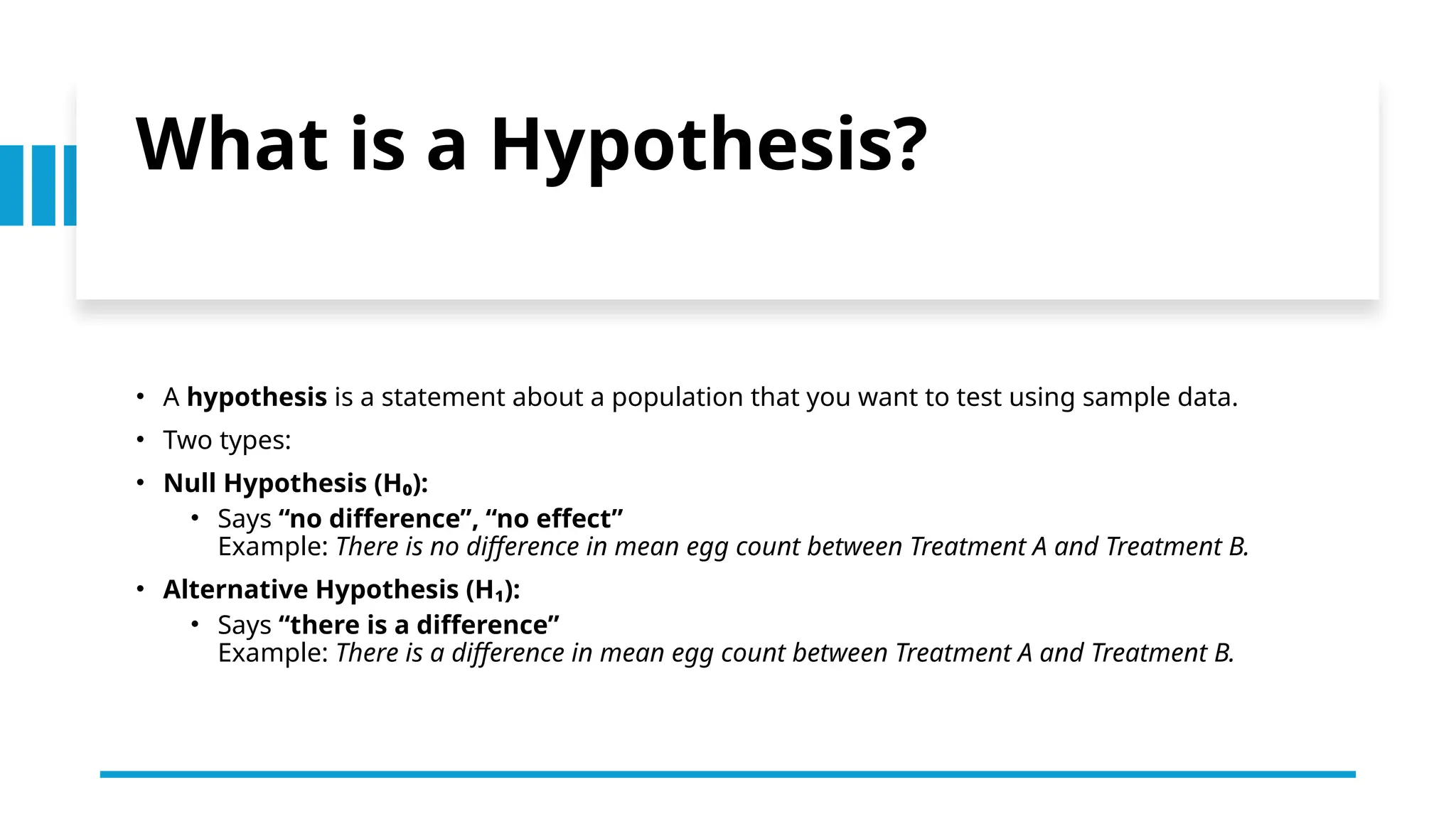
• A hypothesis is a statement about a population that you want to test using sample data.
• Two types:
• Null Hypothesis (H₀):
• Says “no difference”, “no effect”
Example: There is no difference in mean egg count between Treatment A and Treatment B.
• Alternative Hypothesis (H₁):
• Says “there is a difference”
Example: There is a difference in mean egg count between Treatment A and Treatment B.
Steps in Hypothesis Testing
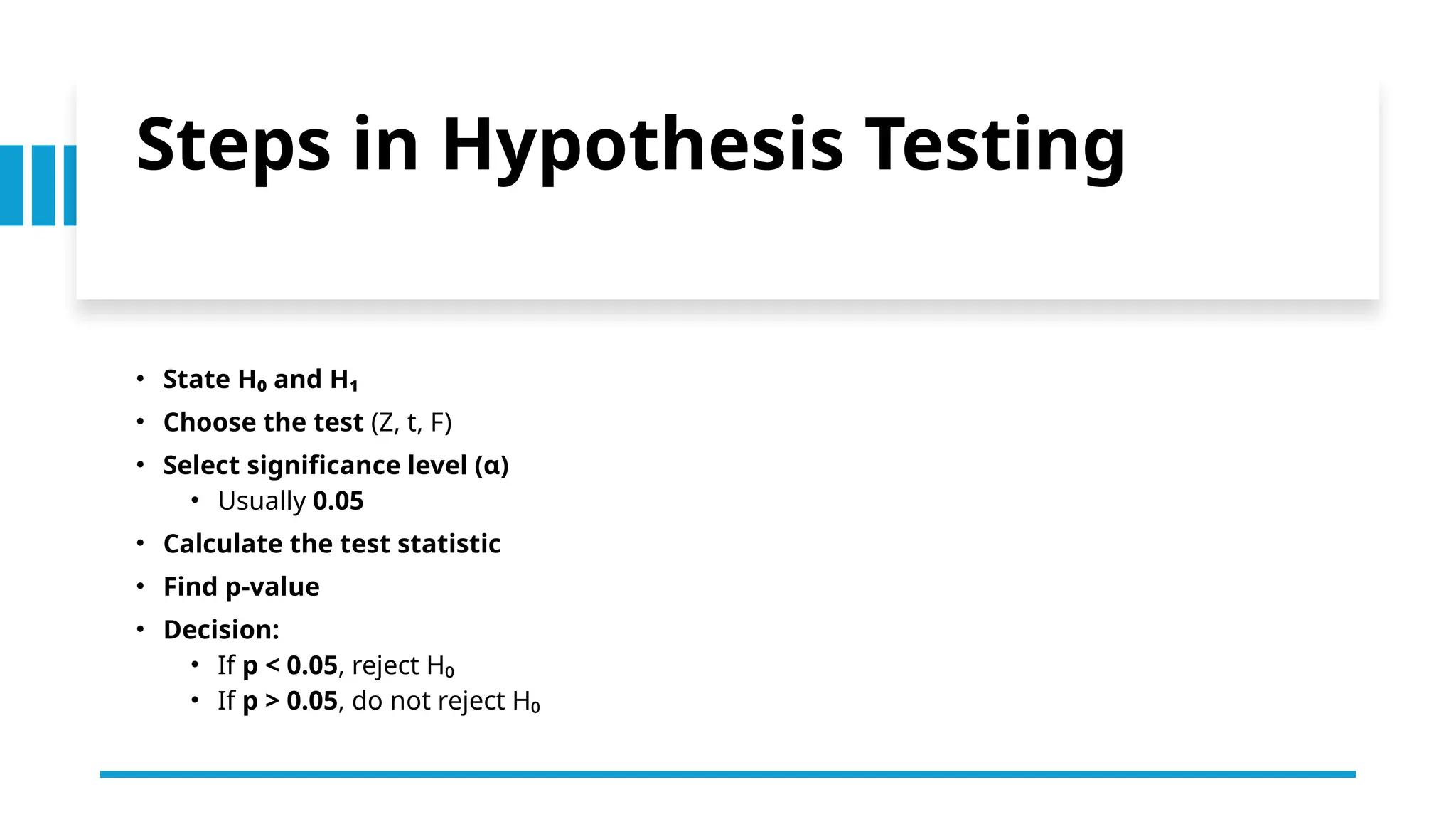
• State H₀ and H₁
• Choose the test (Z, t, F)
• Select significance level (α)
• Usually 0.05
• Calculate the test statistic
• Find p-value
• Decision:
• If p < 0.05, reject H₀
• If p > 0.05, do not reject H₀
When to Use Which Test?
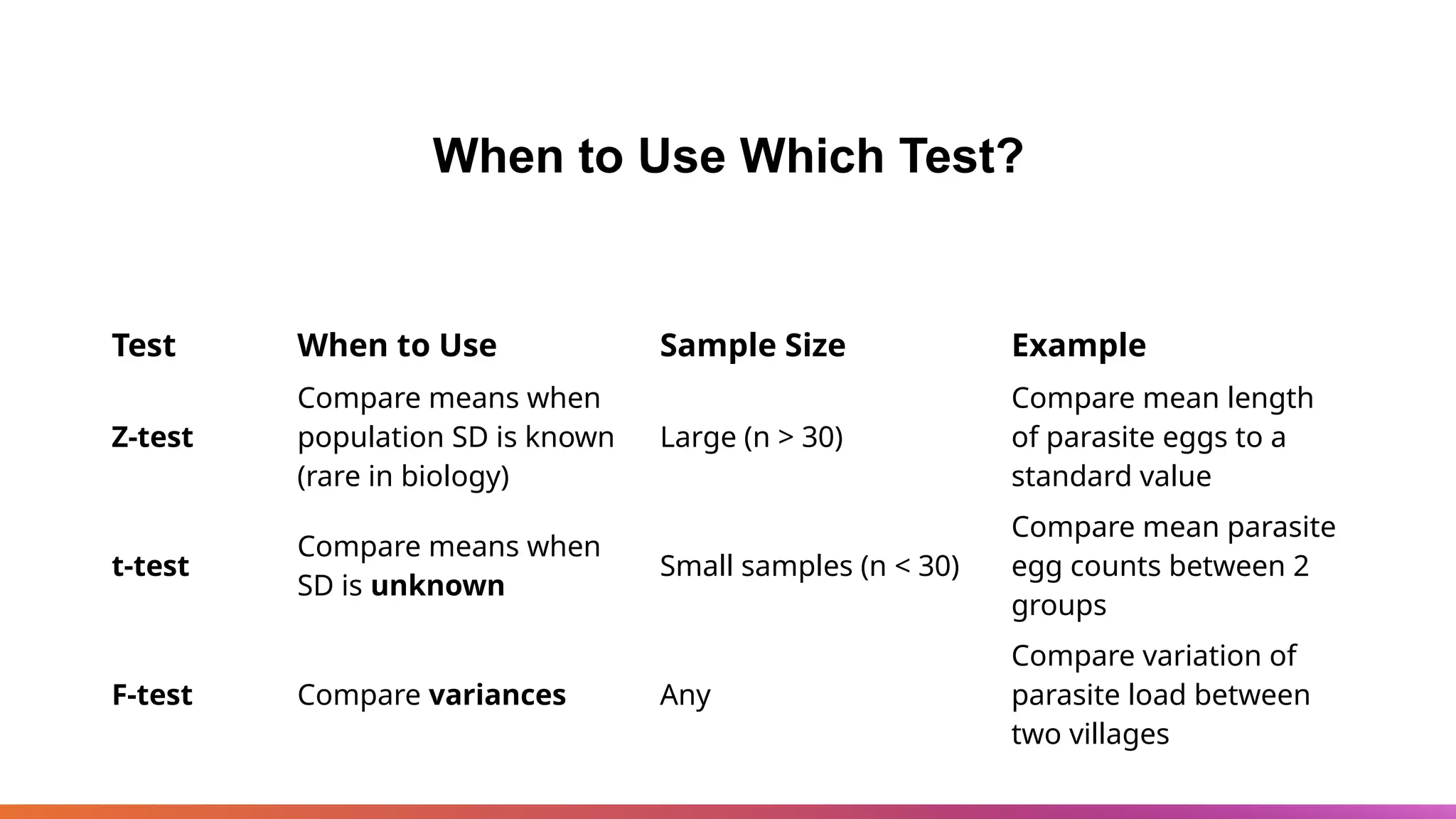
Test When to Use Sample Size Example
Z-test
Compare means when
population SD is known
(rare in biology)
Large (n > 30)
Compare mean length
of parasite eggs to a
standard value
t-test
Compare means when
SD is unknown
Small samples (n < 30)
Compare mean parasite
egg counts between 2
groups
F-test Compare variances Any
Compare variation of
parasite load between
two villages
Z-Test (Simple)
• When used?
• Large sample size
• Population standard deviation (σ) known
(In real biological research, σ is rarely known, so Z-test is less common.)
• Example (Parasitology)
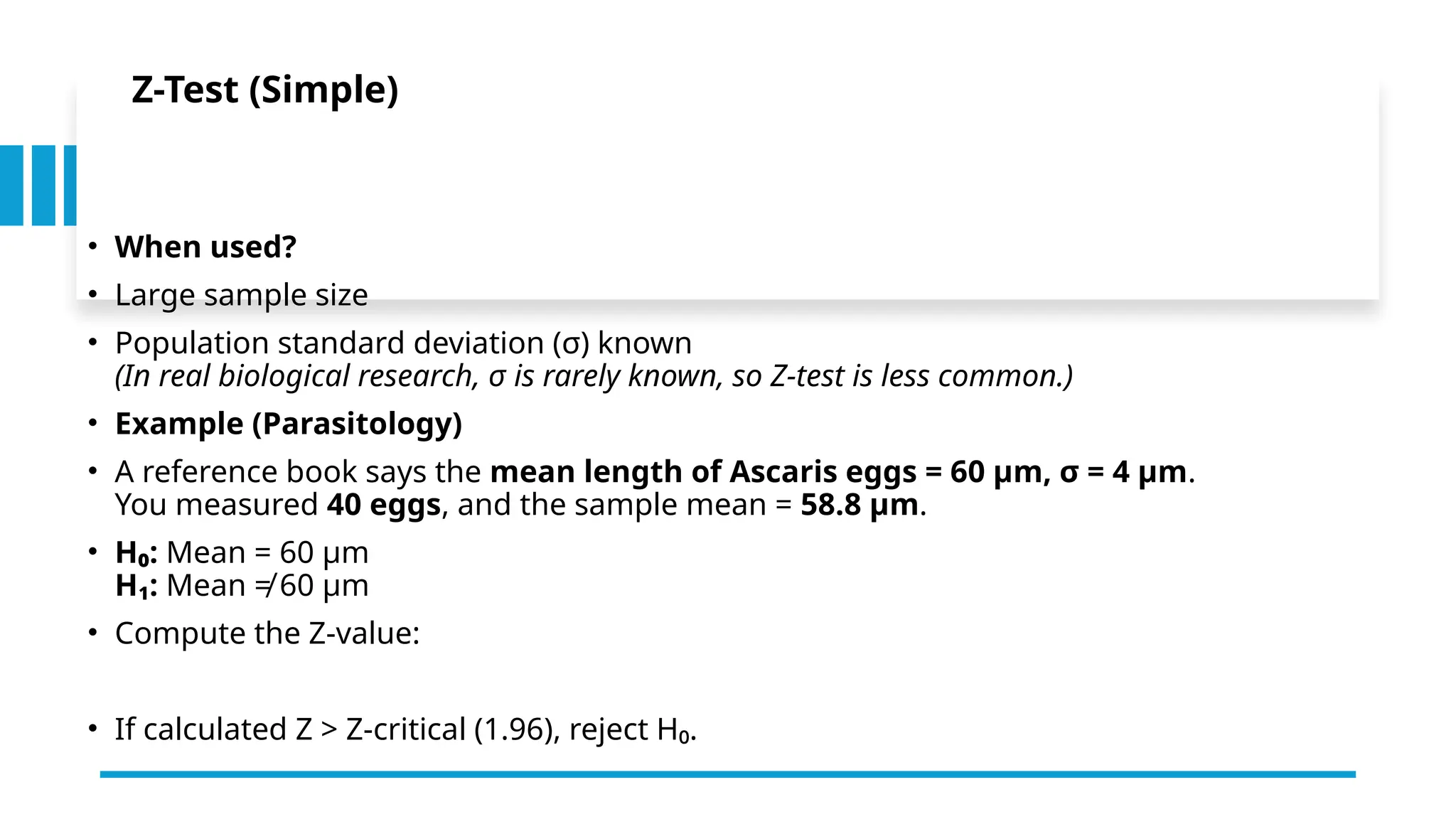
• A reference book says the mean length of Ascaris eggs = 60 µm, σ = 4 µm.
You measured 40 eggs, and the sample mean = 58.8 µm.
• H₀: Mean = 60 µm
H₁: Mean ≠ 60 µm
• Compute the Z-value:
• If calculated Z > Z-critical (1.96), reject H₀.
Student’s t-Test
• This is the most common test in biological science because sample sizes are often small and σ is unknown.
• Types of t-tests
• One-sample t-test – compare sample mean to a known value
• Two-sample t-test (independent) – compare two groups
• Paired t-test – same subjects before/after treatment.
• Example 1: One-Sample t-Test (Parasitology)
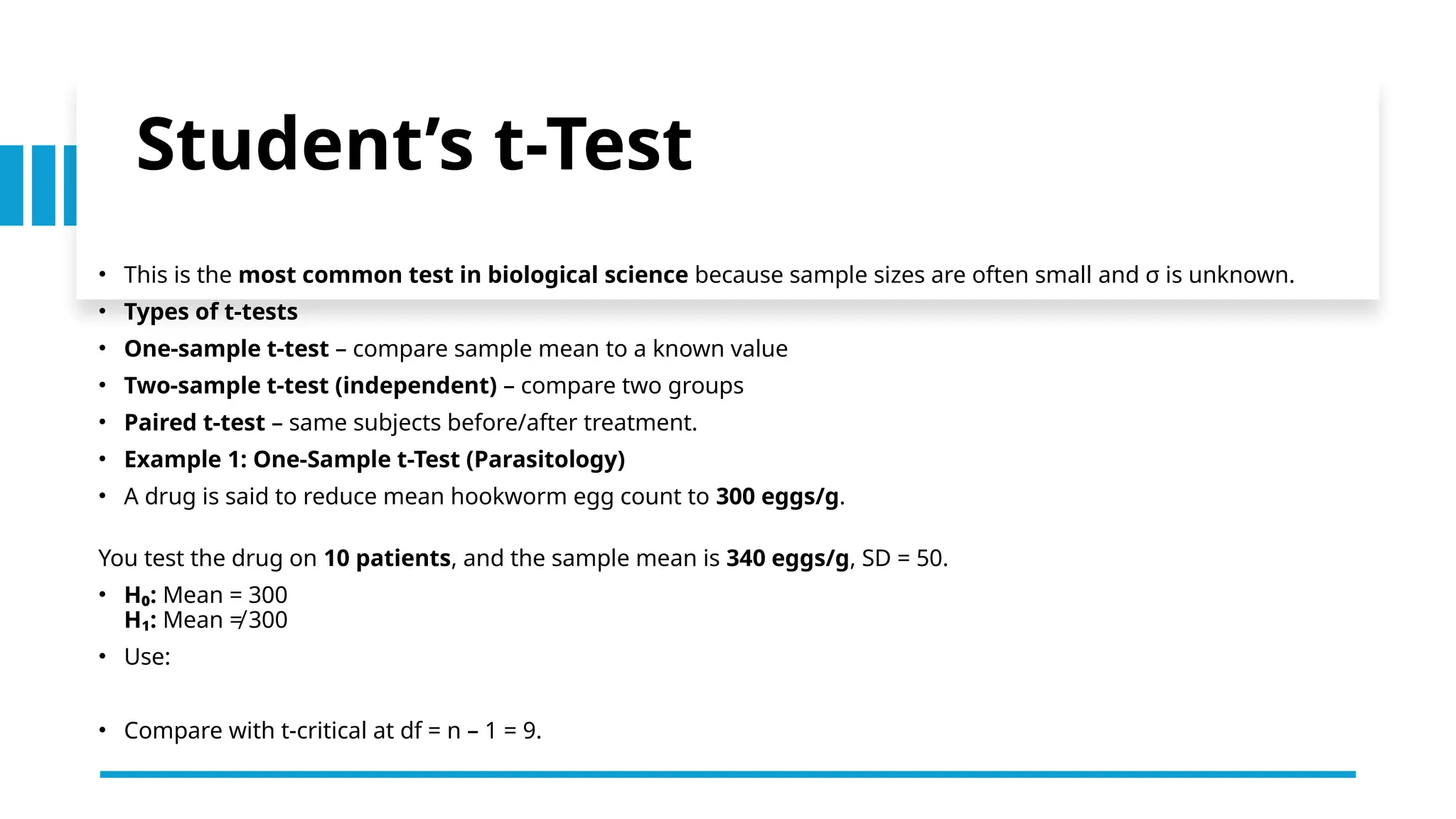
• A drug is said to reduce mean hookworm egg count to 300 eggs/g.
You test the drug on 10 patients, and the sample mean is 340 eggs/g, SD = 50.
• H₀: Mean = 300
H₁: Mean ≠ 300
• Use:
• Compare with t-critical at df = n – 1 = 9.
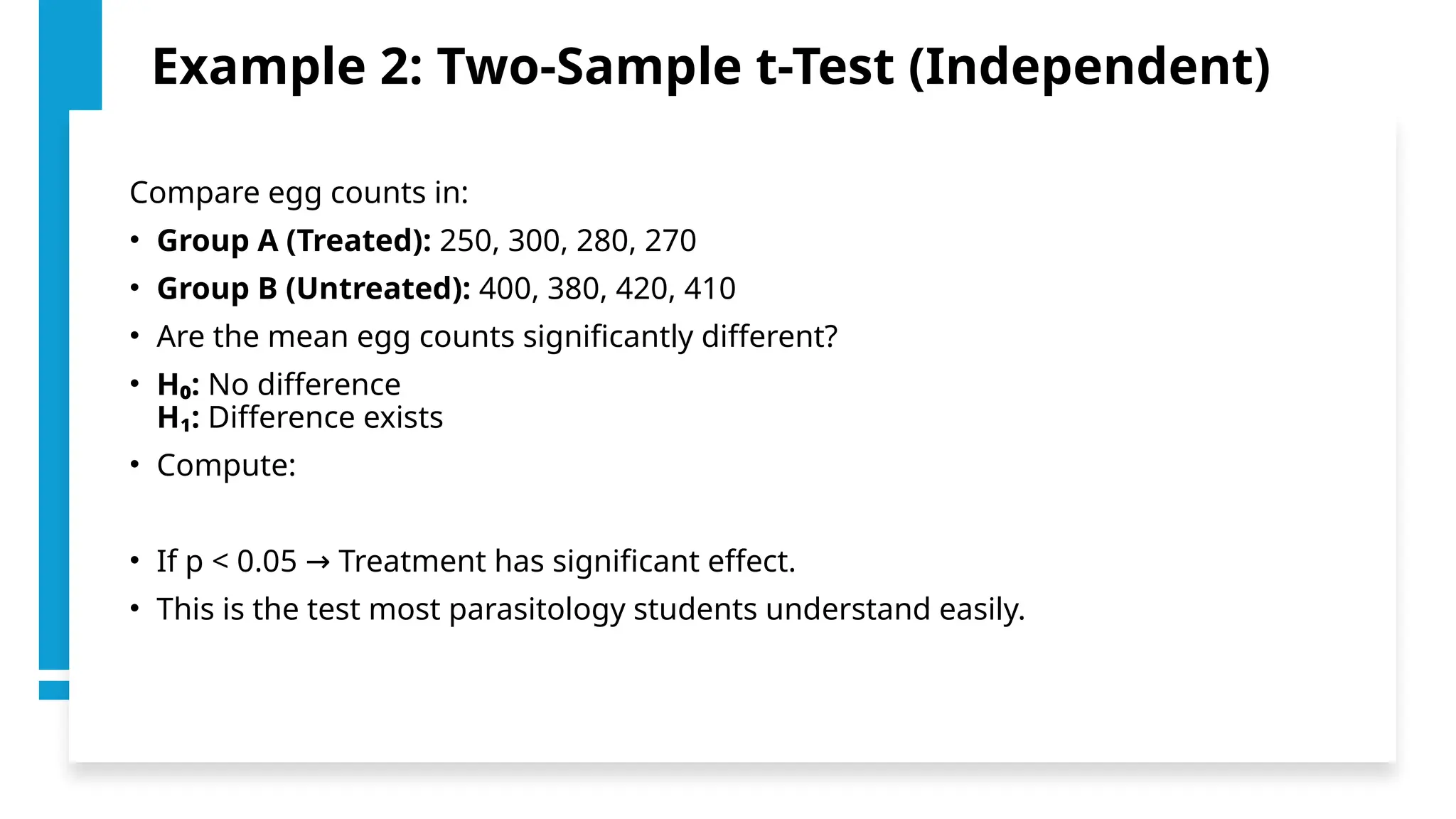
Example 2: Two-Sample t-Test (Independent)
Compare egg counts in:
• Group A (Treated): 250, 300, 280, 270
• Group B (Untreated): 400, 380, 420, 410
• Are the mean egg counts significantly different?
• H₀: No difference
H₁: Difference exists
• Compute:
• If p < 0.05 Treatment has significant effect.
→
• This is the test most parasitology students understand easily.
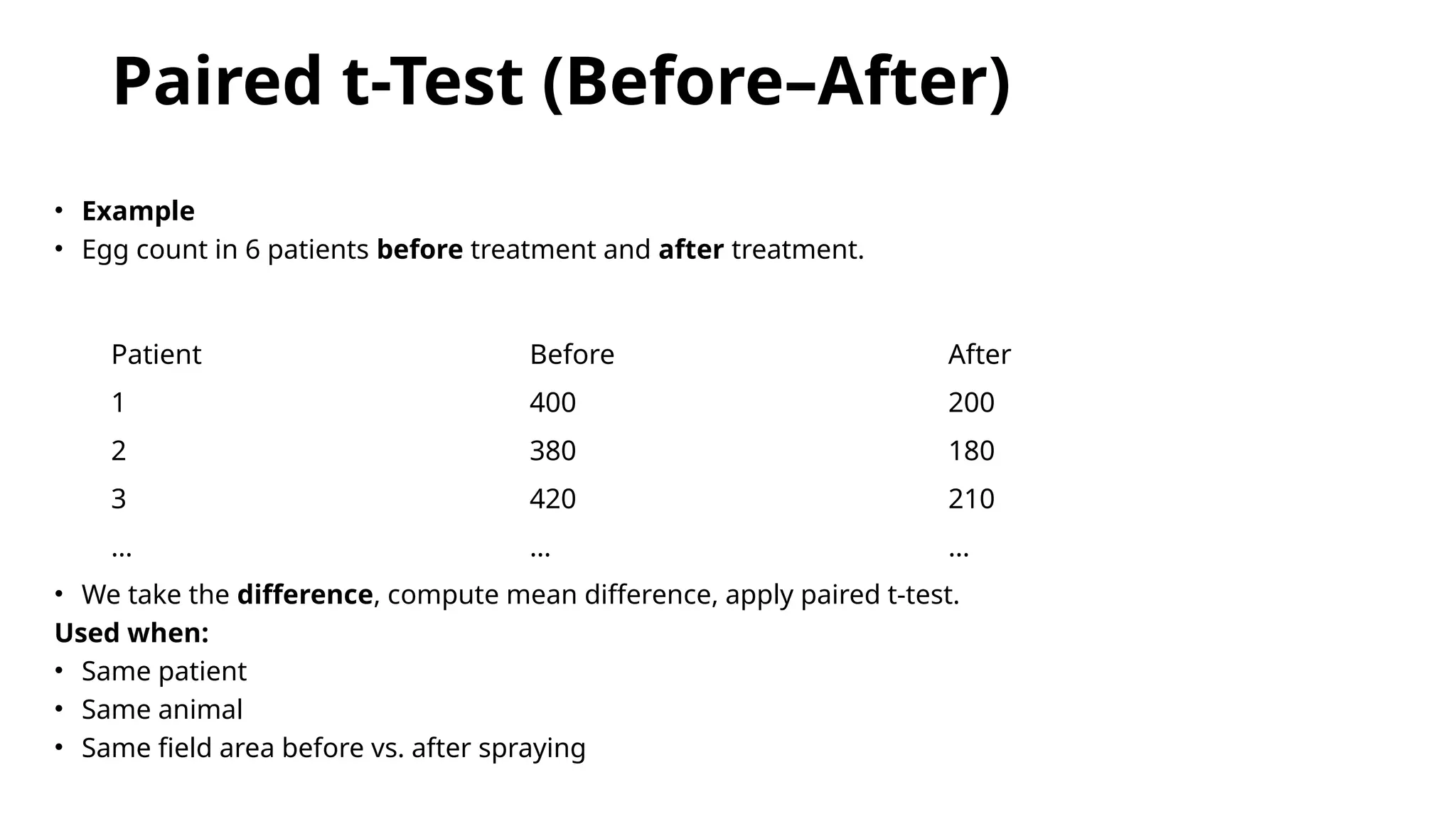
Paired t-Test (Before–After)
• Example
• Egg count in 6 patients before treatment and after treatment.
• We take the difference, compute mean difference, apply paired t-test.
Used when:
• Same patient
• Same animal
• Same field area before vs. after spraying
Patient Before After
1 400 200
2 380 180
3 420 210
… … …
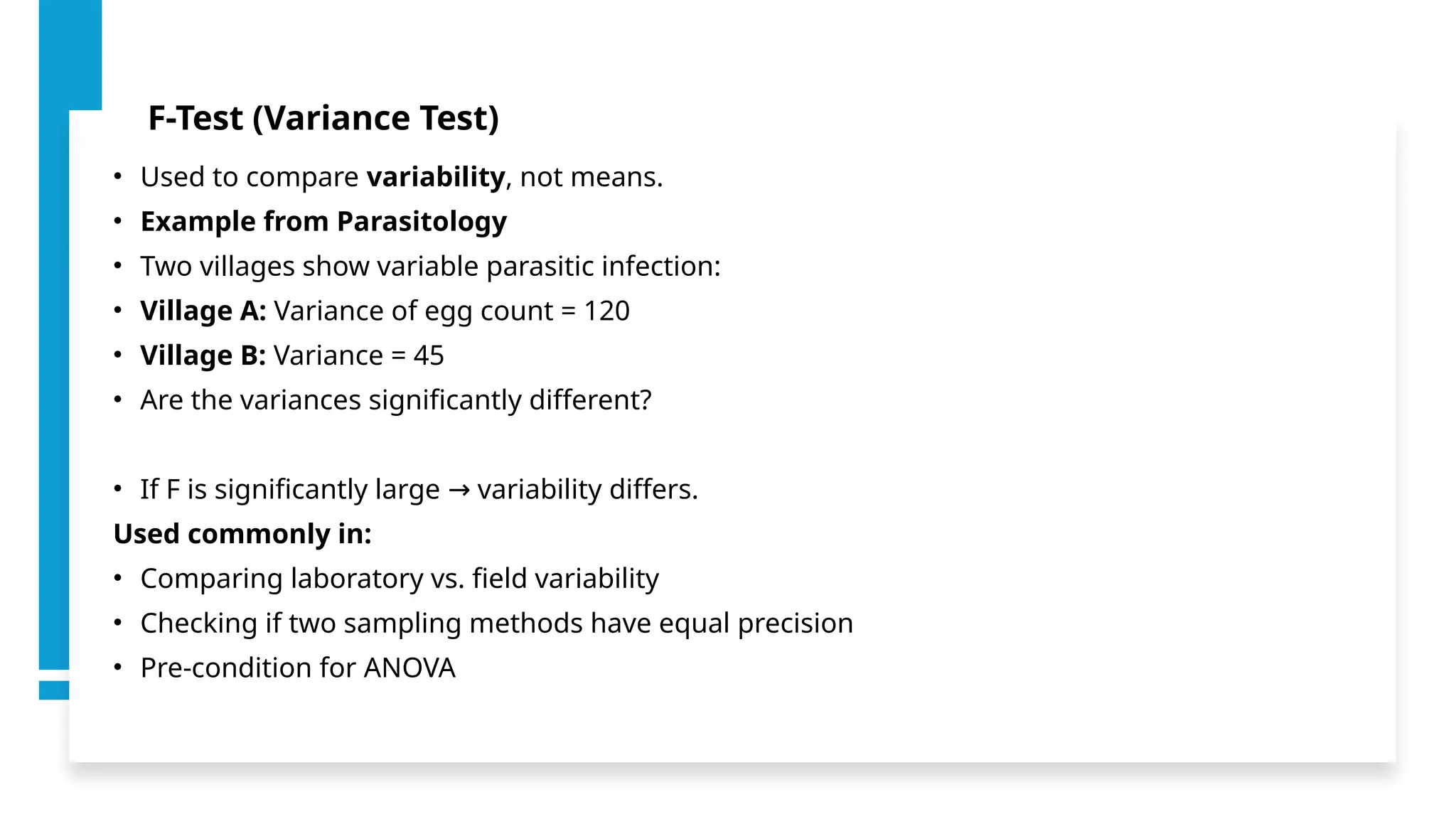
F-Test (Variance Test)
• Used to compare variability, not means.
• Example from Parasitology
• Two villages show variable parasitic infection:
• Village A: Variance of egg count = 120
• Village B: Variance = 45
• Are the variances significantly different?
• If F is significantly large variability differs.
→
Used commonly in:
• Comparing laboratory vs. field variability
• Checking if two sampling methods have equal precision
• Pre-condition for ANOVA
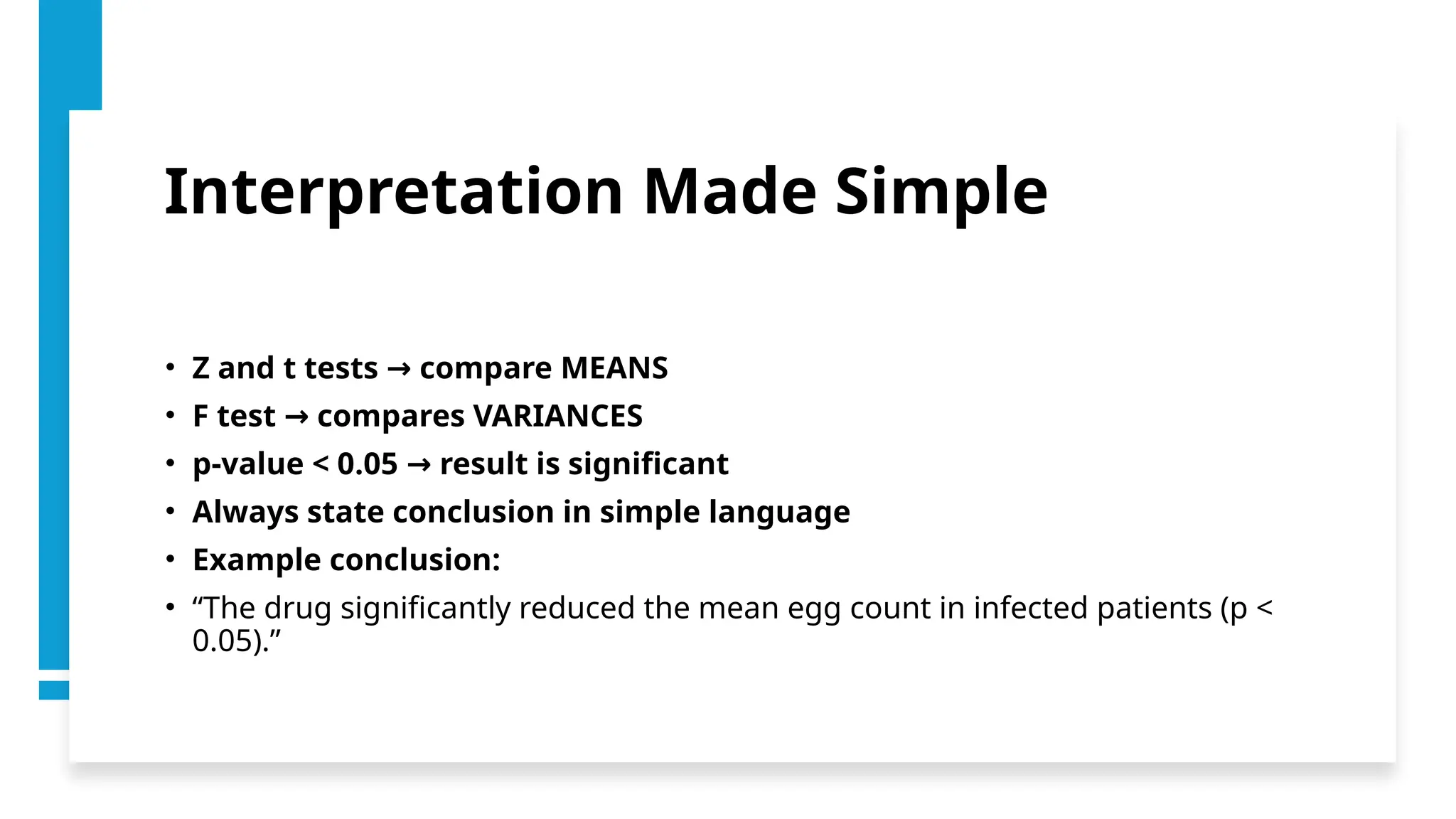
Interpretation Made Simple
• Z and t tests compare MEANS
→
• F test compares VARIANCES
→
• p-value < 0.05 result is significant
→
• Always state conclusion in simple language
• Example conclusion:
• “The drug significantly reduced the mean egg count in infected patients (p <
0.05).”
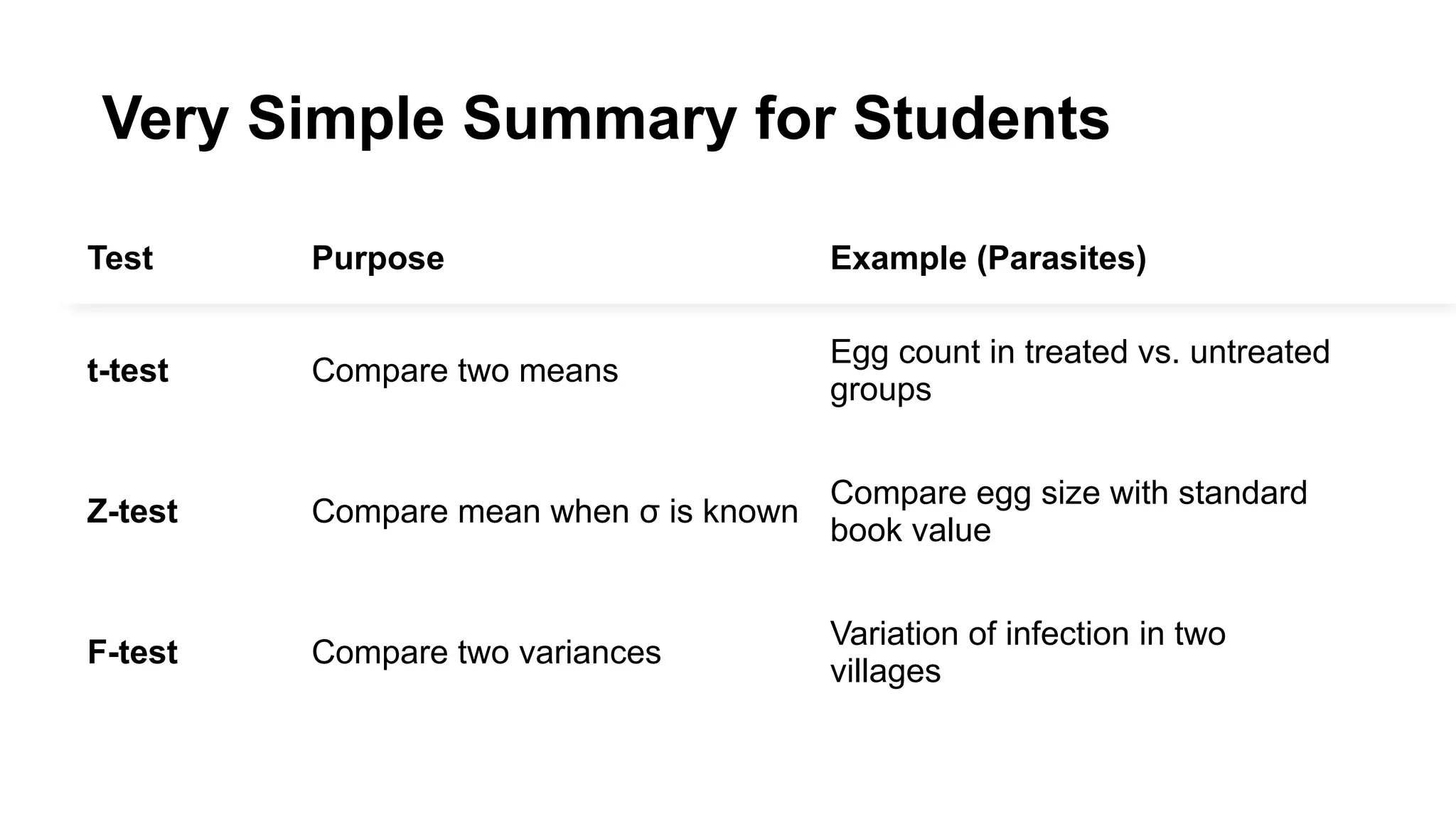
Very Simple Summary for Students
Test Purpose Example (Parasites)
t-test Compare two means
Egg count in treated vs. untreated
groups
Z-test Compare mean when σ is known
Compare egg size with standard
book value
F-test Compare two variances
Variation of infection in two
villages

thanks

Hypothesis testing tests of significance based on T Z and F tests.pptx

  • 1.
    Hypothesis Testing – Testsof Significance (Z, t & F Tests) Dr Showkat Ahmad Wani
  • 2.
    What is aHypothesis? • A hypothesis is a statement about a population that you want to test using sample data. • Two types: • Null Hypothesis (H₀): • Says “no difference”, “no effect” Example: There is no difference in mean egg count between Treatment A and Treatment B. • Alternative Hypothesis (H₁): • Says “there is a difference” Example: There is a difference in mean egg count between Treatment A and Treatment B.
  • 3.
    Steps in HypothesisTesting • State H₀ and H₁ • Choose the test (Z, t, F) • Select significance level (α) • Usually 0.05 • Calculate the test statistic • Find p-value • Decision: • If p < 0.05, reject H₀ • If p > 0.05, do not reject H₀
  • 4.
    When to UseWhich Test? Test When to Use Sample Size Example Z-test Compare means when population SD is known (rare in biology) Large (n > 30) Compare mean length of parasite eggs to a standard value t-test Compare means when SD is unknown Small samples (n < 30) Compare mean parasite egg counts between 2 groups F-test Compare variances Any Compare variation of parasite load between two villages
  • 5.
    Z-Test (Simple) • Whenused? • Large sample size • Population standard deviation (σ) known (In real biological research, σ is rarely known, so Z-test is less common.) • Example (Parasitology) • A reference book says the mean length of Ascaris eggs = 60 µm, σ = 4 µm. You measured 40 eggs, and the sample mean = 58.8 µm. • H₀: Mean = 60 µm H₁: Mean ≠ 60 µm • Compute the Z-value: • If calculated Z > Z-critical (1.96), reject H₀.
  • 6.
    Student’s t-Test • Thisis the most common test in biological science because sample sizes are often small and σ is unknown. • Types of t-tests • One-sample t-test – compare sample mean to a known value • Two-sample t-test (independent) – compare two groups • Paired t-test – same subjects before/after treatment. • Example 1: One-Sample t-Test (Parasitology) • A drug is said to reduce mean hookworm egg count to 300 eggs/g. You test the drug on 10 patients, and the sample mean is 340 eggs/g, SD = 50. • H₀: Mean = 300 H₁: Mean ≠ 300 • Use: • Compare with t-critical at df = n – 1 = 9.
  • 7.
    Example 2: Two-Samplet-Test (Independent) Compare egg counts in: • Group A (Treated): 250, 300, 280, 270 • Group B (Untreated): 400, 380, 420, 410 • Are the mean egg counts significantly different? • H₀: No difference H₁: Difference exists • Compute: • If p < 0.05 Treatment has significant effect. → • This is the test most parasitology students understand easily.
  • 8.
    Paired t-Test (Before–After) •Example • Egg count in 6 patients before treatment and after treatment. • We take the difference, compute mean difference, apply paired t-test. Used when: • Same patient • Same animal • Same field area before vs. after spraying Patient Before After 1 400 200 2 380 180 3 420 210 … … …
  • 9.
    F-Test (Variance Test) •Used to compare variability, not means. • Example from Parasitology • Two villages show variable parasitic infection: • Village A: Variance of egg count = 120 • Village B: Variance = 45 • Are the variances significantly different? • If F is significantly large variability differs. → Used commonly in: • Comparing laboratory vs. field variability • Checking if two sampling methods have equal precision • Pre-condition for ANOVA
  • 10.
    Interpretation Made Simple •Z and t tests compare MEANS → • F test compares VARIANCES → • p-value < 0.05 result is significant → • Always state conclusion in simple language • Example conclusion: • “The drug significantly reduced the mean egg count in infected patients (p < 0.05).”
  • 11.
    Very Simple Summaryfor Students Test Purpose Example (Parasites) t-test Compare two means Egg count in treated vs. untreated groups Z-test Compare mean when σ is known Compare egg size with standard book value F-test Compare two variances Variation of infection in two villages
  • 12.