Compound formation with congruent melting point (Mg Zn) and incongruent melting point (NaCl H2O) system.
1.
PRESENTED BY:- RJAFFRIN RESSICA
ED24B1018
NITPY
DEPARTMENT OF EDUCATION
CHEMISTRY SEMINAR
ED-1106 THERMODYNAMICS EQUILIBRIUM AND SOLUTION
2.
MY TOPIC
Compound formationwith congruent
melting point (Mg-Zn) and incongruent
melting point (NaCl-H2O) system.
3.
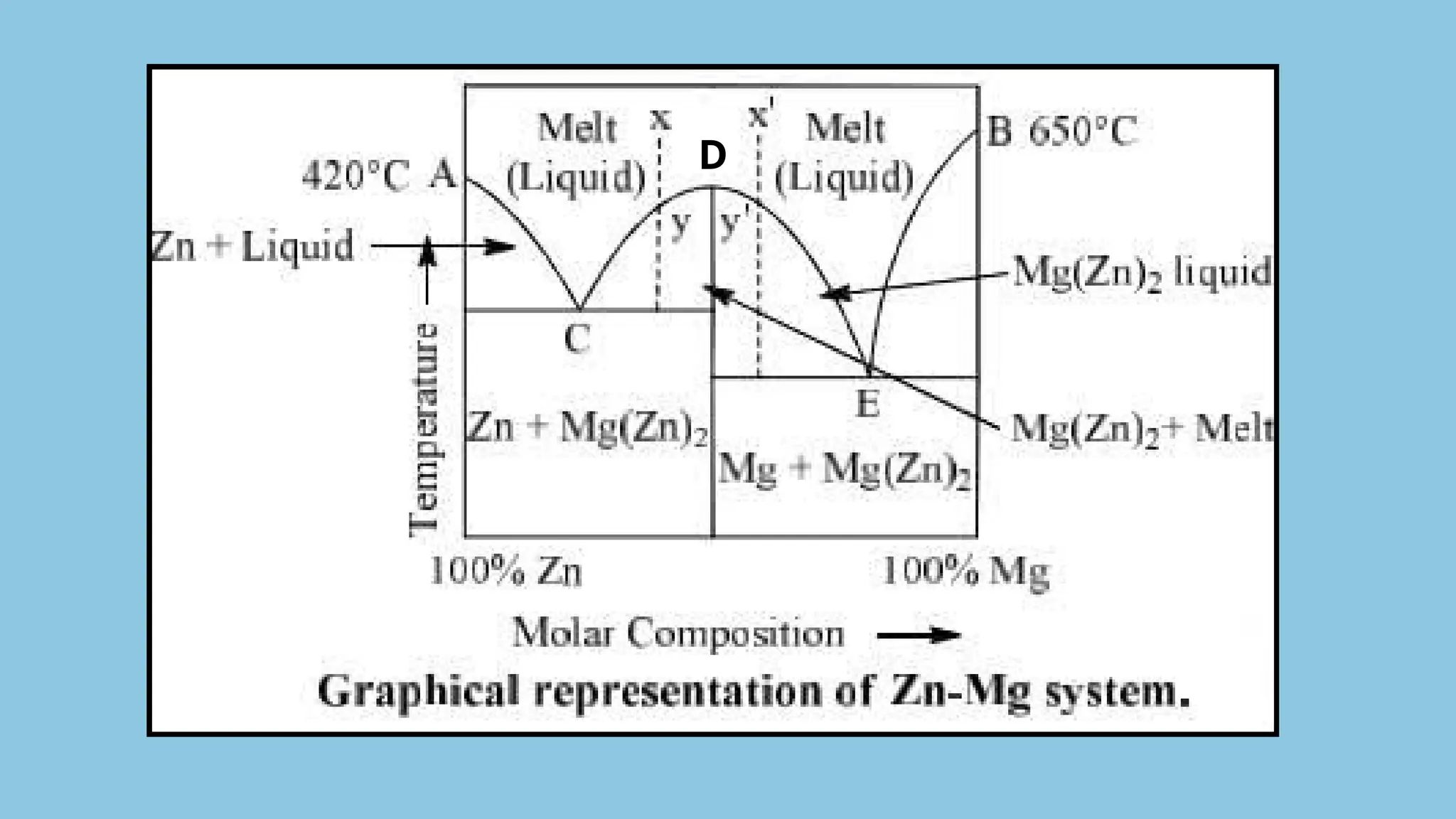
It is anexample of a two component
system in which two metals form a
compound having Mg(Zn)2 having
congruent melting point. Melting point
of pure Zn is 420°C (point A), and that
of pure Mg is 650°C (point B) whereas
m.p. of compound Mg(Zn)2 is 590°C
(point D) which is in between the
melting point of two metals. This
system has four phases i.e. solid Zn,
solid Mg solid compound Mg(Zn)2 and
liquid (L) - atoms of Mg and Zn in same
composition as that of MgZn2.
COMPOUND FORMATION WITH CONGRUENT
MELTING POINT - Mg - Zn SYSTEM.
Point A: It represents the m.p. of pure
Zn (420°C)
Curve AC: When Mg is added to Zn
gradually the m.p. of Zn is lowered
along the curve AC. Along this curve
solid Zn is in equilibrium with melt
(liquid). Thus there two phases along
this curve and on applying the
condensed phase rule F = C – P + 1 = 2 –
2 + 1 = 1 we see that it is a monovariant
system. It means only one variable can
be changed (either temperature or
composition).
4.
Point B: Thisrepresents the melting point of
pure Mg (650°C) .
Curve BE: When Zn is added to Mg
gradually, m.p. of Mg is lowered along the
curve BE. Along the curve BE solid Mg is in
equilibrium with melt (liquid). Again this is
also a monovarient curve having one degree
of freedom.
Curve DC: This curve represents the freezing
point curve of solid Mg(Zn)2 when Zn is
added, the m.p. of compound Mg(Zn)2
lowers along this curve.
Curve DE: This curve represents the
melting point curve of Mg(Zn)2 when Mg
is added in it.
Point D: At this point, the liquid and solid
have the same composition i.e. Mg(Zn)2.
Thus point D is the congruent point and
temperature (590°C) corresponds to this
point is known as congruent melting point
of Mg(Zn)2.
Point C: Two curve AC and DC intersect at
point C. Three phases i.e. solid Zn,
compound Mg(Zn)2 and melt are in
equilibrium at this point. Thus, on
applying phase rule F = C – P + 1 = 2 – 3 +
1 = 0 we see that point C is non variant
and is known as eutectic point.
5.
Point E: Thisis the point where
curves DE and BE intersect. Here also
three phases i.e. solid Mg, compound
Mg(Zn)2 and melt are in equilibrium
at this point. Again it is invariant and
known as eutectic point.
Cooling: When liquid melt is cooled at
point X, it follows the path xy and
Mg(Zn)2 seperates out at y and two
phases i.e. solid Mg(Zn)2 and liquid are
in equilibrium and the degree of
freedom is one. On further cooling
curve follows the path yC and at C,
solid Zn also separates out. Thus there
will be three phases at point C. These
phases are solid Zn, solid Mg(Zn)2 and
melt. Therefore C is monovariant.
FORMATION OF COMPOUNDSWITH INCONGRUENT
MELTING POINT - NaCl-H2O SYSTEM
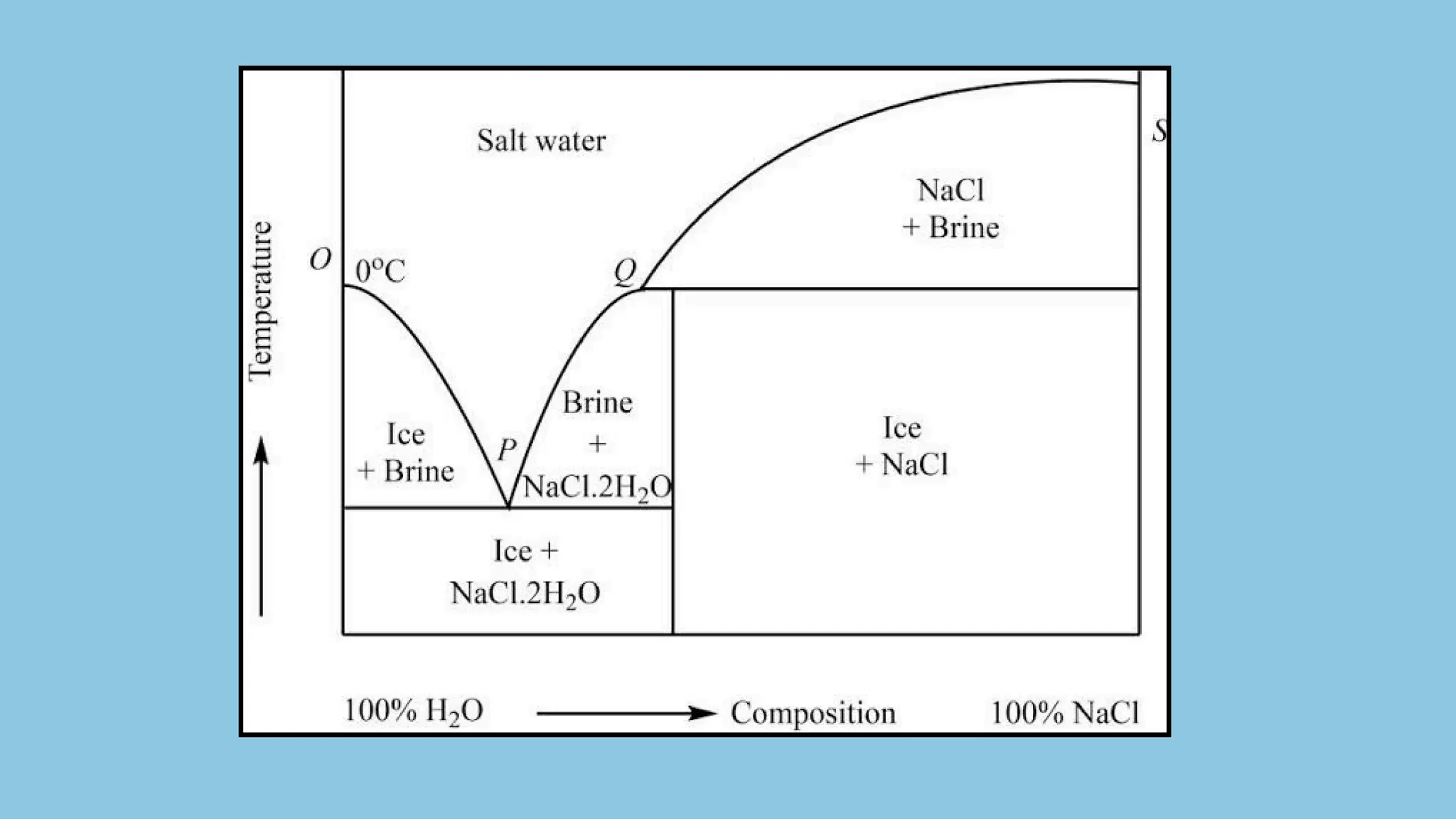
The NaCl-H2O is a typical case of solid-liquid
equilibria in a two-component system that
forms compounds with an incongruent
melting point. The phases involved in this
case are solid NaCl, solid NaCl.2H2O, ice and
liquid mixture.
Point O, S and Q :- The point O and point S
represent the freezing point of pure water
and pure NaCl respectively. The point Q
however is quite strange because it
represents the transition temperature
(incongruent melting point of NaCl.2H2O)
where compound NaCl.2H2O decomposes
into pure NaCl.
8.
When NaCl isadded to pure water, ice
will just start to separate out as solid
along path OP. This will lead to a change
in composition along the line OP. When
point P is attained, the formation of
compound NaCl.2H2O will start, and
since three phases coexist at P ( ice,
NaCl.2H2O and liquid), the reduced
phase rule:-
F' = 2-3+1= 0
Which means that there will be no
degree of freedom at point P( P is non
variant).
Curve OP, SQ and QP:- When NaCl is
added to water, its freezing point
decreases regularly along OP. In other
words, OP is the fusion curve of water
along which the ice is in equilibrium
with the solution. The line SQ is the
fusion curve of pure NaCl along which
solid NaCl is in equilibrium with the
brine solution. Similarly, QP is the
fusion curve of compound NaCl.2H2O
along which solid NaCl.2H2O is in
equilibrium with the solution.
9.
On the otherhand, the curve SQ is the
fusion curve of NaCl. The further cooling
will lead to a change in composition along
the line SQ. When point Q is attained, the
following meritectic reaction will take
place:-
Solid NaCl + Solution ⇌Solid NaCl.2H2O
Therefore the formation of compound NaCl.2H2O
will be started, and since three phases coexist at
this point ( solid NaCl, solid NaCl.2H2O and liquid),
the point Q also becomes invariant.
The transformation of compound NaCl to
compound NaCl.2H2O occurs at constant
temperature and therefore the point Q is called as
peritectic point.
11.
QnA Time
QnA Time
Welcometo
1. In a binary A–B system, a compound AB melts at a temperature at
which the liquid has the same composition as the solid AB. This melting
point is called the:
(a) Eutectic melting point
(b) Congruent melting point
(c) Incongruent melting point
(d) Peritectic melting point
Answer: (b) Congruent melting point
12.
2. In atwo-component system, the compound AB decomposes on heating before it
fully melts and yields a different solid plus a melt. Such a compound has:
(a) A congruent melting point
(b) A peritectic reaction point
(c) A eutectic melting point
(d) An incongruent melting point
Answer: (d) An incongruent melting point
3. Consider the phase diagram of the Magnesium-Zinc system where a compound
MgZn₂ forms and melts at a point where the liquid and solid compositions are
identical. What kind of melting point does MgZn₂ exhibit?
(a) Eutectic
(b) Peritectic
(c) Congruent
(d) Incongruent
Answer: (c) Congruent
13.
4. Which ofthe following statements is true about a compound having an incongruent
melting point?
(a) On heating, it melts completely into a liquid of the same composition.
(b) On heating, it decomposes and gives one new solid phase + liquid of different
composition.
(c) It behaves like a eutectic mixture.
(d) It always forms a solid solution.
Answer: (b) On heating, it decomposes and gives one new solid phase + liquid of different
composition.
5. In the application of the phase rule to a system at the congruent melting point of a
binary compound, the degrees of freedom F = C – P + 1 reduces to 0. Here C = 1 (since
solid and liquid have same composition) and P = 2 (solid and liquid phases) so free
degrees = 0. Which of these conditions corresponds to that scenario?
(a) Two phases in equilibrium, but composition fixed →invariant.
(b) Three phases in equilibrium →invariant.
(c) Two phases in equilibrium with variable composition →univariant.
(d) One phase only →univariant.
Answer: (a) Two phases in equilibrium, but composition fixed →invariant.