DRAFT VERSION JANUARY 13, 2025
Typeset using L
A
TEX preprint2 style in AASTeX631
Discovery of a likely Type II SN at z=3.6 with JWST
D. A. COULTER,1 J. D. R. PIEREL,1, ∗ C. DECOURSEY,2 T. J. MORIYA,3, 4, 5 M. R. SIEBERT,1 B. A. JOSHI,6
M. ENGESSER,1 A. REST,1, 6 E. EGAMI,2 M. SHAHBANDEH,1 W. CHEN,7 O. D. FOX,1 L. G. STROLGER,1
Y. ZENATI,6, 1, † A. J. BUNKER,8 P. A. CARGILE,9 M. CURTI,10 D. J. EISENSTEIN,9 S. GEZARI,1, 6 S. GOMEZ,9
M. GUOLO,6 K. HAINLINE,2 J. JENCSON,11 B. D. JOHNSON,9 M. KARMEN,6 R. MAIOLINO,12, 13, 14
R. M. QUIMBY,15, 16 P. RINALDI,2 B. ROBERTSON,17 S. TACCHELLA,12, 13 F. SUN,9 Q. WANG,18 AND
T. WEVERS1
1
Space Telescope Science Institute, Baltimore, MD 21218, USA
2
Steward Observatory, University of Arizona, 933 N. Cherry Avenue, Tucson, AZ 85721, USA
3
National Astronomical Observatory of Japan, National Institutes of Natural Sciences, 2-21-1 Osawa, Mitaka, Tokyo 181-8588,
Japan
4
Graduate Institute for Advanced Studies, SOKENDAI, 2-21-1 Osawa, Mitaka, Tokyo 181-8588, Japan
5
School of Physics and Astronomy, Monash University, Clayton, VIC 3800, Australia
6
Physics and Astronomy Department, Johns Hopkins University, Baltimore, MD 21218, USA
7
Department of Physics, Oklahoma State University, 145 Physical Sciences Bldg, Stillwater, OK 74078, USA
8
Department of Physics, University of Oxford, Denys Wilkinson Building, Keble Road, Oxford OX1 3RH, UK
9
Center for Astrophysics | Harvard & Smithsonian, 60 Garden St., Cambridge MA 02138 USA
10
European Southern Observatory, Karl-Schwarzschild-Strasse 2, 85748 Garching, Germany
11
IPAC, Mail Code 100-22, Caltech, 1200 E. California Boulevard, Pasadena, CA 91125, USA
12
Kavli Institute for Cosmology, University of Cambridge, Madingley Road, Cambridge CB3 0HA, UK
13
Cavendish Laboratory, University of Cambridge, 19 JJ Thomson Avenue, Cambridge, CB3 0HE, UK
14
Department of Physics and Astronomy, University College London, Gower Street, London WC1E 6BT, UK
15
Department of Astronomy/Mount Laguna Observatory, San Diego State University, 5500 Campanile Drive, San Diego, CA
92812-1221, USA
16
Kavli Institute for the Physics and Mathematics of the Universe (WPI), The University of Tokyo Institutes for Advanced Study,
The University of Tokyo, Kashiwa, Chiba 277-8583, Japan
17
Department of Astronomy and Astrophysics, University of California, Santa Cruz, 1156 High Street, Santa Cruz CA 96054,
USA
18
Department of Physics and Kavli Institute for Astrophysics and Space Research, Massachusetts Institute of Technology, 77
Massachusetts Avenue, Cambridge, MA 02139, USA
ABSTRACT
Transient astronomy in the early, high-redshift (z > 3) Universe is an unexplored regime
that offers the possibility of probing the first stars and the Epoch of Reionization. During
Cycles 1 and 2 of the James Webb Space Telescope (JWST), the JWST Advanced Deep Ex-
tragalactic Survey (JADES) program enabled one of the first searches for transients in deep
images (∼30 AB mag) over a relatively wide area (25 arcmin2
). One transient, AT 2023adsv,
was discovered with an F200W magnitude of 28.04 AB mag, and subsequent JWST observa-
tions revealed that the transient is a likely supernova (SN) in a host with zspec = 3.613±0.001,
Corresponding author: D. A. Coulter
dcoulter@stsci.edu
arXiv:2501.05513v1
[astro-ph.HE]
9
Jan
2025
2
a host mass of log(M∗/M⊙) = 8.41+0.12
−0.12, and an inferred metallicity at the position of the SN
of Z∗ = 0.3 ± 0.1 Z⊙. At this redshift, the first detections in F115W and F150W show that
AT 2023adsv had bright rest-frame ultraviolet flux at the time of discovery. The multi-band
light curve of AT 2023adsv is best matched by a template of an SN IIP, with a peak absolute
magnitude of −18.3 AB mag in the rest-frame B-band. We model AT 2023adsv’s light curve
and find a good match to a 20M⊙ red supergiant progenitor star with an explosion energy of
2.0 × 1051
ergs, likely higher than normally observed in the local Universe, but consistent
with SNe IIP drawn from local, lower metallicity environments. AT 2023adsv is the most
distant photometrically classified SN IIP yet discovered with a spectroscopic redshift mea-
surement, and may represent a global shift in SNe IIP properties as a function of redshift.
This discovery, and the ones sure to follow, demonstrate the continued need for facilities like
JWST to build a statistical sample of core-collapse SNe to understand the evolution of their
properties, and to constrain the poorly understood relationship between progenitor metallicity
and massive star evolution.
Keywords: supernovae: individual (AT 2023adsv); SN II - infrared: supernovae - stars: mas-
sive - galaxies: abundances
1. INTRODUCTION
Core-collapse supernovae (CCSNe) are the ex-
plosive deaths of massive stars with initial masses
> 8 M⊙ and are remarkably diverse in their proper-
ties (Oppenheimer & Snyder 1939; Kobulnicky &
Skillman 1997; Vanbeveren et al. 1998; Heger et al.
2003; Smartt 2009; Dessart & Hillier 2020; Bur-
rows & Vartanyan 2021). This diversity is driven
by the broad range of their progenitor masses,
which sensitively affect their evolution, setting the
initial conditions for both their stellar structure and
circumstellar environments prior to collapse and
resulting in a similarly broad range of explosion
energies, ejecta compositions and observed lumi-
nosities (Smith 2014; Gal-Yam et al. 2014; Wu &
Fuller 2021). These explosions connect to astro-
physical phenomena across many scales — due to
their high mass, the progenitors of CC SNe have
short lifetimes and therefore trace the instanta-
neous star formation rate (SFR) of their locales;
their rates constrain the high-mass end of the Initial
Mass Function (IMF); their explosions deposit en-
∗
NASA Einstein Fellow
†
ISEF International Fellowship
ergy and momentum into the interstellar medium
(ISM) providing a feedback mechanism to moder-
ate star formation; they enrich the ISM with metals
and are factories for cosmic dust; and they produce
ionizing photons that contribute to the reionization
of the Universe.
CC SNe, and in particular SNe II, are in princi-
ple luminous enough to be observed at cosmolog-
ical distances, making them intriguing probes of
the early Universe. However, their peak emission
in optical bands is shifted into the infrared (IR) at
high-redshift. In the last two decades, work based
on the Hubble Space Telescope (HST) has pushed
the study of CCSNe rates and properties to further
distances (Botticella et al. 2008; Bazin et al. 2009;
Graur et al. 2011; Melinder et al. 2012; Dahlen
et al. 2012), culminating with observations from
the Cosmic Assembly Near-infrared Deep Extra-
galactic Legacy Survey (CANDELS; Grogin et al.
2011; Koekemoer et al. 2011) and Cluster Lens-
ing And Supernova survey with Hubble (CLASH;
Postman et al. 2012), which constrained the CCSN
rate out to z ≈ 2.5 (Strolger et al. 2015).
CC SNe discovered at even greater distances
(z > 2.5) will peak in at wavelengths of 2 µm
3
and beyond, placing more distant samples out
of reach for HST but not of the James Webb
Space Telescope (JWST). Indeed, JWST is al-
ready removing this barrier to discovering distant
and observer-frame IR bright CC SNe due to its
combination of wavelength coverage and sensitiv-
ity, opening a new frontier in transient astronomy
with the discovery of several high-z SNe since its
launch (Chen et al. 2022; Engesser et al. 2022a,b;
DeCoursey et al. 2023a,b,c, 2024; Pierel et al.
2024a,b,c,d; Siebert et al. 2024). Such discoveries
are vital laboratories to test topics such as whether
the CC SN rate follows the cosmic SFR density or
if the high-mass end of the IMF flattens with red-
shift in low metallicity stellar populations (Larson
1998; Ziegler et al. 2022).
While metallicity could very plausibly impact
the rate of CC SNe, it also impacts their massive
stellar progenitors and, therefore, their explosive
properties. In particular, the metallicity of the pro-
genitors to SNe II affects not only their mass loss
(Vink et al. 2001; Mokiem et al. 2007), but their
internal structure and convective efficiency (Heger
et al. 2003; Dessart et al. 2013), leading to a range
of pre-explosion envelope masses, stellar radii,
and the presence of circumstellar material (CSM).
These, in turn, yield a diversity of observed SN II
properties, such as their resulting colors, peak lu-
minosities, and for SNe IIP, their plateau durations
(Sanyal et al. 2017; Dessart et al. 2013). In gen-
eral, lower metallicities should lead to lower mass
loss rates for SN II progenitors, yielding more mas-
sive progenitors (barring interactions with binary
companions; Lamers & Cassinelli 1999; Kudritzki
& Puls 2000), and the reduction in stellar enve-
lope opacity should result in stars with smaller
stellar radii (Sanyal et al. 2017). These effects
may combine to produce progenitors with sub-
stantially higher rotation rates (Woosley & Heger
2006; Maeder & Meynet 2012) and potentially
connect lower metallicity environments at high-z
with a diverse menagerie of exotic SN types in-
cluding pair-instability SNe (PISNe; Kasen et al.
2011; Woosley 2017), superluminous supernovae
(SLSNe; Quimby et al. 2011; Gal-Yam 2019), and
the supernovae associated with long gamma-ray
bursts (LGRB; Zeh et al. 2004; Fruchter et al.
2006; Modjaz et al. 2014). However, these asser-
tions need to be tested through the discovery of
many more CC SNe in the early Universe.
Fortunately, this is a task to which JWST is par-
ticularly well-suited. The JWST Advanced Deep
Extragalactic Survey (JADES) program (Eisen-
stein et al. 2023) observed ∼ 25 arcmin2
of
the sky to depths of mAB ⪆ 30 in 9 NIR-
Cam filters in two separate epochs, the first be-
tween September 29 and October 5, 2022, and
the second between September 28 and October
3, 2023. These repeated observations allowed
for these images to be subtracted to discover new
transients beyond the redshift limitations of HST,
with a sensitivity for CCSNe to z > 4. Us-
ing this ∼ 1 year baseline dozens of new tran-
sient objects were discovered (DeCoursey et al.
2024, hereafter D24), and here we present a can-
didate for one of the most distant SN II discov-
ered to date: AT 2023adsv, a very blue and likely
sub-solar metallicity SN IIP-like transient located
at R.A.=3h32m39.4574s decl.=−27d50m19.6660s
(although see Cooke et al. (2012) and Gomez et al.
(2024) for previous high-z SLSNe candidates).
AT 2023adsv is embedded in its host, JADES-
GS+53.16439-27.83877, with a spectroscopically
confirmed redshift of zspec =3.613 ± 0.001.
In what follows, we describe the identification
and analysis of AT 2023adsv, as well as a brief
comparison to other SNe IIP in the local universe.
This paper is structured as follows: in §2, we
present a summary of the observations for this su-
pernova, our reduction of the data, and obtain-
ing AT 2023adsv’s host redshift; in §3 we de-
scribe our classification of AT 2023adsv as a likely
SN II and present the properties of its host and
model AT 2023adsv’s light curve, in §4 we dis-
cuss AT 2023adsv in the context of a sample of
local SNe IIP, and in §5 we conclude with a dis-
4
cussion on the prospects for building an SNe IIP
sample at high redshift and its use as a metallicity
probe of the Universe, as well as the implications
of the new frontier enabled by JWST. Throughout
this paper, we assume a standard ΛCDM cosmol-
ogy with H0 = 70km s−1
Mpc−1
, Ωm = 0.315.
2. SUMMARY OF OBSERVATIONS
AT 2023adsv was discovered as a part of a tran-
sient search for the JADES program (Eisenstein
et al. 2023), centered on the Great Observatories
Origins Deep Survey’s south field (GOODS-S; Gi-
avalisco et al. 2004). A full description of JADES,
including its survey design, data products, the se-
lection process for discovering new transients, and
the follow-up observations of those subsequent
discoveries through its approved DDT program,
are described and presented in detail in D24.
To summarize, the first JADES observations
were acquired between September 29th, 2022 and
October 5th, 2022, in the NIRCam filters F090W,
F115W, F150W, F200W, F277W, F335M, F356W,
F410M, and F444W to a 5σ depth of mAB ∼ 30.
Nearly a year later, a second set of observations
in the same filters and to the same depths were
taken between September 29th, 2023 and Octo-
ber 3rd, 2023, resulting in an overlapping foot-
print of ∼ 25 arcmin2
(both observations under
PID 1180). During this second epoch, several ob-
servations failed, and subsets of the field were ob-
served on November 15th, 2023, and January 1st,
2024. Upon the identification of many interesting
transients in color, redshift, and luminosity space
(see D24 for a complete accounting), a JWST Di-
rector’s Discretionary Time (DDT) program was
approved to follow up the most interesting tran-
sients in this field (Egami et al. 2023). These
subsequent observations were obtained on Novem-
ber 28th, 2023 (NIRCam filters F115W, F150W,
F200W, F277W, F356W, and F444W) and on Jan-
uary 1st, 2024 (NIRCam filters F150W, F200W,
F277W, F356W, and F444W; PID 6541) with the
latter epoch including NIRSpec multi-object spec-
troscopy (MOS) coverage using the micro-shutter
assembly (MSA; Ferruit et al. 2022). NIRSpec
covered the most promising ∼ 10 transients (as
well as a variety of galaxy spectra) using the
MSA with the Prism (R∼ 100) grating, of which
AT 2023adsv was one, as well as two others that
are described in a pair of companion papers (Pierel
et al. 2024c; Siebert et al. 2024). Below, we de-
scribe the data reduction and photometric measure-
ments we derive for AT 2023adsv.
2.1. Measuring Photometry
AT 2023adsv is embedded in a relatively com-
pact host and therefore obtaining accurate photo-
metric measurements requires removing the under-
lying host light from the SN position. We achieve
this through the process of “difference imaging,”
or subtracting a template image (preferably with
no SN light in it) from a series of science im-
ages containing the SN flux we wish to measure.
For every science epoch, we align each of the un-
derlying JWST Level 2 (CAL) images to a cat-
alog of JADES galaxies (that has in turn been
aligned to Gaia sources), using the JWST/HST
Alignment Tool (JHAT; Rest et al. 2023)1
. CAL
images are those that have been bias-subtracted,
dark-subtracted, and flat-fielded but not yet cor-
rected for geometric distortion. We drizzle these
CAL files into Level 3 (I2D) files using the JWST
pipeline (Bushouse et al. 2022). The extra JHAT
step improves the relative alignment by an order of
magnitude between the epochs (from ∼ 1 pixel to
∼ 0.1 pixel), allowing for subtractions with fewer
artifacts between the template and science images.
To perform the subtraction, we use the High Or-
der Transform of PSF and Template Subtraction
(HOTPANTS; Becker 2015)2
code (with additional
improvements implemented in photpipe; Rest
et al. 2005), resulting in the difference images upon
which we perform our photometry (see Figure 1;
the right three columns are the difference images
1
https://jhat.readthedocs.io
2
https://github.com/acbecker/hotpants
5
Figure 1. (Left column) Full color images using F115W+F150W (Blue) F200W+F277W (Green) and
F356W+F444W (Red), with the 2022 JADES epoch on top and 2023 (including AT 2023adsv) on the bottom. (Col-
umn 2-4) Difference images were created from the two JADES epochs (2023 − 2022), with the AT 2023adsv position
marked with a red indicator. All images are drizzled to 0.03′′/pix and have the same spatial extent.
[per filter] generated from subtracting the “tem-
plate” [top, leftmost epoch] from the “science” im-
age [bottom, leftmost image]).
We measure the photometry in the difference
images with a process described in Pierel et al.
(2024b,d), using the space_phot3
Level 3
point-spread function (PSF) fitting routine cen-
tered on a 5 × 5 pixel cutout at AT 2023adsv’s po-
sition. space_phot models the Level 3 PSF by
drizzling the Level 2 PSF models from webbpsf4
,
which account for the spatial and temporal de-
pendence of the JWST PSF and corrects for the
losses in flux incurred by imposing a finite aper-
ture. The resulting fluxes, measured in units of
MJy/sr, are converted to AB magnitudes using the
native pixel scale of each image (0.03′′
/pix for
short- and 0.06′′
/pix for long-wavelength), and the
final, measured photometry is given in Table 1.
3
space-phot.readthedocs.io
4
https://webbpsf.readthedocs.io
2.2. NIRSpec Reduction
We obtained the Stage 2 spectroscopic data col-
lected from the DDT program from the Mikul-
ski Archive for Space Telescopes (MAST; see Ta-
ble 2). With the context file jwst_1185.pmap,
we used the JWST pipeline (Bushouse et al. 2022)
to generate the two-dimensional (2D) spectrum
and applied a correction for slit-losses based on the
position of the SN within the MSA shutters (Figure
2, a and b). Next, we performed an optimal point
source extraction using the algorithm from Horne
(1986, implemented as a Jupyter notebook as part
of the NIRSpec IFU Optimal Point Source Extrac-
tion guide5
) to extract the superimposed spectra of
the SN and its host. For an SN II, we expect Hα
to be the brightest feature during the photospheric
phase, and in our last epoch (when the spectrum
was obtained, see Table 1) AT 2023adsv’s flux in
5
https://spacetelescope.github.io/jdat_notebooks/notebooks/
ifu_optimal/ifu_optimal.html
6
53◦
090
5400
5300
5200
5100
5000
−27
◦
50
0
18
00
19
00
20
00
21
00
R.A. (J2000)
Dec.
(J2000)
0.5 kpc
2023010
z = 3.60
R - F200W
G - F150W
B - F090W
(a)
1 2 3 4 5
λ (obs.) [µm]
−0.5
0.0
0.5
y
[arcsec]
1
shutter
(b)
0.00
0.05
0.10
F
λ
[10
-19
erg
s
-1
cm
-2
Å
-1
] 1500 3500 5500 7500 9500 11500
λ (rest) [Å]
[O
ii]
Hδ
Hγ
Hβ
[O
iii]
Na
i
Hα
TiO
Ca
ii
Paδ
Paγ
(c)
-10 0 10
S/N
prism
Figure 2. a: The MSA slitlet position over AT 2023adsv. b: The 2D NIRSpec Prism spectrum of AT 2023adsv and
JADES-GS+53.16439-27.83877. c: The 1D-extracted NIRSpec spectrum for AT 2023adsv transformed into the rest-
frame, with host emission lines color-coded and labeled. A spectroscopic redshift of z =3.613 ± 0.001 was measured
based on the host’s [O III] and Hα lines. No SN features are readily apparent in the resulting 1D spectrum.
Table 1. Observations for AT 2023adsv discussed in
Section 2.
PID MJD Instrument Filter/Grating mAB
1180 60216 NIRCam F115W 30.04±0.12
1180 60216 NIRCam F150W 28.83±0.06
1180 60217 NIRCam F200W 28.07±0.04
1180 60216 NIRCam F277W 27.94±0.04
1180 60217 NIRCam F356W 27.99±0.05
1180 60216 NIRCam F444W 28.14±0.06
1180 60276 NIRCam F115W >29.8
1180 60276 NIRCam F150W >29.5
1180 60276 NIRCam F200W 28.49±0.13
1180 60276 NIRCam F277W 28.17±0.12
1180 60276 NIRCam F356W 28.03±0.11
1180 60276 NIRCam F444W 28.25±0.21
6541 60310 NIRCam F150W >30.1
6541 60310 NIRCam F200W 29.05±0.15
6541 60310 NIRCam F277W 28.51±0.16
6541 60310 NIRCam F356W 28.13±0.14
6541 60310 NIRCam F444W 28.64±0.30
6541 60310 NIRSpec Prism –
NOTE—Columns are: JWST Program ID, Modified
Julian date, JWST instrument, NIRCam filter, and
photometry plus final uncertainty for AT 2023adsv.
Upper limits are 5σ.
Table 2. AT 2023adsv NIRSpec Observation Details
Instrument NIRSpec
Mode MOS
Wavelength Range 0.6 − 5.3µm
Slit 3 Shutter (0.46′′ × 0.2′′ each)
Grating/Filter Prism/CLEAR
R = λ/∆λ ∼ 30 − 300
Readout Pattern NRSIRS2
Groups per Integration 19
Integrations per Exposure 2
Exposures/Nods 3
Total Exposure Time 22,175s
F277W (near 3 µm) is ∼ 14 nJy while the flux in
the spectrum is ∼ 50 nJy at the same wavelength.
With nearly 3/4 of the flux contaminated with host
light, even if a decomposition were possible, the
SN spectrum is likely to have a signal-to-noise of
∼ 3 per pixel according to the JWST exposure time
calculator6
. For these reasons, we use the Prism
spectrum primarily to measure AT 2023adsv’s red-
shift (Figure 2, c), and the oxygen line ratios to
estimate the host’s metallicity (see Section 3.2).
6
https://jwst-docs.stsci.edu/jwst-exposure-time-calculator-overview
7
2.3. Host Galaxy Redshift
AT 2023adsv was discovered in the host galaxy
JADES-GS+53.16439-27.83877, and the first step
in analyzing AT 2023adsv is to determine its host
redshift by identifying prominent emission lines
seen in Figure 2. These lines are best-matched by
[O III] and Hα, which have rest-frame wavelengths
of ∼ 5008.24 Å and ∼ 6564.61 Å in vacuum, re-
spectively, and provide a robust spectroscopic red-
shift of zspec =3.613±0.001. We use this value for
all analyses going forward, and present a detailed
analysis of these host properties in Section 3.2.
3. ANALYSIS
3.1. SN Light Curve Matching
We fit the measured photometry from Table 1
with the SALT3-NIR SN Ia light curve model
(Pierel et al. 2022) and all existing CC SN light
curve evolution models with rest-frame UV to
near-IR (to observer-frame ∼ 4 µm) wave-
length coverage (Pierel et al. 2018, and references
therein). These models are empirical spectral tem-
plates created from extremely well-observed, low-
z CC SNe and represent a wide range of diversity
in each sub-type. In general, these spectral en-
ergy distributions (SEDs) are used to fit against our
measured photometry, however, none of the tem-
plates extend to the rest-frame wavelengths cov-
ered by the F115W filter (∼ 2500 Å), so it is ex-
cluded in the fitting (but see Section 3.3). We in-
clude Galactic dust based on the maps of Schlafly
& Finkbeiner (2011) and the reddening law from
Fitzpatrick (1999), which corresponds to E(B −
V ) = 0.01 mag with RV = 3.1. We also allow for
host galaxy dust (up to E(B − V ) = 1.5 mag with
1 < RV < 5) of rest-frame, host-galaxy dust in
the CC SN light curve fits and a SALT3-NIR color
parameter range of −1 < c < 1.
Figure 3 shows the best fit models for each SN
sub-type in all filters. The resulting χ2
per de-
gree of freedom (ν, or reduced-χ2
) for each model
is shown in Table 3. The SN Ia and SN Ib/c sub-
types are heavily disfavored (best fit χ2
/ν = 16.63
Table 3. Comparison of the best-fit model χ2 statistic
for each SN sub-type.
SN Type Mode/Template χ2/ν
Ia SALT3-NIR 16.63
Ib/c SDSS004012 6.76
II SN 2006kv 1.10
NOTE—Columns are: SN type, spectral
model/template used, and the light curve fitting χ2 per
degree of freedom (DOF; ν) without model
uncertainties, as they do not exist for CC SN models.
and 6.76, respectively) compared to SN II (χ2
/ν =
1.10). We take the results of this light curve fitting
process as conclusive and give AT 2023adsv a clas-
sification of Type II as a result. The best fit SED
to our photometry is that of SN 2006kv, a normal
SN IIP discovered at z = 0.0620 (D’Andrea et al.
2010). We note, however, that the UV coverage
of SN 2006kv’s spectral template did not extend
to cover AT 2023adsv’s F115W detection (at z =
3.61, F115W ∼ 2500 Å; see Figure 3), and there-
fore is omitted from the fitting. This blue emission
could plausibly be due to a more exotic explosion
with similarities to a SN II, a possibility that we ex-
plore in Section 3.3. While the fit to SN 2006kv is
quite good (see Table 3), AT 2023adsv’s luminos-
ity required a modeled peak B-band absolute mag-
nitude of −18.3 ± 0.1 mag, ∼ 0.5 mag brighter
relative to the real SN 2006kv; while this is still
within the range of normal SN IIP absolute magni-
tudes observed in the local Universe (∼ 3σ above
the distribution mean (Richardson et al. 2014)), it
is also in agreement with the suggestion from Scott
et al. (2019) that low metallicity SN II could be up
to ∼ 0.5 mag brighter than SN II at high metallic-
ity.
3.2. Host Galaxy Properties
At a redshift of z = 3.61, the host of
AT 2023adsv opens a window into the environ-
ment of a SN when the Universe was < 2 Gyr old.
8
27.5
28.0
28.5
29.0
29.5
30.0
F115W F150W F200W
0 80 160 240
27.5
28.0
28.5
29.0
29.5
F277W
0 80 160 240
F356W
0 80 160 240
F444W
0.0 0.2 0.4 0.6 0.8 1.0
MJD 60142.4 (Observer-Frame Days)
0.0
0.2
0.4
0.6
0.8
1.0
AB
Magnitude 0.0 0.2 0.4 0.6 0.8 1.0
Phase (Rest-Frame Days)
0 20 40 60 0 20 40 60 0 20 40 60
0 20 40 60 0 20 40 60 0 20 40 60
Observed
Type II
Type Ib/c
Type Ia
Figure 3. The photometry measured in Section 2.1 is shown as black circles with errors, with (2σ) upper-limits
denoted by triangles. The best fit SN II (red solid line), SN Ib/c (green dashed line), and SN Ia (blue dotted line)
models are shown for comparison. The SN II model shown is the SN 2006kv template discussed in Section 3.1. The
uncertainties shown are purely statistical.
Table 4. Prospector Derived Host Properties
Parameter Value
log(Age [t∗/yr]) 8.55+0.15
−0.17
log(Stellar mass formed [M∗/M⊙]) 8.41+0.12
−0.12
log(SFR/[M⊙yr−1]) 0.31+0.08
−0.06
Gas-Phase Metallicity [Z⊙] * 0.3 ± 0.1
log(O/H) + 12 † 8.1 ± 0.2
Av [mag] 0.15+0.11
−0.07
∗We derive a gas-phase metallicity using the oxy-
gen line ratio diagnostic O3O2 from Curti et al.
(2020); see Section 3.2 for a detailed discussion.
†We convert between gas-phase metallicity ex-
pressed in solar units to units of log(O/H) + 12
following the relation in Asplund et al. (2009).
However, because there are no clear SN features
in the spectrum for AT 2023adsv, yet we know
that SN light must be contaminating the spec-
trum, any fit of the star formation history (SFH)
of JADES-GS+53.16439-27.83877 will be biased
by this unaccounted for SN light – with the added
light leading to systematically higher masses, and
the SN color altering the inferred stellar proper-
ties. To address this, we perform a fit to the
pre-SN photometry for the host galaxy to explore
the SFH. We fit the JADES photometry for the
source measured from the Hubble Space Telescope
(HST) Advanced Camera for Surveys (ACS) in fil-
ters F435W, F606W, F775W, F814W, and F850LP
along with JWST/NIRCam in the filters F090W,
F115W, F150W, F182M, F200W, F210M, F277W,
F335M, F356W, F410M, and F444W. For the fit,
9
Figure 4. Host template photometry fit using Prospector. The blue circles represent the observed JADES
pre-SN photometry, and the dark grey shaded line represents the 50th percentile of the final Prospector fit to the
photometry, with a lighter grey color showing the 16th and 84th percentiles on the fit. The grey boxes are the estimated
Prospector photometry corresponding to the fit. We provide the derived Prospector host galaxy parameters in
Table 4.
we use the tool Prospector7
(Johnson et al.
2021) and follow the method outlined in Helton et
al. (in preparation). Briefly, within Prospector
we employ the Flexible Stellar Population Synthe-
sis (FSPS) code (Conroy et al. 2009; Conroy &
Gunn 2010), and we sampled the posterior dis-
tributions of the stellar population properties us-
ing the dynamic nested sampling code dynesty8
(Speagle 2020). We utilize a Chabrier initial mass
function (IMF) with a lower bound of 0.08 M⊙ and
an upper bound of 120 M⊙. Additionally, we as-
sume a delayed-τ star-forming history of the form
SFR ∼ tage × e−tage/τ
, where SFR is the star for-
mation rate, tage is the age of the galaxy, and τ is
the e-folding time. For the fit, we fix the redshift
to z = 3.61, and allow the stellar- and gas-phase
metallicity to vary uniformly between log(Z/Z⊙)
7
https://prospect.readthedocs.io/en/stable/
8
https://dynesty.readthedocs.io/en/stable/
= −3.0 − 0.0. We plot the Prospector fit cor-
responding to the 50th percentile on the posterior,
along with the fit photometry, in Figure 4.
From these fits we estimate a host mass
of log10(M∗/M⊙) = 8.41+0.12
−0.12, host age
log10(t∗/yr) = 8.55+0.15
−0.17, and host extinction
Av = 0.15+0.11
−0.07 mag. These and additional host
properties are summarized in Table 4.
Because there are no clear SN features in the
spectrum for AT 2023adsv, we rely on the metallic-
ity inferred from the host to estimate the metallicity
of the SN. However, while we use Prospector
to infer host properties like mass, we do not use it
to infer the host metallicity because the host SED
modeling can be unreliable due to the strong de-
generacy between metallicity and stellar age (Dot-
ter et al. 2017). To infer the host metallicity, we
instead turn to spectral fitting of the forbidden oxy-
gen lines present in the spectrum (see Figure 2).
In the photospheric phase, we do not expect much
SN contamination in [O II] and [O III], and use
10
the ratio of [O III] to [O II] (i.e., the O3O2 di-
agnostic from Curti et al. (2020)) to estimate the
metallicity at the position of the SN. We find that
O3O2 = 3.0+3.2
−1.1, and assuming a solar metallicity
of log(O/H) + 12 = 8.69 (Asplund et al. 2009),
we find a host oxygen abundance of log(O/H) +
12 = 8.1 ± 0.2, or Z∗ ≈ 0.3 Z⊙. We note
that Prospector finds a gas-phase metallicity of
log(O/H)+12 = 7.1±0.1, or Z∗ ≈ 0.02 Z⊙, ∼ an
order of magnitude lower. This is a substantial dis-
crepancy, however, we adopt the derivation from
the oxygen ratio due to the aforementioned issues
when using the integrated fit from Prospector.
For the remainder of the paper, we adopt a gas-
phase metallicity of log(O/H) + 12 = 8.1 ± 0.2.
This metallicity is notably lower than the mean
derived oxygen metallicity found for a collection
of SNe II (dominated by IIP) by Anderson et al.
(2010) of log(O/H) + 12 = 8.580 ± 0.027.
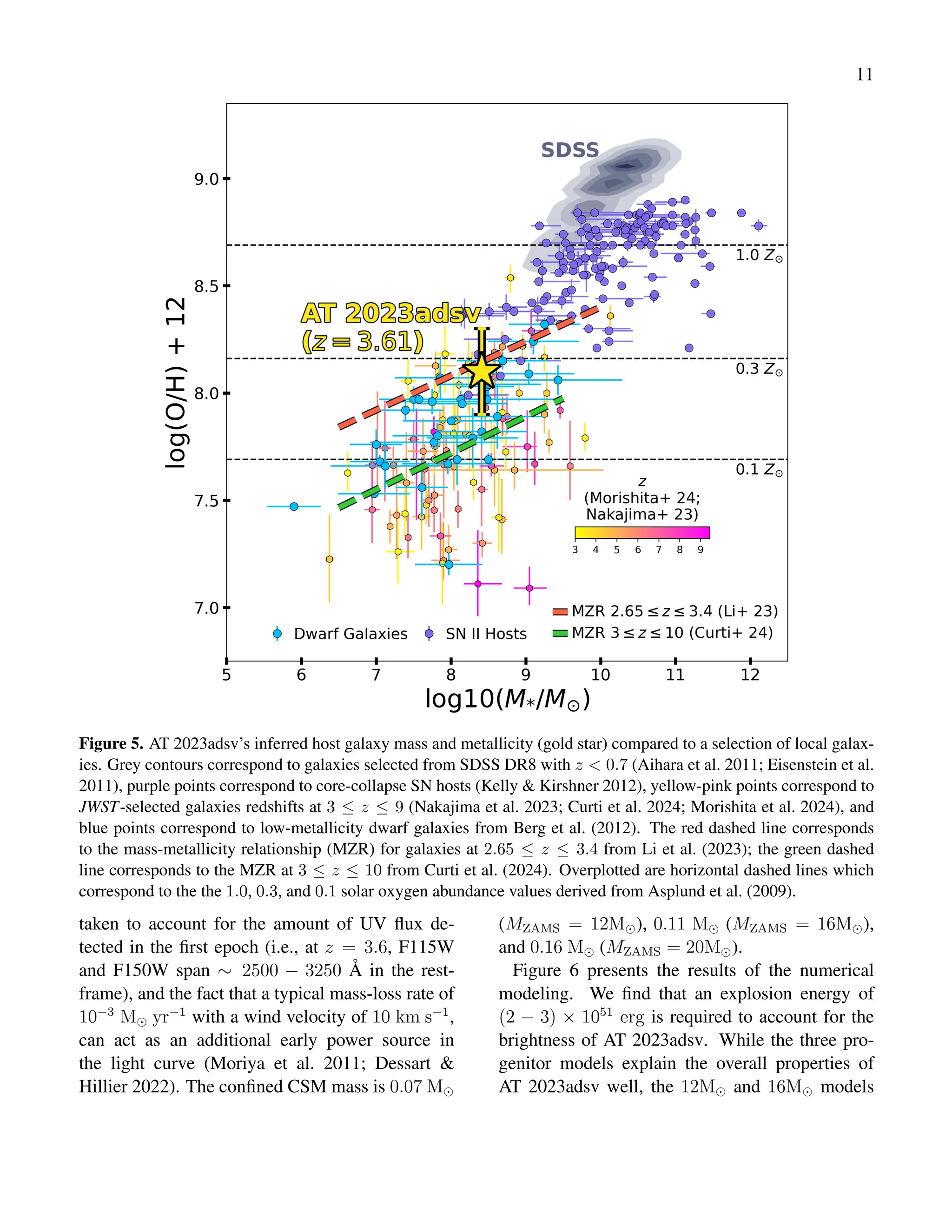
We place this galaxy in a wider context of SNe II
hosts in Figure 5. We compare the mass and metal-
licity of the host of AT 2023adsv with a population
of z < 0.7 galaxies from SDSS DR8 (grey con-
tours; Aihara et al. 2011; Eisenstein et al. 2011),
galaxies from JWST with redshifts 3 ≤ z ≤ 9
(yellow-pink points; Nakajima et al. 2023; Mor-
ishita et al. 2024; Curti et al. 2024), core-collapse
SN hosts (purple points; Kelly & Kirshner 2012),
and low-metallicity dwarf galaxies (blue points;
Berg et al. 2012). Metallicities for both the SN
hosts and SDSS sample were derived following
the PP04 O3N2 calibration from Pettini & Pagel
(2004), while metallicities for both the JWST-
selected, high-z sample and dwarf sample were de-
rived using the direct electron-temperature method
(Campbell et al. 1986). Over-plotted are hori-
zontal dashed lines corresponding to the the 1.0,
0.3, and 0.1 solar oxygen abundance values con-
verted from Asplund et al. (2009), as well as the
mass-metallicity relationship (MZR) for galaxies
at 2.65 ≥ z ≥ 3.4 from Li et al. (2023, red dashed
line), and the MZR at 3 ≥ z ≥ 10 from Curti et al.
(2024, green dashed line). These MZR scalings
are supported by recent work with JWST (Schaerer
et al. 2022; Taylor et al. 2022; Katz et al. 2023;
Rhoads et al. 2023), tracing this relation to even
further distances with measurements of two galax-
ies at z ≈ 8, and has confirmed that at fixed stellar
mass, galaxies are generally less enriched at higher
redshift (Langeroodi et al. 2023). We find that the
metallicity of the host of AT 2023adsv is consis-
tent with the MZR from Li et al. (2023) as well as
with the lower-metallicity tail of the core-collapse
distribution.
3.3. Light curve Modeling
In order to estimate the explosion properties of
AT 2023adsv, we compare synthetic light curves
with those of AT 2023adsv. For this purpose, we
first obtained red supergiant (RSG) SN progenitor
models with 0.3 Z⊙ (in agreement with the inferred
metallicity measured for its host; see Section 3.2)
by using Modules for Experiments in
Stellar Astrophysics (MESA) version
r23.05.1 (Paxton et al. 2011, 2013, 2015, 2018,
2019; Jermyn et al. 2023). We selected a grid
of models with zero-age main-sequence (ZAMS)
masses (MZAMS) of 12, 16, and 20 M⊙. The details
of the assumptions in the stellar evolution calcu-
lations are presented by the accompanying paper
(Moriya et al., in preparation). The final progenitor
properties are summarized in Table 5.
The RSG progenitor models are then transferred
to the one-dimensional multi-frequency radiation
hydrodynamics code STELLA (Blinnikov et al.
1998, 2000, 2006). STELLA numerically evalu-
ates the SED evolution of SNe, and thus we can
directly estimate light curves in the observer frame
from the theoretical SED evolution when they ap-
pear at z = 3.6. We refer to the accompany-
ing paper for the details on the light curve calcu-
lations (Moriya et al., in preparation). Because
SNe II are generally found to be embedded within
a dense and confined circumstellar medium (CSM;
e.g., Förster et al. 2018), we also include a ver-
sion of each of our models with this close in CSM
(deposited up to 1015
cm). This approach was
11
Figure 5. AT 2023adsv’s inferred host galaxy mass and metallicity (gold star) compared to a selection of local galax-
ies. Grey contours correspond to galaxies selected from SDSS DR8 with z < 0.7 (Aihara et al. 2011; Eisenstein et al.
2011), purple points correspond to core-collapse SN hosts (Kelly & Kirshner 2012), yellow-pink points correspond to
JWST-selected galaxies redshifts at 3 ≤ z ≤ 9 (Nakajima et al. 2023; Curti et al. 2024; Morishita et al. 2024), and
blue points correspond to low-metallicity dwarf galaxies from Berg et al. (2012). The red dashed line corresponds
to the mass-metallicity relationship (MZR) for galaxies at 2.65 ≤ z ≤ 3.4 from Li et al. (2023); the green dashed
line corresponds to the MZR at 3 ≤ z ≤ 10 from Curti et al. (2024). Overplotted are horizontal dashed lines which
correspond to the the 1.0, 0.3, and 0.1 solar oxygen abundance values derived from Asplund et al. (2009).
taken to account for the amount of UV flux de-
tected in the first epoch (i.e., at z = 3.6, F115W
and F150W span ∼ 2500 − 3250 Å in the rest-
frame), and the fact that a typical mass-loss rate of
10−3
M⊙ yr−1
with a wind velocity of 10 km s−1
,
can act as an additional early power source in
the light curve (Moriya et al. 2011; Dessart &
Hillier 2022). The confined CSM mass is 0.07 M⊙
(MZAMS = 12M⊙), 0.11 M⊙ (MZAMS = 16M⊙),
and 0.16 M⊙ (MZAMS = 20M⊙).
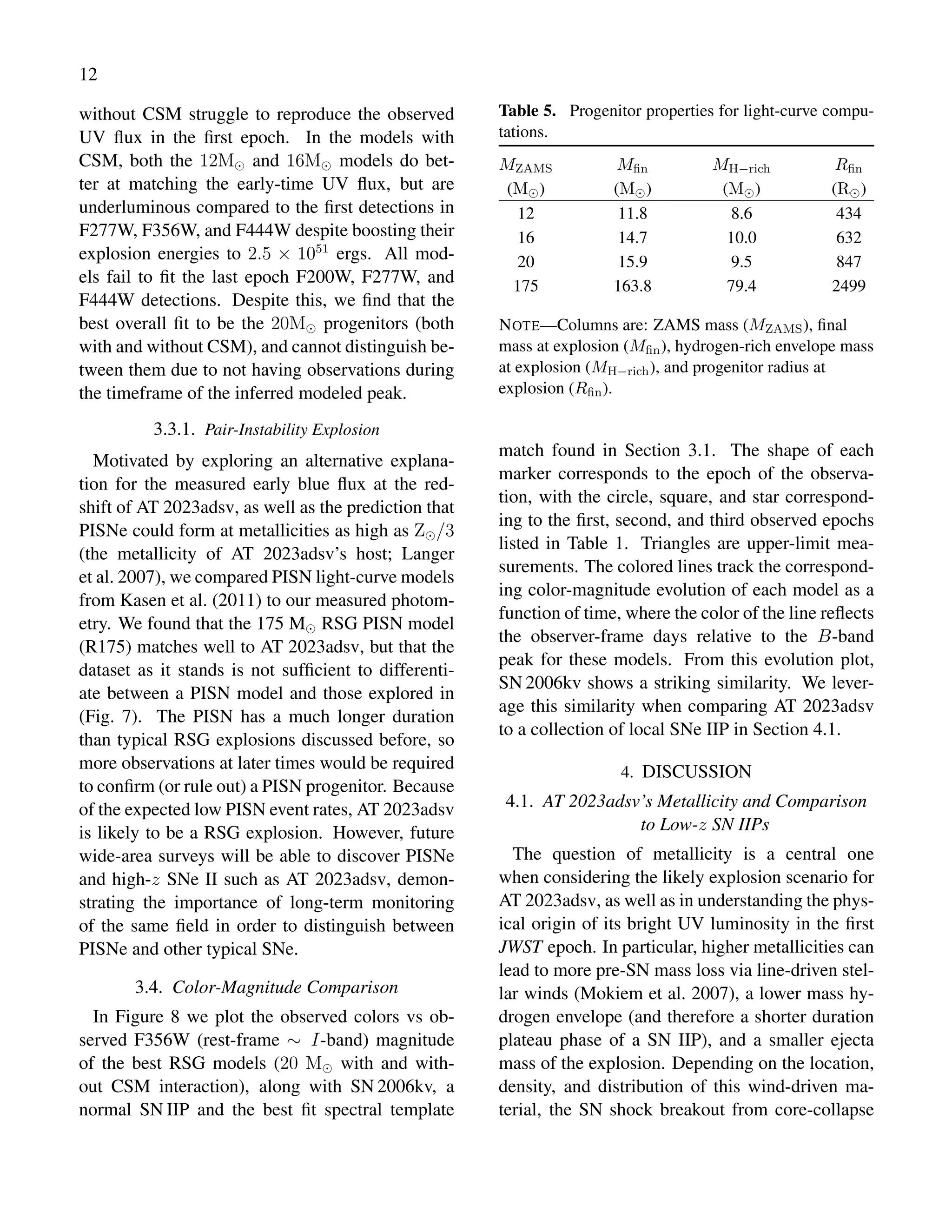
Figure 6 presents the results of the numerical
modeling. We find that an explosion energy of
(2 − 3) × 1051
erg is required to account for the
brightness of AT 2023adsv. While the three pro-
genitor models explain the overall properties of
AT 2023adsv well, the 12M⊙ and 16M⊙ models
12
without CSM struggle to reproduce the observed
UV flux in the first epoch. In the models with
CSM, both the 12M⊙ and 16M⊙ models do bet-
ter at matching the early-time UV flux, but are
underluminous compared to the first detections in
F277W, F356W, and F444W despite boosting their
explosion energies to 2.5 × 1051
ergs. All mod-
els fail to fit the last epoch F200W, F277W, and
F444W detections. Despite this, we find that the
best overall fit to be the 20M⊙ progenitors (both
with and without CSM), and cannot distinguish be-
tween them due to not having observations during
the timeframe of the inferred modeled peak.
3.3.1. Pair-Instability Explosion
Motivated by exploring an alternative explana-
tion for the measured early blue flux at the red-
shift of AT 2023adsv, as well as the prediction that
PISNe could form at metallicities as high as Z⊙/3
(the metallicity of AT 2023adsv’s host; Langer
et al. 2007), we compared PISN light-curve models
from Kasen et al. (2011) to our measured photom-
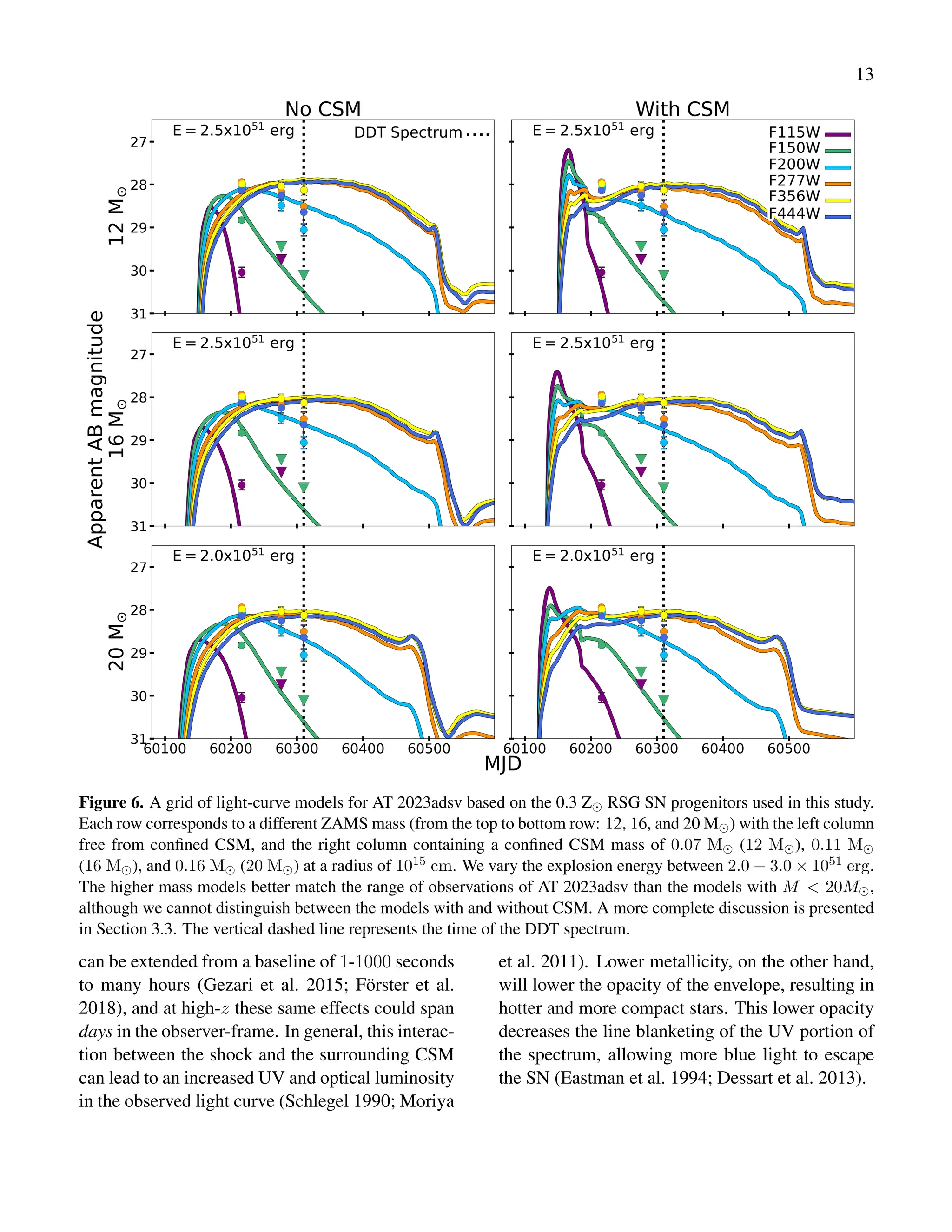
etry. We found that the 175 M⊙ RSG PISN model
(R175) matches well to AT 2023adsv, but that the
dataset as it stands is not sufficient to differenti-
ate between a PISN model and those explored in
(Fig. 7). The PISN has a much longer duration
than typical RSG explosions discussed before, so
more observations at later times would be required
to confirm (or rule out) a PISN progenitor. Because
of the expected low PISN event rates, AT 2023adsv
is likely to be a RSG explosion. However, future
wide-area surveys will be able to discover PISNe
and high-z SNe II such as AT 2023adsv, demon-
strating the importance of long-term monitoring
of the same field in order to distinguish between
PISNe and other typical SNe.
3.4. Color-Magnitude Comparison
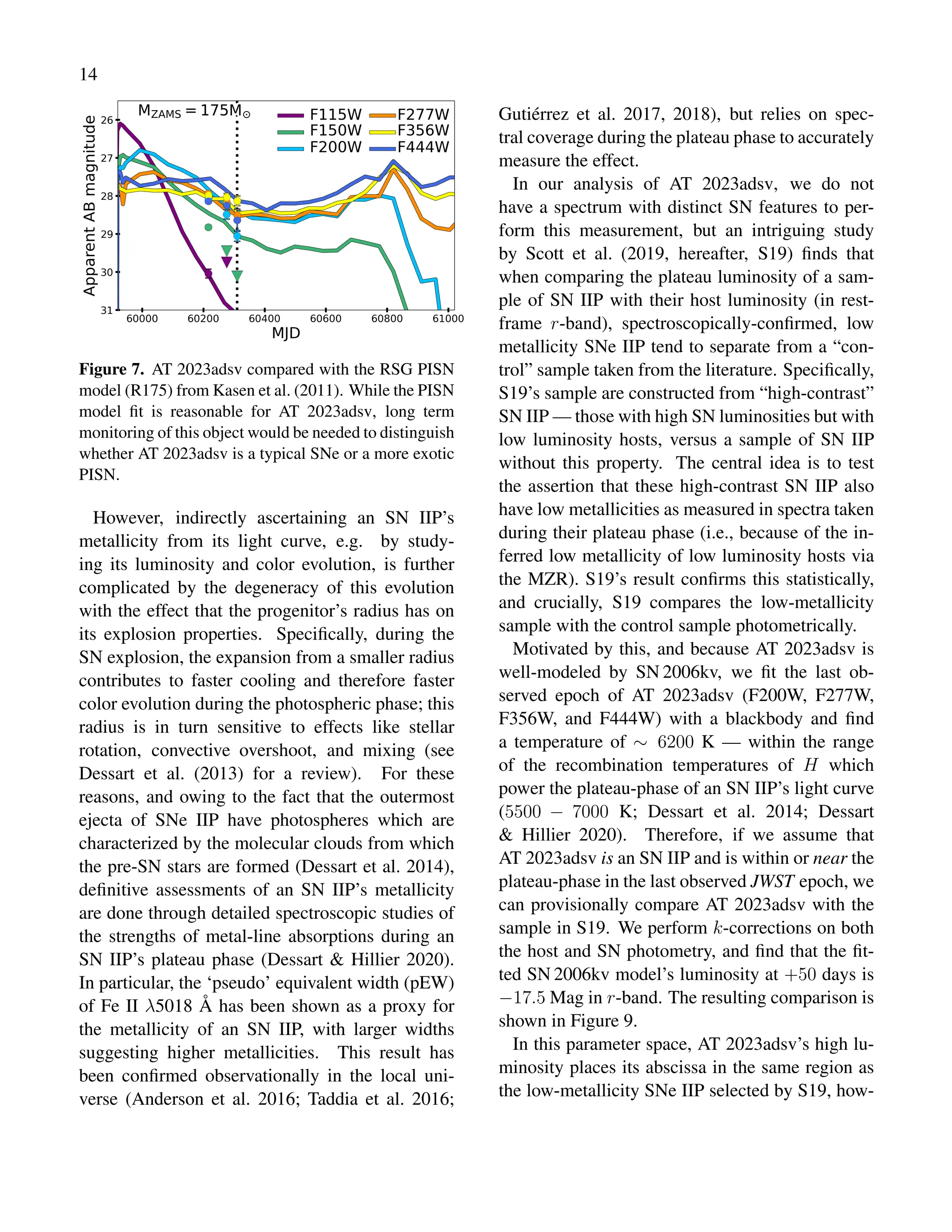
In Figure 8 we plot the observed colors vs ob-
served F356W (rest-frame ∼ I-band) magnitude
of the best RSG models (20 M⊙ with and with-
out CSM interaction), along with SN 2006kv, a
normal SN IIP and the best fit spectral template
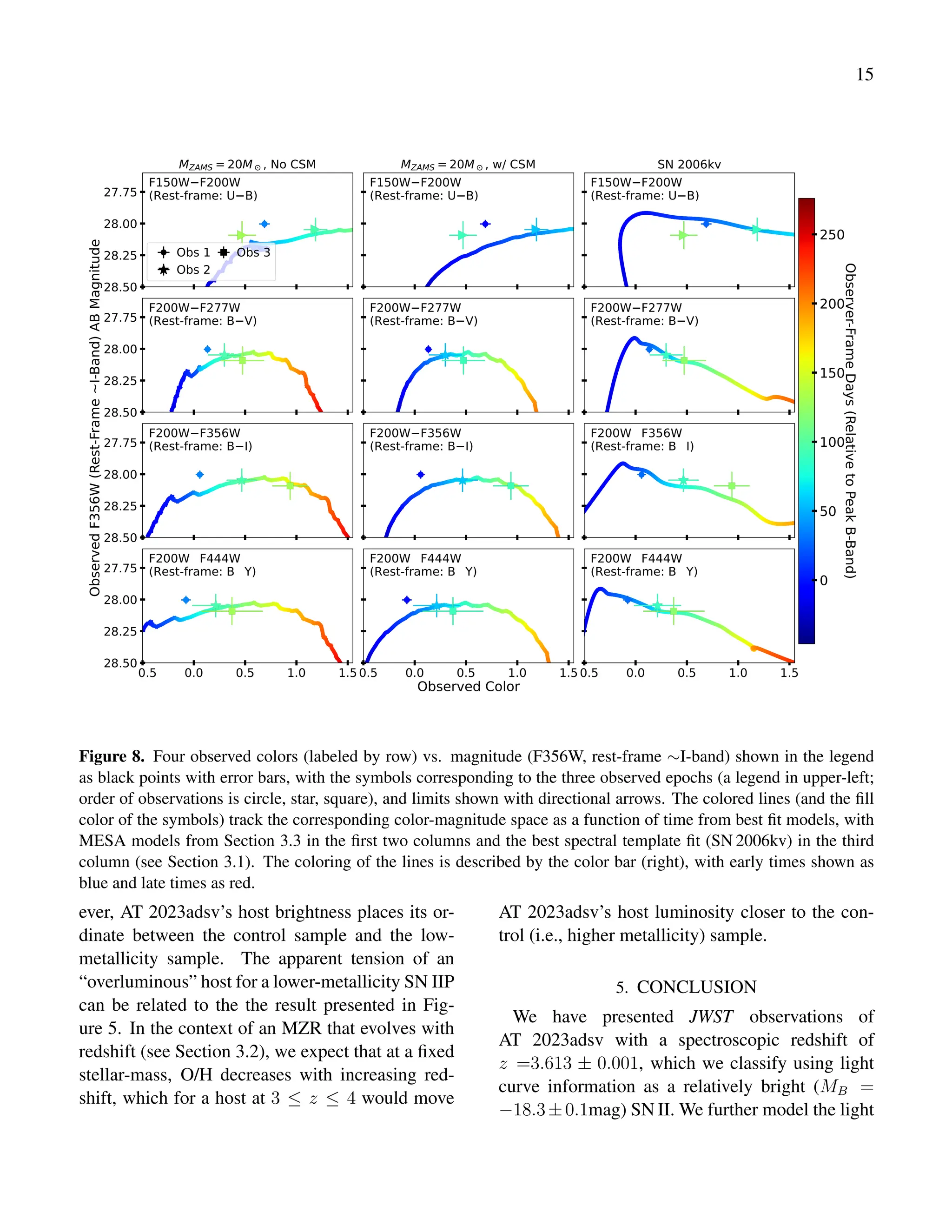
Table 5. Progenitor properties for light-curve compu-
tations.
MZAMS Mfin MH−rich Rfin
(M⊙) (M⊙) (M⊙) (R⊙)
12 11.8 8.6 434
16 14.7 10.0 632
20 15.9 9.5 847
175 163.8 79.4 2499
NOTE—Columns are: ZAMS mass (MZAMS), final
mass at explosion (Mfin), hydrogen-rich envelope mass
at explosion (MH−rich), and progenitor radius at
explosion (Rfin).
match found in Section 3.1. The shape of each
marker corresponds to the epoch of the observa-
tion, with the circle, square, and star correspond-
ing to the first, second, and third observed epochs
listed in Table 1. Triangles are upper-limit mea-
surements. The colored lines track the correspond-
ing color-magnitude evolution of each model as a
function of time, where the color of the line reflects
the observer-frame days relative to the B-band
peak for these models. From this evolution plot,
SN 2006kv shows a striking similarity. We lever-
age this similarity when comparing AT 2023adsv
to a collection of local SNe IIP in Section 4.1.
4. DISCUSSION
4.1. AT 2023adsv’s Metallicity and Comparison
to Low-z SN IIPs
The question of metallicity is a central one
when considering the likely explosion scenario for
AT 2023adsv, as well as in understanding the phys-
ical origin of its bright UV luminosity in the first
JWST epoch. In particular, higher metallicities can
lead to more pre-SN mass loss via line-driven stel-
lar winds (Mokiem et al. 2007), a lower mass hy-
drogen envelope (and therefore a shorter duration
plateau phase of a SN IIP), and a smaller ejecta
mass of the explosion. Depending on the location,
density, and distribution of this wind-driven ma-
terial, the SN shock breakout from core-collapse
13
Figure 6. A grid of light-curve models for AT 2023adsv based on the 0.3 Z⊙ RSG SN progenitors used in this study.
Each row corresponds to a different ZAMS mass (from the top to bottom row: 12, 16, and 20 M⊙) with the left column
free from confined CSM, and the right column containing a confined CSM mass of 0.07 M⊙ (12 M⊙), 0.11 M⊙
(16 M⊙), and 0.16 M⊙ (20 M⊙) at a radius of 1015 cm. We vary the explosion energy between 2.0 − 3.0 × 1051 erg.
The higher mass models better match the range of observations of AT 2023adsv than the models with M < 20M⊙,
although we cannot distinguish between the models with and without CSM. A more complete discussion is presented
in Section 3.3. The vertical dashed line represents the time of the DDT spectrum.
can be extended from a baseline of 1-1000 seconds
to many hours (Gezari et al. 2015; Förster et al.
2018), and at high-z these same effects could span
days in the observer-frame. In general, this interac-
tion between the shock and the surrounding CSM
can lead to an increased UV and optical luminosity
in the observed light curve (Schlegel 1990; Moriya
et al. 2011). Lower metallicity, on the other hand,
will lower the opacity of the envelope, resulting in
hotter and more compact stars. This lower opacity
decreases the line blanketing of the UV portion of
the spectrum, allowing more blue light to escape
the SN (Eastman et al. 1994; Dessart et al. 2013).
14
Figure 7. AT 2023adsv compared with the RSG PISN
model (R175) from Kasen et al. (2011). While the PISN
model fit is reasonable for AT 2023adsv, long term
monitoring of this object would be needed to distinguish
whether AT 2023adsv is a typical SNe or a more exotic
PISN.
However, indirectly ascertaining an SN IIP’s
metallicity from its light curve, e.g. by study-
ing its luminosity and color evolution, is further
complicated by the degeneracy of this evolution
with the effect that the progenitor’s radius has on
its explosion properties. Specifically, during the
SN explosion, the expansion from a smaller radius
contributes to faster cooling and therefore faster
color evolution during the photospheric phase; this
radius is in turn sensitive to effects like stellar
rotation, convective overshoot, and mixing (see
Dessart et al. (2013) for a review). For these
reasons, and owing to the fact that the outermost
ejecta of SNe IIP have photospheres which are
characterized by the molecular clouds from which
the pre-SN stars are formed (Dessart et al. 2014),
definitive assessments of an SN IIP’s metallicity
are done through detailed spectroscopic studies of
the strengths of metal-line absorptions during an
SN IIP’s plateau phase (Dessart & Hillier 2020).
In particular, the ‘pseudo’ equivalent width (pEW)
of Fe II λ5018 Å has been shown as a proxy for
the metallicity of an SN IIP, with larger widths
suggesting higher metallicities. This result has
been confirmed observationally in the local uni-
verse (Anderson et al. 2016; Taddia et al. 2016;
Gutiérrez et al. 2017, 2018), but relies on spec-
tral coverage during the plateau phase to accurately
measure the effect.
In our analysis of AT 2023adsv, we do not
have a spectrum with distinct SN features to per-
form this measurement, but an intriguing study
by Scott et al. (2019, hereafter, S19) finds that
when comparing the plateau luminosity of a sam-
ple of SN IIP with their host luminosity (in rest-
frame r-band), spectroscopically-confirmed, low
metallicity SNe IIP tend to separate from a “con-
trol” sample taken from the literature. Specifically,
S19’s sample are constructed from “high-contrast”
SN IIP — those with high SN luminosities but with
low luminosity hosts, versus a sample of SN IIP
without this property. The central idea is to test
the assertion that these high-contrast SN IIP also
have low metallicities as measured in spectra taken
during their plateau phase (i.e., because of the in-
ferred low metallicity of low luminosity hosts via
the MZR). S19’s result confirms this statistically,
and crucially, S19 compares the low-metallicity
sample with the control sample photometrically.
Motivated by this, and because AT 2023adsv is
well-modeled by SN 2006kv, we fit the last ob-
served epoch of AT 2023adsv (F200W, F277W,
F356W, and F444W) with a blackbody and find
a temperature of ∼ 6200 K — within the range
of the recombination temperatures of H which
power the plateau-phase of an SN IIP’s light curve
(5500 − 7000 K; Dessart et al. 2014; Dessart
& Hillier 2020). Therefore, if we assume that
AT 2023adsv is an SN IIP and is within or near the
plateau-phase in the last observed JWST epoch, we
can provisionally compare AT 2023adsv with the
sample in S19. We perform k-corrections on both
the host and SN photometry, and find that the fit-
ted SN 2006kv model’s luminosity at +50 days is
−17.5 Mag in r-band. The resulting comparison is
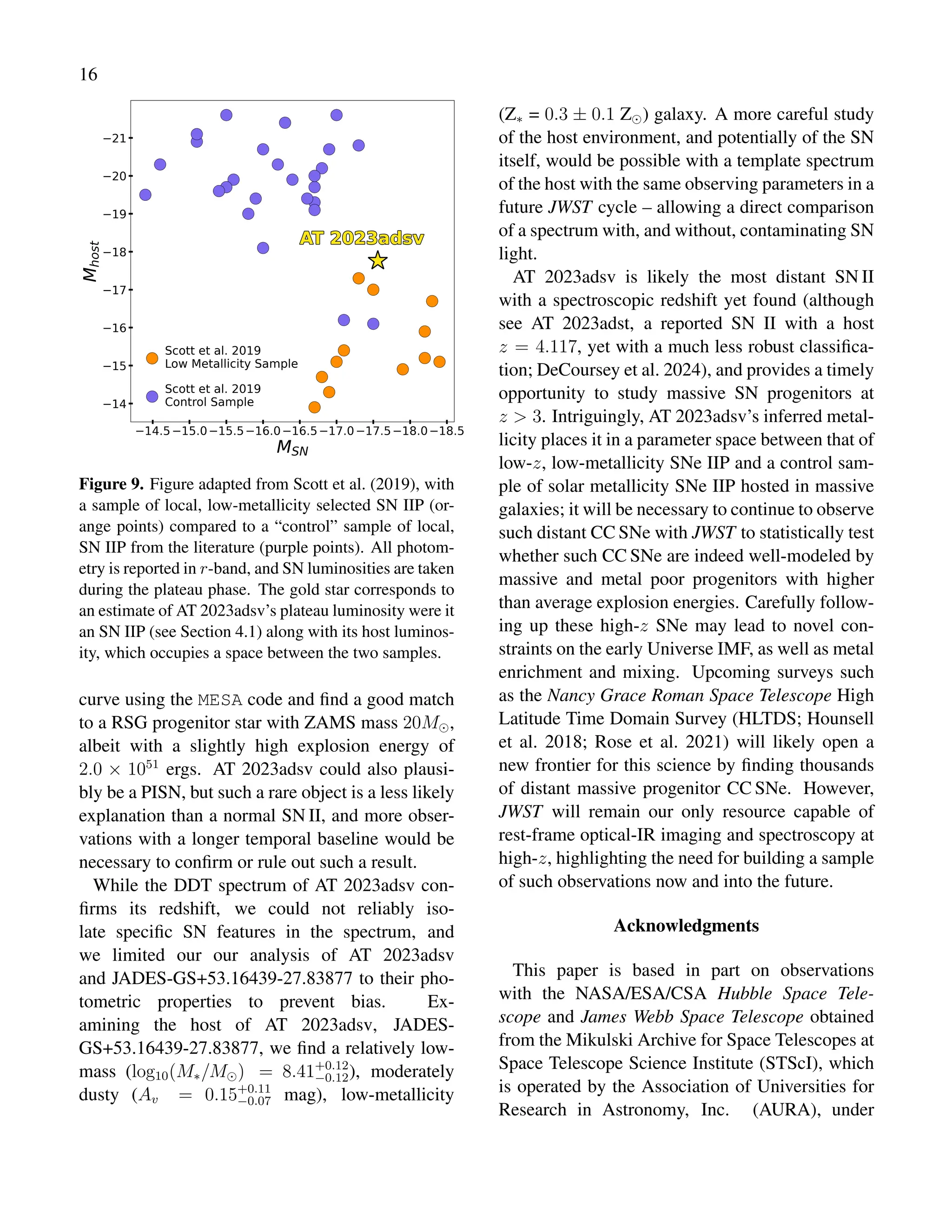
shown in Figure 9.
In this parameter space, AT 2023adsv’s high lu-
minosity places its abscissa in the same region as
the low-metallicity SNe IIP selected by S19, how-
15
27.75
28.00
28.25
28.50
F150W F200W
(Rest-frame: U B)
MZAMS =20M , No CSM
F150W F200W
(Rest-frame: U B)
MZAMS =20M , w/ CSM
F150W F200W
(Rest-frame: U B)
SN 2006kv
27.75
28.00
28.25
28.50
F200W F277W
(Rest-frame: B V)
Obs 1
Obs 2
Obs 3
F200W F277W
(Rest-frame: B V)
F200W F277W
(Rest-frame: B V)
27.75
28.00
28.25
28.50
F200W F356W
(Rest-frame: B I)
F200W F356W
(Rest-frame: B I)
F200W F356W
(Rest-frame: B I)
0.5 0.0 0.5 1.0 1.5
27.75
28.00
28.25
28.50
F200W F444W
(Rest-frame: B Y)
0.5 0.0 0.5 1.0 1.5
F200W F444W
(Rest-frame: B Y)
0.5 0.0 0.5 1.0 1.5
F200W F444W
(Rest-frame: B Y)
0.0 0.2 0.4 0.6 0.8 1.0
Observed Color
0.0
0.2
0.4
0.6
0.8
1.0
Observed
F356W
(Rest-Frame
~I-Band)
AB
Magnitude
0
50
100
150
200
250
Observer-Frame
Days
(Relative
to
Peak
B-Band)
Figure 8. Four observed colors (labeled by row) vs. magnitude (F356W, rest-frame ∼I-band) shown in the legend
as black points with error bars, with the symbols corresponding to the three observed epochs (a legend in upper-left;
order of observations is circle, star, square), and limits shown with directional arrows. The colored lines (and the fill
color of the symbols) track the corresponding color-magnitude space as a function of time from best fit models, with
MESA models from Section 3.3 in the first two columns and the best spectral template fit (SN 2006kv) in the third
column (see Section 3.1). The coloring of the lines is described by the color bar (right), with early times shown as
blue and late times as red.
ever, AT 2023adsv’s host brightness places its or-
dinate between the control sample and the low-
metallicity sample. The apparent tension of an
“overluminous” host for a lower-metallicity SN IIP
can be related to the the result presented in Fig-
ure 5. In the context of an MZR that evolves with
redshift (see Section 3.2), we expect that at a fixed
stellar-mass, O/H decreases with increasing red-
shift, which for a host at 3 ≤ z ≤ 4 would move
AT 2023adsv’s host luminosity closer to the con-
trol (i.e., higher metallicity) sample.
5. CONCLUSION
We have presented JWST observations of
AT 2023adsv with a spectroscopic redshift of
z =3.613 ± 0.001, which we classify using light
curve information as a relatively bright (MB =
−18.3±0.1mag) SN II. We further model the light
16
Figure 9. Figure adapted from Scott et al. (2019), with
a sample of local, low-metallicity selected SN IIP (or-
ange points) compared to a “control” sample of local,
SN IIP from the literature (purple points). All photom-
etry is reported in r-band, and SN luminosities are taken
during the plateau phase. The gold star corresponds to
an estimate of AT 2023adsv’s plateau luminosity were it
an SN IIP (see Section 4.1) along with its host luminos-
ity, which occupies a space between the two samples.
curve using the MESA code and find a good match
to a RSG progenitor star with ZAMS mass 20M⊙,
albeit with a slightly high explosion energy of
2.0 × 1051
ergs. AT 2023adsv could also plausi-
bly be a PISN, but such a rare object is a less likely
explanation than a normal SN II, and more obser-
vations with a longer temporal baseline would be
necessary to confirm or rule out such a result.
While the DDT spectrum of AT 2023adsv con-
firms its redshift, we could not reliably iso-
late specific SN features in the spectrum, and
we limited our our analysis of AT 2023adsv
and JADES-GS+53.16439-27.83877 to their pho-
tometric properties to prevent bias. Ex-
amining the host of AT 2023adsv, JADES-
GS+53.16439-27.83877, we find a relatively low-
mass (log10(M∗/M⊙) = 8.41+0.12
−0.12), moderately
dusty (Av = 0.15+0.11
−0.07 mag), low-metallicity
(Z∗ = 0.3 ± 0.1 Z⊙) galaxy. A more careful study
of the host environment, and potentially of the SN
itself, would be possible with a template spectrum
of the host with the same observing parameters in a
future JWST cycle – allowing a direct comparison
of a spectrum with, and without, contaminating SN
light.
AT 2023adsv is likely the most distant SN II
with a spectroscopic redshift yet found (although
see AT 2023adst, a reported SN II with a host
z = 4.117, yet with a much less robust classifica-
tion; DeCoursey et al. 2024), and provides a timely
opportunity to study massive SN progenitors at
z > 3. Intriguingly, AT 2023adsv’s inferred metal-
licity places it in a parameter space between that of
low-z, low-metallicity SNe IIP and a control sam-
ple of solar metallicity SNe IIP hosted in massive
galaxies; it will be necessary to continue to observe
such distant CC SNe with JWST to statistically test
whether such CC SNe are indeed well-modeled by
massive and metal poor progenitors with higher
than average explosion energies. Carefully follow-
ing up these high-z SNe may lead to novel con-
straints on the early Universe IMF, as well as metal
enrichment and mixing. Upcoming surveys such
as the Nancy Grace Roman Space Telescope High
Latitude Time Domain Survey (HLTDS; Hounsell
et al. 2018; Rose et al. 2021) will likely open a
new frontier for this science by finding thousands
of distant massive progenitor CC SNe. However,
JWST will remain our only resource capable of
rest-frame optical-IR imaging and spectroscopy at
high-z, highlighting the need for building a sample
of such observations now and into the future.
Acknowledgments
This paper is based in part on observations
with the NASA/ESA/CSA Hubble Space Tele-
scope and James Webb Space Telescope obtained
from the Mikulski Archive for Space Telescopes at
Space Telescope Science Institute (STScI), which
is operated by the Association of Universities for
Research in Astronomy, Inc. (AURA), under
17
NASA contract NAS 5-03127 for JWST. These
observations are associated with program #1180
and #6541. We thank the DDT and JWST/HST
scheduling teams at STScI for their extraordinary
effort in getting the DDT observations used here
scheduled quickly. The specific observations an-
alyzed can be accessed via DOI: 10.17909/snj9-
an10; support was provided to JDRP and ME
through program HST-GO-16264. JDRP is sup-
ported by NASA through a Einstein Fellowship
grant No. HF2-51541.001 awarded by STScI,
which is operated by AURA, for NASA, under
contract NAS5-26555. Numerical computations
were in part carried out on PC cluster at the Cen-
ter for Computational Astrophysics, National As-
tronomical Observatory of Japan. TJM is sup-
ported by the Grants-in-Aid for Scientific Research
of the Japan Society for the Promotion of Sci-
ence (JP24K00682, JP24H01824, JP21H04997,
JP24H00002, JP24H00027, JP24K00668) and by
the Australian Research Council (ARC) through
the ARC’s Discovery Projects funding scheme
(project DP240101786). AJB acknowledges fund-
ing from the “FirstGalaxies” Advanced Grant from
the European Research Council (ERC) under the
European Union’s Horizon 2020 research and in-
novation program (Grant agreement No. 789056).
DJE is supported as a Simons Investigator and
by JWST/NIRCam contract to the University of
Arizona, NAS5-02015. BDJ acknowledges the
JWST/NIRCam contract to the University of Ari-
zona, NAS5-02015. RM acknowledges support
by the Science and Technology Facilities Coun-
cil (STFC), by the ERC through Advanced Grant
695671 “QUENCH”, and by the UKRI Frontier
Research grant RISEandFALL. RM also acknowl-
edges funding from a research professorship from
the Royal Society. BER acknowledges support
from the NIRCam Science Team contract to the
University of Arizona, NAS5-02015, and JWST
Program 3215. ST acknowledges support by the
Royal Society Research Grant G125142. QW is
supported by the Sagol Weizmann-MIT Bridge
Program. The authors acknowledge use of the lux
supercomputer at UC Santa Cruz, funded by NSF
MRI grant AST 1828315.
18
REFERENCES
Aihara, H., Allende Prieto, C., An, D., et al. 2011,
ApJS, 193, 29, doi: 10.1088/0067-0049/193/2/29
Anderson, J. P., Covarrubias, R. A., James, P. A.,
Hamuy, M., & Habergham, S. M. 2010, MNRAS,
407, 2660, doi: 10.1111/j.1365-2966.2010.17118.x
Anderson, J. P., Gutiérrez, C. P., Dessart, L., et al.
2016, A&A, 589, A110,
doi: 10.1051/0004-6361/201527691
Asplund, M., Grevesse, N., Sauval, A. J., & Scott, P.
2009, ARA&A, 47, 481,
doi: 10.1146/annurev.astro.46.060407.145222
Bazin, G., Palanque-Delabrouille, N., Rich, J., et al.
2009, A&A, 499, 653,
doi: 10.1051/0004-6361/200911847
Becker, A. 2015, HOTPANTS: High Order Transform
of PSF ANd Template Subtraction
Berg, D. A., Skillman, E. D., Marble, A. R., et al. 2012,
ApJ, 754, 98, doi: 10.1088/0004-637X/754/2/98
Blinnikov, S., Lundqvist, P., Bartunov, O., Nomoto,
K., & Iwamoto, K. 2000, ApJ, 532, 1132,
doi: 10.1086/308588
Blinnikov, S. I., Eastman, R., Bartunov, O. S.,
Popolitov, V. A., & Woosley, S. E. 1998, ApJ, 496,
454, doi: 10.1086/305375
Blinnikov, S. I., Röpke, F. K., Sorokina, E. I., et al.
2006, A&A, 453, 229,
doi: 10.1051/0004-6361:20054594
Botticella, M. T., Riello, M., Cappellaro, E., et al.
2008, A&A, 479, 49,
doi: 10.1051/0004-6361:20078011
Burrows, A., & Vartanyan, D. 2021, Nature, 589, 29,
doi: 10.1038/s41586-020-03059-w
Bushouse, H., Eisenhamer, J., Dencheva, N., et al.
2022, JWST Calibration Pipeline, Zenodo,
doi: 10.5281/zenodo.7325378
Campbell, A., Terlevich, R., & Melnick, J. 1986,
MNRAS, 223, 811, doi: 10.1093/mnras/223.4.811
Chen, W., Kelly, P. L., Oguri, M., et al. 2022, Nature,
611, 256, doi: 10.1038/s41586-022-05252-5
Conroy, C., & Gunn, J. E. 2010, ApJ, 712, 833,
doi: 10.1088/0004-637X/712/2/833
Conroy, C., Gunn, J. E., & White, M. 2009, ApJ, 699,
486, doi: 10.1088/0004-637X/699/1/486
Cooke, J., Sullivan, M., Gal-Yam, A., et al. 2012,
Nature, 491, 228, doi: 10.1038/nature11521
Curti, M., Mannucci, F., Cresci, G., & Maiolino, R.
2020, MNRAS, 491, 944,
doi: 10.1093/mnras/stz2910
Curti, M., Maiolino, R., Curtis-Lake, E., et al. 2024,
A&A, 684, A75,
doi: 10.1051/0004-6361/202346698
Dahlen, T., Strolger, L.-G., Riess, A. G., et al. 2012,
ApJ, 757, 70, doi: 10.1088/0004-637X/757/1/70
DeCoursey, C., Egami, E., Rieke, M., et al. 2023a,
Transient Name Server AstroNote, 164, 1
DeCoursey, C., Sun, F., Egami, E., et al. 2023b,
Transient Name Server AstroNote, 275, 1
DeCoursey, C., Egami, E., Rieke, M., et al. 2023c,
Transient Name Server AstroNote, 164, 1
DeCoursey, C., Egami, E., Pierel, J. D. R., et al. 2024,
arXiv e-prints, arXiv:2406.05060
Dessart, L., & Hillier, D. J. 2020, A&A, 642, A33,
doi: 10.1051/0004-6361/202038148
—. 2022, A&A, 660, L9,
doi: 10.1051/0004-6361/202243372
Dessart, L., Hillier, D. J., Waldman, R., & Livne, E.
2013, MNRAS, 433, 1745,
doi: 10.1093/mnras/stt861
Dessart, L., Gutierrez, C. P., Hamuy, M., et al. 2014,
MNRAS, 440, 1856, doi: 10.1093/mnras/stu417
Dotter, A., Conroy, C., Cargile, P., & Asplund, M.
2017, ApJ, 840, 99, doi: 10.3847/1538-4357/aa6d10
D’Andrea, C. B., Sako, M., Dilday, B., et al. 2010, The
Astrophysical Journal, 708, 661,
doi: 10.1088/0004-637X/708/1/661
Eastman, R. G., Woosley, S. E., Weaver, T. A., &
Pinto, P. A. 1994, ApJ, 430, 300,
doi: 10.1086/174404
Egami, E., Bonaventura, N., Charlot, S., et al. 2023,
JWST NIRSpec/NIRCam Follow-Up of the
High-Redshift Transients Discovered in the
GOODS-S JADES-Deep Field
Eisenstein, D. J., Weinberg, D. H., Agol, E., et al.
2011, AJ, 142, 72, doi: 10.1088/0004-6256/142/3/72
Eisenstein, D. J., Johnson, B. D., Robertson, B., et al.
2023, arXiv e-prints, arXiv:2310.12340,
doi: 10.48550/arXiv.2310.12340
Eisenstein, D. J., Willott, C., Alberts, S., et al. 2023,
arXiv e-prints, arXiv:2306.02465,
doi: 10.48550/arXiv.2306.02465
Engesser, M., Smith, K., Chen, T., et al. 2022a,
Transient Name Server AstroNote, 155, 1
Engesser, M., Brammer, G., Gould, K., et al. 2022b,
Transient Name Server AstroNote, 145, 1
19
Ferruit, P., Jakobsen, P., Giardino, G., et al. 2022,
A&A, 661, A81,
doi: 10.1051/0004-6361/202142673
Fitzpatrick, E. 1999, Publications of the Astronomical
Society of the Pacific, 111, 63, doi: 10.1086/316293
Förster, F., Moriya, T. J., Maureira, J. C., et al. 2018,
Nature Astronomy, 2, 808,
doi: 10.1038/s41550-018-0563-4
Fruchter, A. S., Levan, A. J., Strolger, L., et al. 2006,
Nature, 441, 463, doi: 10.1038/nature04787
Gal-Yam, A. 2019, ARA&A, 57, 305,
doi: 10.1146/annurev-astro-081817-051819
Gal-Yam, A., Arcavi, I., Ofek, E. O., et al. 2014,
Nature, 509, 471, doi: 10.1038/nature13304
Gezari, S., Jones, D. O., Sanders, N. E., et al. 2015,
ApJ, 804, 28, doi: 10.1088/0004-637X/804/1/28
Giavalisco, M., Ferguson, H. C., Koekemoer, A. M.,
et al. 2004, ApJL, 600, L93, doi: 10.1086/379232
Gomez, S., Nicholl, M., Berger, E., et al. 2024,
MNRAS, 535, 471, doi: 10.1093/mnras/stae2270
Graur, O., Poznanski, D., Maoz, D., et al. 2011,
MNRAS, 417, 916,
doi: 10.1111/j.1365-2966.2011.19287.x
Grogin, N. A., Kocevski, D. D., Faber, S. M., et al.
2011, ApJS, 197, 35,
doi: 10.1088/0067-0049/197/2/35
Gutiérrez, C. P., Anderson, J. P., Hamuy, M., et al.
2017, ApJ, 850, 89, doi: 10.3847/1538-4357/aa8f52
Gutiérrez, C. P., Anderson, J. P., Sullivan, M., et al.
2018, MNRAS, 479, 3232,
doi: 10.1093/mnras/sty1581
Heger, A., Fryer, C. L., Woosley, S. E., Langer, N., &
Hartmann, D. H. 2003, ApJ, 591, 288,
doi: 10.1086/375341
Horne, K. 1986, PASP, 98, 609, doi: 10.1086/131801
Hounsell, R., Scolnic, D., Foley, R. J., et al. 2018, The
Astrophysical Journal, 867, 23,
doi: 10.3847/1538-4357/aac08b
Jermyn, A. S., Bauer, E. B., Schwab, J., et al. 2023,
ApJS, 265, 15, doi: 10.3847/1538-4365/acae8d
Johnson, B. D., Leja, J., Conroy, C., & Speagle, J. S.
2021, ApJS, 254, 22,
doi: 10.3847/1538-4365/abef67
Kasen, D., Woosley, S. E., & Heger, A. 2011, ApJ,
734, 102, doi: 10.1088/0004-637X/734/2/102
Kasen, D., Woosley, S. E., & Heger, A. 2011, ApJ,
734, 102, doi: 10.1088/0004-637X/734/2/102
Katz, H., Saxena, A., Cameron, A. J., et al. 2023,
MNRAS, 518, 592, doi: 10.1093/mnras/stac2657
Kelly, P. L., & Kirshner, R. P. 2012, ApJ, 759, 107,
doi: 10.1088/0004-637X/759/2/107
Kobulnicky, H. A., & Skillman, E. D. 1997, ApJ, 489,
636, doi: 10.1086/304830
Koekemoer, A. M., Faber, S. M., Ferguson, H. C., et al.
2011, ApJS, 197, 36,
doi: 10.1088/0067-0049/197/2/36
Kudritzki, R.-P., & Puls, J. 2000, ARA&A, 38, 613,
doi: 10.1146/annurev.astro.38.1.613
Lamers, H. J. G. L. M., & Cassinelli, J. P. 1999,
Introduction to Stellar Winds
Langer, N., Norman, C. A., de Koter, A., et al. 2007,
A&A, 475, L19, doi: 10.1051/0004-6361:20078482
Langeroodi, D., Hjorth, J., Chen, W., et al. 2023, ApJ,
957, 39, doi: 10.3847/1538-4357/acdbc1
Larson, R. B. 1998, MNRAS, 301, 569,
doi: 10.1046/j.1365-8711.1998.02045.x
Li, M., Cai, Z., Bian, F., et al. 2023, ApJL, 955, L18,
doi: 10.3847/2041-8213/acf470
Maeder, A., & Meynet, G. 2012, Reviews of Modern
Physics, 84, 25, doi: 10.1103/RevModPhys.84.25
Melinder, J., Dahlen, T., Mencía Trinchant, L., et al.
2012, A&A, 545, A96,
doi: 10.1051/0004-6361/201219364
Modjaz, M., Blondin, S., Kirshner, R. P., et al. 2014,
AJ, 147, 99, doi: 10.1088/0004-6256/147/5/99
Mokiem, M. R., de Koter, A., Vink, J. S., et al. 2007,
A&A, 473, 603, doi: 10.1051/0004-6361:20077545
Morishita, T., Stiavelli, M., Grillo, C., et al. 2024, ApJ,
971, 43, doi: 10.3847/1538-4357/ad5290
Moriya, T., Tominaga, N., Blinnikov, S. I., Baklanov,
P. V., & Sorokina, E. I. 2011, MNRAS, 415, 199,
doi: 10.1111/j.1365-2966.2011.18689.x
Nakajima, K., Ouchi, M., Isobe, Y., et al. 2023, ApJS,
269, 33, doi: 10.3847/1538-4365/acd556
Oppenheimer, J. R., & Snyder, H. 1939, Physical
Review, 56, 455, doi: 10.1103/PhysRev.56.455
Paxton, B., Bildsten, L., Dotter, A., et al. 2011, ApJS,
192, 3, doi: 10.1088/0067-0049/192/1/3
Paxton, B., Cantiello, M., Arras, P., et al. 2013, ApJS,
208, 4, doi: 10.1088/0067-0049/208/1/4
Paxton, B., Marchant, P., Schwab, J., et al. 2015, ApJS,
220, 15, doi: 10.1088/0067-0049/220/1/15
Paxton, B., Schwab, J., Bauer, E. B., et al. 2018, ApJS,
234, 34, doi: 10.3847/1538-4365/aaa5a8
Paxton, B., Smolec, R., Schwab, J., et al. 2019, ApJS,
243, 10, doi: 10.3847/1538-4365/ab2241
Pettini, M., & Pagel, B. E. J. 2004, MNRAS, 348, L59,
doi: 10.1111/j.1365-2966.2004.07591.x
20
Pierel, J. D. R., Rodney, S., Avelino, A., et al. 2018,
Publications of the Astronomical Society of the
Pacific, 130, 114504,
doi: 10.1088/1538-3873/aadb7a
Pierel, J. D. R., Jones, D. O., Kenworthy, W. D., et al.
2022, ApJ, 939, 11, doi: 10.3847/1538-4357/ac93f9
Pierel, J. D. R., Frye, B. L., Pascale, M., et al. 2024a,
arXiv e-prints, arXiv:2403.18954,
doi: 10.48550/arXiv.2403.18954
Pierel, J. D. R., Newman, A. B., Dhawan, S., et al.
2024b, arXiv e-prints, arXiv:2404.02139,
doi: 10.48550/arXiv.2404.02139
Pierel, J. D. R., Engesser, M., Coulter, D. A., et al.
2024c, ApJL, 971, L32,
doi: 10.3847/2041-8213/ad6908
Pierel, J. D. R., Coulter, D. A., Siebert, M. R., et al.
2024d, arXiv e-prints, arXiv:2411.11953,
doi: 10.48550/arXiv.2411.11953
Postman, M., Coe, D., Benítez, N., et al. 2012, ApJS,
199, 25, doi: 10.1088/0067-0049/199/2/25
Quimby, R. M., Kulkarni, S. R., Kasliwal, M. M., et al.
2011, Nature, 474, 487, doi: 10.1038/nature10095
Rest, A., Pierel, J., Correnti, M., et al. 2023,
arminrest/jhat: The JWST HST Alignment Tool
(JHAT), Zenodo, doi: 10.5281/zenodo.7892935
Rest, A., Stubbs, C., Becker, A. C., et al. 2005, ApJ,
634, 1103, doi: 10.1086/497060
Rhoads, J. E., Wold, I. G. B., Harish, S., et al. 2023,
ApJL, 942, L14, doi: 10.3847/2041-8213/acaaaf
Richardson, D., Jenkins, Robert L., I., Wright, J., &
Maddox, L. 2014, AJ, 147, 118,
doi: 10.1088/0004-6256/147/5/118
Rose, B. M., Baltay, C., Hounsell, R., et al. 2021,
arXiv e-prints, arXiv:2111.03081,
doi: 10.48550/arXiv.2111.03081
Sanyal, D., Langer, N., Szécsi, D., -C Yoon, S., &
Grassitelli, L. 2017, A&A, 597, A71,
doi: 10.1051/0004-6361/201629612
Schaerer, D., Marques-Chaves, R., Barrufet, L., et al.
2022, A&A, 665, L4,
doi: 10.1051/0004-6361/202244556
Schlafly, E. F., & Finkbeiner, D. P. 2011, ApJ, 737,
103, doi: 10.1088/0004-637X/737/2/103
Schlegel, E. M. 1990, MNRAS, 244, 269
Scott, S., Nicholl, M., Blanchard, P., Gomez, S., &
Berger, E. 2019, ApJL, 870, L16,
doi: 10.3847/2041-8213/aaf8ad
Siebert, M. R., Decoursey, C., Coulter, D. A., et al.
2024, arXiv e-prints, arXiv:2406.05076,
doi: 10.48550/arXiv.2406.05076
Smartt, S. J. 2009, ARA&A, 47, 63,
doi: 10.1146/annurev-astro-082708-101737
Smith, N. 2014, ARA&A, 52, 487,
doi: 10.1146/annurev-astro-081913-040025
Speagle, J. S. 2020, MNRAS, 493, 3132,
doi: 10.1093/mnras/staa278
Strolger, L.-G., Dahlen, T., Rodney, S. A., et al. 2015,
ApJ, 813, 93, doi: 10.1088/0004-637X/813/2/93
Taddia, F., Moquist, P., Sollerman, J., et al. 2016,
A&A, 587, L7, doi: 10.1051/0004-6361/201527983
Taylor, A. J., Barger, A. J., & Cowie, L. L. 2022,
ApJL, 939, L3, doi: 10.3847/2041-8213/ac959d
Vanbeveren, D., De Loore, C., & Van Rensbergen, W.
1998, A&A Rv, 9, 63, doi: 10.1007/s001590050015
Vink, J. S., de Koter, A., & Lamers, H. J. G. L. M.
2001, A&A, 369, 574,
doi: 10.1051/0004-6361:20010127
Woosley, S. E. 2017, ApJ, 836, 244,
doi: 10.3847/1538-4357/836/2/244
Woosley, S. E., & Heger, A. 2006, ApJ, 637, 914,
doi: 10.1086/498500
Wu, S., & Fuller, J. 2021, ApJ, 906, 3,
doi: 10.3847/1538-4357/abc87c
Zeh, A., Klose, S., & Hartmann, D. H. 2004, ApJ, 609,
952, doi: 10.1086/421100
Ziegler, J. J., Edwards, T. D. P., Suliga, A. M., et al.
2022, MNRAS, 517, 2471,
doi: 10.1093/mnras/stac2748

Discovery of a likely Type II SN at z=3.6 with JWST

  • 1.
    DRAFT VERSION JANUARY13, 2025 Typeset using L A TEX preprint2 style in AASTeX631 Discovery of a likely Type II SN at z=3.6 with JWST D. A. COULTER,1 J. D. R. PIEREL,1, ∗ C. DECOURSEY,2 T. J. MORIYA,3, 4, 5 M. R. SIEBERT,1 B. A. JOSHI,6 M. ENGESSER,1 A. REST,1, 6 E. EGAMI,2 M. SHAHBANDEH,1 W. CHEN,7 O. D. FOX,1 L. G. STROLGER,1 Y. ZENATI,6, 1, † A. J. BUNKER,8 P. A. CARGILE,9 M. CURTI,10 D. J. EISENSTEIN,9 S. GEZARI,1, 6 S. GOMEZ,9 M. GUOLO,6 K. HAINLINE,2 J. JENCSON,11 B. D. JOHNSON,9 M. KARMEN,6 R. MAIOLINO,12, 13, 14 R. M. QUIMBY,15, 16 P. RINALDI,2 B. ROBERTSON,17 S. TACCHELLA,12, 13 F. SUN,9 Q. WANG,18 AND T. WEVERS1 1 Space Telescope Science Institute, Baltimore, MD 21218, USA 2 Steward Observatory, University of Arizona, 933 N. Cherry Avenue, Tucson, AZ 85721, USA 3 National Astronomical Observatory of Japan, National Institutes of Natural Sciences, 2-21-1 Osawa, Mitaka, Tokyo 181-8588, Japan 4 Graduate Institute for Advanced Studies, SOKENDAI, 2-21-1 Osawa, Mitaka, Tokyo 181-8588, Japan 5 School of Physics and Astronomy, Monash University, Clayton, VIC 3800, Australia 6 Physics and Astronomy Department, Johns Hopkins University, Baltimore, MD 21218, USA 7 Department of Physics, Oklahoma State University, 145 Physical Sciences Bldg, Stillwater, OK 74078, USA 8 Department of Physics, University of Oxford, Denys Wilkinson Building, Keble Road, Oxford OX1 3RH, UK 9 Center for Astrophysics | Harvard & Smithsonian, 60 Garden St., Cambridge MA 02138 USA 10 European Southern Observatory, Karl-Schwarzschild-Strasse 2, 85748 Garching, Germany 11 IPAC, Mail Code 100-22, Caltech, 1200 E. California Boulevard, Pasadena, CA 91125, USA 12 Kavli Institute for Cosmology, University of Cambridge, Madingley Road, Cambridge CB3 0HA, UK 13 Cavendish Laboratory, University of Cambridge, 19 JJ Thomson Avenue, Cambridge, CB3 0HE, UK 14 Department of Physics and Astronomy, University College London, Gower Street, London WC1E 6BT, UK 15 Department of Astronomy/Mount Laguna Observatory, San Diego State University, 5500 Campanile Drive, San Diego, CA 92812-1221, USA 16 Kavli Institute for the Physics and Mathematics of the Universe (WPI), The University of Tokyo Institutes for Advanced Study, The University of Tokyo, Kashiwa, Chiba 277-8583, Japan 17 Department of Astronomy and Astrophysics, University of California, Santa Cruz, 1156 High Street, Santa Cruz CA 96054, USA 18 Department of Physics and Kavli Institute for Astrophysics and Space Research, Massachusetts Institute of Technology, 77 Massachusetts Avenue, Cambridge, MA 02139, USA ABSTRACT Transient astronomy in the early, high-redshift (z > 3) Universe is an unexplored regime that offers the possibility of probing the first stars and the Epoch of Reionization. During Cycles 1 and 2 of the James Webb Space Telescope (JWST), the JWST Advanced Deep Ex- tragalactic Survey (JADES) program enabled one of the first searches for transients in deep images (∼30 AB mag) over a relatively wide area (25 arcmin2 ). One transient, AT 2023adsv, was discovered with an F200W magnitude of 28.04 AB mag, and subsequent JWST observa- tions revealed that the transient is a likely supernova (SN) in a host with zspec = 3.613±0.001, Corresponding author: D. A. Coulter dcoulter@stsci.edu arXiv:2501.05513v1 [astro-ph.HE] 9 Jan 2025
  • 2.
    2 a host massof log(M∗/M⊙) = 8.41+0.12 −0.12, and an inferred metallicity at the position of the SN of Z∗ = 0.3 ± 0.1 Z⊙. At this redshift, the first detections in F115W and F150W show that AT 2023adsv had bright rest-frame ultraviolet flux at the time of discovery. The multi-band light curve of AT 2023adsv is best matched by a template of an SN IIP, with a peak absolute magnitude of −18.3 AB mag in the rest-frame B-band. We model AT 2023adsv’s light curve and find a good match to a 20M⊙ red supergiant progenitor star with an explosion energy of 2.0 × 1051 ergs, likely higher than normally observed in the local Universe, but consistent with SNe IIP drawn from local, lower metallicity environments. AT 2023adsv is the most distant photometrically classified SN IIP yet discovered with a spectroscopic redshift mea- surement, and may represent a global shift in SNe IIP properties as a function of redshift. This discovery, and the ones sure to follow, demonstrate the continued need for facilities like JWST to build a statistical sample of core-collapse SNe to understand the evolution of their properties, and to constrain the poorly understood relationship between progenitor metallicity and massive star evolution. Keywords: supernovae: individual (AT 2023adsv); SN II - infrared: supernovae - stars: mas- sive - galaxies: abundances 1. INTRODUCTION Core-collapse supernovae (CCSNe) are the ex- plosive deaths of massive stars with initial masses > 8 M⊙ and are remarkably diverse in their proper- ties (Oppenheimer & Snyder 1939; Kobulnicky & Skillman 1997; Vanbeveren et al. 1998; Heger et al. 2003; Smartt 2009; Dessart & Hillier 2020; Bur- rows & Vartanyan 2021). This diversity is driven by the broad range of their progenitor masses, which sensitively affect their evolution, setting the initial conditions for both their stellar structure and circumstellar environments prior to collapse and resulting in a similarly broad range of explosion energies, ejecta compositions and observed lumi- nosities (Smith 2014; Gal-Yam et al. 2014; Wu & Fuller 2021). These explosions connect to astro- physical phenomena across many scales — due to their high mass, the progenitors of CC SNe have short lifetimes and therefore trace the instanta- neous star formation rate (SFR) of their locales; their rates constrain the high-mass end of the Initial Mass Function (IMF); their explosions deposit en- ∗ NASA Einstein Fellow † ISEF International Fellowship ergy and momentum into the interstellar medium (ISM) providing a feedback mechanism to moder- ate star formation; they enrich the ISM with metals and are factories for cosmic dust; and they produce ionizing photons that contribute to the reionization of the Universe. CC SNe, and in particular SNe II, are in princi- ple luminous enough to be observed at cosmolog- ical distances, making them intriguing probes of the early Universe. However, their peak emission in optical bands is shifted into the infrared (IR) at high-redshift. In the last two decades, work based on the Hubble Space Telescope (HST) has pushed the study of CCSNe rates and properties to further distances (Botticella et al. 2008; Bazin et al. 2009; Graur et al. 2011; Melinder et al. 2012; Dahlen et al. 2012), culminating with observations from the Cosmic Assembly Near-infrared Deep Extra- galactic Legacy Survey (CANDELS; Grogin et al. 2011; Koekemoer et al. 2011) and Cluster Lens- ing And Supernova survey with Hubble (CLASH; Postman et al. 2012), which constrained the CCSN rate out to z ≈ 2.5 (Strolger et al. 2015). CC SNe discovered at even greater distances (z > 2.5) will peak in at wavelengths of 2 µm
  • 3.
    3 and beyond, placingmore distant samples out of reach for HST but not of the James Webb Space Telescope (JWST). Indeed, JWST is al- ready removing this barrier to discovering distant and observer-frame IR bright CC SNe due to its combination of wavelength coverage and sensitiv- ity, opening a new frontier in transient astronomy with the discovery of several high-z SNe since its launch (Chen et al. 2022; Engesser et al. 2022a,b; DeCoursey et al. 2023a,b,c, 2024; Pierel et al. 2024a,b,c,d; Siebert et al. 2024). Such discoveries are vital laboratories to test topics such as whether the CC SN rate follows the cosmic SFR density or if the high-mass end of the IMF flattens with red- shift in low metallicity stellar populations (Larson 1998; Ziegler et al. 2022). While metallicity could very plausibly impact the rate of CC SNe, it also impacts their massive stellar progenitors and, therefore, their explosive properties. In particular, the metallicity of the pro- genitors to SNe II affects not only their mass loss (Vink et al. 2001; Mokiem et al. 2007), but their internal structure and convective efficiency (Heger et al. 2003; Dessart et al. 2013), leading to a range of pre-explosion envelope masses, stellar radii, and the presence of circumstellar material (CSM). These, in turn, yield a diversity of observed SN II properties, such as their resulting colors, peak lu- minosities, and for SNe IIP, their plateau durations (Sanyal et al. 2017; Dessart et al. 2013). In gen- eral, lower metallicities should lead to lower mass loss rates for SN II progenitors, yielding more mas- sive progenitors (barring interactions with binary companions; Lamers & Cassinelli 1999; Kudritzki & Puls 2000), and the reduction in stellar enve- lope opacity should result in stars with smaller stellar radii (Sanyal et al. 2017). These effects may combine to produce progenitors with sub- stantially higher rotation rates (Woosley & Heger 2006; Maeder & Meynet 2012) and potentially connect lower metallicity environments at high-z with a diverse menagerie of exotic SN types in- cluding pair-instability SNe (PISNe; Kasen et al. 2011; Woosley 2017), superluminous supernovae (SLSNe; Quimby et al. 2011; Gal-Yam 2019), and the supernovae associated with long gamma-ray bursts (LGRB; Zeh et al. 2004; Fruchter et al. 2006; Modjaz et al. 2014). However, these asser- tions need to be tested through the discovery of many more CC SNe in the early Universe. Fortunately, this is a task to which JWST is par- ticularly well-suited. The JWST Advanced Deep Extragalactic Survey (JADES) program (Eisen- stein et al. 2023) observed ∼ 25 arcmin2 of the sky to depths of mAB ⪆ 30 in 9 NIR- Cam filters in two separate epochs, the first be- tween September 29 and October 5, 2022, and the second between September 28 and October 3, 2023. These repeated observations allowed for these images to be subtracted to discover new transients beyond the redshift limitations of HST, with a sensitivity for CCSNe to z > 4. Us- ing this ∼ 1 year baseline dozens of new tran- sient objects were discovered (DeCoursey et al. 2024, hereafter D24), and here we present a can- didate for one of the most distant SN II discov- ered to date: AT 2023adsv, a very blue and likely sub-solar metallicity SN IIP-like transient located at R.A.=3h32m39.4574s decl.=−27d50m19.6660s (although see Cooke et al. (2012) and Gomez et al. (2024) for previous high-z SLSNe candidates). AT 2023adsv is embedded in its host, JADES- GS+53.16439-27.83877, with a spectroscopically confirmed redshift of zspec =3.613 ± 0.001. In what follows, we describe the identification and analysis of AT 2023adsv, as well as a brief comparison to other SNe IIP in the local universe. This paper is structured as follows: in §2, we present a summary of the observations for this su- pernova, our reduction of the data, and obtain- ing AT 2023adsv’s host redshift; in §3 we de- scribe our classification of AT 2023adsv as a likely SN II and present the properties of its host and model AT 2023adsv’s light curve, in §4 we dis- cuss AT 2023adsv in the context of a sample of local SNe IIP, and in §5 we conclude with a dis-
  • 4.
    4 cussion on theprospects for building an SNe IIP sample at high redshift and its use as a metallicity probe of the Universe, as well as the implications of the new frontier enabled by JWST. Throughout this paper, we assume a standard ΛCDM cosmol- ogy with H0 = 70km s−1 Mpc−1 , Ωm = 0.315. 2. SUMMARY OF OBSERVATIONS AT 2023adsv was discovered as a part of a tran- sient search for the JADES program (Eisenstein et al. 2023), centered on the Great Observatories Origins Deep Survey’s south field (GOODS-S; Gi- avalisco et al. 2004). A full description of JADES, including its survey design, data products, the se- lection process for discovering new transients, and the follow-up observations of those subsequent discoveries through its approved DDT program, are described and presented in detail in D24. To summarize, the first JADES observations were acquired between September 29th, 2022 and October 5th, 2022, in the NIRCam filters F090W, F115W, F150W, F200W, F277W, F335M, F356W, F410M, and F444W to a 5σ depth of mAB ∼ 30. Nearly a year later, a second set of observations in the same filters and to the same depths were taken between September 29th, 2023 and Octo- ber 3rd, 2023, resulting in an overlapping foot- print of ∼ 25 arcmin2 (both observations under PID 1180). During this second epoch, several ob- servations failed, and subsets of the field were ob- served on November 15th, 2023, and January 1st, 2024. Upon the identification of many interesting transients in color, redshift, and luminosity space (see D24 for a complete accounting), a JWST Di- rector’s Discretionary Time (DDT) program was approved to follow up the most interesting tran- sients in this field (Egami et al. 2023). These subsequent observations were obtained on Novem- ber 28th, 2023 (NIRCam filters F115W, F150W, F200W, F277W, F356W, and F444W) and on Jan- uary 1st, 2024 (NIRCam filters F150W, F200W, F277W, F356W, and F444W; PID 6541) with the latter epoch including NIRSpec multi-object spec- troscopy (MOS) coverage using the micro-shutter assembly (MSA; Ferruit et al. 2022). NIRSpec covered the most promising ∼ 10 transients (as well as a variety of galaxy spectra) using the MSA with the Prism (R∼ 100) grating, of which AT 2023adsv was one, as well as two others that are described in a pair of companion papers (Pierel et al. 2024c; Siebert et al. 2024). Below, we de- scribe the data reduction and photometric measure- ments we derive for AT 2023adsv. 2.1. Measuring Photometry AT 2023adsv is embedded in a relatively com- pact host and therefore obtaining accurate photo- metric measurements requires removing the under- lying host light from the SN position. We achieve this through the process of “difference imaging,” or subtracting a template image (preferably with no SN light in it) from a series of science im- ages containing the SN flux we wish to measure. For every science epoch, we align each of the un- derlying JWST Level 2 (CAL) images to a cat- alog of JADES galaxies (that has in turn been aligned to Gaia sources), using the JWST/HST Alignment Tool (JHAT; Rest et al. 2023)1 . CAL images are those that have been bias-subtracted, dark-subtracted, and flat-fielded but not yet cor- rected for geometric distortion. We drizzle these CAL files into Level 3 (I2D) files using the JWST pipeline (Bushouse et al. 2022). The extra JHAT step improves the relative alignment by an order of magnitude between the epochs (from ∼ 1 pixel to ∼ 0.1 pixel), allowing for subtractions with fewer artifacts between the template and science images. To perform the subtraction, we use the High Or- der Transform of PSF and Template Subtraction (HOTPANTS; Becker 2015)2 code (with additional improvements implemented in photpipe; Rest et al. 2005), resulting in the difference images upon which we perform our photometry (see Figure 1; the right three columns are the difference images 1 https://jhat.readthedocs.io 2 https://github.com/acbecker/hotpants
  • 5.
    5 Figure 1. (Leftcolumn) Full color images using F115W+F150W (Blue) F200W+F277W (Green) and F356W+F444W (Red), with the 2022 JADES epoch on top and 2023 (including AT 2023adsv) on the bottom. (Col- umn 2-4) Difference images were created from the two JADES epochs (2023 − 2022), with the AT 2023adsv position marked with a red indicator. All images are drizzled to 0.03′′/pix and have the same spatial extent. [per filter] generated from subtracting the “tem- plate” [top, leftmost epoch] from the “science” im- age [bottom, leftmost image]). We measure the photometry in the difference images with a process described in Pierel et al. (2024b,d), using the space_phot3 Level 3 point-spread function (PSF) fitting routine cen- tered on a 5 × 5 pixel cutout at AT 2023adsv’s po- sition. space_phot models the Level 3 PSF by drizzling the Level 2 PSF models from webbpsf4 , which account for the spatial and temporal de- pendence of the JWST PSF and corrects for the losses in flux incurred by imposing a finite aper- ture. The resulting fluxes, measured in units of MJy/sr, are converted to AB magnitudes using the native pixel scale of each image (0.03′′ /pix for short- and 0.06′′ /pix for long-wavelength), and the final, measured photometry is given in Table 1. 3 space-phot.readthedocs.io 4 https://webbpsf.readthedocs.io 2.2. NIRSpec Reduction We obtained the Stage 2 spectroscopic data col- lected from the DDT program from the Mikul- ski Archive for Space Telescopes (MAST; see Ta- ble 2). With the context file jwst_1185.pmap, we used the JWST pipeline (Bushouse et al. 2022) to generate the two-dimensional (2D) spectrum and applied a correction for slit-losses based on the position of the SN within the MSA shutters (Figure 2, a and b). Next, we performed an optimal point source extraction using the algorithm from Horne (1986, implemented as a Jupyter notebook as part of the NIRSpec IFU Optimal Point Source Extrac- tion guide5 ) to extract the superimposed spectra of the SN and its host. For an SN II, we expect Hα to be the brightest feature during the photospheric phase, and in our last epoch (when the spectrum was obtained, see Table 1) AT 2023adsv’s flux in 5 https://spacetelescope.github.io/jdat_notebooks/notebooks/ ifu_optimal/ifu_optimal.html
  • 6.
    6 53◦ 090 5400 5300 5200 5100 5000 −27 ◦ 50 0 18 00 19 00 20 00 21 00 R.A. (J2000) Dec. (J2000) 0.5 kpc 2023010 z= 3.60 R - F200W G - F150W B - F090W (a) 1 2 3 4 5 λ (obs.) [µm] −0.5 0.0 0.5 y [arcsec] 1 shutter (b) 0.00 0.05 0.10 F λ [10 -19 erg s -1 cm -2 Å -1 ] 1500 3500 5500 7500 9500 11500 λ (rest) [Å] [O ii] Hδ Hγ Hβ [O iii] Na i Hα TiO Ca ii Paδ Paγ (c) -10 0 10 S/N prism Figure 2. a: The MSA slitlet position over AT 2023adsv. b: The 2D NIRSpec Prism spectrum of AT 2023adsv and JADES-GS+53.16439-27.83877. c: The 1D-extracted NIRSpec spectrum for AT 2023adsv transformed into the rest- frame, with host emission lines color-coded and labeled. A spectroscopic redshift of z =3.613 ± 0.001 was measured based on the host’s [O III] and Hα lines. No SN features are readily apparent in the resulting 1D spectrum. Table 1. Observations for AT 2023adsv discussed in Section 2. PID MJD Instrument Filter/Grating mAB 1180 60216 NIRCam F115W 30.04±0.12 1180 60216 NIRCam F150W 28.83±0.06 1180 60217 NIRCam F200W 28.07±0.04 1180 60216 NIRCam F277W 27.94±0.04 1180 60217 NIRCam F356W 27.99±0.05 1180 60216 NIRCam F444W 28.14±0.06 1180 60276 NIRCam F115W >29.8 1180 60276 NIRCam F150W >29.5 1180 60276 NIRCam F200W 28.49±0.13 1180 60276 NIRCam F277W 28.17±0.12 1180 60276 NIRCam F356W 28.03±0.11 1180 60276 NIRCam F444W 28.25±0.21 6541 60310 NIRCam F150W >30.1 6541 60310 NIRCam F200W 29.05±0.15 6541 60310 NIRCam F277W 28.51±0.16 6541 60310 NIRCam F356W 28.13±0.14 6541 60310 NIRCam F444W 28.64±0.30 6541 60310 NIRSpec Prism – NOTE—Columns are: JWST Program ID, Modified Julian date, JWST instrument, NIRCam filter, and photometry plus final uncertainty for AT 2023adsv. Upper limits are 5σ. Table 2. AT 2023adsv NIRSpec Observation Details Instrument NIRSpec Mode MOS Wavelength Range 0.6 − 5.3µm Slit 3 Shutter (0.46′′ × 0.2′′ each) Grating/Filter Prism/CLEAR R = λ/∆λ ∼ 30 − 300 Readout Pattern NRSIRS2 Groups per Integration 19 Integrations per Exposure 2 Exposures/Nods 3 Total Exposure Time 22,175s F277W (near 3 µm) is ∼ 14 nJy while the flux in the spectrum is ∼ 50 nJy at the same wavelength. With nearly 3/4 of the flux contaminated with host light, even if a decomposition were possible, the SN spectrum is likely to have a signal-to-noise of ∼ 3 per pixel according to the JWST exposure time calculator6 . For these reasons, we use the Prism spectrum primarily to measure AT 2023adsv’s red- shift (Figure 2, c), and the oxygen line ratios to estimate the host’s metallicity (see Section 3.2). 6 https://jwst-docs.stsci.edu/jwst-exposure-time-calculator-overview
  • 7.
    7 2.3. Host GalaxyRedshift AT 2023adsv was discovered in the host galaxy JADES-GS+53.16439-27.83877, and the first step in analyzing AT 2023adsv is to determine its host redshift by identifying prominent emission lines seen in Figure 2. These lines are best-matched by [O III] and Hα, which have rest-frame wavelengths of ∼ 5008.24 Å and ∼ 6564.61 Å in vacuum, re- spectively, and provide a robust spectroscopic red- shift of zspec =3.613±0.001. We use this value for all analyses going forward, and present a detailed analysis of these host properties in Section 3.2. 3. ANALYSIS 3.1. SN Light Curve Matching We fit the measured photometry from Table 1 with the SALT3-NIR SN Ia light curve model (Pierel et al. 2022) and all existing CC SN light curve evolution models with rest-frame UV to near-IR (to observer-frame ∼ 4 µm) wave- length coverage (Pierel et al. 2018, and references therein). These models are empirical spectral tem- plates created from extremely well-observed, low- z CC SNe and represent a wide range of diversity in each sub-type. In general, these spectral en- ergy distributions (SEDs) are used to fit against our measured photometry, however, none of the tem- plates extend to the rest-frame wavelengths cov- ered by the F115W filter (∼ 2500 Å), so it is ex- cluded in the fitting (but see Section 3.3). We in- clude Galactic dust based on the maps of Schlafly & Finkbeiner (2011) and the reddening law from Fitzpatrick (1999), which corresponds to E(B − V ) = 0.01 mag with RV = 3.1. We also allow for host galaxy dust (up to E(B − V ) = 1.5 mag with 1 < RV < 5) of rest-frame, host-galaxy dust in the CC SN light curve fits and a SALT3-NIR color parameter range of −1 < c < 1. Figure 3 shows the best fit models for each SN sub-type in all filters. The resulting χ2 per de- gree of freedom (ν, or reduced-χ2 ) for each model is shown in Table 3. The SN Ia and SN Ib/c sub- types are heavily disfavored (best fit χ2 /ν = 16.63 Table 3. Comparison of the best-fit model χ2 statistic for each SN sub-type. SN Type Mode/Template χ2/ν Ia SALT3-NIR 16.63 Ib/c SDSS004012 6.76 II SN 2006kv 1.10 NOTE—Columns are: SN type, spectral model/template used, and the light curve fitting χ2 per degree of freedom (DOF; ν) without model uncertainties, as they do not exist for CC SN models. and 6.76, respectively) compared to SN II (χ2 /ν = 1.10). We take the results of this light curve fitting process as conclusive and give AT 2023adsv a clas- sification of Type II as a result. The best fit SED to our photometry is that of SN 2006kv, a normal SN IIP discovered at z = 0.0620 (D’Andrea et al. 2010). We note, however, that the UV coverage of SN 2006kv’s spectral template did not extend to cover AT 2023adsv’s F115W detection (at z = 3.61, F115W ∼ 2500 Å; see Figure 3), and there- fore is omitted from the fitting. This blue emission could plausibly be due to a more exotic explosion with similarities to a SN II, a possibility that we ex- plore in Section 3.3. While the fit to SN 2006kv is quite good (see Table 3), AT 2023adsv’s luminos- ity required a modeled peak B-band absolute mag- nitude of −18.3 ± 0.1 mag, ∼ 0.5 mag brighter relative to the real SN 2006kv; while this is still within the range of normal SN IIP absolute magni- tudes observed in the local Universe (∼ 3σ above the distribution mean (Richardson et al. 2014)), it is also in agreement with the suggestion from Scott et al. (2019) that low metallicity SN II could be up to ∼ 0.5 mag brighter than SN II at high metallic- ity. 3.2. Host Galaxy Properties At a redshift of z = 3.61, the host of AT 2023adsv opens a window into the environ- ment of a SN when the Universe was < 2 Gyr old.
  • 8.
    8 27.5 28.0 28.5 29.0 29.5 30.0 F115W F150W F200W 080 160 240 27.5 28.0 28.5 29.0 29.5 F277W 0 80 160 240 F356W 0 80 160 240 F444W 0.0 0.2 0.4 0.6 0.8 1.0 MJD 60142.4 (Observer-Frame Days) 0.0 0.2 0.4 0.6 0.8 1.0 AB Magnitude 0.0 0.2 0.4 0.6 0.8 1.0 Phase (Rest-Frame Days) 0 20 40 60 0 20 40 60 0 20 40 60 0 20 40 60 0 20 40 60 0 20 40 60 Observed Type II Type Ib/c Type Ia Figure 3. The photometry measured in Section 2.1 is shown as black circles with errors, with (2σ) upper-limits denoted by triangles. The best fit SN II (red solid line), SN Ib/c (green dashed line), and SN Ia (blue dotted line) models are shown for comparison. The SN II model shown is the SN 2006kv template discussed in Section 3.1. The uncertainties shown are purely statistical. Table 4. Prospector Derived Host Properties Parameter Value log(Age [t∗/yr]) 8.55+0.15 −0.17 log(Stellar mass formed [M∗/M⊙]) 8.41+0.12 −0.12 log(SFR/[M⊙yr−1]) 0.31+0.08 −0.06 Gas-Phase Metallicity [Z⊙] * 0.3 ± 0.1 log(O/H) + 12 † 8.1 ± 0.2 Av [mag] 0.15+0.11 −0.07 ∗We derive a gas-phase metallicity using the oxy- gen line ratio diagnostic O3O2 from Curti et al. (2020); see Section 3.2 for a detailed discussion. †We convert between gas-phase metallicity ex- pressed in solar units to units of log(O/H) + 12 following the relation in Asplund et al. (2009). However, because there are no clear SN features in the spectrum for AT 2023adsv, yet we know that SN light must be contaminating the spec- trum, any fit of the star formation history (SFH) of JADES-GS+53.16439-27.83877 will be biased by this unaccounted for SN light – with the added light leading to systematically higher masses, and the SN color altering the inferred stellar proper- ties. To address this, we perform a fit to the pre-SN photometry for the host galaxy to explore the SFH. We fit the JADES photometry for the source measured from the Hubble Space Telescope (HST) Advanced Camera for Surveys (ACS) in fil- ters F435W, F606W, F775W, F814W, and F850LP along with JWST/NIRCam in the filters F090W, F115W, F150W, F182M, F200W, F210M, F277W, F335M, F356W, F410M, and F444W. For the fit,
  • 9.
    9 Figure 4. Hosttemplate photometry fit using Prospector. The blue circles represent the observed JADES pre-SN photometry, and the dark grey shaded line represents the 50th percentile of the final Prospector fit to the photometry, with a lighter grey color showing the 16th and 84th percentiles on the fit. The grey boxes are the estimated Prospector photometry corresponding to the fit. We provide the derived Prospector host galaxy parameters in Table 4. we use the tool Prospector7 (Johnson et al. 2021) and follow the method outlined in Helton et al. (in preparation). Briefly, within Prospector we employ the Flexible Stellar Population Synthe- sis (FSPS) code (Conroy et al. 2009; Conroy & Gunn 2010), and we sampled the posterior dis- tributions of the stellar population properties us- ing the dynamic nested sampling code dynesty8 (Speagle 2020). We utilize a Chabrier initial mass function (IMF) with a lower bound of 0.08 M⊙ and an upper bound of 120 M⊙. Additionally, we as- sume a delayed-τ star-forming history of the form SFR ∼ tage × e−tage/τ , where SFR is the star for- mation rate, tage is the age of the galaxy, and τ is the e-folding time. For the fit, we fix the redshift to z = 3.61, and allow the stellar- and gas-phase metallicity to vary uniformly between log(Z/Z⊙) 7 https://prospect.readthedocs.io/en/stable/ 8 https://dynesty.readthedocs.io/en/stable/ = −3.0 − 0.0. We plot the Prospector fit cor- responding to the 50th percentile on the posterior, along with the fit photometry, in Figure 4. From these fits we estimate a host mass of log10(M∗/M⊙) = 8.41+0.12 −0.12, host age log10(t∗/yr) = 8.55+0.15 −0.17, and host extinction Av = 0.15+0.11 −0.07 mag. These and additional host properties are summarized in Table 4. Because there are no clear SN features in the spectrum for AT 2023adsv, we rely on the metallic- ity inferred from the host to estimate the metallicity of the SN. However, while we use Prospector to infer host properties like mass, we do not use it to infer the host metallicity because the host SED modeling can be unreliable due to the strong de- generacy between metallicity and stellar age (Dot- ter et al. 2017). To infer the host metallicity, we instead turn to spectral fitting of the forbidden oxy- gen lines present in the spectrum (see Figure 2). In the photospheric phase, we do not expect much SN contamination in [O II] and [O III], and use
  • 10.
    10 the ratio of[O III] to [O II] (i.e., the O3O2 di- agnostic from Curti et al. (2020)) to estimate the metallicity at the position of the SN. We find that O3O2 = 3.0+3.2 −1.1, and assuming a solar metallicity of log(O/H) + 12 = 8.69 (Asplund et al. 2009), we find a host oxygen abundance of log(O/H) + 12 = 8.1 ± 0.2, or Z∗ ≈ 0.3 Z⊙. We note that Prospector finds a gas-phase metallicity of log(O/H)+12 = 7.1±0.1, or Z∗ ≈ 0.02 Z⊙, ∼ an order of magnitude lower. This is a substantial dis- crepancy, however, we adopt the derivation from the oxygen ratio due to the aforementioned issues when using the integrated fit from Prospector. For the remainder of the paper, we adopt a gas- phase metallicity of log(O/H) + 12 = 8.1 ± 0.2. This metallicity is notably lower than the mean derived oxygen metallicity found for a collection of SNe II (dominated by IIP) by Anderson et al. (2010) of log(O/H) + 12 = 8.580 ± 0.027. We place this galaxy in a wider context of SNe II hosts in Figure 5. We compare the mass and metal- licity of the host of AT 2023adsv with a population of z < 0.7 galaxies from SDSS DR8 (grey con- tours; Aihara et al. 2011; Eisenstein et al. 2011), galaxies from JWST with redshifts 3 ≤ z ≤ 9 (yellow-pink points; Nakajima et al. 2023; Mor- ishita et al. 2024; Curti et al. 2024), core-collapse SN hosts (purple points; Kelly & Kirshner 2012), and low-metallicity dwarf galaxies (blue points; Berg et al. 2012). Metallicities for both the SN hosts and SDSS sample were derived following the PP04 O3N2 calibration from Pettini & Pagel (2004), while metallicities for both the JWST- selected, high-z sample and dwarf sample were de- rived using the direct electron-temperature method (Campbell et al. 1986). Over-plotted are hori- zontal dashed lines corresponding to the the 1.0, 0.3, and 0.1 solar oxygen abundance values con- verted from Asplund et al. (2009), as well as the mass-metallicity relationship (MZR) for galaxies at 2.65 ≥ z ≥ 3.4 from Li et al. (2023, red dashed line), and the MZR at 3 ≥ z ≥ 10 from Curti et al. (2024, green dashed line). These MZR scalings are supported by recent work with JWST (Schaerer et al. 2022; Taylor et al. 2022; Katz et al. 2023; Rhoads et al. 2023), tracing this relation to even further distances with measurements of two galax- ies at z ≈ 8, and has confirmed that at fixed stellar mass, galaxies are generally less enriched at higher redshift (Langeroodi et al. 2023). We find that the metallicity of the host of AT 2023adsv is consis- tent with the MZR from Li et al. (2023) as well as with the lower-metallicity tail of the core-collapse distribution. 3.3. Light curve Modeling In order to estimate the explosion properties of AT 2023adsv, we compare synthetic light curves with those of AT 2023adsv. For this purpose, we first obtained red supergiant (RSG) SN progenitor models with 0.3 Z⊙ (in agreement with the inferred metallicity measured for its host; see Section 3.2) by using Modules for Experiments in Stellar Astrophysics (MESA) version r23.05.1 (Paxton et al. 2011, 2013, 2015, 2018, 2019; Jermyn et al. 2023). We selected a grid of models with zero-age main-sequence (ZAMS) masses (MZAMS) of 12, 16, and 20 M⊙. The details of the assumptions in the stellar evolution calcu- lations are presented by the accompanying paper (Moriya et al., in preparation). The final progenitor properties are summarized in Table 5. The RSG progenitor models are then transferred to the one-dimensional multi-frequency radiation hydrodynamics code STELLA (Blinnikov et al. 1998, 2000, 2006). STELLA numerically evalu- ates the SED evolution of SNe, and thus we can directly estimate light curves in the observer frame from the theoretical SED evolution when they ap- pear at z = 3.6. We refer to the accompany- ing paper for the details on the light curve calcu- lations (Moriya et al., in preparation). Because SNe II are generally found to be embedded within a dense and confined circumstellar medium (CSM; e.g., Förster et al. 2018), we also include a ver- sion of each of our models with this close in CSM (deposited up to 1015 cm). This approach was
  • 11.
    11 Figure 5. AT2023adsv’s inferred host galaxy mass and metallicity (gold star) compared to a selection of local galax- ies. Grey contours correspond to galaxies selected from SDSS DR8 with z < 0.7 (Aihara et al. 2011; Eisenstein et al. 2011), purple points correspond to core-collapse SN hosts (Kelly & Kirshner 2012), yellow-pink points correspond to JWST-selected galaxies redshifts at 3 ≤ z ≤ 9 (Nakajima et al. 2023; Curti et al. 2024; Morishita et al. 2024), and blue points correspond to low-metallicity dwarf galaxies from Berg et al. (2012). The red dashed line corresponds to the mass-metallicity relationship (MZR) for galaxies at 2.65 ≤ z ≤ 3.4 from Li et al. (2023); the green dashed line corresponds to the MZR at 3 ≤ z ≤ 10 from Curti et al. (2024). Overplotted are horizontal dashed lines which correspond to the the 1.0, 0.3, and 0.1 solar oxygen abundance values derived from Asplund et al. (2009). taken to account for the amount of UV flux de- tected in the first epoch (i.e., at z = 3.6, F115W and F150W span ∼ 2500 − 3250 Å in the rest- frame), and the fact that a typical mass-loss rate of 10−3 M⊙ yr−1 with a wind velocity of 10 km s−1 , can act as an additional early power source in the light curve (Moriya et al. 2011; Dessart & Hillier 2022). The confined CSM mass is 0.07 M⊙ (MZAMS = 12M⊙), 0.11 M⊙ (MZAMS = 16M⊙), and 0.16 M⊙ (MZAMS = 20M⊙). Figure 6 presents the results of the numerical modeling. We find that an explosion energy of (2 − 3) × 1051 erg is required to account for the brightness of AT 2023adsv. While the three pro- genitor models explain the overall properties of AT 2023adsv well, the 12M⊙ and 16M⊙ models
  • 12.
    12 without CSM struggleto reproduce the observed UV flux in the first epoch. In the models with CSM, both the 12M⊙ and 16M⊙ models do bet- ter at matching the early-time UV flux, but are underluminous compared to the first detections in F277W, F356W, and F444W despite boosting their explosion energies to 2.5 × 1051 ergs. All mod- els fail to fit the last epoch F200W, F277W, and F444W detections. Despite this, we find that the best overall fit to be the 20M⊙ progenitors (both with and without CSM), and cannot distinguish be- tween them due to not having observations during the timeframe of the inferred modeled peak. 3.3.1. Pair-Instability Explosion Motivated by exploring an alternative explana- tion for the measured early blue flux at the red- shift of AT 2023adsv, as well as the prediction that PISNe could form at metallicities as high as Z⊙/3 (the metallicity of AT 2023adsv’s host; Langer et al. 2007), we compared PISN light-curve models from Kasen et al. (2011) to our measured photom- etry. We found that the 175 M⊙ RSG PISN model (R175) matches well to AT 2023adsv, but that the dataset as it stands is not sufficient to differenti- ate between a PISN model and those explored in (Fig. 7). The PISN has a much longer duration than typical RSG explosions discussed before, so more observations at later times would be required to confirm (or rule out) a PISN progenitor. Because of the expected low PISN event rates, AT 2023adsv is likely to be a RSG explosion. However, future wide-area surveys will be able to discover PISNe and high-z SNe II such as AT 2023adsv, demon- strating the importance of long-term monitoring of the same field in order to distinguish between PISNe and other typical SNe. 3.4. Color-Magnitude Comparison In Figure 8 we plot the observed colors vs ob- served F356W (rest-frame ∼ I-band) magnitude of the best RSG models (20 M⊙ with and with- out CSM interaction), along with SN 2006kv, a normal SN IIP and the best fit spectral template Table 5. Progenitor properties for light-curve compu- tations. MZAMS Mfin MH−rich Rfin (M⊙) (M⊙) (M⊙) (R⊙) 12 11.8 8.6 434 16 14.7 10.0 632 20 15.9 9.5 847 175 163.8 79.4 2499 NOTE—Columns are: ZAMS mass (MZAMS), final mass at explosion (Mfin), hydrogen-rich envelope mass at explosion (MH−rich), and progenitor radius at explosion (Rfin). match found in Section 3.1. The shape of each marker corresponds to the epoch of the observa- tion, with the circle, square, and star correspond- ing to the first, second, and third observed epochs listed in Table 1. Triangles are upper-limit mea- surements. The colored lines track the correspond- ing color-magnitude evolution of each model as a function of time, where the color of the line reflects the observer-frame days relative to the B-band peak for these models. From this evolution plot, SN 2006kv shows a striking similarity. We lever- age this similarity when comparing AT 2023adsv to a collection of local SNe IIP in Section 4.1. 4. DISCUSSION 4.1. AT 2023adsv’s Metallicity and Comparison to Low-z SN IIPs The question of metallicity is a central one when considering the likely explosion scenario for AT 2023adsv, as well as in understanding the phys- ical origin of its bright UV luminosity in the first JWST epoch. In particular, higher metallicities can lead to more pre-SN mass loss via line-driven stel- lar winds (Mokiem et al. 2007), a lower mass hy- drogen envelope (and therefore a shorter duration plateau phase of a SN IIP), and a smaller ejecta mass of the explosion. Depending on the location, density, and distribution of this wind-driven ma- terial, the SN shock breakout from core-collapse
  • 13.
    13 Figure 6. Agrid of light-curve models for AT 2023adsv based on the 0.3 Z⊙ RSG SN progenitors used in this study. Each row corresponds to a different ZAMS mass (from the top to bottom row: 12, 16, and 20 M⊙) with the left column free from confined CSM, and the right column containing a confined CSM mass of 0.07 M⊙ (12 M⊙), 0.11 M⊙ (16 M⊙), and 0.16 M⊙ (20 M⊙) at a radius of 1015 cm. We vary the explosion energy between 2.0 − 3.0 × 1051 erg. The higher mass models better match the range of observations of AT 2023adsv than the models with M < 20M⊙, although we cannot distinguish between the models with and without CSM. A more complete discussion is presented in Section 3.3. The vertical dashed line represents the time of the DDT spectrum. can be extended from a baseline of 1-1000 seconds to many hours (Gezari et al. 2015; Förster et al. 2018), and at high-z these same effects could span days in the observer-frame. In general, this interac- tion between the shock and the surrounding CSM can lead to an increased UV and optical luminosity in the observed light curve (Schlegel 1990; Moriya et al. 2011). Lower metallicity, on the other hand, will lower the opacity of the envelope, resulting in hotter and more compact stars. This lower opacity decreases the line blanketing of the UV portion of the spectrum, allowing more blue light to escape the SN (Eastman et al. 1994; Dessart et al. 2013).
  • 14.
    14 Figure 7. AT2023adsv compared with the RSG PISN model (R175) from Kasen et al. (2011). While the PISN model fit is reasonable for AT 2023adsv, long term monitoring of this object would be needed to distinguish whether AT 2023adsv is a typical SNe or a more exotic PISN. However, indirectly ascertaining an SN IIP’s metallicity from its light curve, e.g. by study- ing its luminosity and color evolution, is further complicated by the degeneracy of this evolution with the effect that the progenitor’s radius has on its explosion properties. Specifically, during the SN explosion, the expansion from a smaller radius contributes to faster cooling and therefore faster color evolution during the photospheric phase; this radius is in turn sensitive to effects like stellar rotation, convective overshoot, and mixing (see Dessart et al. (2013) for a review). For these reasons, and owing to the fact that the outermost ejecta of SNe IIP have photospheres which are characterized by the molecular clouds from which the pre-SN stars are formed (Dessart et al. 2014), definitive assessments of an SN IIP’s metallicity are done through detailed spectroscopic studies of the strengths of metal-line absorptions during an SN IIP’s plateau phase (Dessart & Hillier 2020). In particular, the ‘pseudo’ equivalent width (pEW) of Fe II λ5018 Å has been shown as a proxy for the metallicity of an SN IIP, with larger widths suggesting higher metallicities. This result has been confirmed observationally in the local uni- verse (Anderson et al. 2016; Taddia et al. 2016; Gutiérrez et al. 2017, 2018), but relies on spec- tral coverage during the plateau phase to accurately measure the effect. In our analysis of AT 2023adsv, we do not have a spectrum with distinct SN features to per- form this measurement, but an intriguing study by Scott et al. (2019, hereafter, S19) finds that when comparing the plateau luminosity of a sam- ple of SN IIP with their host luminosity (in rest- frame r-band), spectroscopically-confirmed, low metallicity SNe IIP tend to separate from a “con- trol” sample taken from the literature. Specifically, S19’s sample are constructed from “high-contrast” SN IIP — those with high SN luminosities but with low luminosity hosts, versus a sample of SN IIP without this property. The central idea is to test the assertion that these high-contrast SN IIP also have low metallicities as measured in spectra taken during their plateau phase (i.e., because of the in- ferred low metallicity of low luminosity hosts via the MZR). S19’s result confirms this statistically, and crucially, S19 compares the low-metallicity sample with the control sample photometrically. Motivated by this, and because AT 2023adsv is well-modeled by SN 2006kv, we fit the last ob- served epoch of AT 2023adsv (F200W, F277W, F356W, and F444W) with a blackbody and find a temperature of ∼ 6200 K — within the range of the recombination temperatures of H which power the plateau-phase of an SN IIP’s light curve (5500 − 7000 K; Dessart et al. 2014; Dessart & Hillier 2020). Therefore, if we assume that AT 2023adsv is an SN IIP and is within or near the plateau-phase in the last observed JWST epoch, we can provisionally compare AT 2023adsv with the sample in S19. We perform k-corrections on both the host and SN photometry, and find that the fit- ted SN 2006kv model’s luminosity at +50 days is −17.5 Mag in r-band. The resulting comparison is shown in Figure 9. In this parameter space, AT 2023adsv’s high lu- minosity places its abscissa in the same region as the low-metallicity SNe IIP selected by S19, how-
  • 15.
    15 27.75 28.00 28.25 28.50 F150W F200W (Rest-frame: UB) MZAMS =20M , No CSM F150W F200W (Rest-frame: U B) MZAMS =20M , w/ CSM F150W F200W (Rest-frame: U B) SN 2006kv 27.75 28.00 28.25 28.50 F200W F277W (Rest-frame: B V) Obs 1 Obs 2 Obs 3 F200W F277W (Rest-frame: B V) F200W F277W (Rest-frame: B V) 27.75 28.00 28.25 28.50 F200W F356W (Rest-frame: B I) F200W F356W (Rest-frame: B I) F200W F356W (Rest-frame: B I) 0.5 0.0 0.5 1.0 1.5 27.75 28.00 28.25 28.50 F200W F444W (Rest-frame: B Y) 0.5 0.0 0.5 1.0 1.5 F200W F444W (Rest-frame: B Y) 0.5 0.0 0.5 1.0 1.5 F200W F444W (Rest-frame: B Y) 0.0 0.2 0.4 0.6 0.8 1.0 Observed Color 0.0 0.2 0.4 0.6 0.8 1.0 Observed F356W (Rest-Frame ~I-Band) AB Magnitude 0 50 100 150 200 250 Observer-Frame Days (Relative to Peak B-Band) Figure 8. Four observed colors (labeled by row) vs. magnitude (F356W, rest-frame ∼I-band) shown in the legend as black points with error bars, with the symbols corresponding to the three observed epochs (a legend in upper-left; order of observations is circle, star, square), and limits shown with directional arrows. The colored lines (and the fill color of the symbols) track the corresponding color-magnitude space as a function of time from best fit models, with MESA models from Section 3.3 in the first two columns and the best spectral template fit (SN 2006kv) in the third column (see Section 3.1). The coloring of the lines is described by the color bar (right), with early times shown as blue and late times as red. ever, AT 2023adsv’s host brightness places its or- dinate between the control sample and the low- metallicity sample. The apparent tension of an “overluminous” host for a lower-metallicity SN IIP can be related to the the result presented in Fig- ure 5. In the context of an MZR that evolves with redshift (see Section 3.2), we expect that at a fixed stellar-mass, O/H decreases with increasing red- shift, which for a host at 3 ≤ z ≤ 4 would move AT 2023adsv’s host luminosity closer to the con- trol (i.e., higher metallicity) sample. 5. CONCLUSION We have presented JWST observations of AT 2023adsv with a spectroscopic redshift of z =3.613 ± 0.001, which we classify using light curve information as a relatively bright (MB = −18.3±0.1mag) SN II. We further model the light
  • 16.
    16 Figure 9. Figureadapted from Scott et al. (2019), with a sample of local, low-metallicity selected SN IIP (or- ange points) compared to a “control” sample of local, SN IIP from the literature (purple points). All photom- etry is reported in r-band, and SN luminosities are taken during the plateau phase. The gold star corresponds to an estimate of AT 2023adsv’s plateau luminosity were it an SN IIP (see Section 4.1) along with its host luminos- ity, which occupies a space between the two samples. curve using the MESA code and find a good match to a RSG progenitor star with ZAMS mass 20M⊙, albeit with a slightly high explosion energy of 2.0 × 1051 ergs. AT 2023adsv could also plausi- bly be a PISN, but such a rare object is a less likely explanation than a normal SN II, and more obser- vations with a longer temporal baseline would be necessary to confirm or rule out such a result. While the DDT spectrum of AT 2023adsv con- firms its redshift, we could not reliably iso- late specific SN features in the spectrum, and we limited our our analysis of AT 2023adsv and JADES-GS+53.16439-27.83877 to their pho- tometric properties to prevent bias. Ex- amining the host of AT 2023adsv, JADES- GS+53.16439-27.83877, we find a relatively low- mass (log10(M∗/M⊙) = 8.41+0.12 −0.12), moderately dusty (Av = 0.15+0.11 −0.07 mag), low-metallicity (Z∗ = 0.3 ± 0.1 Z⊙) galaxy. A more careful study of the host environment, and potentially of the SN itself, would be possible with a template spectrum of the host with the same observing parameters in a future JWST cycle – allowing a direct comparison of a spectrum with, and without, contaminating SN light. AT 2023adsv is likely the most distant SN II with a spectroscopic redshift yet found (although see AT 2023adst, a reported SN II with a host z = 4.117, yet with a much less robust classifica- tion; DeCoursey et al. 2024), and provides a timely opportunity to study massive SN progenitors at z > 3. Intriguingly, AT 2023adsv’s inferred metal- licity places it in a parameter space between that of low-z, low-metallicity SNe IIP and a control sam- ple of solar metallicity SNe IIP hosted in massive galaxies; it will be necessary to continue to observe such distant CC SNe with JWST to statistically test whether such CC SNe are indeed well-modeled by massive and metal poor progenitors with higher than average explosion energies. Carefully follow- ing up these high-z SNe may lead to novel con- straints on the early Universe IMF, as well as metal enrichment and mixing. Upcoming surveys such as the Nancy Grace Roman Space Telescope High Latitude Time Domain Survey (HLTDS; Hounsell et al. 2018; Rose et al. 2021) will likely open a new frontier for this science by finding thousands of distant massive progenitor CC SNe. However, JWST will remain our only resource capable of rest-frame optical-IR imaging and spectroscopy at high-z, highlighting the need for building a sample of such observations now and into the future. Acknowledgments This paper is based in part on observations with the NASA/ESA/CSA Hubble Space Tele- scope and James Webb Space Telescope obtained from the Mikulski Archive for Space Telescopes at Space Telescope Science Institute (STScI), which is operated by the Association of Universities for Research in Astronomy, Inc. (AURA), under
  • 17.
    17 NASA contract NAS5-03127 for JWST. These observations are associated with program #1180 and #6541. We thank the DDT and JWST/HST scheduling teams at STScI for their extraordinary effort in getting the DDT observations used here scheduled quickly. The specific observations an- alyzed can be accessed via DOI: 10.17909/snj9- an10; support was provided to JDRP and ME through program HST-GO-16264. JDRP is sup- ported by NASA through a Einstein Fellowship grant No. HF2-51541.001 awarded by STScI, which is operated by AURA, for NASA, under contract NAS5-26555. Numerical computations were in part carried out on PC cluster at the Cen- ter for Computational Astrophysics, National As- tronomical Observatory of Japan. TJM is sup- ported by the Grants-in-Aid for Scientific Research of the Japan Society for the Promotion of Sci- ence (JP24K00682, JP24H01824, JP21H04997, JP24H00002, JP24H00027, JP24K00668) and by the Australian Research Council (ARC) through the ARC’s Discovery Projects funding scheme (project DP240101786). AJB acknowledges fund- ing from the “FirstGalaxies” Advanced Grant from the European Research Council (ERC) under the European Union’s Horizon 2020 research and in- novation program (Grant agreement No. 789056). DJE is supported as a Simons Investigator and by JWST/NIRCam contract to the University of Arizona, NAS5-02015. BDJ acknowledges the JWST/NIRCam contract to the University of Ari- zona, NAS5-02015. RM acknowledges support by the Science and Technology Facilities Coun- cil (STFC), by the ERC through Advanced Grant 695671 “QUENCH”, and by the UKRI Frontier Research grant RISEandFALL. RM also acknowl- edges funding from a research professorship from the Royal Society. BER acknowledges support from the NIRCam Science Team contract to the University of Arizona, NAS5-02015, and JWST Program 3215. ST acknowledges support by the Royal Society Research Grant G125142. QW is supported by the Sagol Weizmann-MIT Bridge Program. The authors acknowledge use of the lux supercomputer at UC Santa Cruz, funded by NSF MRI grant AST 1828315.
  • 18.
    18 REFERENCES Aihara, H., AllendePrieto, C., An, D., et al. 2011, ApJS, 193, 29, doi: 10.1088/0067-0049/193/2/29 Anderson, J. P., Covarrubias, R. A., James, P. A., Hamuy, M., & Habergham, S. M. 2010, MNRAS, 407, 2660, doi: 10.1111/j.1365-2966.2010.17118.x Anderson, J. P., Gutiérrez, C. P., Dessart, L., et al. 2016, A&A, 589, A110, doi: 10.1051/0004-6361/201527691 Asplund, M., Grevesse, N., Sauval, A. J., & Scott, P. 2009, ARA&A, 47, 481, doi: 10.1146/annurev.astro.46.060407.145222 Bazin, G., Palanque-Delabrouille, N., Rich, J., et al. 2009, A&A, 499, 653, doi: 10.1051/0004-6361/200911847 Becker, A. 2015, HOTPANTS: High Order Transform of PSF ANd Template Subtraction Berg, D. A., Skillman, E. D., Marble, A. R., et al. 2012, ApJ, 754, 98, doi: 10.1088/0004-637X/754/2/98 Blinnikov, S., Lundqvist, P., Bartunov, O., Nomoto, K., & Iwamoto, K. 2000, ApJ, 532, 1132, doi: 10.1086/308588 Blinnikov, S. I., Eastman, R., Bartunov, O. S., Popolitov, V. A., & Woosley, S. E. 1998, ApJ, 496, 454, doi: 10.1086/305375 Blinnikov, S. I., Röpke, F. K., Sorokina, E. I., et al. 2006, A&A, 453, 229, doi: 10.1051/0004-6361:20054594 Botticella, M. T., Riello, M., Cappellaro, E., et al. 2008, A&A, 479, 49, doi: 10.1051/0004-6361:20078011 Burrows, A., & Vartanyan, D. 2021, Nature, 589, 29, doi: 10.1038/s41586-020-03059-w Bushouse, H., Eisenhamer, J., Dencheva, N., et al. 2022, JWST Calibration Pipeline, Zenodo, doi: 10.5281/zenodo.7325378 Campbell, A., Terlevich, R., & Melnick, J. 1986, MNRAS, 223, 811, doi: 10.1093/mnras/223.4.811 Chen, W., Kelly, P. L., Oguri, M., et al. 2022, Nature, 611, 256, doi: 10.1038/s41586-022-05252-5 Conroy, C., & Gunn, J. E. 2010, ApJ, 712, 833, doi: 10.1088/0004-637X/712/2/833 Conroy, C., Gunn, J. E., & White, M. 2009, ApJ, 699, 486, doi: 10.1088/0004-637X/699/1/486 Cooke, J., Sullivan, M., Gal-Yam, A., et al. 2012, Nature, 491, 228, doi: 10.1038/nature11521 Curti, M., Mannucci, F., Cresci, G., & Maiolino, R. 2020, MNRAS, 491, 944, doi: 10.1093/mnras/stz2910 Curti, M., Maiolino, R., Curtis-Lake, E., et al. 2024, A&A, 684, A75, doi: 10.1051/0004-6361/202346698 Dahlen, T., Strolger, L.-G., Riess, A. G., et al. 2012, ApJ, 757, 70, doi: 10.1088/0004-637X/757/1/70 DeCoursey, C., Egami, E., Rieke, M., et al. 2023a, Transient Name Server AstroNote, 164, 1 DeCoursey, C., Sun, F., Egami, E., et al. 2023b, Transient Name Server AstroNote, 275, 1 DeCoursey, C., Egami, E., Rieke, M., et al. 2023c, Transient Name Server AstroNote, 164, 1 DeCoursey, C., Egami, E., Pierel, J. D. R., et al. 2024, arXiv e-prints, arXiv:2406.05060 Dessart, L., & Hillier, D. J. 2020, A&A, 642, A33, doi: 10.1051/0004-6361/202038148 —. 2022, A&A, 660, L9, doi: 10.1051/0004-6361/202243372 Dessart, L., Hillier, D. J., Waldman, R., & Livne, E. 2013, MNRAS, 433, 1745, doi: 10.1093/mnras/stt861 Dessart, L., Gutierrez, C. P., Hamuy, M., et al. 2014, MNRAS, 440, 1856, doi: 10.1093/mnras/stu417 Dotter, A., Conroy, C., Cargile, P., & Asplund, M. 2017, ApJ, 840, 99, doi: 10.3847/1538-4357/aa6d10 D’Andrea, C. B., Sako, M., Dilday, B., et al. 2010, The Astrophysical Journal, 708, 661, doi: 10.1088/0004-637X/708/1/661 Eastman, R. G., Woosley, S. E., Weaver, T. A., & Pinto, P. A. 1994, ApJ, 430, 300, doi: 10.1086/174404 Egami, E., Bonaventura, N., Charlot, S., et al. 2023, JWST NIRSpec/NIRCam Follow-Up of the High-Redshift Transients Discovered in the GOODS-S JADES-Deep Field Eisenstein, D. J., Weinberg, D. H., Agol, E., et al. 2011, AJ, 142, 72, doi: 10.1088/0004-6256/142/3/72 Eisenstein, D. J., Johnson, B. D., Robertson, B., et al. 2023, arXiv e-prints, arXiv:2310.12340, doi: 10.48550/arXiv.2310.12340 Eisenstein, D. J., Willott, C., Alberts, S., et al. 2023, arXiv e-prints, arXiv:2306.02465, doi: 10.48550/arXiv.2306.02465 Engesser, M., Smith, K., Chen, T., et al. 2022a, Transient Name Server AstroNote, 155, 1 Engesser, M., Brammer, G., Gould, K., et al. 2022b, Transient Name Server AstroNote, 145, 1
  • 19.
    19 Ferruit, P., Jakobsen,P., Giardino, G., et al. 2022, A&A, 661, A81, doi: 10.1051/0004-6361/202142673 Fitzpatrick, E. 1999, Publications of the Astronomical Society of the Pacific, 111, 63, doi: 10.1086/316293 Förster, F., Moriya, T. J., Maureira, J. C., et al. 2018, Nature Astronomy, 2, 808, doi: 10.1038/s41550-018-0563-4 Fruchter, A. S., Levan, A. J., Strolger, L., et al. 2006, Nature, 441, 463, doi: 10.1038/nature04787 Gal-Yam, A. 2019, ARA&A, 57, 305, doi: 10.1146/annurev-astro-081817-051819 Gal-Yam, A., Arcavi, I., Ofek, E. O., et al. 2014, Nature, 509, 471, doi: 10.1038/nature13304 Gezari, S., Jones, D. O., Sanders, N. E., et al. 2015, ApJ, 804, 28, doi: 10.1088/0004-637X/804/1/28 Giavalisco, M., Ferguson, H. C., Koekemoer, A. M., et al. 2004, ApJL, 600, L93, doi: 10.1086/379232 Gomez, S., Nicholl, M., Berger, E., et al. 2024, MNRAS, 535, 471, doi: 10.1093/mnras/stae2270 Graur, O., Poznanski, D., Maoz, D., et al. 2011, MNRAS, 417, 916, doi: 10.1111/j.1365-2966.2011.19287.x Grogin, N. A., Kocevski, D. D., Faber, S. M., et al. 2011, ApJS, 197, 35, doi: 10.1088/0067-0049/197/2/35 Gutiérrez, C. P., Anderson, J. P., Hamuy, M., et al. 2017, ApJ, 850, 89, doi: 10.3847/1538-4357/aa8f52 Gutiérrez, C. P., Anderson, J. P., Sullivan, M., et al. 2018, MNRAS, 479, 3232, doi: 10.1093/mnras/sty1581 Heger, A., Fryer, C. L., Woosley, S. E., Langer, N., & Hartmann, D. H. 2003, ApJ, 591, 288, doi: 10.1086/375341 Horne, K. 1986, PASP, 98, 609, doi: 10.1086/131801 Hounsell, R., Scolnic, D., Foley, R. J., et al. 2018, The Astrophysical Journal, 867, 23, doi: 10.3847/1538-4357/aac08b Jermyn, A. S., Bauer, E. B., Schwab, J., et al. 2023, ApJS, 265, 15, doi: 10.3847/1538-4365/acae8d Johnson, B. D., Leja, J., Conroy, C., & Speagle, J. S. 2021, ApJS, 254, 22, doi: 10.3847/1538-4365/abef67 Kasen, D., Woosley, S. E., & Heger, A. 2011, ApJ, 734, 102, doi: 10.1088/0004-637X/734/2/102 Kasen, D., Woosley, S. E., & Heger, A. 2011, ApJ, 734, 102, doi: 10.1088/0004-637X/734/2/102 Katz, H., Saxena, A., Cameron, A. J., et al. 2023, MNRAS, 518, 592, doi: 10.1093/mnras/stac2657 Kelly, P. L., & Kirshner, R. P. 2012, ApJ, 759, 107, doi: 10.1088/0004-637X/759/2/107 Kobulnicky, H. A., & Skillman, E. D. 1997, ApJ, 489, 636, doi: 10.1086/304830 Koekemoer, A. M., Faber, S. M., Ferguson, H. C., et al. 2011, ApJS, 197, 36, doi: 10.1088/0067-0049/197/2/36 Kudritzki, R.-P., & Puls, J. 2000, ARA&A, 38, 613, doi: 10.1146/annurev.astro.38.1.613 Lamers, H. J. G. L. M., & Cassinelli, J. P. 1999, Introduction to Stellar Winds Langer, N., Norman, C. A., de Koter, A., et al. 2007, A&A, 475, L19, doi: 10.1051/0004-6361:20078482 Langeroodi, D., Hjorth, J., Chen, W., et al. 2023, ApJ, 957, 39, doi: 10.3847/1538-4357/acdbc1 Larson, R. B. 1998, MNRAS, 301, 569, doi: 10.1046/j.1365-8711.1998.02045.x Li, M., Cai, Z., Bian, F., et al. 2023, ApJL, 955, L18, doi: 10.3847/2041-8213/acf470 Maeder, A., & Meynet, G. 2012, Reviews of Modern Physics, 84, 25, doi: 10.1103/RevModPhys.84.25 Melinder, J., Dahlen, T., Mencía Trinchant, L., et al. 2012, A&A, 545, A96, doi: 10.1051/0004-6361/201219364 Modjaz, M., Blondin, S., Kirshner, R. P., et al. 2014, AJ, 147, 99, doi: 10.1088/0004-6256/147/5/99 Mokiem, M. R., de Koter, A., Vink, J. S., et al. 2007, A&A, 473, 603, doi: 10.1051/0004-6361:20077545 Morishita, T., Stiavelli, M., Grillo, C., et al. 2024, ApJ, 971, 43, doi: 10.3847/1538-4357/ad5290 Moriya, T., Tominaga, N., Blinnikov, S. I., Baklanov, P. V., & Sorokina, E. I. 2011, MNRAS, 415, 199, doi: 10.1111/j.1365-2966.2011.18689.x Nakajima, K., Ouchi, M., Isobe, Y., et al. 2023, ApJS, 269, 33, doi: 10.3847/1538-4365/acd556 Oppenheimer, J. R., & Snyder, H. 1939, Physical Review, 56, 455, doi: 10.1103/PhysRev.56.455 Paxton, B., Bildsten, L., Dotter, A., et al. 2011, ApJS, 192, 3, doi: 10.1088/0067-0049/192/1/3 Paxton, B., Cantiello, M., Arras, P., et al. 2013, ApJS, 208, 4, doi: 10.1088/0067-0049/208/1/4 Paxton, B., Marchant, P., Schwab, J., et al. 2015, ApJS, 220, 15, doi: 10.1088/0067-0049/220/1/15 Paxton, B., Schwab, J., Bauer, E. B., et al. 2018, ApJS, 234, 34, doi: 10.3847/1538-4365/aaa5a8 Paxton, B., Smolec, R., Schwab, J., et al. 2019, ApJS, 243, 10, doi: 10.3847/1538-4365/ab2241 Pettini, M., & Pagel, B. E. J. 2004, MNRAS, 348, L59, doi: 10.1111/j.1365-2966.2004.07591.x
  • 20.
    20 Pierel, J. D.R., Rodney, S., Avelino, A., et al. 2018, Publications of the Astronomical Society of the Pacific, 130, 114504, doi: 10.1088/1538-3873/aadb7a Pierel, J. D. R., Jones, D. O., Kenworthy, W. D., et al. 2022, ApJ, 939, 11, doi: 10.3847/1538-4357/ac93f9 Pierel, J. D. R., Frye, B. L., Pascale, M., et al. 2024a, arXiv e-prints, arXiv:2403.18954, doi: 10.48550/arXiv.2403.18954 Pierel, J. D. R., Newman, A. B., Dhawan, S., et al. 2024b, arXiv e-prints, arXiv:2404.02139, doi: 10.48550/arXiv.2404.02139 Pierel, J. D. R., Engesser, M., Coulter, D. A., et al. 2024c, ApJL, 971, L32, doi: 10.3847/2041-8213/ad6908 Pierel, J. D. R., Coulter, D. A., Siebert, M. R., et al. 2024d, arXiv e-prints, arXiv:2411.11953, doi: 10.48550/arXiv.2411.11953 Postman, M., Coe, D., Benítez, N., et al. 2012, ApJS, 199, 25, doi: 10.1088/0067-0049/199/2/25 Quimby, R. M., Kulkarni, S. R., Kasliwal, M. M., et al. 2011, Nature, 474, 487, doi: 10.1038/nature10095 Rest, A., Pierel, J., Correnti, M., et al. 2023, arminrest/jhat: The JWST HST Alignment Tool (JHAT), Zenodo, doi: 10.5281/zenodo.7892935 Rest, A., Stubbs, C., Becker, A. C., et al. 2005, ApJ, 634, 1103, doi: 10.1086/497060 Rhoads, J. E., Wold, I. G. B., Harish, S., et al. 2023, ApJL, 942, L14, doi: 10.3847/2041-8213/acaaaf Richardson, D., Jenkins, Robert L., I., Wright, J., & Maddox, L. 2014, AJ, 147, 118, doi: 10.1088/0004-6256/147/5/118 Rose, B. M., Baltay, C., Hounsell, R., et al. 2021, arXiv e-prints, arXiv:2111.03081, doi: 10.48550/arXiv.2111.03081 Sanyal, D., Langer, N., Szécsi, D., -C Yoon, S., & Grassitelli, L. 2017, A&A, 597, A71, doi: 10.1051/0004-6361/201629612 Schaerer, D., Marques-Chaves, R., Barrufet, L., et al. 2022, A&A, 665, L4, doi: 10.1051/0004-6361/202244556 Schlafly, E. F., & Finkbeiner, D. P. 2011, ApJ, 737, 103, doi: 10.1088/0004-637X/737/2/103 Schlegel, E. M. 1990, MNRAS, 244, 269 Scott, S., Nicholl, M., Blanchard, P., Gomez, S., & Berger, E. 2019, ApJL, 870, L16, doi: 10.3847/2041-8213/aaf8ad Siebert, M. R., Decoursey, C., Coulter, D. A., et al. 2024, arXiv e-prints, arXiv:2406.05076, doi: 10.48550/arXiv.2406.05076 Smartt, S. J. 2009, ARA&A, 47, 63, doi: 10.1146/annurev-astro-082708-101737 Smith, N. 2014, ARA&A, 52, 487, doi: 10.1146/annurev-astro-081913-040025 Speagle, J. S. 2020, MNRAS, 493, 3132, doi: 10.1093/mnras/staa278 Strolger, L.-G., Dahlen, T., Rodney, S. A., et al. 2015, ApJ, 813, 93, doi: 10.1088/0004-637X/813/2/93 Taddia, F., Moquist, P., Sollerman, J., et al. 2016, A&A, 587, L7, doi: 10.1051/0004-6361/201527983 Taylor, A. J., Barger, A. J., & Cowie, L. L. 2022, ApJL, 939, L3, doi: 10.3847/2041-8213/ac959d Vanbeveren, D., De Loore, C., & Van Rensbergen, W. 1998, A&A Rv, 9, 63, doi: 10.1007/s001590050015 Vink, J. S., de Koter, A., & Lamers, H. J. G. L. M. 2001, A&A, 369, 574, doi: 10.1051/0004-6361:20010127 Woosley, S. E. 2017, ApJ, 836, 244, doi: 10.3847/1538-4357/836/2/244 Woosley, S. E., & Heger, A. 2006, ApJ, 637, 914, doi: 10.1086/498500 Wu, S., & Fuller, J. 2021, ApJ, 906, 3, doi: 10.3847/1538-4357/abc87c Zeh, A., Klose, S., & Hartmann, D. H. 2004, ApJ, 609, 952, doi: 10.1086/421100 Ziegler, J. J., Edwards, T. D. P., Suliga, A. M., et al. 2022, MNRAS, 517, 2471, doi: 10.1093/mnras/stac2748