1
COMM 202:
Career Fundamentals
T04 & T10 with Sidney Pankratz
Please hand in your
StrengthsQuest Assignment
All Assignments must be handed in
within the first 5 minutes of class.
PRE-CLASS ANNOUNCEMENTS
We want to send you
important reminders!
Help us out by providing
your email in the below
link:
https://goo.gl/forms/uNIQ
XQydcL3pp1Zm1
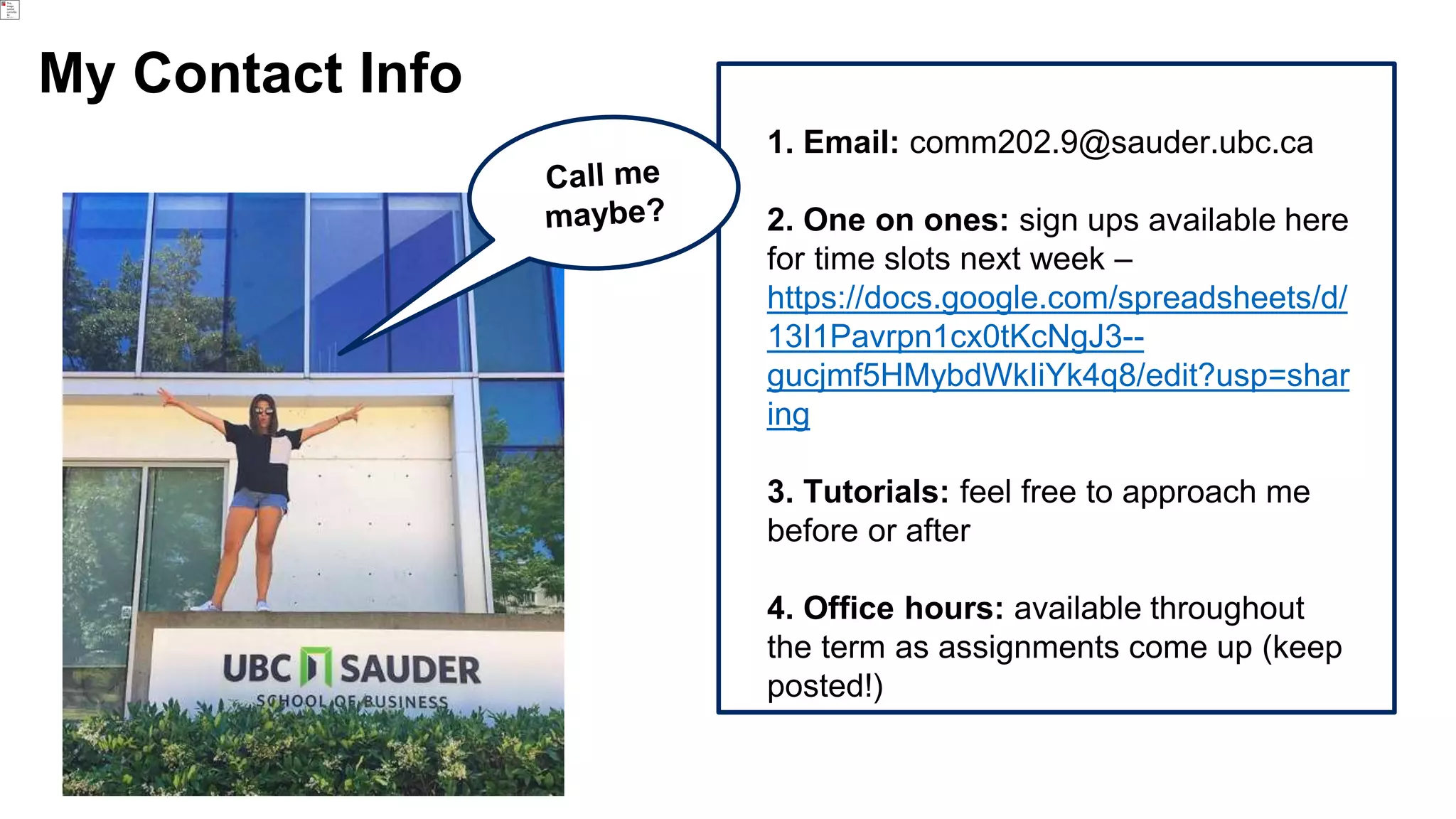
My Contact Info
1. Email: comm202.9@sauder.ubc.ca
2. One on ones: sign ups available here
for time slots next week –
https://docs.google.com/spreadsheets/d/
13I1Pavrpn1cx0tKcNgJ3--
gucjmf5HMybdWkIiYk4q8/edit?usp=shar
ing
3. Tutorials: feel free to approach me
before or after
4. Office hours: available throughout
the term as assignments come up (keep
posted!)
4
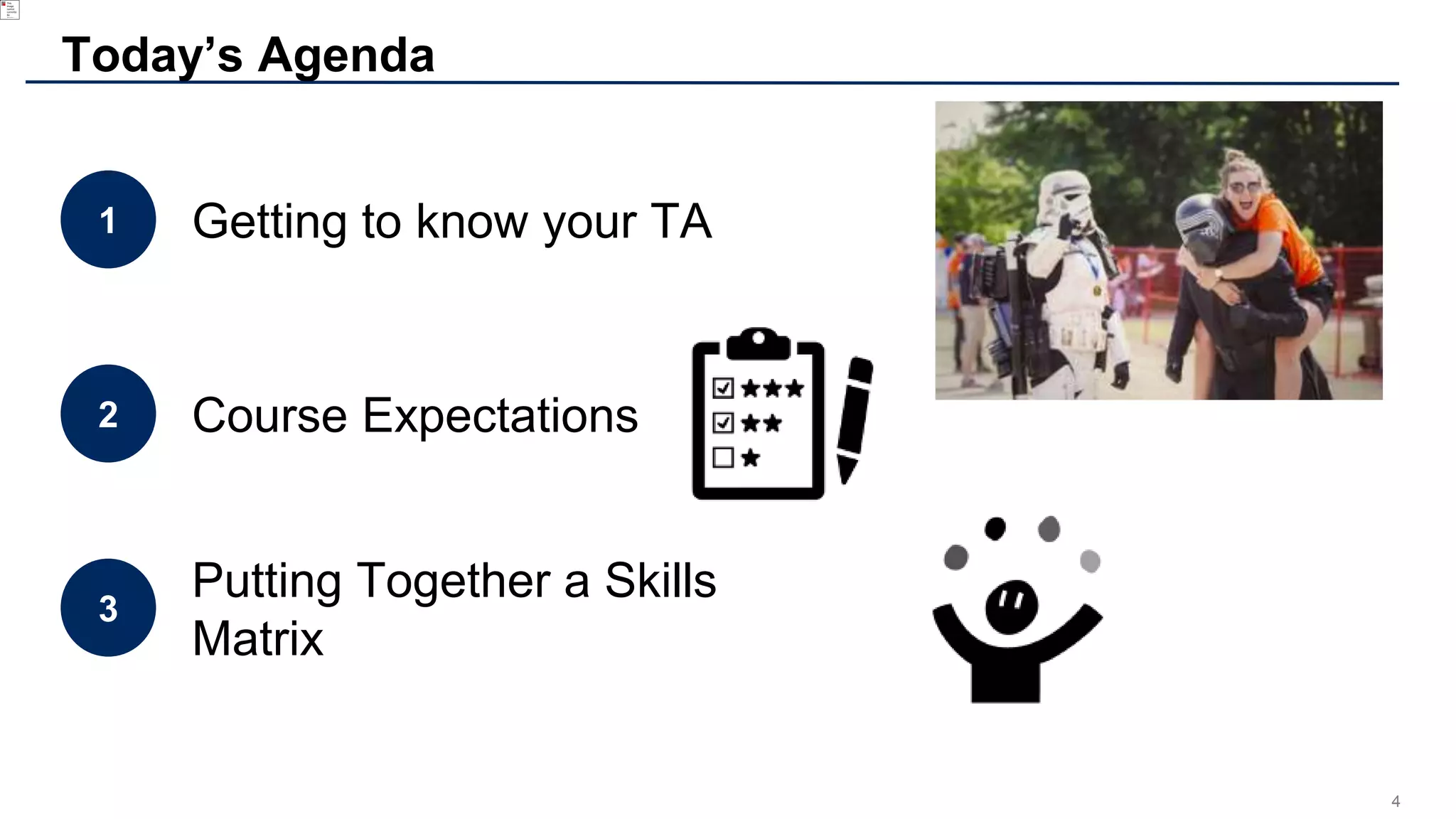
Today’s Agenda
Getting to know your TA1
Course Expectations2
Putting Together a Skills
Matrix
3
5
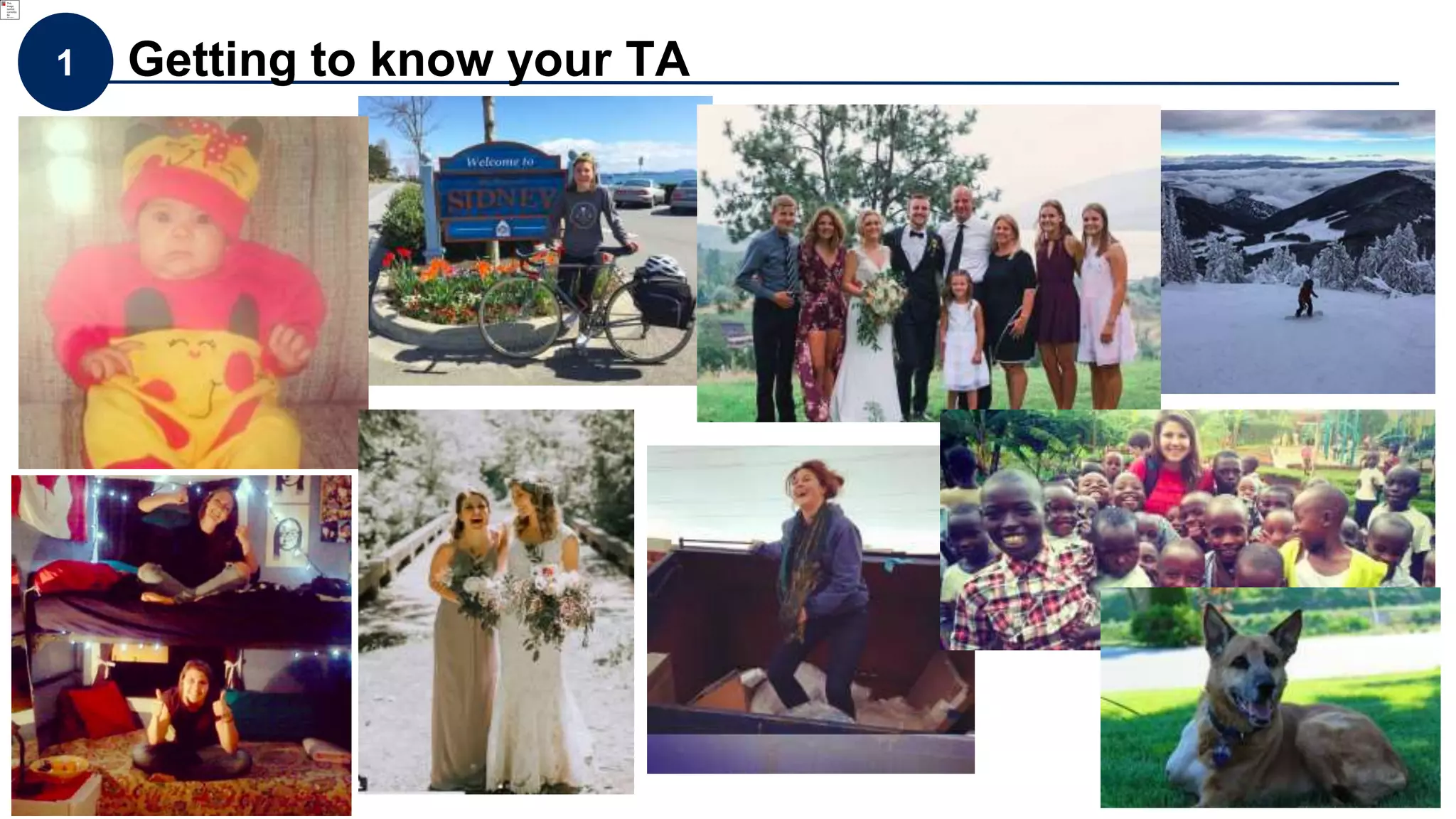
1 Getting to know your TA
6
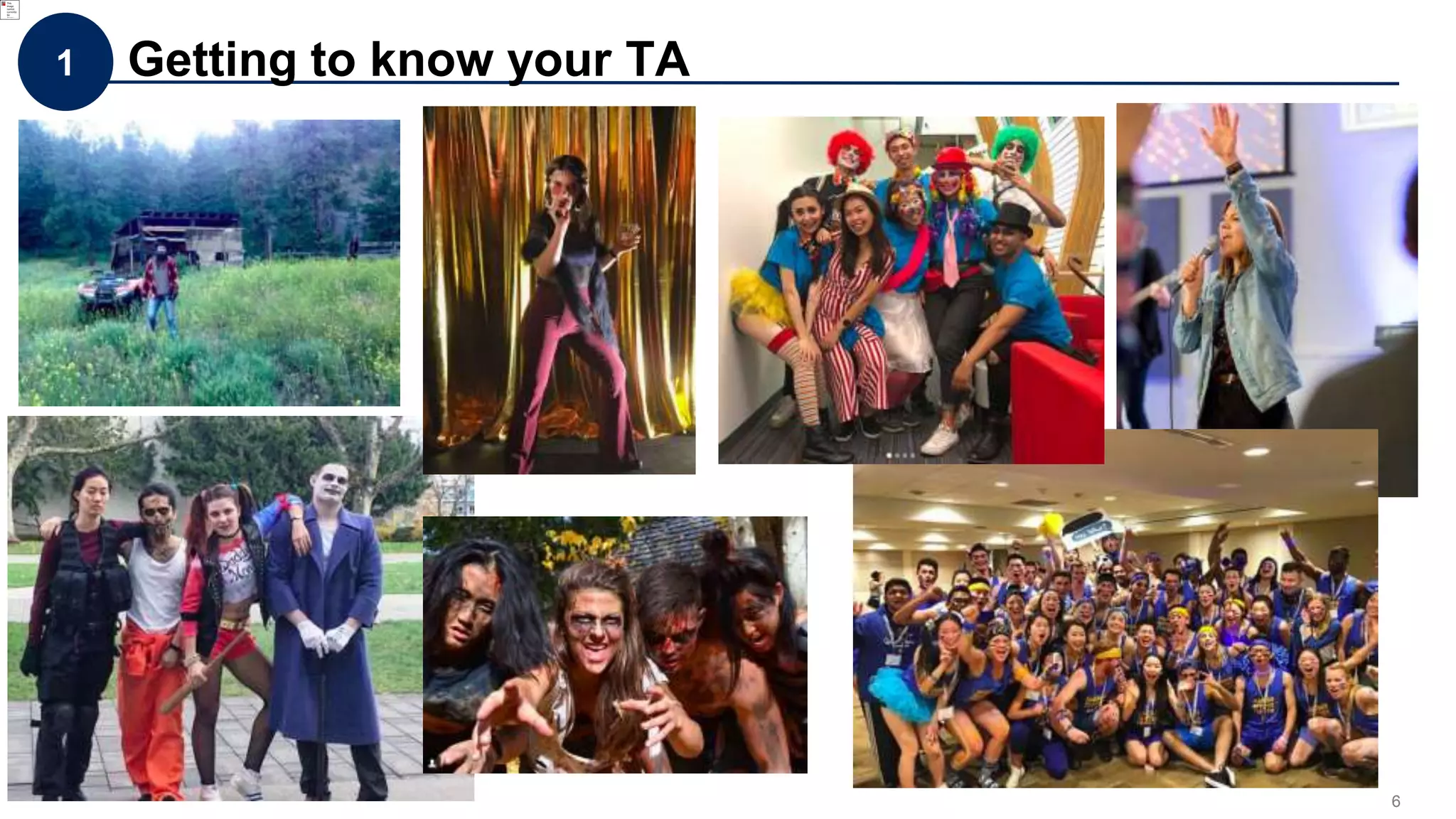
1 Getting to know your TA
7
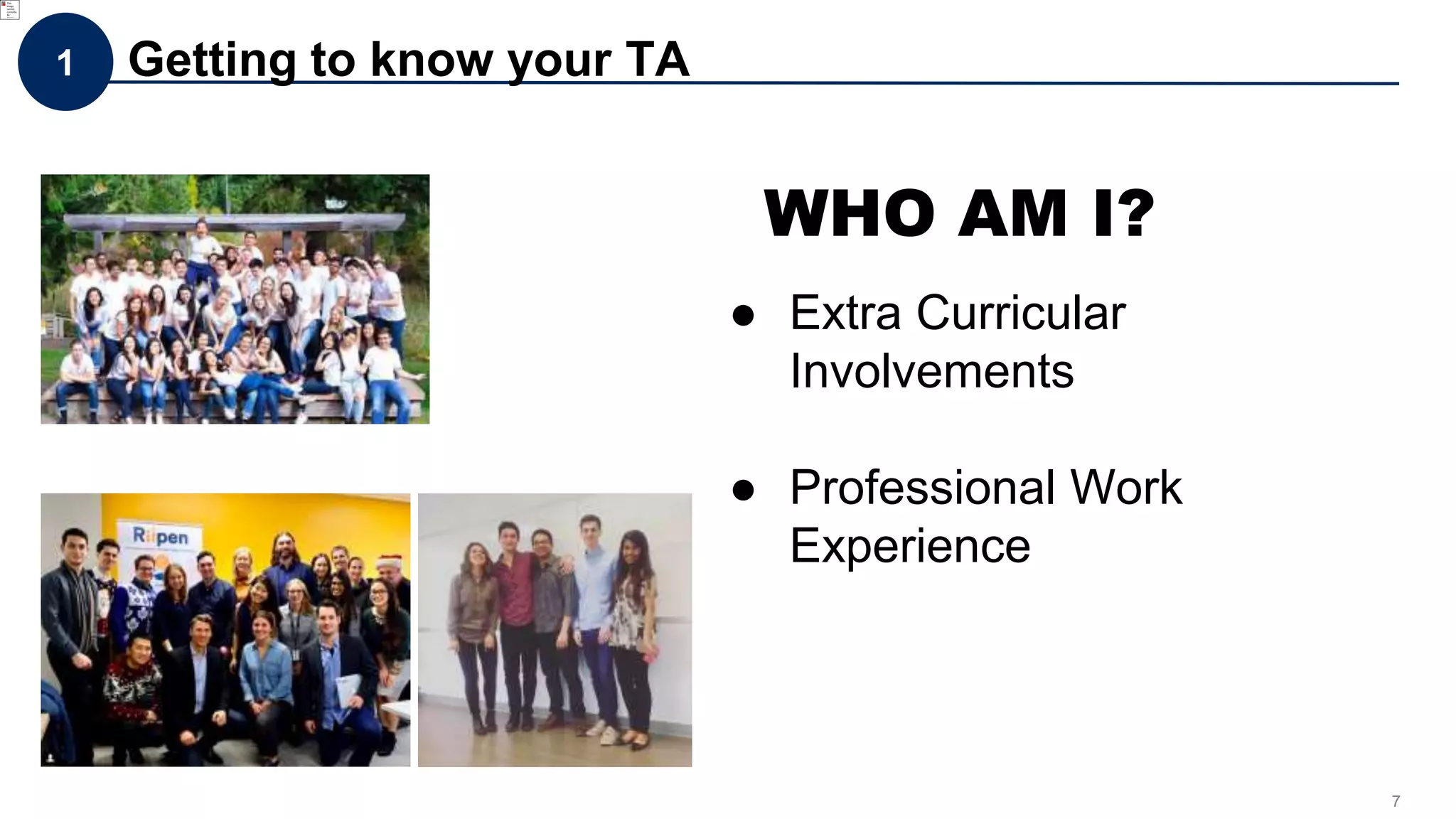
1 Getting to know your TA
WHO AM I?
● Extra Curricular
Involvements
● Professional Work
Experience
8
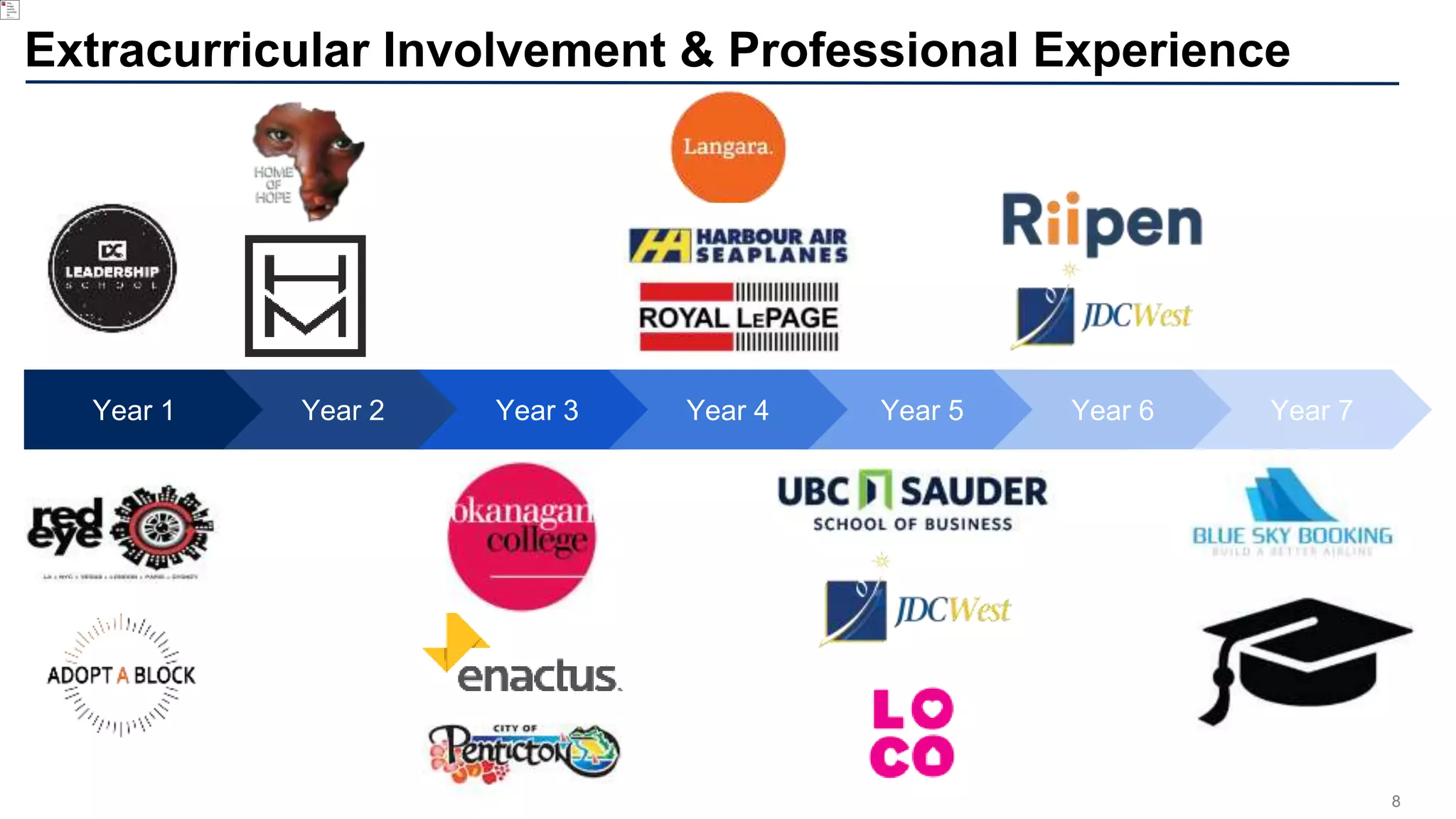
Extracurricular Involvement & Professional Experience
Year 1 Year 2 Year 3 Year 5Year 4 Year 6 Year 7
9
1) Getting to know your TA
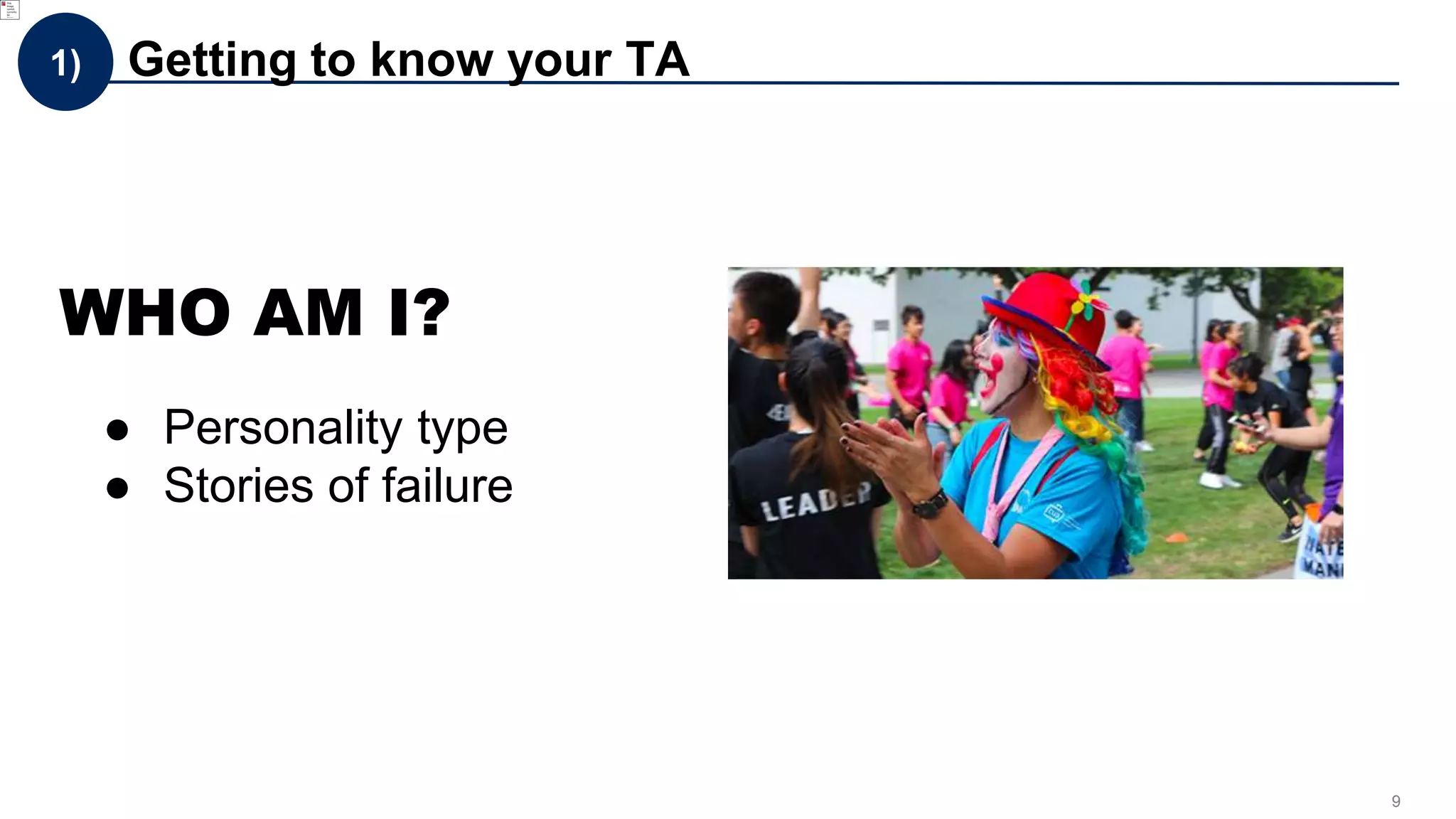
WHO AM I?
● Personality type
● Stories of failure
10
My StrengthsQuest Results
Strengths What This Means
1. Activator
2. Achiever
3. Communicator
4. Command
5. Strategic
• I like to get things started and be a driving force.
• I focus on getting things done. I like to accomplish
things I am proud of.
• I like roles that involve a lot interaction and
communication.
• I am a leader and have no issues taking control of
a group, delegating tasks and taking responsibility.
• I am strategic in how I see problems and solve
them. There is usually a greater purpose for
everything I do.
11
My Saboteurs
Saboteurs
1. Controller
2. Hyper-achiever
3. Restless
4. Stickler for
perfectionism
5. Avoid responsibility
12
Times that I have failed...
At my internship at Riipen I
failed in my first position
within the company because I
didn’t ask for help or direction
when I noticed that I wasn’t
doing as well as the others!
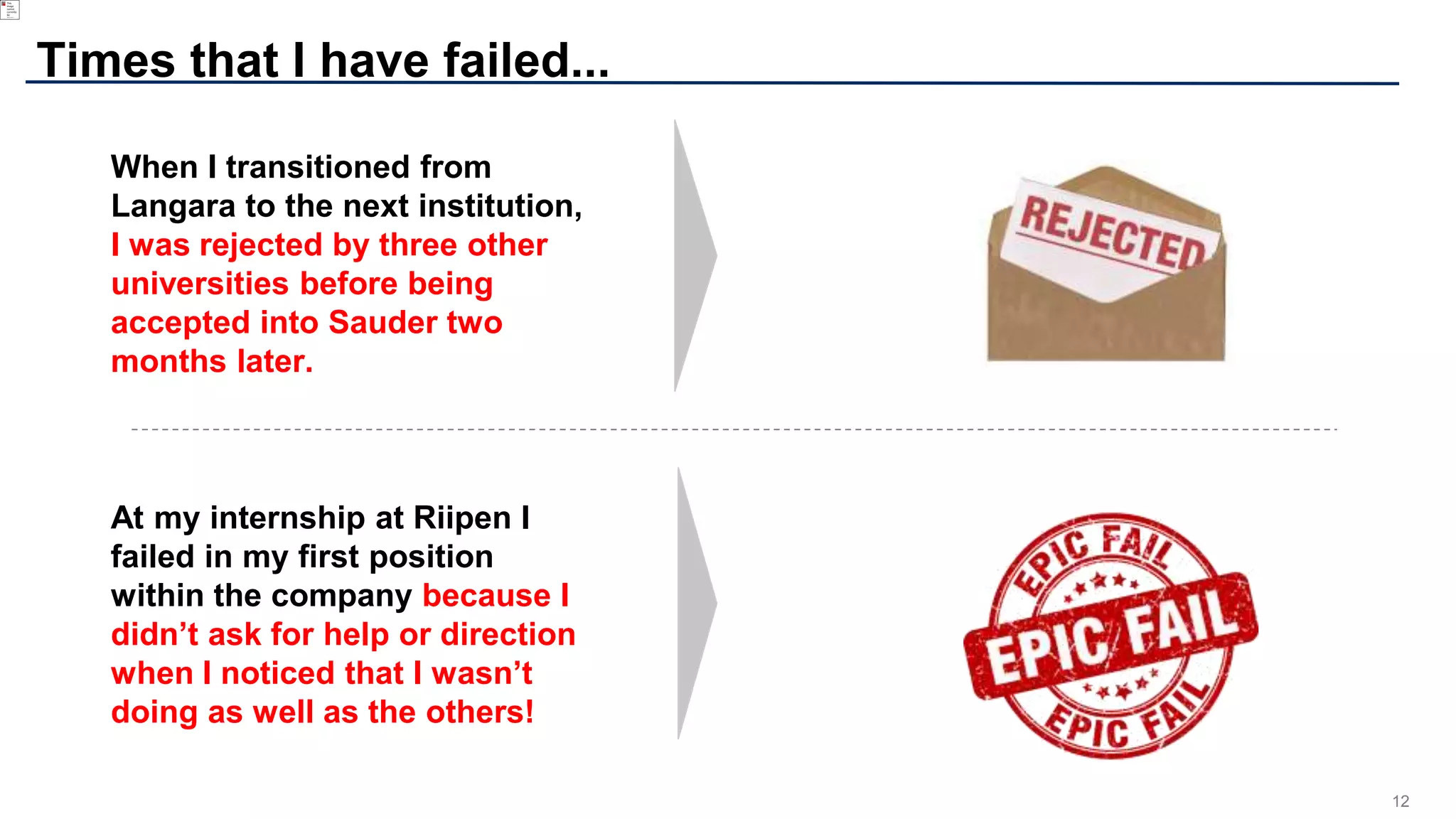
When I transitioned from
Langara to the next institution,
I was rejected by three other
universities before being
accepted into Sauder two
months later.
13
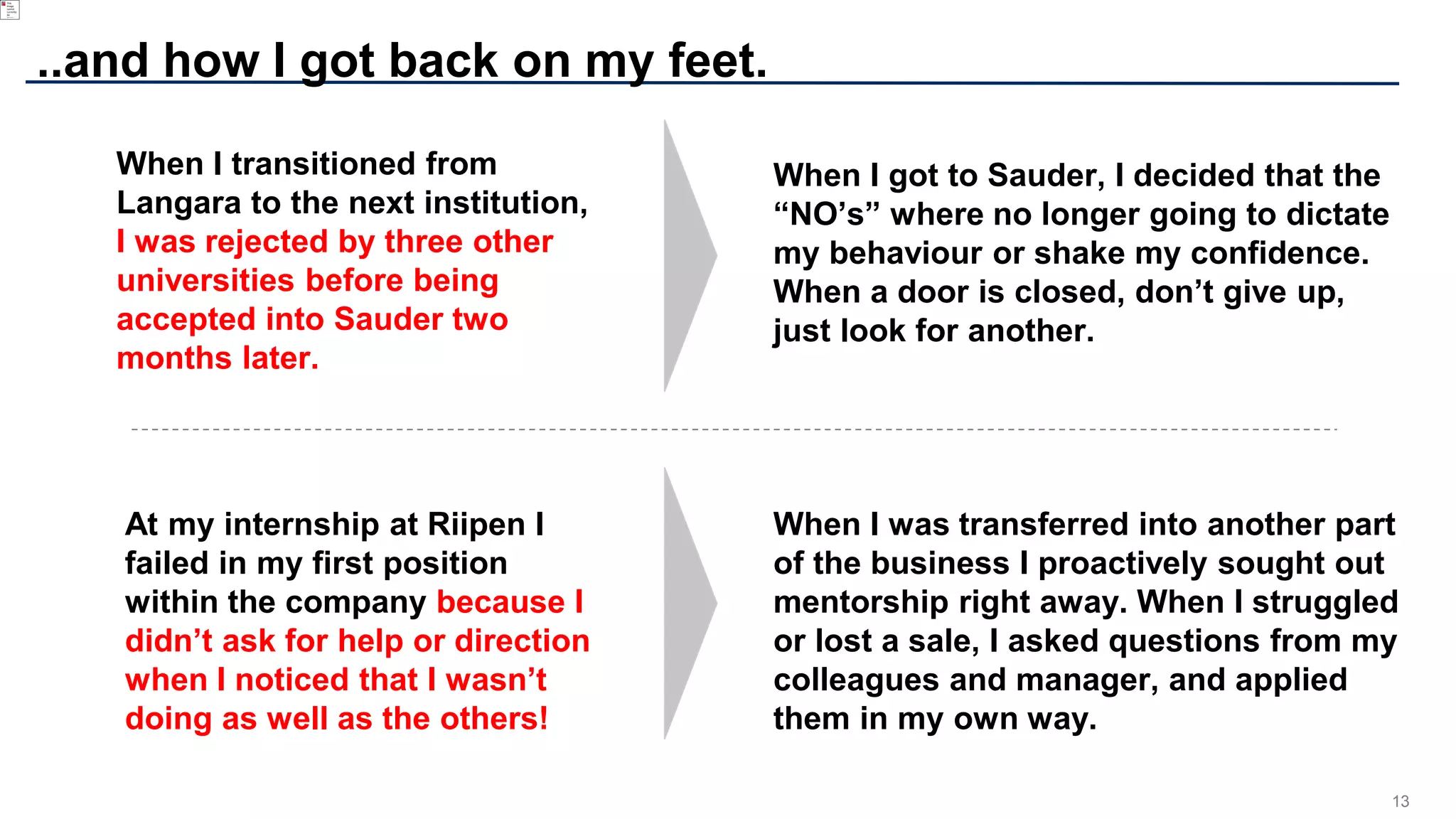
..and how I got back on my feet.
At my internship at Riipen I
failed in my first position
within the company because I
didn’t ask for help or direction
when I noticed that I wasn’t
doing as well as the others!
When I was transferred into another part
of the business I proactively sought out
mentorship right away. When I struggled
or lost a sale, I asked questions from my
colleagues and manager, and applied
them in my own way.
When I transitioned from
Langara to the next institution,
I was rejected by three other
universities before being
accepted into Sauder two
months later.
When I got to Sauder, I decided that the
“NO’s” where no longer going to dictate
my behaviour or shake my confidence.
When a door is closed, don’t give up,
just look for another.
14
15
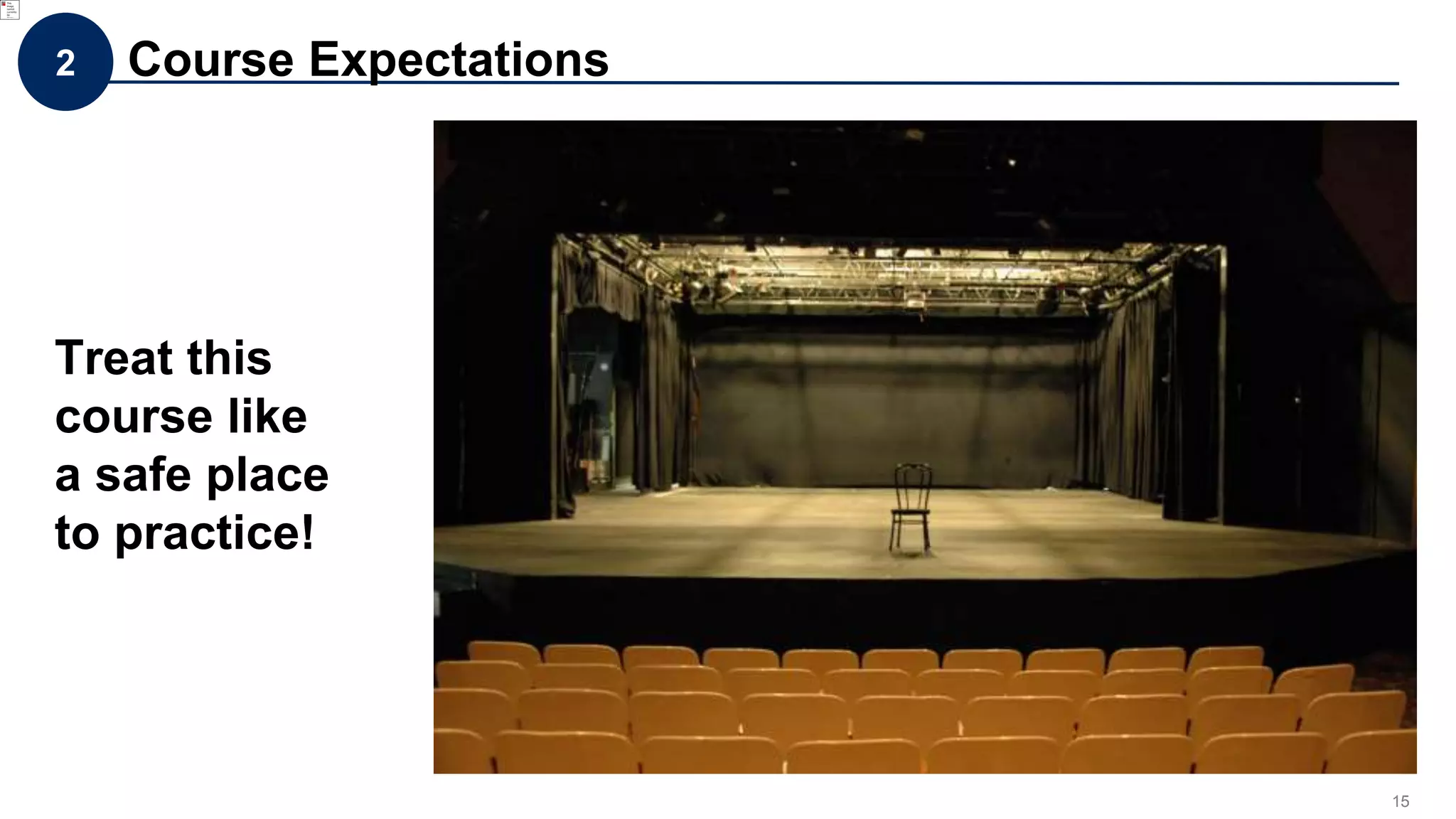
2 Course Expectations
Treat this
course like
a safe place
to practice!
16
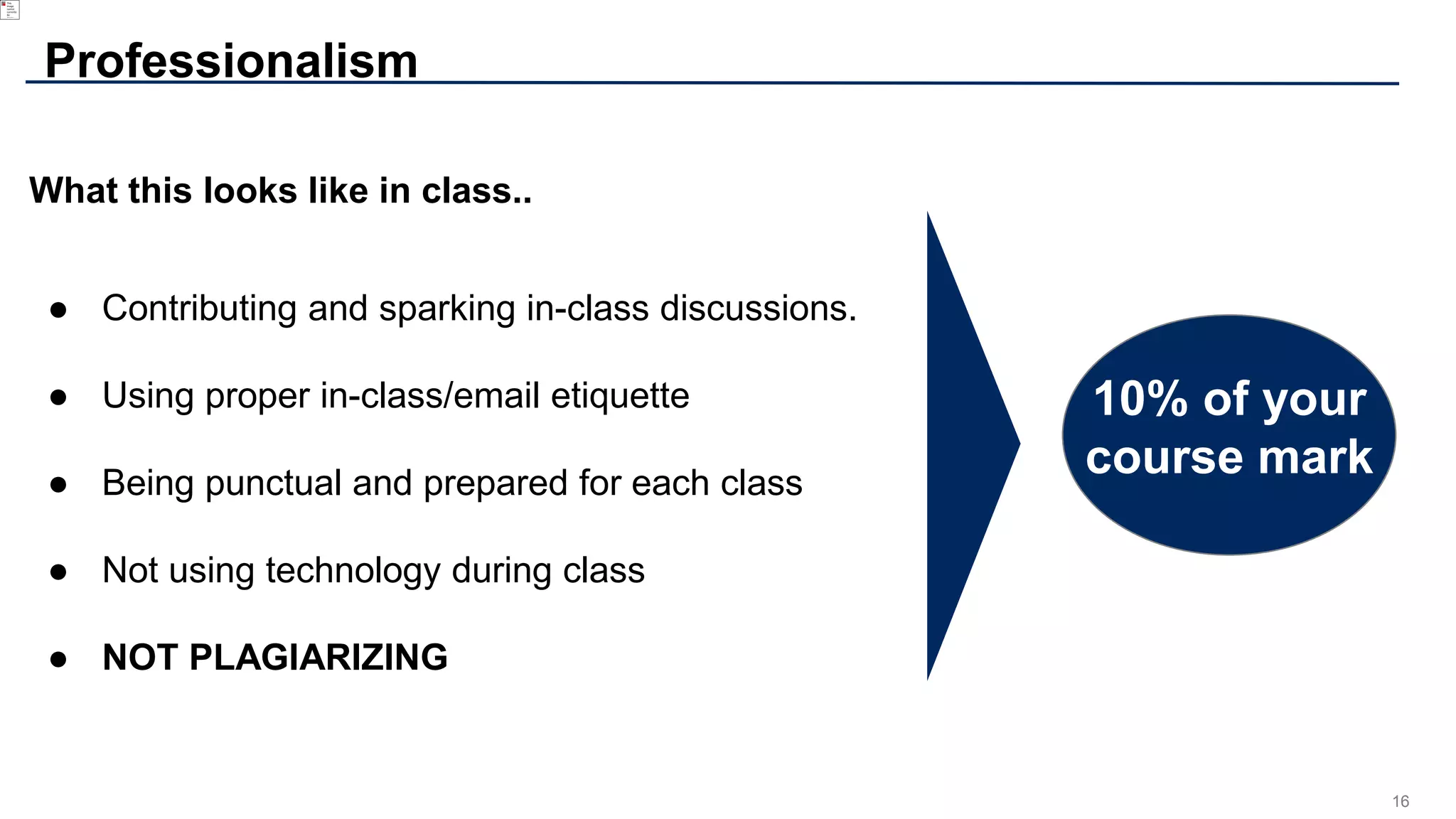
Professionalism
What this looks like in class..
● Contributing and sparking in-class discussions.
● Using proper in-class/email etiquette
● Being punctual and prepared for each class
● Not using technology during class
● NOT PLAGIARIZING
10% of your
course mark
17
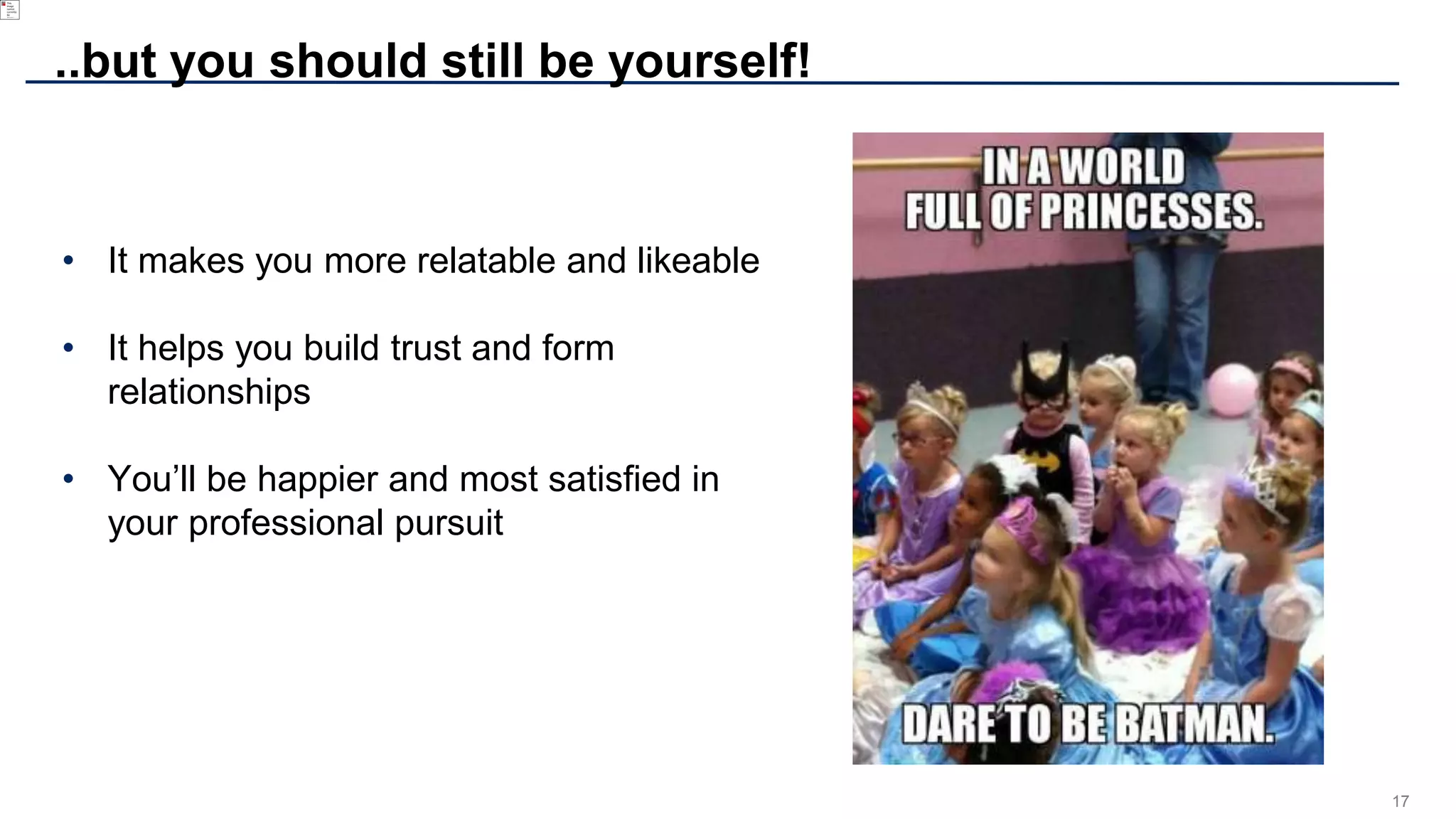
..but you should still be yourself!
• It makes you more relatable and likeable
• It helps you build trust and form
relationships
• You’ll be happier and most satisfied in
your professional pursuit
18
Most tutorials, you will have to
prepare one assignment, such as…
• StrengthsQuest
• Skills Matrix Presentation
• Job Posting Research
• Cover Letter/Resume draft
• ECR assessment
Each assignment is worth 2%, for a
total of 10% in the course
Weekly Tutorial Assignments
Assignments will be
collected in the first 5
minutes of class. All
assignments handed
in late will receive a
grade of zero!
19
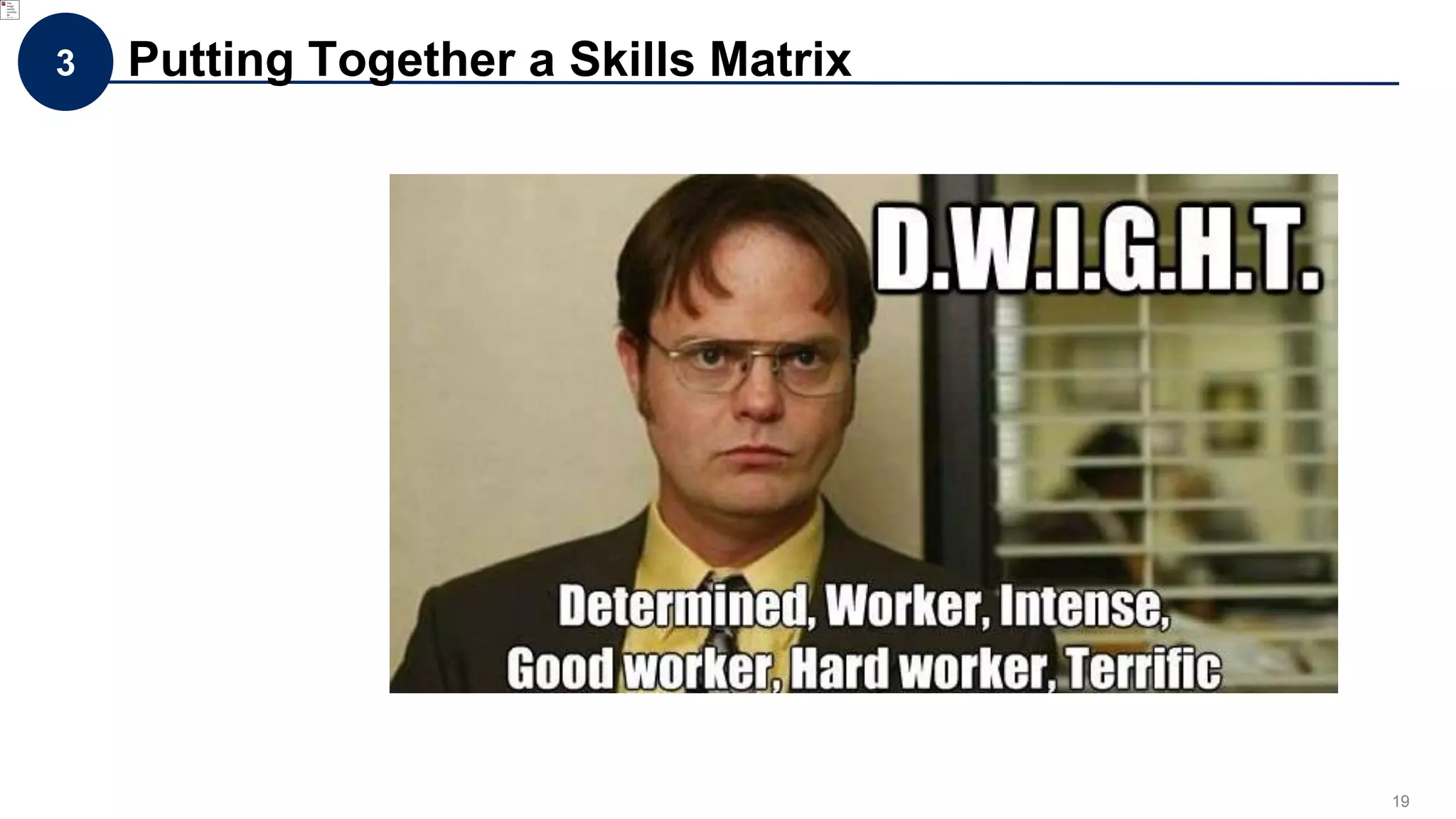
3 Putting Together a Skills Matrix
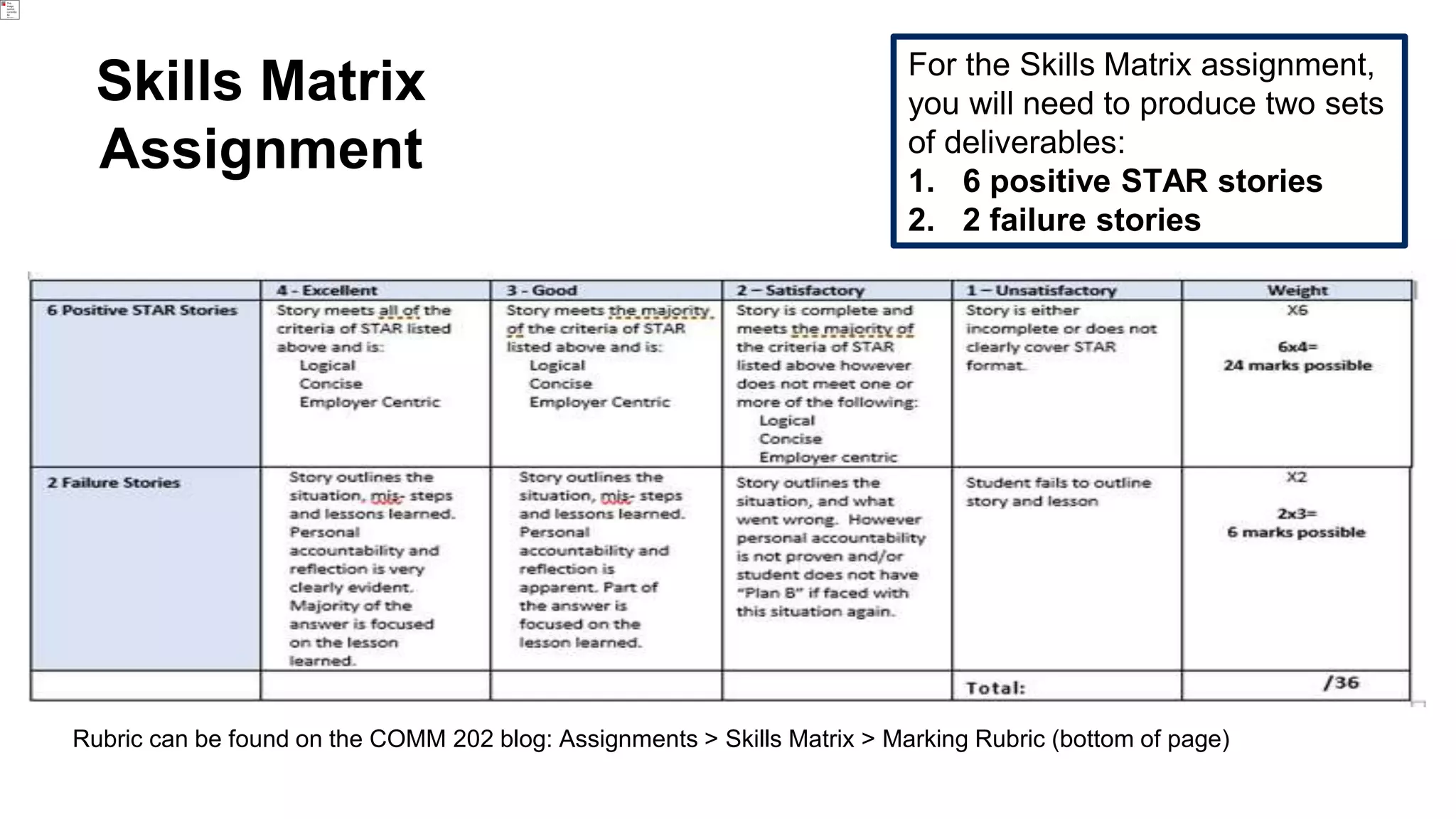
Skills Matrix
Assignment
For the Skills Matrix assignment,
you will need to produce two sets
of deliverables:
1. 6 positive STAR stories
2. 2 failure stories
Rubric can be found on the COMM 202 blog: Assignments > Skills Matrix > Marking Rubric (bottom of page)
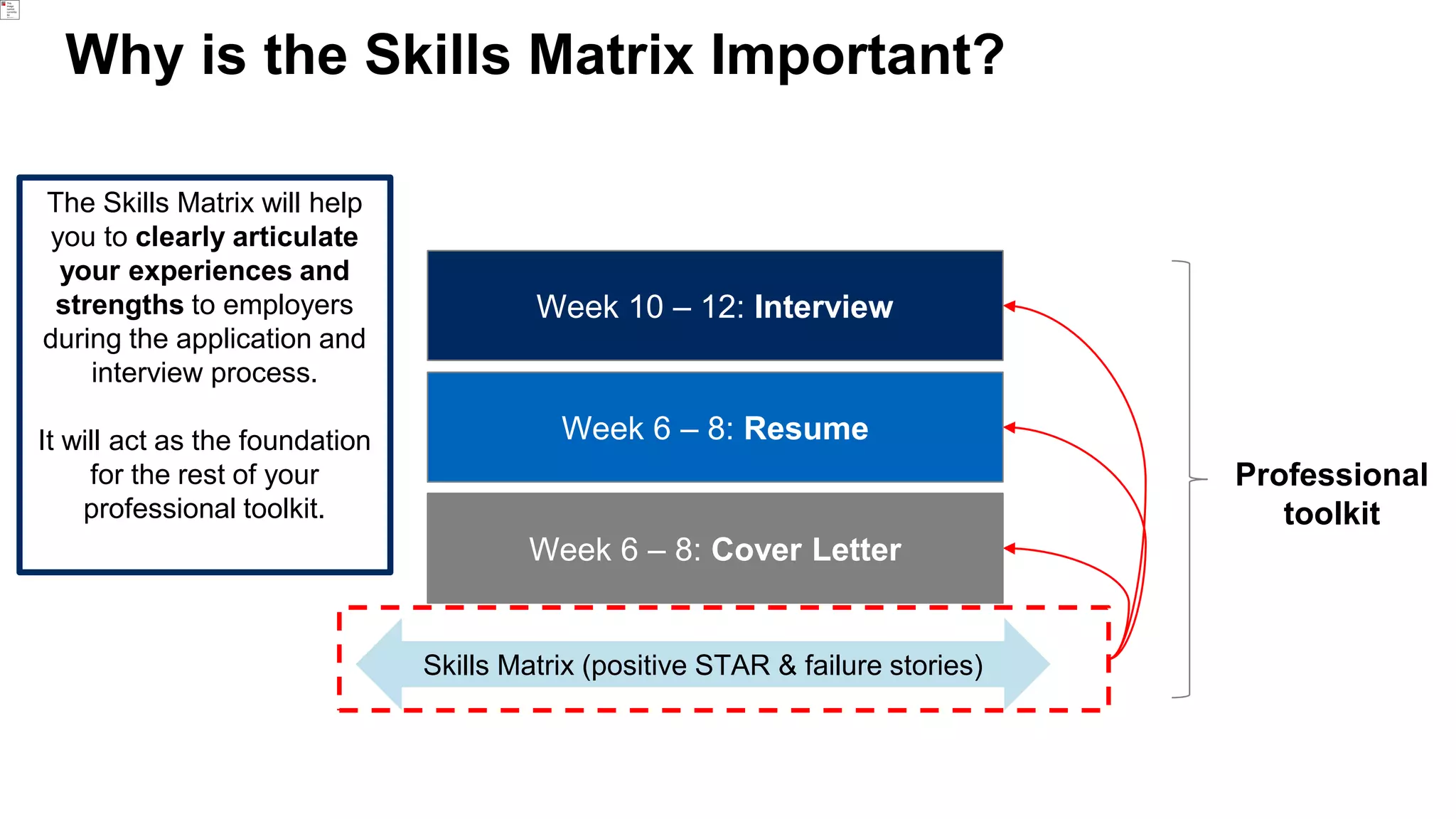
Why is the Skills Matrix Important?
Skills Matrix (positive STAR & failure stories)
Week 6 – 8: Cover Letter
Week 6 – 8: Resume
Week 10 – 12: Interview
The Skills Matrix will help
you to clearly articulate
your experiences and
strengths to employers
during the application and
interview process.
It will act as the foundation
for the rest of your
professional toolkit.
Professional
toolkit
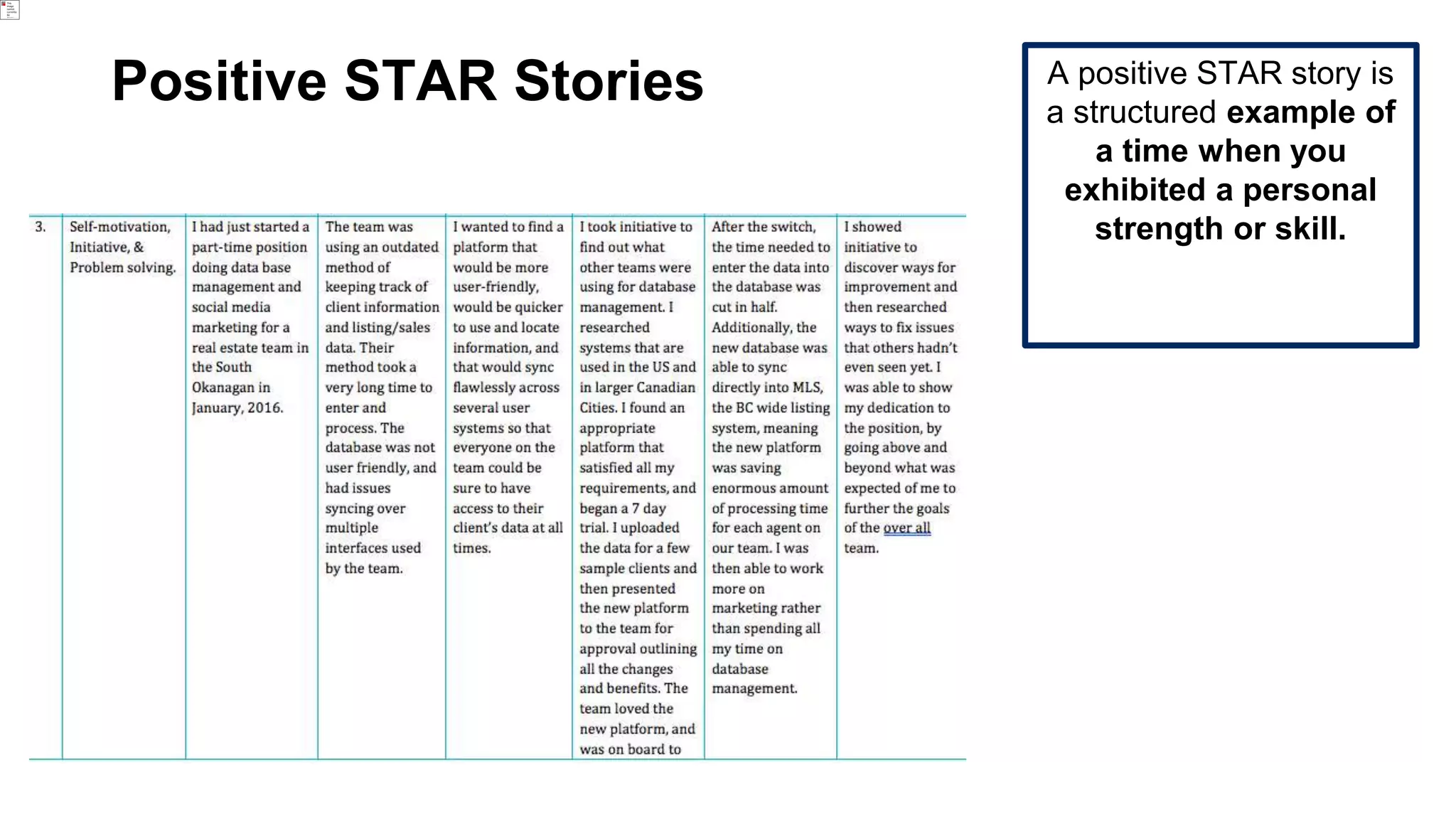
Positive STAR Stories A positive STAR story is
a structured example of
a time when you
exhibited a personal
strength or skill.
23
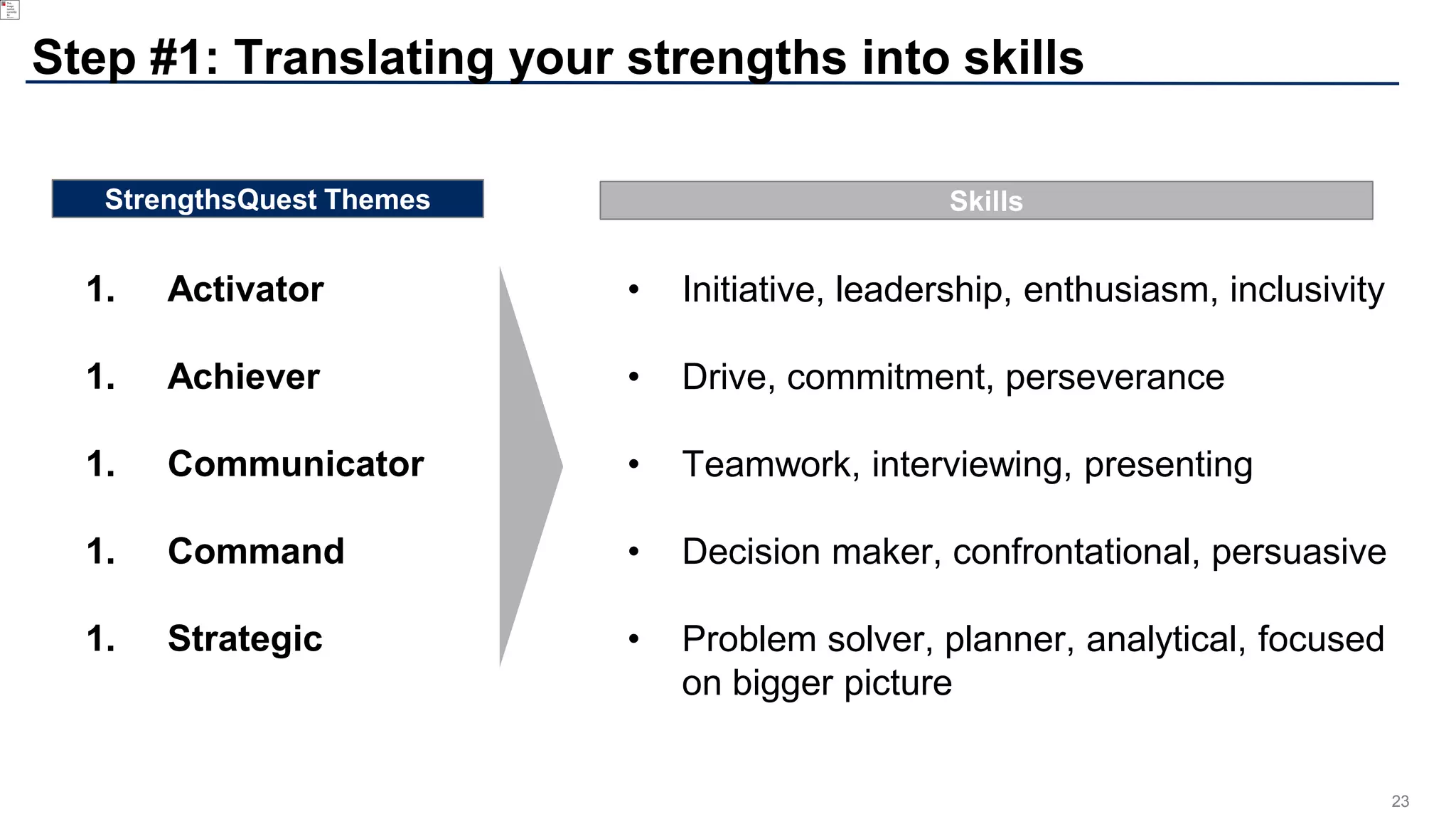
Step #1: Translating your strengths into skills
1. Activator
1. Achiever
1. Communicator
1. Command
1. Strategic
StrengthsQuest Themes Skills
• Initiative, leadership, enthusiasm, inclusivity
• Drive, commitment, perseverance
• Teamwork, interviewing, presenting
• Decision maker, confrontational, persuasive
• Problem solver, planner, analytical, focused
on bigger picture
24
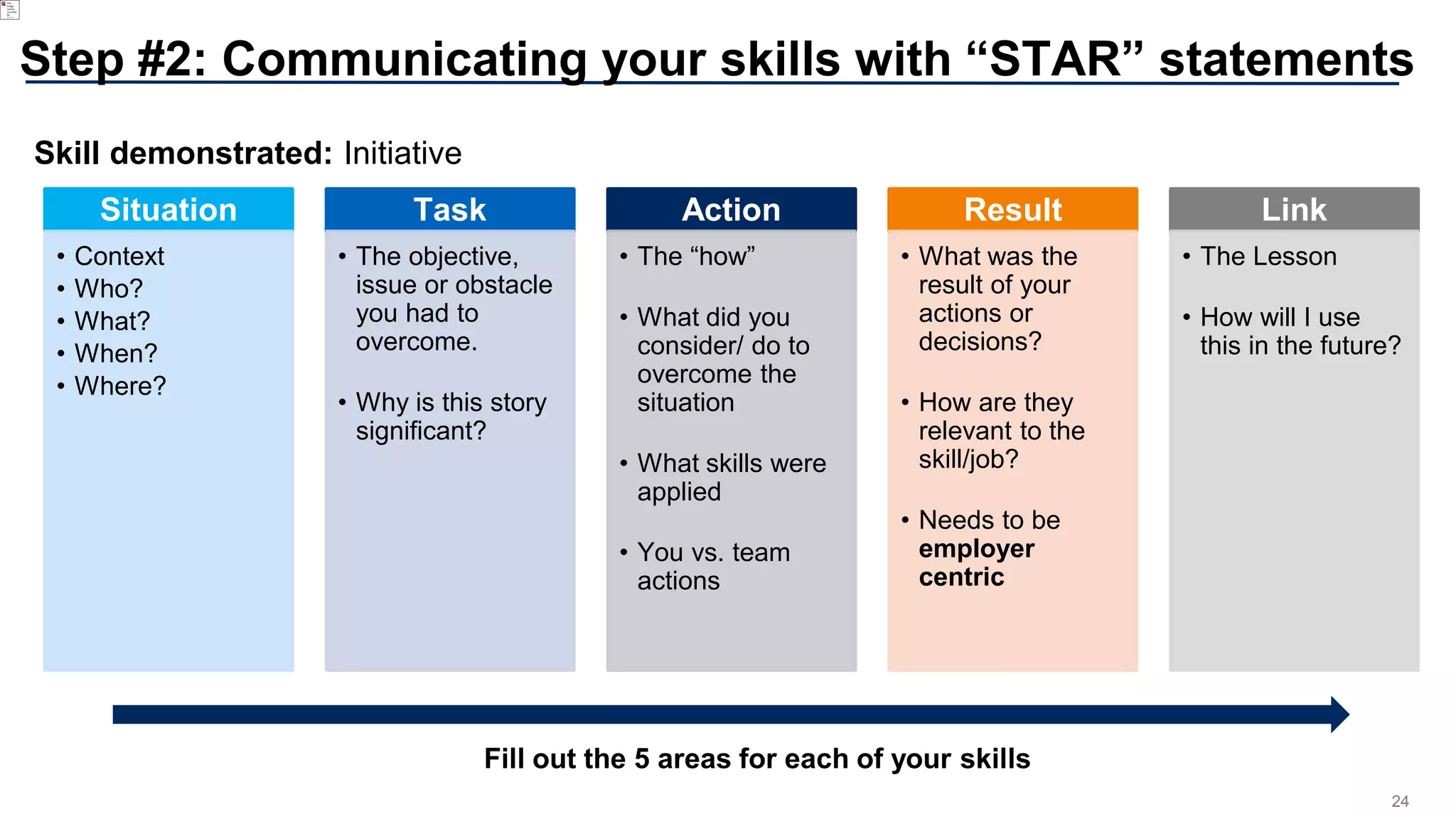
Step #2: Communicating your skills with “STAR” statements
Situation
• Context
• Who?
• What?
• When?
• Where?
Task
• The objective,
issue or obstacle
you had to
overcome.
• Why is this story
significant?
Action
• The “how”
• What did you
consider/ do to
overcome the
situation
• What skills were
applied
• You vs. team
actions
Result
• What was the
result of your
actions or
decisions?
• How are they
relevant to the
skill/job?
• Needs to be
employer
centric
Link
• The Lesson
• How will I use
this in the future?
Skill demonstrated: Initiative
Fill out the 5 areas for each of your skills
25
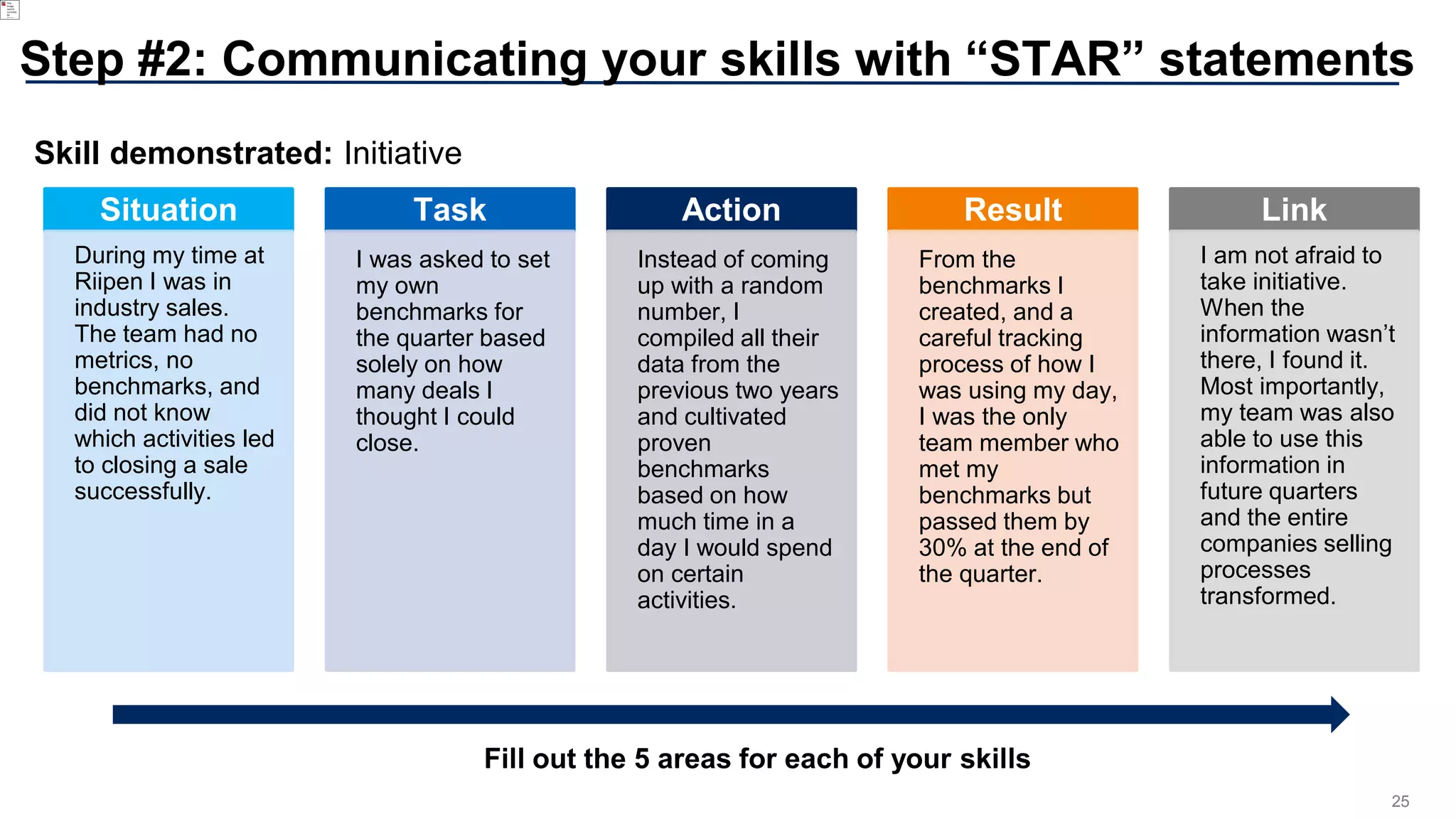
Step #2: Communicating your skills with “STAR” statements
Situation
During my time at
Riipen I was in
industry sales.
The team had no
metrics, no
benchmarks, and
did not know
which activities led
to closing a sale
successfully.
Task
I was asked to set
my own
benchmarks for
the quarter based
solely on how
many deals I
thought I could
close.
Action
Instead of coming
up with a random
number, I
compiled all their
data from the
previous two years
and cultivated
proven
benchmarks
based on how
much time in a
day I would spend
on certain
activities.
Result
From the
benchmarks I
created, and a
careful tracking
process of how I
was using my day,
I was the only
team member who
met my
benchmarks but
passed them by
30% at the end of
the quarter.
Link
I am not afraid to
take initiative.
When the
information wasn’t
there, I found it.
Most importantly,
my team was also
able to use this
information in
future quarters
and the entire
companies selling
processes
transformed.
Skill demonstrated: Initiative
Fill out the 5 areas for each of your skills
26
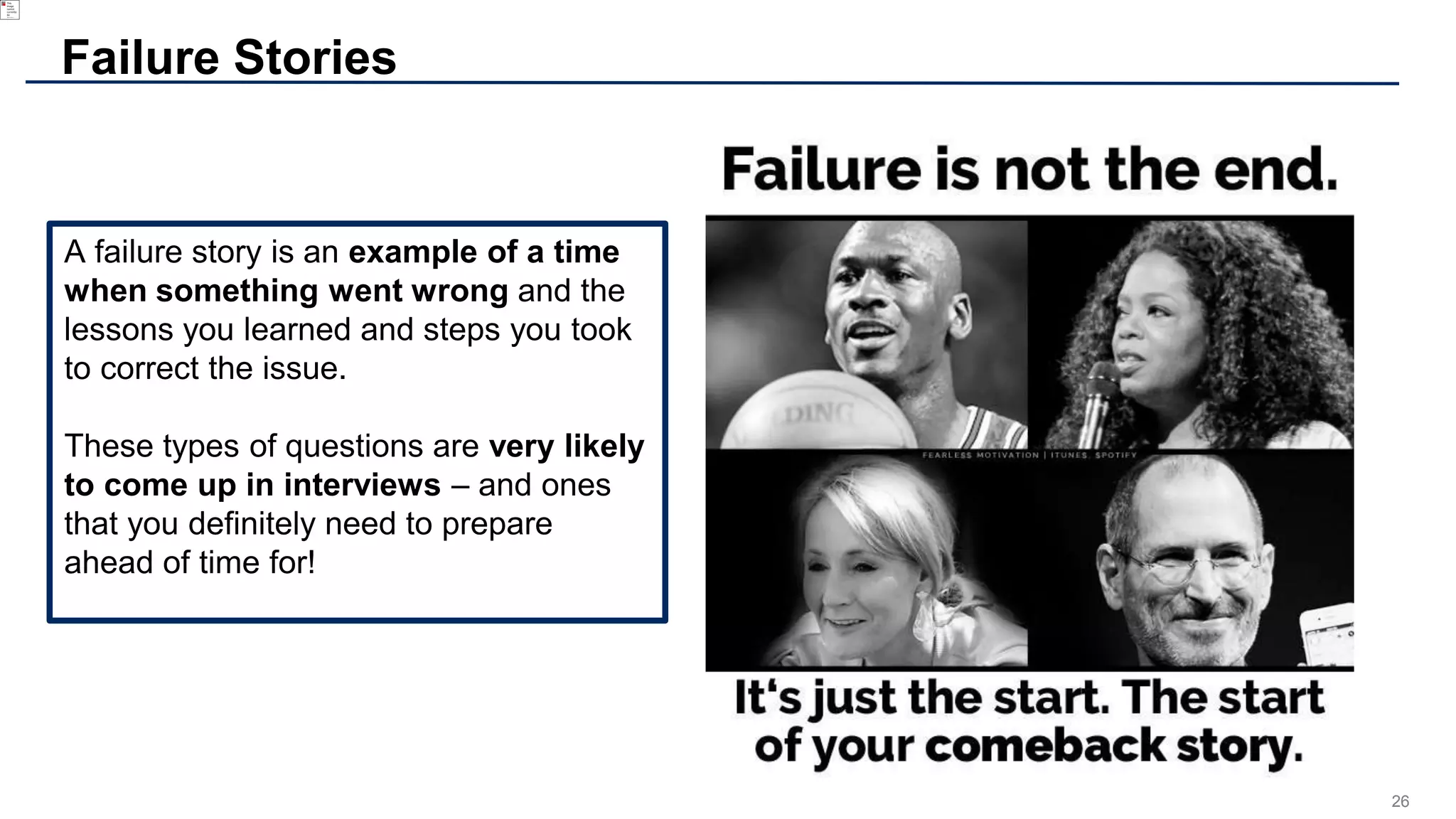
A failure story is an example of a time
when something went wrong and the
lessons you learned and steps you took
to correct the issue.
These types of questions are very likely
to come up in interviews – and ones
that you definitely need to prepare
ahead of time for!
Failure Stories
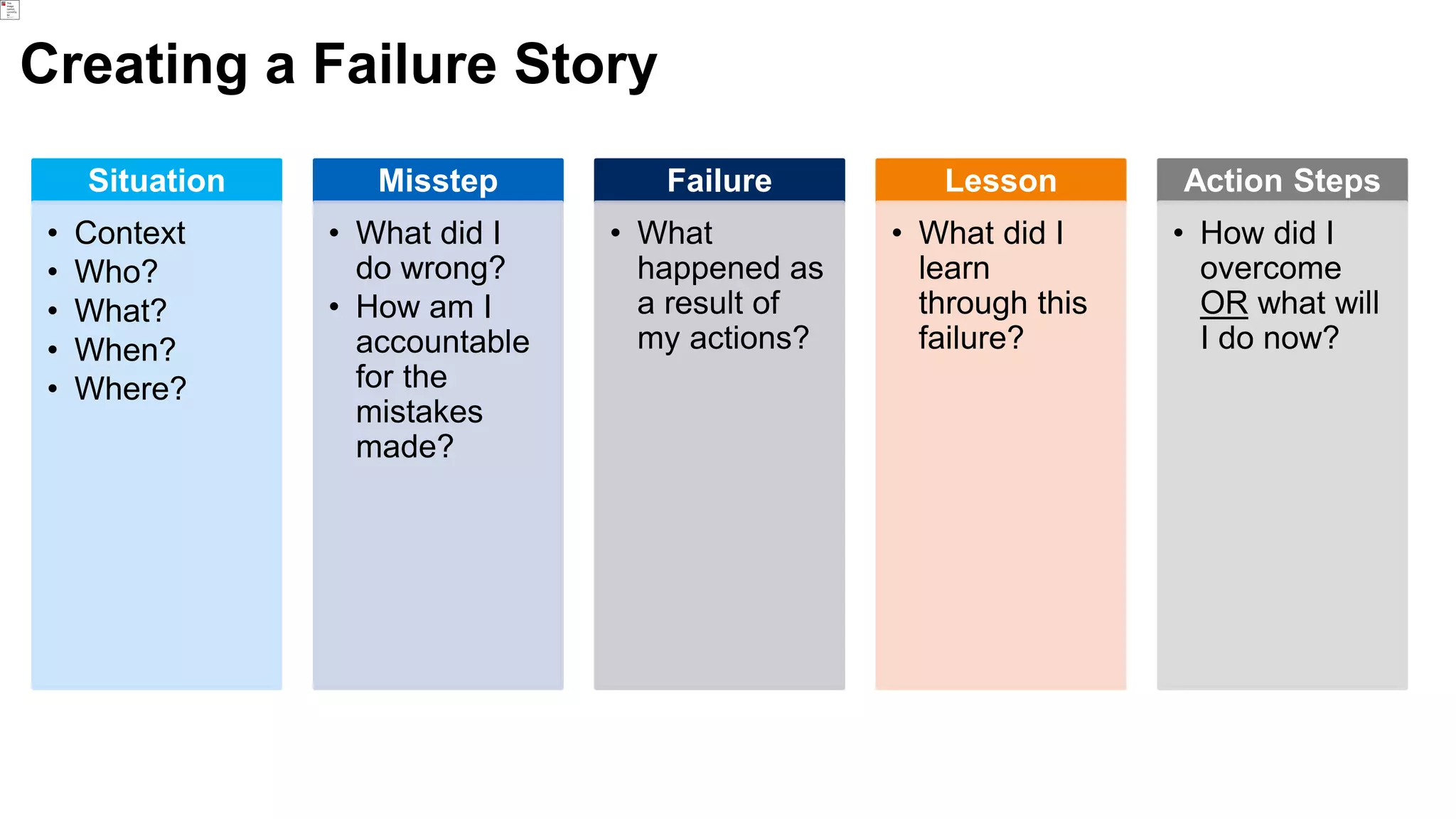
Creating a Failure Story
Situation
• Context
• Who?
• What?
• When?
• Where?
Misstep
• What did I
do wrong?
• How am I
accountable
for the
mistakes
made?
Failure
• What
happened as
a result of
my actions?
Lesson
• What did I
learn
through this
failure?
Action Steps
• How did I
overcome
OR what will
I do now?
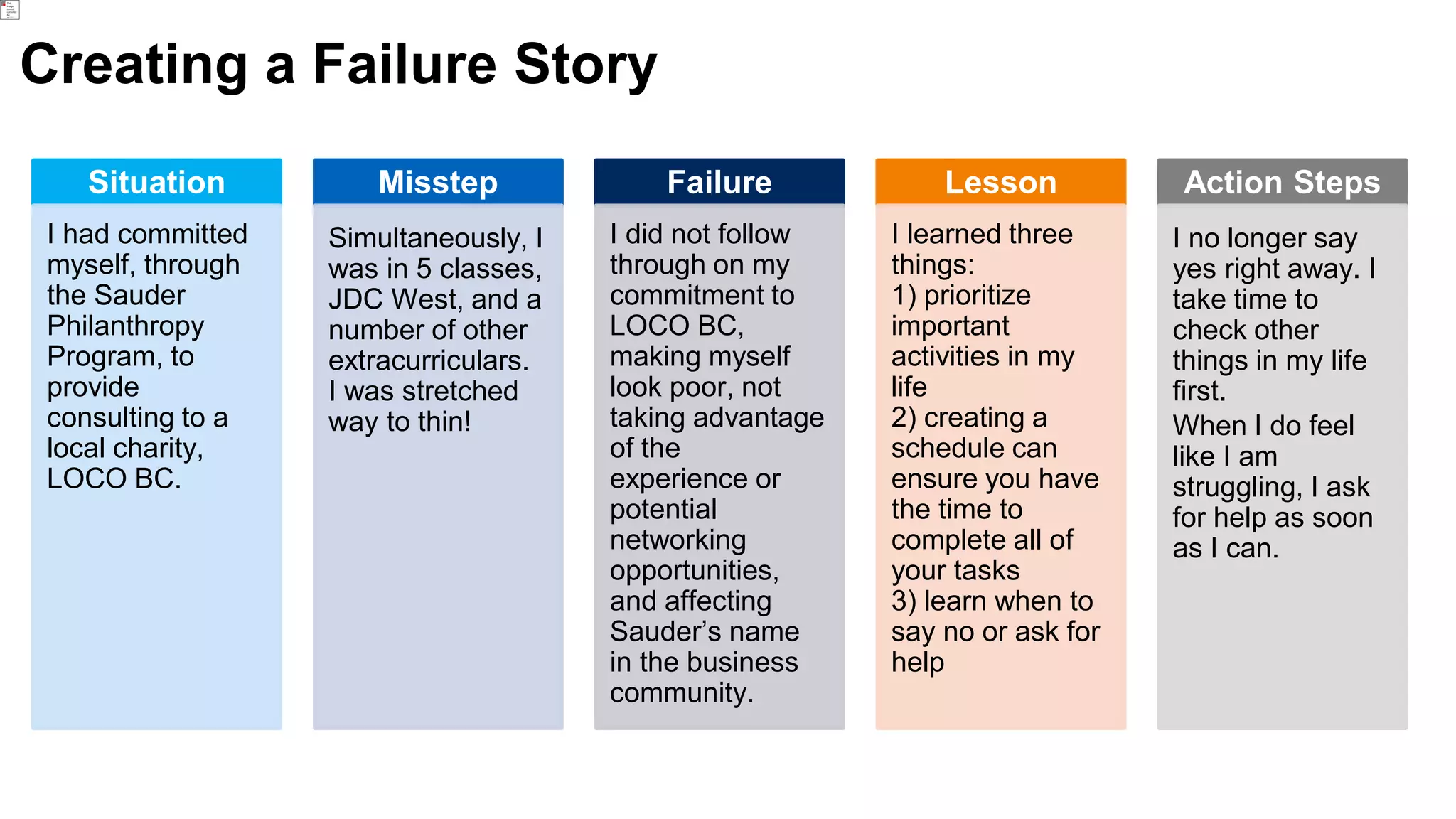
Creating a Failure Story
Situation
I had committed
myself, through
the Sauder
Philanthropy
Program, to
provide
consulting to a
local charity,
LOCO BC.
Misstep
Simultaneously, I
was in 5 classes,
JDC West, and a
number of other
extracurriculars.
I was stretched
way to thin!
Failure
I did not follow
through on my
commitment to
LOCO BC,
making myself
look poor, not
taking advantage
of the
experience or
potential
networking
opportunities,
and affecting
Sauder’s name
in the business
community.
Lesson
I learned three
things:
1) prioritize
important
activities in my
life
2) creating a
schedule can
ensure you have
the time to
complete all of
your tasks
3) learn when to
say no or ask for
help
Action Steps
I no longer say
yes right away. I
take time to
check other
things in my life
first.
When I do feel
like I am
struggling, I ask
for help as soon
as I can.
Creating a Failure Story
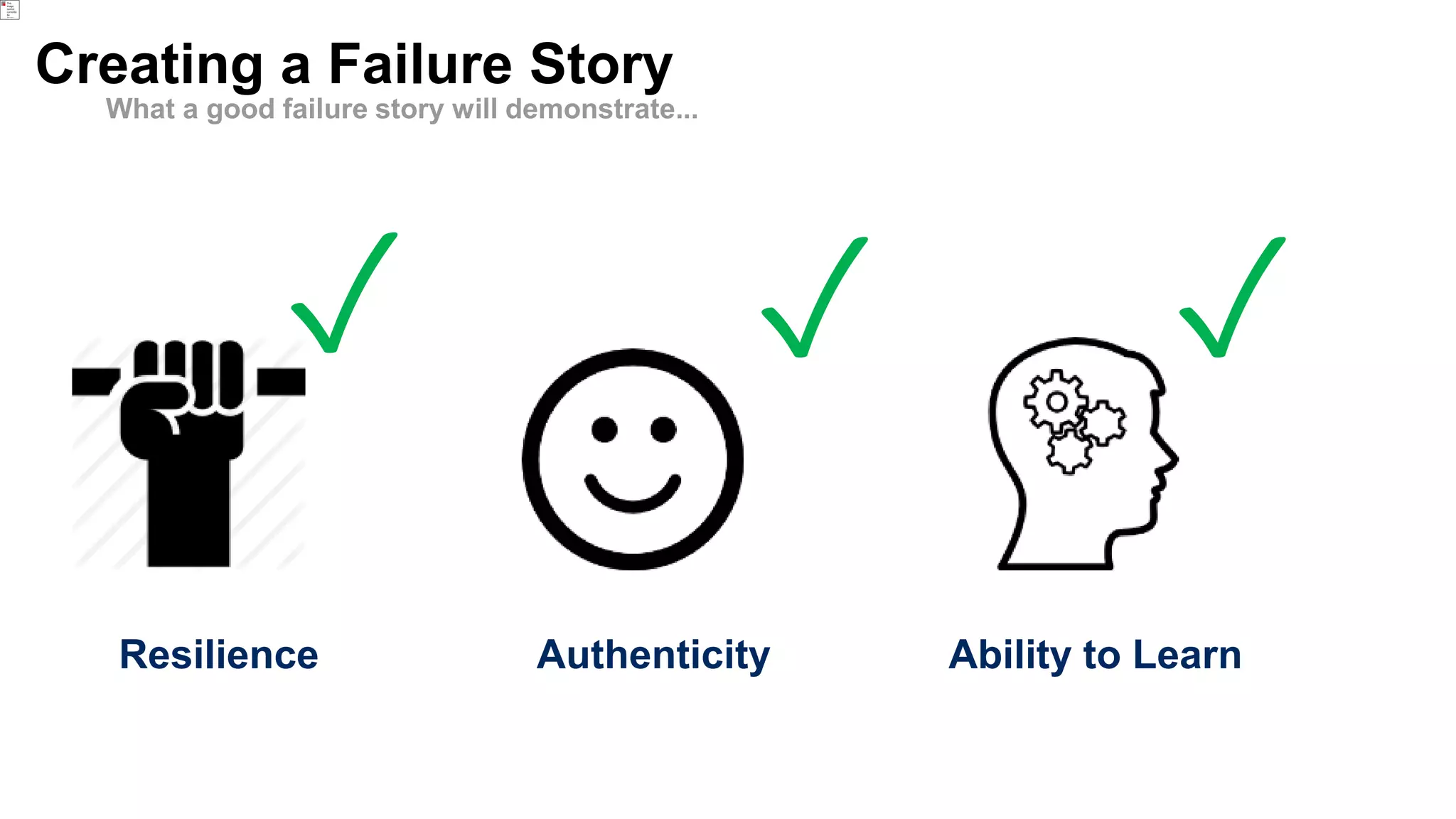
Resilience Authenticity Ability to Learn
✓ ✓ ✓
What a good failure story will demonstrate...
Action items for next week
1. One on one signups (optional) with me
for next week:
https://docs.google.com/spreadsheets/d
/13I1Pavrpn1cx0tKcNgJ3--
gucjmf5HMybdWkIiYk4q8/edit?usp=sha
ring
1. Skills Matrix drafts due on September
24th at the start of class: 2 positive and
1 failure stories
2. Final Skills Matrix due October 4th on
Turnitin: 6 positive and 2 failure stories
My Contact Info
1. Email: comm202.9@sauder.ubc.ca
2. One on ones: sign ups available here
for time slots next week –
https://docs.google.com/spreadsheets/d/
13I1Pavrpn1cx0tKcNgJ3--
gucjmf5HMybdWkIiYk4q8/edit?usp=shar
ing
3. Tutorials: feel free to approach me
before or after
4. Office hours: available throughout
the term as assignments come up (keep
posted!)
32
Questions?
Have a great day!

COMM 202 - Sections T04&T10 - Sept 10th & 12th, 2018

  • 1.
    1 COMM 202: Career Fundamentals T04& T10 with Sidney Pankratz
  • 2.
    Please hand inyour StrengthsQuest Assignment All Assignments must be handed in within the first 5 minutes of class. PRE-CLASS ANNOUNCEMENTS We want to send you important reminders! Help us out by providing your email in the below link: https://goo.gl/forms/uNIQ XQydcL3pp1Zm1
  • 3.
    My Contact Info 1.Email: comm202.9@sauder.ubc.ca 2. One on ones: sign ups available here for time slots next week – https://docs.google.com/spreadsheets/d/ 13I1Pavrpn1cx0tKcNgJ3-- gucjmf5HMybdWkIiYk4q8/edit?usp=shar ing 3. Tutorials: feel free to approach me before or after 4. Office hours: available throughout the term as assignments come up (keep posted!)
  • 4.
    4 Today’s Agenda Getting toknow your TA1 Course Expectations2 Putting Together a Skills Matrix 3
  • 5.
    5 1 Getting toknow your TA
  • 6.
    6 1 Getting toknow your TA
  • 7.
    7 1 Getting toknow your TA WHO AM I? ● Extra Curricular Involvements ● Professional Work Experience
  • 8.
    8 Extracurricular Involvement &Professional Experience Year 1 Year 2 Year 3 Year 5Year 4 Year 6 Year 7
  • 9.
    9 1) Getting toknow your TA WHO AM I? ● Personality type ● Stories of failure
  • 10.
    10 My StrengthsQuest Results StrengthsWhat This Means 1. Activator 2. Achiever 3. Communicator 4. Command 5. Strategic • I like to get things started and be a driving force. • I focus on getting things done. I like to accomplish things I am proud of. • I like roles that involve a lot interaction and communication. • I am a leader and have no issues taking control of a group, delegating tasks and taking responsibility. • I am strategic in how I see problems and solve them. There is usually a greater purpose for everything I do.
  • 11.
    11 My Saboteurs Saboteurs 1. Controller 2.Hyper-achiever 3. Restless 4. Stickler for perfectionism 5. Avoid responsibility
  • 12.
    12 Times that Ihave failed... At my internship at Riipen I failed in my first position within the company because I didn’t ask for help or direction when I noticed that I wasn’t doing as well as the others! When I transitioned from Langara to the next institution, I was rejected by three other universities before being accepted into Sauder two months later.
  • 13.
    13 ..and how Igot back on my feet. At my internship at Riipen I failed in my first position within the company because I didn’t ask for help or direction when I noticed that I wasn’t doing as well as the others! When I was transferred into another part of the business I proactively sought out mentorship right away. When I struggled or lost a sale, I asked questions from my colleagues and manager, and applied them in my own way. When I transitioned from Langara to the next institution, I was rejected by three other universities before being accepted into Sauder two months later. When I got to Sauder, I decided that the “NO’s” where no longer going to dictate my behaviour or shake my confidence. When a door is closed, don’t give up, just look for another.
  • 14.
  • 15.
    15 2 Course Expectations Treatthis course like a safe place to practice!
  • 16.
    16 Professionalism What this lookslike in class.. ● Contributing and sparking in-class discussions. ● Using proper in-class/email etiquette ● Being punctual and prepared for each class ● Not using technology during class ● NOT PLAGIARIZING 10% of your course mark
  • 17.
    17 ..but you shouldstill be yourself! • It makes you more relatable and likeable • It helps you build trust and form relationships • You’ll be happier and most satisfied in your professional pursuit
  • 18.
    18 Most tutorials, youwill have to prepare one assignment, such as… • StrengthsQuest • Skills Matrix Presentation • Job Posting Research • Cover Letter/Resume draft • ECR assessment Each assignment is worth 2%, for a total of 10% in the course Weekly Tutorial Assignments Assignments will be collected in the first 5 minutes of class. All assignments handed in late will receive a grade of zero!
  • 19.
    19 3 Putting Togethera Skills Matrix
  • 20.
    Skills Matrix Assignment For theSkills Matrix assignment, you will need to produce two sets of deliverables: 1. 6 positive STAR stories 2. 2 failure stories Rubric can be found on the COMM 202 blog: Assignments > Skills Matrix > Marking Rubric (bottom of page)
  • 21.
    Why is theSkills Matrix Important? Skills Matrix (positive STAR & failure stories) Week 6 – 8: Cover Letter Week 6 – 8: Resume Week 10 – 12: Interview The Skills Matrix will help you to clearly articulate your experiences and strengths to employers during the application and interview process. It will act as the foundation for the rest of your professional toolkit. Professional toolkit
  • 22.
    Positive STAR StoriesA positive STAR story is a structured example of a time when you exhibited a personal strength or skill.
  • 23.
    23 Step #1: Translatingyour strengths into skills 1. Activator 1. Achiever 1. Communicator 1. Command 1. Strategic StrengthsQuest Themes Skills • Initiative, leadership, enthusiasm, inclusivity • Drive, commitment, perseverance • Teamwork, interviewing, presenting • Decision maker, confrontational, persuasive • Problem solver, planner, analytical, focused on bigger picture
  • 24.
    24 Step #2: Communicatingyour skills with “STAR” statements Situation • Context • Who? • What? • When? • Where? Task • The objective, issue or obstacle you had to overcome. • Why is this story significant? Action • The “how” • What did you consider/ do to overcome the situation • What skills were applied • You vs. team actions Result • What was the result of your actions or decisions? • How are they relevant to the skill/job? • Needs to be employer centric Link • The Lesson • How will I use this in the future? Skill demonstrated: Initiative Fill out the 5 areas for each of your skills
  • 25.
    25 Step #2: Communicatingyour skills with “STAR” statements Situation During my time at Riipen I was in industry sales. The team had no metrics, no benchmarks, and did not know which activities led to closing a sale successfully. Task I was asked to set my own benchmarks for the quarter based solely on how many deals I thought I could close. Action Instead of coming up with a random number, I compiled all their data from the previous two years and cultivated proven benchmarks based on how much time in a day I would spend on certain activities. Result From the benchmarks I created, and a careful tracking process of how I was using my day, I was the only team member who met my benchmarks but passed them by 30% at the end of the quarter. Link I am not afraid to take initiative. When the information wasn’t there, I found it. Most importantly, my team was also able to use this information in future quarters and the entire companies selling processes transformed. Skill demonstrated: Initiative Fill out the 5 areas for each of your skills
  • 26.
    26 A failure storyis an example of a time when something went wrong and the lessons you learned and steps you took to correct the issue. These types of questions are very likely to come up in interviews – and ones that you definitely need to prepare ahead of time for! Failure Stories
  • 27.
    Creating a FailureStory Situation • Context • Who? • What? • When? • Where? Misstep • What did I do wrong? • How am I accountable for the mistakes made? Failure • What happened as a result of my actions? Lesson • What did I learn through this failure? Action Steps • How did I overcome OR what will I do now?
  • 28.
    Creating a FailureStory Situation I had committed myself, through the Sauder Philanthropy Program, to provide consulting to a local charity, LOCO BC. Misstep Simultaneously, I was in 5 classes, JDC West, and a number of other extracurriculars. I was stretched way to thin! Failure I did not follow through on my commitment to LOCO BC, making myself look poor, not taking advantage of the experience or potential networking opportunities, and affecting Sauder’s name in the business community. Lesson I learned three things: 1) prioritize important activities in my life 2) creating a schedule can ensure you have the time to complete all of your tasks 3) learn when to say no or ask for help Action Steps I no longer say yes right away. I take time to check other things in my life first. When I do feel like I am struggling, I ask for help as soon as I can.
  • 29.
    Creating a FailureStory Resilience Authenticity Ability to Learn ✓ ✓ ✓ What a good failure story will demonstrate...
  • 30.
    Action items fornext week 1. One on one signups (optional) with me for next week: https://docs.google.com/spreadsheets/d /13I1Pavrpn1cx0tKcNgJ3-- gucjmf5HMybdWkIiYk4q8/edit?usp=sha ring 1. Skills Matrix drafts due on September 24th at the start of class: 2 positive and 1 failure stories 2. Final Skills Matrix due October 4th on Turnitin: 6 positive and 2 failure stories
  • 31.
    My Contact Info 1.Email: comm202.9@sauder.ubc.ca 2. One on ones: sign ups available here for time slots next week – https://docs.google.com/spreadsheets/d/ 13I1Pavrpn1cx0tKcNgJ3-- gucjmf5HMybdWkIiYk4q8/edit?usp=shar ing 3. Tutorials: feel free to approach me before or after 4. Office hours: available throughout the term as assignments come up (keep posted!)
  • 32.