Presented by
Date
Event
SFO15-TR9: ACPI, PSCI
(and UEFI to boot)
Bill Fletcher
Linaro Field Engineering
v2.0
Bill Fletcher
Thursday 24 September 2015
SFO15
Overview
● An introductory look at ACPI infrastructure
● How a platform (qemu), a bootloader (uefi)
and the kernel work together to set up the
ACPI configuration
● There's an explanation of what’s been
upstreamed in Linux kernel 4.1
● A simple aarch64 demo based on qemu
● A brief look at what's new
Caveats. This is not ...
● An exhaustive tutorial on ACPI
● A reference implementation for PSCI
● “Why to use ACPI instead of device trees”
● “Why to favour UEFI instead of UBoot”
● ...
ACPI and PSCI (briefly)
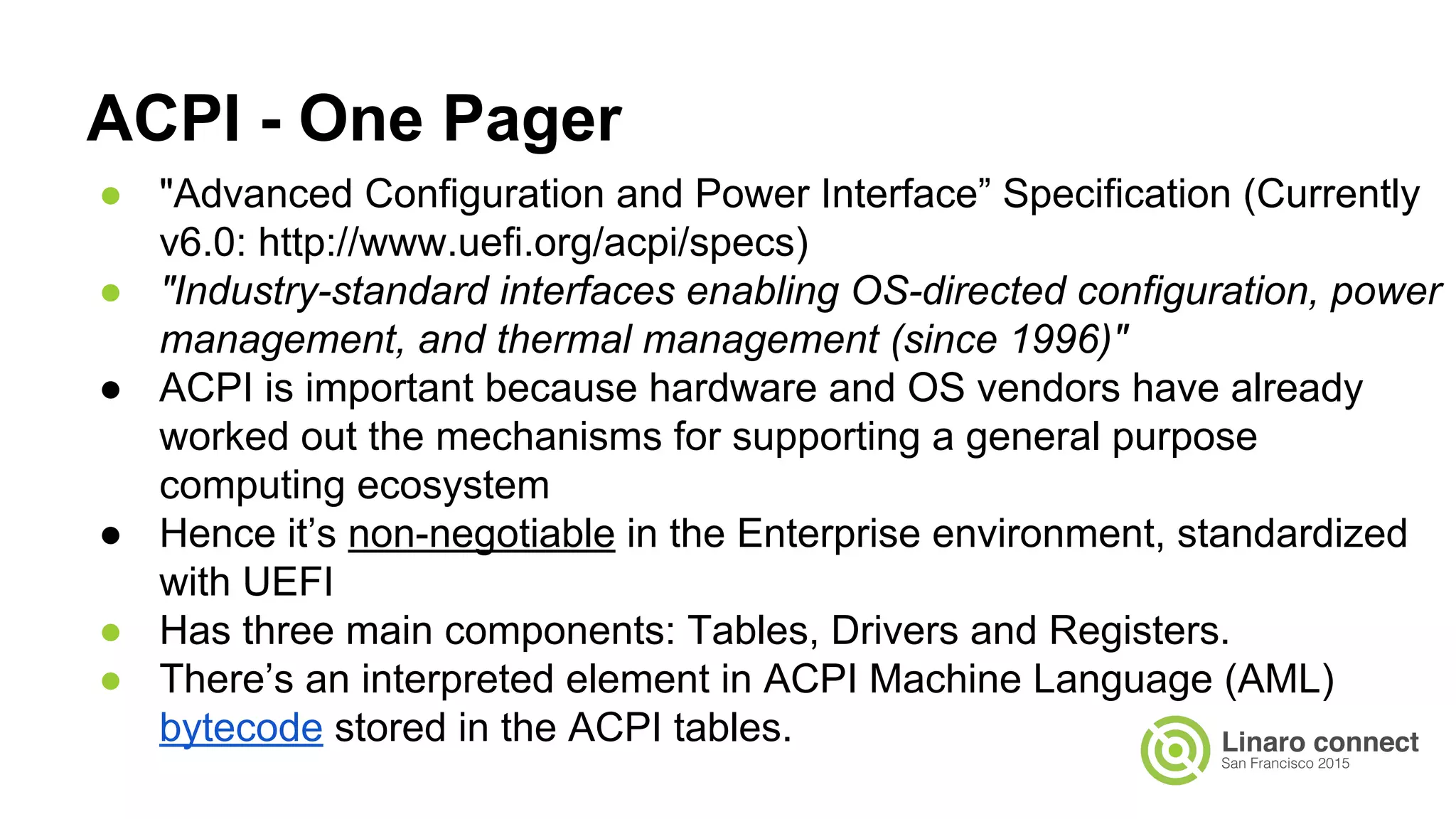
● "Advanced Configuration and Power Interface” Specification (Currently
v6.0: http://www.uefi.org/acpi/specs)
● "Industry-standard interfaces enabling OS-directed configuration, power
management, and thermal management (since 1996)"
● ACPI is important because hardware and OS vendors have already
worked out the mechanisms for supporting a general purpose
computing ecosystem
● Hence it’s non-negotiable in the Enterprise environment, standardized
with UEFI
● Has three main components: Tables, Drivers and Registers.
● There’s an interpreted element in ACPI Machine Language (AML)
bytecode stored in the ACPI tables.
ACPI - One Pager
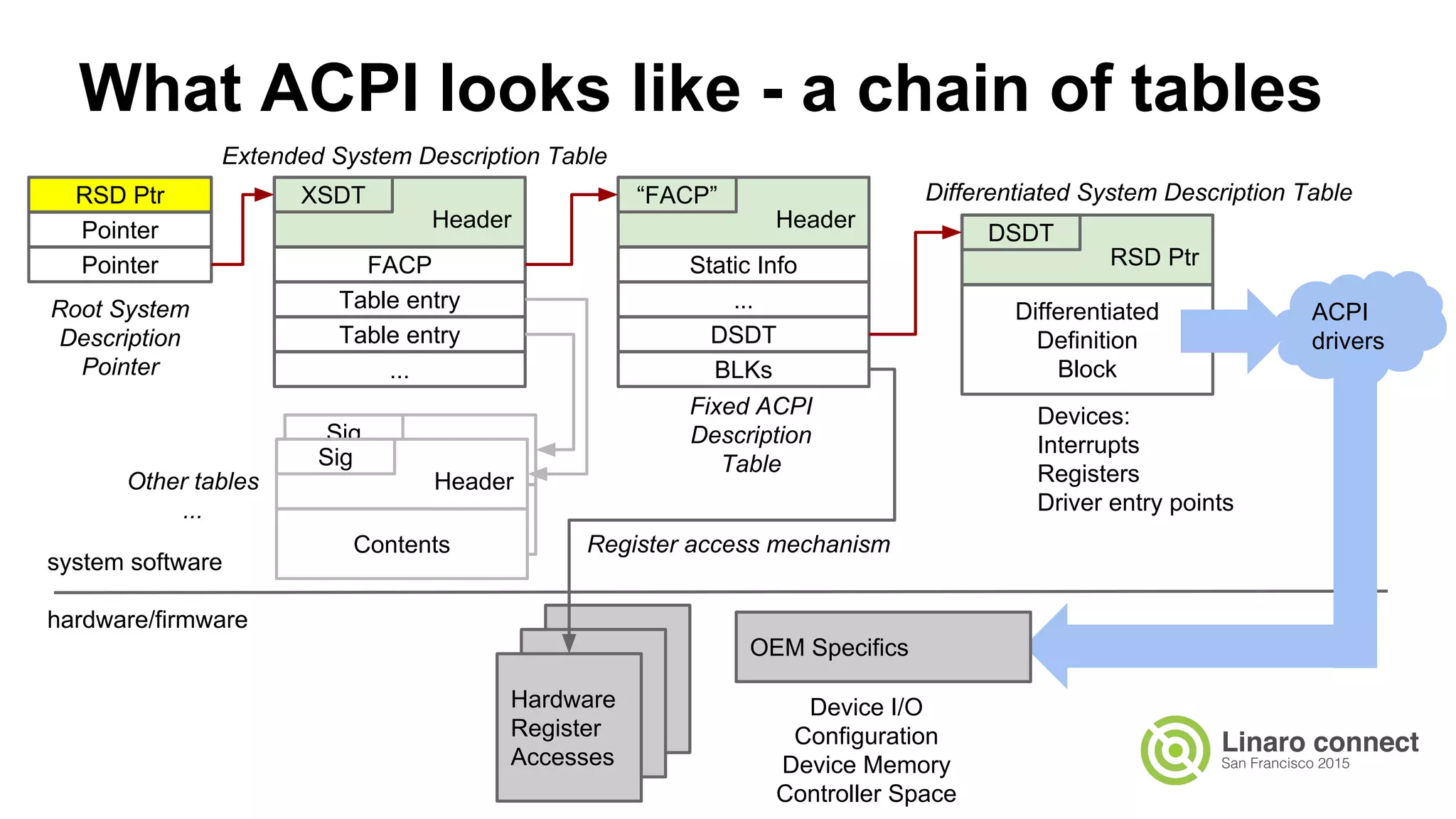
RSD Ptr
Pointer
Pointer
Header
FACP
Table entry
Table entry
XSDT
...
Header
Static Info
...
DSDT
“FACP”
BLKs
RSD Ptr
Differentiated
Definition
Block
DSDT
RSD Ptr
Entry
Sig
Header
Contents
Sig
ACPI
drivers
OEM Specifics
Hardware
Register
Accesses
Root System
Description
Pointer
Extended System Description Table
Fixed ACPI
Description
Table
Other tables
...
Device I/O
Configuration
Device Memory
Controller Space
Register access mechanism
system software
hardware/firmware
What ACPI looks like - a chain of tables
Differentiated System Description Table
Devices:
Interrupts
Registers
Driver entry points
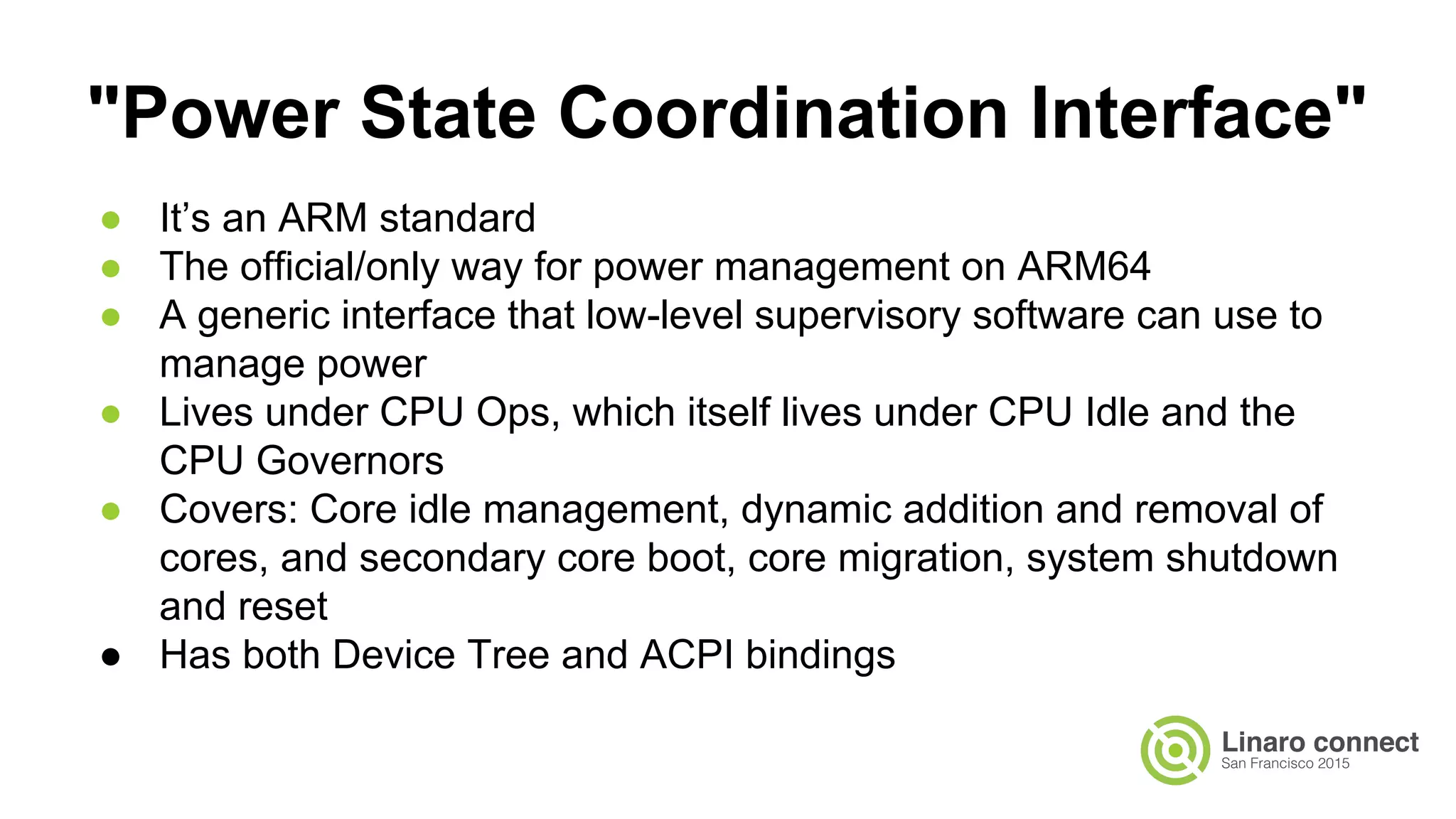
● It’s an ARM standard
● The official/only way for power management on ARM64
● A generic interface that low-level supervisory software can use to
manage power
● Lives under CPU Ops, which itself lives under CPU Idle and the
CPU Governors
● Covers: Core idle management, dynamic addition and removal of
cores, and secondary core boot, core migration, system shutdown
and reset
● Has both Device Tree and ACPI bindings
"Power State Coordination Interface"
Booting
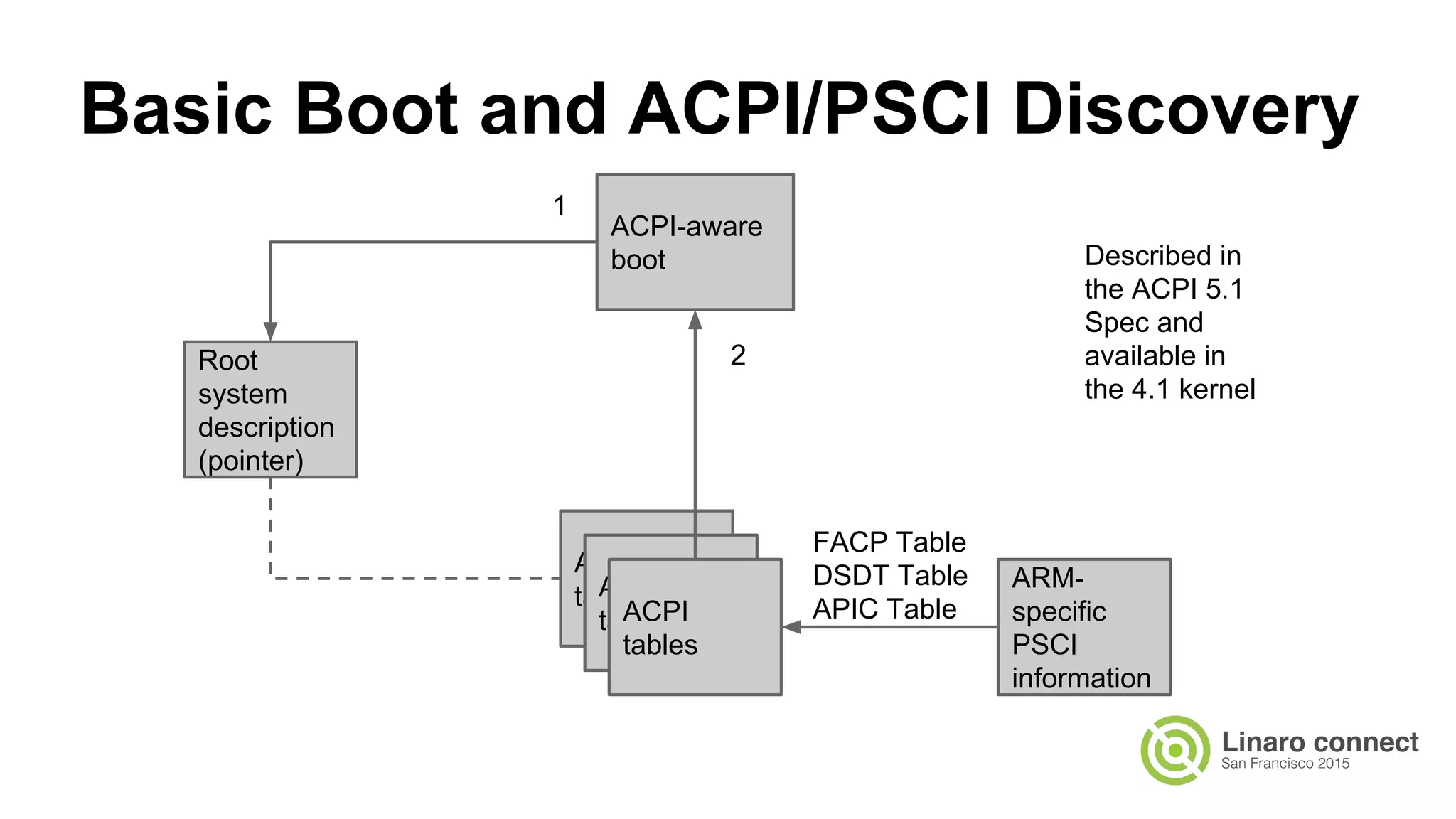
Basic Boot and ACPI/PSCI Discovery
Root
system
description
(pointer)
ACPI
tablesACPI
tablesACPI
tables
ACPI-aware
boot
ARM-
specific
PSCI
information
1
2
FACP Table
DSDT Table
APIC Table
Described in
the ACPI 5.1
Spec and
available in
the 4.1 kernel
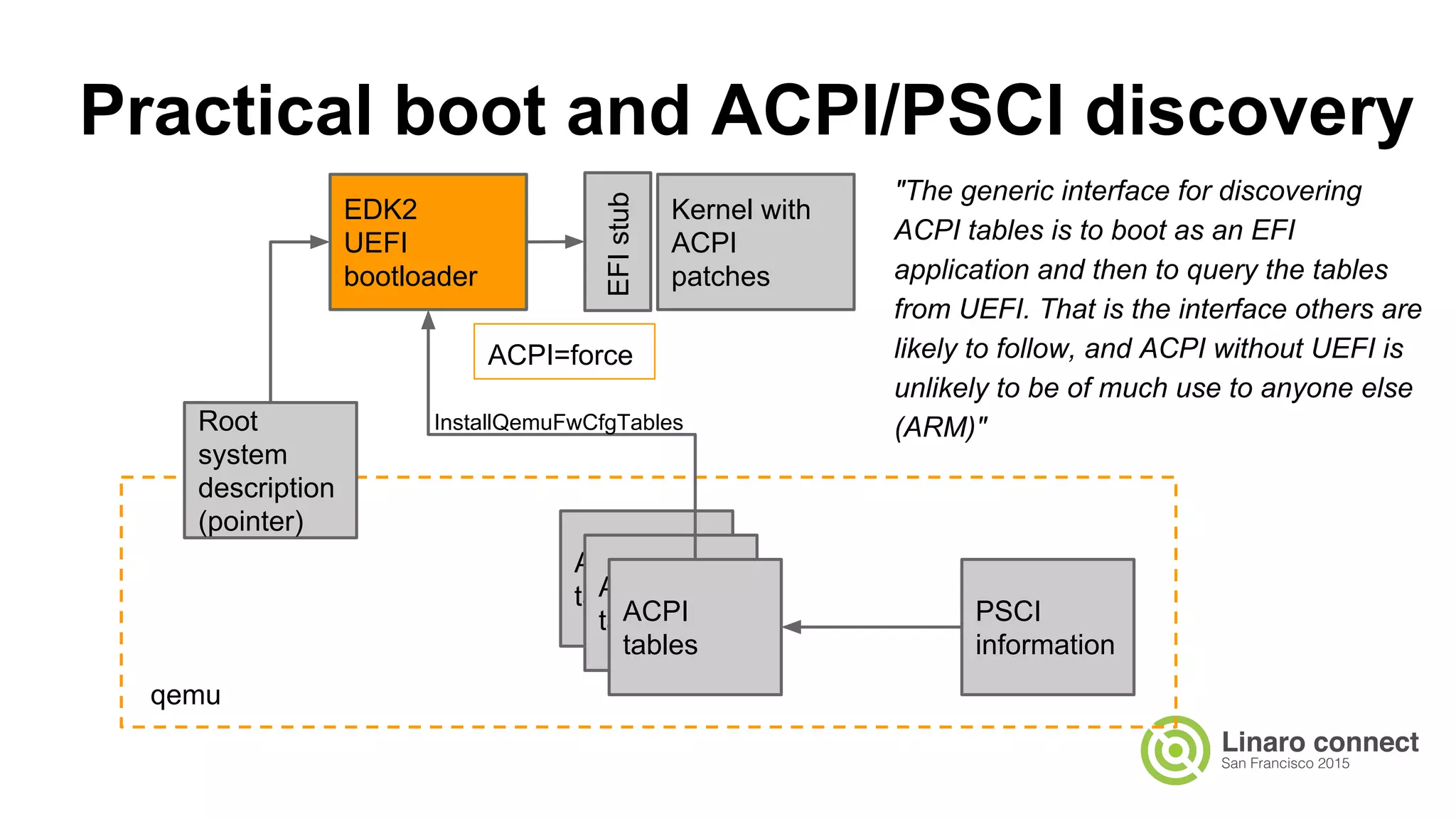
Practical boot and ACPI/PSCI discovery
Root
system
description
(pointer)
ACPI
tablesACPI
tablesACPI
tables
EFIstub PSCI
information
ACPI=force
EDK2
UEFI
bootloader
"The generic interface for discovering
ACPI tables is to boot as an EFI
application and then to query the tables
from UEFI. That is the interface others are
likely to follow, and ACPI without UEFI is
unlikely to be of much use to anyone else
(ARM)"
qemu
Kernel with
ACPI
patches
InstallQemuFwCfgTables
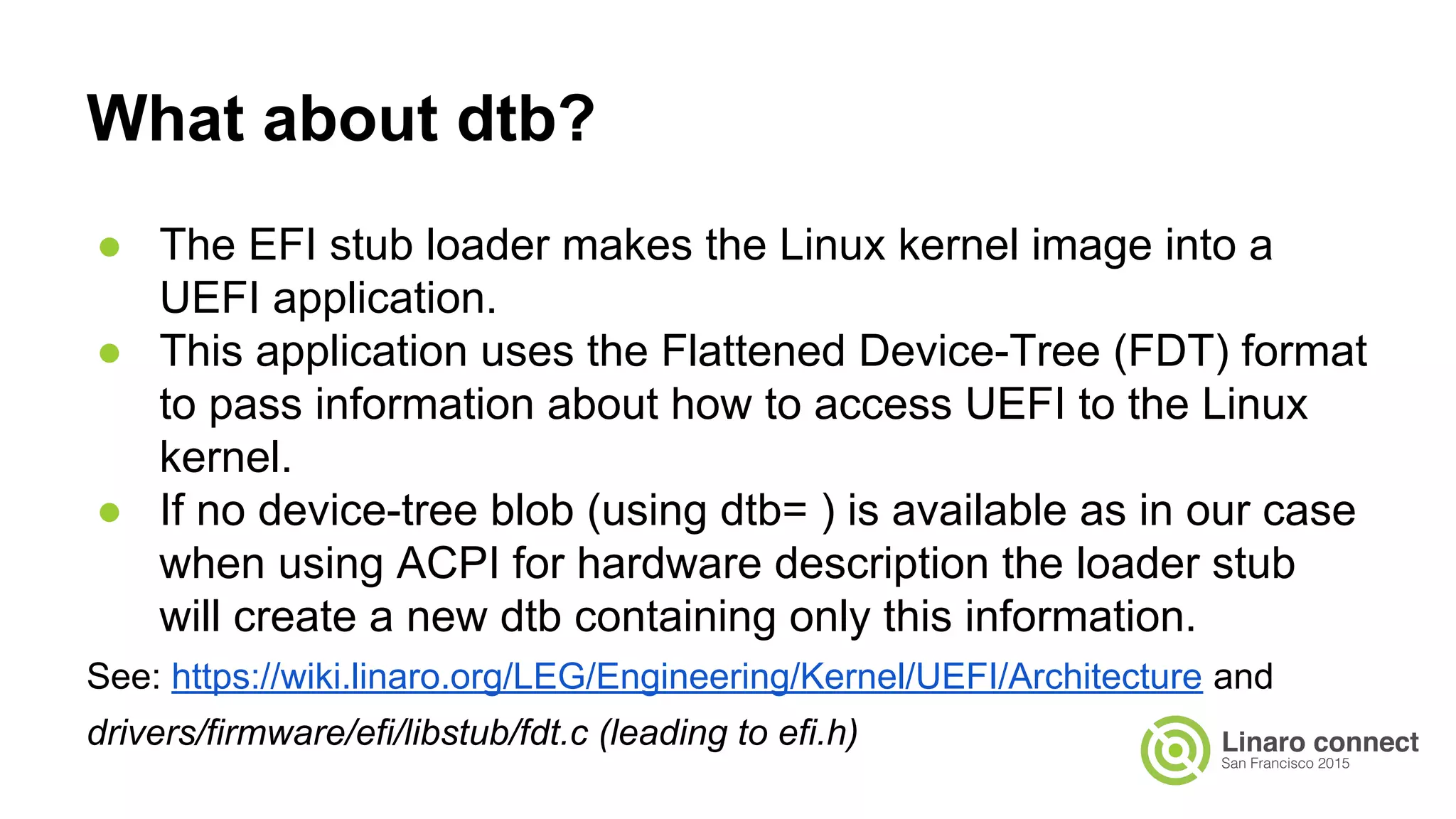
What about dtb?
● The EFI stub loader makes the Linux kernel image into a
UEFI application.
● This application uses the Flattened Device-Tree (FDT) format
to pass information about how to access UEFI to the Linux
kernel.
● If no device-tree blob (using dtb= ) is available as in our case
when using ACPI for hardware description the loader stub
will create a new dtb containing only this information.
See: https://wiki.linaro.org/LEG/Engineering/Kernel/UEFI/Architecture and
drivers/firmware/efi/libstub/fdt.c (leading to efi.h)
Basic Feature Set
Having booted successfully and loaded the ACPI tables … what functionality do we have?
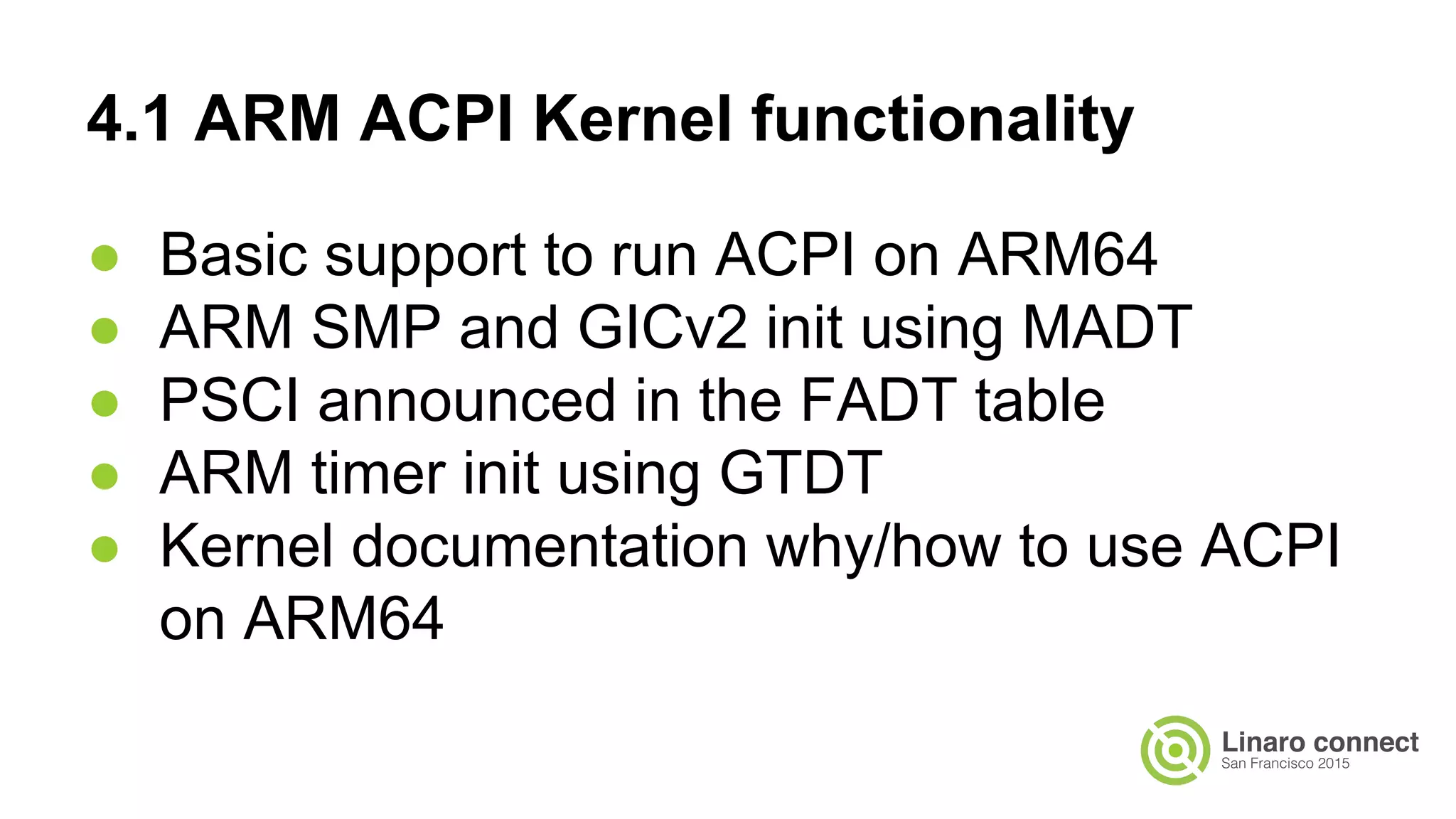
4.1 ARM ACPI Kernel functionality
● Basic support to run ACPI on ARM64
● ARM SMP and GICv2 init using MADT
● PSCI announced in the FADT table
● ARM timer init using GTDT
● Kernel documentation why/how to use ACPI
on ARM64
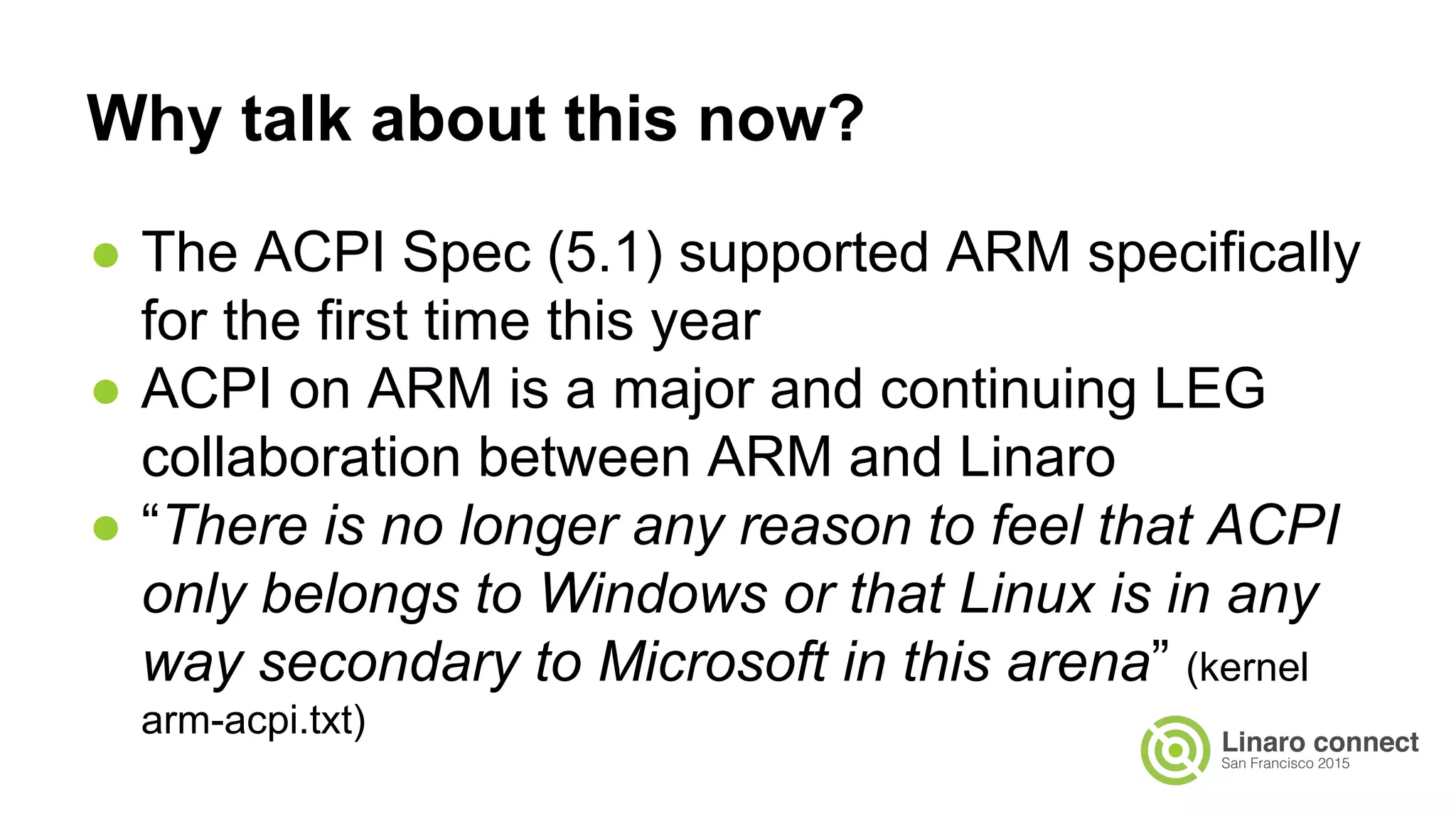
● The ACPI Spec (5.1) supported ARM specifically
for the first time this year
● ACPI on ARM is a major and continuing LEG
collaboration between ARM and Linaro
● “There is no longer any reason to feel that ACPI
only belongs to Windows or that Linux is in any
way secondary to Microsoft in this arena” (kernel
arm-acpi.txt)
Why talk about this now?
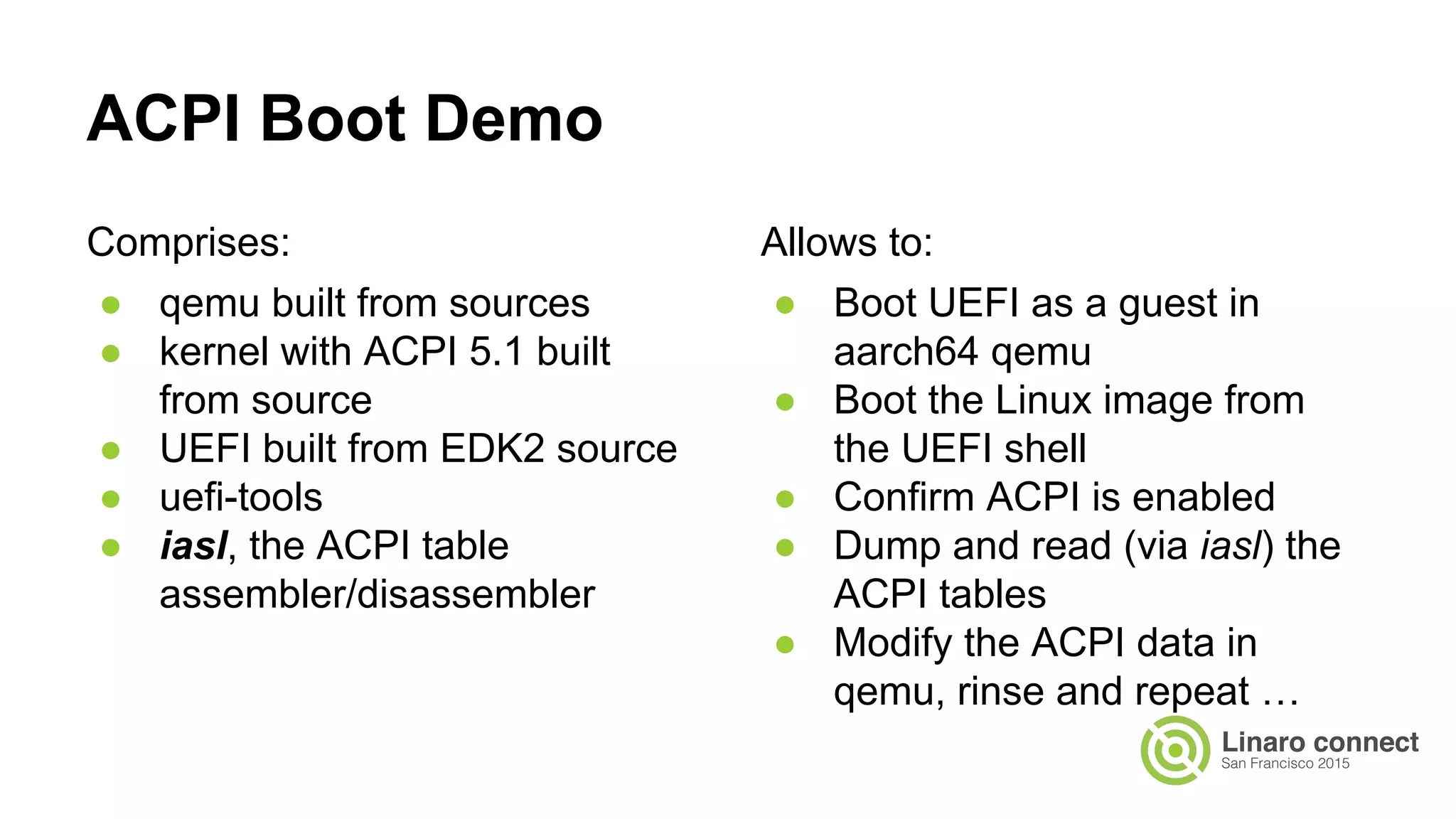
Comprises:
● qemu built from sources
● kernel with ACPI 5.1 built
from source
● UEFI built from EDK2 source
● uefi-tools
● iasl, the ACPI table
assembler/disassembler
ACPI Boot Demo
Allows to:
● Boot UEFI as a guest in
aarch64 qemu
● Boot the Linux image from
the UEFI shell
● Confirm ACPI is enabled
● Dump and read (via iasl) the
ACPI tables
● Modify the ACPI data in
qemu, rinse and repeat …
ACPI in the booting/running
system
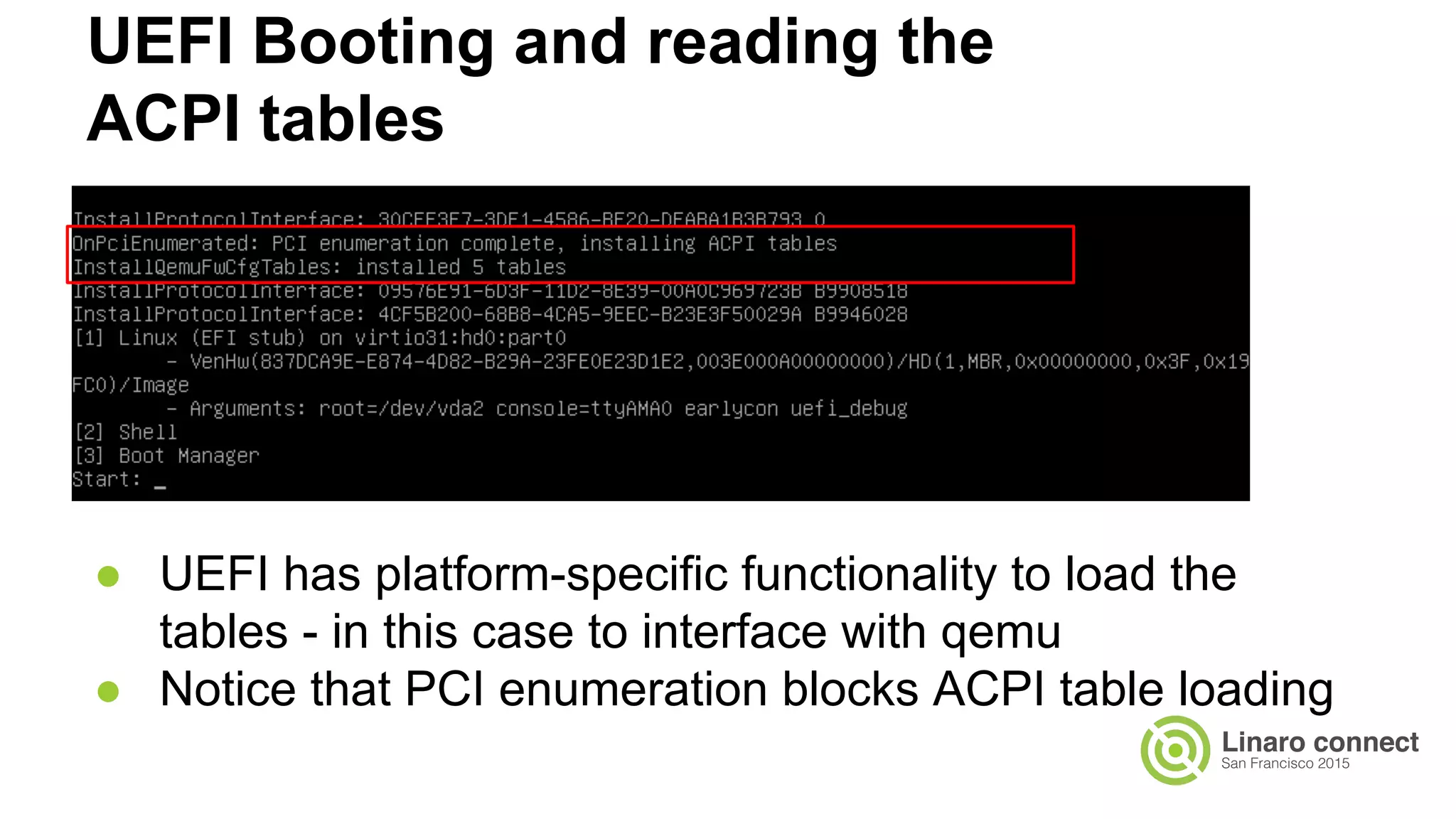
UEFI Booting and reading the
ACPI tables
● UEFI has platform-specific functionality to load the
tables - in this case to interface with qemu
● Notice that PCI enumeration blocks ACPI table loading
Confidential
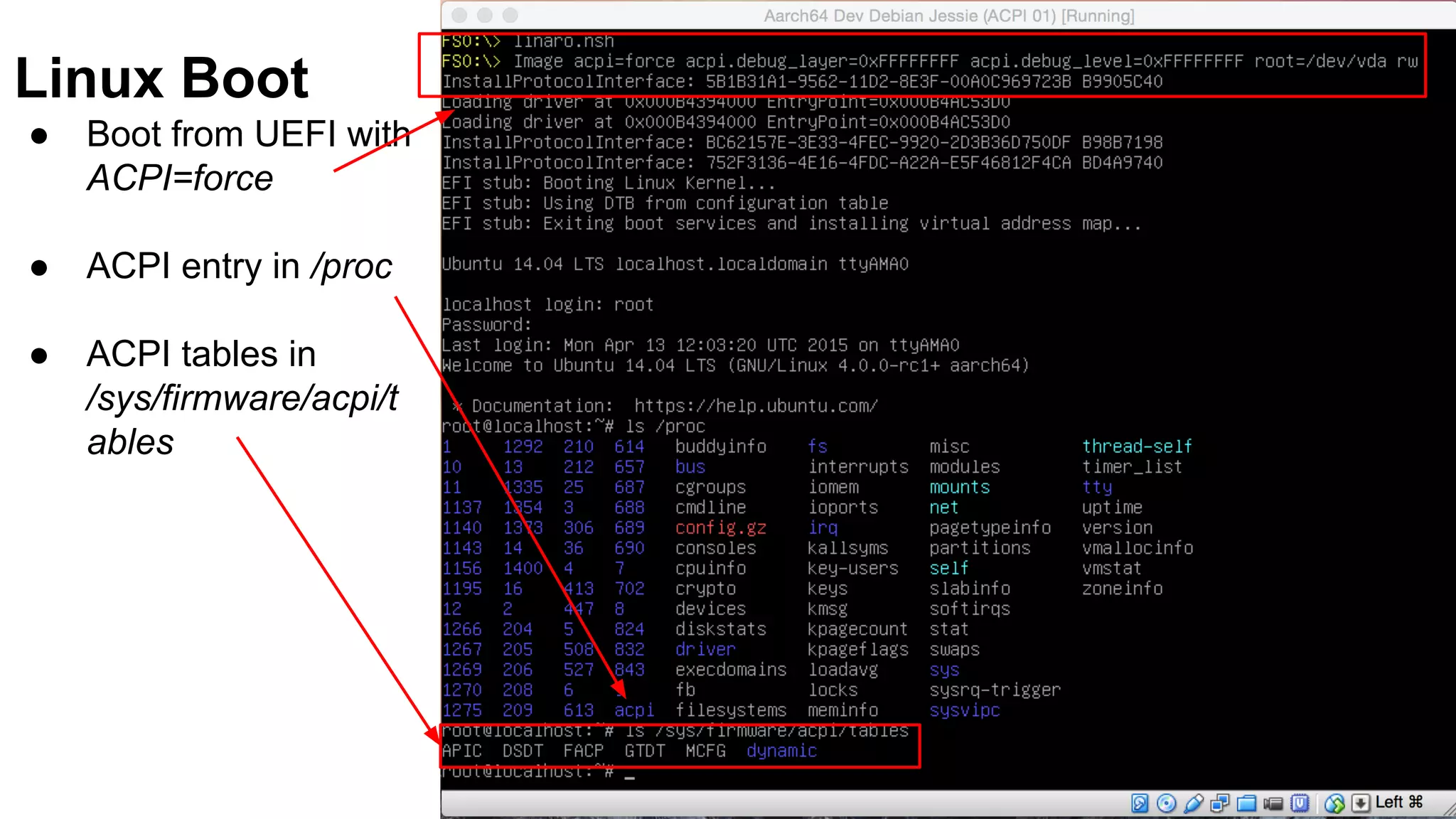
Linux Boot
● Boot from UEFI with
ACPI=force
● ACPI entry in /proc
● ACPI tables in
/sys/firmware/acpi/t
ables
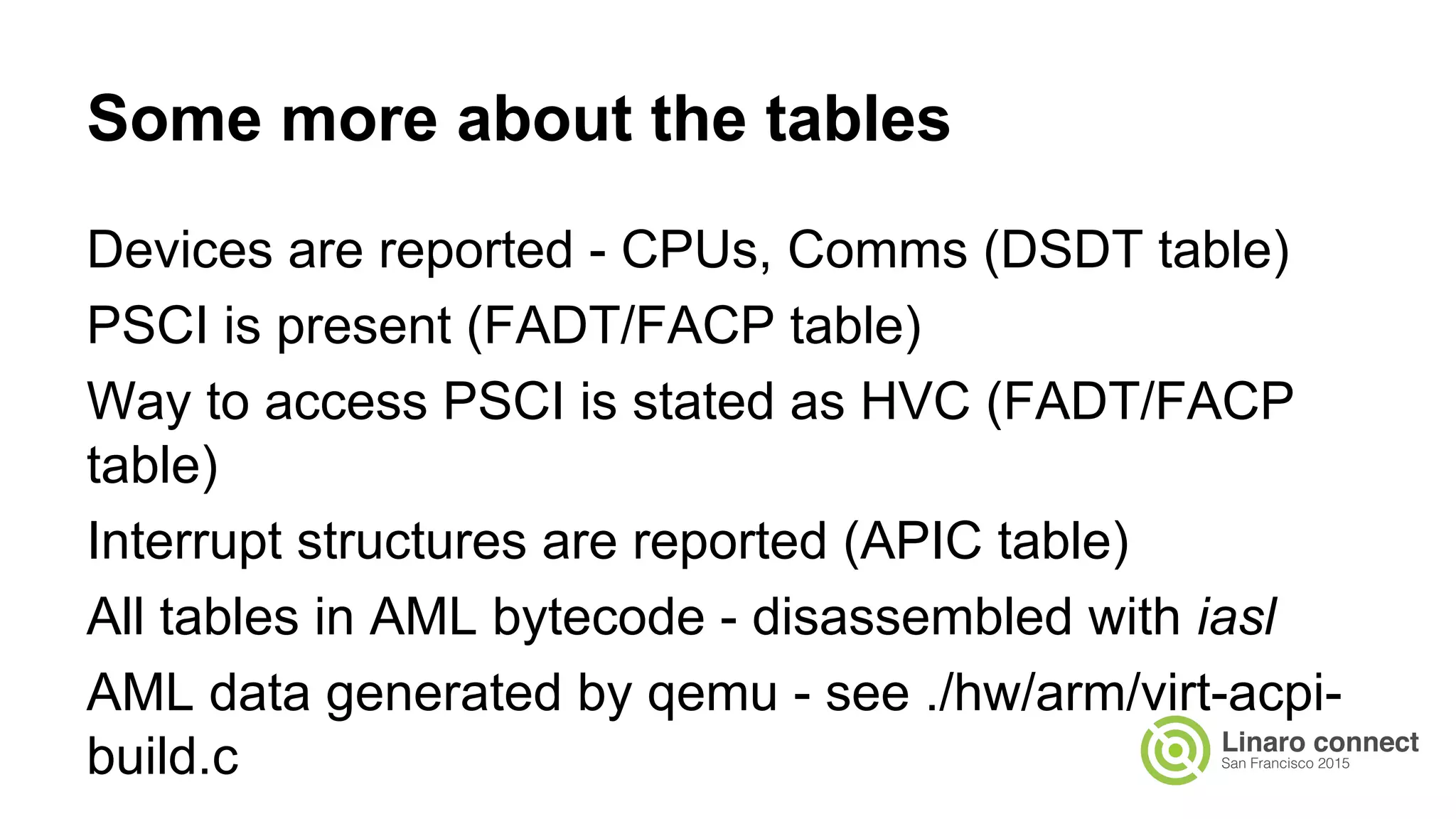
Devices are reported - CPUs, Comms (DSDT table)
PSCI is present (FADT/FACP table)
Way to access PSCI is stated as HVC (FADT/FACP
table)
Interrupt structures are reported (APIC table)
All tables in AML bytecode - disassembled with iasl
AML data generated by qemu - see ./hw/arm/virt-acpi-
build.c
Some more about the tables
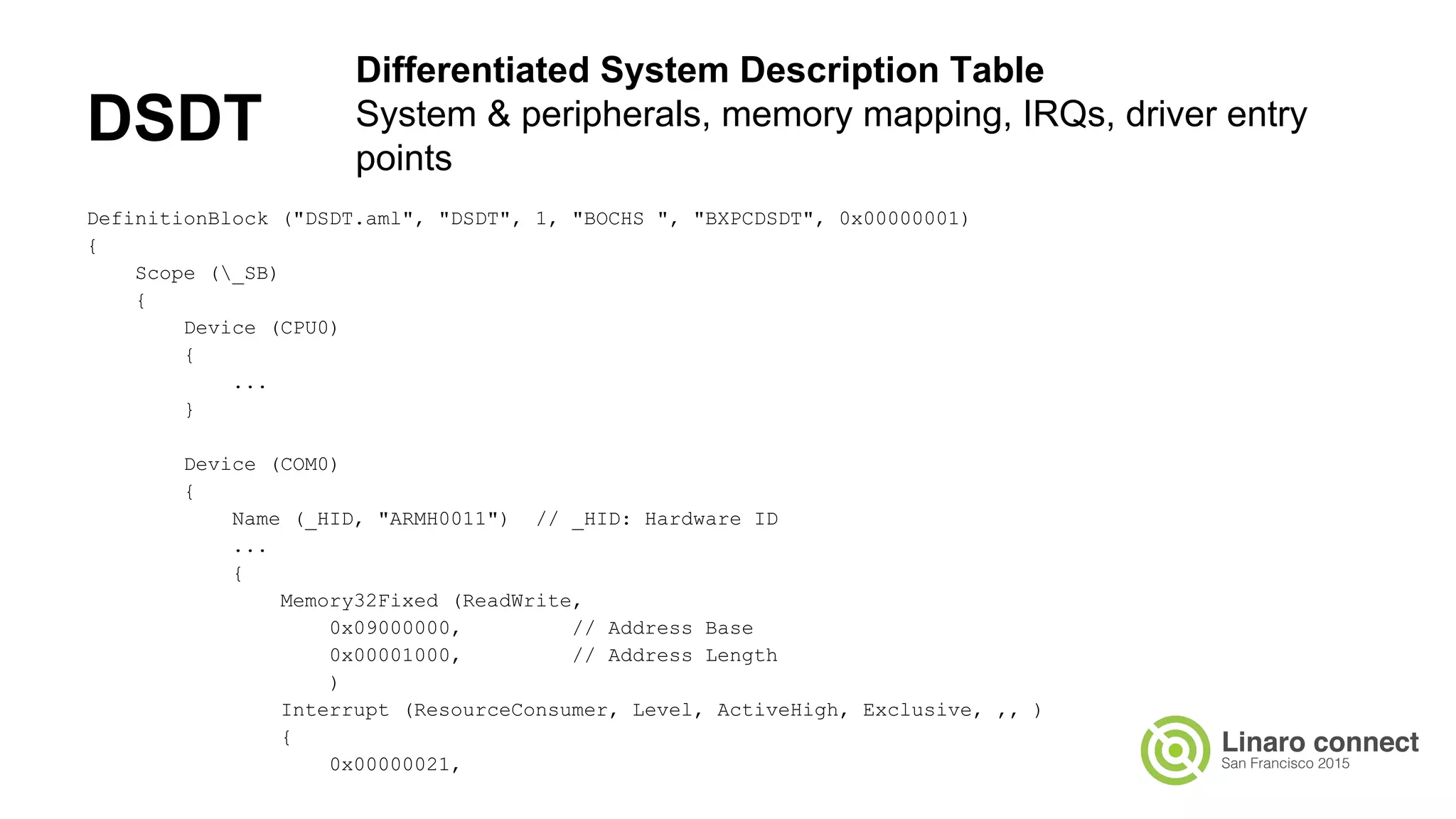
DSDT
DefinitionBlock ("DSDT.aml", "DSDT", 1, "BOCHS ", "BXPCDSDT", 0x00000001)
{
Scope (_SB)
{
Device (CPU0)
{
...
}
Device (COM0)
{
Name (_HID, "ARMH0011") // _HID: Hardware ID
...
{
Memory32Fixed (ReadWrite,
0x09000000, // Address Base
0x00001000, // Address Length
)
Interrupt (ResourceConsumer, Level, ActiveHigh, Exclusive, ,, )
{
0x00000021,
Differentiated System Description Table
System & peripherals, memory mapping, IRQs, driver entry
points
FADT
[000h 0000 4] Signature : "FACP" [Fixed ACPI Description Table (FADT)]
<snip>
[074h 0116 12] Reset Register : [Generic Address Structure]
[074h 0116 1] Space ID : 00 [SystemMemory]
[075h 0117 1] Bit Width : 00
[076h 0118 1] Bit Offset : 00
[077h 0119 1] Encoded Access Width : 00 [Undefined/Legacy]
[078h 0120 8] Address : 0000000000000000
[080h 0128 1] Value to cause reset : 00
[081h 0129 2] ARM Flags (decoded below) : 0003
PSCI Compliant : 1
Must use HVC for PSCI : 1
Fixed ACPI Description Table (“FACP”)
Part of the chain that gets to the DSDT
Register blocks relating to power management … and PSCI
The full table dumps are reproduced here:
http://people.linaro.org/~bill.fletcher/SFO15-TR9_ACPI_PSCI_and_UEFI_To_Boot_supporting_material/
MADT
[000h 0000 4] Signature : "APIC" [Multiple APIC Description Table (MADT)]
<snip>
[02Ch 0044 1] Subtable Type : 0B [Generic Interrupt Controller]
...
[038h 0056 4] Flags (decoded below) : 00000001
Processor Enabled : 1
Performance Interrupt Trigger Mode : 0
Virtual GIC Interrupt Trigger Mode : 0
[03Ch 0060 4] Parking Protocol Version : 00000000
[040h 0064 4] Performance Interrupt : 00000000
...
[070h 0112 8] ARM MPIDR : 0000000000000000
Multiple APIC Description Table (“APIC”)
APIC = Advanced Programmable Interrupt Controller (8259+)
Interrupt controllers and CPU affinity
There can be a system MADT referenced from the XSDT
Peripherals with their own interrupt controllers can have a method in their DSDT entry for you to
get a local MADT
Usage outside qemu
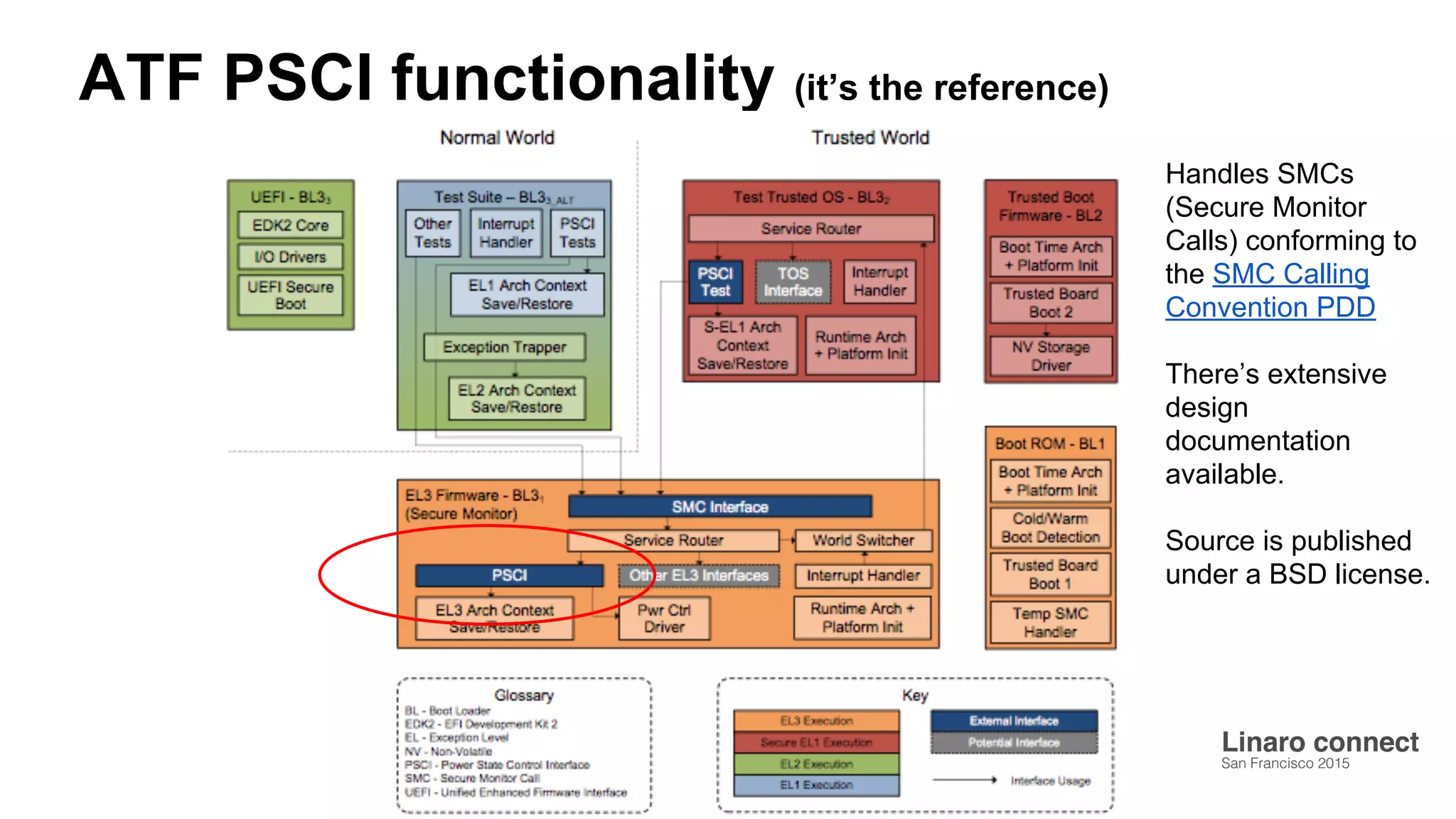
ATF PSCI functionality (it’s the reference)
Handles SMCs
(Secure Monitor
Calls) conforming to
the SMC Calling
Convention PDD
There’s extensive
design
documentation
available.
Source is published
under a BSD license.
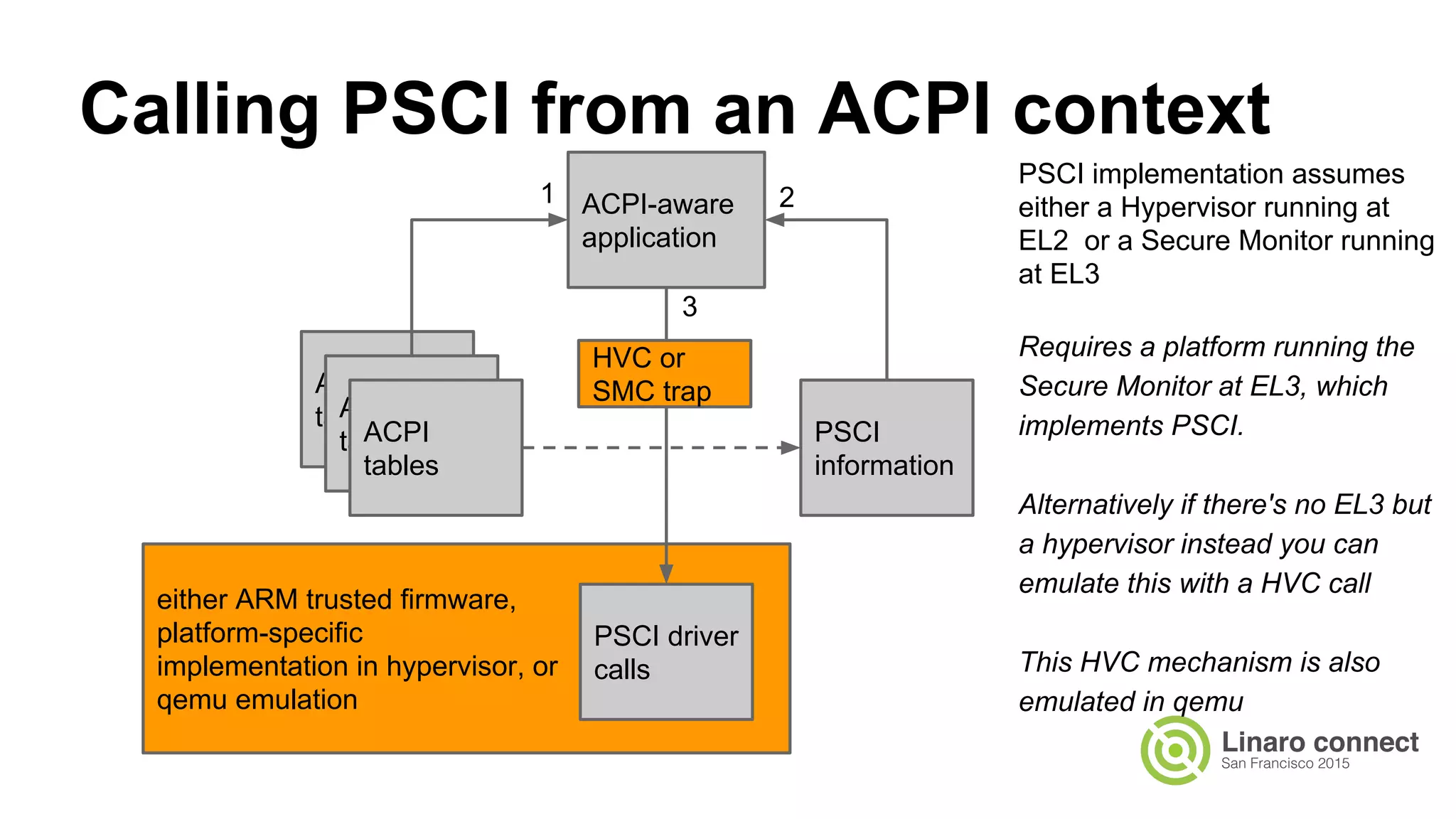
either ARM trusted firmware,
platform-specific
implementation in hypervisor, or
qemu emulation
Calling PSCI from an ACPI context
ACPI-aware
application
PSCI
information
ACPI
tablesACPI
tablesACPI
tables
PSCI driver
calls
21
3
HVC or
SMC trap
PSCI implementation assumes
either a Hypervisor running at
EL2 or a Secure Monitor running
at EL3
Requires a platform running the
Secure Monitor at EL3, which
implements PSCI.
Alternatively if there's no EL3 but
a hypervisor instead you can
emulate this with a HVC call
This HVC mechanism is also
emulated in qemu
What’s New and What’s Next?
Enough in ACPI "to boot a server, support ARM’s latest IP (GICv2m,
GICv3, SMMUv2) and do decent idle management."
What’s next? DVFS performance management ...
… for an ARM server to implement DVFS in an architecture agnostic
way via “CPPC” (CPPC - Collaborative Processor Performance
Control)
What arrived in the latest ACPI 6.0 spec?
ACPI 6.0 introduces Low Power Idle states, which allows an
operating system to manage the power states of the processor
power domain hierarchy.
The ACPI FFH* mechanism is used in ARM-based systems to allow
the operating system to discover: the entry method into a low
power state; how to collect power state residency, and statistics
This ACPI register-based interface is defined in ARM DEN0048A
available on ARM Infocentre portal
*FFH = Functional Fixed Hardware Interface - an ACPI name for the
register address space used for power management)
ARM Low Power Idle (LPI) states
CPPC (Collaborative Processor Performance Control)
Provides more autonomy to the CPU subsystem to control power/perf
An abstract interface where the OS specifies performance bounds and
leaves the underlying subsystem some latitude in how it achieves them.
"CPPC implementation designed as shim which allows Cpufreq drivers
to plug into existing governors or alternately implement inbuilt ones"
PCC (Platform Communication Channel)
PCC (Platform Communication Channel) is a generic means for PCC
Clients such as CPPC, to talk to the firmware.
Back to DVFS → CPPC & PCC (1)
CPPC & PCC (2)
● CPPC has been used on ARM64 servers successfully.
Some ARM vendors may not have feedback counters
(workaroundable). Missing in CPPC at the moment is
the power-to-performance level mapping. This is to be
addressed in the near future once EAS is upstream
● This patchwork is part of LEG activity. See https://git.
linaro.org/people/ashwin.chaugule/leg-kernel.git
● V9 patches picked up for v4.3 - hoping to upstream by
v4.4
Wrap Up
● UEFI is a requirement for ACPI
● Upstream qemu can emulate an aarch64 ACPI platform (with
elementary PSCI)
● You can build a simple ARM64 ACPI-aware system with 4.1
● ARM idle management arrived in the ACPI 6.0 spec
● Interfaces to ARM DVFS (via CPPC) are still "works in
progress".
● Once these arrive, a demonstrator will need more than qemu’
s emulation of PSCI
● ARM trusted firmware is the reference implementation for
PSCI
Wrap-Up
● PSCI spec: http://infocenter.arm.com/help/topic/com.
arm.doc.
den0022c/DEN0022C_Power_State_Coordination_Inter
face.pdf
● ACPI standard: http://www.uefi.
org/sites/default/files/resources/ACPI_5_1release.pdf
● Basic ACPI info: http://www.acpi.info/over.htm
References
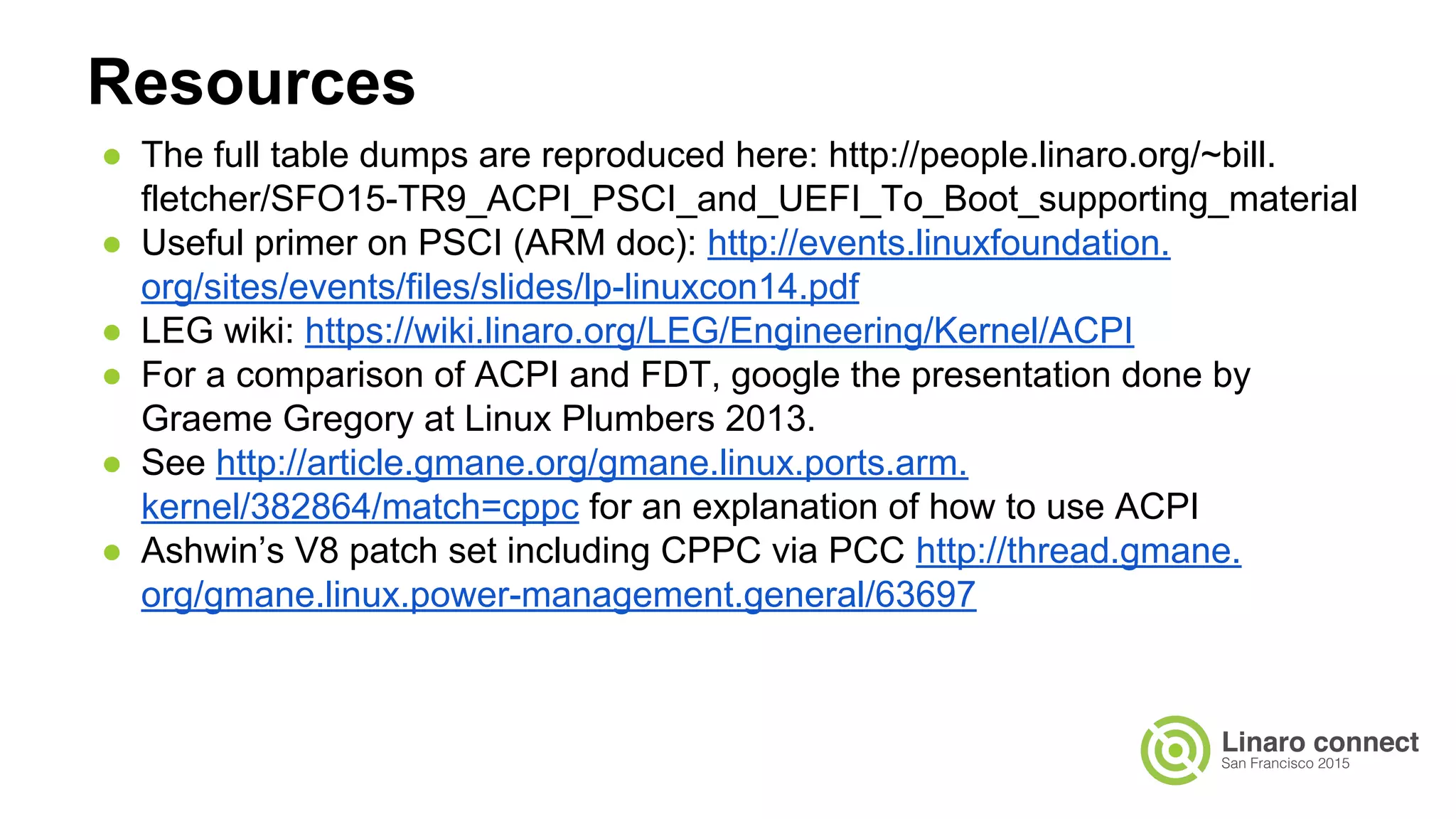
● The full table dumps are reproduced here: http://people.linaro.org/~bill.
fletcher/SFO15-TR9_ACPI_PSCI_and_UEFI_To_Boot_supporting_material
● Useful primer on PSCI (ARM doc): http://events.linuxfoundation.
org/sites/events/files/slides/lp-linuxcon14.pdf
● LEG wiki: https://wiki.linaro.org/LEG/Engineering/Kernel/ACPI
● For a comparison of ACPI and FDT, google the presentation done by
Graeme Gregory at Linux Plumbers 2013.
● See http://article.gmane.org/gmane.linux.ports.arm.
kernel/382864/match=cppc for an explanation of how to use ACPI
● Ashwin’s V8 patch set including CPPC via PCC http://thread.gmane.
org/gmane.linux.power-management.general/63697
Resources
Q&A?
More about Linaro: www.linaro.org/about/
Linaro members: www.linaro.org/members

SFO15-TR9: PSCI, ACPI (and UEFI to boot)

  • 1.
    Presented by Date Event SFO15-TR9: ACPI,PSCI (and UEFI to boot) Bill Fletcher Linaro Field Engineering v2.0 Bill Fletcher Thursday 24 September 2015 SFO15
  • 2.
    Overview ● An introductorylook at ACPI infrastructure ● How a platform (qemu), a bootloader (uefi) and the kernel work together to set up the ACPI configuration ● There's an explanation of what’s been upstreamed in Linux kernel 4.1 ● A simple aarch64 demo based on qemu ● A brief look at what's new
  • 3.
    Caveats. This isnot ... ● An exhaustive tutorial on ACPI ● A reference implementation for PSCI ● “Why to use ACPI instead of device trees” ● “Why to favour UEFI instead of UBoot” ● ...
  • 4.
    ACPI and PSCI(briefly)
  • 5.
    ● "Advanced Configurationand Power Interface” Specification (Currently v6.0: http://www.uefi.org/acpi/specs) ● "Industry-standard interfaces enabling OS-directed configuration, power management, and thermal management (since 1996)" ● ACPI is important because hardware and OS vendors have already worked out the mechanisms for supporting a general purpose computing ecosystem ● Hence it’s non-negotiable in the Enterprise environment, standardized with UEFI ● Has three main components: Tables, Drivers and Registers. ● There’s an interpreted element in ACPI Machine Language (AML) bytecode stored in the ACPI tables. ACPI - One Pager
  • 6.
    RSD Ptr Pointer Pointer Header FACP Table entry Tableentry XSDT ... Header Static Info ... DSDT “FACP” BLKs RSD Ptr Differentiated Definition Block DSDT RSD Ptr Entry Sig Header Contents Sig ACPI drivers OEM Specifics Hardware Register Accesses Root System Description Pointer Extended System Description Table Fixed ACPI Description Table Other tables ... Device I/O Configuration Device Memory Controller Space Register access mechanism system software hardware/firmware What ACPI looks like - a chain of tables Differentiated System Description Table Devices: Interrupts Registers Driver entry points
  • 7.
    ● It’s anARM standard ● The official/only way for power management on ARM64 ● A generic interface that low-level supervisory software can use to manage power ● Lives under CPU Ops, which itself lives under CPU Idle and the CPU Governors ● Covers: Core idle management, dynamic addition and removal of cores, and secondary core boot, core migration, system shutdown and reset ● Has both Device Tree and ACPI bindings "Power State Coordination Interface"
  • 8.
  • 9.
    Basic Boot andACPI/PSCI Discovery Root system description (pointer) ACPI tablesACPI tablesACPI tables ACPI-aware boot ARM- specific PSCI information 1 2 FACP Table DSDT Table APIC Table Described in the ACPI 5.1 Spec and available in the 4.1 kernel
  • 10.
    Practical boot andACPI/PSCI discovery Root system description (pointer) ACPI tablesACPI tablesACPI tables EFIstub PSCI information ACPI=force EDK2 UEFI bootloader "The generic interface for discovering ACPI tables is to boot as an EFI application and then to query the tables from UEFI. That is the interface others are likely to follow, and ACPI without UEFI is unlikely to be of much use to anyone else (ARM)" qemu Kernel with ACPI patches InstallQemuFwCfgTables
  • 11.
    What about dtb? ●The EFI stub loader makes the Linux kernel image into a UEFI application. ● This application uses the Flattened Device-Tree (FDT) format to pass information about how to access UEFI to the Linux kernel. ● If no device-tree blob (using dtb= ) is available as in our case when using ACPI for hardware description the loader stub will create a new dtb containing only this information. See: https://wiki.linaro.org/LEG/Engineering/Kernel/UEFI/Architecture and drivers/firmware/efi/libstub/fdt.c (leading to efi.h)
  • 12.
    Basic Feature Set Havingbooted successfully and loaded the ACPI tables … what functionality do we have?
  • 13.
    4.1 ARM ACPIKernel functionality ● Basic support to run ACPI on ARM64 ● ARM SMP and GICv2 init using MADT ● PSCI announced in the FADT table ● ARM timer init using GTDT ● Kernel documentation why/how to use ACPI on ARM64
  • 14.
    ● The ACPISpec (5.1) supported ARM specifically for the first time this year ● ACPI on ARM is a major and continuing LEG collaboration between ARM and Linaro ● “There is no longer any reason to feel that ACPI only belongs to Windows or that Linux is in any way secondary to Microsoft in this arena” (kernel arm-acpi.txt) Why talk about this now?
  • 15.
    Comprises: ● qemu builtfrom sources ● kernel with ACPI 5.1 built from source ● UEFI built from EDK2 source ● uefi-tools ● iasl, the ACPI table assembler/disassembler ACPI Boot Demo Allows to: ● Boot UEFI as a guest in aarch64 qemu ● Boot the Linux image from the UEFI shell ● Confirm ACPI is enabled ● Dump and read (via iasl) the ACPI tables ● Modify the ACPI data in qemu, rinse and repeat …
  • 16.
    ACPI in thebooting/running system
  • 17.
    UEFI Booting andreading the ACPI tables ● UEFI has platform-specific functionality to load the tables - in this case to interface with qemu ● Notice that PCI enumeration blocks ACPI table loading
  • 18.
    Confidential Linux Boot ● Bootfrom UEFI with ACPI=force ● ACPI entry in /proc ● ACPI tables in /sys/firmware/acpi/t ables
  • 19.
    Devices are reported- CPUs, Comms (DSDT table) PSCI is present (FADT/FACP table) Way to access PSCI is stated as HVC (FADT/FACP table) Interrupt structures are reported (APIC table) All tables in AML bytecode - disassembled with iasl AML data generated by qemu - see ./hw/arm/virt-acpi- build.c Some more about the tables
  • 20.
    DSDT DefinitionBlock ("DSDT.aml", "DSDT",1, "BOCHS ", "BXPCDSDT", 0x00000001) { Scope (_SB) { Device (CPU0) { ... } Device (COM0) { Name (_HID, "ARMH0011") // _HID: Hardware ID ... { Memory32Fixed (ReadWrite, 0x09000000, // Address Base 0x00001000, // Address Length ) Interrupt (ResourceConsumer, Level, ActiveHigh, Exclusive, ,, ) { 0x00000021, Differentiated System Description Table System & peripherals, memory mapping, IRQs, driver entry points
  • 21.
    FADT [000h 0000 4]Signature : "FACP" [Fixed ACPI Description Table (FADT)] <snip> [074h 0116 12] Reset Register : [Generic Address Structure] [074h 0116 1] Space ID : 00 [SystemMemory] [075h 0117 1] Bit Width : 00 [076h 0118 1] Bit Offset : 00 [077h 0119 1] Encoded Access Width : 00 [Undefined/Legacy] [078h 0120 8] Address : 0000000000000000 [080h 0128 1] Value to cause reset : 00 [081h 0129 2] ARM Flags (decoded below) : 0003 PSCI Compliant : 1 Must use HVC for PSCI : 1 Fixed ACPI Description Table (“FACP”) Part of the chain that gets to the DSDT Register blocks relating to power management … and PSCI The full table dumps are reproduced here: http://people.linaro.org/~bill.fletcher/SFO15-TR9_ACPI_PSCI_and_UEFI_To_Boot_supporting_material/
  • 22.
    MADT [000h 0000 4]Signature : "APIC" [Multiple APIC Description Table (MADT)] <snip> [02Ch 0044 1] Subtable Type : 0B [Generic Interrupt Controller] ... [038h 0056 4] Flags (decoded below) : 00000001 Processor Enabled : 1 Performance Interrupt Trigger Mode : 0 Virtual GIC Interrupt Trigger Mode : 0 [03Ch 0060 4] Parking Protocol Version : 00000000 [040h 0064 4] Performance Interrupt : 00000000 ... [070h 0112 8] ARM MPIDR : 0000000000000000 Multiple APIC Description Table (“APIC”) APIC = Advanced Programmable Interrupt Controller (8259+) Interrupt controllers and CPU affinity There can be a system MADT referenced from the XSDT Peripherals with their own interrupt controllers can have a method in their DSDT entry for you to get a local MADT
  • 23.
  • 24.
    ATF PSCI functionality(it’s the reference) Handles SMCs (Secure Monitor Calls) conforming to the SMC Calling Convention PDD There’s extensive design documentation available. Source is published under a BSD license.
  • 25.
    either ARM trustedfirmware, platform-specific implementation in hypervisor, or qemu emulation Calling PSCI from an ACPI context ACPI-aware application PSCI information ACPI tablesACPI tablesACPI tables PSCI driver calls 21 3 HVC or SMC trap PSCI implementation assumes either a Hypervisor running at EL2 or a Secure Monitor running at EL3 Requires a platform running the Secure Monitor at EL3, which implements PSCI. Alternatively if there's no EL3 but a hypervisor instead you can emulate this with a HVC call This HVC mechanism is also emulated in qemu
  • 26.
    What’s New andWhat’s Next?
  • 27.
    Enough in ACPI"to boot a server, support ARM’s latest IP (GICv2m, GICv3, SMMUv2) and do decent idle management." What’s next? DVFS performance management ... … for an ARM server to implement DVFS in an architecture agnostic way via “CPPC” (CPPC - Collaborative Processor Performance Control) What arrived in the latest ACPI 6.0 spec?
  • 28.
    ACPI 6.0 introducesLow Power Idle states, which allows an operating system to manage the power states of the processor power domain hierarchy. The ACPI FFH* mechanism is used in ARM-based systems to allow the operating system to discover: the entry method into a low power state; how to collect power state residency, and statistics This ACPI register-based interface is defined in ARM DEN0048A available on ARM Infocentre portal *FFH = Functional Fixed Hardware Interface - an ACPI name for the register address space used for power management) ARM Low Power Idle (LPI) states
  • 29.
    CPPC (Collaborative ProcessorPerformance Control) Provides more autonomy to the CPU subsystem to control power/perf An abstract interface where the OS specifies performance bounds and leaves the underlying subsystem some latitude in how it achieves them. "CPPC implementation designed as shim which allows Cpufreq drivers to plug into existing governors or alternately implement inbuilt ones" PCC (Platform Communication Channel) PCC (Platform Communication Channel) is a generic means for PCC Clients such as CPPC, to talk to the firmware. Back to DVFS → CPPC & PCC (1)
  • 30.
    CPPC & PCC(2) ● CPPC has been used on ARM64 servers successfully. Some ARM vendors may not have feedback counters (workaroundable). Missing in CPPC at the moment is the power-to-performance level mapping. This is to be addressed in the near future once EAS is upstream ● This patchwork is part of LEG activity. See https://git. linaro.org/people/ashwin.chaugule/leg-kernel.git ● V9 patches picked up for v4.3 - hoping to upstream by v4.4
  • 31.
  • 32.
    ● UEFI isa requirement for ACPI ● Upstream qemu can emulate an aarch64 ACPI platform (with elementary PSCI) ● You can build a simple ARM64 ACPI-aware system with 4.1 ● ARM idle management arrived in the ACPI 6.0 spec ● Interfaces to ARM DVFS (via CPPC) are still "works in progress". ● Once these arrive, a demonstrator will need more than qemu’ s emulation of PSCI ● ARM trusted firmware is the reference implementation for PSCI Wrap-Up
  • 33.
    ● PSCI spec:http://infocenter.arm.com/help/topic/com. arm.doc. den0022c/DEN0022C_Power_State_Coordination_Inter face.pdf ● ACPI standard: http://www.uefi. org/sites/default/files/resources/ACPI_5_1release.pdf ● Basic ACPI info: http://www.acpi.info/over.htm References
  • 34.
    ● The fulltable dumps are reproduced here: http://people.linaro.org/~bill. fletcher/SFO15-TR9_ACPI_PSCI_and_UEFI_To_Boot_supporting_material ● Useful primer on PSCI (ARM doc): http://events.linuxfoundation. org/sites/events/files/slides/lp-linuxcon14.pdf ● LEG wiki: https://wiki.linaro.org/LEG/Engineering/Kernel/ACPI ● For a comparison of ACPI and FDT, google the presentation done by Graeme Gregory at Linux Plumbers 2013. ● See http://article.gmane.org/gmane.linux.ports.arm. kernel/382864/match=cppc for an explanation of how to use ACPI ● Ashwin’s V8 patch set including CPPC via PCC http://thread.gmane. org/gmane.linux.power-management.general/63697 Resources
  • 35.
  • 36.
    More about Linaro:www.linaro.org/about/ Linaro members: www.linaro.org/members