1
Power Management Across
OSs
charles.garcia-tobin@arm.com
2
Introduction
 Firmware/ACPI is not the most popular topic in Linux:
“Modern PCs are horrible. ACPI is a complete design disaster in every
way. But we're kind of stuck with it. If any Intel people are listening to
this and you had anything to do with ACPI, shoot yourself now, before
you reproduce”
“The fact that ACPI was designed by a group of monkeys high on LSD,
and is some of the worst designs in the industry obviously makes
running it at any point pretty damn ugly. “
“EFI is this other Intel brain-damage (the first one being ACPI). “
3
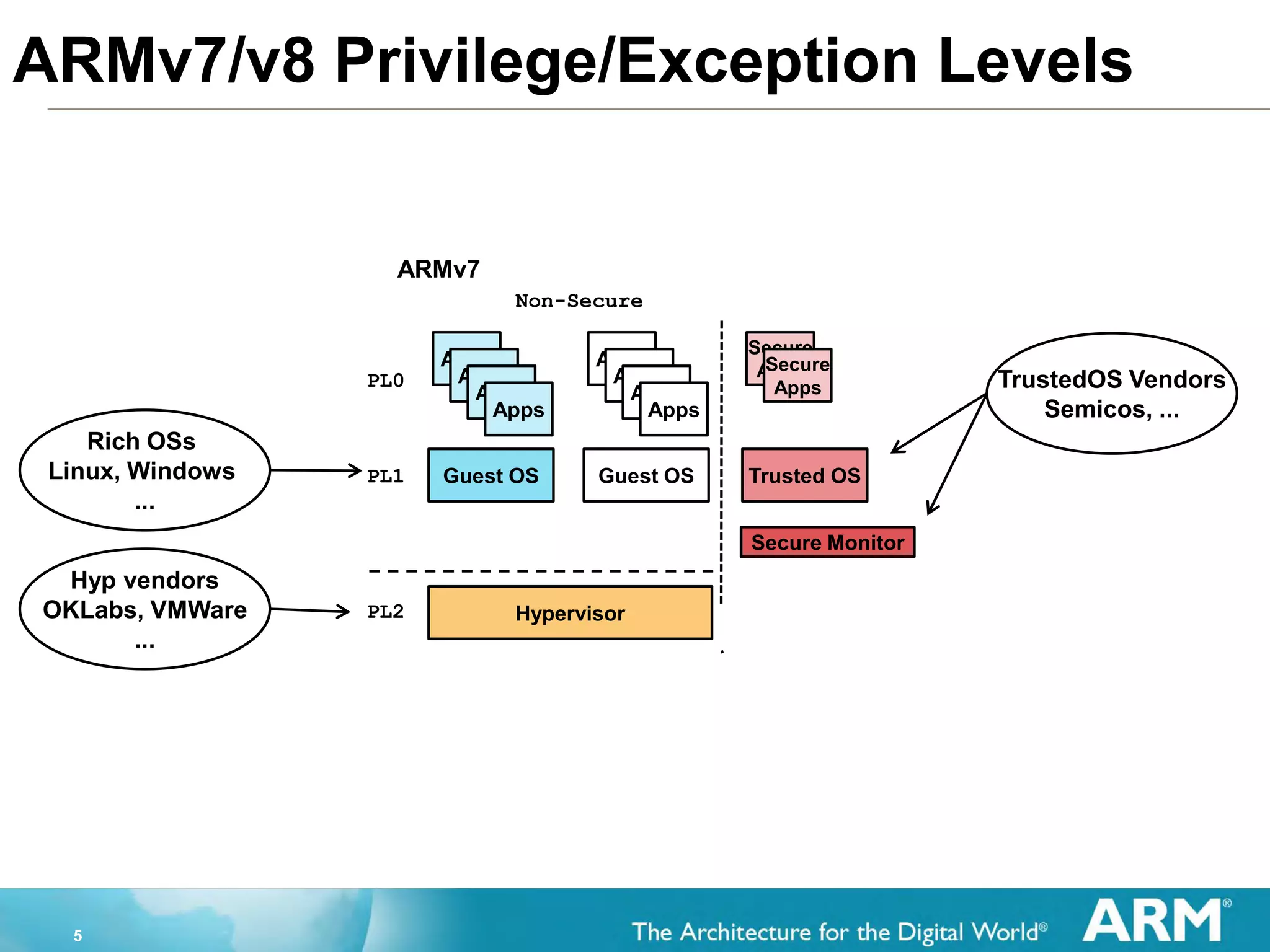
Linux is not Alone on the Device
 Secure code will be present, provided by Semico or trusted
OS vendor for a variety reasons:
 Secure boot
 Crypto services
 Secure key storage
 ....
 Global platform is a leading security standards body in mobile
space
 Most companies in this room are members
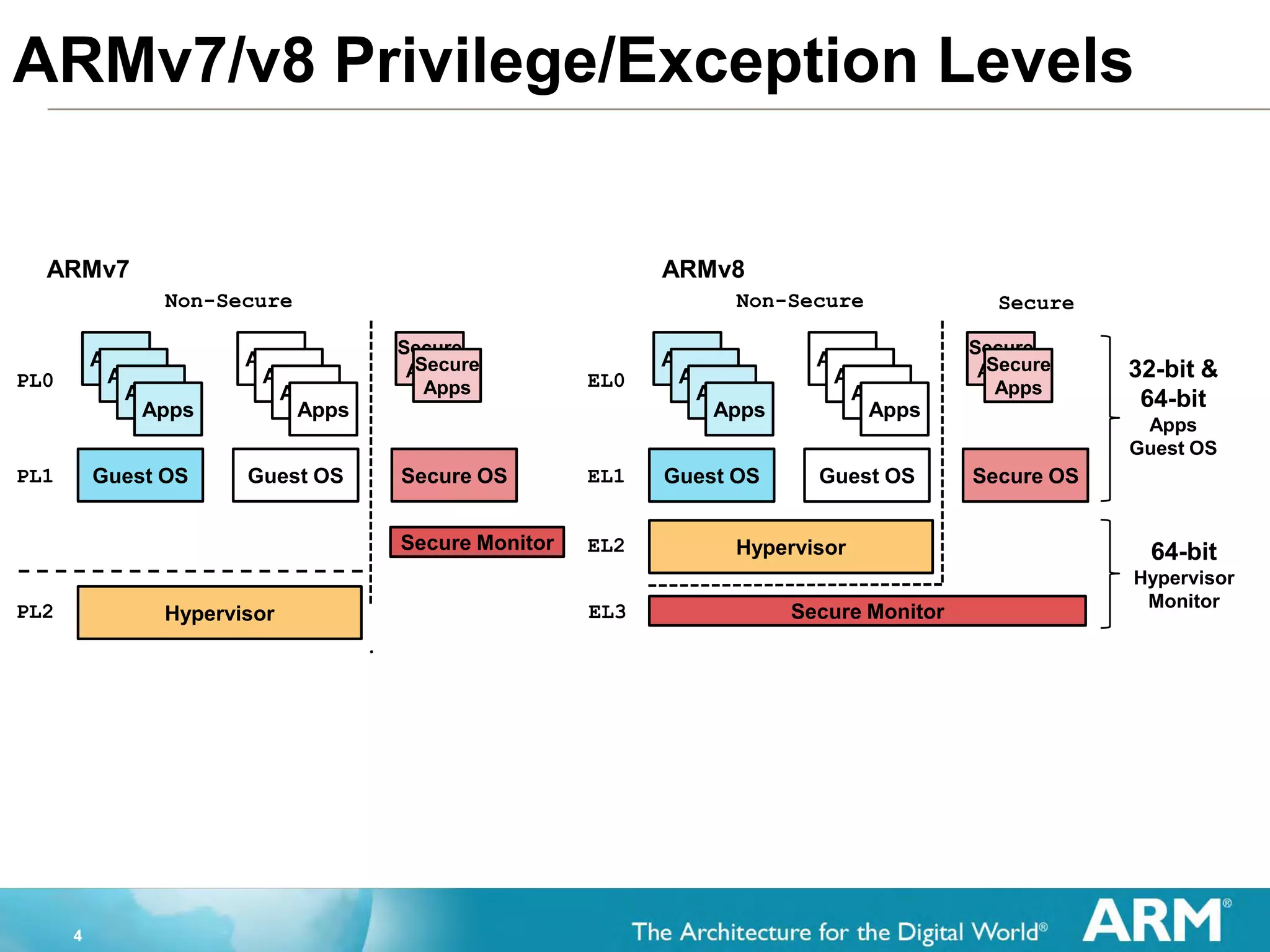
 Hypervisor can also be present
 There is actually a work item in Linaro to cover Trustzone
 TrustZone kernel driver
4
ARMv7/v8 Privilege/Exception Levels
Apps
Apps
Apps
Apps
Guest OS
Apps
Apps
Apps
Apps
Guest OS
Hypervisor
Secure
AppsSecure
Apps
Secure OS
Secure Monitor
EL0
EL1
EL2
EL3
Non-Secure Secure
32-bit &
64-bit
Apps
Guest OS
64-bit
Hypervisor
Monitor
Apps
Apps
Apps
Apps
Guest OS
Apps
Apps
Apps
Apps
Guest OS
Hypervisor
Secure
AppsSecure
Apps
Secure OS
Secure Monitor
PL0
PL1
PL2
Non-Secure
ARMv7 ARMv8
5
ARMv7/v8 Privilege/Exception Levels
Apps
Apps
Apps
Apps
Guest OS
Apps
Apps
Apps
Apps
Guest OS
Hypervisor
Secure
AppsSecure
Apps
Trusted OS
Secure Monitor
PL0
PL1
PL2
Non-Secure
ARMv7
Rich OSs
Linux, Windows
...
Hyp vendors
OKLabs, VMWare
...
TrustedOS Vendors
Semicos, ...
6
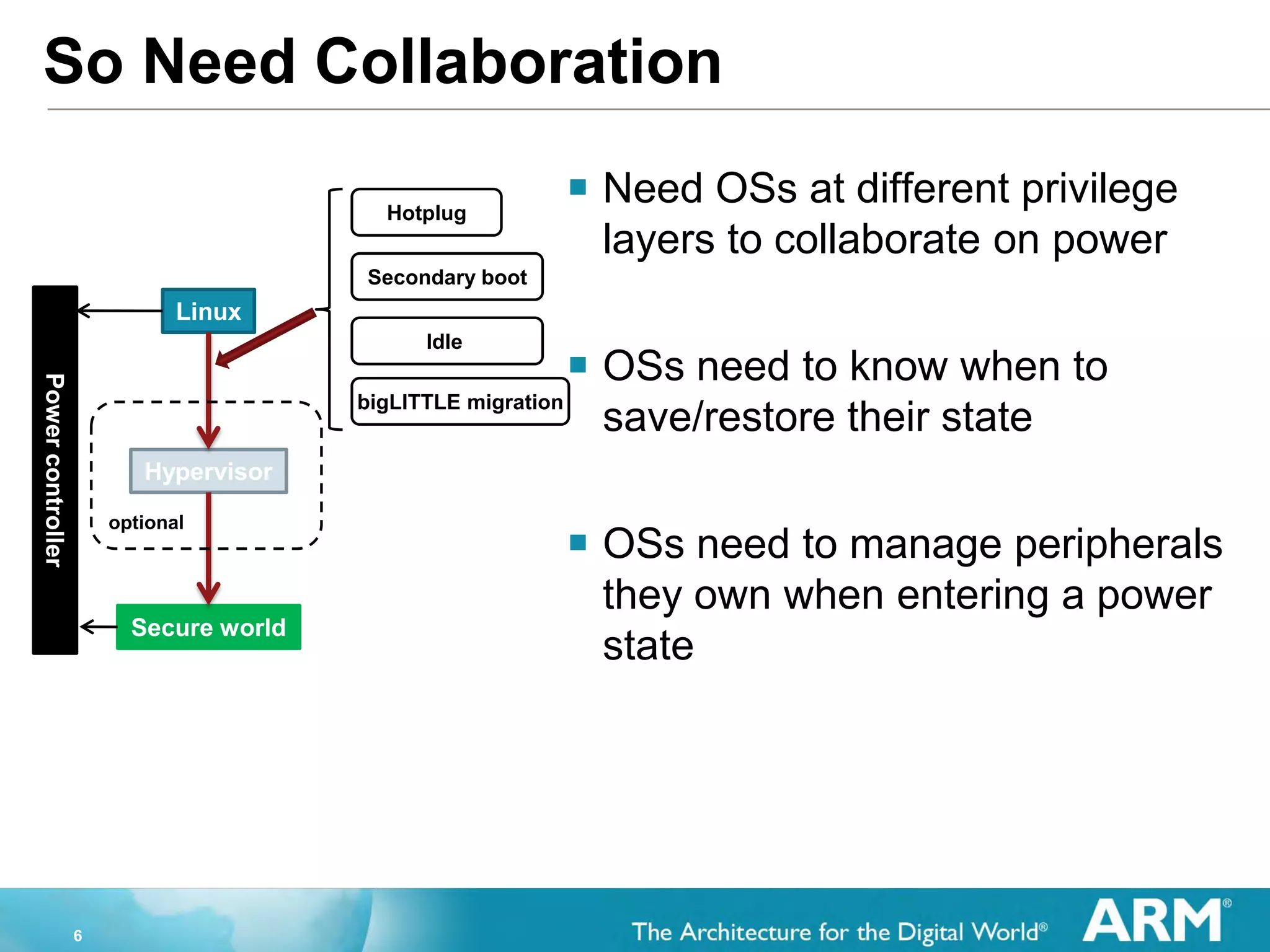
So Need Collaboration
 Need OSs at different privilege
layers to collaborate on power
 OSs need to know when to
save/restore their state
 OSs need to manage peripherals
they own when entering a power
state
Linux
Hypervisor
Secure world
Hotplug
Secondary boot
Idle
Powercontroller
optional
bigLITTLE migration
7
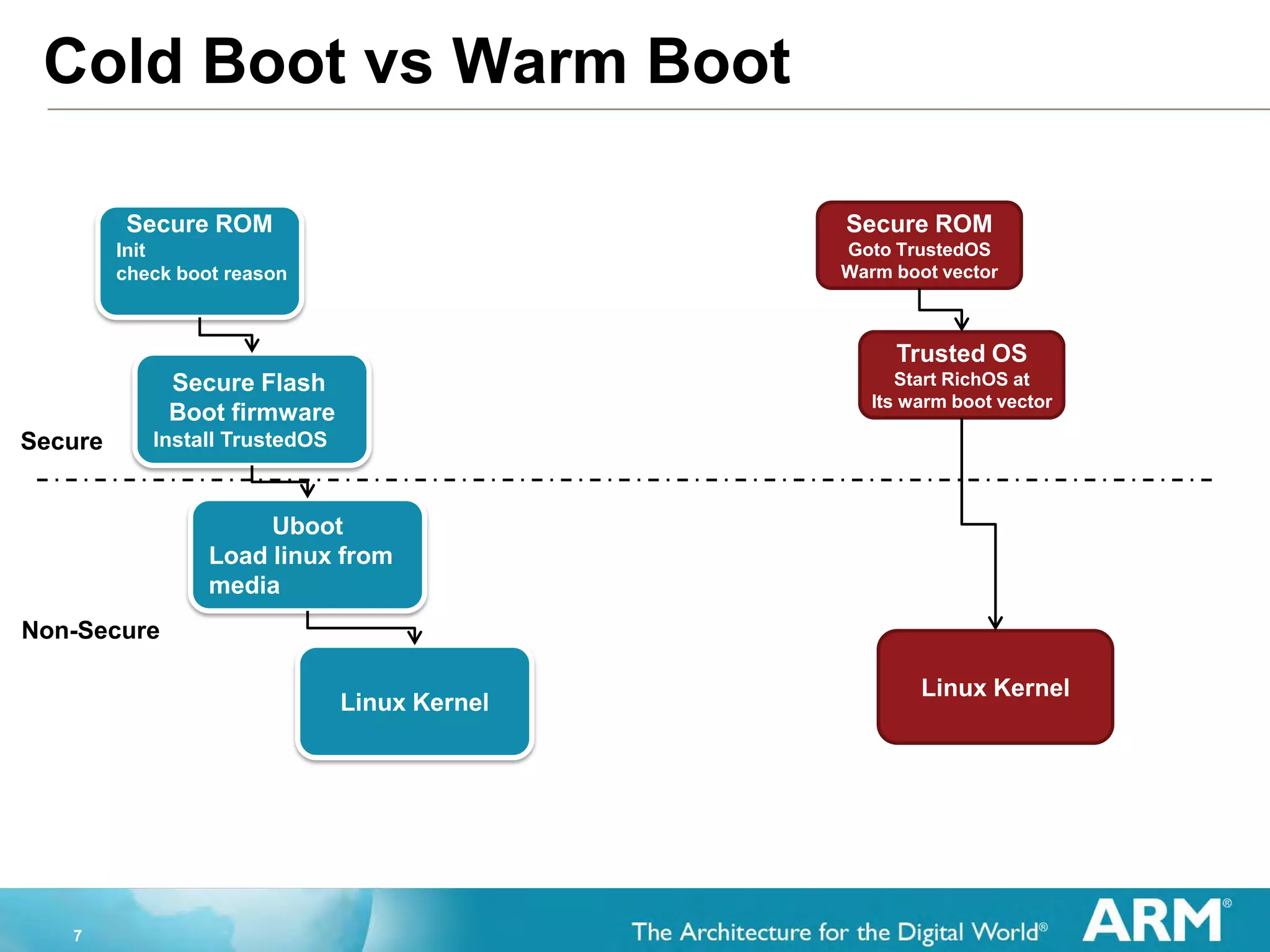
Cold Boot vs Warm Boot
Linux Kernel
Secure ROM
Goto TrustedOS
Warm boot vector
Secure ROM
Init
check boot reason
Secure Flash
Boot firmware
Install TrustedOS
Uboot
Load linux from
media
Trusted OS
Start RichOS at
Its warm boot vector
Linux Kernel
Secure
Non-Secure
8
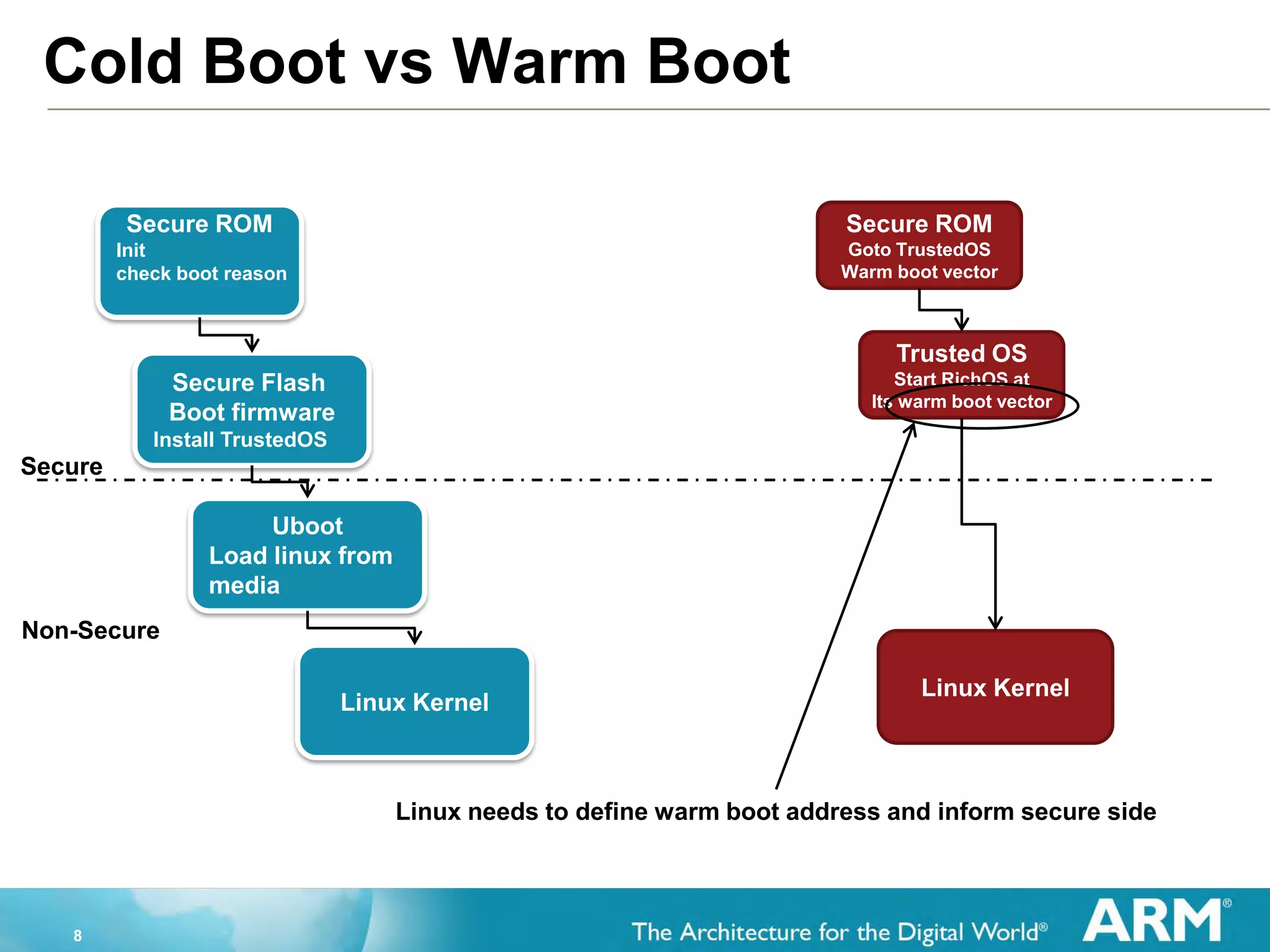
Cold Boot vs Warm Boot
Linux Kernel
Secure ROM
Goto TrustedOS
Warm boot vector
Secure ROM
Init
check boot reason
Secure Flash
Boot firmware
Install TrustedOS
Uboot
Load linux from
media
Trusted OS
Start RichOS at
Its warm boot vector
Linux Kernel
Secure
Non-Secure
Linux needs to define warm boot address and inform secure side
9
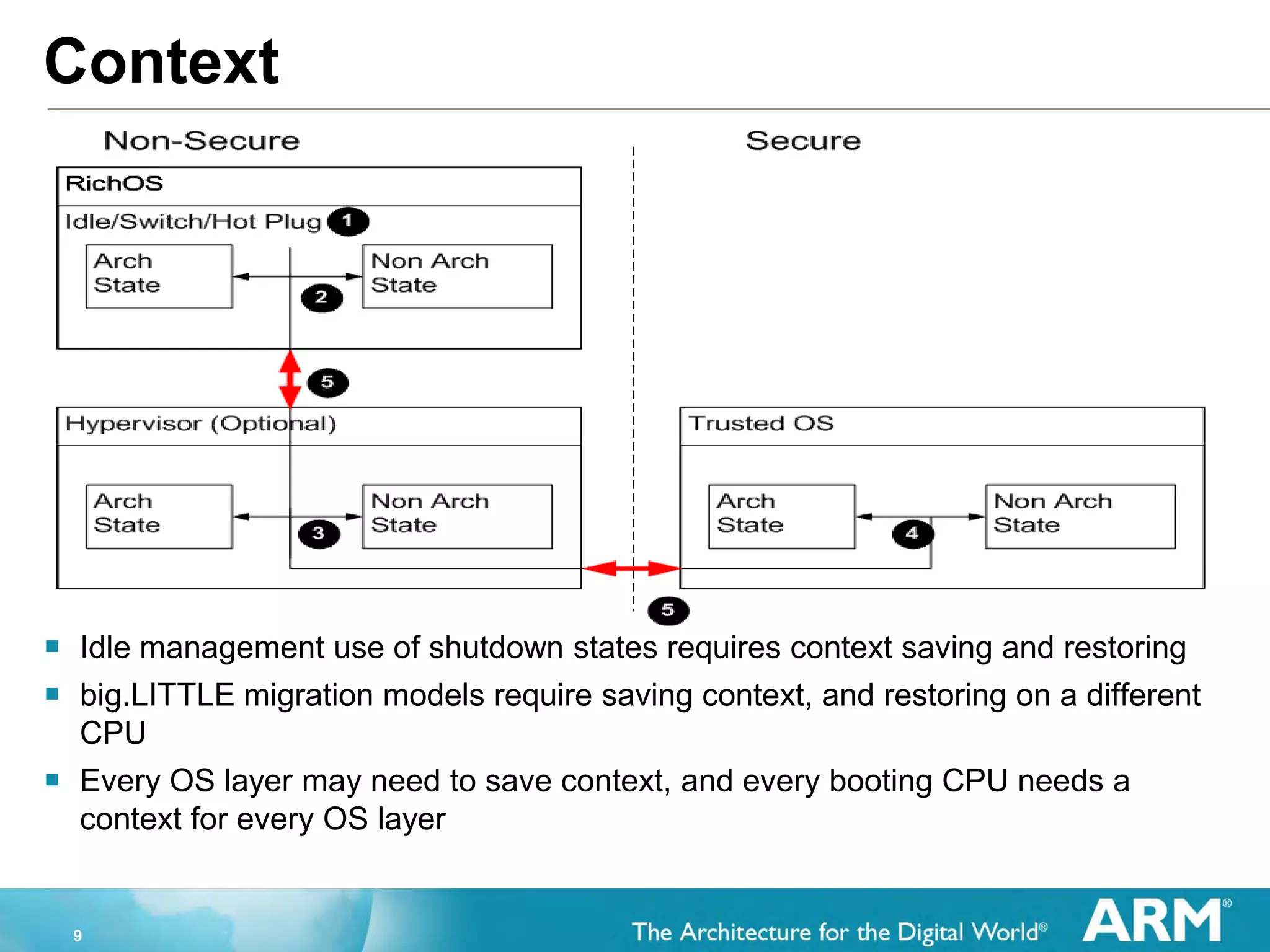
Context
 Idle management use of shutdown states requires context saving and restoring
 big.LITTLE migration models require saving context, and restoring on a different
CPU
 Every OS layer may need to save context, and every booting CPU needs a
context for every OS layer
10
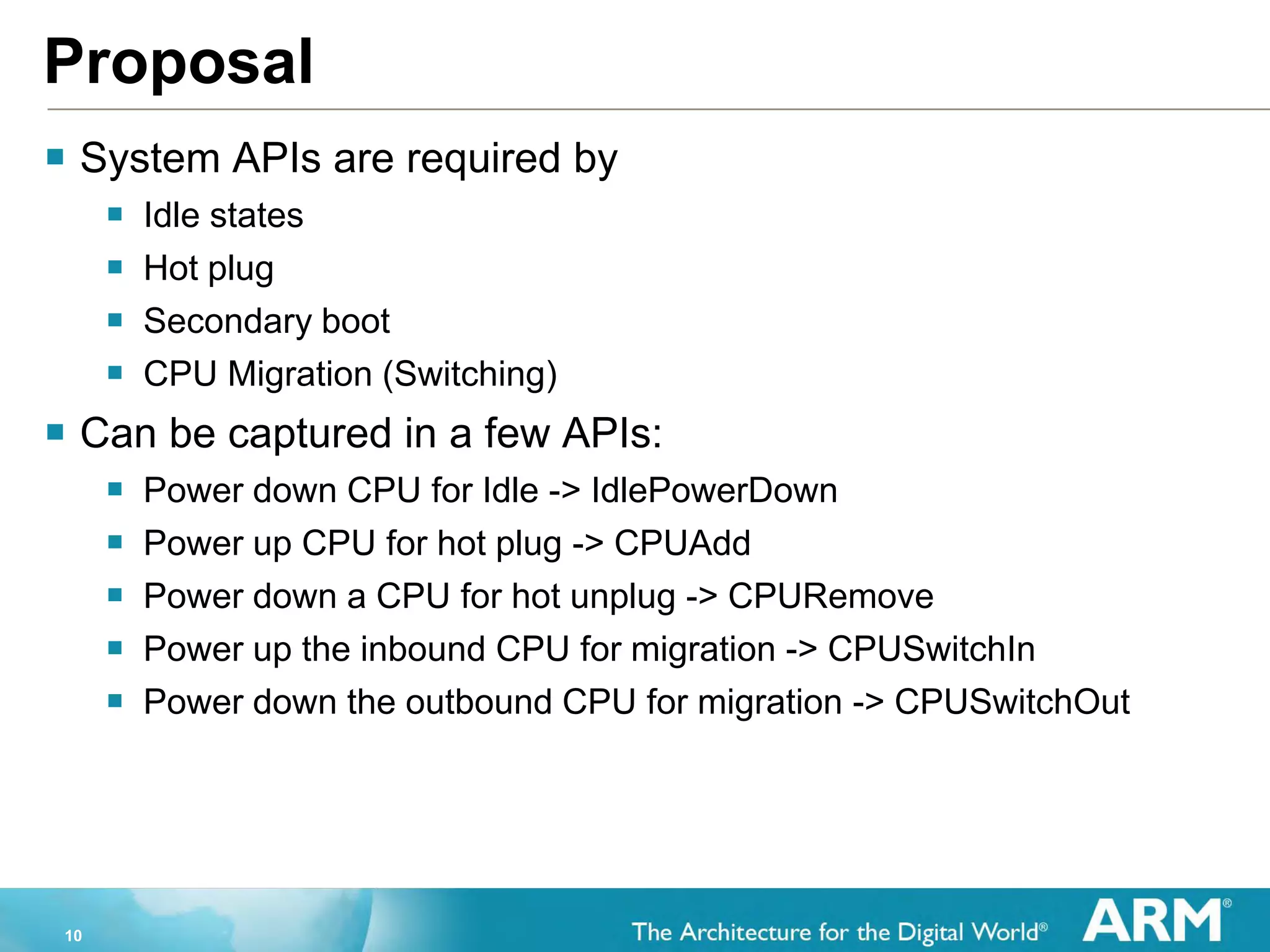
Proposal
 System APIs are required by
 Idle states
 Hot plug
 Secondary boot
 CPU Migration (Switching)
 Can be captured in a few APIs:
 Power down CPU for Idle -> IdlePowerDown
 Power up CPU for hot plug -> CPUAdd
 Power down a CPU for hot unplug -> CPURemove
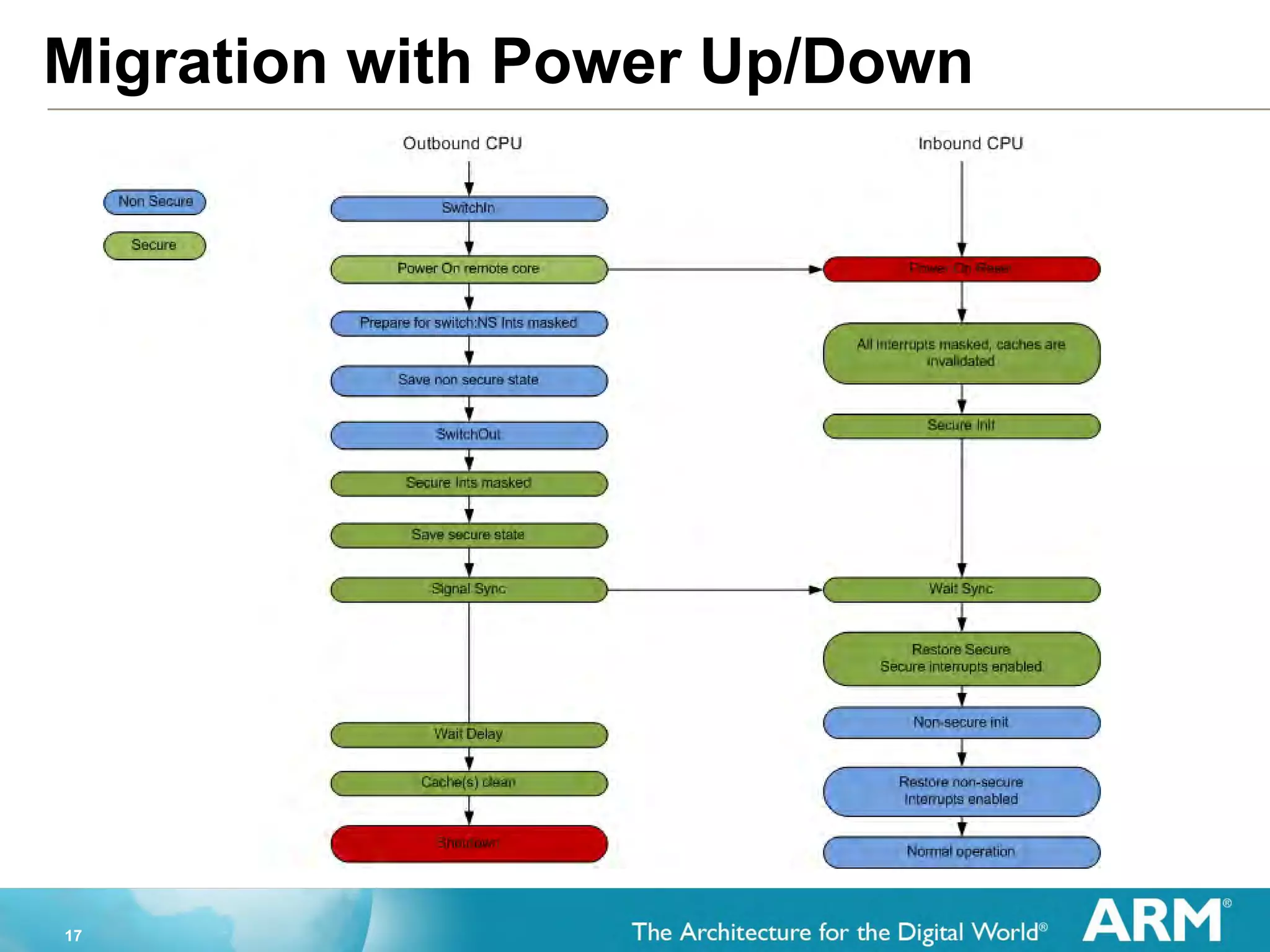
 Power up the inbound CPU for migration -> CPUSwitchIn
 Power down the outbound CPU for migration -> CPUSwitchOut
11
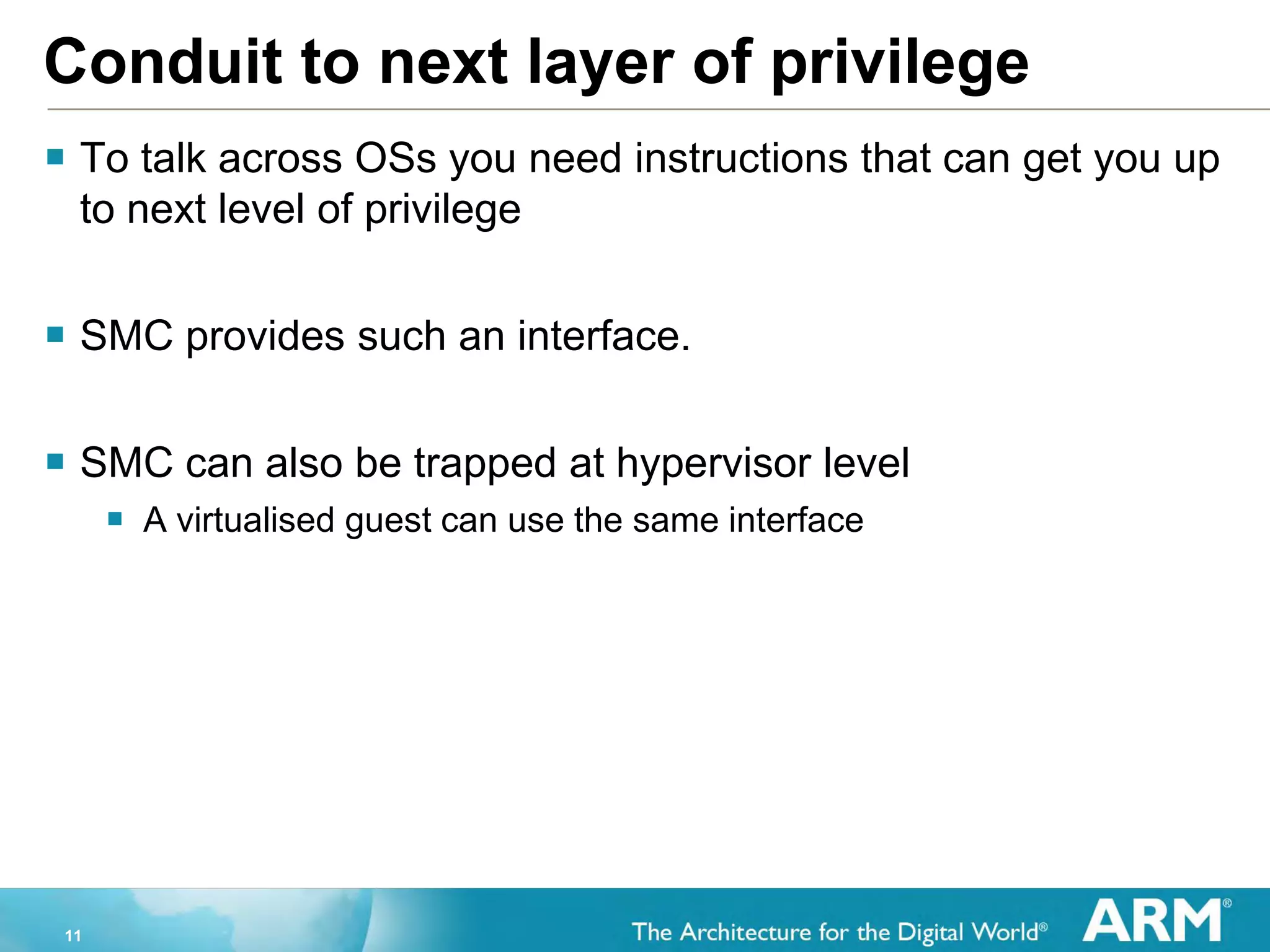
Conduit to next layer of privilege
 To talk across OSs you need instructions that can get you up
to next level of privilege
 SMC provides such an interface.
 SMC can also be trapped at hypervisor level
 A virtualised guest can use the same interface
12
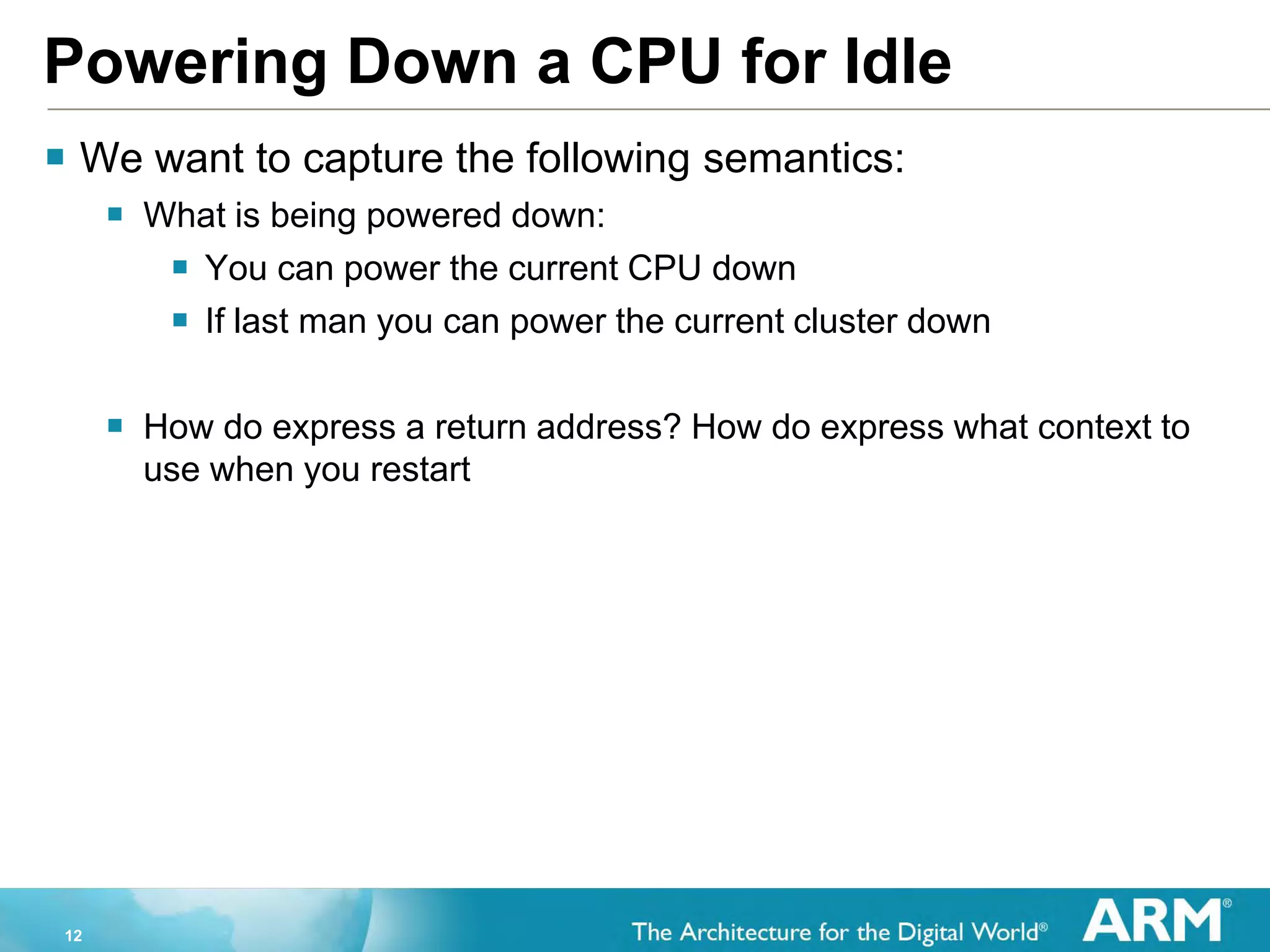
Powering Down a CPU for Idle
 We want to capture the following semantics:
 What is being powered down:
 You can power the current CPU down
 If last man you can power the current cluster down
 How do express a return address? How do express what context to
use when you restart
13
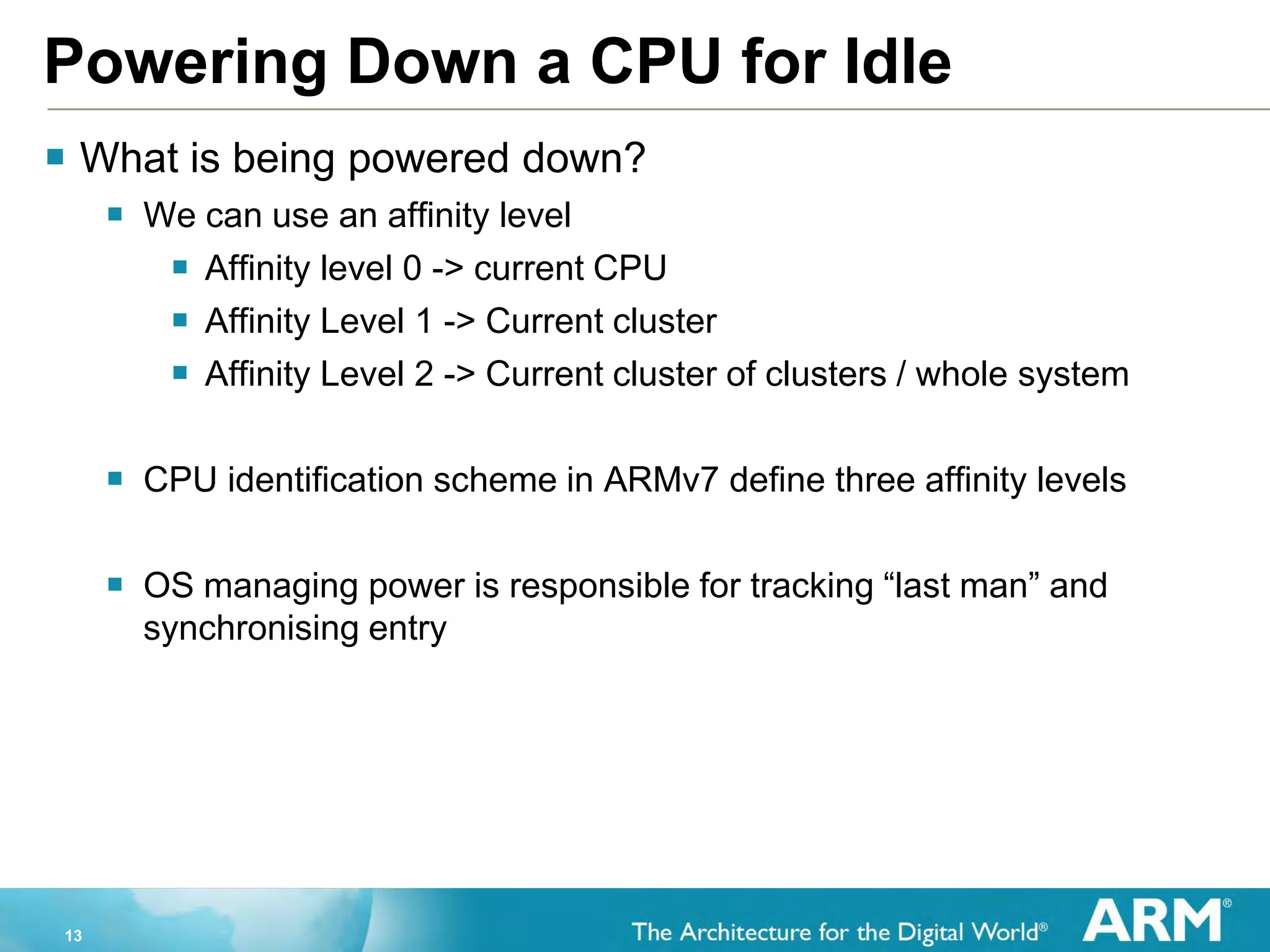
Powering Down a CPU for Idle
 What is being powered down?
 We can use an affinity level
 Affinity level 0 -> current CPU
 Affinity Level 1 -> Current cluster
 Affinity Level 2 -> Current cluster of clusters / whole system
 CPU identification scheme in ARMv7 define three affinity levels
 OS managing power is responsible for tracking “last man” and
synchronising entry
14
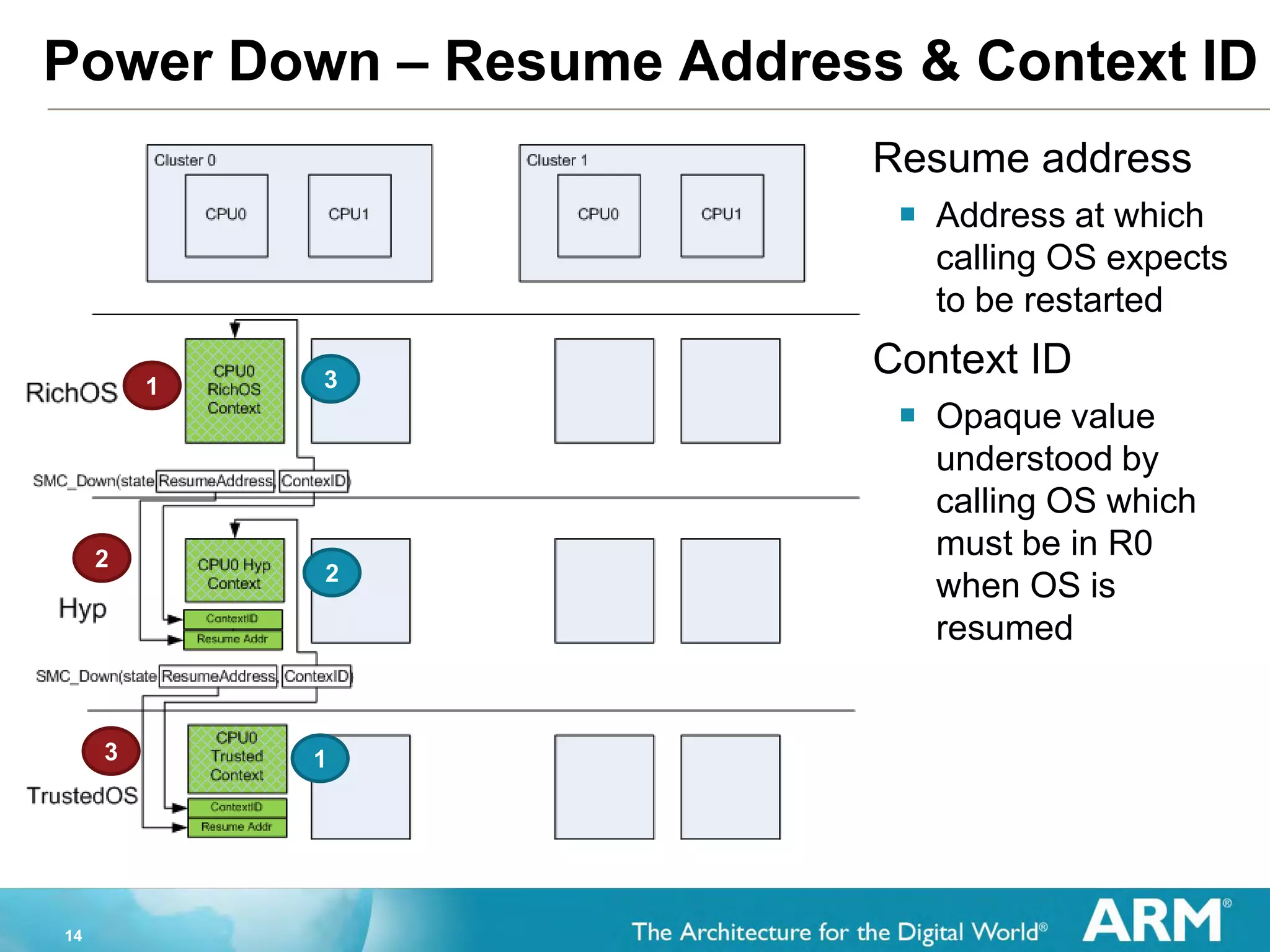
Power Down – Resume Address & Context ID
 Resume address
 Address at which
calling OS expects
to be restarted
 Context ID
 Opaque value
understood by
calling OS which
must be in R0
when OS is
resumed
13
1
2
3
2
15
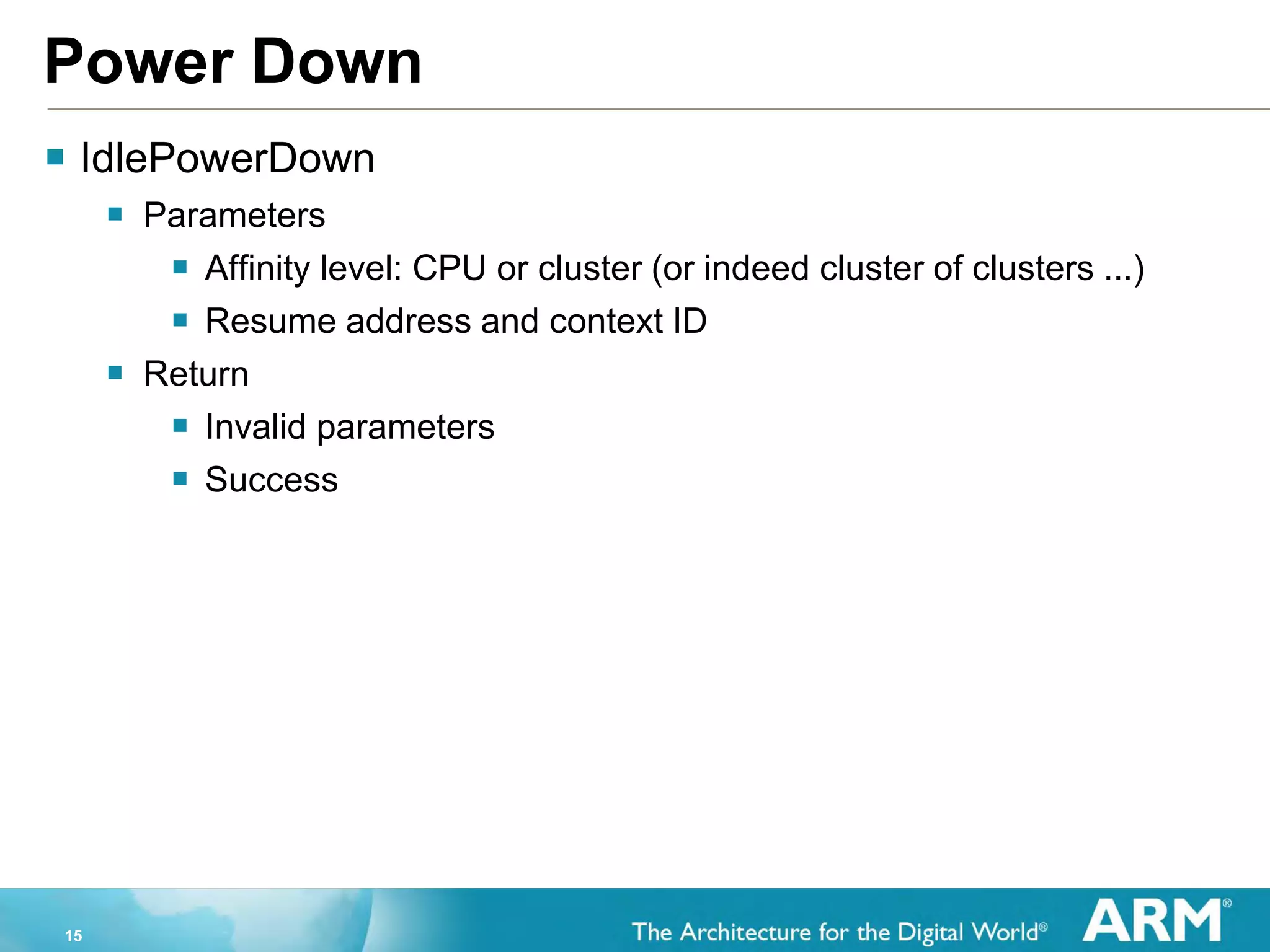
Power Down
 IdlePowerDown
 Parameters
 Affinity level: CPU or cluster (or indeed cluster of clusters ...)
 Resume address and context ID
 Return
 Invalid parameters
 Success
16
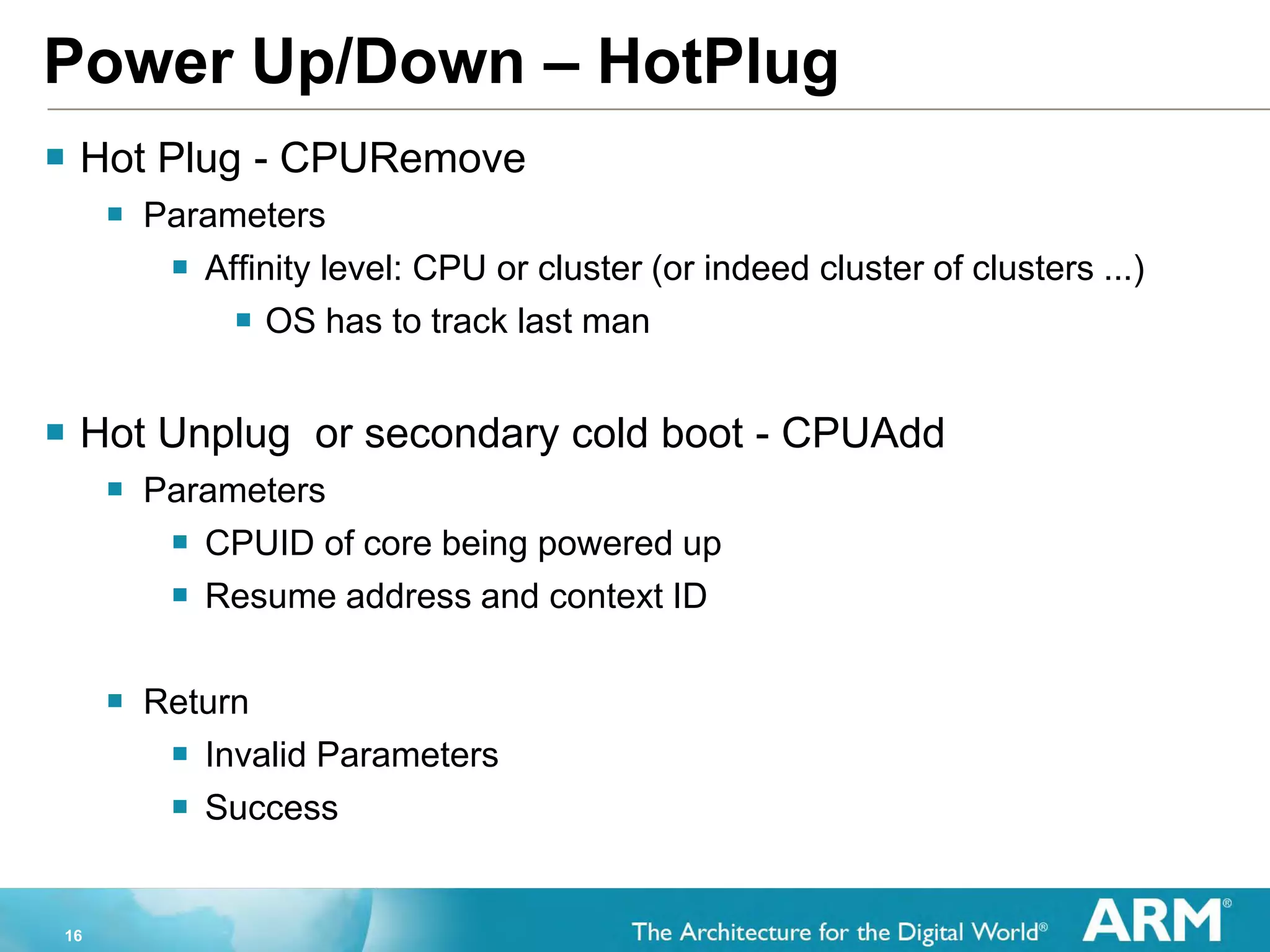
Power Up/Down – HotPlug
 Hot Plug - CPURemove
 Parameters
 Affinity level: CPU or cluster (or indeed cluster of clusters ...)
 OS has to track last man
 Hot Unplug or secondary cold boot - CPUAdd
 Parameters
 CPUID of core being powered up
 Resume address and context ID
 Return
 Invalid Parameters
 Success
17
Migration with Power Up/Down
18
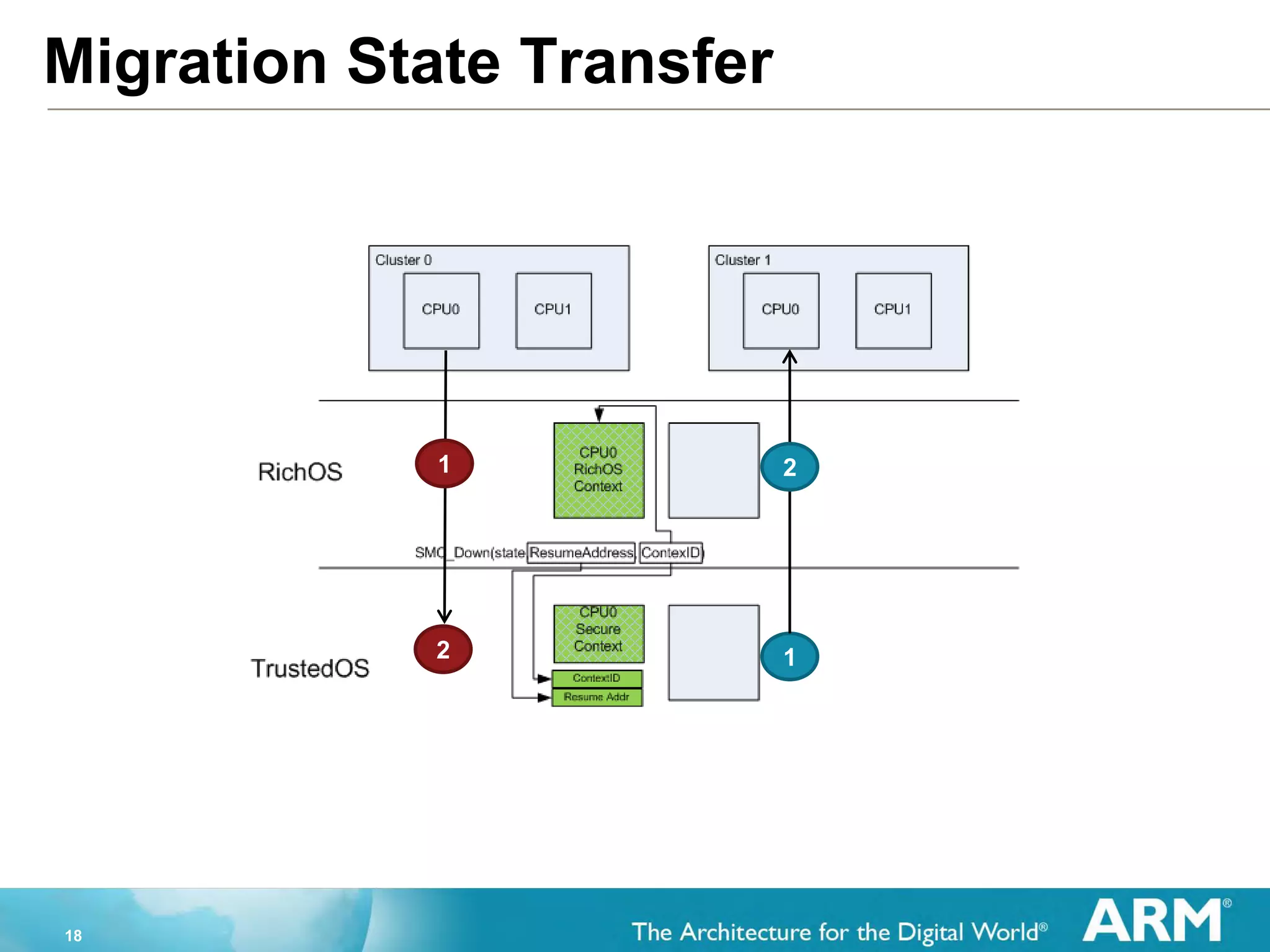
Migration State Transfer
12
1 2
19
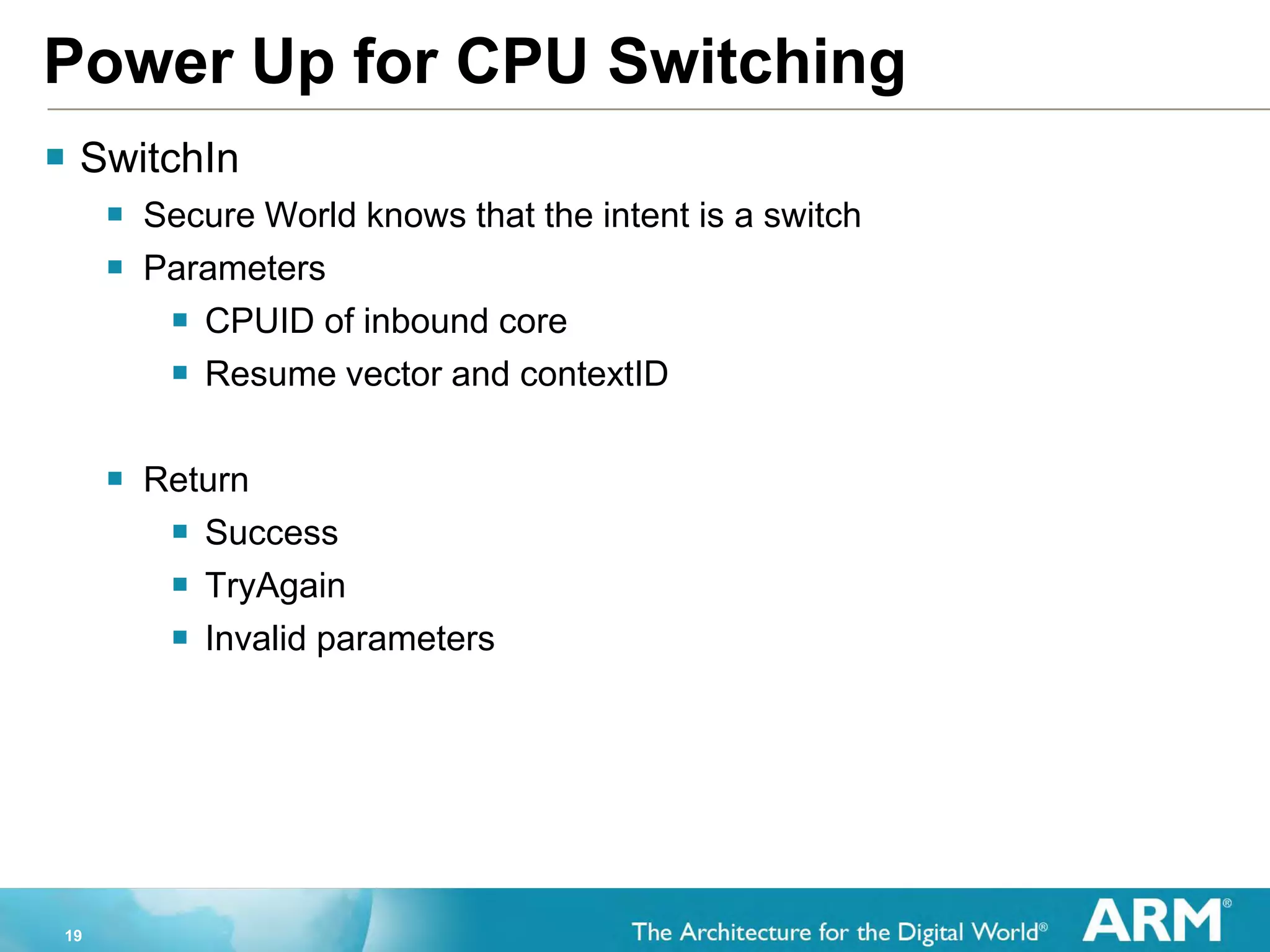
Power Up for CPU Switching
 SwitchIn
 Secure World knows that the intent is a switch
 Parameters
 CPUID of inbound core
 Resume vector and contextID
 Return
 Success
 TryAgain
 Invalid parameters
20
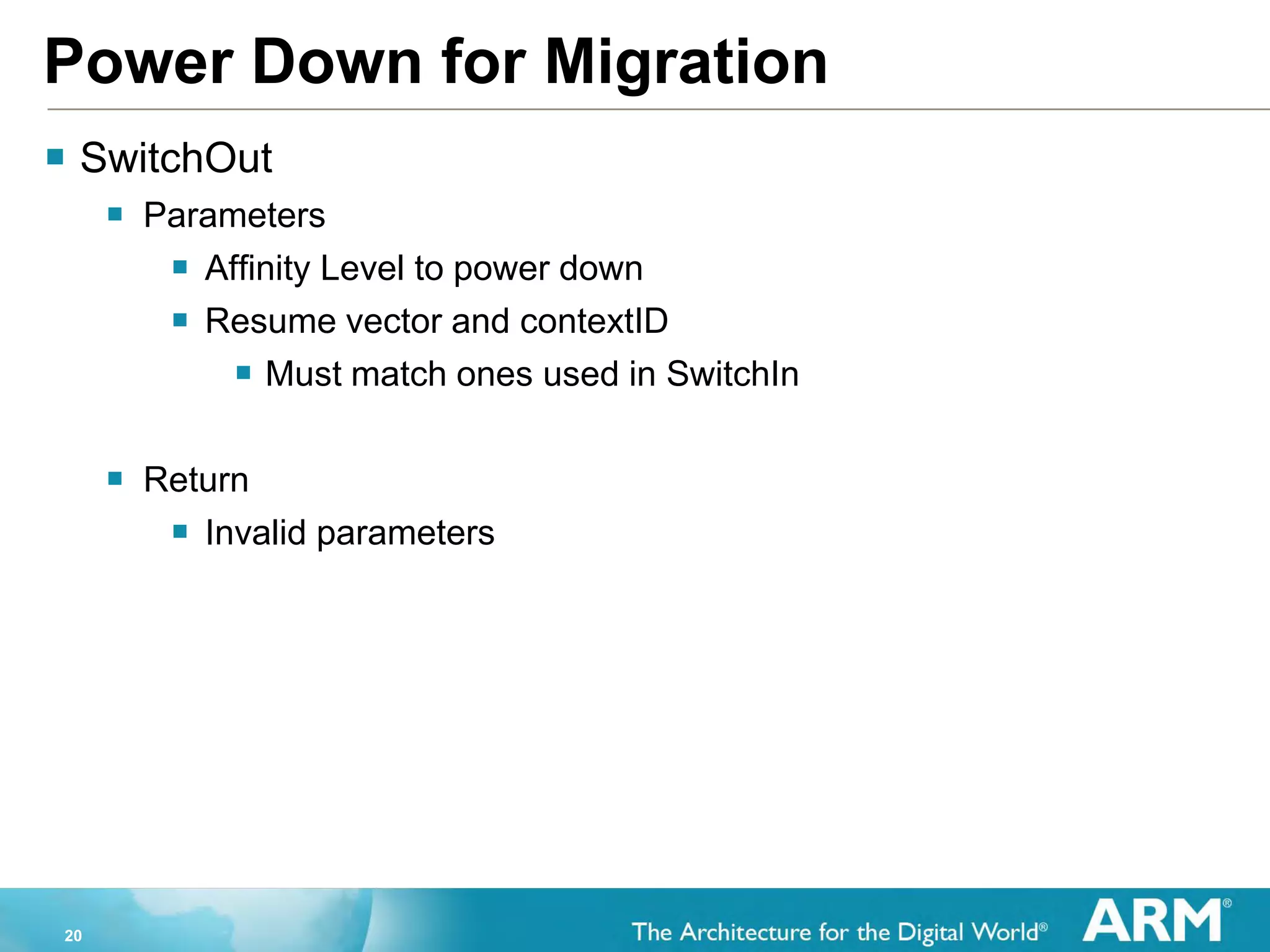
Power Down for Migration
 SwitchOut
 Parameters
 Affinity Level to power down
 Resume vector and contextID
 Must match ones used in SwitchIn
 Return
 Invalid parameters
21
Status
 Standard calling conventions
 Secure monitor SMC
 Hypervisor HVC
 ARM will be providing sample secure code for power
interface
 Questions ...

Q2.12: Power Management Across OSs

  • 1.
  • 2.
    2 Introduction  Firmware/ACPI isnot the most popular topic in Linux: “Modern PCs are horrible. ACPI is a complete design disaster in every way. But we're kind of stuck with it. If any Intel people are listening to this and you had anything to do with ACPI, shoot yourself now, before you reproduce” “The fact that ACPI was designed by a group of monkeys high on LSD, and is some of the worst designs in the industry obviously makes running it at any point pretty damn ugly. “ “EFI is this other Intel brain-damage (the first one being ACPI). “
  • 3.
    3 Linux is notAlone on the Device  Secure code will be present, provided by Semico or trusted OS vendor for a variety reasons:  Secure boot  Crypto services  Secure key storage  ....  Global platform is a leading security standards body in mobile space  Most companies in this room are members  Hypervisor can also be present  There is actually a work item in Linaro to cover Trustzone  TrustZone kernel driver
  • 4.
    4 ARMv7/v8 Privilege/Exception Levels Apps Apps Apps Apps GuestOS Apps Apps Apps Apps Guest OS Hypervisor Secure AppsSecure Apps Secure OS Secure Monitor EL0 EL1 EL2 EL3 Non-Secure Secure 32-bit & 64-bit Apps Guest OS 64-bit Hypervisor Monitor Apps Apps Apps Apps Guest OS Apps Apps Apps Apps Guest OS Hypervisor Secure AppsSecure Apps Secure OS Secure Monitor PL0 PL1 PL2 Non-Secure ARMv7 ARMv8
  • 5.
    5 ARMv7/v8 Privilege/Exception Levels Apps Apps Apps Apps GuestOS Apps Apps Apps Apps Guest OS Hypervisor Secure AppsSecure Apps Trusted OS Secure Monitor PL0 PL1 PL2 Non-Secure ARMv7 Rich OSs Linux, Windows ... Hyp vendors OKLabs, VMWare ... TrustedOS Vendors Semicos, ...
  • 6.
    6 So Need Collaboration Need OSs at different privilege layers to collaborate on power  OSs need to know when to save/restore their state  OSs need to manage peripherals they own when entering a power state Linux Hypervisor Secure world Hotplug Secondary boot Idle Powercontroller optional bigLITTLE migration
  • 7.
    7 Cold Boot vsWarm Boot Linux Kernel Secure ROM Goto TrustedOS Warm boot vector Secure ROM Init check boot reason Secure Flash Boot firmware Install TrustedOS Uboot Load linux from media Trusted OS Start RichOS at Its warm boot vector Linux Kernel Secure Non-Secure
  • 8.
    8 Cold Boot vsWarm Boot Linux Kernel Secure ROM Goto TrustedOS Warm boot vector Secure ROM Init check boot reason Secure Flash Boot firmware Install TrustedOS Uboot Load linux from media Trusted OS Start RichOS at Its warm boot vector Linux Kernel Secure Non-Secure Linux needs to define warm boot address and inform secure side
  • 9.
    9 Context  Idle managementuse of shutdown states requires context saving and restoring  big.LITTLE migration models require saving context, and restoring on a different CPU  Every OS layer may need to save context, and every booting CPU needs a context for every OS layer
  • 10.
    10 Proposal  System APIsare required by  Idle states  Hot plug  Secondary boot  CPU Migration (Switching)  Can be captured in a few APIs:  Power down CPU for Idle -> IdlePowerDown  Power up CPU for hot plug -> CPUAdd  Power down a CPU for hot unplug -> CPURemove  Power up the inbound CPU for migration -> CPUSwitchIn  Power down the outbound CPU for migration -> CPUSwitchOut
  • 11.
    11 Conduit to nextlayer of privilege  To talk across OSs you need instructions that can get you up to next level of privilege  SMC provides such an interface.  SMC can also be trapped at hypervisor level  A virtualised guest can use the same interface
  • 12.
    12 Powering Down aCPU for Idle  We want to capture the following semantics:  What is being powered down:  You can power the current CPU down  If last man you can power the current cluster down  How do express a return address? How do express what context to use when you restart
  • 13.
    13 Powering Down aCPU for Idle  What is being powered down?  We can use an affinity level  Affinity level 0 -> current CPU  Affinity Level 1 -> Current cluster  Affinity Level 2 -> Current cluster of clusters / whole system  CPU identification scheme in ARMv7 define three affinity levels  OS managing power is responsible for tracking “last man” and synchronising entry
  • 14.
    14 Power Down –Resume Address & Context ID  Resume address  Address at which calling OS expects to be restarted  Context ID  Opaque value understood by calling OS which must be in R0 when OS is resumed 13 1 2 3 2
  • 15.
    15 Power Down  IdlePowerDown Parameters  Affinity level: CPU or cluster (or indeed cluster of clusters ...)  Resume address and context ID  Return  Invalid parameters  Success
  • 16.
    16 Power Up/Down –HotPlug  Hot Plug - CPURemove  Parameters  Affinity level: CPU or cluster (or indeed cluster of clusters ...)  OS has to track last man  Hot Unplug or secondary cold boot - CPUAdd  Parameters  CPUID of core being powered up  Resume address and context ID  Return  Invalid Parameters  Success
  • 17.
  • 18.
  • 19.
    19 Power Up forCPU Switching  SwitchIn  Secure World knows that the intent is a switch  Parameters  CPUID of inbound core  Resume vector and contextID  Return  Success  TryAgain  Invalid parameters
  • 20.
    20 Power Down forMigration  SwitchOut  Parameters  Affinity Level to power down  Resume vector and contextID  Must match ones used in SwitchIn  Return  Invalid parameters
  • 21.
    21 Status  Standard callingconventions  Secure monitor SMC  Hypervisor HVC  ARM will be providing sample secure code for power interface  Questions ...