“Study of the Robertson - Walker
metric and its application to the
Cosmological Red Shifts”
Gourab Sahoo
Roll No: BGC/PHY/015-2013
Registration No: 1061511300018 of 2015-16
Project Supervisor: Dr. Prabir Kr. Pal
WELCOME
The large scale structure of the universe is the discovery that
the spectral lines of the distant galaxies are shifted towards
the red-end of the spectrum. Thus we conclude that the
universe as a whole expanding. So we need a non-static,
homogeneous and isotropic metric to describe the entire
universe. In this respect, we study the Robertson - Walker
metric and its application to the cosmological red shifts.
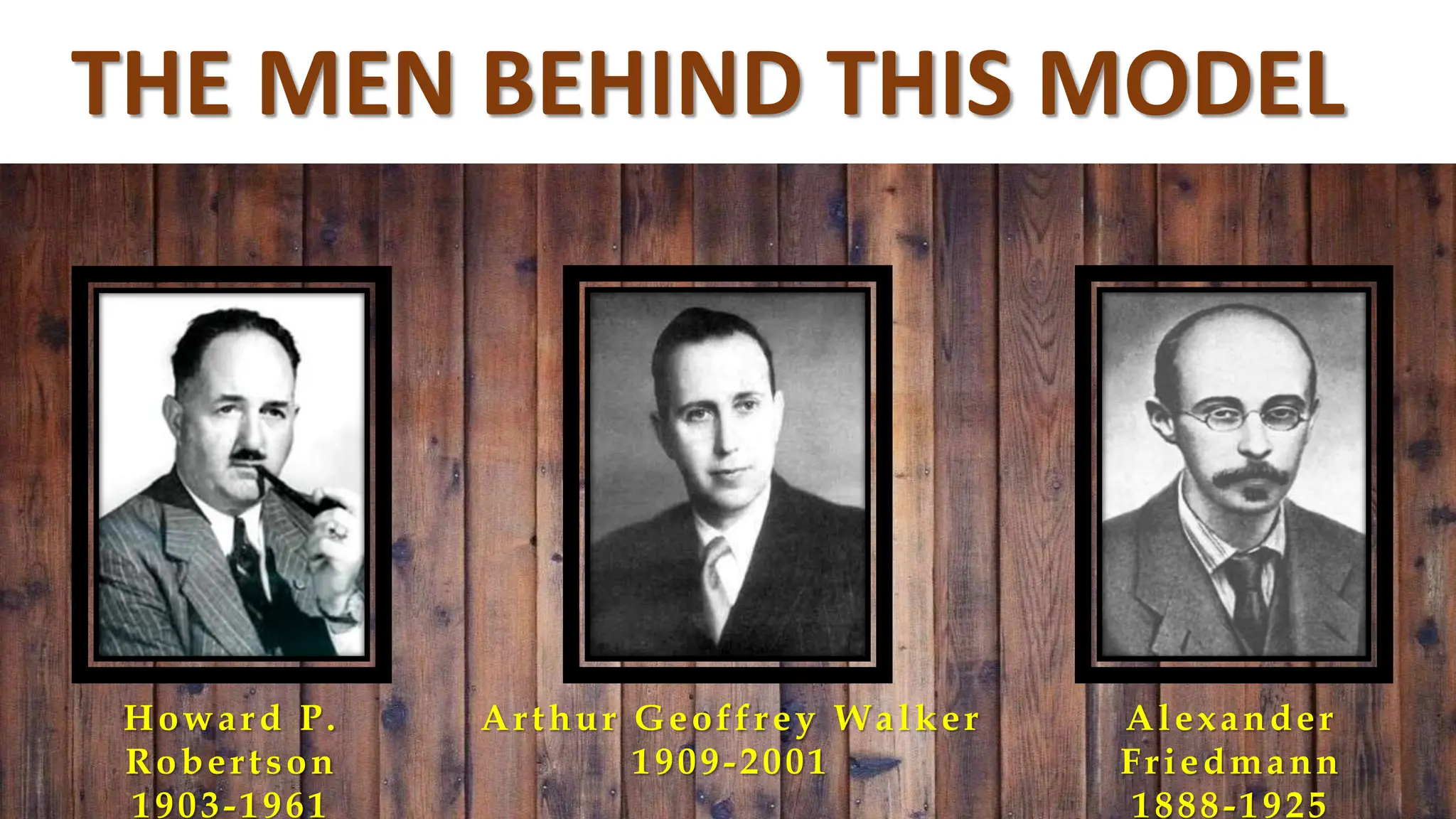
Howard P.
Robertson
1903-1961
Arthur Geoffrey Walker
1909-2001
Alexander
Friedmann
1888-1925
THE MEN BEHIND THIS MODEL
Observations
1
Homogeneous and Isotro
pic
Universe Models
2
Conclusion
5
Spaces of Positive, Nega
tive
and Zero Curvature
3
The Red Shift
4
CONTENTS
CHAPTER
1
1.1 Observations
During the last 60 years or so one has observed processes in
parts of the universe by means of large optical telescopes, radio
telescopes and space born observation equipment, in particular the
Hubble telescope. These observations have suggested several simple
properties of the universe as a whole.
1.1.1 Distance
The velocity of light in vacuum is approximately c = 3 x 10⁵ km/s,
which corresponds to travelling 7 times around the Earth per second. The
light uses 8 minutes from the Sun to the Earth. Our nearest star, Alpha
Centauri, is about 4 light years away from us.
Our planetary system is positioned in an arm of a spiral galaxy, the
Milky Way, about 105 light years from its centre. The galaxies are collected
in clusters of galaxies. The mean distance between the galaxy clusters is
about 108 light years. The farthest objects observed have a distance about
1010 light years from us.
1.1.2 Large scale homogeneity:
Observations seem to indicate that over distances larger than
about 109 light years the material of the universe is uniformly distributed.
On such a scale the universe is usually assumed to be homogeneous. The
validity of this assumption has, however, been discussed recently on the
basis on new three dimensional surveys of the distribution of matter in the
universe.
1.1.3
Isotropy: The distribution of galaxies
seems to be equal in all direction on a
large scale, i.e. the distribution is
isotropic.
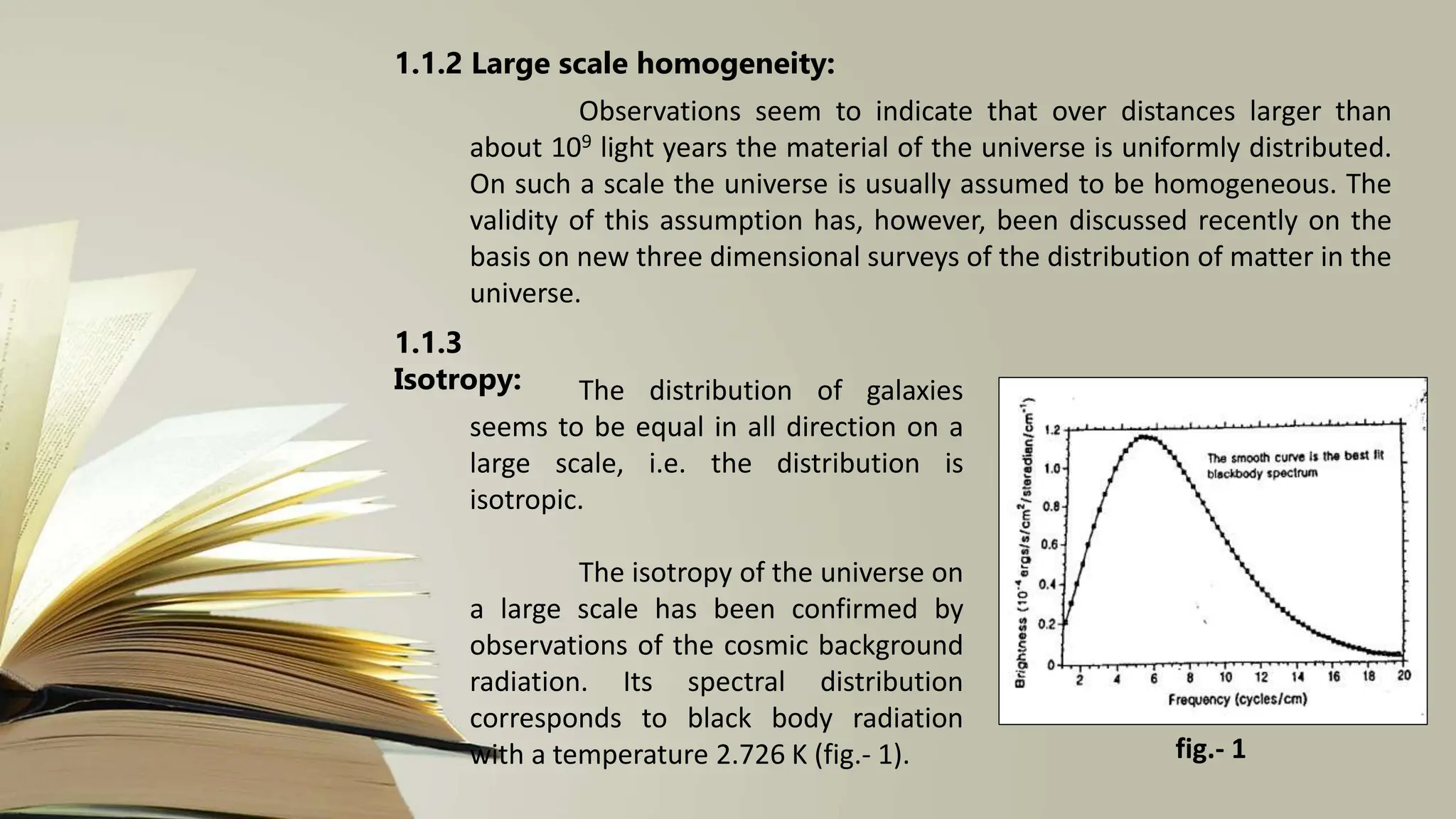
The isotropy of the universe on
a large scale has been confirmed by
observations of the cosmic background
radiation. Its spectral distribution
corresponds to black body radiation
with a temperature 2.726 K (fig.- 1). fig.- 1
1.1.4
Expansion:
From 1925 to 1930
Edwin Hubble observed the
spectral lines in the light from
galaxies far away. The result of
these investigations is that the
spectral lines corresponding to
known atomic transitions are
displaced towards red, that is,
towards longer wavelengths, and
that this red shift is proportional
to the distances of the galaxies.
This is called Hubble’s law.
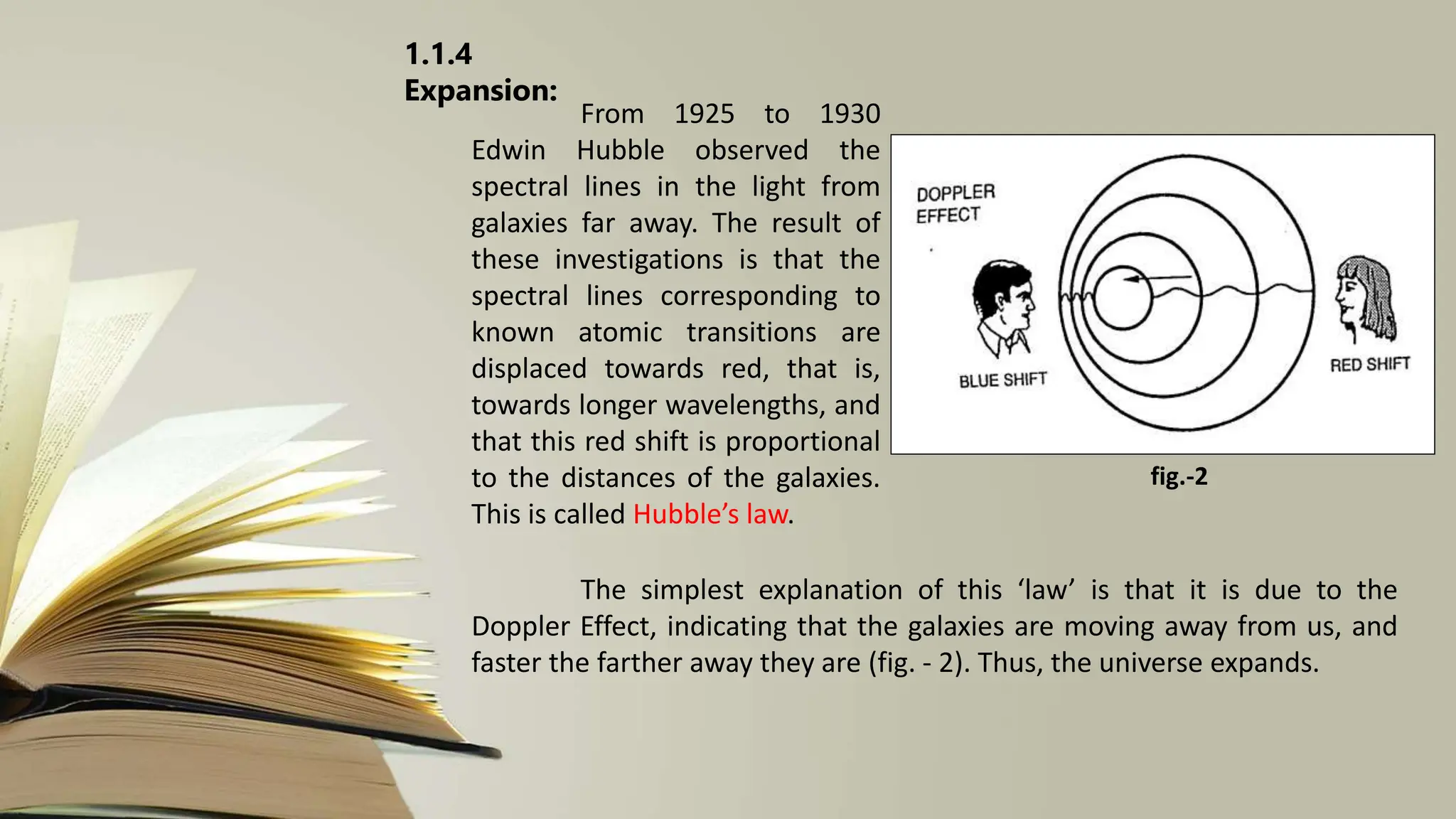
The simplest explanation of this ‘law’ is that it is due to the
Doppler Effect, indicating that the galaxies are moving away from us, and
faster the farther away they are (fig. - 2). Thus, the universe expands.
fig.-2
1.2 Homogeneous and Isotropic Universe Models
The homogeneous and isotropic
universe models of Friedmann are the
simplest relativistic models. The
curvature of space at a certain moment in
a Friedmann model, is constant. In order
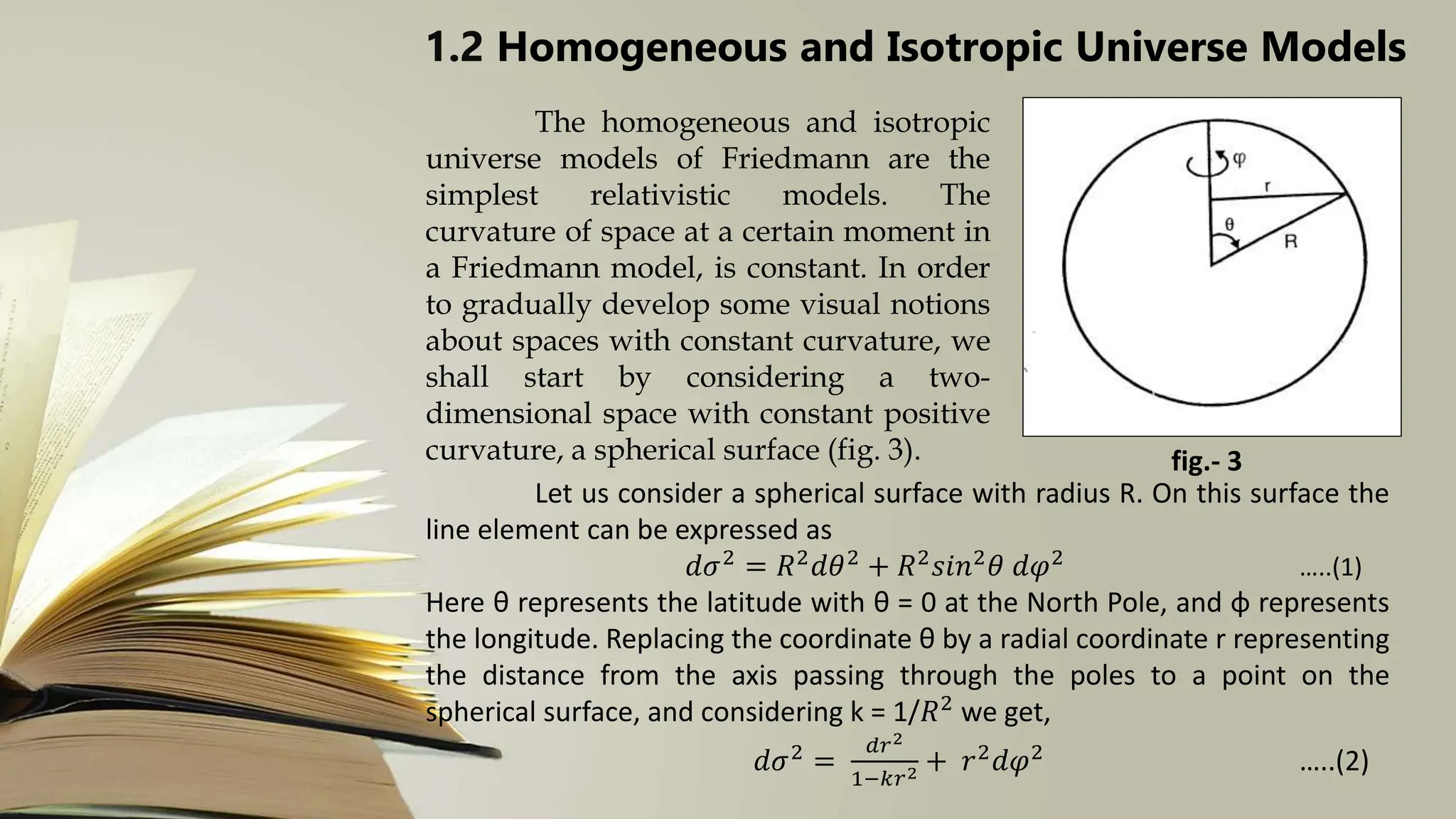
to gradually develop some visual notions
about spaces with constant curvature, we
shall start by considering a two-
dimensional space with constant positive
curvature, a spherical surface (fig. 3). fig.- 3
Let us consider a spherical surface with radius R. On this surface the
line element can be expressed as
𝑑𝜎2
= 𝑅2
𝑑𝜃2
+ 𝑅2
𝑠𝑖𝑛2
𝜃 𝑑𝜑2
…..(1)
Here θ represents the latitude with θ = 0 at the North Pole, and φ represents
the longitude. Replacing the coordinate θ by a radial coordinate r representing
the distance from the axis passing through the poles to a point on the
spherical surface, and considering k = 1/𝑅2 we get,
𝑑𝜎2 =
𝑑𝑟2
1−𝑘𝑟2 + 𝑟2𝑑𝜑2 …..(2)
Similarly for three-dimensional space with constant curvature the
line element will be
𝑑𝜎2 =
𝑑𝑟2
1−𝑘𝑟2 + 𝑟2𝑑𝜃2 + 𝑟2𝑠𝑖𝑛2𝜃𝑑𝜑2 ….(3)
The physical distance between the origin of the coordinates system and a
point with coordinates (dr, dθ, dφ) is dl = a(t) db, where the function a(t) is
a so-called scale factor, which tells us how the distance to a galaxy changes
with time.
Choosing a coordinate time that is equal to the time as measured
by standard clocks carried by the galaxies, the line element of space time
takes the form
𝑑𝑠2 = 𝑎2 𝑡
𝑑𝑟2
1−𝑘𝑟2 + 𝑟2𝑑𝜃2 + 𝑟2 𝑠𝑖𝑛2𝜃 𝑑𝜑2 − 𝑐2𝑑𝑡2 ….(4)
This line element describes the geometric and kinematical properties of
isotropic and (spatially) homogeneous universe models. It is called the
Robertson-Walker line element.
CHAPTER
2
2.1 Spaces Of Positive, Negative And Zero Curvature
From equation (8) we know the spatial part of the Robertson
Walker Metric is given by
𝑑𝜎2 =
𝑑𝑟2
1 − 𝑘𝑟2
+ 𝑟2𝑑𝜃2 + 𝑟2𝑠𝑖𝑛2𝜃𝑑𝜑2
Let us consider the three cases that arise with the normalized curvature
scalar k.
2.1.1 Case 1 : k = 0
It corresponds to the case of zero curvature. The line element for r = χ, becomes
𝑑𝜎2
= 𝑑𝜒2
+ 𝜒2
𝑑𝜃2
+ 𝜒2
𝑠𝑖𝑛2
𝜃 𝑑𝜑2
….(5)
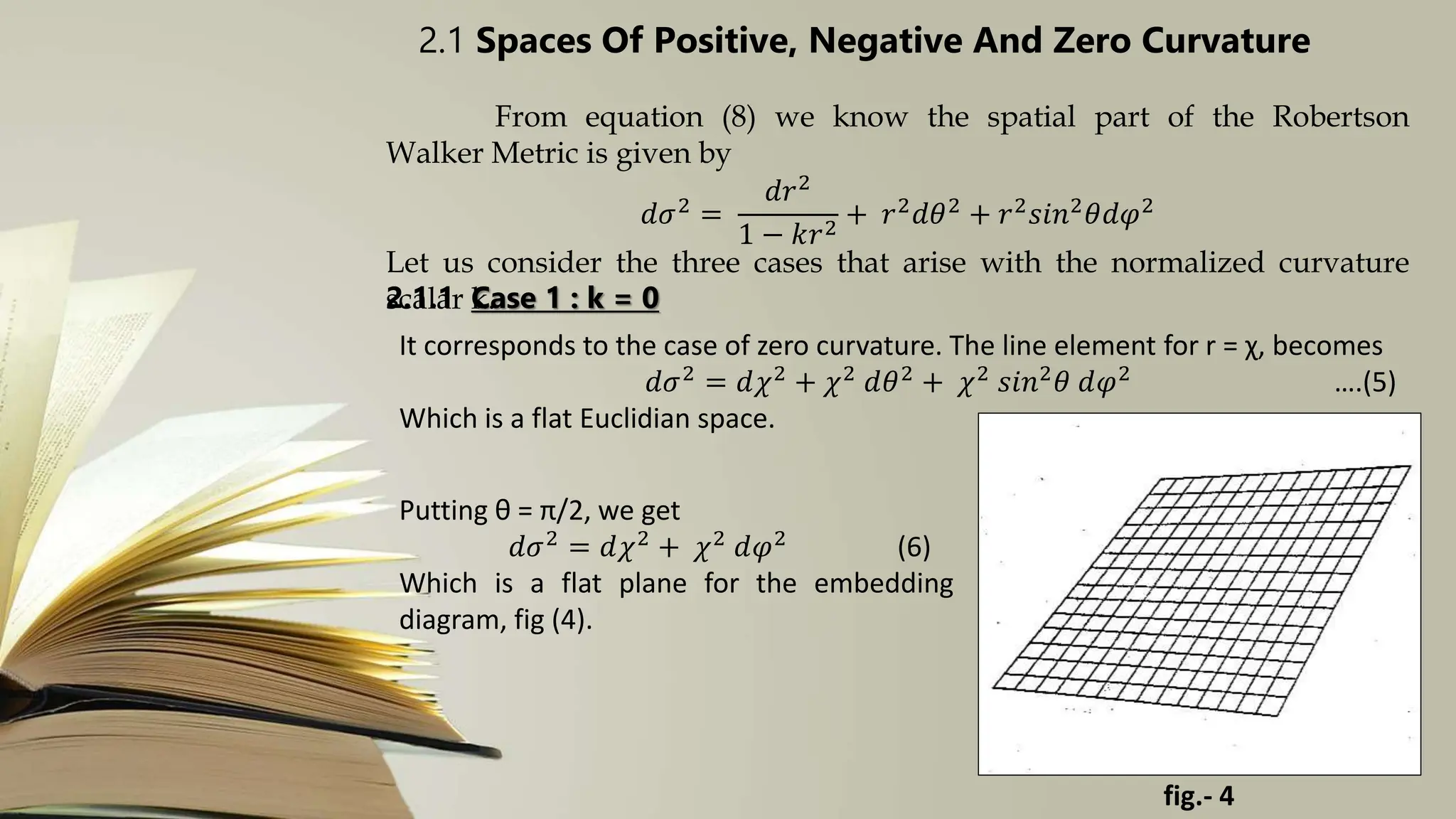
Which is a flat Euclidian space.
Putting θ = π/2, we get
𝑑𝜎2 = 𝑑𝜒2 + 𝜒2 𝑑𝜑2 (6)
Which is a flat plane for the embedding
diagram, fig (4).
fig.- 4
2.1.2 Case 2 : k = +1
The spatial metric can be written as
𝑑𝜎2
=
𝑑𝑟2
1−𝑟2 + 𝑟2
𝑑𝜃2
+ 𝑟2
𝑠𝑖𝑛2
𝜃𝑑𝜑2
….(7)
Which in the more general form is
𝑑𝜎2 =
𝑑𝑟2
1−𝑟2(𝜒)
+ 𝑟2(𝜒)𝑑𝜃2 + 𝑟2(𝜒)𝑠𝑖𝑛2𝜃𝑑𝜑2 ….(8)
Putting r(χ) = sin(χ), we get
𝑑𝜎2
= 𝑑𝜒2
+ 𝑠𝑖𝑛2
𝜒 𝑑𝜃2
+ 𝑠𝑖𝑛2
𝜒 𝑠𝑖𝑛2
𝜃 𝑑𝜑2
….(9)
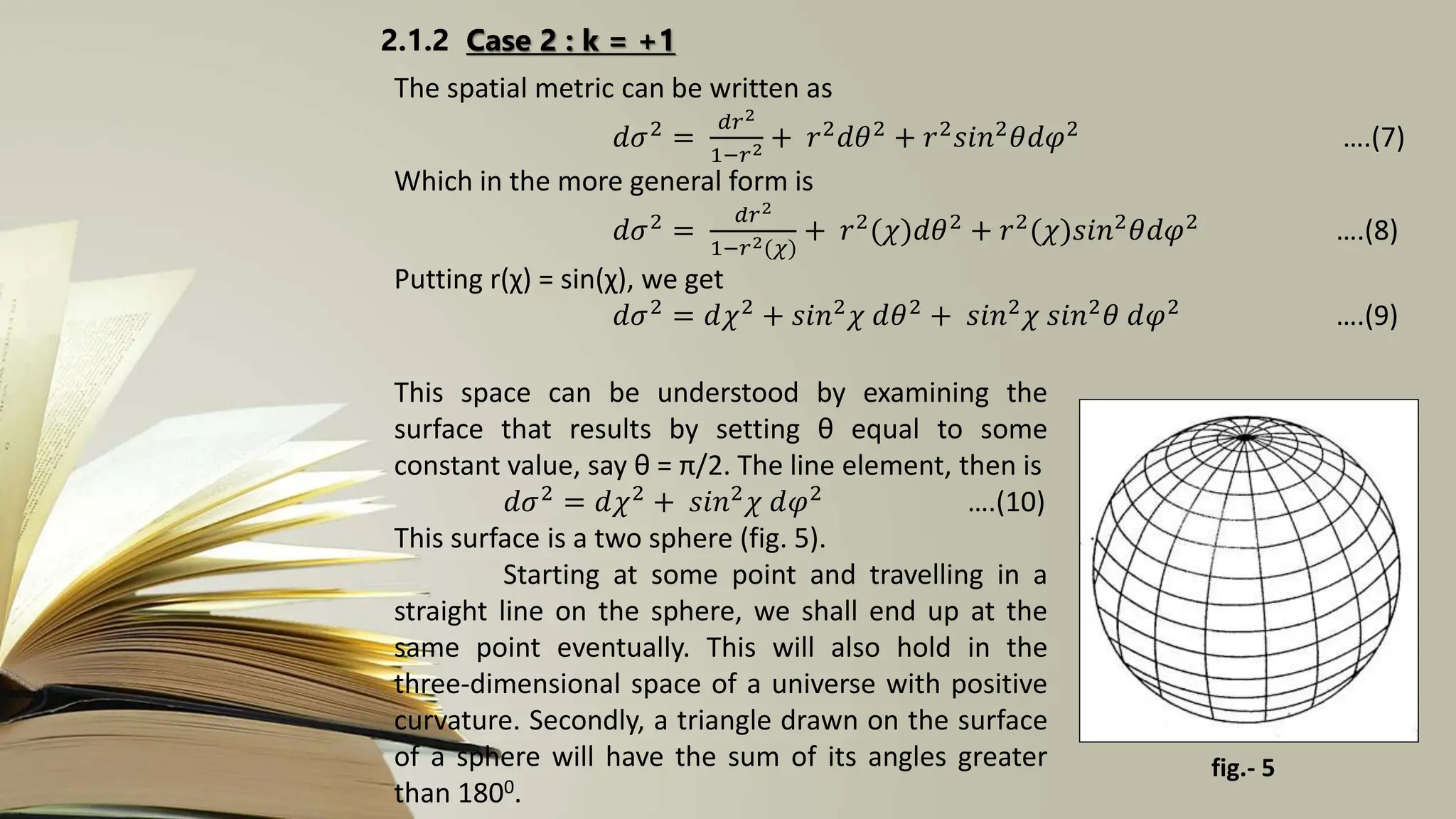
This space can be understood by examining the
surface that results by setting θ equal to some
constant value, say θ = π/2. The line element, then is
𝑑𝜎2 = 𝑑𝜒2 + 𝑠𝑖𝑛2𝜒 𝑑𝜑2 ….(10)
This surface is a two sphere (fig. 5).
Starting at some point and travelling in a
straight line on the sphere, we shall end up at the
same point eventually. This will also hold in the
three-dimensional space of a universe with positive
curvature. Secondly, a triangle drawn on the surface
of a sphere will have the sum of its angles greater
than 1800.
fig.- 5
2.1.3 Case 3 : k = -1
It corresponds to negative curvature. The
spatial metric becomes
𝑑𝜎2 =
𝑑𝑟2
1+𝑟2 + 𝑟2𝑑𝜃2 + 𝑟2𝑠𝑖𝑛2𝜃𝑑𝜑2 ...(11)
Which in the more general form is
𝑑𝜎2
=
𝑑𝑟2
1+𝑟2(𝜒)
+ 𝑟2
𝜒 𝑑𝜃2
+ 𝑟2
𝜒 𝑠𝑖𝑛2
𝜃𝑑𝜑2
….(12)
Putting r(χ) = sinh(χ), the line element become
𝑑𝜎2 = 𝑑𝜒2 + 𝑠𝑖𝑛ℎ2𝜒 𝑑𝜃2 + 𝑠𝑖𝑛ℎ2𝜒 𝑠𝑖𝑛2𝜃 𝑑𝜑2 (13)
For the metric in equation (4),
𝑑𝑠2 = 𝑎2 𝑡 𝑑𝜎2 − 𝑐2𝑑𝑡2 , the spatial slices have the property that they have
infinite volume. The sum of the angles of the triangles add up to less than 1800.
Putting θ = π/2, for obtaining an embedding diagram, we get
𝑑𝜎2
= 𝑑𝜒2
+ 𝑠𝑖𝑛2
𝜒 𝑑𝜑2
….(14)
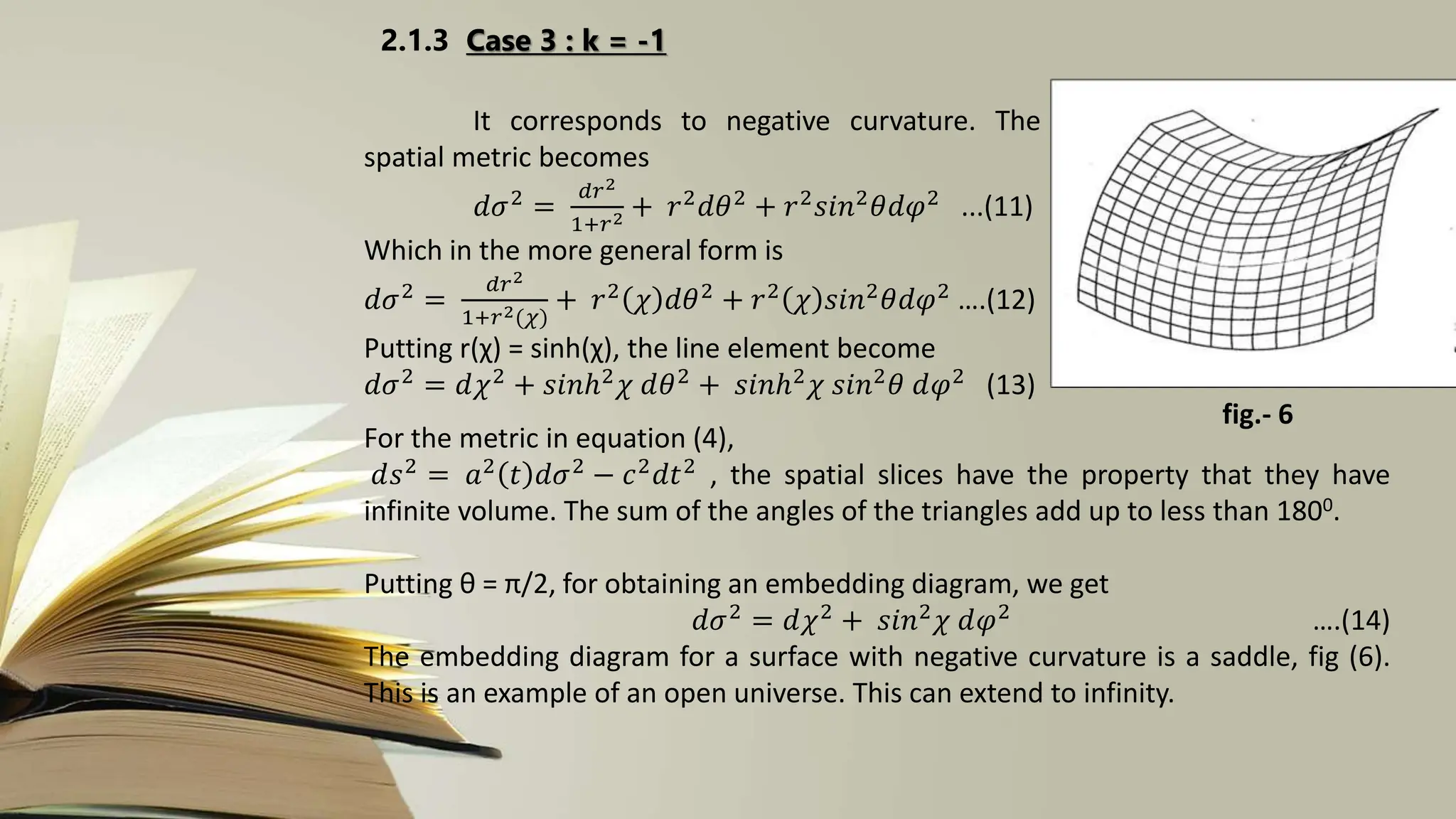
The embedding diagram for a surface with negative curvature is a saddle, fig (6).
This is an example of an open universe. This can extend to infinity.
fig.- 6
CHAPTER
3
3 . 1 T h e R e d S h i f t
It is proposed to show that the Robertson-Walker line element predicts a
shift in the wavelength of the radiation emitted by a remote source such as a nebula
or a radio galaxy. On account of the isotropy of the model, it follows that any radius
vector is a possible trajectory of the light ray, i.e., θ, φ = constant, if we use spherical
polar coordinates.
The Robertson-Walker line element is given by
𝑑𝑠2 = 𝑎2 𝑡
𝑑𝑟2
1−𝑘𝑟2 + 𝑟2𝑑𝜃2 + 𝑟2 𝑠𝑖𝑛2𝜃 𝑑𝜑2 − 𝑐2𝑑𝑡2 (15)
Putting ds = 0, dθ = 0, dφ = 0, we obtain
𝑑𝑟
𝑑𝑡
2
=
1 − 𝑘𝑟2
𝑎2(𝑡)
⇒
𝑑𝑟
𝑑𝑡
= ±
1−𝑘𝑟2
1
2
𝑎(𝑡)
(16)
The plus sign holds for light travelling away from the origin and minus when
towards the origin.
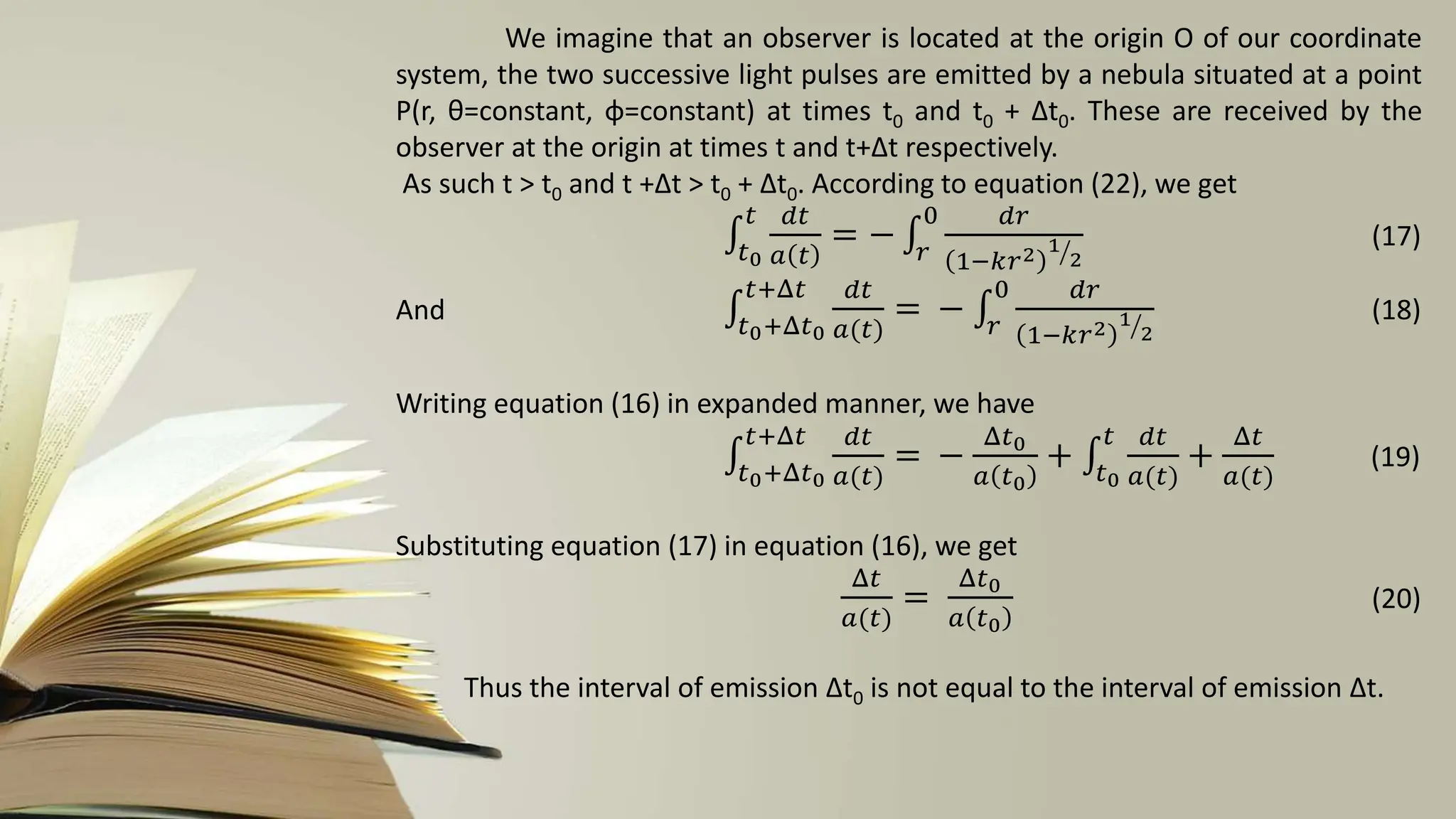
We imagine that an observer is located at the origin O of our coordinate
system, the two successive light pulses are emitted by a nebula situated at a point
P(r, θ=constant, φ=constant) at times t0 and t0 + ∆t0. These are received by the
observer at the origin at times t and t+∆t respectively.
As such t > t0 and t +∆t > t0 + ∆t0. According to equation (22), we get
𝑡0
𝑡 𝑑𝑡
𝑎 𝑡
= − 𝑟
0 𝑑𝑟
1−𝑘𝑟2 1
2
(17)
And 𝑡0+Δ𝑡0
𝑡+Δ𝑡 𝑑𝑡
𝑎(𝑡)
= − 𝑟
0 𝑑𝑟
1−𝑘𝑟2 1
2
(18)
Writing equation (16) in expanded manner, we have
𝑡0+Δ𝑡0
𝑡+Δ𝑡 𝑑𝑡
𝑎(𝑡)
= −
Δ𝑡0
𝑎 𝑡0
+ 𝑡0
𝑡 𝑑𝑡
𝑎(𝑡)
+
Δ𝑡
𝑎(𝑡)
(19)
Substituting equation (17) in equation (16), we get
Δ𝑡
𝑎(𝑡)
=
Δ𝑡0
𝑎 𝑡0
(20)
Thus the interval of emission ∆t0 is not equal to the interval of emission ∆t.
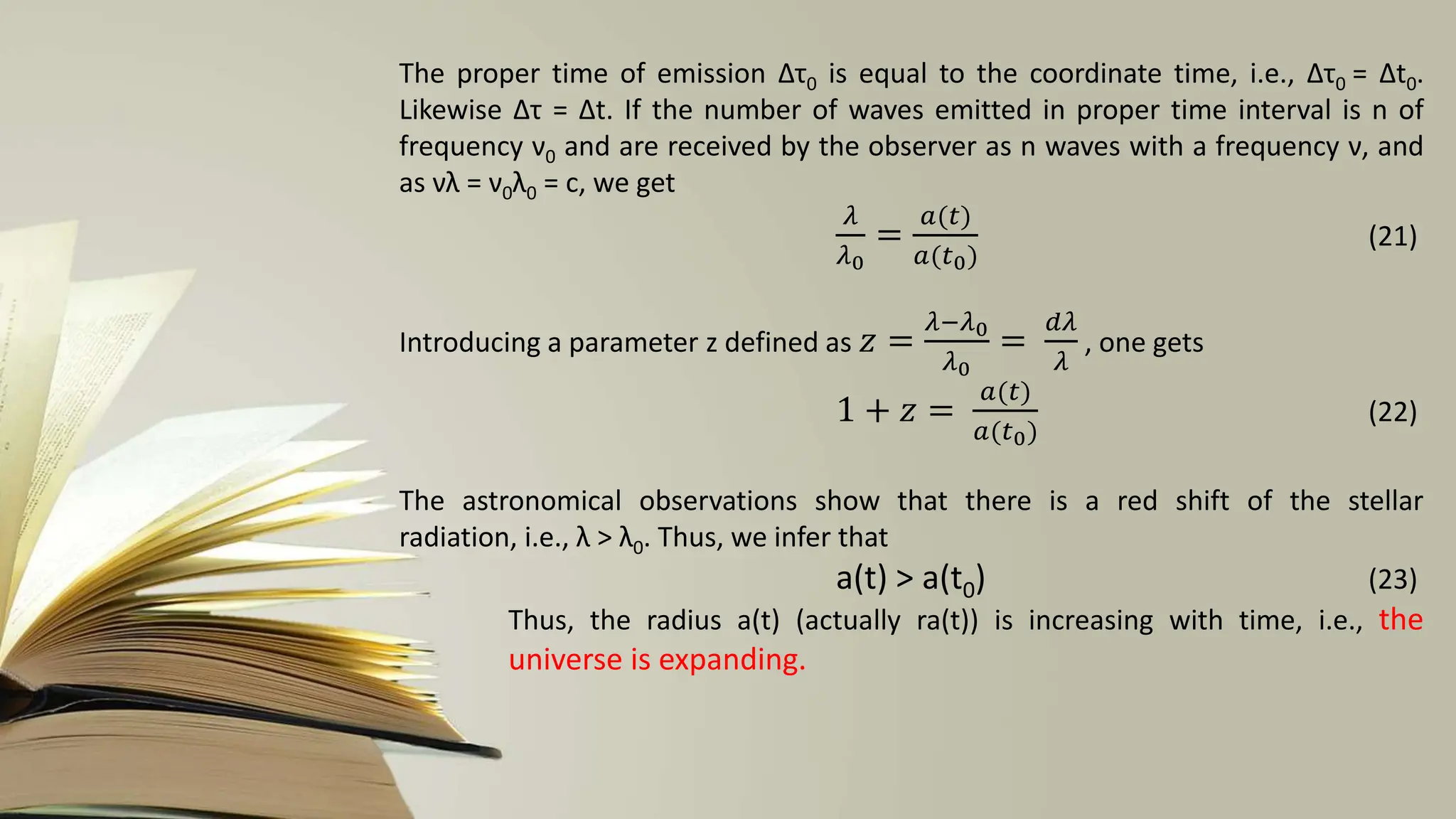
The proper time of emission ∆τ0 is equal to the coordinate time, i.e., ∆τ0 = ∆t0.
Likewise ∆τ = ∆t. If the number of waves emitted in proper time interval is n of
frequency ν0 and are received by the observer as n waves with a frequency ν, and
as νλ = ν0λ0 = c, we get
𝜆
𝜆0
=
𝑎(𝑡)
𝑎(𝑡0)
(21)
Introducing a parameter z defined as 𝑧 =
𝜆−𝜆0
𝜆0
=
𝑑𝜆
𝜆
, one gets
1 + 𝑧 =
𝑎(𝑡)
𝑎(𝑡0)
(22)
The astronomical observations show that there is a red shift of the stellar
radiation, i.e., λ > λ0. Thus, we infer that
a(t) > a(t0) (23)
Thus, the radius a(t) (actually ra(t)) is increasing with time, i.e., the
universe is expanding.
Conclusio
n
The FRW models, provided the matter content is reasonably physical, predict an
initial singularity, commonly known as a Big Bang.
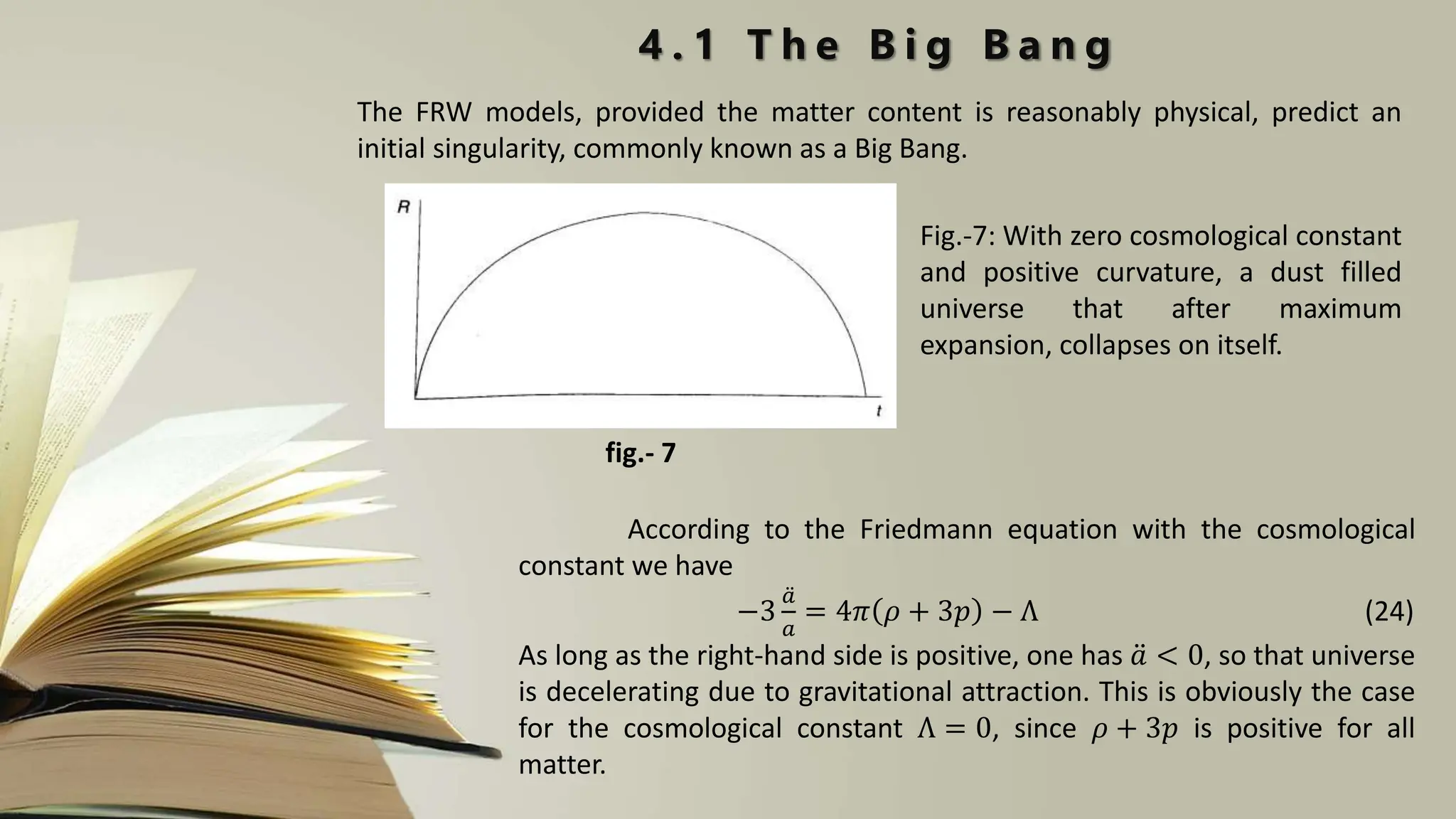
4 . 1 T h e B i g B a n g
Fig.-7: With zero cosmological constant
and positive curvature, a dust filled
universe that after maximum
expansion, collapses on itself.
fig.- 7
According to the Friedmann equation with the cosmological
constant we have
−3
𝑎
𝑎
= 4𝜋 𝜌 + 3𝑝 − Λ (24)
As long as the right-hand side is positive, one has 𝑎 < 0, so that universe
is decelerating due to gravitational attraction. This is obviously the case
for the cosmological constant Λ = 0, since 𝜌 + 3𝑝 is positive for all
matter.
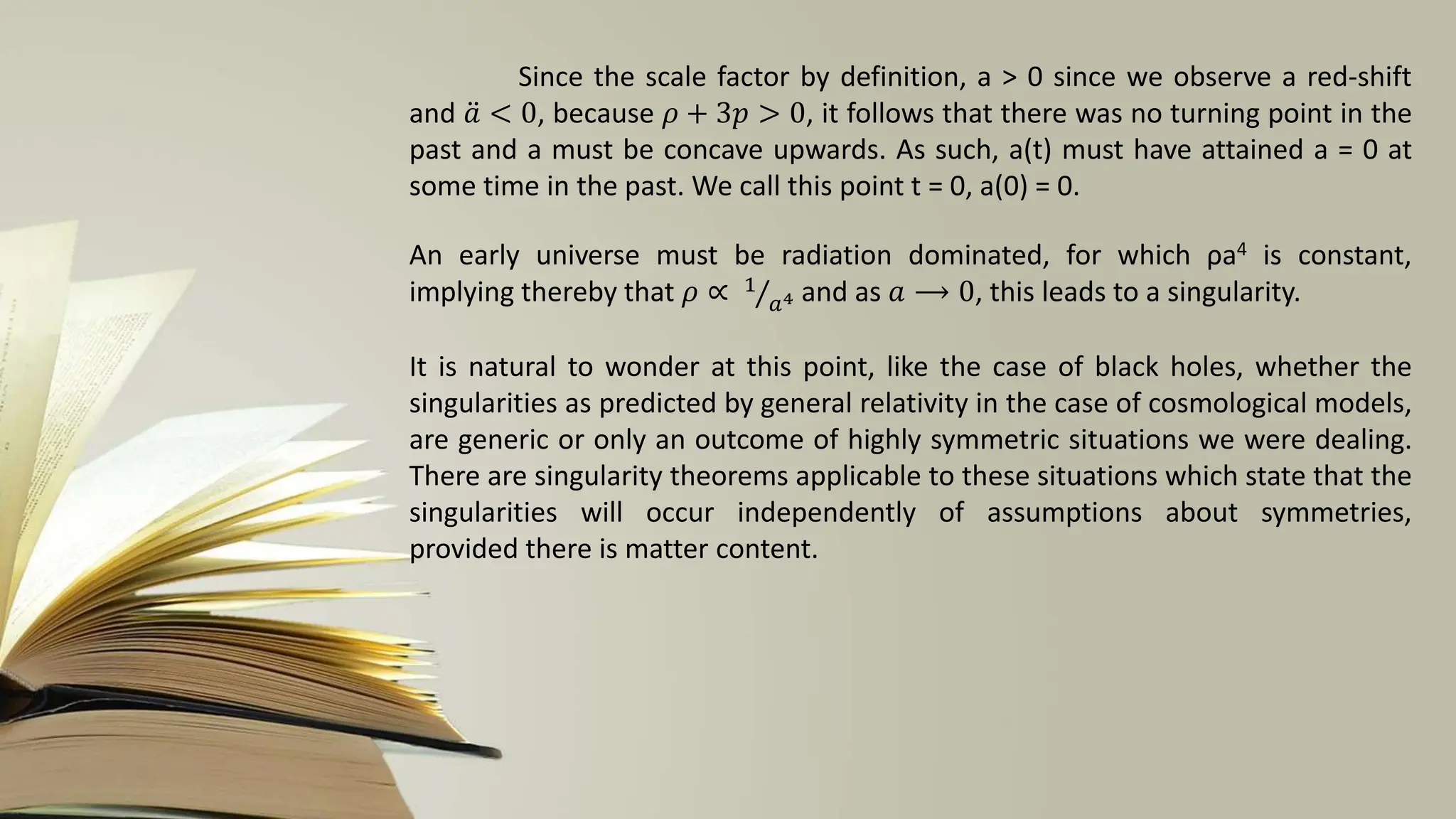
Since the scale factor by definition, a > 0 since we observe a red-shift
and 𝑎 < 0, because 𝜌 + 3𝑝 > 0, it follows that there was no turning point in the
past and a must be concave upwards. As such, a(t) must have attained a = 0 at
some time in the past. We call this point t = 0, a(0) = 0.
An early universe must be radiation dominated, for which ρa4 is constant,
implying thereby that 𝜌 ∝ 1
𝑎4 and as 𝑎 ⟶ 0, this leads to a singularity.
It is natural to wonder at this point, like the case of black holes, whether the
singularities as predicted by general relativity in the case of cosmological models,
are generic or only an outcome of highly symmetric situations we were dealing.
There are singularity theorems applicable to these situations which state that the
singularities will occur independently of assumptions about symmetries,
provided there is matter content.
I take this opportunity to express my profound gratitude and deep regards to
my parents, for their continuous support in my life, without whom it can
never be possible for me to stand here today.
I would also like to express my thanks to Prof. Pradip Mukherjee, H.O.D of PG
dept. of Physics, Barasat Govt. College, for providing me all necessary
facilities and motivating me throughout the course.
Finally I am highly grateful to my project supervisor Dr. Prabir Kr. Pal for his
immense guidance, monitoring, constant encouragement, whole-hearted
cooperation and constructive criticism throughout the course of this project
work.
Presentation.pptx

Presentation.pptx

  • 1.
    “Study of theRobertson - Walker metric and its application to the Cosmological Red Shifts” Gourab Sahoo Roll No: BGC/PHY/015-2013 Registration No: 1061511300018 of 2015-16 Project Supervisor: Dr. Prabir Kr. Pal
  • 2.
  • 3.
    The large scalestructure of the universe is the discovery that the spectral lines of the distant galaxies are shifted towards the red-end of the spectrum. Thus we conclude that the universe as a whole expanding. So we need a non-static, homogeneous and isotropic metric to describe the entire universe. In this respect, we study the Robertson - Walker metric and its application to the cosmological red shifts.
  • 4.
    Howard P. Robertson 1903-1961 Arthur GeoffreyWalker 1909-2001 Alexander Friedmann 1888-1925 THE MEN BEHIND THIS MODEL
  • 5.
    Observations 1 Homogeneous and Isotro pic UniverseModels 2 Conclusion 5 Spaces of Positive, Nega tive and Zero Curvature 3 The Red Shift 4 CONTENTS
  • 6.
  • 7.
    1.1 Observations During thelast 60 years or so one has observed processes in parts of the universe by means of large optical telescopes, radio telescopes and space born observation equipment, in particular the Hubble telescope. These observations have suggested several simple properties of the universe as a whole. 1.1.1 Distance The velocity of light in vacuum is approximately c = 3 x 10⁵ km/s, which corresponds to travelling 7 times around the Earth per second. The light uses 8 minutes from the Sun to the Earth. Our nearest star, Alpha Centauri, is about 4 light years away from us. Our planetary system is positioned in an arm of a spiral galaxy, the Milky Way, about 105 light years from its centre. The galaxies are collected in clusters of galaxies. The mean distance between the galaxy clusters is about 108 light years. The farthest objects observed have a distance about 1010 light years from us.
  • 8.
    1.1.2 Large scalehomogeneity: Observations seem to indicate that over distances larger than about 109 light years the material of the universe is uniformly distributed. On such a scale the universe is usually assumed to be homogeneous. The validity of this assumption has, however, been discussed recently on the basis on new three dimensional surveys of the distribution of matter in the universe. 1.1.3 Isotropy: The distribution of galaxies seems to be equal in all direction on a large scale, i.e. the distribution is isotropic. The isotropy of the universe on a large scale has been confirmed by observations of the cosmic background radiation. Its spectral distribution corresponds to black body radiation with a temperature 2.726 K (fig.- 1). fig.- 1
  • 9.
    1.1.4 Expansion: From 1925 to1930 Edwin Hubble observed the spectral lines in the light from galaxies far away. The result of these investigations is that the spectral lines corresponding to known atomic transitions are displaced towards red, that is, towards longer wavelengths, and that this red shift is proportional to the distances of the galaxies. This is called Hubble’s law. The simplest explanation of this ‘law’ is that it is due to the Doppler Effect, indicating that the galaxies are moving away from us, and faster the farther away they are (fig. - 2). Thus, the universe expands. fig.-2
  • 10.
    1.2 Homogeneous andIsotropic Universe Models The homogeneous and isotropic universe models of Friedmann are the simplest relativistic models. The curvature of space at a certain moment in a Friedmann model, is constant. In order to gradually develop some visual notions about spaces with constant curvature, we shall start by considering a two- dimensional space with constant positive curvature, a spherical surface (fig. 3). fig.- 3 Let us consider a spherical surface with radius R. On this surface the line element can be expressed as 𝑑𝜎2 = 𝑅2 𝑑𝜃2 + 𝑅2 𝑠𝑖𝑛2 𝜃 𝑑𝜑2 …..(1) Here θ represents the latitude with θ = 0 at the North Pole, and φ represents the longitude. Replacing the coordinate θ by a radial coordinate r representing the distance from the axis passing through the poles to a point on the spherical surface, and considering k = 1/𝑅2 we get, 𝑑𝜎2 = 𝑑𝑟2 1−𝑘𝑟2 + 𝑟2𝑑𝜑2 …..(2)
  • 11.
    Similarly for three-dimensionalspace with constant curvature the line element will be 𝑑𝜎2 = 𝑑𝑟2 1−𝑘𝑟2 + 𝑟2𝑑𝜃2 + 𝑟2𝑠𝑖𝑛2𝜃𝑑𝜑2 ….(3) The physical distance between the origin of the coordinates system and a point with coordinates (dr, dθ, dφ) is dl = a(t) db, where the function a(t) is a so-called scale factor, which tells us how the distance to a galaxy changes with time. Choosing a coordinate time that is equal to the time as measured by standard clocks carried by the galaxies, the line element of space time takes the form 𝑑𝑠2 = 𝑎2 𝑡 𝑑𝑟2 1−𝑘𝑟2 + 𝑟2𝑑𝜃2 + 𝑟2 𝑠𝑖𝑛2𝜃 𝑑𝜑2 − 𝑐2𝑑𝑡2 ….(4) This line element describes the geometric and kinematical properties of isotropic and (spatially) homogeneous universe models. It is called the Robertson-Walker line element.
  • 12.
  • 13.
    2.1 Spaces OfPositive, Negative And Zero Curvature From equation (8) we know the spatial part of the Robertson Walker Metric is given by 𝑑𝜎2 = 𝑑𝑟2 1 − 𝑘𝑟2 + 𝑟2𝑑𝜃2 + 𝑟2𝑠𝑖𝑛2𝜃𝑑𝜑2 Let us consider the three cases that arise with the normalized curvature scalar k. 2.1.1 Case 1 : k = 0 It corresponds to the case of zero curvature. The line element for r = χ, becomes 𝑑𝜎2 = 𝑑𝜒2 + 𝜒2 𝑑𝜃2 + 𝜒2 𝑠𝑖𝑛2 𝜃 𝑑𝜑2 ….(5) Which is a flat Euclidian space. Putting θ = π/2, we get 𝑑𝜎2 = 𝑑𝜒2 + 𝜒2 𝑑𝜑2 (6) Which is a flat plane for the embedding diagram, fig (4). fig.- 4
  • 14.
    2.1.2 Case 2: k = +1 The spatial metric can be written as 𝑑𝜎2 = 𝑑𝑟2 1−𝑟2 + 𝑟2 𝑑𝜃2 + 𝑟2 𝑠𝑖𝑛2 𝜃𝑑𝜑2 ….(7) Which in the more general form is 𝑑𝜎2 = 𝑑𝑟2 1−𝑟2(𝜒) + 𝑟2(𝜒)𝑑𝜃2 + 𝑟2(𝜒)𝑠𝑖𝑛2𝜃𝑑𝜑2 ….(8) Putting r(χ) = sin(χ), we get 𝑑𝜎2 = 𝑑𝜒2 + 𝑠𝑖𝑛2 𝜒 𝑑𝜃2 + 𝑠𝑖𝑛2 𝜒 𝑠𝑖𝑛2 𝜃 𝑑𝜑2 ….(9) This space can be understood by examining the surface that results by setting θ equal to some constant value, say θ = π/2. The line element, then is 𝑑𝜎2 = 𝑑𝜒2 + 𝑠𝑖𝑛2𝜒 𝑑𝜑2 ….(10) This surface is a two sphere (fig. 5). Starting at some point and travelling in a straight line on the sphere, we shall end up at the same point eventually. This will also hold in the three-dimensional space of a universe with positive curvature. Secondly, a triangle drawn on the surface of a sphere will have the sum of its angles greater than 1800. fig.- 5
  • 15.
    2.1.3 Case 3: k = -1 It corresponds to negative curvature. The spatial metric becomes 𝑑𝜎2 = 𝑑𝑟2 1+𝑟2 + 𝑟2𝑑𝜃2 + 𝑟2𝑠𝑖𝑛2𝜃𝑑𝜑2 ...(11) Which in the more general form is 𝑑𝜎2 = 𝑑𝑟2 1+𝑟2(𝜒) + 𝑟2 𝜒 𝑑𝜃2 + 𝑟2 𝜒 𝑠𝑖𝑛2 𝜃𝑑𝜑2 ….(12) Putting r(χ) = sinh(χ), the line element become 𝑑𝜎2 = 𝑑𝜒2 + 𝑠𝑖𝑛ℎ2𝜒 𝑑𝜃2 + 𝑠𝑖𝑛ℎ2𝜒 𝑠𝑖𝑛2𝜃 𝑑𝜑2 (13) For the metric in equation (4), 𝑑𝑠2 = 𝑎2 𝑡 𝑑𝜎2 − 𝑐2𝑑𝑡2 , the spatial slices have the property that they have infinite volume. The sum of the angles of the triangles add up to less than 1800. Putting θ = π/2, for obtaining an embedding diagram, we get 𝑑𝜎2 = 𝑑𝜒2 + 𝑠𝑖𝑛2 𝜒 𝑑𝜑2 ….(14) The embedding diagram for a surface with negative curvature is a saddle, fig (6). This is an example of an open universe. This can extend to infinity. fig.- 6
  • 16.
  • 17.
    3 . 1T h e R e d S h i f t It is proposed to show that the Robertson-Walker line element predicts a shift in the wavelength of the radiation emitted by a remote source such as a nebula or a radio galaxy. On account of the isotropy of the model, it follows that any radius vector is a possible trajectory of the light ray, i.e., θ, φ = constant, if we use spherical polar coordinates. The Robertson-Walker line element is given by 𝑑𝑠2 = 𝑎2 𝑡 𝑑𝑟2 1−𝑘𝑟2 + 𝑟2𝑑𝜃2 + 𝑟2 𝑠𝑖𝑛2𝜃 𝑑𝜑2 − 𝑐2𝑑𝑡2 (15) Putting ds = 0, dθ = 0, dφ = 0, we obtain 𝑑𝑟 𝑑𝑡 2 = 1 − 𝑘𝑟2 𝑎2(𝑡) ⇒ 𝑑𝑟 𝑑𝑡 = ± 1−𝑘𝑟2 1 2 𝑎(𝑡) (16) The plus sign holds for light travelling away from the origin and minus when towards the origin.
  • 18.
    We imagine thatan observer is located at the origin O of our coordinate system, the two successive light pulses are emitted by a nebula situated at a point P(r, θ=constant, φ=constant) at times t0 and t0 + ∆t0. These are received by the observer at the origin at times t and t+∆t respectively. As such t > t0 and t +∆t > t0 + ∆t0. According to equation (22), we get 𝑡0 𝑡 𝑑𝑡 𝑎 𝑡 = − 𝑟 0 𝑑𝑟 1−𝑘𝑟2 1 2 (17) And 𝑡0+Δ𝑡0 𝑡+Δ𝑡 𝑑𝑡 𝑎(𝑡) = − 𝑟 0 𝑑𝑟 1−𝑘𝑟2 1 2 (18) Writing equation (16) in expanded manner, we have 𝑡0+Δ𝑡0 𝑡+Δ𝑡 𝑑𝑡 𝑎(𝑡) = − Δ𝑡0 𝑎 𝑡0 + 𝑡0 𝑡 𝑑𝑡 𝑎(𝑡) + Δ𝑡 𝑎(𝑡) (19) Substituting equation (17) in equation (16), we get Δ𝑡 𝑎(𝑡) = Δ𝑡0 𝑎 𝑡0 (20) Thus the interval of emission ∆t0 is not equal to the interval of emission ∆t.
  • 19.
    The proper timeof emission ∆τ0 is equal to the coordinate time, i.e., ∆τ0 = ∆t0. Likewise ∆τ = ∆t. If the number of waves emitted in proper time interval is n of frequency ν0 and are received by the observer as n waves with a frequency ν, and as νλ = ν0λ0 = c, we get 𝜆 𝜆0 = 𝑎(𝑡) 𝑎(𝑡0) (21) Introducing a parameter z defined as 𝑧 = 𝜆−𝜆0 𝜆0 = 𝑑𝜆 𝜆 , one gets 1 + 𝑧 = 𝑎(𝑡) 𝑎(𝑡0) (22) The astronomical observations show that there is a red shift of the stellar radiation, i.e., λ > λ0. Thus, we infer that a(t) > a(t0) (23) Thus, the radius a(t) (actually ra(t)) is increasing with time, i.e., the universe is expanding.
  • 20.
  • 21.
    The FRW models,provided the matter content is reasonably physical, predict an initial singularity, commonly known as a Big Bang. 4 . 1 T h e B i g B a n g Fig.-7: With zero cosmological constant and positive curvature, a dust filled universe that after maximum expansion, collapses on itself. fig.- 7 According to the Friedmann equation with the cosmological constant we have −3 𝑎 𝑎 = 4𝜋 𝜌 + 3𝑝 − Λ (24) As long as the right-hand side is positive, one has 𝑎 < 0, so that universe is decelerating due to gravitational attraction. This is obviously the case for the cosmological constant Λ = 0, since 𝜌 + 3𝑝 is positive for all matter.
  • 22.
    Since the scalefactor by definition, a > 0 since we observe a red-shift and 𝑎 < 0, because 𝜌 + 3𝑝 > 0, it follows that there was no turning point in the past and a must be concave upwards. As such, a(t) must have attained a = 0 at some time in the past. We call this point t = 0, a(0) = 0. An early universe must be radiation dominated, for which ρa4 is constant, implying thereby that 𝜌 ∝ 1 𝑎4 and as 𝑎 ⟶ 0, this leads to a singularity. It is natural to wonder at this point, like the case of black holes, whether the singularities as predicted by general relativity in the case of cosmological models, are generic or only an outcome of highly symmetric situations we were dealing. There are singularity theorems applicable to these situations which state that the singularities will occur independently of assumptions about symmetries, provided there is matter content.
  • 23.
    I take thisopportunity to express my profound gratitude and deep regards to my parents, for their continuous support in my life, without whom it can never be possible for me to stand here today. I would also like to express my thanks to Prof. Pradip Mukherjee, H.O.D of PG dept. of Physics, Barasat Govt. College, for providing me all necessary facilities and motivating me throughout the course. Finally I am highly grateful to my project supervisor Dr. Prabir Kr. Pal for his immense guidance, monitoring, constant encouragement, whole-hearted cooperation and constructive criticism throughout the course of this project work.

Editor's Notes

  • #8 There are about 1011 stars in our galaxy, and there are presumably a similar number of galaxies in the universe. Our nearest galaxy is the Andromeda galaxy. It is about 2.5x10⁶ light years from the Milky Way to the Andromeda galaxy.
  • #10 According to Newtonian kinematics such an expansion of at least a universe of finite extension implies the existence of a centre from which everything expands. This is not so according to the conceptions of the general theory of relativity. As we have seen, space is curved according to this theory. The two-dimensional analogue of a finite isotropic universe is an expanding spherical surface. The galaxies may be imagined as dots painted on the surface. The distances between the dots increase due to the expansion. But the dots do not move on the surface. Neither is there any centre on the surface. Similarly there is no centre in the homogeneous relativistic universe models.