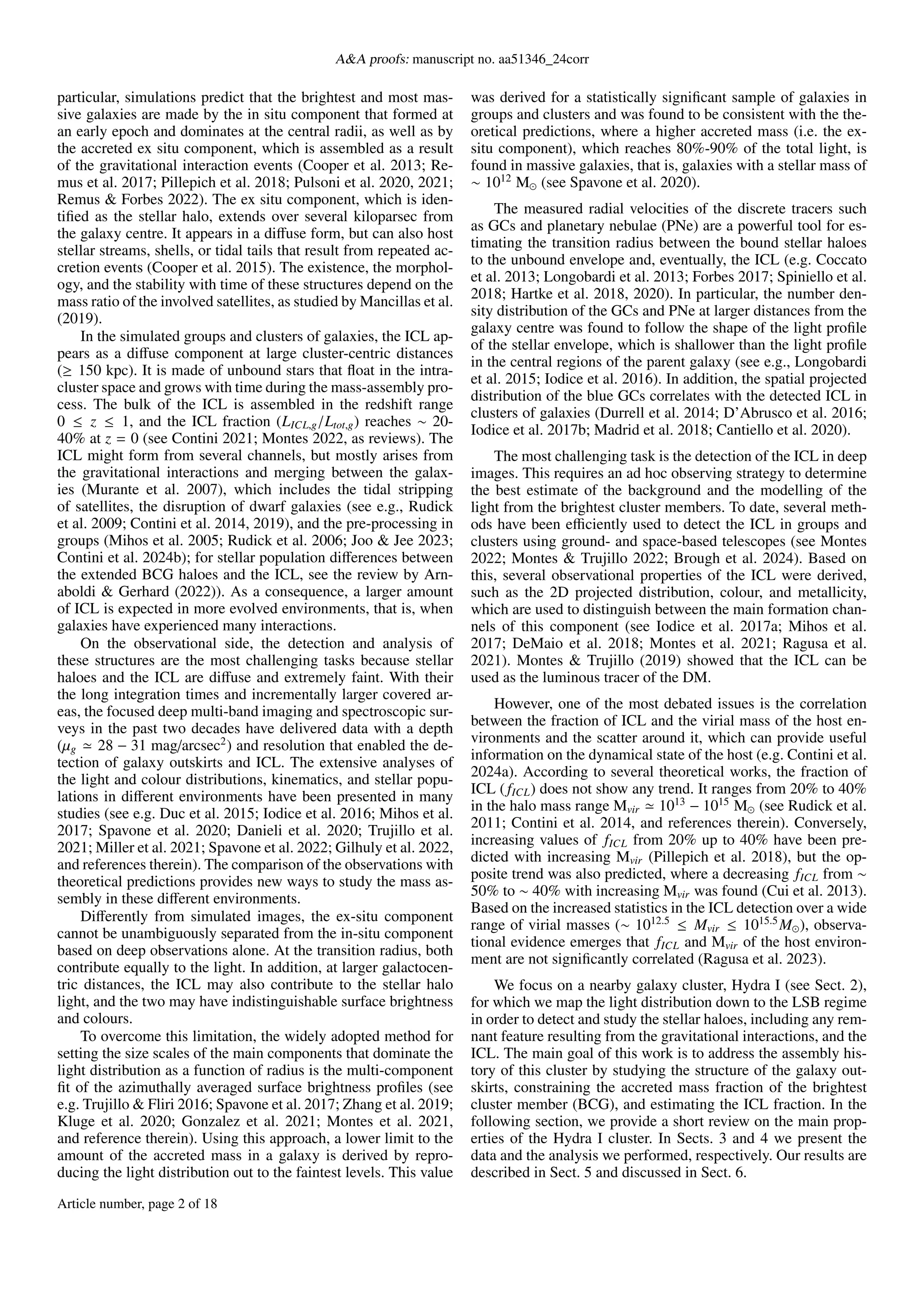
Astronomy & Astrophysics manuscript no. aa51346_24corr ©ESO 2024
August 6, 2024
Galaxy populations in the Hydra I cluster from the VEGAS survey
III. The realm of low surface brightness features and intra-cluster light
Marilena Spavone1,⋆, Enrichetta Iodice1, Felipe S. Lohmann2, Magda Arnaboldi2, Michael Hilker2, Antonio La
Marca1, 3, 9, Rosa Calvi1, Michele Cantiello4, Enrico M. Corsini5, Giuseppe D’Ago6, Duncan A. Forbes7, Marco
Mirabile4, 8, and Marina Rejkuba2
1
INAF − Astronomical Observatory of Capodimonte, Salita Moiariello 16, I-80131, Naples, Italy
2
European Southern Observatory, Karl−Schwarzschild-Strasse 2, 85748 Garching bei München, Germany
3
Kapteyn Institute, University of Groningen, Landleven 12, 9747 AD Groningen, the Netherlands
4
INAF − Astronomical Observatory of Abruzzo, Via Maggini, 64100, Teramo, Italy
5
Dipartimento di Fisica e Astronomia “G. Galilei”, Università di Padova, vicolo dell’Osservatorio 3, I-35122 Padova, Italy
6
Institute of Astronomy, University of Cambridge, Madingley Road, Cambridge CB3 0HA, UK
7
Centre for Astrophysics and Supercomputing, Swinburne University of Technology, Hawthorn VIC 3122, Australia
8
Gran Sasso Science Institute, viale Francesco Crispi 7, I-67100 L’Aquila, Italy
9
SRON Netherlands Institute for Space Research, Landleven 12, 9747 AD Groningen, The Netherlands
Received 02/07/2024; accepted 26/07/2024
ABSTRACT
In this paper, we analyse the light distribution in the Hydra I cluster of galaxies to explore their low surface brightness features,
measure the intra-cluster light, and address the assembly history of the cluster. For this purpose, we used deep wide-field g- and
r-band images obtained with the VLT Survey Telescope (VST) as part of the VEGAS project. The VST mosaic covers ∼ 0.4 times
the virial radius (Rvir) around the core of the cluster, which enabled us to map the light distribution down to faint surface brightness
levels of µg ∼ 28 mag/arcsec2
. In this region of the cluster, 44 cluster members are brighter than mB ≤ 16 mag, and the region includes
more than 300 dwarf galaxies. Similar to the projected distribution of all cluster members (bright galaxies and dwarfs), we find that
the bulk of the galaxy light is concentrated in the cluster core, which also emits in the X-rays, and there are two overdensities: in
the north (N) and south-east (SE) with respect to the cluster core. We present the analysis of the light distribution of all the bright
cluster members. After removing foreground stars and other objects, we measured the diffuse intra-cluster light and compared its
distribution with that of the globular clusters and dwarf galaxies in the cluster. We find that most of the diffuse light low surface
brightness features, and signs of possible gravitational interaction between galaxies reside in the core and in the group in the N, while
ram-pressure stripping is frequently found to affect galaxies within the SE group. All these features confirm that the mass assembly in
this cluster is still ongoing. By combining the projected phase-space with these observed properties, we trace the different stages of
the assembly history. We also address the main formation channels for the intra-cluster light detected in the cluster, which has a total
luminosity of LICL ∼ 2.2 × 10¹¹
L⊙ and contributes ∼ 12% to the total luminosity of the cluster.
Key words. Galaxies: clusters: individual: Hydra I – Galaxies: photometry – Galaxies: evolution – Galaxies: clusters: intracluster
medium
1. Introduction
According to the Lambda-cold dark matter (ΛCDM) scenario,
clusters of galaxies are expected to grow over time by accret-
ing smaller groups along filaments, driven by the effect of grav-
ity that is generated by the total matter content (e.g. White &
Rees 1978; Bullock et al. 2001). In the deep potential well at
the cluster centre, the galaxies continue to undergo active mass
assembly. In this process, gravitational interactions and merg-
ing between systems of comparable mass and/or smaller objects
play a fundamental role in defining their morphology and kine-
matics (Toomre & Toomre 1972). In particular, as a result of
these events, a significant amount of debris is deposited at larger
radii from the galaxy centre and is retained by the DM halo
(e.g. Bullock & Johnston 2005). This debris can be traced by
loosely bound stars and globular clusters (GCs), stellar streams,
and tidal tails, which contribute to the build-up of the stellar
⋆
e-mail: marilena.spavone@inaf.it
haloes and the intra-cluster light (ICL). All these structures are
fainter by more than 4 magnitudes than the central regions of
galaxies (µg ≥ 26 mag/arcsec2
), they have multiple stellar popu-
lations and complex kinematics, and they are still growing at the
present epoch. At larger distances from the galaxy centre, the dy-
namical timescales are longer, and all these structures can there-
fore survive for several billion years. As it encodes the physical
processes, the ICL is considered a highly valuable diagnostic of
the mass assembly in all environments (Montes & Trujillo 2019;
Contini & Gu 2021; Pillepich et al. 2018; Jiménez-Teja et al.
2019; Kluge et al. 2020).
From the theoretical side, semi-analytic models and hydro-
dynamic simulations give detailed predictions about the struc-
ture and stellar populations of stellar haloes, the ICL formation,
and the amount of substructure in various types of environment
(see Cooper et al. 2015; Cook et al. 2016; Pillepich et al. 2018;
Monachesi et al. 2019; Merritt et al. 2020; Contini & Gu 2021;
Contini et al. 2023; Tang et al. 2023, and references therein). In
Article number, page 1 of 18
arXiv:2408.01501v1
[astro-ph.GA]
2
Aug
2024
A&A proofs: manuscript no. aa51346_24corr
particular, simulations predict that the brightest and most mas-
sive galaxies are made by the in situ component that formed at
an early epoch and dominates at the central radii, as well as by
the accreted ex situ component, which is assembled as a result
of the gravitational interaction events (Cooper et al. 2013; Re-
mus et al. 2017; Pillepich et al. 2018; Pulsoni et al. 2020, 2021;
Remus & Forbes 2022). The ex situ component, which is iden-
tified as the stellar halo, extends over several kiloparsec from
the galaxy centre. It appears in a diffuse form, but can also host
stellar streams, shells, or tidal tails that result from repeated ac-
cretion events (Cooper et al. 2015). The existence, the morphol-
ogy, and the stability with time of these structures depend on the
mass ratio of the involved satellites, as studied by Mancillas et al.
(2019).
In the simulated groups and clusters of galaxies, the ICL ap-
pears as a diffuse component at large cluster-centric distances
(≥ 150 kpc). It is made of unbound stars that float in the intra-
cluster space and grows with time during the mass-assembly pro-
cess. The bulk of the ICL is assembled in the redshift range
0 ≤ z ≤ 1, and the ICL fraction (LICL,g/Ltot,g) reaches ∼ 20-
40% at z = 0 (see Contini 2021; Montes 2022, as reviews). The
ICL might form from several channels, but mostly arises from
the gravitational interactions and merging between the galax-
ies (Murante et al. 2007), which includes the tidal stripping
of satellites, the disruption of dwarf galaxies (see e.g., Rudick
et al. 2009; Contini et al. 2014, 2019), and the pre-processing in
groups (Mihos et al. 2005; Rudick et al. 2006; Joo & Jee 2023;
Contini et al. 2024b); for stellar population differences between
the extended BCG haloes and the ICL, see the review by Arn-
aboldi & Gerhard (2022)). As a consequence, a larger amount
of ICL is expected in more evolved environments, that is, when
galaxies have experienced many interactions.
On the observational side, the detection and analysis of
these structures are the most challenging tasks because stellar
haloes and the ICL are diffuse and extremely faint. With their
the long integration times and incrementally larger covered ar-
eas, the focused deep multi-band imaging and spectroscopic sur-
veys in the past two decades have delivered data with a depth
(µg ≃ 28 − 31 mag/arcsec2
) and resolution that enabled the de-
tection of galaxy outskirts and ICL. The extensive analyses of
the light and colour distributions, kinematics, and stellar popu-
lations in different environments have been presented in many
studies (see e.g. Duc et al. 2015; Iodice et al. 2016; Mihos et al.
2017; Spavone et al. 2020; Danieli et al. 2020; Trujillo et al.
2021; Miller et al. 2021; Spavone et al. 2022; Gilhuly et al. 2022,
and references therein). The comparison of the observations with
theoretical predictions provides new ways to study the mass as-
sembly in these different environments.
Differently from simulated images, the ex-situ component
cannot be unambiguously separated from the in-situ component
based on deep observations alone. At the transition radius, both
contribute equally to the light. In addition, at larger galactocen-
tric distances, the ICL may also contribute to the stellar halo
light, and the two may have indistinguishable surface brightness
and colours.
To overcome this limitation, the widely adopted method for
setting the size scales of the main components that dominate the
light distribution as a function of radius is the multi-component
fit of the azimuthally averaged surface brightness profiles (see
e.g. Trujillo & Fliri 2016; Spavone et al. 2017; Zhang et al. 2019;
Kluge et al. 2020; Gonzalez et al. 2021; Montes et al. 2021,
and reference therein). Using this approach, a lower limit to the
amount of the accreted mass in a galaxy is derived by repro-
ducing the light distribution out to the faintest levels. This value
was derived for a statistically significant sample of galaxies in
groups and clusters and was found to be consistent with the the-
oretical predictions, where a higher accreted mass (i.e. the ex-
situ component), which reaches 80%-90% of the total light, is
found in massive galaxies, that is, galaxies with a stellar mass of
∼ 1012
M⊙ (see Spavone et al. 2020).
The measured radial velocities of the discrete tracers such
as GCs and planetary nebulae (PNe) are a powerful tool for es-
timating the transition radius between the bound stellar haloes
to the unbound envelope and, eventually, the ICL (e.g. Coccato
et al. 2013; Longobardi et al. 2013; Forbes 2017; Spiniello et al.
2018; Hartke et al. 2018, 2020). In particular, the number den-
sity distribution of the GCs and PNe at larger distances from the
galaxy centre was found to follow the shape of the light profile
of the stellar envelope, which is shallower than the light profile
in the central regions of the parent galaxy (see e.g., Longobardi
et al. 2015; Iodice et al. 2016). In addition, the spatial projected
distribution of the blue GCs correlates with the detected ICL in
clusters of galaxies (Durrell et al. 2014; D’Abrusco et al. 2016;
Iodice et al. 2017b; Madrid et al. 2018; Cantiello et al. 2020).
The most challenging task is the detection of the ICL in deep
images. This requires an ad hoc observing strategy to determine
the best estimate of the background and the modelling of the
light from the brightest cluster members. To date, several meth-
ods have been efficiently used to detect the ICL in groups and
clusters using ground- and space-based telescopes (see Montes
2022; Montes & Trujillo 2022; Brough et al. 2024). Based on
this, several observational properties of the ICL were derived,
such as the 2D projected distribution, colour, and metallicity,
which are used to distinguish between the main formation chan-
nels of this component (see Iodice et al. 2017a; Mihos et al.
2017; DeMaio et al. 2018; Montes et al. 2021; Ragusa et al.
2021). Montes & Trujillo (2019) showed that the ICL can be
used as the luminous tracer of the DM.
However, one of the most debated issues is the correlation
between the fraction of ICL and the virial mass of the host en-
vironments and the scatter around it, which can provide useful
information on the dynamical state of the host (e.g. Contini et al.
2024a). According to several theoretical works, the fraction of
ICL ( fICL) does not show any trend. It ranges from 20% to 40%
in the halo mass range Mvir ≃ 1013
− 1015
M⊙ (see Rudick et al.
2011; Contini et al. 2014, and references therein). Conversely,
increasing values of fICL from 20% up to 40% have been pre-
dicted with increasing Mvir (Pillepich et al. 2018), but the op-
posite trend was also predicted, where a decreasing fICL from ∼
50% to ∼ 40% with increasing Mvir was found (Cui et al. 2013).
Based on the increased statistics in the ICL detection over a wide
range of virial masses (∼ 1012.5
≤ Mvir ≤ 1015.5
M⊙), observa-
tional evidence emerges that fICL and Mvir of the host environ-
ment are not significantly correlated (Ragusa et al. 2023).
We focus on a nearby galaxy cluster, Hydra I (see Sect. 2),
for which we map the light distribution down to the LSB regime
in order to detect and study the stellar haloes, including any rem-
nant feature resulting from the gravitational interactions, and the
ICL. The main goal of this work is to address the assembly his-
tory of this cluster by studying the structure of the galaxy out-
skirts, constraining the accreted mass fraction of the brightest
cluster member (BCG), and estimating the ICL fraction. In the
following section, we provide a short review on the main prop-
erties of the Hydra I cluster. In Sects. 3 and 4 we present the
data and the analysis we performed, respectively. Our results are
described in Sect. 5 and discussed in Sect. 6.
Article number, page 2 of 18
Marilena Spavone et al.: Galaxy populations in the Hydra I cluster from the VEGAS survey
2. Hydra I cluster of galaxies
Hydra I is a rich and massive (Mdyn ∼ 1014
M⊙, Girardi et al.
1998) cluster of galaxies located at 51 ± 4 Mpc (Christlein &
Zabludoff 2003). According to Richter et al. (1982) and Richter
(1987), Hydra I is quite isolated in redshift space for a range of
40−50 Mpc in front and behind the cluster along the line of sight.
The X-ray emission detected out to ∼ 200 kpc from the cluster
core is centred on the brightest cluster galaxy (BCG) NGC 3311,
but is slightly displaced north-west (NW, Hayakawa et al. 2004,
2006).
The region of the cluster core was widely studied in the past
ten years. It is dominated by the light of the BCG, NGC 3311,
and the other early-type bright member NGC 3309, which lies
close in projection to NGC 3311 on the NW side. Previous stud-
ies of the light distribution of these two galaxies suggested that
they are both embedded in a diffuse and extended stellar en-
velope that is off-centred in the NE direction (Arnaboldi et al.
2012). By combining the light distribution and stellar kinemat-
ics of the Hydra I cluster core, several works revealed i) stellar
debris in the stellar envelope, which might result from the dis-
ruption of infalling dwarf galaxies, ii) multiple components in
the line-of-sight velocity dispersion of the PNe, suggesting the
existence of several different dynamical structures, and of iii)
higher velocity dispersion than the central galaxy regions, indi-
cating that stars are gravitationally driven by the cluster poten-
tial (Arnaboldi et al. 2012; Ventimiglia et al. 2011; Richtler et al.
2011; Hilker et al. 2018; Barbosa et al. 2021). All these features
are signs of an active mass assembly around NGC 3311. In par-
ticular, the velocity displacement measured between NGC 3311
and the barycentre suggests that the central part of NGC 3311
sloshes with respect to its outskirt. This is a clear sign of sub-
cluster merging (Barbosa et al. 2018).
Using the Widefield ASKAP L-band Legacy All-sky Blind
surveY (WALLABY) pilot survey with the Australian Square
Kilometre Array Pathfinder (ASKAP), which covers the Hydra
I cluster out to ∼ 4 Mpc (∼ 2.5 Rvir), Wang et al. (2021) found
that nearly two-thirds of the galaxies within 1.25 Rvir show signs
of ram pressure stripping (RPS) in the early stages. Two of these
galaxies, NGC 3312 and NGC 3314A, are located SE of the core,
in a foreground group of galaxies, and the RPS was also studied
in detail using MeerKat data by Hess et al. (2022).
The Hydra I cluster hosts a large population of dwarf galax-
ies. There are 317 candidates in the magnitude range −18.5 <
Mr < −11.5 mag. The first sample of dwarf galaxies was pro-
vided by Misgeld et al. (2008) and was detected in a small area
around the cluster core. Using a larger and deep-imaging mosaic,
La Marca et al. (2022b) found more than 200 new candidates,
32 of which are LSB galaxies, including ultra-diffuse galaxies
(UDGs; Iodice et al. 2020b; La Marca et al. 2022a). Integral-
field spectroscopic data for all the LSB galaxies have recently
been obtained with MUSE at the ESO-VLT (Iodice et al. 2023).
According to the 2D projected distribution of all cluster
members, that is, bright and dwarf galaxies, three main overden-
sities were identified inside 0.4 Rvir in the Hydra I cluster. These
are the core, a wider group toward the N, and a structure SE of
the cluster core, while the western side of the cluster shows a
lower density than the eastern side (La Marca et al. 2022b). The
study by La Marca et al. (2022b) also revealed that the fraction
of dwarf galaxies decreases toward the cluster centre. This is
consistent with the tidal disruption process of the dwarfs in the
strong potential well of the cluster core (see Popesso et al. 2006,
and references therein). The presence of several sub-groups of
galaxies in the Hydra I cluster further supports the scenario that
this environment is still in an active assembly phase, where these
structures merge into the cluster potential.
3. Observations: Deep optical mosaics for the
Hydra I cluster
The deep g− and r−band images of the Hydra I cluster presented
in this work were acquired with the VLT Survey Telescope (VST,
Schipani et al. 2012) as part of the VST Early-Type Galaxy Sur-
vey (VEGAS, Iodice et al. 2021b). VST is now a hosted tele-
scope of the Italian National Institute for Astrophysics1
, located
at La Silla-Paranal European Southern Observatory (ESO) in
Chile. The VST is equipped with the wide-field imager Omega-
CAM (Kuijken 2011), which covers a field of view of 1 × 1 deg2
and has a resolution of 0.21 arcsec/pixel.
Observations and data reduction have been described in
Iodice et al. (2020a, 2021a) and La Marca et al. (2022b,a). We
report the main information for this data set here. The total inte-
gration times are 2.8 hours in the g band and 3.22 hours in the
r band, respectively. Images were acquired in dark time using
the step-dither observing strategy, which guarantees an accurate
estimate of the sky background (see also Iodice et al. 2016; Ven-
hola et al. 2018). The sky field was acquired west (W) of the
cluster. This field overlaps by ∼ 0.3 deg with the 1 deg field cen-
tred on the core of the cluster. During the data acquisition, the
bright (magnitude 7) foreground star NE of the cluster core was
always placed in one of the two wide OmegaCAM gaps in order
to reduce the scattered light.
Pre-reduction, calibration, sky-subtraction, and stacking
were provided by using the VST-Tube, which is one of the ded-
icated pipelines for processing OmegaCAM images (Capacci-
oli et al. 2015). The final sky-subtracted reduced mosaic for the
Hydra I cluster extends over 1 deg × 2 deg, corresponding to
∼ 0.9 × 1.8 Mpc, assuming a distance of 51 Mpc (Christlein &
Zabludoff 2003). Therefore, the VST mosaic covers ∼ 0.4 virial
radius around the core of the cluster. The final stacked images
reach surface brightness depths of µg = 28.6 ± 0.2 mag/arcsec2
and µr = 28.1 ± 0.2 mag/arcsec2
in the g and r bands, re-
spectively. The median FWHM of the point spread function is
0.85 arcsec in the g band and 0.81 arcsec in the r band.
We focus on an area of 56.7 × 46.6 arcmin2
around the clus-
ter core (Fig. 1), which corresponds to ∼ 0.4Rvir. Based on the
Christlein & Zabludoff (2003) catalogue, this area includes 44
brightest (mR ≤ 15 mag) cluster members. They are listed in
Table 1 and marked in Fig. 1.
4. Data analysis: Surface photometry
The main goal of this work is to study the outskirts of the bright-
est cluster members down to the LSB regime and to constrain the
ICL fraction in this region of the cluster. To do this, we studied
the light distribution in the g and r bands for all galaxies in our
sample (see Table 1). We adopted the same methods and tools
as previously developed within the VEGAS project for studies
of the LSB regime and detection of ICL (see Iodice et al. 2016,
2017b; Spavone et al. 2018; Cattapan et al. 2019; Raj et al. 2019;
Iodice et al. 2019, and references therein). A detailed description
was provided by Ragusa et al. (2021). In short, the main steps of
the surface photometry for the Hydra I sky-subtracted mosaic are
the following:
1
See https://vst.inaf.it/home
Article number, page 3 of 18
A&A proofs: manuscript no. aa51346_24corr
1. remove the contamination of the light from the foreground
brightest stars in the field and background galaxies by mod-
elling and subtracting it from the parent image;
2. estimate the limiting radius of the photometry (Rlim) and the
residual background fluctuations;
3. fit the isophote out to Rlim for all the brightest galaxy mem-
bers to obtain the azimuthally averaged surface brightness
profiles and shape parameters;
4. build the 2D model based on the isophote fit for each galaxy
in our sample to be subtracted from the parent image in order
to estimate the diffuse light in the residual image.
The tools and methods adopted in each step are briefly de-
scribed below.
4.1. Contamination of the scattered light from stars
Close to the core of the Hydra I cluster lie two bright
stars: HD92036 (R.A.=10:37:13.72 DEC=-27:24:45.49, mB =
6.51 mag), located NE of NGC 3311, and HD91964
(R.A.=10:36:42.57 DEC=-27:39:22.86, mB = 8.17 mag), lo-
cated south (S) of the core. During the observations, the centre
of the brightest star HD92036 was always placed in one of the
two wide OmegaCAM gaps in order to reduce its scattered light.
For both objects, we fitted the light distribution out the edge of
the field (∼ 0.5 deg; Fig. 1), assuming circular isophotes. The
centre, position angle (P.A.), and ellipticity were fixed during
the run. As a preliminary step, we identified all the background
and foreground objects (stars and galaxies) that are brighter than
the 2σ background level (see also La Marca et al. 2022a), which
were then masked and excluded from the isophote fit. In partic-
ular, the core of the group was masked with a circular aperture
out to ∼ 7.7 arcmin (∼ 13 Ref f ) from the BCG NGC 3311 (Arn-
aboldi et al. 2012). Based on the isophote fit, the 2D models of
the two stars were built up and then subtracted from the g and r
parent images. The resulting image is shown in Fig. 1.
4.2. Estimate of the residual background fluctuations
We overplotted on the star-subtracted residual image in each
band the light distribution from the core of the cluster (iden-
tified as the centre of NGC 3311) out to the edge of the field
(∼ 0.5 deg) in order to estimate the average value of the residual
background level and the limiting radius Rlim for the photome-
try in this field. The residual background in the sky-subtracted
images is the deviation from the background with respect to
the average sky frame obtained from the empty fields observed
close to the target. Therefore, since the reduced mosaics are sky-
subtracted, the residual background level is close to zero in both
bands. As explained in Ragusa et al. (2021), light is fitted in cir-
cular annuli (i.e. the ellipticity and PA are fixed to zero), with a
constant step, where all the foreground and background sources,
including the second BCG of Hydra I, NGC 3309, which is close
to NGC 3311, were masked accurately. Rlim corresponds to the
outermost semi-major axis derived in the isophote fitting, where
the light from NGC 3311 blends into the average residual back-
ground level. The residual background fluctuations are almost
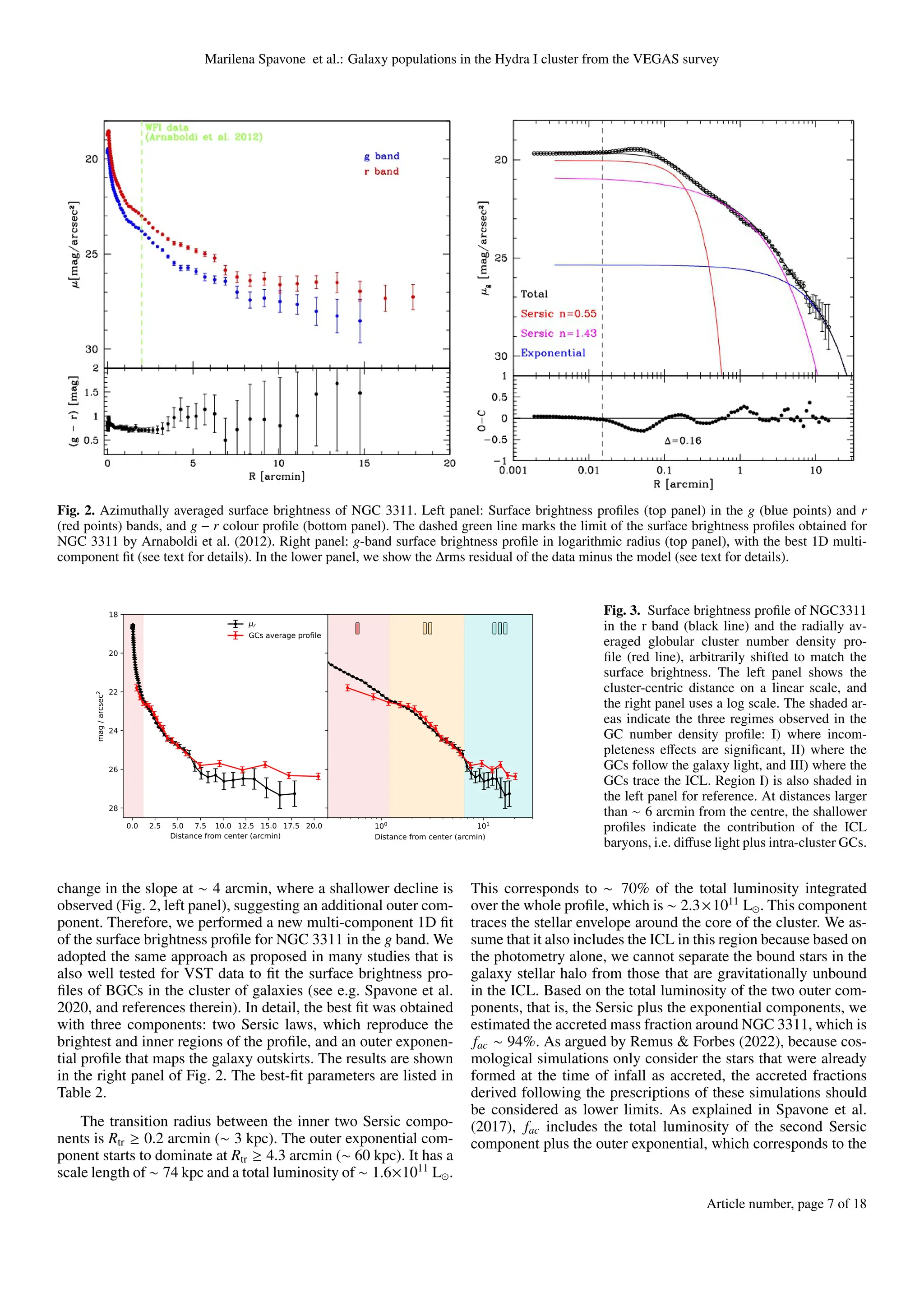
constant for R ≥ Rlim . We found that for NGC 3311, Rlim ∼ 15
arcmin in the g and r bands. For R ≥ Rlim, the residual back-
ground levels are Ig = −0.056 ± 0.11 ADU and Ir = −0.6 ± 0.2
ADU in the g and r band, respectively. The residual background
value and Rlim were derived for all galaxies in our sample in the
g and r bands.
4.3. Isophote fitting
For all galaxies in our sample, we fitted the isophotes with all pa-
rameters left free (i.e. centre, ellipticity, and P.A.). The light dis-
tribution was mapped over elliptical annuli by applying a median
sampling and k-sigma clipping algorithm. This iterative process
was performed as follows. Firstly, we made the isophote fit for
NGC 3311 and built a 2D model of the light distribution. This
was subtracted from the parent image. The isophote fit of the
other bright cluster member in the core, NGC 3309, was per-
formed on the residual image obtained before, and the 2D model
for this galaxy was derived and subtracted. In turn, all the galax-
ies in our sample were studied with the same approach, that is,
the isophote fit was performed on the residual image obtained
by subtracting the 2D model of the other galaxies studied in the
sample.
The main outcome of the isophote fit is the azimuthally av-
eraged surface brightness profile, which was corrected for the
residual value of the background estimated for R ≥ Rlim. The to-
tal uncertainty on the surface brightness profile (errµ)2
took the
uncertainties on the photometric calibration (errzp ∼ 0.3%) and
the RMS in the background fluctuations into account (errsky ∼
10% and errsky ∼ 20% in the g and r bands, respectively). In
addition, we derived the g − r colour profiles, the total inte-
grated magnitudes, and the g − r integrated colours. The sur-
face brightness and colour profiles for NGC 3311 are shown in
Fig. 2. Those obtained for all the other galaxies in our sample
are shown in Appendix A. The total integrated magnitudes and
the g − r integrated colours are listed in Table 1.
4.4. Globular cluster number density
For the Hydra I cluster, we collected a sample of ∼ 5300 GC
candidates obtained from deep U-, V- and I-band photometry ob-
served with VLT/FORS (Mieske et al. 2005; Hilker et al. 2015)
extending out to ∼ 20 arcmin N and E of NGC 3311.
The GCs were selected based on the morphology (point
sources) and their location in the V - (V-I) colour-magnitude di-
agram, guided by radial-velocity-confirmed member GCs (Mis-
geld et al. 2011). The details of the data reduction and sample
selection will be described in a future paper (Lohmann et al. in
prep.). We used the spatial distribution of GCs to obtain their av-
erage radial number density profile. The profile was constructed
considering radial annuli centred on NGC 3311 such that each
bin contained a fixed number of GCs. We masked out the GCs
associated to NGC 3309 using a circular mask around the galaxy,
as well as those forming an overdensity to the east (E), which are
associated with the lenticular galaxy NGC 3316. The mask ra-
dius was arbitrarily chosen to be 0.9 arcmin, which corresponds
to ∼2.3 Re for NGC 3309 and ∼3.5 Re for NGC 3316. By adopt-
ing 20 bins for our profile, we obtained ∼ 250 GCs in each
bin, and the uncertainty on the number density was taken to be
Poissonian. After correcting for background contaminants, the
surface density of the globular clusters in units of arcsec−2
was
then shifted arbitrarily to match the surface brightness profile of
NGC 3311. The results are shown in Fig. 3.
The same sample selection steps included the analysis of
a background region located ∼1.5 deg E of Hydra I to select
2
As detailed in Seigar et al. (2007); Capaccioli et al. (2015);
Iodice et al. (2016), the total uncertainty is derived as errµ =
q
(2.5/(adu × ln(10)))2 × ((erradu + errsky)2) + err2
zp, where N is the
number of pixels used in the isophote fit, adu is the analog digital unit
and erradu =
√
adu/N − 1.
Article number, page 4 of 18
Marilena Spavone et al.: Galaxy populations in the Hydra I cluster from the VEGAS survey
Table 1. Photometric properties and redshift of the brightest cluster members inside 0.4Rvir of the Hydra I cluster.
Object R.A. Dec. V Rproj/Rvir mg (g-r) Morph. Names
[J2000] [J2000] [km/s] [mag] [mag]
(1) (2) (3) (4) (5) (6) (7) (8) (9)
NGC 3311 10 36 42.70 -27 31 42.00 3857 0 10.3±0.11 0.6±0.3 cD2 HCC001
NGC 3316 10 37 37.26 -27 35 38.50 3922 0.012 12.81±0.04 0.87±0.09 SB(rs)0 HCC004
NGC 3309 10 36 35.69 -27 31 5.30 4071 0.016 12.08±0.05 0.83±0.11 E3 HCC002
SGC 1034.3-2718 10 36 41.15 -27 33 39.10 4735 0.018 14.52±0.01 0.80±0.04 S0 HCC007
PGC 031407 10 36 04.20 -27 30 31.30 2294 0.032 14.59±0.01 0.79±0.02 cD pec
PGC 031483 10 36 44.89 -27 28 9.80 2735 0.033 14.30±0.01 0.78±0.02 E1 HCC006
LEDA 087333 10 36 35.45 -27 28 11.90 3222 0.036 15.49±0.01 0.78±0.02 E HCC013
PGC 031450 10 36 29.04 -27 29 2.40 4774 0.037 14.54±0.04 0.84±0.09 SB HCC009
NGC 3312 10 37 02.53 -27 33 53.60 2761 0.045 11.92±0.01 0.65±0.03 SA(s)b pec
PGC 031444 10 36 24.86 -27 34 53.90 2788 0.047 14.76±0.01 0.74±0.03 E2 HCC011
NGC 3307 10 36 17.12 -27 31 46.50 3773 0.053 14.47±0.02 0.86±0.04 SB
NGC 3308 10 36 22.31 -27 26 17.50 3537 0.066 12.27±0.02 0.93±0.04 SAB0 HCC003
PGC 031418 10 36 10.94 -27 27 14.50 4937 0.077 14.71±0.01 0.74±0.02 S0
ESO 501-G047 10 37 17.01 -27 28 7.60 4821 0.078 12.26±0.01 0.96±0.23 SB0
ESO 501-G049 10 37 19.95 -27 33 33.70 4020 0.079 14.33±0.02 0.27±0.07 S0 HCC008
PGC 031464 10 36 34.95 -27 28 44.30 4691 0.080 15.04±0.02 0.79±0.05 S0 HCC012
PGC 031515 10 37 04.89 -27 23 59.30 2690 0.085 14.59±0.01 0.39±0.01 S0
ABELL 1060:SMC-S135 10 37 09.62 -27 39 27.90 4126 0.090 14.00±0.04 0.56±0.09 E3
PGC 031402 10 35 57.90 -27 33 43.90 3571 0.094 14.89±0.02 0.77±0.05 S0
PGC 031441 10 36 23.07 -27 21 14.80 3005 0.105 14.47±0.03 0.76±0.08 S0 HCC010
NGC 3314 10 37 12.76 -27 41 1.10 2795 0.105 12.93±0.01 0.50±0.02 S
LEDA 101367 10 36 37.50 -27 43 0.90 3828 0.106 15.33±0.02 0.52±0.05 S0
PGC 031422 10 36 12.96 -27 41 18.60 4132 0.108 14.75±0.01 0.75±0.03 S0
PGC 031432 10 36 18.92 -27 43 16.70 3559 0.118 15.11±0.02 0.81±0.04 SB
PGC 031447 10 36 27.64 -27 19 8.50 3376 0.119 13.99±0.02 0.78±0.04 S0 HCC005
ABELL 1060:[R89] 196 10 35 38.27 -27 31 34.30 3026 0.132 15.31±0.04 0.82±0.11 S
ESO 501-G052 10 37 36.80 -27 23 14.00 3633 0.136 14.19±0.11 1.04±0.23 S0
ESO 501-G027 10 35 57.86 -27 19 7.90 3158 0.149 14.55±0.04 0.72±0.10 E6
LEDA 087328 10 37 19.42 -27 16 23.70 4463 0.160 14.98±0.01 0.64±0.03 S0
ESO 501-G026 10 35 24.69 -27 28 55.00 2954 0.163 13.99±0.12 0.40±0.32 S0
PGC 031371 10 35 30.81 -27 22 49.30 4430 0.169 14.01±0.02 0.68±0.04 S0a
ESO 501-G021 10 35 20.48 -27 21 42.90 4539 0.192 13.68±0.01 0.74±0.03 S0
NGC 3315 10 37 19.17 -27 11 30.50 3753 0.201 13.17±0.01 0.77±0.02 S0
LEDA 141477 10 36 35.60 -27 08 56.20 4686 0.211 15.15±0.03 0.80±0.05 E/S0
NGC 3305 10 36 12.04 -27 09 43.20 4002 0.212 13.02±0.01 0.81±0.01 E0
ESO 501-G065 10 38 33.32 -27 44 12.40 4412 0.255 13.27±0.01 0.28±0.02 SB(s)d
ESO 501-G041 10 36 53.04 -27 03 10.60 3643 0.264 14.55±0.02 0.62±0.06 SB
ESO 501-G059 10 37 49.40 -27 07 15.20 2434 0.264 13.11±0.05 0.71±0.12 Sc HCG048B
NGC 3285B 10 34 36.75 -27 39 9.30 3150 0.268 13.28±0.02 0.50±0.04 SAB
ABELL 1060:[R89] 185 10 35 12.11 -27 10 10.00 4292 0.272 15.00±0.03 0.66±0.04 S0
IC 2597 10 37 47.30 -27 04 52.00 2973 0.281 11.75±0.02 0.84±0.05 cD4 HCG048A
HCG 048C 10 37 40.51 -27 03 28.20 3124 0.287 12.78±0.45 1.22±0.82 S0a
ESO 501-G020 10 34 47.70 -27 12 51.50 4369 0.294 13.31±0.20 1.04±0.38 SB0
HCG 048D 10 37 41.52 -27 02 39.40 4326 0.294 14.98±0.02 0.78±0.05 E1
Notes. (1)–(4) Galaxy name, RA, Dec, and heliocentric velocity were taken from Christlein & Zabludoff (2003). (5) Ratio of the projected
distance from the cluster centre and virial radius of the cluster (Rvir = 1.6 Mpc). (6)–(7) g-band total magnitude, (g − r) colour, corrected for
Galactic extinction (Schlegel et al. 1998). (8) Morphological type (from the NED). (9) Alternative galaxy name.
GC-like objects that contaminate our sample. We calculated the
number density of these objects and subtracted it from the GC
number density profile. The GC sample was also corrected for
incompleteness by examining the GC luminosity function in the
V band, to which we fitted a Gaussian distribution and deter-
mined an absolute peak magnitude of MV = −7.4 mag and
σ = 1.1 mag. We then calculated a completeness factor by which
the GC counts were to be multiplied, which was ∼ 2.53
. At small
3
The completeness factor was calculated using the Gaussian fit to the
luminosity function of our GCs. We first integrate the function from −∞
to +∞ to get the total number of GCs that we expect from the LF. We
then integrate the function from −∞ to our limiting absolute magnitude
radii (≤ 1.2 arcmin), the detection algorithm failed to identify
sources due to the high background light from NGC 3311, lead-
ing to an incompleteness in the central regions.
(around -7.7) to get the expected number of observed GCs. We then
divide the two numbers and get the factor of 2.5.
Article number, page 5 of 18
A&A proofs: manuscript no. aa51346_24corr
Fig. 1. Extracted region of the g-band VST mosaic (0.945×0.776 deg ∼ 0.84×0.69 Mpc) of the Hydra I cluster, which corresponds to ∼ 0.4Rvir. The
brightest galaxy members (mR ≤ 15 mag) from the Christlein & Zabludoff (2003) catalogue are marked as red diamonds. The BCG, NGC 3311,
is marked with the green cross. The large blue circles indicate the galaxies whose heliocentric velocity is comparable to or larger than the escape
velocity of the cluster in phase-space (see Sect. 6). The orange symbols mark the position of the two brightest foreground stars in the field, which
were subtracted from the original mosaic (see Sect. 4.3). As expected, some artefacts are still present close to the subtracted stars, which are caused
by non-symmetric scattered light and the haloes of those two brightest stars. N is up, and east (E) is on the left.
5. Results: Galaxy outskirts, diffuse light, and low
surface brightness features
5.1. Cluster core
The core of the cluster is dominated by the extended diffuse en-
velope around the two brightest cluster galaxies, NGC 3311 and
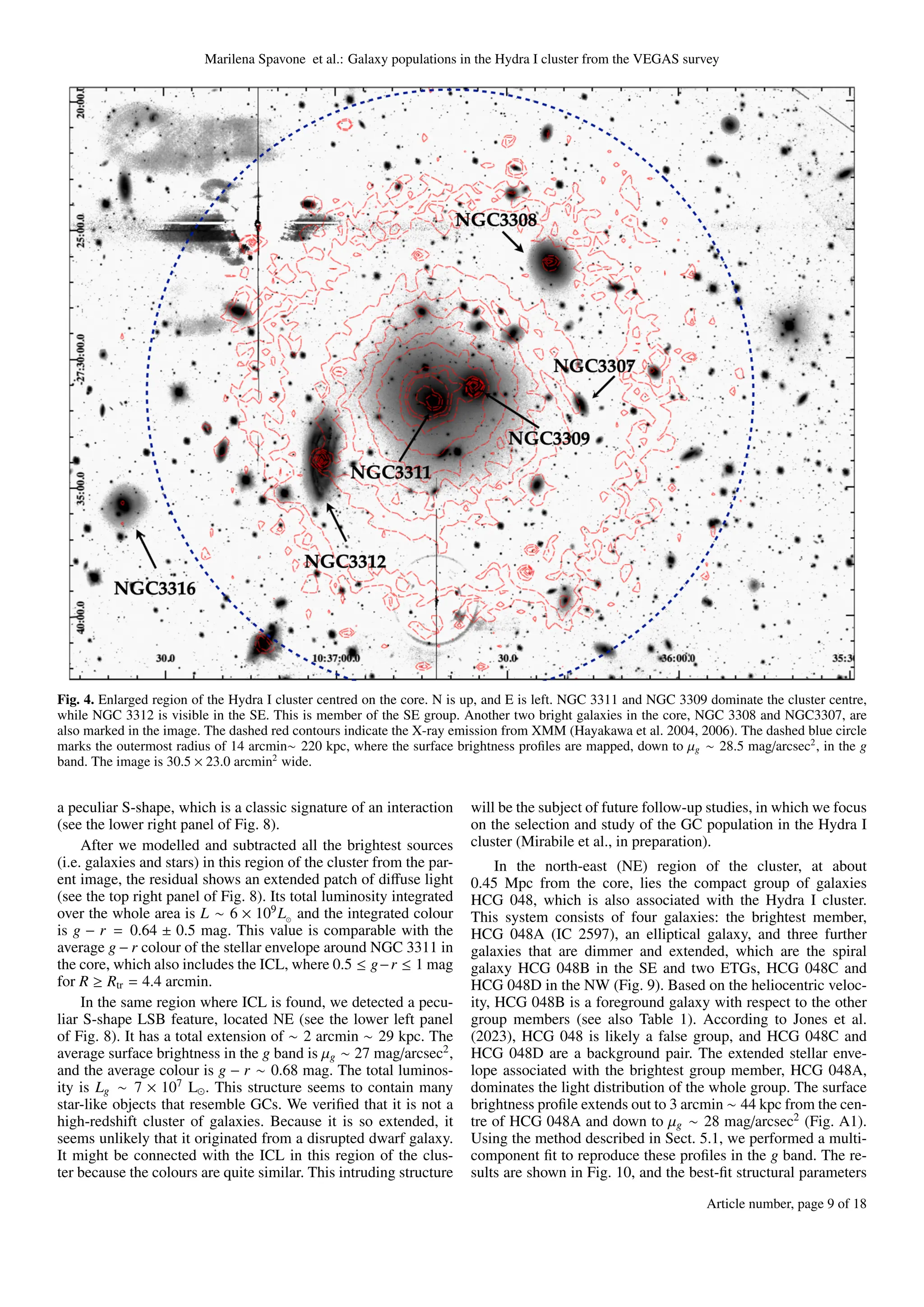
NGC 3309 (Fig. 4). The light distribution was mapped out to
15 arcmin from the centre of NGC 3311, which corresponds to
∼ 223 kpc (∼ 0.14 Rvir), and down to µg ∼ 28.5 mag/arcsec2
in
the g band (Fig. 2, left panel). This distance coincides with the
extension of the detected X-ray emission, centred on the cluster
core (Fig. 4). Our new surface brightness profiles are about six
times more extended than those obtained in the optical V band
by Arnaboldi et al. (2012).
In Fig. 5 we show a portion of the residual image obtained by
subtracting the 2D model of the light distribution of NGC 3311
and NGC 3309, derived from the isophote fit (see Sect. 4.3). This
region of the cluster is located NW of the core. Several bright
galaxies in this area show distorted isophotes in the outskirts. In
detail, HCC009, which is a barred S0 galaxy, has a prominent S-
shape in the west-east (WE) direction. A similar morphology is
observed for HCC012, which lies close in projection to HCC009
on the W side, where LSB tails are detected N and S. The giant
galaxy NGC 3308, located north of the cluster core, which has
a similar total magnitude as NGC 3309 (see Table 1), has an
extended stellar envelope that is elongated toward the SW. We
also confirm the tidal debris associated with the disrupted dwarf
HCC026 inside the stellar envelope of NGC 3311, which was
discovered by Arnaboldi et al. (2012).
5.2. Extended envelope around NGC 3311
Previous studies of imaging data for NGC 3311 revealed that
this galaxy is composed of a central and bright component that
is well fitted by a Sersic law, and an extended stellar envelope
(Arnaboldi et al. 2012). As stated in the previous section, the
surface brightness profiles obtained from the VEGAS data are
about six times more extended than previous profiles. It shows a
Article number, page 6 of 18
Marilena Spavone et al.: Galaxy populations in the Hydra I cluster from the VEGAS survey
Fig. 2. Azimuthally averaged surface brightness of NGC 3311. Left panel: Surface brightness profiles (top panel) in the g (blue points) and r
(red points) bands, and g − r colour profile (bottom panel). The dashed green line marks the limit of the surface brightness profiles obtained for
NGC 3311 by Arnaboldi et al. (2012). Right panel: g-band surface brightness profile in logarithmic radius (top panel), with the best 1D multi-
component fit (see text for details). In the lower panel, we show the ∆rms residual of the data minus the model (see text for details).
0.0 2.5 5.0 7.5 10.0 12.5 15.0 17.5 20.0
Distance from center (arcmin)
18
20
22
24
26
28
mag
/
arcsec
2
r
GCs average profile
100 101
Distance from center (arcmin)
Fig. 3. Surface brightness profile of NGC3311
in the r band (black line) and the radially av-
eraged globular cluster number density pro-
file (red line), arbitrarily shifted to match the
surface brightness. The left panel shows the
cluster-centric distance on a linear scale, and
the right panel uses a log scale. The shaded ar-
eas indicate the three regimes observed in the
GC number density profile: I) where incom-
pleteness effects are significant, II) where the
GCs follow the galaxy light, and III) where the
GCs trace the ICL. Region I) is also shaded in
the left panel for reference. At distances larger
than ∼ 6 arcmin from the centre, the shallower
profiles indicate the contribution of the ICL
baryons, i.e. diffuse light plus intra-cluster GCs.
change in the slope at ∼ 4 arcmin, where a shallower decline is
observed (Fig. 2, left panel), suggesting an additional outer com-
ponent. Therefore, we performed a new multi-component 1D fit
of the surface brightness profile for NGC 3311 in the g band. We
adopted the same approach as proposed in many studies that is
also well tested for VST data to fit the surface brightness pro-
files of BGCs in the cluster of galaxies (see e.g. Spavone et al.
2020, and references therein). In detail, the best fit was obtained
with three components: two Sersic laws, which reproduce the
brightest and inner regions of the profile, and an outer exponen-
tial profile that maps the galaxy outskirts. The results are shown
in the right panel of Fig. 2. The best-fit parameters are listed in
Table 2.
The transition radius between the inner two Sersic compo-
nents is Rtr ≥ 0.2 arcmin (∼ 3 kpc). The outer exponential com-
ponent starts to dominate at Rtr ≥ 4.3 arcmin (∼ 60 kpc). It has a
scale length of ∼ 74 kpc and a total luminosity of ∼ 1.6×10¹¹
L⊙.
This corresponds to ∼ 70% of the total luminosity integrated
over the whole profile, which is ∼ 2.3×10¹¹
L⊙. This component
traces the stellar envelope around the core of the cluster. We as-
sume that it also includes the ICL in this region because based on
the photometry alone, we cannot separate the bound stars in the
galaxy stellar halo from those that are gravitationally unbound
in the ICL. Based on the total luminosity of the two outer com-
ponents, that is, the Sersic plus the exponential components, we
estimated the accreted mass fraction around NGC 3311, which is
fac ∼ 94%. As argued by Remus & Forbes (2022), because cos-
mological simulations only consider the stars that were already
formed at the time of infall as accreted, the accreted fractions
derived following the prescriptions of these simulations should
be considered as lower limits. As explained in Spavone et al.
(2017), fac includes the total luminosity of the second Sersic
component plus the outer exponential, which corresponds to the
Article number, page 7 of 18
A&A proofs: manuscript no. aa51346_24corr
Table 2. Best-fit parameters of the multi-component 1D fit of the sur-
face brightness profiles of NGC 3311 in the g band.
Law µe re n µ0 rh
[mag/arcsec2
] [arcsec] [mag/arcsec2
] [arcsec]
(1) (2) (3) (4) (5) (6)
Sersic 20.87±0.02 8.35±0.03 0.55±0.04 - -
Sersic 23.64±0.04 99±2 1.43±0.01 - -
Exp - - - 25.36±0.01 298±6
Notes. Column 1 reports the empirical law adopted for the multi-
component 1D fit. Columns 2 to 4 list the effective surface brightness,
effective radius, and Sersic’s index of the Sersic law for each of the two
inner components. Columns (5) and (6) list the central surface bright-
ness and scale length of the exponential component we adopted to fit
the galaxy envelope.
bound and unbound ex situ components, respectively (see also
Cooper et al. 2015).
In correspondence with the outer edge of the stellar envelope,
that is, Rlim ∼ 15 arcmin ∼ 223 kpc, we found that the number
density of the dwarf galaxy population (La Marca et al. 2022b)
as a function of the cluster-centric distance decreases by about
10% with respect to the values at larger radii (Fig. 6). A similar
result was found for the Fornax cluster (Venhola et al. 2018).
5.3. Diffuse light versus distribution of the globular clusters
Figure 3 shows the radial average number density profile of
GCs around NGC 3311 (red line) along with the r−band surface
brightness profile (black line). The right panel clearly reveals
three different regimes of the number density of GCs, as indi-
cated by the shaded regions. Region I corresponds to the small-
radius regime where the incompleteness effects in the GC counts
are substantial. As discussed in Sect. 4.4, this is caused by the
source detection algorithm, which underestimates the GC num-
bers. This is mostly caused by the GC number density profile,
which traces the galaxy light at distances below ∼1.2 arcmin
(∼ 17.8 kpc) only poorly. Region II spans distances between
1.2 ≤ d ≤ 6.5 arcmin (17.8 ≤ d ≤ 96.4 kpc), where the num-
ber density of GCs closely follows the light from NGC 3311.
The stellar envelope also starts to dominate in this region (see
Barbosa et al. 2018, and Sect. 5.2).
Region III (d ≥ 6.5 arcmin) shows a striking difference be-
tween the light distribution and GC profile. At R ≃ 6 arcmin, the
GC profile shows a shallower decrease than the surface bright-
ness profile. At this radius, the extended exponential surface
brightness profile starts to dominate (Fig. 3). Therefore, region
III not only marks a change in the surface brightness behaviour,
but also in the mixture of stars and GC systems. The left panel of
Fig. 3 shows that for R ≥ 6 arcmin, there are more GCs by fac-
tor of ∼ 2.5 than what is expected from the stars that contribute
to the surface brightness profile. Therefore, at large distances,
there are 2.5 times more GCs per unit galaxy light than in the
inner region. This is a strong indication of the transition between
the galaxy stellar halo and the ICL-dominated regime. The con-
nection between the flattening in the GC number density and
this change in regime was also reported in previous works. Dur-
rell et al. (2014) studied the GC population in the Virgo galaxies
M87 and M49 and found that their GC number density also flat-
tens at large distances due to the shallow profile of blue GCs,
which are connected to the ICL of Virgo. Moreover, studying
planetary nebulae (PNe) in M87, Longobardi et al. (2015) found
that intracluster PNe have a shallower profile than those belong-
ing to the M87 halo. Similar results were obtained for the blue
GCs around the central Fornax cluster galaxy NGC 1399 (Schu-
berth et al. 2010; Cantiello et al. 2018).
Finally, we derived the specific frequency S N profile using
the GC number density and the surface brightness profiles by
integrating them in each annulus. This is not the classical defini-
tion of S N, which typically considers the total galaxy luminosity
in the calculation, while we only considered the light inside each
respective annulus here. The S N profile as a function of cluster-
centric distance is plotted in Fig. 6, which shows that at larger
distances from NGC 3311, an excess of GCs is observed, with a
specific frequency that is about four times higher than in the cen-
tral regions. A similar trend is observed for the number density
of the dwarf galaxies, as discussed in Sect. 5.1.
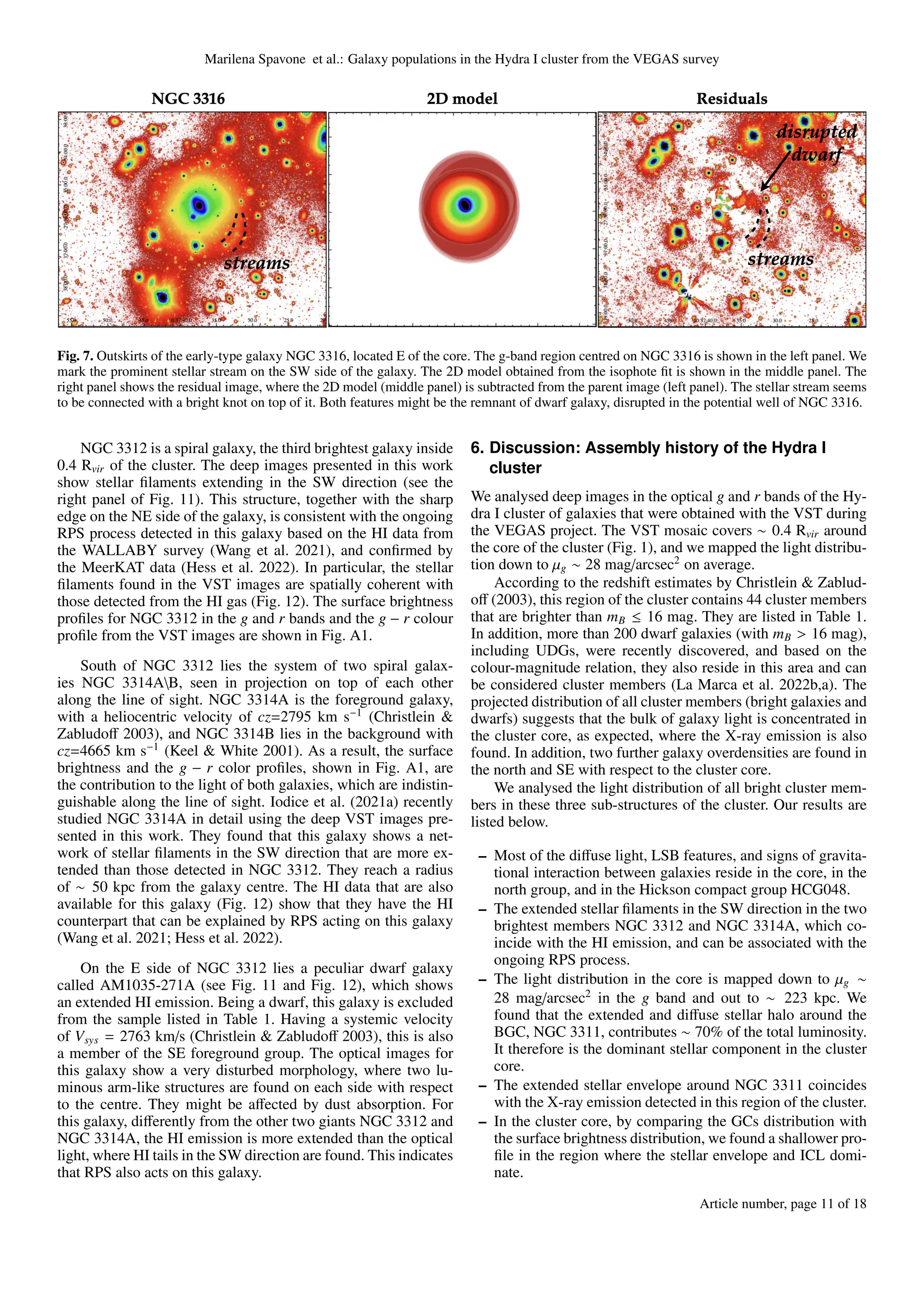
5.4. Disrupting dwarf in the outskirt of NGC 3316
On the SE side of the cluster core lies the fifth brightest mem-
ber, NGC 3316 (Fig. 4), which has a systemic velocity compa-
rable to that of NGC 3311 (see Table 1). The new deep VEGAS
data show that this galaxy, classified as a barred S0, has an ex-
tended boxy outskirt, where we found a prominent arc-like stel-
lar stream on the SW side (Fig. 7, left panel). From the isophote
fit, we built the 2D model of the light distribution, which was
subtracted from the parent image to obtain the residual map (see
the middle and right panels in Fig. 7). The stellar SW stream
clearly stands out from the residuals and, in addition, it seems
to be connected to a bright knot on the N side. This feature
might result from a disrupted dwarf galaxy that interacted with
NGC 3316.
To further support this hypothesis, we derived the integrated
magnitudes and colours for the bright knot and the stream, which
are mg = 19.6 ± 0.2 mag and g − r = 0.5 ± 0.3 mag, and mg =
21.8 ± 0.2 mag and g − r = 0.7 ± 0.3 mag, respectively. The
g − r colours for both structures are consistent with the range
of colours found for the dwarf galaxies in the Hydra I cluster,
which is 0.2 ≤ g − r ≤ 1 mag (La Marca et al. 2022b).
5.5. North group and HCG048 group
The over-density of galaxies located in the north with respect to
the cluster core is mainly distributed along a filament-like struc-
ture that extends in projection in the north-south (NS) direction
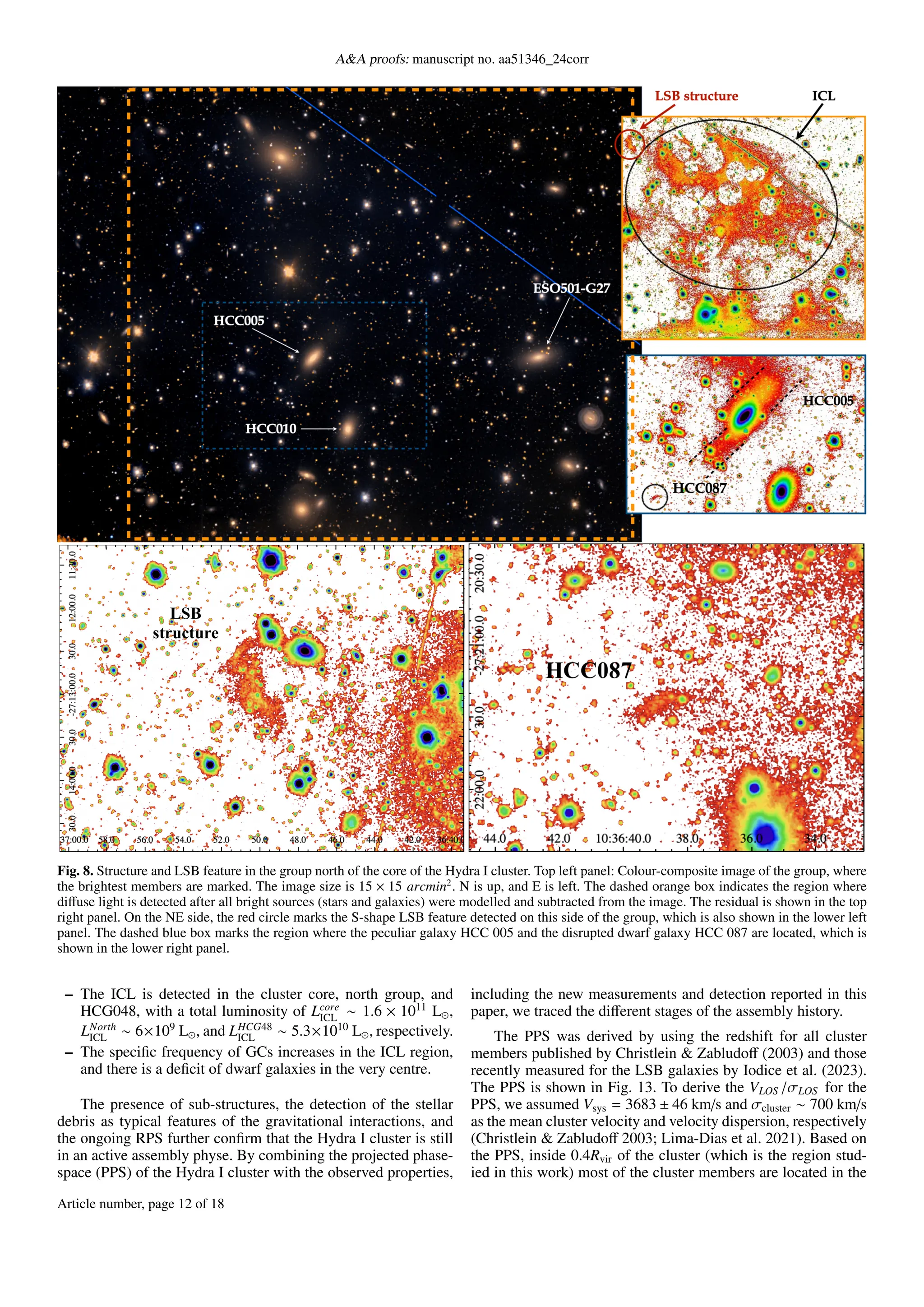
(Fig. 8). In this region of the cluster, we found several LSB fea-
tures that we describe below.
In the outskirts of the S0 galaxy HCC005, we discovered
a thick and extended tail in the SE-NW direction that is about
twice longer than the inner bright regions of the galaxy (see the
middle right panel of Fig. 8). This structure has a total integrated
magnitude in the g band of mg = 18.08 mag and an average
colour of g − r = 0.73 mag. The latter value is consistent with
the integrated g − r colour of the galaxy, which is 0.78 mag (see
Table 1), as well as with the g−r colour measured in the outskirts
(see colour profile in Fig. A1). The similar colours might suggest
that this structure is connected with HCC005 as the result of
a recent gravitational interaction. Alternatively, given the quite
regular shape of the outer galaxy isophotes, we cannot exclude
that this structure is in projection behind HCC005.
SE of HCC005, we also detect the faint (µ0 ∼
26.2 mag/arcsec2
, in the g band) tidally disrupted dwarf galaxy
HCC087, which was previously discovered by Misgeld et al.
(2008) and was studied in detail by Koch et al. (2012). It has
Article number, page 8 of 18
Marilena Spavone et al.: Galaxy populations in the Hydra I cluster from the VEGAS survey
Fig. 4. Enlarged region of the Hydra I cluster centred on the core. N is up, and E is left. NGC 3311 and NGC 3309 dominate the cluster centre,
while NGC 3312 is visible in the SE. This is member of the SE group. Another two bright galaxies in the core, NGC 3308 and NGC3307, are
also marked in the image. The dashed red contours indicate the X-ray emission from XMM (Hayakawa et al. 2004, 2006). The dashed blue circle
marks the outermost radius of 14 arcmin∼ 220 kpc, where the surface brightness profiles are mapped, down to µg ∼ 28.5 mag/arcsec2
, in the g
band. The image is 30.5 × 23.0 arcmin2
wide.
a peculiar S-shape, which is a classic signature of an interaction
(see the lower right panel of Fig. 8).
After we modelled and subtracted all the brightest sources
(i.e. galaxies and stars) in this region of the cluster from the par-
ent image, the residual shows an extended patch of diffuse light
(see the top right panel of Fig. 8). Its total luminosity integrated
over the whole area is L ∼ 6 × 10⁹
L⊙
and the integrated colour
is g − r = 0.64 ± 0.5 mag. This value is comparable with the
average g − r colour of the stellar envelope around NGC 3311 in
the core, which also includes the ICL, where 0.5 ≤ g−r ≤ 1 mag
for R ≥ Rtr = 4.4 arcmin.
In the same region where ICL is found, we detected a pecu-
liar S-shape LSB feature, located NE (see the lower left panel
of Fig. 8). It has a total extension of ∼ 2 arcmin ∼ 29 kpc. The
average surface brightness in the g band is µg ∼ 27 mag/arcsec2
,
and the average colour is g − r ∼ 0.68 mag. The total luminos-
ity is Lg ∼ 7 × 10⁷
L⊙. This structure seems to contain many
star-like objects that resemble GCs. We verified that it is not a
high-redshift cluster of galaxies. Because it is so extended, it
seems unlikely that it originated from a disrupted dwarf galaxy.
It might be connected with the ICL in this region of the clus-
ter because the colours are quite similar. This intruding structure
will be the subject of future follow-up studies, in which we focus
on the selection and study of the GC population in the Hydra I
cluster (Mirabile et al., in preparation).
In the north-east (NE) region of the cluster, at about
0.45 Mpc from the core, lies the compact group of galaxies
HCG 048, which is also associated with the Hydra I cluster.
This system consists of four galaxies: the brightest member,
HCG 048A (IC 2597), an elliptical galaxy, and three further
galaxies that are dimmer and extended, which are the spiral
galaxy HCG 048B in the SE and two ETGs, HCG 048C and
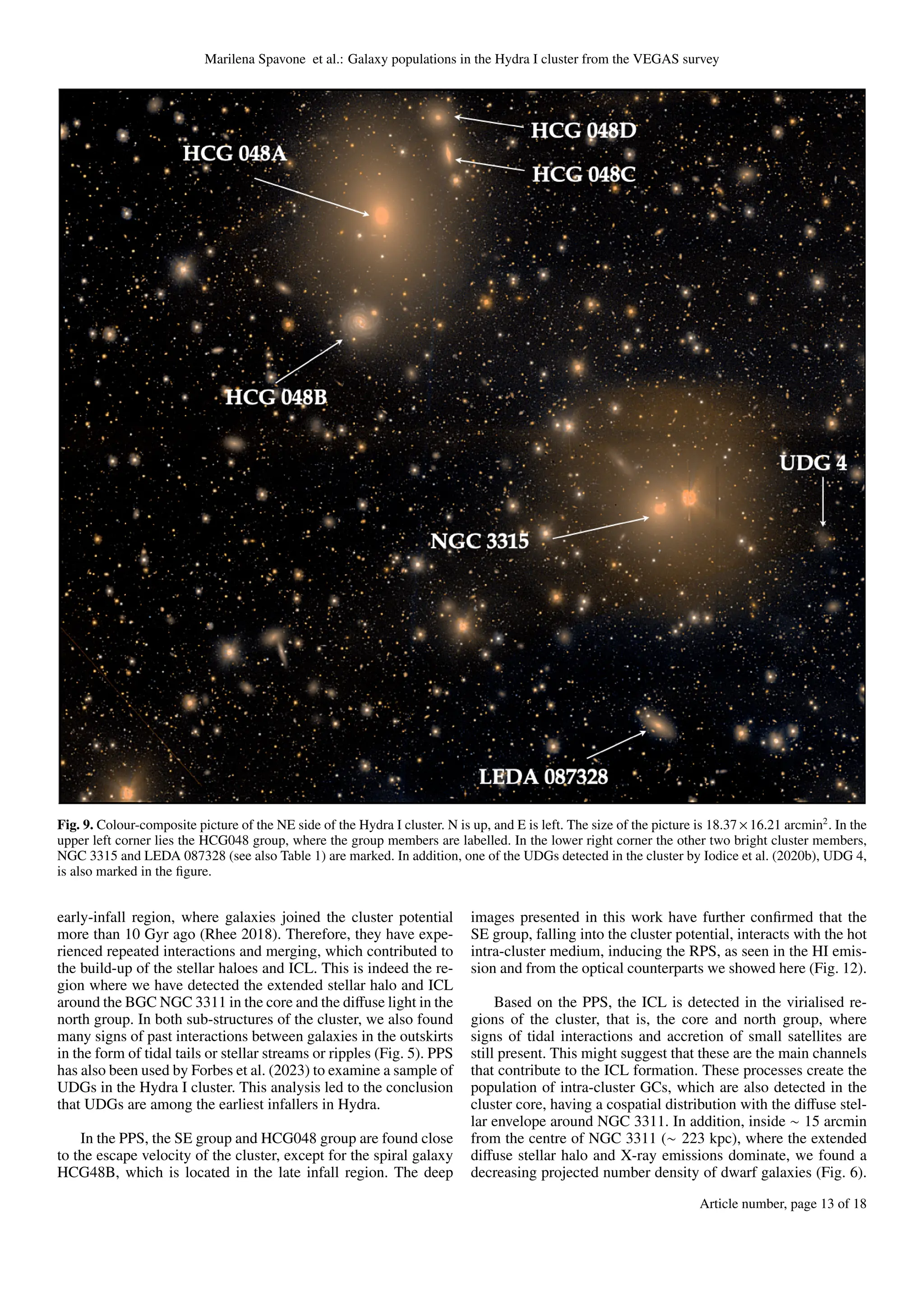
HCG 048D in the NW (Fig. 9). Based on the heliocentric veloc-
ity, HCG 048B is a foreground galaxy with respect to the other
group members (see also Table 1). According to Jones et al.
(2023), HCG 048 is likely a false group, and HCG 048C and
HCG 048D are a background pair. The extended stellar enve-
lope associated with the brightest group member, HCG 048A,
dominates the light distribution of the whole group. The surface
brightness profile extends out to 3 arcmin ∼ 44 kpc from the cen-
tre of HCG 048A and down to µg ∼ 28 mag/arcsec2
(Fig. A1).
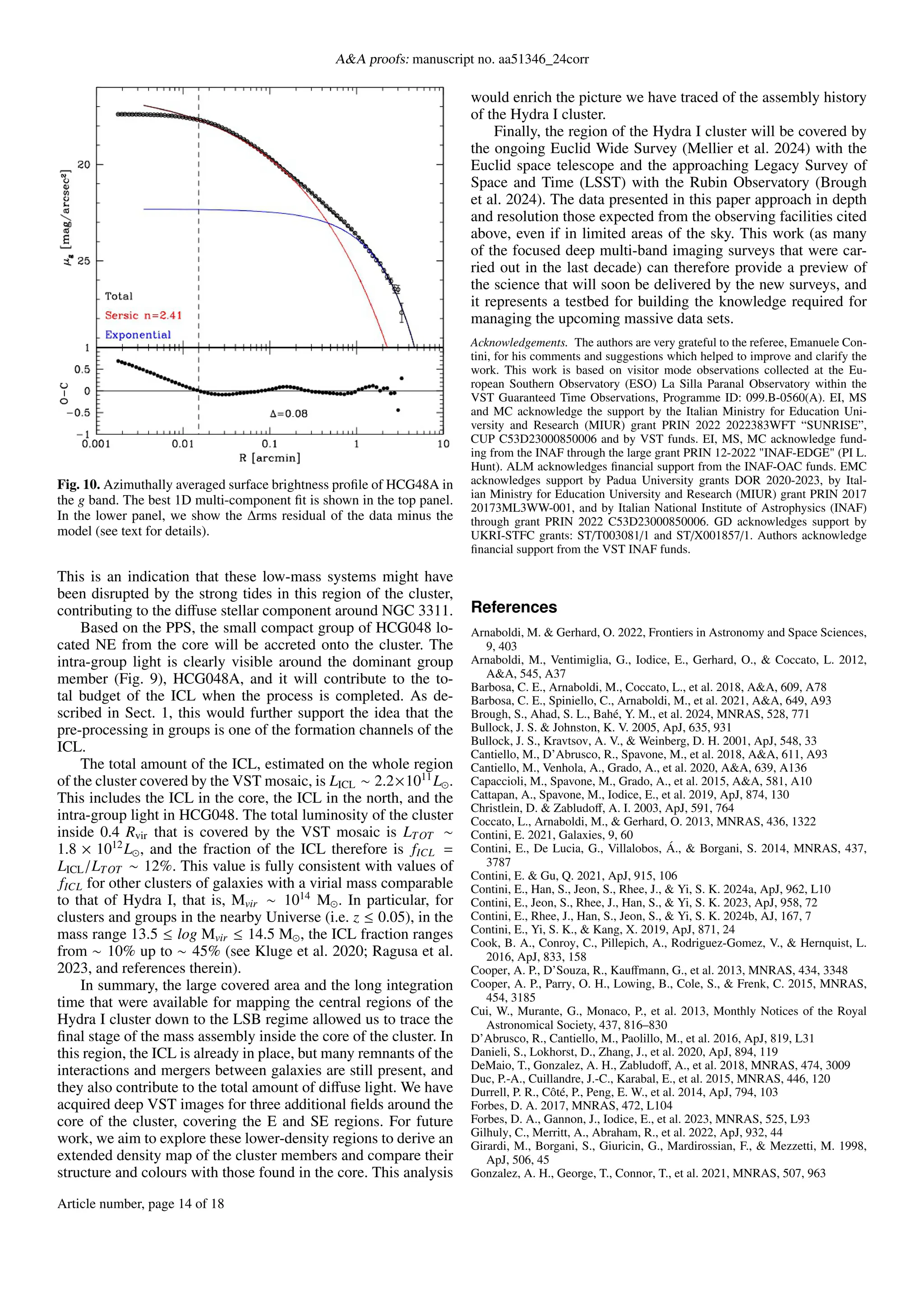
Using the method described in Sect. 5.1, we performed a multi-
component fit to reproduce these profiles in the g band. The re-
sults are shown in Fig. 10, and the best-fit structural parameters
Article number, page 9 of 18
A&A proofs: manuscript no. aa51346_24corr
Fig. 5. Enlarged region of the Hydra I cluster on the NW side of the core. This is the residual image obtained by subtracting the 2D model of the
light distribution of NGC 3311 and NGC 3309 from the isophote fit (see text for details). The image is 14.06 × 7.81 arcmin2
wide. The brightest
galaxies in the field are marked. In addition, the dashed black lines indicate the distorted isophotes in the outskirts of HCC092 and HCC012,
which might suggest possible ongoing interaction. The dashed blue lines mark the stellar streams of the disrupted dwarf HCC026 identified by
Arnaboldi et al. (2012). The several ripples and arcs are artefacts from the residuals of the overlapping outskirts of NGC 3311 and NGC 3309 with
the numerous nearby galaxies, in particular, the bright member NGC 3308.
Fig. 6. Number density of the compact sources as function of the
cluster-centric distance. The number density (left axis) of the dwarf
galaxy population (red line) is taken from La Marca et al. (2022b). The
GC-specific frequency (black line, right axis) was derived in this work
and is described in Sect. 5.3. The vertical dashed blue line marks the
outer edge of the stellar envelope around the core, i.e. Rlim ∼ 15 arcmin
∼ 223 kpc (see Fig. 2).
are listed in Table 3. We found that the extended outer stellar en-
velope is well fitted by an exponential law, with a scale length of
rh = 42.29 ± 0.14 arcsec, which dominates the light distribution
for Rtr ≥ 28.3 arcmin (∼ 7 kpc). This component, which includes
Table 3. Best-fit parameters of the multi-component 1D fit of the sur-
face brightness profiles of HCG 048A in the g band.
Law µe re n µ0 rh
[mag/arcsec2
] [arcsec] [mag/arcsec2
] [arcsec]
(1) (2) (3) (4) (5) (6)
Sersic 20.89±0.02 11.67±0.12 2.41±0.02 - -
Exp - - - 22.32±0.01 42.29±0.14
Notes. Column 1 reports the empirical law adopted for the multi-
component 1D fit. Columns 2 to 4 list the effective surface brightness,
effective radius, and Sersic’s index of the Sersic law for each of the two
inner components. Columns (5) and (6) list the central surface bright-
ness and scale length of the exponential component adopted to fit the
galaxy envelope.
the stellar halo and the intra-group light, has a total luminosity
of L = 5.3 × 10¹⁰
L⊙, which corresponds to ∼ 49% of the total
luminosity of HCG 048A.
5.6. South-west group
According to the systemic velocities derived by Christlein &
Zabludoff (2003), a group of foreground galaxies lies in the SE
region with respect to the core. The brightest galaxies of this
group are NGC 3312 and NGC 3314A (see Fig. 11). This group
is dominated by late-type galaxies.
Article number, page 10 of 18
Marilena Spavone et al.: Galaxy populations in the Hydra I cluster from the VEGAS survey
Fig. 7. Outskirts of the early-type galaxy NGC 3316, located E of the core. The g-band region centred on NGC 3316 is shown in the left panel. We
mark the prominent stellar stream on the SW side of the galaxy. The 2D model obtained from the isophote fit is shown in the middle panel. The
right panel shows the residual image, where the 2D model (middle panel) is subtracted from the parent image (left panel). The stellar stream seems
to be connected with a bright knot on top of it. Both features might be the remnant of dwarf galaxy, disrupted in the potential well of NGC 3316.
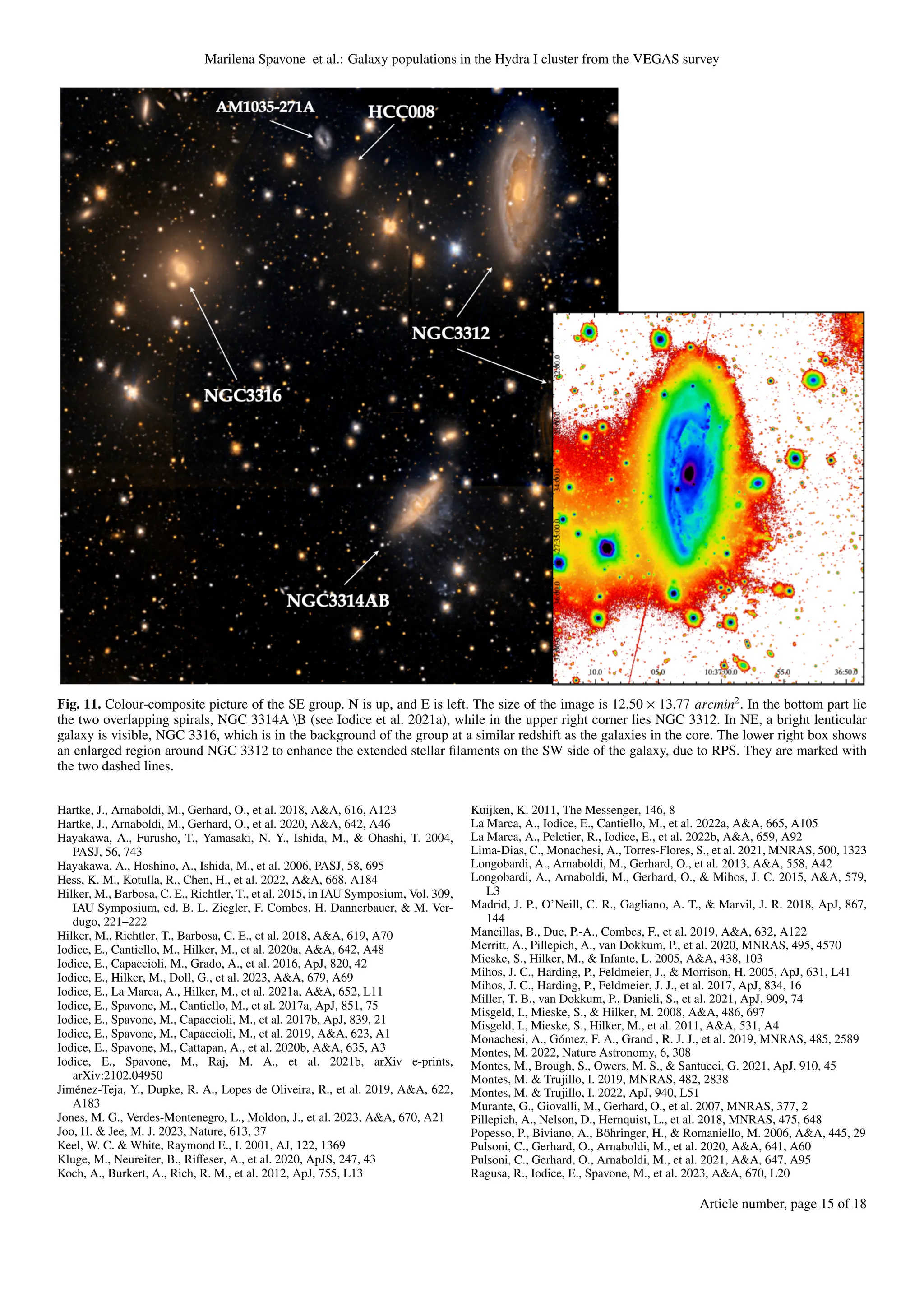
NGC 3312 is a spiral galaxy, the third brightest galaxy inside
0.4 Rvir of the cluster. The deep images presented in this work
show stellar filaments extending in the SW direction (see the
right panel of Fig. 11). This structure, together with the sharp
edge on the NE side of the galaxy, is consistent with the ongoing
RPS process detected in this galaxy based on the HI data from
the WALLABY survey (Wang et al. 2021), and confirmed by
the MeerKAT data (Hess et al. 2022). In particular, the stellar
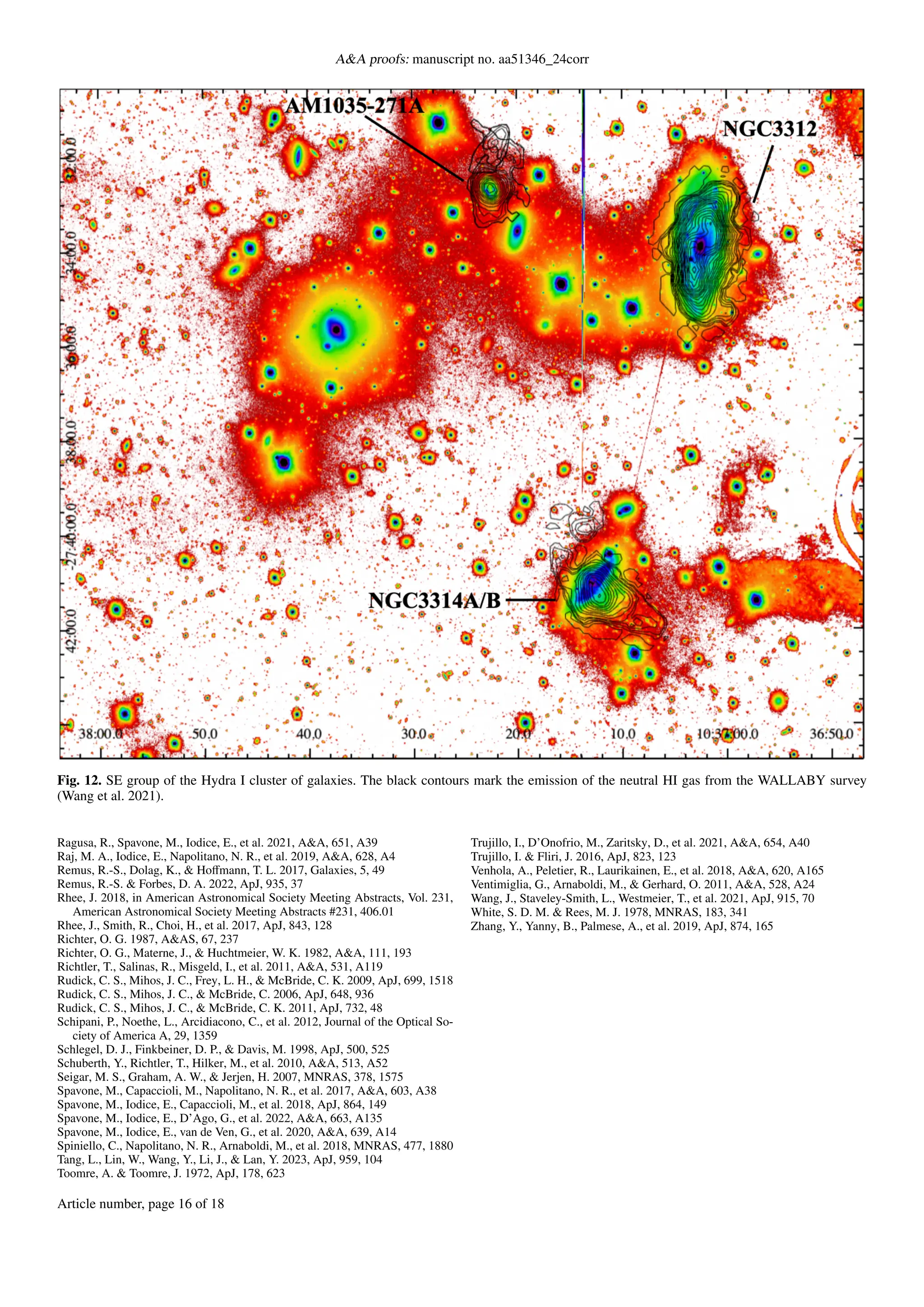
filaments found in the VST images are spatially coherent with
those detected from the HI gas (Fig. 12). The surface brightness
profiles for NGC 3312 in the g and r bands and the g − r colour
profile from the VST images are shown in Fig. A1.
South of NGC 3312 lies the system of two spiral galax-
ies NGC 3314AB, seen in projection on top of each other
along the line of sight. NGC 3314A is the foreground galaxy,
with a heliocentric velocity of cz=2795 km s−1
(Christlein &
Zabludoff 2003), and NGC 3314B lies in the background with
cz=4665 km s−1
(Keel & White 2001). As a result, the surface
brightness and the g − r color profiles, shown in Fig. A1, are
the contribution to the light of both galaxies, which are indistin-
guishable along the line of sight. Iodice et al. (2021a) recently
studied NGC 3314A in detail using the deep VST images pre-
sented in this work. They found that this galaxy shows a net-
work of stellar filaments in the SW direction that are more ex-
tended than those detected in NGC 3312. They reach a radius
of ∼ 50 kpc from the galaxy centre. The HI data that are also
available for this galaxy (Fig. 12) show that they have the HI
counterpart that can be explained by RPS acting on this galaxy
(Wang et al. 2021; Hess et al. 2022).
On the E side of NGC 3312 lies a peculiar dwarf galaxy
called AM1035-271A (see Fig. 11 and Fig. 12), which shows
an extended HI emission. Being a dwarf, this galaxy is excluded
from the sample listed in Table 1. Having a systemic velocity
of Vsys = 2763 km/s (Christlein & Zabludoff 2003), this is also
a member of the SE foreground group. The optical images for
this galaxy show a very disturbed morphology, where two lu-
minous arm-like structures are found on each side with respect
to the centre. They might be affected by dust absorption. For
this galaxy, differently from the other two giants NGC 3312 and
NGC 3314A, the HI emission is more extended than the optical
light, where HI tails in the SW direction are found. This indicates
that RPS also acts on this galaxy.
6. Discussion: Assembly history of the Hydra I
cluster
We analysed deep images in the optical g and r bands of the Hy-
dra I cluster of galaxies that were obtained with the VST during
the VEGAS project. The VST mosaic covers ∼ 0.4 Rvir around
the core of the cluster (Fig. 1), and we mapped the light distribu-
tion down to µg ∼ 28 mag/arcsec2
on average.
According to the redshift estimates by Christlein & Zablud-
off (2003), this region of the cluster contains 44 cluster members
that are brighter than mB ≤ 16 mag. They are listed in Table 1.
In addition, more than 200 dwarf galaxies (with mB > 16 mag),
including UDGs, were recently discovered, and based on the
colour-magnitude relation, they also reside in this area and can
be considered cluster members (La Marca et al. 2022b,a). The
projected distribution of all cluster members (bright galaxies and
dwarfs) suggests that the bulk of galaxy light is concentrated in
the cluster core, as expected, where the X-ray emission is also
found. In addition, two further galaxy overdensities are found in
the north and SE with respect to the cluster core.
We analysed the light distribution of all bright cluster mem-
bers in these three sub-structures of the cluster. Our results are
listed below.
– Most of the diffuse light, LSB features, and signs of gravita-
tional interaction between galaxies reside in the core, in the
north group, and in the Hickson compact group HCG048.
– The extended stellar filaments in the SW direction in the two
brightest members NGC 3312 and NGC 3314A, which co-
incide with the HI emission, and can be associated with the
ongoing RPS process.
– The light distribution in the core is mapped down to µg ∼
28 mag/arcsec2
in the g band and out to ∼ 223 kpc. We
found that the extended and diffuse stellar halo around the
BGC, NGC 3311, contributes ∼ 70% of the total luminosity.
It therefore is the dominant stellar component in the cluster
core.
– The extended stellar envelope around NGC 3311 coincides
with the X-ray emission detected in this region of the cluster.
– In the cluster core, by comparing the GCs distribution with
the surface brightness distribution, we found a shallower pro-
file in the region where the stellar envelope and ICL domi-
nate.
Article number, page 11 of 18
A&A proofs: manuscript no. aa51346_24corr
Fig. 8. Structure and LSB feature in the group north of the core of the Hydra I cluster. Top left panel: Colour-composite image of the group, where
the brightest members are marked. The image size is 15 × 15 arcmin2
. N is up, and E is left. The dashed orange box indicates the region where
diffuse light is detected after all bright sources (stars and galaxies) were modelled and subtracted from the image. The residual is shown in the top
right panel. On the NE side, the red circle marks the S-shape LSB feature detected on this side of the group, which is also shown in the lower left
panel. The dashed blue box marks the region where the peculiar galaxy HCC 005 and the disrupted dwarf galaxy HCC 087 are located, which is
shown in the lower right panel.
– The ICL is detected in the cluster core, north group, and
HCG048, with a total luminosity of Lcore
ICL ∼ 1.6 × 10¹¹
L⊙,
LNorth
ICL ∼ 6×10⁹
L⊙, and LHCG48
ICL ∼ 5.3×10¹⁰
L⊙, respectively.
– The specific frequency of GCs increases in the ICL region,
and there is a deficit of dwarf galaxies in the very centre.
The presence of sub-structures, the detection of the stellar
debris as typical features of the gravitational interactions, and
the ongoing RPS further confirm that the Hydra I cluster is still
in an active assembly physe. By combining the projected phase-
space (PPS) of the Hydra I cluster with the observed properties,
including the new measurements and detection reported in this
paper, we traced the different stages of the assembly history.
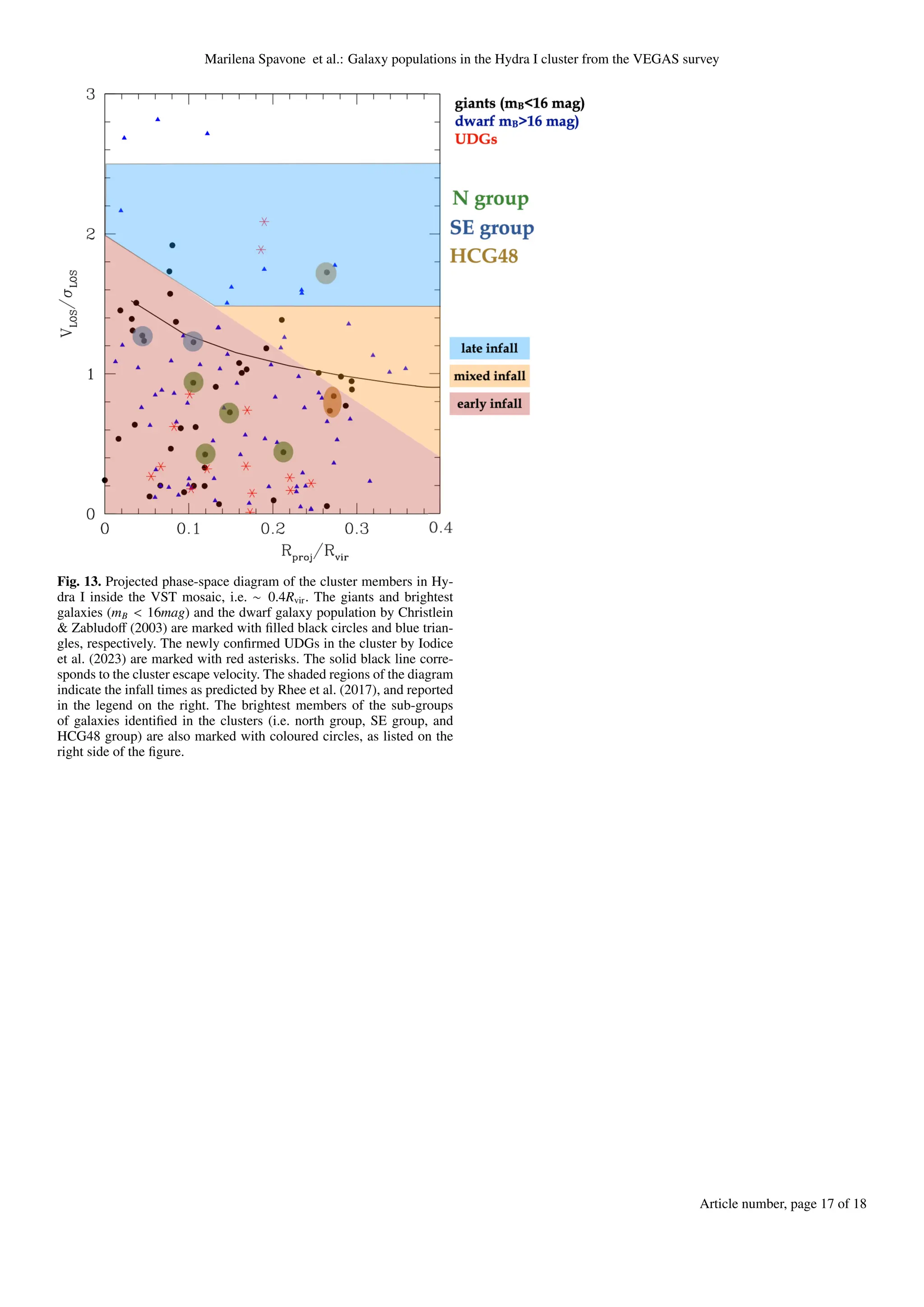
The PPS was derived by using the redshift for all cluster
members published by Christlein & Zabludoff (2003) and those
recently measured for the LSB galaxies by Iodice et al. (2023).
The PPS is shown in Fig. 13. To derive the VLOS /σLOS for the
PPS, we assumed Vsys = 3683 ± 46 km/s and σcluster ∼ 700 km/s
as the mean cluster velocity and velocity dispersion, respectively
(Christlein & Zabludoff 2003; Lima-Dias et al. 2021). Based on
the PPS, inside 0.4Rvir of the cluster (which is the region stud-
ied in this work) most of the cluster members are located in the
Article number, page 12 of 18
Marilena Spavone et al.: Galaxy populations in the Hydra I cluster from the VEGAS survey
Fig. 9. Colour-composite picture of the NE side of the Hydra I cluster. N is up, and E is left. The size of the picture is 18.37×16.21 arcmin2
. In the
upper left corner lies the HCG048 group, where the group members are labelled. In the lower right corner the other two bright cluster members,
NGC 3315 and LEDA 087328 (see also Table 1) are marked. In addition, one of the UDGs detected in the cluster by Iodice et al. (2020b), UDG 4,
is also marked in the figure.
early-infall region, where galaxies joined the cluster potential
more than 10 Gyr ago (Rhee 2018). Therefore, they have expe-
rienced repeated interactions and merging, which contributed to
the build-up of the stellar haloes and ICL. This is indeed the re-
gion where we have detected the extended stellar halo and ICL
around the BGC NGC 3311 in the core and the diffuse light in the
north group. In both sub-structures of the cluster, we also found
many signs of past interactions between galaxies in the outskirts
in the form of tidal tails or stellar streams or ripples (Fig. 5). PPS
has also been used by Forbes et al. (2023) to examine a sample of
UDGs in the Hydra I cluster. This analysis led to the conclusion
that UDGs are among the earliest infallers in Hydra.
In the PPS, the SE group and HCG048 group are found close
to the escape velocity of the cluster, except for the spiral galaxy
HCG48B, which is located in the late infall region. The deep
images presented in this work have further confirmed that the
SE group, falling into the cluster potential, interacts with the hot
intra-cluster medium, inducing the RPS, as seen in the HI emis-
sion and from the optical counterparts we showed here (Fig. 12).
Based on the PPS, the ICL is detected in the virialised re-
gions of the cluster, that is, the core and north group, where
signs of tidal interactions and accretion of small satellites are
still present. This might suggest that these are the main channels
that contribute to the ICL formation. These processes create the
population of intra-cluster GCs, which are also detected in the
cluster core, having a cospatial distribution with the diffuse stel-
lar envelope around NGC 3311. In addition, inside ∼ 15 arcmin
from the centre of NGC 3311 (∼ 223 kpc), where the extended
diffuse stellar halo and X-ray emissions dominate, we found a
decreasing projected number density of dwarf galaxies (Fig. 6).
Article number, page 13 of 18
A&A proofs: manuscript no. aa51346_24corr
Fig. 10. Azimuthally averaged surface brightness profile of HCG48A in
the g band. The best 1D multi-component fit is shown in the top panel.
In the lower panel, we show the ∆rms residual of the data minus the
model (see text for details).
This is an indication that these low-mass systems might have
been disrupted by the strong tides in this region of the cluster,
contributing to the diffuse stellar component around NGC 3311.
Based on the PPS, the small compact group of HCG048 lo-
cated NE from the core will be accreted onto the cluster. The
intra-group light is clearly visible around the dominant group
member (Fig. 9), HCG048A, and it will contribute to the to-
tal budget of the ICL when the process is completed. As de-
scribed in Sect. 1, this would further support the idea that the
pre-processing in groups is one of the formation channels of the
ICL.
The total amount of the ICL, estimated on the whole region
of the cluster covered by the VST mosaic, is LICL ∼ 2.2×10¹¹
L⊙.
This includes the ICL in the core, the ICL in the north, and the
intra-group light in HCG048. The total luminosity of the cluster
inside 0.4 Rvir that is covered by the VST mosaic is LTOT ∼
1.8 × 10¹²
L⊙, and the fraction of the ICL therefore is fICL =
LICL/LTOT ∼ 12%. This value is fully consistent with values of
fICL for other clusters of galaxies with a virial mass comparable
to that of Hydra I, that is, Mvir ∼ 1014
M⊙. In particular, for
clusters and groups in the nearby Universe (i.e. z ≤ 0.05), in the
mass range 13.5 ≤ log Mvir ≤ 14.5 M⊙, the ICL fraction ranges
from ∼ 10% up to ∼ 45% (see Kluge et al. 2020; Ragusa et al.
2023, and references therein).
In summary, the large covered area and the long integration
time that were available for mapping the central regions of the
Hydra I cluster down to the LSB regime allowed us to trace the
final stage of the mass assembly inside the core of the cluster. In
this region, the ICL is already in place, but many remnants of the
interactions and mergers between galaxies are still present, and
they also contribute to the total amount of diffuse light. We have
acquired deep VST images for three additional fields around the
core of the cluster, covering the E and SE regions. For future
work, we aim to explore these lower-density regions to derive an
extended density map of the cluster members and compare their
structure and colours with those found in the core. This analysis
would enrich the picture we have traced of the assembly history
of the Hydra I cluster.
Finally, the region of the Hydra I cluster will be covered by
the ongoing Euclid Wide Survey (Mellier et al. 2024) with the
Euclid space telescope and the approaching Legacy Survey of
Space and Time (LSST) with the Rubin Observatory (Brough
et al. 2024). The data presented in this paper approach in depth
and resolution those expected from the observing facilities cited
above, even if in limited areas of the sky. This work (as many
of the focused deep multi-band imaging surveys that were car-
ried out in the last decade) can therefore provide a preview of
the science that will soon be delivered by the new surveys, and
it represents a testbed for building the knowledge required for
managing the upcoming massive data sets.
Acknowledgements. The authors are very grateful to the referee, Emanuele Con-
tini, for his comments and suggestions which helped to improve and clarify the
work. This work is based on visitor mode observations collected at the Eu-
ropean Southern Observatory (ESO) La Silla Paranal Observatory within the
VST Guaranteed Time Observations, Programme ID: 099.B-0560(A). EI, MS
and MC acknowledge the support by the Italian Ministry for Education Uni-
versity and Research (MIUR) grant PRIN 2022 2022383WFT “SUNRISE”,
CUP C53D23000850006 and by VST funds. EI, MS, MC acknowledge fund-
ing from the INAF through the large grant PRIN 12-2022 "INAF-EDGE" (PI L.
Hunt). ALM acknowledges financial support from the INAF-OAC funds. EMC
acknowledges support by Padua University grants DOR 2020-2023, by Ital-
ian Ministry for Education University and Research (MIUR) grant PRIN 2017
20173ML3WW-001, and by Italian National Institute of Astrophysics (INAF)
through grant PRIN 2022 C53D23000850006. GD acknowledges support by
UKRI-STFC grants: ST/T003081/1 and ST/X001857/1. Authors acknowledge
financial support from the VST INAF funds.
References
Arnaboldi, M. & Gerhard, O. 2022, Frontiers in Astronomy and Space Sciences,
9, 403
Arnaboldi, M., Ventimiglia, G., Iodice, E., Gerhard, O., & Coccato, L. 2012,
A&A, 545, A37
Barbosa, C. E., Arnaboldi, M., Coccato, L., et al. 2018, A&A, 609, A78
Barbosa, C. E., Spiniello, C., Arnaboldi, M., et al. 2021, A&A, 649, A93
Brough, S., Ahad, S. L., Bahé, Y. M., et al. 2024, MNRAS, 528, 771
Bullock, J. S. & Johnston, K. V. 2005, ApJ, 635, 931
Bullock, J. S., Kravtsov, A. V., & Weinberg, D. H. 2001, ApJ, 548, 33
Cantiello, M., D’Abrusco, R., Spavone, M., et al. 2018, A&A, 611, A93
Cantiello, M., Venhola, A., Grado, A., et al. 2020, A&A, 639, A136
Capaccioli, M., Spavone, M., Grado, A., et al. 2015, A&A, 581, A10
Cattapan, A., Spavone, M., Iodice, E., et al. 2019, ApJ, 874, 130
Christlein, D. & Zabludoff, A. I. 2003, ApJ, 591, 764
Coccato, L., Arnaboldi, M., & Gerhard, O. 2013, MNRAS, 436, 1322
Contini, E. 2021, Galaxies, 9, 60
Contini, E., De Lucia, G., Villalobos, Á., & Borgani, S. 2014, MNRAS, 437,
3787
Contini, E. & Gu, Q. 2021, ApJ, 915, 106
Contini, E., Han, S., Jeon, S., Rhee, J., & Yi, S. K. 2024a, ApJ, 962, L10
Contini, E., Jeon, S., Rhee, J., Han, S., & Yi, S. K. 2023, ApJ, 958, 72
Contini, E., Rhee, J., Han, S., Jeon, S., & Yi, S. K. 2024b, AJ, 167, 7
Contini, E., Yi, S. K., & Kang, X. 2019, ApJ, 871, 24
Cook, B. A., Conroy, C., Pillepich, A., Rodriguez-Gomez, V., & Hernquist, L.
2016, ApJ, 833, 158
Cooper, A. P., D’Souza, R., Kauffmann, G., et al. 2013, MNRAS, 434, 3348
Cooper, A. P., Parry, O. H., Lowing, B., Cole, S., & Frenk, C. 2015, MNRAS,
454, 3185
Cui, W., Murante, G., Monaco, P., et al. 2013, Monthly Notices of the Royal
Astronomical Society, 437, 816–830
D’Abrusco, R., Cantiello, M., Paolillo, M., et al. 2016, ApJ, 819, L31
Danieli, S., Lokhorst, D., Zhang, J., et al. 2020, ApJ, 894, 119
DeMaio, T., Gonzalez, A. H., Zabludoff, A., et al. 2018, MNRAS, 474, 3009
Duc, P.-A., Cuillandre, J.-C., Karabal, E., et al. 2015, MNRAS, 446, 120
Durrell, P. R., Côté, P., Peng, E. W., et al. 2014, ApJ, 794, 103
Forbes, D. A. 2017, MNRAS, 472, L104
Forbes, D. A., Gannon, J., Iodice, E., et al. 2023, MNRAS, 525, L93
Gilhuly, C., Merritt, A., Abraham, R., et al. 2022, ApJ, 932, 44
Girardi, M., Borgani, S., Giuricin, G., Mardirossian, F., & Mezzetti, M. 1998,
ApJ, 506, 45
Gonzalez, A. H., George, T., Connor, T., et al. 2021, MNRAS, 507, 963
Article number, page 14 of 18
Marilena Spavone et al.: Galaxy populations in the Hydra I cluster from the VEGAS survey
Fig. 11. Colour-composite picture of the SE group. N is up, and E is left. The size of the image is 12.50 × 13.77 arcmin2
. In the bottom part lie
the two overlapping spirals, NGC 3314A B (see Iodice et al. 2021a), while in the upper right corner lies NGC 3312. In NE, a bright lenticular
galaxy is visible, NGC 3316, which is in the background of the group at a similar redshift as the galaxies in the core. The lower right box shows
an enlarged region around NGC 3312 to enhance the extended stellar filaments on the SW side of the galaxy, due to RPS. They are marked with
the two dashed lines.
Hartke, J., Arnaboldi, M., Gerhard, O., et al. 2018, A&A, 616, A123
Hartke, J., Arnaboldi, M., Gerhard, O., et al. 2020, A&A, 642, A46
Hayakawa, A., Furusho, T., Yamasaki, N. Y., Ishida, M., & Ohashi, T. 2004,
PASJ, 56, 743
Hayakawa, A., Hoshino, A., Ishida, M., et al. 2006, PASJ, 58, 695
Hess, K. M., Kotulla, R., Chen, H., et al. 2022, A&A, 668, A184
Hilker, M., Barbosa, C. E., Richtler, T., et al. 2015, in IAU Symposium, Vol. 309,
IAU Symposium, ed. B. L. Ziegler, F. Combes, H. Dannerbauer, & M. Ver-
dugo, 221–222
Hilker, M., Richtler, T., Barbosa, C. E., et al. 2018, A&A, 619, A70
Iodice, E., Cantiello, M., Hilker, M., et al. 2020a, A&A, 642, A48
Iodice, E., Capaccioli, M., Grado, A., et al. 2016, ApJ, 820, 42
Iodice, E., Hilker, M., Doll, G., et al. 2023, A&A, 679, A69
Iodice, E., La Marca, A., Hilker, M., et al. 2021a, A&A, 652, L11
Iodice, E., Spavone, M., Cantiello, M., et al. 2017a, ApJ, 851, 75
Iodice, E., Spavone, M., Capaccioli, M., et al. 2017b, ApJ, 839, 21
Iodice, E., Spavone, M., Capaccioli, M., et al. 2019, A&A, 623, A1
Iodice, E., Spavone, M., Cattapan, A., et al. 2020b, A&A, 635, A3
Iodice, E., Spavone, M., Raj, M. A., et al. 2021b, arXiv e-prints,
arXiv:2102.04950
Jiménez-Teja, Y., Dupke, R. A., Lopes de Oliveira, R., et al. 2019, A&A, 622,
A183
Jones, M. G., Verdes-Montenegro, L., Moldon, J., et al. 2023, A&A, 670, A21
Joo, H. & Jee, M. J. 2023, Nature, 613, 37
Keel, W. C. & White, Raymond E., I. 2001, AJ, 122, 1369
Kluge, M., Neureiter, B., Riffeser, A., et al. 2020, ApJS, 247, 43
Koch, A., Burkert, A., Rich, R. M., et al. 2012, ApJ, 755, L13
Kuijken, K. 2011, The Messenger, 146, 8
La Marca, A., Iodice, E., Cantiello, M., et al. 2022a, A&A, 665, A105
La Marca, A., Peletier, R., Iodice, E., et al. 2022b, A&A, 659, A92
Lima-Dias, C., Monachesi, A., Torres-Flores, S., et al. 2021, MNRAS, 500, 1323
Longobardi, A., Arnaboldi, M., Gerhard, O., et al. 2013, A&A, 558, A42
Longobardi, A., Arnaboldi, M., Gerhard, O., & Mihos, J. C. 2015, A&A, 579,
L3
Madrid, J. P., O’Neill, C. R., Gagliano, A. T., & Marvil, J. R. 2018, ApJ, 867,
144
Mancillas, B., Duc, P.-A., Combes, F., et al. 2019, A&A, 632, A122
Merritt, A., Pillepich, A., van Dokkum, P., et al. 2020, MNRAS, 495, 4570
Mieske, S., Hilker, M., & Infante, L. 2005, A&A, 438, 103
Mihos, J. C., Harding, P., Feldmeier, J., & Morrison, H. 2005, ApJ, 631, L41
Mihos, J. C., Harding, P., Feldmeier, J. J., et al. 2017, ApJ, 834, 16
Miller, T. B., van Dokkum, P., Danieli, S., et al. 2021, ApJ, 909, 74
Misgeld, I., Mieske, S., & Hilker, M. 2008, A&A, 486, 697
Misgeld, I., Mieske, S., Hilker, M., et al. 2011, A&A, 531, A4
Monachesi, A., Gómez, F. A., Grand , R. J. J., et al. 2019, MNRAS, 485, 2589
Montes, M. 2022, Nature Astronomy, 6, 308
Montes, M., Brough, S., Owers, M. S., & Santucci, G. 2021, ApJ, 910, 45
Montes, M. & Trujillo, I. 2019, MNRAS, 482, 2838
Montes, M. & Trujillo, I. 2022, ApJ, 940, L51
Murante, G., Giovalli, M., Gerhard, O., et al. 2007, MNRAS, 377, 2
Pillepich, A., Nelson, D., Hernquist, L., et al. 2018, MNRAS, 475, 648
Popesso, P., Biviano, A., Böhringer, H., & Romaniello, M. 2006, A&A, 445, 29
Pulsoni, C., Gerhard, O., Arnaboldi, M., et al. 2020, A&A, 641, A60
Pulsoni, C., Gerhard, O., Arnaboldi, M., et al. 2021, A&A, 647, A95
Ragusa, R., Iodice, E., Spavone, M., et al. 2023, A&A, 670, L20
Article number, page 15 of 18
A&A proofs: manuscript no. aa51346_24corr
Fig. 12. SE group of the Hydra I cluster of galaxies. The black contours mark the emission of the neutral HI gas from the WALLABY survey
(Wang et al. 2021).
Ragusa, R., Spavone, M., Iodice, E., et al. 2021, A&A, 651, A39
Raj, M. A., Iodice, E., Napolitano, N. R., et al. 2019, A&A, 628, A4
Remus, R.-S., Dolag, K., & Hoffmann, T. L. 2017, Galaxies, 5, 49
Remus, R.-S. & Forbes, D. A. 2022, ApJ, 935, 37
Rhee, J. 2018, in American Astronomical Society Meeting Abstracts, Vol. 231,
American Astronomical Society Meeting Abstracts #231, 406.01
Rhee, J., Smith, R., Choi, H., et al. 2017, ApJ, 843, 128
Richter, O. G. 1987, A&AS, 67, 237
Richter, O. G., Materne, J., & Huchtmeier, W. K. 1982, A&A, 111, 193
Richtler, T., Salinas, R., Misgeld, I., et al. 2011, A&A, 531, A119
Rudick, C. S., Mihos, J. C., Frey, L. H., & McBride, C. K. 2009, ApJ, 699, 1518
Rudick, C. S., Mihos, J. C., & McBride, C. 2006, ApJ, 648, 936
Rudick, C. S., Mihos, J. C., & McBride, C. K. 2011, ApJ, 732, 48
Schipani, P., Noethe, L., Arcidiacono, C., et al. 2012, Journal of the Optical So-
ciety of America A, 29, 1359
Schlegel, D. J., Finkbeiner, D. P., & Davis, M. 1998, ApJ, 500, 525
Schuberth, Y., Richtler, T., Hilker, M., et al. 2010, A&A, 513, A52
Seigar, M. S., Graham, A. W., & Jerjen, H. 2007, MNRAS, 378, 1575
Spavone, M., Capaccioli, M., Napolitano, N. R., et al. 2017, A&A, 603, A38
Spavone, M., Iodice, E., Capaccioli, M., et al. 2018, ApJ, 864, 149
Spavone, M., Iodice, E., D’Ago, G., et al. 2022, A&A, 663, A135
Spavone, M., Iodice, E., van de Ven, G., et al. 2020, A&A, 639, A14
Spiniello, C., Napolitano, N. R., Arnaboldi, M., et al. 2018, MNRAS, 477, 1880
Tang, L., Lin, W., Wang, Y., Li, J., & Lan, Y. 2023, ApJ, 959, 104
Toomre, A. & Toomre, J. 1972, ApJ, 178, 623
Trujillo, I., D’Onofrio, M., Zaritsky, D., et al. 2021, A&A, 654, A40
Trujillo, I. & Fliri, J. 2016, ApJ, 823, 123
Venhola, A., Peletier, R., Laurikainen, E., et al. 2018, A&A, 620, A165
Ventimiglia, G., Arnaboldi, M., & Gerhard, O. 2011, A&A, 528, A24
Wang, J., Staveley-Smith, L., Westmeier, T., et al. 2021, ApJ, 915, 70
White, S. D. M. & Rees, M. J. 1978, MNRAS, 183, 341
Zhang, Y., Yanny, B., Palmese, A., et al. 2019, ApJ, 874, 165
Article number, page 16 of 18
Marilena Spavone et al.: Galaxy populations in the Hydra I cluster from the VEGAS survey
Fig. 13. Projected phase-space diagram of the cluster members in Hy-
dra I inside the VST mosaic, i.e. ∼ 0.4Rvir. The giants and brightest
galaxies (mB < 16mag) and the dwarf galaxy population by Christlein
& Zabludoff (2003) are marked with filled black circles and blue trian-
gles, respectively. The newly confirmed UDGs in the cluster by Iodice
et al. (2023) are marked with red asterisks. The solid black line corre-
sponds to the cluster escape velocity. The shaded regions of the diagram
indicate the infall times as predicted by Rhee et al. (2017), and reported
in the legend on the right. The brightest members of the sub-groups
of galaxies identified in the clusters (i.e. north group, SE group, and
HCG48 group) are also marked with coloured circles, as listed on the
right side of the figure.
Article number, page 17 of 18
A&A proofs: manuscript no. aa51346_24corr
Appendix A: Surface brightness profiles
This appendix, available on Zenodo (https://zenodo.org/
records/13123011), provides the azimuthally averaged sur-
face brightness and colour profiles of the sample galaxies listed
in Table 1.
Article number, page 18 of 18

Galaxy populations in the Hydra I cluster from the VEGAS survey III. The realm of low surface brightness features and intra-cluster light

  • 1.
    Astronomy & Astrophysicsmanuscript no. aa51346_24corr ©ESO 2024 August 6, 2024 Galaxy populations in the Hydra I cluster from the VEGAS survey III. The realm of low surface brightness features and intra-cluster light Marilena Spavone1,⋆, Enrichetta Iodice1, Felipe S. Lohmann2, Magda Arnaboldi2, Michael Hilker2, Antonio La Marca1, 3, 9, Rosa Calvi1, Michele Cantiello4, Enrico M. Corsini5, Giuseppe D’Ago6, Duncan A. Forbes7, Marco Mirabile4, 8, and Marina Rejkuba2 1 INAF − Astronomical Observatory of Capodimonte, Salita Moiariello 16, I-80131, Naples, Italy 2 European Southern Observatory, Karl−Schwarzschild-Strasse 2, 85748 Garching bei München, Germany 3 Kapteyn Institute, University of Groningen, Landleven 12, 9747 AD Groningen, the Netherlands 4 INAF − Astronomical Observatory of Abruzzo, Via Maggini, 64100, Teramo, Italy 5 Dipartimento di Fisica e Astronomia “G. Galilei”, Università di Padova, vicolo dell’Osservatorio 3, I-35122 Padova, Italy 6 Institute of Astronomy, University of Cambridge, Madingley Road, Cambridge CB3 0HA, UK 7 Centre for Astrophysics and Supercomputing, Swinburne University of Technology, Hawthorn VIC 3122, Australia 8 Gran Sasso Science Institute, viale Francesco Crispi 7, I-67100 L’Aquila, Italy 9 SRON Netherlands Institute for Space Research, Landleven 12, 9747 AD Groningen, The Netherlands Received 02/07/2024; accepted 26/07/2024 ABSTRACT In this paper, we analyse the light distribution in the Hydra I cluster of galaxies to explore their low surface brightness features, measure the intra-cluster light, and address the assembly history of the cluster. For this purpose, we used deep wide-field g- and r-band images obtained with the VLT Survey Telescope (VST) as part of the VEGAS project. The VST mosaic covers ∼ 0.4 times the virial radius (Rvir) around the core of the cluster, which enabled us to map the light distribution down to faint surface brightness levels of µg ∼ 28 mag/arcsec2 . In this region of the cluster, 44 cluster members are brighter than mB ≤ 16 mag, and the region includes more than 300 dwarf galaxies. Similar to the projected distribution of all cluster members (bright galaxies and dwarfs), we find that the bulk of the galaxy light is concentrated in the cluster core, which also emits in the X-rays, and there are two overdensities: in the north (N) and south-east (SE) with respect to the cluster core. We present the analysis of the light distribution of all the bright cluster members. After removing foreground stars and other objects, we measured the diffuse intra-cluster light and compared its distribution with that of the globular clusters and dwarf galaxies in the cluster. We find that most of the diffuse light low surface brightness features, and signs of possible gravitational interaction between galaxies reside in the core and in the group in the N, while ram-pressure stripping is frequently found to affect galaxies within the SE group. All these features confirm that the mass assembly in this cluster is still ongoing. By combining the projected phase-space with these observed properties, we trace the different stages of the assembly history. We also address the main formation channels for the intra-cluster light detected in the cluster, which has a total luminosity of LICL ∼ 2.2 × 10¹¹ L⊙ and contributes ∼ 12% to the total luminosity of the cluster. Key words. Galaxies: clusters: individual: Hydra I – Galaxies: photometry – Galaxies: evolution – Galaxies: clusters: intracluster medium 1. Introduction According to the Lambda-cold dark matter (ΛCDM) scenario, clusters of galaxies are expected to grow over time by accret- ing smaller groups along filaments, driven by the effect of grav- ity that is generated by the total matter content (e.g. White & Rees 1978; Bullock et al. 2001). In the deep potential well at the cluster centre, the galaxies continue to undergo active mass assembly. In this process, gravitational interactions and merg- ing between systems of comparable mass and/or smaller objects play a fundamental role in defining their morphology and kine- matics (Toomre & Toomre 1972). In particular, as a result of these events, a significant amount of debris is deposited at larger radii from the galaxy centre and is retained by the DM halo (e.g. Bullock & Johnston 2005). This debris can be traced by loosely bound stars and globular clusters (GCs), stellar streams, and tidal tails, which contribute to the build-up of the stellar ⋆ e-mail: marilena.spavone@inaf.it haloes and the intra-cluster light (ICL). All these structures are fainter by more than 4 magnitudes than the central regions of galaxies (µg ≥ 26 mag/arcsec2 ), they have multiple stellar popu- lations and complex kinematics, and they are still growing at the present epoch. At larger distances from the galaxy centre, the dy- namical timescales are longer, and all these structures can there- fore survive for several billion years. As it encodes the physical processes, the ICL is considered a highly valuable diagnostic of the mass assembly in all environments (Montes & Trujillo 2019; Contini & Gu 2021; Pillepich et al. 2018; Jiménez-Teja et al. 2019; Kluge et al. 2020). From the theoretical side, semi-analytic models and hydro- dynamic simulations give detailed predictions about the struc- ture and stellar populations of stellar haloes, the ICL formation, and the amount of substructure in various types of environment (see Cooper et al. 2015; Cook et al. 2016; Pillepich et al. 2018; Monachesi et al. 2019; Merritt et al. 2020; Contini & Gu 2021; Contini et al. 2023; Tang et al. 2023, and references therein). In Article number, page 1 of 18 arXiv:2408.01501v1 [astro-ph.GA] 2 Aug 2024
  • 2.
    A&A proofs: manuscriptno. aa51346_24corr particular, simulations predict that the brightest and most mas- sive galaxies are made by the in situ component that formed at an early epoch and dominates at the central radii, as well as by the accreted ex situ component, which is assembled as a result of the gravitational interaction events (Cooper et al. 2013; Re- mus et al. 2017; Pillepich et al. 2018; Pulsoni et al. 2020, 2021; Remus & Forbes 2022). The ex situ component, which is iden- tified as the stellar halo, extends over several kiloparsec from the galaxy centre. It appears in a diffuse form, but can also host stellar streams, shells, or tidal tails that result from repeated ac- cretion events (Cooper et al. 2015). The existence, the morphol- ogy, and the stability with time of these structures depend on the mass ratio of the involved satellites, as studied by Mancillas et al. (2019). In the simulated groups and clusters of galaxies, the ICL ap- pears as a diffuse component at large cluster-centric distances (≥ 150 kpc). It is made of unbound stars that float in the intra- cluster space and grows with time during the mass-assembly pro- cess. The bulk of the ICL is assembled in the redshift range 0 ≤ z ≤ 1, and the ICL fraction (LICL,g/Ltot,g) reaches ∼ 20- 40% at z = 0 (see Contini 2021; Montes 2022, as reviews). The ICL might form from several channels, but mostly arises from the gravitational interactions and merging between the galax- ies (Murante et al. 2007), which includes the tidal stripping of satellites, the disruption of dwarf galaxies (see e.g., Rudick et al. 2009; Contini et al. 2014, 2019), and the pre-processing in groups (Mihos et al. 2005; Rudick et al. 2006; Joo & Jee 2023; Contini et al. 2024b); for stellar population differences between the extended BCG haloes and the ICL, see the review by Arn- aboldi & Gerhard (2022)). As a consequence, a larger amount of ICL is expected in more evolved environments, that is, when galaxies have experienced many interactions. On the observational side, the detection and analysis of these structures are the most challenging tasks because stellar haloes and the ICL are diffuse and extremely faint. With their the long integration times and incrementally larger covered ar- eas, the focused deep multi-band imaging and spectroscopic sur- veys in the past two decades have delivered data with a depth (µg ≃ 28 − 31 mag/arcsec2 ) and resolution that enabled the de- tection of galaxy outskirts and ICL. The extensive analyses of the light and colour distributions, kinematics, and stellar popu- lations in different environments have been presented in many studies (see e.g. Duc et al. 2015; Iodice et al. 2016; Mihos et al. 2017; Spavone et al. 2020; Danieli et al. 2020; Trujillo et al. 2021; Miller et al. 2021; Spavone et al. 2022; Gilhuly et al. 2022, and references therein). The comparison of the observations with theoretical predictions provides new ways to study the mass as- sembly in these different environments. Differently from simulated images, the ex-situ component cannot be unambiguously separated from the in-situ component based on deep observations alone. At the transition radius, both contribute equally to the light. In addition, at larger galactocen- tric distances, the ICL may also contribute to the stellar halo light, and the two may have indistinguishable surface brightness and colours. To overcome this limitation, the widely adopted method for setting the size scales of the main components that dominate the light distribution as a function of radius is the multi-component fit of the azimuthally averaged surface brightness profiles (see e.g. Trujillo & Fliri 2016; Spavone et al. 2017; Zhang et al. 2019; Kluge et al. 2020; Gonzalez et al. 2021; Montes et al. 2021, and reference therein). Using this approach, a lower limit to the amount of the accreted mass in a galaxy is derived by repro- ducing the light distribution out to the faintest levels. This value was derived for a statistically significant sample of galaxies in groups and clusters and was found to be consistent with the the- oretical predictions, where a higher accreted mass (i.e. the ex- situ component), which reaches 80%-90% of the total light, is found in massive galaxies, that is, galaxies with a stellar mass of ∼ 1012 M⊙ (see Spavone et al. 2020). The measured radial velocities of the discrete tracers such as GCs and planetary nebulae (PNe) are a powerful tool for es- timating the transition radius between the bound stellar haloes to the unbound envelope and, eventually, the ICL (e.g. Coccato et al. 2013; Longobardi et al. 2013; Forbes 2017; Spiniello et al. 2018; Hartke et al. 2018, 2020). In particular, the number den- sity distribution of the GCs and PNe at larger distances from the galaxy centre was found to follow the shape of the light profile of the stellar envelope, which is shallower than the light profile in the central regions of the parent galaxy (see e.g., Longobardi et al. 2015; Iodice et al. 2016). In addition, the spatial projected distribution of the blue GCs correlates with the detected ICL in clusters of galaxies (Durrell et al. 2014; D’Abrusco et al. 2016; Iodice et al. 2017b; Madrid et al. 2018; Cantiello et al. 2020). The most challenging task is the detection of the ICL in deep images. This requires an ad hoc observing strategy to determine the best estimate of the background and the modelling of the light from the brightest cluster members. To date, several meth- ods have been efficiently used to detect the ICL in groups and clusters using ground- and space-based telescopes (see Montes 2022; Montes & Trujillo 2022; Brough et al. 2024). Based on this, several observational properties of the ICL were derived, such as the 2D projected distribution, colour, and metallicity, which are used to distinguish between the main formation chan- nels of this component (see Iodice et al. 2017a; Mihos et al. 2017; DeMaio et al. 2018; Montes et al. 2021; Ragusa et al. 2021). Montes & Trujillo (2019) showed that the ICL can be used as the luminous tracer of the DM. However, one of the most debated issues is the correlation between the fraction of ICL and the virial mass of the host en- vironments and the scatter around it, which can provide useful information on the dynamical state of the host (e.g. Contini et al. 2024a). According to several theoretical works, the fraction of ICL ( fICL) does not show any trend. It ranges from 20% to 40% in the halo mass range Mvir ≃ 1013 − 1015 M⊙ (see Rudick et al. 2011; Contini et al. 2014, and references therein). Conversely, increasing values of fICL from 20% up to 40% have been pre- dicted with increasing Mvir (Pillepich et al. 2018), but the op- posite trend was also predicted, where a decreasing fICL from ∼ 50% to ∼ 40% with increasing Mvir was found (Cui et al. 2013). Based on the increased statistics in the ICL detection over a wide range of virial masses (∼ 1012.5 ≤ Mvir ≤ 1015.5 M⊙), observa- tional evidence emerges that fICL and Mvir of the host environ- ment are not significantly correlated (Ragusa et al. 2023). We focus on a nearby galaxy cluster, Hydra I (see Sect. 2), for which we map the light distribution down to the LSB regime in order to detect and study the stellar haloes, including any rem- nant feature resulting from the gravitational interactions, and the ICL. The main goal of this work is to address the assembly his- tory of this cluster by studying the structure of the galaxy out- skirts, constraining the accreted mass fraction of the brightest cluster member (BCG), and estimating the ICL fraction. In the following section, we provide a short review on the main prop- erties of the Hydra I cluster. In Sects. 3 and 4 we present the data and the analysis we performed, respectively. Our results are described in Sect. 5 and discussed in Sect. 6. Article number, page 2 of 18
  • 3.
    Marilena Spavone etal.: Galaxy populations in the Hydra I cluster from the VEGAS survey 2. Hydra I cluster of galaxies Hydra I is a rich and massive (Mdyn ∼ 1014 M⊙, Girardi et al. 1998) cluster of galaxies located at 51 ± 4 Mpc (Christlein & Zabludoff 2003). According to Richter et al. (1982) and Richter (1987), Hydra I is quite isolated in redshift space for a range of 40−50 Mpc in front and behind the cluster along the line of sight. The X-ray emission detected out to ∼ 200 kpc from the cluster core is centred on the brightest cluster galaxy (BCG) NGC 3311, but is slightly displaced north-west (NW, Hayakawa et al. 2004, 2006). The region of the cluster core was widely studied in the past ten years. It is dominated by the light of the BCG, NGC 3311, and the other early-type bright member NGC 3309, which lies close in projection to NGC 3311 on the NW side. Previous stud- ies of the light distribution of these two galaxies suggested that they are both embedded in a diffuse and extended stellar en- velope that is off-centred in the NE direction (Arnaboldi et al. 2012). By combining the light distribution and stellar kinemat- ics of the Hydra I cluster core, several works revealed i) stellar debris in the stellar envelope, which might result from the dis- ruption of infalling dwarf galaxies, ii) multiple components in the line-of-sight velocity dispersion of the PNe, suggesting the existence of several different dynamical structures, and of iii) higher velocity dispersion than the central galaxy regions, indi- cating that stars are gravitationally driven by the cluster poten- tial (Arnaboldi et al. 2012; Ventimiglia et al. 2011; Richtler et al. 2011; Hilker et al. 2018; Barbosa et al. 2021). All these features are signs of an active mass assembly around NGC 3311. In par- ticular, the velocity displacement measured between NGC 3311 and the barycentre suggests that the central part of NGC 3311 sloshes with respect to its outskirt. This is a clear sign of sub- cluster merging (Barbosa et al. 2018). Using the Widefield ASKAP L-band Legacy All-sky Blind surveY (WALLABY) pilot survey with the Australian Square Kilometre Array Pathfinder (ASKAP), which covers the Hydra I cluster out to ∼ 4 Mpc (∼ 2.5 Rvir), Wang et al. (2021) found that nearly two-thirds of the galaxies within 1.25 Rvir show signs of ram pressure stripping (RPS) in the early stages. Two of these galaxies, NGC 3312 and NGC 3314A, are located SE of the core, in a foreground group of galaxies, and the RPS was also studied in detail using MeerKat data by Hess et al. (2022). The Hydra I cluster hosts a large population of dwarf galax- ies. There are 317 candidates in the magnitude range −18.5 < Mr < −11.5 mag. The first sample of dwarf galaxies was pro- vided by Misgeld et al. (2008) and was detected in a small area around the cluster core. Using a larger and deep-imaging mosaic, La Marca et al. (2022b) found more than 200 new candidates, 32 of which are LSB galaxies, including ultra-diffuse galaxies (UDGs; Iodice et al. 2020b; La Marca et al. 2022a). Integral- field spectroscopic data for all the LSB galaxies have recently been obtained with MUSE at the ESO-VLT (Iodice et al. 2023). According to the 2D projected distribution of all cluster members, that is, bright and dwarf galaxies, three main overden- sities were identified inside 0.4 Rvir in the Hydra I cluster. These are the core, a wider group toward the N, and a structure SE of the cluster core, while the western side of the cluster shows a lower density than the eastern side (La Marca et al. 2022b). The study by La Marca et al. (2022b) also revealed that the fraction of dwarf galaxies decreases toward the cluster centre. This is consistent with the tidal disruption process of the dwarfs in the strong potential well of the cluster core (see Popesso et al. 2006, and references therein). The presence of several sub-groups of galaxies in the Hydra I cluster further supports the scenario that this environment is still in an active assembly phase, where these structures merge into the cluster potential. 3. Observations: Deep optical mosaics for the Hydra I cluster The deep g− and r−band images of the Hydra I cluster presented in this work were acquired with the VLT Survey Telescope (VST, Schipani et al. 2012) as part of the VST Early-Type Galaxy Sur- vey (VEGAS, Iodice et al. 2021b). VST is now a hosted tele- scope of the Italian National Institute for Astrophysics1 , located at La Silla-Paranal European Southern Observatory (ESO) in Chile. The VST is equipped with the wide-field imager Omega- CAM (Kuijken 2011), which covers a field of view of 1 × 1 deg2 and has a resolution of 0.21 arcsec/pixel. Observations and data reduction have been described in Iodice et al. (2020a, 2021a) and La Marca et al. (2022b,a). We report the main information for this data set here. The total inte- gration times are 2.8 hours in the g band and 3.22 hours in the r band, respectively. Images were acquired in dark time using the step-dither observing strategy, which guarantees an accurate estimate of the sky background (see also Iodice et al. 2016; Ven- hola et al. 2018). The sky field was acquired west (W) of the cluster. This field overlaps by ∼ 0.3 deg with the 1 deg field cen- tred on the core of the cluster. During the data acquisition, the bright (magnitude 7) foreground star NE of the cluster core was always placed in one of the two wide OmegaCAM gaps in order to reduce the scattered light. Pre-reduction, calibration, sky-subtraction, and stacking were provided by using the VST-Tube, which is one of the ded- icated pipelines for processing OmegaCAM images (Capacci- oli et al. 2015). The final sky-subtracted reduced mosaic for the Hydra I cluster extends over 1 deg × 2 deg, corresponding to ∼ 0.9 × 1.8 Mpc, assuming a distance of 51 Mpc (Christlein & Zabludoff 2003). Therefore, the VST mosaic covers ∼ 0.4 virial radius around the core of the cluster. The final stacked images reach surface brightness depths of µg = 28.6 ± 0.2 mag/arcsec2 and µr = 28.1 ± 0.2 mag/arcsec2 in the g and r bands, re- spectively. The median FWHM of the point spread function is 0.85 arcsec in the g band and 0.81 arcsec in the r band. We focus on an area of 56.7 × 46.6 arcmin2 around the clus- ter core (Fig. 1), which corresponds to ∼ 0.4Rvir. Based on the Christlein & Zabludoff (2003) catalogue, this area includes 44 brightest (mR ≤ 15 mag) cluster members. They are listed in Table 1 and marked in Fig. 1. 4. Data analysis: Surface photometry The main goal of this work is to study the outskirts of the bright- est cluster members down to the LSB regime and to constrain the ICL fraction in this region of the cluster. To do this, we studied the light distribution in the g and r bands for all galaxies in our sample (see Table 1). We adopted the same methods and tools as previously developed within the VEGAS project for studies of the LSB regime and detection of ICL (see Iodice et al. 2016, 2017b; Spavone et al. 2018; Cattapan et al. 2019; Raj et al. 2019; Iodice et al. 2019, and references therein). A detailed description was provided by Ragusa et al. (2021). In short, the main steps of the surface photometry for the Hydra I sky-subtracted mosaic are the following: 1 See https://vst.inaf.it/home Article number, page 3 of 18
  • 4.
    A&A proofs: manuscriptno. aa51346_24corr 1. remove the contamination of the light from the foreground brightest stars in the field and background galaxies by mod- elling and subtracting it from the parent image; 2. estimate the limiting radius of the photometry (Rlim) and the residual background fluctuations; 3. fit the isophote out to Rlim for all the brightest galaxy mem- bers to obtain the azimuthally averaged surface brightness profiles and shape parameters; 4. build the 2D model based on the isophote fit for each galaxy in our sample to be subtracted from the parent image in order to estimate the diffuse light in the residual image. The tools and methods adopted in each step are briefly de- scribed below. 4.1. Contamination of the scattered light from stars Close to the core of the Hydra I cluster lie two bright stars: HD92036 (R.A.=10:37:13.72 DEC=-27:24:45.49, mB = 6.51 mag), located NE of NGC 3311, and HD91964 (R.A.=10:36:42.57 DEC=-27:39:22.86, mB = 8.17 mag), lo- cated south (S) of the core. During the observations, the centre of the brightest star HD92036 was always placed in one of the two wide OmegaCAM gaps in order to reduce its scattered light. For both objects, we fitted the light distribution out the edge of the field (∼ 0.5 deg; Fig. 1), assuming circular isophotes. The centre, position angle (P.A.), and ellipticity were fixed during the run. As a preliminary step, we identified all the background and foreground objects (stars and galaxies) that are brighter than the 2σ background level (see also La Marca et al. 2022a), which were then masked and excluded from the isophote fit. In partic- ular, the core of the group was masked with a circular aperture out to ∼ 7.7 arcmin (∼ 13 Ref f ) from the BCG NGC 3311 (Arn- aboldi et al. 2012). Based on the isophote fit, the 2D models of the two stars were built up and then subtracted from the g and r parent images. The resulting image is shown in Fig. 1. 4.2. Estimate of the residual background fluctuations We overplotted on the star-subtracted residual image in each band the light distribution from the core of the cluster (iden- tified as the centre of NGC 3311) out to the edge of the field (∼ 0.5 deg) in order to estimate the average value of the residual background level and the limiting radius Rlim for the photome- try in this field. The residual background in the sky-subtracted images is the deviation from the background with respect to the average sky frame obtained from the empty fields observed close to the target. Therefore, since the reduced mosaics are sky- subtracted, the residual background level is close to zero in both bands. As explained in Ragusa et al. (2021), light is fitted in cir- cular annuli (i.e. the ellipticity and PA are fixed to zero), with a constant step, where all the foreground and background sources, including the second BCG of Hydra I, NGC 3309, which is close to NGC 3311, were masked accurately. Rlim corresponds to the outermost semi-major axis derived in the isophote fitting, where the light from NGC 3311 blends into the average residual back- ground level. The residual background fluctuations are almost constant for R ≥ Rlim . We found that for NGC 3311, Rlim ∼ 15 arcmin in the g and r bands. For R ≥ Rlim, the residual back- ground levels are Ig = −0.056 ± 0.11 ADU and Ir = −0.6 ± 0.2 ADU in the g and r band, respectively. The residual background value and Rlim were derived for all galaxies in our sample in the g and r bands. 4.3. Isophote fitting For all galaxies in our sample, we fitted the isophotes with all pa- rameters left free (i.e. centre, ellipticity, and P.A.). The light dis- tribution was mapped over elliptical annuli by applying a median sampling and k-sigma clipping algorithm. This iterative process was performed as follows. Firstly, we made the isophote fit for NGC 3311 and built a 2D model of the light distribution. This was subtracted from the parent image. The isophote fit of the other bright cluster member in the core, NGC 3309, was per- formed on the residual image obtained before, and the 2D model for this galaxy was derived and subtracted. In turn, all the galax- ies in our sample were studied with the same approach, that is, the isophote fit was performed on the residual image obtained by subtracting the 2D model of the other galaxies studied in the sample. The main outcome of the isophote fit is the azimuthally av- eraged surface brightness profile, which was corrected for the residual value of the background estimated for R ≥ Rlim. The to- tal uncertainty on the surface brightness profile (errµ)2 took the uncertainties on the photometric calibration (errzp ∼ 0.3%) and the RMS in the background fluctuations into account (errsky ∼ 10% and errsky ∼ 20% in the g and r bands, respectively). In addition, we derived the g − r colour profiles, the total inte- grated magnitudes, and the g − r integrated colours. The sur- face brightness and colour profiles for NGC 3311 are shown in Fig. 2. Those obtained for all the other galaxies in our sample are shown in Appendix A. The total integrated magnitudes and the g − r integrated colours are listed in Table 1. 4.4. Globular cluster number density For the Hydra I cluster, we collected a sample of ∼ 5300 GC candidates obtained from deep U-, V- and I-band photometry ob- served with VLT/FORS (Mieske et al. 2005; Hilker et al. 2015) extending out to ∼ 20 arcmin N and E of NGC 3311. The GCs were selected based on the morphology (point sources) and their location in the V - (V-I) colour-magnitude di- agram, guided by radial-velocity-confirmed member GCs (Mis- geld et al. 2011). The details of the data reduction and sample selection will be described in a future paper (Lohmann et al. in prep.). We used the spatial distribution of GCs to obtain their av- erage radial number density profile. The profile was constructed considering radial annuli centred on NGC 3311 such that each bin contained a fixed number of GCs. We masked out the GCs associated to NGC 3309 using a circular mask around the galaxy, as well as those forming an overdensity to the east (E), which are associated with the lenticular galaxy NGC 3316. The mask ra- dius was arbitrarily chosen to be 0.9 arcmin, which corresponds to ∼2.3 Re for NGC 3309 and ∼3.5 Re for NGC 3316. By adopt- ing 20 bins for our profile, we obtained ∼ 250 GCs in each bin, and the uncertainty on the number density was taken to be Poissonian. After correcting for background contaminants, the surface density of the globular clusters in units of arcsec−2 was then shifted arbitrarily to match the surface brightness profile of NGC 3311. The results are shown in Fig. 3. The same sample selection steps included the analysis of a background region located ∼1.5 deg E of Hydra I to select 2 As detailed in Seigar et al. (2007); Capaccioli et al. (2015); Iodice et al. (2016), the total uncertainty is derived as errµ = q (2.5/(adu × ln(10)))2 × ((erradu + errsky)2) + err2 zp, where N is the number of pixels used in the isophote fit, adu is the analog digital unit and erradu = √ adu/N − 1. Article number, page 4 of 18
  • 5.
    Marilena Spavone etal.: Galaxy populations in the Hydra I cluster from the VEGAS survey Table 1. Photometric properties and redshift of the brightest cluster members inside 0.4Rvir of the Hydra I cluster. Object R.A. Dec. V Rproj/Rvir mg (g-r) Morph. Names [J2000] [J2000] [km/s] [mag] [mag] (1) (2) (3) (4) (5) (6) (7) (8) (9) NGC 3311 10 36 42.70 -27 31 42.00 3857 0 10.3±0.11 0.6±0.3 cD2 HCC001 NGC 3316 10 37 37.26 -27 35 38.50 3922 0.012 12.81±0.04 0.87±0.09 SB(rs)0 HCC004 NGC 3309 10 36 35.69 -27 31 5.30 4071 0.016 12.08±0.05 0.83±0.11 E3 HCC002 SGC 1034.3-2718 10 36 41.15 -27 33 39.10 4735 0.018 14.52±0.01 0.80±0.04 S0 HCC007 PGC 031407 10 36 04.20 -27 30 31.30 2294 0.032 14.59±0.01 0.79±0.02 cD pec PGC 031483 10 36 44.89 -27 28 9.80 2735 0.033 14.30±0.01 0.78±0.02 E1 HCC006 LEDA 087333 10 36 35.45 -27 28 11.90 3222 0.036 15.49±0.01 0.78±0.02 E HCC013 PGC 031450 10 36 29.04 -27 29 2.40 4774 0.037 14.54±0.04 0.84±0.09 SB HCC009 NGC 3312 10 37 02.53 -27 33 53.60 2761 0.045 11.92±0.01 0.65±0.03 SA(s)b pec PGC 031444 10 36 24.86 -27 34 53.90 2788 0.047 14.76±0.01 0.74±0.03 E2 HCC011 NGC 3307 10 36 17.12 -27 31 46.50 3773 0.053 14.47±0.02 0.86±0.04 SB NGC 3308 10 36 22.31 -27 26 17.50 3537 0.066 12.27±0.02 0.93±0.04 SAB0 HCC003 PGC 031418 10 36 10.94 -27 27 14.50 4937 0.077 14.71±0.01 0.74±0.02 S0 ESO 501-G047 10 37 17.01 -27 28 7.60 4821 0.078 12.26±0.01 0.96±0.23 SB0 ESO 501-G049 10 37 19.95 -27 33 33.70 4020 0.079 14.33±0.02 0.27±0.07 S0 HCC008 PGC 031464 10 36 34.95 -27 28 44.30 4691 0.080 15.04±0.02 0.79±0.05 S0 HCC012 PGC 031515 10 37 04.89 -27 23 59.30 2690 0.085 14.59±0.01 0.39±0.01 S0 ABELL 1060:SMC-S135 10 37 09.62 -27 39 27.90 4126 0.090 14.00±0.04 0.56±0.09 E3 PGC 031402 10 35 57.90 -27 33 43.90 3571 0.094 14.89±0.02 0.77±0.05 S0 PGC 031441 10 36 23.07 -27 21 14.80 3005 0.105 14.47±0.03 0.76±0.08 S0 HCC010 NGC 3314 10 37 12.76 -27 41 1.10 2795 0.105 12.93±0.01 0.50±0.02 S LEDA 101367 10 36 37.50 -27 43 0.90 3828 0.106 15.33±0.02 0.52±0.05 S0 PGC 031422 10 36 12.96 -27 41 18.60 4132 0.108 14.75±0.01 0.75±0.03 S0 PGC 031432 10 36 18.92 -27 43 16.70 3559 0.118 15.11±0.02 0.81±0.04 SB PGC 031447 10 36 27.64 -27 19 8.50 3376 0.119 13.99±0.02 0.78±0.04 S0 HCC005 ABELL 1060:[R89] 196 10 35 38.27 -27 31 34.30 3026 0.132 15.31±0.04 0.82±0.11 S ESO 501-G052 10 37 36.80 -27 23 14.00 3633 0.136 14.19±0.11 1.04±0.23 S0 ESO 501-G027 10 35 57.86 -27 19 7.90 3158 0.149 14.55±0.04 0.72±0.10 E6 LEDA 087328 10 37 19.42 -27 16 23.70 4463 0.160 14.98±0.01 0.64±0.03 S0 ESO 501-G026 10 35 24.69 -27 28 55.00 2954 0.163 13.99±0.12 0.40±0.32 S0 PGC 031371 10 35 30.81 -27 22 49.30 4430 0.169 14.01±0.02 0.68±0.04 S0a ESO 501-G021 10 35 20.48 -27 21 42.90 4539 0.192 13.68±0.01 0.74±0.03 S0 NGC 3315 10 37 19.17 -27 11 30.50 3753 0.201 13.17±0.01 0.77±0.02 S0 LEDA 141477 10 36 35.60 -27 08 56.20 4686 0.211 15.15±0.03 0.80±0.05 E/S0 NGC 3305 10 36 12.04 -27 09 43.20 4002 0.212 13.02±0.01 0.81±0.01 E0 ESO 501-G065 10 38 33.32 -27 44 12.40 4412 0.255 13.27±0.01 0.28±0.02 SB(s)d ESO 501-G041 10 36 53.04 -27 03 10.60 3643 0.264 14.55±0.02 0.62±0.06 SB ESO 501-G059 10 37 49.40 -27 07 15.20 2434 0.264 13.11±0.05 0.71±0.12 Sc HCG048B NGC 3285B 10 34 36.75 -27 39 9.30 3150 0.268 13.28±0.02 0.50±0.04 SAB ABELL 1060:[R89] 185 10 35 12.11 -27 10 10.00 4292 0.272 15.00±0.03 0.66±0.04 S0 IC 2597 10 37 47.30 -27 04 52.00 2973 0.281 11.75±0.02 0.84±0.05 cD4 HCG048A HCG 048C 10 37 40.51 -27 03 28.20 3124 0.287 12.78±0.45 1.22±0.82 S0a ESO 501-G020 10 34 47.70 -27 12 51.50 4369 0.294 13.31±0.20 1.04±0.38 SB0 HCG 048D 10 37 41.52 -27 02 39.40 4326 0.294 14.98±0.02 0.78±0.05 E1 Notes. (1)–(4) Galaxy name, RA, Dec, and heliocentric velocity were taken from Christlein & Zabludoff (2003). (5) Ratio of the projected distance from the cluster centre and virial radius of the cluster (Rvir = 1.6 Mpc). (6)–(7) g-band total magnitude, (g − r) colour, corrected for Galactic extinction (Schlegel et al. 1998). (8) Morphological type (from the NED). (9) Alternative galaxy name. GC-like objects that contaminate our sample. We calculated the number density of these objects and subtracted it from the GC number density profile. The GC sample was also corrected for incompleteness by examining the GC luminosity function in the V band, to which we fitted a Gaussian distribution and deter- mined an absolute peak magnitude of MV = −7.4 mag and σ = 1.1 mag. We then calculated a completeness factor by which the GC counts were to be multiplied, which was ∼ 2.53 . At small 3 The completeness factor was calculated using the Gaussian fit to the luminosity function of our GCs. We first integrate the function from −∞ to +∞ to get the total number of GCs that we expect from the LF. We then integrate the function from −∞ to our limiting absolute magnitude radii (≤ 1.2 arcmin), the detection algorithm failed to identify sources due to the high background light from NGC 3311, lead- ing to an incompleteness in the central regions. (around -7.7) to get the expected number of observed GCs. We then divide the two numbers and get the factor of 2.5. Article number, page 5 of 18
  • 6.
    A&A proofs: manuscriptno. aa51346_24corr Fig. 1. Extracted region of the g-band VST mosaic (0.945×0.776 deg ∼ 0.84×0.69 Mpc) of the Hydra I cluster, which corresponds to ∼ 0.4Rvir. The brightest galaxy members (mR ≤ 15 mag) from the Christlein & Zabludoff (2003) catalogue are marked as red diamonds. The BCG, NGC 3311, is marked with the green cross. The large blue circles indicate the galaxies whose heliocentric velocity is comparable to or larger than the escape velocity of the cluster in phase-space (see Sect. 6). The orange symbols mark the position of the two brightest foreground stars in the field, which were subtracted from the original mosaic (see Sect. 4.3). As expected, some artefacts are still present close to the subtracted stars, which are caused by non-symmetric scattered light and the haloes of those two brightest stars. N is up, and east (E) is on the left. 5. Results: Galaxy outskirts, diffuse light, and low surface brightness features 5.1. Cluster core The core of the cluster is dominated by the extended diffuse en- velope around the two brightest cluster galaxies, NGC 3311 and NGC 3309 (Fig. 4). The light distribution was mapped out to 15 arcmin from the centre of NGC 3311, which corresponds to ∼ 223 kpc (∼ 0.14 Rvir), and down to µg ∼ 28.5 mag/arcsec2 in the g band (Fig. 2, left panel). This distance coincides with the extension of the detected X-ray emission, centred on the cluster core (Fig. 4). Our new surface brightness profiles are about six times more extended than those obtained in the optical V band by Arnaboldi et al. (2012). In Fig. 5 we show a portion of the residual image obtained by subtracting the 2D model of the light distribution of NGC 3311 and NGC 3309, derived from the isophote fit (see Sect. 4.3). This region of the cluster is located NW of the core. Several bright galaxies in this area show distorted isophotes in the outskirts. In detail, HCC009, which is a barred S0 galaxy, has a prominent S- shape in the west-east (WE) direction. A similar morphology is observed for HCC012, which lies close in projection to HCC009 on the W side, where LSB tails are detected N and S. The giant galaxy NGC 3308, located north of the cluster core, which has a similar total magnitude as NGC 3309 (see Table 1), has an extended stellar envelope that is elongated toward the SW. We also confirm the tidal debris associated with the disrupted dwarf HCC026 inside the stellar envelope of NGC 3311, which was discovered by Arnaboldi et al. (2012). 5.2. Extended envelope around NGC 3311 Previous studies of imaging data for NGC 3311 revealed that this galaxy is composed of a central and bright component that is well fitted by a Sersic law, and an extended stellar envelope (Arnaboldi et al. 2012). As stated in the previous section, the surface brightness profiles obtained from the VEGAS data are about six times more extended than previous profiles. It shows a Article number, page 6 of 18
  • 7.
    Marilena Spavone etal.: Galaxy populations in the Hydra I cluster from the VEGAS survey Fig. 2. Azimuthally averaged surface brightness of NGC 3311. Left panel: Surface brightness profiles (top panel) in the g (blue points) and r (red points) bands, and g − r colour profile (bottom panel). The dashed green line marks the limit of the surface brightness profiles obtained for NGC 3311 by Arnaboldi et al. (2012). Right panel: g-band surface brightness profile in logarithmic radius (top panel), with the best 1D multi- component fit (see text for details). In the lower panel, we show the ∆rms residual of the data minus the model (see text for details). 0.0 2.5 5.0 7.5 10.0 12.5 15.0 17.5 20.0 Distance from center (arcmin) 18 20 22 24 26 28 mag / arcsec 2 r GCs average profile 100 101 Distance from center (arcmin) Fig. 3. Surface brightness profile of NGC3311 in the r band (black line) and the radially av- eraged globular cluster number density pro- file (red line), arbitrarily shifted to match the surface brightness. The left panel shows the cluster-centric distance on a linear scale, and the right panel uses a log scale. The shaded ar- eas indicate the three regimes observed in the GC number density profile: I) where incom- pleteness effects are significant, II) where the GCs follow the galaxy light, and III) where the GCs trace the ICL. Region I) is also shaded in the left panel for reference. At distances larger than ∼ 6 arcmin from the centre, the shallower profiles indicate the contribution of the ICL baryons, i.e. diffuse light plus intra-cluster GCs. change in the slope at ∼ 4 arcmin, where a shallower decline is observed (Fig. 2, left panel), suggesting an additional outer com- ponent. Therefore, we performed a new multi-component 1D fit of the surface brightness profile for NGC 3311 in the g band. We adopted the same approach as proposed in many studies that is also well tested for VST data to fit the surface brightness pro- files of BGCs in the cluster of galaxies (see e.g. Spavone et al. 2020, and references therein). In detail, the best fit was obtained with three components: two Sersic laws, which reproduce the brightest and inner regions of the profile, and an outer exponen- tial profile that maps the galaxy outskirts. The results are shown in the right panel of Fig. 2. The best-fit parameters are listed in Table 2. The transition radius between the inner two Sersic compo- nents is Rtr ≥ 0.2 arcmin (∼ 3 kpc). The outer exponential com- ponent starts to dominate at Rtr ≥ 4.3 arcmin (∼ 60 kpc). It has a scale length of ∼ 74 kpc and a total luminosity of ∼ 1.6×10¹¹ L⊙. This corresponds to ∼ 70% of the total luminosity integrated over the whole profile, which is ∼ 2.3×10¹¹ L⊙. This component traces the stellar envelope around the core of the cluster. We as- sume that it also includes the ICL in this region because based on the photometry alone, we cannot separate the bound stars in the galaxy stellar halo from those that are gravitationally unbound in the ICL. Based on the total luminosity of the two outer com- ponents, that is, the Sersic plus the exponential components, we estimated the accreted mass fraction around NGC 3311, which is fac ∼ 94%. As argued by Remus & Forbes (2022), because cos- mological simulations only consider the stars that were already formed at the time of infall as accreted, the accreted fractions derived following the prescriptions of these simulations should be considered as lower limits. As explained in Spavone et al. (2017), fac includes the total luminosity of the second Sersic component plus the outer exponential, which corresponds to the Article number, page 7 of 18
  • 8.
    A&A proofs: manuscriptno. aa51346_24corr Table 2. Best-fit parameters of the multi-component 1D fit of the sur- face brightness profiles of NGC 3311 in the g band. Law µe re n µ0 rh [mag/arcsec2 ] [arcsec] [mag/arcsec2 ] [arcsec] (1) (2) (3) (4) (5) (6) Sersic 20.87±0.02 8.35±0.03 0.55±0.04 - - Sersic 23.64±0.04 99±2 1.43±0.01 - - Exp - - - 25.36±0.01 298±6 Notes. Column 1 reports the empirical law adopted for the multi- component 1D fit. Columns 2 to 4 list the effective surface brightness, effective radius, and Sersic’s index of the Sersic law for each of the two inner components. Columns (5) and (6) list the central surface bright- ness and scale length of the exponential component we adopted to fit the galaxy envelope. bound and unbound ex situ components, respectively (see also Cooper et al. 2015). In correspondence with the outer edge of the stellar envelope, that is, Rlim ∼ 15 arcmin ∼ 223 kpc, we found that the number density of the dwarf galaxy population (La Marca et al. 2022b) as a function of the cluster-centric distance decreases by about 10% with respect to the values at larger radii (Fig. 6). A similar result was found for the Fornax cluster (Venhola et al. 2018). 5.3. Diffuse light versus distribution of the globular clusters Figure 3 shows the radial average number density profile of GCs around NGC 3311 (red line) along with the r−band surface brightness profile (black line). The right panel clearly reveals three different regimes of the number density of GCs, as indi- cated by the shaded regions. Region I corresponds to the small- radius regime where the incompleteness effects in the GC counts are substantial. As discussed in Sect. 4.4, this is caused by the source detection algorithm, which underestimates the GC num- bers. This is mostly caused by the GC number density profile, which traces the galaxy light at distances below ∼1.2 arcmin (∼ 17.8 kpc) only poorly. Region II spans distances between 1.2 ≤ d ≤ 6.5 arcmin (17.8 ≤ d ≤ 96.4 kpc), where the num- ber density of GCs closely follows the light from NGC 3311. The stellar envelope also starts to dominate in this region (see Barbosa et al. 2018, and Sect. 5.2). Region III (d ≥ 6.5 arcmin) shows a striking difference be- tween the light distribution and GC profile. At R ≃ 6 arcmin, the GC profile shows a shallower decrease than the surface bright- ness profile. At this radius, the extended exponential surface brightness profile starts to dominate (Fig. 3). Therefore, region III not only marks a change in the surface brightness behaviour, but also in the mixture of stars and GC systems. The left panel of Fig. 3 shows that for R ≥ 6 arcmin, there are more GCs by fac- tor of ∼ 2.5 than what is expected from the stars that contribute to the surface brightness profile. Therefore, at large distances, there are 2.5 times more GCs per unit galaxy light than in the inner region. This is a strong indication of the transition between the galaxy stellar halo and the ICL-dominated regime. The con- nection between the flattening in the GC number density and this change in regime was also reported in previous works. Dur- rell et al. (2014) studied the GC population in the Virgo galaxies M87 and M49 and found that their GC number density also flat- tens at large distances due to the shallow profile of blue GCs, which are connected to the ICL of Virgo. Moreover, studying planetary nebulae (PNe) in M87, Longobardi et al. (2015) found that intracluster PNe have a shallower profile than those belong- ing to the M87 halo. Similar results were obtained for the blue GCs around the central Fornax cluster galaxy NGC 1399 (Schu- berth et al. 2010; Cantiello et al. 2018). Finally, we derived the specific frequency S N profile using the GC number density and the surface brightness profiles by integrating them in each annulus. This is not the classical defini- tion of S N, which typically considers the total galaxy luminosity in the calculation, while we only considered the light inside each respective annulus here. The S N profile as a function of cluster- centric distance is plotted in Fig. 6, which shows that at larger distances from NGC 3311, an excess of GCs is observed, with a specific frequency that is about four times higher than in the cen- tral regions. A similar trend is observed for the number density of the dwarf galaxies, as discussed in Sect. 5.1. 5.4. Disrupting dwarf in the outskirt of NGC 3316 On the SE side of the cluster core lies the fifth brightest mem- ber, NGC 3316 (Fig. 4), which has a systemic velocity compa- rable to that of NGC 3311 (see Table 1). The new deep VEGAS data show that this galaxy, classified as a barred S0, has an ex- tended boxy outskirt, where we found a prominent arc-like stel- lar stream on the SW side (Fig. 7, left panel). From the isophote fit, we built the 2D model of the light distribution, which was subtracted from the parent image to obtain the residual map (see the middle and right panels in Fig. 7). The stellar SW stream clearly stands out from the residuals and, in addition, it seems to be connected to a bright knot on the N side. This feature might result from a disrupted dwarf galaxy that interacted with NGC 3316. To further support this hypothesis, we derived the integrated magnitudes and colours for the bright knot and the stream, which are mg = 19.6 ± 0.2 mag and g − r = 0.5 ± 0.3 mag, and mg = 21.8 ± 0.2 mag and g − r = 0.7 ± 0.3 mag, respectively. The g − r colours for both structures are consistent with the range of colours found for the dwarf galaxies in the Hydra I cluster, which is 0.2 ≤ g − r ≤ 1 mag (La Marca et al. 2022b). 5.5. North group and HCG048 group The over-density of galaxies located in the north with respect to the cluster core is mainly distributed along a filament-like struc- ture that extends in projection in the north-south (NS) direction (Fig. 8). In this region of the cluster, we found several LSB fea- tures that we describe below. In the outskirts of the S0 galaxy HCC005, we discovered a thick and extended tail in the SE-NW direction that is about twice longer than the inner bright regions of the galaxy (see the middle right panel of Fig. 8). This structure has a total integrated magnitude in the g band of mg = 18.08 mag and an average colour of g − r = 0.73 mag. The latter value is consistent with the integrated g − r colour of the galaxy, which is 0.78 mag (see Table 1), as well as with the g−r colour measured in the outskirts (see colour profile in Fig. A1). The similar colours might suggest that this structure is connected with HCC005 as the result of a recent gravitational interaction. Alternatively, given the quite regular shape of the outer galaxy isophotes, we cannot exclude that this structure is in projection behind HCC005. SE of HCC005, we also detect the faint (µ0 ∼ 26.2 mag/arcsec2 , in the g band) tidally disrupted dwarf galaxy HCC087, which was previously discovered by Misgeld et al. (2008) and was studied in detail by Koch et al. (2012). It has Article number, page 8 of 18
  • 9.
    Marilena Spavone etal.: Galaxy populations in the Hydra I cluster from the VEGAS survey Fig. 4. Enlarged region of the Hydra I cluster centred on the core. N is up, and E is left. NGC 3311 and NGC 3309 dominate the cluster centre, while NGC 3312 is visible in the SE. This is member of the SE group. Another two bright galaxies in the core, NGC 3308 and NGC3307, are also marked in the image. The dashed red contours indicate the X-ray emission from XMM (Hayakawa et al. 2004, 2006). The dashed blue circle marks the outermost radius of 14 arcmin∼ 220 kpc, where the surface brightness profiles are mapped, down to µg ∼ 28.5 mag/arcsec2 , in the g band. The image is 30.5 × 23.0 arcmin2 wide. a peculiar S-shape, which is a classic signature of an interaction (see the lower right panel of Fig. 8). After we modelled and subtracted all the brightest sources (i.e. galaxies and stars) in this region of the cluster from the par- ent image, the residual shows an extended patch of diffuse light (see the top right panel of Fig. 8). Its total luminosity integrated over the whole area is L ∼ 6 × 10⁹ L⊙ and the integrated colour is g − r = 0.64 ± 0.5 mag. This value is comparable with the average g − r colour of the stellar envelope around NGC 3311 in the core, which also includes the ICL, where 0.5 ≤ g−r ≤ 1 mag for R ≥ Rtr = 4.4 arcmin. In the same region where ICL is found, we detected a pecu- liar S-shape LSB feature, located NE (see the lower left panel of Fig. 8). It has a total extension of ∼ 2 arcmin ∼ 29 kpc. The average surface brightness in the g band is µg ∼ 27 mag/arcsec2 , and the average colour is g − r ∼ 0.68 mag. The total luminos- ity is Lg ∼ 7 × 10⁷ L⊙. This structure seems to contain many star-like objects that resemble GCs. We verified that it is not a high-redshift cluster of galaxies. Because it is so extended, it seems unlikely that it originated from a disrupted dwarf galaxy. It might be connected with the ICL in this region of the clus- ter because the colours are quite similar. This intruding structure will be the subject of future follow-up studies, in which we focus on the selection and study of the GC population in the Hydra I cluster (Mirabile et al., in preparation). In the north-east (NE) region of the cluster, at about 0.45 Mpc from the core, lies the compact group of galaxies HCG 048, which is also associated with the Hydra I cluster. This system consists of four galaxies: the brightest member, HCG 048A (IC 2597), an elliptical galaxy, and three further galaxies that are dimmer and extended, which are the spiral galaxy HCG 048B in the SE and two ETGs, HCG 048C and HCG 048D in the NW (Fig. 9). Based on the heliocentric veloc- ity, HCG 048B is a foreground galaxy with respect to the other group members (see also Table 1). According to Jones et al. (2023), HCG 048 is likely a false group, and HCG 048C and HCG 048D are a background pair. The extended stellar enve- lope associated with the brightest group member, HCG 048A, dominates the light distribution of the whole group. The surface brightness profile extends out to 3 arcmin ∼ 44 kpc from the cen- tre of HCG 048A and down to µg ∼ 28 mag/arcsec2 (Fig. A1). Using the method described in Sect. 5.1, we performed a multi- component fit to reproduce these profiles in the g band. The re- sults are shown in Fig. 10, and the best-fit structural parameters Article number, page 9 of 18
  • 10.
    A&A proofs: manuscriptno. aa51346_24corr Fig. 5. Enlarged region of the Hydra I cluster on the NW side of the core. This is the residual image obtained by subtracting the 2D model of the light distribution of NGC 3311 and NGC 3309 from the isophote fit (see text for details). The image is 14.06 × 7.81 arcmin2 wide. The brightest galaxies in the field are marked. In addition, the dashed black lines indicate the distorted isophotes in the outskirts of HCC092 and HCC012, which might suggest possible ongoing interaction. The dashed blue lines mark the stellar streams of the disrupted dwarf HCC026 identified by Arnaboldi et al. (2012). The several ripples and arcs are artefacts from the residuals of the overlapping outskirts of NGC 3311 and NGC 3309 with the numerous nearby galaxies, in particular, the bright member NGC 3308. Fig. 6. Number density of the compact sources as function of the cluster-centric distance. The number density (left axis) of the dwarf galaxy population (red line) is taken from La Marca et al. (2022b). The GC-specific frequency (black line, right axis) was derived in this work and is described in Sect. 5.3. The vertical dashed blue line marks the outer edge of the stellar envelope around the core, i.e. Rlim ∼ 15 arcmin ∼ 223 kpc (see Fig. 2). are listed in Table 3. We found that the extended outer stellar en- velope is well fitted by an exponential law, with a scale length of rh = 42.29 ± 0.14 arcsec, which dominates the light distribution for Rtr ≥ 28.3 arcmin (∼ 7 kpc). This component, which includes Table 3. Best-fit parameters of the multi-component 1D fit of the sur- face brightness profiles of HCG 048A in the g band. Law µe re n µ0 rh [mag/arcsec2 ] [arcsec] [mag/arcsec2 ] [arcsec] (1) (2) (3) (4) (5) (6) Sersic 20.89±0.02 11.67±0.12 2.41±0.02 - - Exp - - - 22.32±0.01 42.29±0.14 Notes. Column 1 reports the empirical law adopted for the multi- component 1D fit. Columns 2 to 4 list the effective surface brightness, effective radius, and Sersic’s index of the Sersic law for each of the two inner components. Columns (5) and (6) list the central surface bright- ness and scale length of the exponential component adopted to fit the galaxy envelope. the stellar halo and the intra-group light, has a total luminosity of L = 5.3 × 10¹⁰ L⊙, which corresponds to ∼ 49% of the total luminosity of HCG 048A. 5.6. South-west group According to the systemic velocities derived by Christlein & Zabludoff (2003), a group of foreground galaxies lies in the SE region with respect to the core. The brightest galaxies of this group are NGC 3312 and NGC 3314A (see Fig. 11). This group is dominated by late-type galaxies. Article number, page 10 of 18
  • 11.
    Marilena Spavone etal.: Galaxy populations in the Hydra I cluster from the VEGAS survey Fig. 7. Outskirts of the early-type galaxy NGC 3316, located E of the core. The g-band region centred on NGC 3316 is shown in the left panel. We mark the prominent stellar stream on the SW side of the galaxy. The 2D model obtained from the isophote fit is shown in the middle panel. The right panel shows the residual image, where the 2D model (middle panel) is subtracted from the parent image (left panel). The stellar stream seems to be connected with a bright knot on top of it. Both features might be the remnant of dwarf galaxy, disrupted in the potential well of NGC 3316. NGC 3312 is a spiral galaxy, the third brightest galaxy inside 0.4 Rvir of the cluster. The deep images presented in this work show stellar filaments extending in the SW direction (see the right panel of Fig. 11). This structure, together with the sharp edge on the NE side of the galaxy, is consistent with the ongoing RPS process detected in this galaxy based on the HI data from the WALLABY survey (Wang et al. 2021), and confirmed by the MeerKAT data (Hess et al. 2022). In particular, the stellar filaments found in the VST images are spatially coherent with those detected from the HI gas (Fig. 12). The surface brightness profiles for NGC 3312 in the g and r bands and the g − r colour profile from the VST images are shown in Fig. A1. South of NGC 3312 lies the system of two spiral galax- ies NGC 3314AB, seen in projection on top of each other along the line of sight. NGC 3314A is the foreground galaxy, with a heliocentric velocity of cz=2795 km s−1 (Christlein & Zabludoff 2003), and NGC 3314B lies in the background with cz=4665 km s−1 (Keel & White 2001). As a result, the surface brightness and the g − r color profiles, shown in Fig. A1, are the contribution to the light of both galaxies, which are indistin- guishable along the line of sight. Iodice et al. (2021a) recently studied NGC 3314A in detail using the deep VST images pre- sented in this work. They found that this galaxy shows a net- work of stellar filaments in the SW direction that are more ex- tended than those detected in NGC 3312. They reach a radius of ∼ 50 kpc from the galaxy centre. The HI data that are also available for this galaxy (Fig. 12) show that they have the HI counterpart that can be explained by RPS acting on this galaxy (Wang et al. 2021; Hess et al. 2022). On the E side of NGC 3312 lies a peculiar dwarf galaxy called AM1035-271A (see Fig. 11 and Fig. 12), which shows an extended HI emission. Being a dwarf, this galaxy is excluded from the sample listed in Table 1. Having a systemic velocity of Vsys = 2763 km/s (Christlein & Zabludoff 2003), this is also a member of the SE foreground group. The optical images for this galaxy show a very disturbed morphology, where two lu- minous arm-like structures are found on each side with respect to the centre. They might be affected by dust absorption. For this galaxy, differently from the other two giants NGC 3312 and NGC 3314A, the HI emission is more extended than the optical light, where HI tails in the SW direction are found. This indicates that RPS also acts on this galaxy. 6. Discussion: Assembly history of the Hydra I cluster We analysed deep images in the optical g and r bands of the Hy- dra I cluster of galaxies that were obtained with the VST during the VEGAS project. The VST mosaic covers ∼ 0.4 Rvir around the core of the cluster (Fig. 1), and we mapped the light distribu- tion down to µg ∼ 28 mag/arcsec2 on average. According to the redshift estimates by Christlein & Zablud- off (2003), this region of the cluster contains 44 cluster members that are brighter than mB ≤ 16 mag. They are listed in Table 1. In addition, more than 200 dwarf galaxies (with mB > 16 mag), including UDGs, were recently discovered, and based on the colour-magnitude relation, they also reside in this area and can be considered cluster members (La Marca et al. 2022b,a). The projected distribution of all cluster members (bright galaxies and dwarfs) suggests that the bulk of galaxy light is concentrated in the cluster core, as expected, where the X-ray emission is also found. In addition, two further galaxy overdensities are found in the north and SE with respect to the cluster core. We analysed the light distribution of all bright cluster mem- bers in these three sub-structures of the cluster. Our results are listed below. – Most of the diffuse light, LSB features, and signs of gravita- tional interaction between galaxies reside in the core, in the north group, and in the Hickson compact group HCG048. – The extended stellar filaments in the SW direction in the two brightest members NGC 3312 and NGC 3314A, which co- incide with the HI emission, and can be associated with the ongoing RPS process. – The light distribution in the core is mapped down to µg ∼ 28 mag/arcsec2 in the g band and out to ∼ 223 kpc. We found that the extended and diffuse stellar halo around the BGC, NGC 3311, contributes ∼ 70% of the total luminosity. It therefore is the dominant stellar component in the cluster core. – The extended stellar envelope around NGC 3311 coincides with the X-ray emission detected in this region of the cluster. – In the cluster core, by comparing the GCs distribution with the surface brightness distribution, we found a shallower pro- file in the region where the stellar envelope and ICL domi- nate. Article number, page 11 of 18
  • 12.
    A&A proofs: manuscriptno. aa51346_24corr Fig. 8. Structure and LSB feature in the group north of the core of the Hydra I cluster. Top left panel: Colour-composite image of the group, where the brightest members are marked. The image size is 15 × 15 arcmin2 . N is up, and E is left. The dashed orange box indicates the region where diffuse light is detected after all bright sources (stars and galaxies) were modelled and subtracted from the image. The residual is shown in the top right panel. On the NE side, the red circle marks the S-shape LSB feature detected on this side of the group, which is also shown in the lower left panel. The dashed blue box marks the region where the peculiar galaxy HCC 005 and the disrupted dwarf galaxy HCC 087 are located, which is shown in the lower right panel. – The ICL is detected in the cluster core, north group, and HCG048, with a total luminosity of Lcore ICL ∼ 1.6 × 10¹¹ L⊙, LNorth ICL ∼ 6×10⁹ L⊙, and LHCG48 ICL ∼ 5.3×10¹⁰ L⊙, respectively. – The specific frequency of GCs increases in the ICL region, and there is a deficit of dwarf galaxies in the very centre. The presence of sub-structures, the detection of the stellar debris as typical features of the gravitational interactions, and the ongoing RPS further confirm that the Hydra I cluster is still in an active assembly physe. By combining the projected phase- space (PPS) of the Hydra I cluster with the observed properties, including the new measurements and detection reported in this paper, we traced the different stages of the assembly history. The PPS was derived by using the redshift for all cluster members published by Christlein & Zabludoff (2003) and those recently measured for the LSB galaxies by Iodice et al. (2023). The PPS is shown in Fig. 13. To derive the VLOS /σLOS for the PPS, we assumed Vsys = 3683 ± 46 km/s and σcluster ∼ 700 km/s as the mean cluster velocity and velocity dispersion, respectively (Christlein & Zabludoff 2003; Lima-Dias et al. 2021). Based on the PPS, inside 0.4Rvir of the cluster (which is the region stud- ied in this work) most of the cluster members are located in the Article number, page 12 of 18
  • 13.
    Marilena Spavone etal.: Galaxy populations in the Hydra I cluster from the VEGAS survey Fig. 9. Colour-composite picture of the NE side of the Hydra I cluster. N is up, and E is left. The size of the picture is 18.37×16.21 arcmin2 . In the upper left corner lies the HCG048 group, where the group members are labelled. In the lower right corner the other two bright cluster members, NGC 3315 and LEDA 087328 (see also Table 1) are marked. In addition, one of the UDGs detected in the cluster by Iodice et al. (2020b), UDG 4, is also marked in the figure. early-infall region, where galaxies joined the cluster potential more than 10 Gyr ago (Rhee 2018). Therefore, they have expe- rienced repeated interactions and merging, which contributed to the build-up of the stellar haloes and ICL. This is indeed the re- gion where we have detected the extended stellar halo and ICL around the BGC NGC 3311 in the core and the diffuse light in the north group. In both sub-structures of the cluster, we also found many signs of past interactions between galaxies in the outskirts in the form of tidal tails or stellar streams or ripples (Fig. 5). PPS has also been used by Forbes et al. (2023) to examine a sample of UDGs in the Hydra I cluster. This analysis led to the conclusion that UDGs are among the earliest infallers in Hydra. In the PPS, the SE group and HCG048 group are found close to the escape velocity of the cluster, except for the spiral galaxy HCG48B, which is located in the late infall region. The deep images presented in this work have further confirmed that the SE group, falling into the cluster potential, interacts with the hot intra-cluster medium, inducing the RPS, as seen in the HI emis- sion and from the optical counterparts we showed here (Fig. 12). Based on the PPS, the ICL is detected in the virialised re- gions of the cluster, that is, the core and north group, where signs of tidal interactions and accretion of small satellites are still present. This might suggest that these are the main channels that contribute to the ICL formation. These processes create the population of intra-cluster GCs, which are also detected in the cluster core, having a cospatial distribution with the diffuse stel- lar envelope around NGC 3311. In addition, inside ∼ 15 arcmin from the centre of NGC 3311 (∼ 223 kpc), where the extended diffuse stellar halo and X-ray emissions dominate, we found a decreasing projected number density of dwarf galaxies (Fig. 6). Article number, page 13 of 18
  • 14.
    A&A proofs: manuscriptno. aa51346_24corr Fig. 10. Azimuthally averaged surface brightness profile of HCG48A in the g band. The best 1D multi-component fit is shown in the top panel. In the lower panel, we show the ∆rms residual of the data minus the model (see text for details). This is an indication that these low-mass systems might have been disrupted by the strong tides in this region of the cluster, contributing to the diffuse stellar component around NGC 3311. Based on the PPS, the small compact group of HCG048 lo- cated NE from the core will be accreted onto the cluster. The intra-group light is clearly visible around the dominant group member (Fig. 9), HCG048A, and it will contribute to the to- tal budget of the ICL when the process is completed. As de- scribed in Sect. 1, this would further support the idea that the pre-processing in groups is one of the formation channels of the ICL. The total amount of the ICL, estimated on the whole region of the cluster covered by the VST mosaic, is LICL ∼ 2.2×10¹¹ L⊙. This includes the ICL in the core, the ICL in the north, and the intra-group light in HCG048. The total luminosity of the cluster inside 0.4 Rvir that is covered by the VST mosaic is LTOT ∼ 1.8 × 10¹² L⊙, and the fraction of the ICL therefore is fICL = LICL/LTOT ∼ 12%. This value is fully consistent with values of fICL for other clusters of galaxies with a virial mass comparable to that of Hydra I, that is, Mvir ∼ 1014 M⊙. In particular, for clusters and groups in the nearby Universe (i.e. z ≤ 0.05), in the mass range 13.5 ≤ log Mvir ≤ 14.5 M⊙, the ICL fraction ranges from ∼ 10% up to ∼ 45% (see Kluge et al. 2020; Ragusa et al. 2023, and references therein). In summary, the large covered area and the long integration time that were available for mapping the central regions of the Hydra I cluster down to the LSB regime allowed us to trace the final stage of the mass assembly inside the core of the cluster. In this region, the ICL is already in place, but many remnants of the interactions and mergers between galaxies are still present, and they also contribute to the total amount of diffuse light. We have acquired deep VST images for three additional fields around the core of the cluster, covering the E and SE regions. For future work, we aim to explore these lower-density regions to derive an extended density map of the cluster members and compare their structure and colours with those found in the core. This analysis would enrich the picture we have traced of the assembly history of the Hydra I cluster. Finally, the region of the Hydra I cluster will be covered by the ongoing Euclid Wide Survey (Mellier et al. 2024) with the Euclid space telescope and the approaching Legacy Survey of Space and Time (LSST) with the Rubin Observatory (Brough et al. 2024). The data presented in this paper approach in depth and resolution those expected from the observing facilities cited above, even if in limited areas of the sky. This work (as many of the focused deep multi-band imaging surveys that were car- ried out in the last decade) can therefore provide a preview of the science that will soon be delivered by the new surveys, and it represents a testbed for building the knowledge required for managing the upcoming massive data sets. Acknowledgements. The authors are very grateful to the referee, Emanuele Con- tini, for his comments and suggestions which helped to improve and clarify the work. This work is based on visitor mode observations collected at the Eu- ropean Southern Observatory (ESO) La Silla Paranal Observatory within the VST Guaranteed Time Observations, Programme ID: 099.B-0560(A). EI, MS and MC acknowledge the support by the Italian Ministry for Education Uni- versity and Research (MIUR) grant PRIN 2022 2022383WFT “SUNRISE”, CUP C53D23000850006 and by VST funds. EI, MS, MC acknowledge fund- ing from the INAF through the large grant PRIN 12-2022 "INAF-EDGE" (PI L. Hunt). ALM acknowledges financial support from the INAF-OAC funds. EMC acknowledges support by Padua University grants DOR 2020-2023, by Ital- ian Ministry for Education University and Research (MIUR) grant PRIN 2017 20173ML3WW-001, and by Italian National Institute of Astrophysics (INAF) through grant PRIN 2022 C53D23000850006. GD acknowledges support by UKRI-STFC grants: ST/T003081/1 and ST/X001857/1. Authors acknowledge financial support from the VST INAF funds. References Arnaboldi, M. & Gerhard, O. 2022, Frontiers in Astronomy and Space Sciences, 9, 403 Arnaboldi, M., Ventimiglia, G., Iodice, E., Gerhard, O., & Coccato, L. 2012, A&A, 545, A37 Barbosa, C. E., Arnaboldi, M., Coccato, L., et al. 2018, A&A, 609, A78 Barbosa, C. E., Spiniello, C., Arnaboldi, M., et al. 2021, A&A, 649, A93 Brough, S., Ahad, S. L., Bahé, Y. M., et al. 2024, MNRAS, 528, 771 Bullock, J. S. & Johnston, K. V. 2005, ApJ, 635, 931 Bullock, J. S., Kravtsov, A. V., & Weinberg, D. H. 2001, ApJ, 548, 33 Cantiello, M., D’Abrusco, R., Spavone, M., et al. 2018, A&A, 611, A93 Cantiello, M., Venhola, A., Grado, A., et al. 2020, A&A, 639, A136 Capaccioli, M., Spavone, M., Grado, A., et al. 2015, A&A, 581, A10 Cattapan, A., Spavone, M., Iodice, E., et al. 2019, ApJ, 874, 130 Christlein, D. & Zabludoff, A. I. 2003, ApJ, 591, 764 Coccato, L., Arnaboldi, M., & Gerhard, O. 2013, MNRAS, 436, 1322 Contini, E. 2021, Galaxies, 9, 60 Contini, E., De Lucia, G., Villalobos, Á., & Borgani, S. 2014, MNRAS, 437, 3787 Contini, E. & Gu, Q. 2021, ApJ, 915, 106 Contini, E., Han, S., Jeon, S., Rhee, J., & Yi, S. K. 2024a, ApJ, 962, L10 Contini, E., Jeon, S., Rhee, J., Han, S., & Yi, S. K. 2023, ApJ, 958, 72 Contini, E., Rhee, J., Han, S., Jeon, S., & Yi, S. K. 2024b, AJ, 167, 7 Contini, E., Yi, S. K., & Kang, X. 2019, ApJ, 871, 24 Cook, B. A., Conroy, C., Pillepich, A., Rodriguez-Gomez, V., & Hernquist, L. 2016, ApJ, 833, 158 Cooper, A. P., D’Souza, R., Kauffmann, G., et al. 2013, MNRAS, 434, 3348 Cooper, A. P., Parry, O. H., Lowing, B., Cole, S., & Frenk, C. 2015, MNRAS, 454, 3185 Cui, W., Murante, G., Monaco, P., et al. 2013, Monthly Notices of the Royal Astronomical Society, 437, 816–830 D’Abrusco, R., Cantiello, M., Paolillo, M., et al. 2016, ApJ, 819, L31 Danieli, S., Lokhorst, D., Zhang, J., et al. 2020, ApJ, 894, 119 DeMaio, T., Gonzalez, A. H., Zabludoff, A., et al. 2018, MNRAS, 474, 3009 Duc, P.-A., Cuillandre, J.-C., Karabal, E., et al. 2015, MNRAS, 446, 120 Durrell, P. R., Côté, P., Peng, E. W., et al. 2014, ApJ, 794, 103 Forbes, D. A. 2017, MNRAS, 472, L104 Forbes, D. A., Gannon, J., Iodice, E., et al. 2023, MNRAS, 525, L93 Gilhuly, C., Merritt, A., Abraham, R., et al. 2022, ApJ, 932, 44 Girardi, M., Borgani, S., Giuricin, G., Mardirossian, F., & Mezzetti, M. 1998, ApJ, 506, 45 Gonzalez, A. H., George, T., Connor, T., et al. 2021, MNRAS, 507, 963 Article number, page 14 of 18
  • 15.
    Marilena Spavone etal.: Galaxy populations in the Hydra I cluster from the VEGAS survey Fig. 11. Colour-composite picture of the SE group. N is up, and E is left. The size of the image is 12.50 × 13.77 arcmin2 . In the bottom part lie the two overlapping spirals, NGC 3314A B (see Iodice et al. 2021a), while in the upper right corner lies NGC 3312. In NE, a bright lenticular galaxy is visible, NGC 3316, which is in the background of the group at a similar redshift as the galaxies in the core. The lower right box shows an enlarged region around NGC 3312 to enhance the extended stellar filaments on the SW side of the galaxy, due to RPS. They are marked with the two dashed lines. Hartke, J., Arnaboldi, M., Gerhard, O., et al. 2018, A&A, 616, A123 Hartke, J., Arnaboldi, M., Gerhard, O., et al. 2020, A&A, 642, A46 Hayakawa, A., Furusho, T., Yamasaki, N. Y., Ishida, M., & Ohashi, T. 2004, PASJ, 56, 743 Hayakawa, A., Hoshino, A., Ishida, M., et al. 2006, PASJ, 58, 695 Hess, K. M., Kotulla, R., Chen, H., et al. 2022, A&A, 668, A184 Hilker, M., Barbosa, C. E., Richtler, T., et al. 2015, in IAU Symposium, Vol. 309, IAU Symposium, ed. B. L. Ziegler, F. Combes, H. Dannerbauer, & M. Ver- dugo, 221–222 Hilker, M., Richtler, T., Barbosa, C. E., et al. 2018, A&A, 619, A70 Iodice, E., Cantiello, M., Hilker, M., et al. 2020a, A&A, 642, A48 Iodice, E., Capaccioli, M., Grado, A., et al. 2016, ApJ, 820, 42 Iodice, E., Hilker, M., Doll, G., et al. 2023, A&A, 679, A69 Iodice, E., La Marca, A., Hilker, M., et al. 2021a, A&A, 652, L11 Iodice, E., Spavone, M., Cantiello, M., et al. 2017a, ApJ, 851, 75 Iodice, E., Spavone, M., Capaccioli, M., et al. 2017b, ApJ, 839, 21 Iodice, E., Spavone, M., Capaccioli, M., et al. 2019, A&A, 623, A1 Iodice, E., Spavone, M., Cattapan, A., et al. 2020b, A&A, 635, A3 Iodice, E., Spavone, M., Raj, M. A., et al. 2021b, arXiv e-prints, arXiv:2102.04950 Jiménez-Teja, Y., Dupke, R. A., Lopes de Oliveira, R., et al. 2019, A&A, 622, A183 Jones, M. G., Verdes-Montenegro, L., Moldon, J., et al. 2023, A&A, 670, A21 Joo, H. & Jee, M. J. 2023, Nature, 613, 37 Keel, W. C. & White, Raymond E., I. 2001, AJ, 122, 1369 Kluge, M., Neureiter, B., Riffeser, A., et al. 2020, ApJS, 247, 43 Koch, A., Burkert, A., Rich, R. M., et al. 2012, ApJ, 755, L13 Kuijken, K. 2011, The Messenger, 146, 8 La Marca, A., Iodice, E., Cantiello, M., et al. 2022a, A&A, 665, A105 La Marca, A., Peletier, R., Iodice, E., et al. 2022b, A&A, 659, A92 Lima-Dias, C., Monachesi, A., Torres-Flores, S., et al. 2021, MNRAS, 500, 1323 Longobardi, A., Arnaboldi, M., Gerhard, O., et al. 2013, A&A, 558, A42 Longobardi, A., Arnaboldi, M., Gerhard, O., & Mihos, J. C. 2015, A&A, 579, L3 Madrid, J. P., O’Neill, C. R., Gagliano, A. T., & Marvil, J. R. 2018, ApJ, 867, 144 Mancillas, B., Duc, P.-A., Combes, F., et al. 2019, A&A, 632, A122 Merritt, A., Pillepich, A., van Dokkum, P., et al. 2020, MNRAS, 495, 4570 Mieske, S., Hilker, M., & Infante, L. 2005, A&A, 438, 103 Mihos, J. C., Harding, P., Feldmeier, J., & Morrison, H. 2005, ApJ, 631, L41 Mihos, J. C., Harding, P., Feldmeier, J. J., et al. 2017, ApJ, 834, 16 Miller, T. B., van Dokkum, P., Danieli, S., et al. 2021, ApJ, 909, 74 Misgeld, I., Mieske, S., & Hilker, M. 2008, A&A, 486, 697 Misgeld, I., Mieske, S., Hilker, M., et al. 2011, A&A, 531, A4 Monachesi, A., Gómez, F. A., Grand , R. J. J., et al. 2019, MNRAS, 485, 2589 Montes, M. 2022, Nature Astronomy, 6, 308 Montes, M., Brough, S., Owers, M. S., & Santucci, G. 2021, ApJ, 910, 45 Montes, M. & Trujillo, I. 2019, MNRAS, 482, 2838 Montes, M. & Trujillo, I. 2022, ApJ, 940, L51 Murante, G., Giovalli, M., Gerhard, O., et al. 2007, MNRAS, 377, 2 Pillepich, A., Nelson, D., Hernquist, L., et al. 2018, MNRAS, 475, 648 Popesso, P., Biviano, A., Böhringer, H., & Romaniello, M. 2006, A&A, 445, 29 Pulsoni, C., Gerhard, O., Arnaboldi, M., et al. 2020, A&A, 641, A60 Pulsoni, C., Gerhard, O., Arnaboldi, M., et al. 2021, A&A, 647, A95 Ragusa, R., Iodice, E., Spavone, M., et al. 2023, A&A, 670, L20 Article number, page 15 of 18
  • 16.
    A&A proofs: manuscriptno. aa51346_24corr Fig. 12. SE group of the Hydra I cluster of galaxies. The black contours mark the emission of the neutral HI gas from the WALLABY survey (Wang et al. 2021). Ragusa, R., Spavone, M., Iodice, E., et al. 2021, A&A, 651, A39 Raj, M. A., Iodice, E., Napolitano, N. R., et al. 2019, A&A, 628, A4 Remus, R.-S., Dolag, K., & Hoffmann, T. L. 2017, Galaxies, 5, 49 Remus, R.-S. & Forbes, D. A. 2022, ApJ, 935, 37 Rhee, J. 2018, in American Astronomical Society Meeting Abstracts, Vol. 231, American Astronomical Society Meeting Abstracts #231, 406.01 Rhee, J., Smith, R., Choi, H., et al. 2017, ApJ, 843, 128 Richter, O. G. 1987, A&AS, 67, 237 Richter, O. G., Materne, J., & Huchtmeier, W. K. 1982, A&A, 111, 193 Richtler, T., Salinas, R., Misgeld, I., et al. 2011, A&A, 531, A119 Rudick, C. S., Mihos, J. C., Frey, L. H., & McBride, C. K. 2009, ApJ, 699, 1518 Rudick, C. S., Mihos, J. C., & McBride, C. 2006, ApJ, 648, 936 Rudick, C. S., Mihos, J. C., & McBride, C. K. 2011, ApJ, 732, 48 Schipani, P., Noethe, L., Arcidiacono, C., et al. 2012, Journal of the Optical So- ciety of America A, 29, 1359 Schlegel, D. J., Finkbeiner, D. P., & Davis, M. 1998, ApJ, 500, 525 Schuberth, Y., Richtler, T., Hilker, M., et al. 2010, A&A, 513, A52 Seigar, M. S., Graham, A. W., & Jerjen, H. 2007, MNRAS, 378, 1575 Spavone, M., Capaccioli, M., Napolitano, N. R., et al. 2017, A&A, 603, A38 Spavone, M., Iodice, E., Capaccioli, M., et al. 2018, ApJ, 864, 149 Spavone, M., Iodice, E., D’Ago, G., et al. 2022, A&A, 663, A135 Spavone, M., Iodice, E., van de Ven, G., et al. 2020, A&A, 639, A14 Spiniello, C., Napolitano, N. R., Arnaboldi, M., et al. 2018, MNRAS, 477, 1880 Tang, L., Lin, W., Wang, Y., Li, J., & Lan, Y. 2023, ApJ, 959, 104 Toomre, A. & Toomre, J. 1972, ApJ, 178, 623 Trujillo, I., D’Onofrio, M., Zaritsky, D., et al. 2021, A&A, 654, A40 Trujillo, I. & Fliri, J. 2016, ApJ, 823, 123 Venhola, A., Peletier, R., Laurikainen, E., et al. 2018, A&A, 620, A165 Ventimiglia, G., Arnaboldi, M., & Gerhard, O. 2011, A&A, 528, A24 Wang, J., Staveley-Smith, L., Westmeier, T., et al. 2021, ApJ, 915, 70 White, S. D. M. & Rees, M. J. 1978, MNRAS, 183, 341 Zhang, Y., Yanny, B., Palmese, A., et al. 2019, ApJ, 874, 165 Article number, page 16 of 18
  • 17.
    Marilena Spavone etal.: Galaxy populations in the Hydra I cluster from the VEGAS survey Fig. 13. Projected phase-space diagram of the cluster members in Hy- dra I inside the VST mosaic, i.e. ∼ 0.4Rvir. The giants and brightest galaxies (mB < 16mag) and the dwarf galaxy population by Christlein & Zabludoff (2003) are marked with filled black circles and blue trian- gles, respectively. The newly confirmed UDGs in the cluster by Iodice et al. (2023) are marked with red asterisks. The solid black line corre- sponds to the cluster escape velocity. The shaded regions of the diagram indicate the infall times as predicted by Rhee et al. (2017), and reported in the legend on the right. The brightest members of the sub-groups of galaxies identified in the clusters (i.e. north group, SE group, and HCG48 group) are also marked with coloured circles, as listed on the right side of the figure. Article number, page 17 of 18
  • 18.
    A&A proofs: manuscriptno. aa51346_24corr Appendix A: Surface brightness profiles This appendix, available on Zenodo (https://zenodo.org/ records/13123011), provides the azimuthally averaged sur- face brightness and colour profiles of the sample galaxies listed in Table 1. Article number, page 18 of 18