Anomaly Detection
Lecture Notes for Chapter 9
Introduction to Data Mining, 2nd Edition
by
Tan, Steinbach, Karpatne, Kumar
4/12/2021
Introduction to Data Mining, 2nd Edition Tan,
Steinbach, Karpatne, Kumar
1
Anomaly/Outlier Detection
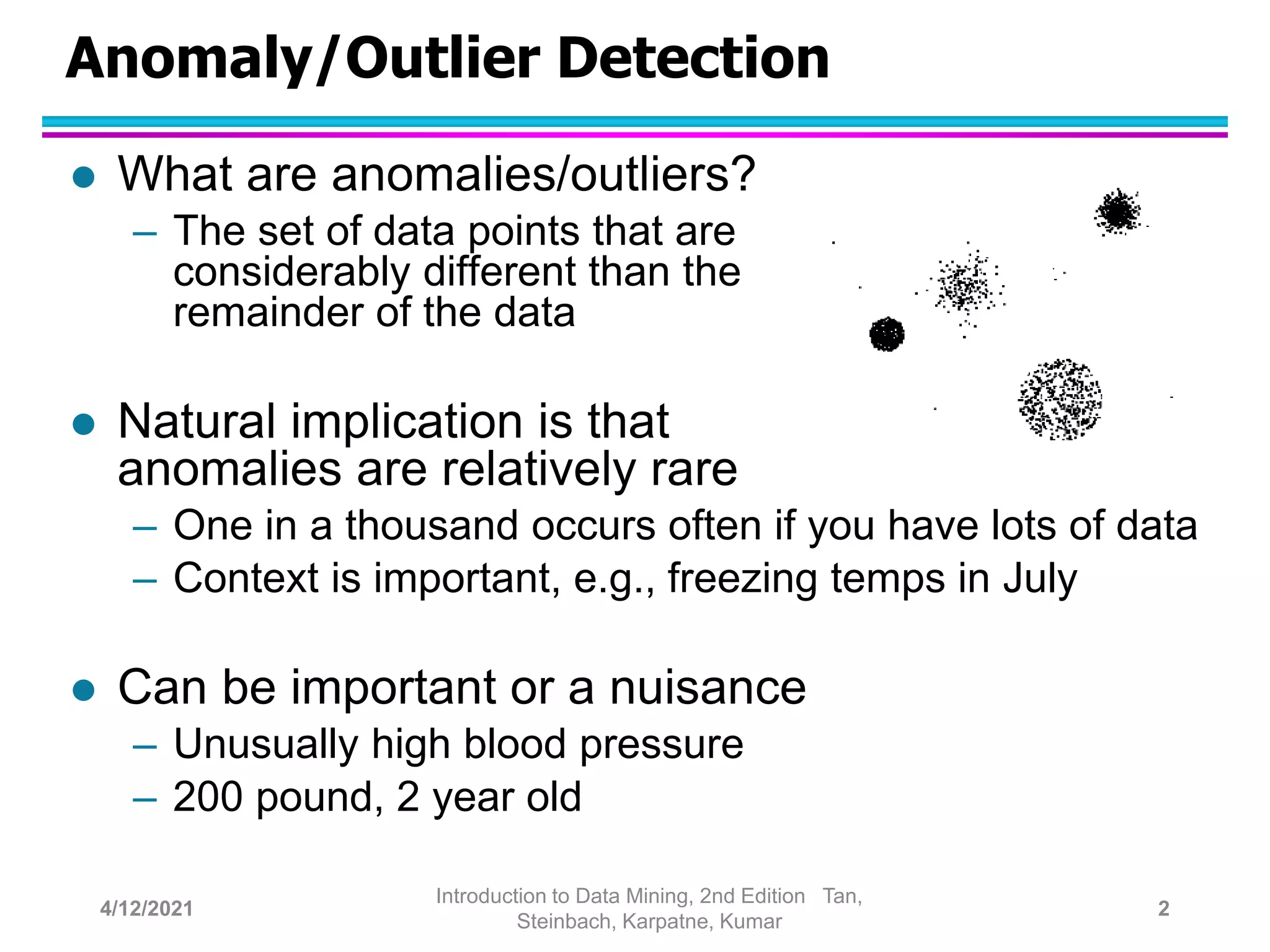
 What are anomalies/outliers?
– The set of data points that are
considerably different than the
remainder of the data
 Natural implication is that
anomalies are relatively rare
– One in a thousand occurs often if you have lots of data
– Context is important, e.g., freezing temps in July
 Can be important or a nuisance
– Unusually high blood pressure
– 200 pound, 2 year old
4/12/2021
Introduction to Data Mining, 2nd Edition Tan,
Steinbach, Karpatne, Kumar
2
Importance of Anomaly Detection
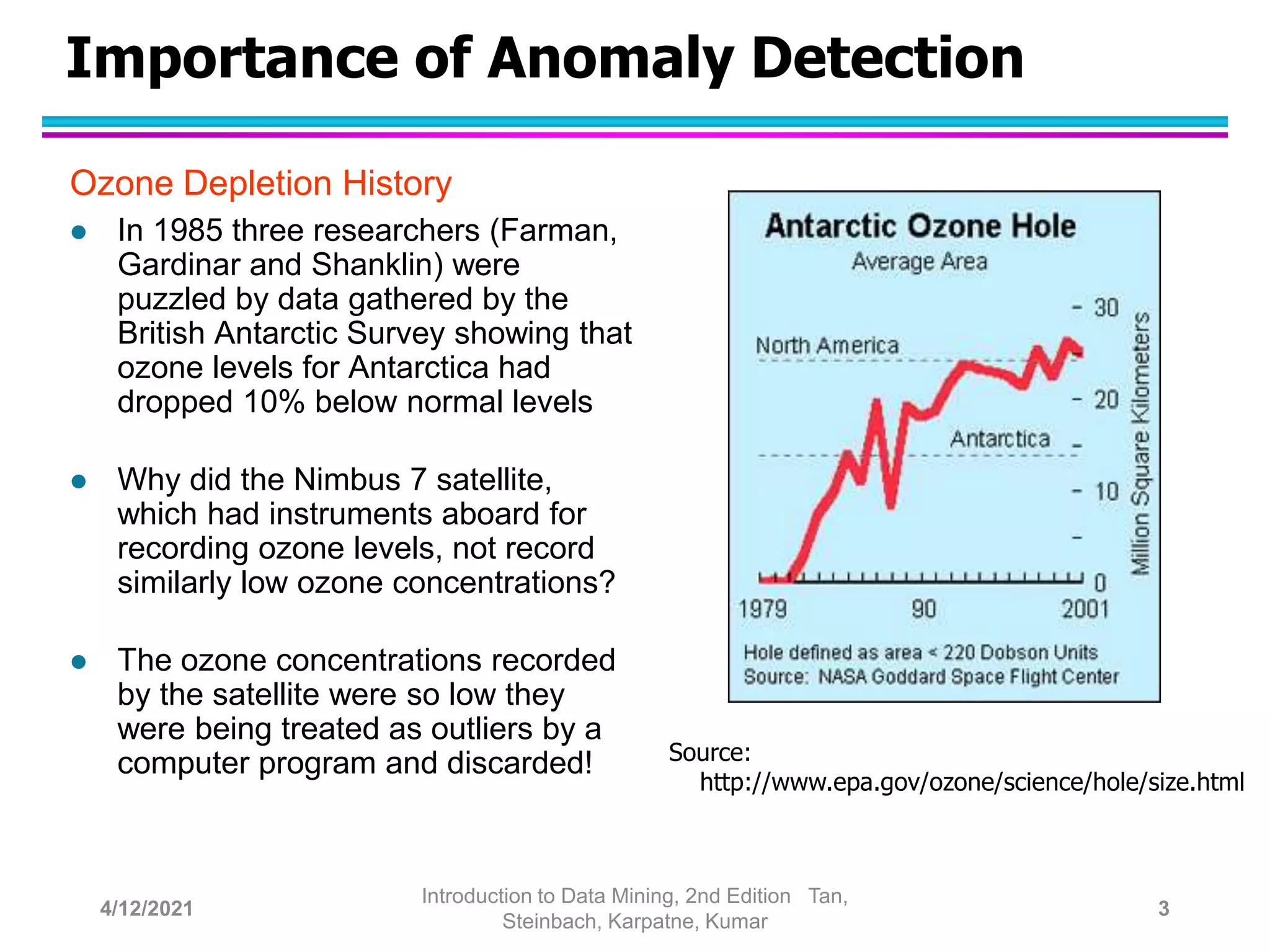
Ozone Depletion History
 In 1985 three researchers (Farman,
Gardinar and Shanklin) were
puzzled by data gathered by the
British Antarctic Survey showing that
ozone levels for Antarctica had
dropped 10% below normal levels
 Why did the Nimbus 7 satellite,
which had instruments aboard for
recording ozone levels, not record
similarly low ozone concentrations?
 The ozone concentrations recorded
by the satellite were so low they
were being treated as outliers by a
computer program and discarded! Source:
http://www.epa.gov/ozone/science/hole/size.html
4/12/2021
Introduction to Data Mining, 2nd Edition Tan,
Steinbach, Karpatne, Kumar
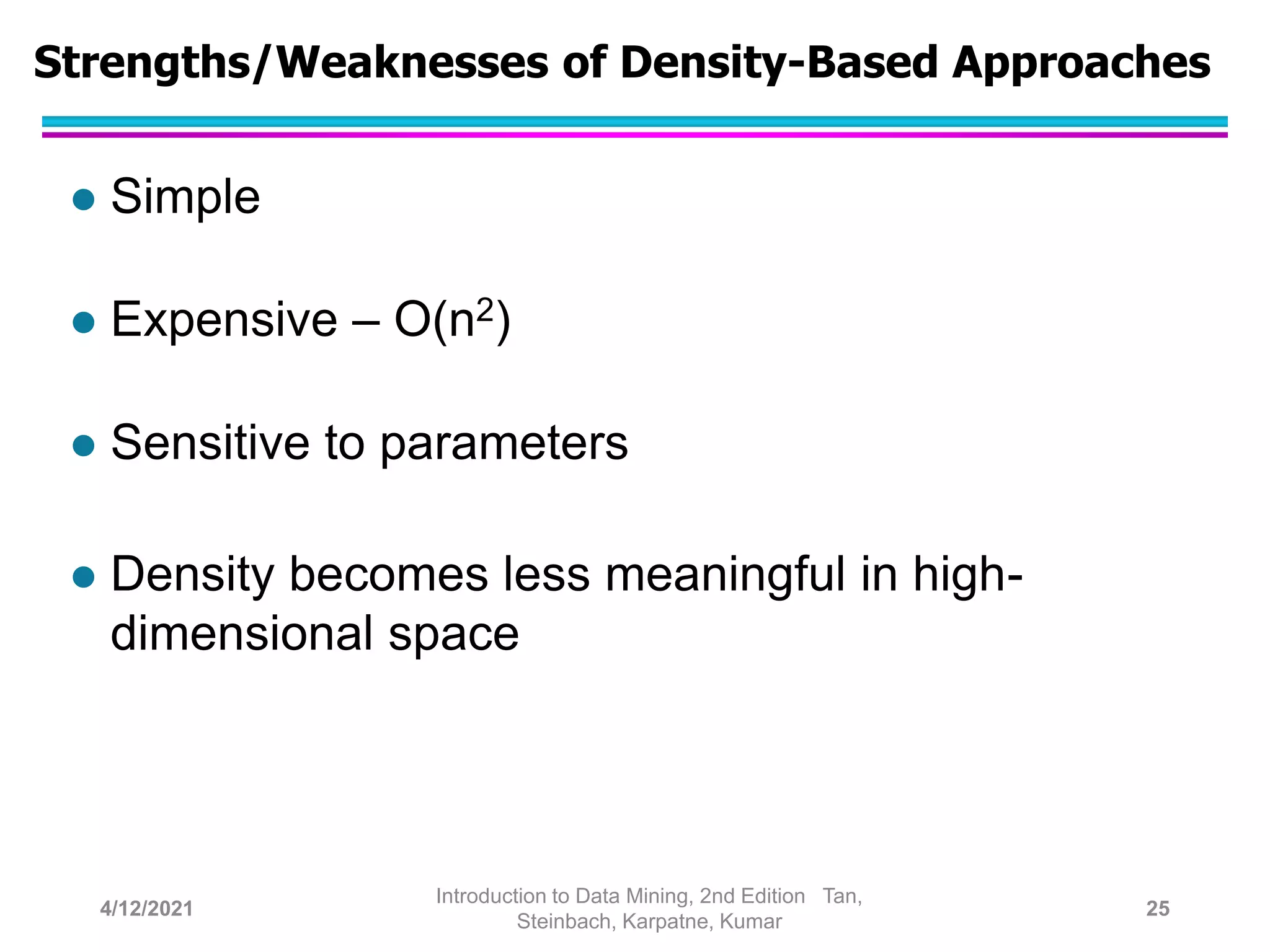
3
Causes of Anomalies
 Data from different classes
– Measuring the weights of oranges, but a few grapefruit
are mixed in
 Natural variation
– Unusually tall people
 Data errors
– 200 pound 2 year old
4/12/2021
Introduction to Data Mining, 2nd Edition Tan,
Steinbach, Karpatne, Kumar
4
https://umn.zoom.us/my/kumar001
Distinction Between Noise and Anomalies
 Noise doesn’t necessarily produce unusual values or
objects
 Noise is not interesting
 Noise and anomalies are related but distinct concepts
4/12/2021
Introduction to Data Mining, 2nd Edition Tan,
Steinbach, Karpatne, Kumar
5
Model-based vs Model-free
Model-based Approaches
Model can be parametric or non-parametric
Anomalies are those points that don’t fit well
Anomalies are those points that distort the model
Model-free Approaches
Anomalies are identified directly from the data without
building a model
Often the underlying assumption is that the
most of the points in the data are normal
4/12/2021
Introduction to Data Mining, 2nd Edition Tan,
Steinbach, Karpatne, Kumar
6
General Issues: Label vs Score
 Some anomaly detection techniques provide only a
binary categorization
 Other approaches measure the degree to which an
object is an anomaly
– This allows objects to be ranked
– Scores can also have associated meaning (e.g., statistical
significance)
4/12/2021
Introduction to Data Mining, 2nd Edition Tan,
Steinbach, Karpatne, Kumar
7
Anomaly Detection Techniques
 Statistical Approaches
 Proximity-based
– Anomalies are points far away from other points
 Clustering-based
– Points far away from cluster centers are outliers
– Small clusters are outliers
 Reconstruction Based
4/12/2021
Introduction to Data Mining, 2nd Edition Tan,
Steinbach, Karpatne, Kumar
8
Statistical Approaches
Probabilistic definition of an outlier: An outlier is an object that
has a low probability with respect to a probability distribution
model of the data.
 Usually assume a parametric model describing the distribution
of the data (e.g., normal distribution)
 Apply a statistical test that depends on
– Data distribution
– Parameters of distribution (e.g., mean, variance)
– Number of expected outliers (confidence limit)
 Issues
– Identifying the distribution of a data set
 Heavy tailed distribution
– Number of attributes
– Is the data a mixture of distributions?
4/12/2021
Introduction to Data Mining, 2nd Edition Tan,
Steinbach, Karpatne, Kumar
9
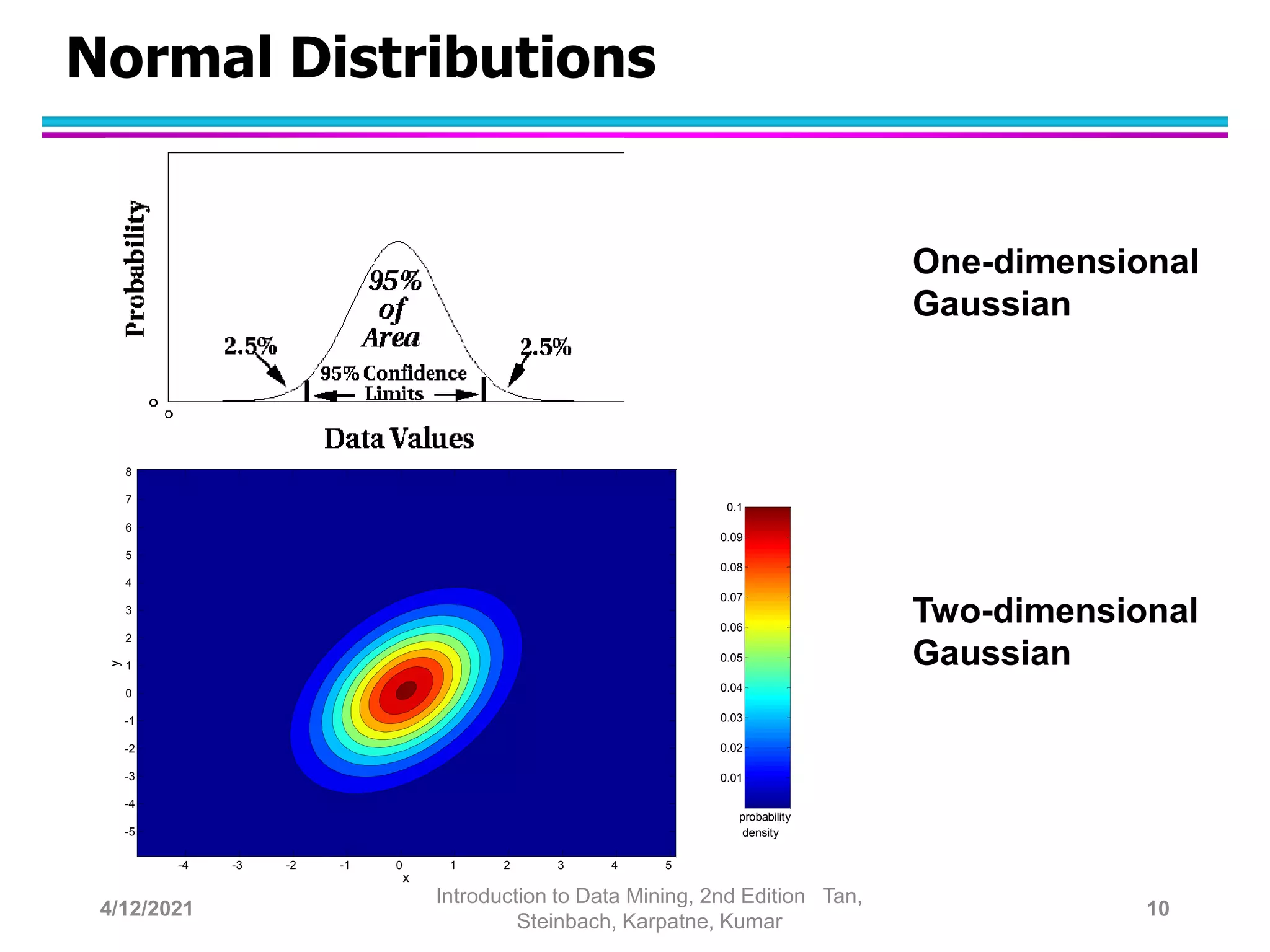
Normal Distributions
One-dimensional
Gaussian
Two-dimensional
Gaussian
x
y
-4 -3 -2 -1 0 1 2 3 4 5
-5
-4
-3
-2
-1
0
1
2
3
4
5
6
7
8
probability
density
0.01
0.02
0.03
0.04
0.05
0.06
0.07
0.08
0.09
0.1
4/12/2021
Introduction to Data Mining, 2nd Edition Tan,
Steinbach, Karpatne, Kumar
10
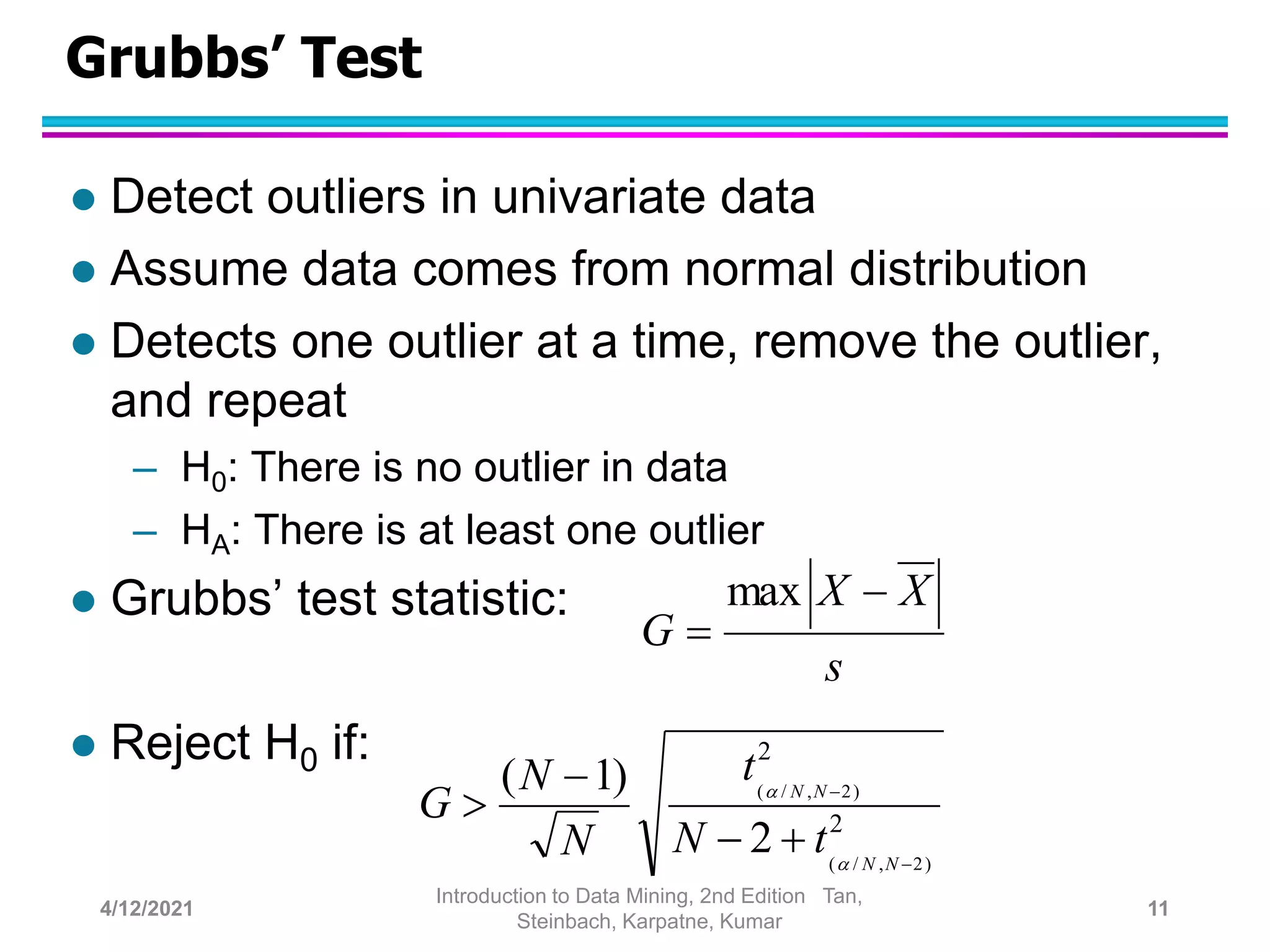
Grubbs’ Test
 Detect outliers in univariate data
 Assume data comes from normal distribution
 Detects one outlier at a time, remove the outlier,
and repeat
– H0: There is no outlier in data
– HA: There is at least one outlier
 Grubbs’ test statistic:
 Reject H0 if:
s
X
X
G


max
2
2
)
2
,
/
(
)
2
,
/
(
2
)
1
(






N
N
N
N
t
N
t
N
N
G


4/12/2021
Introduction to Data Mining, 2nd Edition Tan,
Steinbach, Karpatne, Kumar
11
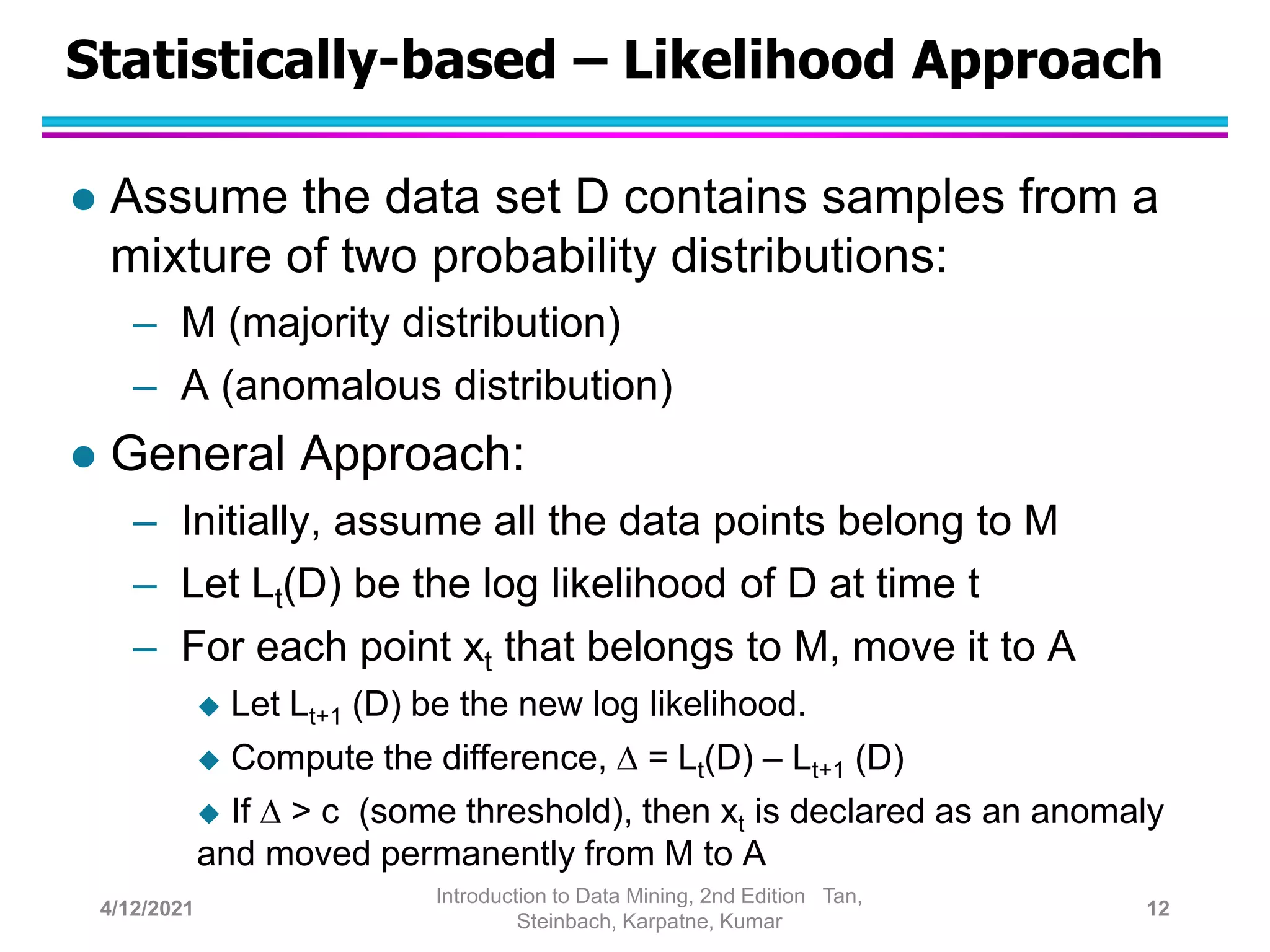
Statistically-based – Likelihood Approach
 Assume the data set D contains samples from a
mixture of two probability distributions:
– M (majority distribution)
– A (anomalous distribution)
 General Approach:
– Initially, assume all the data points belong to M
– Let Lt(D) be the log likelihood of D at time t
– For each point xt that belongs to M, move it to A
 Let Lt+1 (D) be the new log likelihood.
 Compute the difference,  = Lt(D) – Lt+1 (D)
 If  > c (some threshold), then xt is declared as an anomaly
and moved permanently from M to A
4/12/2021
Introduction to Data Mining, 2nd Edition Tan,
Steinbach, Karpatne, Kumar
12
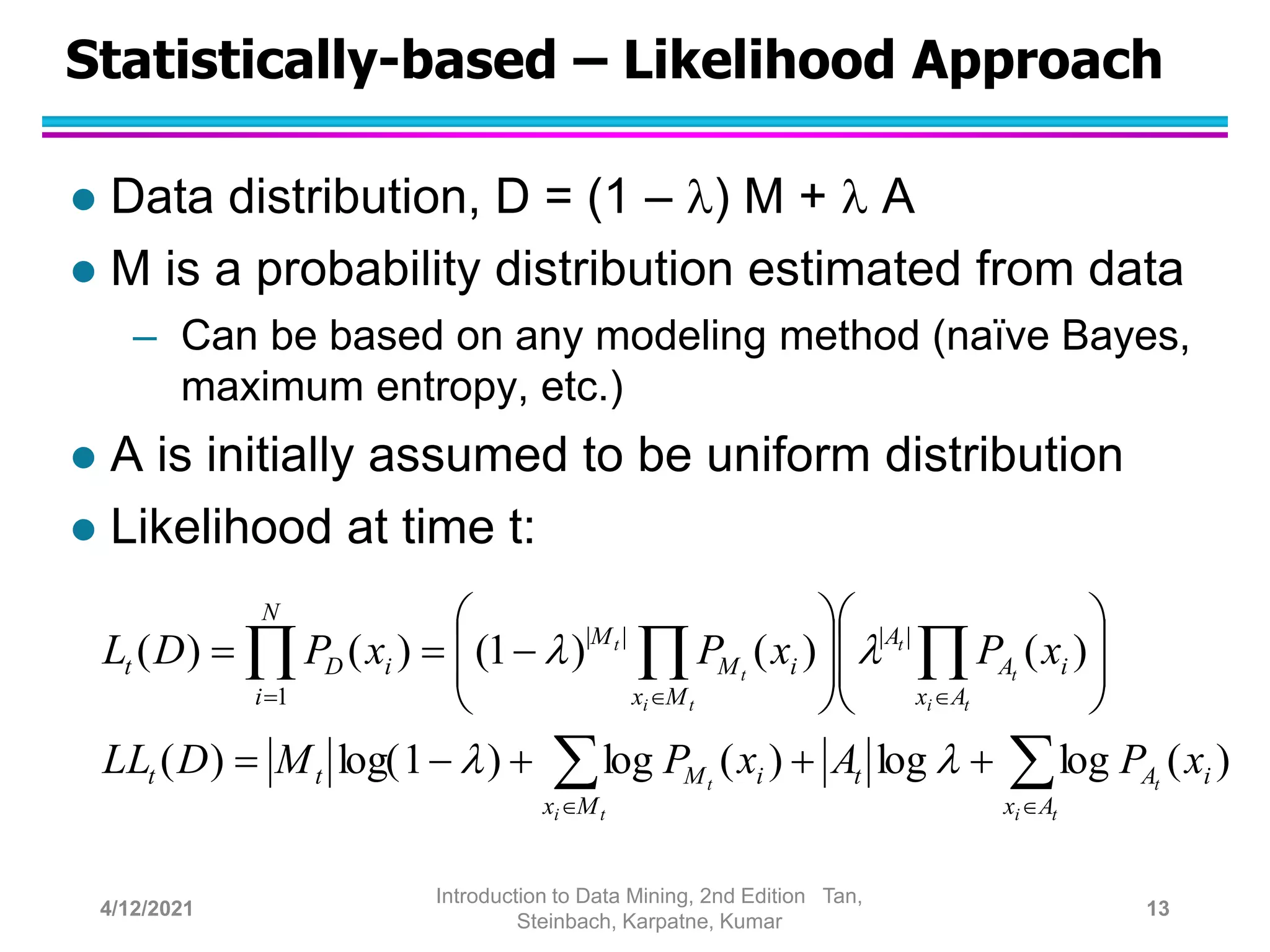
Statistically-based – Likelihood Approach
 Data distribution, D = (1 – ) M +  A
 M is a probability distribution estimated from data
– Can be based on any modeling method (naïve Bayes,
maximum entropy, etc.)
 A is initially assumed to be uniform distribution
 Likelihood at time t:


































t
i
t
t
i
t
t
i
t
t
t
i
t
t
A
x
i
A
t
M
x
i
M
t
t
A
x
i
A
A
M
x
i
M
M
N
i
i
D
t
x
P
A
x
P
M
D
LL
x
P
x
P
x
P
D
L
)
(
log
log
)
(
log
)
1
log(
)
(
)
(
)
(
)
1
(
)
(
)
( |
|
|
|
1




4/12/2021
Introduction to Data Mining, 2nd Edition Tan,
Steinbach, Karpatne, Kumar
13
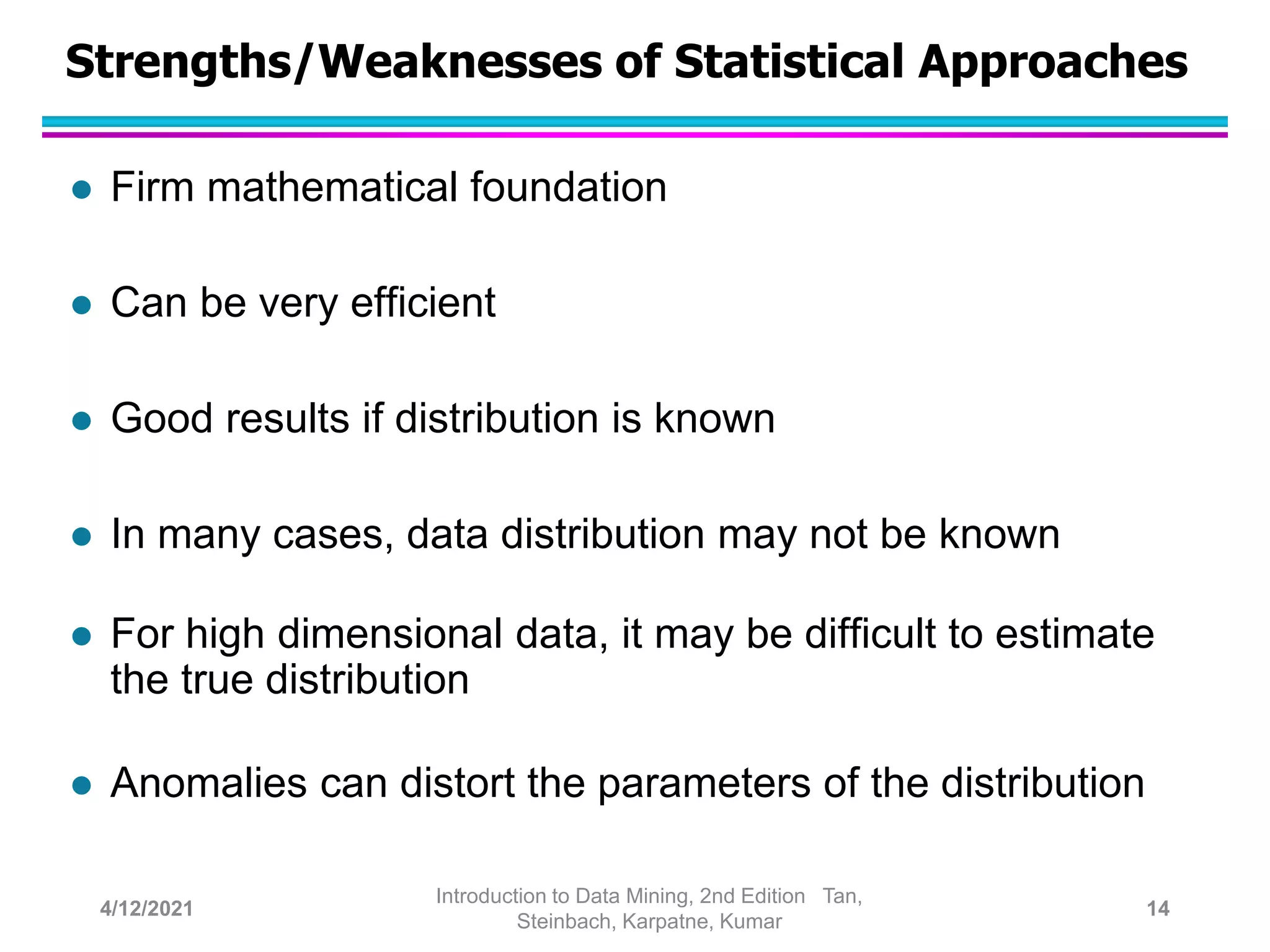
Strengths/Weaknesses of Statistical Approaches
 Firm mathematical foundation
 Can be very efficient
 Good results if distribution is known
 In many cases, data distribution may not be known
 For high dimensional data, it may be difficult to estimate
the true distribution
 Anomalies can distort the parameters of the distribution
4/12/2021
Introduction to Data Mining, 2nd Edition Tan,
Steinbach, Karpatne, Kumar
14
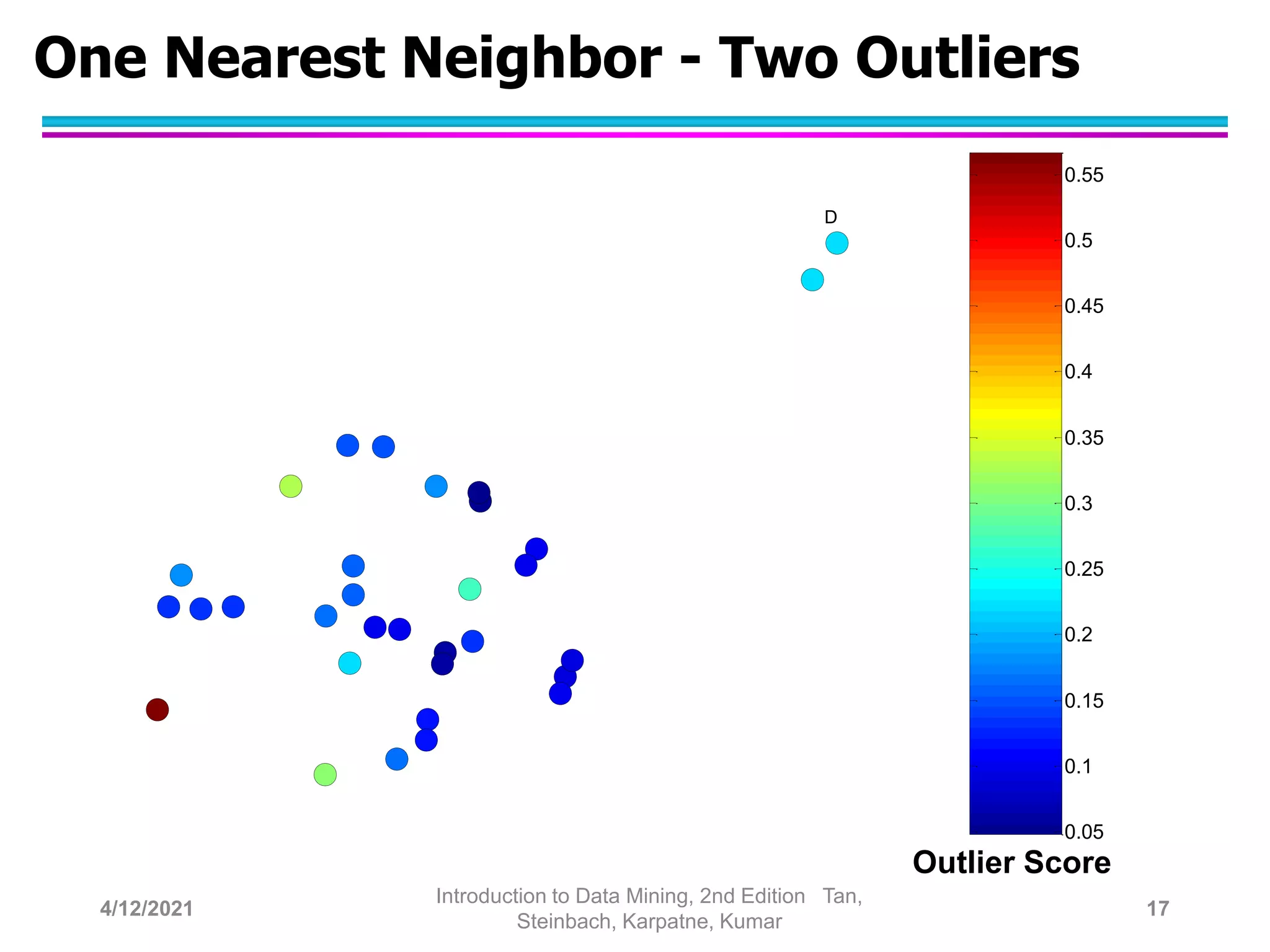
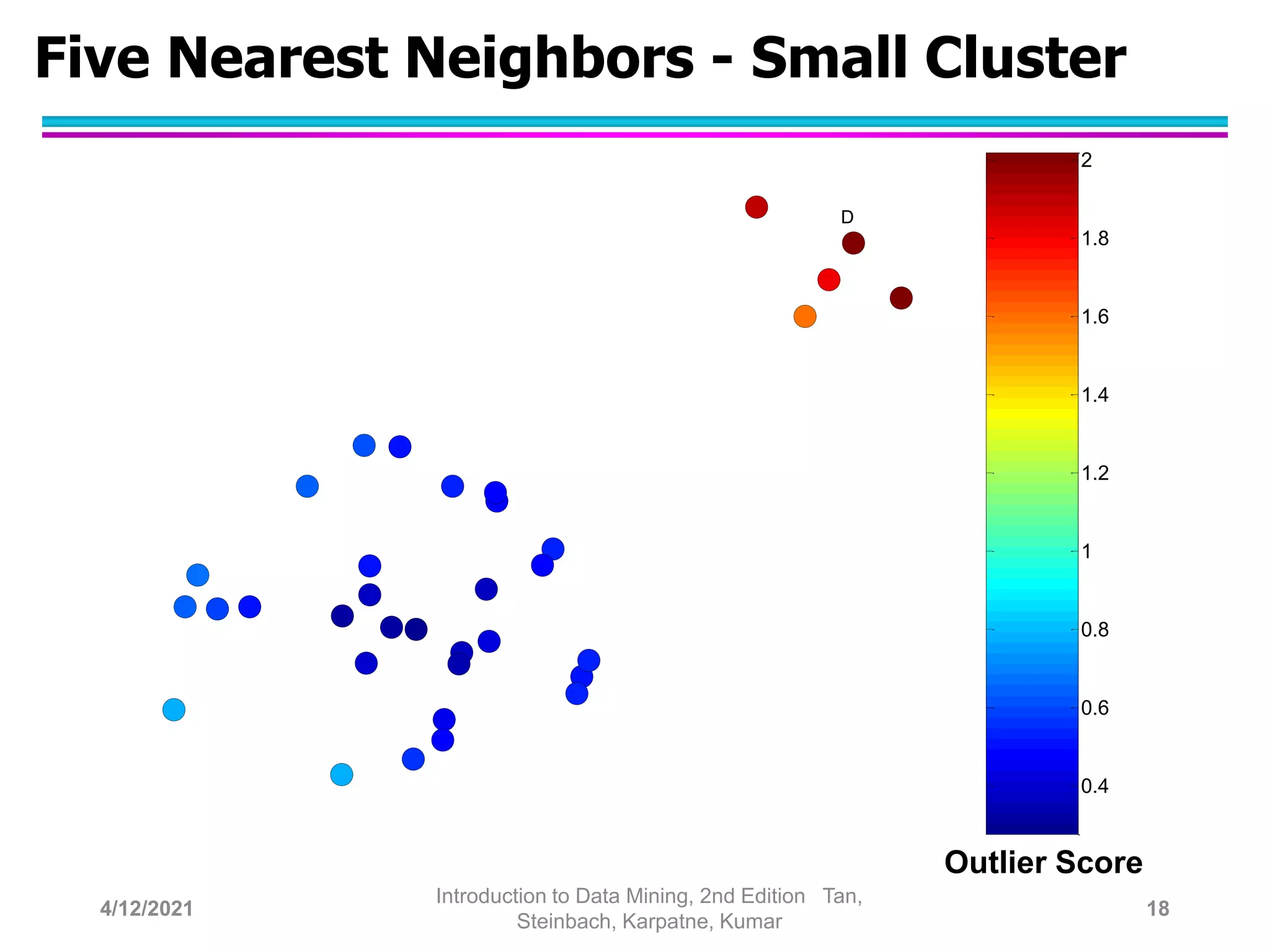
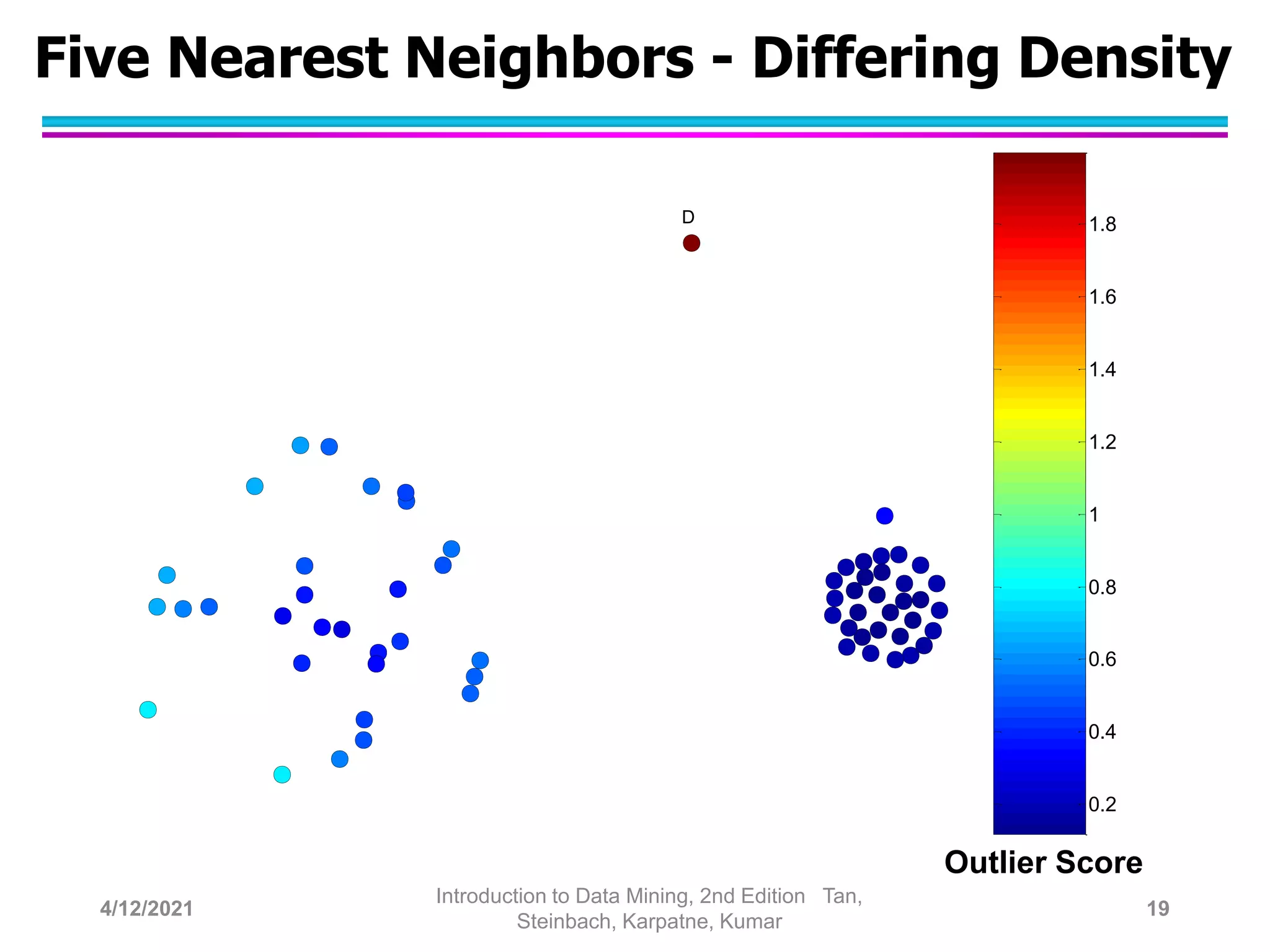
Distance-Based Approaches
 The outlier score of an object is the distance to
its kth nearest neighbor
4/12/2021
Introduction to Data Mining, 2nd Edition Tan,
Steinbach, Karpatne, Kumar
15
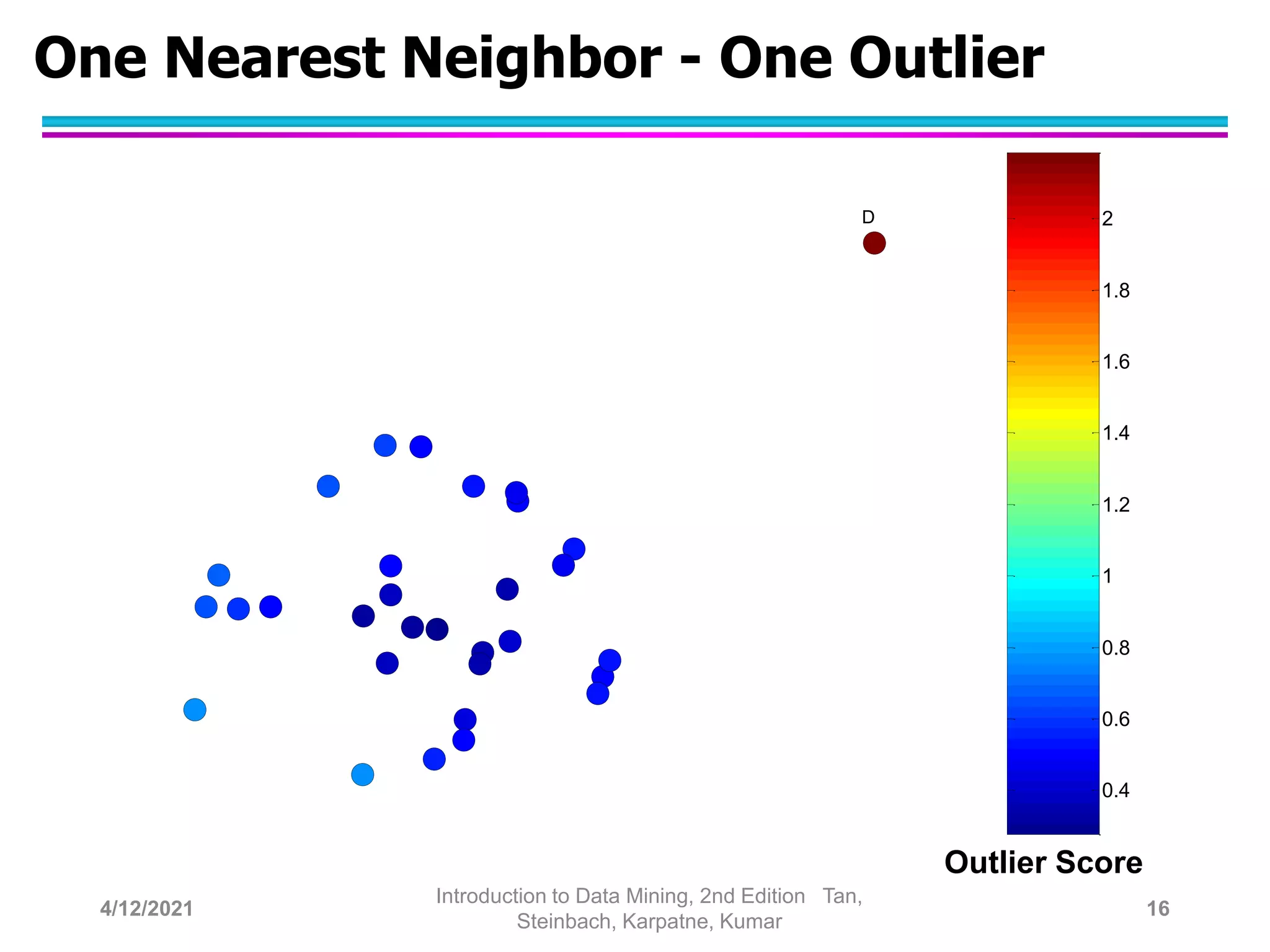
One Nearest Neighbor - One Outlier
D
0.4
0.6
0.8
1
1.2
1.4
1.6
1.8
2
Outlier Score
4/12/2021
Introduction to Data Mining, 2nd Edition Tan,
Steinbach, Karpatne, Kumar
16
One Nearest Neighbor - Two Outliers
D
0.05
0.1
0.15
0.2
0.25
0.3
0.35
0.4
0.45
0.5
0.55
Outlier Score
4/12/2021
Introduction to Data Mining, 2nd Edition Tan,
Steinbach, Karpatne, Kumar
17
Five Nearest Neighbors - Small Cluster
D
0.4
0.6
0.8
1
1.2
1.4
1.6
1.8
2
Outlier Score
4/12/2021
Introduction to Data Mining, 2nd Edition Tan,
Steinbach, Karpatne, Kumar
18
Five Nearest Neighbors - Differing Density
D
0.2
0.4
0.6
0.8
1
1.2
1.4
1.6
1.8
Outlier Score
4/12/2021
Introduction to Data Mining, 2nd Edition Tan,
Steinbach, Karpatne, Kumar
19
Strengths/Weaknesses of Distance-Based Approaches
 Simple
 Expensive – O(n2)
 Sensitive to parameters
 Sensitive to variations in density
 Distance becomes less meaningful in high-
dimensional space
4/12/2021
Introduction to Data Mining, 2nd Edition Tan,
Steinbach, Karpatne, Kumar
20
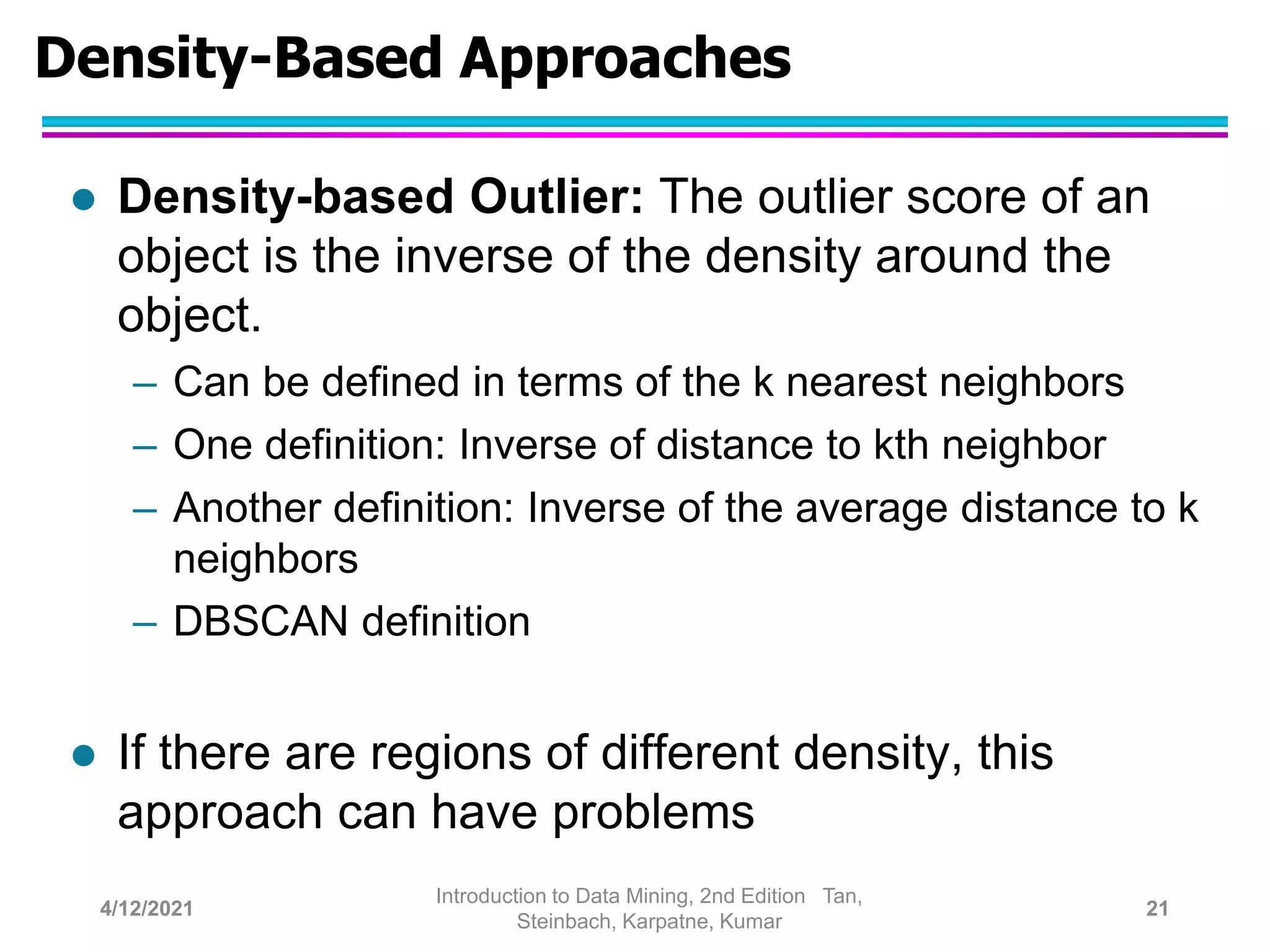
Density-Based Approaches
 Density-based Outlier: The outlier score of an
object is the inverse of the density around the
object.
– Can be defined in terms of the k nearest neighbors
– One definition: Inverse of distance to kth neighbor
– Another definition: Inverse of the average distance to k
neighbors
– DBSCAN definition
 If there are regions of different density, this
approach can have problems
4/12/2021
Introduction to Data Mining, 2nd Edition Tan,
Steinbach, Karpatne, Kumar
21
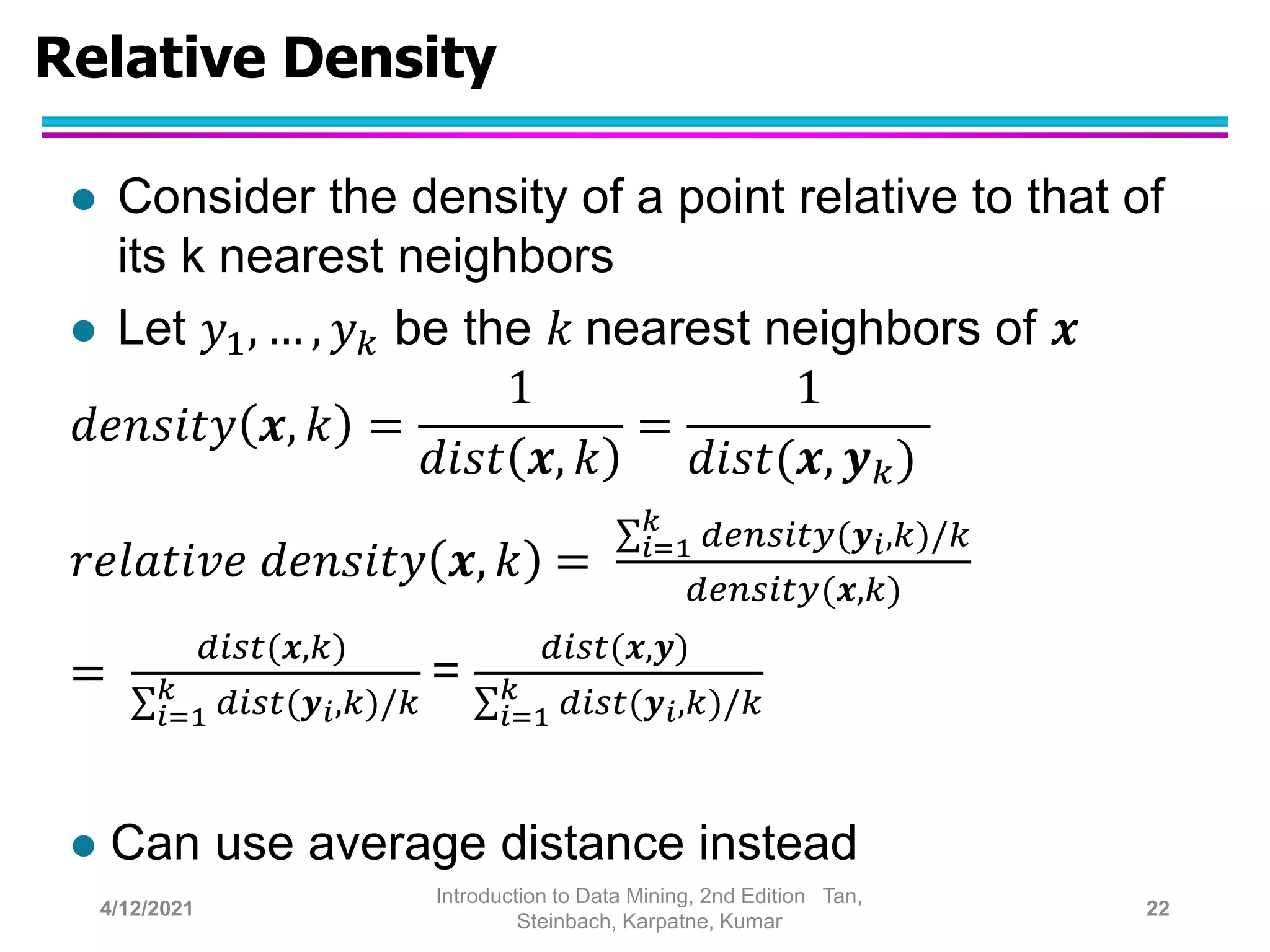
Relative Density
 Consider the density of a point relative to that of
its k nearest neighbors
 Let 𝑦1, … , 𝑦𝑘 be the 𝑘 nearest neighbors of 𝒙
𝑑𝑒𝑛𝑠𝑖𝑡𝑦 𝒙, 𝑘 =
1
𝑑𝑖𝑠𝑡 𝒙, 𝑘
=
1
𝑑𝑖𝑠𝑡(𝒙, 𝒚𝑘)
𝑟𝑒𝑙𝑎𝑡𝑖𝑣𝑒 𝑑𝑒𝑛𝑠𝑖𝑡𝑦 𝒙, 𝑘 = 𝑖=1
𝑘
𝑑𝑒𝑛𝑠𝑖𝑡𝑦(𝒚𝑖,𝑘)/𝑘
𝑑𝑒𝑛𝑠𝑖𝑡𝑦(𝒙,𝑘)
=
𝑑𝑖𝑠𝑡(𝒙,𝑘)
𝑖=1
𝑘
𝑑𝑖𝑠𝑡(𝒚𝑖,𝑘)/𝑘
=
𝑑𝑖𝑠𝑡(𝒙,𝒚)
𝑖=1
𝑘
𝑑𝑖𝑠𝑡(𝒚𝑖,𝑘)/𝑘
 Can use average distance instead
4/12/2021
Introduction to Data Mining, 2nd Edition Tan,
Steinbach, Karpatne, Kumar
22
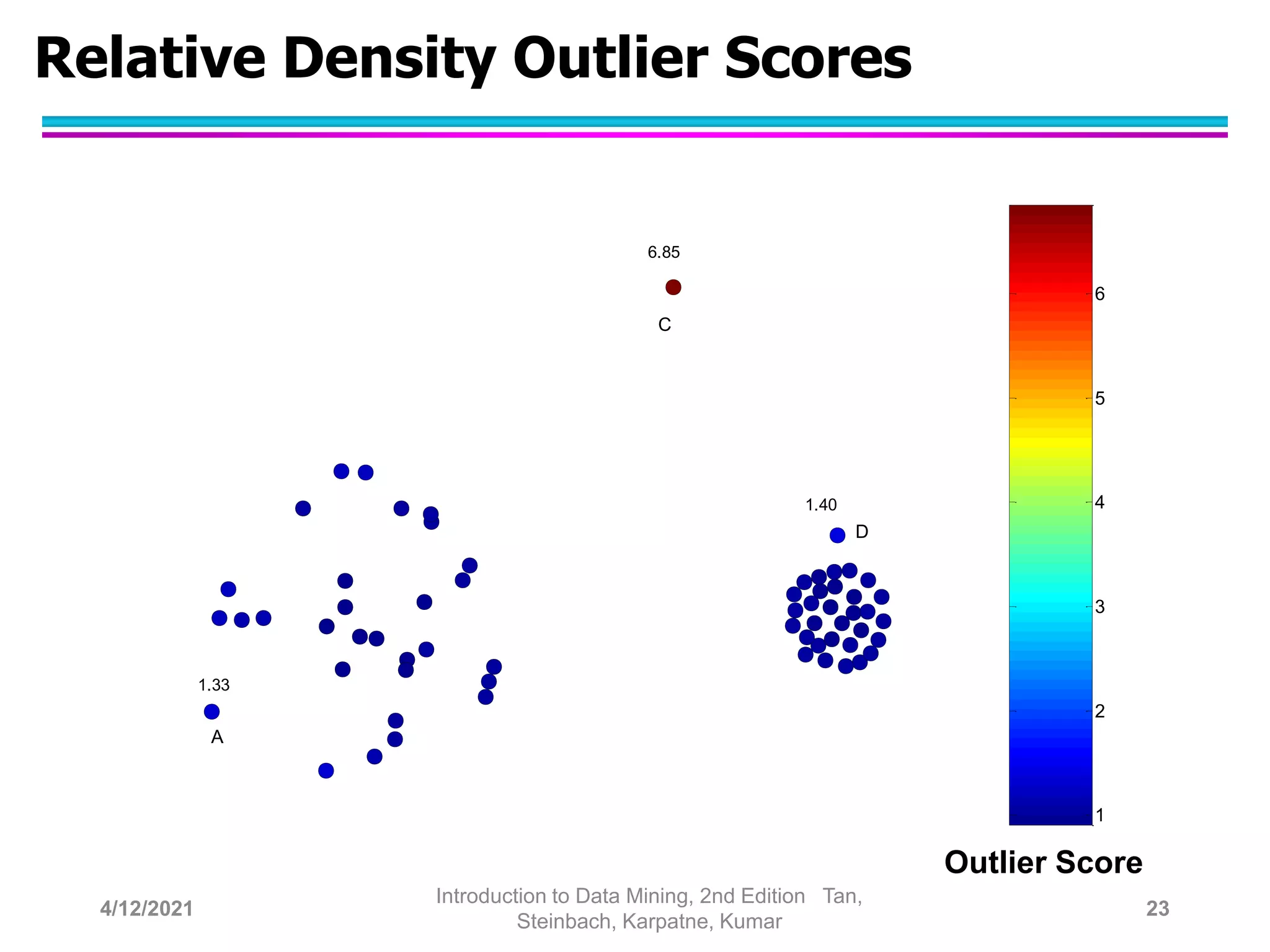
Relative Density Outlier Scores
Outlier Score
1
2
3
4
5
6
6.85
1.33
1.40
A
C
D
4/12/2021
Introduction to Data Mining, 2nd Edition Tan,
Steinbach, Karpatne, Kumar
23
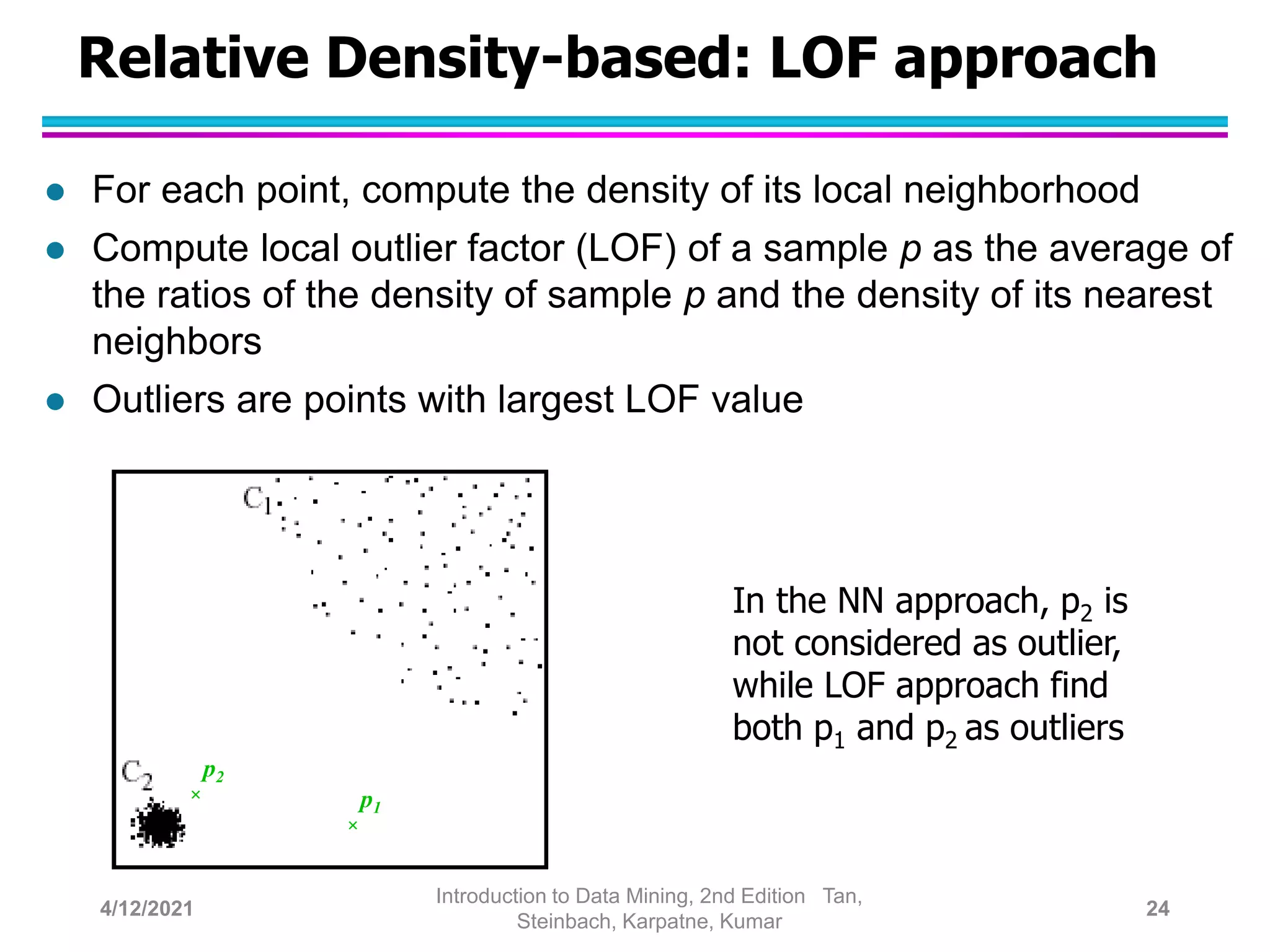
Relative Density-based: LOF approach
 For each point, compute the density of its local neighborhood
 Compute local outlier factor (LOF) of a sample p as the average of
the ratios of the density of sample p and the density of its nearest
neighbors
 Outliers are points with largest LOF value
p2
 p1

In the NN approach, p2 is
not considered as outlier,
while LOF approach find
both p1 and p2 as outliers
4/12/2021
Introduction to Data Mining, 2nd Edition Tan,
Steinbach, Karpatne, Kumar
24
Strengths/Weaknesses of Density-Based Approaches
 Simple
 Expensive – O(n2)
 Sensitive to parameters
 Density becomes less meaningful in high-
dimensional space
4/12/2021
Introduction to Data Mining, 2nd Edition Tan,
Steinbach, Karpatne, Kumar
25
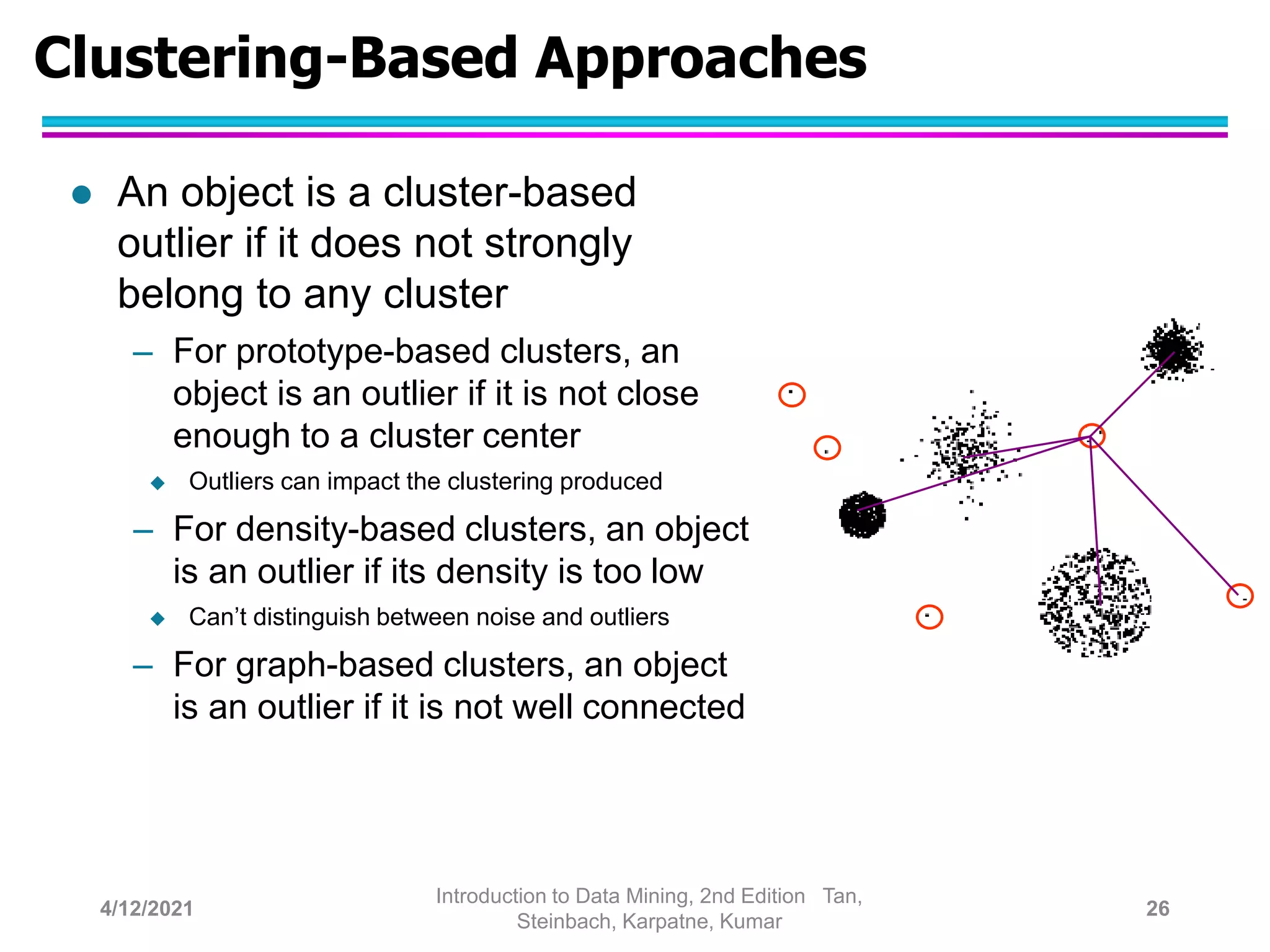
Clustering-Based Approaches
 An object is a cluster-based
outlier if it does not strongly
belong to any cluster
– For prototype-based clusters, an
object is an outlier if it is not close
enough to a cluster center
 Outliers can impact the clustering produced
– For density-based clusters, an object
is an outlier if its density is too low
 Can’t distinguish between noise and outliers
– For graph-based clusters, an object
is an outlier if it is not well connected
4/12/2021
Introduction to Data Mining, 2nd Edition Tan,
Steinbach, Karpatne, Kumar
26
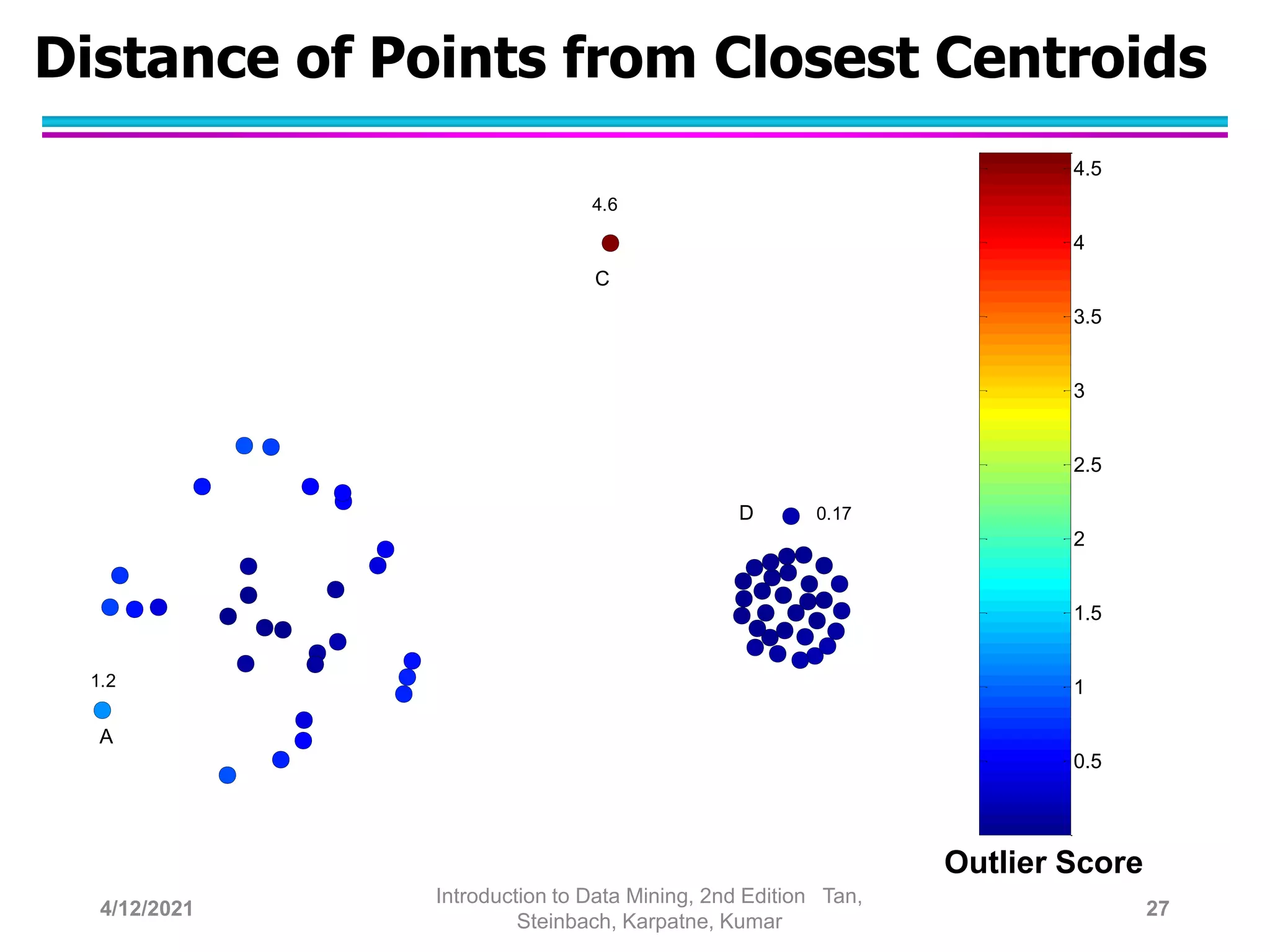
Distance of Points from Closest Centroids
Outlier Score
0.5
1
1.5
2
2.5
3
3.5
4
4.5
D
C
A
1.2
0.17
4.6
4/12/2021
Introduction to Data Mining, 2nd Edition Tan,
Steinbach, Karpatne, Kumar
27
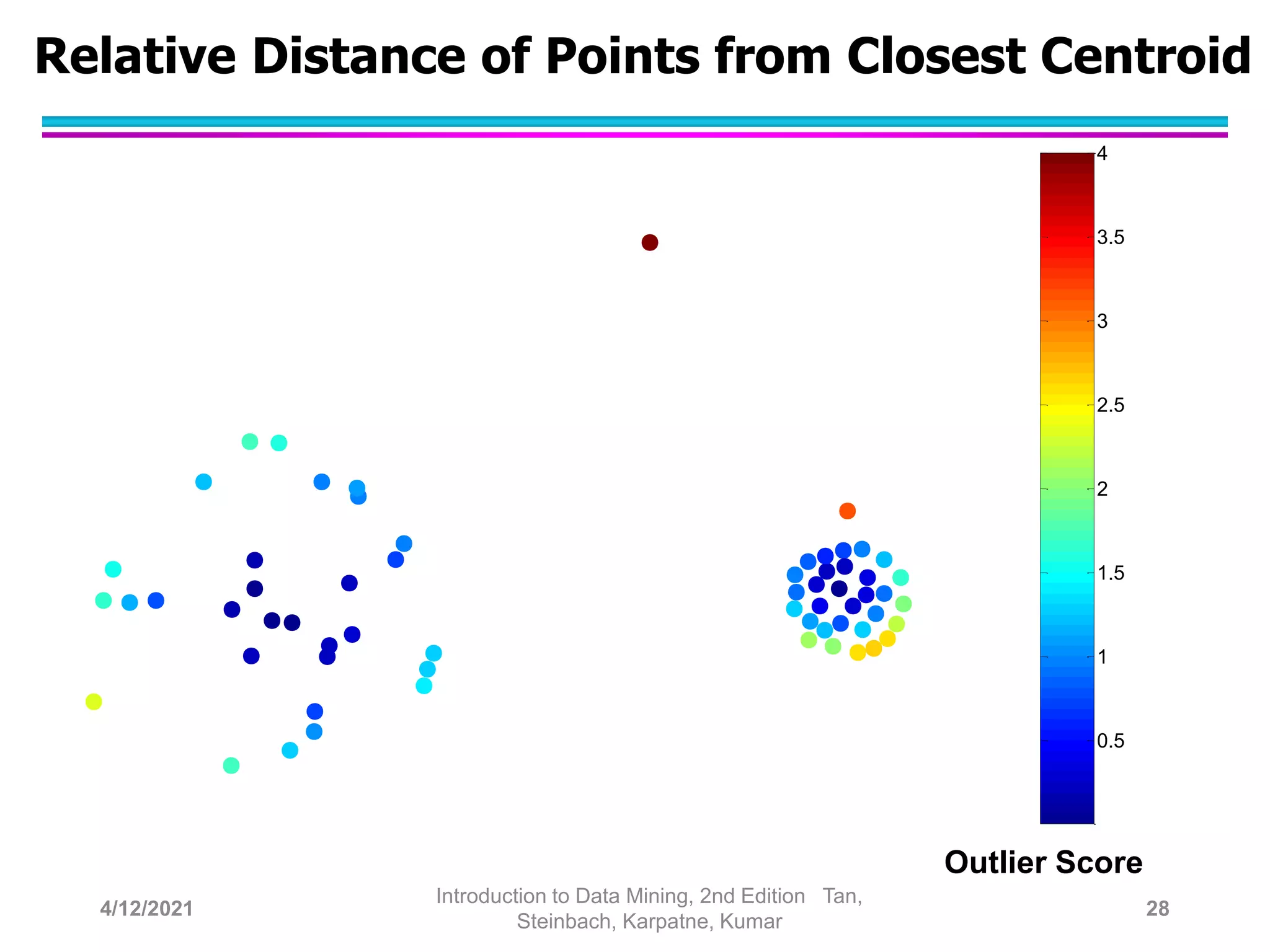
Relative Distance of Points from Closest Centroid
Outlier Score
0.5
1
1.5
2
2.5
3
3.5
4
4/12/2021
Introduction to Data Mining, 2nd Edition Tan,
Steinbach, Karpatne, Kumar
28
Strengths/Weaknesses of Clustering-Based Approaches
 Simple
 Many clustering techniques can be used
 Can be difficult to decide on a clustering
technique
 Can be difficult to decide on number of clusters
 Outliers can distort the clusters
4/12/2021
Introduction to Data Mining, 2nd Edition Tan,
Steinbach, Karpatne, Kumar
29
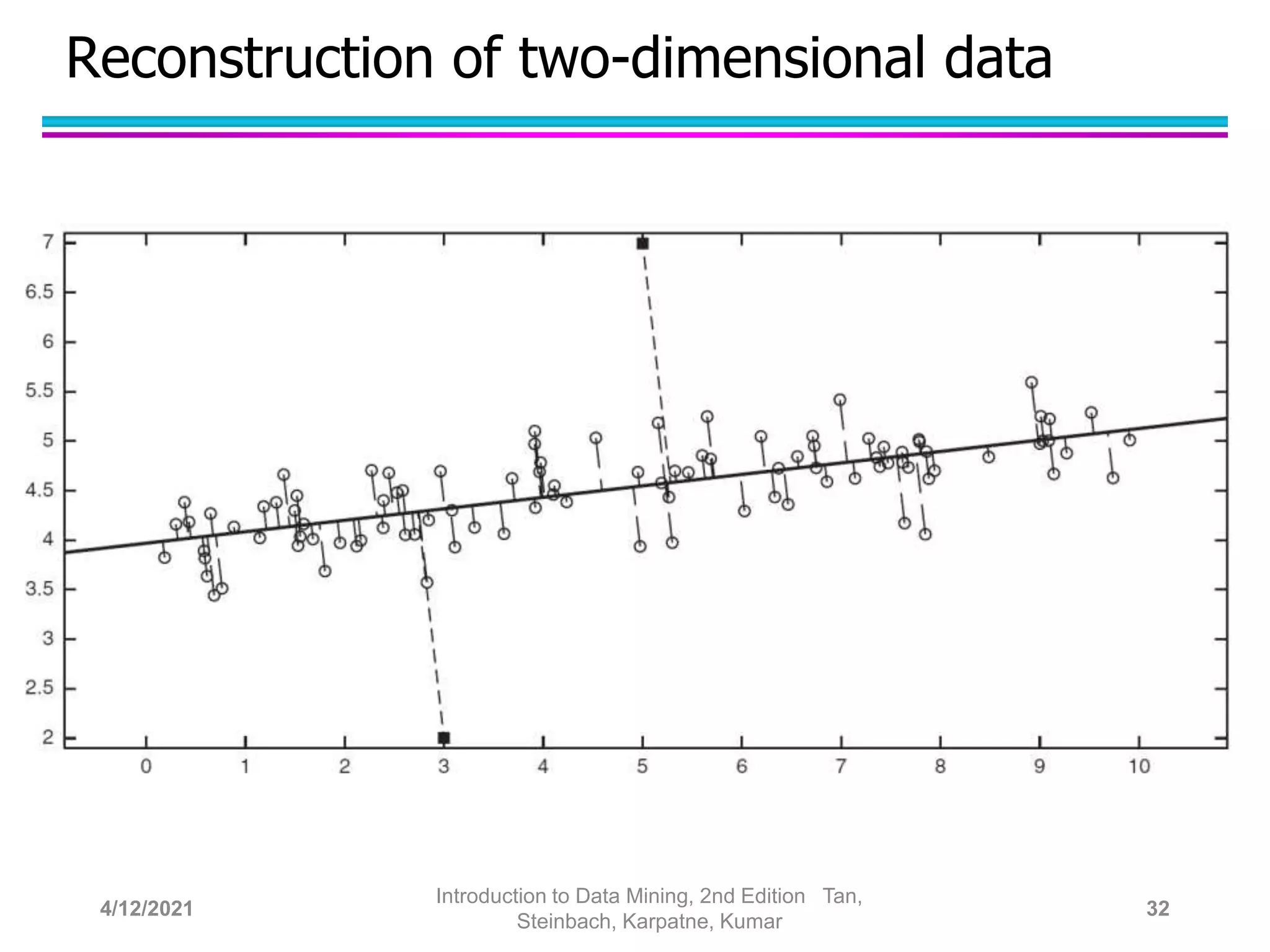
Reconstruction-Based Approaches
 Based on assumptions there are patterns in the
distribution of the normal class that can be
captured using lower-dimensional
representations
 Reduce data to lower dimensional data
– E.g. Use Principal Components Analysis (PCA) or
Auto-encoders
 Measure the reconstruction error for each object
– The difference between original and reduced
dimensionality version
4/12/2021
Introduction to Data Mining, 2nd Edition Tan,
Steinbach, Karpatne, Kumar
30
Reconstruction Error
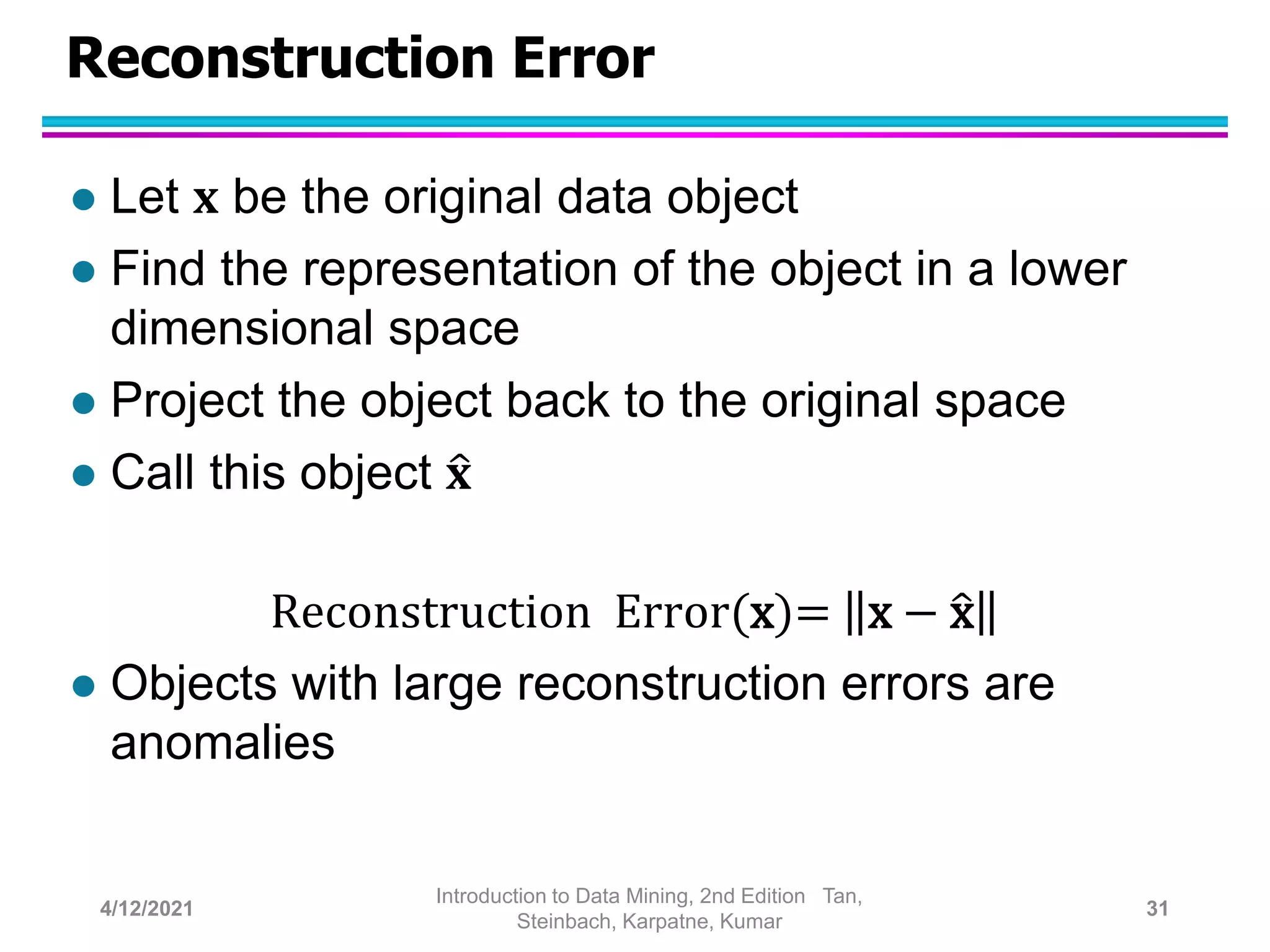
 Let 𝐱 be the original data object
 Find the representation of the object in a lower
dimensional space
 Project the object back to the original space
 Call this object 𝐱
Reconstruction Error(x)= x − x
 Objects with large reconstruction errors are
anomalies
4/12/2021
Introduction to Data Mining, 2nd Edition Tan,
Steinbach, Karpatne, Kumar
31
Reconstruction of two-dimensional data
4/12/2021
Introduction to Data Mining, 2nd Edition Tan,
Steinbach, Karpatne, Kumar
32
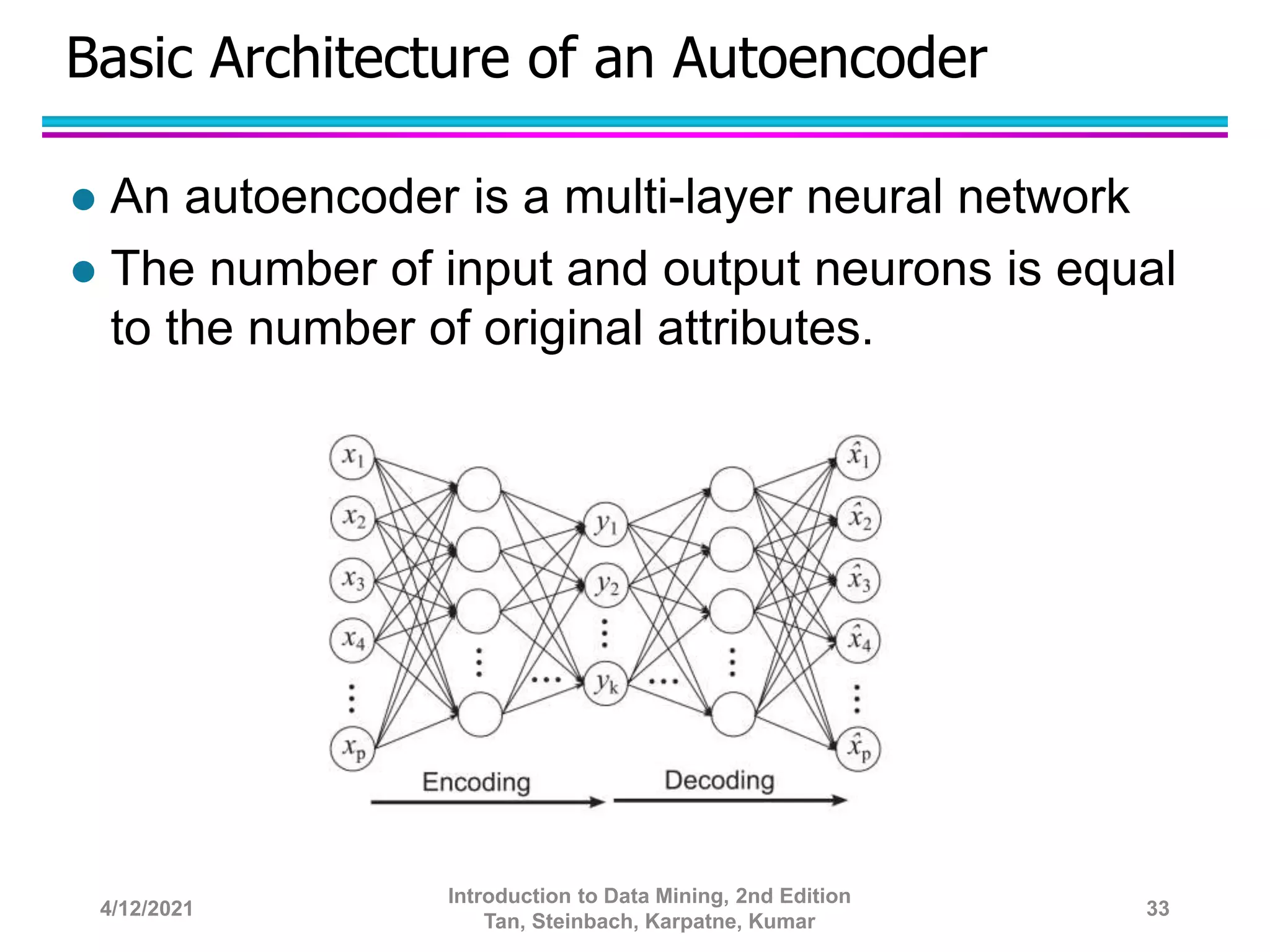
Basic Architecture of an Autoencoder
 An autoencoder is a multi-layer neural network
 The number of input and output neurons is equal
to the number of original attributes.
4/12/2021
Introduction to Data Mining, 2nd Edition
Tan, Steinbach, Karpatne, Kumar
33
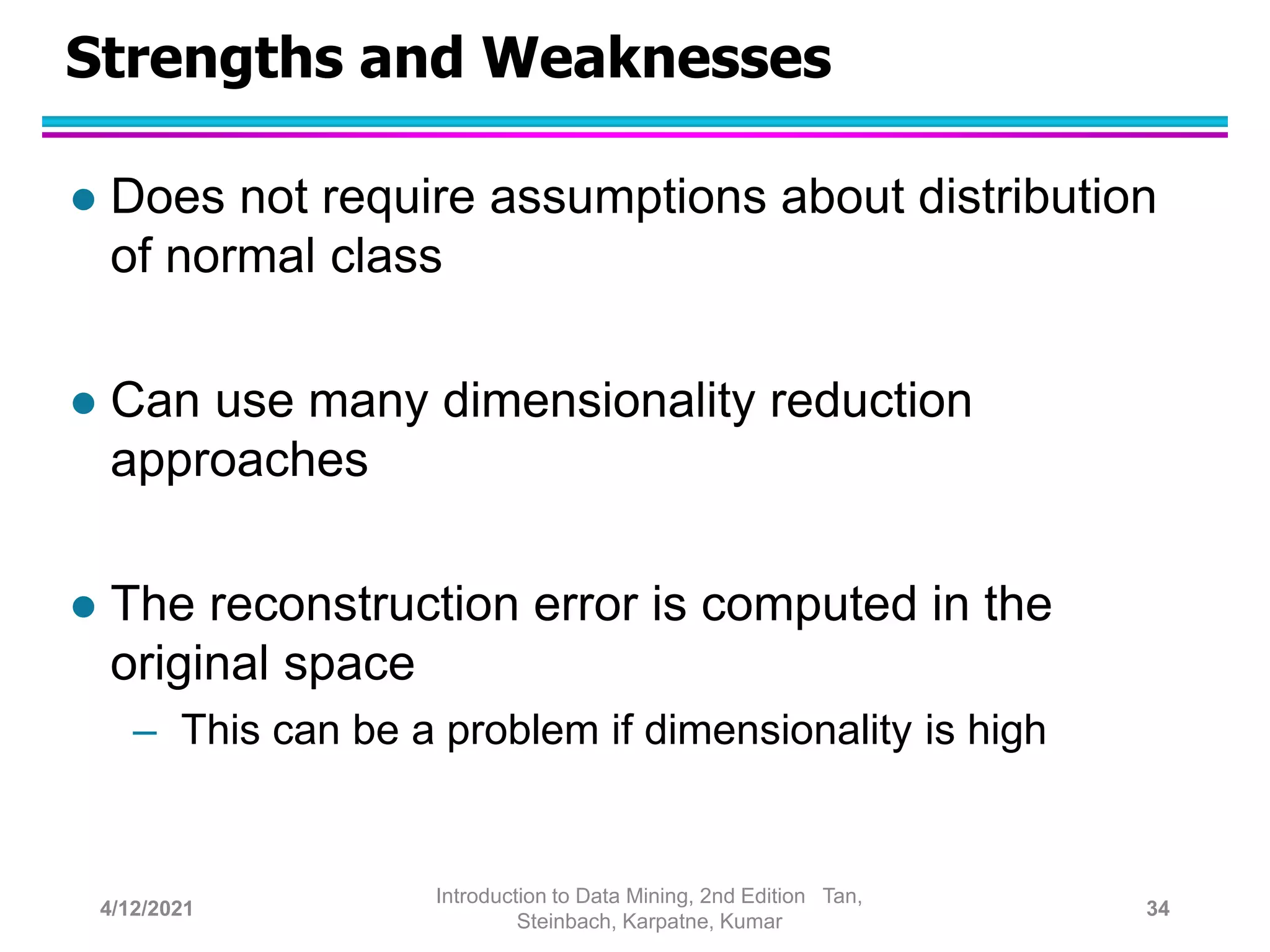
Strengths and Weaknesses
 Does not require assumptions about distribution
of normal class
 Can use many dimensionality reduction
approaches
 The reconstruction error is computed in the
original space
– This can be a problem if dimensionality is high
4/12/2021
Introduction to Data Mining, 2nd Edition Tan,
Steinbach, Karpatne, Kumar
34
One Class SVM
 Uses an SVM approach to classify normal objects
 Uses the given data to construct such a model
 This data may contain outliers
 But the data does not contain class labels
 How to build a classifier given one class?
4/12/2021
Introduction to Data Mining, 2nd Edition Tan,
Steinbach, Karpatne, Kumar
35
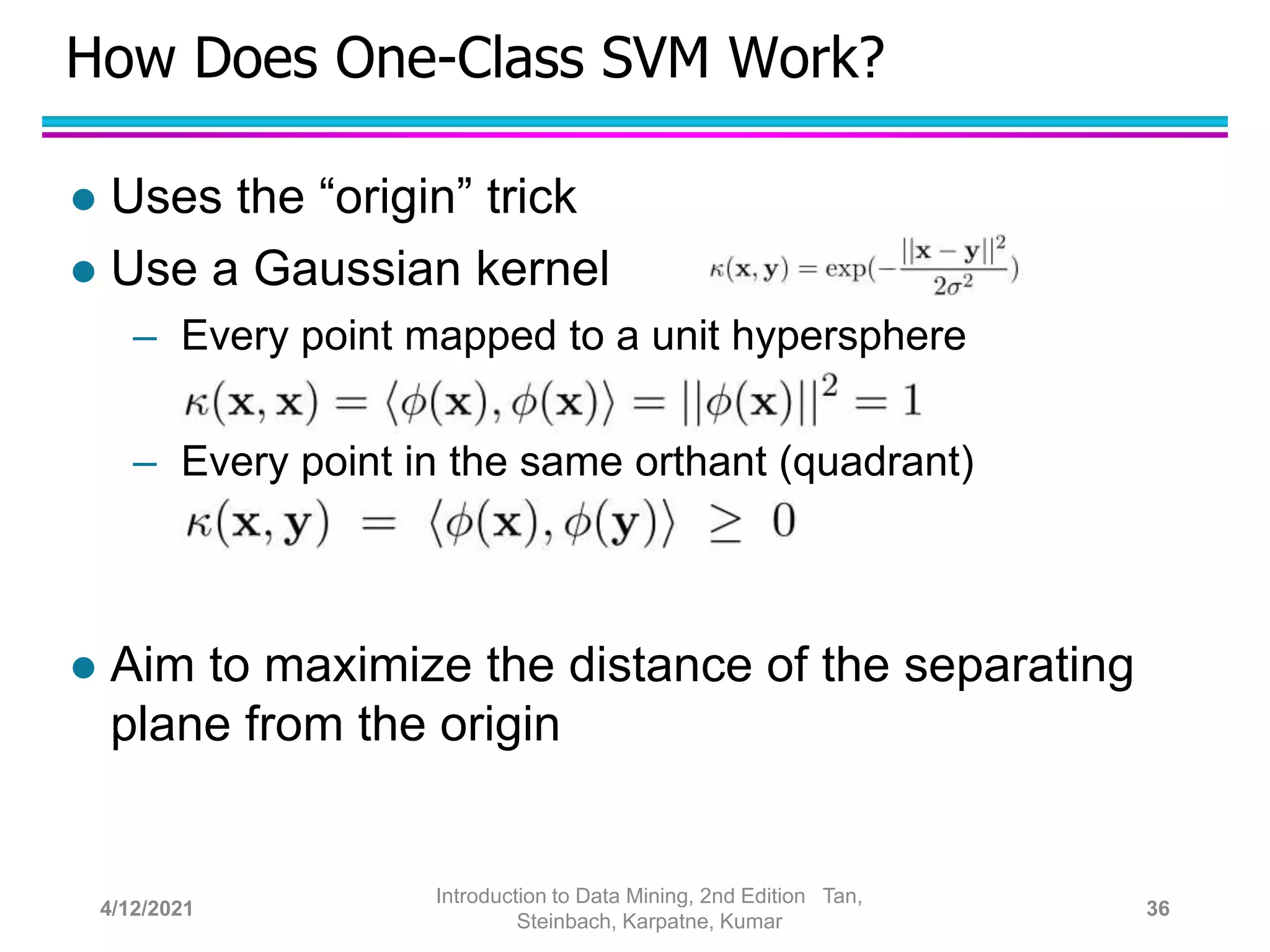
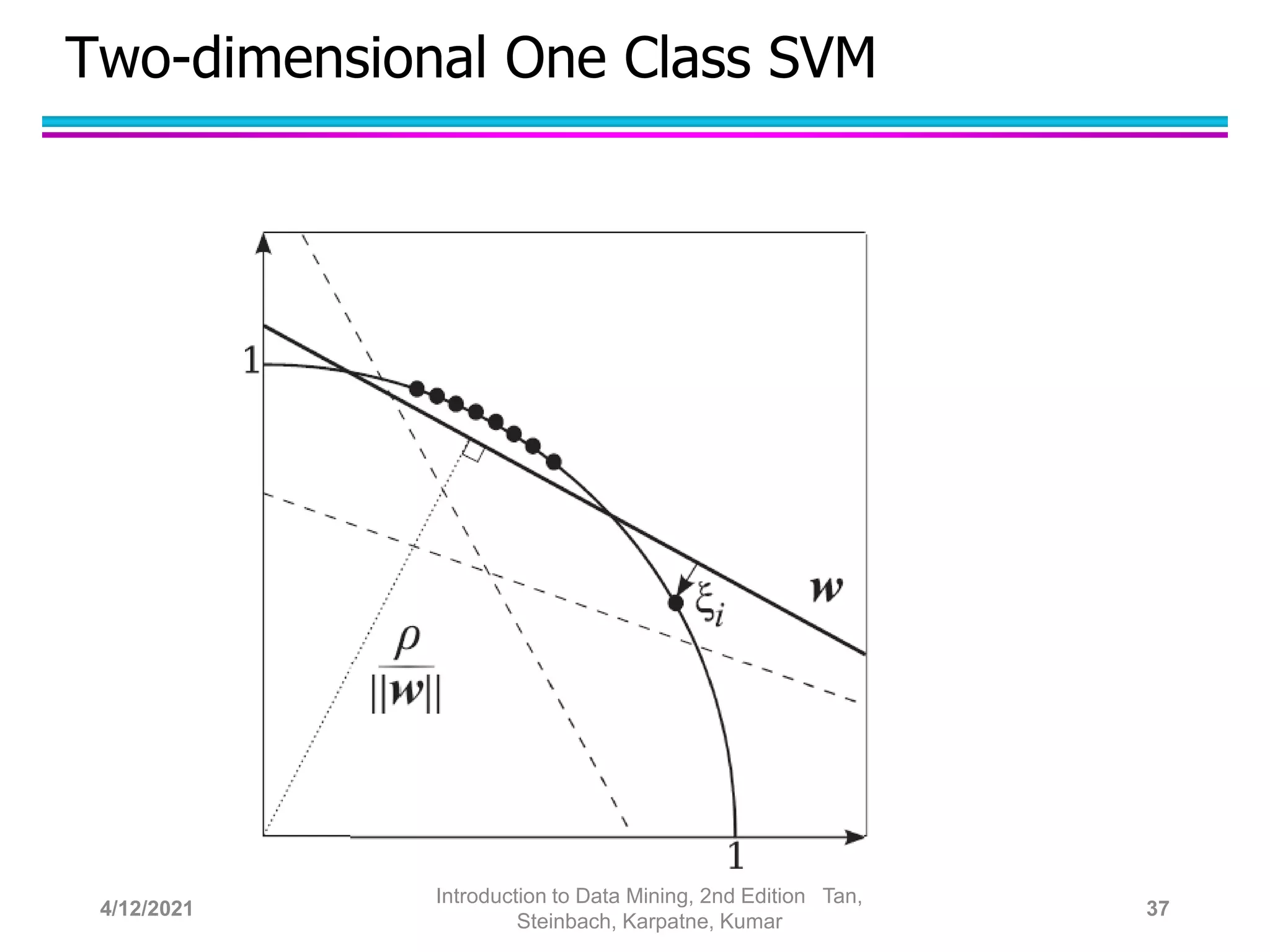
How Does One-Class SVM Work?
 Uses the “origin” trick
 Use a Gaussian kernel
– Every point mapped to a unit hypersphere
– Every point in the same orthant (quadrant)
 Aim to maximize the distance of the separating
plane from the origin
4/12/2021
Introduction to Data Mining, 2nd Edition Tan,
Steinbach, Karpatne, Kumar
36
Two-dimensional One Class SVM
4/12/2021
Introduction to Data Mining, 2nd Edition Tan,
Steinbach, Karpatne, Kumar
37
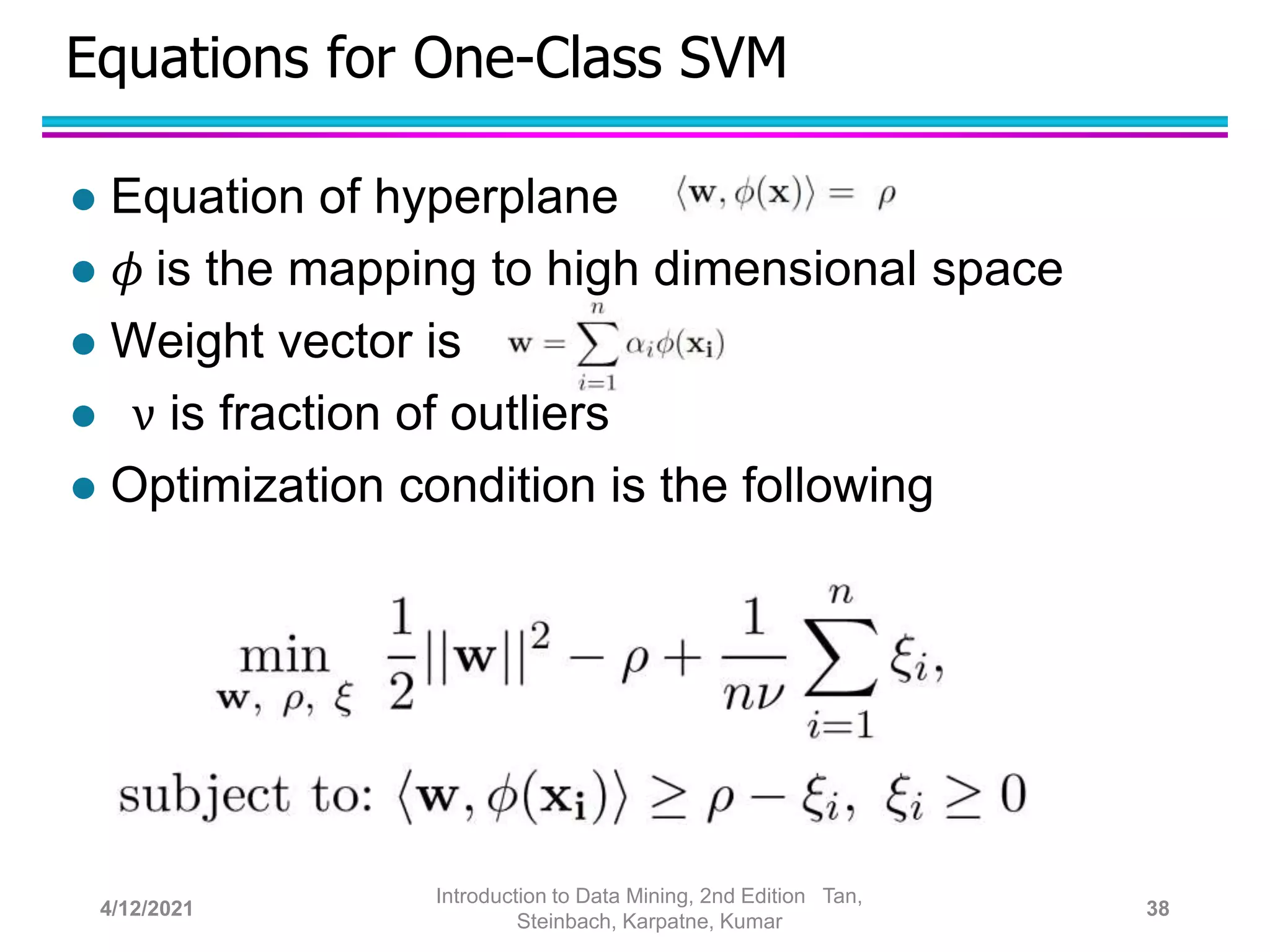
Equations for One-Class SVM
 Equation of hyperplane
 𝜙 is the mapping to high dimensional space
 Weight vector is
 ν is fraction of outliers
 Optimization condition is the following
4/12/2021
Introduction to Data Mining, 2nd Edition Tan,
Steinbach, Karpatne, Kumar
38
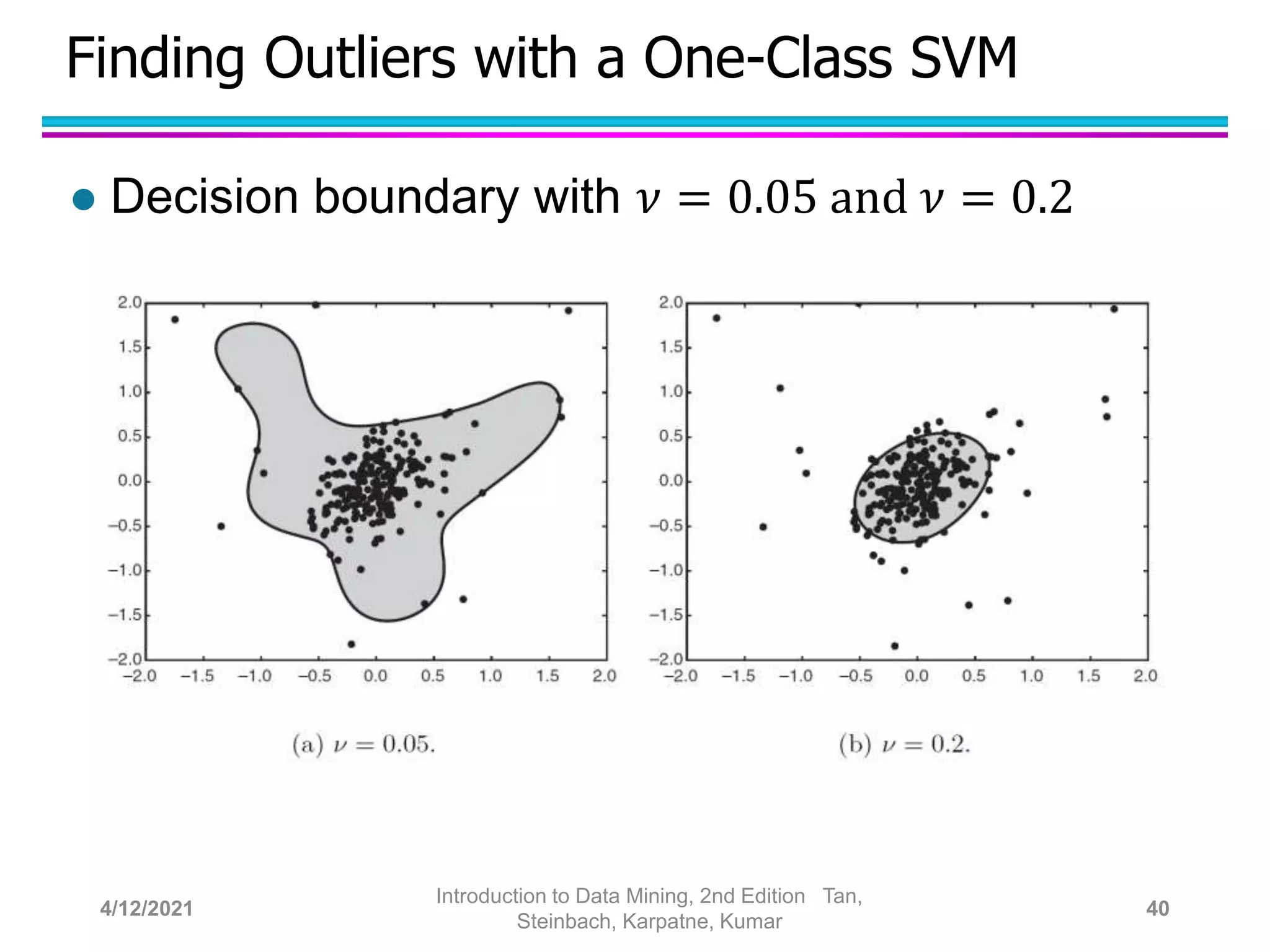
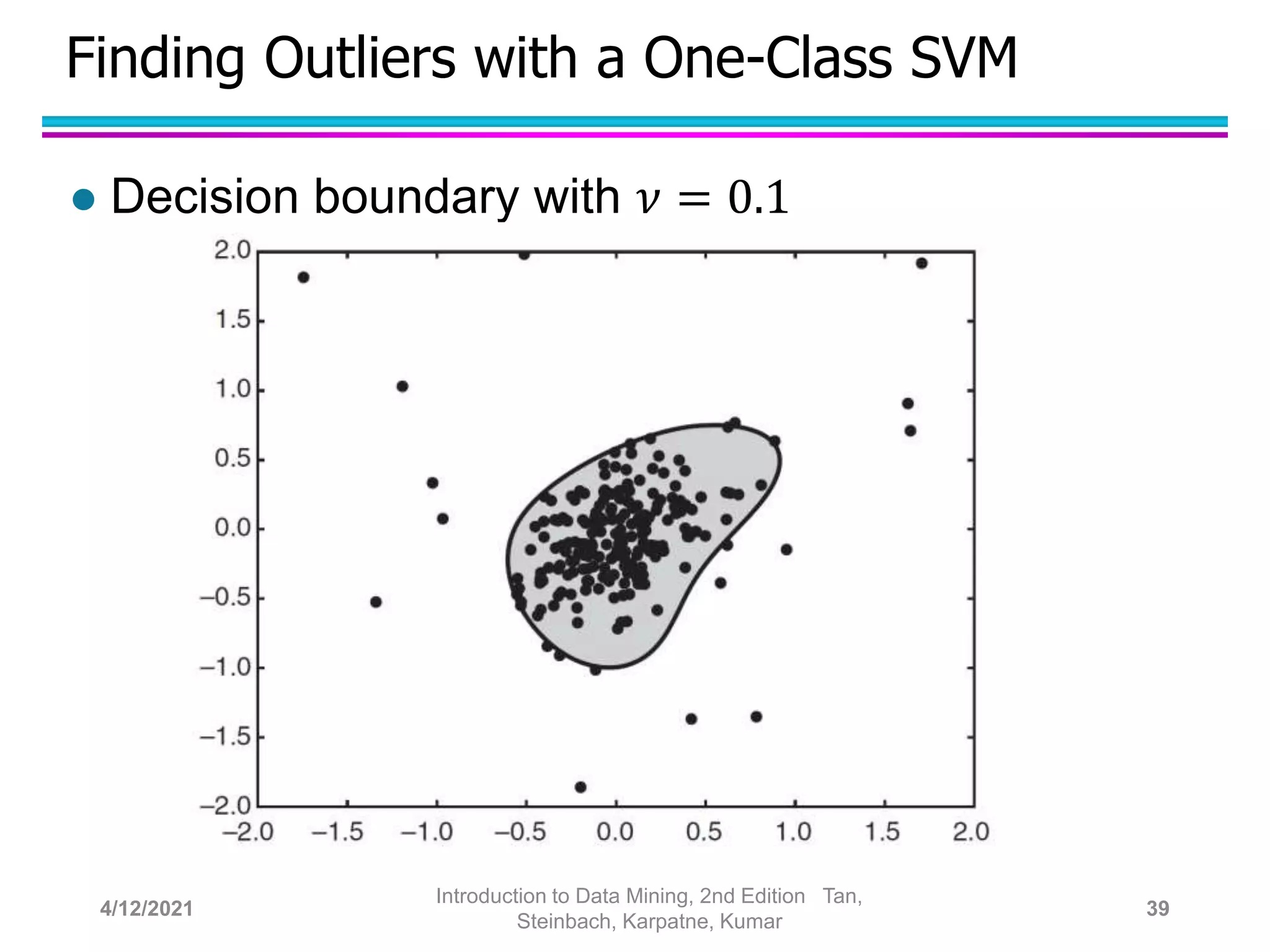
Finding Outliers with a One-Class SVM
 Decision boundary with 𝜈 = 0.1
4/12/2021
Introduction to Data Mining, 2nd Edition Tan,
Steinbach, Karpatne, Kumar
39
Finding Outliers with a One-Class SVM
 Decision boundary with 𝜈 = 0.05 and 𝜈 = 0.2
4/12/2021
Introduction to Data Mining, 2nd Edition Tan,
Steinbach, Karpatne, Kumar
40
Strengths and Weaknesses
 Strong theoretical foundation
 Choice of ν is difficult
 Computationally expensive
4/12/2021
Introduction to Data Mining, 2nd Edition Tan,
Steinbach, Karpatne, Kumar
41
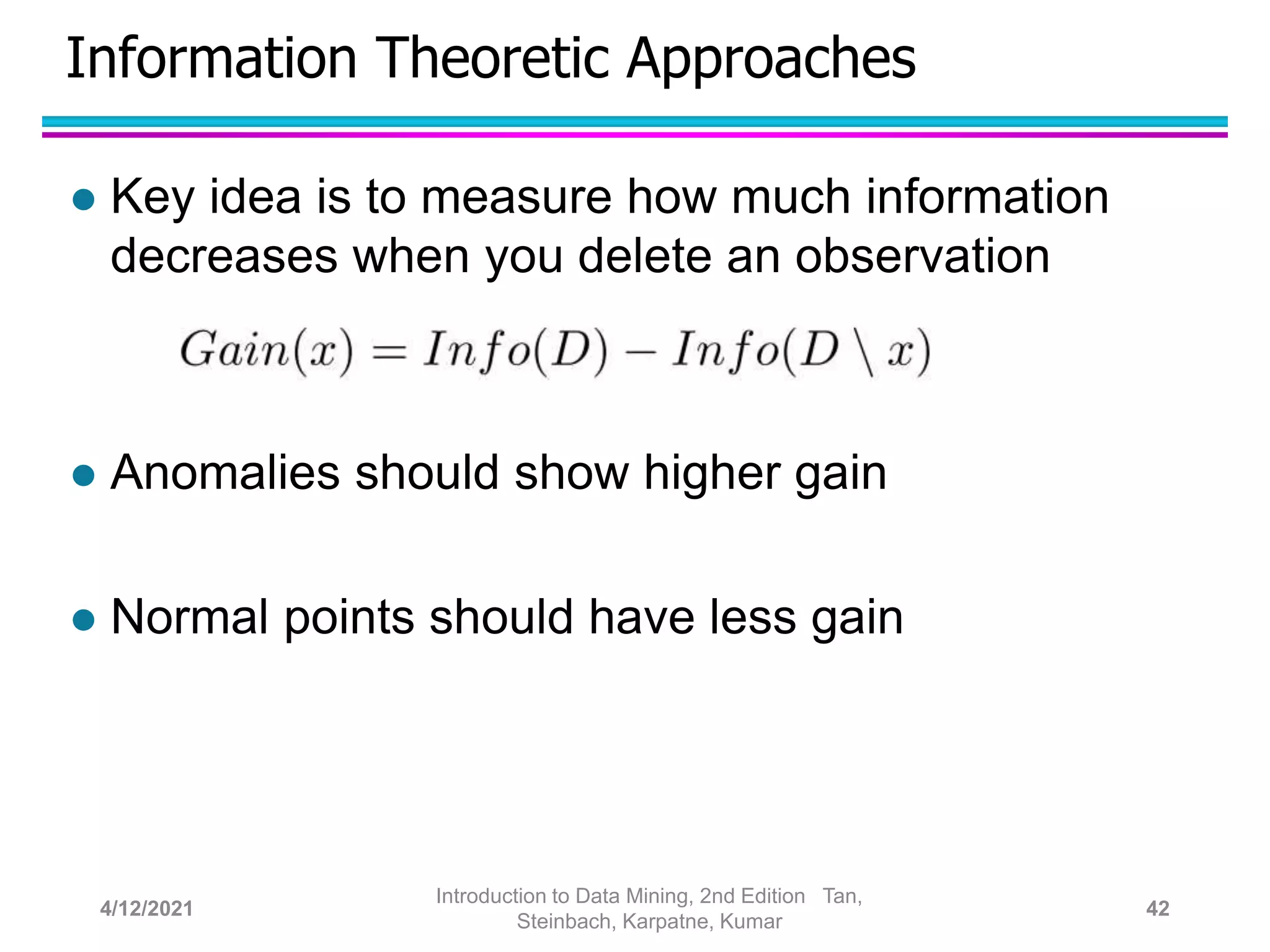
Information Theoretic Approaches
 Key idea is to measure how much information
decreases when you delete an observation
 Anomalies should show higher gain
 Normal points should have less gain
4/12/2021
Introduction to Data Mining, 2nd Edition Tan,
Steinbach, Karpatne, Kumar
42
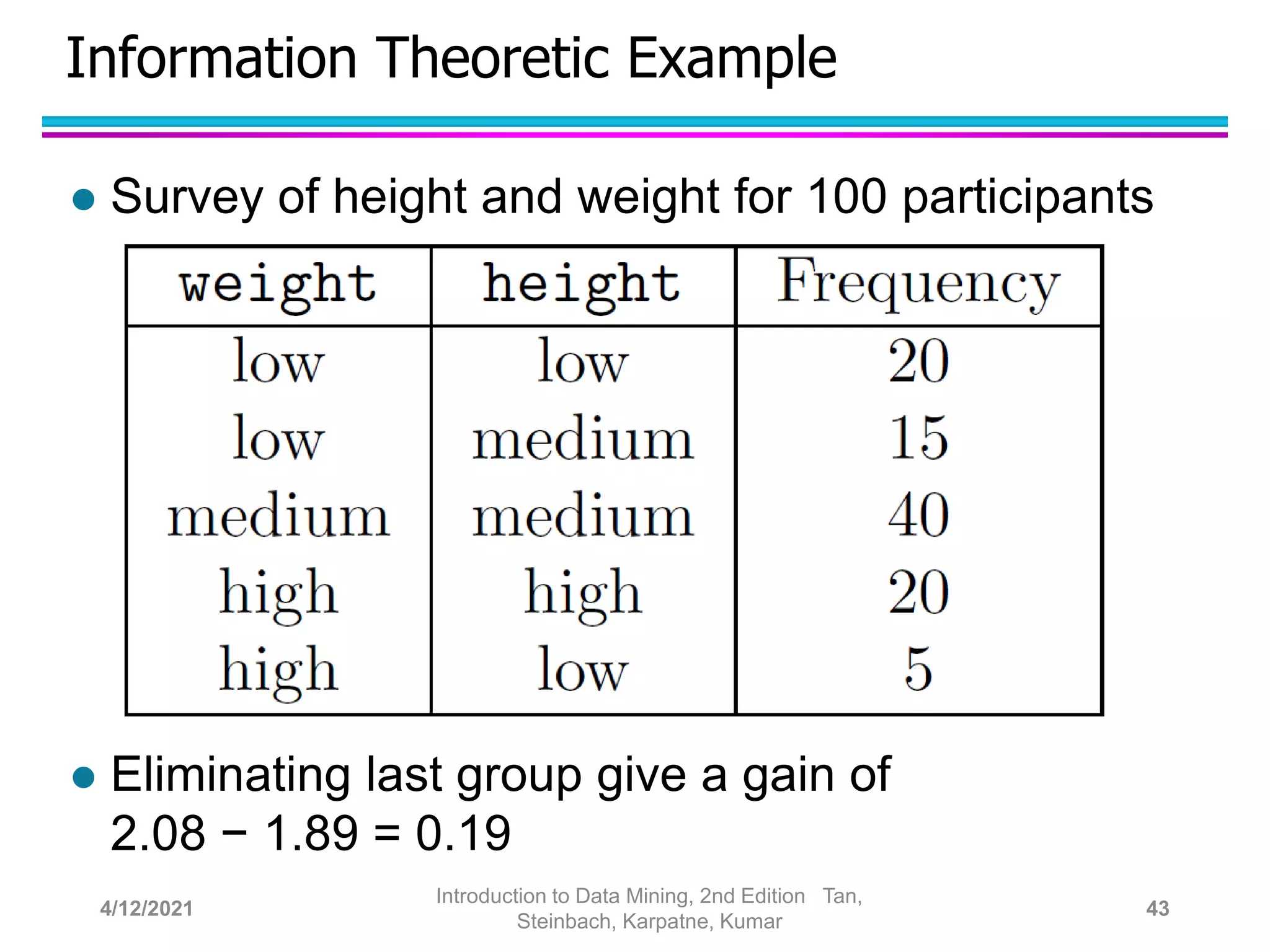
Information Theoretic Example
 Survey of height and weight for 100 participants
 Eliminating last group give a gain of
2.08 − 1.89 = 0.19
4/12/2021
Introduction to Data Mining, 2nd Edition Tan,
Steinbach, Karpatne, Kumar
43
Strengths and Weaknesses
 Solid theoretical foundation
 Theoretically applicable to all kinds of data
 Difficult and computationally expensive to
implement in practice
4/12/2021
Introduction to Data Mining, 2nd Edition Tan,
Steinbach, Karpatne, Kumar
44
Evaluation of Anomaly Detection
 If class labels are present, then use standard
evaluation approaches for rare class such as
precision, recall, or false positive rate
– FPR is also know as false alarm rate
 For unsupervised anomaly detection use
measures provided by the anomaly method
– E.g. reconstruction error or gain
 Can also look at histograms of anomaly scores.
4/12/2021
Introduction to Data Mining, 2nd Edition Tan,
Steinbach, Karpatne, Kumar
45
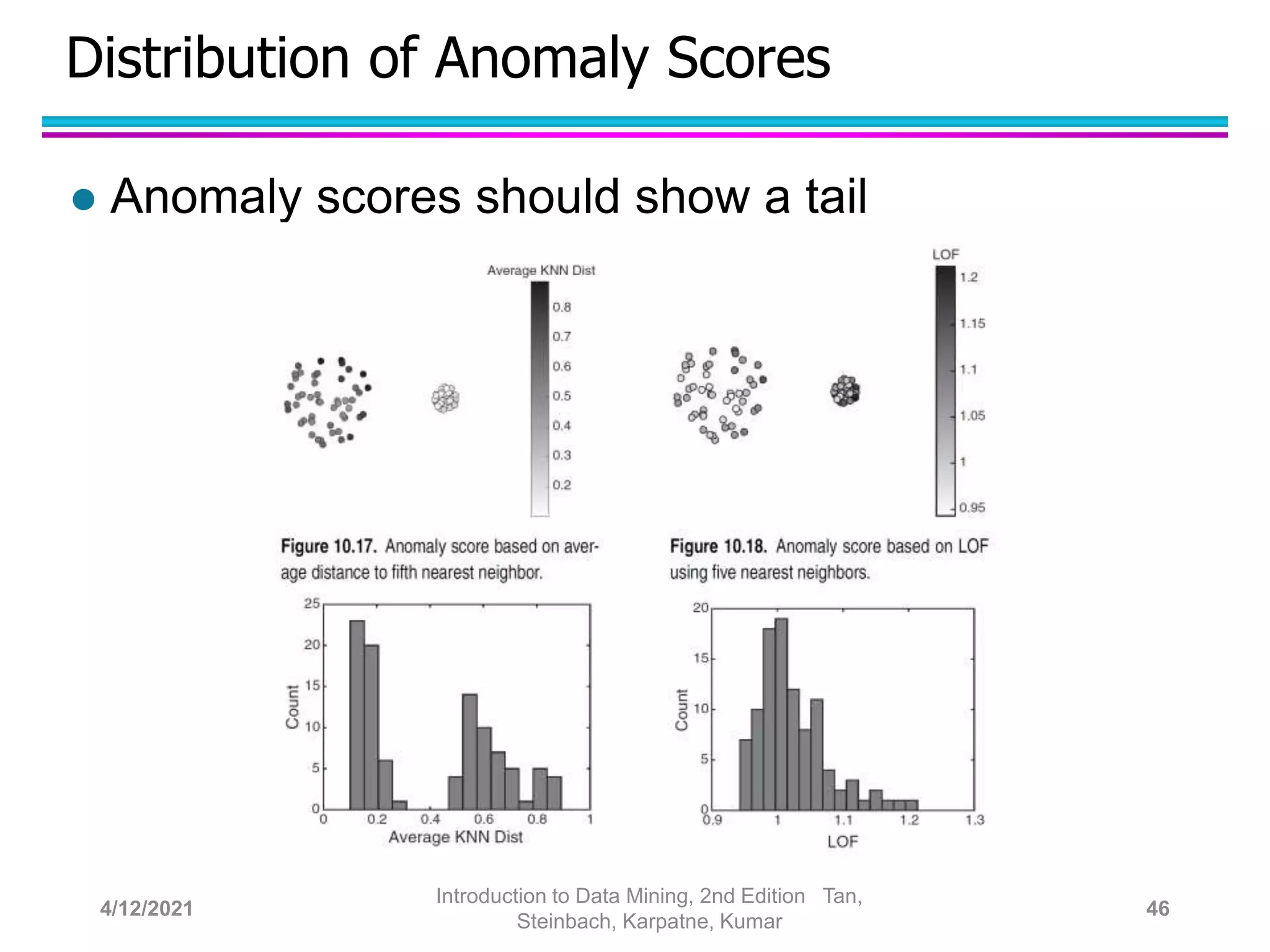
Distribution of Anomaly Scores
 Anomaly scores should show a tail
4/12/2021
Introduction to Data Mining, 2nd Edition Tan,
Steinbach, Karpatne, Kumar
46

chap9_anomaly_detection.pptx

  • 1.
    Anomaly Detection Lecture Notesfor Chapter 9 Introduction to Data Mining, 2nd Edition by Tan, Steinbach, Karpatne, Kumar 4/12/2021 Introduction to Data Mining, 2nd Edition Tan, Steinbach, Karpatne, Kumar 1
  • 2.
    Anomaly/Outlier Detection  Whatare anomalies/outliers? – The set of data points that are considerably different than the remainder of the data  Natural implication is that anomalies are relatively rare – One in a thousand occurs often if you have lots of data – Context is important, e.g., freezing temps in July  Can be important or a nuisance – Unusually high blood pressure – 200 pound, 2 year old 4/12/2021 Introduction to Data Mining, 2nd Edition Tan, Steinbach, Karpatne, Kumar 2
  • 3.
    Importance of AnomalyDetection Ozone Depletion History  In 1985 three researchers (Farman, Gardinar and Shanklin) were puzzled by data gathered by the British Antarctic Survey showing that ozone levels for Antarctica had dropped 10% below normal levels  Why did the Nimbus 7 satellite, which had instruments aboard for recording ozone levels, not record similarly low ozone concentrations?  The ozone concentrations recorded by the satellite were so low they were being treated as outliers by a computer program and discarded! Source: http://www.epa.gov/ozone/science/hole/size.html 4/12/2021 Introduction to Data Mining, 2nd Edition Tan, Steinbach, Karpatne, Kumar 3
  • 4.
    Causes of Anomalies Data from different classes – Measuring the weights of oranges, but a few grapefruit are mixed in  Natural variation – Unusually tall people  Data errors – 200 pound 2 year old 4/12/2021 Introduction to Data Mining, 2nd Edition Tan, Steinbach, Karpatne, Kumar 4 https://umn.zoom.us/my/kumar001
  • 5.
    Distinction Between Noiseand Anomalies  Noise doesn’t necessarily produce unusual values or objects  Noise is not interesting  Noise and anomalies are related but distinct concepts 4/12/2021 Introduction to Data Mining, 2nd Edition Tan, Steinbach, Karpatne, Kumar 5
  • 6.
    Model-based vs Model-free Model-basedApproaches Model can be parametric or non-parametric Anomalies are those points that don’t fit well Anomalies are those points that distort the model Model-free Approaches Anomalies are identified directly from the data without building a model Often the underlying assumption is that the most of the points in the data are normal 4/12/2021 Introduction to Data Mining, 2nd Edition Tan, Steinbach, Karpatne, Kumar 6
  • 7.
    General Issues: Labelvs Score  Some anomaly detection techniques provide only a binary categorization  Other approaches measure the degree to which an object is an anomaly – This allows objects to be ranked – Scores can also have associated meaning (e.g., statistical significance) 4/12/2021 Introduction to Data Mining, 2nd Edition Tan, Steinbach, Karpatne, Kumar 7
  • 8.
    Anomaly Detection Techniques Statistical Approaches  Proximity-based – Anomalies are points far away from other points  Clustering-based – Points far away from cluster centers are outliers – Small clusters are outliers  Reconstruction Based 4/12/2021 Introduction to Data Mining, 2nd Edition Tan, Steinbach, Karpatne, Kumar 8
  • 9.
    Statistical Approaches Probabilistic definitionof an outlier: An outlier is an object that has a low probability with respect to a probability distribution model of the data.  Usually assume a parametric model describing the distribution of the data (e.g., normal distribution)  Apply a statistical test that depends on – Data distribution – Parameters of distribution (e.g., mean, variance) – Number of expected outliers (confidence limit)  Issues – Identifying the distribution of a data set  Heavy tailed distribution – Number of attributes – Is the data a mixture of distributions? 4/12/2021 Introduction to Data Mining, 2nd Edition Tan, Steinbach, Karpatne, Kumar 9
  • 10.
    Normal Distributions One-dimensional Gaussian Two-dimensional Gaussian x y -4 -3-2 -1 0 1 2 3 4 5 -5 -4 -3 -2 -1 0 1 2 3 4 5 6 7 8 probability density 0.01 0.02 0.03 0.04 0.05 0.06 0.07 0.08 0.09 0.1 4/12/2021 Introduction to Data Mining, 2nd Edition Tan, Steinbach, Karpatne, Kumar 10
  • 11.
    Grubbs’ Test  Detectoutliers in univariate data  Assume data comes from normal distribution  Detects one outlier at a time, remove the outlier, and repeat – H0: There is no outlier in data – HA: There is at least one outlier  Grubbs’ test statistic:  Reject H0 if: s X X G   max 2 2 ) 2 , / ( ) 2 , / ( 2 ) 1 (       N N N N t N t N N G   4/12/2021 Introduction to Data Mining, 2nd Edition Tan, Steinbach, Karpatne, Kumar 11
  • 12.
    Statistically-based – LikelihoodApproach  Assume the data set D contains samples from a mixture of two probability distributions: – M (majority distribution) – A (anomalous distribution)  General Approach: – Initially, assume all the data points belong to M – Let Lt(D) be the log likelihood of D at time t – For each point xt that belongs to M, move it to A  Let Lt+1 (D) be the new log likelihood.  Compute the difference,  = Lt(D) – Lt+1 (D)  If  > c (some threshold), then xt is declared as an anomaly and moved permanently from M to A 4/12/2021 Introduction to Data Mining, 2nd Edition Tan, Steinbach, Karpatne, Kumar 12
  • 13.
    Statistically-based – LikelihoodApproach  Data distribution, D = (1 – ) M +  A  M is a probability distribution estimated from data – Can be based on any modeling method (naïve Bayes, maximum entropy, etc.)  A is initially assumed to be uniform distribution  Likelihood at time t:                                   t i t t i t t i t t t i t t A x i A t M x i M t t A x i A A M x i M M N i i D t x P A x P M D LL x P x P x P D L ) ( log log ) ( log ) 1 log( ) ( ) ( ) ( ) 1 ( ) ( ) ( | | | | 1     4/12/2021 Introduction to Data Mining, 2nd Edition Tan, Steinbach, Karpatne, Kumar 13
  • 14.
    Strengths/Weaknesses of StatisticalApproaches  Firm mathematical foundation  Can be very efficient  Good results if distribution is known  In many cases, data distribution may not be known  For high dimensional data, it may be difficult to estimate the true distribution  Anomalies can distort the parameters of the distribution 4/12/2021 Introduction to Data Mining, 2nd Edition Tan, Steinbach, Karpatne, Kumar 14
  • 15.
    Distance-Based Approaches  Theoutlier score of an object is the distance to its kth nearest neighbor 4/12/2021 Introduction to Data Mining, 2nd Edition Tan, Steinbach, Karpatne, Kumar 15
  • 16.
    One Nearest Neighbor- One Outlier D 0.4 0.6 0.8 1 1.2 1.4 1.6 1.8 2 Outlier Score 4/12/2021 Introduction to Data Mining, 2nd Edition Tan, Steinbach, Karpatne, Kumar 16
  • 17.
    One Nearest Neighbor- Two Outliers D 0.05 0.1 0.15 0.2 0.25 0.3 0.35 0.4 0.45 0.5 0.55 Outlier Score 4/12/2021 Introduction to Data Mining, 2nd Edition Tan, Steinbach, Karpatne, Kumar 17
  • 18.
    Five Nearest Neighbors- Small Cluster D 0.4 0.6 0.8 1 1.2 1.4 1.6 1.8 2 Outlier Score 4/12/2021 Introduction to Data Mining, 2nd Edition Tan, Steinbach, Karpatne, Kumar 18
  • 19.
    Five Nearest Neighbors- Differing Density D 0.2 0.4 0.6 0.8 1 1.2 1.4 1.6 1.8 Outlier Score 4/12/2021 Introduction to Data Mining, 2nd Edition Tan, Steinbach, Karpatne, Kumar 19
  • 20.
    Strengths/Weaknesses of Distance-BasedApproaches  Simple  Expensive – O(n2)  Sensitive to parameters  Sensitive to variations in density  Distance becomes less meaningful in high- dimensional space 4/12/2021 Introduction to Data Mining, 2nd Edition Tan, Steinbach, Karpatne, Kumar 20
  • 21.
    Density-Based Approaches  Density-basedOutlier: The outlier score of an object is the inverse of the density around the object. – Can be defined in terms of the k nearest neighbors – One definition: Inverse of distance to kth neighbor – Another definition: Inverse of the average distance to k neighbors – DBSCAN definition  If there are regions of different density, this approach can have problems 4/12/2021 Introduction to Data Mining, 2nd Edition Tan, Steinbach, Karpatne, Kumar 21
  • 22.
    Relative Density  Considerthe density of a point relative to that of its k nearest neighbors  Let 𝑦1, … , 𝑦𝑘 be the 𝑘 nearest neighbors of 𝒙 𝑑𝑒𝑛𝑠𝑖𝑡𝑦 𝒙, 𝑘 = 1 𝑑𝑖𝑠𝑡 𝒙, 𝑘 = 1 𝑑𝑖𝑠𝑡(𝒙, 𝒚𝑘) 𝑟𝑒𝑙𝑎𝑡𝑖𝑣𝑒 𝑑𝑒𝑛𝑠𝑖𝑡𝑦 𝒙, 𝑘 = 𝑖=1 𝑘 𝑑𝑒𝑛𝑠𝑖𝑡𝑦(𝒚𝑖,𝑘)/𝑘 𝑑𝑒𝑛𝑠𝑖𝑡𝑦(𝒙,𝑘) = 𝑑𝑖𝑠𝑡(𝒙,𝑘) 𝑖=1 𝑘 𝑑𝑖𝑠𝑡(𝒚𝑖,𝑘)/𝑘 = 𝑑𝑖𝑠𝑡(𝒙,𝒚) 𝑖=1 𝑘 𝑑𝑖𝑠𝑡(𝒚𝑖,𝑘)/𝑘  Can use average distance instead 4/12/2021 Introduction to Data Mining, 2nd Edition Tan, Steinbach, Karpatne, Kumar 22
  • 23.
    Relative Density OutlierScores Outlier Score 1 2 3 4 5 6 6.85 1.33 1.40 A C D 4/12/2021 Introduction to Data Mining, 2nd Edition Tan, Steinbach, Karpatne, Kumar 23
  • 24.
    Relative Density-based: LOFapproach  For each point, compute the density of its local neighborhood  Compute local outlier factor (LOF) of a sample p as the average of the ratios of the density of sample p and the density of its nearest neighbors  Outliers are points with largest LOF value p2  p1  In the NN approach, p2 is not considered as outlier, while LOF approach find both p1 and p2 as outliers 4/12/2021 Introduction to Data Mining, 2nd Edition Tan, Steinbach, Karpatne, Kumar 24
  • 25.
    Strengths/Weaknesses of Density-BasedApproaches  Simple  Expensive – O(n2)  Sensitive to parameters  Density becomes less meaningful in high- dimensional space 4/12/2021 Introduction to Data Mining, 2nd Edition Tan, Steinbach, Karpatne, Kumar 25
  • 26.
    Clustering-Based Approaches  Anobject is a cluster-based outlier if it does not strongly belong to any cluster – For prototype-based clusters, an object is an outlier if it is not close enough to a cluster center  Outliers can impact the clustering produced – For density-based clusters, an object is an outlier if its density is too low  Can’t distinguish between noise and outliers – For graph-based clusters, an object is an outlier if it is not well connected 4/12/2021 Introduction to Data Mining, 2nd Edition Tan, Steinbach, Karpatne, Kumar 26
  • 27.
    Distance of Pointsfrom Closest Centroids Outlier Score 0.5 1 1.5 2 2.5 3 3.5 4 4.5 D C A 1.2 0.17 4.6 4/12/2021 Introduction to Data Mining, 2nd Edition Tan, Steinbach, Karpatne, Kumar 27
  • 28.
    Relative Distance ofPoints from Closest Centroid Outlier Score 0.5 1 1.5 2 2.5 3 3.5 4 4/12/2021 Introduction to Data Mining, 2nd Edition Tan, Steinbach, Karpatne, Kumar 28
  • 29.
    Strengths/Weaknesses of Clustering-BasedApproaches  Simple  Many clustering techniques can be used  Can be difficult to decide on a clustering technique  Can be difficult to decide on number of clusters  Outliers can distort the clusters 4/12/2021 Introduction to Data Mining, 2nd Edition Tan, Steinbach, Karpatne, Kumar 29
  • 30.
    Reconstruction-Based Approaches  Basedon assumptions there are patterns in the distribution of the normal class that can be captured using lower-dimensional representations  Reduce data to lower dimensional data – E.g. Use Principal Components Analysis (PCA) or Auto-encoders  Measure the reconstruction error for each object – The difference between original and reduced dimensionality version 4/12/2021 Introduction to Data Mining, 2nd Edition Tan, Steinbach, Karpatne, Kumar 30
  • 31.
    Reconstruction Error  Let𝐱 be the original data object  Find the representation of the object in a lower dimensional space  Project the object back to the original space  Call this object 𝐱 Reconstruction Error(x)= x − x  Objects with large reconstruction errors are anomalies 4/12/2021 Introduction to Data Mining, 2nd Edition Tan, Steinbach, Karpatne, Kumar 31
  • 32.
    Reconstruction of two-dimensionaldata 4/12/2021 Introduction to Data Mining, 2nd Edition Tan, Steinbach, Karpatne, Kumar 32
  • 33.
    Basic Architecture ofan Autoencoder  An autoencoder is a multi-layer neural network  The number of input and output neurons is equal to the number of original attributes. 4/12/2021 Introduction to Data Mining, 2nd Edition Tan, Steinbach, Karpatne, Kumar 33
  • 34.
    Strengths and Weaknesses Does not require assumptions about distribution of normal class  Can use many dimensionality reduction approaches  The reconstruction error is computed in the original space – This can be a problem if dimensionality is high 4/12/2021 Introduction to Data Mining, 2nd Edition Tan, Steinbach, Karpatne, Kumar 34
  • 35.
    One Class SVM Uses an SVM approach to classify normal objects  Uses the given data to construct such a model  This data may contain outliers  But the data does not contain class labels  How to build a classifier given one class? 4/12/2021 Introduction to Data Mining, 2nd Edition Tan, Steinbach, Karpatne, Kumar 35
  • 36.
    How Does One-ClassSVM Work?  Uses the “origin” trick  Use a Gaussian kernel – Every point mapped to a unit hypersphere – Every point in the same orthant (quadrant)  Aim to maximize the distance of the separating plane from the origin 4/12/2021 Introduction to Data Mining, 2nd Edition Tan, Steinbach, Karpatne, Kumar 36
  • 37.
    Two-dimensional One ClassSVM 4/12/2021 Introduction to Data Mining, 2nd Edition Tan, Steinbach, Karpatne, Kumar 37
  • 38.
    Equations for One-ClassSVM  Equation of hyperplane  𝜙 is the mapping to high dimensional space  Weight vector is  ν is fraction of outliers  Optimization condition is the following 4/12/2021 Introduction to Data Mining, 2nd Edition Tan, Steinbach, Karpatne, Kumar 38
  • 39.
    Finding Outliers witha One-Class SVM  Decision boundary with 𝜈 = 0.1 4/12/2021 Introduction to Data Mining, 2nd Edition Tan, Steinbach, Karpatne, Kumar 39
  • 40.
    Finding Outliers witha One-Class SVM  Decision boundary with 𝜈 = 0.05 and 𝜈 = 0.2 4/12/2021 Introduction to Data Mining, 2nd Edition Tan, Steinbach, Karpatne, Kumar 40
  • 41.
    Strengths and Weaknesses Strong theoretical foundation  Choice of ν is difficult  Computationally expensive 4/12/2021 Introduction to Data Mining, 2nd Edition Tan, Steinbach, Karpatne, Kumar 41
  • 42.
    Information Theoretic Approaches Key idea is to measure how much information decreases when you delete an observation  Anomalies should show higher gain  Normal points should have less gain 4/12/2021 Introduction to Data Mining, 2nd Edition Tan, Steinbach, Karpatne, Kumar 42
  • 43.
    Information Theoretic Example Survey of height and weight for 100 participants  Eliminating last group give a gain of 2.08 − 1.89 = 0.19 4/12/2021 Introduction to Data Mining, 2nd Edition Tan, Steinbach, Karpatne, Kumar 43
  • 44.
    Strengths and Weaknesses Solid theoretical foundation  Theoretically applicable to all kinds of data  Difficult and computationally expensive to implement in practice 4/12/2021 Introduction to Data Mining, 2nd Edition Tan, Steinbach, Karpatne, Kumar 44
  • 45.
    Evaluation of AnomalyDetection  If class labels are present, then use standard evaluation approaches for rare class such as precision, recall, or false positive rate – FPR is also know as false alarm rate  For unsupervised anomaly detection use measures provided by the anomaly method – E.g. reconstruction error or gain  Can also look at histograms of anomaly scores. 4/12/2021 Introduction to Data Mining, 2nd Edition Tan, Steinbach, Karpatne, Kumar 45
  • 46.
    Distribution of AnomalyScores  Anomaly scores should show a tail 4/12/2021 Introduction to Data Mining, 2nd Edition Tan, Steinbach, Karpatne, Kumar 46