




Basics of Edgewise
INDIAN DENTAL ACADEMY

Leader in continuing dental education
www.indiandentalacademy.com

www.indiandentalacademy.com
1ST, 2ND AND 3RD ORDER BENDS IN
STANDARD EDGEWISE APPLIANCE
SYSTEM
Dr. OP Kharbanda
All India Institute of Medical Sciences
New Delhi 110029 INDIA
Phone 91-11-26493344, 26594755
www.indiandentalacademy.com
Opk15@hotmail.com, ompk@aiims.ac.in
Contributors
Dr. Ashok Jena,
Dr. Sandip Kumar,
Dr. Priyanka Kapoor,
Dr. Hari,
Dr. Neeraj Wadhawan,
Dr. Vishal Gupta,
Dr. Anand Pal Lohia

www.indiandentalacademy.com
First order bends:In and Out bends
Bucco-lingual / Labio-lingual
and Rotational movement.
Second order bends:- Tip bends
Mesio-distal movements.
Third order bends:-

Torque
www.indiandentalacademy.com
FIRST ORDER BENDS
• Purpose:- To contour the arch wire to the buccal
surfaces of teeth, which vary in their labio-lingual
thickness and do not conform to an arch.
• The extent of each bends is dictated by the labiolingual thickness of individual teeth so that a smooth
curve of incisors and canines on their lingual surface
can be achieved.
www.indiandentalacademy.com
• First order bends also helps for derotation
(Molar offset)
• First order bend in between pre-molar and molar is
also known as anti-rotation or toe-in bend and the
size vary from individuals to individual.
• First order bends in the maxillary and mandibular
arch must be co-ordinated.
www.indiandentalacademy.com
• In pre-adjusted edgewise appliance system, first
order bends are built in the bracket bases and buccal
tube base.
• However these may have to be bent depending on
individual requirements of a malocclusion or while
finishing .

www.indiandentalacademy.com
SECOND ORDER BENDS
• Bends in the occluso-gingival direction to maintain the final
angulation of teeth.
• In the incisal area, second order bends (artistic bends)
provide the ideal angulation to these teeth.
• In posterior region, second order bends maintain the distal
tipping of the pre-molars and molars and cause bite opening
(pseudo bite opening).
www.indiandentalacademy.com
V- bend
• To differentiate between anterior and posterior
segment.
• To give separate anterior and posterior root torque.
• For soldering attachments.

www.indiandentalacademy.com
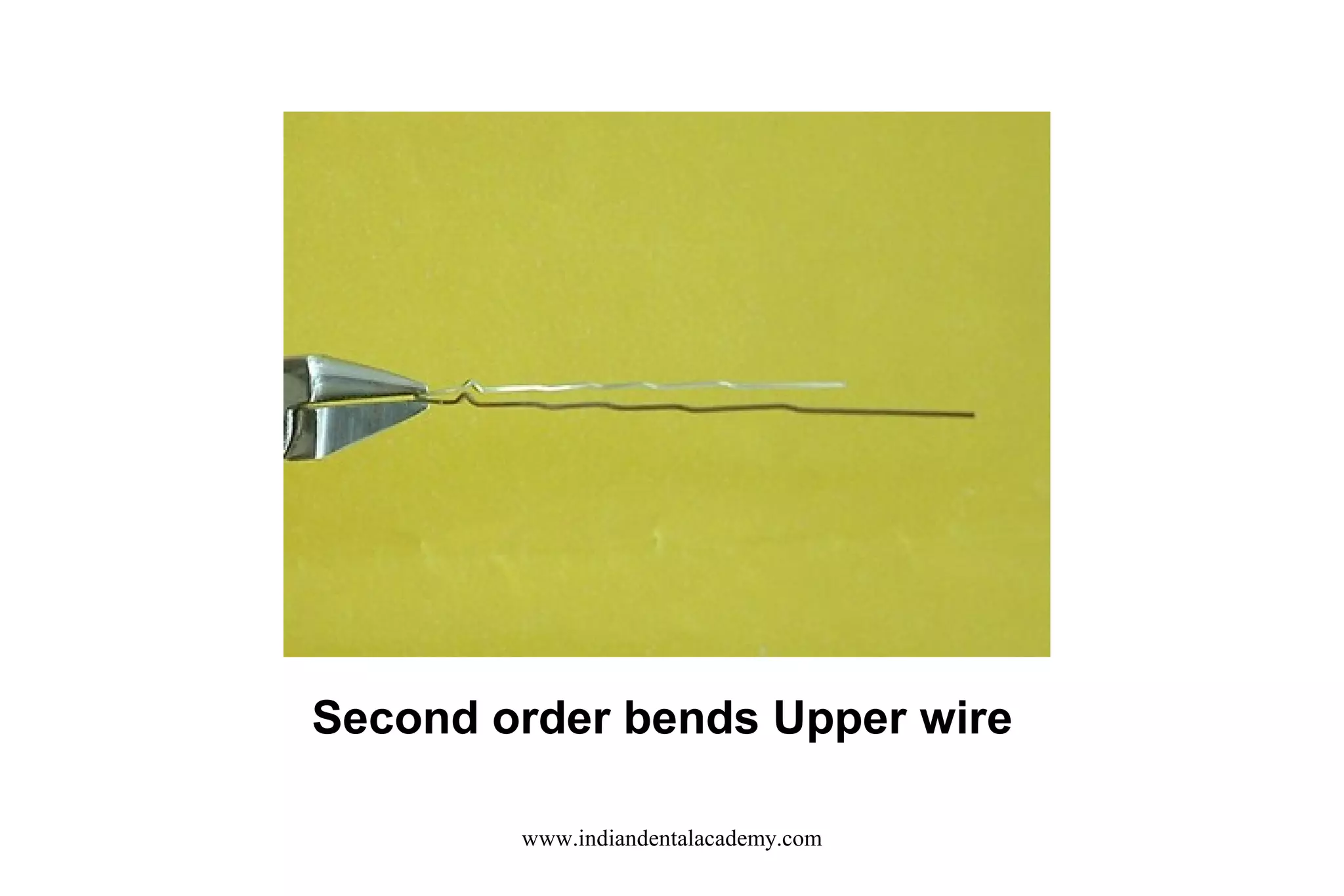
Second order bends Upper wire
www.indiandentalacademy.com
Biomechanical effects of second
order bends
• An intrusive force for bite opening is also
produced in the anterior segment which is
accompanied by a labial crown torque.
• Labial crown torque is controlled by Class II
Elastics in the Upper arch and in lower arch with
tie back molar
www.indiandentalacademy.com
In pre-adjusted edgewise system, second order effects (tip)
are incorporated in the bracket slot but may be useful in
some cases to achieve better finish in terms of angulation of
teeth.

www.indiandentalacademy.com
Second order bend Vs Tip-back bend
• Exaggerated second order bends are known as tip
back bends and are used for anchorage
preparation.

www.indiandentalacademy.com
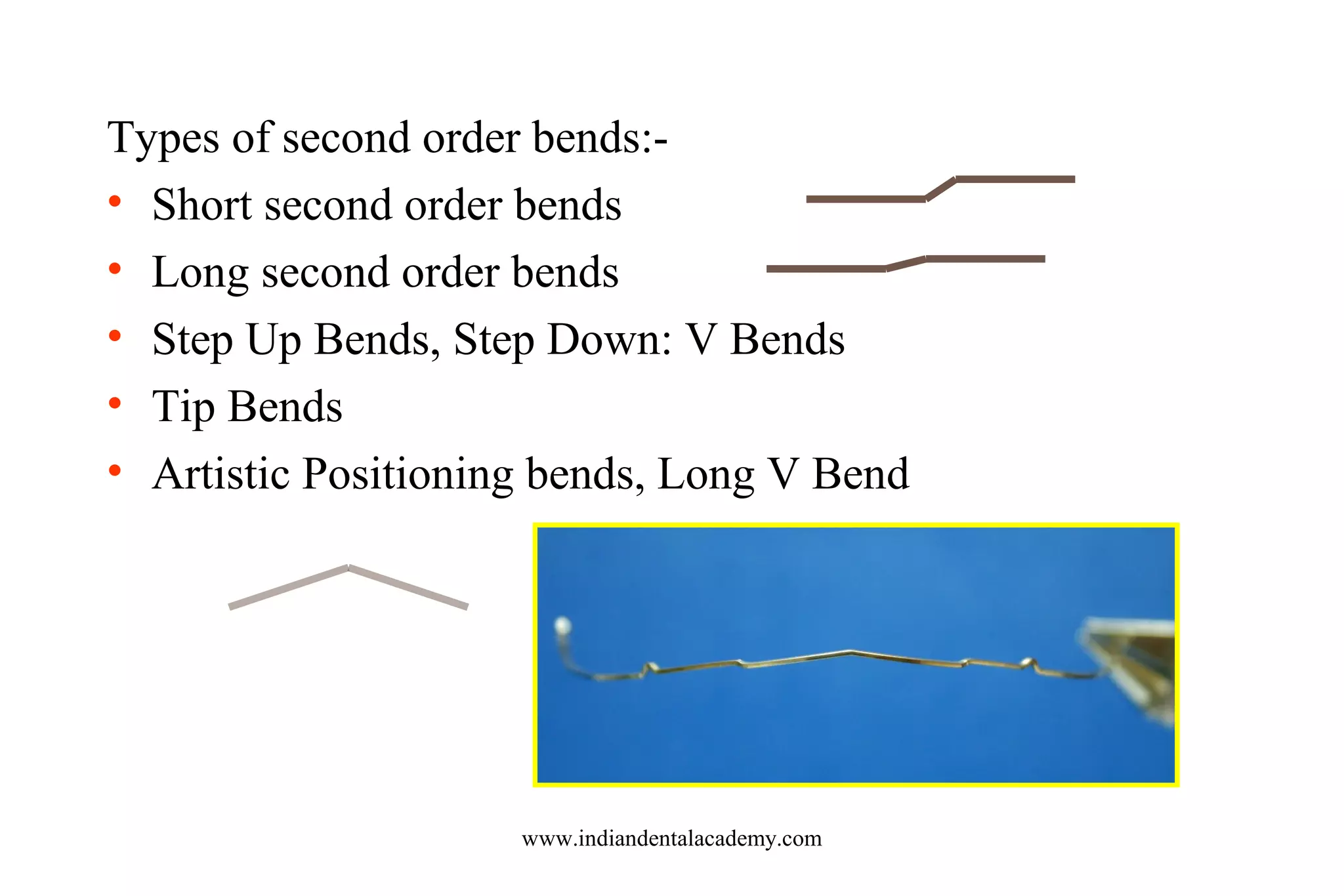
Types of second order bends:• Short second order bends
• Long second order bends
• Step Up Bends, Step Down: V Bends
• Tip Bends
• Artistic Positioning bends, Long V Bend

www.indiandentalacademy.com
Analysis of Tip Back second order
bends
• Second order Tip-back bends are utilized to prepare
anchorage.
• The degree of tip-back on the terminal molars should
be such that when the arch wire is placed in the
buccal tubes it will cross the cuspid teeth at their
dento-enamel junctions.
www.indiandentalacademy.com
After placing the arch wire in the molar tubes of the
terminal molars when it is raised and ligated to the two
brackets on the first molar teeth, the mesial cusps of
the terminal molars are elevated and the first molars
are depressed. At this point the arch wire will lie
gingival to the brackets on the second pre-molar teeth.

www.indiandentalacademy.com
When the arch wire is placed in the slots of the
second pre-molar brackets, first molars are elevated
and the second premolars are depressed. Thus the
force necessary to tip the terminal molars
transferred to the second premolar teeth. Now the
arch wire lies gingival to the first premolar brackets.

www.indiandentalacademy.com
When the arch wire ligated to the first premolar brackets, first
premolars depressed and second premolars are elevated. Thus
terminal molars are being tipped distally at the expense of
depressing the first premolar teeth. Now arch wire lies gingival
to the canine brackets.

www.indiandentalacademy.com
When canines are engaged, the canines are depressed
and the first premolars are elevated. Thus all the distal
tipping forces on premolars and molars are neutralized
by the depressing force on the canines. This depression
is neither too rapid as it has very large root with well
supported alveolar bone. Now arch wire lies gingival to
the incisors brackets.

www.indiandentalacademy.com
When arch wire ligated to the incisors brackets, the action
is elevation of the canines and depression of the incisors.
These teeth are too small and depressed very rapidly.

www.indiandentalacademy.com
• As the canine and incisors brackets slots are in same
level, the cuspid and both incisors reacts as single
unit to resist the depressing action of the distal
tipping of the terminal molars.
• At this time there is alteration of the occlusal plane. It
has dropped down in its anterior quadrant.
• If no force other than those within the arch wires are
utilized and if the arch wires are left in the mouth for
a long period of time, the end result will be bite
opening and this is not desirable.
www.indiandentalacademy.com
The alteration of occlusal plane is however can be maintained
by the anterior box elastics.
By doing this, the roots of the mand. buccal quadrants displace
mesially without much distal tipping of the crowns.
This is because the second order bends remain as second order
bends rather than becoming step down bends if the mand.
occlusal plane is not allowed to drop down anteriorly.

www.indiandentalacademy.com
However, when Class-III elastics are applied along
with anterior box elastics the crowns of the mand.
Buccal segment tipped distally to the desired degree of
anchorage preparation with minimum amount of mesial
root displacement.
Class-III elastics are applied while preparing the
mand. Anchorage and to counteract the mesial
force of the elastics , intermediate pull head hear
has to be worn in the maxillary arch.
www.indiandentalacademy.com
If second order bends are placed in the maxillary arch
without Class-II elastics, the uncontrolled forces move the
root apices of the teeth in the buccal segment in mesial
direction without distal movement of the crown. In such
instances it will leads to mesial displacement of the teeth in
the buccal quadrants of both arches resulting bimaxillary
protrusion.

www.indiandentalacademy.com
THIRD ORDER BENDS
• Torsional bends along the long axis of the
rectangular arch wire are called third order bends or
torque.
• Basically two types of torque depending on the type
of tooth movement:– Buccal (Labial) / Palatal (Lingual) root torque.
– Buccal (Labial) / Palatal (Lingual) crown torque
www.indiandentalacademy.com
Torque may be:* Passive or active torque.
* Continuous or progressive torque.

Continuous torque is recommended in the
mandibular incisor region where as progressive
torque is recommended in the posterior region.

www.indiandentalacademy.com
Active torque
• Torque in an arch wire is said to be active when it is
capable of affecting a torque movement of teeth in a
segment.

Passive torque
• A passive torque in an arch wire is said to be present
when the torque in it does NOT produce torque
movement on full engagement of the wire. The
purpose of the passive torque is to maintain the
already achieved torque.
www.indiandentalacademy.com
In pre-adjusted edgewise appliance system, torque
values are built-in in the brackets. However, a variation
of torque in a segment or for an individual tooth may
required for proper finishing the case .

www.indiandentalacademy.com
Thank you

For more details please visit
www.indiandentalacademy.com

www.indiandentalacademy.com

Basics of edge wise /certified fixed orthodontic courses by Indian dental academy

  • 1.
    Basics of Edgewise INDIANDENTAL ACADEMY Leader in continuing dental education www.indiandentalacademy.com www.indiandentalacademy.com
  • 2.
    1ST, 2ND AND3RD ORDER BENDS IN STANDARD EDGEWISE APPLIANCE SYSTEM Dr. OP Kharbanda All India Institute of Medical Sciences New Delhi 110029 INDIA Phone 91-11-26493344, 26594755 www.indiandentalacademy.com Opk15@hotmail.com, ompk@aiims.ac.in
  • 3.
    Contributors Dr. Ashok Jena, Dr.Sandip Kumar, Dr. Priyanka Kapoor, Dr. Hari, Dr. Neeraj Wadhawan, Dr. Vishal Gupta, Dr. Anand Pal Lohia www.indiandentalacademy.com
  • 4.
    First order bends:Inand Out bends Bucco-lingual / Labio-lingual and Rotational movement. Second order bends:- Tip bends Mesio-distal movements. Third order bends:- Torque www.indiandentalacademy.com
  • 5.
    FIRST ORDER BENDS •Purpose:- To contour the arch wire to the buccal surfaces of teeth, which vary in their labio-lingual thickness and do not conform to an arch. • The extent of each bends is dictated by the labiolingual thickness of individual teeth so that a smooth curve of incisors and canines on their lingual surface can be achieved. www.indiandentalacademy.com
  • 6.
    • First orderbends also helps for derotation (Molar offset) • First order bend in between pre-molar and molar is also known as anti-rotation or toe-in bend and the size vary from individuals to individual. • First order bends in the maxillary and mandibular arch must be co-ordinated. www.indiandentalacademy.com
  • 7.
    • In pre-adjustededgewise appliance system, first order bends are built in the bracket bases and buccal tube base. • However these may have to be bent depending on individual requirements of a malocclusion or while finishing . www.indiandentalacademy.com
  • 8.
    SECOND ORDER BENDS •Bends in the occluso-gingival direction to maintain the final angulation of teeth. • In the incisal area, second order bends (artistic bends) provide the ideal angulation to these teeth. • In posterior region, second order bends maintain the distal tipping of the pre-molars and molars and cause bite opening (pseudo bite opening). www.indiandentalacademy.com
  • 9.
    V- bend • Todifferentiate between anterior and posterior segment. • To give separate anterior and posterior root torque. • For soldering attachments. www.indiandentalacademy.com
  • 10.
    Second order bendsUpper wire www.indiandentalacademy.com
  • 11.
    Biomechanical effects ofsecond order bends • An intrusive force for bite opening is also produced in the anterior segment which is accompanied by a labial crown torque. • Labial crown torque is controlled by Class II Elastics in the Upper arch and in lower arch with tie back molar www.indiandentalacademy.com
  • 12.
    In pre-adjusted edgewisesystem, second order effects (tip) are incorporated in the bracket slot but may be useful in some cases to achieve better finish in terms of angulation of teeth. www.indiandentalacademy.com
  • 13.
    Second order bendVs Tip-back bend • Exaggerated second order bends are known as tip back bends and are used for anchorage preparation. www.indiandentalacademy.com
  • 14.
    Types of secondorder bends:• Short second order bends • Long second order bends • Step Up Bends, Step Down: V Bends • Tip Bends • Artistic Positioning bends, Long V Bend www.indiandentalacademy.com
  • 15.
    Analysis of TipBack second order bends • Second order Tip-back bends are utilized to prepare anchorage. • The degree of tip-back on the terminal molars should be such that when the arch wire is placed in the buccal tubes it will cross the cuspid teeth at their dento-enamel junctions. www.indiandentalacademy.com
  • 16.
    After placing thearch wire in the molar tubes of the terminal molars when it is raised and ligated to the two brackets on the first molar teeth, the mesial cusps of the terminal molars are elevated and the first molars are depressed. At this point the arch wire will lie gingival to the brackets on the second pre-molar teeth. www.indiandentalacademy.com
  • 17.
    When the archwire is placed in the slots of the second pre-molar brackets, first molars are elevated and the second premolars are depressed. Thus the force necessary to tip the terminal molars transferred to the second premolar teeth. Now the arch wire lies gingival to the first premolar brackets. www.indiandentalacademy.com
  • 18.
    When the archwire ligated to the first premolar brackets, first premolars depressed and second premolars are elevated. Thus terminal molars are being tipped distally at the expense of depressing the first premolar teeth. Now arch wire lies gingival to the canine brackets. www.indiandentalacademy.com
  • 19.
    When canines areengaged, the canines are depressed and the first premolars are elevated. Thus all the distal tipping forces on premolars and molars are neutralized by the depressing force on the canines. This depression is neither too rapid as it has very large root with well supported alveolar bone. Now arch wire lies gingival to the incisors brackets. www.indiandentalacademy.com
  • 20.
    When arch wireligated to the incisors brackets, the action is elevation of the canines and depression of the incisors. These teeth are too small and depressed very rapidly. www.indiandentalacademy.com
  • 21.
    • As thecanine and incisors brackets slots are in same level, the cuspid and both incisors reacts as single unit to resist the depressing action of the distal tipping of the terminal molars. • At this time there is alteration of the occlusal plane. It has dropped down in its anterior quadrant. • If no force other than those within the arch wires are utilized and if the arch wires are left in the mouth for a long period of time, the end result will be bite opening and this is not desirable. www.indiandentalacademy.com
  • 22.
    The alteration ofocclusal plane is however can be maintained by the anterior box elastics. By doing this, the roots of the mand. buccal quadrants displace mesially without much distal tipping of the crowns. This is because the second order bends remain as second order bends rather than becoming step down bends if the mand. occlusal plane is not allowed to drop down anteriorly. www.indiandentalacademy.com
  • 23.
    However, when Class-IIIelastics are applied along with anterior box elastics the crowns of the mand. Buccal segment tipped distally to the desired degree of anchorage preparation with minimum amount of mesial root displacement. Class-III elastics are applied while preparing the mand. Anchorage and to counteract the mesial force of the elastics , intermediate pull head hear has to be worn in the maxillary arch. www.indiandentalacademy.com
  • 24.
    If second orderbends are placed in the maxillary arch without Class-II elastics, the uncontrolled forces move the root apices of the teeth in the buccal segment in mesial direction without distal movement of the crown. In such instances it will leads to mesial displacement of the teeth in the buccal quadrants of both arches resulting bimaxillary protrusion. www.indiandentalacademy.com
  • 25.
    THIRD ORDER BENDS •Torsional bends along the long axis of the rectangular arch wire are called third order bends or torque. • Basically two types of torque depending on the type of tooth movement:– Buccal (Labial) / Palatal (Lingual) root torque. – Buccal (Labial) / Palatal (Lingual) crown torque www.indiandentalacademy.com
  • 26.
    Torque may be:*Passive or active torque. * Continuous or progressive torque. Continuous torque is recommended in the mandibular incisor region where as progressive torque is recommended in the posterior region. www.indiandentalacademy.com
  • 27.
    Active torque • Torquein an arch wire is said to be active when it is capable of affecting a torque movement of teeth in a segment. Passive torque • A passive torque in an arch wire is said to be present when the torque in it does NOT produce torque movement on full engagement of the wire. The purpose of the passive torque is to maintain the already achieved torque. www.indiandentalacademy.com
  • 28.
    In pre-adjusted edgewiseappliance system, torque values are built-in in the brackets. However, a variation of torque in a segment or for an individual tooth may required for proper finishing the case . www.indiandentalacademy.com
  • 29.
    Thank you For moredetails please visit www.indiandentalacademy.com www.indiandentalacademy.com