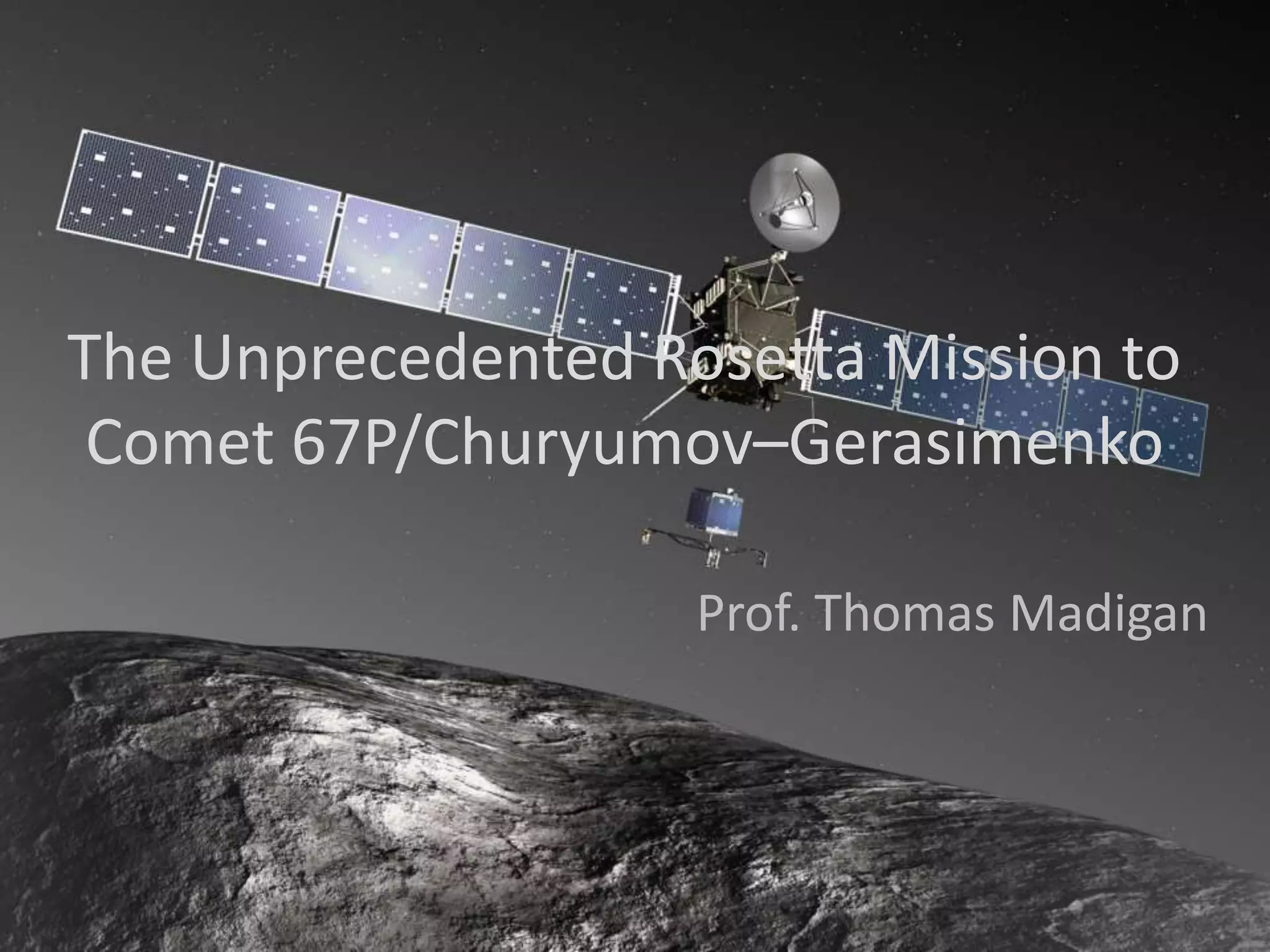
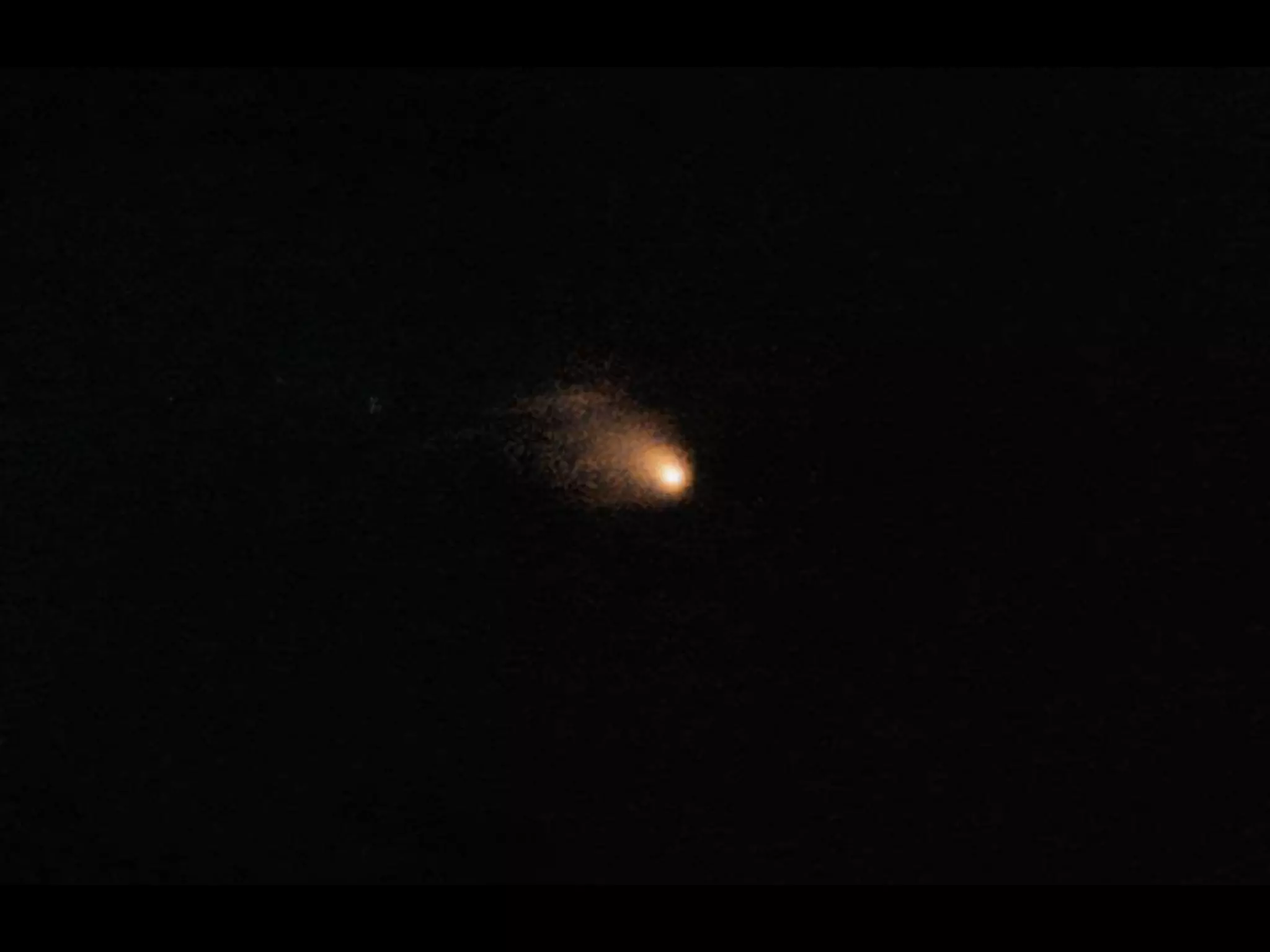


The Unprecedented Rosetta Mission to 
Comet 67P/Churyumov–Gerasimenko 
Prof. Thomas Madigan
Overview 
• Historical retrospective of comets 
• The Dawn of the Modern Era and a New 
Intellectual Renaissance 
• Our Modern Understanding of Comets 
• Why study comets? 
• The Importance of visiting Comet 67P/C-G 
–Why this comet? 
• The 67P/C-G Mission
Since antiquity comets were thought of as 
harbingers of doom. The word “disaster” is 
derived from the Greek word meaning “bad 
star” and was often used to refer to the 
appearance of a comet within the context of a 
certain calamity
dis·as·ter 
Origin 
• late 16th century: from Italian disastro ‘ill-starred 
event,’ from dis- (expressing negation) 
+ astro ‘star’ (from Latin astrum ).
Antiquity 
The Greeks 
– Some suggest that comets are solar system 
objects like planets 
– Others suggest that they were burning clouds or 
optical phenomena in the Earth’s atmosphere 
– Aristotle (400 BC), a Geocentrist, adopts this later 
view, suggesting that comets are "windy 
exhalations“ from the Earth
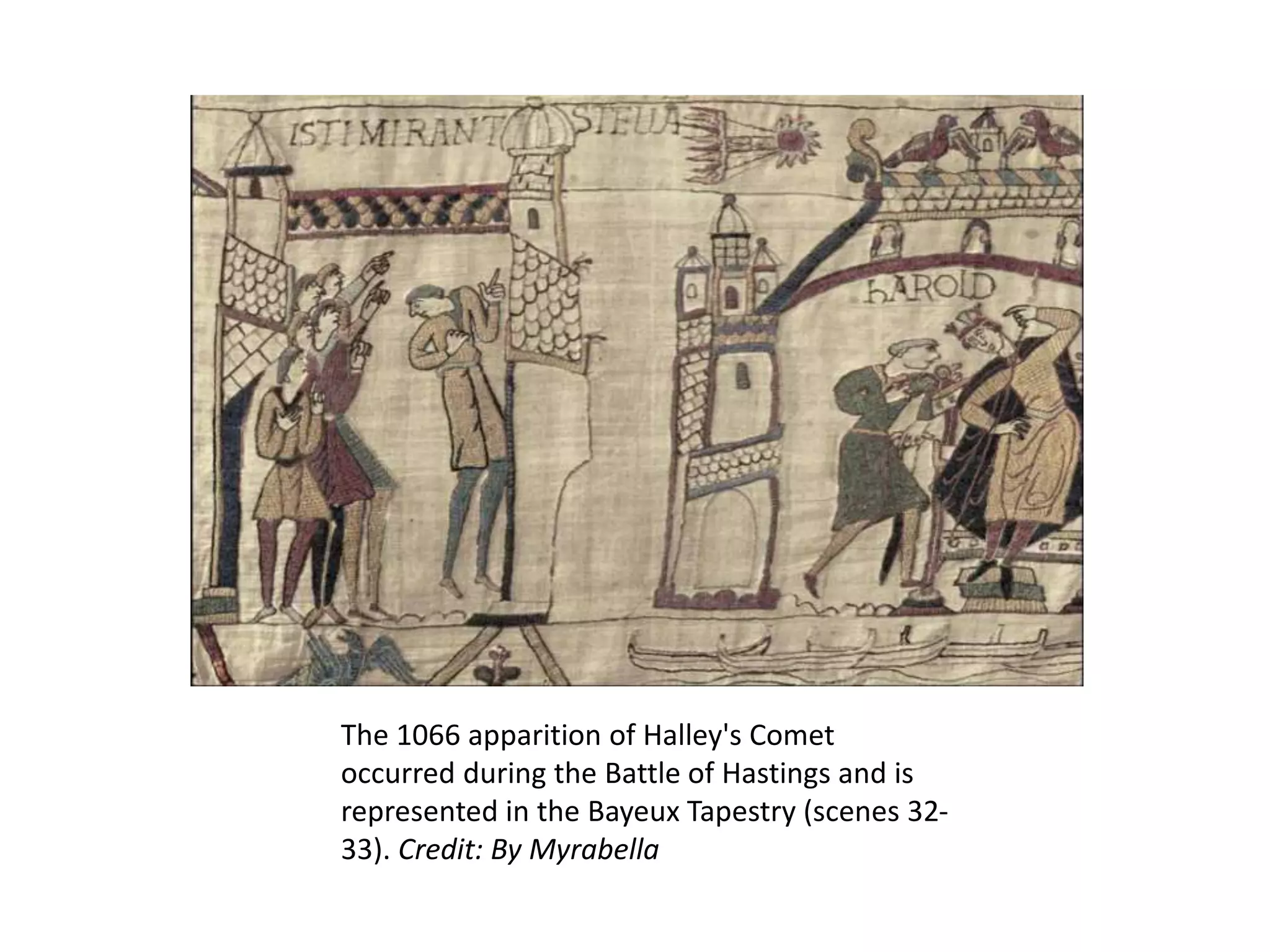
The 1066 apparition of Halley's Comet 
occurred during the Battle of Hastings and is 
represented in the Bayeux Tapestry (scenes 32- 
33). Credit: By Myrabella
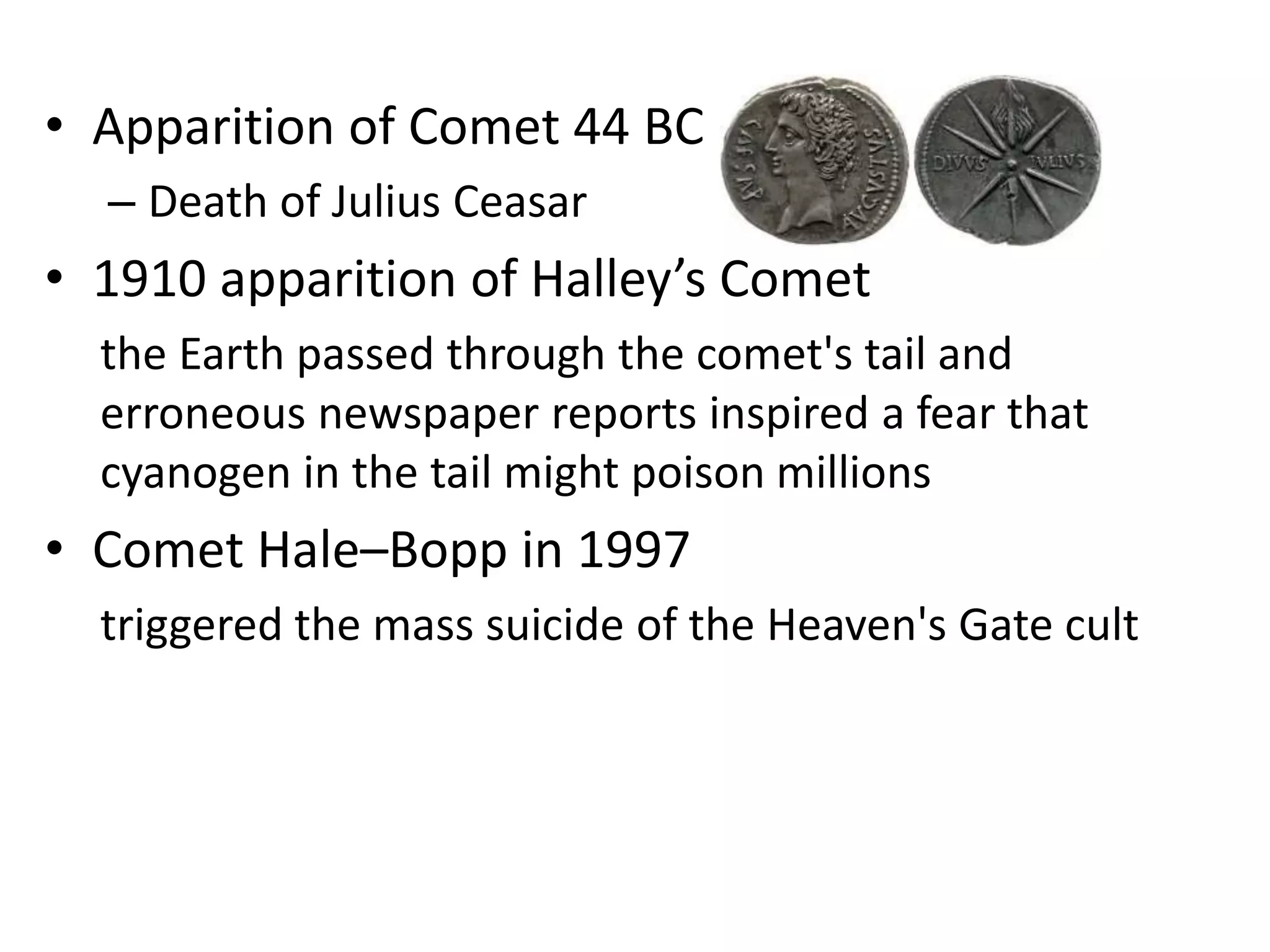
• Apparition of Comet 44 BC 
– Death of Julius Ceasar 
• 1910 apparition of Halley’s Comet 
the Earth passed through the comet's tail and 
erroneous newspaper reports inspired a fear that 
cyanogen in the tail might poison millions 
• Comet Hale–Bopp in 1997 
triggered the mass suicide of the Heaven's Gate cult
The Beginnings of Modernity 
and the Scientific Revolution 
(The Dawn of Reason) 
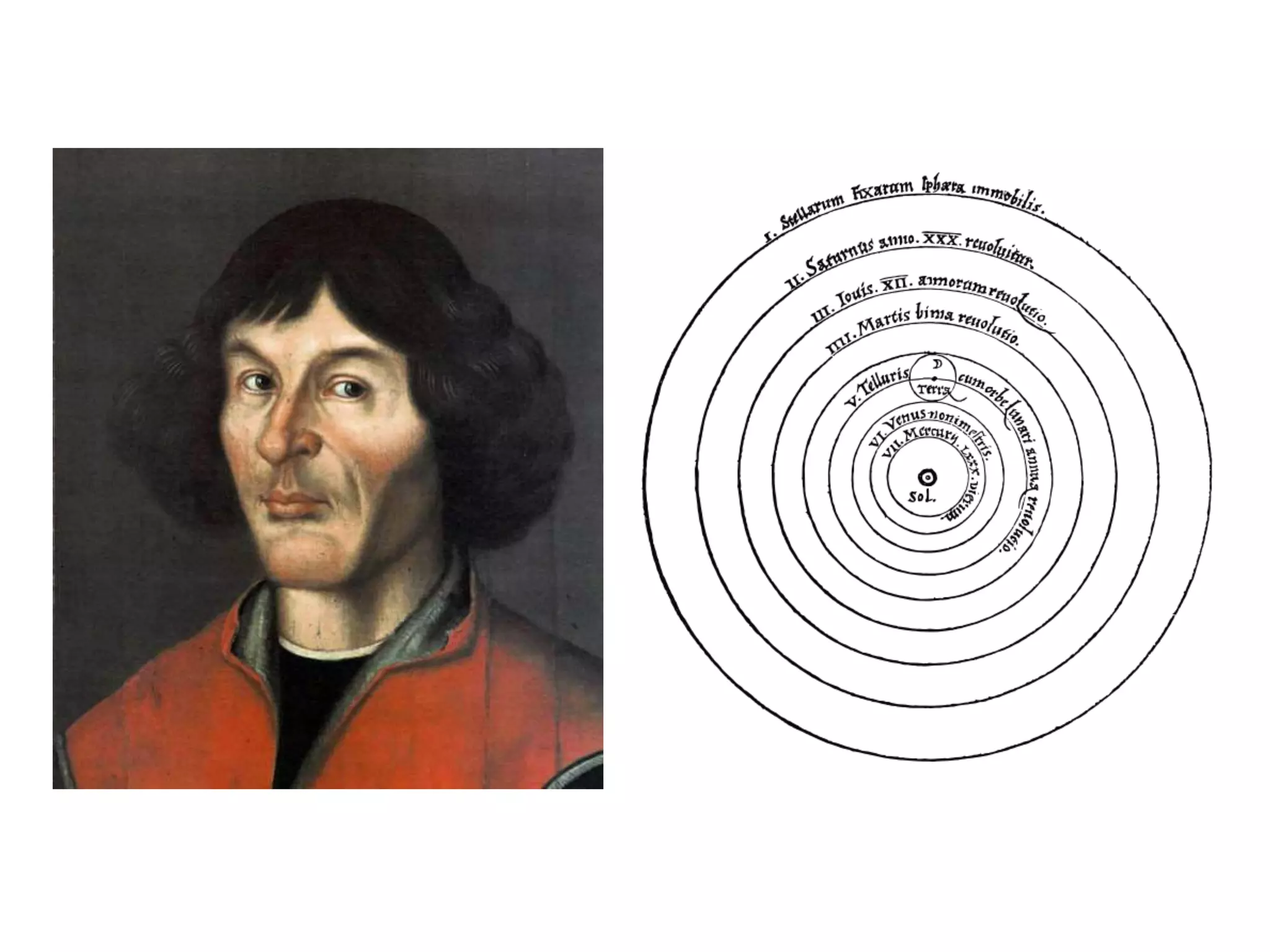
Copernicus 
Publishes De Revolutionibus Orbium Coelestium 
(On the Revolutions of the Celestial Spheres) just 
before his death in 1543, proposing a Heliocentric 
model of the solar system 
Is renowned as the “Father of Modern 
Astronomy” for rekindling this idea, for proposing 
a model “More Pleasing to the Mind”
Tycho Brahe 
– Meticulous observations of the planets at 
Uraniburg on the island of Hven (Denmark) 
– Proposes the use of careful experiments rather 
than lengthy philosophical debates 
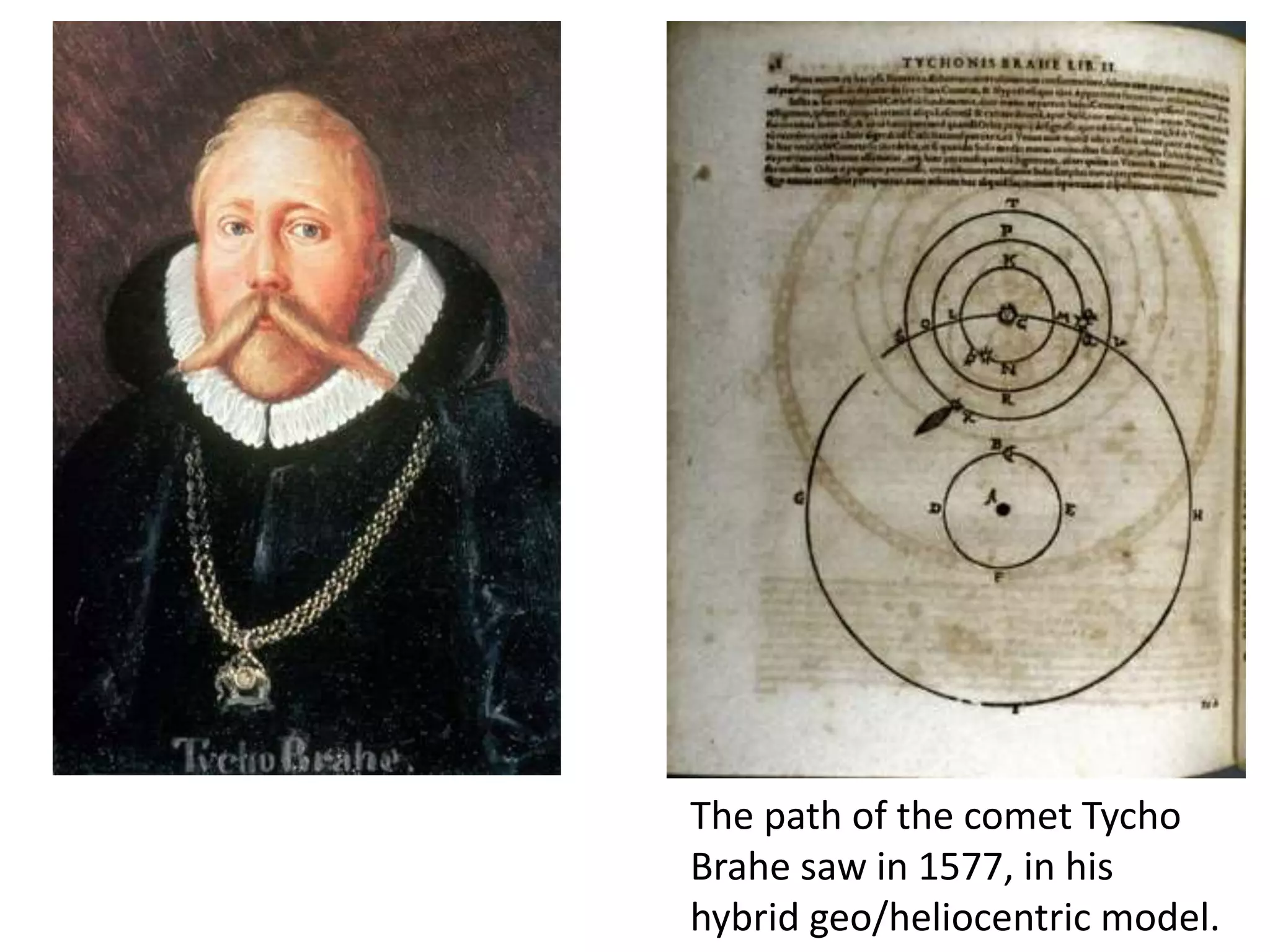
– computes the distance to the Great Comet of 
1577 using the parallax method 
– Subsequently proposes a hybrid model that 
includes aspects of the Geocentric and 
Heliocentric models
The path of the comet Tycho 
Brahe saw in 1577, in his 
hybrid geo/heliocentric model.
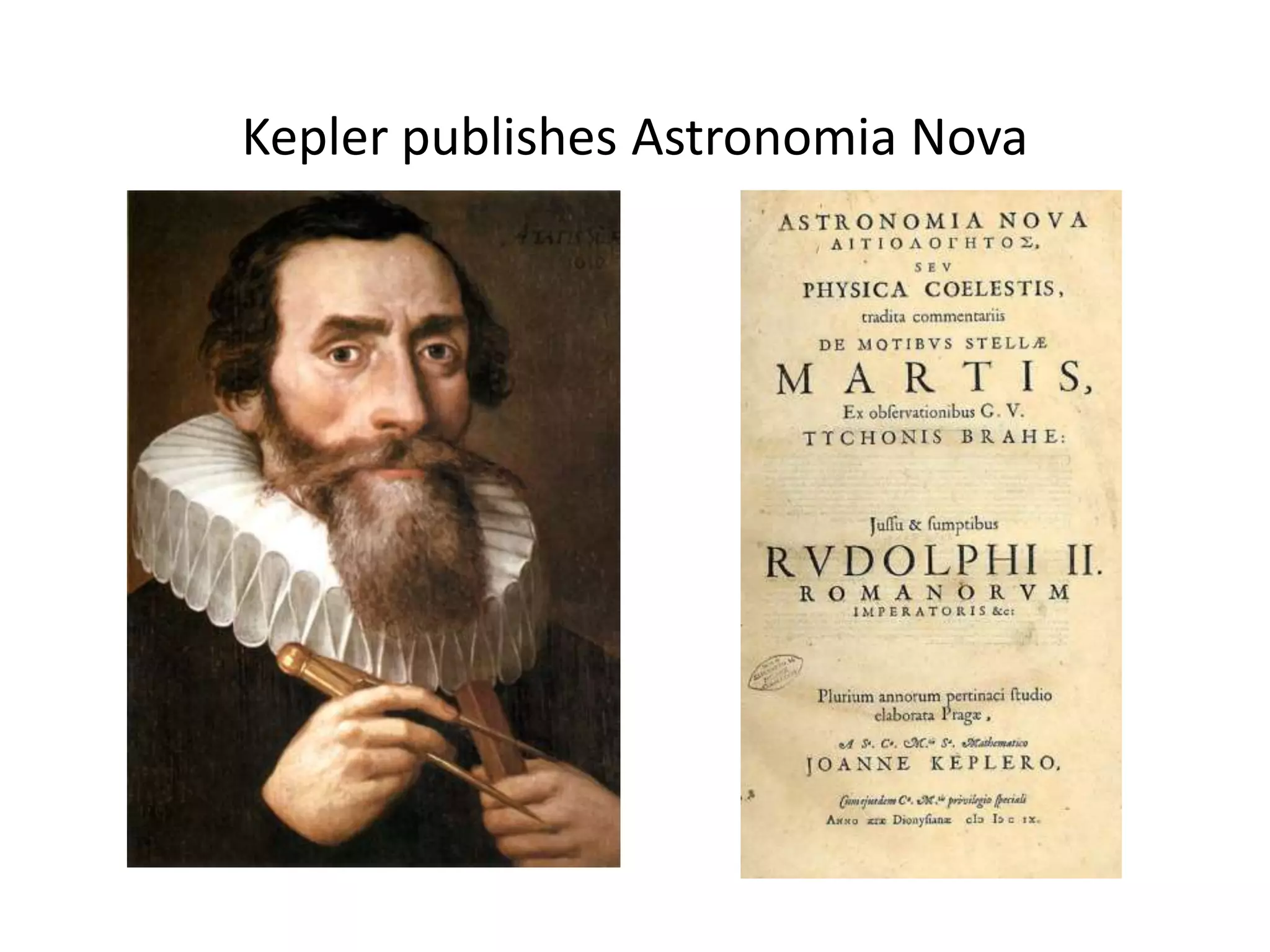
Kepler publishes Astronomia Nova
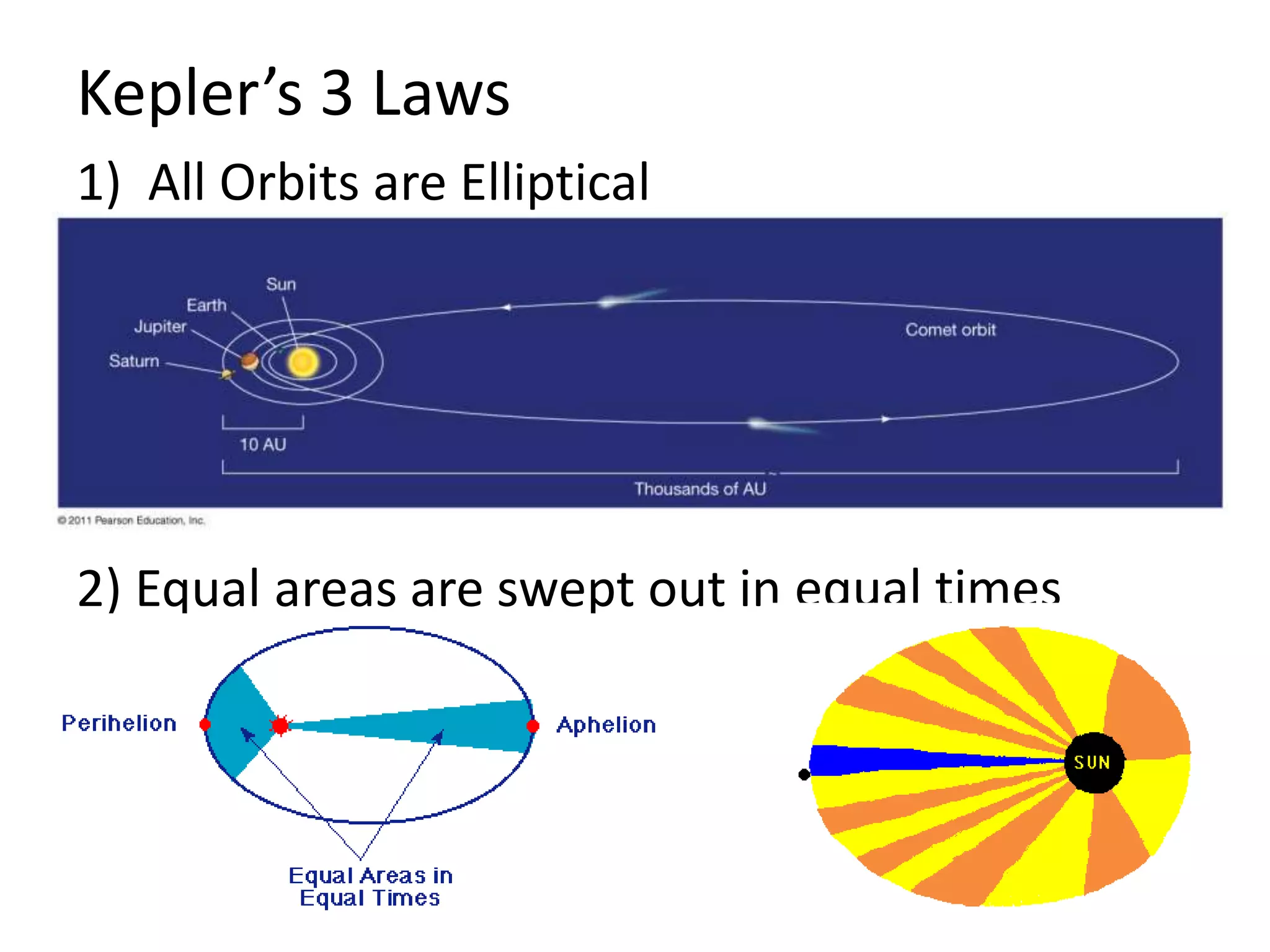
Kepler’s 3 Laws 
1) All Orbits are Elliptical 
2) Equal areas are swept out in equal times
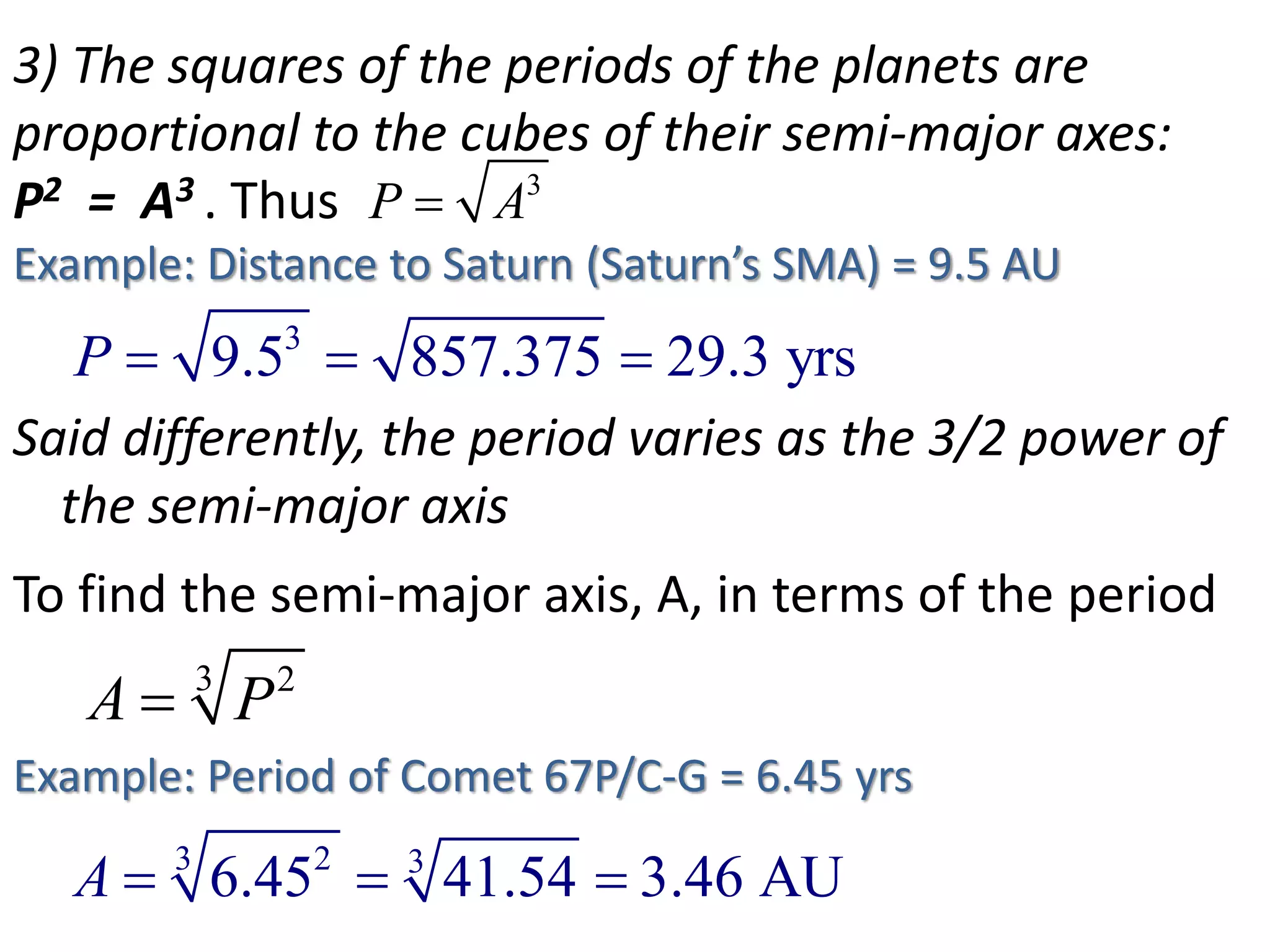
3) The squares The Copernican of the periods of Revolution 
the planets are 
proportional to the cubes of their semi-major axes: 
P2 = A3 . Thus 
P  A 
3 Example: Distance to Saturn (Saturn’s SMA) = 9.5 AU 
3 P  9.5  857.375  29.3 yrs 
Said differently, the period varies P  A3 
as the 3/2 power of 
the semi-major axis 
To find the semi-major axis, A, in terms of the period 
3 2 A  P 
Example: Period of Comet 67P/C-G = 6.45 yrs 
3 2 3 A  6.45  41.54  3.46 AU
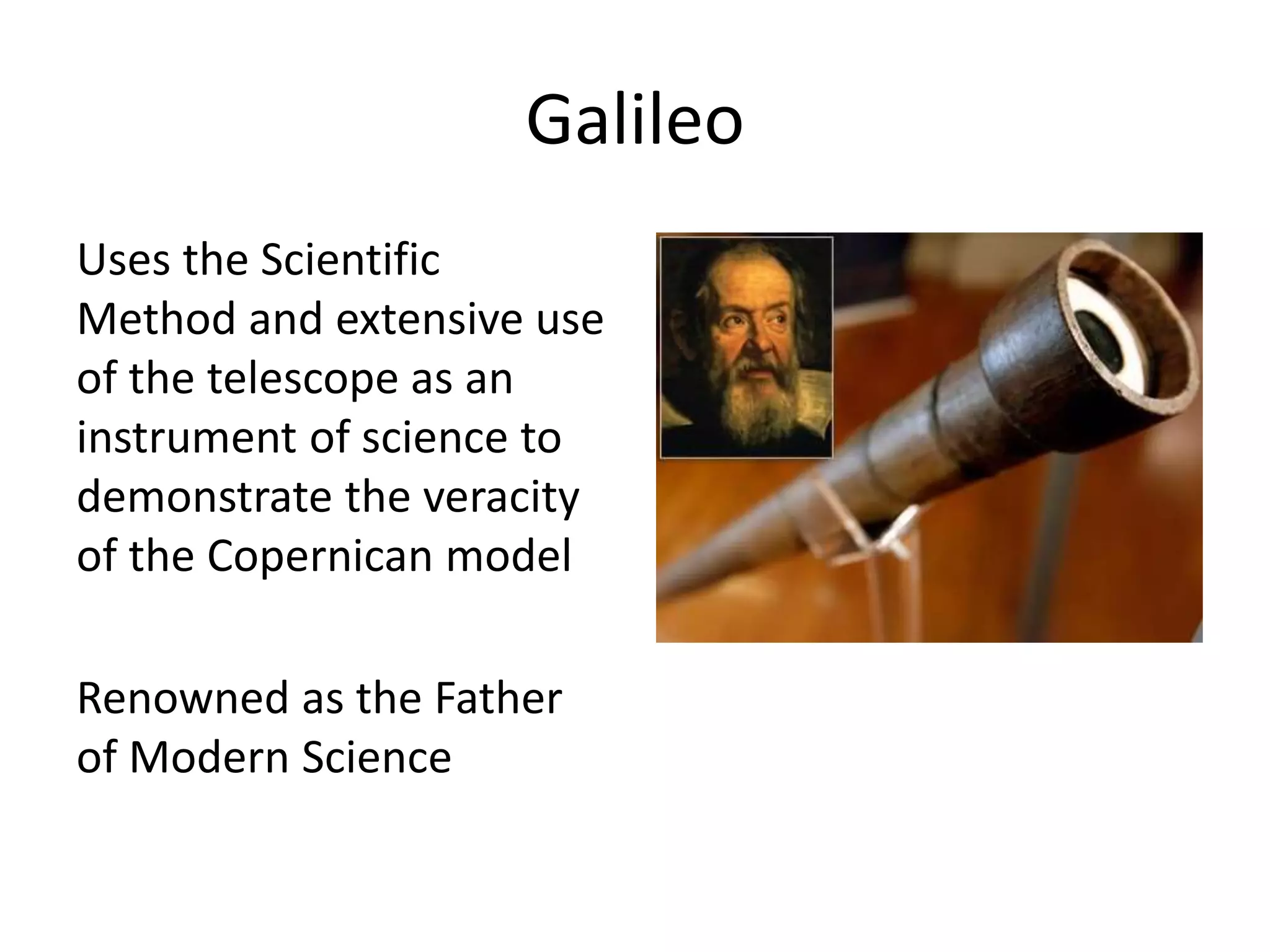
Galileo 
Uses the Scientific 
Method and extensive use 
of the telescope as an 
instrument of science to 
demonstrate the veracity 
of the Copernican model 
Renowned as the Father 
of Modern Science
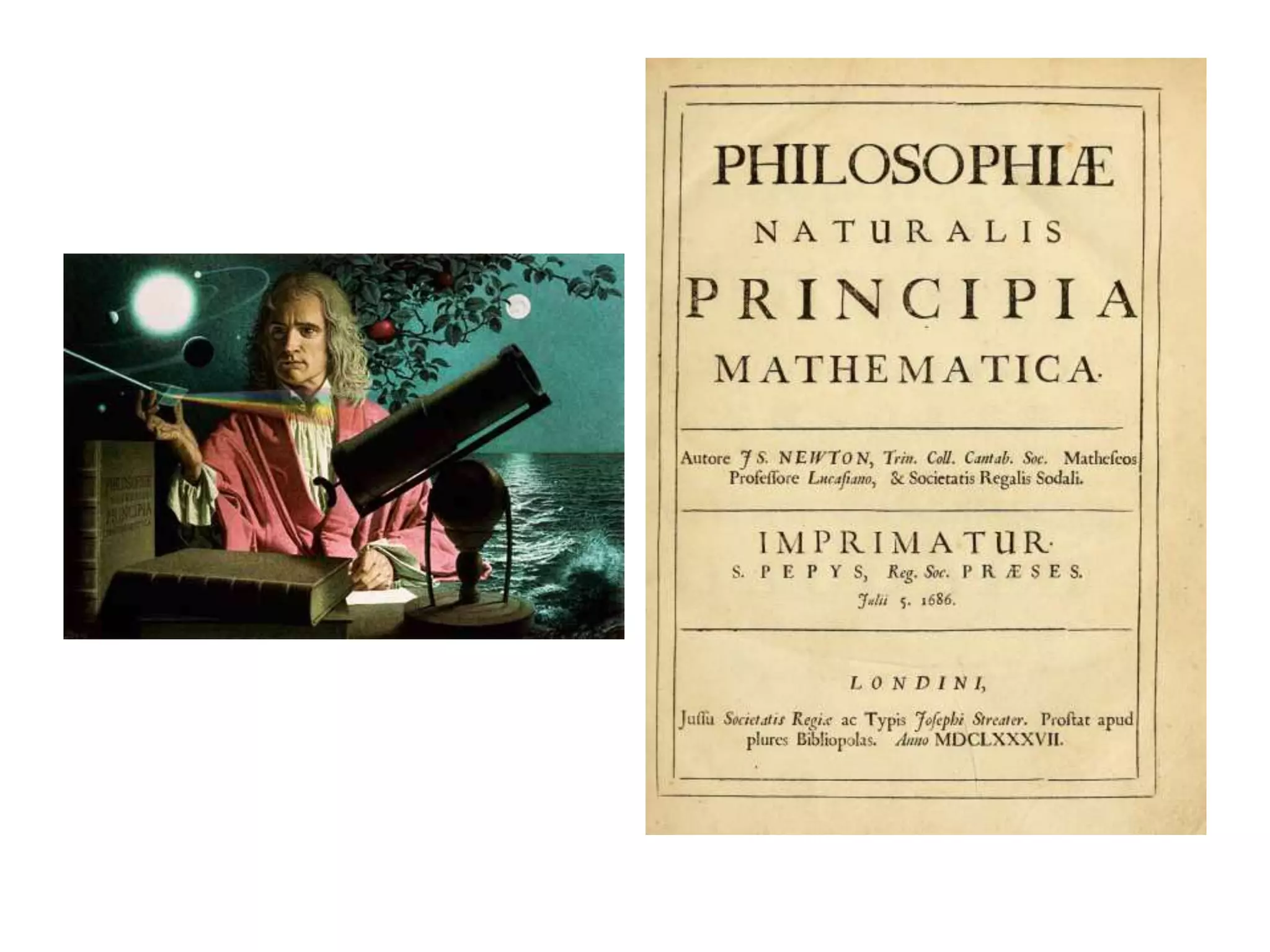
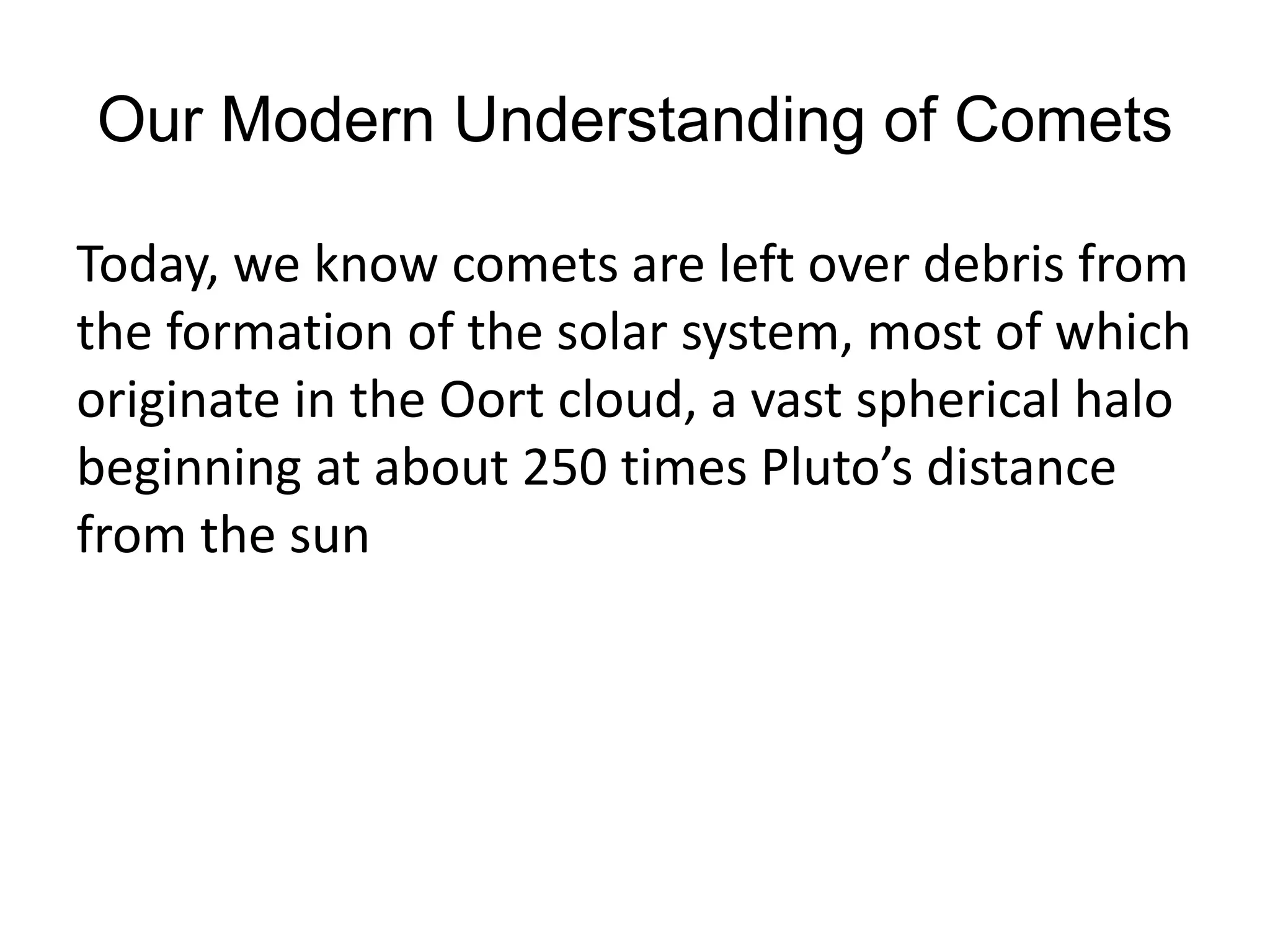
Isaac Newton 
• Develops Classical Mechanics and Laws of Motion 
• Develops The Law of Universal Gravitation 
• Publishes Principia Mathematica 
• Along with Liebnitz, develops Calculus 
• Renowned as one of the most influential scientists of 
all time and a key figure in the scientific revolution
Our Modern Understanding of Comets 
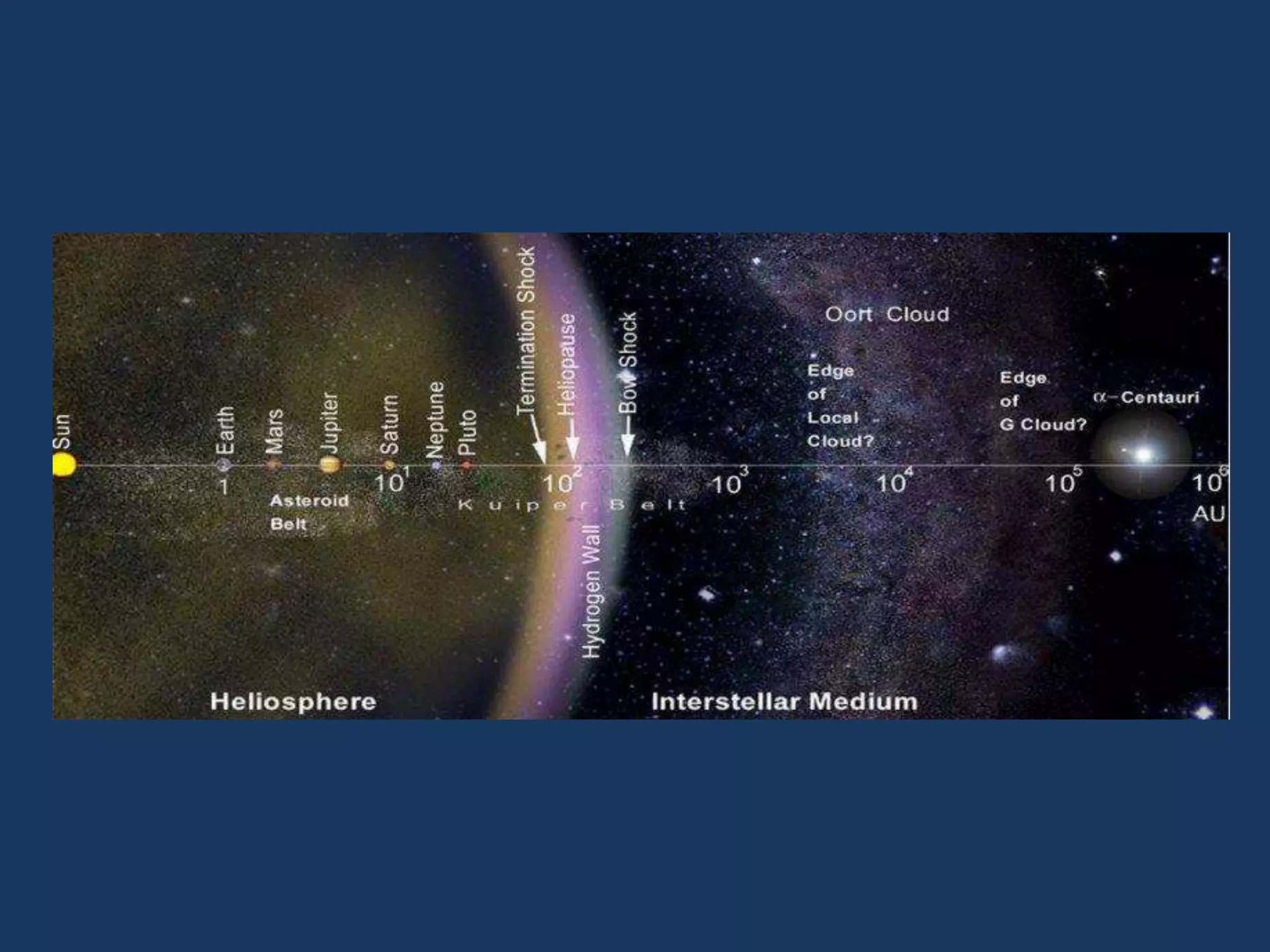
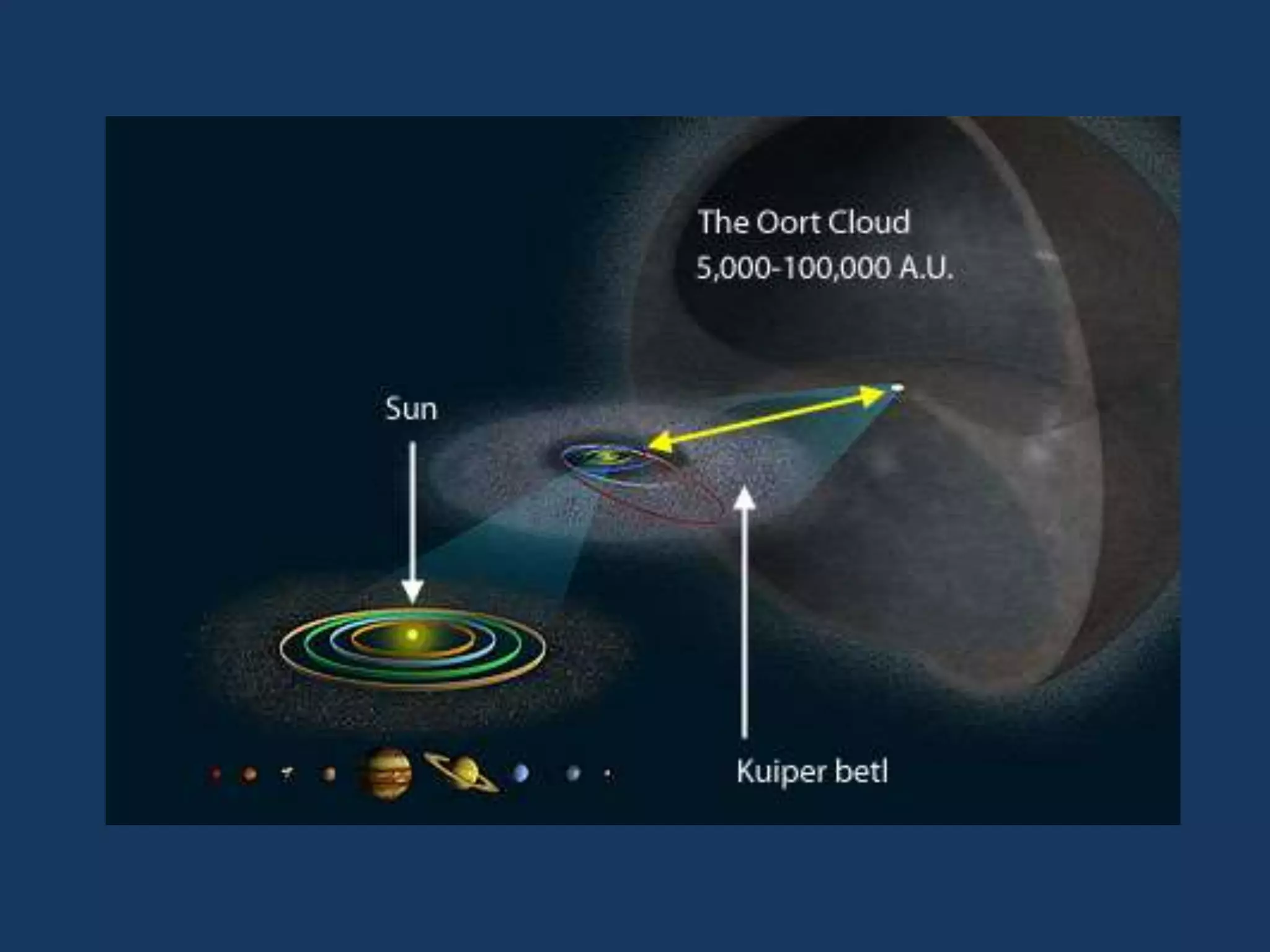
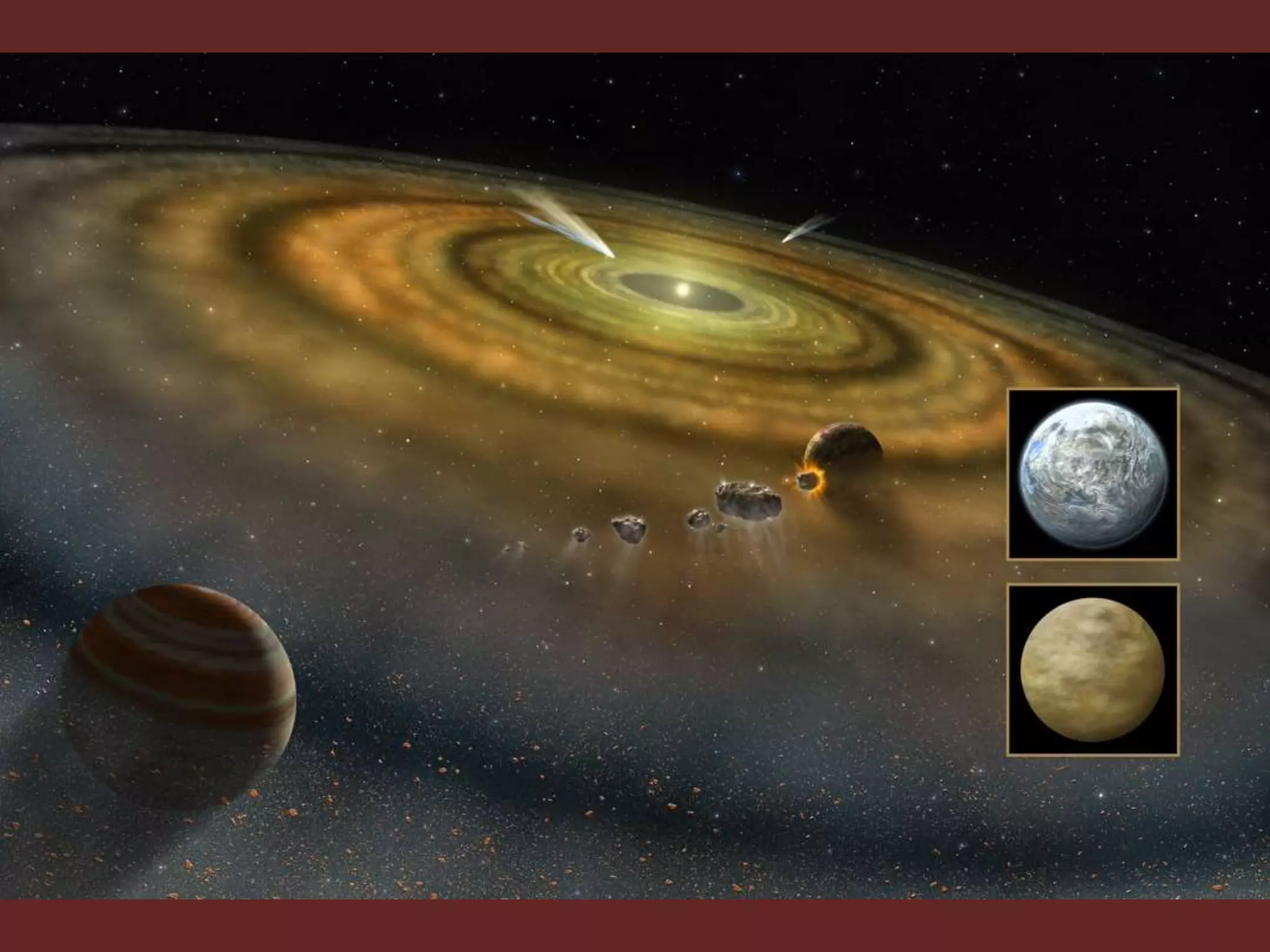
Today, we know comets are left over debris from 
the formation of the solar system, most of which 
originate in the Oort cloud, a vast spherical halo 
beginning at about 250 times Pluto’s distance 
from the sun
Our Modern Understanding of Comets 
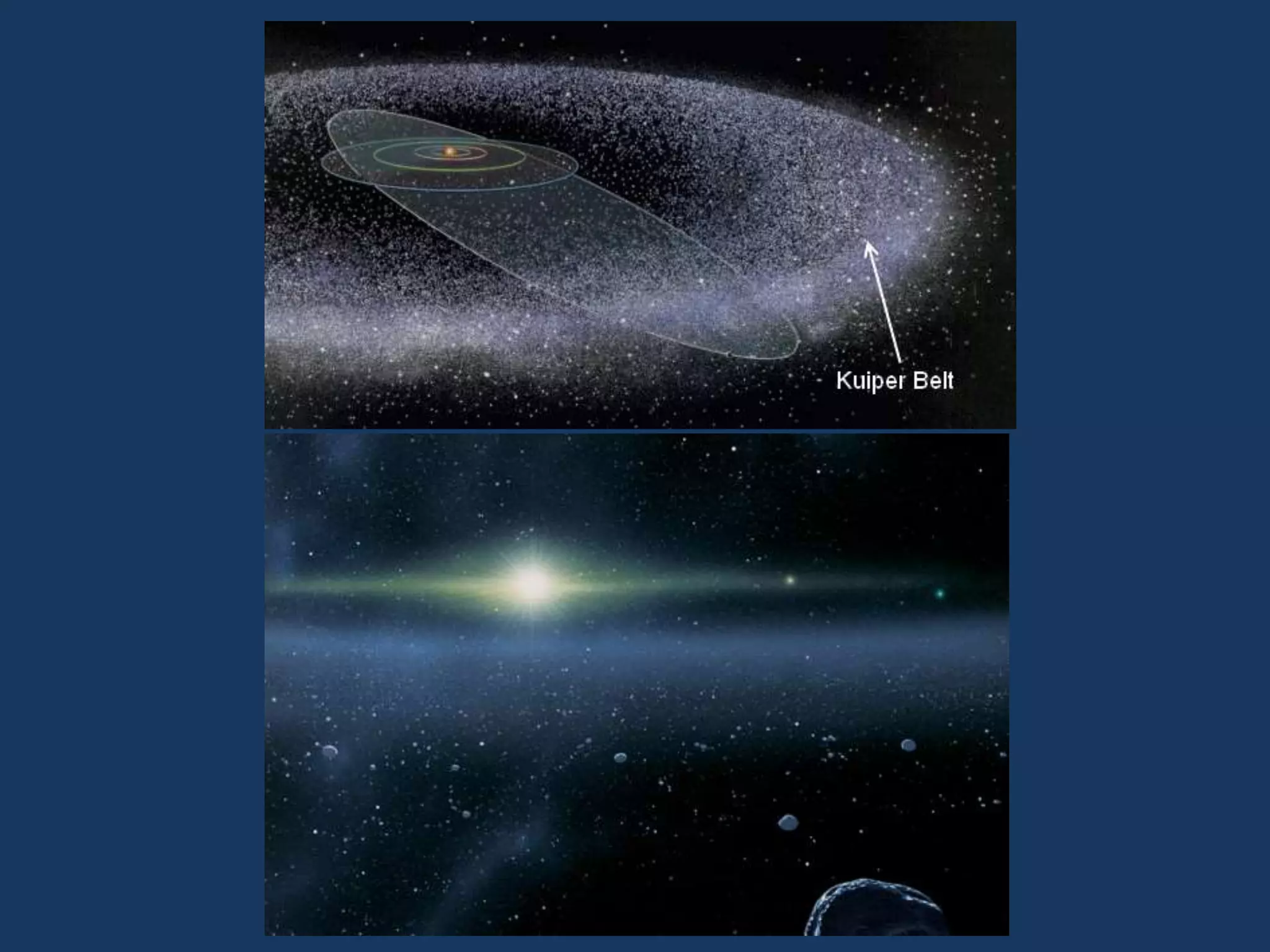
Comets have a wide range of orbital periods and 
orbital eccentricities. Short period comets 
originate in the Kuiper belt, a debris disk beyond 
the orbit of Neptune and Pluto. The longer 
period comets originate in the Oort cloud.
Why Study Comets?
Why Study Comets? 
Comets are composed of material unadulterated 
since the formation of the solar system
What is the true nature of a comet? 
Does it always present with a beautiful tail 
or is it something quite different? 
Lets take a look
And 
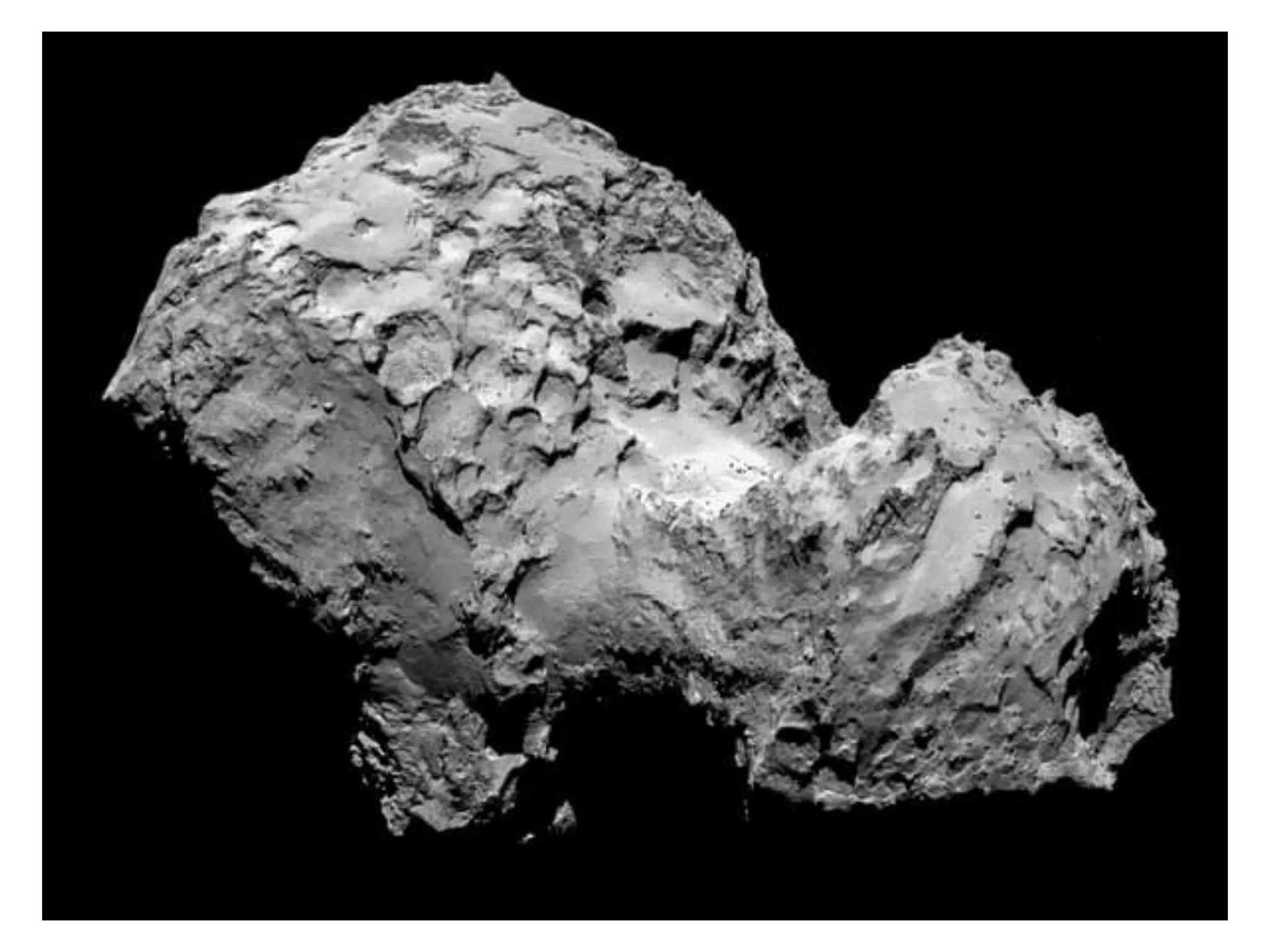
Comet 67P/C-G
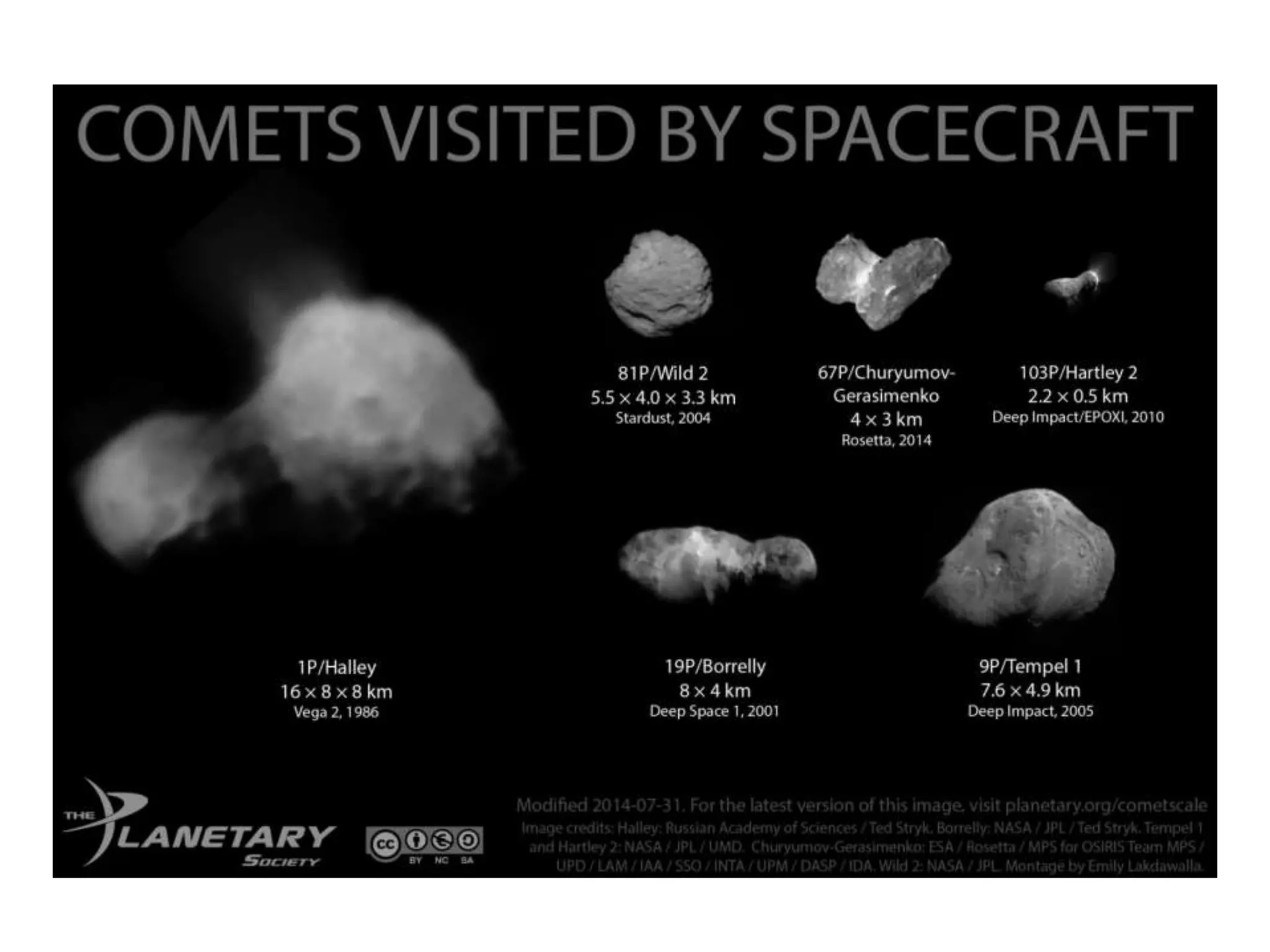
How do comets compare to other objects? 
Cities 4 – 8 KM? 
Oceans 3,000 KM? 
Planets 10,000 KM? 
Stars (the sun) 700,000 KM (radius)?
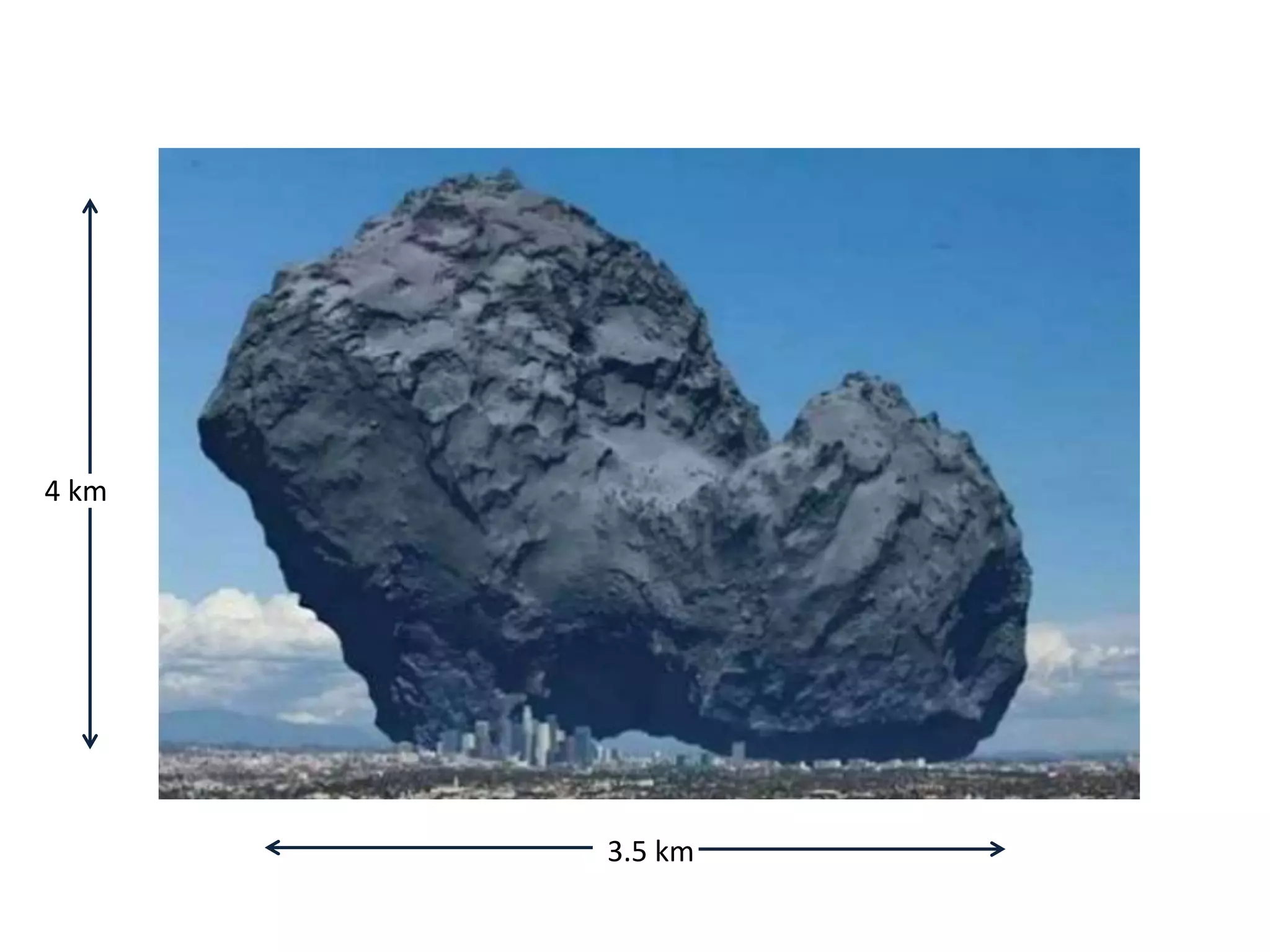
3.5 km 
4 km
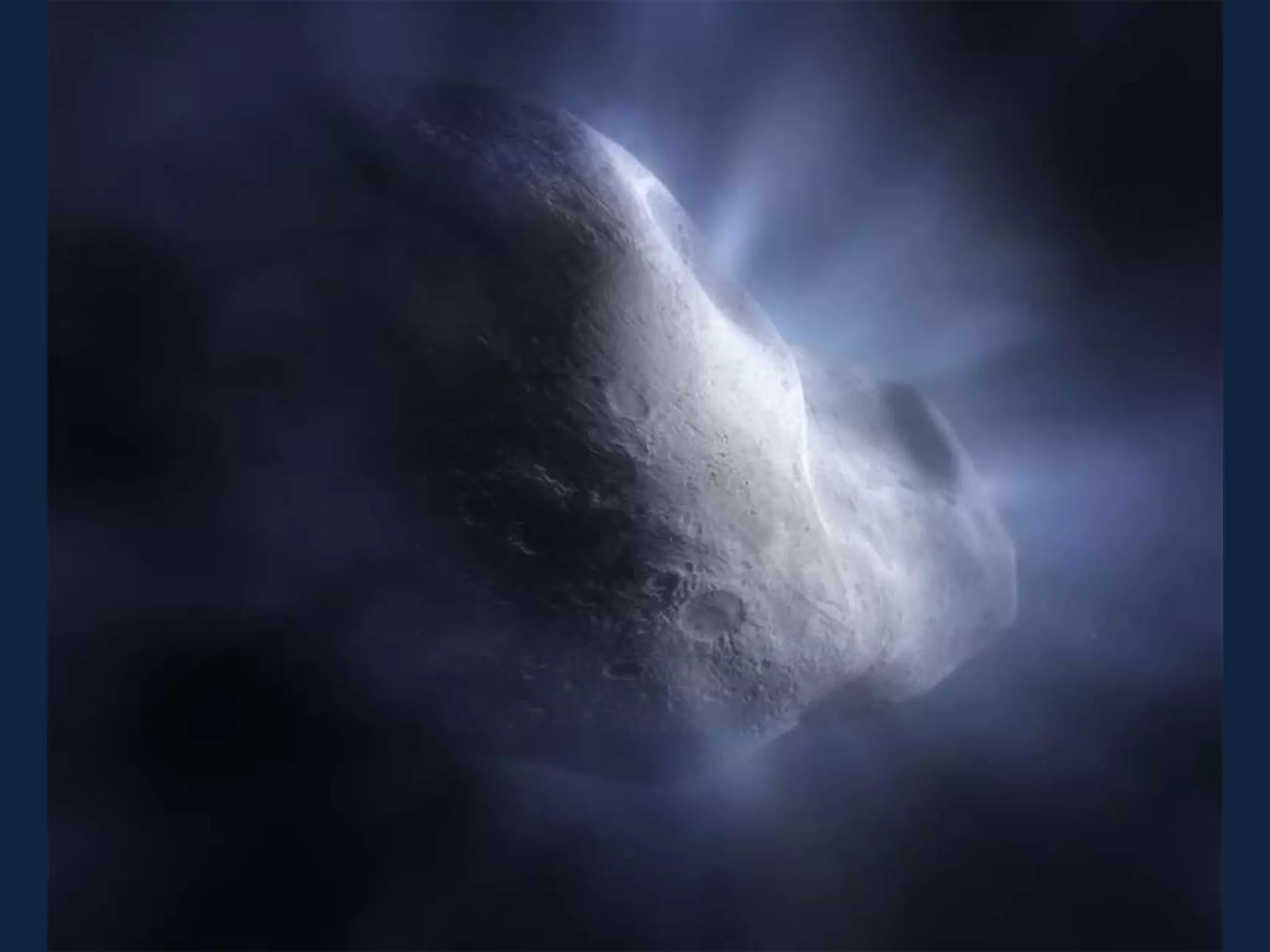
The Nucleus is the loosely bound agglomeration of debris 
held together by ice of various compositions. This is the 
“dormant” state of the comet 
This material “activates” as the comet approaches the sun 
and begins to warm. This process forms the “Coma”
What happens to a comet as it approaches the 
sun? 
Lets take a look
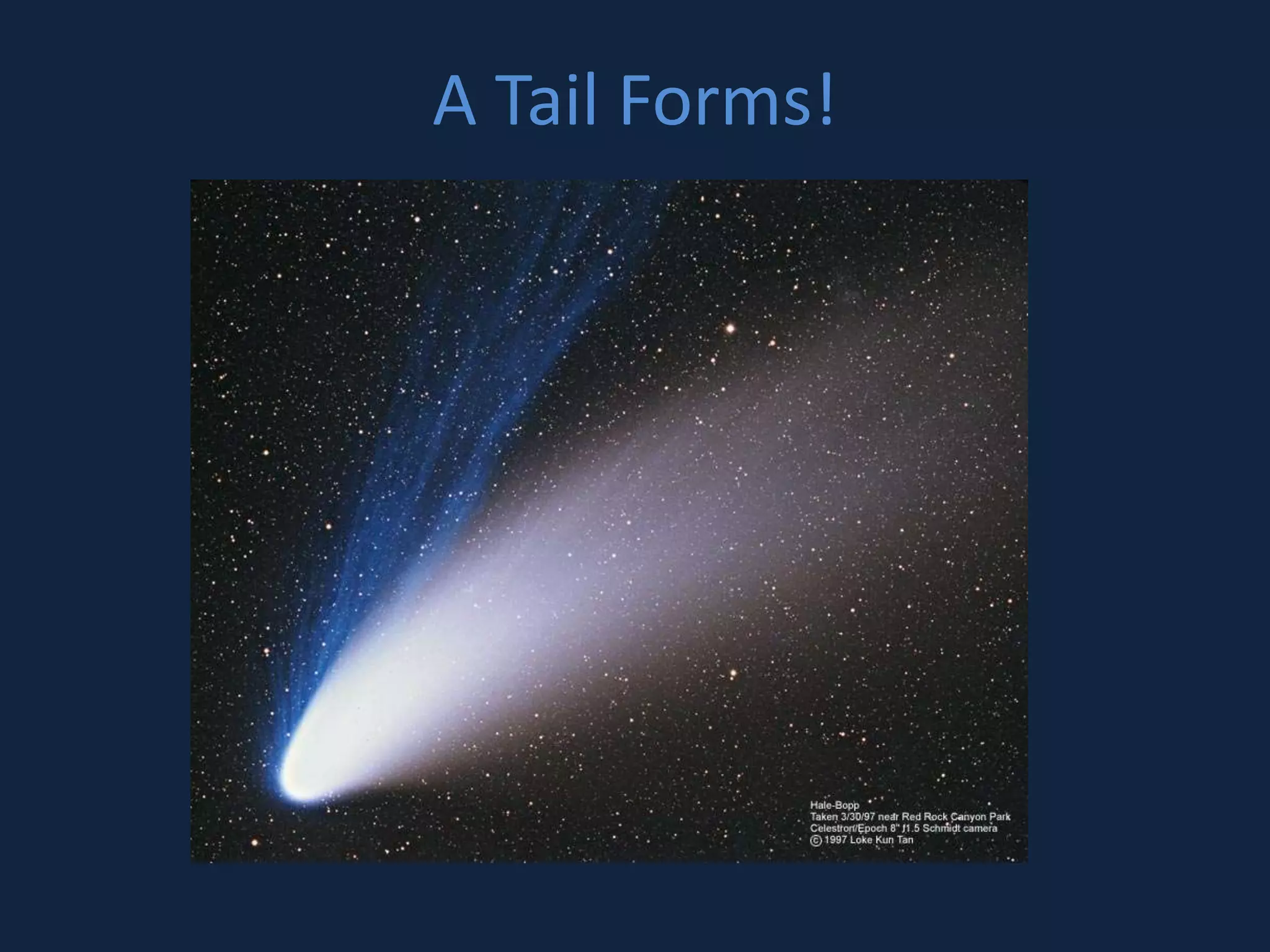
A Tail Forms!
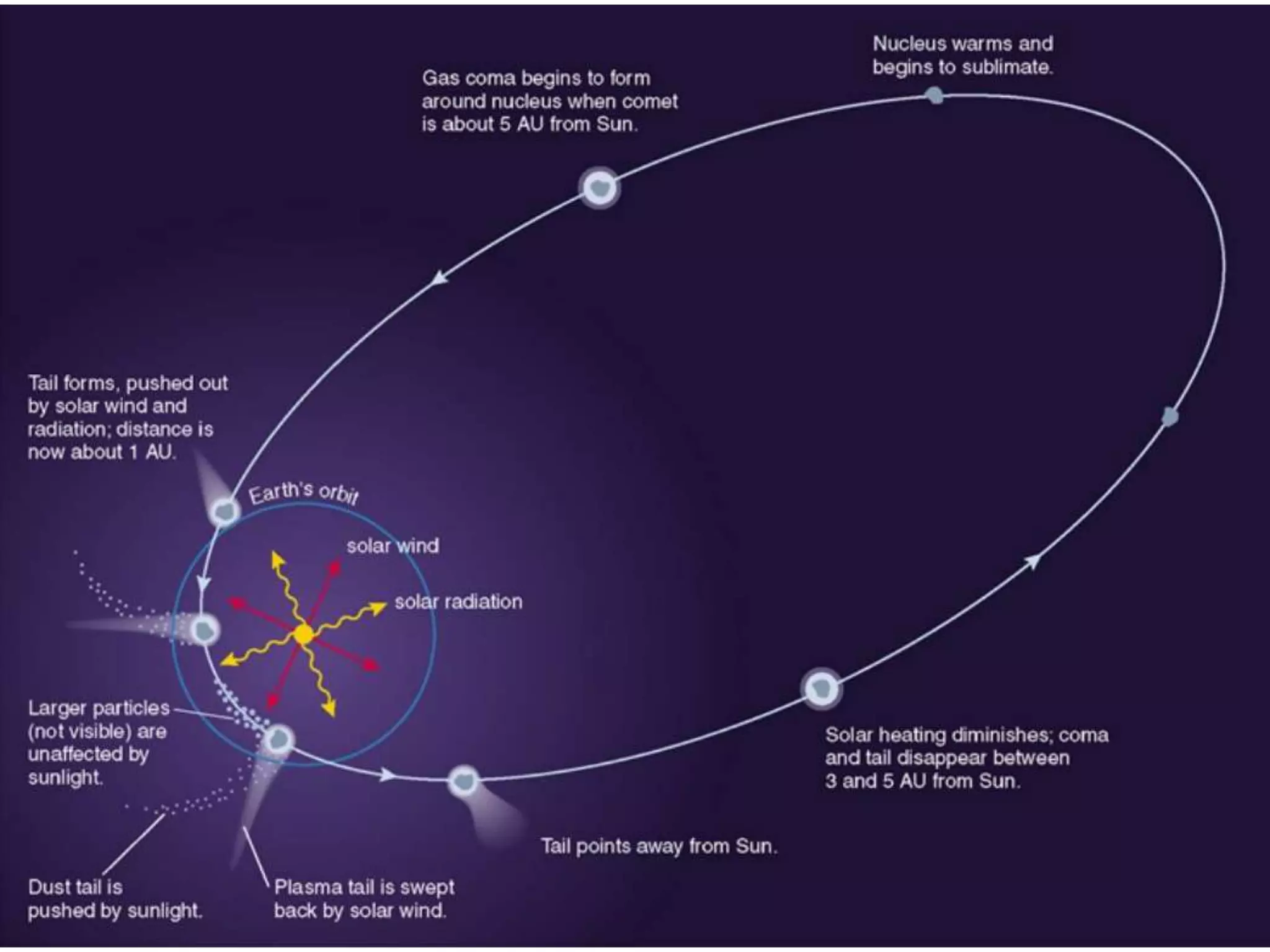
Why does the tail form and what is it comprised 
of?
Why does the tail form and what is it comprised 
of? 
– As the comet approaches the sun, the nucleus 
begins to warm and the ice starts to sublimate 
(evaporate)
Why does the tail form and what is it comprised 
of? 
– As the comet approaches the sun, the nucleus 
begins to warm and the ice starts to sublimate 
(evaporate) 
– At about 1 AU from the sun, the tail forms, pushed 
out by Solar Wind and Radiation Pressure
Why does the tail form and what is it comprised 
of? 
– As the comet approaches the sun, the nucleus 
begins to warm and the ice starts to sublimate 
(evaporate) 
– At about 1 AU from the sun, the tail forms, pushed 
out by Solar Wind and Radiation Pressure 
– Solar radiation pressure forms a dust tail
Why does the tail form and what is it comprised 
of? 
– As the comet approaches the sun, the nucleus 
begins to warm and the ice starts to sublimate 
(evaporate) 
– At about 1 AU from the sun, the tail forms, pushed 
out by Solar Wind and Radiation Pressure 
– Solar radiation pressure forms a dust tail 
– Solar Ultraviolet radiation forms a gas-ion tail
Why does the tail form and what is it comprised 
of? 
– As the comet approaches the sun, the nucleus 
begins to warm and the ice starts to sublimate 
(evaporate) 
– At about 1 AU from the sun, the tail forms, pushed 
out by Solar Wind and Radiation Pressure 
– Solar radiation pressure forms a dust tail 
– Solar Ultraviolet radiation forms a gas-ion tail 
– The Solar wind pushes the gas-ion tail in the 
opposite direction
Why does the tail form and what is it comprised 
of? 
– As the comet approaches the sun, the nucleus 
begins to warm and the ice starts to sublimate 
(evaporate) 
– At about 1 AU from the sun, the tail forms, pushed 
out by Solar Wind and Radiation Pressure 
– Solar radiation pressure forms a dust tail 
– Solar Ultraviolet radiation forms a gas-ion tail 
– The Solar wind pushes the gas-ion tail in the 
opposite direction 
– The gas-ion tail follows the magnetic field lines
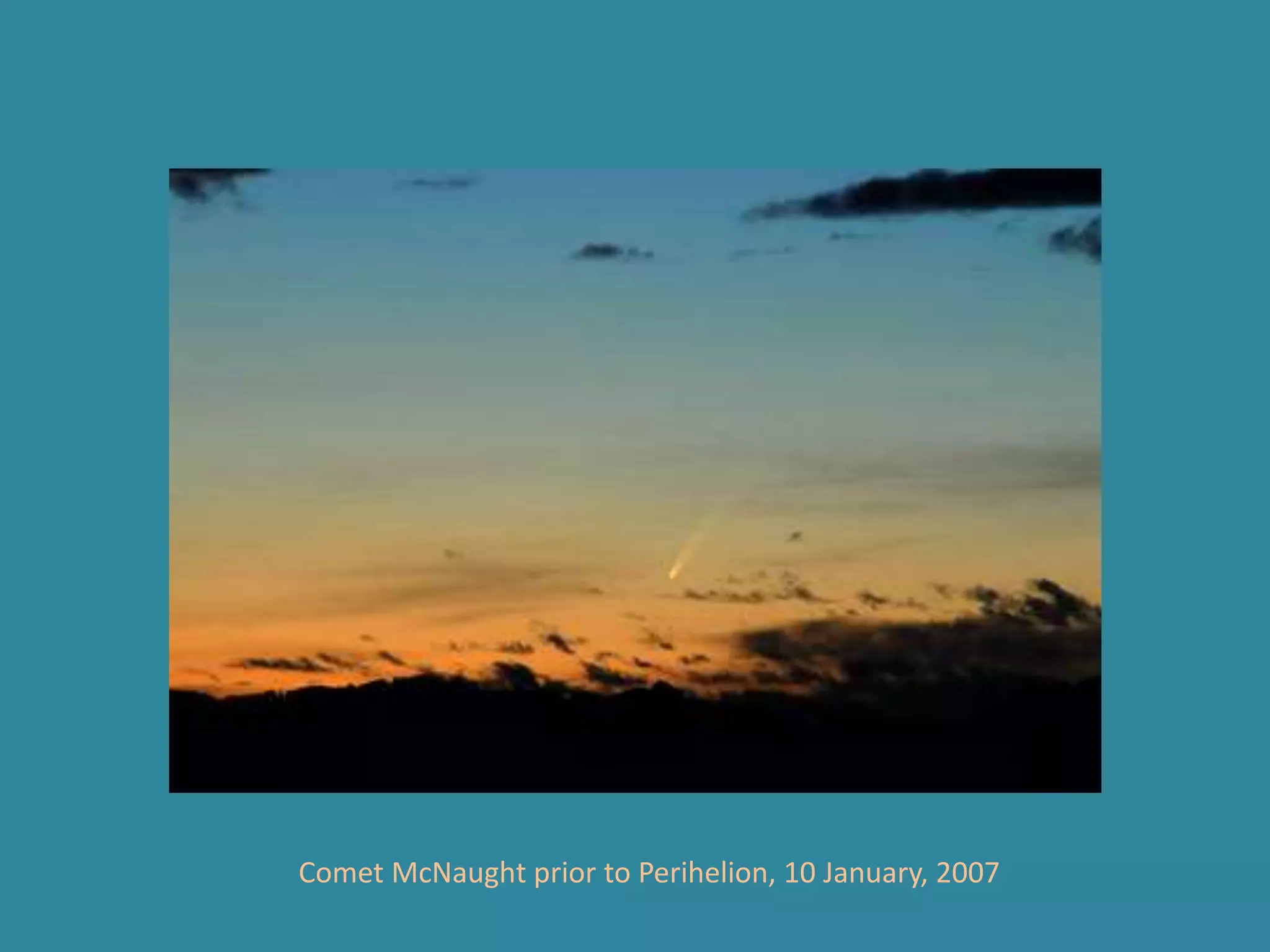
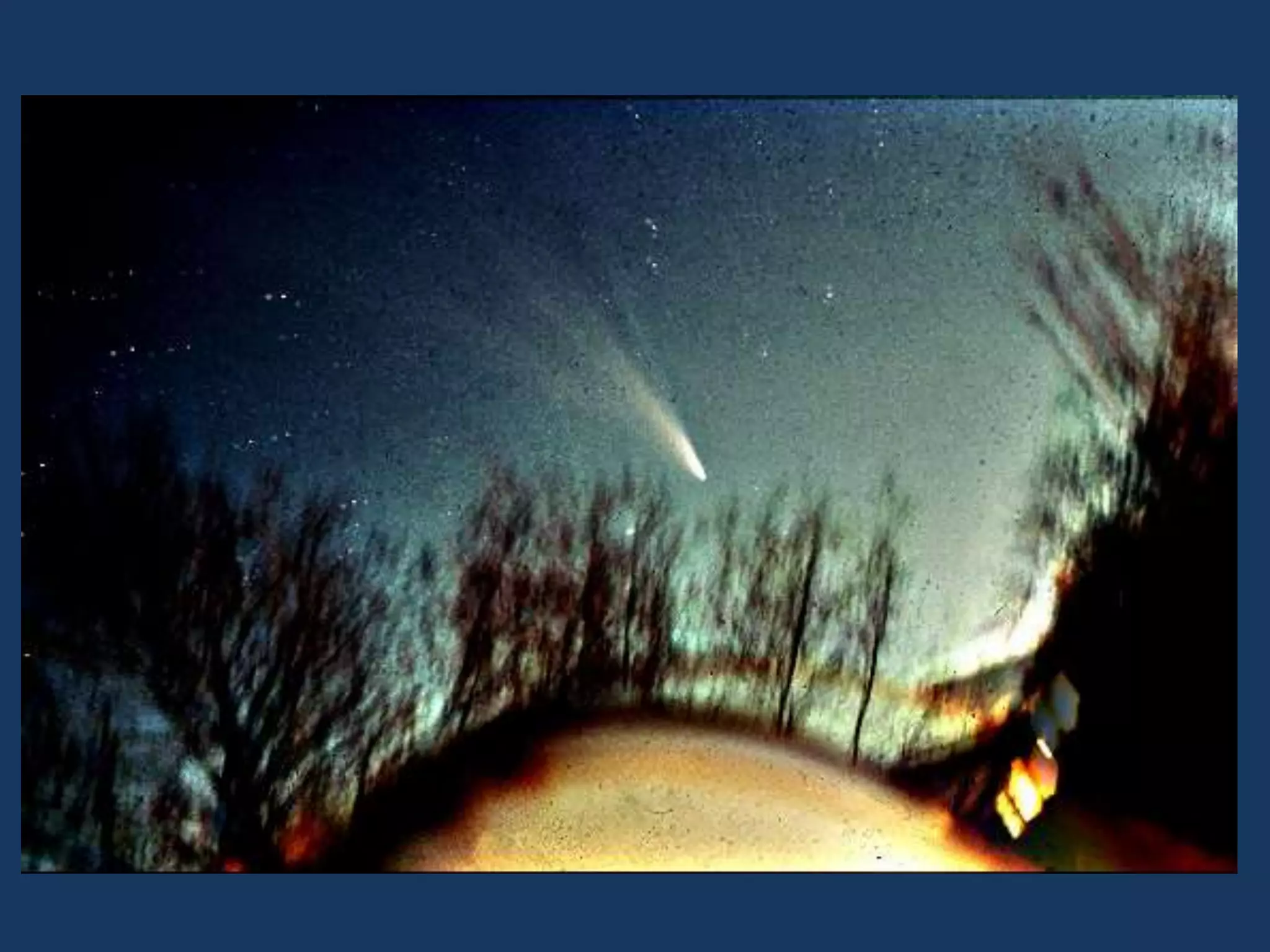
Comet McNaught prior to Perihelion, 10 January, 2007
What happens next? 
The comet passes around the sun at Perihelion 
or 
The comet becomes a “Sun-grazing” comet
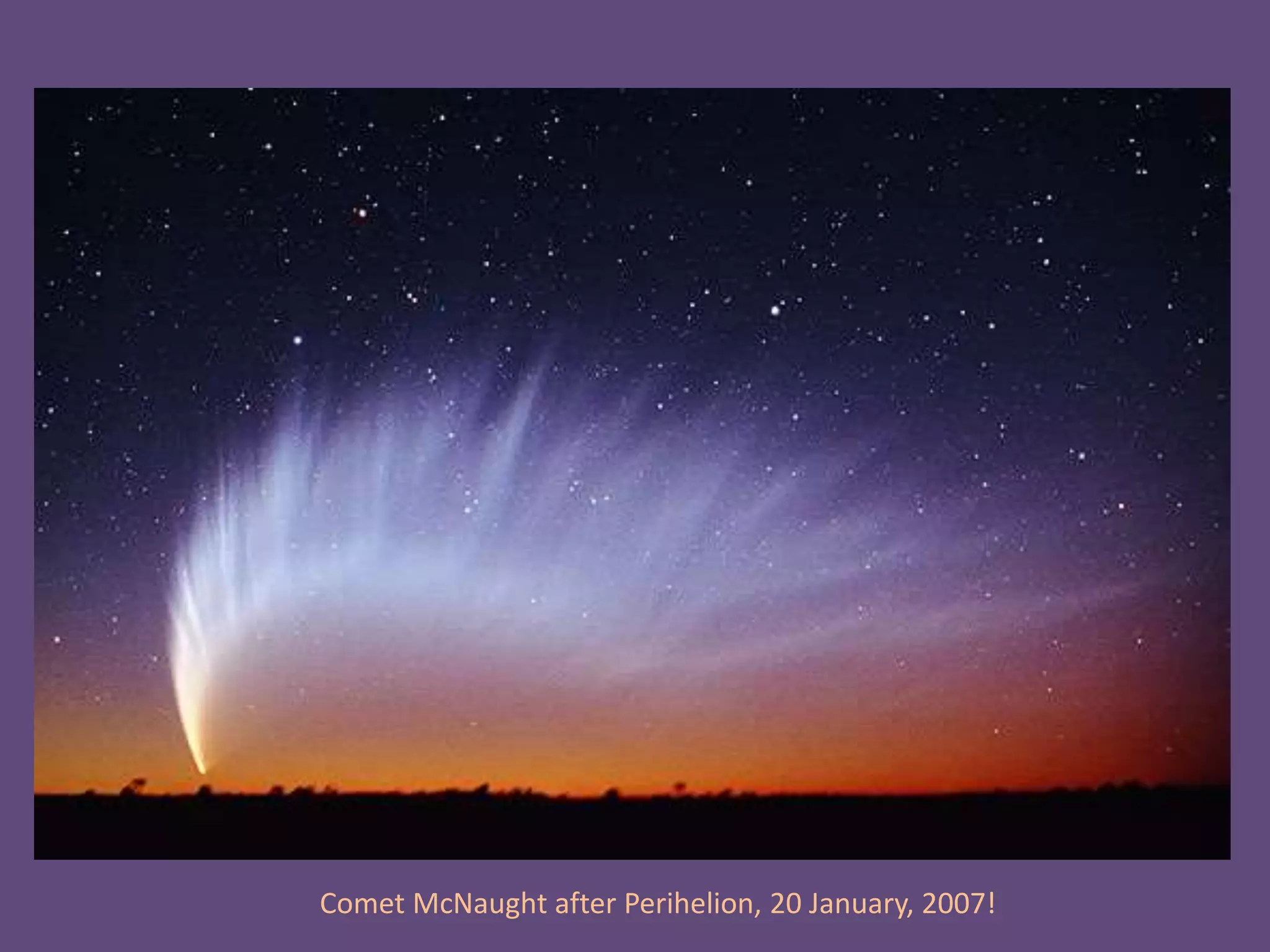
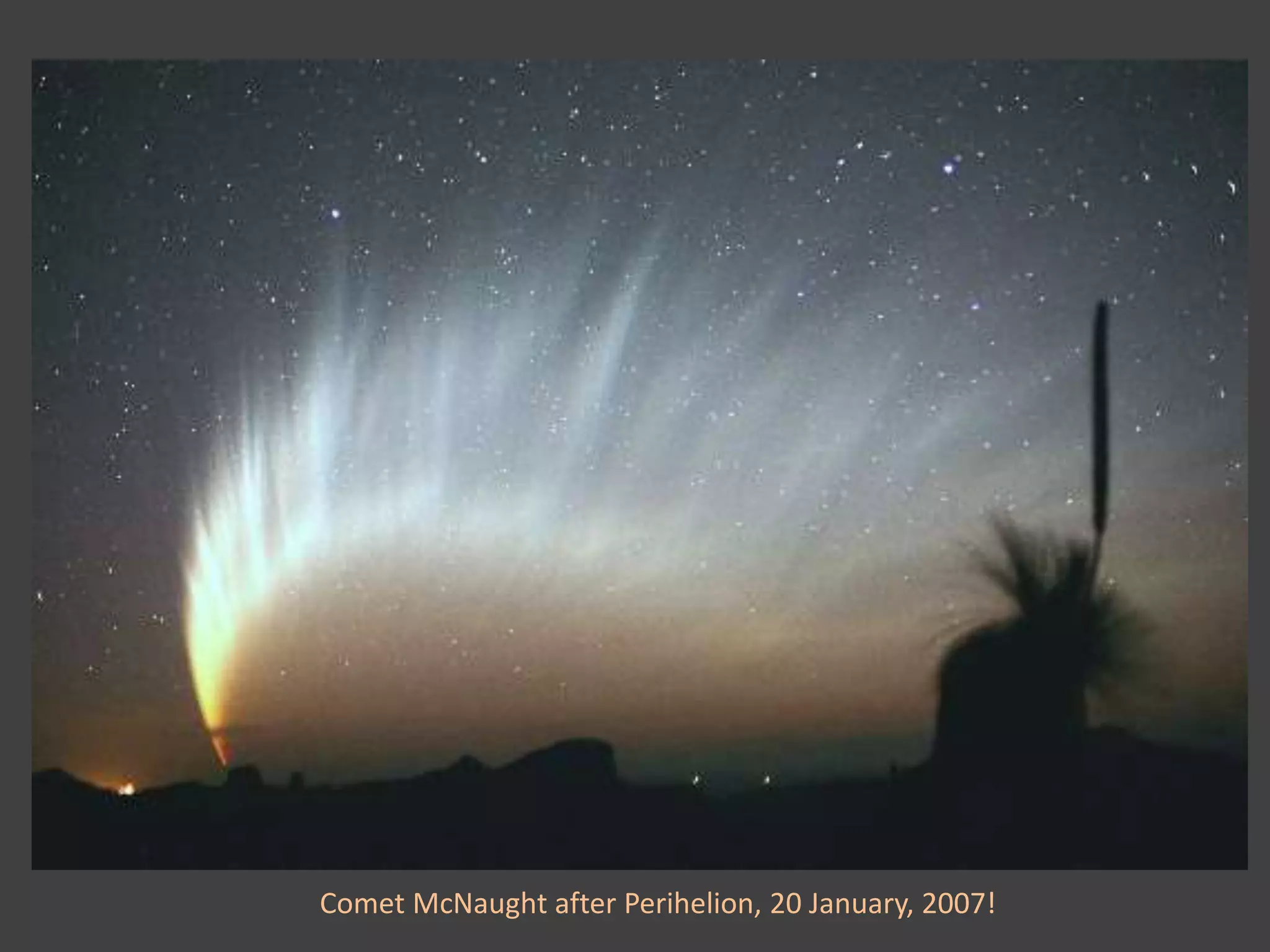
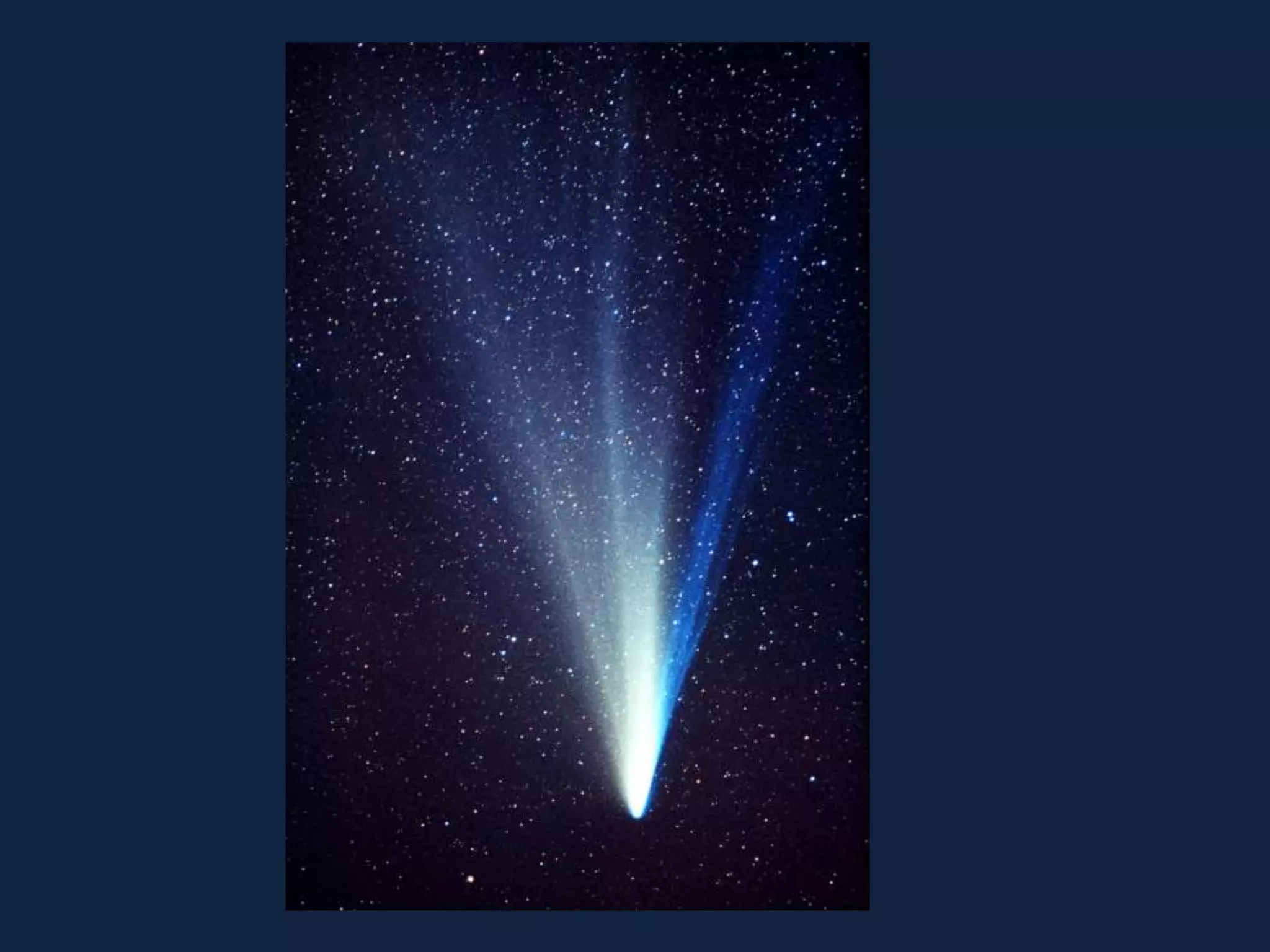
Comet McNaught after Perihelion, 20 January, 2007!
Why Comet 67P/C-G
Why Comet 67P/C-G 
• Long standing desire to rendezvous with a 
comet
Why Comet 67P/C-G 
• Long standing desire to rendezvous with a 
comet 
• Target of opportunity
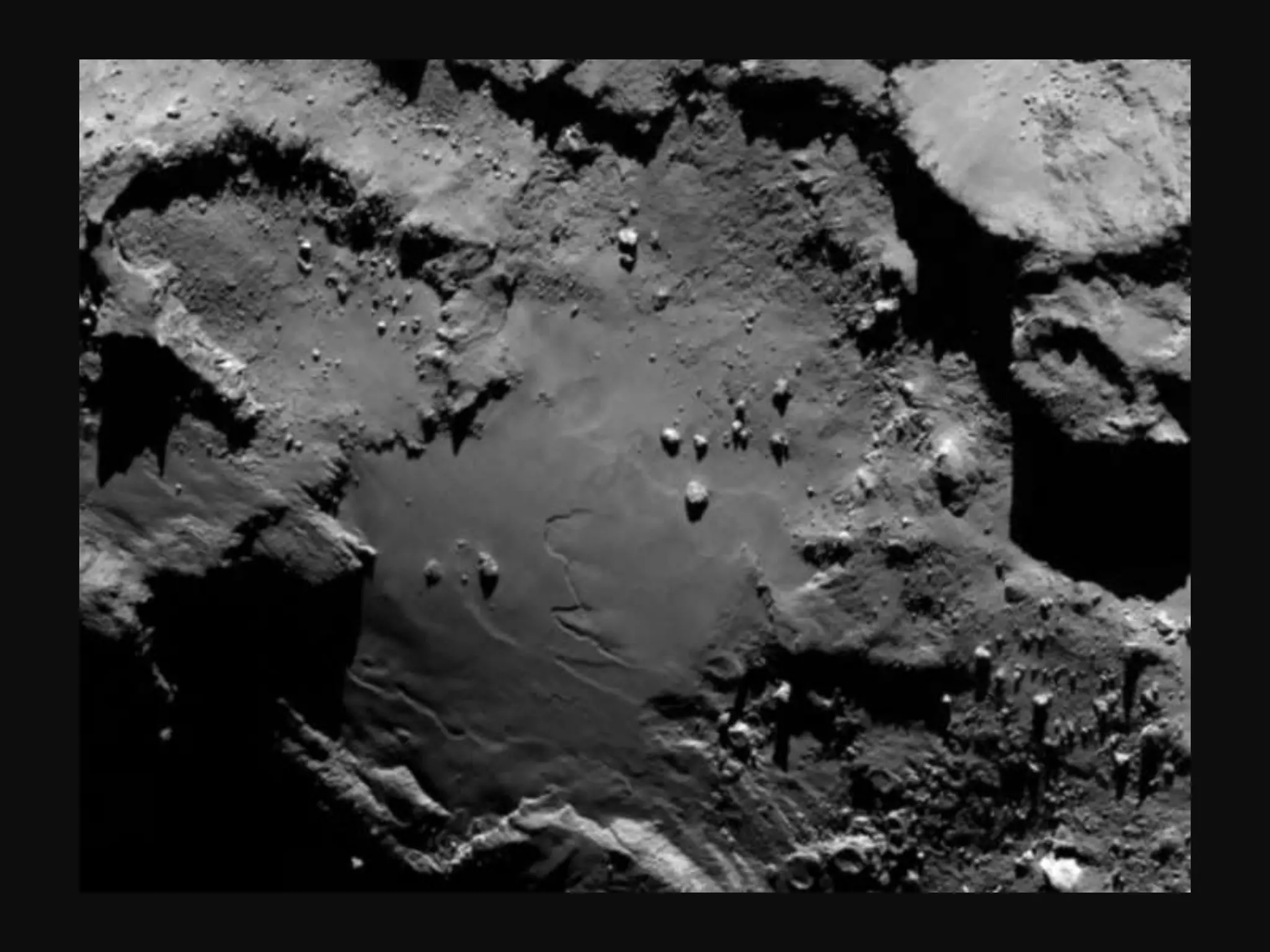
The 67P/C-G Mission
The 67P/C-G Mission 
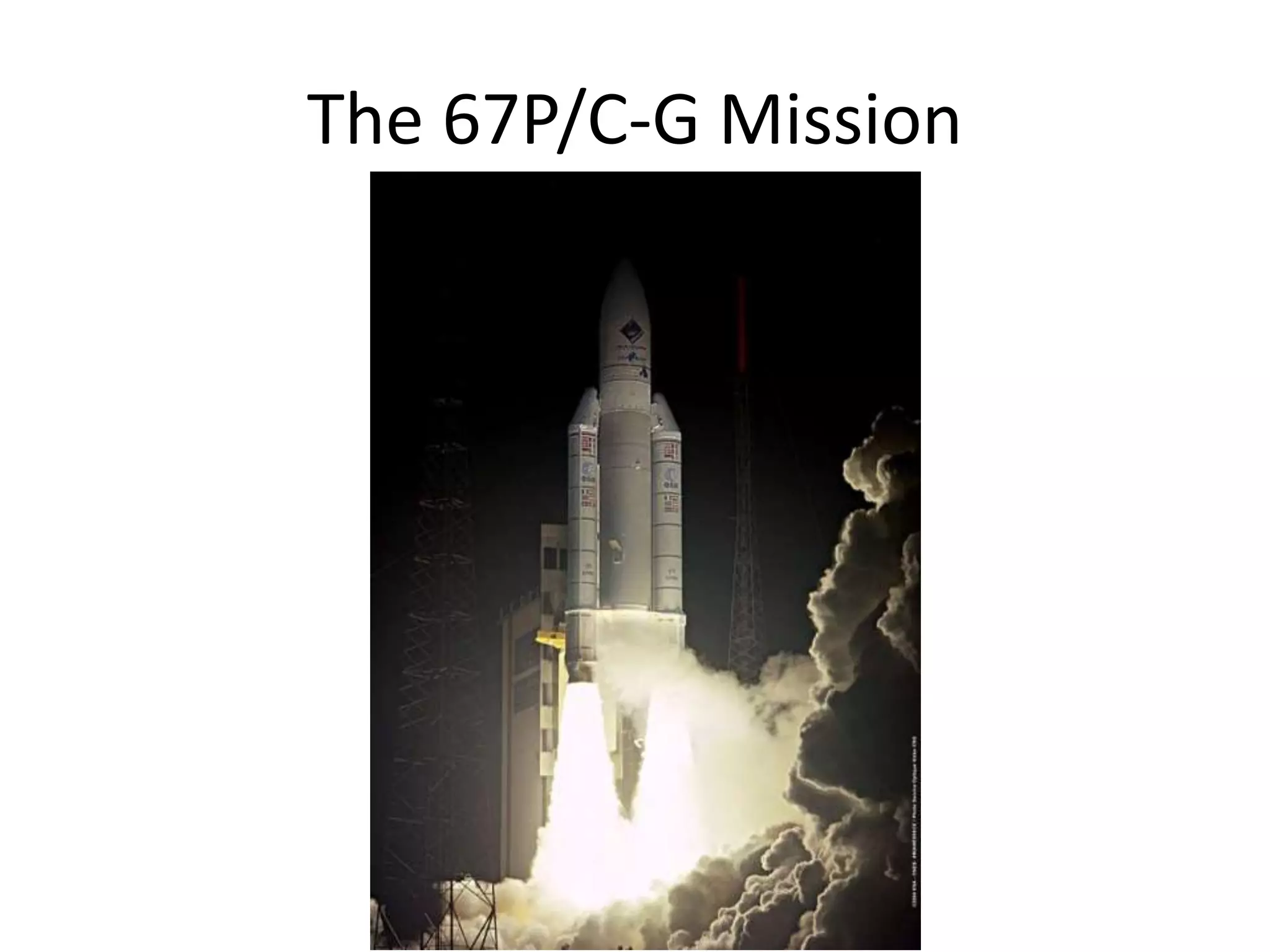
• Launched on 2 March, 2004
The 67P/C-G Mission
The 67P/C-G Mission 
• Launched on 2 March, 2004 
• Gravity assists and various maneuvers
The 67P/C-G Mission 
• Launched on 2 March, 2004 
• Gravity assists and various manuvers 
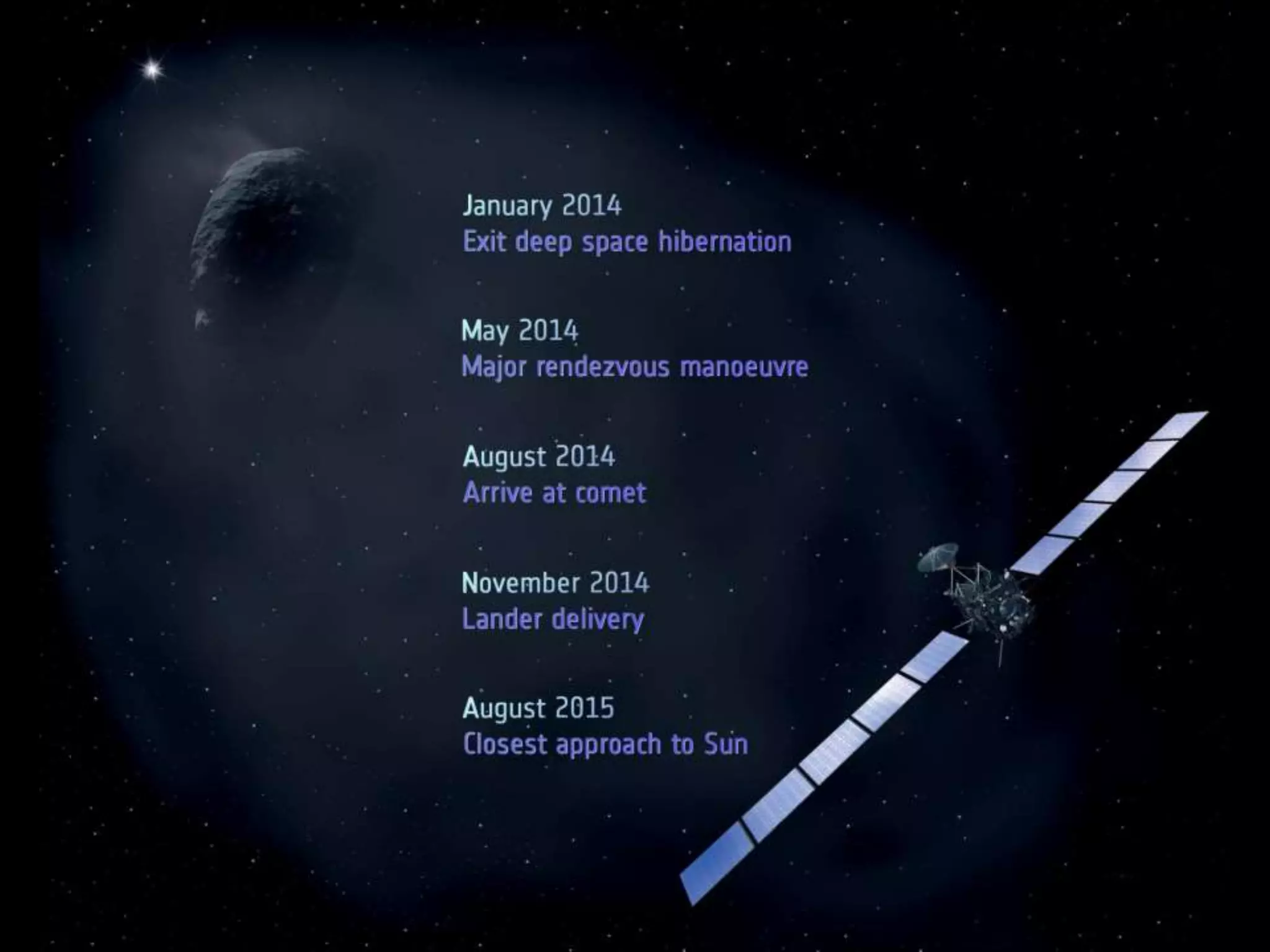
• Enter deep space hibernation 8 June, 2011
The 67P/C-G Mission 
• Launched on 2 March, 2004 
• Gravity assists and various manuvers 
• Enter deep space hibernation 8 June, 2011 
• Exit deep space hibernation 20, January 2014
The 67P/C-G Mission 
• Launched on 2 March, 2004 
• Gravity assists and various manuvers 
• Enter deep space hibernation 8 June, 2011 
• Exit deep space hibernation 20, January 2014 
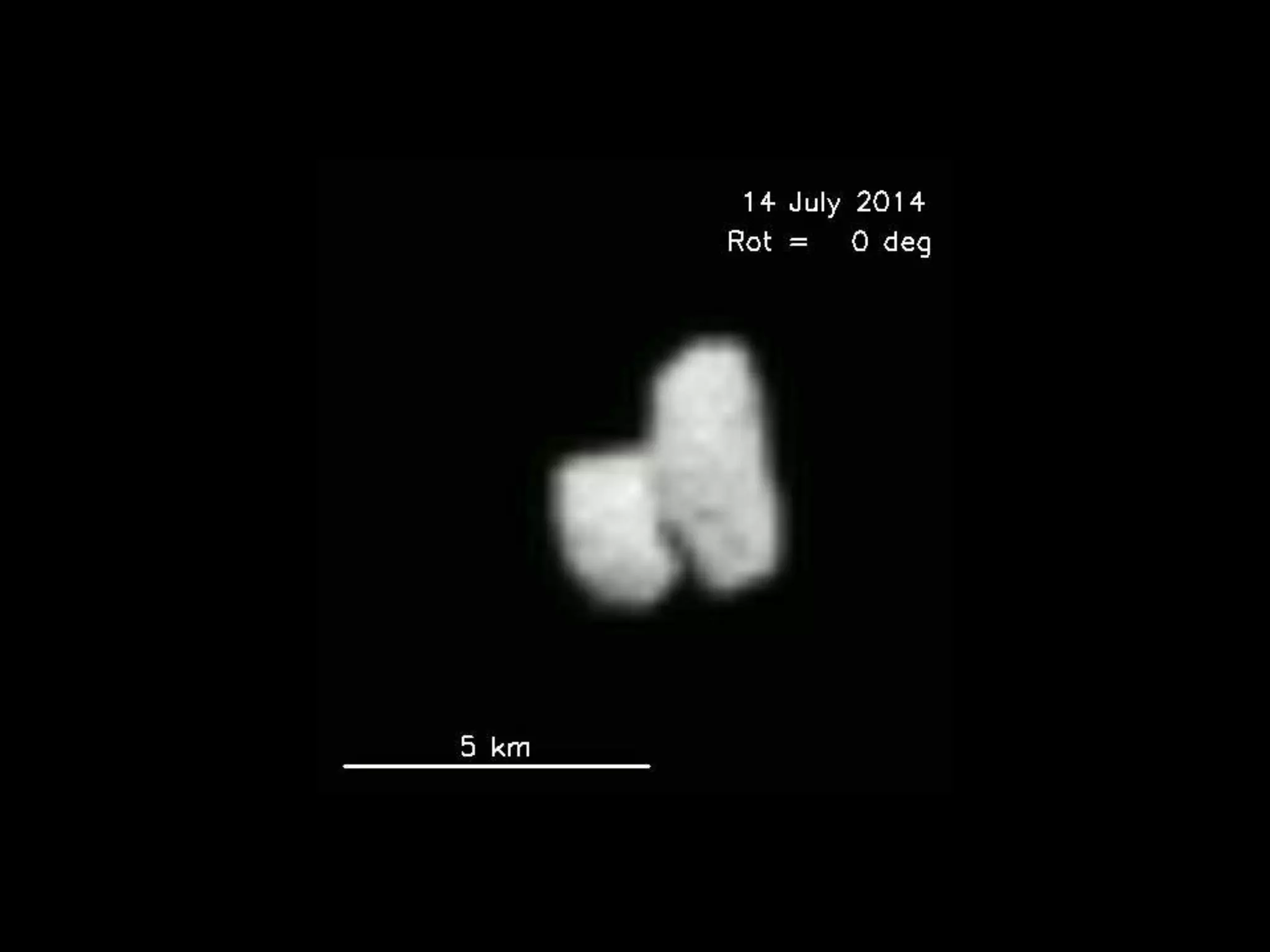
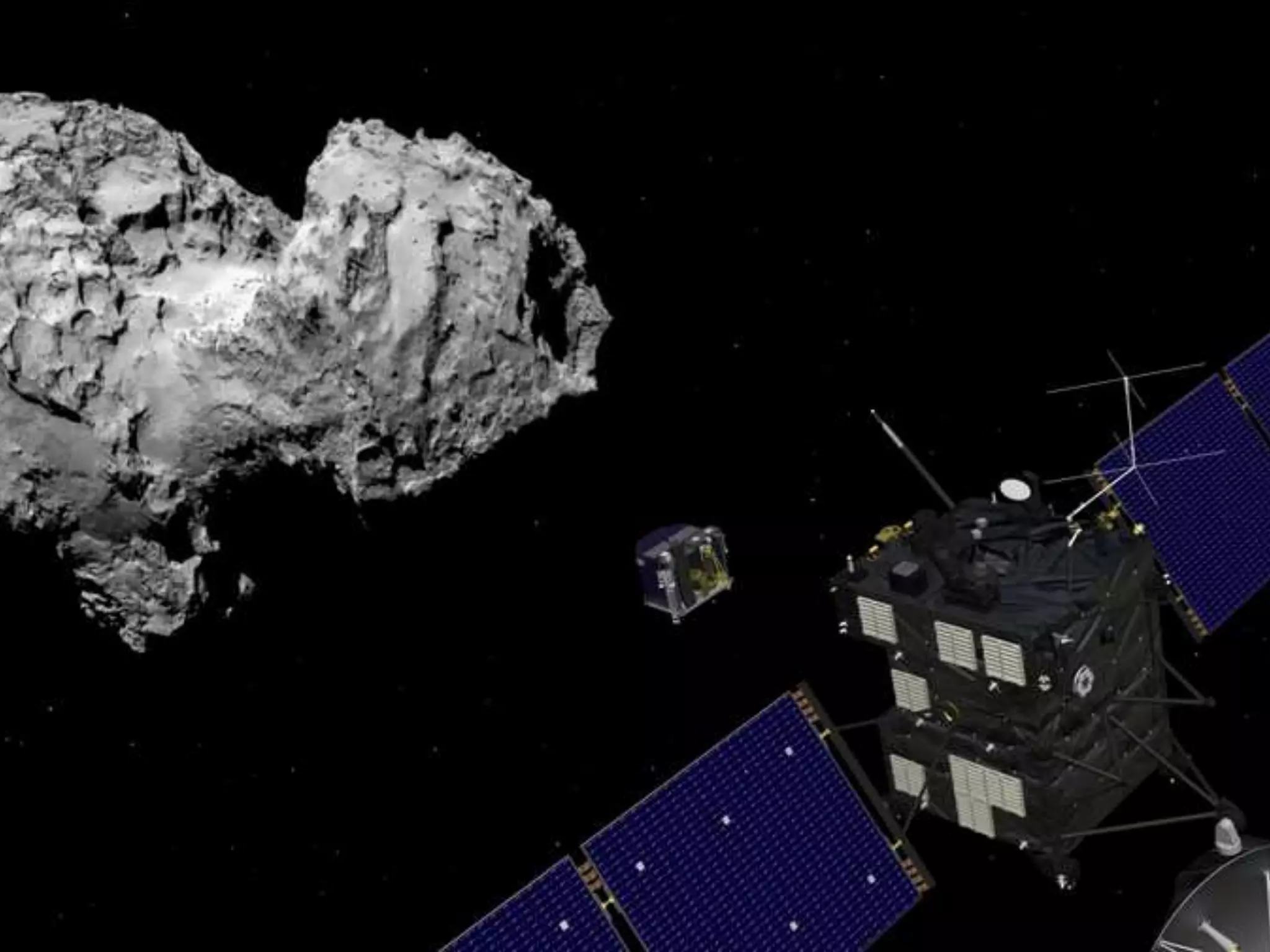
• 6 August, 2014 
– Rendezvous with 67P/C-G on, approaching to 
within 100 km, reducing its velocity to 1 m/sec
The 67P/C-G Mission 
• Launched on 2 March, 2004 
• 6 August, 2014 
– Rendezvous with 67P/C-G on, approaching to within 
100 km, reducing its velocity to 1 m/sec 
– Commences comet mapping and characterization to 
determine a stable orbit and viable landing location 
for Philae lander 
• 10 September 2014 
– Rosetta enters the Global Mapping Phase, orbiting 
67/C-G at an altitude of 29 km
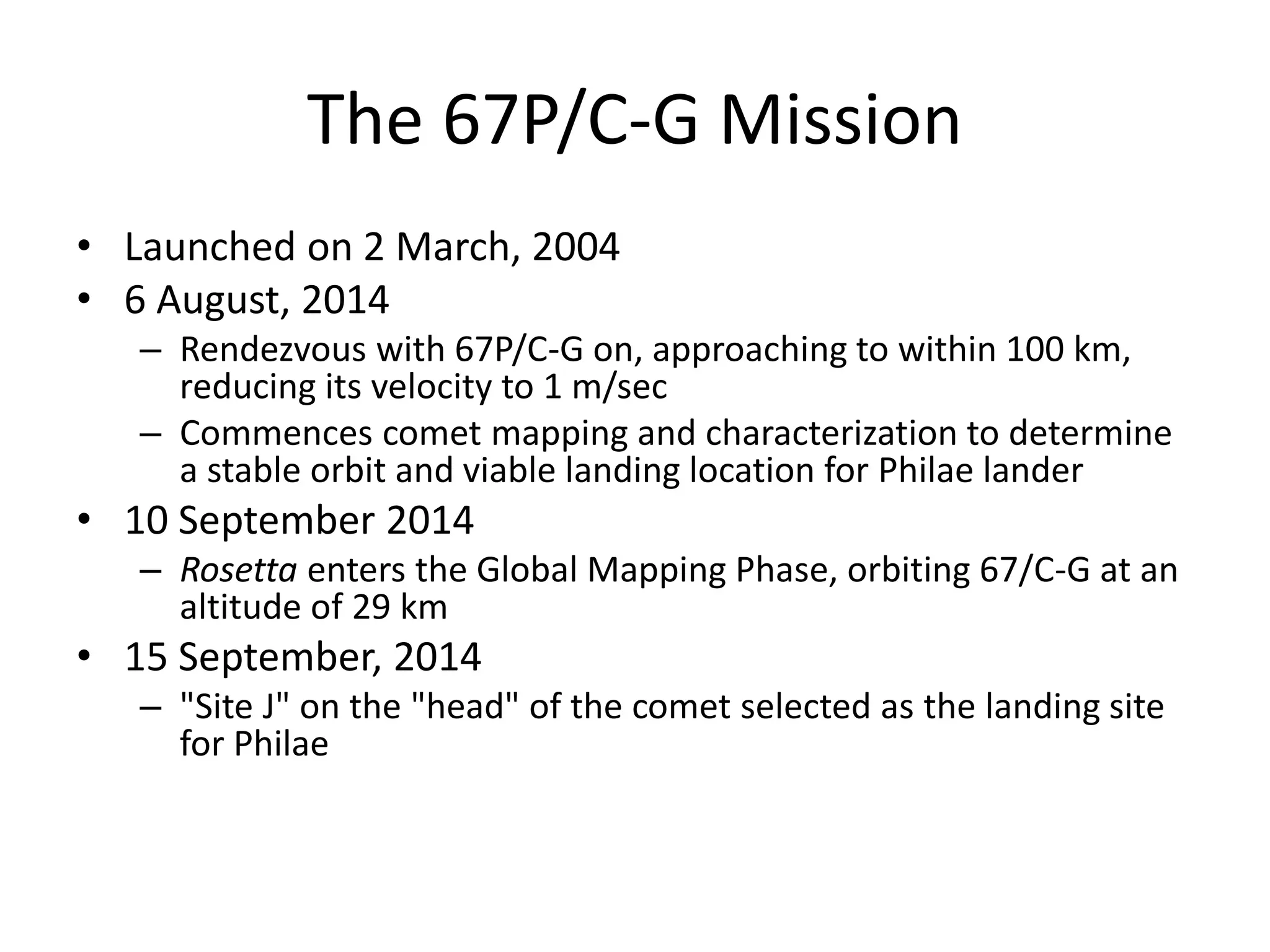
The 67P/C-G Mission 
• Launched on 2 March, 2004 
• 6 August, 2014 
– Rendezvous with 67P/C-G on, approaching to within 100 km, 
reducing its velocity to 1 m/sec 
– Commences comet mapping and characterization to determine 
a stable orbit and viable landing location for Philae lander 
• 10 September 2014 
– Rosetta enters the Global Mapping Phase, orbiting 67/C-G at an 
altitude of 29 km 
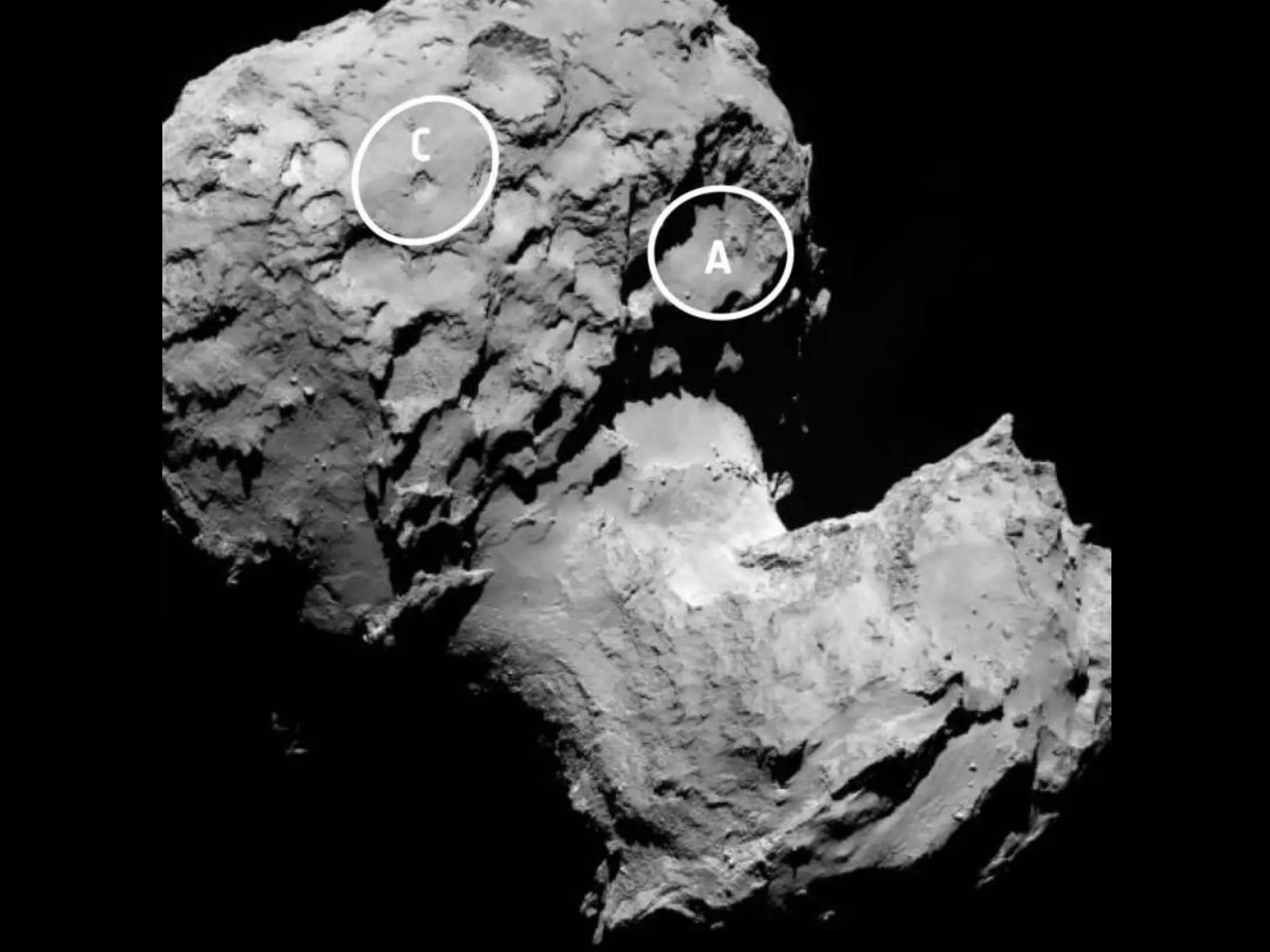
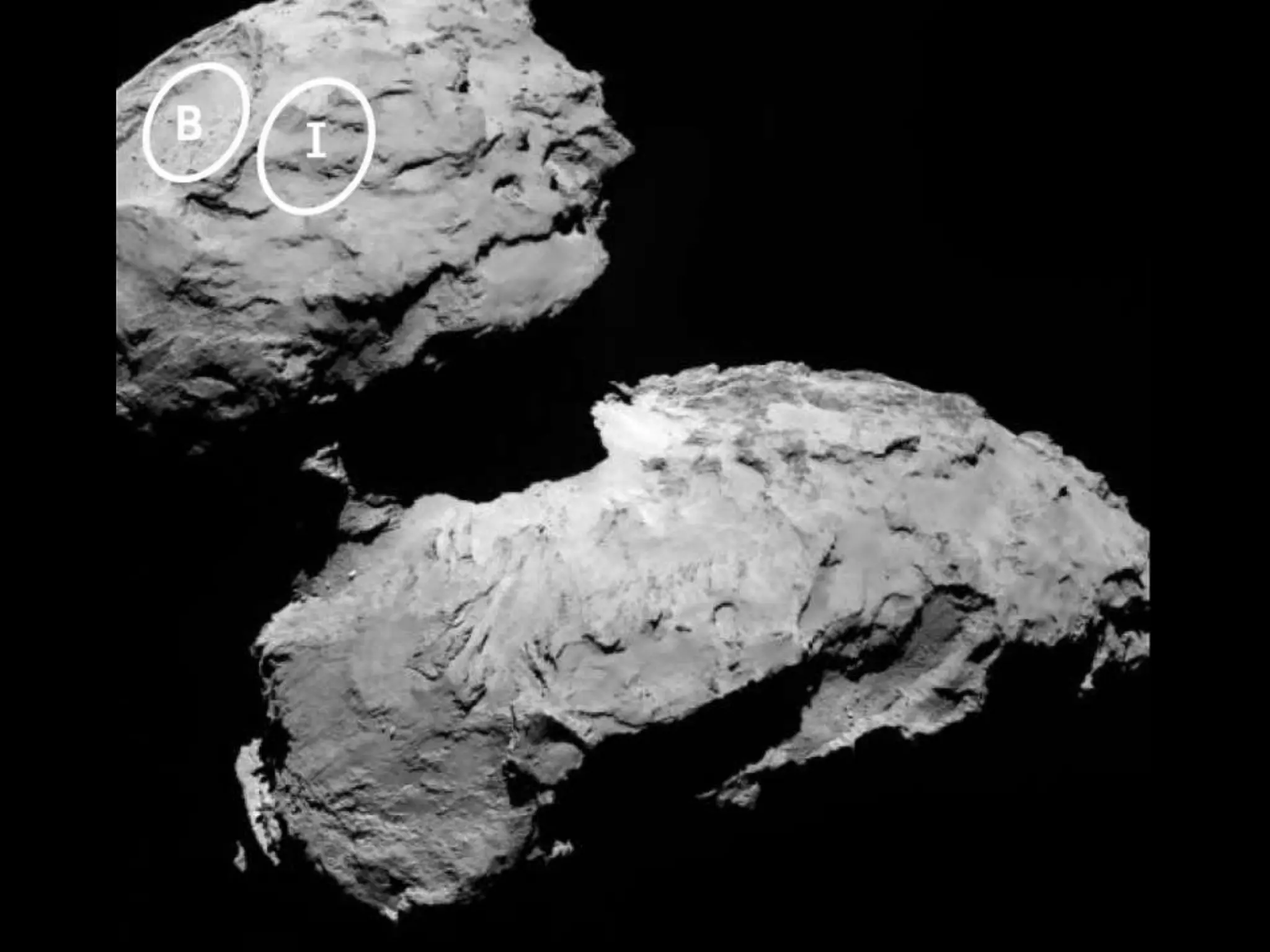
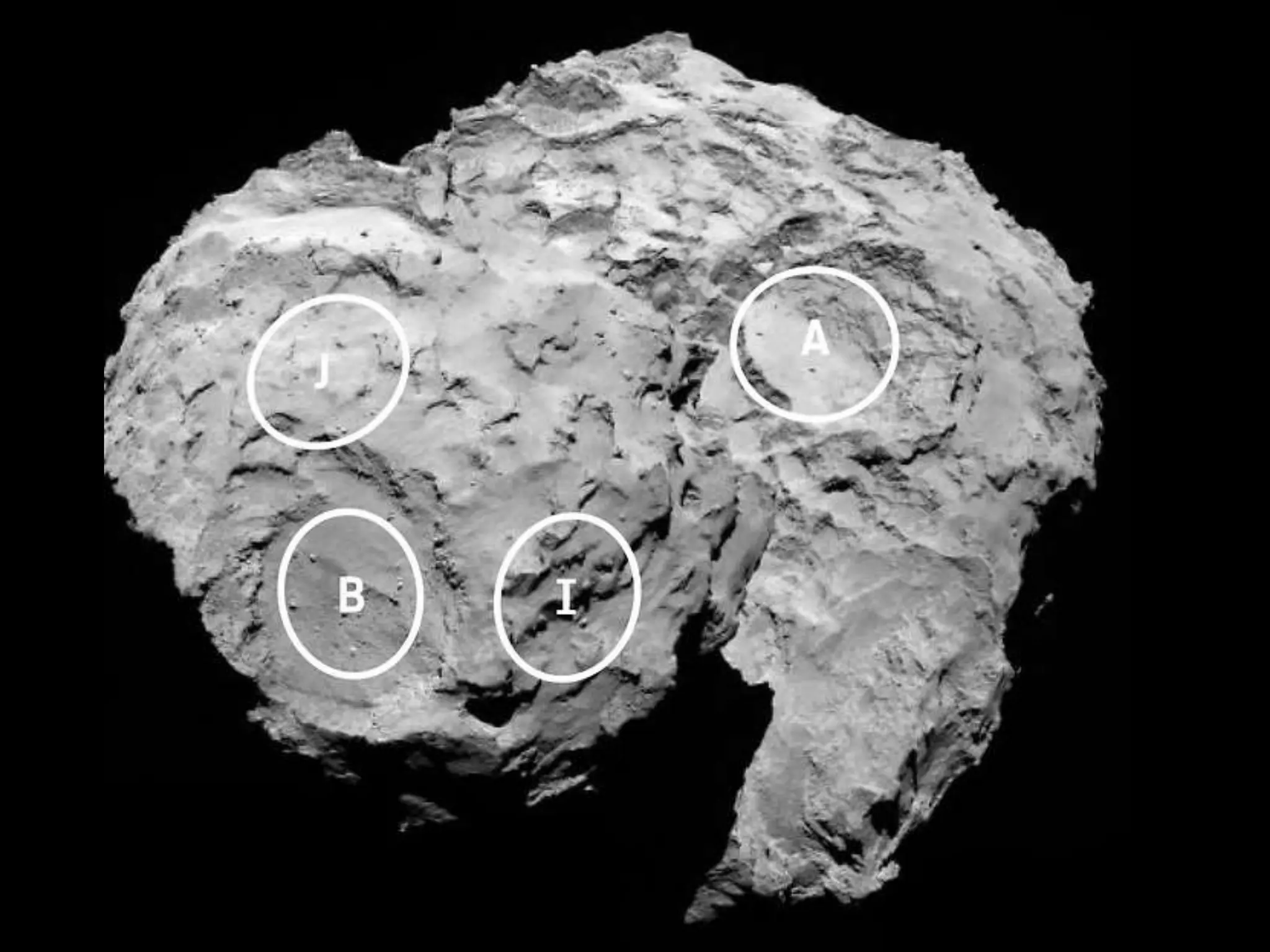
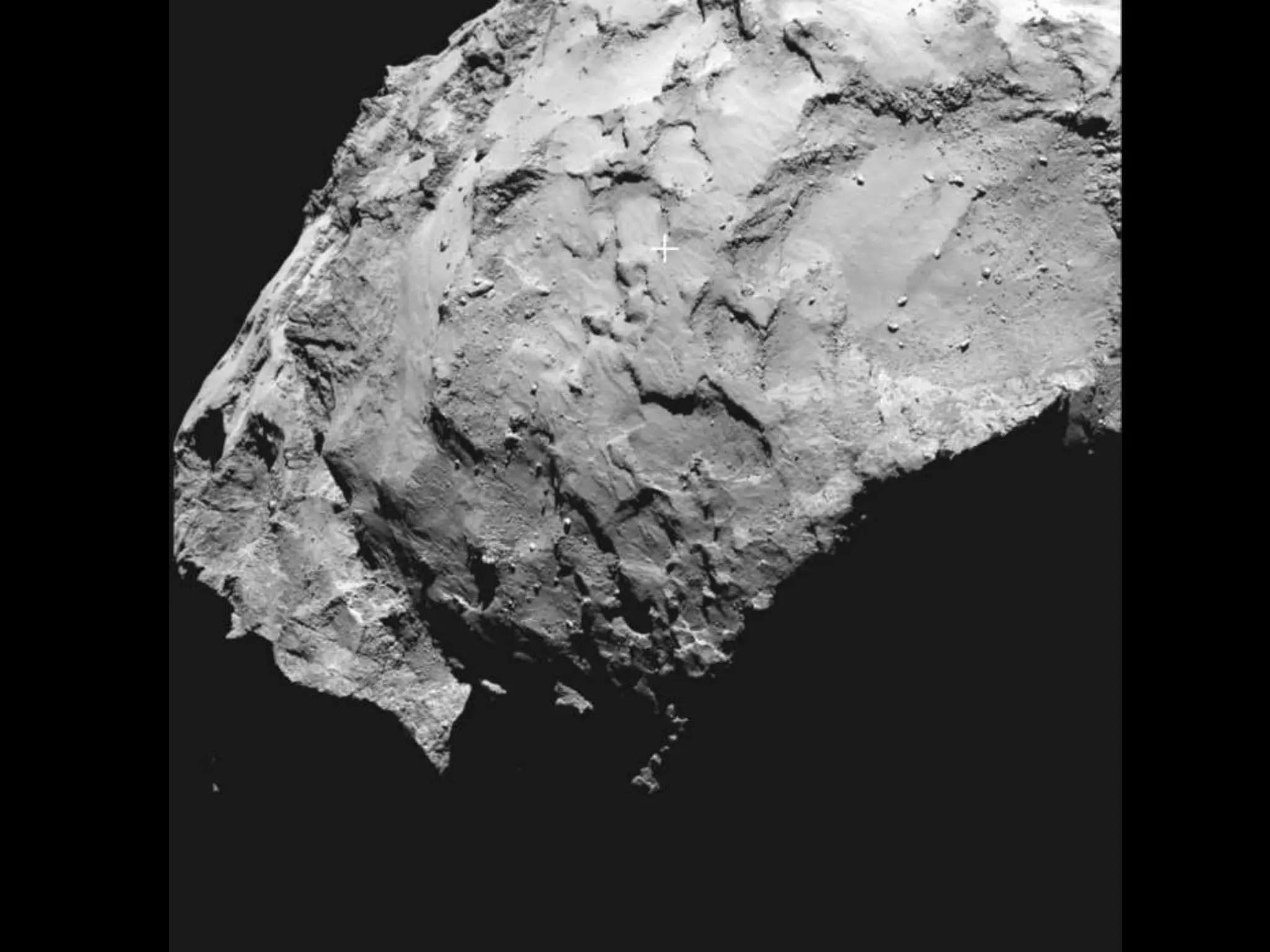
• 15 September, 2014 
– "Site J" on the "head" of the comet selected as the landing site 
for Philae
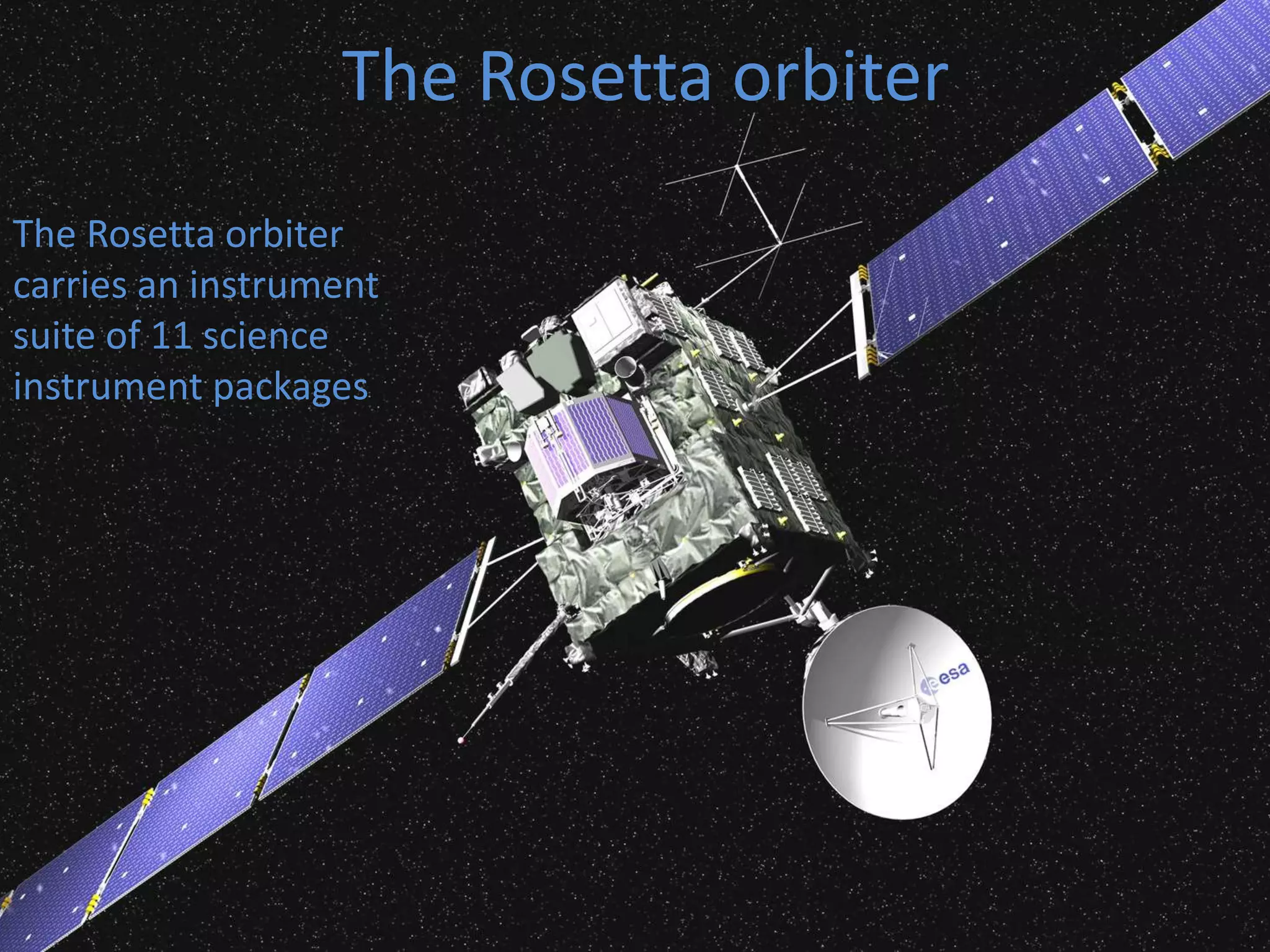
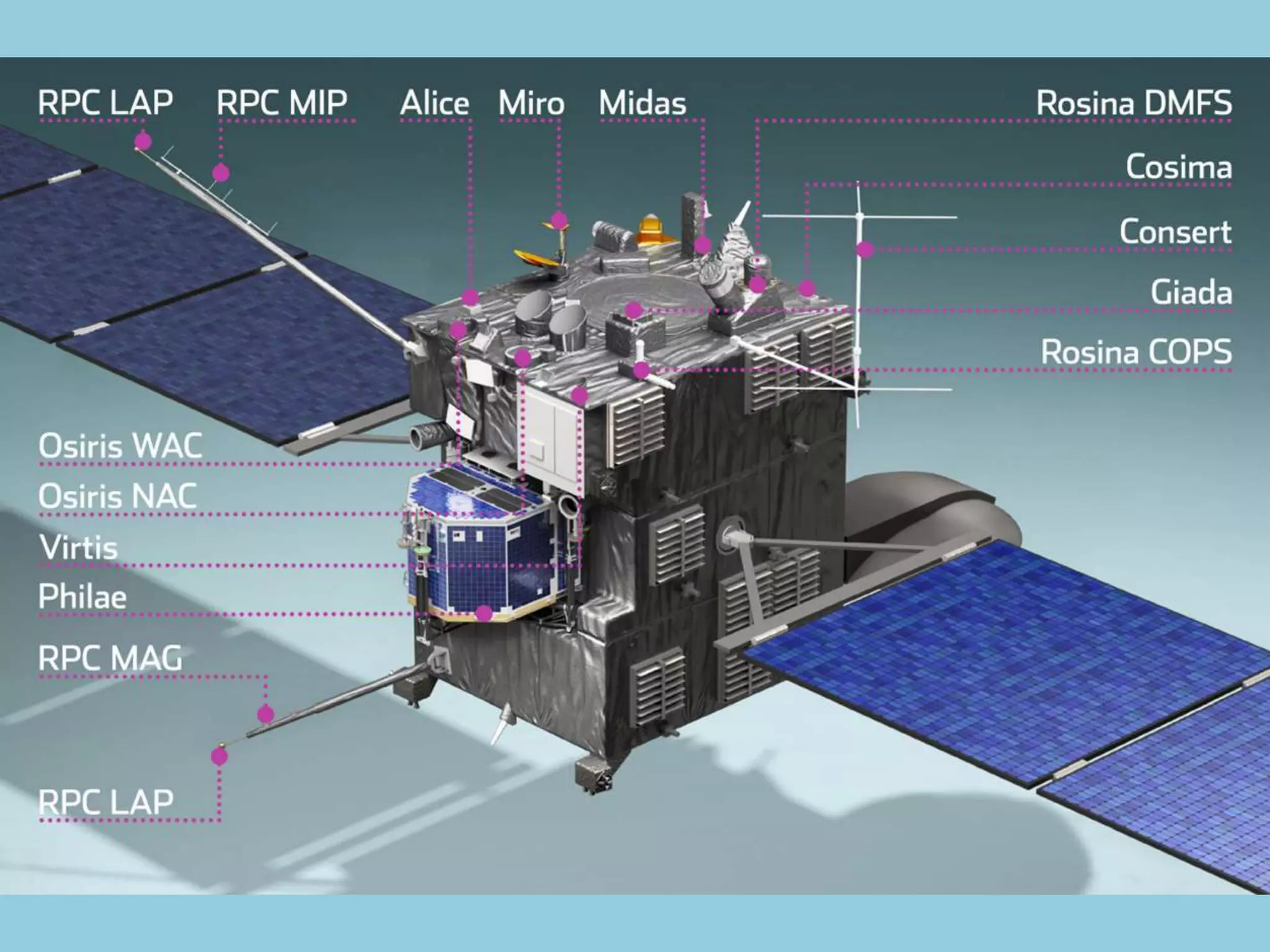
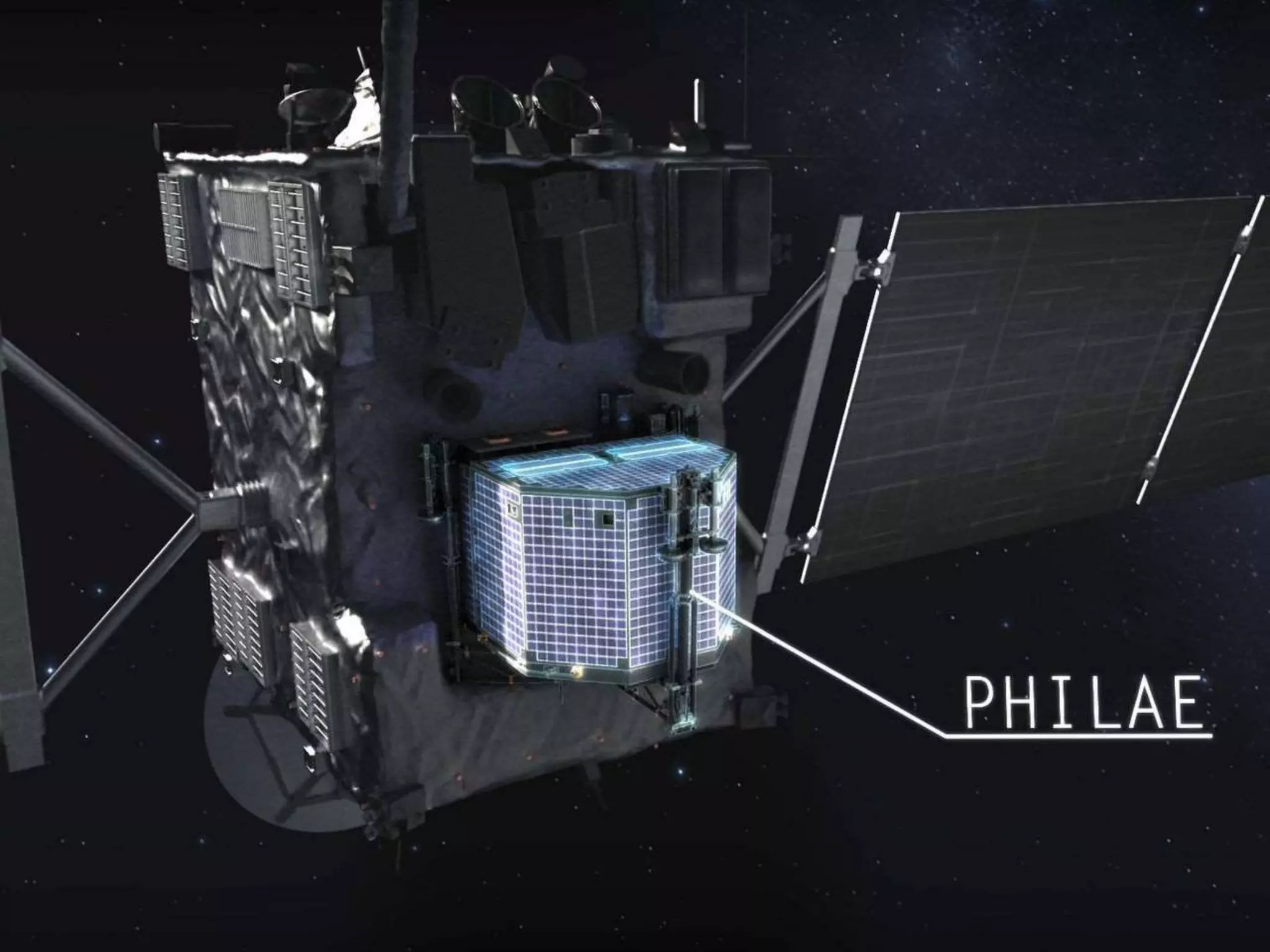
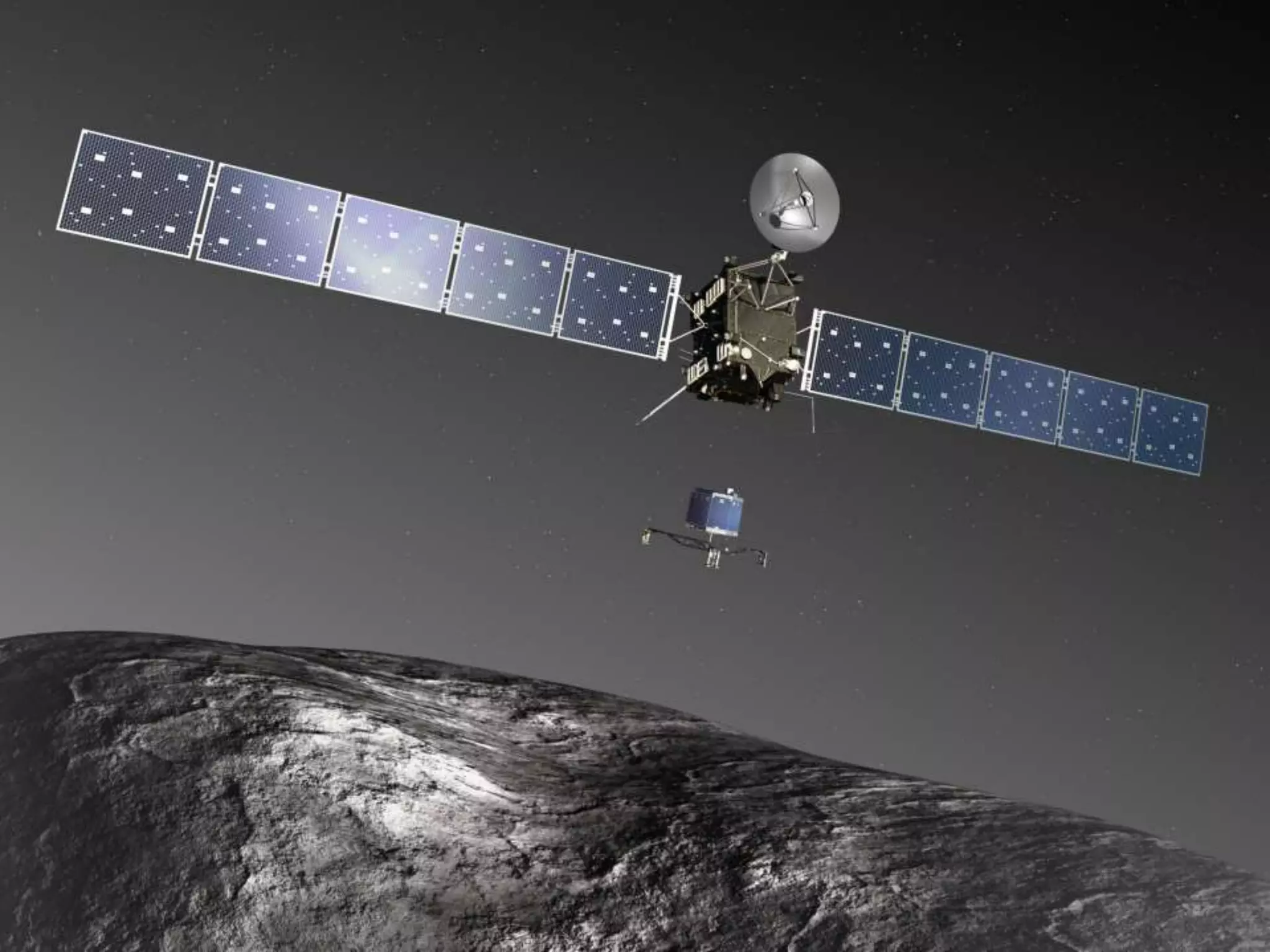
The Rosetta orbiter 
The Rosetta orbiter 
carries an instrument 
suite of 11 science 
instrument packages
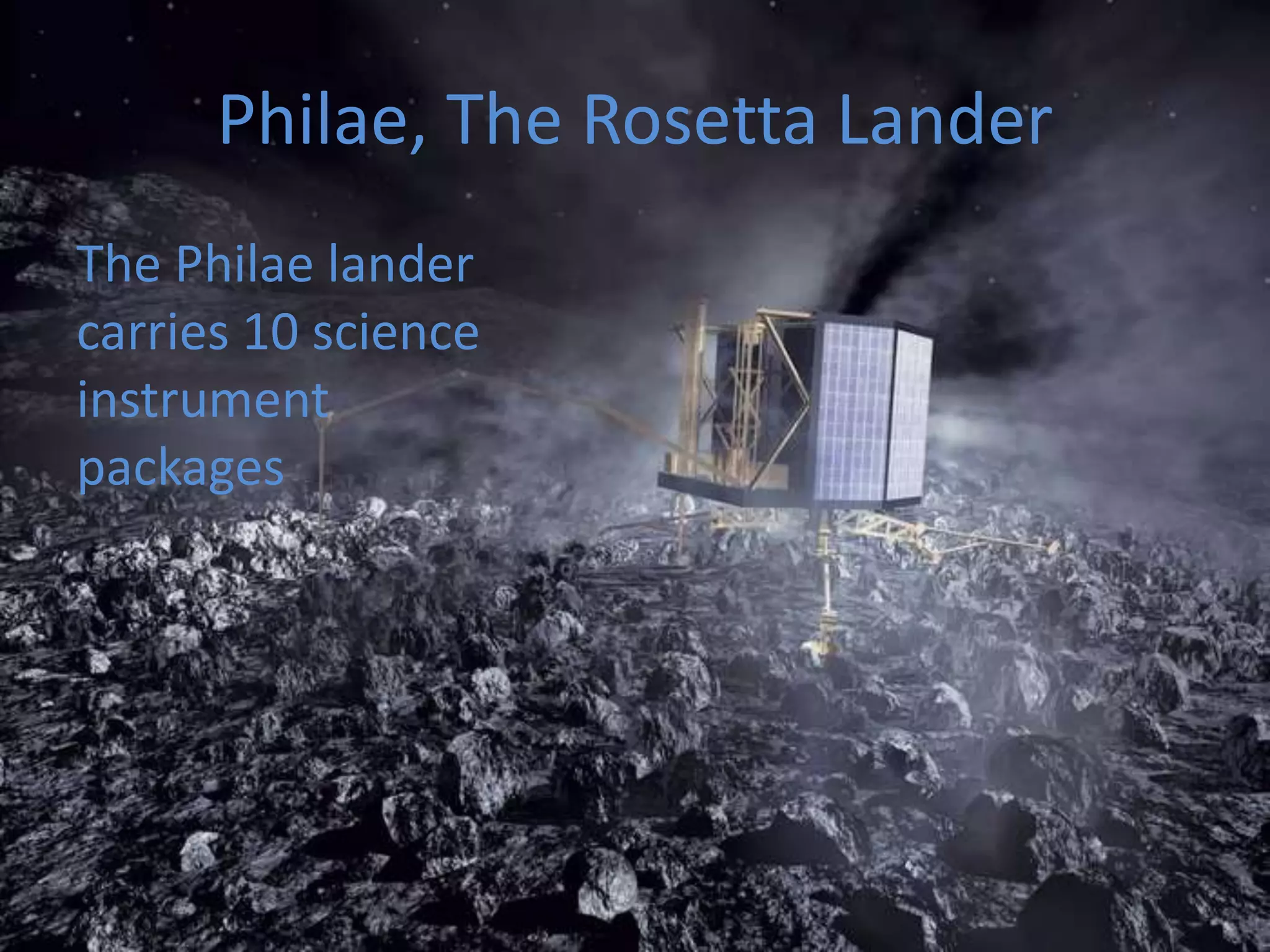
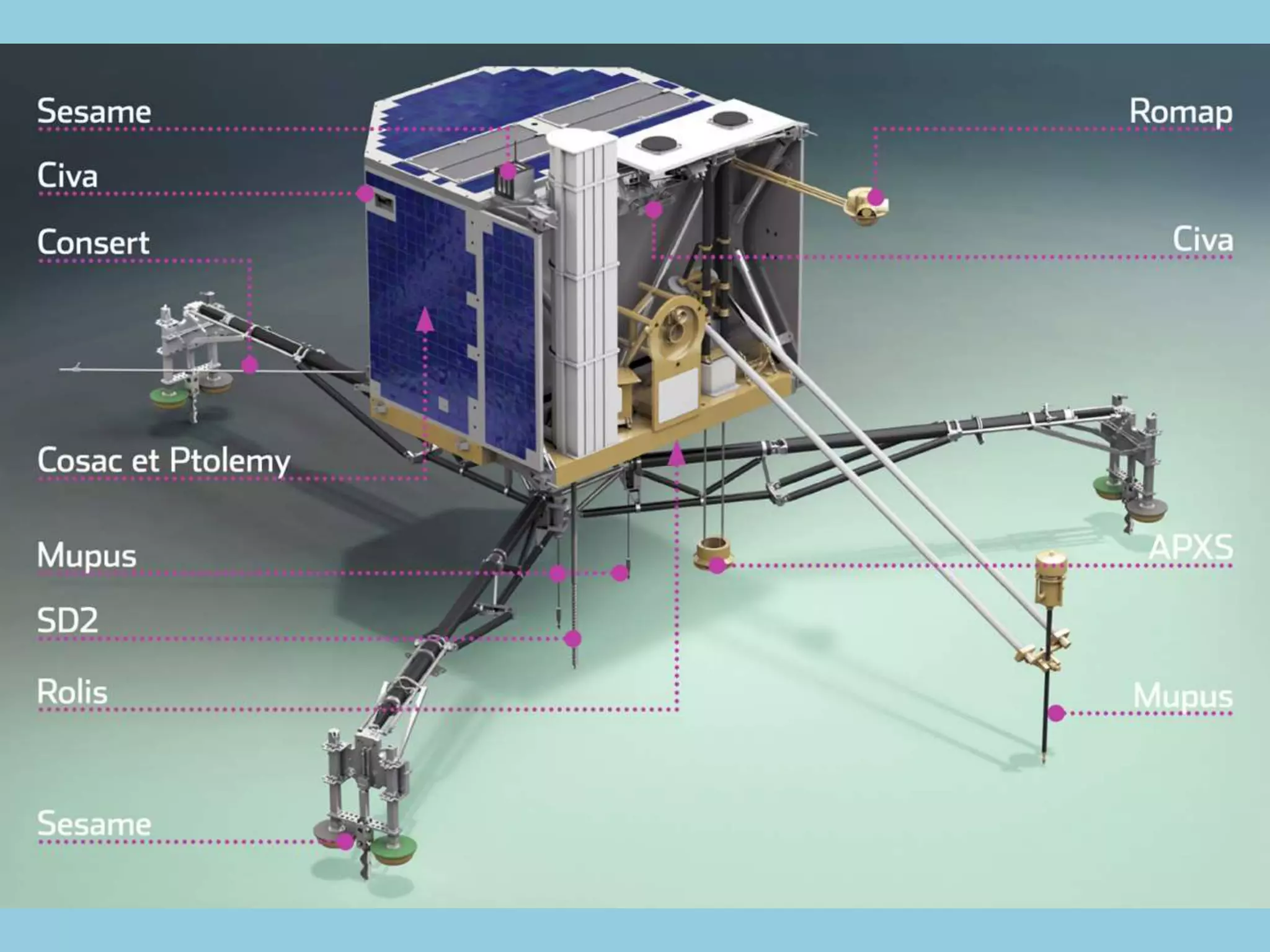
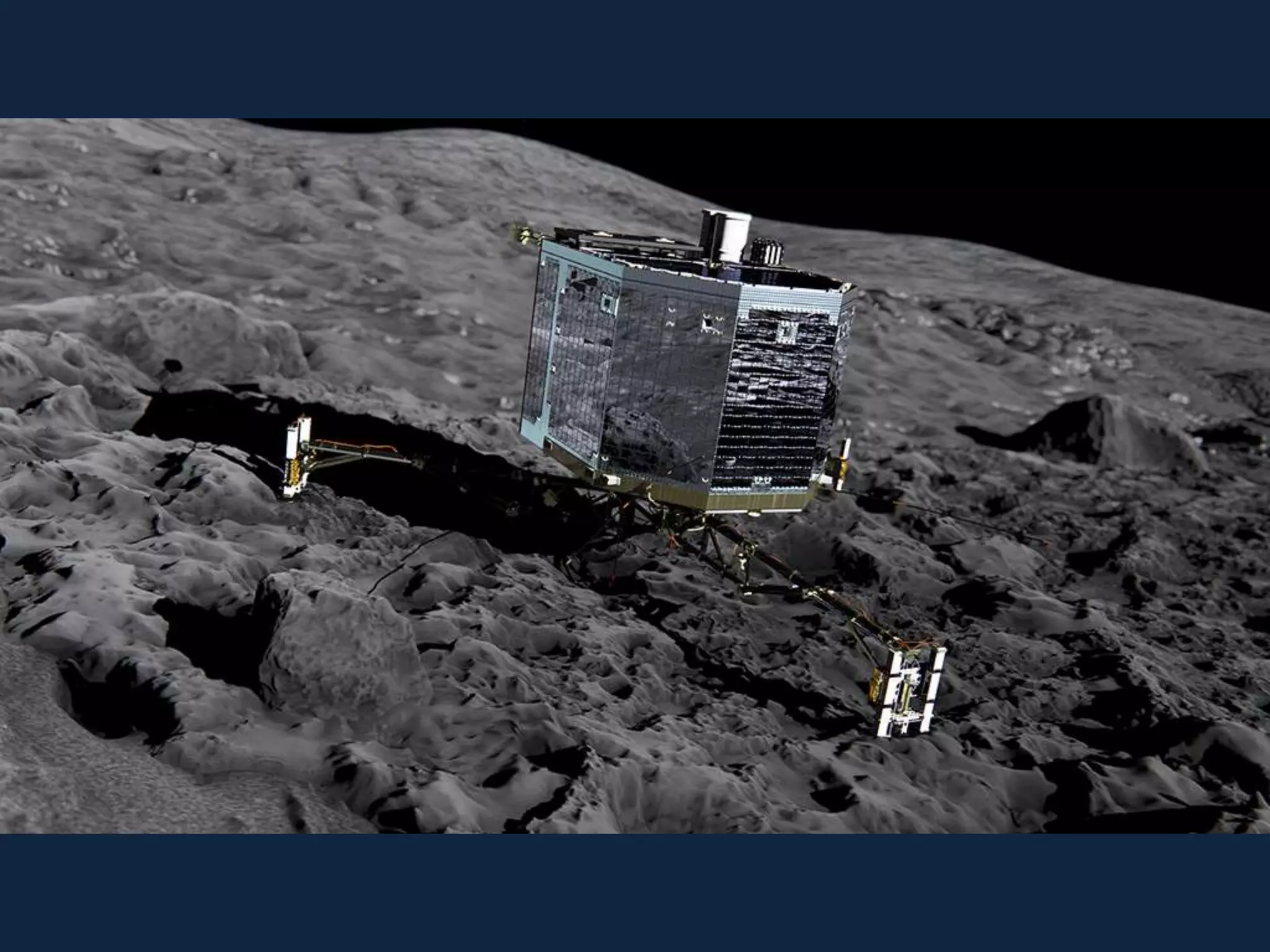
Philae, The Rosetta Lander 
The Philae lander 
carries 10 science 
instrument 
packages
The 67P/C-G Mission 
The importance of ground-based 
observations of Comet 67P/C-G with the 
VLT
The 67P/C-G Mission 
The importance of ground-based 
observations of Comet 67P/C-G with the 
VLT 
– Rosetta is operating in the comet’s coma!
Why did it take 12 years?
Why did it take 12 years? 
– The required rendezvous velocity was 16 km/sec
Why did it take 12 years? 
– The required rendezvous velocity was 16 km/sec 
– The average cruise velocity of Rosetta was 20 
km/sec
Why did it take 12 years? 
– The required rendezvous velocity was 16 km/sec 
– The average cruise velocity of Rosetta was 20 
km/sec 
– At times, the comet was traveling at 34 km/sec in its 
orbit
Why did it take 12 years? 
– The required rendezvous velocity was 16 km/sec 
– The average cruise velocity of Rosetta was 20 
km/sec 
– At times, the comet was traveling at 34 km/sec in its 
orbit 
– To negotiate the complex trajectory necessary to 
intercept the comet, Rosetta needed 3 gravity 
assists from Earth and one from Mars
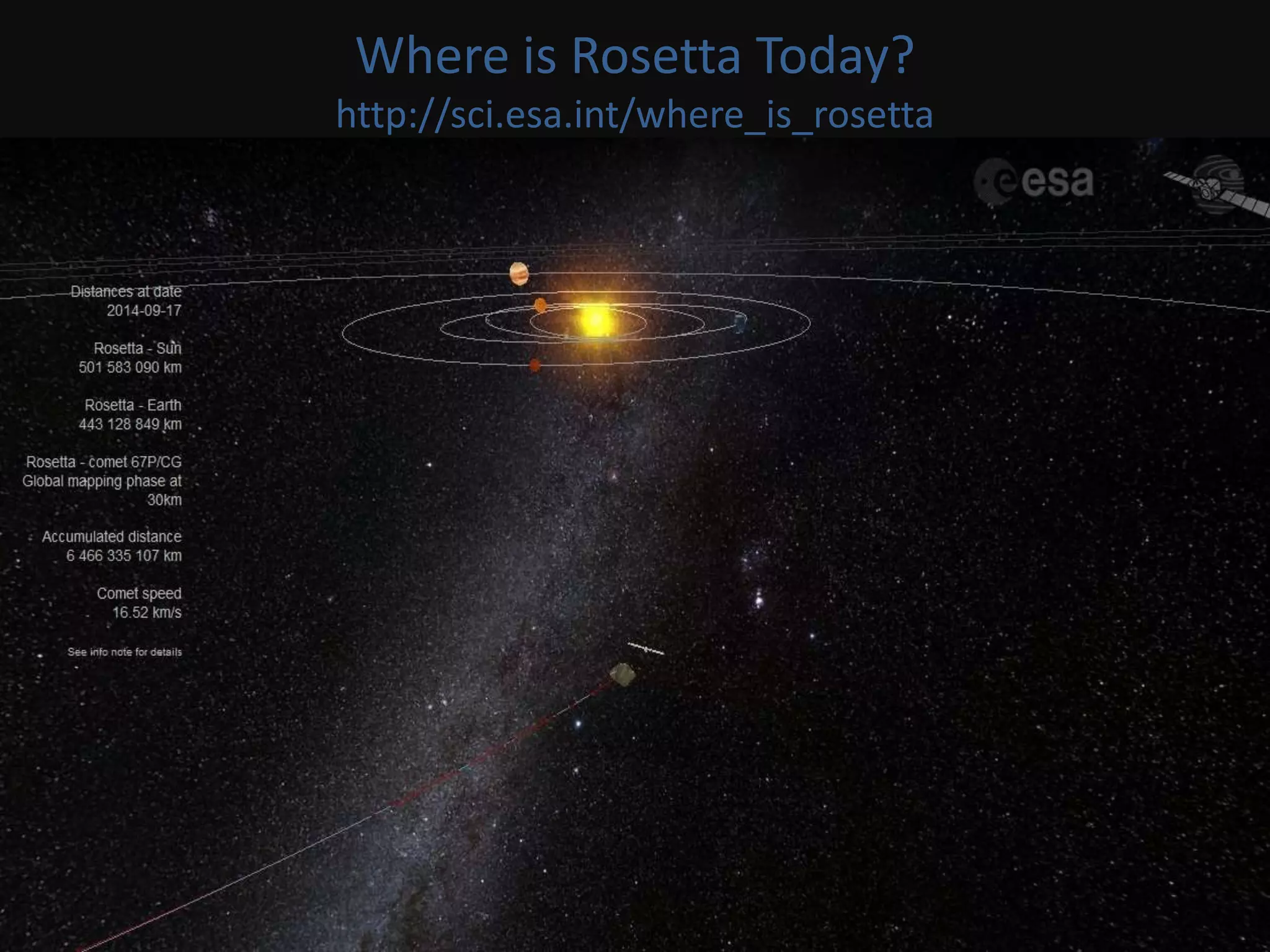
Where is Rosetta Today? 
http://sci.esa.int/where_is_rosetta
The Unprecedented Rosetta mission to Comet 67P/Churyumov–Gerasimenko

The Unprecedented Rosetta mission to Comet 67P/Churyumov–Gerasimenko

  • 1.
    The Unprecedented RosettaMission to Comet 67P/Churyumov–Gerasimenko Prof. Thomas Madigan
  • 2.
    Overview • Historicalretrospective of comets • The Dawn of the Modern Era and a New Intellectual Renaissance • Our Modern Understanding of Comets • Why study comets? • The Importance of visiting Comet 67P/C-G –Why this comet? • The 67P/C-G Mission
  • 3.
    Since antiquity cometswere thought of as harbingers of doom. The word “disaster” is derived from the Greek word meaning “bad star” and was often used to refer to the appearance of a comet within the context of a certain calamity
  • 4.
    dis·as·ter Origin •late 16th century: from Italian disastro ‘ill-starred event,’ from dis- (expressing negation) + astro ‘star’ (from Latin astrum ).
  • 5.
    Antiquity The Greeks – Some suggest that comets are solar system objects like planets – Others suggest that they were burning clouds or optical phenomena in the Earth’s atmosphere – Aristotle (400 BC), a Geocentrist, adopts this later view, suggesting that comets are "windy exhalations“ from the Earth
  • 6.
    The 1066 apparitionof Halley's Comet occurred during the Battle of Hastings and is represented in the Bayeux Tapestry (scenes 32- 33). Credit: By Myrabella
  • 7.
    • Apparition ofComet 44 BC – Death of Julius Ceasar • 1910 apparition of Halley’s Comet the Earth passed through the comet's tail and erroneous newspaper reports inspired a fear that cyanogen in the tail might poison millions • Comet Hale–Bopp in 1997 triggered the mass suicide of the Heaven's Gate cult
  • 8.
    The Beginnings ofModernity and the Scientific Revolution (The Dawn of Reason) Copernicus Publishes De Revolutionibus Orbium Coelestium (On the Revolutions of the Celestial Spheres) just before his death in 1543, proposing a Heliocentric model of the solar system Is renowned as the “Father of Modern Astronomy” for rekindling this idea, for proposing a model “More Pleasing to the Mind”
  • 10.
    Tycho Brahe –Meticulous observations of the planets at Uraniburg on the island of Hven (Denmark) – Proposes the use of careful experiments rather than lengthy philosophical debates – computes the distance to the Great Comet of 1577 using the parallax method – Subsequently proposes a hybrid model that includes aspects of the Geocentric and Heliocentric models
  • 11.
    The path ofthe comet Tycho Brahe saw in 1577, in his hybrid geo/heliocentric model.
  • 12.
  • 13.
    Kepler’s 3 Laws 1) All Orbits are Elliptical 2) Equal areas are swept out in equal times
  • 14.
    3) The squaresThe Copernican of the periods of Revolution the planets are proportional to the cubes of their semi-major axes: P2 = A3 . Thus P  A 3 Example: Distance to Saturn (Saturn’s SMA) = 9.5 AU 3 P  9.5  857.375  29.3 yrs Said differently, the period varies P  A3 as the 3/2 power of the semi-major axis To find the semi-major axis, A, in terms of the period 3 2 A  P Example: Period of Comet 67P/C-G = 6.45 yrs 3 2 3 A  6.45  41.54  3.46 AU
  • 15.
    Galileo Uses theScientific Method and extensive use of the telescope as an instrument of science to demonstrate the veracity of the Copernican model Renowned as the Father of Modern Science
  • 16.
    Isaac Newton •Develops Classical Mechanics and Laws of Motion • Develops The Law of Universal Gravitation • Publishes Principia Mathematica • Along with Liebnitz, develops Calculus • Renowned as one of the most influential scientists of all time and a key figure in the scientific revolution
  • 18.
    Our Modern Understandingof Comets Today, we know comets are left over debris from the formation of the solar system, most of which originate in the Oort cloud, a vast spherical halo beginning at about 250 times Pluto’s distance from the sun
  • 20.
    Our Modern Understandingof Comets Comets have a wide range of orbital periods and orbital eccentricities. Short period comets originate in the Kuiper belt, a debris disk beyond the orbit of Neptune and Pluto. The longer period comets originate in the Oort cloud.
  • 23.
  • 24.
    Why Study Comets? Comets are composed of material unadulterated since the formation of the solar system
  • 26.
    What is thetrue nature of a comet? Does it always present with a beautiful tail or is it something quite different? Lets take a look
  • 28.
  • 30.
    How do cometscompare to other objects? Cities 4 – 8 KM? Oceans 3,000 KM? Planets 10,000 KM? Stars (the sun) 700,000 KM (radius)?
  • 31.
  • 32.
    The Nucleus isthe loosely bound agglomeration of debris held together by ice of various compositions. This is the “dormant” state of the comet This material “activates” as the comet approaches the sun and begins to warm. This process forms the “Coma”
  • 34.
    What happens toa comet as it approaches the sun? Lets take a look
  • 35.
  • 36.
    Why does thetail form and what is it comprised of?
  • 37.
    Why does thetail form and what is it comprised of? – As the comet approaches the sun, the nucleus begins to warm and the ice starts to sublimate (evaporate)
  • 38.
    Why does thetail form and what is it comprised of? – As the comet approaches the sun, the nucleus begins to warm and the ice starts to sublimate (evaporate) – At about 1 AU from the sun, the tail forms, pushed out by Solar Wind and Radiation Pressure
  • 39.
    Why does thetail form and what is it comprised of? – As the comet approaches the sun, the nucleus begins to warm and the ice starts to sublimate (evaporate) – At about 1 AU from the sun, the tail forms, pushed out by Solar Wind and Radiation Pressure – Solar radiation pressure forms a dust tail
  • 40.
    Why does thetail form and what is it comprised of? – As the comet approaches the sun, the nucleus begins to warm and the ice starts to sublimate (evaporate) – At about 1 AU from the sun, the tail forms, pushed out by Solar Wind and Radiation Pressure – Solar radiation pressure forms a dust tail – Solar Ultraviolet radiation forms a gas-ion tail
  • 41.
    Why does thetail form and what is it comprised of? – As the comet approaches the sun, the nucleus begins to warm and the ice starts to sublimate (evaporate) – At about 1 AU from the sun, the tail forms, pushed out by Solar Wind and Radiation Pressure – Solar radiation pressure forms a dust tail – Solar Ultraviolet radiation forms a gas-ion tail – The Solar wind pushes the gas-ion tail in the opposite direction
  • 42.
    Why does thetail form and what is it comprised of? – As the comet approaches the sun, the nucleus begins to warm and the ice starts to sublimate (evaporate) – At about 1 AU from the sun, the tail forms, pushed out by Solar Wind and Radiation Pressure – Solar radiation pressure forms a dust tail – Solar Ultraviolet radiation forms a gas-ion tail – The Solar wind pushes the gas-ion tail in the opposite direction – The gas-ion tail follows the magnetic field lines
  • 44.
    Comet McNaught priorto Perihelion, 10 January, 2007
  • 45.
    What happens next? The comet passes around the sun at Perihelion or The comet becomes a “Sun-grazing” comet
  • 46.
    Comet McNaught afterPerihelion, 20 January, 2007!
  • 47.
    Comet McNaught afterPerihelion, 20 January, 2007!
  • 51.
  • 52.
    Why Comet 67P/C-G • Long standing desire to rendezvous with a comet
  • 53.
    Why Comet 67P/C-G • Long standing desire to rendezvous with a comet • Target of opportunity
  • 54.
  • 55.
    The 67P/C-G Mission • Launched on 2 March, 2004
  • 56.
  • 57.
    The 67P/C-G Mission • Launched on 2 March, 2004 • Gravity assists and various maneuvers
  • 58.
    The 67P/C-G Mission • Launched on 2 March, 2004 • Gravity assists and various manuvers • Enter deep space hibernation 8 June, 2011
  • 59.
    The 67P/C-G Mission • Launched on 2 March, 2004 • Gravity assists and various manuvers • Enter deep space hibernation 8 June, 2011 • Exit deep space hibernation 20, January 2014
  • 61.
    The 67P/C-G Mission • Launched on 2 March, 2004 • Gravity assists and various manuvers • Enter deep space hibernation 8 June, 2011 • Exit deep space hibernation 20, January 2014 • 6 August, 2014 – Rendezvous with 67P/C-G on, approaching to within 100 km, reducing its velocity to 1 m/sec
  • 63.
    The 67P/C-G Mission • Launched on 2 March, 2004 • 6 August, 2014 – Rendezvous with 67P/C-G on, approaching to within 100 km, reducing its velocity to 1 m/sec – Commences comet mapping and characterization to determine a stable orbit and viable landing location for Philae lander • 10 September 2014 – Rosetta enters the Global Mapping Phase, orbiting 67/C-G at an altitude of 29 km
  • 66.
    The 67P/C-G Mission • Launched on 2 March, 2004 • 6 August, 2014 – Rendezvous with 67P/C-G on, approaching to within 100 km, reducing its velocity to 1 m/sec – Commences comet mapping and characterization to determine a stable orbit and viable landing location for Philae lander • 10 September 2014 – Rosetta enters the Global Mapping Phase, orbiting 67/C-G at an altitude of 29 km • 15 September, 2014 – "Site J" on the "head" of the comet selected as the landing site for Philae
  • 71.
    The Rosetta orbiter The Rosetta orbiter carries an instrument suite of 11 science instrument packages
  • 76.
    Philae, The RosettaLander The Philae lander carries 10 science instrument packages
  • 79.
    The 67P/C-G Mission The importance of ground-based observations of Comet 67P/C-G with the VLT
  • 80.
    The 67P/C-G Mission The importance of ground-based observations of Comet 67P/C-G with the VLT – Rosetta is operating in the comet’s coma!
  • 82.
    Why did ittake 12 years?
  • 83.
    Why did ittake 12 years? – The required rendezvous velocity was 16 km/sec
  • 84.
    Why did ittake 12 years? – The required rendezvous velocity was 16 km/sec – The average cruise velocity of Rosetta was 20 km/sec
  • 85.
    Why did ittake 12 years? – The required rendezvous velocity was 16 km/sec – The average cruise velocity of Rosetta was 20 km/sec – At times, the comet was traveling at 34 km/sec in its orbit
  • 86.
    Why did ittake 12 years? – The required rendezvous velocity was 16 km/sec – The average cruise velocity of Rosetta was 20 km/sec – At times, the comet was traveling at 34 km/sec in its orbit – To negotiate the complex trajectory necessary to intercept the comet, Rosetta needed 3 gravity assists from Earth and one from Mars
  • 88.
    Where is RosettaToday? http://sci.esa.int/where_is_rosetta