Open Science
What? Why? For What? How?
L. Anglada
(CSUC. Àrea de Ciència Oberta)
Open Science and Open Access Course
BGSMath Maria de Maeztu Unit of Excellence / Centre de Recerca Matemàtica
Bellaterra, 11 de novembre, 2018
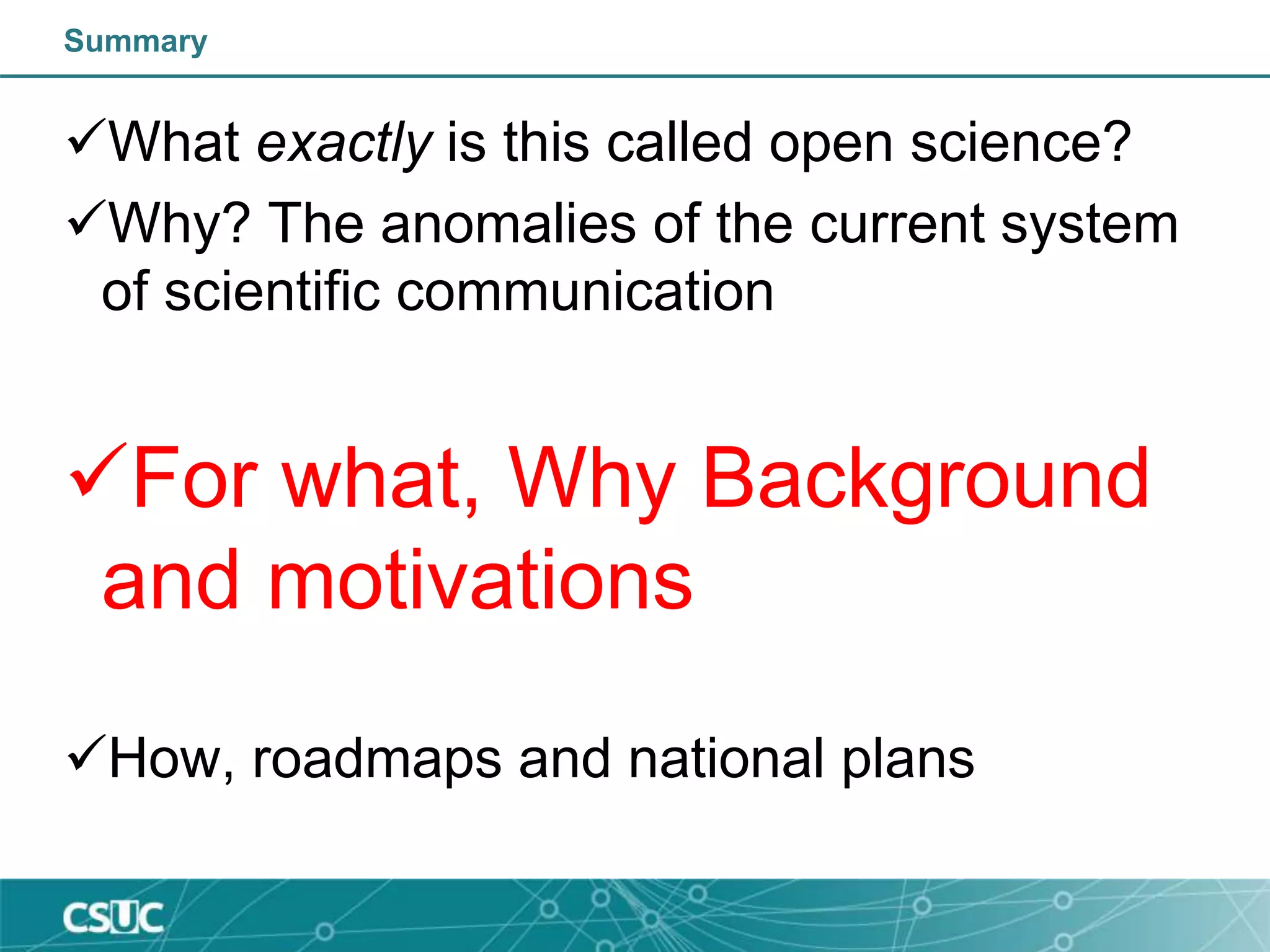
Summary
What exactly is this called open science?
Why? The anomalies of the current system
of scientific communication
For what, Why Background and motivations
How, roadmaps and national plans
Summary
What exactly is this called
open science?
Why? The anomalies of the current system
of scientific communication
For what, Why Background and motivations
How, roadmaps and national plans
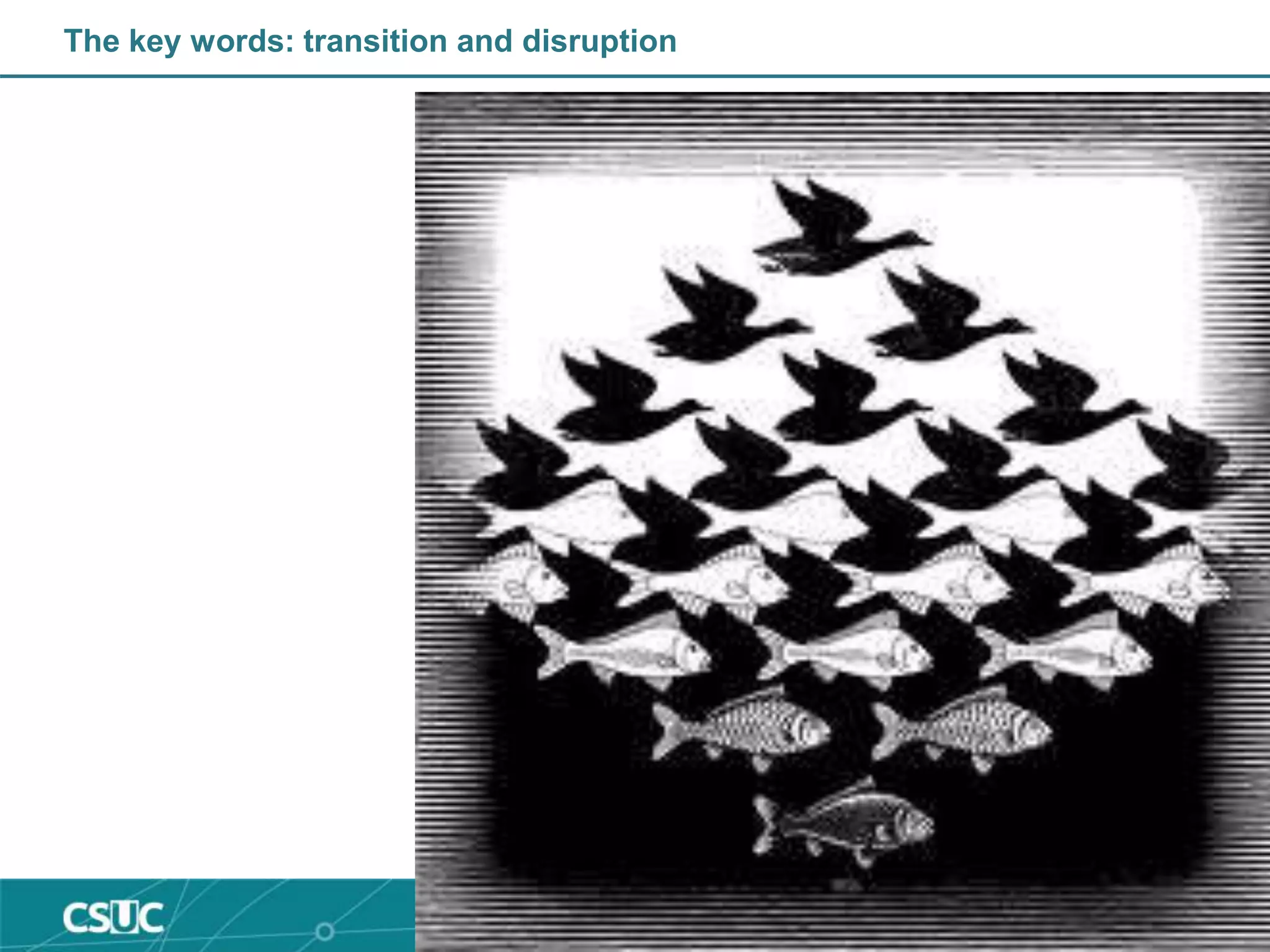
The key words: transition and disruption
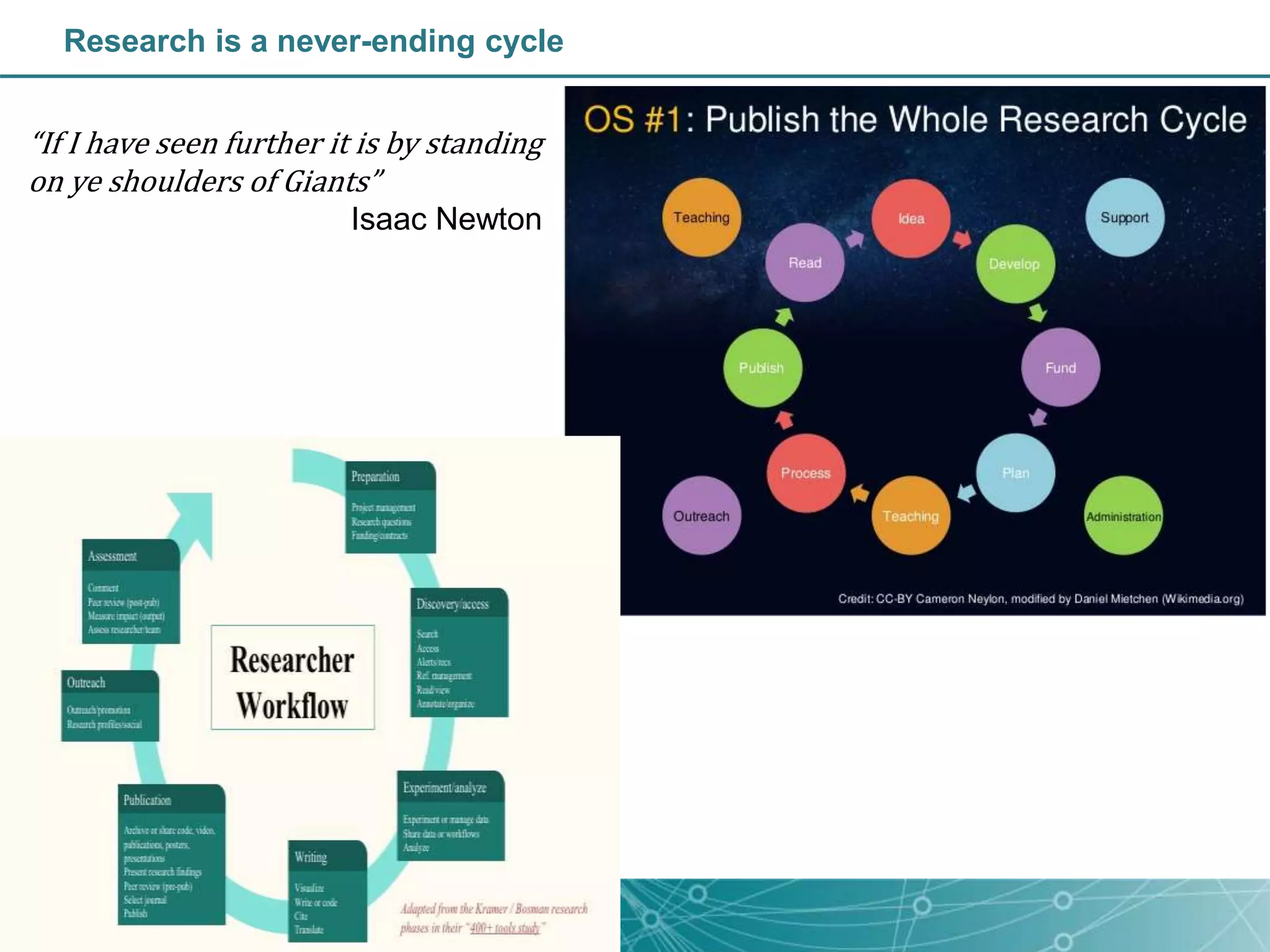
Research is a never-ending cycle
“If I have seen further it is by standing
on ye shoulders of Giants”
Isaac Newton
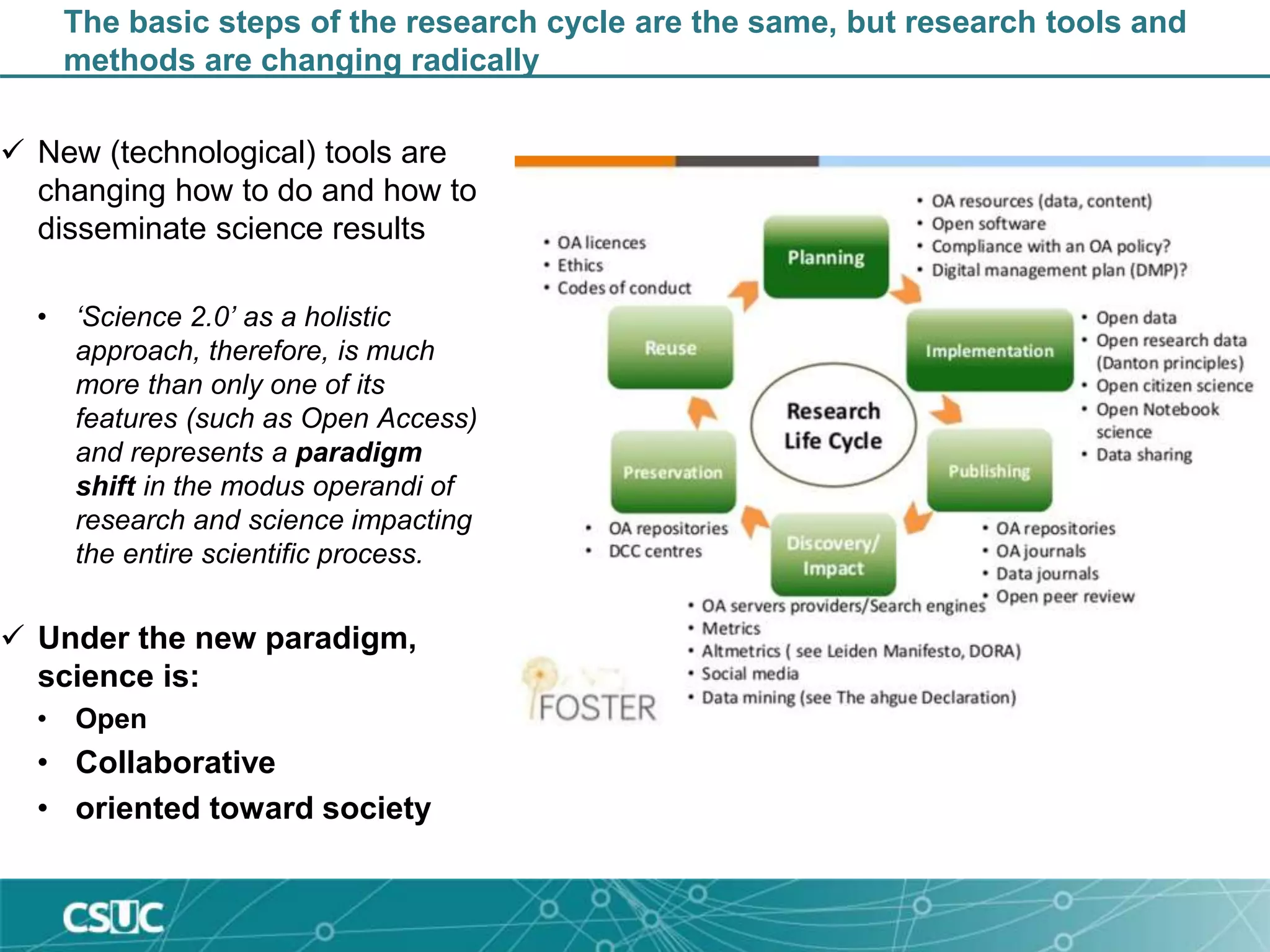
The basic steps of the research cycle are the same, but research tools and
methods are changing radically
 New (technological) tools are
changing how to do and how to
disseminate science results
• ‘Science 2.0’ as a holistic
approach, therefore, is much
more than only one of its
features (such as Open Access)
and represents a paradigm
shift in the modus operandi of
research and science impacting
the entire scientific process.
 Under the new paradigm,
science is:
• Open
• Collaborative
• oriented toward society
OS: two definitions / descriptiobns
 Amsterdam Call for Action on Open Science
• Open science Open science is about the way researchers work, collaborate,
interact, share resources and disseminate results.
• A systemic change towards open science is driven by new technologies and data,
the increasing demand in society to address the societal challenges of our times
and the readiness of citizens to participate in research.
• Increased openness and rapid, convenient and high-quality scientific
communication - not just among researchers themselves but between researchers
and society at large - will bring huge benefits for science itself, as well as for its
connection with society.
 Public Consultation: ‘Science 2.0’: Science in Transition
• ‘Science 2.0’ describes the on-going evolution in the modus operandi of doing
research and organising science.
• These changes in the dynamics of science and research are enabled by digital
technologies and driven by the globalisation of the scientific community, as well as
the need to address the Grand Challenges of our times.
• They have an impact on the entire research cycle, from the inception of research to
its publication, as well as on the way in which this cycle is organised.
Open Science Policy Platform Recommendations
 Open Science is scholarly research
that is:
• collaborative,
• transparent and
• reproducible and
• whose outputs are publicly available.
 The European Union will not remain
competitive at the global level
unless:
• it promotes Open Science, and
relatedly,
• Open Innovation..
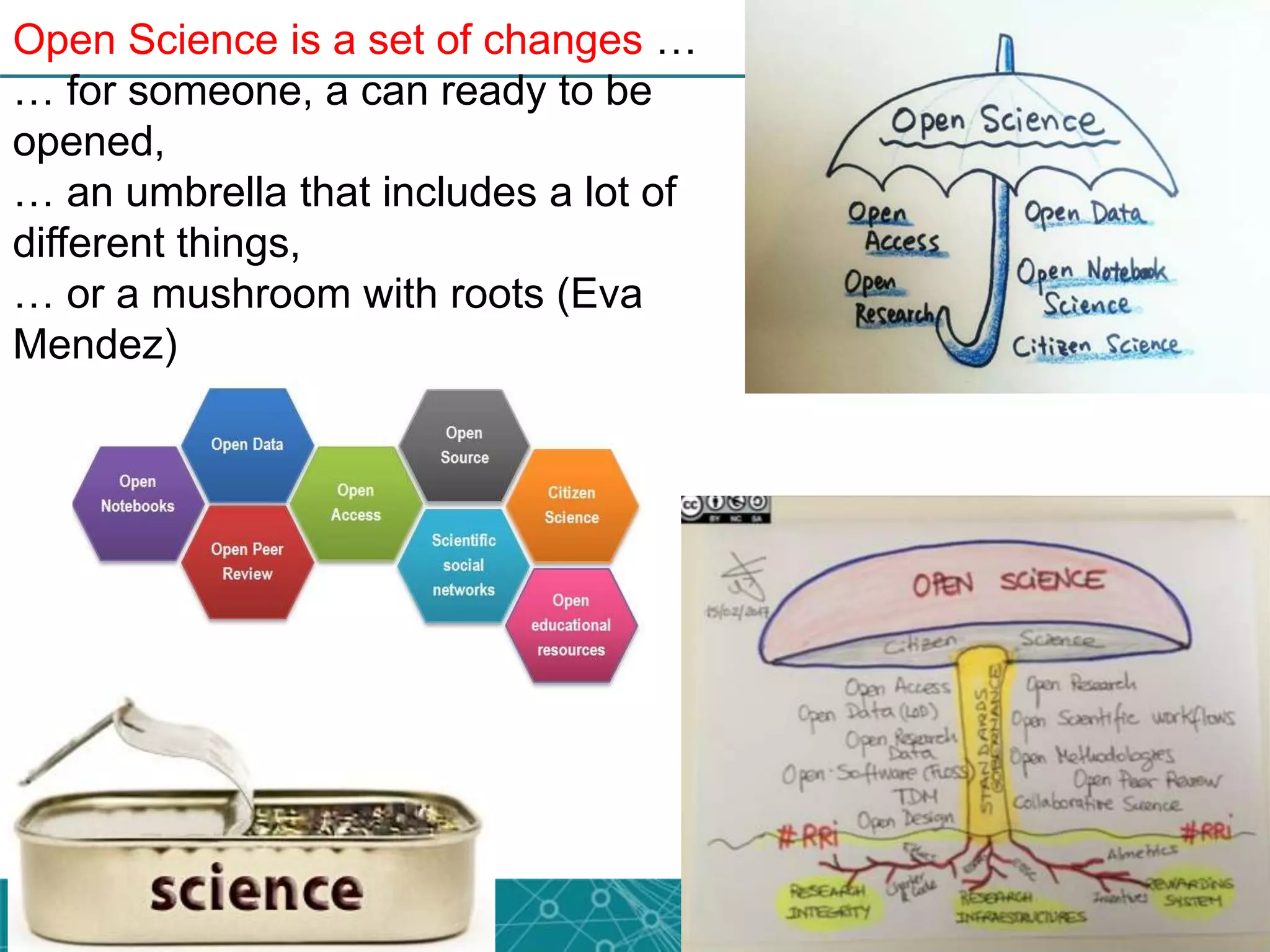
Open Science is a set of changes …
… for someone, a can ready to be
opened,
… an umbrella that includes a lot of
different things,
… or a mushroom with roots (Eva
Mendez)
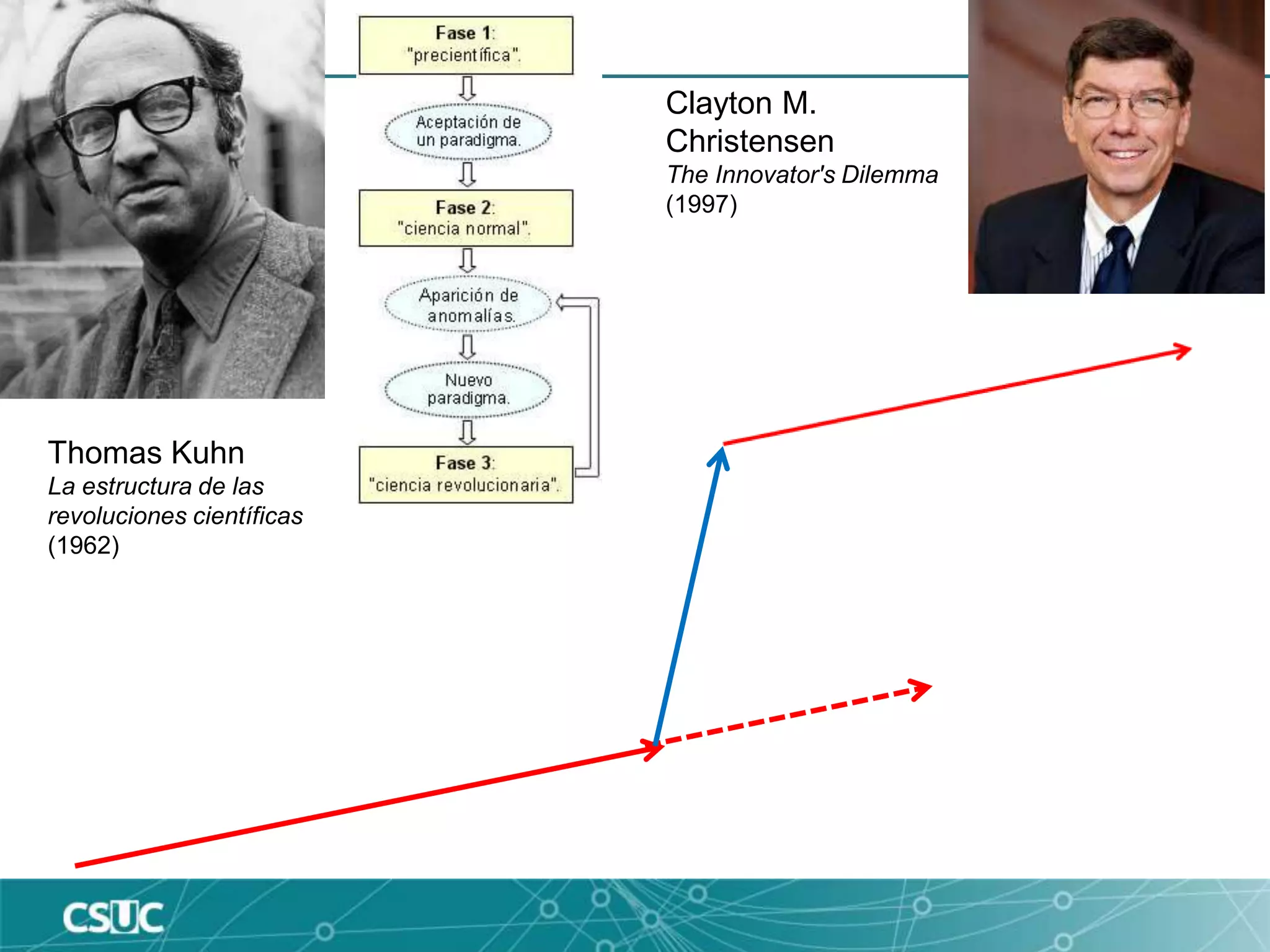
Clayton M.
Christensen
The Innovator's Dilemma
(1997)
Thomas Kuhn
La estructura de las
revoluciones científicas
(1962)
Summary
What exactly is this called open science?
Why? The anomalies of the
current system of scientific
communication
For what, Why Background and motivations
How, roadmaps and national plans
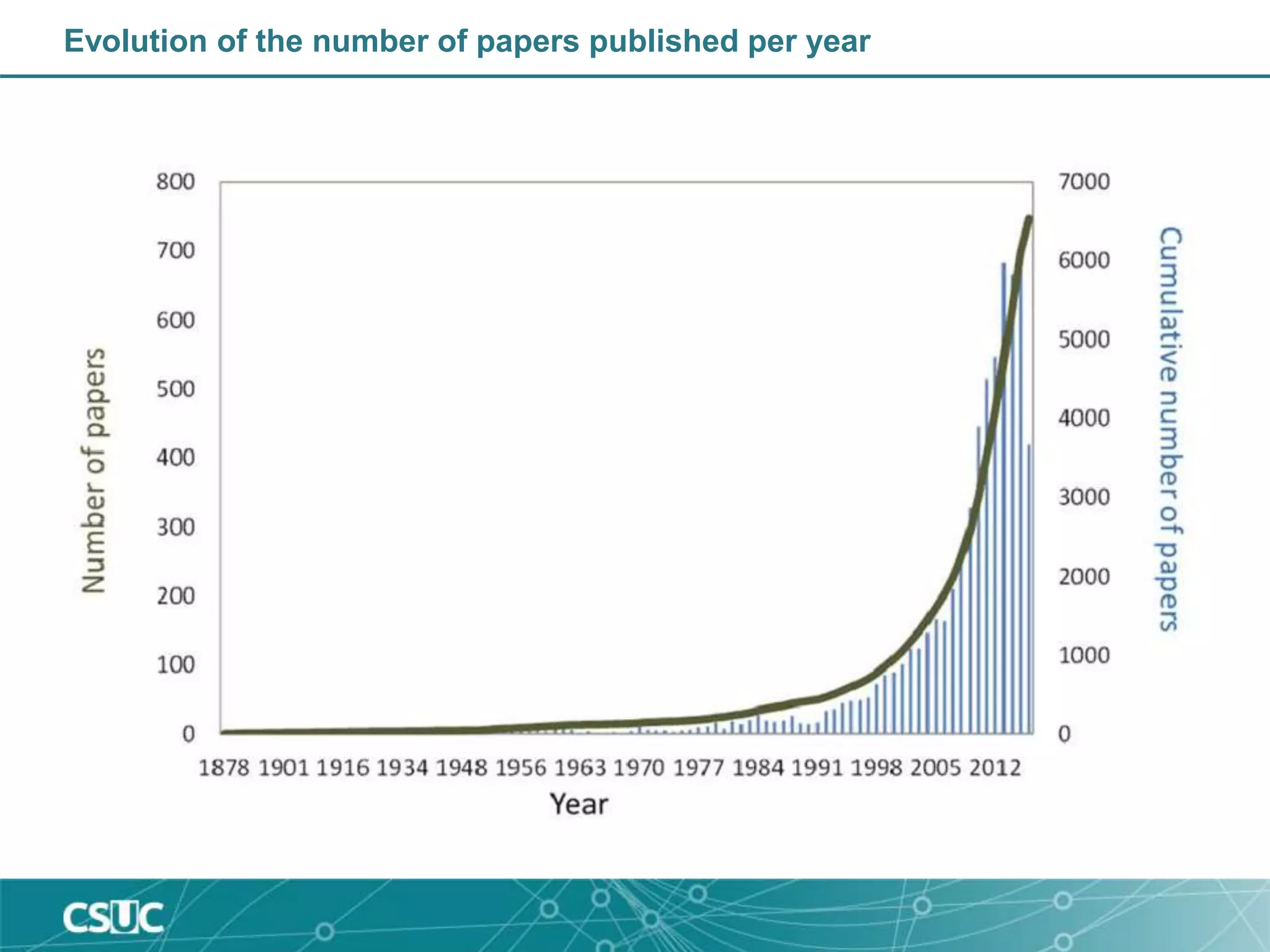
Evolution of the number of papers published per year
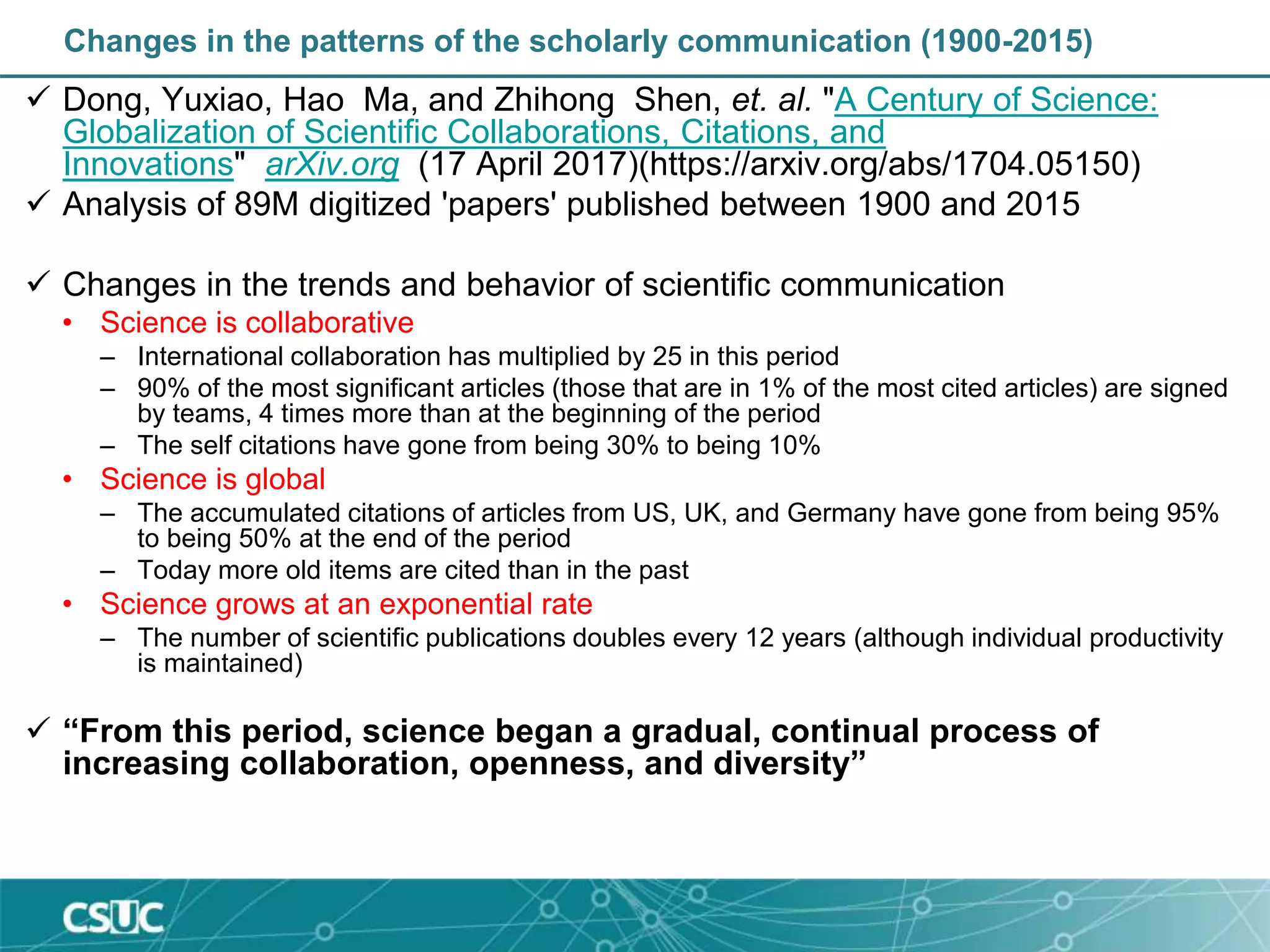
Changes in the patterns of the scholarly communication (1900-2015)
 Dong, Yuxiao, Hao Ma, and Zhihong Shen, et. al. "A Century of Science:
Globalization of Scientific Collaborations, Citations, and
Innovations" arXiv.org (17 April 2017)(https://arxiv.org/abs/1704.05150)
 Analysis of 89M digitized 'papers' published between 1900 and 2015
 Changes in the trends and behavior of scientific communication
• Science is collaborative
– International collaboration has multiplied by 25 in this period
– 90% of the most significant articles (those that are in 1% of the most cited articles) are signed
by teams, 4 times more than at the beginning of the period
– The self citations have gone from being 30% to being 10%
• Science is global
– The accumulated citations of articles from US, UK, and Germany have gone from being 95%
to being 50% at the end of the period
– Today more old items are cited than in the past
• Science grows at an exponential rate
– The number of scientific publications doubles every 12 years (although individual productivity
is maintained)
 “From this period, science began a gradual, continual process of
increasing collaboration, openness, and diversity”
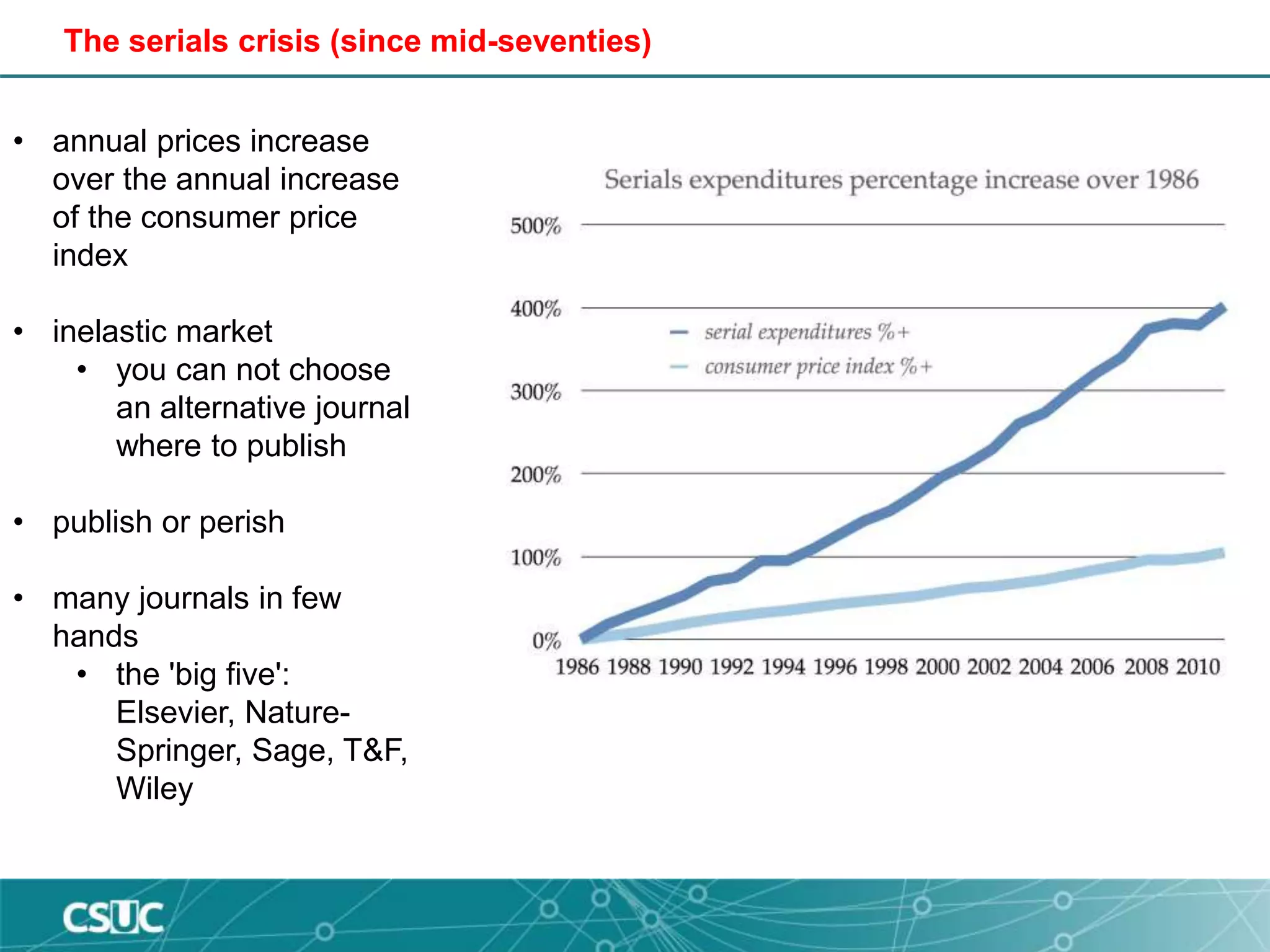
The serials crisis (since mid-seventies)
• annual prices increase
over the annual increase
of the consumer price
index
• inelastic market
• you can not choose
an alternative journal
where to publish
• publish or perish
• many journals in few
hands
• the 'big five':
Elsevier, Nature-
Springer, Sage, T&F,
Wiley
Thomas Kuhn (The Structure of Scientific Revolutions)
 The paradigm =
• Universally recognized scientific achievements that, for a certain time,
provide models of problems and solutions to a scientific community.
• Its success comes from "the comparative ability [with respect to the
previous paradigm] to solve problems."
• But, the (new o the old) paradigm is a solution, it is not the purpose
 The anomalies =
• The inadequacy between the responses of the paradigm and reality
• They are tolerated for not being central and for having no solution for them
 The change =
• the emergence of new paradigms is preceded by "a period of profound
professional insecurity"
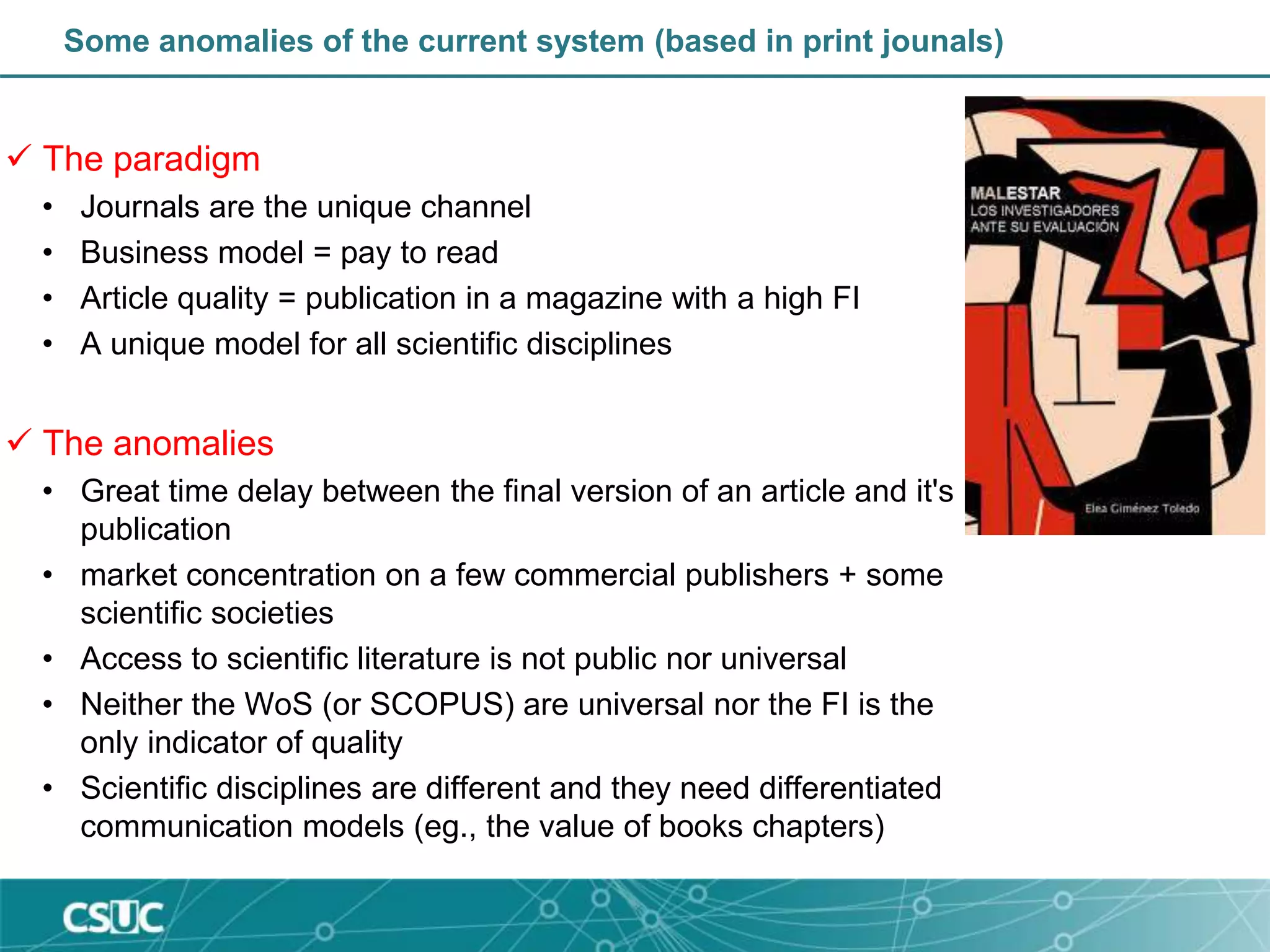
Some anomalies of the current system (based in print jounals)
 The paradigm
• Journals are the unique channel
• Business model = pay to read
• Article quality = publication in a magazine with a high FI
• A unique model for all scientific disciplines
 The anomalies
• Great time delay between the final version of an article and it's
publication
• market concentration on a few commercial publishers + some
scientific societies
• Access to scientific literature is not public nor universal
• Neither the WoS (or SCOPUS) are universal nor the FI is the
only indicator of quality
• Scientific disciplines are different and they need differentiated
communication models (eg., the value of books chapters)
Summary
What exactly is this called open science?
Why? The anomalies of the current system
of scientific communication
For what, Why Background
and motivations
How, roadmaps and national plans
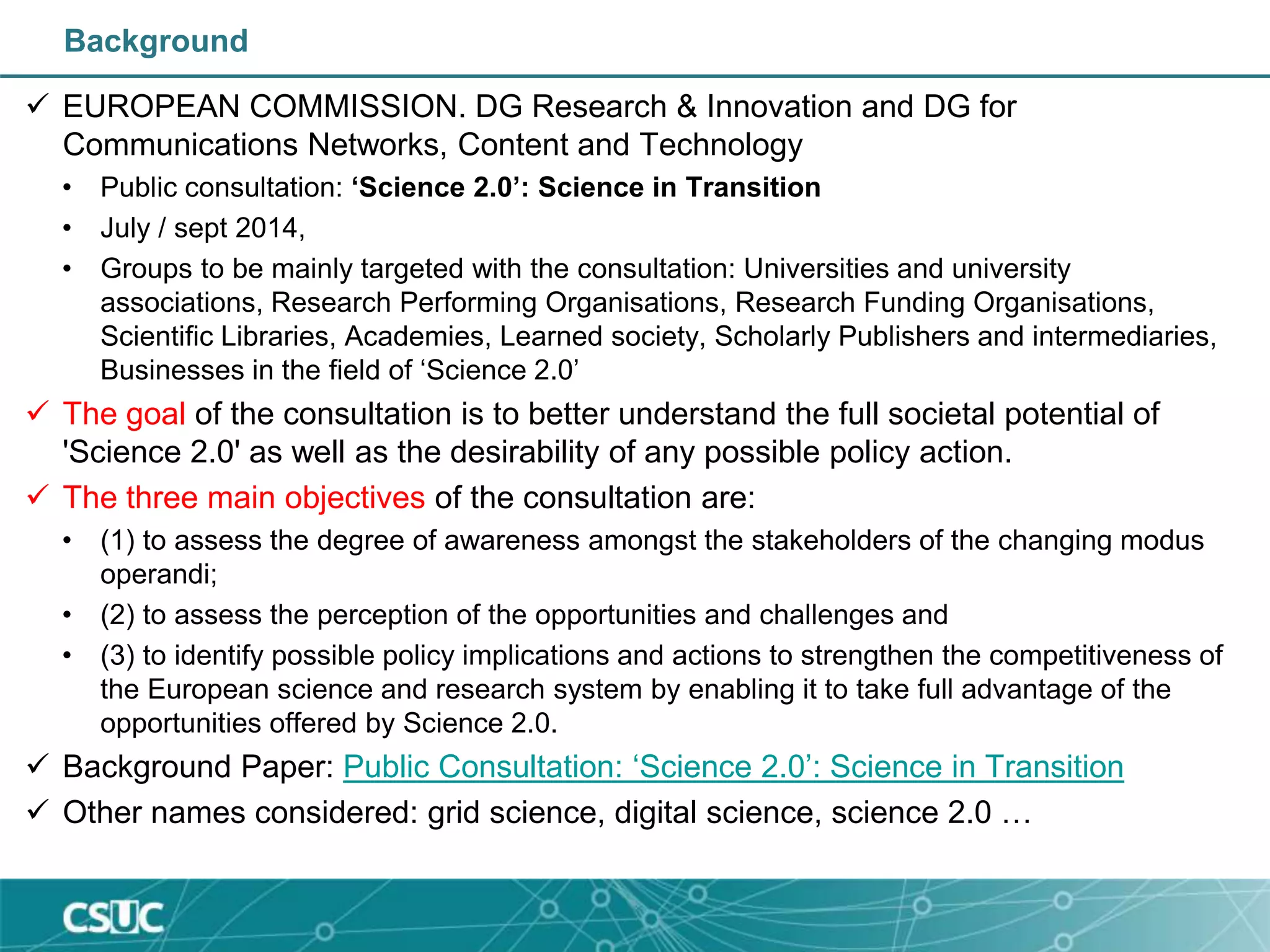
Background
 EUROPEAN COMMISSION. DG Research & Innovation and DG for
Communications Networks, Content and Technology
• Public consultation: ‘Science 2.0’: Science in Transition
• July / sept 2014,
• Groups to be mainly targeted with the consultation: Universities and university
associations, Research Performing Organisations, Research Funding Organisations,
Scientific Libraries, Academies, Learned society, Scholarly Publishers and intermediaries,
Businesses in the field of ‘Science 2.0’
 The goal of the consultation is to better understand the full societal potential of
'Science 2.0' as well as the desirability of any possible policy action.
 The three main objectives of the consultation are:
• (1) to assess the degree of awareness amongst the stakeholders of the changing modus
operandi;
• (2) to assess the perception of the opportunities and challenges and
• (3) to identify possible policy implications and actions to strengthen the competitiveness of
the European science and research system by enabling it to take full advantage of the
opportunities offered by Science 2.0.
 Background Paper: Public Consultation: ‘Science 2.0’: Science in Transition
 Other names considered: grid science, digital science, science 2.0 …
Economic, politic & scientific motivations
 For future (European) welfare:
• A change of economic model is needed
• From industrial society to a knowledge-based society
 For responding to the great social challenges of our time:
• Science should be for and with society (involvement and citizen participation)
• For transparency and control (accountability): utility, reliability and replicability of
the search
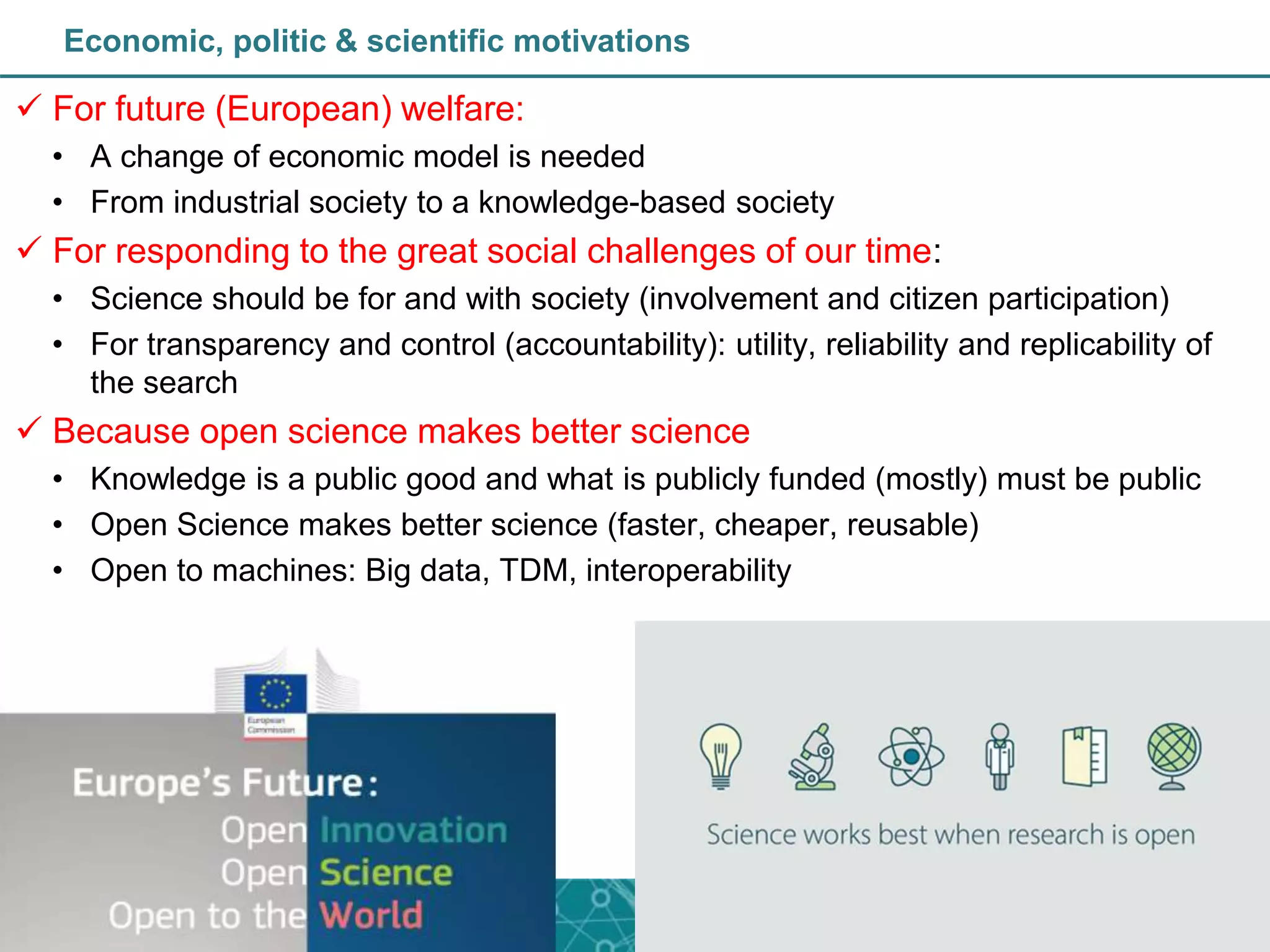
 Because open science makes better science
• Knowledge is a public good and what is publicly funded (mostly) must be public
• Open Science makes better science (faster, cheaper, reusable)
• Open to machines: Big data, TDM, interoperability
Summary
What exactly is this called open science?
Why? The anomalies of the current system
of scientific communication
For what, Why Background and motivations
How, roadmaps and
national plans
OS: central issues
 Central issues (today)
• OA (articles)
• OD (research data)
• New skills
• Incentives for OS
 Emerging issues
• Citizen science
• Digital Humanities (?)
• OER
 But, always,
• Collaboratively
• Openly
• Federated
• Social
Political mandate
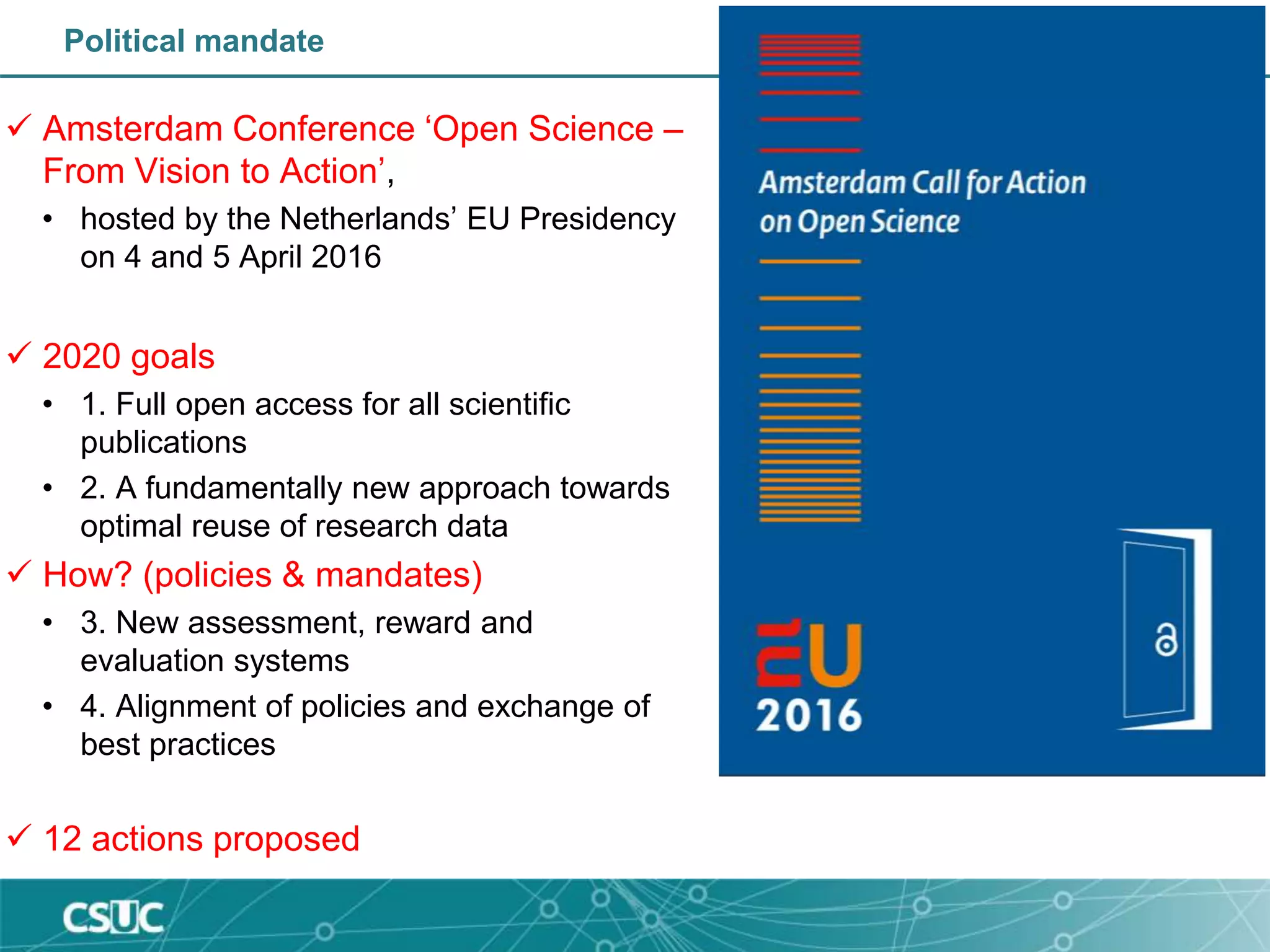
 Amsterdam Conference ‘Open Science –
From Vision to Action’,
• hosted by the Netherlands’ EU Presidency
on 4 and 5 April 2016
 2020 goals
• 1. Full open access for all scientific
publications
• 2. A fundamentally new approach towards
optimal reuse of research data
 How? (policies & mandates)
• 3. New assessment, reward and
evaluation systems
• 4. Alignment of policies and exchange of
best practices
 12 actions proposed
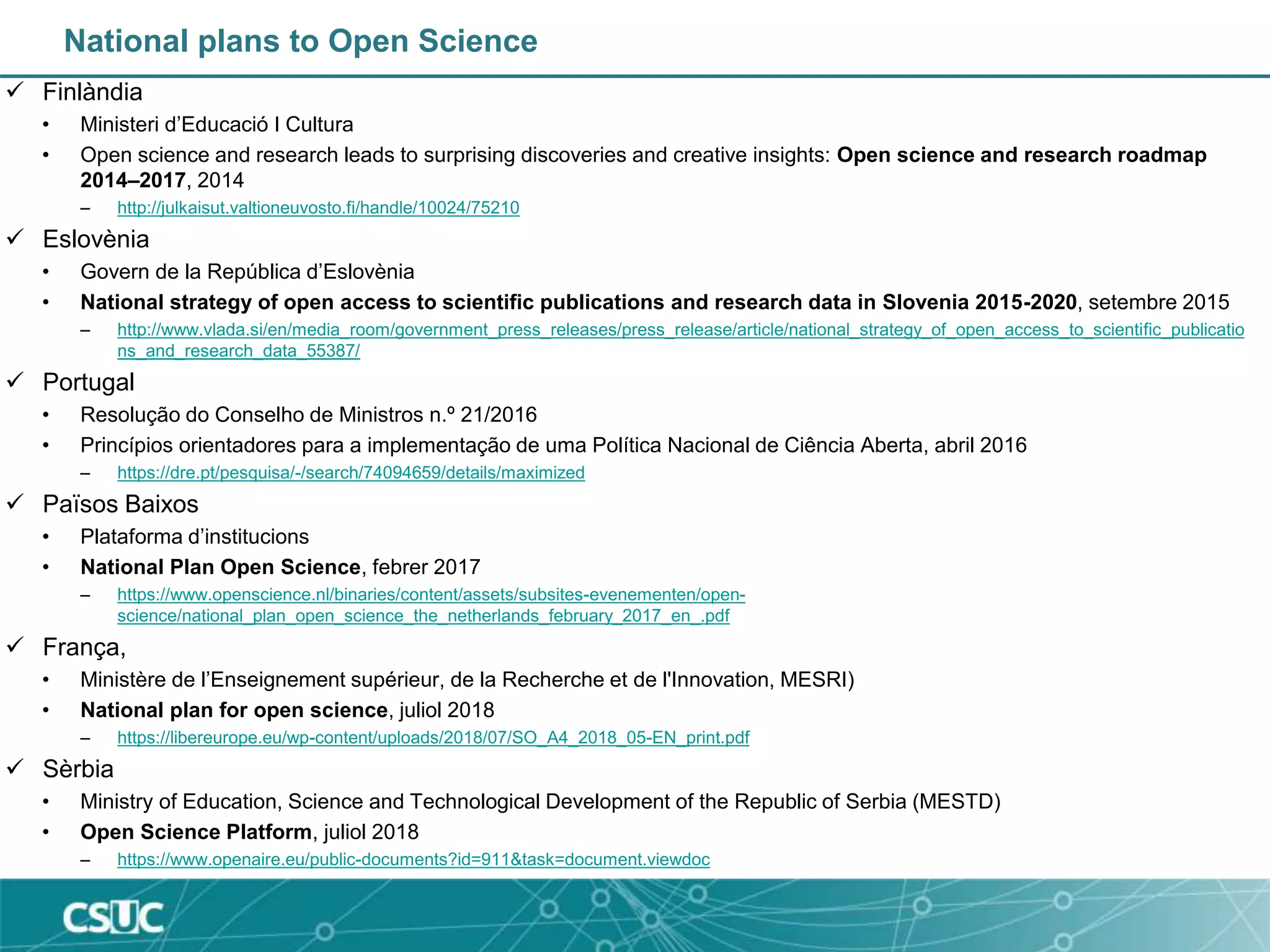
National plans to Open Science
 Finlàndia
• Ministeri d’Educació I Cultura
• Open science and research leads to surprising discoveries and creative insights: Open science and research roadmap
2014–2017, 2014
– http://julkaisut.valtioneuvosto.fi/handle/10024/75210
 Eslovènia
• Govern de la República d’Eslovènia
• National strategy of open access to scientific publications and research data in Slovenia 2015-2020, setembre 2015
– http://www.vlada.si/en/media_room/government_press_releases/press_release/article/national_strategy_of_open_access_to_scientific_publicatio
ns_and_research_data_55387/
 Portugal
• Resolução do Conselho de Ministros n.º 21/2016
• Princípios orientadores para a implementação de uma Política Nacional de Ciência Aberta, abril 2016
– https://dre.pt/pesquisa/-/search/74094659/details/maximized
 Països Baixos
• Plataforma d’institucions
• National Plan Open Science, febrer 2017
– https://www.openscience.nl/binaries/content/assets/subsites-evenementen/open-
science/national_plan_open_science_the_netherlands_february_2017_en_.pdf
 França,
• Ministère de l’Enseignement supérieur, de la Recherche et de l'Innovation, MESRI)
• National plan for open science, juliol 2018
– https://libereurope.eu/wp-content/uploads/2018/07/SO_A4_2018_05-EN_print.pdf
 Sèrbia
• Ministry of Education, Science and Technological Development of the Republic of Serbia (MESTD)
• Open Science Platform, juliol 2018
– https://www.openaire.eu/public-documents?id=911&task=document.viewdoc
Netherland
 … there are now new opportunities to exchange results of scientific research - publications and research data
- and even scientific methods and practices.
 The transition towards an open science system requires ambition, investments in people and resources, and
alertness to risks, because they too exist.
 The key ambitions [of the Plan] are:
• Full open access to publications in 2020
– Continue the Dutch approach for all Dutch research organisations and research areas whilst recognising their
differences and similarities.
• To make research data optimally suited for reuse
– To set clear and agreed technical and policy-related preconditions to facilitate reuse of research data, including provision
of the necessary expertise and support.
• Recognition and rewards
– To examine together how open science can be an element of the evaluation and reward system for researchers,
research groups and research proposals.
• To promote and support
– To establish a ‘clearing house’ for all information regarding all available research support.
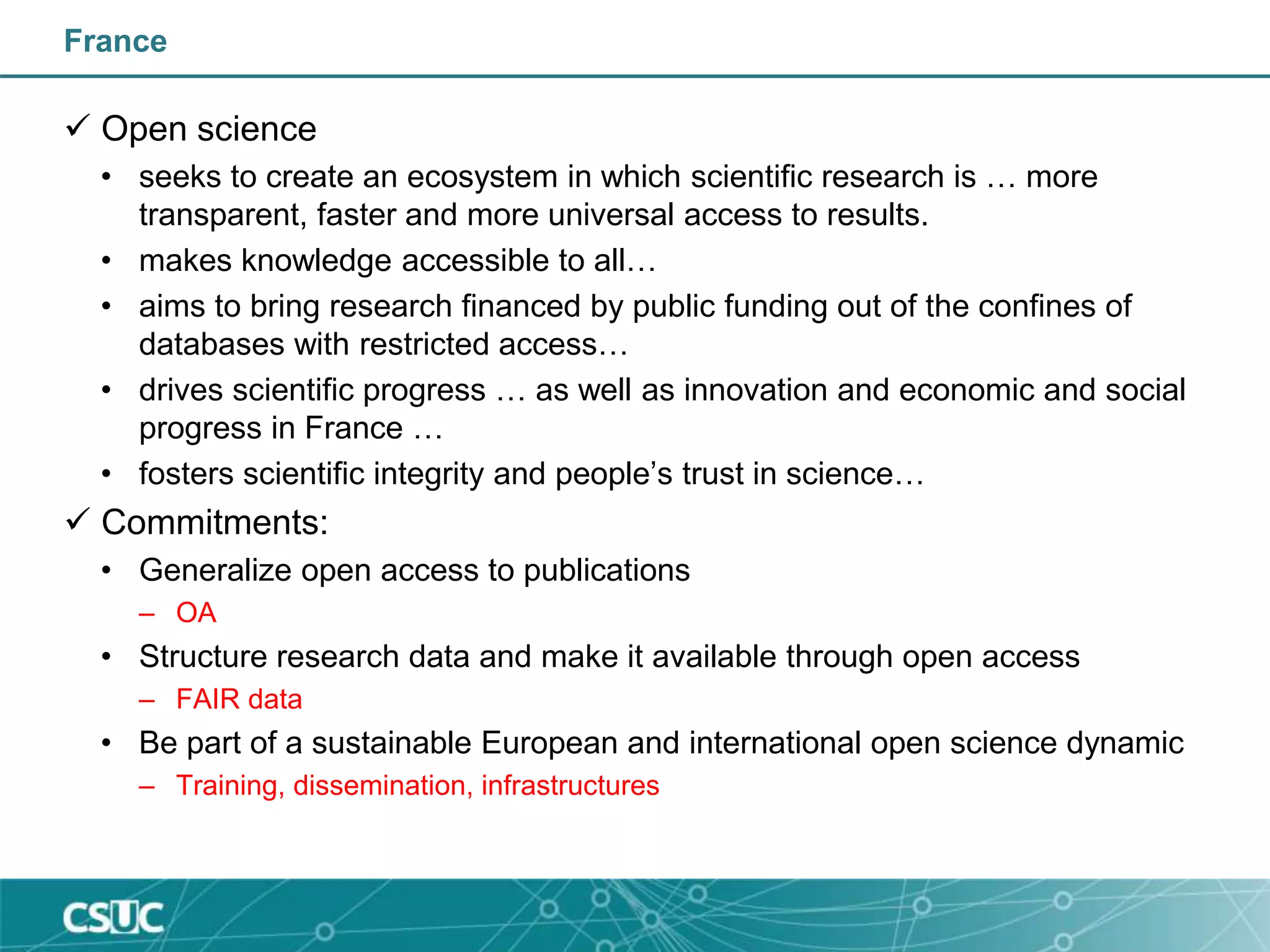
France
 Open science
• seeks to create an ecosystem in which scientific research is … more
transparent, faster and more universal access to results.
• makes knowledge accessible to all…
• aims to bring research financed by public funding out of the confines of
databases with restricted access…
• drives scientific progress … as well as innovation and economic and social
progress in France …
• fosters scientific integrity and people’s trust in science…
 Commitments:
• Generalize open access to publications
– OA
• Structure research data and make it available through open access
– FAIR data
• Be part of a sustainable European and international open science dynamic
– Training, dissemination, infrastructures
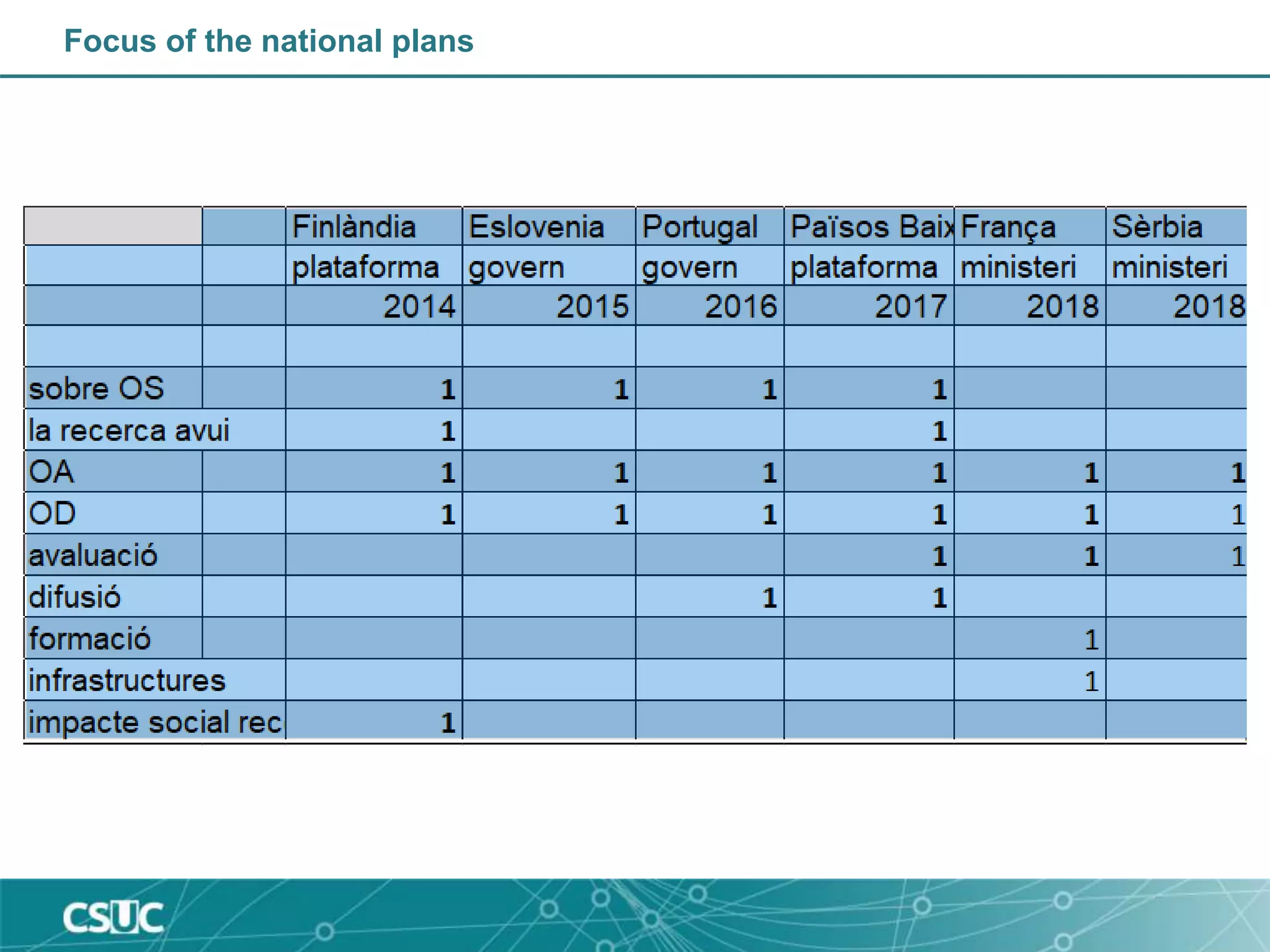
Focus of the national plans
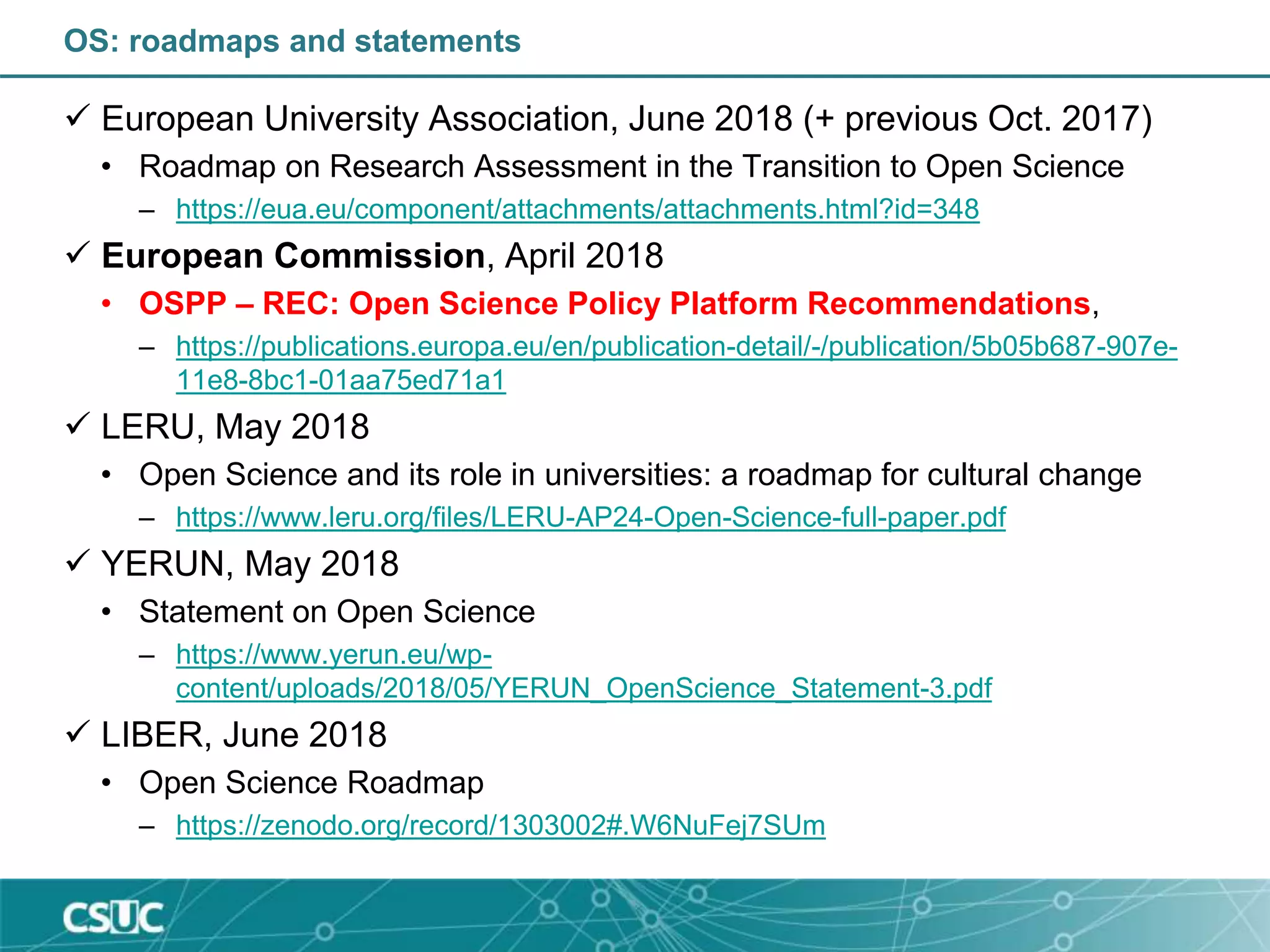
OS: roadmaps and statements
 European University Association, June 2018 (+ previous Oct. 2017)
• Roadmap on Research Assessment in the Transition to Open Science
– https://eua.eu/component/attachments/attachments.html?id=348
 European Commission, April 2018
• OSPP – REC: Open Science Policy Platform Recommendations,
– https://publications.europa.eu/en/publication-detail/-/publication/5b05b687-907e-
11e8-8bc1-01aa75ed71a1
 LERU, May 2018
• Open Science and its role in universities: a roadmap for cultural change
– https://www.leru.org/files/LERU-AP24-Open-Science-full-paper.pdf
 YERUN, May 2018
• Statement on Open Science
– https://www.yerun.eu/wp-
content/uploads/2018/05/YERUN_OpenScience_Statement-3.pdf
 LIBER, June 2018
• Open Science Roadmap
– https://zenodo.org/record/1303002#.W6NuFej7SUm
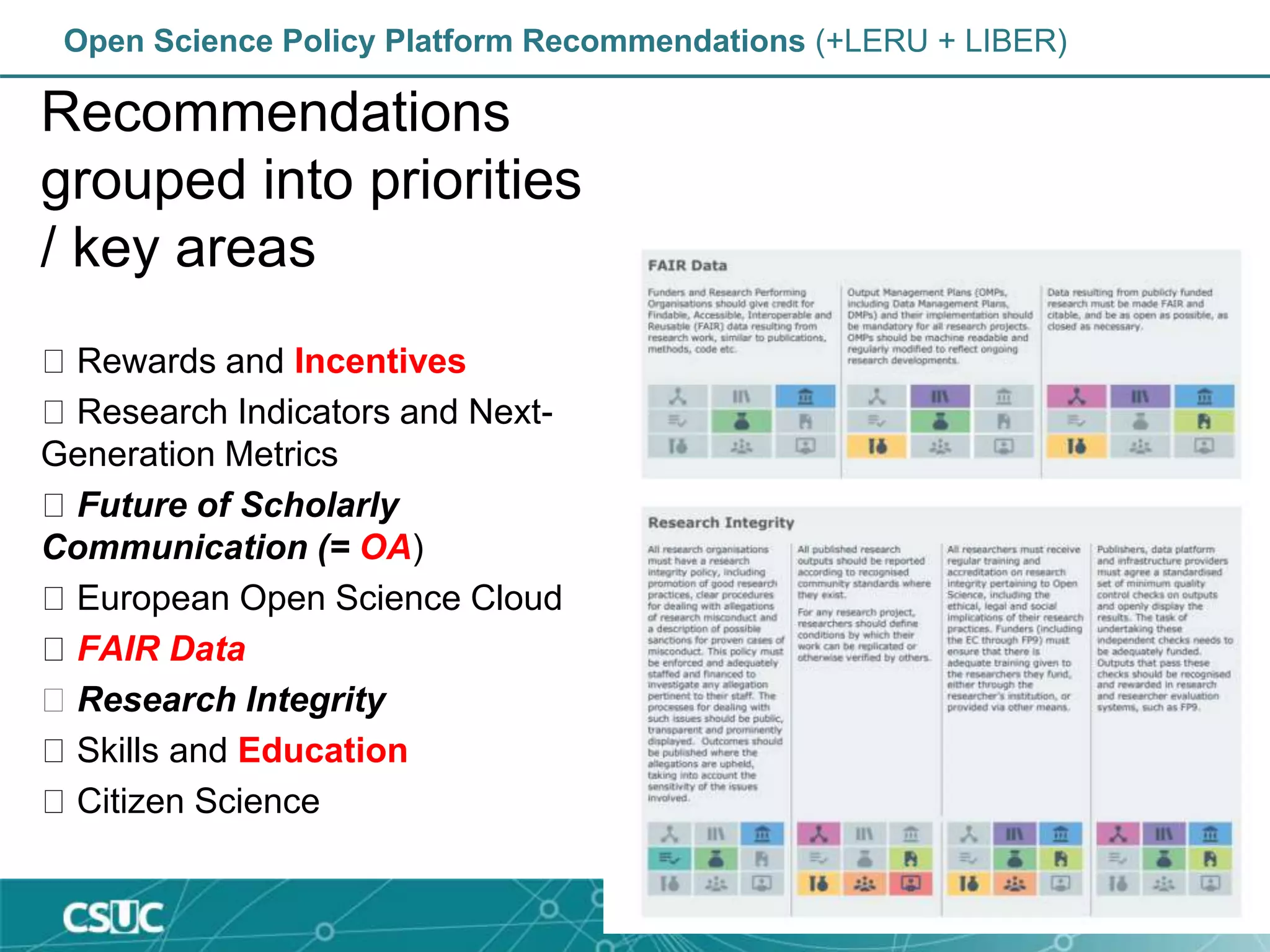
Open Science Policy Platform Recommendations (+LERU + LIBER)
Recommendations
grouped into priorities
/ key areas
Rewards and Incentives
Research Indicators and Next-
Generation Metrics
Future of Scholarly
Communication (= OA)
European Open Science Cloud
FAIR Data
Research Integrity
Skills and Education
Citizen Science
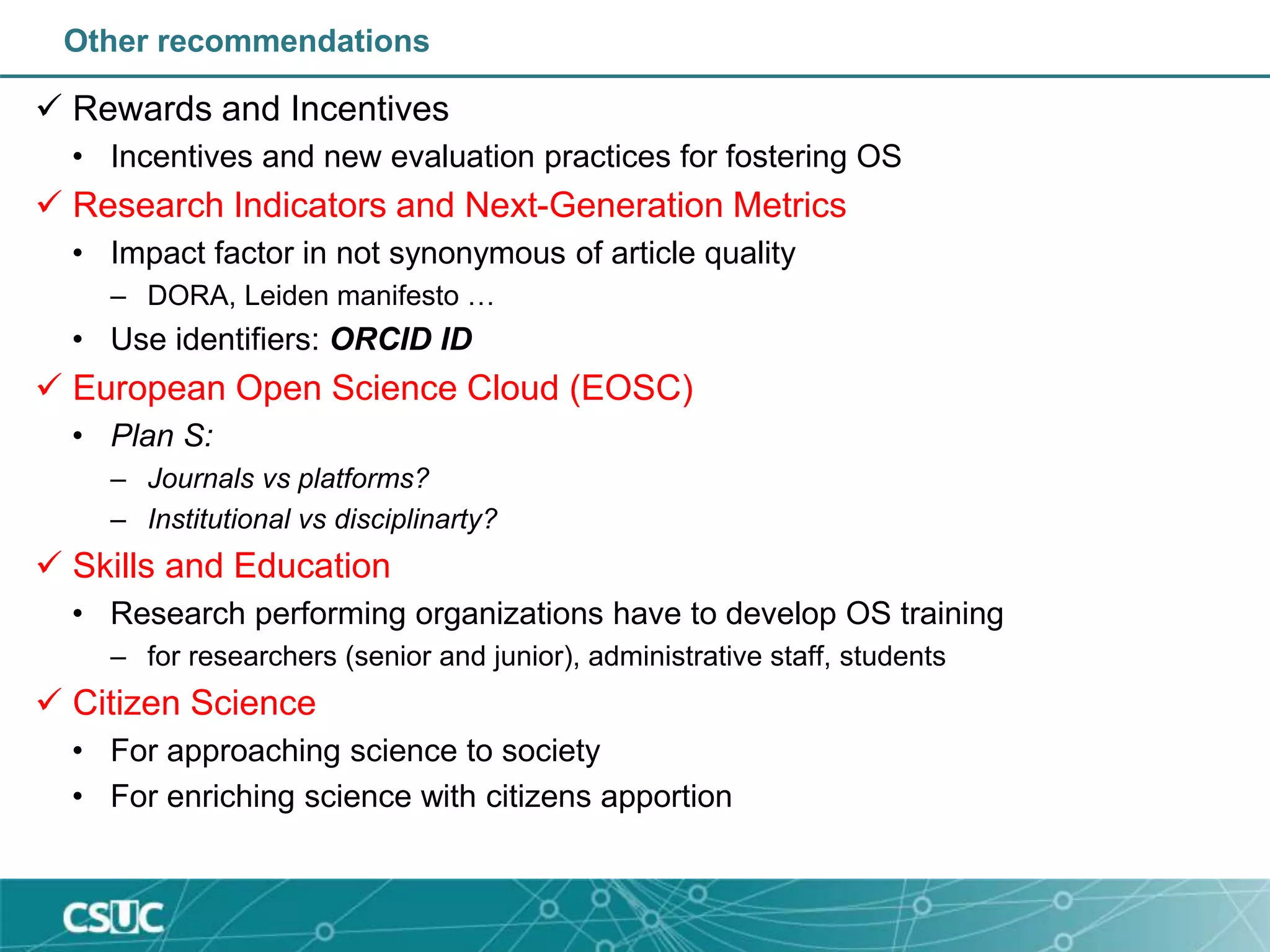
Other recommendations
 Rewards and Incentives
• Incentives and new evaluation practices for fostering OS
 Research Indicators and Next-Generation Metrics
• Impact factor in not synonymous of article quality
– DORA, Leiden manifesto …
• Use identifiers: ORCID ID
 European Open Science Cloud (EOSC)
• Plan S:
– Journals vs platforms?
– Institutional vs disciplinarty?
 Skills and Education
• Research performing organizations have to develop OS training
– for researchers (senior and junior), administrative staff, students
 Citizen Science
• For approaching science to society
• For enriching science with citizens apportion
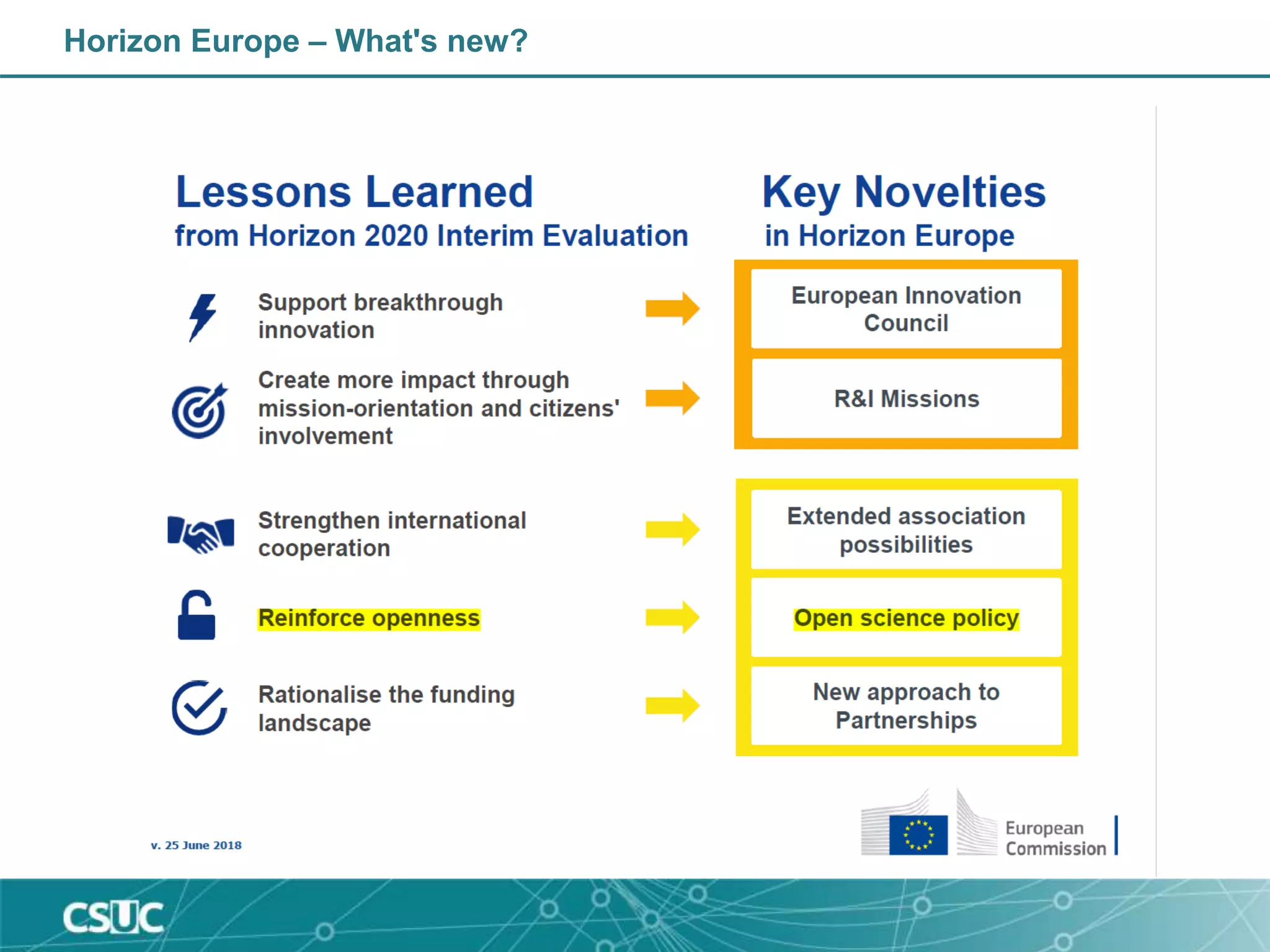
Horizon Europe – What's new?
OA, the situation for a Spanish researcher
 The European Commission wants to have the 100% OA in 2020
• But there are deep differences between countries and disciplines
• In Europe, in a very general picture,
– countries with a strong publishing industry (and powerful research) opt for the golden
way (with payment of APCs) in gold and hybrid journals (UK, Netherlands, Germany,
Austria, Finland),
– In general, with a strong support by the Government and rectors
– most countries have opted for the green way;
 The hybrid journals were born with the promise of not increasing overall
costs (APCs should be discounted from subscription prices)
• but, APCs meant an added cost (of a 10%?)
 The dilemma for Spanish researchers is:
• to publish in IR with short embargo periods (it does not happen often),
• or to publish in pure gold journals (there are not many in JCR)
• or publish in hybrid journals (in most cases with payment and APC)
Plan S / cOAlition S
 10 principles
 Guidance on the Implementation of Plan S
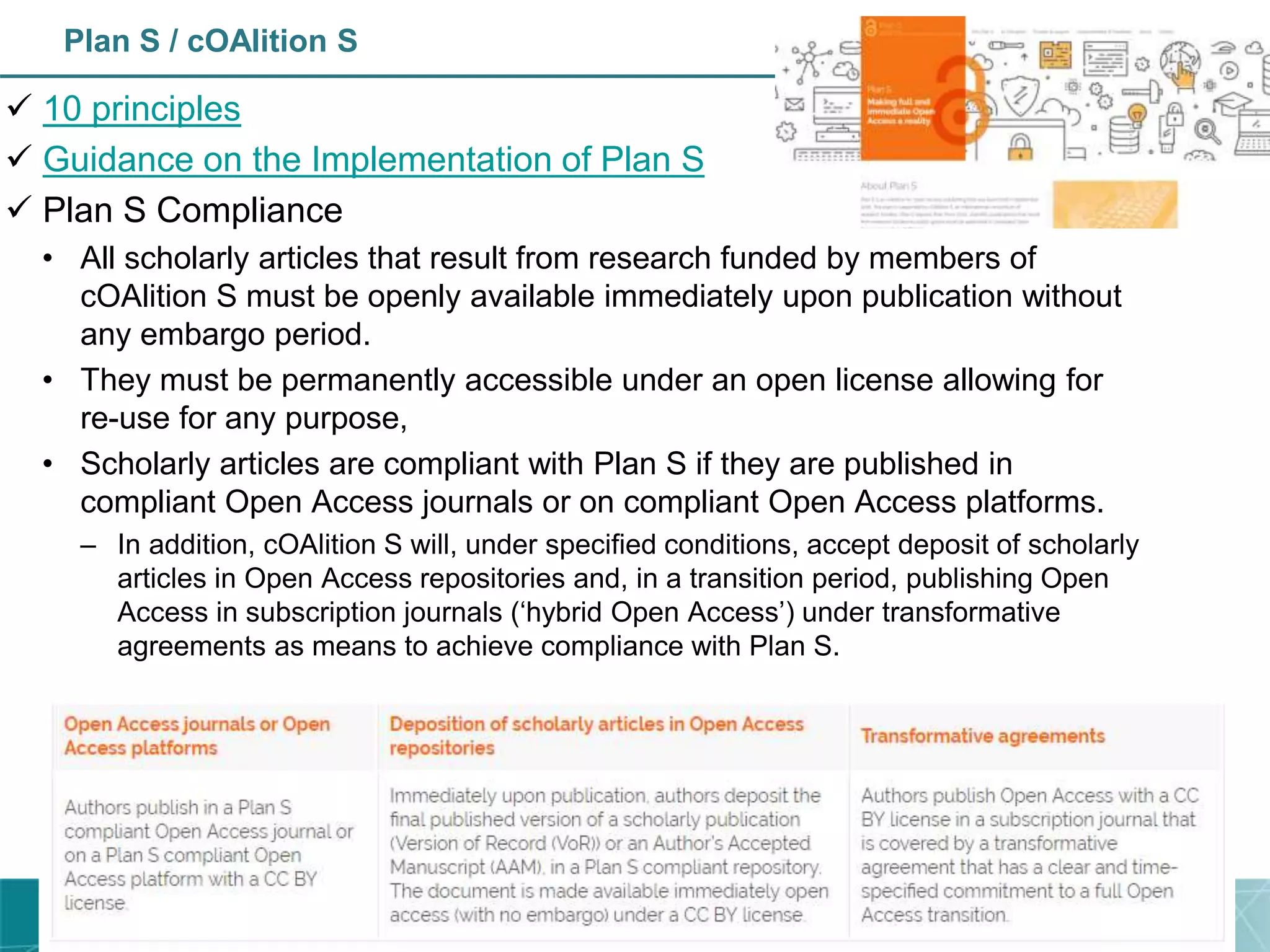
 Plan S Compliance
• All scholarly articles that result from research funded by members of
cOAlition S must be openly available immediately upon publication without
any embargo period.
• They must be permanently accessible under an open license allowing for
re-use for any purpose,
• Scholarly articles are compliant with Plan S if they are published in
compliant Open Access journals or on compliant Open Access platforms.
– In addition, cOAlition S will, under specified conditions, accept deposit of scholarly
articles in Open Access repositories and, in a transition period, publishing Open
Access in subscription journals (‘hybrid Open Access’) under transformative
agreements as means to achieve compliance with Plan S.
Plan S Compliance
 Basic mandatory criteria for Plan S compliant OA journals & platforms:
• The journal/platform must be registered in the Directory of OA Journals (DOAJ)
• Content must be OA and free to read and download immediately upon publication
• The journal/platform must enable authors to publish under a CC BY 4.0 license
• To have a solid system in place for review according to the standards within the
relevant discipline,
• …
 Requirements for Plan S compliant Open Access repositories:
• A copy of the published work must be OA in a compliant repository … without cost
for the depositor/author if it is not available in a compliant journal or platform:
• Version: the final published version of the publication (Version of Record) or at
least the Author’s Accepted Manuscript (AAM).
• No embargo period can be applied
• Authors must retain their copyright, articles must be under the CC BY 4.0 license
• The venue where the article is published must have a solid system in place for
review according to the standards within the relevant discipline
• …
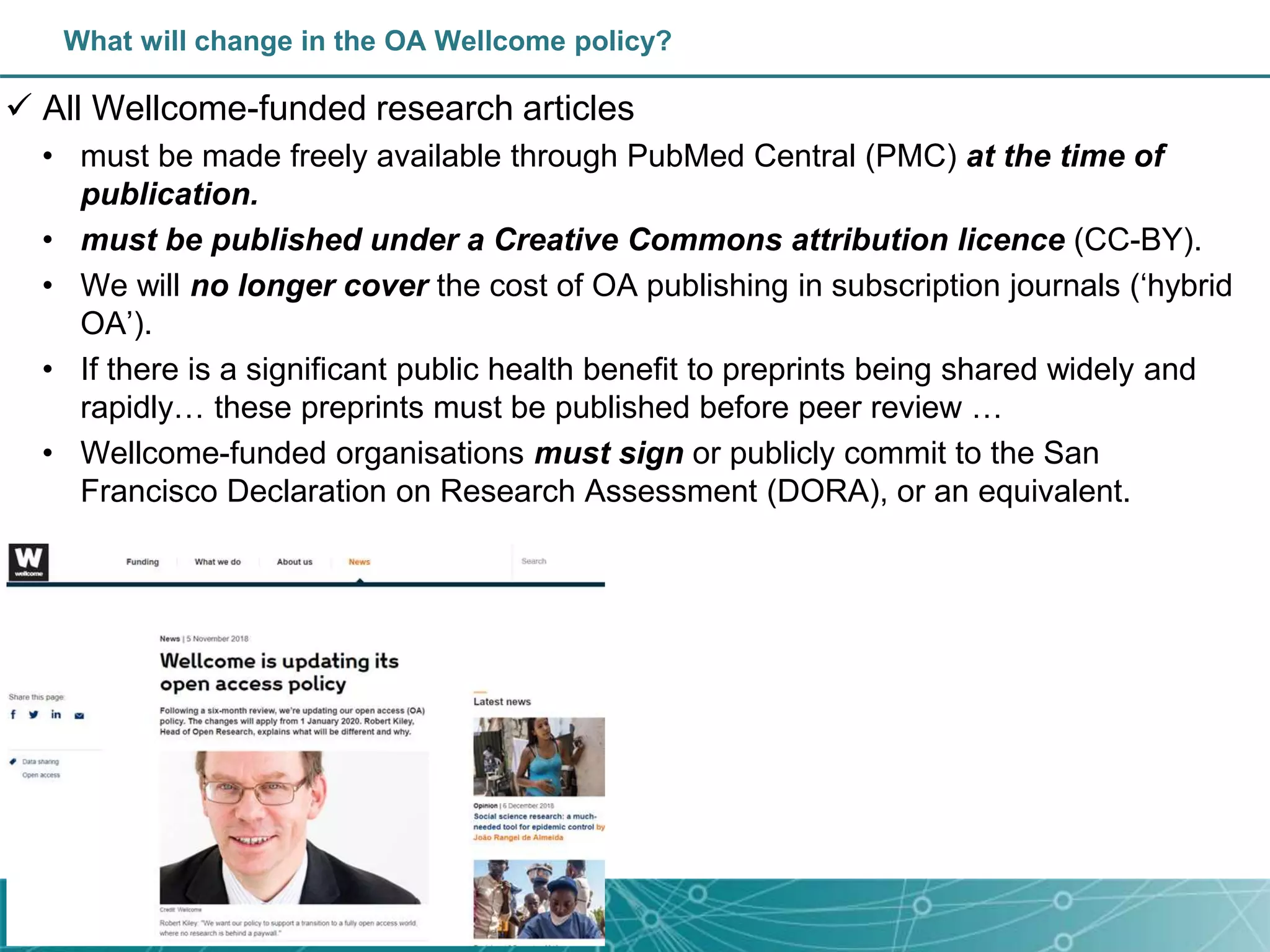
 All Wellcome-funded research articles
• must be made freely available through PubMed Central (PMC) at the time of
publication.
• must be published under a Creative Commons attribution licence (CC-BY).
• We will no longer cover the cost of OA publishing in subscription journals (‘hybrid
OA’).
• If there is a significant public health benefit to preprints being shared widely and
rapidly… these preprints must be published before peer review …
• Wellcome-funded organisations must sign or publicly commit to the San
Francisco Declaration on Research Assessment (DORA), or an equivalent.
What will change in the OA Wellcome policy?
Why?
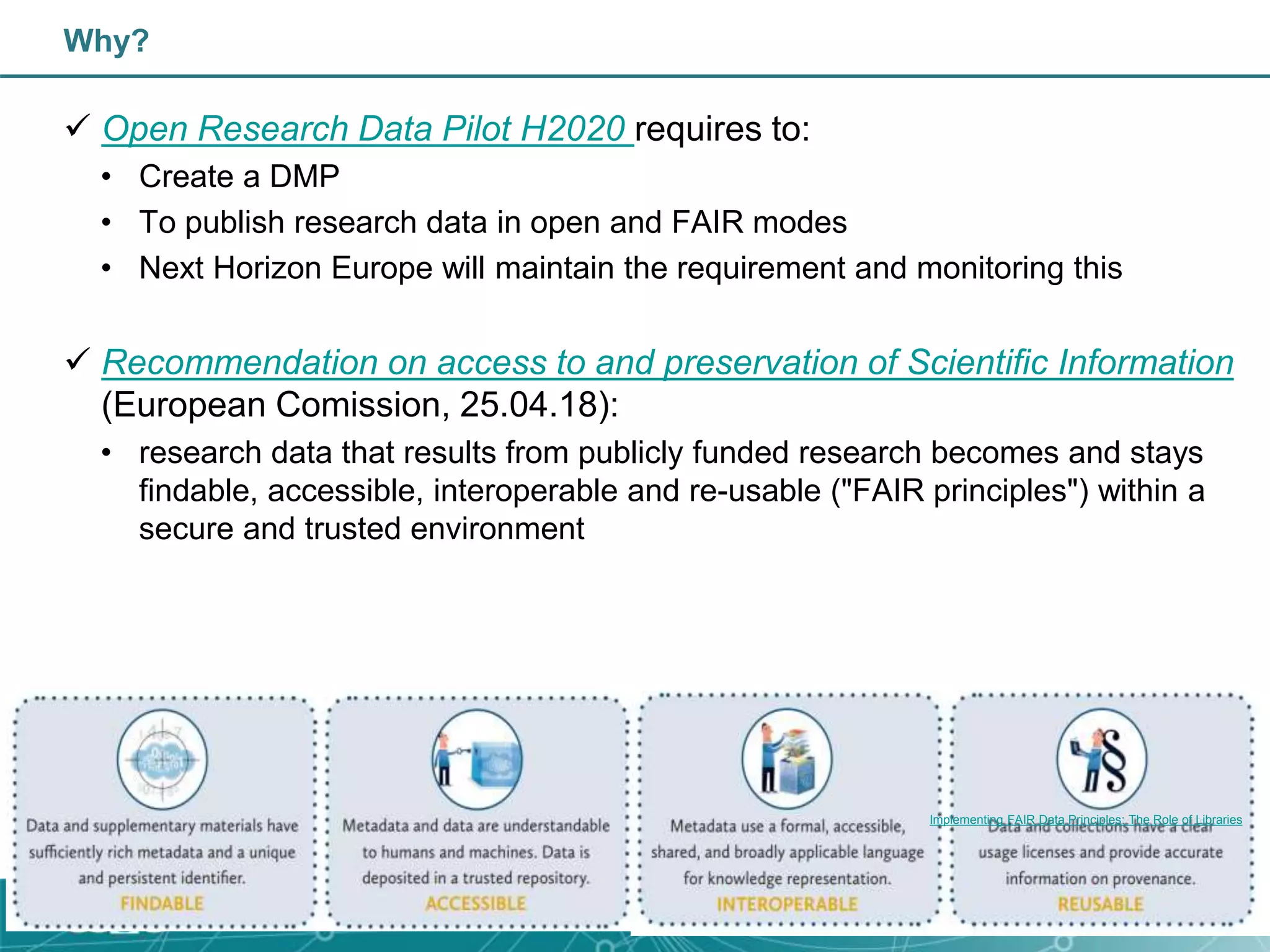
 Open Research Data Pilot H2020 requires to:
• Create a DMP
• To publish research data in open and FAIR modes
• Next Horizon Europe will maintain the requirement and monitoring this
 Recommendation on access to and preservation of Scientific Information
(European Comission, 25.04.18):
• research data that results from publicly funded research becomes and stays
findable, accessible, interoperable and re-usable ("FAIR principles") within a
secure and trusted environment
Implementing FAIR Data Principles: The Role of Libraries
Summary
What exactly is this called open
science?
 Why? The anomalies of the current system of scientific communication
 For what, Why Background and motivations
 How, roadmaps and national plans
Moltes
gràcies
langlada@gmail.com
@lluisanglada

Open Science What? Why? For What? How?

  • 1.
    Open Science What? Why?For What? How? L. Anglada (CSUC. Àrea de Ciència Oberta) Open Science and Open Access Course BGSMath Maria de Maeztu Unit of Excellence / Centre de Recerca Matemàtica Bellaterra, 11 de novembre, 2018
  • 2.
    Summary What exactly isthis called open science? Why? The anomalies of the current system of scientific communication For what, Why Background and motivations How, roadmaps and national plans
  • 3.
    Summary What exactly isthis called open science? Why? The anomalies of the current system of scientific communication For what, Why Background and motivations How, roadmaps and national plans
  • 4.
    The key words:transition and disruption
  • 5.
    Research is anever-ending cycle “If I have seen further it is by standing on ye shoulders of Giants” Isaac Newton
  • 6.
    The basic stepsof the research cycle are the same, but research tools and methods are changing radically  New (technological) tools are changing how to do and how to disseminate science results • ‘Science 2.0’ as a holistic approach, therefore, is much more than only one of its features (such as Open Access) and represents a paradigm shift in the modus operandi of research and science impacting the entire scientific process.  Under the new paradigm, science is: • Open • Collaborative • oriented toward society
  • 7.
    OS: two definitions/ descriptiobns  Amsterdam Call for Action on Open Science • Open science Open science is about the way researchers work, collaborate, interact, share resources and disseminate results. • A systemic change towards open science is driven by new technologies and data, the increasing demand in society to address the societal challenges of our times and the readiness of citizens to participate in research. • Increased openness and rapid, convenient and high-quality scientific communication - not just among researchers themselves but between researchers and society at large - will bring huge benefits for science itself, as well as for its connection with society.  Public Consultation: ‘Science 2.0’: Science in Transition • ‘Science 2.0’ describes the on-going evolution in the modus operandi of doing research and organising science. • These changes in the dynamics of science and research are enabled by digital technologies and driven by the globalisation of the scientific community, as well as the need to address the Grand Challenges of our times. • They have an impact on the entire research cycle, from the inception of research to its publication, as well as on the way in which this cycle is organised.
  • 8.
    Open Science PolicyPlatform Recommendations  Open Science is scholarly research that is: • collaborative, • transparent and • reproducible and • whose outputs are publicly available.  The European Union will not remain competitive at the global level unless: • it promotes Open Science, and relatedly, • Open Innovation..
  • 9.
    Open Science isa set of changes … … for someone, a can ready to be opened, … an umbrella that includes a lot of different things, … or a mushroom with roots (Eva Mendez)
  • 10.
    Clayton M. Christensen The Innovator'sDilemma (1997) Thomas Kuhn La estructura de las revoluciones científicas (1962)
  • 11.
    Summary What exactly isthis called open science? Why? The anomalies of the current system of scientific communication For what, Why Background and motivations How, roadmaps and national plans
  • 12.
    Evolution of thenumber of papers published per year
  • 13.
    Changes in thepatterns of the scholarly communication (1900-2015)  Dong, Yuxiao, Hao Ma, and Zhihong Shen, et. al. "A Century of Science: Globalization of Scientific Collaborations, Citations, and Innovations" arXiv.org (17 April 2017)(https://arxiv.org/abs/1704.05150)  Analysis of 89M digitized 'papers' published between 1900 and 2015  Changes in the trends and behavior of scientific communication • Science is collaborative – International collaboration has multiplied by 25 in this period – 90% of the most significant articles (those that are in 1% of the most cited articles) are signed by teams, 4 times more than at the beginning of the period – The self citations have gone from being 30% to being 10% • Science is global – The accumulated citations of articles from US, UK, and Germany have gone from being 95% to being 50% at the end of the period – Today more old items are cited than in the past • Science grows at an exponential rate – The number of scientific publications doubles every 12 years (although individual productivity is maintained)  “From this period, science began a gradual, continual process of increasing collaboration, openness, and diversity”
  • 14.
    The serials crisis(since mid-seventies) • annual prices increase over the annual increase of the consumer price index • inelastic market • you can not choose an alternative journal where to publish • publish or perish • many journals in few hands • the 'big five': Elsevier, Nature- Springer, Sage, T&F, Wiley
  • 15.
    Thomas Kuhn (TheStructure of Scientific Revolutions)  The paradigm = • Universally recognized scientific achievements that, for a certain time, provide models of problems and solutions to a scientific community. • Its success comes from "the comparative ability [with respect to the previous paradigm] to solve problems." • But, the (new o the old) paradigm is a solution, it is not the purpose  The anomalies = • The inadequacy between the responses of the paradigm and reality • They are tolerated for not being central and for having no solution for them  The change = • the emergence of new paradigms is preceded by "a period of profound professional insecurity"
  • 16.
    Some anomalies ofthe current system (based in print jounals)  The paradigm • Journals are the unique channel • Business model = pay to read • Article quality = publication in a magazine with a high FI • A unique model for all scientific disciplines  The anomalies • Great time delay between the final version of an article and it's publication • market concentration on a few commercial publishers + some scientific societies • Access to scientific literature is not public nor universal • Neither the WoS (or SCOPUS) are universal nor the FI is the only indicator of quality • Scientific disciplines are different and they need differentiated communication models (eg., the value of books chapters)
  • 17.
    Summary What exactly isthis called open science? Why? The anomalies of the current system of scientific communication For what, Why Background and motivations How, roadmaps and national plans
  • 18.
    Background  EUROPEAN COMMISSION.DG Research & Innovation and DG for Communications Networks, Content and Technology • Public consultation: ‘Science 2.0’: Science in Transition • July / sept 2014, • Groups to be mainly targeted with the consultation: Universities and university associations, Research Performing Organisations, Research Funding Organisations, Scientific Libraries, Academies, Learned society, Scholarly Publishers and intermediaries, Businesses in the field of ‘Science 2.0’  The goal of the consultation is to better understand the full societal potential of 'Science 2.0' as well as the desirability of any possible policy action.  The three main objectives of the consultation are: • (1) to assess the degree of awareness amongst the stakeholders of the changing modus operandi; • (2) to assess the perception of the opportunities and challenges and • (3) to identify possible policy implications and actions to strengthen the competitiveness of the European science and research system by enabling it to take full advantage of the opportunities offered by Science 2.0.  Background Paper: Public Consultation: ‘Science 2.0’: Science in Transition  Other names considered: grid science, digital science, science 2.0 …
  • 19.
    Economic, politic &scientific motivations  For future (European) welfare: • A change of economic model is needed • From industrial society to a knowledge-based society  For responding to the great social challenges of our time: • Science should be for and with society (involvement and citizen participation) • For transparency and control (accountability): utility, reliability and replicability of the search  Because open science makes better science • Knowledge is a public good and what is publicly funded (mostly) must be public • Open Science makes better science (faster, cheaper, reusable) • Open to machines: Big data, TDM, interoperability
  • 20.
    Summary What exactly isthis called open science? Why? The anomalies of the current system of scientific communication For what, Why Background and motivations How, roadmaps and national plans
  • 21.
    OS: central issues Central issues (today) • OA (articles) • OD (research data) • New skills • Incentives for OS  Emerging issues • Citizen science • Digital Humanities (?) • OER  But, always, • Collaboratively • Openly • Federated • Social
  • 22.
    Political mandate  AmsterdamConference ‘Open Science – From Vision to Action’, • hosted by the Netherlands’ EU Presidency on 4 and 5 April 2016  2020 goals • 1. Full open access for all scientific publications • 2. A fundamentally new approach towards optimal reuse of research data  How? (policies & mandates) • 3. New assessment, reward and evaluation systems • 4. Alignment of policies and exchange of best practices  12 actions proposed
  • 23.
    National plans toOpen Science  Finlàndia • Ministeri d’Educació I Cultura • Open science and research leads to surprising discoveries and creative insights: Open science and research roadmap 2014–2017, 2014 – http://julkaisut.valtioneuvosto.fi/handle/10024/75210  Eslovènia • Govern de la República d’Eslovènia • National strategy of open access to scientific publications and research data in Slovenia 2015-2020, setembre 2015 – http://www.vlada.si/en/media_room/government_press_releases/press_release/article/national_strategy_of_open_access_to_scientific_publicatio ns_and_research_data_55387/  Portugal • Resolução do Conselho de Ministros n.º 21/2016 • Princípios orientadores para a implementação de uma Política Nacional de Ciência Aberta, abril 2016 – https://dre.pt/pesquisa/-/search/74094659/details/maximized  Països Baixos • Plataforma d’institucions • National Plan Open Science, febrer 2017 – https://www.openscience.nl/binaries/content/assets/subsites-evenementen/open- science/national_plan_open_science_the_netherlands_february_2017_en_.pdf  França, • Ministère de l’Enseignement supérieur, de la Recherche et de l'Innovation, MESRI) • National plan for open science, juliol 2018 – https://libereurope.eu/wp-content/uploads/2018/07/SO_A4_2018_05-EN_print.pdf  Sèrbia • Ministry of Education, Science and Technological Development of the Republic of Serbia (MESTD) • Open Science Platform, juliol 2018 – https://www.openaire.eu/public-documents?id=911&task=document.viewdoc
  • 24.
    Netherland  … thereare now new opportunities to exchange results of scientific research - publications and research data - and even scientific methods and practices.  The transition towards an open science system requires ambition, investments in people and resources, and alertness to risks, because they too exist.  The key ambitions [of the Plan] are: • Full open access to publications in 2020 – Continue the Dutch approach for all Dutch research organisations and research areas whilst recognising their differences and similarities. • To make research data optimally suited for reuse – To set clear and agreed technical and policy-related preconditions to facilitate reuse of research data, including provision of the necessary expertise and support. • Recognition and rewards – To examine together how open science can be an element of the evaluation and reward system for researchers, research groups and research proposals. • To promote and support – To establish a ‘clearing house’ for all information regarding all available research support.
  • 25.
    France  Open science •seeks to create an ecosystem in which scientific research is … more transparent, faster and more universal access to results. • makes knowledge accessible to all… • aims to bring research financed by public funding out of the confines of databases with restricted access… • drives scientific progress … as well as innovation and economic and social progress in France … • fosters scientific integrity and people’s trust in science…  Commitments: • Generalize open access to publications – OA • Structure research data and make it available through open access – FAIR data • Be part of a sustainable European and international open science dynamic – Training, dissemination, infrastructures
  • 26.
    Focus of thenational plans
  • 27.
    OS: roadmaps andstatements  European University Association, June 2018 (+ previous Oct. 2017) • Roadmap on Research Assessment in the Transition to Open Science – https://eua.eu/component/attachments/attachments.html?id=348  European Commission, April 2018 • OSPP – REC: Open Science Policy Platform Recommendations, – https://publications.europa.eu/en/publication-detail/-/publication/5b05b687-907e- 11e8-8bc1-01aa75ed71a1  LERU, May 2018 • Open Science and its role in universities: a roadmap for cultural change – https://www.leru.org/files/LERU-AP24-Open-Science-full-paper.pdf  YERUN, May 2018 • Statement on Open Science – https://www.yerun.eu/wp- content/uploads/2018/05/YERUN_OpenScience_Statement-3.pdf  LIBER, June 2018 • Open Science Roadmap – https://zenodo.org/record/1303002#.W6NuFej7SUm
  • 28.
    Open Science PolicyPlatform Recommendations (+LERU + LIBER) Recommendations grouped into priorities / key areas Rewards and Incentives Research Indicators and Next- Generation Metrics Future of Scholarly Communication (= OA) European Open Science Cloud FAIR Data Research Integrity Skills and Education Citizen Science
  • 29.
    Other recommendations  Rewardsand Incentives • Incentives and new evaluation practices for fostering OS  Research Indicators and Next-Generation Metrics • Impact factor in not synonymous of article quality – DORA, Leiden manifesto … • Use identifiers: ORCID ID  European Open Science Cloud (EOSC) • Plan S: – Journals vs platforms? – Institutional vs disciplinarty?  Skills and Education • Research performing organizations have to develop OS training – for researchers (senior and junior), administrative staff, students  Citizen Science • For approaching science to society • For enriching science with citizens apportion
  • 30.
    Horizon Europe –What's new?
  • 31.
    OA, the situationfor a Spanish researcher  The European Commission wants to have the 100% OA in 2020 • But there are deep differences between countries and disciplines • In Europe, in a very general picture, – countries with a strong publishing industry (and powerful research) opt for the golden way (with payment of APCs) in gold and hybrid journals (UK, Netherlands, Germany, Austria, Finland), – In general, with a strong support by the Government and rectors – most countries have opted for the green way;  The hybrid journals were born with the promise of not increasing overall costs (APCs should be discounted from subscription prices) • but, APCs meant an added cost (of a 10%?)  The dilemma for Spanish researchers is: • to publish in IR with short embargo periods (it does not happen often), • or to publish in pure gold journals (there are not many in JCR) • or publish in hybrid journals (in most cases with payment and APC)
  • 32.
    Plan S /cOAlition S  10 principles  Guidance on the Implementation of Plan S  Plan S Compliance • All scholarly articles that result from research funded by members of cOAlition S must be openly available immediately upon publication without any embargo period. • They must be permanently accessible under an open license allowing for re-use for any purpose, • Scholarly articles are compliant with Plan S if they are published in compliant Open Access journals or on compliant Open Access platforms. – In addition, cOAlition S will, under specified conditions, accept deposit of scholarly articles in Open Access repositories and, in a transition period, publishing Open Access in subscription journals (‘hybrid Open Access’) under transformative agreements as means to achieve compliance with Plan S.
  • 33.
    Plan S Compliance Basic mandatory criteria for Plan S compliant OA journals & platforms: • The journal/platform must be registered in the Directory of OA Journals (DOAJ) • Content must be OA and free to read and download immediately upon publication • The journal/platform must enable authors to publish under a CC BY 4.0 license • To have a solid system in place for review according to the standards within the relevant discipline, • …  Requirements for Plan S compliant Open Access repositories: • A copy of the published work must be OA in a compliant repository … without cost for the depositor/author if it is not available in a compliant journal or platform: • Version: the final published version of the publication (Version of Record) or at least the Author’s Accepted Manuscript (AAM). • No embargo period can be applied • Authors must retain their copyright, articles must be under the CC BY 4.0 license • The venue where the article is published must have a solid system in place for review according to the standards within the relevant discipline • …
  • 34.
     All Wellcome-fundedresearch articles • must be made freely available through PubMed Central (PMC) at the time of publication. • must be published under a Creative Commons attribution licence (CC-BY). • We will no longer cover the cost of OA publishing in subscription journals (‘hybrid OA’). • If there is a significant public health benefit to preprints being shared widely and rapidly… these preprints must be published before peer review … • Wellcome-funded organisations must sign or publicly commit to the San Francisco Declaration on Research Assessment (DORA), or an equivalent. What will change in the OA Wellcome policy?
  • 35.
    Why?  Open ResearchData Pilot H2020 requires to: • Create a DMP • To publish research data in open and FAIR modes • Next Horizon Europe will maintain the requirement and monitoring this  Recommendation on access to and preservation of Scientific Information (European Comission, 25.04.18): • research data that results from publicly funded research becomes and stays findable, accessible, interoperable and re-usable ("FAIR principles") within a secure and trusted environment Implementing FAIR Data Principles: The Role of Libraries
  • 36.
    Summary What exactly isthis called open science?  Why? The anomalies of the current system of scientific communication  For what, Why Background and motivations  How, roadmaps and national plans Moltes gràcies langlada@gmail.com @lluisanglada

Editor's Notes

  • #7 European Commission. Directorates-general for research and innovation (RTD) and communications networks, content and Technology / Public consultation. ‘Science 2.0’: science in transition: Background document. https://ec.europa.eu/research/consultations/science-2.0/background.pdf Altres : Amsterdam Call for Action on Open Science Open science Open science is about the way researchers work, collaborate, interact, share resources and disseminate results. A systemic change towards open science is driven by new technologies and data, the increasing demand in society to address the societal challenges of our times and the readiness of citizens to participate in research. Increased openness and rapid, convenient and high-quality scientific communication - not just among researchers themselves but between researchers and society at large - will bring huge benefits for science itself, as well as for its connection with society. Public Consultation: ‘Science 2.0’: Science in Transition  ‘Science 2.0’ describes the on-going evolution in the modus operandi of doing research and organising science. These changes in the dynamics of science and research are enabled by digital technologies and driven by the globalisation of the scientific community, as well as the need to address the Grand Challenges of our times. They have an impact on the entire research cycle, from the inception of research to its publication, as well as on the way in which this cycle is organised.
  • #13 Fig. 3. Evolution of the number of papers published per year from 1872 to 31 st of May, 2014. The graph was constructed using the ISI Web of Knowledge, Science Direct, Pub Med, ProQuest Research, B-on and Scopus platforms, with the topics ammonia oxidizing archaea, ammonia-oxidizing bacteria, microbial nitrification, archaeal ammonia oxidation and bacterial ammonia oxidation. Overlapping papers were cleaned from the database. https://www.researchgate.net/publication/263515300_The_History_of_Aerobic_Ammonia_Oxidizers_from_the_First_Discoveries_to_Today/figures?lo=1
  • #19 ‘Science 2.0’ describes the on-going evolution in the modus operandi of doing research and organising science. These changes in the dynamics of science and research are enabled by digital technologies and driven by the globalisation of the scientific community, as well as the need to address the Grand Challenges of our times. They have an impact on the entire research cycle, from the inception of research to its publication, as well as on the way in which this cycle is organised.