Cancer Genomic Somatic Reference Samples –
A Collaborative Initiative
Carolyn Hiller, MBA | Program Director, Clinical Diagnostics
GIAB, March 28, 2019
2
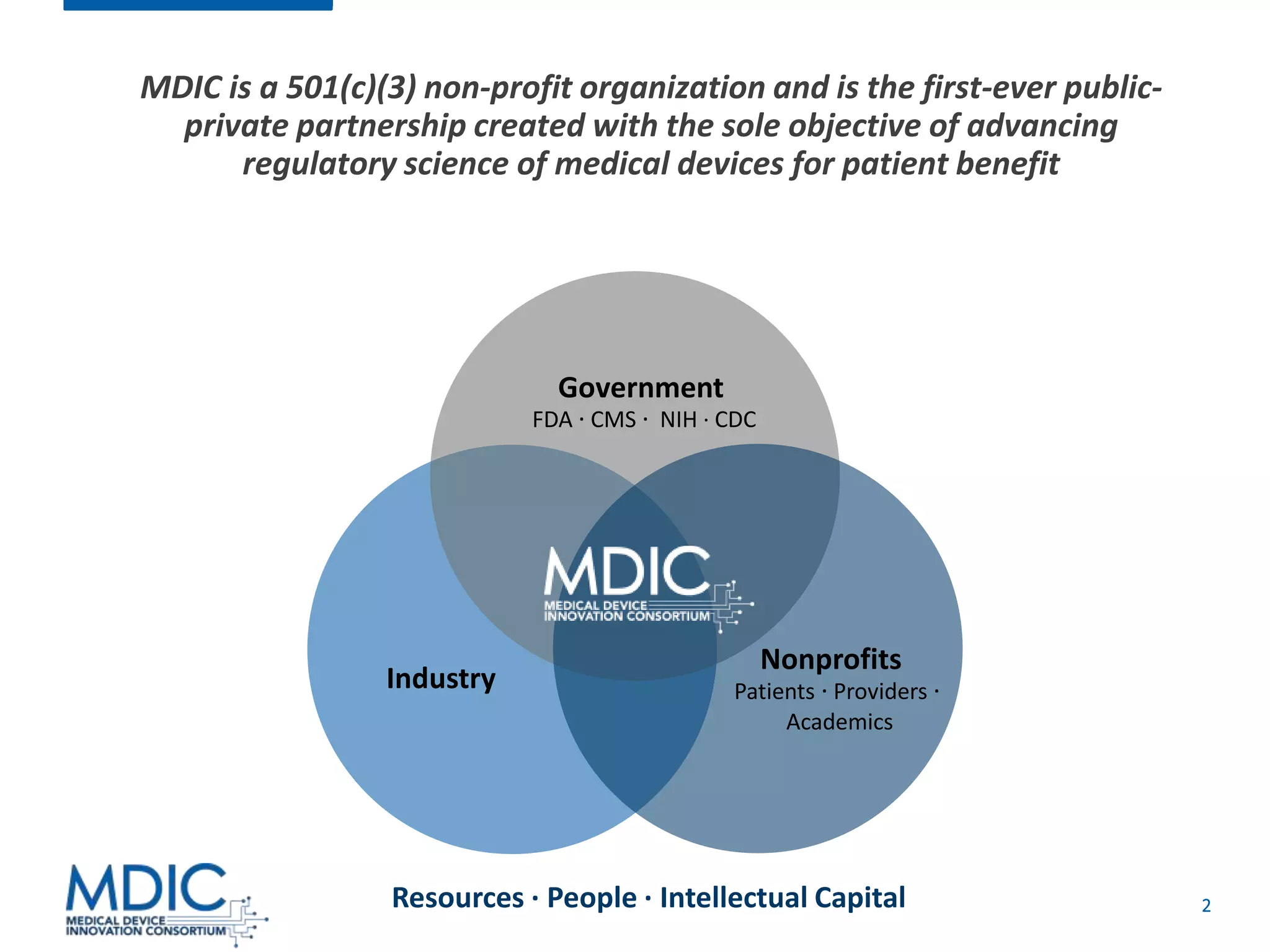
MDIC is a 501(c)(3) non-profit organization and is the first-ever public-
private partnership created with the sole objective of advancing
regulatory science of medical devices for patient benefit
Industry
Nonprofits
Government
FDA ∙ CMS ∙ NIH ∙ CDC
Patients ∙ Providers ∙
Academics
Resources ∙ People ∙ Intellectual Capital
3
CANCER GENOMIC SOMATIC REFERENCE SAMPLES
Impact:
• Aid in efficient NGS test development and validation
• Streamline and possibly obviate steps in the regulatory process for
diagnostic companies
• Provide transparency
• Compress development timelines for targeted therapeutics developers
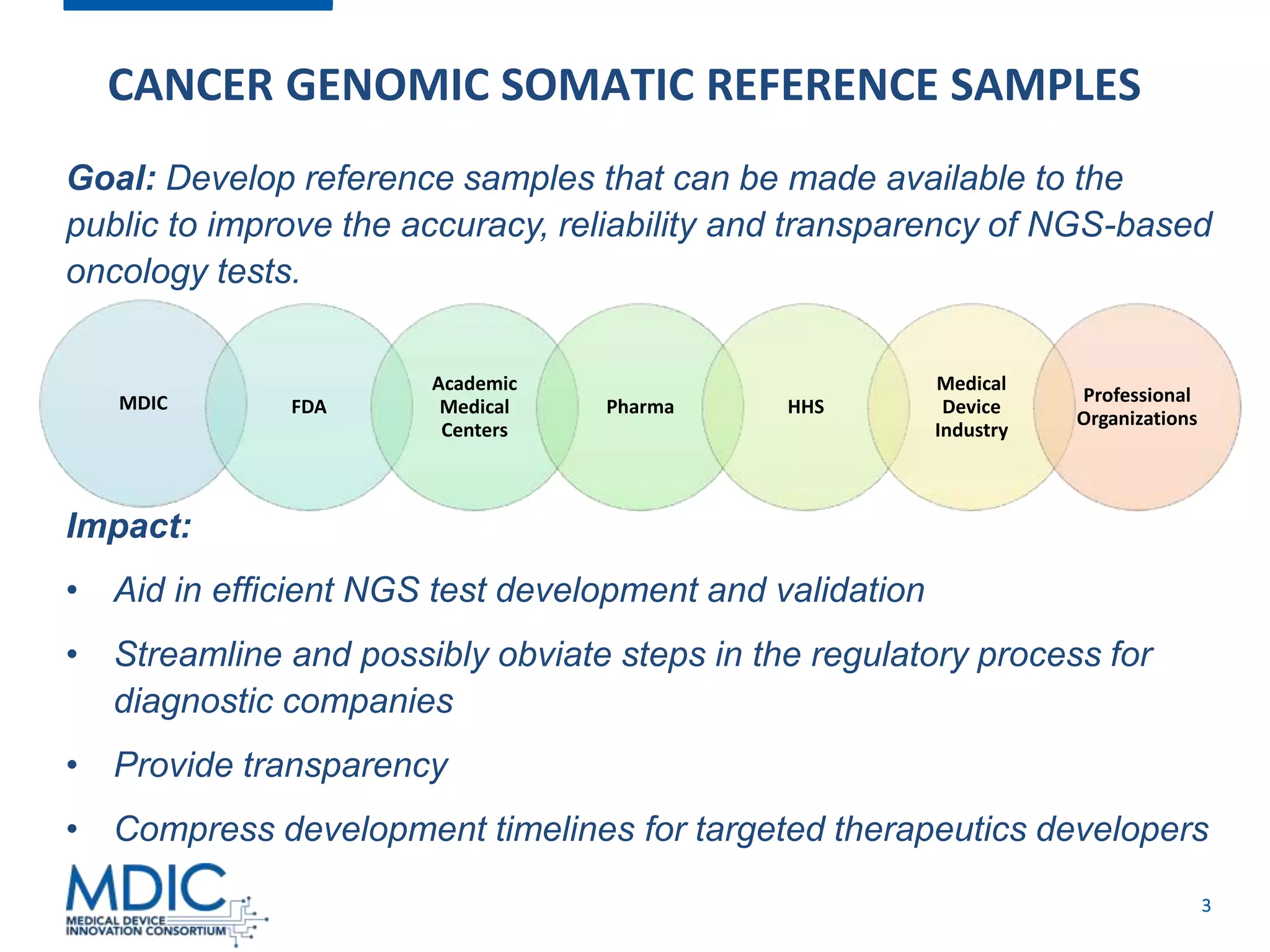
Goal: Develop reference samples that can be made available to the
public to improve the accuracy, reliability and transparency of NGS-based
oncology tests.
MDIC FDA
Academic
Medical
Centers
Pharma HHS
Medical
Device
Industry
Professional
Organizations
4
PHASE 1 QUESTIONS AND FOCUS
• Questions
• What has been done or is ongoing in the space?
• What variants are most important to develop reference
standards for?
• What are the characteristics of the samples that will
serve as reference samples?
• How to validate those reference samples?
• How to make those reference samples available?
• Focus
• Solid tumors
• Tissue standards - ctDNA is out of scope
Variant Prioritization
6
VARIANT PRIORITIZATION
• Chair – Tim McDaniel, PhD, TGen
Eric Peters, PhD, Genentech
• Goal – Define a list of clinically actionable genomic
alterations that would be represented in an ideal
set of somatic reference samples.
• Progress – Prioritized list of variants created, public
comments receive, vetted, and accepted or
declined.
7
APPROACH TO VARIANT SELECTION
This team's task was to identify a list of variants or other targets (e.g.,
genomic signatures) that would be covered in an ideal set of reference
materials.
To ensure that the list identifies the most useful targets to benefit the
most patients today, the targets were drawn from the work of objective
third parties without vested commercial interests in any particular
target. Sources therefore:
• Represent current standard medical practice
• Originate from a public sector or independent non-profit organizations
• Represent the collective opinion of a broad swathe of clinicians and / or
laboratory scientists.
Sources used:
List will focus on variants relevant to solid tumors
8
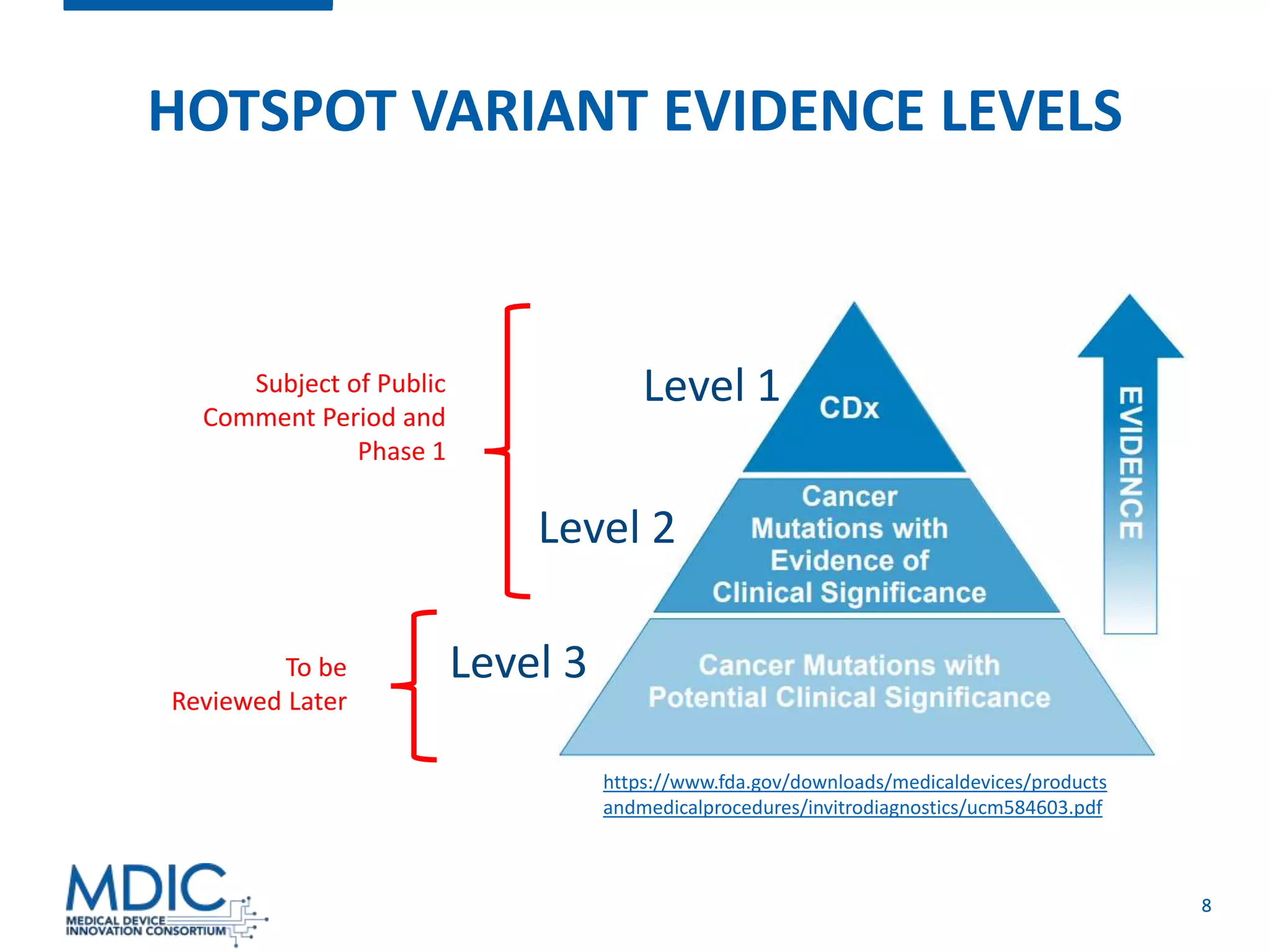
HOTSPOT VARIANT EVIDENCE LEVELS
Level 1
Level 2
Level 3
https://www.fda.gov/downloads/medicaldevices/products
andmedicalprocedures/invitrodiagnostics/ucm584603.pdf
Subject of Public
Comment Period and
Phase 1
To be
Reviewed Later
9
PRIORITIZED VARIANT LIST
• Use Level 1 & 2 Variants
• Variants need to be included in a drug label
• Included in FDA or professional society guidelines
• Part of a registrational trial
• Would like to focus on variants from each type and
sample to be as close to clinical samples as possible
• Additional details to be provided in upcoming RFI
and RFP process.
Landscape Analysis
11
LANDSCAPE ANALYSIS
• Chair – Barbara Zehnbauer, PhD, Emory University
• Goal – Comprehensive summary to identify other
efforts for development and evaluation of NGS
reference samples which may inform and
complement the SRS goals.
• Progress
• Conducted comprehensive review of existing NGS
reference material products and projects
• Surveyed NGS users about their needs
• Summary report of NGS reference materials is publicly
available.
12
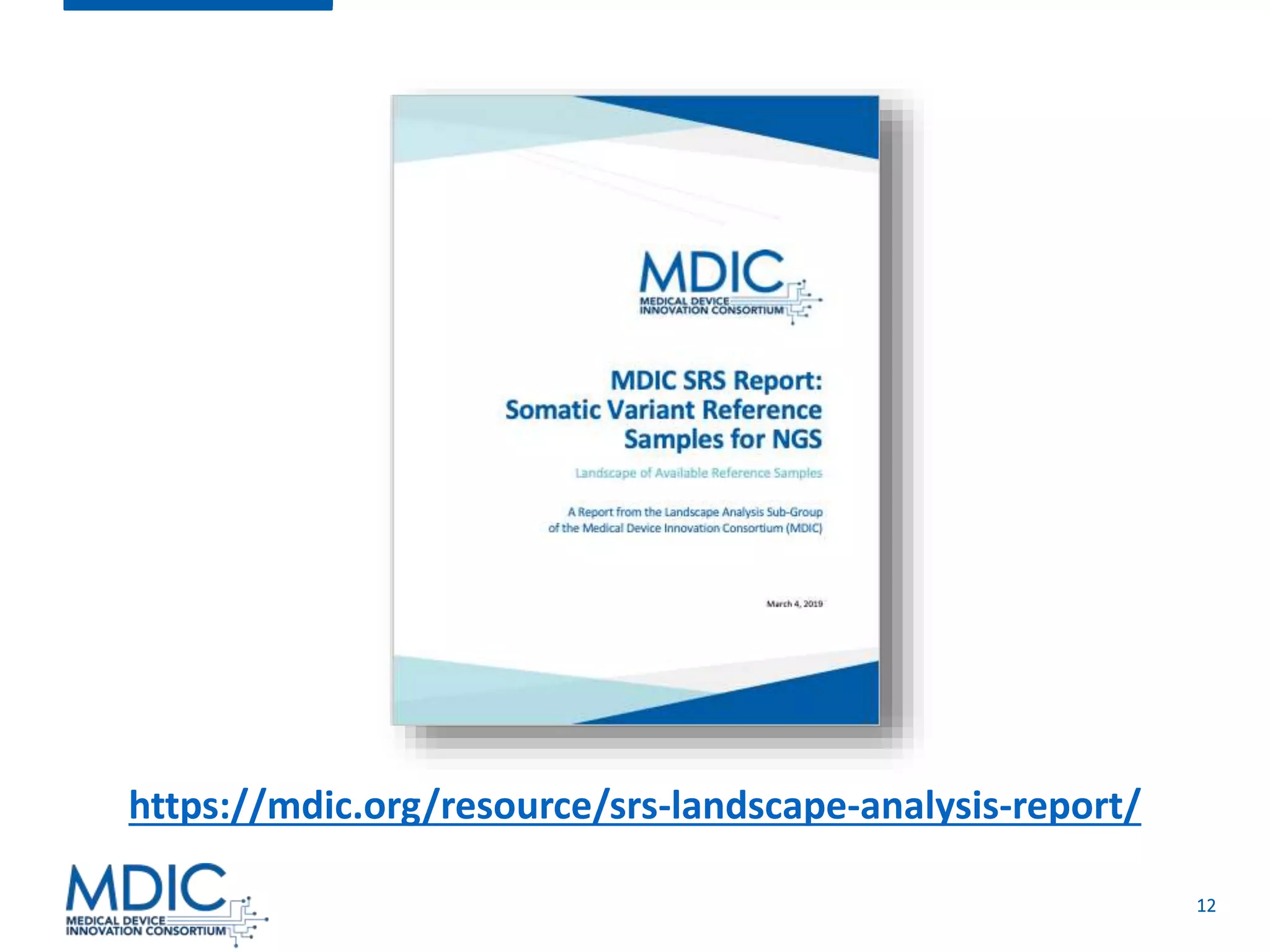
https://mdic.org/resource/srs-landscape-analysis-report/
Sample Definition
14
SAMPLE DEFINITION
• Chair – Maryellen de Mars, PhD, ATCC
• Goal
• Define and/or identify desired somatic reference samples
(physical and in silico)
• Develop sample characterization, acceptance criteria and
quality control specifications
• Develop strategies for maintaining supply and stability of
reference samples over time.
• Progress
• Develop minimal requirements for reference samples
(consent, availability, licensing, production, distribution)
• In depth evaluation of current samples and attributes from
commercial sources and various initiatives that are related to
target areas
15
Minimum DNA & Cell-line Technical Requirements
1) Diploid – normal background
• Karyotypically normal
2) Tumor/Normal pair preferred
• Ability to engineer into tumor sample
• Doesn’t need to be same tissue
3) Genomically and karyotypically characterized
4) Enough DNA to be used for (mg amounts) ‘a while’
• Plan to minimize drift (inventory strategy and bridging studies)
Passage number
• Outline steps
5) A least 10% variant allele fraction (VAF)
• Flexibility to mix at custom frequency
6) Cell line and DNA minimum deliverable (FFPE bonus)
7) If unable to include all the variants/(e.g. CNVs, fusions, etc.) on
the prioritized list, we need to identify strategies for
development of synthetic samples
Next Steps
17
SRS Request for Information (RFI)
• The RFI period is from March 30 – April 12, 2019
• The RFI info will be available on the MDIC website
• An interactive webinar will be held on Thursday,
April 4, from 4 – 5pm ET to answer questions on
the RFI process
• Register at: www.MDIC.org/mdicx-series
• If you would like to receive information on the RFI
or RFP process, contact: SRS-RFI@mdic.org
18
SRS Tumor Suppressor / Gene Signatures
• Following similar process to selecting Variants
• MDICx webinar to review TS/GS process and announce
public comment period:
May 1, 12pm ET
Panelists:
- Timothy Stenzel, MD, PhD –
Director, FDA|CDHR|OIR
- JD Alvarez, MD, PhD – SRS Chair
- Tim McDaniel, PhD – Variants Chair
- Mike Morrissey, PhD – TS/GS Chair
• Register for webinar at:
www.MDIC.org/mdicx-series/upcoming-webinars/
Questions?
Additional questions about MDIC
or the SRS initiative:
Carolyn Hiller, Program Director |
Clinical Diagnostics
Email: chiller@mdic.org

How giab fits in the rest of the world mdic somatic reference samples

  • 1.
    Cancer Genomic SomaticReference Samples – A Collaborative Initiative Carolyn Hiller, MBA | Program Director, Clinical Diagnostics GIAB, March 28, 2019
  • 2.
    2 MDIC is a501(c)(3) non-profit organization and is the first-ever public- private partnership created with the sole objective of advancing regulatory science of medical devices for patient benefit Industry Nonprofits Government FDA ∙ CMS ∙ NIH ∙ CDC Patients ∙ Providers ∙ Academics Resources ∙ People ∙ Intellectual Capital
  • 3.
    3 CANCER GENOMIC SOMATICREFERENCE SAMPLES Impact: • Aid in efficient NGS test development and validation • Streamline and possibly obviate steps in the regulatory process for diagnostic companies • Provide transparency • Compress development timelines for targeted therapeutics developers Goal: Develop reference samples that can be made available to the public to improve the accuracy, reliability and transparency of NGS-based oncology tests. MDIC FDA Academic Medical Centers Pharma HHS Medical Device Industry Professional Organizations
  • 4.
    4 PHASE 1 QUESTIONSAND FOCUS • Questions • What has been done or is ongoing in the space? • What variants are most important to develop reference standards for? • What are the characteristics of the samples that will serve as reference samples? • How to validate those reference samples? • How to make those reference samples available? • Focus • Solid tumors • Tissue standards - ctDNA is out of scope
  • 5.
  • 6.
    6 VARIANT PRIORITIZATION • Chair– Tim McDaniel, PhD, TGen Eric Peters, PhD, Genentech • Goal – Define a list of clinically actionable genomic alterations that would be represented in an ideal set of somatic reference samples. • Progress – Prioritized list of variants created, public comments receive, vetted, and accepted or declined.
  • 7.
    7 APPROACH TO VARIANTSELECTION This team's task was to identify a list of variants or other targets (e.g., genomic signatures) that would be covered in an ideal set of reference materials. To ensure that the list identifies the most useful targets to benefit the most patients today, the targets were drawn from the work of objective third parties without vested commercial interests in any particular target. Sources therefore: • Represent current standard medical practice • Originate from a public sector or independent non-profit organizations • Represent the collective opinion of a broad swathe of clinicians and / or laboratory scientists. Sources used: List will focus on variants relevant to solid tumors
  • 8.
    8 HOTSPOT VARIANT EVIDENCELEVELS Level 1 Level 2 Level 3 https://www.fda.gov/downloads/medicaldevices/products andmedicalprocedures/invitrodiagnostics/ucm584603.pdf Subject of Public Comment Period and Phase 1 To be Reviewed Later
  • 9.
    9 PRIORITIZED VARIANT LIST •Use Level 1 & 2 Variants • Variants need to be included in a drug label • Included in FDA or professional society guidelines • Part of a registrational trial • Would like to focus on variants from each type and sample to be as close to clinical samples as possible • Additional details to be provided in upcoming RFI and RFP process.
  • 10.
  • 11.
    11 LANDSCAPE ANALYSIS • Chair– Barbara Zehnbauer, PhD, Emory University • Goal – Comprehensive summary to identify other efforts for development and evaluation of NGS reference samples which may inform and complement the SRS goals. • Progress • Conducted comprehensive review of existing NGS reference material products and projects • Surveyed NGS users about their needs • Summary report of NGS reference materials is publicly available.
  • 12.
  • 13.
  • 14.
    14 SAMPLE DEFINITION • Chair– Maryellen de Mars, PhD, ATCC • Goal • Define and/or identify desired somatic reference samples (physical and in silico) • Develop sample characterization, acceptance criteria and quality control specifications • Develop strategies for maintaining supply and stability of reference samples over time. • Progress • Develop minimal requirements for reference samples (consent, availability, licensing, production, distribution) • In depth evaluation of current samples and attributes from commercial sources and various initiatives that are related to target areas
  • 15.
    15 Minimum DNA &Cell-line Technical Requirements 1) Diploid – normal background • Karyotypically normal 2) Tumor/Normal pair preferred • Ability to engineer into tumor sample • Doesn’t need to be same tissue 3) Genomically and karyotypically characterized 4) Enough DNA to be used for (mg amounts) ‘a while’ • Plan to minimize drift (inventory strategy and bridging studies) Passage number • Outline steps 5) A least 10% variant allele fraction (VAF) • Flexibility to mix at custom frequency 6) Cell line and DNA minimum deliverable (FFPE bonus) 7) If unable to include all the variants/(e.g. CNVs, fusions, etc.) on the prioritized list, we need to identify strategies for development of synthetic samples
  • 16.
  • 17.
    17 SRS Request forInformation (RFI) • The RFI period is from March 30 – April 12, 2019 • The RFI info will be available on the MDIC website • An interactive webinar will be held on Thursday, April 4, from 4 – 5pm ET to answer questions on the RFI process • Register at: www.MDIC.org/mdicx-series • If you would like to receive information on the RFI or RFP process, contact: SRS-RFI@mdic.org
  • 18.
    18 SRS Tumor Suppressor/ Gene Signatures • Following similar process to selecting Variants • MDICx webinar to review TS/GS process and announce public comment period: May 1, 12pm ET Panelists: - Timothy Stenzel, MD, PhD – Director, FDA|CDHR|OIR - JD Alvarez, MD, PhD – SRS Chair - Tim McDaniel, PhD – Variants Chair - Mike Morrissey, PhD – TS/GS Chair • Register for webinar at: www.MDIC.org/mdicx-series/upcoming-webinars/
  • 19.
    Questions? Additional questions aboutMDIC or the SRS initiative: Carolyn Hiller, Program Director | Clinical Diagnostics Email: chiller@mdic.org

Editor's Notes

  • #3 Formed in 2013, MDIC was the first-ever public-private partnership created with the sole objective of advancing medical device regulatory science. Regulatory science is the science of developing new tools, standards, and approaches to assess the safety, efficacy, quality, and performance of FDA-regulated products. Patients benefit by speeding access to important technologies in their clinical care. Medical Device manufacturers and government agencies benefit from reduced time and resources necessary for device development , assessment, and review. MDIC’s focus is on regulatory science, simply put – MDIC’s focus is on science not policy.
  • #4 The Cancer Genomic Somatic Reference Samples, or SRS project, is a collaborative effort to develop cancer genomic somatic reference samples. We think that once developed, these samples can aid in efficient NGS test development and validation, streamline and possibly obviate steps in the regulatory review process for these tests, provide transparency and compress development timelines for therapeutic developers.
  • #5 On this slide you can see a list of main questions the project is set to address: What is currently going on in this space, which reference samples are already available or in development? Where are the gaps, what variants should be prioritized for development, and why? What sample types are needed? How to validate and characterize samples and how to make both samples and data available? Early on, the group decided to focus the effort on solid tumors, and tissue, not ctDNA.
  • #7 Variant prioritization working group is co-chaired by Tim McDaniel from TGen and Eric Peters from Genentech. They were charged with created a process to identify and prioritize a list of clinically actionable variants that would represent an ideal set of somatic reference samples.
  • #8 The team’s remit and approach are stated here. To create the list, targets were drawn from the work of objective third parties without commercial interests in any particular target. The sources had to represent current standard medical practice, originate from a public sector or independent non-profit organization, and represent the collective opinion of a broad swath of clinicians and/or laboratory scientists. We use the OncoKB and CiVic databases as well as the Cancer Genome Interpreter.
  • #9 With the hotspots, we prioritized our efforts to identify variants with Levels 1 and 2 clinical evidence as defined in CDRH’s tiering system for NGS. Level 1 representing those variants that are associated with FDA approved companion diagnostics, and Level 2 representing mutations with evidence of clinical significance, such as by inclusion in guidelines. Due to the volume of Level 1 and Level 2, Level 3 mutations will be reviewed at a later time.
  • #10 Our initiative is focused on clinically actionable genomic variants and keeping the samples as close to clinical samples as possible. The variant list will be identified in our upcoming RFI and RFP process.
  • #11 To learn what’s already available, we had a team conduct a Landscape Analysis. Lisa Kalmer is not only on our working group, she also served on our Landscape Analysis team. Justin Zook and Kenneth Cole have provided technical assistance to our initiative.
  • #12 Our Landscape Analysis work group was led by Barbara Zehnbauer. They were charged with identifying what somatic reference samples are currently available. They have completed a landscape analysis of available reference samples and the report is available for free downloading from the MDIC website. The primary aims of the Landscape analysis was to: Avoid duplication of efforts Identify existing genes/variants & sample types Define unmet needs for additional genes/variants Share the data to inform other SRS efforts
  • #13 The report is now available for free downloading at the MDIC website. If you can’t remember this link, google ‘SRS Landscape Analysis Report’ and it should be the top hit. The authors have removed all references to marketing claims, so this is an excellent source of need-to-know information without promotional language. The primary purpose was to inform SRS working group; however, working group members encouraged making the resource available beyond the working group. For MDIC SRS - Variant Gap Analysis Which genes/variants are already available? Cross-checked Variant Prioritization list Vendor/project summaries Which sample types are represented? Noted per report TOC designations Which additional sample types and variants are still needed or requested by laboratories? For NGS laboratories test developers Catalog summarizing what is available and in development Links to sample details and technical contacts
  • #15 Sample definition group is chaired by Maryellen de Mars from ATCC.
  • #16 Here are the DNA and Cell-line Technical Requirements identified by the Sample Definition Group:
  • #18 To help inform our RFP creation, we are having an Request for Information.
  • #19 Our Tumor Suppressor / Gene Signatures