Presentation by Jaco Stout (Deltares, Netherlands) at the Delft3D User Days, during the Delft Software Days - Edition 2025 (DSD-INT 2025). Tuesday, 11 November 2025, Delft.
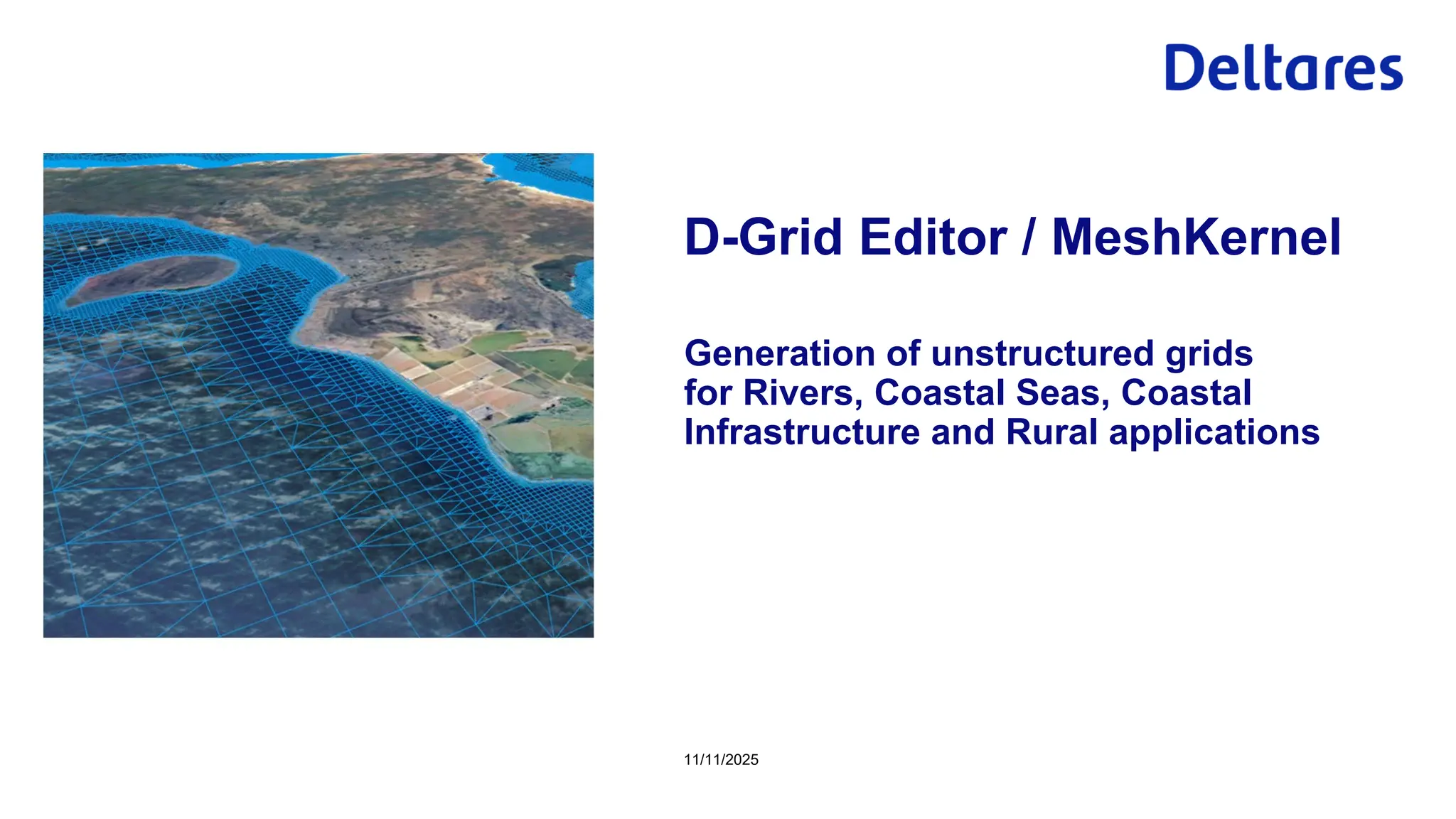
Generation of unstructuredgrids
for Rivers, Coastal Seas, Coastal
Infrastructure and Rural applications
11/11/2025
D-Grid Editor / MeshKernel
2.
Programme
2
• Overview
• Architectureand way of use
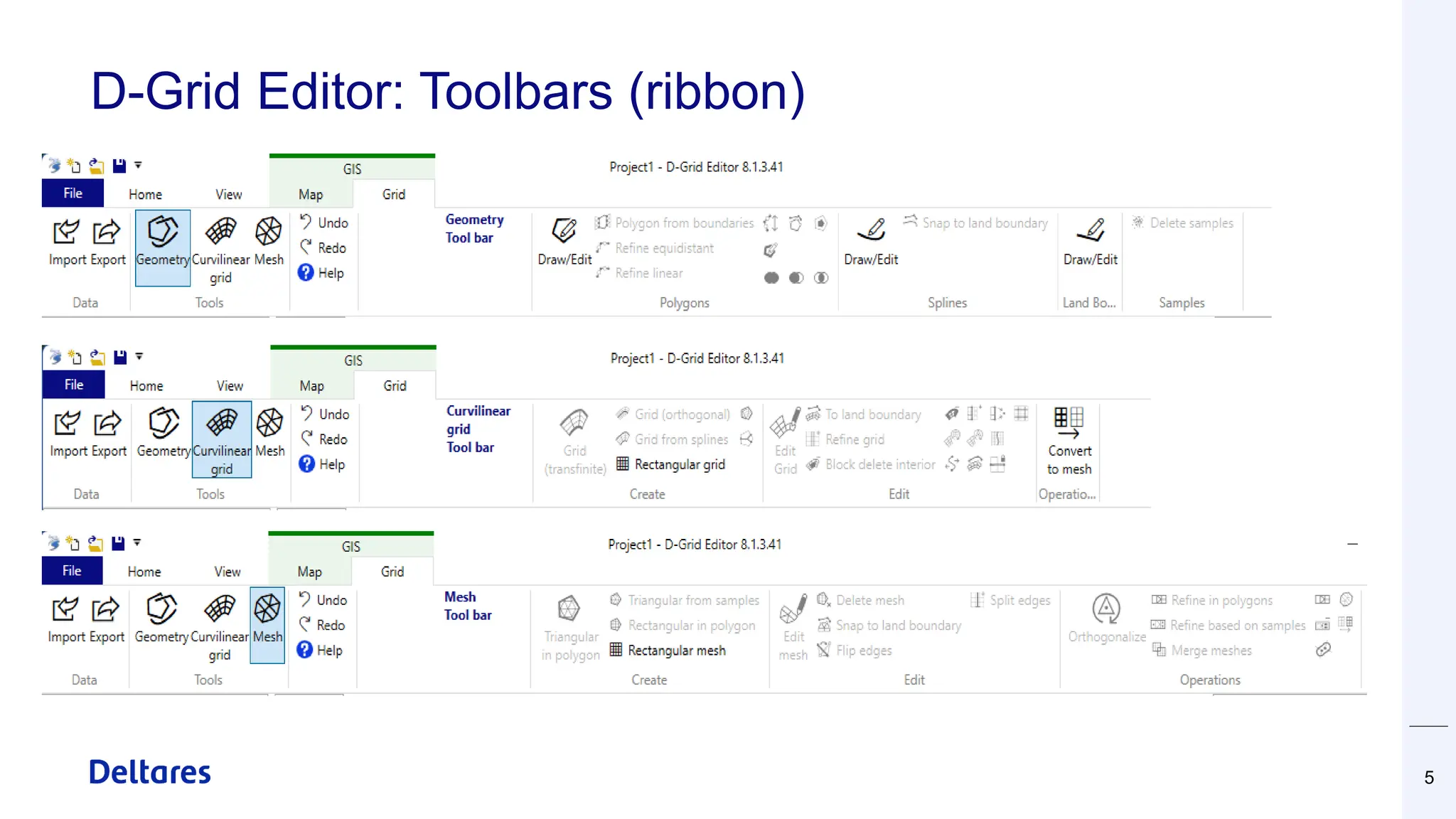
• Toolbars
• Algorithms
• Advantages
• Why we started this development ?
• Development history
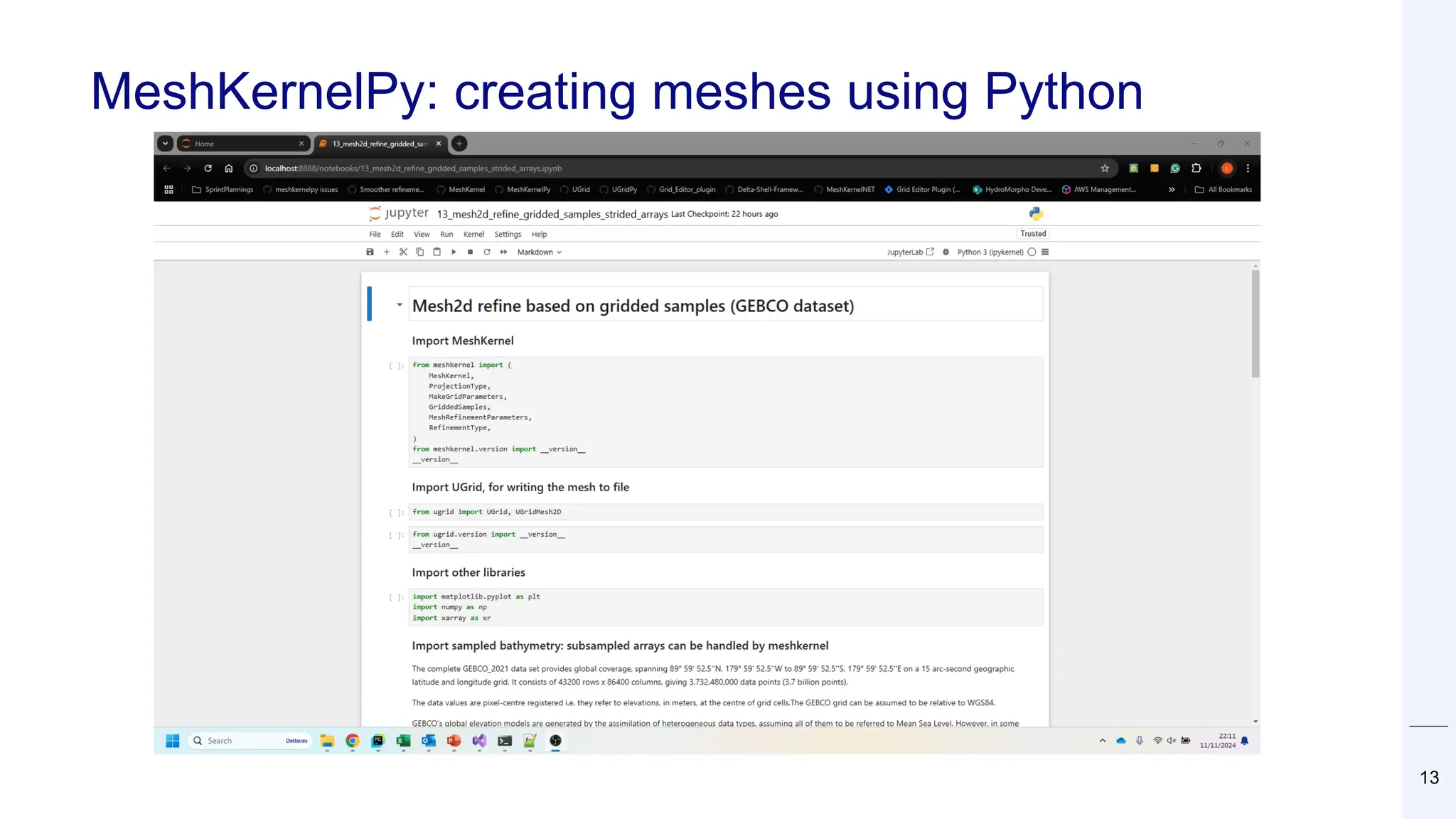
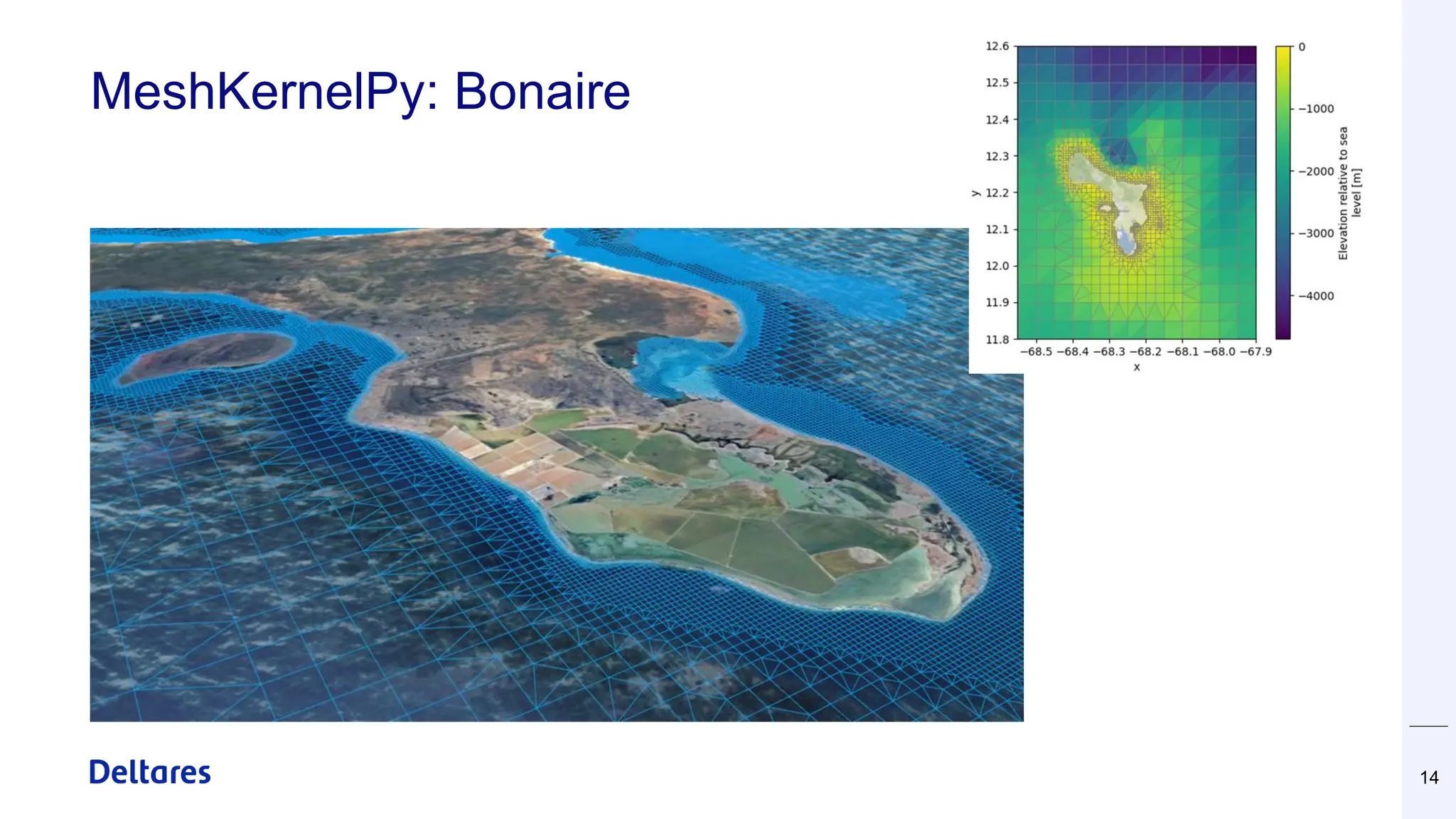
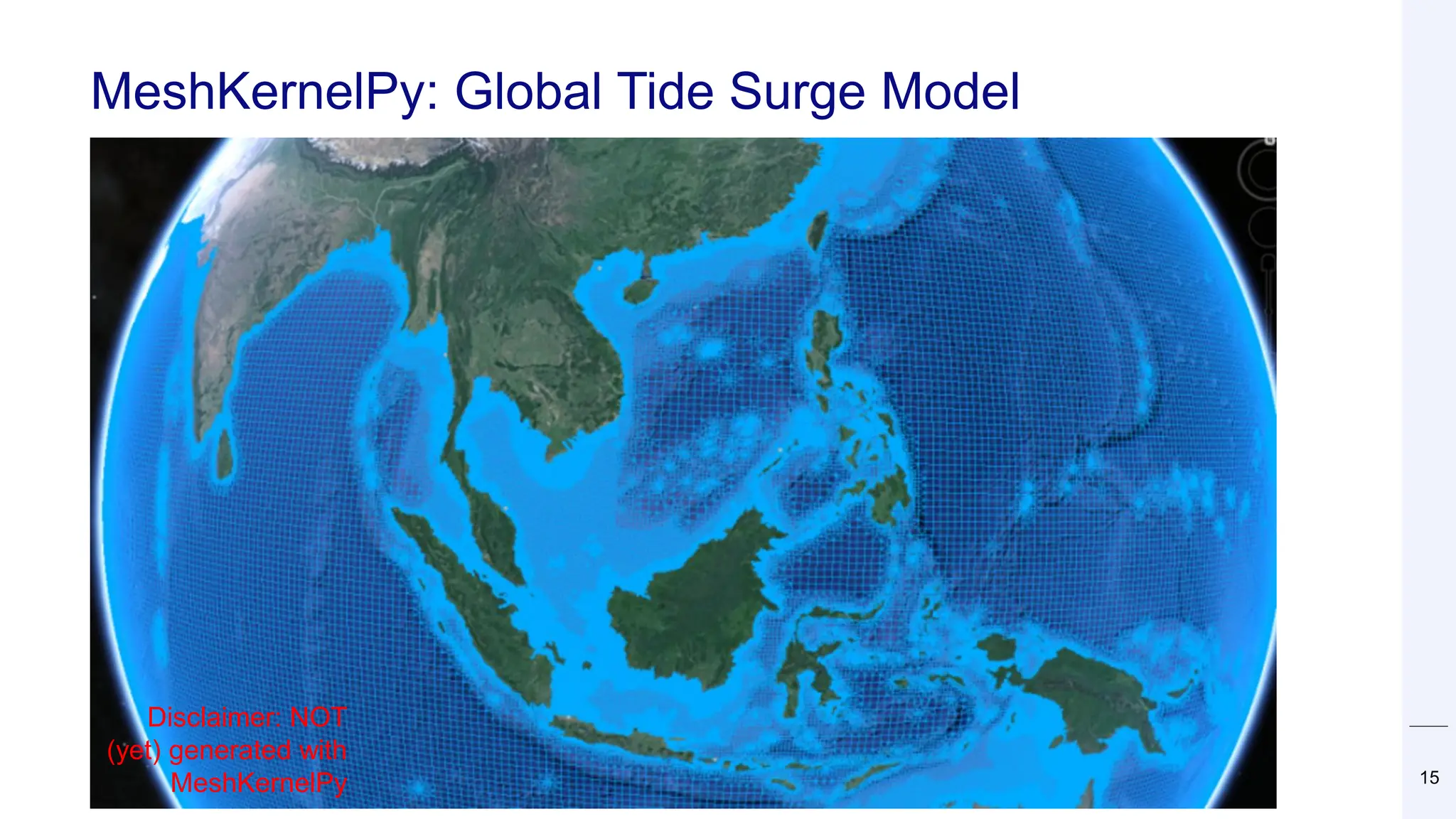
• MeshKernelPy
• Creating meshes using Python
• Examples
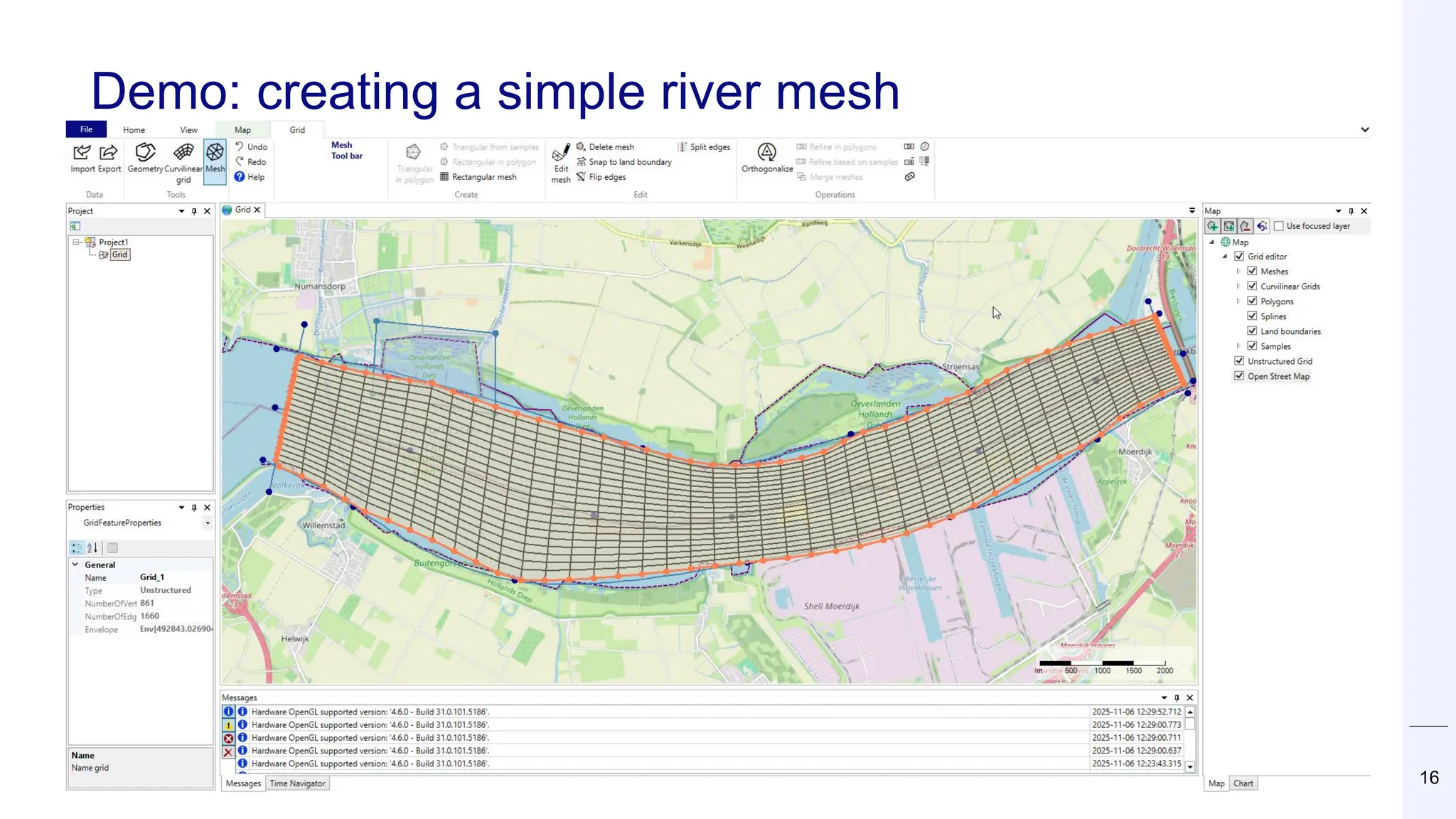
• Demo D-Grid Editor
• Creating a simple river mesh
• User Manual / Tutorials
• Release schedule
3.
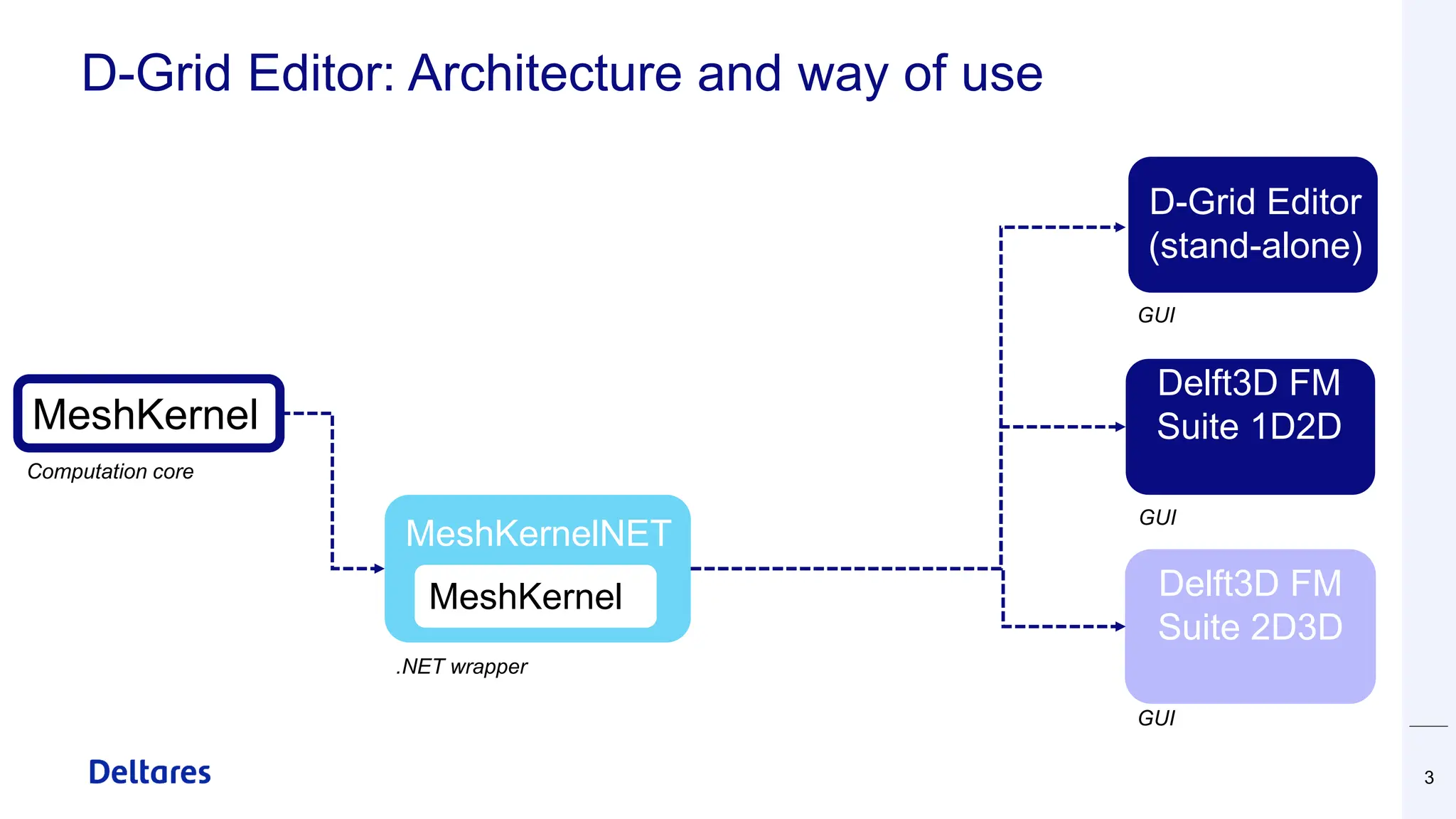
D-Grid Editor: Architectureand way of use
3
MeshKernel
Grid Editor
stad-alone
Delft3D FM
Suite 1D2D
Delft3D FM
Suite 2D3D
MeshKernel
MeshKernelNET
Computation core
.NET wrapper
GUI
GUI
GUI
D-Grid Editor
(stand-alone)
4.
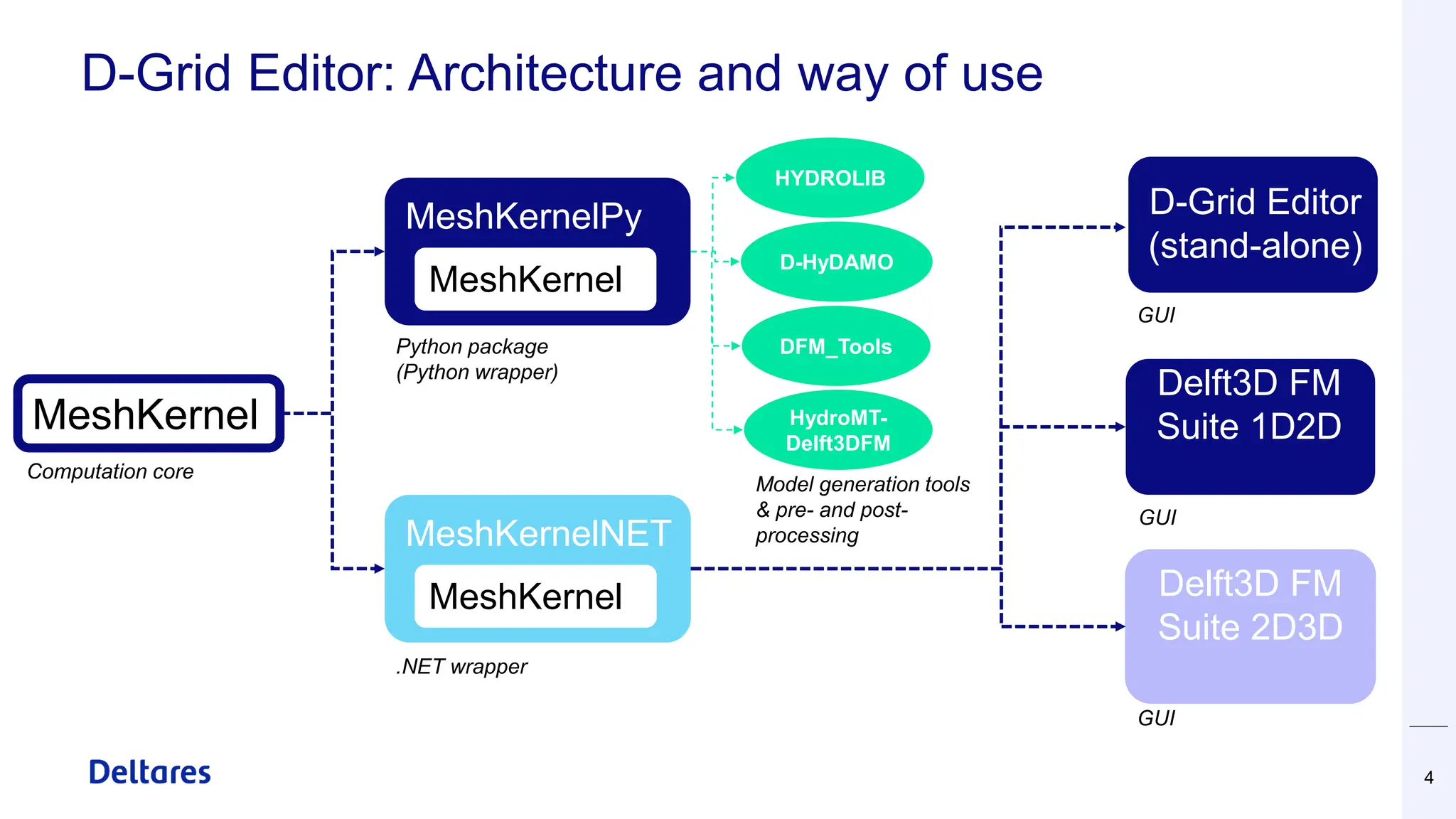
D-Grid Editor: Architectureand way of use
4
MeshKernel
MeshKernel
MeshKernelPy Grid Editor
stad-alone
Delft3D FM
Suite 1D2D
Delft3D FM
Suite 2D3D
MeshKernel
MeshKernelNET
HYDROLIB
D-HyDAMO
DFM_Tools
HydroMT-
Delft3DFM
Computation core
Python package
(Python wrapper)
.NET wrapper
GUI
GUI
GUI
Model generation tools
& pre- and post-
processing
D-Grid Editor
(stand-alone)
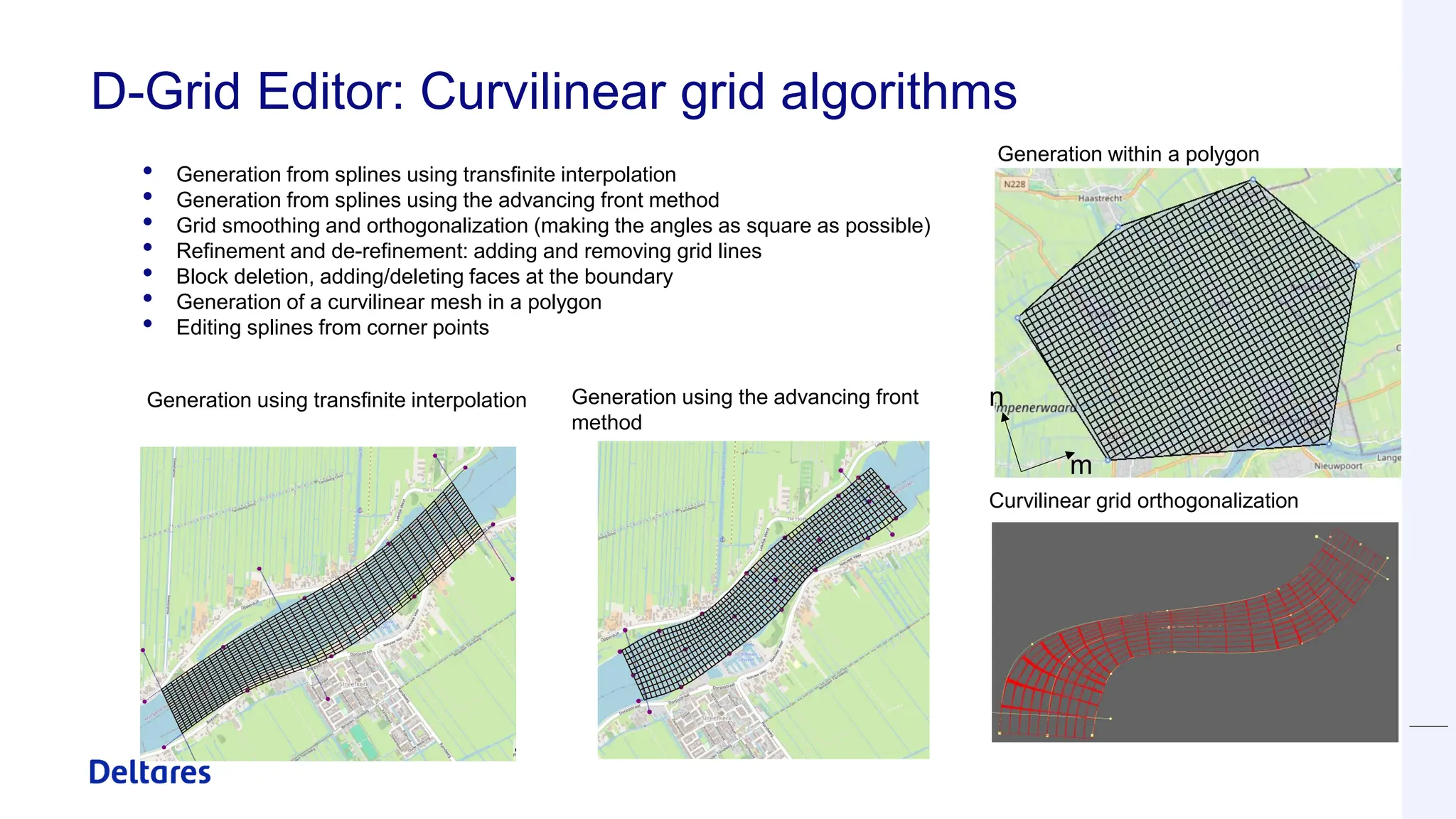
D-Grid Editor: Curvilineargrid algorithms
• Generation from splines using transfinite interpolation
• Generation from splines using the advancing front method
• Grid smoothing and orthogonalization (making the angles as square as possible)
• Refinement and de-refinement: adding and removing grid lines
• Block deletion, adding/deleting faces at the boundary
• Generation of a curvilinear mesh in a polygon
• Editing splines from corner points
n
m
Generation using transfinite interpolation Generation using the advancing front
method
Generation within a polygon
Curvilinear grid orthogonalization
7.
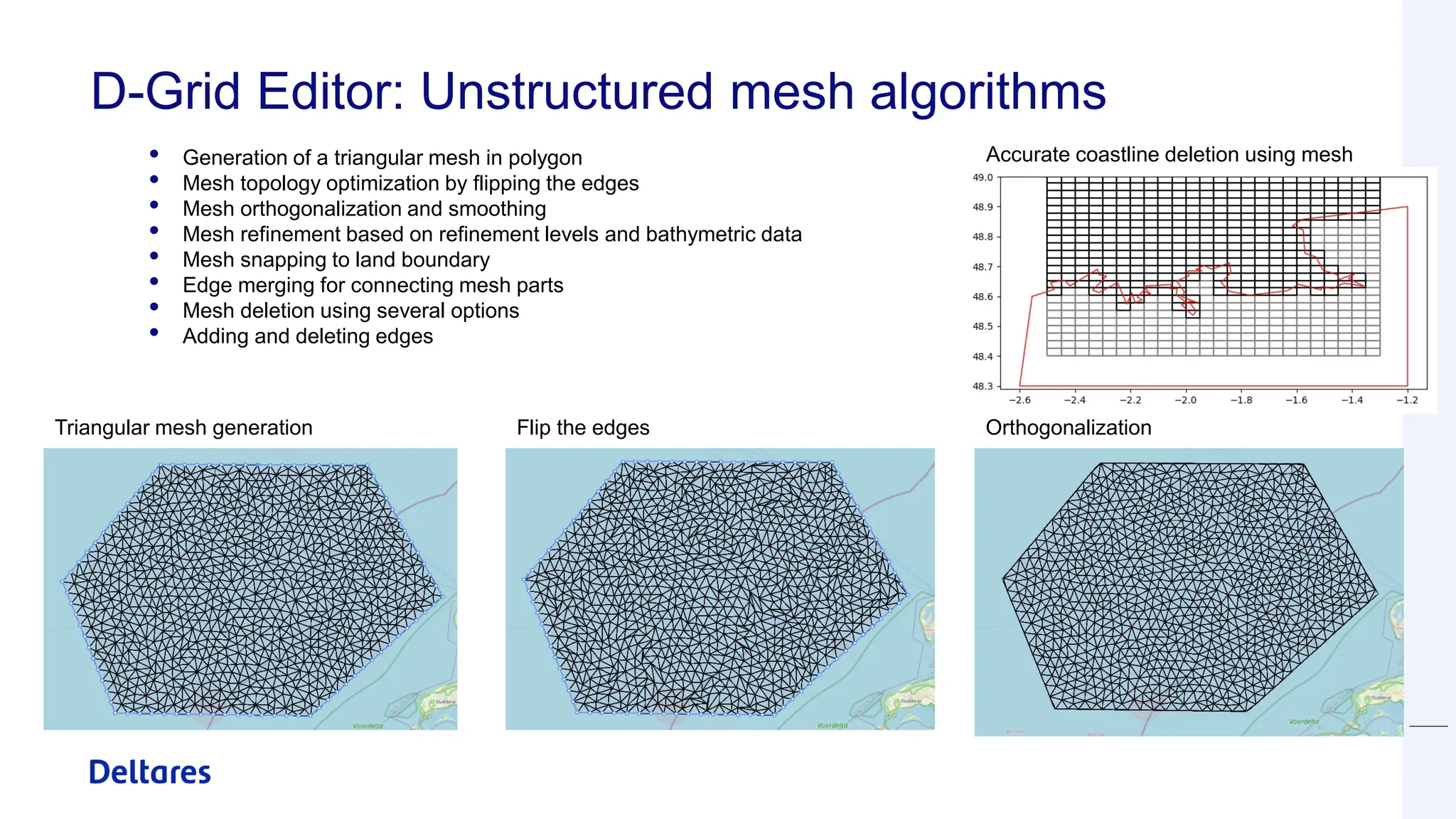
D-Grid Editor: Unstructuredmesh algorithms
• Generation of a triangular mesh in polygon
• Mesh topology optimization by flipping the edges
• Mesh orthogonalization and smoothing
• Mesh refinement based on refinement levels and bathymetric data
• Mesh snapping to land boundary
• Edge merging for connecting mesh parts
• Mesh deletion using several options
• Adding and deleting edges
Triangular mesh generation Flip the edges Orthogonalization
Accurate coastline deletion using mesh
topology
8.
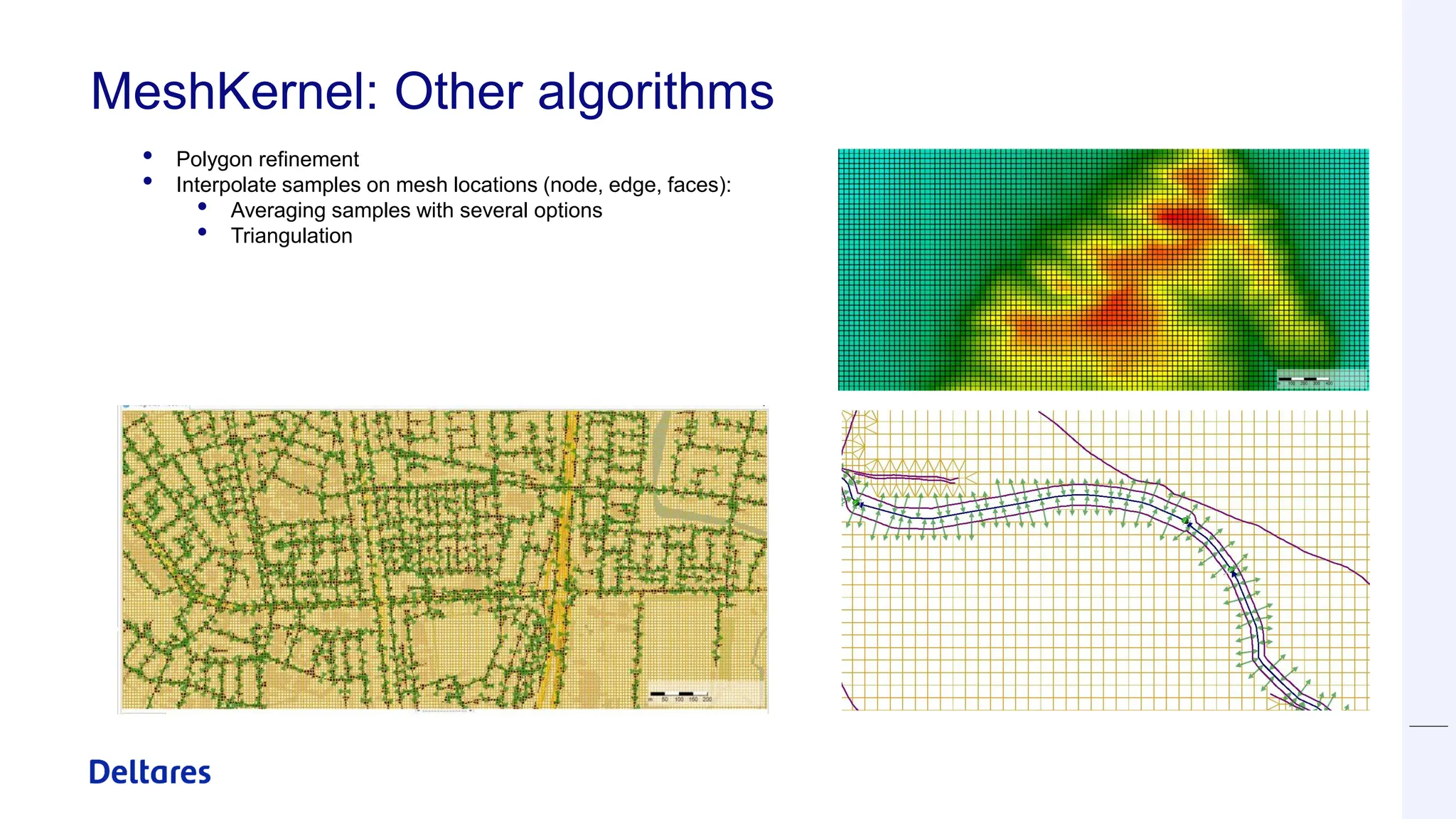
MeshKernel: Other algorithms
•Polygon refinement
• Interpolate samples on mesh locations (node, edge, faces):
• Averaging samples with several options
• Triangulation
9.
MeshKernel: Other algorithms
•Polygon refinement
• Interpolate samples on mesh locations (node, edge, faces):
• Averaging samples with several options
• Triangulation
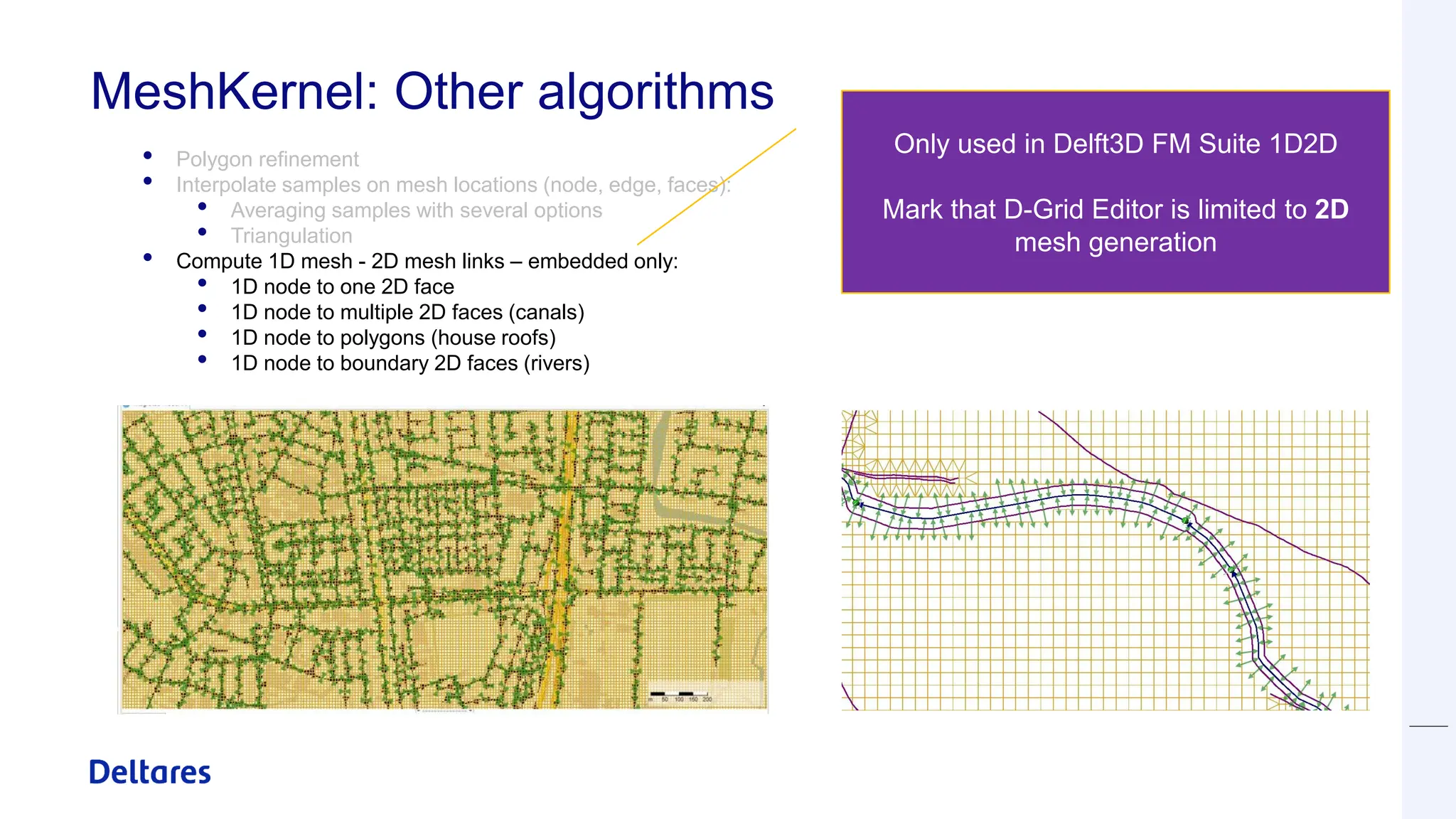
• Compute 1D mesh - 2D mesh links – embedded only:
• 1D node to one 2D face
• 1D node to multiple 2D faces (canals)
• 1D node to polygons (house roofs)
• 1D node to boundary 2D faces (rivers)
Only used in Delft3D FM Suite 1D2D
Mark that D-Grid Editor is limited to 2D
mesh generation
10.
D-Grid Editor: Advantages
10
•MeshKernel: one backend containing all in-house
developed meshing algorithms, which can serve several
clients / operating modes
• Can be used to eliminate duplicated implementations
(for example gridgeom)
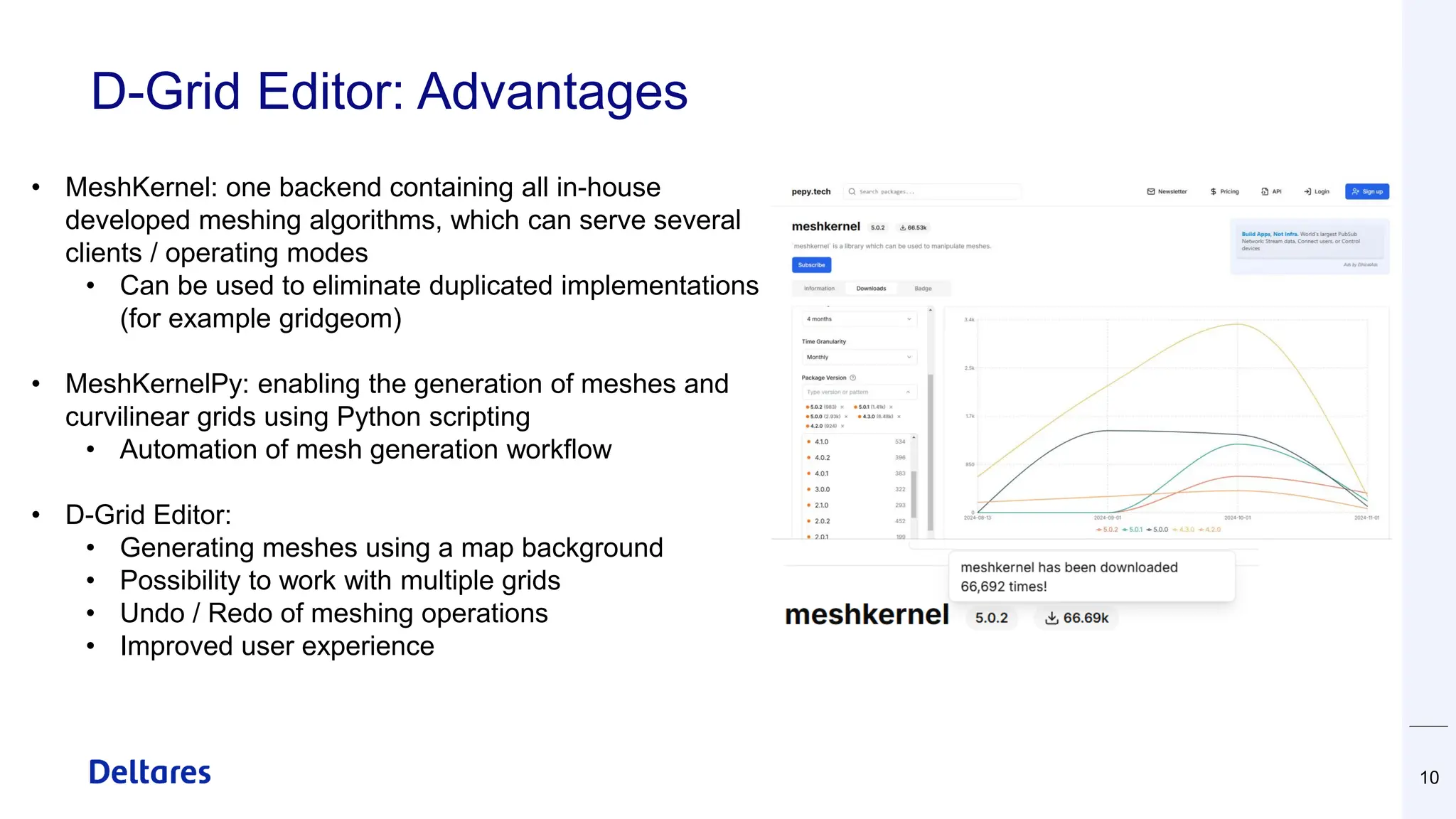
• MeshKernelPy: enabling the generation of meshes and
curvilinear grids using Python scripting
• Automation of mesh generation workflow
• D-Grid Editor:
• Generating meshes using a map background
• Possibility to work with multiple grids
• Undo / Redo of meshing operations
• Improved user experience
11.
2019: Why westarted?
11
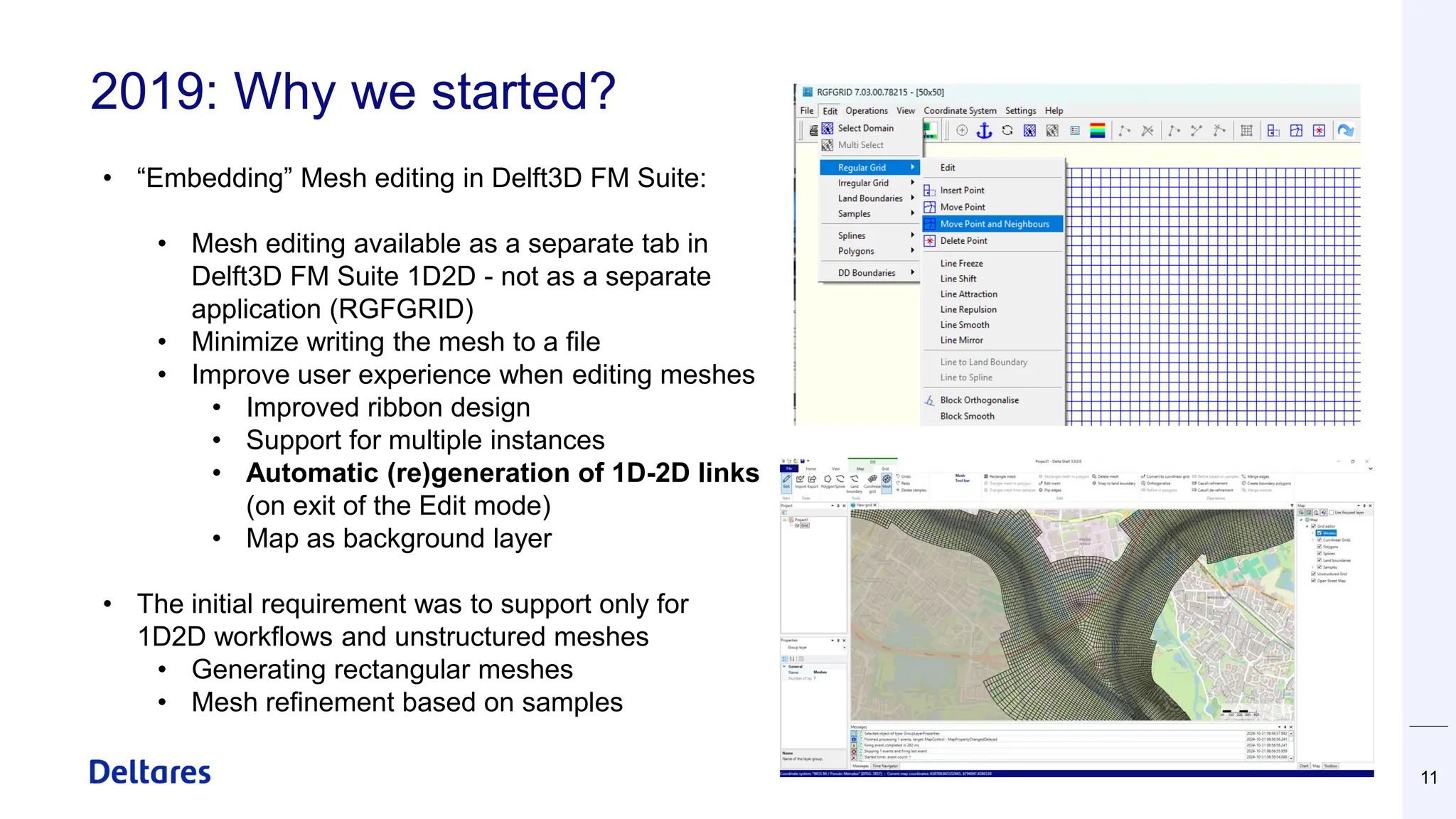
• “Embedding” Mesh editing in Delft3D FM Suite:
• Mesh editing available as a separate tab in
Delft3D FM Suite 1D2D - not as a separate
application (RGFGRID)
• Minimize writing the mesh to a file
• Improve user experience when editing meshes
• Improved ribbon design
• Support for multiple instances
• Automatic (re)generation of 1D-2D links
(on exit of the Edit mode)
• Map as background layer
• The initial requirement was to support only for
1D2D workflows and unstructured meshes
• Generating rectangular meshes
• Mesh refinement based on samples
12.
Development history (2019– 2025)
• 2019:
− First embedded version (in Delft3D FM Suite 1D2D)
• 2020-2022:
− Hybernating
• 2023:
− Proof of concept studies
• 2024:
− Full force development with a dedicated team (4-5 developers)
− Focus on the stand-alone application and on MeshKernelPY
• 2025:
− Evaluation “Fit for use” for Rivers, Coastal Seas, Coastal Infrastructure and Rural applications
− (beta) Release
12
Release schedule
18
D-Grid Editorwill be released:
• December 2025:
• As D-Grid Editor 8.1.4 (beta release)
• Spring 2026:
• Optional: D-Grid Editor “update” (beta release)
• Embedded in Delft3D FM Suite 1D2D 2026.02
• Fall 2026:
• As D-Grid Editor (General Availability release)
• Embedded in Delft3D FM Suite 1D2D 2027.01
• Optionally: embedded in Delft3D FM Suite 2027.01
Meshkernel(Py) will be released continuously on GitHub:
• Deltares/MeshKernel: Deltares C++library for creating and editing meshes. It supports 1D & 2D unstructured
meshes as well as curvilinear meshes.