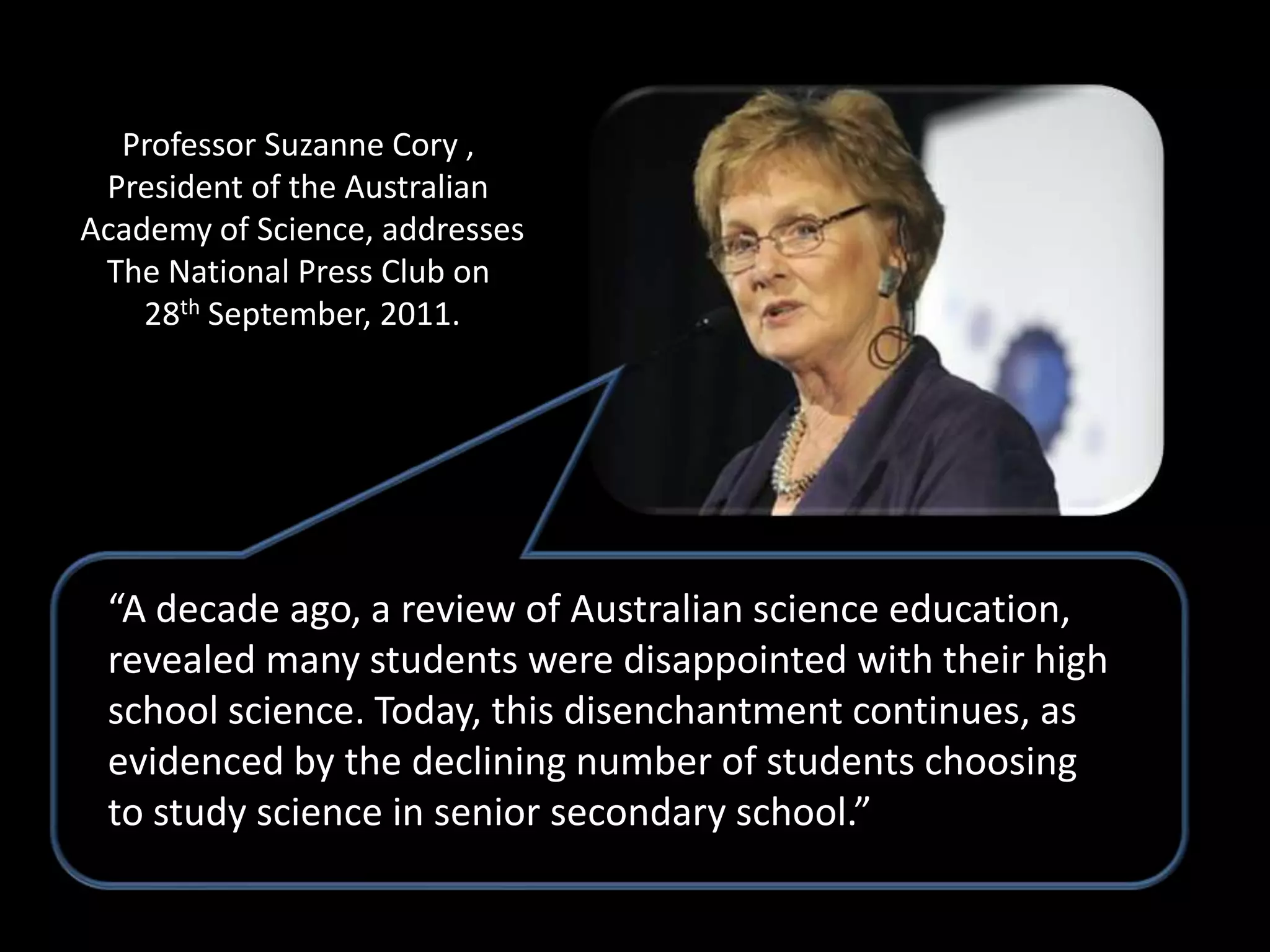
Professor Suzanne Cory ,
 President of the Australian
Academy of Science, addresses
 The National Press Club on
    28th September, 2011.


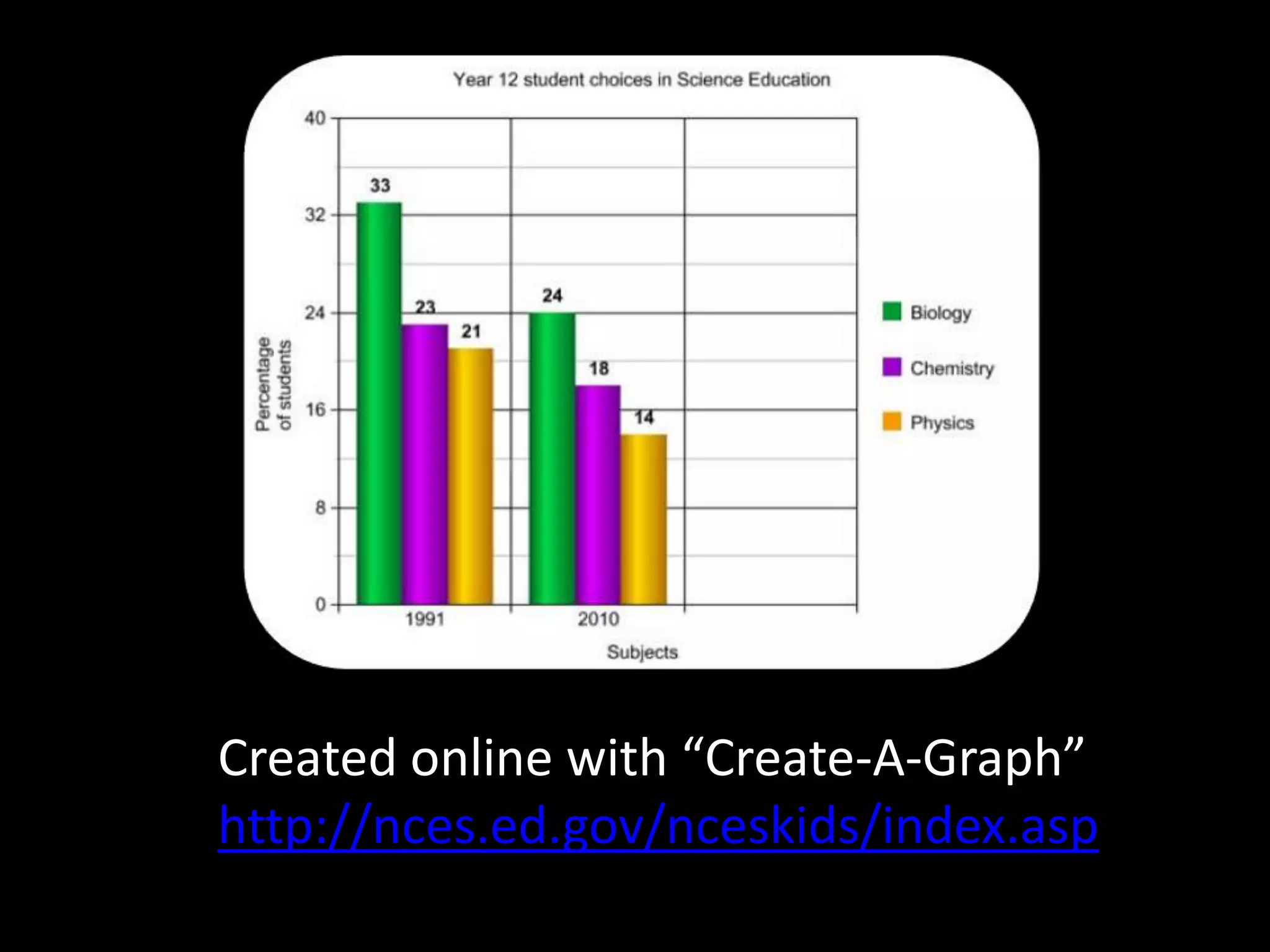
 “A decade ago, a review of Australian science education,
 revealed many students were disappointed with their high
 school science. Today, this disenchantment continues, as
 evidenced by the declining number of students choosing
 to study science in senior secondary school.”
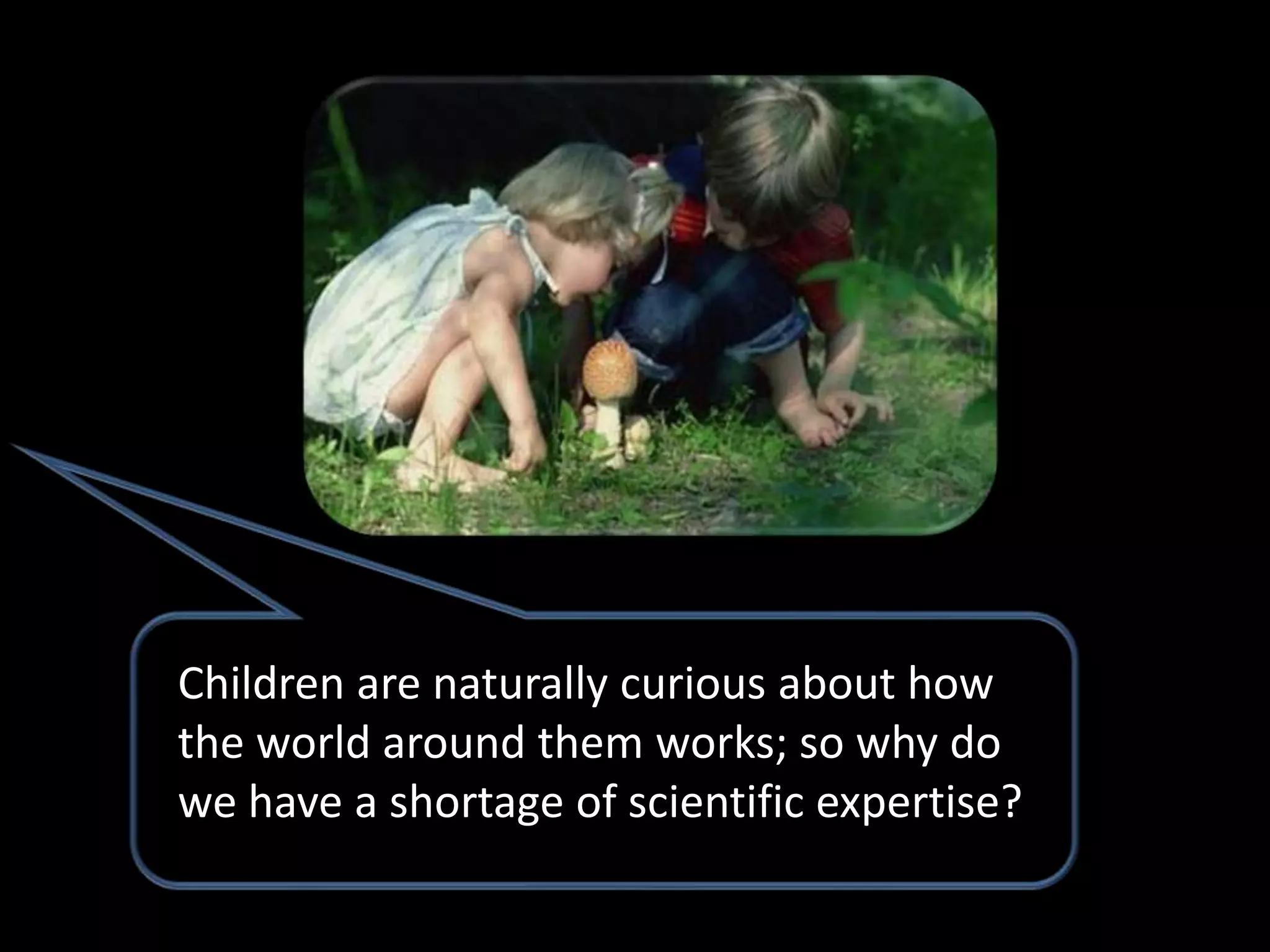
Children are naturally curious about how
the world around them works; so why do
we have a shortage of scientific expertise?
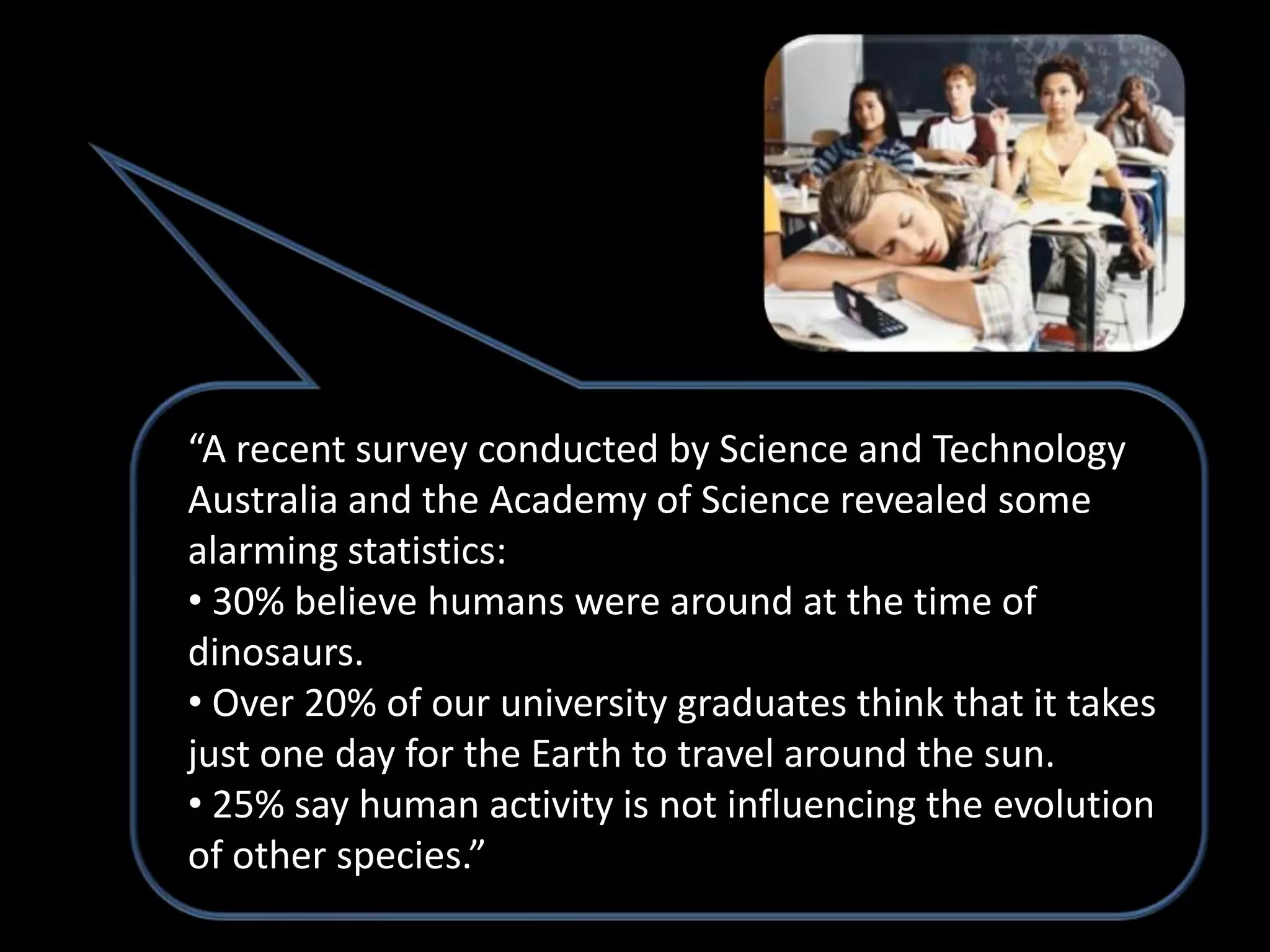
“A recent survey conducted by Science and Technology
Australia and the Academy of Science revealed some
alarming statistics:
• 30% believe humans were around at the time of
dinosaurs.
• Over 20% of our university graduates think that it takes
just one day for the Earth to travel around the sun.
• 25% say human activity is not influencing the evolution
of other species.”
Created online with “Create-A-Graph”
http://nces.ed.gov/nceskids/index.asp
Today’s Learners are:
•   Multi-taskers
•   Digitally literate
•   Mobile and connected 24/7
•   Experiential
•   Social
•   Visual/spatial learners
•   Fast response times, short attention spans

© 2006 “Teaching the 21st Century Learner”
 http://depd.wisc.edu/series/06_4168.pdf
Why do we need to teach with
               technology?
1. The Power to Engage

2. Students use technology already – educate them to
      use it for good and not for evil!

3. Professional Development

4. It's not going to go away...it will only grow

5. Employers want their workers to use internet tools

http://www.emergingedtech.com/2009/05/5-reasons-why-
educators-need-to-embrace-internet-technologies/
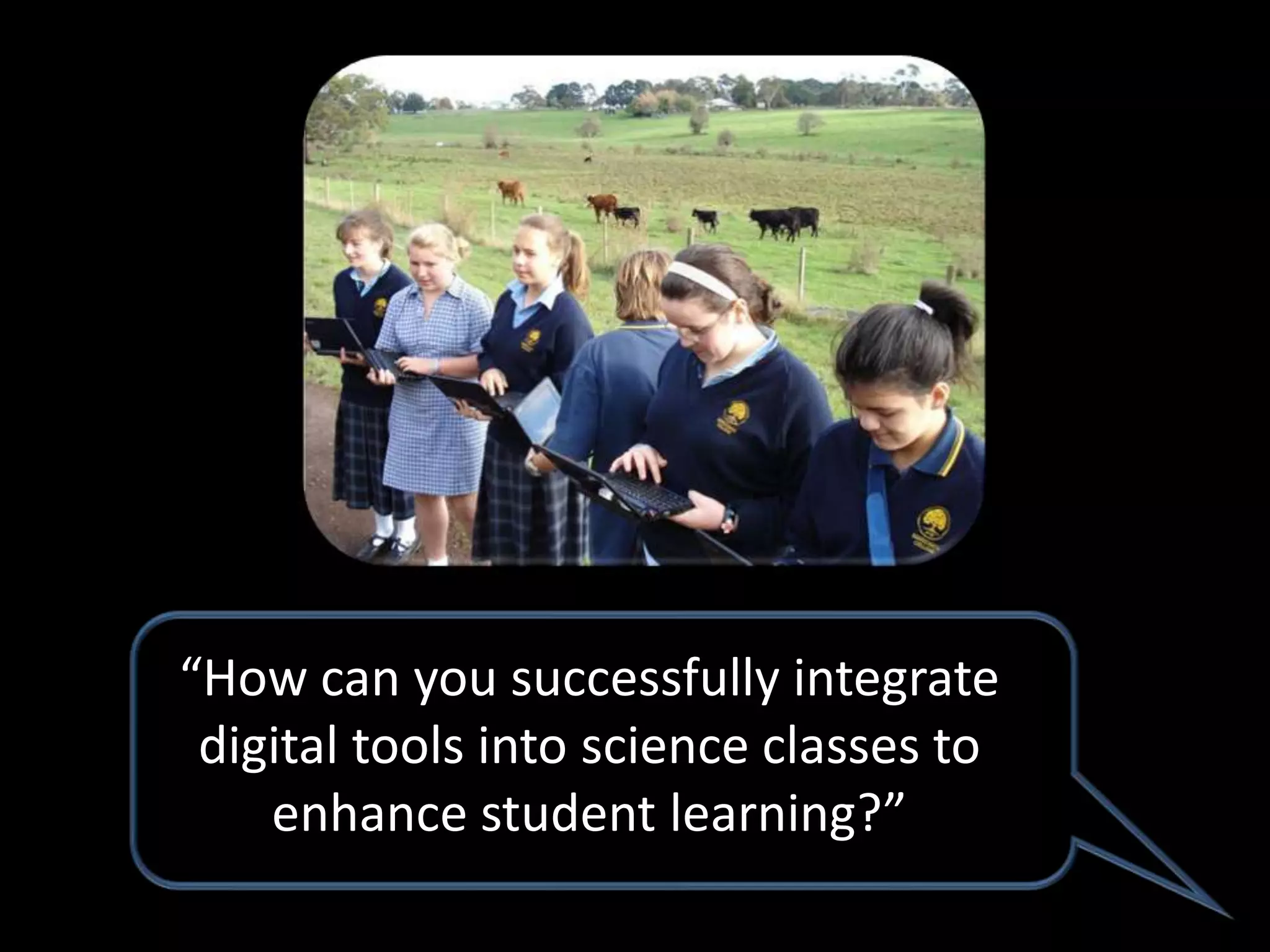
“How can you successfully integrate
 digital tools into science classes to
    enhance student learning?”
I get overwhelmed by all the choices –
there are so many different web2.0 tools
and informative resources to use!


  Try a social bookmarking site:
How can I get to know my students better
at the beginning of the school year?


  Try using Survey Monkey or
  Google Docs to create a
  student survey about their
  strengths, interests and concerns.
How can I introduce a new
 topic with web2.0 tools?


  You can use Flickr and PowerPoint to
  create slideshow of interesting images
  around your topic.
How can I connect with
experts using web2.0 tools?


 Use Skype or Blackboard Collaborate to
 participate in presentations, ask
 questions and connect with scientists.
We use Skype and Blackboard Collaborate to
connect with our Scientist in Schools partner,
  Melissa Toifl, from CSIRO Land and Water
    Technologies, in Highett and Clayton.
Peter Barnett, Geologist
                                          from Hot Rocks Ltd.


 Connecting with experts in the field increases motivation
and engagement by allowing students to ask questions and
          actively participate in presentations.
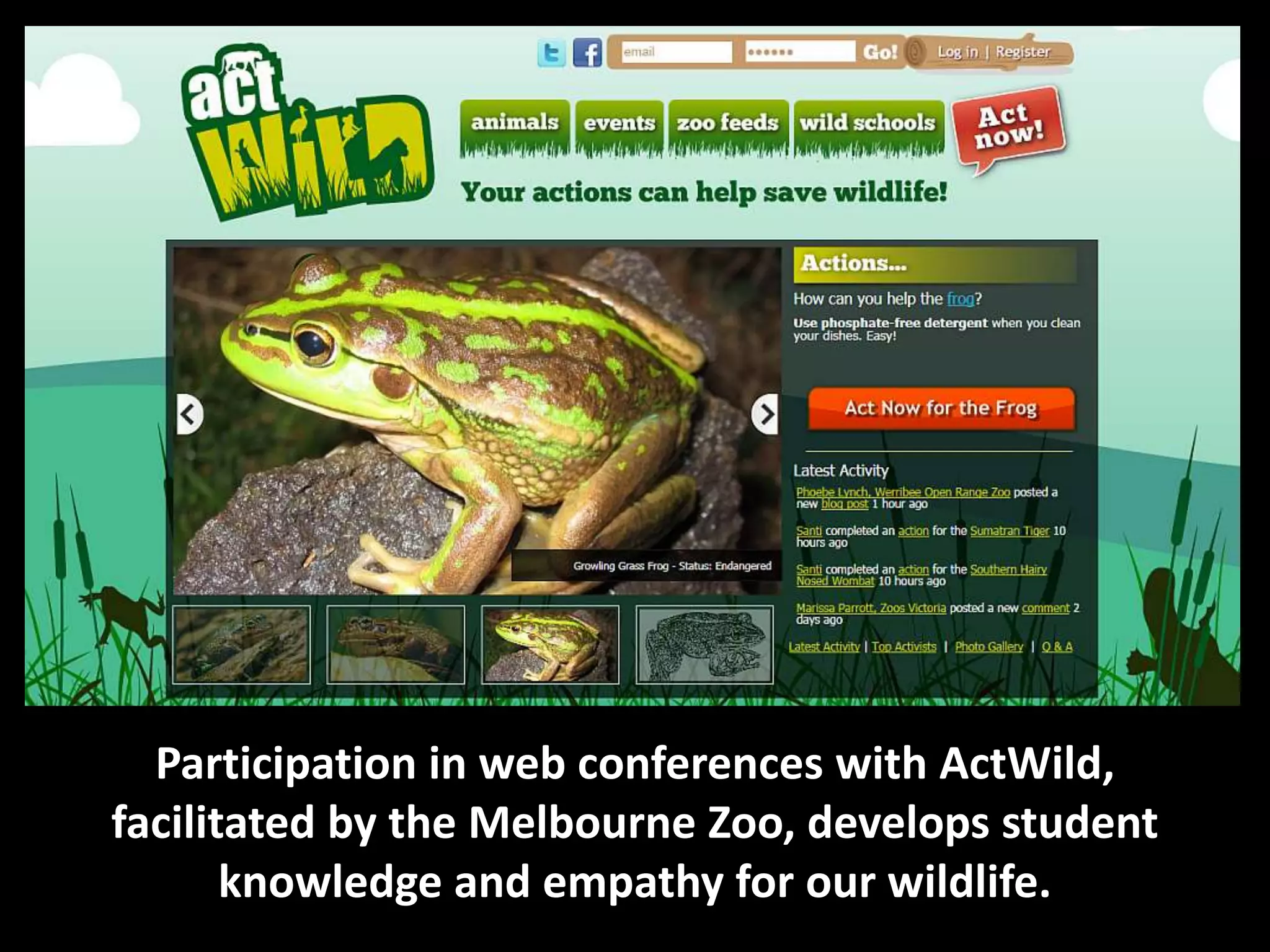
Participation in web conferences with ActWild,
facilitated by the Melbourne Zoo, develops student
       knowledge and empathy for our wildlife.
Students collect data
about tree growth to
upload to the
Smithsonian Institute
website, where
scientists use the data
for climate change
research.
This year I used Blackboard
Collaborate to teach Unit 3 and
4 VCE Environmental Science to
students from four different
schools. We connected for 90
minutes each week
synchronously and used my
blog, email and Facebook
asynchronously.

We met at Ecolinc, Bacchus
Marsh in term 1 and at
EcoBeach Apollo Bay YHA during
term 3 holidays.
How can I find out what my students
   already know about a topic?


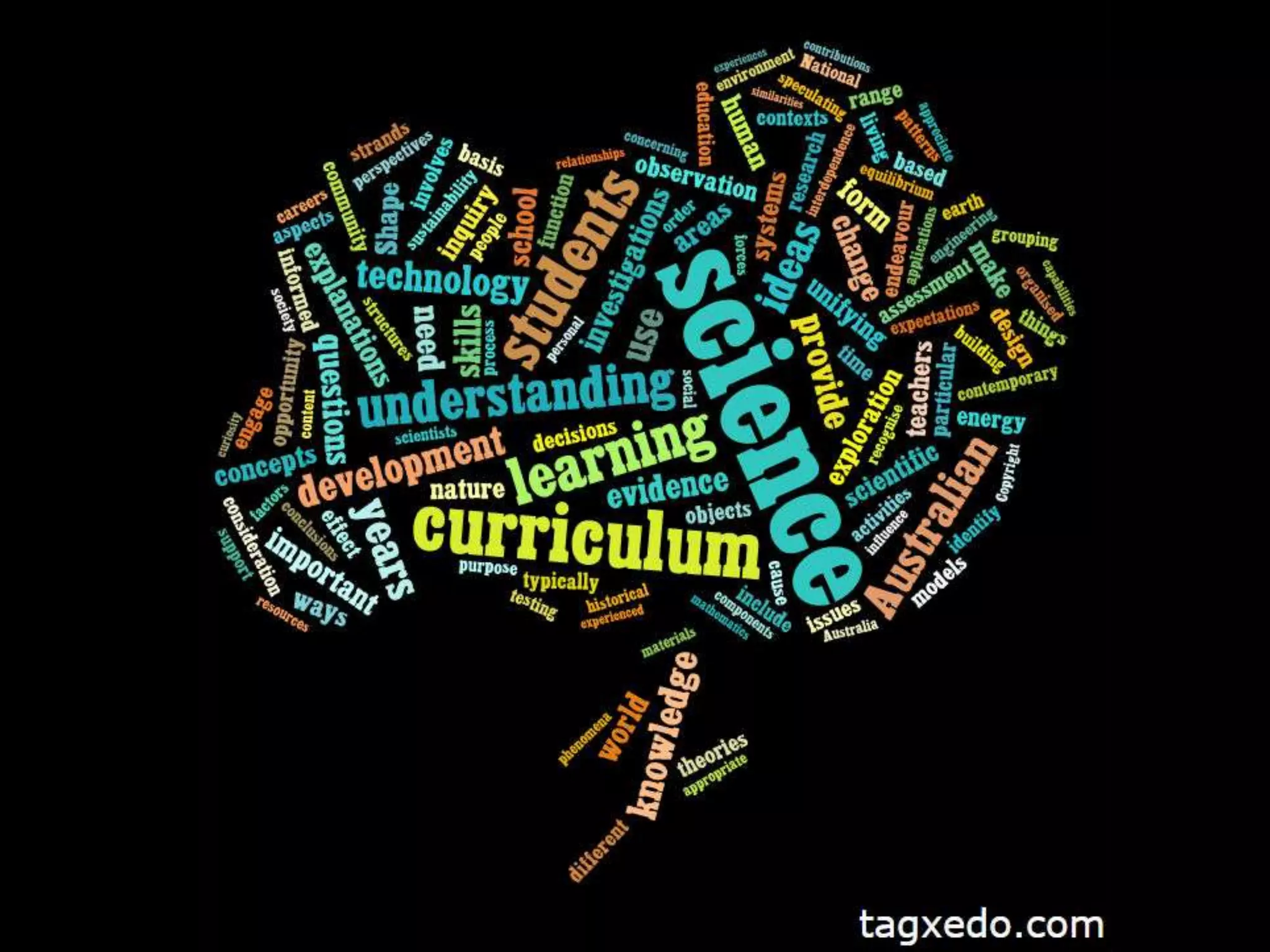
 Try creating a group word cloud using
 Google Docs and Wordle or Tagxedo.
How can you encourage students to
connect different concepts or show their
understanding of how ideas are related?


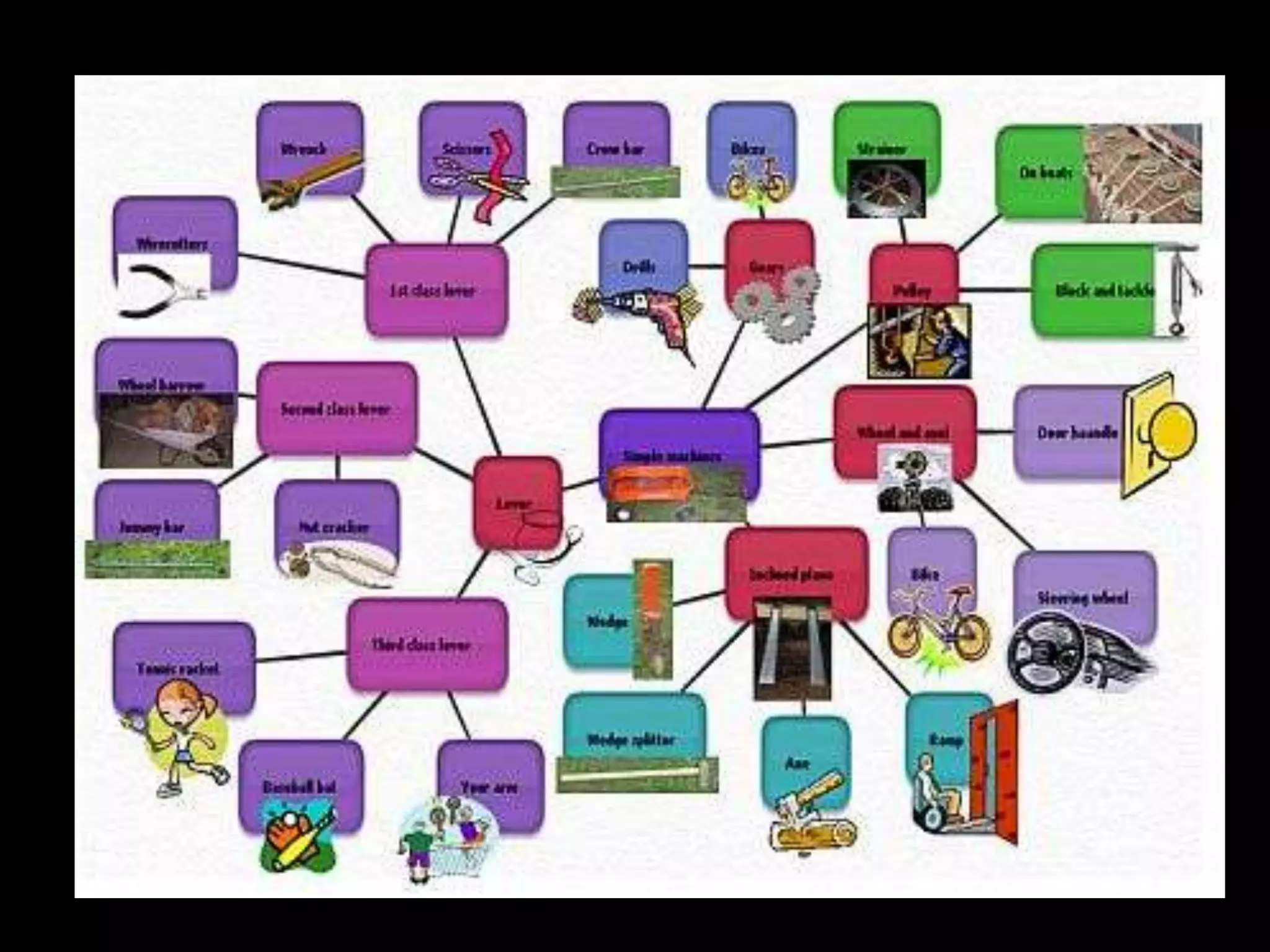
  Bubbl.us (online) and Freemind (download)
  are digital mind mapping tools that are easy
           to use and display on blogs.
How can mobile devices be used effectively to
enhance science learning?


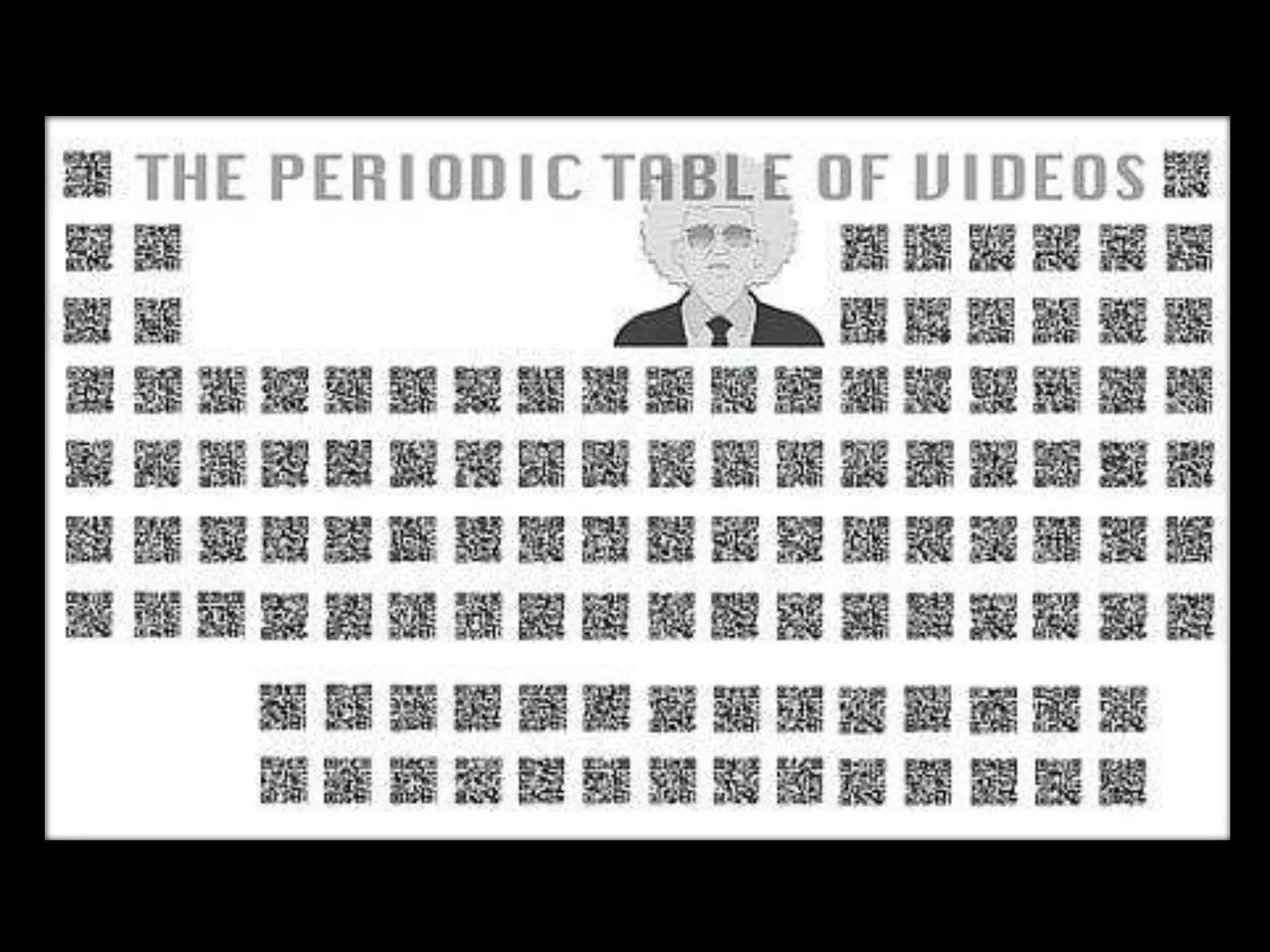
   Use mobile phones to scan QR codes, take
   pictures or record data during excursions
   and trips outside into the school garden.
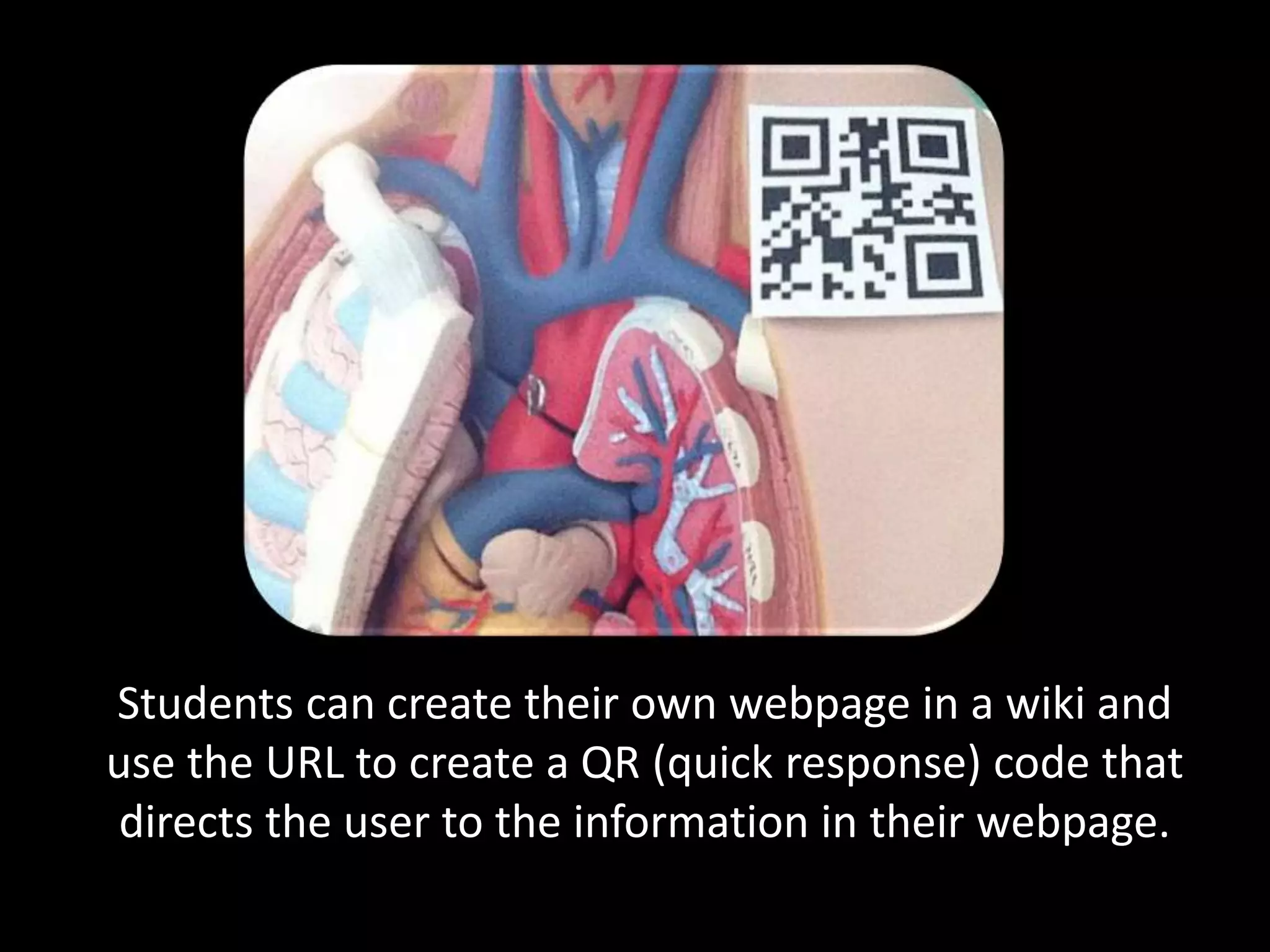
Students can create their own webpage in a wiki and
use the URL to create a QR (quick response) code that
directs the user to the information in their webpage.
How can you encourage students to work together,
collaborate on projects and share their results?


     Google Docs and Wikispaces are free tools
     that allow students to work together online.
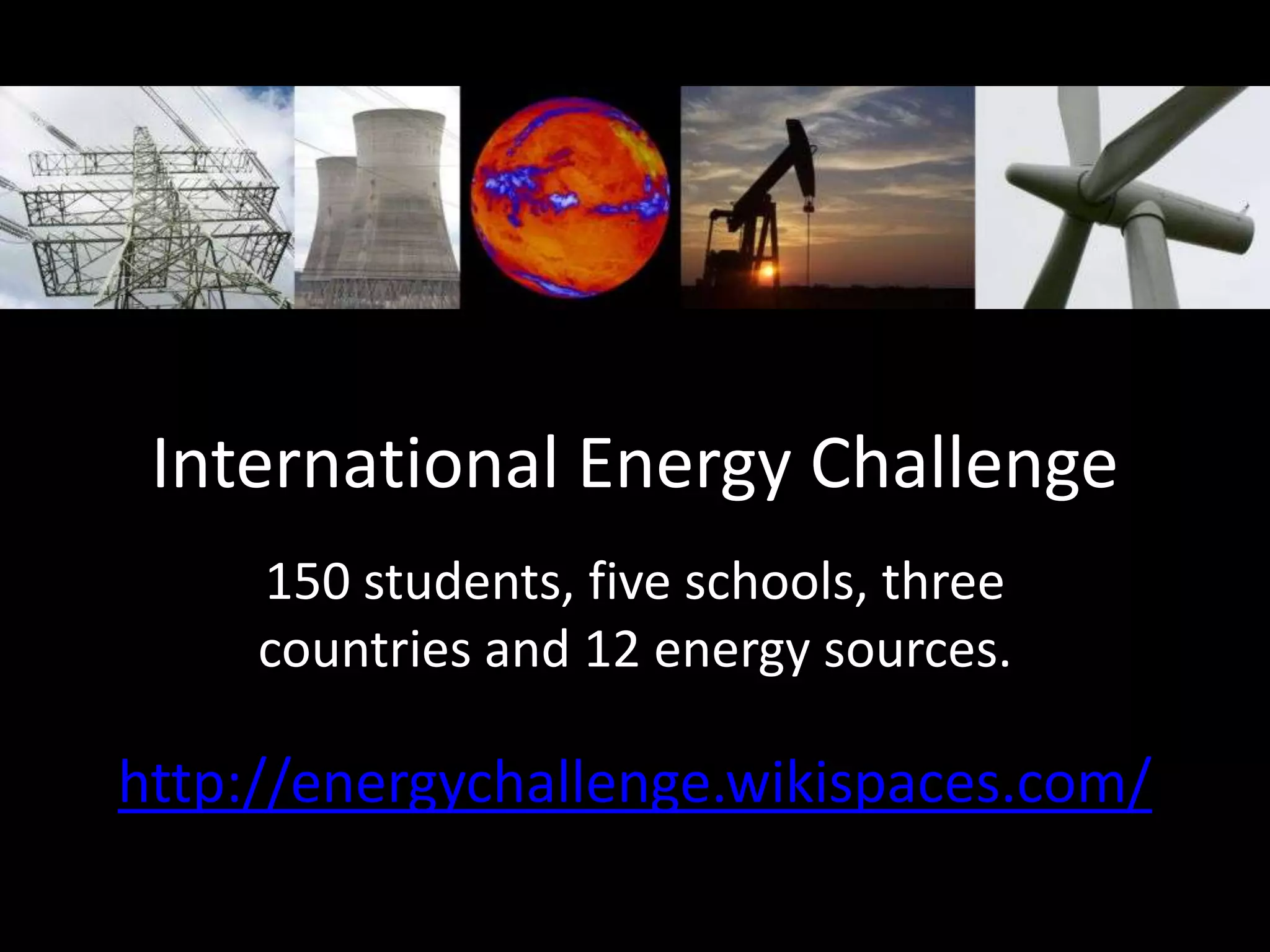
International Energy Challenge
     150 students, five schools, three
     countries and 12 energy sources.

http://energychallenge.wikispaces.com/
How can students describe experiments or work
together to explain the results of investigations?


   Voicethread is a simply wonderful way
     to use images with audio and text.
My students have difficulty remembering
definitions of scientific terms – how can I help?


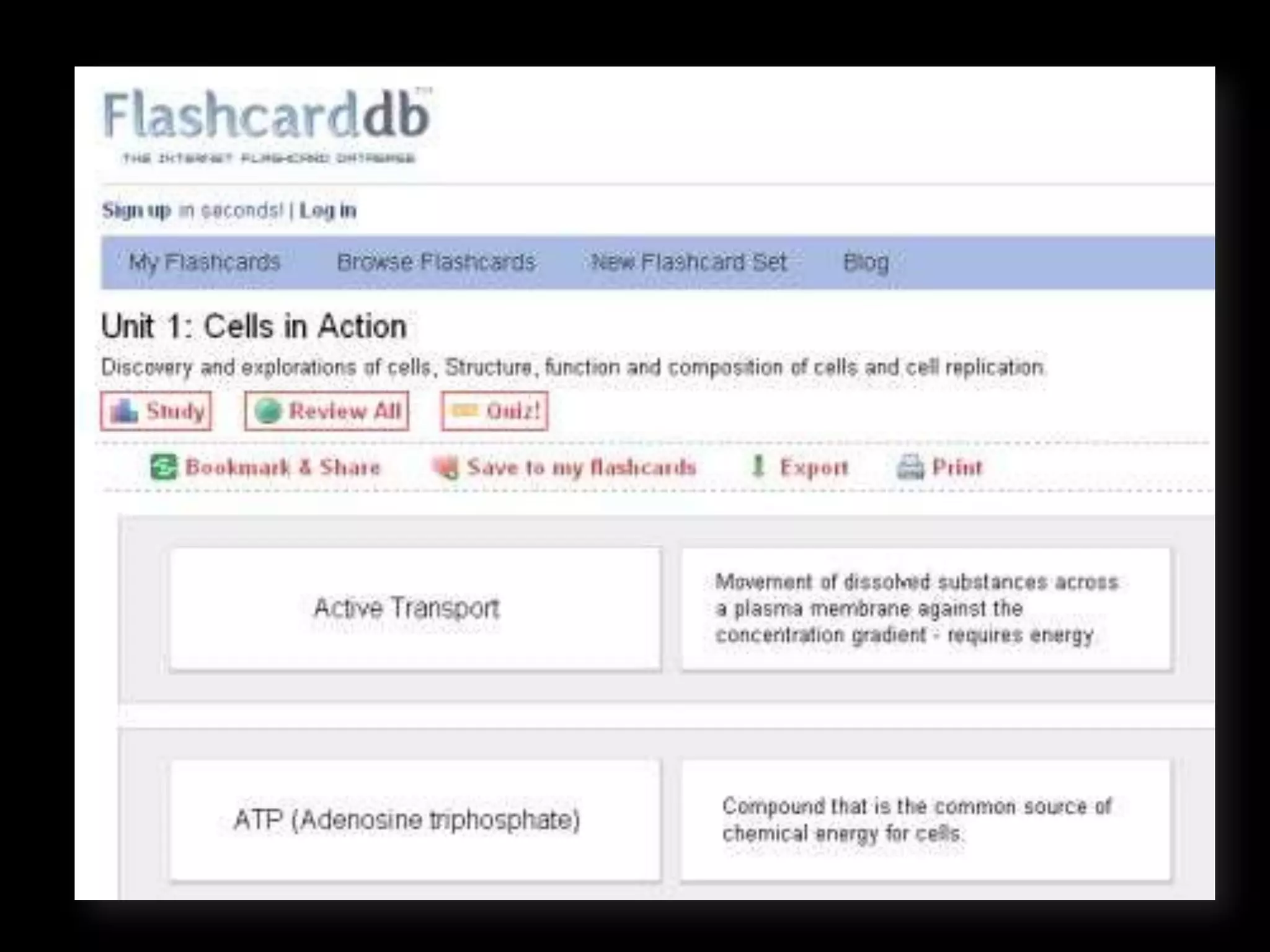
    Flashcards db is an online tool where students
    can create digital Flashcards, which can be
    used online or printed out. There is a similar
    app for iPods and iPads called Flashcardlet.
How can I help my students
revise effectively for tests?


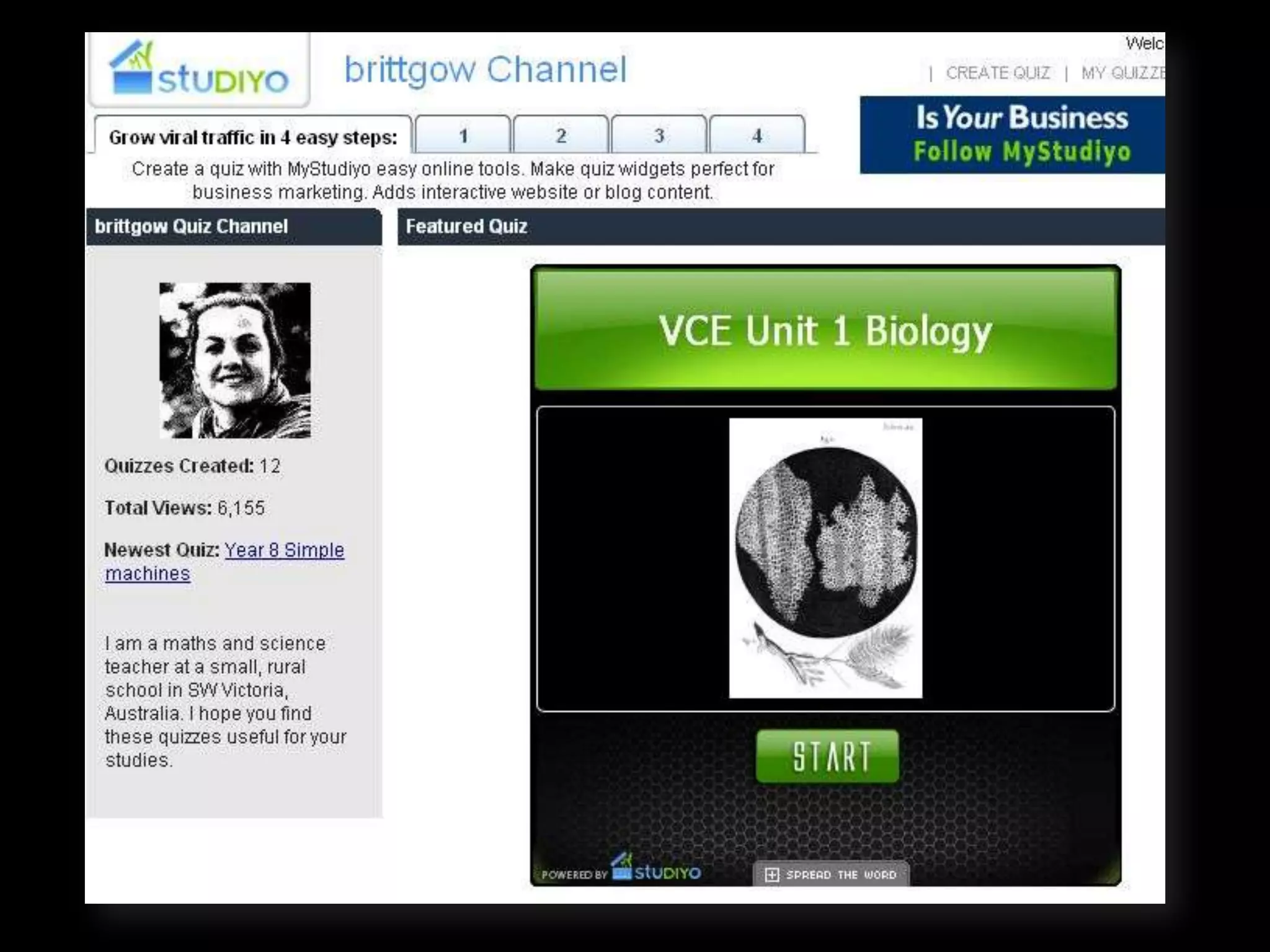
 Quiz Revolution (formerly My Studiyo) is a free tool for
 creating online multiple choice quizzes. It is simple for
 students to create their own quizzes and send a link by
email to their friends and teacher or embed the quiz into
                  a blog. Quizlet is similar.
How can students demonstrate their
     understanding of a topic?


 Ask students to create a digital story
                using
 Animoto, Slideshare, Photostory, Win
    dows Movie Maker or iMovie.
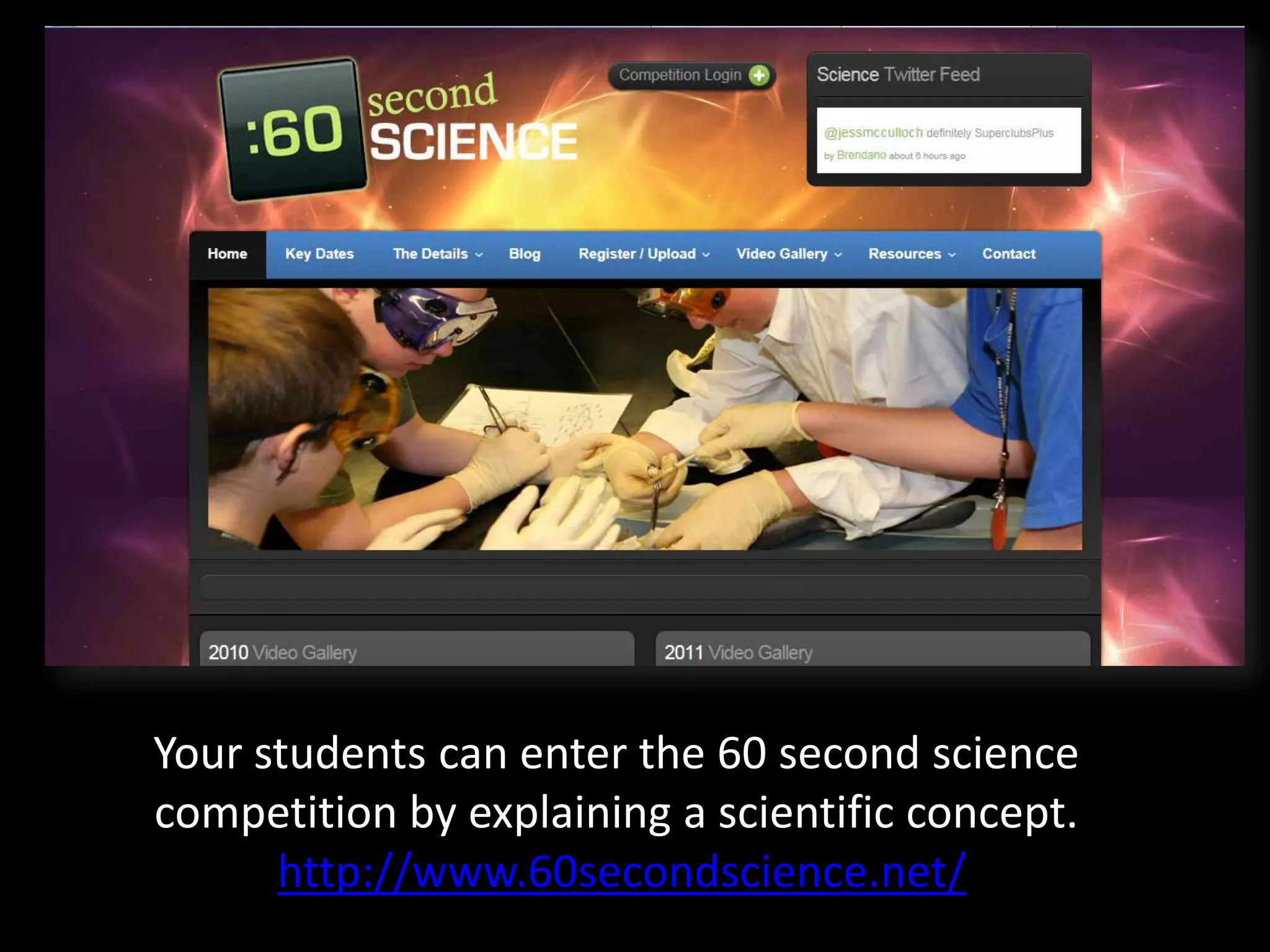
Your students can enter the 60 second science
competition by explaining a scientific concept.
      http://www.60secondscience.net/
How can I find out what students
learnt during a lesson or what they
    may not have understood?


  Wallwisher can be used as an exit slip – a
   short, low-stakes, assessment task. A
    prompted (or unprompted) written
      reflection that is posted online.
• What did you learn about cells today?
• How could you get a magnification of x400?
• What is the difference between a light
     microscope and a stereo microscope?
REFERENCES
• Prof. Suzanne Cory’s National Press Club Address on
  28th September, 2011
  http://theconversation.edu.au/science-maths-and-the-
  future-of-australia-3577
• Bored students image from
  http://ap018.edublogs.org/2010/10/17/pop-culture/
• Survey by STA and Academy of Science at
  http://www.fasts.org/images/News2010/science%20lit
  eracy%20report%20final%20270710.pdf (04/10/2011)
• Teaching the 21st Century Learner at
  http://depd.wisc.edu/series/06_4168.pdf

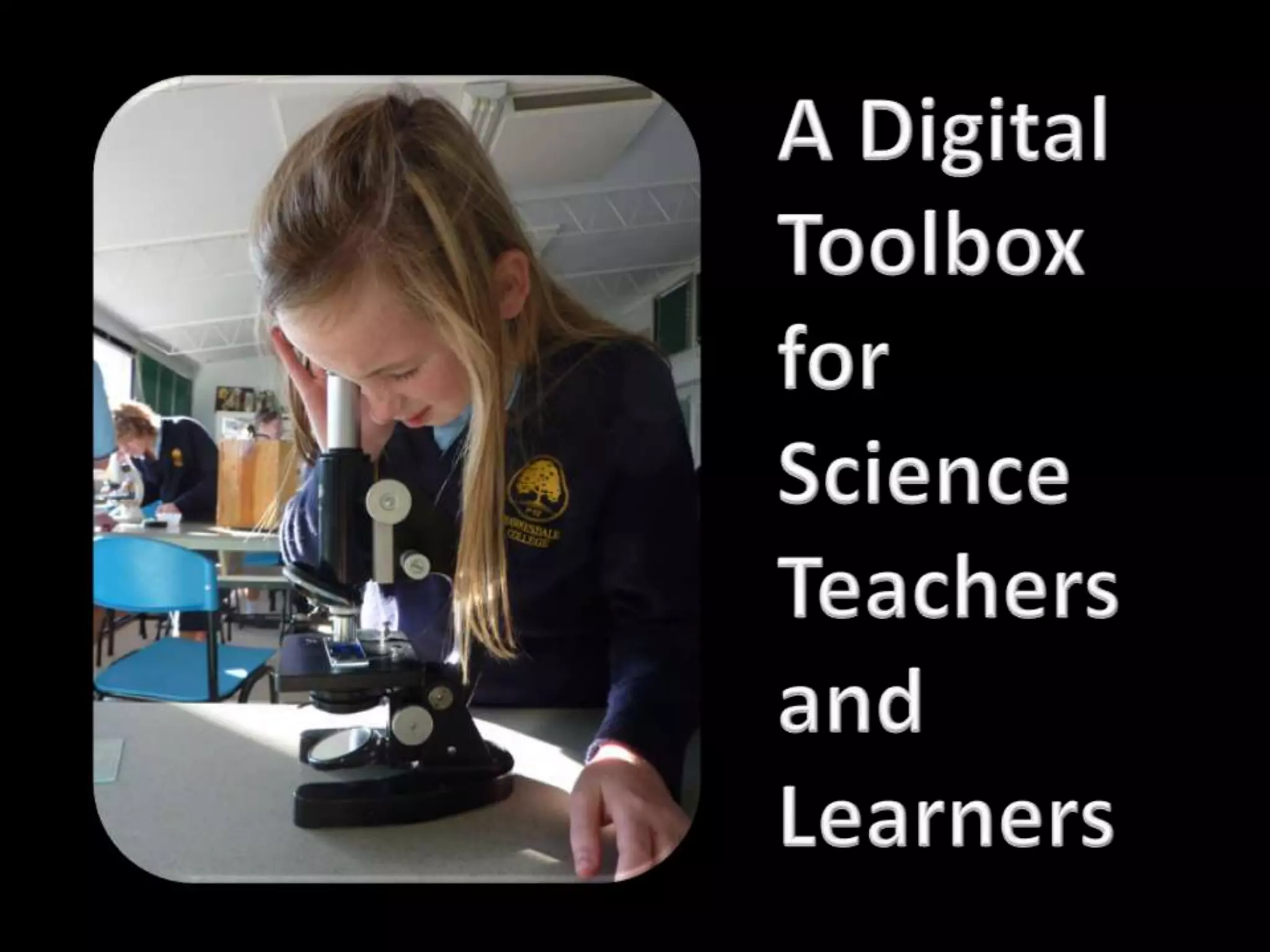
A Digital Toolbox for Science Teachers and Learners

  • 2.
    Professor Suzanne Cory, President of the Australian Academy of Science, addresses The National Press Club on 28th September, 2011. “A decade ago, a review of Australian science education, revealed many students were disappointed with their high school science. Today, this disenchantment continues, as evidenced by the declining number of students choosing to study science in senior secondary school.”
  • 3.
    Children are naturallycurious about how the world around them works; so why do we have a shortage of scientific expertise?
  • 4.
    “A recent surveyconducted by Science and Technology Australia and the Academy of Science revealed some alarming statistics: • 30% believe humans were around at the time of dinosaurs. • Over 20% of our university graduates think that it takes just one day for the Earth to travel around the sun. • 25% say human activity is not influencing the evolution of other species.”
  • 5.
    Created online with“Create-A-Graph” http://nces.ed.gov/nceskids/index.asp
  • 6.
    Today’s Learners are: • Multi-taskers • Digitally literate • Mobile and connected 24/7 • Experiential • Social • Visual/spatial learners • Fast response times, short attention spans © 2006 “Teaching the 21st Century Learner” http://depd.wisc.edu/series/06_4168.pdf
  • 7.
    Why do weneed to teach with technology? 1. The Power to Engage 2. Students use technology already – educate them to use it for good and not for evil! 3. Professional Development 4. It's not going to go away...it will only grow 5. Employers want their workers to use internet tools http://www.emergingedtech.com/2009/05/5-reasons-why- educators-need-to-embrace-internet-technologies/
  • 8.
    “How can yousuccessfully integrate digital tools into science classes to enhance student learning?”
  • 10.
    I get overwhelmedby all the choices – there are so many different web2.0 tools and informative resources to use! Try a social bookmarking site:
  • 11.
    How can Iget to know my students better at the beginning of the school year? Try using Survey Monkey or Google Docs to create a student survey about their strengths, interests and concerns.
  • 12.
    How can Iintroduce a new topic with web2.0 tools? You can use Flickr and PowerPoint to create slideshow of interesting images around your topic.
  • 14.
    How can Iconnect with experts using web2.0 tools? Use Skype or Blackboard Collaborate to participate in presentations, ask questions and connect with scientists.
  • 15.
    We use Skypeand Blackboard Collaborate to connect with our Scientist in Schools partner, Melissa Toifl, from CSIRO Land and Water Technologies, in Highett and Clayton.
  • 16.
    Peter Barnett, Geologist from Hot Rocks Ltd. Connecting with experts in the field increases motivation and engagement by allowing students to ask questions and actively participate in presentations.
  • 17.
    Participation in webconferences with ActWild, facilitated by the Melbourne Zoo, develops student knowledge and empathy for our wildlife.
  • 18.
    Students collect data abouttree growth to upload to the Smithsonian Institute website, where scientists use the data for climate change research.
  • 19.
    This year Iused Blackboard Collaborate to teach Unit 3 and 4 VCE Environmental Science to students from four different schools. We connected for 90 minutes each week synchronously and used my blog, email and Facebook asynchronously. We met at Ecolinc, Bacchus Marsh in term 1 and at EcoBeach Apollo Bay YHA during term 3 holidays.
  • 20.
    How can Ifind out what my students already know about a topic? Try creating a group word cloud using Google Docs and Wordle or Tagxedo.
  • 23.
    How can youencourage students to connect different concepts or show their understanding of how ideas are related? Bubbl.us (online) and Freemind (download) are digital mind mapping tools that are easy to use and display on blogs.
  • 26.
    How can mobiledevices be used effectively to enhance science learning? Use mobile phones to scan QR codes, take pictures or record data during excursions and trips outside into the school garden.
  • 27.
    Students can createtheir own webpage in a wiki and use the URL to create a QR (quick response) code that directs the user to the information in their webpage.
  • 29.
    How can youencourage students to work together, collaborate on projects and share their results? Google Docs and Wikispaces are free tools that allow students to work together online.
  • 30.
    International Energy Challenge 150 students, five schools, three countries and 12 energy sources. http://energychallenge.wikispaces.com/
  • 31.
    How can studentsdescribe experiments or work together to explain the results of investigations? Voicethread is a simply wonderful way to use images with audio and text.
  • 32.
    My students havedifficulty remembering definitions of scientific terms – how can I help? Flashcards db is an online tool where students can create digital Flashcards, which can be used online or printed out. There is a similar app for iPods and iPads called Flashcardlet.
  • 34.
    How can Ihelp my students revise effectively for tests? Quiz Revolution (formerly My Studiyo) is a free tool for creating online multiple choice quizzes. It is simple for students to create their own quizzes and send a link by email to their friends and teacher or embed the quiz into a blog. Quizlet is similar.
  • 36.
    How can studentsdemonstrate their understanding of a topic? Ask students to create a digital story using Animoto, Slideshare, Photostory, Win dows Movie Maker or iMovie.
  • 37.
    Your students canenter the 60 second science competition by explaining a scientific concept. http://www.60secondscience.net/
  • 38.
    How can Ifind out what students learnt during a lesson or what they may not have understood? Wallwisher can be used as an exit slip – a short, low-stakes, assessment task. A prompted (or unprompted) written reflection that is posted online.
  • 39.
    • What didyou learn about cells today? • How could you get a magnification of x400? • What is the difference between a light microscope and a stereo microscope?
  • 40.
    REFERENCES • Prof. SuzanneCory’s National Press Club Address on 28th September, 2011 http://theconversation.edu.au/science-maths-and-the- future-of-australia-3577 • Bored students image from http://ap018.edublogs.org/2010/10/17/pop-culture/ • Survey by STA and Academy of Science at http://www.fasts.org/images/News2010/science%20lit eracy%20report%20final%20270710.pdf (04/10/2011) • Teaching the 21st Century Learner at http://depd.wisc.edu/series/06_4168.pdf