Chapter 9 Lecture
© 2014 Pearson Education, Inc.
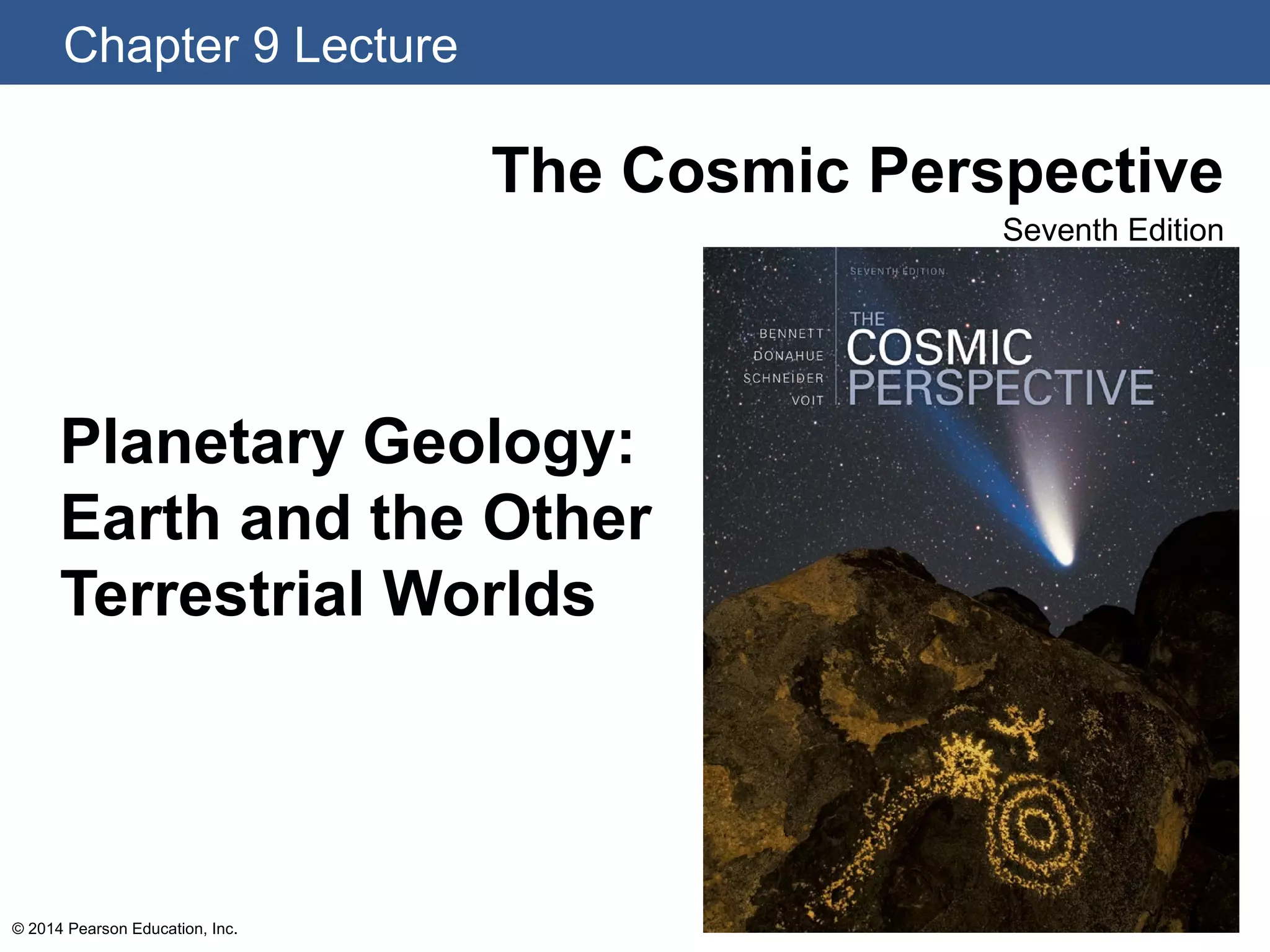
The Cosmic Perspective
Seventh Edition
Planetary Geology:
Earth and the Other
Terrestrial Worlds
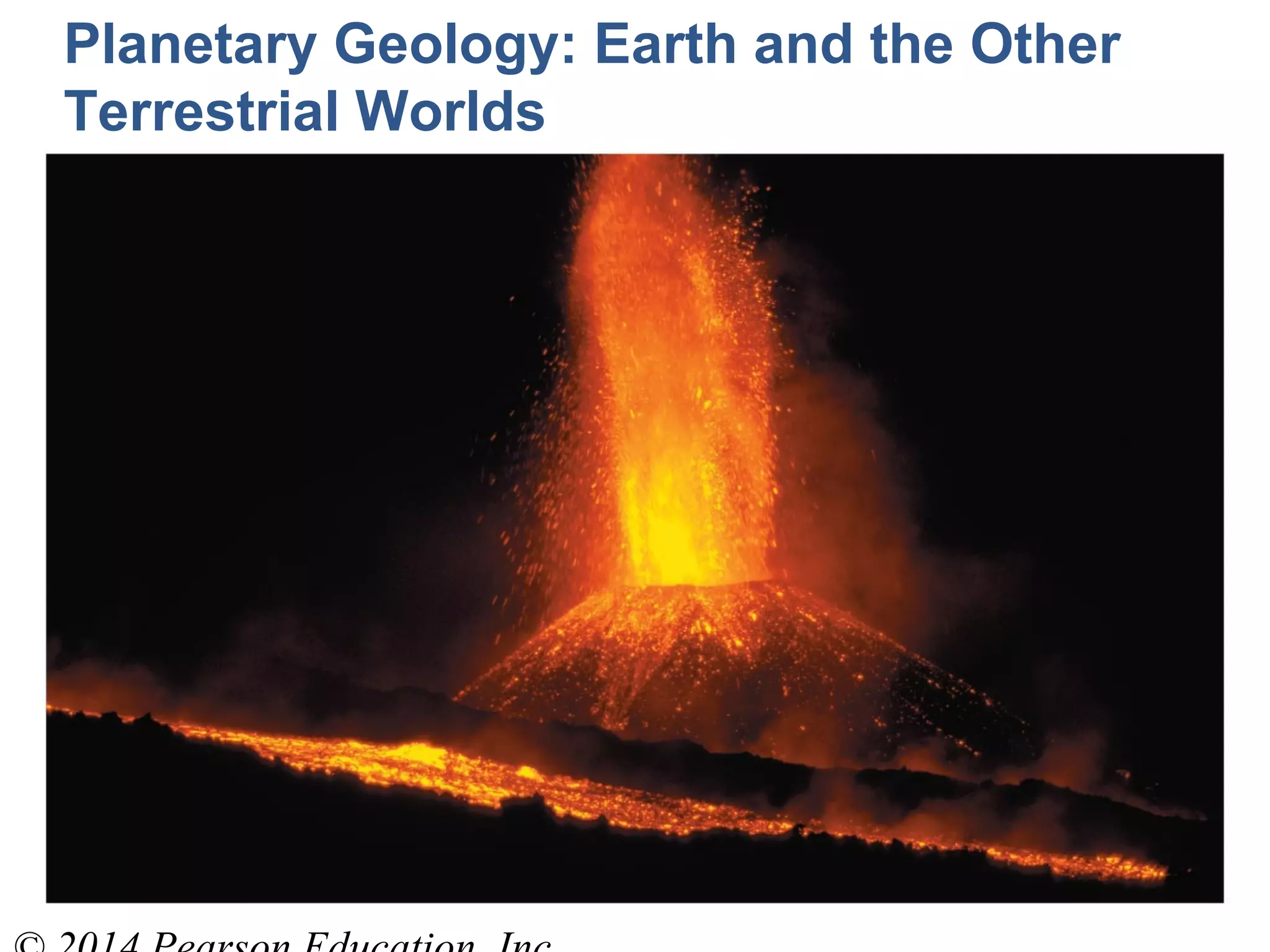
Planetary Geology: Earth and the Other
Terrestrial Worlds
9.1 Connecting Planetary Interiors and
Surfaces
• Our goals for learning:
– What are terrestrial planets like on the
inside?
– What causes geological activity?
– Why do some planetary interiors create
magnetic fields?
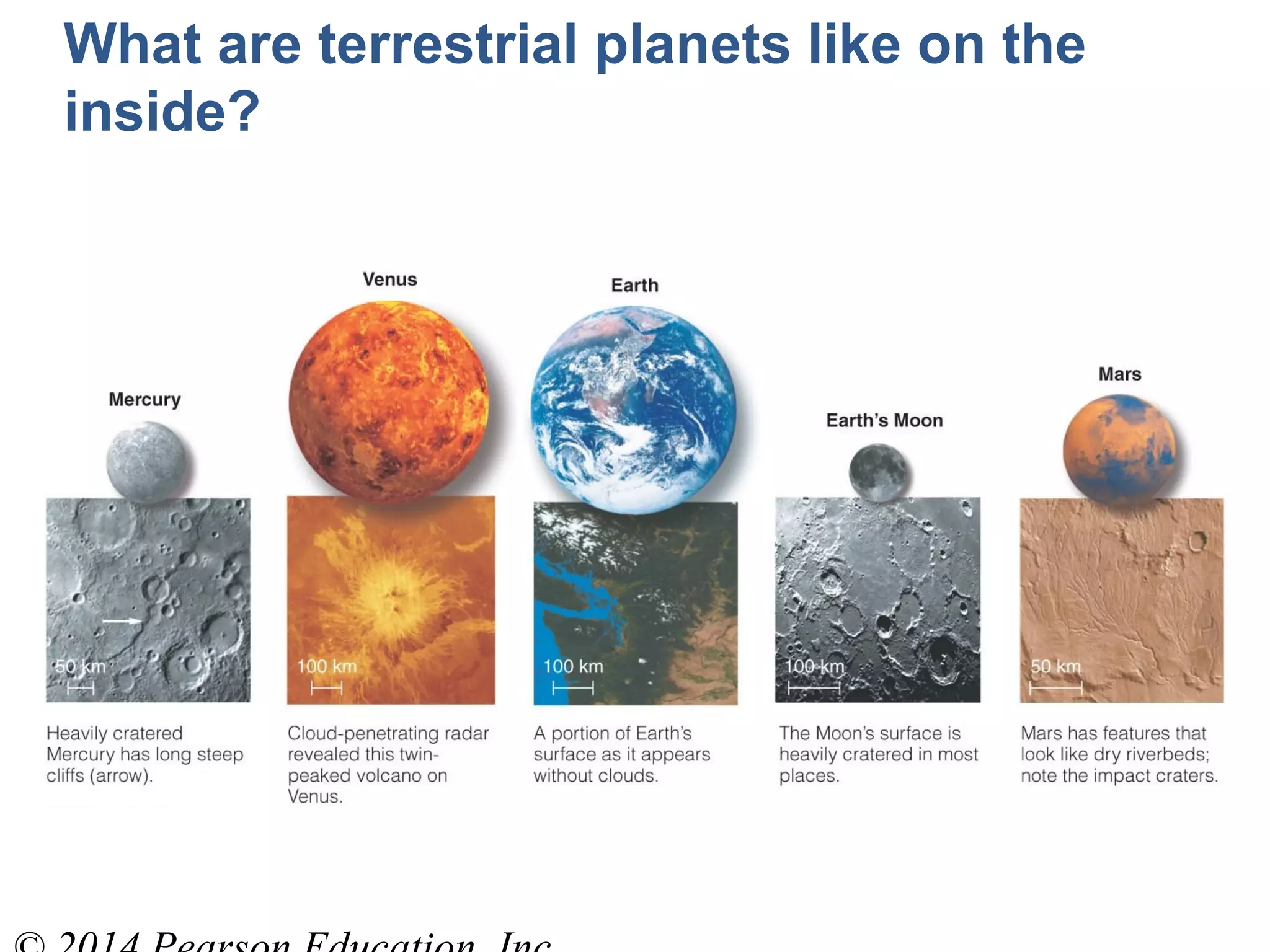
What are terrestrial planets like on the
inside?
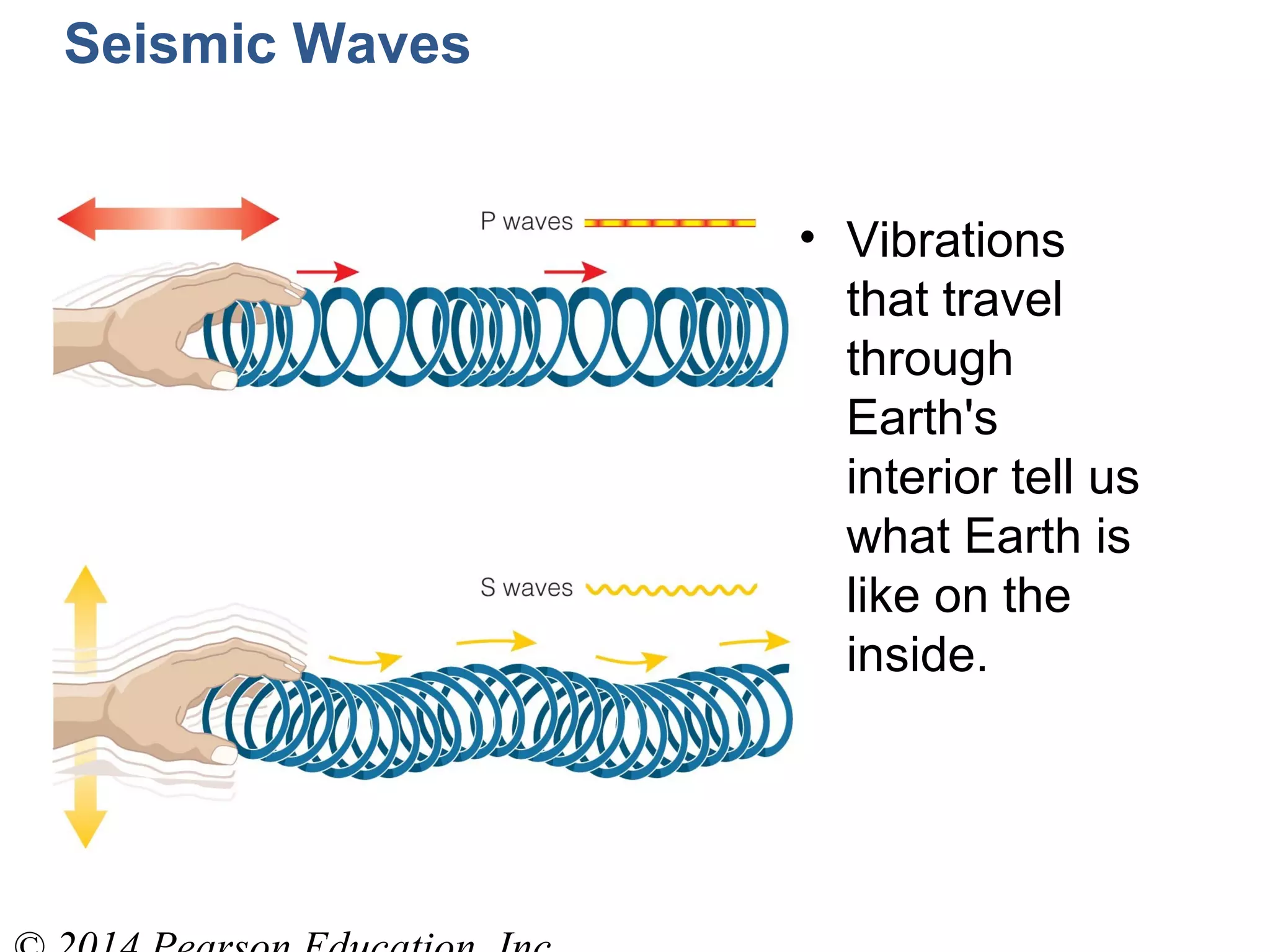
Seismic Waves
• Vibrations
that travel
through
Earth's
interior tell us
what Earth is
like on the
inside.
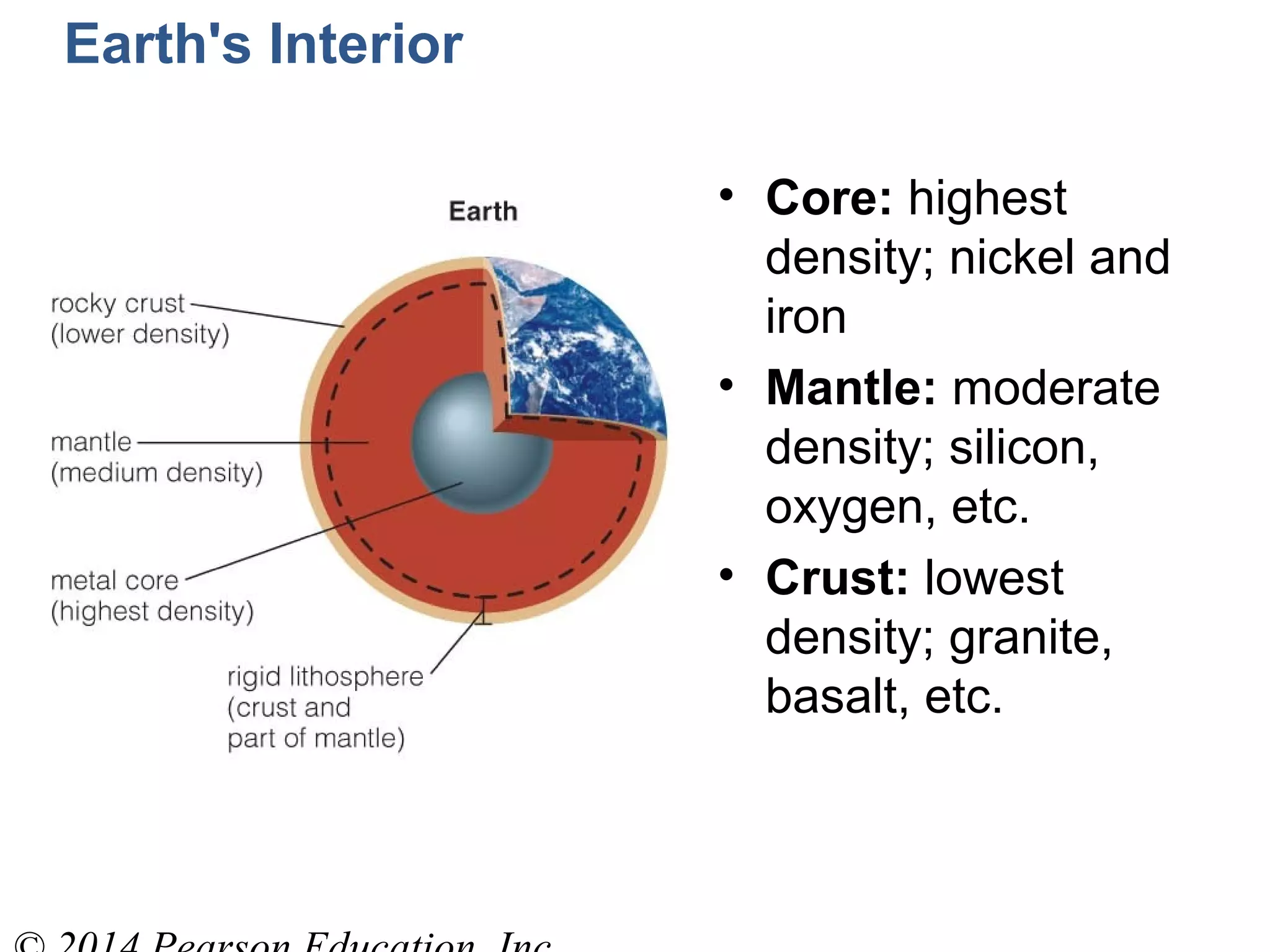
Earth's Interior
• Core: highest
density; nickel and
iron
• Mantle: moderate
density; silicon,
oxygen, etc.
• Crust: lowest
density; granite,
basalt, etc.
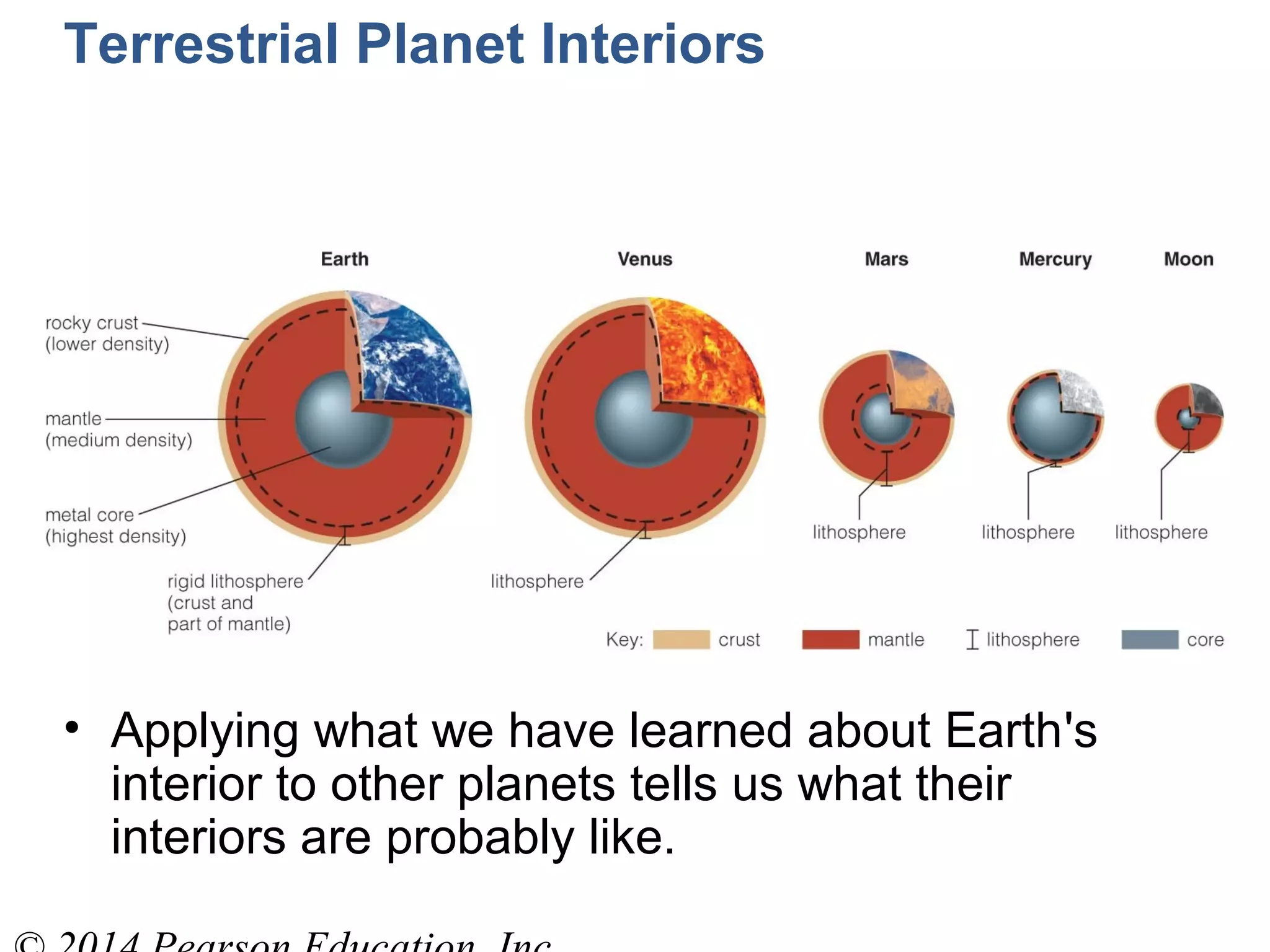
• Applying what we have learned about Earth's
interior to other planets tells us what their
interiors are probably like.
Terrestrial Planet Interiors
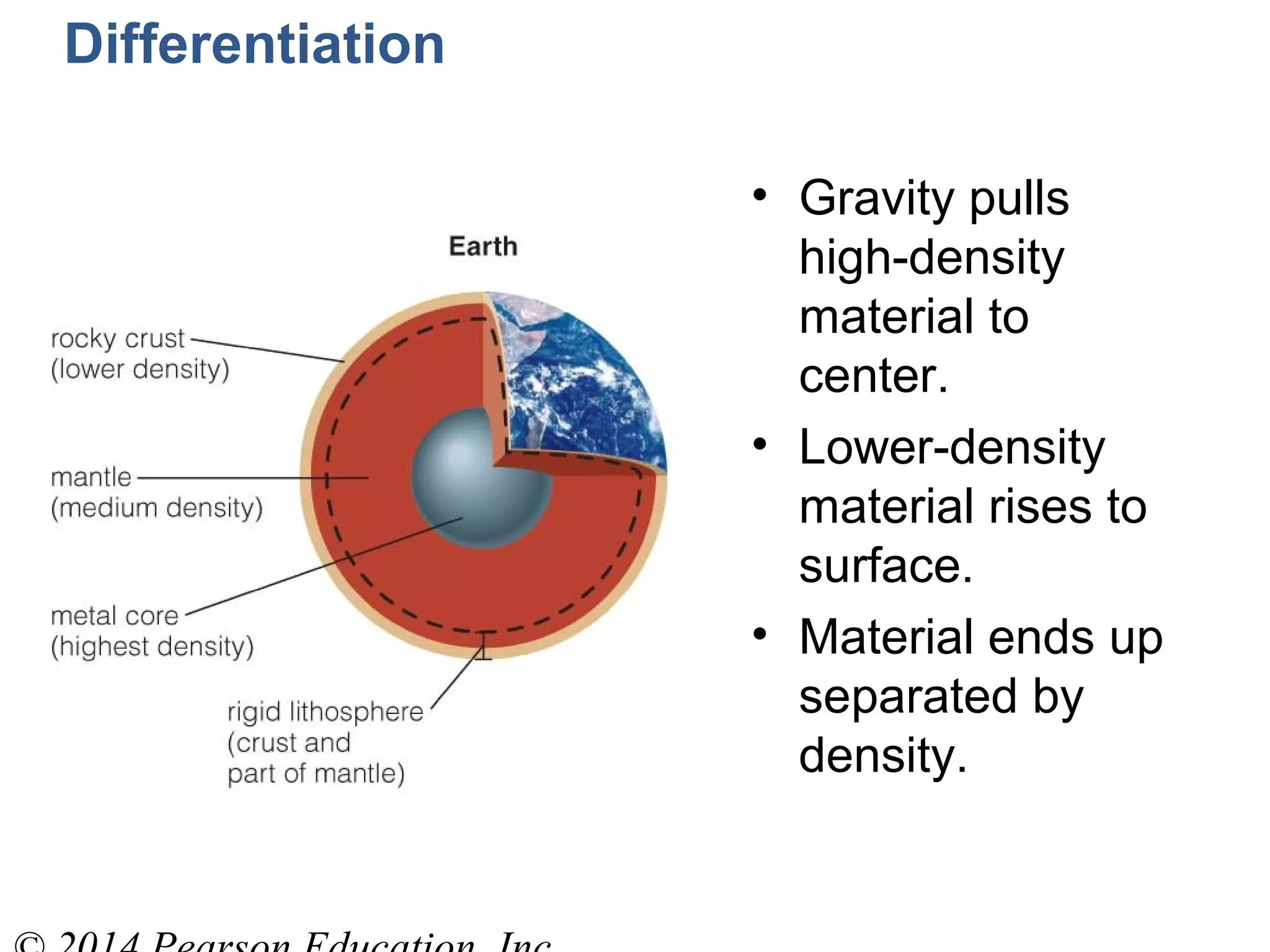
Differentiation
• Gravity pulls
high-density
material to
center.
• Lower-density
material rises to
surface.
• Material ends up
separated by
density.
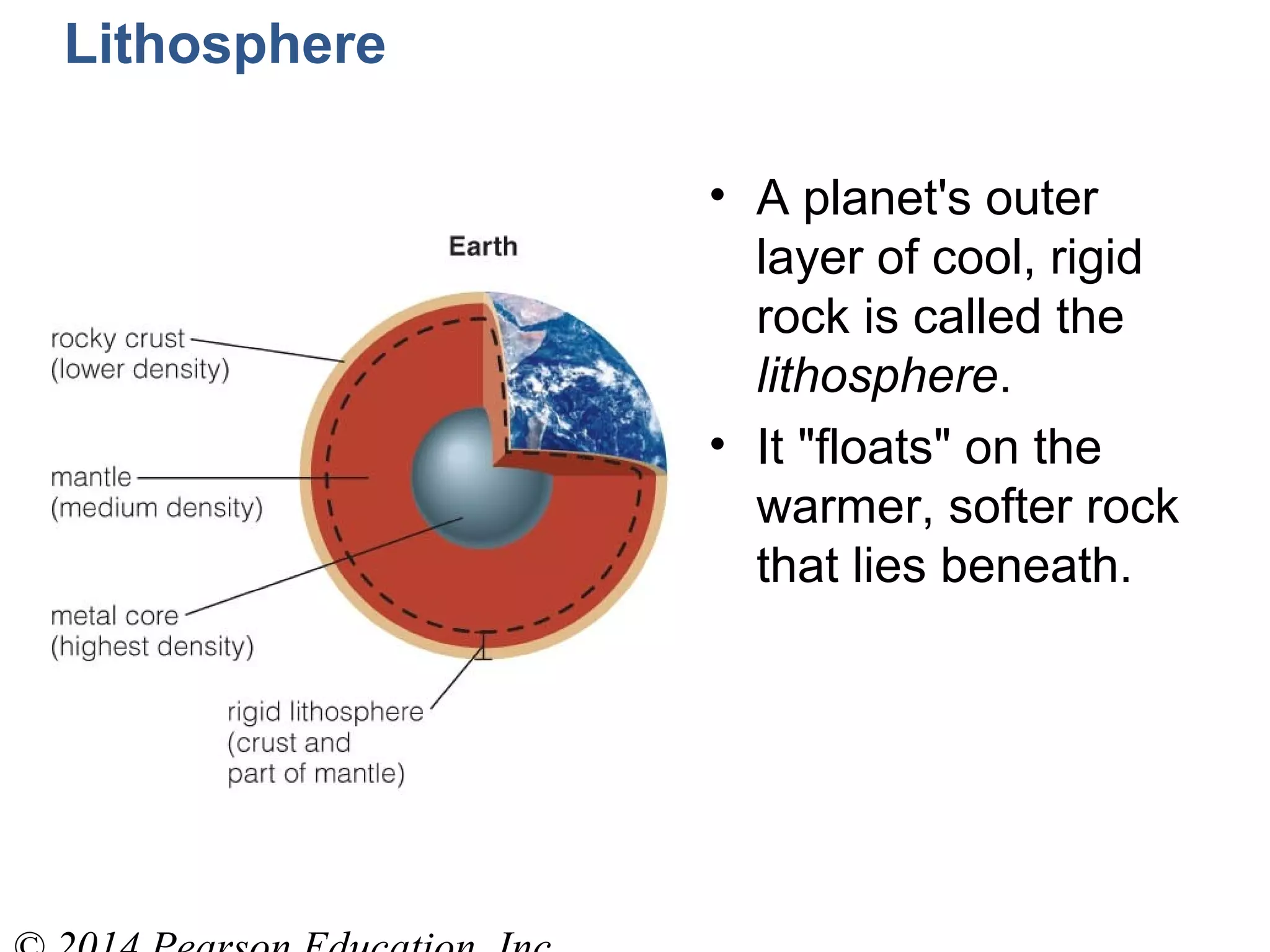
Lithosphere
• A planet's outer
layer of cool, rigid
rock is called the
lithosphere.
• It "floats" on the
warmer, softer rock
that lies beneath.
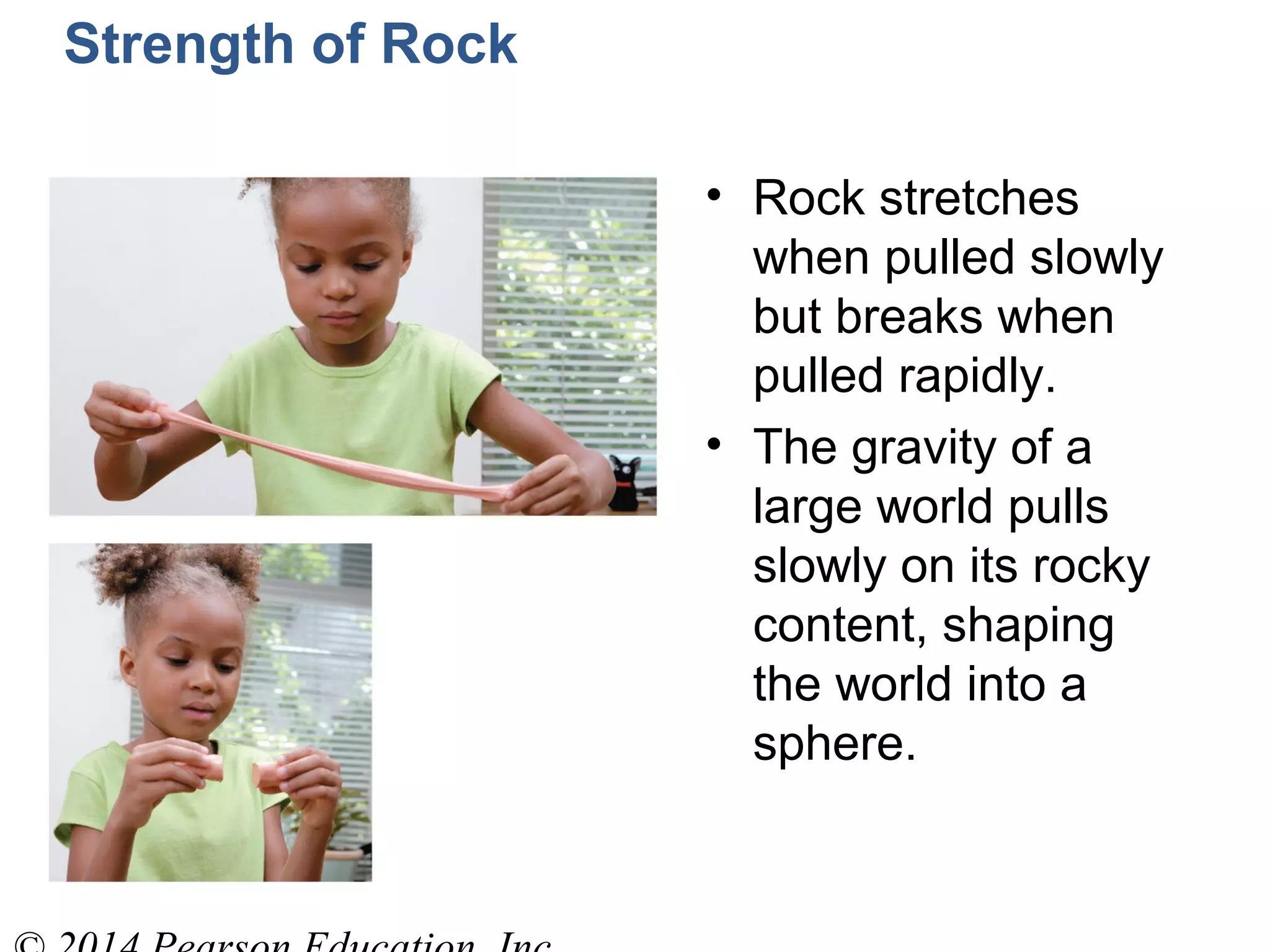
Strength of Rock
• Rock stretches
when pulled slowly
but breaks when
pulled rapidly.
• The gravity of a
large world pulls
slowly on its rocky
content, shaping
the world into a
sphere.
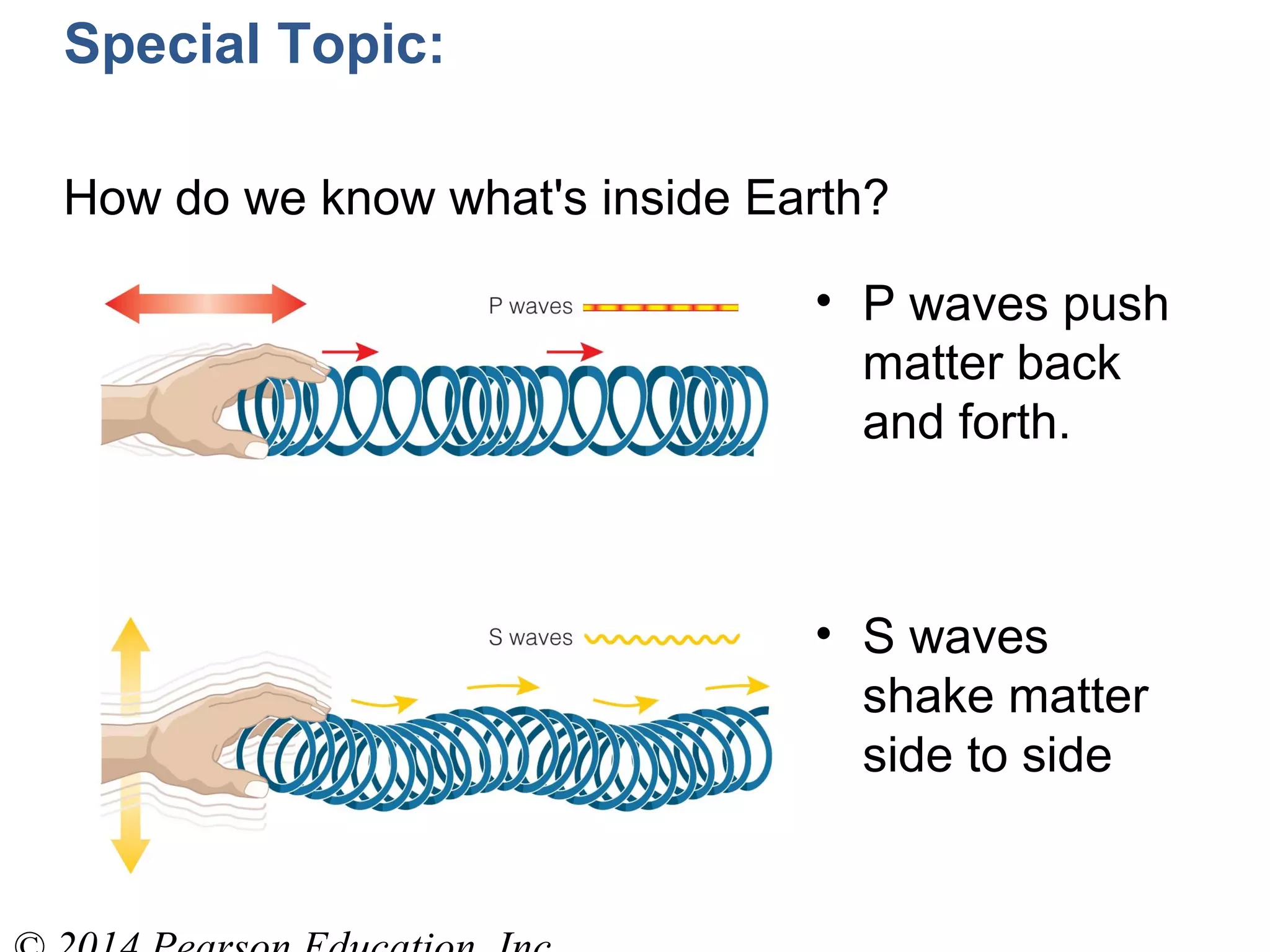
Special Topic:
How do we know what's inside Earth?
• P waves push
matter back
and forth.
• S waves
shake matter
side to side
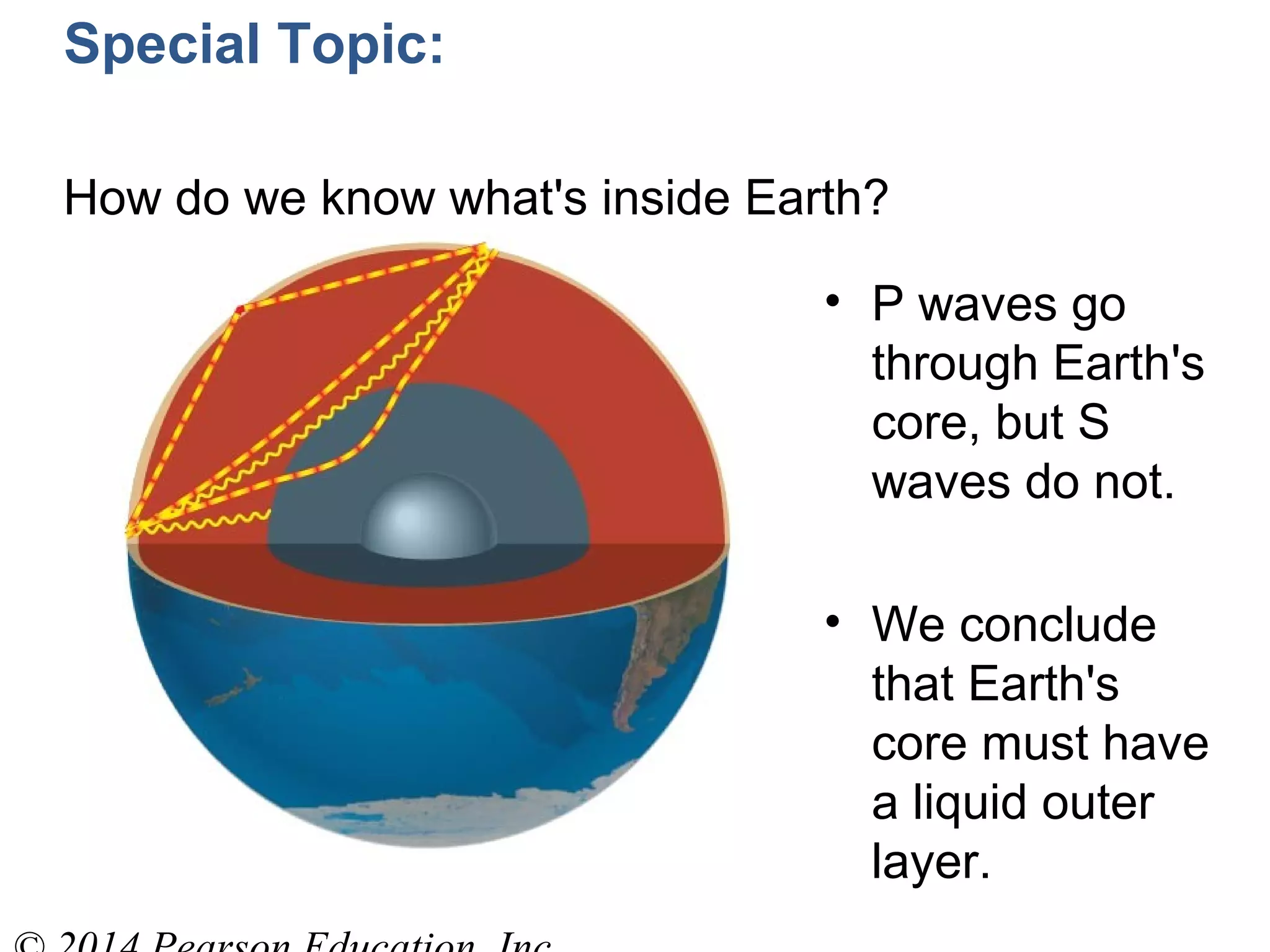
Special Topic:
How do we know what's inside Earth?
• P waves go
through Earth's
core, but S
waves do not.
• We conclude
that Earth's
core must have
a liquid outer
layer.
Thought Question
What is necessary for differentiation to occur in a
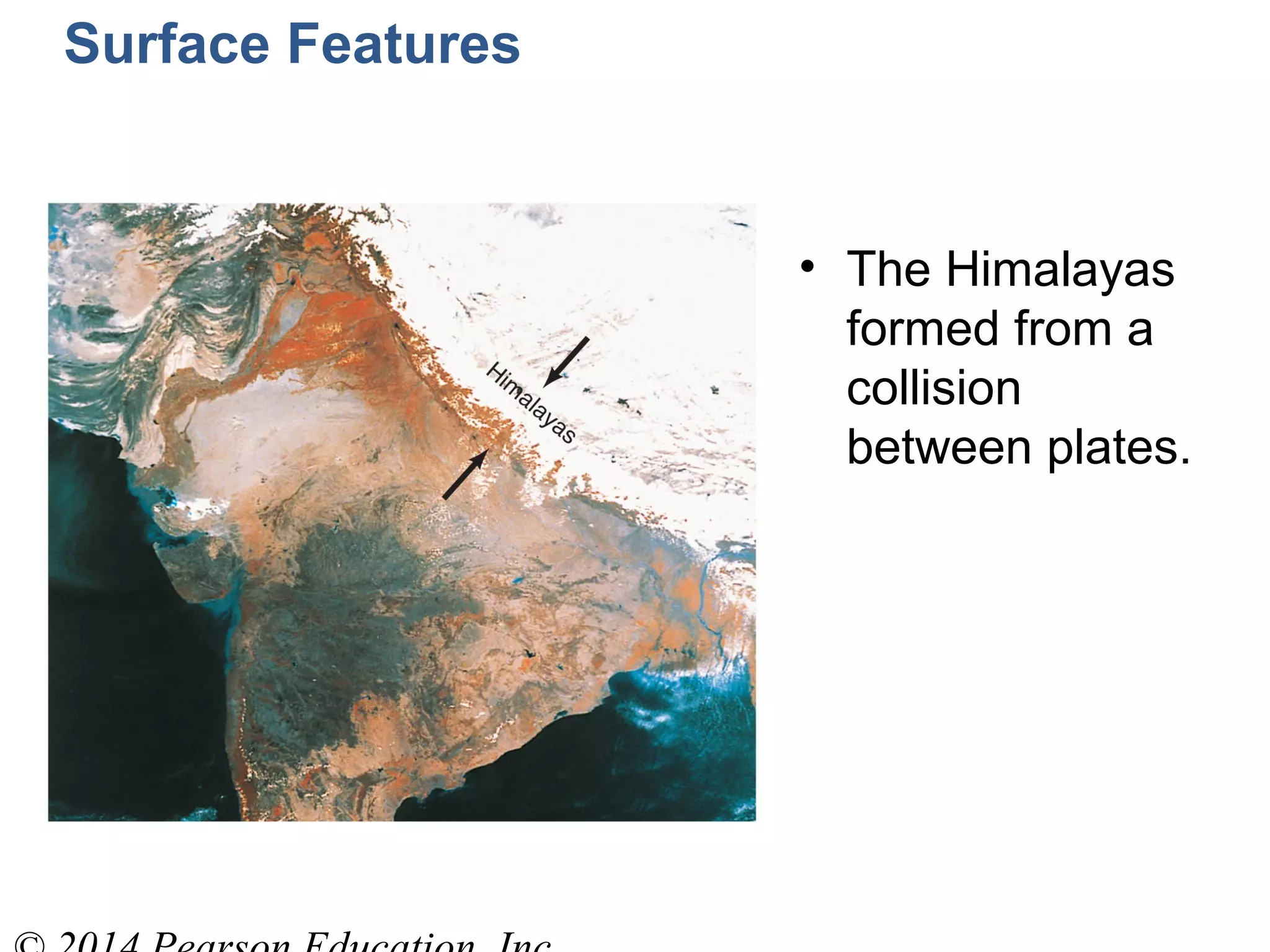
planet?
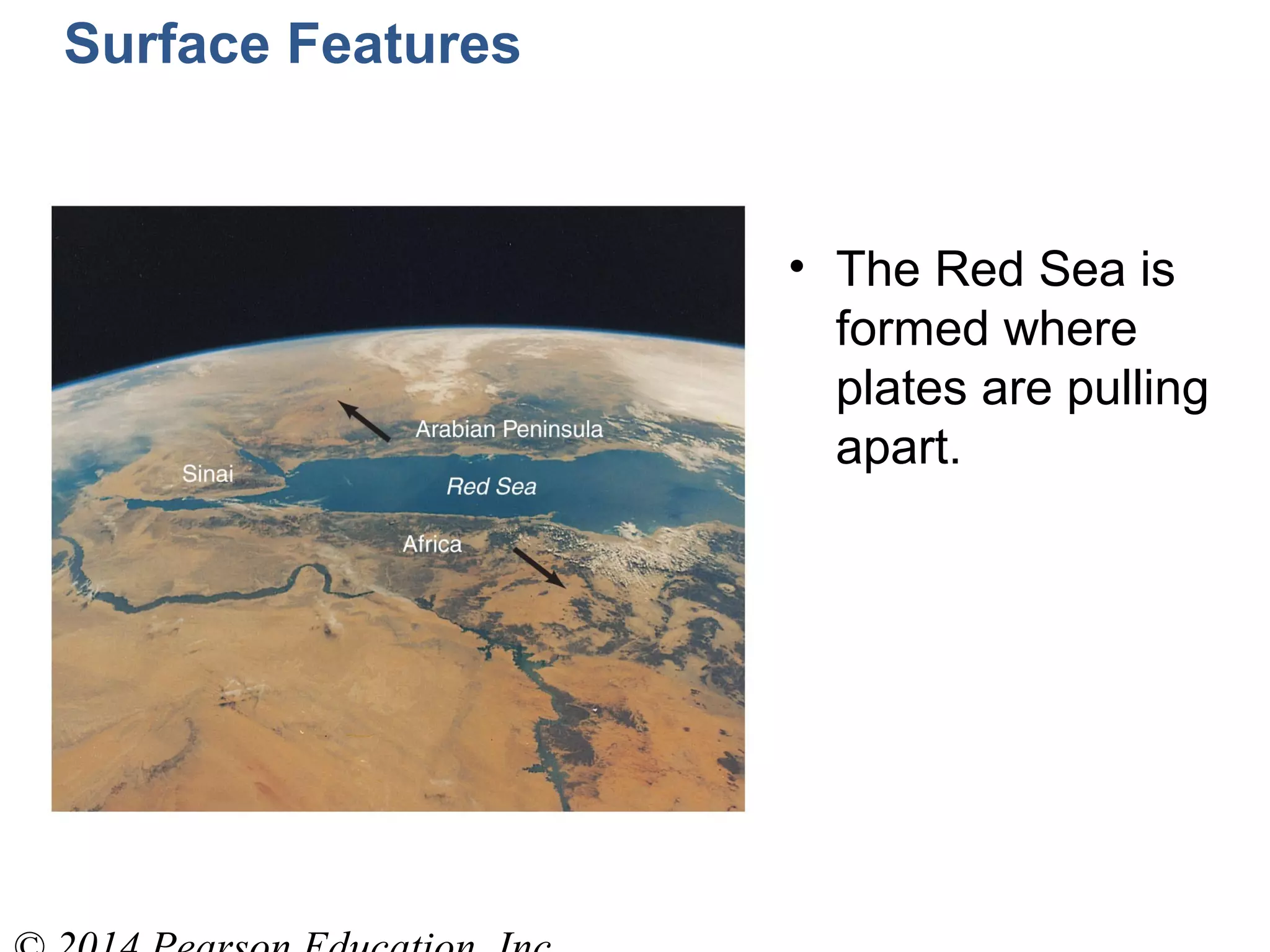
a) It must have metal and rock in it.
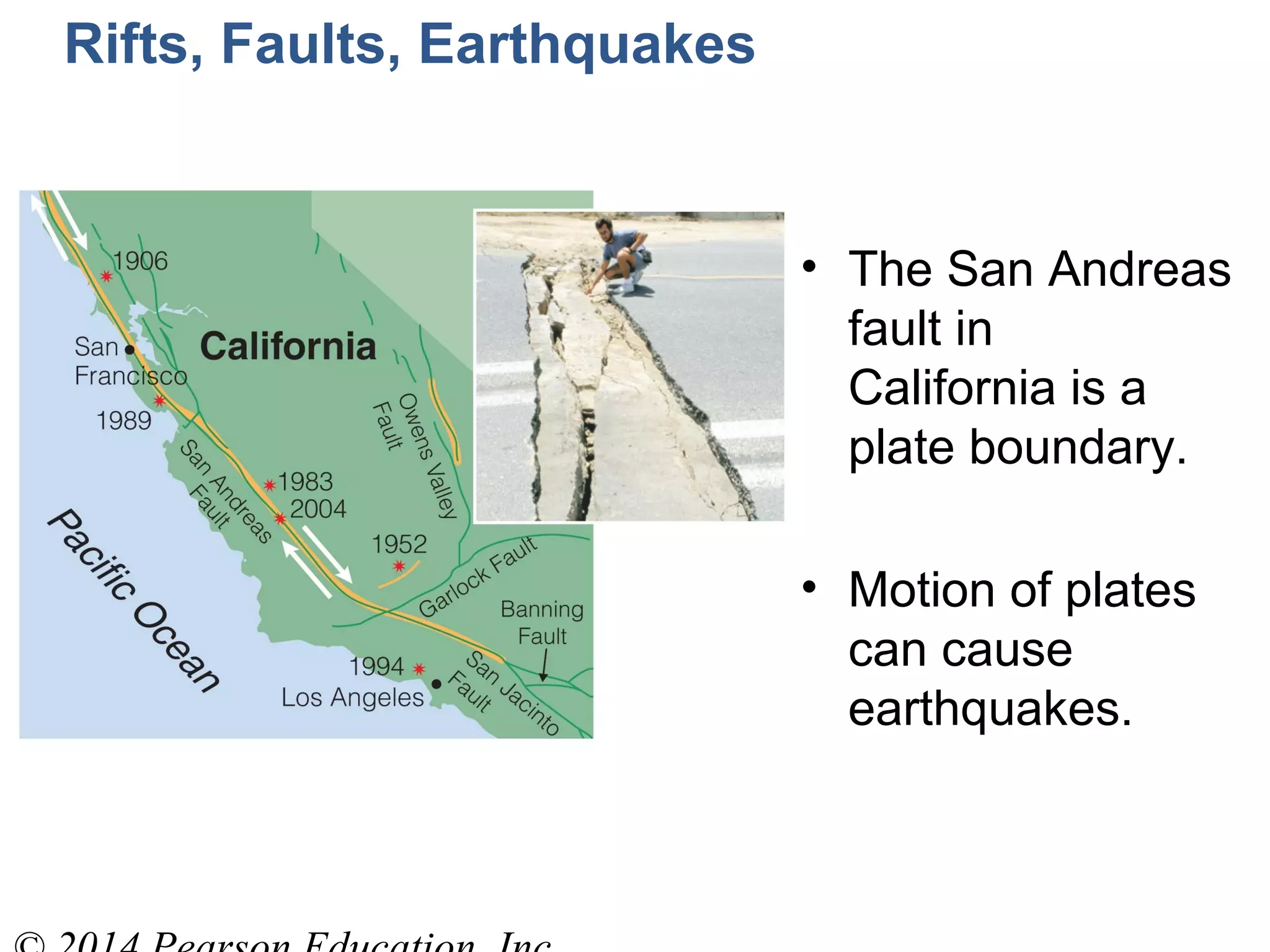
b) It must be a mix of materials of different density.
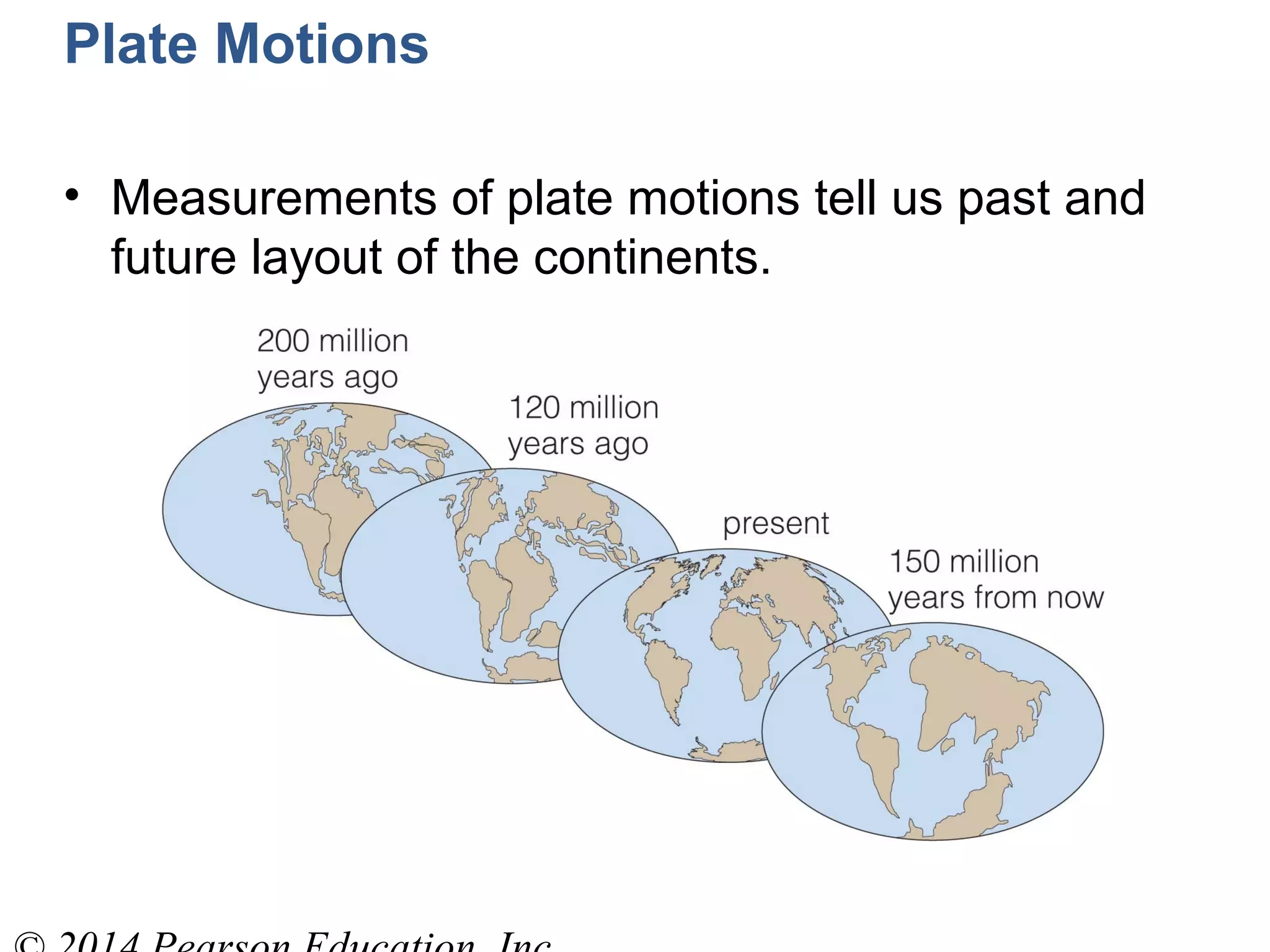
c) Material inside must be able to flow.
d) All of the above
e) b and c
Thought Question
What is necessary for differentiation to occur in a
planet?
a) It must have metal and rock in it.
b) It must be a mix of materials of different density.
c) Material inside must be able to flow.
d) All of the above
e) b and c
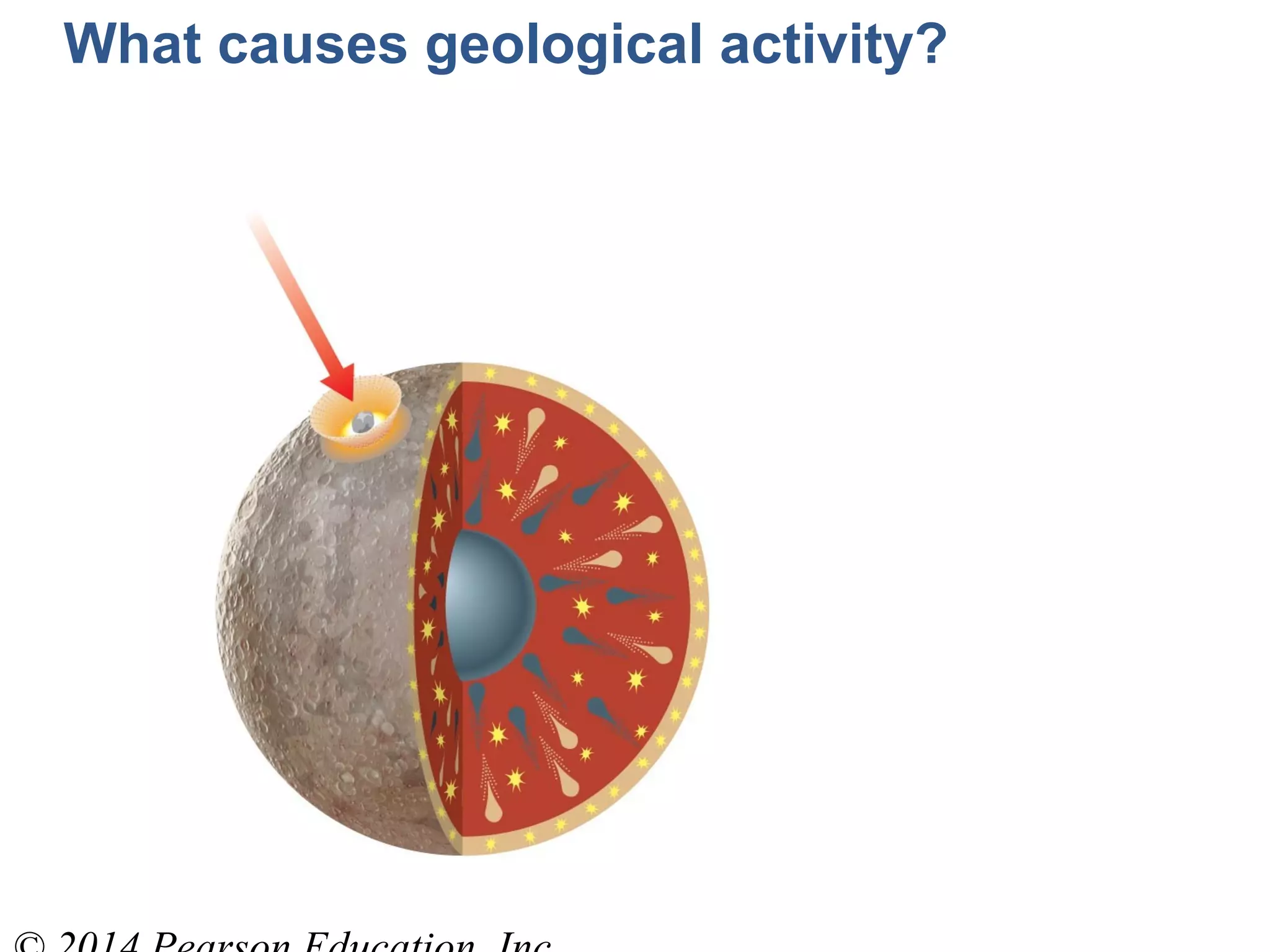
What causes geological activity?
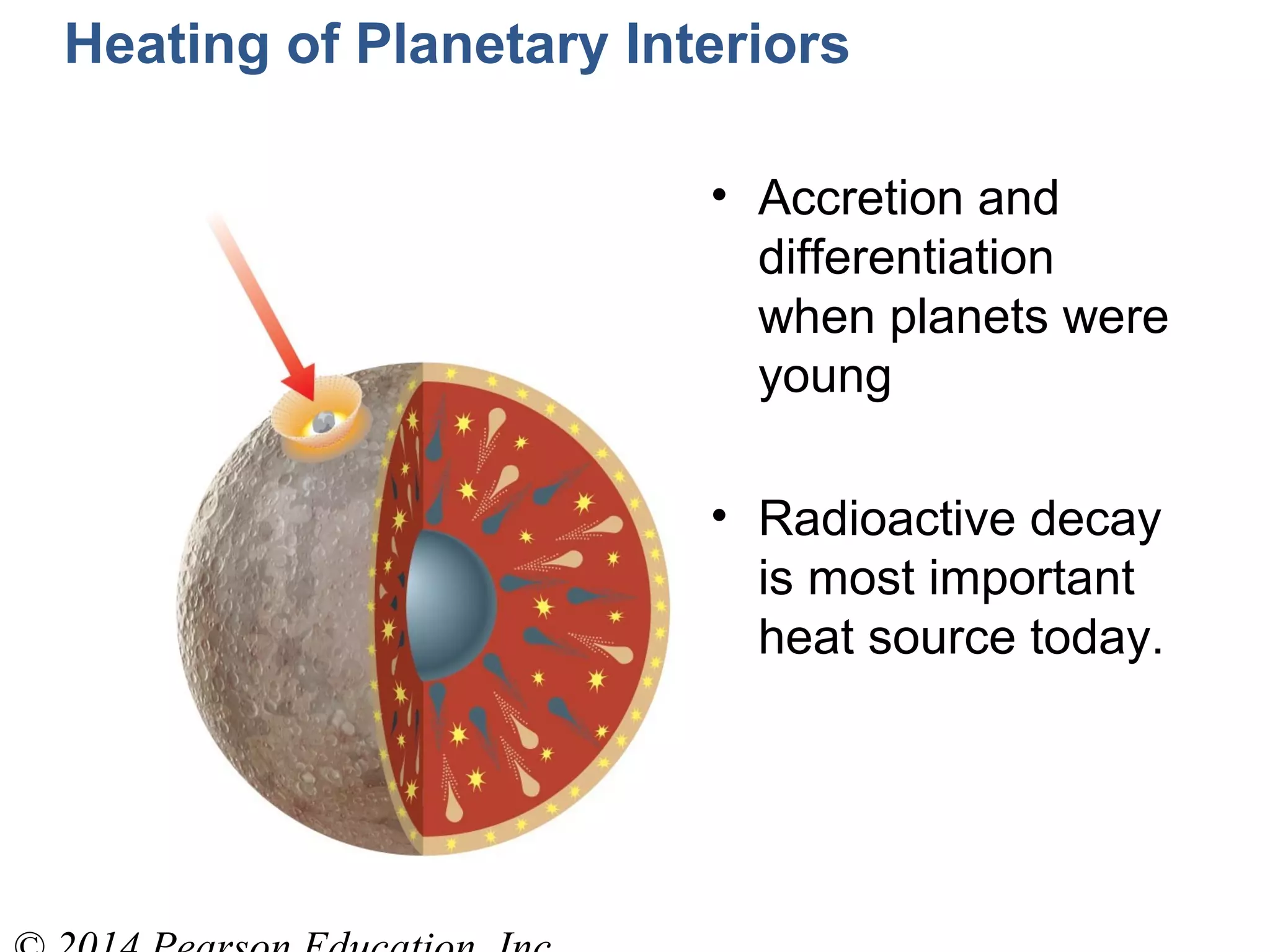
Heating of Planetary Interiors
• Accretion and
differentiation
when planets were
young
• Radioactive decay
is most important
heat source today.
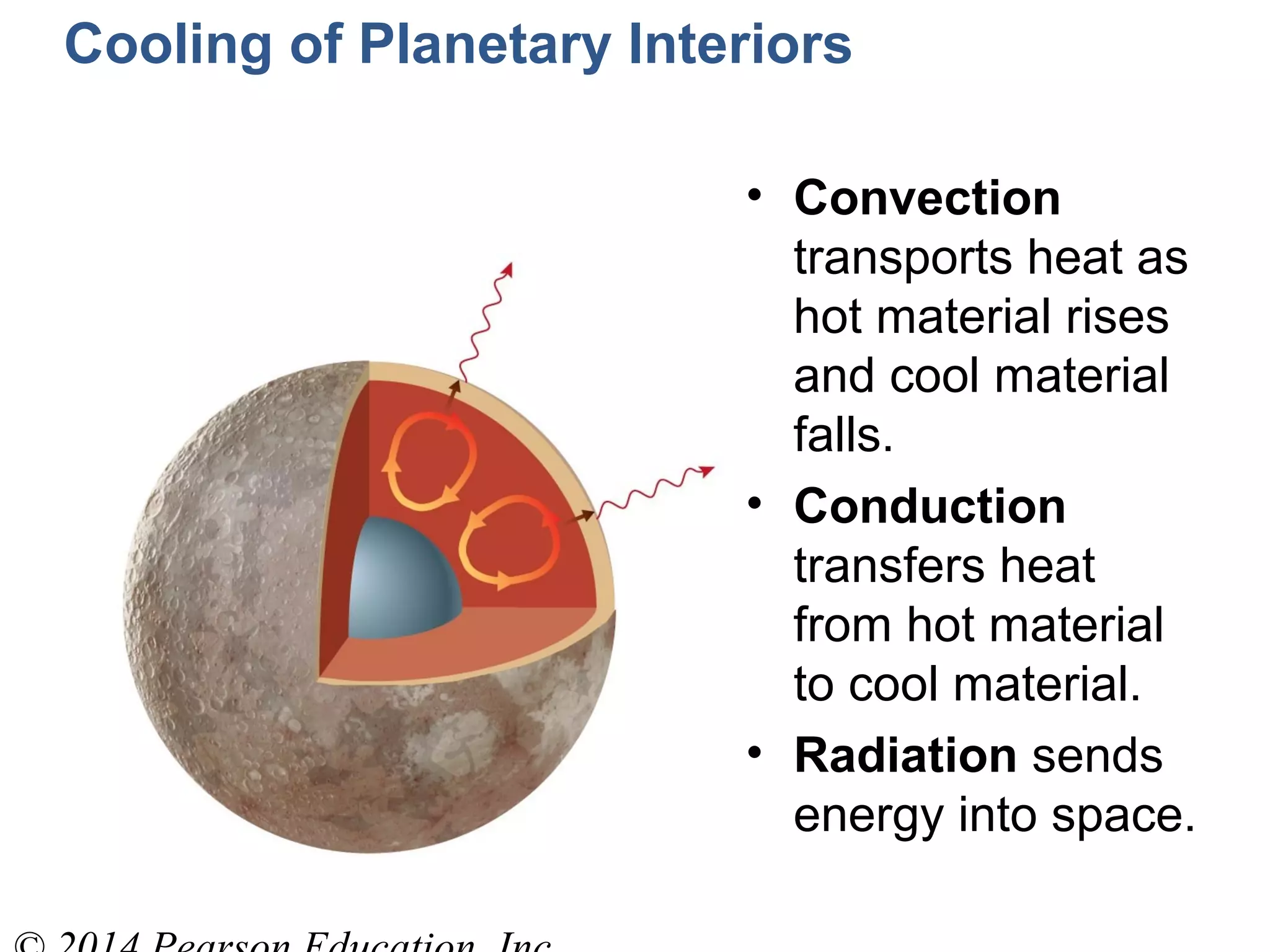
Cooling of Planetary Interiors
• Convection
transports heat as
hot material rises
and cool material
falls.
• Conduction
transfers heat
from hot material
to cool material.
• Radiation sends
energy into space.
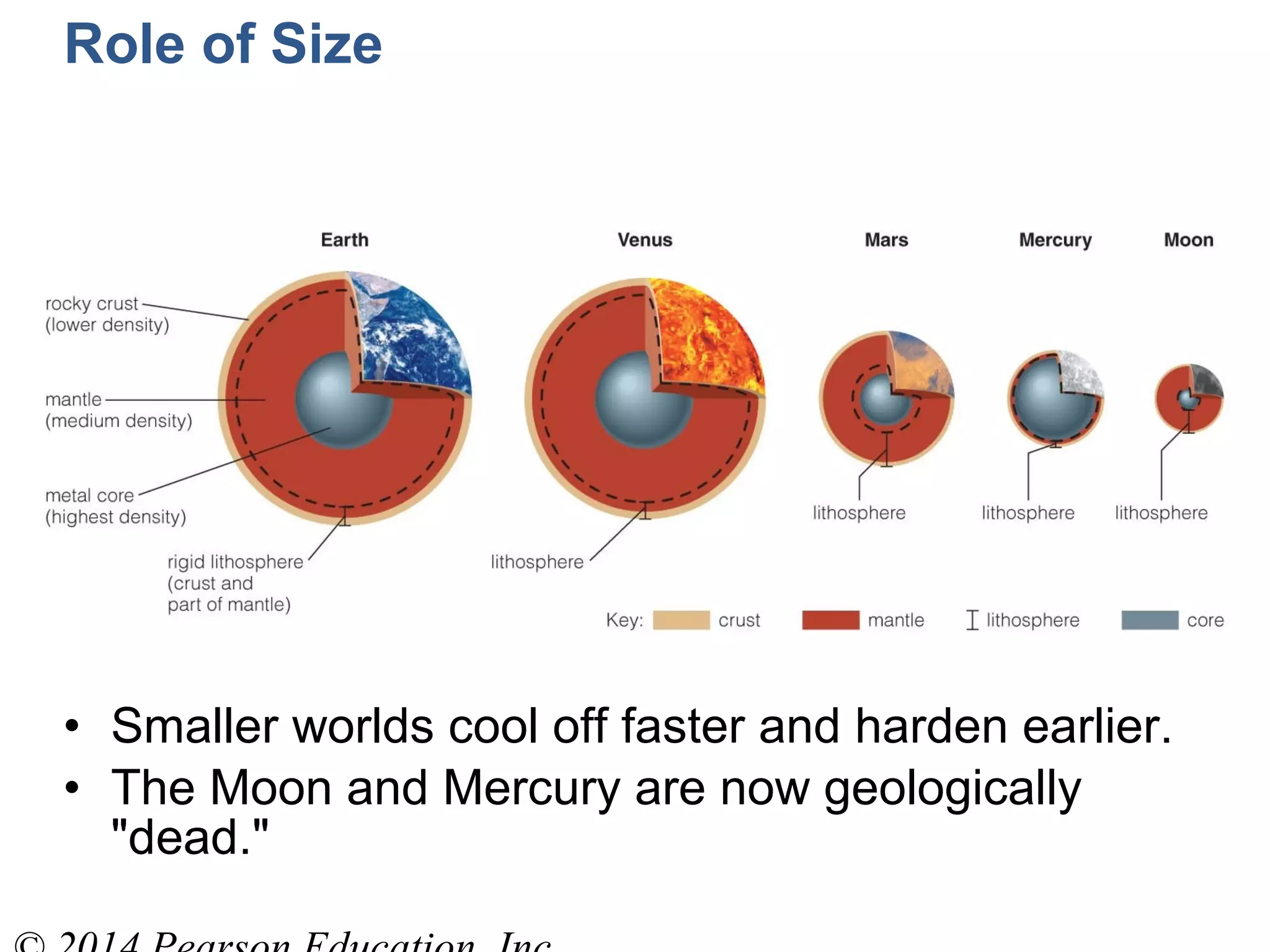
• Smaller worlds cool off faster and harden earlier.
• The Moon and Mercury are now geologically
"dead."
Role of Size
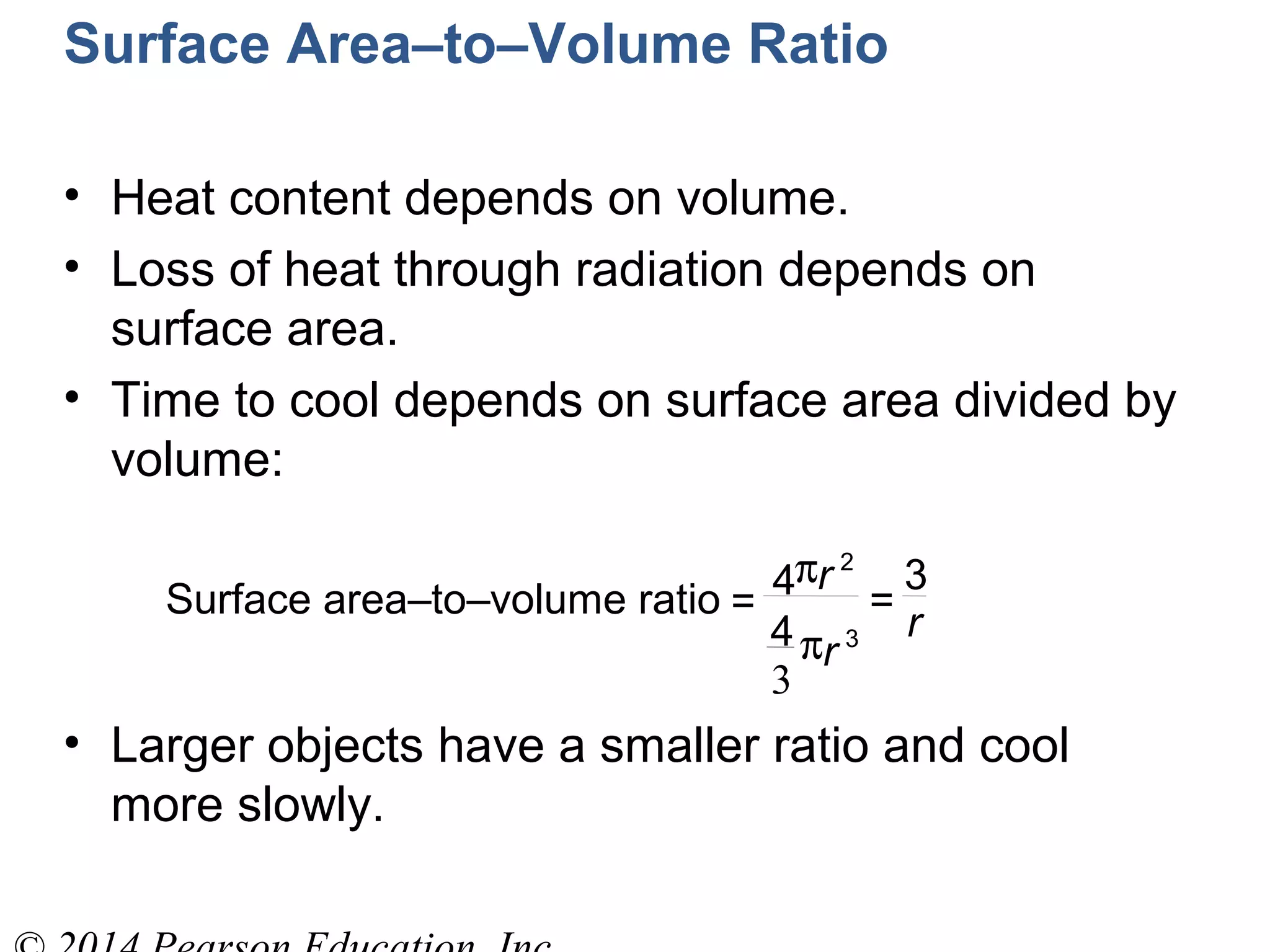
• Heat content depends on volume.
• Loss of heat through radiation depends on
surface area.
• Time to cool depends on surface area divided by
volume:
• Larger objects have a smaller ratio and cool
more slowly.
3
Surface area–to–volume ratio =
4πr 2
4πr 3
=
3
r
Surface Area–to–Volume Ratio
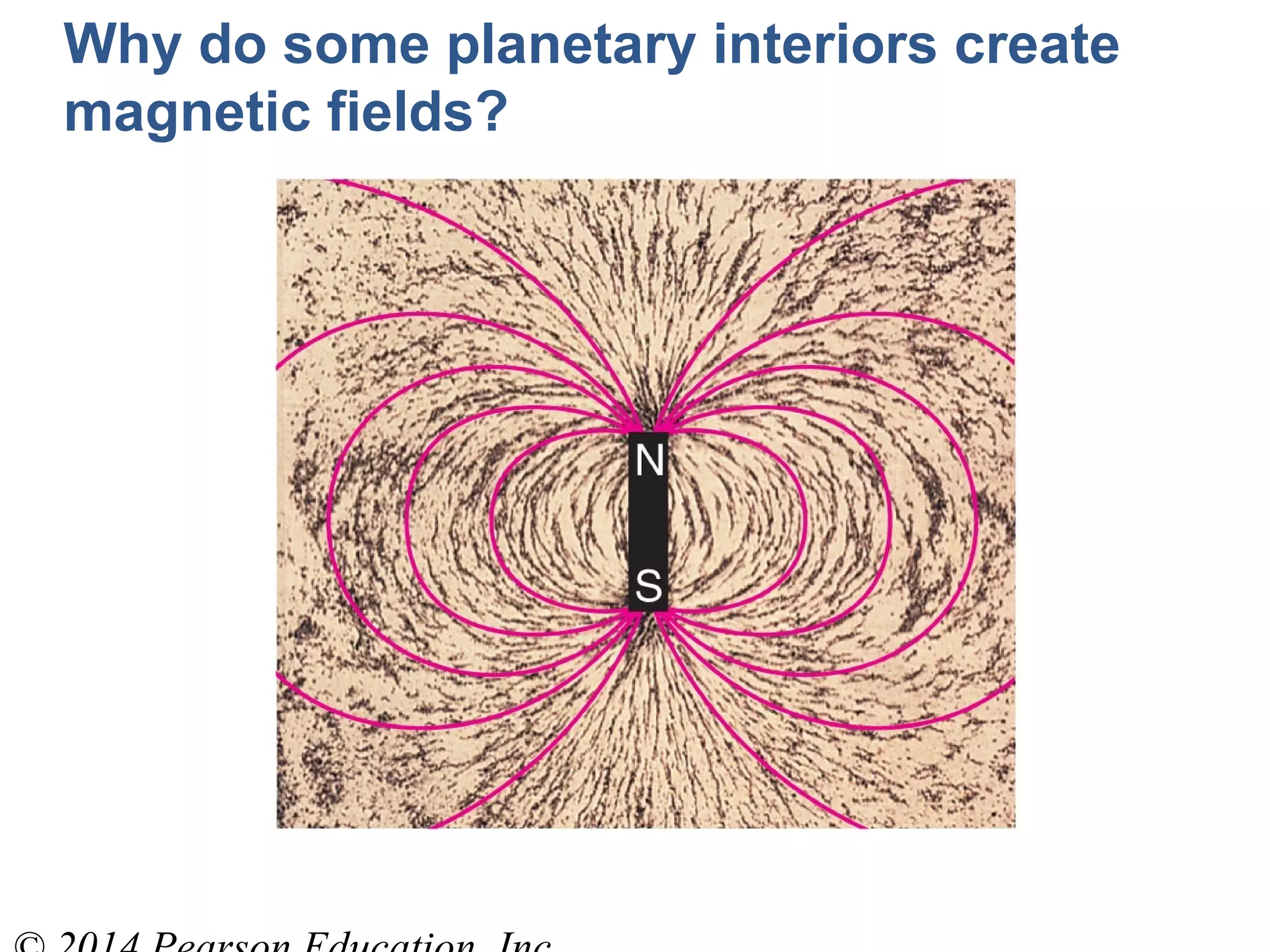
Why do some planetary interiors create
magnetic fields?
Sources of Magnetic Fields
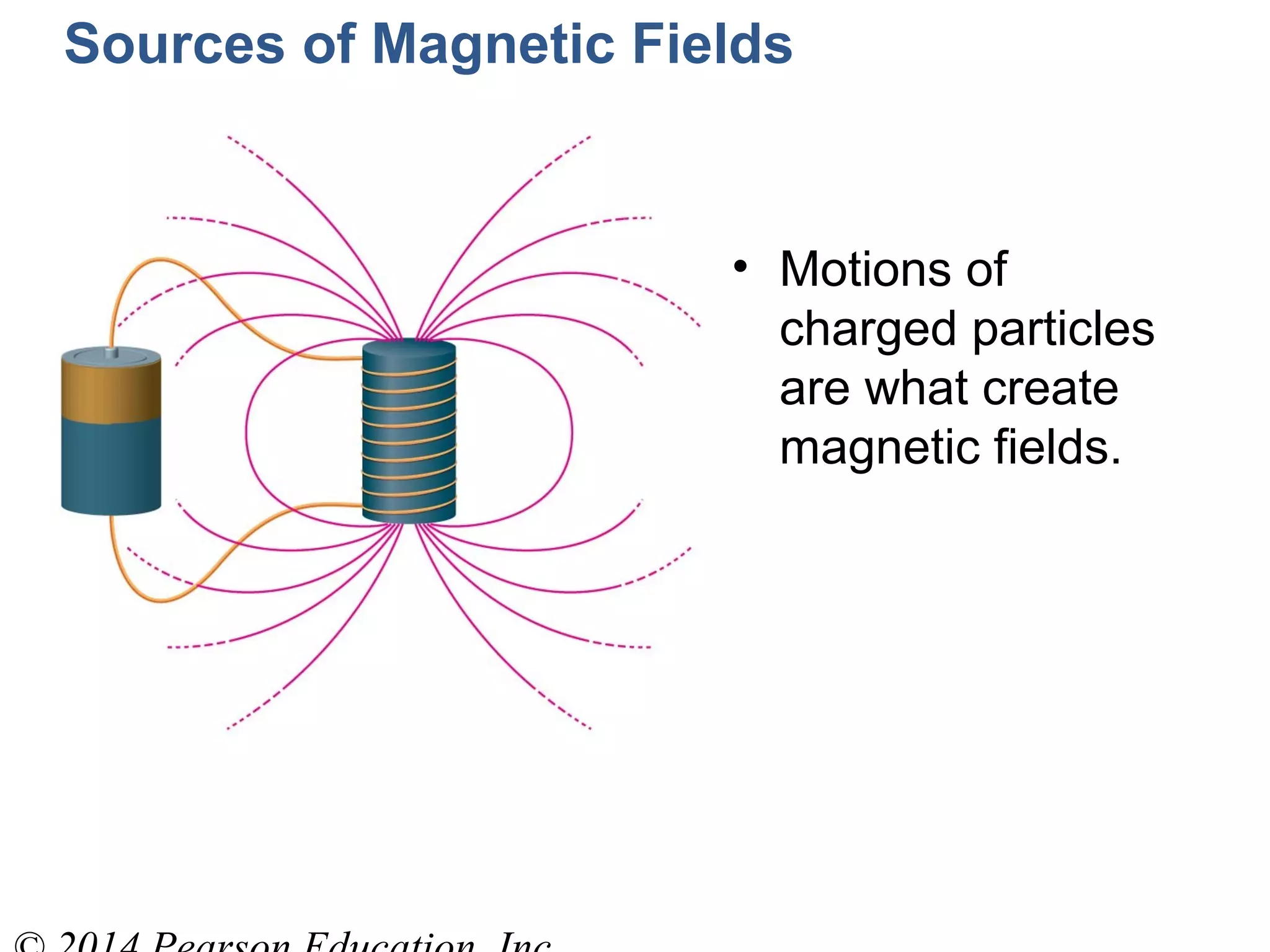
• Motions of
charged particles
are what create
magnetic fields.
Sources of Magnetic Fields
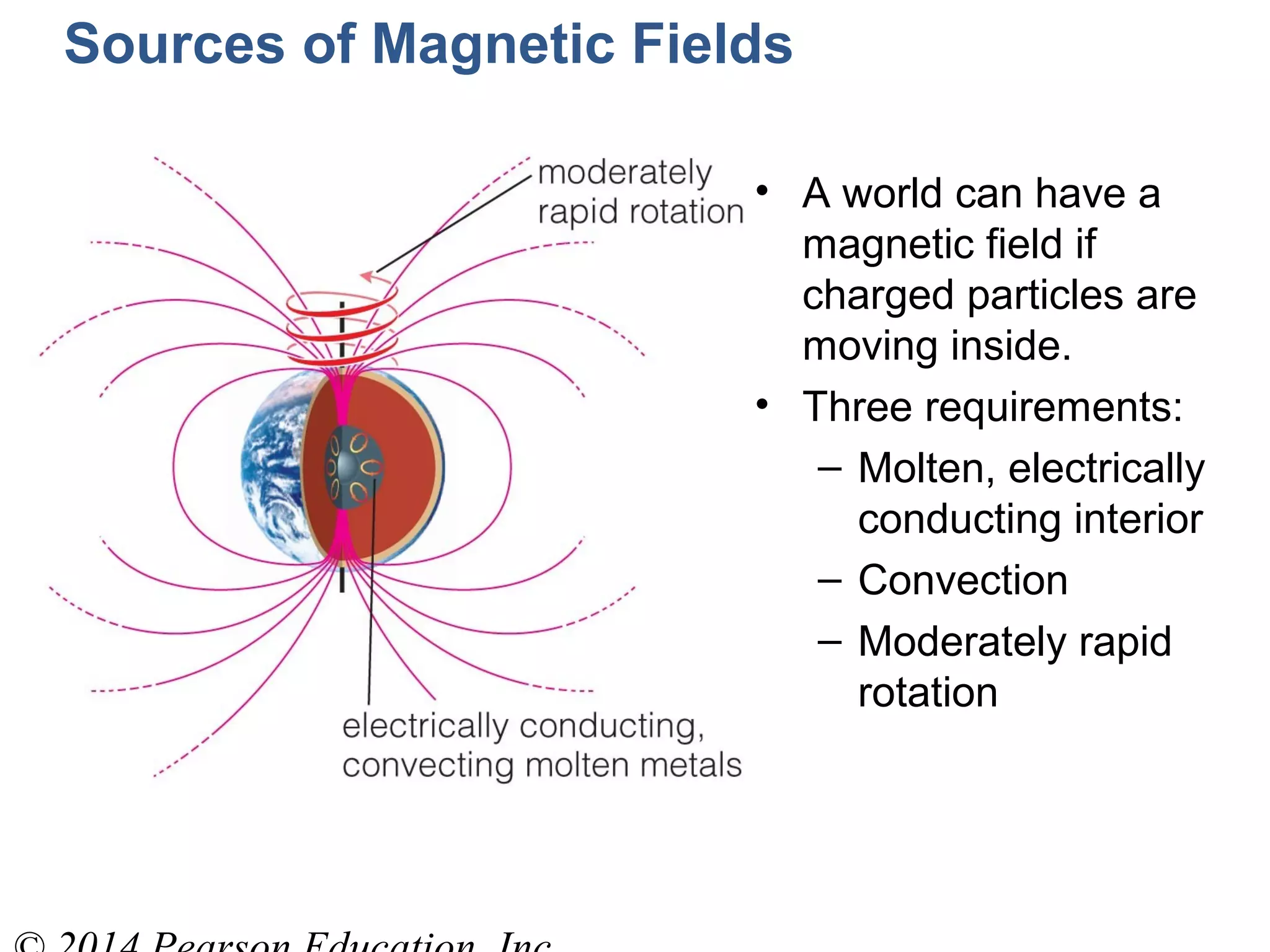
• A world can have a
magnetic field if
charged particles are
moving inside.
• Three requirements:
– Molten, electrically
conducting interior
– Convection
– Moderately rapid
rotation
What have we learned?
• What are terrestrial planets like on the inside?
– All terrestrial worlds have a core, mantle, and crust.
– Denser material is found deeper inside.
• What causes geological activity?
– Interior heat drives geological activity.
– Radioactive decay is currently main heat source.
• Why do some planetary interiors create magnetic
fields?
– Requires motion of charged particles inside a planet
9.2 Shaping Planetary Surfaces
• Our goals for learning:
– What processes shape planetary
surfaces?
– How do impact craters reveal a surface's
geological age?
– Why do the terrestrial planets have
different geological histories?
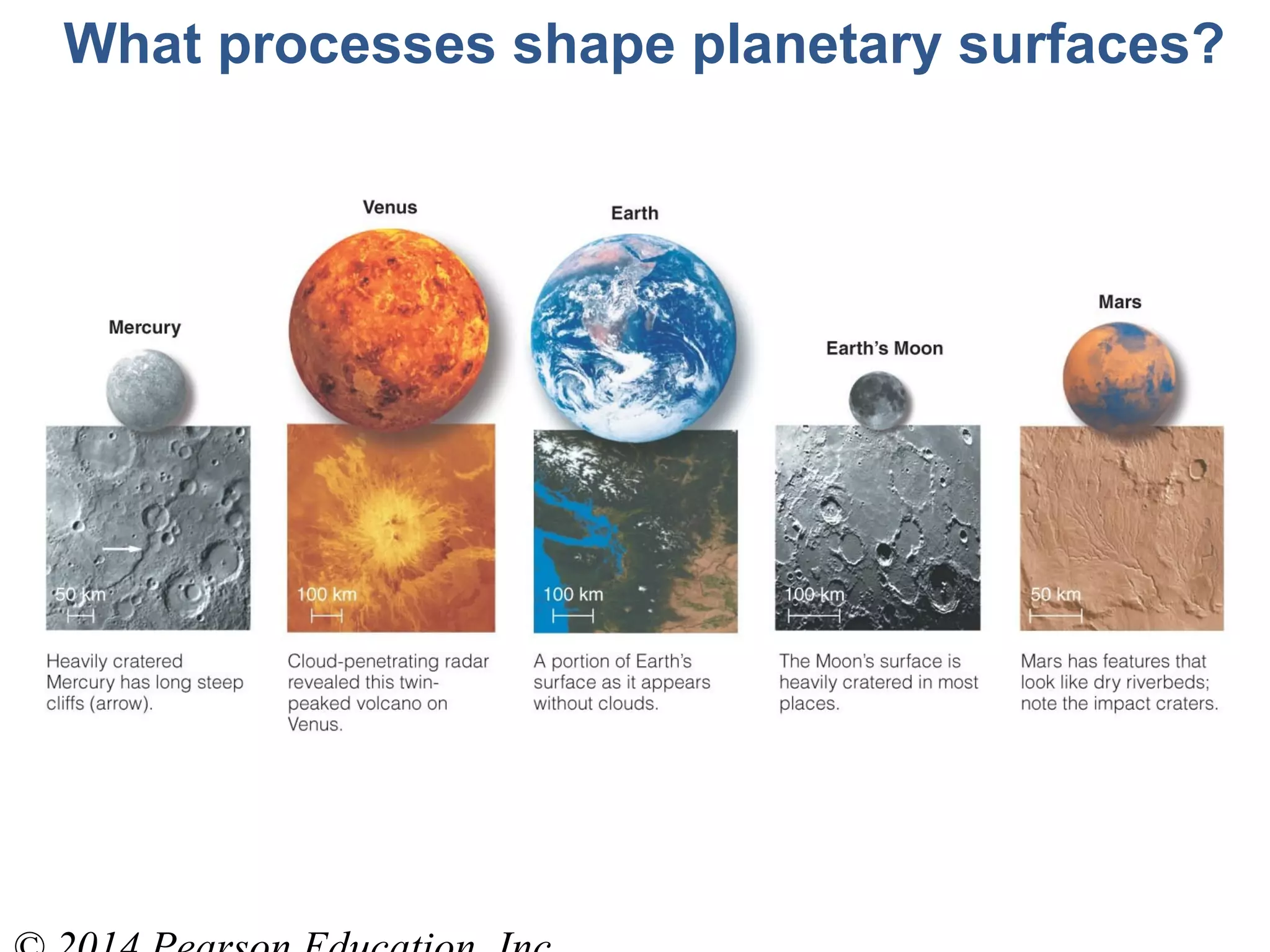
What processes shape planetary surfaces?
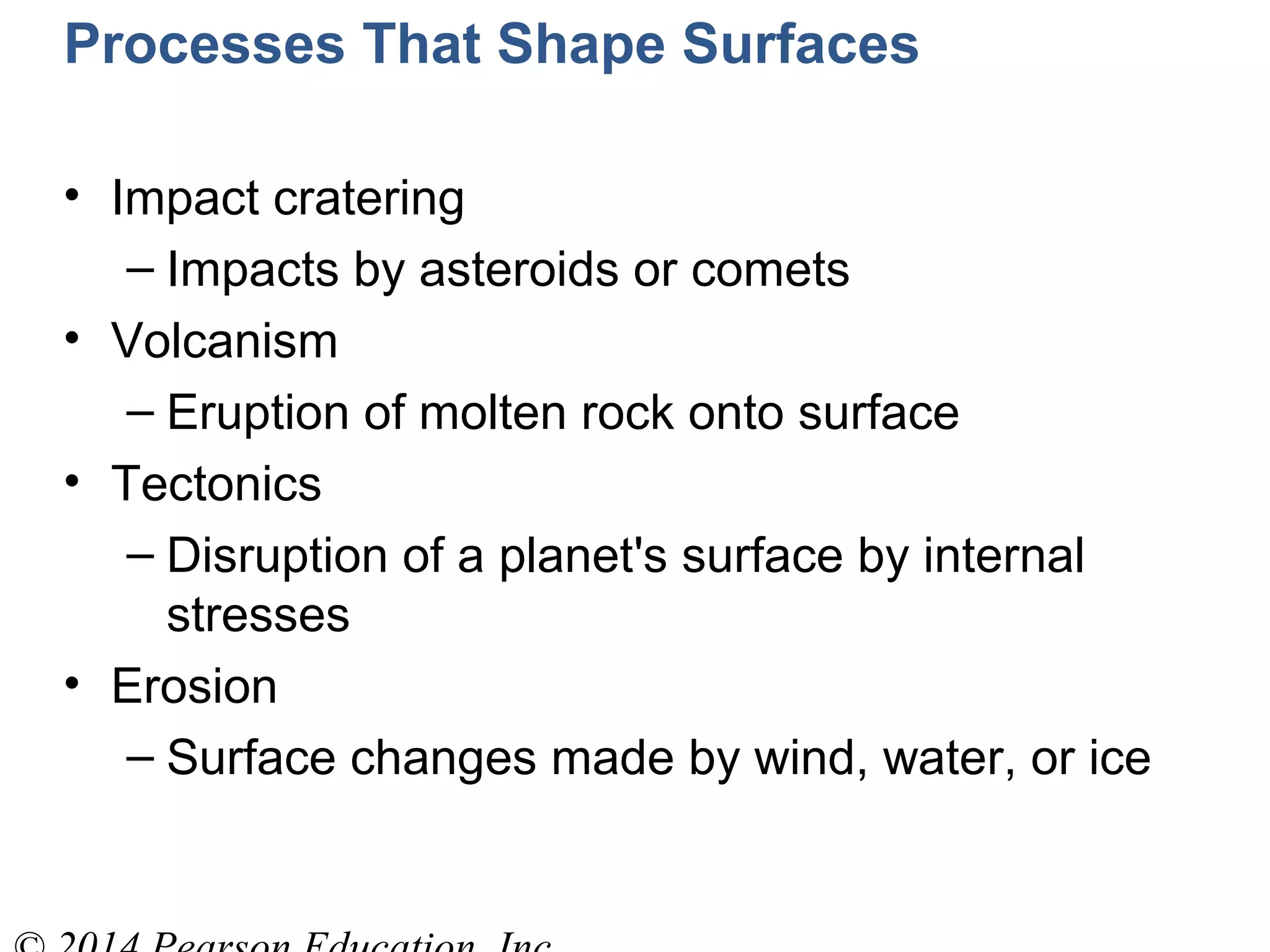
Processes That Shape Surfaces
• Impact cratering
– Impacts by asteroids or comets
• Volcanism
– Eruption of molten rock onto surface
• Tectonics
– Disruption of a planet's surface by internal
stresses
• Erosion
– Surface changes made by wind, water, or ice
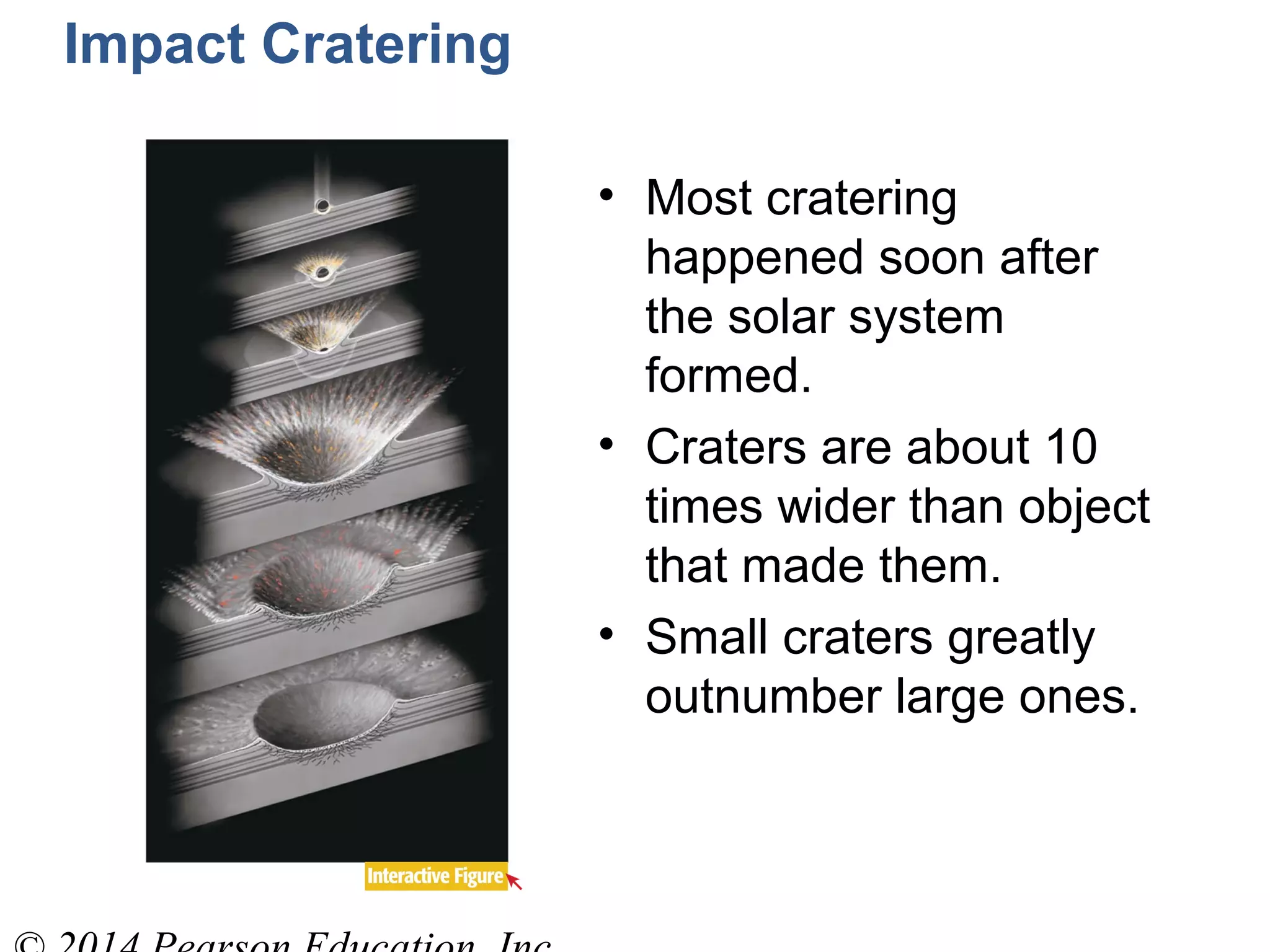
Impact Cratering
• Most cratering
happened soon after
the solar system
formed.
• Craters are about 10
times wider than object
that made them.
• Small craters greatly
outnumber large ones.
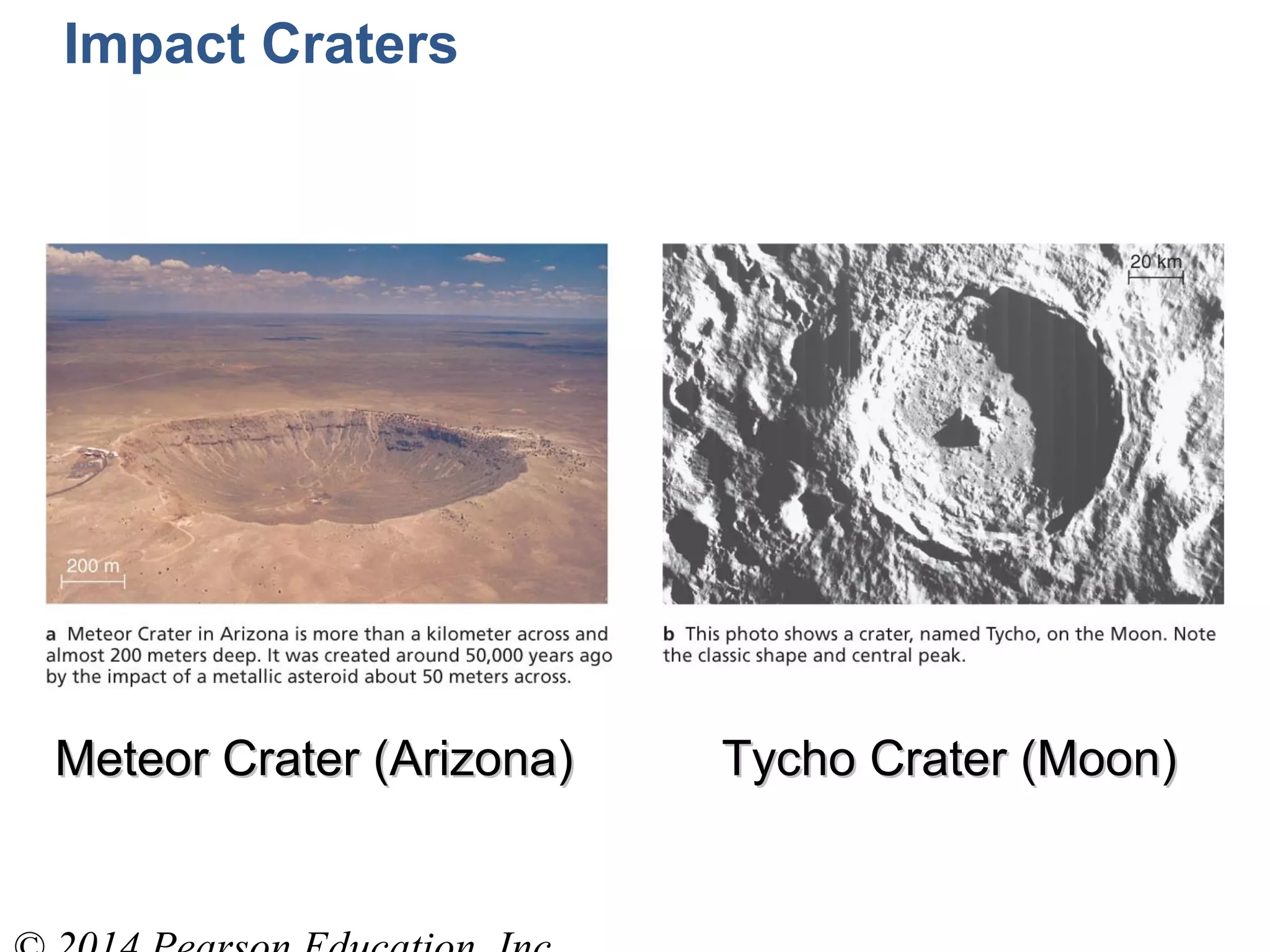
Meteor Crater (Arizona)Meteor Crater (Arizona) Tycho Crater (Moon)Tycho Crater (Moon)
Impact Craters
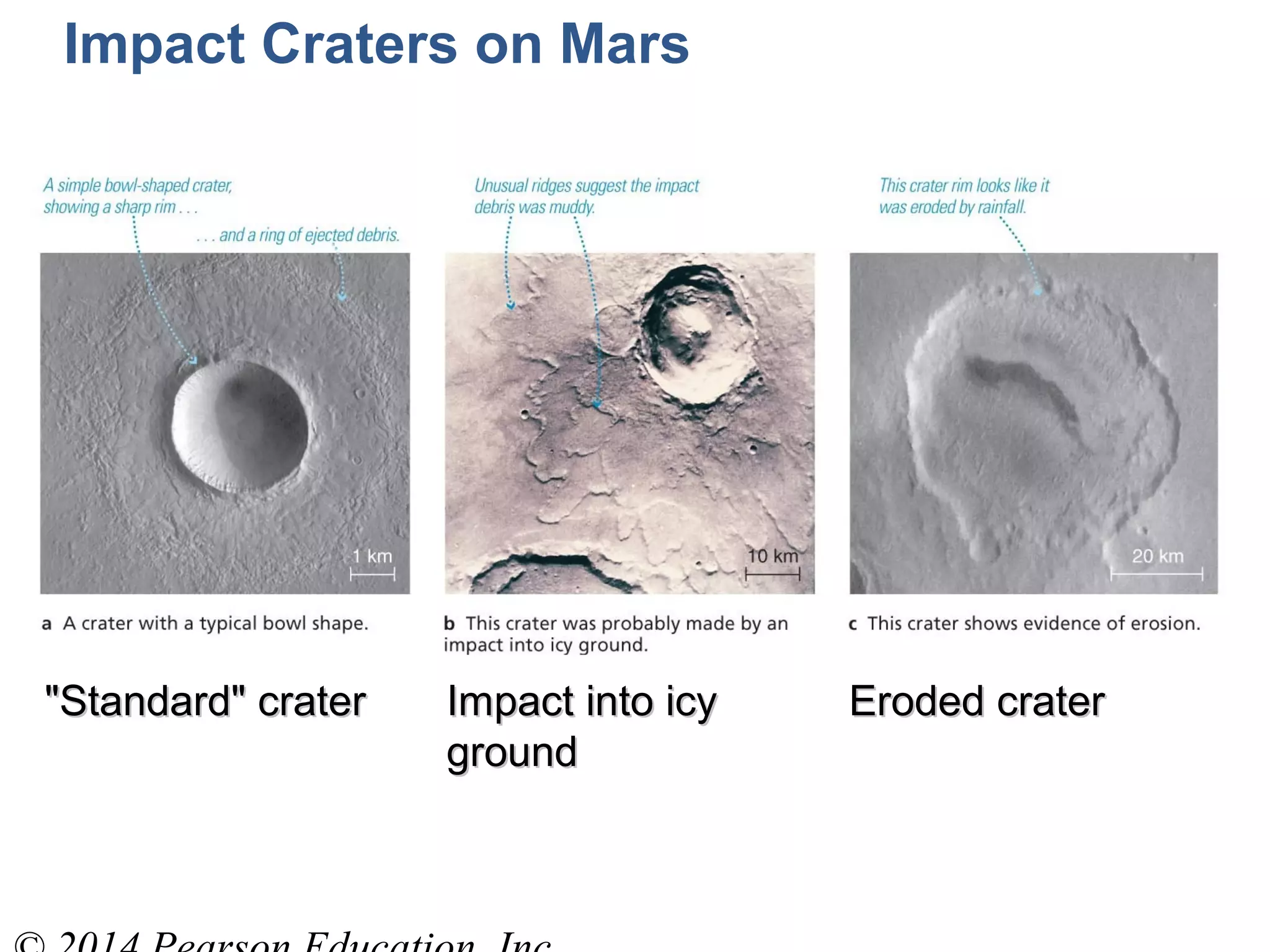
"Standard" crater"Standard" crater Impact into icyImpact into icy
groundground
Eroded craterEroded crater
Impact Craters on Mars
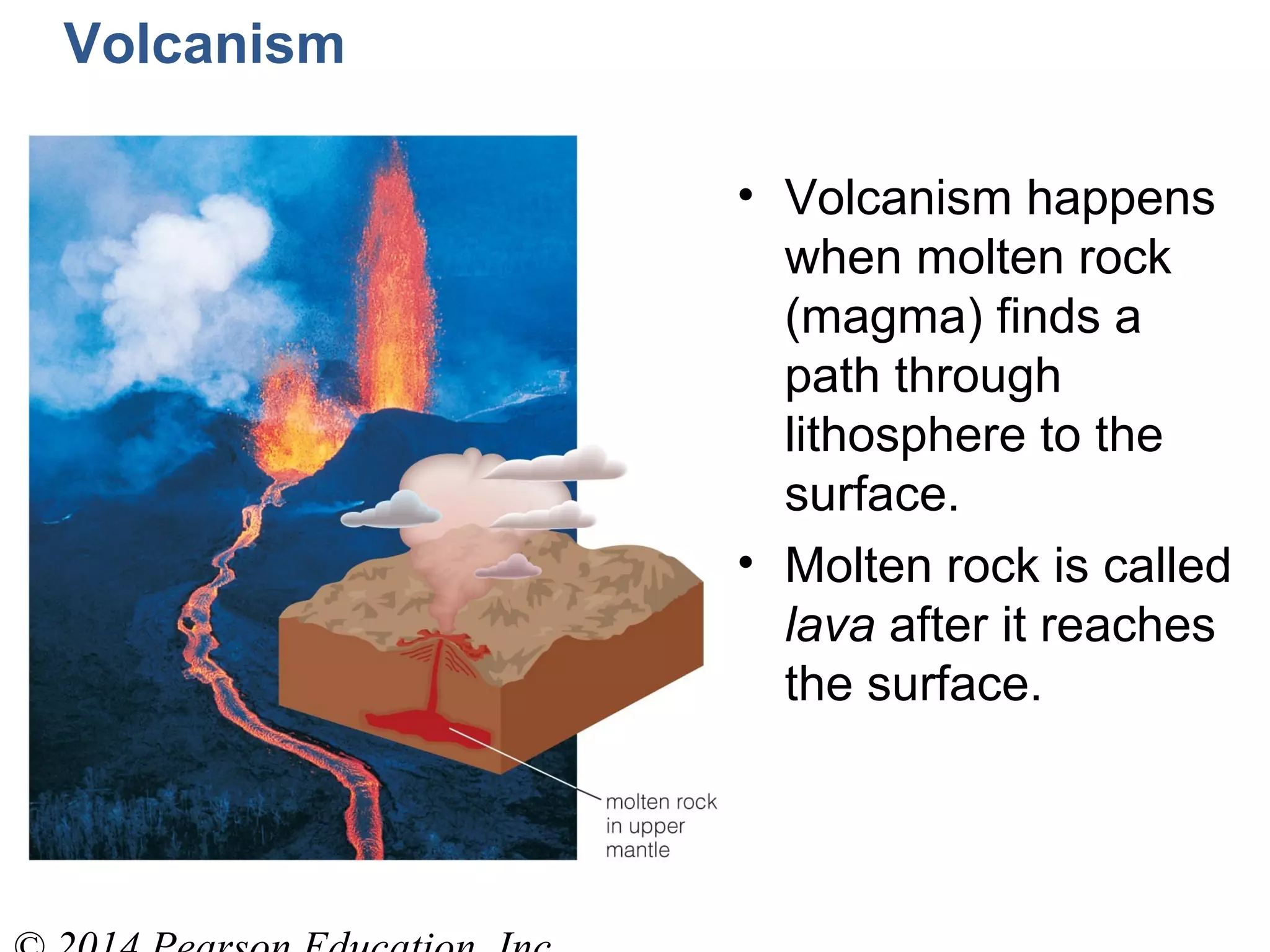
Volcanism
• Volcanism happens
when molten rock
(magma) finds a
path through
lithosphere to the
surface.
• Molten rock is called
lava after it reaches
the surface.
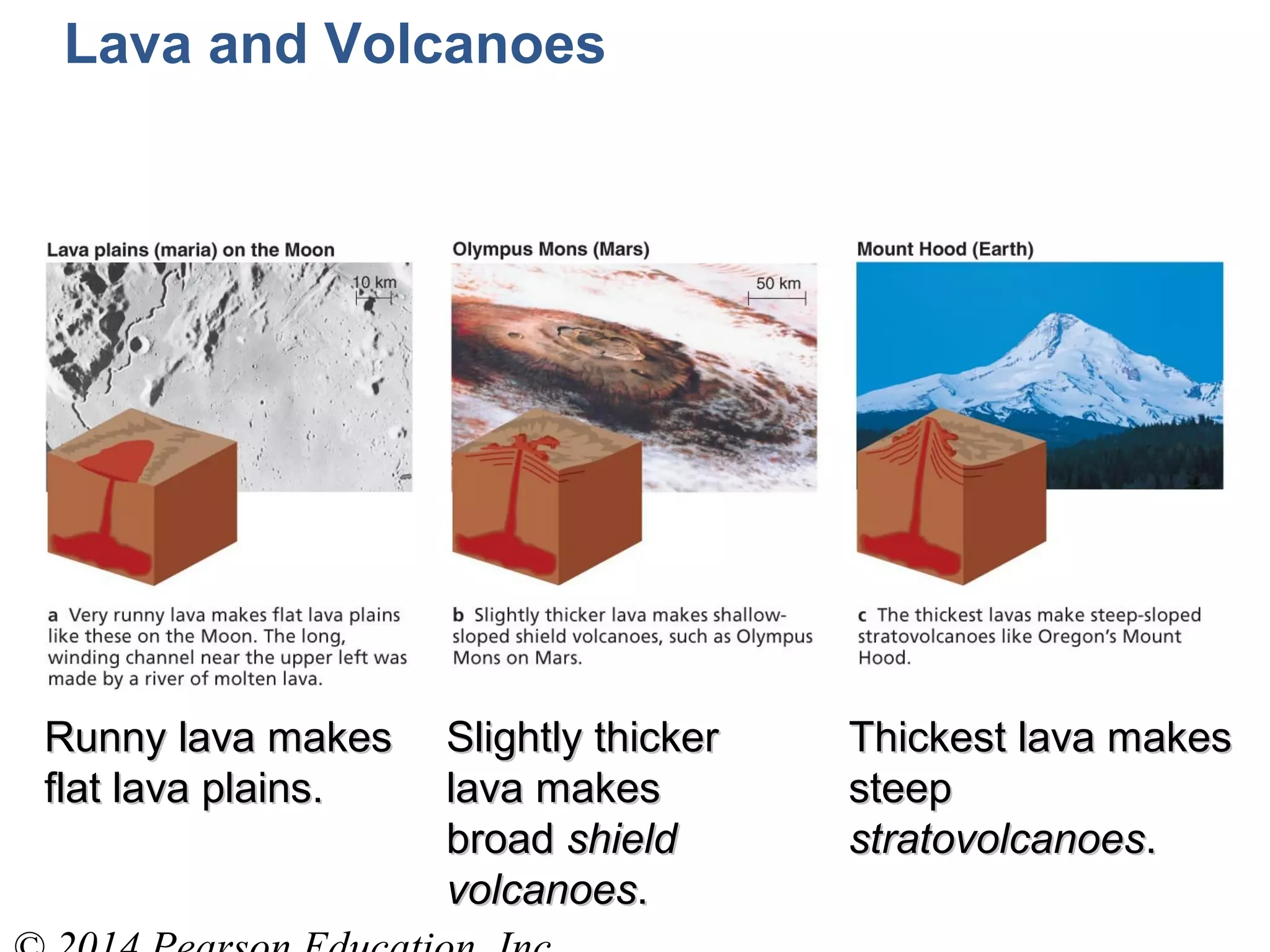
Runny lava makesRunny lava makes
flat lava plains.flat lava plains.
Slightly thickerSlightly thicker
lava makeslava makes
broadbroad shieldshield
volcanoesvolcanoes..
Thickest lava makesThickest lava makes
steepsteep
stratovolcanoesstratovolcanoes..
Lava and Volcanoes
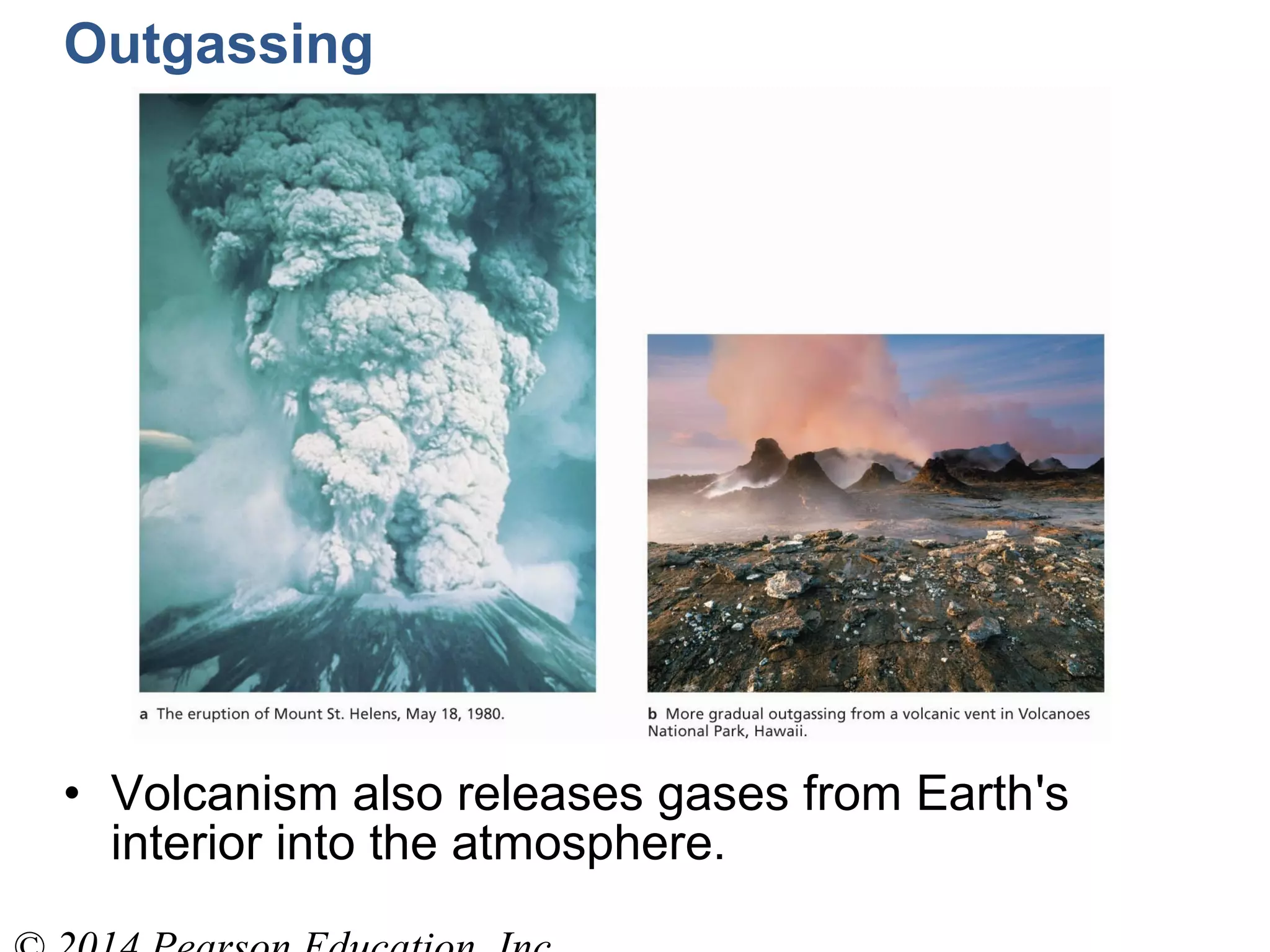
• Volcanism also releases gases from Earth's
interior into the atmosphere.
Outgassing
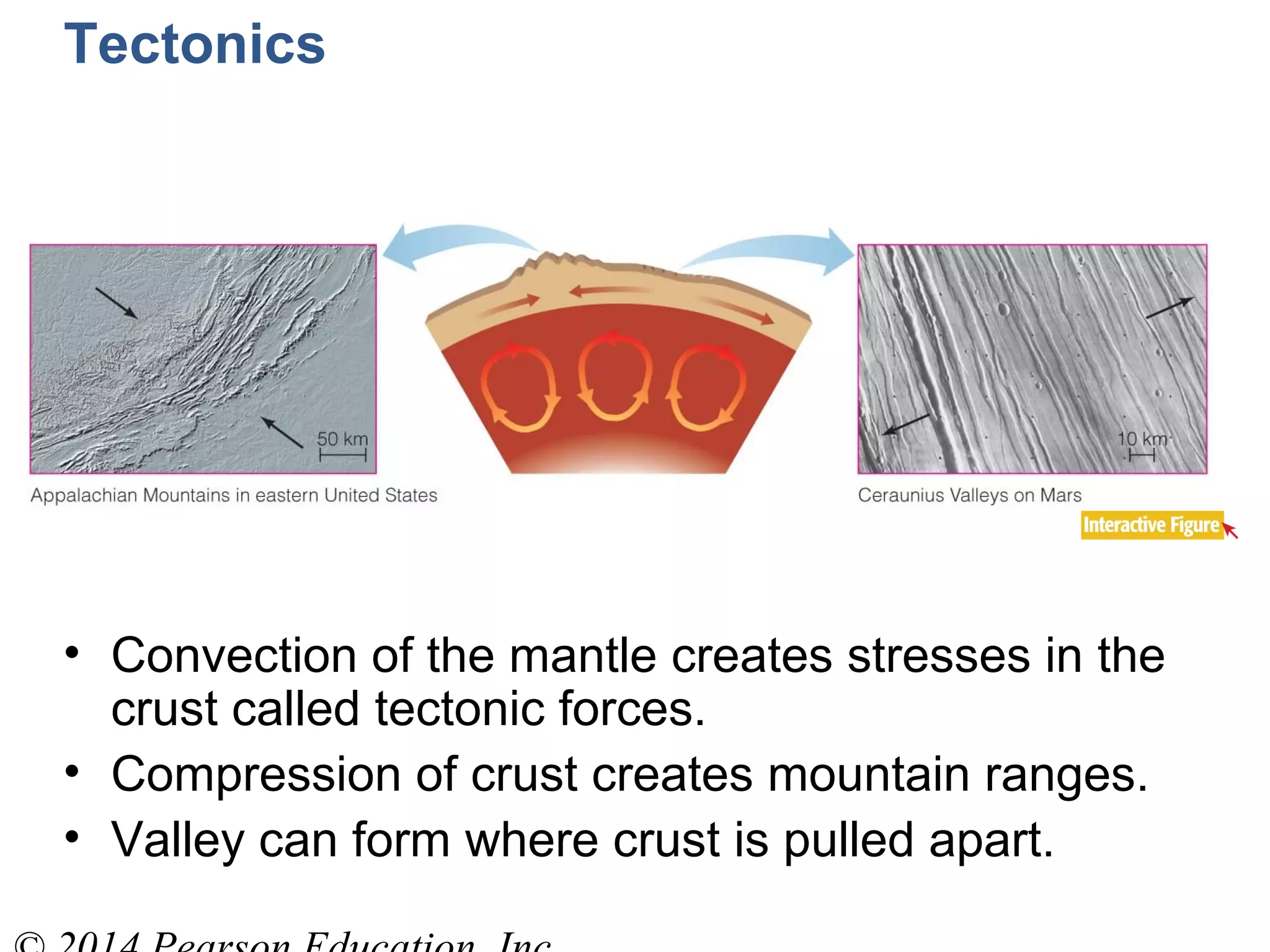
• Convection of the mantle creates stresses in the
crust called tectonic forces.
• Compression of crust creates mountain ranges.
• Valley can form where crust is pulled apart.
Tectonics
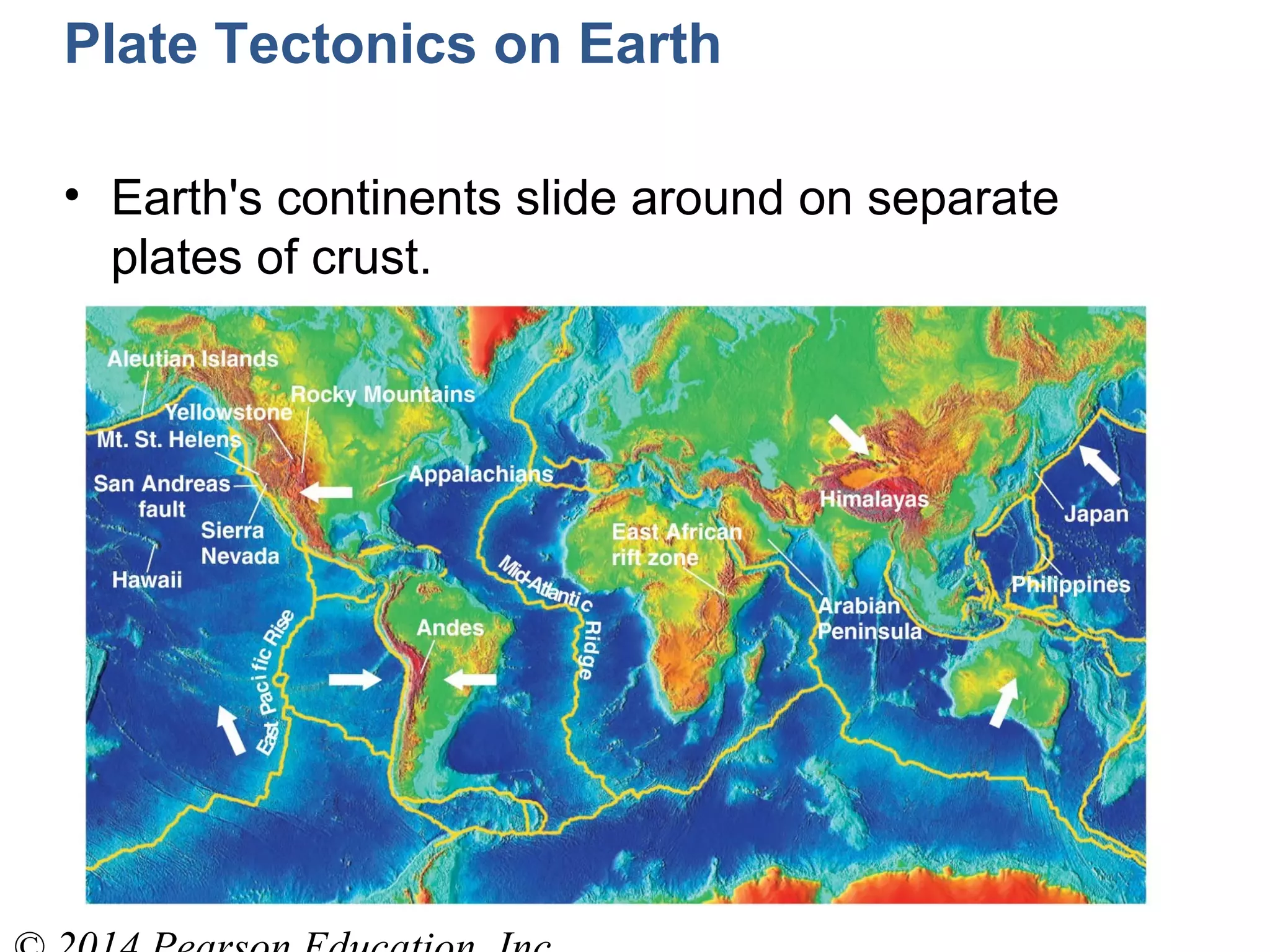
Plate Tectonics on Earth
• Earth's continents slide around on separate
plates of crust.
Erosion
• Erosion is a blanket term for weather-driven
processes that break down or transport rock.
• Processes that cause erosion include:
– glaciers
– rivers
– wind
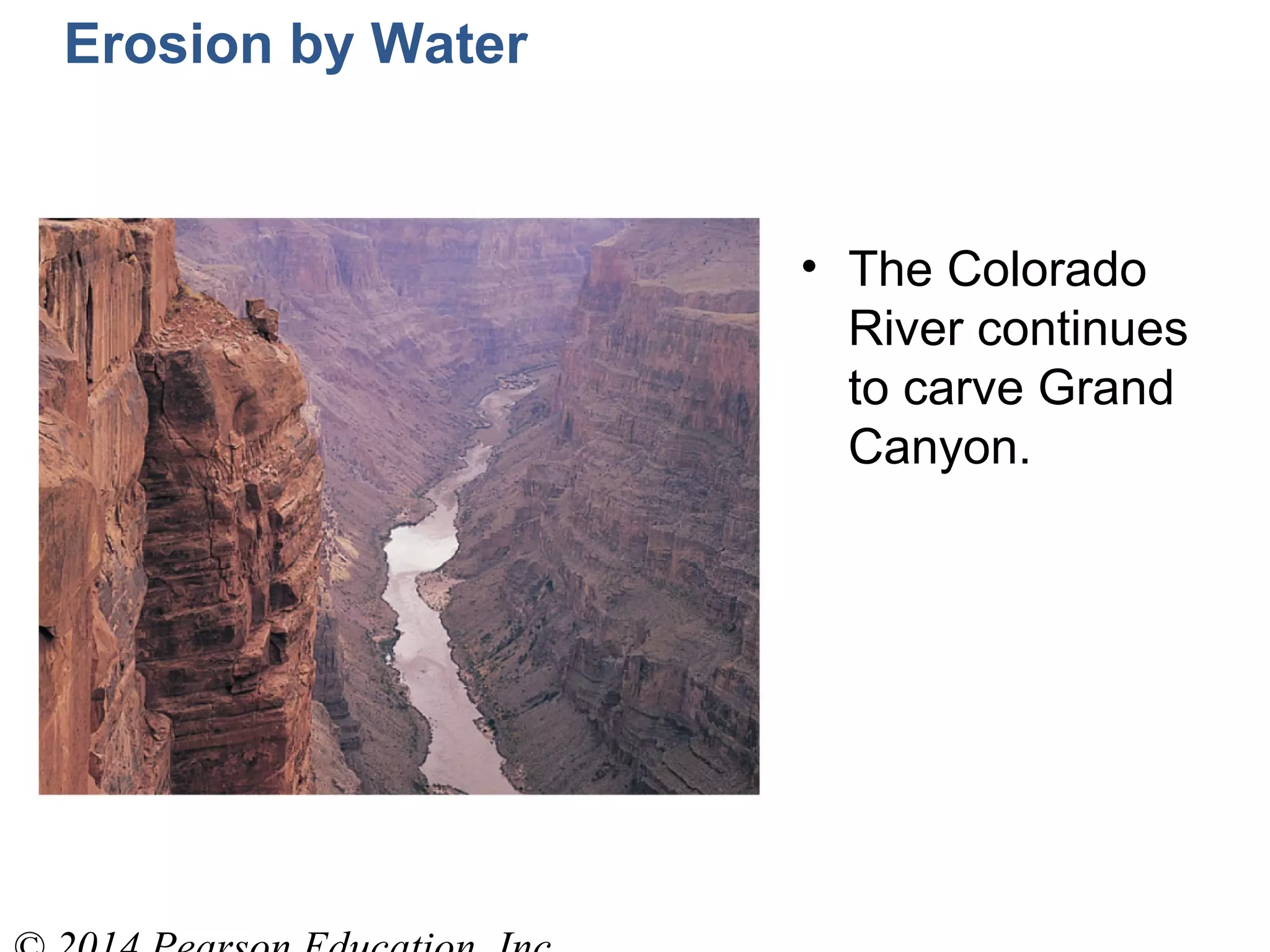
Erosion by Water
• The Colorado
River continues
to carve Grand
Canyon.
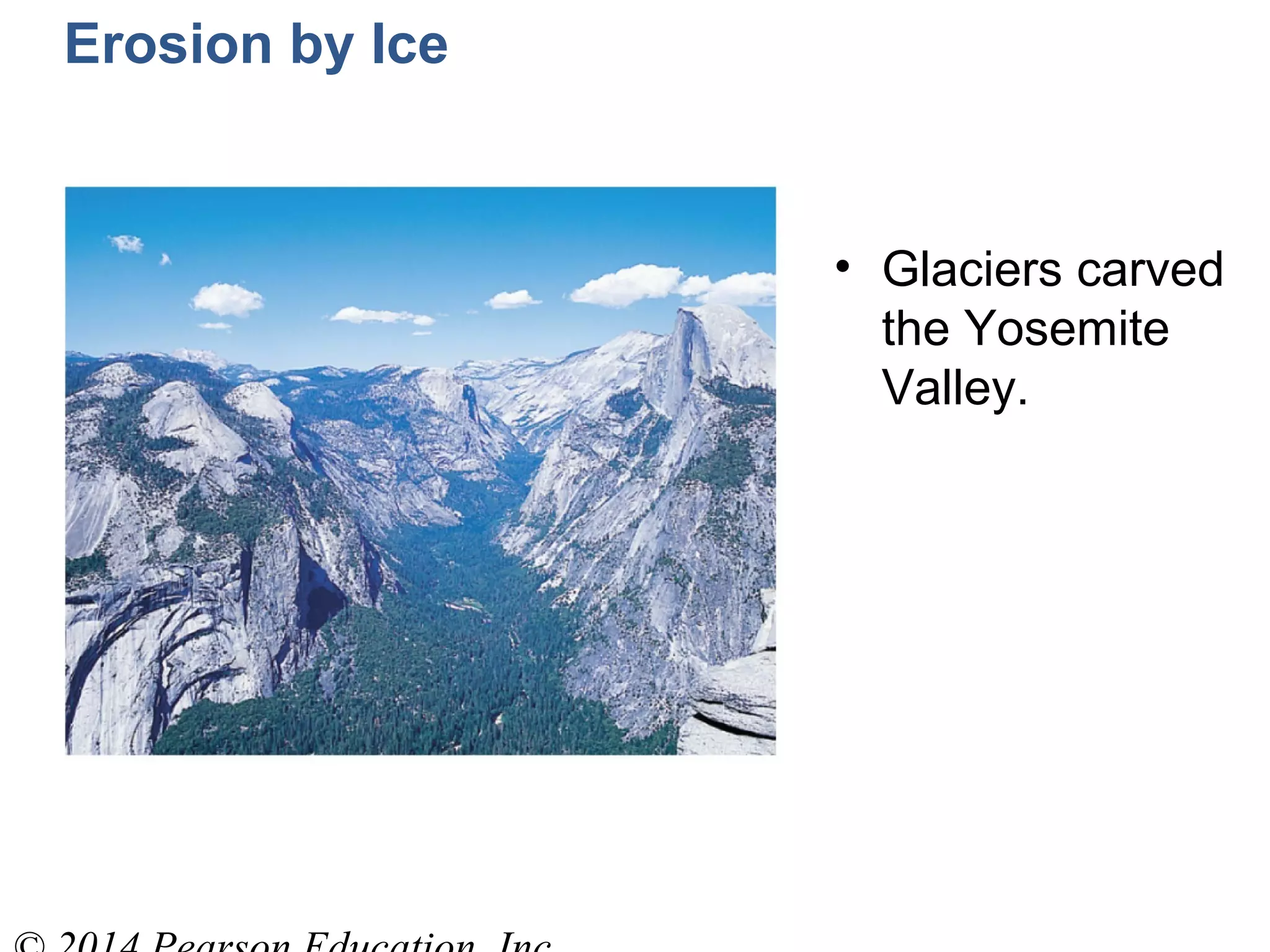
Erosion by Ice
• Glaciers carved
the Yosemite
Valley.
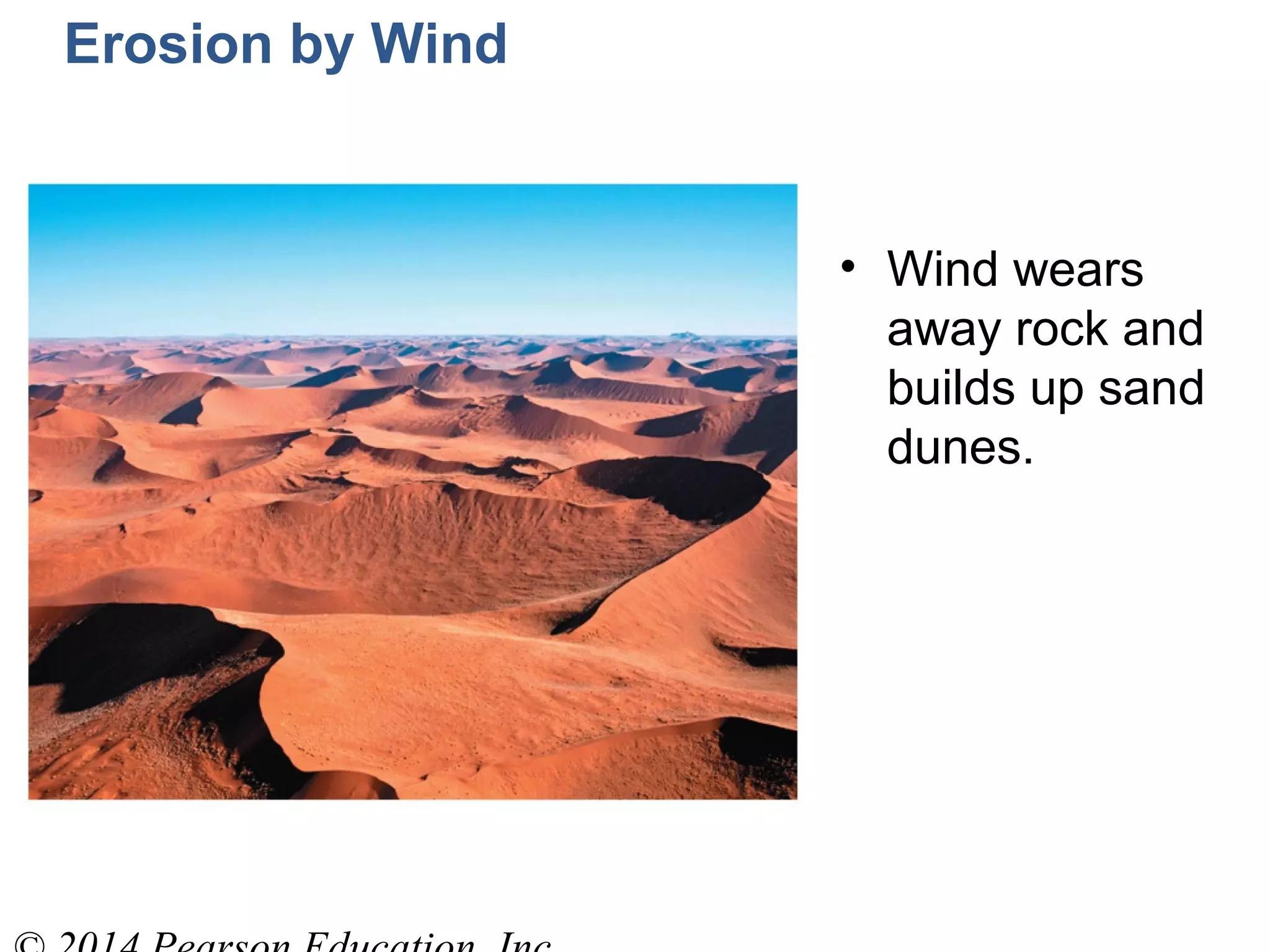
Erosion by Wind
• Wind wears
away rock and
builds up sand
dunes.
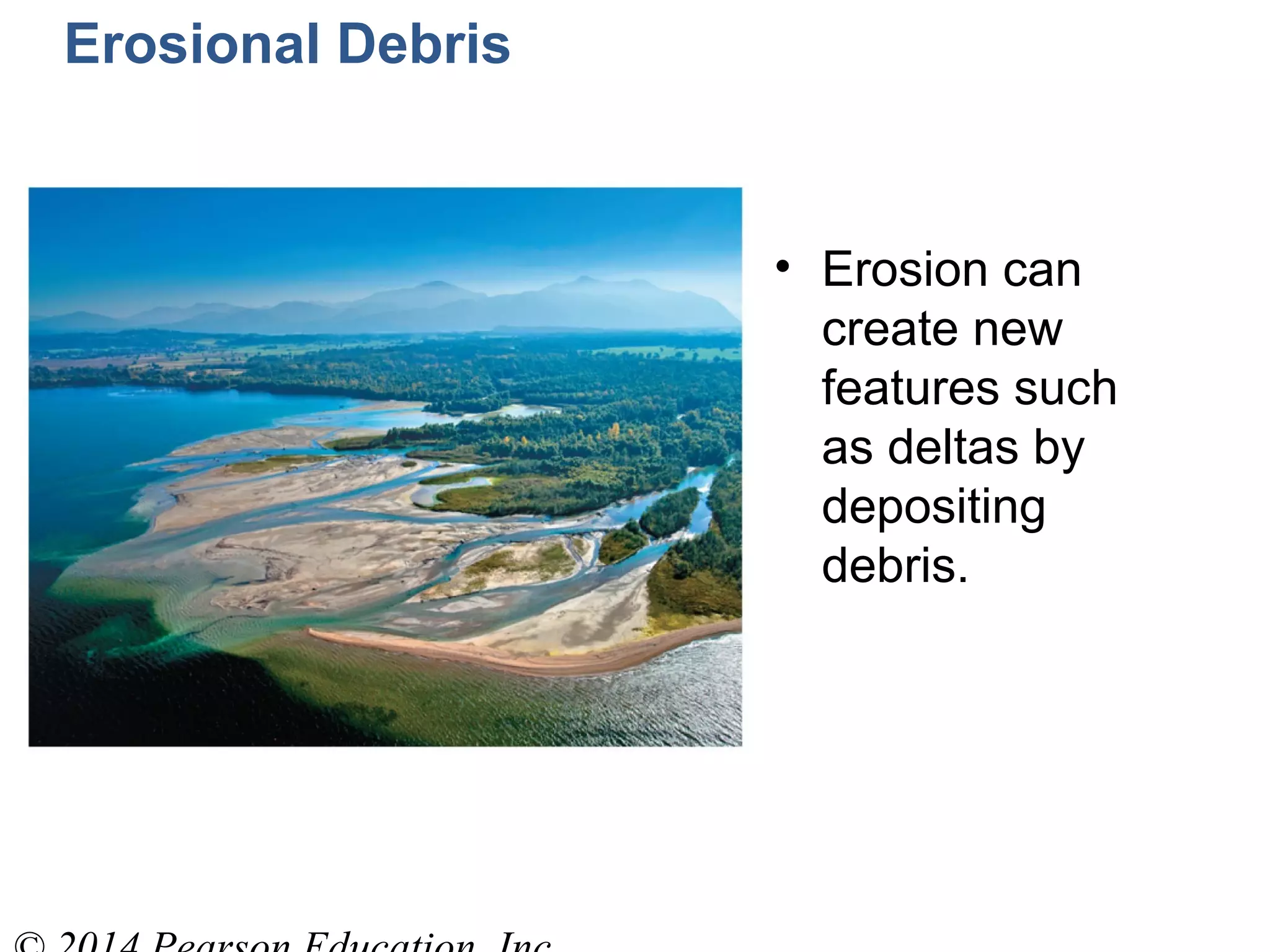
Erosional Debris
• Erosion can
create new
features such
as deltas by
depositing
debris.
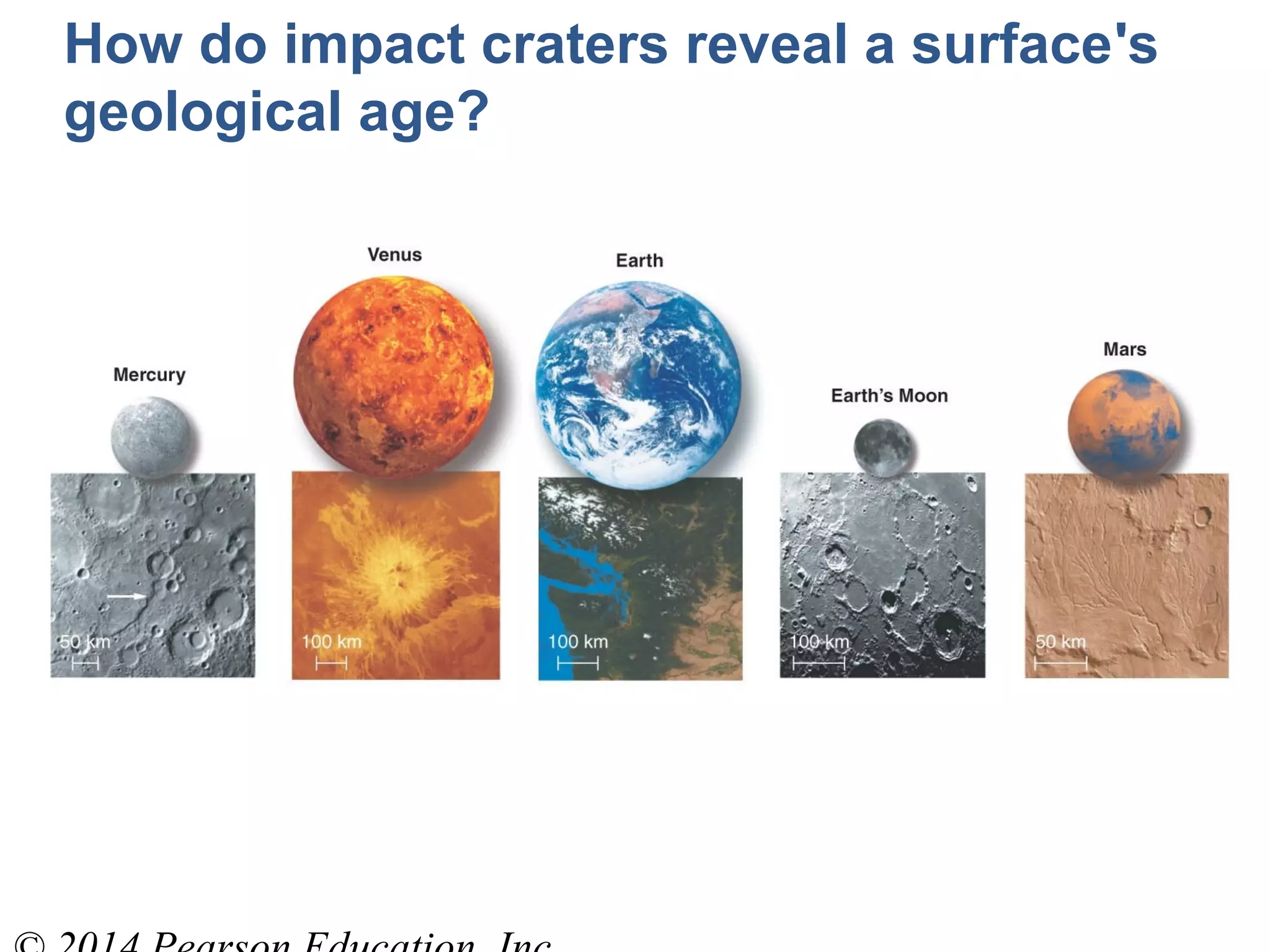
How do impact craters reveal a surface's
geological age?
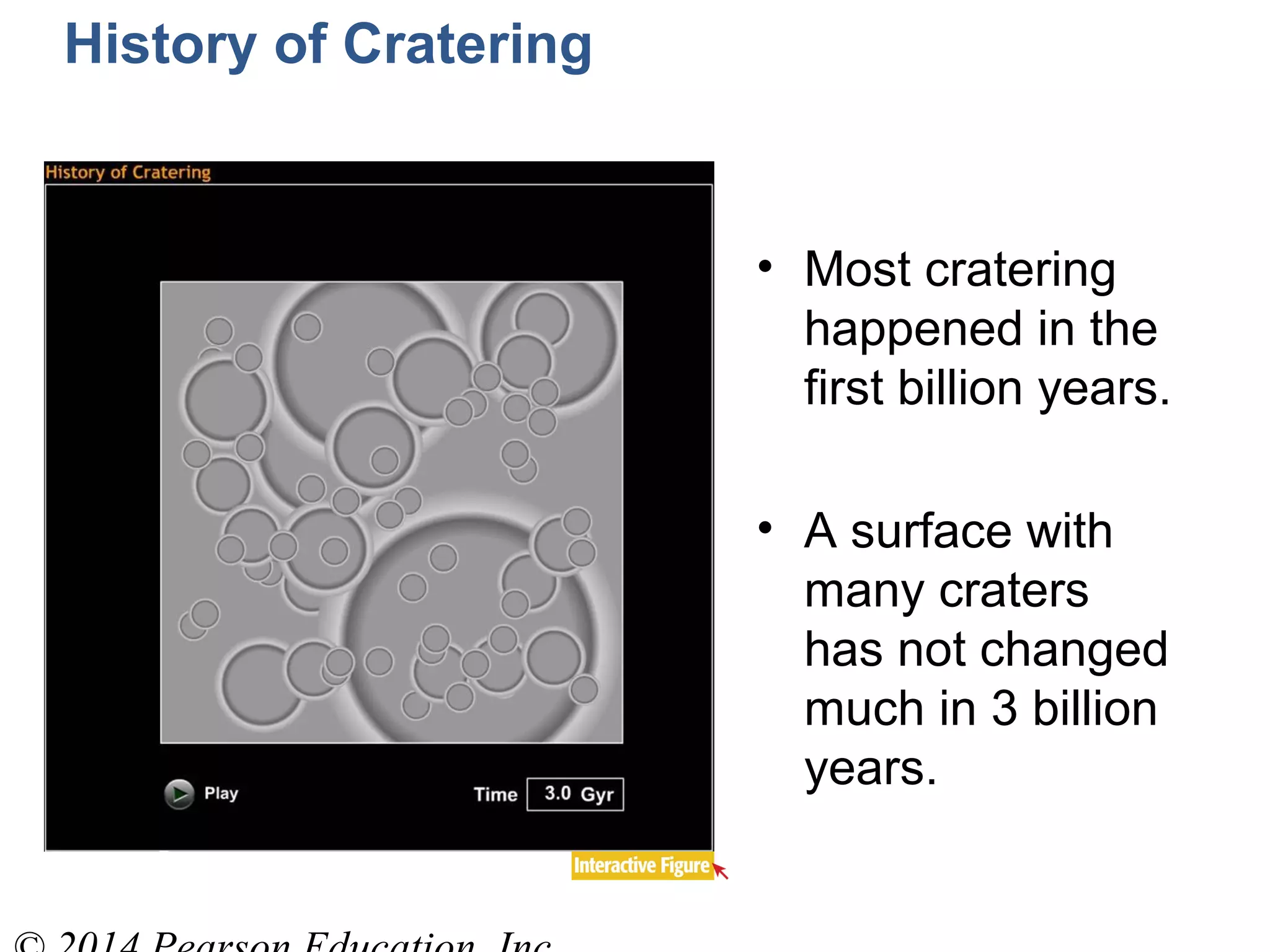
History of Cratering
• Most cratering
happened in the
first billion years.
• A surface with
many craters
has not changed
much in 3 billion
years.
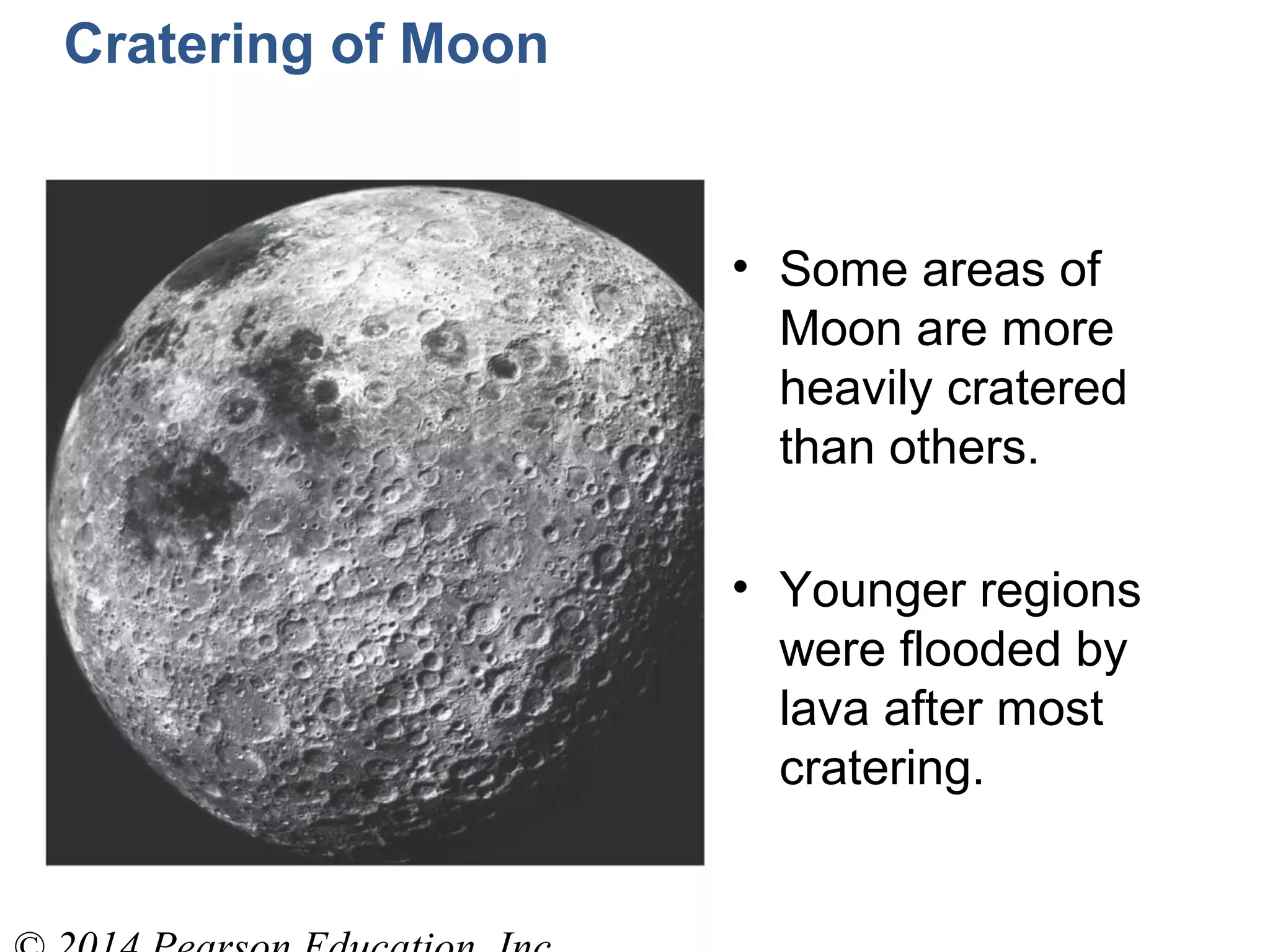
Cratering of Moon
• Some areas of
Moon are more
heavily cratered
than others.
• Younger regions
were flooded by
lava after most
cratering.
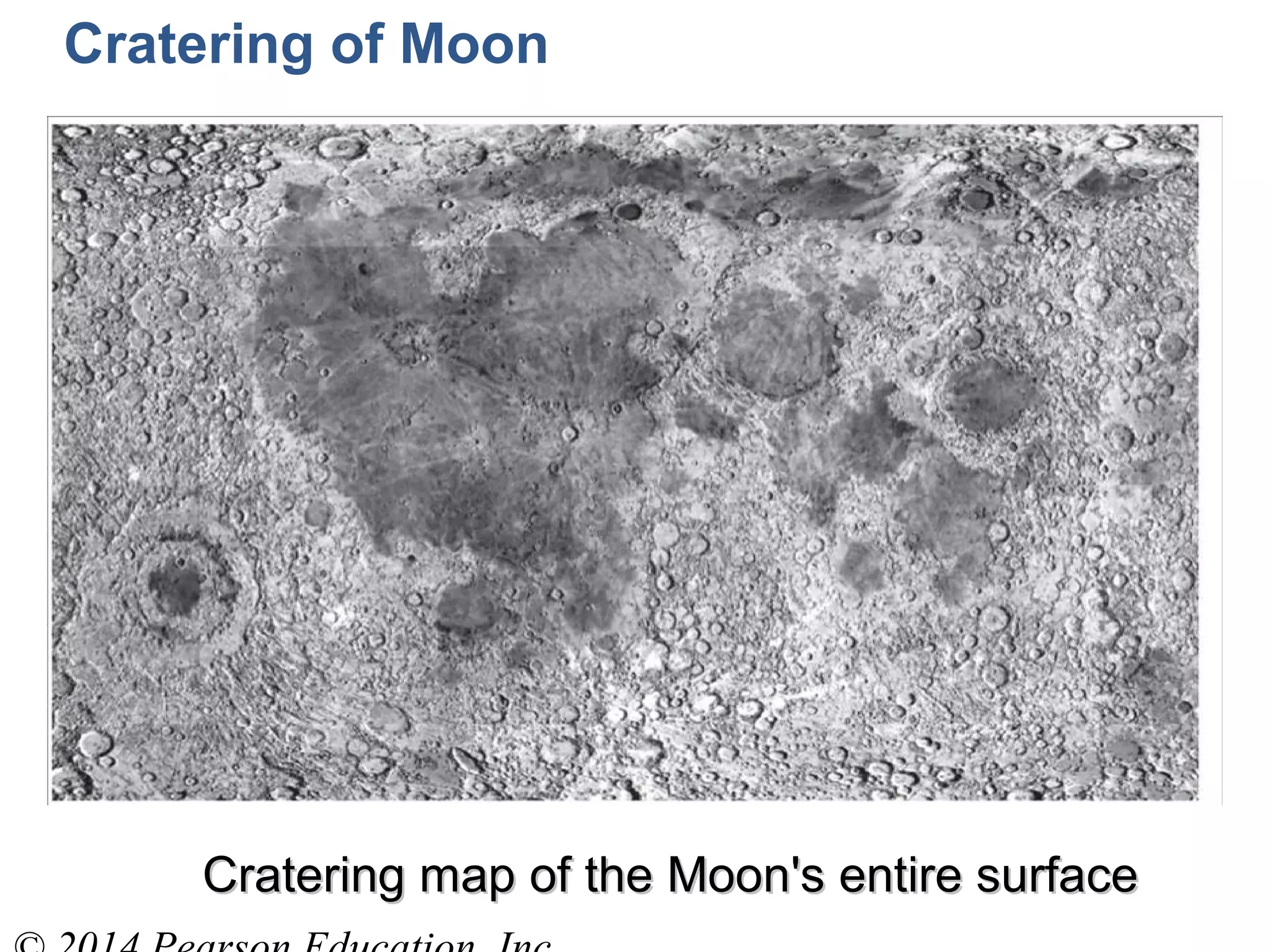
Cratering map of the MoonCratering map of the Moon's entire surface's entire surface
Cratering of Moon
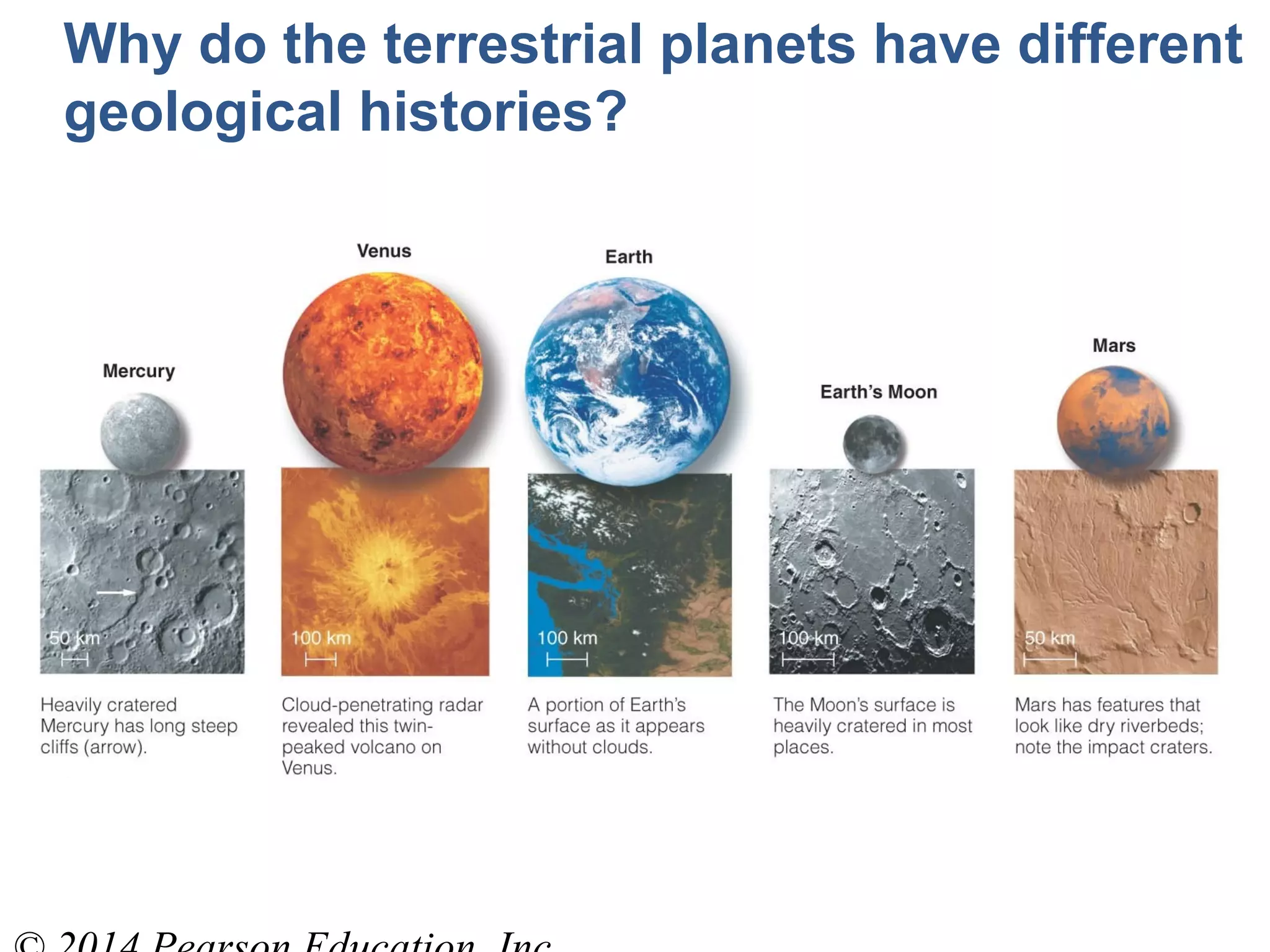
Why do the terrestrial planets have different
geological histories?
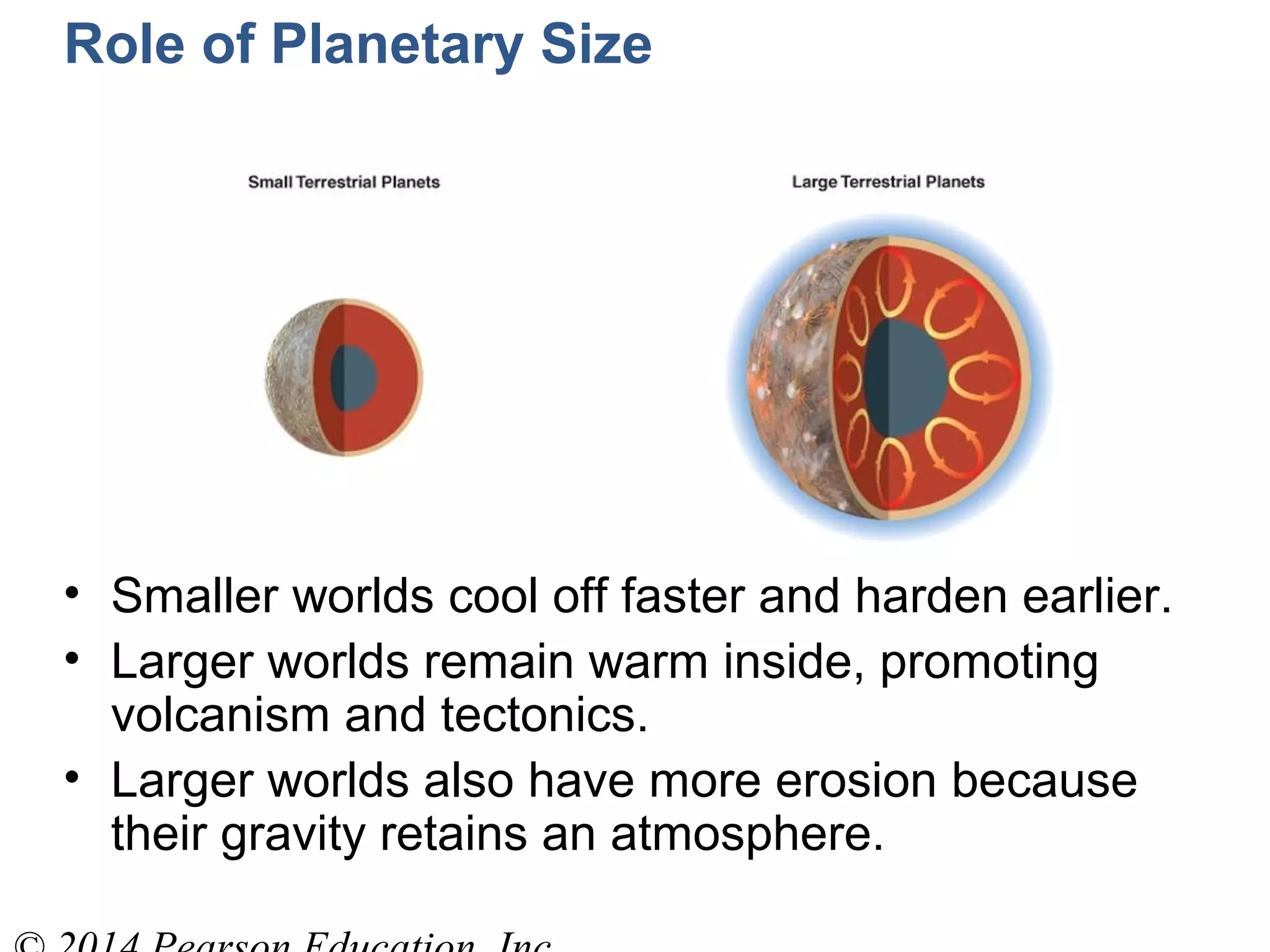
• Smaller worlds cool off faster and harden earlier.
• Larger worlds remain warm inside, promoting
volcanism and tectonics.
• Larger worlds also have more erosion because
their gravity retains an atmosphere.
Role of Planetary Size
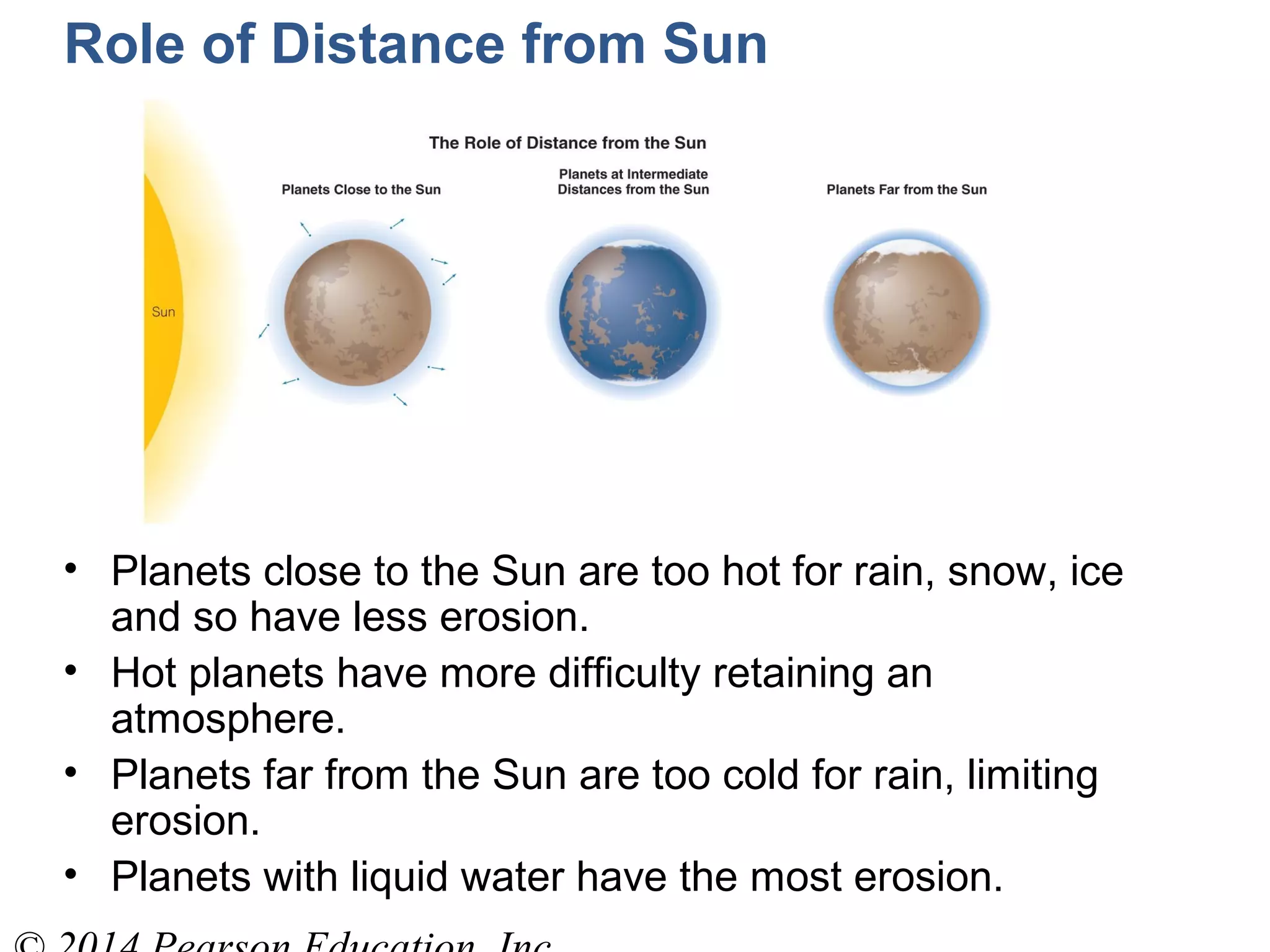
• Planets close to the Sun are too hot for rain, snow, ice
and so have less erosion.
• Hot planets have more difficulty retaining an
atmosphere.
• Planets far from the Sun are too cold for rain, limiting
erosion.
• Planets with liquid water have the most erosion.
Role of Distance from Sun
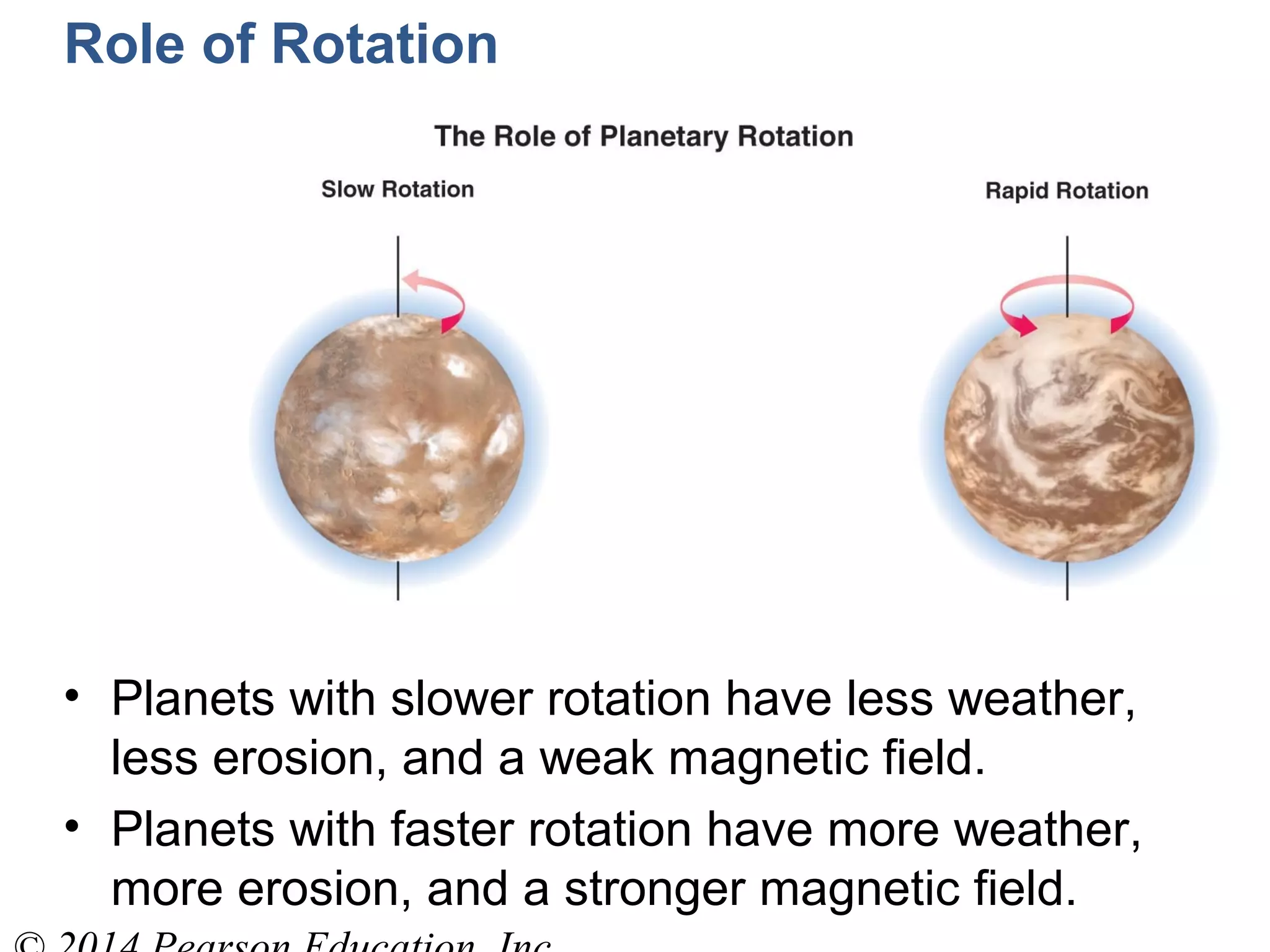
• Planets with slower rotation have less weather,
less erosion, and a weak magnetic field.
• Planets with faster rotation have more weather,
more erosion, and a stronger magnetic field.
Role of Rotation
Thought Question
How does the cooling of planets and potatoes vary
with size?
a) Larger size makes it harder for heat from inside to
escape.
b) Larger size means a bigger ratio of volume to
surface area.
c) Larger size takes longer to cool.
d) all of the above
Thought Question
How does the cooling of planets and potatoes vary
with size?
a) Larger size makes it harder for heat from inside to
escape.
b) Larger size means a bigger ratio of volume to
surface area.
c) Larger size takes longer to cool.
d) all of the above
What have we learned?
• What processes shape planetary surfaces?
– Cratering, volcanism, tectonics, erosion
• How do impact craters reveal a surface's
geological age?
– The amount of cratering tells us how long ago
a surface formed.
• Why do the terrestrial planets have different
geological histories?
– Differences arise because of planetary size,
distance from Sun, and rotation rate.
9.3 Geology of the Moon and Mercury
• Our goals for learning:
– What geological processes shaped our
Moon?
– What geological processes shaped
Mercury?
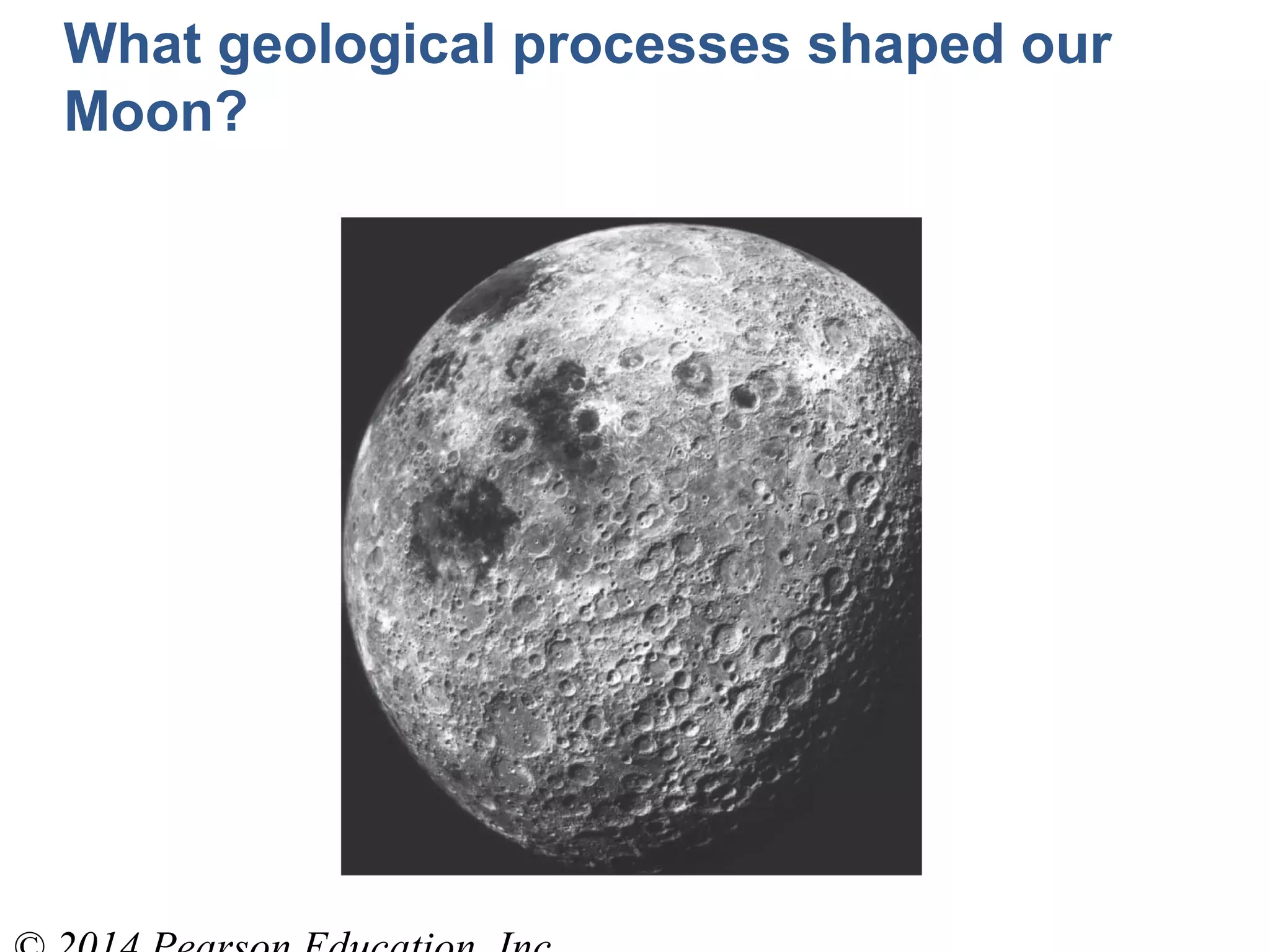
What geological processes shaped our
Moon?
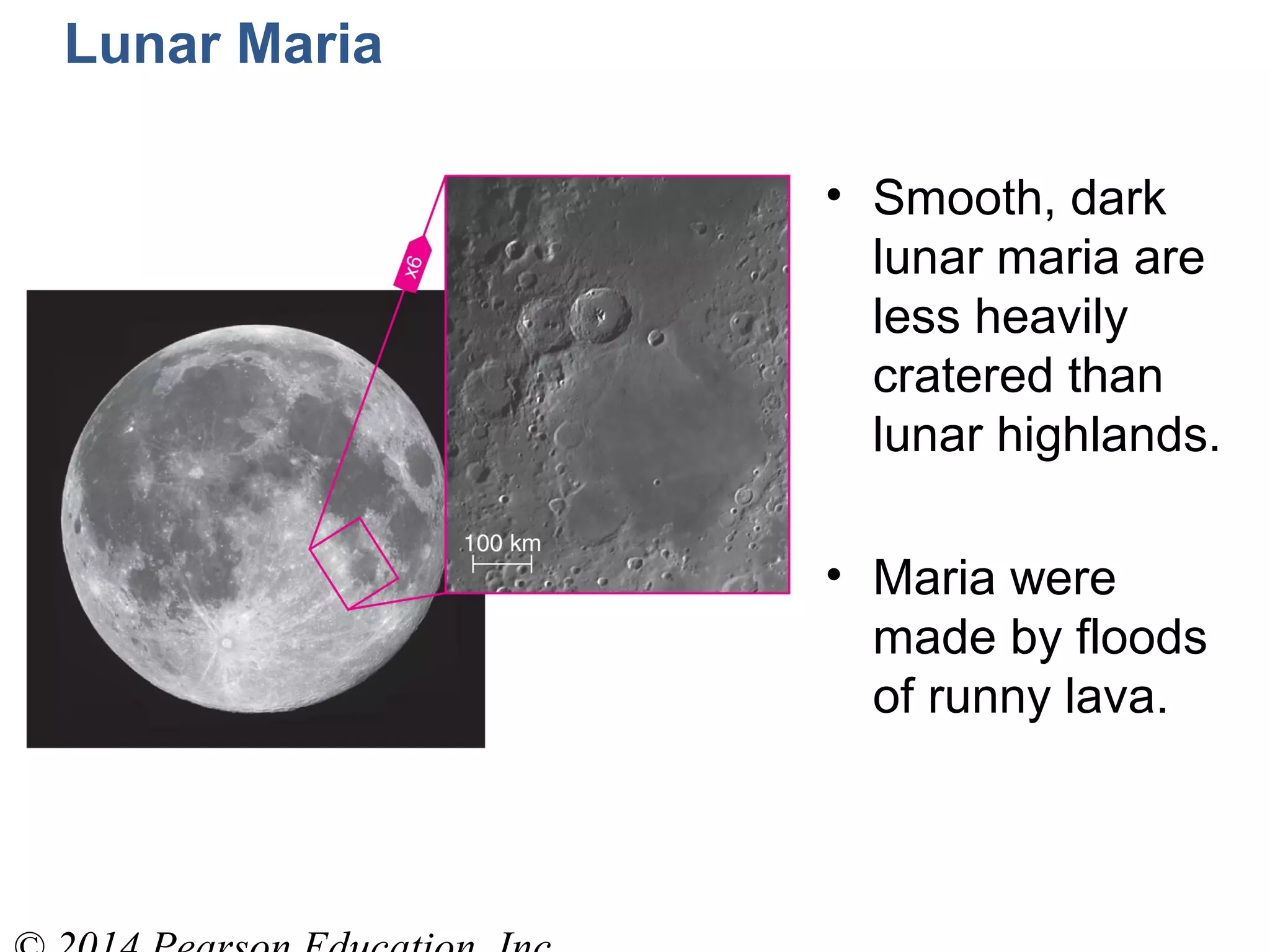
Lunar Maria
• Smooth, dark
lunar maria are
less heavily
cratered than
lunar highlands.
• Maria were
made by floods
of runny lava.
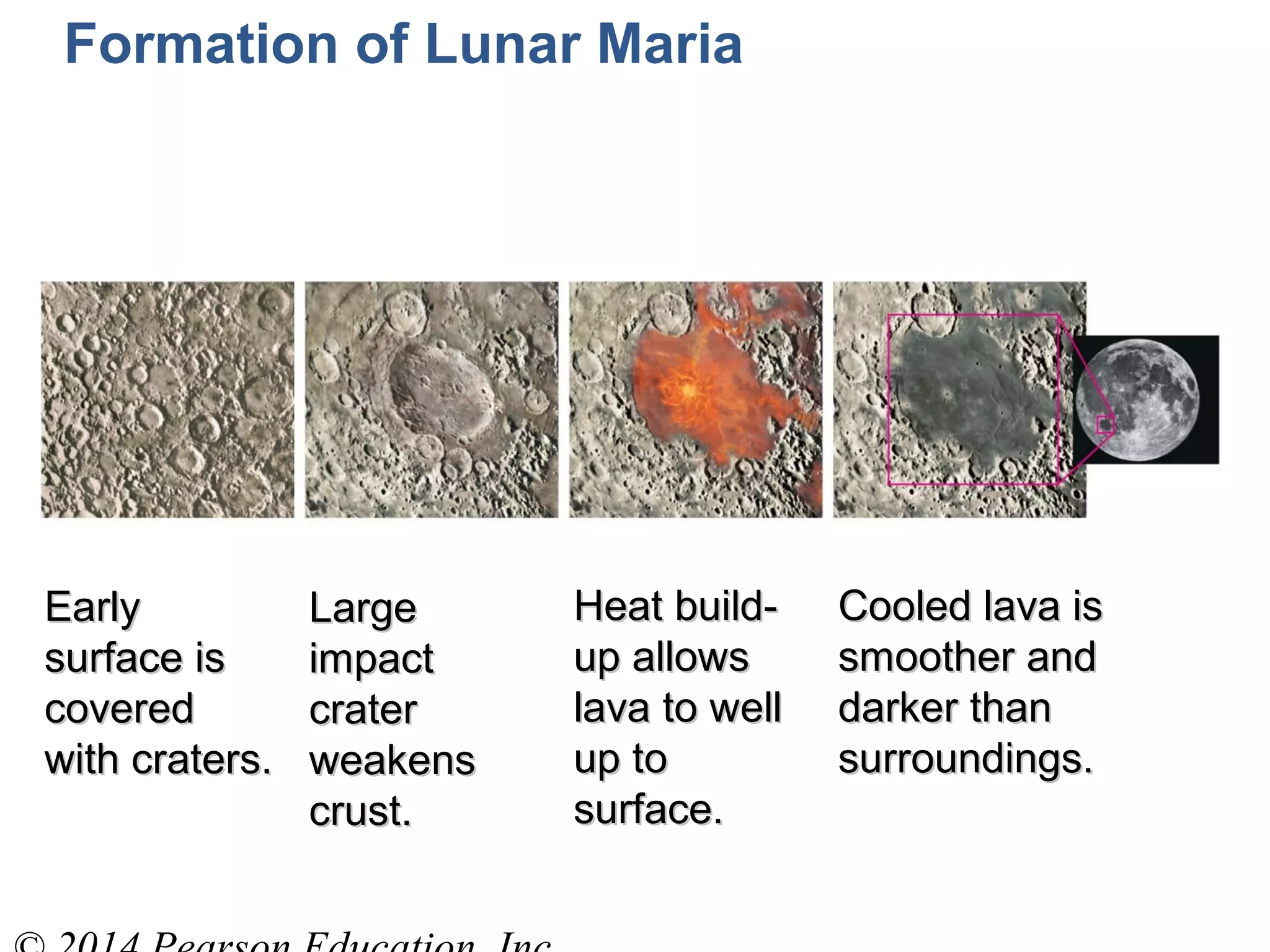
LargeLarge
impactimpact
cratercrater
weakensweakens
crust.crust.
Heat build-Heat build-
up allowsup allows
lava to welllava to well
up toup to
surface.surface.
EarlyEarly
surface issurface is
coveredcovered
with craters.with craters.
Cooled lava isCooled lava is
smoother andsmoother and
darker thandarker than
surroundings.surroundings.
Formation of Lunar Maria
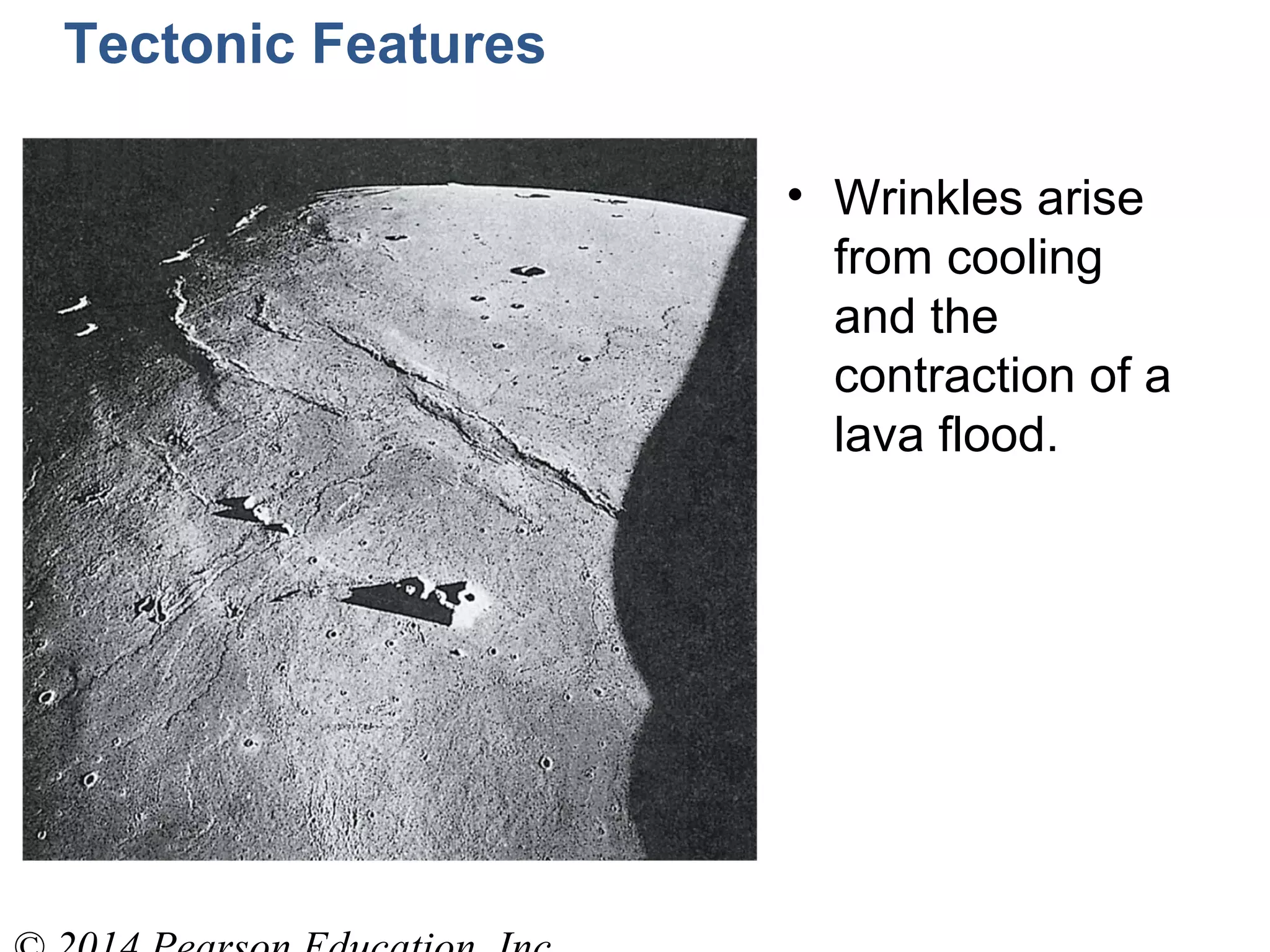
Tectonic Features
• Wrinkles arise
from cooling
and the
contraction of a
lava flood.
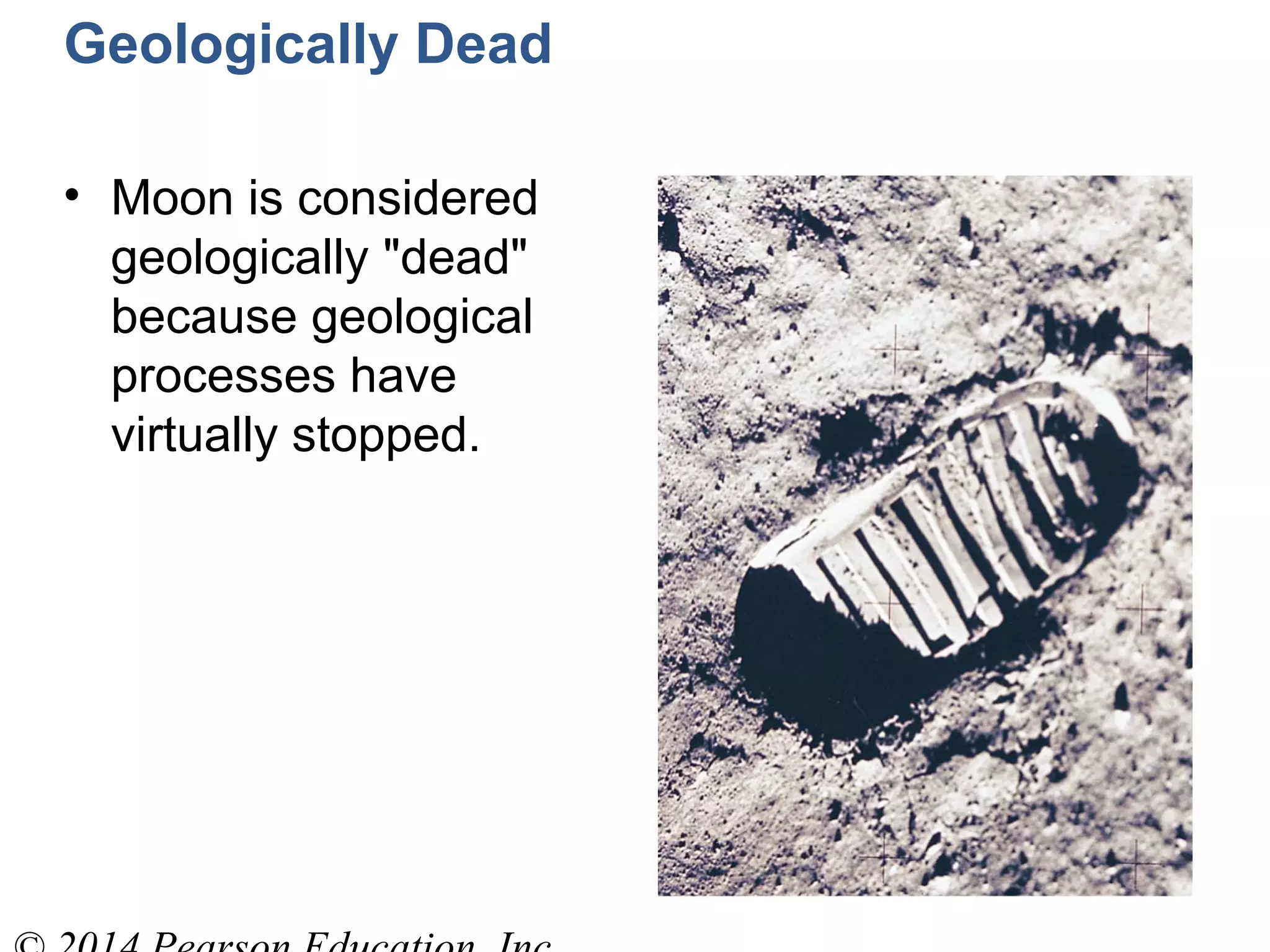
Geologically Dead
• Moon is considered
geologically "dead"
because geological
processes have
virtually stopped.
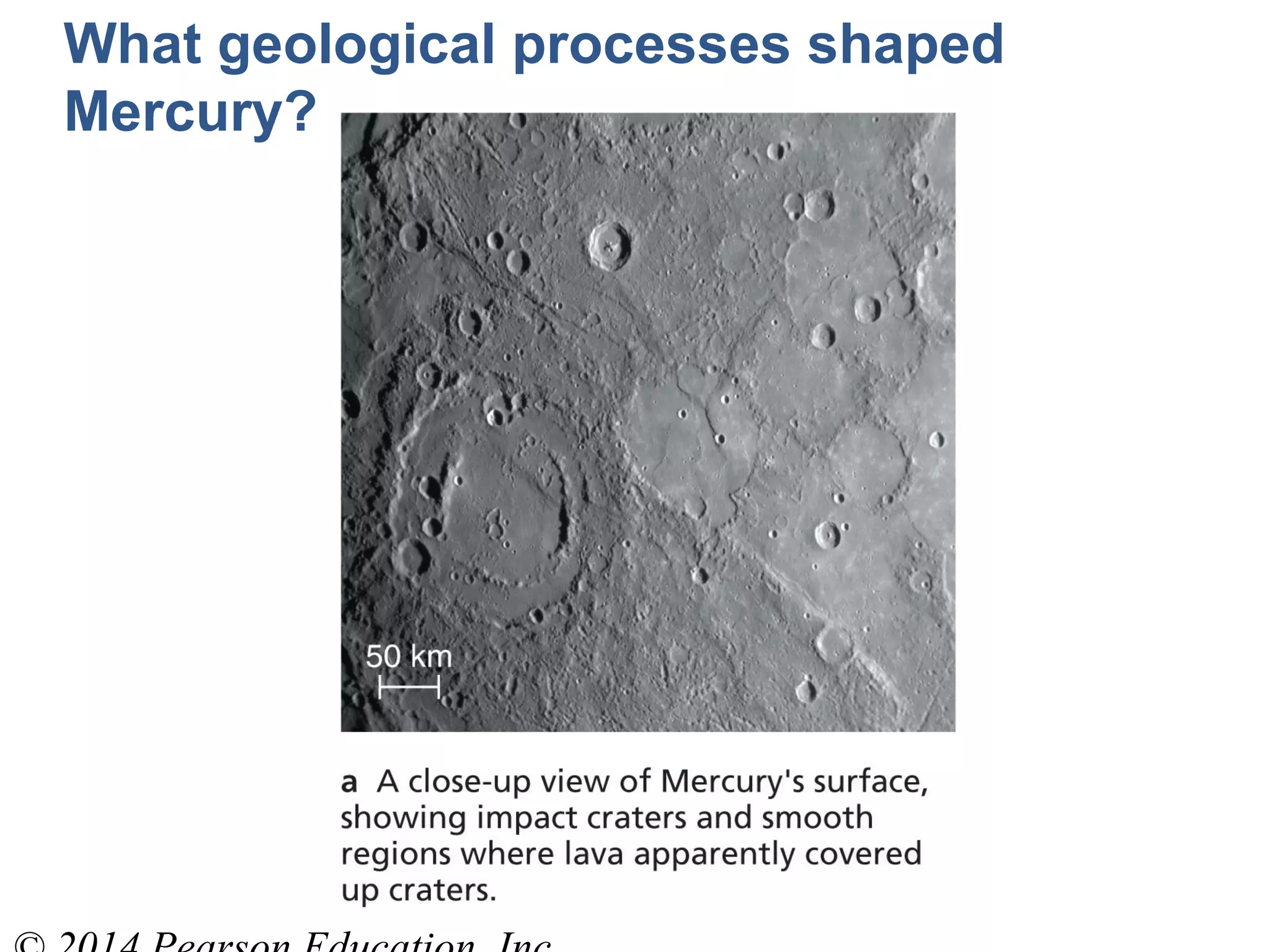
What geological processes shaped
Mercury?
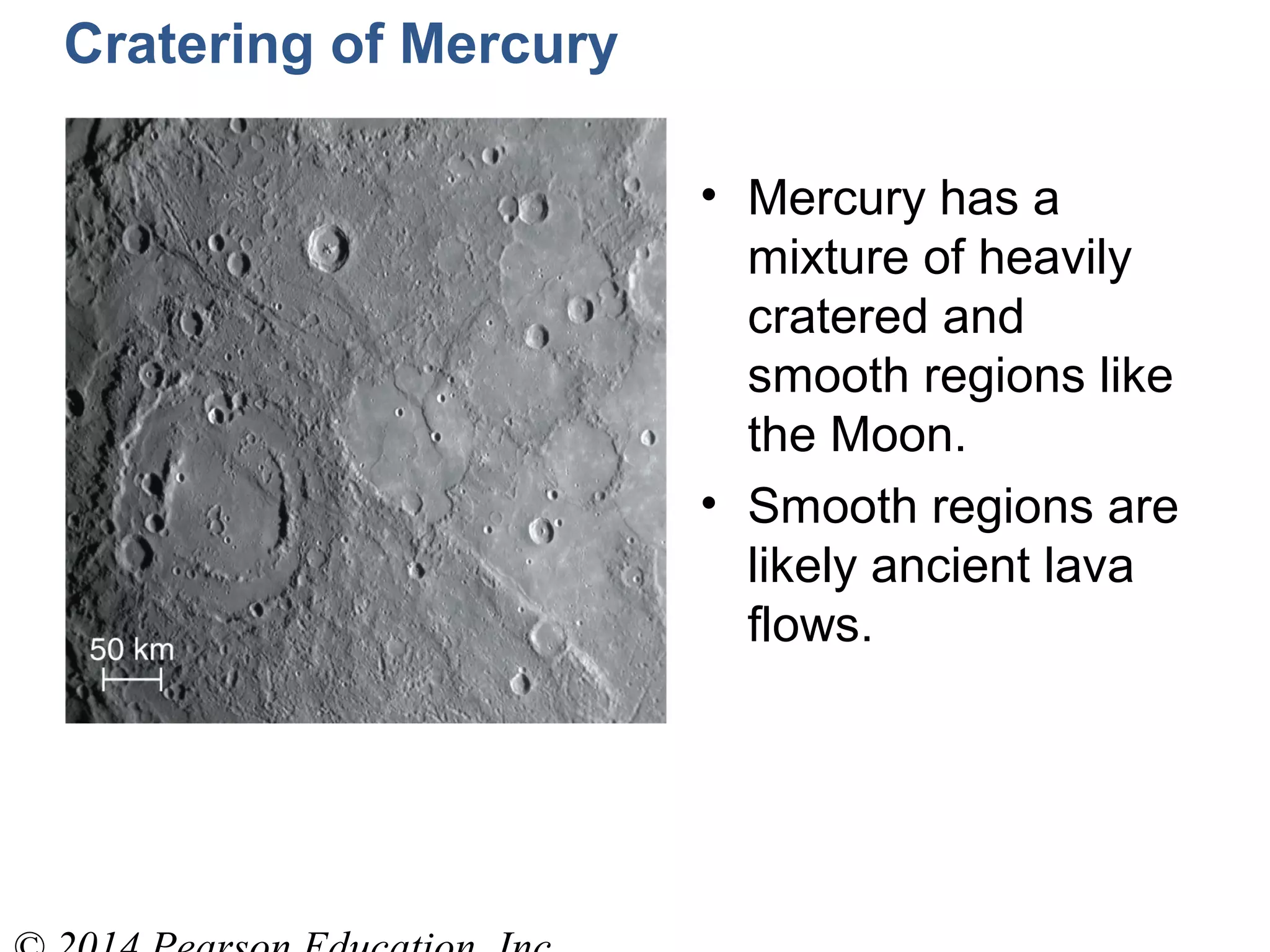
Cratering of Mercury
• Mercury has a
mixture of heavily
cratered and
smooth regions like
the Moon.
• Smooth regions are
likely ancient lava
flows.
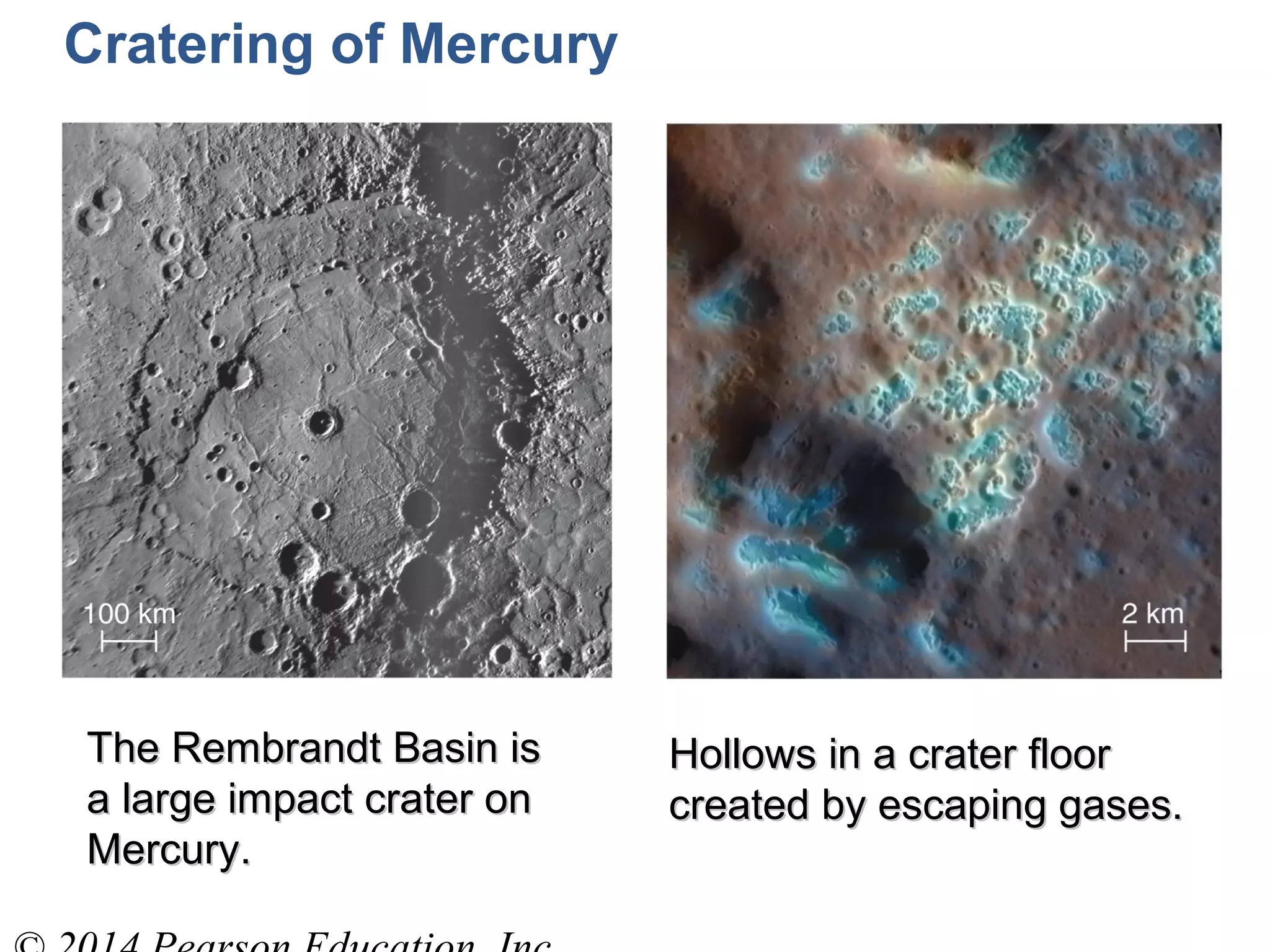
The Rembrandt Basin isThe Rembrandt Basin is
a large impact crater ona large impact crater on
Mercury.Mercury.
Hollows in a crater floorHollows in a crater floor
created by escaping gases.created by escaping gases.
Cratering of Mercury
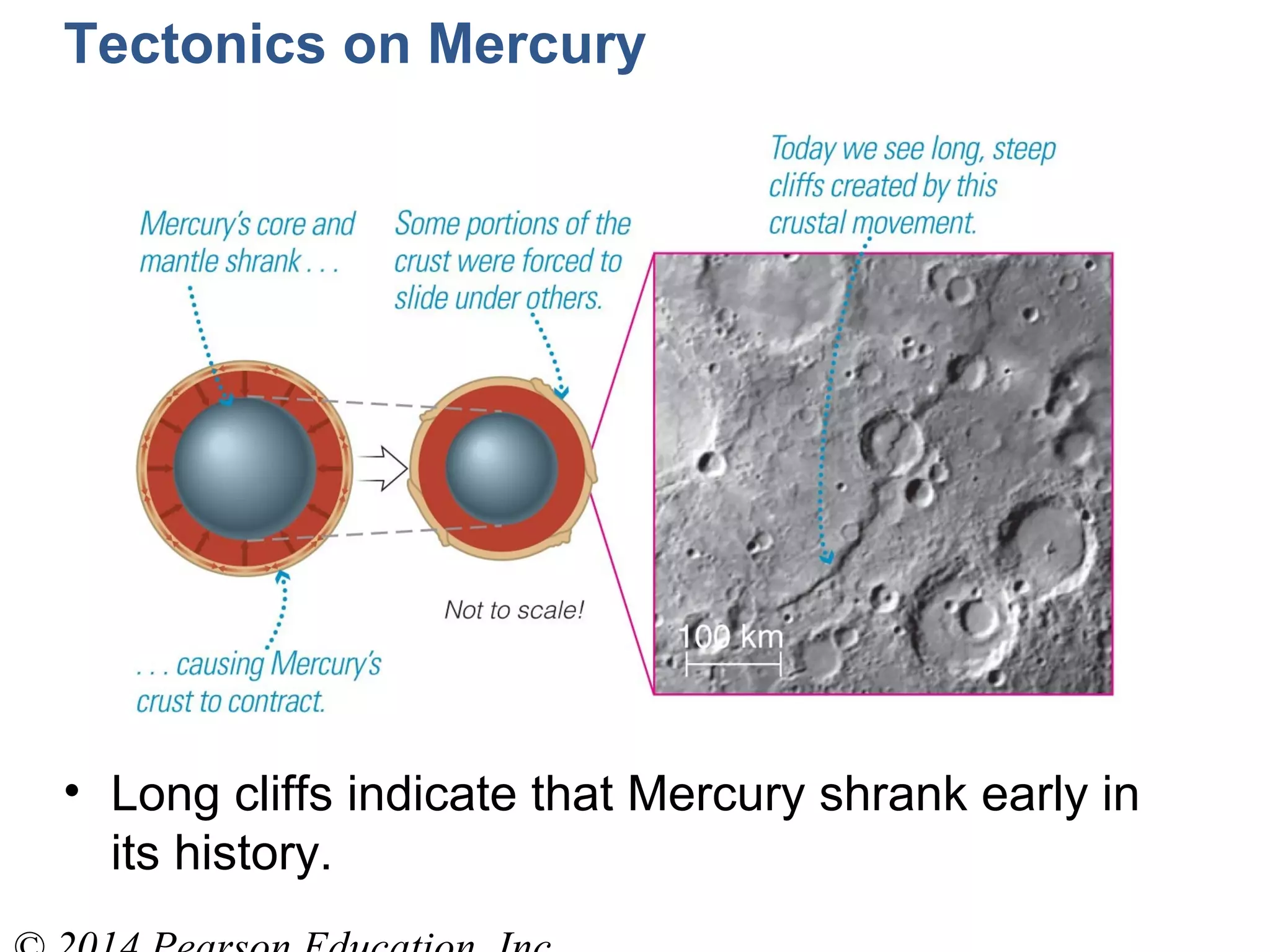
• Long cliffs indicate that Mercury shrank early in
its history.
Tectonics on Mercury
What have we learned?
• What geological processes shaped our
Moon?
– Early cratering is still present.
– Maria resulted from volcanism.
• What geological processes shaped Mercury?
– Had cratering and volcanism similar to Moon
– Tectonic features indicate early shrinkage.
9.4 Geology of Mars
• Our goals for learning:
– What geological processes have shaped
Mars?
– What geological evidence tells us that
water once flowed on Mars?
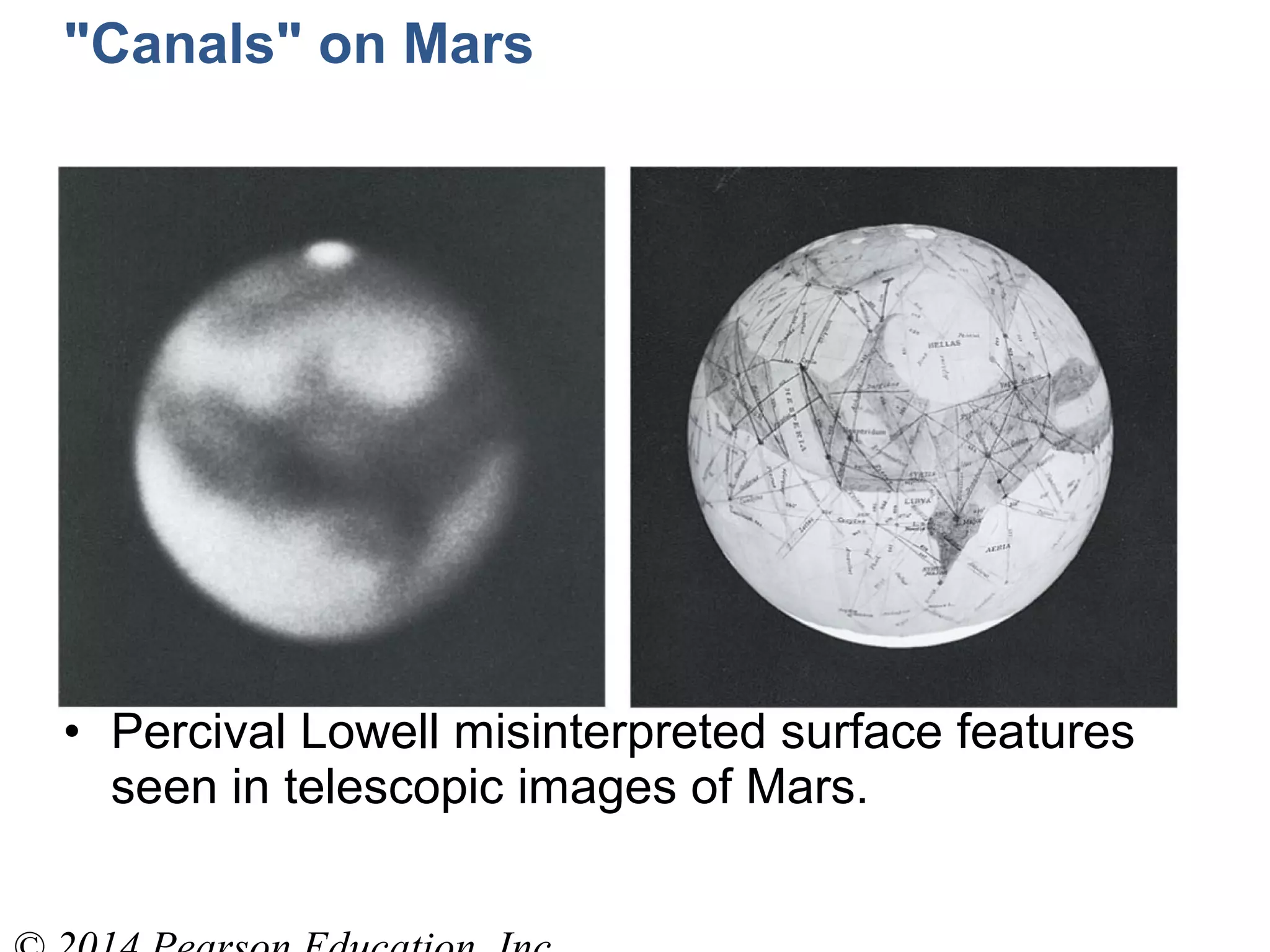
• Percival Lowell misinterpreted surface features
seen in telescopic images of Mars.
"Canals" on Mars
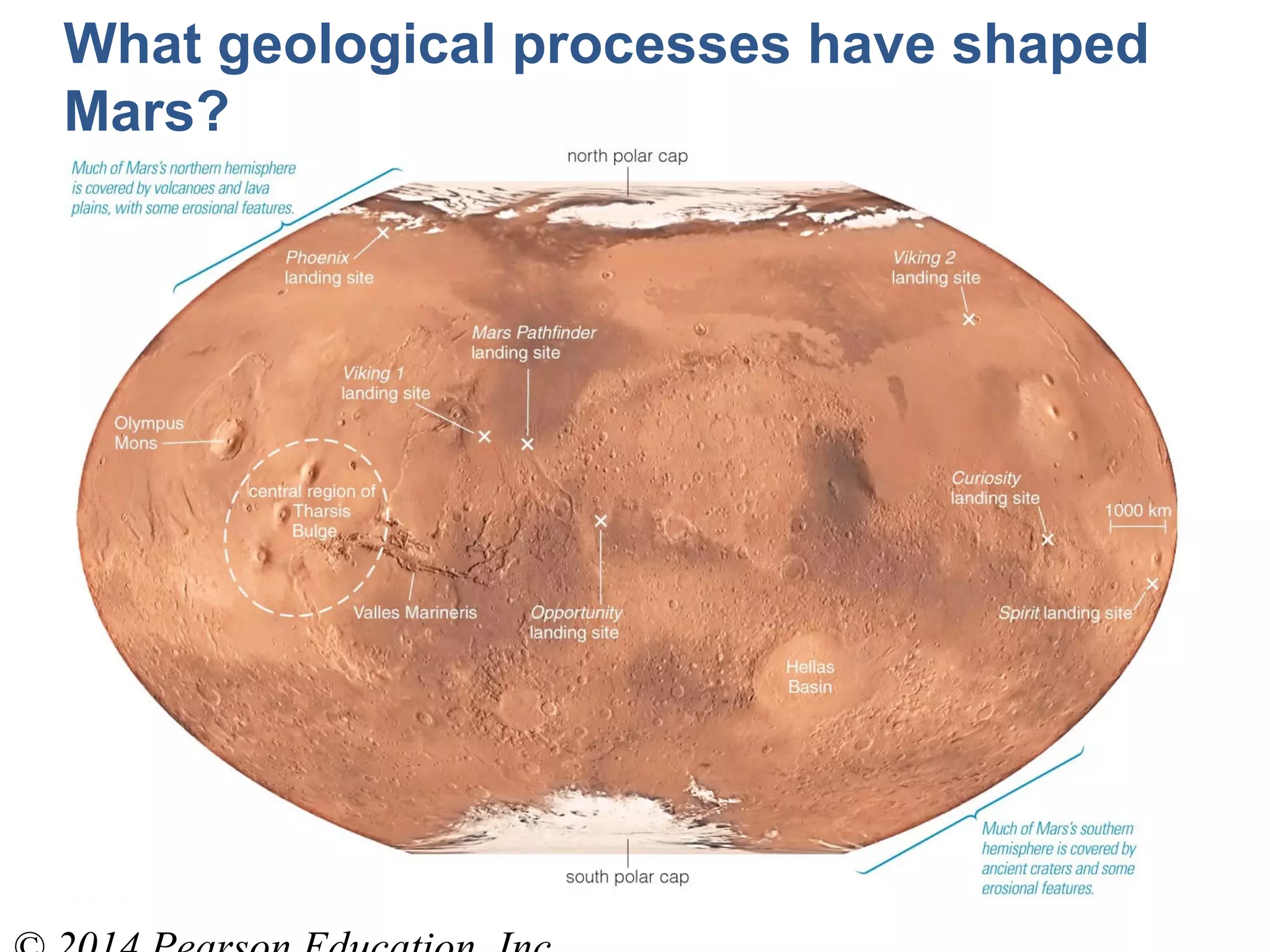
What geological processes have shaped
Mars?
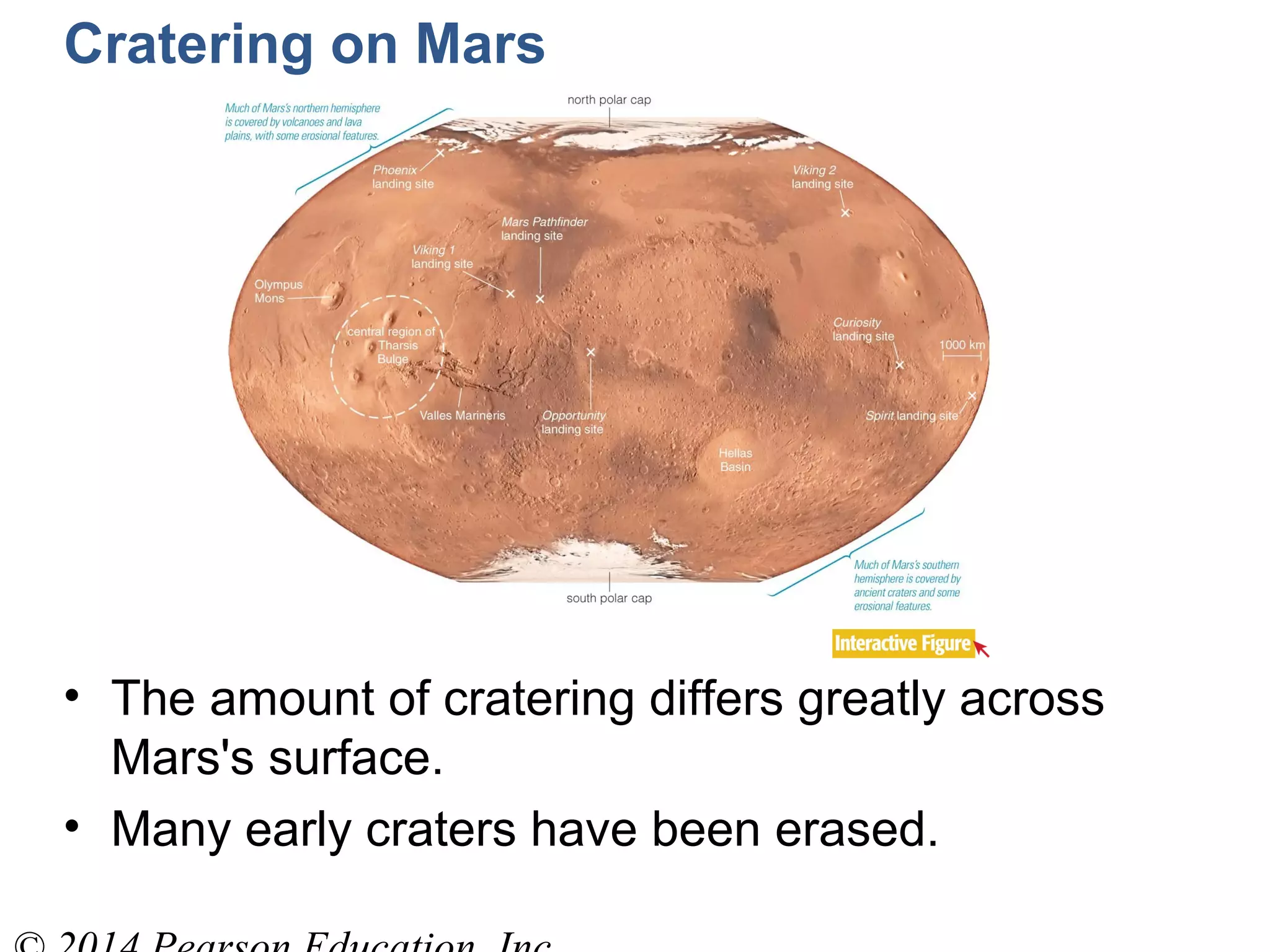
• The amount of cratering differs greatly across
Mars's surface.
• Many early craters have been erased.
Cratering on Mars
Volcanism on Mars
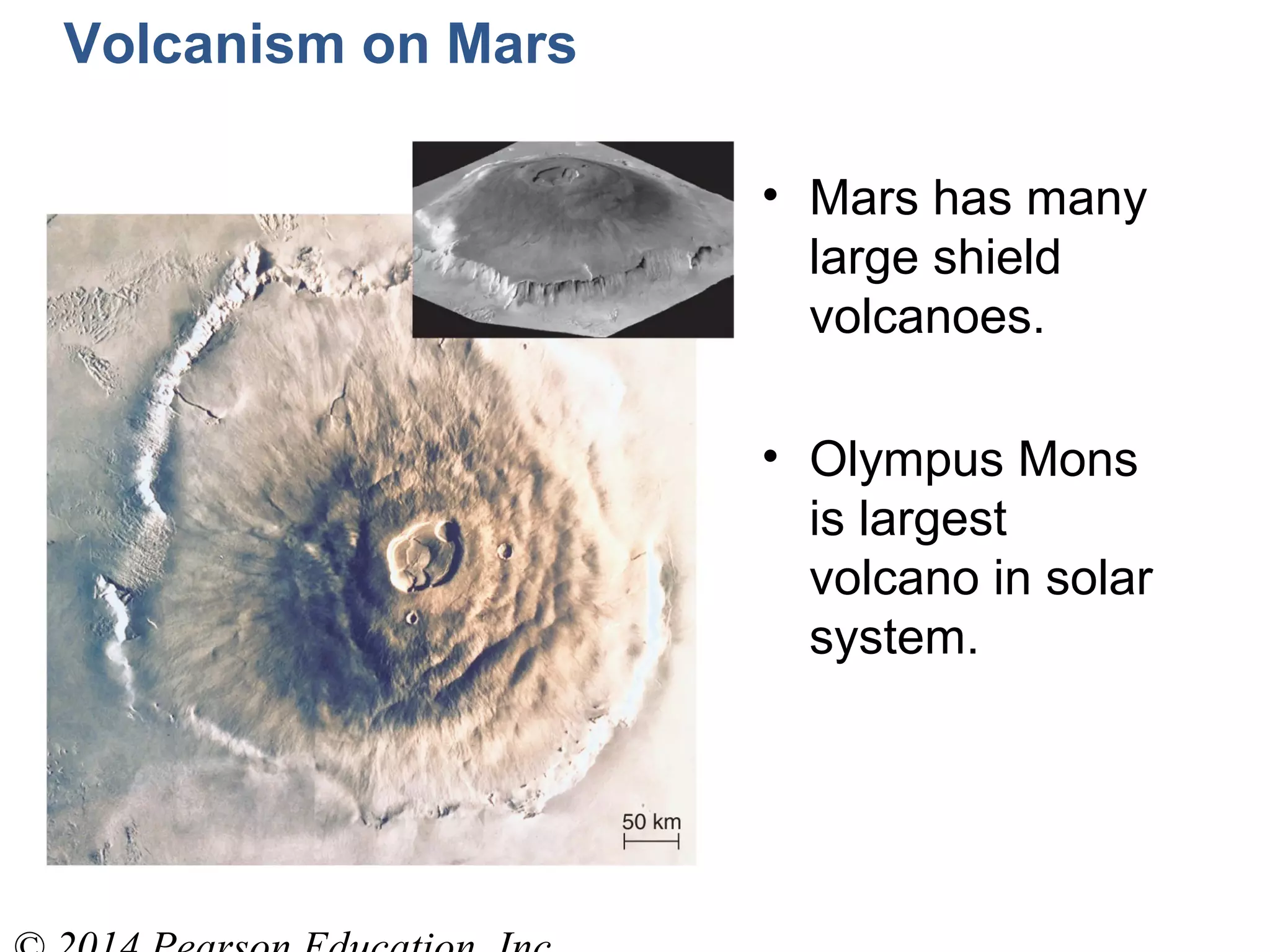
• Mars has many
large shield
volcanoes.
• Olympus Mons
is largest
volcano in solar
system.
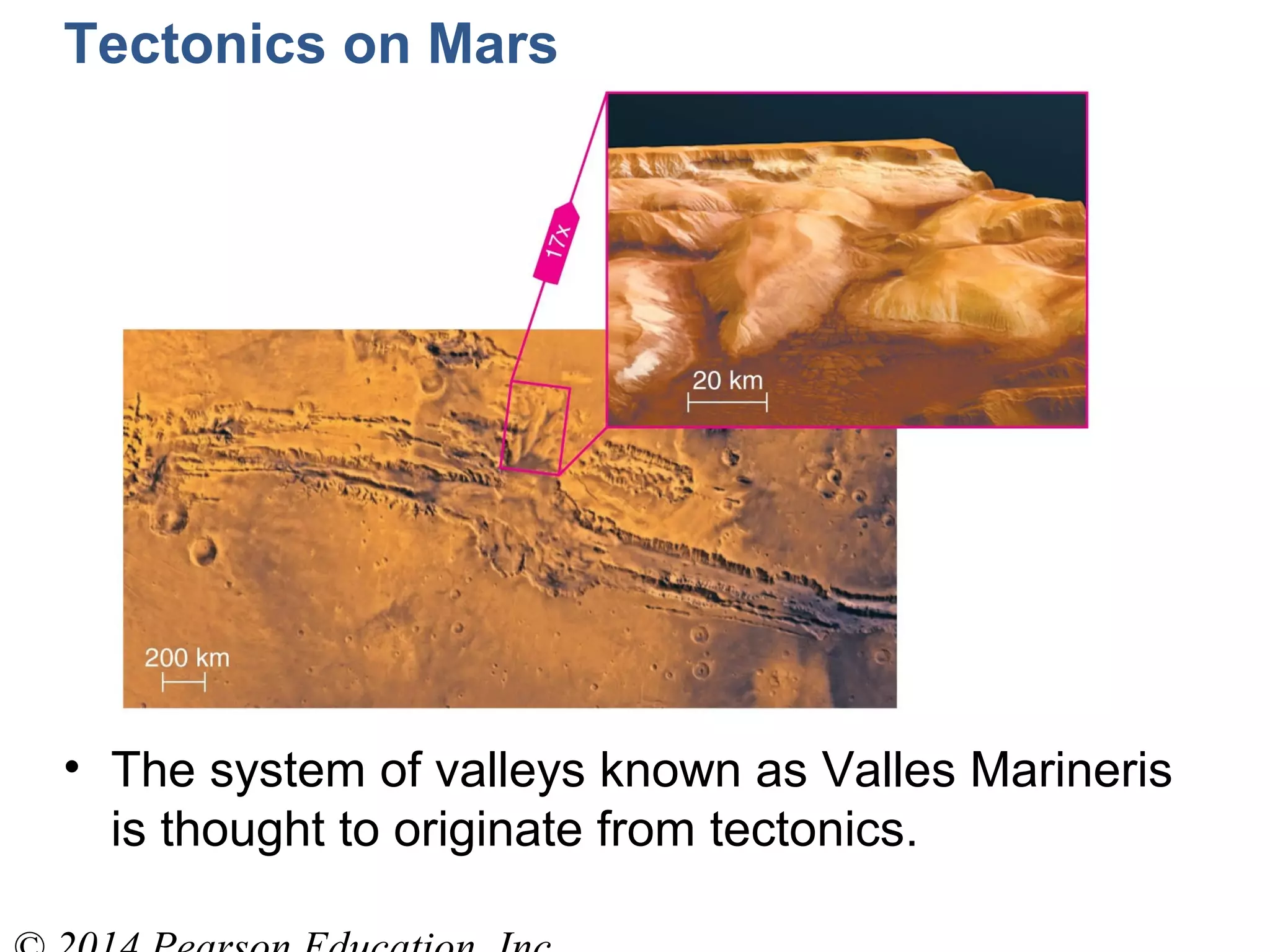
• The system of valleys known as Valles Marineris
is thought to originate from tectonics.
Tectonics on Mars
What geological evidence tells us that water
once flowed on Mars?
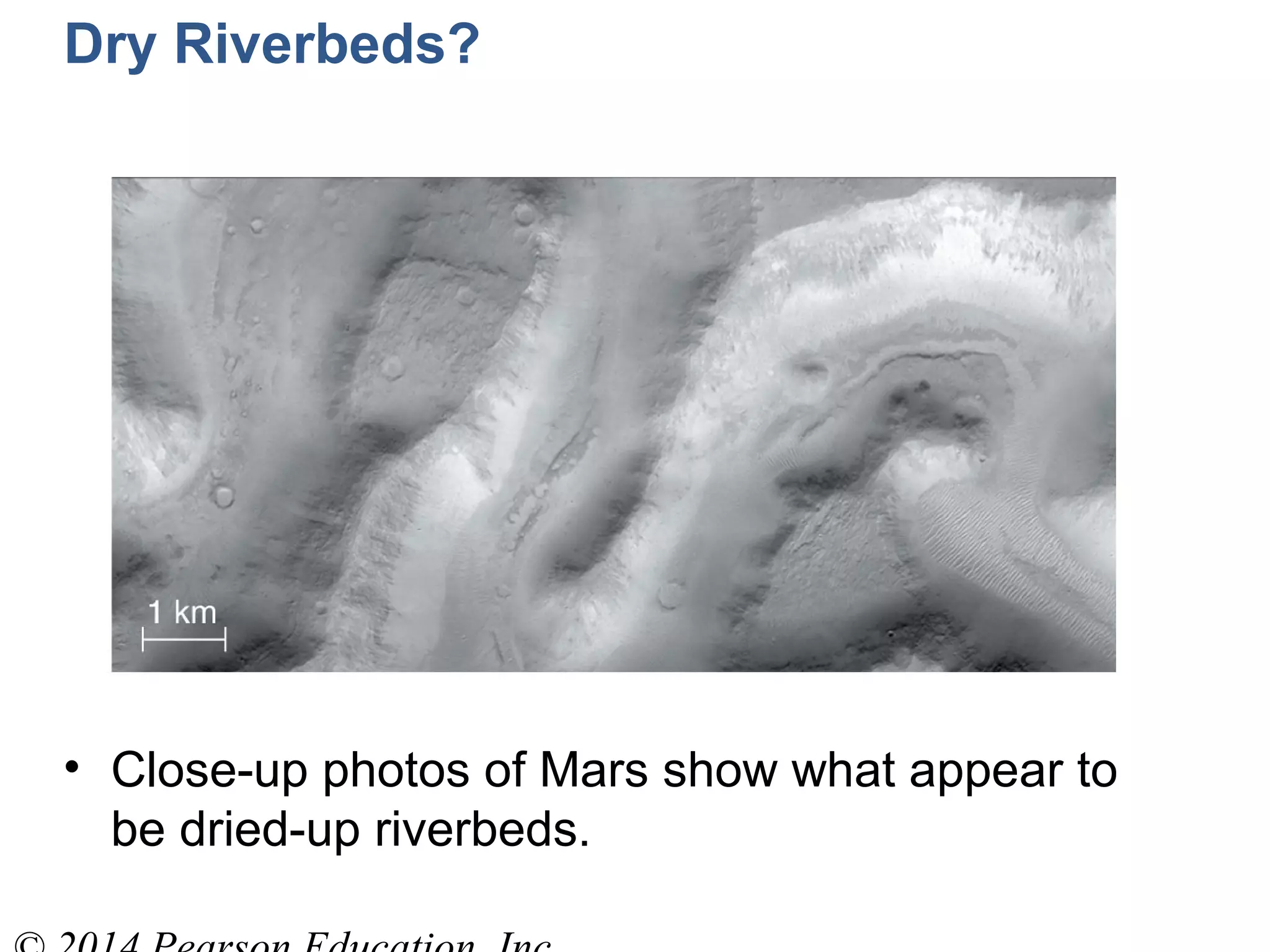
• Close-up photos of Mars show what appear to
be dried-up riverbeds.
Dry Riverbeds?
Insert TCP7e
Figure 9.29
Insert TCP7e
Figure 9.29
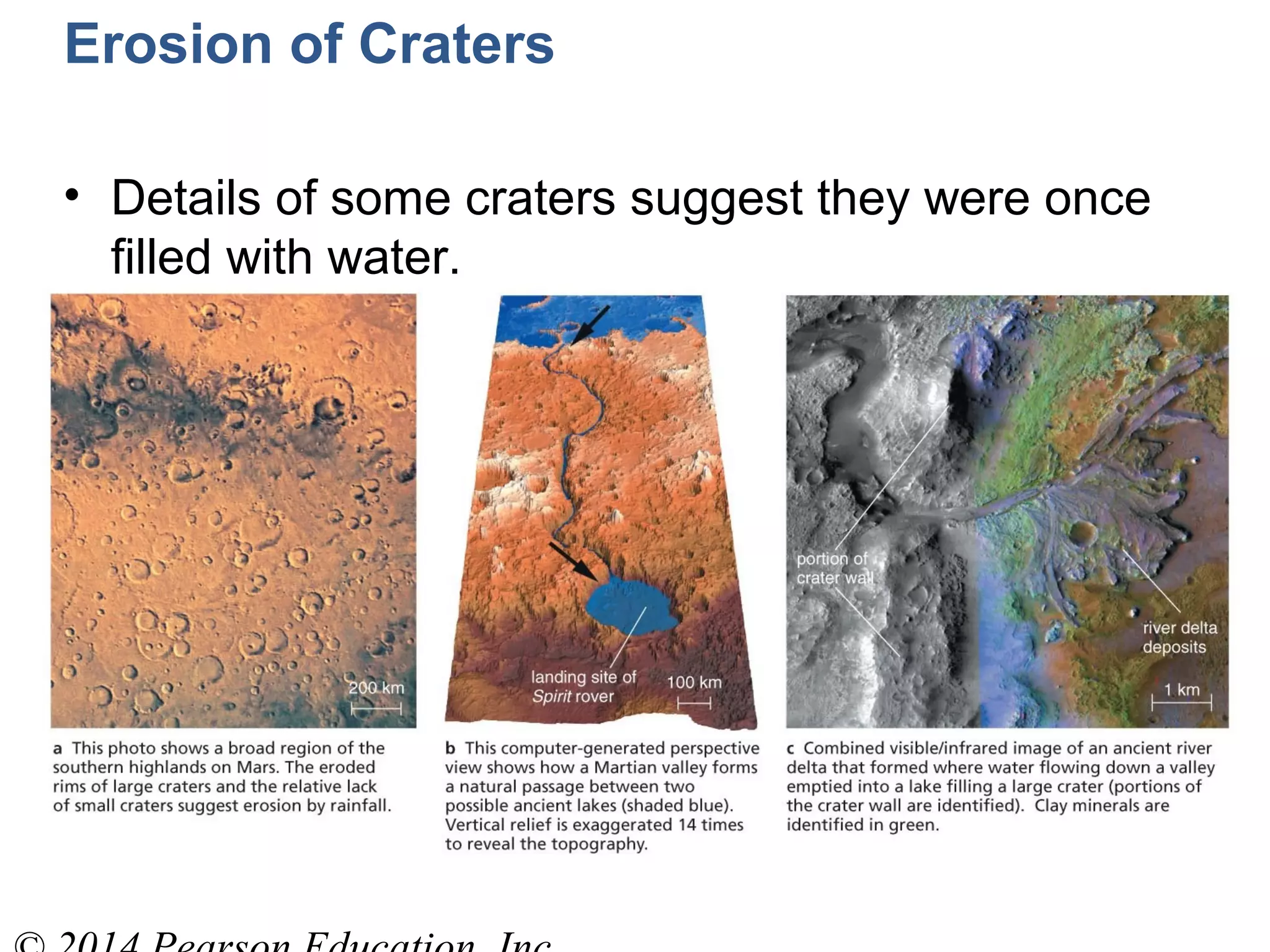
Erosion of Craters
• Details of some craters suggest they were once
filled with water.
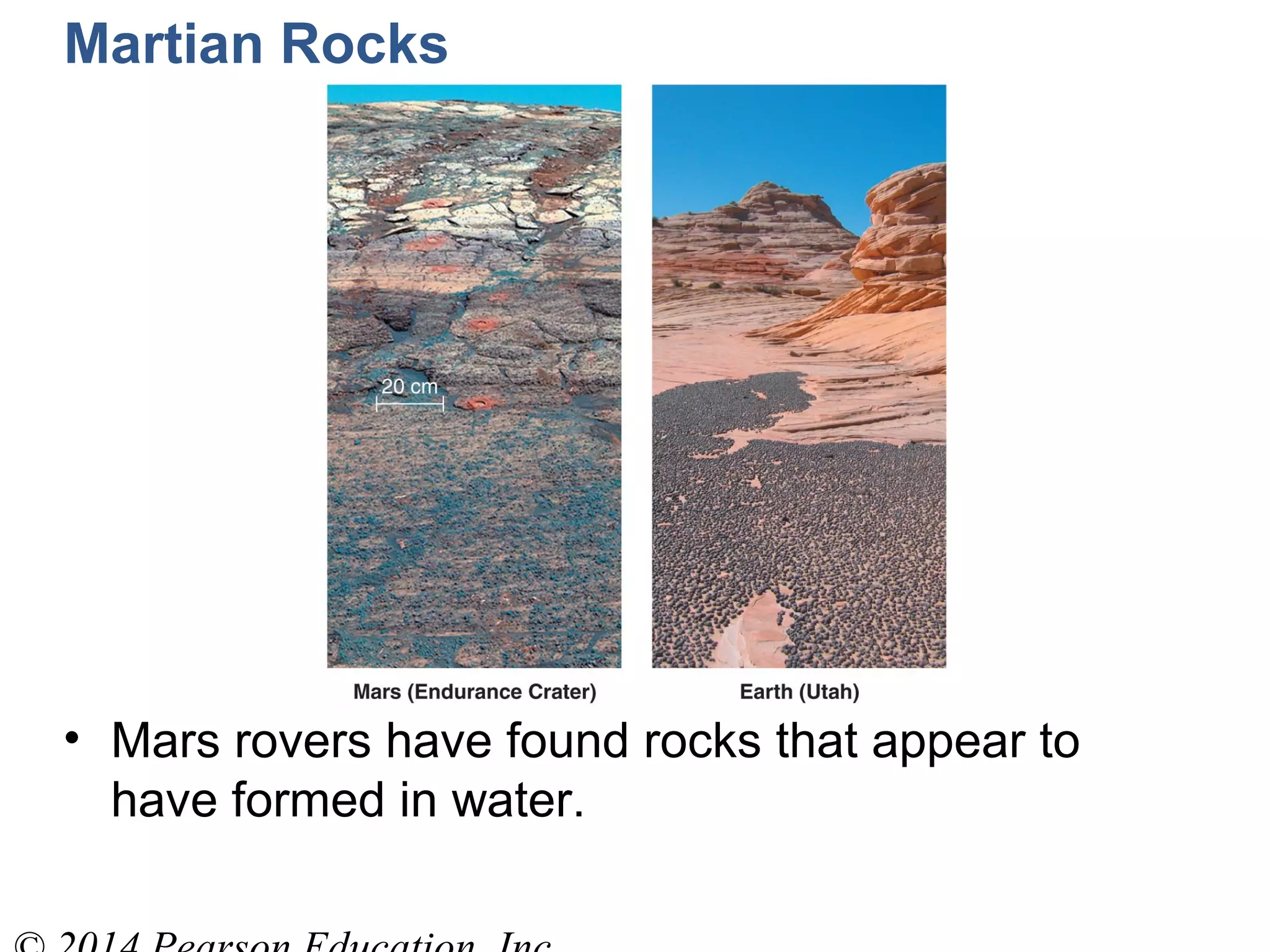
Martian Rocks
• Mars rovers have found rocks that appear to
have formed in water.
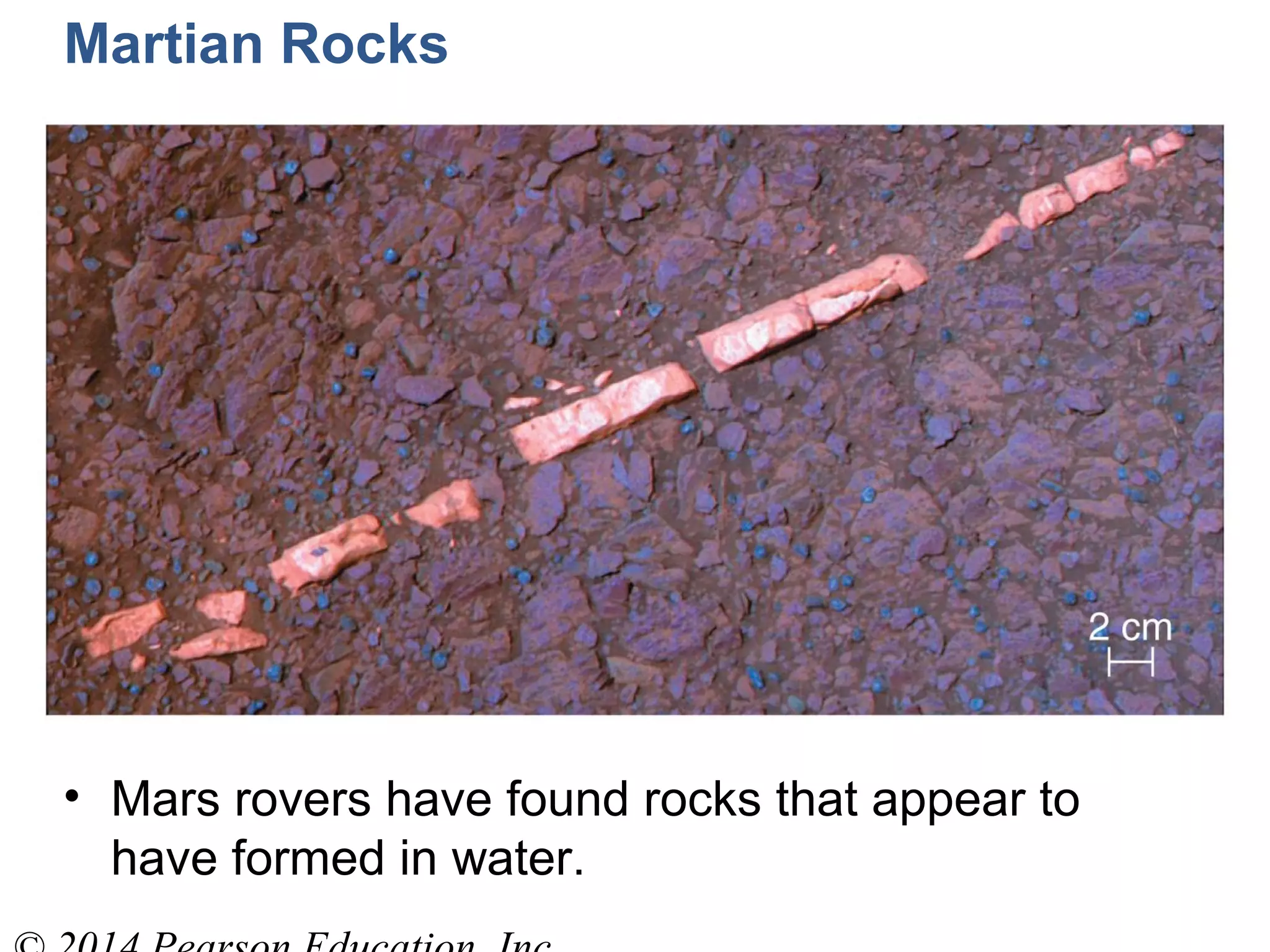
Martian Rocks
• Mars rovers have found rocks that appear to
have formed in water.
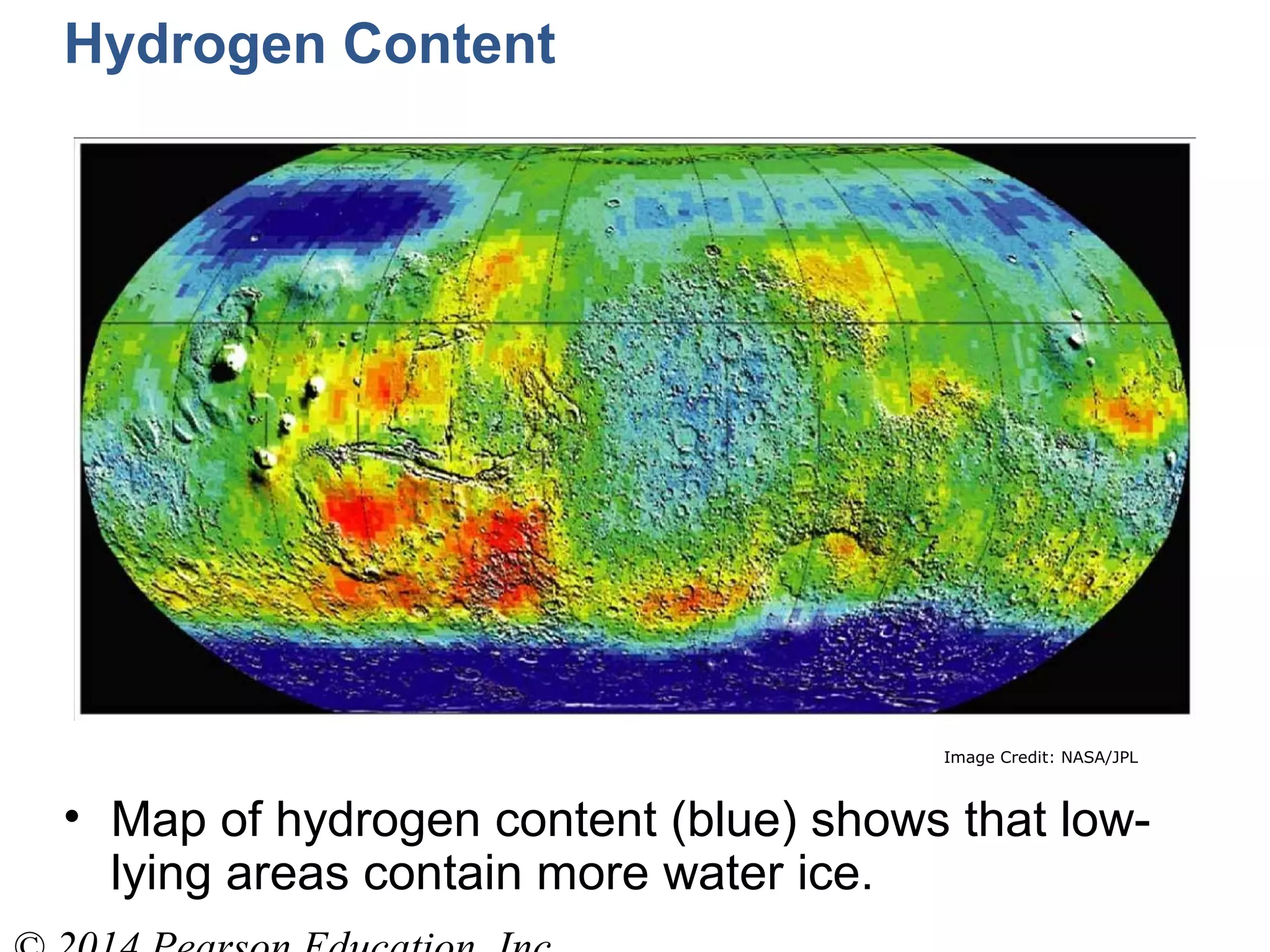
Image Credit: NASA/JPL
Hydrogen Content
• Map of hydrogen content (blue) shows that low-
lying areas contain more water ice.
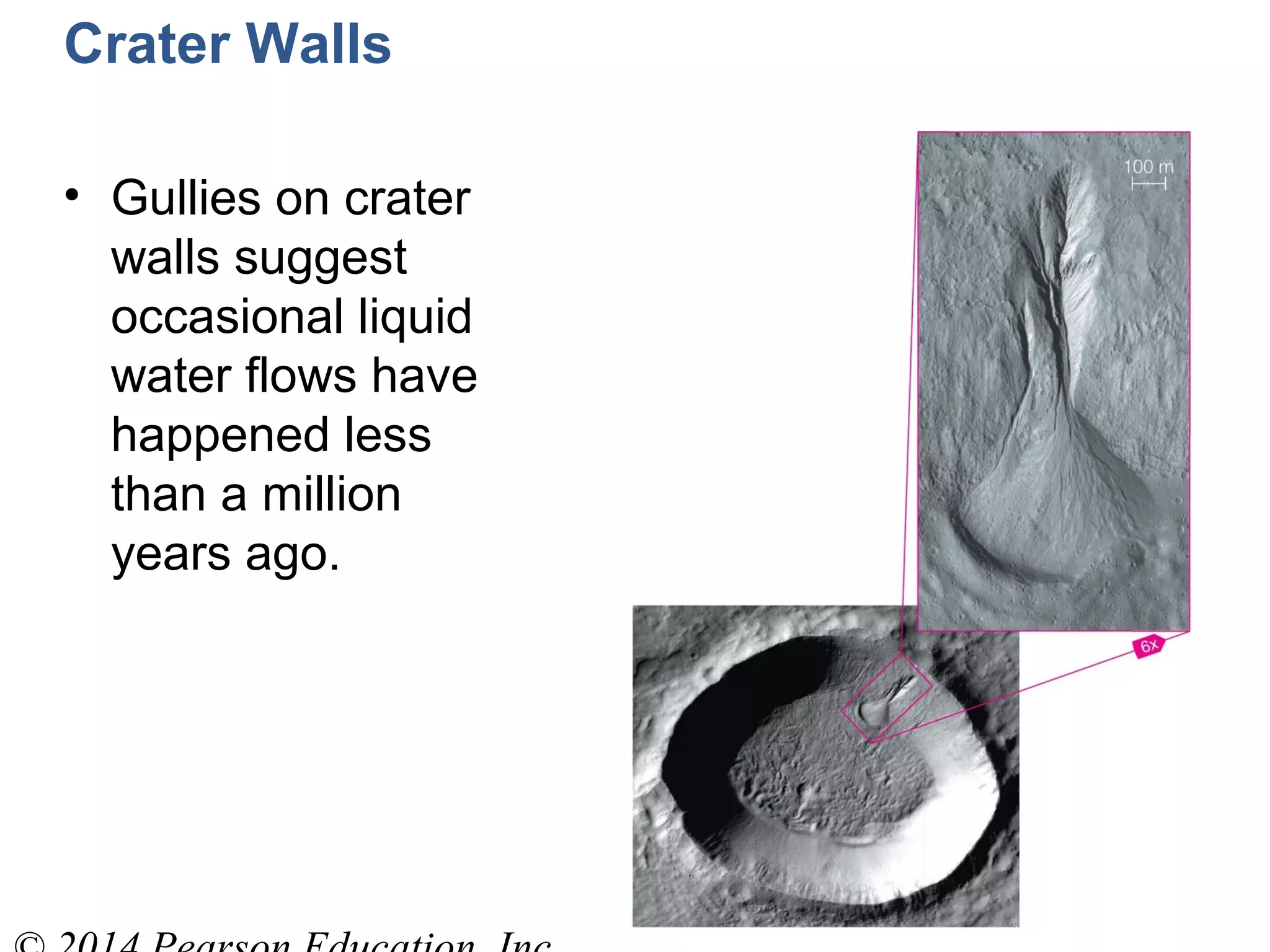
Crater Walls
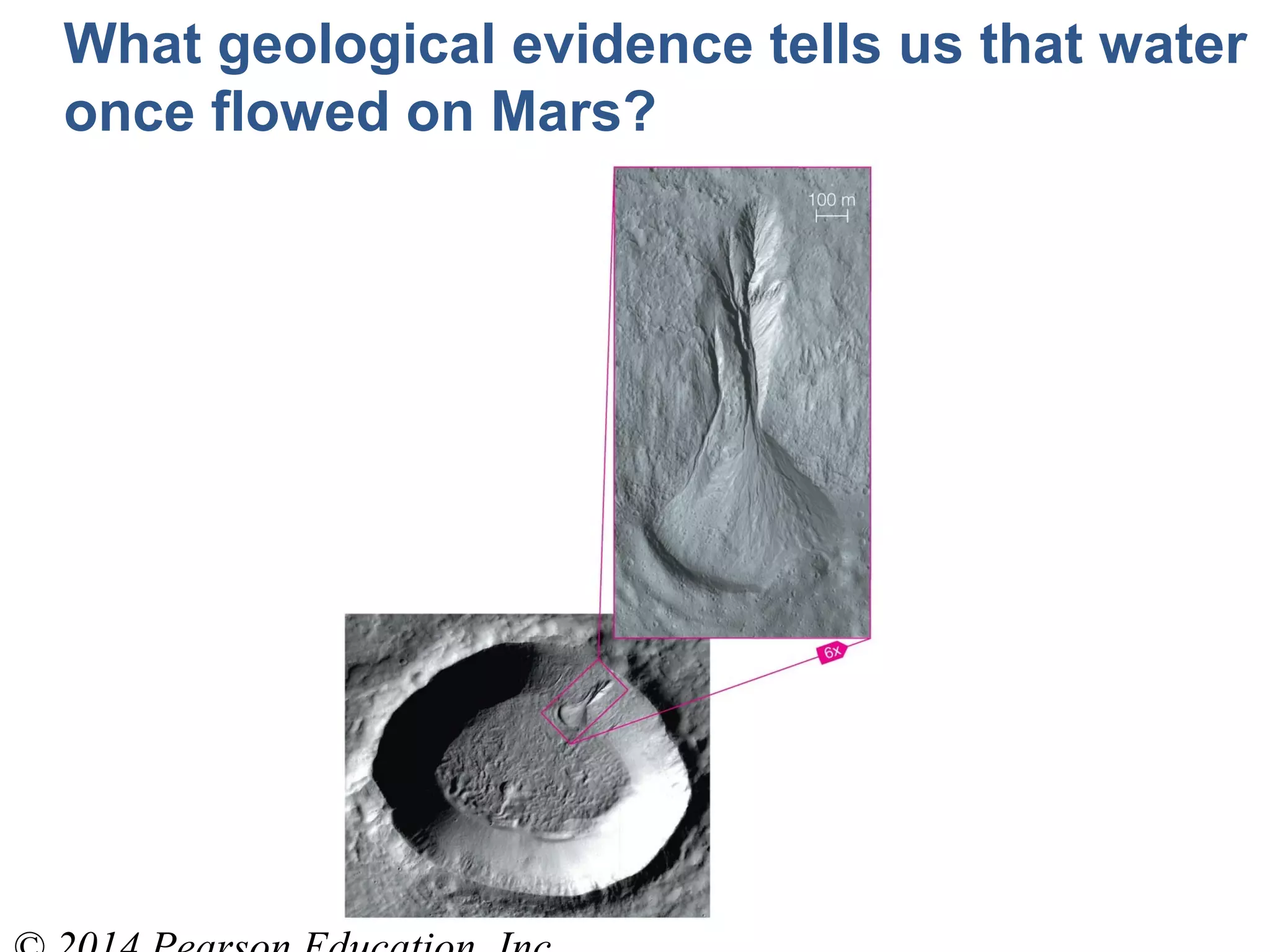
• Gullies on crater
walls suggest
occasional liquid
water flows have
happened less
than a million
years ago.
What have we learned?
• What are the major geological features of
Mars?
– Differences in cratering across surface
– Giant shield volcanoes
– Evidence of tectonic activity
What have we learned?
• What geological evidence tells us that water
once flowed on Mars?
– Some surface features look like dry riverbeds.
– Some craters appear to be eroded.
– Rovers have found rocks that appear to have
formed in water.
– Gullies in crater walls may indicate recent
water flows.
9.5 Geology of Venus
• Our goals for learning:
– What geological processes have shaped
Venus?
– Does Venus have plate tectonics?
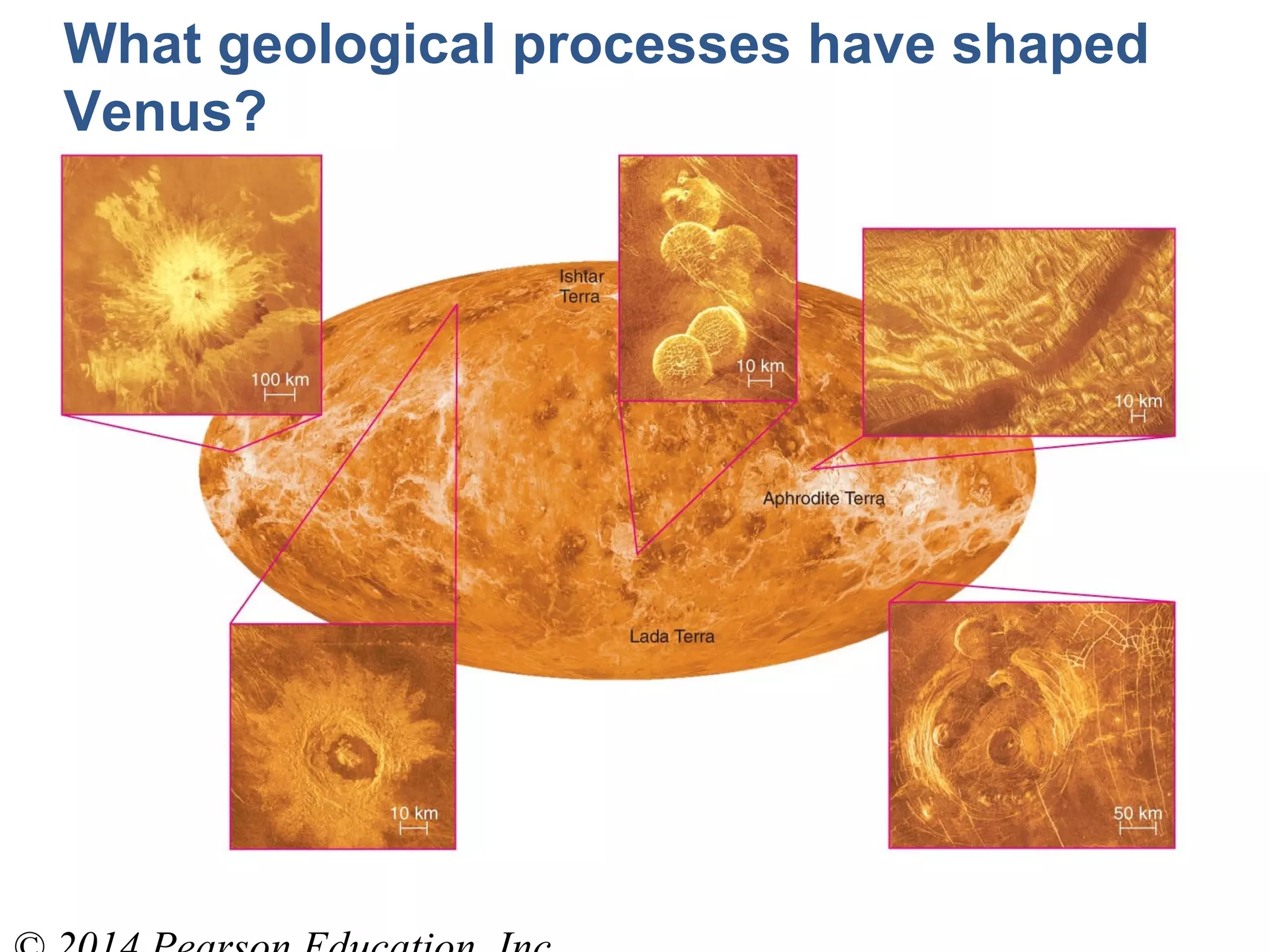
What geological processes have shaped
Venus?
Insert TCP7e
figure 9.35
Insert TCP7e
figure 9.35
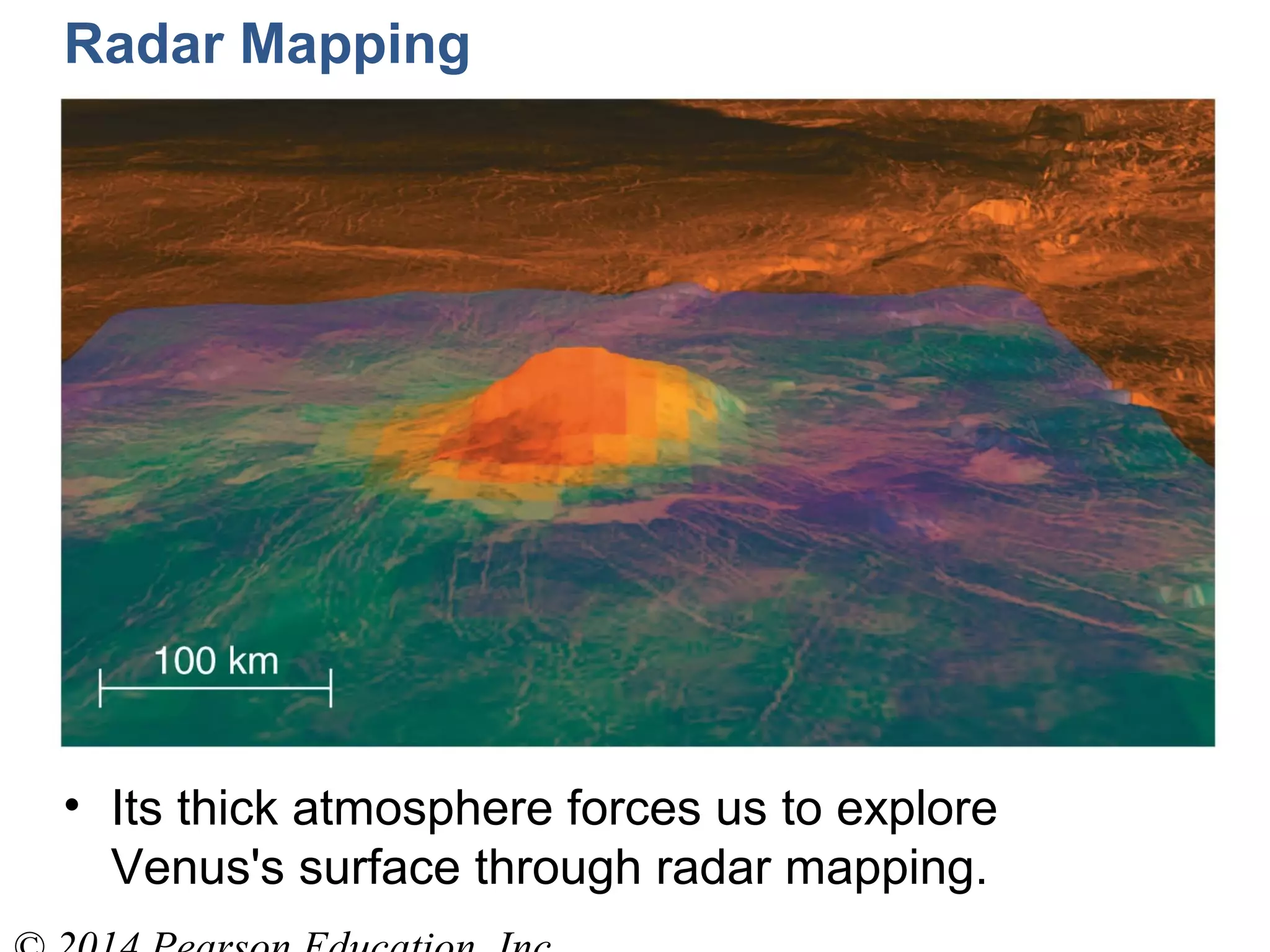
Radar Mapping
• Its thick atmosphere forces us to explore
Venus's surface through radar mapping.
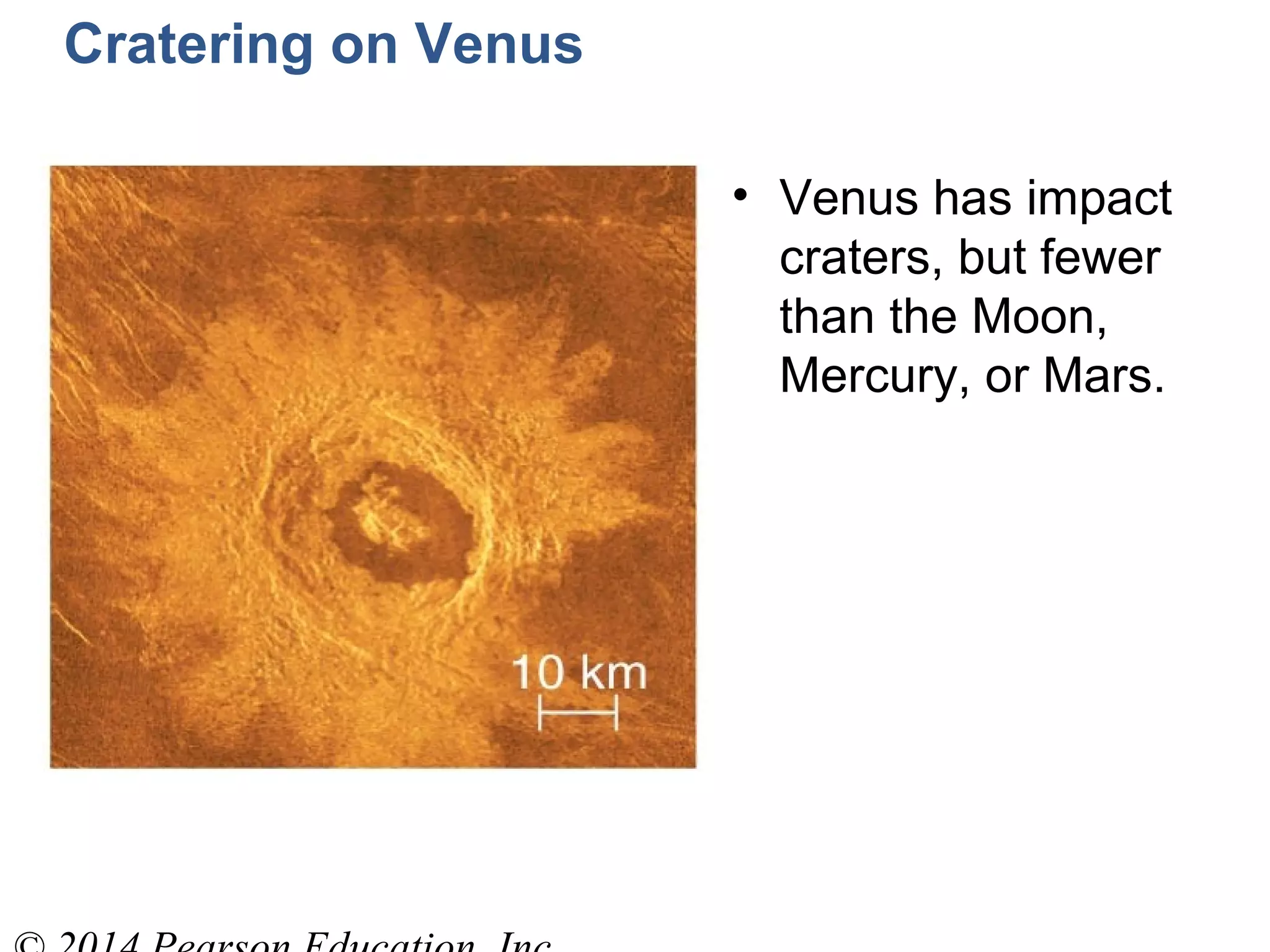
Cratering on Venus
• Venus has impact
craters, but fewer
than the Moon,
Mercury, or Mars.
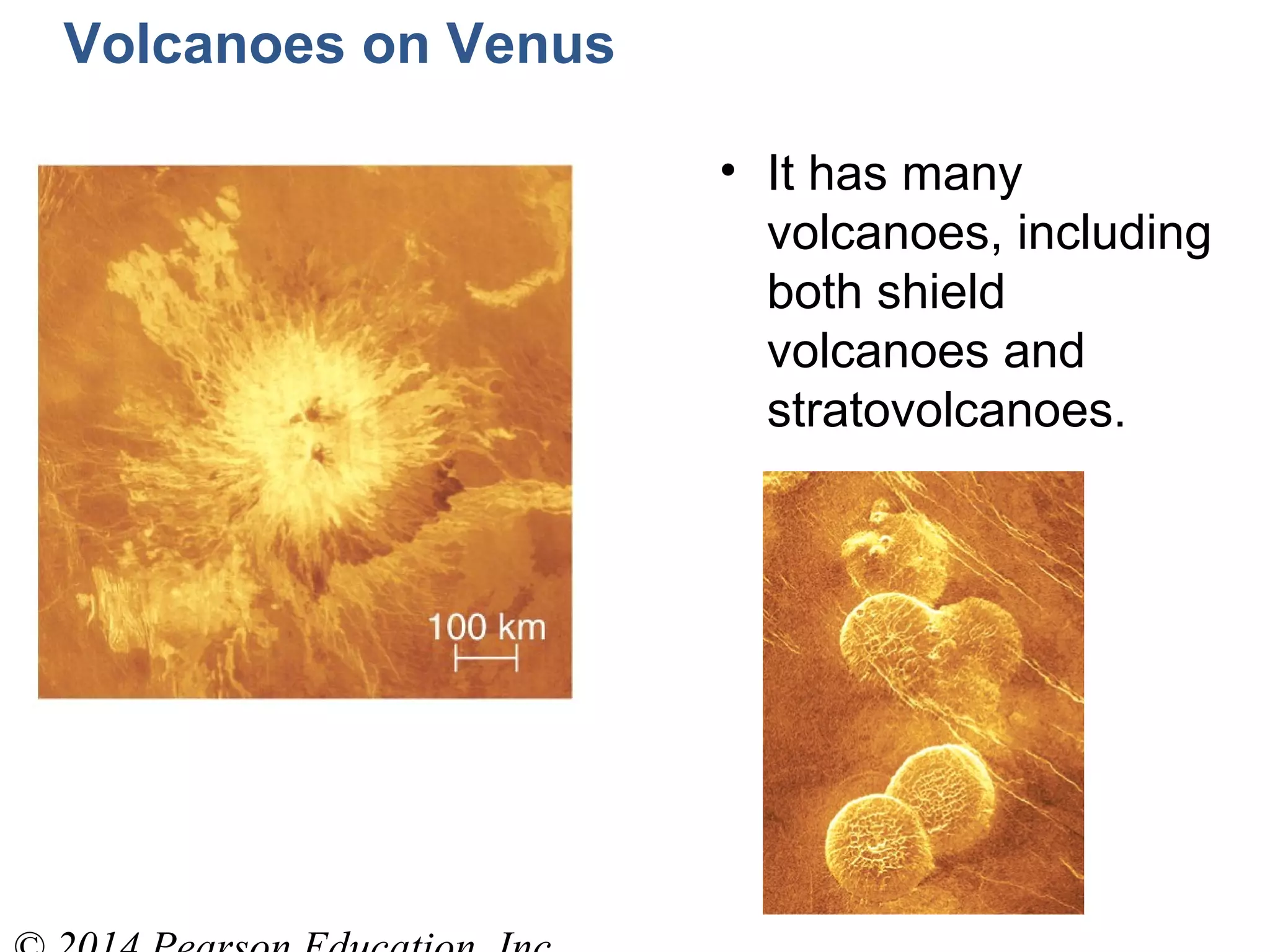
Volcanoes on Venus
• It has many
volcanoes, including
both shield
volcanoes and
stratovolcanoes.
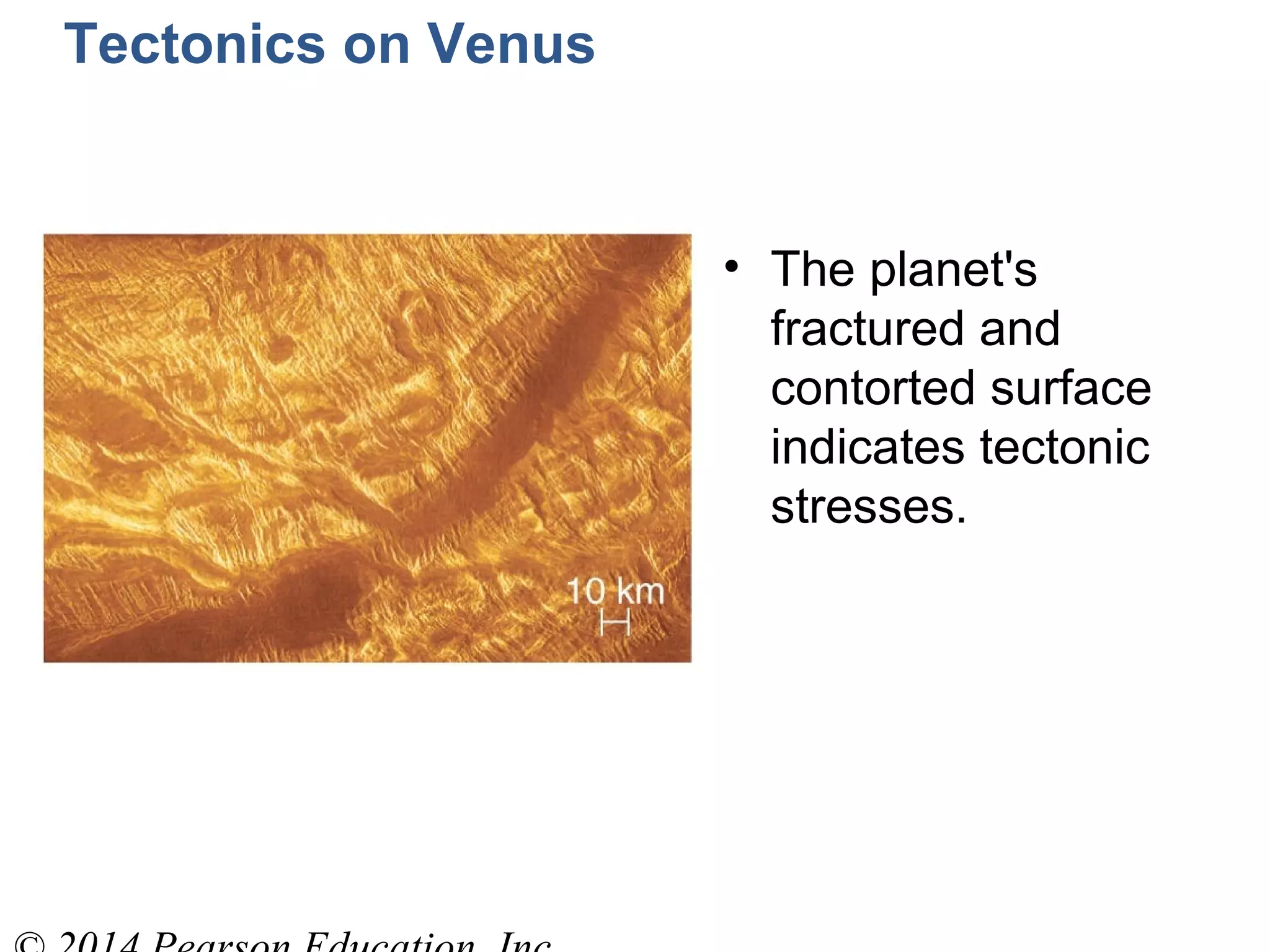
Tectonics on Venus
• The planet's
fractured and
contorted surface
indicates tectonic
stresses.
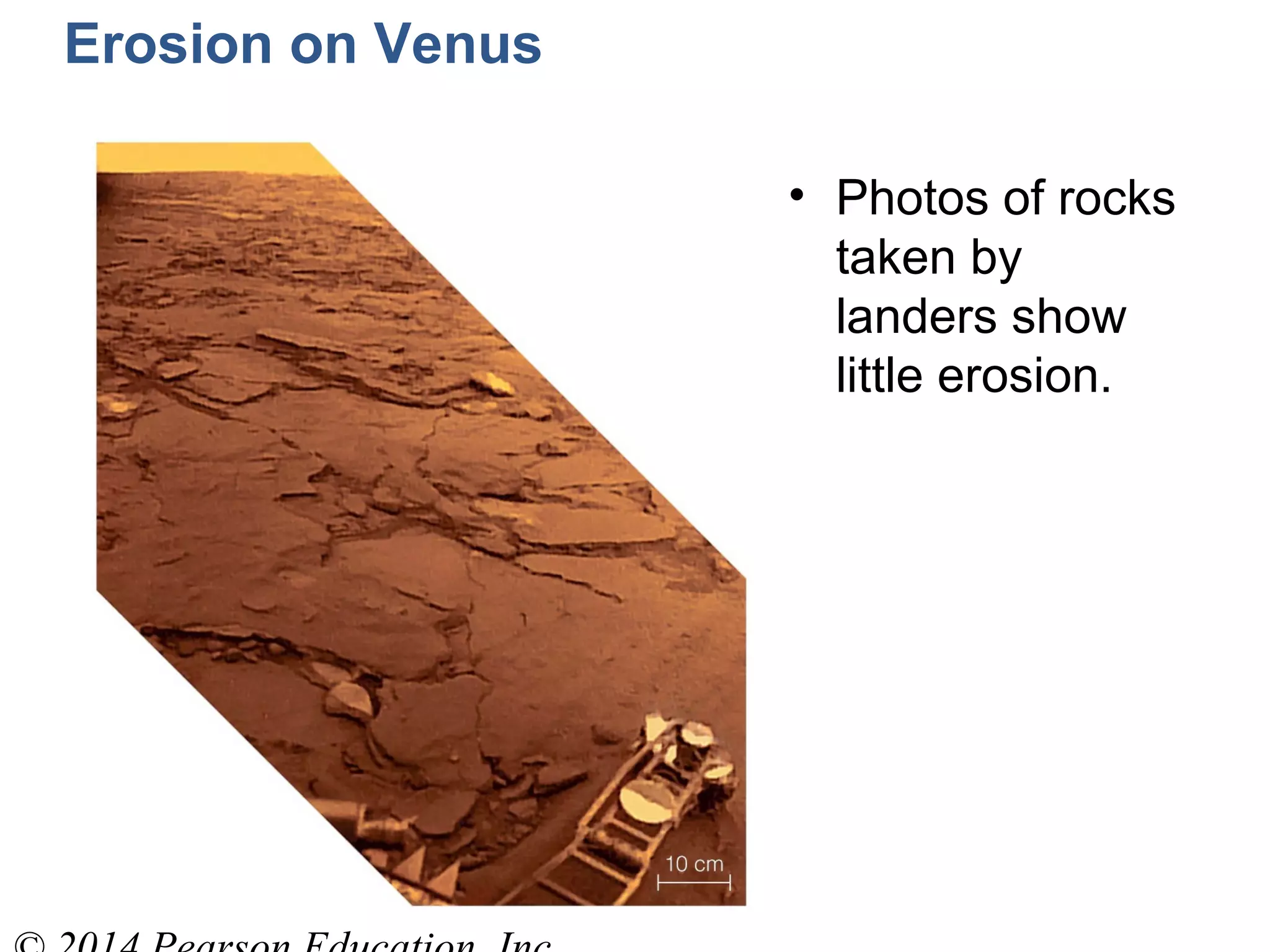
Erosion on Venus
• Photos of rocks
taken by
landers show
little erosion.
Does Venus have plate tectonics?
• Venus does not appear to have plate tectonics,
but entire surface seems to have been "repaved"
750 million years ago.
• Weaker convection?
• Thicker or more rigid lithosphere?
What have we learned?
• What geological processes have shaped
Venus?
– Venus has cratering, volcanism, and tectonics
but not much erosion.
• Does Venus have plate tectonics?
– The lack of plate tectonics on Venus is a
mystery.
9.6 The Unique Geology of Earth
• Our goals for learning:
– How is Earth's surface shaped by plate
tectonics?
– Was Earth's geology destined from birth?
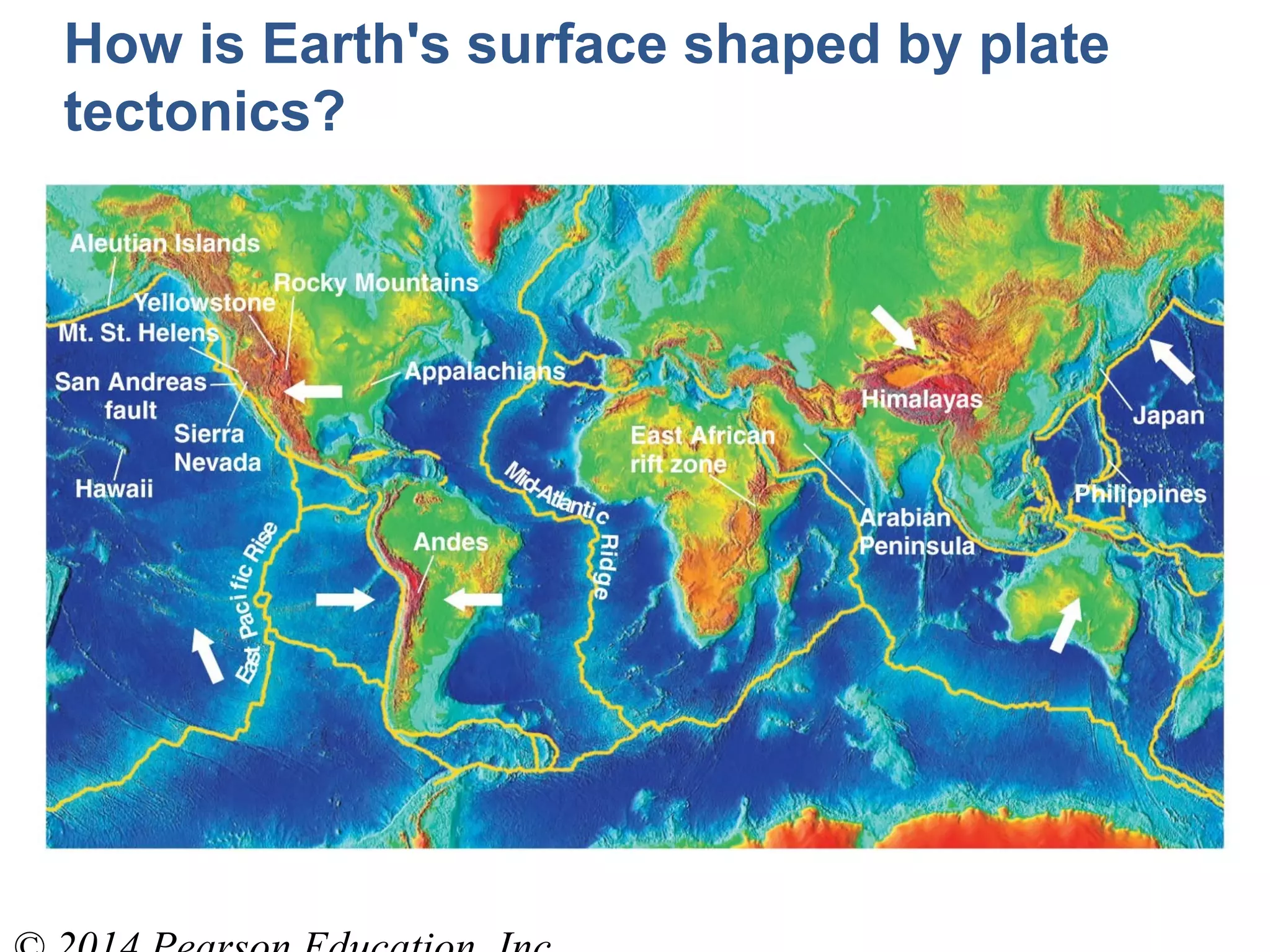
How is Earth's surface shaped by plate
tectonics?
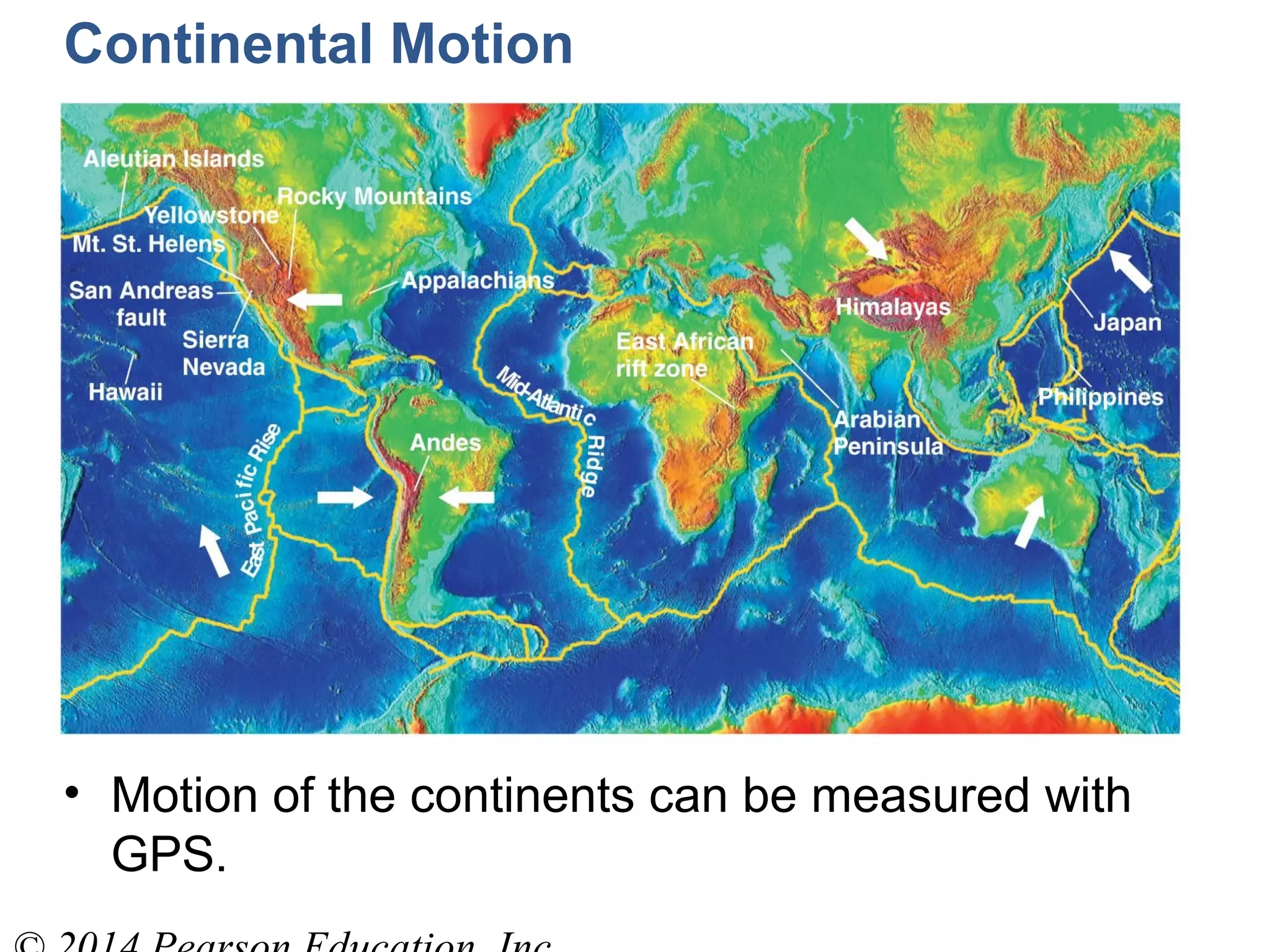
Continental Motion
• Motion of the continents can be measured with
GPS.
Continental Motion
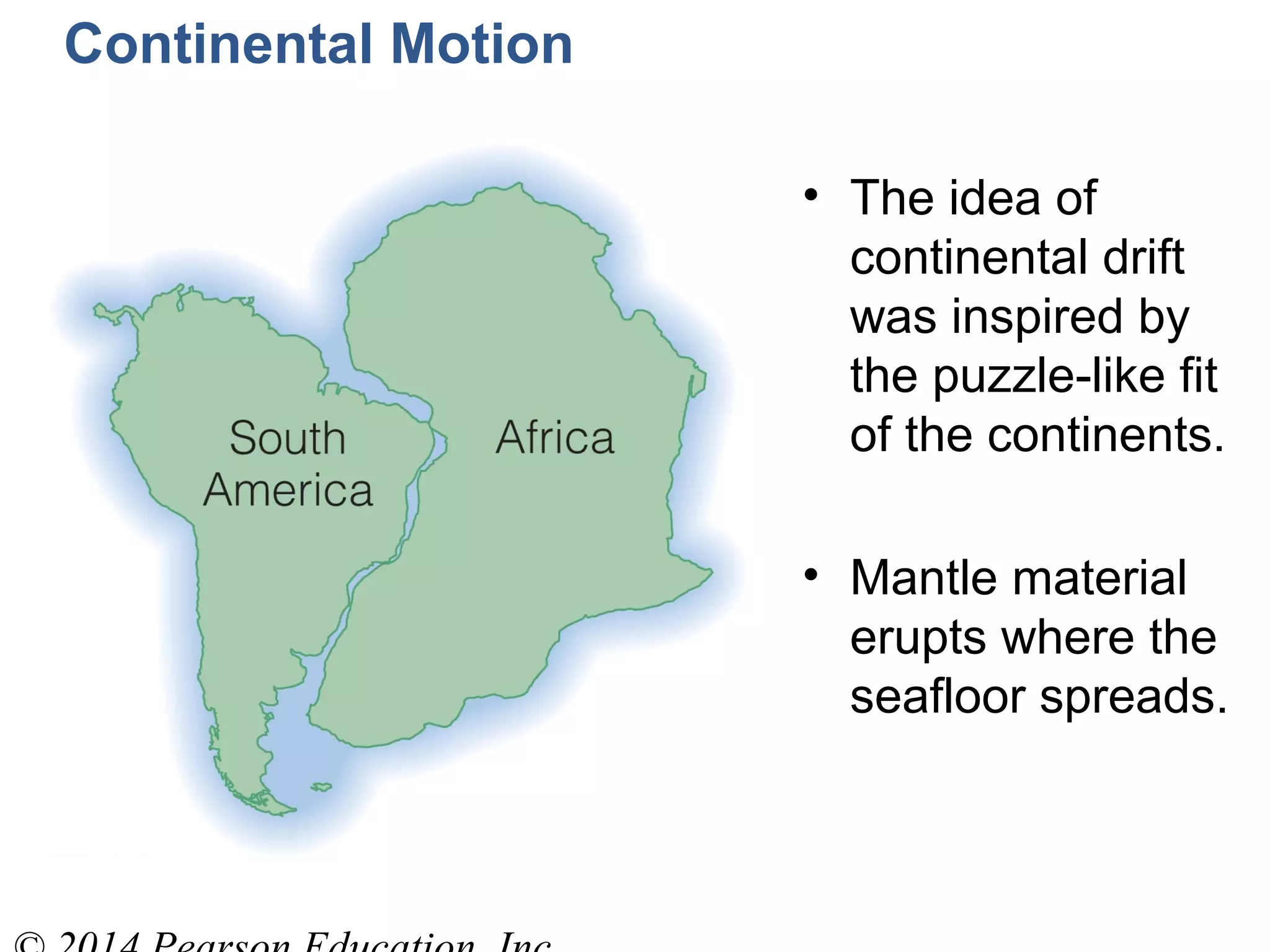
• The idea of
continental drift
was inspired by
the puzzle-like fit
of the continents.
• Mantle material
erupts where the
seafloor spreads.
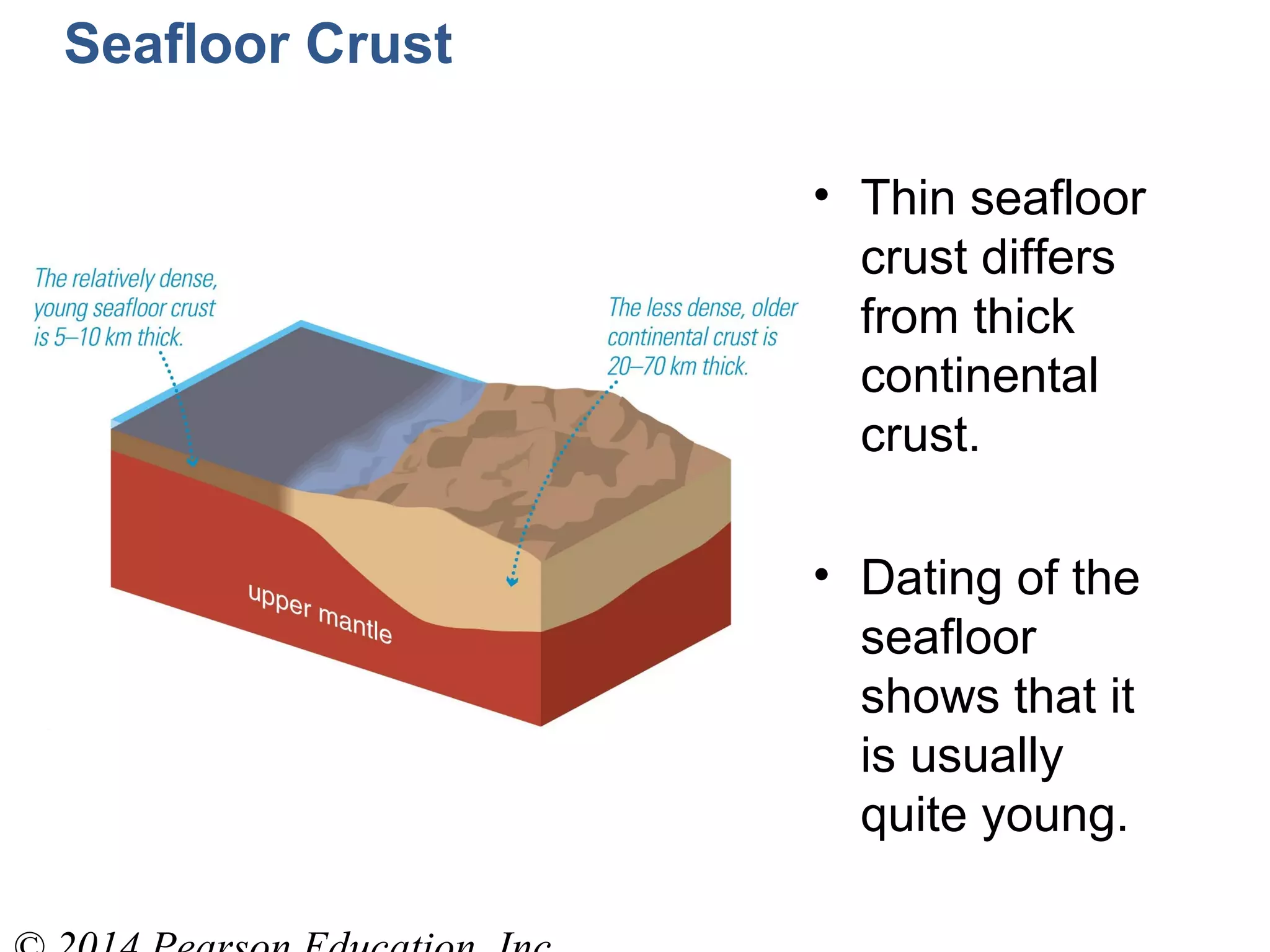
Seafloor Crust
• Thin seafloor
crust differs
from thick
continental
crust.
• Dating of the
seafloor
shows that it
is usually
quite young.
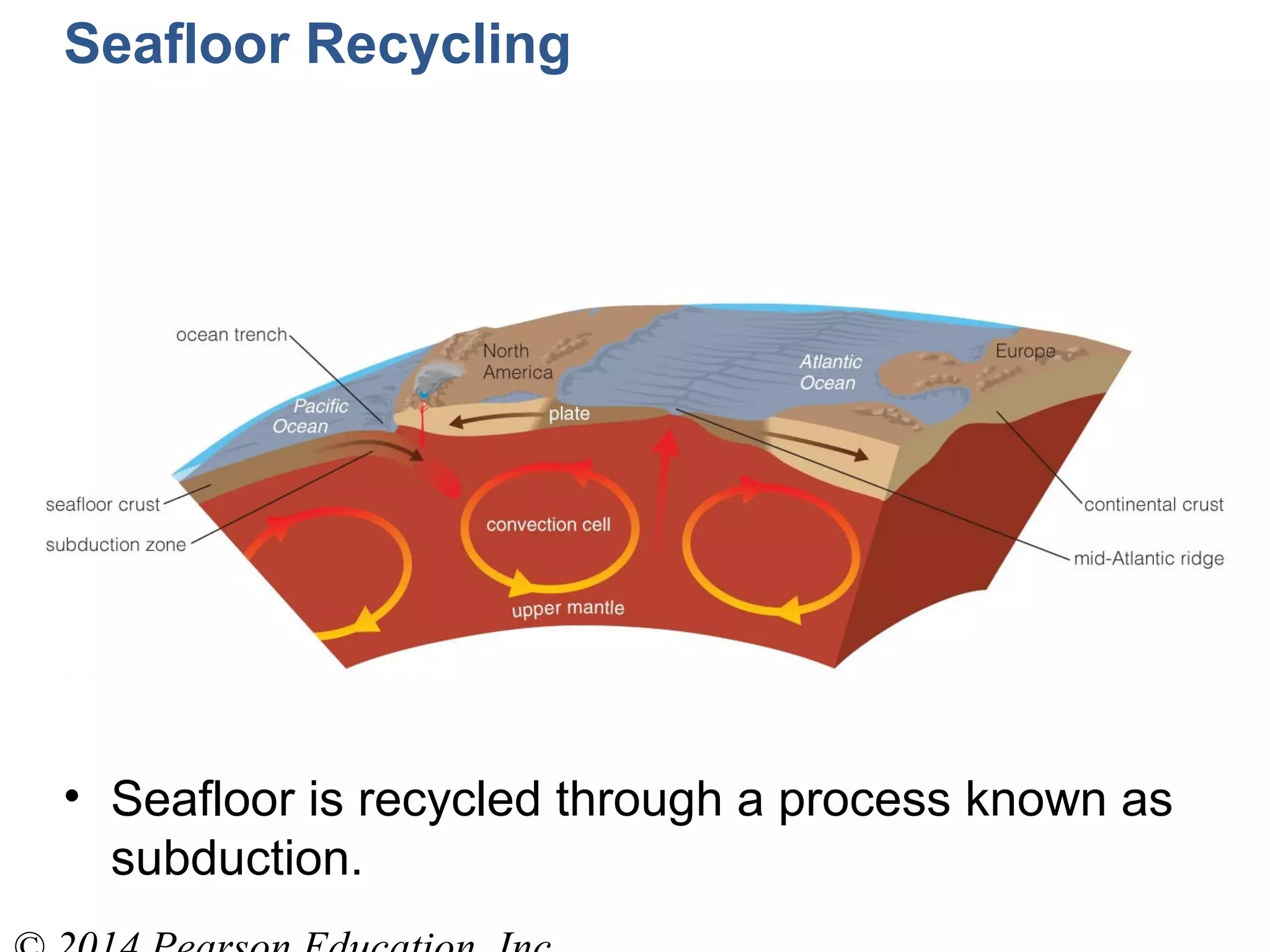
Seafloor Recycling
• Seafloor is recycled through a process known as
subduction.
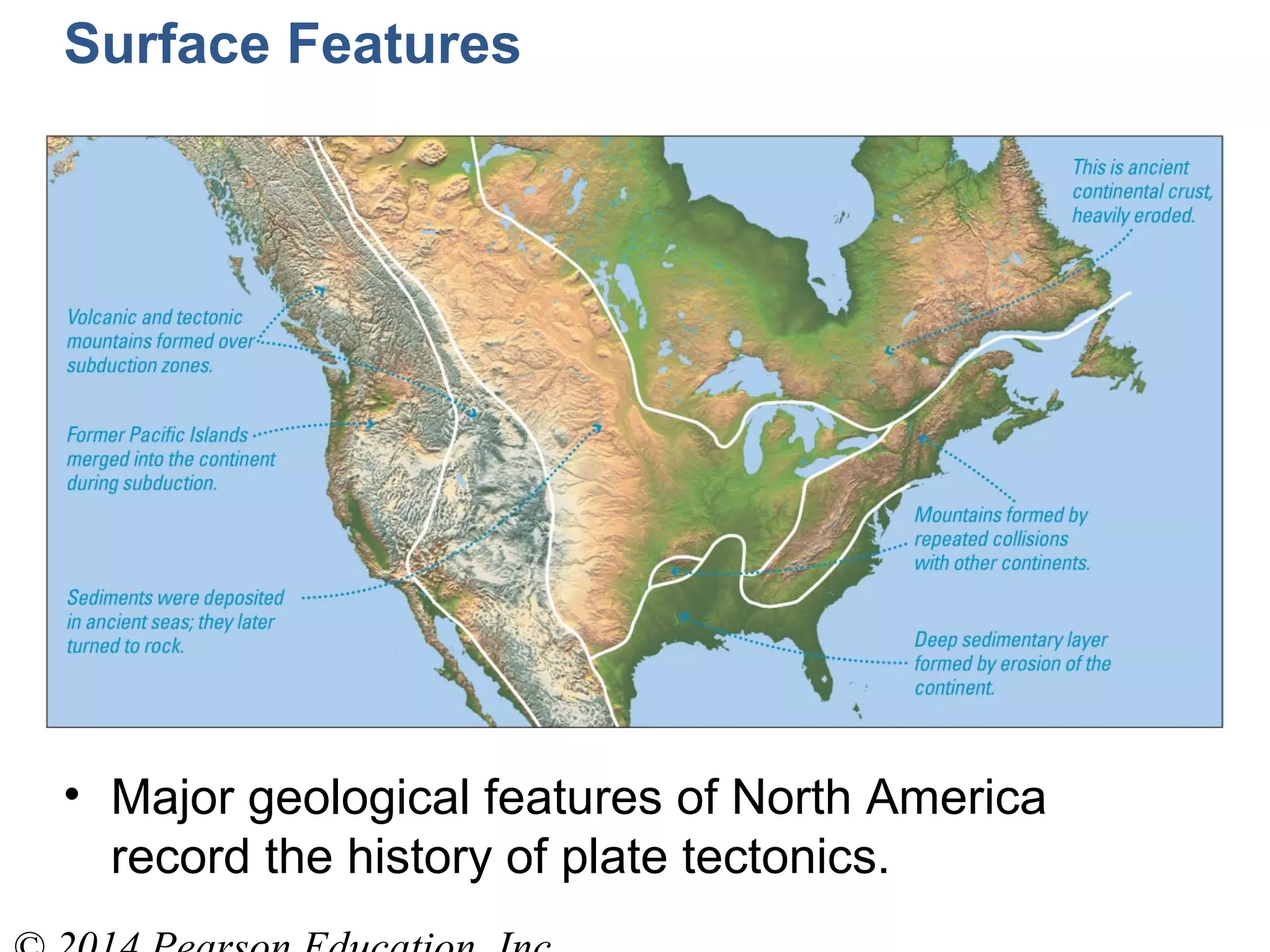
Surface Features
• Major geological features of North America
record the history of plate tectonics.
Surface Features
• The Himalayas
formed from a
collision
between plates.
Surface Features
• The Red Sea is
formed where
plates are pulling
apart.
Rifts, Faults, Earthquakes
• The San Andreas
fault in
California is a
plate boundary.
• Motion of plates
can cause
earthquakes.
Plate Motions
• Measurements of plate motions tell us past and
future layout of the continents.
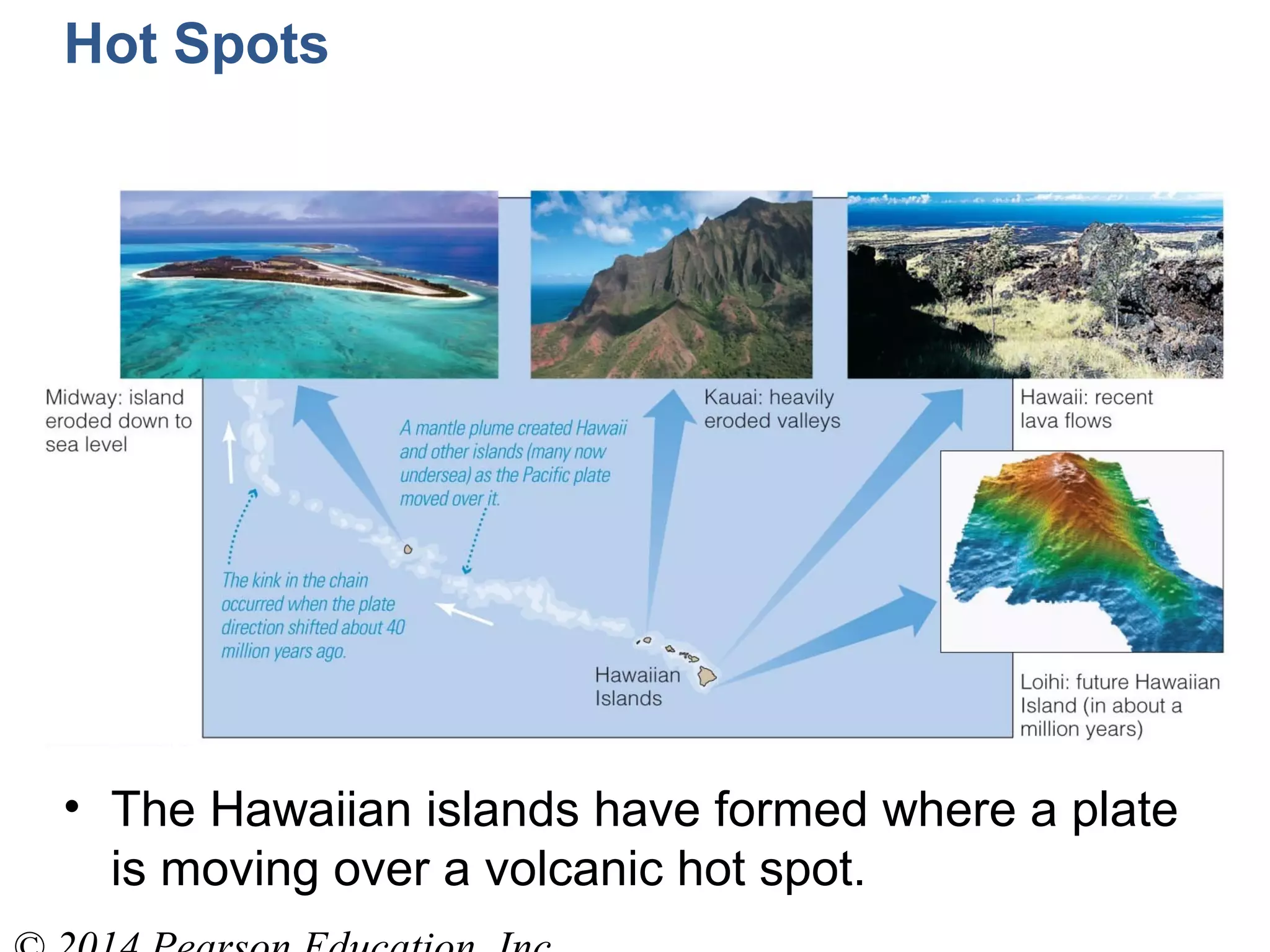
Hot Spots
• The Hawaiian islands have formed where a plate
is moving over a volcanic hot spot.
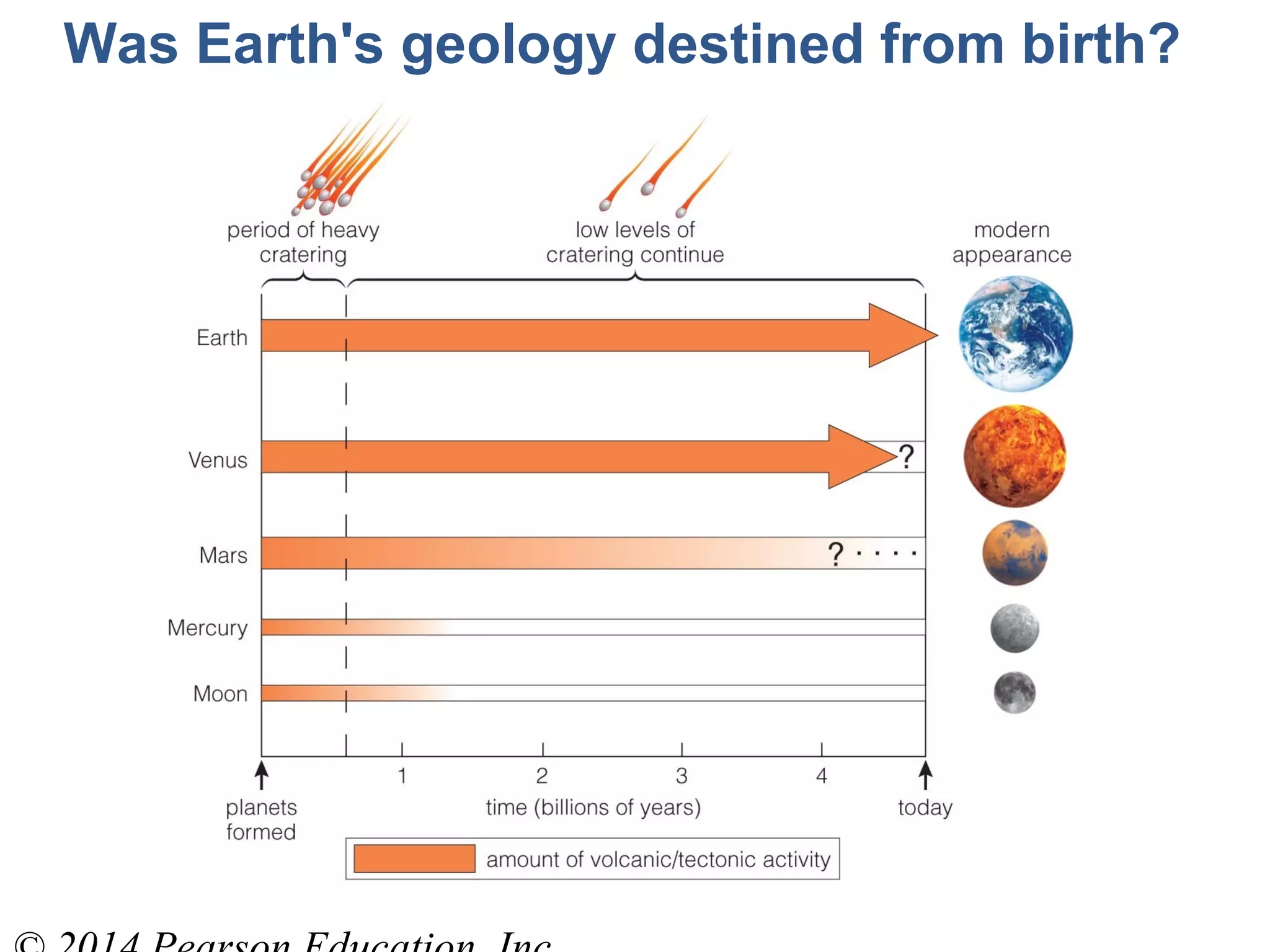
Was Earth's geology destined from birth?
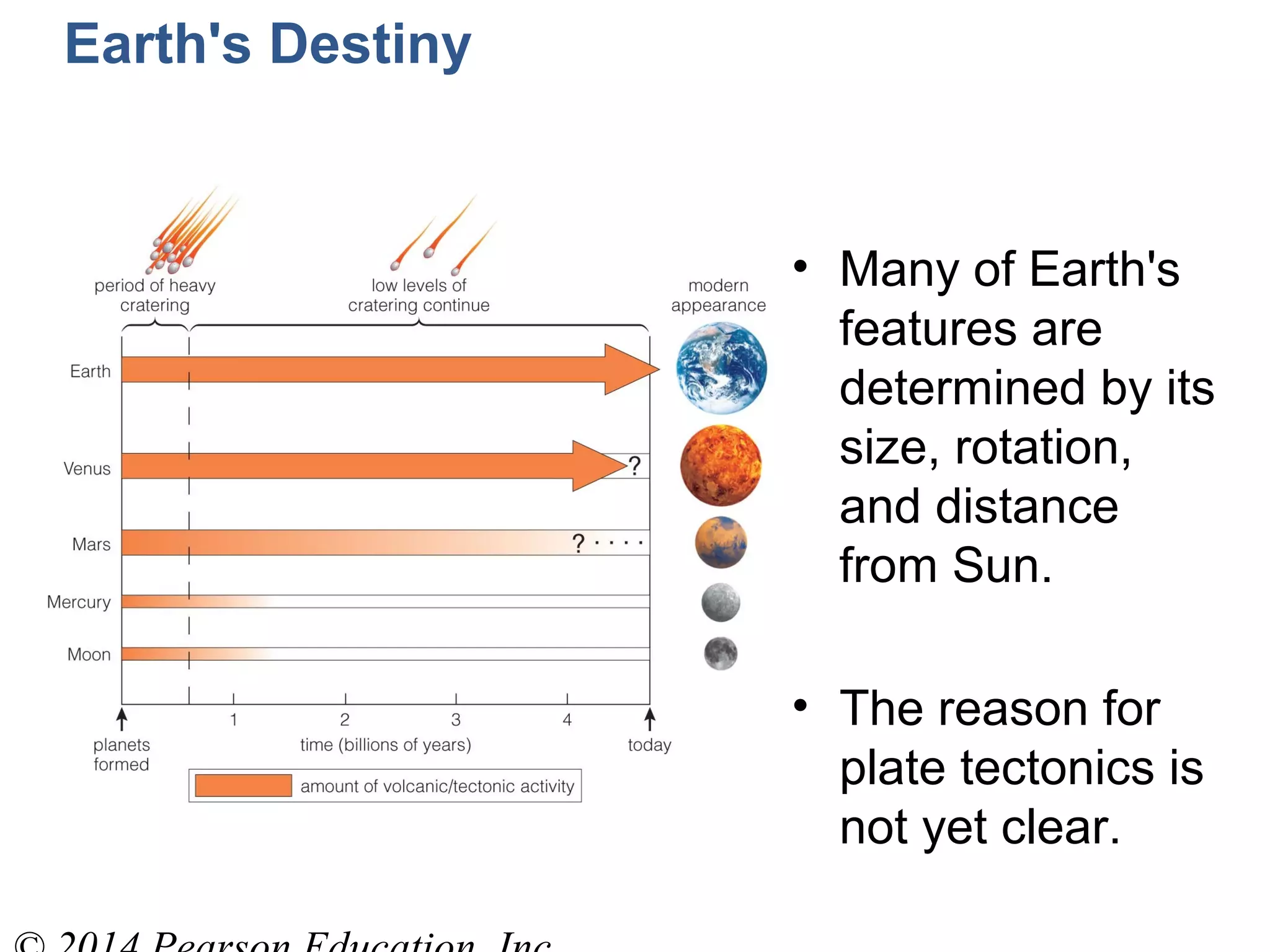
Earth's Destiny
• Many of Earth's
features are
determined by its
size, rotation,
and distance
from Sun.
• The reason for
plate tectonics is
not yet clear.
What have we learned?
• How is Earth's surface shaped by plate
tectonics?
– Measurements of plate motions confirm the
idea of continental drift.
– Plate tectonics is responsible for subduction,
seafloor spreading, mountains, rifts, and
earthquakes.
What have we learned?
• Was Earth's geology destined from birth?
– Many of Earth's features are determined by its
size, distance from Sun, and rotation rate.
– The reason for plate tectonics is still a
mystery.

09 lecture outline

  • 1.
    Chapter 9 Lecture ©2014 Pearson Education, Inc. The Cosmic Perspective Seventh Edition Planetary Geology: Earth and the Other Terrestrial Worlds
  • 2.
    Planetary Geology: Earthand the Other Terrestrial Worlds
  • 3.
    9.1 Connecting PlanetaryInteriors and Surfaces • Our goals for learning: – What are terrestrial planets like on the inside? – What causes geological activity? – Why do some planetary interiors create magnetic fields?
  • 4.
    What are terrestrialplanets like on the inside?
  • 5.
    Seismic Waves • Vibrations thattravel through Earth's interior tell us what Earth is like on the inside.
  • 6.
    Earth's Interior • Core:highest density; nickel and iron • Mantle: moderate density; silicon, oxygen, etc. • Crust: lowest density; granite, basalt, etc.
  • 7.
    • Applying whatwe have learned about Earth's interior to other planets tells us what their interiors are probably like. Terrestrial Planet Interiors
  • 8.
    Differentiation • Gravity pulls high-density materialto center. • Lower-density material rises to surface. • Material ends up separated by density.
  • 9.
    Lithosphere • A planet'souter layer of cool, rigid rock is called the lithosphere. • It "floats" on the warmer, softer rock that lies beneath.
  • 10.
    Strength of Rock •Rock stretches when pulled slowly but breaks when pulled rapidly. • The gravity of a large world pulls slowly on its rocky content, shaping the world into a sphere.
  • 11.
    Special Topic: How dowe know what's inside Earth? • P waves push matter back and forth. • S waves shake matter side to side
  • 12.
    Special Topic: How dowe know what's inside Earth? • P waves go through Earth's core, but S waves do not. • We conclude that Earth's core must have a liquid outer layer.
  • 13.
    Thought Question What isnecessary for differentiation to occur in a planet? a) It must have metal and rock in it. b) It must be a mix of materials of different density. c) Material inside must be able to flow. d) All of the above e) b and c
  • 14.
    Thought Question What isnecessary for differentiation to occur in a planet? a) It must have metal and rock in it. b) It must be a mix of materials of different density. c) Material inside must be able to flow. d) All of the above e) b and c
  • 15.
  • 16.
    Heating of PlanetaryInteriors • Accretion and differentiation when planets were young • Radioactive decay is most important heat source today.
  • 17.
    Cooling of PlanetaryInteriors • Convection transports heat as hot material rises and cool material falls. • Conduction transfers heat from hot material to cool material. • Radiation sends energy into space.
  • 18.
    • Smaller worldscool off faster and harden earlier. • The Moon and Mercury are now geologically "dead." Role of Size
  • 19.
    • Heat contentdepends on volume. • Loss of heat through radiation depends on surface area. • Time to cool depends on surface area divided by volume: • Larger objects have a smaller ratio and cool more slowly. 3 Surface area–to–volume ratio = 4πr 2 4πr 3 = 3 r Surface Area–to–Volume Ratio
  • 20.
    Why do someplanetary interiors create magnetic fields?
  • 21.
    Sources of MagneticFields • Motions of charged particles are what create magnetic fields.
  • 22.
    Sources of MagneticFields • A world can have a magnetic field if charged particles are moving inside. • Three requirements: – Molten, electrically conducting interior – Convection – Moderately rapid rotation
  • 23.
    What have welearned? • What are terrestrial planets like on the inside? – All terrestrial worlds have a core, mantle, and crust. – Denser material is found deeper inside. • What causes geological activity? – Interior heat drives geological activity. – Radioactive decay is currently main heat source. • Why do some planetary interiors create magnetic fields? – Requires motion of charged particles inside a planet
  • 24.
    9.2 Shaping PlanetarySurfaces • Our goals for learning: – What processes shape planetary surfaces? – How do impact craters reveal a surface's geological age? – Why do the terrestrial planets have different geological histories?
  • 25.
    What processes shapeplanetary surfaces?
  • 26.
    Processes That ShapeSurfaces • Impact cratering – Impacts by asteroids or comets • Volcanism – Eruption of molten rock onto surface • Tectonics – Disruption of a planet's surface by internal stresses • Erosion – Surface changes made by wind, water, or ice
  • 27.
    Impact Cratering • Mostcratering happened soon after the solar system formed. • Craters are about 10 times wider than object that made them. • Small craters greatly outnumber large ones.
  • 28.
    Meteor Crater (Arizona)MeteorCrater (Arizona) Tycho Crater (Moon)Tycho Crater (Moon) Impact Craters
  • 29.
    "Standard" crater"Standard" craterImpact into icyImpact into icy groundground Eroded craterEroded crater Impact Craters on Mars
  • 30.
    Volcanism • Volcanism happens whenmolten rock (magma) finds a path through lithosphere to the surface. • Molten rock is called lava after it reaches the surface.
  • 31.
    Runny lava makesRunnylava makes flat lava plains.flat lava plains. Slightly thickerSlightly thicker lava makeslava makes broadbroad shieldshield volcanoesvolcanoes.. Thickest lava makesThickest lava makes steepsteep stratovolcanoesstratovolcanoes.. Lava and Volcanoes
  • 32.
    • Volcanism alsoreleases gases from Earth's interior into the atmosphere. Outgassing
  • 33.
    • Convection ofthe mantle creates stresses in the crust called tectonic forces. • Compression of crust creates mountain ranges. • Valley can form where crust is pulled apart. Tectonics
  • 34.
    Plate Tectonics onEarth • Earth's continents slide around on separate plates of crust.
  • 35.
    Erosion • Erosion isa blanket term for weather-driven processes that break down or transport rock. • Processes that cause erosion include: – glaciers – rivers – wind
  • 36.
    Erosion by Water •The Colorado River continues to carve Grand Canyon.
  • 37.
    Erosion by Ice •Glaciers carved the Yosemite Valley.
  • 38.
    Erosion by Wind •Wind wears away rock and builds up sand dunes.
  • 39.
    Erosional Debris • Erosioncan create new features such as deltas by depositing debris.
  • 40.
    How do impactcraters reveal a surface's geological age?
  • 41.
    History of Cratering •Most cratering happened in the first billion years. • A surface with many craters has not changed much in 3 billion years.
  • 42.
    Cratering of Moon •Some areas of Moon are more heavily cratered than others. • Younger regions were flooded by lava after most cratering.
  • 43.
    Cratering map ofthe MoonCratering map of the Moon's entire surface's entire surface Cratering of Moon
  • 44.
    Why do theterrestrial planets have different geological histories?
  • 45.
    • Smaller worldscool off faster and harden earlier. • Larger worlds remain warm inside, promoting volcanism and tectonics. • Larger worlds also have more erosion because their gravity retains an atmosphere. Role of Planetary Size
  • 46.
    • Planets closeto the Sun are too hot for rain, snow, ice and so have less erosion. • Hot planets have more difficulty retaining an atmosphere. • Planets far from the Sun are too cold for rain, limiting erosion. • Planets with liquid water have the most erosion. Role of Distance from Sun
  • 47.
    • Planets withslower rotation have less weather, less erosion, and a weak magnetic field. • Planets with faster rotation have more weather, more erosion, and a stronger magnetic field. Role of Rotation
  • 48.
    Thought Question How doesthe cooling of planets and potatoes vary with size? a) Larger size makes it harder for heat from inside to escape. b) Larger size means a bigger ratio of volume to surface area. c) Larger size takes longer to cool. d) all of the above
  • 49.
    Thought Question How doesthe cooling of planets and potatoes vary with size? a) Larger size makes it harder for heat from inside to escape. b) Larger size means a bigger ratio of volume to surface area. c) Larger size takes longer to cool. d) all of the above
  • 50.
    What have welearned? • What processes shape planetary surfaces? – Cratering, volcanism, tectonics, erosion • How do impact craters reveal a surface's geological age? – The amount of cratering tells us how long ago a surface formed. • Why do the terrestrial planets have different geological histories? – Differences arise because of planetary size, distance from Sun, and rotation rate.
  • 51.
    9.3 Geology ofthe Moon and Mercury • Our goals for learning: – What geological processes shaped our Moon? – What geological processes shaped Mercury?
  • 52.
    What geological processesshaped our Moon?
  • 53.
    Lunar Maria • Smooth,dark lunar maria are less heavily cratered than lunar highlands. • Maria were made by floods of runny lava.
  • 54.
    LargeLarge impactimpact cratercrater weakensweakens crust.crust. Heat build-Heat build- upallowsup allows lava to welllava to well up toup to surface.surface. EarlyEarly surface issurface is coveredcovered with craters.with craters. Cooled lava isCooled lava is smoother andsmoother and darker thandarker than surroundings.surroundings. Formation of Lunar Maria
  • 55.
    Tectonic Features • Wrinklesarise from cooling and the contraction of a lava flood.
  • 56.
    Geologically Dead • Moonis considered geologically "dead" because geological processes have virtually stopped.
  • 57.
  • 58.
    Cratering of Mercury •Mercury has a mixture of heavily cratered and smooth regions like the Moon. • Smooth regions are likely ancient lava flows.
  • 59.
    The Rembrandt BasinisThe Rembrandt Basin is a large impact crater ona large impact crater on Mercury.Mercury. Hollows in a crater floorHollows in a crater floor created by escaping gases.created by escaping gases. Cratering of Mercury
  • 60.
    • Long cliffsindicate that Mercury shrank early in its history. Tectonics on Mercury
  • 61.
    What have welearned? • What geological processes shaped our Moon? – Early cratering is still present. – Maria resulted from volcanism. • What geological processes shaped Mercury? – Had cratering and volcanism similar to Moon – Tectonic features indicate early shrinkage.
  • 62.
    9.4 Geology ofMars • Our goals for learning: – What geological processes have shaped Mars? – What geological evidence tells us that water once flowed on Mars?
  • 63.
    • Percival Lowellmisinterpreted surface features seen in telescopic images of Mars. "Canals" on Mars
  • 64.
    What geological processeshave shaped Mars?
  • 65.
    • The amountof cratering differs greatly across Mars's surface. • Many early craters have been erased. Cratering on Mars
  • 66.
    Volcanism on Mars •Mars has many large shield volcanoes. • Olympus Mons is largest volcano in solar system.
  • 67.
    • The systemof valleys known as Valles Marineris is thought to originate from tectonics. Tectonics on Mars
  • 68.
    What geological evidencetells us that water once flowed on Mars?
  • 69.
    • Close-up photosof Mars show what appear to be dried-up riverbeds. Dry Riverbeds?
  • 70.
    Insert TCP7e Figure 9.29 InsertTCP7e Figure 9.29 Erosion of Craters • Details of some craters suggest they were once filled with water.
  • 71.
    Martian Rocks • Marsrovers have found rocks that appear to have formed in water.
  • 72.
    Martian Rocks • Marsrovers have found rocks that appear to have formed in water.
  • 73.
    Image Credit: NASA/JPL HydrogenContent • Map of hydrogen content (blue) shows that low- lying areas contain more water ice.
  • 74.
    Crater Walls • Gullieson crater walls suggest occasional liquid water flows have happened less than a million years ago.
  • 75.
    What have welearned? • What are the major geological features of Mars? – Differences in cratering across surface – Giant shield volcanoes – Evidence of tectonic activity
  • 76.
    What have welearned? • What geological evidence tells us that water once flowed on Mars? – Some surface features look like dry riverbeds. – Some craters appear to be eroded. – Rovers have found rocks that appear to have formed in water. – Gullies in crater walls may indicate recent water flows.
  • 77.
    9.5 Geology ofVenus • Our goals for learning: – What geological processes have shaped Venus? – Does Venus have plate tectonics?
  • 78.
    What geological processeshave shaped Venus?
  • 79.
    Insert TCP7e figure 9.35 InsertTCP7e figure 9.35 Radar Mapping • Its thick atmosphere forces us to explore Venus's surface through radar mapping.
  • 80.
    Cratering on Venus •Venus has impact craters, but fewer than the Moon, Mercury, or Mars.
  • 81.
    Volcanoes on Venus •It has many volcanoes, including both shield volcanoes and stratovolcanoes.
  • 82.
    Tectonics on Venus •The planet's fractured and contorted surface indicates tectonic stresses.
  • 83.
    Erosion on Venus •Photos of rocks taken by landers show little erosion.
  • 84.
    Does Venus haveplate tectonics? • Venus does not appear to have plate tectonics, but entire surface seems to have been "repaved" 750 million years ago. • Weaker convection? • Thicker or more rigid lithosphere?
  • 85.
    What have welearned? • What geological processes have shaped Venus? – Venus has cratering, volcanism, and tectonics but not much erosion. • Does Venus have plate tectonics? – The lack of plate tectonics on Venus is a mystery.
  • 86.
    9.6 The UniqueGeology of Earth • Our goals for learning: – How is Earth's surface shaped by plate tectonics? – Was Earth's geology destined from birth?
  • 87.
    How is Earth'ssurface shaped by plate tectonics?
  • 88.
    Continental Motion • Motionof the continents can be measured with GPS.
  • 89.
    Continental Motion • Theidea of continental drift was inspired by the puzzle-like fit of the continents. • Mantle material erupts where the seafloor spreads.
  • 90.
    Seafloor Crust • Thinseafloor crust differs from thick continental crust. • Dating of the seafloor shows that it is usually quite young.
  • 91.
    Seafloor Recycling • Seaflooris recycled through a process known as subduction.
  • 92.
    Surface Features • Majorgeological features of North America record the history of plate tectonics.
  • 93.
    Surface Features • TheHimalayas formed from a collision between plates.
  • 94.
    Surface Features • TheRed Sea is formed where plates are pulling apart.
  • 95.
    Rifts, Faults, Earthquakes •The San Andreas fault in California is a plate boundary. • Motion of plates can cause earthquakes.
  • 96.
    Plate Motions • Measurementsof plate motions tell us past and future layout of the continents.
  • 97.
    Hot Spots • TheHawaiian islands have formed where a plate is moving over a volcanic hot spot.
  • 98.
    Was Earth's geologydestined from birth?
  • 99.
    Earth's Destiny • Manyof Earth's features are determined by its size, rotation, and distance from Sun. • The reason for plate tectonics is not yet clear.
  • 100.
    What have welearned? • How is Earth's surface shaped by plate tectonics? – Measurements of plate motions confirm the idea of continental drift. – Plate tectonics is responsible for subduction, seafloor spreading, mountains, rifts, and earthquakes.
  • 101.
    What have welearned? • Was Earth's geology destined from birth? – Many of Earth's features are determined by its size, distance from Sun, and rotation rate. – The reason for plate tectonics is still a mystery.