What is a health system?
What is health system
strengthening?
IHPSR Presentation 2
www.hpsa-africa.org
@hpsa_africa
www.slideshare.net/hpsa_africa
Introduction to Health Policy and
Systems Research
Outline
• Definition of a health system
• Conceptual frameworks that help us to
think about health systems
• Considering policy for health system
strengthening
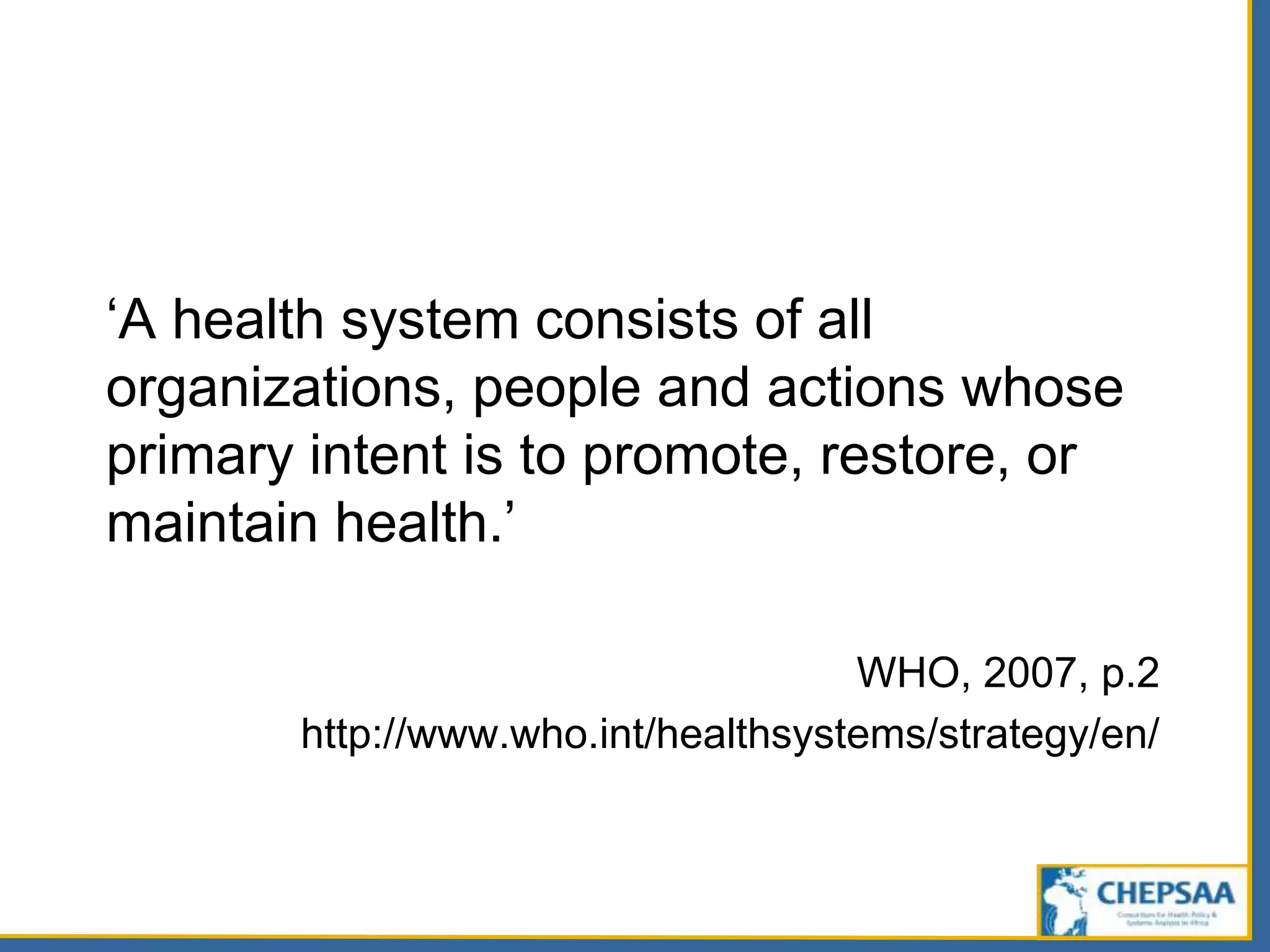
‘A health system consists of all
organizations, people and actions whose
primary intent is to promote, restore, or
maintain health.’
WHO, 2007, p.2
http://www.who.int/healthsystems/strategy/en/
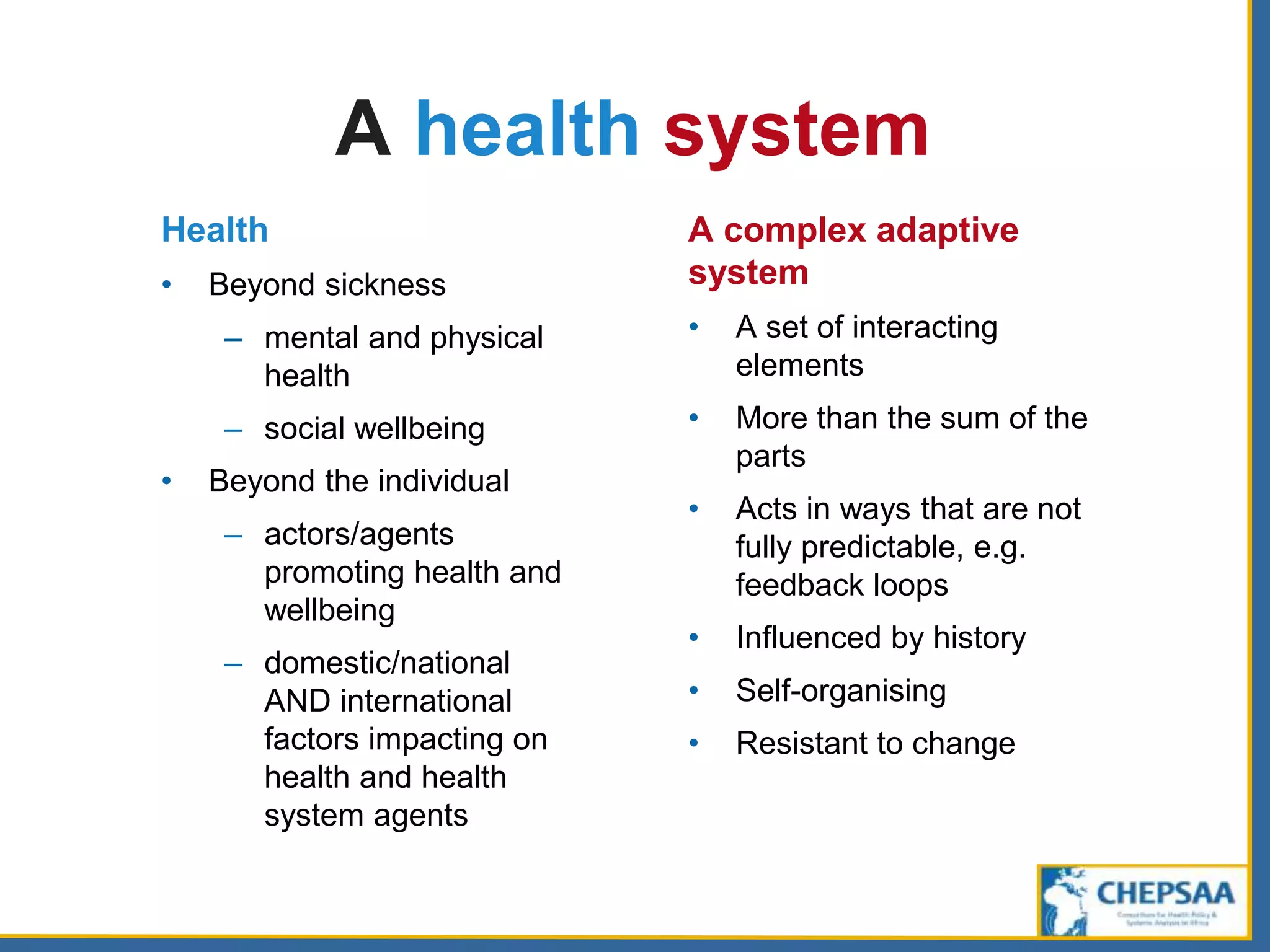
A health system
Health
• Beyond sickness
– mental and physical
health
– social wellbeing
• Beyond the individual
– actors/agents
promoting health and
wellbeing
– domestic/national
AND international
factors impacting on
health and health
system agents
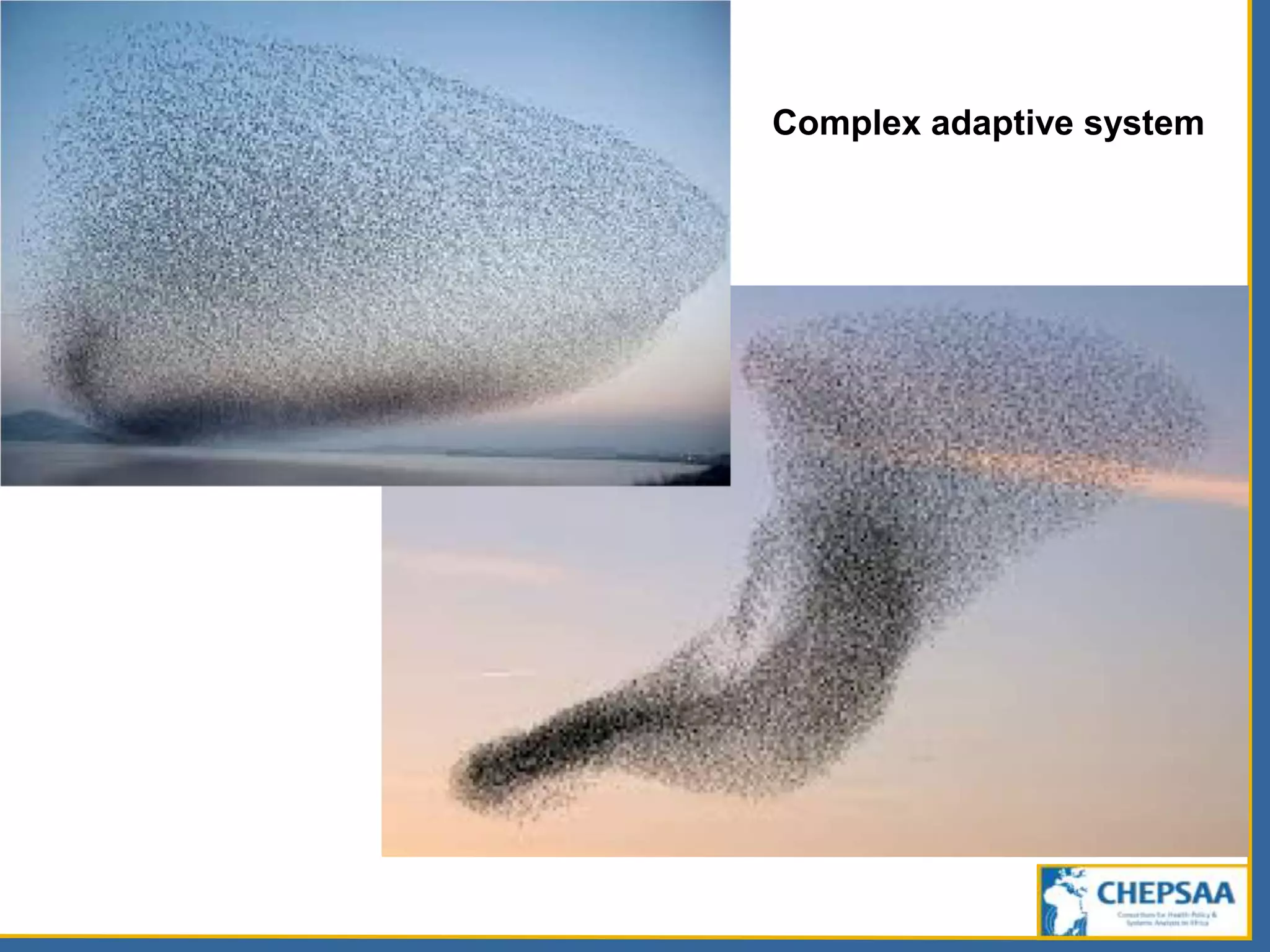
A complex adaptive
system
• A set of interacting
elements
• More than the sum of the
parts
• Acts in ways that are not
fully predictable, e.g.
feedback loops
• Influenced by history
• Self-organising
• Resistant to change
Complex adaptive system
Health system frameworks …
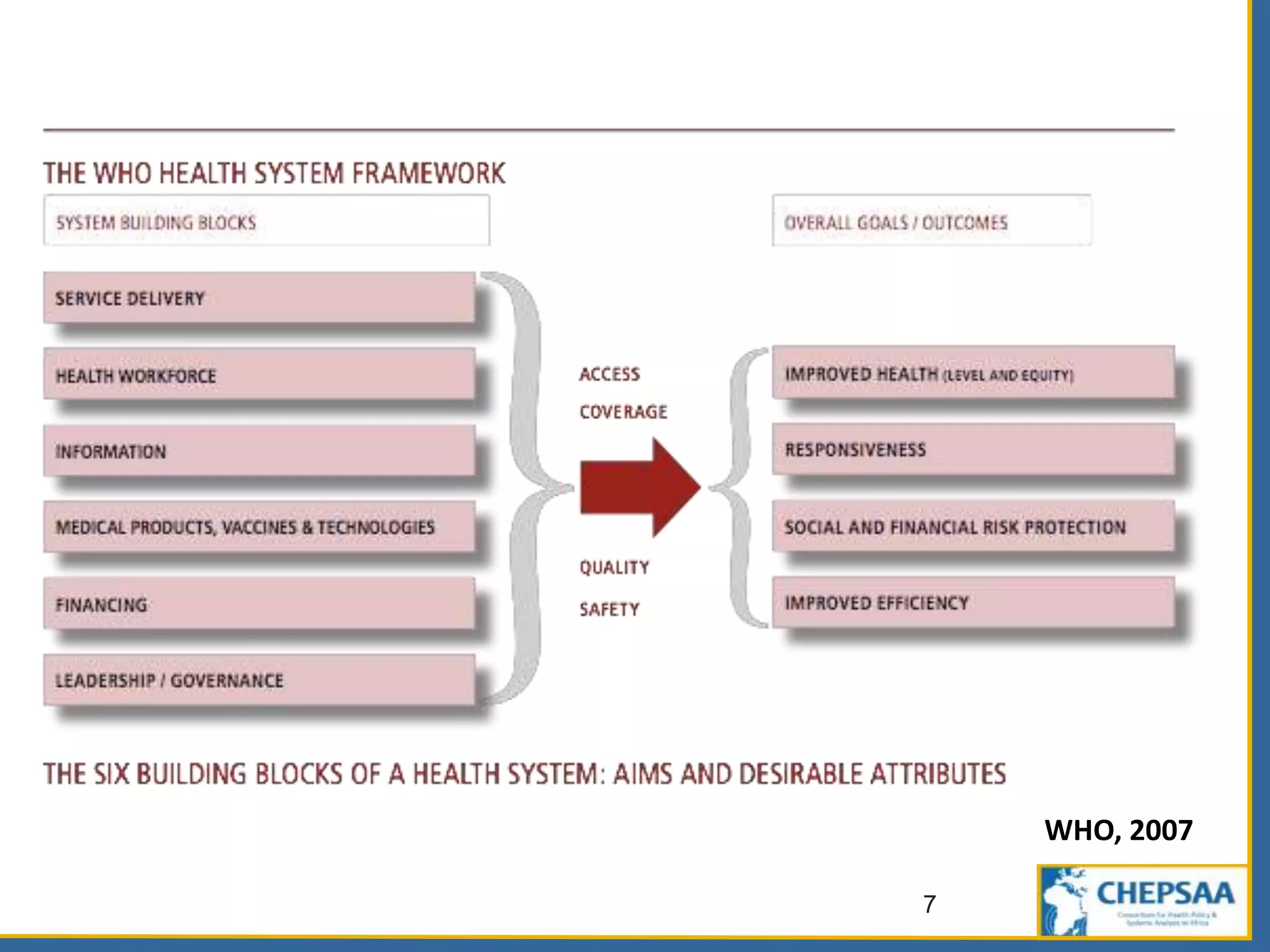
WHO, 2007
7
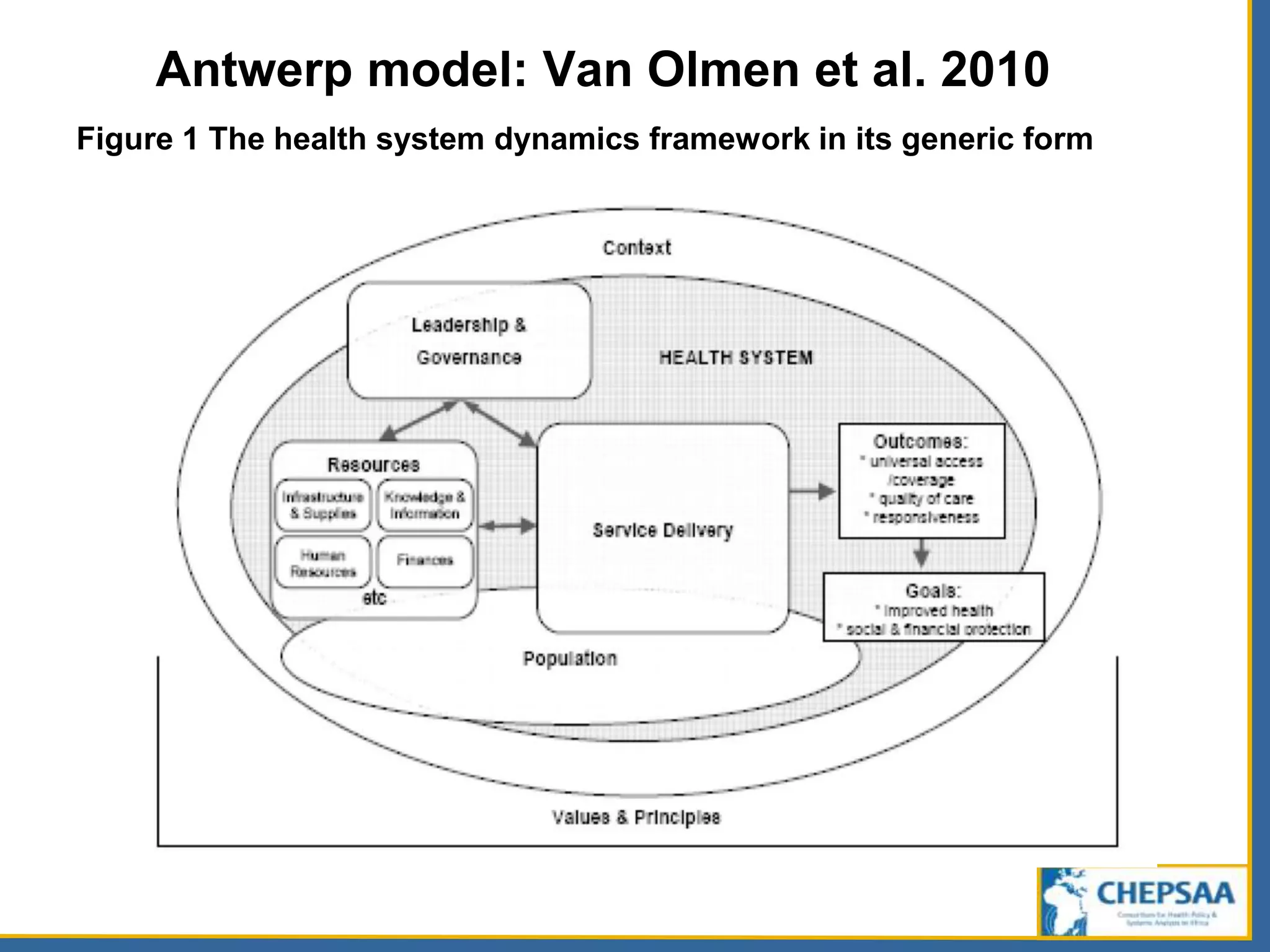
Antwerp model: Van Olmen et al. 2010
Figure 1 The health system dynamics framework in its generic form
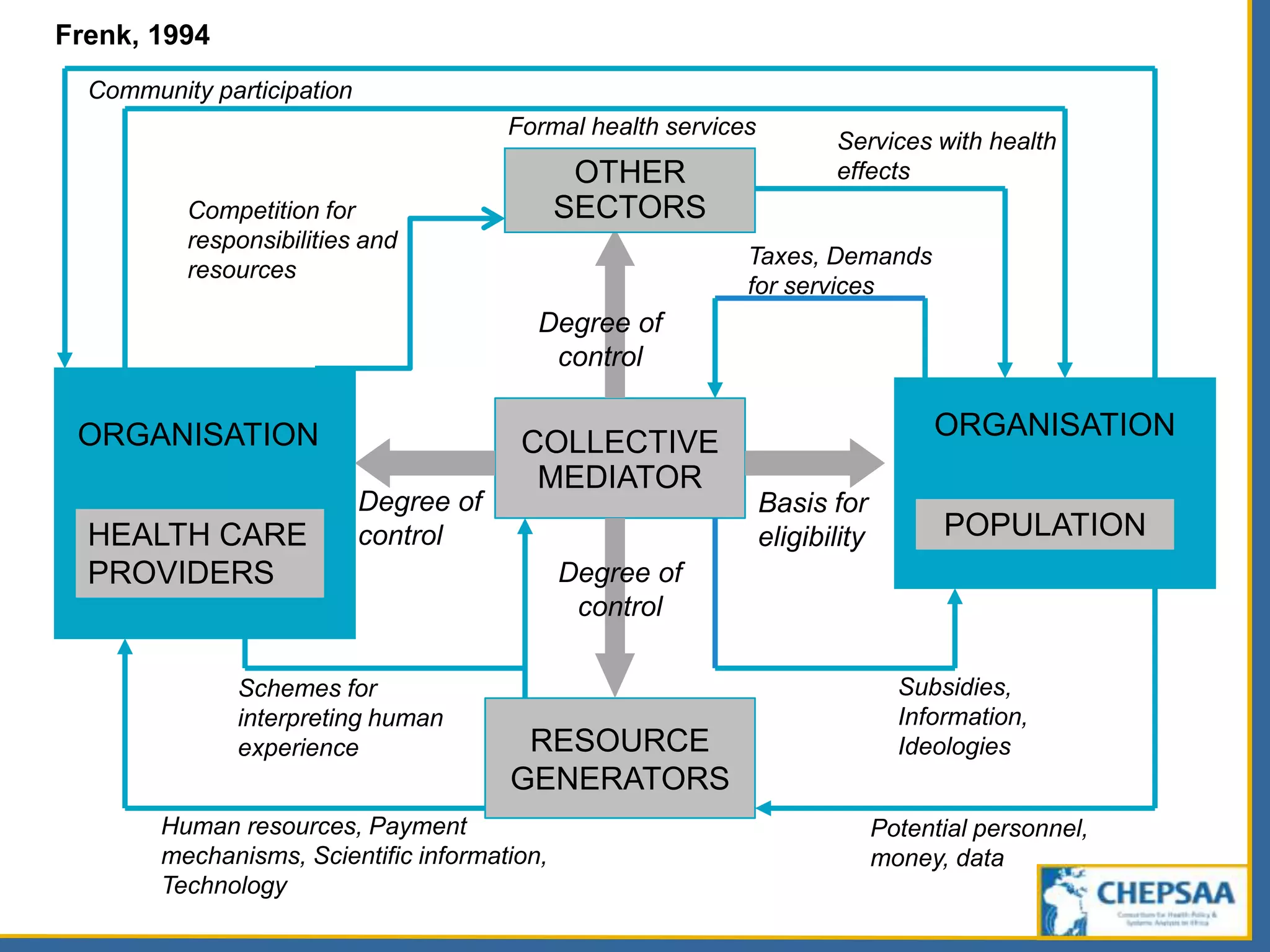
Frenk, 1994
COLLECTIVE
MEDIATOR
HEALTH CARE
PROVIDERS
ORGANISATION
POPULATION
ORGANISATION
RESOURCE
GENERATORS
OTHER
SECTORS
Basis for
eligibility
Degree of
control
Degree of
control
Degree of
control
Taxes, Demands
for services
Services with health
effects
Subsidies,
Information,
Ideologies
Potential personnel,
money, data
Schemes for
interpreting human
experience
Formal health services
Community participation
Competition for
responsibilities and
resources
Human resources, Payment
mechanisms, Scientific information,
Technology
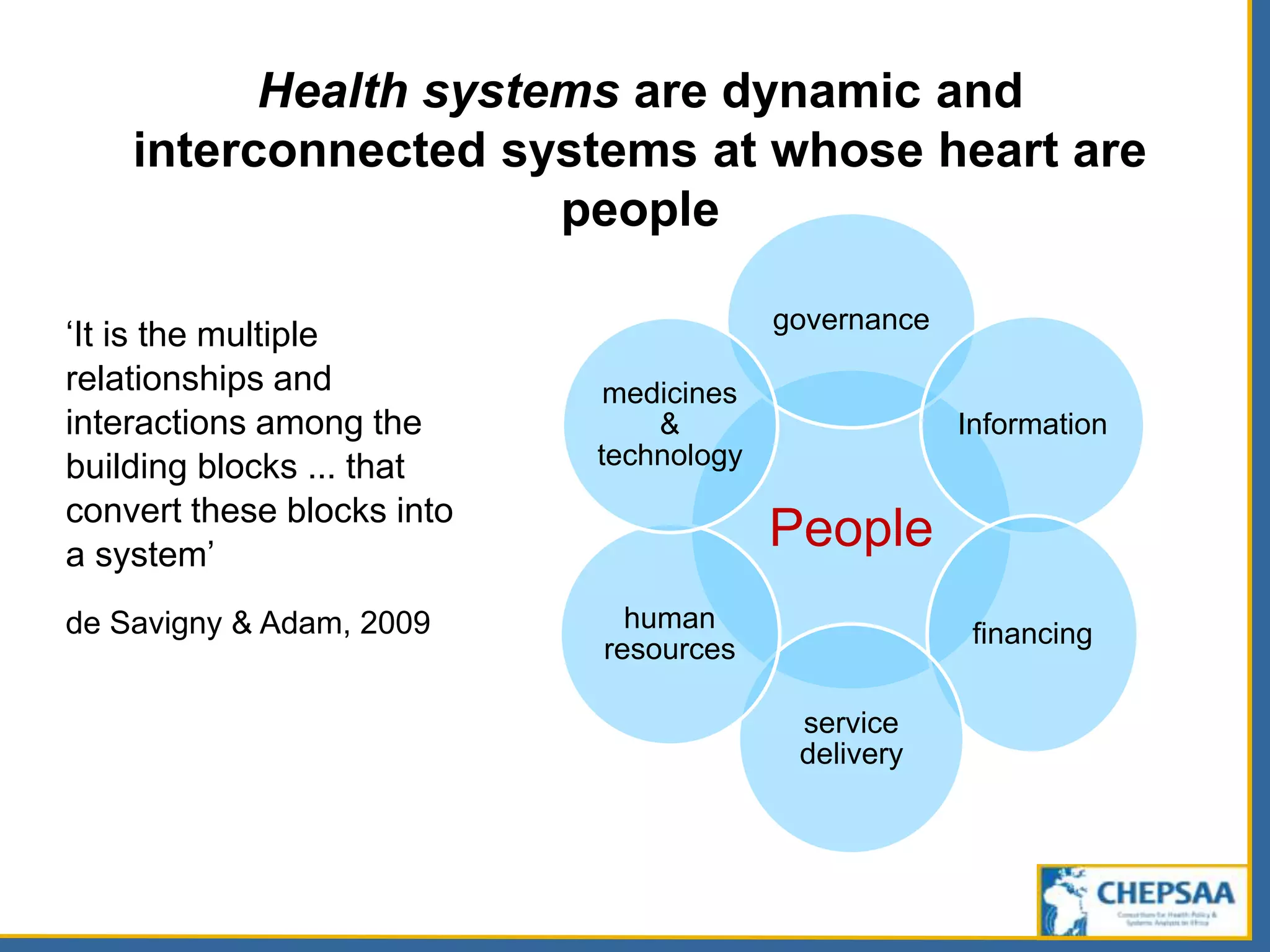
Health systems are dynamic and
interconnected systems at whose heart are
people
‘It is the multiple
relationships and
interactions among the
building blocks ... that
convert these blocks into
a system’
de Savigny & Adam, 2009
People
governance
Information
financing
service
delivery
human
resources
medicines
&
technology
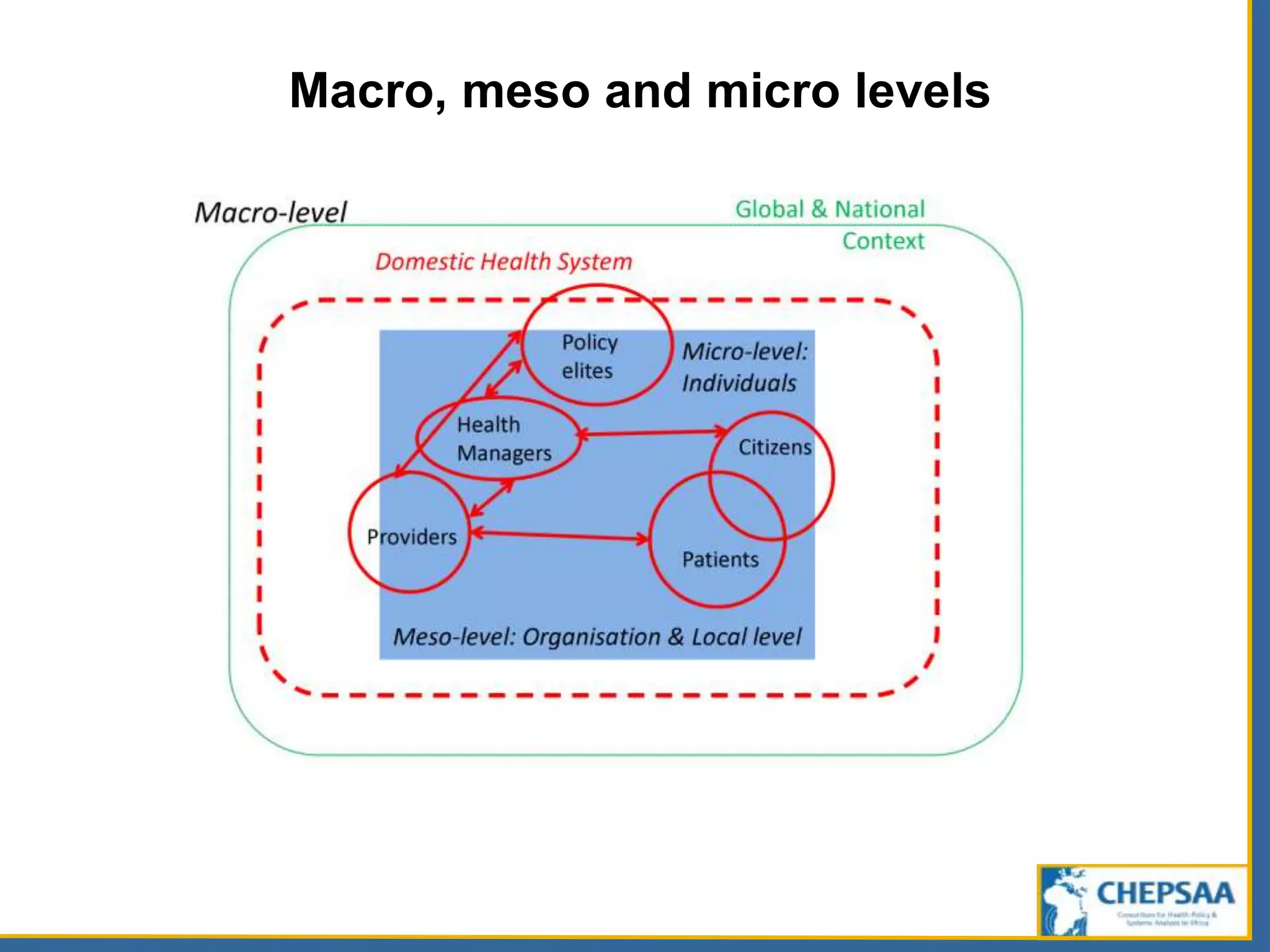
Macro, meso and micro levels
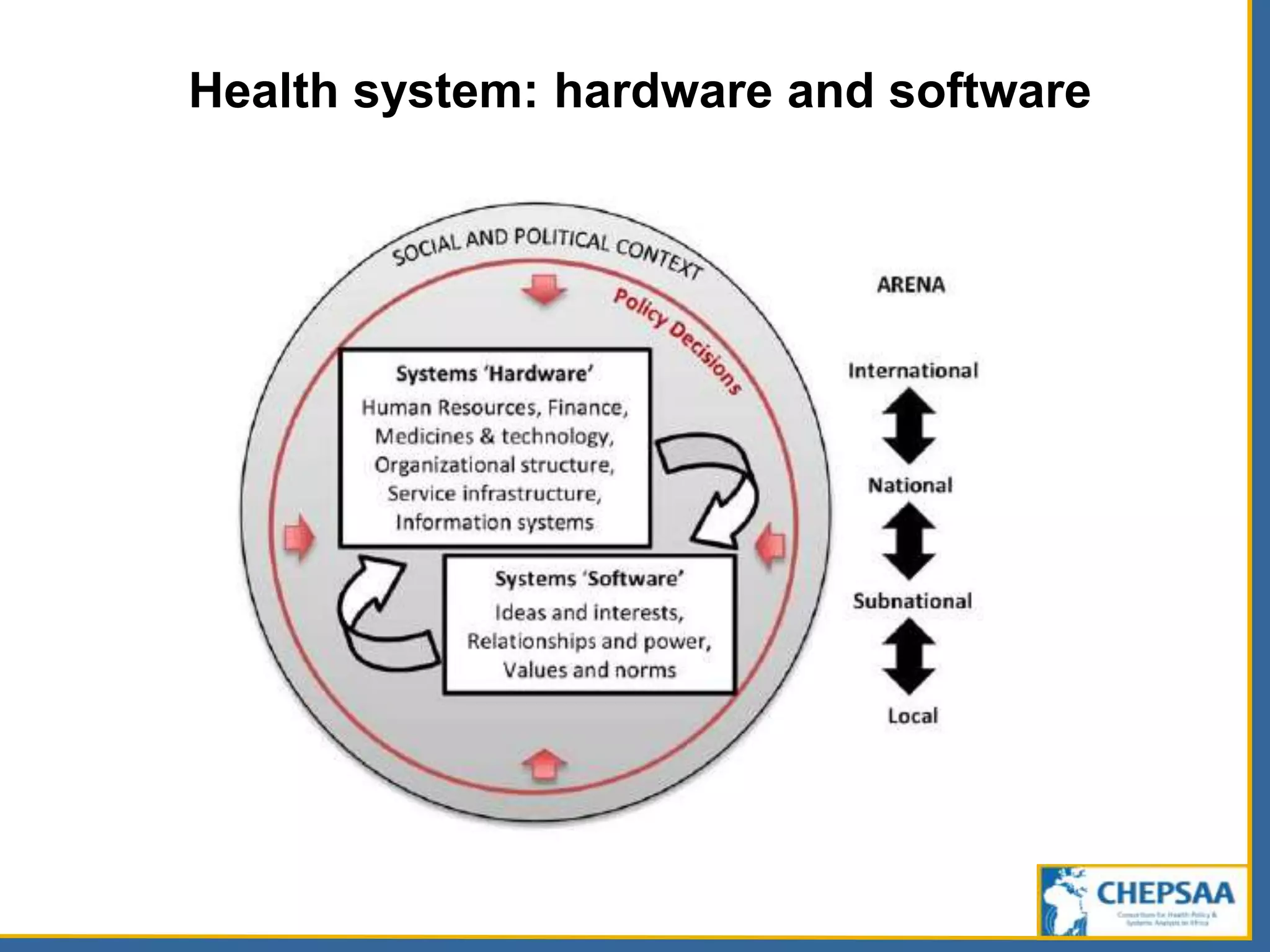
Health system: hardware and software
‘Health system’ as a focus
in global health …
• Not new ...
… but
• in a ‘see-saw’ with focus on disease
control programmes
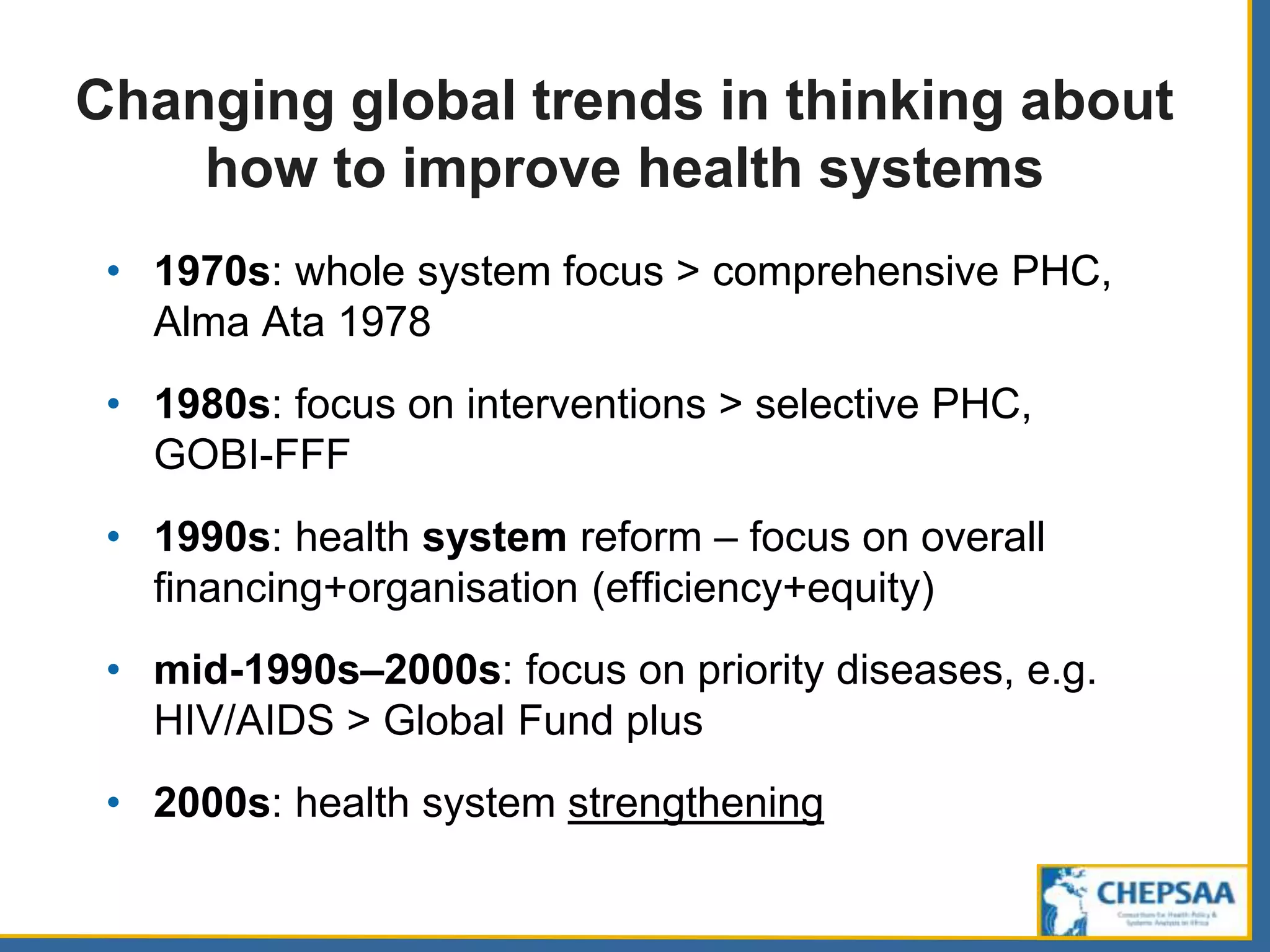
Changing global trends in thinking about
how to improve health systems
• 1970s: whole system focus > comprehensive PHC,
Alma Ata 1978
• 1980s: focus on interventions > selective PHC,
GOBI-FFF
• 1990s: health system reform – focus on overall
financing+organisation (efficiency+equity)
• mid-1990s–2000s: focus on priority diseases, e.g.
HIV/AIDS > Global Fund plus
• 2000s: health system strengthening
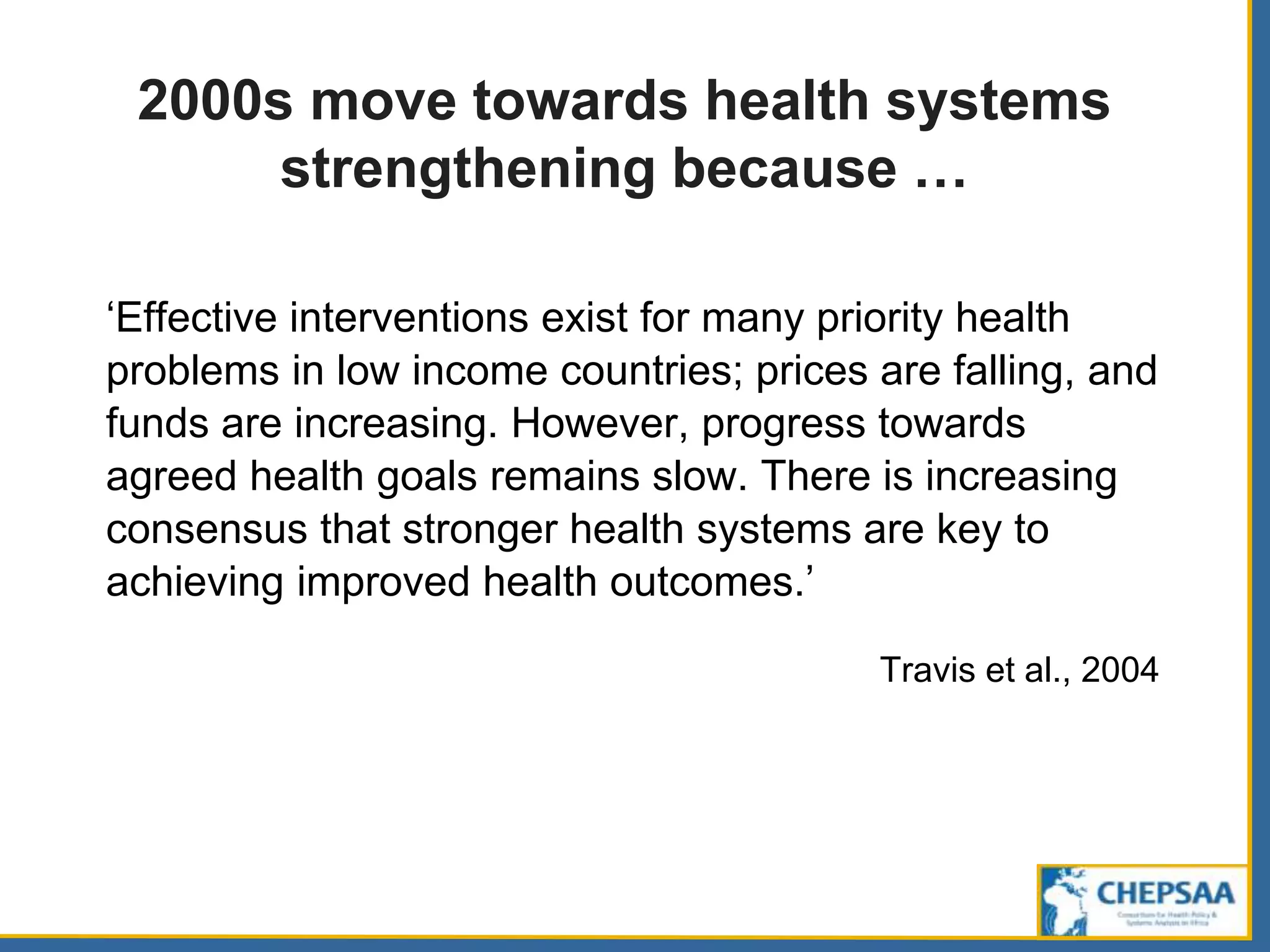
2000s move towards health systems
strengthening because …
‘Effective interventions exist for many priority health
problems in low income countries; prices are falling, and
funds are increasing. However, progress towards
agreed health goals remains slow. There is increasing
consensus that stronger health systems are key to
achieving improved health outcomes.’
Travis et al., 2004
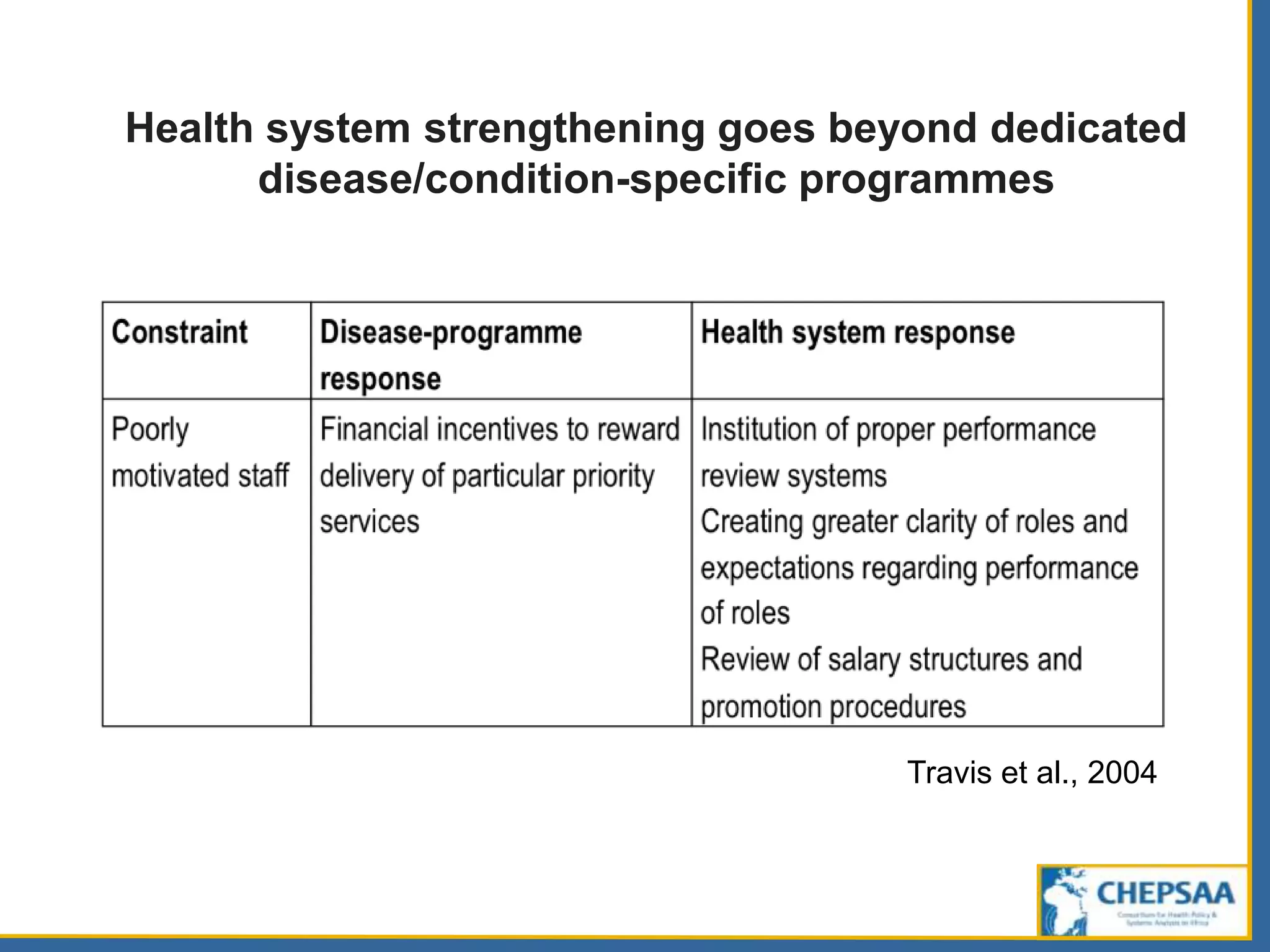
Health system strengthening goes beyond dedicated
disease/condition-specific programmes
Travis et al., 2004
Good health at low cost:
Thai experience
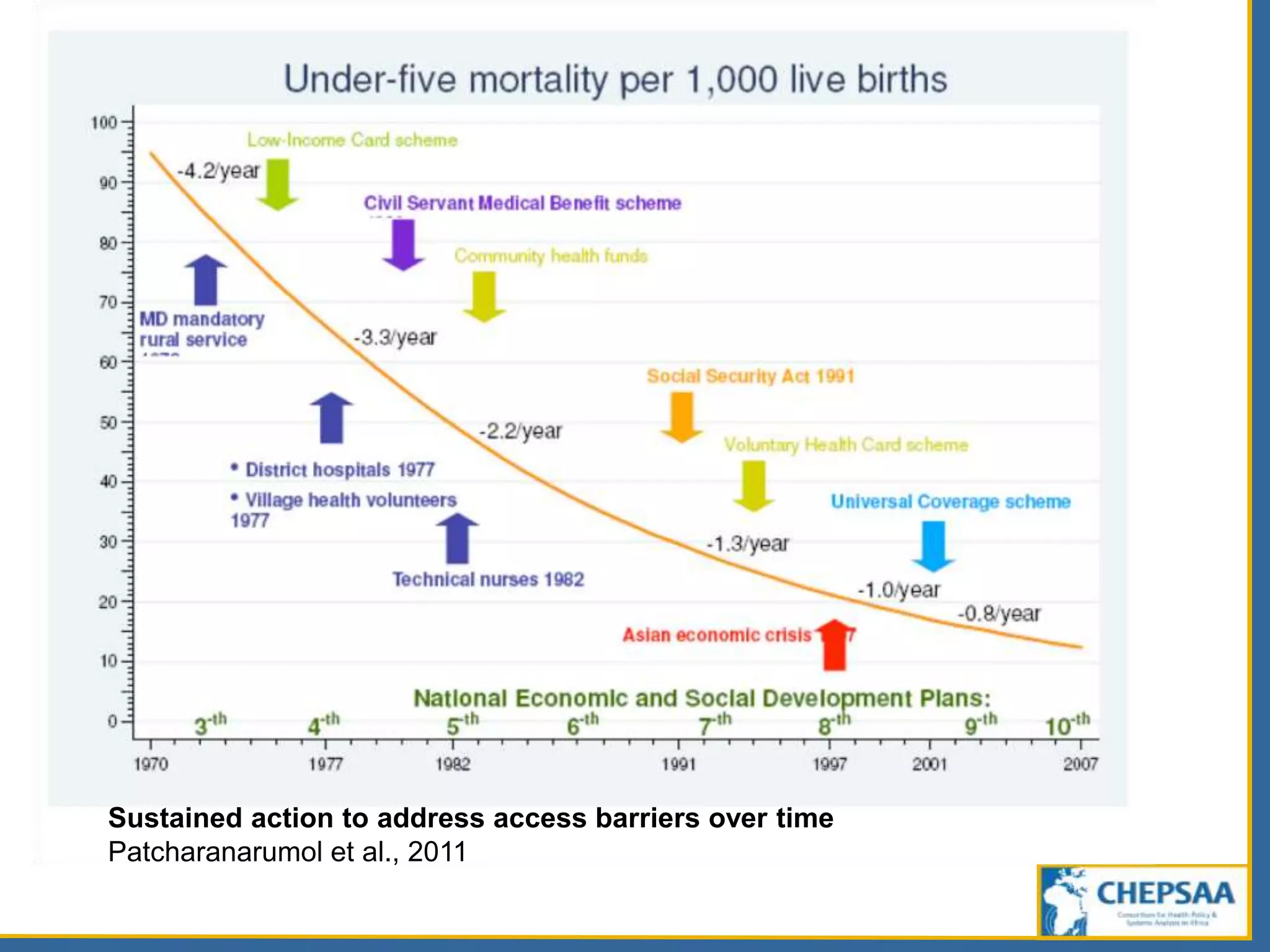
Sustained action to address access barriers over time
Patcharanarumol et al., 2011
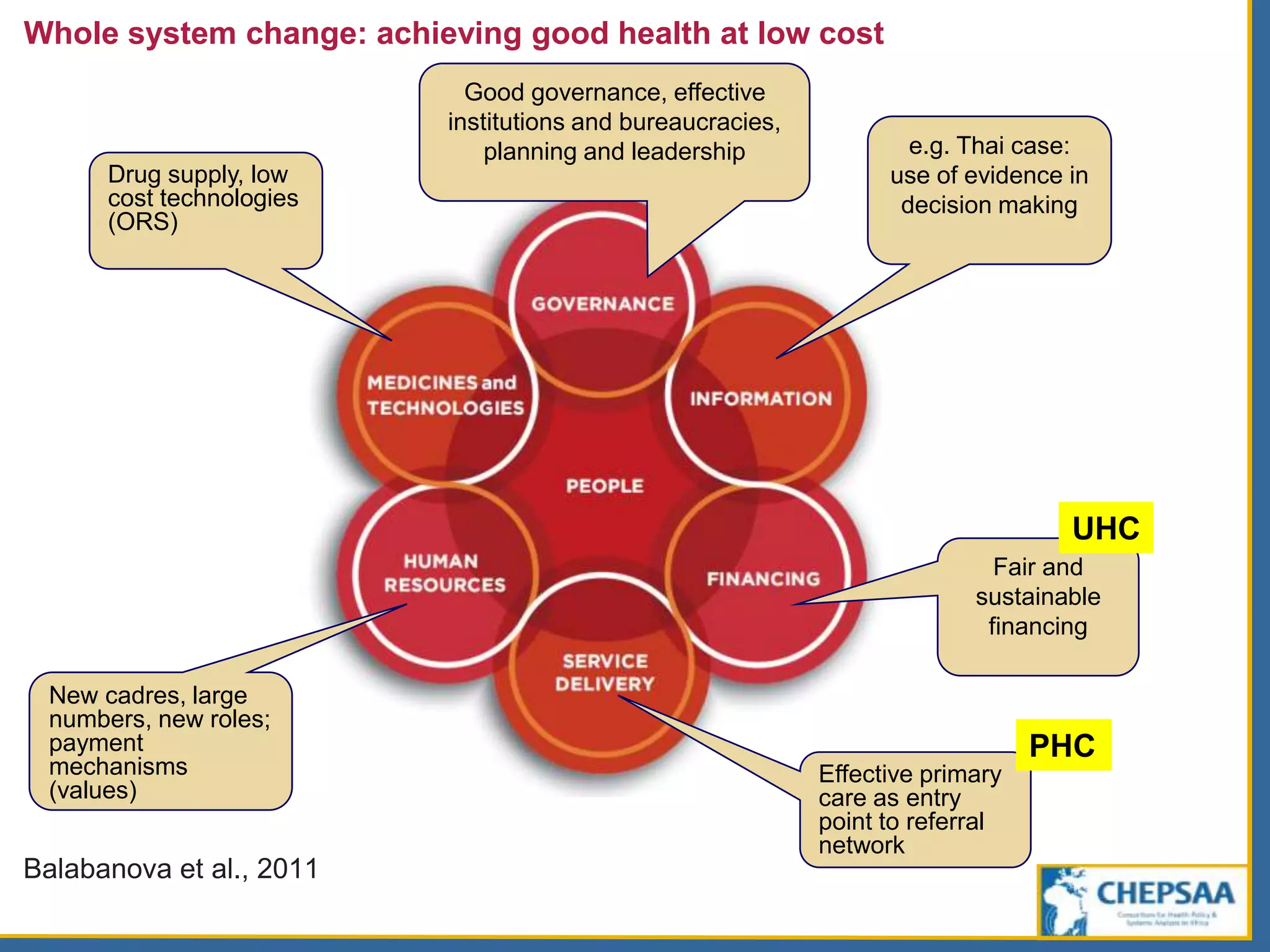
Whole system change: achieving good health at low cost
Good governance, effective
institutions and bureaucracies,
planning and leadership e.g. Thai case:
use of evidence in
decision making
Fair and
sustainable
financing
Effective primary
care as entry
point to referral
network
New cadres, large
numbers, new roles;
payment
mechanisms
(values)
Drug supply, low
cost technologies
(ORS)
PHC
UHC
Balabanova et al., 2011
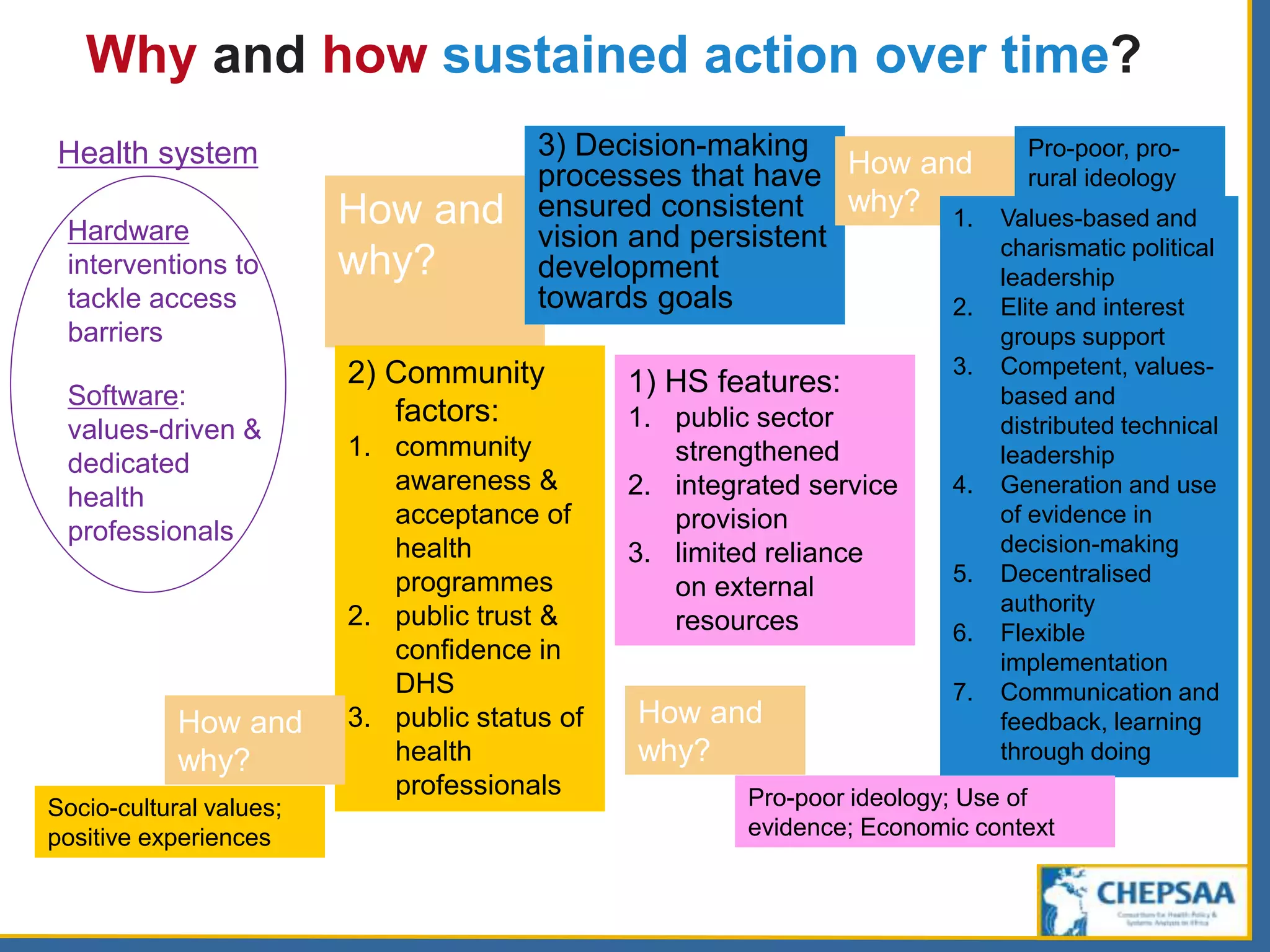
Why and how sustained action over time?
Hardware
interventions to
tackle access
barriers
Software:
values-driven &
dedicated
health
professionals
How and
why?
3) Decision-making
processes that have
ensured consistent
vision and persistent
development
towards goals
How and
why?
1) HS features:
1. public sector
strengthened
2. integrated service
provision
3. limited reliance
on external
resources
1. Values-based and
charismatic political
leadership
2. Elite and interest
groups support
3. Competent, values-
based and
distributed technical
leadership
4. Generation and use
of evidence in
decision-making
5. Decentralised
authority
6. Flexible
implementation
7. Communication and
feedback, learning
through doing
2) Community
factors:
1. community
awareness &
acceptance of
health
programmes
2. public trust &
confidence in
DHS
3. public status of
health
professionals
How and
why?
Socio-cultural values;
positive experiences
Pro-poor, pro-
rural ideology
How and
why?
Pro-poor ideology; Use of
evidence; Economic context
Health system
Health policies are deliberate
actions to strengthen health
systems and improve
performance
Polices are more than documents!
Not just the output of
decision making but rather
the entire process of
decision-making across the
full range of people and
organisations that translate
policy
documents/statements into
policy-as-experienced
• It is important to understand:
– the politics of influencing
‘policy agendas’
and
– the organisational
dynamics through which
policies take effect:
 actors, relationships
and driving forces
Caveat
No easy answers to improve a
health system!
Politics and values matter …
• The US: Obamacare
• The UK:
– born out of a political moment
• with particular underpinning values
– but undergone endless reforms over its life
• Could current changes compromise
initial values?
• Will they improve system performance?
Copyright
Funding
You are free:
To Share – to copy, distribute and transmit the work
To Remix – to adapt the work
Under the following conditions:
Attribution You must attribute the work in the manner
specified by the author or licensor (but not in any way that
suggests that they endorse you or your use of the work).
Non-commercial You may not use this work for commercial
purposes.
Share Alike If you alter, transform, or build upon this work,
you may distribute the resulting work but only under the same
or similar license to this one.
Other conditions
For any reuse or distribution, you must make clear to
others the license terms of this work.
Nothing in this license impairs or restricts the authors’
moral rights.
Nothing in this license impairs or restricts the rights of
authors whose work is referenced in this document.
Cited works used in this document must be cited following
usual academic conventions.
Citation of this work must follow normal academic
conventions. Suggested citation:
Introduction to Health Policy and Systems Research,
course presentation, Presentation 2. Copyright
CHEPSAA (Consortium for Health Policy & Systems
Analysis in Africa) 2014, www.hpsa-africa.org
www.slideshare.net/hpsa_africa
This document is an output from a project funded by the European Commission (EC) FP7-Africa (Grant no.
265482). The views expressed are not necessarily those of the EC.
The CHEPSAA partners
University of Dar Es Salaam
Institute of Development Studies
University of the Witwatersrand
Centre for Health Policy
University of Ghana
School of Public Health, Department of
Health Policy, Planning and Management
University of Leeds
Nuffield Centre for International Health and
Development
University of Nigeria Enugu
Health Policy Research Group & the
Department of Health Administration and
Management
London School of Hygiene and
Tropical Medicine
Health Economics and Systems Analysis
Group, Depart of Global Health & Dev.
Great Lakes University of Kisumu
Tropical Institute of Community Health and
Development
Karolinska Institutet
Health Systems and Policy Group,
Department of Public Health Sciences
University of Cape Town
Health Policy and Systems Programme,
Health Economics Unit
Swiss Tropical and Public Health
Institute
Health Systems Research Group
University of the Western Cape
School of Public Health

What is a health system? What is health system strengthening?

  • 1.
    What is ahealth system? What is health system strengthening? IHPSR Presentation 2 www.hpsa-africa.org @hpsa_africa www.slideshare.net/hpsa_africa Introduction to Health Policy and Systems Research
  • 2.
    Outline • Definition ofa health system • Conceptual frameworks that help us to think about health systems • Considering policy for health system strengthening
  • 3.
    ‘A health systemconsists of all organizations, people and actions whose primary intent is to promote, restore, or maintain health.’ WHO, 2007, p.2 http://www.who.int/healthsystems/strategy/en/
  • 4.
    A health system Health •Beyond sickness – mental and physical health – social wellbeing • Beyond the individual – actors/agents promoting health and wellbeing – domestic/national AND international factors impacting on health and health system agents A complex adaptive system • A set of interacting elements • More than the sum of the parts • Acts in ways that are not fully predictable, e.g. feedback loops • Influenced by history • Self-organising • Resistant to change
  • 5.
  • 6.
  • 7.
  • 8.
    Antwerp model: VanOlmen et al. 2010 Figure 1 The health system dynamics framework in its generic form
  • 9.
    Frenk, 1994 COLLECTIVE MEDIATOR HEALTH CARE PROVIDERS ORGANISATION POPULATION ORGANISATION RESOURCE GENERATORS OTHER SECTORS Basisfor eligibility Degree of control Degree of control Degree of control Taxes, Demands for services Services with health effects Subsidies, Information, Ideologies Potential personnel, money, data Schemes for interpreting human experience Formal health services Community participation Competition for responsibilities and resources Human resources, Payment mechanisms, Scientific information, Technology
  • 10.
    Health systems aredynamic and interconnected systems at whose heart are people ‘It is the multiple relationships and interactions among the building blocks ... that convert these blocks into a system’ de Savigny & Adam, 2009 People governance Information financing service delivery human resources medicines & technology
  • 11.
    Macro, meso andmicro levels
  • 12.
  • 13.
    ‘Health system’ asa focus in global health … • Not new ... … but • in a ‘see-saw’ with focus on disease control programmes
  • 14.
    Changing global trendsin thinking about how to improve health systems • 1970s: whole system focus > comprehensive PHC, Alma Ata 1978 • 1980s: focus on interventions > selective PHC, GOBI-FFF • 1990s: health system reform – focus on overall financing+organisation (efficiency+equity) • mid-1990s–2000s: focus on priority diseases, e.g. HIV/AIDS > Global Fund plus • 2000s: health system strengthening
  • 15.
    2000s move towardshealth systems strengthening because … ‘Effective interventions exist for many priority health problems in low income countries; prices are falling, and funds are increasing. However, progress towards agreed health goals remains slow. There is increasing consensus that stronger health systems are key to achieving improved health outcomes.’ Travis et al., 2004
  • 16.
    Health system strengtheninggoes beyond dedicated disease/condition-specific programmes Travis et al., 2004
  • 17.
    Good health atlow cost: Thai experience
  • 18.
    Sustained action toaddress access barriers over time Patcharanarumol et al., 2011
  • 19.
    Whole system change:achieving good health at low cost Good governance, effective institutions and bureaucracies, planning and leadership e.g. Thai case: use of evidence in decision making Fair and sustainable financing Effective primary care as entry point to referral network New cadres, large numbers, new roles; payment mechanisms (values) Drug supply, low cost technologies (ORS) PHC UHC Balabanova et al., 2011
  • 20.
    Why and howsustained action over time? Hardware interventions to tackle access barriers Software: values-driven & dedicated health professionals How and why? 3) Decision-making processes that have ensured consistent vision and persistent development towards goals How and why? 1) HS features: 1. public sector strengthened 2. integrated service provision 3. limited reliance on external resources 1. Values-based and charismatic political leadership 2. Elite and interest groups support 3. Competent, values- based and distributed technical leadership 4. Generation and use of evidence in decision-making 5. Decentralised authority 6. Flexible implementation 7. Communication and feedback, learning through doing 2) Community factors: 1. community awareness & acceptance of health programmes 2. public trust & confidence in DHS 3. public status of health professionals How and why? Socio-cultural values; positive experiences Pro-poor, pro- rural ideology How and why? Pro-poor ideology; Use of evidence; Economic context Health system
  • 21.
    Health policies aredeliberate actions to strengthen health systems and improve performance
  • 22.
    Polices are morethan documents! Not just the output of decision making but rather the entire process of decision-making across the full range of people and organisations that translate policy documents/statements into policy-as-experienced • It is important to understand: – the politics of influencing ‘policy agendas’ and – the organisational dynamics through which policies take effect:  actors, relationships and driving forces
  • 23.
    Caveat No easy answersto improve a health system! Politics and values matter …
  • 24.
    • The US:Obamacare • The UK: – born out of a political moment • with particular underpinning values – but undergone endless reforms over its life • Could current changes compromise initial values? • Will they improve system performance?
  • 25.
    Copyright Funding You are free: ToShare – to copy, distribute and transmit the work To Remix – to adapt the work Under the following conditions: Attribution You must attribute the work in the manner specified by the author or licensor (but not in any way that suggests that they endorse you or your use of the work). Non-commercial You may not use this work for commercial purposes. Share Alike If you alter, transform, or build upon this work, you may distribute the resulting work but only under the same or similar license to this one. Other conditions For any reuse or distribution, you must make clear to others the license terms of this work. Nothing in this license impairs or restricts the authors’ moral rights. Nothing in this license impairs or restricts the rights of authors whose work is referenced in this document. Cited works used in this document must be cited following usual academic conventions. Citation of this work must follow normal academic conventions. Suggested citation: Introduction to Health Policy and Systems Research, course presentation, Presentation 2. Copyright CHEPSAA (Consortium for Health Policy & Systems Analysis in Africa) 2014, www.hpsa-africa.org www.slideshare.net/hpsa_africa This document is an output from a project funded by the European Commission (EC) FP7-Africa (Grant no. 265482). The views expressed are not necessarily those of the EC.
  • 26.
    The CHEPSAA partners Universityof Dar Es Salaam Institute of Development Studies University of the Witwatersrand Centre for Health Policy University of Ghana School of Public Health, Department of Health Policy, Planning and Management University of Leeds Nuffield Centre for International Health and Development University of Nigeria Enugu Health Policy Research Group & the Department of Health Administration and Management London School of Hygiene and Tropical Medicine Health Economics and Systems Analysis Group, Depart of Global Health & Dev. Great Lakes University of Kisumu Tropical Institute of Community Health and Development Karolinska Institutet Health Systems and Policy Group, Department of Public Health Sciences University of Cape Town Health Policy and Systems Programme, Health Economics Unit Swiss Tropical and Public Health Institute Health Systems Research Group University of the Western Cape School of Public Health