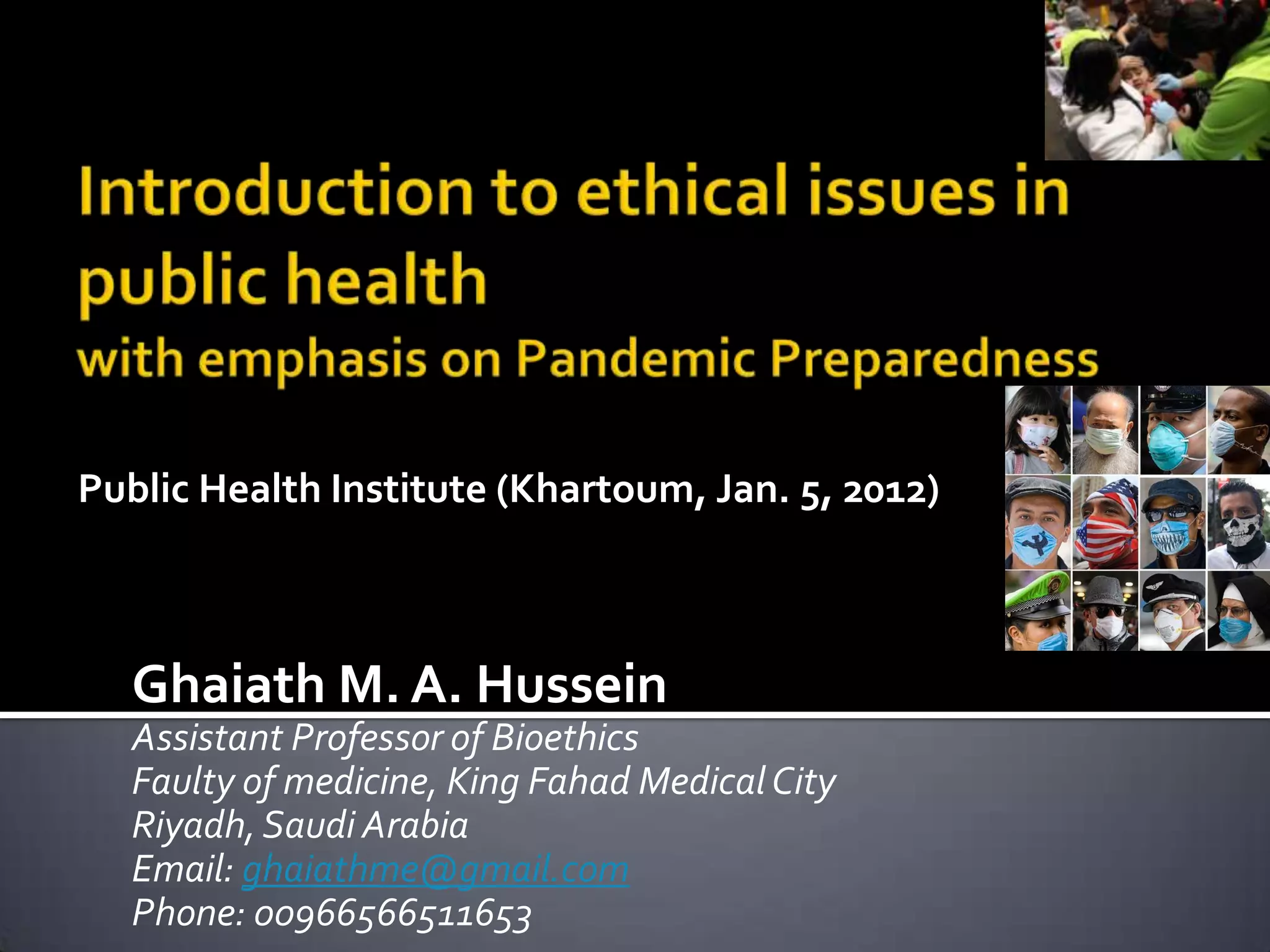
Public Health Institute (Khartoum, Jan. 5, 2012)


  Ghaiath M. A. Hussein
  Assistant Professor of Bioethics
  Faulty of medicine, King Fahad Medical City
  Riyadh, Saudi Arabia
  Email: ghaiathme@gmail.com
  Phone: 00966566511653
   Public health (vs. clinical care)
   What’s Ethics? What is Public Health Ethics
    (PHE)?
   Sources of ethical concern in public health
    practice and research
   Why are pandemics ethically unique?
   Levels of pandemic effects and their ethical
    implications
   Guiding ethical principles
   How to deal with ethical tensions in PH?
              Public Health Institute (Sudan)
Public Health Institute (Sudan)
 The expressive level (unanalyzed expressions or
  feeling that, by themselves, don’t provide
  reasons or justification)
 The pre-reflective level (justification via
  law, religious tenets, social values, codes of
  ethics, etc.; accepted uncritically)
 The reflective level (reasoned ethical
  argument/defense based on ethical
  principles, rules, virtues, values to which we
  consciously subscribe; justification provided)
                   Thomas J and Waluchow W, 1998


             Public Health Institute (Sudan)
 It is the process we need to go through to reach a
  decision about an ethical issue.
 It helps us to differentiate:
     Values and ethical principles
             description of the way the world is; an actual state
     of affairs (“is”)
                judgment about the way things should be
     (“ought”).
                          they are meant to guide actions. Key
     values in bioethics have corresponding (e.g., principle of
     respect for autonomy)

                 Public Health Institute (Sudan)
What is Public Health about?
What is ethics/bioethics?
What is Public Health Ethics?
What is an ethical issue?


             Public Health Institute (Sudan)
   Definitions:
     “Public health is what we, as a society, do collectively to assure the
      conditions for people to be healthy.” (IOM, 1988);
     “the process of mobilizing and engaging local, regional, national and
      international resources to assure the conditions in which people can be
      healthy” (Oxford Textbook of public health, 2004)
     "Public health is primarily concerned with the health of the entire
      population“ (Childress et al.)
   Scope: health promotion and disease prevention throughout
    society)
   Fields: Policy; Practice; and Research
          Disease prevention                  Occupational health
           Health promotion                    Environmental health
           Epidemiological studies             Determinants of health
                                               WSH
           Biostatistics Health Institute (Sudan)
                      Public
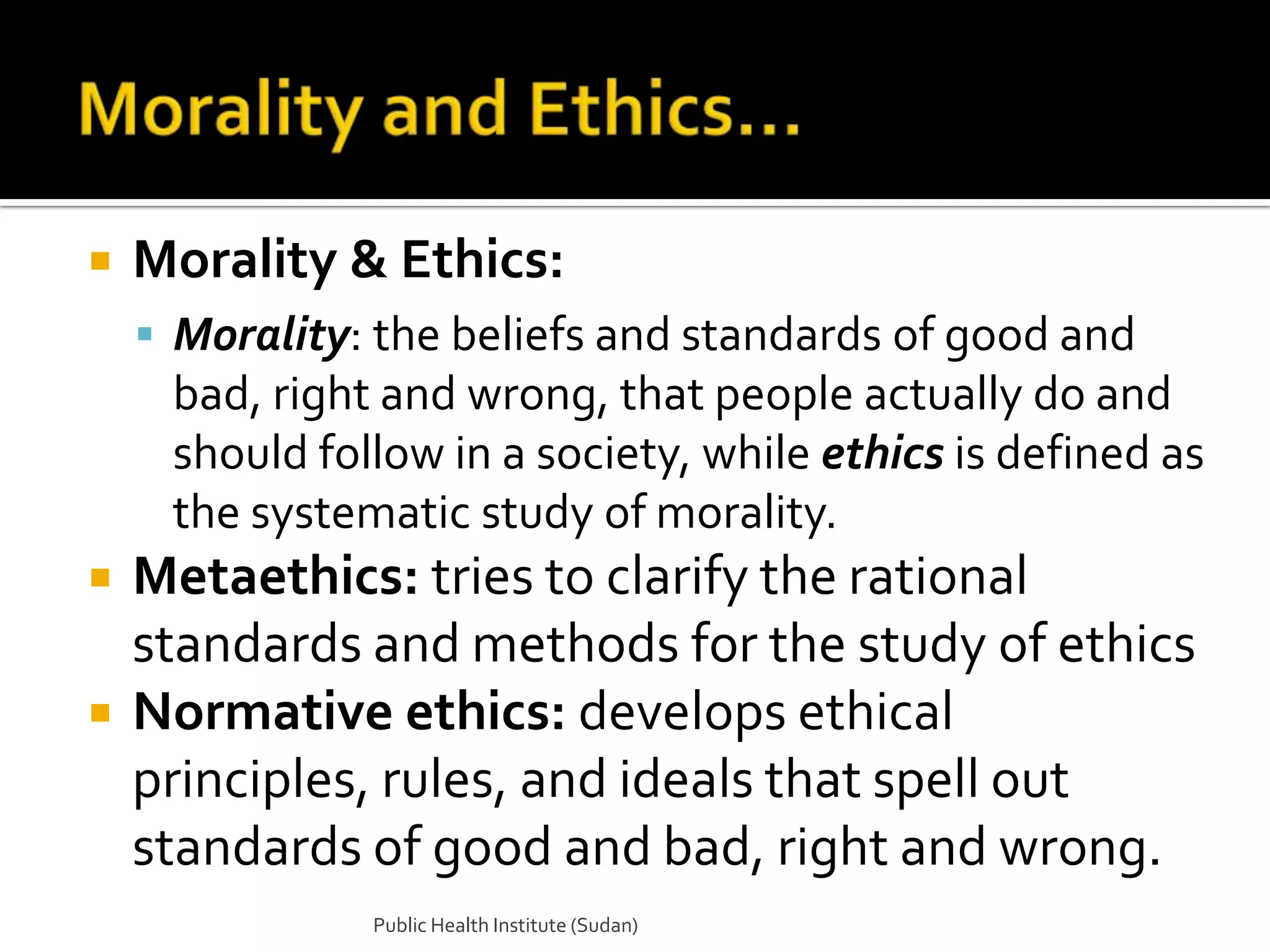
   Morality & Ethics:
     Morality: the beliefs and standards of good and
     bad, right and wrong, that people actually do and
     should follow in a society, while ethics is defined as
     the systematic study of morality.
   Metaethics: tries to clarify the rational
    standards and methods for the study of ethics
   Normative ethics: develops ethical
    principles, rules, and ideals that spell out
    standards of good and bad, right and wrong.
               Public Health Institute (Sudan)
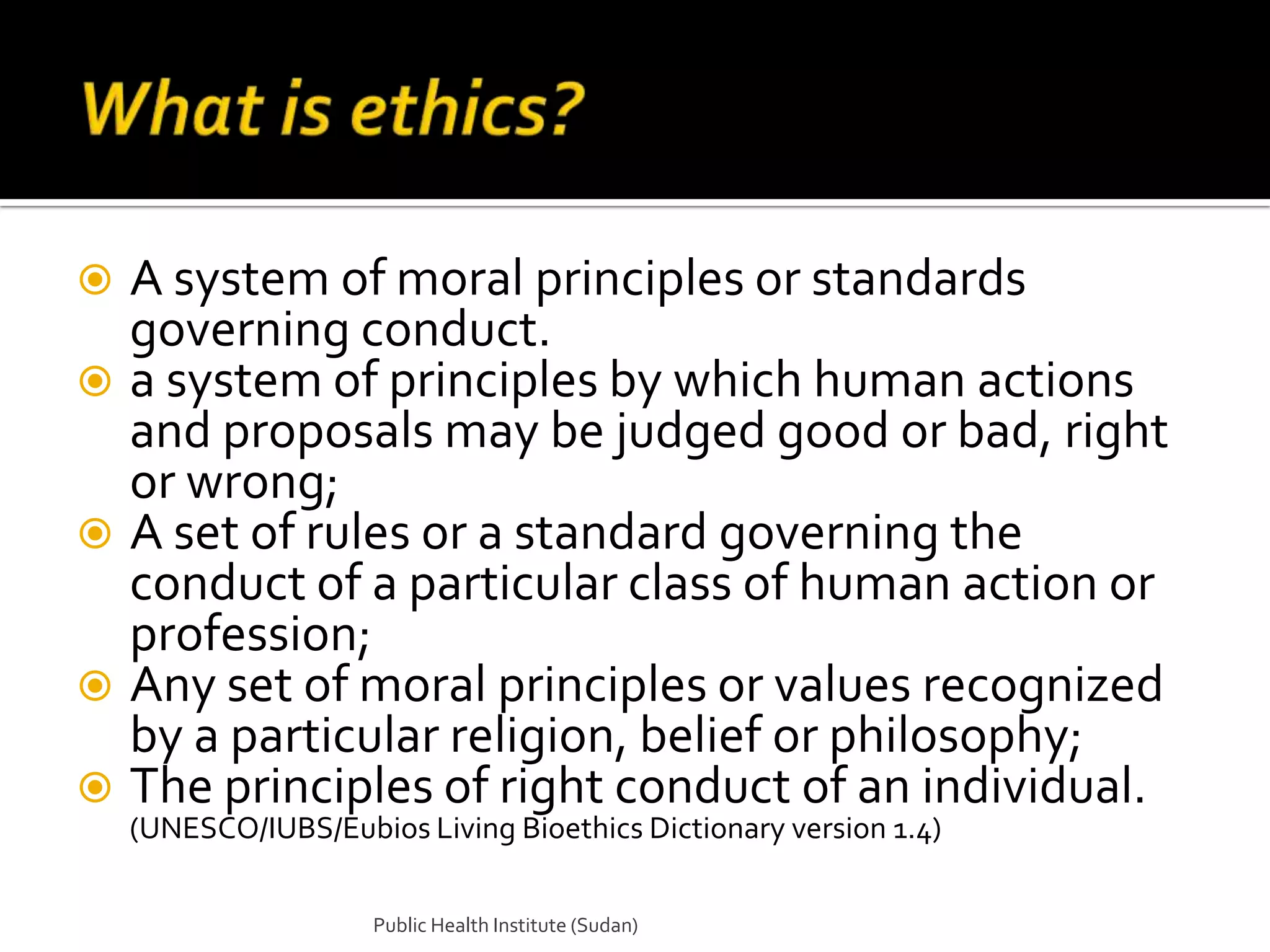
 A system of moral principles or standards
  governing conduct.
 a system of principles by which human actions
  and proposals may be judged good or bad, right
  or wrong;
 A set of rules or a standard governing the
  conduct of a particular class of human action or
  profession;
 Any set of moral principles or values recognized
  by a particular religion, belief or philosophy;
 The principles of right conduct of an individual.
    (UNESCO/IUBS/Eubios Living Bioethics Dictionary version 1.4)

                      Public Health Institute (Sudan)
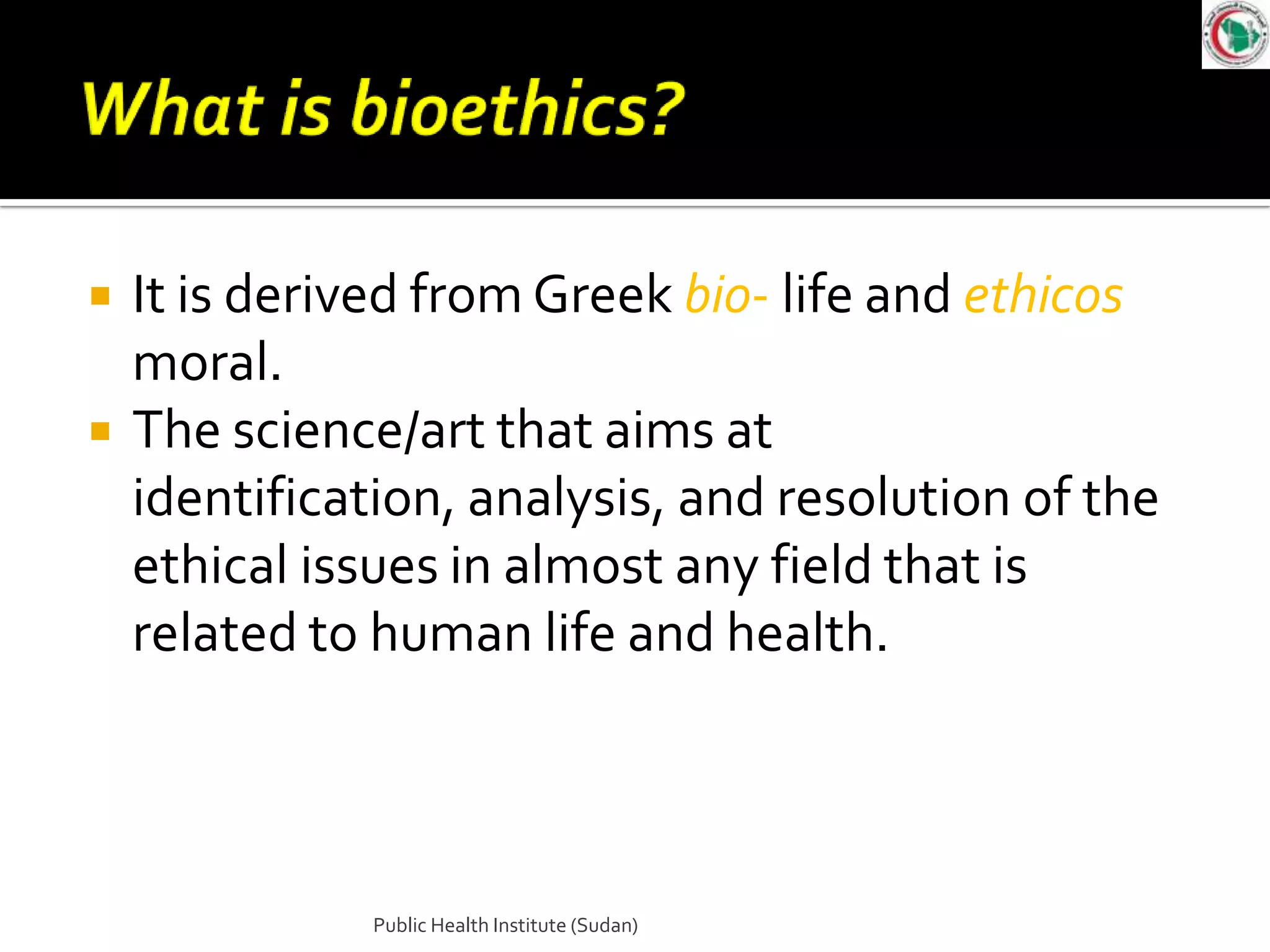
   It is derived from Greek bio- life and ethicos
    moral.
   The science/art that aims at
    identification, analysis, and resolution of the
    ethical issues in almost any field that is
    related to human life and health.


               Public Health Institute (Sudan)
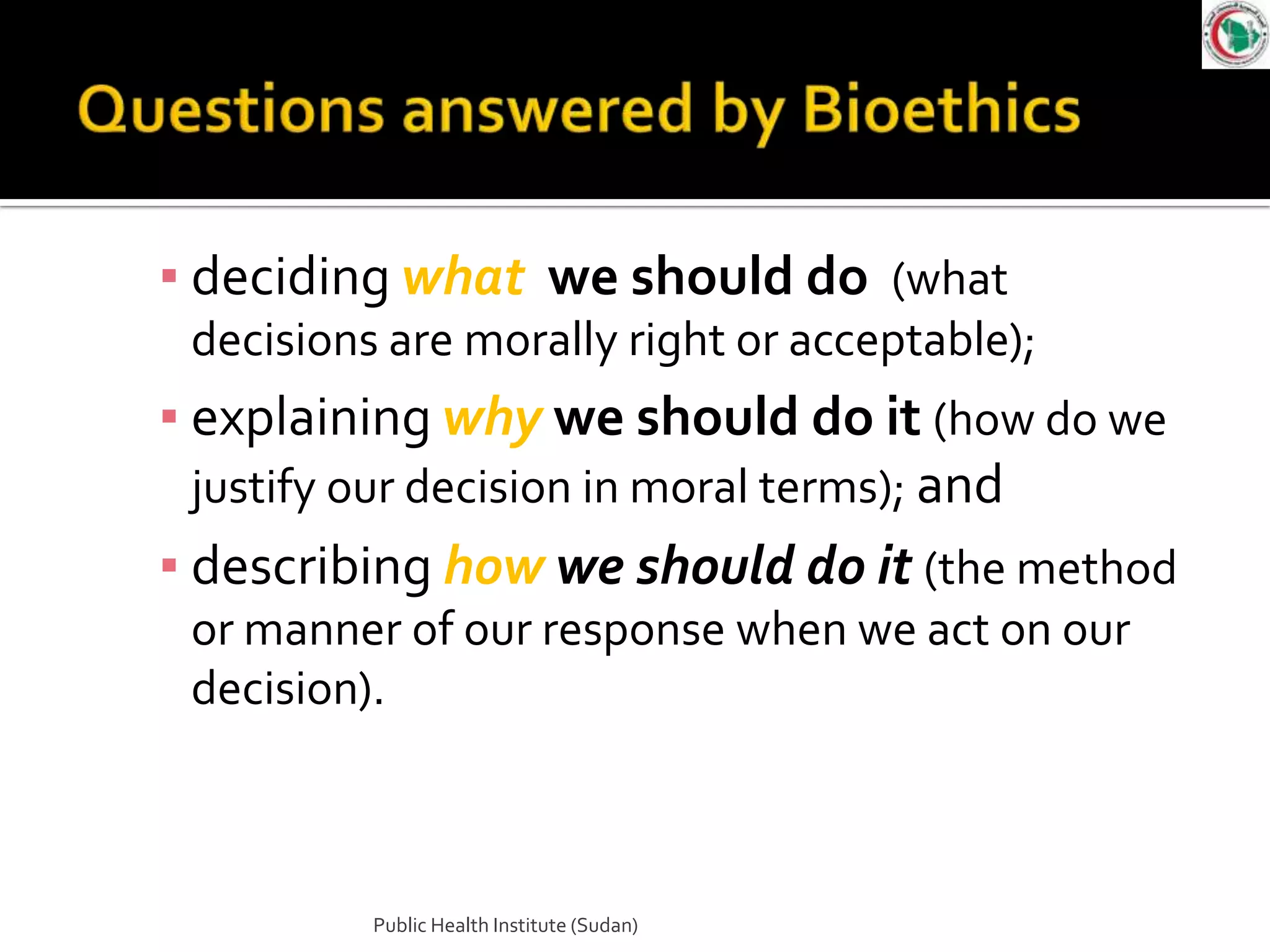
▪ deciding what we should do (what
 decisions are morally right or acceptable);
▪ explaining why we should do it (how do we
  justify our decision in moral terms); and
▪ describing how we should do it (the method
 or manner of our response when we act on our
 decision).


          Public Health Institute (Sudan)
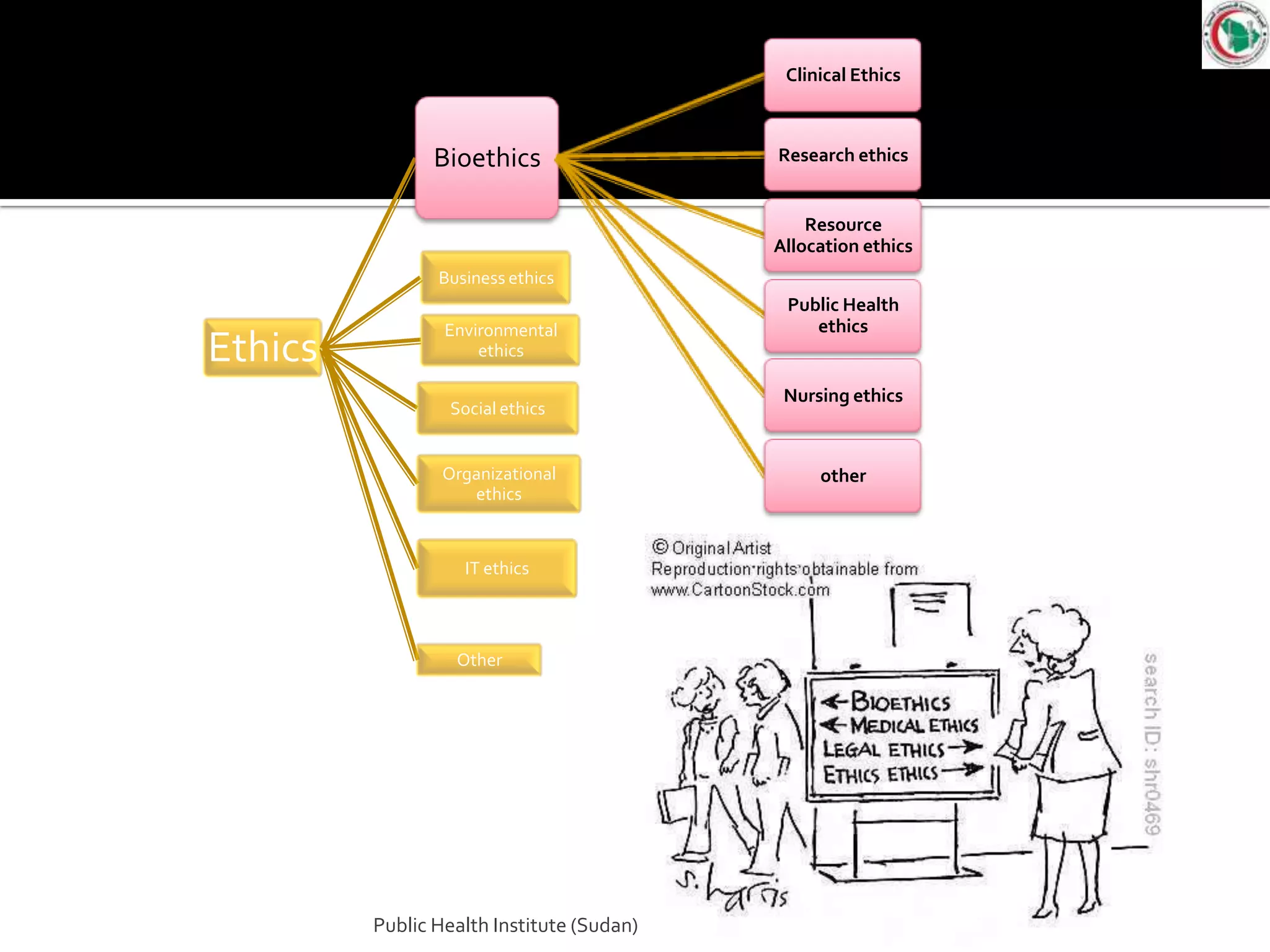
Clinical Ethics


                Bioethics                  Research ethics


                                               Resource
                                           Allocation ethics
                Business ethics
                                            Public Health
                 Environmental                 ethics
Ethics               ethics

                                            Nursing ethics
                  Social ethics


                 Organizational                 other
                    ethics


                    IT ethics


                  Other


         Public Health Institute (Sudan)
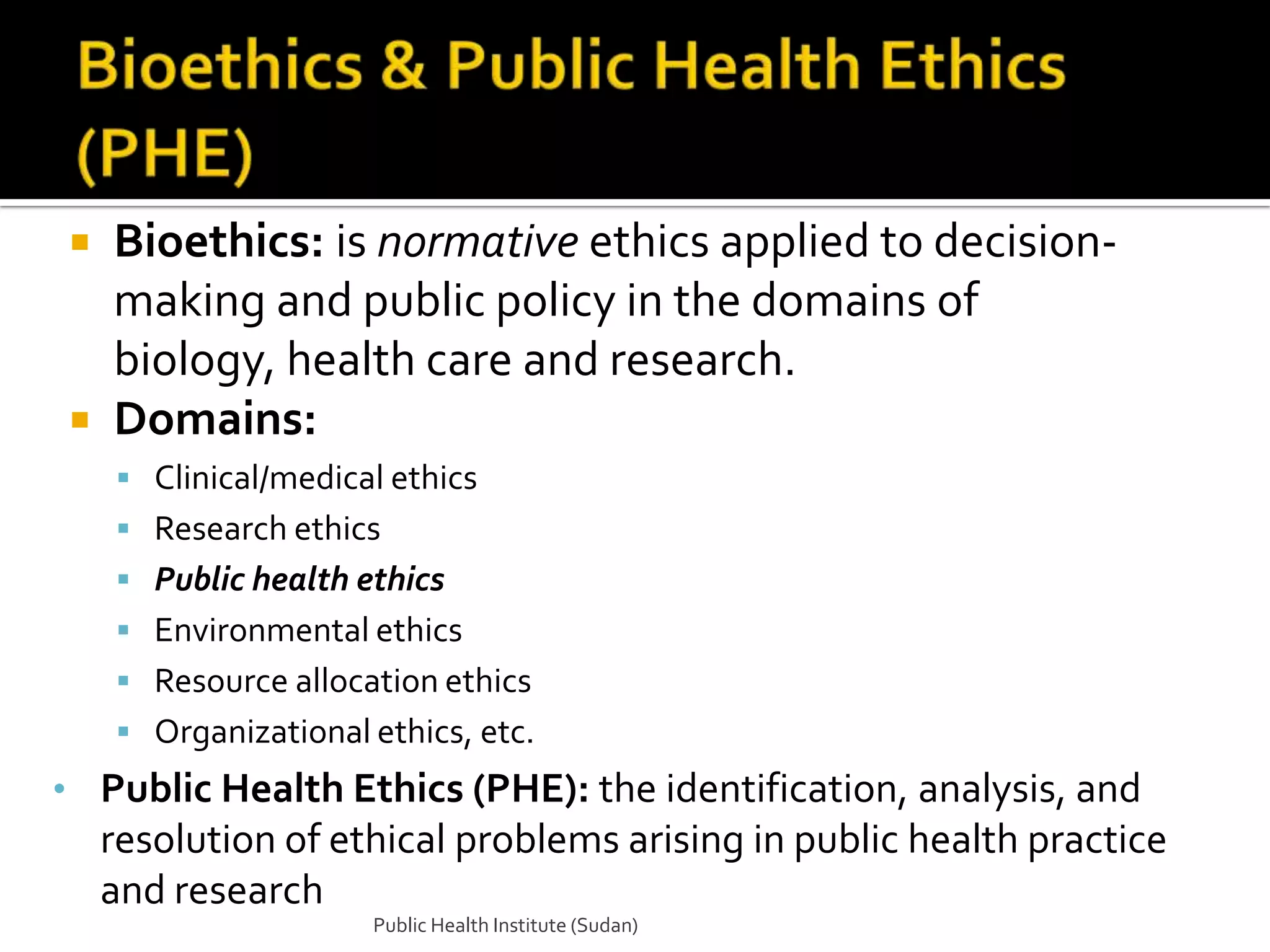
 Bioethics: is normative ethics applied to decision-
  making and public policy in the domains of
  biology, health care and research.
 Domains:
     Clinical/medical ethics
     Research ethics
     Public health ethics
     Environmental ethics
     Resource allocation ethics
     Organizational ethics, etc.
• Public Health Ethics (PHE): the identification, analysis, and
    resolution of ethical problems arising in public health practice
    and research
                     Public Health Institute (Sudan)
Public Health Institute (Sudan)
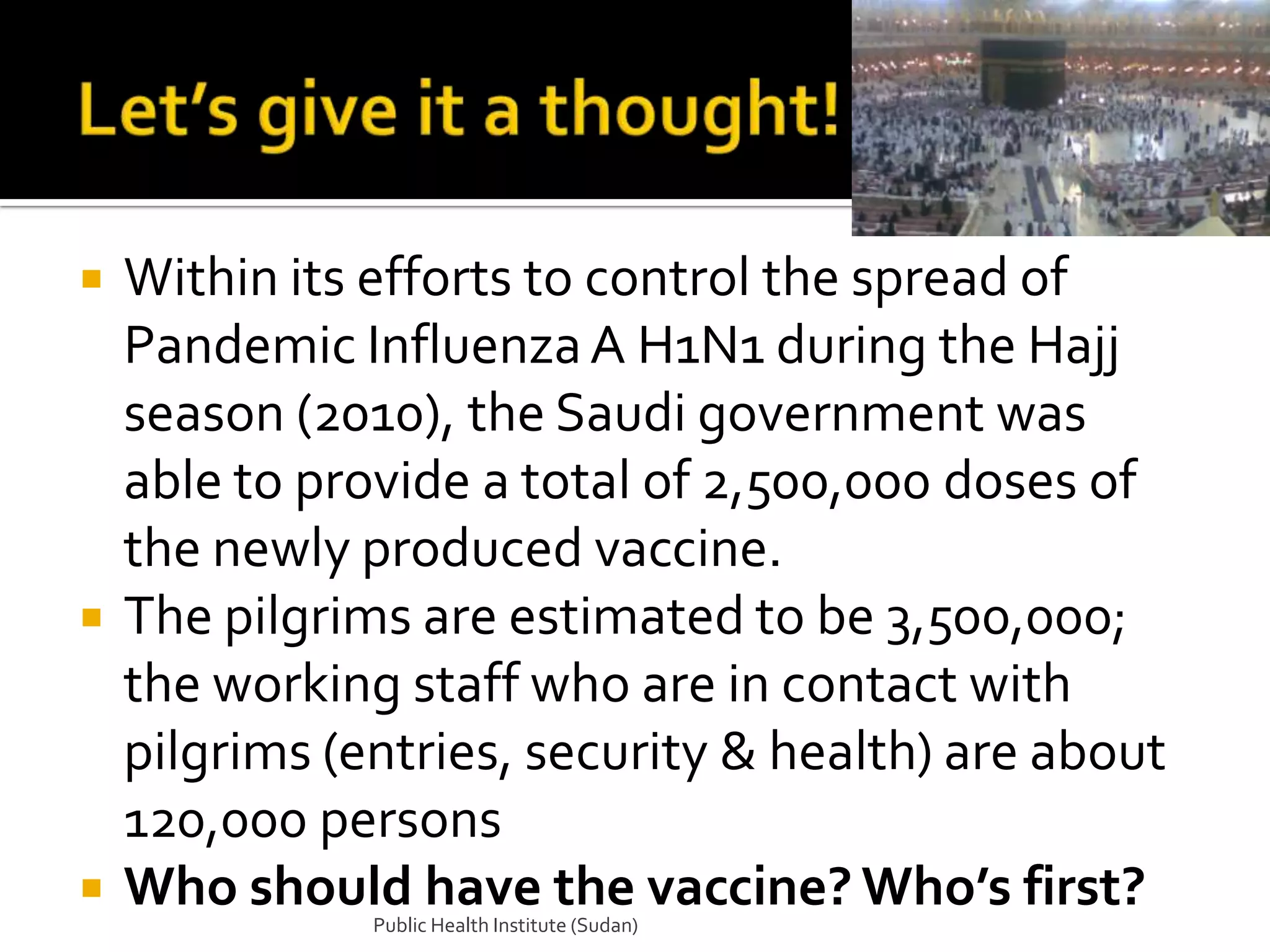
   Within its efforts to control the spread of
    Pandemic Influenza A H1N1 during the Hajj
    season (2010), the Saudi government was
    able to provide a total of 2,500,000 doses of
    the newly produced vaccine.
   The pilgrims are estimated to be 3,500,000;
    the working staff who are in contact with
    pilgrims (entries, security & health) are about
    120,000 persons
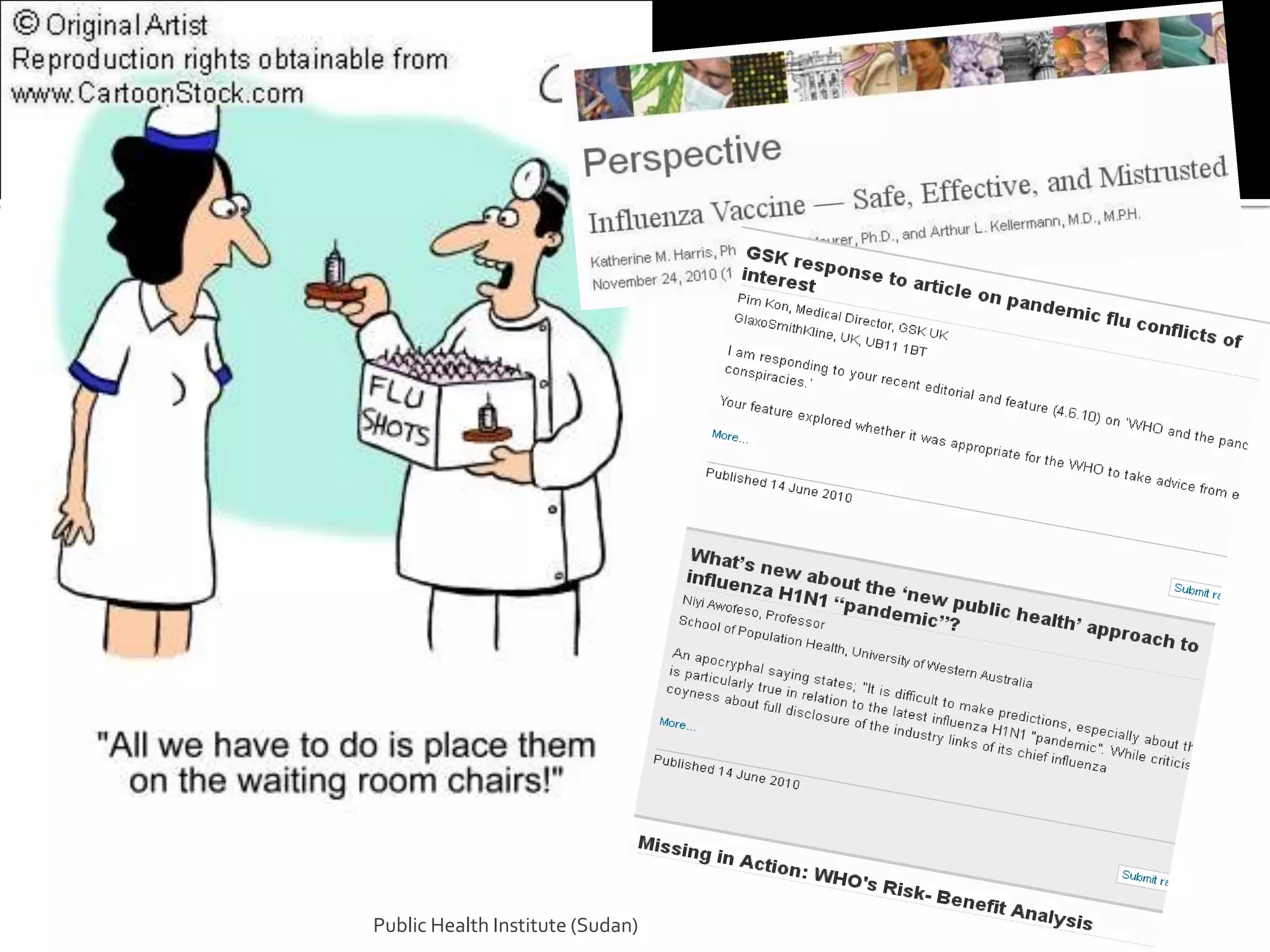
   Who should have the vaccine? Who’s first?
               Public Health Institute (Sudan)
Public Health Institute (Sudan)
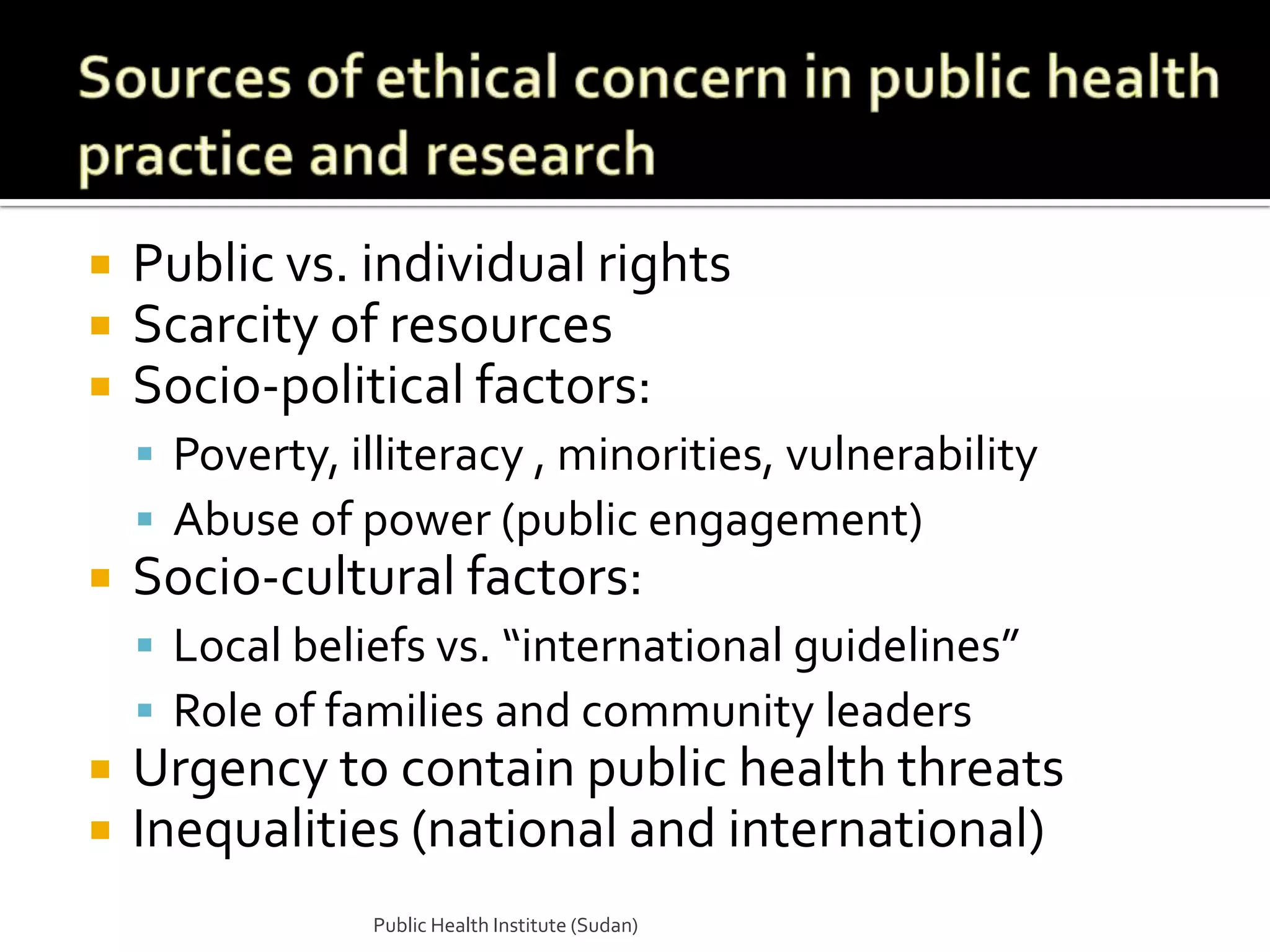
   Public vs. individual rights
   Scarcity of resources
   Socio-political factors:
     Poverty, illiteracy , minorities, vulnerability
     Abuse of power (public engagement)
   Socio-cultural factors:
     Local beliefs vs. “international guidelines”
     Role of families and community leaders
   Urgency to contain public health threats
   Inequalities (national and international)
                Public Health Institute (Sudan)
Public Health Institute (Sudan)
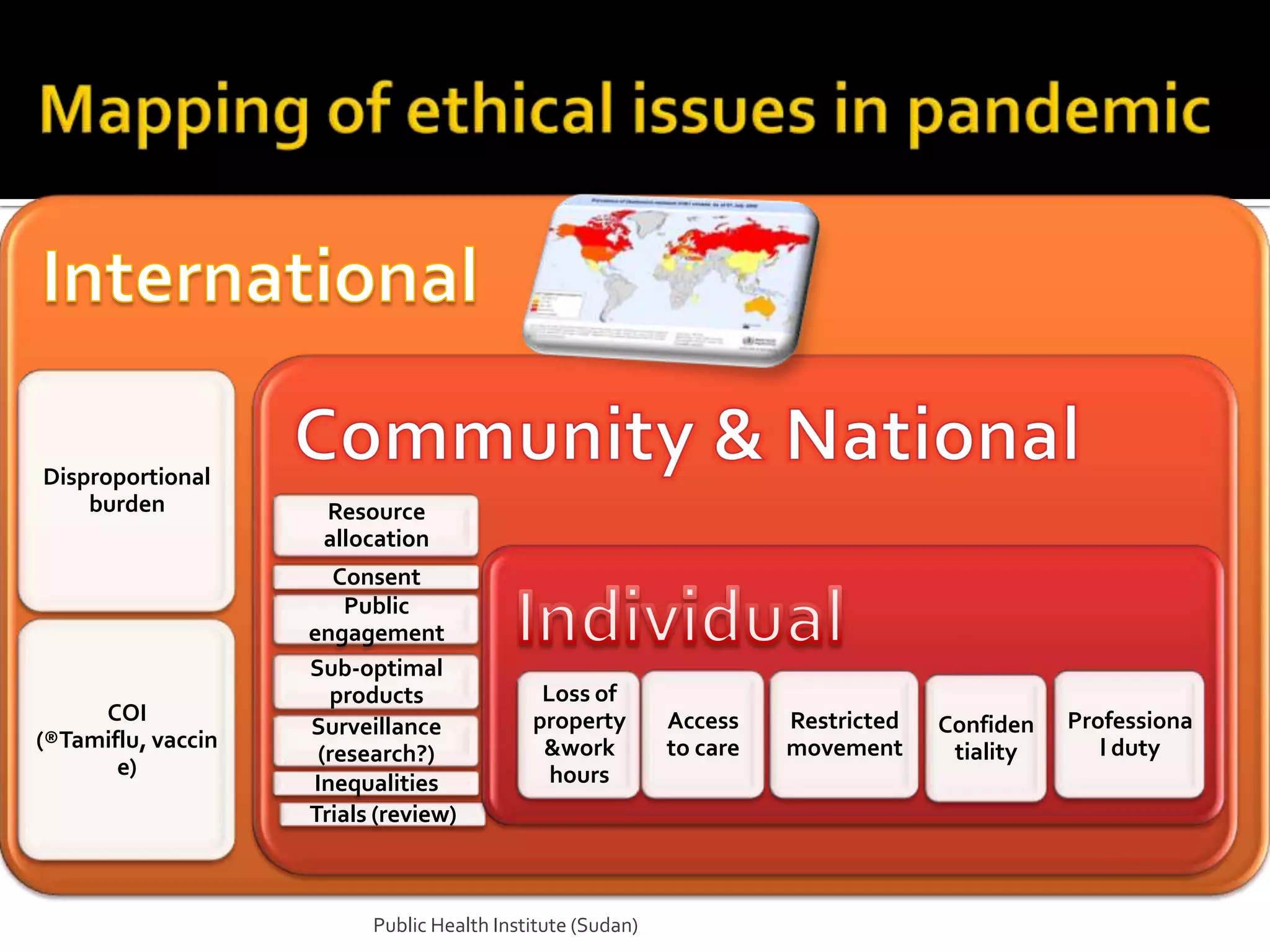
Disproportional
    burden           Resource
                     allocation
                       Consent
                        Public
                    engagement
                    Sub-optimal
                      products               Loss of
     COI                                    property        Access    Restricted   Confiden   Professiona
                    Surveillance
(®Tamiflu, vaccin                            &work          to care   movement      tiality      l duty
                     (research?)
       e)                                     hours
                    Inequalities
                    Trials (review)


                          Public Health Institute (Sudan)
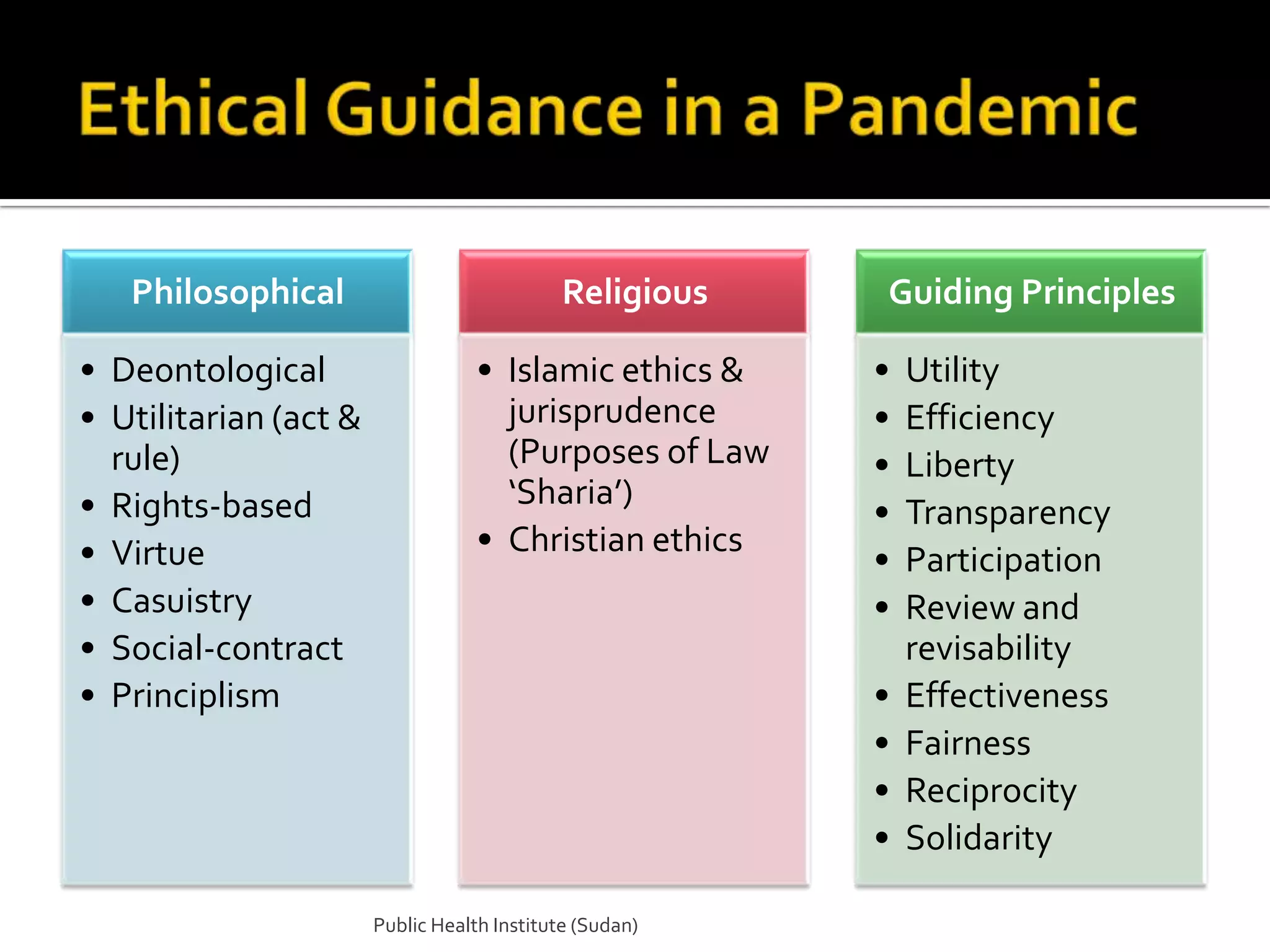
Philosophical                             Religious   Guiding Principles

• Deontological                    • Islamic ethics &    •   Utility
• Utilitarian (act &                 jurisprudence       •   Efficiency
  rule)                              (Purposes of Law    •   Liberty
• Rights-based                       ‘Sharia’)
                                                         •   Transparency
• Virtue                           • Christian ethics
                                                         •   Participation
• Casuistry                                              •   Review and
• Social-contract                                            revisability
• Principlism                                            •   Effectiveness
                                                         •   Fairness
                                                         •   Reciprocity
                                                         •   Solidarity

                       Public Health Institute (Sudan)
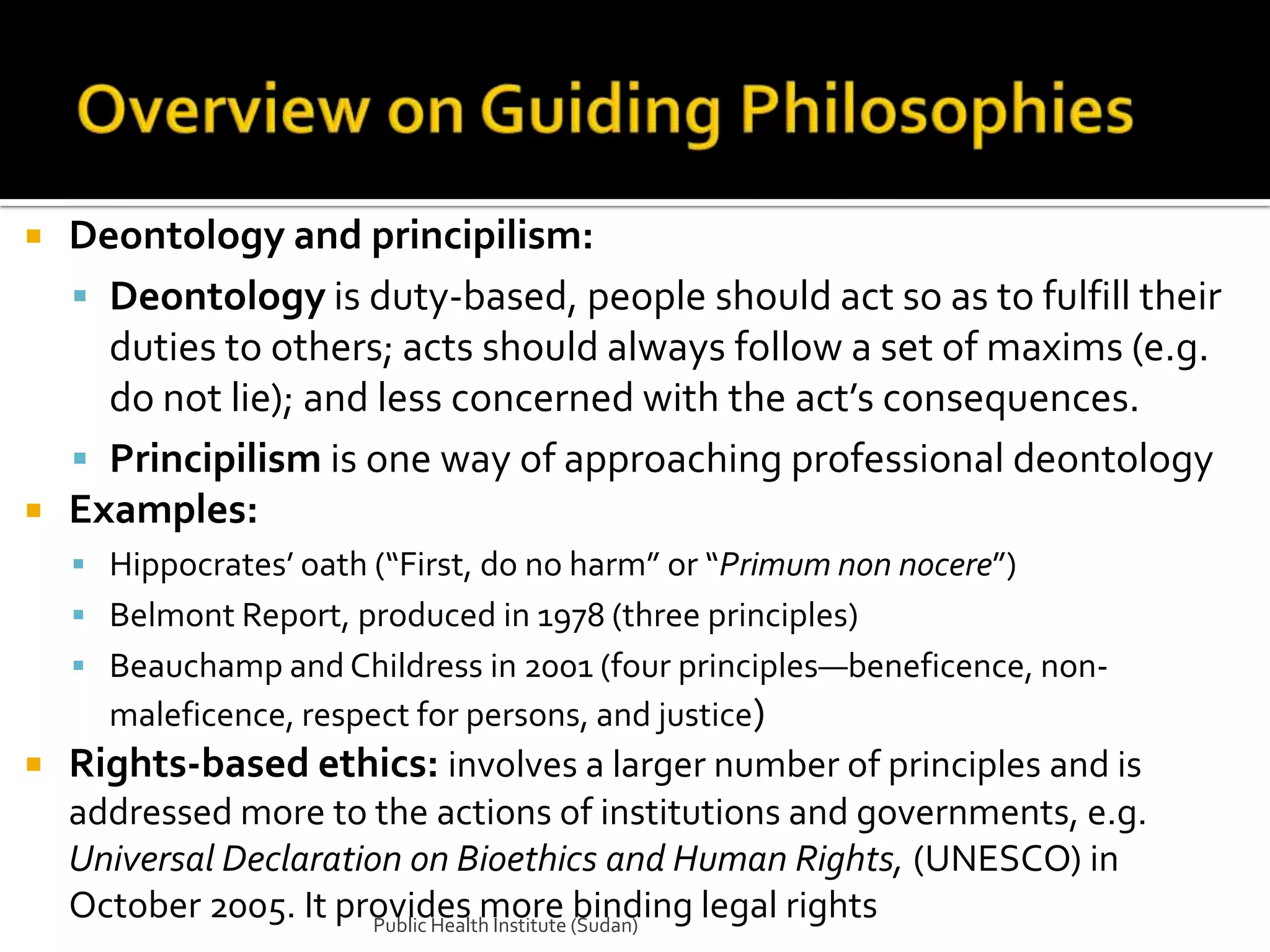
   Deontology and principilism:
     Deontology is duty-based, people should act so as to fulfill their
      duties to others; acts should always follow a set of maxims (e.g.
      do not lie); and less concerned with the act’s consequences.
     Principilism is one way of approaching professional deontology
   Examples:
     Hippocrates’ oath (“First, do no harm” or “Primum non nocere”)
     Belmont Report, produced in 1978 (three principles)
     Beauchamp and Childress in 2001 (four principles—beneficence, non-
      maleficence, respect for persons, and justice)
   Rights-based ethics: involves a larger number of principles and is
    addressed more to the actions of institutions and governments, e.g.
    Universal Declaration on Bioethics and Human Rights, (UNESCO) in
    October 2005. It provides more (Sudan)
                        Public Health Institute
                                                binding legal rights
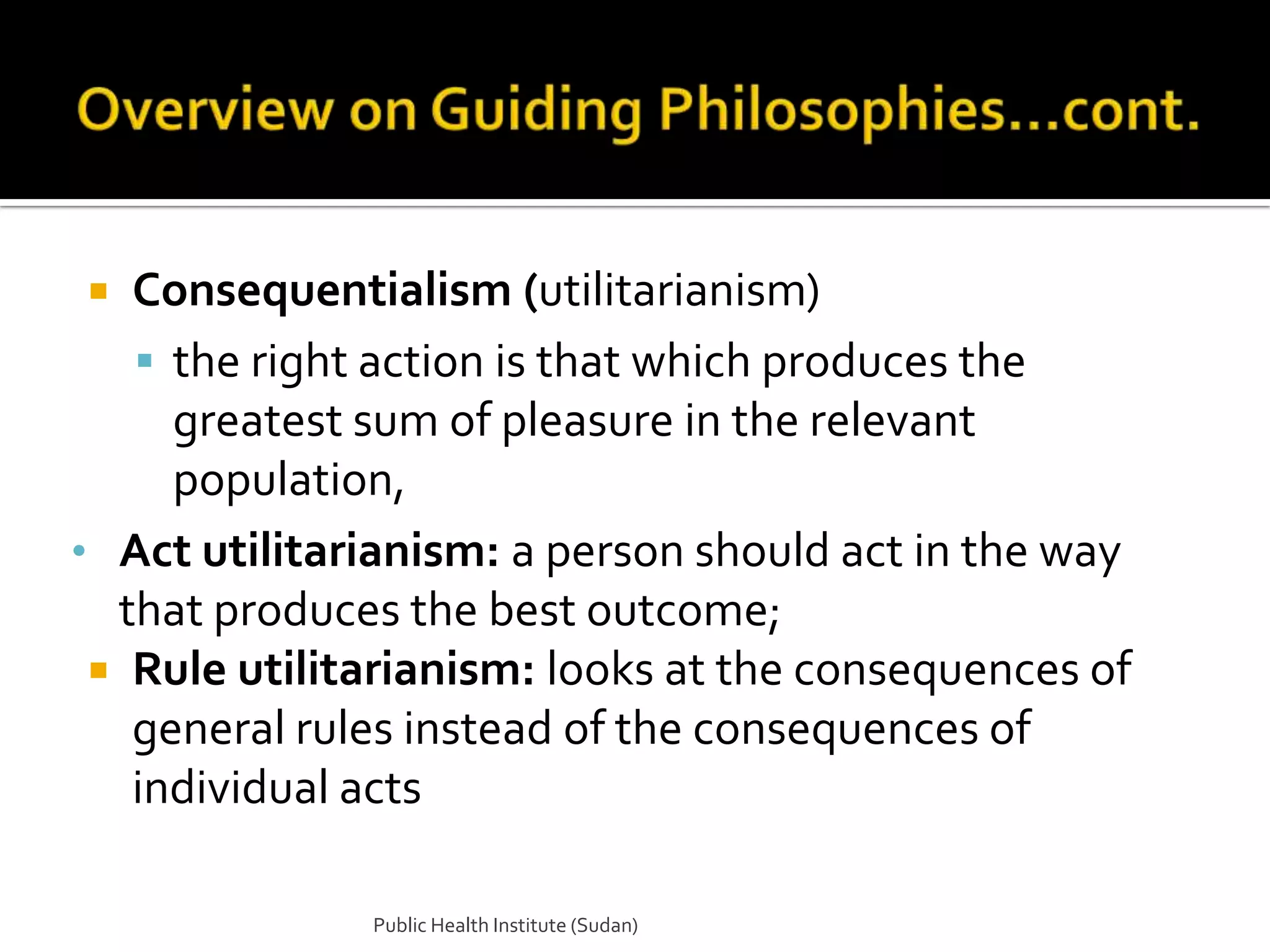
  Consequentialism (utilitarianism)
    the right action is that which produces the
     greatest sum of pleasure in the relevant
     population,
• Act utilitarianism: a person should act in the way
  that produces the best outcome;
  Rule utilitarianism: looks at the consequences of
   general rules instead of the consequences of
   individual acts

              Public Health Institute (Sudan)
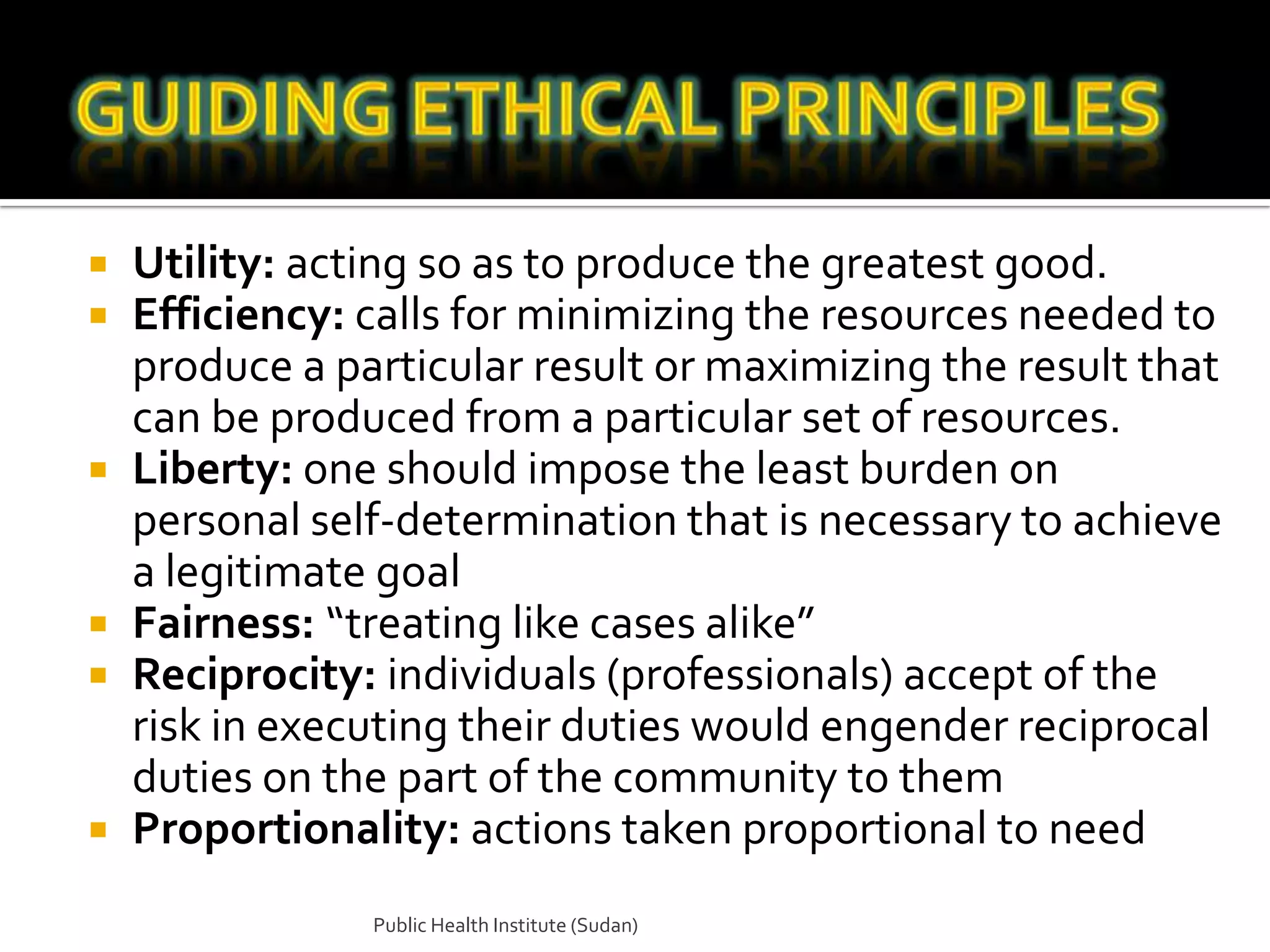
   Utility: acting so as to produce the greatest good.
   Efficiency: calls for minimizing the resources needed to
    produce a particular result or maximizing the result that
    can be produced from a particular set of resources.
   Liberty: one should impose the least burden on
    personal self-determination that is necessary to achieve
    a legitimate goal
   Fairness: “treating like cases alike”
   Reciprocity: individuals (professionals) accept of the
    risk in executing their duties would engender reciprocal
    duties on the part of the community to them
   Proportionality: actions taken proportional to need
                Public Health Institute (Sudan)
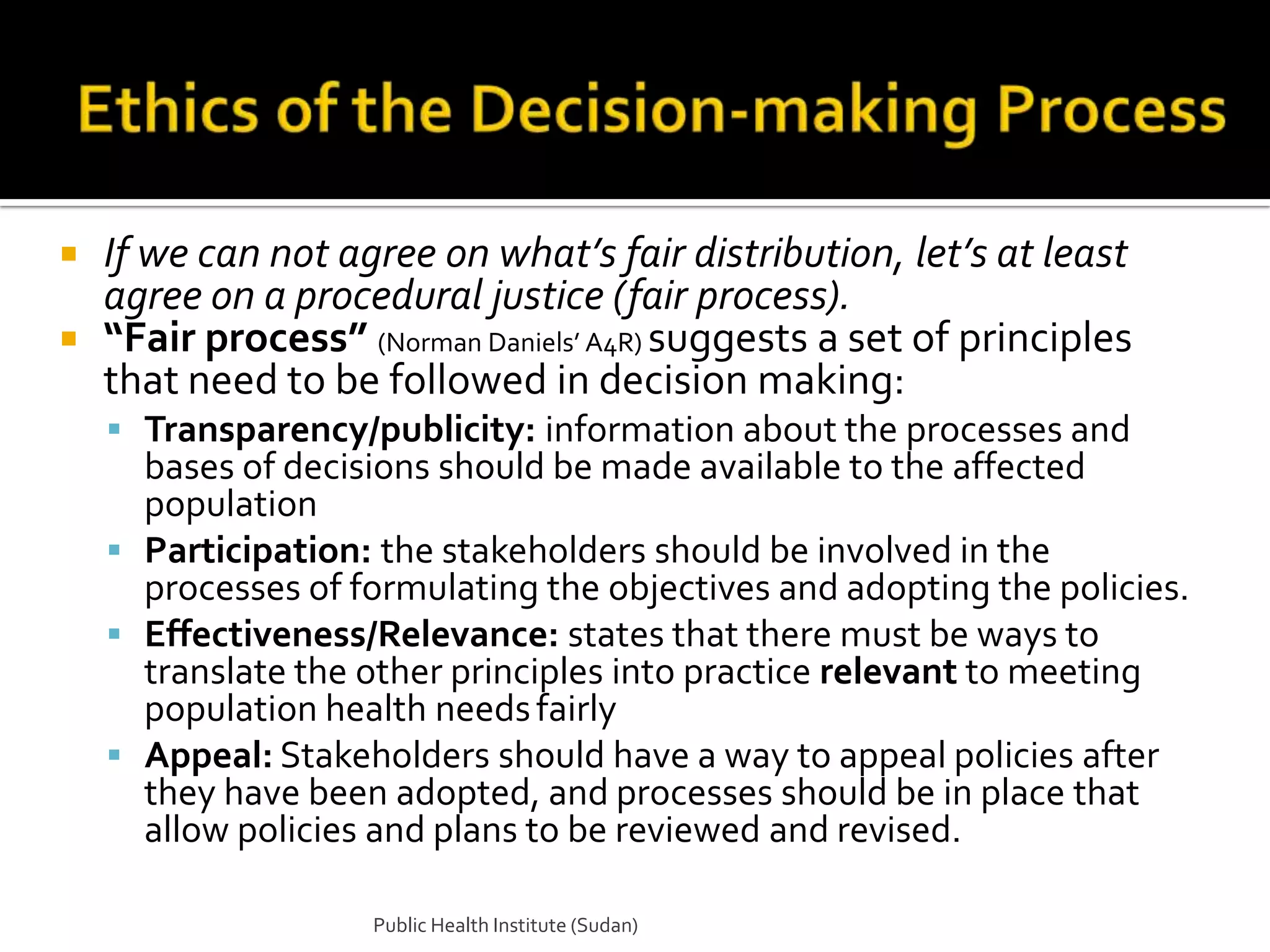
 If we can not agree on what’s fair distribution, let’s at least
  agree on a procedural justice (fair process).
 “Fair process” (Norman Daniels’ A4R) suggests a set of principles
  that need to be followed in decision making:
     Transparency/publicity: information about the processes and
      bases of decisions should be made available to the affected
      population
     Participation: the stakeholders should be involved in the
      processes of formulating the objectives and adopting the policies.
     Effectiveness/Relevance: states that there must be ways to
      translate the other principles into practice relevant to meeting
      population health needs fairly
     Appeal: Stakeholders should have a way to appeal policies after
      they have been adopted, and processes should be in place that
      allow policies and plans to be reviewed and revised.

                    Public Health Institute (Sudan)
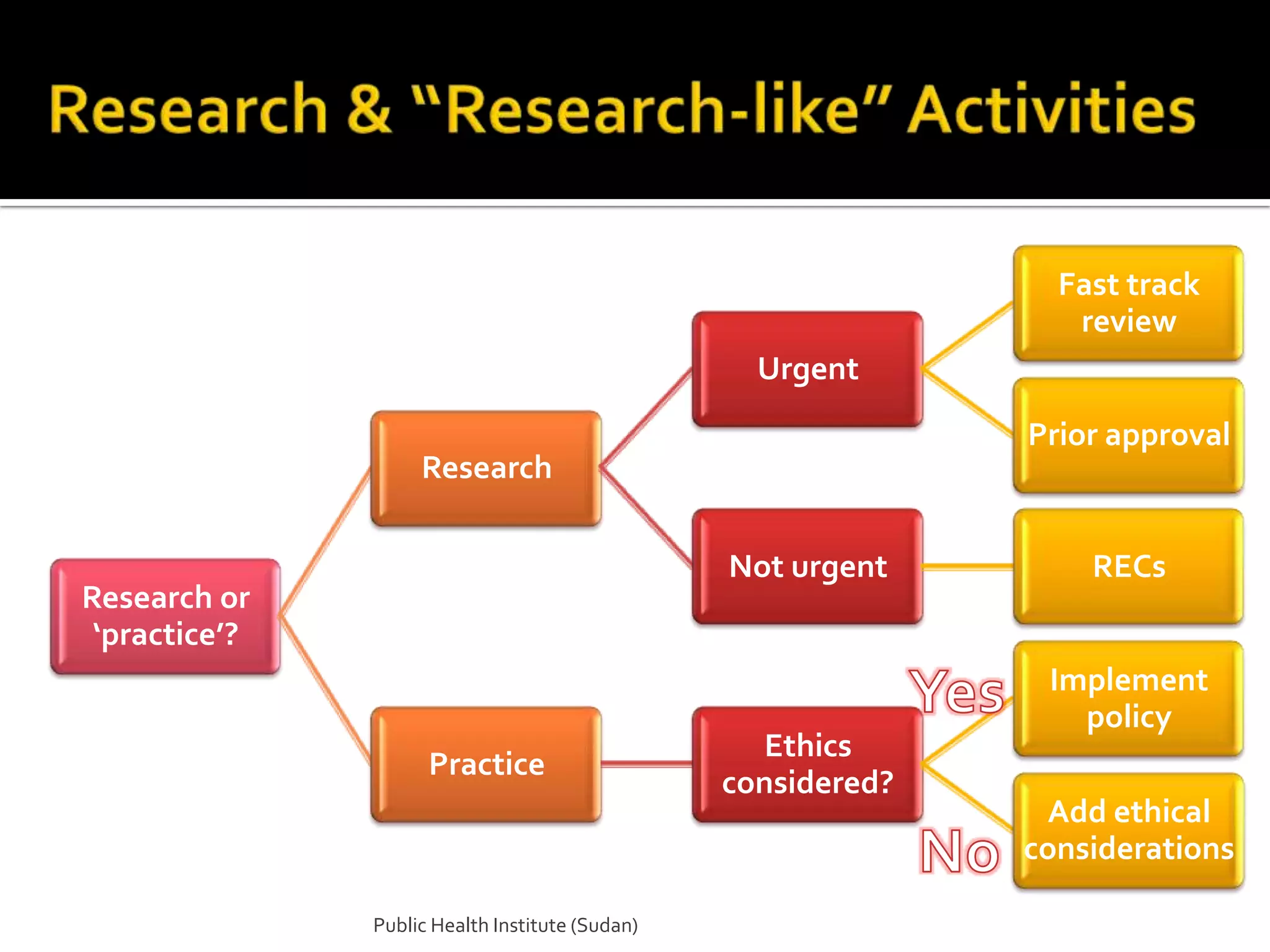
Fast track
                                                                  review
                                                   Urgent
                                                               Prior approval
                    Research

                                                 Not urgent        RECs
Research or
 ‘practice’?
                                                                Implement
                                                                  policy
                                                    Ethics
                     Practice
                                                 considered?
                                                                Add ethical
                                                               considerations

               Public Health Institute (Sudan)
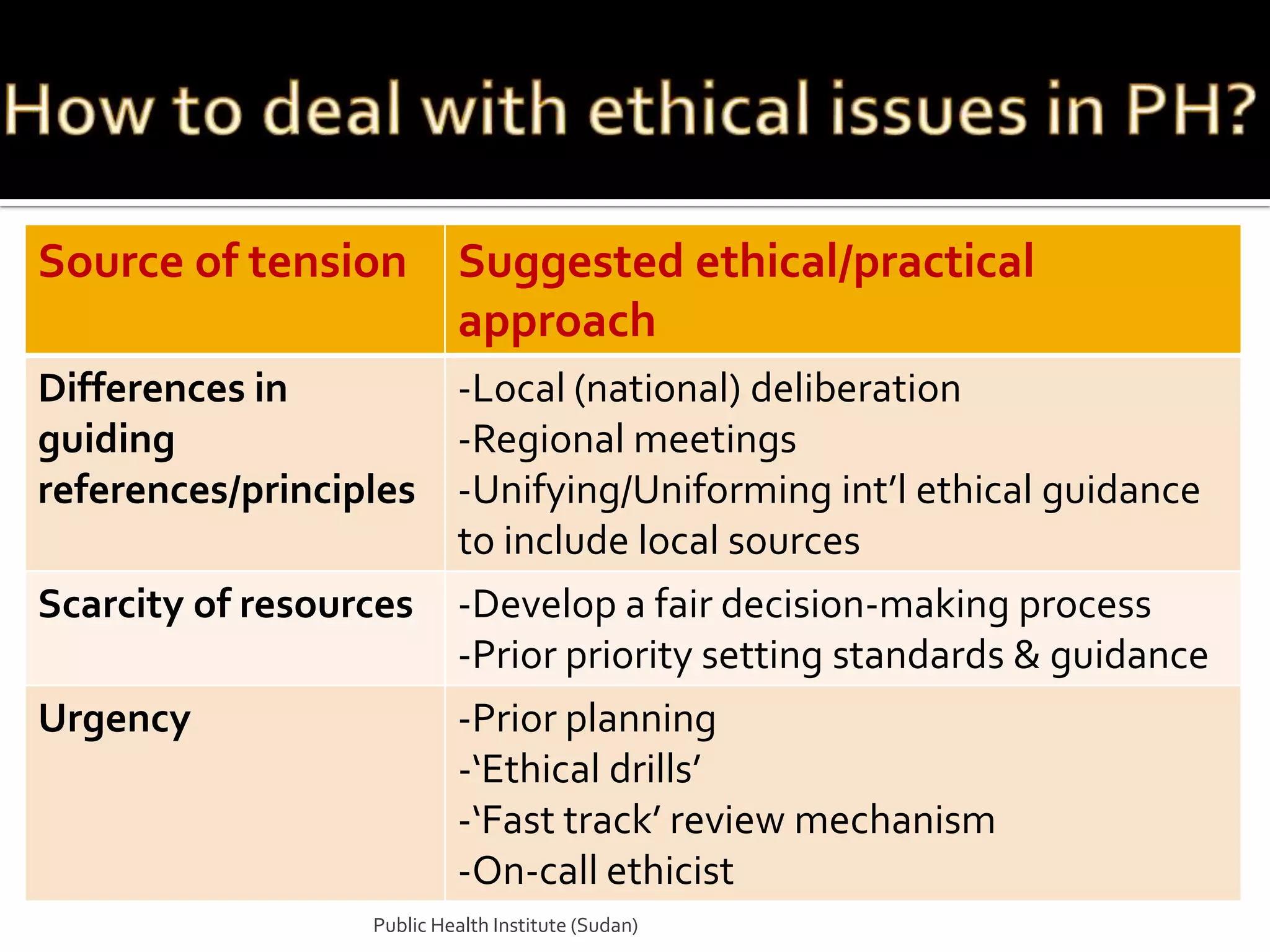
Source of tension          Suggested ethical/practical
                           approach
Differences in        -Local (national) deliberation
guiding               -Regional meetings
references/principles -Unifying/Uniforming int’l ethical guidance
                      to include local sources
Scarcity of resources -Develop a fair decision-making process
                      -Prior priority setting standards & guidance
Urgency               -Prior planning
                      -‘Ethical drills’
                      -‘Fast track’ review mechanism
                      -On-call ethicist
                  Public Health Institute (Sudan)
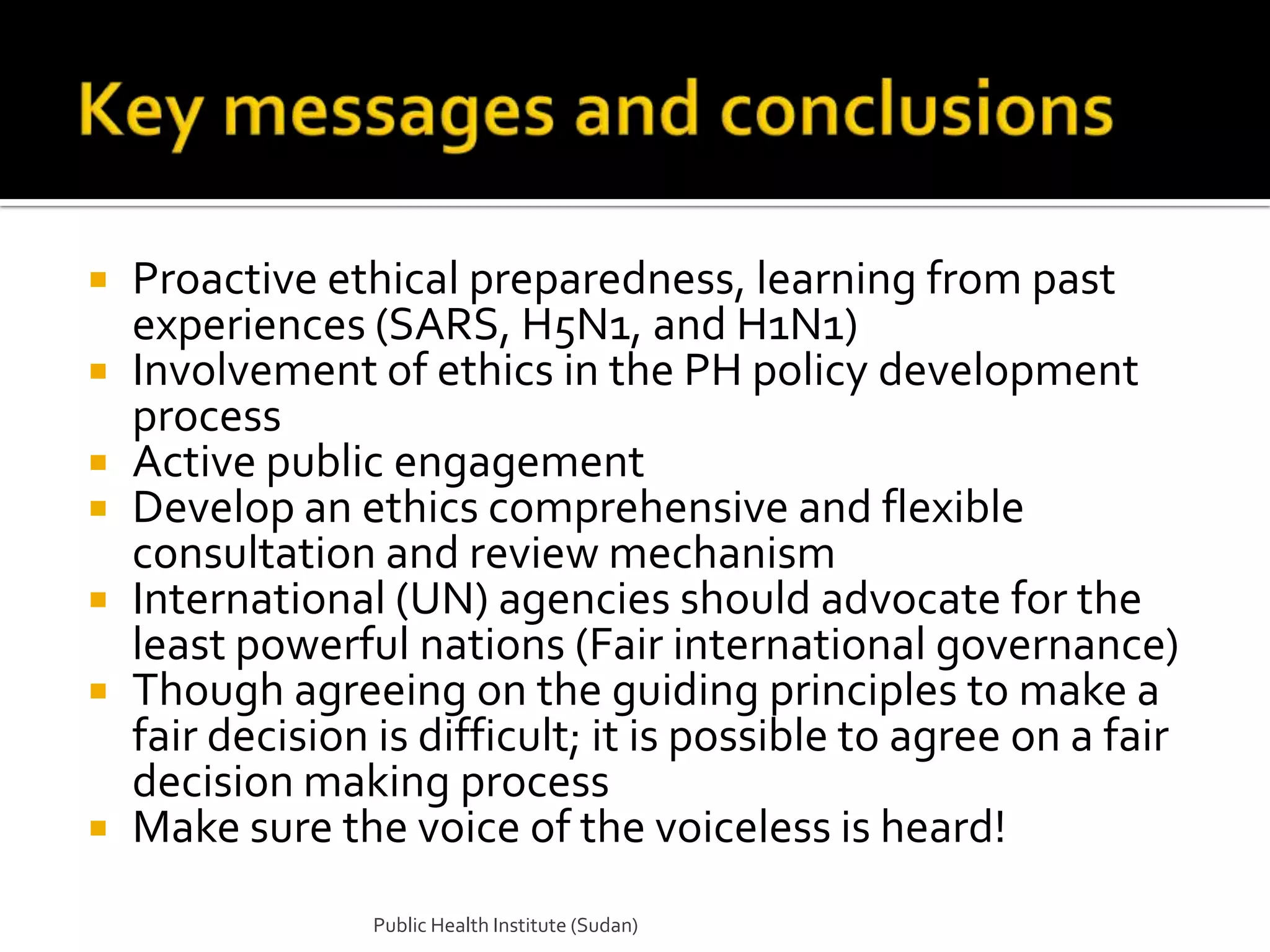
 Proactive ethical preparedness, learning from past
  experiences (SARS, H5N1, and H1N1)
 Involvement of ethics in the PH policy development
  process
 Active public engagement
 Develop an ethics comprehensive and flexible
  consultation and review mechanism
 International (UN) agencies should advocate for the
  least powerful nations (Fair international governance)
 Though agreeing on the guiding principles to make a
  fair decision is difficult; it is possible to agree on a fair
  decision making process
 Make sure the voice of the voiceless is heard!

                Public Health Institute (Sudan)
Questions & Discussion
                                   Public Health Institute (Sudan)


Feel free to contact:

Ghaiath Hussein
Assistant Professor of Bioethics
Faulty of medicine, King Fahad
Medical City
Riyadh, Saudi Arabia
Email:
ghaiathme@gmail.com
Phone: 00966566511653
   Principles of the Ethical Practice of Public Health; Public Health
    Leadership Society (2002)
   Ethics and Public Health: Model Curriculum. Ed. Bruce Jennings
    et al. (2003)
   Childress JF, Faden RR, Gaare RD, Gostin LO, Kahn J, Bonnie
    RJ, Kass NE, Mastroianni AC, Moreno JD, Nieburg P: Public health
    ethics: mapping the terrain. J Law Med Ethics 2002, 30:170-8.
   Public health: disconnections between policy, practice and
    research. Jansen et al. Health Research Policy and Systems
    2010, 8:37
   Ethical issues in epidemiologic research and public health
    practice. Steven S Coughlin. Emerging Themes in Epidemiology
    2006, 3:16
   Accountability for reasonableness. Norman Daniels, BMJ
    2000;321:1300-1301


                   Public Health Institute (Sudan)

Introduction to ethical issues in public health, Public Health Institute (PHI, Sudan) Jan.5,2011

  • 1.
    Public Health Institute(Khartoum, Jan. 5, 2012) Ghaiath M. A. Hussein Assistant Professor of Bioethics Faulty of medicine, King Fahad Medical City Riyadh, Saudi Arabia Email: ghaiathme@gmail.com Phone: 00966566511653
  • 2.
    Public health (vs. clinical care)  What’s Ethics? What is Public Health Ethics (PHE)?  Sources of ethical concern in public health practice and research  Why are pandemics ethically unique?  Levels of pandemic effects and their ethical implications  Guiding ethical principles  How to deal with ethical tensions in PH? Public Health Institute (Sudan)
  • 3.
  • 4.
  • 5.
     The expressivelevel (unanalyzed expressions or feeling that, by themselves, don’t provide reasons or justification)  The pre-reflective level (justification via law, religious tenets, social values, codes of ethics, etc.; accepted uncritically)  The reflective level (reasoned ethical argument/defense based on ethical principles, rules, virtues, values to which we consciously subscribe; justification provided) Thomas J and Waluchow W, 1998 Public Health Institute (Sudan)
  • 6.
     It isthe process we need to go through to reach a decision about an ethical issue.  It helps us to differentiate:  Values and ethical principles description of the way the world is; an actual state of affairs (“is”) judgment about the way things should be (“ought”). they are meant to guide actions. Key values in bioethics have corresponding (e.g., principle of respect for autonomy) Public Health Institute (Sudan)
  • 7.
    What is PublicHealth about? What is ethics/bioethics? What is Public Health Ethics? What is an ethical issue? Public Health Institute (Sudan)
  • 8.
    Definitions:  “Public health is what we, as a society, do collectively to assure the conditions for people to be healthy.” (IOM, 1988);  “the process of mobilizing and engaging local, regional, national and international resources to assure the conditions in which people can be healthy” (Oxford Textbook of public health, 2004)  "Public health is primarily concerned with the health of the entire population“ (Childress et al.)  Scope: health promotion and disease prevention throughout society)  Fields: Policy; Practice; and Research  Disease prevention Occupational health Health promotion Environmental health Epidemiological studies Determinants of health WSH Biostatistics Health Institute (Sudan) Public
  • 9.
    Morality & Ethics:  Morality: the beliefs and standards of good and bad, right and wrong, that people actually do and should follow in a society, while ethics is defined as the systematic study of morality.  Metaethics: tries to clarify the rational standards and methods for the study of ethics  Normative ethics: develops ethical principles, rules, and ideals that spell out standards of good and bad, right and wrong. Public Health Institute (Sudan)
  • 10.
     A systemof moral principles or standards governing conduct.  a system of principles by which human actions and proposals may be judged good or bad, right or wrong;  A set of rules or a standard governing the conduct of a particular class of human action or profession;  Any set of moral principles or values recognized by a particular religion, belief or philosophy;  The principles of right conduct of an individual. (UNESCO/IUBS/Eubios Living Bioethics Dictionary version 1.4) Public Health Institute (Sudan)
  • 11.
    It is derived from Greek bio- life and ethicos moral.  The science/art that aims at identification, analysis, and resolution of the ethical issues in almost any field that is related to human life and health. Public Health Institute (Sudan)
  • 12.
    ▪ deciding whatwe should do (what decisions are morally right or acceptable); ▪ explaining why we should do it (how do we justify our decision in moral terms); and ▪ describing how we should do it (the method or manner of our response when we act on our decision). Public Health Institute (Sudan)
  • 13.
    Clinical Ethics Bioethics Research ethics Resource Allocation ethics Business ethics Public Health Environmental ethics Ethics ethics Nursing ethics Social ethics Organizational other ethics IT ethics Other Public Health Institute (Sudan)
  • 14.
     Bioethics: isnormative ethics applied to decision- making and public policy in the domains of biology, health care and research.  Domains:  Clinical/medical ethics  Research ethics  Public health ethics  Environmental ethics  Resource allocation ethics  Organizational ethics, etc. • Public Health Ethics (PHE): the identification, analysis, and resolution of ethical problems arising in public health practice and research Public Health Institute (Sudan)
  • 15.
  • 16.
    Within its efforts to control the spread of Pandemic Influenza A H1N1 during the Hajj season (2010), the Saudi government was able to provide a total of 2,500,000 doses of the newly produced vaccine.  The pilgrims are estimated to be 3,500,000; the working staff who are in contact with pilgrims (entries, security & health) are about 120,000 persons  Who should have the vaccine? Who’s first? Public Health Institute (Sudan)
  • 17.
  • 18.
    Public vs. individual rights  Scarcity of resources  Socio-political factors:  Poverty, illiteracy , minorities, vulnerability  Abuse of power (public engagement)  Socio-cultural factors:  Local beliefs vs. “international guidelines”  Role of families and community leaders  Urgency to contain public health threats  Inequalities (national and international) Public Health Institute (Sudan)
  • 19.
  • 20.
    Disproportional burden Resource allocation Consent Public engagement Sub-optimal products Loss of COI property Access Restricted Confiden Professiona Surveillance (®Tamiflu, vaccin &work to care movement tiality l duty (research?) e) hours Inequalities Trials (review) Public Health Institute (Sudan)
  • 21.
    Philosophical Religious Guiding Principles • Deontological • Islamic ethics & • Utility • Utilitarian (act & jurisprudence • Efficiency rule) (Purposes of Law • Liberty • Rights-based ‘Sharia’) • Transparency • Virtue • Christian ethics • Participation • Casuistry • Review and • Social-contract revisability • Principlism • Effectiveness • Fairness • Reciprocity • Solidarity Public Health Institute (Sudan)
  • 22.
    Deontology and principilism:  Deontology is duty-based, people should act so as to fulfill their duties to others; acts should always follow a set of maxims (e.g. do not lie); and less concerned with the act’s consequences.  Principilism is one way of approaching professional deontology  Examples:  Hippocrates’ oath (“First, do no harm” or “Primum non nocere”)  Belmont Report, produced in 1978 (three principles)  Beauchamp and Childress in 2001 (four principles—beneficence, non- maleficence, respect for persons, and justice)  Rights-based ethics: involves a larger number of principles and is addressed more to the actions of institutions and governments, e.g. Universal Declaration on Bioethics and Human Rights, (UNESCO) in October 2005. It provides more (Sudan) Public Health Institute binding legal rights
  • 23.
     Consequentialism(utilitarianism)  the right action is that which produces the greatest sum of pleasure in the relevant population, • Act utilitarianism: a person should act in the way that produces the best outcome;  Rule utilitarianism: looks at the consequences of general rules instead of the consequences of individual acts Public Health Institute (Sudan)
  • 24.
    Utility: acting so as to produce the greatest good.  Efficiency: calls for minimizing the resources needed to produce a particular result or maximizing the result that can be produced from a particular set of resources.  Liberty: one should impose the least burden on personal self-determination that is necessary to achieve a legitimate goal  Fairness: “treating like cases alike”  Reciprocity: individuals (professionals) accept of the risk in executing their duties would engender reciprocal duties on the part of the community to them  Proportionality: actions taken proportional to need Public Health Institute (Sudan)
  • 25.
     If wecan not agree on what’s fair distribution, let’s at least agree on a procedural justice (fair process).  “Fair process” (Norman Daniels’ A4R) suggests a set of principles that need to be followed in decision making:  Transparency/publicity: information about the processes and bases of decisions should be made available to the affected population  Participation: the stakeholders should be involved in the processes of formulating the objectives and adopting the policies.  Effectiveness/Relevance: states that there must be ways to translate the other principles into practice relevant to meeting population health needs fairly  Appeal: Stakeholders should have a way to appeal policies after they have been adopted, and processes should be in place that allow policies and plans to be reviewed and revised. Public Health Institute (Sudan)
  • 26.
    Fast track review Urgent Prior approval Research Not urgent RECs Research or ‘practice’? Implement policy Ethics Practice considered? Add ethical considerations Public Health Institute (Sudan)
  • 27.
    Source of tension Suggested ethical/practical approach Differences in -Local (national) deliberation guiding -Regional meetings references/principles -Unifying/Uniforming int’l ethical guidance to include local sources Scarcity of resources -Develop a fair decision-making process -Prior priority setting standards & guidance Urgency -Prior planning -‘Ethical drills’ -‘Fast track’ review mechanism -On-call ethicist Public Health Institute (Sudan)
  • 28.
     Proactive ethicalpreparedness, learning from past experiences (SARS, H5N1, and H1N1)  Involvement of ethics in the PH policy development process  Active public engagement  Develop an ethics comprehensive and flexible consultation and review mechanism  International (UN) agencies should advocate for the least powerful nations (Fair international governance)  Though agreeing on the guiding principles to make a fair decision is difficult; it is possible to agree on a fair decision making process  Make sure the voice of the voiceless is heard! Public Health Institute (Sudan)
  • 29.
    Questions & Discussion Public Health Institute (Sudan) Feel free to contact: Ghaiath Hussein Assistant Professor of Bioethics Faulty of medicine, King Fahad Medical City Riyadh, Saudi Arabia Email: ghaiathme@gmail.com Phone: 00966566511653
  • 30.
    Principles of the Ethical Practice of Public Health; Public Health Leadership Society (2002)  Ethics and Public Health: Model Curriculum. Ed. Bruce Jennings et al. (2003)  Childress JF, Faden RR, Gaare RD, Gostin LO, Kahn J, Bonnie RJ, Kass NE, Mastroianni AC, Moreno JD, Nieburg P: Public health ethics: mapping the terrain. J Law Med Ethics 2002, 30:170-8.  Public health: disconnections between policy, practice and research. Jansen et al. Health Research Policy and Systems 2010, 8:37  Ethical issues in epidemiologic research and public health practice. Steven S Coughlin. Emerging Themes in Epidemiology 2006, 3:16  Accountability for reasonableness. Norman Daniels, BMJ 2000;321:1300-1301 Public Health Institute (Sudan)