
Bio-Statistics
CHANU BHATTACHARYA
At the end of the class we will
understand
1. Meaning of statistics
2. Application of statistics
3. SCALE OF MEASUREMENT
4. Central Tendency
5. Standard Deviations
2
Meaning
 The word Statistics today refers to either quantitative information or a
method of dealing with quantitative or qualitative information.
 “Statistics is defined as collection, Presentation, analysis and interpretation
of numerical data”.
 Acc. Croxton & cowden
 statistics is the sciences and art of dealing with figure and facts.
3
Meaning
 Biostatistics is the branch of statistics applied to
biology or medical sciences. Biostatistics is also
called “Biometry”
 In Greek, Bios = Life
 Metry= Measurement
 So, it is measurement of life
4
USE & APPLICATION OF
STATISTICS
1. Statistics facilitates comparisons
2. It simplifies the message of figure
3. It helps in formulating and testing hypothesis
4. It help in prediction
5
SCALE OF MEASUREMENT
 Measurement is the process of assigning numbers or labels to
objects, persons, states, or events in accordance with specific
rules to represent quantities or qualities of attributes.
 Do not measure specific objects, persons, etc. Measure
attributes or features that define them.
6
FOUR BASIC SCALES OF
MEASUREMENT
1. Nominal Scales
2. Ordinal Scales
3. Interval Scales
4. Ratio Scales
7
 There must be distinct classes but these classes have no
quantitative properties. Therefore, no comparison can be
made in terms of one category being higher than the other.
 For example - there are two classes for the, variable
gender - males and females. There are no quantitative
properties for this variable or these classes and, therefore,
gender is a nominal variable.
8
NOMINAL SCALE
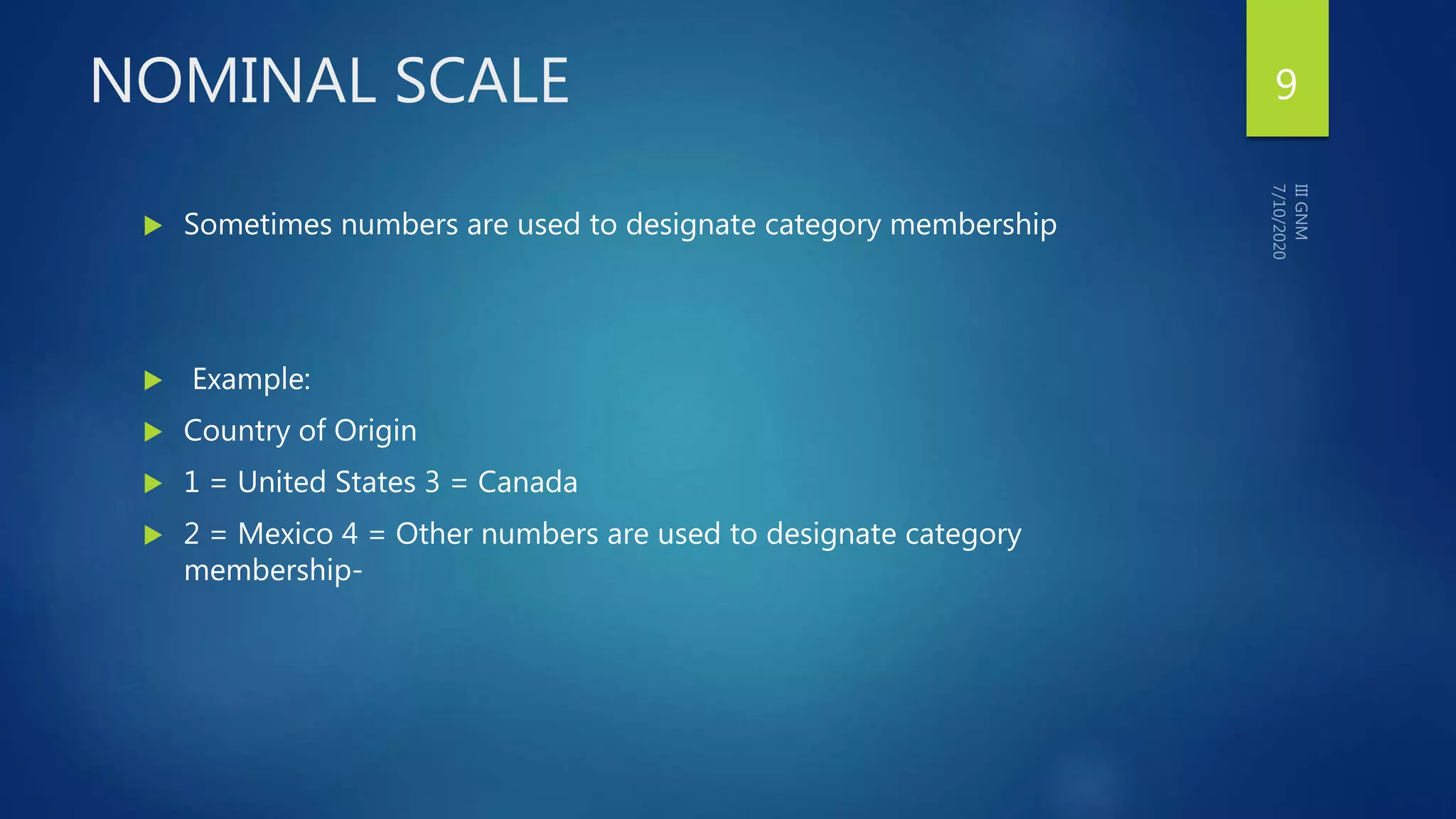
 Sometimes numbers are used to designate category membership
 Example:
 Country of Origin
 1 = United States 3 = Canada
 2 = Mexico 4 = Other numbers are used to designate category
membership-
9
Ordinal Scales
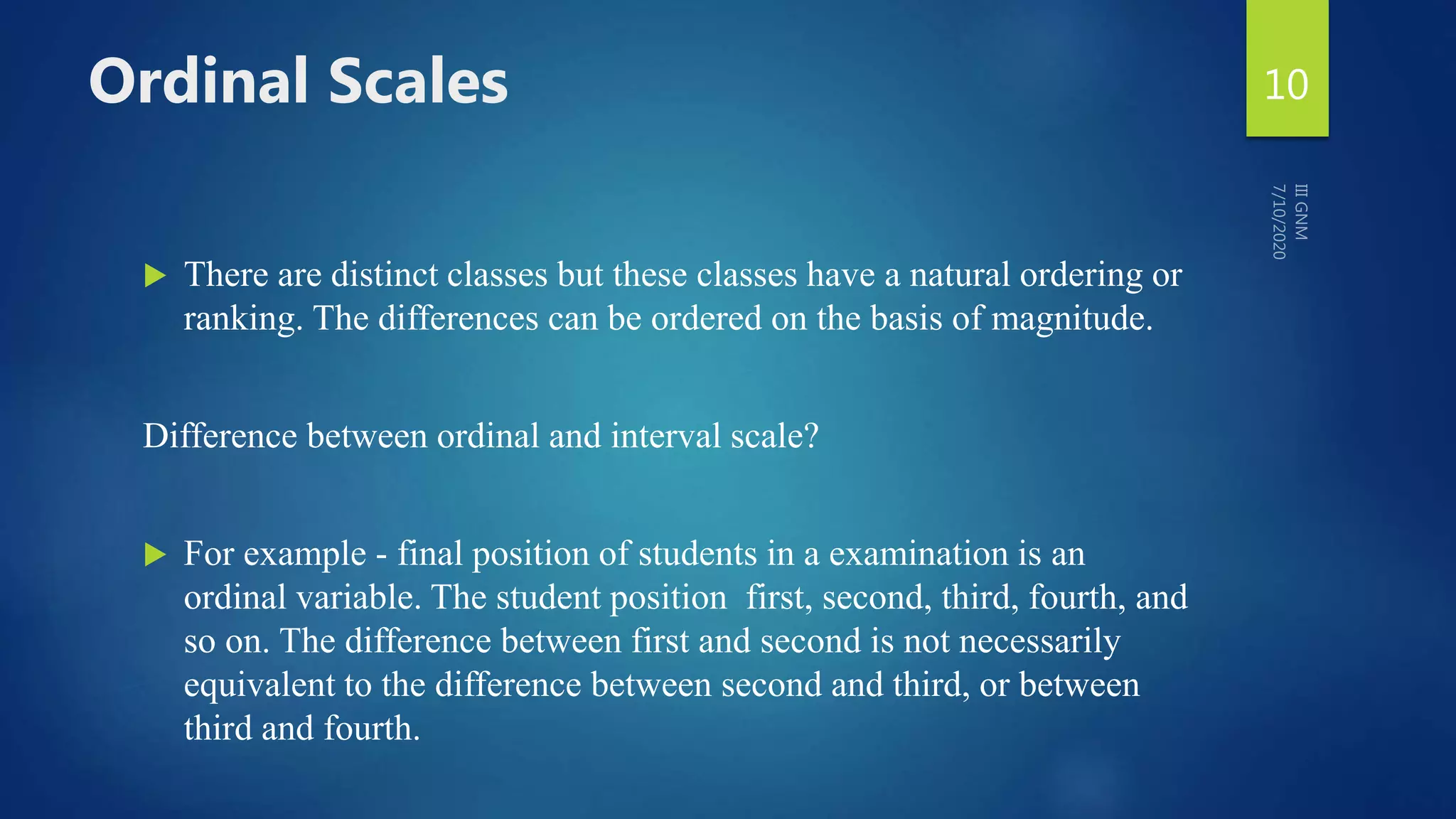
 There are distinct classes but these classes have a natural ordering or
ranking. The differences can be ordered on the basis of magnitude.
Difference between ordinal and interval scale?
 For example - final position of students in a examination is an
ordinal variable. The student position first, second, third, fourth, and
so on. The difference between first and second is not necessarily
equivalent to the difference between second and third, or between
third and fourth.
10
INTERVAL SCALES
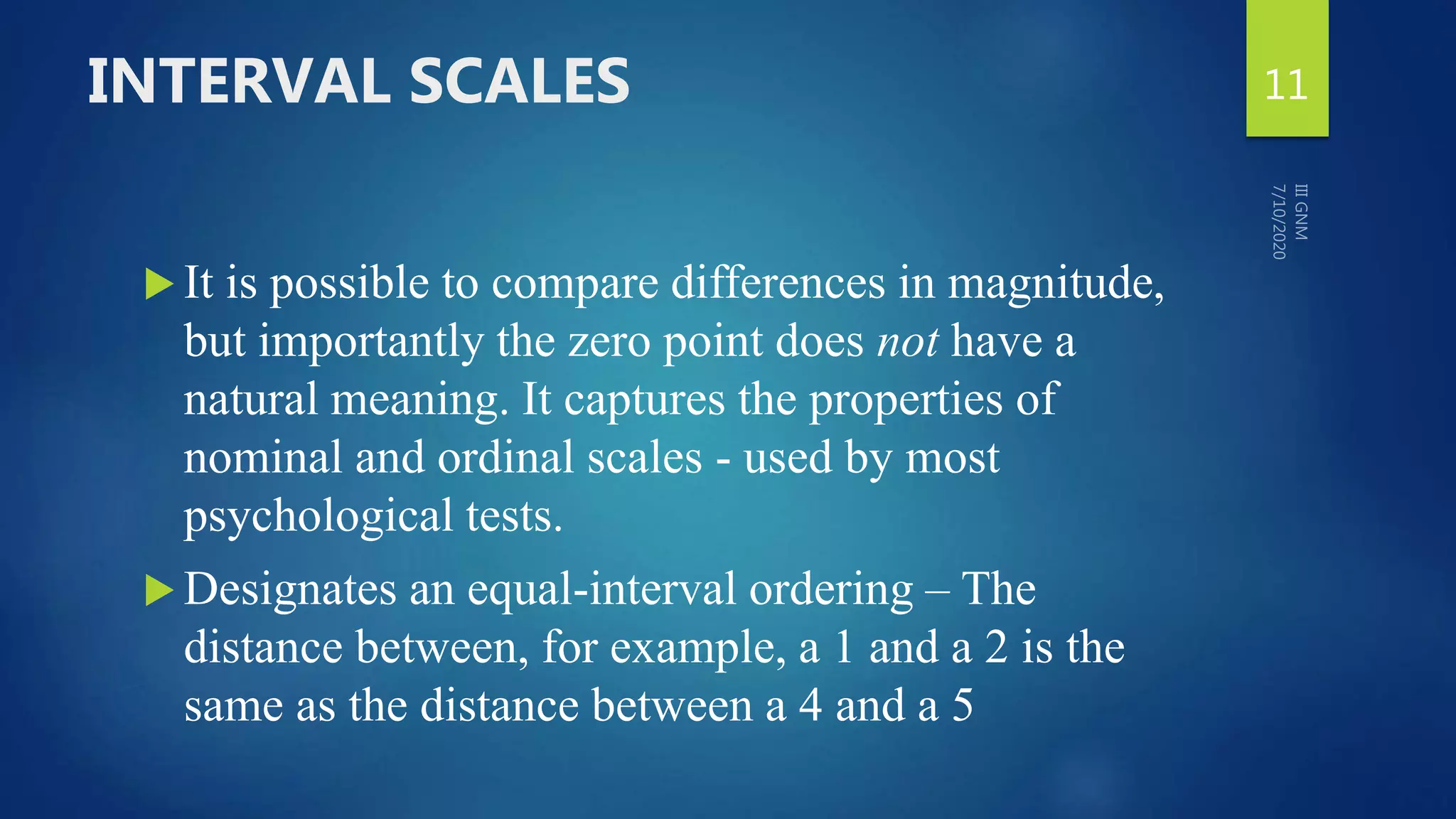
 It is possible to compare differences in magnitude,
but importantly the zero point does not have a
natural meaning. It captures the properties of
nominal and ordinal scales - used by most
psychological tests.
 Designates an equal-interval ordering – The
distance between, for example, a 1 and a 2 is the
same as the distance between a 4 and a 5
11
INTERVAL SCALES
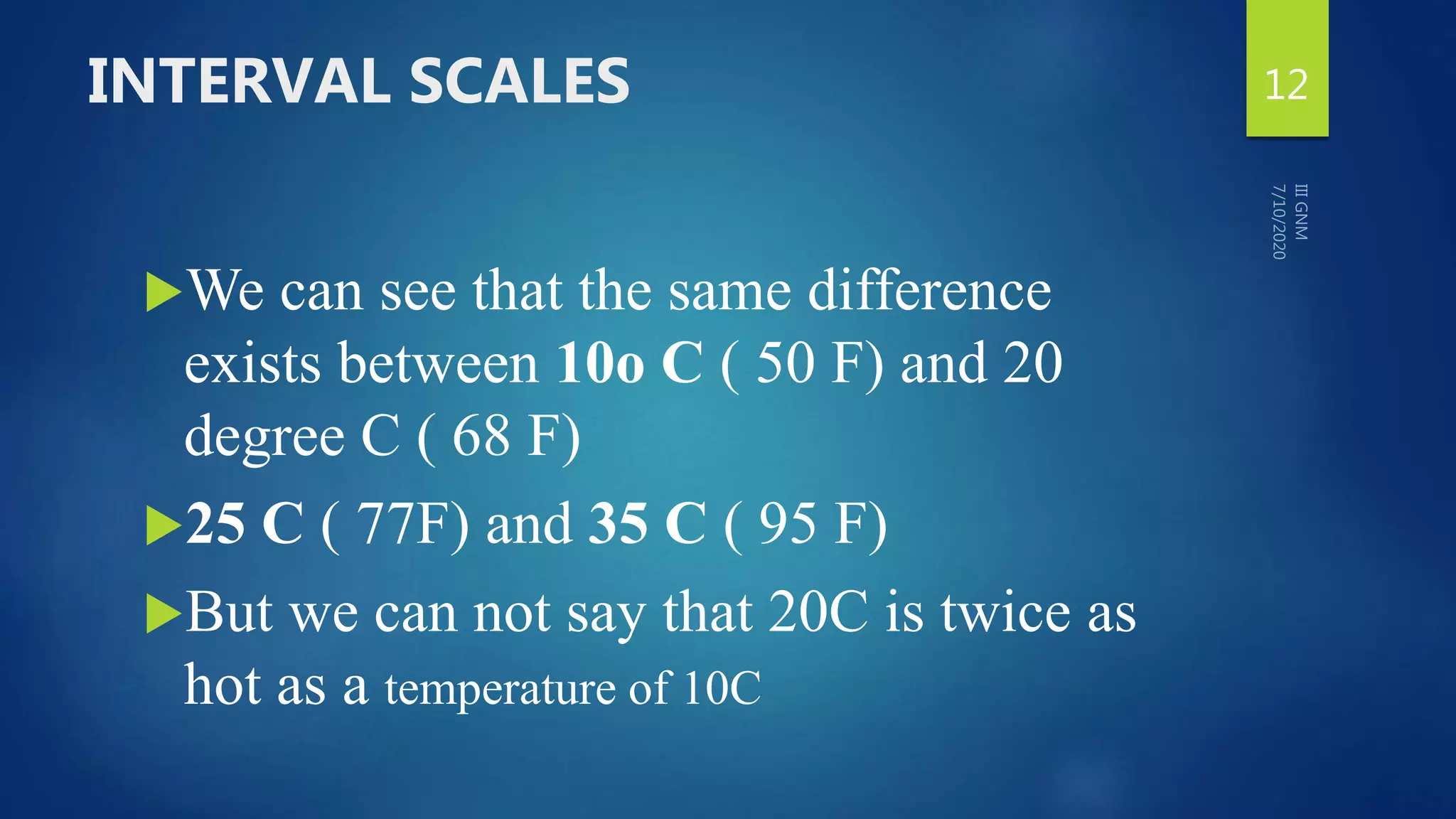
We can see that the same difference
exists between 10o C ( 50 F) and 20
degree C ( 68 F)
25 C ( 77F) and 35 C ( 95 F)
But we can not say that 20C is twice as
hot as a temperature of 10C
12
Example -
 Example - Celsius temperature is an interval variable. It is
meaningful to say that 25 degrees Celsius is 3 degrees
hotter than 22 degrees Celsius, and that 17 degrees
Celsius is the same amount hotter (3 degrees) than 14
degrees Celsius. Notice, however, that 0 degrees Celsius
does not have a natural meaning.
 That is, 0 degrees Celsius does not mean the absence of
heat!
13
RATIO SCALES
 It is the highest level for measurement
 This level has all the three attributes:
 Magnitude
 Equal interval
 Absolute zero point
 It represent continuous values
14
Example:
Biophysical parameters
Weight
Height
Volume
Blood pressure
15
EXAMPLE
30 Kg is thrice of 10 kg
20 cm is twice of 10 cm
8 hours is four time of 2 hours
16
TYPES OF MEASUREMENT SCALES
(CONT.)
Each of these scales have different properties
(i.e., difference, magnitude, equal intervals, or
a true zero point) and allows for different
interpretations.
17
TYPES OF MEASUREMENT SCALES
(CONT.)
The scales are listed in hierarchical order.
Nominal scales have the fewest measurement
properties and ratio having the most
properties including the properties of all the
scales beneath it on the hierarchy.
18
TYPES OFMEASUREMENT SCALES
(CONT.)
The goal is to be able to identify the type
of measurement scale, and to understand
proper use and interpretation of the scale
19
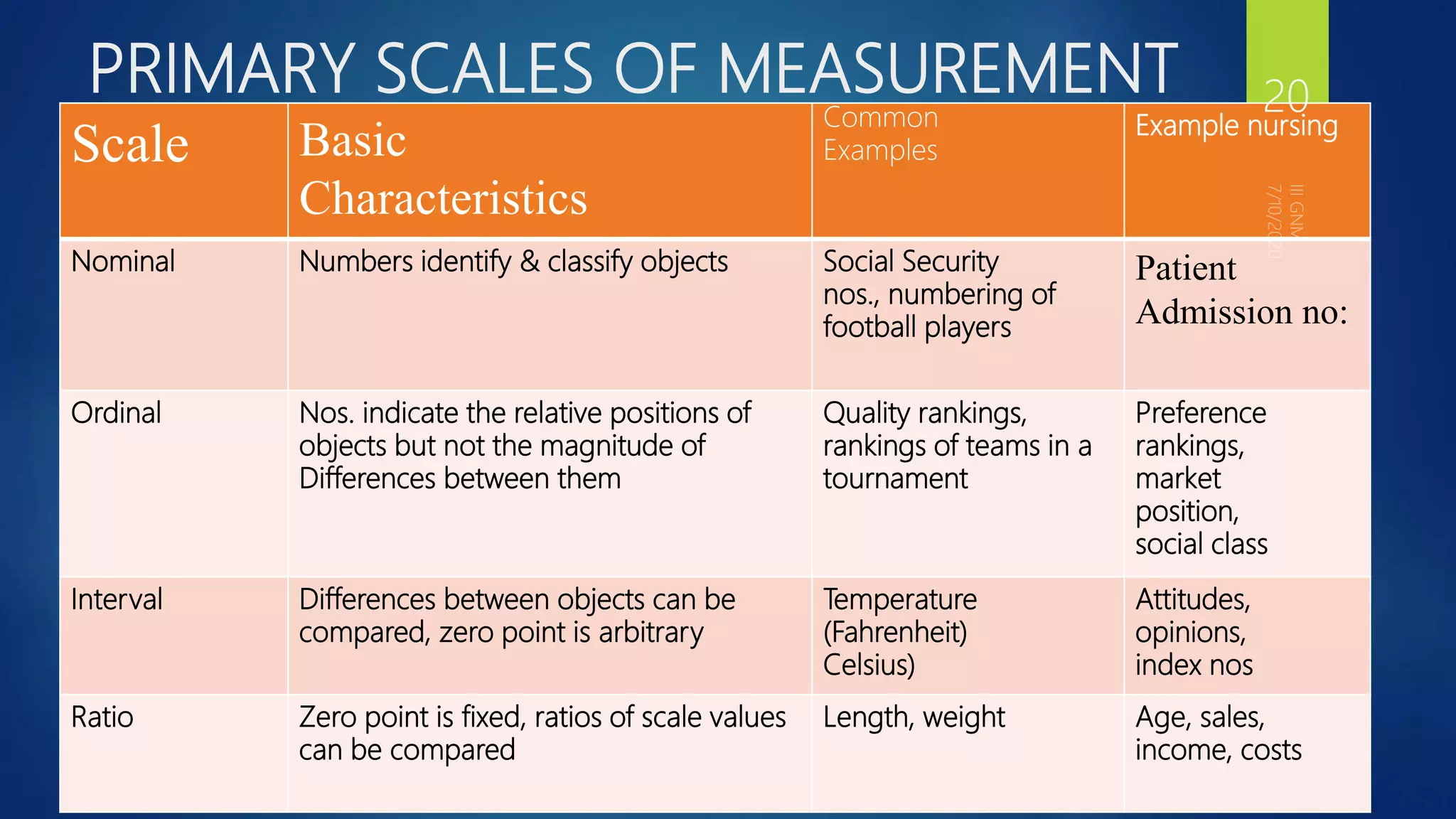
PRIMARY SCALES OF MEASUREMENT
Scale Basic
Characteristics
Common
Examples
Example nursing
Nominal Numbers identify & classify objects Social Security
nos., numbering of
football players
Patient
Admission no:
Ordinal Nos. indicate the relative positions of
objects but not the magnitude of
Differences between them
Quality rankings,
rankings of teams in a
tournament
Preference
rankings,
market
position,
social class
Interval Differences between objects can be
compared, zero point is arbitrary
Temperature
(Fahrenheit)
Celsius)
Attitudes,
opinions,
index nos
Ratio Zero point is fixed, ratios of scale values
can be compared
Length, weight Age, sales,
income, costs
20
Central Tendency
Measure of central tendency provides a very convenient way
of describing a set of scores with a single number that
describes the PERFORMANCE of the group
It is also defined as a single value that is used to describe the
“center” of the data.
There are three commonly used measures of central
tendency. These are the following:
1. MEAN
2. MEDIAN
3. MODE
21
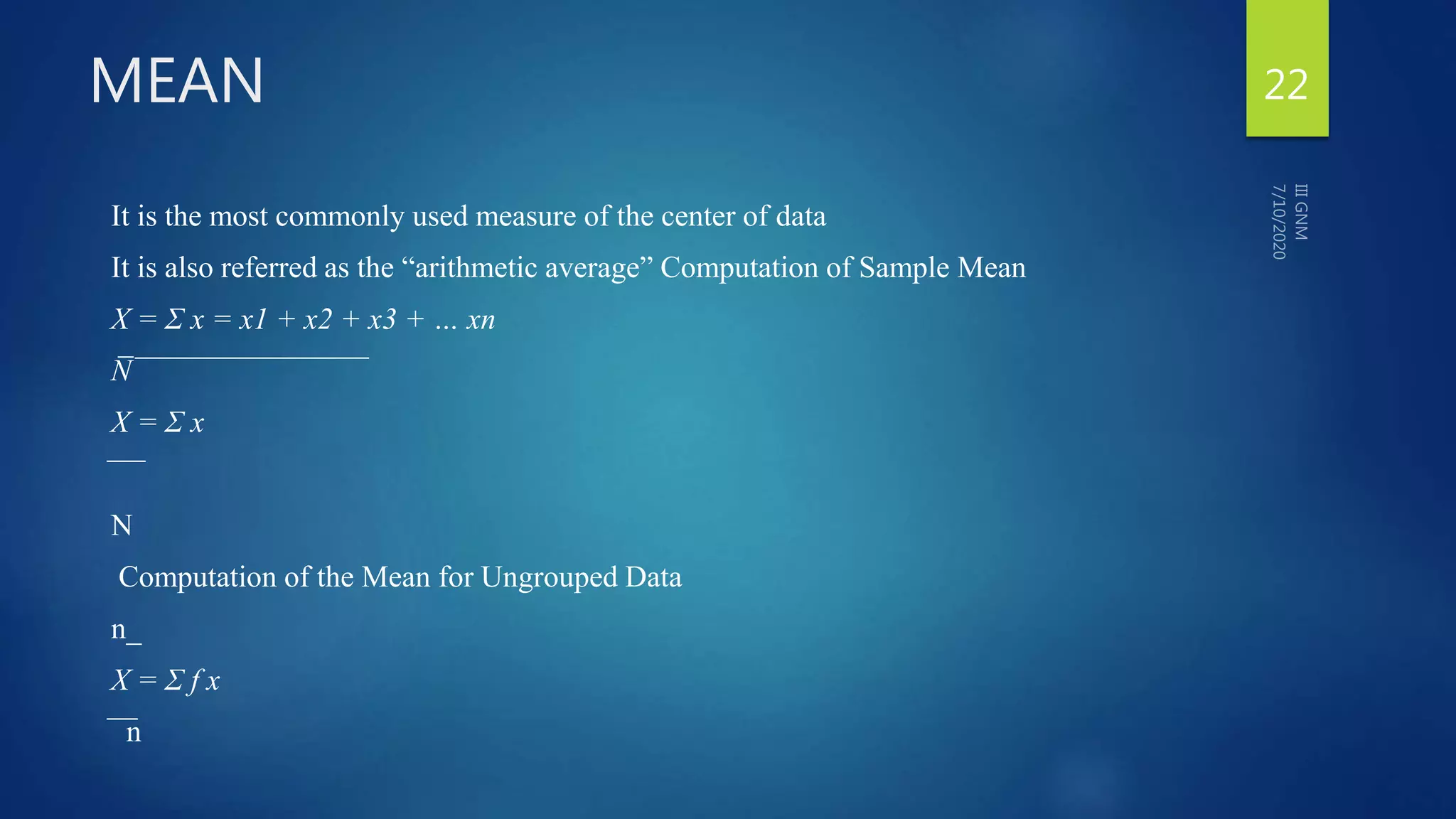
MEAN
It is the most commonly used measure of the center of data
It is also referred as the “arithmetic average” Computation of Sample Mean
X = Σ x = x1 + x2 + x3 + … xn
N̅ ̅ ̅ ̅ ̅ ̅ ̅ ̅ ̅ ̅ ̅ ̅ ̅ ̅ ̅ ̅ ̅ ̅ ̅ ̅ ̅ ̅ ̅ ̅ ̅ ̅ ̅ ̅ ̅ ̅ ̅
X = Σ x
̅ ̅ ̅ ̅
N
Computation of the Mean for Ungrouped Data
n_
X = Σ f x
̅ ̅ ̅n
22
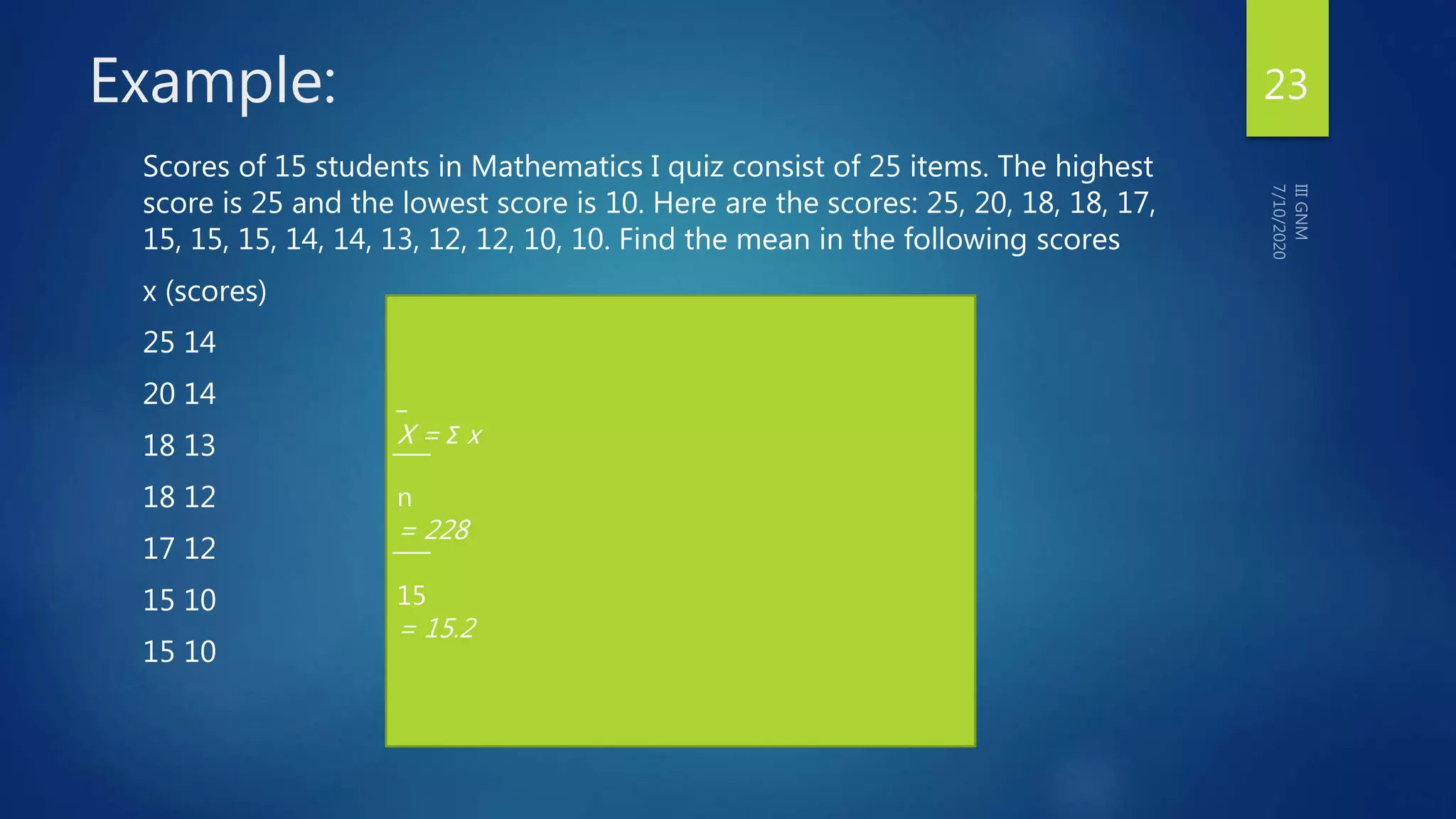
Example:
Scores of 15 students in Mathematics I quiz consist of 25 items. The highest
score is 25 and the lowest score is 10. Here are the scores: 25, 20, 18, 18, 17,
15, 15, 15, 14, 14, 13, 12, 12, 10, 10. Find the mean in the following scores
x (scores)
25 14
20 14
18 13
18 12
17 12
15 10
15 10
_
X = Σ x
̅ ̅ ̅ ̅
n
= 228
̅ ̅ ̅ ̅
15
= 15.2
23
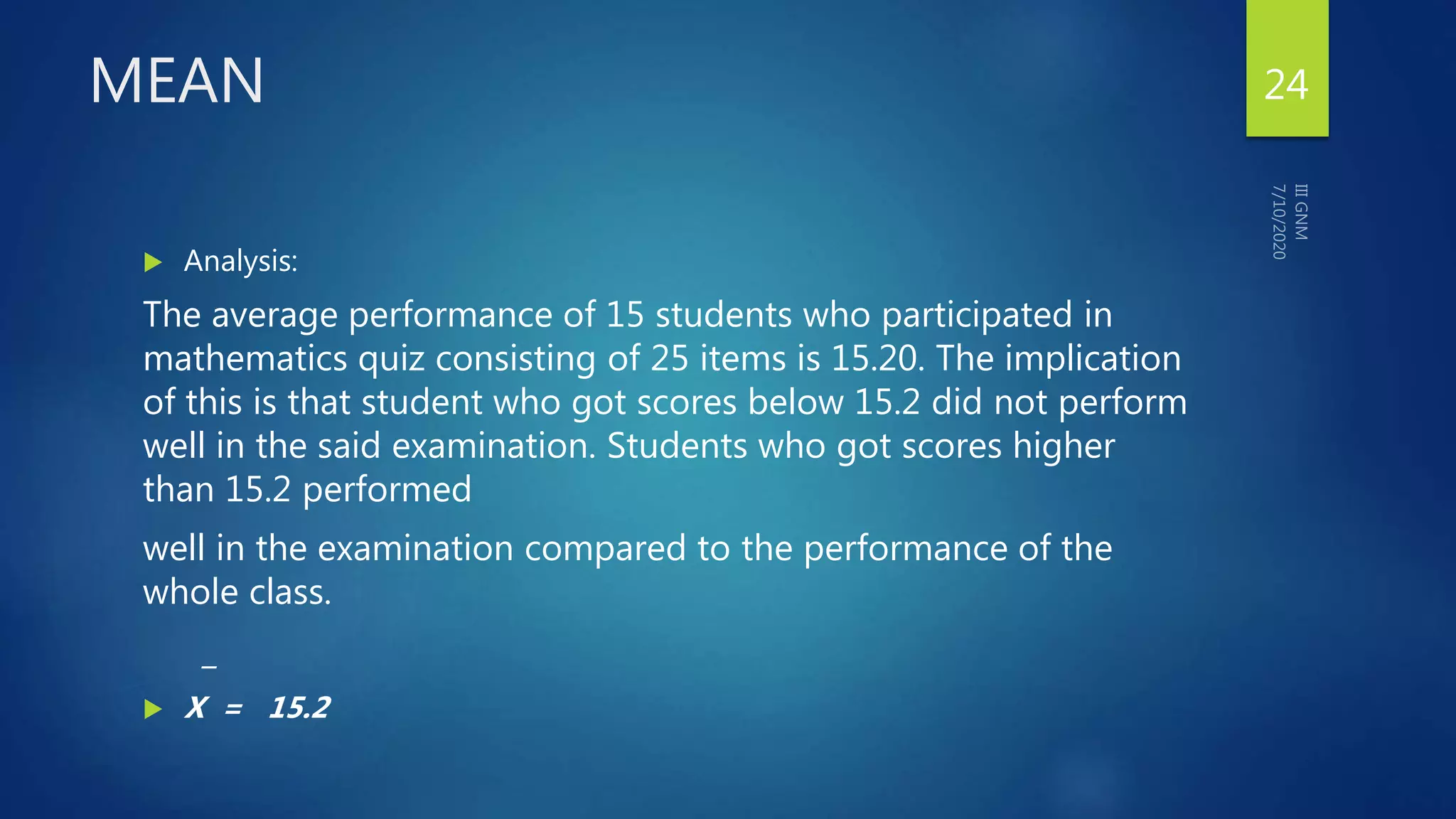
MEAN
 Analysis:
The average performance of 15 students who participated in
mathematics quiz consisting of 25 items is 15.20. The implication
of this is that student who got scores below 15.2 did not perform
well in the said examination. Students who got scores higher
than 15.2 performed
well in the examination compared to the performance of the
whole class.
_
 X = 15.2
24
MEAN
Properties of the Mean
It measures stability. Mean is the most stable among other
measures of central tendency because every score contributes
to the value of the mean.
• It may easily affected by the extreme scores.
• The sum of each score’s distance from the mean is zero.
• It may not be an actual score in the distribution.
• It can be applied to interval level of measurement.
• It is very easy to compute.
25
Median
Median is what divides the scores in the distribution into
two equal parts.
Fifty percent (50%) lies below the median value and 50%
lies above the median value.
It is also known as the middle score or the 50th percentile.
26
Median
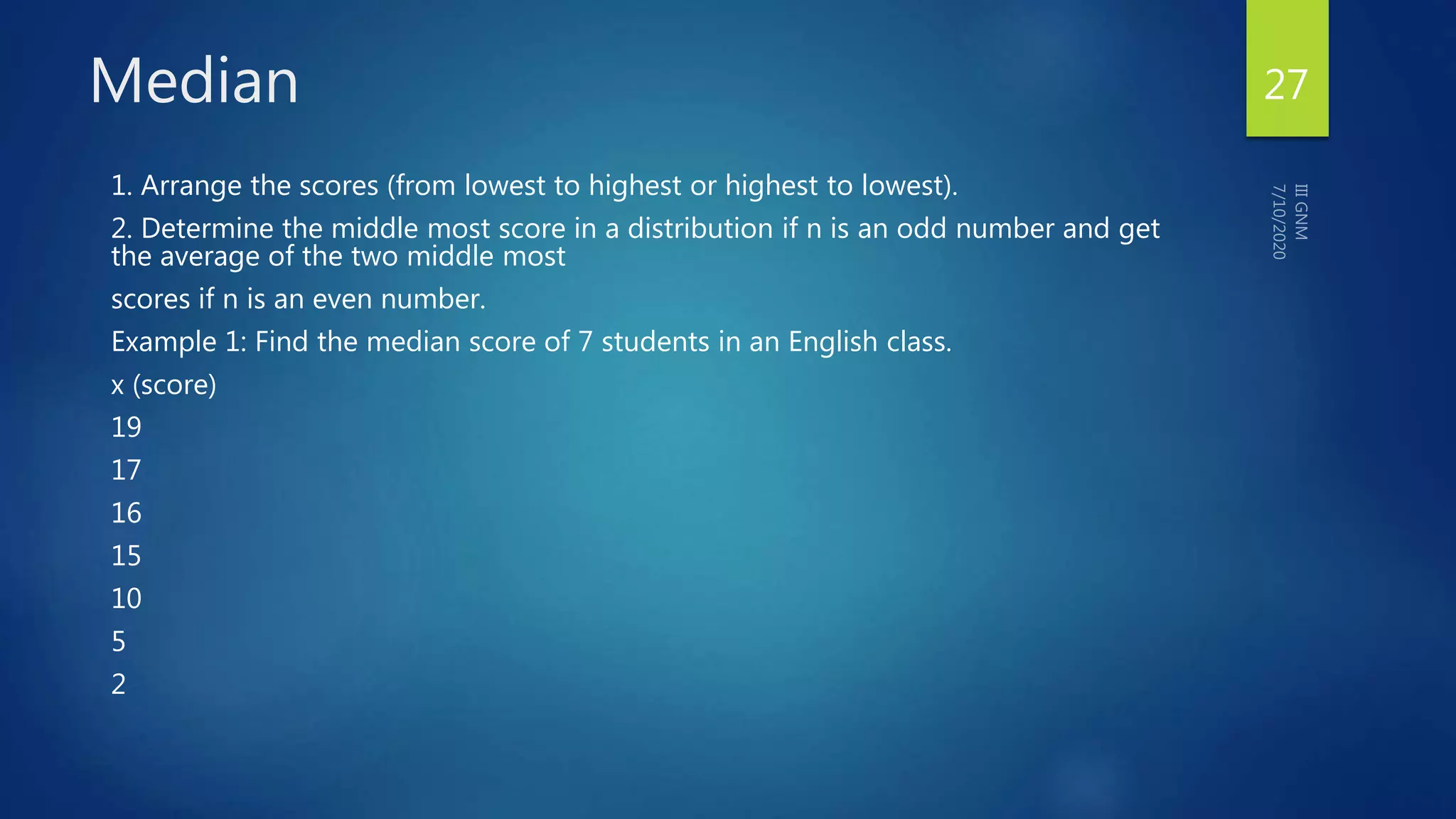
1. Arrange the scores (from lowest to highest or highest to lowest).
2. Determine the middle most score in a distribution if n is an odd number and get
the average of the two middle most
scores if n is an even number.
Example 1: Find the median score of 7 students in an English class.
x (score)
19
17
16
15
10
5
2
27
Median
Properties of the Median
1. It may not be an actual observation in the data set.
2. It is not affected by extreme values because median is a
positional measure.
1. It can be applied in ordinal level
When to Use the Media
1. The exact midpoint of the score distribution is desired.
2. There are extreme scores in the distribution.
28
MODE
1. The mode or the modal score is a score or scores that occurred
most in the distribution.
1. It is classified as unmoral, bimodal, trimodal or multimodal.
2. Unmoral is a distribution of scores that consists of only one mode.
3. Bimodal is a distribution of scores that consists of two
4. modes or multimodal is a distribution of scores that
5. consists of more than two modes.
6. trimodal is a distribution of scores that consists of 3 modes
29
MODE
 When to Use the Mode
 It can be used when the data are qualitative as well as quantitative.
1. It may not be unique.
2. It may not be exist
3. When the “typical” value is desired.
When to Use the Mode
1. When the data set is measured on a nominal scale.
2. It is affected by extreme values.
30
SD or Standard Deviations
 A quantity expressing by how much the members of a group differ from
the mean value for the group.
31
Definition of SD 32
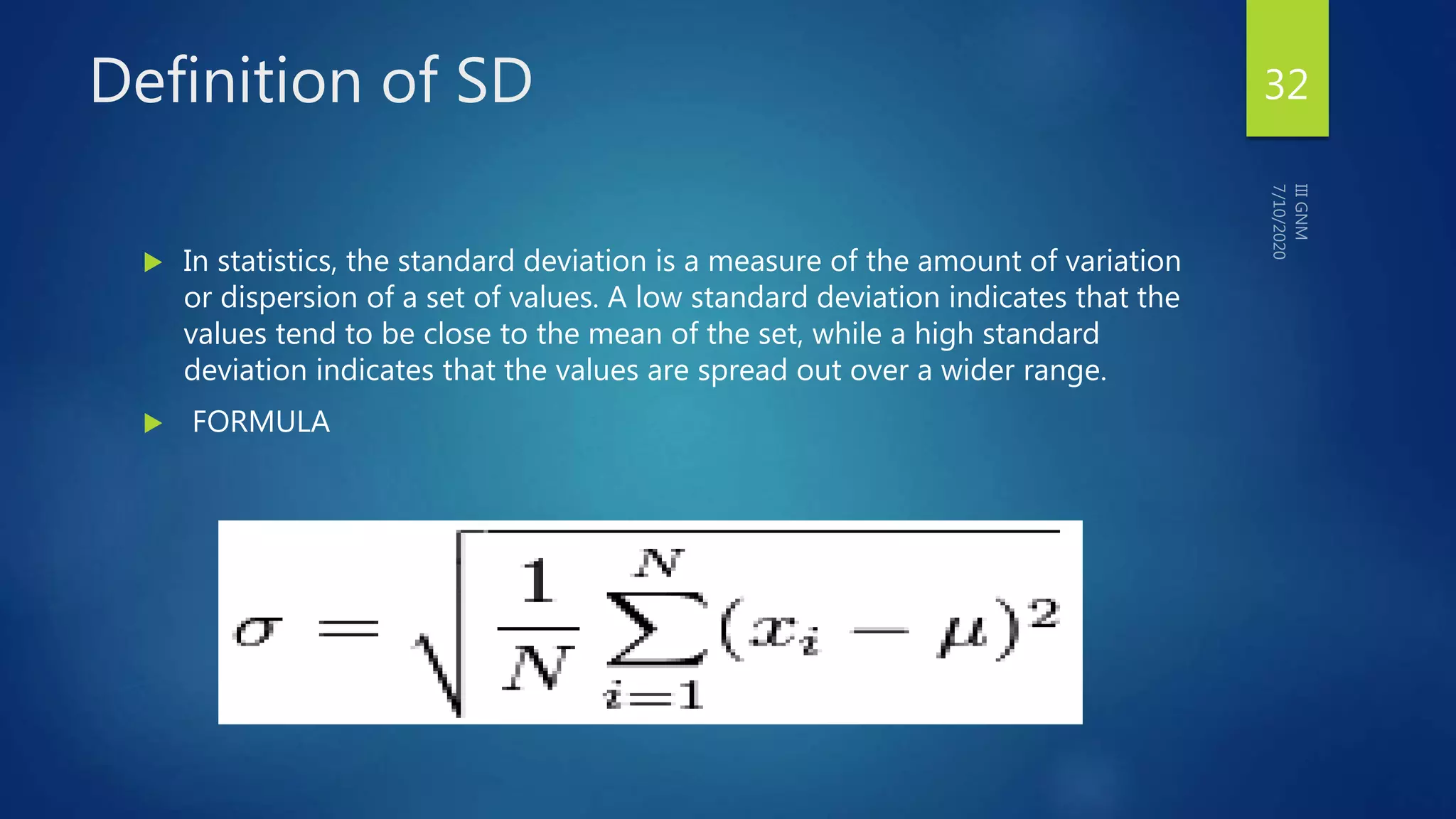
 In statistics, the standard deviation is a measure of the amount of variation
or dispersion of a set of values. A low standard deviation indicates that the
values tend to be close to the mean of the set, while a high standard
deviation indicates that the values are spread out over a wider range.
 FORMULA
OK. Let us explain it step by step 33
Measures of dispersion.
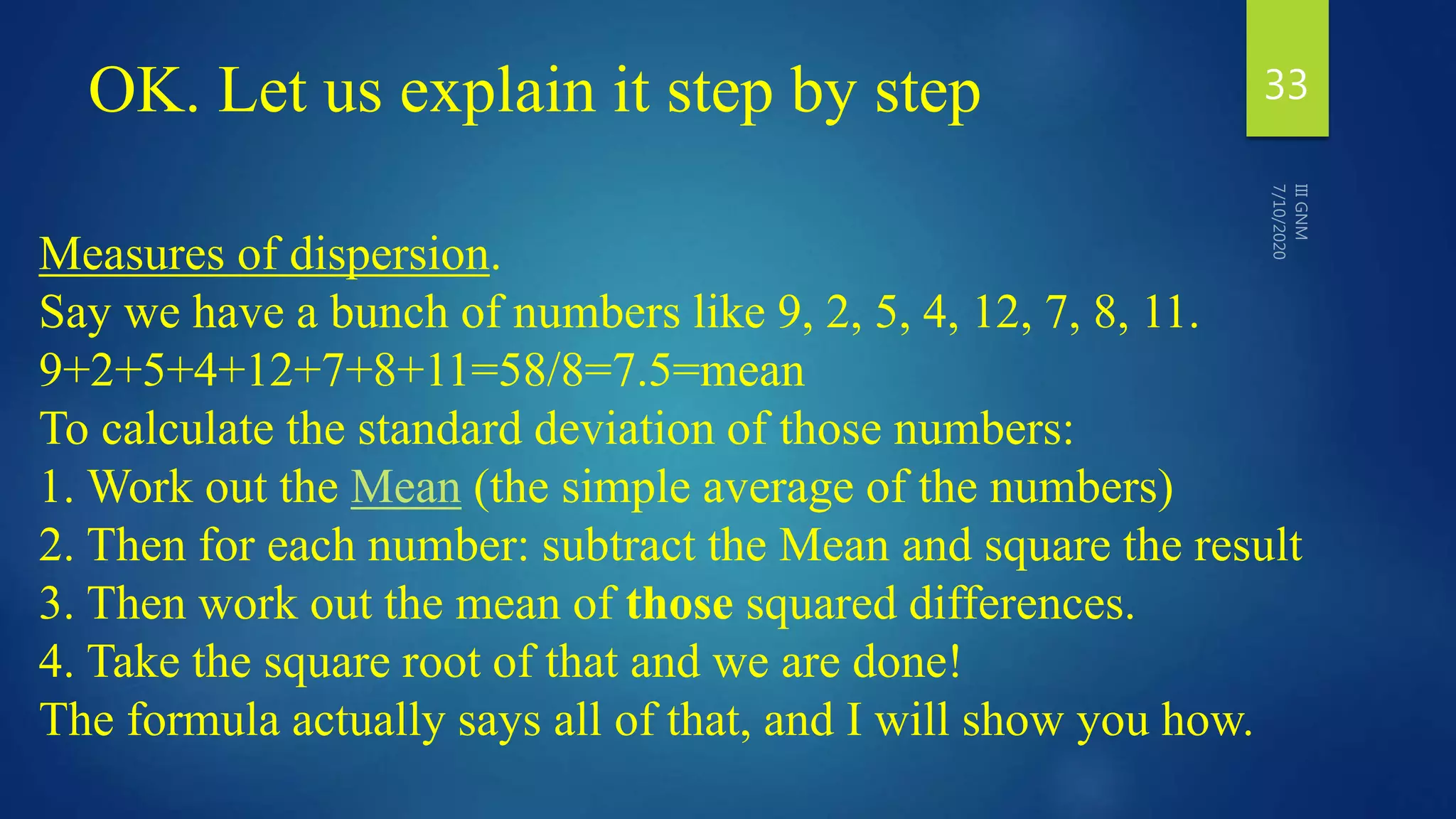
Say we have a bunch of numbers like 9, 2, 5, 4, 12, 7, 8, 11.
9+2+5+4+12+7+8+11=58/8=7.5=mean
To calculate the standard deviation of those numbers:
1. Work out the Mean (the simple average of the numbers)
2. Then for each number: subtract the Mean and square the result
3. Then work out the mean of those squared differences.
4. Take the square root of that and we are done!
The formula actually says all of that, and I will show you how.
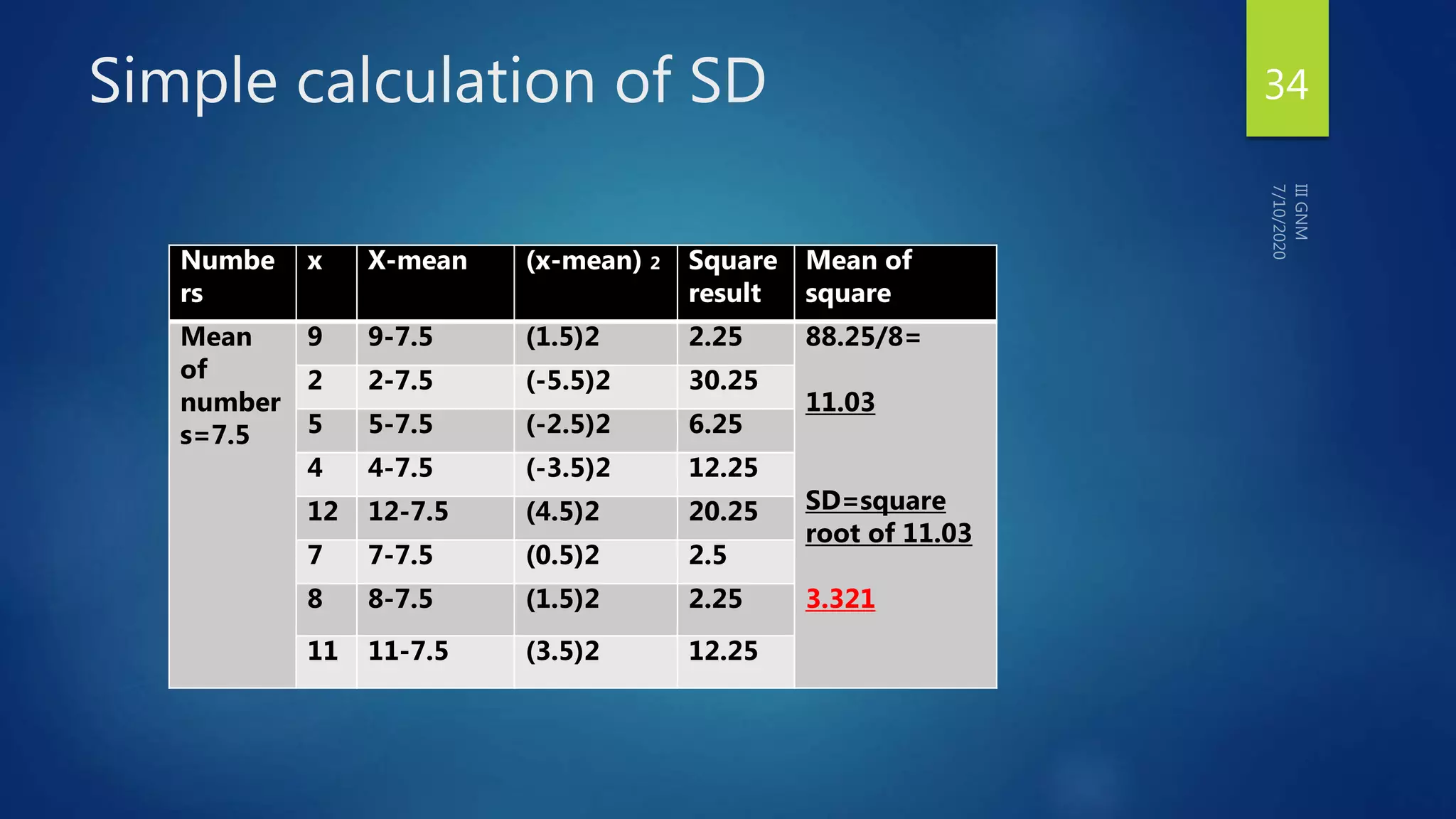
Simple calculation of SD
Numbe
rs
x X-mean (x-mean) 2 Square
result
Mean of
square
Mean
of
number
s=7.5
9 9-7.5 (1.5)2 2.25 88.25/8=
11.03
SD=square
root of 11.03
3.321
2 2-7.5 (-5.5)2 30.25
5 5-7.5 (-2.5)2 6.25
4 4-7.5 (-3.5)2 12.25
12 12-7.5 (4.5)2 20.25
7 7-7.5 (0.5)2 2.5
8 8-7.5 (1.5)2 2.25
11 11-7.5 (3.5)2 12.25
34
35
36
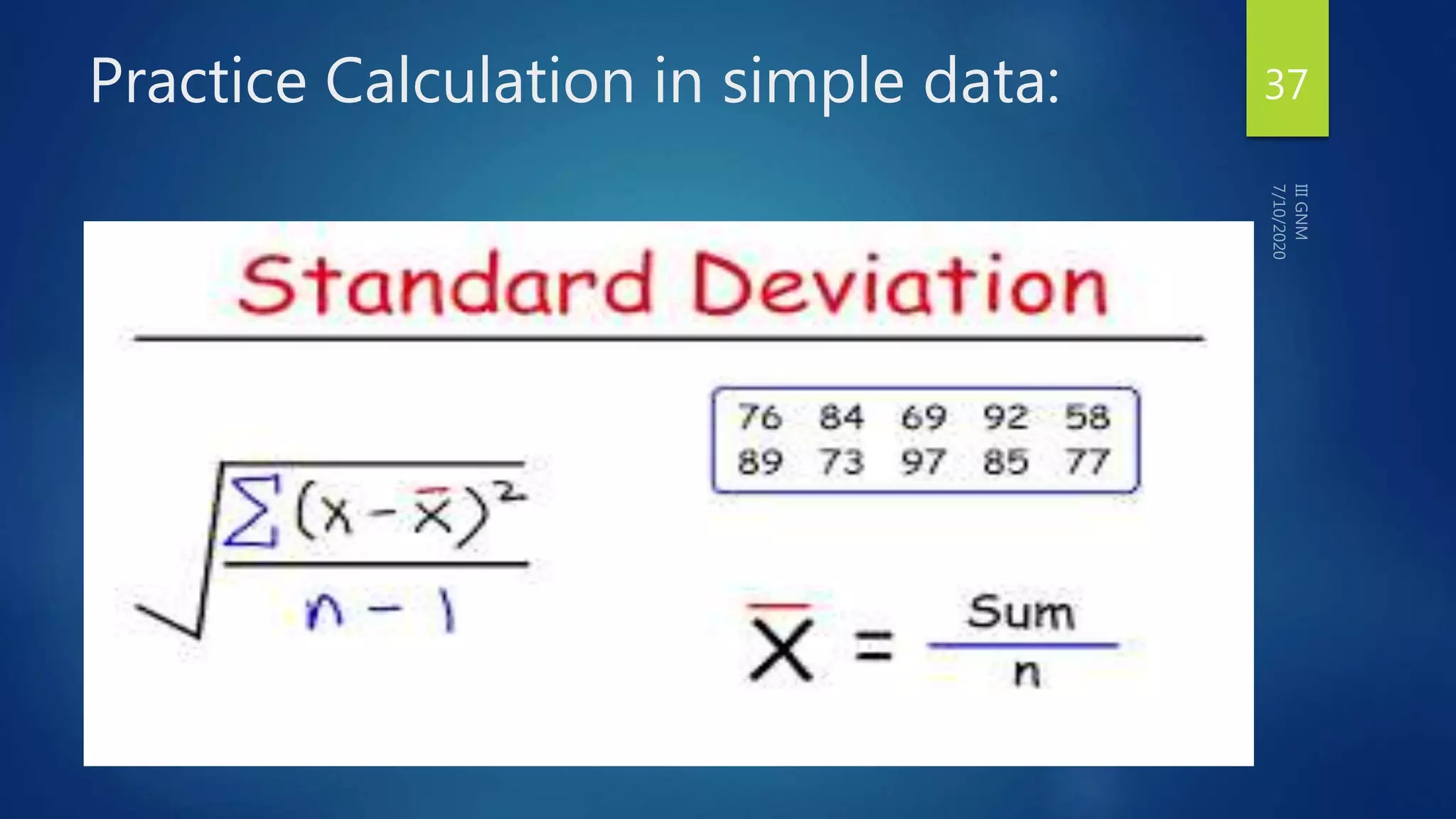
Practice Calculation in simple data: 37
38

Statistics(Basic)

  • 1.
  • 2.
    At the endof the class we will understand 1. Meaning of statistics 2. Application of statistics 3. SCALE OF MEASUREMENT 4. Central Tendency 5. Standard Deviations 2
  • 3.
    Meaning  The wordStatistics today refers to either quantitative information or a method of dealing with quantitative or qualitative information.  “Statistics is defined as collection, Presentation, analysis and interpretation of numerical data”.  Acc. Croxton & cowden  statistics is the sciences and art of dealing with figure and facts. 3
  • 4.
    Meaning  Biostatistics isthe branch of statistics applied to biology or medical sciences. Biostatistics is also called “Biometry”  In Greek, Bios = Life  Metry= Measurement  So, it is measurement of life 4
  • 5.
    USE & APPLICATIONOF STATISTICS 1. Statistics facilitates comparisons 2. It simplifies the message of figure 3. It helps in formulating and testing hypothesis 4. It help in prediction 5
  • 6.
    SCALE OF MEASUREMENT Measurement is the process of assigning numbers or labels to objects, persons, states, or events in accordance with specific rules to represent quantities or qualities of attributes.  Do not measure specific objects, persons, etc. Measure attributes or features that define them. 6
  • 7.
    FOUR BASIC SCALESOF MEASUREMENT 1. Nominal Scales 2. Ordinal Scales 3. Interval Scales 4. Ratio Scales 7
  • 8.
     There mustbe distinct classes but these classes have no quantitative properties. Therefore, no comparison can be made in terms of one category being higher than the other.  For example - there are two classes for the, variable gender - males and females. There are no quantitative properties for this variable or these classes and, therefore, gender is a nominal variable. 8
  • 9.
    NOMINAL SCALE  Sometimesnumbers are used to designate category membership  Example:  Country of Origin  1 = United States 3 = Canada  2 = Mexico 4 = Other numbers are used to designate category membership- 9
  • 10.
    Ordinal Scales  Thereare distinct classes but these classes have a natural ordering or ranking. The differences can be ordered on the basis of magnitude. Difference between ordinal and interval scale?  For example - final position of students in a examination is an ordinal variable. The student position first, second, third, fourth, and so on. The difference between first and second is not necessarily equivalent to the difference between second and third, or between third and fourth. 10
  • 11.
    INTERVAL SCALES  Itis possible to compare differences in magnitude, but importantly the zero point does not have a natural meaning. It captures the properties of nominal and ordinal scales - used by most psychological tests.  Designates an equal-interval ordering – The distance between, for example, a 1 and a 2 is the same as the distance between a 4 and a 5 11
  • 12.
    INTERVAL SCALES We cansee that the same difference exists between 10o C ( 50 F) and 20 degree C ( 68 F) 25 C ( 77F) and 35 C ( 95 F) But we can not say that 20C is twice as hot as a temperature of 10C 12
  • 13.
    Example -  Example- Celsius temperature is an interval variable. It is meaningful to say that 25 degrees Celsius is 3 degrees hotter than 22 degrees Celsius, and that 17 degrees Celsius is the same amount hotter (3 degrees) than 14 degrees Celsius. Notice, however, that 0 degrees Celsius does not have a natural meaning.  That is, 0 degrees Celsius does not mean the absence of heat! 13
  • 14.
    RATIO SCALES  Itis the highest level for measurement  This level has all the three attributes:  Magnitude  Equal interval  Absolute zero point  It represent continuous values 14
  • 15.
  • 16.
    EXAMPLE 30 Kg isthrice of 10 kg 20 cm is twice of 10 cm 8 hours is four time of 2 hours 16
  • 17.
    TYPES OF MEASUREMENTSCALES (CONT.) Each of these scales have different properties (i.e., difference, magnitude, equal intervals, or a true zero point) and allows for different interpretations. 17
  • 18.
    TYPES OF MEASUREMENTSCALES (CONT.) The scales are listed in hierarchical order. Nominal scales have the fewest measurement properties and ratio having the most properties including the properties of all the scales beneath it on the hierarchy. 18
  • 19.
    TYPES OFMEASUREMENT SCALES (CONT.) Thegoal is to be able to identify the type of measurement scale, and to understand proper use and interpretation of the scale 19
  • 20.
    PRIMARY SCALES OFMEASUREMENT Scale Basic Characteristics Common Examples Example nursing Nominal Numbers identify & classify objects Social Security nos., numbering of football players Patient Admission no: Ordinal Nos. indicate the relative positions of objects but not the magnitude of Differences between them Quality rankings, rankings of teams in a tournament Preference rankings, market position, social class Interval Differences between objects can be compared, zero point is arbitrary Temperature (Fahrenheit) Celsius) Attitudes, opinions, index nos Ratio Zero point is fixed, ratios of scale values can be compared Length, weight Age, sales, income, costs 20
  • 21.
    Central Tendency Measure ofcentral tendency provides a very convenient way of describing a set of scores with a single number that describes the PERFORMANCE of the group It is also defined as a single value that is used to describe the “center” of the data. There are three commonly used measures of central tendency. These are the following: 1. MEAN 2. MEDIAN 3. MODE 21
  • 22.
    MEAN It is themost commonly used measure of the center of data It is also referred as the “arithmetic average” Computation of Sample Mean X = Σ x = x1 + x2 + x3 + … xn N̅ ̅ ̅ ̅ ̅ ̅ ̅ ̅ ̅ ̅ ̅ ̅ ̅ ̅ ̅ ̅ ̅ ̅ ̅ ̅ ̅ ̅ ̅ ̅ ̅ ̅ ̅ ̅ ̅ ̅ ̅ X = Σ x ̅ ̅ ̅ ̅ N Computation of the Mean for Ungrouped Data n_ X = Σ f x ̅ ̅ ̅n 22
  • 23.
    Example: Scores of 15students in Mathematics I quiz consist of 25 items. The highest score is 25 and the lowest score is 10. Here are the scores: 25, 20, 18, 18, 17, 15, 15, 15, 14, 14, 13, 12, 12, 10, 10. Find the mean in the following scores x (scores) 25 14 20 14 18 13 18 12 17 12 15 10 15 10 _ X = Σ x ̅ ̅ ̅ ̅ n = 228 ̅ ̅ ̅ ̅ 15 = 15.2 23
  • 24.
    MEAN  Analysis: The averageperformance of 15 students who participated in mathematics quiz consisting of 25 items is 15.20. The implication of this is that student who got scores below 15.2 did not perform well in the said examination. Students who got scores higher than 15.2 performed well in the examination compared to the performance of the whole class. _  X = 15.2 24
  • 25.
    MEAN Properties of theMean It measures stability. Mean is the most stable among other measures of central tendency because every score contributes to the value of the mean. • It may easily affected by the extreme scores. • The sum of each score’s distance from the mean is zero. • It may not be an actual score in the distribution. • It can be applied to interval level of measurement. • It is very easy to compute. 25
  • 26.
    Median Median is whatdivides the scores in the distribution into two equal parts. Fifty percent (50%) lies below the median value and 50% lies above the median value. It is also known as the middle score or the 50th percentile. 26
  • 27.
    Median 1. Arrange thescores (from lowest to highest or highest to lowest). 2. Determine the middle most score in a distribution if n is an odd number and get the average of the two middle most scores if n is an even number. Example 1: Find the median score of 7 students in an English class. x (score) 19 17 16 15 10 5 2 27
  • 28.
    Median Properties of theMedian 1. It may not be an actual observation in the data set. 2. It is not affected by extreme values because median is a positional measure. 1. It can be applied in ordinal level When to Use the Media 1. The exact midpoint of the score distribution is desired. 2. There are extreme scores in the distribution. 28
  • 29.
    MODE 1. The modeor the modal score is a score or scores that occurred most in the distribution. 1. It is classified as unmoral, bimodal, trimodal or multimodal. 2. Unmoral is a distribution of scores that consists of only one mode. 3. Bimodal is a distribution of scores that consists of two 4. modes or multimodal is a distribution of scores that 5. consists of more than two modes. 6. trimodal is a distribution of scores that consists of 3 modes 29
  • 30.
    MODE  When toUse the Mode  It can be used when the data are qualitative as well as quantitative. 1. It may not be unique. 2. It may not be exist 3. When the “typical” value is desired. When to Use the Mode 1. When the data set is measured on a nominal scale. 2. It is affected by extreme values. 30
  • 31.
    SD or StandardDeviations  A quantity expressing by how much the members of a group differ from the mean value for the group. 31
  • 32.
    Definition of SD32  In statistics, the standard deviation is a measure of the amount of variation or dispersion of a set of values. A low standard deviation indicates that the values tend to be close to the mean of the set, while a high standard deviation indicates that the values are spread out over a wider range.  FORMULA
  • 33.
    OK. Let usexplain it step by step 33 Measures of dispersion. Say we have a bunch of numbers like 9, 2, 5, 4, 12, 7, 8, 11. 9+2+5+4+12+7+8+11=58/8=7.5=mean To calculate the standard deviation of those numbers: 1. Work out the Mean (the simple average of the numbers) 2. Then for each number: subtract the Mean and square the result 3. Then work out the mean of those squared differences. 4. Take the square root of that and we are done! The formula actually says all of that, and I will show you how.
  • 34.
    Simple calculation ofSD Numbe rs x X-mean (x-mean) 2 Square result Mean of square Mean of number s=7.5 9 9-7.5 (1.5)2 2.25 88.25/8= 11.03 SD=square root of 11.03 3.321 2 2-7.5 (-5.5)2 30.25 5 5-7.5 (-2.5)2 6.25 4 4-7.5 (-3.5)2 12.25 12 12-7.5 (4.5)2 20.25 7 7-7.5 (0.5)2 2.5 8 8-7.5 (1.5)2 2.25 11 11-7.5 (3.5)2 12.25 34
  • 35.
  • 36.
  • 37.
    Practice Calculation insimple data: 37
  • 38.