Elementary Statistics
Chapter 6:
Normal Probability
Distributions
6.3 Sampling
Distributions and
Estimators
1
Chapter 6: Normal Probability Distribution
6.1 The Standard Normal Distribution
6.2 Real Applications of Normal Distributions
6.3 Sampling Distributions and Estimators
6.4 The Central Limit Theorem
6.5 Assessing Normality
6.6 Normal as Approximation to Binomial
2
Objectives:
• Identify distributions as symmetric or skewed.
• Identify the properties of a normal distribution.
• Find the area under the standard normal distribution, given various z values.
• Find probabilities for a normally distributed variable by transforming it into a standard normal variable.
• Find specific data values for given percentages, using the standard normal distribution.
• Use the central limit theorem to solve problems involving sample means for large samples.
• Use the normal approximation to compute probabilities for a binomial variable.
Recall: 6.1 The Standard Normal Distribution
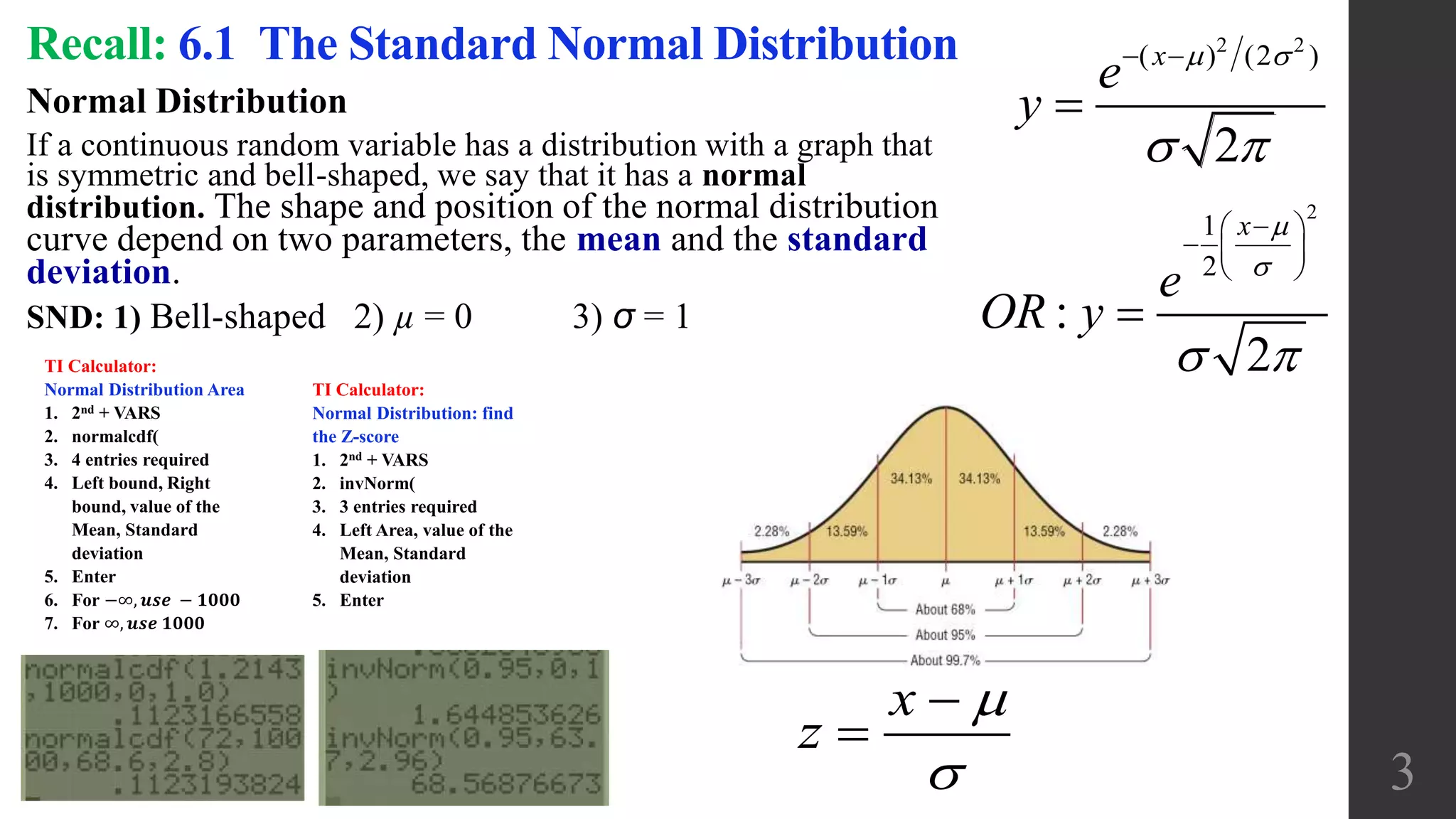
Normal Distribution
If a continuous random variable has a distribution with a graph that
is symmetric and bell-shaped, we say that it has a normal
distribution. The shape and position of the normal distribution
curve depend on two parameters, the mean and the standard
deviation.
SND: 1) Bell-shaped 2) µ = 0 3) σ = 1
3
2 2
( ) (2 )
2
x
e
y
 
 
 

2
1
2
:
2
x
e
OR y


 
 
  
 

x
z




TI Calculator:
Normal Distribution Area
1. 2nd + VARS
2. normalcdf(
3. 4 entries required
4. Left bound, Right
bound, value of the
Mean, Standard
deviation
5. Enter
6. For −∞, 𝒖𝒔𝒆 − 𝟏𝟎𝟎𝟎
7. For ∞, 𝒖𝒔𝒆 𝟏𝟎𝟎𝟎
TI Calculator:
Normal Distribution: find
the Z-score
1. 2nd + VARS
2. invNorm(
3. 3 entries required
4. Left Area, value of the
Mean, Standard
deviation
5. Enter
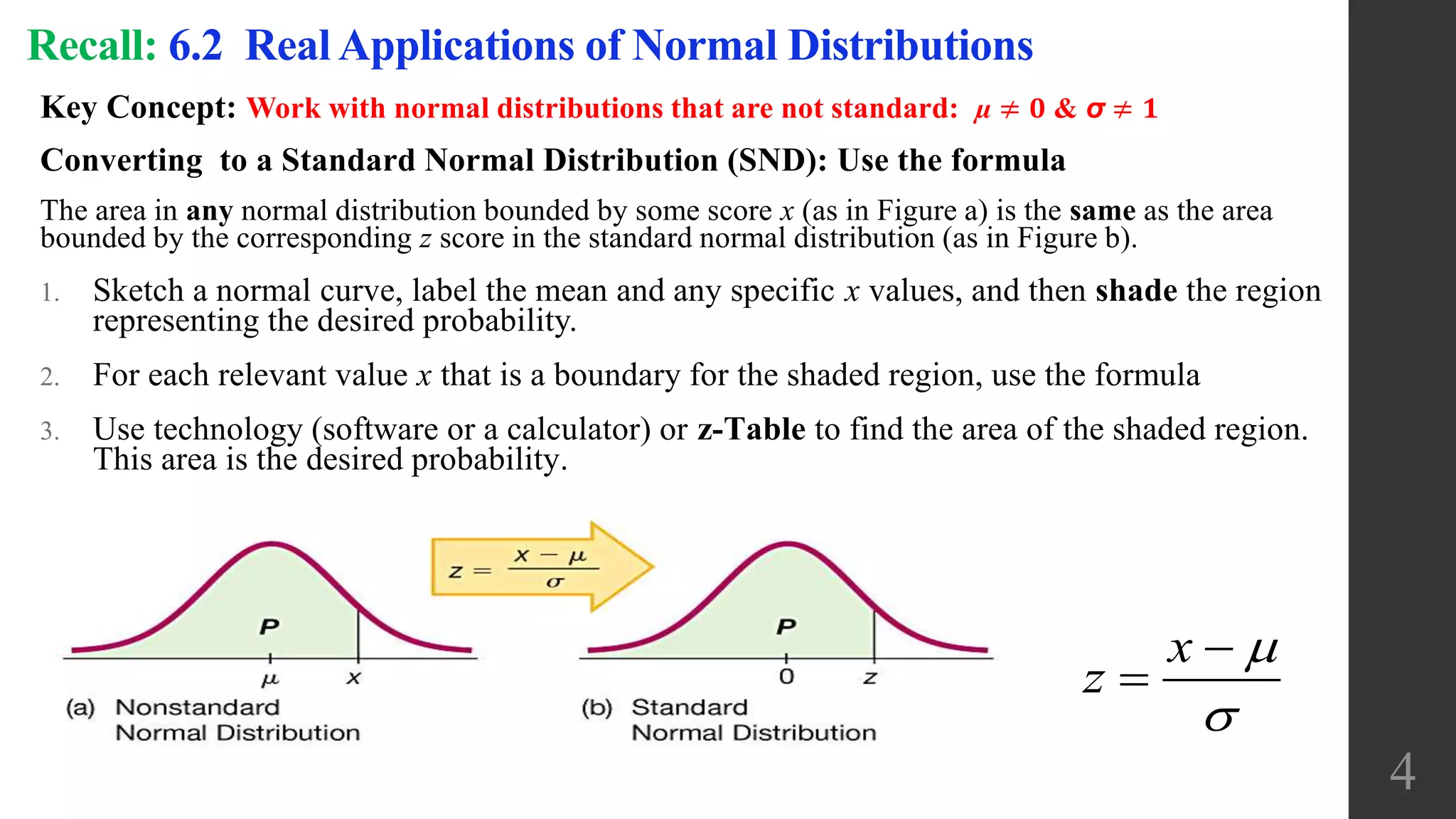
Key Concept: Work with normal distributions that are not standard: µ ≠ 𝟎 & σ ≠ 𝟏
Converting to a Standard Normal Distribution (SND): Use the formula
The area in any normal distribution bounded by some score x (as in Figure a) is the same as the area
bounded by the corresponding z score in the standard normal distribution (as in Figure b).
1. Sketch a normal curve, label the mean and any specific x values, and then shade the region
representing the desired probability.
2. For each relevant value x that is a boundary for the shaded region, use the formula
3. Use technology (software or a calculator) or z-Table to find the area of the shaded region.
This area is the desired probability.
Recall: 6.2 Real Applications of Normal Distributions
x
z




4
Key Concept: In addition to knowing how individual data values vary about the
mean for a population, statisticians are interested in knowing how the means of
samples of the same size taken from the same population vary about the population
mean.
We now consider the concept of a sampling distribution of a statistic. Instead
of working with values from the original population, we want to focus on the
values of statistics (such as sample proportions or sample means) obtained from
the population.
6.3 Sampling Distributions and Estimators
5
Sampling Distribution of a Statistic: The
sampling distribution of a statistic (such as a
sample proportion or sample mean) is the
distribution of all values of the statistic when
all possible samples of the same size n are
taken from the same population. (The
sampling distribution of a statistic is typically
represented as a probability distribution in the
format of a probability histogram, formula, or
table.)
population proportion: p
sample proportion: 𝑝 (𝑝 − ℎ𝑎𝑡)
General Behavior of Sampling
Distributions:
1. Sample proportions tend to be normally
distributed.
2. The mean of sample proportions is the same as
the population mean.
6.3 Sampling Distributions and Estimators
6
Behavior of Sample Proportions: 𝒑
1. The distribution of sample proportions tends to approximate a normal distribution.
2. Sample proportions target the values of the population proportion ( the mean of all
the sample proportion: 𝑝 (𝑝 − ℎ𝑎𝑡) is equal to the population proportion p.).
7
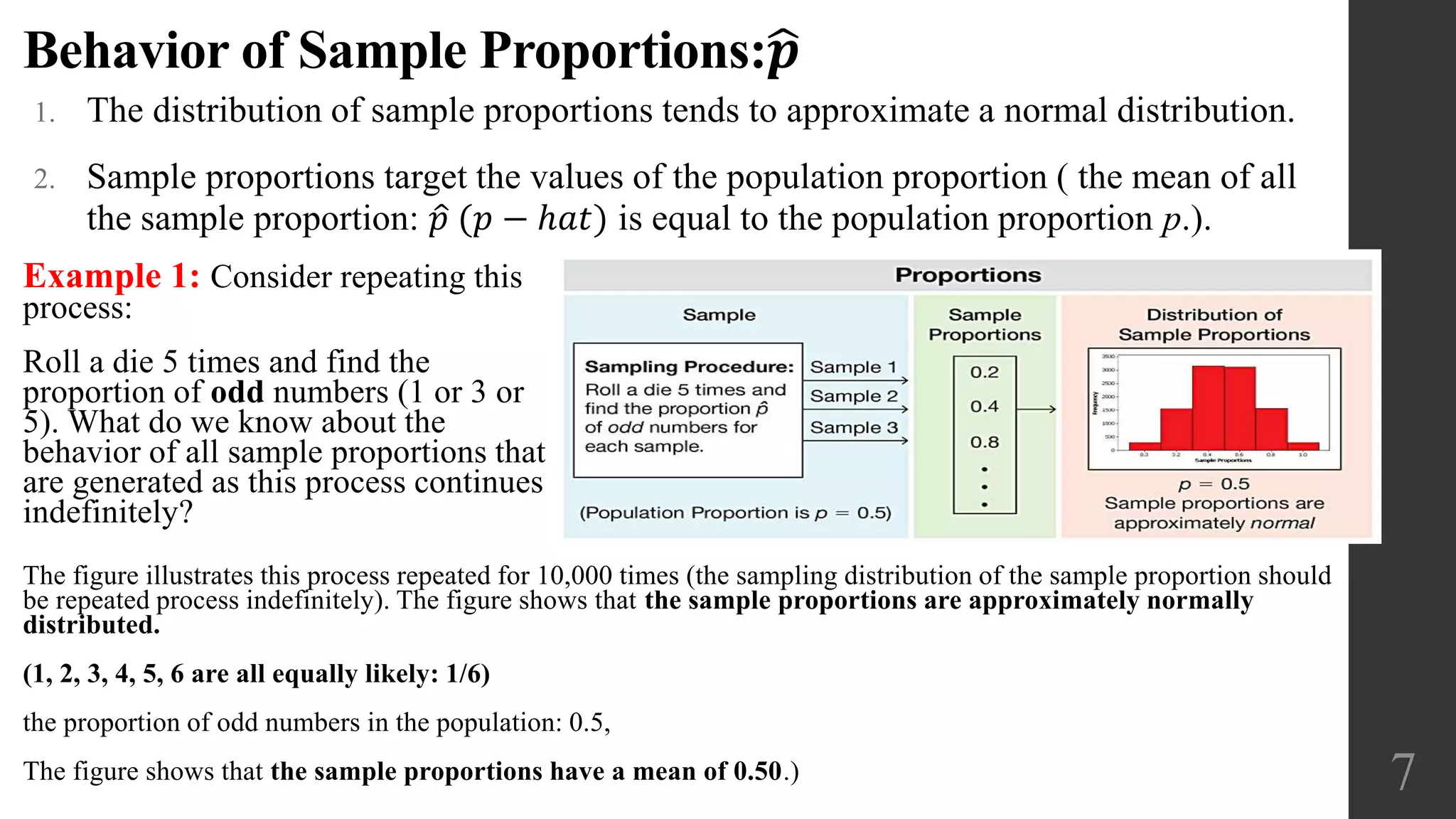
Example 1: Consider repeating this
process:
Roll a die 5 times and find the
proportion of odd numbers (1 or 3 or
5). What do we know about the
behavior of all sample proportions that
are generated as this process continues
indefinitely?
The figure illustrates this process repeated for 10,000 times (the sampling distribution of the sample proportion should
be repeated process indefinitely). The figure shows that the sample proportions are approximately normally
distributed.
(1, 2, 3, 4, 5, 6 are all equally likely: 1/6)
the proportion of odd numbers in the population: 0.5,
The figure shows that the sample proportions have a mean of 0.50.)
Behavior of Sample Mean: 𝒙
1. The distribution of sample means tends to be a normal distribution. (This will be discussed
further in the following section, but the distribution tends to become closer to a normal
distribution as the sample size increases.)
2. The sample means target the value of the population mean. (That is, the mean of the
sample means is the population mean. The expected value of the sample mean is equal to
the population mean.)
8
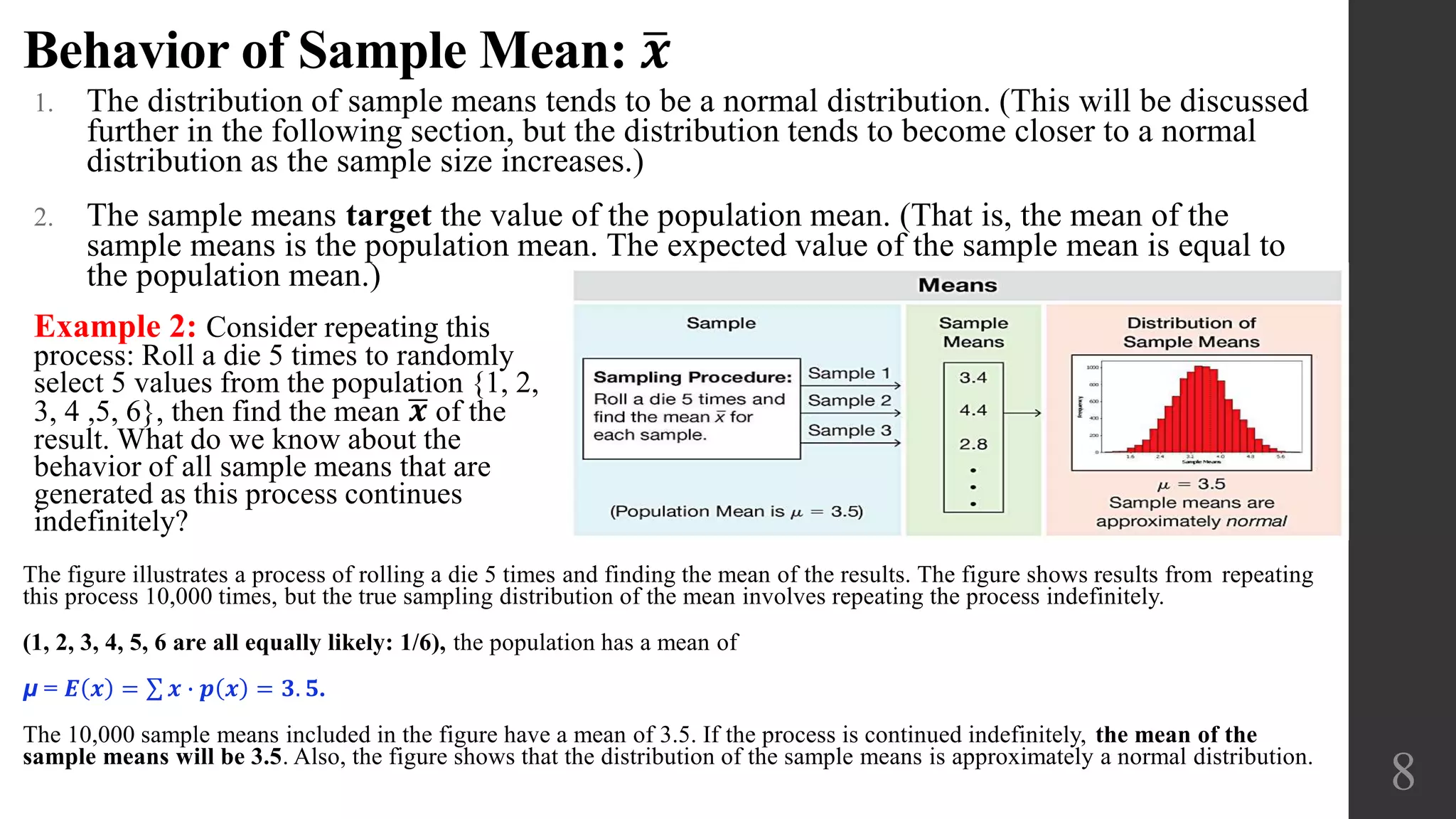
Example 2: Consider repeating this
process: Roll a die 5 times to randomly
select 5 values from the population {1, 2,
3, 4 ,5, 6}, then find the mean 𝒙 of the
result. What do we know about the
behavior of all sample means that are
generated as this process continues
indefinitely?
The figure illustrates a process of rolling a die 5 times and finding the mean of the results. The figure shows results from repeating
this process 10,000 times, but the true sampling distribution of the mean involves repeating the process indefinitely.
(1, 2, 3, 4, 5, 6 are all equally likely: 1/6), the population has a mean of
μ = 𝑬 𝒙 = 𝒙 ∙ 𝒑 𝒙 = 𝟑. 𝟓.
The 10,000 sample means included in the figure have a mean of 3.5. If the process is continued indefinitely, the mean of the
sample means will be 3.5. Also, the figure shows that the distribution of the sample means is approximately a normal distribution.
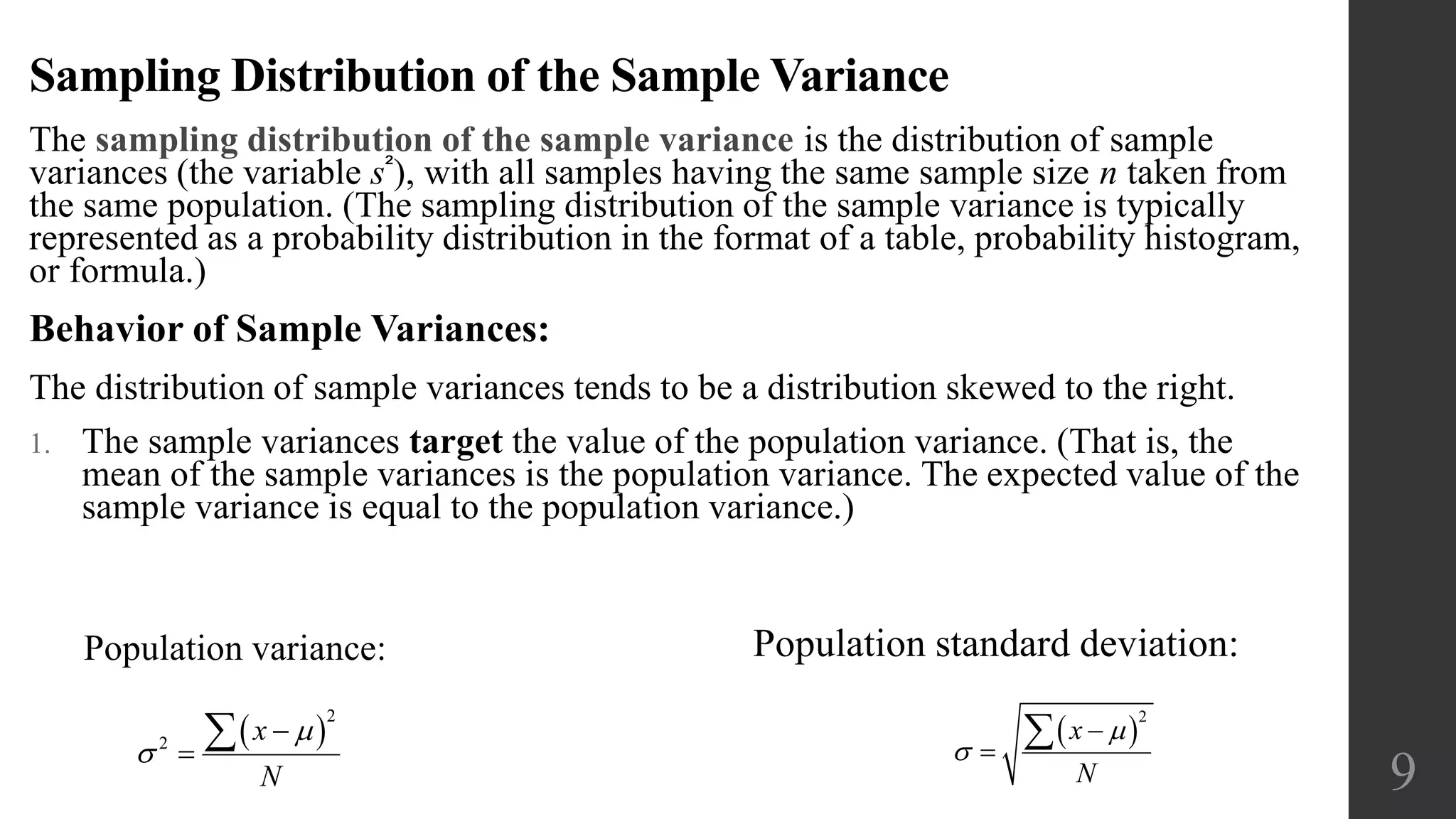
Sampling Distribution of the Sample Variance
The sampling distribution of the sample variance is the distribution of sample
variances (the variable s²), with all samples having the same sample size n taken from
the same population. (The sampling distribution of the sample variance is typically
represented as a probability distribution in the format of a table, probability histogram,
or formula.)
Behavior of Sample Variances:
The distribution of sample variances tends to be a distribution skewed to the right.
1. The sample variances target the value of the population variance. (That is, the
mean of the sample variances is the population variance. The expected value of the
sample variance is equal to the population variance.)
9
Population standard deviation:Population variance:
 
2
2
x
N




  
2
x
N






Sampling Distributions and Estimators

  • 1.
    Elementary Statistics Chapter 6: NormalProbability Distributions 6.3 Sampling Distributions and Estimators 1
  • 2.
    Chapter 6: NormalProbability Distribution 6.1 The Standard Normal Distribution 6.2 Real Applications of Normal Distributions 6.3 Sampling Distributions and Estimators 6.4 The Central Limit Theorem 6.5 Assessing Normality 6.6 Normal as Approximation to Binomial 2 Objectives: • Identify distributions as symmetric or skewed. • Identify the properties of a normal distribution. • Find the area under the standard normal distribution, given various z values. • Find probabilities for a normally distributed variable by transforming it into a standard normal variable. • Find specific data values for given percentages, using the standard normal distribution. • Use the central limit theorem to solve problems involving sample means for large samples. • Use the normal approximation to compute probabilities for a binomial variable.
  • 3.
    Recall: 6.1 TheStandard Normal Distribution Normal Distribution If a continuous random variable has a distribution with a graph that is symmetric and bell-shaped, we say that it has a normal distribution. The shape and position of the normal distribution curve depend on two parameters, the mean and the standard deviation. SND: 1) Bell-shaped 2) µ = 0 3) σ = 1 3 2 2 ( ) (2 ) 2 x e y        2 1 2 : 2 x e OR y             x z     TI Calculator: Normal Distribution Area 1. 2nd + VARS 2. normalcdf( 3. 4 entries required 4. Left bound, Right bound, value of the Mean, Standard deviation 5. Enter 6. For −∞, 𝒖𝒔𝒆 − 𝟏𝟎𝟎𝟎 7. For ∞, 𝒖𝒔𝒆 𝟏𝟎𝟎𝟎 TI Calculator: Normal Distribution: find the Z-score 1. 2nd + VARS 2. invNorm( 3. 3 entries required 4. Left Area, value of the Mean, Standard deviation 5. Enter
  • 4.
    Key Concept: Workwith normal distributions that are not standard: µ ≠ 𝟎 & σ ≠ 𝟏 Converting to a Standard Normal Distribution (SND): Use the formula The area in any normal distribution bounded by some score x (as in Figure a) is the same as the area bounded by the corresponding z score in the standard normal distribution (as in Figure b). 1. Sketch a normal curve, label the mean and any specific x values, and then shade the region representing the desired probability. 2. For each relevant value x that is a boundary for the shaded region, use the formula 3. Use technology (software or a calculator) or z-Table to find the area of the shaded region. This area is the desired probability. Recall: 6.2 Real Applications of Normal Distributions x z     4
  • 5.
    Key Concept: Inaddition to knowing how individual data values vary about the mean for a population, statisticians are interested in knowing how the means of samples of the same size taken from the same population vary about the population mean. We now consider the concept of a sampling distribution of a statistic. Instead of working with values from the original population, we want to focus on the values of statistics (such as sample proportions or sample means) obtained from the population. 6.3 Sampling Distributions and Estimators 5
  • 6.
    Sampling Distribution ofa Statistic: The sampling distribution of a statistic (such as a sample proportion or sample mean) is the distribution of all values of the statistic when all possible samples of the same size n are taken from the same population. (The sampling distribution of a statistic is typically represented as a probability distribution in the format of a probability histogram, formula, or table.) population proportion: p sample proportion: 𝑝 (𝑝 − ℎ𝑎𝑡) General Behavior of Sampling Distributions: 1. Sample proportions tend to be normally distributed. 2. The mean of sample proportions is the same as the population mean. 6.3 Sampling Distributions and Estimators 6
  • 7.
    Behavior of SampleProportions: 𝒑 1. The distribution of sample proportions tends to approximate a normal distribution. 2. Sample proportions target the values of the population proportion ( the mean of all the sample proportion: 𝑝 (𝑝 − ℎ𝑎𝑡) is equal to the population proportion p.). 7 Example 1: Consider repeating this process: Roll a die 5 times and find the proportion of odd numbers (1 or 3 or 5). What do we know about the behavior of all sample proportions that are generated as this process continues indefinitely? The figure illustrates this process repeated for 10,000 times (the sampling distribution of the sample proportion should be repeated process indefinitely). The figure shows that the sample proportions are approximately normally distributed. (1, 2, 3, 4, 5, 6 are all equally likely: 1/6) the proportion of odd numbers in the population: 0.5, The figure shows that the sample proportions have a mean of 0.50.)
  • 8.
    Behavior of SampleMean: 𝒙 1. The distribution of sample means tends to be a normal distribution. (This will be discussed further in the following section, but the distribution tends to become closer to a normal distribution as the sample size increases.) 2. The sample means target the value of the population mean. (That is, the mean of the sample means is the population mean. The expected value of the sample mean is equal to the population mean.) 8 Example 2: Consider repeating this process: Roll a die 5 times to randomly select 5 values from the population {1, 2, 3, 4 ,5, 6}, then find the mean 𝒙 of the result. What do we know about the behavior of all sample means that are generated as this process continues indefinitely? The figure illustrates a process of rolling a die 5 times and finding the mean of the results. The figure shows results from repeating this process 10,000 times, but the true sampling distribution of the mean involves repeating the process indefinitely. (1, 2, 3, 4, 5, 6 are all equally likely: 1/6), the population has a mean of μ = 𝑬 𝒙 = 𝒙 ∙ 𝒑 𝒙 = 𝟑. 𝟓. The 10,000 sample means included in the figure have a mean of 3.5. If the process is continued indefinitely, the mean of the sample means will be 3.5. Also, the figure shows that the distribution of the sample means is approximately a normal distribution.
  • 9.
    Sampling Distribution ofthe Sample Variance The sampling distribution of the sample variance is the distribution of sample variances (the variable s²), with all samples having the same sample size n taken from the same population. (The sampling distribution of the sample variance is typically represented as a probability distribution in the format of a table, probability histogram, or formula.) Behavior of Sample Variances: The distribution of sample variances tends to be a distribution skewed to the right. 1. The sample variances target the value of the population variance. (That is, the mean of the sample variances is the population variance. The expected value of the sample variance is equal to the population variance.) 9 Population standard deviation:Population variance:   2 2 x N        2 x N     