RAJKIYA ENGINEERING COLLEGE,
AMBEDKAR NAGAR (737)
(DEPARTMENT OF INFORMATION TECHNOLOGY)
Submitted to:
Mr. Prince Rajpoot
(Asst. Professor)
A
presentation
On
Digital Image Processing: ORB Feature
Under the Supervision of
Mr. Ramesh chand
(Asst. Professor)
Submitted By:
Nitin Kumar Maurya
Roll no.1573713020
Outline
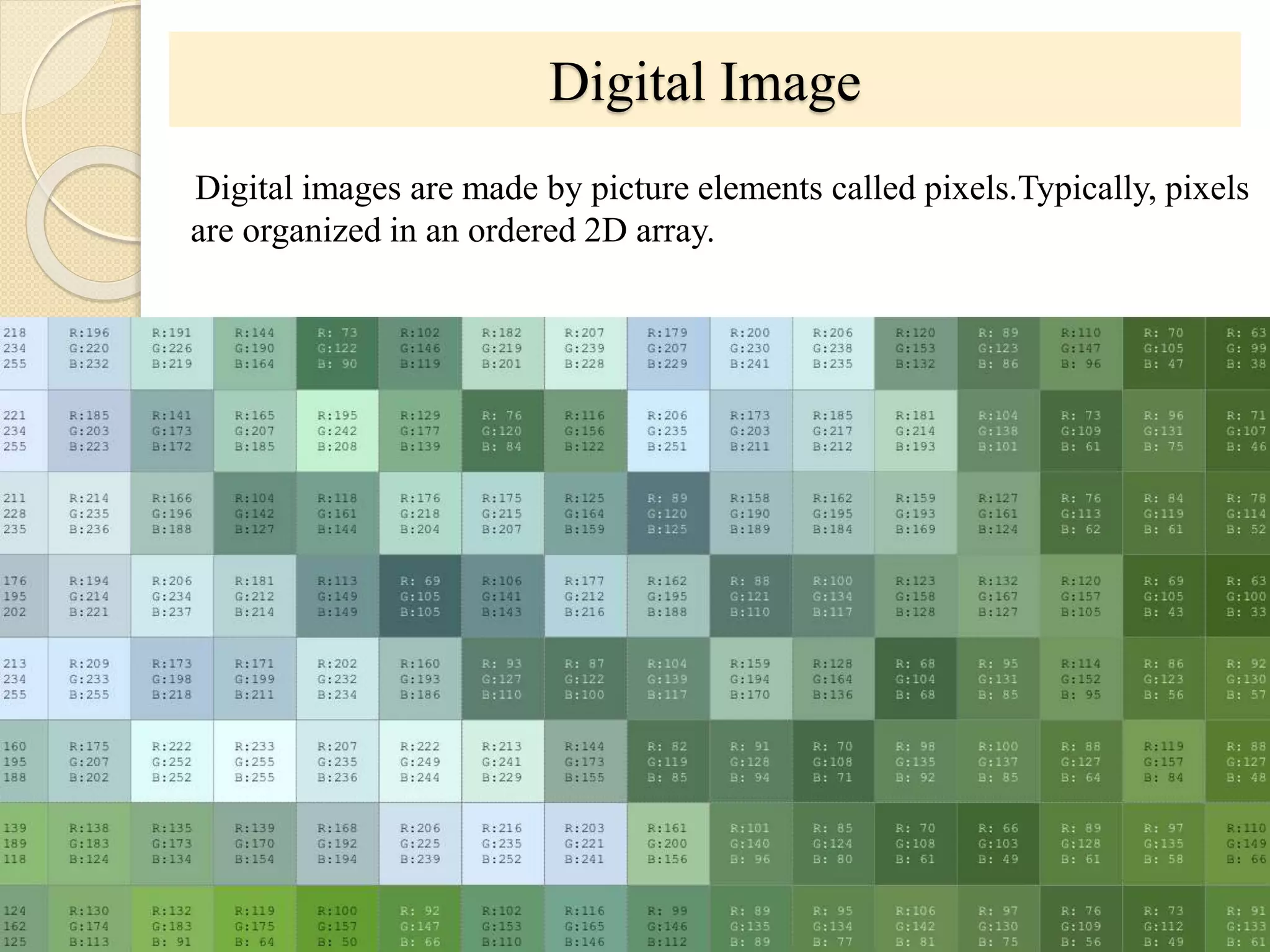
Digital Image
Digital images are made by picture elements called pixels.Typically, pixels
are organized in an ordered 2D array.
Digital image processing deals with manipulation of digital images
through a digital computer.
This is a method to perform some operations on an image, in order to get
an enhanced image or to extract some useful information from it.
It is a type of signal processing in which input is an image and output
may be image or characteristics/features associated with that image.
Image processing basically includes the following three steps:
 Importing the image via image acquisition tools;
 Analysing and manipulating the image;
 Output in which result can be altered image or report that is based on
image analysis.
Digital Image Processing
Digital image processing focuses on two major tasks :
 Improvement of pictorial information for human interpretation
 Processing of image data for storage, transmission and representation for
autonomous machine perception
Level of image processing :
Low Level
Process
Input: Image
Output: Image
Examples: Noise
removal, image
sharpening
Mid Level
Process
Input: Image
Output: Attributes
Examples: Object
recognition,
segmentation
High Level
Process
Input: Attributes
Output: Understanding
Examples: Scene
understanding,
autonomous navigation
History of Digital Image Processing
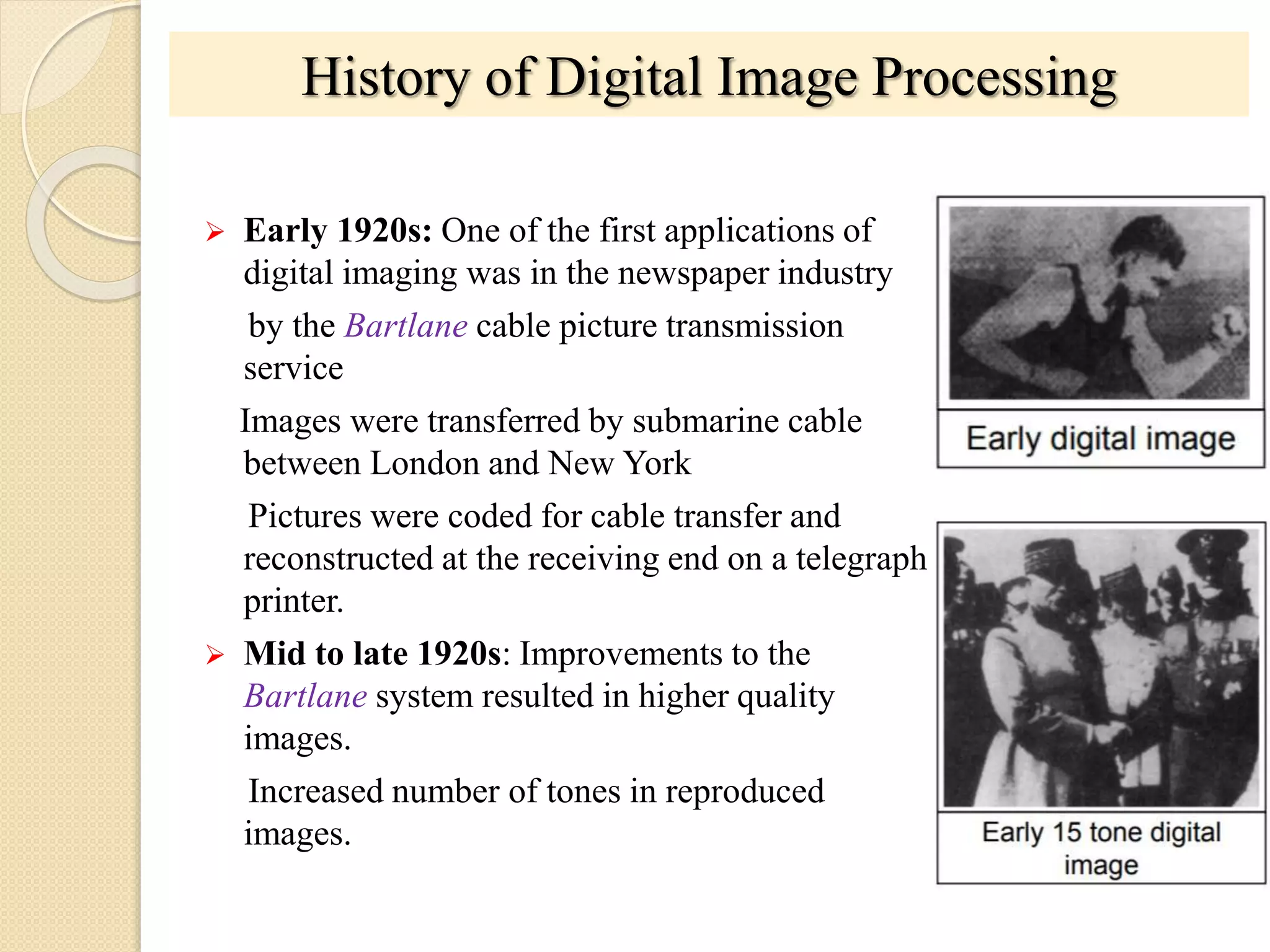
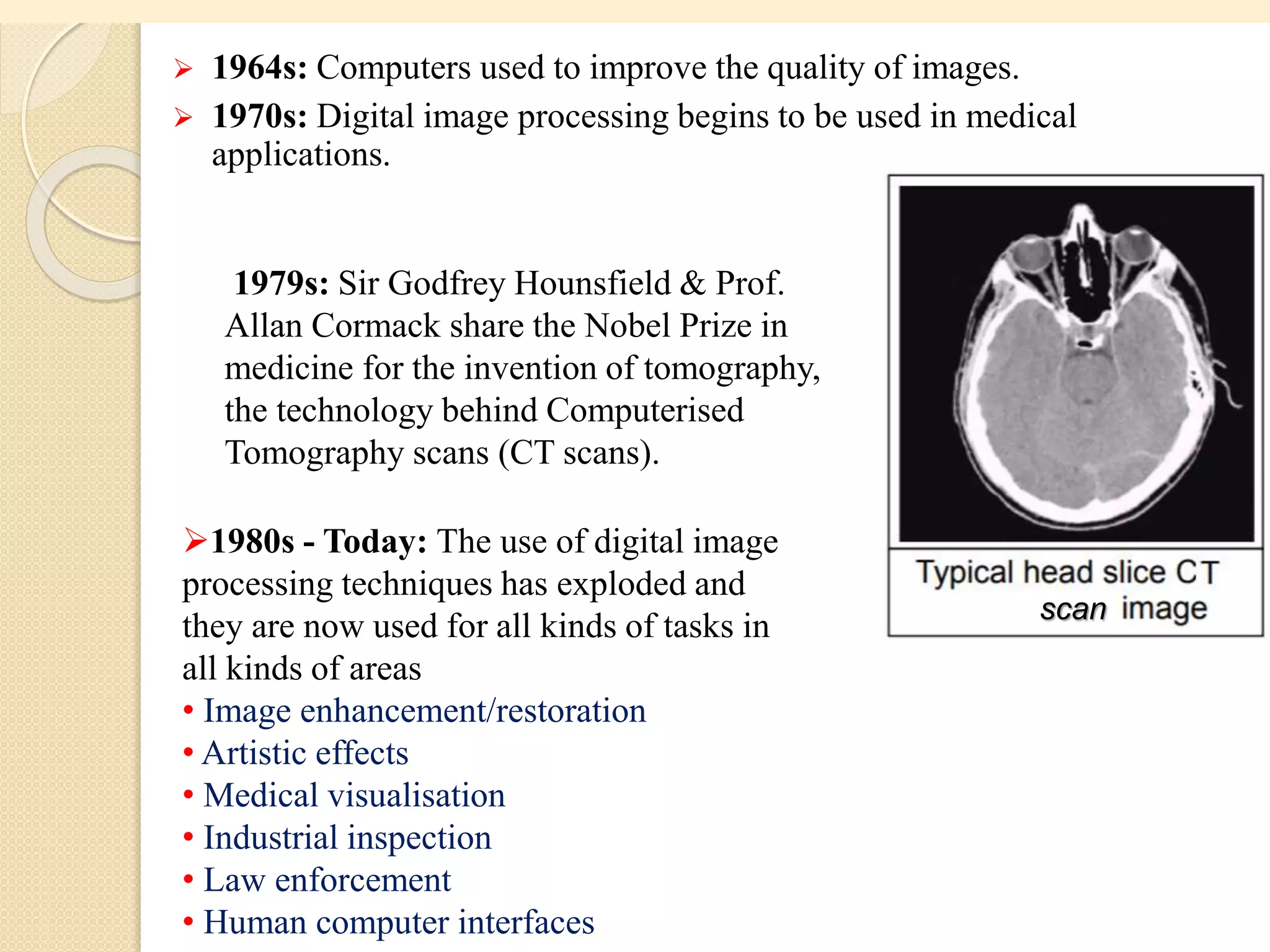
 Early 1920s: One of the first applications of
digital imaging was in the newspaper industry
by the Bartlane cable picture transmission
service
Images were transferred by submarine cable
between London and New York
Pictures were coded for cable transfer and
reconstructed at the receiving end on a telegraph
printer.
 Mid to late 1920s: Improvements to the
Bartlane system resulted in higher quality
images.
Increased number of tones in reproduced
images.
 1964s: Computers used to improve the quality of images.
 1970s: Digital image processing begins to be used in medical
applications.
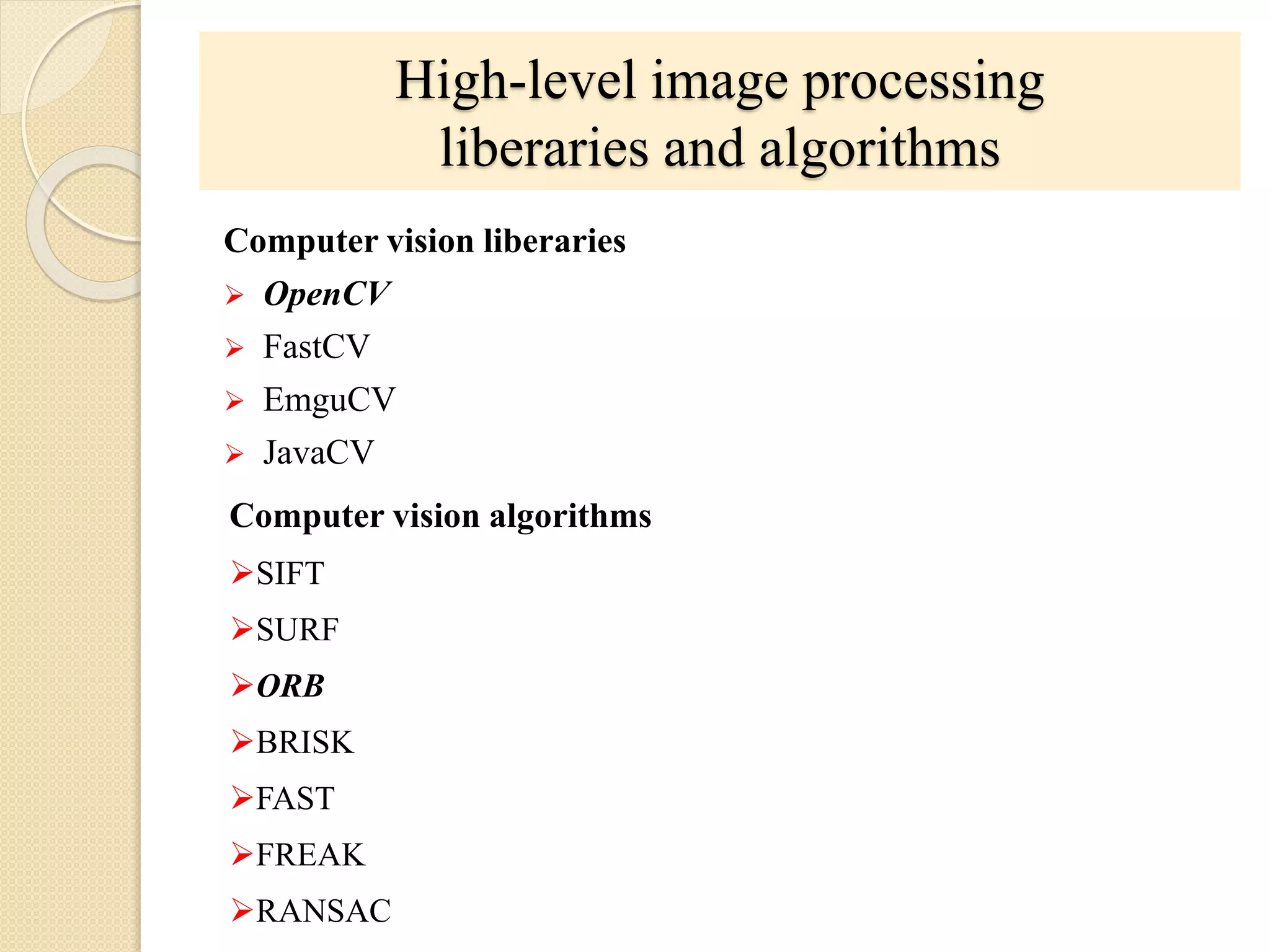
1979s: Sir Godfrey Hounsfield & Prof.
Allan Cormack share the Nobel Prize in
medicine for the invention of tomography,
the technology behind Computerised
Tomography scans (CT scans).
scan
1980s - Today: The use of digital image
processing techniques has exploded and
they are now used for all kinds of tasks in
all kinds of areas
• Image enhancement/restoration
• Artistic effects
• Medical visualisation
• Industrial inspection
• Law enforcement
• Human computer interfaces
Computer vision liberaries
 OpenCV
 FastCV
 EmguCV
 JavaCV
High-level image processing
liberaries and algorithms
Computer vision algorithms
SIFT
SURF
ORB
BRISK
FAST
FREAK
RANSAC
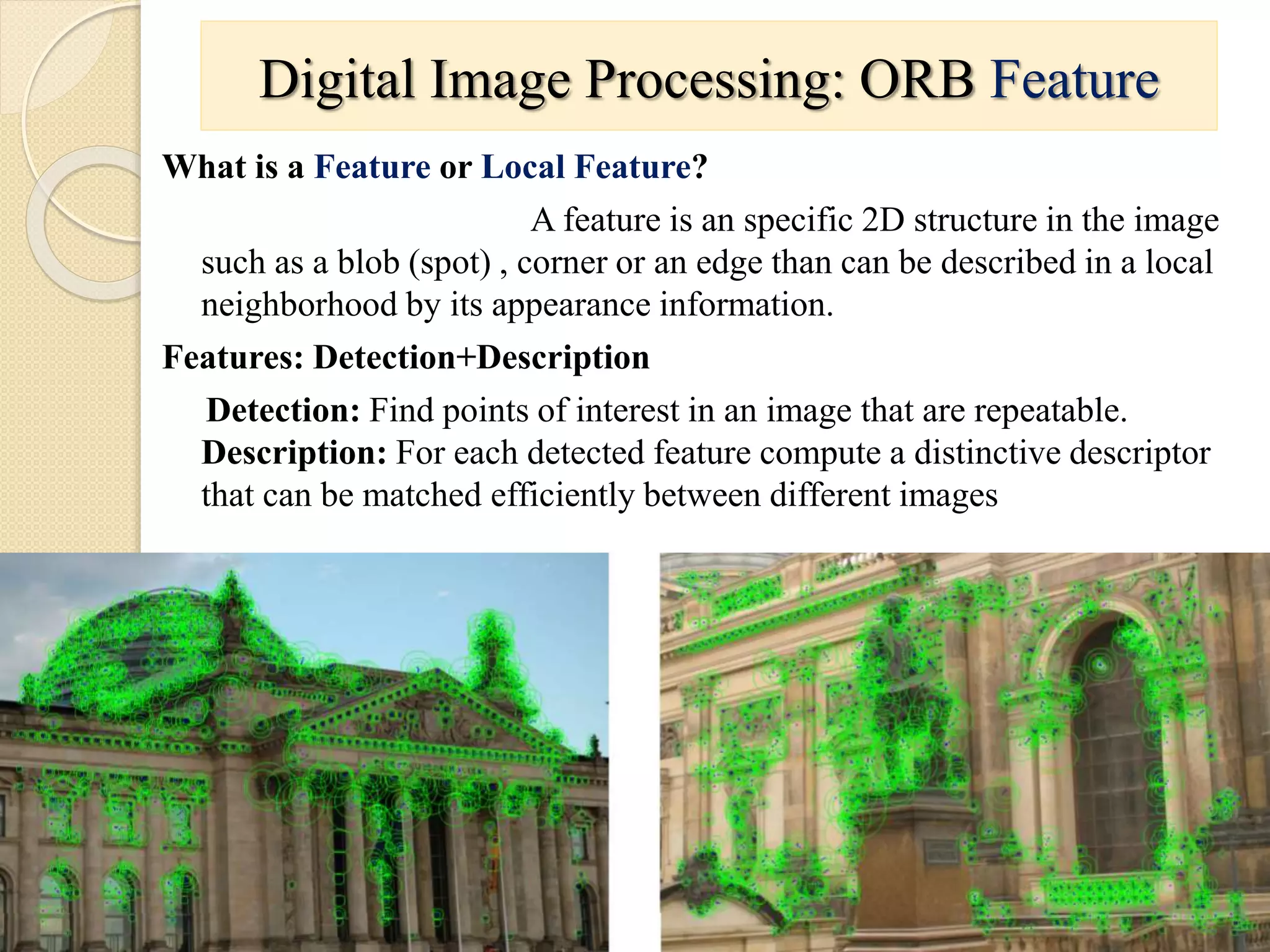
What is a Feature or Local Feature?
A feature is an specific 2D structure in the image
such as a blob (spot) , corner or an edge than can be described in a local
neighborhood by its appearance information.
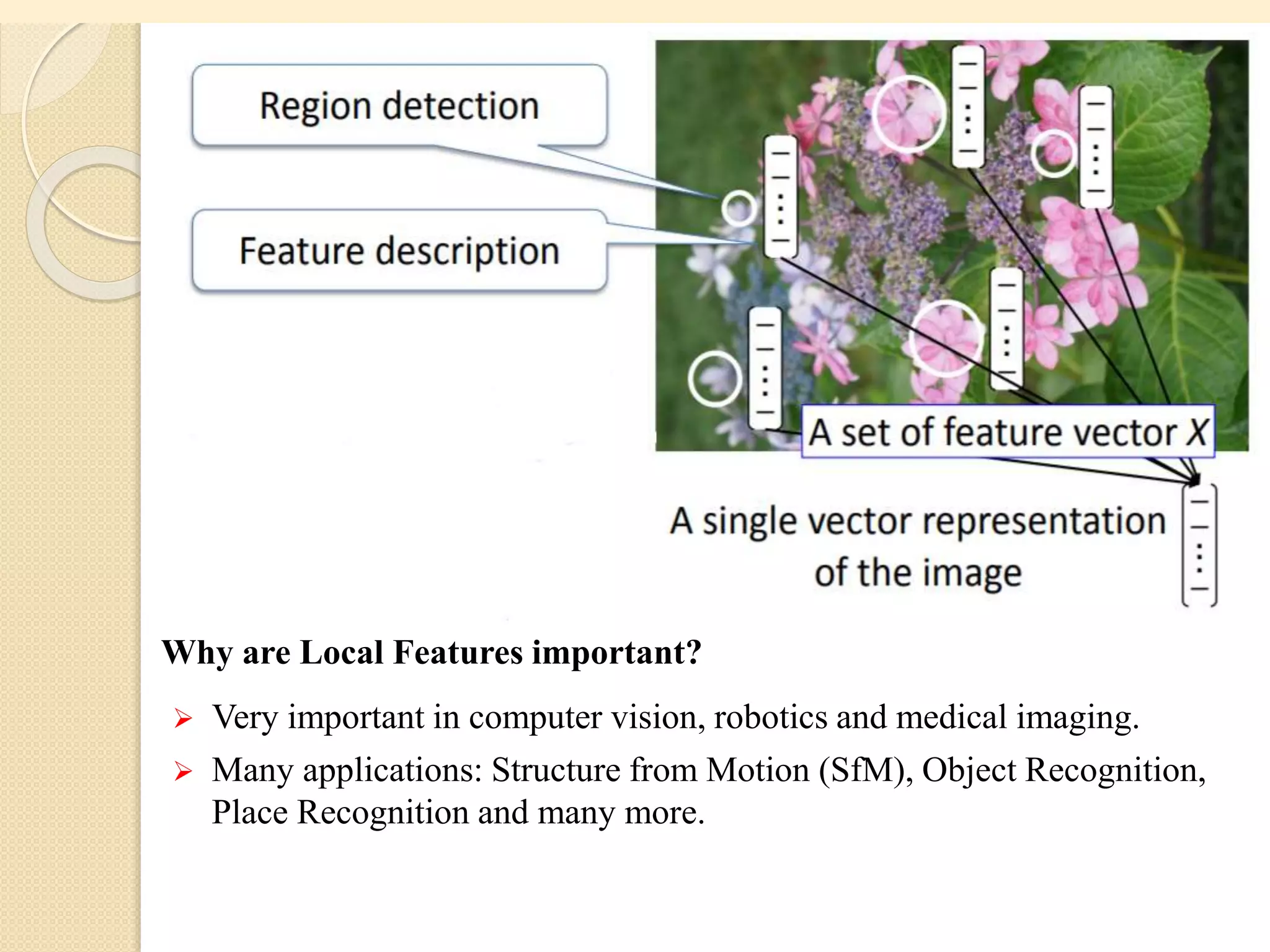
Features: Detection+Description
Detection: Find points of interest in an image that are repeatable.
Description: For each detected feature compute a distinctive descriptor
that can be matched efficiently between different images
Digital Image Processing: ORB Feature
Why are Local Features important?
 Very important in computer vision, robotics and medical imaging.
 Many applications: Structure from Motion (SfM), Object Recognition,
Place Recognition and many more.
ORB – Oriented FAST and Rotated BRIEF
The Principle of ORB Algorithm
ORB algorithm is proposed
based on FAST algorithm and BRIEF algorithm.
ORB algorithm is a method to describe feature points by
using the binary string.
 Since the feature point of ORB is detected by the FAST
feature detection, and which is described using an
improved BRIEF feature descriptor, and the speed of
FAST and BRIEF are very fast, so ORB has an absolute
advantage in speed.
 The greatest feature of this algorithm is fast and having
rotational invariance and reducing sensitivity to noise.
FAST Feature Points Detection
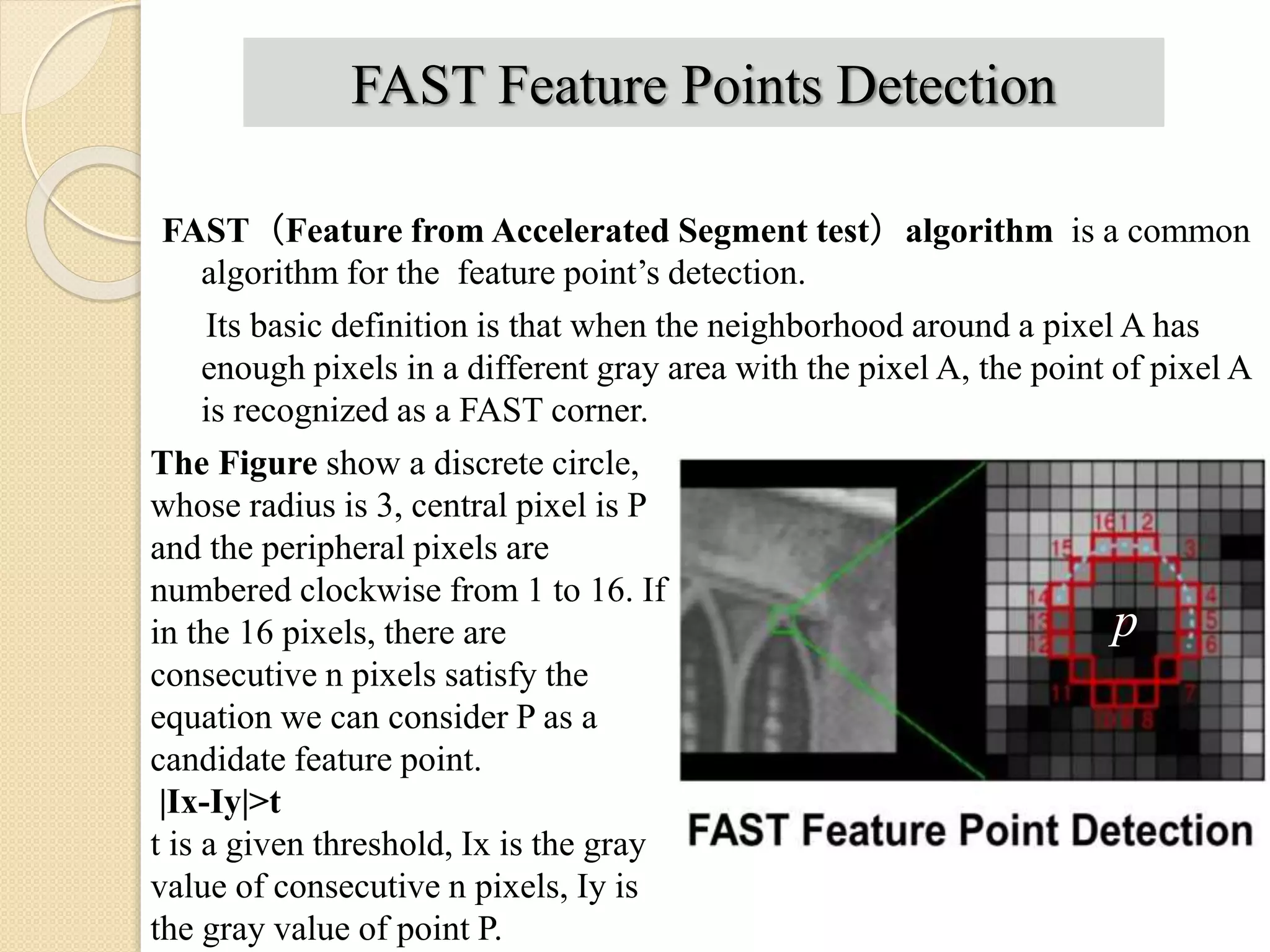
FAST(Feature from Accelerated Segment test)algorithm is a common
algorithm for the feature point’s detection.
Its basic definition is that when the neighborhood around a pixel A has
enough pixels in a different gray area with the pixel A, the point of pixel A
is recognized as a FAST corner.
p
The Figure show a discrete circle,
whose radius is 3, central pixel is P
and the peripheral pixels are
numbered clockwise from 1 to 16. If
in the 16 pixels, there are
consecutive n pixels satisfy the
equation we can consider P as a
candidate feature point.
|Ix-Iy|>t
t is a given threshold, Ix is the gray
value of consecutive n pixels, Iy is
the gray value of point P.
Description of BRIEF Algorithm
After obtaining the feature point, descriptors has been built using BRIEF
(Binary Robust Independent Elementary Features) descriptor ideas.
BRIEF extracts descriptors around feature points by binary coding
method.
This descriptor is simpler and storage space is smaller than SIFT and
SURF.
Around the image spot P is , randomly selecting n pairs of pixel point and
defining it as
τ(p:x,y)={1 if p(x)<p(y)
0 otherwise.
P(x) is the pixel intensity at the point of the x.
A set of points can uniquely identify one binary detection τ
nd -dimensional binary string just as below equation (3) as the BRIEF
descriptor.
The ORB algorithm can greatly solve the problem of rotational invariance
which the BRIEF algorithms don’t have, the main way is to add a
direction for BRIEF descriptors. First defining the moments of plaque...
x, y is in the position of the FAST feature point ,circular neighborhood
radius r, x, y ∈ [-r, r]. Then calculate the center of gravity of the plaque,
as shown in below equation.
The Angle which is formed by feature point and the center of gravity has
been defined as for the FAST feature point direction:
The ORB algorithm extracts the BRIEF descriptors according
to direction provided by the previous equation, Because of
the environmental factors and the noise will change the
direction of the feature points,
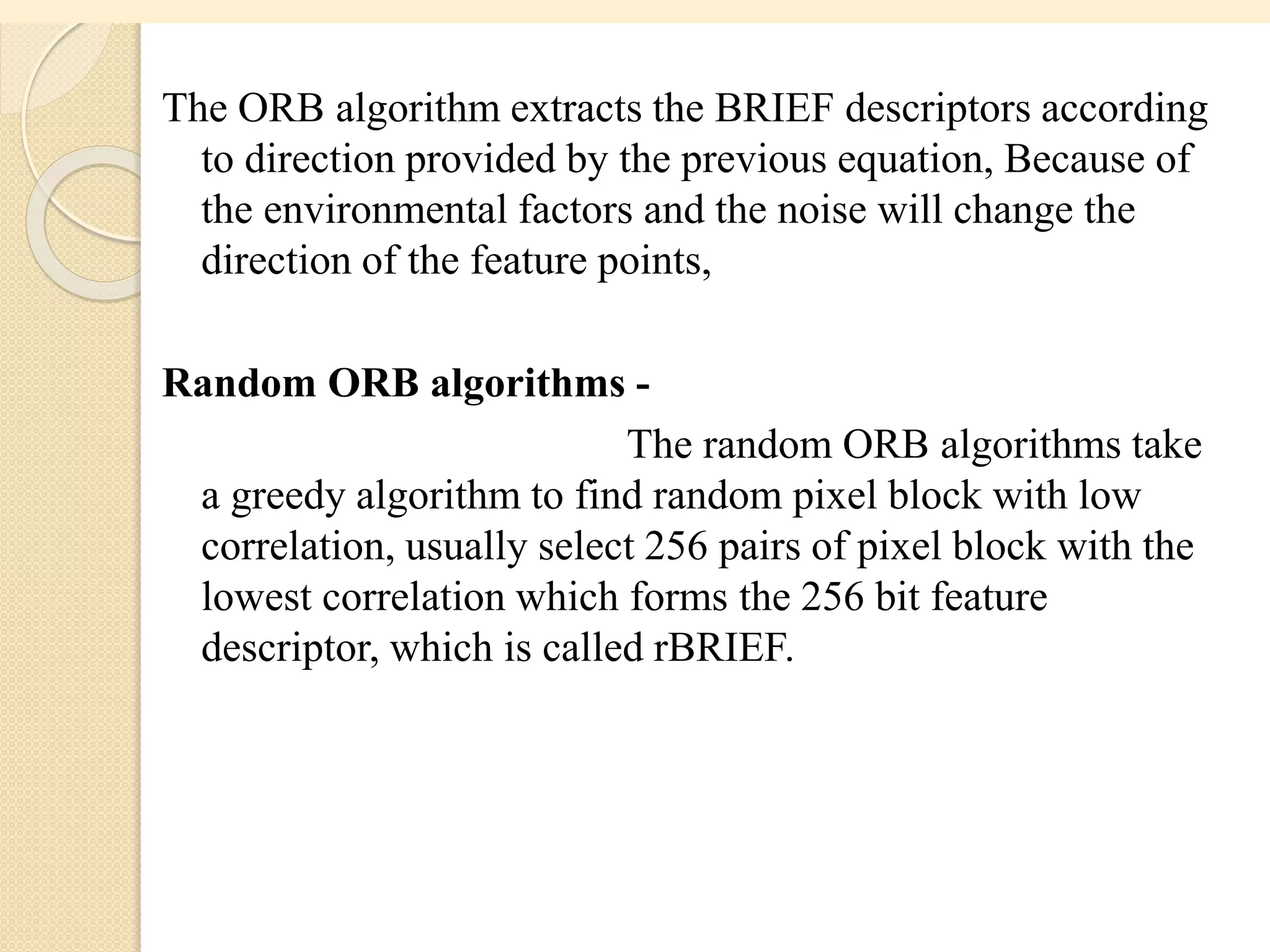
Random ORB algorithms -
The random ORB algorithms take
a greedy algorithm to find random pixel block with low
correlation, usually select 256 pairs of pixel block with the
lowest correlation which forms the 256 bit feature
descriptor, which is called rBRIEF.
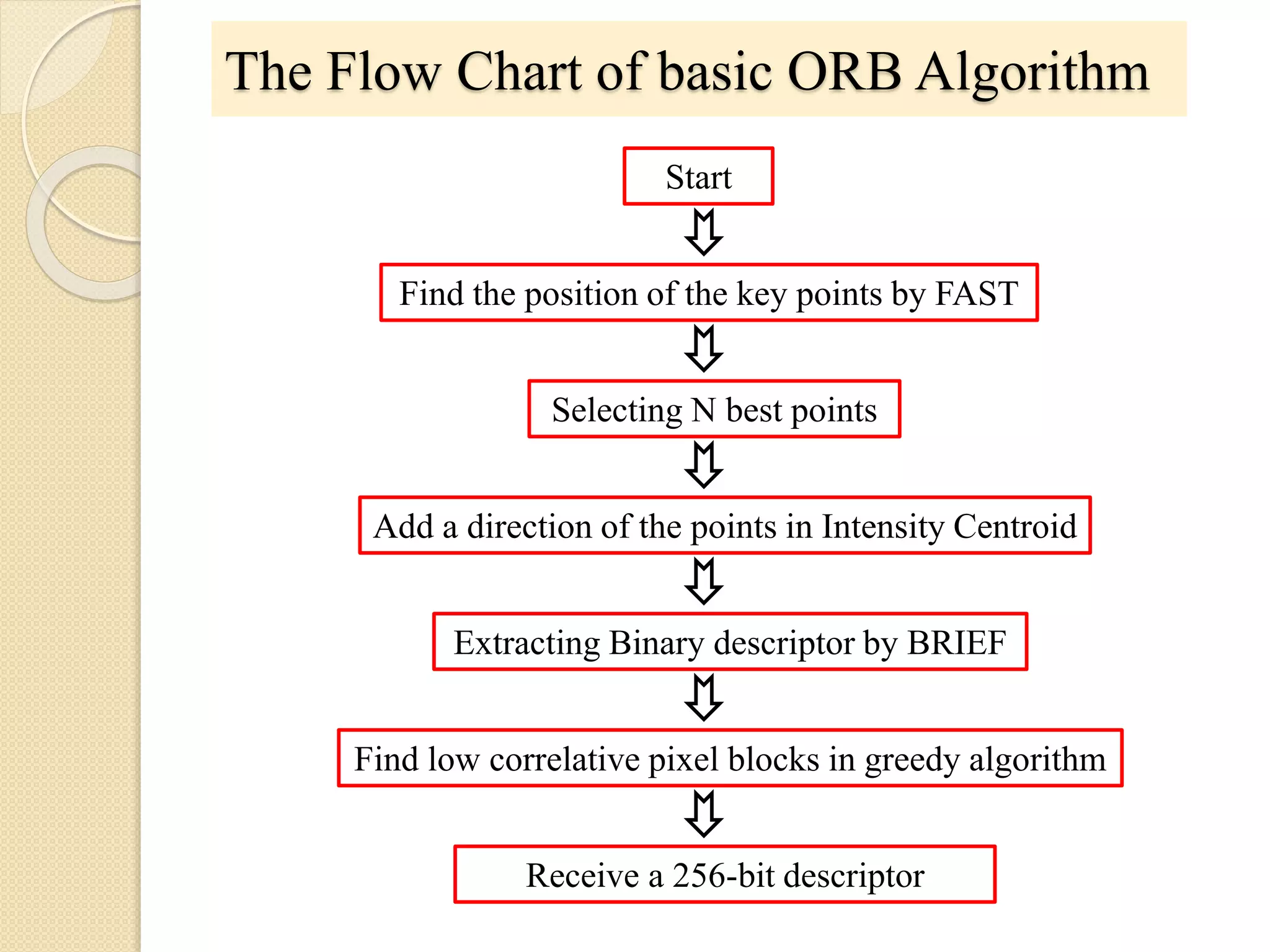
The Flow Chart of basic ORB Algorithm
Start
Find the position of the key points by FAST
Selecting N best points
Add a direction of the points in Intensity Centroid
Extracting Binary descriptor by BRIEF
Find low correlative pixel blocks in greedy algorithm
Receive a 256-bit descriptor
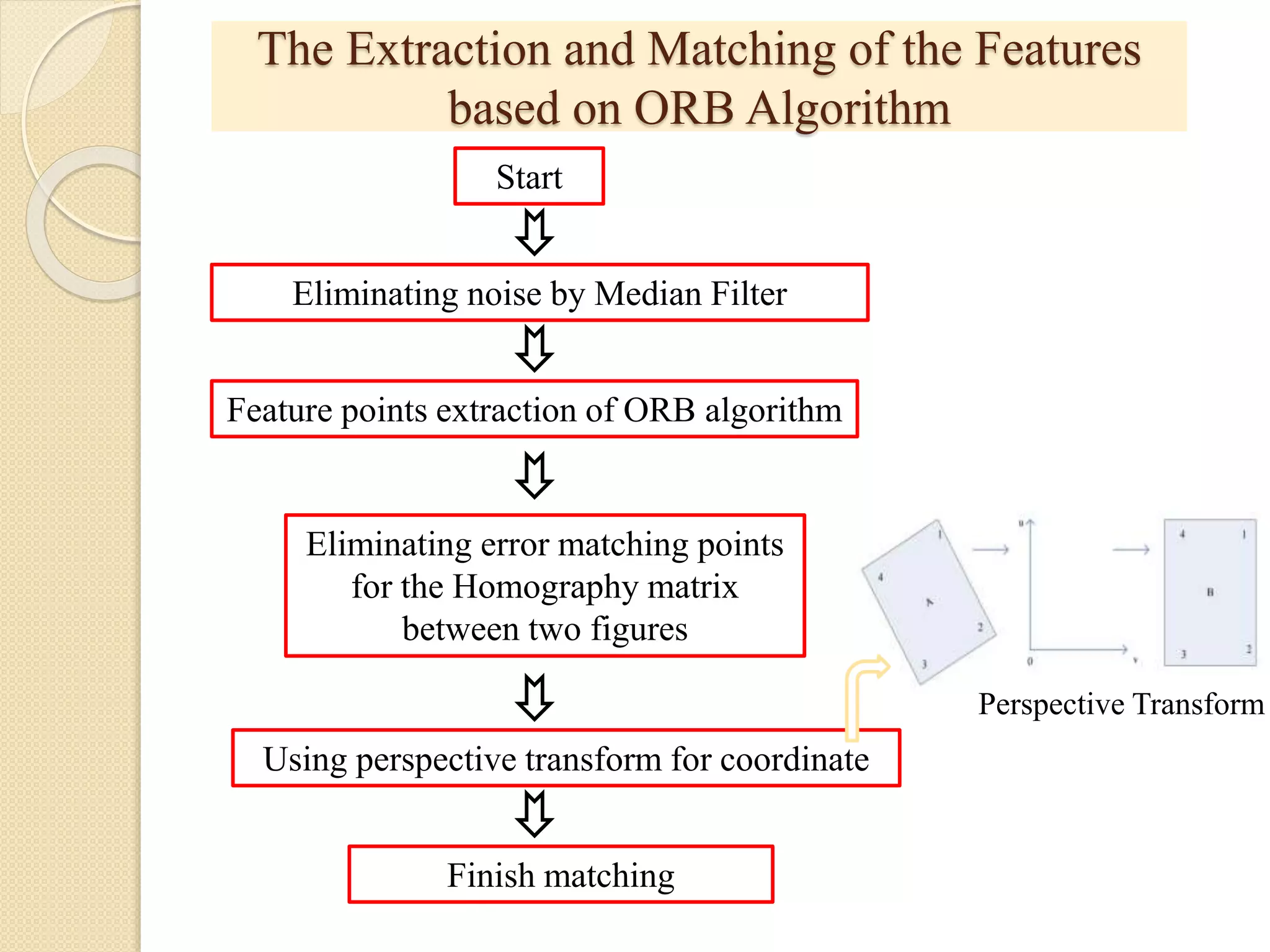
The Extraction and Matching of the Features
based on ORB Algorithm
Start
Eliminating noise by Median Filter
Feature points extraction of ORB algorithm
Eliminating error matching points
for the Homography matrix
between two figures
Using perspective transform for coordinate
Finish matching
Perspective Transform
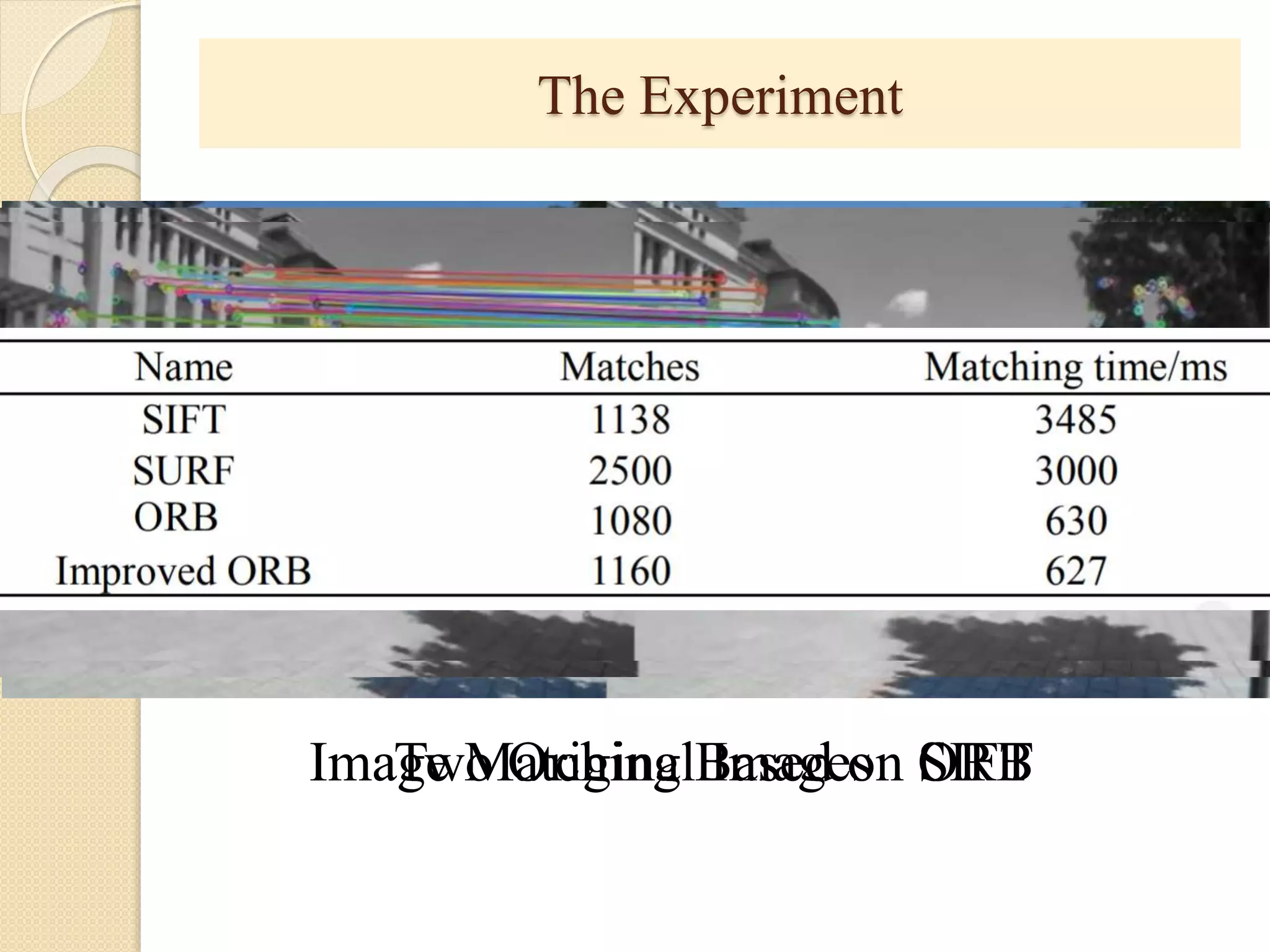
The Experiment
Two Original ImagesImage Matching Based on SIFTImage Matching Based on ORB
Applications
 Image enhancement/restoration
 Artistic effects
 Medical visualisation
 Industrial inspection
 Law enforcement
 Human computer interfaces
 Machine/Robot vision
 Pattern recognization
Conclusion
 ORB implementation includes, the addition of a fast and accurate
orientation component to FAST, the efficient computation of
oriented BRIEF features.
 With the addition of new techniques, ORB outperforms comparison
to SIFT and SURF on the outdoor dataset. ORB outperforms over
large databases of images
 The experimental environment is OpenCV2.3.1 and Visual
Studio2010.
References
 D. G. Lowe, “Distinctive image features from scale-invariant
keypoints”, International Journal of Computer Vision, vol. 60, no.
2, (2004), pp. 91-110
 M. Brown and D. G. Lowe, “Recognising panoramas”, In IEEE
Computer Society, eds. Proc. of the Seventh IEEE International
Conference on Conference Computer Vision (ICCV), USA:
ICCV, (2003), pp. 1218-1225
 H. Bay, T. Tuytelaars and L. Van Gool, “Surf: Speeded up robust
features”, Berlin Heidelberg: Springer, (2006).
 Rublee, Ethan; Rabaud, Vincent; Konolige, Kurt; Bradski, Gary
(2011). "ORB: an efficient alternative to SIFT or SURF"
Orb feature by nitin

Orb feature by nitin

  • 1.
    RAJKIYA ENGINEERING COLLEGE, AMBEDKARNAGAR (737) (DEPARTMENT OF INFORMATION TECHNOLOGY) Submitted to: Mr. Prince Rajpoot (Asst. Professor) A presentation On Digital Image Processing: ORB Feature Under the Supervision of Mr. Ramesh chand (Asst. Professor) Submitted By: Nitin Kumar Maurya Roll no.1573713020
  • 2.
  • 3.
    Digital Image Digital imagesare made by picture elements called pixels.Typically, pixels are organized in an ordered 2D array.
  • 4.
    Digital image processingdeals with manipulation of digital images through a digital computer. This is a method to perform some operations on an image, in order to get an enhanced image or to extract some useful information from it. It is a type of signal processing in which input is an image and output may be image or characteristics/features associated with that image. Image processing basically includes the following three steps:  Importing the image via image acquisition tools;  Analysing and manipulating the image;  Output in which result can be altered image or report that is based on image analysis. Digital Image Processing
  • 5.
    Digital image processingfocuses on two major tasks :  Improvement of pictorial information for human interpretation  Processing of image data for storage, transmission and representation for autonomous machine perception Level of image processing : Low Level Process Input: Image Output: Image Examples: Noise removal, image sharpening Mid Level Process Input: Image Output: Attributes Examples: Object recognition, segmentation High Level Process Input: Attributes Output: Understanding Examples: Scene understanding, autonomous navigation
  • 6.
    History of DigitalImage Processing  Early 1920s: One of the first applications of digital imaging was in the newspaper industry by the Bartlane cable picture transmission service Images were transferred by submarine cable between London and New York Pictures were coded for cable transfer and reconstructed at the receiving end on a telegraph printer.  Mid to late 1920s: Improvements to the Bartlane system resulted in higher quality images. Increased number of tones in reproduced images.
  • 7.
     1964s: Computersused to improve the quality of images.  1970s: Digital image processing begins to be used in medical applications. 1979s: Sir Godfrey Hounsfield & Prof. Allan Cormack share the Nobel Prize in medicine for the invention of tomography, the technology behind Computerised Tomography scans (CT scans). scan 1980s - Today: The use of digital image processing techniques has exploded and they are now used for all kinds of tasks in all kinds of areas • Image enhancement/restoration • Artistic effects • Medical visualisation • Industrial inspection • Law enforcement • Human computer interfaces
  • 8.
    Computer vision liberaries OpenCV  FastCV  EmguCV  JavaCV High-level image processing liberaries and algorithms Computer vision algorithms SIFT SURF ORB BRISK FAST FREAK RANSAC
  • 9.
    What is aFeature or Local Feature? A feature is an specific 2D structure in the image such as a blob (spot) , corner or an edge than can be described in a local neighborhood by its appearance information. Features: Detection+Description Detection: Find points of interest in an image that are repeatable. Description: For each detected feature compute a distinctive descriptor that can be matched efficiently between different images Digital Image Processing: ORB Feature
  • 10.
    Why are LocalFeatures important?  Very important in computer vision, robotics and medical imaging.  Many applications: Structure from Motion (SfM), Object Recognition, Place Recognition and many more.
  • 11.
    ORB – OrientedFAST and Rotated BRIEF The Principle of ORB Algorithm ORB algorithm is proposed based on FAST algorithm and BRIEF algorithm. ORB algorithm is a method to describe feature points by using the binary string.  Since the feature point of ORB is detected by the FAST feature detection, and which is described using an improved BRIEF feature descriptor, and the speed of FAST and BRIEF are very fast, so ORB has an absolute advantage in speed.  The greatest feature of this algorithm is fast and having rotational invariance and reducing sensitivity to noise.
  • 12.
    FAST Feature PointsDetection FAST(Feature from Accelerated Segment test)algorithm is a common algorithm for the feature point’s detection. Its basic definition is that when the neighborhood around a pixel A has enough pixels in a different gray area with the pixel A, the point of pixel A is recognized as a FAST corner. p The Figure show a discrete circle, whose radius is 3, central pixel is P and the peripheral pixels are numbered clockwise from 1 to 16. If in the 16 pixels, there are consecutive n pixels satisfy the equation we can consider P as a candidate feature point. |Ix-Iy|>t t is a given threshold, Ix is the gray value of consecutive n pixels, Iy is the gray value of point P.
  • 13.
    Description of BRIEFAlgorithm After obtaining the feature point, descriptors has been built using BRIEF (Binary Robust Independent Elementary Features) descriptor ideas. BRIEF extracts descriptors around feature points by binary coding method. This descriptor is simpler and storage space is smaller than SIFT and SURF. Around the image spot P is , randomly selecting n pairs of pixel point and defining it as τ(p:x,y)={1 if p(x)<p(y) 0 otherwise. P(x) is the pixel intensity at the point of the x. A set of points can uniquely identify one binary detection τ nd -dimensional binary string just as below equation (3) as the BRIEF descriptor.
  • 14.
    The ORB algorithmcan greatly solve the problem of rotational invariance which the BRIEF algorithms don’t have, the main way is to add a direction for BRIEF descriptors. First defining the moments of plaque... x, y is in the position of the FAST feature point ,circular neighborhood radius r, x, y ∈ [-r, r]. Then calculate the center of gravity of the plaque, as shown in below equation. The Angle which is formed by feature point and the center of gravity has been defined as for the FAST feature point direction:
  • 15.
    The ORB algorithmextracts the BRIEF descriptors according to direction provided by the previous equation, Because of the environmental factors and the noise will change the direction of the feature points, Random ORB algorithms - The random ORB algorithms take a greedy algorithm to find random pixel block with low correlation, usually select 256 pairs of pixel block with the lowest correlation which forms the 256 bit feature descriptor, which is called rBRIEF.
  • 16.
    The Flow Chartof basic ORB Algorithm Start Find the position of the key points by FAST Selecting N best points Add a direction of the points in Intensity Centroid Extracting Binary descriptor by BRIEF Find low correlative pixel blocks in greedy algorithm Receive a 256-bit descriptor
  • 17.
    The Extraction andMatching of the Features based on ORB Algorithm Start Eliminating noise by Median Filter Feature points extraction of ORB algorithm Eliminating error matching points for the Homography matrix between two figures Using perspective transform for coordinate Finish matching Perspective Transform
  • 18.
    The Experiment Two OriginalImagesImage Matching Based on SIFTImage Matching Based on ORB
  • 19.
    Applications  Image enhancement/restoration Artistic effects  Medical visualisation  Industrial inspection  Law enforcement  Human computer interfaces  Machine/Robot vision  Pattern recognization
  • 20.
    Conclusion  ORB implementationincludes, the addition of a fast and accurate orientation component to FAST, the efficient computation of oriented BRIEF features.  With the addition of new techniques, ORB outperforms comparison to SIFT and SURF on the outdoor dataset. ORB outperforms over large databases of images  The experimental environment is OpenCV2.3.1 and Visual Studio2010.
  • 21.
    References  D. G.Lowe, “Distinctive image features from scale-invariant keypoints”, International Journal of Computer Vision, vol. 60, no. 2, (2004), pp. 91-110  M. Brown and D. G. Lowe, “Recognising panoramas”, In IEEE Computer Society, eds. Proc. of the Seventh IEEE International Conference on Conference Computer Vision (ICCV), USA: ICCV, (2003), pp. 1218-1225  H. Bay, T. Tuytelaars and L. Van Gool, “Surf: Speeded up robust features”, Berlin Heidelberg: Springer, (2006).  Rublee, Ethan; Rabaud, Vincent; Konolige, Kurt; Bradski, Gary (2011). "ORB: an efficient alternative to SIFT or SURF"