MPI Communications

Point to Point
Collective Communication
Data Packaging
Point-to-Point Communication
Send and Receive
• MPI_Send/MPI_Recv provide point-to-
  point communication
  – synchronization protocol is not fully specified.
     • what are possibilities?
Send and Receive
Synchronization
• Fully Synchronized (Rendezvous)
  – Send and Receive complete simultaneously
     • whichever code reaches the Send/Receive first waits
  – provides synchronization point (up to network
    delays)
• Buffered
  – Receive must wait until message is received
  – Send completes when message is moved to buffer
    clearing memory of message for reuse
Send and Receive Synchronization
• Asynchronous
  – Sending process may proceed immediately
     • does not need to wait until message is copied to buffer
     • must check for completion before using message
       memory
  – Receiving process may proceed immediately
     • will not have message to use until it is received
     • must check for completion before using message
MPI Send and Receive
• MPI_Send/MPI_Recv are synchronous,
  but buffering is unspecified
  – MPI_Recv suspends until message is received
  – MPI_Send may be fully synchronous or may
    be buffered
     • implementation dependent
• Variations allow synchronous or buffering
  to be specified
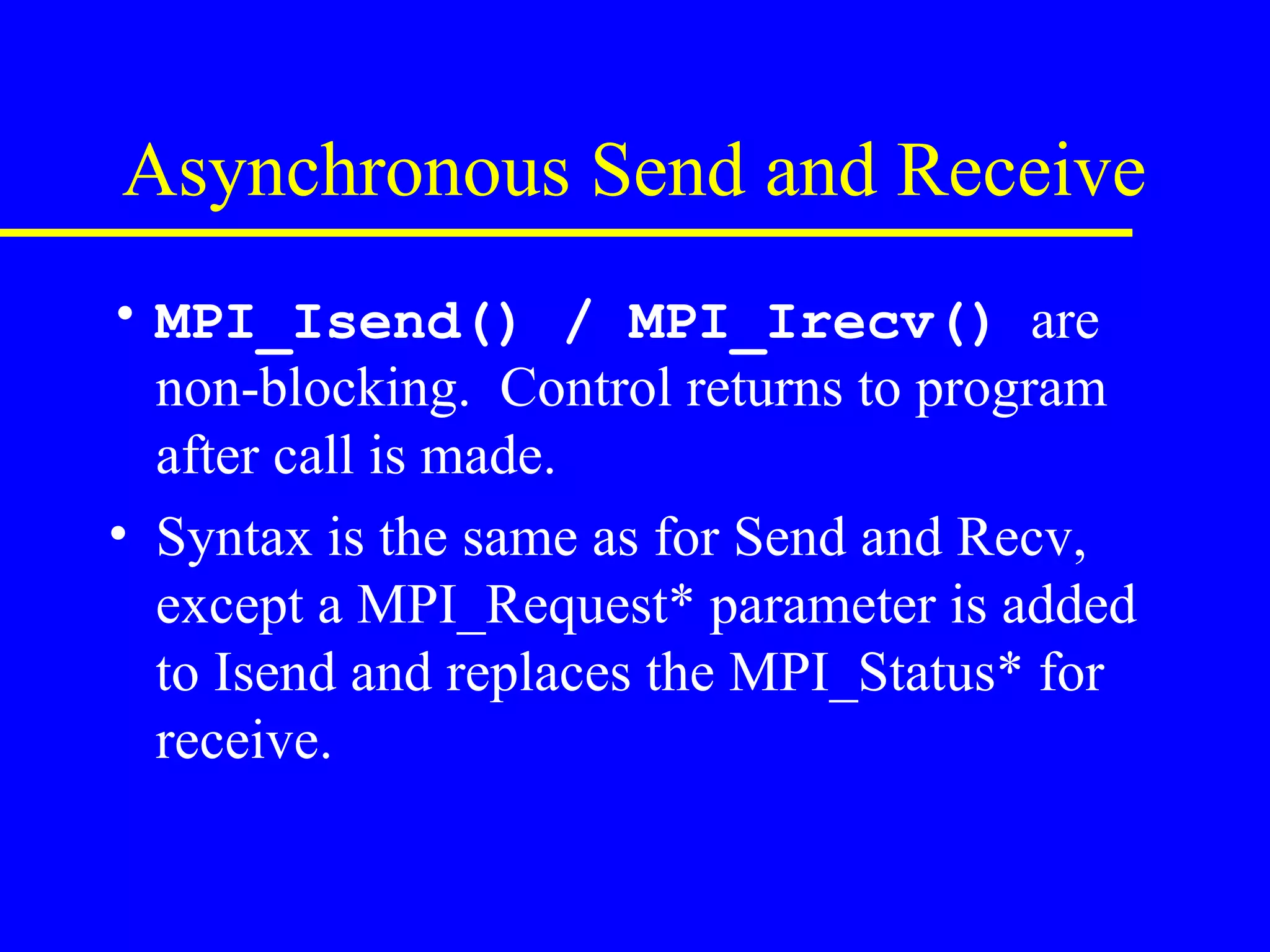
Asynchronous Send and Receive
• MPI_Isend() / MPI_Irecv() are
  non-blocking. Control returns to program
  after call is made.
• Syntax is the same as for Send and Recv,
  except a MPI_Request* parameter is added
  to Isend and replaces the MPI_Status* for
  receive.
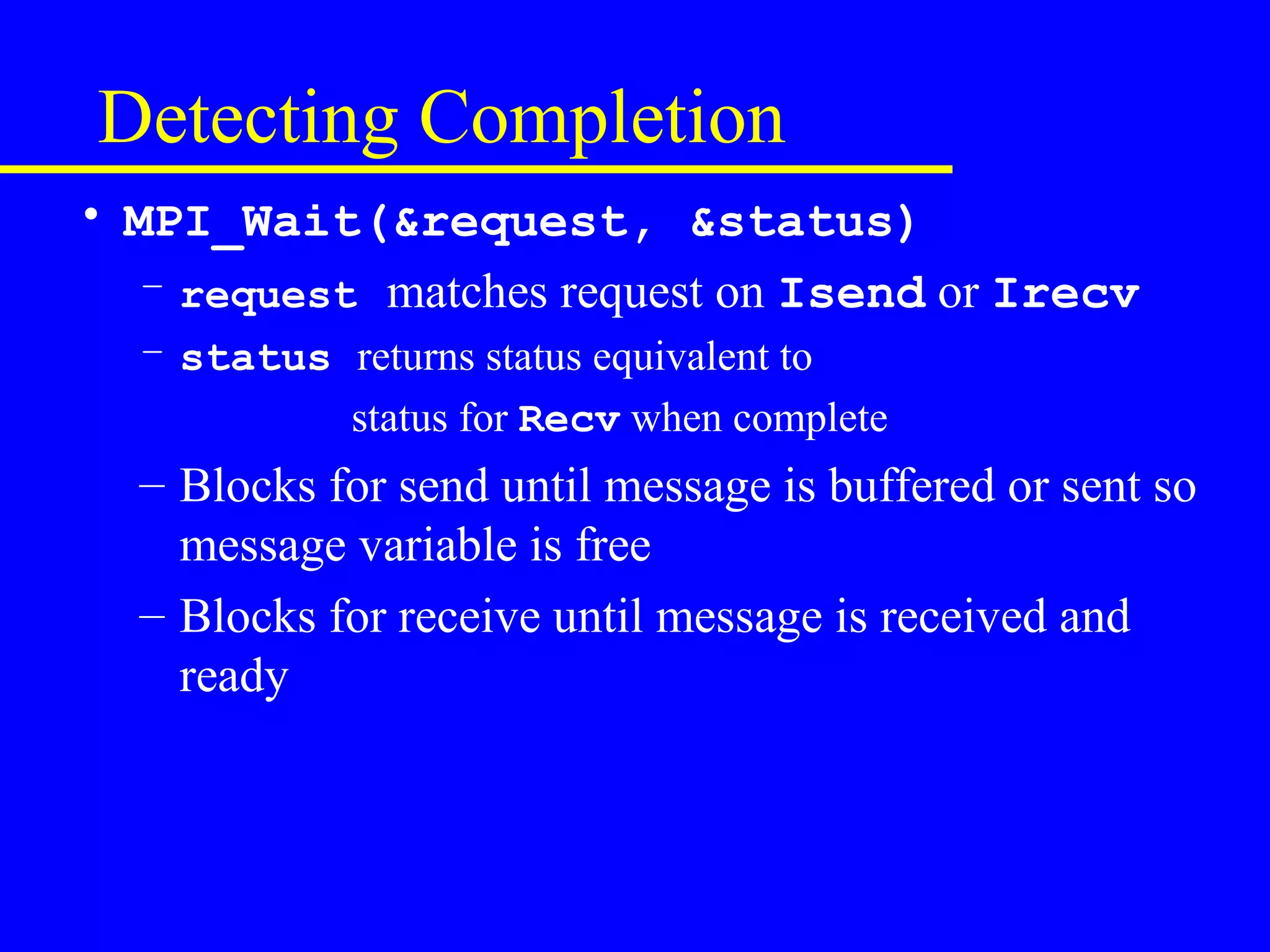
Detecting Completion
• MPI_Wait(&request, &status)
   – request matches request on Isend or Irecv
  – status returns status equivalent to
           status for Recv when complete
  – Blocks for send until message is buffered or sent so
    message variable is free
  – Blocks for receive until message is received and
    ready
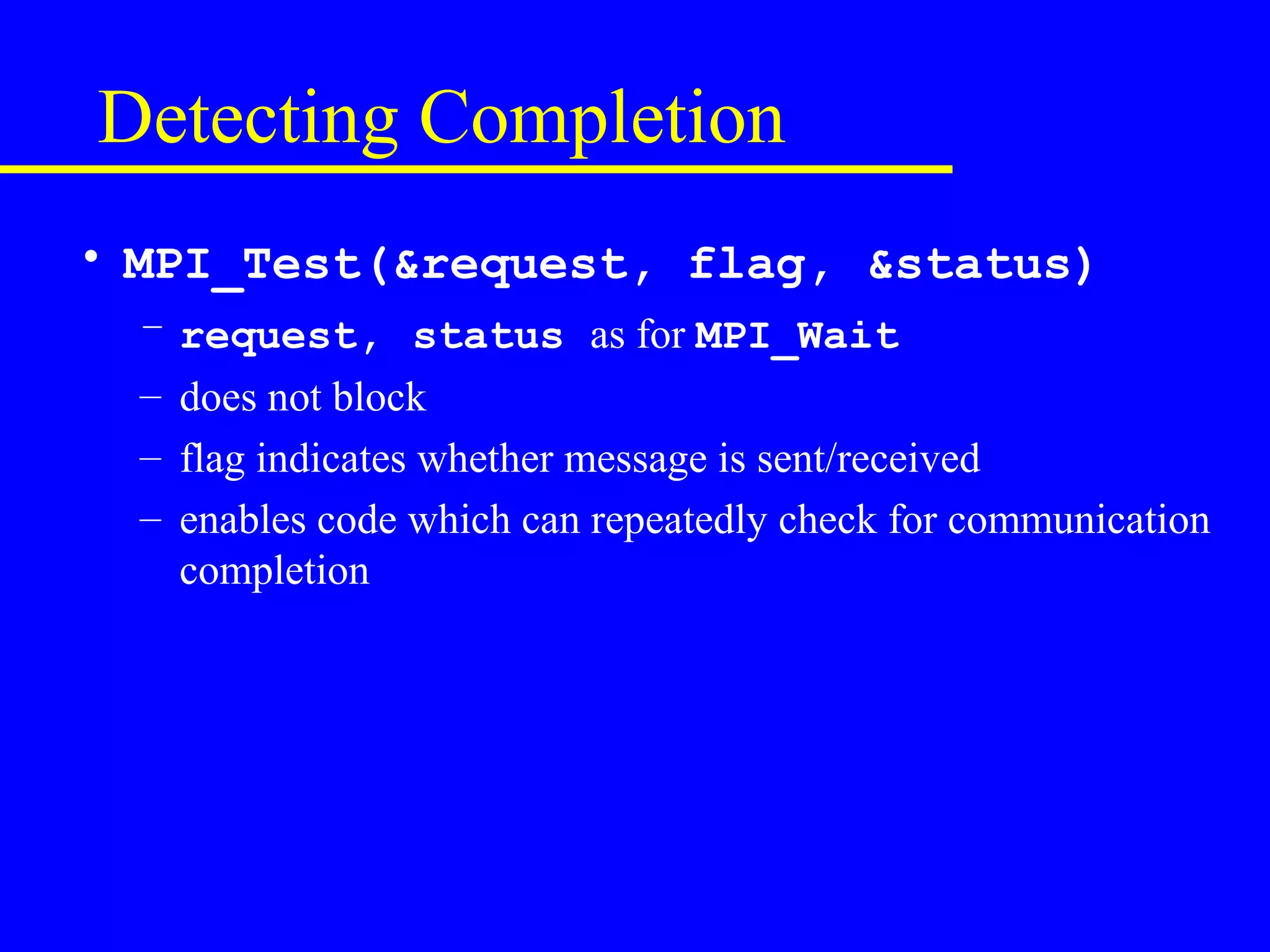
Detecting Completion
• MPI_Test(&request, flag, &status)
  – request, status as for MPI_Wait
  – does not block
  – flag indicates whether message is sent/received
  – enables code which can repeatedly check for communication
    completion
Collective Communications

• One to Many (Broadcast, Scatter)
• Many to One (Reduce, Gather)
• Many to Many (All Reduce, Allgather)
Broadcast
• A selected processor sends to all other
  processors in the communicator
• Any type of message can be sent
• Size of message should be known by all (it
  could be broadcast first)
• Can be optimized within system for any
  given architecture
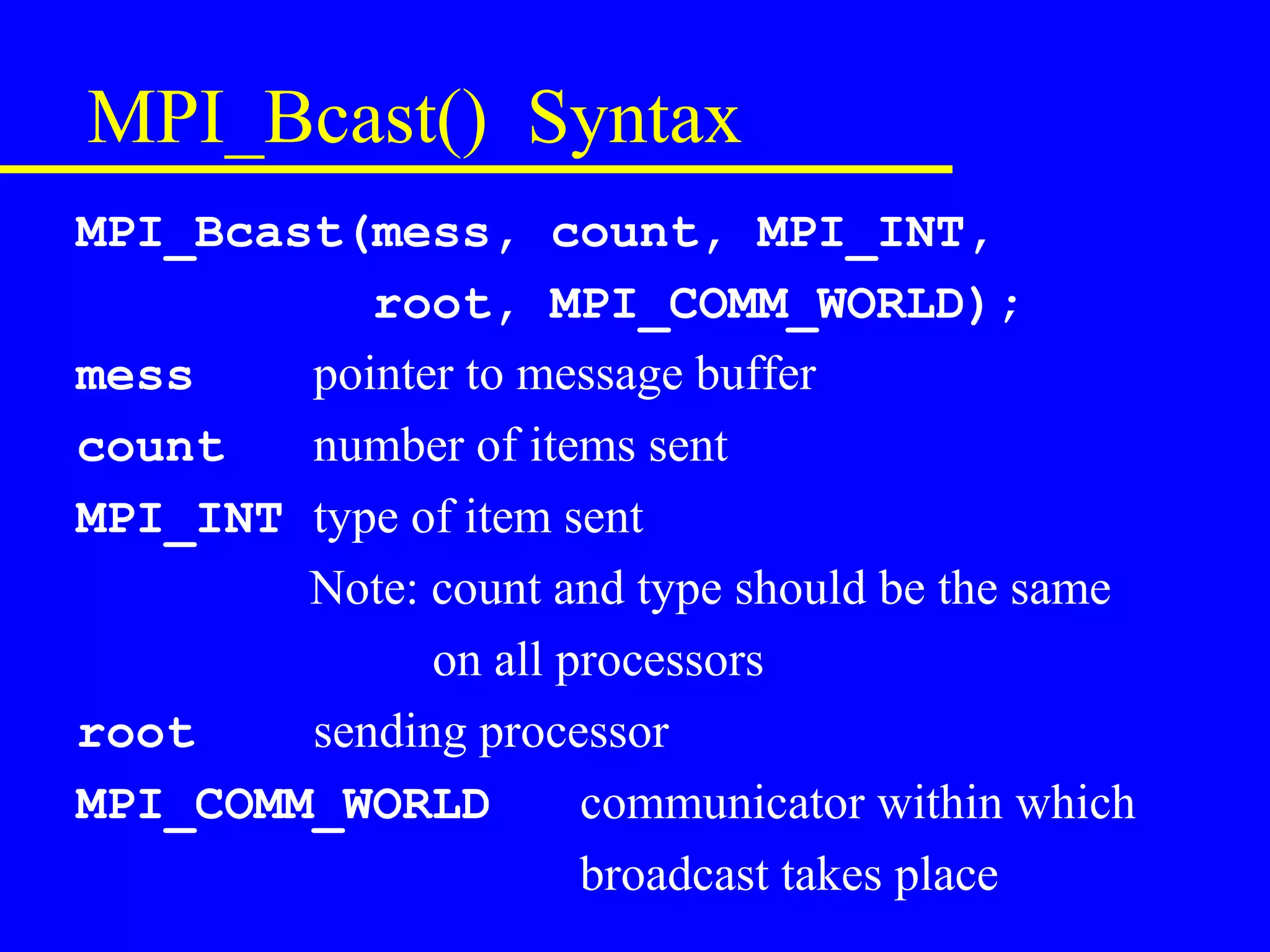
MPI_Bcast() Syntax
MPI_Bcast(mess, count, MPI_INT,
           root, MPI_COMM_WORLD);
mess    pointer to message buffer
count   number of items sent
MPI_INT type of item sent
        Note: count and type should be the same
              on all processors
root    sending processor
MPI_COMM_WORLD        communicator within which
                      broadcast takes place
MPI_Barrier()
MPI_Barrier(MPI_COMM_WORLD);
MPI_COMM_WORLD  communicator within which
                broadcast takes place

provides for barrier synchronization without message of
  broadcast
Reduce

• All Processors send to a single processor,
  the reverse of broadcast
• Information must be combined at receiver
• Several combining functions available
  – MAX, MIN, SUM, PROD, LAND, BAND,
    LOR, BOR, LXOR, BXOR, MAXLOC,
    MINLOC
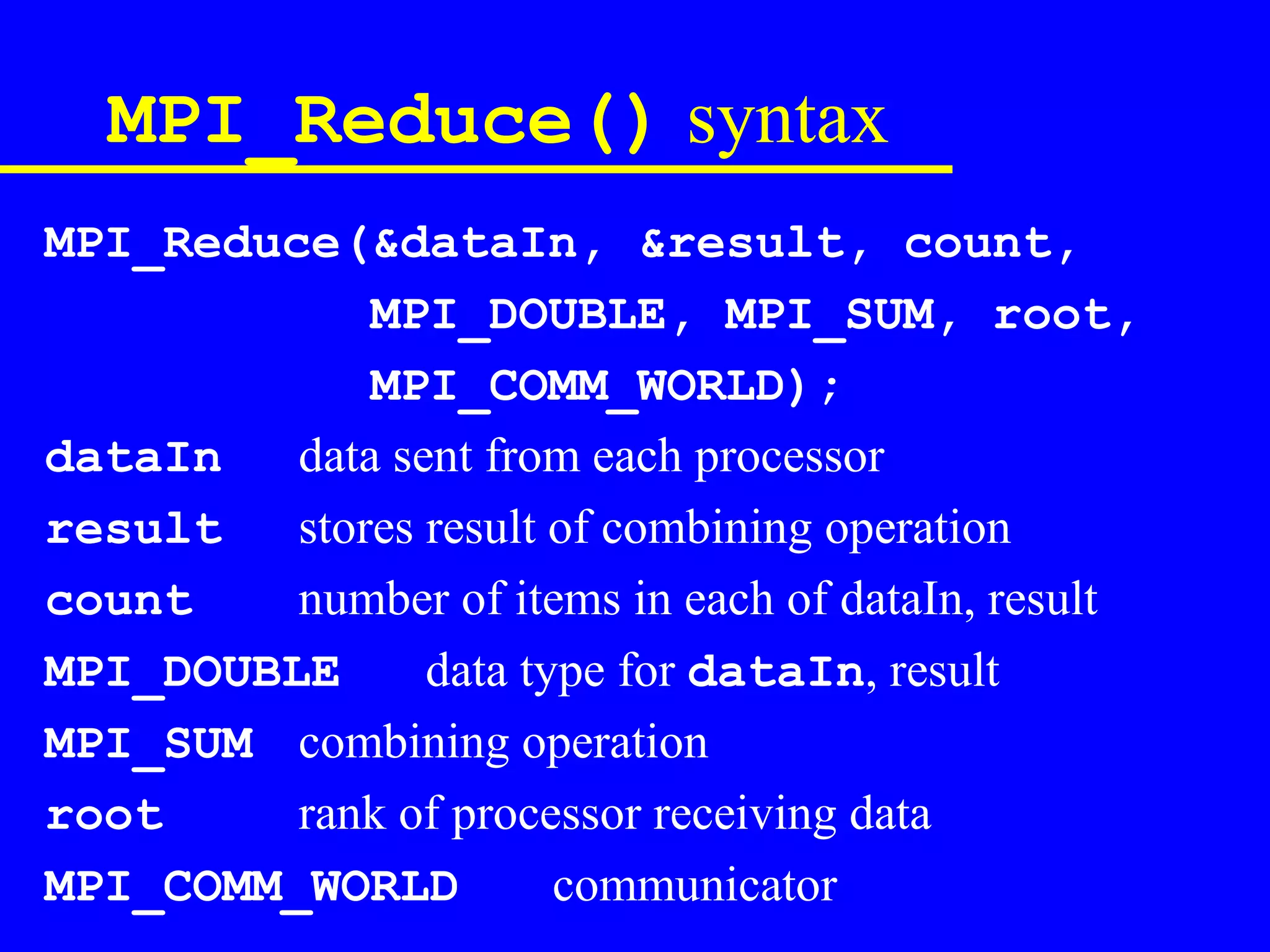
MPI_Reduce() syntax
MPI_Reduce(&dataIn, &result, count,
             MPI_DOUBLE, MPI_SUM, root,
             MPI_COMM_WORLD);
dataIn   data sent from each processor
result   stores result of combining operation
count    number of items in each of dataIn, result
MPI_DOUBLE      data type for dataIn, result
MPI_SUM combining operation
root     rank of processor receiving data
MPI_COMM_WORLD         communicator
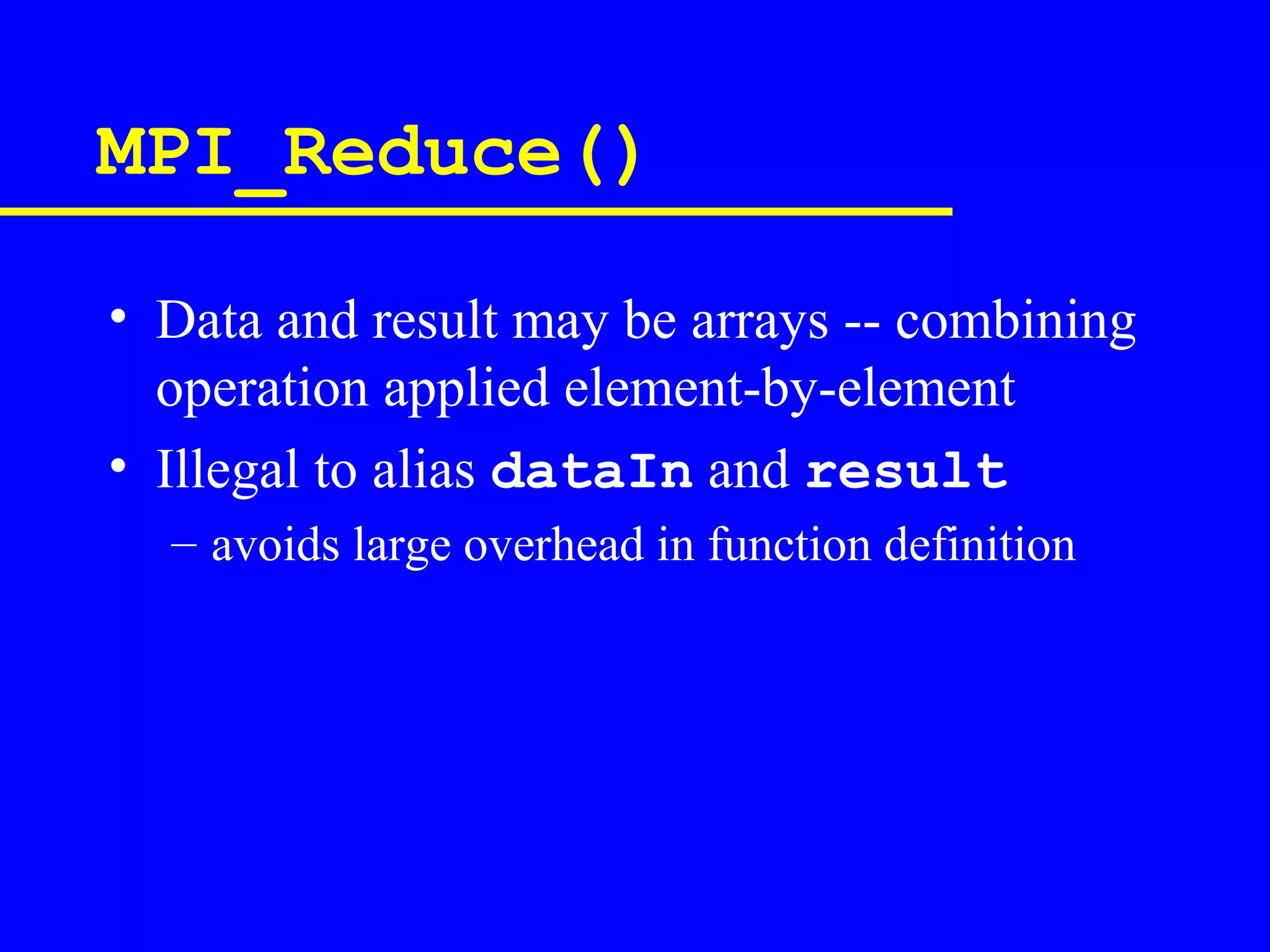
MPI_Reduce()

• Data and result may be arrays -- combining
  operation applied element-by-element
• Illegal to alias dataIn and result
  – avoids large overhead in function definition
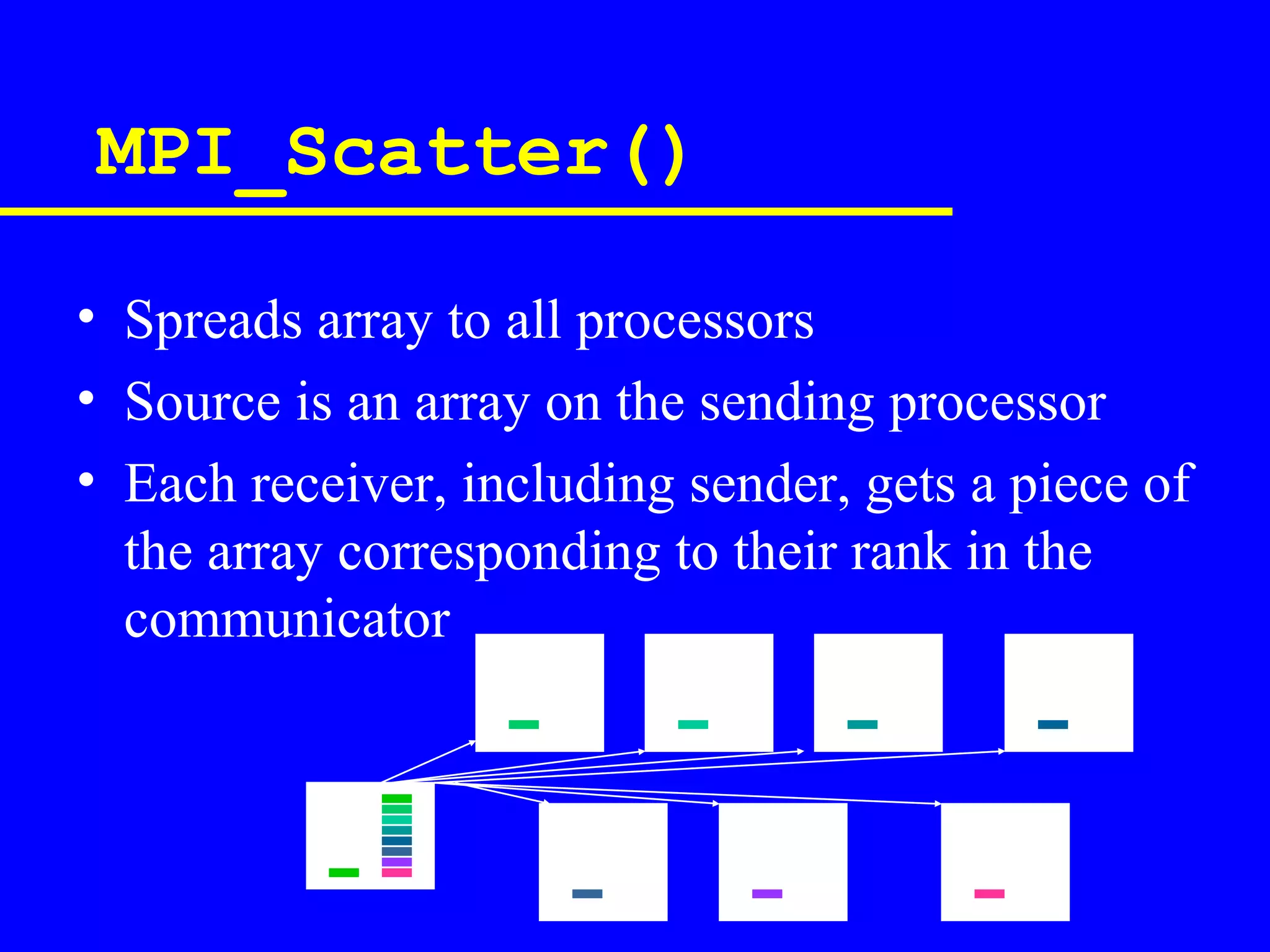
MPI_Scatter()

• Spreads array to all processors
• Source is an array on the sending processor
• Each receiver, including sender, gets a piece of
  the array corresponding to their rank in the
  communicator
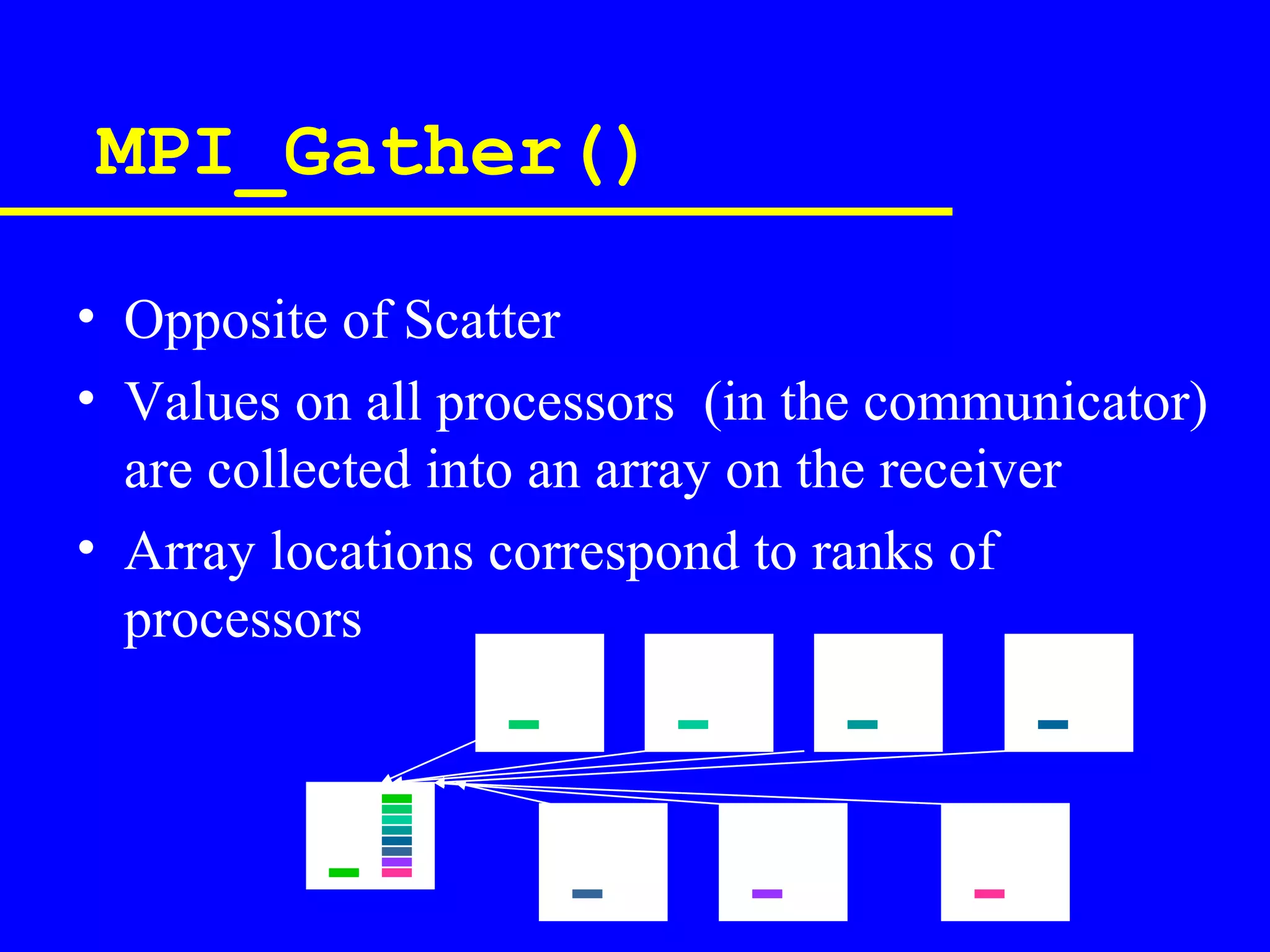
MPI_Gather()

• Opposite of Scatter
• Values on all processors (in the communicator)
  are collected into an array on the receiver
• Array locations correspond to ranks of
  processors
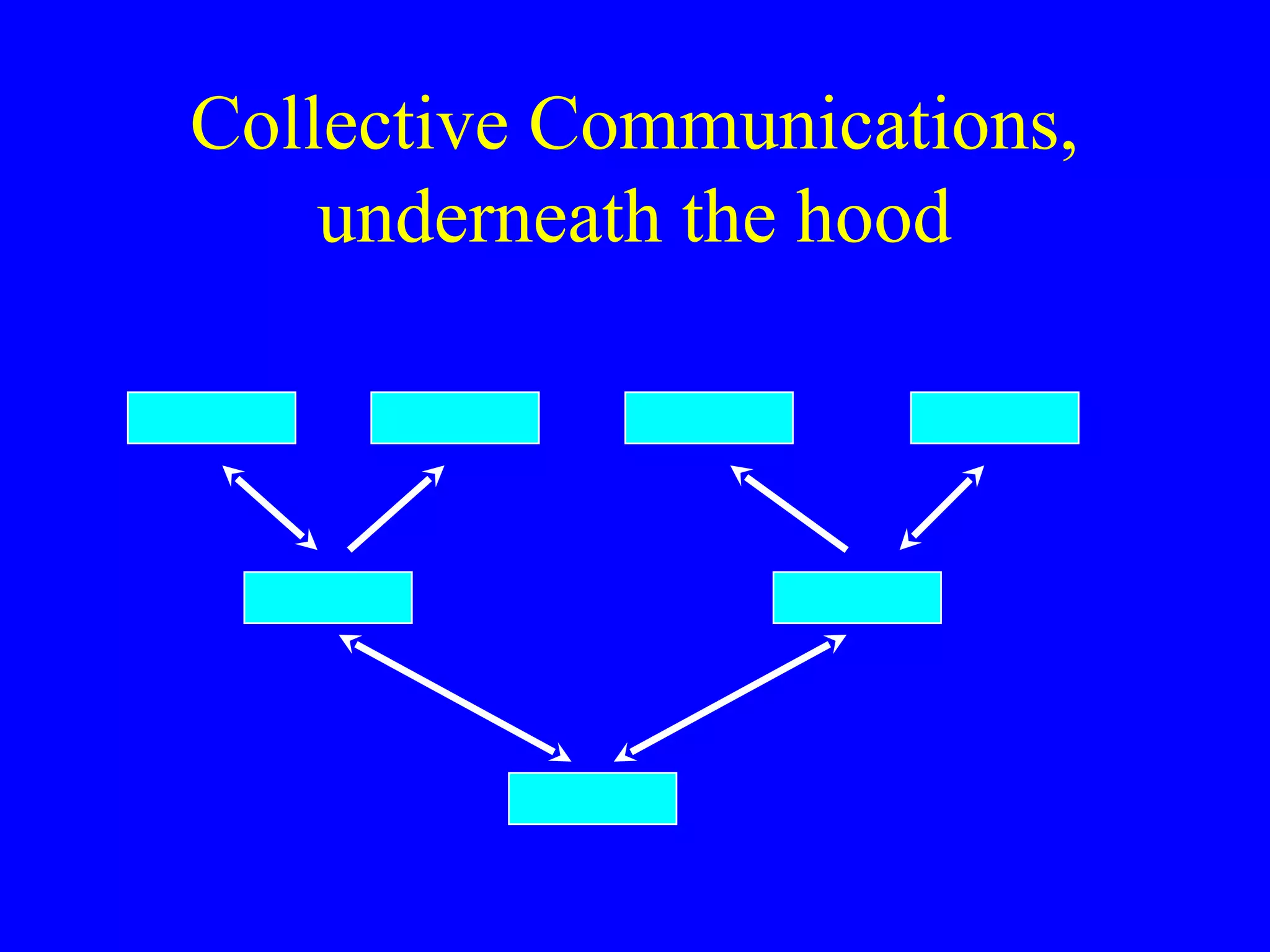
Collective Communications,
    underneath the hood
Many to Many Communications

• MPI_Allreduce
  – Syntax like reduce, except no root parameter
  – All nodes get result
• MPI_Allgather
  – Syntax like gather, except no root parameter
  – All nodes get resulting array
• Underneath -- virtual butterfly network
Data packaging
• Needed to combine irregular, non-
  contiguous data into single message
• pack -- unpack, explicitly pack data into a
  buffer, send, unpack data from buffer
• Derived data types, MPI heterogeneous data
  types which can be sent as a message
MPI_Pack() syntax
MPI_Pack(Aptr, count, MPI_DOUBLE,
   buffer, size, &pos, MPI_COMM_WORLD);

Aptr     pointer to data to pack
count    number of items to pack
         type of items
buffer   buffer being packed
size     size of buffer (in bytes)
pos      position in buffer (in bytes), updated
         communicator
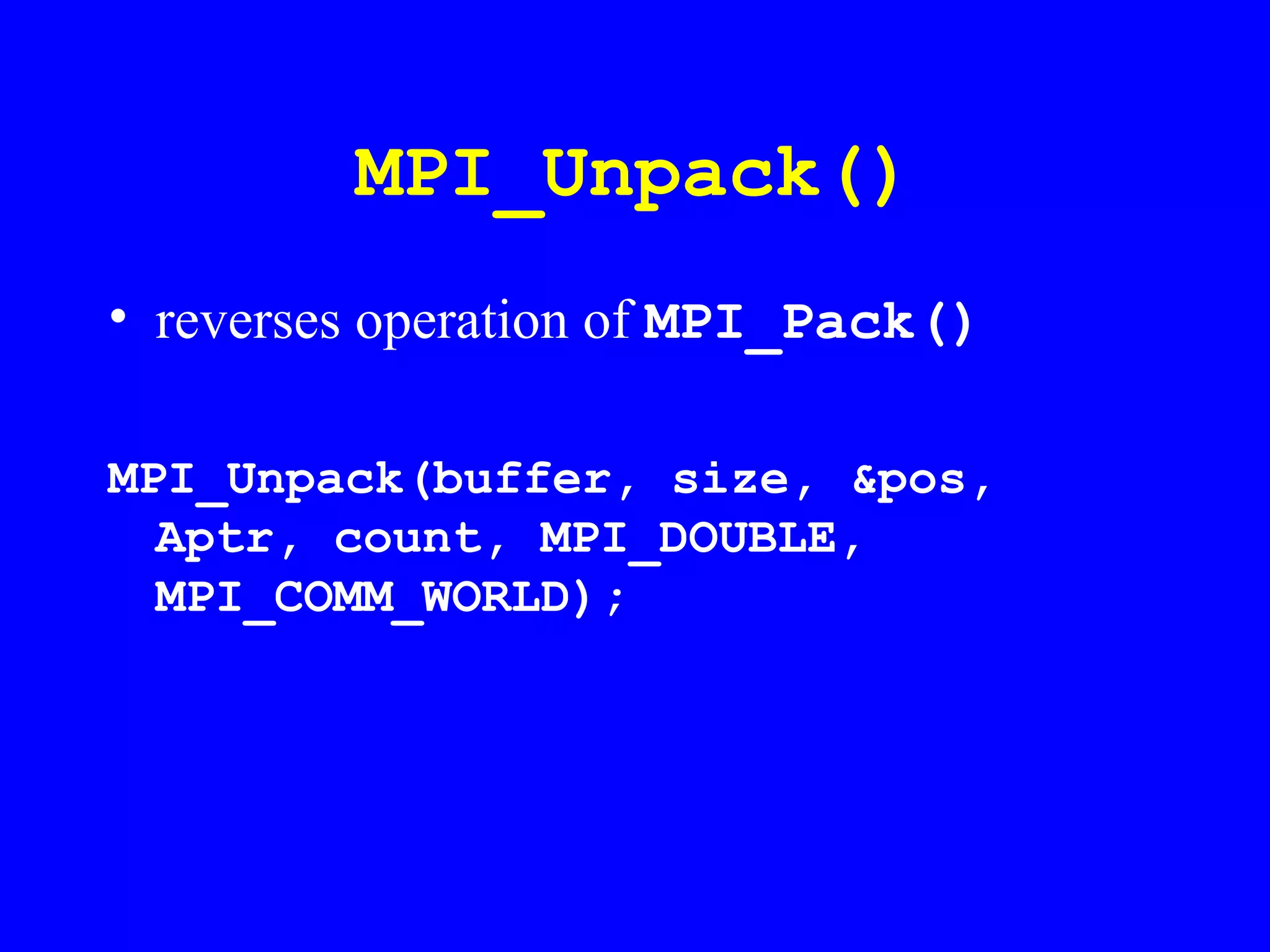
MPI_Unpack()
• reverses operation of MPI_Pack()

MPI_Unpack(buffer, size, &pos,
  Aptr, count, MPI_DOUBLE,
  MPI_COMM_WORLD);

Message passing interface

  • 1.
    MPI Communications Point toPoint Collective Communication Data Packaging
  • 2.
    Point-to-Point Communication Send andReceive • MPI_Send/MPI_Recv provide point-to- point communication – synchronization protocol is not fully specified. • what are possibilities?
  • 3.
    Send and Receive Synchronization •Fully Synchronized (Rendezvous) – Send and Receive complete simultaneously • whichever code reaches the Send/Receive first waits – provides synchronization point (up to network delays) • Buffered – Receive must wait until message is received – Send completes when message is moved to buffer clearing memory of message for reuse
  • 4.
    Send and ReceiveSynchronization • Asynchronous – Sending process may proceed immediately • does not need to wait until message is copied to buffer • must check for completion before using message memory – Receiving process may proceed immediately • will not have message to use until it is received • must check for completion before using message
  • 5.
    MPI Send andReceive • MPI_Send/MPI_Recv are synchronous, but buffering is unspecified – MPI_Recv suspends until message is received – MPI_Send may be fully synchronous or may be buffered • implementation dependent • Variations allow synchronous or buffering to be specified
  • 6.
    Asynchronous Send andReceive • MPI_Isend() / MPI_Irecv() are non-blocking. Control returns to program after call is made. • Syntax is the same as for Send and Recv, except a MPI_Request* parameter is added to Isend and replaces the MPI_Status* for receive.
  • 7.
    Detecting Completion • MPI_Wait(&request,&status) – request matches request on Isend or Irecv – status returns status equivalent to status for Recv when complete – Blocks for send until message is buffered or sent so message variable is free – Blocks for receive until message is received and ready
  • 8.
    Detecting Completion • MPI_Test(&request,flag, &status) – request, status as for MPI_Wait – does not block – flag indicates whether message is sent/received – enables code which can repeatedly check for communication completion
  • 9.
    Collective Communications • Oneto Many (Broadcast, Scatter) • Many to One (Reduce, Gather) • Many to Many (All Reduce, Allgather)
  • 10.
    Broadcast • A selectedprocessor sends to all other processors in the communicator • Any type of message can be sent • Size of message should be known by all (it could be broadcast first) • Can be optimized within system for any given architecture
  • 11.
    MPI_Bcast() Syntax MPI_Bcast(mess, count,MPI_INT, root, MPI_COMM_WORLD); mess pointer to message buffer count number of items sent MPI_INT type of item sent Note: count and type should be the same on all processors root sending processor MPI_COMM_WORLD communicator within which broadcast takes place
  • 12.
    MPI_Barrier() MPI_Barrier(MPI_COMM_WORLD); MPI_COMM_WORLD communicatorwithin which broadcast takes place provides for barrier synchronization without message of broadcast
  • 13.
    Reduce • All Processorssend to a single processor, the reverse of broadcast • Information must be combined at receiver • Several combining functions available – MAX, MIN, SUM, PROD, LAND, BAND, LOR, BOR, LXOR, BXOR, MAXLOC, MINLOC
  • 14.
    MPI_Reduce() syntax MPI_Reduce(&dataIn, &result,count, MPI_DOUBLE, MPI_SUM, root, MPI_COMM_WORLD); dataIn data sent from each processor result stores result of combining operation count number of items in each of dataIn, result MPI_DOUBLE data type for dataIn, result MPI_SUM combining operation root rank of processor receiving data MPI_COMM_WORLD communicator
  • 15.
    MPI_Reduce() • Data andresult may be arrays -- combining operation applied element-by-element • Illegal to alias dataIn and result – avoids large overhead in function definition
  • 16.
    MPI_Scatter() • Spreads arrayto all processors • Source is an array on the sending processor • Each receiver, including sender, gets a piece of the array corresponding to their rank in the communicator
  • 17.
    MPI_Gather() • Opposite ofScatter • Values on all processors (in the communicator) are collected into an array on the receiver • Array locations correspond to ranks of processors
  • 18.
    Collective Communications, underneath the hood
  • 19.
    Many to ManyCommunications • MPI_Allreduce – Syntax like reduce, except no root parameter – All nodes get result • MPI_Allgather – Syntax like gather, except no root parameter – All nodes get resulting array • Underneath -- virtual butterfly network
  • 20.
    Data packaging • Neededto combine irregular, non- contiguous data into single message • pack -- unpack, explicitly pack data into a buffer, send, unpack data from buffer • Derived data types, MPI heterogeneous data types which can be sent as a message
  • 21.
    MPI_Pack() syntax MPI_Pack(Aptr, count,MPI_DOUBLE, buffer, size, &pos, MPI_COMM_WORLD); Aptr pointer to data to pack count number of items to pack type of items buffer buffer being packed size size of buffer (in bytes) pos position in buffer (in bytes), updated communicator
  • 22.
    MPI_Unpack() • reverses operationof MPI_Pack() MPI_Unpack(buffer, size, &pos, Aptr, count, MPI_DOUBLE, MPI_COMM_WORLD);