BlueBRIDGE receives funding from the European Union’s Horizon 2020
research and innovation programme under grant agreement No. 675680 www.bluebridge-vres.eu
Konstantinos Bovolis
kbovolis@i2s.gr
Machine Learning methods to
estimate the performance of aquafarms
Supporting Blue Growth with
innovative applications based on
EU e-infrastructures
14-15 February 2018, Brussels
Outline
Challenges and Needs
BlueBRIDGE Solution
BlueEconomy: Performance Evaluation, Benchmarking and
Decision Making
Case Study
Conclusion
15/2/2018 2
“Supporting Blue Growth with innovative applications based on
EU e-infrastructures”, 14-15 February 2018, Brussels
Challenges that have to be addressed:
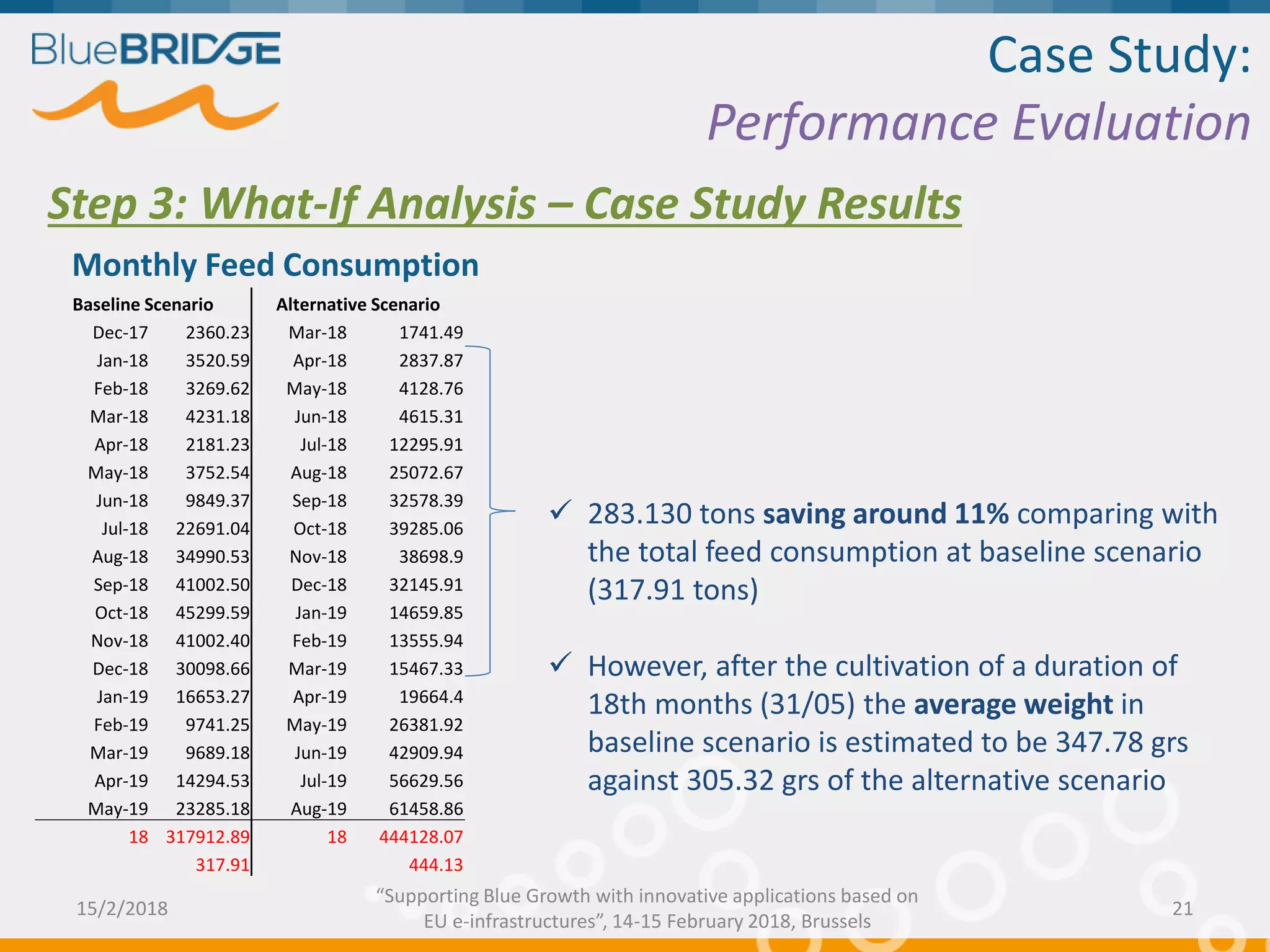
• maintaining the economic viability of the sector by
reducing costs and increasing production
• guaranteeing high quality food and animal welfare
• addressing environmental concerns.
All aquaculture producers are concerned about improving the
performance of their companies in terms of cost, feed
conversion, growth rate and mortality and at the same time, be
sustainable and environmental friendly
Challenges and Needs
15/2/2018 3
“Supporting Blue Growth with innovative applications based on
EU e-infrastructures”, 14-15 February 2018, Brussels
It is not only equipment and
hardware!
Unfortunately, answering this question is not that simple
• Aquafarmers can invest in the latest technology for cages or on
the most advanced feeding systems but they cannot forget two
key aspects:
i. an aquaculture comes with its own array of environmental
challenges that have a huge impact on production system;
ii. an aquaculture business can be sustainable only if they are
able to continuously monitor and improve its performance
15/2/2018 4
“Supporting Blue Growth with innovative applications based on
EU e-infrastructures”, 14-15 February 2018, Brussels
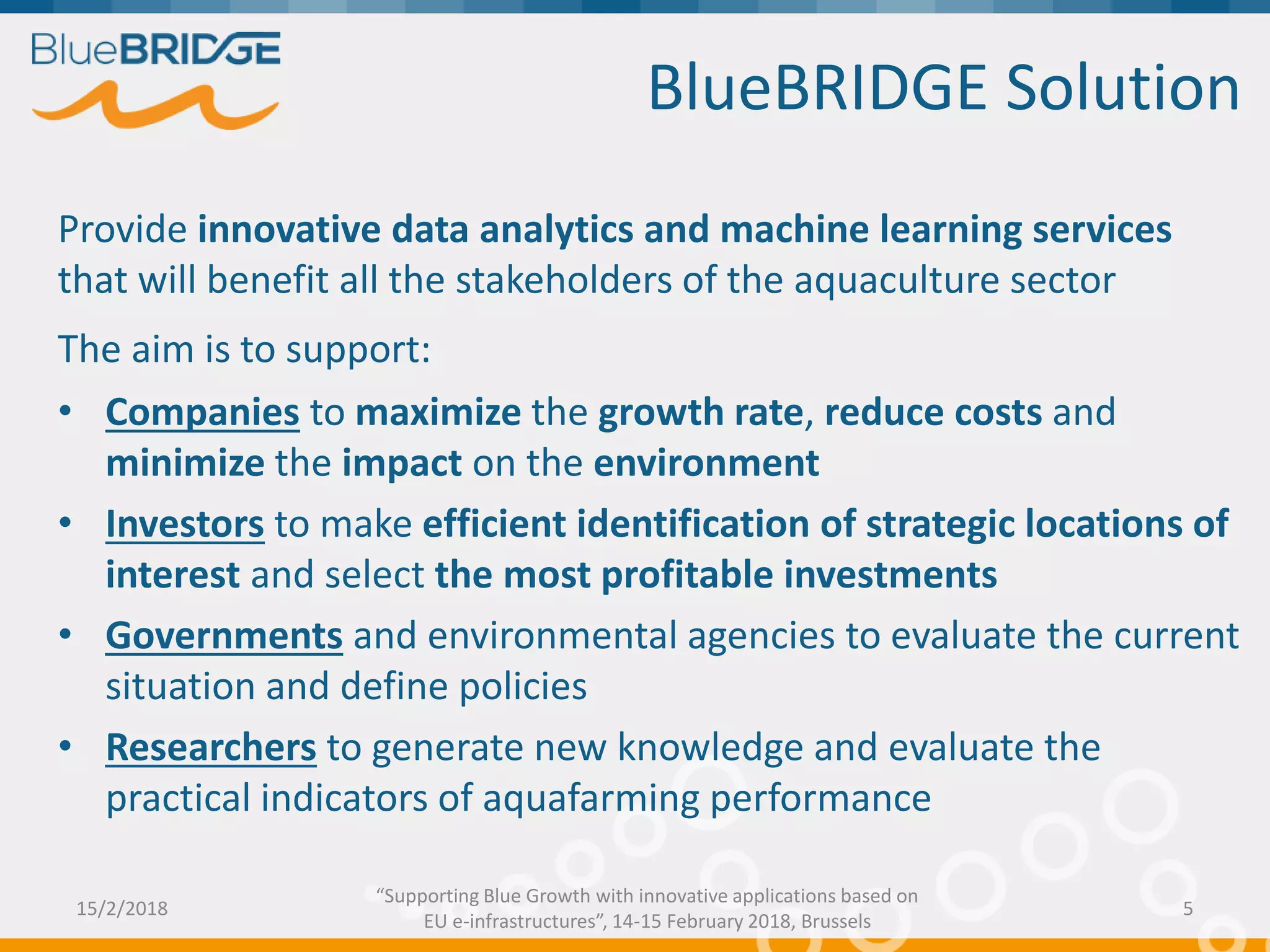
Provide innovative data analytics and machine learning services
that will benefit all the stakeholders of the aquaculture sector
The aim is to support:
• Companies to maximize the growth rate, reduce costs and
minimize the impact on the environment
• Investors to make efficient identification of strategic locations of
interest and select the most profitable investments
• Governments and environmental agencies to evaluate the current
situation and define policies
• Researchers to generate new knowledge and evaluate the
practical indicators of aquafarming performance
BlueBRIDGE Solution
15/2/2018 5
“Supporting Blue Growth with innovative applications based on
EU e-infrastructures”, 14-15 February 2018, Brussels
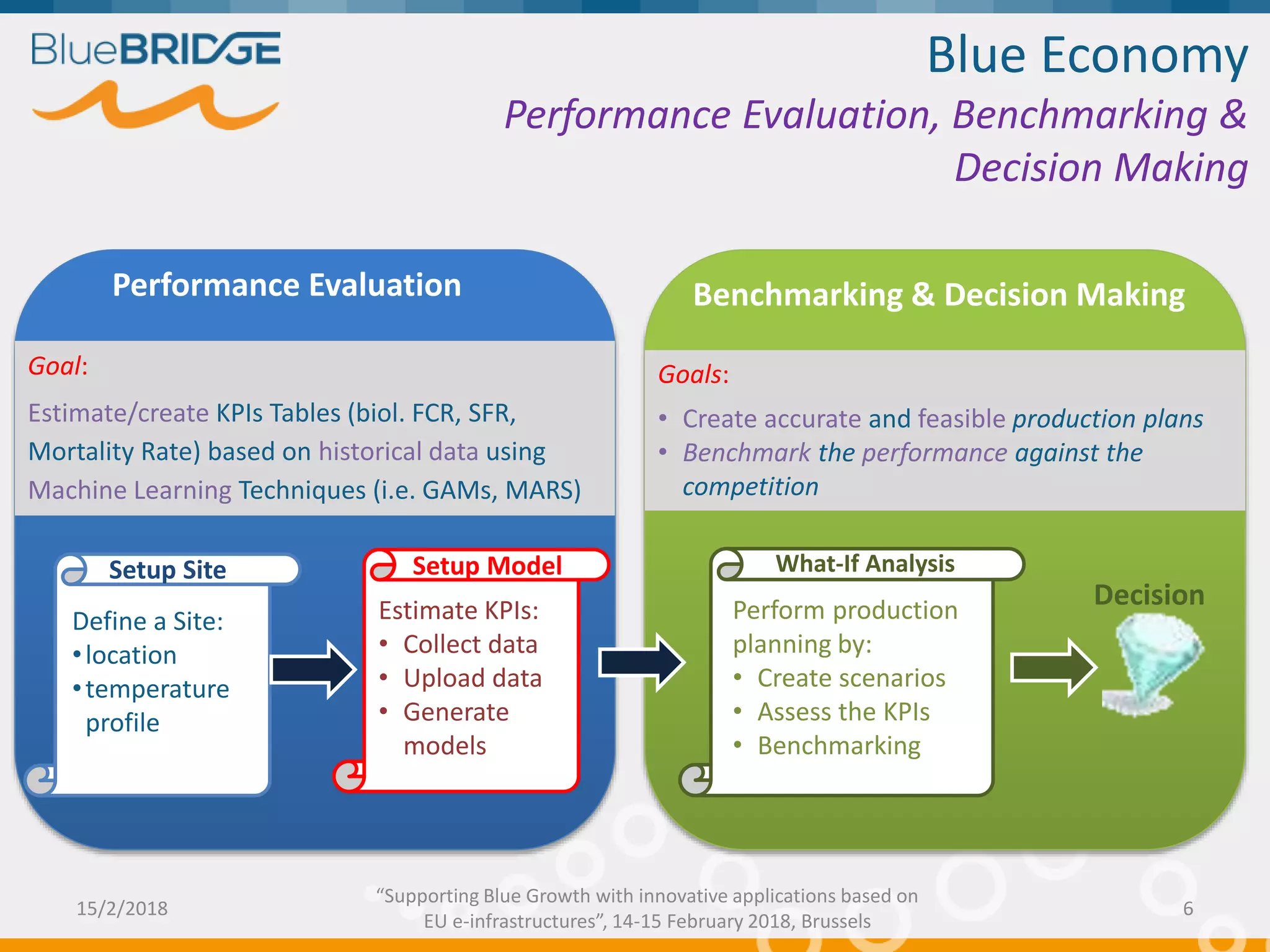
Blue Economy
Performance Evaluation, Benchmarking &
Decision Making
Goal:
Estimate/create KPIs Tables (biol. FCR, SFR,
Mortality Rate) based on historical data using
Machine Learning Techniques (i.e. GAMs, MARS)
Define a Site:
•location
•temperature
profile
Setup Site
Performance Evaluation
Estimate KPIs:
• Collect data
• Upload data
• Generate
models
Setup Model
Benchmarking & Decision Making
Goals:
• Create accurate and feasible production plans
• Benchmark the performance against the
competition
Perform production
planning by:
• Create scenarios
• Assess the KPIs
• Benchmarking
What-If Analysis
Decision
15/2/2018 6
“Supporting Blue Growth with innovative applications based on
EU e-infrastructures”, 14-15 February 2018, Brussels
Aquafarms engagement
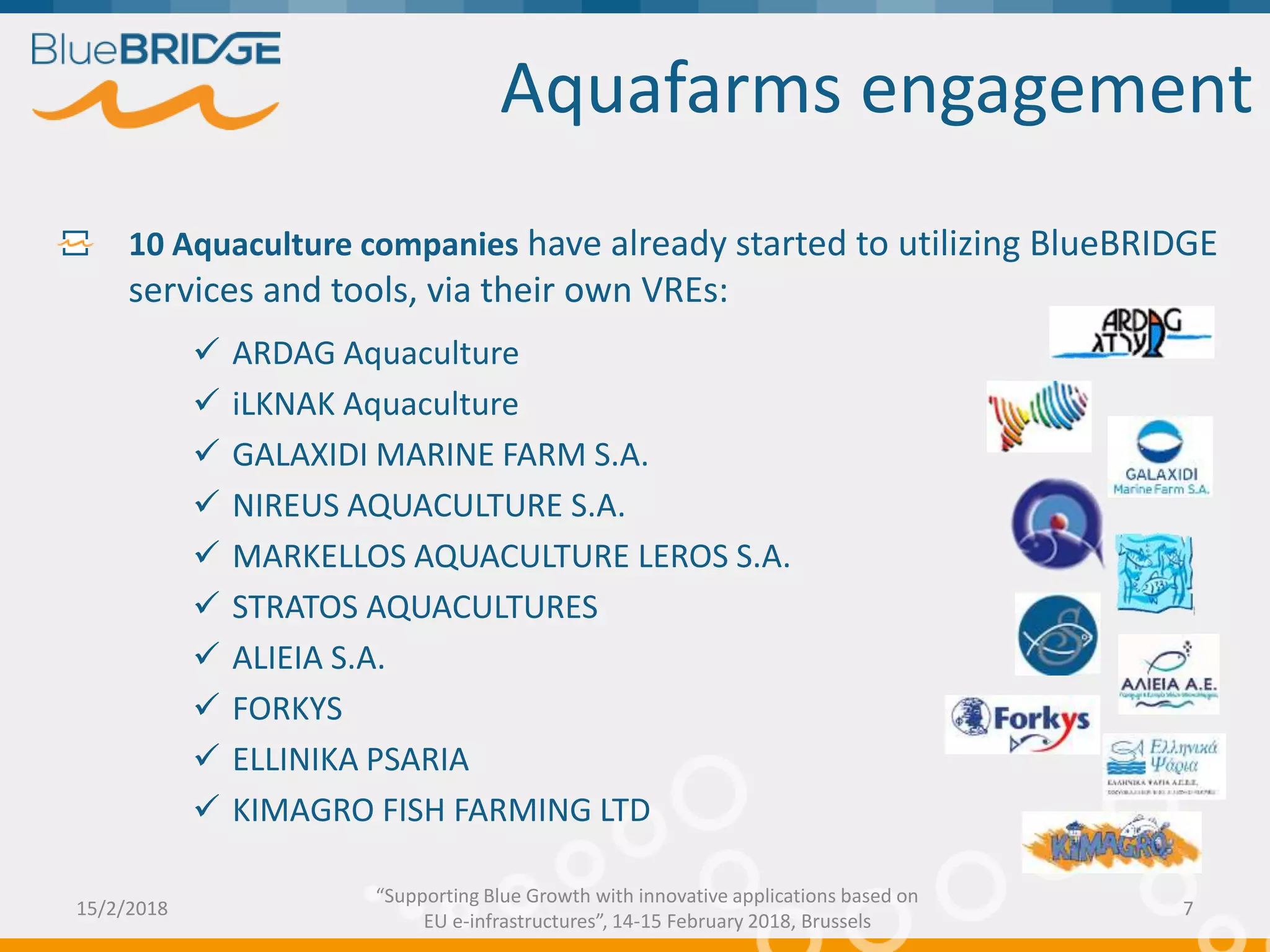
10 Aquaculture companies have already started to utilizing BlueBRIDGE
services and tools, via their own VREs:
 ARDAG Aquaculture
 iLKNAK Aquaculture
 GALAXIDI MARINE FARM S.A.
 NIREUS AQUACULTURE S.A.
 MARKELLOS AQUACULTURE LEROS S.A.
 STRATOS AQUACULTURES
 ALIEIA S.A.
 FORKYS
 ELLINIKA PSARIA
 KIMAGRO FISH FARMING LTD
15/2/2018 7
“Supporting Blue Growth with innovative applications based on
EU e-infrastructures”, 14-15 February 2018, Brussels
Case Study:
Performance Evaluation,
Benchmarking &Decision Making
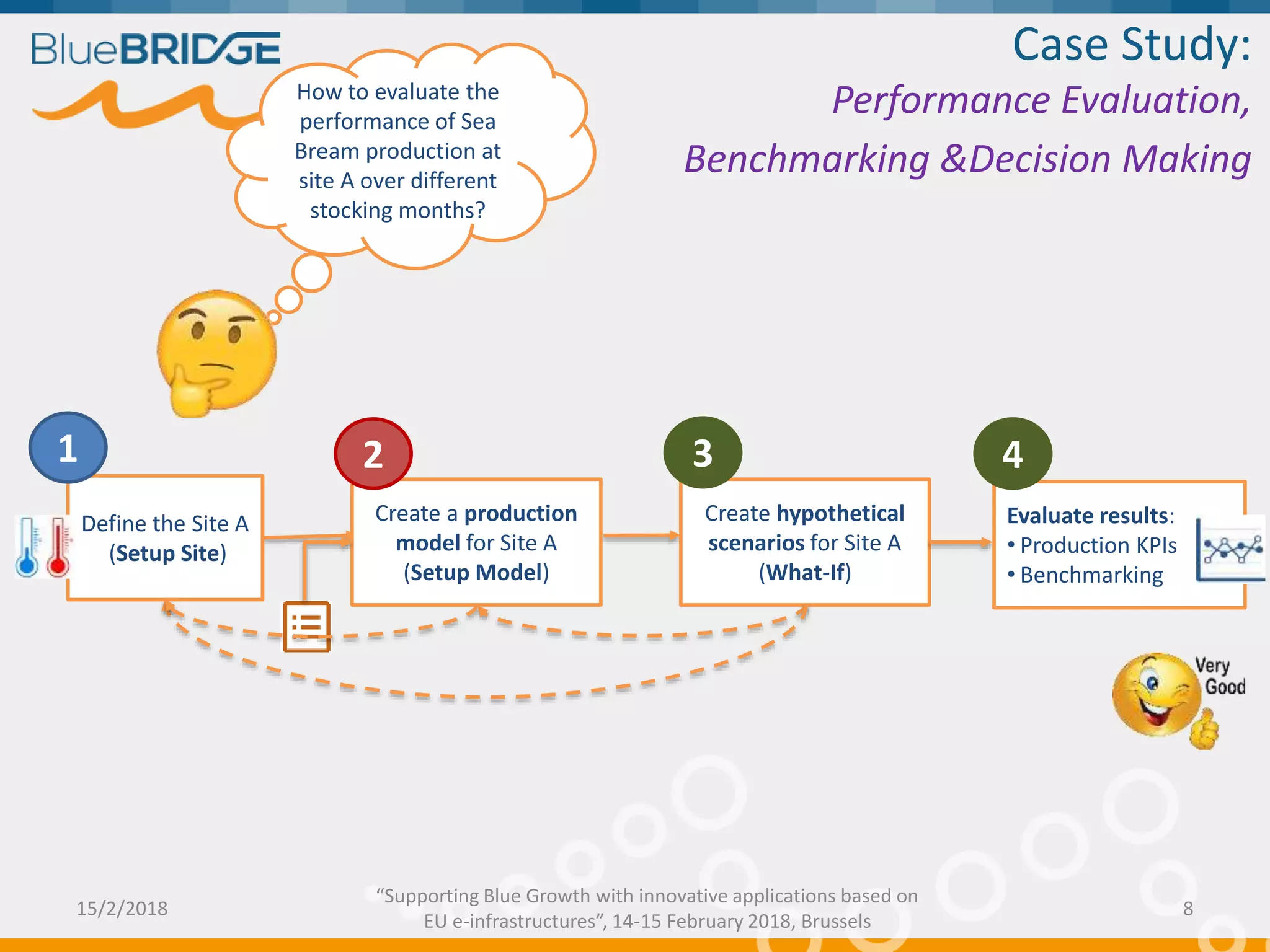
How to evaluate the
performance of Sea
Bream production at
site A over different
stocking months?
Define the Site A
(Setup Site)
1
Create a production
model for Site A
(Setup Model)
2
Create hypothetical
scenarios for Site A
(What-If)
3
Evaluate results:
• Production KPIs
• Benchmarking
4
15/2/2018 8
“Supporting Blue Growth with innovative applications based on
EU e-infrastructures”, 14-15 February 2018, Brussels
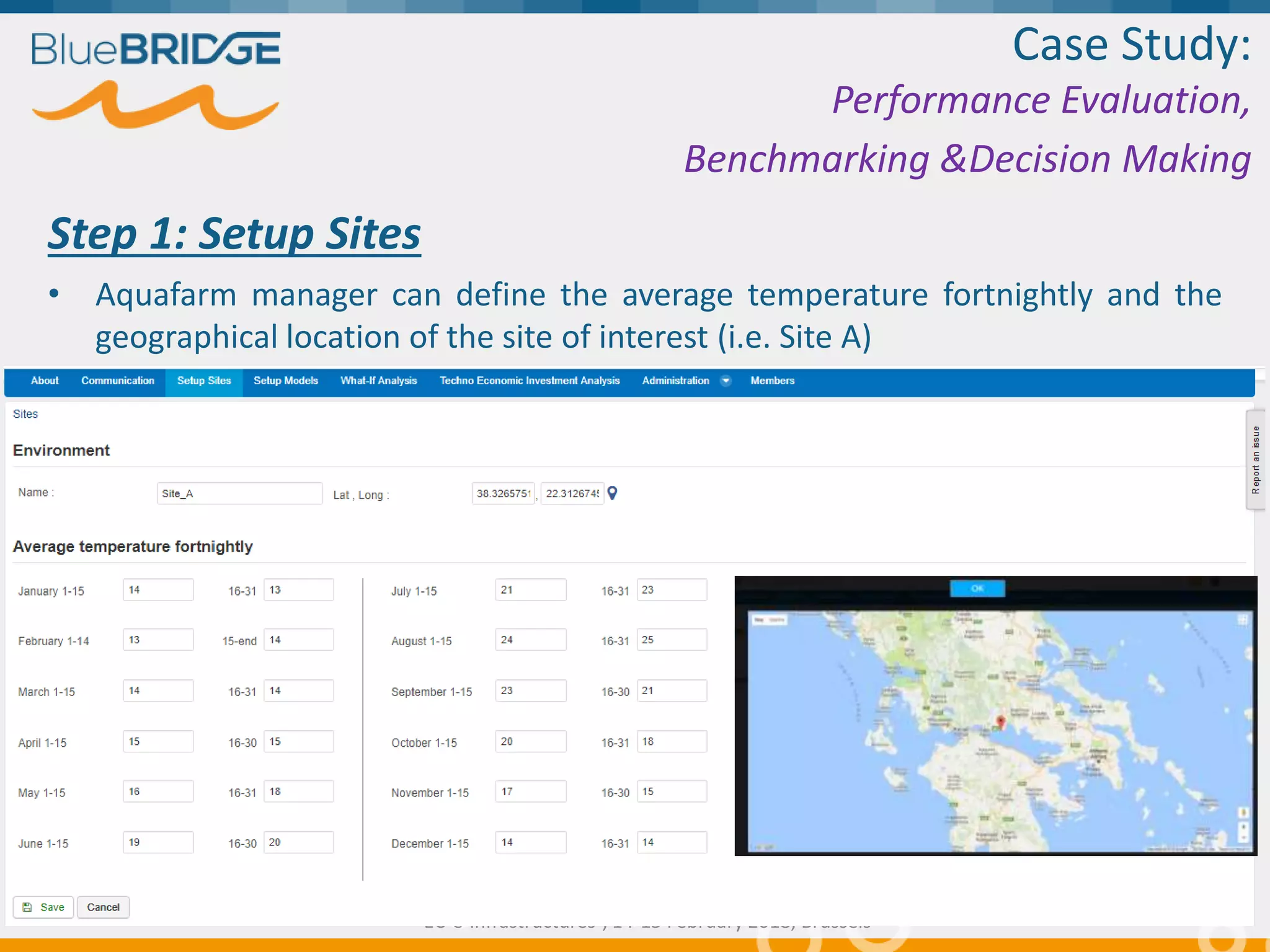
Step 1: Setup Sites
• Aquafarm manager can define the average temperature fortnightly and the
geographical location of the site of interest (i.e. Site A)
Case Study:
Performance Evaluation,
Benchmarking &Decision Making
15/2/2018 9
“Supporting Blue Growth with innovative applications based on
EU e-infrastructures”, 14-15 February 2018, Brussels
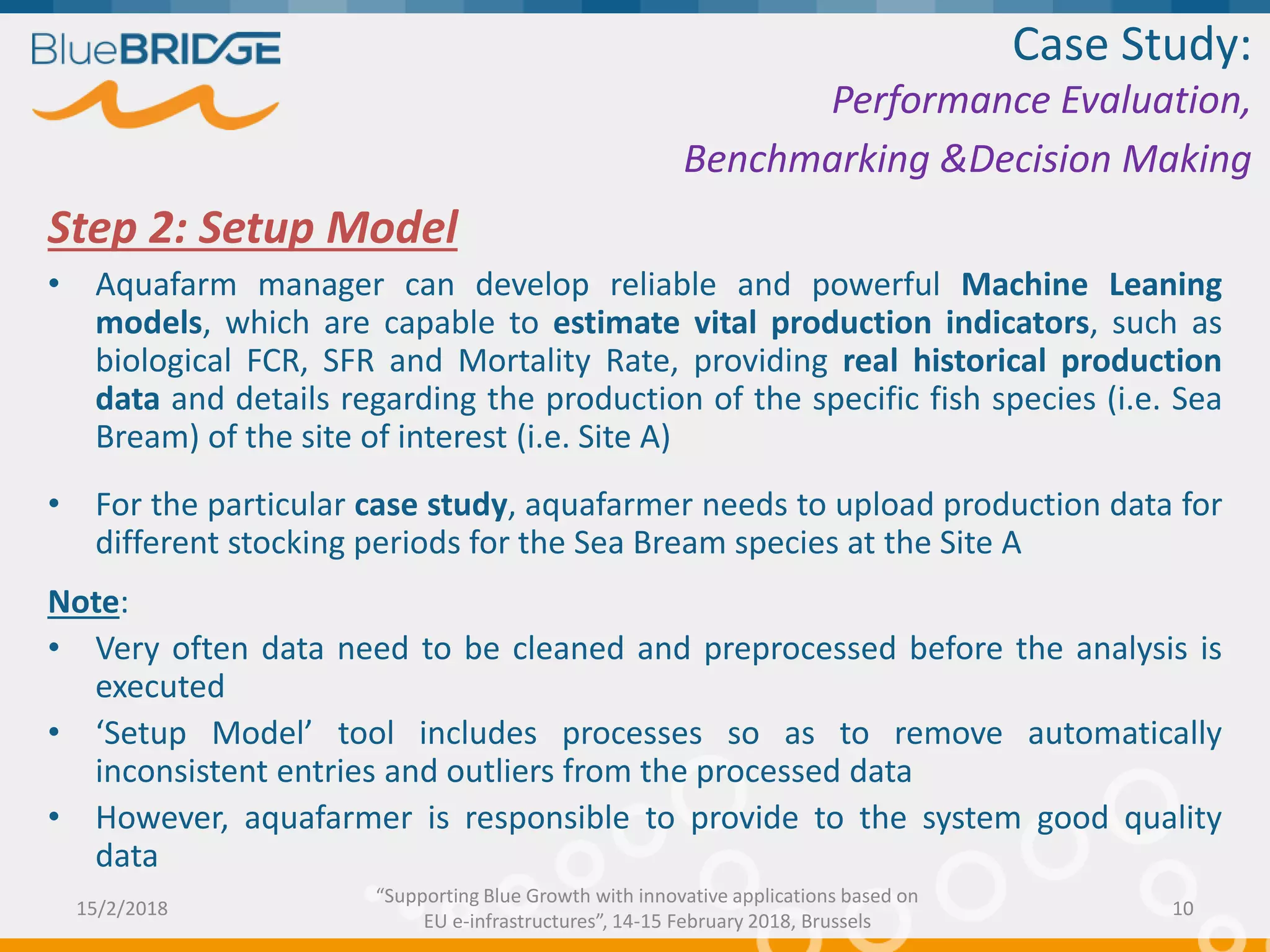
Step 2: Setup Model
• Aquafarm manager can develop reliable and powerful Machine Leaning
models, which are capable to estimate vital production indicators, such as
biological FCR, SFR and Mortality Rate, providing real historical production
data and details regarding the production of the specific fish species (i.e. Sea
Bream) of the site of interest (i.e. Site A)
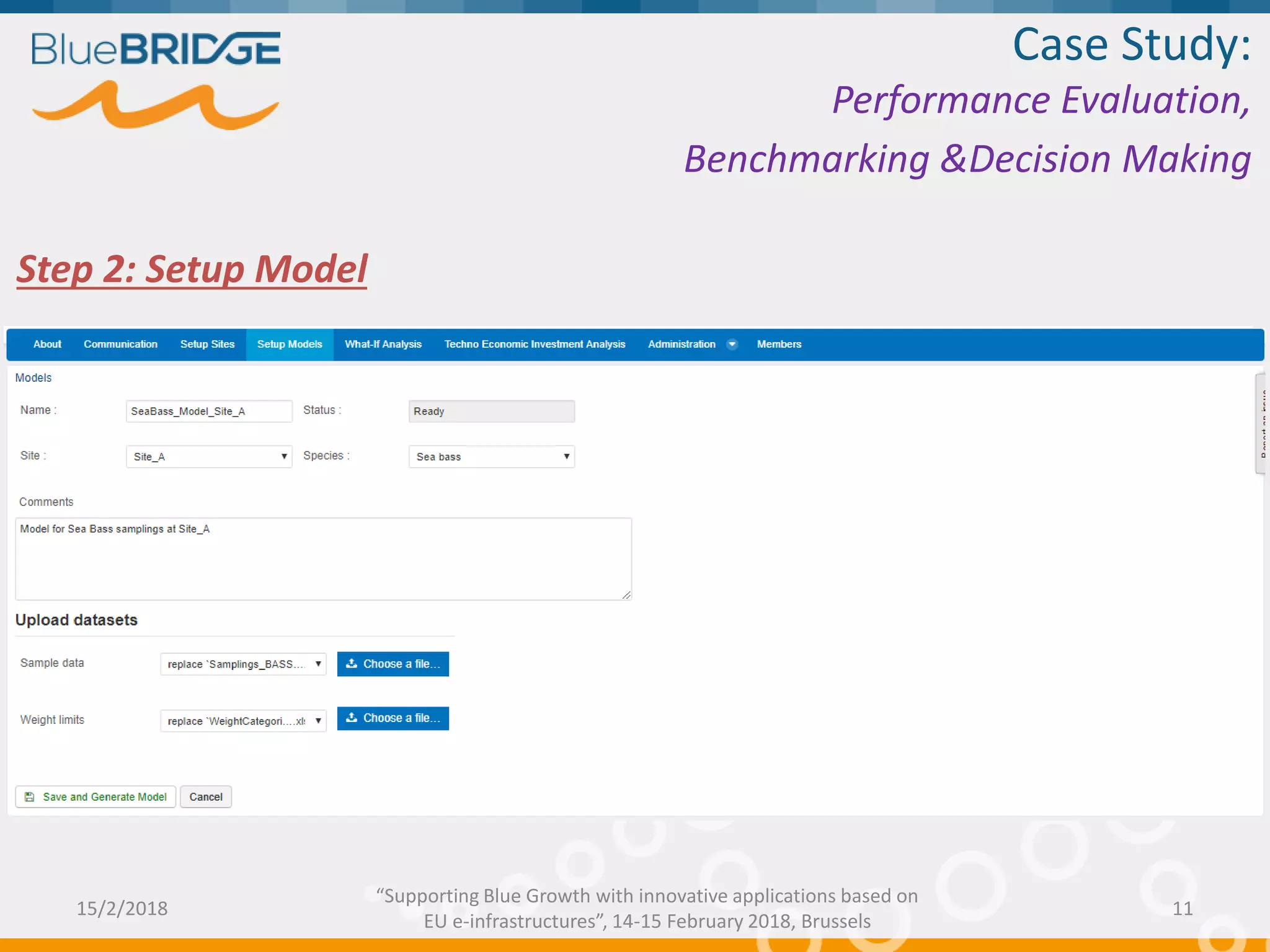
• For the particular case study, aquafarmer needs to upload production data for
different stocking periods for the Sea Bream species at the Site A
Note:
• Very often data need to be cleaned and preprocessed before the analysis is
executed
• ‘Setup Model’ tool includes processes so as to remove automatically
inconsistent entries and outliers from the processed data
• However, aquafarmer is responsible to provide to the system good quality
data
Case Study:
Performance Evaluation,
Benchmarking &Decision Making
15/2/2018 10
“Supporting Blue Growth with innovative applications based on
EU e-infrastructures”, 14-15 February 2018, Brussels
Step 2: Setup Model
Case Study:
Performance Evaluation,
Benchmarking &Decision Making
15/2/2018 11
“Supporting Blue Growth with innovative applications based on
EU e-infrastructures”, 14-15 February 2018, Brussels
Step 2: Setup Model - Results
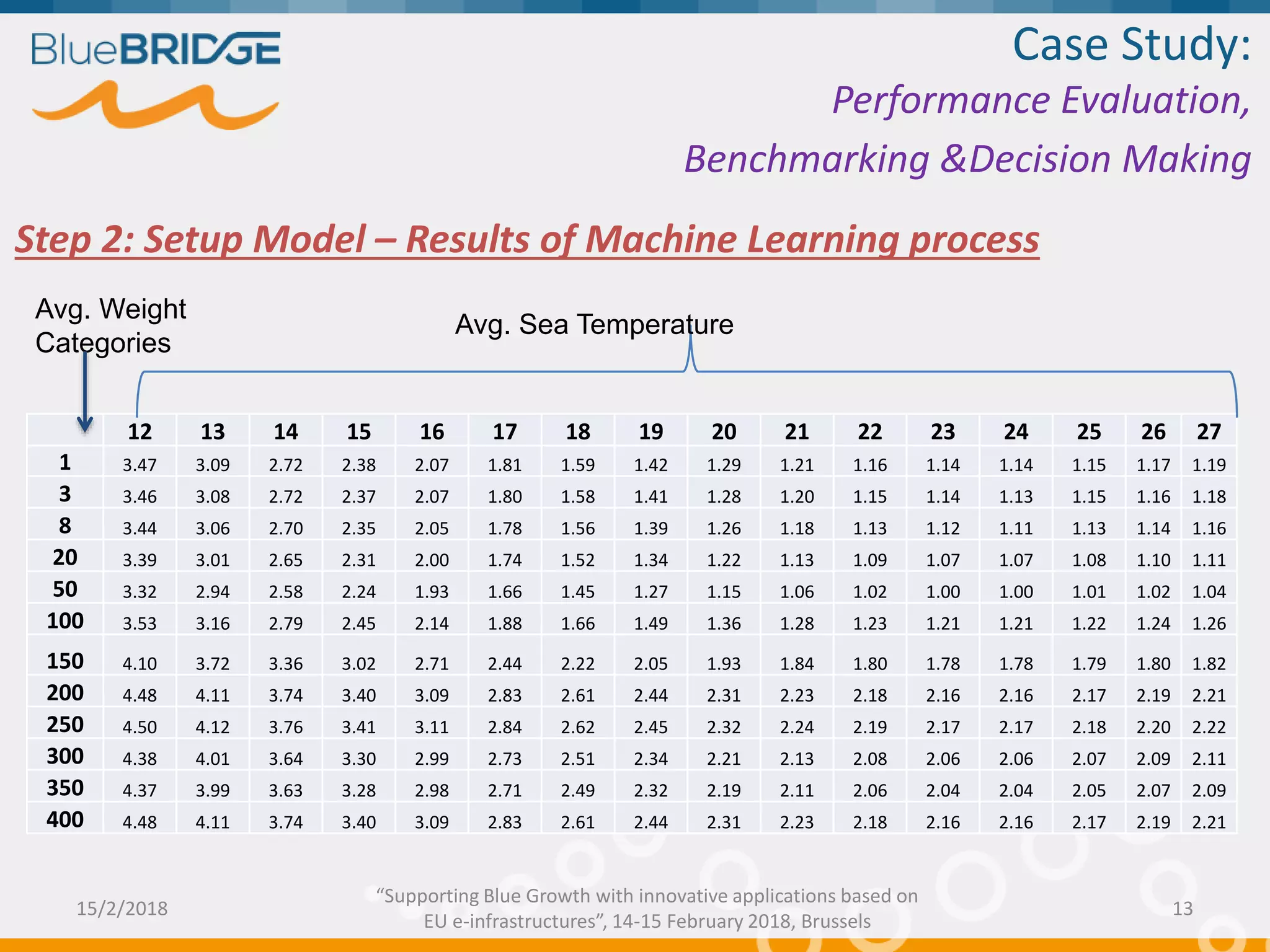
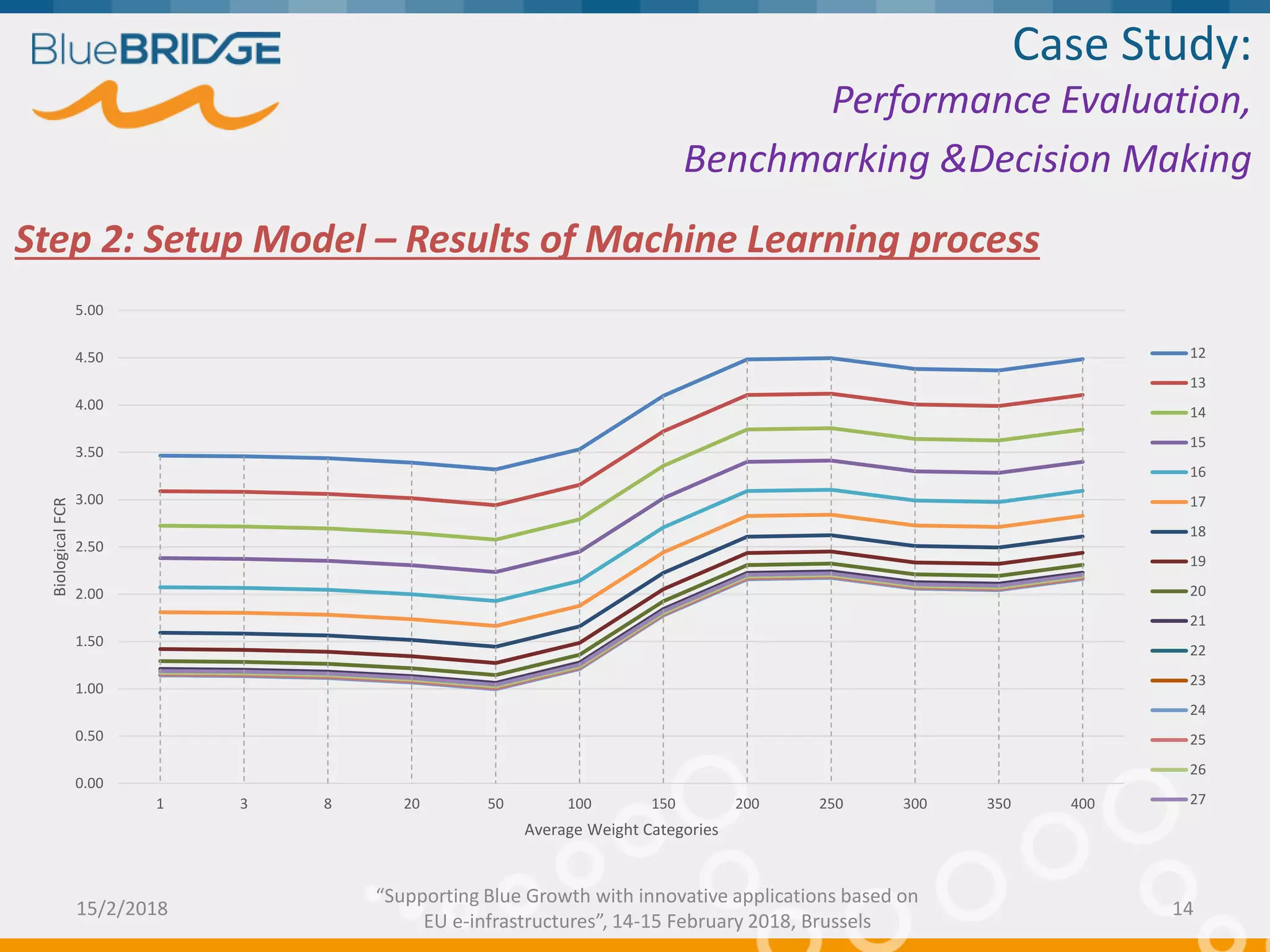
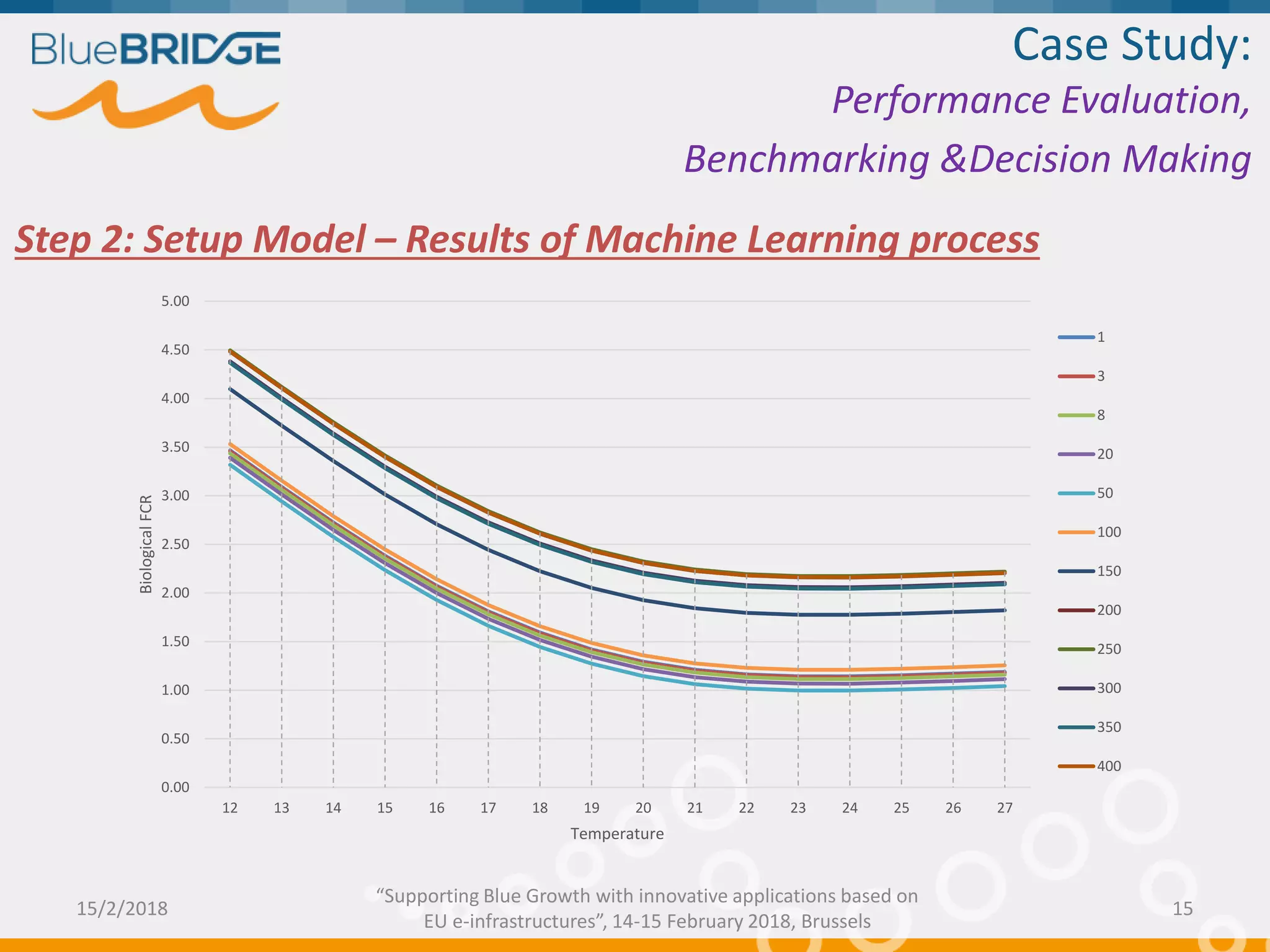
• The outcome of the modeling process is a simulation of the relationship
between growth, feeding and temperature
• Development of tables for
 Biological FCR,
 Feeding Rate and
 Mortality Rate
in terms of fish weight (Avg. Weight Categories) and temperatures (Avg. Sea
Temperature)
Case Study:
Performance Evaluation,
Benchmarking &Decision Making
15/2/2018 12
“Supporting Blue Growth with innovative applications based on
EU e-infrastructures”, 14-15 February 2018, Brussels
12 13 14 15 16 17 18 19 20 21 22 23 24 25 26 27
1 3.47 3.09 2.72 2.38 2.07 1.81 1.59 1.42 1.29 1.21 1.16 1.14 1.14 1.15 1.17 1.19
3 3.46 3.08 2.72 2.37 2.07 1.80 1.58 1.41 1.28 1.20 1.15 1.14 1.13 1.15 1.16 1.18
8 3.44 3.06 2.70 2.35 2.05 1.78 1.56 1.39 1.26 1.18 1.13 1.12 1.11 1.13 1.14 1.16
20 3.39 3.01 2.65 2.31 2.00 1.74 1.52 1.34 1.22 1.13 1.09 1.07 1.07 1.08 1.10 1.11
50 3.32 2.94 2.58 2.24 1.93 1.66 1.45 1.27 1.15 1.06 1.02 1.00 1.00 1.01 1.02 1.04
100 3.53 3.16 2.79 2.45 2.14 1.88 1.66 1.49 1.36 1.28 1.23 1.21 1.21 1.22 1.24 1.26
150 4.10 3.72 3.36 3.02 2.71 2.44 2.22 2.05 1.93 1.84 1.80 1.78 1.78 1.79 1.80 1.82
200 4.48 4.11 3.74 3.40 3.09 2.83 2.61 2.44 2.31 2.23 2.18 2.16 2.16 2.17 2.19 2.21
250 4.50 4.12 3.76 3.41 3.11 2.84 2.62 2.45 2.32 2.24 2.19 2.17 2.17 2.18 2.20 2.22
300 4.38 4.01 3.64 3.30 2.99 2.73 2.51 2.34 2.21 2.13 2.08 2.06 2.06 2.07 2.09 2.11
350 4.37 3.99 3.63 3.28 2.98 2.71 2.49 2.32 2.19 2.11 2.06 2.04 2.04 2.05 2.07 2.09
400 4.48 4.11 3.74 3.40 3.09 2.83 2.61 2.44 2.31 2.23 2.18 2.16 2.16 2.17 2.19 2.21
Step 2: Setup Model – Results of Machine Learning process
Avg. Sea Temperature
Avg. Weight
Categories
Case Study:
Performance Evaluation,
Benchmarking &Decision Making
15/2/2018 13
“Supporting Blue Growth with innovative applications based on
EU e-infrastructures”, 14-15 February 2018, Brussels
Step 2: Setup Model – Results of Machine Learning process
0.00
0.50
1.00
1.50
2.00
2.50
3.00
3.50
4.00
4.50
5.00
1 3 8 20 50 100 150 200 250 300 350 400
BiologicalFCR
Average Weight Categories
12
13
14
15
16
17
18
19
20
21
22
23
24
25
26
27
Case Study:
Performance Evaluation,
Benchmarking &Decision Making
15/2/2018 14
“Supporting Blue Growth with innovative applications based on
EU e-infrastructures”, 14-15 February 2018, Brussels
Step 2: Setup Model – Results of Machine Learning process
0.00
0.50
1.00
1.50
2.00
2.50
3.00
3.50
4.00
4.50
5.00
12 13 14 15 16 17 18 19 20 21 22 23 24 25 26 27
BiologicalFCR
Temperature
1
3
8
20
50
100
150
200
250
300
350
400
Case Study:
Performance Evaluation,
Benchmarking &Decision Making
15/2/2018 15
“Supporting Blue Growth with innovative applications based on
EU e-infrastructures”, 14-15 February 2018, Brussels
Case Study:
Performance Evaluation
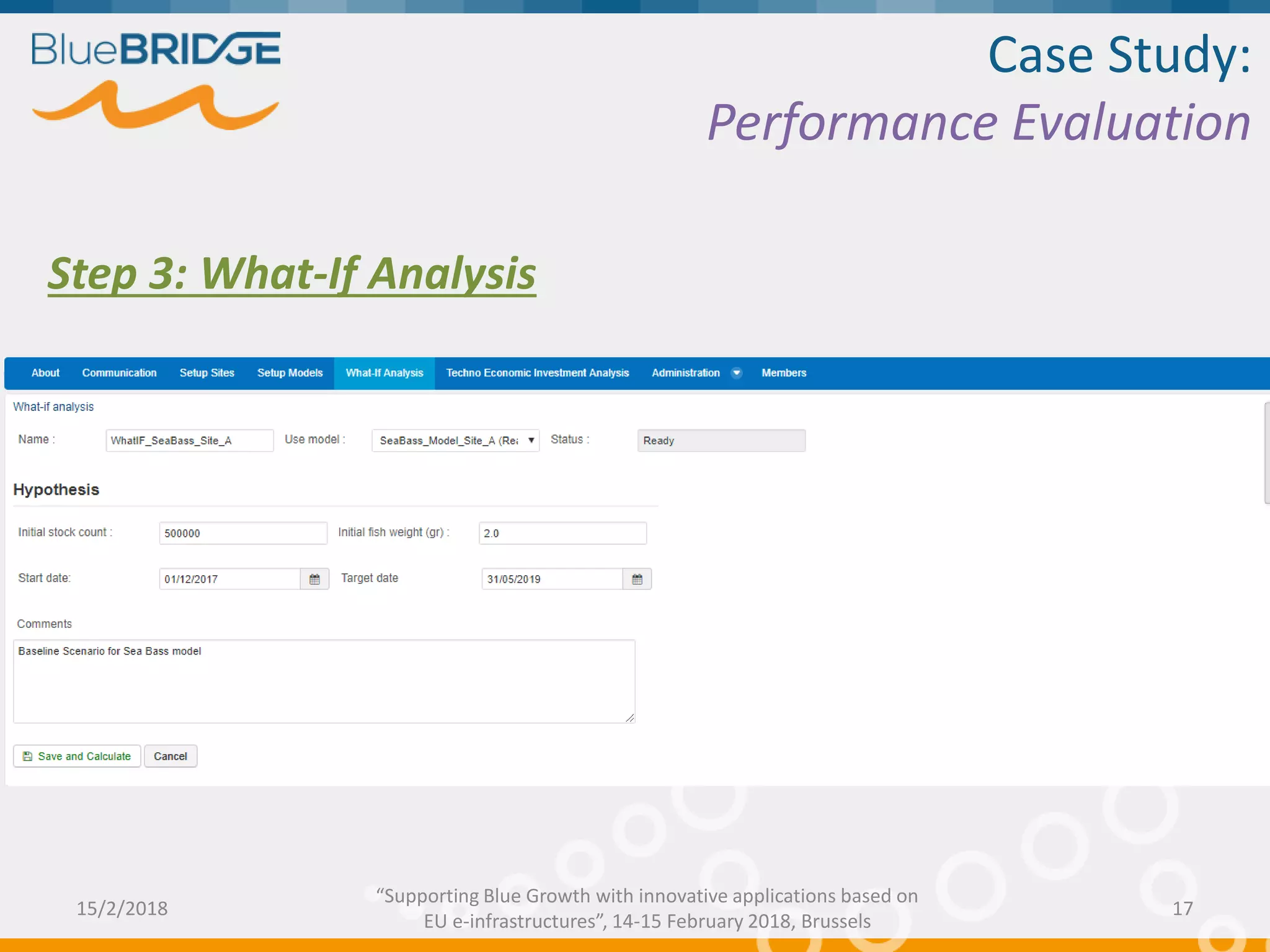
Step 3: What-If Analysis
• Aquafarm manager can draw a hypothesis and evaluate it, using an already
existing production model
• The ‘What-If Analysis’ tool:
 calculates production indicators which are able to estimate the
performance of the fish growth
 presents the results in a meaningful tables and interactive graphs
 benchmark the production performance against competition over the
same hypothesis
15/2/2018 16
“Supporting Blue Growth with innovative applications based on
EU e-infrastructures”, 14-15 February 2018, Brussels
Case Study:
Performance Evaluation
Step 3: What-If Analysis
15/2/2018 17
“Supporting Blue Growth with innovative applications based on
EU e-infrastructures”, 14-15 February 2018, Brussels
Case Study:
Performance Evaluation
Step 3: What-If Analysis – Case Study
• Baseline scenario: evaluate the Sea Bream production performance whether a
population of 500.000 fish will be stocked at “Site A” in December (01/12)
with initial average weight 2 grs and they are cultivated for 18 months (harvest
date 31/05)
• Alternative scenario: stock the fish 3 months later, namely on March (01/03).
Thus, the harvest date will be at the end of August (31/08). The other
conditions are similar with baseline scenario
15/2/2018 18
“Supporting Blue Growth with innovative applications based on
EU e-infrastructures”, 14-15 February 2018, Brussels
Case Study:
Performance Evaluation
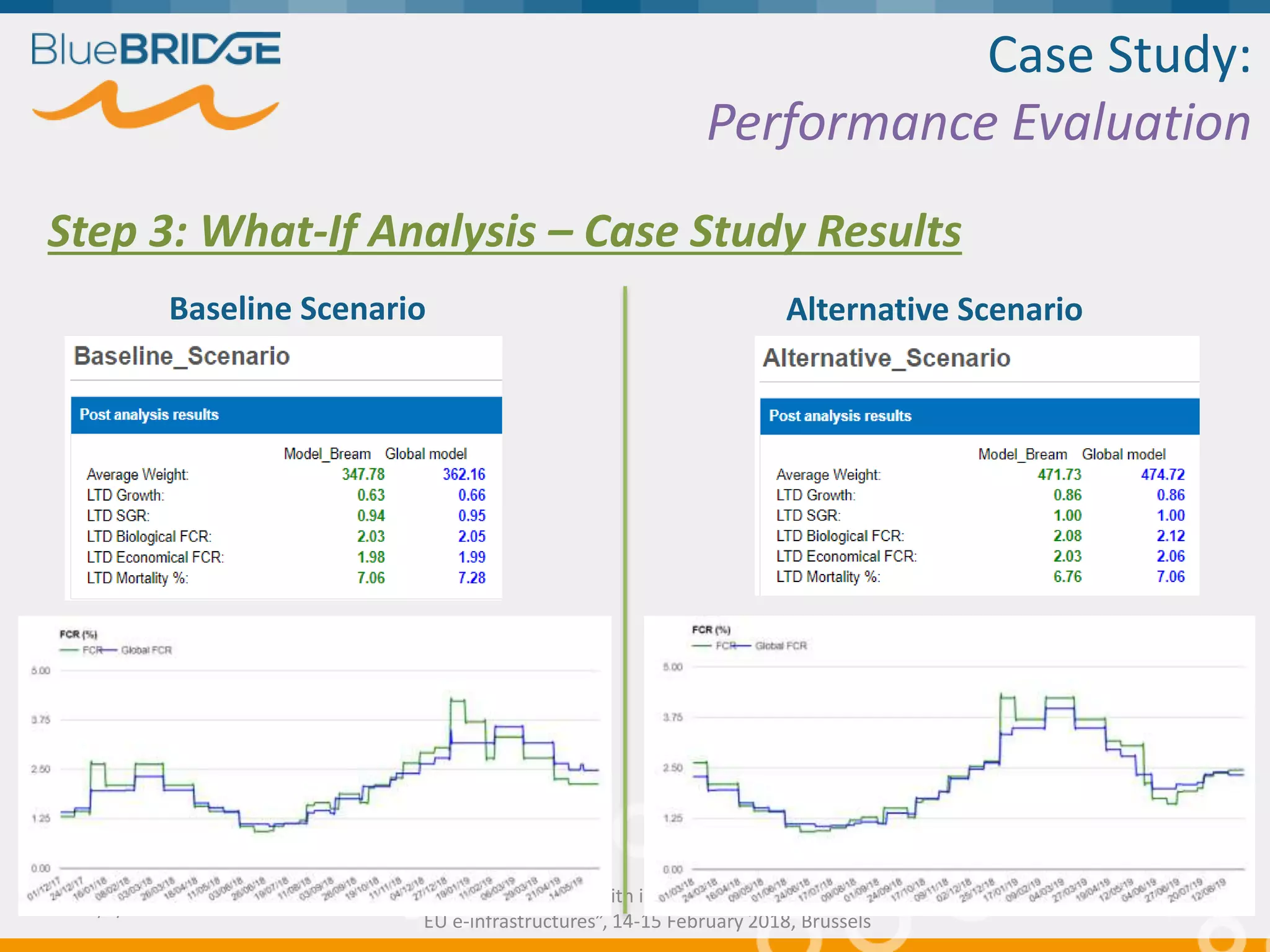
Step 3: What-If Analysis – Case Study Results
Baseline Scenario Alternative Scenario
15/2/2018 19
“Supporting Blue Growth with innovative applications based on
EU e-infrastructures”, 14-15 February 2018, Brussels
“Supporting Blue Growth with innovative applications based
on EU e-infrastructures”, 14-15 February 2018, Brussels
Case Study:
Performance Evaluation
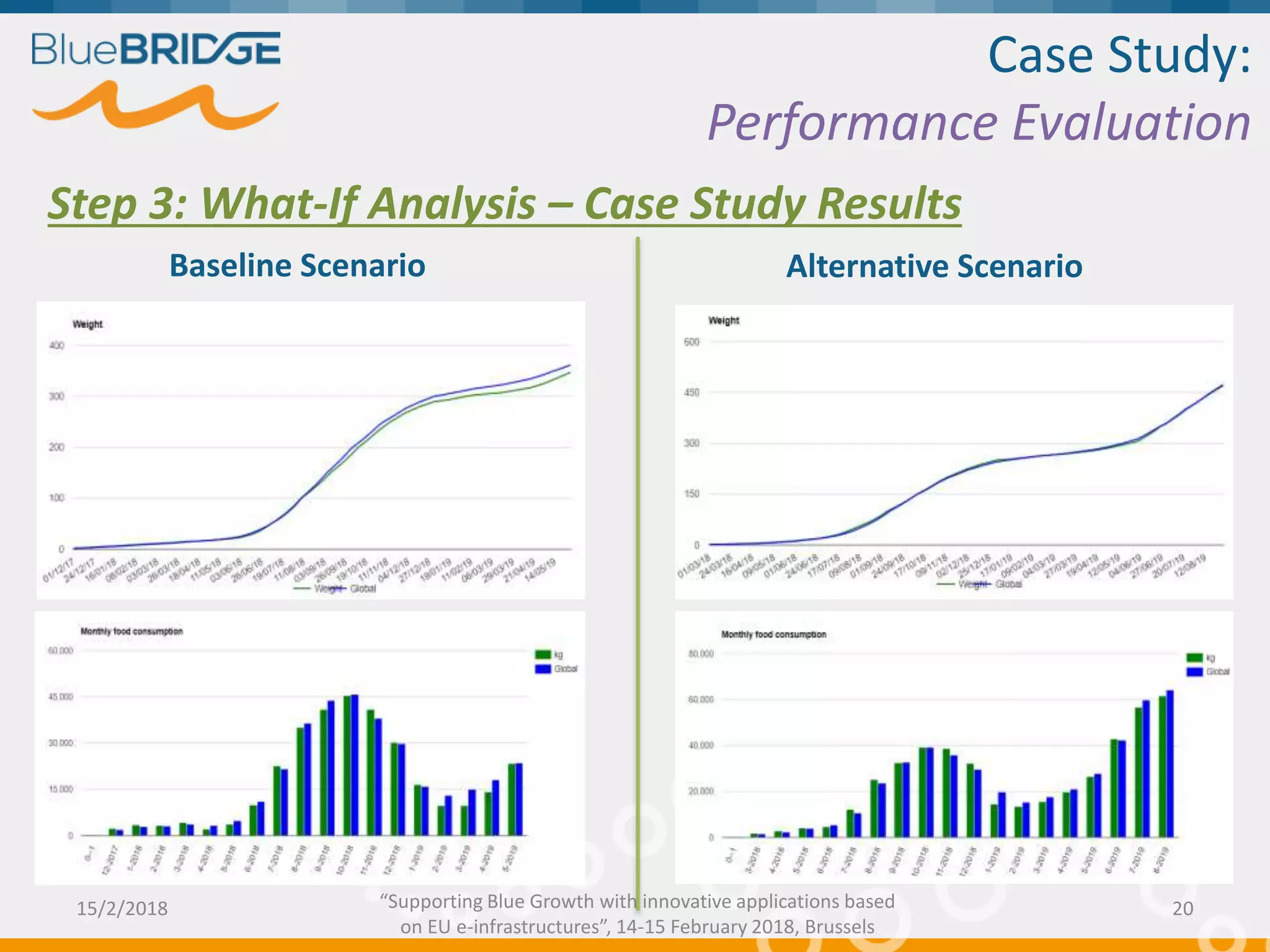
Step 3: What-If Analysis – Case Study Results
Baseline Scenario Alternative Scenario
15/2/2018 20
Case Study:
Performance Evaluation
Step 3: What-If Analysis – Case Study Results
Monthly Feed Consumption
Baseline Scenario Alternative Scenario
Dec-17 2360.23 Mar-18 1741.49
Jan-18 3520.59 Apr-18 2837.87
Feb-18 3269.62 May-18 4128.76
Mar-18 4231.18 Jun-18 4615.31
Apr-18 2181.23 Jul-18 12295.91
May-18 3752.54 Aug-18 25072.67
Jun-18 9849.37 Sep-18 32578.39
Jul-18 22691.04 Oct-18 39285.06
Aug-18 34990.53 Nov-18 38698.9
Sep-18 41002.50 Dec-18 32145.91
Oct-18 45299.59 Jan-19 14659.85
Nov-18 41002.40 Feb-19 13555.94
Dec-18 30098.66 Mar-19 15467.33
Jan-19 16653.27 Apr-19 19664.4
Feb-19 9741.25 May-19 26381.92
Mar-19 9689.18 Jun-19 42909.94
Apr-19 14294.53 Jul-19 56629.56
May-19 23285.18 Aug-19 61458.86
18 317912.89 18 444128.07
317.91 444.13
 283.130 tons saving around 11% comparing with
the total feed consumption at baseline scenario
(317.91 tons)
 However, after the cultivation of a duration of
18th months (31/05) the average weight in
baseline scenario is estimated to be 347.78 grs
against 305.32 grs of the alternative scenario
15/2/2018 21
“Supporting Blue Growth with innovative applications based on
EU e-infrastructures”, 14-15 February 2018, Brussels
Conclusions
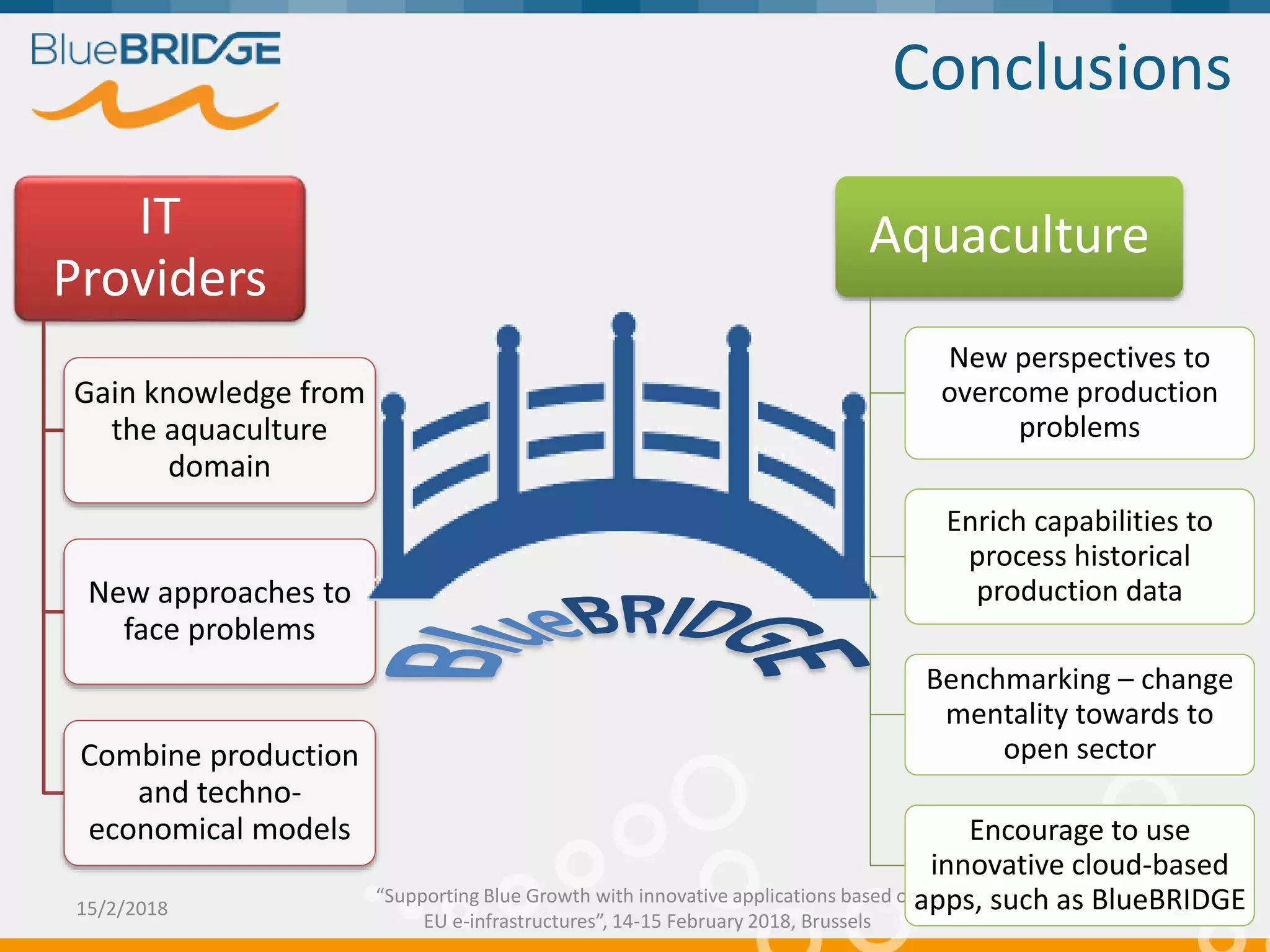
IT
Providers
Gain knowledge from
the aquaculture
domain
New approaches to
face problems
Combine production
and techno-
economical models
15/2/2018 22
“Supporting Blue Growth with innovative applications based on
EU e-infrastructures”, 14-15 February 2018, Brussels
Aquaculture
New perspectives to
overcome production
problems
Enrich capabilities to
process historical
production data
Benchmarking – change
mentality towards to
open sector
Encourage to use
innovative cloud-based
apps, such as BlueBRIDGE
Any Questions?
15/2/2018 23
“Supporting Blue Growth with innovative applications based on
EU e-infrastructures”, 14-15 February 2018, Brussels
http://www.bluebridge-vres.eu/
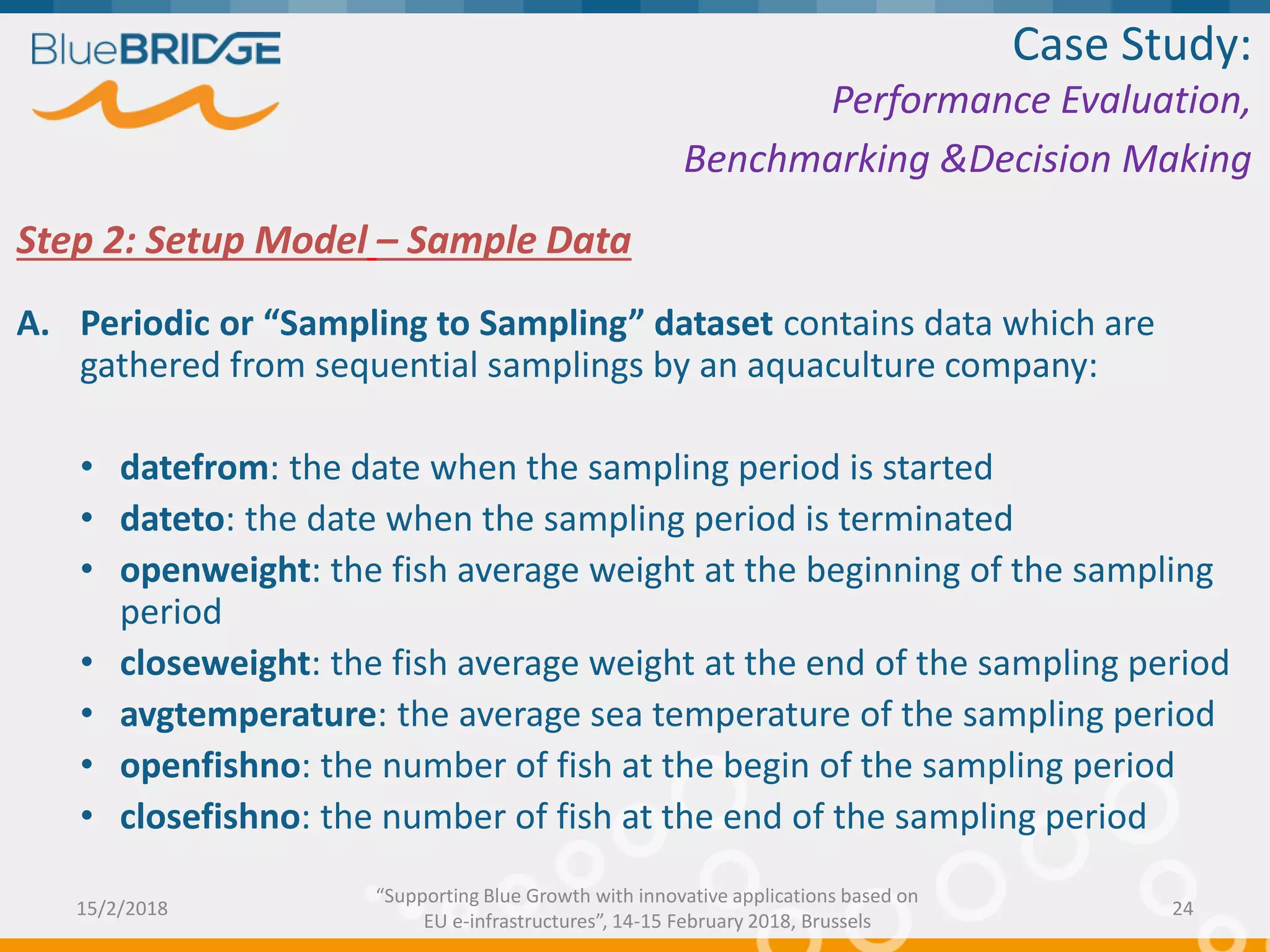
Step 2: Setup Model – Sample Data
A. Periodic or “Sampling to Sampling” dataset contains data which are
gathered from sequential samplings by an aquaculture company:
• datefrom: the date when the sampling period is started
• dateto: the date when the sampling period is terminated
• openweight: the fish average weight at the beginning of the sampling
period
• closeweight: the fish average weight at the end of the sampling period
• avgtemperature: the average sea temperature of the sampling period
• openfishno: the number of fish at the begin of the sampling period
• closefishno: the number of fish at the end of the sampling period
Case Study:
Performance Evaluation,
Benchmarking &Decision Making
15/2/2018 24
“Supporting Blue Growth with innovative applications based on
EU e-infrastructures”, 14-15 February 2018, Brussels
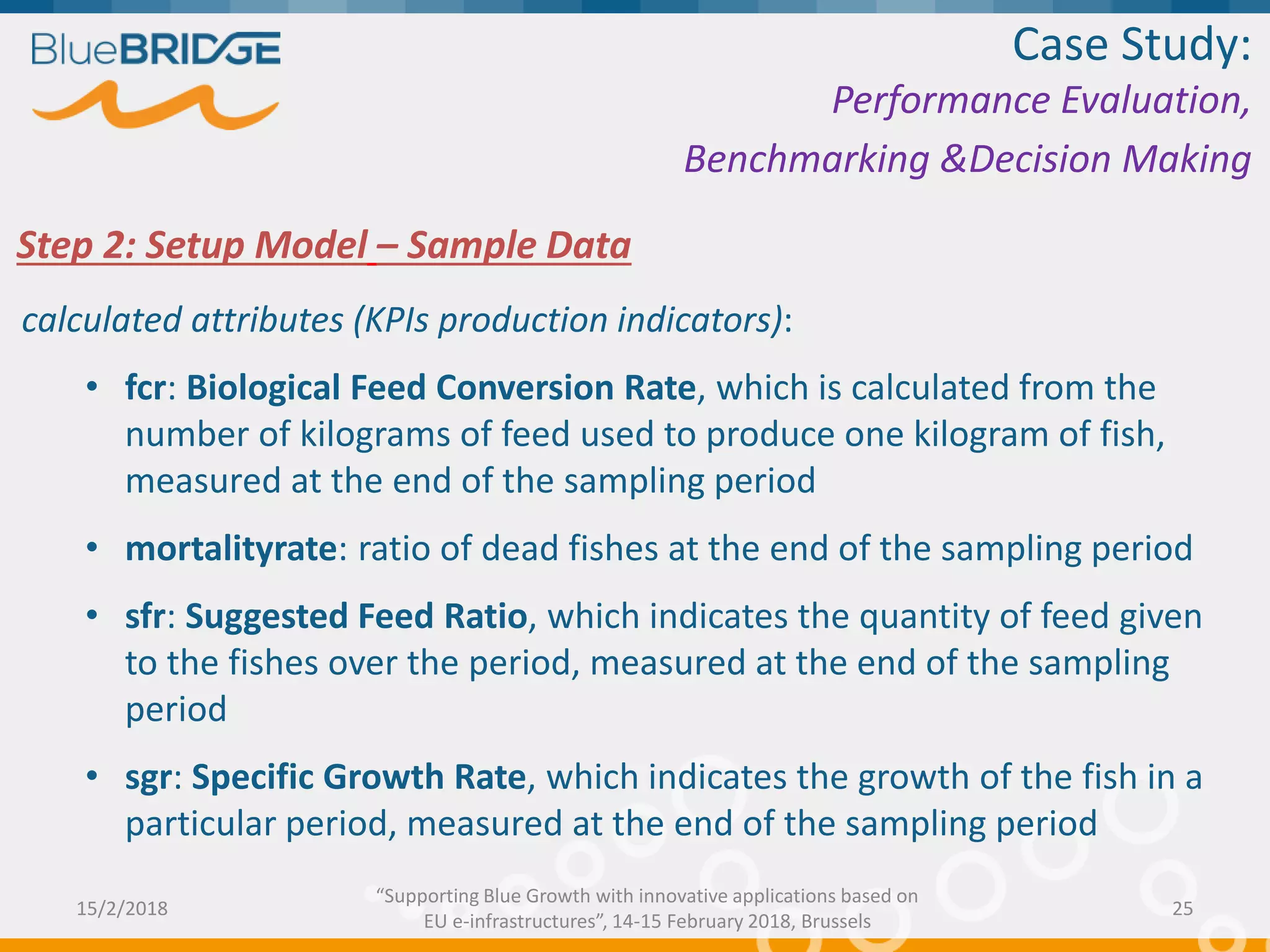
calculated attributes (KPIs production indicators):
• fcr: Biological Feed Conversion Rate, which is calculated from the
number of kilograms of feed used to produce one kilogram of fish,
measured at the end of the sampling period
• mortalityrate: ratio of dead fishes at the end of the sampling period
• sfr: Suggested Feed Ratio, which indicates the quantity of feed given
to the fishes over the period, measured at the end of the sampling
period
• sgr: Specific Growth Rate, which indicates the growth of the fish in a
particular period, measured at the end of the sampling period
Case Study:
Performance Evaluation,
Benchmarking &Decision Making
Step 2: Setup Model – Sample Data
15/2/2018 25
“Supporting Blue Growth with innovative applications based on
EU e-infrastructures”, 14-15 February 2018, Brussels
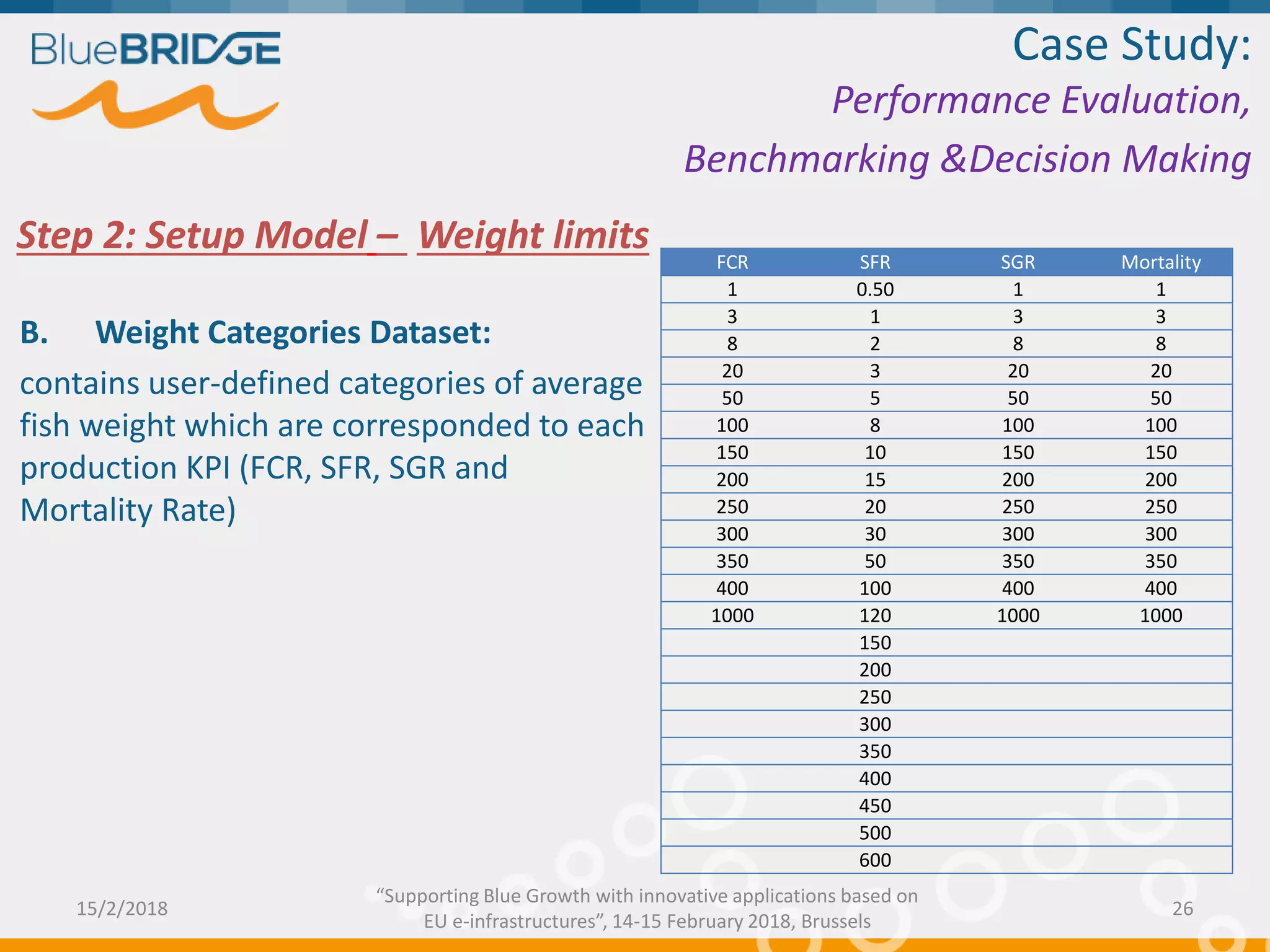
Step 2: Setup Model – Weight limits
B. Weight Categories Dataset:
contains user-defined categories of average
fish weight which are corresponded to each
production KPI (FCR, SFR, SGR and
Mortality Rate)
FCR SFR SGR Mortality
1 0.50 1 1
3 1 3 3
8 2 8 8
20 3 20 20
50 5 50 50
100 8 100 100
150 10 150 150
200 15 200 200
250 20 250 250
300 30 300 300
350 50 350 350
400 100 400 400
1000 120 1000 1000
150
200
250
300
350
400
450
500
600
Case Study:
Performance Evaluation,
Benchmarking &Decision Making
15/2/2018 26
“Supporting Blue Growth with innovative applications based on
EU e-infrastructures”, 14-15 February 2018, Brussels

Machine Learning methods to estimate the performance of aquafarms

  • 1.
    BlueBRIDGE receives fundingfrom the European Union’s Horizon 2020 research and innovation programme under grant agreement No. 675680 www.bluebridge-vres.eu Konstantinos Bovolis kbovolis@i2s.gr Machine Learning methods to estimate the performance of aquafarms Supporting Blue Growth with innovative applications based on EU e-infrastructures 14-15 February 2018, Brussels
  • 2.
    Outline Challenges and Needs BlueBRIDGESolution BlueEconomy: Performance Evaluation, Benchmarking and Decision Making Case Study Conclusion 15/2/2018 2 “Supporting Blue Growth with innovative applications based on EU e-infrastructures”, 14-15 February 2018, Brussels
  • 3.
    Challenges that haveto be addressed: • maintaining the economic viability of the sector by reducing costs and increasing production • guaranteeing high quality food and animal welfare • addressing environmental concerns. All aquaculture producers are concerned about improving the performance of their companies in terms of cost, feed conversion, growth rate and mortality and at the same time, be sustainable and environmental friendly Challenges and Needs 15/2/2018 3 “Supporting Blue Growth with innovative applications based on EU e-infrastructures”, 14-15 February 2018, Brussels
  • 4.
    It is notonly equipment and hardware! Unfortunately, answering this question is not that simple • Aquafarmers can invest in the latest technology for cages or on the most advanced feeding systems but they cannot forget two key aspects: i. an aquaculture comes with its own array of environmental challenges that have a huge impact on production system; ii. an aquaculture business can be sustainable only if they are able to continuously monitor and improve its performance 15/2/2018 4 “Supporting Blue Growth with innovative applications based on EU e-infrastructures”, 14-15 February 2018, Brussels
  • 5.
    Provide innovative dataanalytics and machine learning services that will benefit all the stakeholders of the aquaculture sector The aim is to support: • Companies to maximize the growth rate, reduce costs and minimize the impact on the environment • Investors to make efficient identification of strategic locations of interest and select the most profitable investments • Governments and environmental agencies to evaluate the current situation and define policies • Researchers to generate new knowledge and evaluate the practical indicators of aquafarming performance BlueBRIDGE Solution 15/2/2018 5 “Supporting Blue Growth with innovative applications based on EU e-infrastructures”, 14-15 February 2018, Brussels
  • 6.
    Blue Economy Performance Evaluation,Benchmarking & Decision Making Goal: Estimate/create KPIs Tables (biol. FCR, SFR, Mortality Rate) based on historical data using Machine Learning Techniques (i.e. GAMs, MARS) Define a Site: •location •temperature profile Setup Site Performance Evaluation Estimate KPIs: • Collect data • Upload data • Generate models Setup Model Benchmarking & Decision Making Goals: • Create accurate and feasible production plans • Benchmark the performance against the competition Perform production planning by: • Create scenarios • Assess the KPIs • Benchmarking What-If Analysis Decision 15/2/2018 6 “Supporting Blue Growth with innovative applications based on EU e-infrastructures”, 14-15 February 2018, Brussels
  • 7.
    Aquafarms engagement 10 Aquaculturecompanies have already started to utilizing BlueBRIDGE services and tools, via their own VREs:  ARDAG Aquaculture  iLKNAK Aquaculture  GALAXIDI MARINE FARM S.A.  NIREUS AQUACULTURE S.A.  MARKELLOS AQUACULTURE LEROS S.A.  STRATOS AQUACULTURES  ALIEIA S.A.  FORKYS  ELLINIKA PSARIA  KIMAGRO FISH FARMING LTD 15/2/2018 7 “Supporting Blue Growth with innovative applications based on EU e-infrastructures”, 14-15 February 2018, Brussels
  • 8.
    Case Study: Performance Evaluation, Benchmarking&Decision Making How to evaluate the performance of Sea Bream production at site A over different stocking months? Define the Site A (Setup Site) 1 Create a production model for Site A (Setup Model) 2 Create hypothetical scenarios for Site A (What-If) 3 Evaluate results: • Production KPIs • Benchmarking 4 15/2/2018 8 “Supporting Blue Growth with innovative applications based on EU e-infrastructures”, 14-15 February 2018, Brussels
  • 9.
    Step 1: SetupSites • Aquafarm manager can define the average temperature fortnightly and the geographical location of the site of interest (i.e. Site A) Case Study: Performance Evaluation, Benchmarking &Decision Making 15/2/2018 9 “Supporting Blue Growth with innovative applications based on EU e-infrastructures”, 14-15 February 2018, Brussels
  • 10.
    Step 2: SetupModel • Aquafarm manager can develop reliable and powerful Machine Leaning models, which are capable to estimate vital production indicators, such as biological FCR, SFR and Mortality Rate, providing real historical production data and details regarding the production of the specific fish species (i.e. Sea Bream) of the site of interest (i.e. Site A) • For the particular case study, aquafarmer needs to upload production data for different stocking periods for the Sea Bream species at the Site A Note: • Very often data need to be cleaned and preprocessed before the analysis is executed • ‘Setup Model’ tool includes processes so as to remove automatically inconsistent entries and outliers from the processed data • However, aquafarmer is responsible to provide to the system good quality data Case Study: Performance Evaluation, Benchmarking &Decision Making 15/2/2018 10 “Supporting Blue Growth with innovative applications based on EU e-infrastructures”, 14-15 February 2018, Brussels
  • 11.
    Step 2: SetupModel Case Study: Performance Evaluation, Benchmarking &Decision Making 15/2/2018 11 “Supporting Blue Growth with innovative applications based on EU e-infrastructures”, 14-15 February 2018, Brussels
  • 12.
    Step 2: SetupModel - Results • The outcome of the modeling process is a simulation of the relationship between growth, feeding and temperature • Development of tables for  Biological FCR,  Feeding Rate and  Mortality Rate in terms of fish weight (Avg. Weight Categories) and temperatures (Avg. Sea Temperature) Case Study: Performance Evaluation, Benchmarking &Decision Making 15/2/2018 12 “Supporting Blue Growth with innovative applications based on EU e-infrastructures”, 14-15 February 2018, Brussels
  • 13.
    12 13 1415 16 17 18 19 20 21 22 23 24 25 26 27 1 3.47 3.09 2.72 2.38 2.07 1.81 1.59 1.42 1.29 1.21 1.16 1.14 1.14 1.15 1.17 1.19 3 3.46 3.08 2.72 2.37 2.07 1.80 1.58 1.41 1.28 1.20 1.15 1.14 1.13 1.15 1.16 1.18 8 3.44 3.06 2.70 2.35 2.05 1.78 1.56 1.39 1.26 1.18 1.13 1.12 1.11 1.13 1.14 1.16 20 3.39 3.01 2.65 2.31 2.00 1.74 1.52 1.34 1.22 1.13 1.09 1.07 1.07 1.08 1.10 1.11 50 3.32 2.94 2.58 2.24 1.93 1.66 1.45 1.27 1.15 1.06 1.02 1.00 1.00 1.01 1.02 1.04 100 3.53 3.16 2.79 2.45 2.14 1.88 1.66 1.49 1.36 1.28 1.23 1.21 1.21 1.22 1.24 1.26 150 4.10 3.72 3.36 3.02 2.71 2.44 2.22 2.05 1.93 1.84 1.80 1.78 1.78 1.79 1.80 1.82 200 4.48 4.11 3.74 3.40 3.09 2.83 2.61 2.44 2.31 2.23 2.18 2.16 2.16 2.17 2.19 2.21 250 4.50 4.12 3.76 3.41 3.11 2.84 2.62 2.45 2.32 2.24 2.19 2.17 2.17 2.18 2.20 2.22 300 4.38 4.01 3.64 3.30 2.99 2.73 2.51 2.34 2.21 2.13 2.08 2.06 2.06 2.07 2.09 2.11 350 4.37 3.99 3.63 3.28 2.98 2.71 2.49 2.32 2.19 2.11 2.06 2.04 2.04 2.05 2.07 2.09 400 4.48 4.11 3.74 3.40 3.09 2.83 2.61 2.44 2.31 2.23 2.18 2.16 2.16 2.17 2.19 2.21 Step 2: Setup Model – Results of Machine Learning process Avg. Sea Temperature Avg. Weight Categories Case Study: Performance Evaluation, Benchmarking &Decision Making 15/2/2018 13 “Supporting Blue Growth with innovative applications based on EU e-infrastructures”, 14-15 February 2018, Brussels
  • 14.
    Step 2: SetupModel – Results of Machine Learning process 0.00 0.50 1.00 1.50 2.00 2.50 3.00 3.50 4.00 4.50 5.00 1 3 8 20 50 100 150 200 250 300 350 400 BiologicalFCR Average Weight Categories 12 13 14 15 16 17 18 19 20 21 22 23 24 25 26 27 Case Study: Performance Evaluation, Benchmarking &Decision Making 15/2/2018 14 “Supporting Blue Growth with innovative applications based on EU e-infrastructures”, 14-15 February 2018, Brussels
  • 15.
    Step 2: SetupModel – Results of Machine Learning process 0.00 0.50 1.00 1.50 2.00 2.50 3.00 3.50 4.00 4.50 5.00 12 13 14 15 16 17 18 19 20 21 22 23 24 25 26 27 BiologicalFCR Temperature 1 3 8 20 50 100 150 200 250 300 350 400 Case Study: Performance Evaluation, Benchmarking &Decision Making 15/2/2018 15 “Supporting Blue Growth with innovative applications based on EU e-infrastructures”, 14-15 February 2018, Brussels
  • 16.
    Case Study: Performance Evaluation Step3: What-If Analysis • Aquafarm manager can draw a hypothesis and evaluate it, using an already existing production model • The ‘What-If Analysis’ tool:  calculates production indicators which are able to estimate the performance of the fish growth  presents the results in a meaningful tables and interactive graphs  benchmark the production performance against competition over the same hypothesis 15/2/2018 16 “Supporting Blue Growth with innovative applications based on EU e-infrastructures”, 14-15 February 2018, Brussels
  • 17.
    Case Study: Performance Evaluation Step3: What-If Analysis 15/2/2018 17 “Supporting Blue Growth with innovative applications based on EU e-infrastructures”, 14-15 February 2018, Brussels
  • 18.
    Case Study: Performance Evaluation Step3: What-If Analysis – Case Study • Baseline scenario: evaluate the Sea Bream production performance whether a population of 500.000 fish will be stocked at “Site A” in December (01/12) with initial average weight 2 grs and they are cultivated for 18 months (harvest date 31/05) • Alternative scenario: stock the fish 3 months later, namely on March (01/03). Thus, the harvest date will be at the end of August (31/08). The other conditions are similar with baseline scenario 15/2/2018 18 “Supporting Blue Growth with innovative applications based on EU e-infrastructures”, 14-15 February 2018, Brussels
  • 19.
    Case Study: Performance Evaluation Step3: What-If Analysis – Case Study Results Baseline Scenario Alternative Scenario 15/2/2018 19 “Supporting Blue Growth with innovative applications based on EU e-infrastructures”, 14-15 February 2018, Brussels
  • 20.
    “Supporting Blue Growthwith innovative applications based on EU e-infrastructures”, 14-15 February 2018, Brussels Case Study: Performance Evaluation Step 3: What-If Analysis – Case Study Results Baseline Scenario Alternative Scenario 15/2/2018 20
  • 21.
    Case Study: Performance Evaluation Step3: What-If Analysis – Case Study Results Monthly Feed Consumption Baseline Scenario Alternative Scenario Dec-17 2360.23 Mar-18 1741.49 Jan-18 3520.59 Apr-18 2837.87 Feb-18 3269.62 May-18 4128.76 Mar-18 4231.18 Jun-18 4615.31 Apr-18 2181.23 Jul-18 12295.91 May-18 3752.54 Aug-18 25072.67 Jun-18 9849.37 Sep-18 32578.39 Jul-18 22691.04 Oct-18 39285.06 Aug-18 34990.53 Nov-18 38698.9 Sep-18 41002.50 Dec-18 32145.91 Oct-18 45299.59 Jan-19 14659.85 Nov-18 41002.40 Feb-19 13555.94 Dec-18 30098.66 Mar-19 15467.33 Jan-19 16653.27 Apr-19 19664.4 Feb-19 9741.25 May-19 26381.92 Mar-19 9689.18 Jun-19 42909.94 Apr-19 14294.53 Jul-19 56629.56 May-19 23285.18 Aug-19 61458.86 18 317912.89 18 444128.07 317.91 444.13  283.130 tons saving around 11% comparing with the total feed consumption at baseline scenario (317.91 tons)  However, after the cultivation of a duration of 18th months (31/05) the average weight in baseline scenario is estimated to be 347.78 grs against 305.32 grs of the alternative scenario 15/2/2018 21 “Supporting Blue Growth with innovative applications based on EU e-infrastructures”, 14-15 February 2018, Brussels
  • 22.
    Conclusions IT Providers Gain knowledge from theaquaculture domain New approaches to face problems Combine production and techno- economical models 15/2/2018 22 “Supporting Blue Growth with innovative applications based on EU e-infrastructures”, 14-15 February 2018, Brussels Aquaculture New perspectives to overcome production problems Enrich capabilities to process historical production data Benchmarking – change mentality towards to open sector Encourage to use innovative cloud-based apps, such as BlueBRIDGE
  • 23.
    Any Questions? 15/2/2018 23 “SupportingBlue Growth with innovative applications based on EU e-infrastructures”, 14-15 February 2018, Brussels http://www.bluebridge-vres.eu/
  • 24.
    Step 2: SetupModel – Sample Data A. Periodic or “Sampling to Sampling” dataset contains data which are gathered from sequential samplings by an aquaculture company: • datefrom: the date when the sampling period is started • dateto: the date when the sampling period is terminated • openweight: the fish average weight at the beginning of the sampling period • closeweight: the fish average weight at the end of the sampling period • avgtemperature: the average sea temperature of the sampling period • openfishno: the number of fish at the begin of the sampling period • closefishno: the number of fish at the end of the sampling period Case Study: Performance Evaluation, Benchmarking &Decision Making 15/2/2018 24 “Supporting Blue Growth with innovative applications based on EU e-infrastructures”, 14-15 February 2018, Brussels
  • 25.
    calculated attributes (KPIsproduction indicators): • fcr: Biological Feed Conversion Rate, which is calculated from the number of kilograms of feed used to produce one kilogram of fish, measured at the end of the sampling period • mortalityrate: ratio of dead fishes at the end of the sampling period • sfr: Suggested Feed Ratio, which indicates the quantity of feed given to the fishes over the period, measured at the end of the sampling period • sgr: Specific Growth Rate, which indicates the growth of the fish in a particular period, measured at the end of the sampling period Case Study: Performance Evaluation, Benchmarking &Decision Making Step 2: Setup Model – Sample Data 15/2/2018 25 “Supporting Blue Growth with innovative applications based on EU e-infrastructures”, 14-15 February 2018, Brussels
  • 26.
    Step 2: SetupModel – Weight limits B. Weight Categories Dataset: contains user-defined categories of average fish weight which are corresponded to each production KPI (FCR, SFR, SGR and Mortality Rate) FCR SFR SGR Mortality 1 0.50 1 1 3 1 3 3 8 2 8 8 20 3 20 20 50 5 50 50 100 8 100 100 150 10 150 150 200 15 200 200 250 20 250 250 300 30 300 300 350 50 350 350 400 100 400 400 1000 120 1000 1000 150 200 250 300 350 400 450 500 600 Case Study: Performance Evaluation, Benchmarking &Decision Making 15/2/2018 26 “Supporting Blue Growth with innovative applications based on EU e-infrastructures”, 14-15 February 2018, Brussels

Editor's Notes

  • #7 GAM : Generalised Additive Models MARS: Multivariate Adaptive Regression Splines
  • #9 Η διαδικασία είναι επαναληπτική
  • #11 Μπορώ να μειώσω
  • #17 production indicators such as LTD Biological/Economical FCR, LTD SGR, LTD Growth, LTD Mortality, monthly feed consumption and average weight per day
  • #25 Sampling is a common procedure in the aquaculture sector, in order to estimate crucial production KPIs as well as the number and the average weight of fish in cages/units. This kind of datasets can be generated by monitoring systems used by Aquaculture companies. Each dataset contains measurements as well as estimations of basic parameters regarding the fish growth in a period of time. The time between samplings is not prefixed and it is determined by each aquaculture company. However, it should not be exceeded the two months. *Note: The “Periodic” (“Sampling to Sampling”) dataset should be in Microsoft Excel (xls, xlsx) format