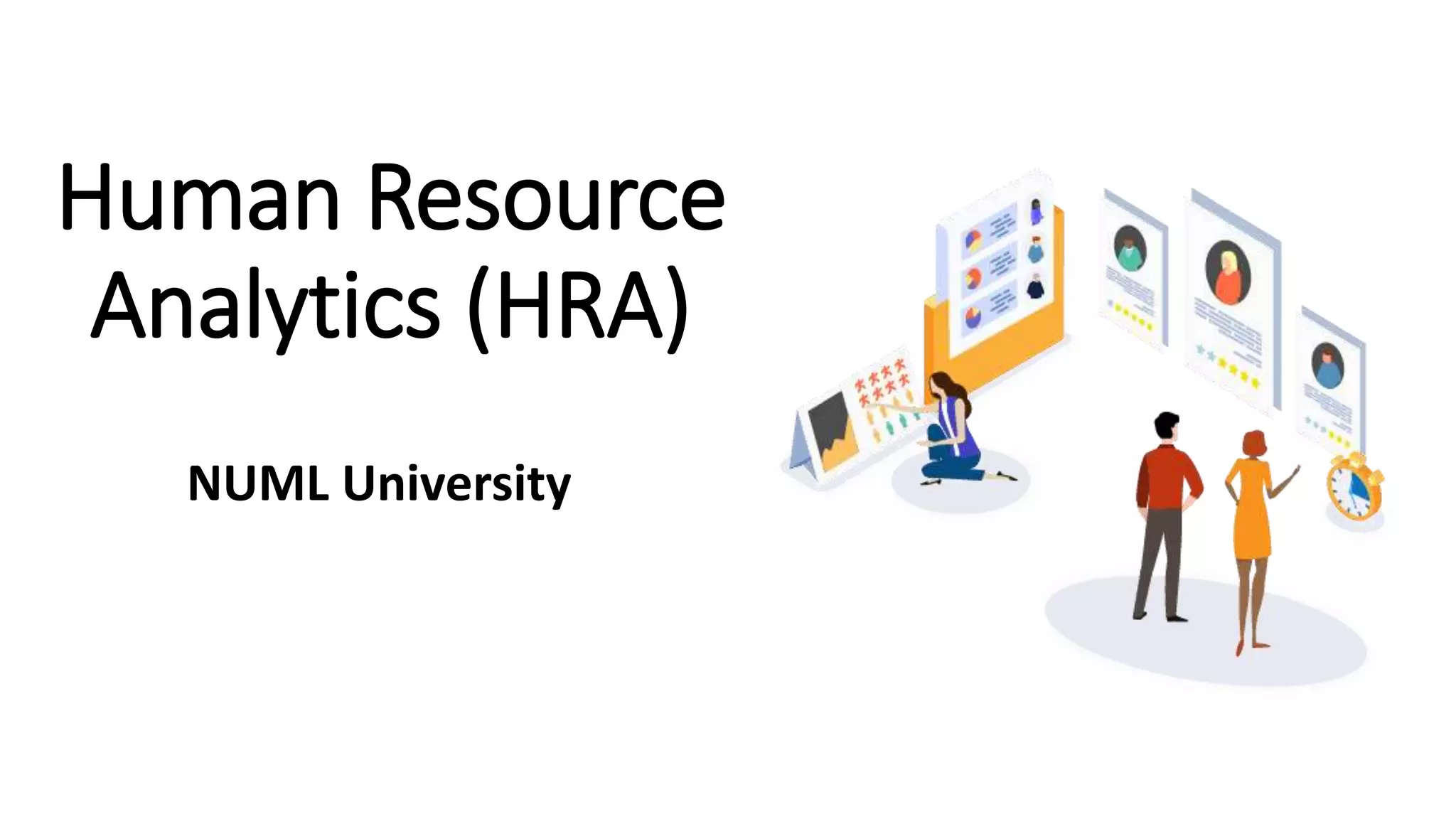
Human Resource
Analytics (HRA)
NUML University
Introduction
2
• Course Description:
• This course focuses on the Human Resource management and planning.
The course emphasis is on the understanding of the concepts of right person
for right job with right policies.
•
• Prerequisites:
• HRM, Business Math and Statistics,
• Course Objectives:
 A brief introduction to the field of predictive HR analytics.
 Discuss the nature of HR data and demonstrate how to convert HR
data into a workable form to analyze with SPSS.
 Discusses and introduces a range of different more advanced analytic
techniques.
3
• Learning Outcomes:
•
• Equips the students with the concepts, problems and techniques
applicable to the human resource functions of business organizations.
The emphasis is on decision making in human resource areas.
•
• Textbooks (or Course Materials):
•
Martin R Edwards and Kirsten Edwards (2016) Predictive HR Analytics
: Mastering the HR Metric
Shivinder Nijjer and Sahil Raj (2021) Predictive Analytics in Human
Resource Management
David A. Decenzo and Stephen P. Robins (HUMAN RESOURCE
4
Understanding HR Analytics
Chapter 01
What is Human Resource Management?
• No universal definition
• Term originated in the USA
• Initially interchangeable with ‘Personnel Management’
• Managing Humans (Employees)
• The management of people to do the work. (Boxall and Purcell 2012)
6
Human Resource Management
Human resource management is the management of an organization's
workforce, or human resources.
The process by which managers ensure that they have the right
number and kinds of people in the right places, and at the right
times, who are capable of effectively and efficiently performing their
tasks.
7
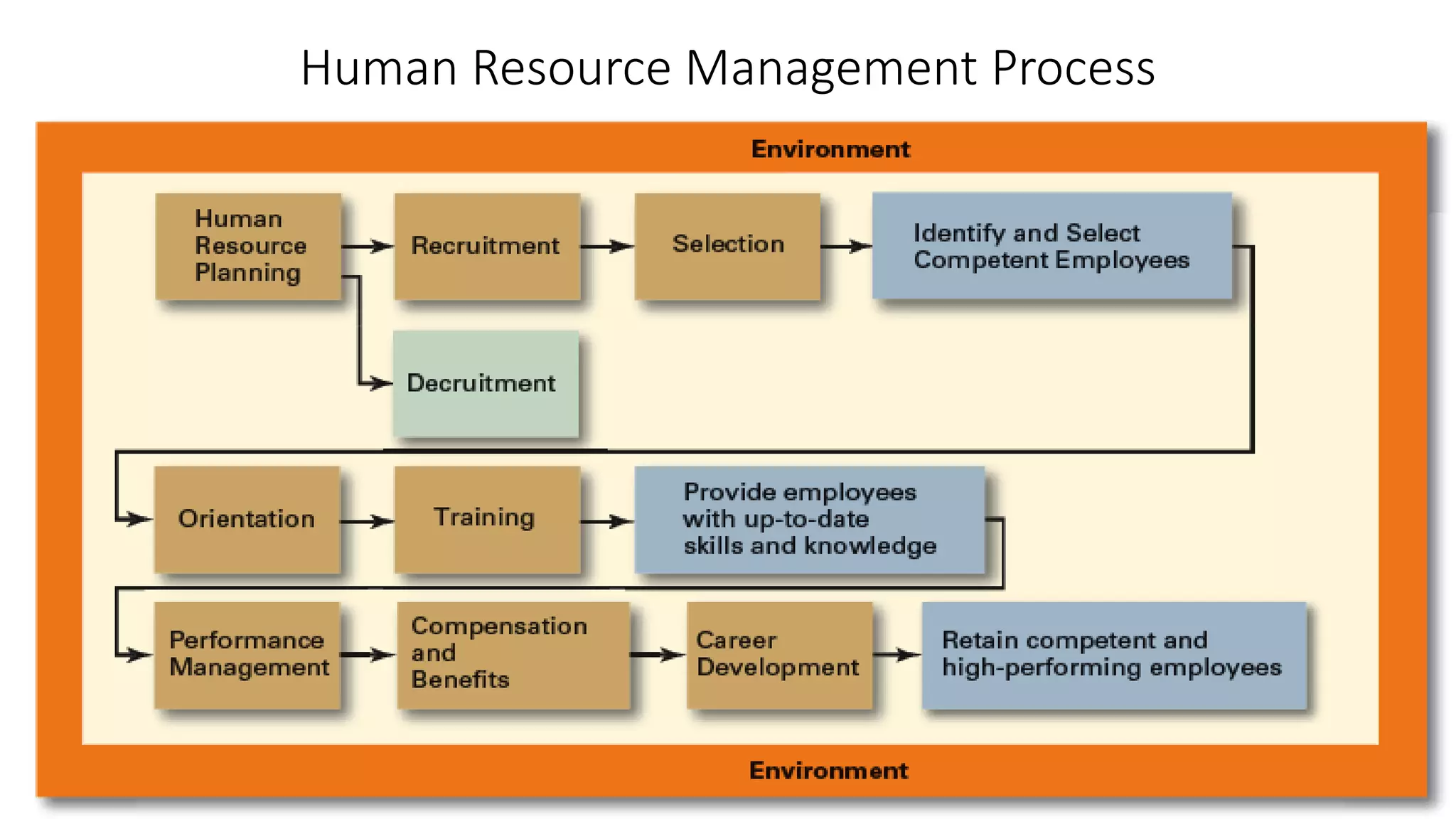
Human Resource Management Process
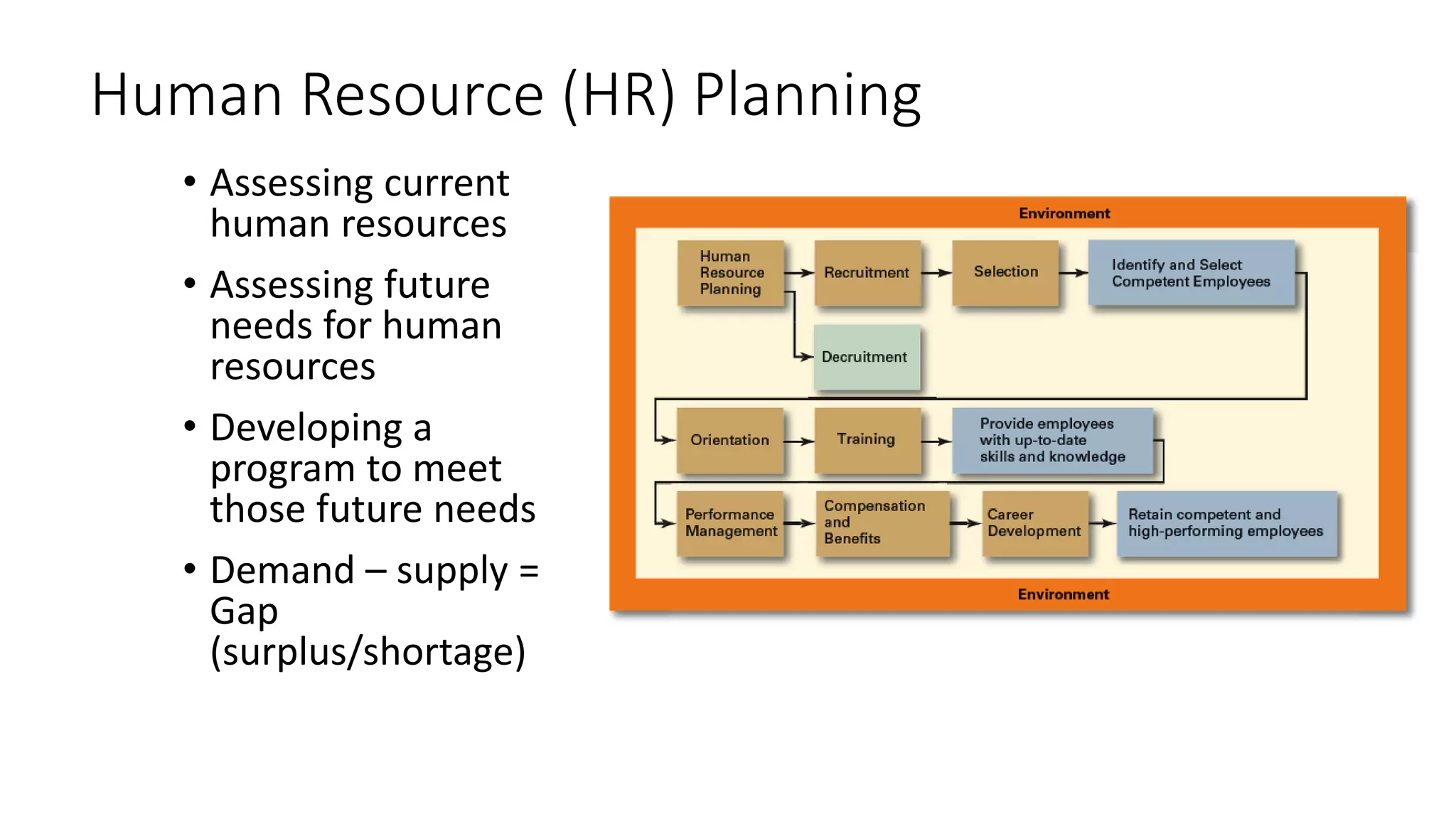
Human Resource (HR) Planning
• Assessing current
human resources
• Assessing future
needs for human
resources
• Developing a
program to meet
those future needs
• Demand – supply =
Gap
(surplus/shortage)
What is HR Analytic?
HR analytics is the systematic identification and quantification of the
people drivers of business outcomes (Heuvel & Bondarouk, 2016).
• KPMG
• Human capital measurement. Big data. Talent analytics. Strategic workforce
analytics. HR analytics. These terms all refer to the synthesis of qualitative
and quantitative data and information to bring predictive insight and
decision making support to the management of people in organizations.
• To put it another way, HR analytics can be seen as the application of
statistical techniques (for example, factor analysis, regression and
correlation) and the synthesis of multiple sources to create meaningful
insights – for example, employee retention in office X is driven by
factors Y and Z.
What is HR Analytic?
“HR analytics is the process of collecting and analyzing Human
Resource (HR) data in order to improve an organization’s workforce
performance. The process can also be referred to as talent analytics,
people analytics, or even workforce analytics.”
• This method of data analysis takes data that is routinely collected by
HR and correlates it to HR and organizational objectives.
• Doing so provides measured evidence of how HR initiatives are
contributing to the organization’s goals and strategies.
• For example, if a software engineering firm has high employee
turnover, the company is not operating at a fully productive level.
11
What is HR Analytic?
• It takes time and investment to bring employees up to a fully
productive level.
• HR analytics provides data-backed insight on what is working well
and what is not so that organizations can make improvements and
plan more effectively for the future.
• As in the example above, knowing the cause of the firm’s high
turnover can provide valuable insight into how it might be reduced.
By reducing the turnover, the company can increase its revenue and
productivity.
12
What is People Analytics
• HR analytics (also known as people analytics) is
the collection and application of talent data to
improve critical talent and business outcomes.
• HR analytics leaders enable HR leaders to
develop data-driven insights to inform talent
decisions, improve workforce processes and
promote positive employee experience.
13
Understanding the Need
• Most organizations already have data that is routinely collected
• Raw data on its own cannot actually provide any useful insight.
• It would be like looking at a large spreadsheet full of numbers and words.
• Without organization or direction, the data appears meaningless.
• Once organized, compared and analyzed, this raw data provides useful
insight.
• They can help answer questions like:
• What patterns can be revealed in employee turnover?
• How long does it take to hire employees?
• What amount of investment is needed to get employees up to a fully productive
speed?
• Which of our employees are most likely to leave within the year?
• Are learning and development initiatives having an impact on employee performance?
14
Example in HR Analytics
• How can HR Analytics be used by organizations?
Turnover
• When employees quit, there is often no real understanding of why.
• There may be collected reports or data on individual situations, but
no way of knowing whether there is an overarching reason or trend
for the turnover.
• With turnover being costly in terms of lost time and profit,
organizations need this insight to prevent turnover from becoming an
on-going problem.
15
HR Analytics can:
• Collect and analyze past data on turnover to identify trends and patterns
indicating why employees quit.
• Collect data on employee behavior, such as productivity and engagement,
to better understand the status of current employees.
• Correlate both types of data to understand the factors that lead to
turnover.
• Help create a predictive model to better track and flag employees who may
fall into the identified pattern associated with employees that have quit.
• Develop strategies and make decisions that will improve the work
environment and engagement levels.
• Identify patterns of employee engagement, employee satisfaction and
performance.
16
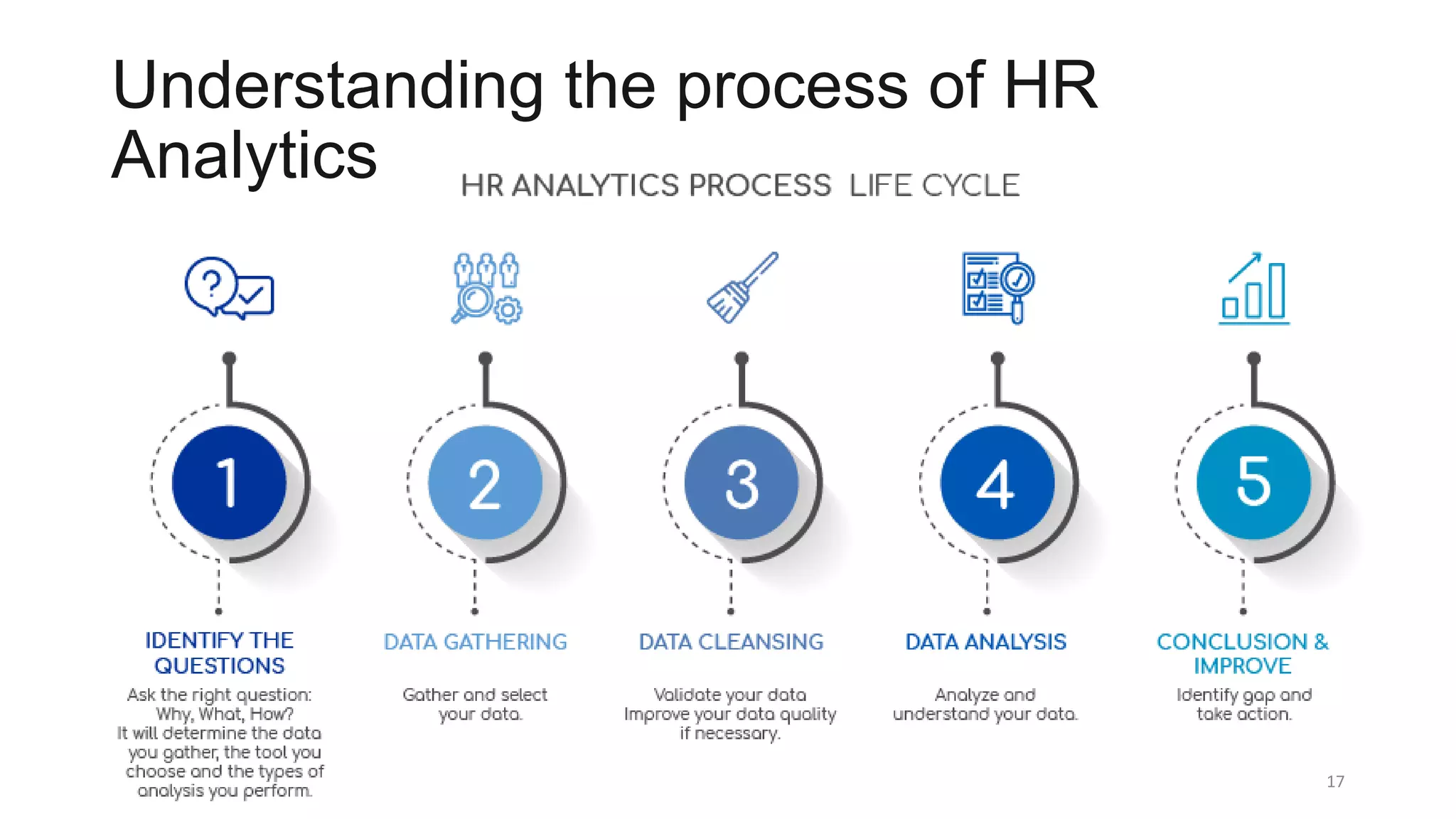
Understanding the process of HR
Analytics
17
Understanding the process of HR
Analytics
1.Identify the need to initiate and HR analytics process: What, Why and
How.
2.To gain the problem-solving insights that HR Analytics promises, data
must first be collected.
3.The data then needs to be monitored and measured against other
data, such as historical information, norms or averages.
4.This helps identify trends or patterns. It is at this point that the
results can be analyzed at the analytical stage.
5.The final step is to apply insight to organizational decisions.
18
Understanding the process of HR
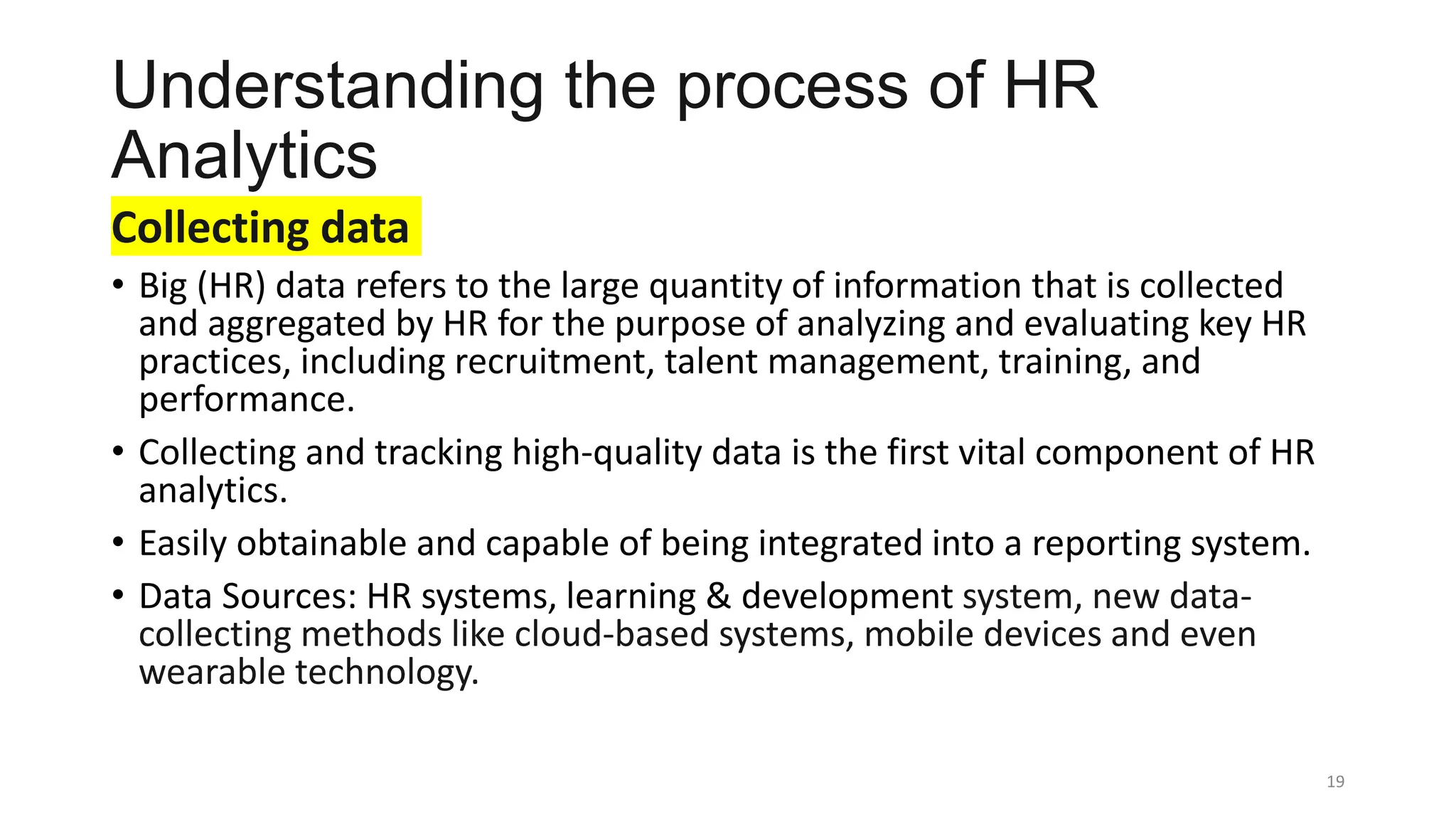
Analytics
Collecting data
• Big (HR) data refers to the large quantity of information that is collected
and aggregated by HR for the purpose of analyzing and evaluating key HR
practices, including recruitment, talent management, training, and
performance.
• Collecting and tracking high-quality data is the first vital component of HR
analytics.
• Easily obtainable and capable of being integrated into a reporting system.
• Data Sources: HR systems, learning & development system, new data-
collecting methods like cloud-based systems, mobile devices and even
wearable technology.
19
Understanding the process of HR
Analytics
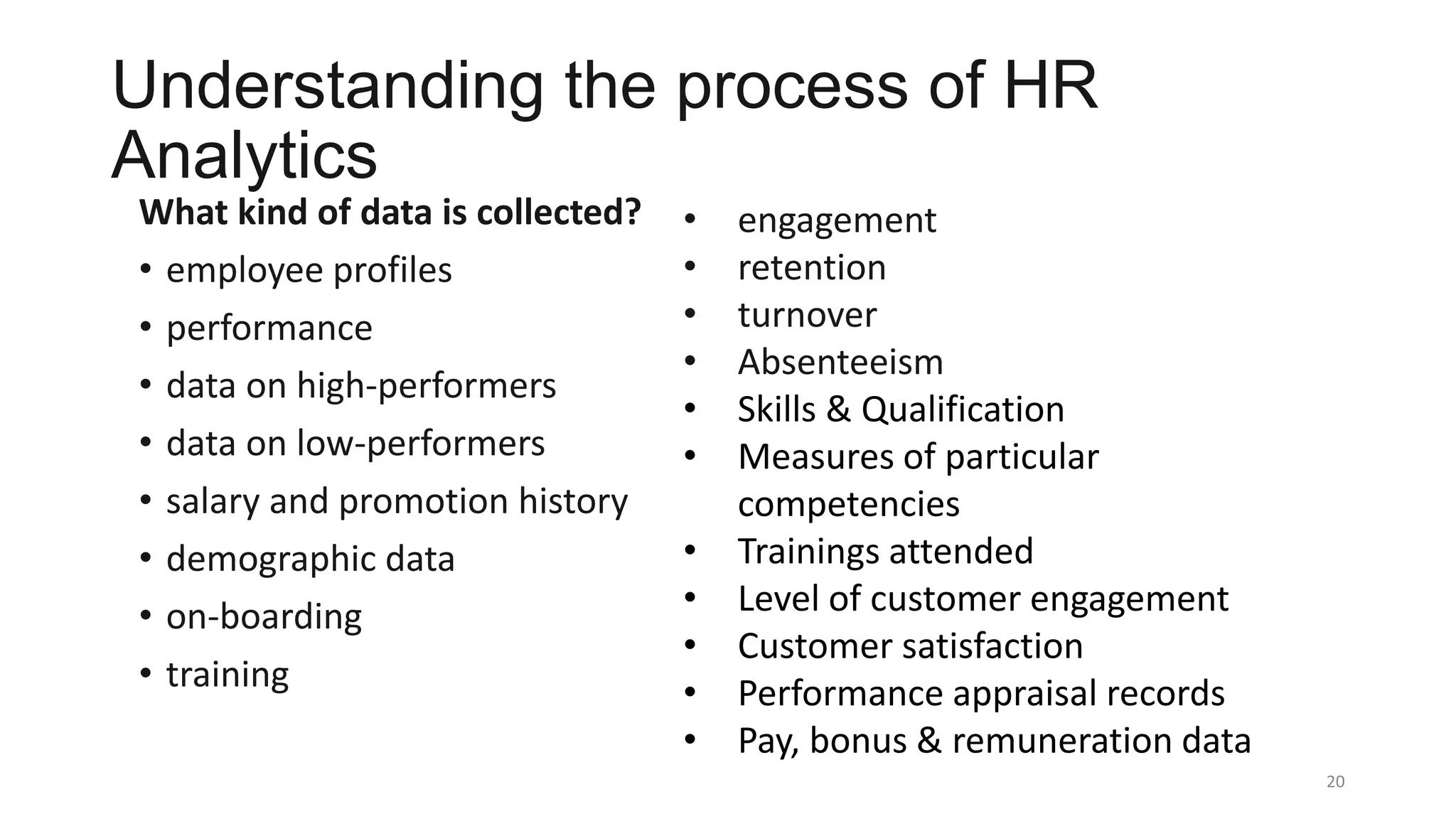
What kind of data is collected?
• employee profiles
• performance
• data on high-performers
• data on low-performers
• salary and promotion history
• demographic data
• on-boarding
• training
20
• engagement
• retention
• turnover
• Absenteeism
• Skills & Qualification
• Measures of particular
competencies
• Trainings attended
• Level of customer engagement
• Customer satisfaction
• Performance appraisal records
• Pay, bonus & remuneration data
Understanding the process of HR
Analytics
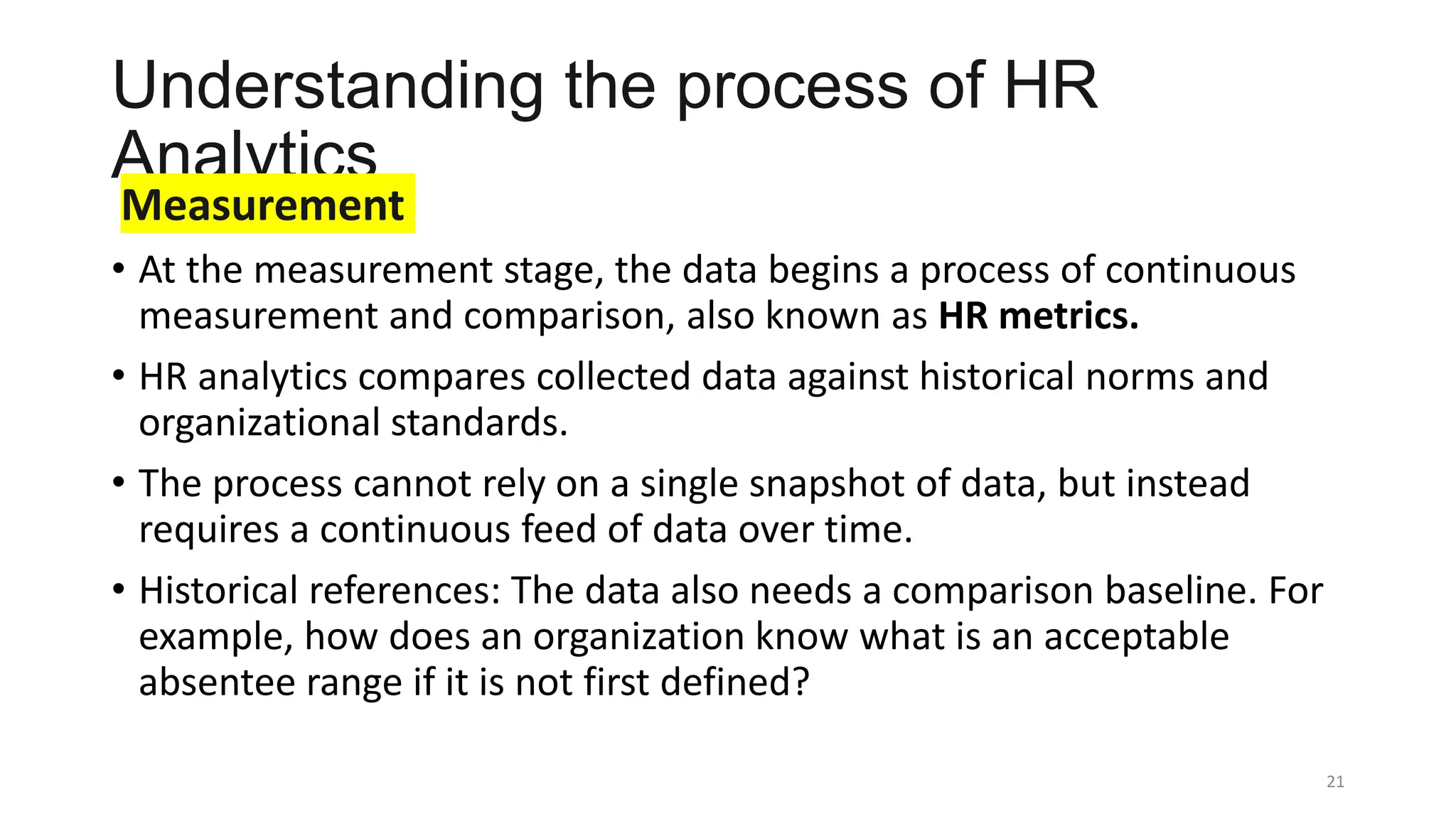
Measurement
• At the measurement stage, the data begins a process of continuous
measurement and comparison, also known as HR metrics.
• HR analytics compares collected data against historical norms and
organizational standards.
• The process cannot rely on a single snapshot of data, but instead
requires a continuous feed of data over time.
• Historical references: The data also needs a comparison baseline. For
example, how does an organization know what is an acceptable
absentee range if it is not first defined?
21
Understanding the process of HR
Analytics
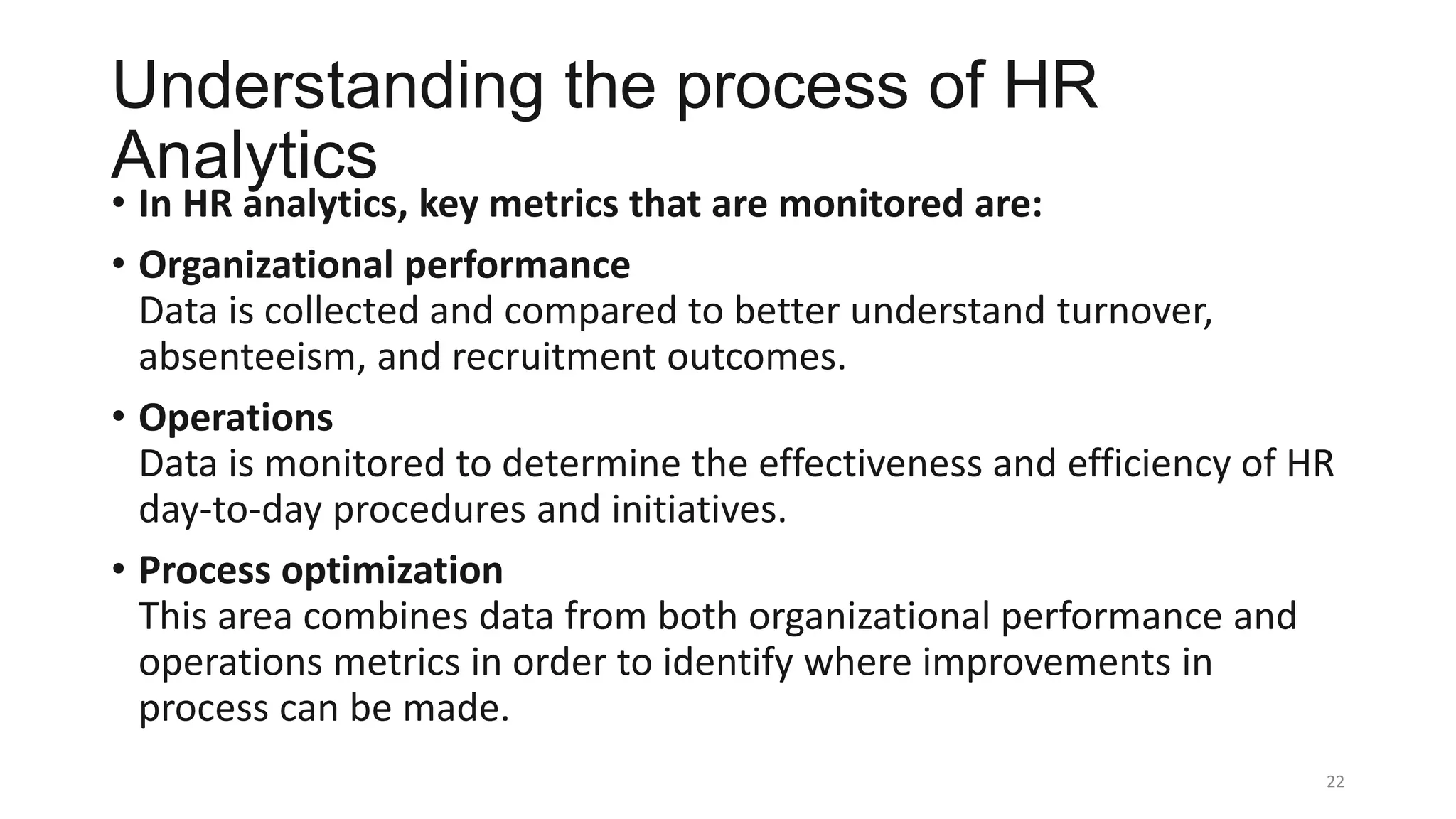
• In HR analytics, key metrics that are monitored are:
• Organizational performance
Data is collected and compared to better understand turnover,
absenteeism, and recruitment outcomes.
• Operations
Data is monitored to determine the effectiveness and efficiency of HR
day-to-day procedures and initiatives.
• Process optimization
This area combines data from both organizational performance and
operations metrics in order to identify where improvements in
process can be made.
22
Understanding the process of HR Analytics
• Examples of HR analytics Metrics
• Here are some examples of specific metrics that can be measured by HR:
• Time to hire - The number of days that it takes to post jobs and finalize the hiring of
candidates. This metric is monitored over time and is compared to the desired
organizational rate.
• Recruitment cost to hire - The total cost involved with recruiting and hiring candidates.
This metric is monitored over time to track the typical costs involved with recruiting
specific types of candidates.
• Absenteeism - The number of days and frequency that employees are away from their
jobs. This metric is monitored over time and is compared to the organization’s
acceptable rate or goal.
• Engagement rating - The measurement of employee productivity and employee
satisfaction to gauge the level of engagement employees have in their job. This can be
measured through surveys, performance assessments or productivity measures.
23
Understanding the process of HR
Analytics
Analysis
• Review the results from metric reporting to identify trends and patterns
that may have an organizational impact.
• Different analytical methods used, depending on the outcome desired. E.g.
descriptive analytics, prescriptive analytics, and predictive analytics.
• Descriptive Analytics is focused solely on understanding historical data
and what can be improved.
• Predictive Analytics uses statistical models to analyze historical data in
order to forecast future risks or opportunities.
• Prescriptive Analytics takes Predictive Analytics a step further and
predicts consequences for forecasted outcomes.
24
Understanding the process of HR
Analytics
Examples of Analytics:
• Time to hire - The amount of time between a job posting and the actual
hire is a metric that enables HR to gain insight into the efficiency of the
hiring process; it prompts investigation into what is working and what is not
working. Does it take too long to find the right candidate? What factors
could be impacting the result?
• Absenteeism - The metric indicating how often and how long employees
are away from their jobs as compared to the organization’s established
norm could be an indicator of employee engagement. As absenteeism can
be costly to the productivity of an organization, the metric enables HR to
investigate the possible reasons for high absence rates.
25
Understanding the process of HR
Analytics
Application
• Once metrics are analyzed, the findings are used as actionable insight
for organizational decision-making.
Examples of how to apply HR analytics insights:
• Time to hire - If findings determine that the time to hire is taking too
long and the job application itself is discovered to be the barrier,
organizations can make an informed decision about how to improve
the effectiveness and accessibility of the job application procedure.
• Absenteeism - Understanding the reasons for employee long-term
absence enables organizations to develop strategies to improve the
factors in the work environment impacting employee engagement. 26
Pros and Cons of HR Analytics
• Pros:
• More accurate decision-making can be made with data-driven approach, which
reduces the need for organizations to rely on intuition or guess-work in decision-
making.
• Strategies to improve retention based the reasons employees leave or stay with
an organization.
• Employee engagement can be improved by analyzing data about employee
behavior, such as behavior with co workers and customers,
• Better recruitment and hiring as per organization’s skillset needs by analyzing and
comparing the data of current employees and potential candidates.
• Trends and patterns in HR data can lend itself to forecasting via predictive
analytics, enabling organizations to be proactive in maintaining a productive
workforce.
27
Pros and Cons of HR Analytics
• Cons:
• Many HR departments lack the statistical and analytical skillset to work with
large datasets.
• Different management and reporting systems within the organization can
make it difficult to aggregate and compare data.
• Access to quality data can be an issue for some organizations who do not
have up-to-date systems.
• Organizations need access to good quality analytical and reporting software
that can utilize the data collected.
• Monitoring and collecting a greater amount of data with new technologies
(eg. cloud-based systems, wearable devices), as well as basing predictions on
data, can create ethical issues.
28
Predictive HR Analytics
29
• Predictive Analytics analyzes historical data in order to forecast the
future. The differentiator is the way data is used.
• In standard HR analytics, data is collected and analyzed to report on
what is working and what needs improvement.
• In predictive analytics, data is also collected but is used to make
future predictions about employees or HR initiatives.
• This can include anything from predicting which candidates would be
more successful in the organization, to who is at risk of quitting within
a year.
Predictive HR Analytics
How does it work?
• Advanced statistical techniques are used to create algorithmic models
capable of identifying trends and future behaviors.
• These future trends can describe possible risks or opportunities that
organizations can leverage in long-term decision-making.
• Turnover
With predictive analytics, an algorithm can be devised to predict the
likelihood of employees quitting within a given timeframe.
• Being able to flag which employees are at risk enables organizations to
step in with preventative measures and avoid the cost of losing
productivity and the cost of re-hiring.
30
Predictive HR Analytics
• Benefits: Predictive HR analytics enables organizations to become proactive
in their use of data.
• Instead of fixing past problems, organizations can create a future that
prevents problems and solves future challenges before they even happen.
This can save on future costs, both in revenue, goals, and productivity.
• Challenges: Predictive HR analytics requires a level of skill, technology and
investment that many organizations do not yet have.
• Many factors also need to be taken into consideration in order to make
predictions about employees or potential candidates.
• Human beings can be unpredictable and have different personalities,
backgrounds and experiences. Slotting people into a black and white
algorithm in order to make predictions about their job performance or
future poses not just a risk, but an ethical question.
31

Lecture 1 Human Resource Analytics

  • 1.
  • 2.
  • 3.
    • Course Description: •This course focuses on the Human Resource management and planning. The course emphasis is on the understanding of the concepts of right person for right job with right policies. • • Prerequisites: • HRM, Business Math and Statistics, • Course Objectives:  A brief introduction to the field of predictive HR analytics.  Discuss the nature of HR data and demonstrate how to convert HR data into a workable form to analyze with SPSS.  Discusses and introduces a range of different more advanced analytic techniques. 3
  • 4.
    • Learning Outcomes: • •Equips the students with the concepts, problems and techniques applicable to the human resource functions of business organizations. The emphasis is on decision making in human resource areas. • • Textbooks (or Course Materials): • Martin R Edwards and Kirsten Edwards (2016) Predictive HR Analytics : Mastering the HR Metric Shivinder Nijjer and Sahil Raj (2021) Predictive Analytics in Human Resource Management David A. Decenzo and Stephen P. Robins (HUMAN RESOURCE 4
  • 5.
  • 6.
    What is HumanResource Management? • No universal definition • Term originated in the USA • Initially interchangeable with ‘Personnel Management’ • Managing Humans (Employees) • The management of people to do the work. (Boxall and Purcell 2012) 6
  • 7.
    Human Resource Management Humanresource management is the management of an organization's workforce, or human resources. The process by which managers ensure that they have the right number and kinds of people in the right places, and at the right times, who are capable of effectively and efficiently performing their tasks. 7
  • 8.
  • 9.
    Human Resource (HR)Planning • Assessing current human resources • Assessing future needs for human resources • Developing a program to meet those future needs • Demand – supply = Gap (surplus/shortage)
  • 10.
    What is HRAnalytic? HR analytics is the systematic identification and quantification of the people drivers of business outcomes (Heuvel & Bondarouk, 2016). • KPMG • Human capital measurement. Big data. Talent analytics. Strategic workforce analytics. HR analytics. These terms all refer to the synthesis of qualitative and quantitative data and information to bring predictive insight and decision making support to the management of people in organizations. • To put it another way, HR analytics can be seen as the application of statistical techniques (for example, factor analysis, regression and correlation) and the synthesis of multiple sources to create meaningful insights – for example, employee retention in office X is driven by factors Y and Z.
  • 11.
    What is HRAnalytic? “HR analytics is the process of collecting and analyzing Human Resource (HR) data in order to improve an organization’s workforce performance. The process can also be referred to as talent analytics, people analytics, or even workforce analytics.” • This method of data analysis takes data that is routinely collected by HR and correlates it to HR and organizational objectives. • Doing so provides measured evidence of how HR initiatives are contributing to the organization’s goals and strategies. • For example, if a software engineering firm has high employee turnover, the company is not operating at a fully productive level. 11
  • 12.
    What is HRAnalytic? • It takes time and investment to bring employees up to a fully productive level. • HR analytics provides data-backed insight on what is working well and what is not so that organizations can make improvements and plan more effectively for the future. • As in the example above, knowing the cause of the firm’s high turnover can provide valuable insight into how it might be reduced. By reducing the turnover, the company can increase its revenue and productivity. 12
  • 13.
    What is PeopleAnalytics • HR analytics (also known as people analytics) is the collection and application of talent data to improve critical talent and business outcomes. • HR analytics leaders enable HR leaders to develop data-driven insights to inform talent decisions, improve workforce processes and promote positive employee experience. 13
  • 14.
    Understanding the Need •Most organizations already have data that is routinely collected • Raw data on its own cannot actually provide any useful insight. • It would be like looking at a large spreadsheet full of numbers and words. • Without organization or direction, the data appears meaningless. • Once organized, compared and analyzed, this raw data provides useful insight. • They can help answer questions like: • What patterns can be revealed in employee turnover? • How long does it take to hire employees? • What amount of investment is needed to get employees up to a fully productive speed? • Which of our employees are most likely to leave within the year? • Are learning and development initiatives having an impact on employee performance? 14
  • 15.
    Example in HRAnalytics • How can HR Analytics be used by organizations? Turnover • When employees quit, there is often no real understanding of why. • There may be collected reports or data on individual situations, but no way of knowing whether there is an overarching reason or trend for the turnover. • With turnover being costly in terms of lost time and profit, organizations need this insight to prevent turnover from becoming an on-going problem. 15
  • 16.
    HR Analytics can: •Collect and analyze past data on turnover to identify trends and patterns indicating why employees quit. • Collect data on employee behavior, such as productivity and engagement, to better understand the status of current employees. • Correlate both types of data to understand the factors that lead to turnover. • Help create a predictive model to better track and flag employees who may fall into the identified pattern associated with employees that have quit. • Develop strategies and make decisions that will improve the work environment and engagement levels. • Identify patterns of employee engagement, employee satisfaction and performance. 16
  • 17.
    Understanding the processof HR Analytics 17
  • 18.
    Understanding the processof HR Analytics 1.Identify the need to initiate and HR analytics process: What, Why and How. 2.To gain the problem-solving insights that HR Analytics promises, data must first be collected. 3.The data then needs to be monitored and measured against other data, such as historical information, norms or averages. 4.This helps identify trends or patterns. It is at this point that the results can be analyzed at the analytical stage. 5.The final step is to apply insight to organizational decisions. 18
  • 19.
    Understanding the processof HR Analytics Collecting data • Big (HR) data refers to the large quantity of information that is collected and aggregated by HR for the purpose of analyzing and evaluating key HR practices, including recruitment, talent management, training, and performance. • Collecting and tracking high-quality data is the first vital component of HR analytics. • Easily obtainable and capable of being integrated into a reporting system. • Data Sources: HR systems, learning & development system, new data- collecting methods like cloud-based systems, mobile devices and even wearable technology. 19
  • 20.
    Understanding the processof HR Analytics What kind of data is collected? • employee profiles • performance • data on high-performers • data on low-performers • salary and promotion history • demographic data • on-boarding • training 20 • engagement • retention • turnover • Absenteeism • Skills & Qualification • Measures of particular competencies • Trainings attended • Level of customer engagement • Customer satisfaction • Performance appraisal records • Pay, bonus & remuneration data
  • 21.
    Understanding the processof HR Analytics Measurement • At the measurement stage, the data begins a process of continuous measurement and comparison, also known as HR metrics. • HR analytics compares collected data against historical norms and organizational standards. • The process cannot rely on a single snapshot of data, but instead requires a continuous feed of data over time. • Historical references: The data also needs a comparison baseline. For example, how does an organization know what is an acceptable absentee range if it is not first defined? 21
  • 22.
    Understanding the processof HR Analytics • In HR analytics, key metrics that are monitored are: • Organizational performance Data is collected and compared to better understand turnover, absenteeism, and recruitment outcomes. • Operations Data is monitored to determine the effectiveness and efficiency of HR day-to-day procedures and initiatives. • Process optimization This area combines data from both organizational performance and operations metrics in order to identify where improvements in process can be made. 22
  • 23.
    Understanding the processof HR Analytics • Examples of HR analytics Metrics • Here are some examples of specific metrics that can be measured by HR: • Time to hire - The number of days that it takes to post jobs and finalize the hiring of candidates. This metric is monitored over time and is compared to the desired organizational rate. • Recruitment cost to hire - The total cost involved with recruiting and hiring candidates. This metric is monitored over time to track the typical costs involved with recruiting specific types of candidates. • Absenteeism - The number of days and frequency that employees are away from their jobs. This metric is monitored over time and is compared to the organization’s acceptable rate or goal. • Engagement rating - The measurement of employee productivity and employee satisfaction to gauge the level of engagement employees have in their job. This can be measured through surveys, performance assessments or productivity measures. 23
  • 24.
    Understanding the processof HR Analytics Analysis • Review the results from metric reporting to identify trends and patterns that may have an organizational impact. • Different analytical methods used, depending on the outcome desired. E.g. descriptive analytics, prescriptive analytics, and predictive analytics. • Descriptive Analytics is focused solely on understanding historical data and what can be improved. • Predictive Analytics uses statistical models to analyze historical data in order to forecast future risks or opportunities. • Prescriptive Analytics takes Predictive Analytics a step further and predicts consequences for forecasted outcomes. 24
  • 25.
    Understanding the processof HR Analytics Examples of Analytics: • Time to hire - The amount of time between a job posting and the actual hire is a metric that enables HR to gain insight into the efficiency of the hiring process; it prompts investigation into what is working and what is not working. Does it take too long to find the right candidate? What factors could be impacting the result? • Absenteeism - The metric indicating how often and how long employees are away from their jobs as compared to the organization’s established norm could be an indicator of employee engagement. As absenteeism can be costly to the productivity of an organization, the metric enables HR to investigate the possible reasons for high absence rates. 25
  • 26.
    Understanding the processof HR Analytics Application • Once metrics are analyzed, the findings are used as actionable insight for organizational decision-making. Examples of how to apply HR analytics insights: • Time to hire - If findings determine that the time to hire is taking too long and the job application itself is discovered to be the barrier, organizations can make an informed decision about how to improve the effectiveness and accessibility of the job application procedure. • Absenteeism - Understanding the reasons for employee long-term absence enables organizations to develop strategies to improve the factors in the work environment impacting employee engagement. 26
  • 27.
    Pros and Consof HR Analytics • Pros: • More accurate decision-making can be made with data-driven approach, which reduces the need for organizations to rely on intuition or guess-work in decision- making. • Strategies to improve retention based the reasons employees leave or stay with an organization. • Employee engagement can be improved by analyzing data about employee behavior, such as behavior with co workers and customers, • Better recruitment and hiring as per organization’s skillset needs by analyzing and comparing the data of current employees and potential candidates. • Trends and patterns in HR data can lend itself to forecasting via predictive analytics, enabling organizations to be proactive in maintaining a productive workforce. 27
  • 28.
    Pros and Consof HR Analytics • Cons: • Many HR departments lack the statistical and analytical skillset to work with large datasets. • Different management and reporting systems within the organization can make it difficult to aggregate and compare data. • Access to quality data can be an issue for some organizations who do not have up-to-date systems. • Organizations need access to good quality analytical and reporting software that can utilize the data collected. • Monitoring and collecting a greater amount of data with new technologies (eg. cloud-based systems, wearable devices), as well as basing predictions on data, can create ethical issues. 28
  • 29.
    Predictive HR Analytics 29 •Predictive Analytics analyzes historical data in order to forecast the future. The differentiator is the way data is used. • In standard HR analytics, data is collected and analyzed to report on what is working and what needs improvement. • In predictive analytics, data is also collected but is used to make future predictions about employees or HR initiatives. • This can include anything from predicting which candidates would be more successful in the organization, to who is at risk of quitting within a year.
  • 30.
    Predictive HR Analytics Howdoes it work? • Advanced statistical techniques are used to create algorithmic models capable of identifying trends and future behaviors. • These future trends can describe possible risks or opportunities that organizations can leverage in long-term decision-making. • Turnover With predictive analytics, an algorithm can be devised to predict the likelihood of employees quitting within a given timeframe. • Being able to flag which employees are at risk enables organizations to step in with preventative measures and avoid the cost of losing productivity and the cost of re-hiring. 30
  • 31.
    Predictive HR Analytics •Benefits: Predictive HR analytics enables organizations to become proactive in their use of data. • Instead of fixing past problems, organizations can create a future that prevents problems and solves future challenges before they even happen. This can save on future costs, both in revenue, goals, and productivity. • Challenges: Predictive HR analytics requires a level of skill, technology and investment that many organizations do not yet have. • Many factors also need to be taken into consideration in order to make predictions about employees or potential candidates. • Human beings can be unpredictable and have different personalities, backgrounds and experiences. Slotting people into a black and white algorithm in order to make predictions about their job performance or future poses not just a risk, but an ethical question. 31