Principles of Management
Lecture 02
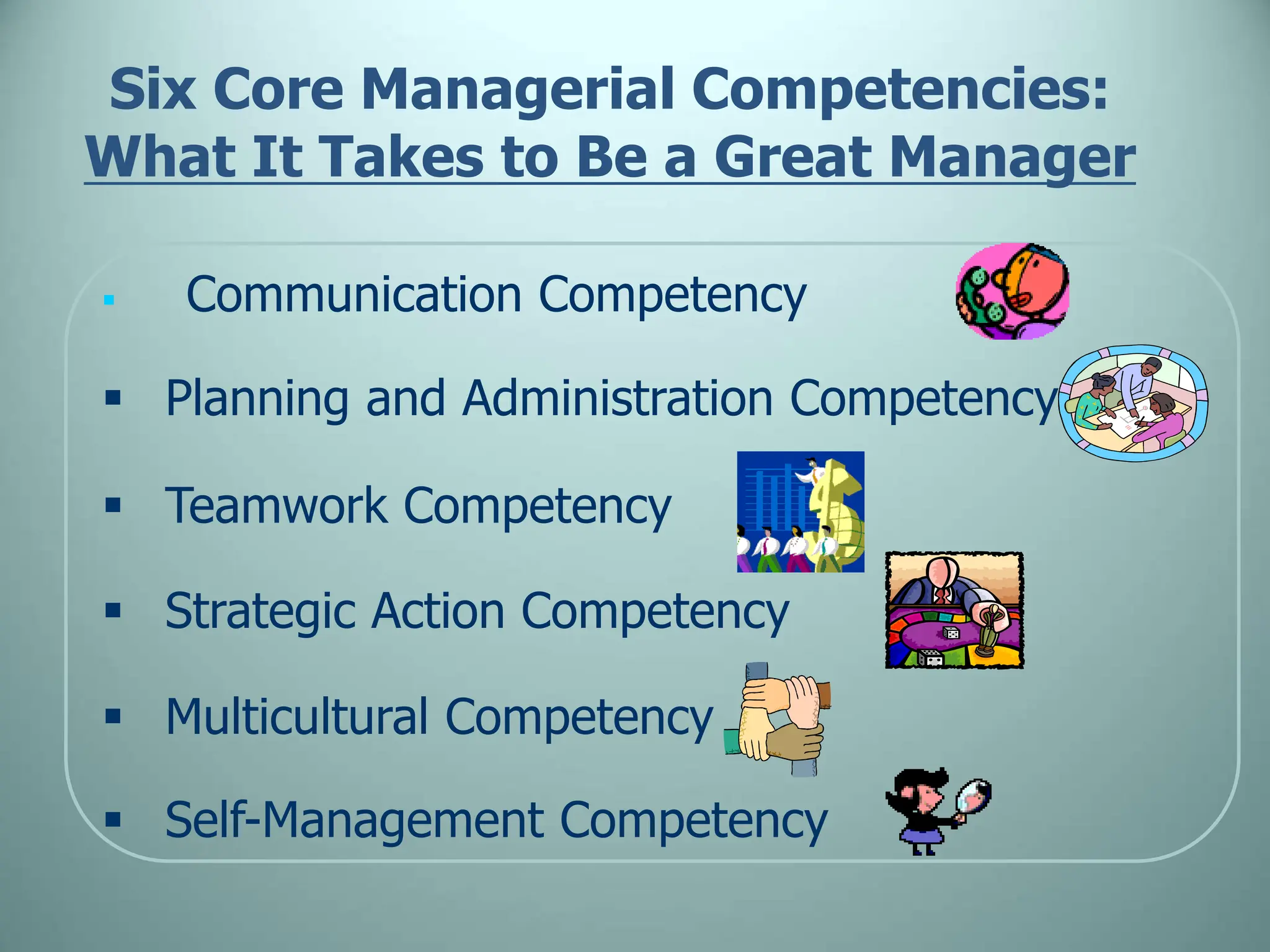
Six Core Managerial Competencies:
What It Takes to Be a Great Manager
 Communication Competency
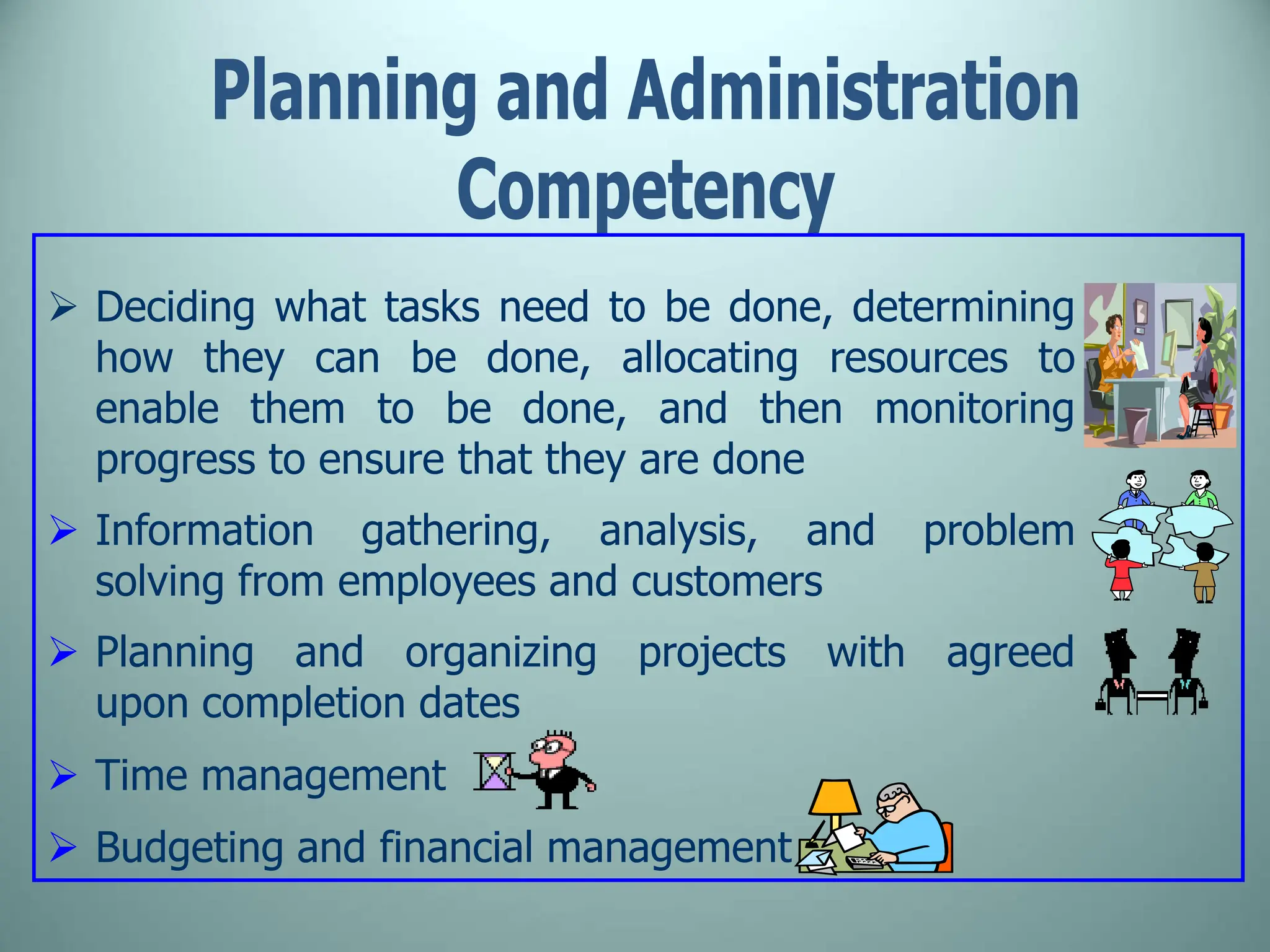
 Planning and Administration Competency
 Teamwork Competency
 Strategic Action Competency
 Multicultural Competency
 Self-Management Competency
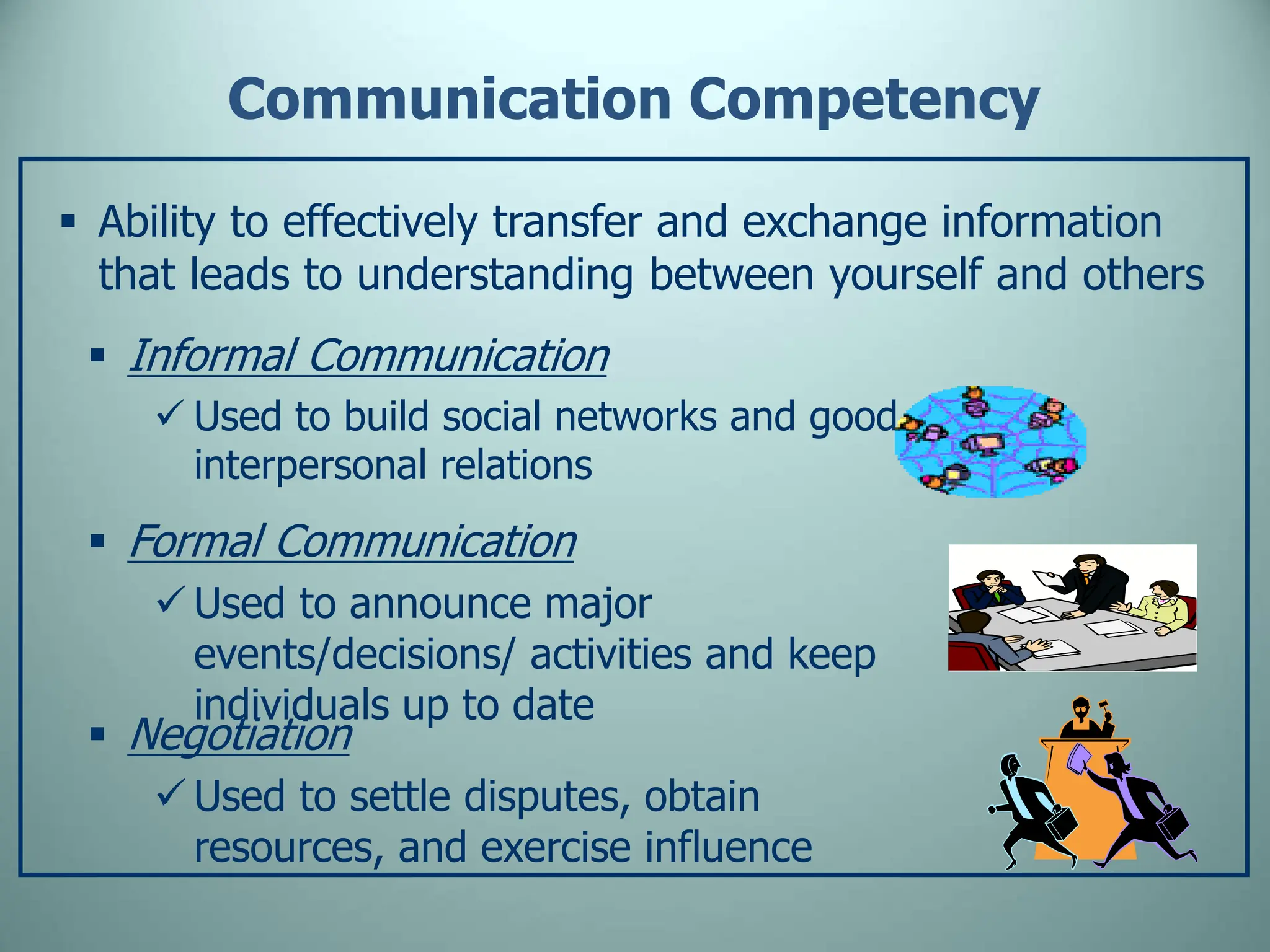
Communication Competency
 Ability to effectively transfer and exchange information
that leads to understanding between yourself and others
 Informal Communication
 Used to build social networks and good
interpersonal relations
 Formal Communication
 Used to announce major
events/decisions/ activities and keep
individuals up to date
 Negotiation
 Used to settle disputes, obtain
resources, and exercise influence
 Deciding what tasks need to be done, determining
how they can be done, allocating resources to
enable them to be done, and then monitoring
progress to ensure that they are done
 Information gathering, analysis, and problem
solving from employees and customers
 Planning and organizing projects with agreed
upon completion dates
 Time management
 Budgeting and financial management
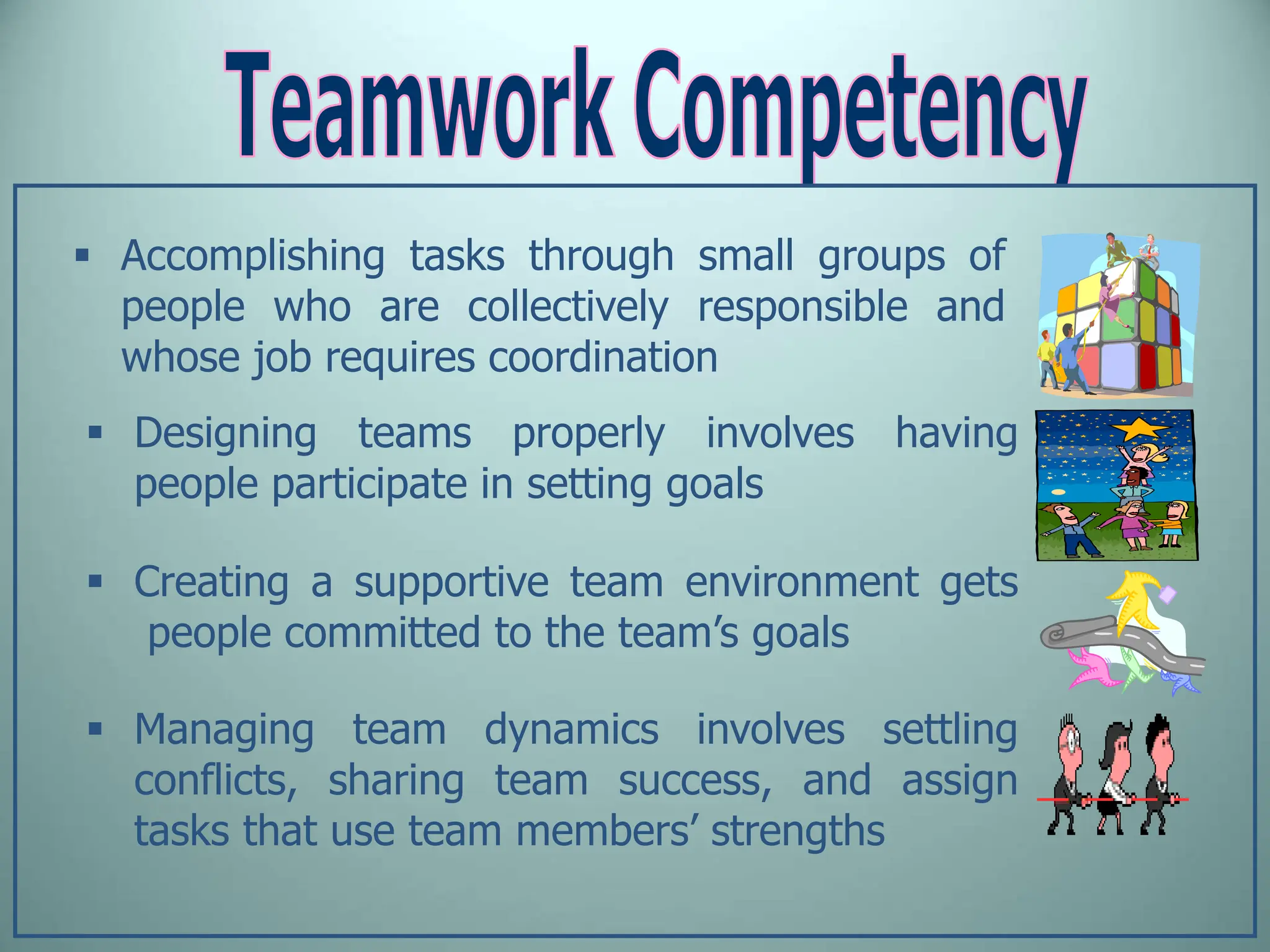
 Accomplishing tasks through small groups of
people who are collectively responsible and
whose job requires coordination
 Designing teams properly involves having
people participate in setting goals
 Creating a supportive team environment gets
people committed to the team’s goals
 Managing team dynamics involves settling
conflicts, sharing team success, and assign
tasks that use team members’ strengths
Strategic Action Competency
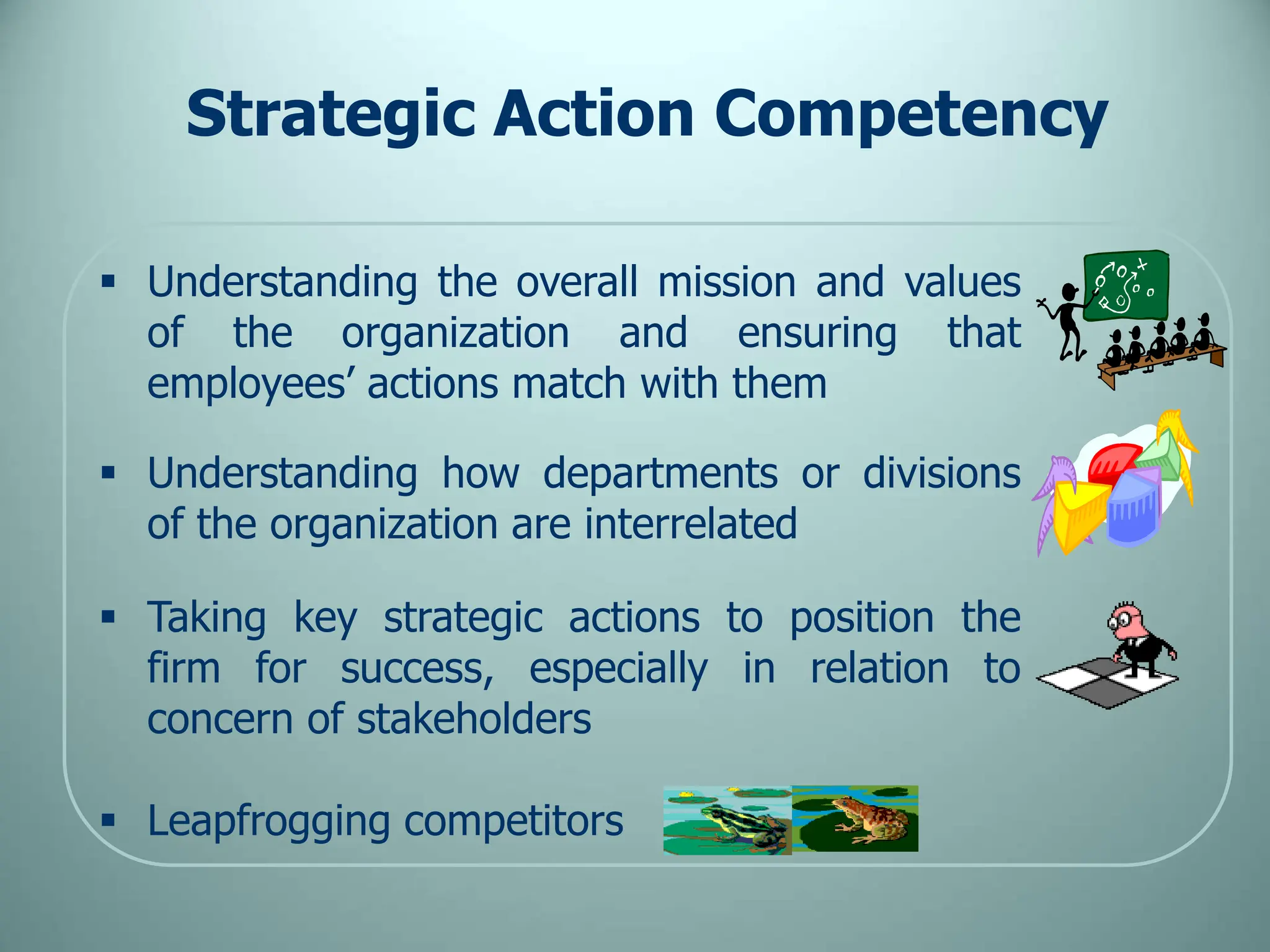
 Understanding the overall mission and values
of the organization and ensuring that
employees’ actions match with them
 Understanding how departments or divisions
of the organization are interrelated
 Taking key strategic actions to position the
firm for success, especially in relation to
concern of stakeholders
 Leapfrogging competitors
Snapshot
“Sony must sell off businesses that don’t fit its
core strategy of fusing gadgets with films,
music, and game software. That means
selling off its businesses in its Sony Financial
Holdings, which are very profitable.”
Howard Stringer, CEO, Sony
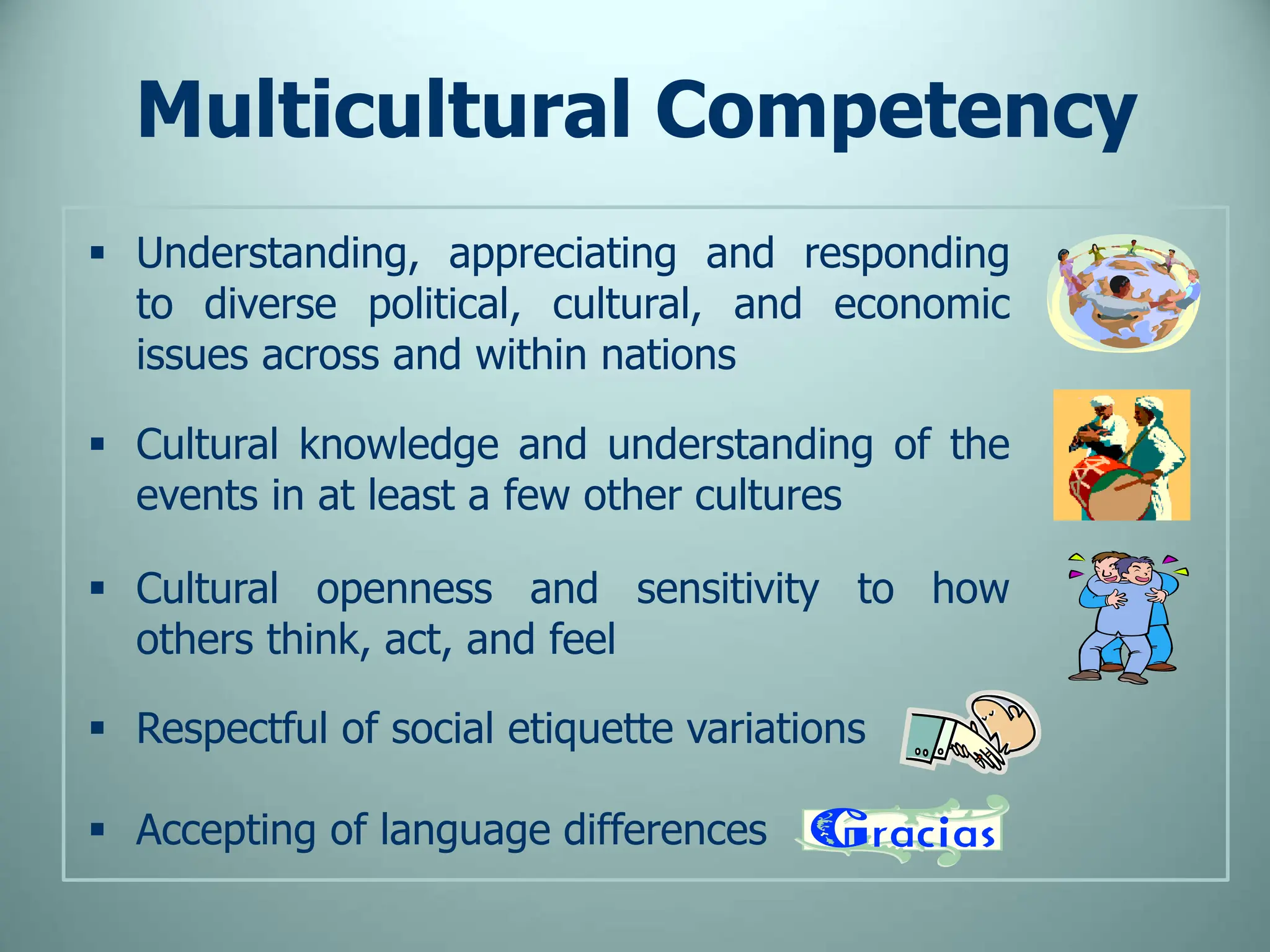
 Understanding, appreciating and responding
to diverse political, cultural, and economic
issues across and within nations
 Cultural knowledge and understanding of the
events in at least a few other cultures
 Cultural openness and sensitivity to how
others think, act, and feel
 Respectful of social etiquette variations
 Accepting of language differences
Multicultural Competency
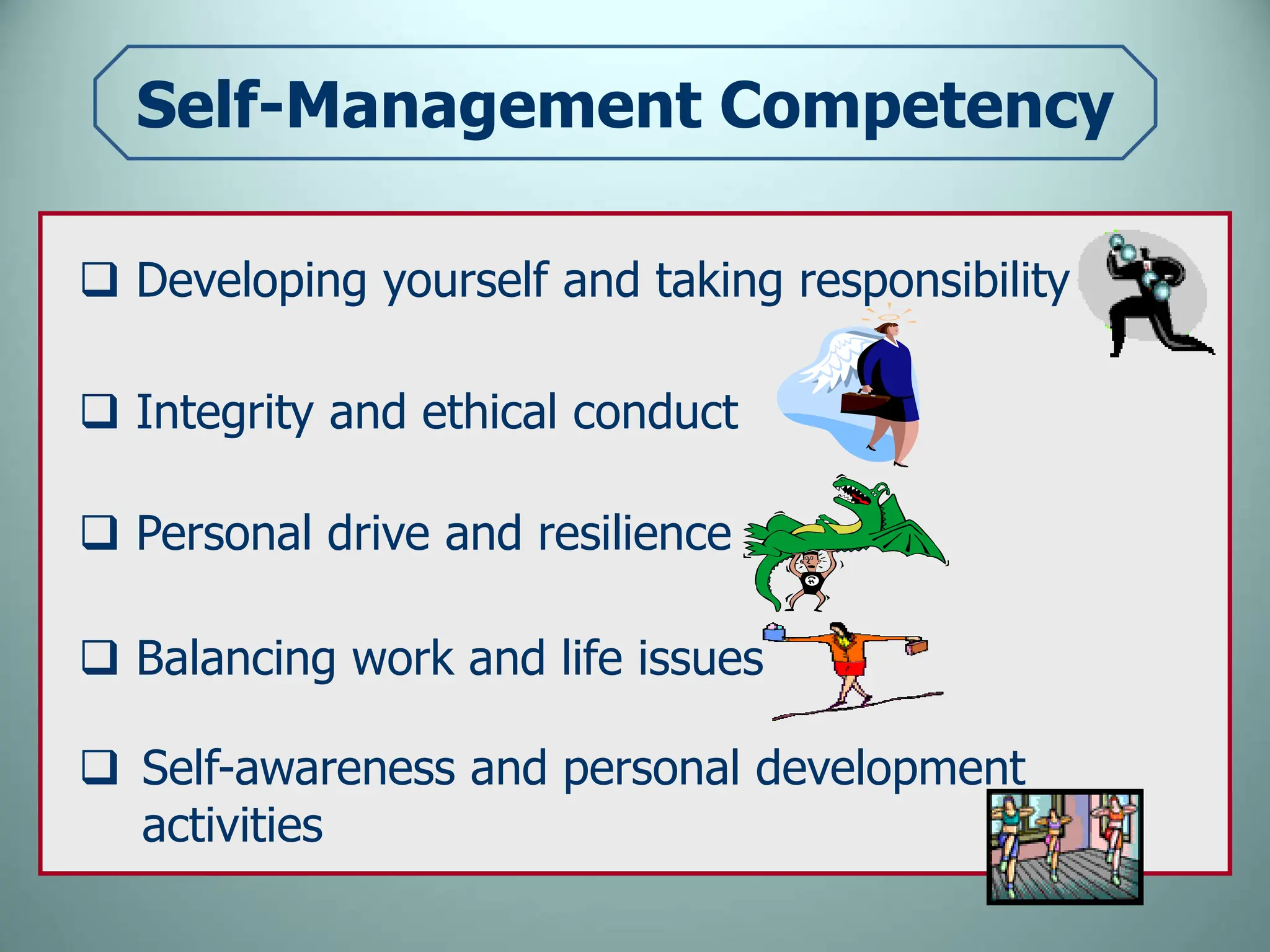
Self-Management Competency
 Developing yourself and taking responsibility
 Integrity and ethical conduct
 Personal drive and resilience
 Balancing work and life issues
 Self-awareness and personal development
activities
Snapshot
“My strengths and weaknesses haven’t
changed a lot in 51 years. The important
thing is to recognize the things you don’t
do well and build a team that reflects what
you know the company needs.”
Anne Mulcahy, CEO, Xerox
Self-Management Competency
Who Is the Manager?
1. College Dean?
2. Police officer?
3. Surgeon?
4. Web-designer?
5. Football coach?
6. Chef?
7. Managing your checking account?
The Manager’s Job Is To:
PLAN:
 A manager cannot operate effectively unless
he or she has long range plans.
A plan for each day’s work:
 What is to be done, and why do it?
 When is it to be done, and how will it be
done?
 Who is to do the job?
 Where should it be done?
The Manager Must Organize
 When there is more than one employee
needed to carry out a plan.
 Then organization is needed.
 A team must be formed.
 Each job must be carefully defined in
terms of what is to be done.
 Establish delegation of responsibility.
Role vs. Status
 Role is the behavior
expected of an
individual who occupies
a given social position
or status.
 A role is a
comprehensive pattern
of behavior that is
socially recognized,
providing a means of
identifying and placing
an individual in a
society.
 Status refers to the
honor or prestige
accorded to a role in the
society.
 Status is the rank in
social hierarchy while
role is the behavior that
is expected of a person.
 Example:
Status as student
 Role 1: Classroom: Attending class, taking notes,
and communicating with the professor
 Role 2: Fellow student: Participating in study
groups, sharing ideas, quizzing other students
Status as employee
 Role 1: Warehouse: Unloading boxes, labeling
products, restocking shelves
 Role 2: Customer service: Answering questions,
solving problems, researching information
Managerial Roles
 Leading your team and also resolving a conflict,
 negotiating new contracts,
 representing your department at a board
meeting, or approving a request for a new
computer system.
 Managers are constantly switching roles as tasks,
situations, and expectations change.
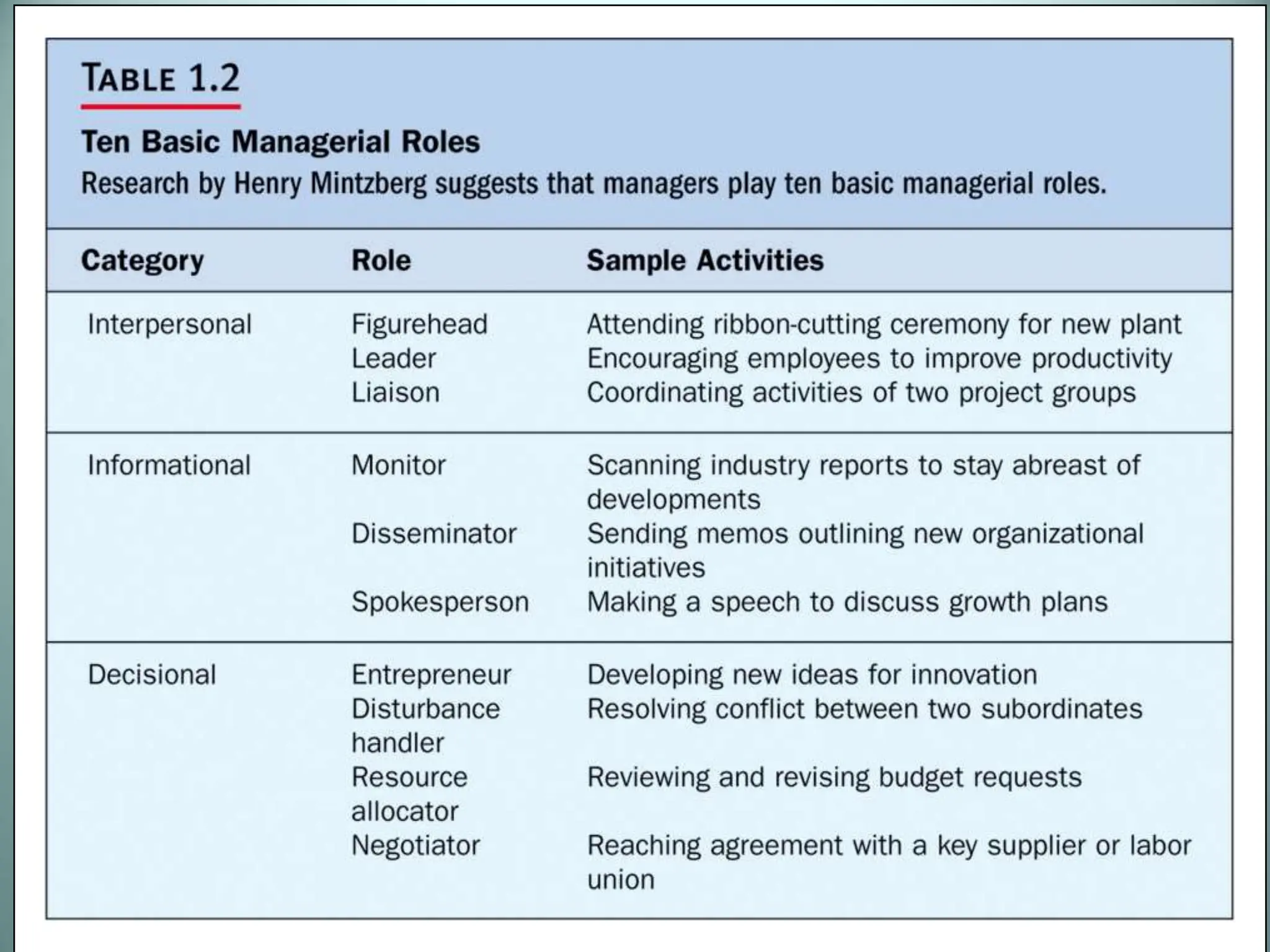
 Management expert and professor Henry
Mintzberg recognized this, and he argued that
there are ten primary roles or behaviors that can
be used to categorize a manager's different
functions.
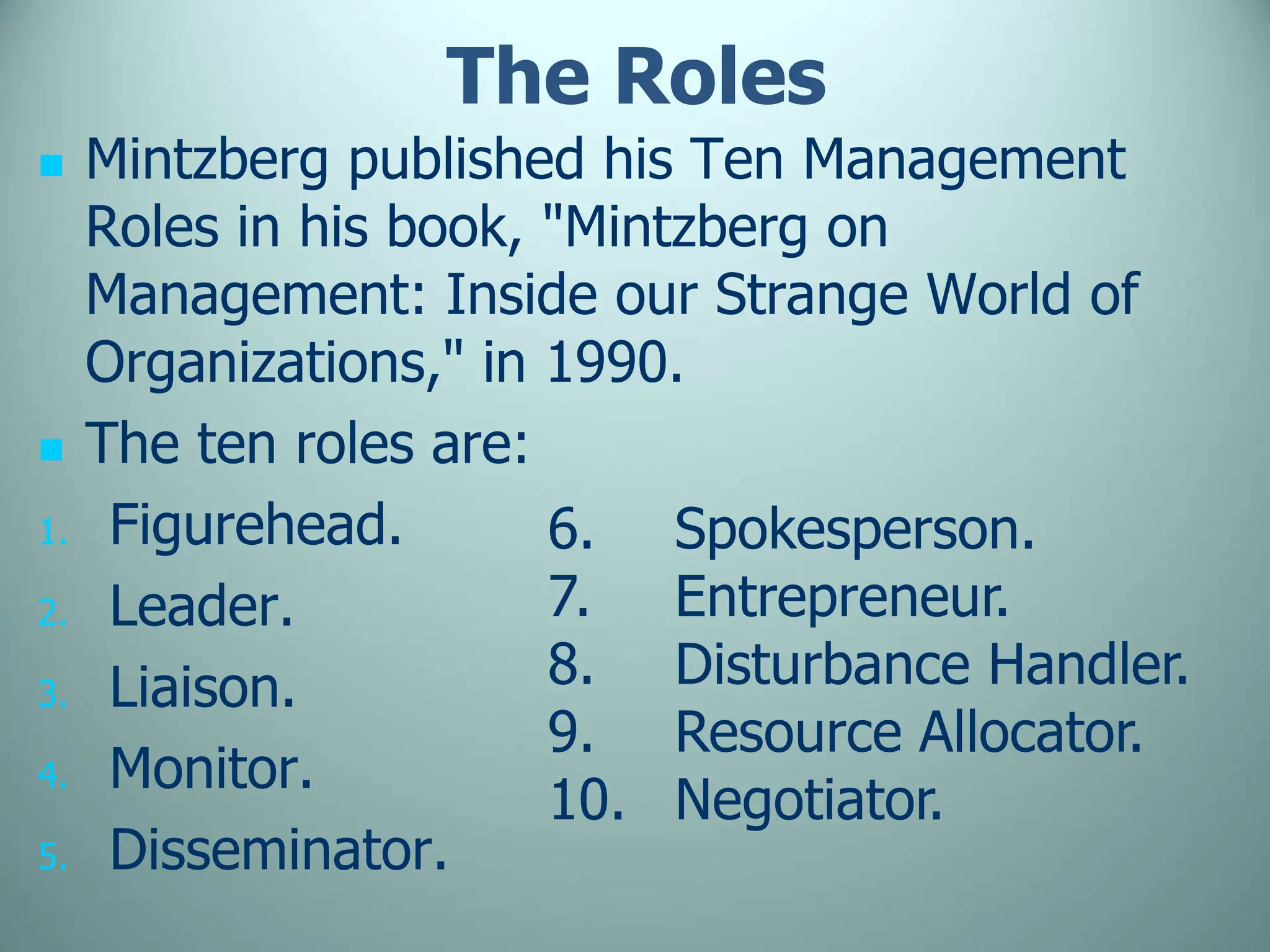
The Roles
 Mintzberg published his Ten Management
Roles in his book, "Mintzberg on
Management: Inside our Strange World of
Organizations," in 1990.
 The ten roles are:
1. Figurehead.
2. Leader.
3. Liaison.
4. Monitor.
5. Disseminator.
6. Spokesperson.
7. Entrepreneur.
8. Disturbance Handler.
9. Resource Allocator.
10. Negotiator.
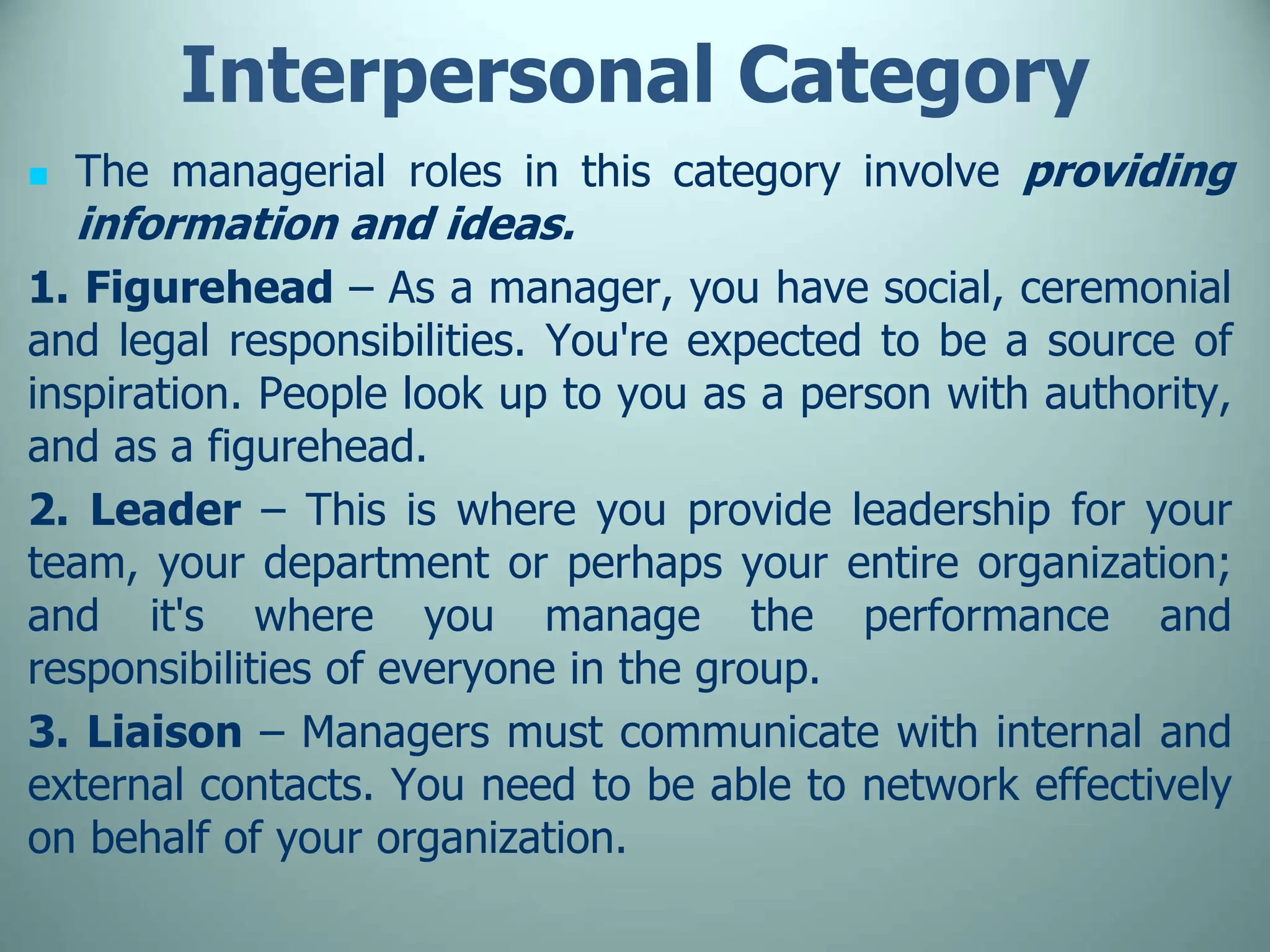
Interpersonal Category
 The managerial roles in this category involve providing
information and ideas.
1. Figurehead – As a manager, you have social, ceremonial
and legal responsibilities. You're expected to be a source of
inspiration. People look up to you as a person with authority,
and as a figurehead.
2. Leader – This is where you provide leadership for your
team, your department or perhaps your entire organization;
and it's where you manage the performance and
responsibilities of everyone in the group.
3. Liaison – Managers must communicate with internal and
external contacts. You need to be able to network effectively
on behalf of your organization.
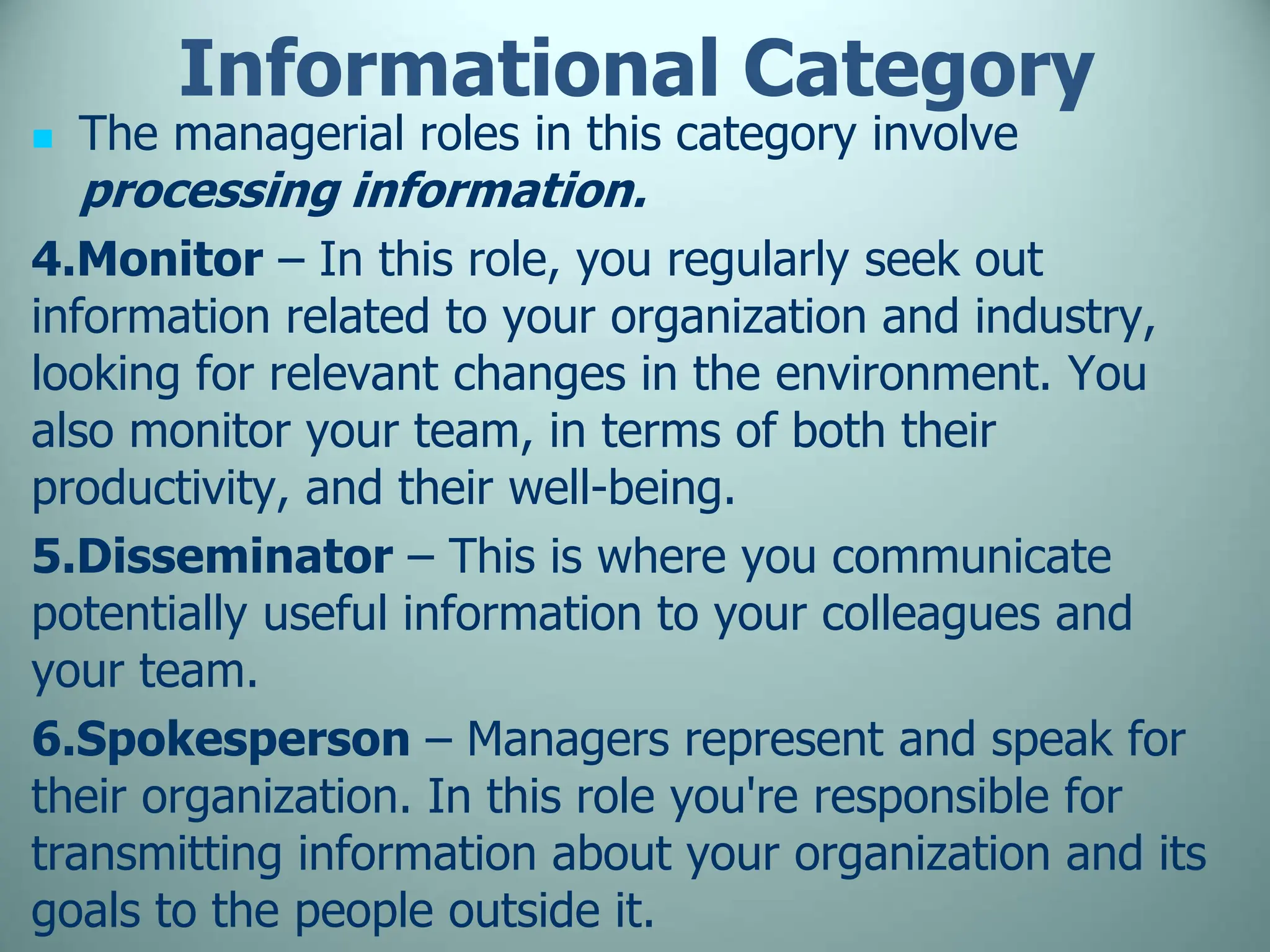
Informational Category
 The managerial roles in this category involve
processing information.
4.Monitor – In this role, you regularly seek out
information related to your organization and industry,
looking for relevant changes in the environment. You
also monitor your team, in terms of both their
productivity, and their well-being.
5.Disseminator – This is where you communicate
potentially useful information to your colleagues and
your team.
6.Spokesperson – Managers represent and speak for
their organization. In this role you're responsible for
transmitting information about your organization and its
goals to the people outside it.
Decisional Category
 The managerial roles in this category involve using
information.
7.Entrepreneur – As a manager, you create and control
change within the organization. This means solving problems,
generating new ideas, and implementing them.
8.Disturbance Handler – When an organization or team hits
an unexpected roadblock, it's the manager who must take
charge. You also need to help mediate disputes within it.
9.Resource Allocator – You'll also need to determine where
organizational resources are best applied. This involves
allocating funding, as well as assigning staff and other
organizational resources.
10.Negotiator – You may be needed to take part in, and
direct, important negotiations within your team, department, or
organization.
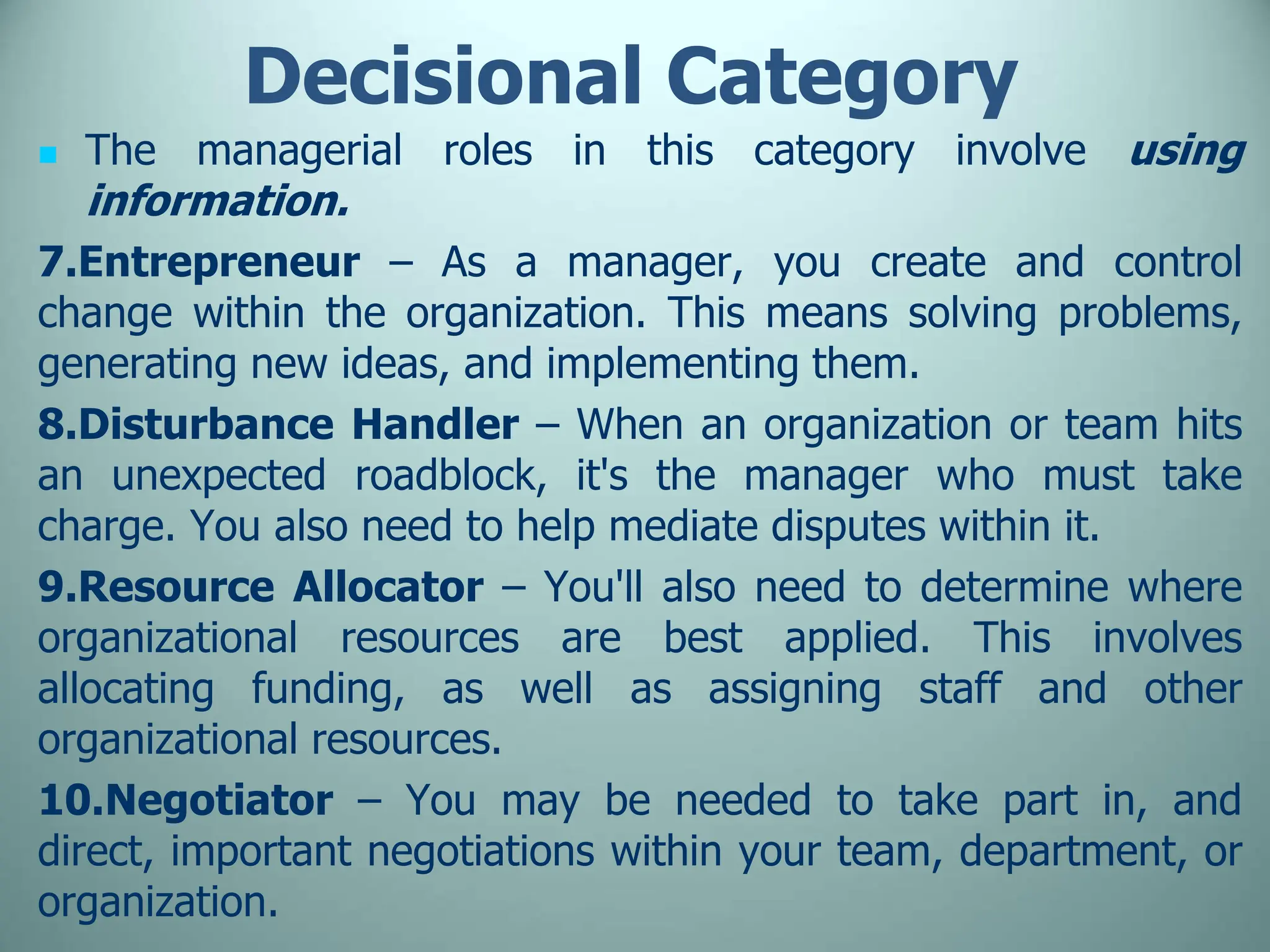
Managerial Skills
 In addition to fulfilling roles, managers also
need a number of specific skills.
 The most fundamental management skills
are:
 Technical
 Interpersonal
 Conceptual
 Diagnostic
 Communication
 Decision-making
 Time-management
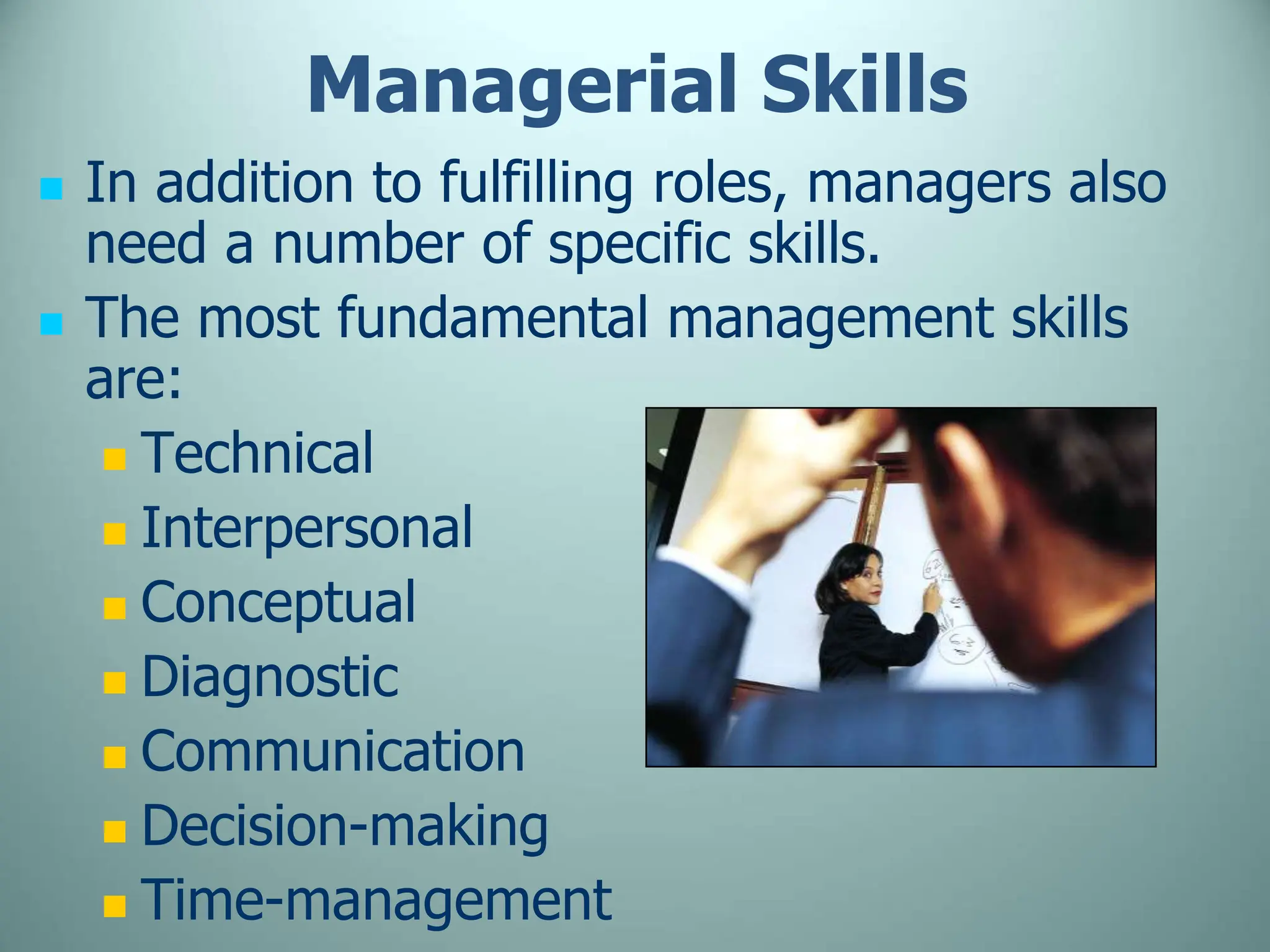
Technical Skills
 Necessary to
accomplish or
understand the specific
kind of work being
done.
 These skills are
especially important for
first line managers.
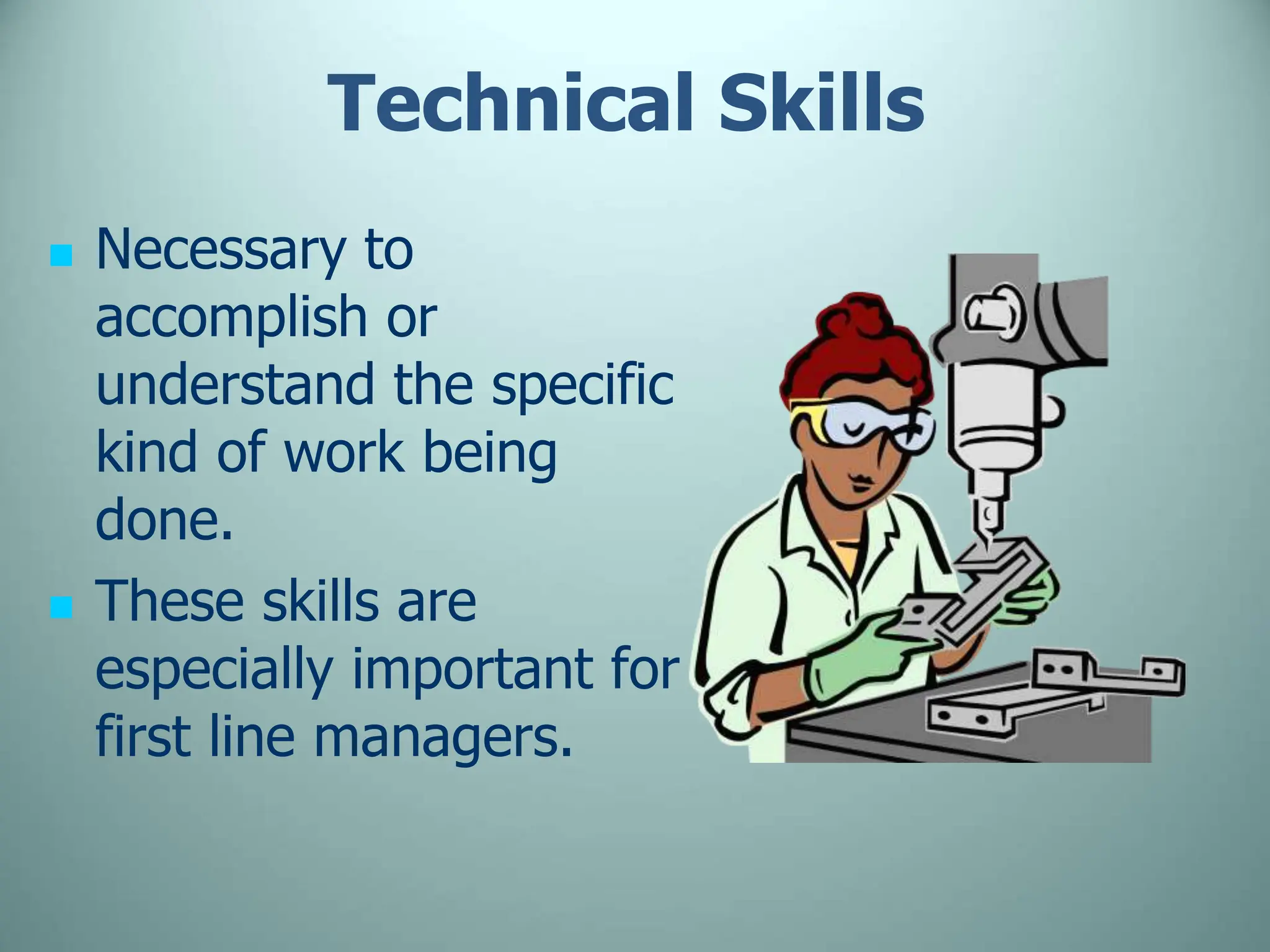
Interpersonal Skills
 The ability to
communicate with,
understand, and motivate
both individuals and
groups.
 Be able to get along with:
 Subordinates
 Peers
 Those at higher levels
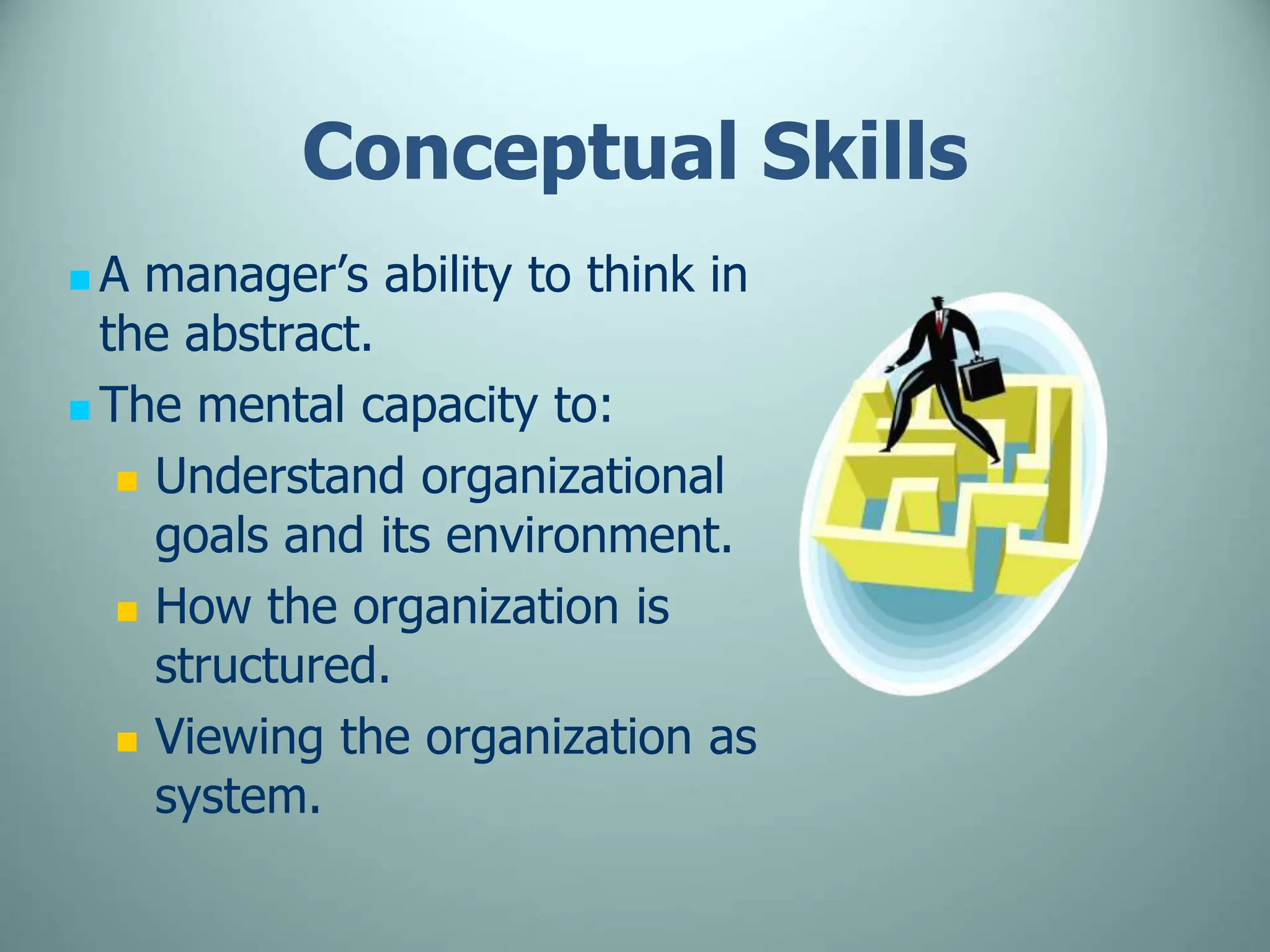
Conceptual Skills
 A manager’s ability to think in
the abstract.
 The mental capacity to:
 Understand organizational
goals and its environment.
 How the organization is
structured.
 Viewing the organization as
system.
1 - 26
Diagnostic Skills
 Skills that enable a
manager to
visualize the most
appropriate
response to a
situation.
Communication Skills
 A manager’s abilities
both to effectively
convey ideas and
information to others
and to effectively
receive ideas and
information from
others.
Decision-Making Skills
 A manager’s ability to
correctly recognize and
define problems and
opportunities and to then
select an appropriate
course of action to solve
problems and capitalize on
opportunities.
Time-Management Skills
 The manager’s
ability to prioritize
work, to work
efficiently, and to
delegate
appropriately.
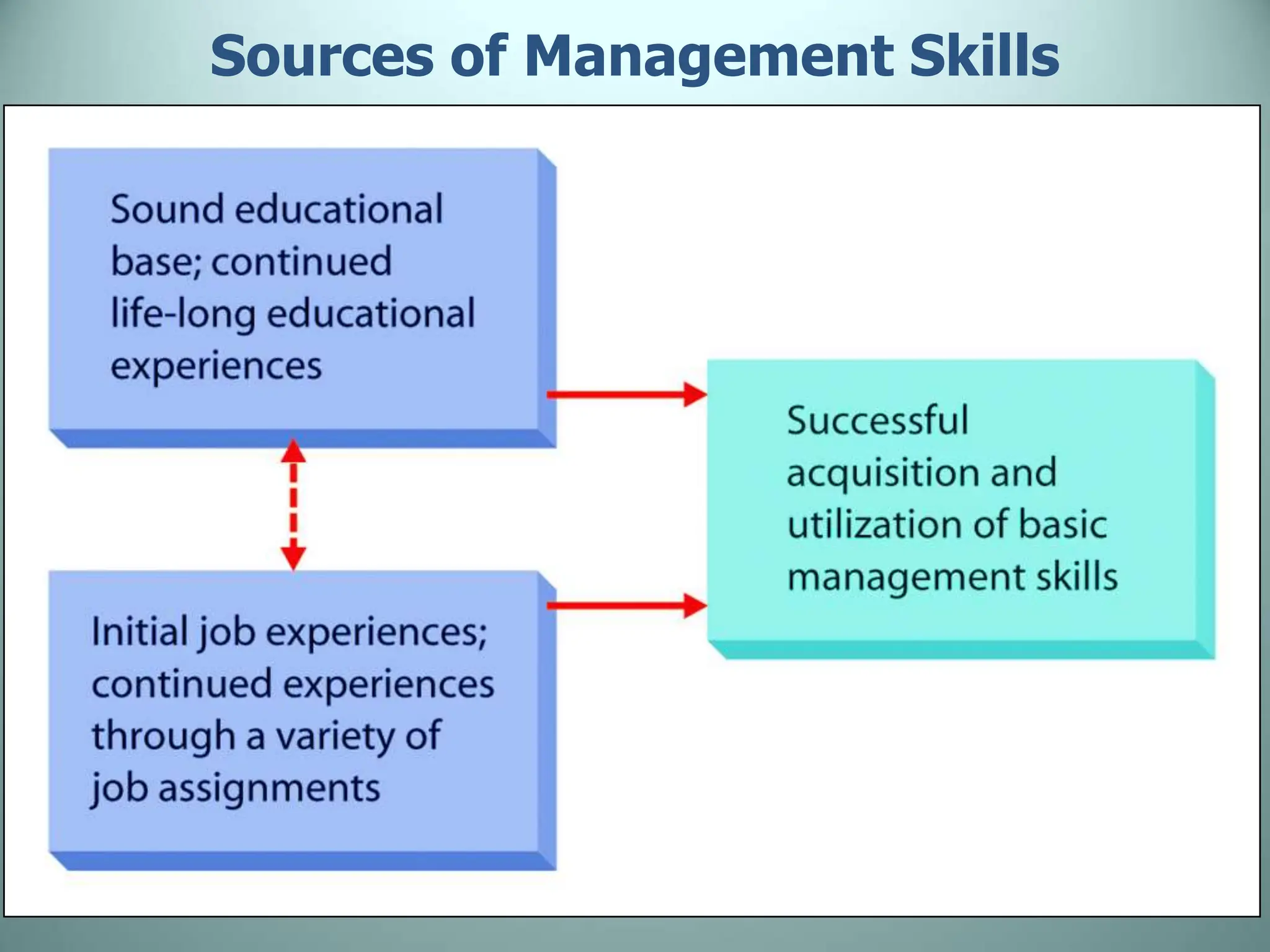
Becoming a Manager
 How does one acquire the skills necessary
to blend the science and art of
management to become successful
manager?
Sources of Management Skills
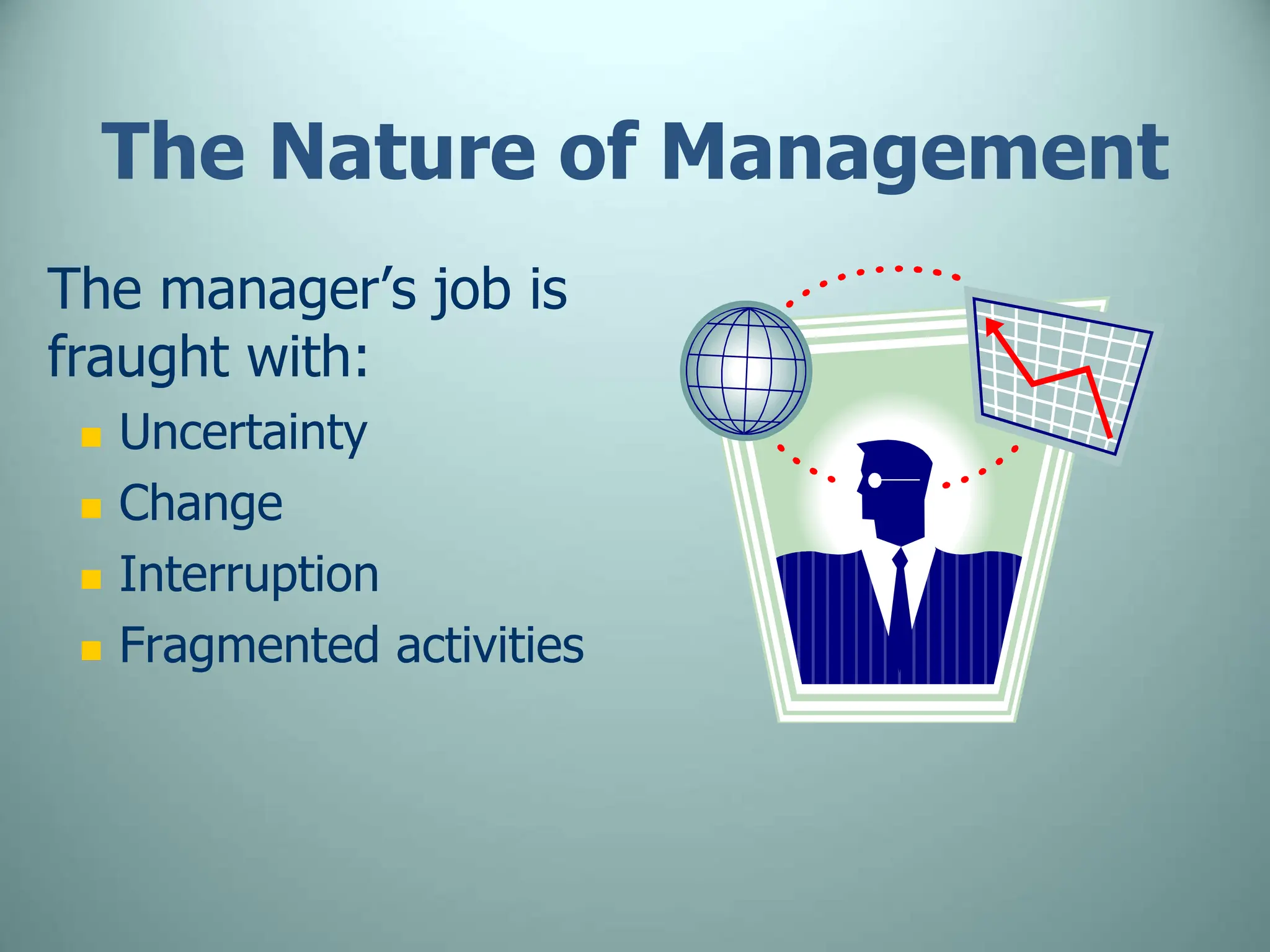
The Nature of Management
The manager’s job is
fraught with:
 Uncertainty
 Change
 Interruption
 Fragmented activities
A Manager Must be a Leader of
Employees
 It means overseeing the
team by influencing the
employees to get the job
done.
 Motivating employees.
 Creating an environment
that makes employees
work efficiently.
 Managers get employees
to put forth their best
effort.
You Have Been Assigned As
Manager of Your Group
 The manager whose place you are taking
is being left on the job for a period to train
you, but he is not training you.
 You find the previous manager has been
running a one person show.
 The morale of the employees really could
be better.
 What are you going to do?

Principles of Management NUML University Lecture 2

  • 1.
  • 2.
    Six Core ManagerialCompetencies: What It Takes to Be a Great Manager  Communication Competency  Planning and Administration Competency  Teamwork Competency  Strategic Action Competency  Multicultural Competency  Self-Management Competency
  • 3.
    Communication Competency  Abilityto effectively transfer and exchange information that leads to understanding between yourself and others  Informal Communication  Used to build social networks and good interpersonal relations  Formal Communication  Used to announce major events/decisions/ activities and keep individuals up to date  Negotiation  Used to settle disputes, obtain resources, and exercise influence
  • 4.
     Deciding whattasks need to be done, determining how they can be done, allocating resources to enable them to be done, and then monitoring progress to ensure that they are done  Information gathering, analysis, and problem solving from employees and customers  Planning and organizing projects with agreed upon completion dates  Time management  Budgeting and financial management
  • 5.
     Accomplishing tasksthrough small groups of people who are collectively responsible and whose job requires coordination  Designing teams properly involves having people participate in setting goals  Creating a supportive team environment gets people committed to the team’s goals  Managing team dynamics involves settling conflicts, sharing team success, and assign tasks that use team members’ strengths
  • 6.
    Strategic Action Competency Understanding the overall mission and values of the organization and ensuring that employees’ actions match with them  Understanding how departments or divisions of the organization are interrelated  Taking key strategic actions to position the firm for success, especially in relation to concern of stakeholders  Leapfrogging competitors
  • 7.
    Snapshot “Sony must selloff businesses that don’t fit its core strategy of fusing gadgets with films, music, and game software. That means selling off its businesses in its Sony Financial Holdings, which are very profitable.” Howard Stringer, CEO, Sony
  • 8.
     Understanding, appreciatingand responding to diverse political, cultural, and economic issues across and within nations  Cultural knowledge and understanding of the events in at least a few other cultures  Cultural openness and sensitivity to how others think, act, and feel  Respectful of social etiquette variations  Accepting of language differences Multicultural Competency
  • 9.
    Self-Management Competency  Developingyourself and taking responsibility  Integrity and ethical conduct  Personal drive and resilience  Balancing work and life issues  Self-awareness and personal development activities
  • 10.
    Snapshot “My strengths andweaknesses haven’t changed a lot in 51 years. The important thing is to recognize the things you don’t do well and build a team that reflects what you know the company needs.” Anne Mulcahy, CEO, Xerox Self-Management Competency
  • 11.
    Who Is theManager? 1. College Dean? 2. Police officer? 3. Surgeon? 4. Web-designer? 5. Football coach? 6. Chef? 7. Managing your checking account?
  • 12.
    The Manager’s JobIs To: PLAN:  A manager cannot operate effectively unless he or she has long range plans. A plan for each day’s work:  What is to be done, and why do it?  When is it to be done, and how will it be done?  Who is to do the job?  Where should it be done?
  • 13.
    The Manager MustOrganize  When there is more than one employee needed to carry out a plan.  Then organization is needed.  A team must be formed.  Each job must be carefully defined in terms of what is to be done.  Establish delegation of responsibility.
  • 14.
    Role vs. Status Role is the behavior expected of an individual who occupies a given social position or status.  A role is a comprehensive pattern of behavior that is socially recognized, providing a means of identifying and placing an individual in a society.  Status refers to the honor or prestige accorded to a role in the society.  Status is the rank in social hierarchy while role is the behavior that is expected of a person.
  • 15.
     Example: Status asstudent  Role 1: Classroom: Attending class, taking notes, and communicating with the professor  Role 2: Fellow student: Participating in study groups, sharing ideas, quizzing other students Status as employee  Role 1: Warehouse: Unloading boxes, labeling products, restocking shelves  Role 2: Customer service: Answering questions, solving problems, researching information
  • 16.
    Managerial Roles  Leadingyour team and also resolving a conflict,  negotiating new contracts,  representing your department at a board meeting, or approving a request for a new computer system.  Managers are constantly switching roles as tasks, situations, and expectations change.  Management expert and professor Henry Mintzberg recognized this, and he argued that there are ten primary roles or behaviors that can be used to categorize a manager's different functions.
  • 17.
    The Roles  Mintzbergpublished his Ten Management Roles in his book, "Mintzberg on Management: Inside our Strange World of Organizations," in 1990.  The ten roles are: 1. Figurehead. 2. Leader. 3. Liaison. 4. Monitor. 5. Disseminator. 6. Spokesperson. 7. Entrepreneur. 8. Disturbance Handler. 9. Resource Allocator. 10. Negotiator.
  • 19.
    Interpersonal Category  Themanagerial roles in this category involve providing information and ideas. 1. Figurehead – As a manager, you have social, ceremonial and legal responsibilities. You're expected to be a source of inspiration. People look up to you as a person with authority, and as a figurehead. 2. Leader – This is where you provide leadership for your team, your department or perhaps your entire organization; and it's where you manage the performance and responsibilities of everyone in the group. 3. Liaison – Managers must communicate with internal and external contacts. You need to be able to network effectively on behalf of your organization.
  • 20.
    Informational Category  Themanagerial roles in this category involve processing information. 4.Monitor – In this role, you regularly seek out information related to your organization and industry, looking for relevant changes in the environment. You also monitor your team, in terms of both their productivity, and their well-being. 5.Disseminator – This is where you communicate potentially useful information to your colleagues and your team. 6.Spokesperson – Managers represent and speak for their organization. In this role you're responsible for transmitting information about your organization and its goals to the people outside it.
  • 21.
    Decisional Category  Themanagerial roles in this category involve using information. 7.Entrepreneur – As a manager, you create and control change within the organization. This means solving problems, generating new ideas, and implementing them. 8.Disturbance Handler – When an organization or team hits an unexpected roadblock, it's the manager who must take charge. You also need to help mediate disputes within it. 9.Resource Allocator – You'll also need to determine where organizational resources are best applied. This involves allocating funding, as well as assigning staff and other organizational resources. 10.Negotiator – You may be needed to take part in, and direct, important negotiations within your team, department, or organization.
  • 22.
    Managerial Skills  Inaddition to fulfilling roles, managers also need a number of specific skills.  The most fundamental management skills are:  Technical  Interpersonal  Conceptual  Diagnostic  Communication  Decision-making  Time-management
  • 23.
    Technical Skills  Necessaryto accomplish or understand the specific kind of work being done.  These skills are especially important for first line managers.
  • 24.
    Interpersonal Skills  Theability to communicate with, understand, and motivate both individuals and groups.  Be able to get along with:  Subordinates  Peers  Those at higher levels
  • 25.
    Conceptual Skills  Amanager’s ability to think in the abstract.  The mental capacity to:  Understand organizational goals and its environment.  How the organization is structured.  Viewing the organization as system.
  • 26.
    1 - 26 DiagnosticSkills  Skills that enable a manager to visualize the most appropriate response to a situation.
  • 27.
    Communication Skills  Amanager’s abilities both to effectively convey ideas and information to others and to effectively receive ideas and information from others.
  • 28.
    Decision-Making Skills  Amanager’s ability to correctly recognize and define problems and opportunities and to then select an appropriate course of action to solve problems and capitalize on opportunities.
  • 29.
    Time-Management Skills  Themanager’s ability to prioritize work, to work efficiently, and to delegate appropriately.
  • 30.
    Becoming a Manager How does one acquire the skills necessary to blend the science and art of management to become successful manager?
  • 31.
  • 32.
    The Nature ofManagement The manager’s job is fraught with:  Uncertainty  Change  Interruption  Fragmented activities
  • 33.
    A Manager Mustbe a Leader of Employees  It means overseeing the team by influencing the employees to get the job done.  Motivating employees.  Creating an environment that makes employees work efficiently.  Managers get employees to put forth their best effort.
  • 34.
    You Have BeenAssigned As Manager of Your Group  The manager whose place you are taking is being left on the job for a period to train you, but he is not training you.  You find the previous manager has been running a one person show.  The morale of the employees really could be better.  What are you going to do?