DR NILESH KATE
MBBS,MD
ASSOCIATE PROF
ESIC MEDICAL COLLEGE, GULBARGA.
DEPT. OF PHYSIOLOGY
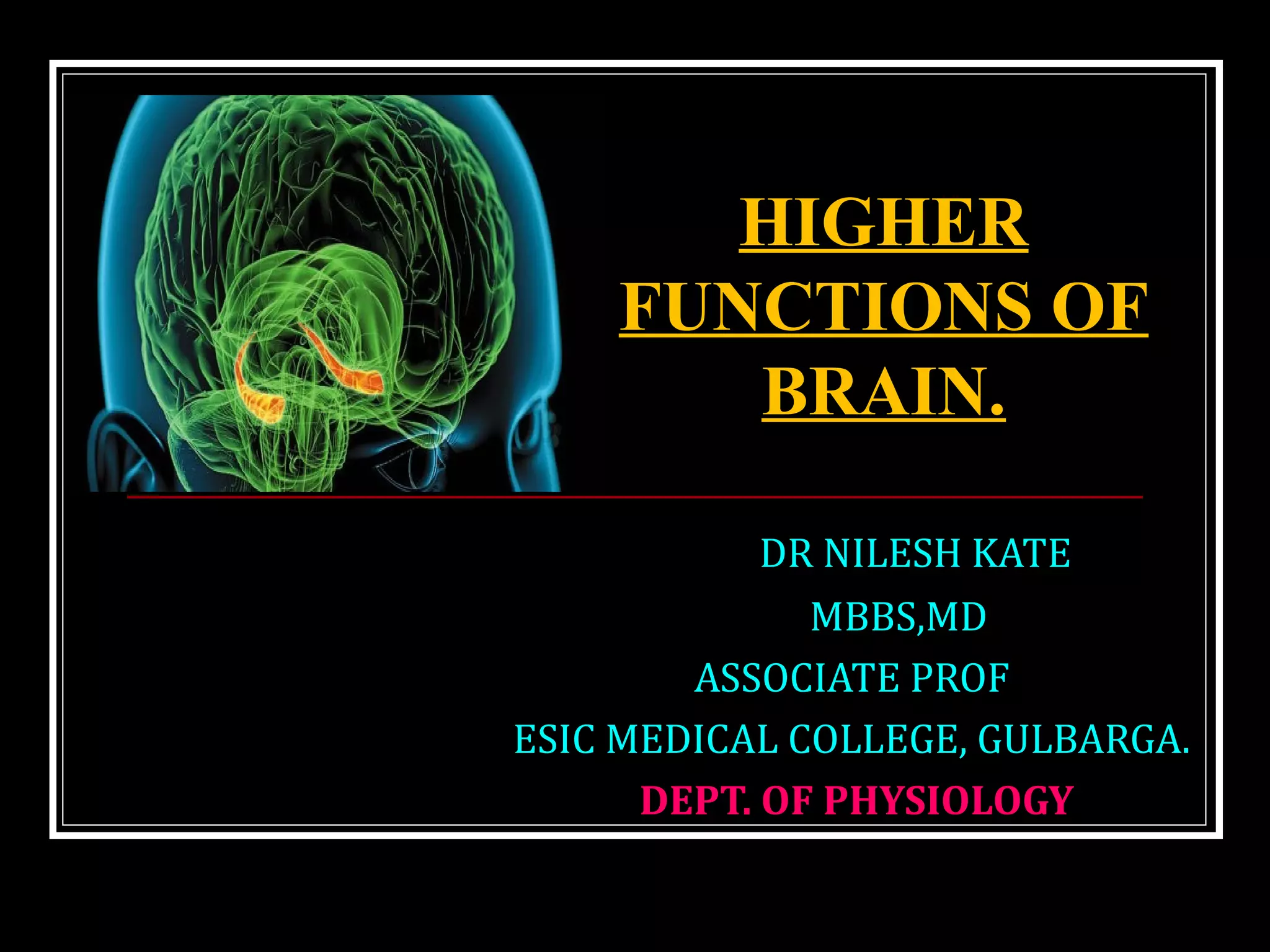
HIGHER
FUNCTIONS OF
BRAIN.
LEARNING & MEMORY
 Learning – Neural
mechanism by which
individual changes
behaviour on the basis of
past experience.
 Memory – Acquisition ,
storage & retrieval of
sensory information
Monday, February 2, 2015 HIGHER FUNCTIONS OF BRAIN. 2
LEARNING .
 Reflex learning.
 Associated with
immediate behaviour
change.
 Incidental learning.
 Behaviour change not
immediate
 But person gets
information from
sensory inputs &
develop potential to
behave differently.
Monday, February 2, 2015 3HIGHER FUNCTIONS OF BRAIN.
REFLEX LEARNING.
 Non- associative .
Person learns about
properties of single
stimulus when
repeatedly exposed to
same stimulus.
 Associative.
Person learns about
relationship between
two stimuli or a
stimulus & behaviour.
Monday, February 2, 2015 4HIGHER FUNCTIONS OF BRAIN.
NON- ASSOCIATIVE .
 Habituation
Decrease in response
to benign stimulus
when stimulus
presented repeatedly.
 Sensitization.
 Increase in response
to benign stimulus
when stimulus
presented repeatedly.
Monday, February 2, 2015 5HIGHER FUNCTIONS OF BRAIN.
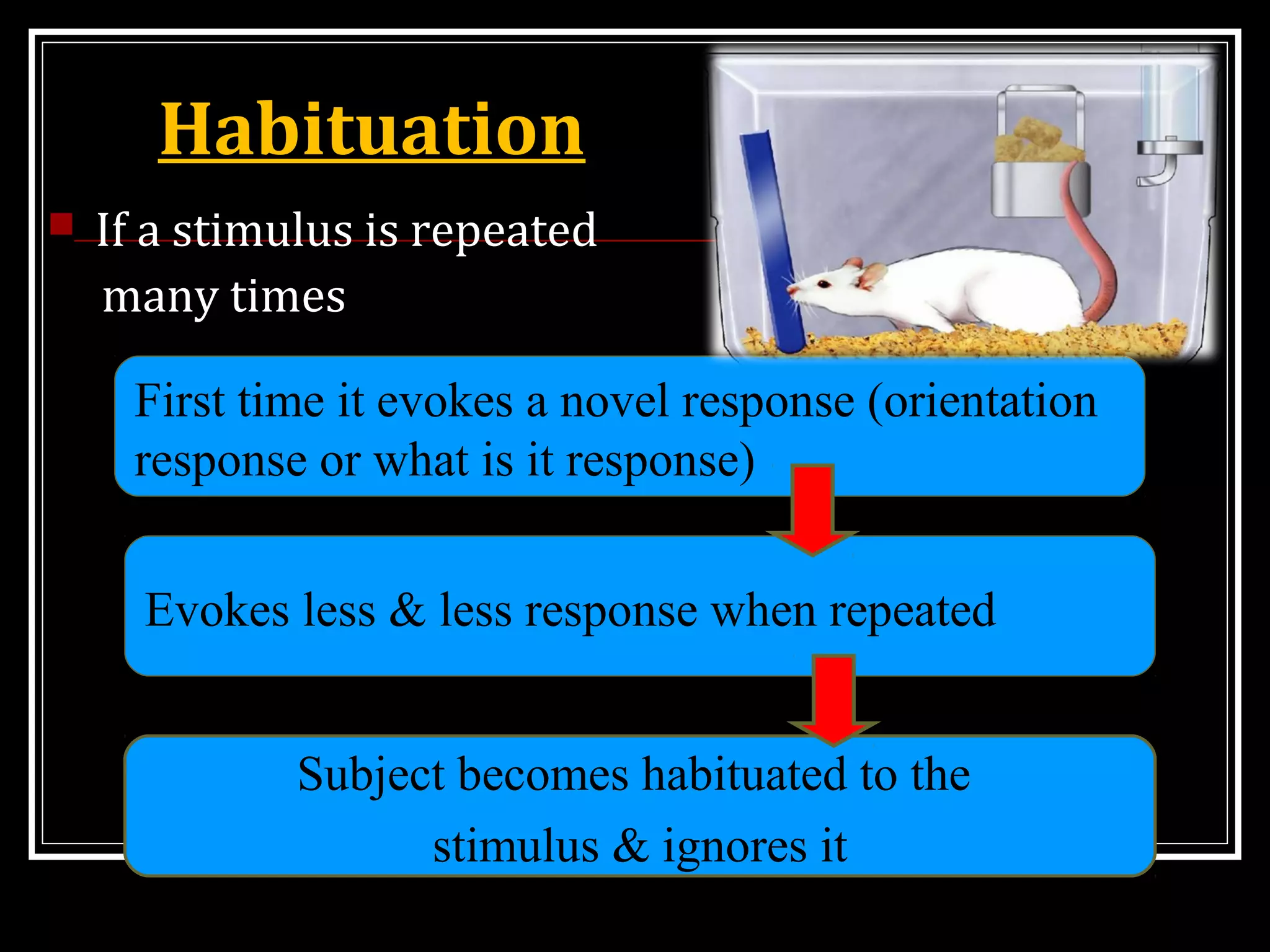
First time it evokes a novel response (orientation
response or what is it response)
Evokes less & less response when repeated
Subject becomes habituated to the
stimulus & ignores it
Habituation
 If a stimulus is repeated
many times
Habituation
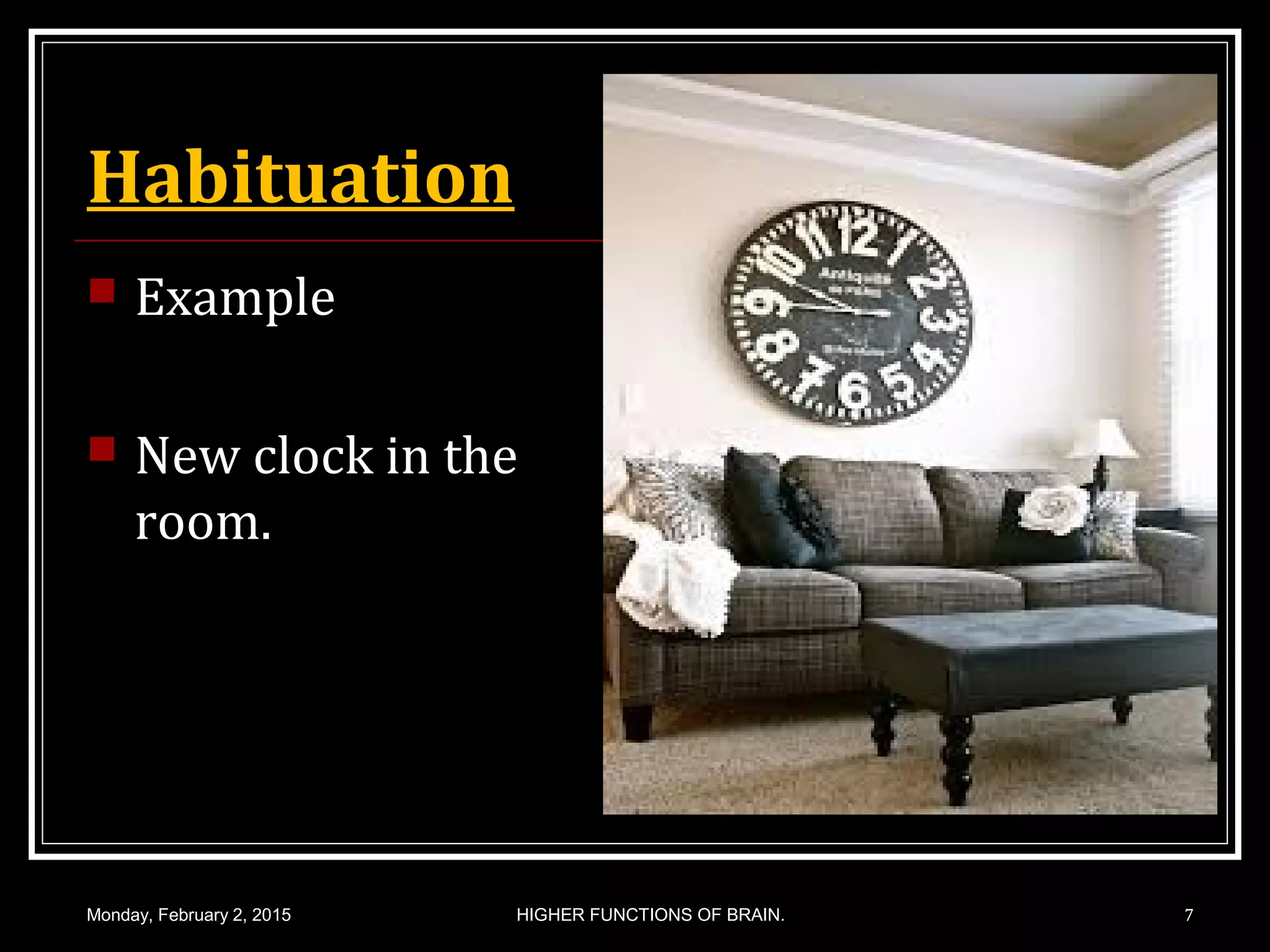
 Example
 New clock in the
room.
Monday, February 2, 2015 HIGHER FUNCTIONS OF BRAIN. 7
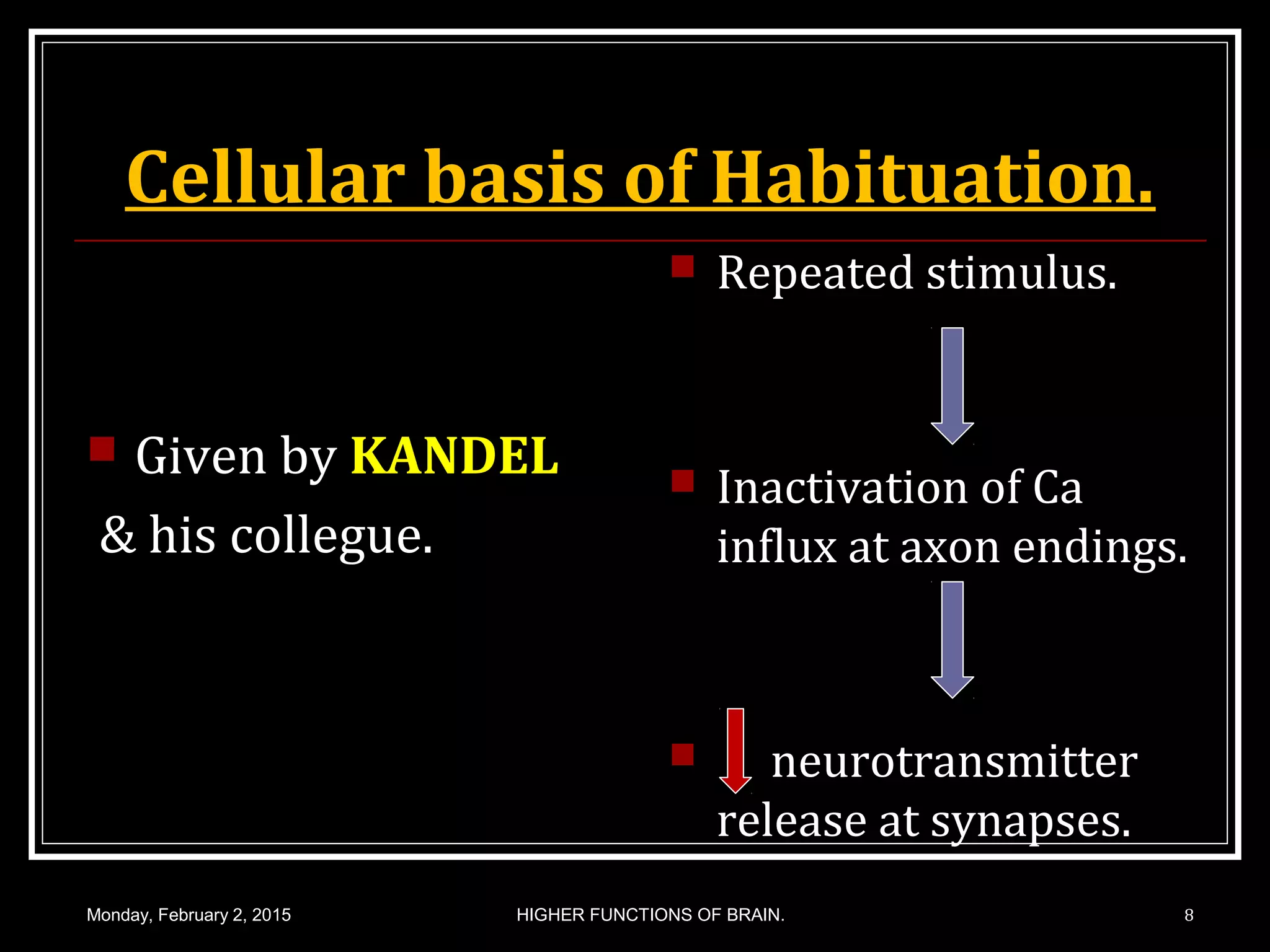
Cellular basis of Habituation.
 Given by KANDEL
& his collegue.
 Repeated stimulus.
 Inactivation of Ca
influx at axon endings.
 neurotransmitter
release at synapses.
Monday, February 2, 2015 HIGHER FUNCTIONS OF BRAIN. 8
Cellular basis of Sensitization.
 Given by KANDEL
& his collegue.
 Repeated stimulus.
 neurotransmitter
release at synapses.
Monday, February 2, 2015 HIGHER FUNCTIONS OF BRAIN. 9
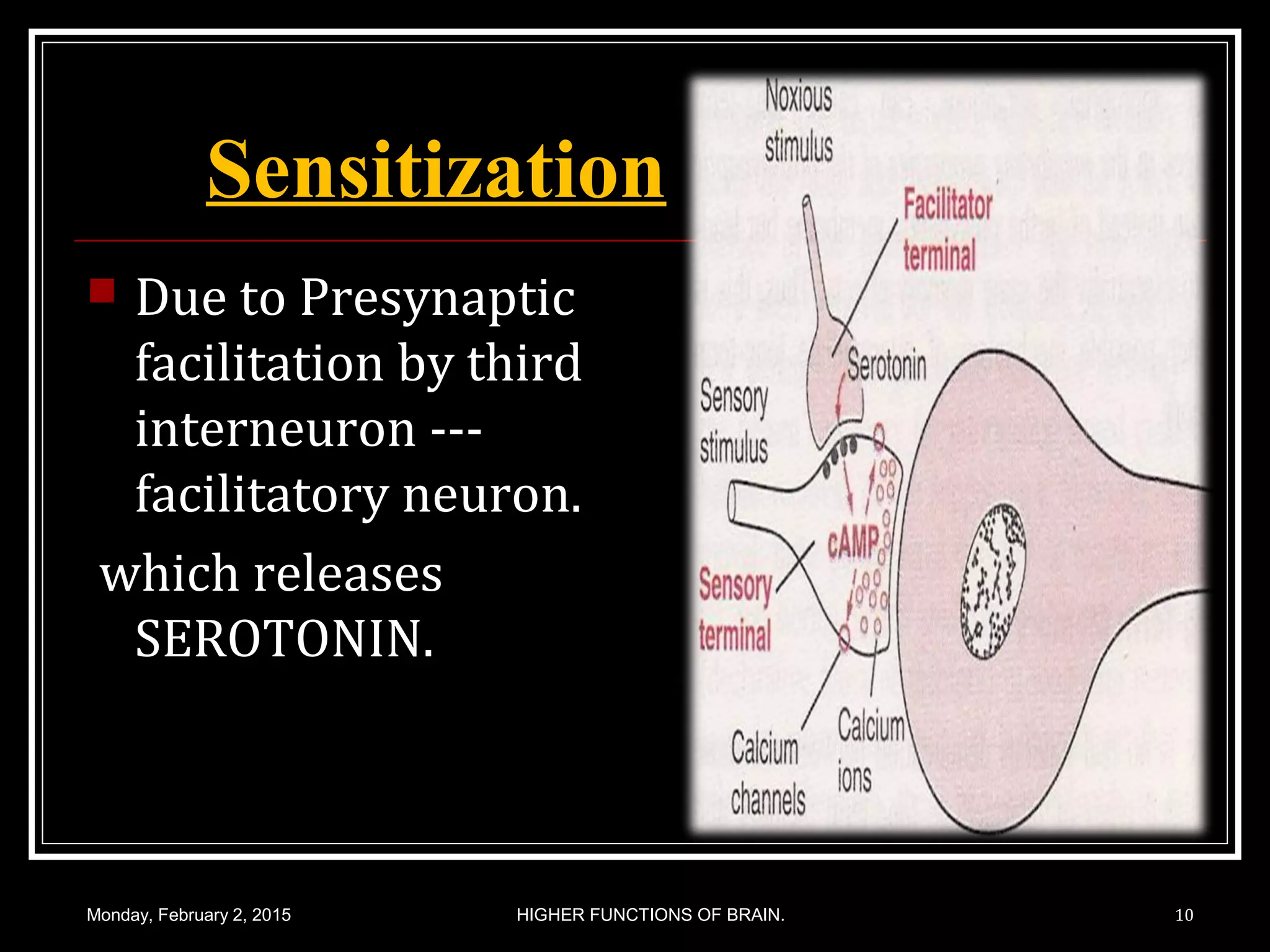
 Due to Presynaptic
facilitation by third
interneuron ---
facilitatory neuron.
which releases
SEROTONIN.
Monday, February 2, 2015 HIGHER FUNCTIONS OF BRAIN. 10
Sensitization
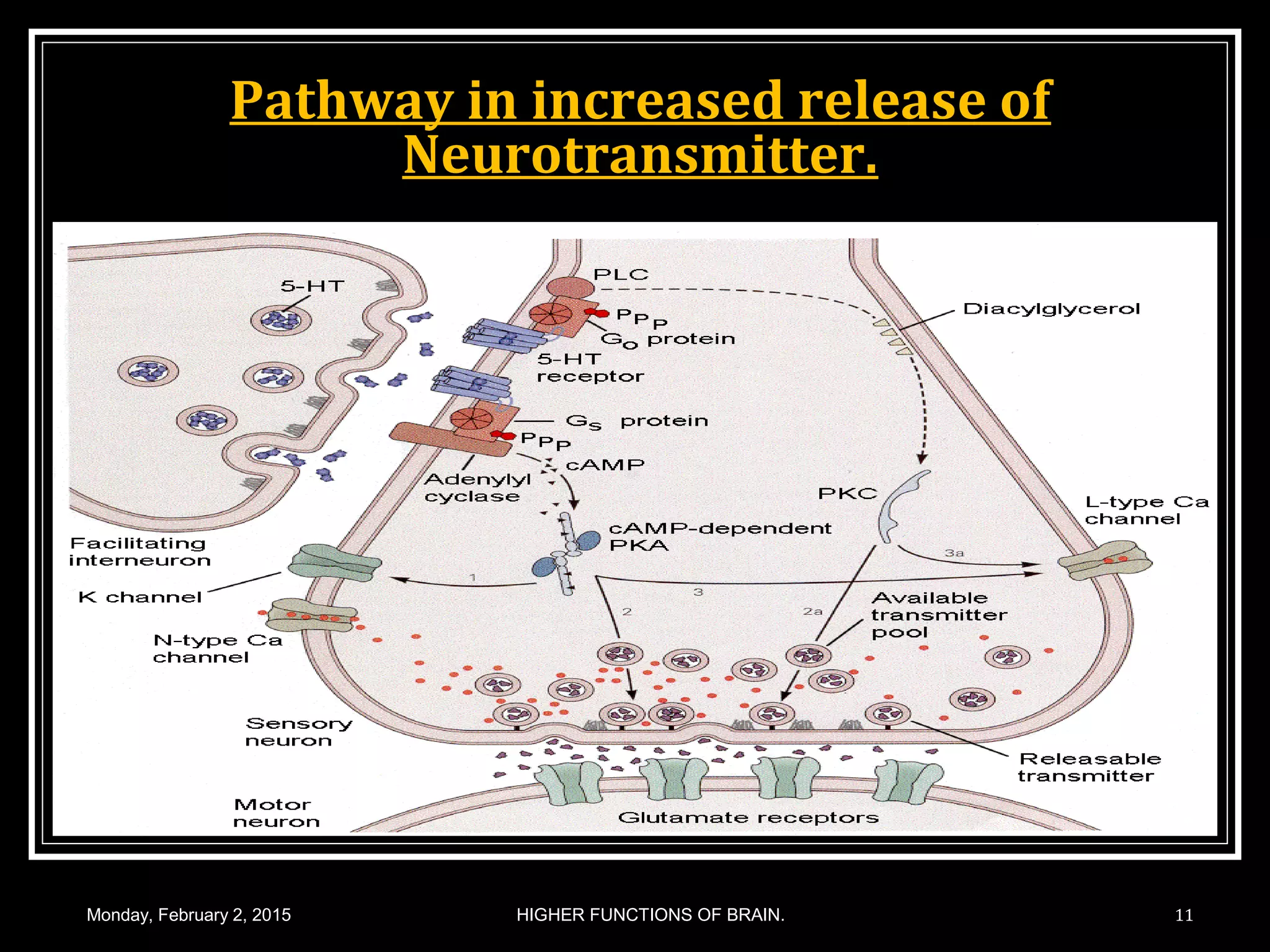
Pathway in increased release of
Neurotransmitter.
Monday, February 2, 2015 HIGHER FUNCTIONS OF BRAIN. 11
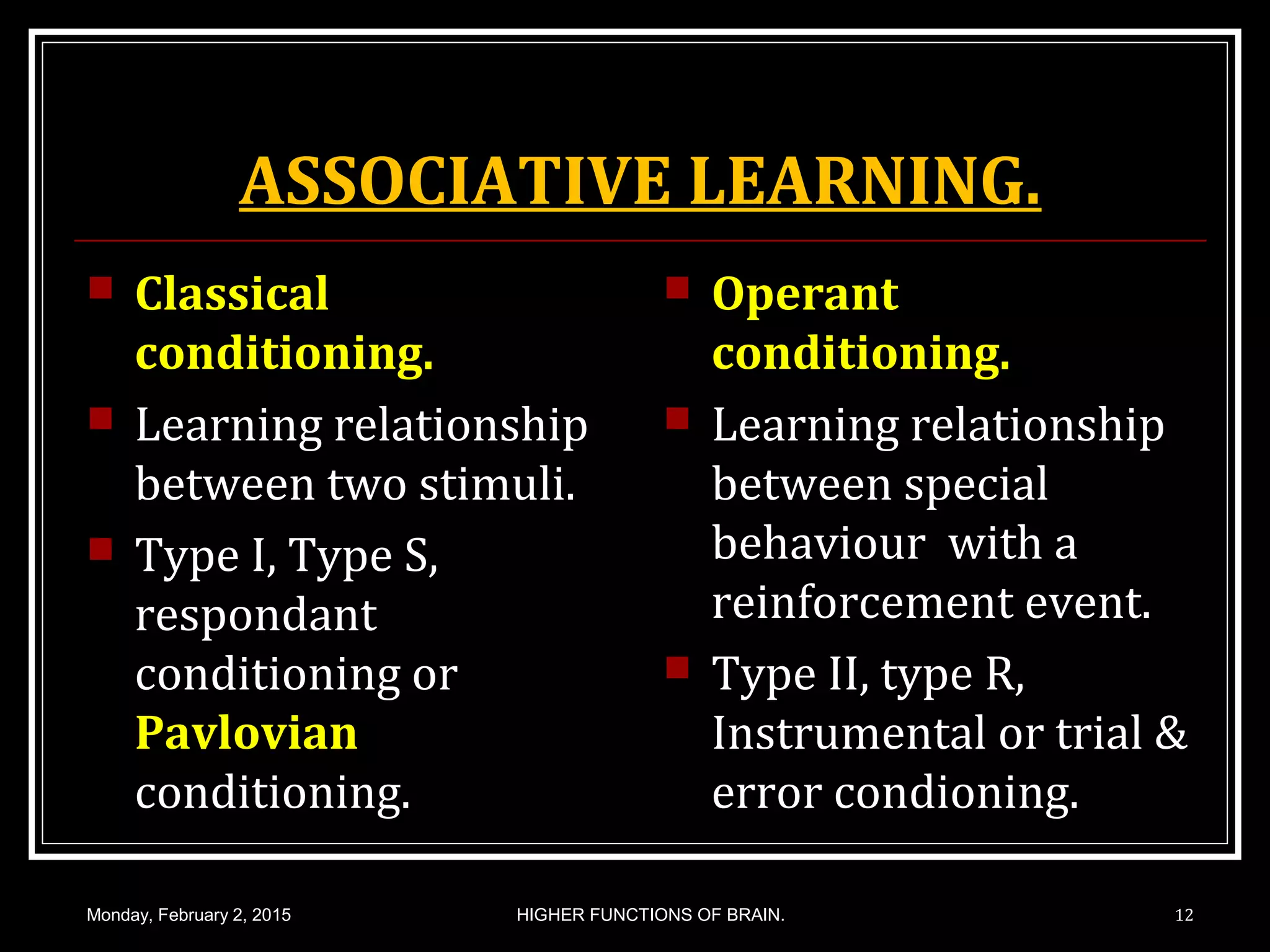
ASSOCIATIVE LEARNING.
 Classical
conditioning.
 Learning relationship
between two stimuli.
 Type I, Type S,
respondant
conditioning or
Pavlovian
conditioning.
 Operant
conditioning.
 Learning relationship
between special
behaviour with a
reinforcement event.
 Type II, type R,
Instrumental or trial &
error condioning.
Monday, February 2, 2015 12HIGHER FUNCTIONS OF BRAIN.
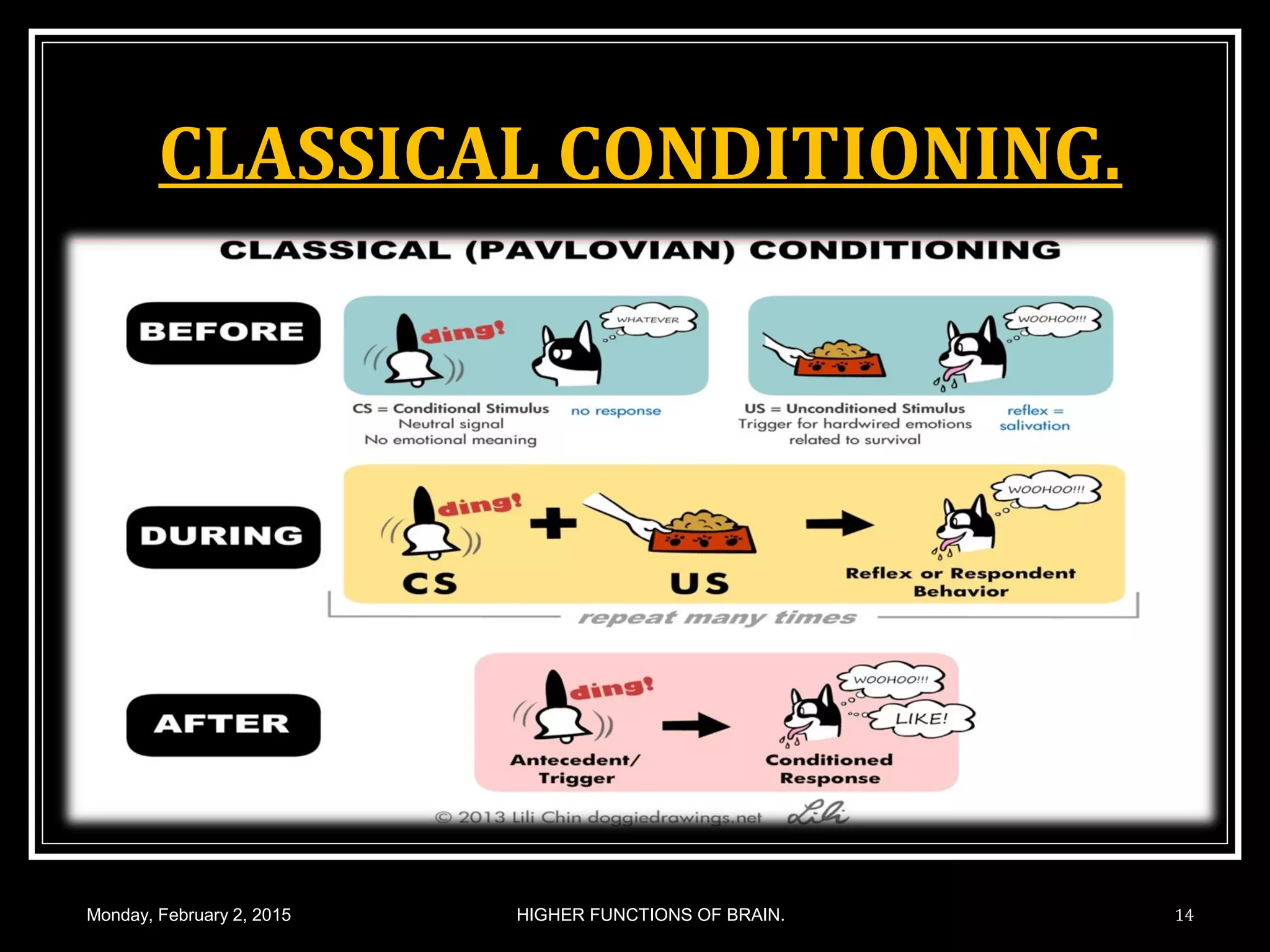
CLASSICAL CONDITIONING.
 Characteristic features.
 Conditioned reflex is reflex response.
 Acquired by repeatedly pairing given stimulus with
another stimulus which normally produces the response.
 Thus temporal association made between neutral
conditioned stimulus (CS) & unconditioned stimulus. (US)
 It depends upon formation of new functional connections
in CNS.
 Reinforcement -- CS SHOULD FOLLOWED BY US
Monday, February 2, 2015 13HIGHER FUNCTIONS OF BRAIN.
CLASSICAL CONDITIONING.
Monday, February 2, 2015 14HIGHER FUNCTIONS OF BRAIN.
Pre-requisites for development of
conditioned reflex.
 Alertness & good health.
 Timing of CS & US – CS US.
 Duration of CS – Should overlap US.
 Reinforcement. CS US.
 No external inhibition.
 Type of US
 Sensory / motor
 Pleasant, unpleasant / Neutral.
Monday, February 2, 2015 15HIGHER FUNCTIONS OF BRAIN.
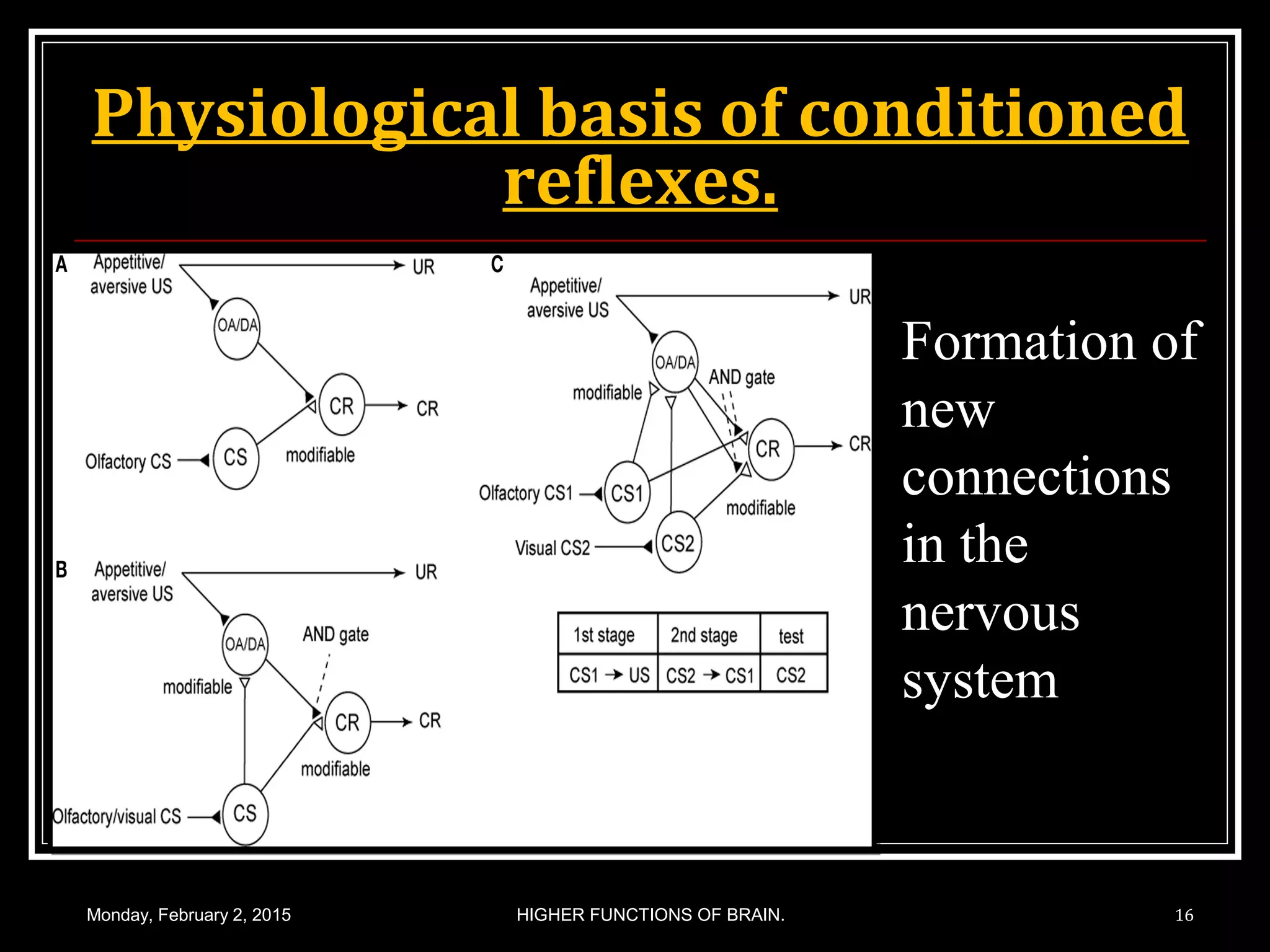
Physiological basis of conditioned
reflexes.
Monday, February 2, 2015 16HIGHER FUNCTIONS OF BRAIN.
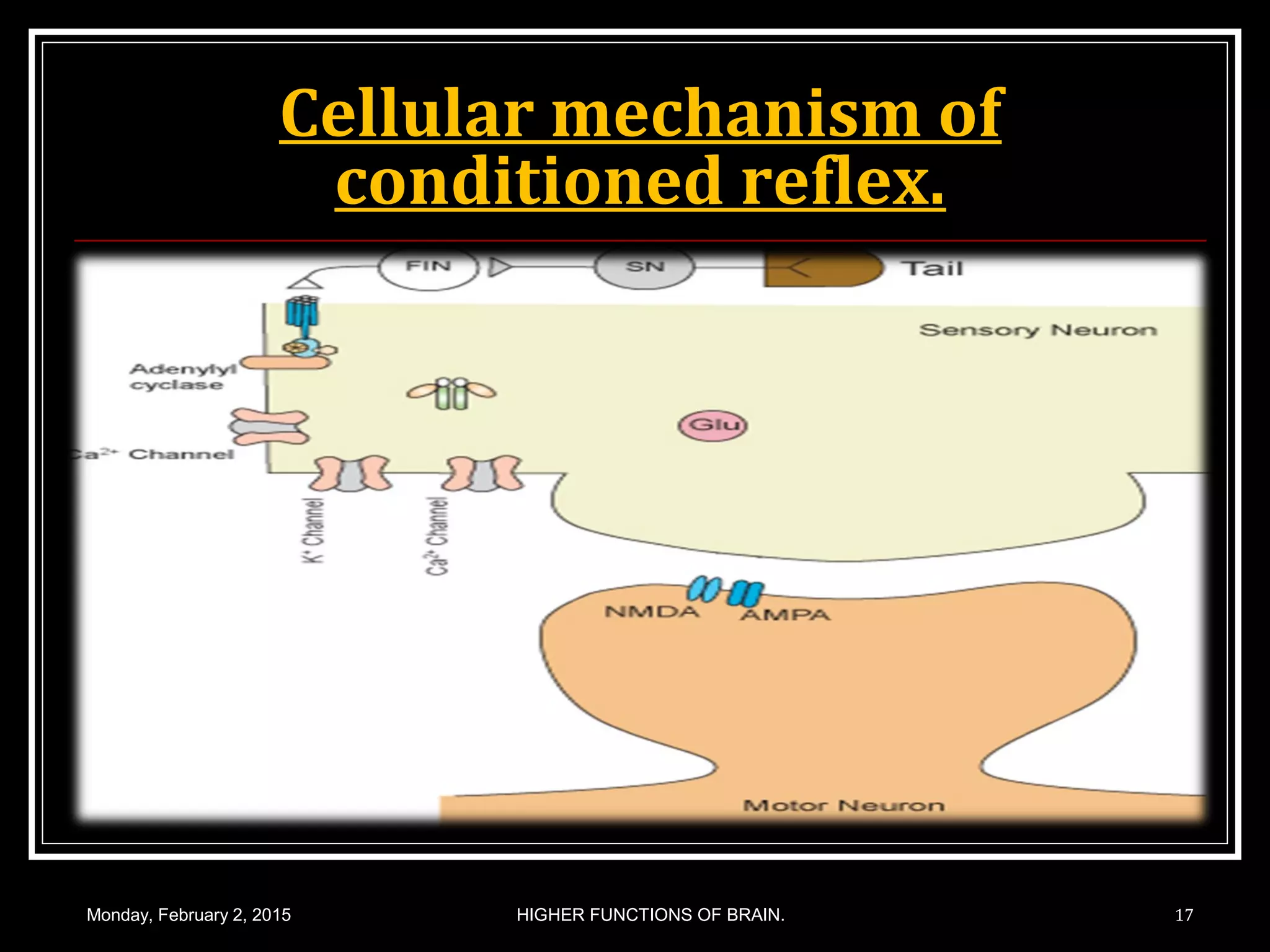
Formation of
new
connections
in the
nervous
system
Cellular mechanism of
conditioned reflex.
Monday, February 2, 2015 17HIGHER FUNCTIONS OF BRAIN.
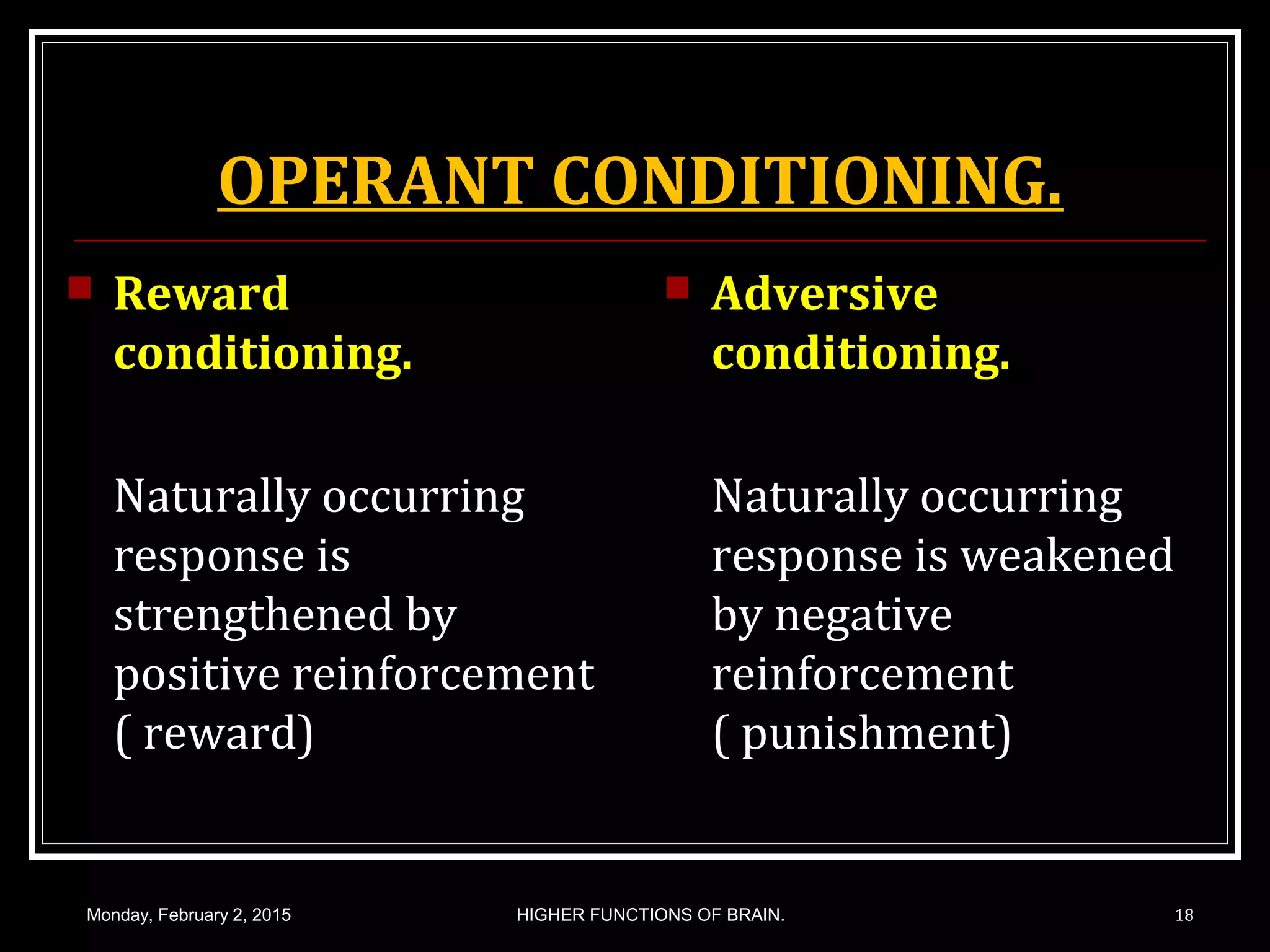
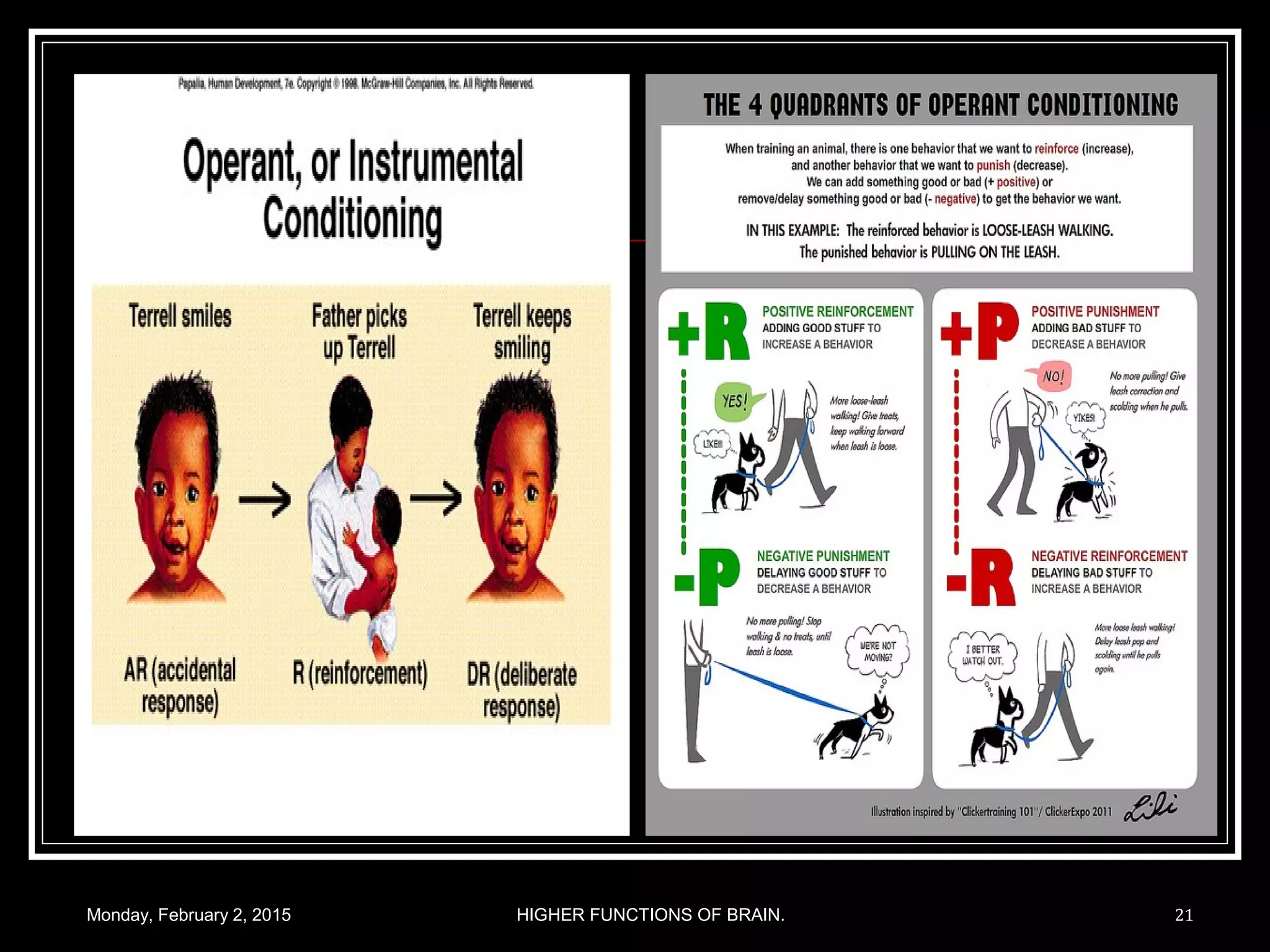
OPERANT CONDITIONING.
 Reward
conditioning.
Naturally occurring
response is
strengthened by
positive reinforcement
( reward)
 Adversive
conditioning.
Naturally occurring
response is weakened
by negative
reinforcement
( punishment)
Monday, February 2, 2015 18HIGHER FUNCTIONS OF BRAIN.
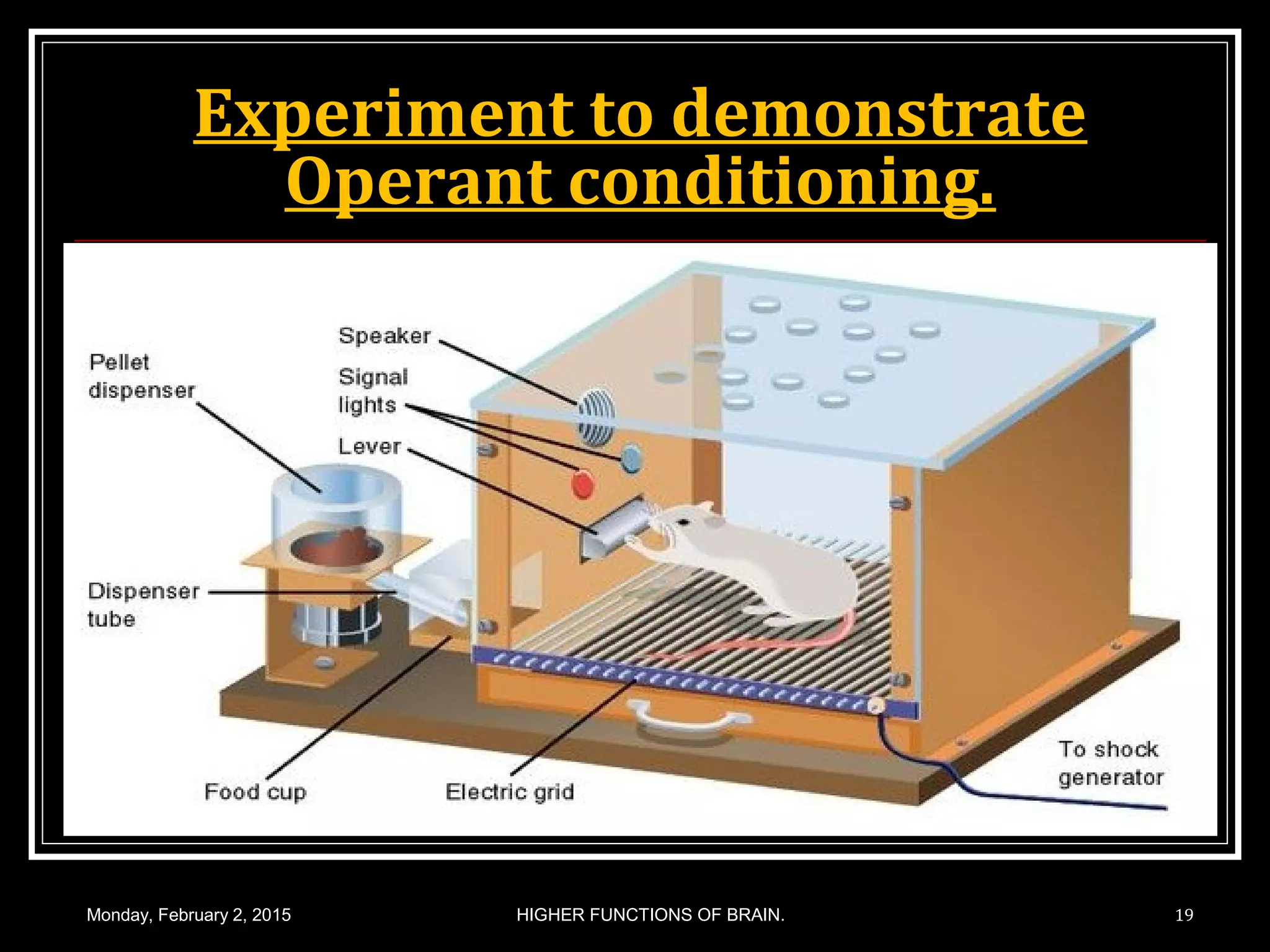
Experiment to demonstrate
Operant conditioning.
Monday, February 2, 2015 19HIGHER FUNCTIONS OF BRAIN.
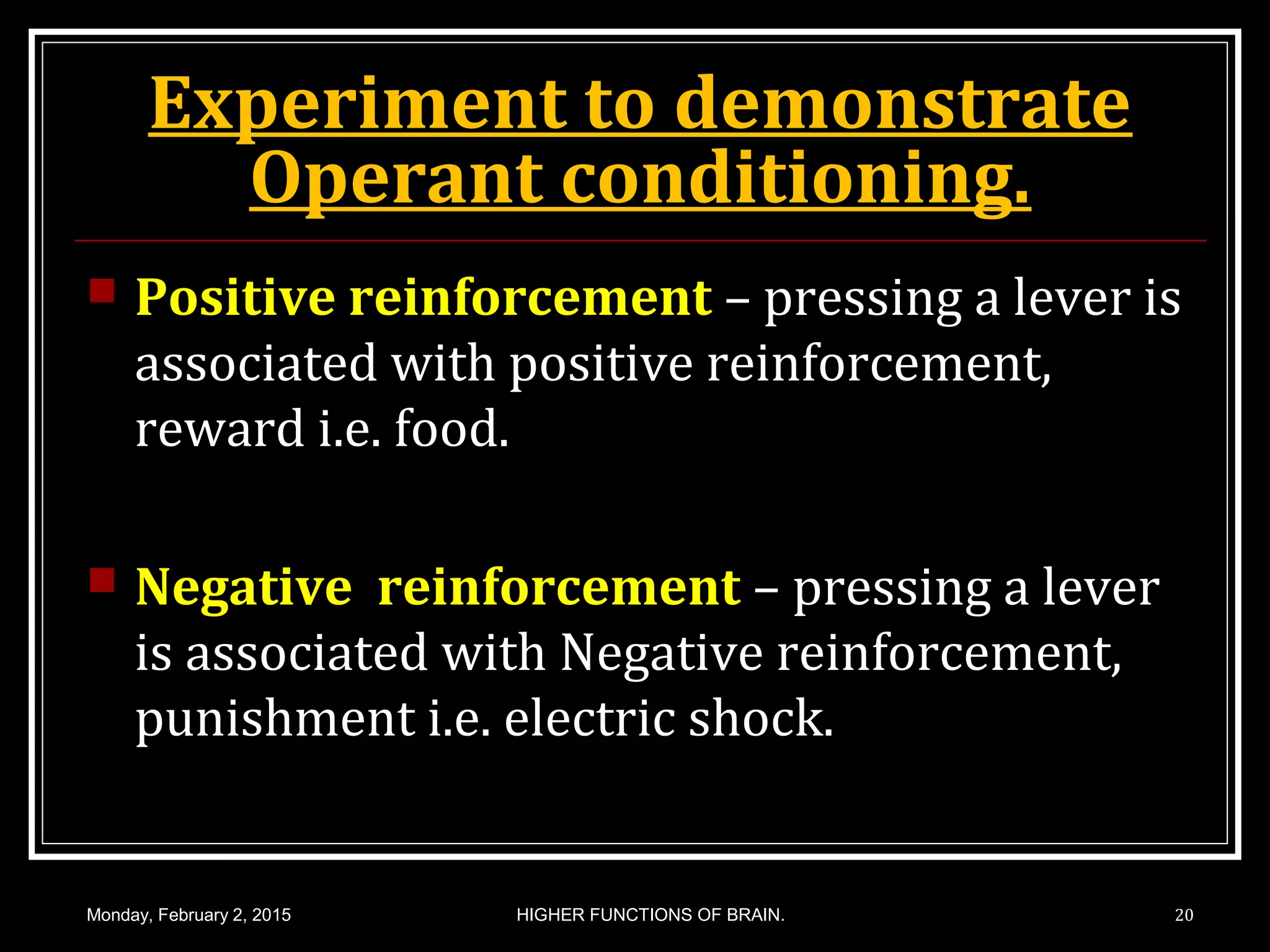
Experiment to demonstrate
Operant conditioning.
 Positive reinforcement – pressing a lever is
associated with positive reinforcement,
reward i.e. food.
 Negative reinforcement – pressing a lever
is associated with Negative reinforcement,
punishment i.e. electric shock.
Monday, February 2, 2015 HIGHER FUNCTIONS OF BRAIN. 20
Monday, February 2, 2015 HIGHER FUNCTIONS OF BRAIN. 21
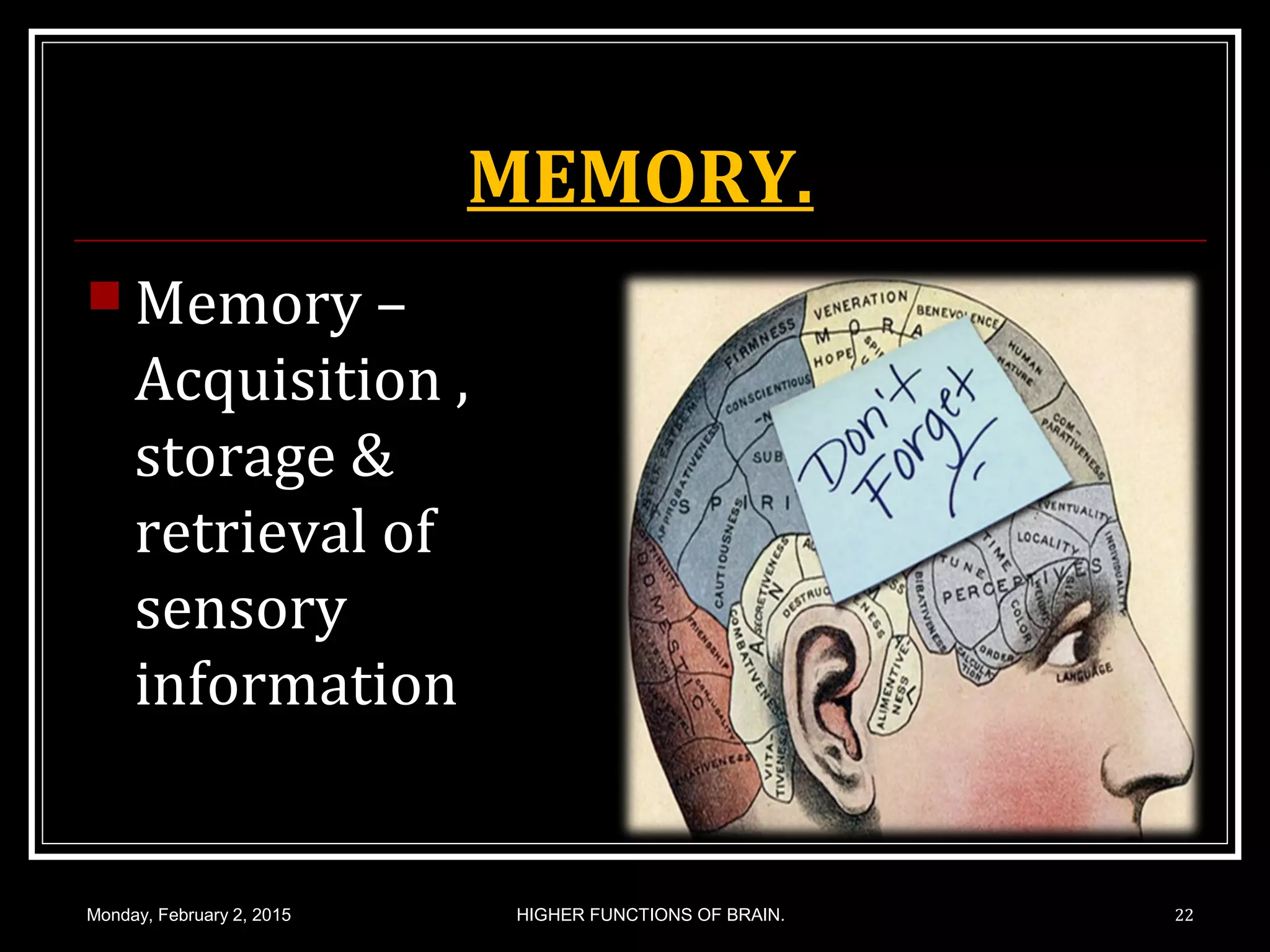
MEMORY.
 Memory –
Acquisition ,
storage &
retrieval of
sensory
information
Monday, February 2, 2015 HIGHER FUNCTIONS OF BRAIN. 22
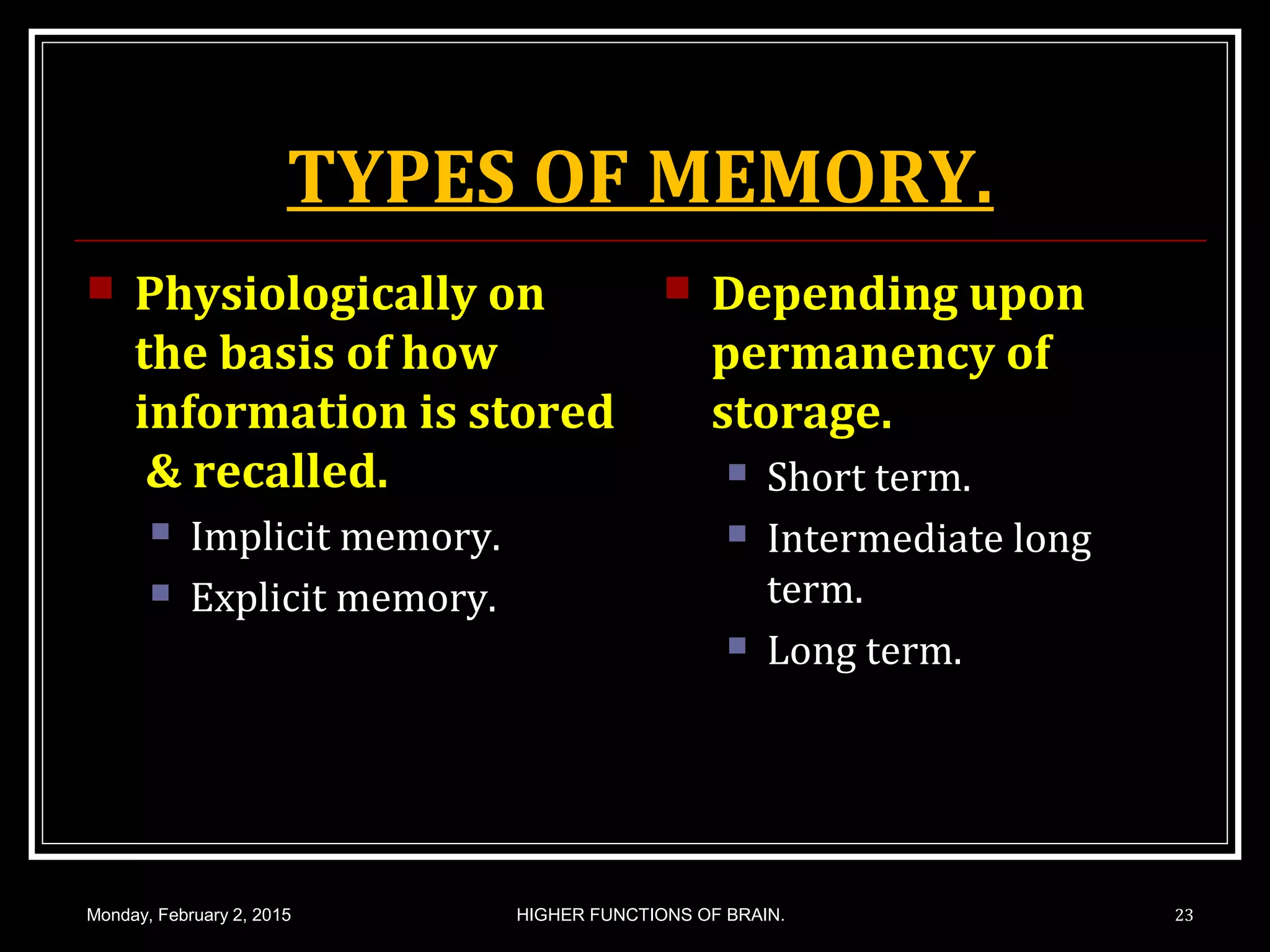
TYPES OF MEMORY.
 Physiologically on
the basis of how
information is stored
& recalled.
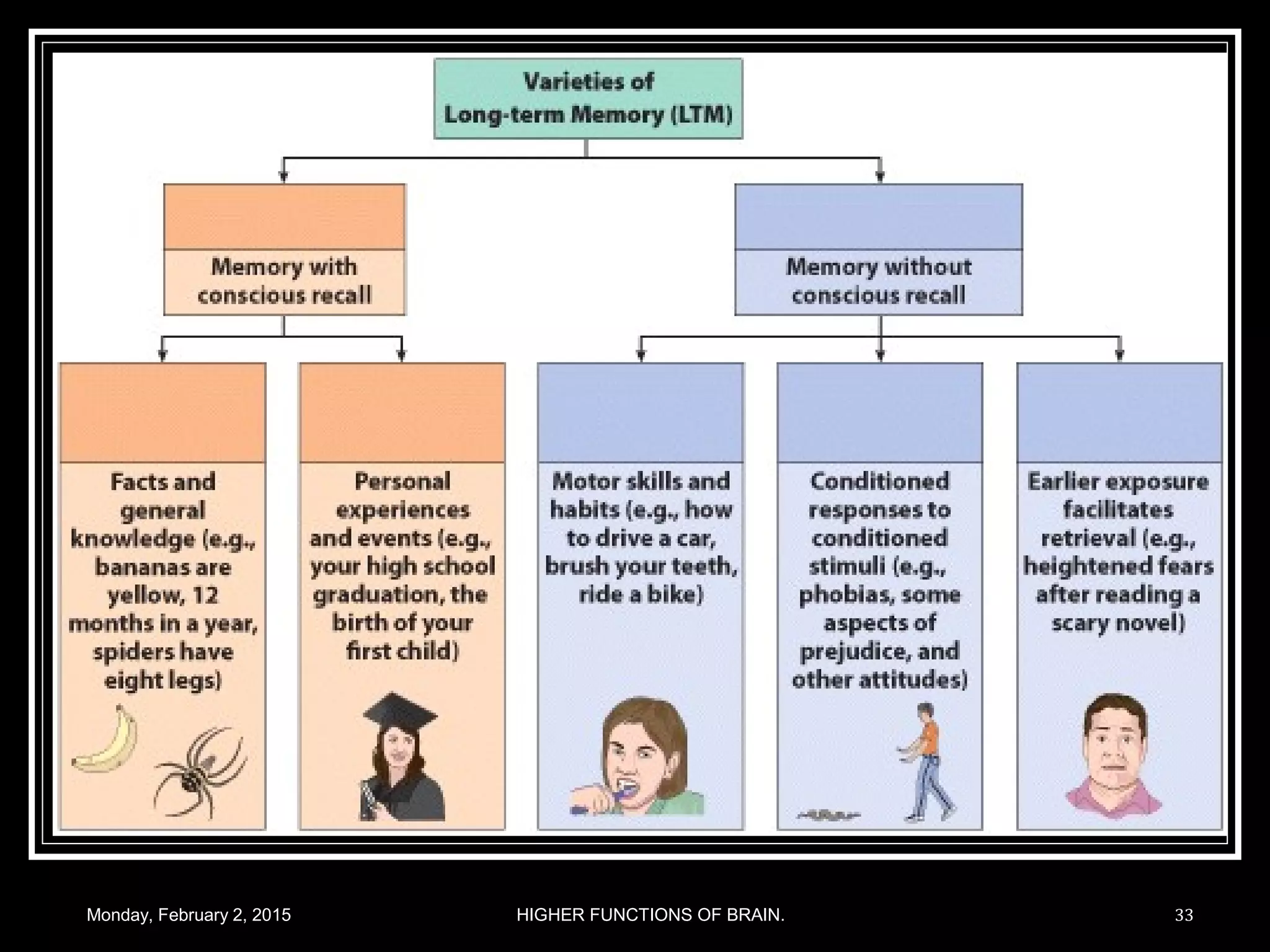
 Implicit memory.
 Explicit memory.
 Depending upon
permanency of
storage.
 Short term.
 Intermediate long
term.
 Long term.
Monday, February 2, 2015 HIGHER FUNCTIONS OF BRAIN. 23
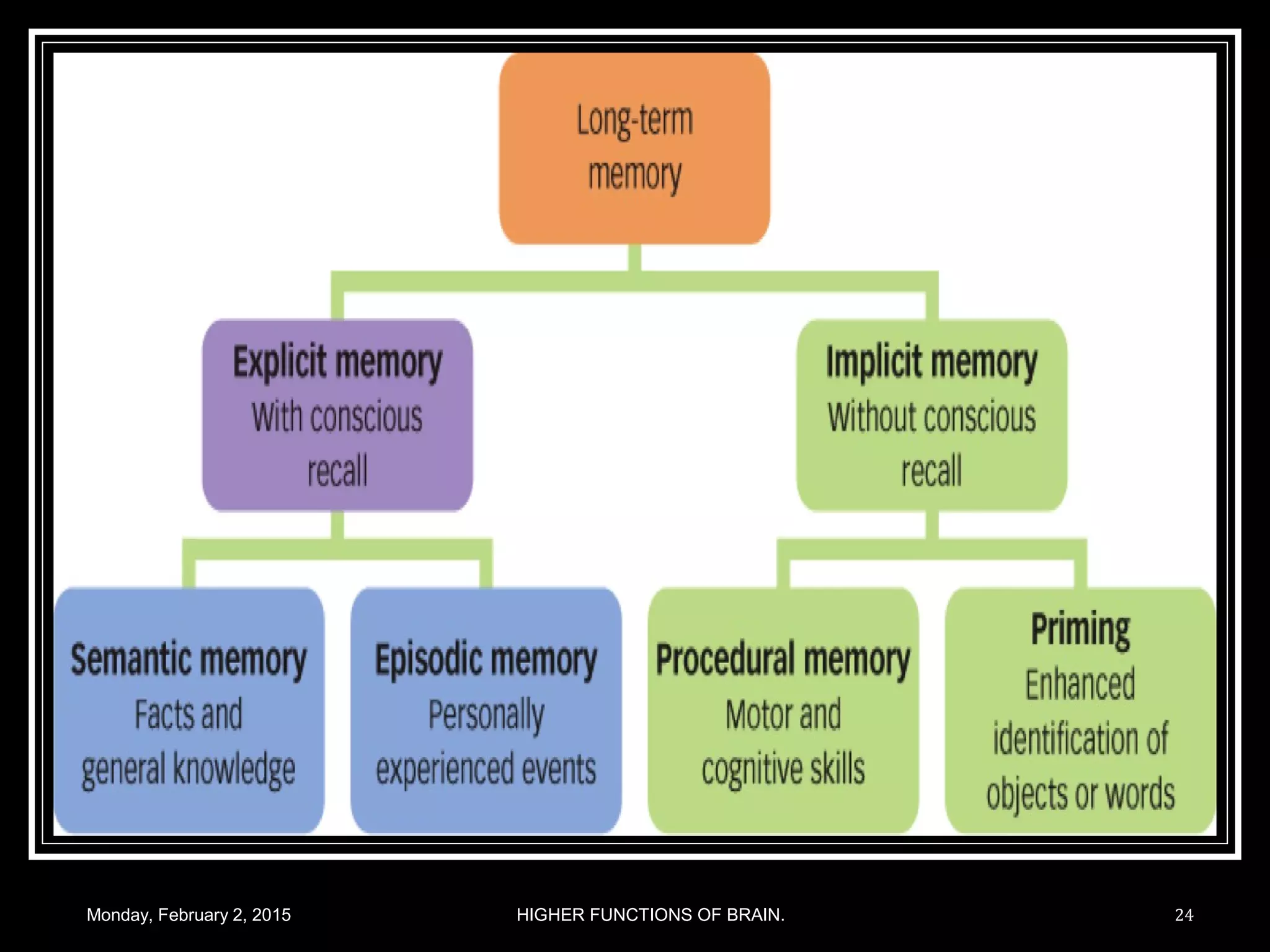
Monday, February 2, 2015 HIGHER FUNCTIONS OF BRAIN. 24
TYPES OF MEMORY.
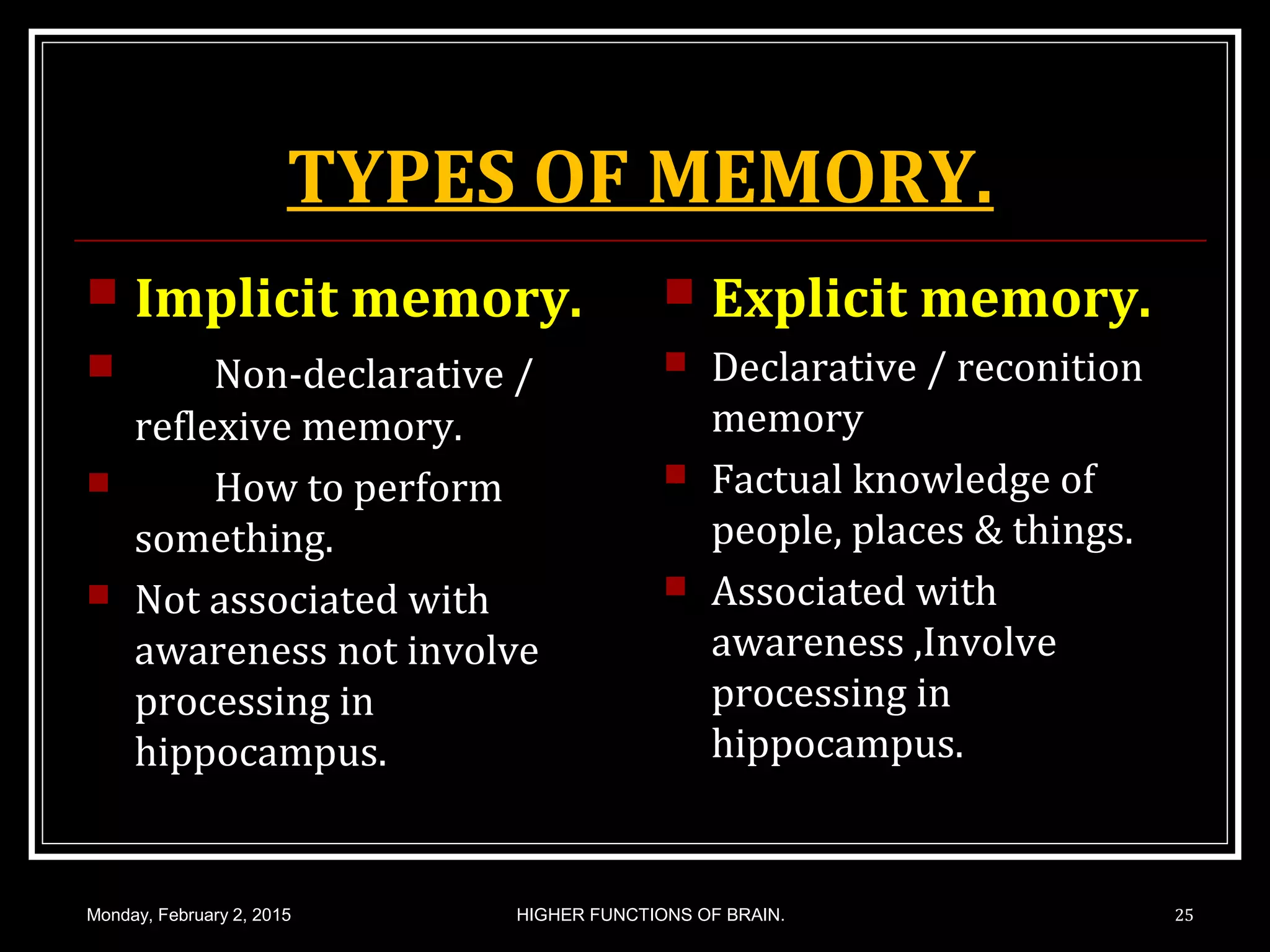
 Implicit memory.
 Non-declarative /
reflexive memory.
 How to perform
something.
 Not associated with
awareness not involve
processing in
hippocampus.
 Explicit memory.
 Declarative / reconition
memory
 Factual knowledge of
people, places & things.
 Associated with
awareness ,Involve
processing in
hippocampus.
Monday, February 2, 2015 HIGHER FUNCTIONS OF BRAIN. 25
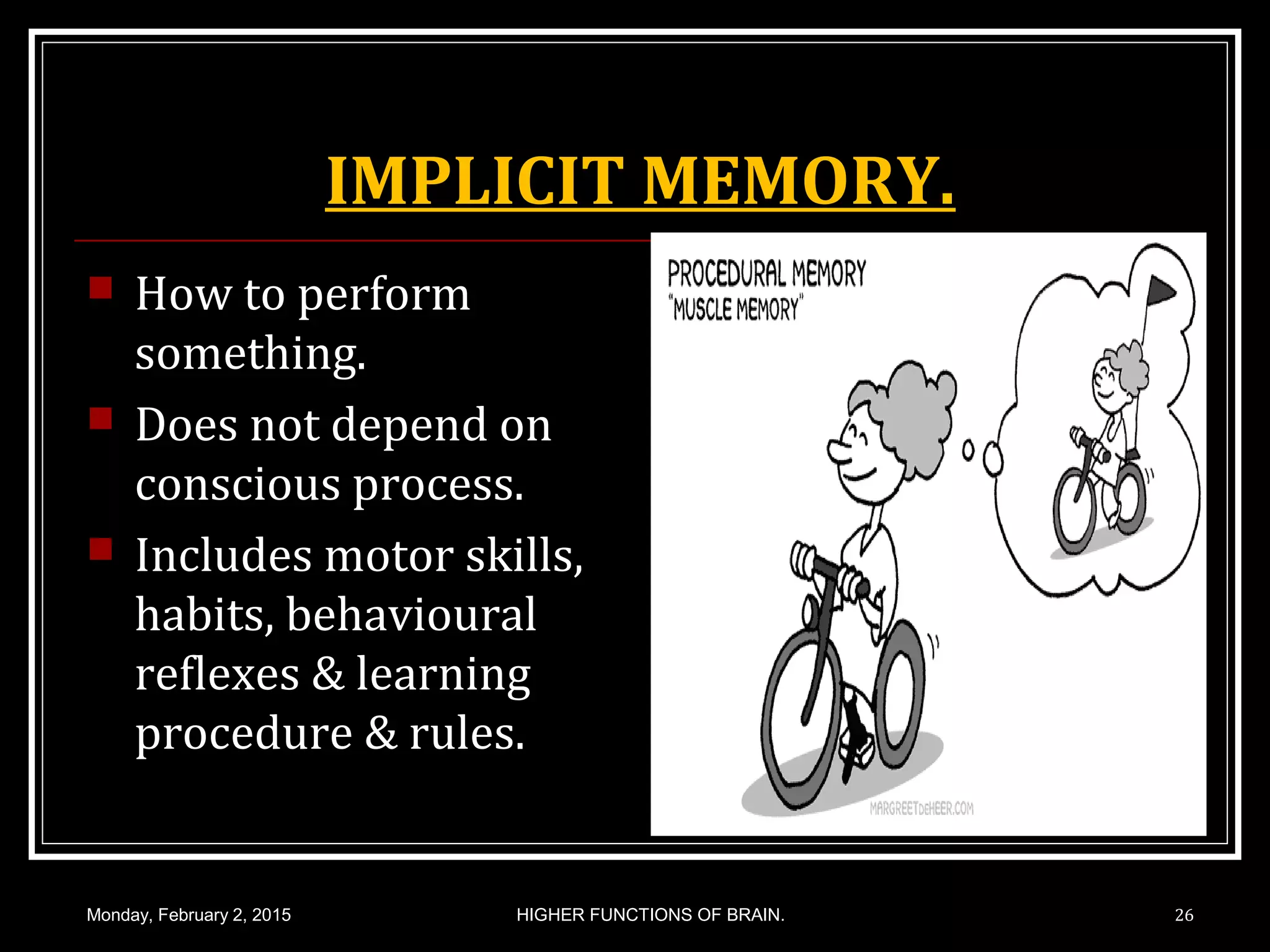
IMPLICIT MEMORY.
 How to perform
something.
 Does not depend on
conscious process.
 Includes motor skills,
habits, behavioural
reflexes & learning
procedure & rules.
Monday, February 2, 2015 HIGHER FUNCTIONS OF BRAIN. 26
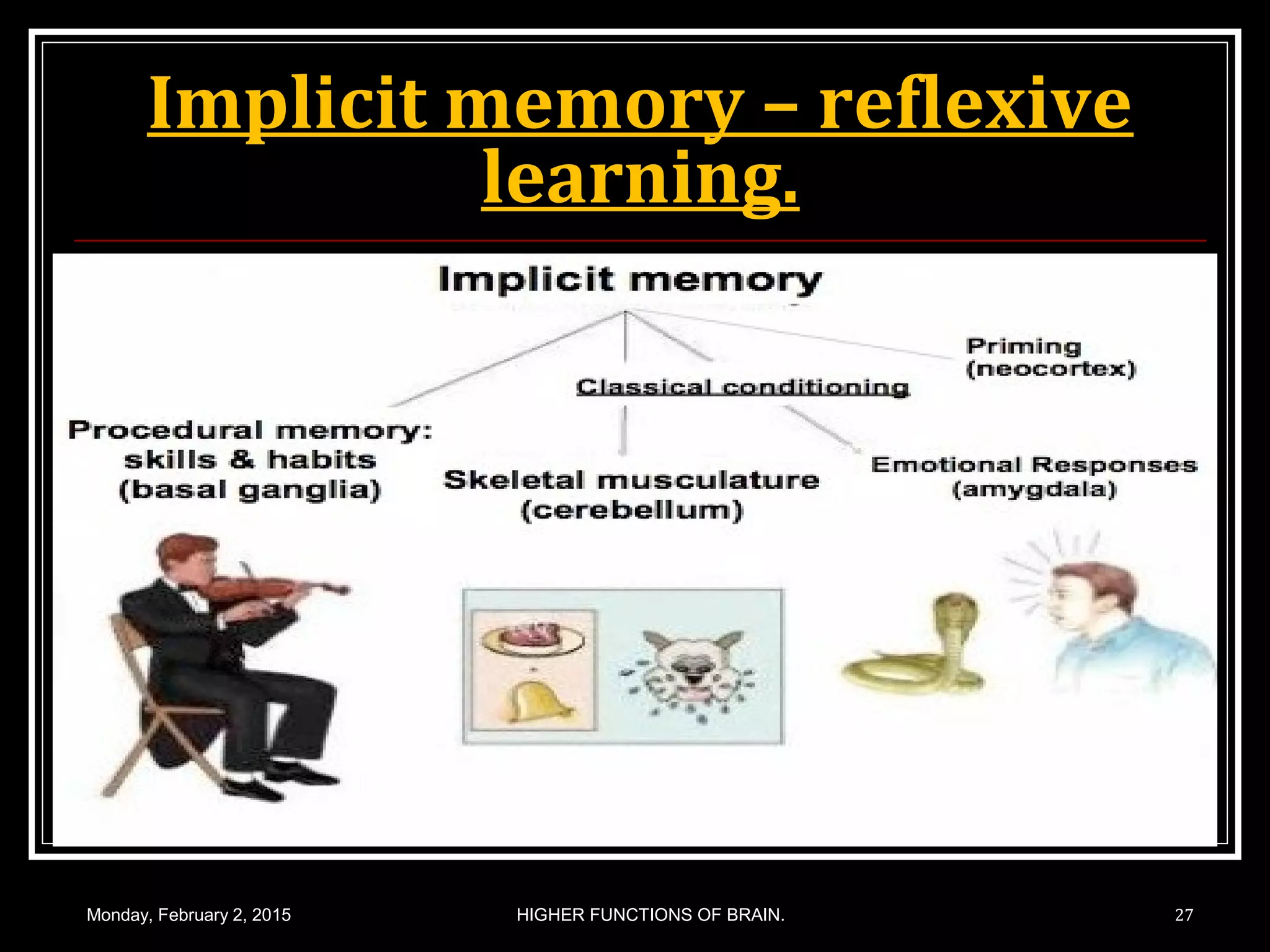
Implicit memory – reflexive
learning.
Monday, February 2, 2015 HIGHER FUNCTIONS OF BRAIN. 27
EXPLICIT MEMORY.
 Declarative / reconition
memory
 Factual knowledge of
people, places & things.
 Associated with
awareness ,Involve
processing in
hippocampus.
Monday, February 2, 2015 HIGHER FUNCTIONS OF BRAIN. 28
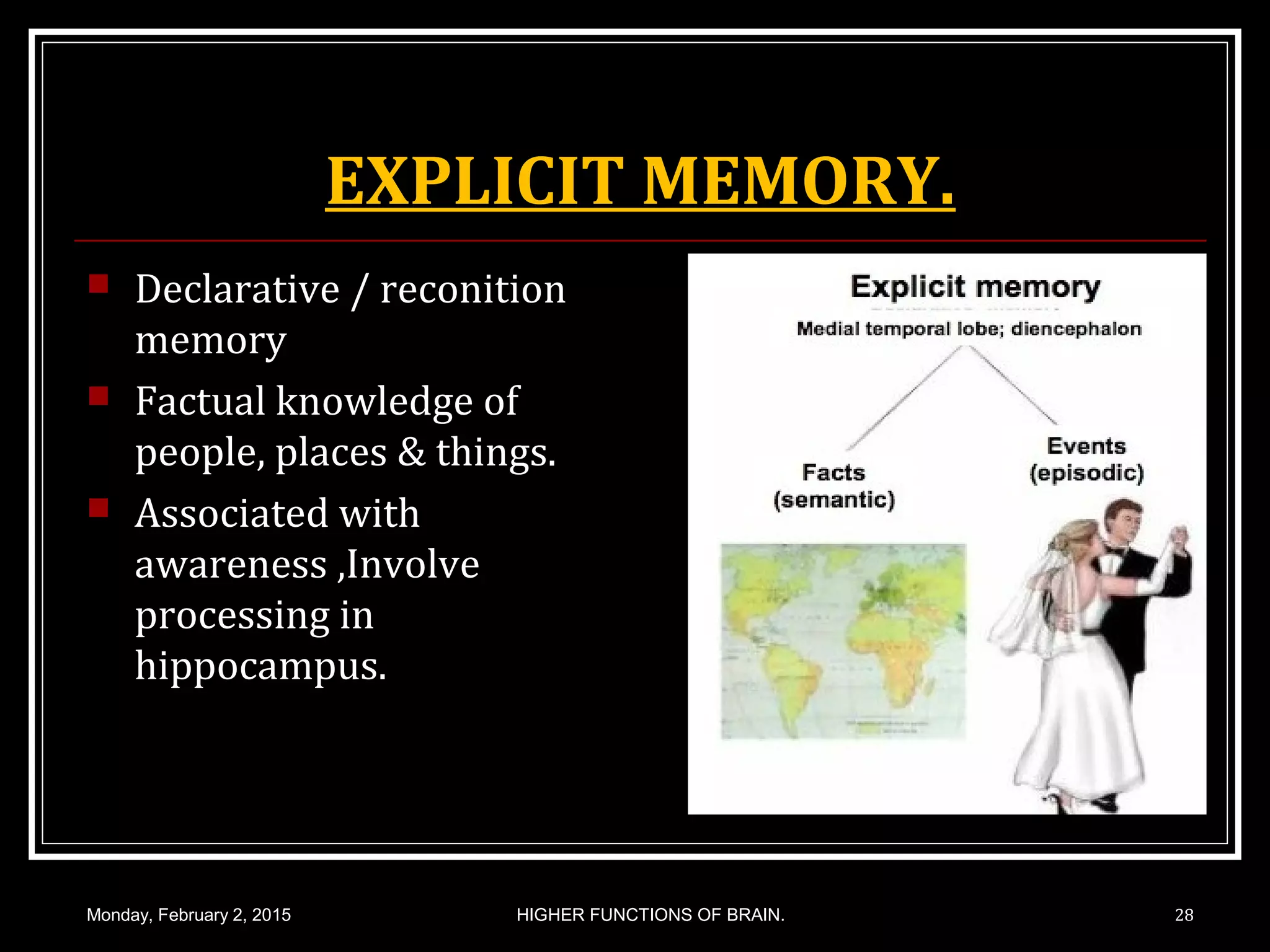
EXPLICIT MEMORY.
 Semantic memory.
 About knowledge of
objects, facts and
concepts.
 Words & their
meanings.
 Episodic memory.
 Memory of events &
personal experience.
Monday, February 2, 2015 HIGHER FUNCTIONS OF BRAIN. 29
MECHANISM OF MEMORY.
 Explicit memory.
 Short term memory.
 Neural substrate for encoding of memory.
 Intermediate long term.
 Long term.
 Consolidation of memory.
 Storage of memory.
Monday, February 2, 2015 HIGHER FUNCTIONS OF BRAIN. 30
Principles of Memory.
 Encoding.
 Elaboration. (Item specific)
 Organization (Inter-item)
 Storage.
 Time-dependency (Interference)
 Retrieval.
 Cue-dependency.
 Encoding specificity.
 Schematic processing.
 Reconstruction.
Monday, February 2, 2015 HIGHER FUNCTIONS OF BRAIN. 31
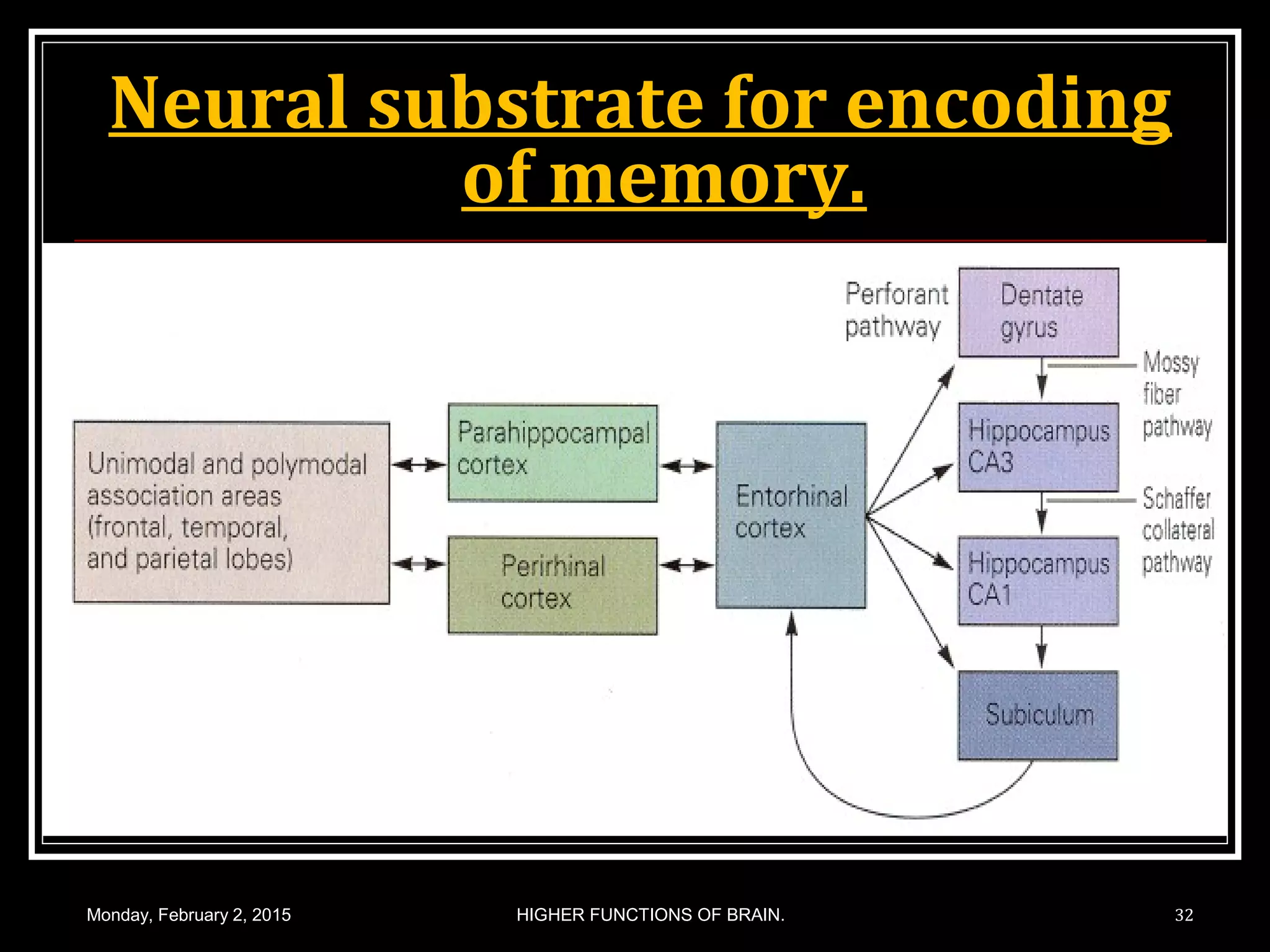
Neural substrate for encoding
of memory.
Monday, February 2, 2015 HIGHER FUNCTIONS OF BRAIN. 32
Monday, February 2, 2015 HIGHER FUNCTIONS OF BRAIN. 33
RETRIEVAL OF MEMORY.
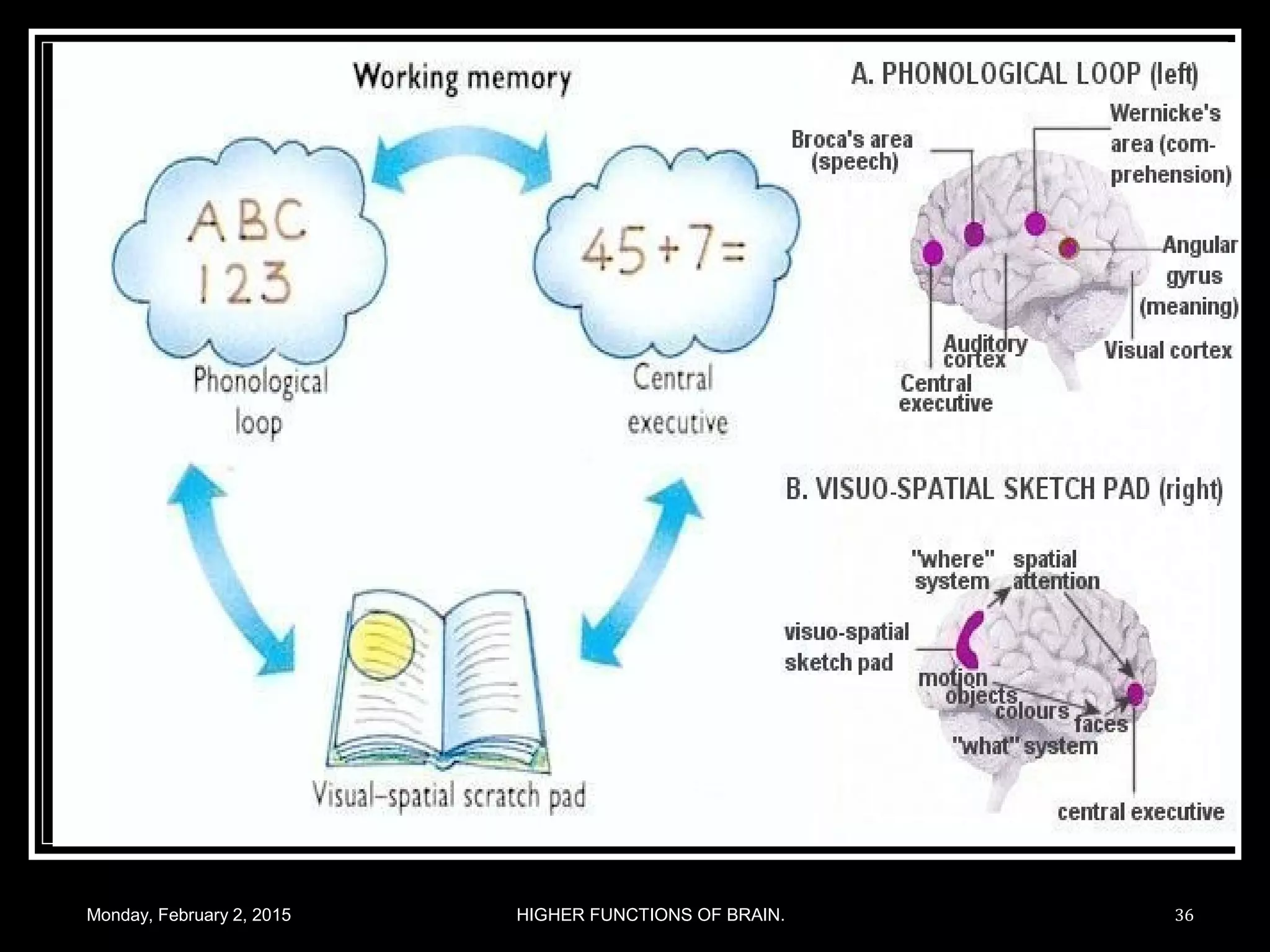
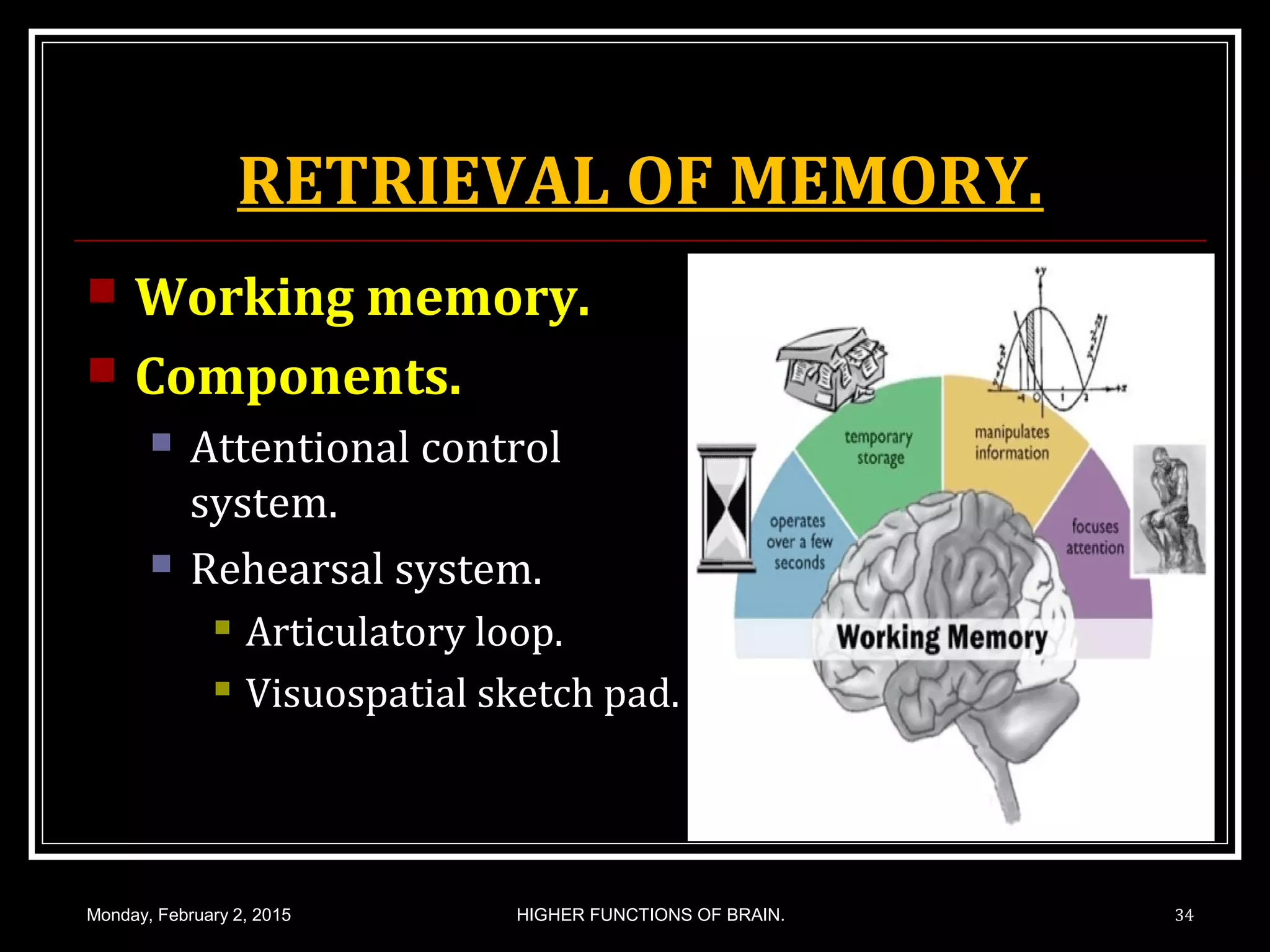
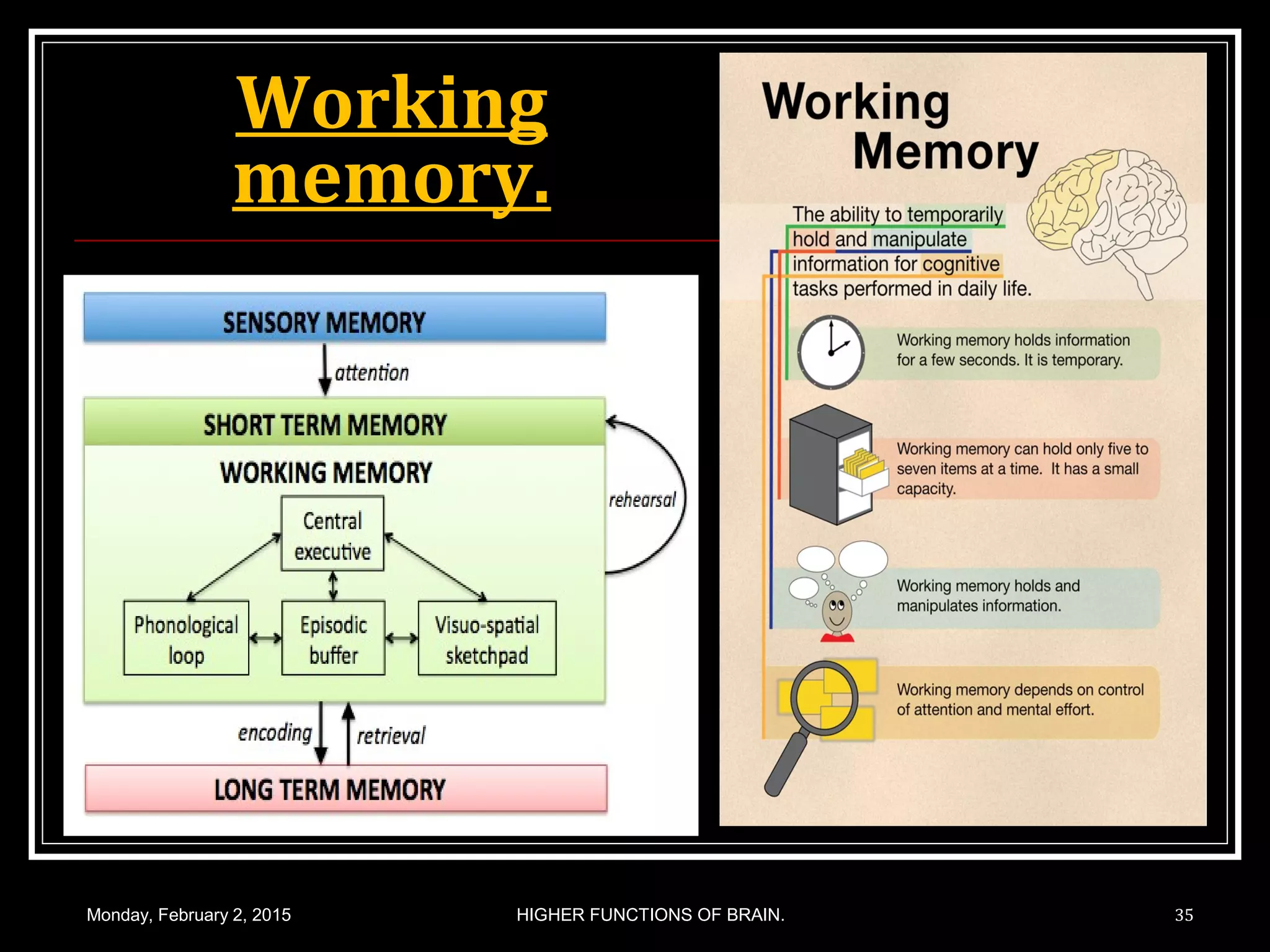
 Working memory.
 Components.
 Attentional control
system.
 Rehearsal system.
 Articulatory loop.
 Visuospatial sketch pad.
Monday, February 2, 2015 HIGHER FUNCTIONS OF BRAIN. 34
Working
memory.
Monday, February 2, 2015 HIGHER FUNCTIONS OF BRAIN. 35
Monday, February 2, 2015 HIGHER FUNCTIONS OF BRAIN. 36
LEARNING & MEMORY
 Interhemispheric transfer of learning &
memory.
 Experiment to demonstrate importance of corpus
callosum for interhemispheric transfer of
information.
Monday, February 2, 2015 37HIGHER FUNCTIONS OF BRAIN.
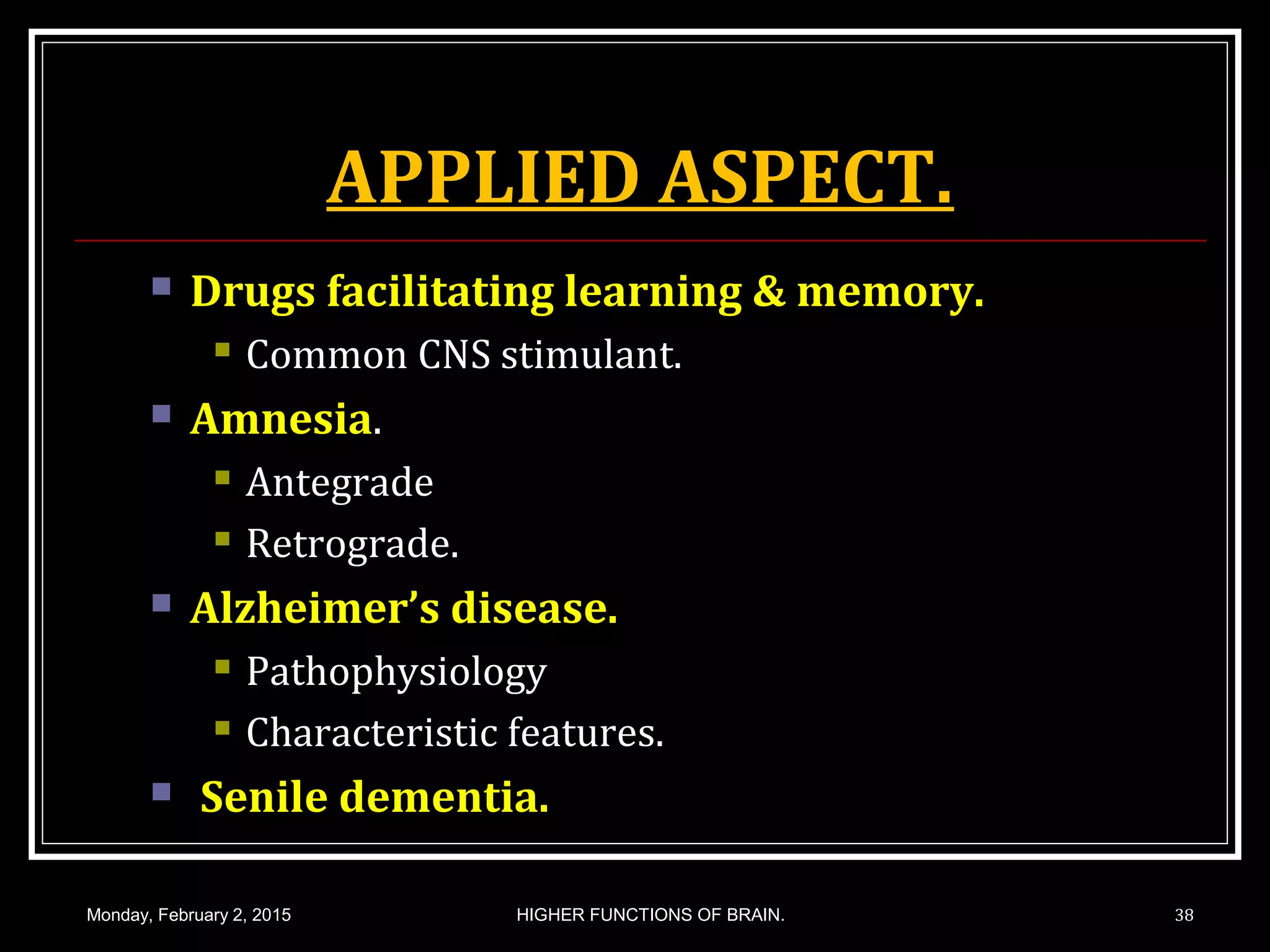
APPLIED ASPECT.
 Drugs facilitating learning & memory.
 Common CNS stimulant.
 Amnesia.
 Antegrade
 Retrograde.
 Alzheimer’s disease.
 Pathophysiology
 Characteristic features.
 Senile dementia.
Monday, February 2, 2015 HIGHER FUNCTIONS OF BRAIN. 38
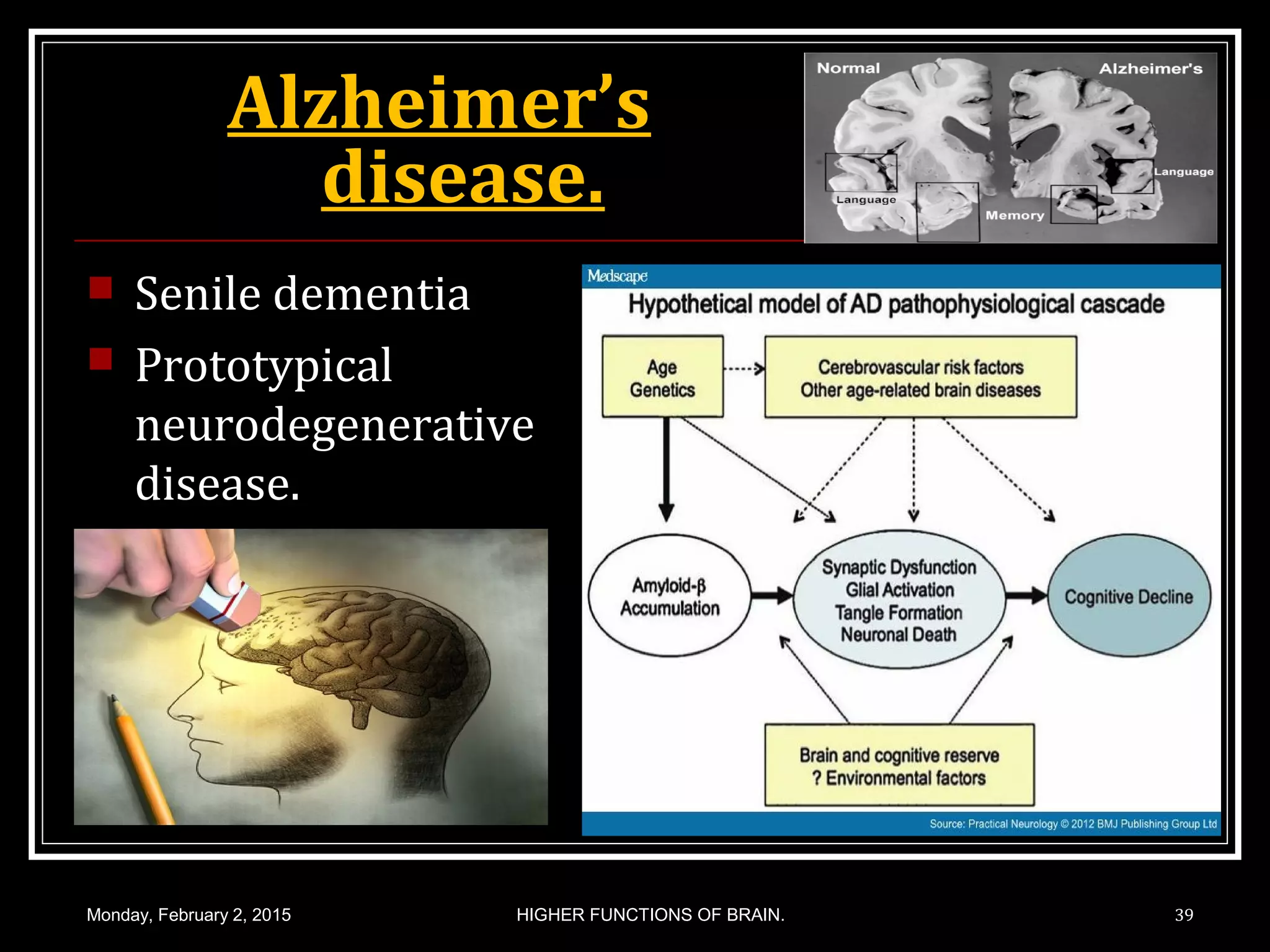
Alzheimer’s
disease.
 Senile dementia
 Prototypical
neurodegenerative
disease.
Monday, February 2, 2015 HIGHER FUNCTIONS OF BRAIN. 39
Higher intellectual functions of
prefrontal association cortex.
 Thought process.
 Working memory & intellectual functions.
 Episodic memory.
Monday, February 2, 2015 40HIGHER FUNCTIONS OF BRAIN.
Monday, February 2, 2015 41HIGHER FUNCTIONS OF BRAIN.
Thank
You

Higher functions of brain.learning memory

  • 1.
    DR NILESH KATE MBBS,MD ASSOCIATEPROF ESIC MEDICAL COLLEGE, GULBARGA. DEPT. OF PHYSIOLOGY HIGHER FUNCTIONS OF BRAIN.
  • 2.
    LEARNING & MEMORY Learning – Neural mechanism by which individual changes behaviour on the basis of past experience.  Memory – Acquisition , storage & retrieval of sensory information Monday, February 2, 2015 HIGHER FUNCTIONS OF BRAIN. 2
  • 3.
    LEARNING .  Reflexlearning.  Associated with immediate behaviour change.  Incidental learning.  Behaviour change not immediate  But person gets information from sensory inputs & develop potential to behave differently. Monday, February 2, 2015 3HIGHER FUNCTIONS OF BRAIN.
  • 4.
    REFLEX LEARNING.  Non-associative . Person learns about properties of single stimulus when repeatedly exposed to same stimulus.  Associative. Person learns about relationship between two stimuli or a stimulus & behaviour. Monday, February 2, 2015 4HIGHER FUNCTIONS OF BRAIN.
  • 5.
    NON- ASSOCIATIVE . Habituation Decrease in response to benign stimulus when stimulus presented repeatedly.  Sensitization.  Increase in response to benign stimulus when stimulus presented repeatedly. Monday, February 2, 2015 5HIGHER FUNCTIONS OF BRAIN.
  • 6.
    First time itevokes a novel response (orientation response or what is it response) Evokes less & less response when repeated Subject becomes habituated to the stimulus & ignores it Habituation  If a stimulus is repeated many times
  • 7.
    Habituation  Example  Newclock in the room. Monday, February 2, 2015 HIGHER FUNCTIONS OF BRAIN. 7
  • 8.
    Cellular basis ofHabituation.  Given by KANDEL & his collegue.  Repeated stimulus.  Inactivation of Ca influx at axon endings.  neurotransmitter release at synapses. Monday, February 2, 2015 HIGHER FUNCTIONS OF BRAIN. 8
  • 9.
    Cellular basis ofSensitization.  Given by KANDEL & his collegue.  Repeated stimulus.  neurotransmitter release at synapses. Monday, February 2, 2015 HIGHER FUNCTIONS OF BRAIN. 9
  • 10.
     Due toPresynaptic facilitation by third interneuron --- facilitatory neuron. which releases SEROTONIN. Monday, February 2, 2015 HIGHER FUNCTIONS OF BRAIN. 10 Sensitization
  • 11.
    Pathway in increasedrelease of Neurotransmitter. Monday, February 2, 2015 HIGHER FUNCTIONS OF BRAIN. 11
  • 12.
    ASSOCIATIVE LEARNING.  Classical conditioning. Learning relationship between two stimuli.  Type I, Type S, respondant conditioning or Pavlovian conditioning.  Operant conditioning.  Learning relationship between special behaviour with a reinforcement event.  Type II, type R, Instrumental or trial & error condioning. Monday, February 2, 2015 12HIGHER FUNCTIONS OF BRAIN.
  • 13.
    CLASSICAL CONDITIONING.  Characteristicfeatures.  Conditioned reflex is reflex response.  Acquired by repeatedly pairing given stimulus with another stimulus which normally produces the response.  Thus temporal association made between neutral conditioned stimulus (CS) & unconditioned stimulus. (US)  It depends upon formation of new functional connections in CNS.  Reinforcement -- CS SHOULD FOLLOWED BY US Monday, February 2, 2015 13HIGHER FUNCTIONS OF BRAIN.
  • 14.
    CLASSICAL CONDITIONING. Monday, February2, 2015 14HIGHER FUNCTIONS OF BRAIN.
  • 15.
    Pre-requisites for developmentof conditioned reflex.  Alertness & good health.  Timing of CS & US – CS US.  Duration of CS – Should overlap US.  Reinforcement. CS US.  No external inhibition.  Type of US  Sensory / motor  Pleasant, unpleasant / Neutral. Monday, February 2, 2015 15HIGHER FUNCTIONS OF BRAIN.
  • 16.
    Physiological basis ofconditioned reflexes. Monday, February 2, 2015 16HIGHER FUNCTIONS OF BRAIN. Formation of new connections in the nervous system
  • 17.
    Cellular mechanism of conditionedreflex. Monday, February 2, 2015 17HIGHER FUNCTIONS OF BRAIN.
  • 18.
    OPERANT CONDITIONING.  Reward conditioning. Naturallyoccurring response is strengthened by positive reinforcement ( reward)  Adversive conditioning. Naturally occurring response is weakened by negative reinforcement ( punishment) Monday, February 2, 2015 18HIGHER FUNCTIONS OF BRAIN.
  • 19.
    Experiment to demonstrate Operantconditioning. Monday, February 2, 2015 19HIGHER FUNCTIONS OF BRAIN.
  • 20.
    Experiment to demonstrate Operantconditioning.  Positive reinforcement – pressing a lever is associated with positive reinforcement, reward i.e. food.  Negative reinforcement – pressing a lever is associated with Negative reinforcement, punishment i.e. electric shock. Monday, February 2, 2015 HIGHER FUNCTIONS OF BRAIN. 20
  • 21.
    Monday, February 2,2015 HIGHER FUNCTIONS OF BRAIN. 21
  • 22.
    MEMORY.  Memory – Acquisition, storage & retrieval of sensory information Monday, February 2, 2015 HIGHER FUNCTIONS OF BRAIN. 22
  • 23.
    TYPES OF MEMORY. Physiologically on the basis of how information is stored & recalled.  Implicit memory.  Explicit memory.  Depending upon permanency of storage.  Short term.  Intermediate long term.  Long term. Monday, February 2, 2015 HIGHER FUNCTIONS OF BRAIN. 23
  • 24.
    Monday, February 2,2015 HIGHER FUNCTIONS OF BRAIN. 24
  • 25.
    TYPES OF MEMORY. Implicit memory.  Non-declarative / reflexive memory.  How to perform something.  Not associated with awareness not involve processing in hippocampus.  Explicit memory.  Declarative / reconition memory  Factual knowledge of people, places & things.  Associated with awareness ,Involve processing in hippocampus. Monday, February 2, 2015 HIGHER FUNCTIONS OF BRAIN. 25
  • 26.
    IMPLICIT MEMORY.  Howto perform something.  Does not depend on conscious process.  Includes motor skills, habits, behavioural reflexes & learning procedure & rules. Monday, February 2, 2015 HIGHER FUNCTIONS OF BRAIN. 26
  • 27.
    Implicit memory –reflexive learning. Monday, February 2, 2015 HIGHER FUNCTIONS OF BRAIN. 27
  • 28.
    EXPLICIT MEMORY.  Declarative/ reconition memory  Factual knowledge of people, places & things.  Associated with awareness ,Involve processing in hippocampus. Monday, February 2, 2015 HIGHER FUNCTIONS OF BRAIN. 28
  • 29.
    EXPLICIT MEMORY.  Semanticmemory.  About knowledge of objects, facts and concepts.  Words & their meanings.  Episodic memory.  Memory of events & personal experience. Monday, February 2, 2015 HIGHER FUNCTIONS OF BRAIN. 29
  • 30.
    MECHANISM OF MEMORY. Explicit memory.  Short term memory.  Neural substrate for encoding of memory.  Intermediate long term.  Long term.  Consolidation of memory.  Storage of memory. Monday, February 2, 2015 HIGHER FUNCTIONS OF BRAIN. 30
  • 31.
    Principles of Memory. Encoding.  Elaboration. (Item specific)  Organization (Inter-item)  Storage.  Time-dependency (Interference)  Retrieval.  Cue-dependency.  Encoding specificity.  Schematic processing.  Reconstruction. Monday, February 2, 2015 HIGHER FUNCTIONS OF BRAIN. 31
  • 32.
    Neural substrate forencoding of memory. Monday, February 2, 2015 HIGHER FUNCTIONS OF BRAIN. 32
  • 33.
    Monday, February 2,2015 HIGHER FUNCTIONS OF BRAIN. 33
  • 34.
    RETRIEVAL OF MEMORY. Working memory.  Components.  Attentional control system.  Rehearsal system.  Articulatory loop.  Visuospatial sketch pad. Monday, February 2, 2015 HIGHER FUNCTIONS OF BRAIN. 34
  • 35.
    Working memory. Monday, February 2,2015 HIGHER FUNCTIONS OF BRAIN. 35
  • 36.
    Monday, February 2,2015 HIGHER FUNCTIONS OF BRAIN. 36
  • 37.
    LEARNING & MEMORY Interhemispheric transfer of learning & memory.  Experiment to demonstrate importance of corpus callosum for interhemispheric transfer of information. Monday, February 2, 2015 37HIGHER FUNCTIONS OF BRAIN.
  • 38.
    APPLIED ASPECT.  Drugsfacilitating learning & memory.  Common CNS stimulant.  Amnesia.  Antegrade  Retrograde.  Alzheimer’s disease.  Pathophysiology  Characteristic features.  Senile dementia. Monday, February 2, 2015 HIGHER FUNCTIONS OF BRAIN. 38
  • 39.
    Alzheimer’s disease.  Senile dementia Prototypical neurodegenerative disease. Monday, February 2, 2015 HIGHER FUNCTIONS OF BRAIN. 39
  • 40.
    Higher intellectual functionsof prefrontal association cortex.  Thought process.  Working memory & intellectual functions.  Episodic memory. Monday, February 2, 2015 40HIGHER FUNCTIONS OF BRAIN.
  • 41.
    Monday, February 2,2015 41HIGHER FUNCTIONS OF BRAIN. Thank You