





Artificial Intelligence in the
               Design of Microstrip
                            Antenna

 By:
                 Raj Kumar Thenua
                 Vandana V. Thakare
Department of Electronics & Instrumentation Engineering
                    AEC, Agra, UP
Outline
       Introduction
       Methodology
       Design of a microstrip line feed rectangular Microstrip Antenna using
        IE3D EM Simulator
       Analysis of a microstrip line feed rectangular Microstrip Antenna
        using ANN
       Application
       Conclusion
       Future scope of the work
       Results
       References


2                                    8/9/2012
Introduction
       Accurate RF/Microwave design is crucial for the current
        upsurge in VLSI, telecommunication and wireless technologies
       Design at microwave frequencies is significantly different from
        low-frequency and digital designs
       Substantial development in RF/microwave CAD techniques
        have been made during the last decade
       Further advances in CAD are needed to address new design
        challenges
       Fast and accurate models are key to efficient CAD
       Neural network based modeling and design could significantly
        impact high-frequency CAD


3                                 8/9/2012
A Illustration Example
        MICRO STRIP PATCH ANTENNA

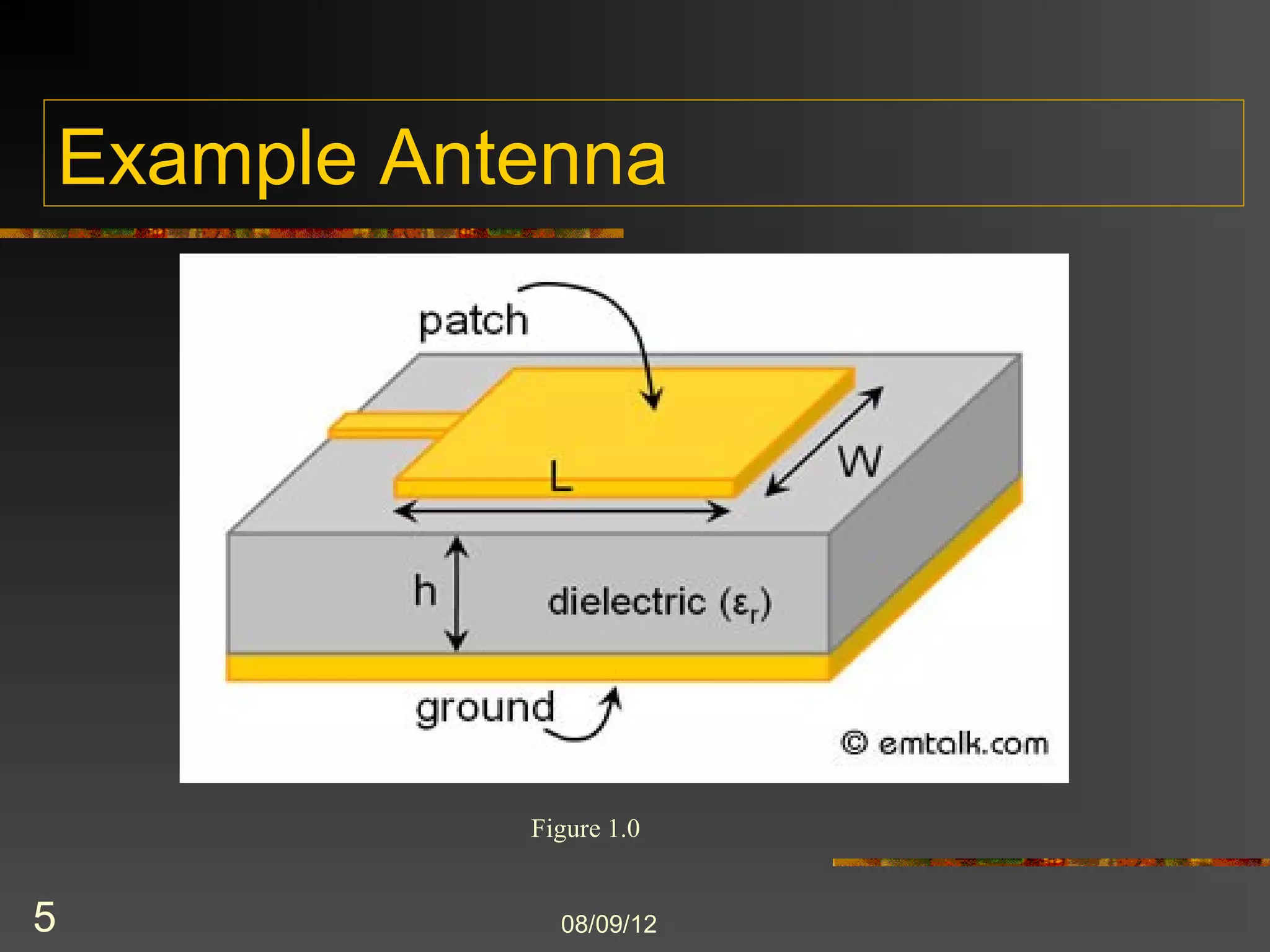
     radiating metallic patch on a ground substrate
        patch can take different configurations but rectangular
        and circular patches are the most popular one because of
        ease of analysis and fabrication and their attractive
        radiation characteristics


4                               8/9/2012
Example Antenna


               Figure 1.0


5                8/9/2012
Justification for Present Work
       Antenna design is a very complex problem .
       Spacecrafts,aircrafts,missiles and satellite
        applications require antenna in small ,size
        ,weight,cost and easy to install.
       Mobile ,radio and other wireless communications
        also demands such specific antennas.
       To fulfill such requirements Microstrip patch
        antennas are used.


6                           8/9/2012
Methodology
       Development of an ANN model in Mat Lab Neural
        Network Tool Box for the calculation of patch
        dimensions for Microstrip Antenna .
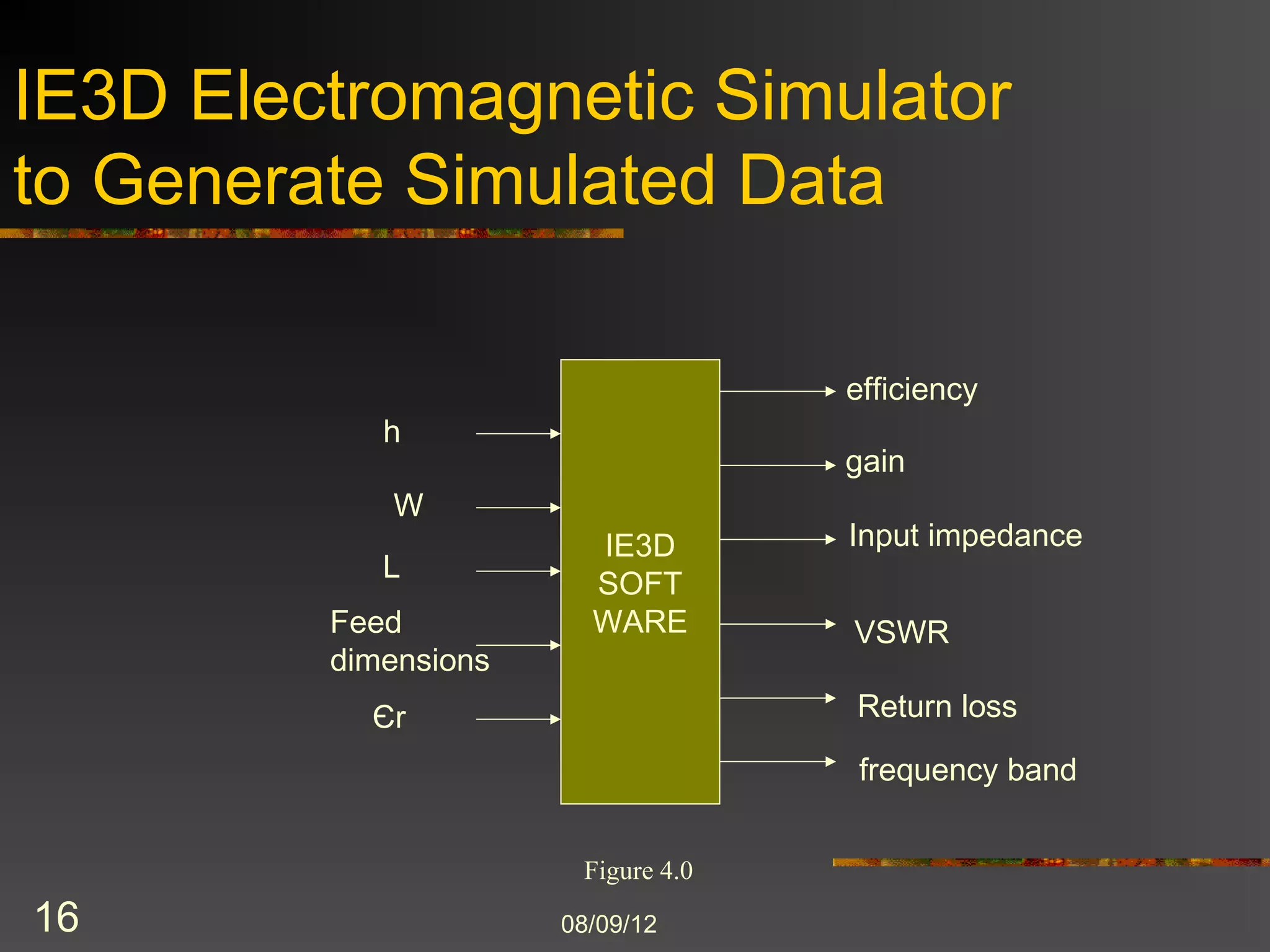
       The data for training the network is generated
        using IE3D a Electro Magnetic Simulator.
       As an example a microstrip line feed rectangular
        Microstrip patch Antenna is being considered
        and designed using simulator for a particular
        resonating frequency i.e. 4.9 GHz.
       Validation of ANN model


7                           8/9/2012
IE3D Electro Magnetic Simulator

    •   Computer Aided Simulation
           Integrated Electromagnetic three Dimensional
            (IE3D) Software
           Developed by Zeland Inc., United States

           Design Dimensions can be milli, micro and so on.

           Simulation Time – Few Minutes

           Output Result can be obtained in the form of patch
            dimensions , VSWR, Return loss, Gain Directivity
            ,Radiation efficiency,etc.


8                             8/9/2012
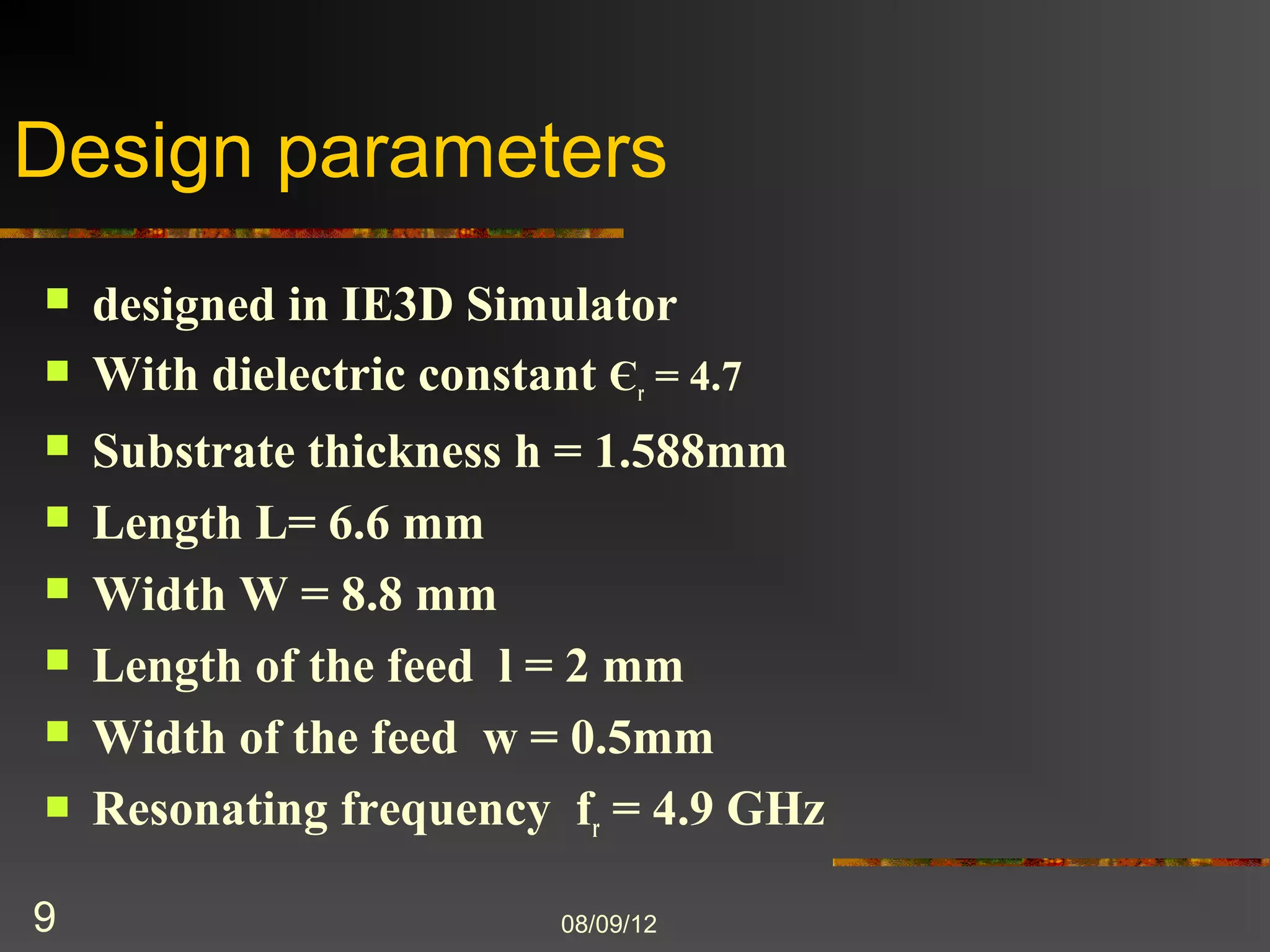
Design parameters
   designed in IE3D Simulator
   With dielectric constant Єr = 4.7
   Substrate thickness h = 1.588mm
   Length L= 6.6 mm
   Width W = 8.8 mm
   Length of the feed l = 2 mm
   Width of the feed w = 0.5mm
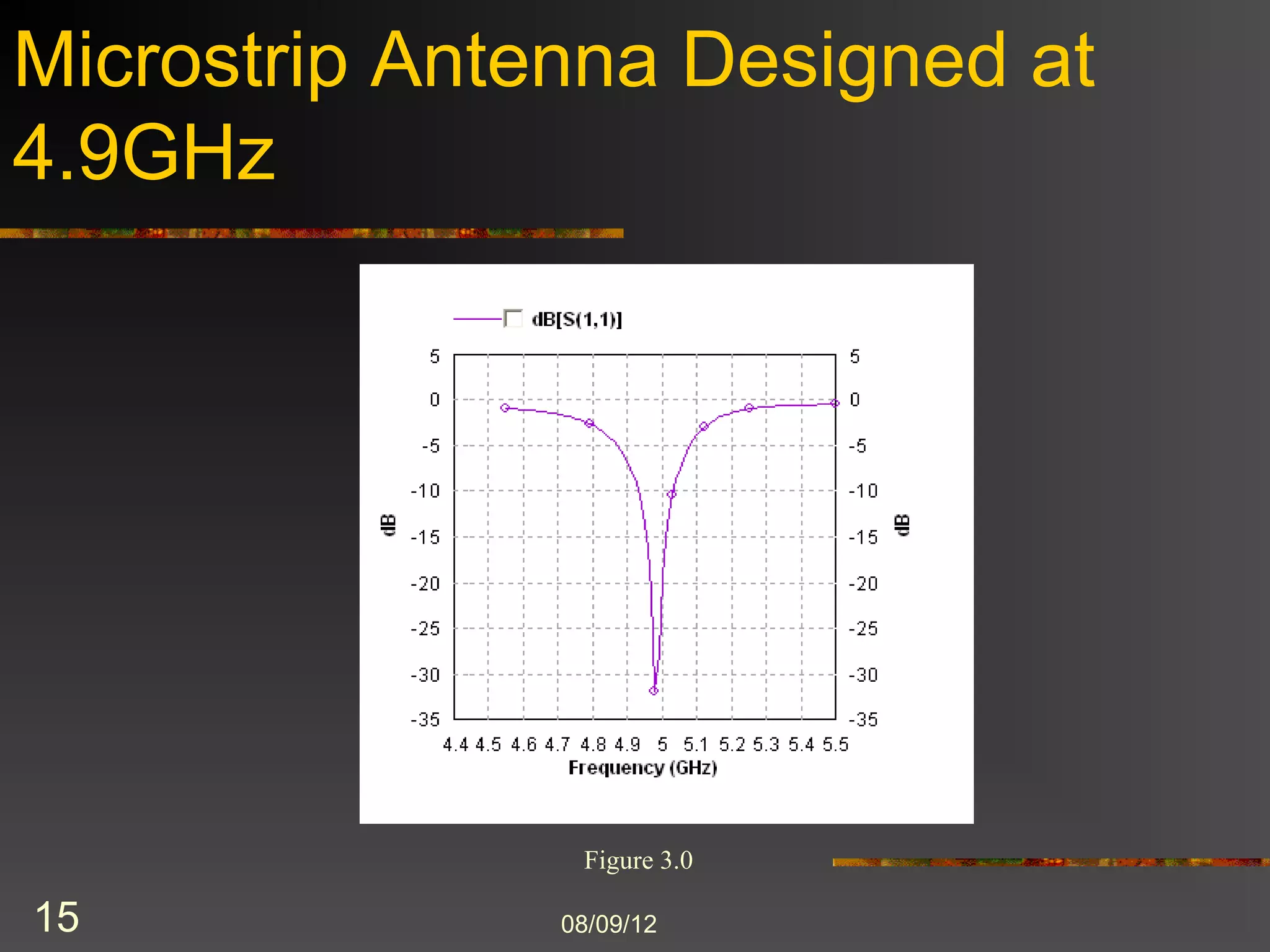
   Resonating frequency fr = 4.9 GHz

9                       8/9/2012
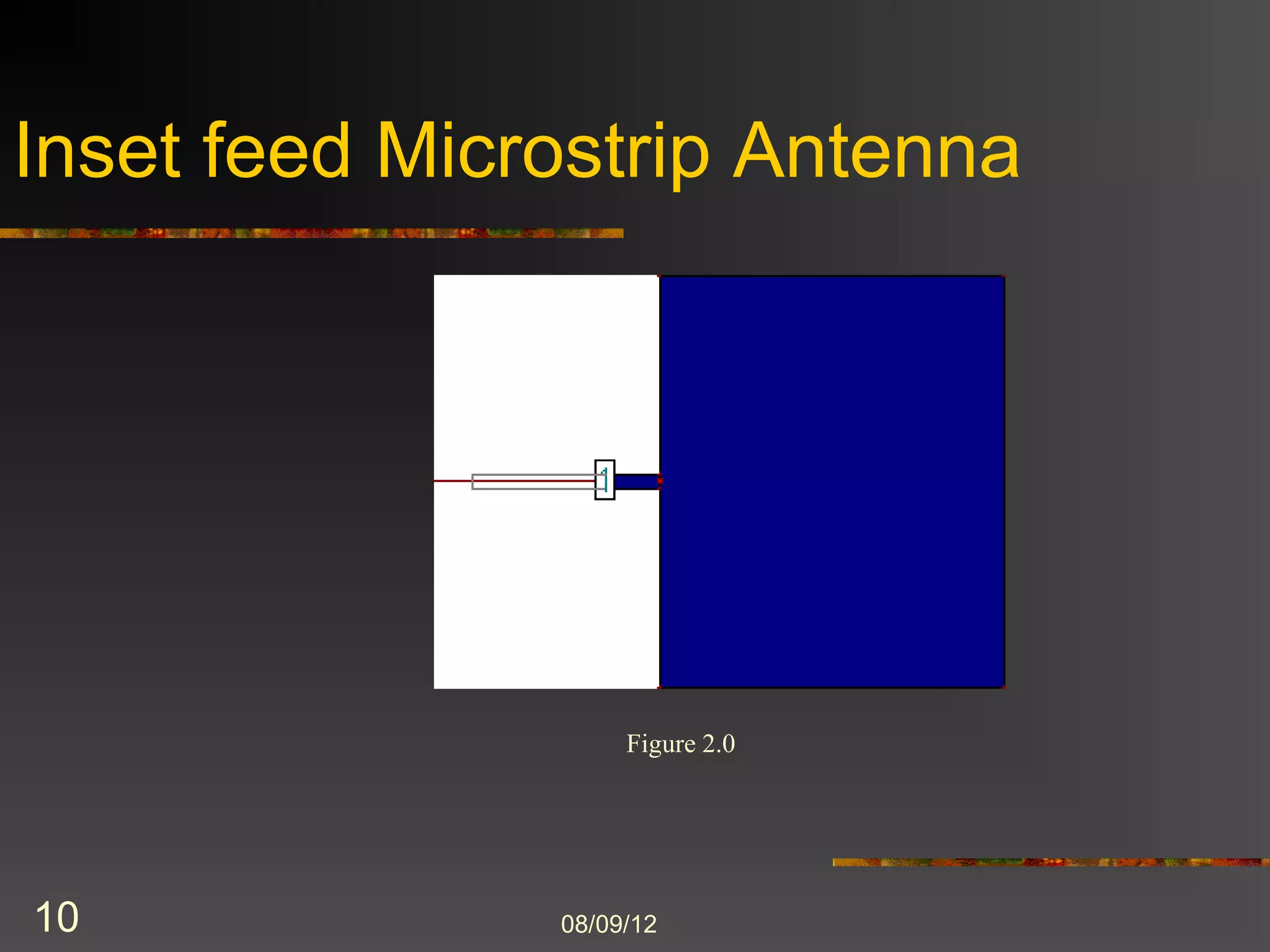
Inset feed Microstrip Antenna


                    Figure 2.0


10             8/9/2012
Relations to calculate different parameters of
rectangular patch antenna


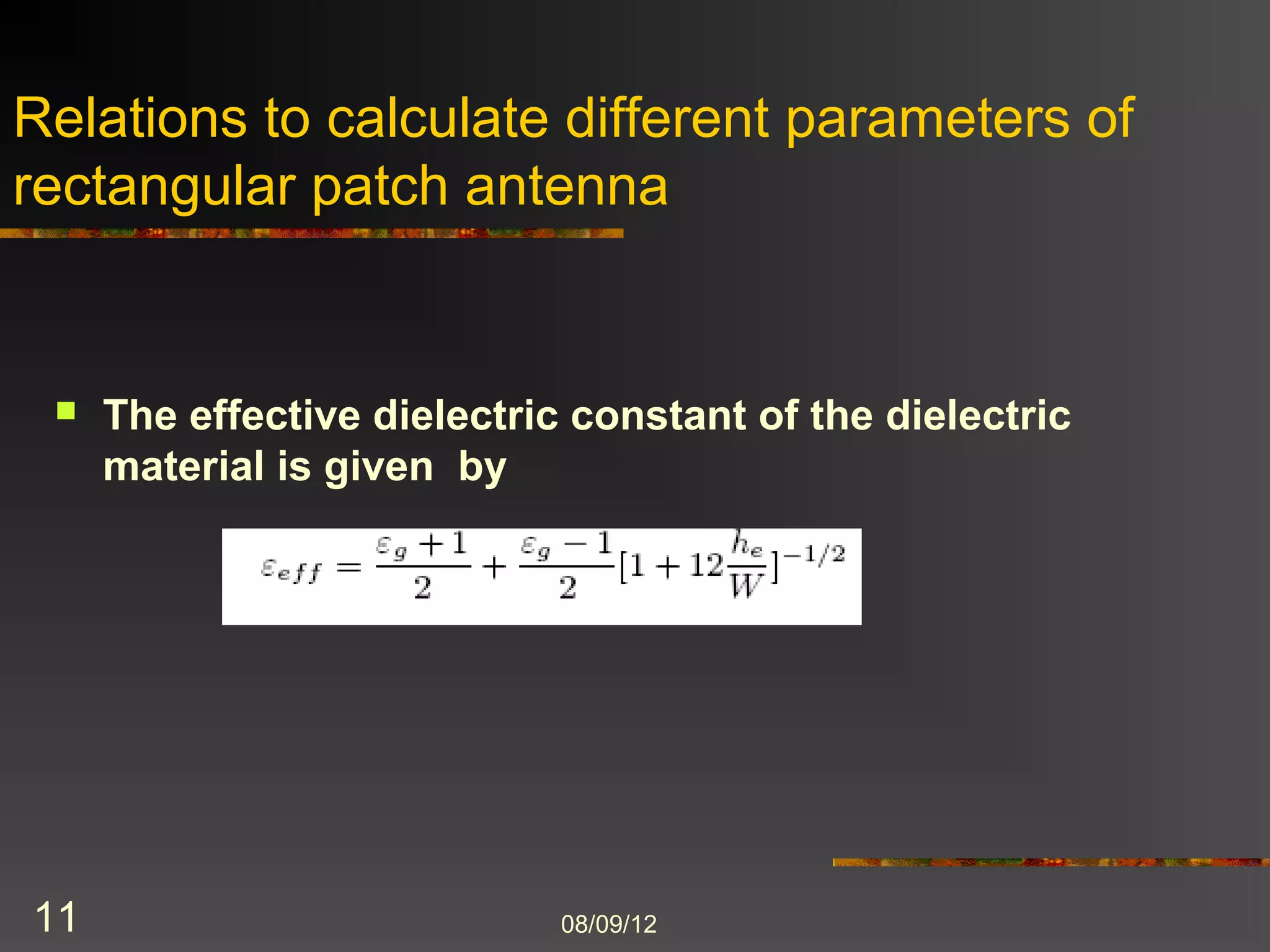
    The effective dielectric constant of the dielectric
     material is given by


11                           8/9/2012
Contd…

    For an efficient radiator, a practical width that leads
     to good radiation efficiencies is given by:


    where vo is the free-space velocity of light.

12                            8/9/2012
Contd..

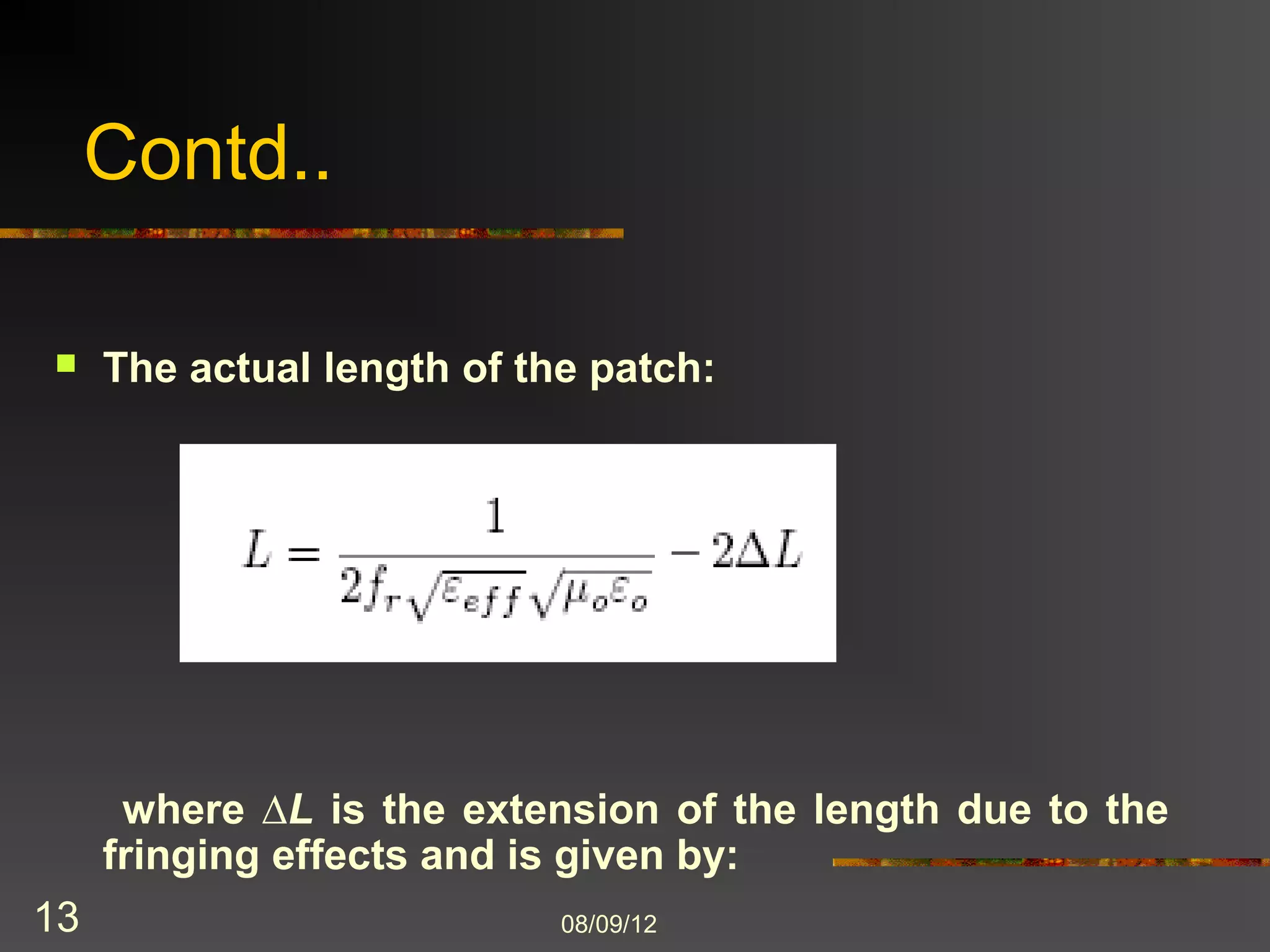
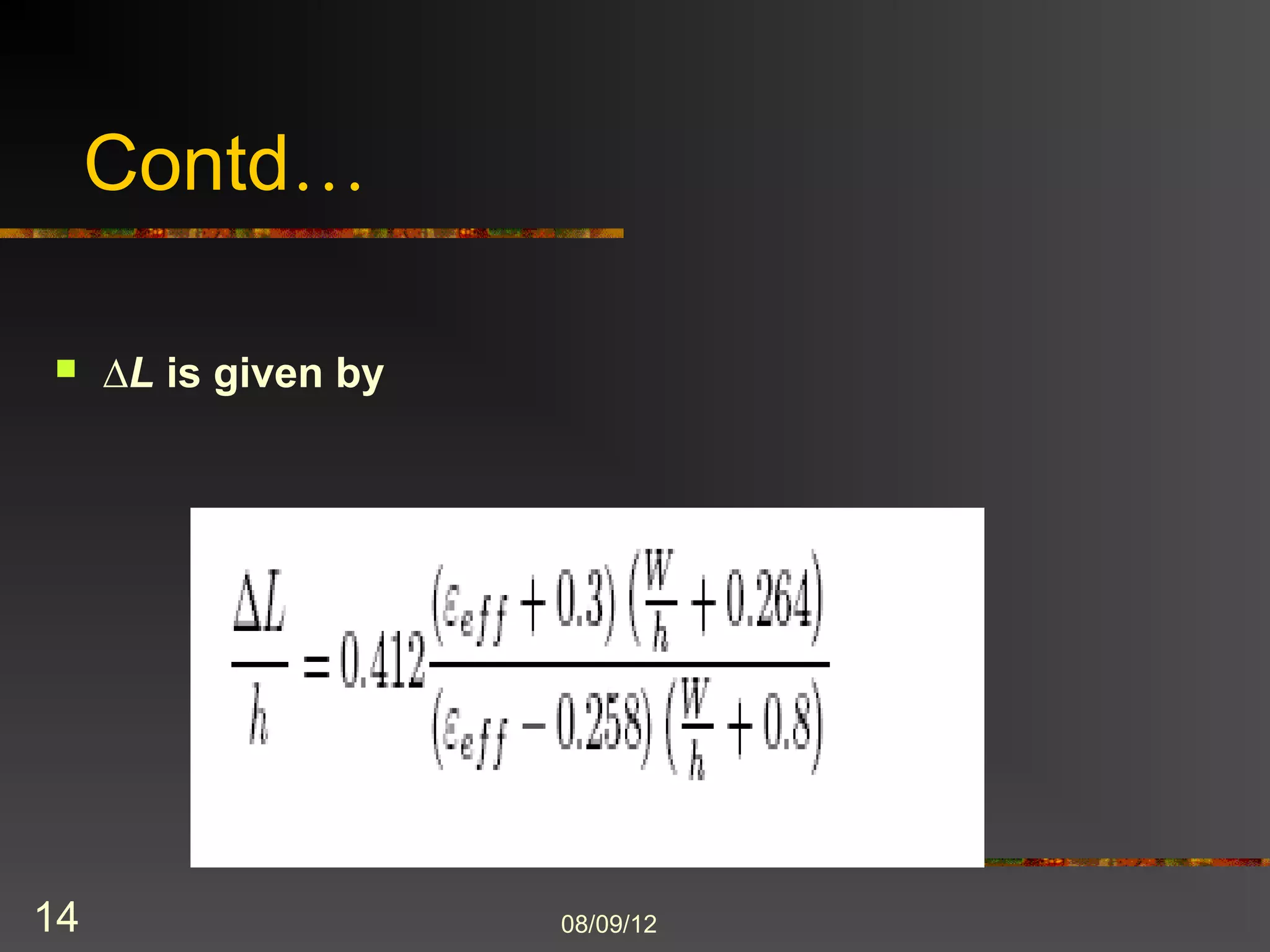
    The actual length of the patch:


     where ∆L is the extension of the length due to the
     fringing effects and is given by:
13                          8/9/2012
Contd…

    ∆L is given by


14                    8/9/2012
Microstrip Antenna Designed at
4.9GHz


                Figure 3.0

15             8/9/2012
IE3D Electromagnetic Simulator
to Generate Simulated Data

                                    efficiency
            h
                                    gain
             W
                         IE3D       Input impedance
            L
                         SOFT
         Feed            WARE        VSWR
         dimensions
           Єr                        Return loss
                                     frequency band


                       Figure 4.0
16                    8/9/2012
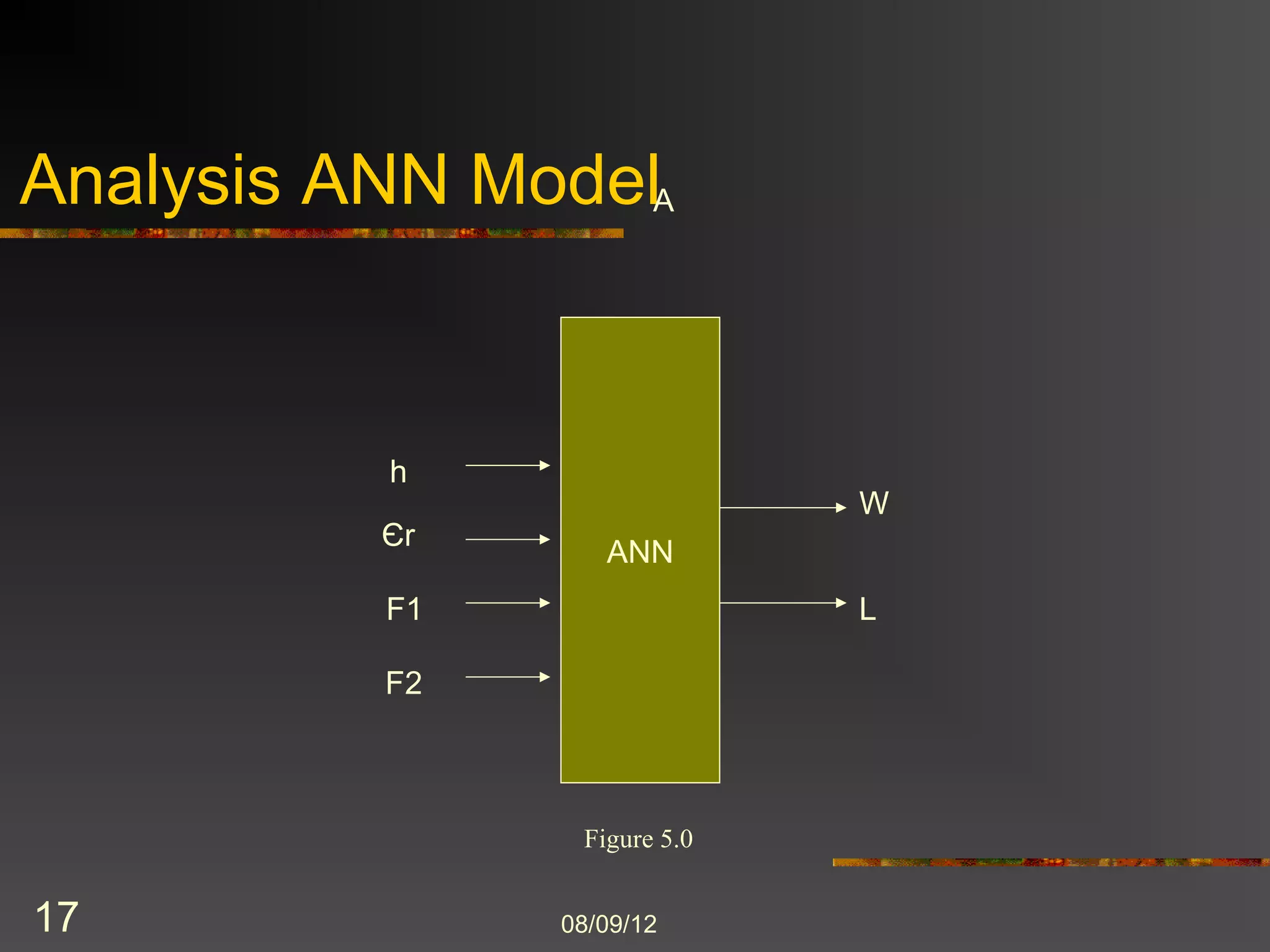
Analysis ANN ModelA


          h
                             W
          Єr
                   ANN
          F1                 L

          F2


                Figure 5.0


17             8/9/2012
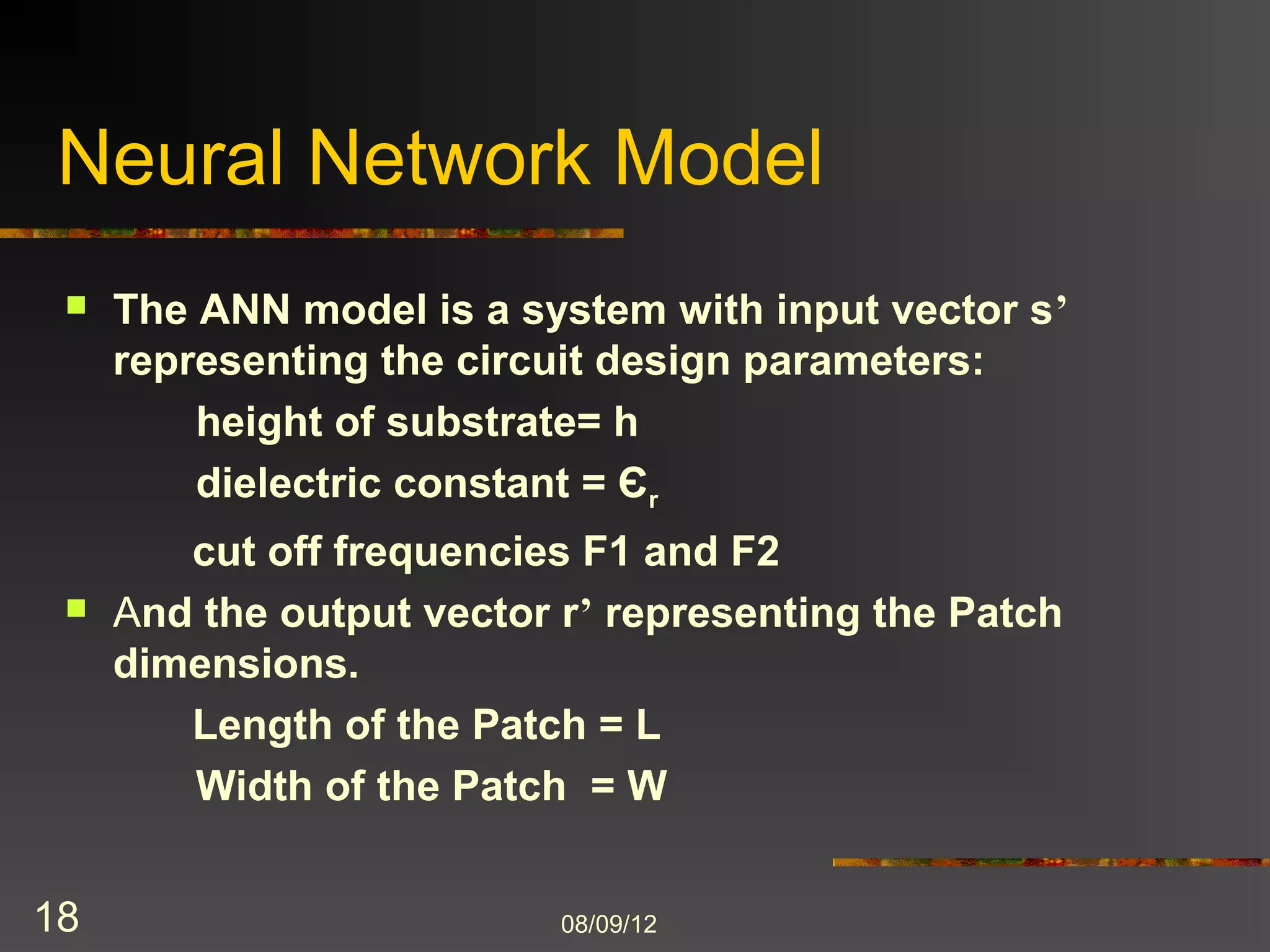
Neural Network Model
    The ANN model is a system with input vector s’
     representing the circuit design parameters:
         height of substrate= h
         dielectric constant = Єr
         cut off frequencies F1 and F2
    And the output vector r’ representing the Patch
     dimensions.
         Length of the Patch = L
         Width of the Patch = W


18                         8/9/2012
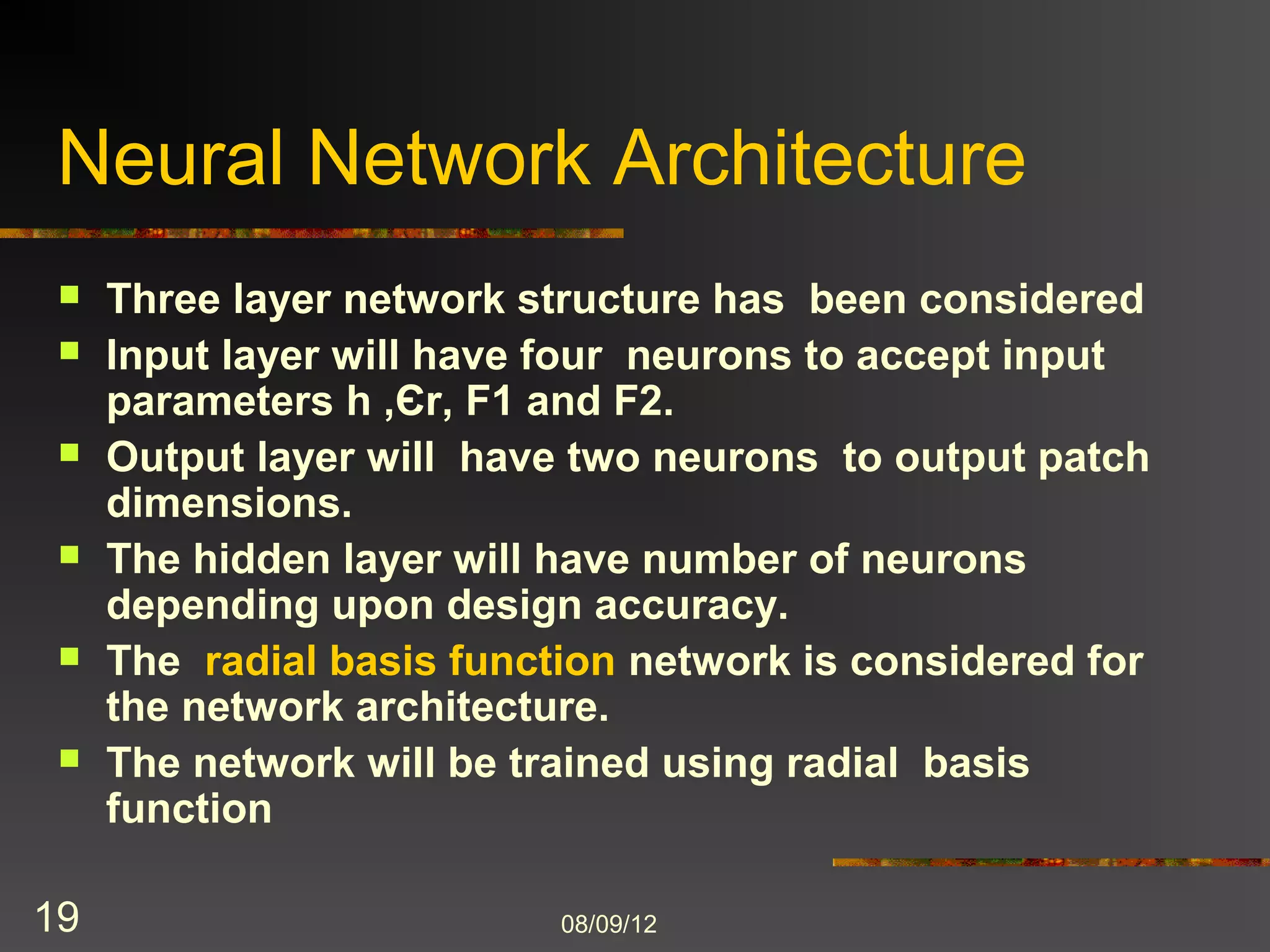
Neural Network Architecture
    Three layer network structure has been considered
    Input layer will have four neurons to accept input
     parameters h ,Єr, F1 and F2.
    Output layer will have two neurons to output patch
     dimensions.
    The hidden layer will have number of neurons
     depending upon design accuracy.
    The radial basis function network is considered for
     the network architecture.
    The network will be trained using radial basis
     function

19                         8/9/2012
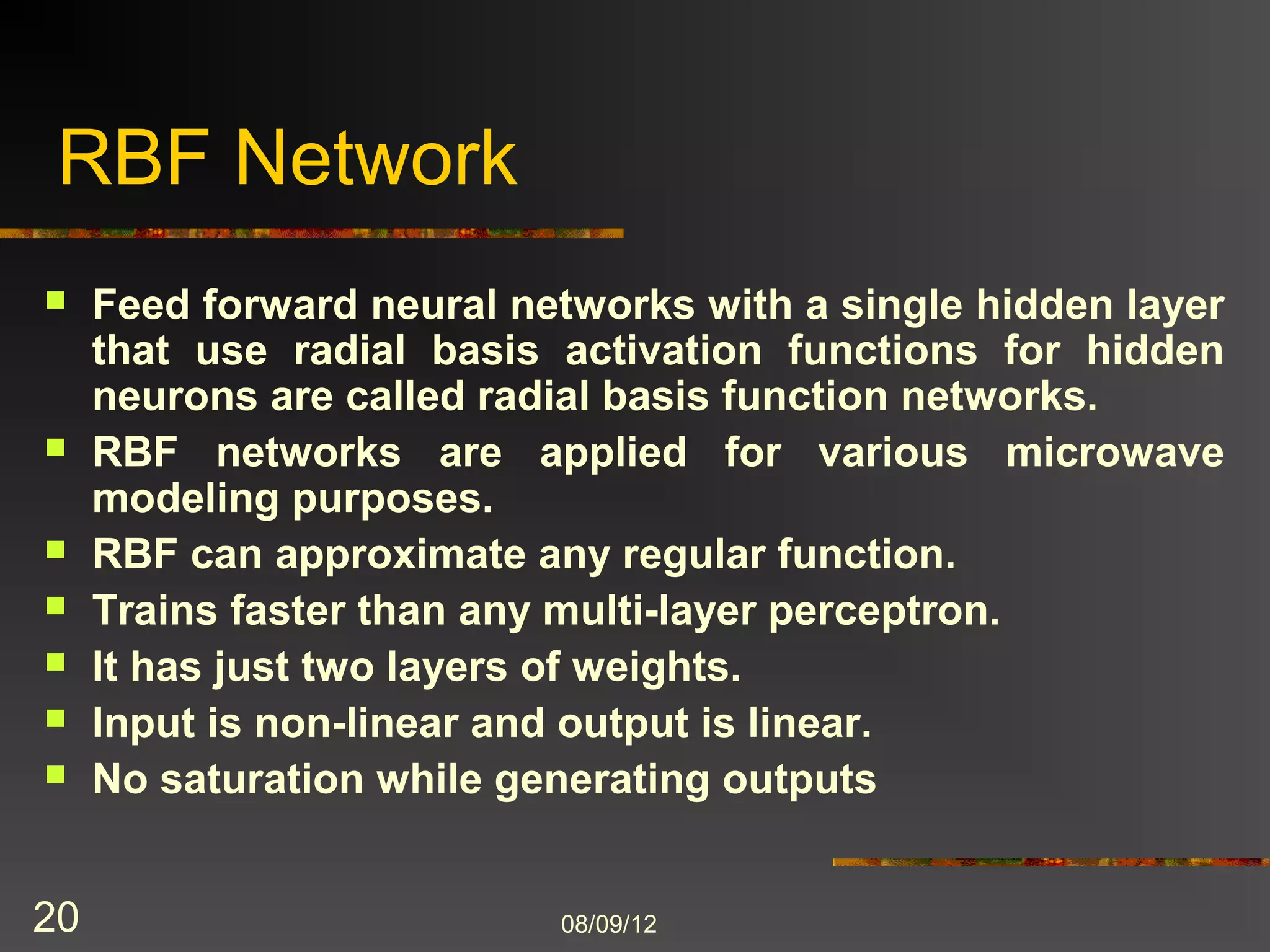
RBF Network
    Feed forward neural networks with a single hidden layer
     that use radial basis activation functions for hidden
     neurons are called radial basis function networks.
    RBF networks are applied for various microwave
     modeling purposes.
    RBF can approximate any regular function.
    Trains faster than any multi-layer perceptron.
    It has just two layers of weights.
    Input is non-linear and output is linear.
    No saturation while generating outputs


20                         8/9/2012
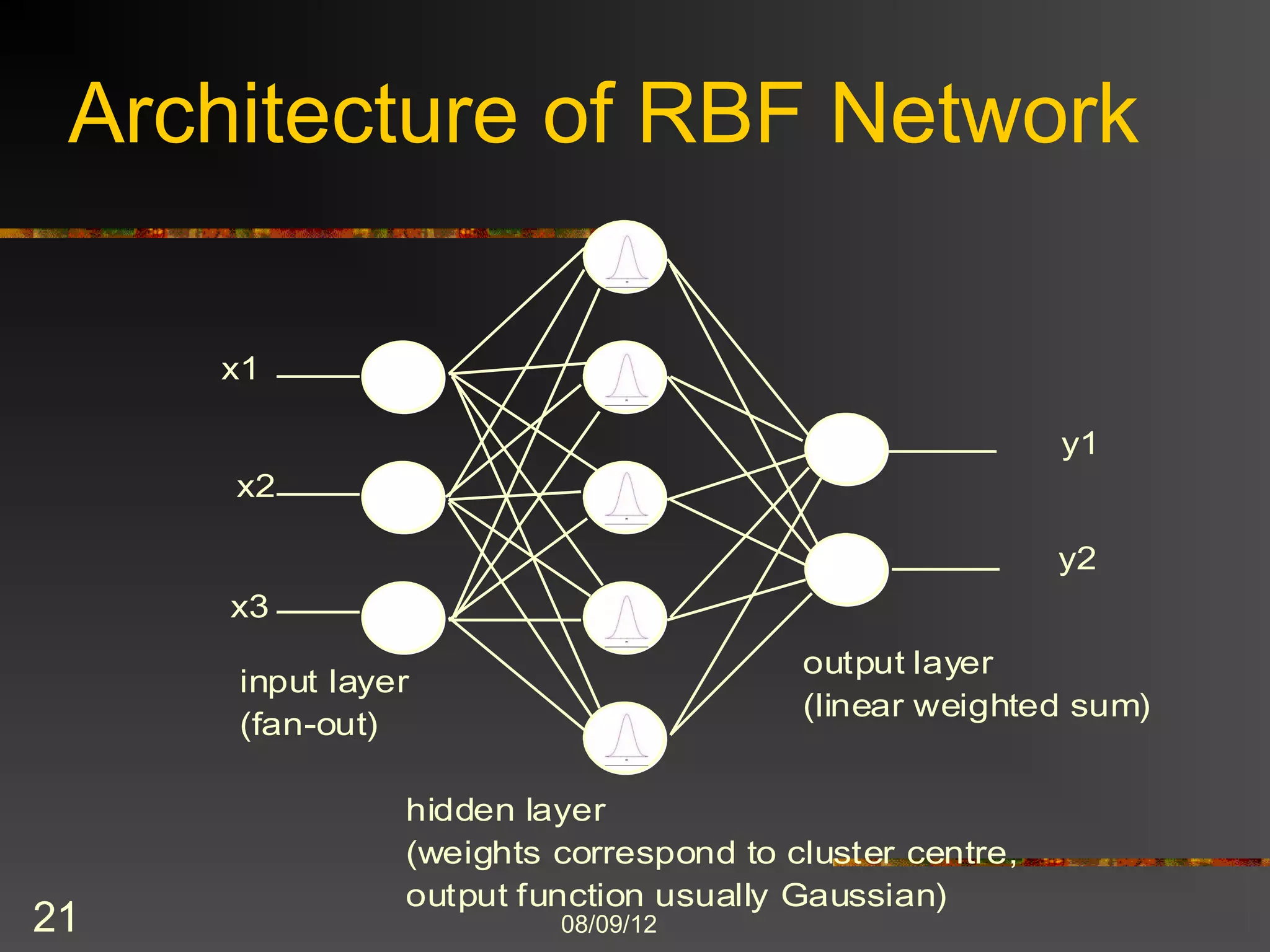
Architecture of RBF Network

     x1

                                                        y1
     x2

                                                        y2
     x3
                                       output layer
     input layer
                                       (linear weighted sum)
     (fan-out)

               hidden layer
               (weights correspond to cluster centre,
               output function usually Gaussian)
21                      8/9/2012
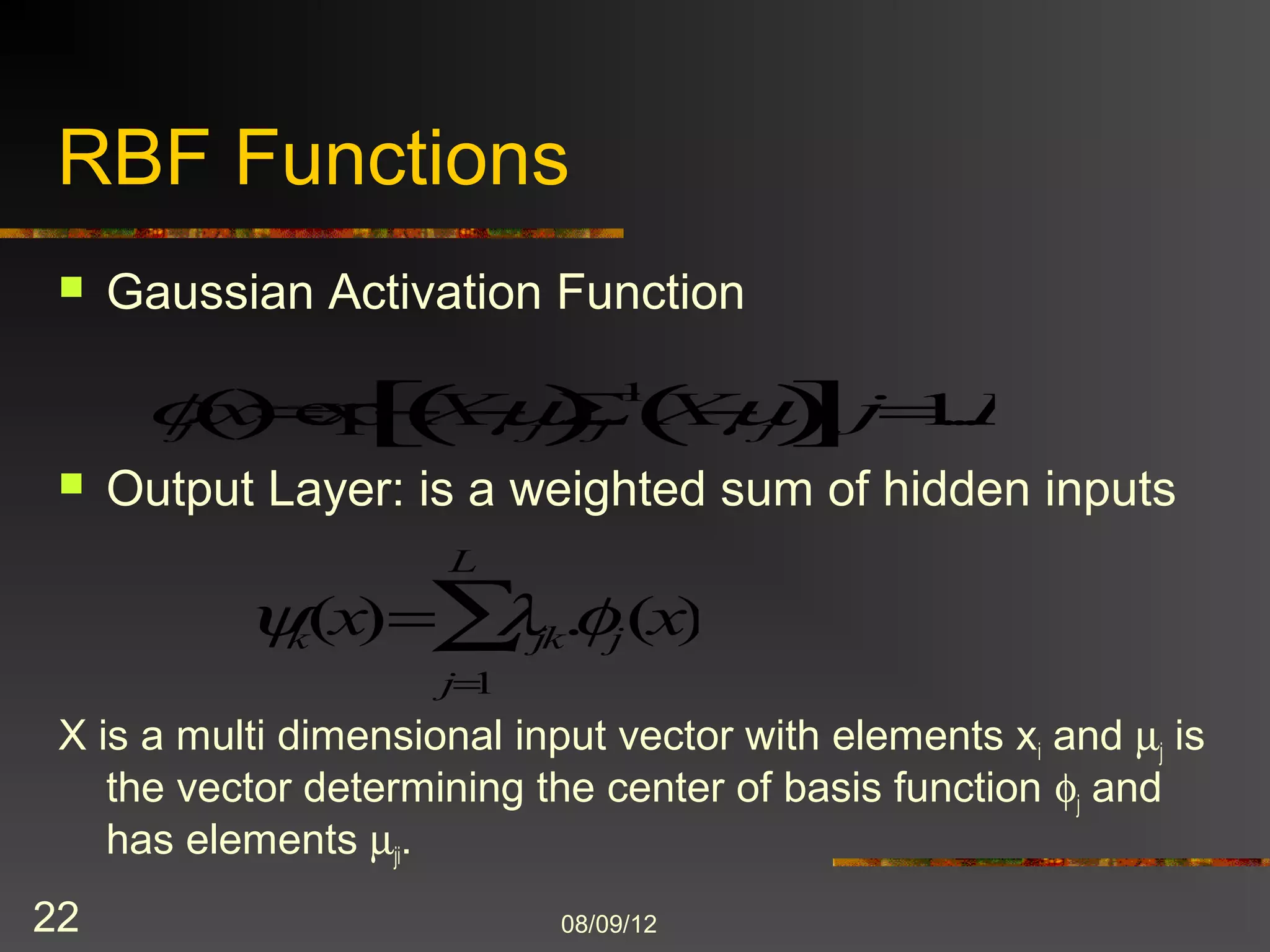
RBF Functions
    Gaussian Activation Function
                                                 1
        j   x   exp       X       j          j       X   j   j 1...L
    Output Layer: is a weighted sum of hidden inputs
                              L

                k   (x)               jk   . j (x)
                          j 1
 X is a multi dimensional input vector with elements xi and j is
    the vector determining the center of basis function j and
    has elements ji.

22                                         8/9/2012
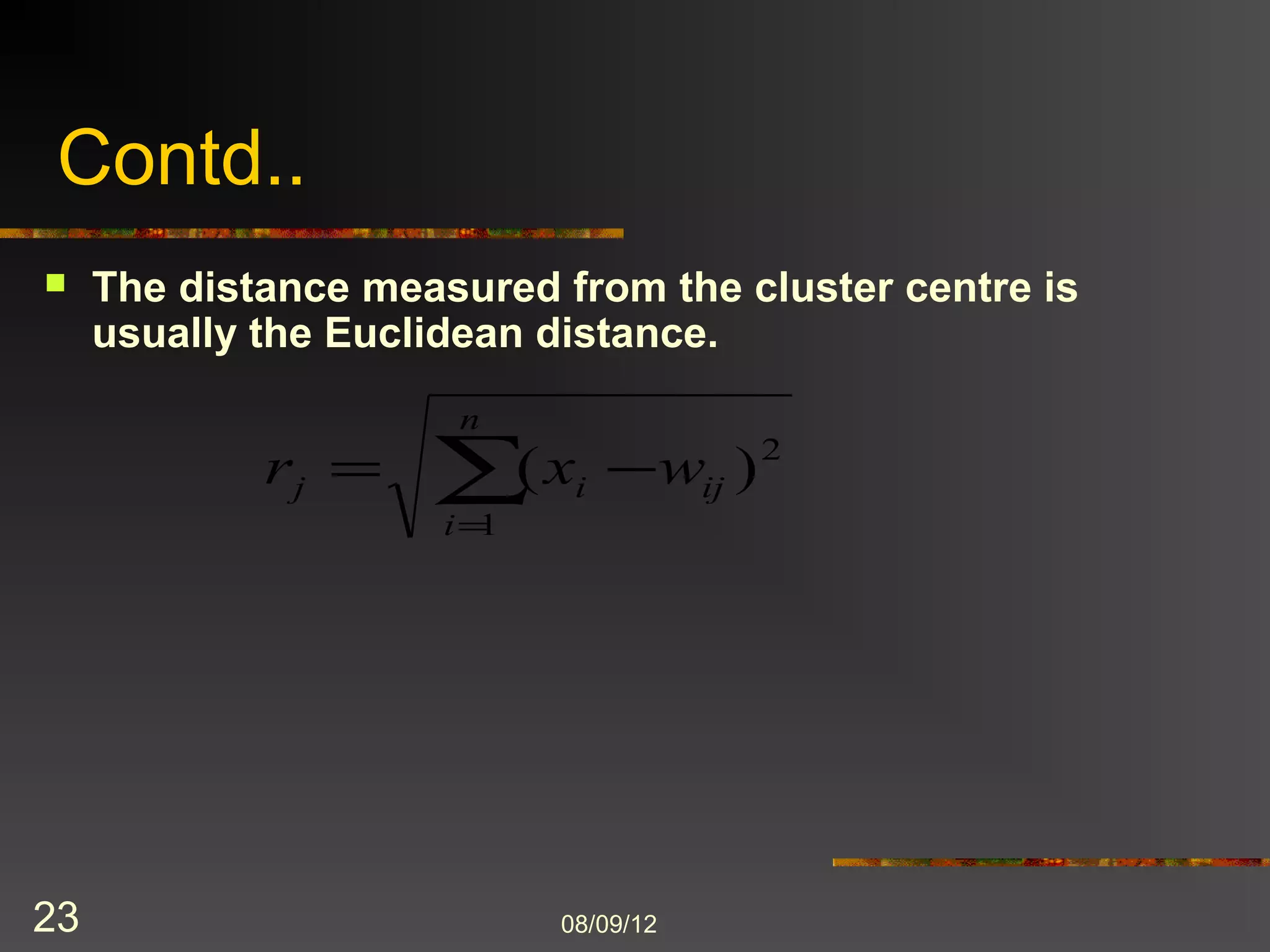
Contd..
    The distance measured from the cluster centre is
     usually the Euclidean distance.
                      n
             rj             ( xi         wij ) 2
                      i 1


23                            8/9/2012
MAT Lab Tool Box


    In order to develop the ANN model MAT LAB
     neural network tool box has been used.


24                    8/9/2012
Network Training
    Two kinds of training algorithms
-    Supervised and Unsupervised
-    RBF networks are used mainly in supervised
     applications
-    In this case, both dataset and its output is known.
-    The model is trained with the set of 200 samples
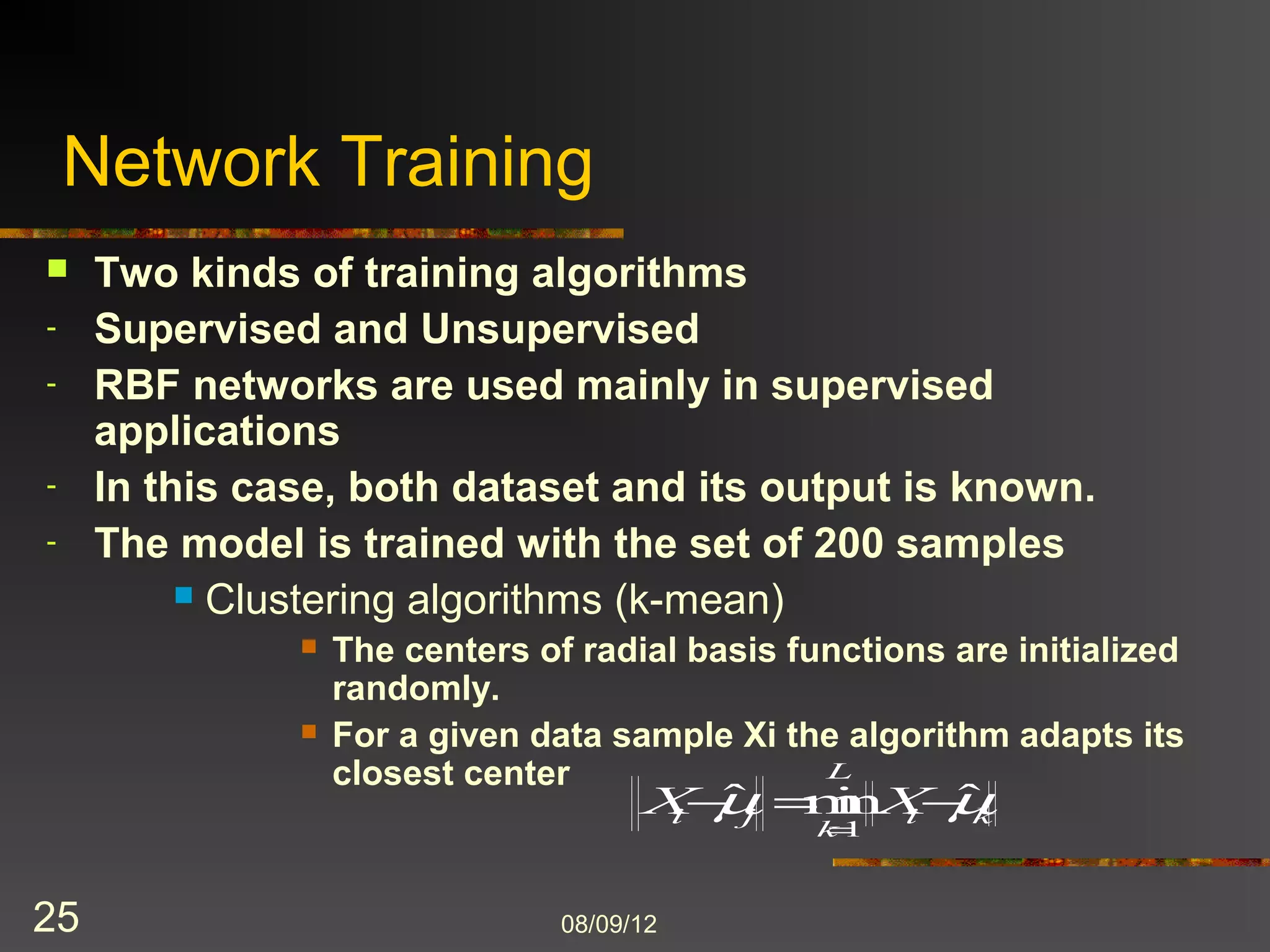
           Clustering algorithms (k-mean)
                  The centers of radial basis functions are initialized
                   randomly.
                  For a given data sample Xi the algorithm adapts its
                   closest center


25                               8/9/2012
Network Testing
    The performance of the network is tested by a
     second set of a sample vectors pairs which are not
     included in training data set but must be in the
     specified given range.
    If the unknown sample pairs are modeled correctly
     the network is likely to represent a valid model.
    The model is tested for around 26 values and found
     satisfactorily.


26                       8/9/2012
Application
    After training and testing the model is ready to be
     used as a simulator for the calculation of patch
     dimensions for the Microstrip antenna.
    The model can be reused in the design process
     many times without the cost of EM Simulations.
    The network is capable of predicting the output for
     any given input in the trained region inexpensively.


27                         8/9/2012
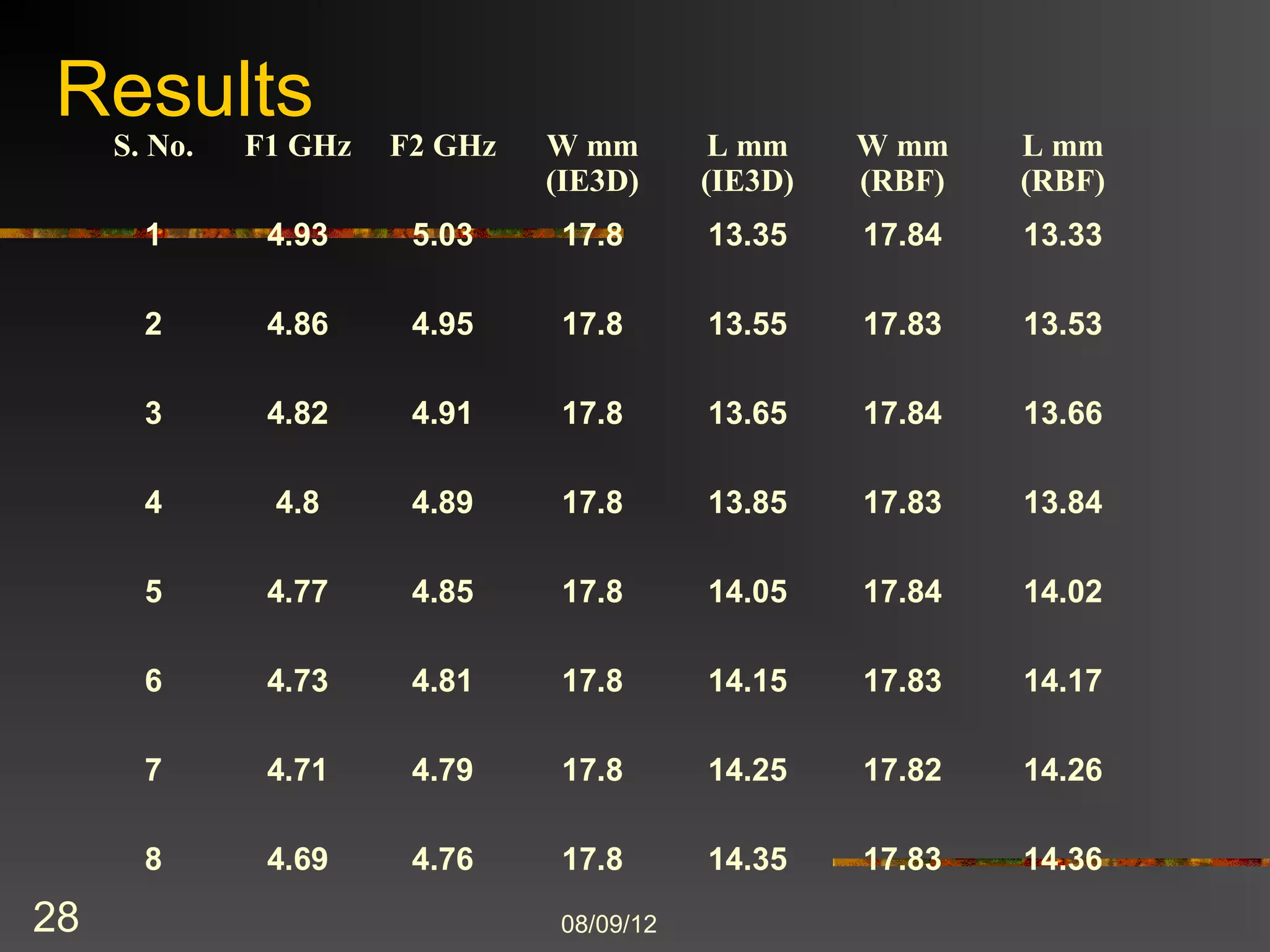
Results
     S. No.   F1 GHz   F2 GHz   W mm        L mm    W mm    L mm
                                (IE3D)     (IE3D)   (RBF)   (RBF)
       1       4.93     5.03     17.8      13.35    17.84   13.33

       2       4.86     4.95     17.8      13.55    17.83   13.53

       3       4.82     4.91     17.8      13.65    17.84   13.66

       4       4.8      4.89     17.8      13.85    17.83   13.84

       5       4.77     4.85     17.8      14.05    17.84   14.02

       6       4.73     4.81     17.8      14.15    17.83   14.17

       7       4.71     4.79     17.8      14.25    17.82   14.26

       8       4.69     4.76     17.8      14.35    17.83   14.36
28                              8/9/2012
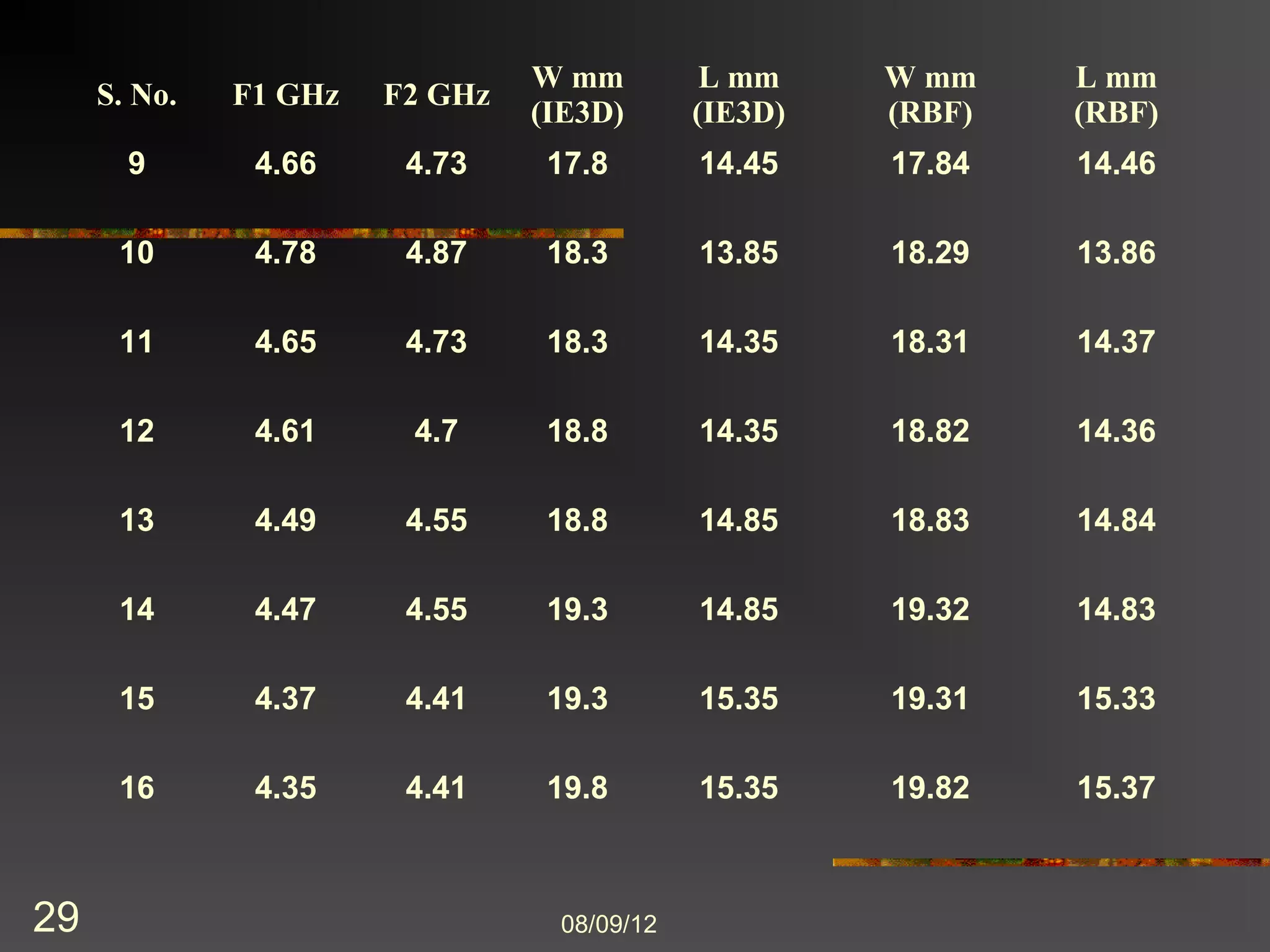
W mm         L mm    W mm    L mm
     S. No.   F1 GHz   F2 GHz
                                (IE3D)      (IE3D)   (RBF)   (RBF)
       9       4.66     4.73     17.8       14.45    17.84   14.46

      10       4.78     4.87     18.3       13.85    18.29   13.86

      11       4.65     4.73     18.3       14.35    18.31   14.37

      12       4.61     4.7      18.8       14.35    18.82   14.36

      13       4.49     4.55     18.8       14.85    18.83   14.84

      14       4.47     4.55     19.3       14.85    19.32   14.83

      15       4.37     4.41     19.3       15.35    19.31   15.33

      16       4.35     4.41     19.8       15.35    19.82   15.37


29                               8/9/2012
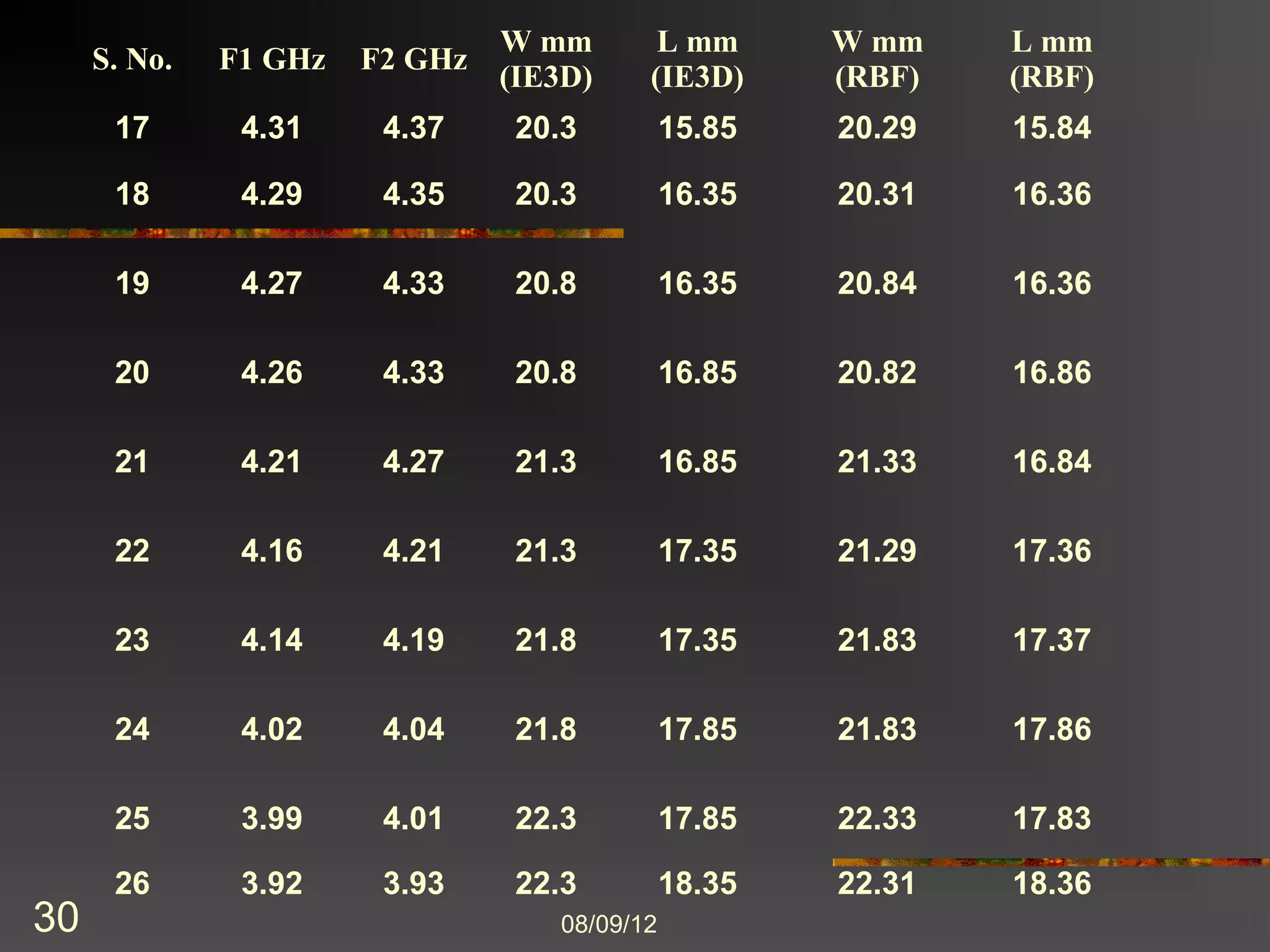
W mm       L mm       W mm    L mm
     S. No.   F1 GHz   F2 GHz
                                (IE3D)    (IE3D)      (RBF)   (RBF)
      17       4.31     4.37     20.3         15.85   20.29   15.84

      18       4.29     4.35     20.3         16.35   20.31   16.36

      19       4.27     4.33     20.8         16.35   20.84   16.36

      20       4.26     4.33     20.8         16.85   20.82   16.86

      21       4.21     4.27     21.3         16.85   21.33   16.84

      22       4.16     4.21     21.3         17.35   21.29   17.36

      23       4.14     4.19     21.8         17.35   21.83   17.37

      24       4.02     4.04     21.8         17.85   21.83   17.86

      25       3.99     4.01     22.3         17.85   22.33   17.83

      26       3.92     3.93     22.3         18.35   22.31   18.36
30                                 8/9/2012
Conclusion
    The neural network developed in this work models
     the patch dimensions calculator for microstrip line
     feed rectangular Microstrip patch antenna.
    The radial basis function network is giving the best
     approximation to the target values
    The values obtained from ANN are very close to
     simulation readings .
    The error between output of ANN and IE3D is very
     very small.
    The developed model for resonant structure
     Microstrip Antenna validate the modeling approach.

31                         8/9/2012
Future Scope
    Working with the same concept and design
     analysis ,different microwave and RF devices
     could be designed .
    Different analysis and synthesis ANN model
     could be developed for other performance
     parameters of the microwave circuits like input
     impedance ,directivity ,gain, VSWR, return
     loss etc.
32                       8/9/2012
References
    [1]   Q. J. Zhang, K. C. Gupta, Neural Networks for RF and Microwave Design,
           Artech House Publishers, 2000.
    [2]   R. K. Mishra, Member, IEEE, and A. Patnaik , ANN Techniques in
           Microwave technology .
    [3]   A. H. Zaabab, Q.J. Zhang, M. Nakhla, ”Analysis and Optimization of
           Microwave Circuits & Devices Using Neural Network Models”’ IEEE MTT-
           S Digest 1994, pp 393- 396
    [4]   C.A. Balanis, Antenna Theory, John Wiley & Sons, Inc., 1997.
    [5]   D.M. Pozar, Microstrip Antenna , Proc. IEEE, Vol. 80, pp.79-81,
    [6]   F. Wang, V.K. DevabhaktunI, and Q.J. Zhang,” A
           hierarchical neural network approach to the development of library of
           neural models for microwave design”,
           IEEE Intl. Microwave Symp. Digest, pp. 1767-1770, Baltimore, MD, 1998.


33                                   8/9/2012
Contd..
    [7]    F. Peik, G. Coutts, R.R. Mansour ,COM DEV, Cambridge, ON, Canada,
            “Application of neural networks in microwave circuit modelling” ,           Electrical
            and computer Engineering,1998,IEEE Canadian            Conference , vol-2 ,24-28 May
            1998,pages:928-931
    [8]    S. Devi , D.C. Panda, S.S. Pattnaik, “A novel method of using Artificial neural
            networks to calculate input impedance of circular microstrip antenna”,
             Antennas and Propagation Society International Symposium, Vol. 3, pp. 462 – 465,
            16-21 June 2002.
    [9]    R.K. Mishra, A. Patnaik, “Neural network-based CAD model for the design of
            square-patch antennas”, Antennas and Propagation, IEEE          Transactions, Vol. 46,
            No. 12, pp. 1890 – 1891, December 1998.
    [10]   A. Patnaik, R.K. Mishra, G.K. Patra, S.K. Dash, ”An artificial Neural network
            model for effective dielectric constant of microstrip line,”
            IEEE Trans. On Antennas Propagat., vol. 45, no. 11, p. 1697, Nov. 1997.
    [11]   Simon Haykin, Neural Networks second edition pHI


34                                         8/9/2012
Thank you
35      8/9/2012

Artificial intelligence in the design of microstrip antenna

  • 1.
    Artificial Intelligence inthe Design of Microstrip Antenna By: Raj Kumar Thenua Vandana V. Thakare Department of Electronics & Instrumentation Engineering AEC, Agra, UP
  • 2.
    Outline  Introduction  Methodology  Design of a microstrip line feed rectangular Microstrip Antenna using IE3D EM Simulator  Analysis of a microstrip line feed rectangular Microstrip Antenna using ANN  Application  Conclusion  Future scope of the work  Results  References 2 8/9/2012
  • 3.
    Introduction  Accurate RF/Microwave design is crucial for the current upsurge in VLSI, telecommunication and wireless technologies  Design at microwave frequencies is significantly different from low-frequency and digital designs  Substantial development in RF/microwave CAD techniques have been made during the last decade  Further advances in CAD are needed to address new design challenges  Fast and accurate models are key to efficient CAD  Neural network based modeling and design could significantly impact high-frequency CAD 3 8/9/2012
  • 4.
    A Illustration Example MICRO STRIP PATCH ANTENNA  radiating metallic patch on a ground substrate  patch can take different configurations but rectangular and circular patches are the most popular one because of ease of analysis and fabrication and their attractive radiation characteristics 4 8/9/2012
  • 5.
    Example Antenna Figure 1.0 5 8/9/2012
  • 6.
    Justification for PresentWork  Antenna design is a very complex problem .  Spacecrafts,aircrafts,missiles and satellite applications require antenna in small ,size ,weight,cost and easy to install.  Mobile ,radio and other wireless communications also demands such specific antennas.  To fulfill such requirements Microstrip patch antennas are used. 6 8/9/2012
  • 7.
    Methodology  Development of an ANN model in Mat Lab Neural Network Tool Box for the calculation of patch dimensions for Microstrip Antenna .  The data for training the network is generated using IE3D a Electro Magnetic Simulator.  As an example a microstrip line feed rectangular Microstrip patch Antenna is being considered and designed using simulator for a particular resonating frequency i.e. 4.9 GHz.  Validation of ANN model 7 8/9/2012
  • 8.
    IE3D Electro MagneticSimulator • Computer Aided Simulation  Integrated Electromagnetic three Dimensional (IE3D) Software  Developed by Zeland Inc., United States  Design Dimensions can be milli, micro and so on.  Simulation Time – Few Minutes  Output Result can be obtained in the form of patch dimensions , VSWR, Return loss, Gain Directivity ,Radiation efficiency,etc. 8 8/9/2012
  • 9.
    Design parameters  designed in IE3D Simulator  With dielectric constant Єr = 4.7  Substrate thickness h = 1.588mm  Length L= 6.6 mm  Width W = 8.8 mm  Length of the feed l = 2 mm  Width of the feed w = 0.5mm  Resonating frequency fr = 4.9 GHz 9 8/9/2012
  • 10.
    Inset feed MicrostripAntenna Figure 2.0 10 8/9/2012
  • 11.
    Relations to calculatedifferent parameters of rectangular patch antenna  The effective dielectric constant of the dielectric material is given by 11 8/9/2012
  • 12.
    Contd…  For an efficient radiator, a practical width that leads to good radiation efficiencies is given by:  where vo is the free-space velocity of light. 12 8/9/2012
  • 13.
    Contd..  The actual length of the patch: where ∆L is the extension of the length due to the fringing effects and is given by: 13 8/9/2012
  • 14.
    Contd…  ∆L is given by 14 8/9/2012
  • 15.
    Microstrip Antenna Designedat 4.9GHz Figure 3.0 15 8/9/2012
  • 16.
    IE3D Electromagnetic Simulator toGenerate Simulated Data efficiency h gain W IE3D Input impedance L SOFT Feed WARE VSWR dimensions Єr Return loss frequency band Figure 4.0 16 8/9/2012
  • 17.
    Analysis ANN ModelA h W Єr ANN F1 L F2 Figure 5.0 17 8/9/2012
  • 18.
    Neural Network Model  The ANN model is a system with input vector s’ representing the circuit design parameters: height of substrate= h dielectric constant = Єr cut off frequencies F1 and F2  And the output vector r’ representing the Patch dimensions. Length of the Patch = L Width of the Patch = W 18 8/9/2012
  • 19.
    Neural Network Architecture  Three layer network structure has been considered  Input layer will have four neurons to accept input parameters h ,Єr, F1 and F2.  Output layer will have two neurons to output patch dimensions.  The hidden layer will have number of neurons depending upon design accuracy.  The radial basis function network is considered for the network architecture.  The network will be trained using radial basis function 19 8/9/2012
  • 20.
    RBF Network  Feed forward neural networks with a single hidden layer that use radial basis activation functions for hidden neurons are called radial basis function networks.  RBF networks are applied for various microwave modeling purposes.  RBF can approximate any regular function.  Trains faster than any multi-layer perceptron.  It has just two layers of weights.  Input is non-linear and output is linear.  No saturation while generating outputs 20 8/9/2012
  • 21.
    Architecture of RBFNetwork x1 y1 x2 y2 x3 output layer input layer (linear weighted sum) (fan-out) hidden layer (weights correspond to cluster centre, output function usually Gaussian) 21 8/9/2012
  • 22.
    RBF Functions  Gaussian Activation Function 1 j x exp X j j X j j 1...L  Output Layer: is a weighted sum of hidden inputs L k (x) jk . j (x) j 1 X is a multi dimensional input vector with elements xi and j is the vector determining the center of basis function j and has elements ji. 22 8/9/2012
  • 23.
    Contd..  The distance measured from the cluster centre is usually the Euclidean distance. n rj ( xi wij ) 2 i 1 23 8/9/2012
  • 24.
    MAT Lab ToolBox  In order to develop the ANN model MAT LAB neural network tool box has been used. 24 8/9/2012
  • 25.
    Network Training  Two kinds of training algorithms - Supervised and Unsupervised - RBF networks are used mainly in supervised applications - In this case, both dataset and its output is known. - The model is trained with the set of 200 samples  Clustering algorithms (k-mean)  The centers of radial basis functions are initialized randomly.  For a given data sample Xi the algorithm adapts its closest center 25 8/9/2012
  • 26.
    Network Testing  The performance of the network is tested by a second set of a sample vectors pairs which are not included in training data set but must be in the specified given range.  If the unknown sample pairs are modeled correctly the network is likely to represent a valid model.  The model is tested for around 26 values and found satisfactorily. 26 8/9/2012
  • 27.
    Application  After training and testing the model is ready to be used as a simulator for the calculation of patch dimensions for the Microstrip antenna.  The model can be reused in the design process many times without the cost of EM Simulations.  The network is capable of predicting the output for any given input in the trained region inexpensively. 27 8/9/2012
  • 28.
    Results S. No. F1 GHz F2 GHz W mm L mm W mm L mm (IE3D) (IE3D) (RBF) (RBF) 1 4.93 5.03 17.8 13.35 17.84 13.33 2 4.86 4.95 17.8 13.55 17.83 13.53 3 4.82 4.91 17.8 13.65 17.84 13.66 4 4.8 4.89 17.8 13.85 17.83 13.84 5 4.77 4.85 17.8 14.05 17.84 14.02 6 4.73 4.81 17.8 14.15 17.83 14.17 7 4.71 4.79 17.8 14.25 17.82 14.26 8 4.69 4.76 17.8 14.35 17.83 14.36 28 8/9/2012
  • 29.
    W mm L mm W mm L mm S. No. F1 GHz F2 GHz (IE3D) (IE3D) (RBF) (RBF) 9 4.66 4.73 17.8 14.45 17.84 14.46 10 4.78 4.87 18.3 13.85 18.29 13.86 11 4.65 4.73 18.3 14.35 18.31 14.37 12 4.61 4.7 18.8 14.35 18.82 14.36 13 4.49 4.55 18.8 14.85 18.83 14.84 14 4.47 4.55 19.3 14.85 19.32 14.83 15 4.37 4.41 19.3 15.35 19.31 15.33 16 4.35 4.41 19.8 15.35 19.82 15.37 29 8/9/2012
  • 30.
    W mm L mm W mm L mm S. No. F1 GHz F2 GHz (IE3D) (IE3D) (RBF) (RBF) 17 4.31 4.37 20.3 15.85 20.29 15.84 18 4.29 4.35 20.3 16.35 20.31 16.36 19 4.27 4.33 20.8 16.35 20.84 16.36 20 4.26 4.33 20.8 16.85 20.82 16.86 21 4.21 4.27 21.3 16.85 21.33 16.84 22 4.16 4.21 21.3 17.35 21.29 17.36 23 4.14 4.19 21.8 17.35 21.83 17.37 24 4.02 4.04 21.8 17.85 21.83 17.86 25 3.99 4.01 22.3 17.85 22.33 17.83 26 3.92 3.93 22.3 18.35 22.31 18.36 30 8/9/2012
  • 31.
    Conclusion  The neural network developed in this work models the patch dimensions calculator for microstrip line feed rectangular Microstrip patch antenna.  The radial basis function network is giving the best approximation to the target values  The values obtained from ANN are very close to simulation readings .  The error between output of ANN and IE3D is very very small.  The developed model for resonant structure Microstrip Antenna validate the modeling approach. 31 8/9/2012
  • 32.
    Future Scope  Working with the same concept and design analysis ,different microwave and RF devices could be designed .  Different analysis and synthesis ANN model could be developed for other performance parameters of the microwave circuits like input impedance ,directivity ,gain, VSWR, return loss etc. 32 8/9/2012
  • 33.
    References  [1] Q. J. Zhang, K. C. Gupta, Neural Networks for RF and Microwave Design, Artech House Publishers, 2000.  [2] R. K. Mishra, Member, IEEE, and A. Patnaik , ANN Techniques in Microwave technology .  [3] A. H. Zaabab, Q.J. Zhang, M. Nakhla, ”Analysis and Optimization of Microwave Circuits & Devices Using Neural Network Models”’ IEEE MTT- S Digest 1994, pp 393- 396  [4] C.A. Balanis, Antenna Theory, John Wiley & Sons, Inc., 1997.  [5] D.M. Pozar, Microstrip Antenna , Proc. IEEE, Vol. 80, pp.79-81,  [6] F. Wang, V.K. DevabhaktunI, and Q.J. Zhang,” A hierarchical neural network approach to the development of library of neural models for microwave design”, IEEE Intl. Microwave Symp. Digest, pp. 1767-1770, Baltimore, MD, 1998. 33 8/9/2012
  • 34.
    Contd..  [7] F. Peik, G. Coutts, R.R. Mansour ,COM DEV, Cambridge, ON, Canada, “Application of neural networks in microwave circuit modelling” , Electrical and computer Engineering,1998,IEEE Canadian Conference , vol-2 ,24-28 May 1998,pages:928-931  [8] S. Devi , D.C. Panda, S.S. Pattnaik, “A novel method of using Artificial neural networks to calculate input impedance of circular microstrip antenna”, Antennas and Propagation Society International Symposium, Vol. 3, pp. 462 – 465, 16-21 June 2002.  [9] R.K. Mishra, A. Patnaik, “Neural network-based CAD model for the design of square-patch antennas”, Antennas and Propagation, IEEE Transactions, Vol. 46, No. 12, pp. 1890 – 1891, December 1998.  [10] A. Patnaik, R.K. Mishra, G.K. Patra, S.K. Dash, ”An artificial Neural network model for effective dielectric constant of microstrip line,” IEEE Trans. On Antennas Propagat., vol. 45, no. 11, p. 1697, Nov. 1997.  [11] Simon Haykin, Neural Networks second edition pHI 34 8/9/2012
  • 35.
    Thank you 35 8/9/2012