ANalysis Of VAriance
Presenter- Dr. SNEH KHATRI
Junior Resident
PGIMSRohtak
Contents
• Introduction – Various statistical tests
• What is ANOVA?
• One way ANOVA
• Two way ANOVA
• MANOVA (Multivariate ANalysis Of VAriance)
• ANOVA with repeated measures
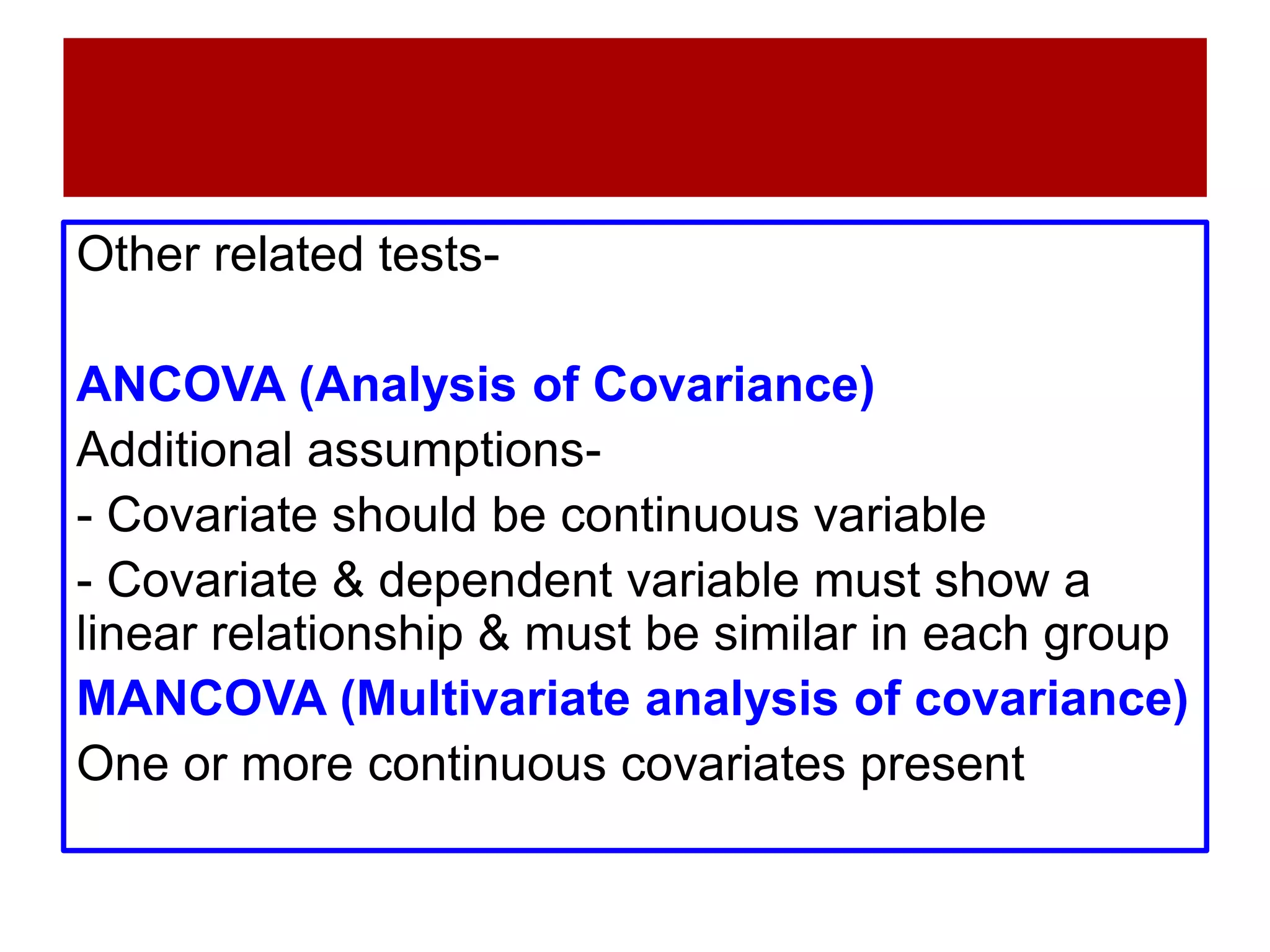
• Other related tests
• References
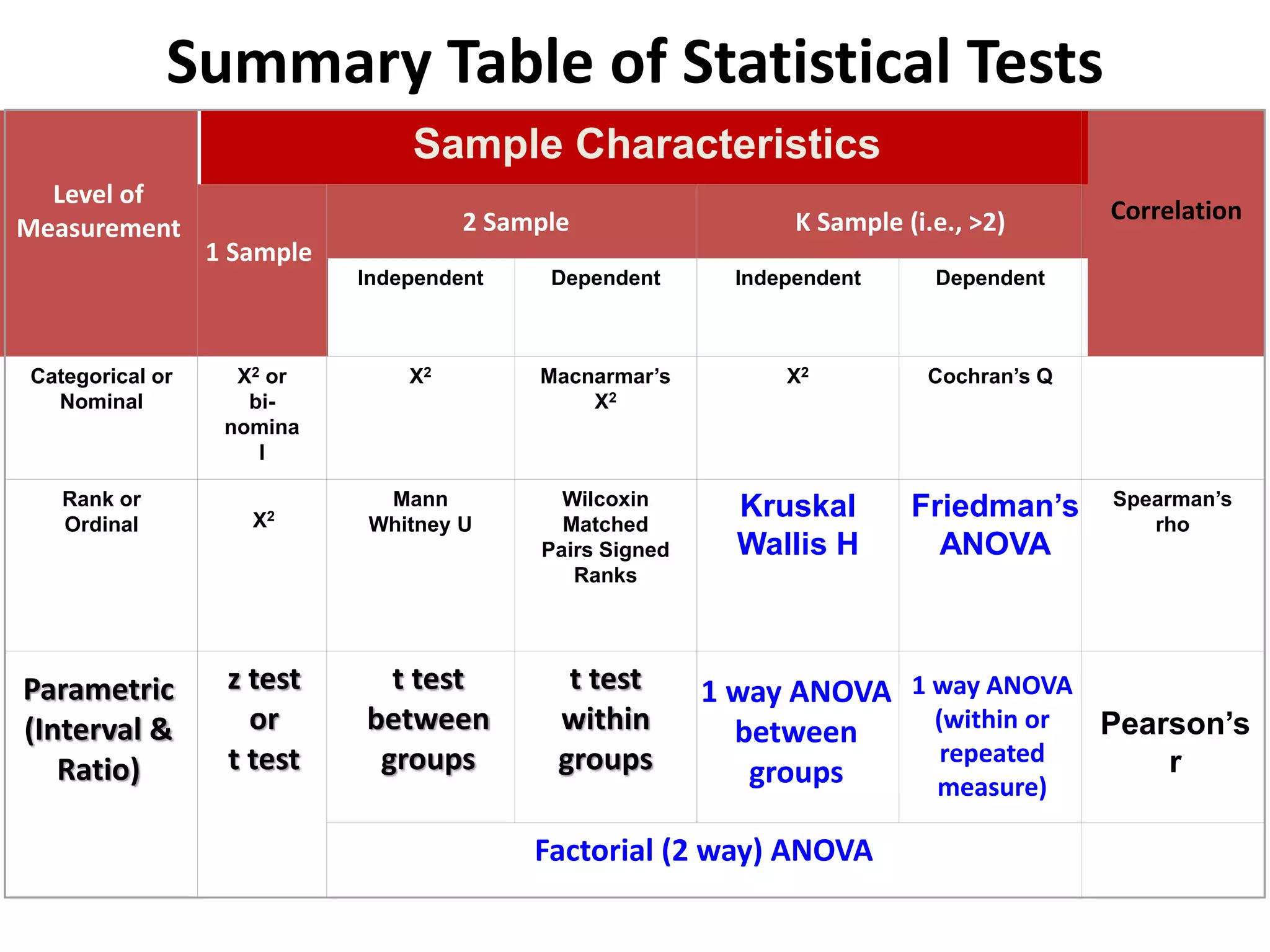
Summary Table of Statistical Tests
Level of
Measurement
Sample Characteristics
Correlation
1 Sample
2 Sample K Sample (i.e., >2)
Independent Dependent Independent Dependent
Categorical or
Nominal
Χ2 or
bi-
nomina
l
Χ2 Macnarmar’s
Χ2
Χ2 Cochran’s Q
Rank or
Ordinal
Mann
Whitney U
Wilcoxin
Matched
Pairs Signed
Ranks
Kruskal
Wallis H
Friedman’s
ANOVA
Spearman’s
rho
Parametric
(Interval &
Ratio)
z test
or
t test
t test
between
groups
t test
within
groups
1 way ANOVA
between
groups
1 way ANOVA
(within or
repeated
measure)
Pearson’s
r
Factorial (2 way) ANOVA
Χ2
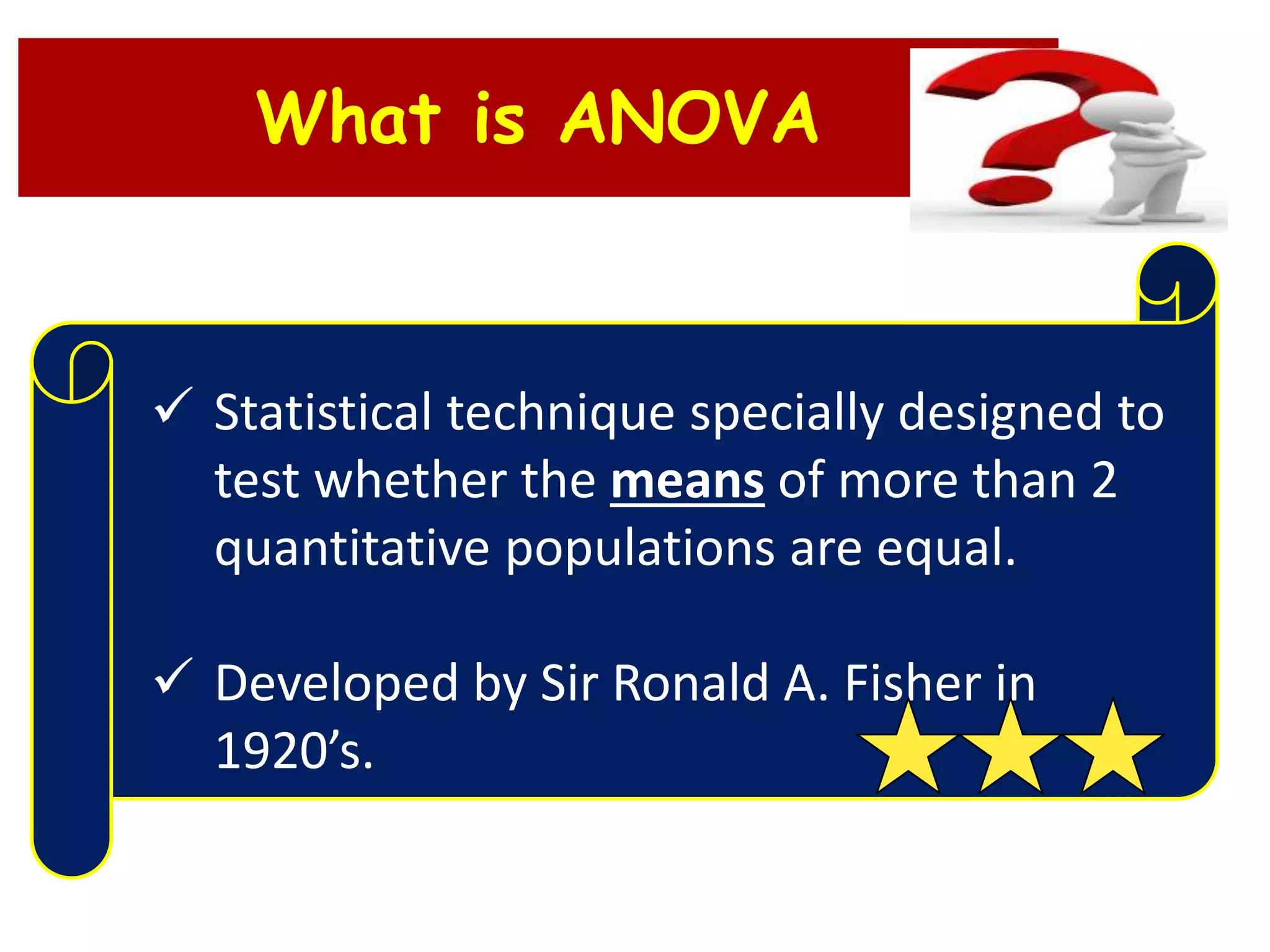
What is ANOVA
 Statistical technique specially designed to
test whether the means of more than 2
quantitative populations are equal.
 Developed by Sir Ronald A. Fisher in
1920’s.
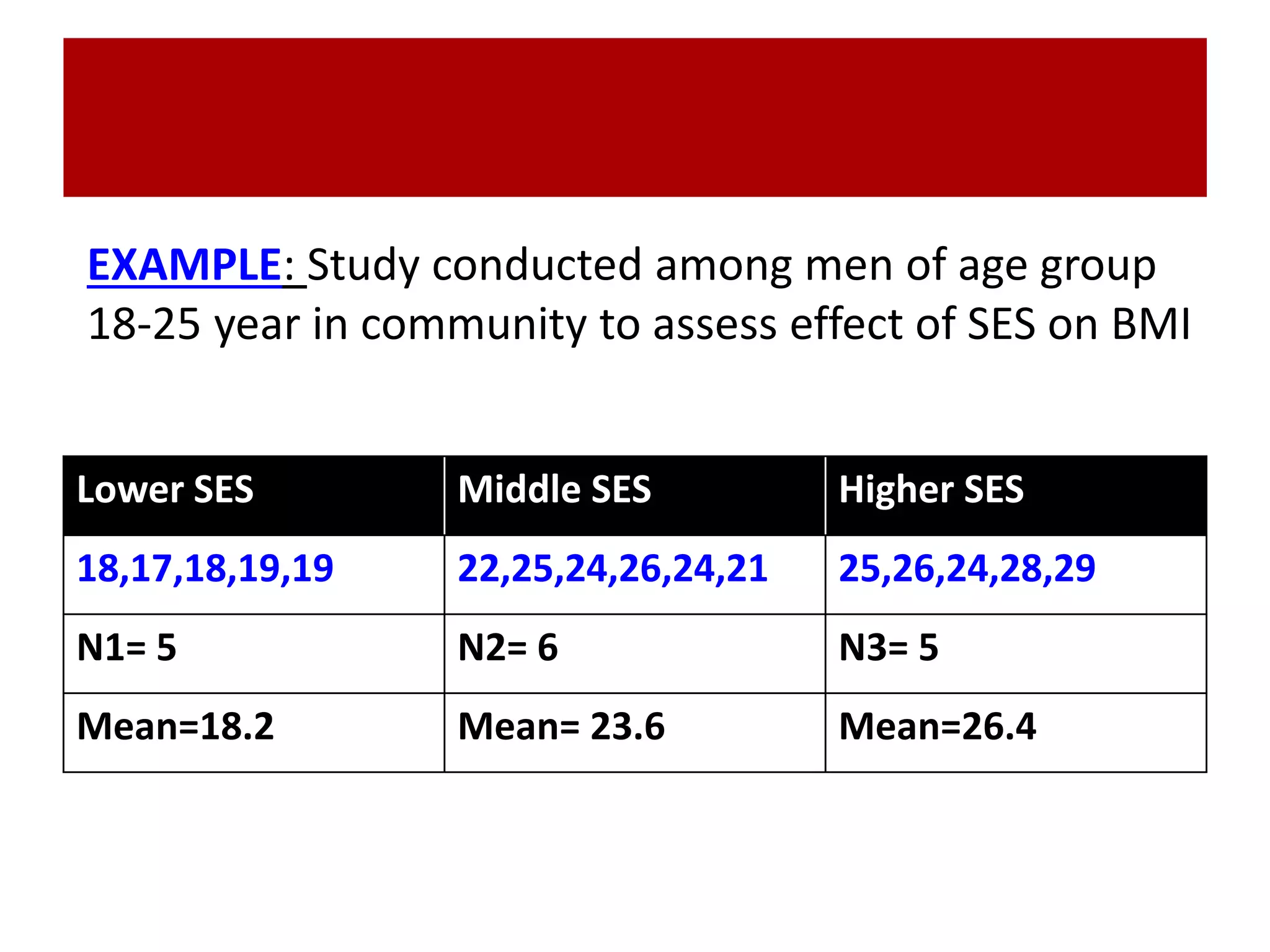
Lower SES Middle SES Higher SES
18,17,18,19,19 22,25,24,26,24,21 25,26,24,28,29
N1= 5 N2= 6 N3= 5
Mean=18.2 Mean= 23.6 Mean=26.4
EXAMPLE: Study conducted among men of age group
18-25 year in community to assess effect of SES on BMI
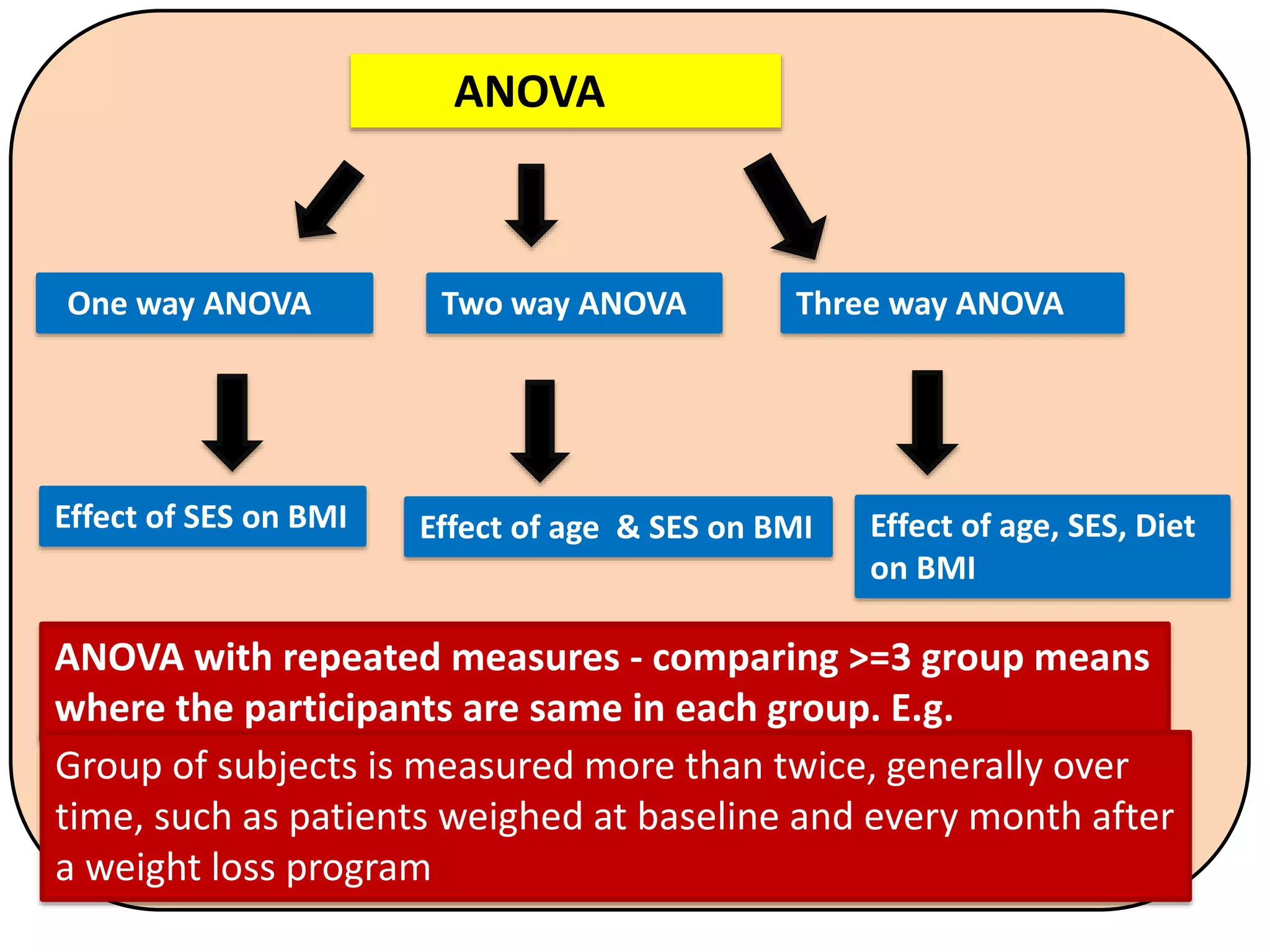
ANOVA
One way ANOVA Three way ANOVA
Effect of SES on BMI
Two way ANOVA
Effect of age & SES on BMI Effect of age, SES, Diet
on BMI
ANOVA with repeated measures - comparing >=3 group means
where the participants are same in each group. E.g.
Group of subjects is measured more than twice, generally over
time, such as patients weighed at baseline and every month after
a weight loss program
One Way ANOVA
Data required
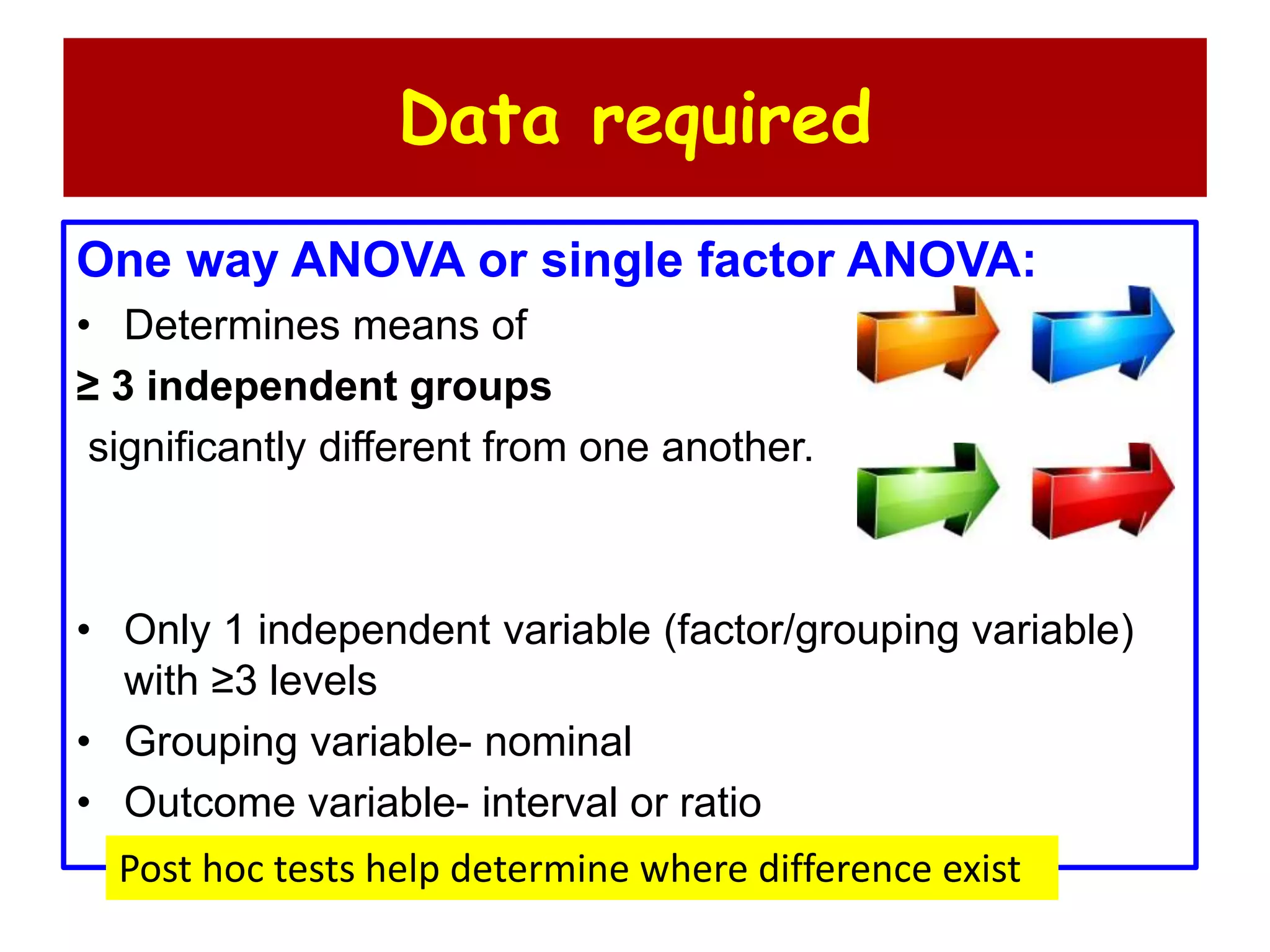
One way ANOVA or single factor ANOVA:
• Determines means of
≥ 3 independent groups
significantly different from one another.
• Only 1 independent variable (factor/grouping variable)
with ≥3 levels
• Grouping variable- nominal
• Outcome variable- interval or ratio
Post hoc tests help determine where difference exist
Assumptions
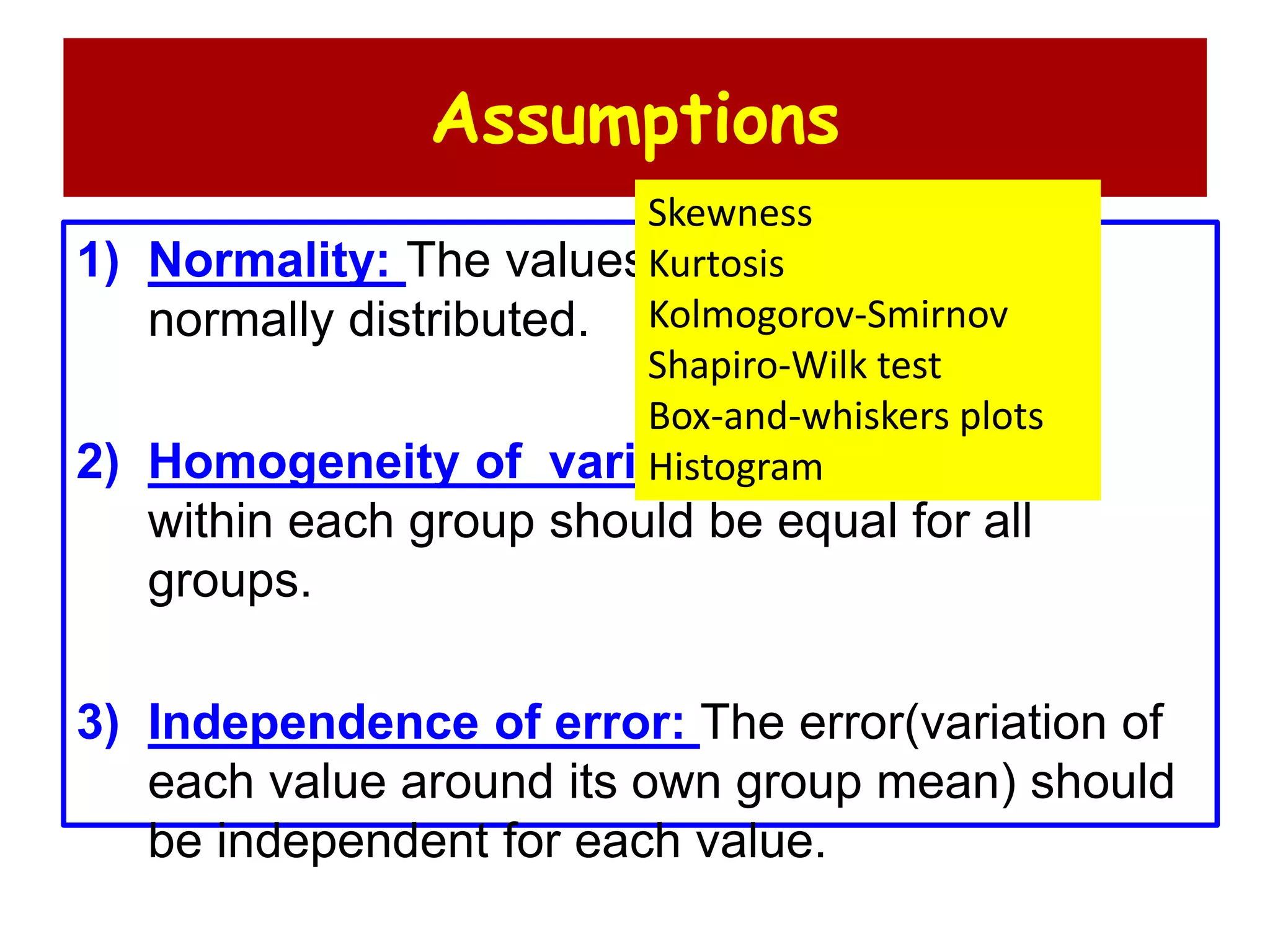
1) Normality: The values in each group are
normally distributed.
2) Homogeneity of variances: The variance
within each group should be equal for all
groups.
3) Independence of error: The error(variation of
each value around its own group mean) should
be independent for each value.
Skewness
Kurtosis
Kolmogorov-Smirnov
Shapiro-Wilk test
Box-and-whiskers plots
Histogram
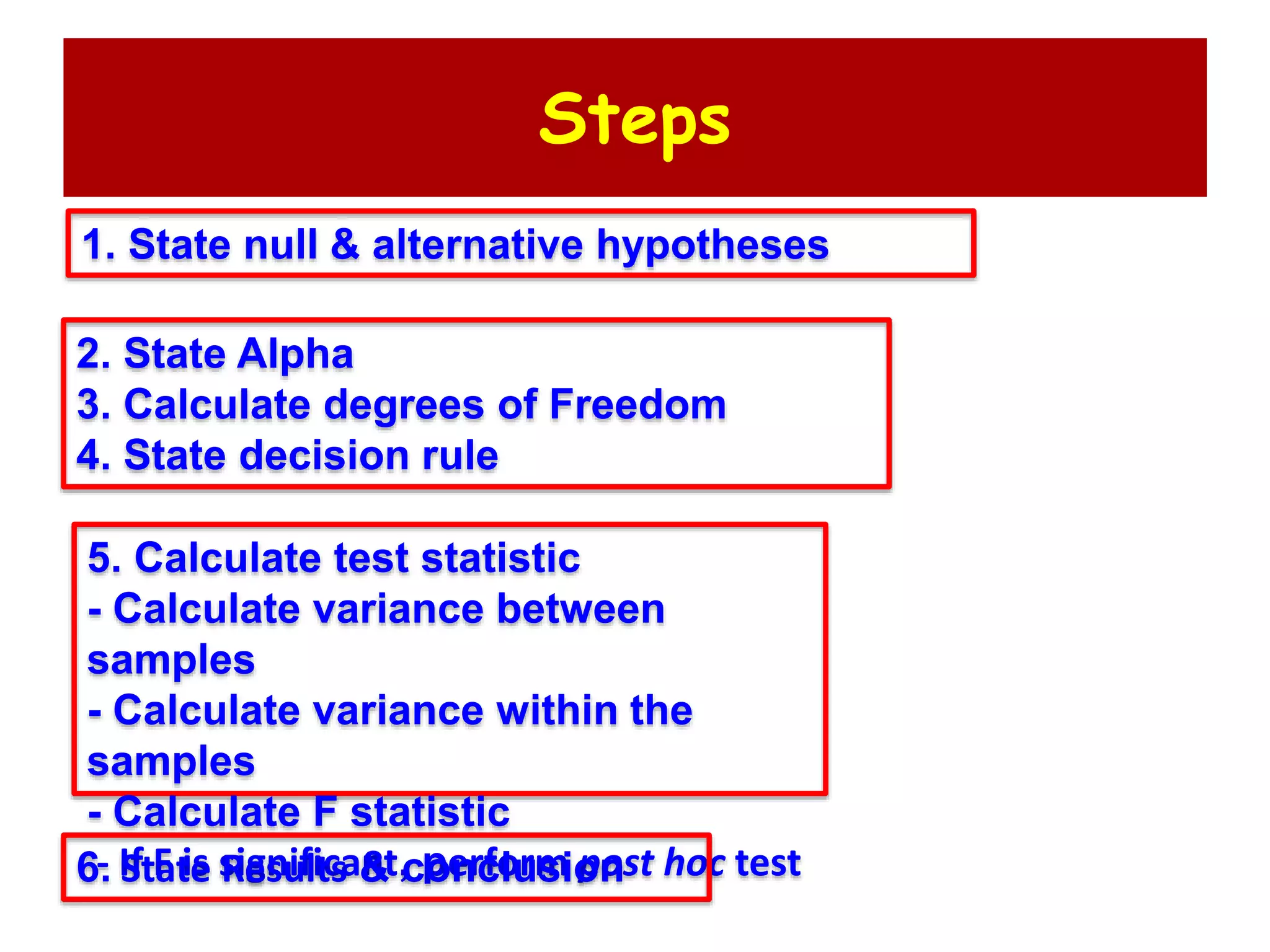
Steps
2. State Alpha
3. Calculate degrees of Freedom
4. State decision rule
5. Calculate test statistic
- Calculate variance between
samples
- Calculate variance within the
samples
- Calculate F statistic
- If F is significant, perform post hoc test
1. State null & alternative hypotheses
6. State Results & conclusion
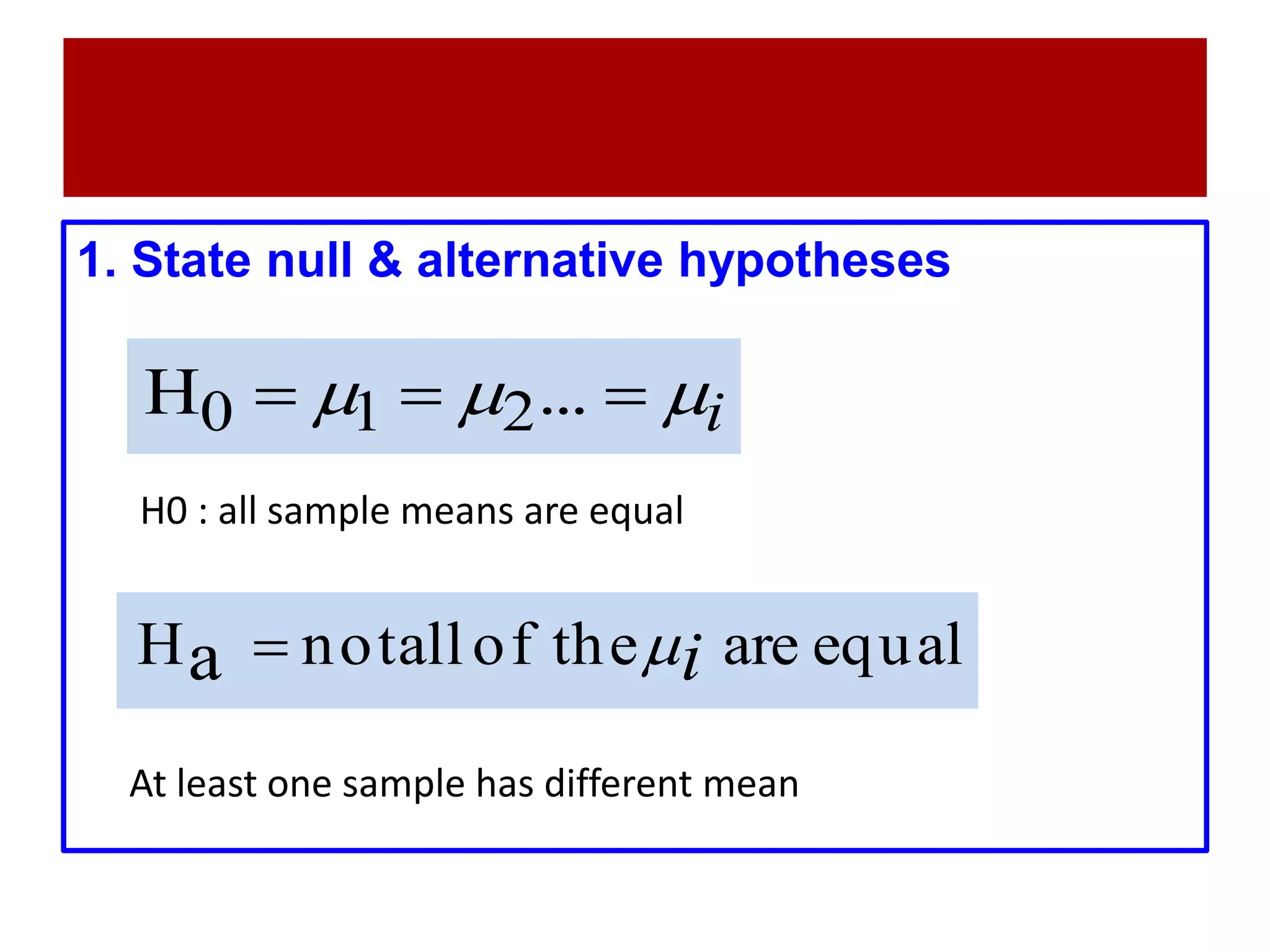
1. State null & alternative hypotheses
i  ...H 210
equalaretheofallnotHa i
H0 : all sample means are equal
At least one sample has different mean
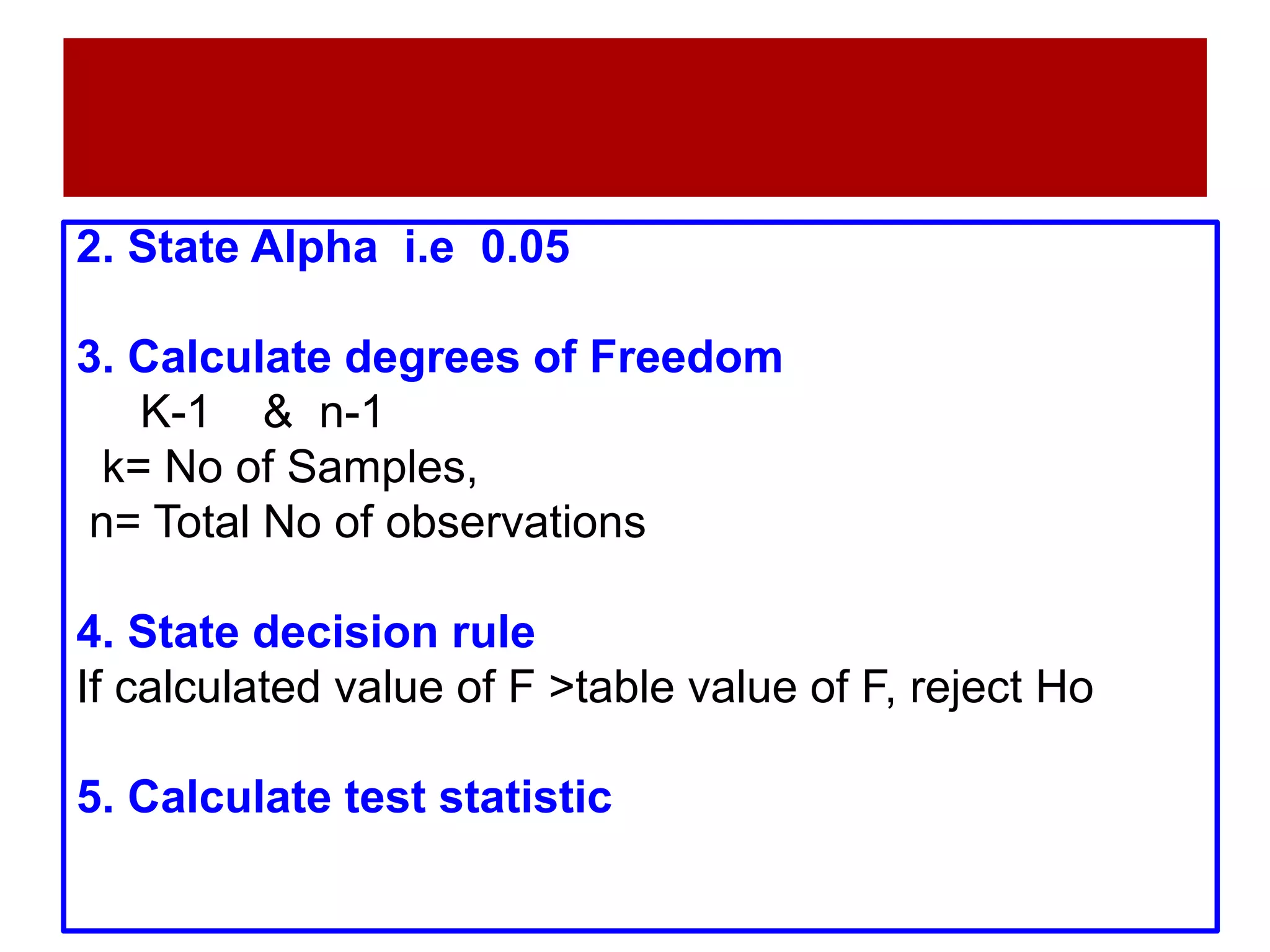
2. State Alpha i.e 0.05
3. Calculate degrees of Freedom
K-1 & n-1
k= No of Samples,
n= Total No of observations
4. State decision rule
If calculated value of F >table value of F, reject Ho
5. Calculate test statistic
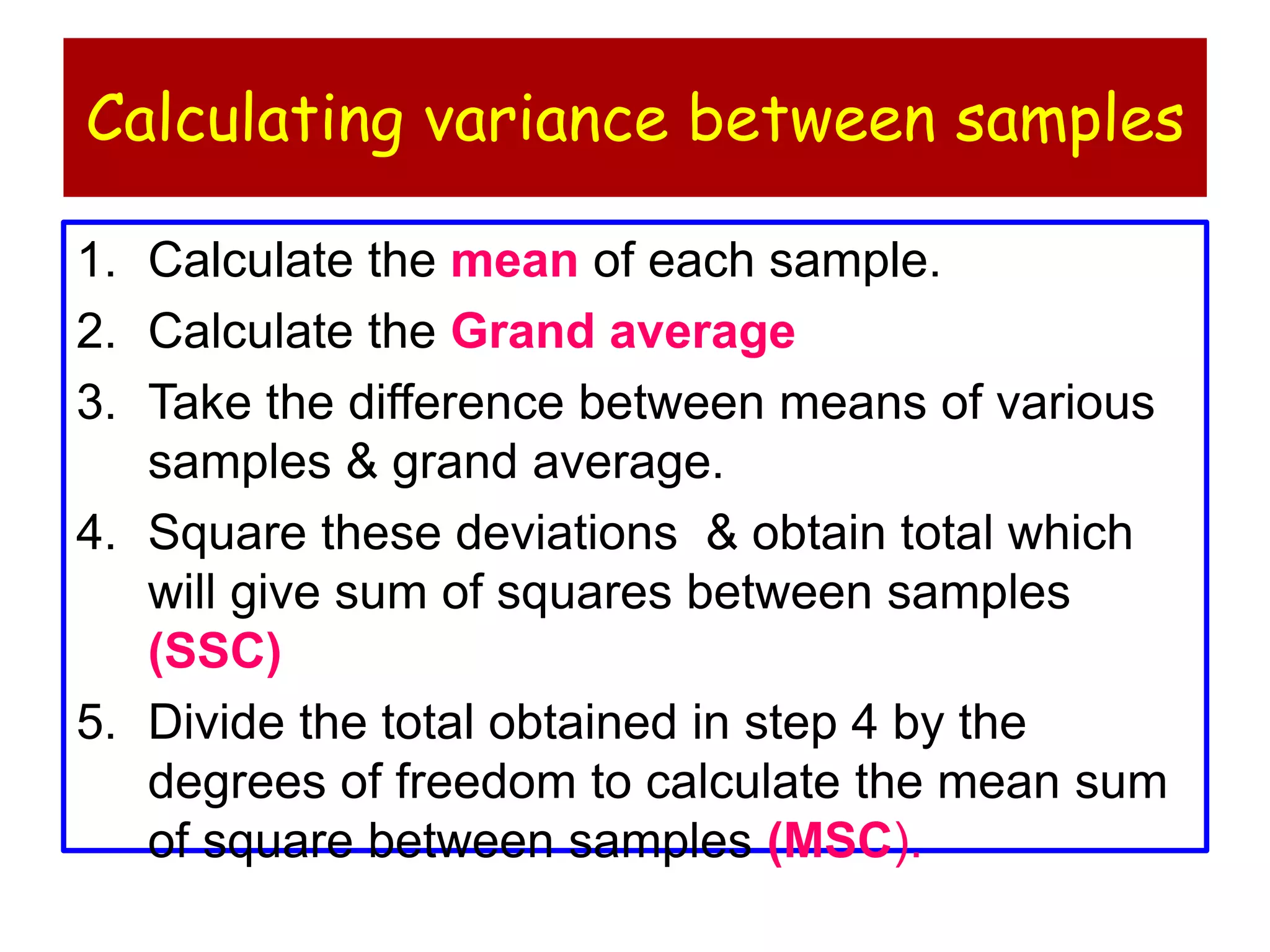
Calculating variance between samples
1. Calculate the mean of each sample.
2. Calculate the Grand average
3. Take the difference between means of various
samples & grand average.
4. Square these deviations & obtain total which
will give sum of squares between samples
(SSC)
5. Divide the total obtained in step 4 by the
degrees of freedom to calculate the mean sum
of square between samples (MSC).
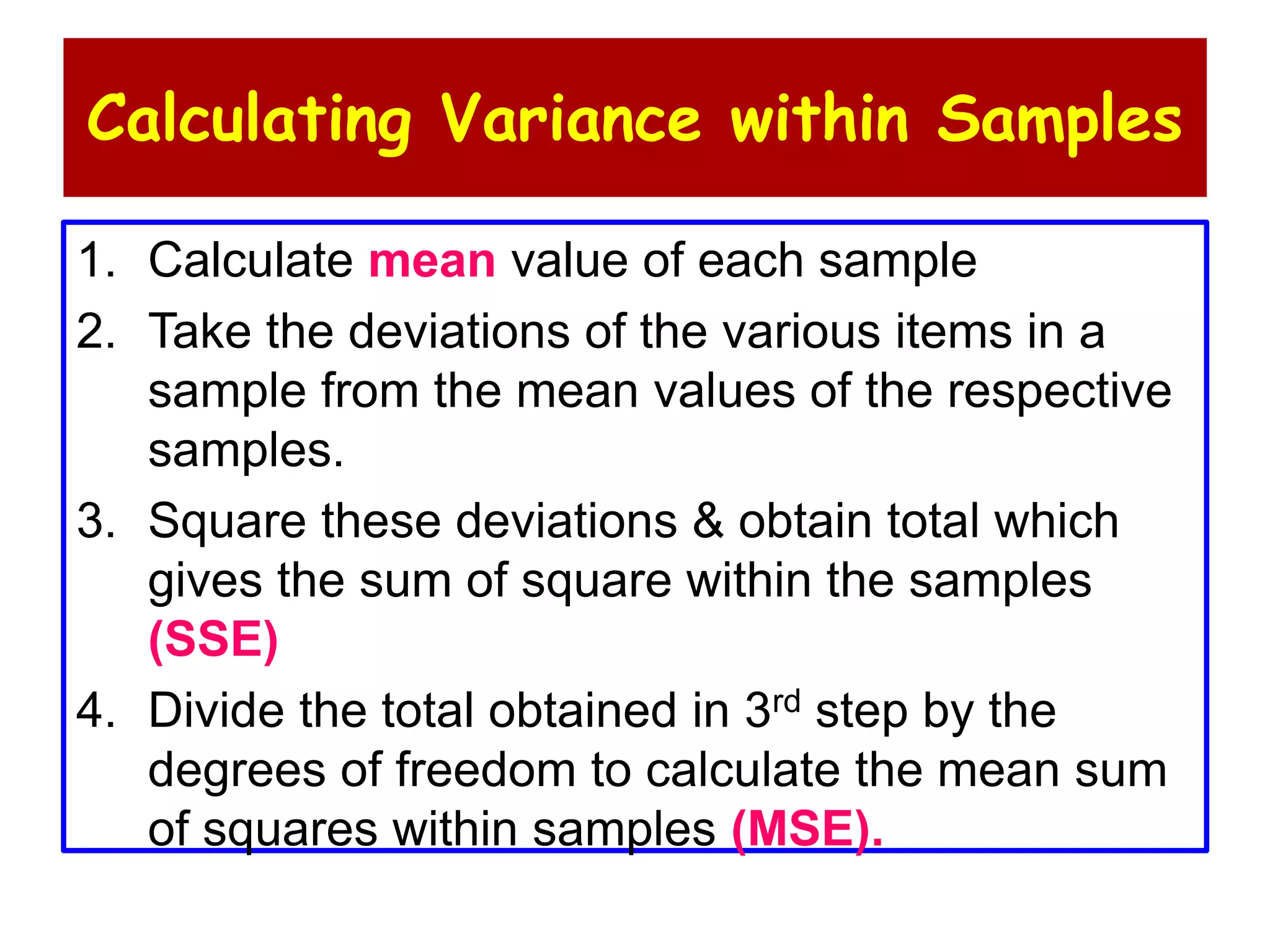
Calculating Variance within Samples
1. Calculate mean value of each sample
2. Take the deviations of the various items in a
sample from the mean values of the respective
samples.
3. Square these deviations & obtain total which
gives the sum of square within the samples
(SSE)
4. Divide the total obtained in 3rd step by the
degrees of freedom to calculate the mean sum
of squares within samples (MSE).
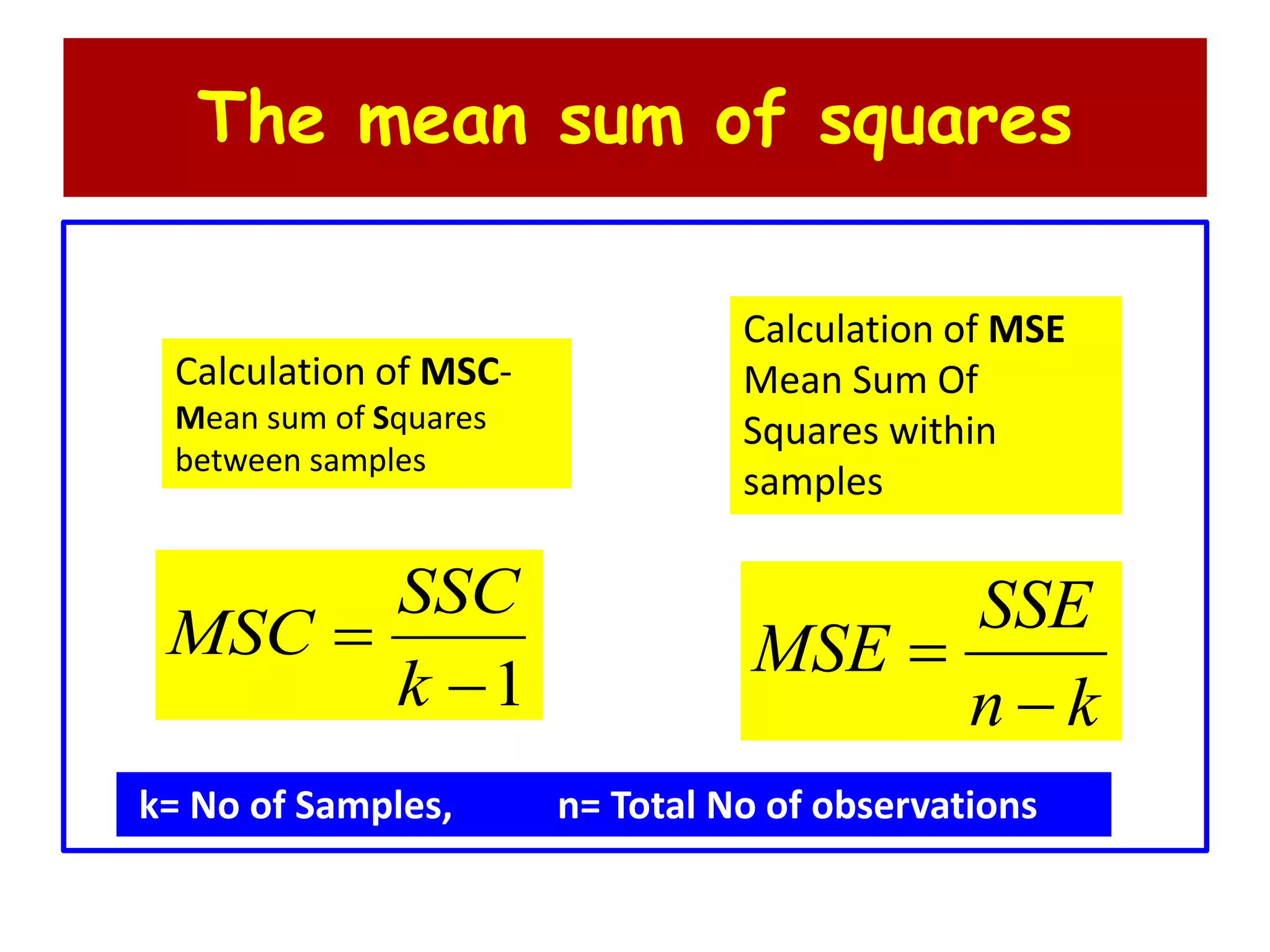
The mean sum of squares
1

k
SSC
MSC
kn
SSE
MSE


Calculation of MSC-
Mean sum of Squares
between samples
Calculation of MSE
Mean Sum Of
Squares within
samples
k= No of Samples, n= Total No of observations
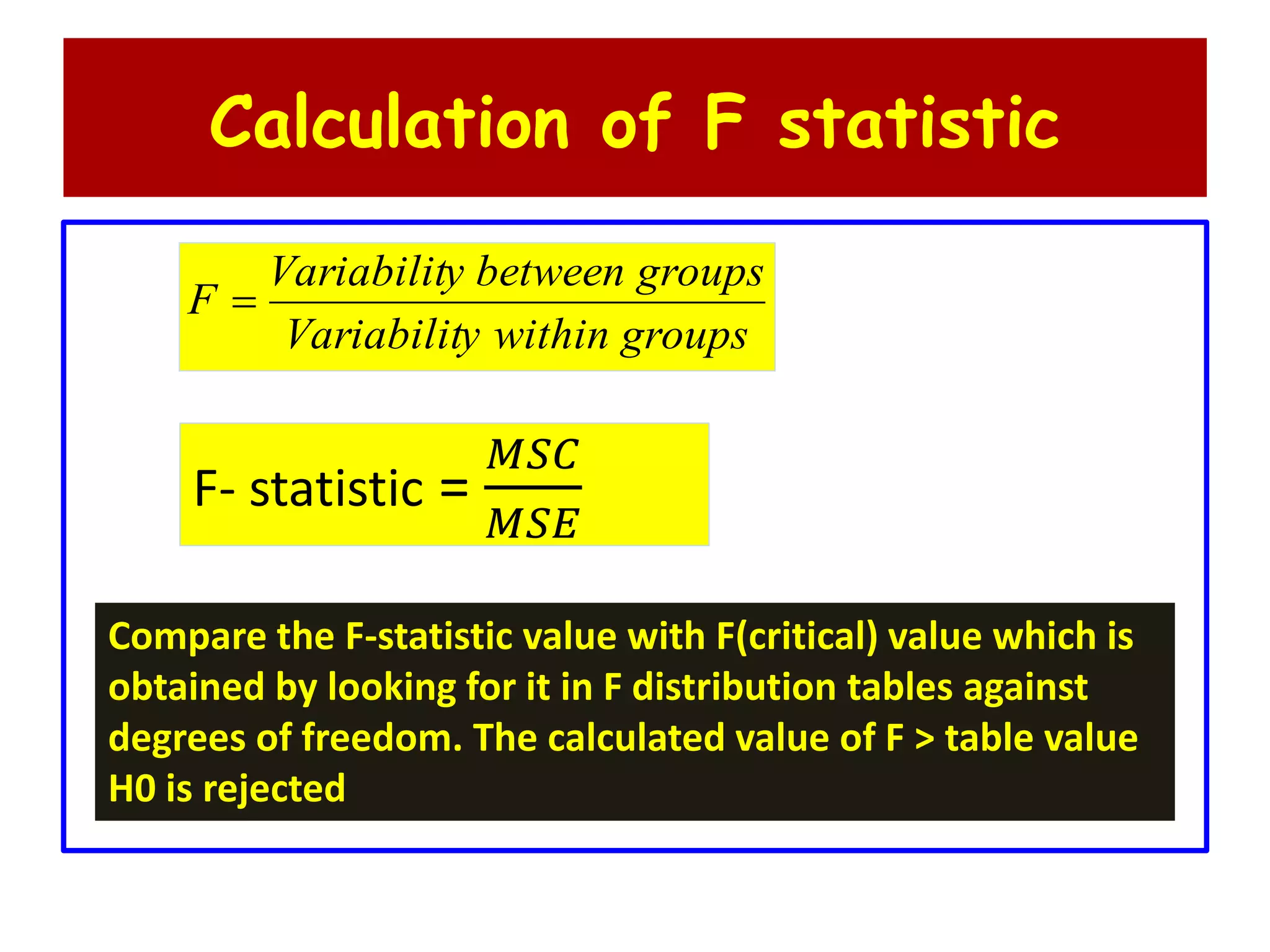
Calculation of F statistic
groupswithinyVariabilit
groupsbetweenyVariabilit
F 
F- statistic =
𝑀𝑆𝐶
𝑀𝑆𝐸
Compare the F-statistic value with F(critical) value which is
obtained by looking for it in F distribution tables against
degrees of freedom. The calculated value of F > table value
H0 is rejected
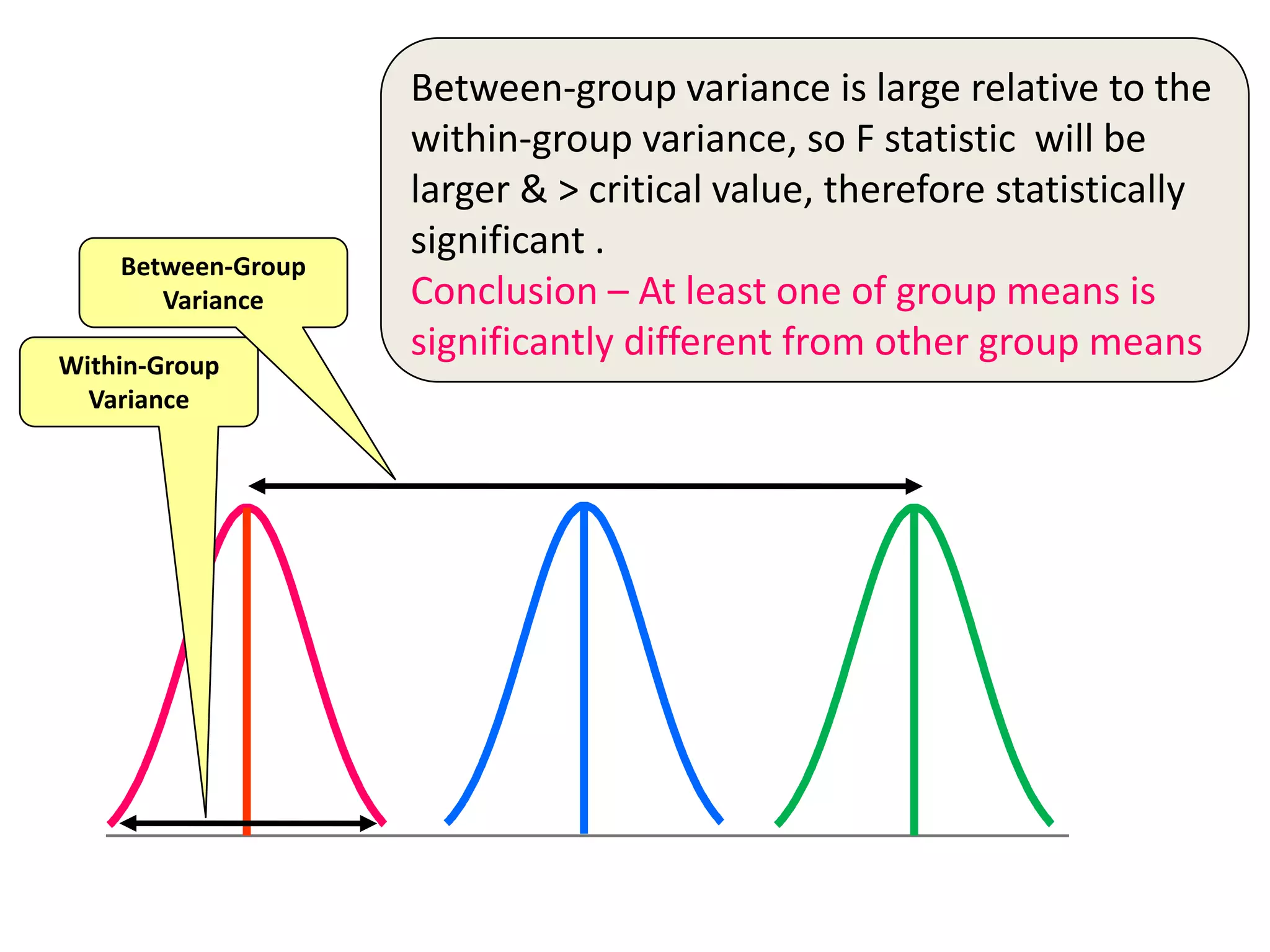
Within-Group
Variance
Between-Group
Variance
Between-group variance is large relative to the
within-group variance, so F statistic will be
larger & > critical value, therefore statistically
significant .
Conclusion – At least one of group means is
significantly different from other group means
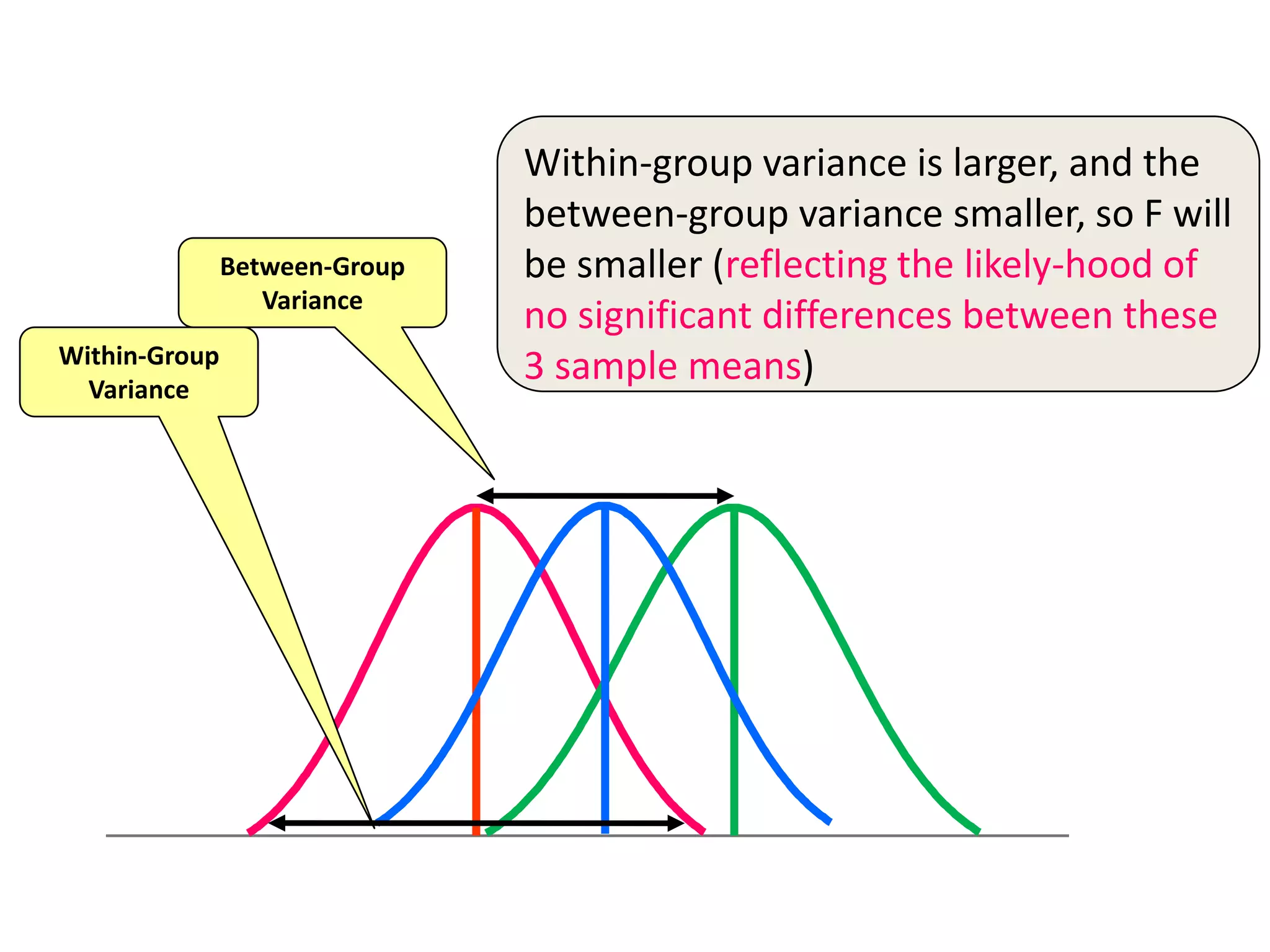
Within-Group
Variance
Between-Group
Variance
Within-group variance is larger, and the
between-group variance smaller, so F will
be smaller (reflecting the likely-hood of
no significant differences between these
3 sample means)
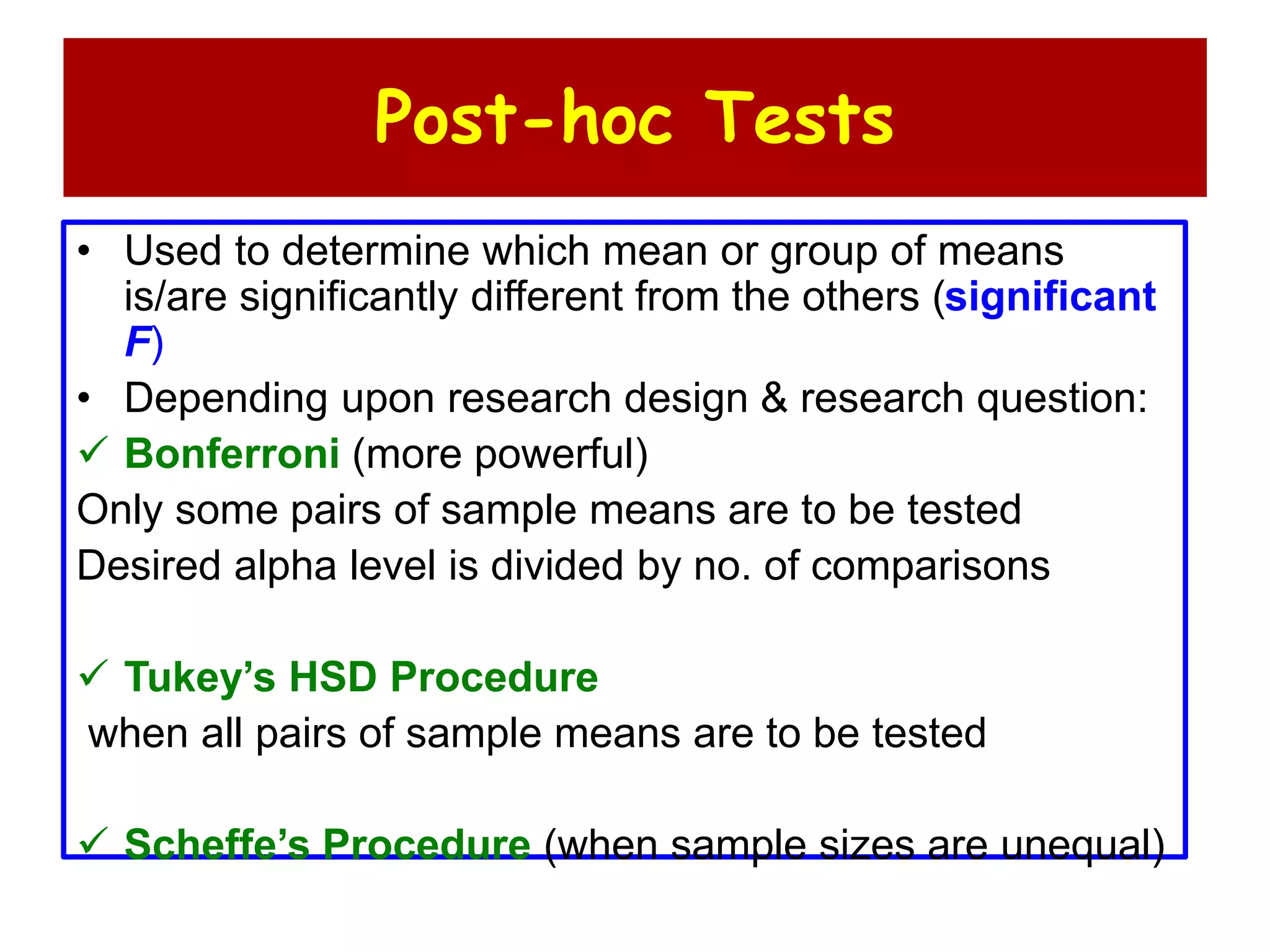
Post-hoc Tests
• Used to determine which mean or group of means
is/are significantly different from the others (significant
F)
• Depending upon research design & research question:
 Bonferroni (more powerful)
Only some pairs of sample means are to be tested
Desired alpha level is divided by no. of comparisons
 Tukey’s HSD Procedure
when all pairs of sample means are to be tested
 Scheffe’s Procedure (when sample sizes are unequal)
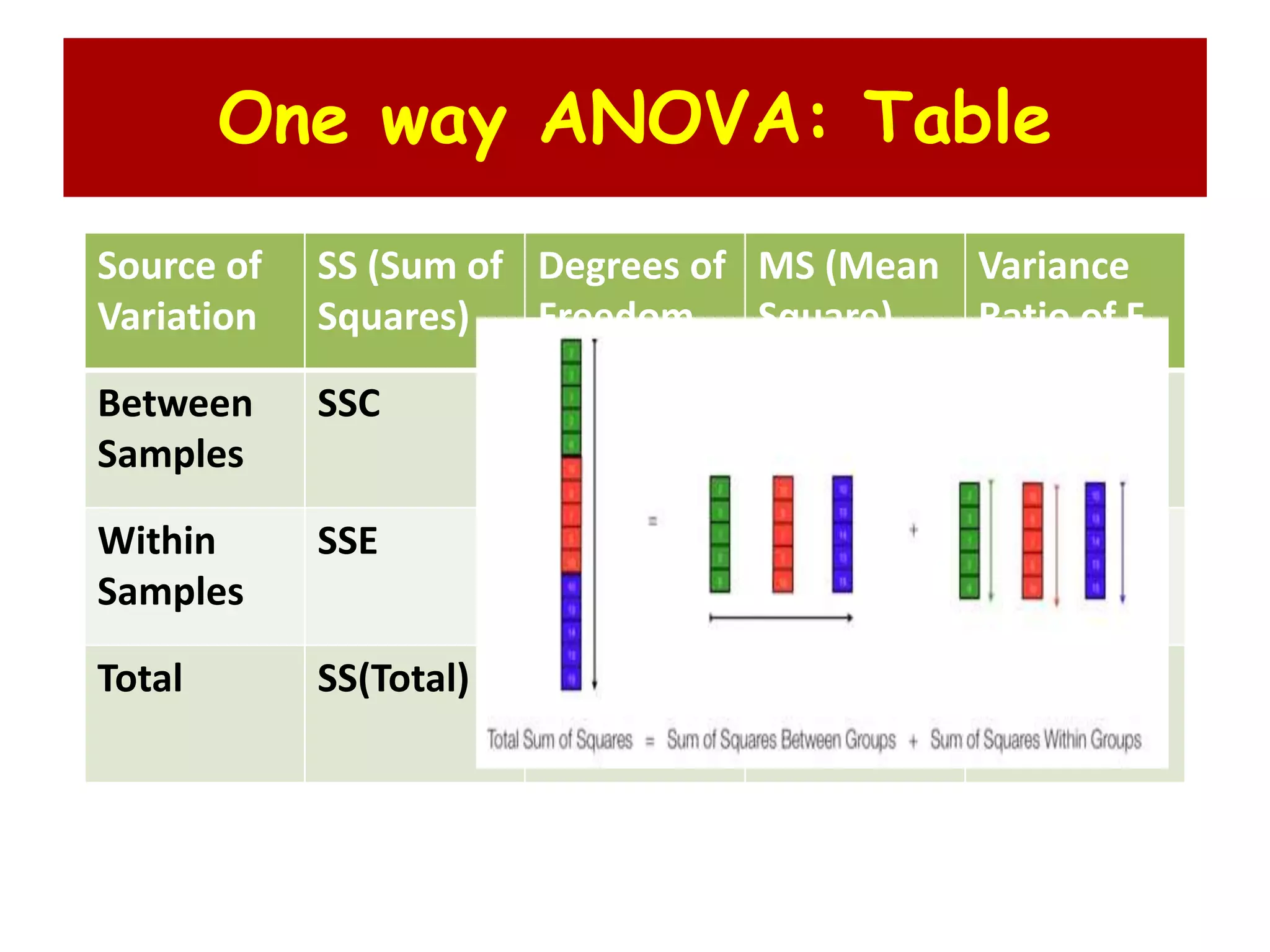
One way ANOVA: Table
Source of
Variation
SS (Sum of
Squares)
Degrees of
Freedom
MS (Mean
Square)
Variance
Ratio of F
Between
Samples
SSC k-1 MSC=
SSC/(k-1)
MSC/MSE
Within
Samples
SSE n-k MSE=
SSE/(n-k)
Total SS(Total) n-1
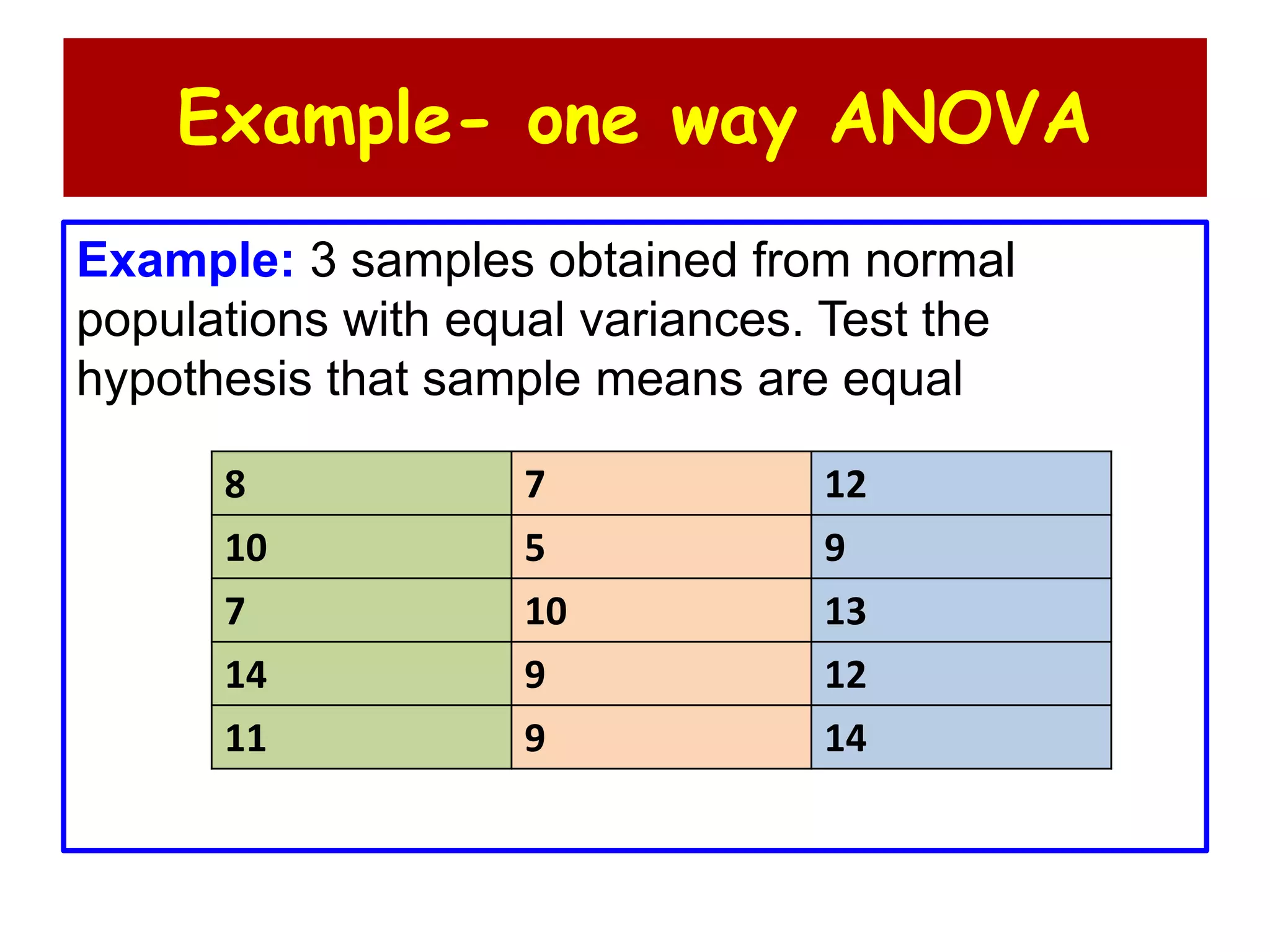
Example- one way ANOVA
Example: 3 samples obtained from normal
populations with equal variances. Test the
hypothesis that sample means are equal
8 7 12
10 5 9
7 10 13
14 9 12
11 9 14
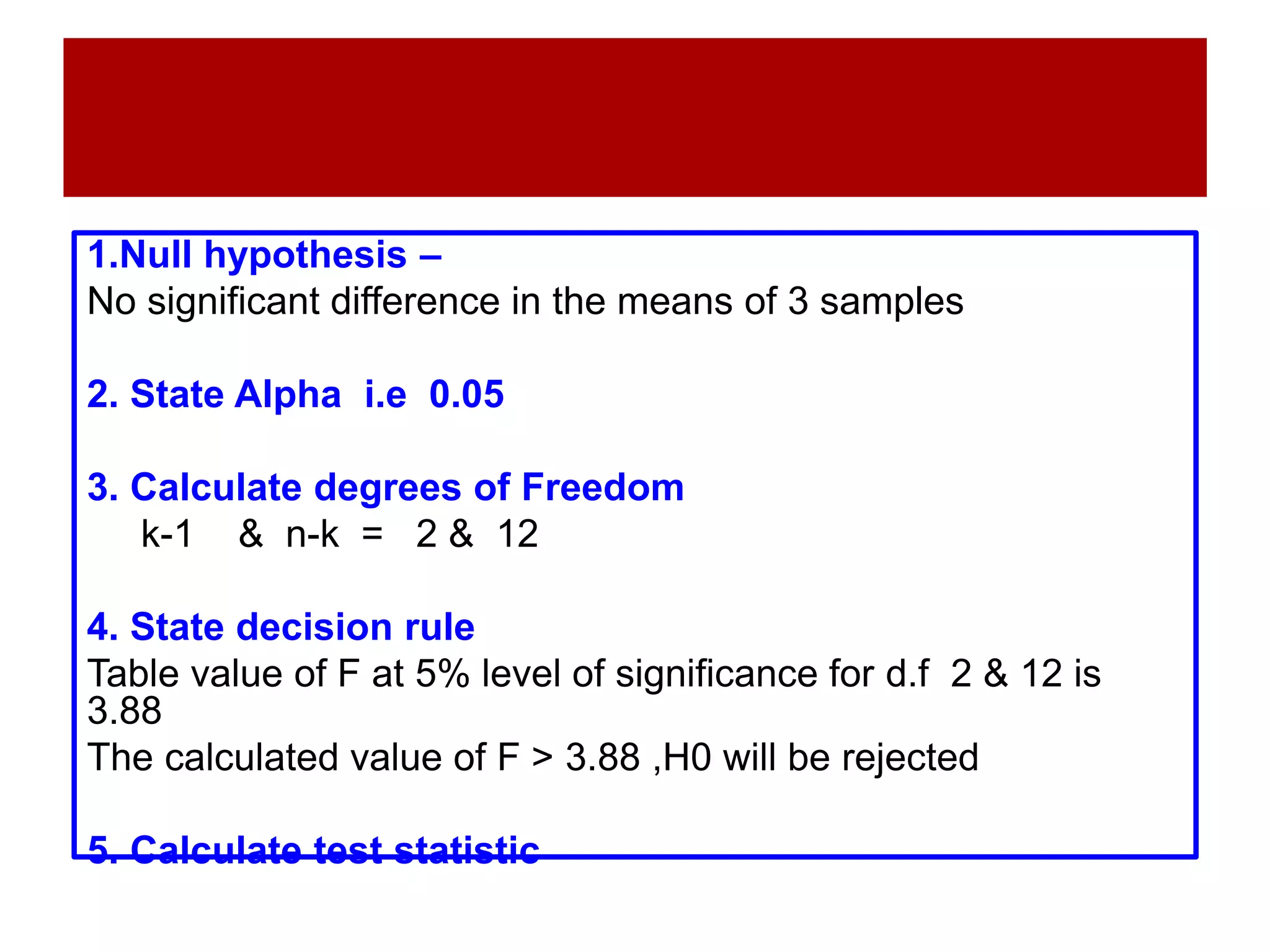
1.Null hypothesis –
No significant difference in the means of 3 samples
2. State Alpha i.e 0.05
3. Calculate degrees of Freedom
k-1 & n-k = 2 & 12
4. State decision rule
Table value of F at 5% level of significance for d.f 2 & 12 is
3.88
The calculated value of F > 3.88 ,H0 will be rejected
5. Calculate test statistic
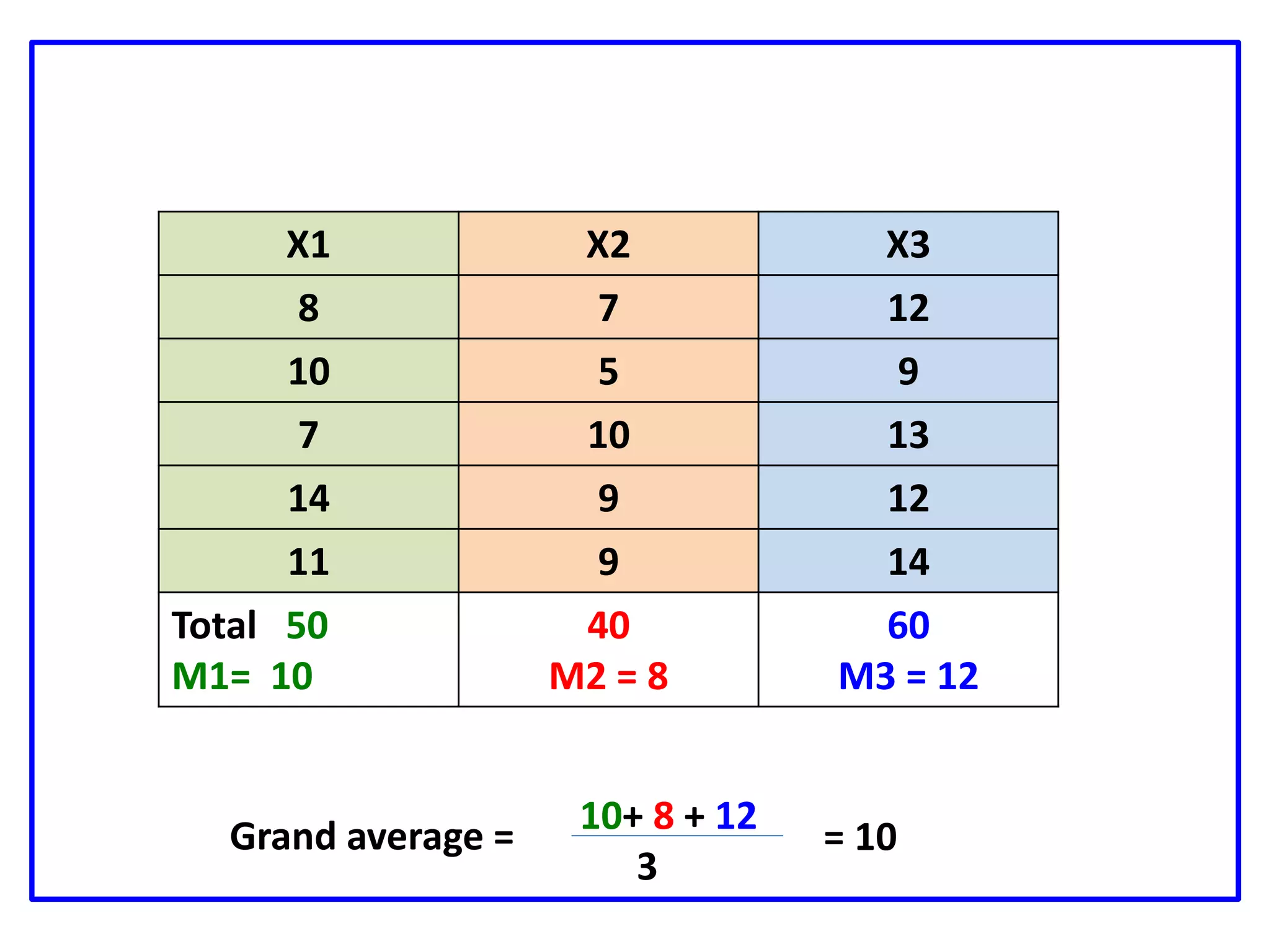
X1 X2 X3
8 7 12
10 5 9
7 10 13
14 9 12
11 9 14
Total 50
M1= 10
40
M2 = 8
60
M3 = 12
10+ 8 + 12
3
Grand average = = 10
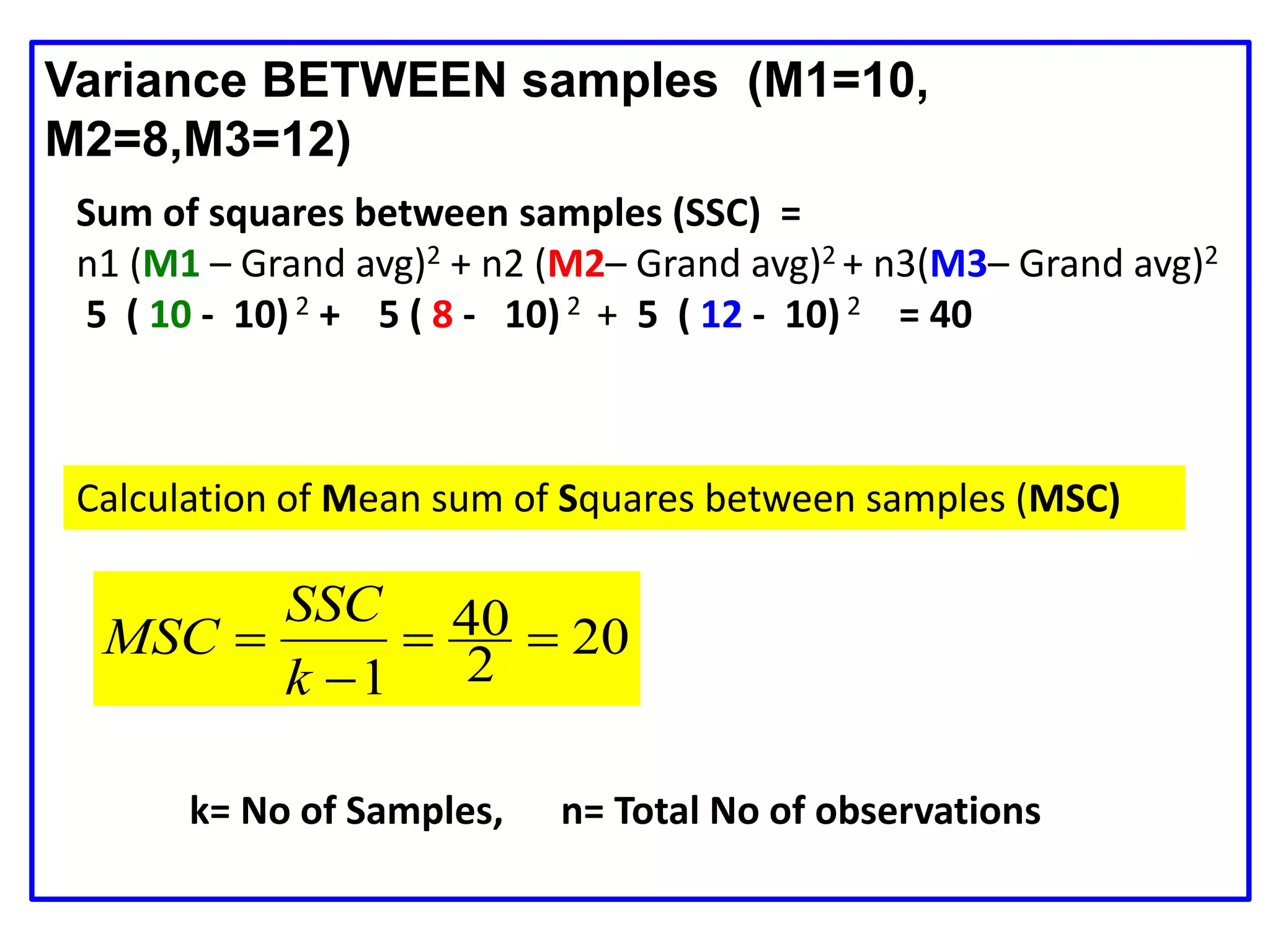
Variance BETWEEN samples (M1=10,
M2=8,M3=12)
Sum of squares between samples (SSC) =
n1 (M1 – Grand avg)2 + n2 (M2– Grand avg)2 + n3(M3– Grand avg)2
5 ( 10 - 10)2 + 5 ( 8 - 10) 2 + 5 ( 12 - 10) 2 = 40
20
2
40
1



k
SSC
MSC
Calculation of Mean sum of Squares between samples (MSC)
k= No of Samples, n= Total No of observations
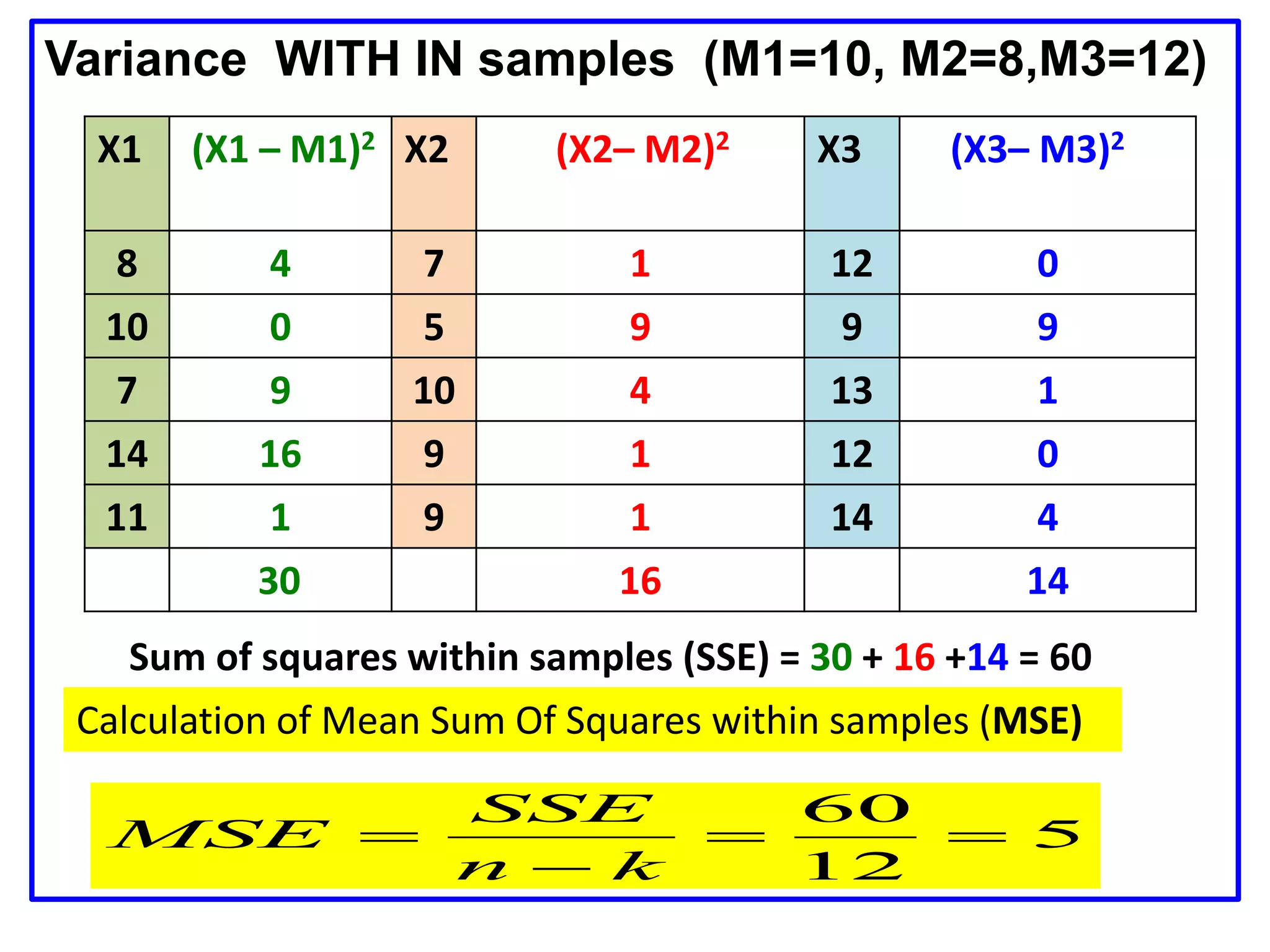
Variance WITH IN samples (M1=10, M2=8,M3=12)
X1 (X1 – M1)2 X2 (X2– M2)2 X3 (X3– M3)2
8 4 7 1 12 0
10 0 5 9 9 9
7 9 10 4 13 1
14 16 9 1 12 0
11 1 9 1 14 4
30 16 14
Sum of squares within samples (SSE) = 30 + 16 +14 = 60
5
12
60



kn
SSE
MSE
Calculation of Mean Sum Of Squares within samples (MSE)
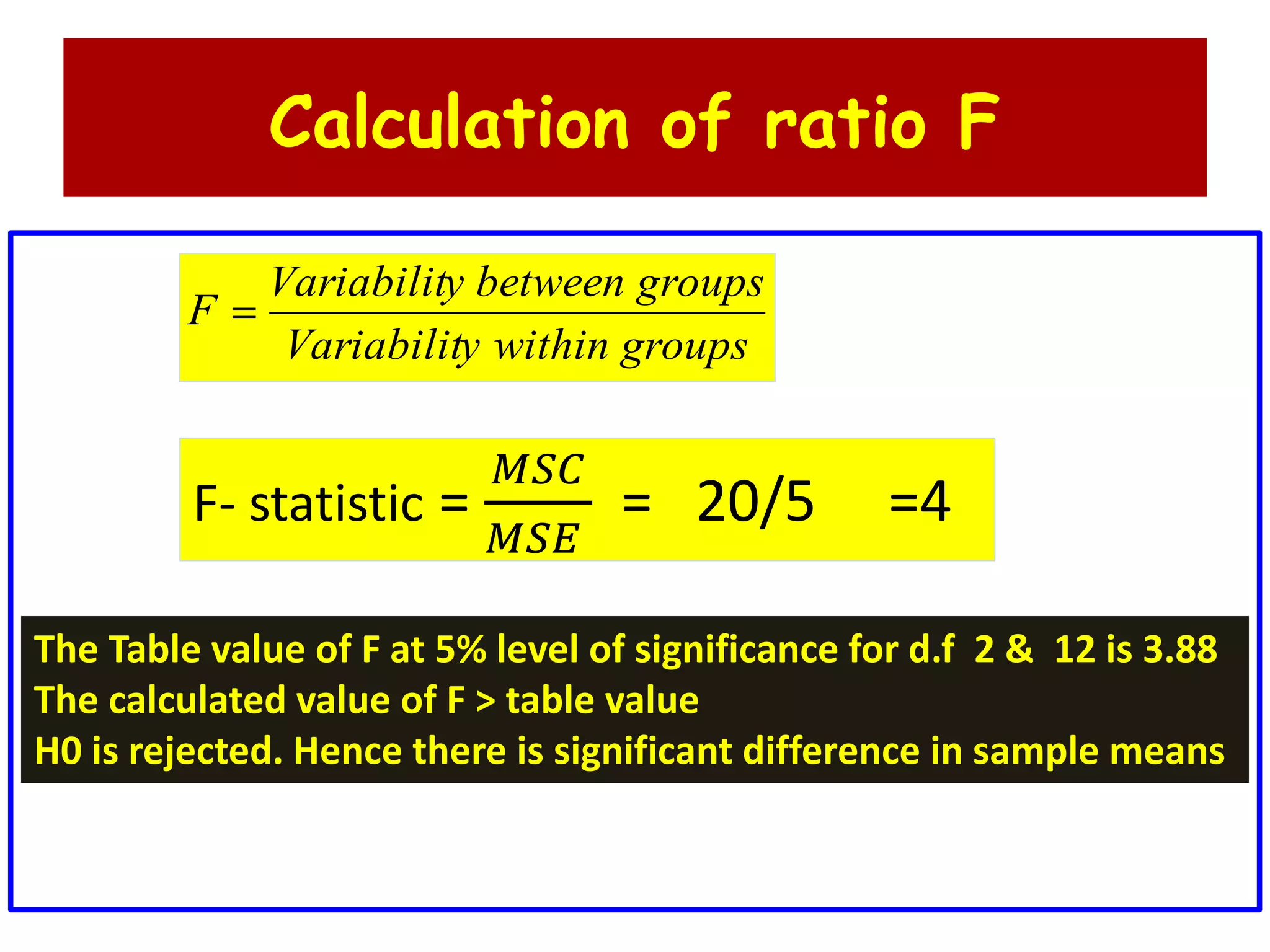
Calculation of ratio F
groupswithinyVariabilit
groupsbetweenyVariabilit
F 
F- statistic =
𝑀𝑆𝐶
𝑀𝑆𝐸
= 20/5 =4
The Table value of F at 5% level of significance for d.f 2 & 12 is 3.88
The calculated value of F > table value
H0 is rejected. Hence there is significant difference in sample means
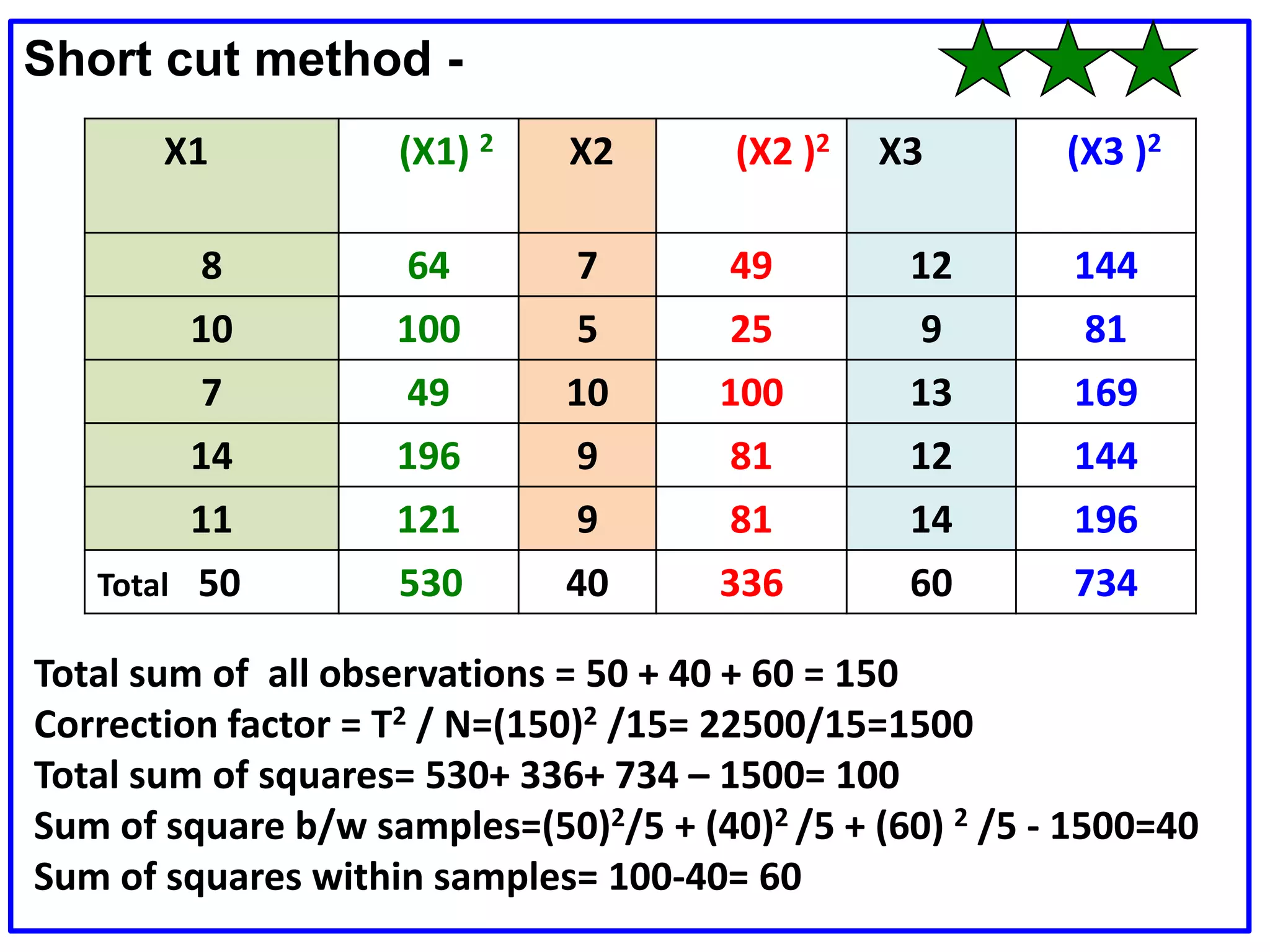
Short cut method -
X1 (X1) 2 X2 (X2 )2 X3 (X3 )2
8 64 7 49 12 144
10 100 5 25 9 81
7 49 10 100 13 169
14 196 9 81 12 144
11 121 9 81 14 196
Total 50 530 40 336 60 734
Total sum of all observations = 50 + 40 + 60 = 150
Correction factor = T2 / N=(150)2 /15= 22500/15=1500
Total sum of squares= 530+ 336+ 734 – 1500= 100
Sum of square b/w samples=(50)2/5 + (40)2 /5 + (60) 2 /5 - 1500=40
Sum of squares within samples= 100-40= 60
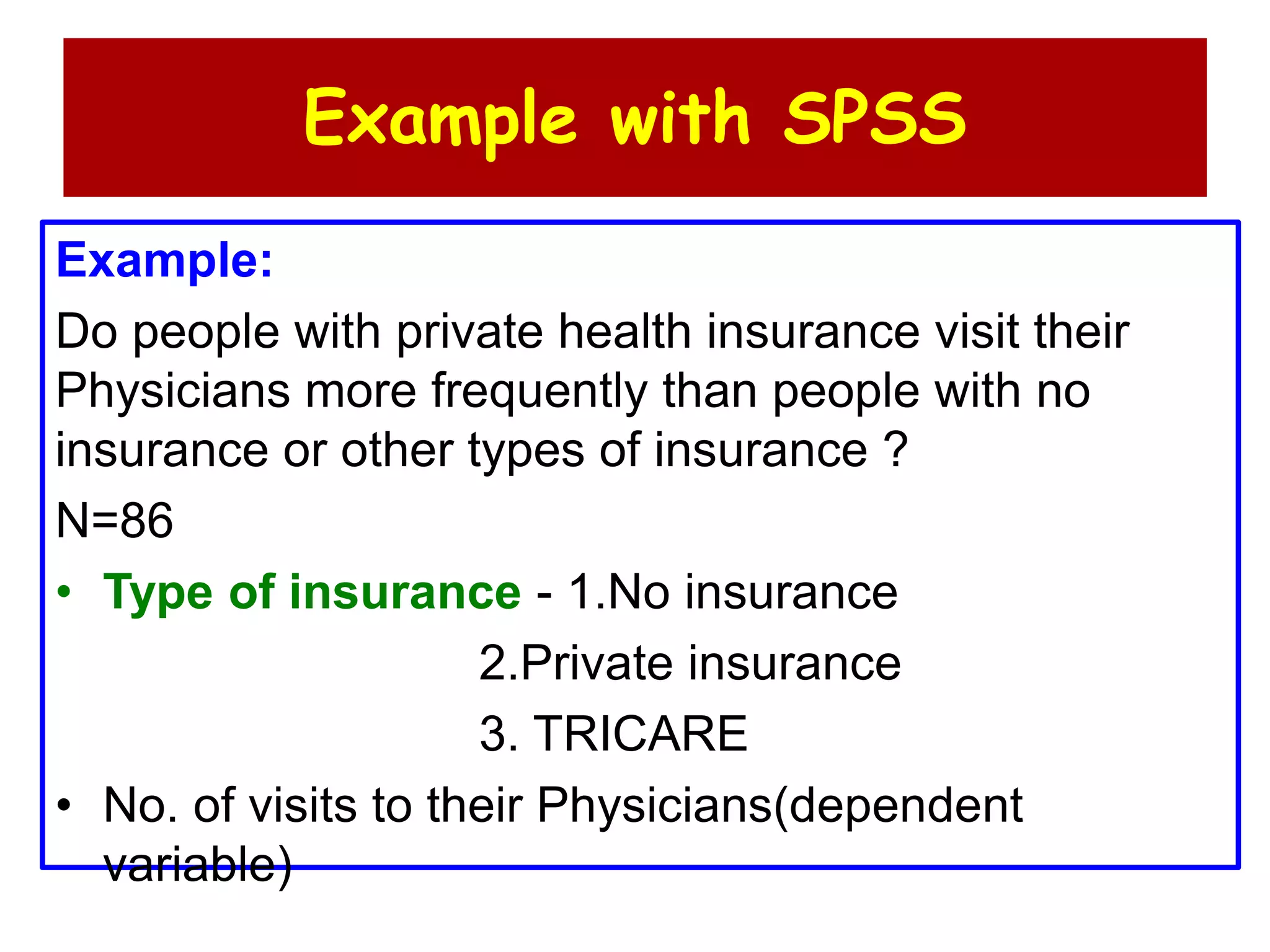
Example with SPSS
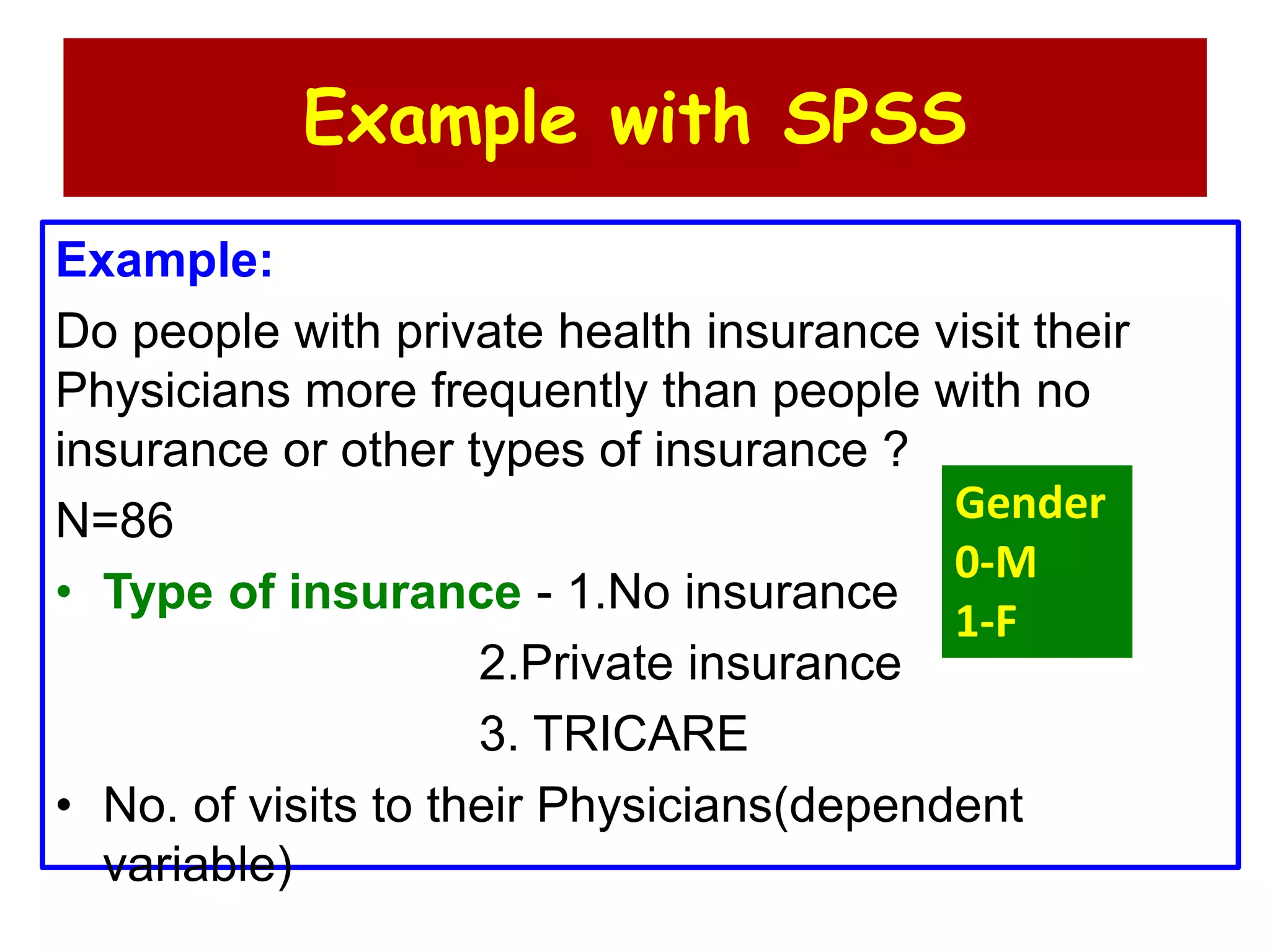
Example:
Do people with private health insurance visit their
Physicians more frequently than people with no
insurance or other types of insurance ?
N=86
• Type of insurance - 1.No insurance
2.Private insurance
3. TRICARE
• No. of visits to their Physicians(dependent
variable)
Violations of Assumptions
Normality
Choose the non-parametric Kruskal-Wallis H Test
which does not require the assumption of
normality.
Homogeneity of variances
 Welch test or
 Brown and Forsythe test or Kruskal-Wallis H Test
Two Way ANOVA
Data required
• When 2 independent variables
(Nominal/categorical) have
an effect on one dependent variable
(ordinal or ratio measurement scale)
• Compares relative influences on Dependent Variable
• Examine interactions between independent variables
• Just as we had Sums of Squares and Mean Squares in
One-way ANOVA, we have the same in Two-way
ANOVA.
Two way ANOVA
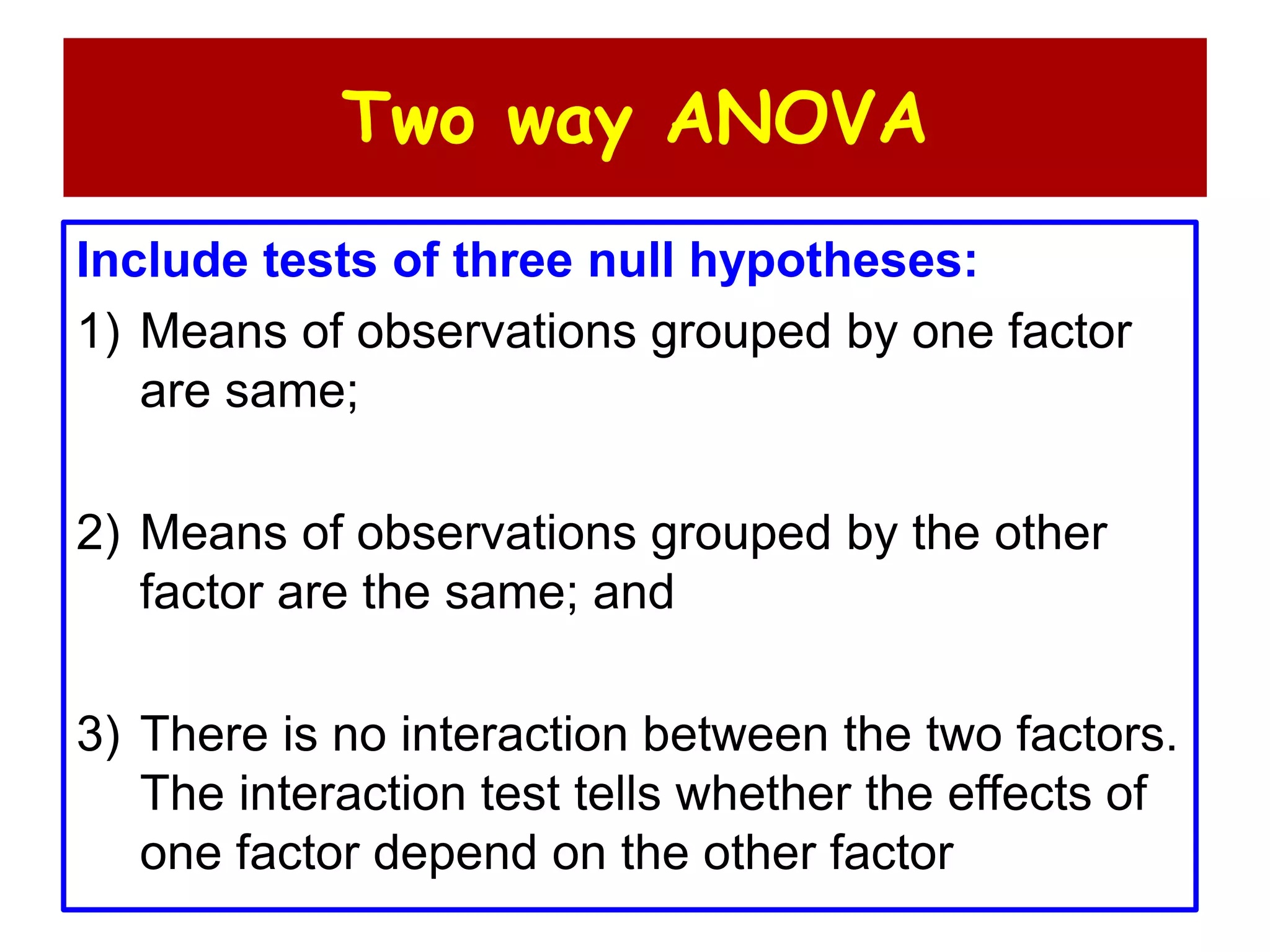
Include tests of three null hypotheses:
1) Means of observations grouped by one factor
are same;
2) Means of observations grouped by the other
factor are the same; and
3) There is no interaction between the two factors.
The interaction test tells whether the effects of
one factor depend on the other factor
Example-
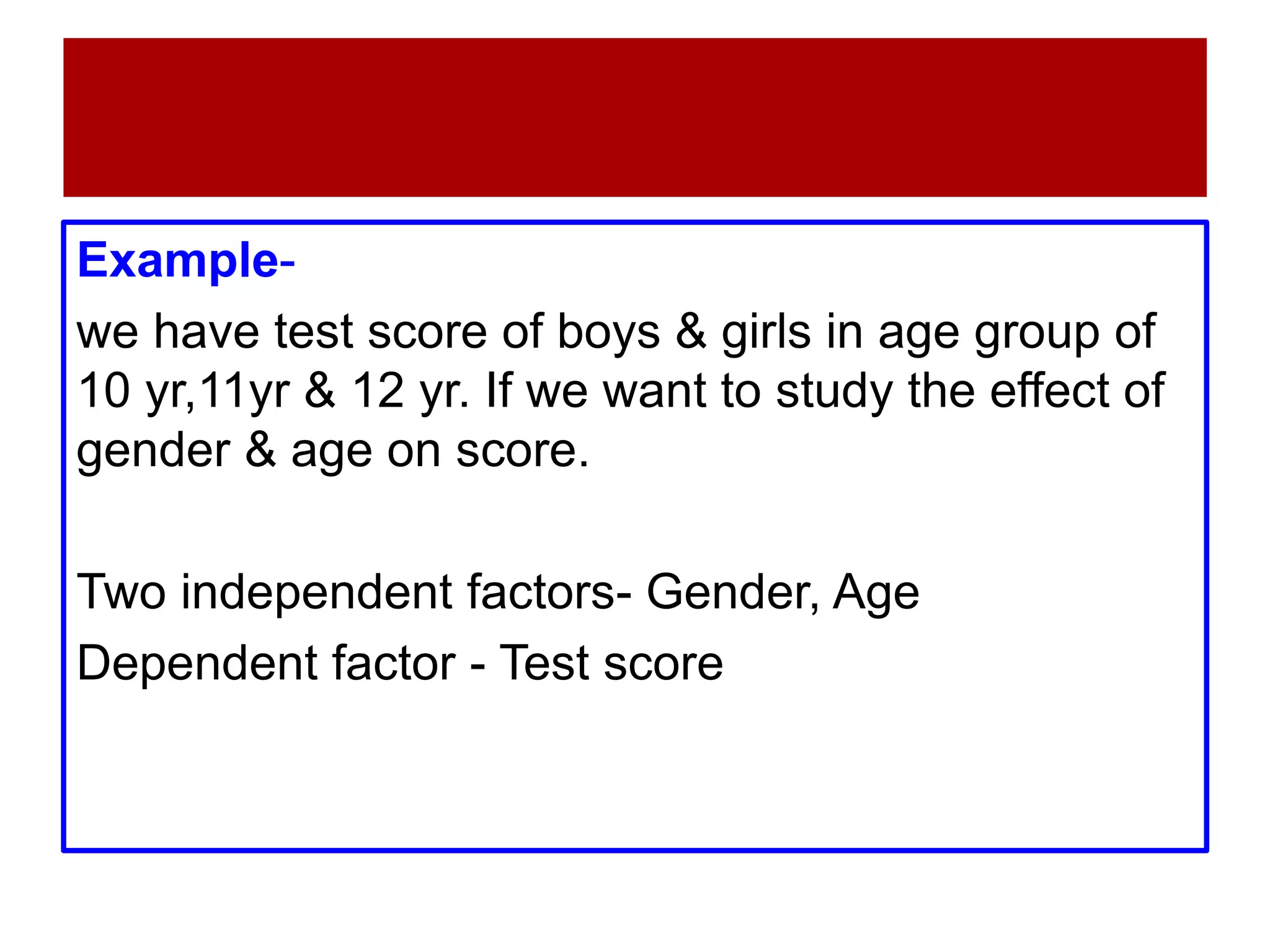
we have test score of boys & girls in age group of
10 yr,11yr & 12 yr. If we want to study the effect of
gender & age on score.
Two independent factors- Gender, Age
Dependent factor - Test score
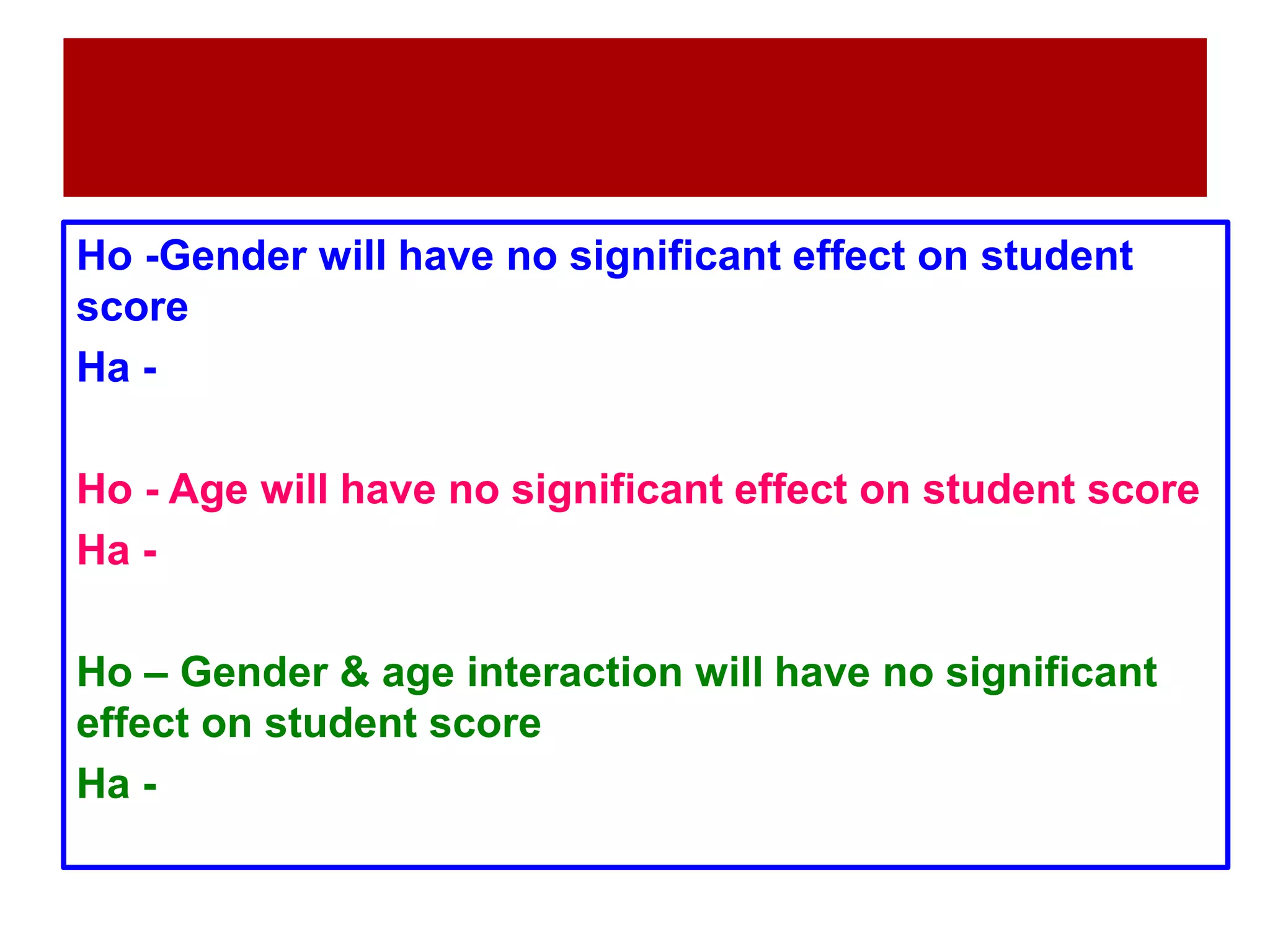
Ho -Gender will have no significant effect on student
score
Ha -
Ho - Age will have no significant effect on student score
Ha -
Ho – Gender & age interaction will have no significant
effect on student score
Ha -
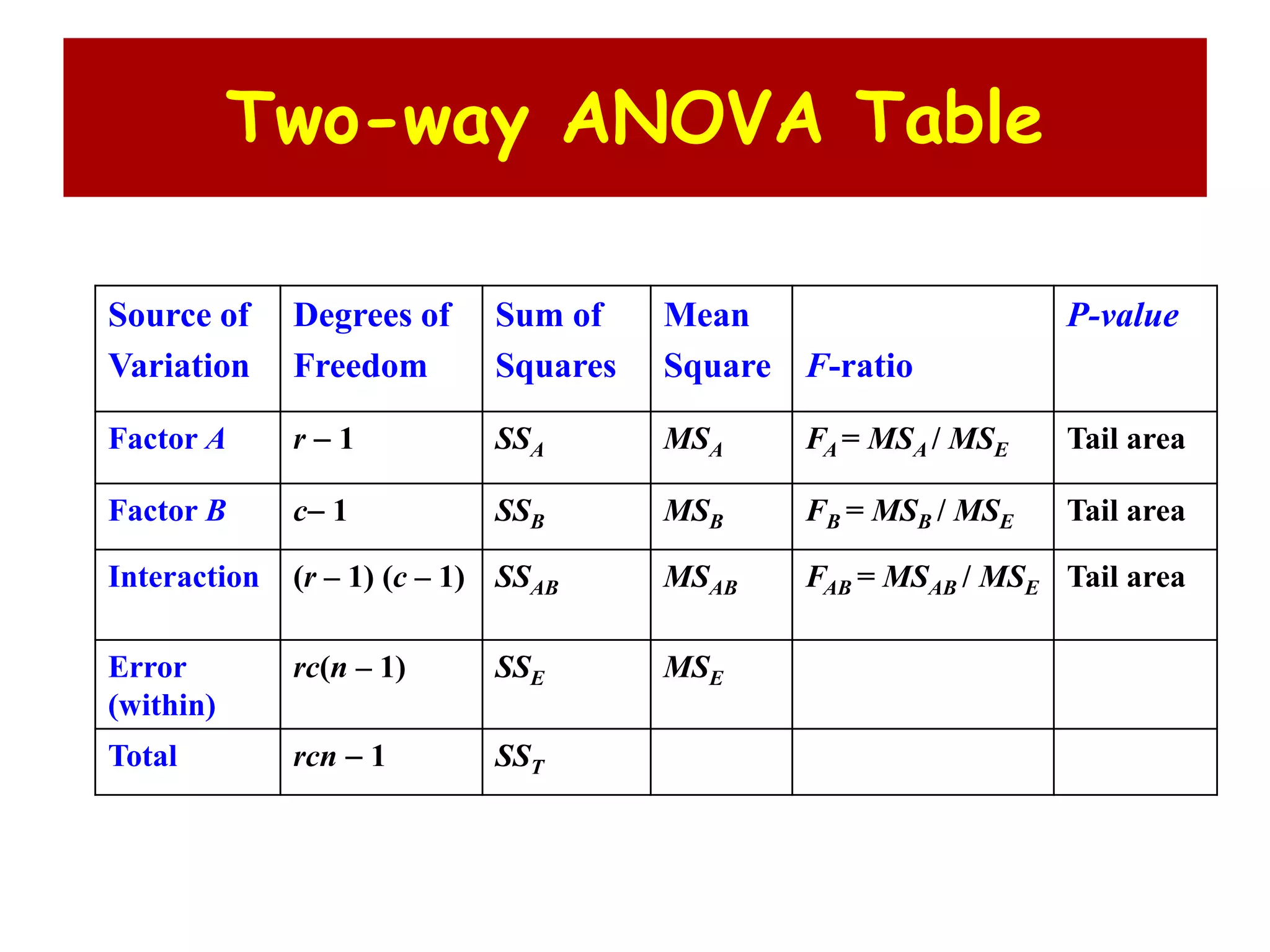
Two-way ANOVA Table
Source of
Variation
Degrees of
Freedom
Sum of
Squares
Mean
Square F-ratio
P-value
Factor A r  1 SSA MSA FA = MSA / MSE Tail area
Factor B c 1 SSB MSB FB = MSB / MSE Tail area
Interaction (r – 1) (c – 1) SSAB MSAB FAB = MSAB / MSE Tail area
Error
(within)
rc(n – 1) SSE MSE
Total rcn  1 SST
Example with SPSS
Example:
Do people with private health insurance visit their
Physicians more frequently than people with no
insurance or other types of insurance ?
N=86
• Type of insurance - 1.No insurance
2.Private insurance
3. TRICARE
• No. of visits to their Physicians(dependent
variable)
Gender
0-M
1-F
MANOVA
Multivariate ANalysis Of VAriance
Data Required
• MANOVA is used to test the significance of the
effects of one or more IVs on two or more DVs.
• It can be viewed as an extension of ANOVA with
the key difference that we are dealing with many
dependent variables (not a single DV as in the
case of ANOVA)
• Dependent Variables ( at least 2)
– Interval /or ratio measurement scale
– May be correlated
– Multivariate normality
– Homogeneity of variance
• Independent Variables ( at least 1)
– Nominal measurement scale
– Each independent variable should be independent of
each other
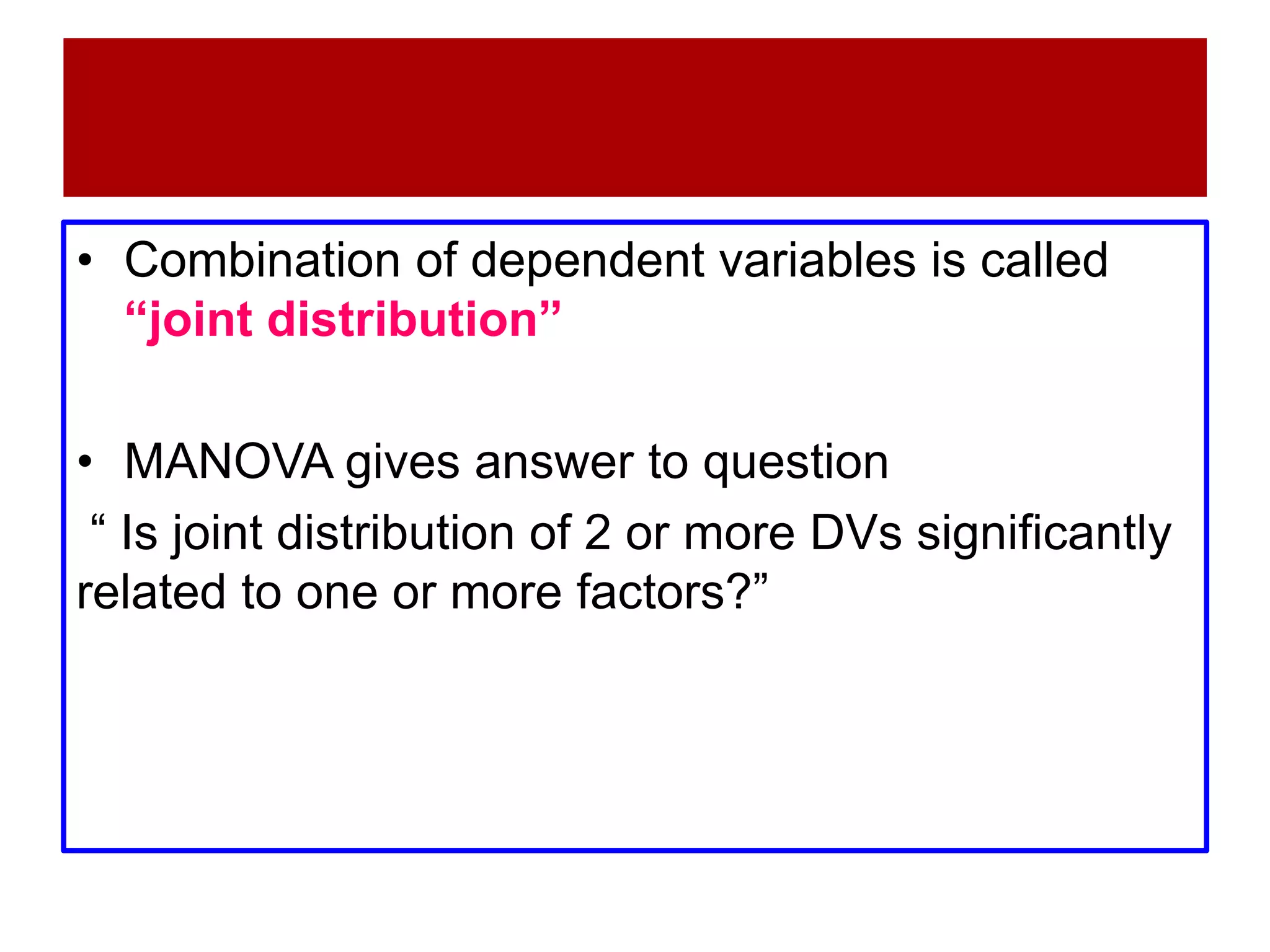
• Combination of dependent variables is called
“joint distribution”
• MANOVA gives answer to question
“ Is joint distribution of 2 or more DVs significantly
related to one or more factors?”
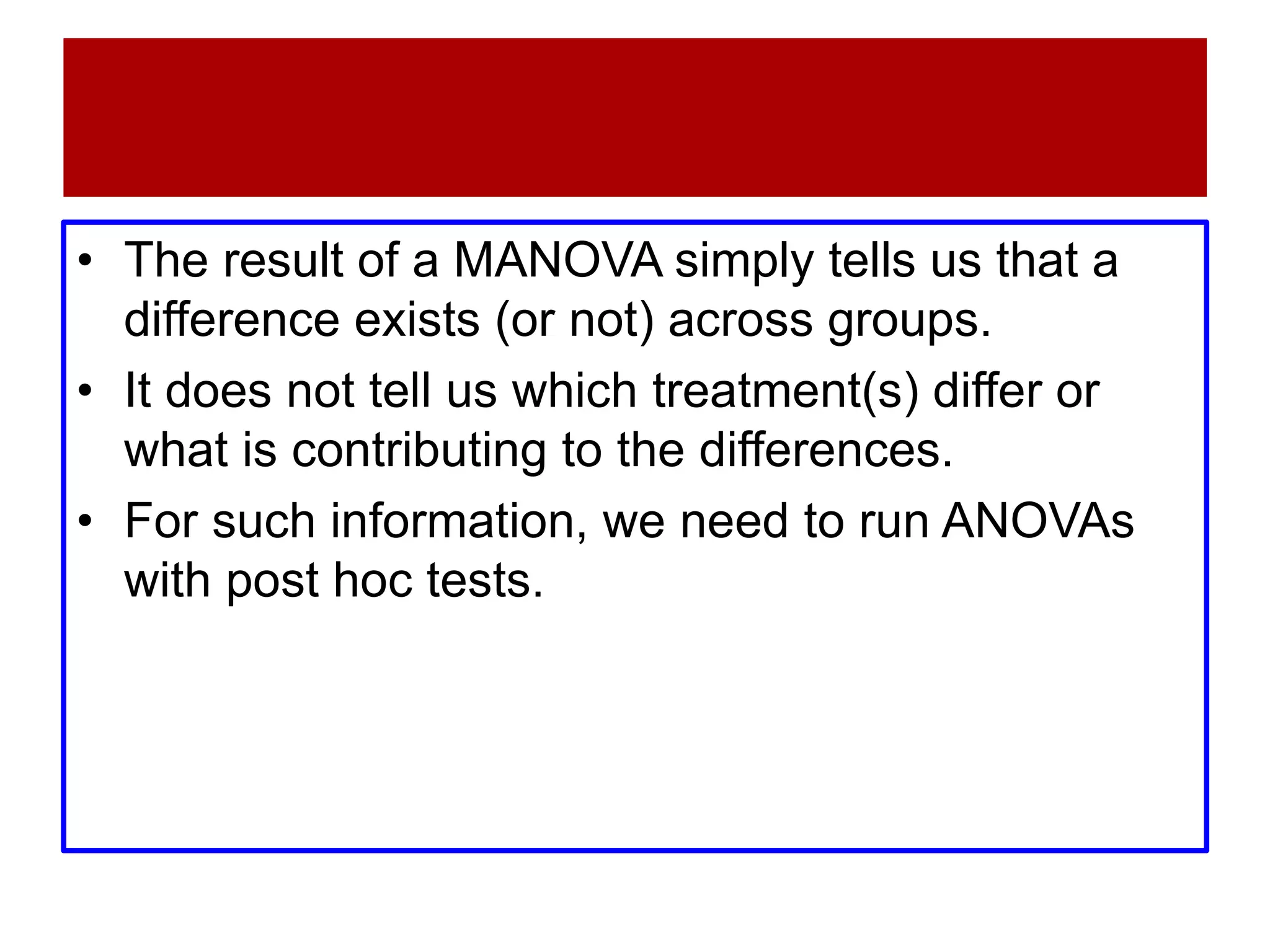
• The result of a MANOVA simply tells us that a
difference exists (or not) across groups.
• It does not tell us which treatment(s) differ or
what is contributing to the differences.
• For such information, we need to run ANOVAs
with post hoc tests.
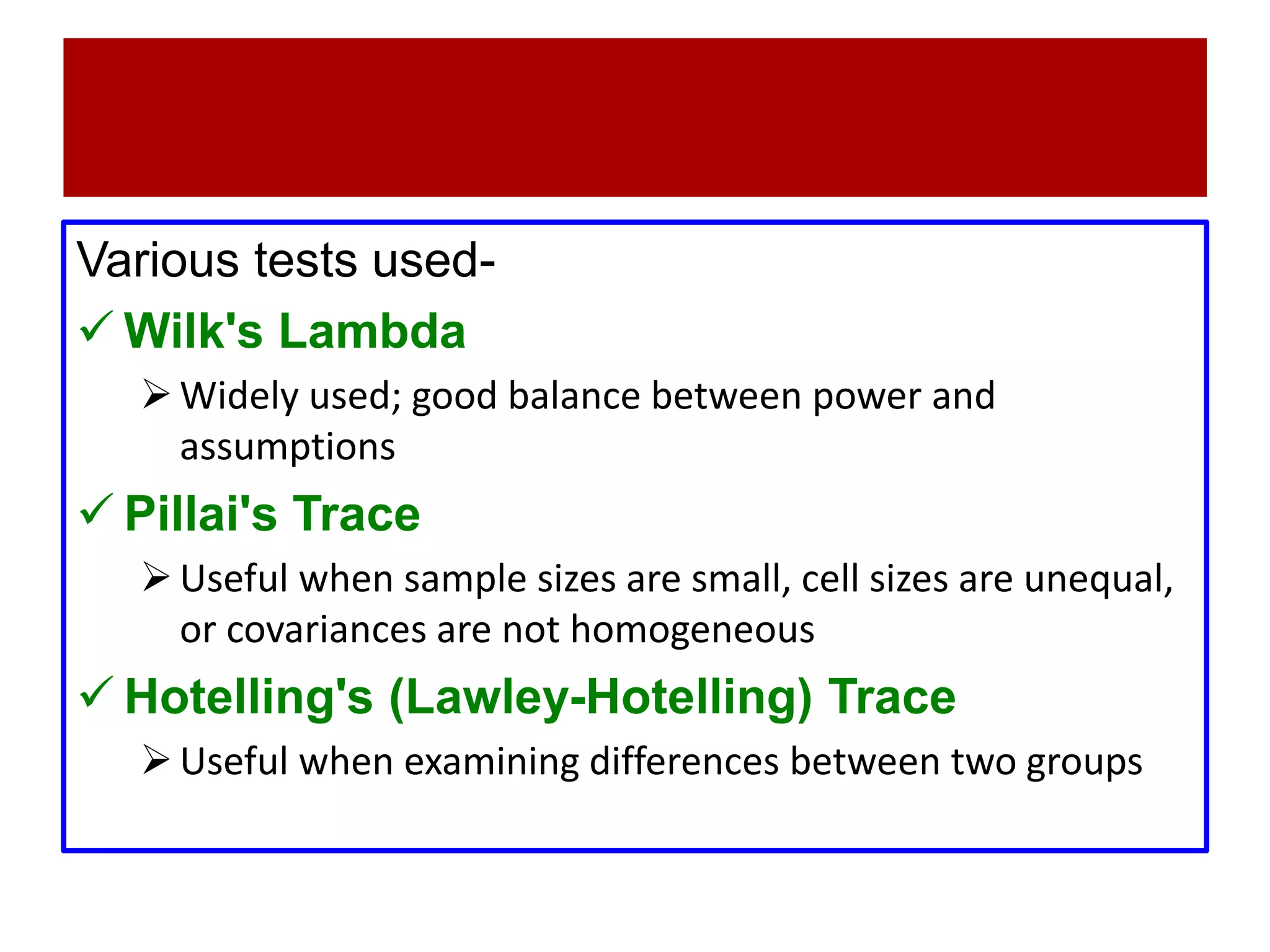
Various tests used-
 Wilk's Lambda
Widely used; good balance between power and
assumptions
 Pillai's Trace
Useful when sample sizes are small, cell sizes are unequal,
or covariances are not homogeneous
 Hotelling's (Lawley-Hotelling) Trace
Useful when examining differences between two groups
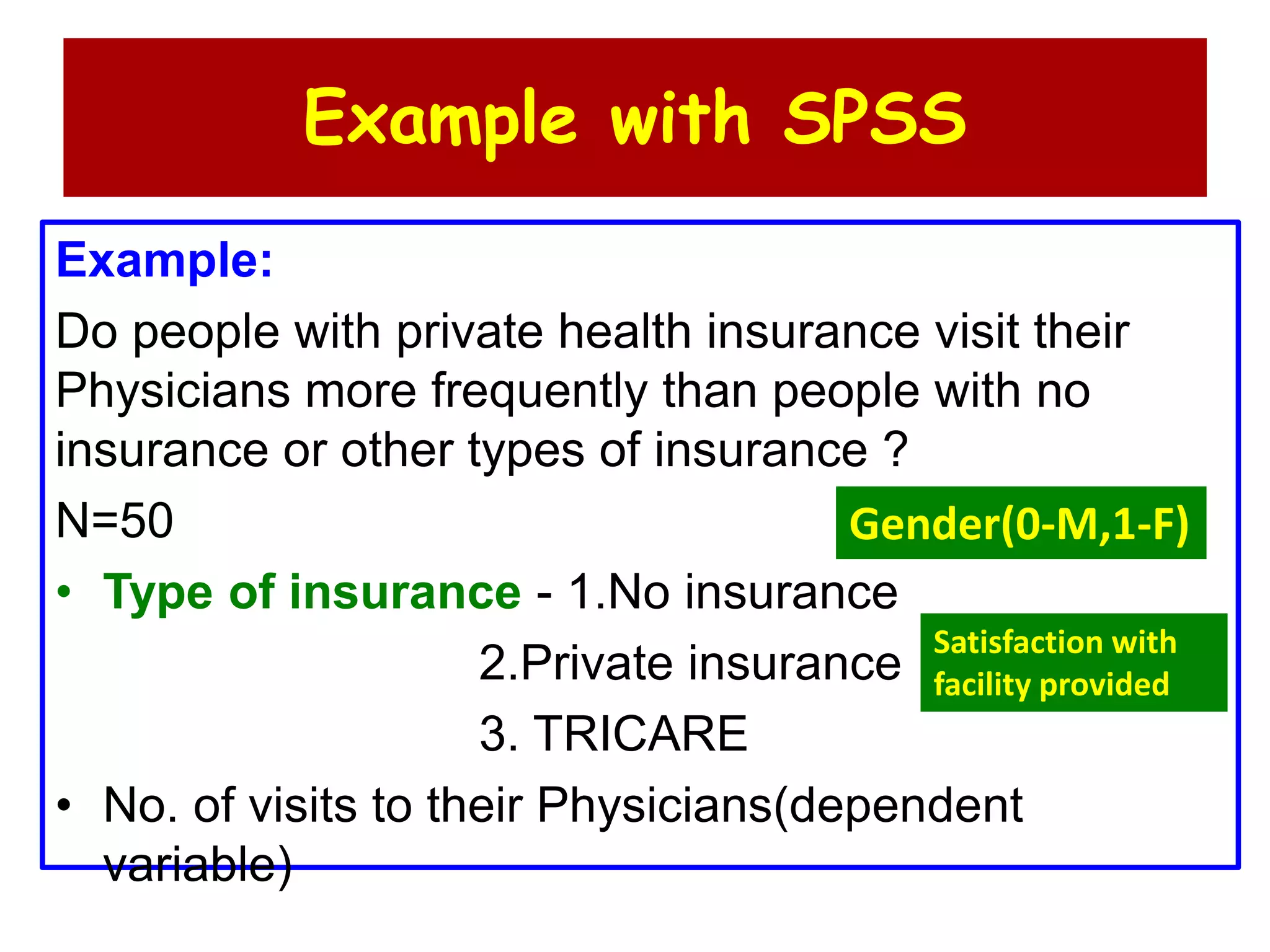
Example with SPSS
Example:
Do people with private health insurance visit their
Physicians more frequently than people with no
insurance or other types of insurance ?
N=50
• Type of insurance - 1.No insurance
2.Private insurance
3. TRICARE
• No. of visits to their Physicians(dependent
variable)
Gender(0-M,1-F)
Satisfaction with
facility provided
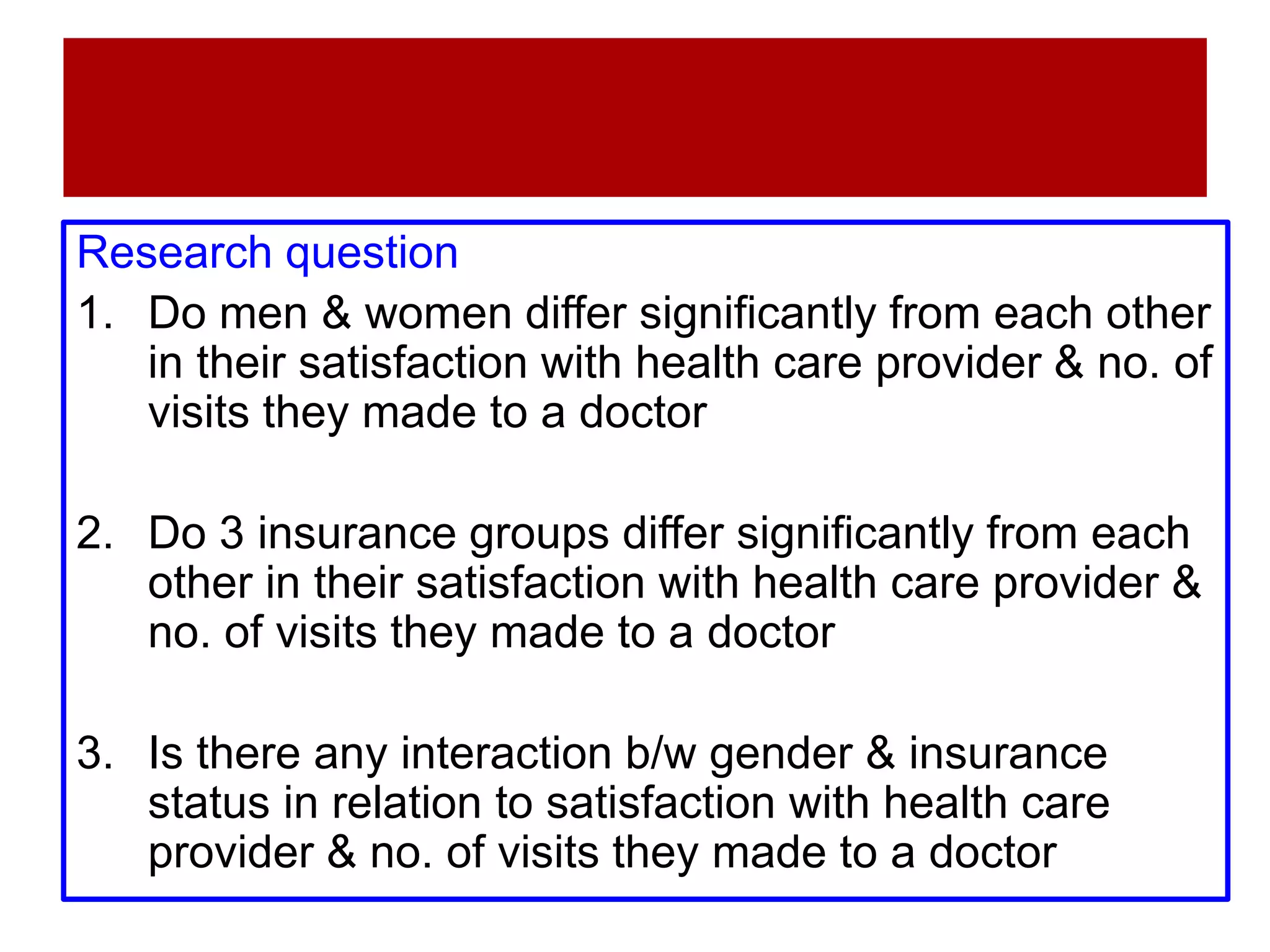
Research question
1. Do men & women differ significantly from each other
in their satisfaction with health care provider & no. of
visits they made to a doctor
2. Do 3 insurance groups differ significantly from each
other in their satisfaction with health care provider &
no. of visits they made to a doctor
3. Is there any interaction b/w gender & insurance
status in relation to satisfaction with health care
provider & no. of visits they made to a doctor
ANOVA with repeated measures
ANOVA with Repeated Measures
• Determines whether means of 3 or more
measures from same person or matched
controls are similar or different.
• Measures DV for various levels of one or more
IVs
• Used when we repeatedly measure
the same subjects multiple times
Assumptions
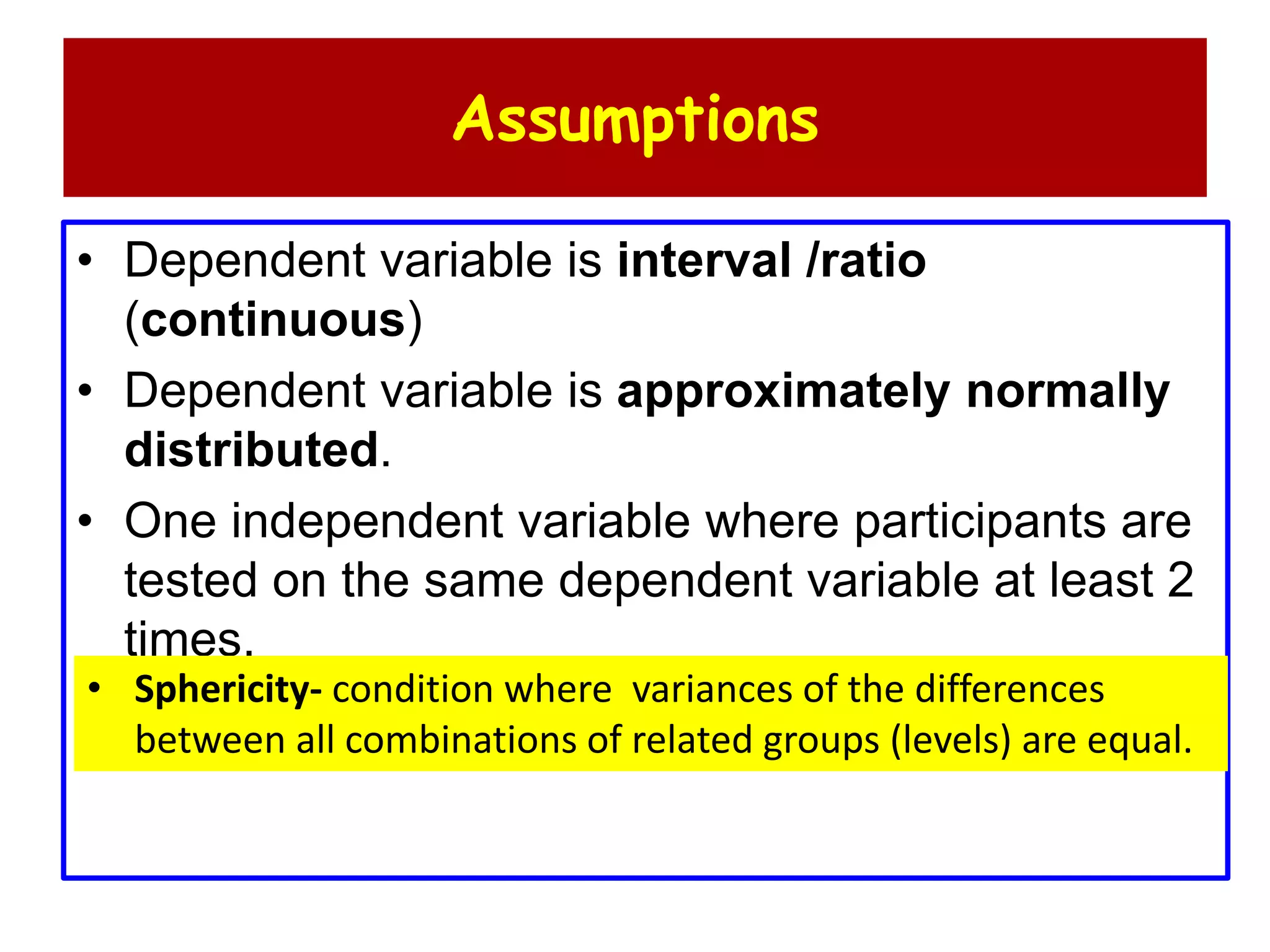
• Dependent variable is interval /ratio
(continuous)
• Dependent variable is approximately normally
distributed.
• One independent variable where participants are
tested on the same dependent variable at least 2
times.
• Sphericity- condition where variances of the differences
between all combinations of related groups (levels) are equal.
Sphericity violation
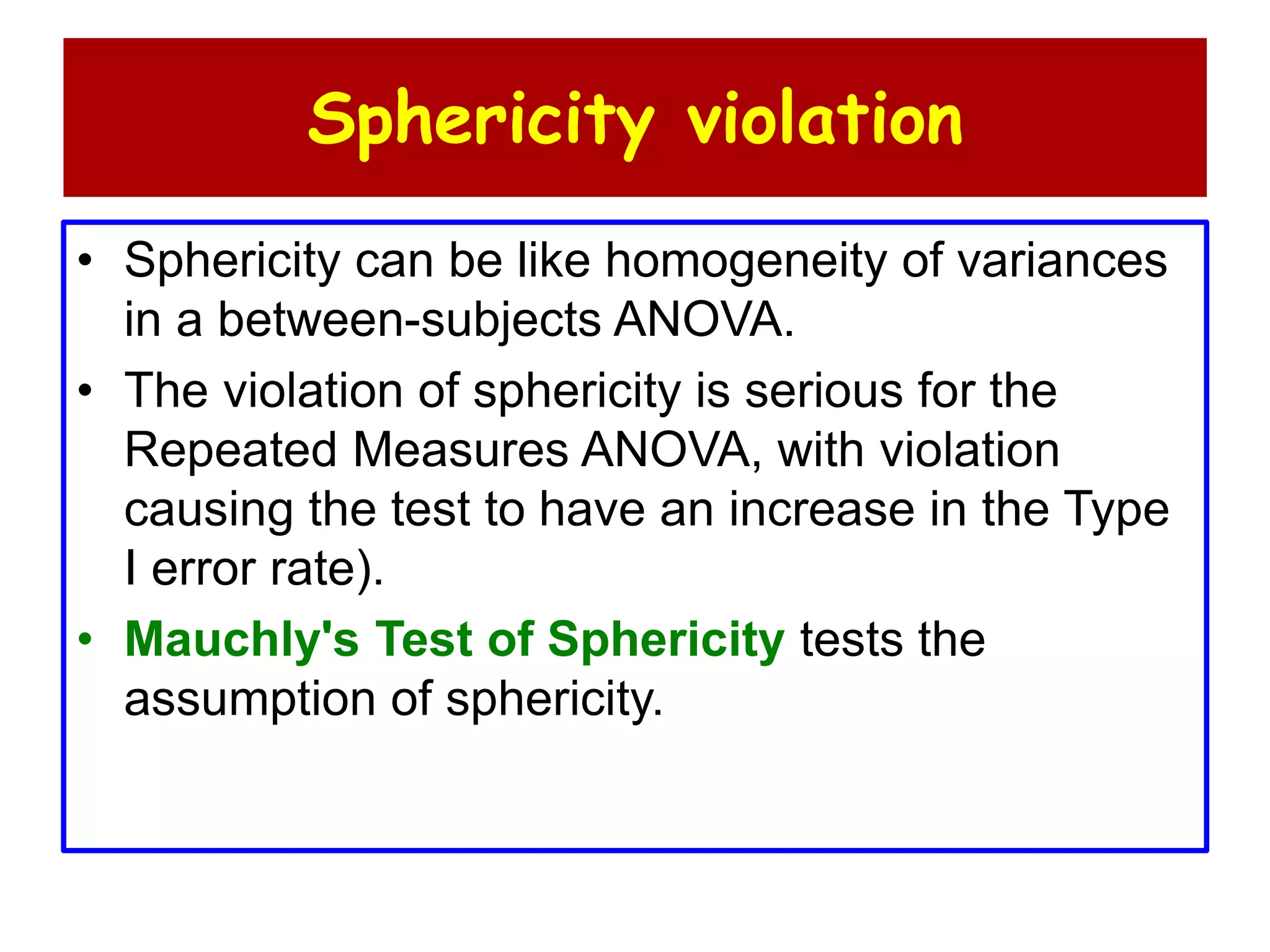
• Sphericity can be like homogeneity of variances
in a between-subjects ANOVA.
• The violation of sphericity is serious for the
Repeated Measures ANOVA, with violation
causing the test to have an increase in the Type
I error rate).
• Mauchly's Test of Sphericity tests the
assumption of sphericity.
Sphericity violation
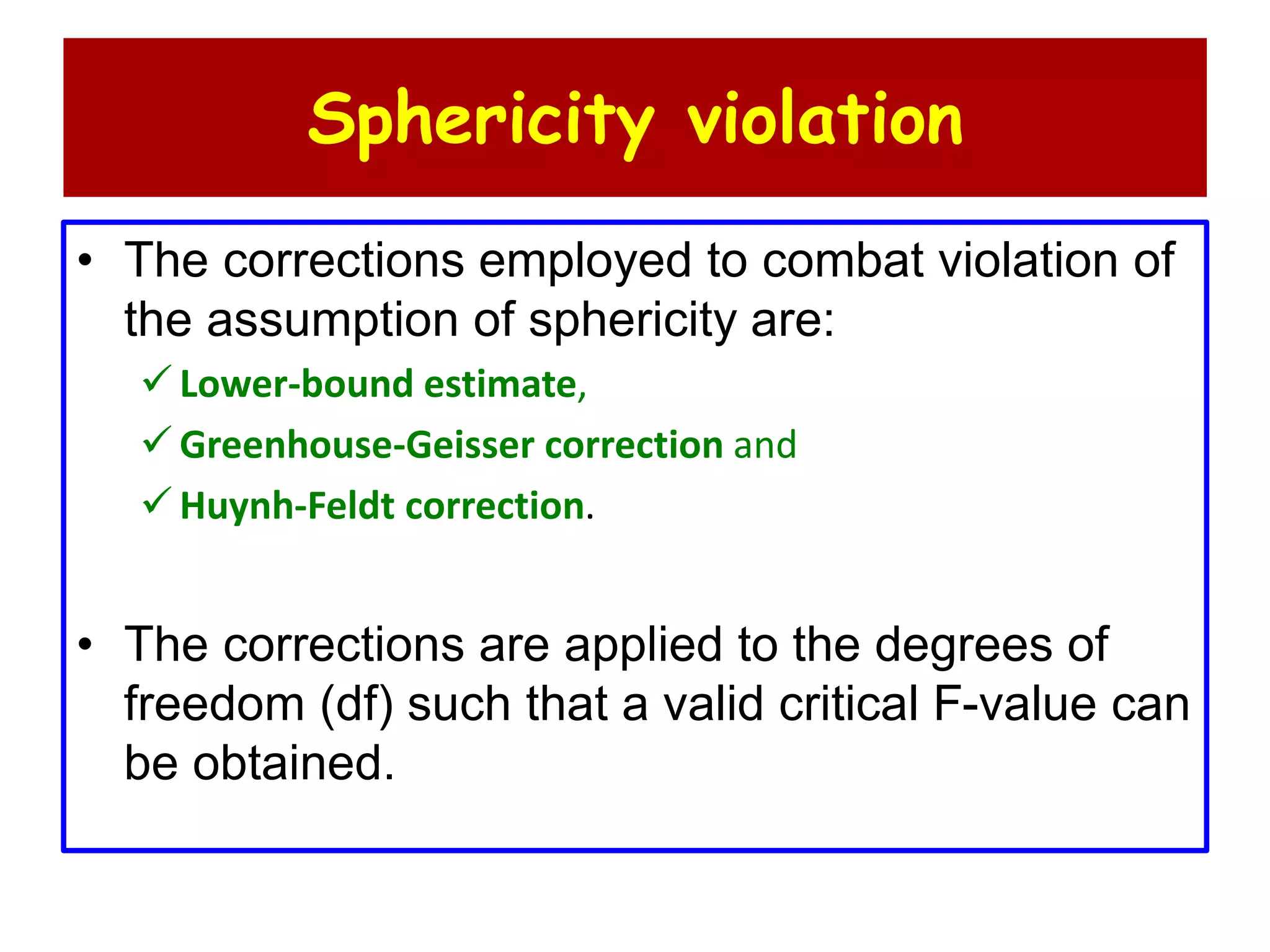
• The corrections employed to combat violation of
the assumption of sphericity are:
 Lower-bound estimate,
 Greenhouse-Geisser correction and
 Huynh-Feldt correction.
• The corrections are applied to the degrees of
freedom (df) such that a valid critical F-value can
be obtained.
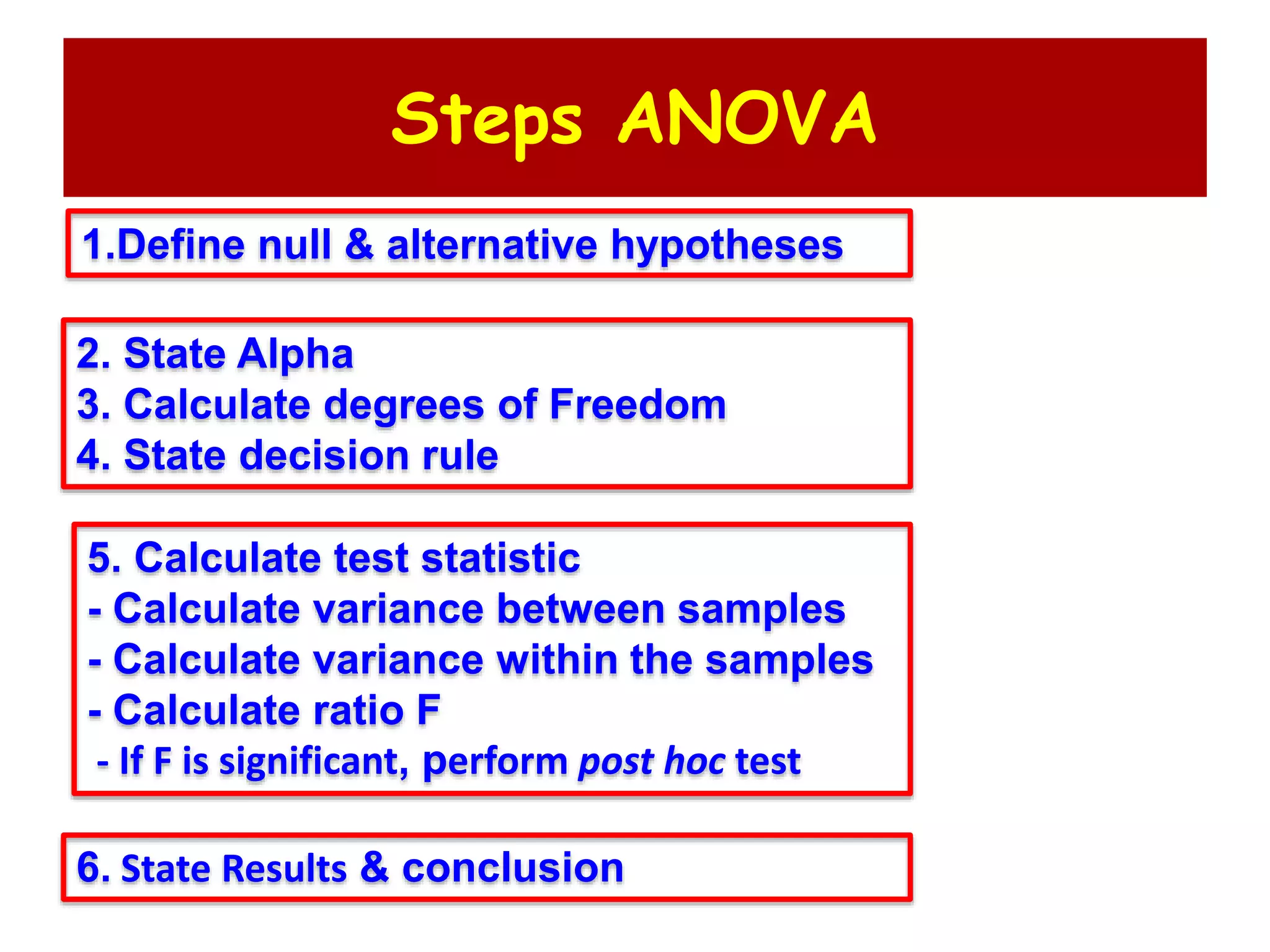
Steps ANOVA
2. State Alpha
3. Calculate degrees of Freedom
4. State decision rule
5. Calculate test statistic
- Calculate variance between samples
- Calculate variance within the samples
- Calculate ratio F
- If F is significant, perform post hoc test
1.Define null & alternative hypotheses
6. State Results & conclusion
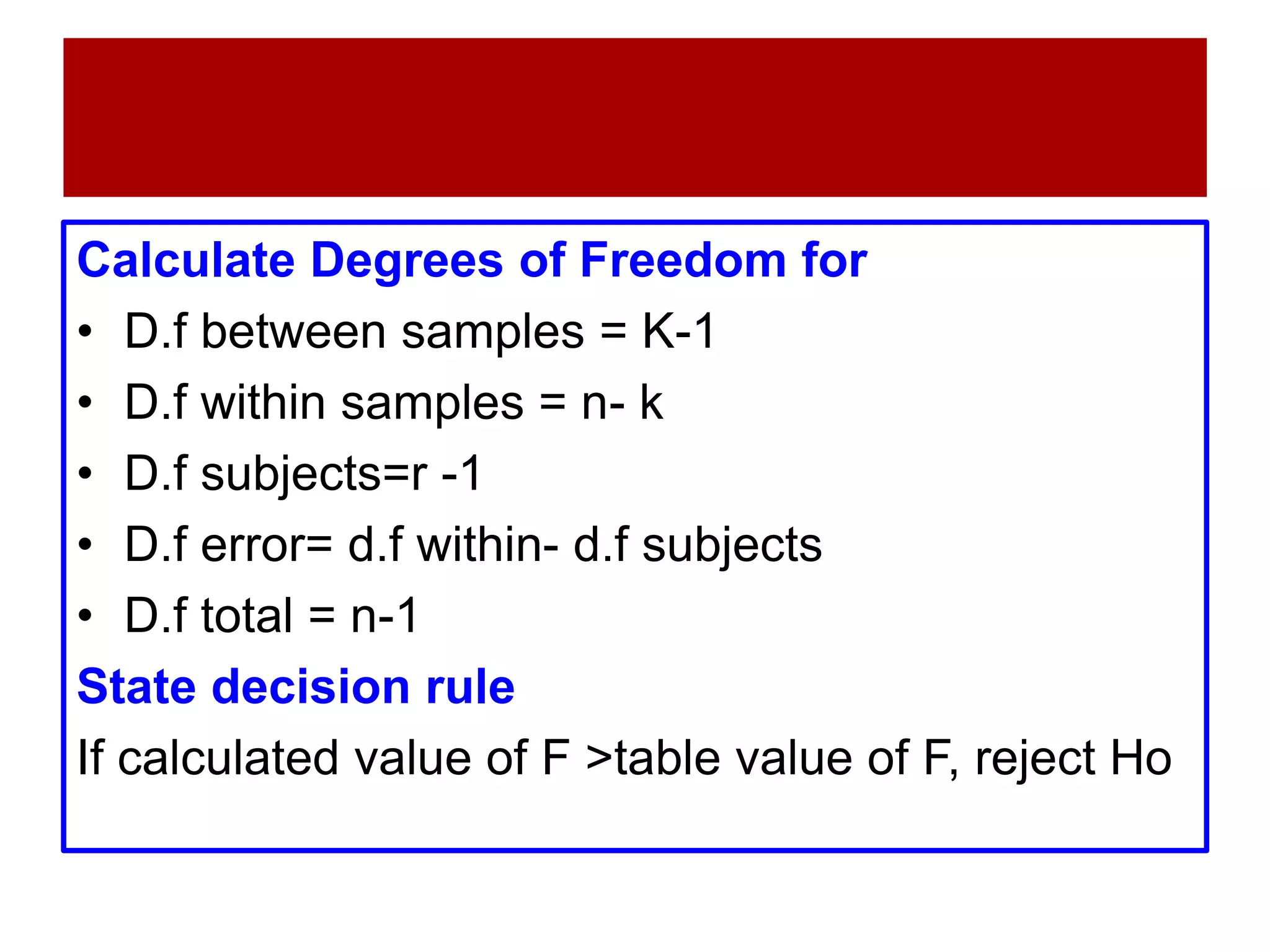
Calculate Degrees of Freedom for
• D.f between samples = K-1
• D.f within samples = n- k
• D.f subjects=r -1
• D.f error= d.f within- d.f subjects
• D.f total = n-1
State decision rule
If calculated value of F >table value of F, reject Ho
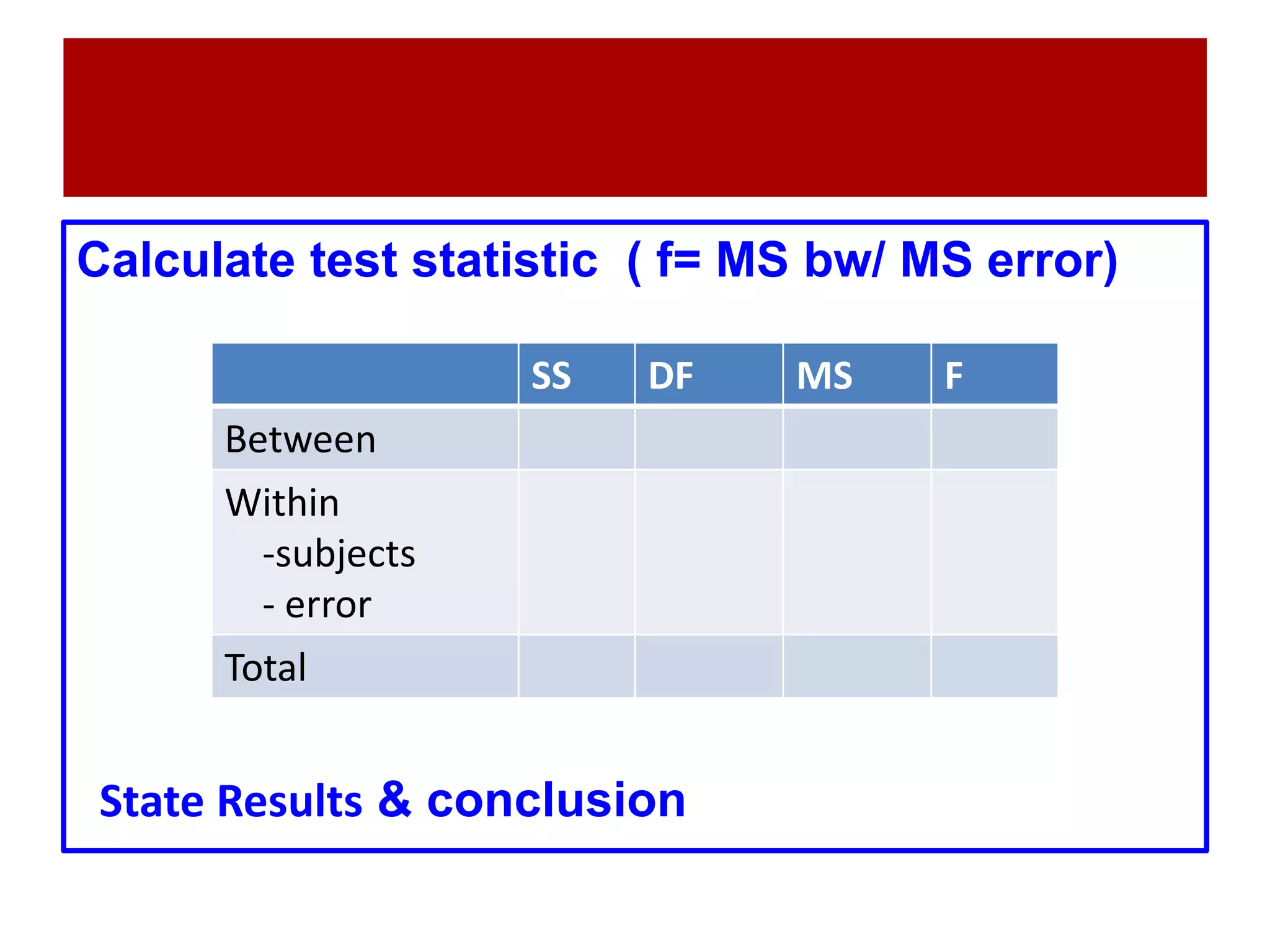
Calculate test statistic ( f= MS bw/ MS error)
SS DF MS F
Between
Within
-subjects
- error
Total
State Results & conclusion
Example with SPSS
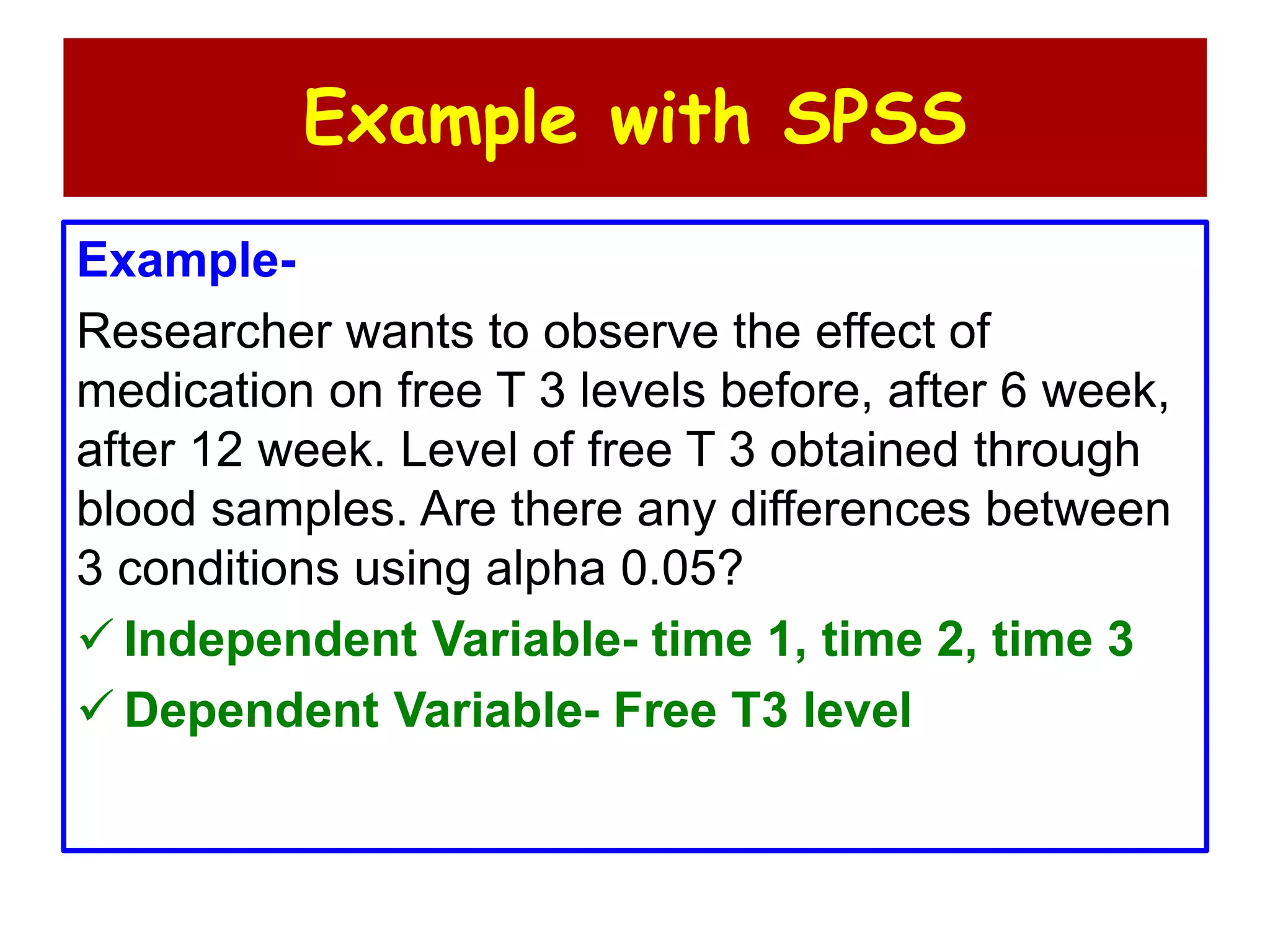
Example-
Researcher wants to observe the effect of
medication on free T 3 levels before, after 6 week,
after 12 week. Level of free T 3 obtained through
blood samples. Are there any differences between
3 conditions using alpha 0.05?
 Independent Variable- time 1, time 2, time 3
 Dependent Variable- Free T3 level
Other related tests-
ANCOVA (Analysis of Covariance)
Additional assumptions-
- Covariate should be continuous variable
- Covariate & dependent variable must show a
linear relationship & must be similar in each group
MANCOVA (Multivariate analysis of covariance)
One or more continuous covariates present
References
• Methods in Biostatistics by BK Mahajan
• Statistical Methods by SP Gupta
• Basic & Clinical Biostatistics by Dawson and
Beth
• Munro’s statistical methods for health care
research
Analysis of variance (ANOVA)

Analysis of variance (ANOVA)

  • 1.
    ANalysis Of VAriance Presenter-Dr. SNEH KHATRI Junior Resident PGIMSRohtak
  • 2.
    Contents • Introduction –Various statistical tests • What is ANOVA? • One way ANOVA • Two way ANOVA • MANOVA (Multivariate ANalysis Of VAriance) • ANOVA with repeated measures • Other related tests • References
  • 3.
    Summary Table ofStatistical Tests Level of Measurement Sample Characteristics Correlation 1 Sample 2 Sample K Sample (i.e., >2) Independent Dependent Independent Dependent Categorical or Nominal Χ2 or bi- nomina l Χ2 Macnarmar’s Χ2 Χ2 Cochran’s Q Rank or Ordinal Mann Whitney U Wilcoxin Matched Pairs Signed Ranks Kruskal Wallis H Friedman’s ANOVA Spearman’s rho Parametric (Interval & Ratio) z test or t test t test between groups t test within groups 1 way ANOVA between groups 1 way ANOVA (within or repeated measure) Pearson’s r Factorial (2 way) ANOVA Χ2
  • 4.
    What is ANOVA Statistical technique specially designed to test whether the means of more than 2 quantitative populations are equal.  Developed by Sir Ronald A. Fisher in 1920’s.
  • 5.
    Lower SES MiddleSES Higher SES 18,17,18,19,19 22,25,24,26,24,21 25,26,24,28,29 N1= 5 N2= 6 N3= 5 Mean=18.2 Mean= 23.6 Mean=26.4 EXAMPLE: Study conducted among men of age group 18-25 year in community to assess effect of SES on BMI
  • 6.
    ANOVA One way ANOVAThree way ANOVA Effect of SES on BMI Two way ANOVA Effect of age & SES on BMI Effect of age, SES, Diet on BMI ANOVA with repeated measures - comparing >=3 group means where the participants are same in each group. E.g. Group of subjects is measured more than twice, generally over time, such as patients weighed at baseline and every month after a weight loss program
  • 7.
  • 8.
    Data required One wayANOVA or single factor ANOVA: • Determines means of ≥ 3 independent groups significantly different from one another. • Only 1 independent variable (factor/grouping variable) with ≥3 levels • Grouping variable- nominal • Outcome variable- interval or ratio Post hoc tests help determine where difference exist
  • 9.
    Assumptions 1) Normality: Thevalues in each group are normally distributed. 2) Homogeneity of variances: The variance within each group should be equal for all groups. 3) Independence of error: The error(variation of each value around its own group mean) should be independent for each value. Skewness Kurtosis Kolmogorov-Smirnov Shapiro-Wilk test Box-and-whiskers plots Histogram
  • 10.
    Steps 2. State Alpha 3.Calculate degrees of Freedom 4. State decision rule 5. Calculate test statistic - Calculate variance between samples - Calculate variance within the samples - Calculate F statistic - If F is significant, perform post hoc test 1. State null & alternative hypotheses 6. State Results & conclusion
  • 11.
    1. State null& alternative hypotheses i  ...H 210 equalaretheofallnotHa i H0 : all sample means are equal At least one sample has different mean
  • 12.
    2. State Alphai.e 0.05 3. Calculate degrees of Freedom K-1 & n-1 k= No of Samples, n= Total No of observations 4. State decision rule If calculated value of F >table value of F, reject Ho 5. Calculate test statistic
  • 13.
    Calculating variance betweensamples 1. Calculate the mean of each sample. 2. Calculate the Grand average 3. Take the difference between means of various samples & grand average. 4. Square these deviations & obtain total which will give sum of squares between samples (SSC) 5. Divide the total obtained in step 4 by the degrees of freedom to calculate the mean sum of square between samples (MSC).
  • 14.
    Calculating Variance withinSamples 1. Calculate mean value of each sample 2. Take the deviations of the various items in a sample from the mean values of the respective samples. 3. Square these deviations & obtain total which gives the sum of square within the samples (SSE) 4. Divide the total obtained in 3rd step by the degrees of freedom to calculate the mean sum of squares within samples (MSE).
  • 15.
    The mean sumof squares 1  k SSC MSC kn SSE MSE   Calculation of MSC- Mean sum of Squares between samples Calculation of MSE Mean Sum Of Squares within samples k= No of Samples, n= Total No of observations
  • 16.
    Calculation of Fstatistic groupswithinyVariabilit groupsbetweenyVariabilit F  F- statistic = 𝑀𝑆𝐶 𝑀𝑆𝐸 Compare the F-statistic value with F(critical) value which is obtained by looking for it in F distribution tables against degrees of freedom. The calculated value of F > table value H0 is rejected
  • 17.
    Within-Group Variance Between-Group Variance Between-group variance islarge relative to the within-group variance, so F statistic will be larger & > critical value, therefore statistically significant . Conclusion – At least one of group means is significantly different from other group means
  • 18.
    Within-Group Variance Between-Group Variance Within-group variance islarger, and the between-group variance smaller, so F will be smaller (reflecting the likely-hood of no significant differences between these 3 sample means)
  • 19.
    Post-hoc Tests • Usedto determine which mean or group of means is/are significantly different from the others (significant F) • Depending upon research design & research question:  Bonferroni (more powerful) Only some pairs of sample means are to be tested Desired alpha level is divided by no. of comparisons  Tukey’s HSD Procedure when all pairs of sample means are to be tested  Scheffe’s Procedure (when sample sizes are unequal)
  • 20.
    One way ANOVA:Table Source of Variation SS (Sum of Squares) Degrees of Freedom MS (Mean Square) Variance Ratio of F Between Samples SSC k-1 MSC= SSC/(k-1) MSC/MSE Within Samples SSE n-k MSE= SSE/(n-k) Total SS(Total) n-1
  • 21.
    Example- one wayANOVA Example: 3 samples obtained from normal populations with equal variances. Test the hypothesis that sample means are equal 8 7 12 10 5 9 7 10 13 14 9 12 11 9 14
  • 22.
    1.Null hypothesis – Nosignificant difference in the means of 3 samples 2. State Alpha i.e 0.05 3. Calculate degrees of Freedom k-1 & n-k = 2 & 12 4. State decision rule Table value of F at 5% level of significance for d.f 2 & 12 is 3.88 The calculated value of F > 3.88 ,H0 will be rejected 5. Calculate test statistic
  • 23.
    X1 X2 X3 87 12 10 5 9 7 10 13 14 9 12 11 9 14 Total 50 M1= 10 40 M2 = 8 60 M3 = 12 10+ 8 + 12 3 Grand average = = 10
  • 24.
    Variance BETWEEN samples(M1=10, M2=8,M3=12) Sum of squares between samples (SSC) = n1 (M1 – Grand avg)2 + n2 (M2– Grand avg)2 + n3(M3– Grand avg)2 5 ( 10 - 10)2 + 5 ( 8 - 10) 2 + 5 ( 12 - 10) 2 = 40 20 2 40 1    k SSC MSC Calculation of Mean sum of Squares between samples (MSC) k= No of Samples, n= Total No of observations
  • 25.
    Variance WITH INsamples (M1=10, M2=8,M3=12) X1 (X1 – M1)2 X2 (X2– M2)2 X3 (X3– M3)2 8 4 7 1 12 0 10 0 5 9 9 9 7 9 10 4 13 1 14 16 9 1 12 0 11 1 9 1 14 4 30 16 14 Sum of squares within samples (SSE) = 30 + 16 +14 = 60 5 12 60    kn SSE MSE Calculation of Mean Sum Of Squares within samples (MSE)
  • 26.
    Calculation of ratioF groupswithinyVariabilit groupsbetweenyVariabilit F  F- statistic = 𝑀𝑆𝐶 𝑀𝑆𝐸 = 20/5 =4 The Table value of F at 5% level of significance for d.f 2 & 12 is 3.88 The calculated value of F > table value H0 is rejected. Hence there is significant difference in sample means
  • 27.
    Short cut method- X1 (X1) 2 X2 (X2 )2 X3 (X3 )2 8 64 7 49 12 144 10 100 5 25 9 81 7 49 10 100 13 169 14 196 9 81 12 144 11 121 9 81 14 196 Total 50 530 40 336 60 734 Total sum of all observations = 50 + 40 + 60 = 150 Correction factor = T2 / N=(150)2 /15= 22500/15=1500 Total sum of squares= 530+ 336+ 734 – 1500= 100 Sum of square b/w samples=(50)2/5 + (40)2 /5 + (60) 2 /5 - 1500=40 Sum of squares within samples= 100-40= 60
  • 28.
    Example with SPSS Example: Dopeople with private health insurance visit their Physicians more frequently than people with no insurance or other types of insurance ? N=86 • Type of insurance - 1.No insurance 2.Private insurance 3. TRICARE • No. of visits to their Physicians(dependent variable)
  • 29.
    Violations of Assumptions Normality Choosethe non-parametric Kruskal-Wallis H Test which does not require the assumption of normality. Homogeneity of variances  Welch test or  Brown and Forsythe test or Kruskal-Wallis H Test
  • 30.
  • 31.
    Data required • When2 independent variables (Nominal/categorical) have an effect on one dependent variable (ordinal or ratio measurement scale) • Compares relative influences on Dependent Variable • Examine interactions between independent variables • Just as we had Sums of Squares and Mean Squares in One-way ANOVA, we have the same in Two-way ANOVA.
  • 32.
    Two way ANOVA Includetests of three null hypotheses: 1) Means of observations grouped by one factor are same; 2) Means of observations grouped by the other factor are the same; and 3) There is no interaction between the two factors. The interaction test tells whether the effects of one factor depend on the other factor
  • 33.
    Example- we have testscore of boys & girls in age group of 10 yr,11yr & 12 yr. If we want to study the effect of gender & age on score. Two independent factors- Gender, Age Dependent factor - Test score
  • 34.
    Ho -Gender willhave no significant effect on student score Ha - Ho - Age will have no significant effect on student score Ha - Ho – Gender & age interaction will have no significant effect on student score Ha -
  • 35.
    Two-way ANOVA Table Sourceof Variation Degrees of Freedom Sum of Squares Mean Square F-ratio P-value Factor A r  1 SSA MSA FA = MSA / MSE Tail area Factor B c 1 SSB MSB FB = MSB / MSE Tail area Interaction (r – 1) (c – 1) SSAB MSAB FAB = MSAB / MSE Tail area Error (within) rc(n – 1) SSE MSE Total rcn  1 SST
  • 36.
    Example with SPSS Example: Dopeople with private health insurance visit their Physicians more frequently than people with no insurance or other types of insurance ? N=86 • Type of insurance - 1.No insurance 2.Private insurance 3. TRICARE • No. of visits to their Physicians(dependent variable) Gender 0-M 1-F
  • 37.
  • 38.
    Data Required • MANOVAis used to test the significance of the effects of one or more IVs on two or more DVs. • It can be viewed as an extension of ANOVA with the key difference that we are dealing with many dependent variables (not a single DV as in the case of ANOVA)
  • 39.
    • Dependent Variables( at least 2) – Interval /or ratio measurement scale – May be correlated – Multivariate normality – Homogeneity of variance • Independent Variables ( at least 1) – Nominal measurement scale – Each independent variable should be independent of each other
  • 40.
    • Combination ofdependent variables is called “joint distribution” • MANOVA gives answer to question “ Is joint distribution of 2 or more DVs significantly related to one or more factors?”
  • 41.
    • The resultof a MANOVA simply tells us that a difference exists (or not) across groups. • It does not tell us which treatment(s) differ or what is contributing to the differences. • For such information, we need to run ANOVAs with post hoc tests.
  • 42.
    Various tests used- Wilk's Lambda Widely used; good balance between power and assumptions  Pillai's Trace Useful when sample sizes are small, cell sizes are unequal, or covariances are not homogeneous  Hotelling's (Lawley-Hotelling) Trace Useful when examining differences between two groups
  • 43.
    Example with SPSS Example: Dopeople with private health insurance visit their Physicians more frequently than people with no insurance or other types of insurance ? N=50 • Type of insurance - 1.No insurance 2.Private insurance 3. TRICARE • No. of visits to their Physicians(dependent variable) Gender(0-M,1-F) Satisfaction with facility provided
  • 44.
    Research question 1. Domen & women differ significantly from each other in their satisfaction with health care provider & no. of visits they made to a doctor 2. Do 3 insurance groups differ significantly from each other in their satisfaction with health care provider & no. of visits they made to a doctor 3. Is there any interaction b/w gender & insurance status in relation to satisfaction with health care provider & no. of visits they made to a doctor
  • 45.
  • 46.
    ANOVA with RepeatedMeasures • Determines whether means of 3 or more measures from same person or matched controls are similar or different. • Measures DV for various levels of one or more IVs • Used when we repeatedly measure the same subjects multiple times
  • 47.
    Assumptions • Dependent variableis interval /ratio (continuous) • Dependent variable is approximately normally distributed. • One independent variable where participants are tested on the same dependent variable at least 2 times. • Sphericity- condition where variances of the differences between all combinations of related groups (levels) are equal.
  • 48.
    Sphericity violation • Sphericitycan be like homogeneity of variances in a between-subjects ANOVA. • The violation of sphericity is serious for the Repeated Measures ANOVA, with violation causing the test to have an increase in the Type I error rate). • Mauchly's Test of Sphericity tests the assumption of sphericity.
  • 49.
    Sphericity violation • Thecorrections employed to combat violation of the assumption of sphericity are:  Lower-bound estimate,  Greenhouse-Geisser correction and  Huynh-Feldt correction. • The corrections are applied to the degrees of freedom (df) such that a valid critical F-value can be obtained.
  • 50.
    Steps ANOVA 2. StateAlpha 3. Calculate degrees of Freedom 4. State decision rule 5. Calculate test statistic - Calculate variance between samples - Calculate variance within the samples - Calculate ratio F - If F is significant, perform post hoc test 1.Define null & alternative hypotheses 6. State Results & conclusion
  • 51.
    Calculate Degrees ofFreedom for • D.f between samples = K-1 • D.f within samples = n- k • D.f subjects=r -1 • D.f error= d.f within- d.f subjects • D.f total = n-1 State decision rule If calculated value of F >table value of F, reject Ho
  • 52.
    Calculate test statistic( f= MS bw/ MS error) SS DF MS F Between Within -subjects - error Total State Results & conclusion
  • 53.
    Example with SPSS Example- Researcherwants to observe the effect of medication on free T 3 levels before, after 6 week, after 12 week. Level of free T 3 obtained through blood samples. Are there any differences between 3 conditions using alpha 0.05?  Independent Variable- time 1, time 2, time 3  Dependent Variable- Free T3 level
  • 54.
    Other related tests- ANCOVA(Analysis of Covariance) Additional assumptions- - Covariate should be continuous variable - Covariate & dependent variable must show a linear relationship & must be similar in each group MANCOVA (Multivariate analysis of covariance) One or more continuous covariates present
  • 55.
    References • Methods inBiostatistics by BK Mahajan • Statistical Methods by SP Gupta • Basic & Clinical Biostatistics by Dawson and Beth • Munro’s statistical methods for health care research