Lecture 9
    Data Analysis

Ref Chapters 13 and 14
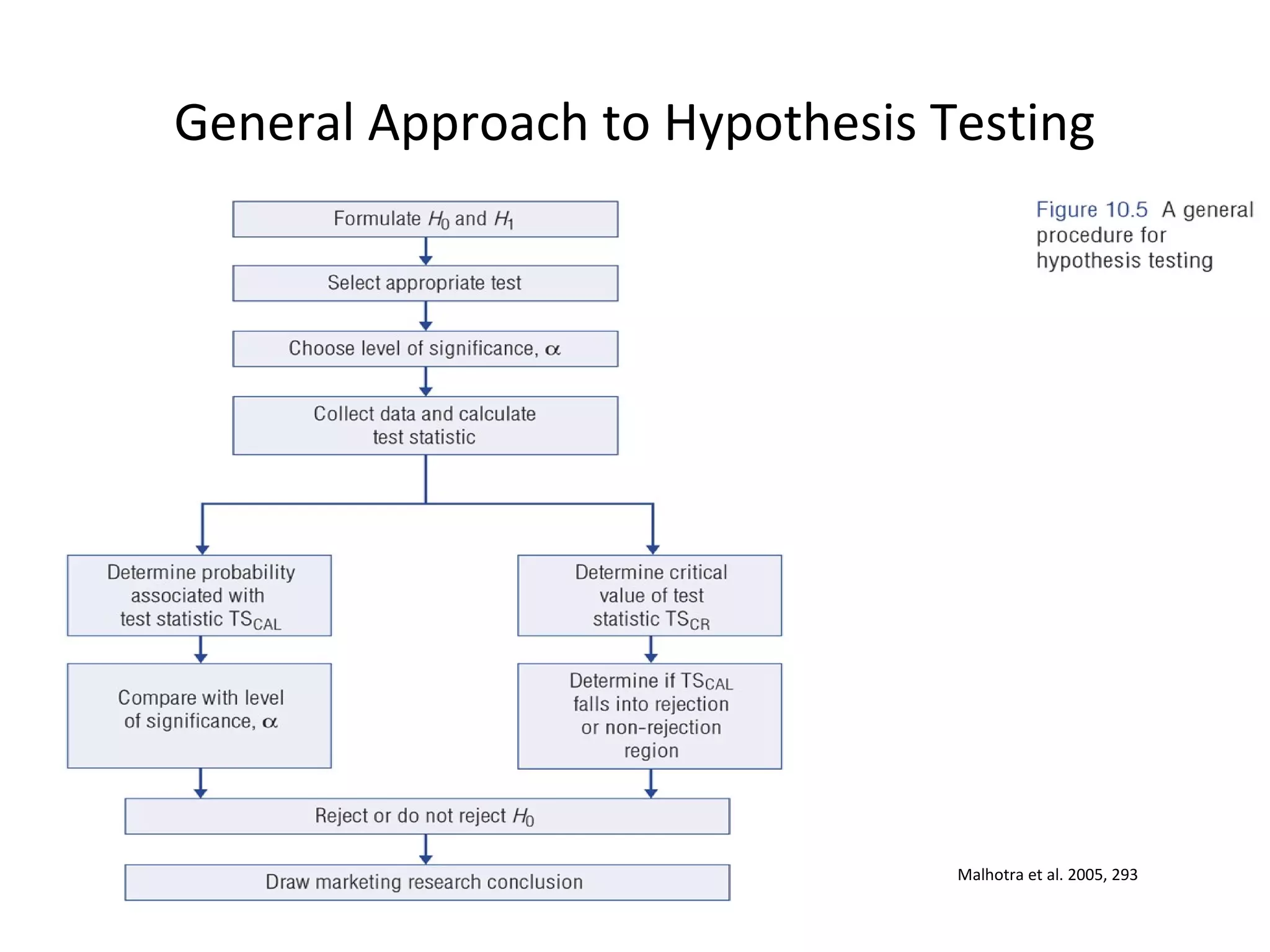
General Approach to Hypothesis Testing


                                Malhotra et al. 2005, 293
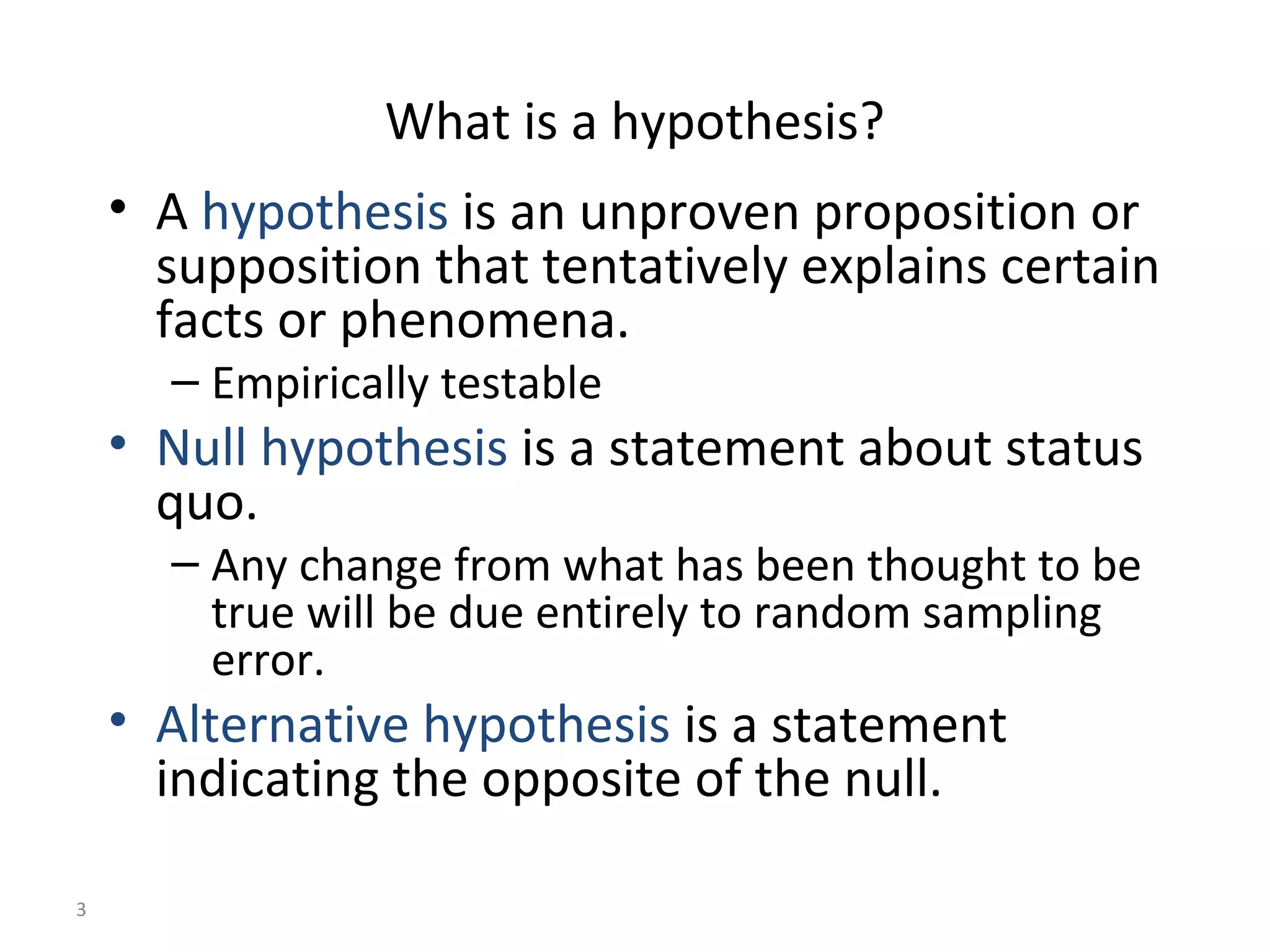
What is a hypothesis?
    • A hypothesis is an unproven proposition or
      supposition that tentatively explains certain
      facts or phenomena.
      – Empirically testable
    • Null hypothesis is a statement about status
      quo.
      – Any change from what has been thought to be
        true will be due entirely to random sampling
        error.
    • Alternative hypothesis is a statement
      indicating the opposite of the null.

3
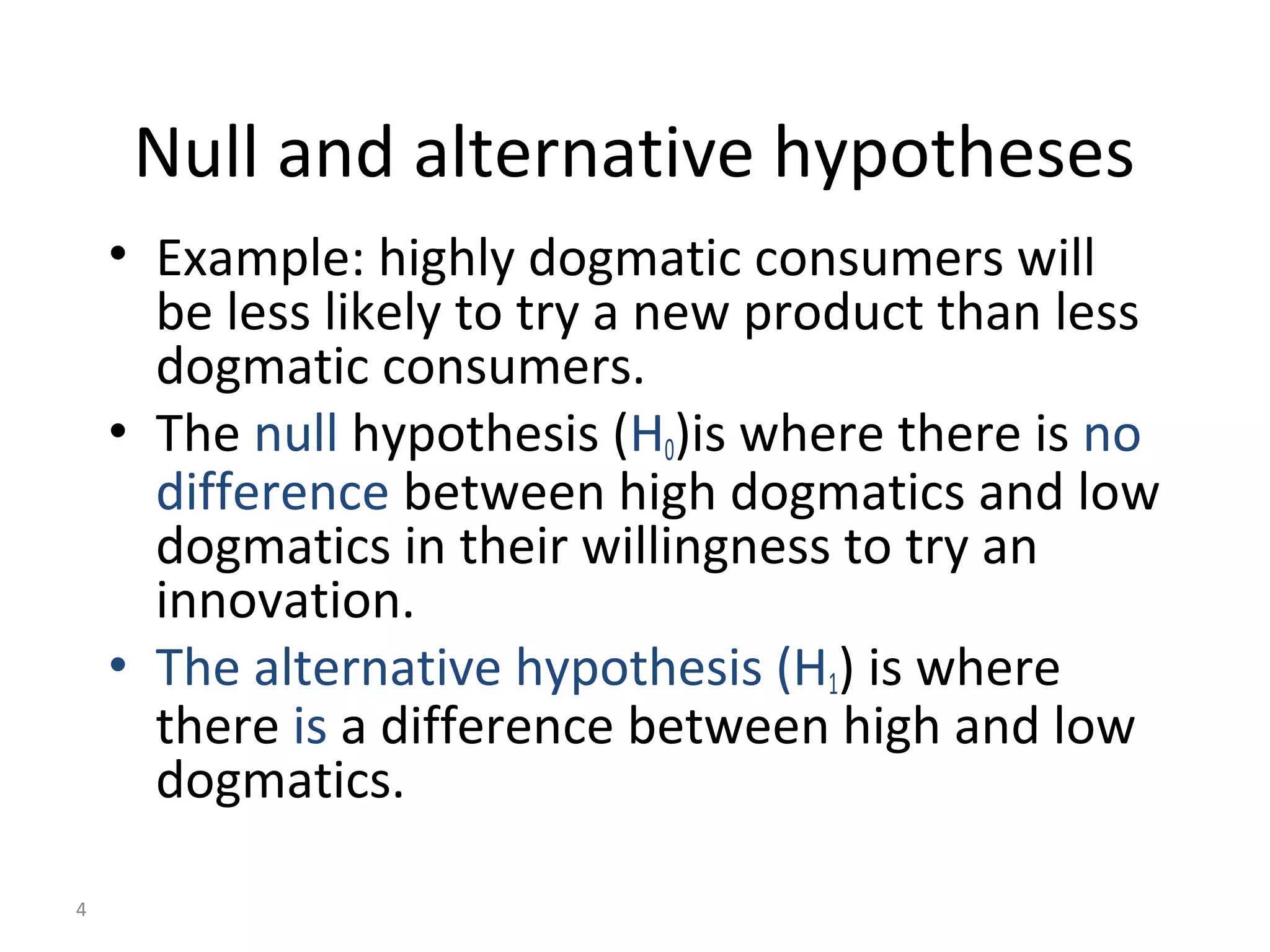
Null and alternative hypotheses
    • Example: highly dogmatic consumers will
      be less likely to try a new product than less
      dogmatic consumers.
    • The null hypothesis (H0)is where there is no
      difference between high dogmatics and low
      dogmatics in their willingness to try an
      innovation.
    • The alternative hypothesis (H1) is where
      there is a difference between high and low
      dogmatics.

4
Hypothesis testing


• The purpose of hypothesis testing is
  to determine which of the two
  hypotheses is correct.

                                         5
The hypothesis–testing procedure
    • The process is as follows:
      – Determine a statistical hypothesis.
      – Imagine what sampling distribution would be if
        this is a true statement.
      – Take an actual sample and calculate sample
        mean.
      – Determine if the deviation between the
        obtained value and expected value of sample
        mean could have occurred by chance alone.
      – Set a standard for determining if we reject the
        null or accept the alternative.
6
The hypothesis–testing procedure
    • Significance level is the critical probability
      in choosing between the null and
      alternative hypotheses.
       – The probability level that is too low to warrant
         support of the null hypothesis.
    • Assuming the null is true, if the probability
      of occurrence of the observed data is
      smaller than the significance level, then the
      data suggest that the null should be
      rejected.
       – Evidence supporting contradiction of null.

7
Type I and type II errors
    • Since hypothesis testing is based on
      probability theory, the researcher cannot
      be completely certain and runs the risk of
      committing two types of errors.
      – Type I error is an error caused by rejecting the
        null hypothesis when it is true.
         • Probability of alpha (α)
      – Type II error is an error caused by failing to
        reject the null hypothesis when the alternative
        hypothesis is true.
         • Probability of beta (β)
8
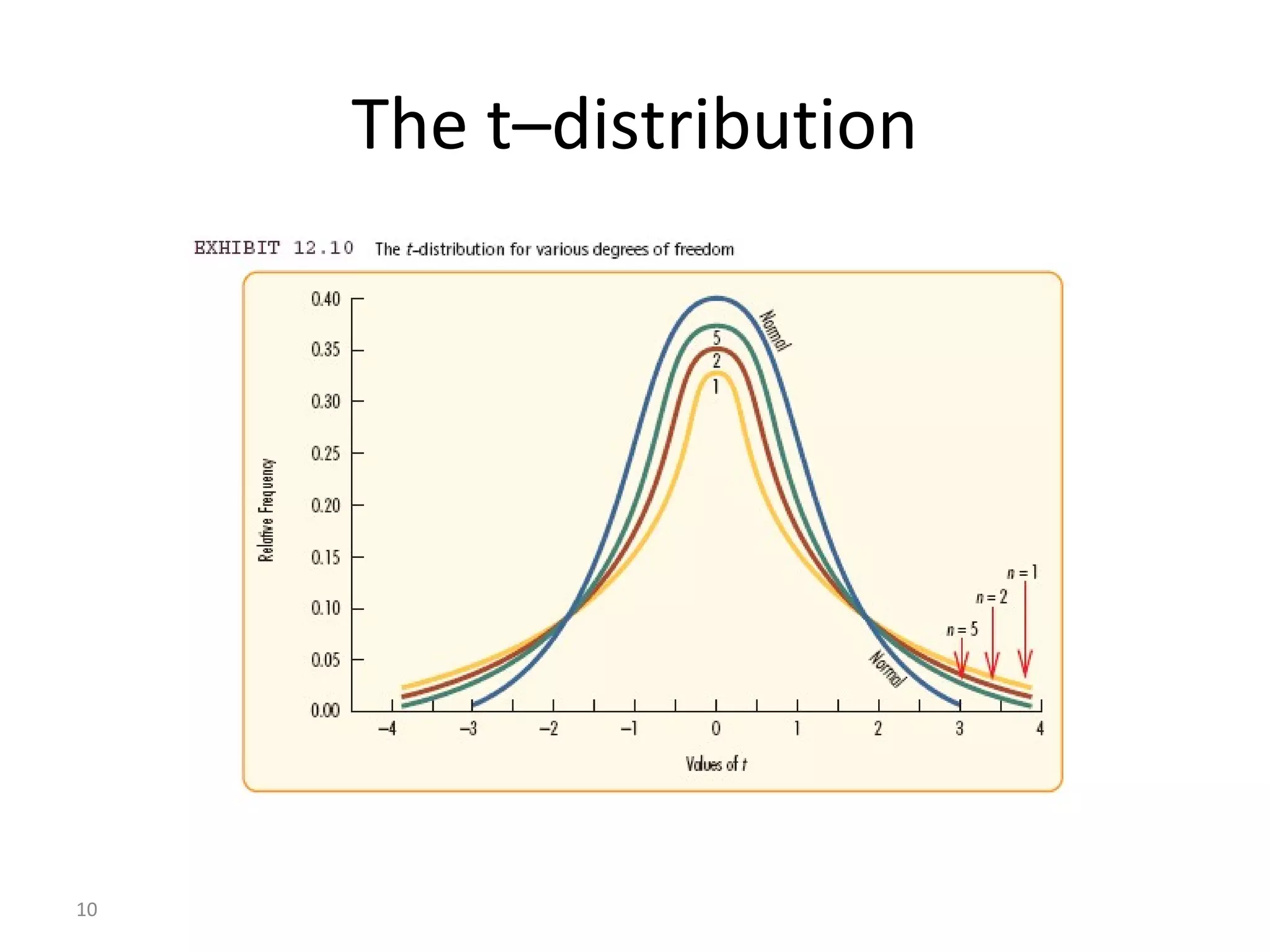
The t–distribution
    • The t-distribution is a symmetrical, bell–
      shaped distribution that is contingent on
      sample size.
      – It has a mean of zero and a standard deviation
        equal to one.
    • The shape of the t–distribution is
      influenced by its degrees of freedom.
      – Number of observations minus number of
        constraints or assumptions.
      – For sample sizes over 30, t–distribution closely
        approximates Z–distribution.

9
The t–distribution


10
Univariate hypothesis test using the t–
                       distribution
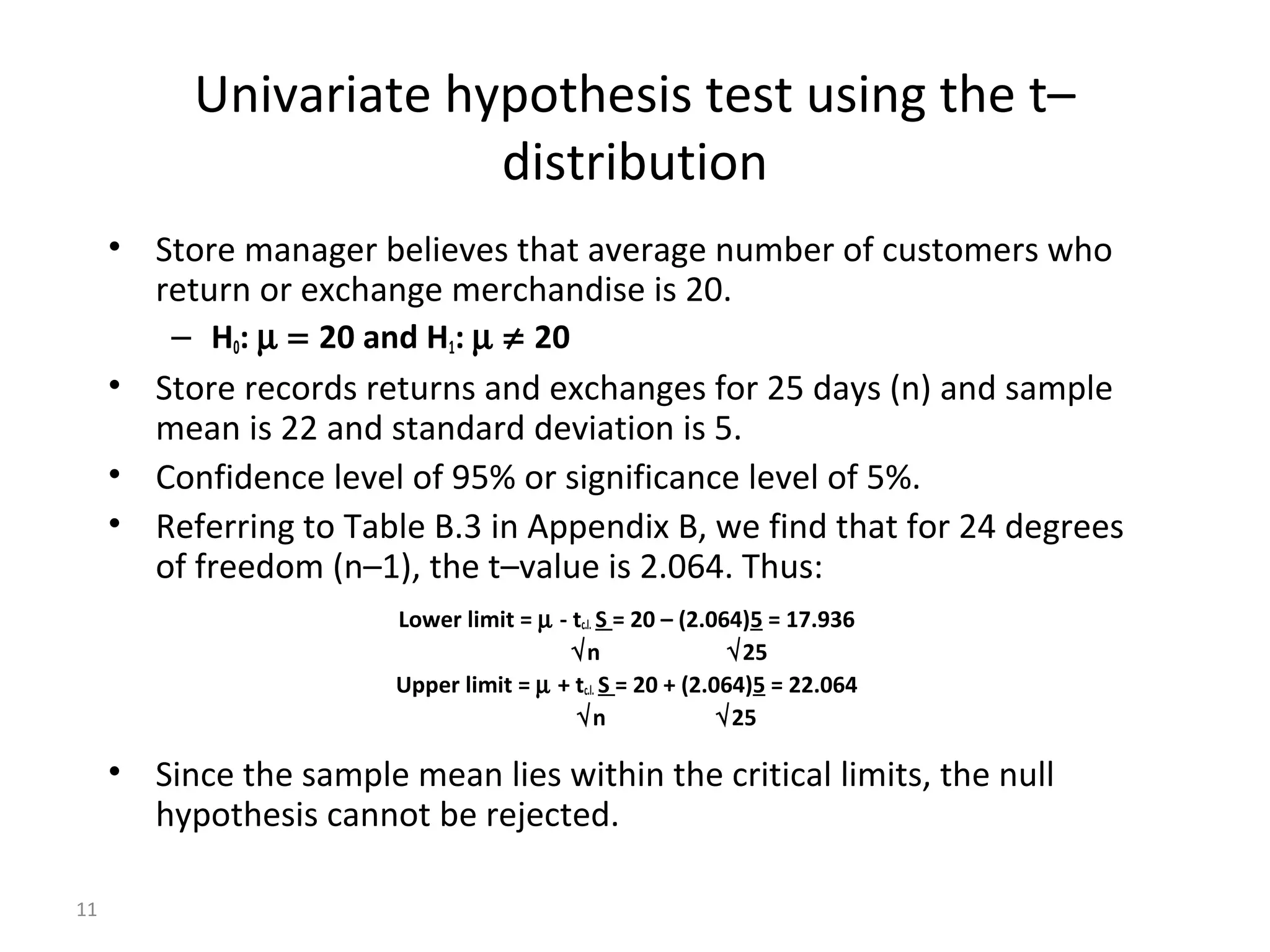
     • Store manager believes that average number of customers who
       return or exchange merchandise is 20.
        – H0: µ = 20 and H1: µ ≠ 20
     • Store records returns and exchanges for 25 days (n) and sample
       mean is 22 and standard deviation is 5.
     • Confidence level of 95% or significance level of 5%.
     • Referring to Table B.3 in Appendix B, we find that for 24 degrees
       of freedom (n–1), the t–value is 2.064. Thus:
                        Lower limit = µ - tc.l. S = 20 – (2.064)5 = 17.936
                                          √n                  √25
                        Upper limit = µ + tc.l. S = 20 + (2.064)5 = 22.064
                                          √n                 √25

     • Since the sample mean lies within the critical limits, the null
       hypothesis cannot be rejected.

11
Univariate hypothesis test using the t–
             distribution
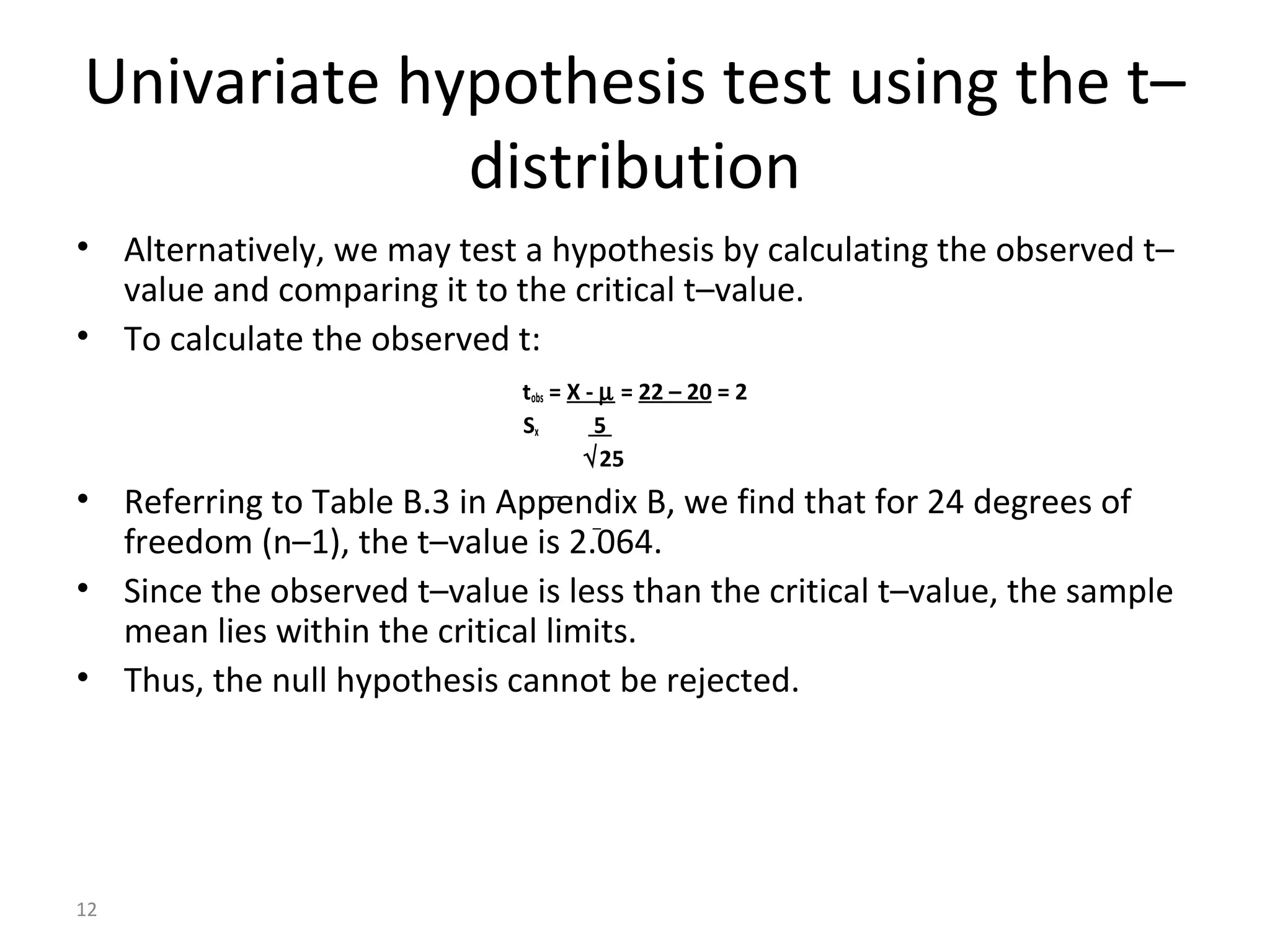
• Alternatively, we may test a hypothesis by calculating the observed t–
  value and comparing it to the critical t–value.
• To calculate the observed t:
                              tobs = X - µ = 22 – 20 = 2
                              Sx        5
                                       √25
• Referring to Table B.3 in Appendix B, we find that for 24 degrees of
  freedom (n–1), the t–value is 2.064.
• Since the observed t–value is less than the critical t–value, the sample
  mean lies within the critical limits.
• Thus, the null hypothesis cannot be rejected.


12
The Chi-square test for
                       goodness of fit
     • The Chi-square (c2) test allows for investigation of
       statistical significance in the analysis of a frequency
       distribution.
     • Categorical data on variables like sex, education, etc.,
     • Allows us to compare the observed frequencies with the
       expected frequencies based on theoretical ideas about
       the population distribution.
     • Tests whether the data came from a certain probability
       distribution.


13
The Chi-square test for goodness of fit
     • The process is as follows:
     • Formulate the null hypothesis and determine the
       expected frequency of each answer.
     • Determine the appropriate significance level.
     • Calculate the c2 value, using the observed frequencies
       from the sample and the expected frequencies.
     • Make the statistical decision by comparing the
       calculated c2 value with the critical c2 value.


14
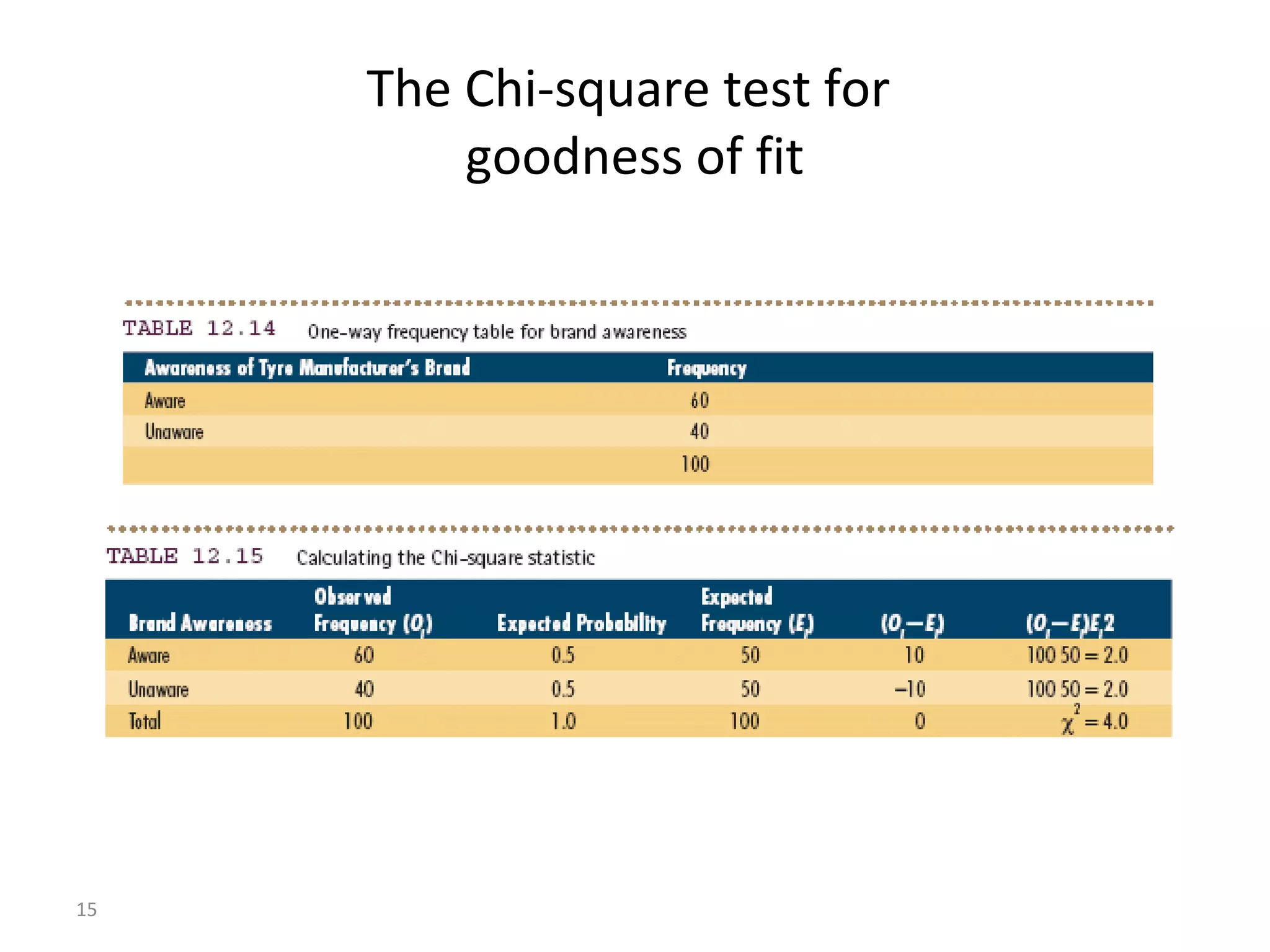
The Chi-square test for
         goodness of fit


15
The Chi-square test for goodness of fit
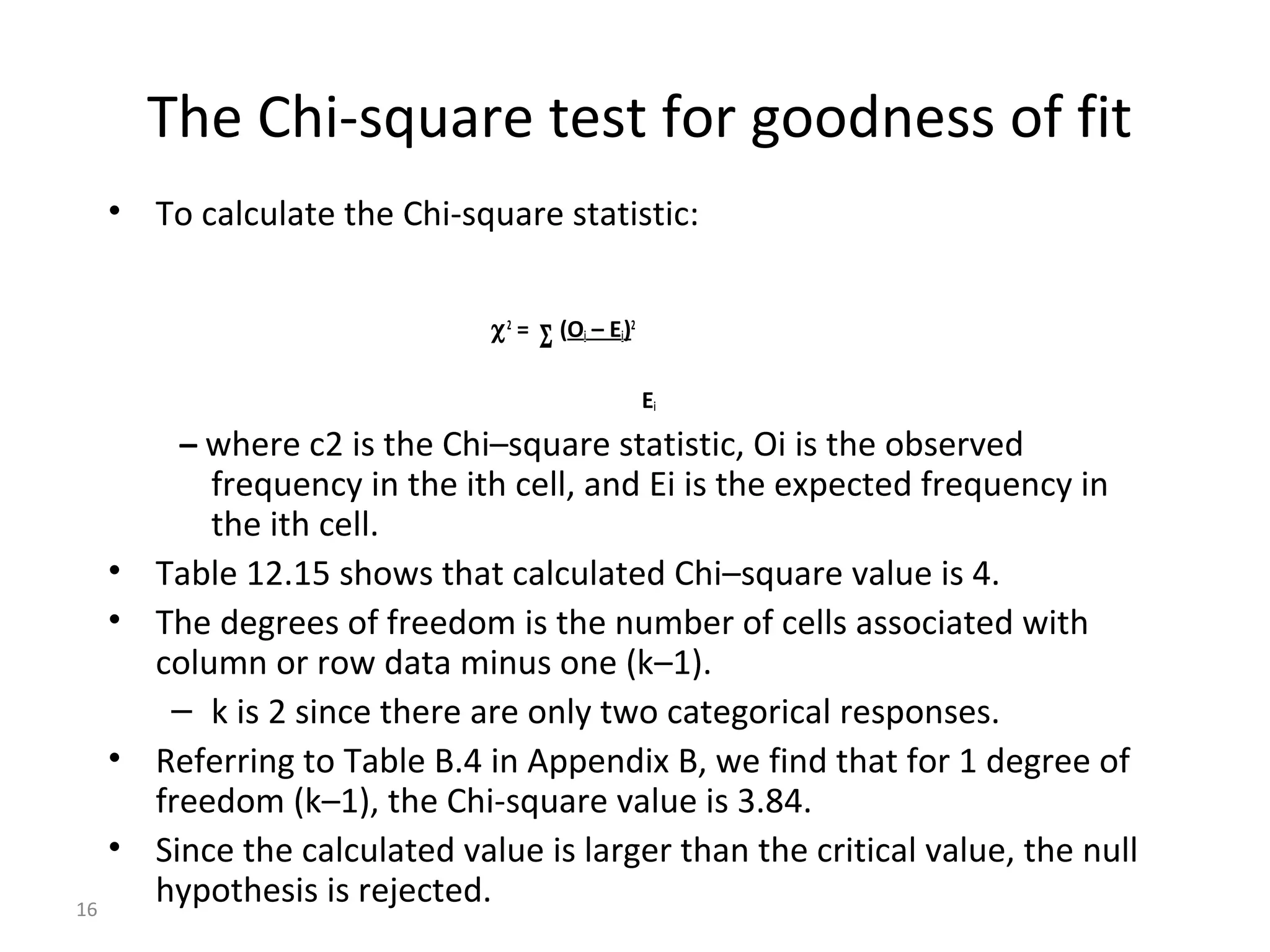
     • To calculate the Chi-square statistic:


                                χ2 =   Σ (Oi – Ei)
                                                 2


                                                     Ei
           – where c2 is the Chi–square statistic, Oi is the observed
             frequency in the ith cell, and Ei is the expected frequency in
             the ith cell.
     •   Table 12.15 shows that calculated Chi–square value is 4.
     •   The degrees of freedom is the number of cells associated with
         column or row data minus one (k–1).
          – k is 2 since there are only two categorical responses.
     •   Referring to Table B.4 in Appendix B, we find that for 1 degree of
         freedom (k–1), the Chi-square value is 3.84.
     •   Since the calculated value is larger than the critical value, the null
16
         hypothesis is rejected.
Choosing the appropriate statistical
                        technique
     • The choice of statistical analysis depends on:
        – The type of question to be answered
            • Example: researcher concerned with comparing average
              monthly sales central value would use t–test.
        – The number of variables
            • Example: researcher concerned with one variable at a time
              would use univariate statistical analysis.
        – The scale of measurement
            • Example: testing a hypothesis about a mean requires interval
              scaled or ratio scaled data.
            • Parametric versus nonparametric statistics.


17
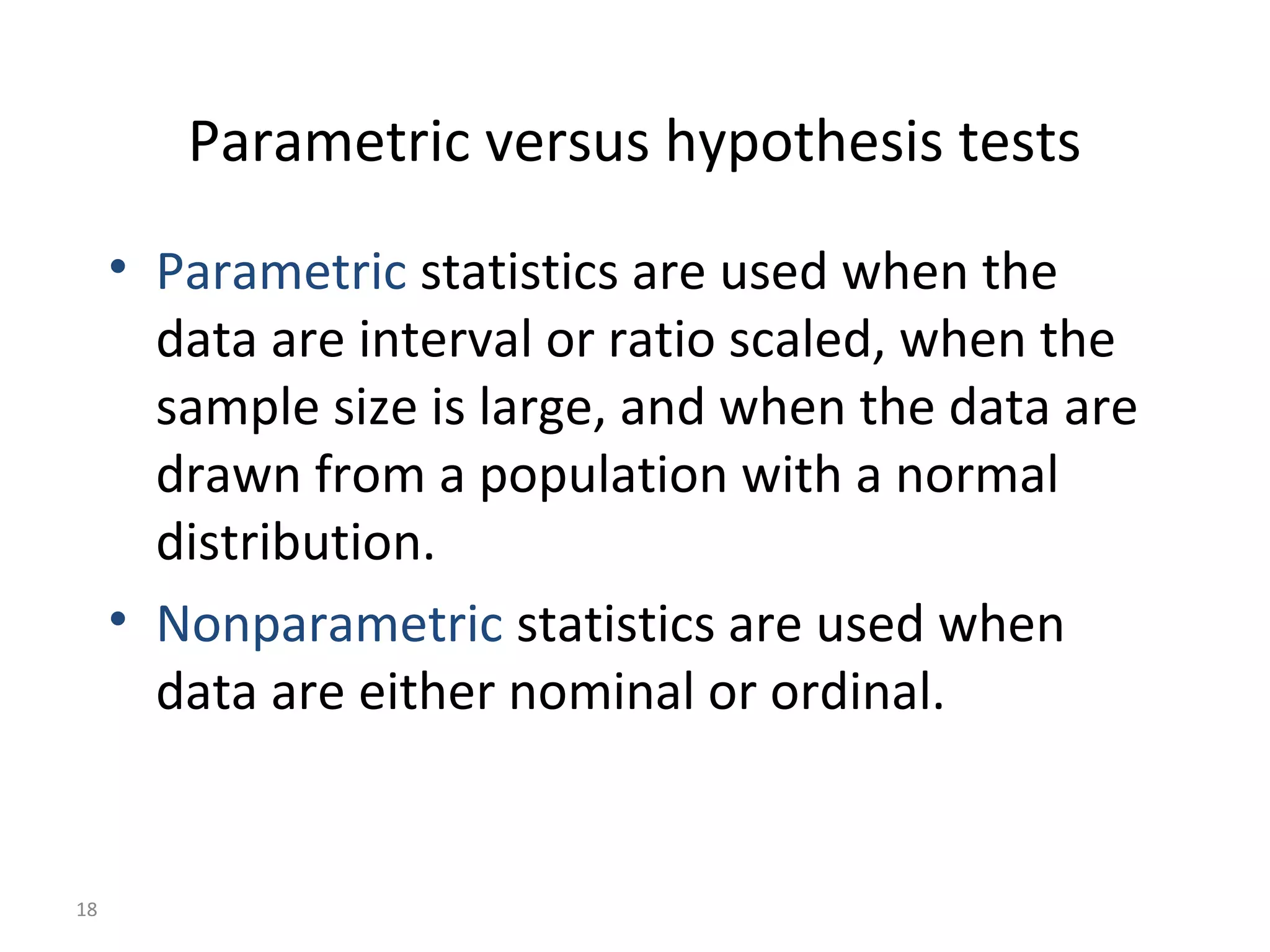
Parametric versus hypothesis tests
     • Parametric statistics are used when the
       data are interval or ratio scaled, when the
       sample size is large, and when the data are
       drawn from a population with a normal
       distribution.
     • Nonparametric statistics are used when
       data are either nominal or ordinal.


18
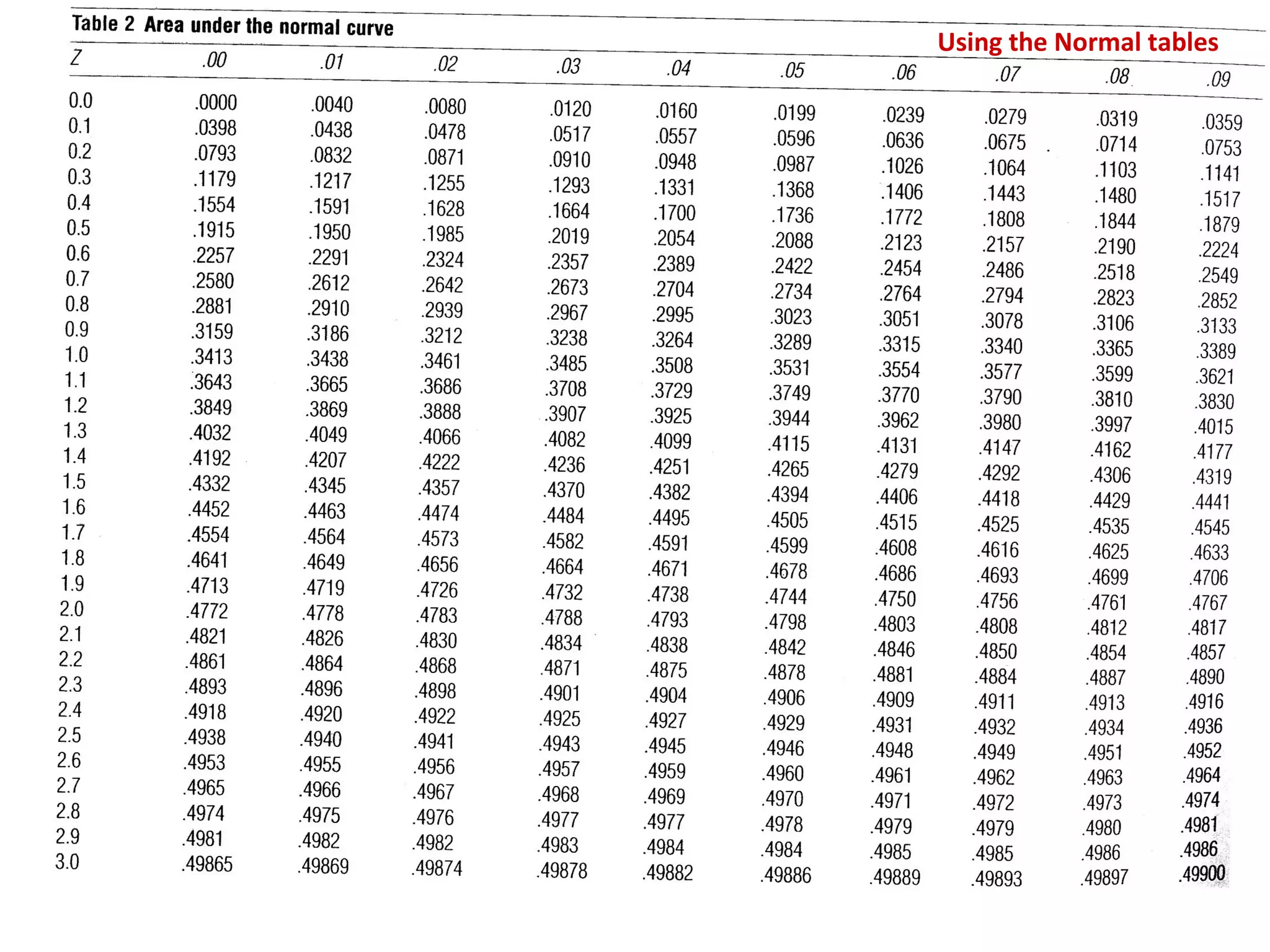
Using the Normal tables
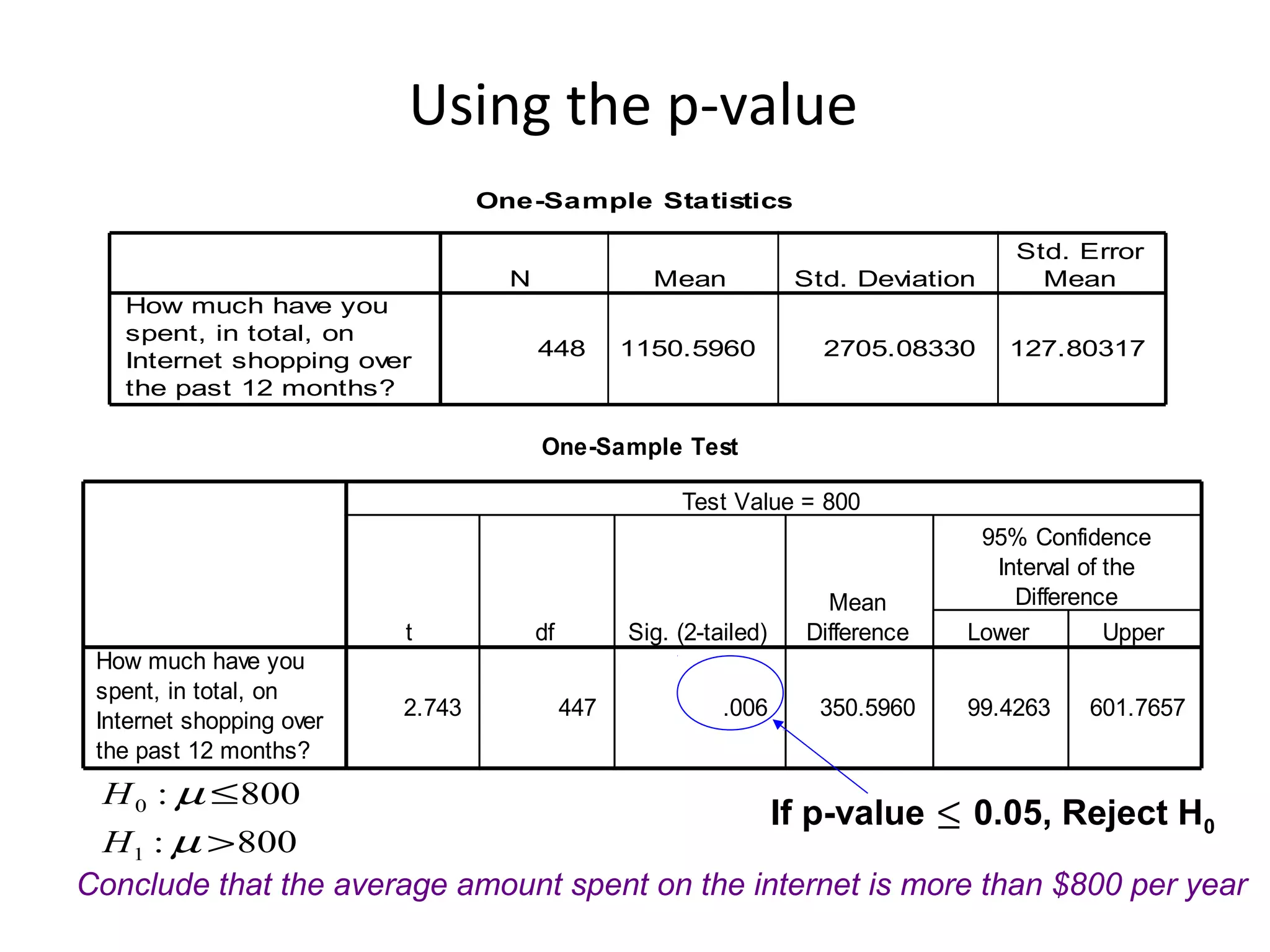
Using the p-value
                                  One-Sample Statistics

                                                                                        Std. Error
                                    N                Mean             Std. Deviation      Mean
   How much have you
   spent, in total, on
                                        448        1150.5960            2705.08330      127.80317
   Internet shopping over
   the past 12 months?

                                        One-Sample Test

                                                        Test Value = 800
                                                                                     95% Confidence
                                                                                      Interval of the
                                                                         Mean           Difference
                          t             df         Sig. (2-tailed)     Difference   Lower         Upper
 How much have you
 spent, in total, on
                          2.743              447             .006       350.5960    99.4263    601.7657
 Internet shopping over
 the past 12 months?
 H 0 : µ ≤ 800
                                                                     If p-value ≤ 0.05, Reject H0
 H 1 : µ > 800
Conclude that the average amount spent on the internet is more than $800 per year
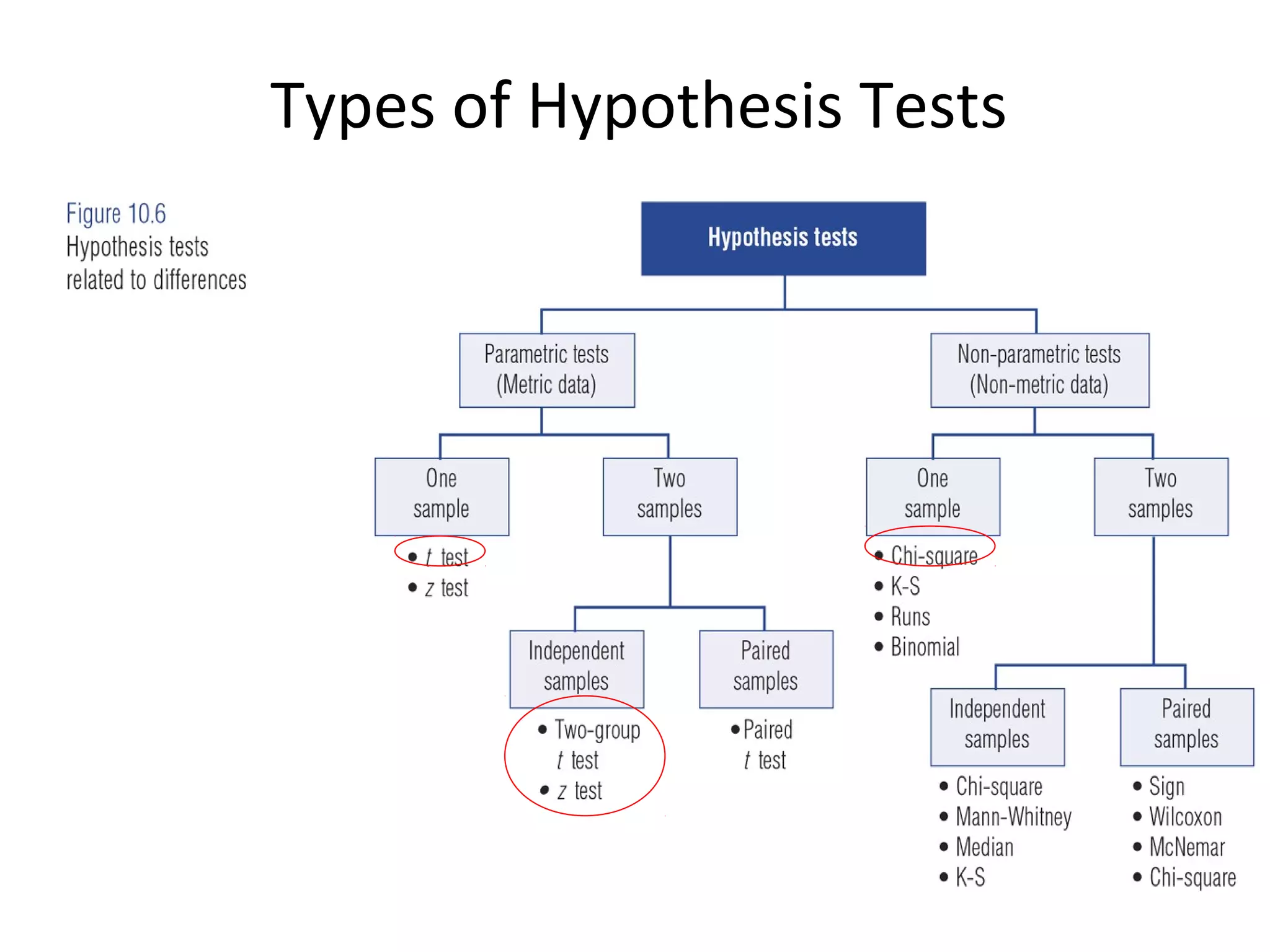
Types of Hypothesis Tests
Parametric Tests
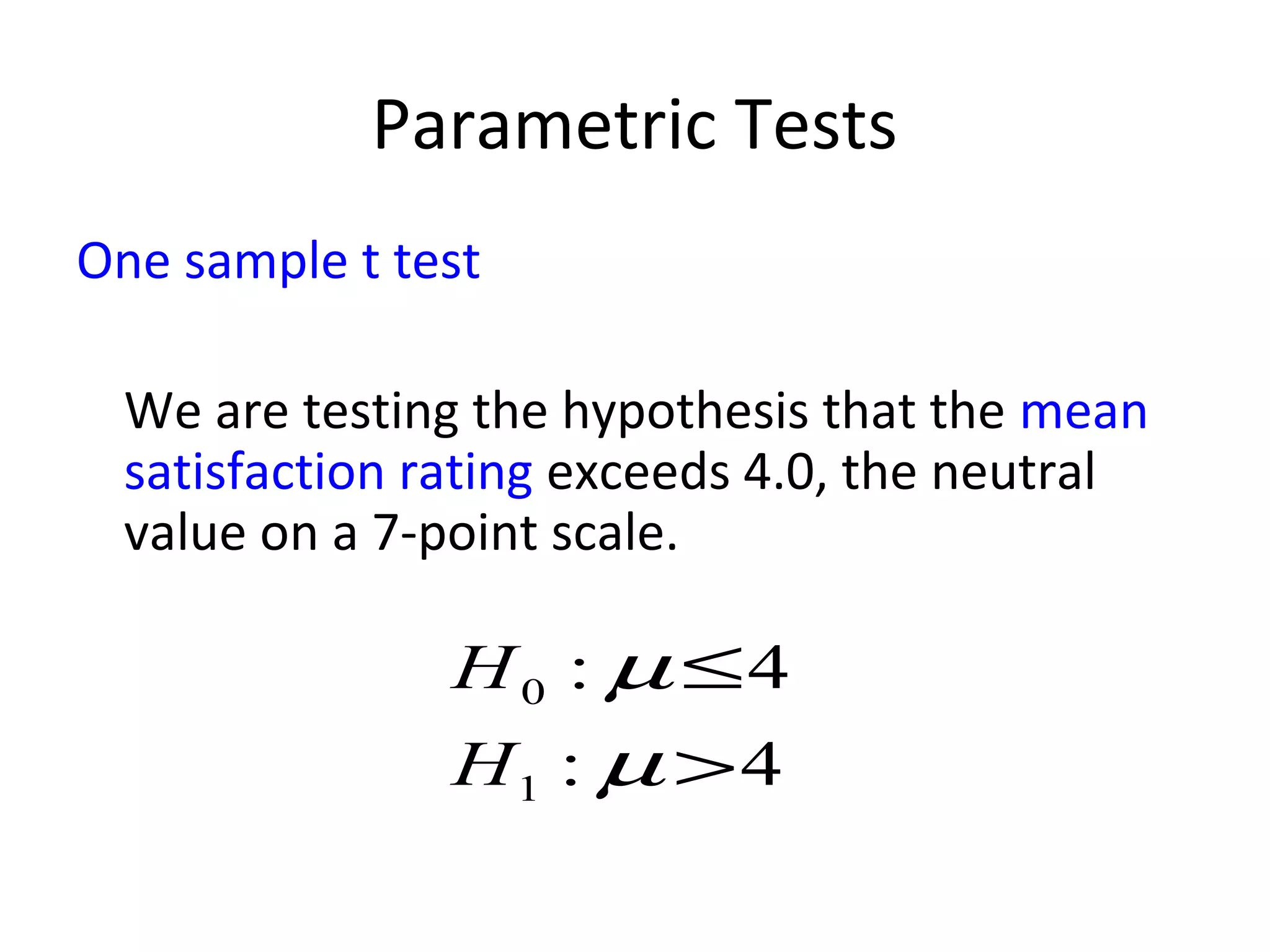
One sample t test

  We are testing the hypothesis that the mean
  satisfaction rating exceeds 4.0, the neutral
  value on a 7-point scale.

                H 0 : µ ≤4
                H1 : µ > 4
Parametric Tests cont.

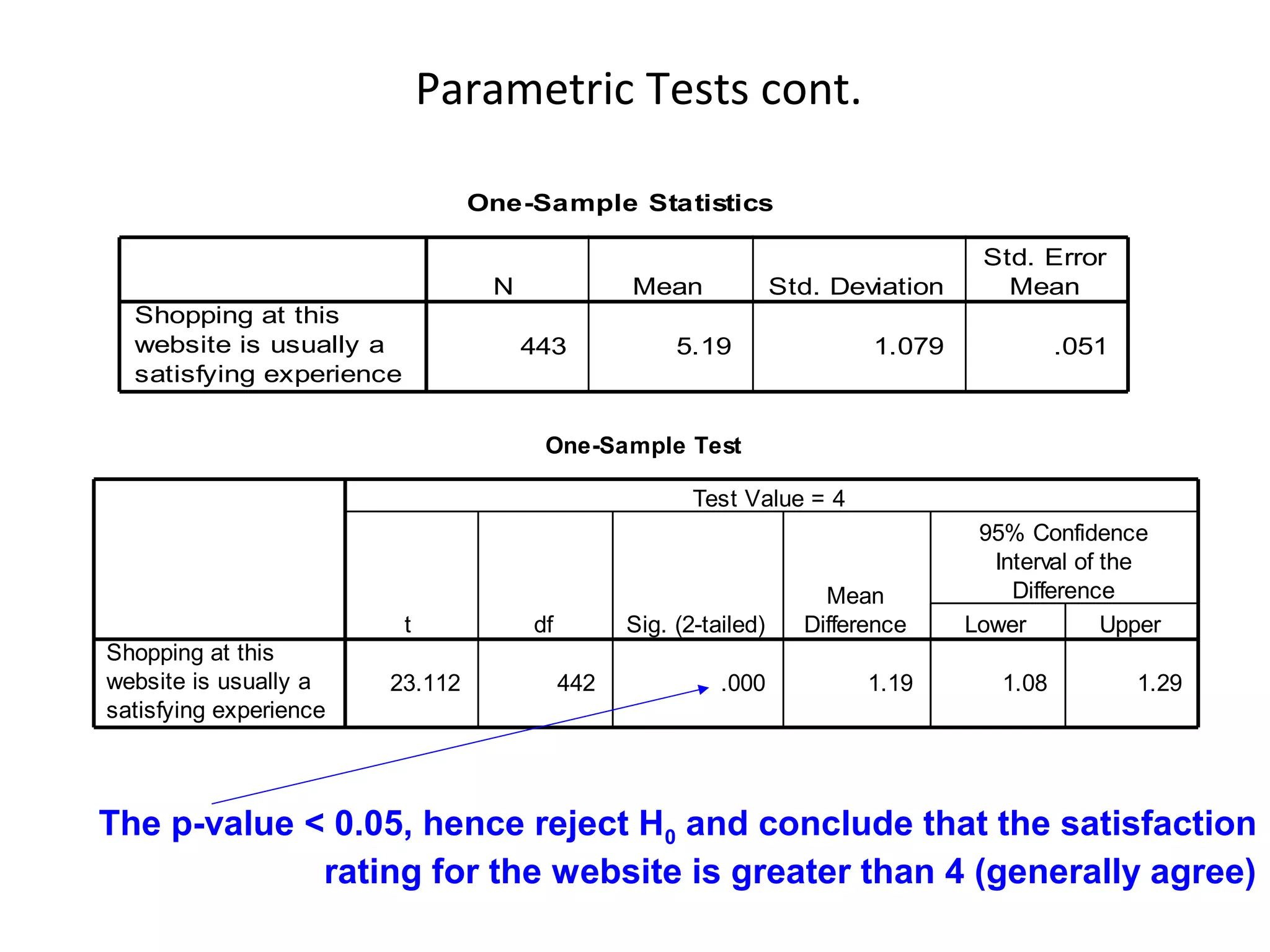
                                 One-Sample Statistics

                                                                                     Std. Error
                                  N              Mean              Std. Deviation      Mean
  Shopping at this
  website is usually a                443             5.19                 1.079              .051
  satisfying experience


                                       One-Sample Test

                                                        Test Value = 4
                                                                                     95% Confidence
                                                                                      Interval of the
                                                                       Mean             Difference
                          t           df         Sig. (2-tailed)     Difference     Lower         Upper
Shopping at this
website is usually a    23.112             442             .000            1.19        1.08          1.29
satisfying experience


The p-value < 0.05, hence reject H0 and conclude that the satisfaction
             rating for the website is greater than 4 (generally agree)
Parametric Tests cont.

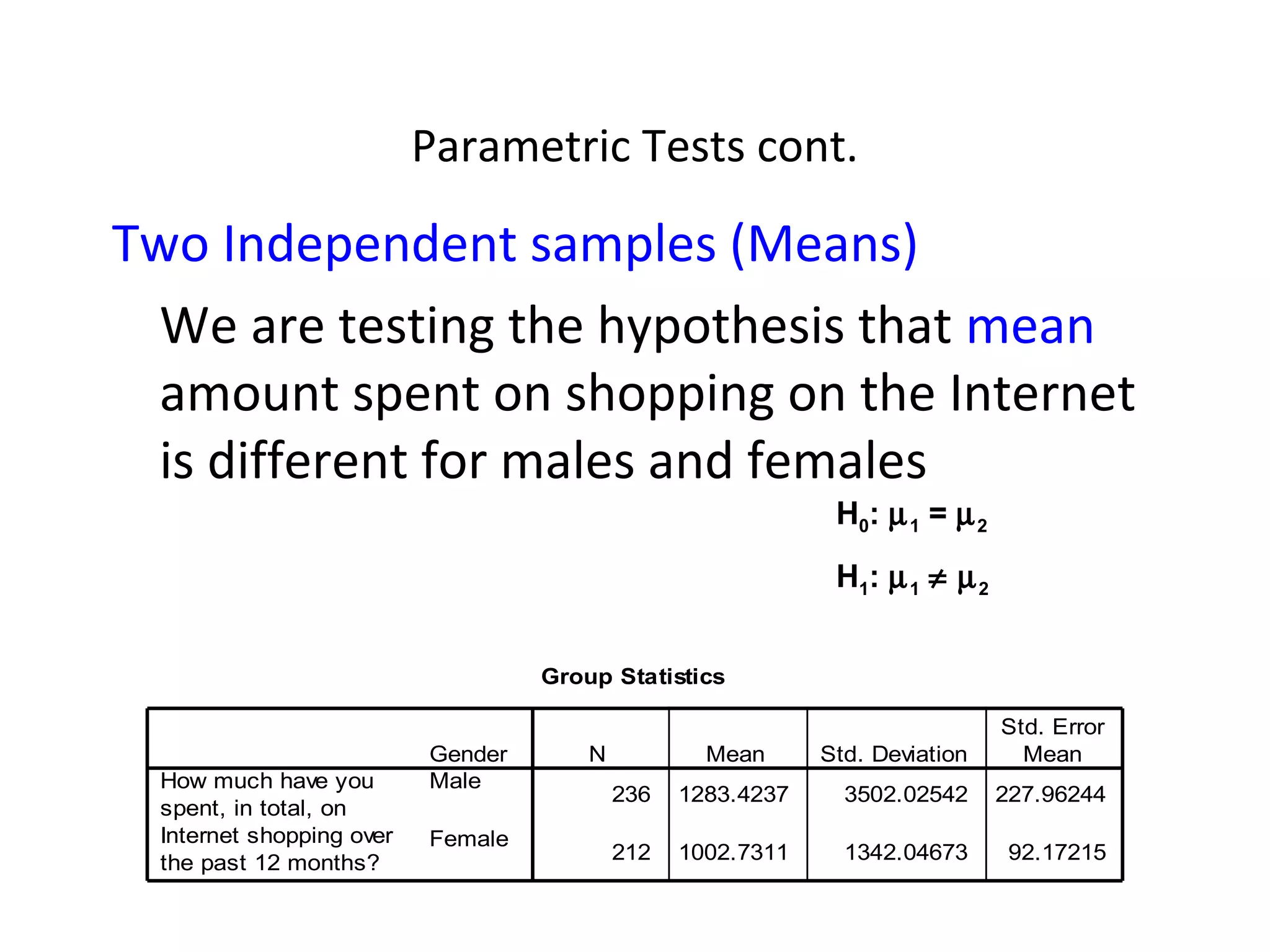
Two Independent samples (Means)
 We are testing the hypothesis that mean
 amount spent on shopping on the Internet
 is different for males and females
                                                              H0: µ 1 = µ 2
                                                              H1: µ 1 ≠ µ 2


                                   Group Statistics

                                                                              Std. Error
                          Gender       N           Mean      Std. Deviation     Mean
 How much have you        Male
                                           236   1283.4237     3502.02542     227.96244
 spent, in total, on
 Internet shopping over   Female
 the past 12 months?                       212   1002.7311     1342.04673      92.17215
Parametric Tests cont.

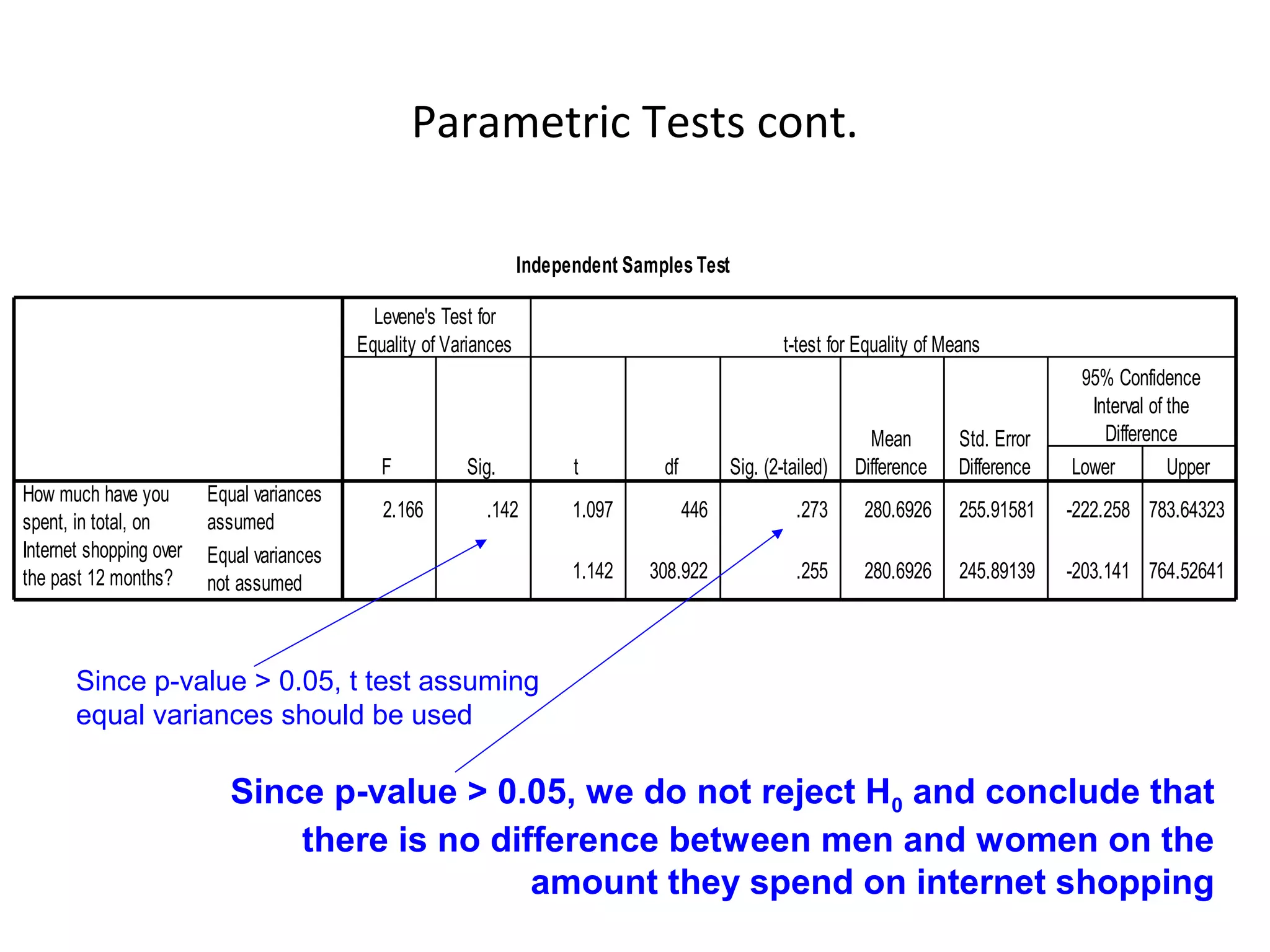
                                                                   Independent Samples Test

                                             Levene's Test for
                                           Equality of Variances                                      t-test for Equality of Means
                                                                                                                                            95% Confidence
                                                                                                                                             Interval of the
                                                                                                                  Mean        Std. Error       Difference
                                              F          Sig.            t         df         Sig. (2-tailed)   Difference    Difference   Lower         Upper
How much have you        Equal variances
                                              2.166         .142         1.097          446             .273     280.6926      255.91581   -222.258 783.64323
spent, in total, on      assumed
Internet shopping over   Equal variances
the past 12 months?                                                      1.142   308.922                .255     280.6926      245.89139   -203.141 764.52641
                         not assumed


       Since p-value > 0.05, t test assuming
       equal variances should be used

                            Since p-value > 0.05, we do not reject H0 and conclude that
                                there is no difference between men and women on the
                                               amount they spend on internet shopping
Parametric Tests cont.
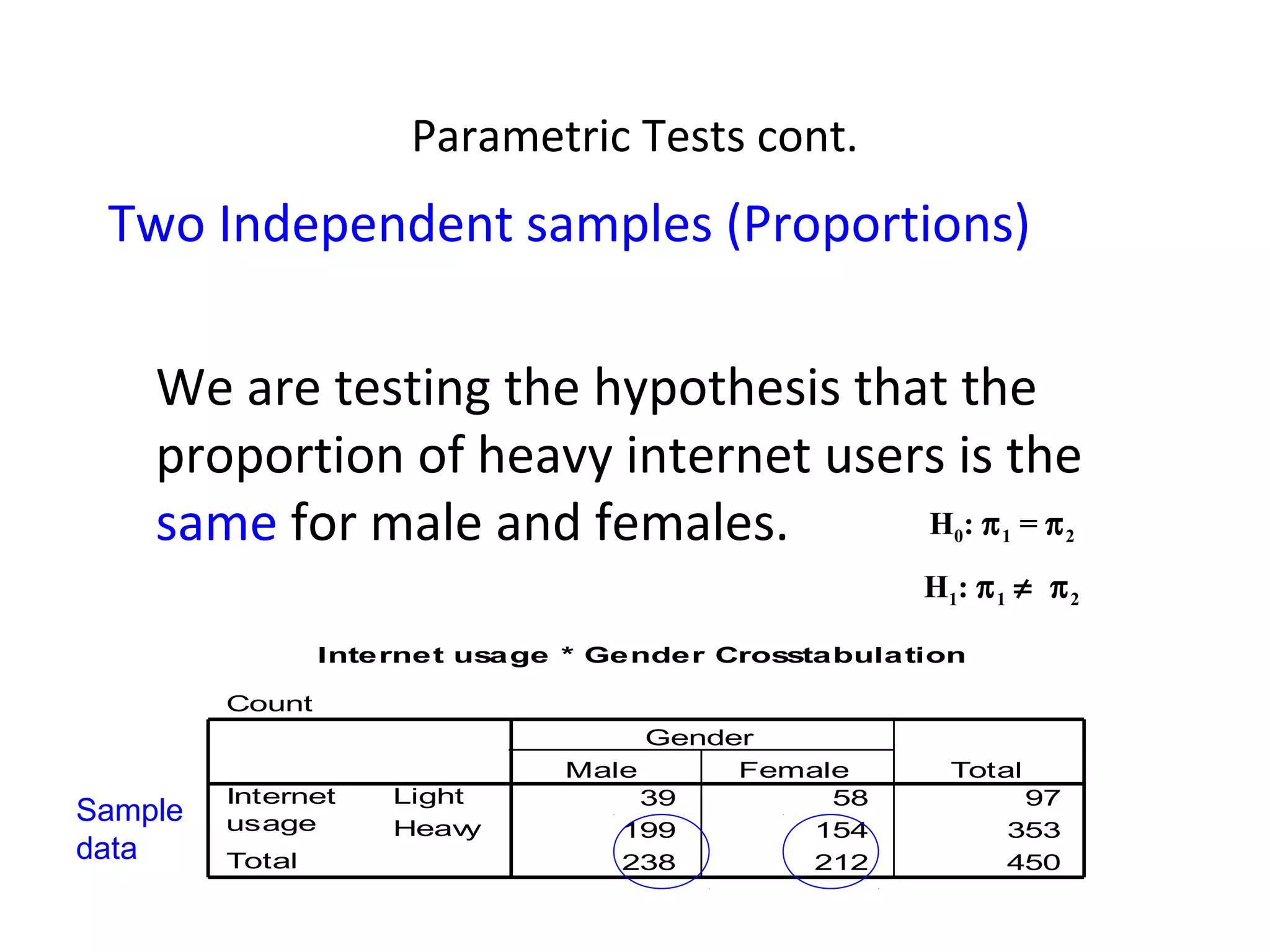
 Two Independent samples (Proportions)

    We are testing the hypothesis that the
    proportion of heavy internet users is the
    same for male and females.       H:π =π             0   1     2


                                                      H1: π 1 ≠ π 2

                 Internet usage * Gender Crosstabula tion

         Count
                                     Gender
                                Male      Female        Total
         Internet    Light           39        58            97
Sample   usage       Heavy         199       154            353
data     Total                     238       212            450
Parametric Tests cont.

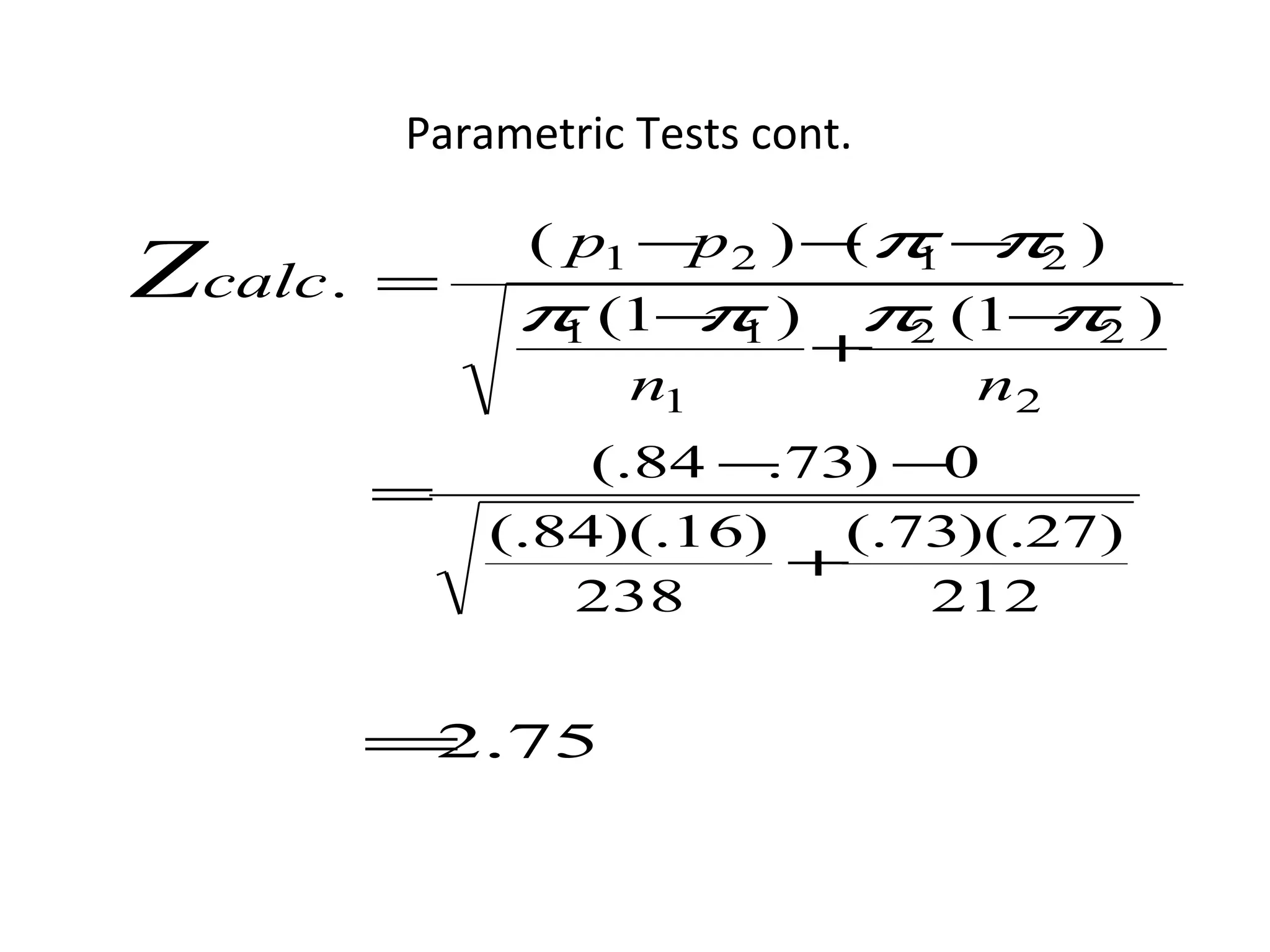
              ( p1 −p 2 ) − π − 2 )
                           ( 1 π
Zcalc.   =
              π (1− 1 ) π2 (1− 2 )
                     π            π
                1
                          +
                  n1           n2
                 (.84 − 73) −
                       .      0
         =
             (.84)(.16)   (.73)(.27)
                         +
                238          212


         = .75
          2
Parametric Tests cont.


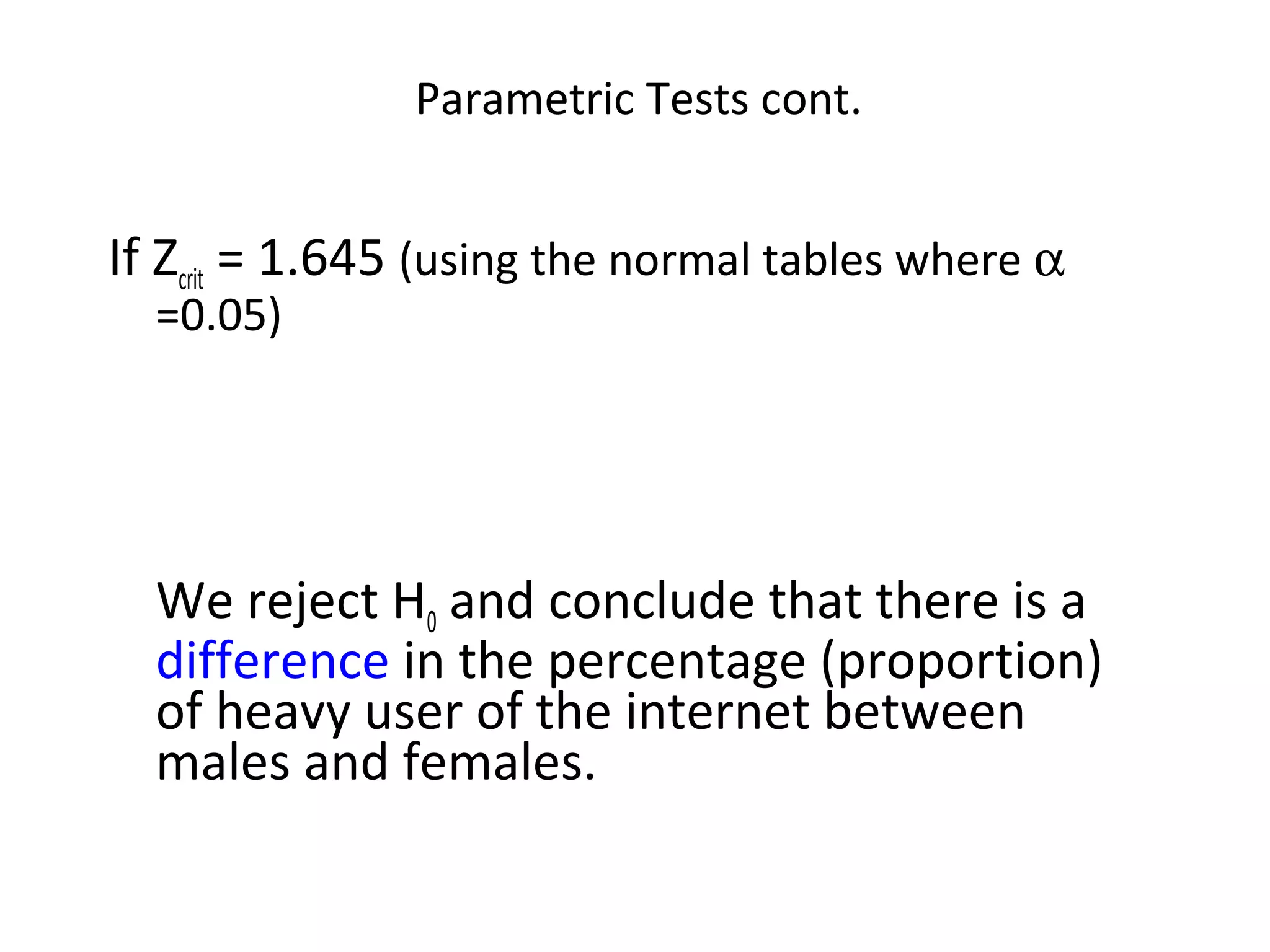
If Zcrit = 1.645 (using the normal tables where α
  =0.05)


  We reject H0 and conclude that there is a
  difference in the percentage (proportion)
  of heavy user of the internet between
  males and females.
Non-Parametric Tests
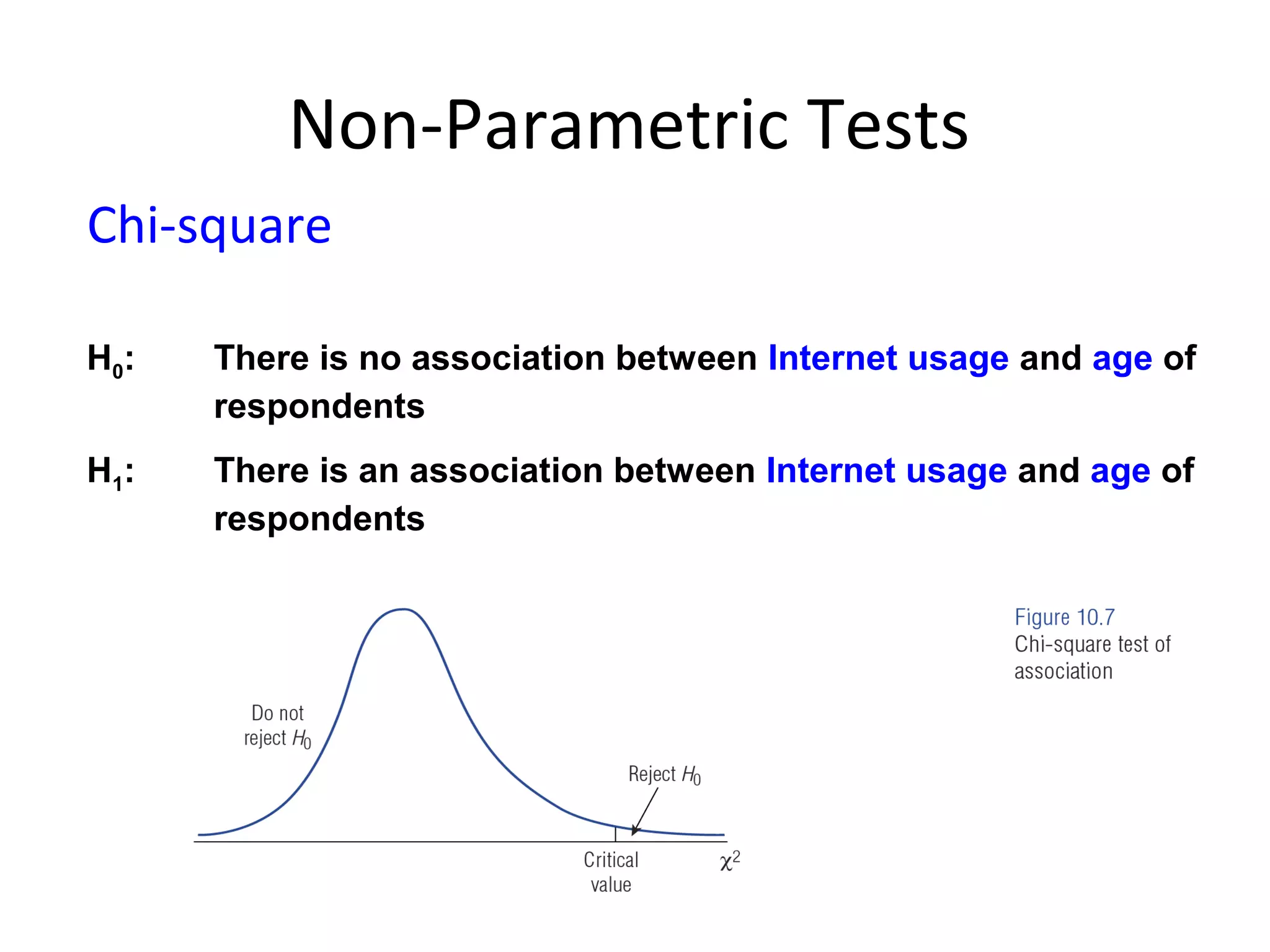
Chi-square

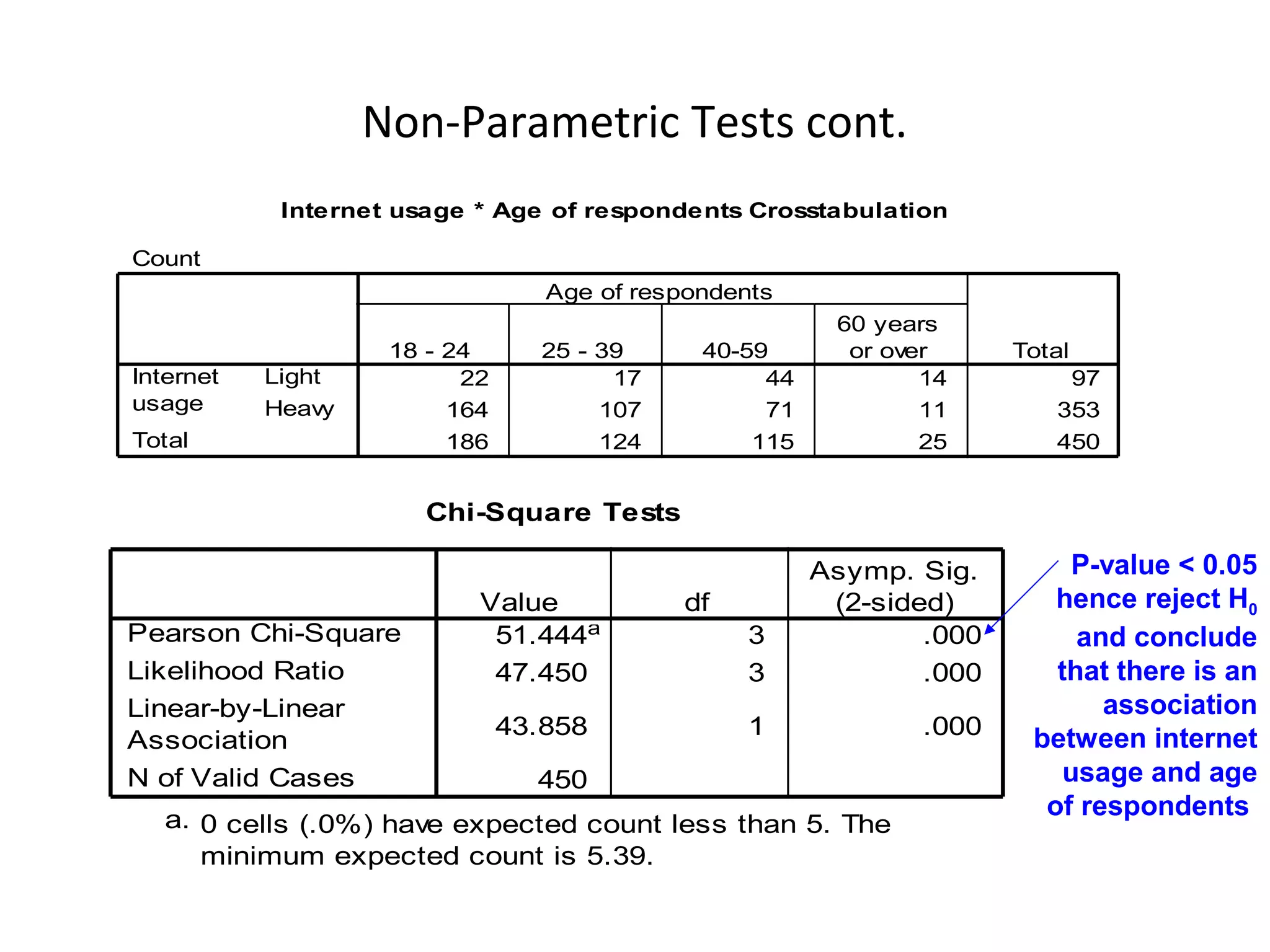
H0:   There is no association between Internet usage and age of
      respondents
H1:   There is an association between Internet usage and age of
      respondents
Non-Parametric Tests cont.
            Internet usage * Age of respondents Crosstabulation

Count
                                  Age of respondents
                                                         60 years
                    18 - 24      25 - 39      40-59       or over      Total
Internet   Light          22           17          44           14         97
usage      Heavy         164          107          71           11        353
Total                    186          124         115           25        450


                       Chi-Square Tests

                                                        Asymp. Sig.         P-value < 0.05
                           Value            df           (2-sided)        hence reject H0
Pearson Chi-Square          51.444a               3             .000        and conclude
Likelihood Ratio            47.450                3             .000      that there is an
Linear-by-Linear                                                              association
                               43.858             1            .000     between internet
Association
N of Valid Cases                 450                                       usage and age
   a. 0 cells (.0%) have expected count less than 5. The
                                                                         of respondents
      minimum expected count is 5.39.
Non-Parametric Tests cont.
 Chi-square (Another one!)
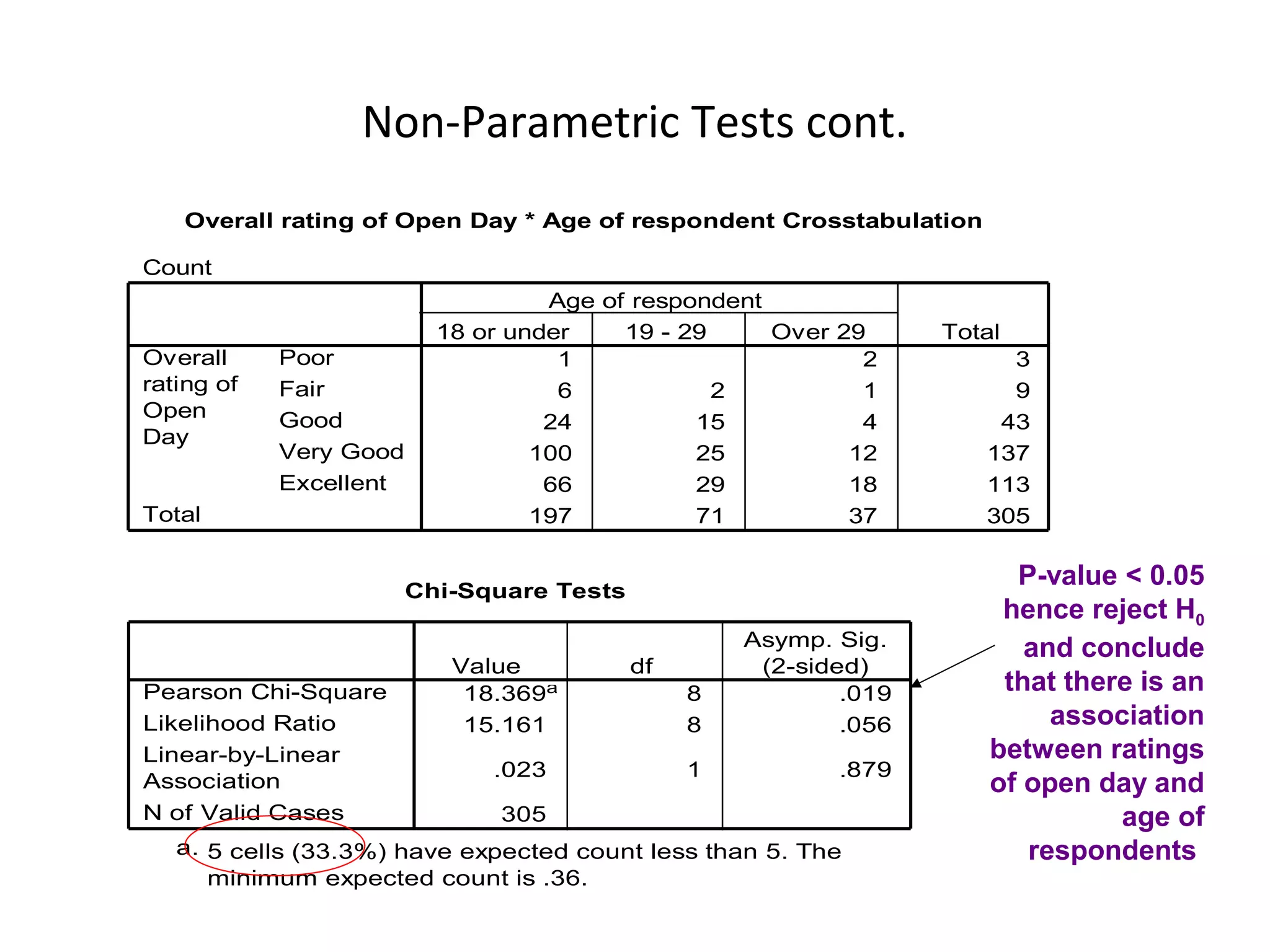
      VU’s Open Day organisers are investigating whether visitors’
      overall rating of Open Day is independent of the age of the
      visitor. Test at .05 level of significance.
H0:      Overall rating of Open Day and age are independent [no association]

H1:      Overall rating of Open Day and age are not independent [association]
Non-Parametric Tests cont.
   Overall rating of Open Day * Age of respondent Crosstabulation

Count
                                   Age of respondent
                          18 or under    19 - 29     Over 29       Total
Overall     Poor                    1                       2           3
rating of   Fair                    6            2          1           9
Open        Good                   24          15           4          43
Day
            Very Good             100          25          12         137
            Excellent              66          29          18         113
Total                             197          71          37         305


                        Chi-Square Tests
                                                                         P-value < 0.05
                                                                        hence reject H0
                                                    Asymp. Sig.           and conclude
                           Value           df        (2-sided)
Pearson Chi-Square          18.369a             8           .019        that there is an
Likelihood Ratio            15.161              8           .056            association
Linear-by-Linear                                                       between ratings
                              .023              1          .879
Association                                                            of open day and
N of Valid Cases               305                                               age of
   a. 5 cells (33.3%) have expected count less than 5. The                respondents
      minimum expected count is .36.
Chapter 13
     Bivariate statistical analysis: Tests
     of differences


33
What is the appropriate test of
               difference?
• Do two groups differ with respect to some behaviour,
  characteristic, or attitude?
   – For example, are there differences in muscle gain
     between subjects in the experimental exposed to
     muscle supplements and control group?
   – Two different variables.
• Comparisons between two independent groups is
  independent samples t–test for difference of means.


34
The independent samples t–test for
            differences of means
     • Used to test a hypothesis stating that the means
       scores on a variable will be significantly different from
       two independent samples.
     • Can only take the mean of an interval or ratio–scaled
       variable.
        – The other variable is nominal scaled with two
          groups.
     • Example: frequency of purchase between gender
       groups.


35
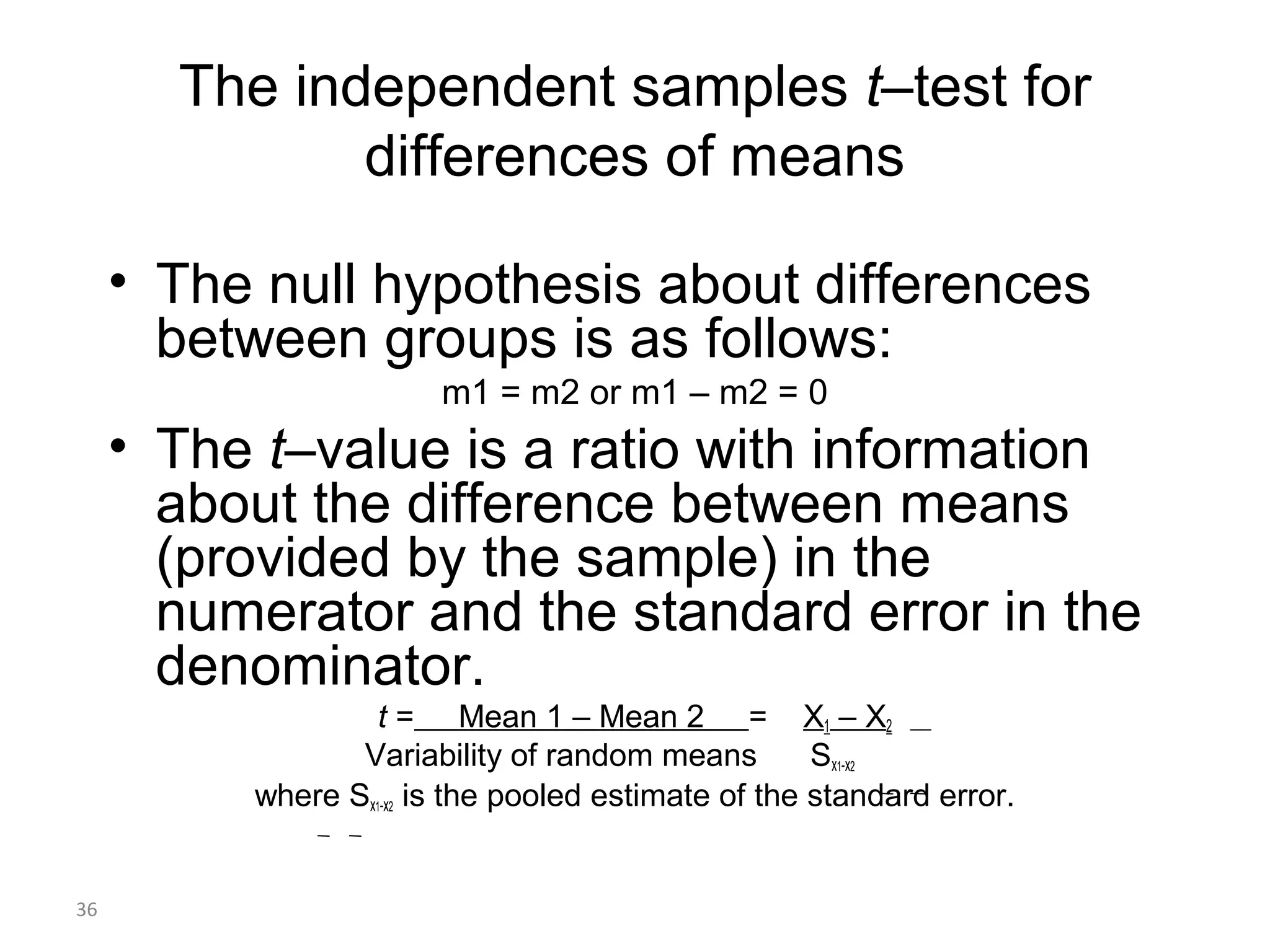
The independent samples t–test for
              differences of means

     • The null hypothesis about differences
       between groups is as follows:
                        m1 = m2 or m1 – m2 = 0
     • The t–value is a ratio with information
       about the difference between means
       (provided by the sample) in the
       numerator and the standard error in the
       denominator.
                   t = Mean 1 – Mean 2 = X1 – X2
                 Variability of random means         Sx1-x2
          where Sx1-x2 is the pooled estimate of the standard error.


36
The independent samples t–test for
                differences of means


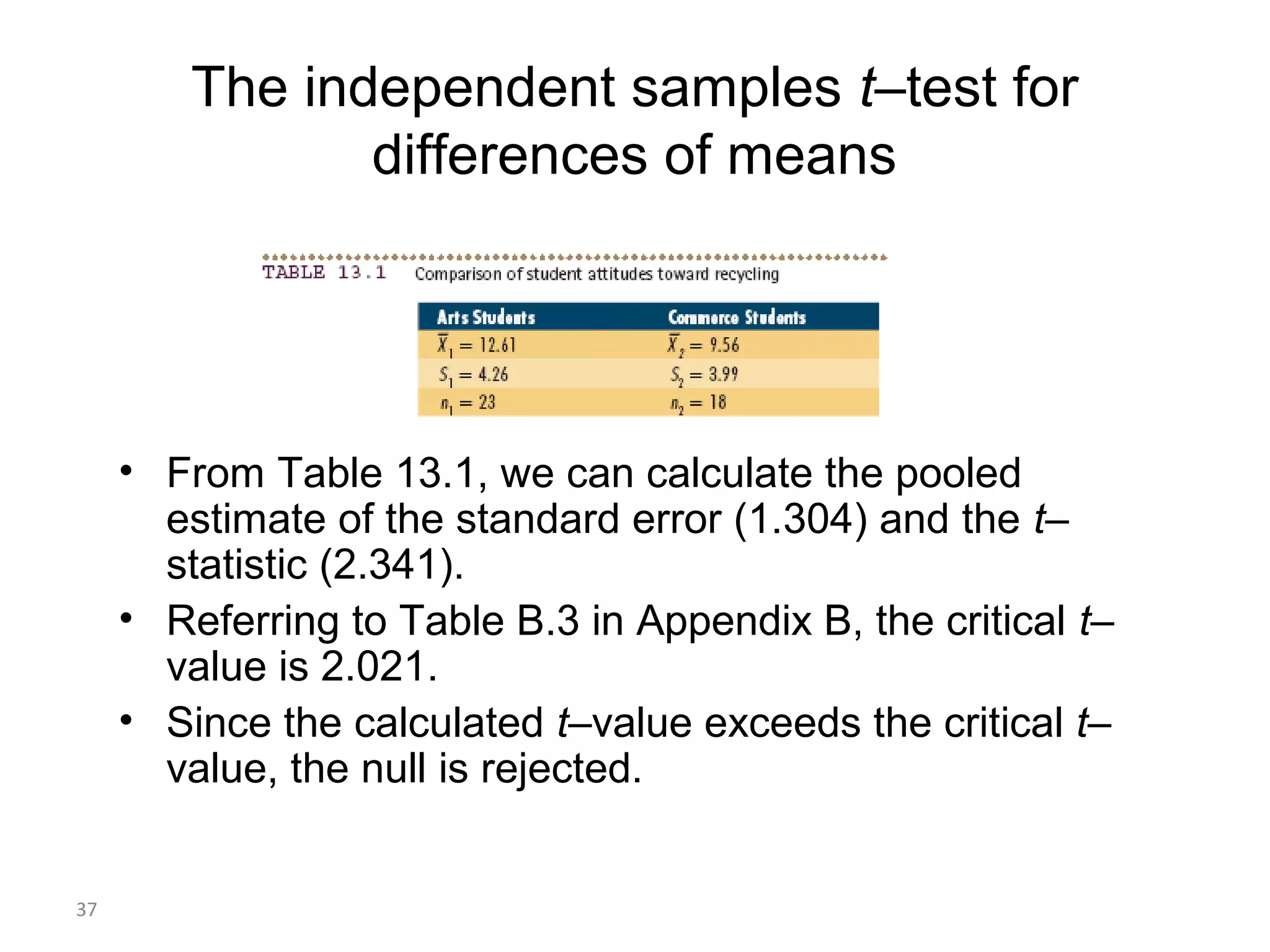
     • From Table 13.1, we can calculate the pooled
       estimate of the standard error (1.304) and the t–
       statistic (2.341).
     • Referring to Table B.3 in Appendix B, the critical t–
       value is 2.021.
     • Since the calculated t–value exceeds the critical t–
       value, the null is rejected.


37
Conducting an independent
         samples t-test in SPSS
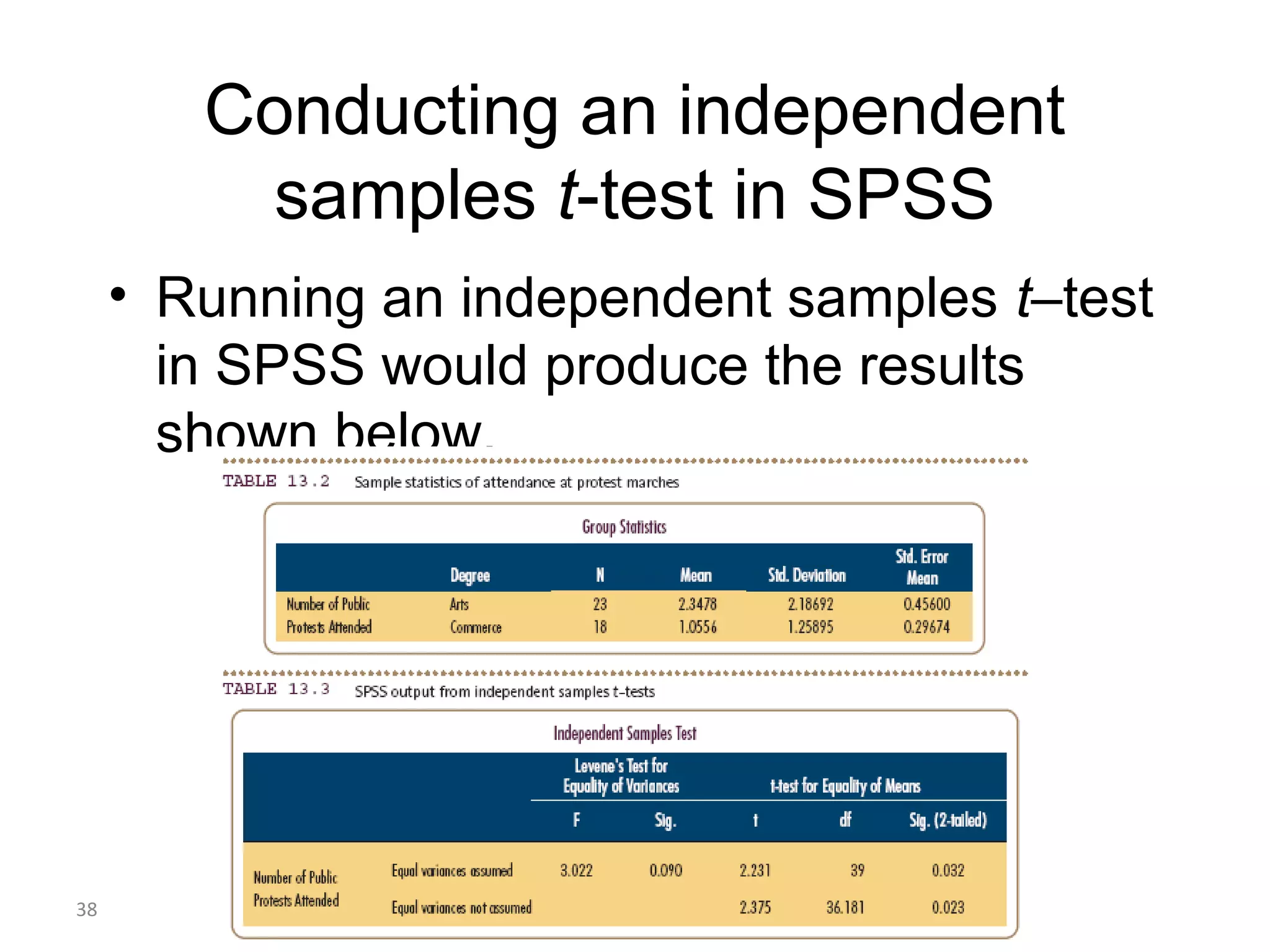
     • Running an independent samples t–test
       in SPSS would produce the results
       shown below.


38
Conducting an independent
           samples t-test in SPSS
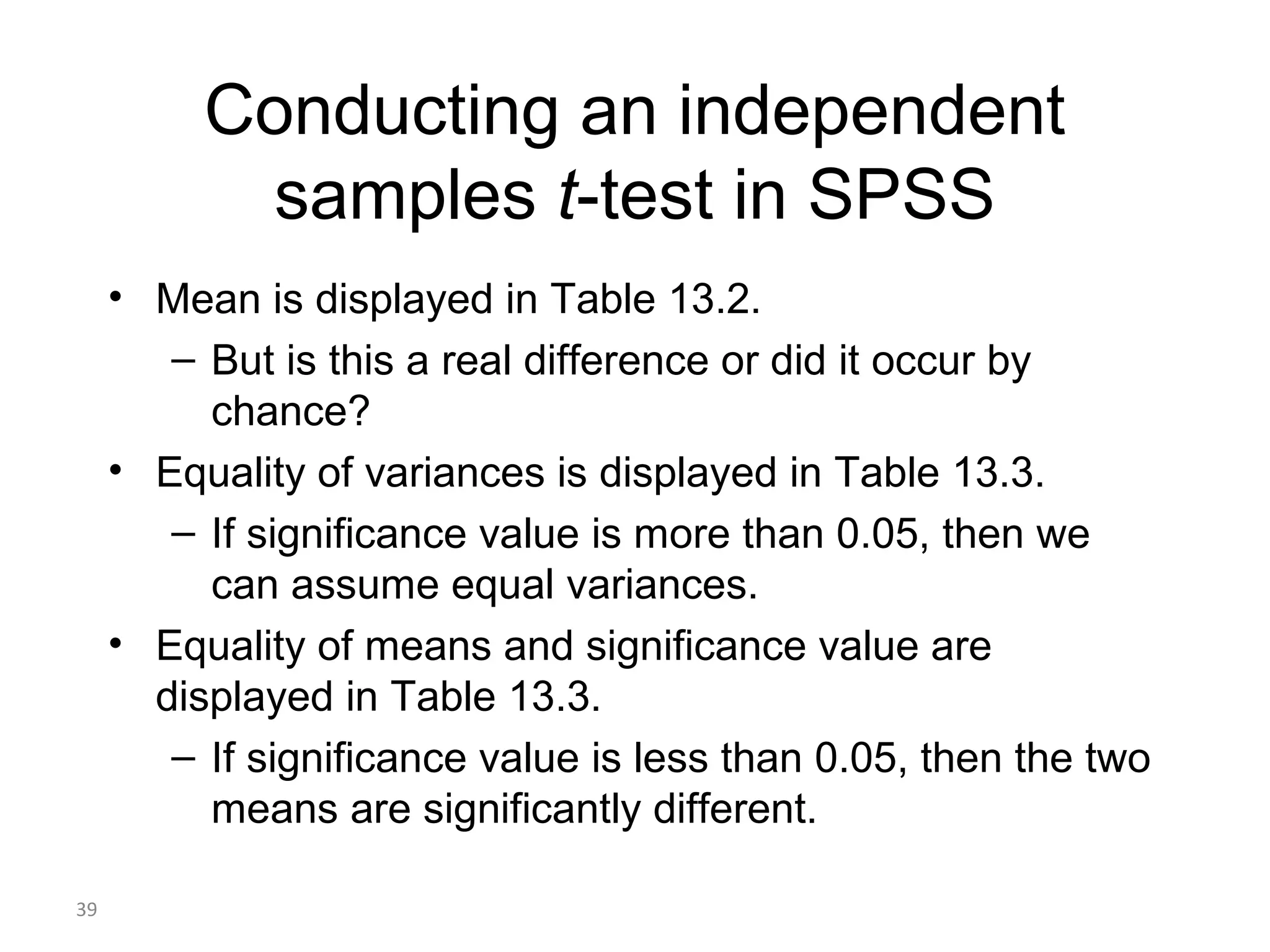
     • Mean is displayed in Table 13.2.
        – But is this a real difference or did it occur by
          chance?
     • Equality of variances is displayed in Table 13.3.
        – If significance value is more than 0.05, then we
          can assume equal variances.
     • Equality of means and significance value are
       displayed in Table 13.3.
        – If significance value is less than 0.05, then the two
          means are significantly different.

39
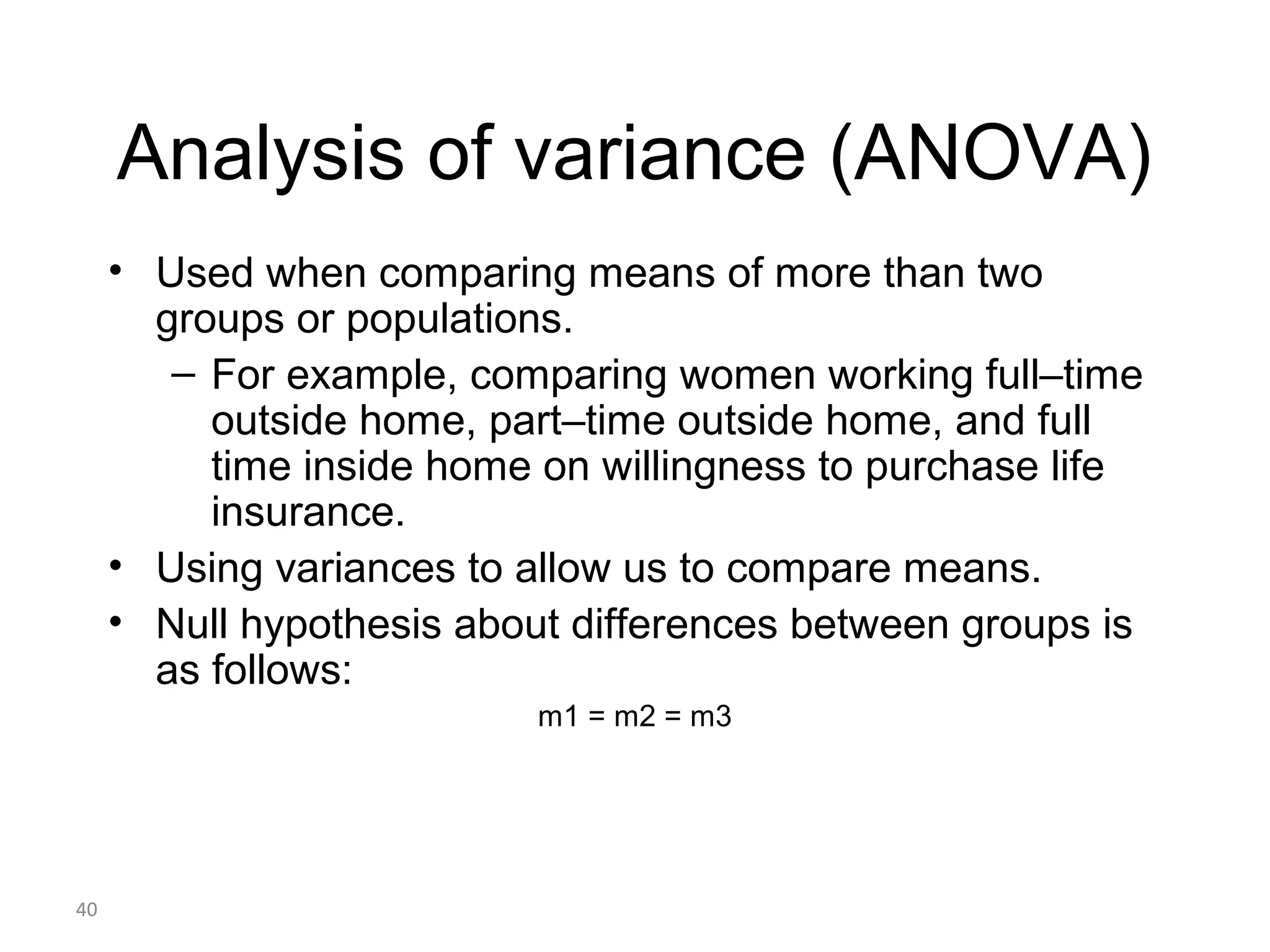
Analysis of variance (ANOVA)
     • Used when comparing means of more than two
       groups or populations.
        – For example, comparing women working full–time
          outside home, part–time outside home, and full
          time inside home on willingness to purchase life
          insurance.
     • Using variances to allow us to compare means.
     • Null hypothesis about differences between groups is
       as follows:
                           m1 = m2 = m3


40
Analysis of variance (ANOVA)
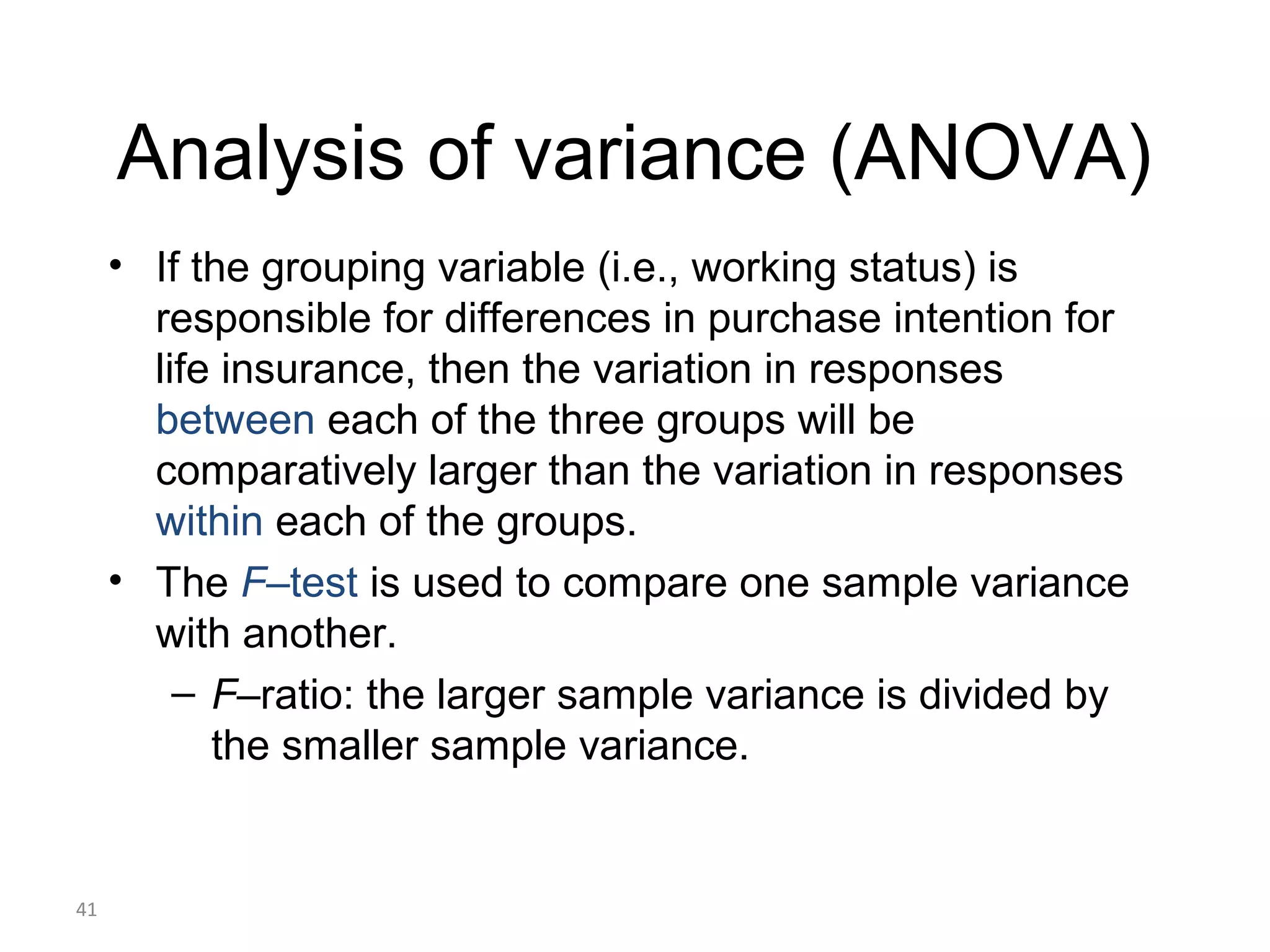
     • If the grouping variable (i.e., working status) is
       responsible for differences in purchase intention for
       life insurance, then the variation in responses
       between each of the three groups will be
       comparatively larger than the variation in responses
       within each of the groups.
     • The F–test is used to compare one sample variance
       with another.
         – F–ratio: the larger sample variance is divided by
           the smaller sample variance.


41
Analysis of variance (ANOVA)
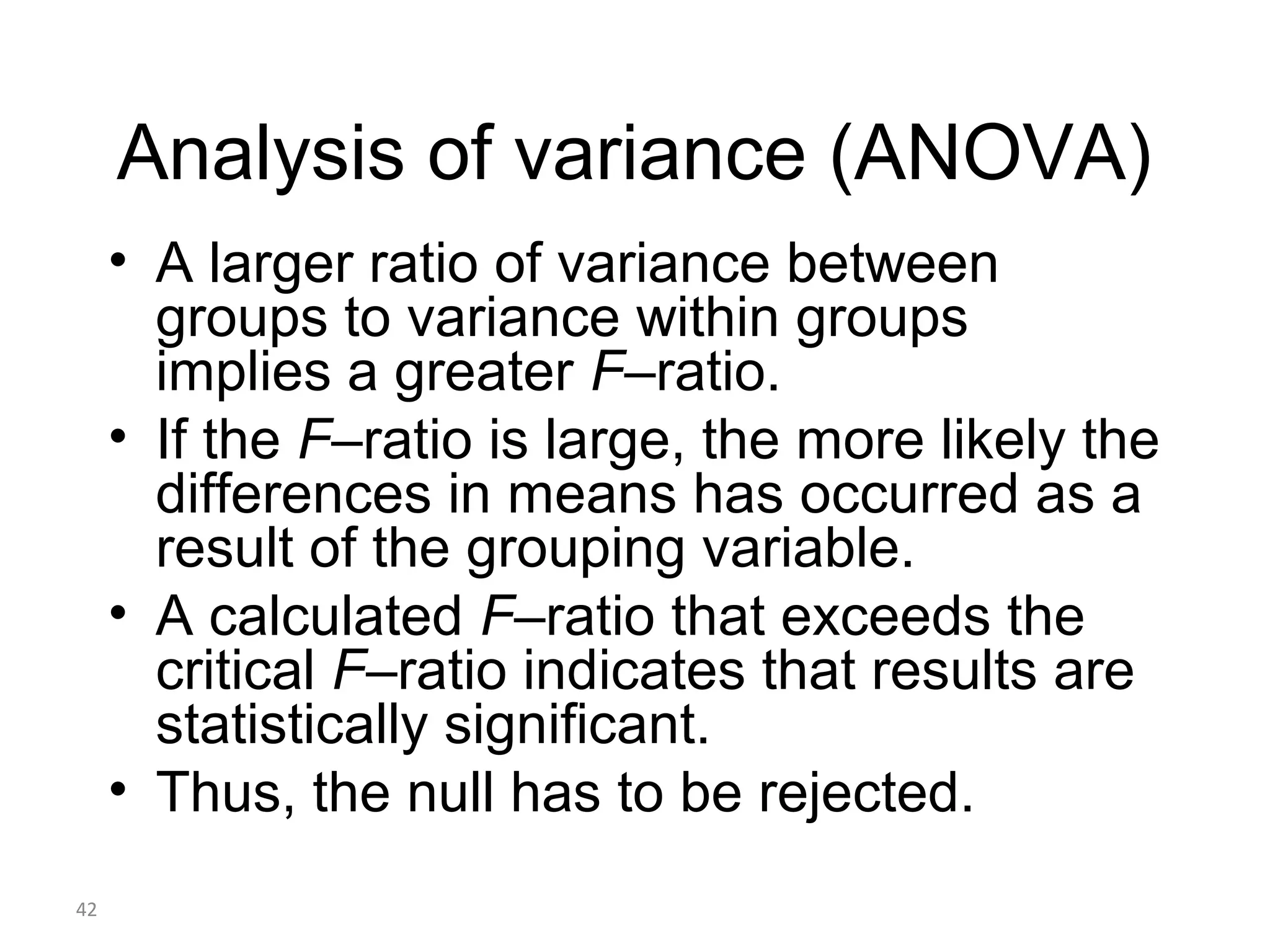
     • A larger ratio of variance between
       groups to variance within groups
       implies a greater F–ratio.
     • If the F–ratio is large, the more likely the
       differences in means has occurred as a
       result of the grouping variable.
     • A calculated F–ratio that exceeds the
       critical F–ratio indicates that results are
       statistically significant.
     • Thus, the null has to be rejected.
42
Conducting an ANOVA in SPSS
     • Running an ANOVA in SPSS would
       produce the results shown below.


43
Conducting an ANOVA in SPSS
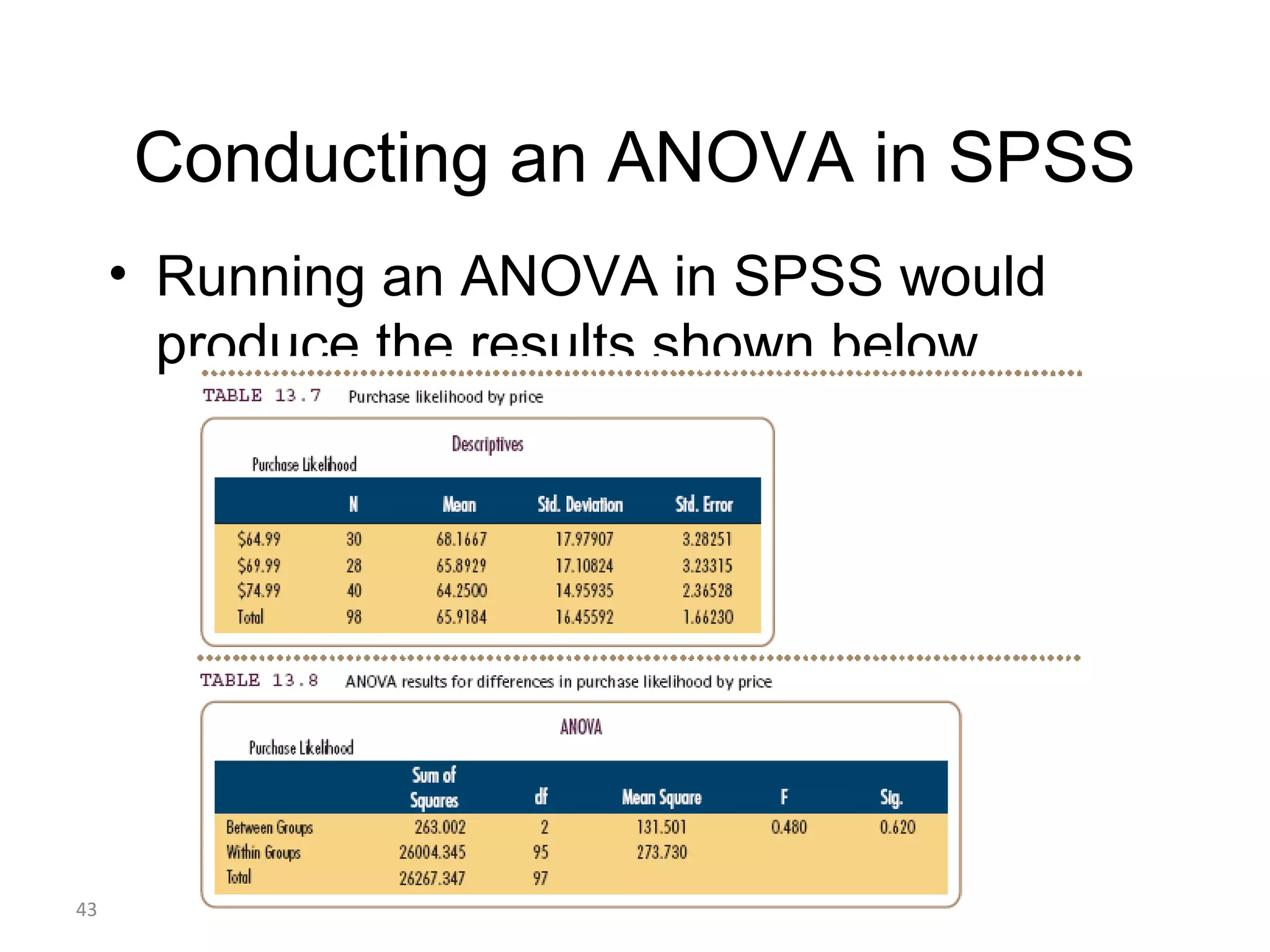
     • Mean is displayed in Table 13.7.
       – But is this a real difference or did it occur
         by chance?
     • Variances between and within groups
       are displayed in Table 13.8.
     • F–ratio and significance value are
       displayed in Table 13.8.
       – If significance value is more than 0.05,
         then the means are not significantly
         different.
          • A result of sampling error or chance.

44
Nonparametric statistics for tests of
          differences
• So far, it has been necessary to assume that population
  is normally distributed.
   – If it is normal, the error associated with making
      inferences can be estimated.
   – If it is not normal, the error may be large and cannot
      be estimated.
• Nonparametric tests overcome these limitations but will
  have a greater probability of Type II error and require a
  larger sample size compared to a parametric test.


45
Statistical and practical significance for test
                 of differences
• There is a distinction between statistical
  significance and practical significance.
• Even if there is a statistical difference, the
  practical difference might be very small.
     – This is substantive significance.
• Researchers need to keep this in mind
  when interpreting statistical output.


46
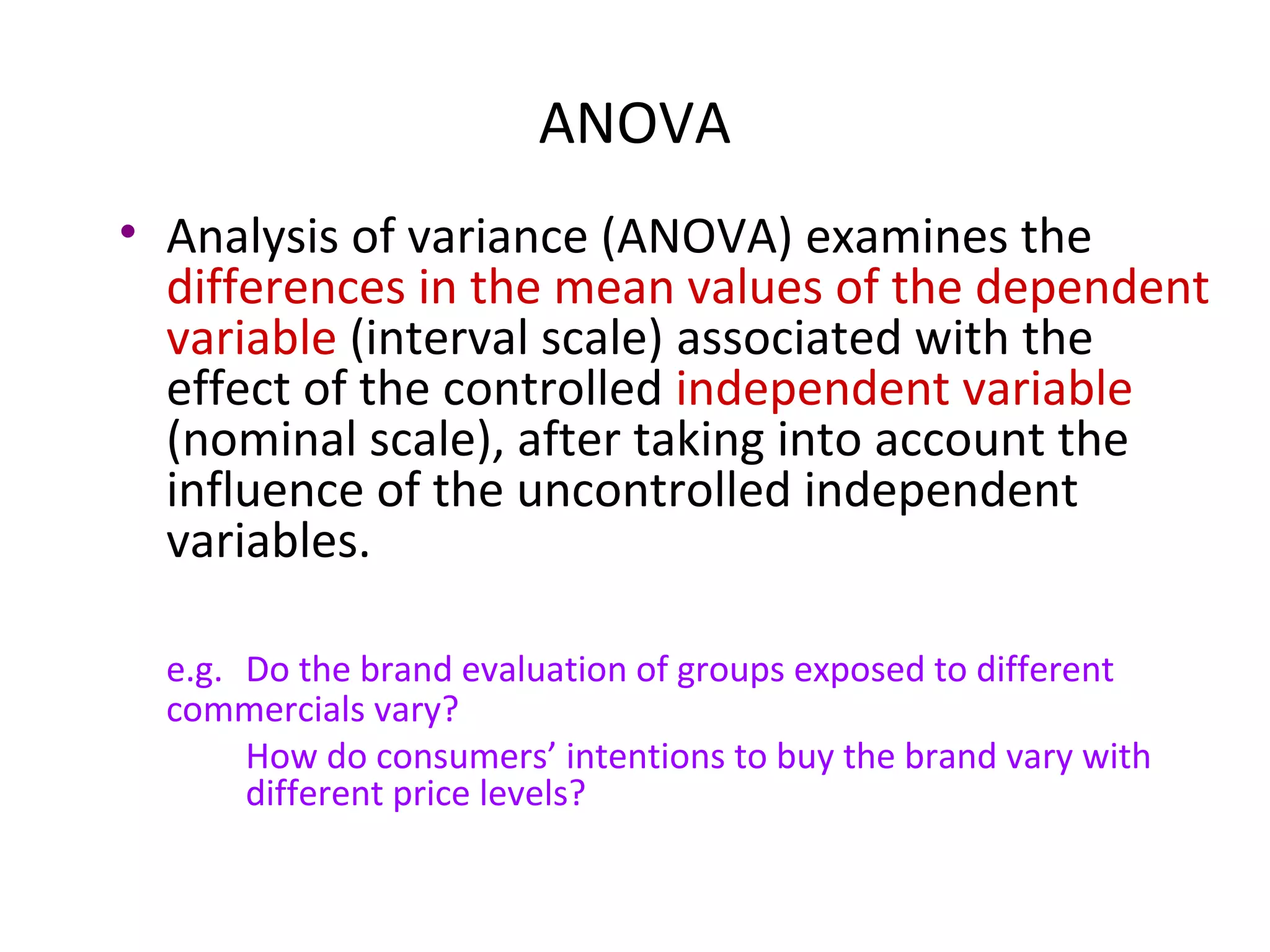
ANOVA
• Analysis of variance (ANOVA) examines the
  differences in the mean values of the dependent
  variable (interval scale) associated with the
  effect of the controlled independent variable
  (nominal scale), after taking into account the
  influence of the uncontrolled independent
  variables.

  e.g. Do the brand evaluation of groups exposed to different
  commercials vary?
       How do consumers’ intentions to buy the brand vary with
       different price levels?
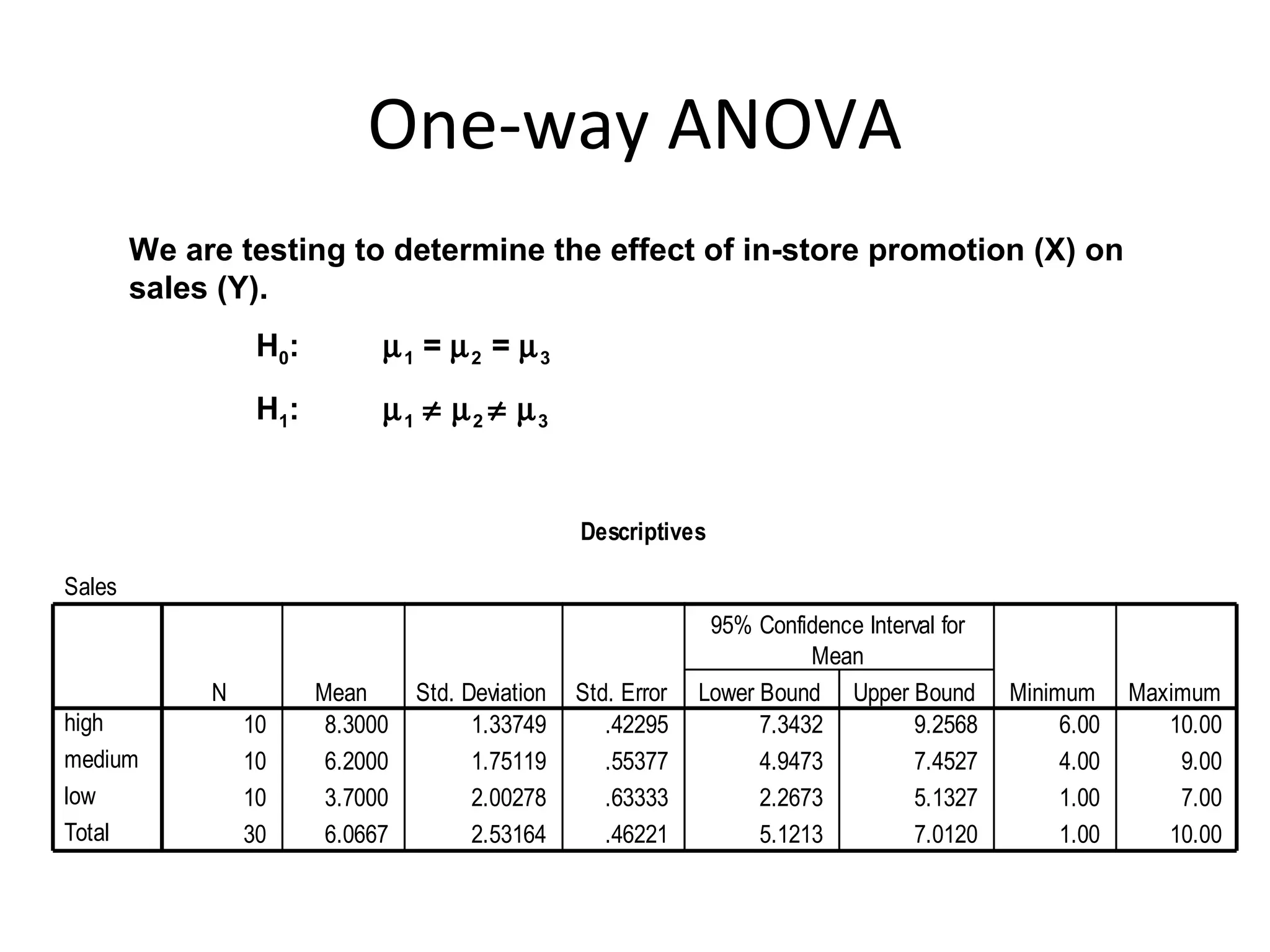
One-way ANOVA
        We are testing to determine the effect of in-store promotion (X) on
        sales (Y).
                  H0:         µ1 = µ2 = µ3
                  H1:         µ1 ≠ µ2 ≠ µ3


                                                   Descriptives

Sales
                                                                 95% Confidence Interval for
                                                                           Mean
             N          Mean      Std. Deviation   Std. Error   Lower Bound Upper Bound        Minimum     Maximum
high             10      8.3000         1.33749       .42295          7.3432         9.2568         6.00      10.00
medium           10      6.2000         1.75119       .55377          4.9473         7.4527         4.00       9.00
low              10      3.7000         2.00278       .63333          2.2673         5.1327         1.00       7.00
Total            30      6.0667         2.53164       .46221          5.1213         7.0120         1.00      10.00
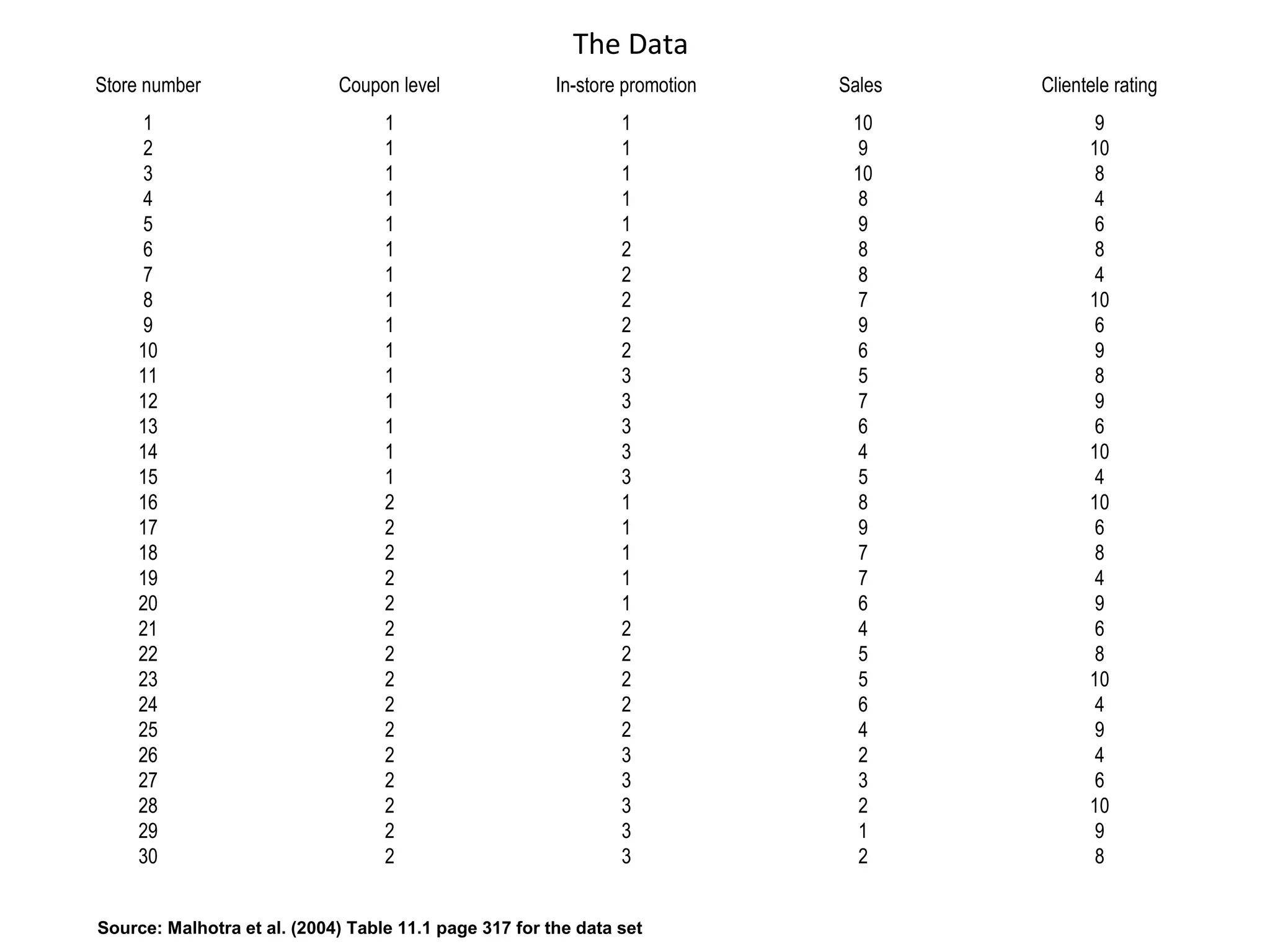
The Data
Store number                 Coupon level               In-store promotion   Sales   Clientele rating
     1                             1                            1             10            9
     2                             1                            1              9           10
     3                             1                            1             10            8
     4                             1                            1              8            4
     5                             1                            1              9            6
     6                             1                            2              8            8
     7                             1                            2              8            4
     8                             1                            2              7           10
     9                             1                            2              9            6
     10                            1                            2              6            9
     11                            1                            3              5            8
     12                            1                            3              7            9
     13                            1                            3              6            6
     14                            1                            3              4           10
     15                            1                            3              5            4
     16                            2                            1              8           10
     17                            2                            1              9            6
     18                            2                            1              7            8
     19                            2                            1              7            4
     20                            2                            1              6            9
     21                            2                            2              4            6
     22                            2                            2              5            8
     23                            2                            2              5           10
     24                            2                            2              6            4
     25                            2                            2              4            9
     26                            2                            3              2            4
     27                            2                            3              3            6
     28                            2                            3              2           10
     29                            2                            3              1            9
     30                            2                            3              2            8


Source: Malhotra et al. (2004) Table 11.1 page 317 for the data set
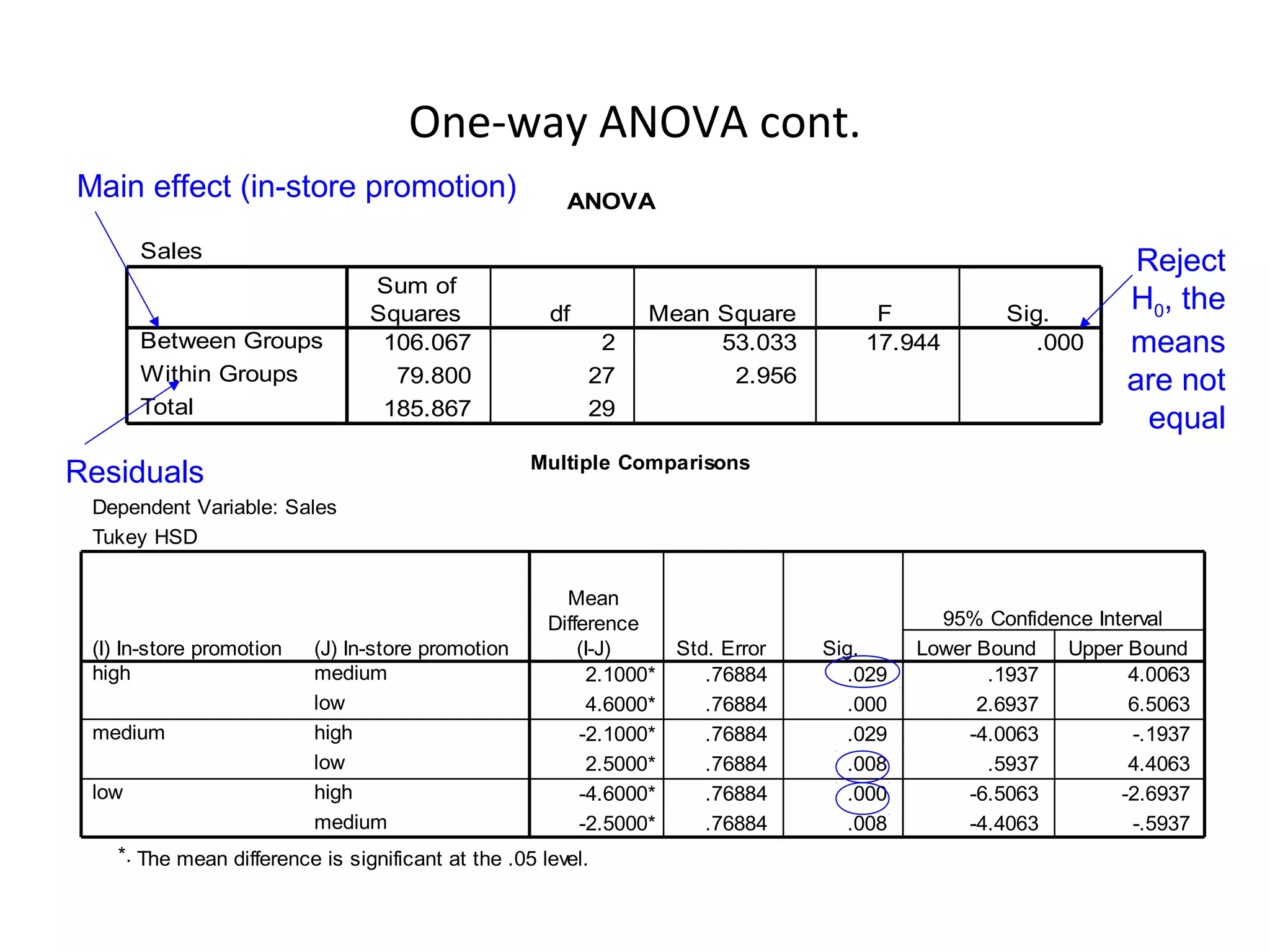
One-way ANOVA cont.
Main effect (in-store promotion)                       ANOVA

       Sales
                                                                                                                 Reject
                                Sum of
                                Squares              df          Mean Square           F            Sig.
                                                                                                                H0, the
       Between Groups            106.067                   2          53.033          17.944          .000      means
       Within Groups              79.800                  27           2.956                                    are not
       Total                     185.867                  29
                                                                                                                  equal
                                                   Multiple Comparisons
Residuals
 Dependent Variable: Sales
 Tukey HSD

                                                       Mean
                                                     Difference                               95% Confidence Interval
 (I) In-store promotion   (J) In-store promotion         (I-J)       Std. Error   Sig.      Lower Bound   Upper Bound
 high                     medium                           2.1000*      .76884       .029          .1937         4.0063
                          low                              4.6000*      .76884       .000         2.6937         6.5063
 medium                   high                           -2.1000*       .76884       .029        -4.0063         -.1937
                          low                              2.5000*      .76884       .008          .5937         4.4063
 low                      high                           -4.6000*       .76884       .000        -6.5063        -2.6937
                          medium                         -2.5000*       .76884       .008        -4.4063         -.5937
   *. The mean difference is significant at the .05 level.
One-way ANOVA cont.

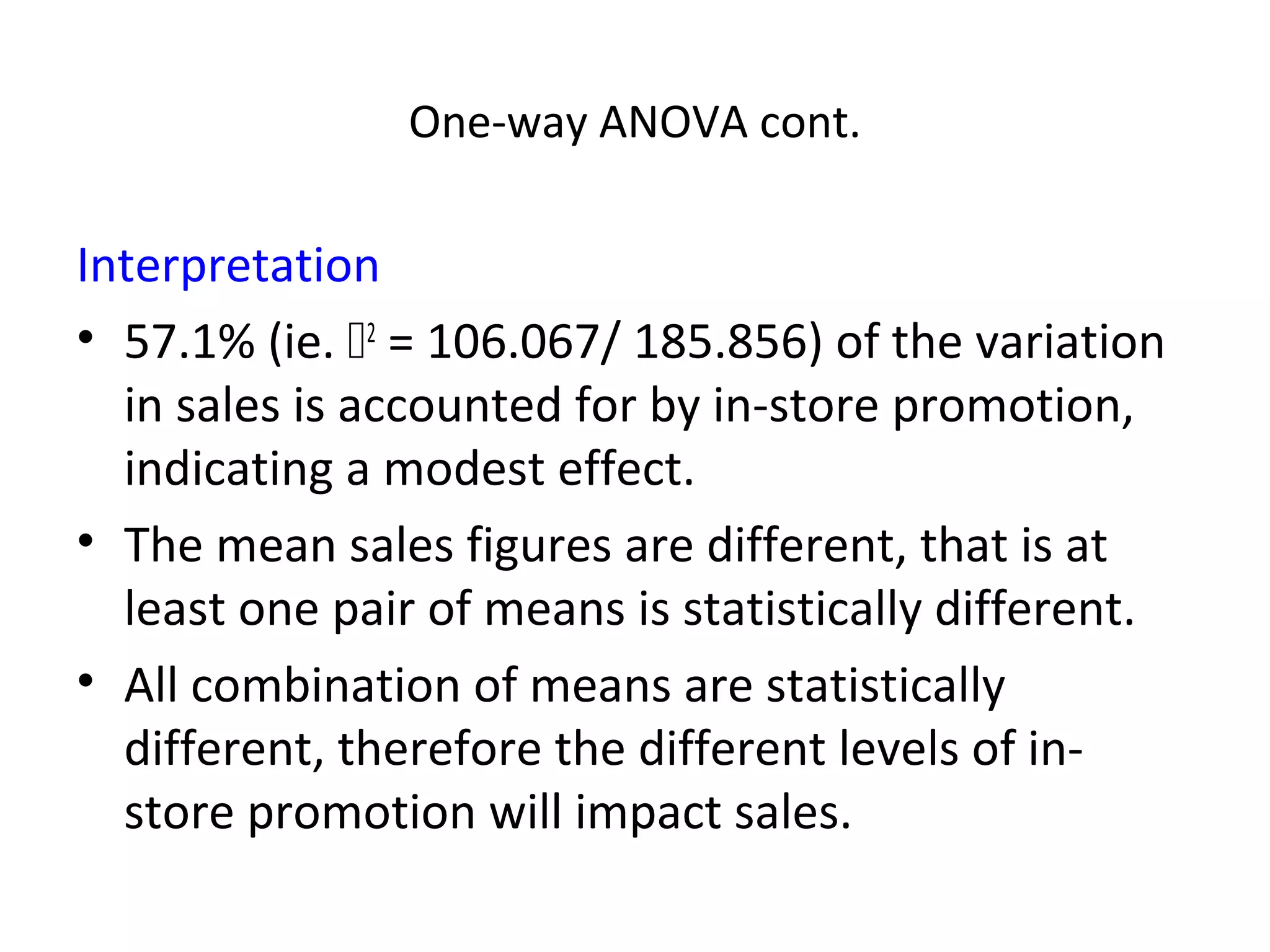
Interpretation
• 57.1% (ie. 2 = 106.067/ 185.856) of the variation
  in sales is accounted for by in-store promotion,
  indicating a modest effect.
• The mean sales figures are different, that is at
  least one pair of means is statistically different.
• All combination of means are statistically
  different, therefore the different levels of in-
  store promotion will impact sales.
Data analysis

Data analysis

  • 1.
    Lecture 9 Data Analysis Ref Chapters 13 and 14
  • 2.
    General Approach toHypothesis Testing Malhotra et al. 2005, 293
  • 3.
    What is ahypothesis? • A hypothesis is an unproven proposition or supposition that tentatively explains certain facts or phenomena. – Empirically testable • Null hypothesis is a statement about status quo. – Any change from what has been thought to be true will be due entirely to random sampling error. • Alternative hypothesis is a statement indicating the opposite of the null. 3
  • 4.
    Null and alternativehypotheses • Example: highly dogmatic consumers will be less likely to try a new product than less dogmatic consumers. • The null hypothesis (H0)is where there is no difference between high dogmatics and low dogmatics in their willingness to try an innovation. • The alternative hypothesis (H1) is where there is a difference between high and low dogmatics. 4
  • 5.
    Hypothesis testing • Thepurpose of hypothesis testing is to determine which of the two hypotheses is correct. 5
  • 6.
    The hypothesis–testing procedure • The process is as follows: – Determine a statistical hypothesis. – Imagine what sampling distribution would be if this is a true statement. – Take an actual sample and calculate sample mean. – Determine if the deviation between the obtained value and expected value of sample mean could have occurred by chance alone. – Set a standard for determining if we reject the null or accept the alternative. 6
  • 7.
    The hypothesis–testing procedure • Significance level is the critical probability in choosing between the null and alternative hypotheses. – The probability level that is too low to warrant support of the null hypothesis. • Assuming the null is true, if the probability of occurrence of the observed data is smaller than the significance level, then the data suggest that the null should be rejected. – Evidence supporting contradiction of null. 7
  • 8.
    Type I andtype II errors • Since hypothesis testing is based on probability theory, the researcher cannot be completely certain and runs the risk of committing two types of errors. – Type I error is an error caused by rejecting the null hypothesis when it is true. • Probability of alpha (α) – Type II error is an error caused by failing to reject the null hypothesis when the alternative hypothesis is true. • Probability of beta (β) 8
  • 9.
    The t–distribution • The t-distribution is a symmetrical, bell– shaped distribution that is contingent on sample size. – It has a mean of zero and a standard deviation equal to one. • The shape of the t–distribution is influenced by its degrees of freedom. – Number of observations minus number of constraints or assumptions. – For sample sizes over 30, t–distribution closely approximates Z–distribution. 9
  • 10.
  • 11.
    Univariate hypothesis testusing the t– distribution • Store manager believes that average number of customers who return or exchange merchandise is 20. – H0: µ = 20 and H1: µ ≠ 20 • Store records returns and exchanges for 25 days (n) and sample mean is 22 and standard deviation is 5. • Confidence level of 95% or significance level of 5%. • Referring to Table B.3 in Appendix B, we find that for 24 degrees of freedom (n–1), the t–value is 2.064. Thus: Lower limit = µ - tc.l. S = 20 – (2.064)5 = 17.936 √n √25 Upper limit = µ + tc.l. S = 20 + (2.064)5 = 22.064 √n √25 • Since the sample mean lies within the critical limits, the null hypothesis cannot be rejected. 11
  • 12.
    Univariate hypothesis testusing the t– distribution • Alternatively, we may test a hypothesis by calculating the observed t– value and comparing it to the critical t–value. • To calculate the observed t: tobs = X - µ = 22 – 20 = 2 Sx 5 √25 • Referring to Table B.3 in Appendix B, we find that for 24 degrees of freedom (n–1), the t–value is 2.064. • Since the observed t–value is less than the critical t–value, the sample mean lies within the critical limits. • Thus, the null hypothesis cannot be rejected. 12
  • 13.
    The Chi-square testfor goodness of fit • The Chi-square (c2) test allows for investigation of statistical significance in the analysis of a frequency distribution. • Categorical data on variables like sex, education, etc., • Allows us to compare the observed frequencies with the expected frequencies based on theoretical ideas about the population distribution. • Tests whether the data came from a certain probability distribution. 13
  • 14.
    The Chi-square testfor goodness of fit • The process is as follows: • Formulate the null hypothesis and determine the expected frequency of each answer. • Determine the appropriate significance level. • Calculate the c2 value, using the observed frequencies from the sample and the expected frequencies. • Make the statistical decision by comparing the calculated c2 value with the critical c2 value. 14
  • 15.
    The Chi-square testfor goodness of fit 15
  • 16.
    The Chi-square testfor goodness of fit • To calculate the Chi-square statistic: χ2 = Σ (Oi – Ei) 2 Ei – where c2 is the Chi–square statistic, Oi is the observed frequency in the ith cell, and Ei is the expected frequency in the ith cell. • Table 12.15 shows that calculated Chi–square value is 4. • The degrees of freedom is the number of cells associated with column or row data minus one (k–1). – k is 2 since there are only two categorical responses. • Referring to Table B.4 in Appendix B, we find that for 1 degree of freedom (k–1), the Chi-square value is 3.84. • Since the calculated value is larger than the critical value, the null 16 hypothesis is rejected.
  • 17.
    Choosing the appropriatestatistical technique • The choice of statistical analysis depends on: – The type of question to be answered • Example: researcher concerned with comparing average monthly sales central value would use t–test. – The number of variables • Example: researcher concerned with one variable at a time would use univariate statistical analysis. – The scale of measurement • Example: testing a hypothesis about a mean requires interval scaled or ratio scaled data. • Parametric versus nonparametric statistics. 17
  • 18.
    Parametric versus hypothesistests • Parametric statistics are used when the data are interval or ratio scaled, when the sample size is large, and when the data are drawn from a population with a normal distribution. • Nonparametric statistics are used when data are either nominal or ordinal. 18
  • 19.
  • 20.
    Using the p-value One-Sample Statistics Std. Error N Mean Std. Deviation Mean How much have you spent, in total, on 448 1150.5960 2705.08330 127.80317 Internet shopping over the past 12 months? One-Sample Test Test Value = 800 95% Confidence Interval of the Mean Difference t df Sig. (2-tailed) Difference Lower Upper How much have you spent, in total, on 2.743 447 .006 350.5960 99.4263 601.7657 Internet shopping over the past 12 months? H 0 : µ ≤ 800 If p-value ≤ 0.05, Reject H0 H 1 : µ > 800 Conclude that the average amount spent on the internet is more than $800 per year
  • 21.
  • 22.
    Parametric Tests One samplet test We are testing the hypothesis that the mean satisfaction rating exceeds 4.0, the neutral value on a 7-point scale. H 0 : µ ≤4 H1 : µ > 4
  • 23.
    Parametric Tests cont. One-Sample Statistics Std. Error N Mean Std. Deviation Mean Shopping at this website is usually a 443 5.19 1.079 .051 satisfying experience One-Sample Test Test Value = 4 95% Confidence Interval of the Mean Difference t df Sig. (2-tailed) Difference Lower Upper Shopping at this website is usually a 23.112 442 .000 1.19 1.08 1.29 satisfying experience The p-value < 0.05, hence reject H0 and conclude that the satisfaction rating for the website is greater than 4 (generally agree)
  • 24.
    Parametric Tests cont. TwoIndependent samples (Means) We are testing the hypothesis that mean amount spent on shopping on the Internet is different for males and females H0: µ 1 = µ 2 H1: µ 1 ≠ µ 2 Group Statistics Std. Error Gender N Mean Std. Deviation Mean How much have you Male 236 1283.4237 3502.02542 227.96244 spent, in total, on Internet shopping over Female the past 12 months? 212 1002.7311 1342.04673 92.17215
  • 25.
    Parametric Tests cont. Independent Samples Test Levene's Test for Equality of Variances t-test for Equality of Means 95% Confidence Interval of the Mean Std. Error Difference F Sig. t df Sig. (2-tailed) Difference Difference Lower Upper How much have you Equal variances 2.166 .142 1.097 446 .273 280.6926 255.91581 -222.258 783.64323 spent, in total, on assumed Internet shopping over Equal variances the past 12 months? 1.142 308.922 .255 280.6926 245.89139 -203.141 764.52641 not assumed Since p-value > 0.05, t test assuming equal variances should be used Since p-value > 0.05, we do not reject H0 and conclude that there is no difference between men and women on the amount they spend on internet shopping
  • 26.
    Parametric Tests cont. Two Independent samples (Proportions) We are testing the hypothesis that the proportion of heavy internet users is the same for male and females. H:π =π 0 1 2 H1: π 1 ≠ π 2 Internet usage * Gender Crosstabula tion Count Gender Male Female Total Internet Light 39 58 97 Sample usage Heavy 199 154 353 data Total 238 212 450
  • 27.
    Parametric Tests cont. ( p1 −p 2 ) − π − 2 ) ( 1 π Zcalc. = π (1− 1 ) π2 (1− 2 ) π π 1 + n1 n2 (.84 − 73) − . 0 = (.84)(.16) (.73)(.27) + 238 212 = .75 2
  • 28.
    Parametric Tests cont. IfZcrit = 1.645 (using the normal tables where α =0.05) We reject H0 and conclude that there is a difference in the percentage (proportion) of heavy user of the internet between males and females.
  • 29.
    Non-Parametric Tests Chi-square H0: There is no association between Internet usage and age of respondents H1: There is an association between Internet usage and age of respondents
  • 30.
    Non-Parametric Tests cont. Internet usage * Age of respondents Crosstabulation Count Age of respondents 60 years 18 - 24 25 - 39 40-59 or over Total Internet Light 22 17 44 14 97 usage Heavy 164 107 71 11 353 Total 186 124 115 25 450 Chi-Square Tests Asymp. Sig. P-value < 0.05 Value df (2-sided) hence reject H0 Pearson Chi-Square 51.444a 3 .000 and conclude Likelihood Ratio 47.450 3 .000 that there is an Linear-by-Linear association 43.858 1 .000 between internet Association N of Valid Cases 450 usage and age a. 0 cells (.0%) have expected count less than 5. The of respondents minimum expected count is 5.39.
  • 31.
    Non-Parametric Tests cont. Chi-square (Another one!) VU’s Open Day organisers are investigating whether visitors’ overall rating of Open Day is independent of the age of the visitor. Test at .05 level of significance. H0: Overall rating of Open Day and age are independent [no association] H1: Overall rating of Open Day and age are not independent [association]
  • 32.
    Non-Parametric Tests cont. Overall rating of Open Day * Age of respondent Crosstabulation Count Age of respondent 18 or under 19 - 29 Over 29 Total Overall Poor 1 2 3 rating of Fair 6 2 1 9 Open Good 24 15 4 43 Day Very Good 100 25 12 137 Excellent 66 29 18 113 Total 197 71 37 305 Chi-Square Tests P-value < 0.05 hence reject H0 Asymp. Sig. and conclude Value df (2-sided) Pearson Chi-Square 18.369a 8 .019 that there is an Likelihood Ratio 15.161 8 .056 association Linear-by-Linear between ratings .023 1 .879 Association of open day and N of Valid Cases 305 age of a. 5 cells (33.3%) have expected count less than 5. The respondents minimum expected count is .36.
  • 33.
    Chapter 13 Bivariate statistical analysis: Tests of differences 33
  • 34.
    What is theappropriate test of difference? • Do two groups differ with respect to some behaviour, characteristic, or attitude? – For example, are there differences in muscle gain between subjects in the experimental exposed to muscle supplements and control group? – Two different variables. • Comparisons between two independent groups is independent samples t–test for difference of means. 34
  • 35.
    The independent samplest–test for differences of means • Used to test a hypothesis stating that the means scores on a variable will be significantly different from two independent samples. • Can only take the mean of an interval or ratio–scaled variable. – The other variable is nominal scaled with two groups. • Example: frequency of purchase between gender groups. 35
  • 36.
    The independent samplest–test for differences of means • The null hypothesis about differences between groups is as follows: m1 = m2 or m1 – m2 = 0 • The t–value is a ratio with information about the difference between means (provided by the sample) in the numerator and the standard error in the denominator. t = Mean 1 – Mean 2 = X1 – X2 Variability of random means Sx1-x2 where Sx1-x2 is the pooled estimate of the standard error. 36
  • 37.
    The independent samplest–test for differences of means • From Table 13.1, we can calculate the pooled estimate of the standard error (1.304) and the t– statistic (2.341). • Referring to Table B.3 in Appendix B, the critical t– value is 2.021. • Since the calculated t–value exceeds the critical t– value, the null is rejected. 37
  • 38.
    Conducting an independent samples t-test in SPSS • Running an independent samples t–test in SPSS would produce the results shown below. 38
  • 39.
    Conducting an independent samples t-test in SPSS • Mean is displayed in Table 13.2. – But is this a real difference or did it occur by chance? • Equality of variances is displayed in Table 13.3. – If significance value is more than 0.05, then we can assume equal variances. • Equality of means and significance value are displayed in Table 13.3. – If significance value is less than 0.05, then the two means are significantly different. 39
  • 40.
    Analysis of variance(ANOVA) • Used when comparing means of more than two groups or populations. – For example, comparing women working full–time outside home, part–time outside home, and full time inside home on willingness to purchase life insurance. • Using variances to allow us to compare means. • Null hypothesis about differences between groups is as follows: m1 = m2 = m3 40
  • 41.
    Analysis of variance(ANOVA) • If the grouping variable (i.e., working status) is responsible for differences in purchase intention for life insurance, then the variation in responses between each of the three groups will be comparatively larger than the variation in responses within each of the groups. • The F–test is used to compare one sample variance with another. – F–ratio: the larger sample variance is divided by the smaller sample variance. 41
  • 42.
    Analysis of variance(ANOVA) • A larger ratio of variance between groups to variance within groups implies a greater F–ratio. • If the F–ratio is large, the more likely the differences in means has occurred as a result of the grouping variable. • A calculated F–ratio that exceeds the critical F–ratio indicates that results are statistically significant. • Thus, the null has to be rejected. 42
  • 43.
    Conducting an ANOVAin SPSS • Running an ANOVA in SPSS would produce the results shown below. 43
  • 44.
    Conducting an ANOVAin SPSS • Mean is displayed in Table 13.7. – But is this a real difference or did it occur by chance? • Variances between and within groups are displayed in Table 13.8. • F–ratio and significance value are displayed in Table 13.8. – If significance value is more than 0.05, then the means are not significantly different. • A result of sampling error or chance. 44
  • 45.
    Nonparametric statistics fortests of differences • So far, it has been necessary to assume that population is normally distributed. – If it is normal, the error associated with making inferences can be estimated. – If it is not normal, the error may be large and cannot be estimated. • Nonparametric tests overcome these limitations but will have a greater probability of Type II error and require a larger sample size compared to a parametric test. 45
  • 46.
    Statistical and practicalsignificance for test of differences • There is a distinction between statistical significance and practical significance. • Even if there is a statistical difference, the practical difference might be very small. – This is substantive significance. • Researchers need to keep this in mind when interpreting statistical output. 46
  • 47.
    ANOVA • Analysis ofvariance (ANOVA) examines the differences in the mean values of the dependent variable (interval scale) associated with the effect of the controlled independent variable (nominal scale), after taking into account the influence of the uncontrolled independent variables. e.g. Do the brand evaluation of groups exposed to different commercials vary? How do consumers’ intentions to buy the brand vary with different price levels?
  • 48.
    One-way ANOVA We are testing to determine the effect of in-store promotion (X) on sales (Y). H0: µ1 = µ2 = µ3 H1: µ1 ≠ µ2 ≠ µ3 Descriptives Sales 95% Confidence Interval for Mean N Mean Std. Deviation Std. Error Lower Bound Upper Bound Minimum Maximum high 10 8.3000 1.33749 .42295 7.3432 9.2568 6.00 10.00 medium 10 6.2000 1.75119 .55377 4.9473 7.4527 4.00 9.00 low 10 3.7000 2.00278 .63333 2.2673 5.1327 1.00 7.00 Total 30 6.0667 2.53164 .46221 5.1213 7.0120 1.00 10.00
  • 49.
    The Data Store number Coupon level In-store promotion Sales Clientele rating 1 1 1 10 9 2 1 1 9 10 3 1 1 10 8 4 1 1 8 4 5 1 1 9 6 6 1 2 8 8 7 1 2 8 4 8 1 2 7 10 9 1 2 9 6 10 1 2 6 9 11 1 3 5 8 12 1 3 7 9 13 1 3 6 6 14 1 3 4 10 15 1 3 5 4 16 2 1 8 10 17 2 1 9 6 18 2 1 7 8 19 2 1 7 4 20 2 1 6 9 21 2 2 4 6 22 2 2 5 8 23 2 2 5 10 24 2 2 6 4 25 2 2 4 9 26 2 3 2 4 27 2 3 3 6 28 2 3 2 10 29 2 3 1 9 30 2 3 2 8 Source: Malhotra et al. (2004) Table 11.1 page 317 for the data set
  • 50.
    One-way ANOVA cont. Maineffect (in-store promotion) ANOVA Sales Reject Sum of Squares df Mean Square F Sig. H0, the Between Groups 106.067 2 53.033 17.944 .000 means Within Groups 79.800 27 2.956 are not Total 185.867 29 equal Multiple Comparisons Residuals Dependent Variable: Sales Tukey HSD Mean Difference 95% Confidence Interval (I) In-store promotion (J) In-store promotion (I-J) Std. Error Sig. Lower Bound Upper Bound high medium 2.1000* .76884 .029 .1937 4.0063 low 4.6000* .76884 .000 2.6937 6.5063 medium high -2.1000* .76884 .029 -4.0063 -.1937 low 2.5000* .76884 .008 .5937 4.4063 low high -4.6000* .76884 .000 -6.5063 -2.6937 medium -2.5000* .76884 .008 -4.4063 -.5937 *. The mean difference is significant at the .05 level.
  • 51.
    One-way ANOVA cont. Interpretation •57.1% (ie. 2 = 106.067/ 185.856) of the variation in sales is accounted for by in-store promotion, indicating a modest effect. • The mean sales figures are different, that is at least one pair of means is statistically different. • All combination of means are statistically different, therefore the different levels of in- store promotion will impact sales.

Editor's Notes

  • #22 Metric data – variables measured on at least an interval scale. Non-metric data – variables measured on a nominal or ordinal scale.