Presenter: Dr Vidya D C
Guide: Ms Radhika K
Dr N S Murthy
Acknowledgement: Mr Shivraj N S
Tests of Significance
10/16/2024
Contents
 Introduction
 Terms and concepts in test of significance
 Methods of tests of significance
 Steps in tests of significance
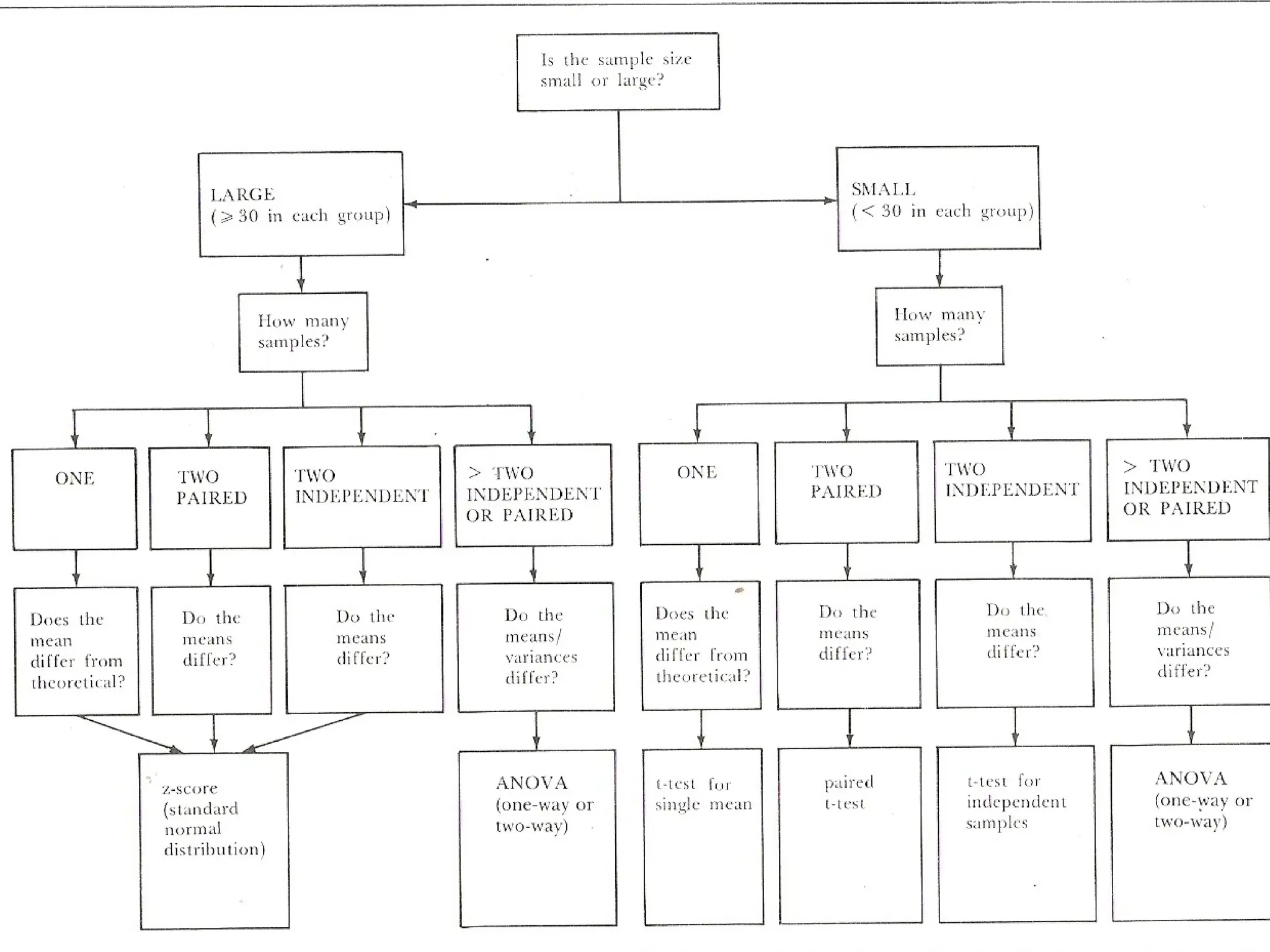
 Parametric methods
 Non parametric methods
2
10/16/2024
 Clinical significance v/s statistical significance
 Summary
 Conclusion
 References
3
Contents
10/16/2024
Introduction
4
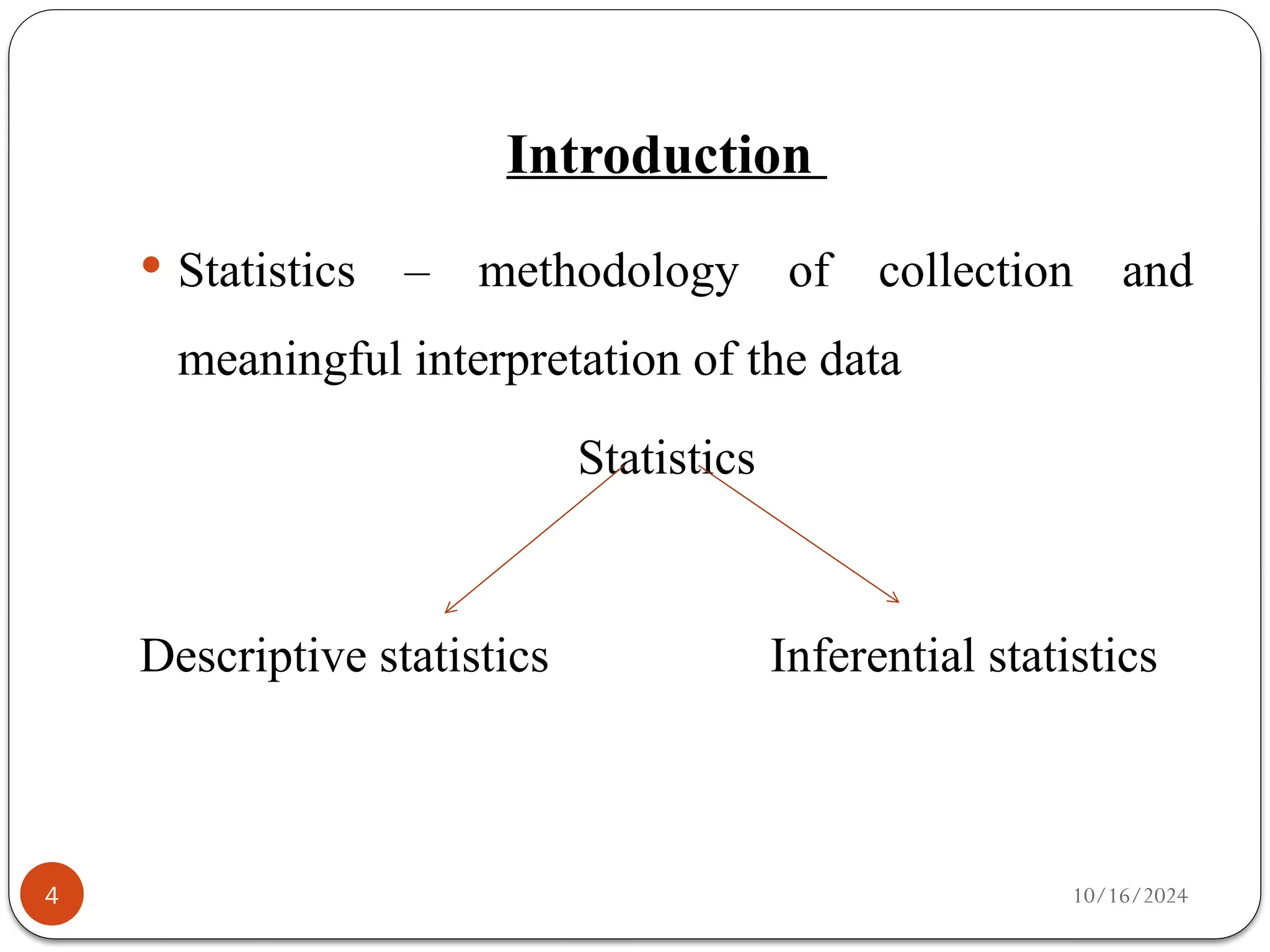
 Statistics – methodology of collection and
meaningful interpretation of the data
Statistics
Descriptive statistics Inferential statistics
10/16/2024
Introduction
5
 Tests of significance – methodologies of statistics,
which deals with the techniques to analyse, how
far the difference between estimates from different
sample are due to sampling variation or otherwise.
10/16/2024
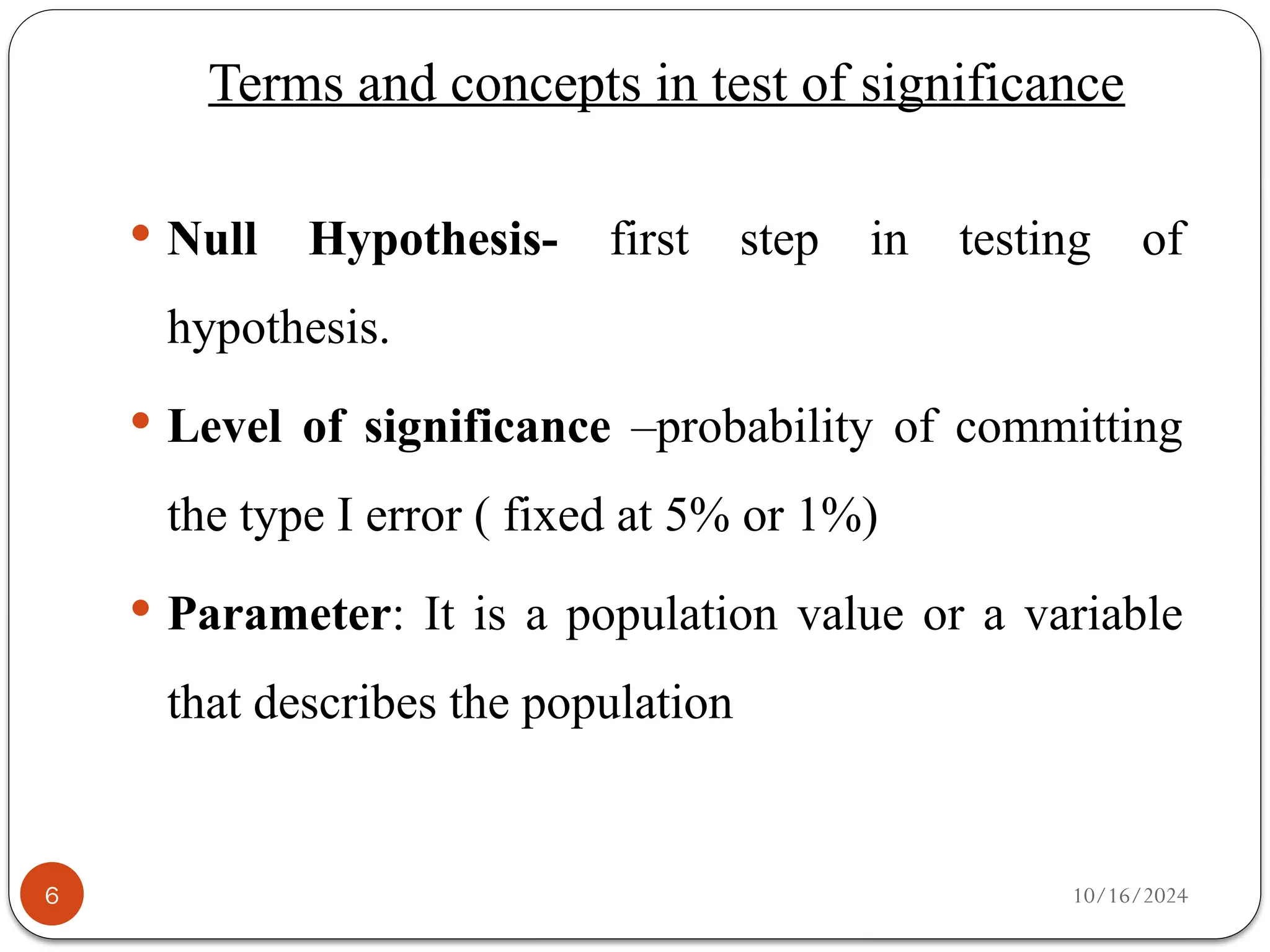
Terms and concepts in test of significance
6
 Null Hypothesis- first step in testing of
hypothesis.
 Level of significance –probability of committing
the type I error ( fixed at 5% or 1%)
 Parameter: It is a population value or a variable
that describes the population
10/16/2024
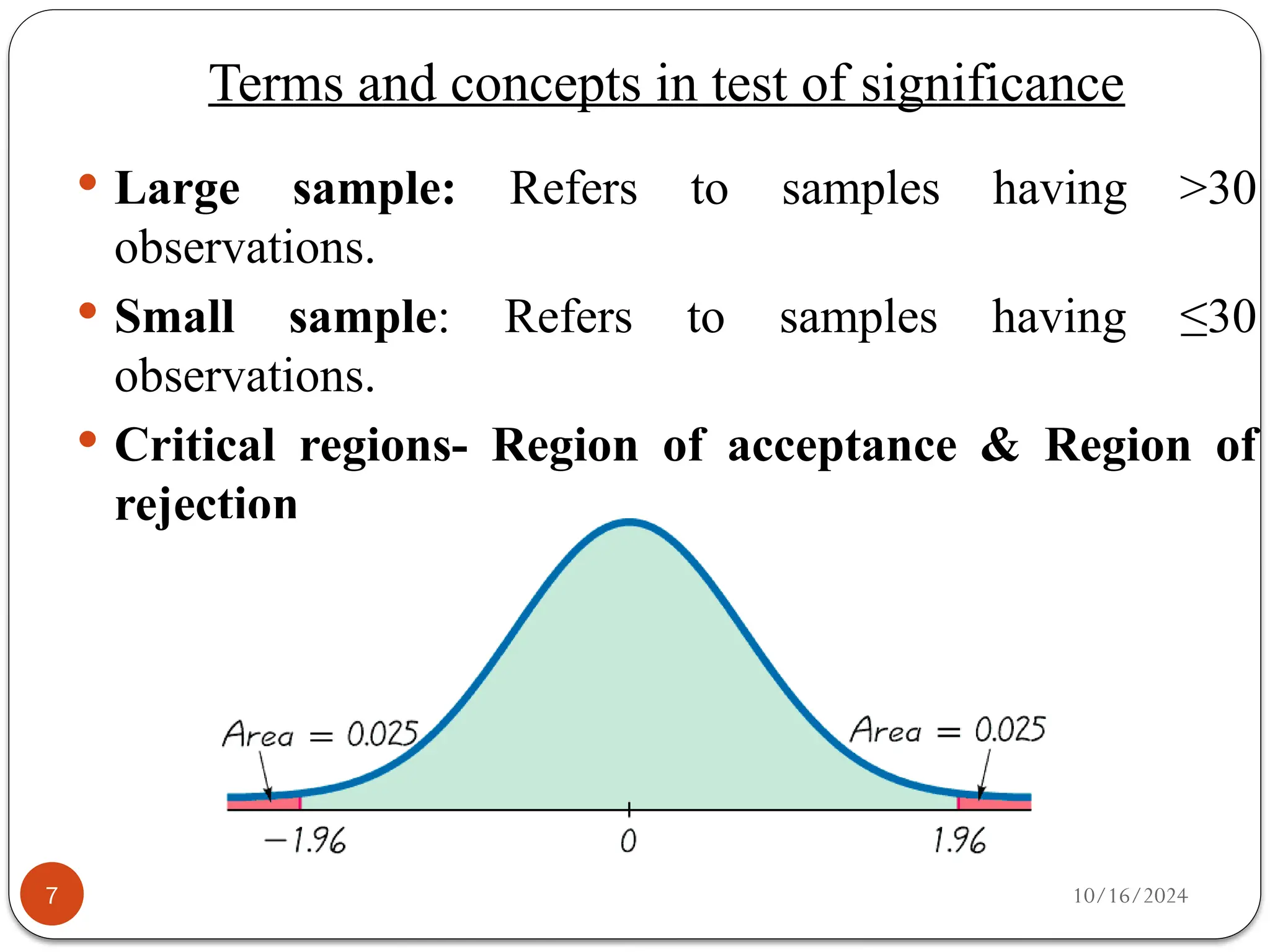
7
 Large sample: Refers to samples having >30
observations.
 Small sample: Refers to samples having ≤30
observations.
 Critical regions- Region of acceptance & Region of
rejection
Terms and concepts in test of significance
10/16/2024
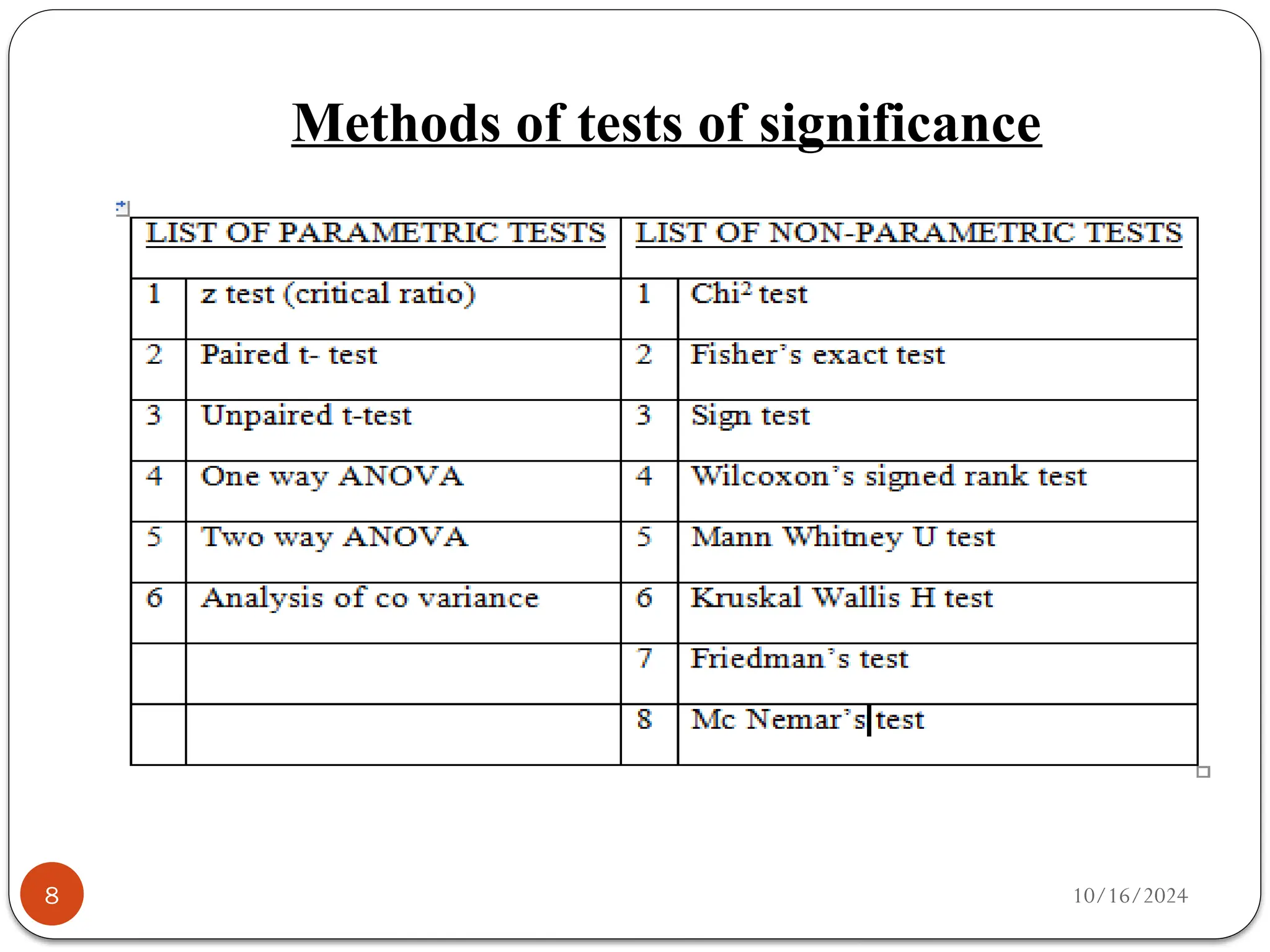
Methods of tests of significance
8
PARAMETRIC TESTS- Assumptions
 The observations must be drawn from normally
distributed populations
 These populations must have the same variances
 The observations must be independent
 Population parameters involved is mean, standard
deviation
 Require interval scale or ratio scale (whole numbers
or fractions). Example: Height in inches: 72, 60.5,
54.7; temperature[30-34 degree Celsius]
9
PARAMETRIC TESTS…
 Critical ratio/ Z-test
 Paired t-test
 Unpaired t-test
 One way ANOVA
 Two way ANOVA
10
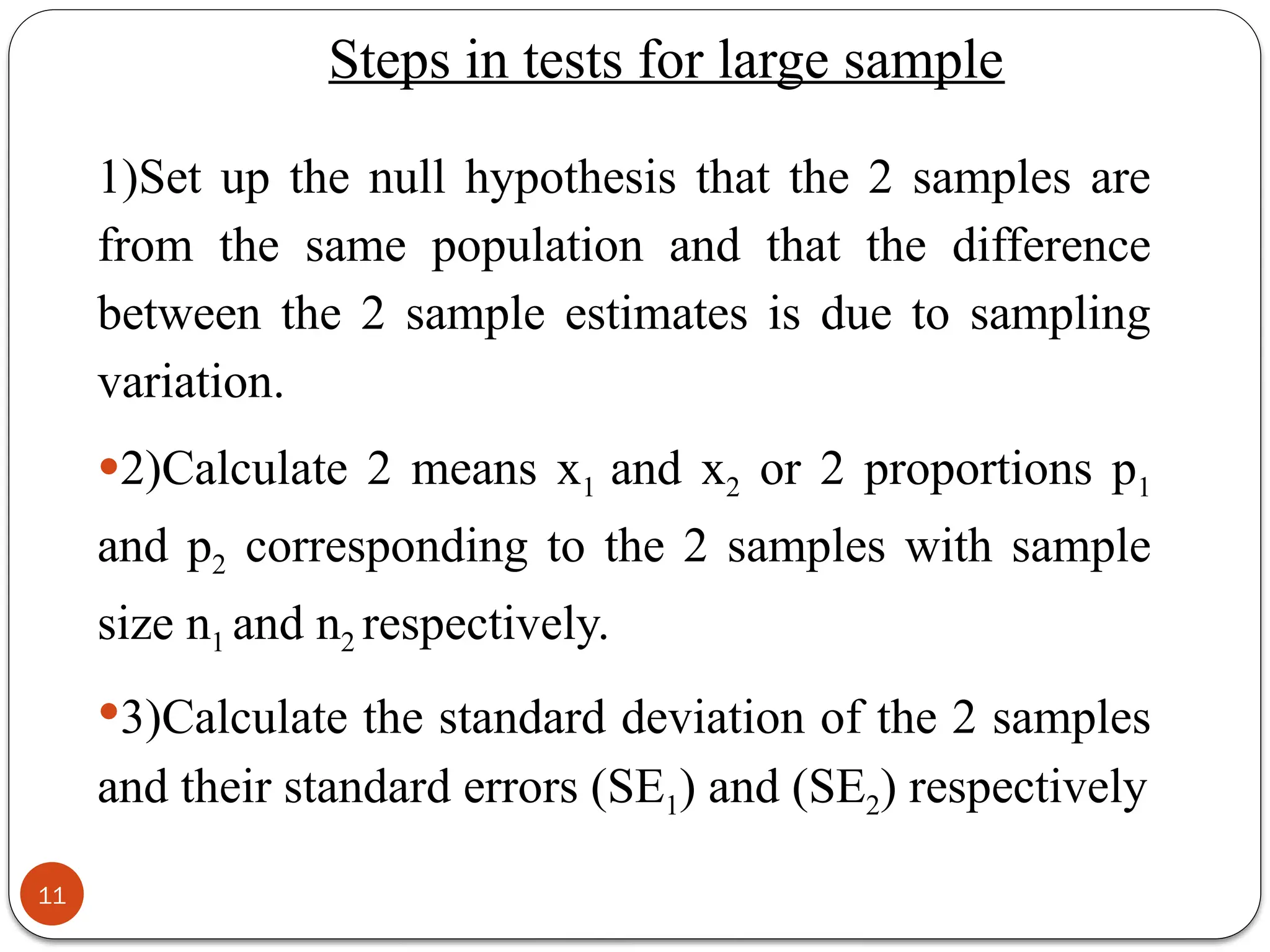
Steps in tests for large sample
1)Set up the null hypothesis that the 2 samples are
from the same population and that the difference
between the 2 sample estimates is due to sampling
variation.
2)Calculate 2 means x1 and x2 or 2 proportions p1
and p2 corresponding to the 2 samples with sample
size n1 and n2 respectively.
3)Calculate the standard deviation of the 2 samples
and their standard errors (SE1) and (SE2) respectively
11
4)Calculate the standard error of the difference
between the 2 sample estimates as
√[(SE1)2
+ (SE2)2
]
5)Calculate the critical ratio (CR) or z value.
z= difference between sample estimates/ SE of
difference
12
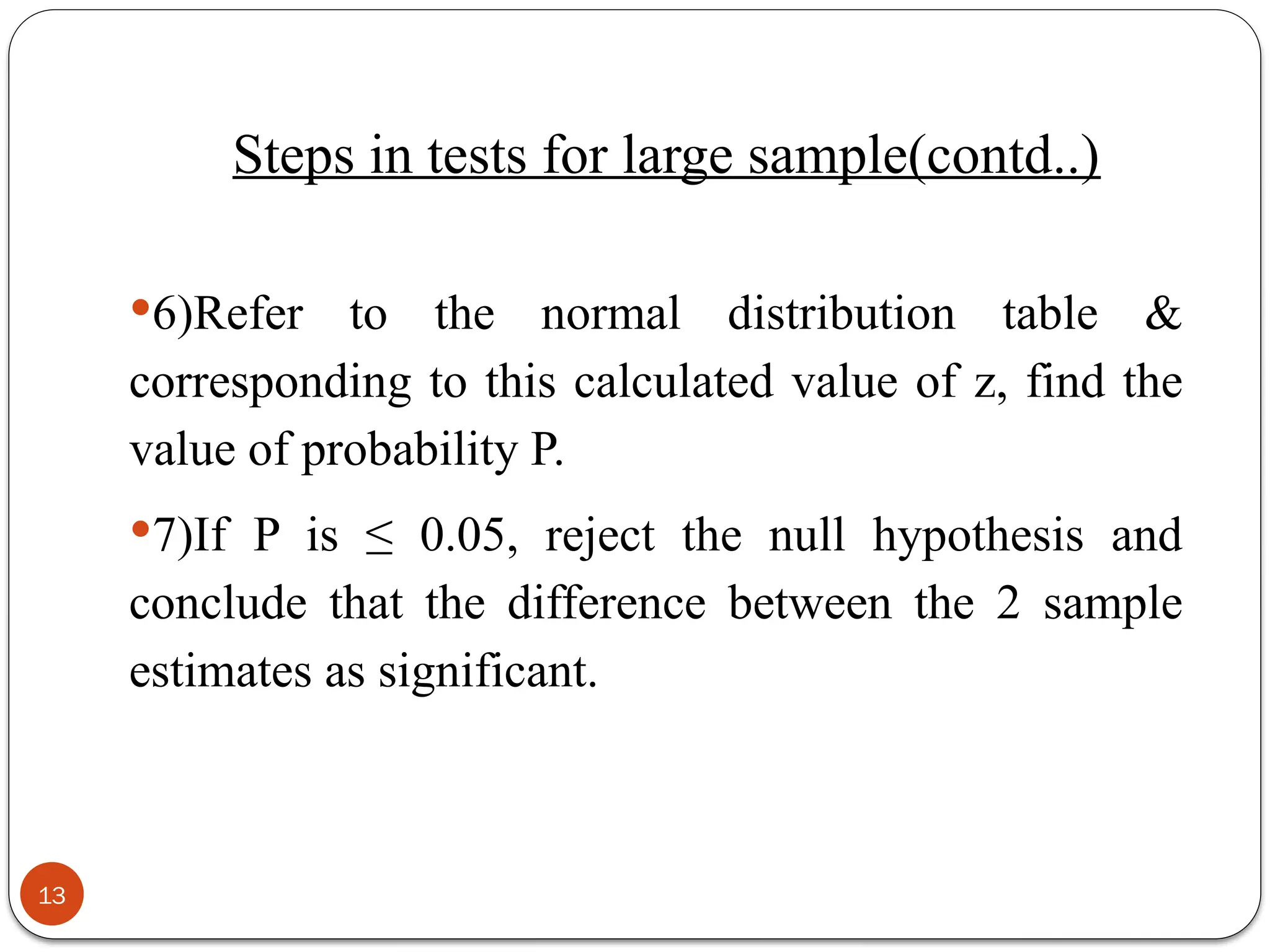
Steps in tests for large sample(contd..)
6)Refer to the normal distribution table &
corresponding to this calculated value of z, find the
value of probability P.
7)If P is ≤ 0.05, reject the null hypothesis and
conclude that the difference between the 2 sample
estimates as significant.
13
Steps in tests for large sample(contd..)
Tests for large samples
SE of mean= s/ √n
SE of proportion= √(pq/n)
SE of difference between 2 means= √[(s1
2
/n1 ) +
(s2
2
/n2)]
SE of difference between 2 proportions= √[(p1q1/n1)
+ (p2q2/n2)]
14
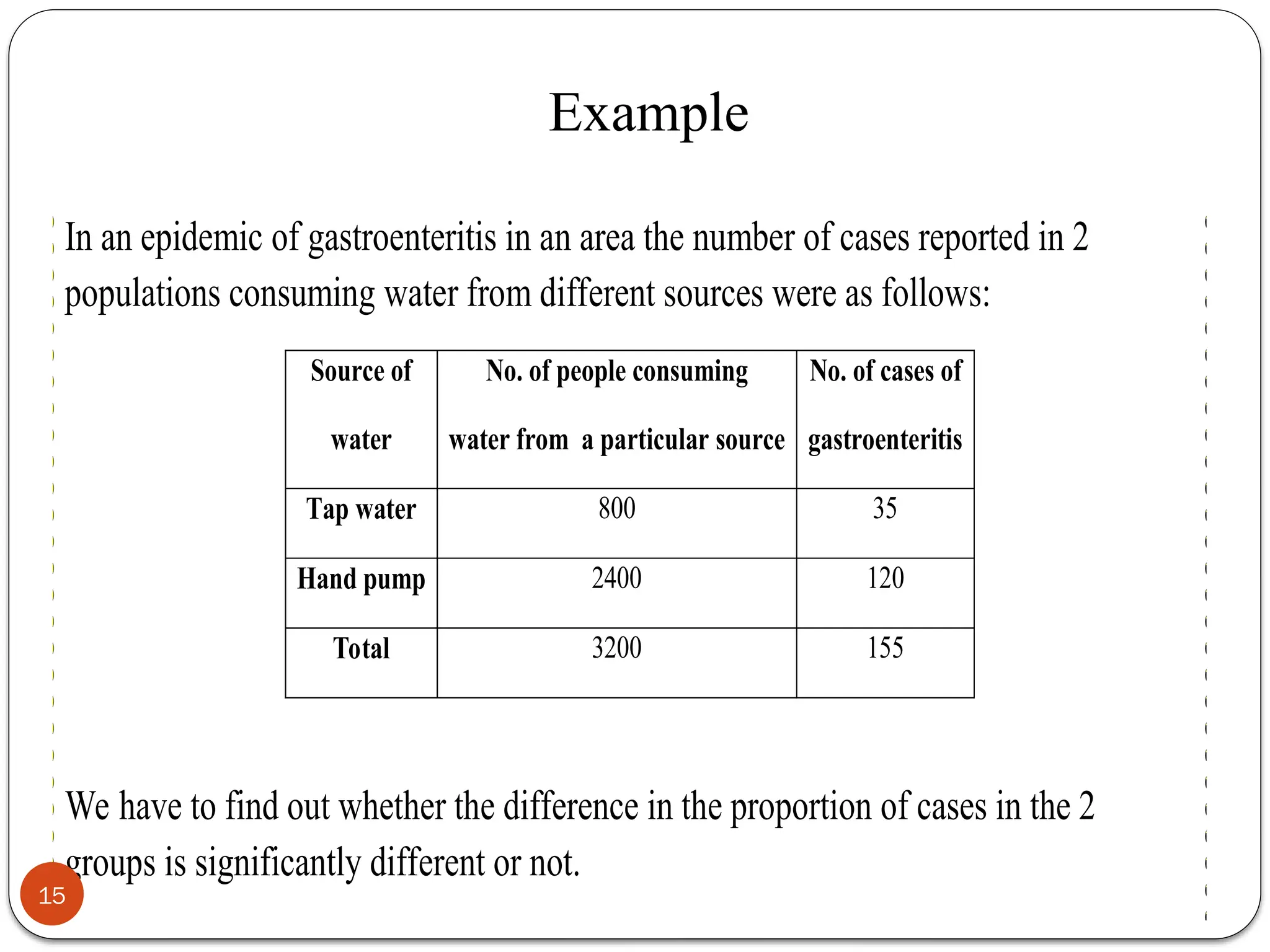
Example
In an epidemic of gastroenteritis in an area the number of cases reported in 2
populations consuming water from different sources were as follows:
Source of
water
No. of people consuming
water from a particular source
No. of cases of
gastroenteritis
Tap water 800 35
Hand pump 2400 120
Total 3200 155
We have to find out whether the difference in the proportion of cases in the 2
groups is significantly different or not.
15
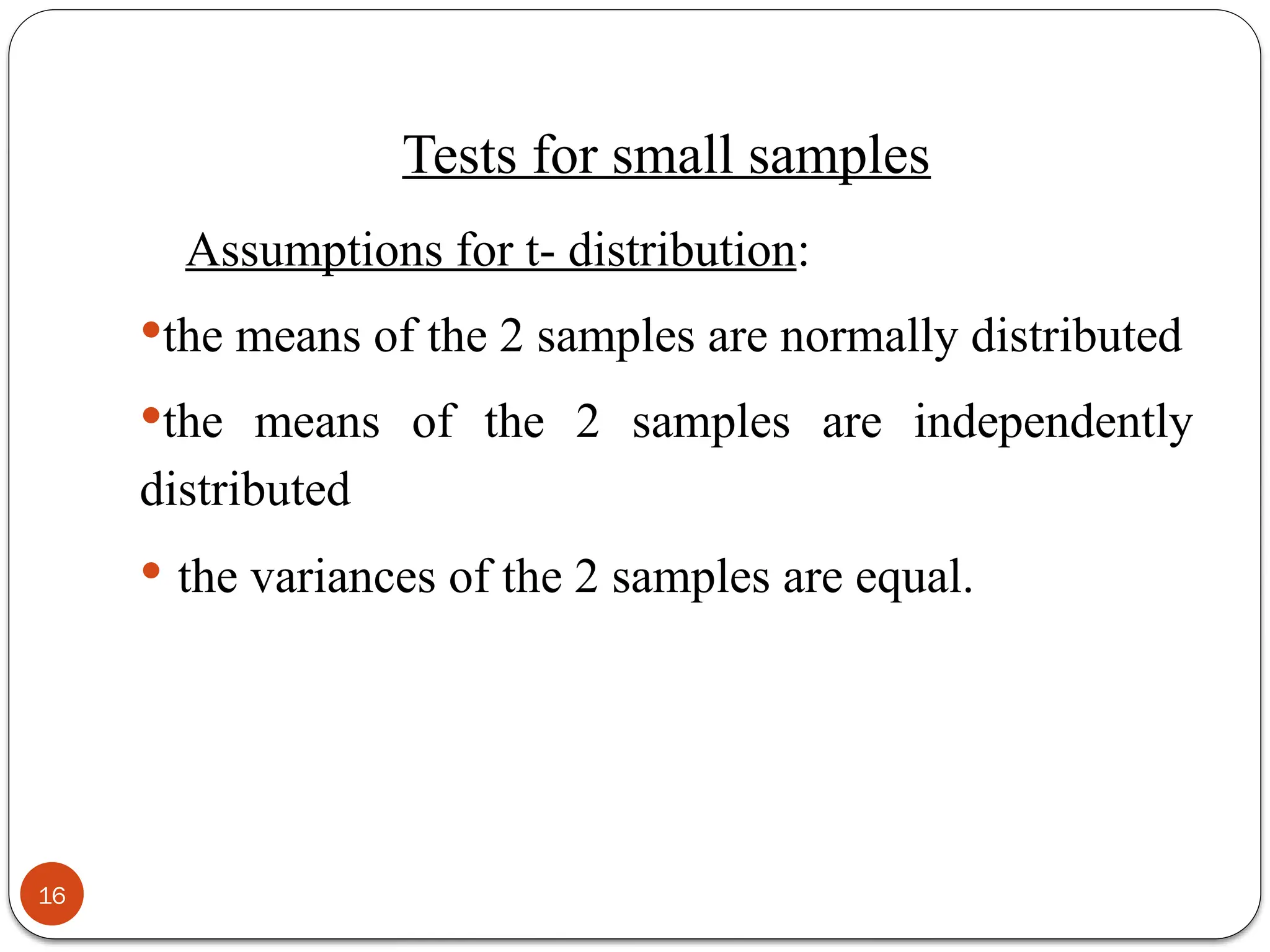
Tests for small samples
Assumptions for t- distribution:
the means of the 2 samples are normally distributed
the means of the 2 samples are independently
distributed
 the variances of the 2 samples are equal.
16
t- test for paired observation
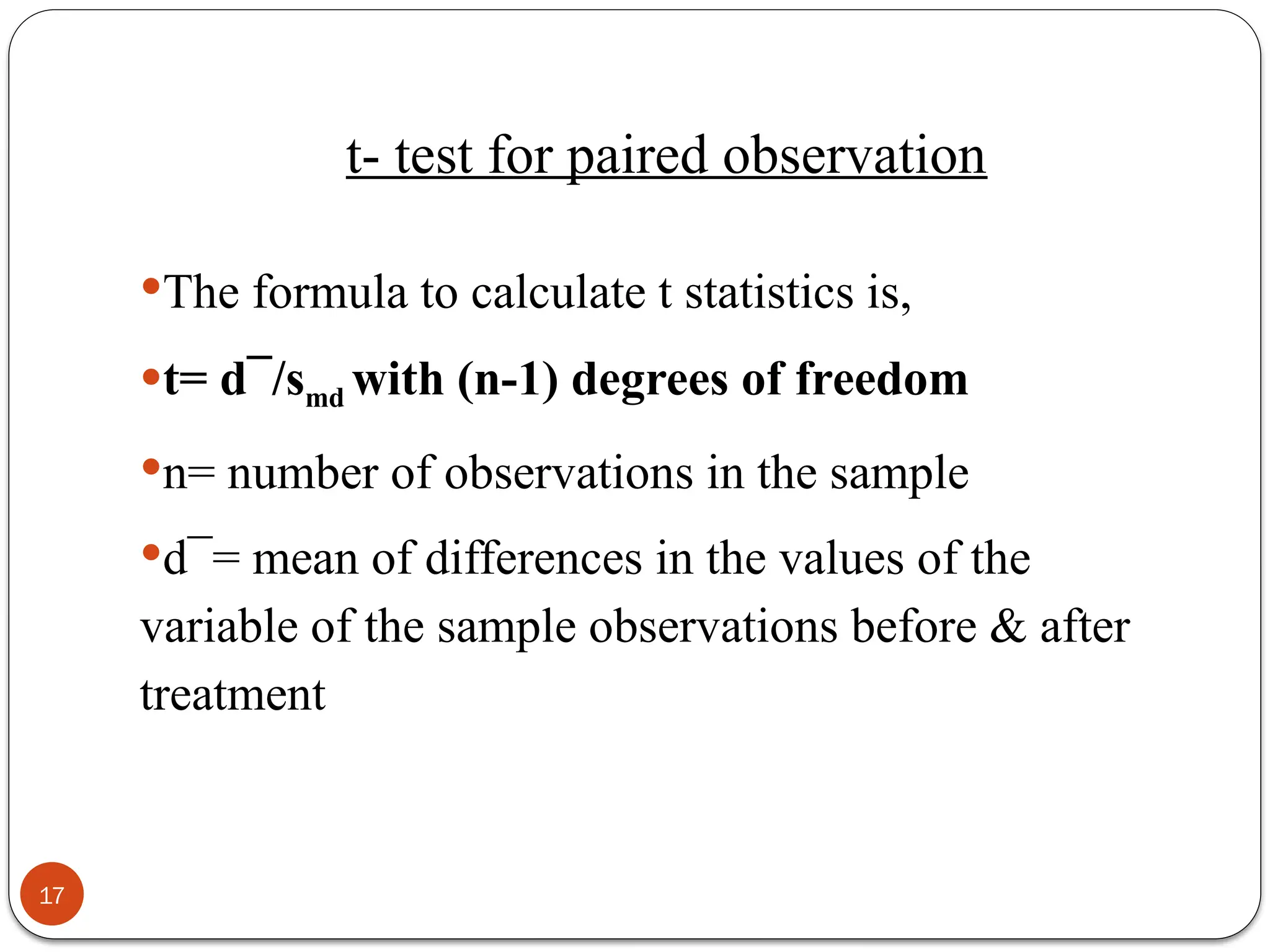
The formula to calculate t statistics is,
t= d¯/smd with (n-1) degrees of freedom
n= number of observations in the sample
d¯= mean of differences in the values of the
variable of the sample observations before & after
treatment
17
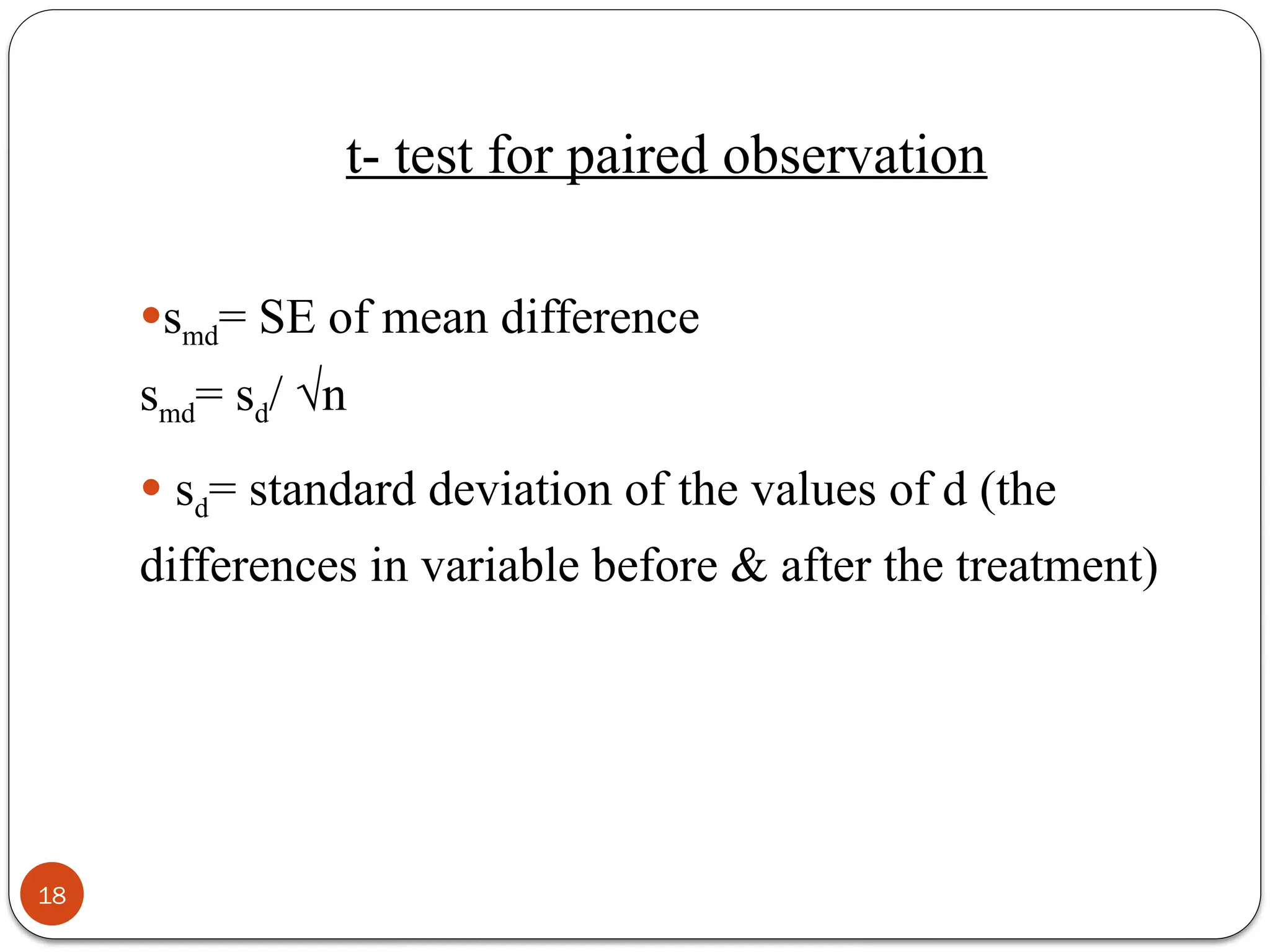
smd= SE of mean difference
smd= sd/ √n
 sd= standard deviation of the values of d (the
differences in variable before & after the treatment)
18
t- test for paired observation
1)Set up null hypothesis that d¯=0
2)Calculate the difference d1 for each pair of observations
before & after treatment and compute their mean d¯
3)Calculate the SD of these differences
sd= [√{sum total of difference between
individual observation & d¯}2
]/(n-1)
n= number of pairs of observations
4)Calculate SE smd from the formula
smd= sd/ √n
19
t- test for paired observation
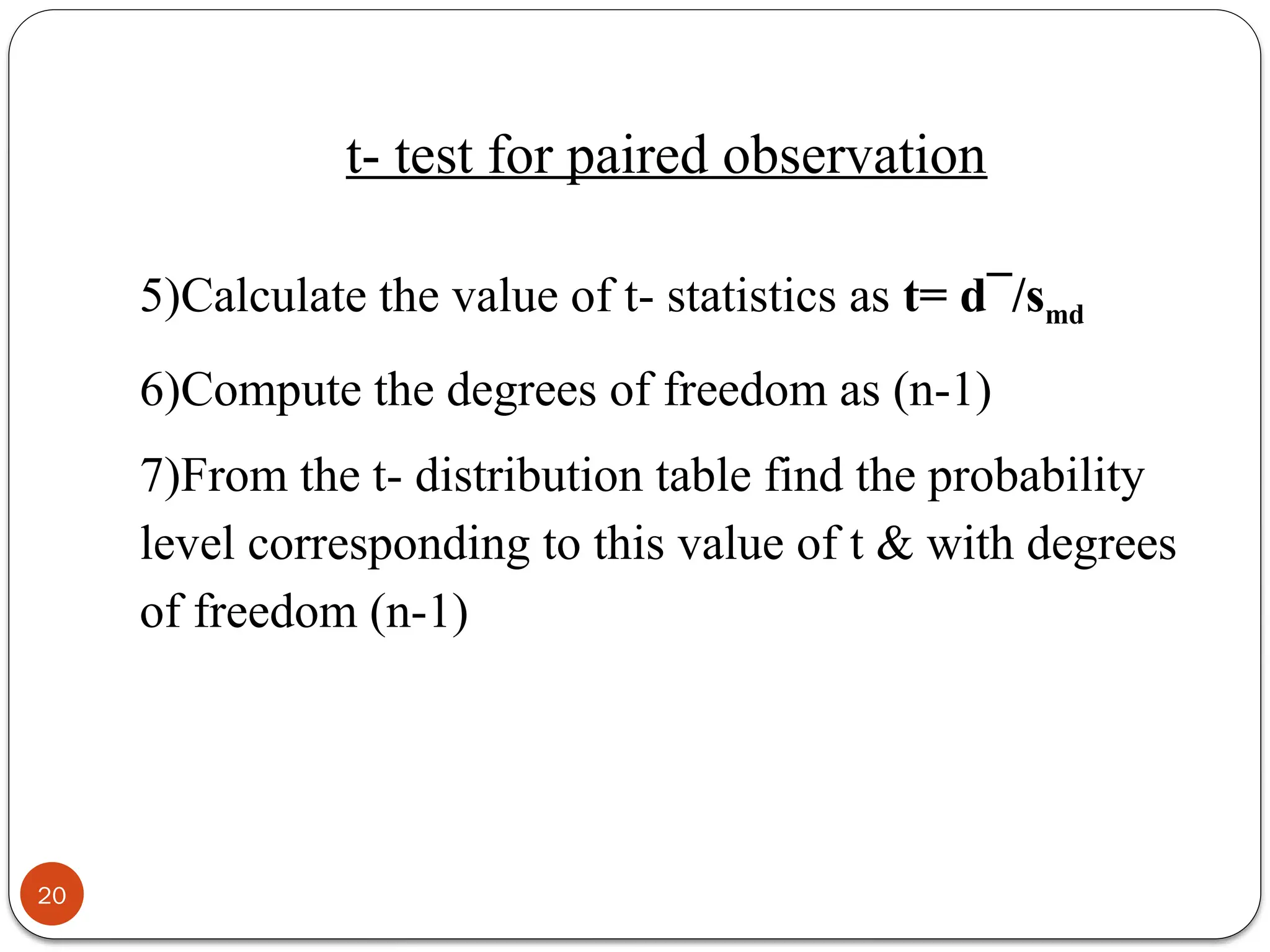
5)Calculate the value of t- statistics as t= d¯/smd
6)Compute the degrees of freedom as (n-1)
7)From the t- distribution table find the probability
level corresponding to this value of t & with degrees
of freedom (n-1)
20
t- test for paired observation
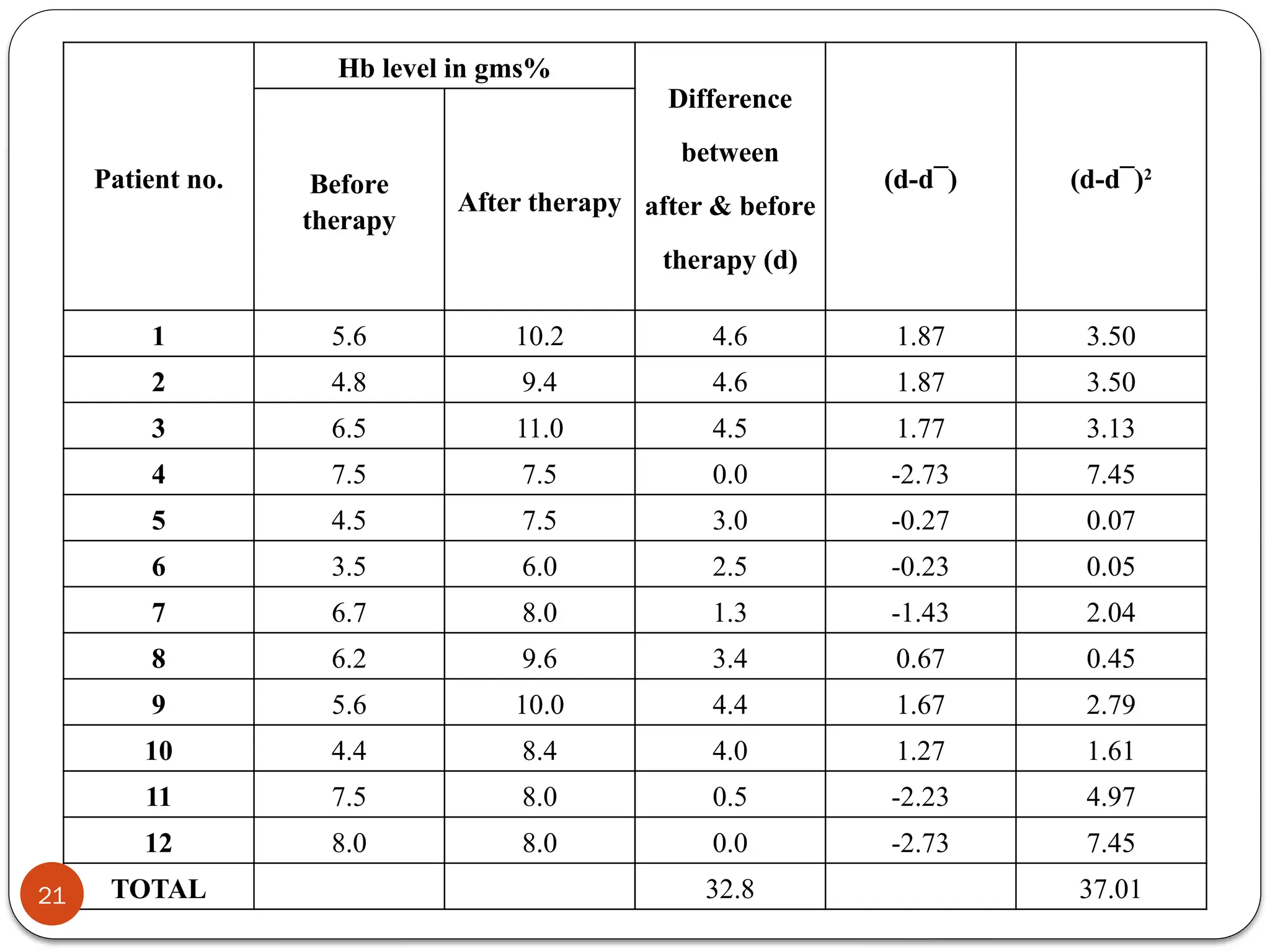
Patient no.
Hb level in gms%
Difference
between
after & before
therapy (d)
(d-d¯) (d-d¯)2
Before
therapy
After therapy
1 5.6 10.2 4.6 1.87 3.50
2 4.8 9.4 4.6 1.87 3.50
3 6.5 11.0 4.5 1.77 3.13
4 7.5 7.5 0.0 -2.73 7.45
5 4.5 7.5 3.0 -0.27 0.07
6 3.5 6.0 2.5 -0.23 0.05
7 6.7 8.0 1.3 -1.43 2.04
8 6.2 9.6 3.4 0.67 0.45
9 5.6 10.0 4.4 1.67 2.79
10 4.4 8.4 4.0 1.27 1.61
11 7.5 8.0 0.5 -2.23 4.97
12 8.0 8.0 0.0 -2.73 7.45
TOTAL 32.8 37.01
21
Unpaired t-test
t= {(x1¯- x2¯)/ smd}
smd is estimated standard error of the difference between the 2
sample means
smd= √[{(n1+n2)/n1n2}{(n1-1)s1
2
+ (n2-1)s2
2
}/ (n1+n2-2)]
s1
2
and s2
2
are the SD of 2 samples
n1 and n2 are respective sample sizes
t= (x1¯- x2¯)/ √[{(n1+n2)/n1n2}{(n1-1)s1
2
+ (n2-1)s2
2
}/ (n1+n2-2)]
with (n1 + n2 – 2) degrees of freedom
22
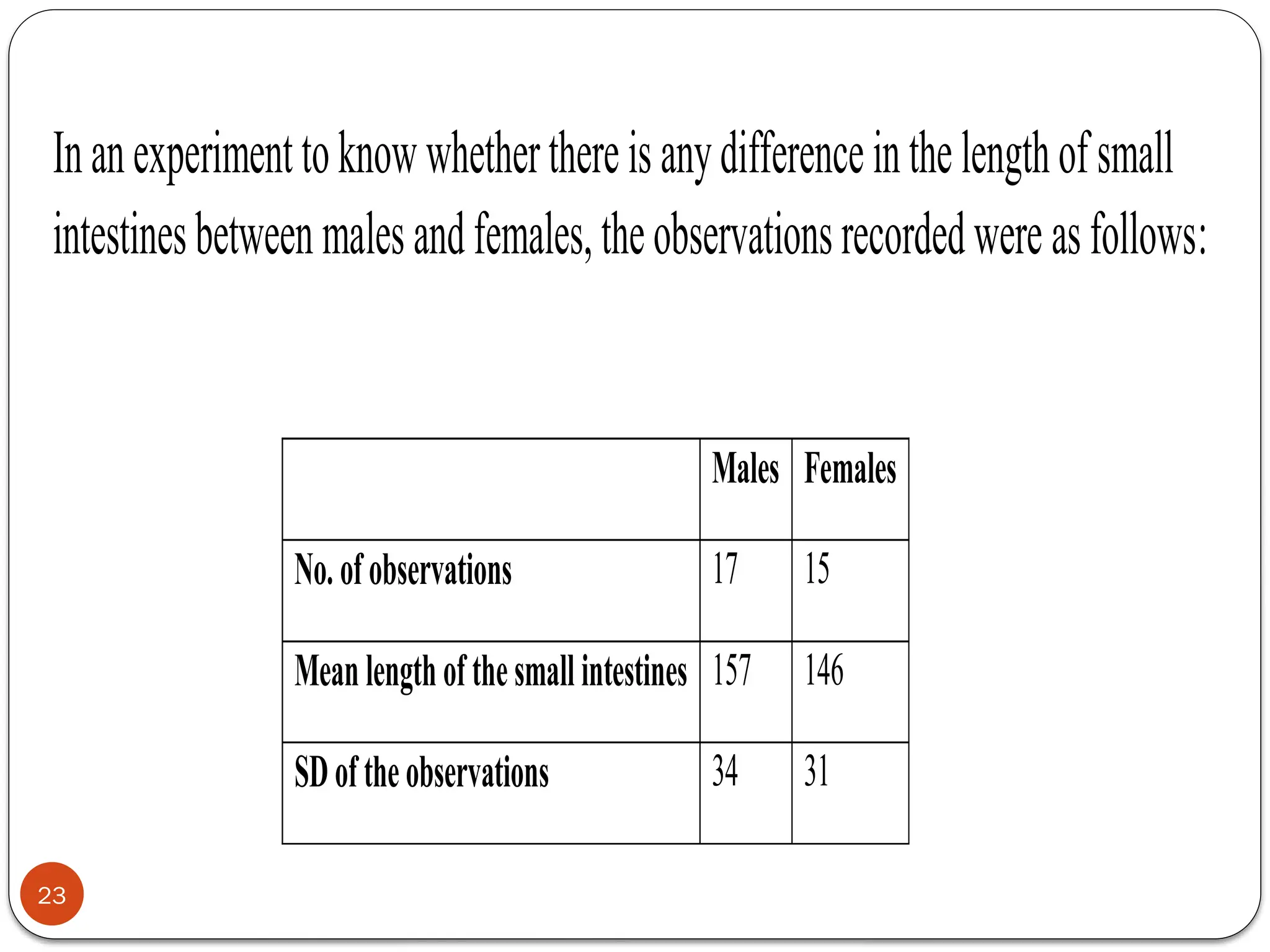
Inanexperimenttoknowwhetherthereisanydifferenceinthelengthofsmall
intestinesbetween malesandfemales,theobservationsrecordedwere asfollows:
Males Females
No.ofobservations 17 15
Meanlengthofthesmallintestines 157 146
SDoftheobservations 34 31
23
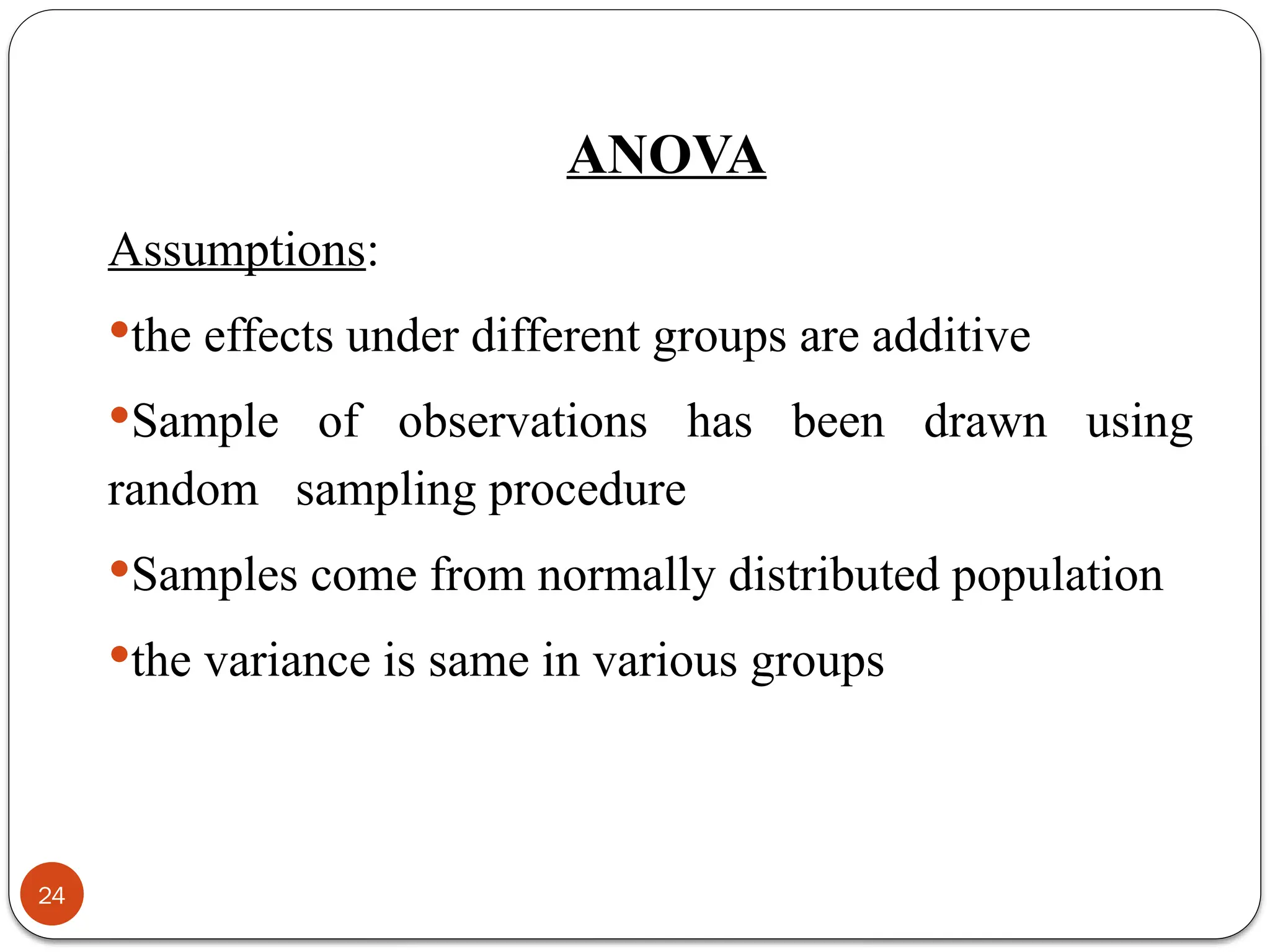
ANOVA
Assumptions:
the effects under different groups are additive
Sample of observations has been drawn using
random sampling procedure
Samples come from normally distributed population
the variance is same in various groups
24
One way ANOVA
1)Calculate sum of observations of each group (village)=
(Ti)
2)Calculate sum of all observations (Σxij),where xij
represents each observation
3)Calculate square of sum of all observations= (Σxij)2
4)Calculate total sum of squares, ie = [Σ(xij
2
)- {(Σxij)2
/n}];
n= total no. of observations.
(Σxij)2
/n is called correction factor(CF)
25
5)Calculate ‘sum of squares between groups’, ie
= {Σ(Tj
2
/ki)-CF}; Tj= sum of observations in each
group; ki= no. of observations in each group
6)Sum of squares within groups is obtained as
difference between the ‘total sum of squares’ and ‘sum
of squares between groups’ ie [(Σxij)2 – CF] – [Σ(Tj
2
/ki)
– CF] = (Σxij)2
- Σ(Tj
2
/ki).
26
One way ANOVA
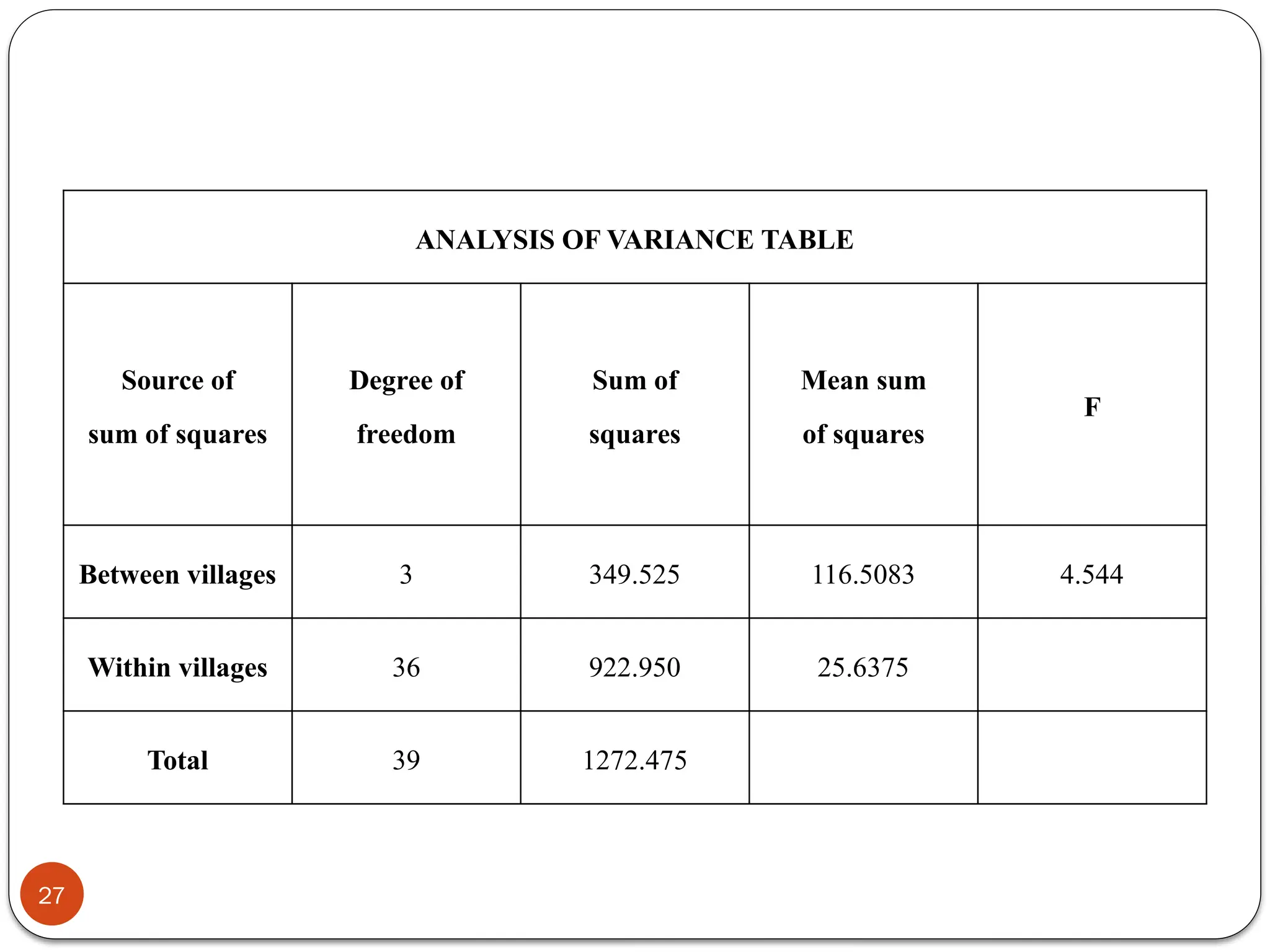
ANALYSIS OF VARIANCE TABLE
Source of
sum of squares
Degree of
freedom
Sum of
squares
Mean sum
of squares
F
Between villages 3 349.525 116.5083 4.544
Within villages 36 922.950 25.6375
Total 39 1272.475
27
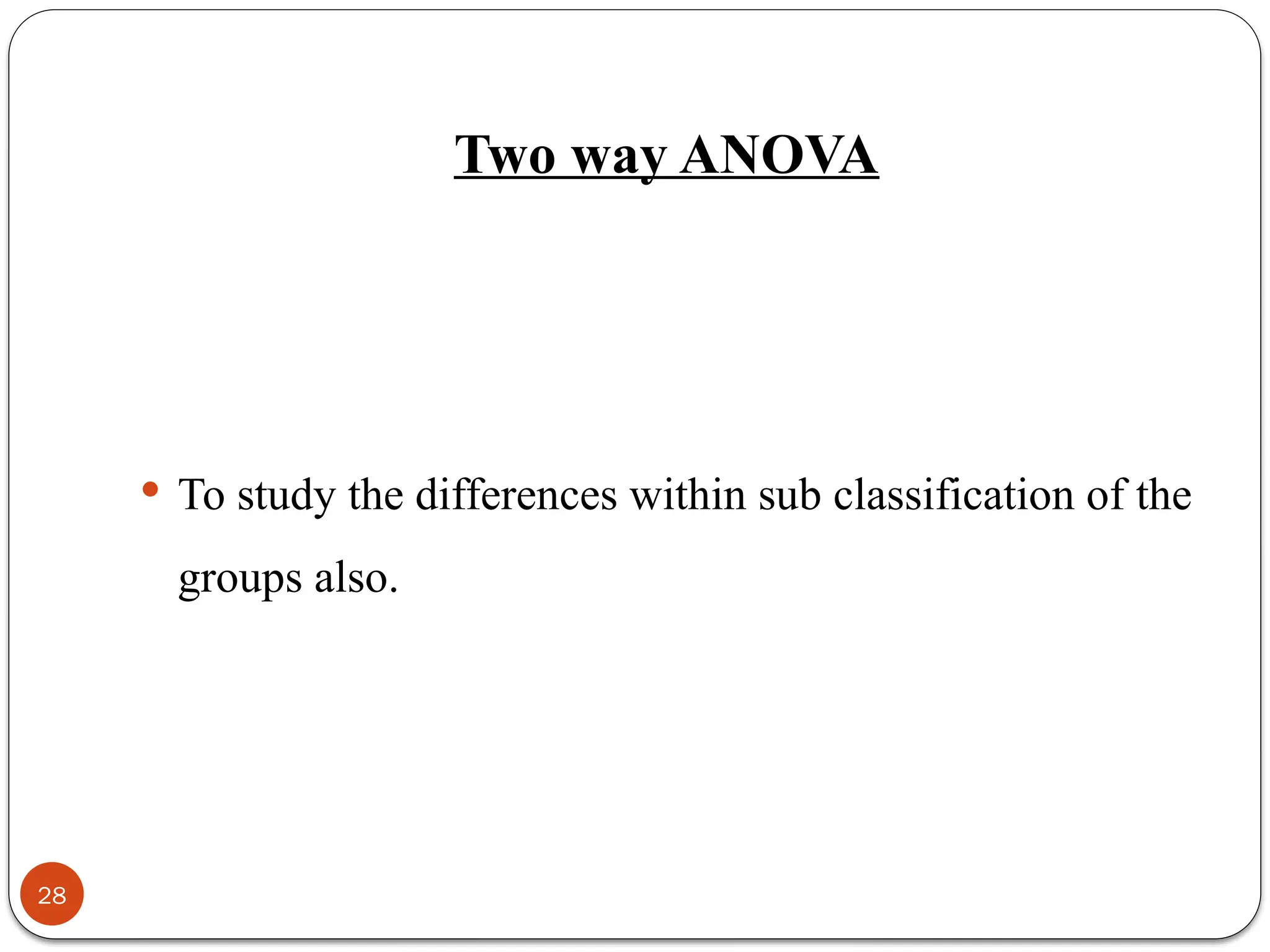
Two way ANOVA
 To study the differences within sub classification of the
groups also.
28
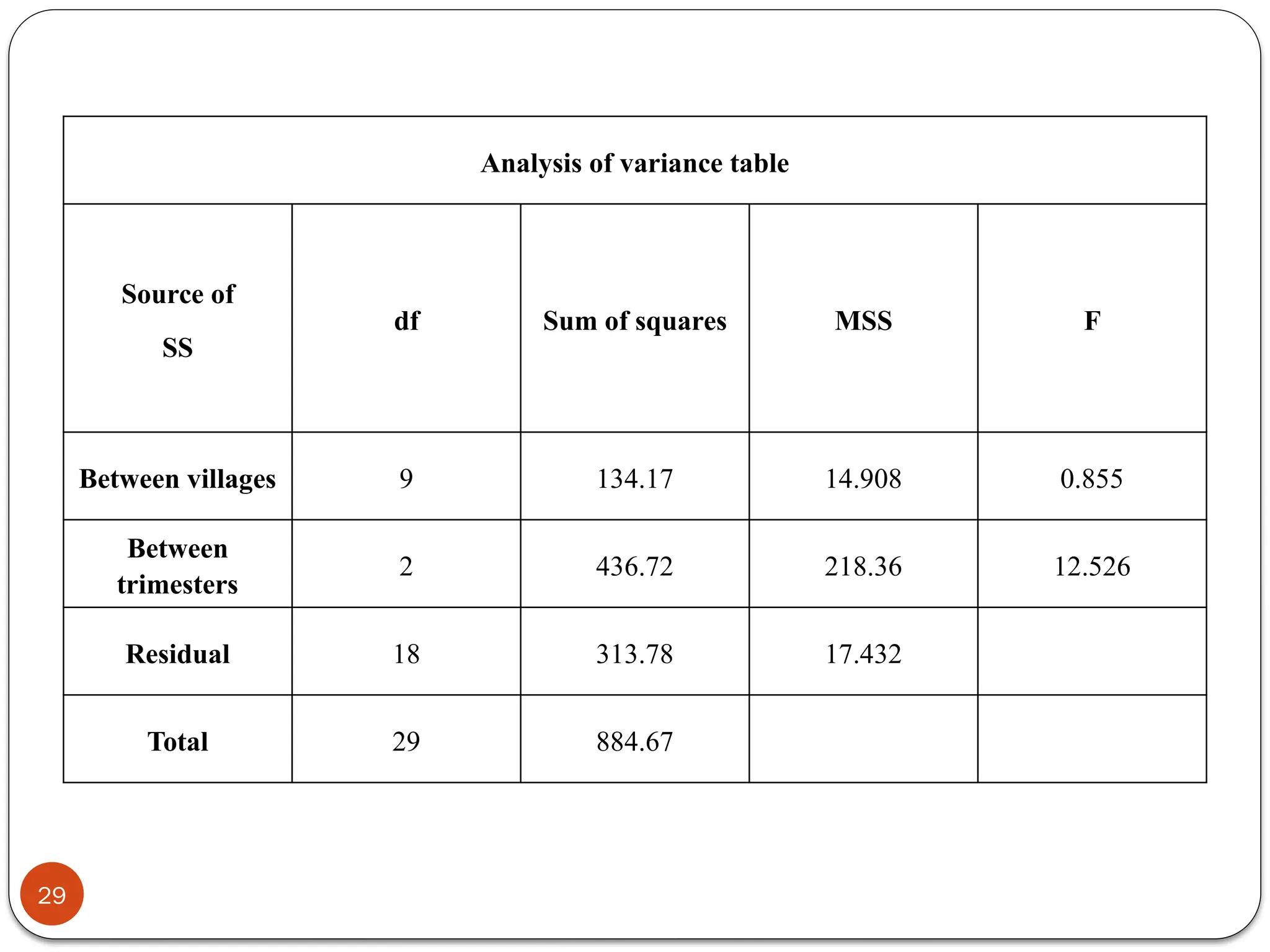
Analysis of variance table
Source of
SS
df Sum of squares MSS F
Between villages 9 134.17 14.908 0.855
Between
trimesters
2 436.72 218.36 12.526
Residual 18 313.78 17.432
Total 29 884.67
29
NON-PARAMETRIC TESTS- Assumptions
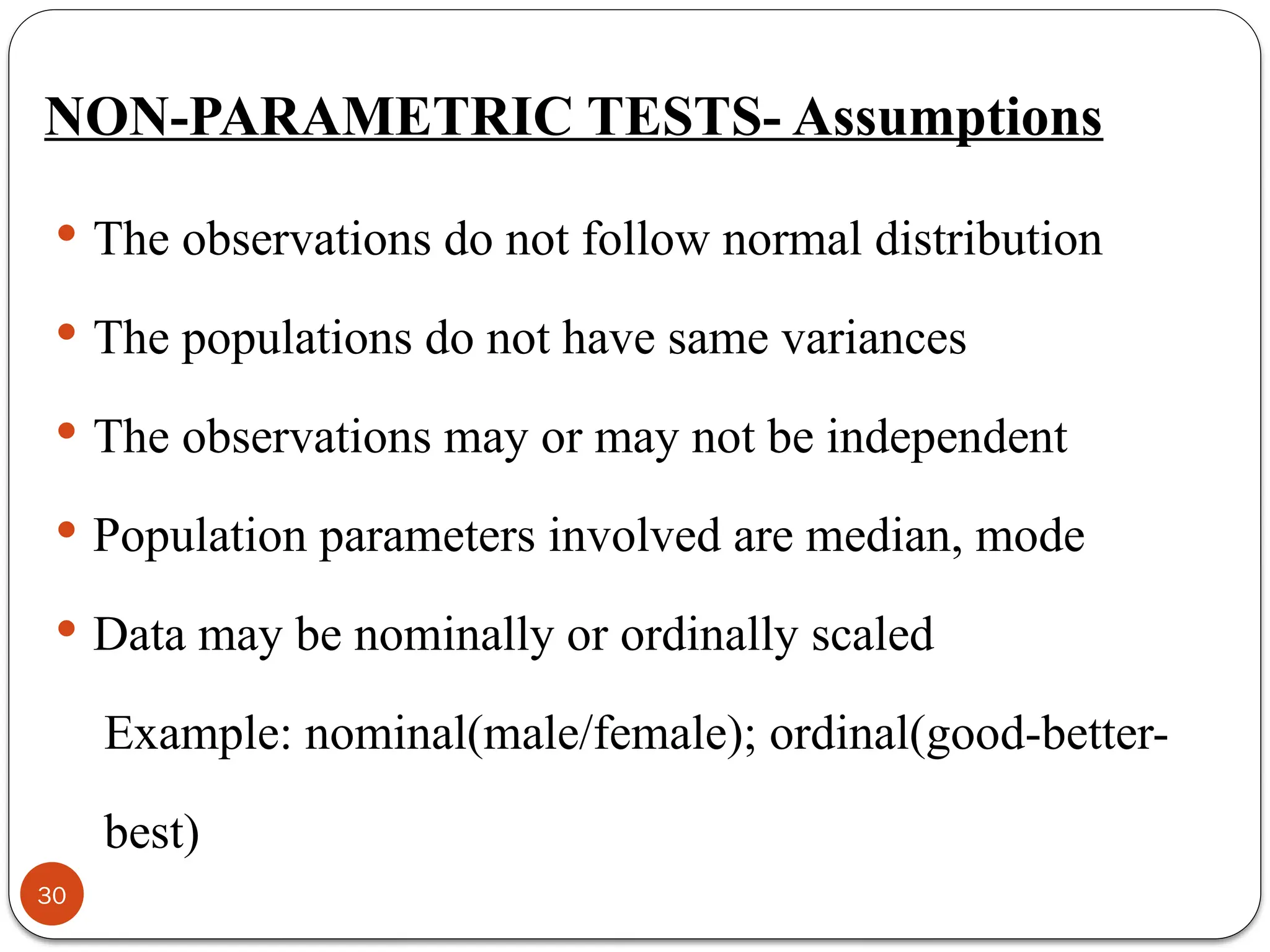
 The observations do not follow normal distribution
 The populations do not have same variances
 The observations may or may not be independent
 Population parameters involved are median, mode
 Data may be nominally or ordinally scaled
Example: nominal(male/female); ordinal(good-better-
best)
30
NON-PARAMETRIC TESTS…
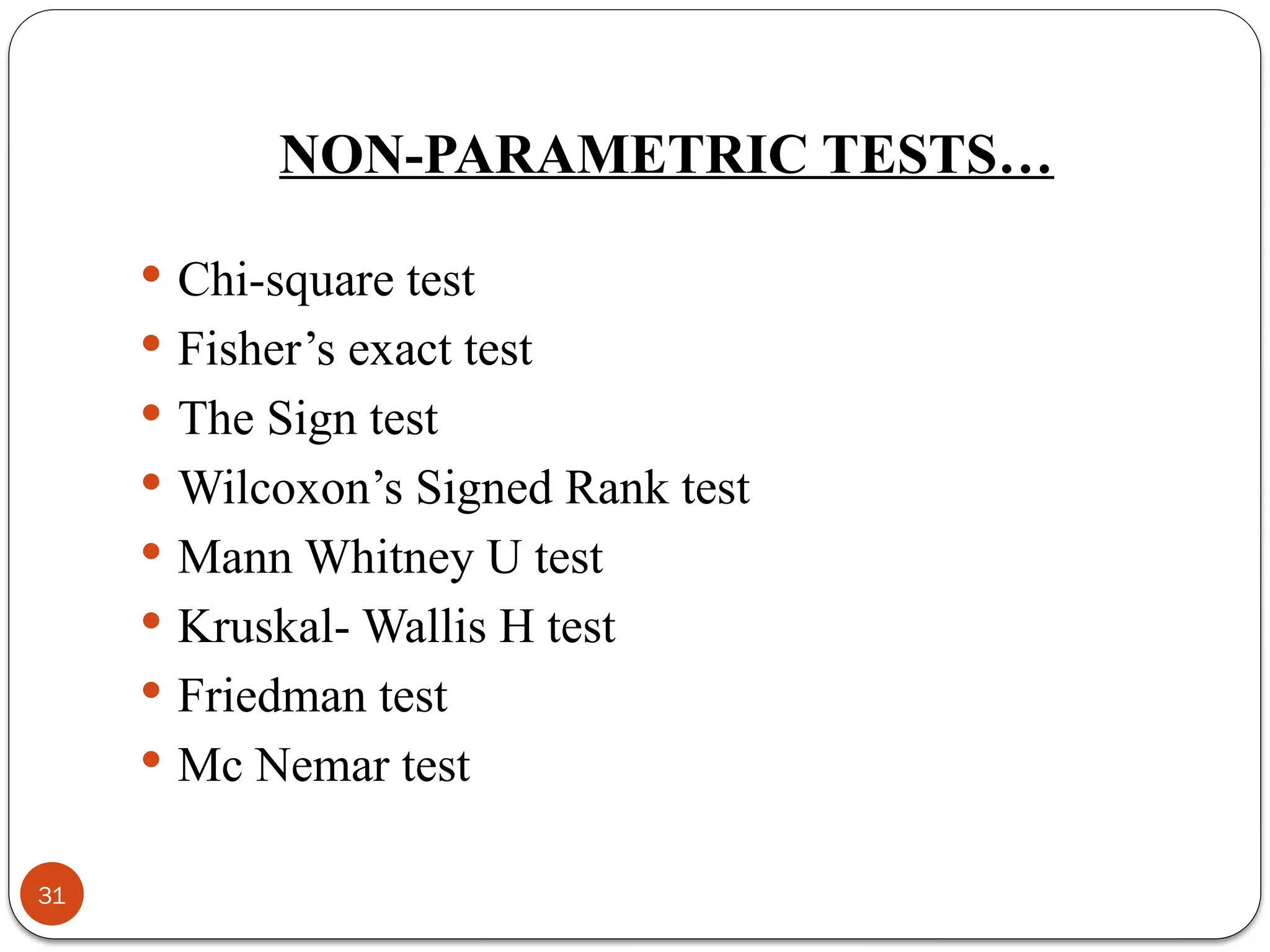
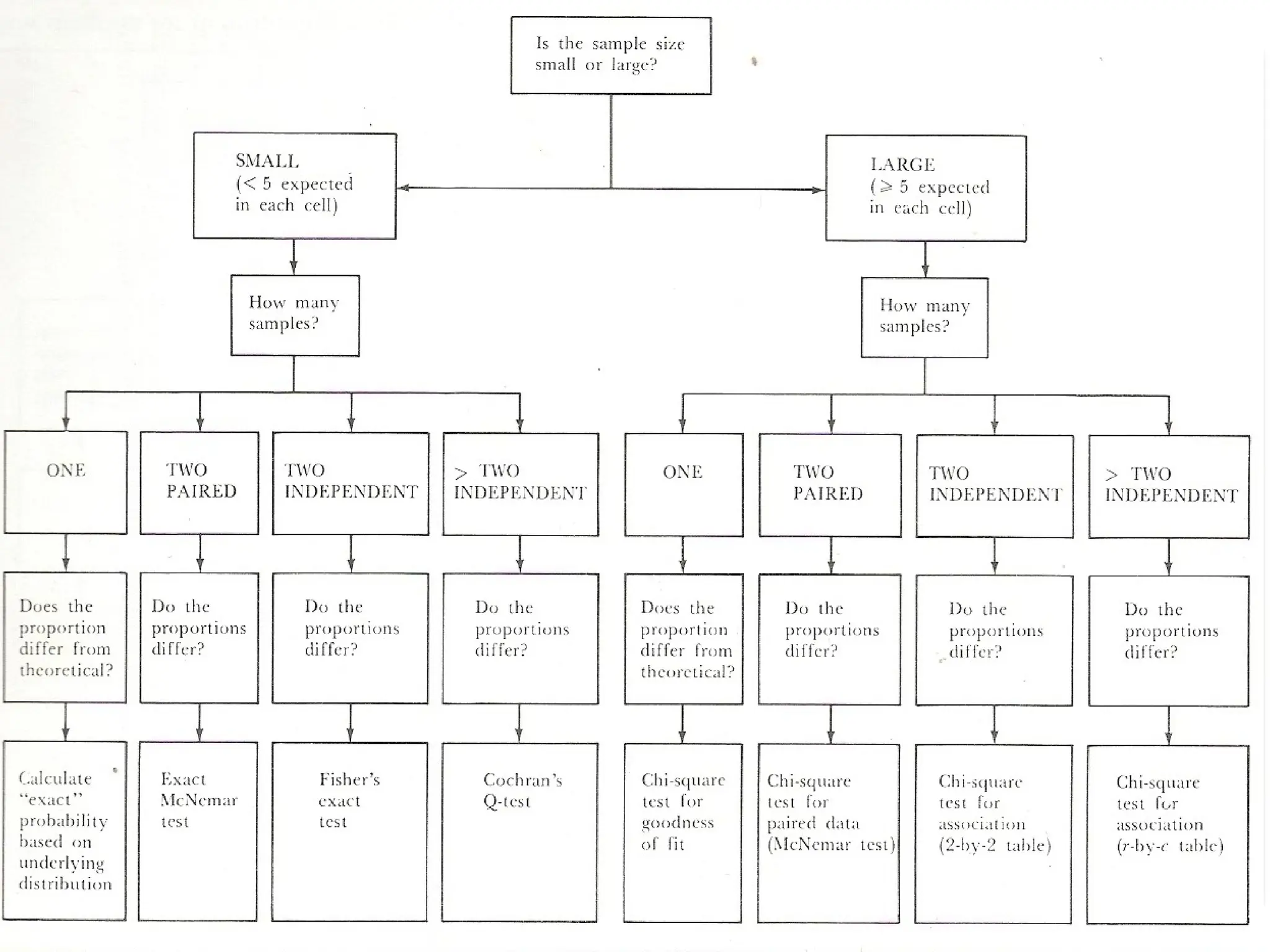
 Chi-square test
 Fisher’s exact test
 The Sign test
 Wilcoxon’s Signed Rank test
 Mann Whitney U test
 Kruskal- Wallis H test
 Friedman test
 Mc Nemar test
31
Chi-square test
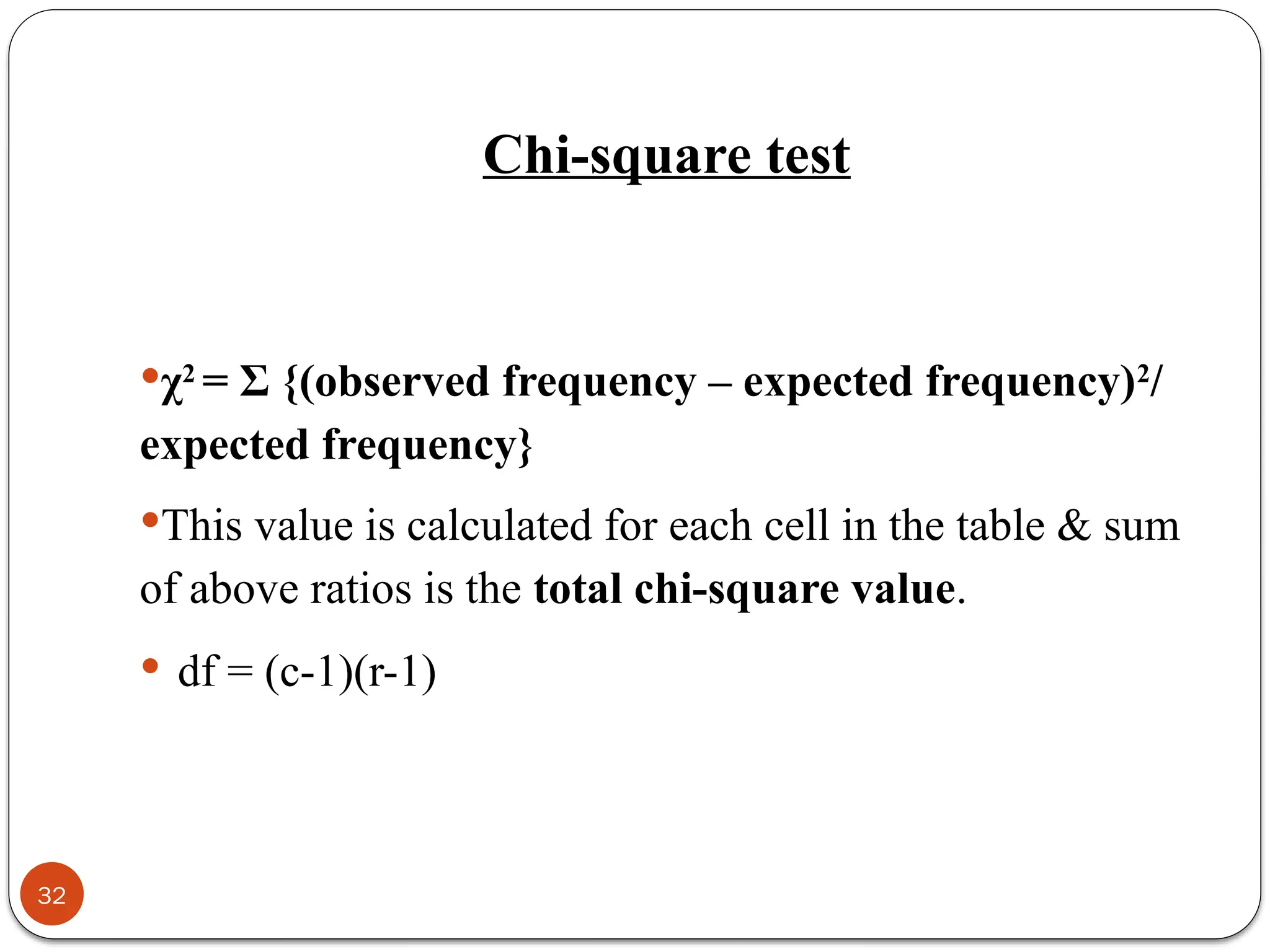
χ2
= Σ {(observed frequency – expected frequency)2
/
expected frequency}
This value is calculated for each cell in the table & sum
of above ratios is the total chi-square value.
 df = (c-1)(r-1)
32
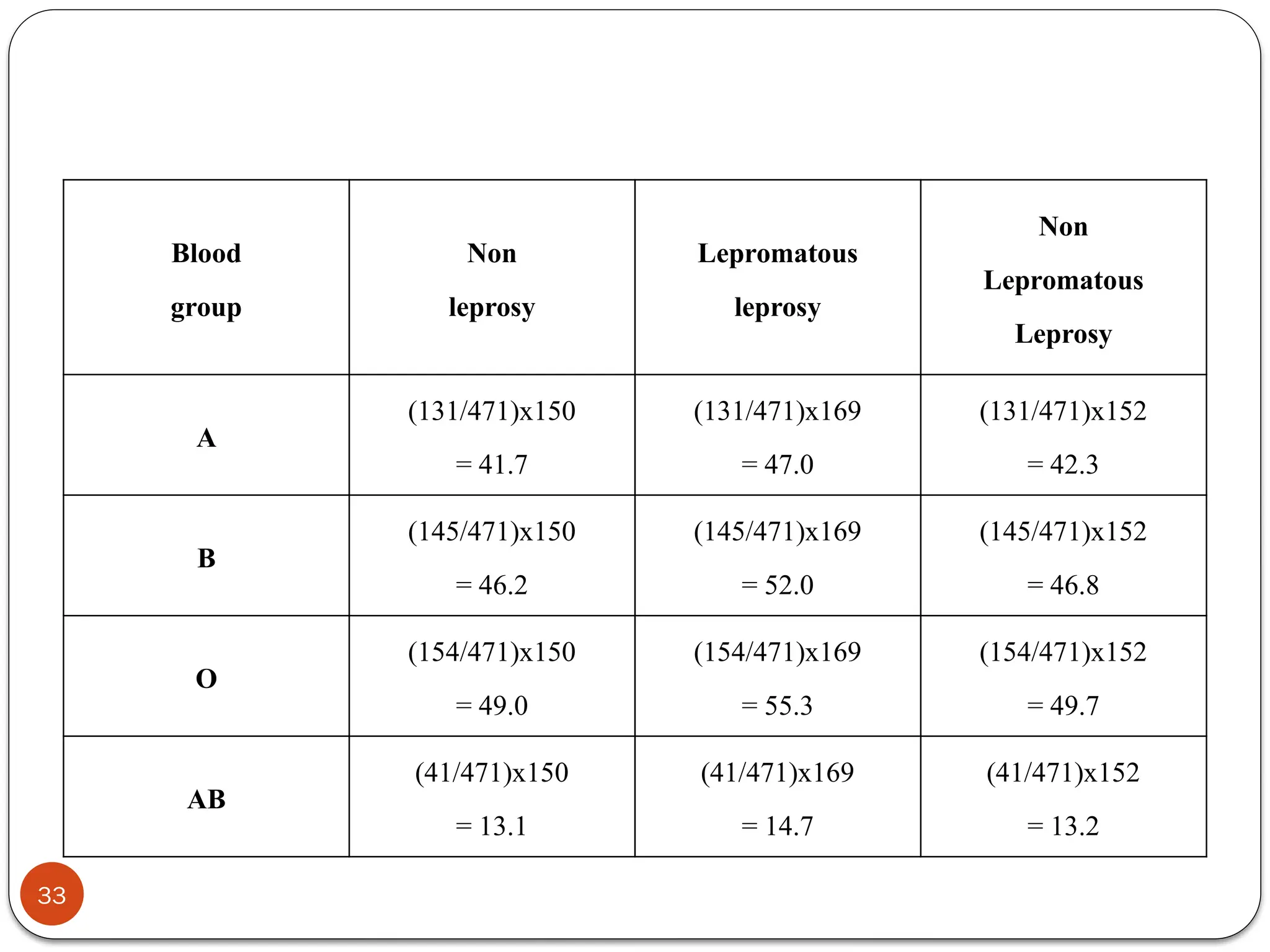
Blood
group
Non
leprosy
Lepromatous
leprosy
Non
Lepromatous
Leprosy
A
(131/471)x150
= 41.7
(131/471)x169
= 47.0
(131/471)x152
= 42.3
B
(145/471)x150
= 46.2
(145/471)x169
= 52.0
(145/471)x152
= 46.8
O
(154/471)x150
= 49.0
(154/471)x169
= 55.3
(154/471)x152
= 49.7
AB
(41/471)x150
= 13.1
(41/471)x169
= 14.7
(41/471)x152
= 13.2
33
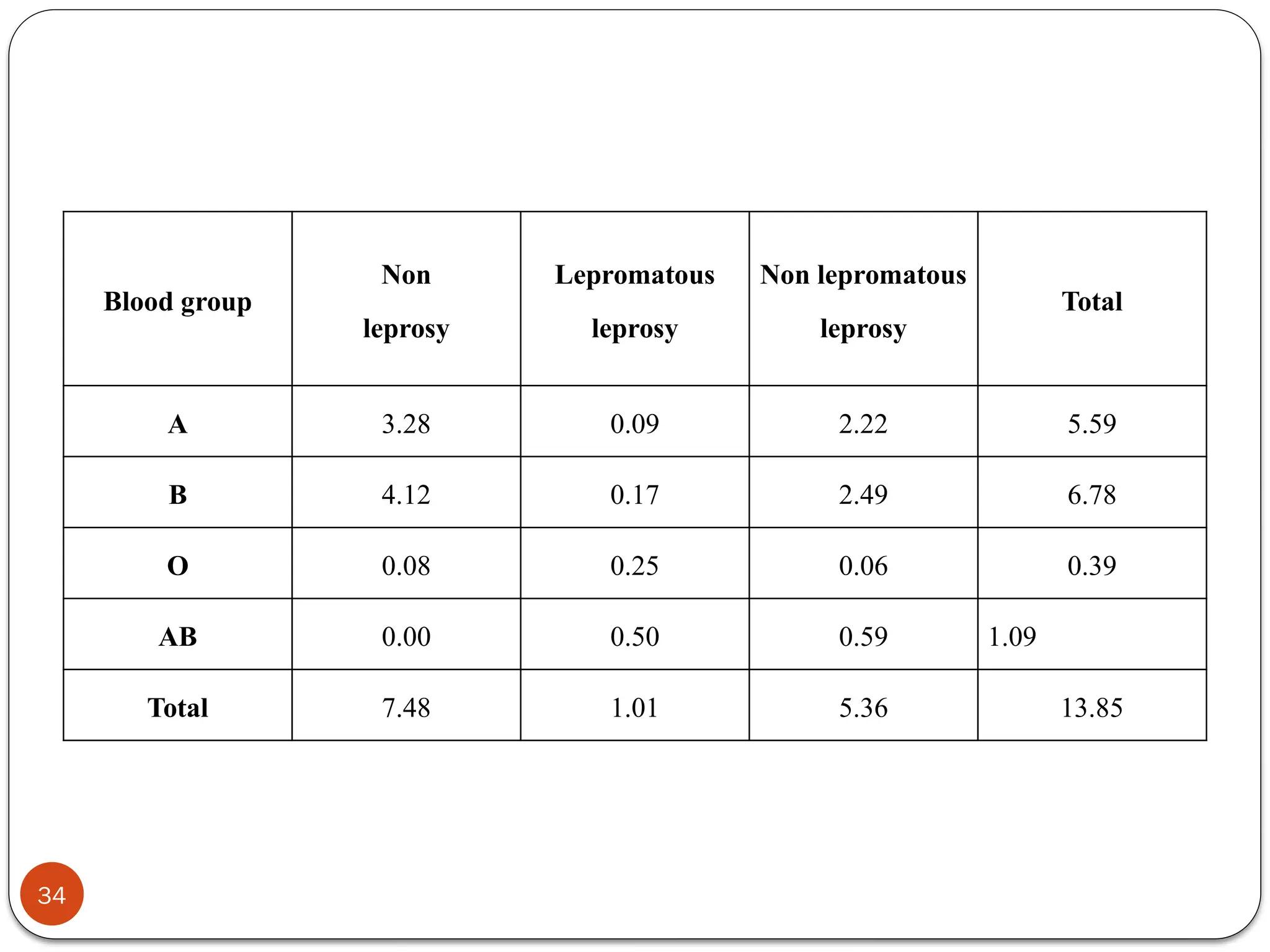
Blood group
Non
leprosy
Lepromatous
leprosy
Non lepromatous
leprosy
Total
A 3.28 0.09 2.22 5.59
B 4.12 0.17 2.49 6.78
O 0.08 0.25 0.06 0.39
AB 0.00 0.50 0.59 1.09
Total 7.48 1.01 5.36 13.85
34
Chi-square test for a 2x2 table
 χ2
= [(ad-bc)2
x G] / [(a+b)(c+d)(a+c)(b+d)]
df = (2-1)(2-1) = 1
35
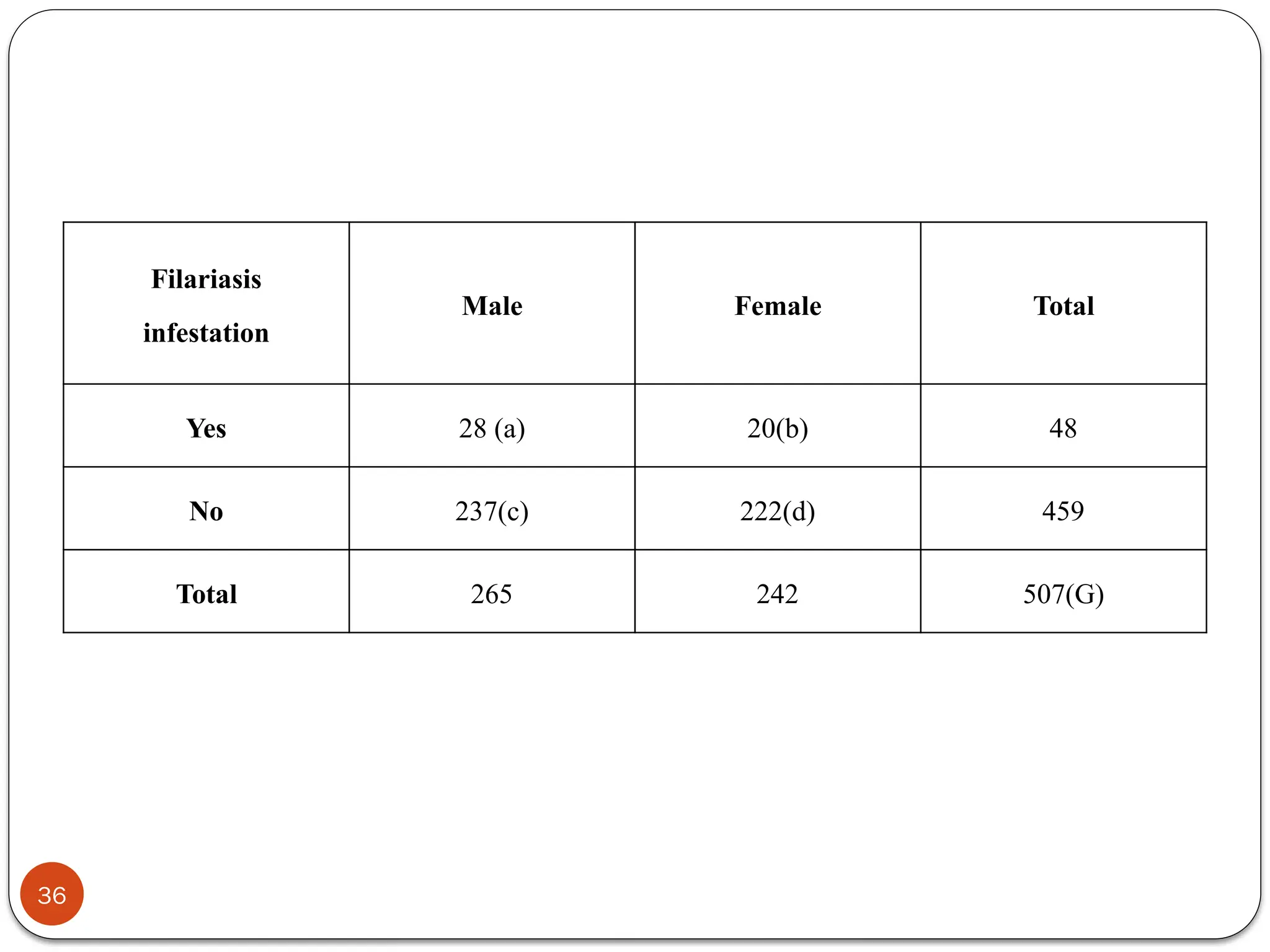
Filariasis
infestation
Male Female Total
Yes 28 (a) 20(b) 48
No 237(c) 222(d) 459
Total 265 242 507(G)
36
Fisher’s Exact probability test
P = [{(a+c)! (b+d)! (a+b)! (c+d)! }/ {n! a! b! c! d!}]
a, b, c & d = cell frequencies in 2x2 table
 n = total number of observations
37
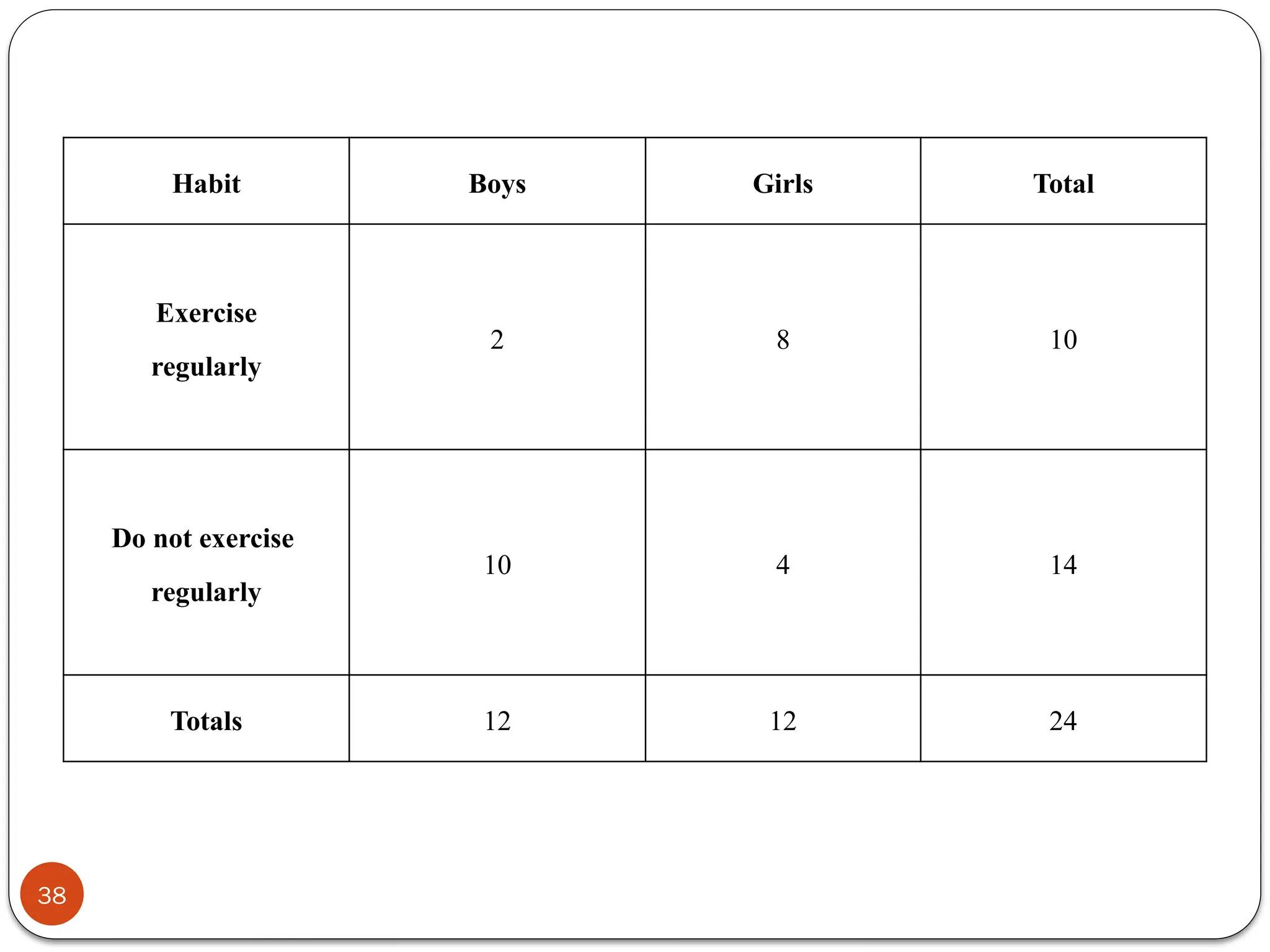
Habit Boys Girls Total
Exercise
regularly
2 8 10
Do not exercise
regularly
10 4 14
Totals 12 12 24
38
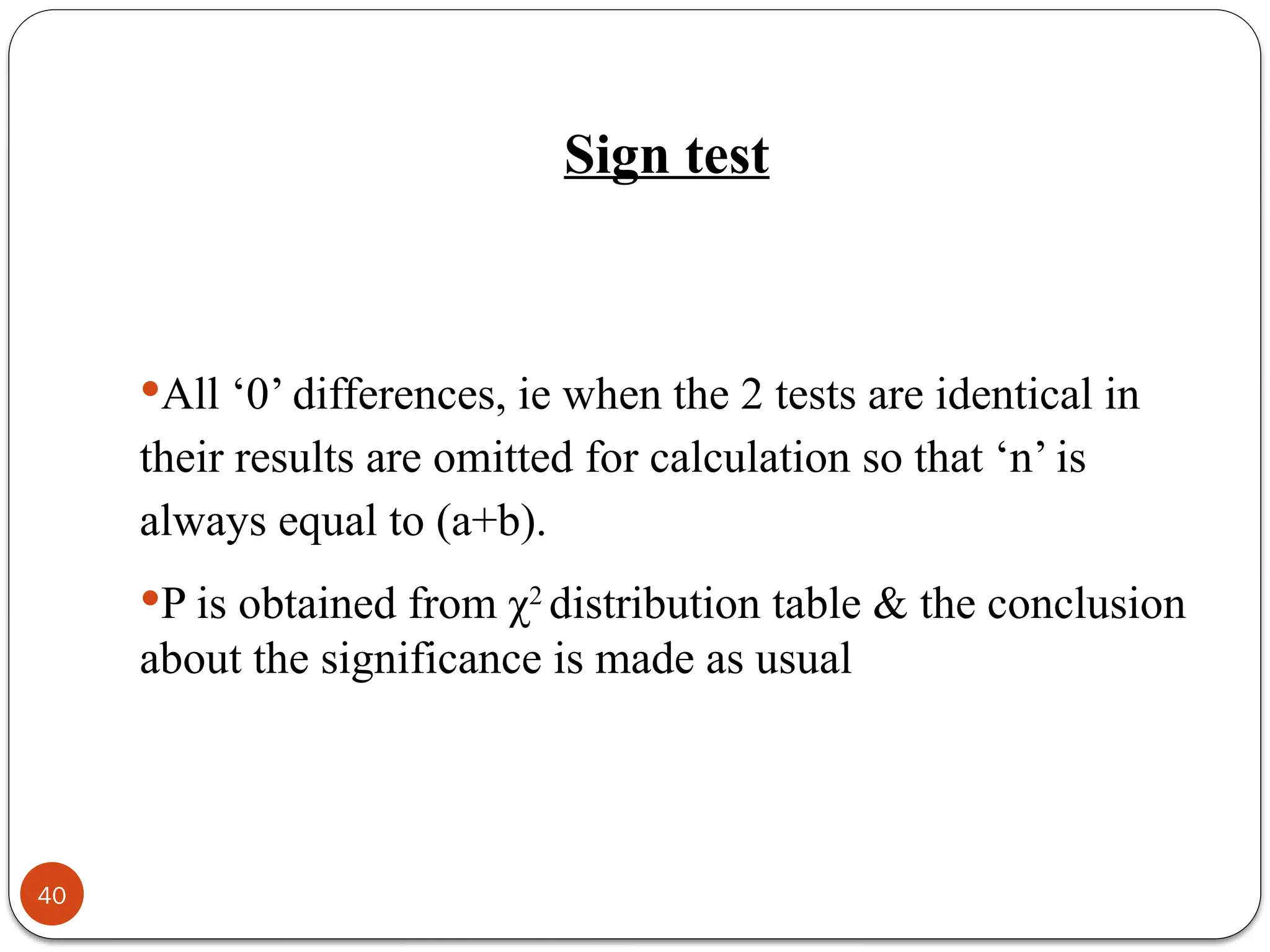
Sign test
The significance of difference can be tested using
usual χ2
test, which is as follows:
χ2
= [(|a-b| - 1)2
] / n with 1 df
a & b = no. of (+) & (-) respectively
n = (a+b)
39
All ‘0’ differences, ie when the 2 tests are identical in
their results are omitted for calculation so that ‘n’ is
always equal to (a+b).
P is obtained from χ2
distribution table & the conclusion
about the significance is made as usual
40
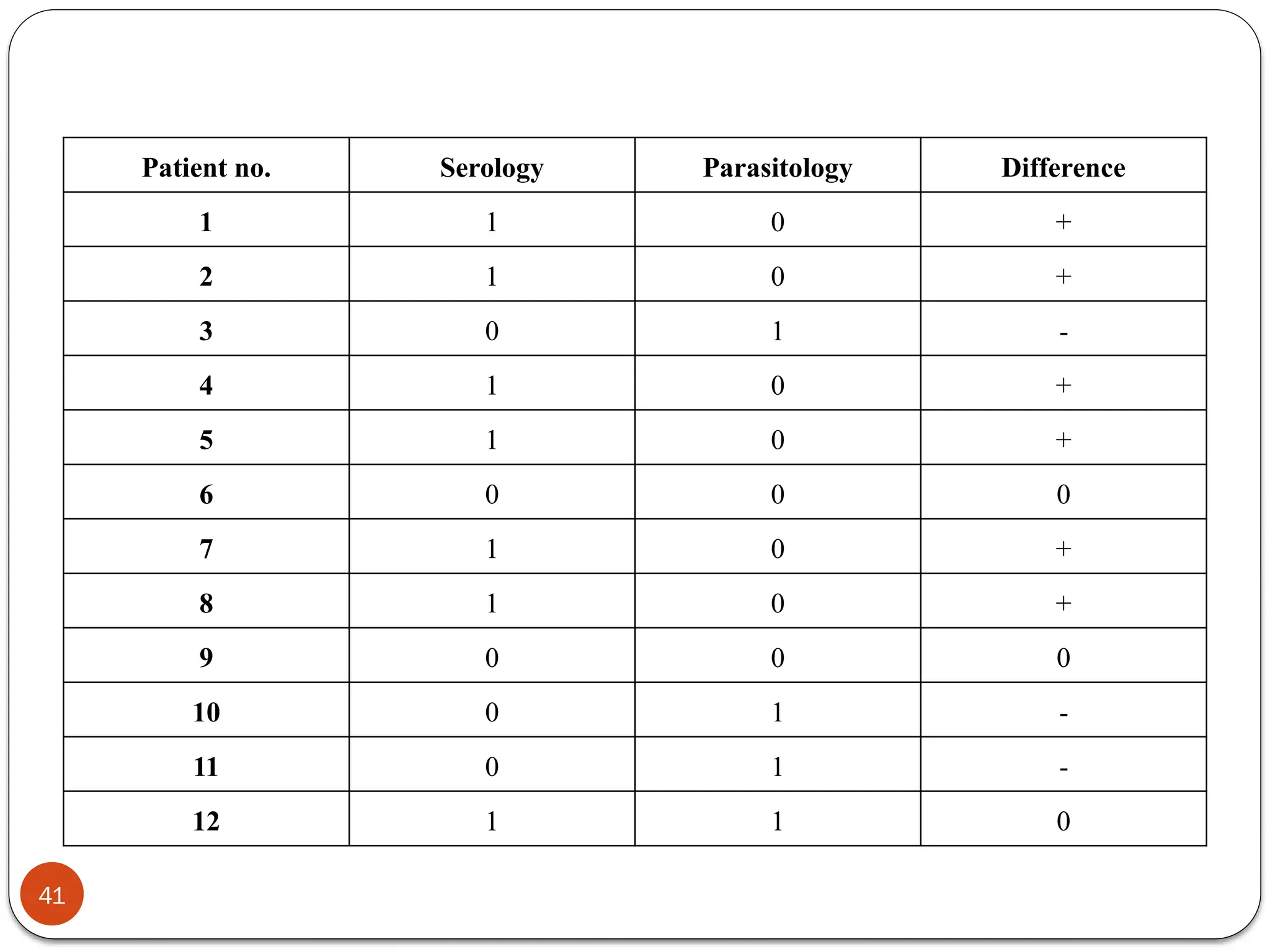
Sign test
Patient no. Serology Parasitology Difference
1 1 0 +
2 1 0 +
3 0 1 -
4 1 0 +
5 1 0 +
6 0 0 0
7 1 0 +
8 1 0 +
9 0 0 0
10 0 1 -
11 0 1 -
12 1 1 0
41
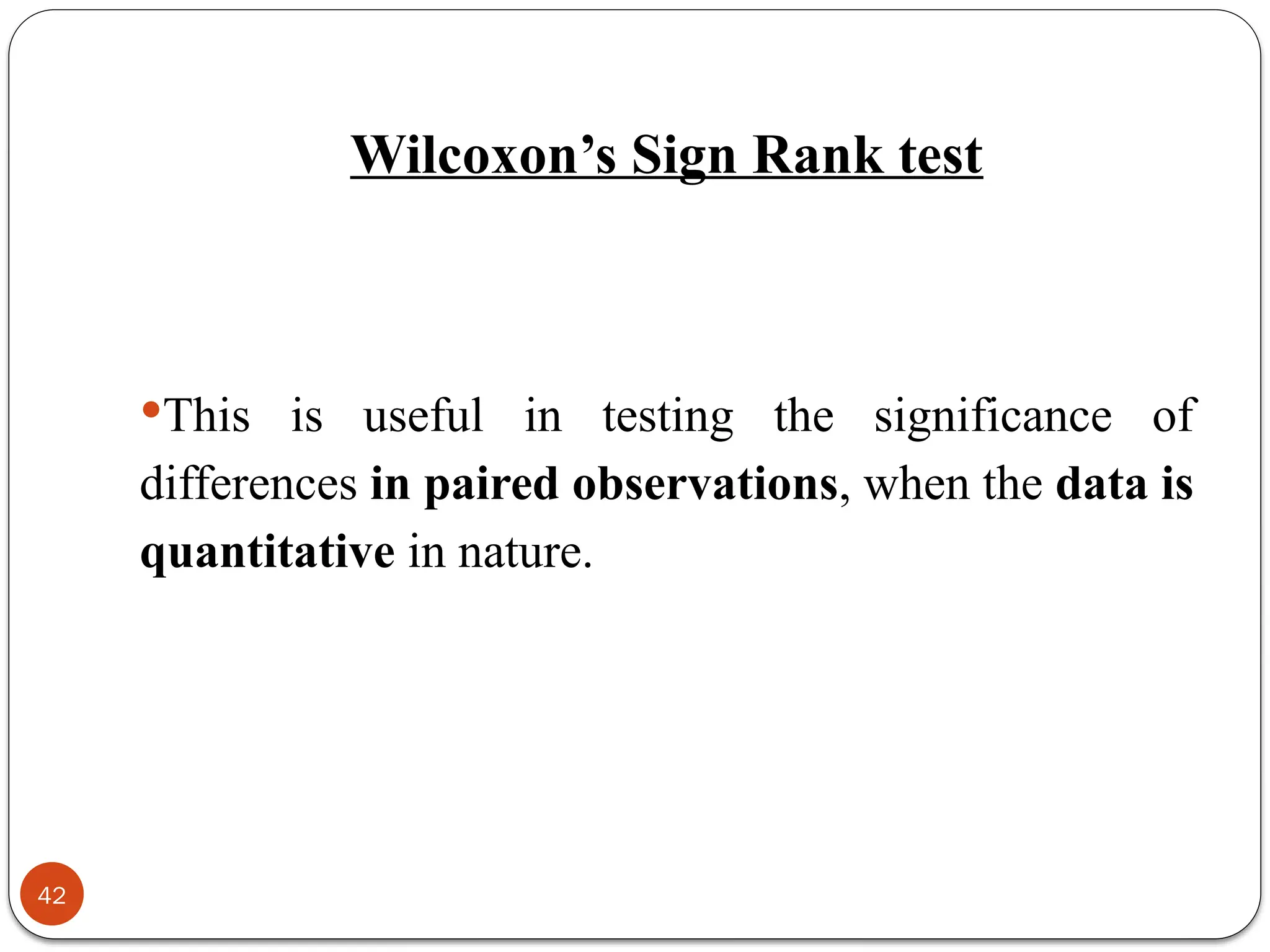
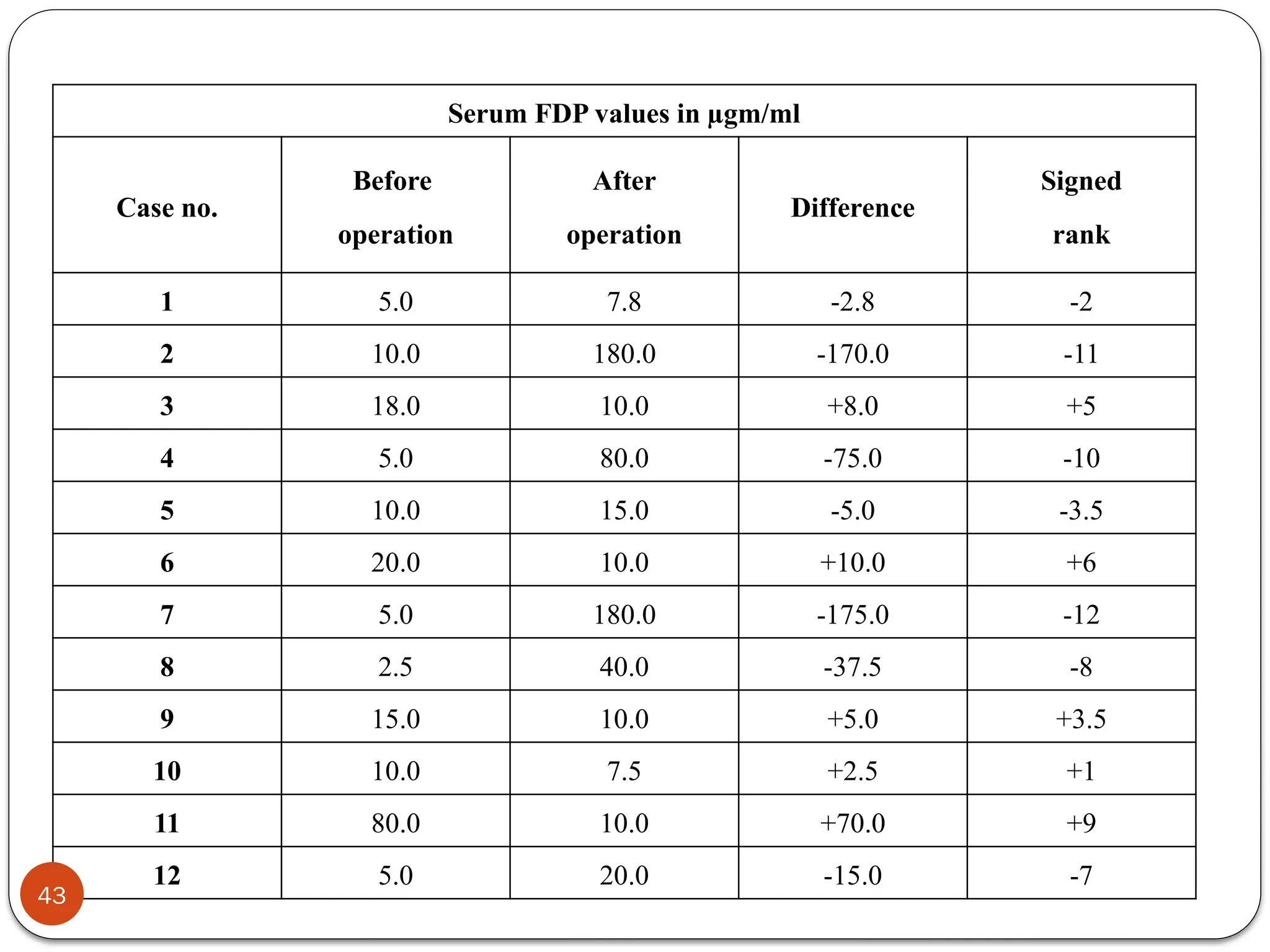
Wilcoxon’s Sign Rank test
This is useful in testing the significance of
differences in paired observations, when the data is
quantitative in nature.
42
Serum FDP values in µgm/ml
Case no.
Before
operation
After
operation
Difference
Signed
rank
1 5.0 7.8 -2.8 -2
2 10.0 180.0 -170.0 -11
3 18.0 10.0 +8.0 +5
4 5.0 80.0 -75.0 -10
5 10.0 15.0 -5.0 -3.5
6 20.0 10.0 +10.0 +6
7 5.0 180.0 -175.0 -12
8 2.5 40.0 -37.5 -8
9 15.0 10.0 +5.0 +3.5
10 10.0 7.5 +2.5 +1
11 80.0 10.0 +70.0 +9
12 5.0 20.0 -15.0 -7
43
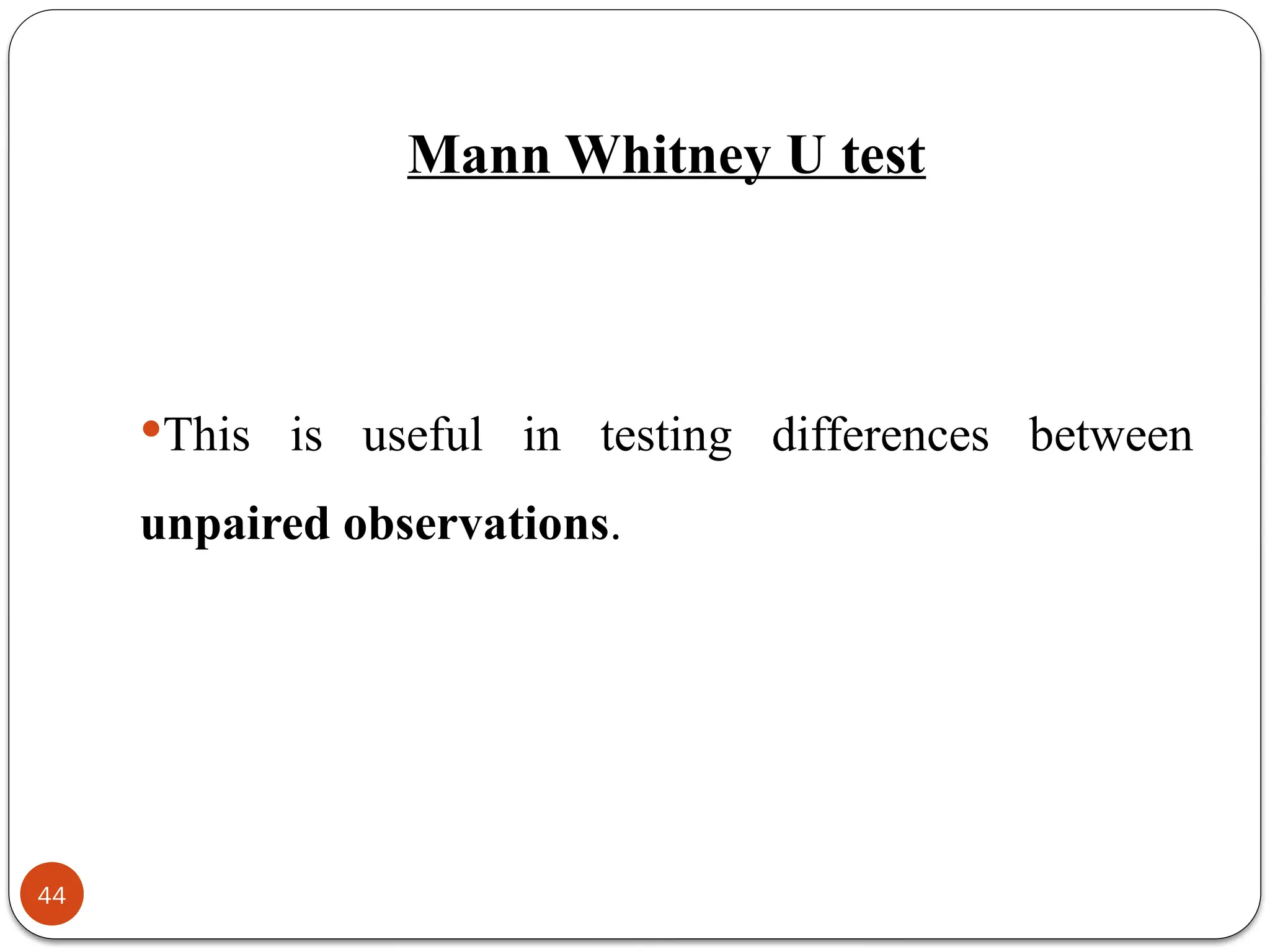
Mann Whitney U test
This is useful in testing differences between
unpaired observations.
44
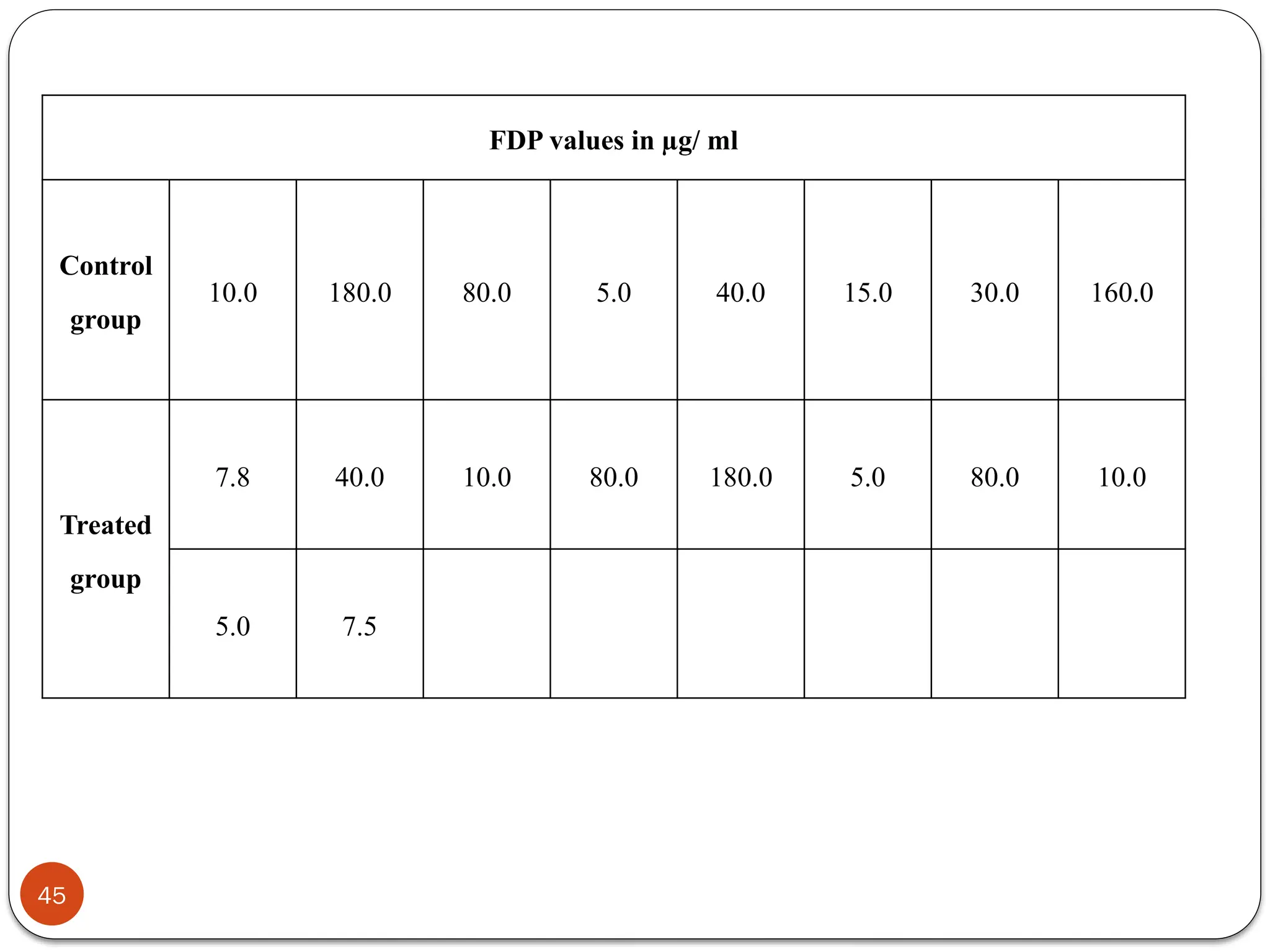
FDP values in µg/ ml
Control
group
10.0 180.0 80.0 5.0 40.0 15.0 30.0 160.0
Treated
group
7.8 40.0 10.0 80.0 180.0 5.0 80.0 10.0
5.0 7.5
45
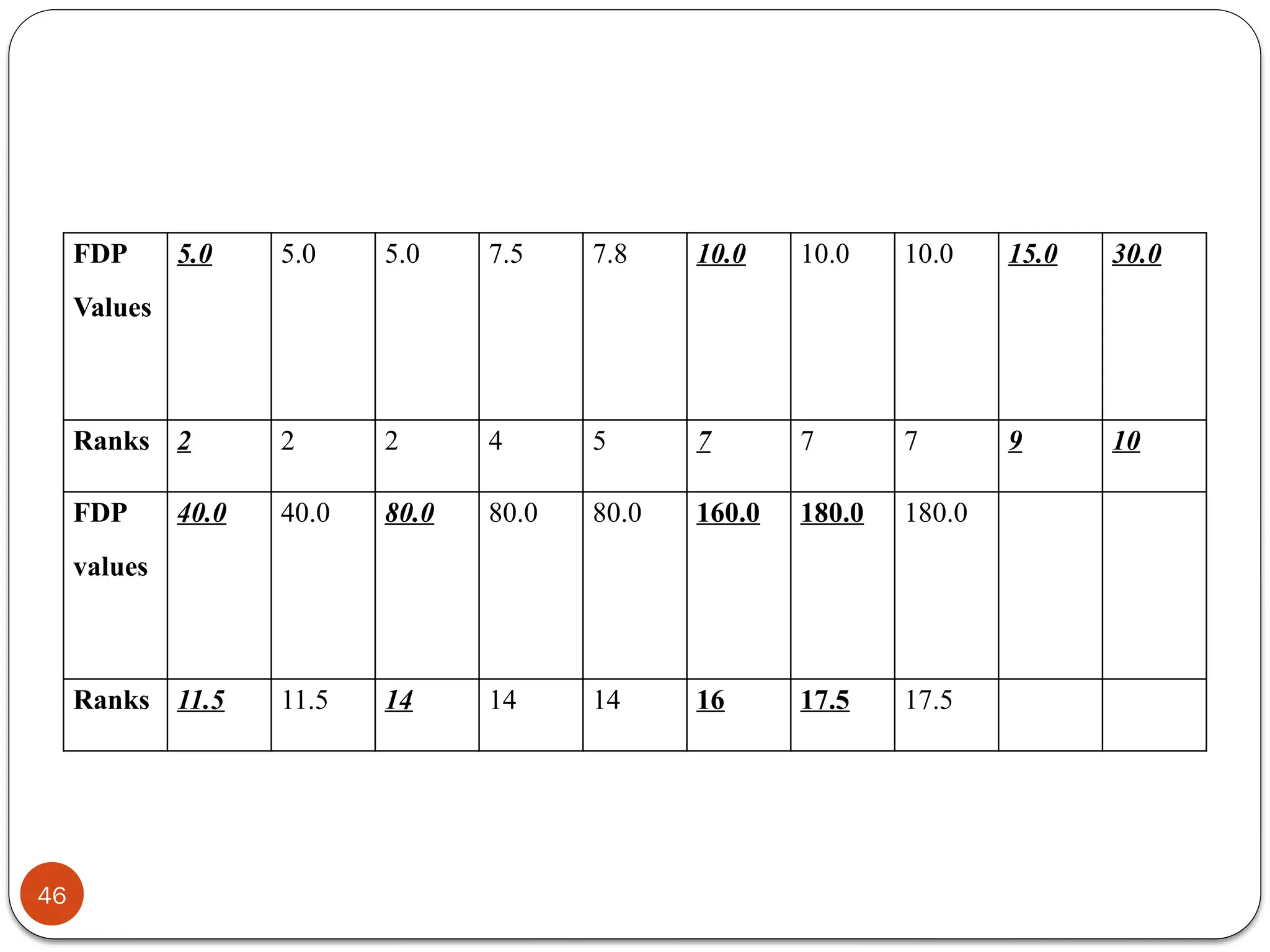
FDP
Values
5.0 5.0 5.0 7.5 7.8 10.0 10.0 10.0 15.0 30.0
Ranks 2 2 2 4 5 7 7 7 9 10
FDP
values
40.0 40.0 80.0 80.0 80.0 160.0 180.0 180.0
Ranks 11.5 11.5 14 14 14 16 17.5 17.5
46
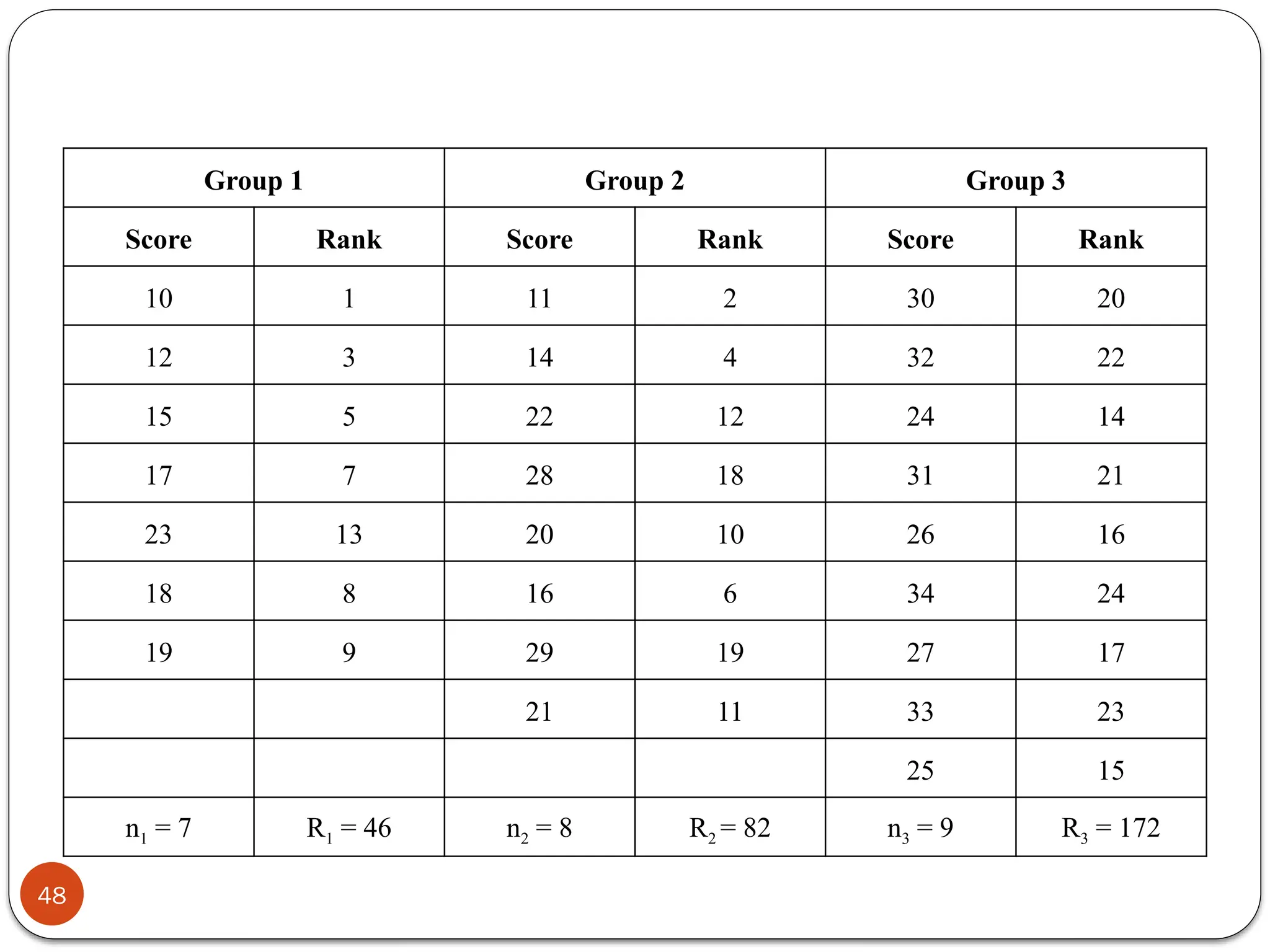
Kruskal Wallis H test
This is the non-parametric equivalent to F test used in
one way ANOVA. This test is used to test whether or not
the groups of independent samples have been drawn
from the same population. It is calculated using formula:
H = [12/n(n+1)]{Σ(Ri
2
/ni)} – 3(n+1)
47
Group 1 Group 2 Group 3
Score Rank Score Rank Score Rank
10 1 11 2 30 20
12 3 14 4 32 22
15 5 22 12 24 14
17 7 28 18 31 21
23 13 20 10 26 16
18 8 16 6 34 24
19 9 29 19 27 17
21 11 33 23
25 15
n1 = 7 R1 = 46 n2 = 8 R2 = 82 n3 = 9 R3 = 172
48
Friedman Test
This is the non-parametric equivalent of two way
ANOVA, where each group may have further sub-
divisions. df = k-1
The formula used is as follows:
χ2
= [{(12) x Σ(Rj
2
)} / {nk(k+1)}] – {3n(k+1)}
ΣRj = sum of ranks in each column
n = no. of rows
k = no. of columns
49
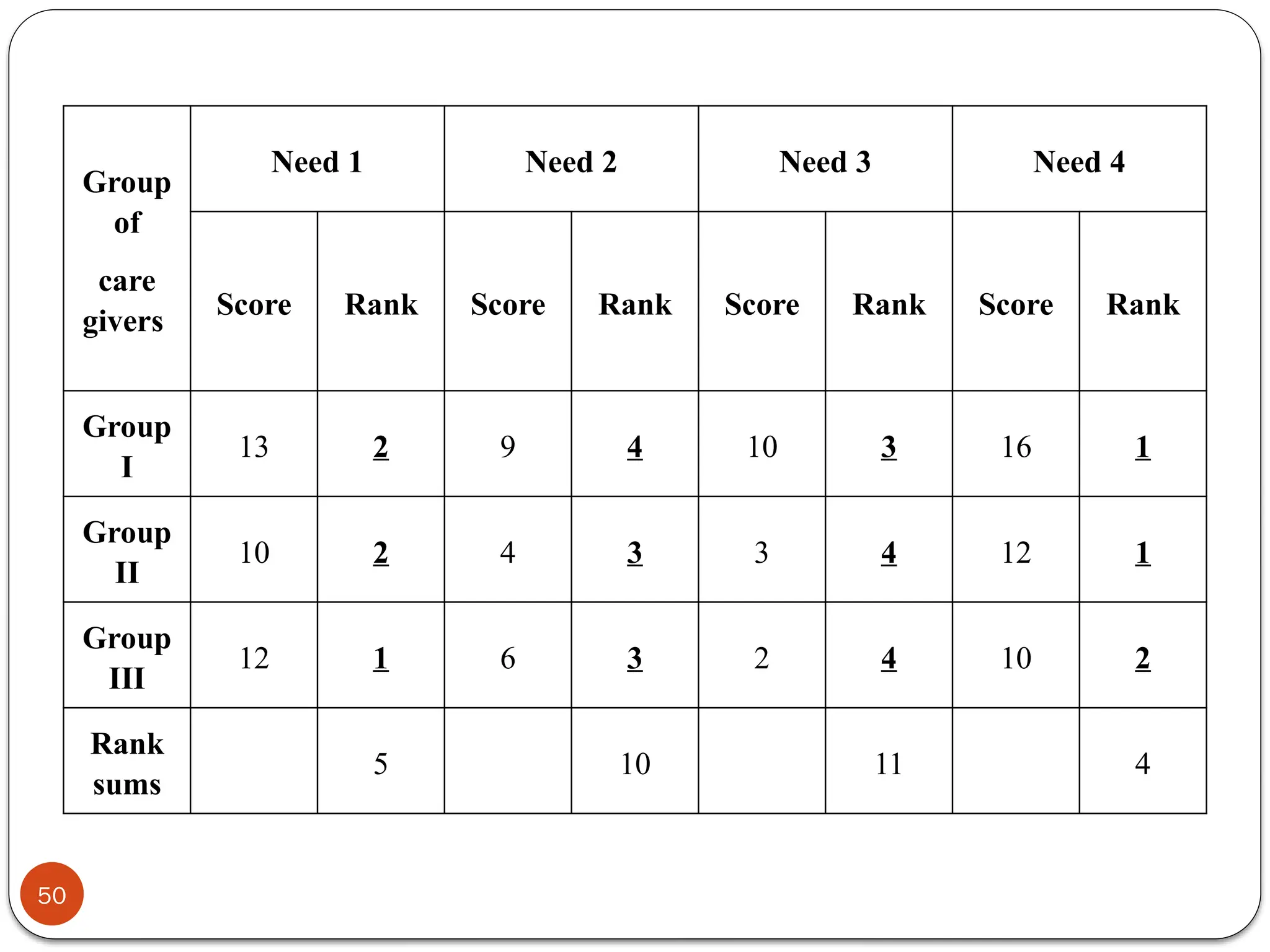
Group
of
care
givers
Need 1 Need 2 Need 3 Need 4
Score Rank Score Rank Score Rank Score Rank
Group
I
13 2 9 4 10 3 16 1
Group
II
10 2 4 3 3 4 12 1
Group
III
12 1 6 3 2 4 10 2
Rank
sums
5 10 11 4
50
Mc Nemar test
 It is a type of 2x2 chi-square test. It is for comparisons
of variables from matched pairs & uses information
only from discordant pairs(variables are not
independent).
 Reduces type 1 error
χ2
= [(|f-g| - 1)2
] / (f+g)
 df = 1
51
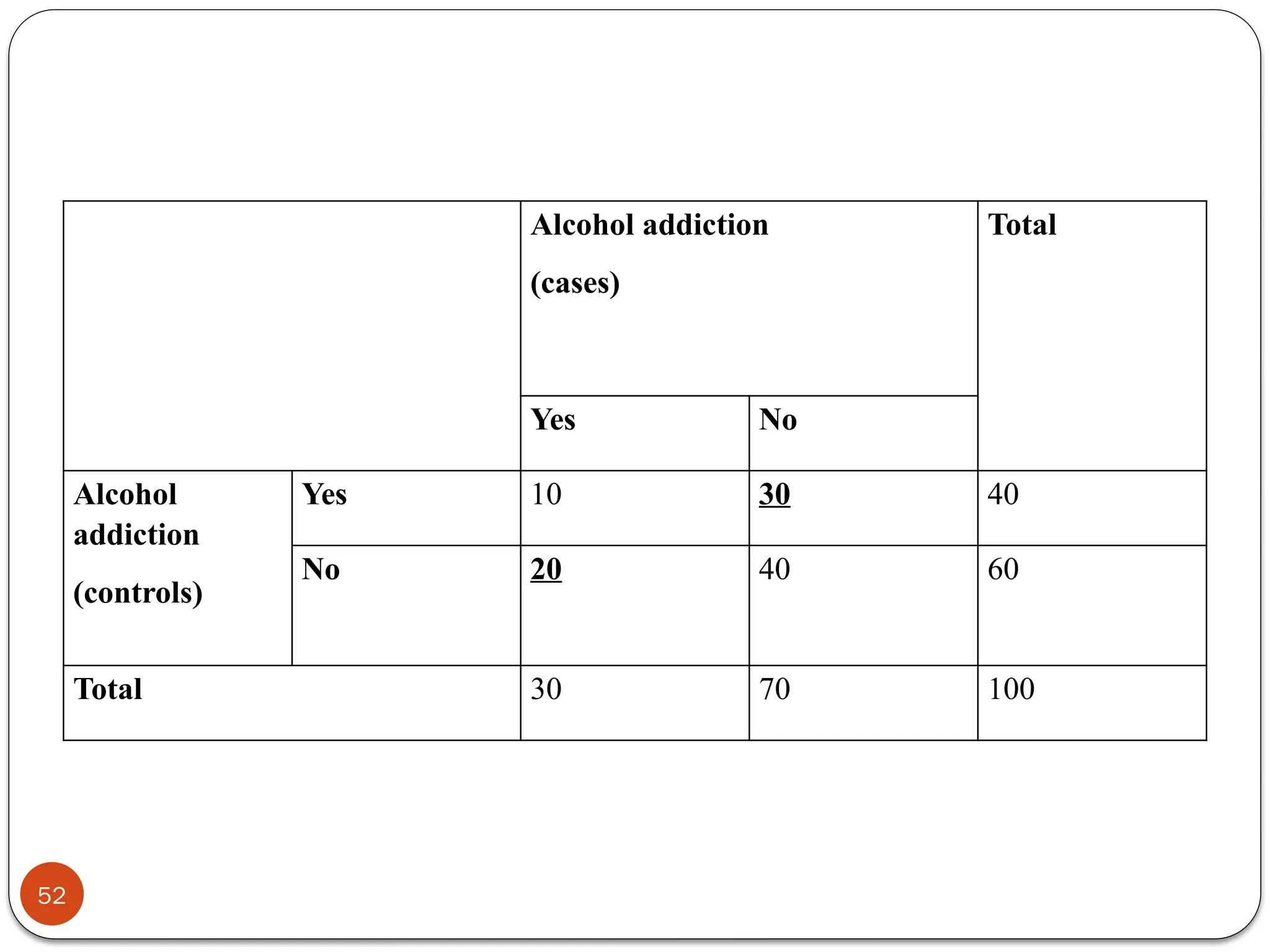
Alcohol addiction
(cases)
Total
Yes No
Alcohol
addiction
(controls)
Yes 10 30 40
No 20 40 60
Total 30 70 100
52
Non-parametric tests: Advantages over
parametric tests
 Can be used to test the data measured on nominal
& ordinal scales
 Easier to compute, understand & explain
 Make fewer assumptions about distribution of
samples
 Can be used even for very small sample sizes
 The computational burden is so light that they are
known as “short cut” methods
53
Advantages…
 Need not involve population parameters ie can be
used to analyze the data from populations where
mean & standard deviations are not available or
undeterminable
 Results may be as exact as parametric procedures
when used even on populations following normal
distribution
54
Non-parametric tests: Disadvantages
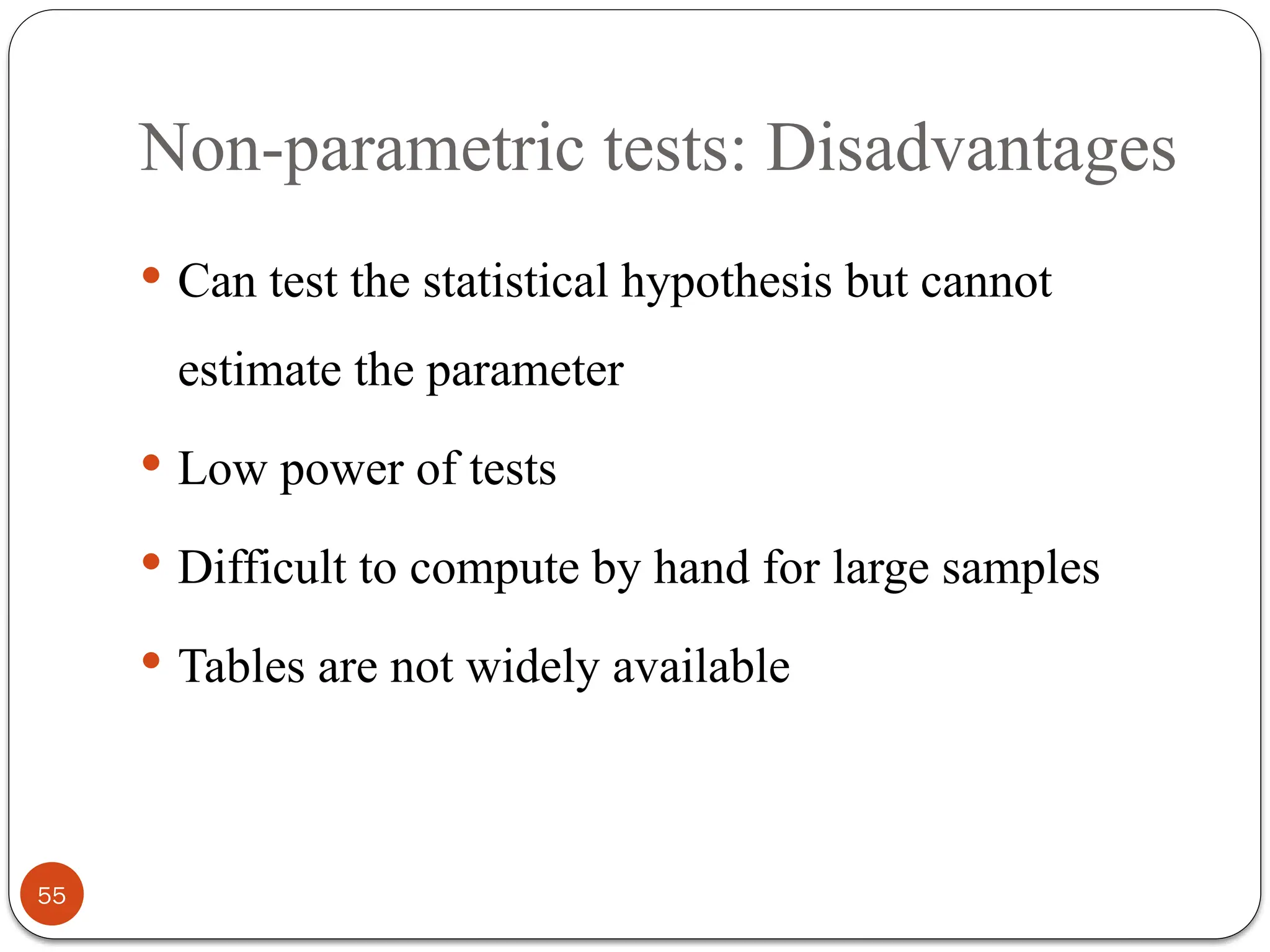
 Can test the statistical hypothesis but cannot
estimate the parameter
 Low power of tests
 Difficult to compute by hand for large samples
 Tables are not widely available
55
Disadvantages…
 Waste of time & data if all assumptions of a
statistical model are satisfied & if there is a
suitable parametric test
56
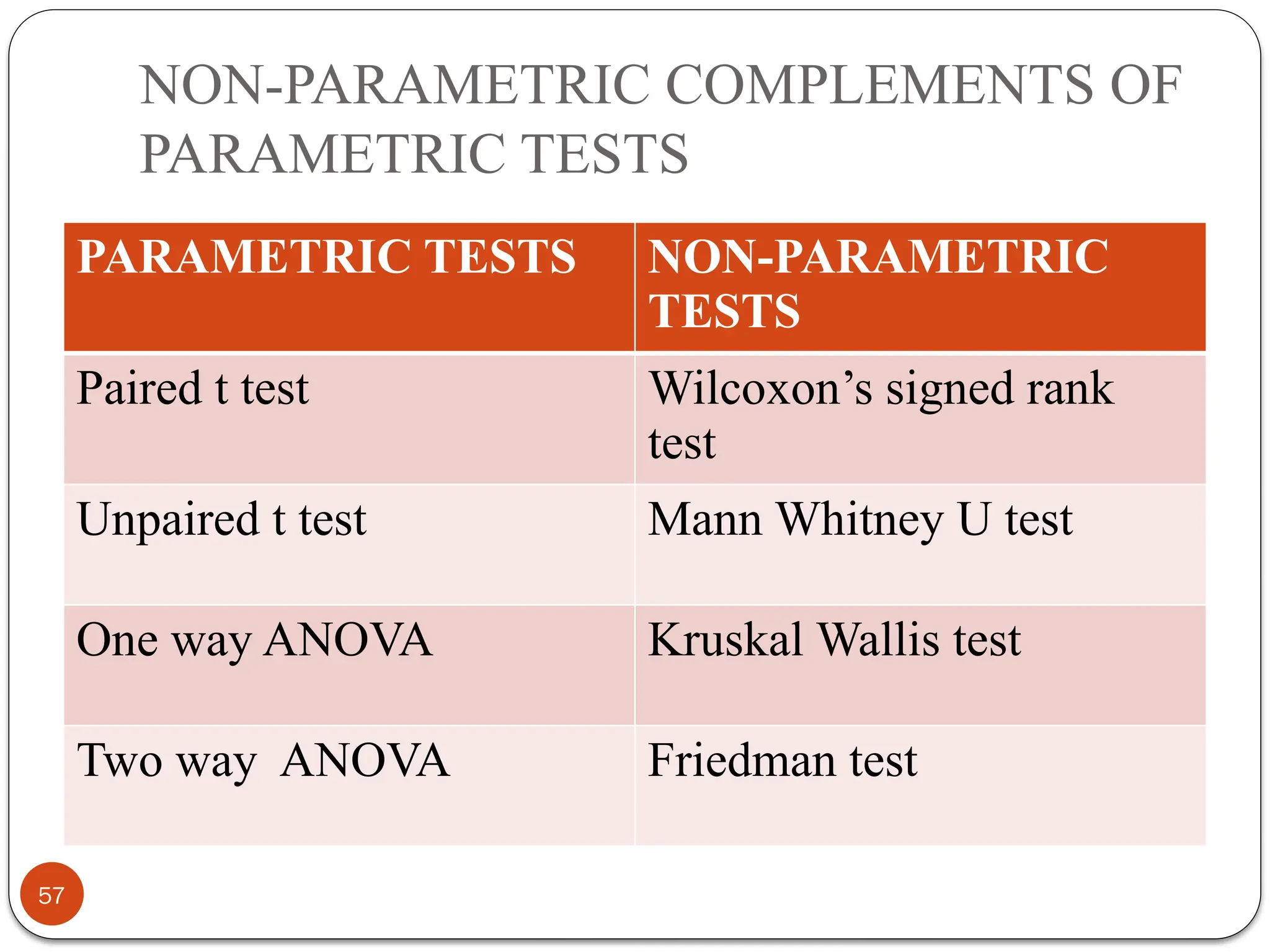
NON-PARAMETRIC COMPLEMENTS OF
PARAMETRIC TESTS
PARAMETRIC TESTS NON-PARAMETRIC
TESTS
Paired t test Wilcoxon’s signed rank
test
Unpaired t test Mann Whitney U test
One way ANOVA Kruskal Wallis test
Two way ANOVA Friedman test
57
10/16/2024
Clinical significance v/s statistical significance
58
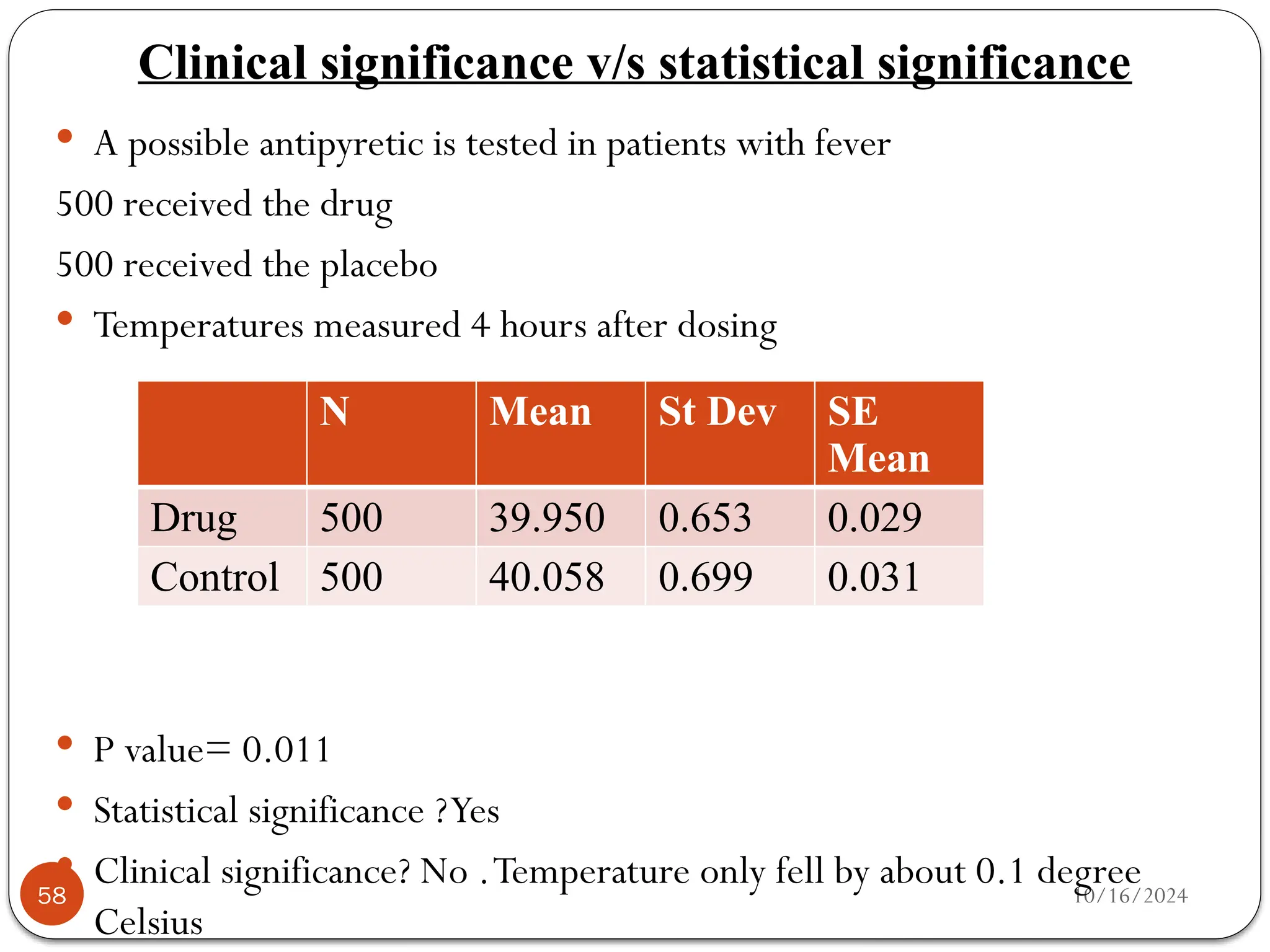
 A possible antipyretic is tested in patients with fever
500 received the drug
500 received the placebo
 Temperatures measured 4 hours after dosing
 P value= 0.011
 Statistical significance ?Yes
 Clinical significance? No .Temperature only fell by about 0.1 degree
Celsius
N Mean St Dev SE
Mean
Drug 500 39.950 0.653 0.029
Control 500 40.058 0.699 0.031
10/16/2024
Summary
59
10/16/2024
Conclusion
62
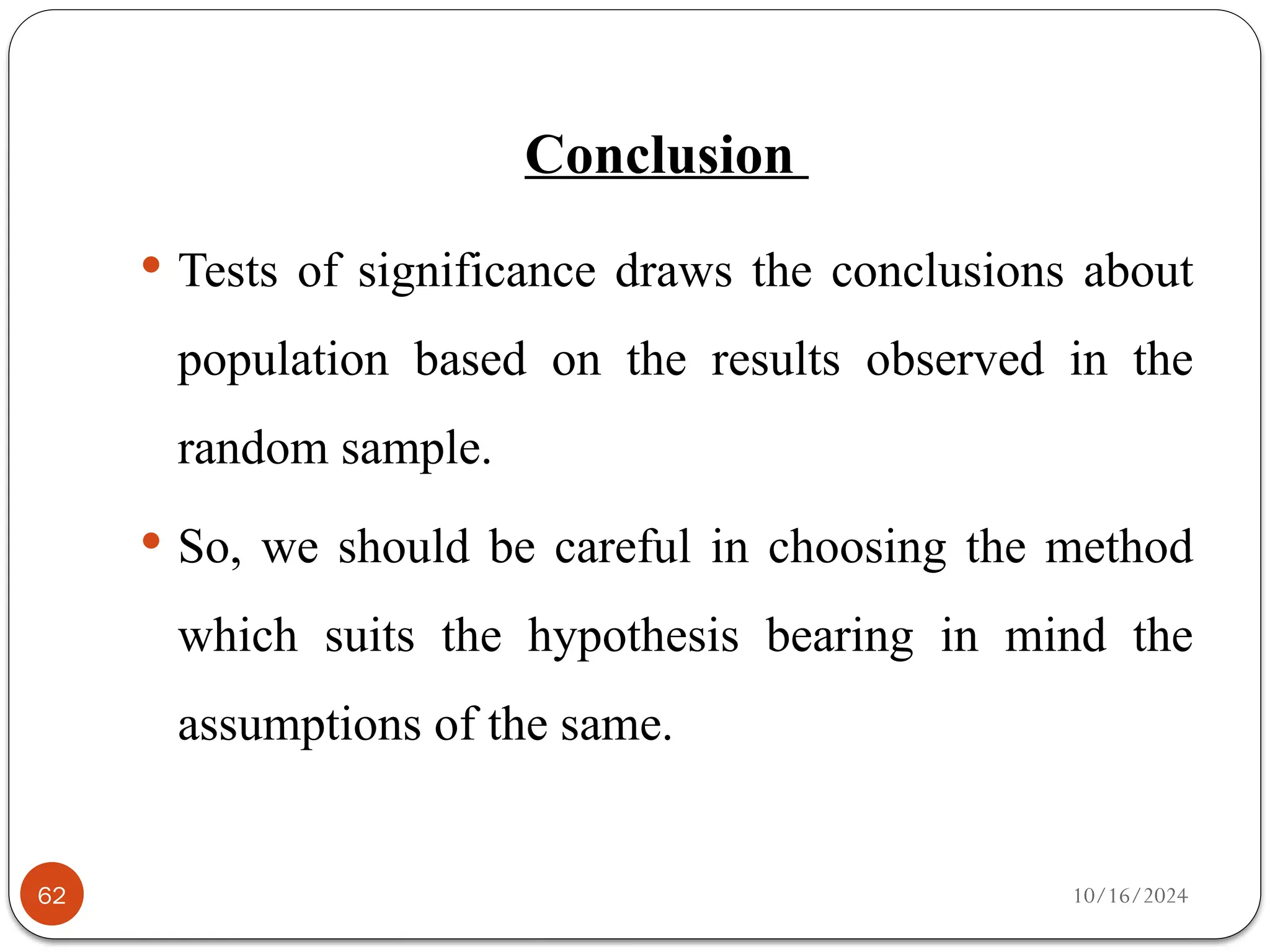
 Tests of significance draws the conclusions about
population based on the results observed in the
random sample.
 So, we should be careful in choosing the method
which suits the hypothesis bearing in mind the
assumptions of the same.
10/16/2024
References
63
1] Rao NSN, Murthy NS. Applied statistics in health
sciences. 1st
ed. New Delhi: Jaypee Brothers Medical
Publishers (P) Ltd; 2008.
2] Dixit JV. Principles and practice of biostatistics. 3rd
ed.
Jabalpur: M/S Banarsidas Bhanot Publishers; 2005.
3] Hennekens CH, Buring JE. Epidemiology in medicine.
1st
ed. Boston, Toronto: Little Brown & Company.
4] Sundaran KR, Dwivedi SN,Sreenivas V. Medical
Statistics-Principles and methods. New Delhi: BI
Publications Pvt Ltd.;2010
10/16/2024
64
5] Kapur JN, Saxena HC. Mathematical Statistics.4th
Edition. Delhi: Chand and Co Publishers:1967
6]Jeyaseelan L. Tests of Significance notes.
Fundamentals in Biostatistics and SPSS. 2014
7]Dr Farah Naaz Fathima. Seminar notes on Tests of
significance. Presented on 2/11/2004
8] Dr Akshay K M. Seminar notes on Parametric tests.
Presented on 26/11/2008
9] Dr Bhanu M . Seminar notes on Tests of Significance.
Presented on 29/04/2011.
10] Aleyamma Mathew. ABC of Medical Statistics.
Kerala Surgical journal, 1999:6(1);p 1-71
10/16/2024
THANK YOU
65

Tests of Significance.pptx powerpoint presentation

  • 1.
    Presenter: Dr VidyaD C Guide: Ms Radhika K Dr N S Murthy Acknowledgement: Mr Shivraj N S Tests of Significance
  • 2.
    10/16/2024 Contents  Introduction  Termsand concepts in test of significance  Methods of tests of significance  Steps in tests of significance  Parametric methods  Non parametric methods 2
  • 3.
    10/16/2024  Clinical significancev/s statistical significance  Summary  Conclusion  References 3 Contents
  • 4.
    10/16/2024 Introduction 4  Statistics –methodology of collection and meaningful interpretation of the data Statistics Descriptive statistics Inferential statistics
  • 5.
    10/16/2024 Introduction 5  Tests ofsignificance – methodologies of statistics, which deals with the techniques to analyse, how far the difference between estimates from different sample are due to sampling variation or otherwise.
  • 6.
    10/16/2024 Terms and conceptsin test of significance 6  Null Hypothesis- first step in testing of hypothesis.  Level of significance –probability of committing the type I error ( fixed at 5% or 1%)  Parameter: It is a population value or a variable that describes the population
  • 7.
    10/16/2024 7  Large sample:Refers to samples having >30 observations.  Small sample: Refers to samples having ≤30 observations.  Critical regions- Region of acceptance & Region of rejection Terms and concepts in test of significance
  • 8.
    10/16/2024 Methods of testsof significance 8
  • 9.
    PARAMETRIC TESTS- Assumptions The observations must be drawn from normally distributed populations  These populations must have the same variances  The observations must be independent  Population parameters involved is mean, standard deviation  Require interval scale or ratio scale (whole numbers or fractions). Example: Height in inches: 72, 60.5, 54.7; temperature[30-34 degree Celsius] 9
  • 10.
    PARAMETRIC TESTS…  Criticalratio/ Z-test  Paired t-test  Unpaired t-test  One way ANOVA  Two way ANOVA 10
  • 11.
    Steps in testsfor large sample 1)Set up the null hypothesis that the 2 samples are from the same population and that the difference between the 2 sample estimates is due to sampling variation. 2)Calculate 2 means x1 and x2 or 2 proportions p1 and p2 corresponding to the 2 samples with sample size n1 and n2 respectively. 3)Calculate the standard deviation of the 2 samples and their standard errors (SE1) and (SE2) respectively 11
  • 12.
    4)Calculate the standarderror of the difference between the 2 sample estimates as √[(SE1)2 + (SE2)2 ] 5)Calculate the critical ratio (CR) or z value. z= difference between sample estimates/ SE of difference 12 Steps in tests for large sample(contd..)
  • 13.
    6)Refer to thenormal distribution table & corresponding to this calculated value of z, find the value of probability P. 7)If P is ≤ 0.05, reject the null hypothesis and conclude that the difference between the 2 sample estimates as significant. 13 Steps in tests for large sample(contd..)
  • 14.
    Tests for largesamples SE of mean= s/ √n SE of proportion= √(pq/n) SE of difference between 2 means= √[(s1 2 /n1 ) + (s2 2 /n2)] SE of difference between 2 proportions= √[(p1q1/n1) + (p2q2/n2)] 14
  • 15.
    Example In an epidemicof gastroenteritis in an area the number of cases reported in 2 populations consuming water from different sources were as follows: Source of water No. of people consuming water from a particular source No. of cases of gastroenteritis Tap water 800 35 Hand pump 2400 120 Total 3200 155 We have to find out whether the difference in the proportion of cases in the 2 groups is significantly different or not. 15
  • 16.
    Tests for smallsamples Assumptions for t- distribution: the means of the 2 samples are normally distributed the means of the 2 samples are independently distributed  the variances of the 2 samples are equal. 16
  • 17.
    t- test forpaired observation The formula to calculate t statistics is, t= d¯/smd with (n-1) degrees of freedom n= number of observations in the sample d¯= mean of differences in the values of the variable of the sample observations before & after treatment 17
  • 18.
    smd= SE ofmean difference smd= sd/ √n  sd= standard deviation of the values of d (the differences in variable before & after the treatment) 18 t- test for paired observation
  • 19.
    1)Set up nullhypothesis that d¯=0 2)Calculate the difference d1 for each pair of observations before & after treatment and compute their mean d¯ 3)Calculate the SD of these differences sd= [√{sum total of difference between individual observation & d¯}2 ]/(n-1) n= number of pairs of observations 4)Calculate SE smd from the formula smd= sd/ √n 19 t- test for paired observation
  • 20.
    5)Calculate the valueof t- statistics as t= d¯/smd 6)Compute the degrees of freedom as (n-1) 7)From the t- distribution table find the probability level corresponding to this value of t & with degrees of freedom (n-1) 20 t- test for paired observation
  • 21.
    Patient no. Hb levelin gms% Difference between after & before therapy (d) (d-d¯) (d-d¯)2 Before therapy After therapy 1 5.6 10.2 4.6 1.87 3.50 2 4.8 9.4 4.6 1.87 3.50 3 6.5 11.0 4.5 1.77 3.13 4 7.5 7.5 0.0 -2.73 7.45 5 4.5 7.5 3.0 -0.27 0.07 6 3.5 6.0 2.5 -0.23 0.05 7 6.7 8.0 1.3 -1.43 2.04 8 6.2 9.6 3.4 0.67 0.45 9 5.6 10.0 4.4 1.67 2.79 10 4.4 8.4 4.0 1.27 1.61 11 7.5 8.0 0.5 -2.23 4.97 12 8.0 8.0 0.0 -2.73 7.45 TOTAL 32.8 37.01 21
  • 22.
    Unpaired t-test t= {(x1¯-x2¯)/ smd} smd is estimated standard error of the difference between the 2 sample means smd= √[{(n1+n2)/n1n2}{(n1-1)s1 2 + (n2-1)s2 2 }/ (n1+n2-2)] s1 2 and s2 2 are the SD of 2 samples n1 and n2 are respective sample sizes t= (x1¯- x2¯)/ √[{(n1+n2)/n1n2}{(n1-1)s1 2 + (n2-1)s2 2 }/ (n1+n2-2)] with (n1 + n2 – 2) degrees of freedom 22
  • 23.
    Inanexperimenttoknowwhetherthereisanydifferenceinthelengthofsmall intestinesbetween malesandfemales,theobservationsrecordedwere asfollows: MalesFemales No.ofobservations 17 15 Meanlengthofthesmallintestines 157 146 SDoftheobservations 34 31 23
  • 24.
    ANOVA Assumptions: the effects underdifferent groups are additive Sample of observations has been drawn using random sampling procedure Samples come from normally distributed population the variance is same in various groups 24
  • 25.
    One way ANOVA 1)Calculatesum of observations of each group (village)= (Ti) 2)Calculate sum of all observations (Σxij),where xij represents each observation 3)Calculate square of sum of all observations= (Σxij)2 4)Calculate total sum of squares, ie = [Σ(xij 2 )- {(Σxij)2 /n}]; n= total no. of observations. (Σxij)2 /n is called correction factor(CF) 25
  • 26.
    5)Calculate ‘sum ofsquares between groups’, ie = {Σ(Tj 2 /ki)-CF}; Tj= sum of observations in each group; ki= no. of observations in each group 6)Sum of squares within groups is obtained as difference between the ‘total sum of squares’ and ‘sum of squares between groups’ ie [(Σxij)2 – CF] – [Σ(Tj 2 /ki) – CF] = (Σxij)2 - Σ(Tj 2 /ki). 26 One way ANOVA
  • 27.
    ANALYSIS OF VARIANCETABLE Source of sum of squares Degree of freedom Sum of squares Mean sum of squares F Between villages 3 349.525 116.5083 4.544 Within villages 36 922.950 25.6375 Total 39 1272.475 27
  • 28.
    Two way ANOVA To study the differences within sub classification of the groups also. 28
  • 29.
    Analysis of variancetable Source of SS df Sum of squares MSS F Between villages 9 134.17 14.908 0.855 Between trimesters 2 436.72 218.36 12.526 Residual 18 313.78 17.432 Total 29 884.67 29
  • 30.
    NON-PARAMETRIC TESTS- Assumptions The observations do not follow normal distribution  The populations do not have same variances  The observations may or may not be independent  Population parameters involved are median, mode  Data may be nominally or ordinally scaled Example: nominal(male/female); ordinal(good-better- best) 30
  • 31.
    NON-PARAMETRIC TESTS…  Chi-squaretest  Fisher’s exact test  The Sign test  Wilcoxon’s Signed Rank test  Mann Whitney U test  Kruskal- Wallis H test  Friedman test  Mc Nemar test 31
  • 32.
    Chi-square test χ2 = Σ{(observed frequency – expected frequency)2 / expected frequency} This value is calculated for each cell in the table & sum of above ratios is the total chi-square value.  df = (c-1)(r-1) 32
  • 33.
    Blood group Non leprosy Lepromatous leprosy Non Lepromatous Leprosy A (131/471)x150 = 41.7 (131/471)x169 = 47.0 (131/471)x152 =42.3 B (145/471)x150 = 46.2 (145/471)x169 = 52.0 (145/471)x152 = 46.8 O (154/471)x150 = 49.0 (154/471)x169 = 55.3 (154/471)x152 = 49.7 AB (41/471)x150 = 13.1 (41/471)x169 = 14.7 (41/471)x152 = 13.2 33
  • 34.
    Blood group Non leprosy Lepromatous leprosy Non lepromatous leprosy Total A3.28 0.09 2.22 5.59 B 4.12 0.17 2.49 6.78 O 0.08 0.25 0.06 0.39 AB 0.00 0.50 0.59 1.09 Total 7.48 1.01 5.36 13.85 34
  • 35.
    Chi-square test fora 2x2 table  χ2 = [(ad-bc)2 x G] / [(a+b)(c+d)(a+c)(b+d)] df = (2-1)(2-1) = 1 35
  • 36.
    Filariasis infestation Male Female Total Yes28 (a) 20(b) 48 No 237(c) 222(d) 459 Total 265 242 507(G) 36
  • 37.
    Fisher’s Exact probabilitytest P = [{(a+c)! (b+d)! (a+b)! (c+d)! }/ {n! a! b! c! d!}] a, b, c & d = cell frequencies in 2x2 table  n = total number of observations 37
  • 38.
    Habit Boys GirlsTotal Exercise regularly 2 8 10 Do not exercise regularly 10 4 14 Totals 12 12 24 38
  • 39.
    Sign test The significanceof difference can be tested using usual χ2 test, which is as follows: χ2 = [(|a-b| - 1)2 ] / n with 1 df a & b = no. of (+) & (-) respectively n = (a+b) 39
  • 40.
    All ‘0’ differences,ie when the 2 tests are identical in their results are omitted for calculation so that ‘n’ is always equal to (a+b). P is obtained from χ2 distribution table & the conclusion about the significance is made as usual 40 Sign test
  • 41.
    Patient no. SerologyParasitology Difference 1 1 0 + 2 1 0 + 3 0 1 - 4 1 0 + 5 1 0 + 6 0 0 0 7 1 0 + 8 1 0 + 9 0 0 0 10 0 1 - 11 0 1 - 12 1 1 0 41
  • 42.
    Wilcoxon’s Sign Ranktest This is useful in testing the significance of differences in paired observations, when the data is quantitative in nature. 42
  • 43.
    Serum FDP valuesin µgm/ml Case no. Before operation After operation Difference Signed rank 1 5.0 7.8 -2.8 -2 2 10.0 180.0 -170.0 -11 3 18.0 10.0 +8.0 +5 4 5.0 80.0 -75.0 -10 5 10.0 15.0 -5.0 -3.5 6 20.0 10.0 +10.0 +6 7 5.0 180.0 -175.0 -12 8 2.5 40.0 -37.5 -8 9 15.0 10.0 +5.0 +3.5 10 10.0 7.5 +2.5 +1 11 80.0 10.0 +70.0 +9 12 5.0 20.0 -15.0 -7 43
  • 44.
    Mann Whitney Utest This is useful in testing differences between unpaired observations. 44
  • 45.
    FDP values inµg/ ml Control group 10.0 180.0 80.0 5.0 40.0 15.0 30.0 160.0 Treated group 7.8 40.0 10.0 80.0 180.0 5.0 80.0 10.0 5.0 7.5 45
  • 46.
    FDP Values 5.0 5.0 5.07.5 7.8 10.0 10.0 10.0 15.0 30.0 Ranks 2 2 2 4 5 7 7 7 9 10 FDP values 40.0 40.0 80.0 80.0 80.0 160.0 180.0 180.0 Ranks 11.5 11.5 14 14 14 16 17.5 17.5 46
  • 47.
    Kruskal Wallis Htest This is the non-parametric equivalent to F test used in one way ANOVA. This test is used to test whether or not the groups of independent samples have been drawn from the same population. It is calculated using formula: H = [12/n(n+1)]{Σ(Ri 2 /ni)} – 3(n+1) 47
  • 48.
    Group 1 Group2 Group 3 Score Rank Score Rank Score Rank 10 1 11 2 30 20 12 3 14 4 32 22 15 5 22 12 24 14 17 7 28 18 31 21 23 13 20 10 26 16 18 8 16 6 34 24 19 9 29 19 27 17 21 11 33 23 25 15 n1 = 7 R1 = 46 n2 = 8 R2 = 82 n3 = 9 R3 = 172 48
  • 49.
    Friedman Test This isthe non-parametric equivalent of two way ANOVA, where each group may have further sub- divisions. df = k-1 The formula used is as follows: χ2 = [{(12) x Σ(Rj 2 )} / {nk(k+1)}] – {3n(k+1)} ΣRj = sum of ranks in each column n = no. of rows k = no. of columns 49
  • 50.
    Group of care givers Need 1 Need2 Need 3 Need 4 Score Rank Score Rank Score Rank Score Rank Group I 13 2 9 4 10 3 16 1 Group II 10 2 4 3 3 4 12 1 Group III 12 1 6 3 2 4 10 2 Rank sums 5 10 11 4 50
  • 51.
    Mc Nemar test It is a type of 2x2 chi-square test. It is for comparisons of variables from matched pairs & uses information only from discordant pairs(variables are not independent).  Reduces type 1 error χ2 = [(|f-g| - 1)2 ] / (f+g)  df = 1 51
  • 52.
  • 53.
    Non-parametric tests: Advantagesover parametric tests  Can be used to test the data measured on nominal & ordinal scales  Easier to compute, understand & explain  Make fewer assumptions about distribution of samples  Can be used even for very small sample sizes  The computational burden is so light that they are known as “short cut” methods 53
  • 54.
    Advantages…  Need notinvolve population parameters ie can be used to analyze the data from populations where mean & standard deviations are not available or undeterminable  Results may be as exact as parametric procedures when used even on populations following normal distribution 54
  • 55.
    Non-parametric tests: Disadvantages Can test the statistical hypothesis but cannot estimate the parameter  Low power of tests  Difficult to compute by hand for large samples  Tables are not widely available 55
  • 56.
    Disadvantages…  Waste oftime & data if all assumptions of a statistical model are satisfied & if there is a suitable parametric test 56
  • 57.
    NON-PARAMETRIC COMPLEMENTS OF PARAMETRICTESTS PARAMETRIC TESTS NON-PARAMETRIC TESTS Paired t test Wilcoxon’s signed rank test Unpaired t test Mann Whitney U test One way ANOVA Kruskal Wallis test Two way ANOVA Friedman test 57
  • 58.
    10/16/2024 Clinical significance v/sstatistical significance 58  A possible antipyretic is tested in patients with fever 500 received the drug 500 received the placebo  Temperatures measured 4 hours after dosing  P value= 0.011  Statistical significance ?Yes  Clinical significance? No .Temperature only fell by about 0.1 degree Celsius N Mean St Dev SE Mean Drug 500 39.950 0.653 0.029 Control 500 40.058 0.699 0.031
  • 59.
  • 62.
    10/16/2024 Conclusion 62  Tests ofsignificance draws the conclusions about population based on the results observed in the random sample.  So, we should be careful in choosing the method which suits the hypothesis bearing in mind the assumptions of the same.
  • 63.
    10/16/2024 References 63 1] Rao NSN,Murthy NS. Applied statistics in health sciences. 1st ed. New Delhi: Jaypee Brothers Medical Publishers (P) Ltd; 2008. 2] Dixit JV. Principles and practice of biostatistics. 3rd ed. Jabalpur: M/S Banarsidas Bhanot Publishers; 2005. 3] Hennekens CH, Buring JE. Epidemiology in medicine. 1st ed. Boston, Toronto: Little Brown & Company. 4] Sundaran KR, Dwivedi SN,Sreenivas V. Medical Statistics-Principles and methods. New Delhi: BI Publications Pvt Ltd.;2010
  • 64.
    10/16/2024 64 5] Kapur JN,Saxena HC. Mathematical Statistics.4th Edition. Delhi: Chand and Co Publishers:1967 6]Jeyaseelan L. Tests of Significance notes. Fundamentals in Biostatistics and SPSS. 2014 7]Dr Farah Naaz Fathima. Seminar notes on Tests of significance. Presented on 2/11/2004 8] Dr Akshay K M. Seminar notes on Parametric tests. Presented on 26/11/2008 9] Dr Bhanu M . Seminar notes on Tests of Significance. Presented on 29/04/2011. 10] Aleyamma Mathew. ABC of Medical Statistics. Kerala Surgical journal, 1999:6(1);p 1-71
  • 65.