Who Owns CRISPR?
Stephen J. Lieb
Frommer Lawrence & Haug LLP
745 Fifth Avenue
New York, New York 10151
slieb@flhlaw.com
(212) 588-0800
What is CRISPR and What is Going On?
• CRIPSR-Cas9 is a gene editing technique originally
identified a part of a bacteria's immune system.
• The natural mechanism has been adapted to target and
cut DNA
– It is highly accurate, inexpensive, and allows editing of
multiple sites on the genome simultaneously.
– “Breakthrough of 2015” by Science magazine
• There is a dispute (an Interference) between MIT’s
Broad Institute and Univ. of California about who owns
the basic patents for the use of CRIPSR.
https://acts.uspto.gov/ifiling/PublicView.jsp?identifier=106048&identifier2=null&t
abSel=4&action=filecontent&replyTo=PublicView.jsp
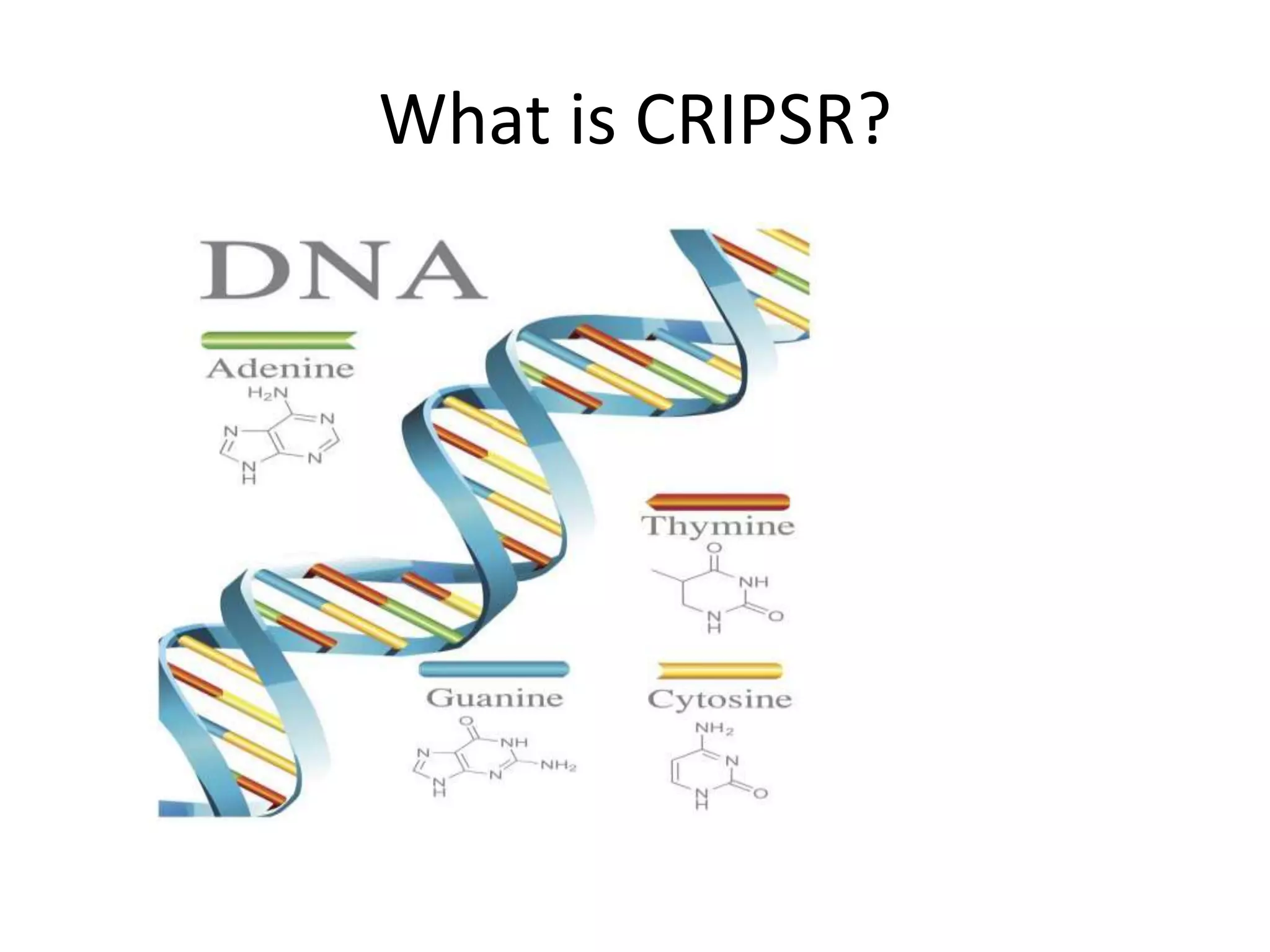
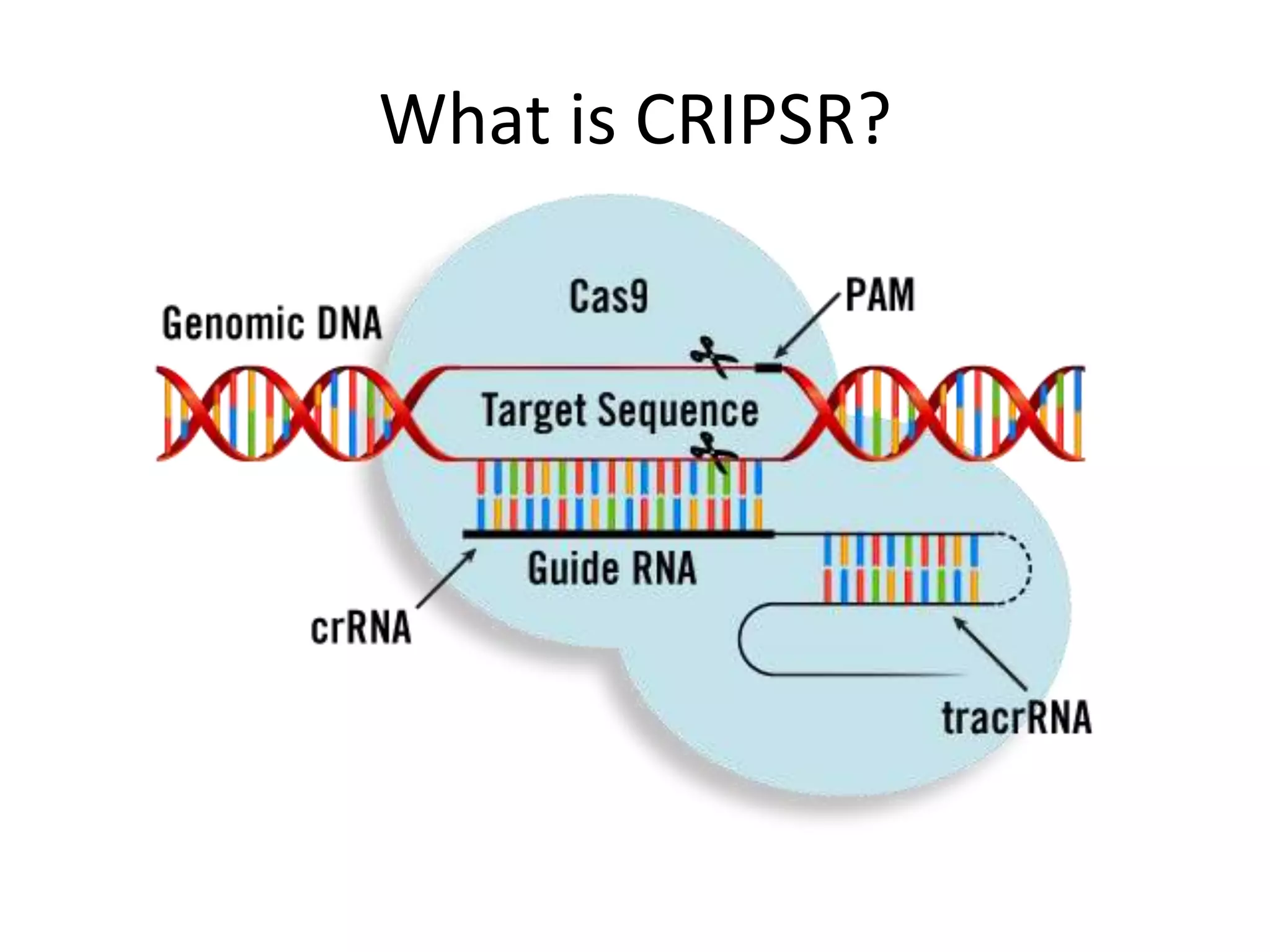
What is CRIPSR?
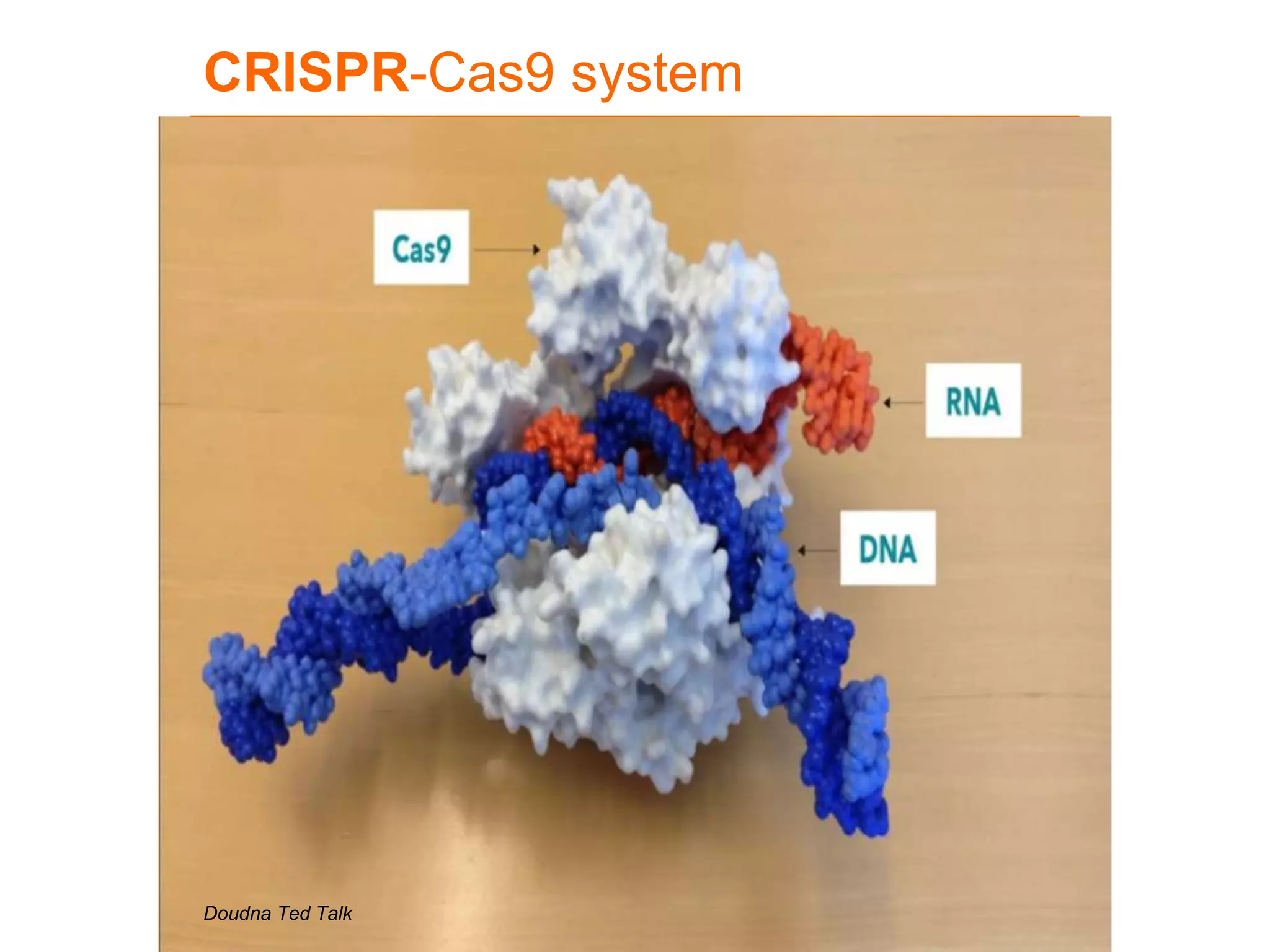
Doudna Ted Talk
CRISPR-Cas9 system
What is CRIPSR?
Who are the Player in the Dispute?
• Senior Party
– Jennifer Doudna of the University of California,
Berkeley, and
– Emmanuelle Charpentier, currently at the
Helmholtz Center for Infection Research in
Germany
• Junior Party
– Feng Zhang of the Broad Institute and MIT
Who are the Player in the Dispute?
• Broad has 13 issued patents
– Broad filed after U.C. but paid to have examination
“fast tracked”
• U.C. has 8 Pending applications related to the
one being disputed
What is an Interference?
• A trial to see who invented first
• Motions must be pre-authorized
– Do the parties claim the same subject matter (no
interference-in-fact)?
– And which of the parties’ claims actually interfere
(which claims “correspond” to the “count”)?
– Are each of the parties entitled to claim that
subject matter?
• Do the parties’ applications really disclose the whole
invention (written description support)?
What is the “count?”
A method, in a eukaryotic cell, of cleaving or editing a
target DNA molecule … comprising:
contacting, in a eukaryotic cell, a target DNA molecule
having a target sequence with an engineered CRISPR-Cas
system comprising:
a) a DNA-targeting RNA comprising
i) a targeter-RNA …, and
ii) an activator-RNA or tracr sequence … and
b) a Cas9 protein,
wherein the DNA-targeting RNA forms a complex with the
Cas9 protein, thereby targeting the Cas9 protein to the
target DNA molecule, whereby said target DNA molecule is
cleaved or edited ….
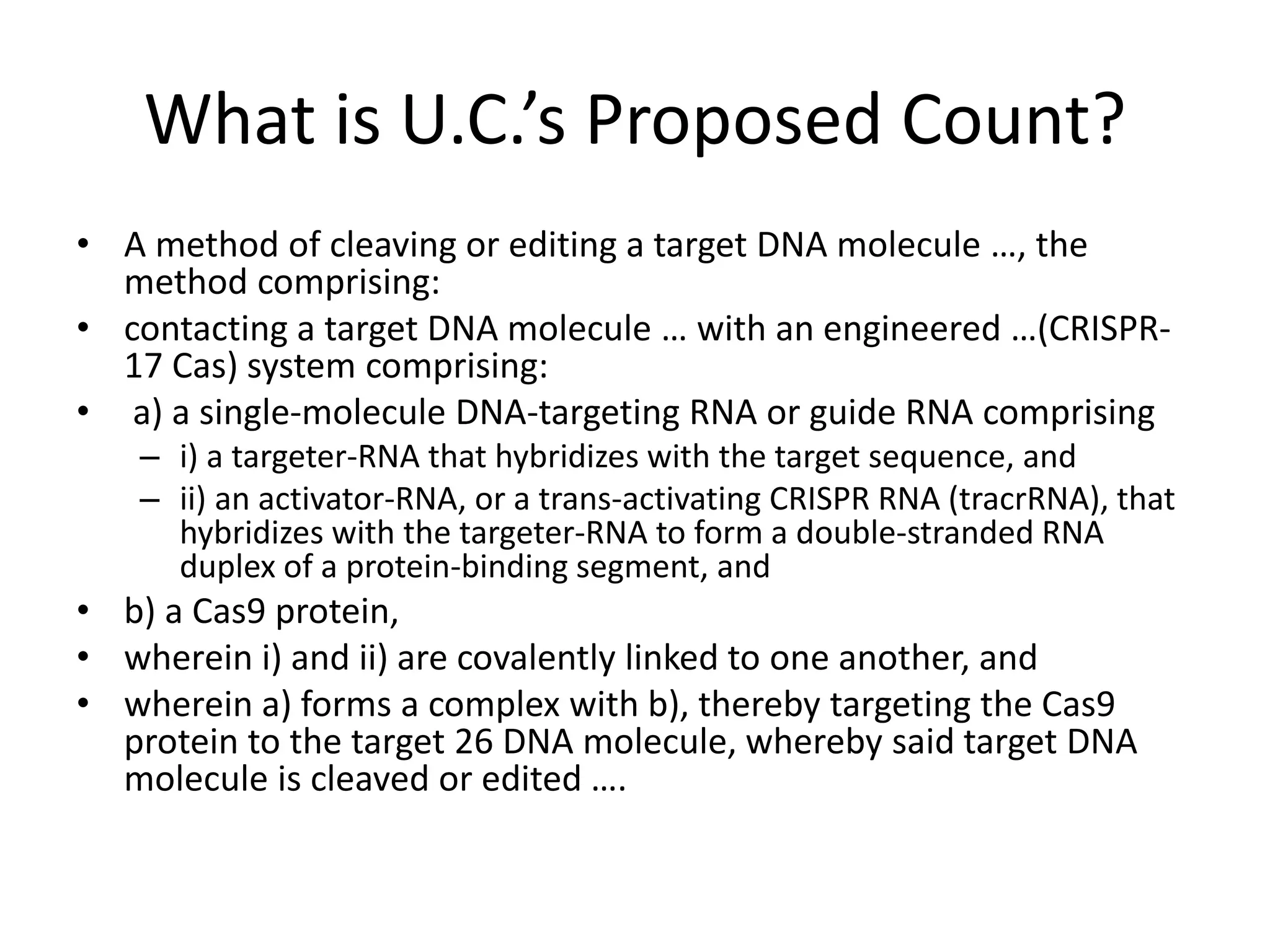
What is U.C.’s Proposed Count?
• A method of cleaving or editing a target DNA molecule …, the
method comprising:
• contacting a target DNA molecule … with an engineered …(CRISPR-
17 Cas) system comprising:
• a) a single-molecule DNA-targeting RNA or guide RNA comprising
– i) a targeter-RNA that hybridizes with the target sequence, and
– ii) an activator-RNA, or a trans-activating CRISPR RNA (tracrRNA), that
hybridizes with the targeter-RNA to form a double-stranded RNA
duplex of a protein-binding segment, and
• b) a Cas9 protein,
• wherein i) and ii) are covalently linked to one another, and
• wherein a) forms a complex with b), thereby targeting the Cas9
protein to the target 26 DNA molecule, whereby said target DNA
molecule is cleaved or edited ….
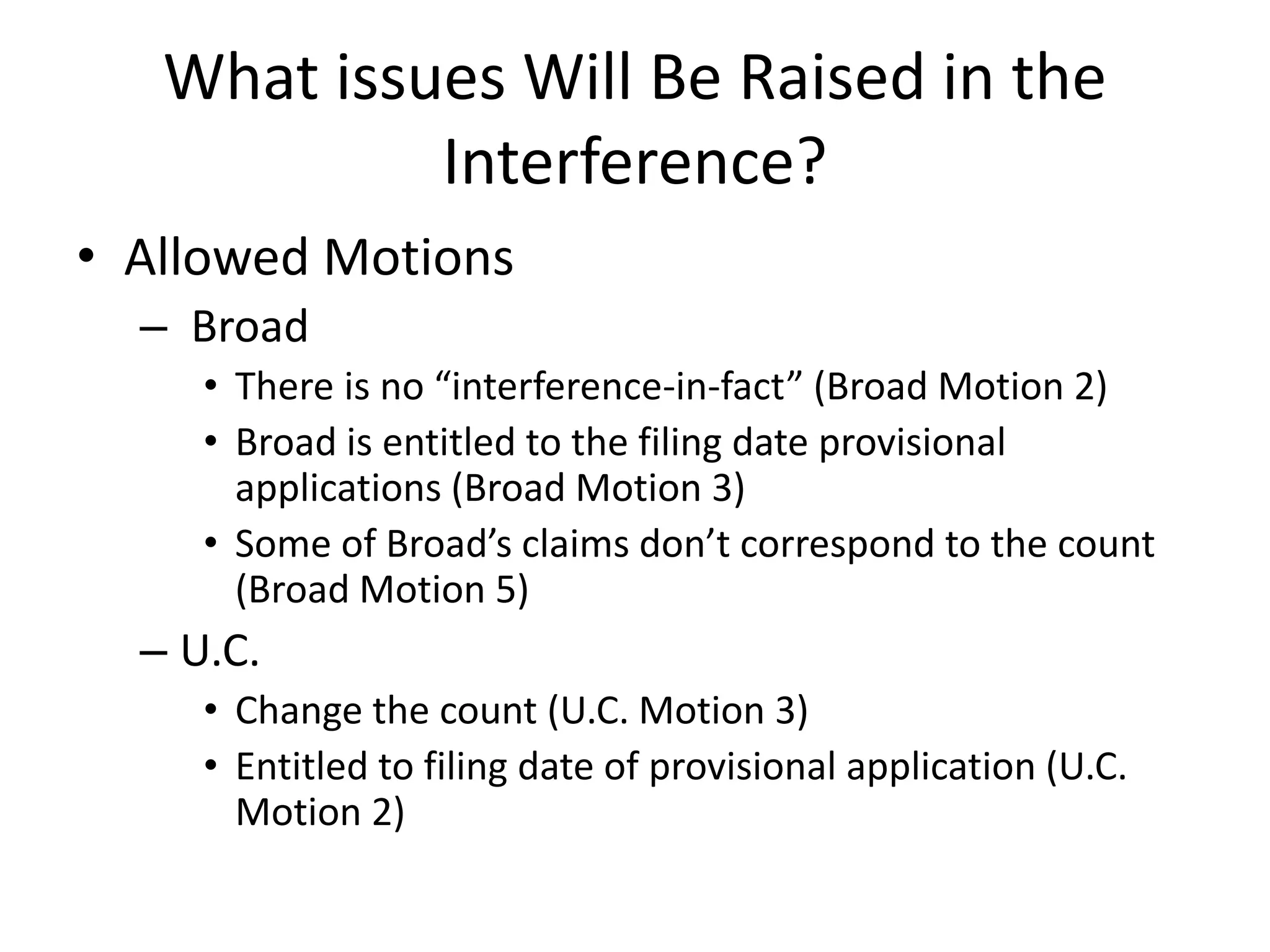
What issues Will Be Raised in the
Interference?
• Allowed Motions
– Broad
• There is no “interference-in-fact” (Broad Motion 2)
• Broad is entitled to the filing date provisional
applications (Broad Motion 3)
• Some of Broad’s claims don’t correspond to the count
(Broad Motion 5)
– U.C.
• Change the count (U.C. Motion 3)
• Entitled to filing date of provisional application (U.C.
Motion 2)
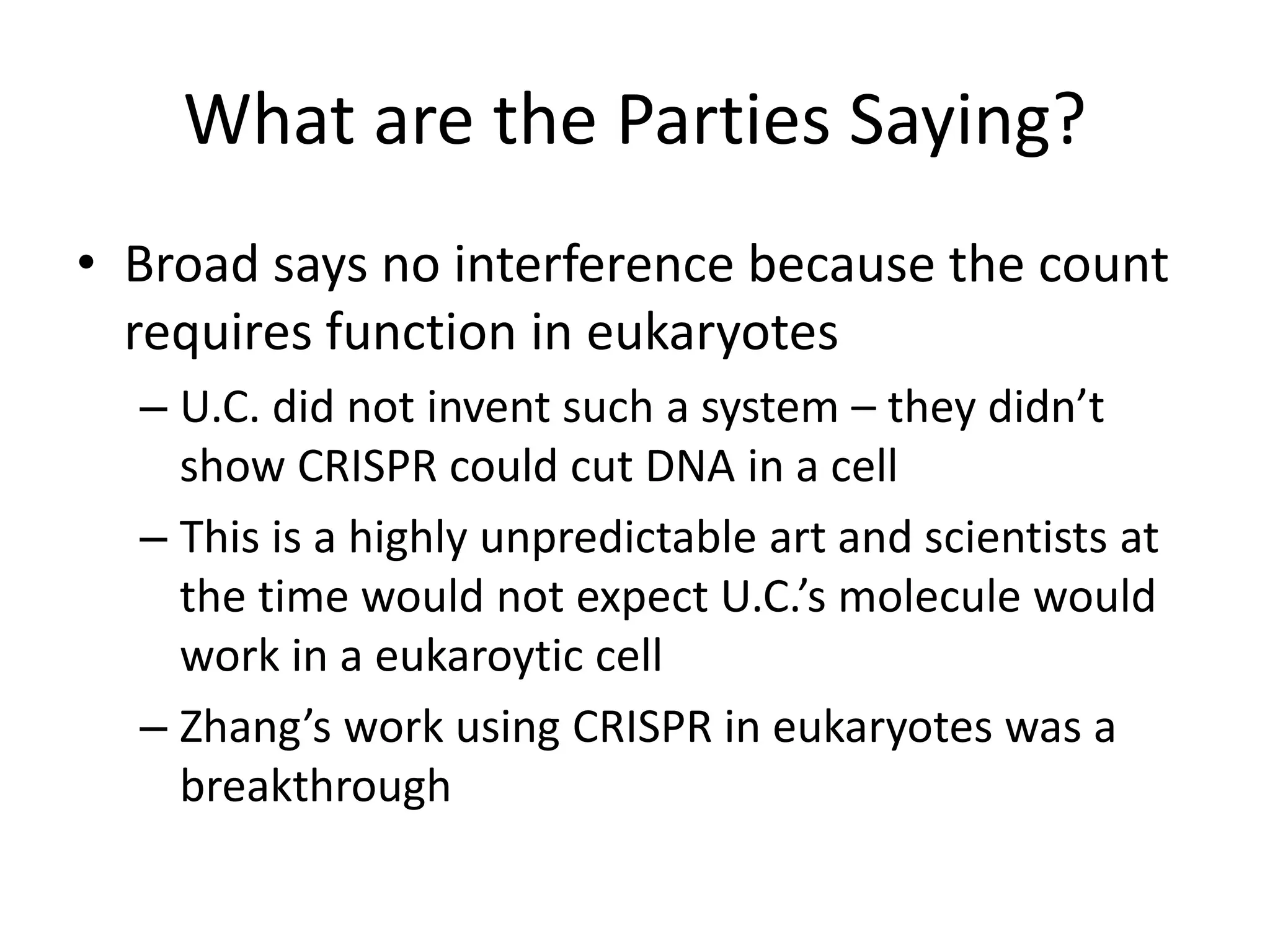
What are the Parties Saying?
• Broad says no interference because the count
requires function in eukaryotes
– U.C. did not invent such a system – they didn’t
show CRISPR could cut DNA in a cell
– This is a highly unpredictable art and scientists at
the time would not expect U.C.’s molecule would
work in a eukaroytic cell
– Zhang’s work using CRISPR in eukaryotes was a
breakthrough
What are the Parties Saying?
• U.C. moved to change the count to
– Remove Eukaryote requirement
– Limit the count to a single-molecule DNA-targeting RNA
– U.C.’s allowed claims are not limited to eukaryotes.
• U.C. moved that its earlier provisionals support the
count (limited to eukaryotes)
– Example 1 shows the single molecule system in vitro and
says it can be used in all types of cells
– Extending example to eukaryotes is obvious and
predictable
• Other investigators quickly used the disclosed molecule of
Example 1 in eukaryotes.
What are the Commercial
Implications?
• Genetic medicine
– Duke, U. Tex. And Harvard report editing genes in a
mouse to treat Duchene’s Muscular Dystrophy h
• http://www.nytimes.com/2016/01/01/science/gene-therapy-muscular-
dystrophy.html?_r=0
– Napster founder funds U.Penn. Effort to modify T-cells
with CRIPSR to treat cancer
• https://www.technologyreview.com/s/601742/money-behind-first-crispr-
test-its-from-internet-billionaire-sean-parker/
• Bioengineering
– DuPont announced new CRIPSR spliced corn hybrids
– https://www.technologyreview.com/s/542311/dupont-predicts-crispr-plants-on-dinner-
plates-in-five-years/
What are the Commercial
Implications?
• Doudna and Charpentier
– Caribou Biosciences
• Therapeutics, agriculture, and industrial bio production
• $30 Million Series B in May 2016
– CRIPSR Therapeutics
• In vivo and ex vivo therpies
• Backed by Celgene, GSK Venture,
• Raise $89 Million in 2014
– Intellia Therapeutics
• T-cell based therapeutics
• Backed by Novartis
• Zhang
– Editas Medicine
• T-cell based therapeutics
• IPO in February 2016 at $94 million

Who owns CRISPR? - An update on the Interference.

  • 1.
    Who Owns CRISPR? StephenJ. Lieb Frommer Lawrence & Haug LLP 745 Fifth Avenue New York, New York 10151 slieb@flhlaw.com (212) 588-0800
  • 3.
    What is CRISPRand What is Going On? • CRIPSR-Cas9 is a gene editing technique originally identified a part of a bacteria's immune system. • The natural mechanism has been adapted to target and cut DNA – It is highly accurate, inexpensive, and allows editing of multiple sites on the genome simultaneously. – “Breakthrough of 2015” by Science magazine • There is a dispute (an Interference) between MIT’s Broad Institute and Univ. of California about who owns the basic patents for the use of CRIPSR. https://acts.uspto.gov/ifiling/PublicView.jsp?identifier=106048&identifier2=null&t abSel=4&action=filecontent&replyTo=PublicView.jsp
  • 4.
  • 5.
  • 6.
  • 7.
    Who are thePlayer in the Dispute? • Senior Party – Jennifer Doudna of the University of California, Berkeley, and – Emmanuelle Charpentier, currently at the Helmholtz Center for Infection Research in Germany • Junior Party – Feng Zhang of the Broad Institute and MIT
  • 8.
    Who are thePlayer in the Dispute? • Broad has 13 issued patents – Broad filed after U.C. but paid to have examination “fast tracked” • U.C. has 8 Pending applications related to the one being disputed
  • 9.
    What is anInterference? • A trial to see who invented first • Motions must be pre-authorized – Do the parties claim the same subject matter (no interference-in-fact)? – And which of the parties’ claims actually interfere (which claims “correspond” to the “count”)? – Are each of the parties entitled to claim that subject matter? • Do the parties’ applications really disclose the whole invention (written description support)?
  • 10.
    What is the“count?” A method, in a eukaryotic cell, of cleaving or editing a target DNA molecule … comprising: contacting, in a eukaryotic cell, a target DNA molecule having a target sequence with an engineered CRISPR-Cas system comprising: a) a DNA-targeting RNA comprising i) a targeter-RNA …, and ii) an activator-RNA or tracr sequence … and b) a Cas9 protein, wherein the DNA-targeting RNA forms a complex with the Cas9 protein, thereby targeting the Cas9 protein to the target DNA molecule, whereby said target DNA molecule is cleaved or edited ….
  • 11.
    What is U.C.’sProposed Count? • A method of cleaving or editing a target DNA molecule …, the method comprising: • contacting a target DNA molecule … with an engineered …(CRISPR- 17 Cas) system comprising: • a) a single-molecule DNA-targeting RNA or guide RNA comprising – i) a targeter-RNA that hybridizes with the target sequence, and – ii) an activator-RNA, or a trans-activating CRISPR RNA (tracrRNA), that hybridizes with the targeter-RNA to form a double-stranded RNA duplex of a protein-binding segment, and • b) a Cas9 protein, • wherein i) and ii) are covalently linked to one another, and • wherein a) forms a complex with b), thereby targeting the Cas9 protein to the target 26 DNA molecule, whereby said target DNA molecule is cleaved or edited ….
  • 12.
    What issues WillBe Raised in the Interference? • Allowed Motions – Broad • There is no “interference-in-fact” (Broad Motion 2) • Broad is entitled to the filing date provisional applications (Broad Motion 3) • Some of Broad’s claims don’t correspond to the count (Broad Motion 5) – U.C. • Change the count (U.C. Motion 3) • Entitled to filing date of provisional application (U.C. Motion 2)
  • 13.
    What are theParties Saying? • Broad says no interference because the count requires function in eukaryotes – U.C. did not invent such a system – they didn’t show CRISPR could cut DNA in a cell – This is a highly unpredictable art and scientists at the time would not expect U.C.’s molecule would work in a eukaroytic cell – Zhang’s work using CRISPR in eukaryotes was a breakthrough
  • 14.
    What are theParties Saying? • U.C. moved to change the count to – Remove Eukaryote requirement – Limit the count to a single-molecule DNA-targeting RNA – U.C.’s allowed claims are not limited to eukaryotes. • U.C. moved that its earlier provisionals support the count (limited to eukaryotes) – Example 1 shows the single molecule system in vitro and says it can be used in all types of cells – Extending example to eukaryotes is obvious and predictable • Other investigators quickly used the disclosed molecule of Example 1 in eukaryotes.
  • 15.
    What are theCommercial Implications? • Genetic medicine – Duke, U. Tex. And Harvard report editing genes in a mouse to treat Duchene’s Muscular Dystrophy h • http://www.nytimes.com/2016/01/01/science/gene-therapy-muscular- dystrophy.html?_r=0 – Napster founder funds U.Penn. Effort to modify T-cells with CRIPSR to treat cancer • https://www.technologyreview.com/s/601742/money-behind-first-crispr- test-its-from-internet-billionaire-sean-parker/ • Bioengineering – DuPont announced new CRIPSR spliced corn hybrids – https://www.technologyreview.com/s/542311/dupont-predicts-crispr-plants-on-dinner- plates-in-five-years/
  • 16.
    What are theCommercial Implications? • Doudna and Charpentier – Caribou Biosciences • Therapeutics, agriculture, and industrial bio production • $30 Million Series B in May 2016 – CRIPSR Therapeutics • In vivo and ex vivo therpies • Backed by Celgene, GSK Venture, • Raise $89 Million in 2014 – Intellia Therapeutics • T-cell based therapeutics • Backed by Novartis • Zhang – Editas Medicine • T-cell based therapeutics • IPO in February 2016 at $94 million

Editor's Notes

  • #4 BTW, bacteria (and archea) are called prokaryotes. Animals and plants are called eukaryotes. This will be important later. CRIPSR is a gene editing technology that, in some circumstances, can cut DNA more accurately and at lower cost than previous techniques. It’s the hottest thing since slices mRNA. Cutting DNA lets you “knock-out” a gene (the gene will stop doing what it normally does) or “knock-in” another gene (so the cell starts doing something else). For example, you could manipulate a mouse genome to express genes that mimic a human disease for study. To do any kind of editing (think Microsoft WORD) you need to be able to find you place on the genome and cut it to remove a gene or insert a new piece of genetic material. The scisors are called nucleases. The human genome has 3 billion base pairs (think 3 billion letters in a document). The mouse genome has about the same (2.7 billion). War and Peace has 587,000 words or roughly 3 million letters. So the genome has about a thousand times the number of letters. If you were a super-Tolstoy, and you wanted to add a few sentences at a particular point in Word you would type in a few words you know and do a “find”. To cut the geneome, the nuclease needs to do a “find.” In the past, nucleases were made to target a particular sequence of genome “letters.” So you had one nulease that looked for and cut the sequence. For example, one nuclease cut wherever it found the sequence GAATTC. What I
  • #5 BTW, bacteria (and archea) are called prokaryotes. Animals and plants are called eukaryotes. This will be important later. CRIPSR is a gene editing technology that, in some circumstances, can cut DNA more accurately and at lower cost than previous techniques. It’s the hottest thing since slices mRNA. Cutting DNA lets you “knock-out” a gene (the gene will stop doing what it normally does) or “knock-in” another gene (so the cell starts doing something else). For example, you could manipulate a mouse genome to express genes that mimic a human disease for study. To do any kind of editing (think Microsoft WORD) you need to be able to find you place on the genome and cut it to remove a gene or insert a new piece of genetic material. The scisors are called nucleases. The human genome has 3 billion base pairs (think 3 billion letters in a document). The mouse genome has about the same (2.7 billion). War and Peace has 587,000 words or roughly 3 million letters. So the genome has about a thousand times the number of letters. If you were a super-Tolstoy, and you wanted to add a few sentences at a particular point in Word you would type in a few words you know and do a “find”. To cut the geneome, the nuclease needs to do a “find.” In the past, nucleases were made to target a particular sequence of genome “letters.” So you had one nulease that looked for and cut the sequence. For example, one nuclease cut wherever it found the sequence GAATTC.
  • #6 Cas9 (CRISPR associated protein 9) is an RNA-guided DNA endonuclease enzyme associated with the CRISPR (Clustered Regularly Interspersed Palindromic Repeats) adaptive immunity system in Streptococcus pyogenes, among other bacteria. S. pyogenes utilizes Cas9 to memorize[1] and later interrogate and cleave foreign DNA,[2] such as invading bacteriophage DNA or plasmid DNA. Cas9 performs this interrogation by unwinding foreign DNA and checking whether it is complementary to the 20 basepair spacer region of the guide RNA. If the DNA substrate is complementary to the guide RNA, Cas9 cleaves the invading DNA. In this sense, the CRISPR-Cas9 mechanism has a number of parallels with the RNA interference (RNAi) mechanism in eukaryotes.
  • #7 BTW, bacteria (and archea) are called prokaryotes. Animals and plants are called eukaryotes. This will be important later. CRIPSR is a gene editing technology that, in some circumstances, can cut DNA more accurately and at lower cost than previous techniques. It’s the hottest thing since slices mRNA. Cutting DNA lets you “knock-out” a gene (the gene will stop doing what it normally does) or “knock-in” another gene (so the cell starts doing something else). For example, you could manipulate a mouse genome to express genes that mimic a human disease for study. To do any kind of editing (think Microsoft WORD) you need to be able to find you place on the genome and cut it to remove a gene or insert a new piece of genetic material. The scisors are called nucleases. The human genome has 3 billion base pairs (think 3 billion letters in a document). The mouse genome has about the same (2.7 billion). War and Peace has 587,000 words or roughly 3 million letters. So the genome has about a thousand times the number of letters. If you were a super-Tolstoy, and you wanted to add a few sentences at a particular point in Word you would type in a few words you know and do a “find”. To cut the geneome, the nuclease needs to do a “find.” In the past, nucleases were made to target a particular sequence of genome “letters.” So you had one nulease that looked for and cut the sequence. For example, one nuclease cut wherever it found the sequence GAATTC.
  • #8 Junior and Senior Parties. 7 month priority to Doudna. Application still pending Zhang fast-tracked his application. So far
  • #9 Junior and Senior Parties. 7 month priority to Doudna. Application still pending Zhang fast-tracked his application. So far
  • #10 Will be a thing of the past with changes to the US patent laws. Conception and reduction to practice.