We Are All Stakeholders

Usability in Government
         Systems
  User Experience Design
        for Citizens
   and Public Servants

       Elizabeth Buie
      Luminanze Consulting
            @ebuie
Who Am I?

• I’ve specialized in UI/
  usability/UX since the
  Beginning of Time 1978
• I’ve worked on government
  systems even longer 1975
• I’ve worked in a very large
  firm, a very small firm, and a
  solo practice (current)
Some Notes on Terminology
• “Usability” — effectiveness, efficiency, and
  satisfaction (from ISO 9241)
• “User experience” (UX) — users’ subjective
  experience surrounding their use of a product
• Good usability is (usually) necessary for a good
  user experience, but they are not the same thing
• We can design FOR good user experience, but
  we cannot (for the most part) design the
  experience itself: “UX design” is a shorthand
We Are All Stakeholders
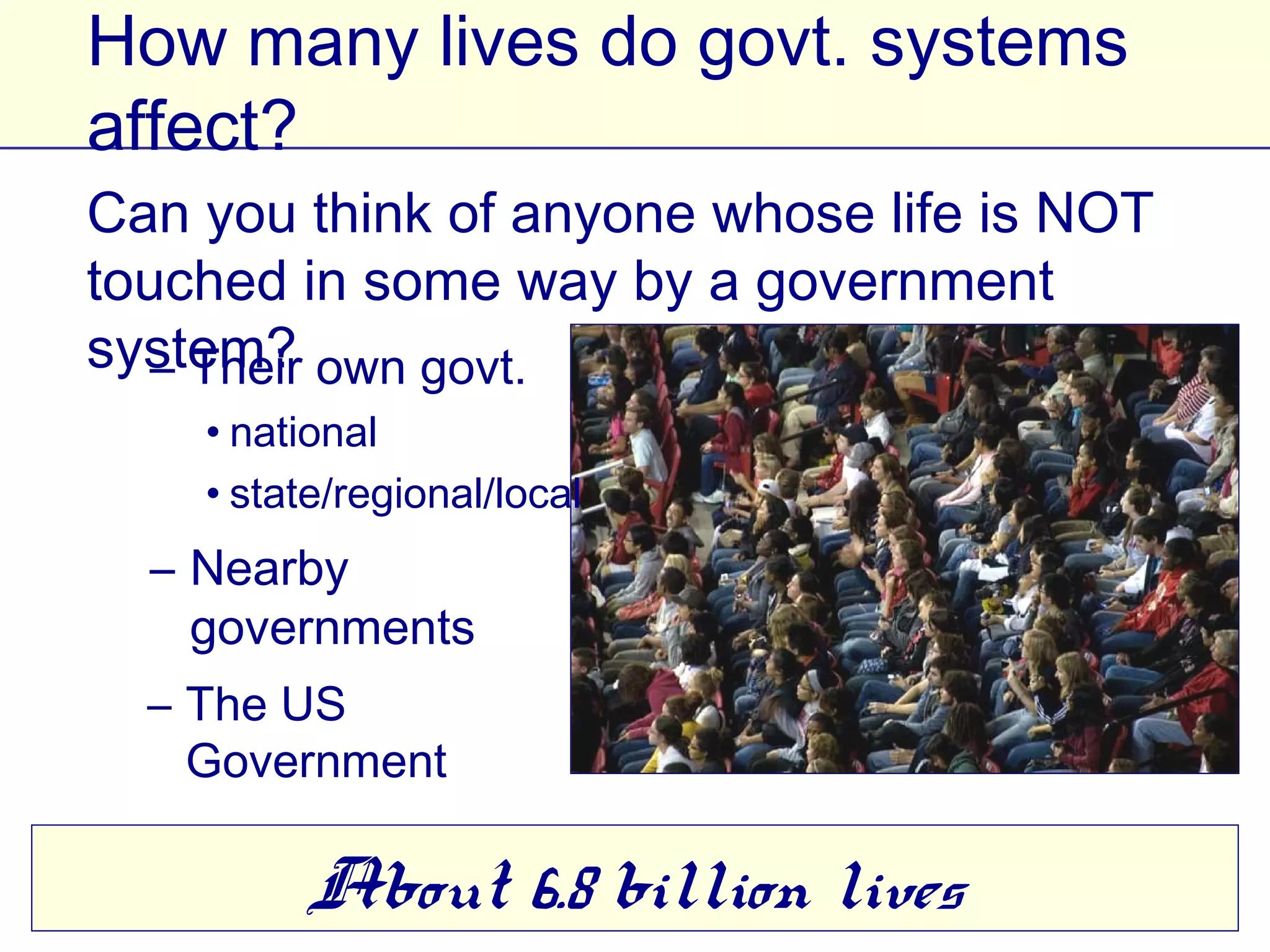
How many lives do govt. systems affect?
Can you think of anyone whose life is NOT
touched in some way by a government system?
  – Their own govt.
    • national
    • state/regional/local
  – Nearby
    governments
  – The US
    Government

       About 6.8 billion lives
The audiences of government systems

What do you think of when you hear this phrase?

      “usability in government”

               Agency websites?
                 Gov 2.0?
                  Voting?

                     It’s all of these, and more.
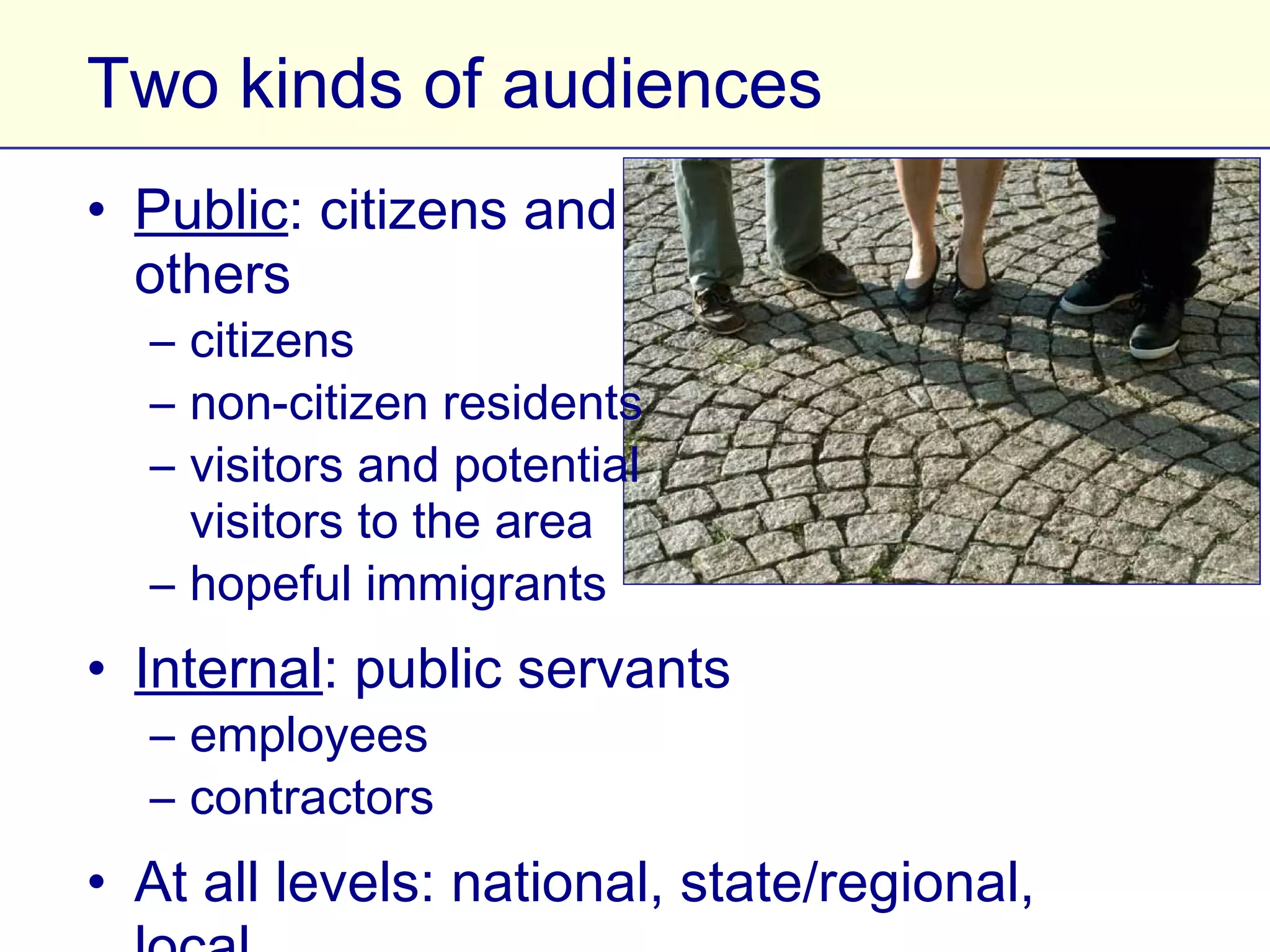
Two kinds of audiences
• Public: citizens and
  others
   – citizens
   – non-citizen residents
   – visitors and potential
     visitors to the area
   – hopeful immigrants
• Internal: public servants
   – employees
   – contractors
• At all levels: national, state/regional, local
Major goals of public-facing systems
• Provide information and services to the
  broadest possible audience
• Conduct transactions with the public
  – Optional
     • e.g., find a library book and put it on hold
  – Required (but doing them on line may be optional)
     • e.g., pay taxes, renew vehicle registration
• Encourage citizen participation (Gov 2.0)
• Protect citizen privacy
Some major goals of internal systems
• Conduct the work of the government as
  effectively and efficiently as possible
• Maintain national/regional/local security
Internal systems: some examples
• Defense systems
• Air traffic control, spacecraft control
    – some of these are defense related
•   Agency intranets
•   Emergency response systems
•   Management of critical infrastructures
•   Legislative drafting (lawmaking)
•   Internal social media applications (e.g., the US
    Department of Transportation’s IdeaHub)
Public and internal share many concerns
•   Content strategy
•   Plain language
•   Accessibility
•   Mobile access
•   Security
•   Biometrics (fingerprints,
    iris recognition, etc.)
• Cross-cultural issues

                              Photo by NIST
Usability and UX in the process
•   Getting UX work into the contract
•   Use of usability process standards
•   User-centered requirements engineering
•   User-centered software development
•   Usability evaluation
biggest
Public-facing systems are not the problem
                                 ^

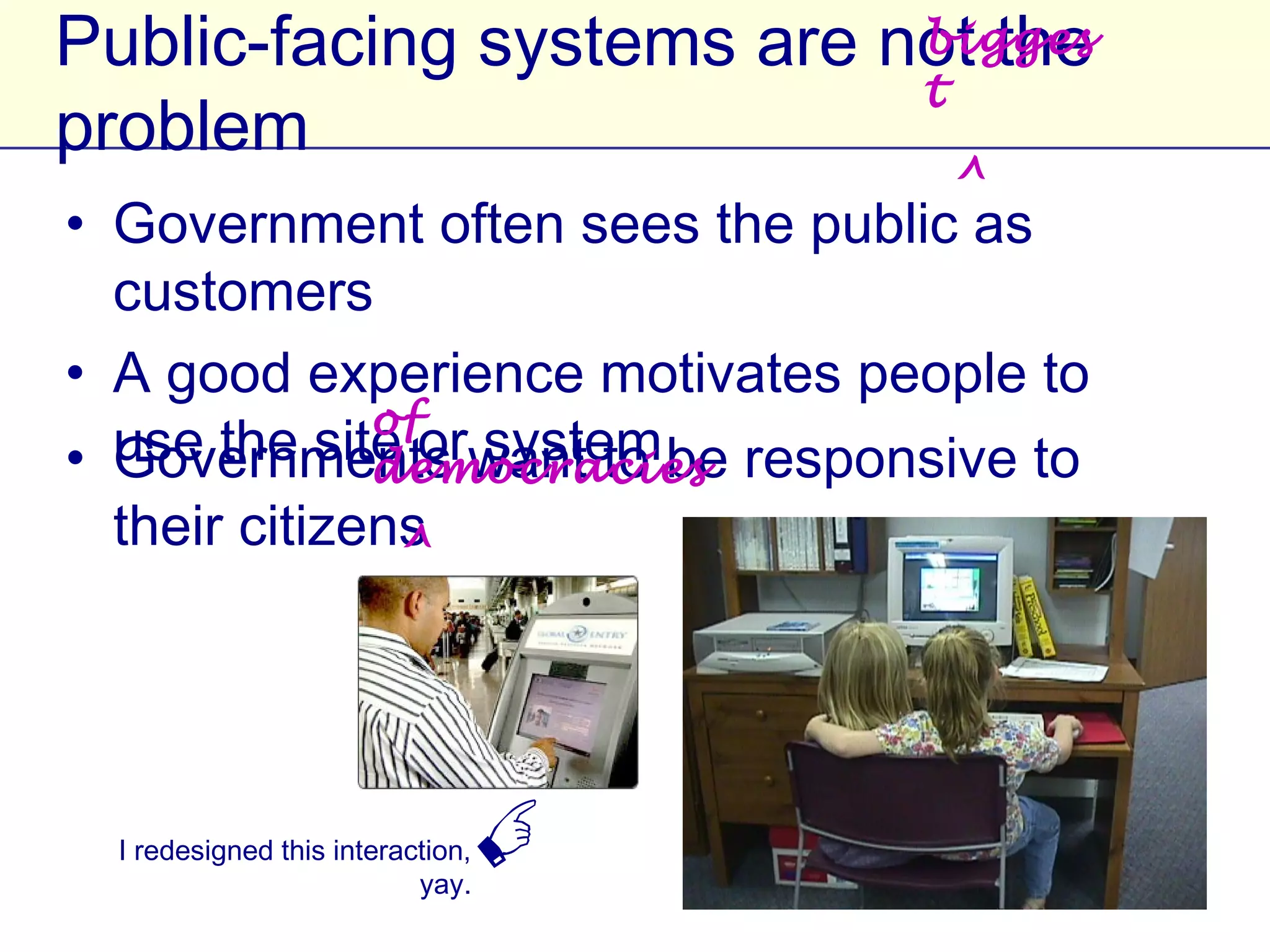
• Government often sees the public as customers
• A good experience motivates people to use the
  site or system
                          of democracies
• Governments want to be responsive to their
            ^
  citizens


 I redesigned this interaction, yay.
                                       
Internal systems can be a bigger challenge
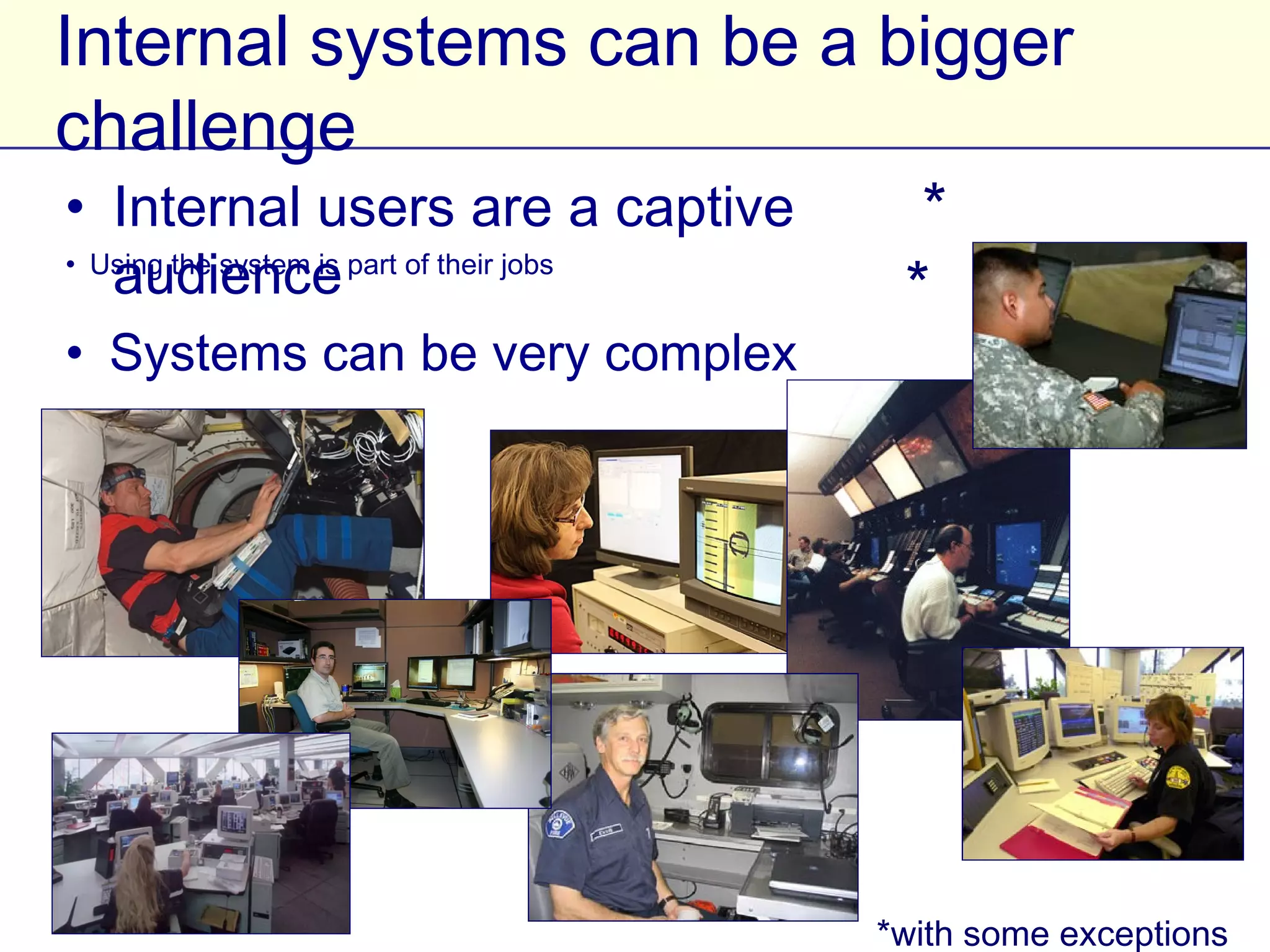
• Internal users are a captive audience*
• Using the system is part of their jobs*
• Systems can be very complex


                                      *with some exceptions
Internal: Usability more sellable than UX
• Effectiveness
• Efficiency
• Satisfaction ?
   – Not quite as easy
   – Can be couched in terms of employee morale
     and therefore productivity
   – Less important than the other two, but a case
     can be made
• But experience? Surely you jest.
What makes govt. projects different?
• Access to users in advance
   – Once an RFP is issued, bidders
     cannot talk to users
• Contract structure
   – Usability and UX may not be
     mentioned in the RFP
   – Can be difficult to bid it if not
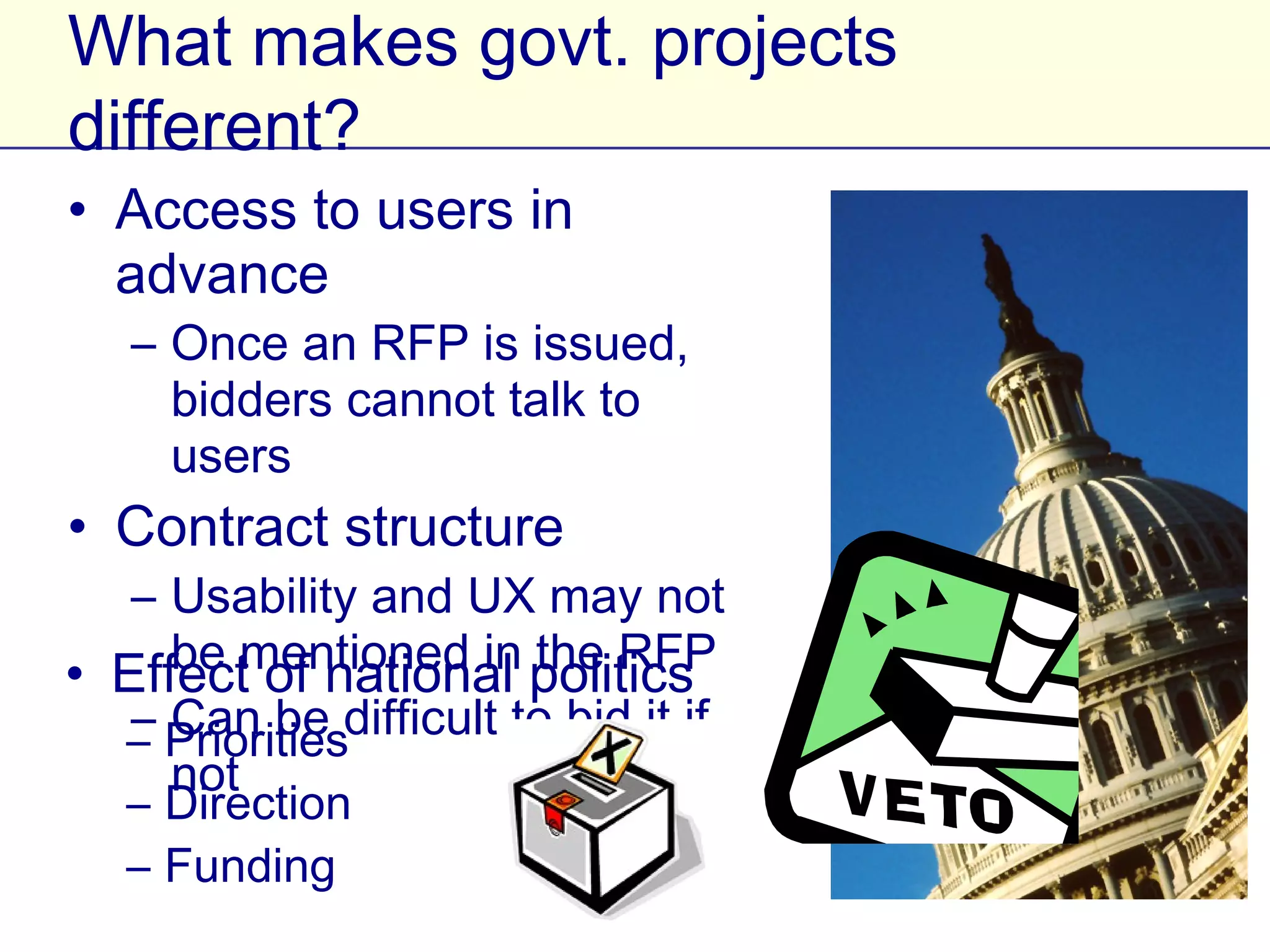
• Effect of national politics
   – Priorities
   – Direction
   – Funding
What makes govt. projects special?
• Number and diversity of users
  affected
• Potential to affect important
  aspects of many people’s
  lives
• Potential to help make
  government itself more
  effective and efficient
  Dare I say “more satisfying”
  too?
Challenges to UX in the govt. process
• Getting usability into the contract (or the RFP, if
  you’re on that side of the project)
• Working it into the project if it’s not in the RFP
• Getting awesome UXers
   – Being seen as sexy *
   – Paying as well as commercial

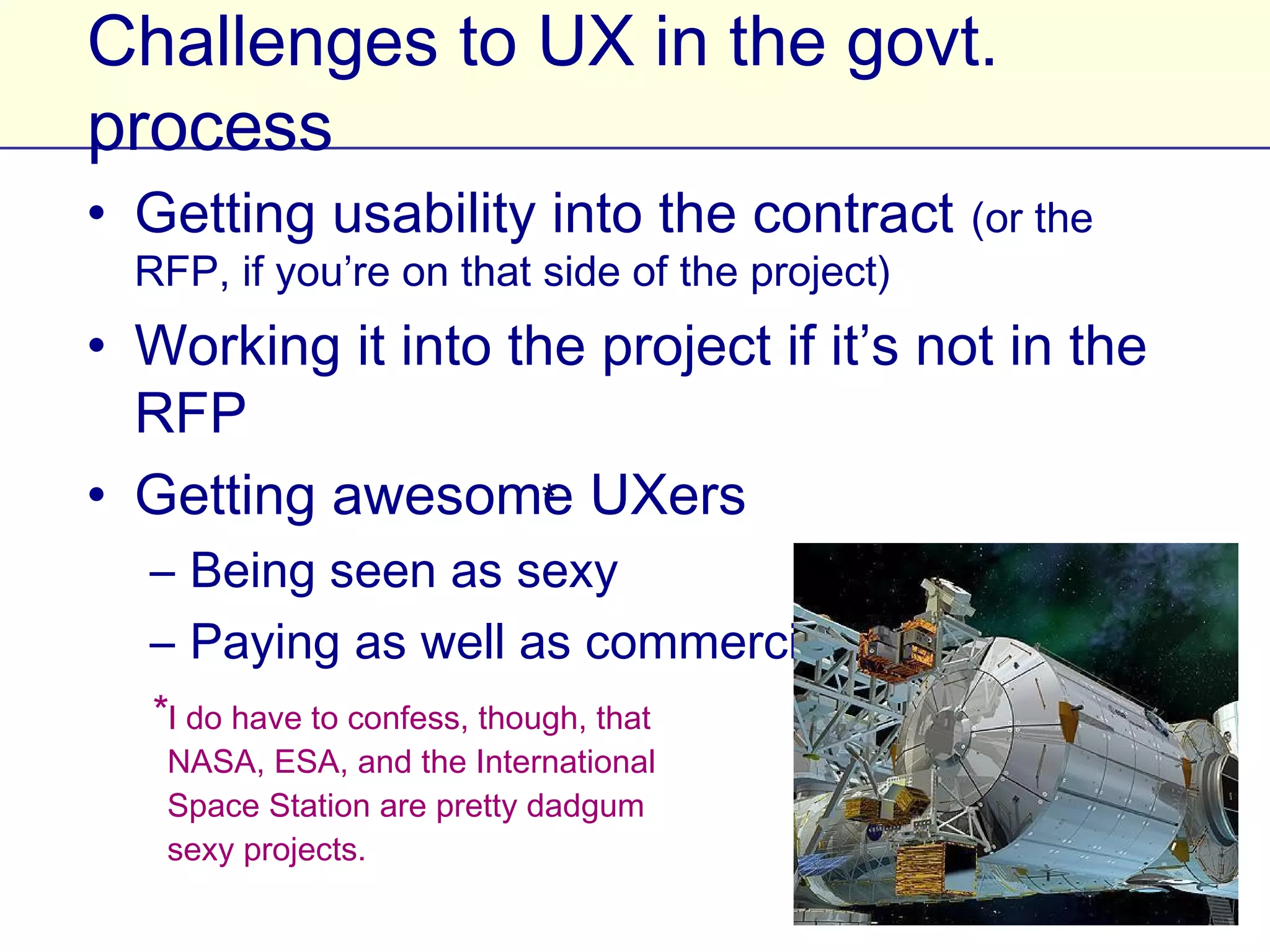
   *I do have to confess, though,
    that NASA, ESA, and the
    International Space Station are
    pretty dadgum sexy projects.
Flexibility is essential

• Do what’s called for in each project
• Pay as much attention to the users’ subjective
  experience as we can, within constraints
• I offer my motto:
       Any improvement
           is good news.
And finally, some wider issues
• Service design
  – Cross-channel design
  – Channel shifting
• Applying design to policymaking
• UX designers and e-democracy
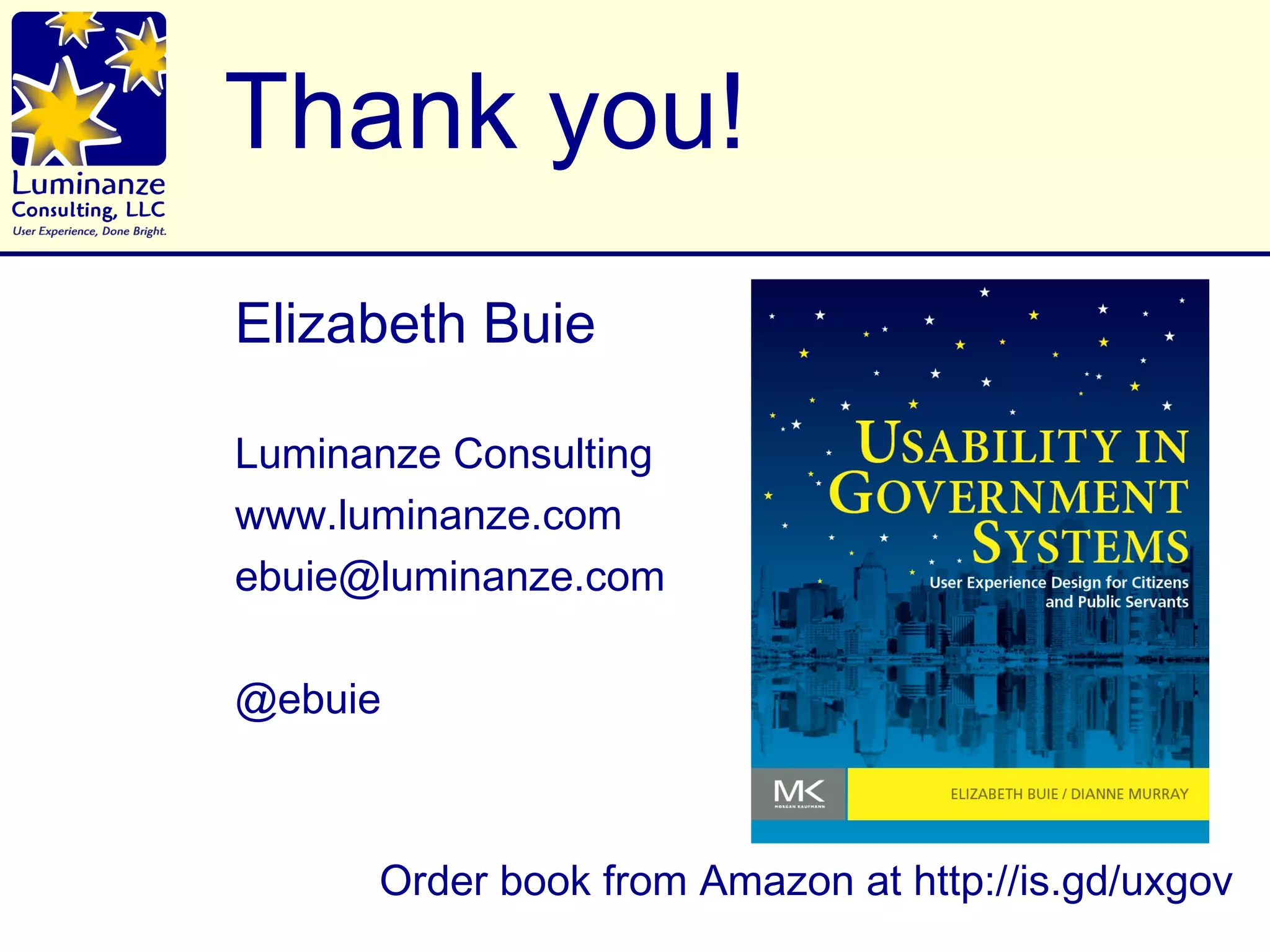
Thank you!
Elizabeth Buie

Luminanze Consulting
www.luminanze.com
ebuie@luminanze.com

@ebuie


         Order book from Amazon at http://is.gd/uxgov

We Are All Stakeholders: Usability and User Experience in Government Systems

  • 1.
    We Are AllStakeholders Usability in Government Systems User Experience Design for Citizens and Public Servants Elizabeth Buie Luminanze Consulting @ebuie
  • 2.
    Who Am I? •I’ve specialized in UI/ usability/UX since the Beginning of Time 1978 • I’ve worked on government systems even longer 1975 • I’ve worked in a very large firm, a very small firm, and a solo practice (current)
  • 3.
    Some Notes onTerminology • “Usability” — effectiveness, efficiency, and satisfaction (from ISO 9241) • “User experience” (UX) — users’ subjective experience surrounding their use of a product • Good usability is (usually) necessary for a good user experience, but they are not the same thing • We can design FOR good user experience, but we cannot (for the most part) design the experience itself: “UX design” is a shorthand
  • 4.
    We Are AllStakeholders
  • 5.
    How many livesdo govt. systems affect? Can you think of anyone whose life is NOT touched in some way by a government system? – Their own govt. • national • state/regional/local – Nearby governments – The US Government About 6.8 billion lives
  • 6.
    The audiences ofgovernment systems What do you think of when you hear this phrase? “usability in government” Agency websites? Gov 2.0? Voting? It’s all of these, and more.
  • 7.
    Two kinds ofaudiences • Public: citizens and others – citizens – non-citizen residents – visitors and potential visitors to the area – hopeful immigrants • Internal: public servants – employees – contractors • At all levels: national, state/regional, local
  • 8.
    Major goals ofpublic-facing systems • Provide information and services to the broadest possible audience • Conduct transactions with the public – Optional • e.g., find a library book and put it on hold – Required (but doing them on line may be optional) • e.g., pay taxes, renew vehicle registration • Encourage citizen participation (Gov 2.0) • Protect citizen privacy
  • 9.
    Some major goalsof internal systems • Conduct the work of the government as effectively and efficiently as possible • Maintain national/regional/local security
  • 10.
    Internal systems: someexamples • Defense systems • Air traffic control, spacecraft control – some of these are defense related • Agency intranets • Emergency response systems • Management of critical infrastructures • Legislative drafting (lawmaking) • Internal social media applications (e.g., the US Department of Transportation’s IdeaHub)
  • 11.
    Public and internalshare many concerns • Content strategy • Plain language • Accessibility • Mobile access • Security • Biometrics (fingerprints, iris recognition, etc.) • Cross-cultural issues Photo by NIST
  • 12.
    Usability and UXin the process • Getting UX work into the contract • Use of usability process standards • User-centered requirements engineering • User-centered software development • Usability evaluation
  • 13.
    biggest Public-facing systems arenot the problem ^ • Government often sees the public as customers • A good experience motivates people to use the site or system of democracies • Governments want to be responsive to their ^ citizens I redesigned this interaction, yay. 
  • 14.
    Internal systems canbe a bigger challenge • Internal users are a captive audience* • Using the system is part of their jobs* • Systems can be very complex *with some exceptions
  • 15.
    Internal: Usability moresellable than UX • Effectiveness • Efficiency • Satisfaction ? – Not quite as easy – Can be couched in terms of employee morale and therefore productivity – Less important than the other two, but a case can be made • But experience? Surely you jest.
  • 16.
    What makes govt.projects different? • Access to users in advance – Once an RFP is issued, bidders cannot talk to users • Contract structure – Usability and UX may not be mentioned in the RFP – Can be difficult to bid it if not • Effect of national politics – Priorities – Direction – Funding
  • 17.
    What makes govt.projects special? • Number and diversity of users affected • Potential to affect important aspects of many people’s lives • Potential to help make government itself more effective and efficient Dare I say “more satisfying” too?
  • 18.
    Challenges to UXin the govt. process • Getting usability into the contract (or the RFP, if you’re on that side of the project) • Working it into the project if it’s not in the RFP • Getting awesome UXers – Being seen as sexy * – Paying as well as commercial *I do have to confess, though, that NASA, ESA, and the International Space Station are pretty dadgum sexy projects.
  • 19.
    Flexibility is essential •Do what’s called for in each project • Pay as much attention to the users’ subjective experience as we can, within constraints • I offer my motto: Any improvement is good news.
  • 20.
    And finally, somewider issues • Service design – Cross-channel design – Channel shifting • Applying design to policymaking • UX designers and e-democracy
  • 21.
    Thank you! Elizabeth Buie LuminanzeConsulting www.luminanze.com ebuie@luminanze.com @ebuie Order book from Amazon at http://is.gd/uxgov

Editor's Notes

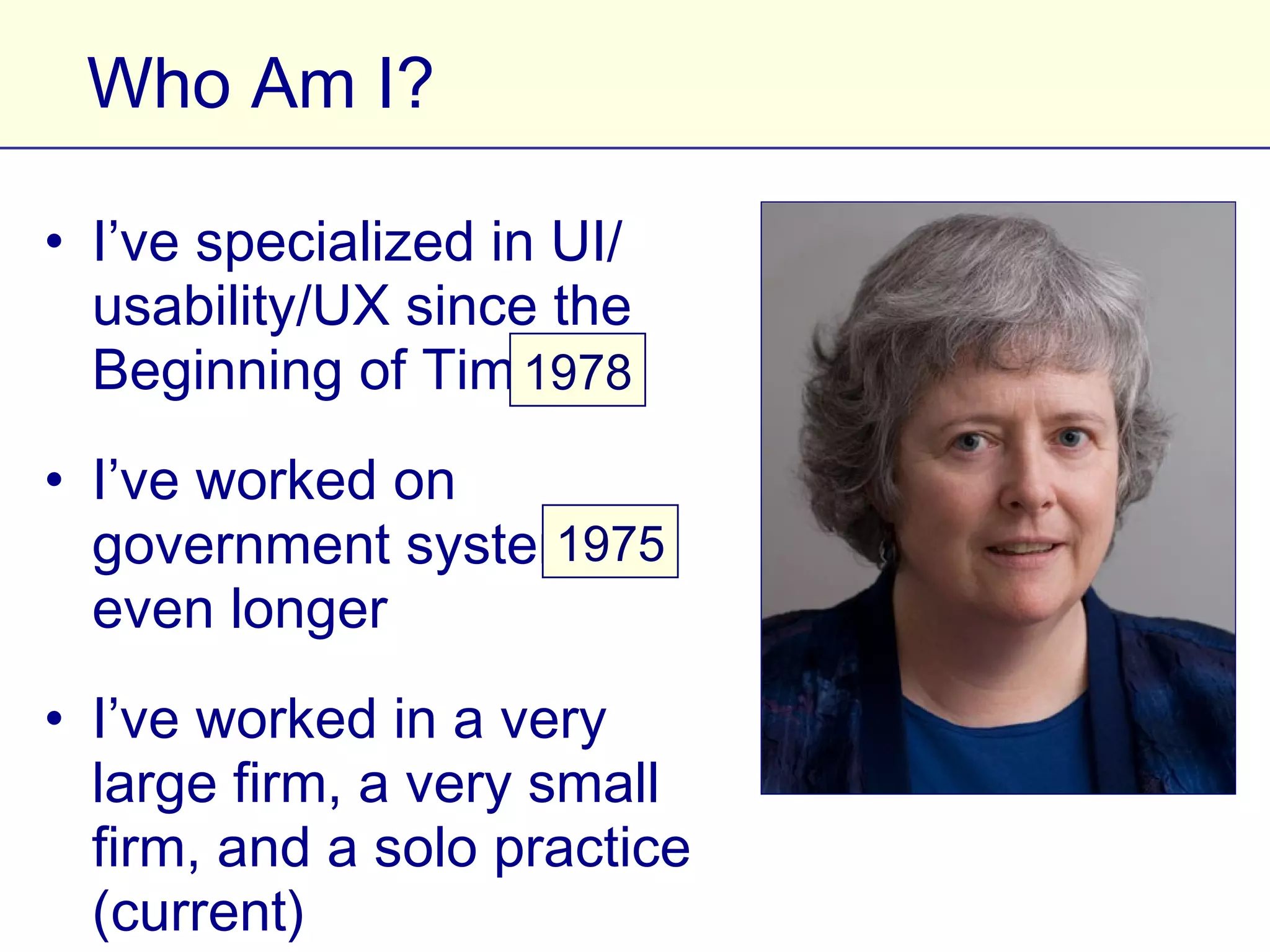
  • #3 This is me, in case you can’t tell what I look like.
  • #15 There ARE some exceptions — specifically, internal systems whose use is optional. These are more like public-facing systems if the agency wants to encourage staff to use them. DOT’s IdeaHub is an example of this. btw, these are all photos of real public servants, obtained from government sites.
  • #16 Usability is defined as effectiveness, efficiency, and satisfaction. The first two are somewhat straightforward.