Unified Testing Criteria (UTC)  for  Java (TM)  based  mobile applications  Belal Raslan /Quality Manager Date: September, 09, 2007
Unified Testing Initiative (UTI)
The Unified Testing Initiative (UTI) is a joint effort formed by Sun Microsystems, mobile device manufacturers and network operators: Motorola, Nokia, Samsung, Sony Ericsson, LG, Orange, Vodafone. These industry leaders, have unified their various mobile Java application testing programs into a single, comprehensive program providing application testing, promotion and distribution for developers.  UTI :Introduction
UTI :Members
UTI :Members
UTI :Members
UTI :Members
UTI :Members
UTI :Members
UTI :Members
UTI :Members
UTI :Members
UTI :Origin The UTI is a result of the efforts of key industry  players, ranging from device manufacturers to  network operators and technology developers. Since the  beginning of the UTI in late 2002 and the launch of the Java  Verified Program in 2004, it has evolved into a trusted  means of ensuring adherence to accepted standards of  quality and safety for a multitude of Java applications  meant for market.
UTI :Goals The goal of the UTI is to grow supply and demand for mobile Java applications by driving the development, promotion and distribution of high-quality mobile applications for the Java platform. This will be achieved by providing a comprehensive test set against which mobile Java developers can test their applications.
Unified Testing Criteria (UTC)
UTC: Introduction The UTI defines the Unified Testing Criteria (UTC), which is  a general set of tests, that run against applications to certify them  under the Java Verified Program. The UTC  subcommittee is  made up of one representative from each of the platinum  member companies of the UTI. This subcommittee defines the  test criteria and is responsible for continuously updating and  expanding tests to facilitate acceptance of applications by network  operators and other participants who offer applications to  end users.
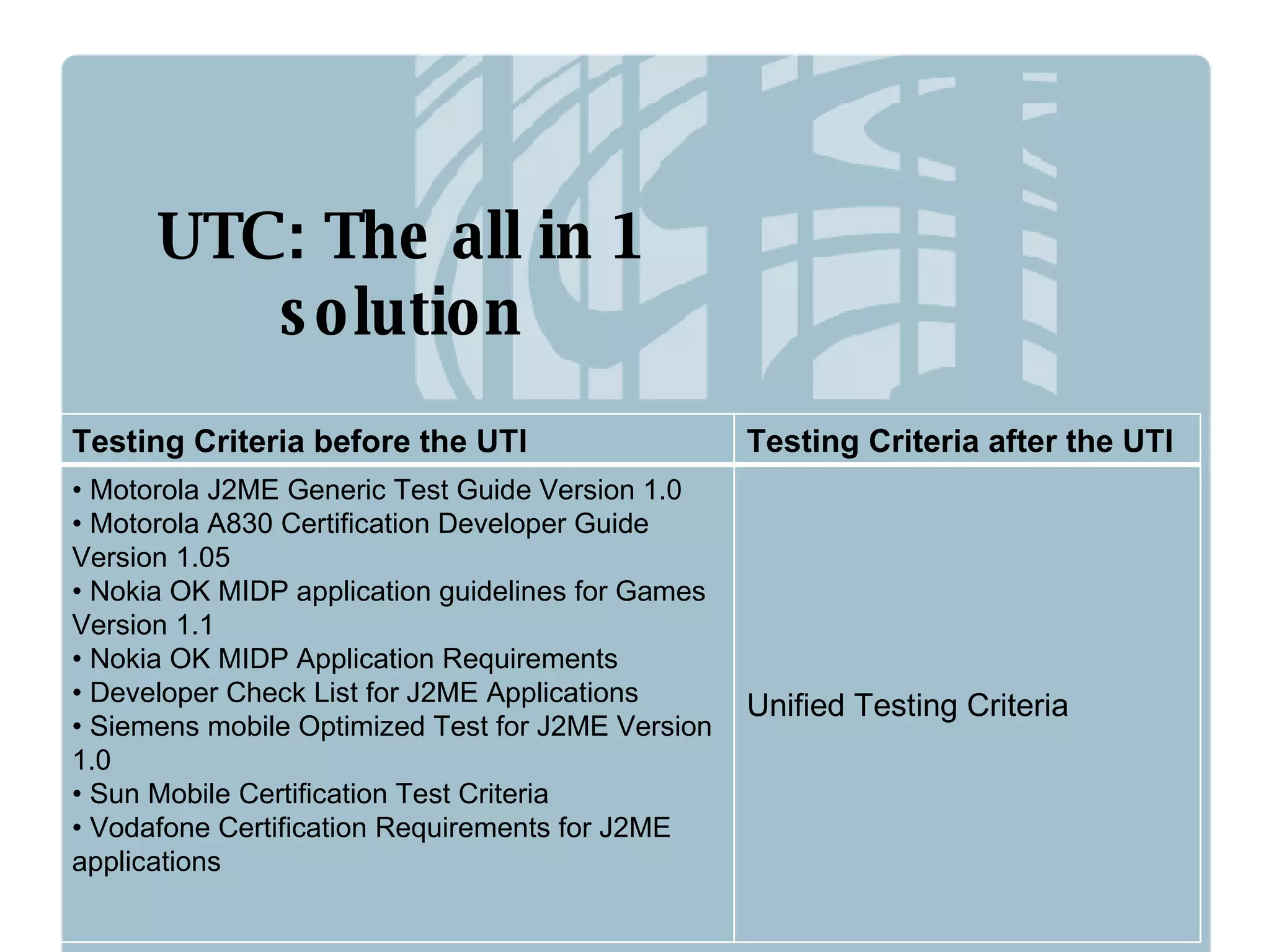
UTC: The all in 1 solution Testing Criteria before the UTI Testing Criteria after the UTI •  Motorola J2ME Generic Test Guide Version 1.0  •  Motorola A830 Certification Developer Guide  Version 1.05  •  Nokia OK MIDP application guidelines for Games Version 1.1  •  Nokia OK MIDP Application Requirements  •  Developer Check List for J2ME Applications  •  Siemens mobile Optimized Test for J2ME Version 1.0  •  Sun Mobile Certification Test Criteria  •  Vodafone Certification Requirements for J2ME applications  Unified Testing Criteria
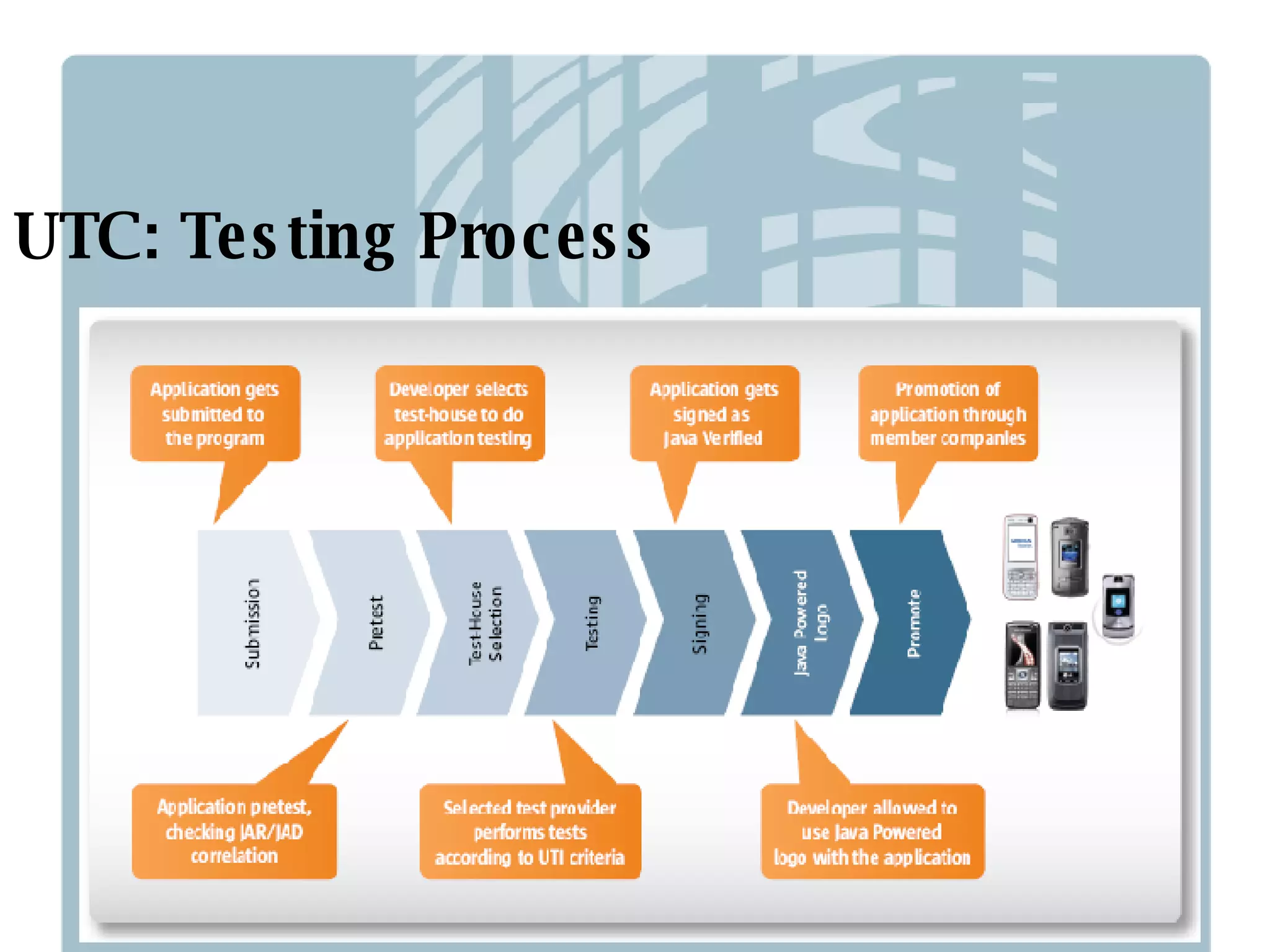
UTC: Testing Process
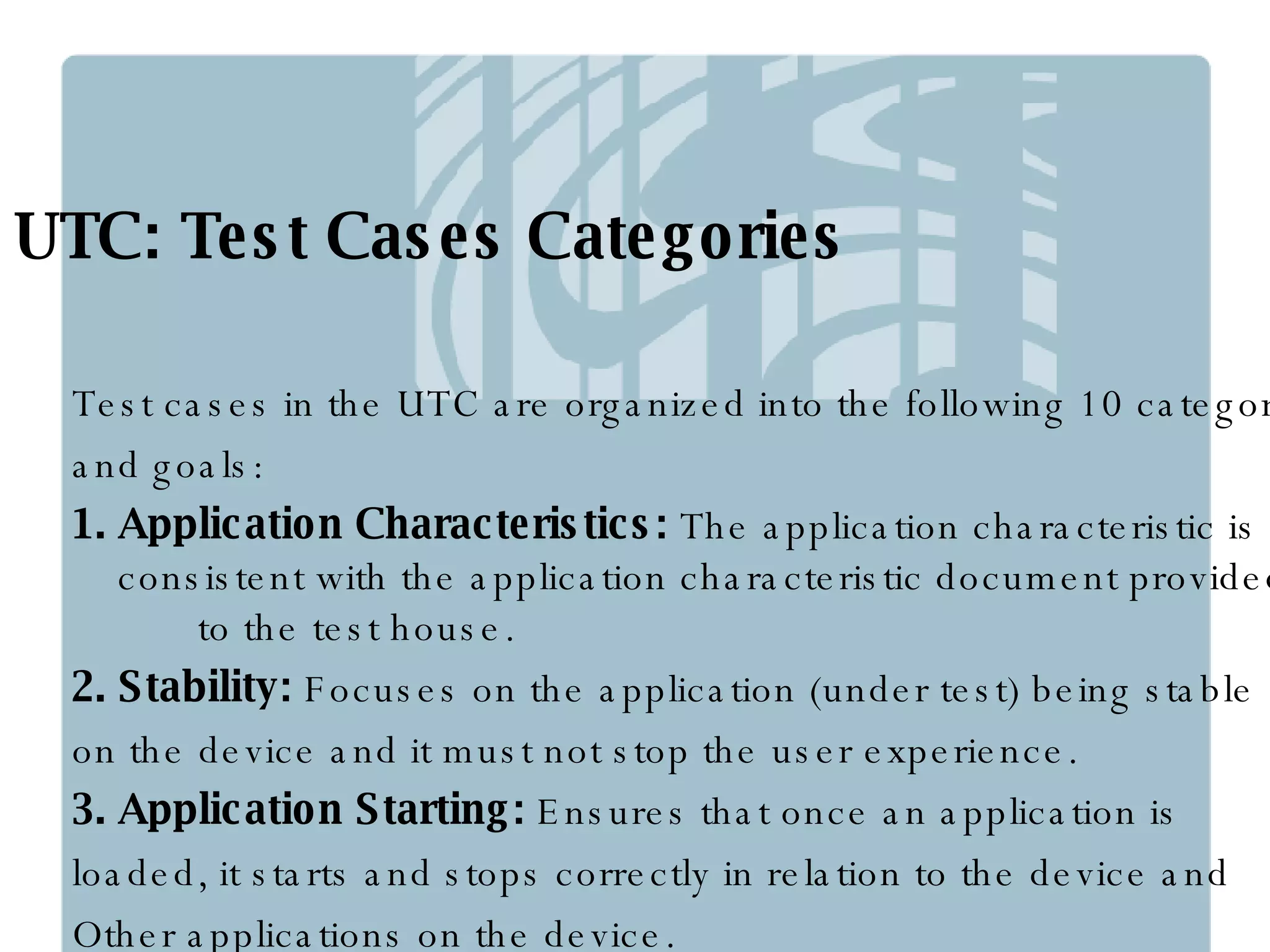
UTC: Test Cases Categories Test cases in the UTC are organized into the following 10 categories  and goals: 1. Application Characteristics:  The application characteristic is  consistent with the application characteristic document provided  to the test house.  2. Stability:  Focuses on the application (under test) being stable  on the device and it must not stop the user experience. 3. Application Starting:  Ensures that once an application is  loaded, it starts and stops correctly in relation to the device and  Other applications on the device.
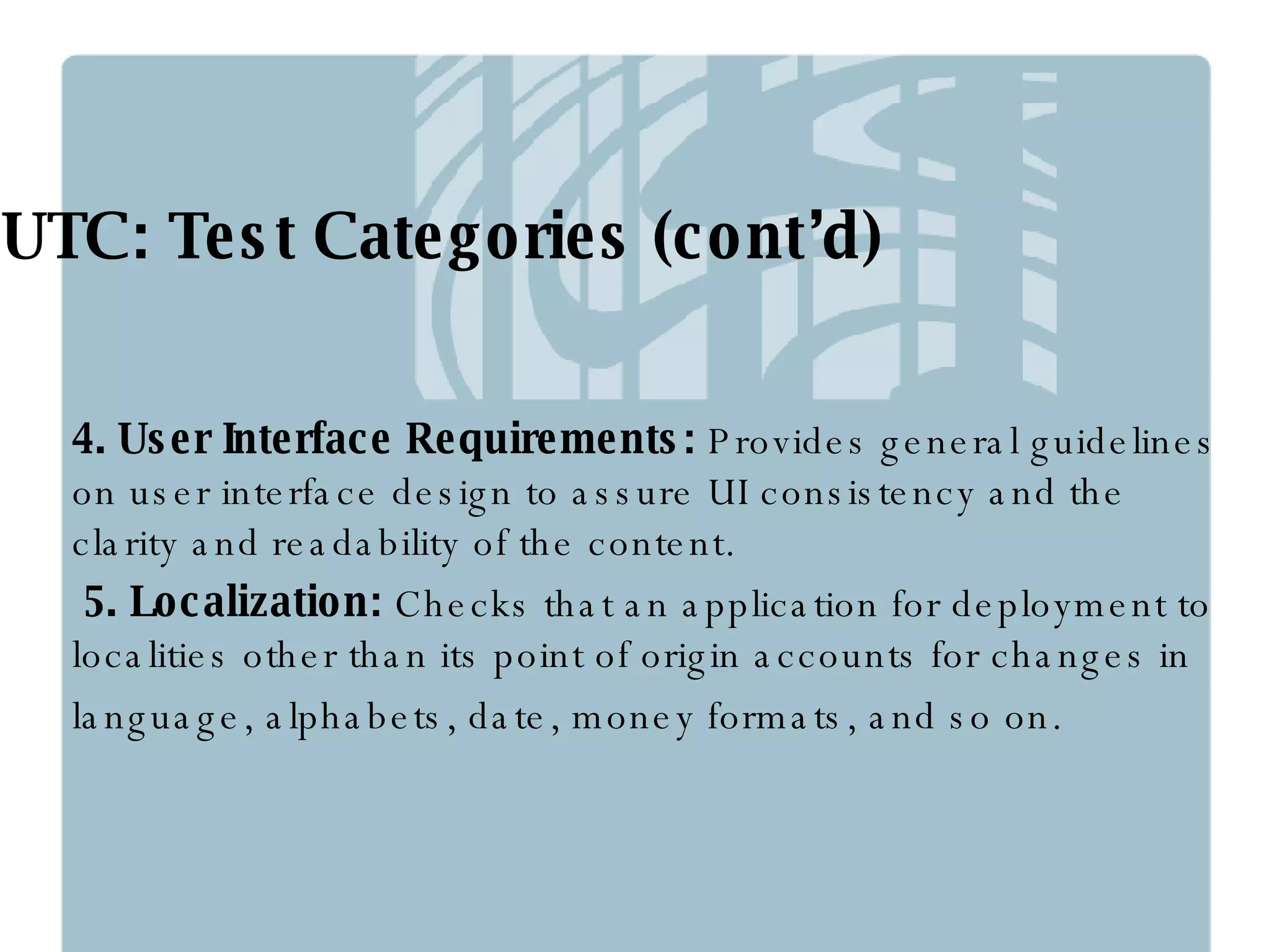
UTC: Test Categories (cont’d) 4. User Interface Requirements:  Provides general guidelines on user interface design to assure UI consistency and the clarity and readability of the content. 5. Localization:  Checks that an application for deployment to localities other than its point of origin accounts for changes in language, alphabets, date, money formats, and so on.
UTC: Test Categories (cont’d) 6. Functionality:  From information sources such as user manuals, application specification documents, and online documentation, checks that documented features are implemented in the  application and that they work as expected 7. Connectivity:  Ensures that if an application has communication capabilities, it demonstrates the ability to communicate over a network correctly and is capable of dealing with both network  and server-side problems
UTC: Test Categories (cont’d) 8. Personal Information Management: Ensures that an application accessing user information is able to  do it without destroying the information 9. Security:  Provides the capability to list different security-related issues that are tested in an application 10. Retesting:  Provides facilities to perform selected retesting

Unified Testing Criteria (UTC)

  • 1.
    Unified Testing Criteria(UTC) for Java (TM) based mobile applications Belal Raslan /Quality Manager Date: September, 09, 2007
  • 2.
  • 3.
    The Unified TestingInitiative (UTI) is a joint effort formed by Sun Microsystems, mobile device manufacturers and network operators: Motorola, Nokia, Samsung, Sony Ericsson, LG, Orange, Vodafone. These industry leaders, have unified their various mobile Java application testing programs into a single, comprehensive program providing application testing, promotion and distribution for developers. UTI :Introduction
  • 4.
  • 5.
  • 6.
  • 7.
  • 8.
  • 9.
  • 10.
  • 11.
  • 12.
  • 13.
    UTI :Origin TheUTI is a result of the efforts of key industry players, ranging from device manufacturers to network operators and technology developers. Since the beginning of the UTI in late 2002 and the launch of the Java Verified Program in 2004, it has evolved into a trusted means of ensuring adherence to accepted standards of quality and safety for a multitude of Java applications meant for market.
  • 14.
    UTI :Goals Thegoal of the UTI is to grow supply and demand for mobile Java applications by driving the development, promotion and distribution of high-quality mobile applications for the Java platform. This will be achieved by providing a comprehensive test set against which mobile Java developers can test their applications.
  • 15.
  • 16.
    UTC: Introduction TheUTI defines the Unified Testing Criteria (UTC), which is a general set of tests, that run against applications to certify them under the Java Verified Program. The UTC subcommittee is made up of one representative from each of the platinum member companies of the UTI. This subcommittee defines the test criteria and is responsible for continuously updating and expanding tests to facilitate acceptance of applications by network operators and other participants who offer applications to end users.
  • 17.
    UTC: The allin 1 solution Testing Criteria before the UTI Testing Criteria after the UTI • Motorola J2ME Generic Test Guide Version 1.0 • Motorola A830 Certification Developer Guide Version 1.05 • Nokia OK MIDP application guidelines for Games Version 1.1 • Nokia OK MIDP Application Requirements • Developer Check List for J2ME Applications • Siemens mobile Optimized Test for J2ME Version 1.0 • Sun Mobile Certification Test Criteria • Vodafone Certification Requirements for J2ME applications Unified Testing Criteria
  • 18.
  • 19.
    UTC: Test CasesCategories Test cases in the UTC are organized into the following 10 categories and goals: 1. Application Characteristics: The application characteristic is consistent with the application characteristic document provided to the test house. 2. Stability: Focuses on the application (under test) being stable on the device and it must not stop the user experience. 3. Application Starting: Ensures that once an application is loaded, it starts and stops correctly in relation to the device and Other applications on the device.
  • 20.
    UTC: Test Categories(cont’d) 4. User Interface Requirements: Provides general guidelines on user interface design to assure UI consistency and the clarity and readability of the content. 5. Localization: Checks that an application for deployment to localities other than its point of origin accounts for changes in language, alphabets, date, money formats, and so on.
  • 21.
    UTC: Test Categories(cont’d) 6. Functionality: From information sources such as user manuals, application specification documents, and online documentation, checks that documented features are implemented in the application and that they work as expected 7. Connectivity: Ensures that if an application has communication capabilities, it demonstrates the ability to communicate over a network correctly and is capable of dealing with both network and server-side problems
  • 22.
    UTC: Test Categories(cont’d) 8. Personal Information Management: Ensures that an application accessing user information is able to do it without destroying the information 9. Security: Provides the capability to list different security-related issues that are tested in an application 10. Retesting: Provides facilities to perform selected retesting