The Role of Librarians in transforming
the world through Open Data and
Open Science
Presented by Ina Smith & Susan Veldsman
Academy of Science of South Africa (ASSAf)
XXIII SCECSAL Conference, Entebbe, Uganda
24 April 2018
Agenda
• Overview of Open Data & Open Science
• Data in support of achieving the SDGs
• Role of Librarians
• African Open Science Platform Project
Data Driven World
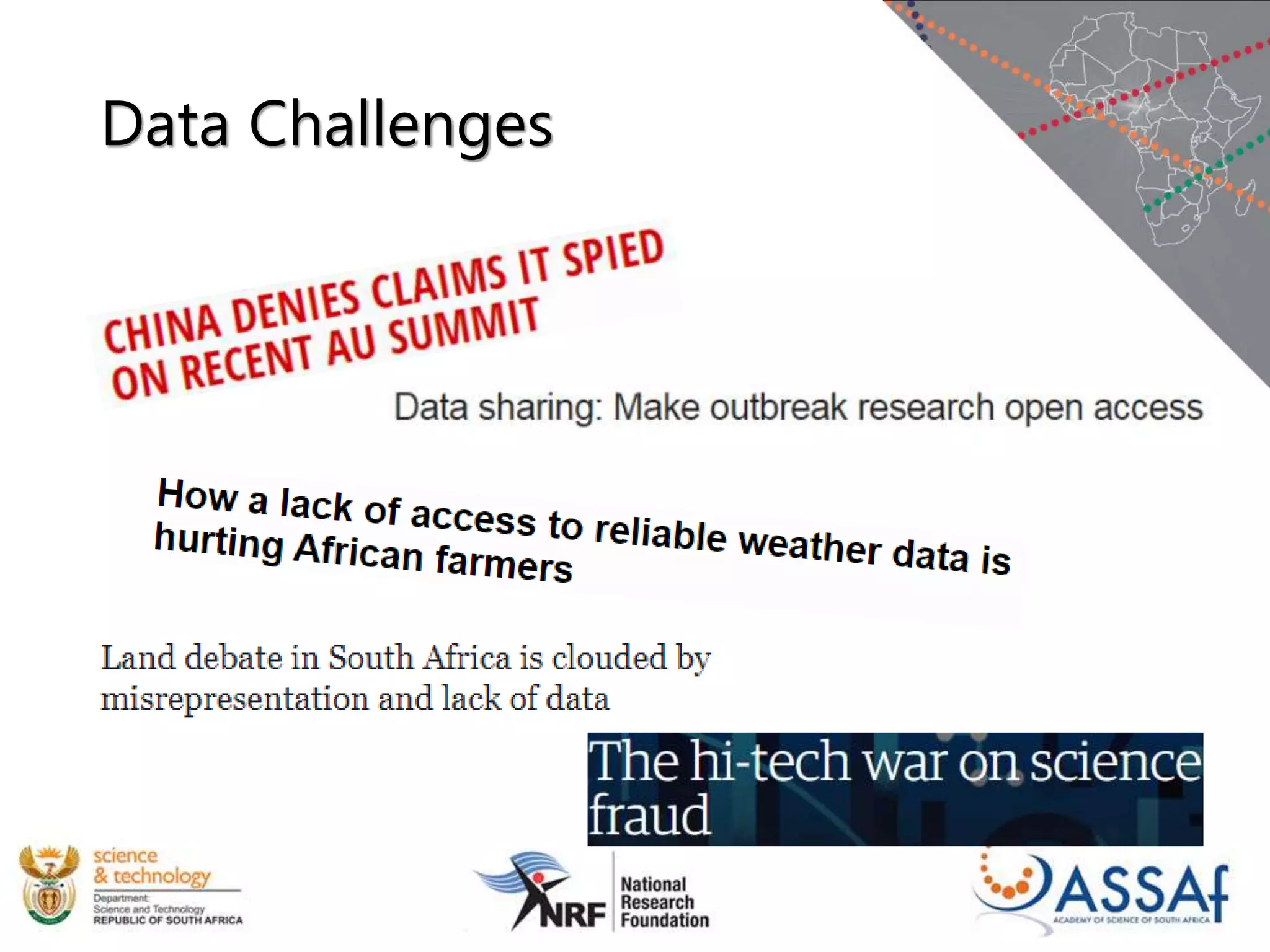
Data Challenges
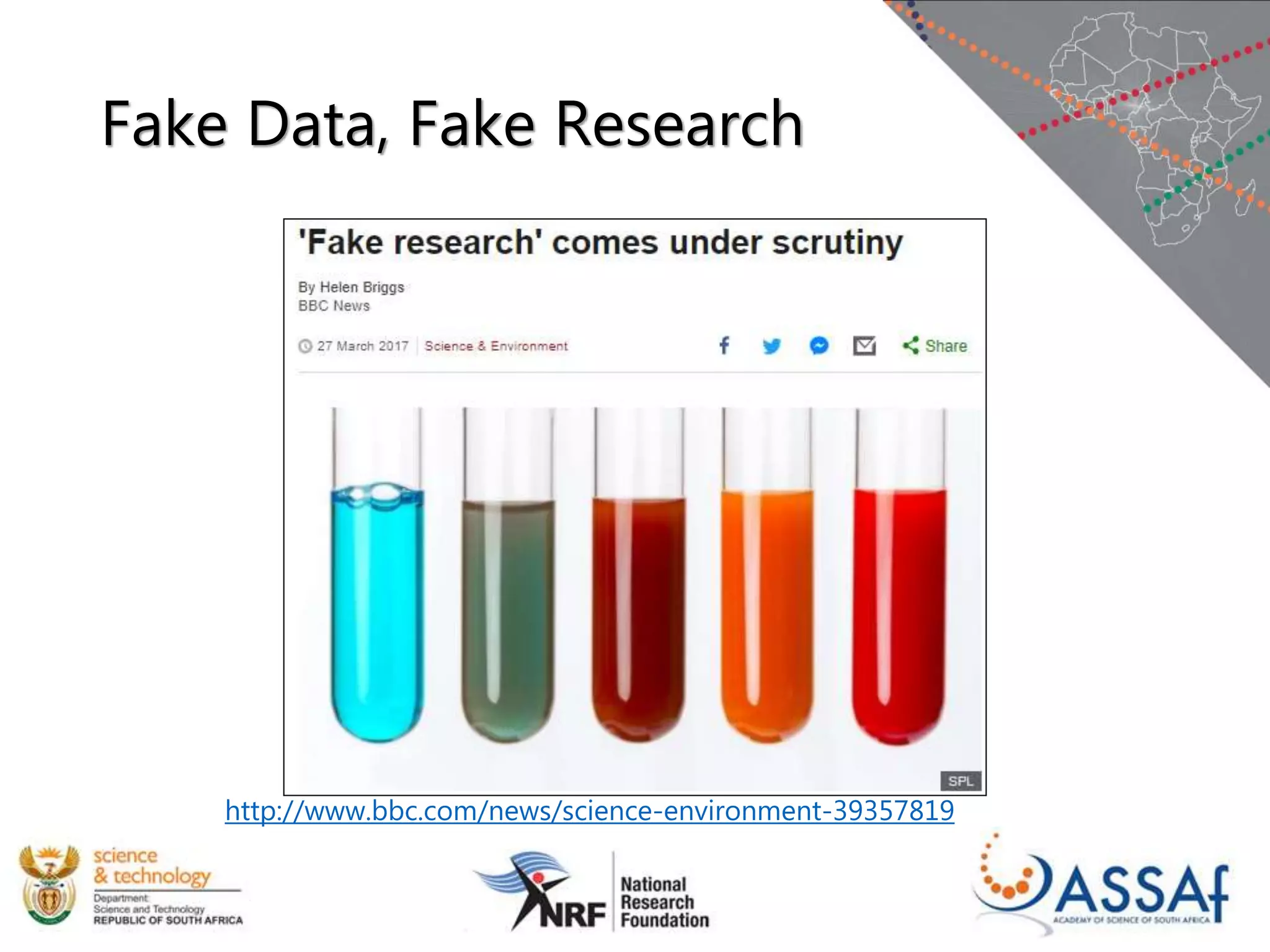
Fake Data, Fake Research
http://www.bbc.com/news/science-environment-39357819
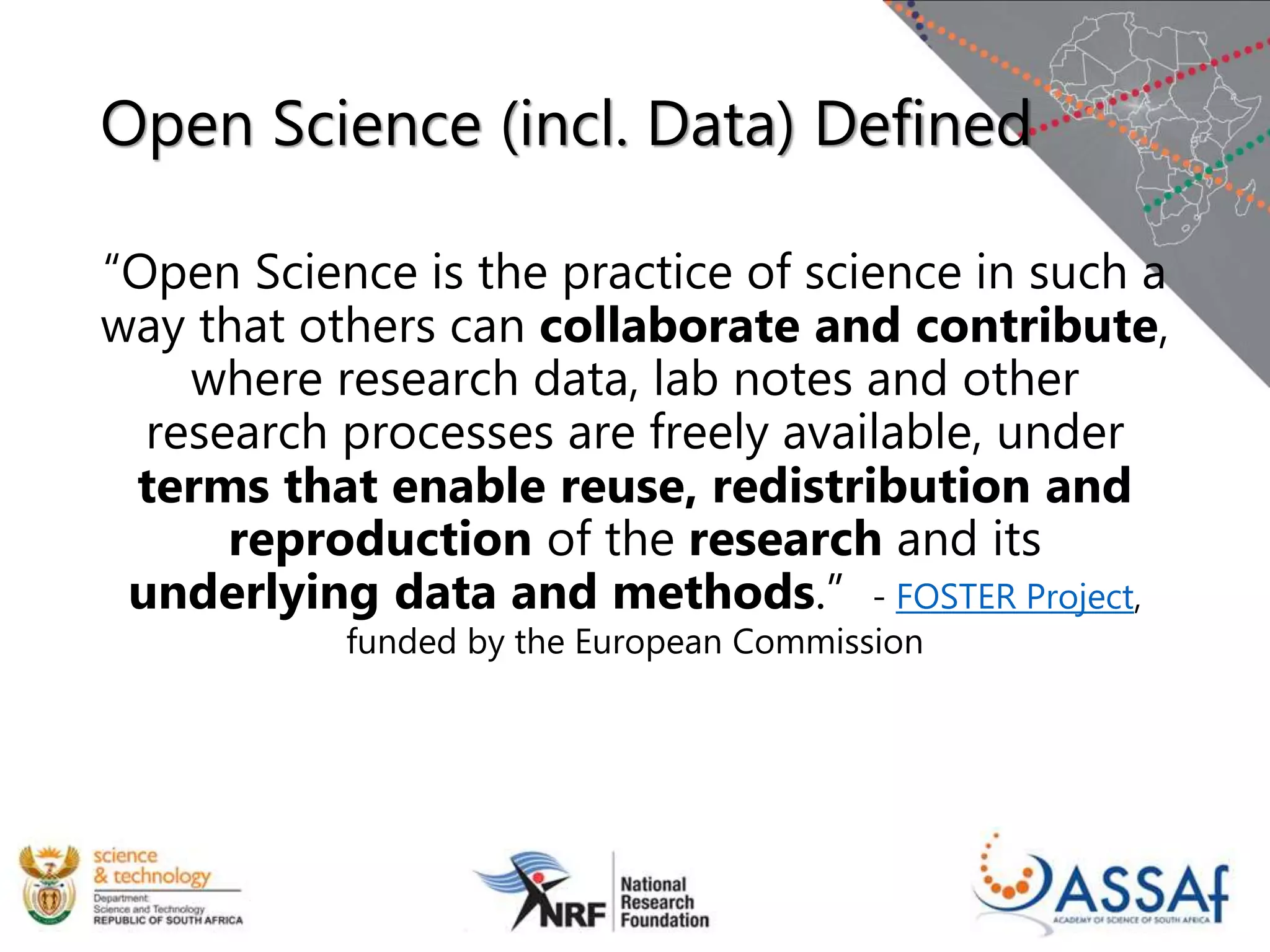
Open Science (incl. Data) Defined
“Open Science is the practice of science in such a
way that others can collaborate and contribute,
where research data, lab notes and other
research processes are freely available, under
terms that enable reuse, redistribution and
reproduction of the research and its
underlying data and methods.” - FOSTER Project,
funded by the European Commission
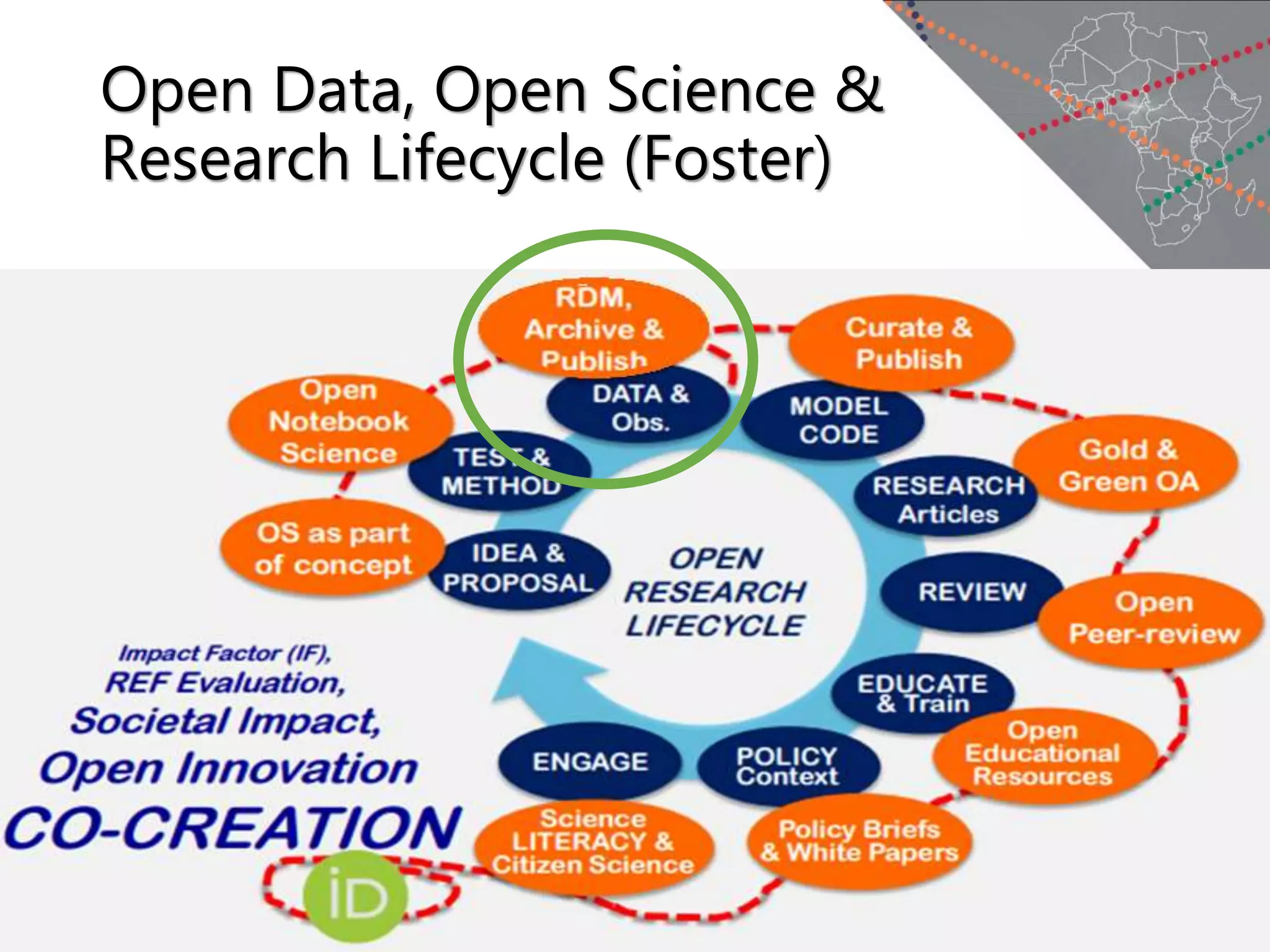
Open Data, Open Science &
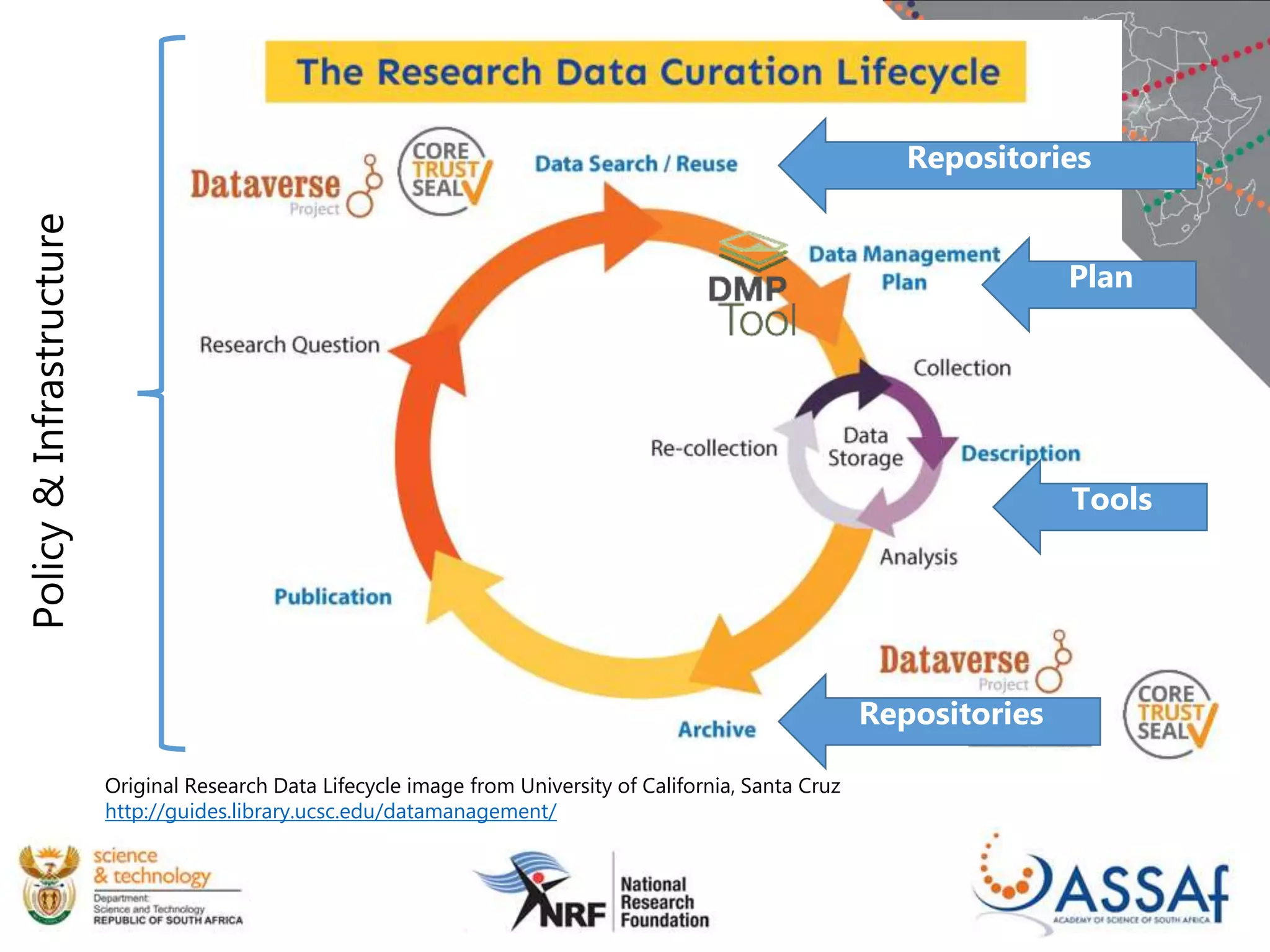
Research Lifecycle (Foster)
Original Research Data Lifecycle image from University of California, Santa Cruz
http://guides.library.ucsc.edu/datamanagement/
Repositories
Repositories
Tools
Plan
Policy&Infrastructure
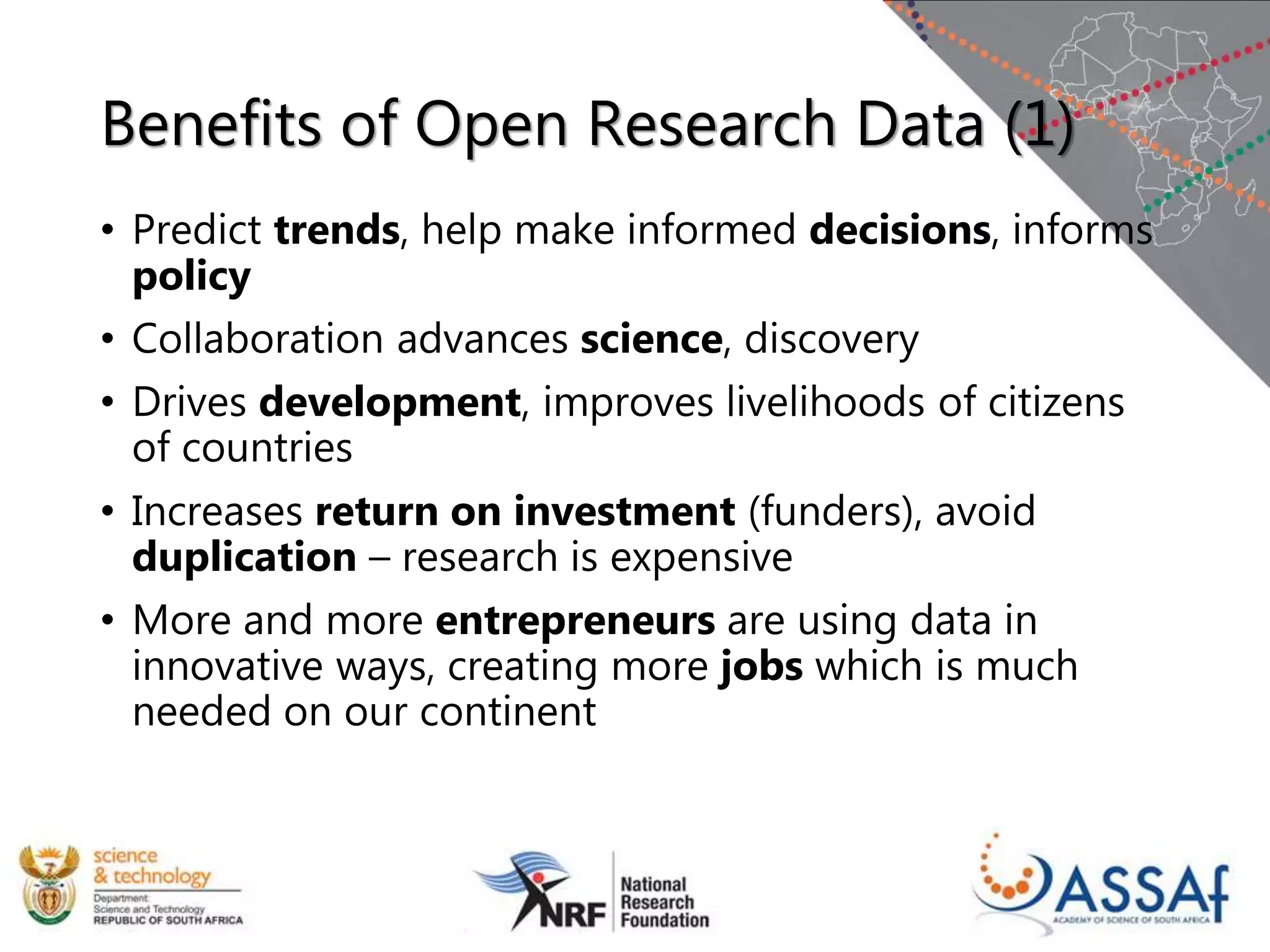
Benefits of Open Research Data (1)
• Predict trends, help make informed decisions, informs
policy
• Collaboration advances science, discovery
• Drives development, improves livelihoods of citizens
of countries
• Increases return on investment (funders), avoid
duplication – research is expensive
• More and more entrepreneurs are using data in
innovative ways, creating more jobs which is much
needed on our continent
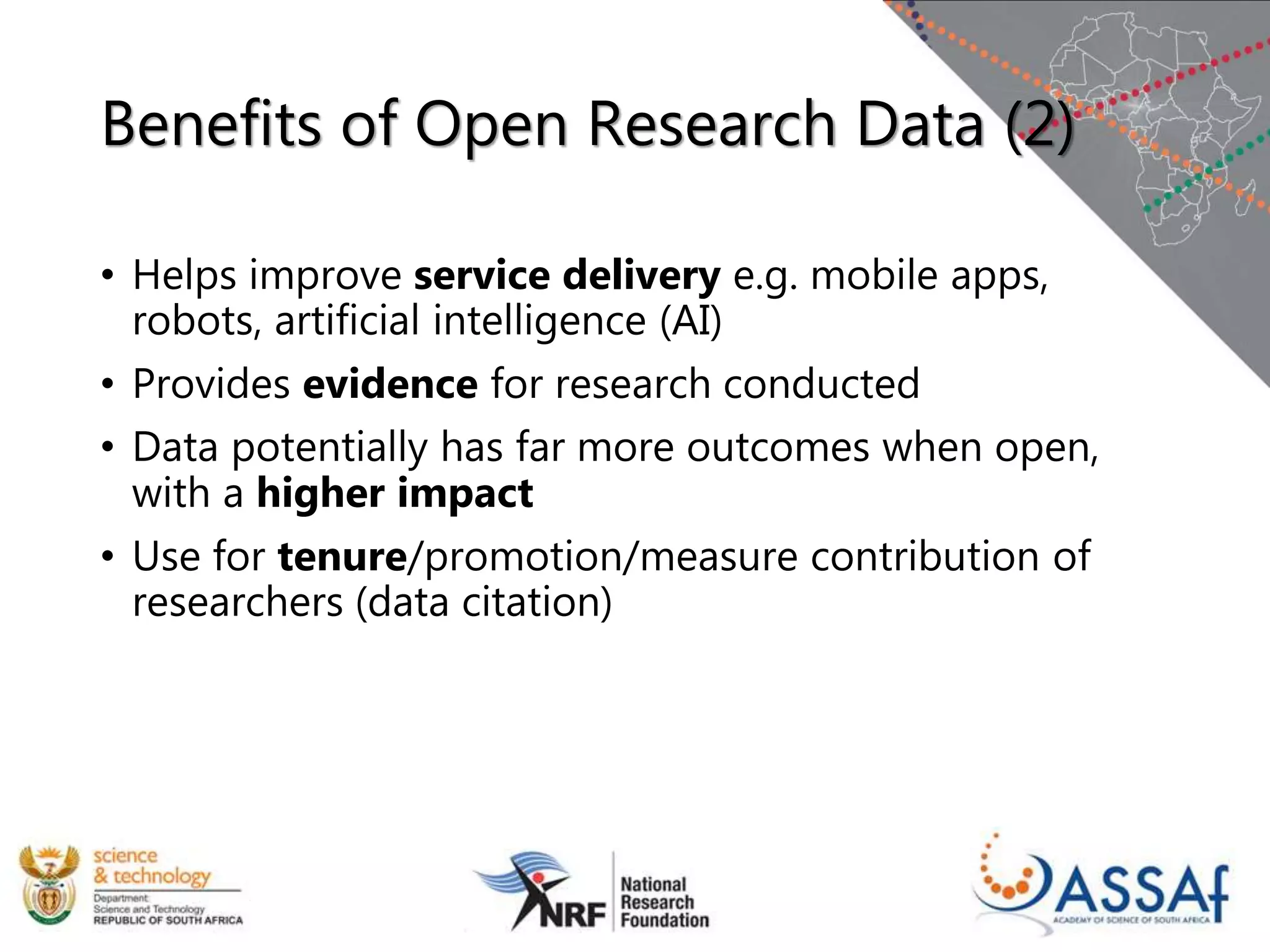
Benefits of Open Research Data (2)
• Helps improve service delivery e.g. mobile apps,
robots, artificial intelligence (AI)
• Provides evidence for research conducted
• Data potentially has far more outcomes when open,
with a higher impact
• Use for tenure/promotion/measure contribution of
researchers (data citation)
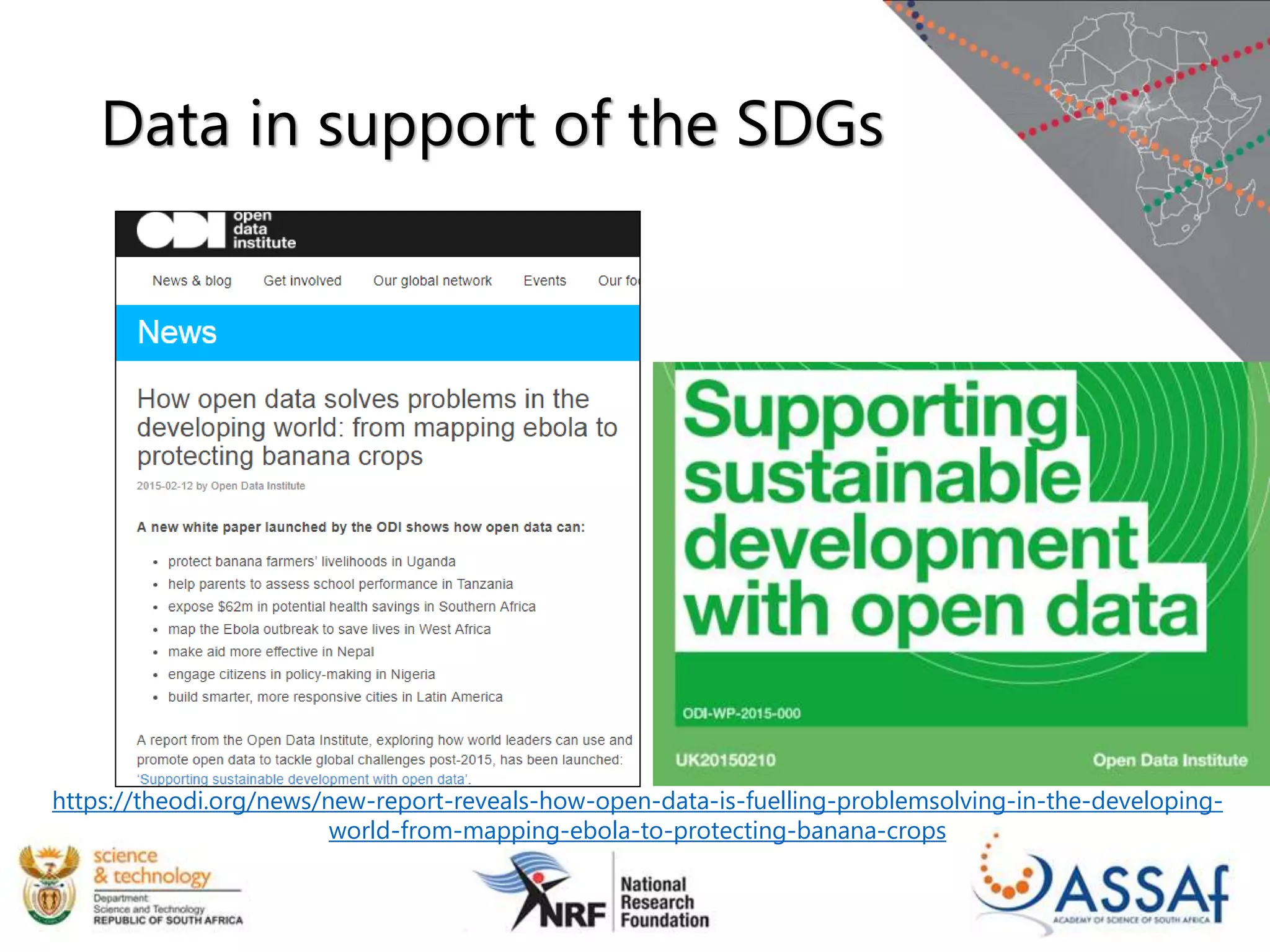
https://theodi.org/news/new-report-reveals-how-open-data-is-fuelling-problemsolving-in-the-developing-
world-from-mapping-ebola-to-protecting-banana-crops
Data in support of the SDGs
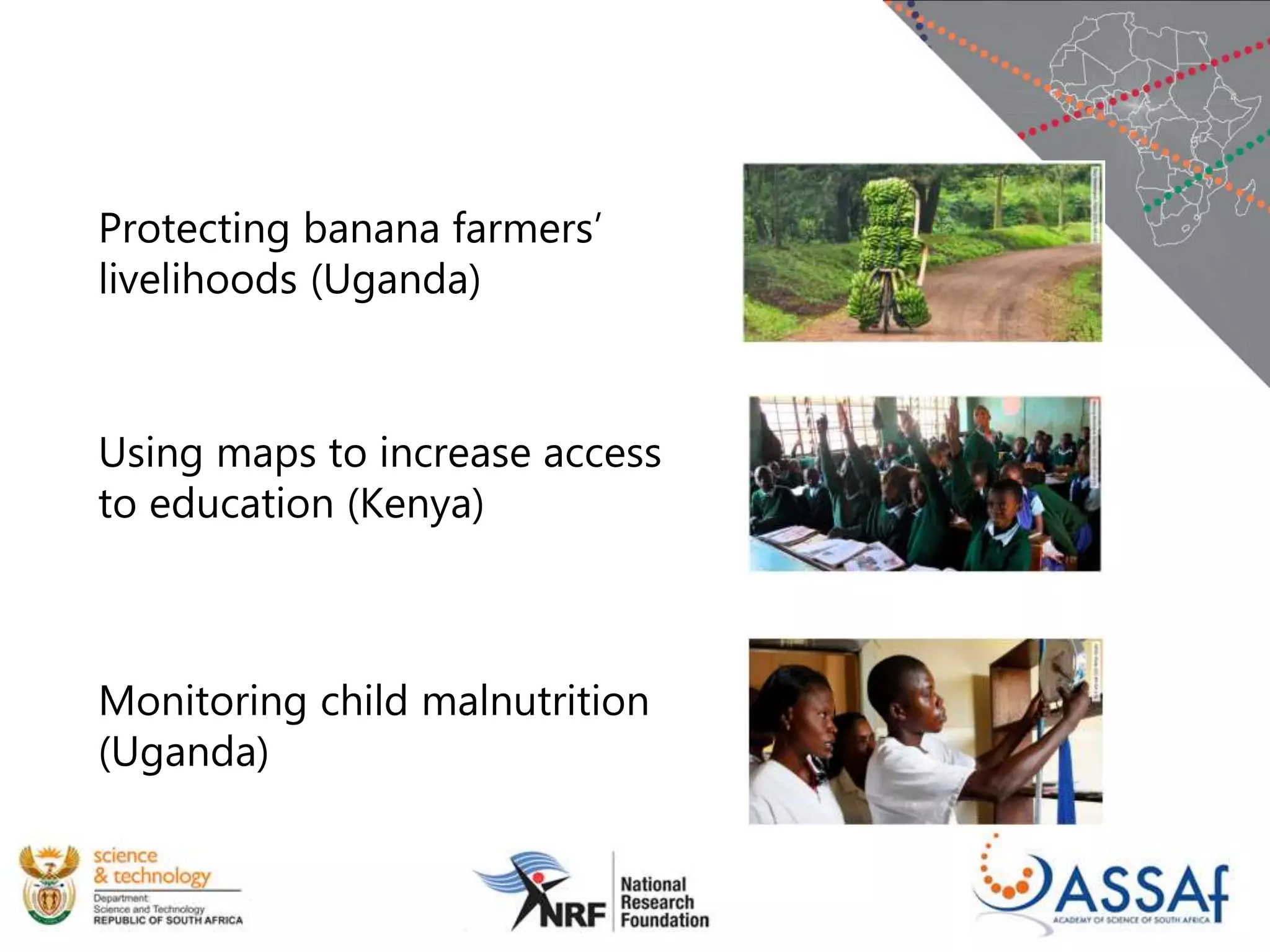
Protecting banana farmers’
livelihoods (Uganda)
Using maps to increase access
to education (Kenya)
Monitoring child malnutrition
(Uganda)
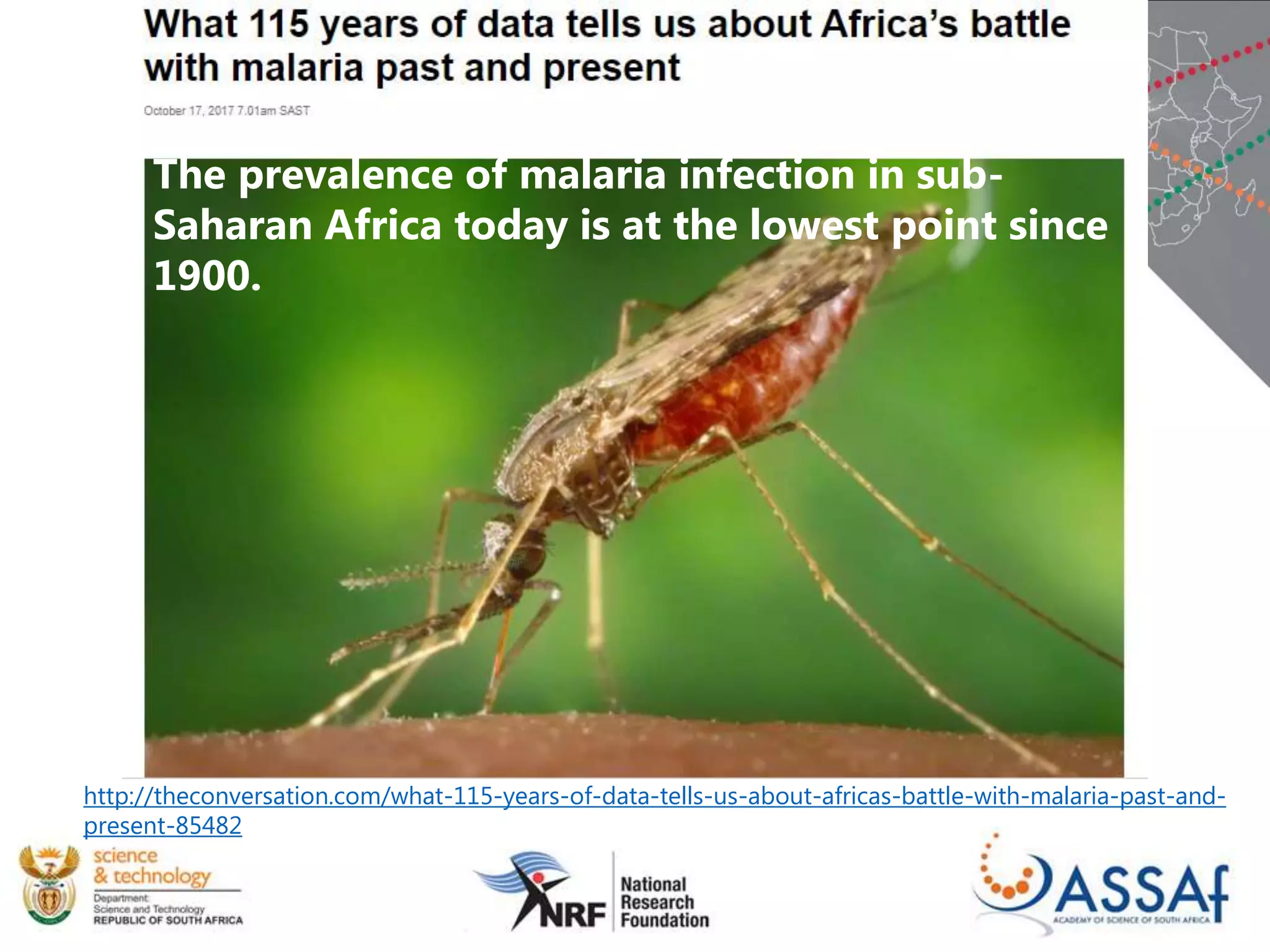
http://theconversation.com/what-115-years-of-data-tells-us-about-africas-battle-with-malaria-past-and-
present-85482
The prevalence of malaria infection in sub-
Saharan Africa today is at the lowest point since
1900.
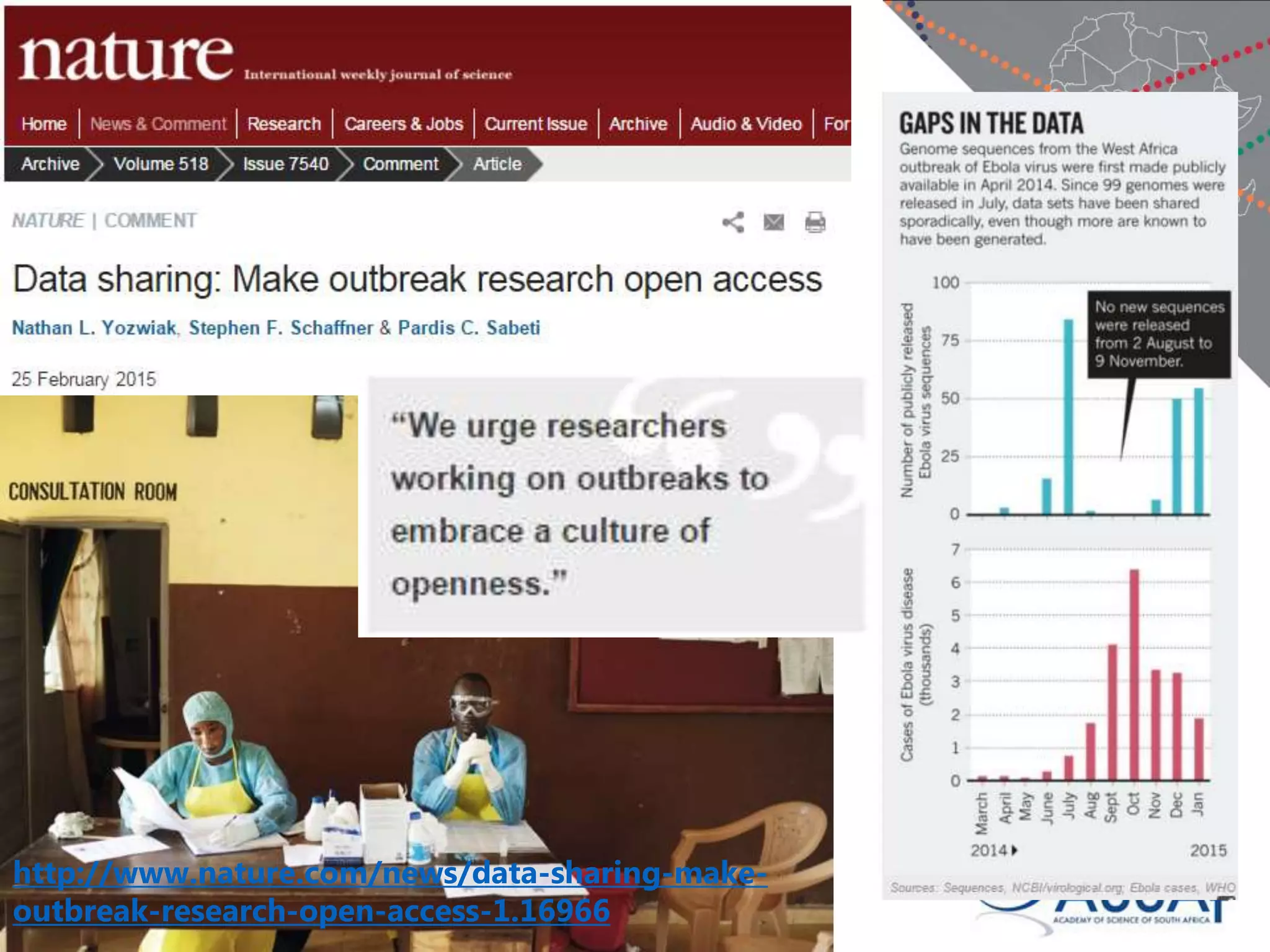
http://www.nature.com/news/data-sharing-make-
outbreak-research-open-access-1.16966
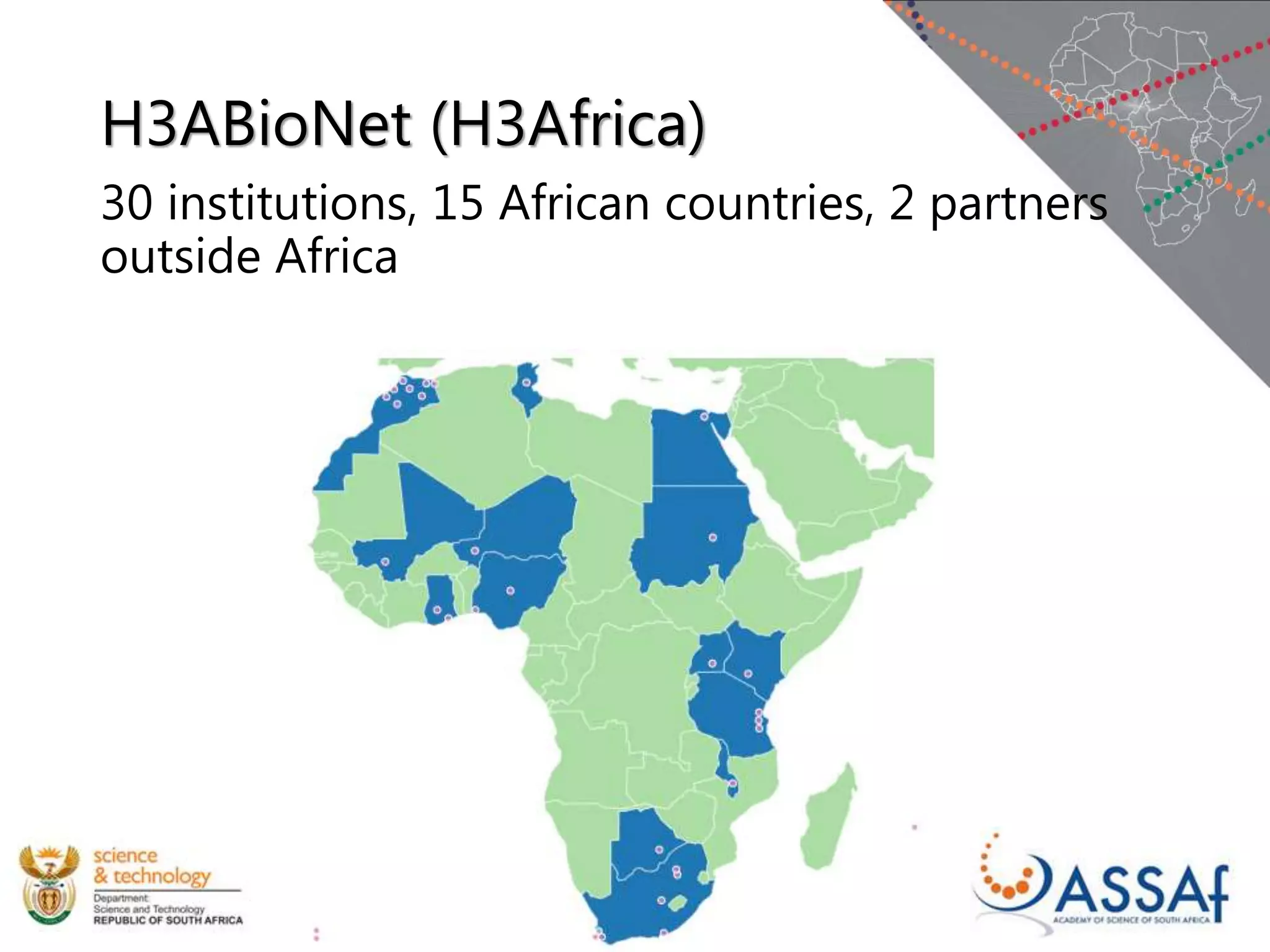
H3ABioNet (H3Africa)
30 institutions, 15 African countries, 2 partners
outside Africa
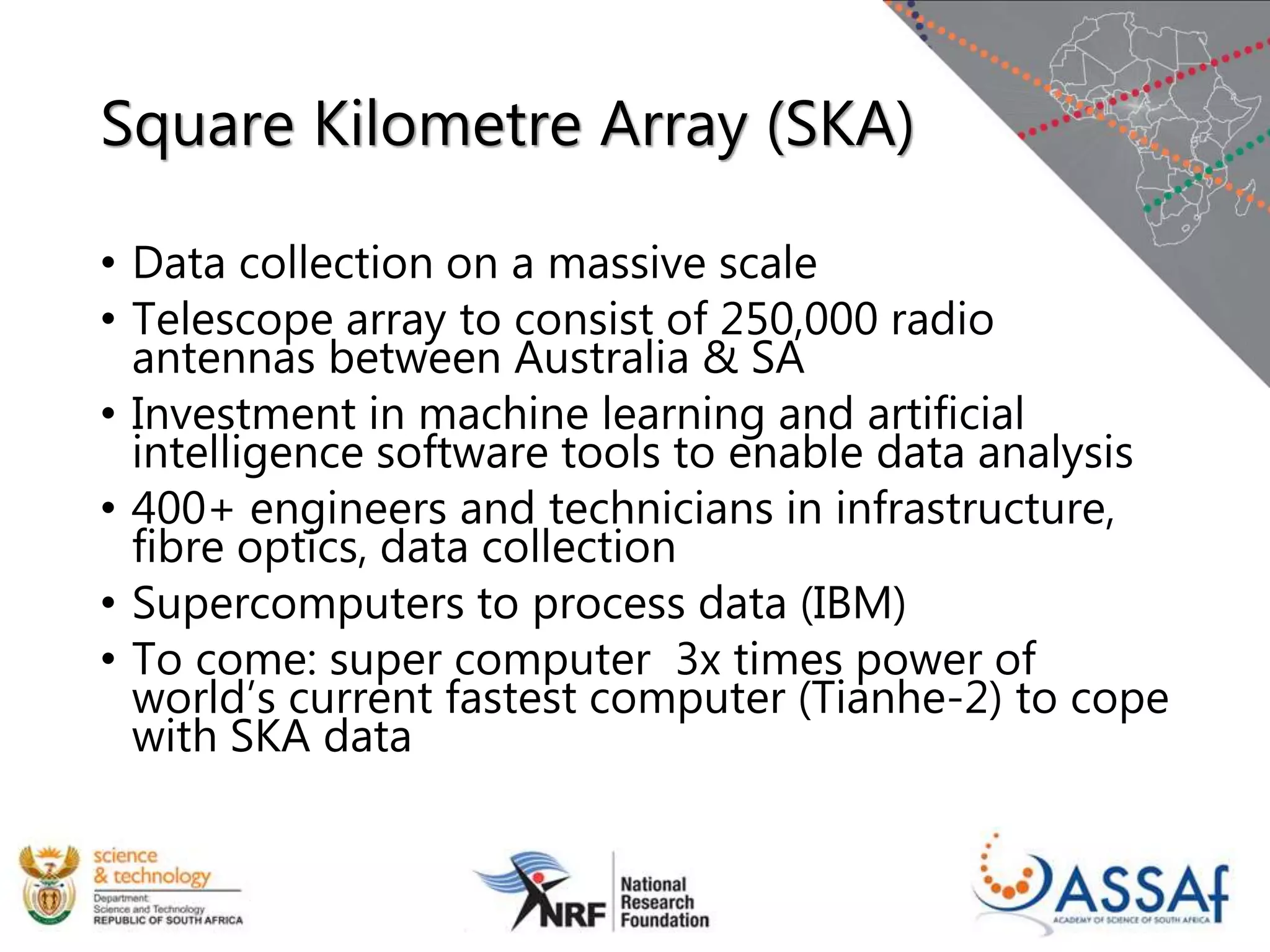
Square Kilometre Array (SKA)
• Data collection on a massive scale
• Telescope array to consist of 250,000 radio
antennas between Australia & SA
• Investment in machine learning and artificial
intelligence software tools to enable data analysis
• 400+ engineers and technicians in infrastructure,
fibre optics, data collection
• Supercomputers to process data (IBM)
• To come: super computer 3x times power of
world’s current fastest computer (Tianhe-2) to cope
with SKA data
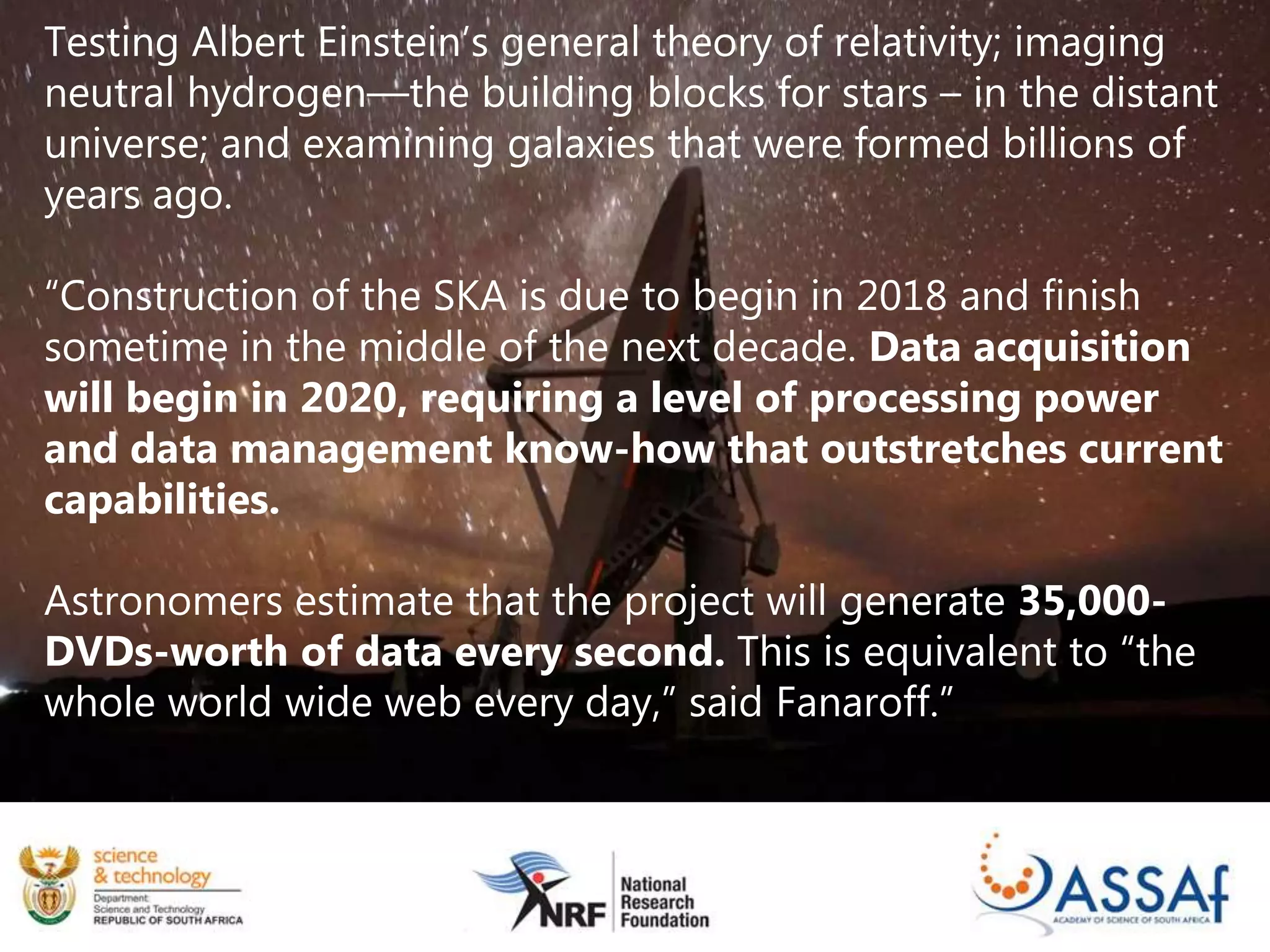
Testing Albert Einstein’s general theory of relativity; imaging
neutral hydrogen—the building blocks for stars – in the distant
universe; and examining galaxies that were formed billions of
years ago.
“Construction of the SKA is due to begin in 2018 and finish
sometime in the middle of the next decade. Data acquisition
will begin in 2020, requiring a level of processing power
and data management know-how that outstretches current
capabilities.
Astronomers estimate that the project will generate 35,000-
DVDs-worth of data every second. This is equivalent to “the
whole world wide web every day,” said Fanaroff.”
Data Stakeholders
• Governments (policy)
• Institutions (policy & strategy)
• Research Offices (reporting, impact)
• Researchers (collecting data in an ethical and
trusted way so that it can be re-used)
• Statisticians (processing, analysing and visualising
data)
• System engineers (to maintain a network and
allow for data to be digitally transmitted)
• Librarians (managing and organizing the data, and
making sure it is digitally preserved for the
unforeseeable future)
Librarian Jobs of the Future
Why Librarians as Data Partners?
• Information standards
• Organizational skills
• Setting up file structures (organizing
information)
• Knowledge of workflows
• Knowledge of collection management
• Describing data using established metadata
schemes & controlled vocabulary
• Collection curation/preservation
Role of Librarians
• Advocate for transparency, openness in research,
access to data
• Initiating conversation on Open Science Open Data
Policy & Strategy - implement
• Develop own data skills (data skills but also
informed on copyright, licensing, citation)
• Increase visibility of research data
• Manage & register trusted data repositories
• Recommend trusted data repositories
• Promote & support proper research data
management planning among researchers
Data Skills for Librarians (1)
• Data terminology
• Unix-style command line interface, allowing librarians to
efficiently work with directories and files, and find and manipulate
data
• Cleaning and enhancing data in OpenRefine and spreadsheets
• Git version control system and the GitHub collaboration tool
• Web scraping and extracting data from websites
• Scientific writing in useful, powerful, and open mark-up
languages such as LaTeX, XML, and Markdown
• Formulating and managing citation data, publication lists, and
bibliographies in open formats such as BiBTeX, JSON, XML and
using open source reference management tools such as JabRef
and Zotero
Data Skills for Librarians (2)
• Transforming metadata documenting research outputs into open plain
text formats for easy reuse in research information systems in support of
funder compliance mandates and institutional reporting
• Scholarly identity with ORCiD and managing reputation with ORCiD-
enabled scholarly sharing platforms such as ScienceOpen
• Authorship, contributorship, and copyright ownership in collaborative
research projects
• Demonstrating best practices in attribution, acknowledgement, and
citation, particularly for non-traditional research outputs (software,
datasets)
• Identifying reputable Open Access publications and Open
Institutional/Open Data repositories
• Scholarly annotation and open peer review
• Investigating and managing copyright status of a work, and evaluating
conditions for Fair Use
African Open Science Platform (AOSP)
• Platform = opportunity to engage in dialogue,
create awareness, connect all, provide continental
view
• Funded by SA Dept. of Science & Technology
through National Research Foundation
• 3 years (1 Nov. 2016 – 31 Oct. 2019)
• Managed by Academy of Science of South Africa
(ASSAf)
• Through ASSAf hosting ICSU Regional Office for Africa
(ICSU ROA)
• Direction from CODATA
http://africanopenscience.org.za/
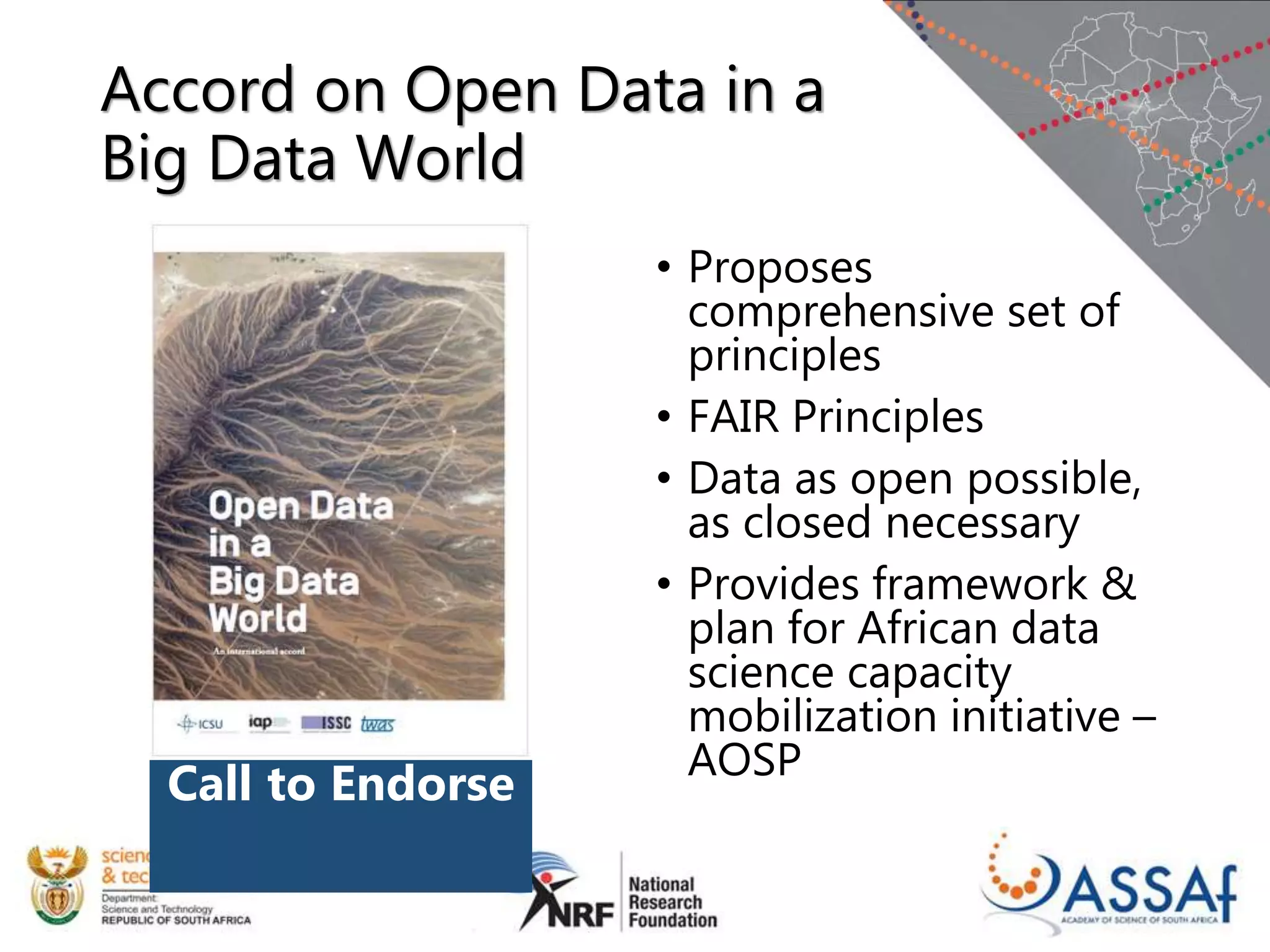
Accord on Open Data in a
Big Data World
• Proposes
comprehensive set of
principles
• FAIR Principles
• Data as open possible,
as closed necessary
• Provides framework &
plan for African data
science capacity
mobilization initiative –
AOSP
Call to Endorse
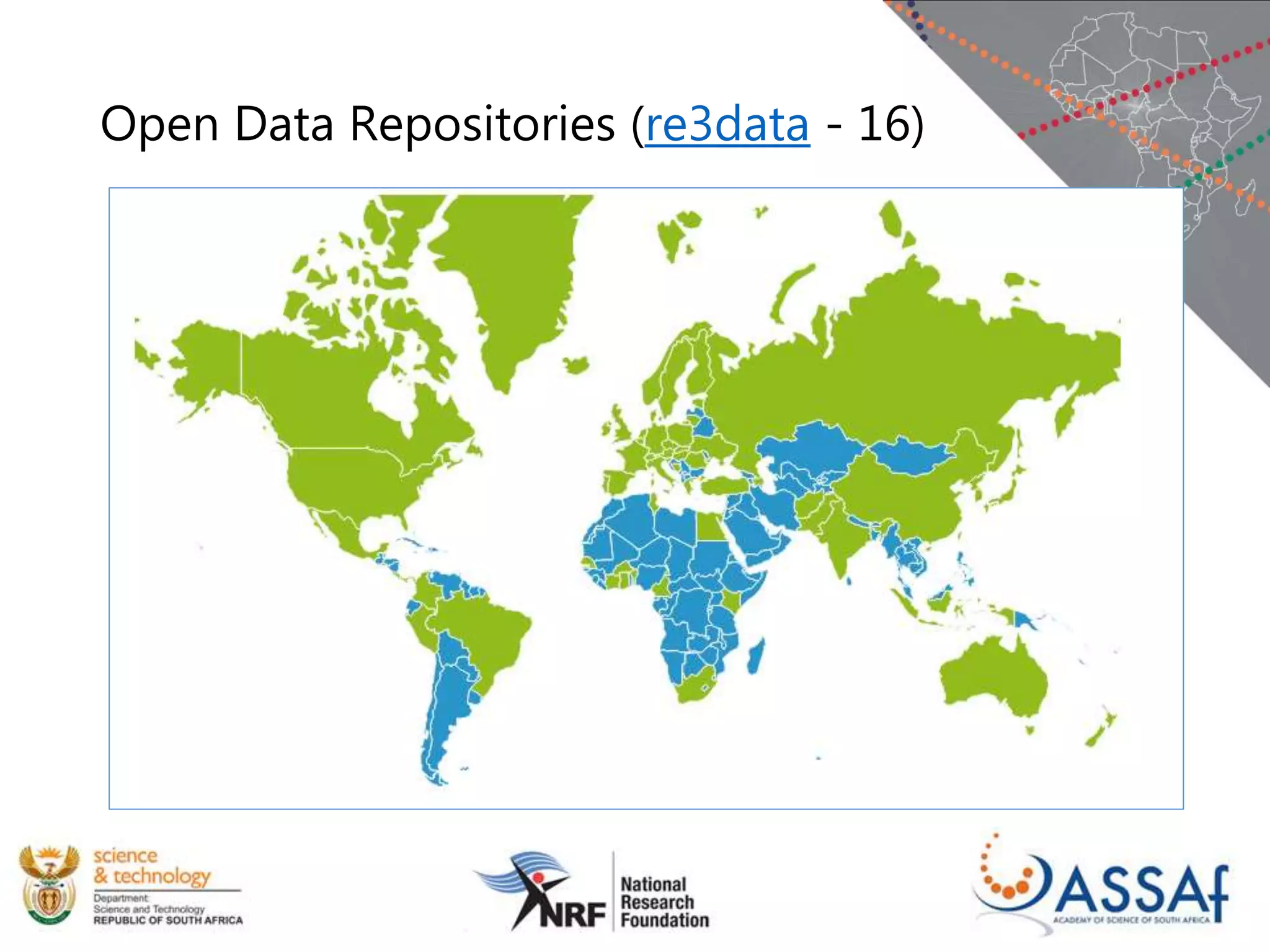
Open Data Repositories (re3data - 16)
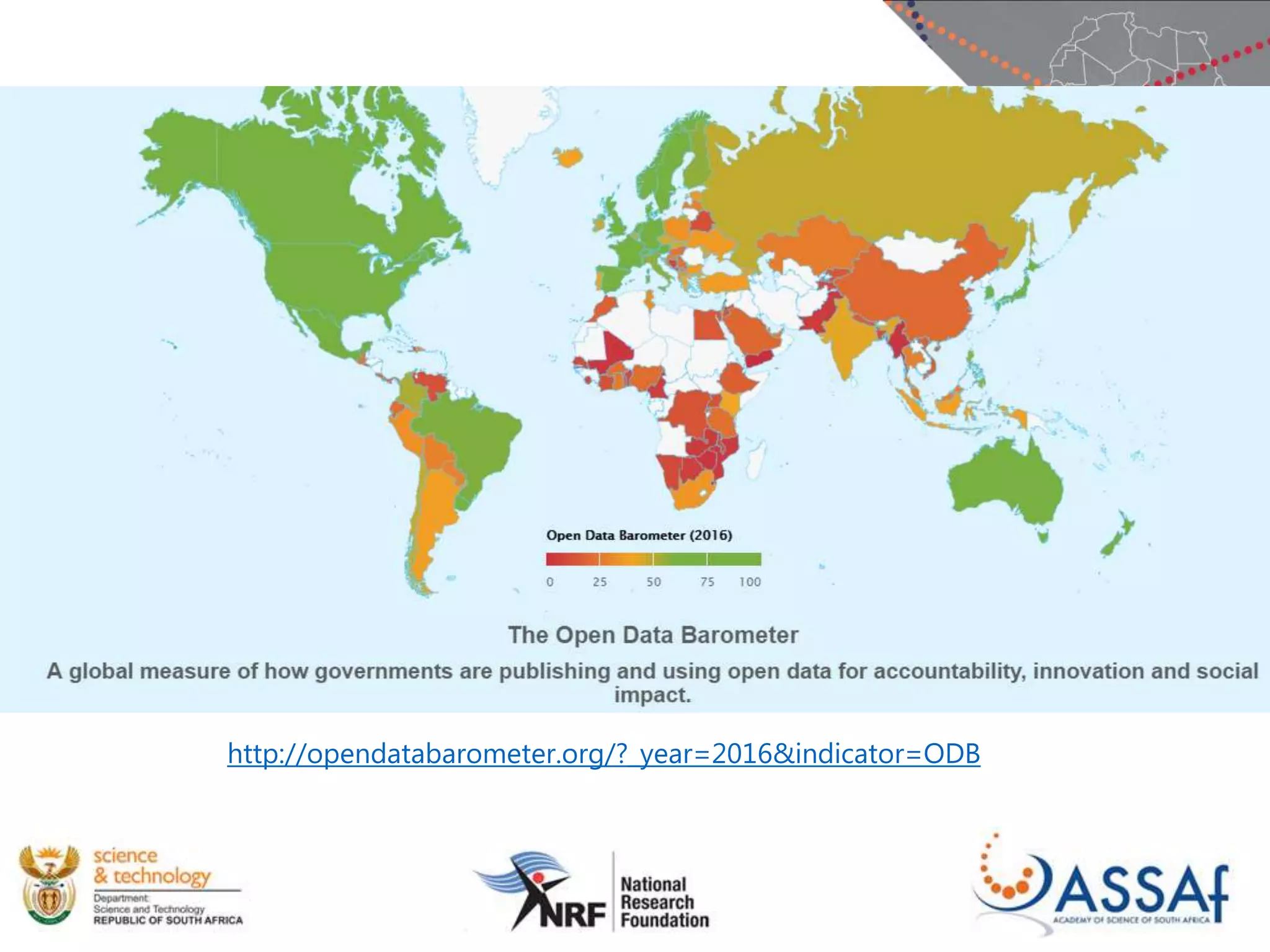
http://opendatabarometer.org/?_year=2016&indicator=ODB
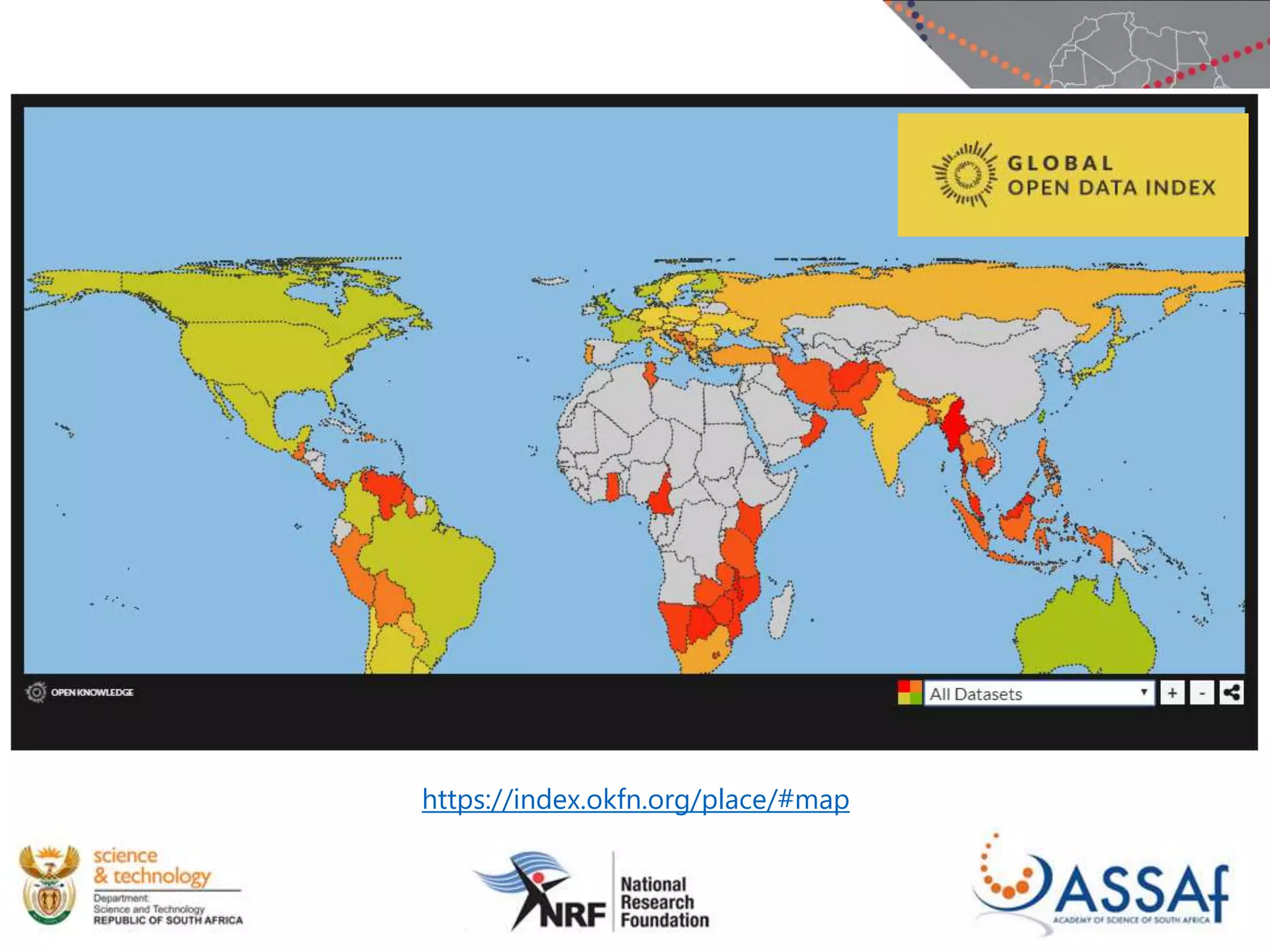
https://index.okfn.org/place/#map
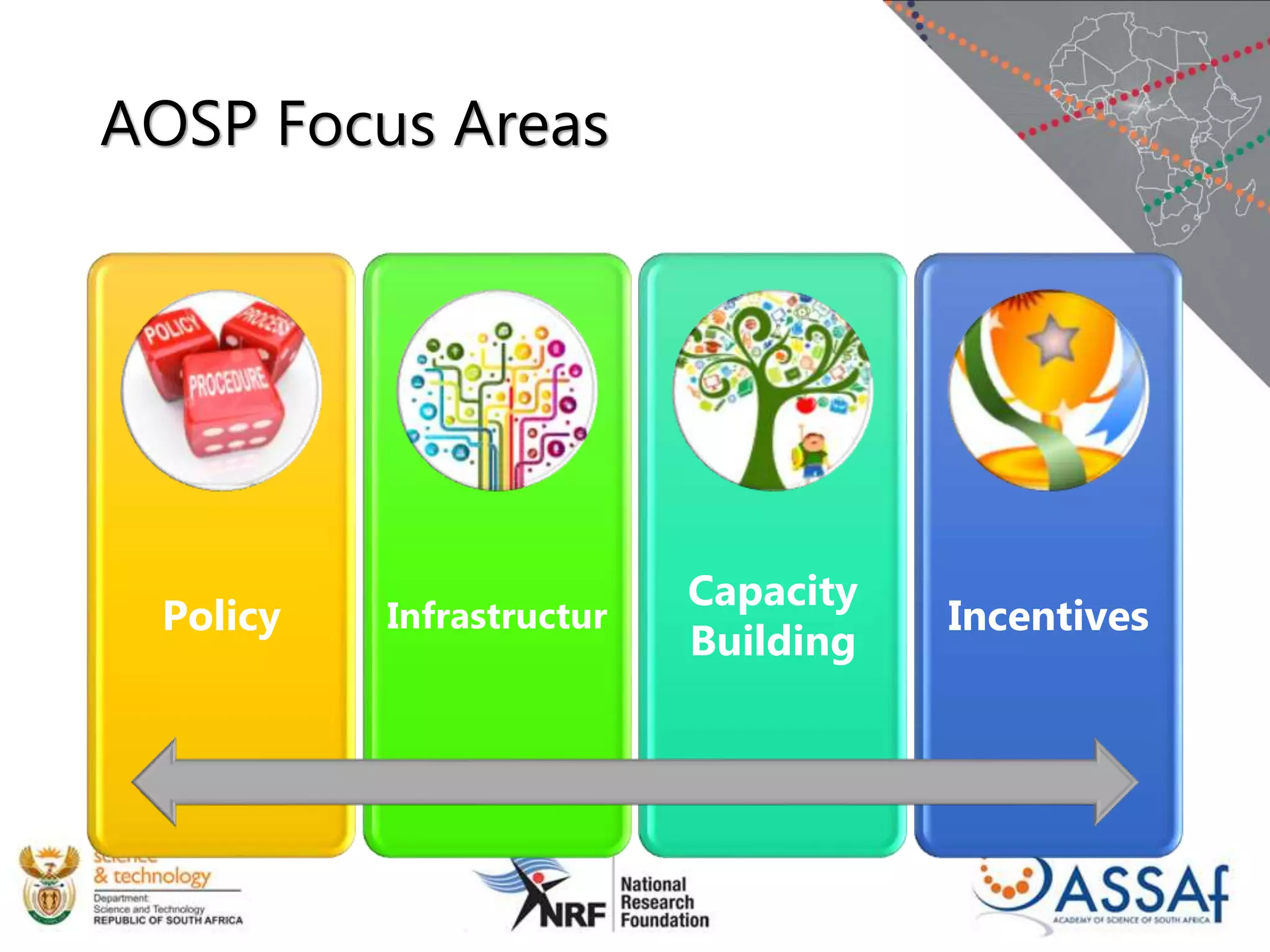
AOSP Focus Areas
Policy Infrastructur
Capacity
Building
Incentives
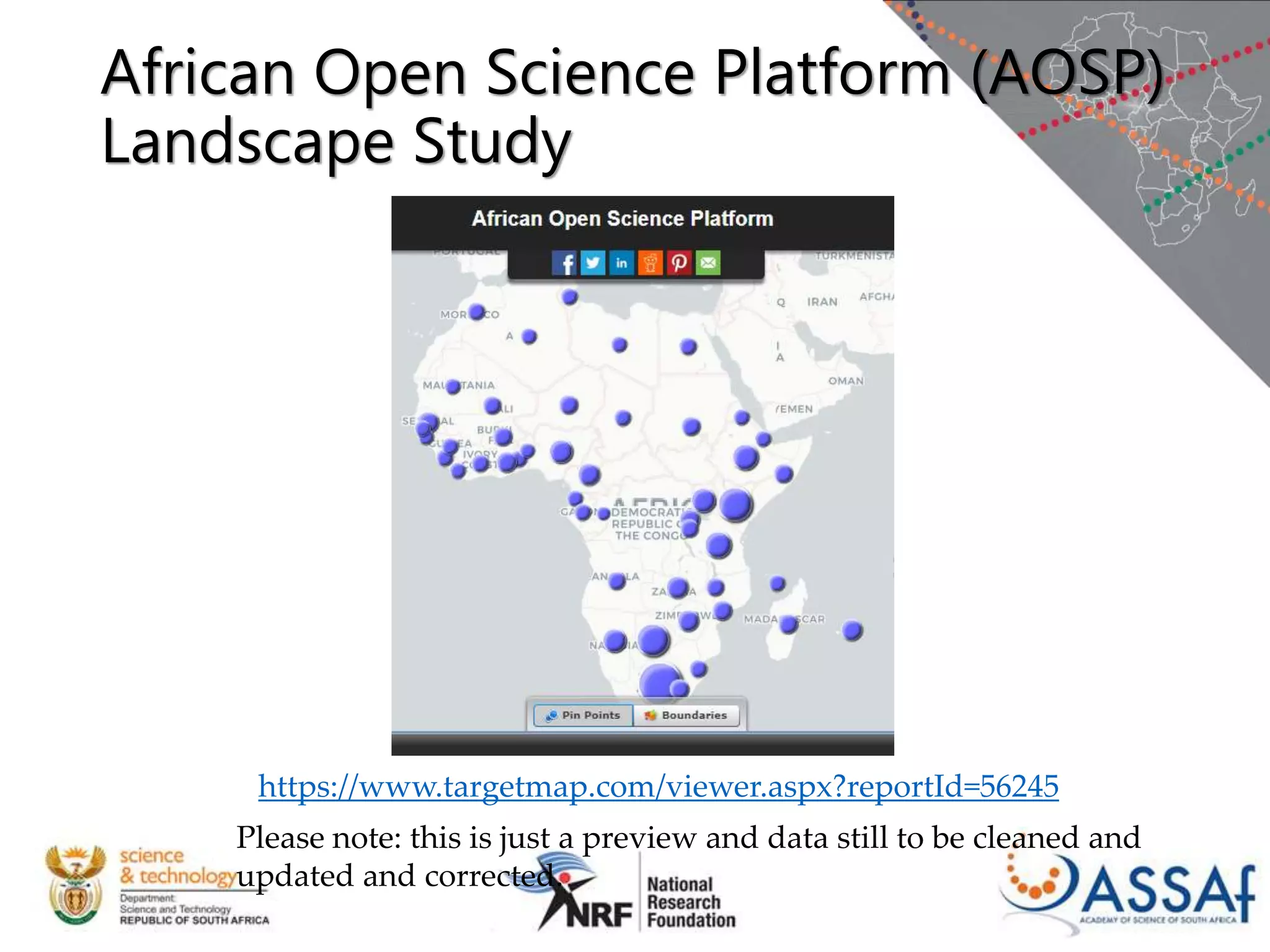
https://www.targetmap.com/viewer.aspx?reportId=56245
Please note: this is just a preview and data still to be cleaned and
updated and corrected.
African Open Science Platform (AOSP)
Landscape Study
Workshop 4: Open Science & Open
Data for Librarians
14:00 – 17:30
• Introduction to Open Science/Open Data
• Data informing the library profession
• Data in support of research
• Working with data – tools & applications
• Towards a data strategy for your library &
institution
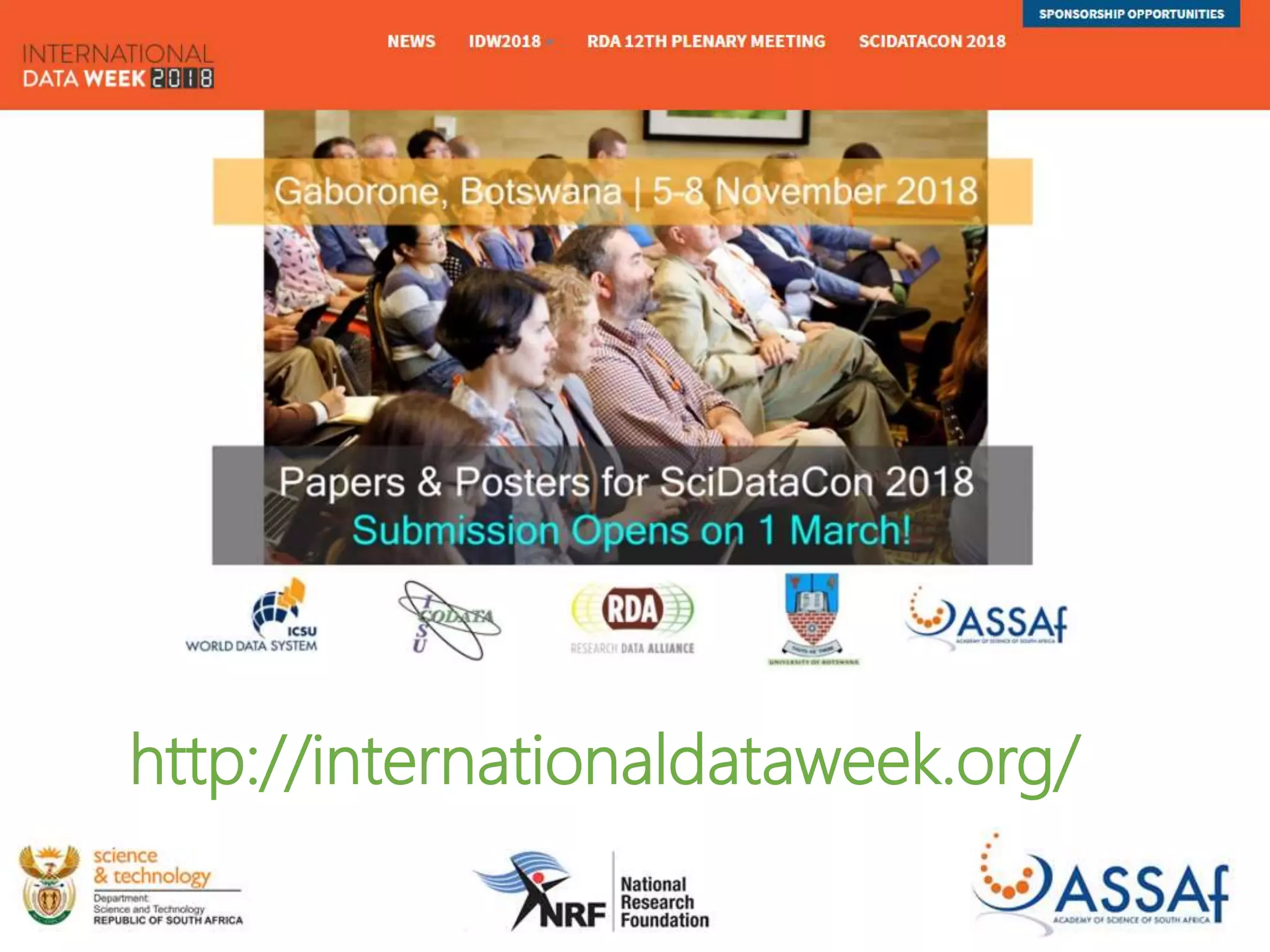
http://internationaldataweek.org/
Conclusion
Only if research and data are open and
democratized so that all can have equal access,
it would be possible to work towards achieving
the 2030 Sustainable Development Goals
Librarians to adapt service delivery to new way
of doing research (systemic changes), providing
data related support to researchers
Thank you
Ina Smith
Project Manager, African Open Science Platform Project, Academy of
Science of South Africa (ASSAf)
ina@assaf.org.za
Susan Veldsman
Director, Scholarly Publishing Programme, Academy of Science of
South Africa (ASSAf)
susan@assaf.org.za
Visit http://africanopenscience.org.za

The Role of Librarians in transforming the world through Open Data and Open Science/Ina Smith

  • 1.
    The Role ofLibrarians in transforming the world through Open Data and Open Science Presented by Ina Smith & Susan Veldsman Academy of Science of South Africa (ASSAf) XXIII SCECSAL Conference, Entebbe, Uganda 24 April 2018
  • 2.
    Agenda • Overview ofOpen Data & Open Science • Data in support of achieving the SDGs • Role of Librarians • African Open Science Platform Project
  • 3.
  • 4.
  • 5.
    Fake Data, FakeResearch http://www.bbc.com/news/science-environment-39357819
  • 7.
    Open Science (incl.Data) Defined “Open Science is the practice of science in such a way that others can collaborate and contribute, where research data, lab notes and other research processes are freely available, under terms that enable reuse, redistribution and reproduction of the research and its underlying data and methods.” - FOSTER Project, funded by the European Commission
  • 8.
    Open Data, OpenScience & Research Lifecycle (Foster)
  • 9.
    Original Research DataLifecycle image from University of California, Santa Cruz http://guides.library.ucsc.edu/datamanagement/ Repositories Repositories Tools Plan Policy&Infrastructure
  • 10.
    Benefits of OpenResearch Data (1) • Predict trends, help make informed decisions, informs policy • Collaboration advances science, discovery • Drives development, improves livelihoods of citizens of countries • Increases return on investment (funders), avoid duplication – research is expensive • More and more entrepreneurs are using data in innovative ways, creating more jobs which is much needed on our continent
  • 11.
    Benefits of OpenResearch Data (2) • Helps improve service delivery e.g. mobile apps, robots, artificial intelligence (AI) • Provides evidence for research conducted • Data potentially has far more outcomes when open, with a higher impact • Use for tenure/promotion/measure contribution of researchers (data citation)
  • 12.
  • 13.
    Protecting banana farmers’ livelihoods(Uganda) Using maps to increase access to education (Kenya) Monitoring child malnutrition (Uganda)
  • 14.
  • 15.
  • 16.
    H3ABioNet (H3Africa) 30 institutions,15 African countries, 2 partners outside Africa
  • 17.
    Square Kilometre Array(SKA) • Data collection on a massive scale • Telescope array to consist of 250,000 radio antennas between Australia & SA • Investment in machine learning and artificial intelligence software tools to enable data analysis • 400+ engineers and technicians in infrastructure, fibre optics, data collection • Supercomputers to process data (IBM) • To come: super computer 3x times power of world’s current fastest computer (Tianhe-2) to cope with SKA data
  • 18.
    Testing Albert Einstein’sgeneral theory of relativity; imaging neutral hydrogen—the building blocks for stars – in the distant universe; and examining galaxies that were formed billions of years ago. “Construction of the SKA is due to begin in 2018 and finish sometime in the middle of the next decade. Data acquisition will begin in 2020, requiring a level of processing power and data management know-how that outstretches current capabilities. Astronomers estimate that the project will generate 35,000- DVDs-worth of data every second. This is equivalent to “the whole world wide web every day,” said Fanaroff.”
  • 19.
    Data Stakeholders • Governments(policy) • Institutions (policy & strategy) • Research Offices (reporting, impact) • Researchers (collecting data in an ethical and trusted way so that it can be re-used) • Statisticians (processing, analysing and visualising data) • System engineers (to maintain a network and allow for data to be digitally transmitted) • Librarians (managing and organizing the data, and making sure it is digitally preserved for the unforeseeable future)
  • 20.
  • 21.
    Why Librarians asData Partners? • Information standards • Organizational skills • Setting up file structures (organizing information) • Knowledge of workflows • Knowledge of collection management • Describing data using established metadata schemes & controlled vocabulary • Collection curation/preservation
  • 22.
    Role of Librarians •Advocate for transparency, openness in research, access to data • Initiating conversation on Open Science Open Data Policy & Strategy - implement • Develop own data skills (data skills but also informed on copyright, licensing, citation) • Increase visibility of research data • Manage & register trusted data repositories • Recommend trusted data repositories • Promote & support proper research data management planning among researchers
  • 23.
    Data Skills forLibrarians (1) • Data terminology • Unix-style command line interface, allowing librarians to efficiently work with directories and files, and find and manipulate data • Cleaning and enhancing data in OpenRefine and spreadsheets • Git version control system and the GitHub collaboration tool • Web scraping and extracting data from websites • Scientific writing in useful, powerful, and open mark-up languages such as LaTeX, XML, and Markdown • Formulating and managing citation data, publication lists, and bibliographies in open formats such as BiBTeX, JSON, XML and using open source reference management tools such as JabRef and Zotero
  • 24.
    Data Skills forLibrarians (2) • Transforming metadata documenting research outputs into open plain text formats for easy reuse in research information systems in support of funder compliance mandates and institutional reporting • Scholarly identity with ORCiD and managing reputation with ORCiD- enabled scholarly sharing platforms such as ScienceOpen • Authorship, contributorship, and copyright ownership in collaborative research projects • Demonstrating best practices in attribution, acknowledgement, and citation, particularly for non-traditional research outputs (software, datasets) • Identifying reputable Open Access publications and Open Institutional/Open Data repositories • Scholarly annotation and open peer review • Investigating and managing copyright status of a work, and evaluating conditions for Fair Use
  • 25.
    African Open SciencePlatform (AOSP) • Platform = opportunity to engage in dialogue, create awareness, connect all, provide continental view • Funded by SA Dept. of Science & Technology through National Research Foundation • 3 years (1 Nov. 2016 – 31 Oct. 2019) • Managed by Academy of Science of South Africa (ASSAf) • Through ASSAf hosting ICSU Regional Office for Africa (ICSU ROA) • Direction from CODATA http://africanopenscience.org.za/
  • 26.
    Accord on OpenData in a Big Data World • Proposes comprehensive set of principles • FAIR Principles • Data as open possible, as closed necessary • Provides framework & plan for African data science capacity mobilization initiative – AOSP Call to Endorse
  • 27.
    Open Data Repositories(re3data - 16)
  • 28.
  • 29.
  • 30.
    AOSP Focus Areas PolicyInfrastructur Capacity Building Incentives
  • 31.
    https://www.targetmap.com/viewer.aspx?reportId=56245 Please note: thisis just a preview and data still to be cleaned and updated and corrected. African Open Science Platform (AOSP) Landscape Study
  • 32.
    Workshop 4: OpenScience & Open Data for Librarians 14:00 – 17:30 • Introduction to Open Science/Open Data • Data informing the library profession • Data in support of research • Working with data – tools & applications • Towards a data strategy for your library & institution
  • 33.
  • 34.
    Conclusion Only if researchand data are open and democratized so that all can have equal access, it would be possible to work towards achieving the 2030 Sustainable Development Goals Librarians to adapt service delivery to new way of doing research (systemic changes), providing data related support to researchers
  • 35.
    Thank you Ina Smith ProjectManager, African Open Science Platform Project, Academy of Science of South Africa (ASSAf) ina@assaf.org.za Susan Veldsman Director, Scholarly Publishing Programme, Academy of Science of South Africa (ASSAf) susan@assaf.org.za Visit http://africanopenscience.org.za