TEST OF MEMORY 
Sr.Supriti February 2010
MEMORY 
The ability of an organism to store, retain 
and recall information. 
the means by which individual retains and 
draws on her past experiences to use this 
information in the present.
MEMORY 
Encoding 
Storage 
Retrieval
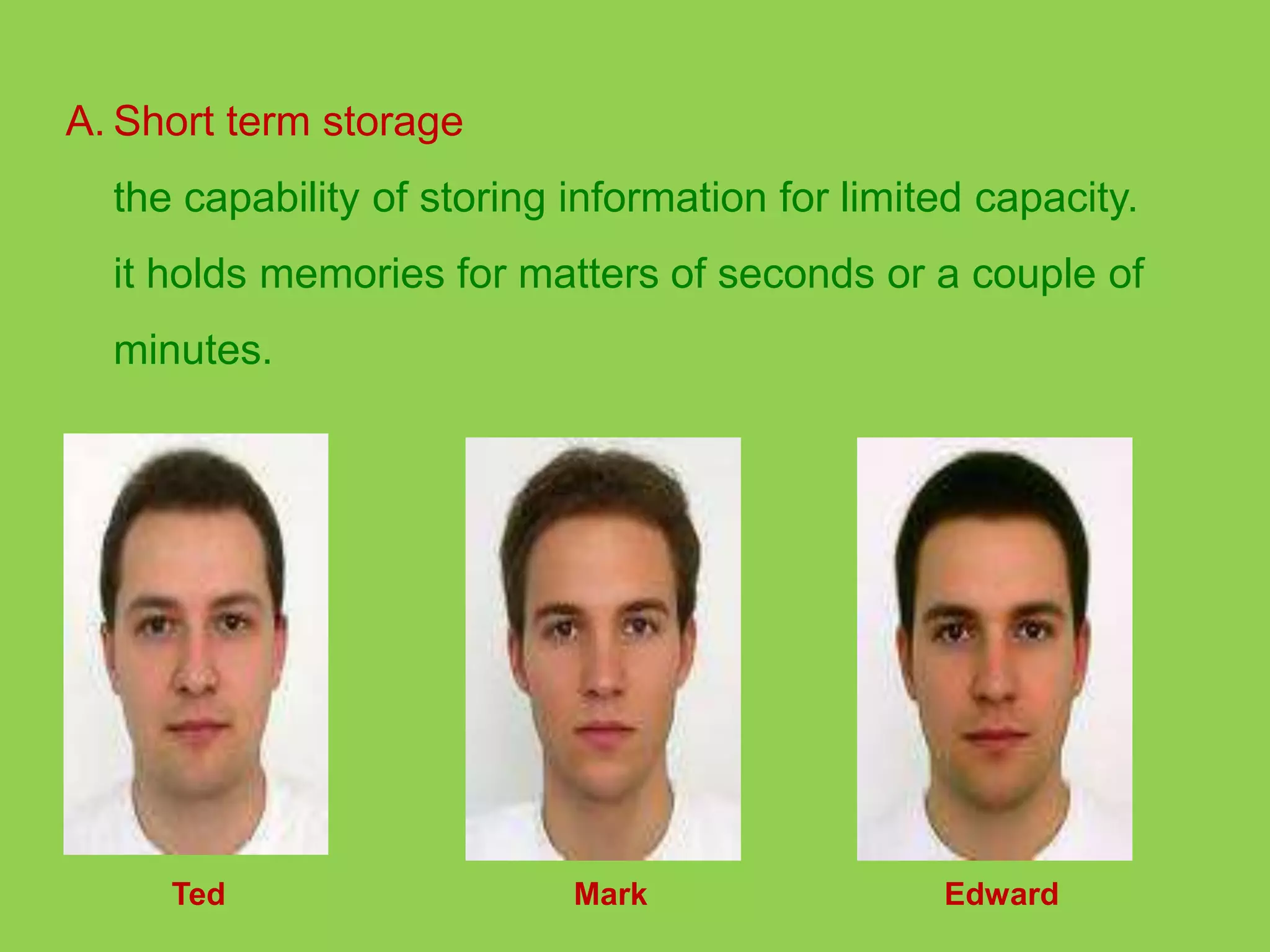
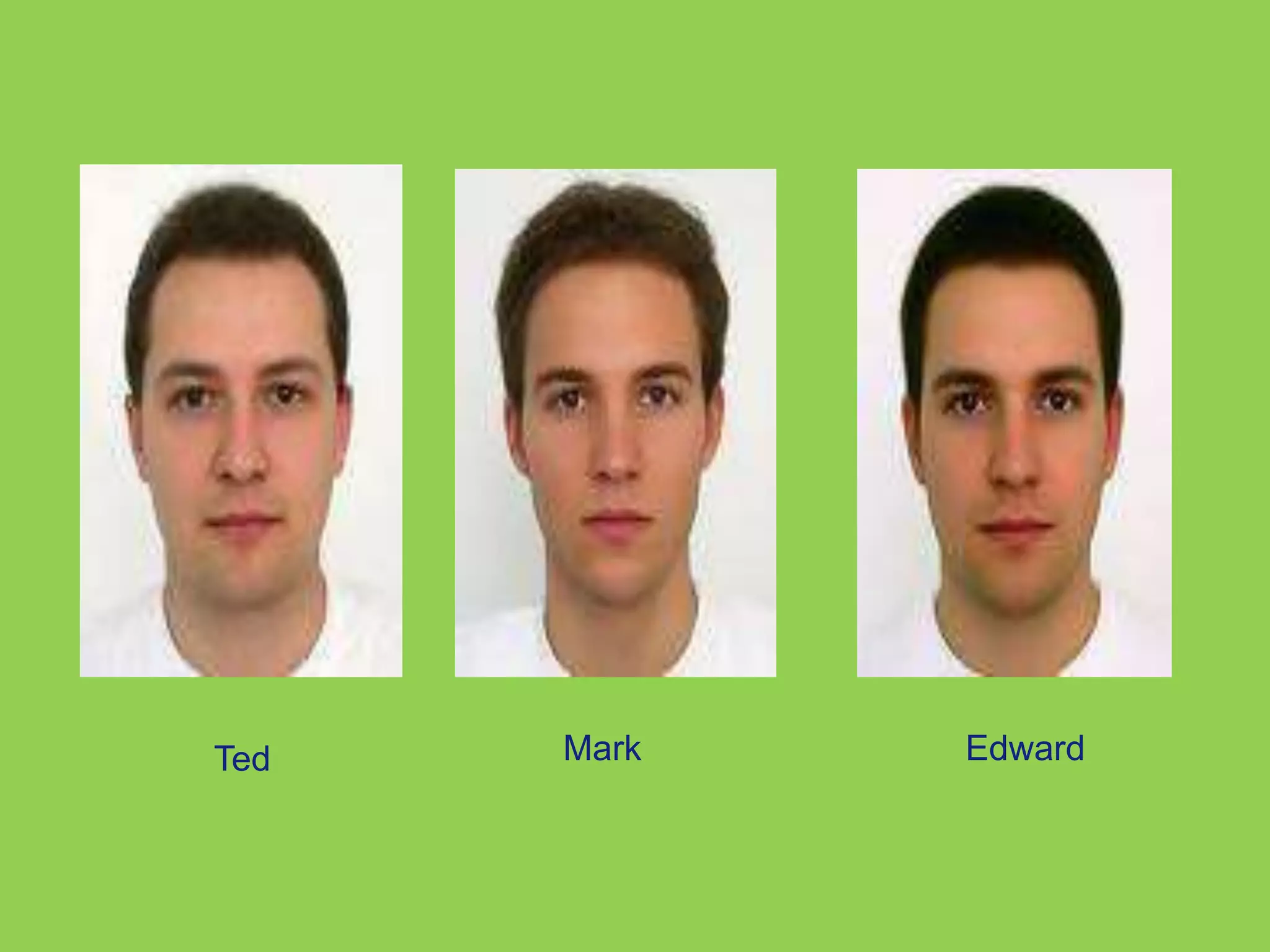
A. Short term storage 
the capability of storing information for limited capacity. 
it holds memories for matters of seconds or a couple of 
minutes. 
Ted Mark Edward
Ted Mark Edward
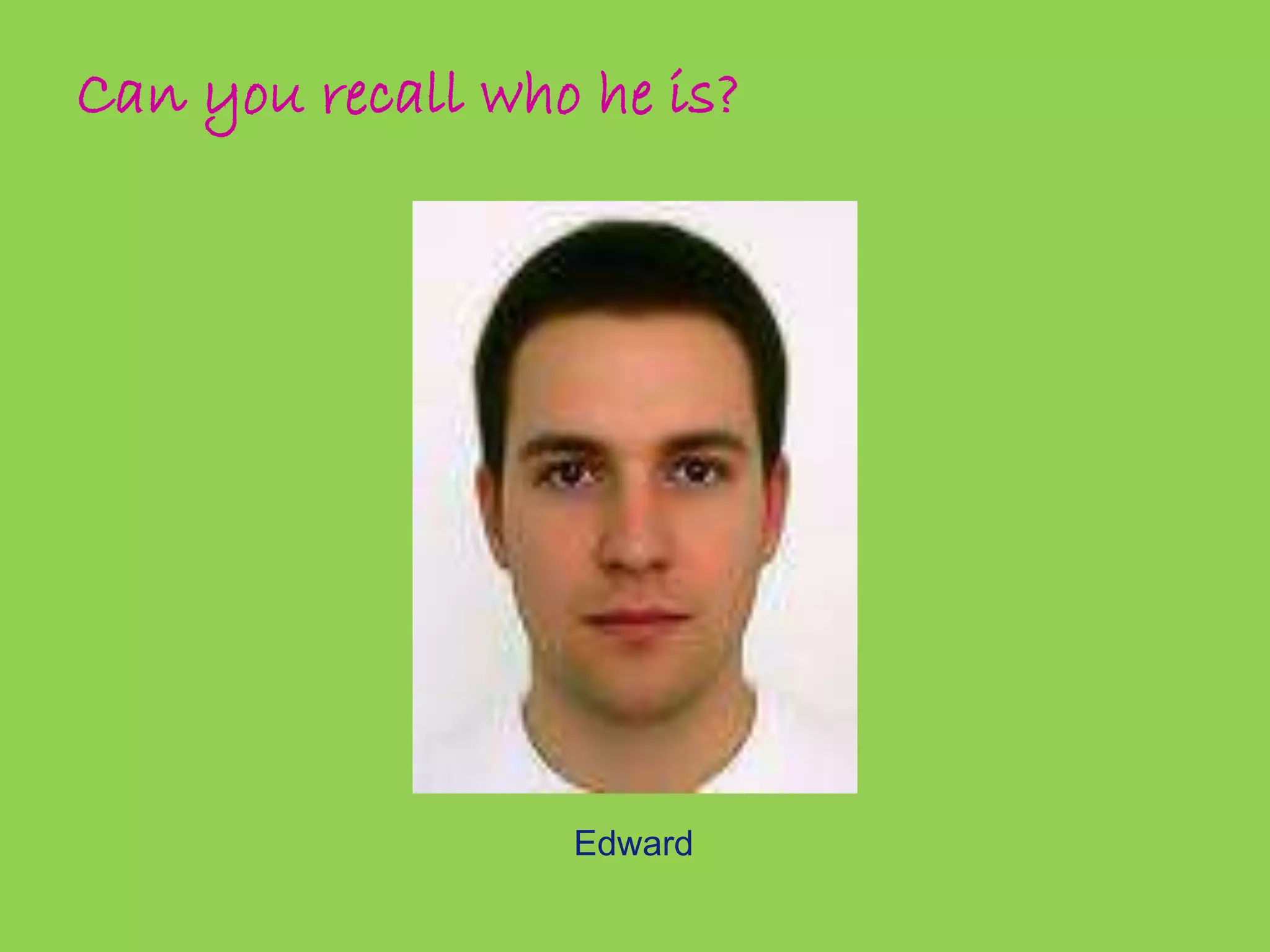
Can you recall who he is? 
Edward
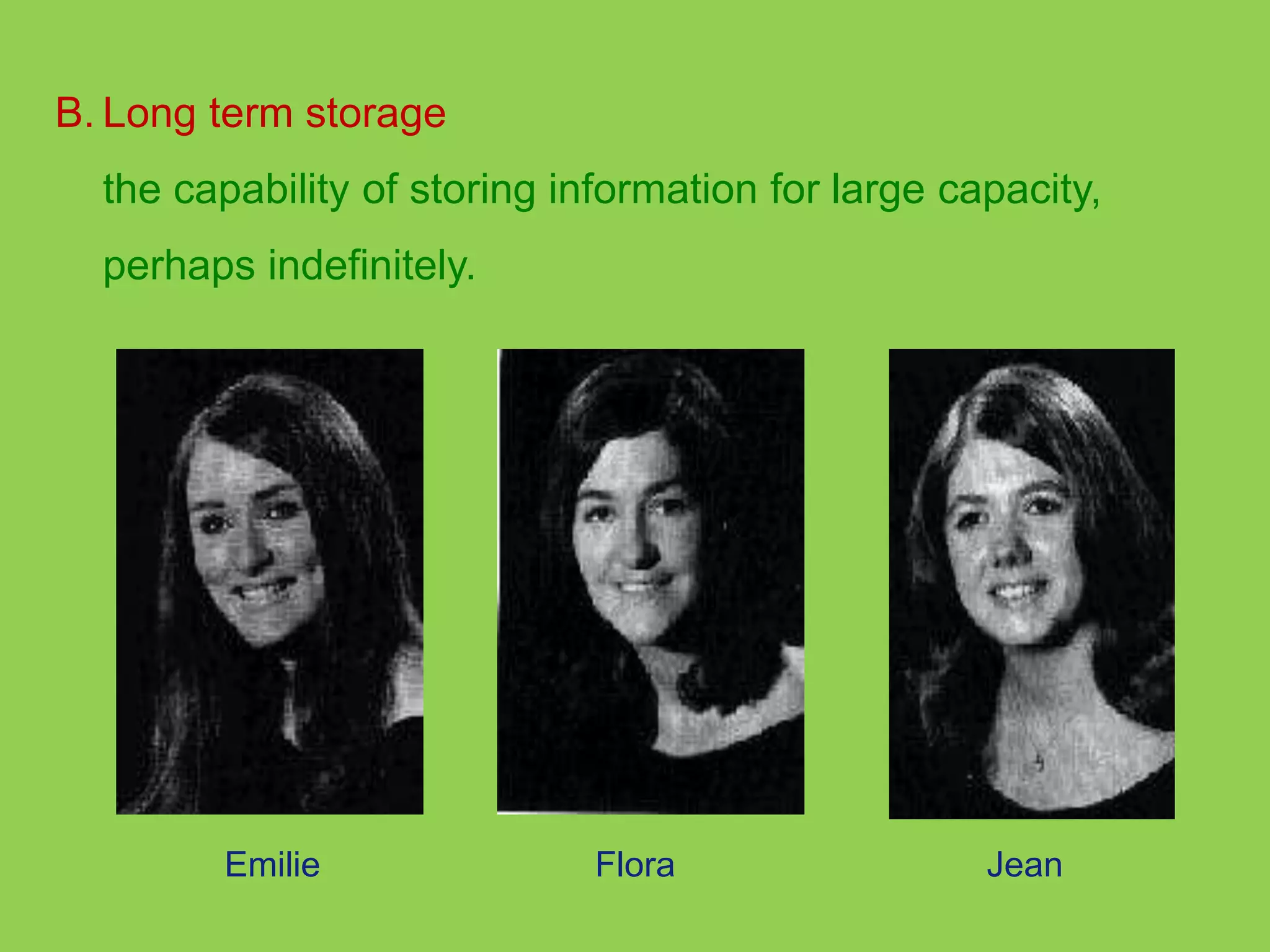
B. Long term storage 
the capability of storing information for large capacity, 
perhaps indefinitely. 
Emilie Flora Jean
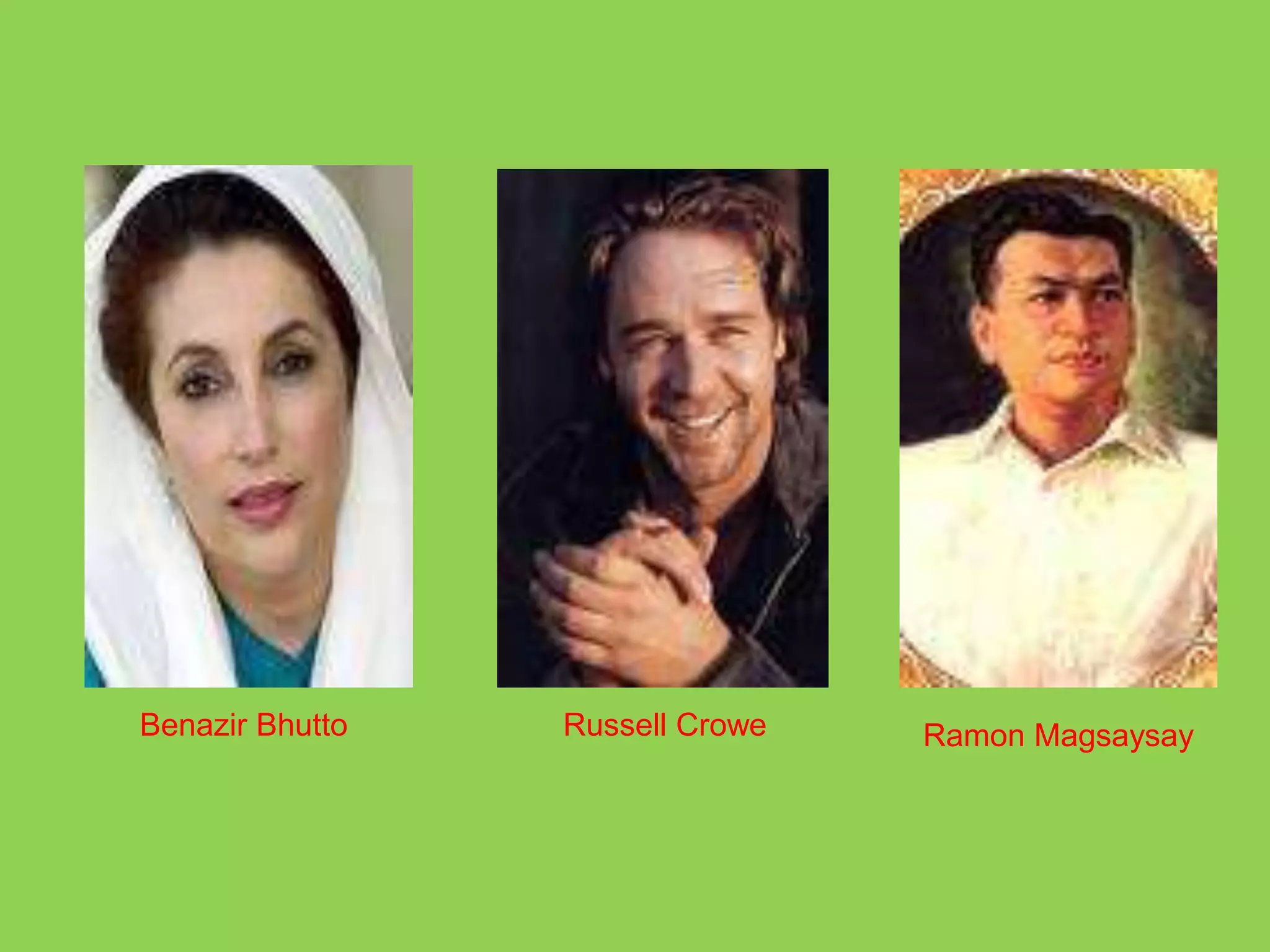
Benazir Bhutto Russell Crowe Ramon Magsaysay
The Niagara Falls 
CANADA
The Statue of Jesus Redeemer 
Brazil
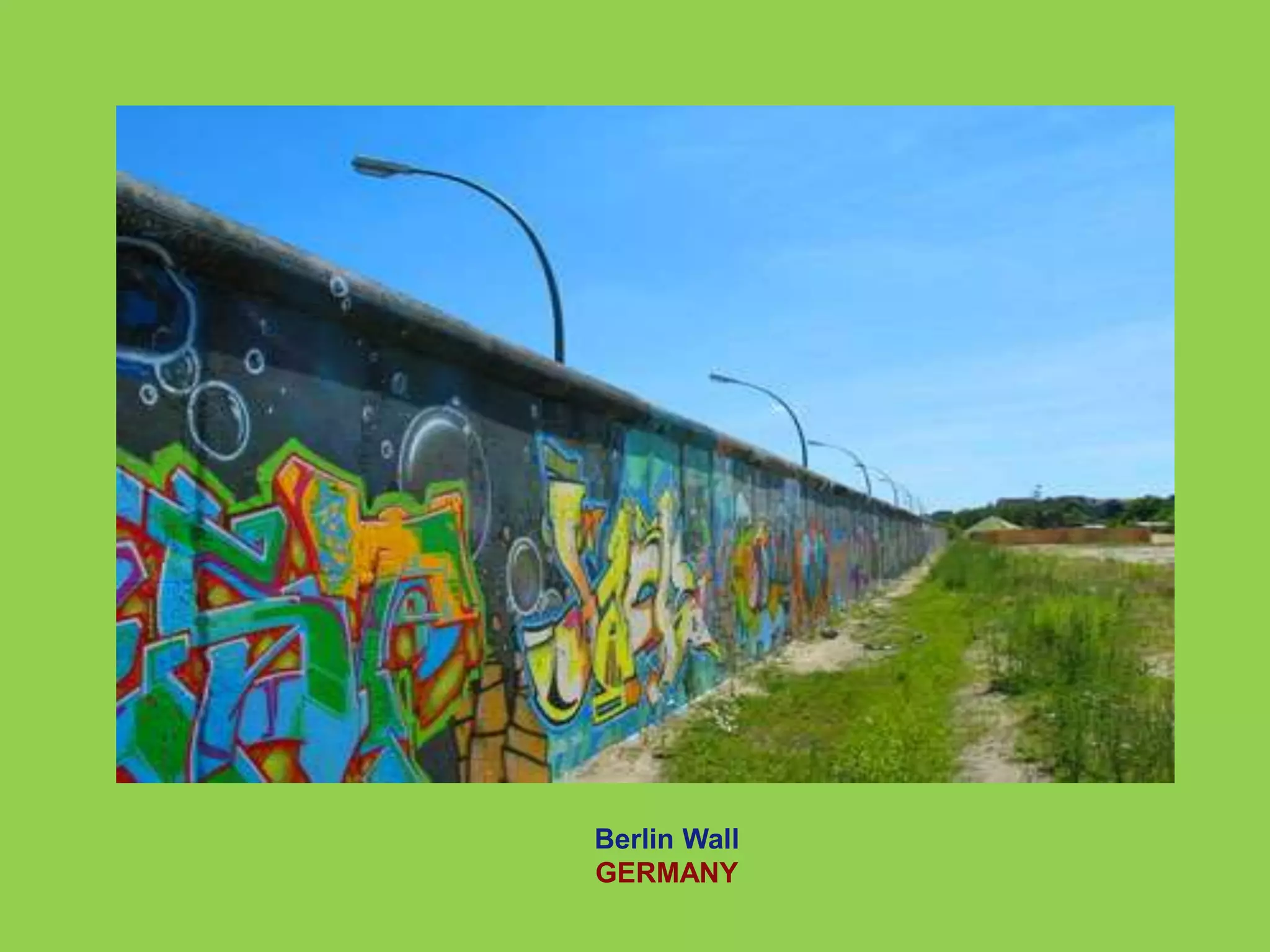
Berlin Wall 
GERMANY
The Factors affecting Memory Impairment 
1. Head Injuries/ Head trauma 
2. Brain tumors or Brain infections 
3. Stroke 
4. Vitamin deficiency 
5. Depression 
6. Thyroid disorders 
7. Illnesses (Amnesia, Dementia, Alzheimer, etc)
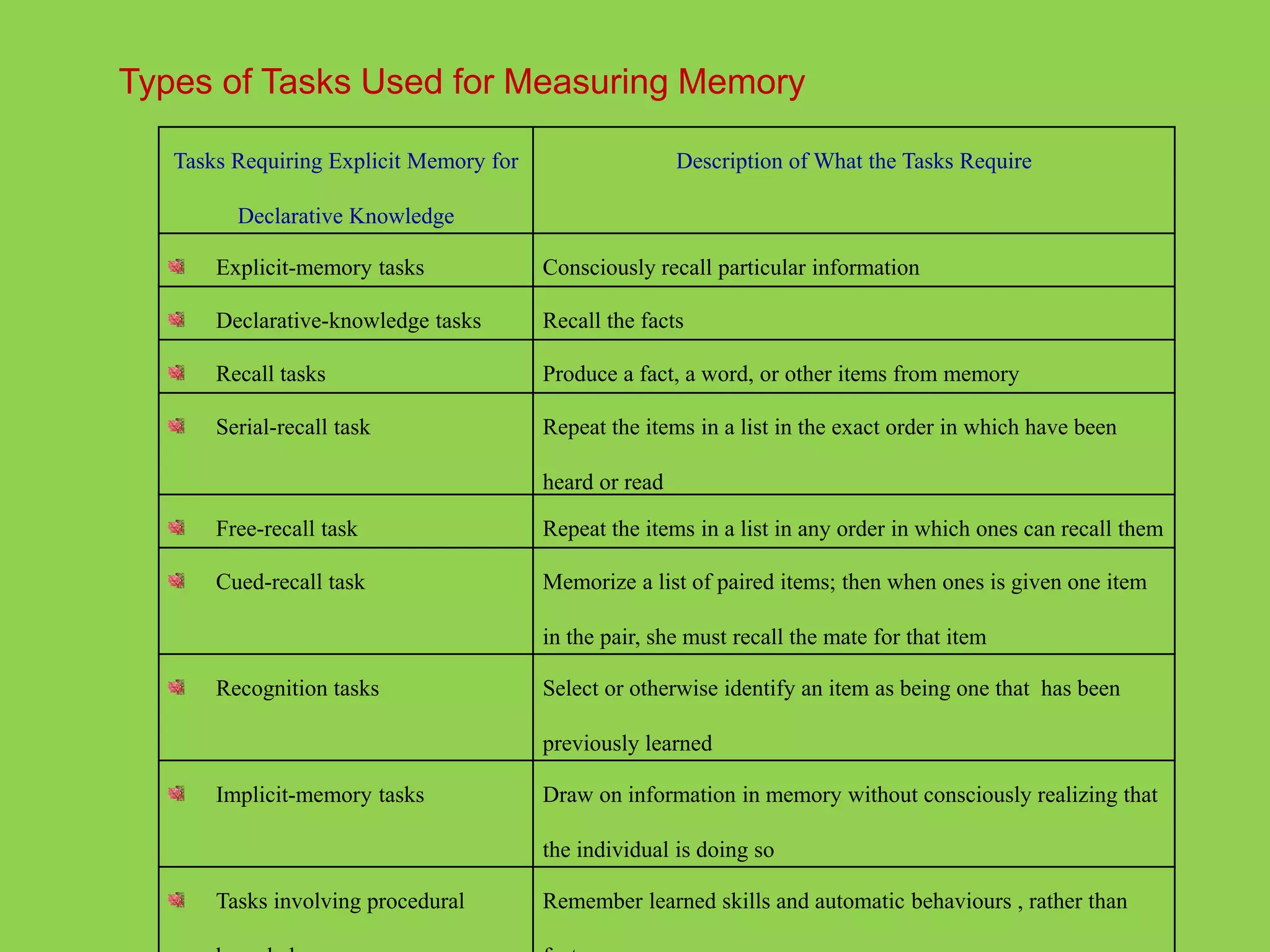
Types of Tasks Used for Measuring Memory 
Tasks Requiring Explicit Memory for 
Declarative Knowledge 
Description of What the Tasks Require 
Explicit-memory tasks Consciously recall particular information 
Declarative-knowledge tasks Recall the facts 
Recall tasks Produce a fact, a word, or other items from memory 
Serial-recall task Repeat the items in a list in the exact order in which have been 
heard or read 
Free-recall task Repeat the items in a list in any order in which ones can recall them 
Cued-recall task Memorize a list of paired items; then when ones is given one item 
in the pair, she must recall the mate for that item 
Recognition tasks Select or otherwise identify an item as being one that has been 
previously learned 
Implicit-memory tasks Draw on information in memory without consciously realizing that 
the individual is doing so 
Tasks involving procedural 
knowledge 
Remember learned skills and automatic behaviours , rather than 
facts.
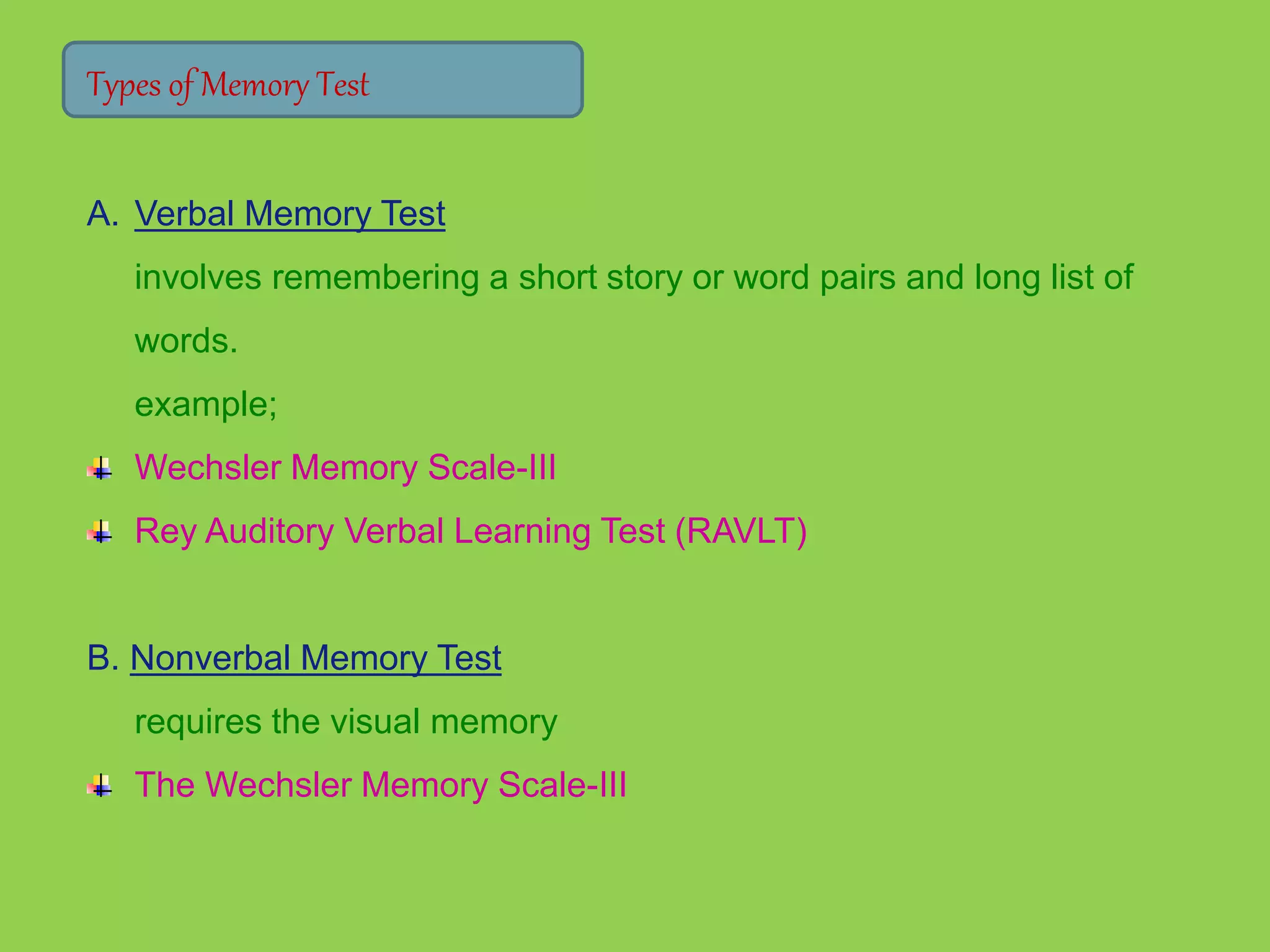
Types of Memory Test 
A. Verbal Memory Test 
involves remembering a short story or word pairs and long list of 
words. 
example; 
Wechsler Memory Scale-III 
Rey Auditory Verbal Learning Test (RAVLT) 
B. Nonverbal Memory Test 
requires the visual memory 
The Wechsler Memory Scale-III
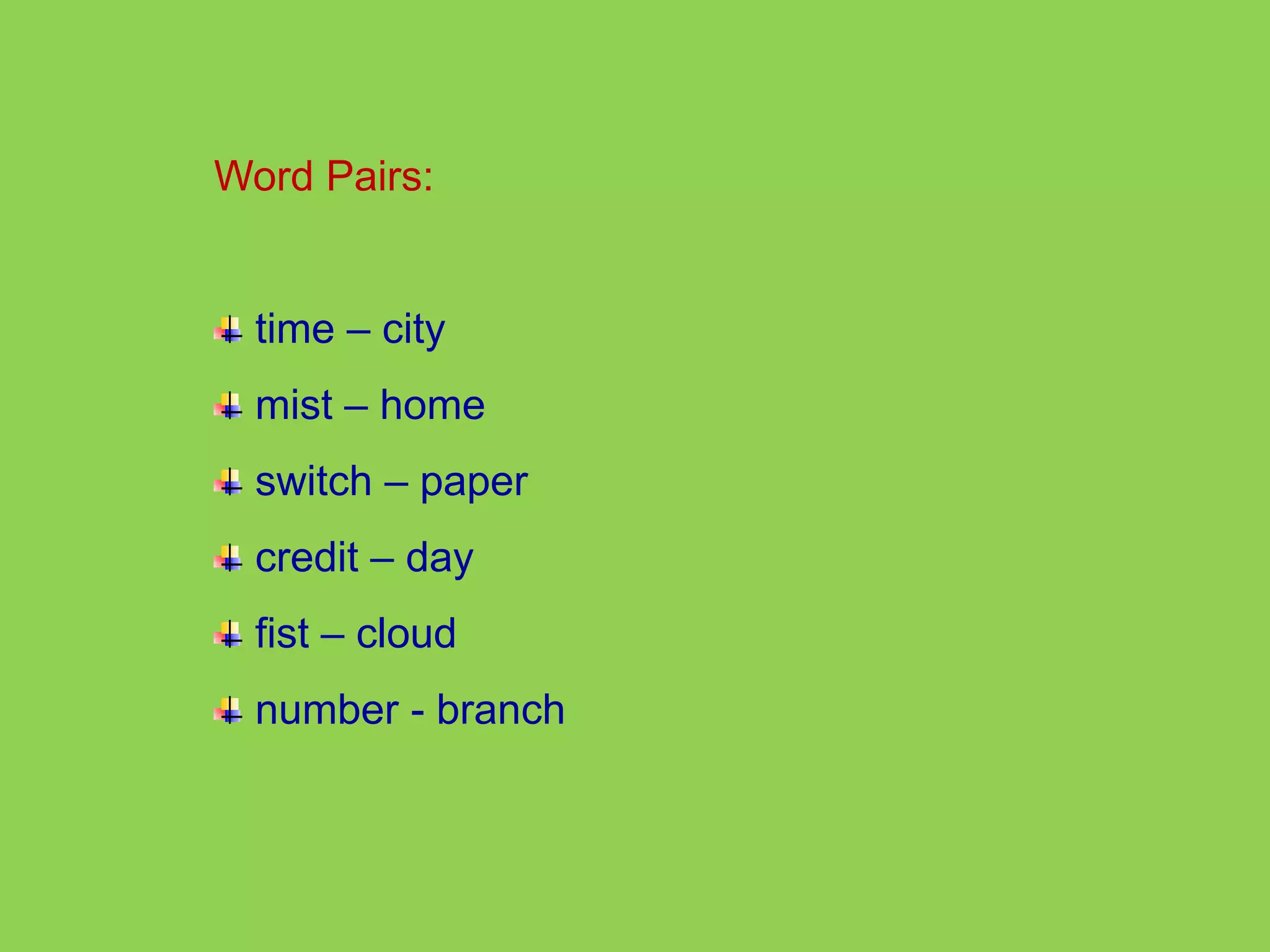
Word Pairs: 
time – city 
mist – home 
switch – paper 
credit – day 
fist – cloud 
number - branch
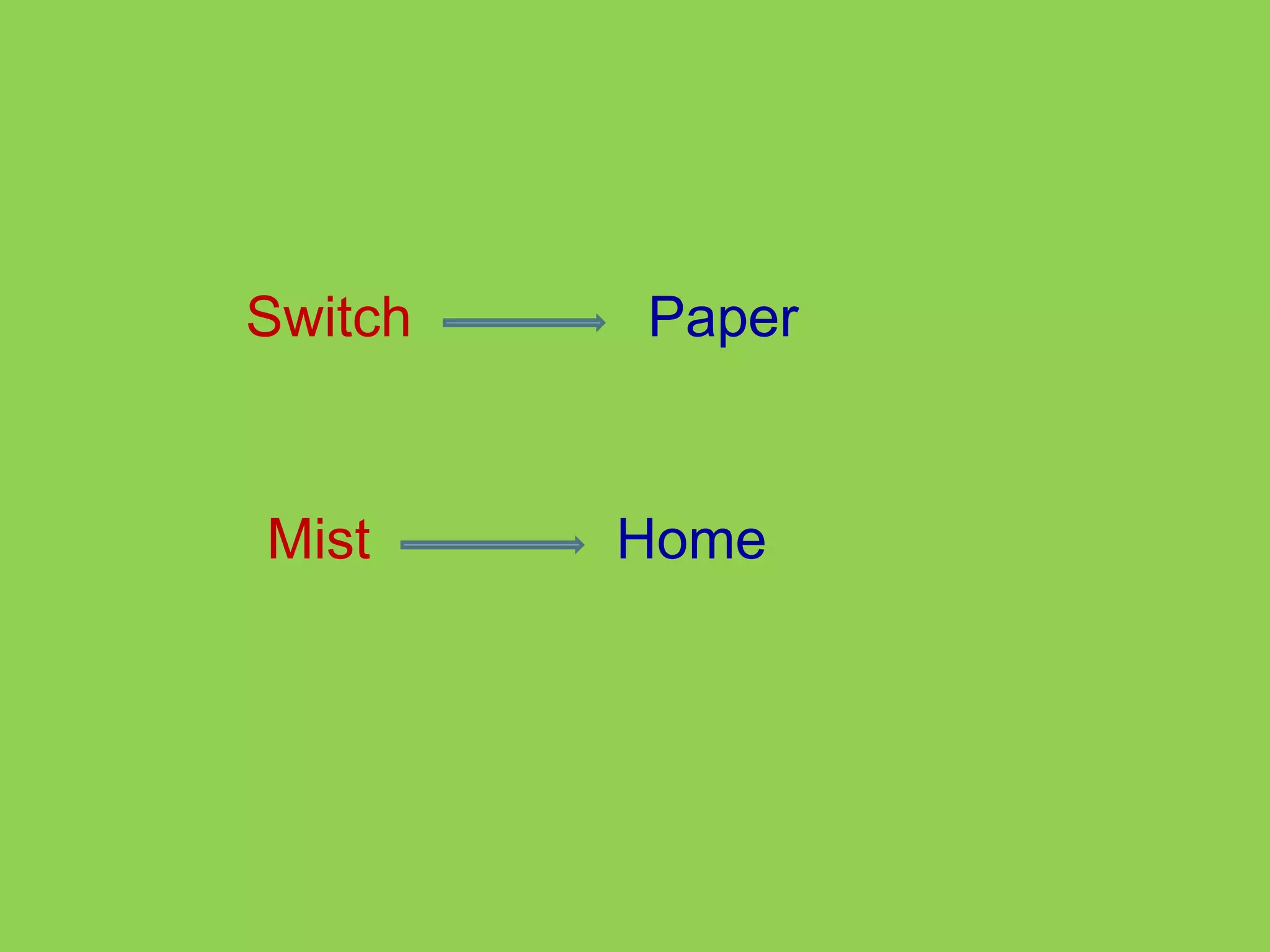
Switch Paper 
Mist Home
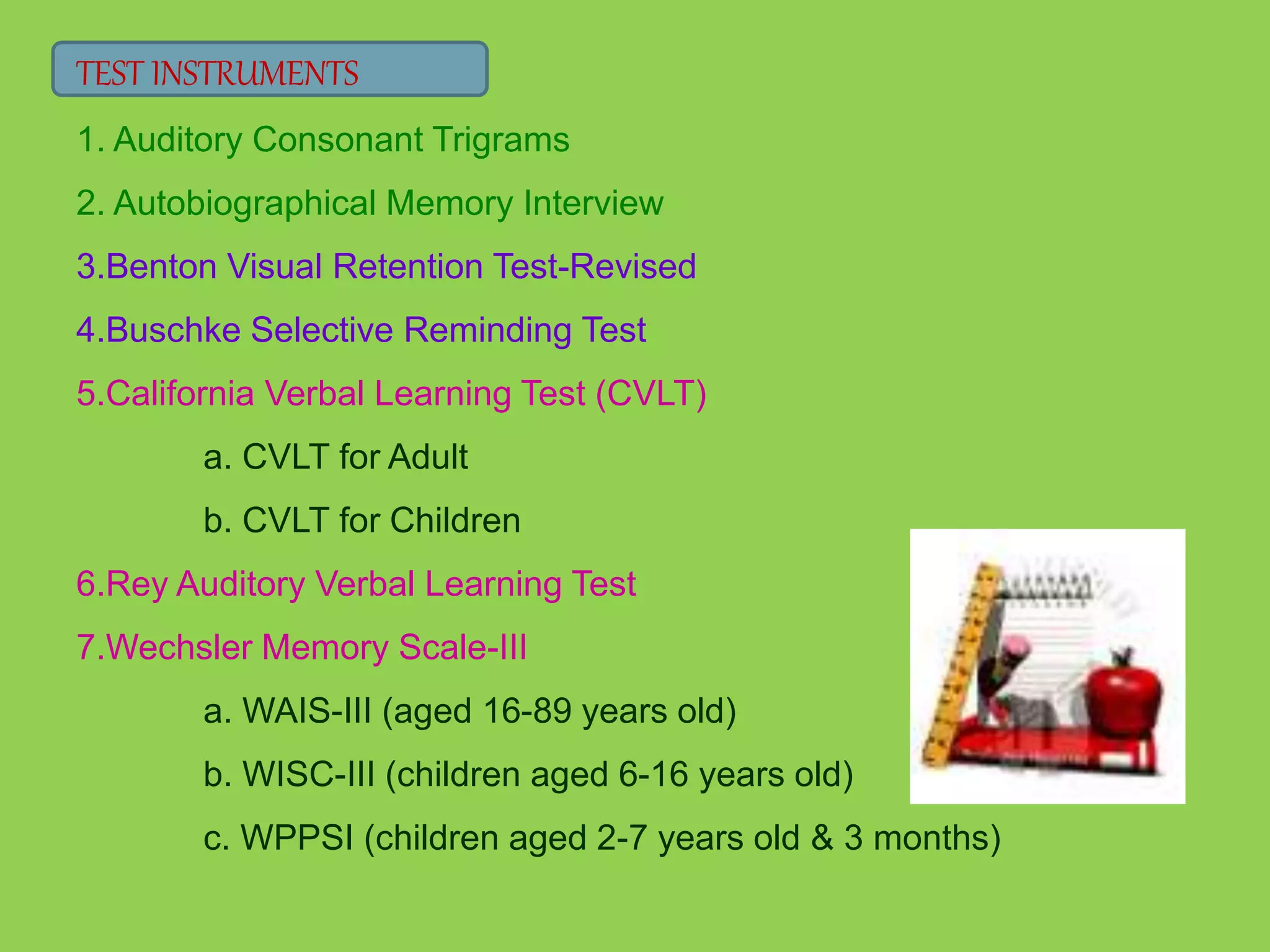
TEST INSTRUMENTS 
1. Auditory Consonant Trigrams 
2. Autobiographical Memory Interview 
3.Benton Visual Retention Test-Revised 
4.Buschke Selective Reminding Test 
5.California Verbal Learning Test (CVLT) 
a. CVLT for Adult 
b. CVLT for Children 
6.Rey Auditory Verbal Learning Test 
7.Wechsler Memory Scale-III 
a. WAIS-III (aged 16-89 years old) 
b. WISC-III (children aged 6-16 years old) 
c. WPPSI (children aged 2-7 years old & 3 months)
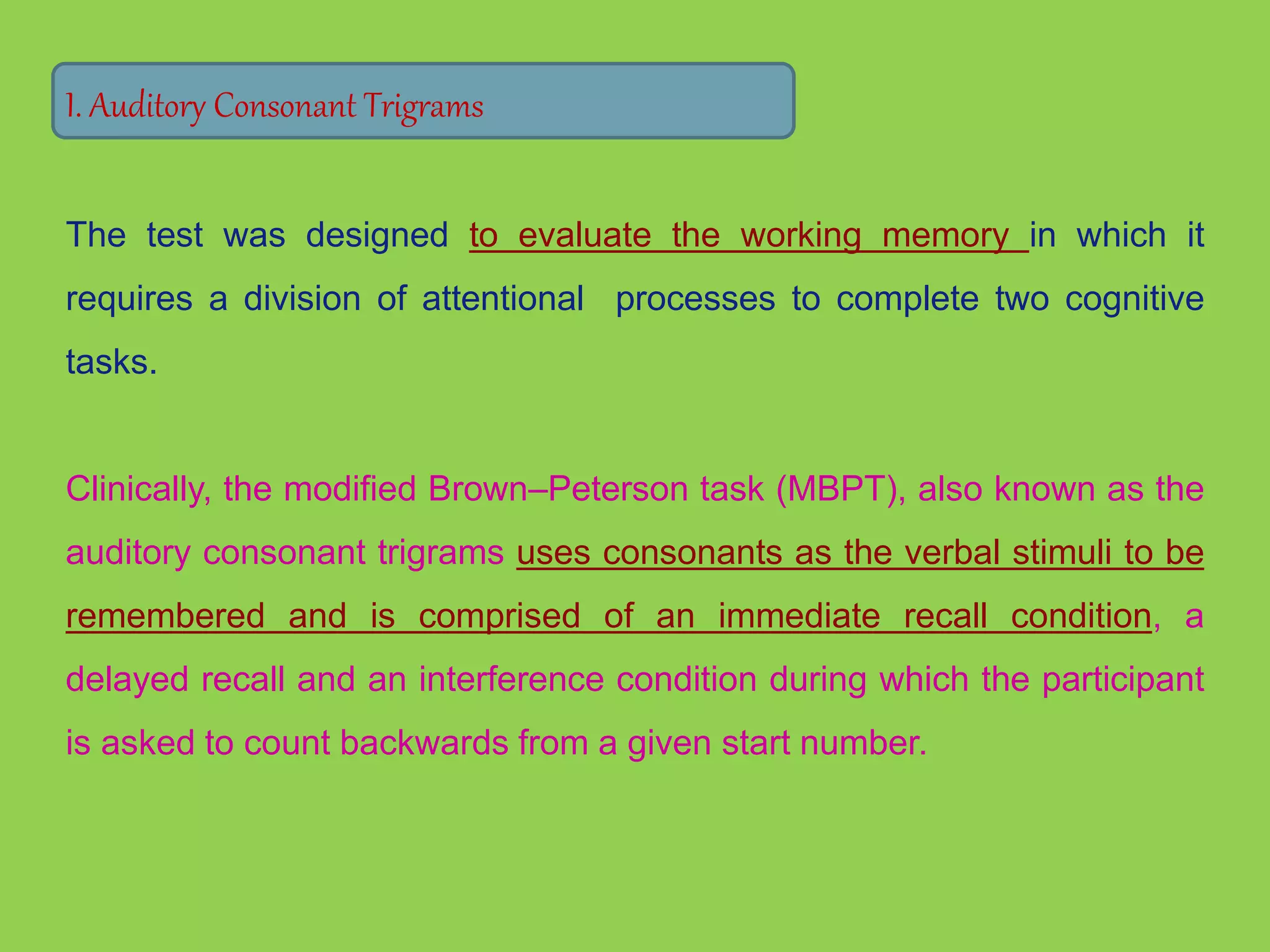
I. Auditory Consonant Trigrams 
The test was designed to evaluate the working memory in which it 
requires a division of attentional processes to complete two cognitive 
tasks. 
Clinically, the modified Brown–Peterson task (MBPT), also known as the 
auditory consonant trigrams uses consonants as the verbal stimuli to be 
remembered and is comprised of an immediate recall condition, a 
delayed recall and an interference condition during which the participant 
is asked to count backwards from a given start number.
II. Autobiographical Memory 
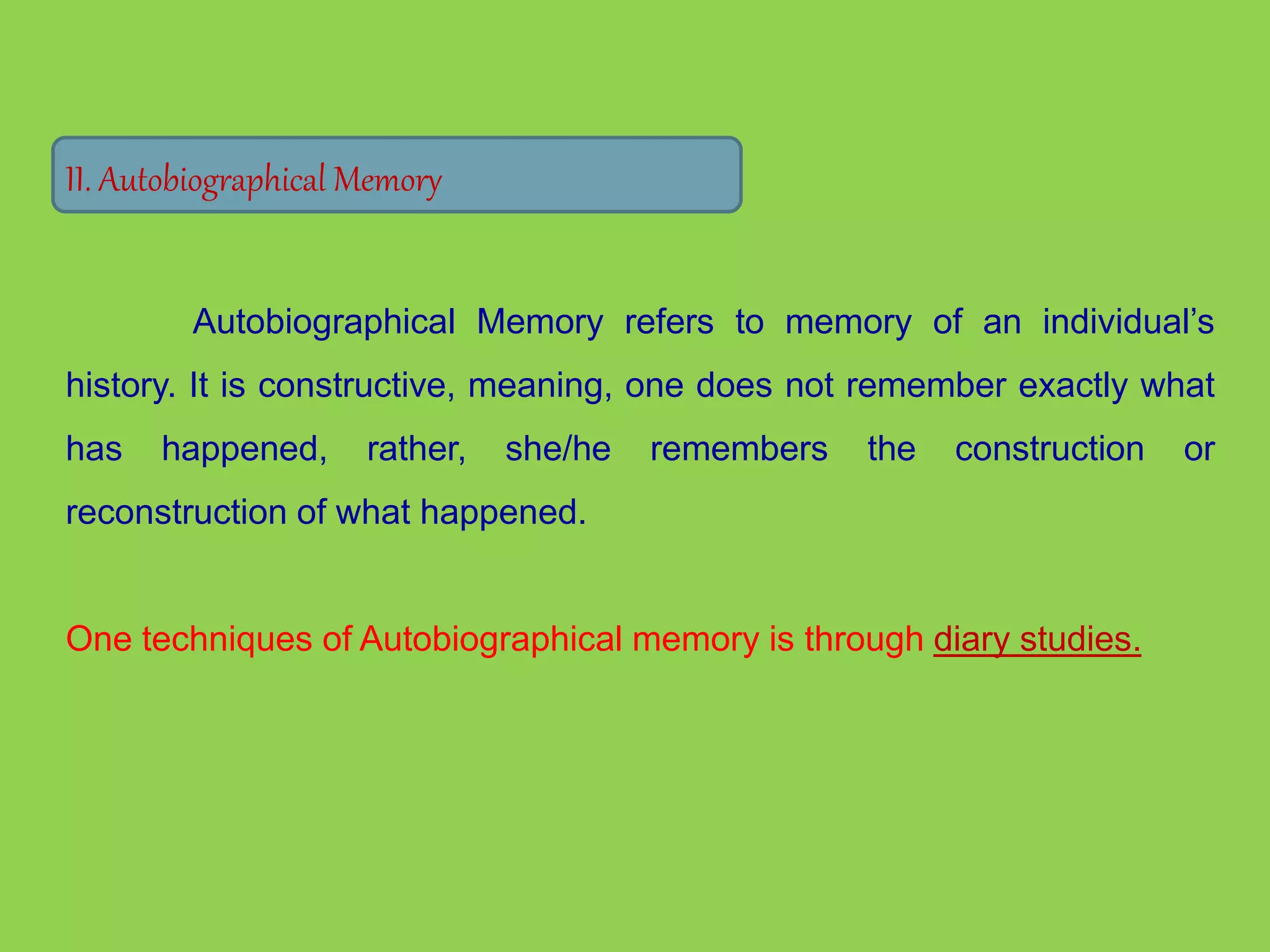
Autobiographical Memory refers to memory of an individual’s 
history. It is constructive, meaning, one does not remember exactly what 
has happened, rather, she/he remembers the construction or 
reconstruction of what happened. 
One techniques of Autobiographical memory is through diary studies.
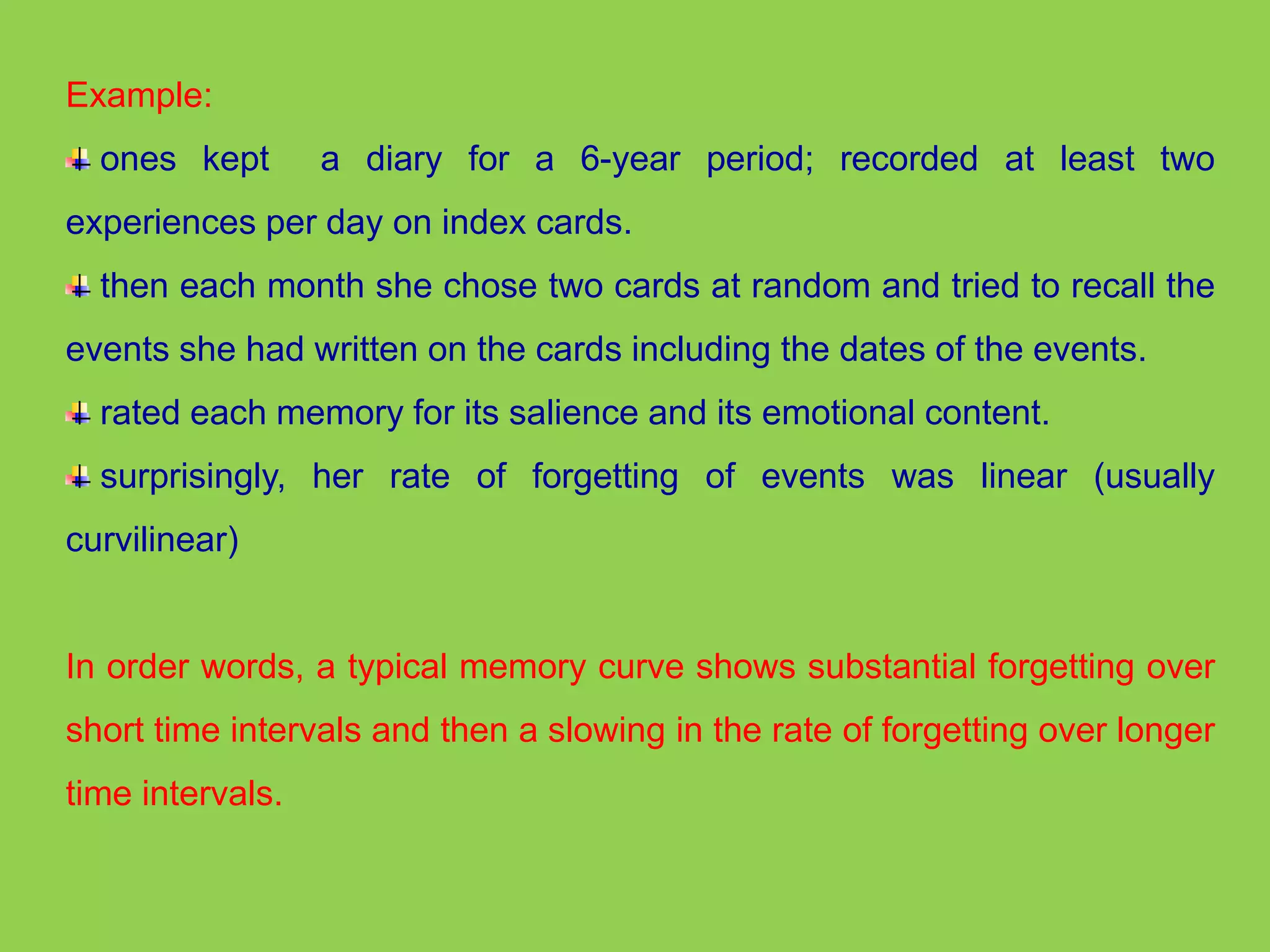
Example: 
ones kept a diary for a 6-year period; recorded at least two 
experiences per day on index cards. 
then each month she chose two cards at random and tried to recall the 
events she had written on the cards including the dates of the events. 
rated each memory for its salience and its emotional content. 
surprisingly, her rate of forgetting of events was linear (usually 
curvilinear) 
In order words, a typical memory curve shows substantial forgetting over 
short time intervals and then a slowing in the rate of forgetting over longer 
time intervals.
III. Benton Visual Retention Test (Benton test) 
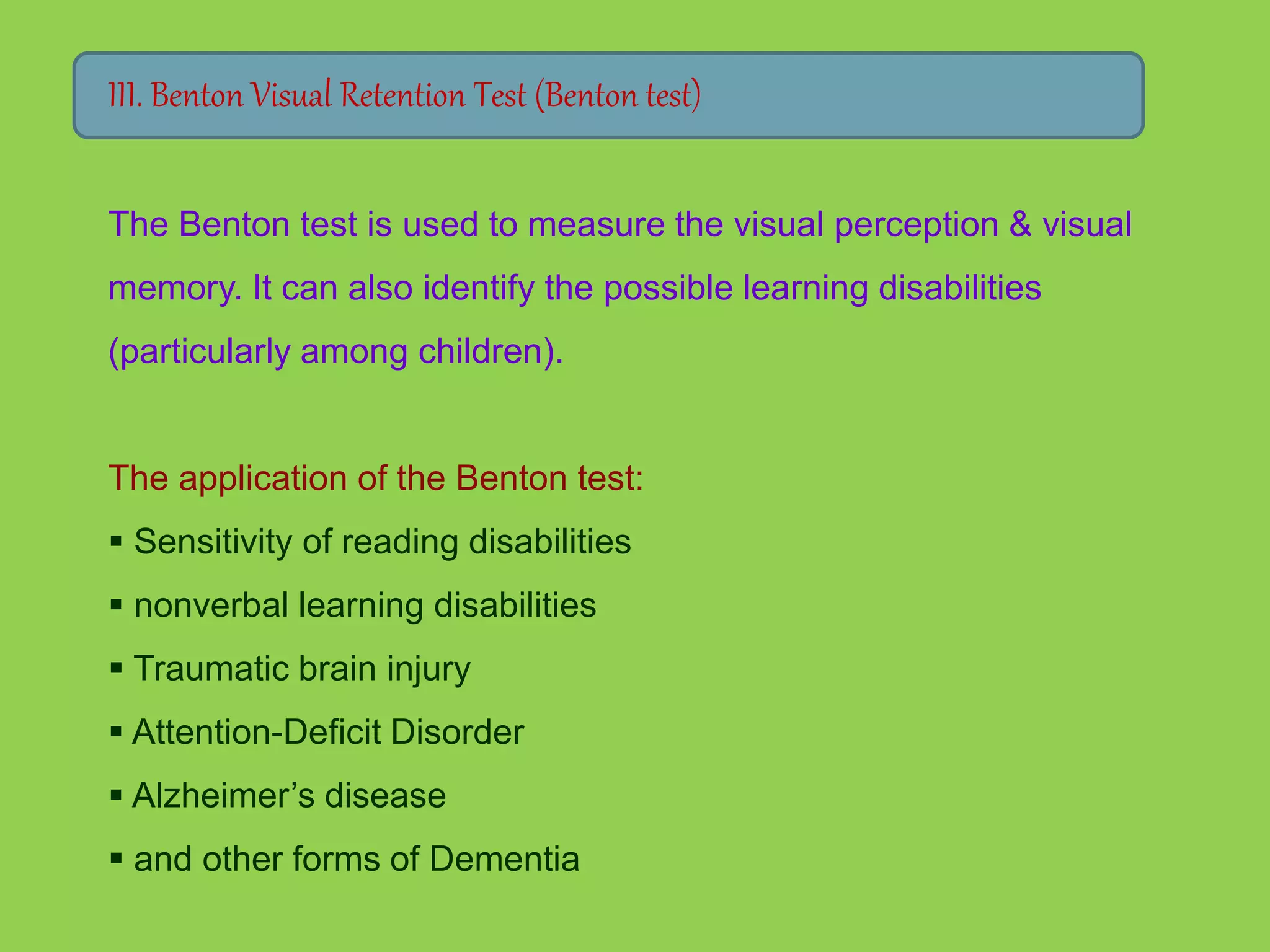
The Benton test is used to measure the visual perception & visual 
memory. It can also identify the possible learning disabilities 
(particularly among children). 
The application of the Benton test: 
 Sensitivity of reading disabilities 
 nonverbal learning disabilities 
 Traumatic brain injury 
 Attention-Deficit Disorder 
 Alzheimer’s disease 
 and other forms of Dementia
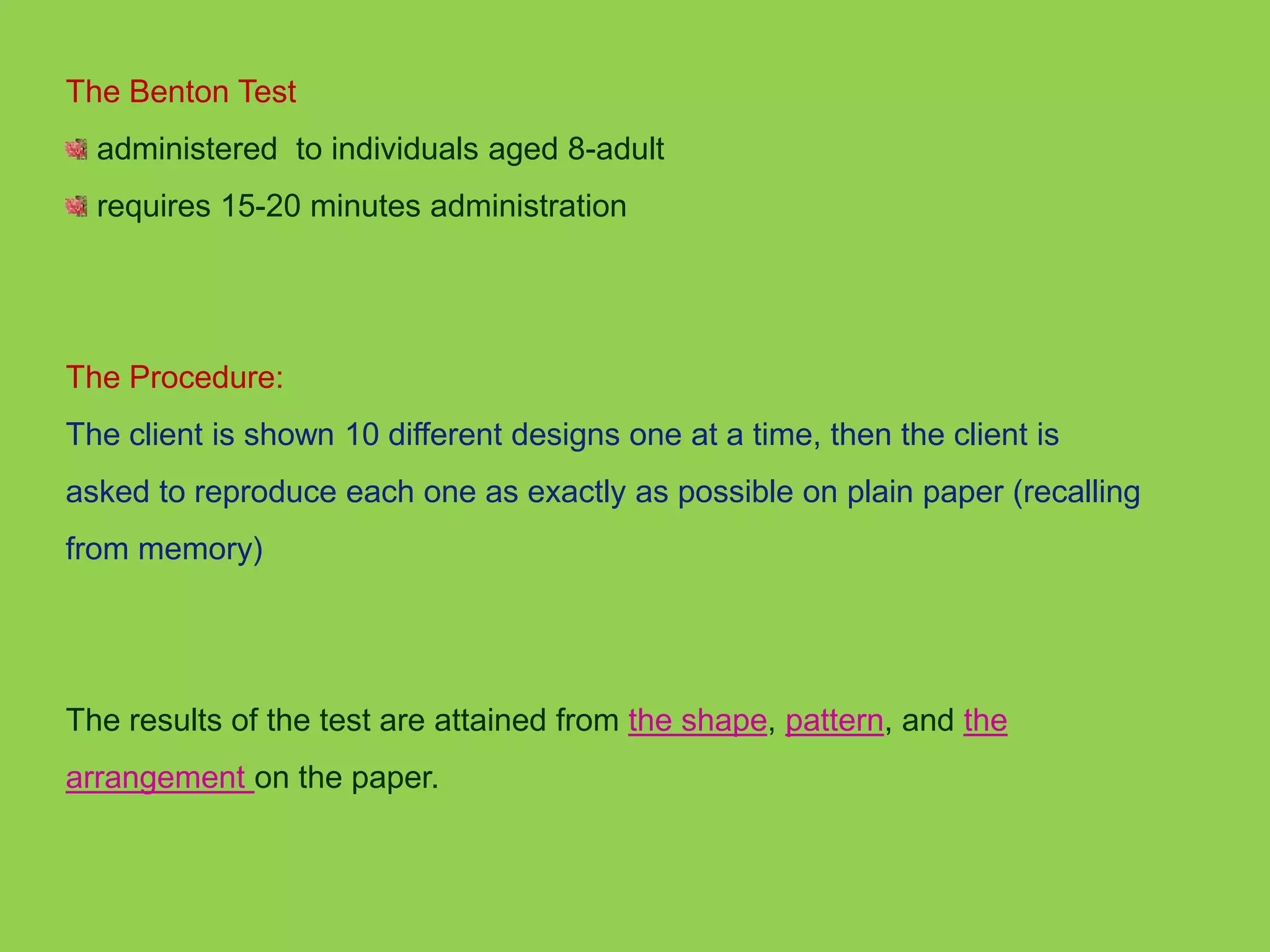
The Benton Test 
administered to individuals aged 8-adult 
requires 15-20 minutes administration 
The Procedure: 
The client is shown 10 different designs one at a time, then the client is 
asked to reproduce each one as exactly as possible on plain paper (recalling 
from memory) 
The results of the test are attained from the shape, pattern, and the 
arrangement on the paper.
IV. Buschke Selective Reminding Test 
It is a multiple-trial free-recall auditory-verbal learning task 
which firstly developed by Buschke (1973) as a test for 
adults. 
The BSRT enables the simultaneous evaluation on initial 
storage, retention, and retrieval of auditory verbal 
information.
The latter Development of BSRT 
 Buschke (1974) developed the test to be applied to the normal 
children 
 Levin, Benton & Grossman (1976) normal and head-injured 
adolescents 
 Morgan (1982) applied the test to normal and hospitalized 
children 
 Taylor, Michaels, Mazur, Bauer & Liden (1984) applied the test to 
children who suffered from Haemophilus influenza meningitis
Levin et al (1982) discovered that the problems with 
consistent long-term retrieval was particularly the 
characteristics of patients who had experienced prolonged 
coma following head injury.
The BSRT Instrument 
Buschke (1974) used the list of 20 animal names with 12 recall 
trials 
Morgan (1982) used three 8-item lists, each confined to nouns of 
a single class (e.g. Foods) 
Clodfelter, Dickson, Wilkes, and Johnson (1987) reported the 
equivalence of two forms of SRT with children aged 9-12 years 
old. The forms consist of 12 selected words. Clodfelter also used 
a four-footed animal version adapted form Buschke.
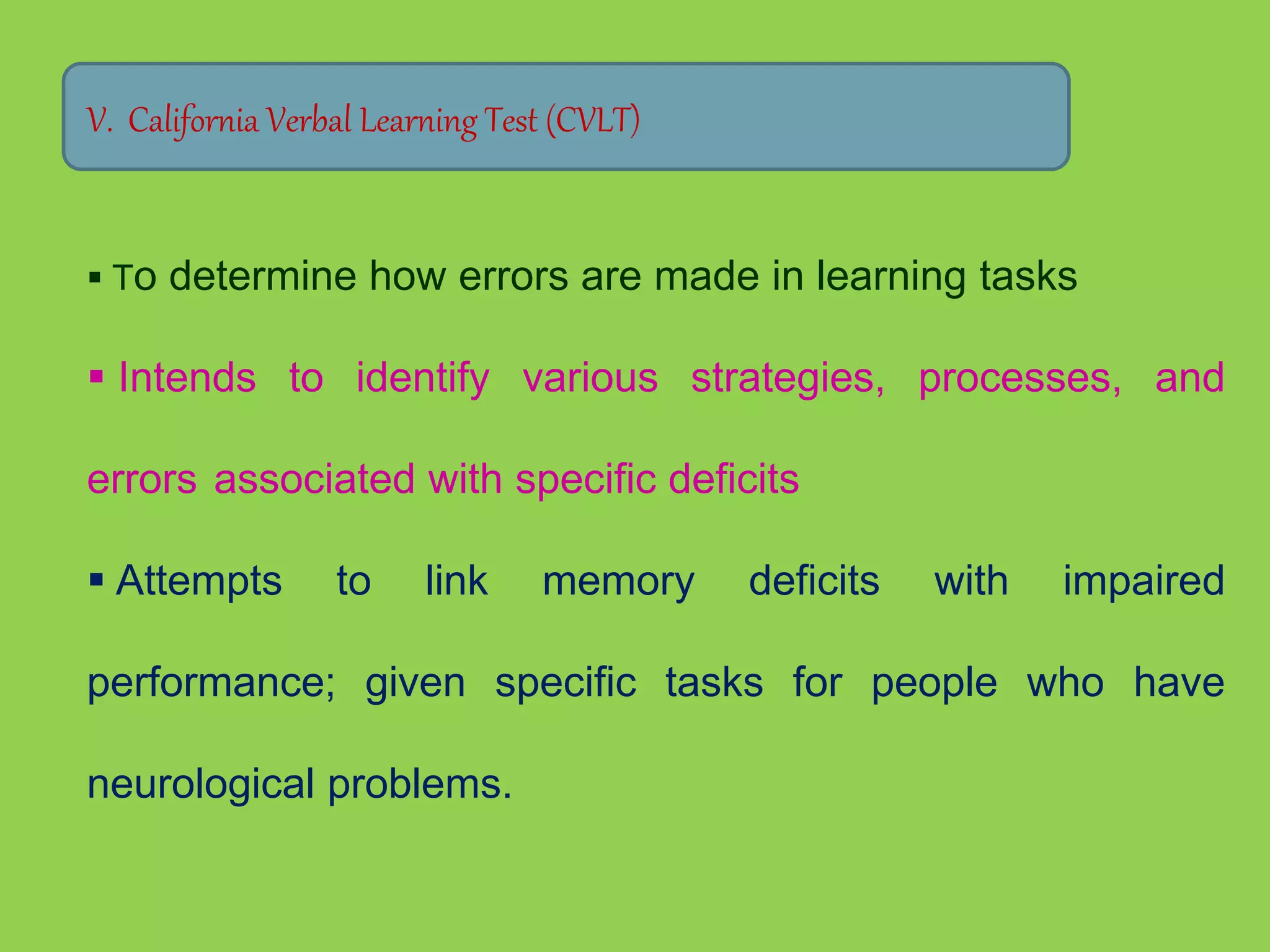
V. California Verbal Learning Test (CVLT) 
 To determine how errors are made in learning tasks 
 Intends to identify various strategies, processes, and 
errors associated with specific deficits 
 Attempts to link memory deficits with impaired 
performance; given specific tasks for people who have 
neurological problems.
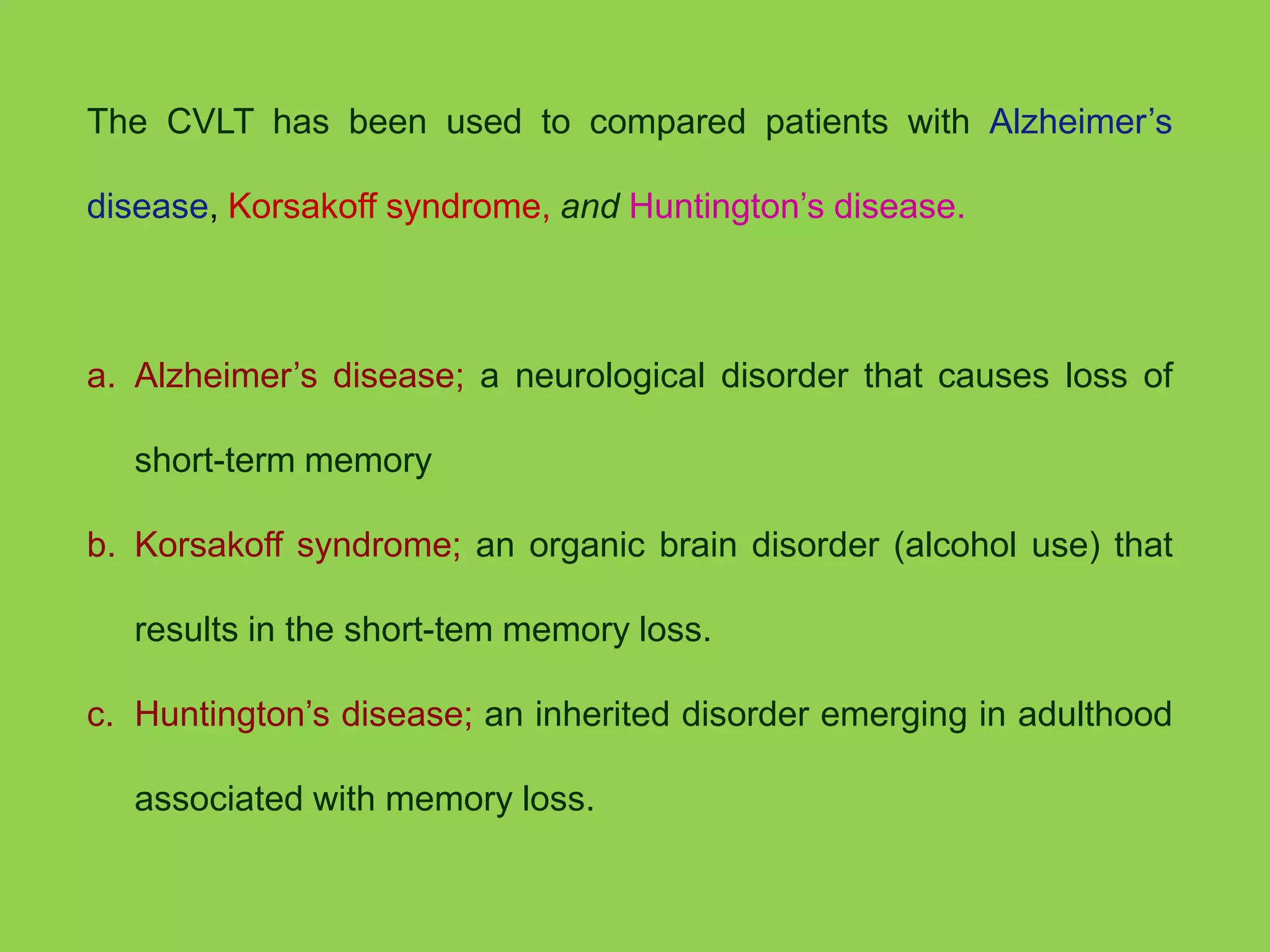
The CVLT has been used to compared patients with Alzheimer’s 
disease, Korsakoff syndrome, and Huntington’s disease. 
a. Alzheimer’s disease; a neurological disorder that causes loss of 
short-term memory 
b. Korsakoff syndrome; an organic brain disorder (alcohol use) that 
results in the short-tem memory loss. 
c. Huntington’s disease; an inherited disorder emerging in adulthood 
associated with memory loss.
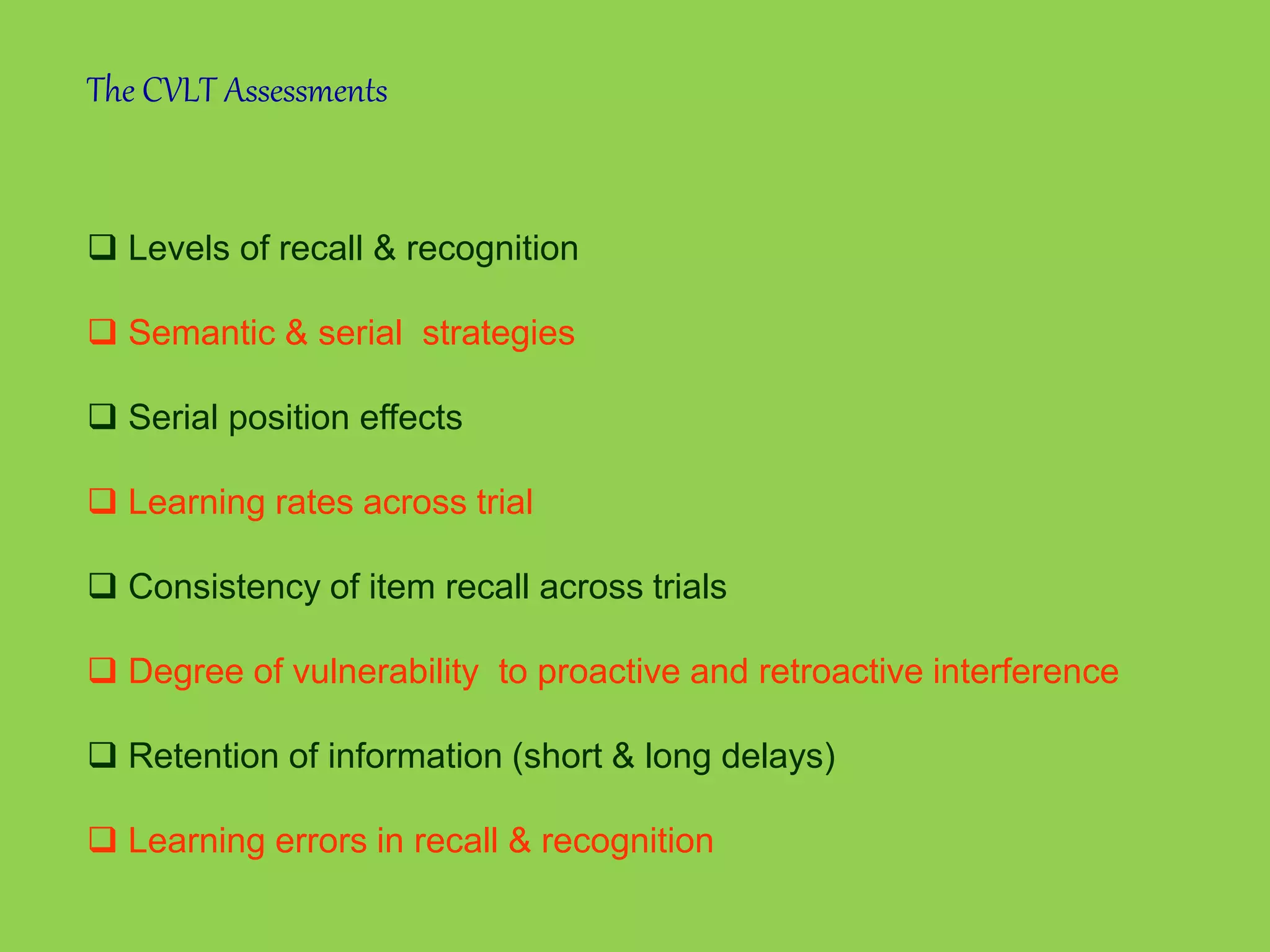
The CVLT Assessments 
 Levels of recall & recognition 
 Semantic & serial strategies 
 Serial position effects 
 Learning rates across trial 
 Consistency of item recall across trials 
 Degree of vulnerability to proactive and retroactive interference 
 Retention of information (short & long delays) 
 Learning errors in recall & recognition
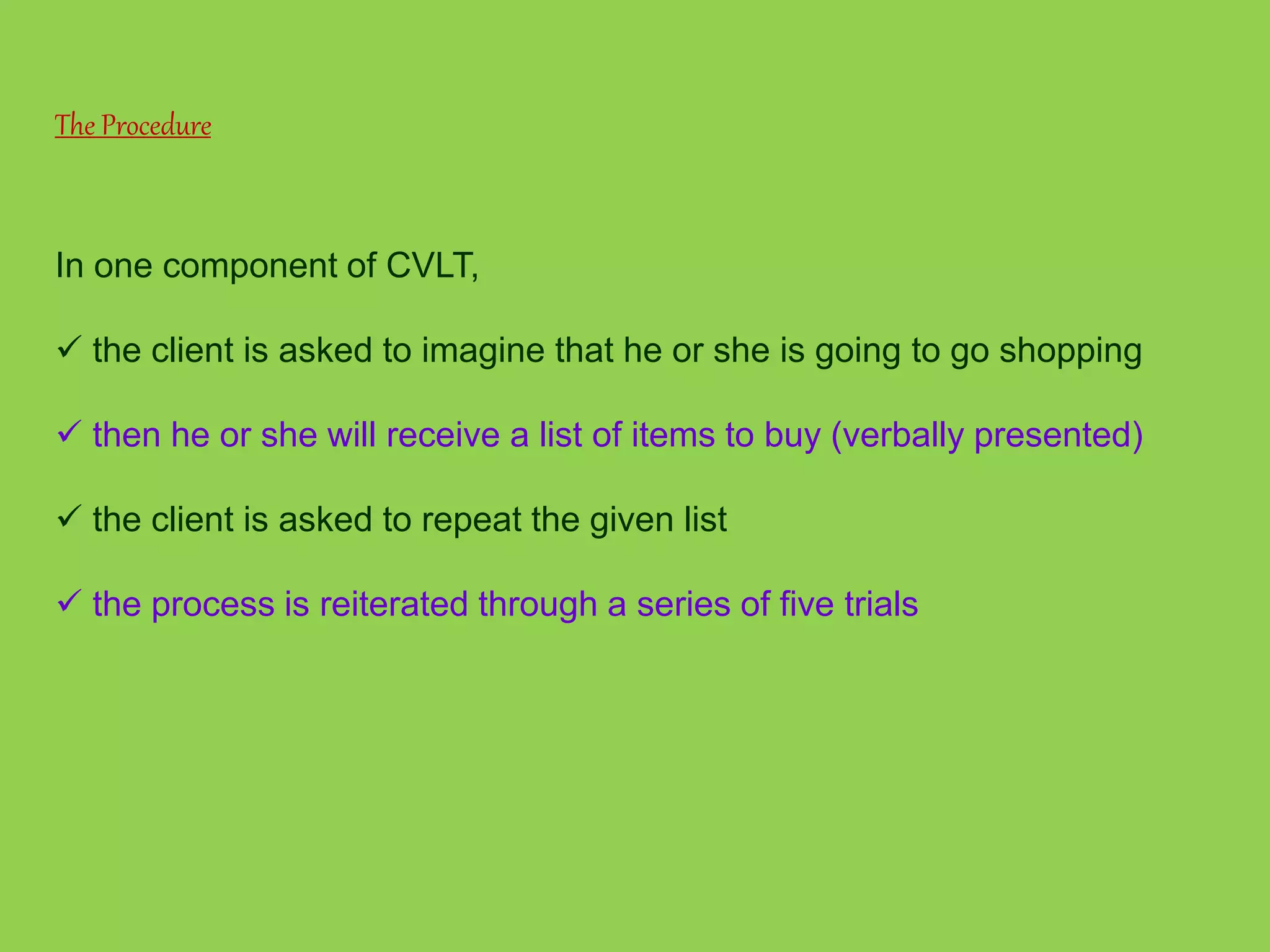
The Procedure 
In one component of CVLT, 
 the client is asked to imagine that he or she is going to go shopping 
 then he or she will receive a list of items to buy (verbally presented) 
 the client is asked to repeat the given list 
 the process is reiterated through a series of five trials
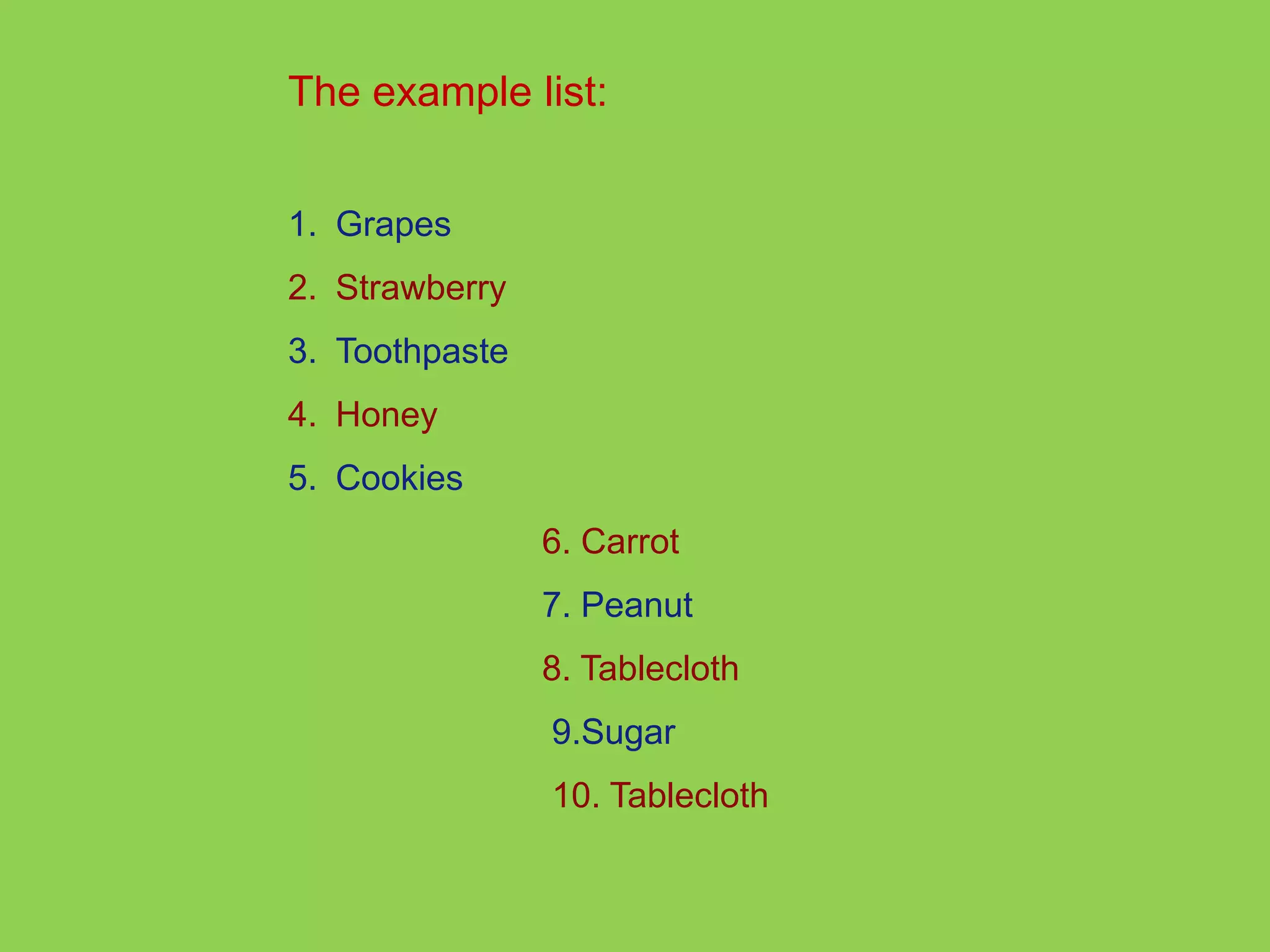
The example list: 
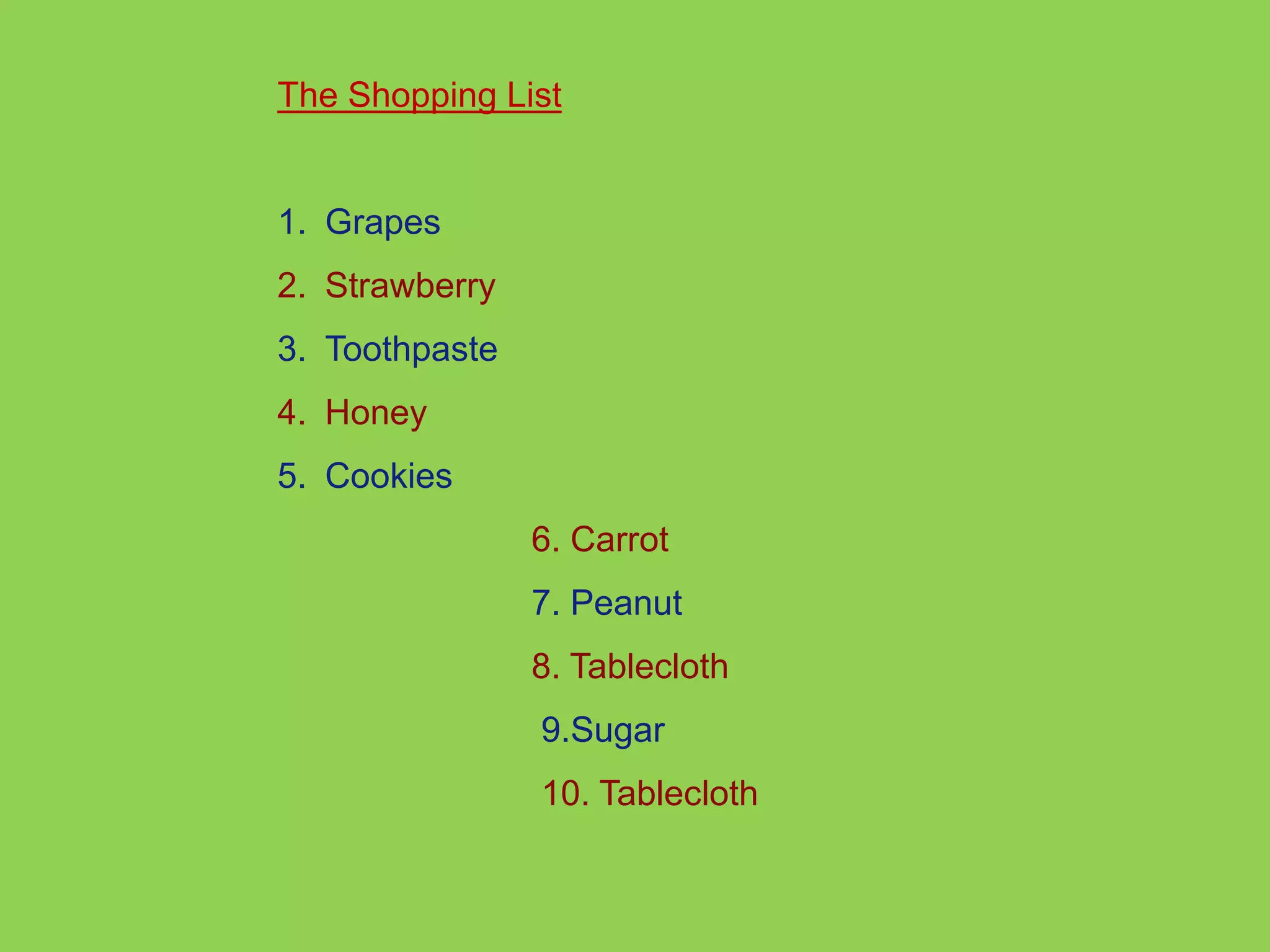
1. Grapes 
2. Strawberry 
3. Toothpaste 
4. Honey 
5. Cookies 
6. Carrot 
7. Peanut 
8. Tablecloth 
9.Sugar 
10. Tablecloth
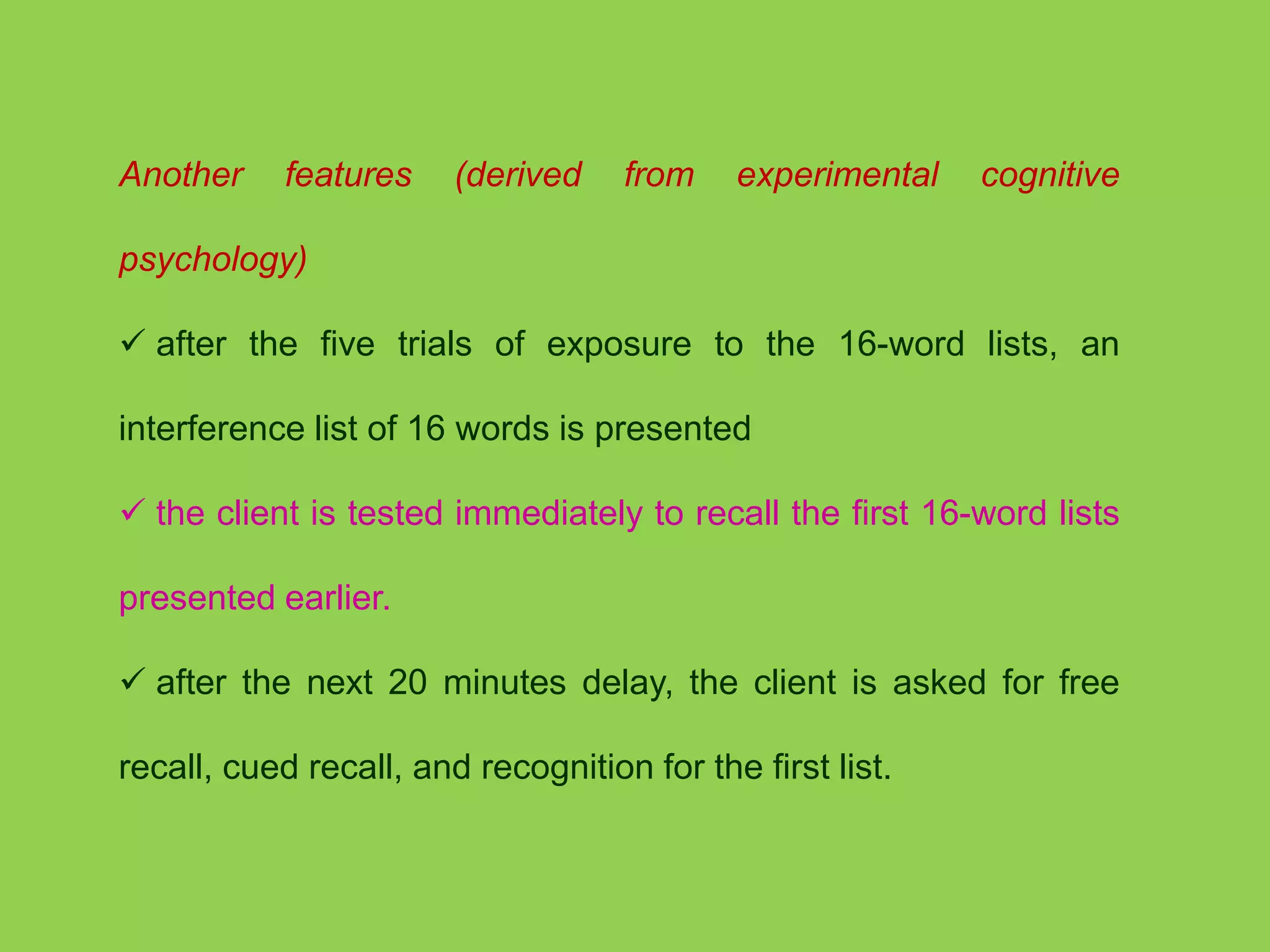
Another features (derived from experimental cognitive 
psychology) 
 after the five trials of exposure to the 16-word lists, an 
interference list of 16 words is presented 
 the client is tested immediately to recall the first 16-word lists 
presented earlier. 
 after the next 20 minutes delay, the client is asked for free 
recall, cued recall, and recognition for the first list.
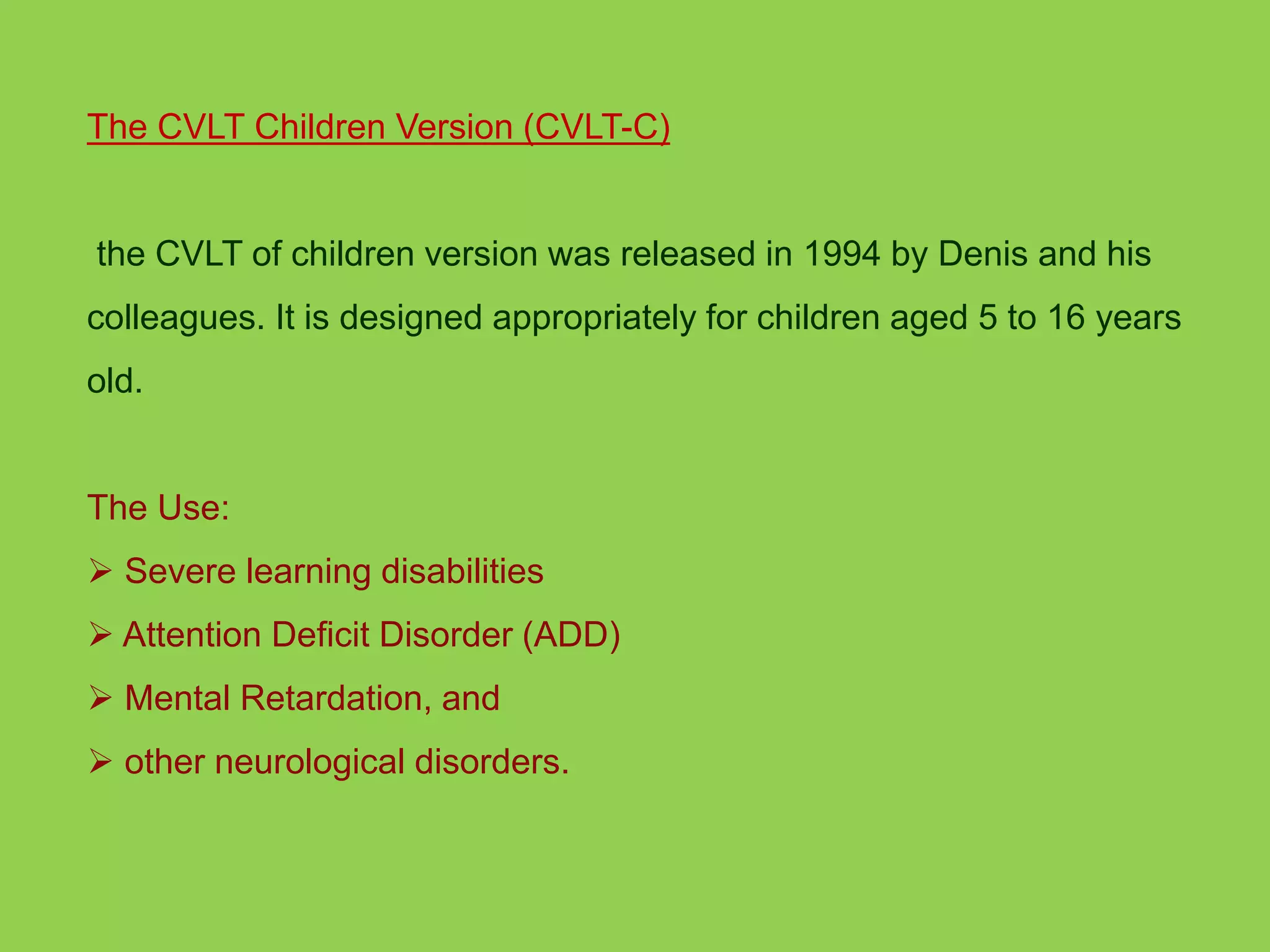
The CVLT Children Version (CVLT-C) 
the CVLT of children version was released in 1994 by Denis and his 
colleagues. It is designed appropriately for children aged 5 to 16 years 
old. 
The Use: 
 Severe learning disabilities 
 Attention Deficit Disorder (ADD) 
 Mental Retardation, and 
 other neurological disorders.
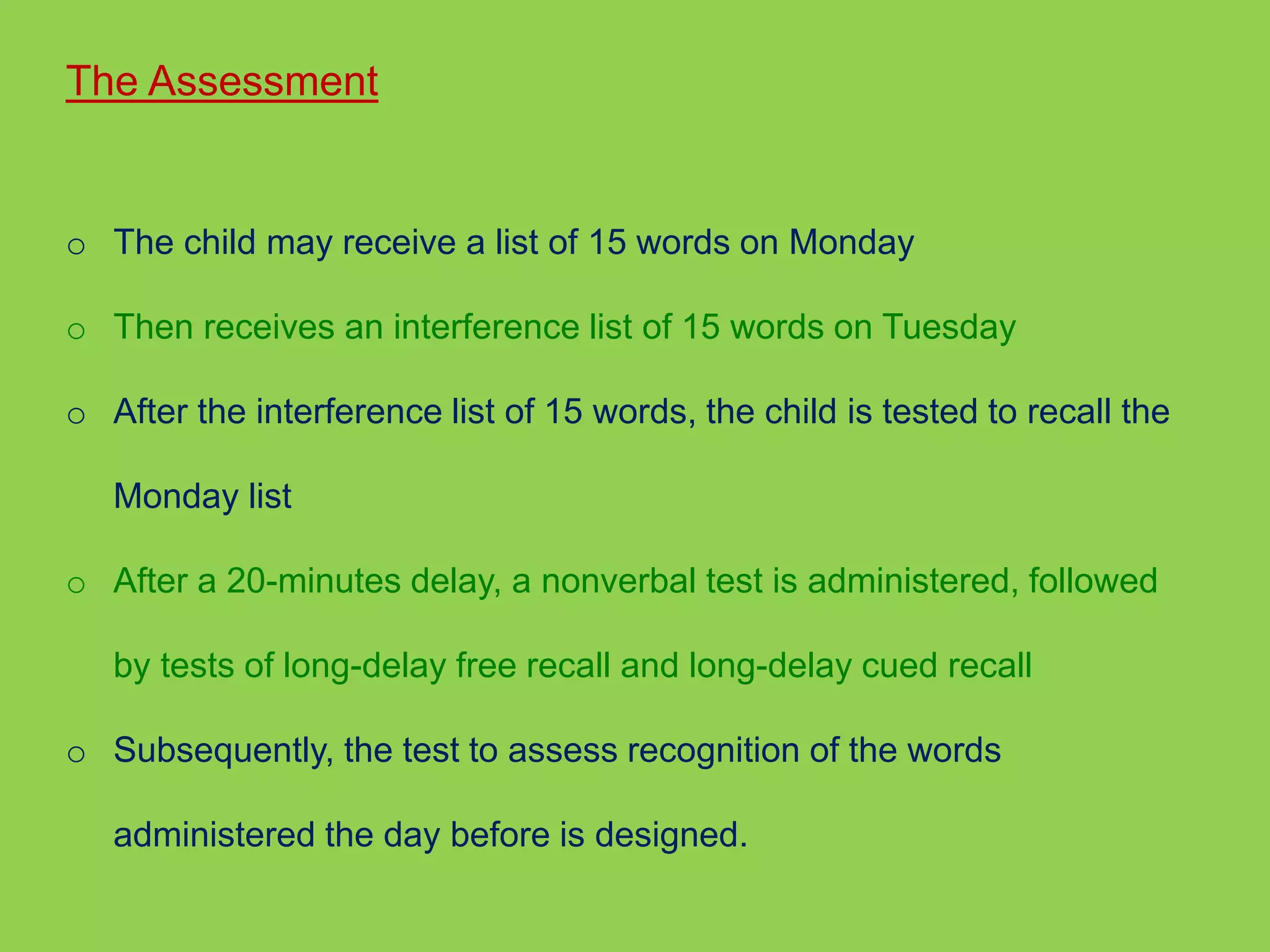
The Assessment 
o The child may receive a list of 15 words on Monday 
o Then receives an interference list of 15 words on Tuesday 
o After the interference list of 15 words, the child is tested to recall the 
Monday list 
o After a 20-minutes delay, a nonverbal test is administered, followed 
by tests of long-delay free recall and long-delay cued recall 
o Subsequently, the test to assess recognition of the words 
administered the day before is designed.
VI. Rey Auditory Verbal Learning Test (RAVLT) 
(a 15-item word list) 
The RAVLT was initially developed by Rey (1964) then later 
revised for English usage by Lezak (1983) & Taylor (1959). 
The test is intended to measure rote of verbal memory that 
assess multiple memory domain, including immediate 
memory span, new learning, retroactive & proactive 
inference & recognition. 
The impaired performance on RAVLT has been associated 
with left temporal lobe dysfunction, mild head injury, 
entrenched Alzheimer, alcoholism)
 Test Administration Procedure 
a list of 15-item word list is presented, after which the patient is recall as 
many words as possible in any order. The list is presented a total of 5 
times, with the patient recalling all the words he or she remembers after 
each administration. 
A distracter list of 15 new words is then presented for the patient to 
recall. At this point, the patient is now asked to recall the words from the 
first list. 
Delayed recall of the original list is also requested 20 to 30 minutes 
afterward. Recognition memory is assessed by having the patient 
identify the words from the original list from among distracter words.
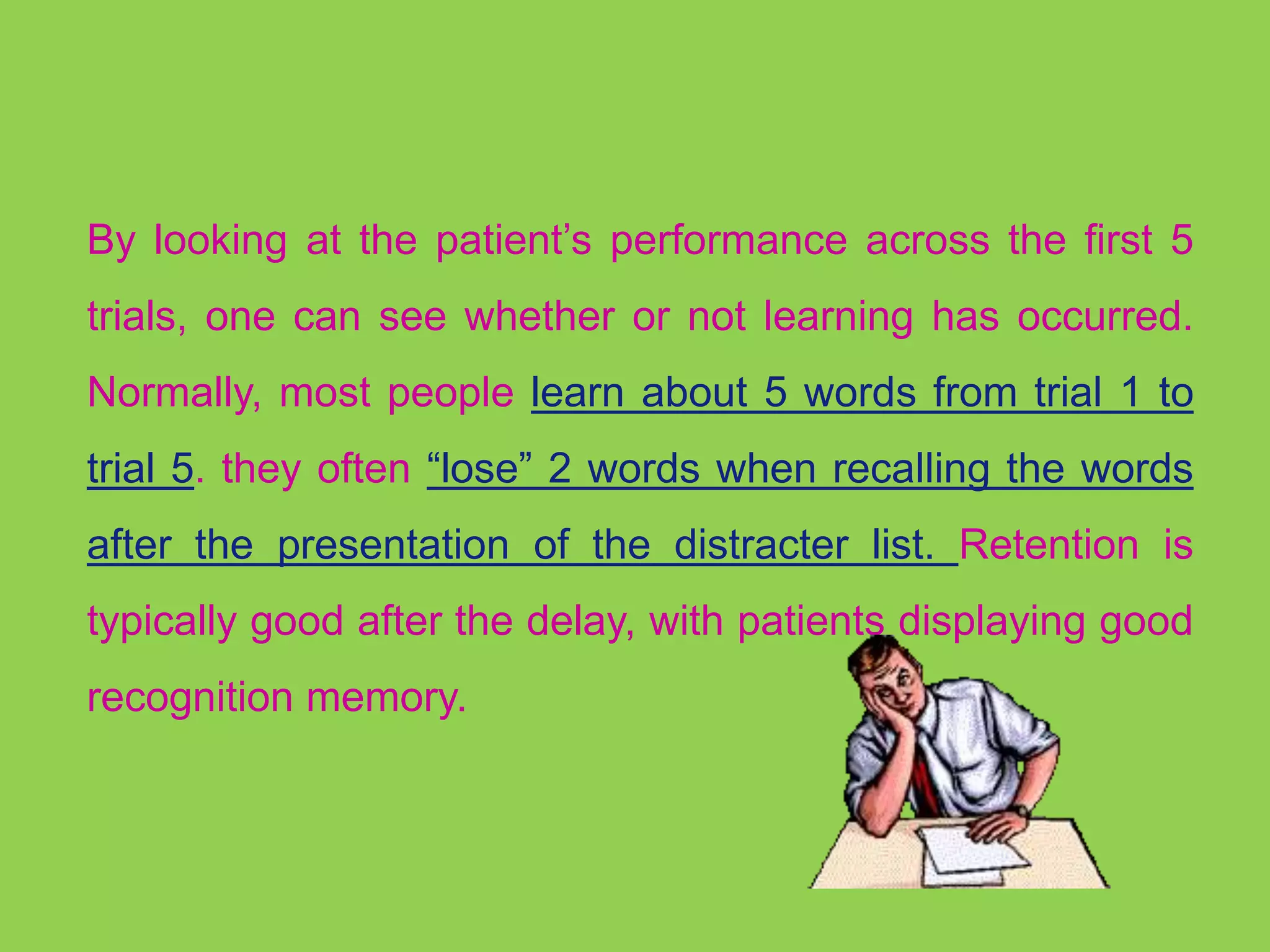
By looking at the patient’s performance across the first 5 
trials, one can see whether or not learning has occurred. 
Normally, most people learn about 5 words from trial 1 to 
trial 5. they often “lose” 2 words when recalling the words 
after the presentation of the distracter list. Retention is 
typically good after the delay, with patients displaying good 
recognition memory.
VII. The Wechsler Memory Scale-III 
The test was developed by David Wechsler in the 1940s. The WMS is 
one of the core instrument used in neuropsychological assessment to 
evaluate cognitive Abilities and intellectual abilities in children and adults. 
It provides information about the over-all level of intellectual functioning 
and the presence or absence of significant intellectual disability. 
Likewise, it provides clues to altered function.
There are three different kinds of WMS; 
1. Wechsler Intelligence Scale for Children (WISC-III) “Whisk”; used for 
ages 6-16 years old. 
2. Wechsler Adult Intelligence Scale (WAIS-III); used for ages 16-89 
years old. 
3. WPPSI “Whipsy”; for children under age (ages 2-7 years & 3 months)
The Characteristics of all Subtest (WAIS-III, WISC-III & WPPSI-R) 
A. Verbal Scale 
Information; covered knowledge of general information 
“In what continent is Brazil” 
Comprehension; the ability to organize and apply social knowledge. 
“why should children be cautious in speaking to strangers? 
Similarities; the ability to analyze relationships and engage in logical abstract 
thinking. 
“how are a pen and a pencil alike?” 
Arithmetic; the ability to work with arithmetic problems. 
Vocabulary; the ability to learn words and express its meaning.
Digit Span/ Sentences; 
 Digit span to WISC-III; the examinee is asked to repeat the 
series of numbers in the sequence 
 Sentence to WPPSI-R; the examinee is tasked to repeat 
sentence verbatim. 
Both sub assess tab attention, concentration, and short-term 
auditory memory. 
Letter-Number Sequencing
B. Performance Scale 
Picture Completion; the ability to perceive & visually organize a sketch then 
recognize the missing parts. 
Picture Arrangement; the ability to comprehend a whole situation & able to see 
the cause & relationship. 
Block Design; 
Object Assembly; to assemble skills and psychomotor speed 
Coding/ Anima Pegs; to tap learning ability, rote recall ability, psychomotor 
speed, concentration & attention.
Mazes; perceptual motor skills, psychomotor speed, concentration 
and attention. 
Geometric Design; to provide child’s perceptual skills 
Symbol Search; to tap cognitive processing speed. 
Matrix Reasoning; to tap the perceptual organizing and reasoning.
A. Wechsler Adult Intelligence Test-Revised (WAIS-R) 
to demonstrate different areas of intellectual capabilities. 
 Administered to individuals aged 16 to 89 years old 
 Approximate time of administration is 75 minutes 
 The two scales; Verbal & Performance can be administered separately or 
together. 
Test data of four factors: 
1. Verbal Comprehension; Vocabulary, Similarities, Information 
2. Working Memory; Arithmetic, Digit Span, Letter-Number, Sequence 
3. Perceptual Organization; Picture Completion, Block Design, Matrix Reasoning 
4. Processing Speed; Digit Symbol, Symbol Reach
Note: 
 Physical conditions (testing room) 
 Testing time (60-90 minutes); consider the older subjects 
 Rapport 
 Material supplied
B. Wechsler Intelligence Scale for Children (WISC) 
to assess child’s capacity to understand and cope with the world 
around them. 
 Administered to children aged 6-16 years old 
 Approximate time is 1 hour 
 The Verbal Scale measures the child’s ability to respond orally 
 The Performance Scale intends to tap child’s ability to solve problems 
requiring visual-spatial reasoning 
 Wechsler Intelligence Scale for Children (WISC)- III 
 Children aged 6-16 years old & 11 months 
 10 core tests; 50-70 minutes; 3 supplemental subtests; 10-15 minutes.
C. WPPSI “Whipsy”; for children under age (ages 2-7 years & 3 months) 
to determine the presence of a learning disability or a developmental 
delay, to identify the giftedness, and to track the intellectual 
development. 
 Designed for children aged 3-7 years old & 3 months 
 Approximate time is 1 hour & 15 minutes 
 The test is divided into six verbal & five performance subtests which 
contain information, animal house & animal house re-test, vocabulary, 
picture completion, arithmetic, mazes, geometric design, similarities, 
block design, comprehension, and sentences. (PICTURES NEXT...)
Jean Emilie Flora
Ted Elton John Emilie
The Shopping List 
1. Grapes 
2. Strawberry 
3. Toothpaste 
4. Honey 
5. Cookies 
6. Carrot 
7. Peanut 
8. Tablecloth 
9.Sugar 
10. Tablecloth
The Statue of Jesus Redeemer 
Brazil
Thank you for listening!

Test of Memory

  • 1.
    TEST OF MEMORY Sr.Supriti February 2010
  • 2.
    MEMORY The abilityof an organism to store, retain and recall information. the means by which individual retains and draws on her past experiences to use this information in the present.
  • 3.
  • 4.
    A. Short termstorage the capability of storing information for limited capacity. it holds memories for matters of seconds or a couple of minutes. Ted Mark Edward
  • 5.
  • 6.
    Can you recallwho he is? Edward
  • 7.
    B. Long termstorage the capability of storing information for large capacity, perhaps indefinitely. Emilie Flora Jean
  • 8.
    Benazir Bhutto RussellCrowe Ramon Magsaysay
  • 9.
  • 10.
    The Statue ofJesus Redeemer Brazil
  • 11.
  • 12.
    The Factors affectingMemory Impairment 1. Head Injuries/ Head trauma 2. Brain tumors or Brain infections 3. Stroke 4. Vitamin deficiency 5. Depression 6. Thyroid disorders 7. Illnesses (Amnesia, Dementia, Alzheimer, etc)
  • 13.
    Types of TasksUsed for Measuring Memory Tasks Requiring Explicit Memory for Declarative Knowledge Description of What the Tasks Require Explicit-memory tasks Consciously recall particular information Declarative-knowledge tasks Recall the facts Recall tasks Produce a fact, a word, or other items from memory Serial-recall task Repeat the items in a list in the exact order in which have been heard or read Free-recall task Repeat the items in a list in any order in which ones can recall them Cued-recall task Memorize a list of paired items; then when ones is given one item in the pair, she must recall the mate for that item Recognition tasks Select or otherwise identify an item as being one that has been previously learned Implicit-memory tasks Draw on information in memory without consciously realizing that the individual is doing so Tasks involving procedural knowledge Remember learned skills and automatic behaviours , rather than facts.
  • 14.
    Types of MemoryTest A. Verbal Memory Test involves remembering a short story or word pairs and long list of words. example; Wechsler Memory Scale-III Rey Auditory Verbal Learning Test (RAVLT) B. Nonverbal Memory Test requires the visual memory The Wechsler Memory Scale-III
  • 15.
    Word Pairs: time– city mist – home switch – paper credit – day fist – cloud number - branch
  • 16.
  • 17.
    TEST INSTRUMENTS 1.Auditory Consonant Trigrams 2. Autobiographical Memory Interview 3.Benton Visual Retention Test-Revised 4.Buschke Selective Reminding Test 5.California Verbal Learning Test (CVLT) a. CVLT for Adult b. CVLT for Children 6.Rey Auditory Verbal Learning Test 7.Wechsler Memory Scale-III a. WAIS-III (aged 16-89 years old) b. WISC-III (children aged 6-16 years old) c. WPPSI (children aged 2-7 years old & 3 months)
  • 18.
    I. Auditory ConsonantTrigrams The test was designed to evaluate the working memory in which it requires a division of attentional processes to complete two cognitive tasks. Clinically, the modified Brown–Peterson task (MBPT), also known as the auditory consonant trigrams uses consonants as the verbal stimuli to be remembered and is comprised of an immediate recall condition, a delayed recall and an interference condition during which the participant is asked to count backwards from a given start number.
  • 19.
    II. Autobiographical Memory Autobiographical Memory refers to memory of an individual’s history. It is constructive, meaning, one does not remember exactly what has happened, rather, she/he remembers the construction or reconstruction of what happened. One techniques of Autobiographical memory is through diary studies.
  • 20.
    Example: ones kepta diary for a 6-year period; recorded at least two experiences per day on index cards. then each month she chose two cards at random and tried to recall the events she had written on the cards including the dates of the events. rated each memory for its salience and its emotional content. surprisingly, her rate of forgetting of events was linear (usually curvilinear) In order words, a typical memory curve shows substantial forgetting over short time intervals and then a slowing in the rate of forgetting over longer time intervals.
  • 21.
    III. Benton VisualRetention Test (Benton test) The Benton test is used to measure the visual perception & visual memory. It can also identify the possible learning disabilities (particularly among children). The application of the Benton test:  Sensitivity of reading disabilities  nonverbal learning disabilities  Traumatic brain injury  Attention-Deficit Disorder  Alzheimer’s disease  and other forms of Dementia
  • 22.
    The Benton Test administered to individuals aged 8-adult requires 15-20 minutes administration The Procedure: The client is shown 10 different designs one at a time, then the client is asked to reproduce each one as exactly as possible on plain paper (recalling from memory) The results of the test are attained from the shape, pattern, and the arrangement on the paper.
  • 23.
    IV. Buschke SelectiveReminding Test It is a multiple-trial free-recall auditory-verbal learning task which firstly developed by Buschke (1973) as a test for adults. The BSRT enables the simultaneous evaluation on initial storage, retention, and retrieval of auditory verbal information.
  • 24.
    The latter Developmentof BSRT  Buschke (1974) developed the test to be applied to the normal children  Levin, Benton & Grossman (1976) normal and head-injured adolescents  Morgan (1982) applied the test to normal and hospitalized children  Taylor, Michaels, Mazur, Bauer & Liden (1984) applied the test to children who suffered from Haemophilus influenza meningitis
  • 25.
    Levin et al(1982) discovered that the problems with consistent long-term retrieval was particularly the characteristics of patients who had experienced prolonged coma following head injury.
  • 26.
    The BSRT Instrument Buschke (1974) used the list of 20 animal names with 12 recall trials Morgan (1982) used three 8-item lists, each confined to nouns of a single class (e.g. Foods) Clodfelter, Dickson, Wilkes, and Johnson (1987) reported the equivalence of two forms of SRT with children aged 9-12 years old. The forms consist of 12 selected words. Clodfelter also used a four-footed animal version adapted form Buschke.
  • 27.
    V. California VerbalLearning Test (CVLT)  To determine how errors are made in learning tasks  Intends to identify various strategies, processes, and errors associated with specific deficits  Attempts to link memory deficits with impaired performance; given specific tasks for people who have neurological problems.
  • 28.
    The CVLT hasbeen used to compared patients with Alzheimer’s disease, Korsakoff syndrome, and Huntington’s disease. a. Alzheimer’s disease; a neurological disorder that causes loss of short-term memory b. Korsakoff syndrome; an organic brain disorder (alcohol use) that results in the short-tem memory loss. c. Huntington’s disease; an inherited disorder emerging in adulthood associated with memory loss.
  • 29.
    The CVLT Assessments  Levels of recall & recognition  Semantic & serial strategies  Serial position effects  Learning rates across trial  Consistency of item recall across trials  Degree of vulnerability to proactive and retroactive interference  Retention of information (short & long delays)  Learning errors in recall & recognition
  • 30.
    The Procedure Inone component of CVLT,  the client is asked to imagine that he or she is going to go shopping  then he or she will receive a list of items to buy (verbally presented)  the client is asked to repeat the given list  the process is reiterated through a series of five trials
  • 31.
    The example list: 1. Grapes 2. Strawberry 3. Toothpaste 4. Honey 5. Cookies 6. Carrot 7. Peanut 8. Tablecloth 9.Sugar 10. Tablecloth
  • 32.
    Another features (derivedfrom experimental cognitive psychology)  after the five trials of exposure to the 16-word lists, an interference list of 16 words is presented  the client is tested immediately to recall the first 16-word lists presented earlier.  after the next 20 minutes delay, the client is asked for free recall, cued recall, and recognition for the first list.
  • 33.
    The CVLT ChildrenVersion (CVLT-C) the CVLT of children version was released in 1994 by Denis and his colleagues. It is designed appropriately for children aged 5 to 16 years old. The Use:  Severe learning disabilities  Attention Deficit Disorder (ADD)  Mental Retardation, and  other neurological disorders.
  • 34.
    The Assessment oThe child may receive a list of 15 words on Monday o Then receives an interference list of 15 words on Tuesday o After the interference list of 15 words, the child is tested to recall the Monday list o After a 20-minutes delay, a nonverbal test is administered, followed by tests of long-delay free recall and long-delay cued recall o Subsequently, the test to assess recognition of the words administered the day before is designed.
  • 35.
    VI. Rey AuditoryVerbal Learning Test (RAVLT) (a 15-item word list) The RAVLT was initially developed by Rey (1964) then later revised for English usage by Lezak (1983) & Taylor (1959). The test is intended to measure rote of verbal memory that assess multiple memory domain, including immediate memory span, new learning, retroactive & proactive inference & recognition. The impaired performance on RAVLT has been associated with left temporal lobe dysfunction, mild head injury, entrenched Alzheimer, alcoholism)
  • 36.
     Test AdministrationProcedure a list of 15-item word list is presented, after which the patient is recall as many words as possible in any order. The list is presented a total of 5 times, with the patient recalling all the words he or she remembers after each administration. A distracter list of 15 new words is then presented for the patient to recall. At this point, the patient is now asked to recall the words from the first list. Delayed recall of the original list is also requested 20 to 30 minutes afterward. Recognition memory is assessed by having the patient identify the words from the original list from among distracter words.
  • 37.
    By looking atthe patient’s performance across the first 5 trials, one can see whether or not learning has occurred. Normally, most people learn about 5 words from trial 1 to trial 5. they often “lose” 2 words when recalling the words after the presentation of the distracter list. Retention is typically good after the delay, with patients displaying good recognition memory.
  • 38.
    VII. The WechslerMemory Scale-III The test was developed by David Wechsler in the 1940s. The WMS is one of the core instrument used in neuropsychological assessment to evaluate cognitive Abilities and intellectual abilities in children and adults. It provides information about the over-all level of intellectual functioning and the presence or absence of significant intellectual disability. Likewise, it provides clues to altered function.
  • 39.
    There are threedifferent kinds of WMS; 1. Wechsler Intelligence Scale for Children (WISC-III) “Whisk”; used for ages 6-16 years old. 2. Wechsler Adult Intelligence Scale (WAIS-III); used for ages 16-89 years old. 3. WPPSI “Whipsy”; for children under age (ages 2-7 years & 3 months)
  • 40.
    The Characteristics ofall Subtest (WAIS-III, WISC-III & WPPSI-R) A. Verbal Scale Information; covered knowledge of general information “In what continent is Brazil” Comprehension; the ability to organize and apply social knowledge. “why should children be cautious in speaking to strangers? Similarities; the ability to analyze relationships and engage in logical abstract thinking. “how are a pen and a pencil alike?” Arithmetic; the ability to work with arithmetic problems. Vocabulary; the ability to learn words and express its meaning.
  • 41.
    Digit Span/ Sentences;  Digit span to WISC-III; the examinee is asked to repeat the series of numbers in the sequence  Sentence to WPPSI-R; the examinee is tasked to repeat sentence verbatim. Both sub assess tab attention, concentration, and short-term auditory memory. Letter-Number Sequencing
  • 42.
    B. Performance Scale Picture Completion; the ability to perceive & visually organize a sketch then recognize the missing parts. Picture Arrangement; the ability to comprehend a whole situation & able to see the cause & relationship. Block Design; Object Assembly; to assemble skills and psychomotor speed Coding/ Anima Pegs; to tap learning ability, rote recall ability, psychomotor speed, concentration & attention.
  • 43.
    Mazes; perceptual motorskills, psychomotor speed, concentration and attention. Geometric Design; to provide child’s perceptual skills Symbol Search; to tap cognitive processing speed. Matrix Reasoning; to tap the perceptual organizing and reasoning.
  • 44.
    A. Wechsler AdultIntelligence Test-Revised (WAIS-R) to demonstrate different areas of intellectual capabilities.  Administered to individuals aged 16 to 89 years old  Approximate time of administration is 75 minutes  The two scales; Verbal & Performance can be administered separately or together. Test data of four factors: 1. Verbal Comprehension; Vocabulary, Similarities, Information 2. Working Memory; Arithmetic, Digit Span, Letter-Number, Sequence 3. Perceptual Organization; Picture Completion, Block Design, Matrix Reasoning 4. Processing Speed; Digit Symbol, Symbol Reach
  • 45.
    Note:  Physicalconditions (testing room)  Testing time (60-90 minutes); consider the older subjects  Rapport  Material supplied
  • 46.
    B. Wechsler IntelligenceScale for Children (WISC) to assess child’s capacity to understand and cope with the world around them.  Administered to children aged 6-16 years old  Approximate time is 1 hour  The Verbal Scale measures the child’s ability to respond orally  The Performance Scale intends to tap child’s ability to solve problems requiring visual-spatial reasoning  Wechsler Intelligence Scale for Children (WISC)- III  Children aged 6-16 years old & 11 months  10 core tests; 50-70 minutes; 3 supplemental subtests; 10-15 minutes.
  • 47.
    C. WPPSI “Whipsy”;for children under age (ages 2-7 years & 3 months) to determine the presence of a learning disability or a developmental delay, to identify the giftedness, and to track the intellectual development.  Designed for children aged 3-7 years old & 3 months  Approximate time is 1 hour & 15 minutes  The test is divided into six verbal & five performance subtests which contain information, animal house & animal house re-test, vocabulary, picture completion, arithmetic, mazes, geometric design, similarities, block design, comprehension, and sentences. (PICTURES NEXT...)
  • 48.
  • 49.
  • 50.
    The Shopping List 1. Grapes 2. Strawberry 3. Toothpaste 4. Honey 5. Cookies 6. Carrot 7. Peanut 8. Tablecloth 9.Sugar 10. Tablecloth
  • 51.
    The Statue ofJesus Redeemer Brazil
  • 52.
    Thank you forlistening!