Prepared by
Dezy Shukla
 “Intelligence is the ability to adjust oneself to a new situation.”
W. Stern 1914
 “Intelligence is the ability to think abstractly.”
Terman 1921
 “Intelligence is sometime described as the ability to learn quickly and
to retain learning .”
Haber and Fried 1975
 Intelligence is the capacity to understand the world, thinking rationally
and use Resources effectively when faced with challenges.”
Feldman (Known)
Classification on the basis of Administration
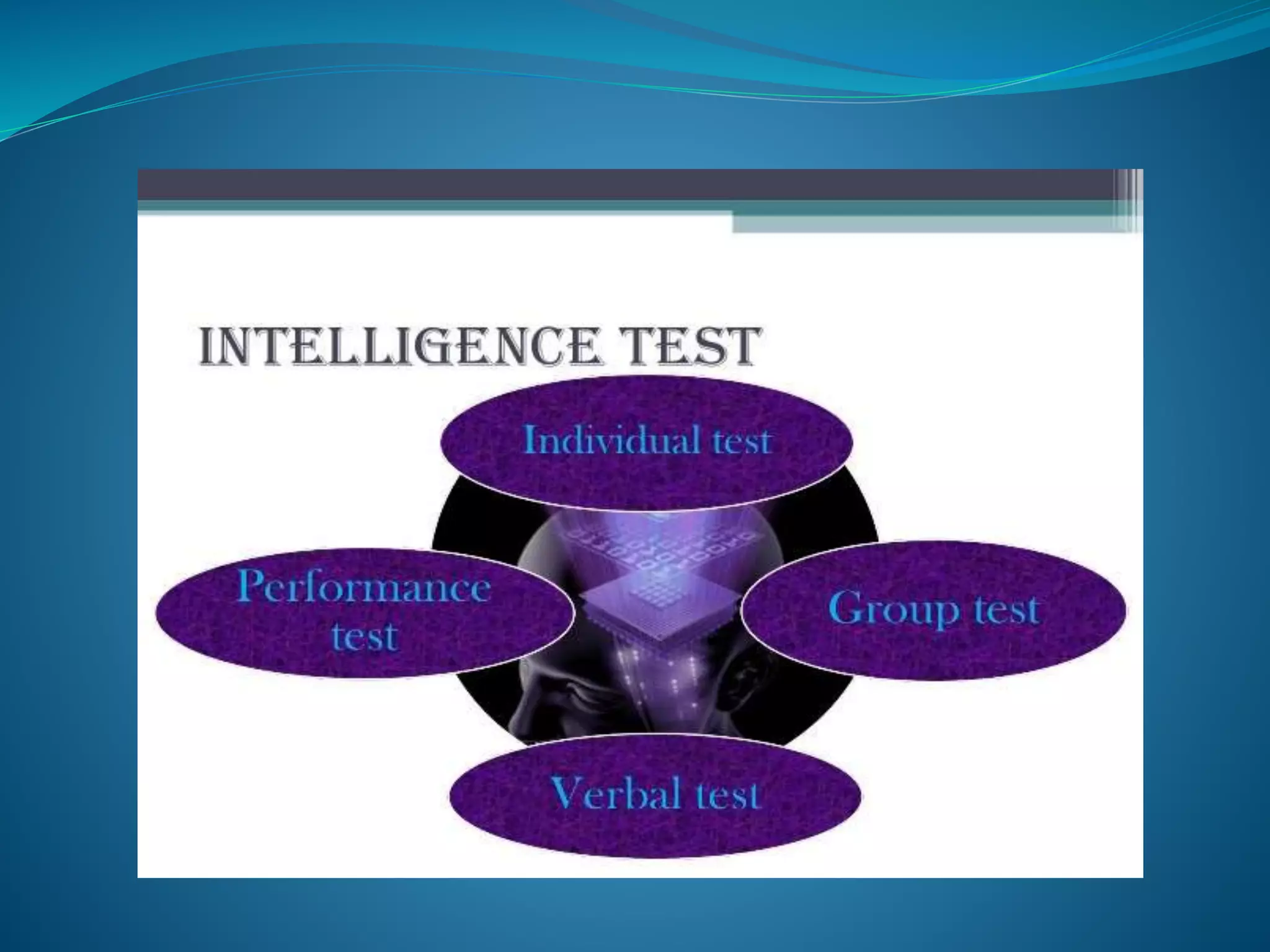
 Individual Intelligence Test : Test given one on one by a certified
evaluator, most commonly used for educational placement
decisions. Like- Koh’s Block Test, Pass Along Test
 Group Intelligence Test : Given to a large group or whole class,
Administrated by teacher s as a screening process to determine
who differs from the average and a closer look or individual test.
Like- Army Alpha Test, Army Beta Test
Classification on the basis of Posts
 Verbal Intelligence Test
 Non- Verbal Intelligence Test
 Performance Intelligence Test
 Non- Language Intelligence Test
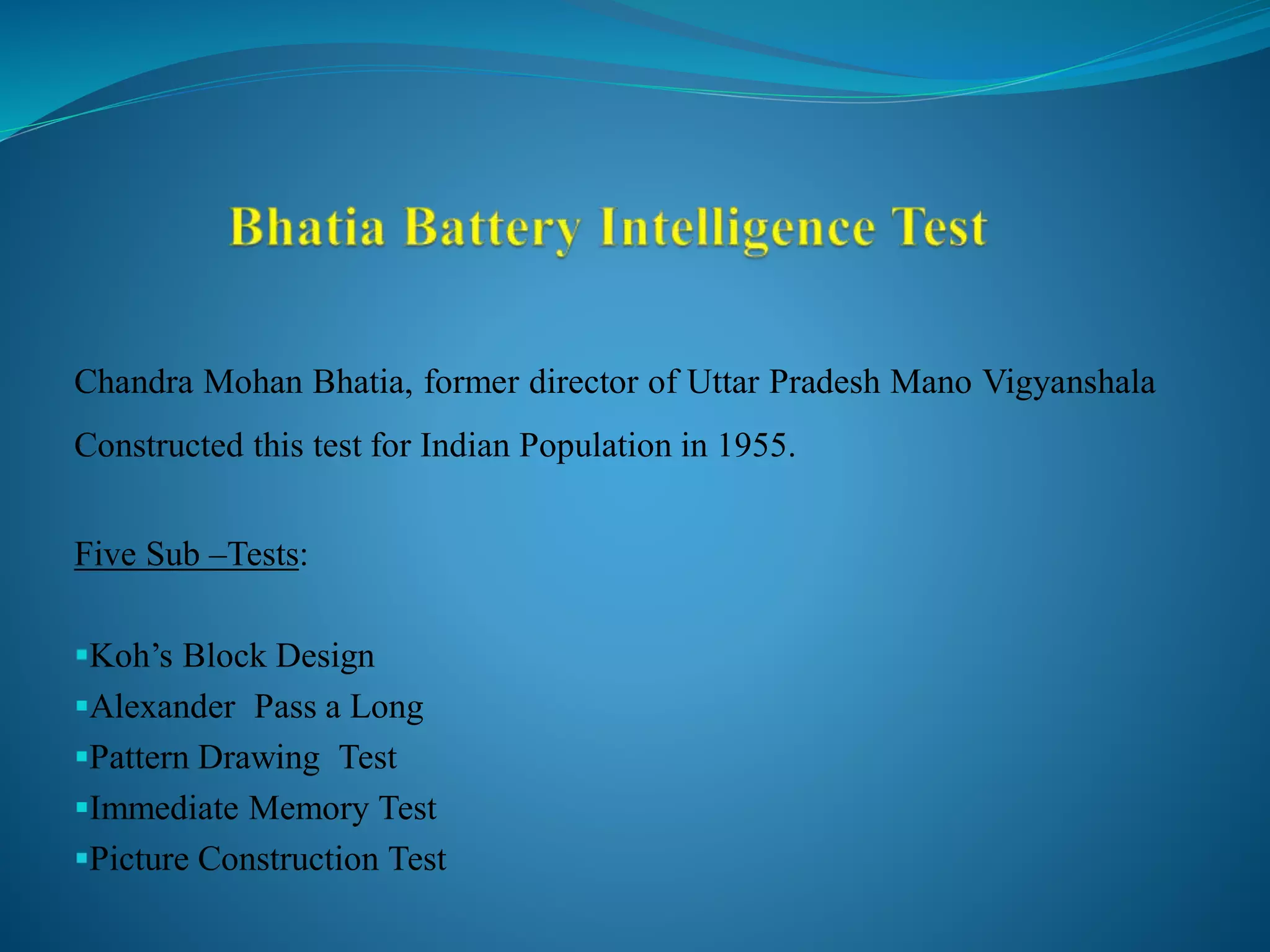
Chandra Mohan Bhatia, former director of Uttar Pradesh Mano Vigyanshala
Constructed this test for Indian Population in 1955.
Five Sub –Tests:
Koh’s Block Design
Alexander Pass a Long
Pattern Drawing Test
Immediate Memory Test
Picture Construction Test
Standardization of 05 subtests was done for over 4 years in village & cities
in place of cross cultural settings.
Split Half Reliability: .55
Validity: .77
Correlation with other intelligence tests is: .67-.82
Total Maximum time: 1 hour.
Total Maximum score: 95
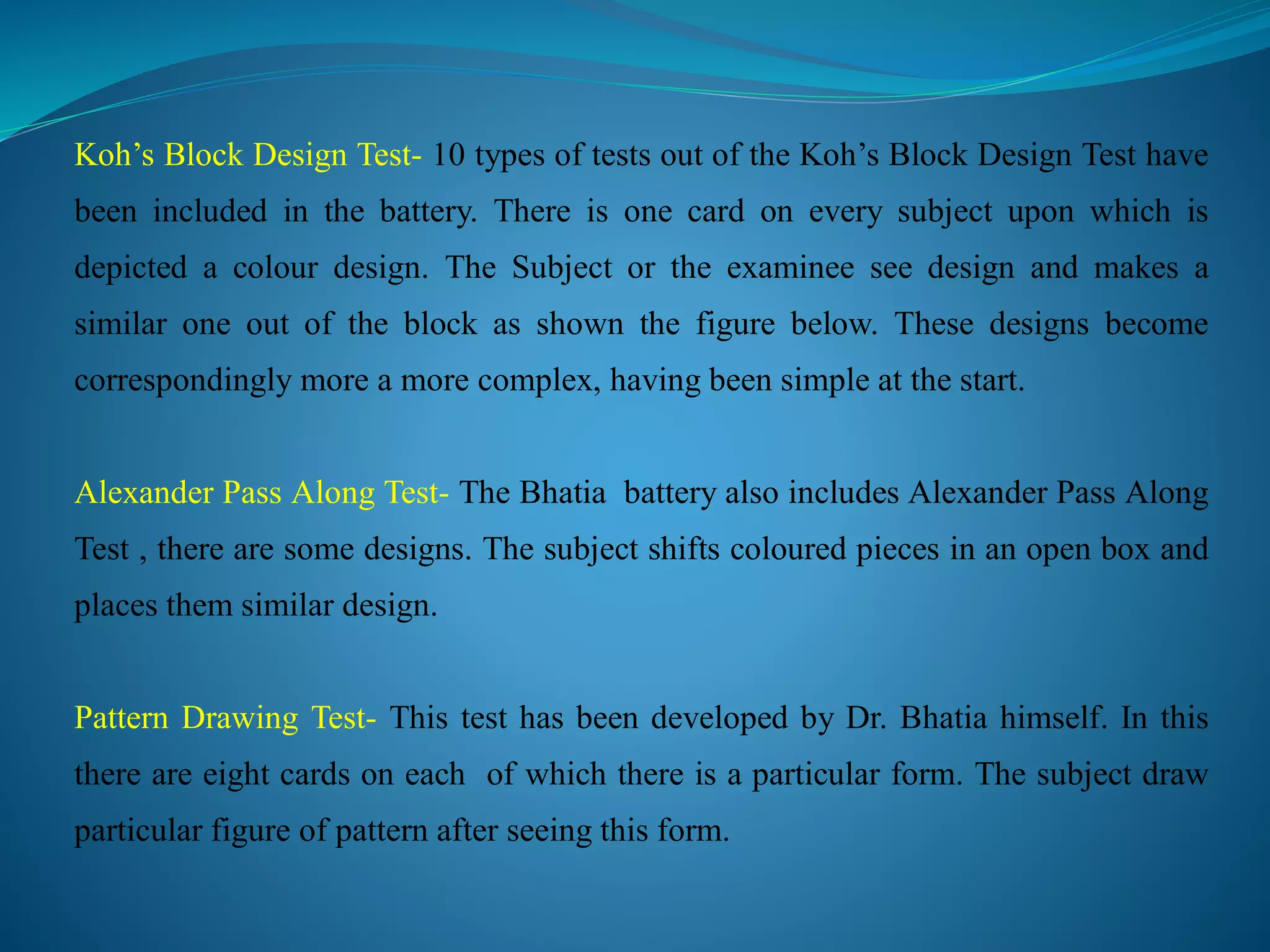
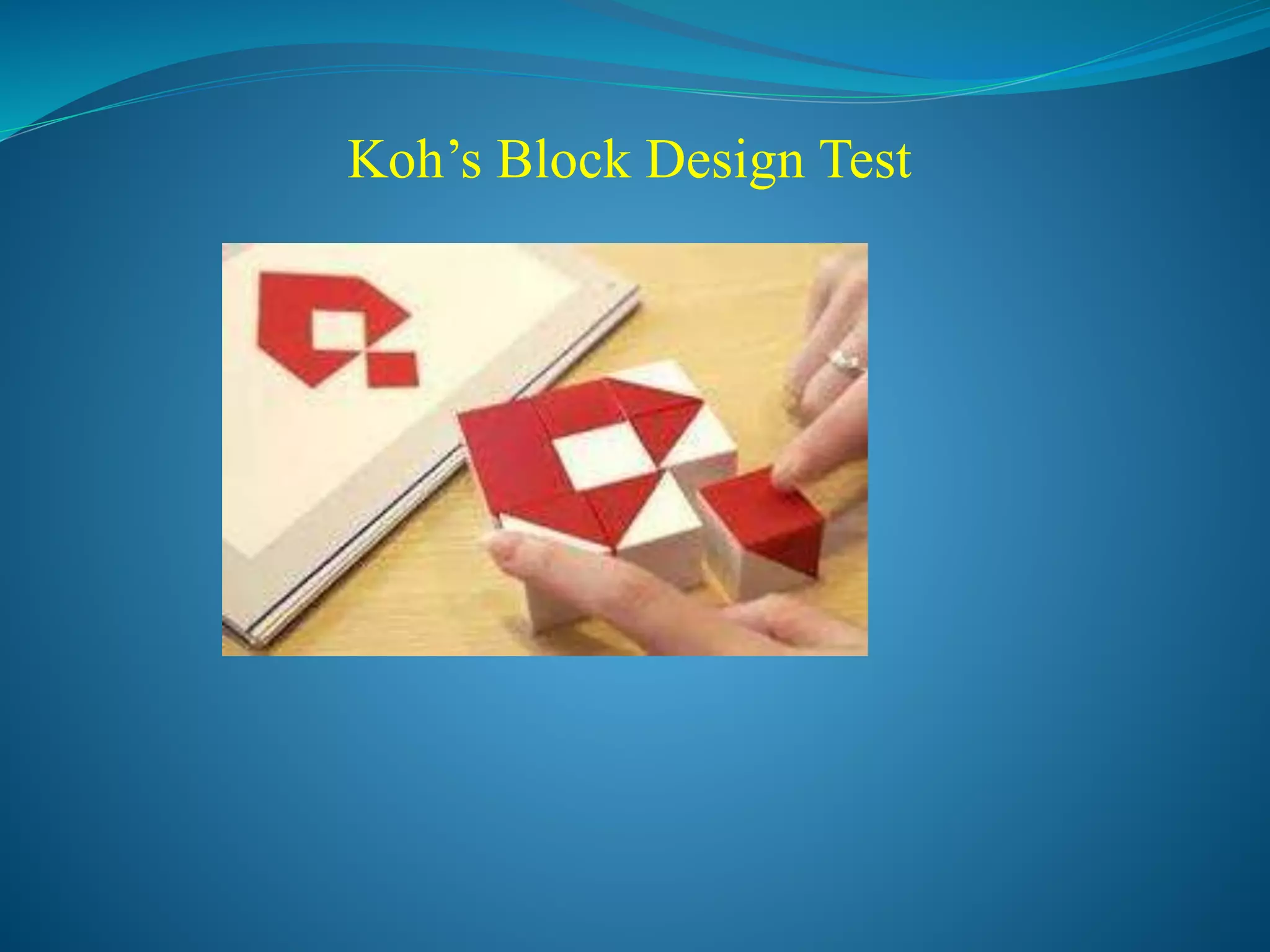
Koh’s Block Design Test- 10 types of tests out of the Koh’s Block Design Test have
been included in the battery. There is one card on every subject upon which is
depicted a colour design. The Subject or the examinee see design and makes a
similar one out of the block as shown the figure below. These designs become
correspondingly more a more complex, having been simple at the start.
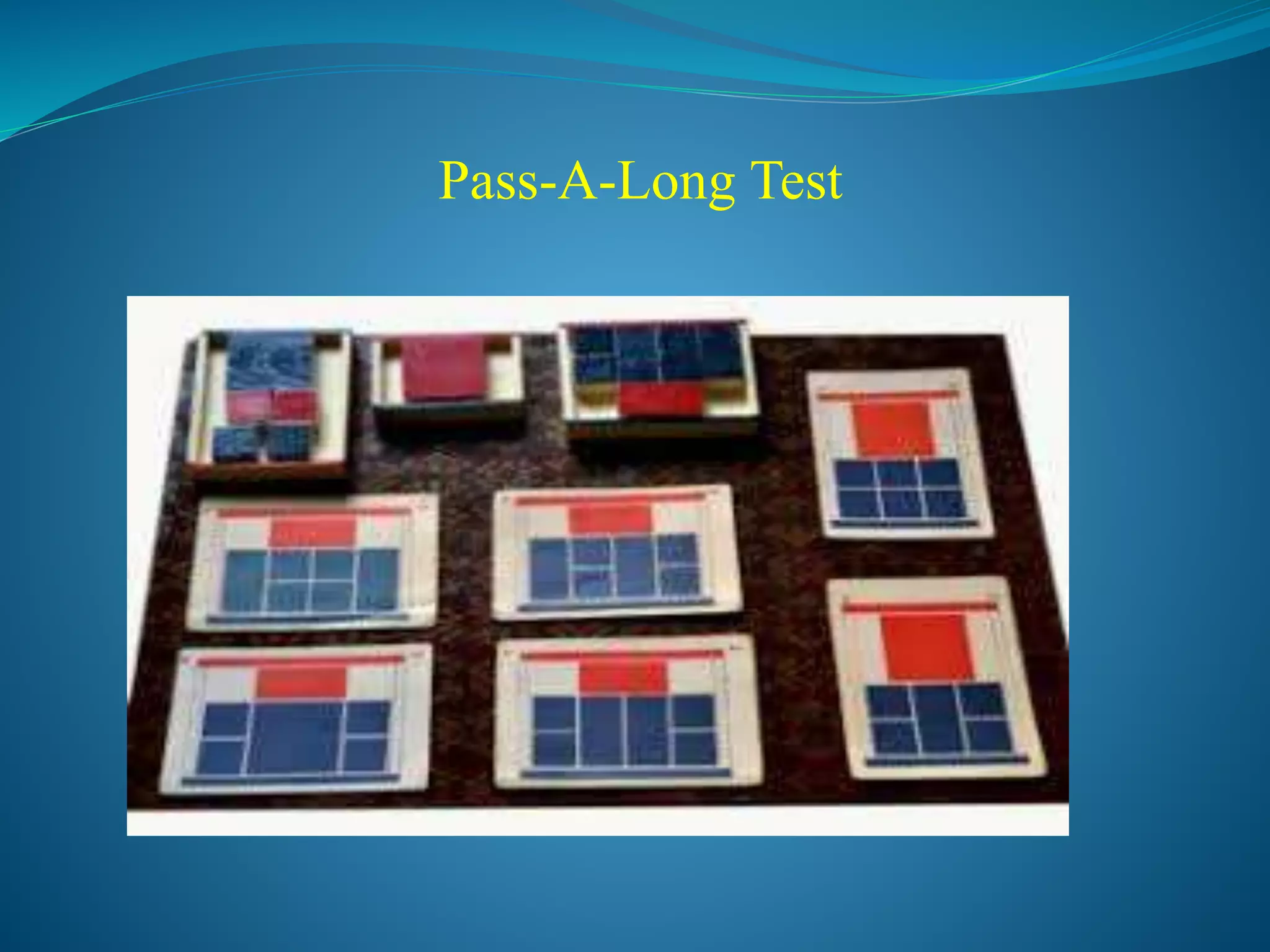
Alexander Pass Along Test- The Bhatia battery also includes Alexander Pass Along
Test , there are some designs. The subject shifts coloured pieces in an open box and
places them similar design.
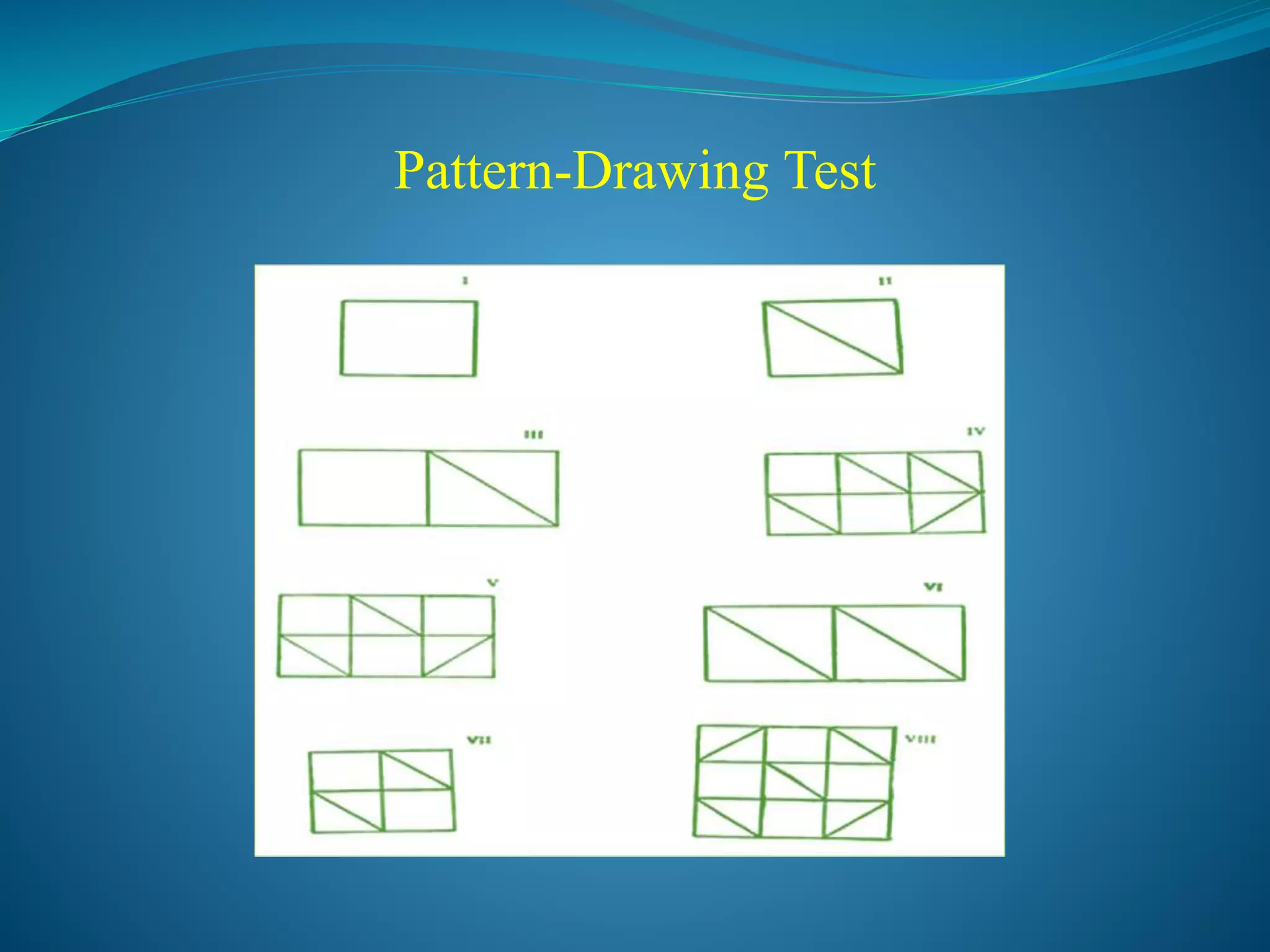
Pattern Drawing Test- This test has been developed by Dr. Bhatia himself. In this
there are eight cards on each of which there is a particular form. The subject draw
particular figure of pattern after seeing this form.
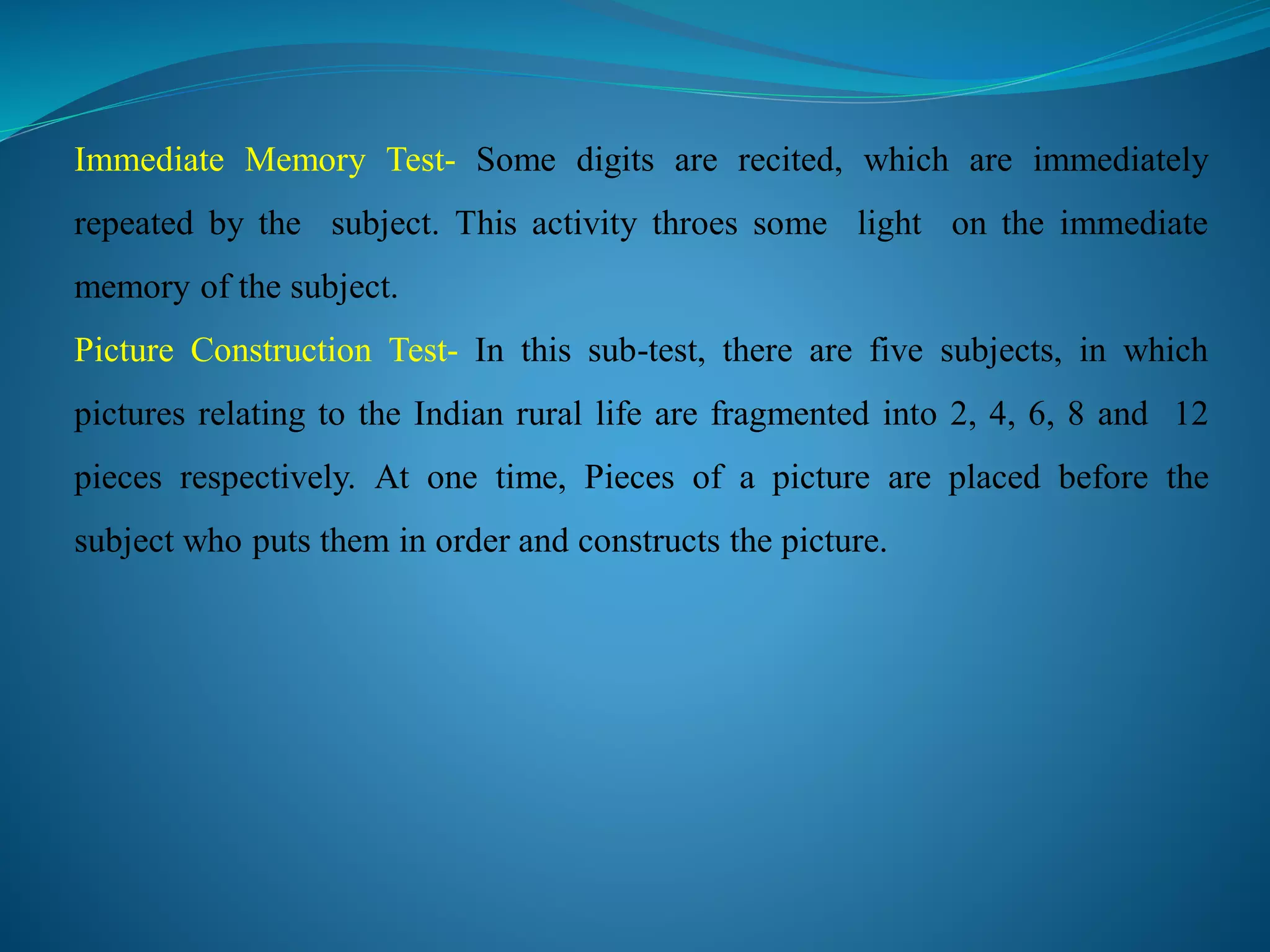
Immediate Memory Test- Some digits are recited, which are immediately
repeated by the subject. This activity throes some light on the immediate
memory of the subject.
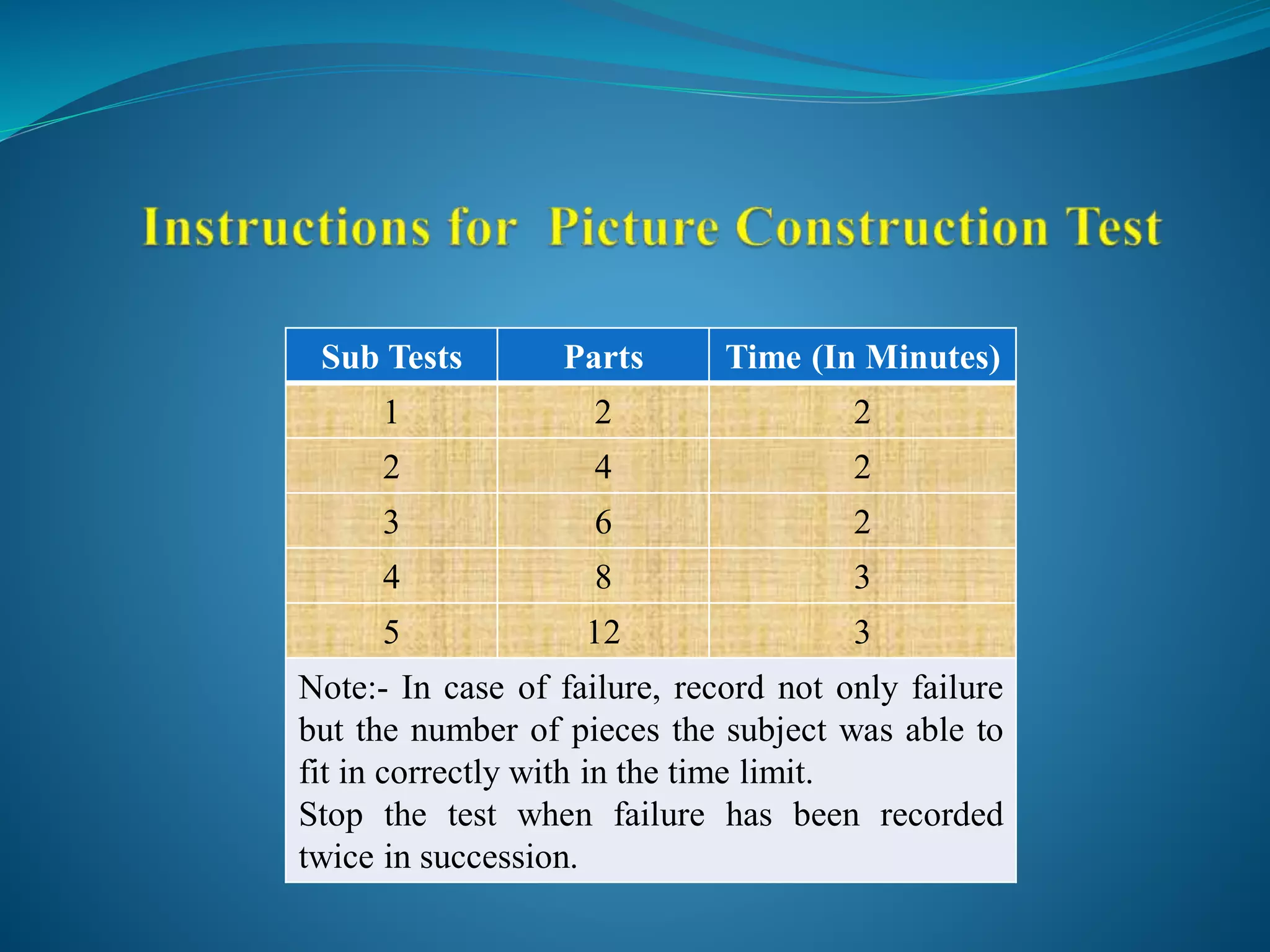
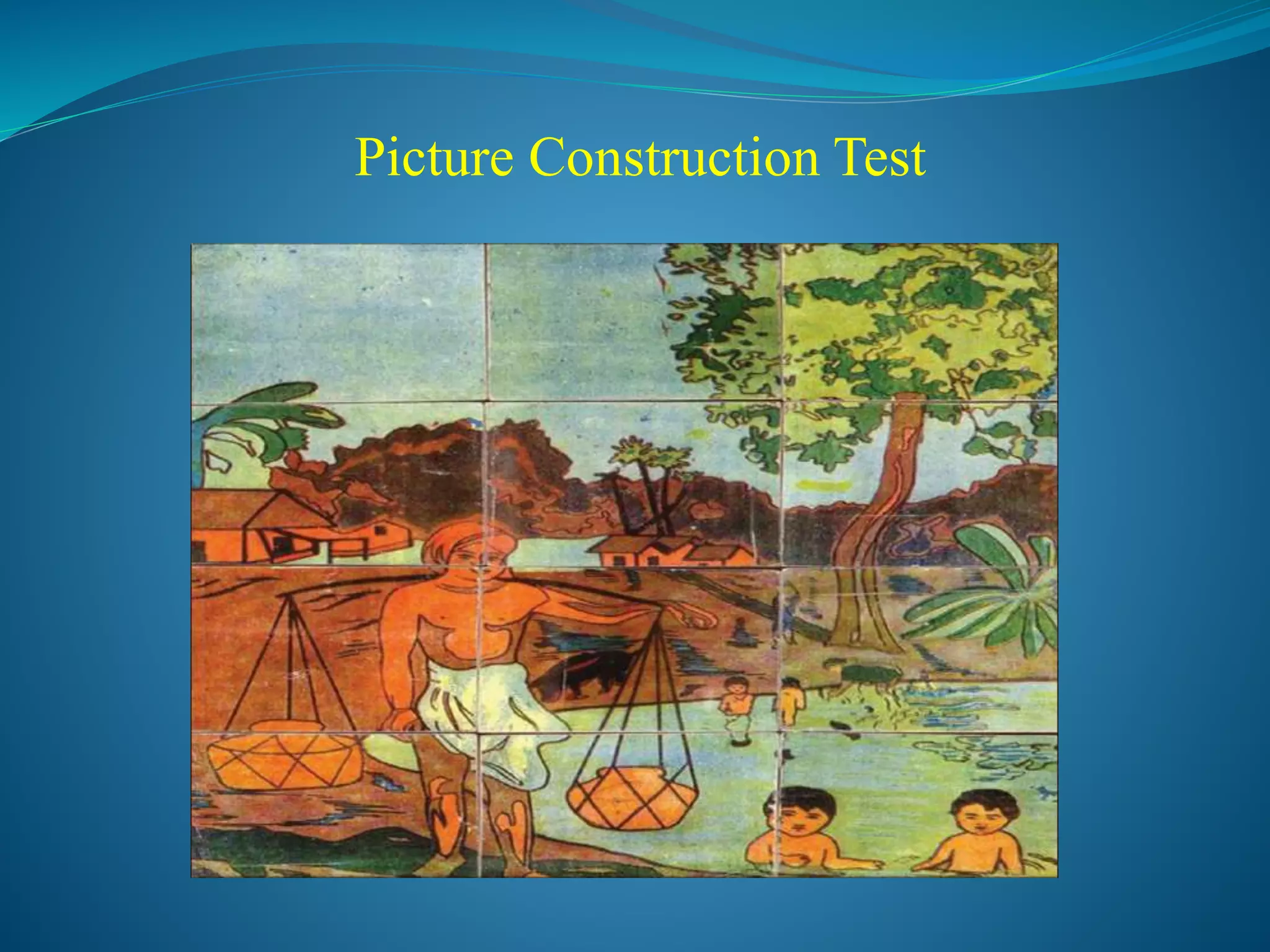
Picture Construction Test- In this sub-test, there are five subjects, in which
pictures relating to the Indian rural life are fragmented into 2, 4, 6, 8 and 12
pieces respectively. At one time, Pieces of a picture are placed before the
subject who puts them in order and constructs the picture.
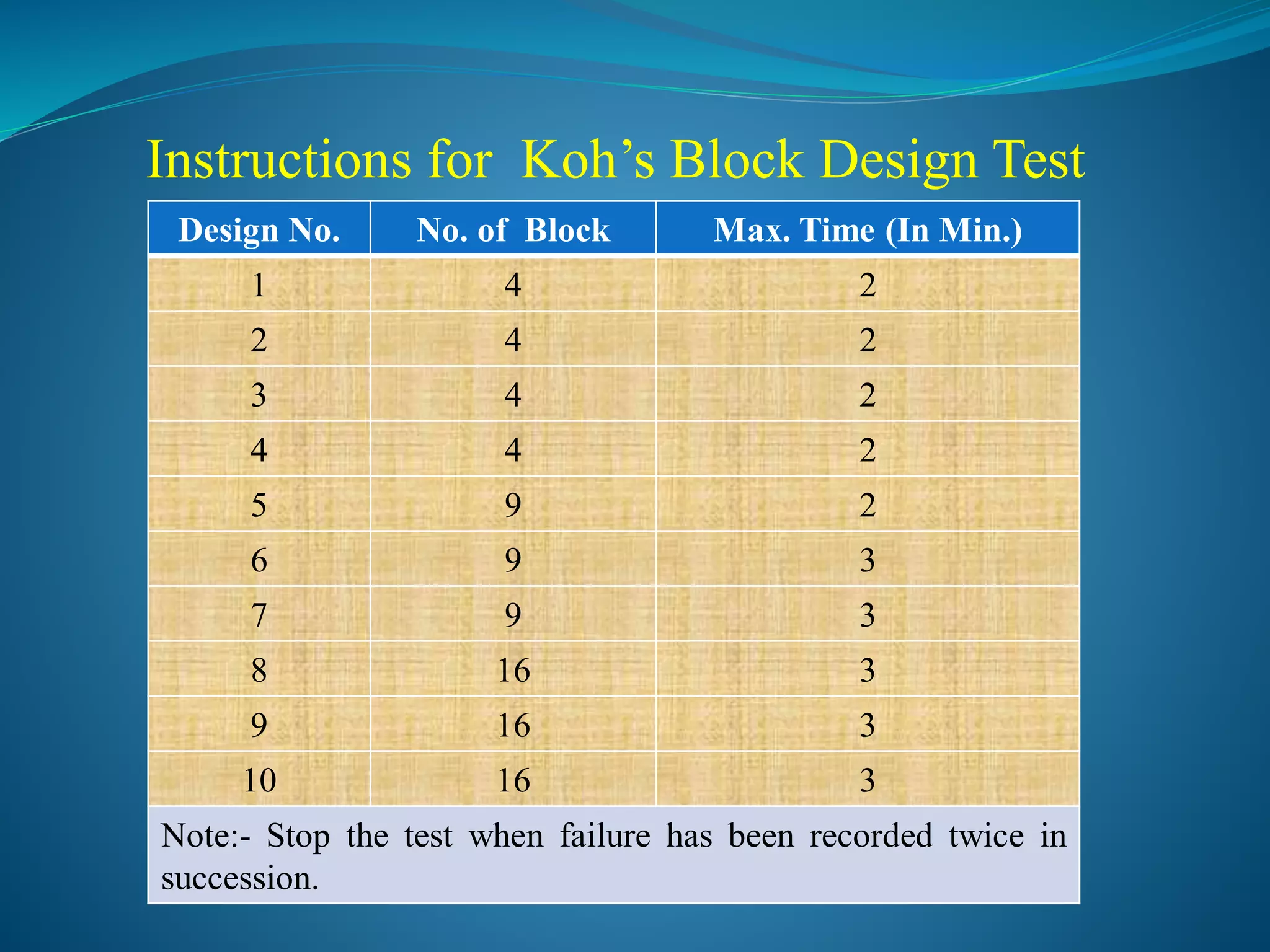
Instructions for Koh’s Block Design Test
Design No. No. of Block Max. Time (In Min.)
1 4 2
2 4 2
3 4 2
4 4 2
5 9 2
6 9 3
7 9 3
8 16 3
9 16 3
10 16 3
Note:- Stop the test when failure has been recorded twice in
succession.
Koh’s Block Design Test
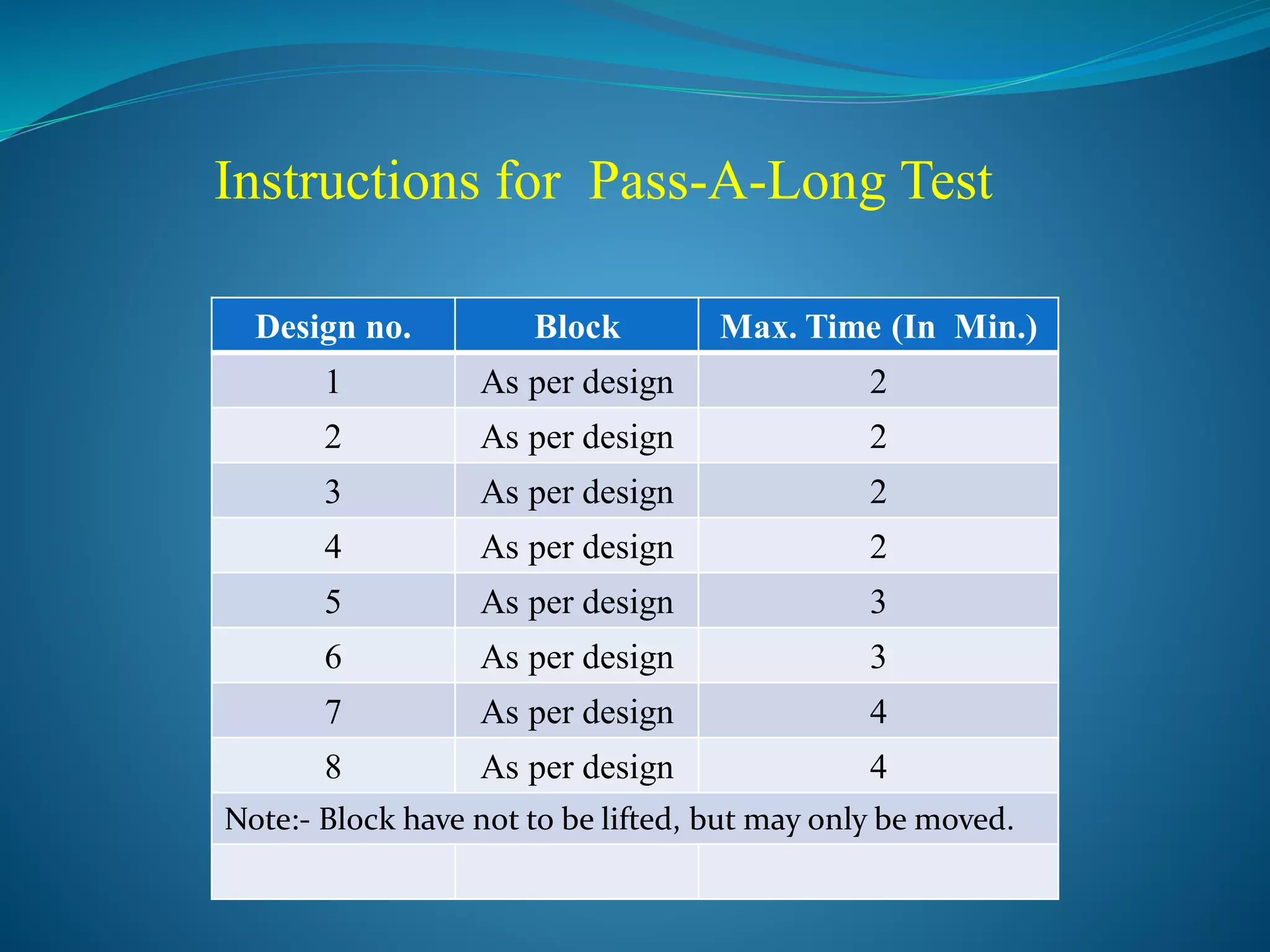
Instructions for Pass-A-Long Test
Design no. Block Max. Time (In Min.)
1 As per design 2
2 As per design 2
3 As per design 2
4 As per design 2
5 As per design 3
6 As per design 3
7 As per design 4
8 As per design 4
Note:- Block have not to be lifted, but may only be moved.
Pass-A-Long Test
There are eight patterns
Increasing difficulty from 1st to 8th
Without repeating lines and without lifting pencil
Stop the test when failure has been recorded twice in succession.
Maximum 2 minutes for each 4 patterns & 3 minutes for patterns no. 5-8
Pattern-Drawing Test
I will same thing.
Listen attentively.
Repeat it after I have finished.
We start with Two letters & last go to 9 letters.
We have Three alternative sets. If failure is recorded in the first set, try the
second and third alternative sets.
If failure is recorded in all the three alternatives a final failure is recorded and
we stop.
Sub Tests Parts Time (In Minutes)
1 2 2
2 4 2
3 6 2
4 8 3
5 12 3
Note:- In case of failure, record not only failure
but the number of pieces the subject was able to
fit in correctly with in the time limit.
Stop the test when failure has been recorded
twice in succession.
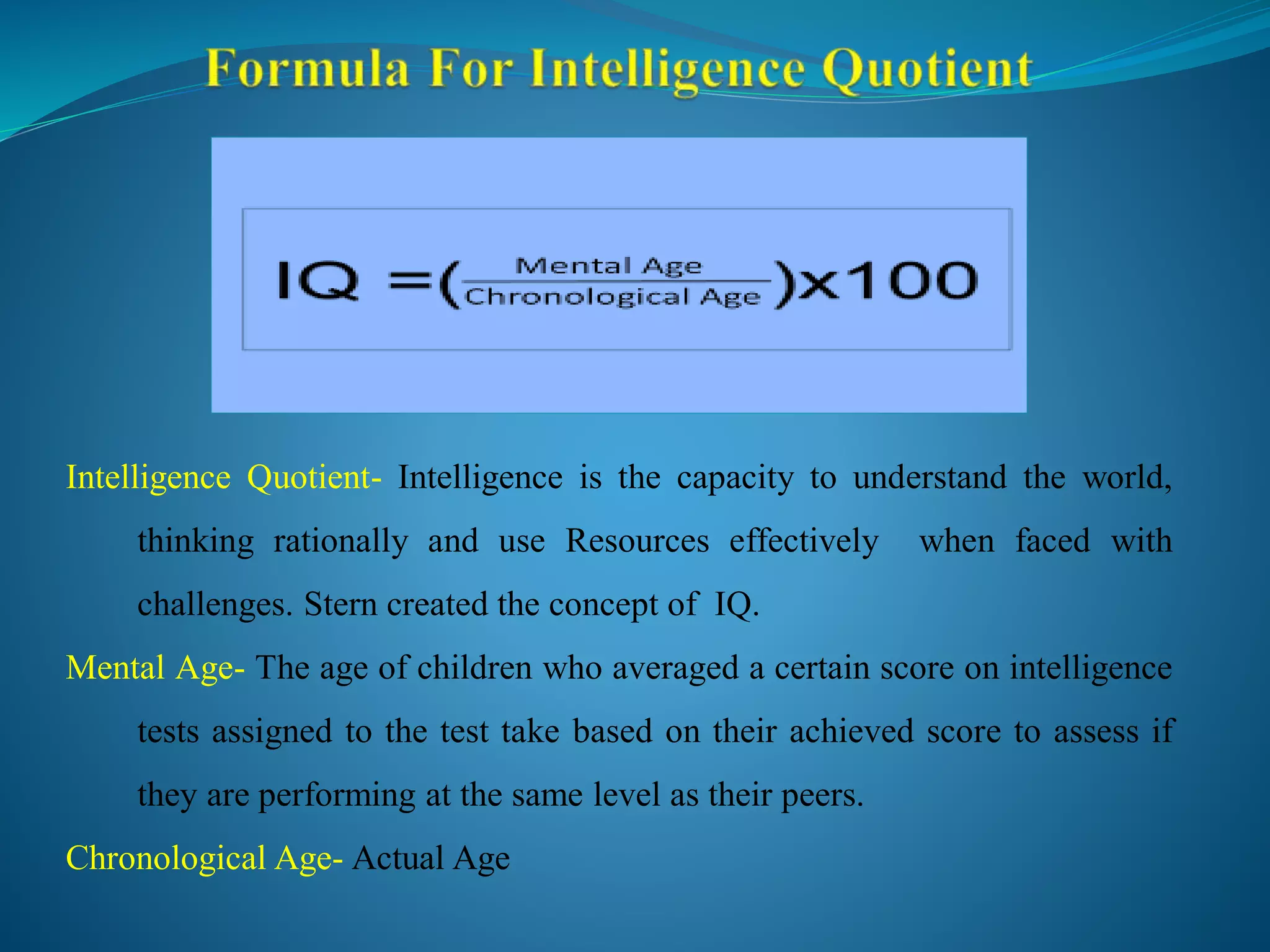
Intelligence Quotient- Intelligence is the capacity to understand the world,
thinking rationally and use Resources effectively when faced with
challenges. Stern created the concept of IQ.
Mental Age- The age of children who averaged a certain score on intelligence
tests assigned to the test take based on their achieved score to assess if
they are performing at the same level as their peers.
Chronological Age- Actual Age
Picture Construction Test
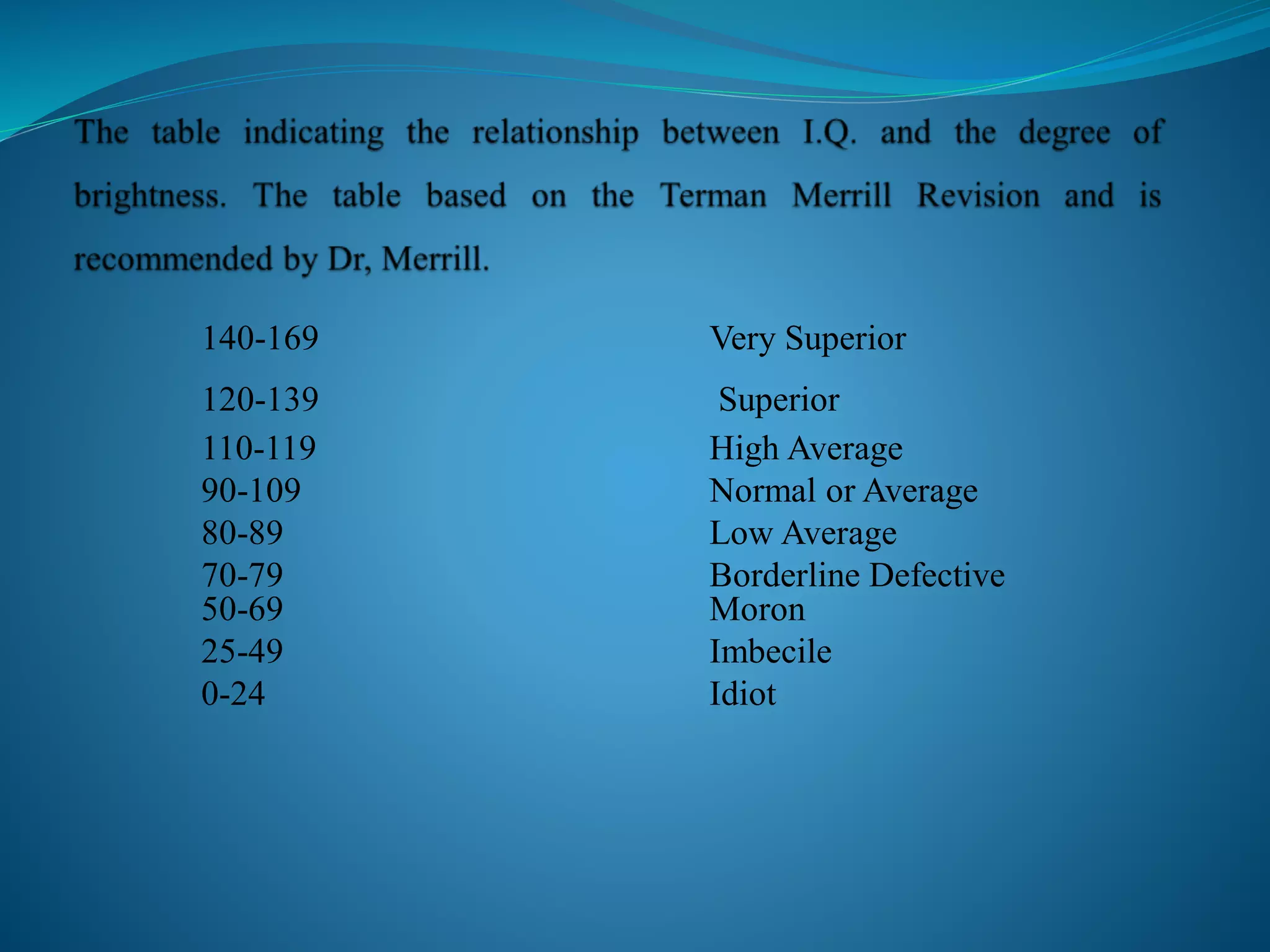
140-169 Very Superior
120-139 Superior
110-119 High Average
90-109 Normal or Average
80-89 Low Average
70-79 Borderline Defective
50-69 Moron
25-49 Imbecile
0-24 Idiot
 Administration Manual of Bhatia Performance Tests of Intelligence,pp.1-8
Feldman, S.Robert (2011). Understanding Psychology Edition 11th, Tata McGraw-Hill, New
Delhi, pp. 280. Maud A. Merrill (1938). I.Q.’s on the revised Stanford-Binet Scale’. Journal of
Educational Psychology 29, pp.641-651.
Morgan, T. Clifford, King, A. Richard, Weisz,R.John & Schopler, John, Introduction to
Psychology, Edition 1993 McGraw-Hill, New Delhi, pp. 531-537.
Pahuja ,Sudha Encyclopedia of Fundamental of Educational Psychology ,Vol-I, R. Lall Book
Depot, Meerut, pp.308-312.
 Santrock, W.John, Educational Psychology , Edition 4th, Tata McGraw-Hill, New Delhi, pp.
146.

9 Bhatia Battery Performance Test.pdf

  • 1.
  • 2.
     “Intelligence isthe ability to adjust oneself to a new situation.” W. Stern 1914  “Intelligence is the ability to think abstractly.” Terman 1921  “Intelligence is sometime described as the ability to learn quickly and to retain learning .” Haber and Fried 1975  Intelligence is the capacity to understand the world, thinking rationally and use Resources effectively when faced with challenges.” Feldman (Known)
  • 3.
    Classification on thebasis of Administration  Individual Intelligence Test : Test given one on one by a certified evaluator, most commonly used for educational placement decisions. Like- Koh’s Block Test, Pass Along Test  Group Intelligence Test : Given to a large group or whole class, Administrated by teacher s as a screening process to determine who differs from the average and a closer look or individual test. Like- Army Alpha Test, Army Beta Test Classification on the basis of Posts  Verbal Intelligence Test  Non- Verbal Intelligence Test  Performance Intelligence Test  Non- Language Intelligence Test
  • 5.
    Chandra Mohan Bhatia,former director of Uttar Pradesh Mano Vigyanshala Constructed this test for Indian Population in 1955. Five Sub –Tests: Koh’s Block Design Alexander Pass a Long Pattern Drawing Test Immediate Memory Test Picture Construction Test
  • 6.
    Standardization of 05subtests was done for over 4 years in village & cities in place of cross cultural settings. Split Half Reliability: .55 Validity: .77 Correlation with other intelligence tests is: .67-.82 Total Maximum time: 1 hour. Total Maximum score: 95
  • 7.
    Koh’s Block DesignTest- 10 types of tests out of the Koh’s Block Design Test have been included in the battery. There is one card on every subject upon which is depicted a colour design. The Subject or the examinee see design and makes a similar one out of the block as shown the figure below. These designs become correspondingly more a more complex, having been simple at the start. Alexander Pass Along Test- The Bhatia battery also includes Alexander Pass Along Test , there are some designs. The subject shifts coloured pieces in an open box and places them similar design. Pattern Drawing Test- This test has been developed by Dr. Bhatia himself. In this there are eight cards on each of which there is a particular form. The subject draw particular figure of pattern after seeing this form.
  • 8.
    Immediate Memory Test-Some digits are recited, which are immediately repeated by the subject. This activity throes some light on the immediate memory of the subject. Picture Construction Test- In this sub-test, there are five subjects, in which pictures relating to the Indian rural life are fragmented into 2, 4, 6, 8 and 12 pieces respectively. At one time, Pieces of a picture are placed before the subject who puts them in order and constructs the picture.
  • 9.
    Instructions for Koh’sBlock Design Test Design No. No. of Block Max. Time (In Min.) 1 4 2 2 4 2 3 4 2 4 4 2 5 9 2 6 9 3 7 9 3 8 16 3 9 16 3 10 16 3 Note:- Stop the test when failure has been recorded twice in succession.
  • 10.
  • 11.
    Instructions for Pass-A-LongTest Design no. Block Max. Time (In Min.) 1 As per design 2 2 As per design 2 3 As per design 2 4 As per design 2 5 As per design 3 6 As per design 3 7 As per design 4 8 As per design 4 Note:- Block have not to be lifted, but may only be moved.
  • 12.
  • 13.
    There are eightpatterns Increasing difficulty from 1st to 8th Without repeating lines and without lifting pencil Stop the test when failure has been recorded twice in succession. Maximum 2 minutes for each 4 patterns & 3 minutes for patterns no. 5-8
  • 14.
  • 15.
    I will samething. Listen attentively. Repeat it after I have finished. We start with Two letters & last go to 9 letters. We have Three alternative sets. If failure is recorded in the first set, try the second and third alternative sets. If failure is recorded in all the three alternatives a final failure is recorded and we stop.
  • 16.
    Sub Tests PartsTime (In Minutes) 1 2 2 2 4 2 3 6 2 4 8 3 5 12 3 Note:- In case of failure, record not only failure but the number of pieces the subject was able to fit in correctly with in the time limit. Stop the test when failure has been recorded twice in succession.
  • 17.
    Intelligence Quotient- Intelligenceis the capacity to understand the world, thinking rationally and use Resources effectively when faced with challenges. Stern created the concept of IQ. Mental Age- The age of children who averaged a certain score on intelligence tests assigned to the test take based on their achieved score to assess if they are performing at the same level as their peers. Chronological Age- Actual Age
  • 18.
  • 19.
    140-169 Very Superior 120-139Superior 110-119 High Average 90-109 Normal or Average 80-89 Low Average 70-79 Borderline Defective 50-69 Moron 25-49 Imbecile 0-24 Idiot
  • 20.
     Administration Manualof Bhatia Performance Tests of Intelligence,pp.1-8 Feldman, S.Robert (2011). Understanding Psychology Edition 11th, Tata McGraw-Hill, New Delhi, pp. 280. Maud A. Merrill (1938). I.Q.’s on the revised Stanford-Binet Scale’. Journal of Educational Psychology 29, pp.641-651. Morgan, T. Clifford, King, A. Richard, Weisz,R.John & Schopler, John, Introduction to Psychology, Edition 1993 McGraw-Hill, New Delhi, pp. 531-537. Pahuja ,Sudha Encyclopedia of Fundamental of Educational Psychology ,Vol-I, R. Lall Book Depot, Meerut, pp.308-312.  Santrock, W.John, Educational Psychology , Edition 4th, Tata McGraw-Hill, New Delhi, pp. 146.