Culture Fair Intelligence Tests
(CFIT)
by Raymond B. Cattell
A. Karen S. Cattell
Slides created by
Clarence G. Apostol
MA in Counseling Psychology
De La Salle University-Manila
CPS 560M:
Assessment Tools in Counseling
Introduction
Raymond B. Cattell divided general intelligence into
two distinct types: crystallized and fluid.
Crystallized intelligence represents knowledge
acquired through experience.
Tests of crystallized intelligence, such as verbal
memory and general knowledge, are thought to reflect
the influence of culture and schooling.
Fluid intelligence represents the biological ability to
acquire knowledge and solve problems.
Tests that reflect fluid intelligence, such as reasoning
speed, spatial reasoning, and inductive reasoning, are
thought to reflect intelligence independent of learning.
Cattell developed a “culture-fair” test to measure fluid
intelligence.
Purpose:
The Culture Fair Intelligence Tests measures
individual intelligence in a manner designed to
reduced, as much as possible, the influence of
verbal fluency, cultural climate, and educational
level.
The tests, which may be administered individually
or in a group, are non-verbal and require only the
examinees be able to perceive relationships in
shapes and figures.
Each scale contains 4 subtests involving different
perceptual tasks, so that the composite intelligence
measure avoids spurious reliance on a single skill.
Purpose:
It aids in the identification of learning
problems and helps in making more
reliable and informed decisions in relation
to the special education needs of children.
 Other uses include selecting students for
accelerated educational programs, advising
students as to probable success in college,
and increasing effectiveness of vocational
guidance decisions, for both students and
adults.
History
late 1920’s-Began in the work undertaken by
Cattell, sparked the precise scientific research of
Charles Spearman into the nature and accurate
measurement of intelligence.
1930-resulted in the publication of the Cattell
Group and Inventory (particularly intended for
use with children) were revised and recast into
non-verbal form to diminish the unwanted and
unnecessary effects of verbal fluency in the pure
measurement of intelligence
History
1940-another revision of the test appeared. Items
had become completely perceptual and were
organized into 6 subtest, 3 of which have been
retained in the present format. Of the 159 items
analyzes, 72 of satisfactory validity and reliability
were retained for the published edition
1949-another revision and adopted the format
consisting of 4 subtest (Series, Classification,
Matrices and Conditions)
1961-primary outcome of this revision were slight
adjustments in the difficulty level and sequencing
of few items. At the same time the few samples
were expanded to achieve better national
representation in the final tables.
Age/Range:
Scale 1: 4 to 8 years and older, mentally
handicapped individuals
Scale 2: 8-14 years and average adults
Scale 3: 14 to college students and adults
of superior intelligence
Requirements for Purchase:
Level B
Requirements for Purchase
(Philippine Psychological Corporation, 1995)
LEVEL A- available if the person administering the
tests had undergraduate courses in testing or
psychometrics, or sufficient training and experience
in test administration.
LEVEL B- available only if the test administrator
has completed an advanced level course in testing
in a university, or its equivalent in training under
the direction of a qualified superior or consultant
LEVEL C- available only for use, by, or under the
supervision of qualified psychologists, i.e. members
of APA or the PAP or other persons with at least a
Master’s Degree in psychology and at least one year
experience under professional supervision
Reliability:
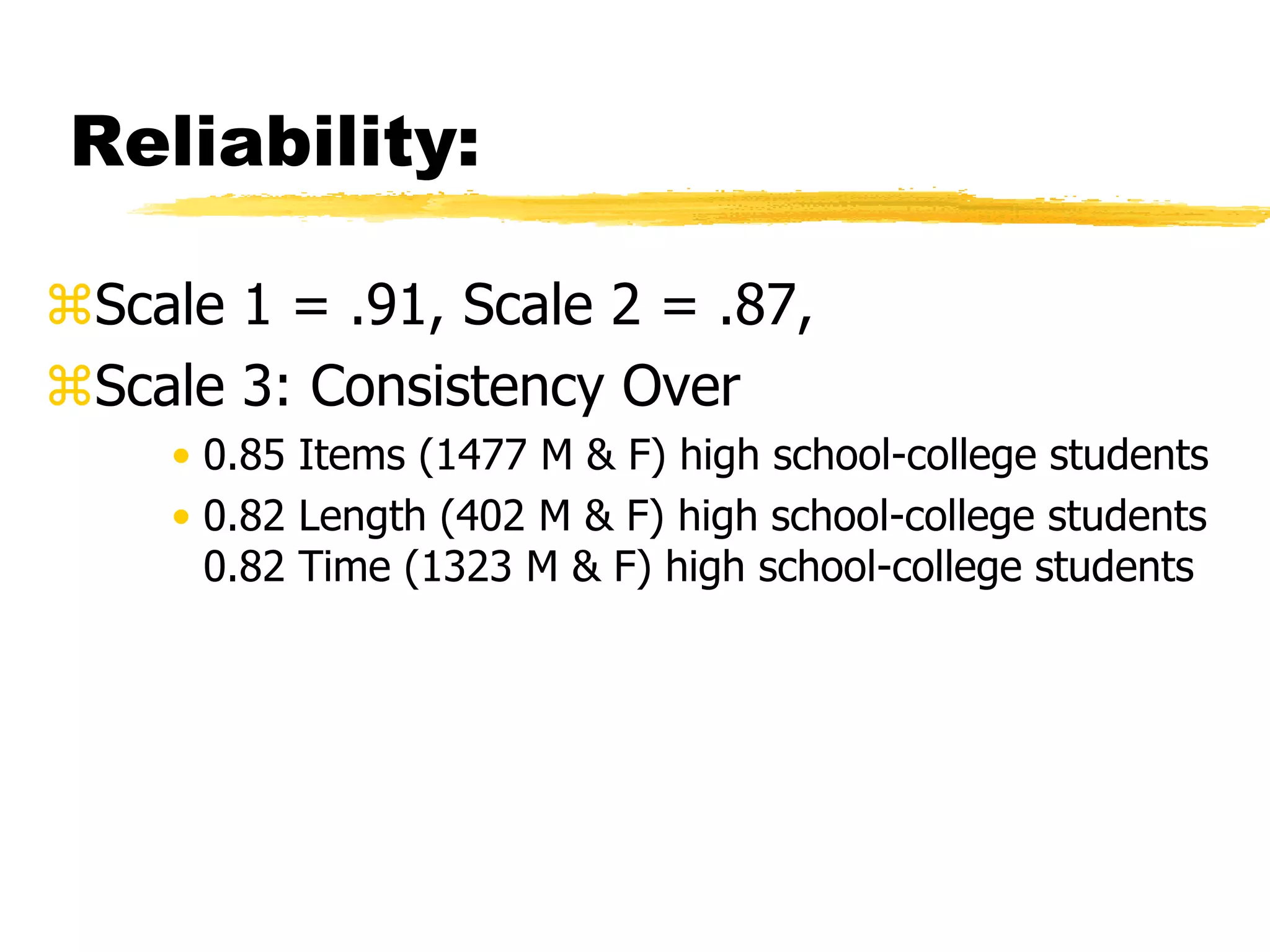
Scale 1 = .91, Scale 2 = .87,
Scale 3: Consistency Over
• 0.85 Items (1477 M & F) high school-college students
• 0.82 Length (402 M & F) high school-college students
0.82 Time (1323 M & F) high school-college students
Validity: Scale 3
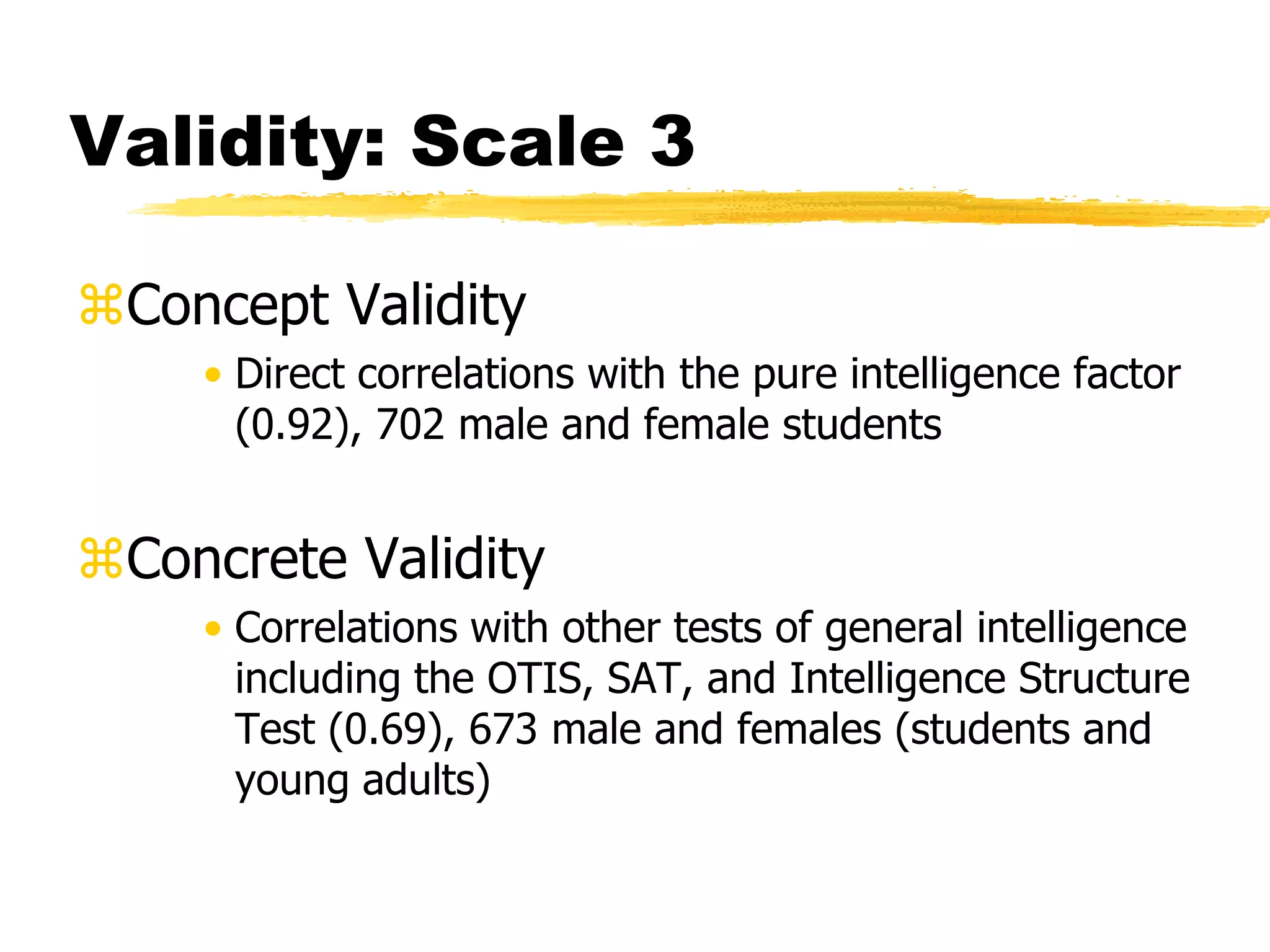
Concept Validity
• Direct correlations with the pure intelligence factor
(0.92), 702 male and female students
Concrete Validity
• Correlations with other tests of general intelligence
including the OTIS, SAT, and Intelligence Structure
Test (0.69), 673 male and females (students and
young adults)
Time
Description of the Subtest:
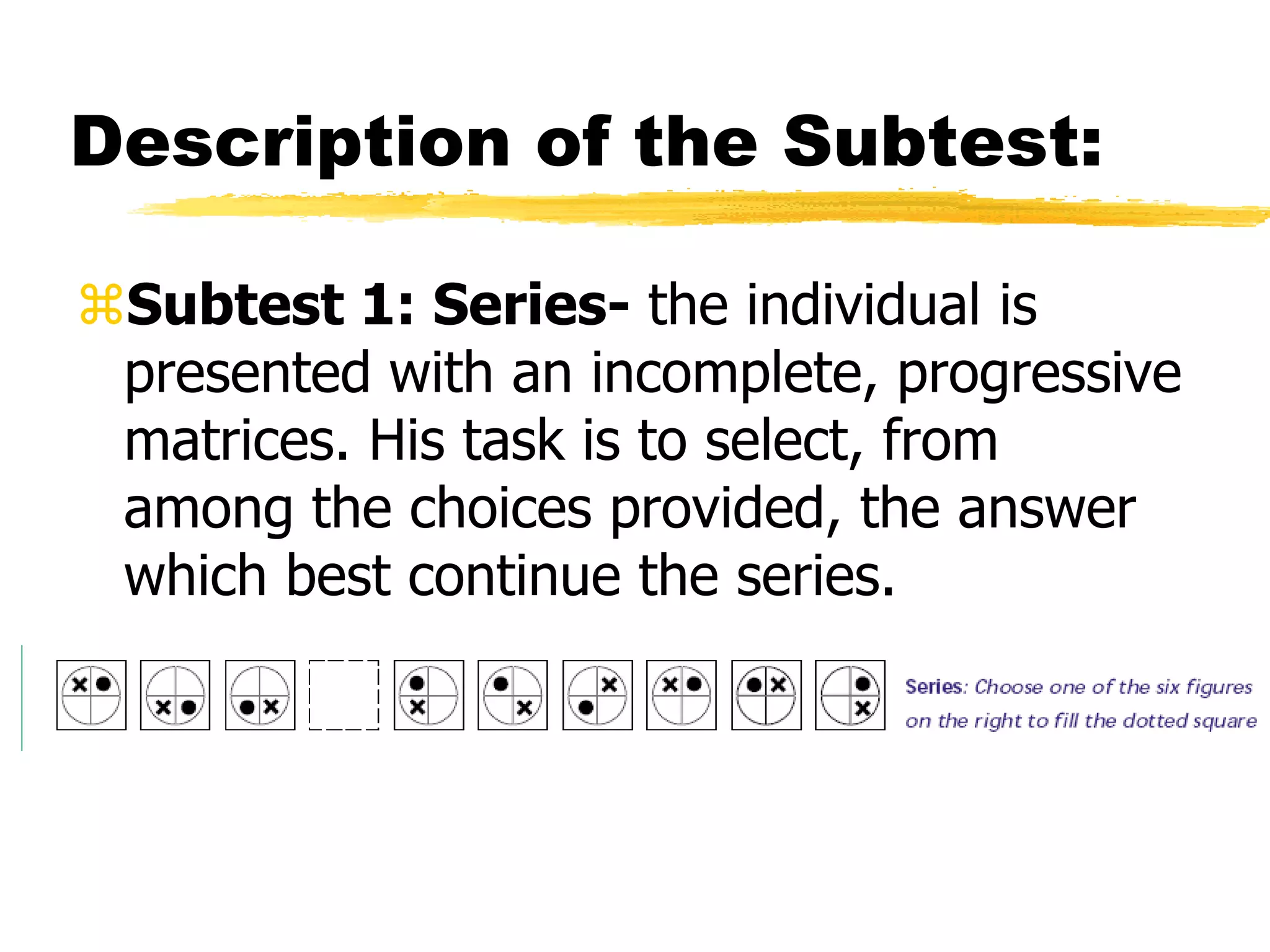
Subtest 1: Series- the individual is
presented with an incomplete, progressive
matrices. His task is to select, from
among the choices provided, the answer
which best continue the series.
Description of the Subtest:
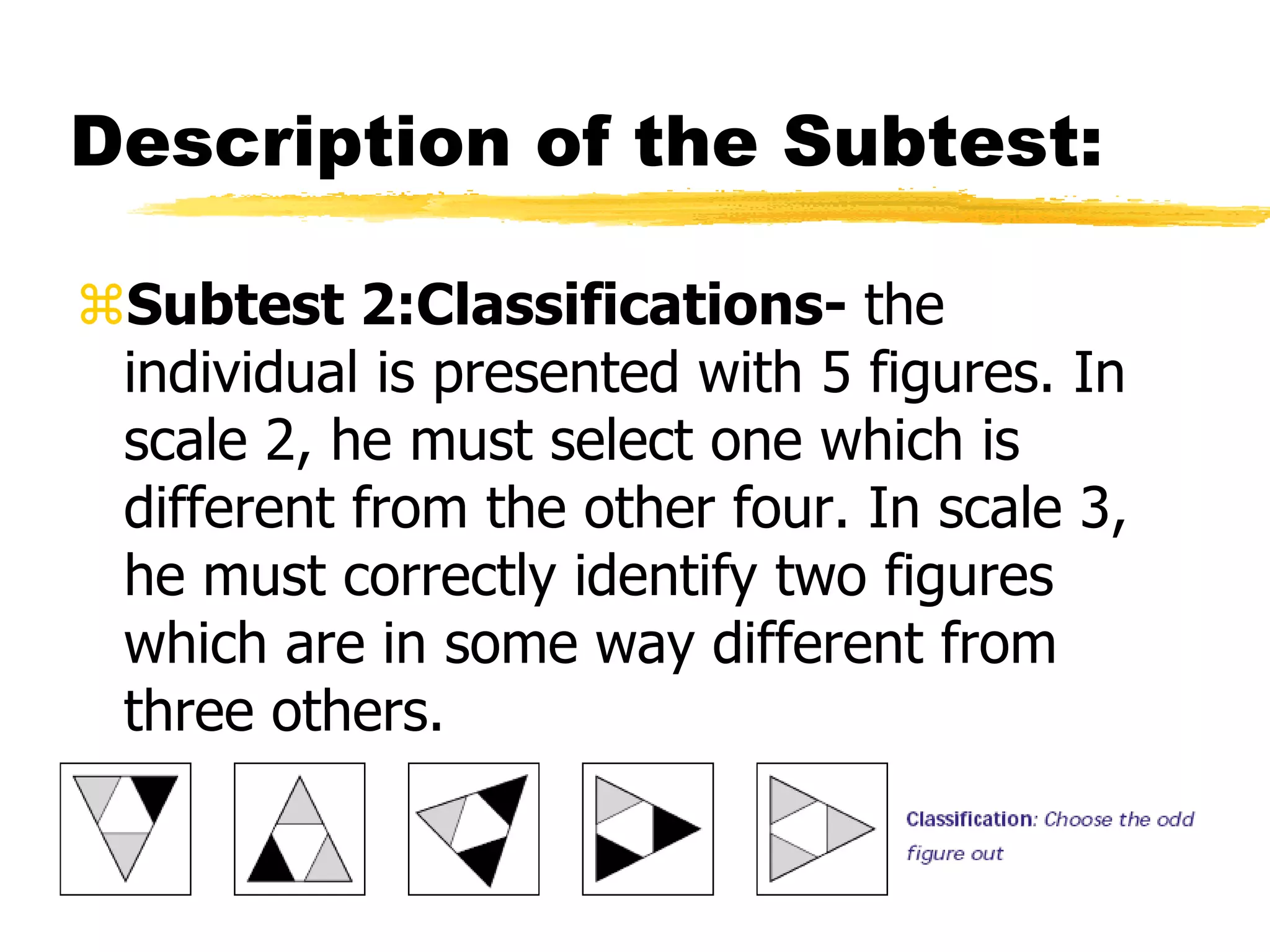
Subtest 2:Classifications- the
individual is presented with 5 figures. In
scale 2, he must select one which is
different from the other four. In scale 3,
he must correctly identify two figures
which are in some way different from
three others.
Description of the Subtest:
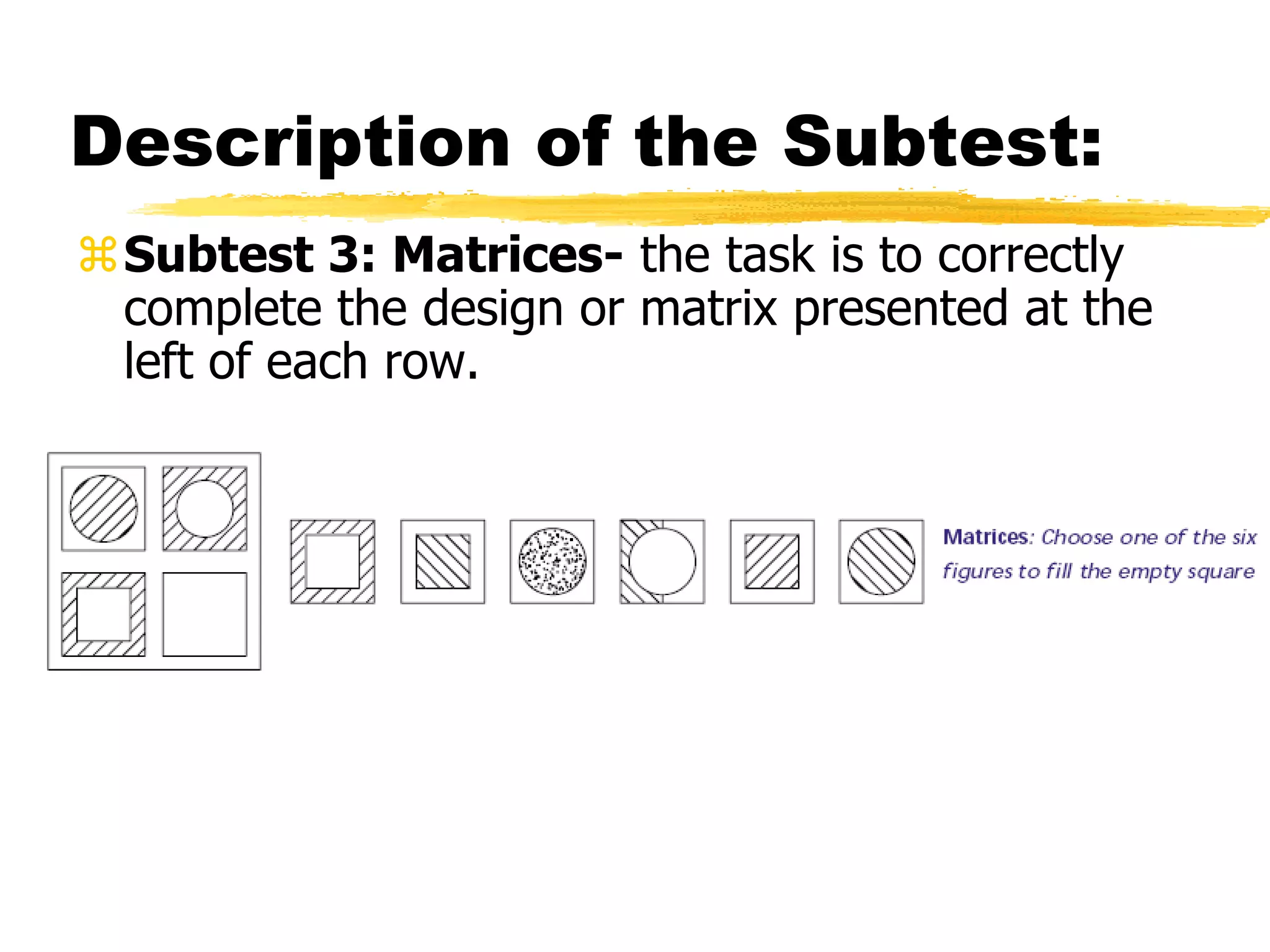
Subtest 3: Matrices- the task is to correctly
complete the design or matrix presented at the
left of each row.
Description of the Subtest:
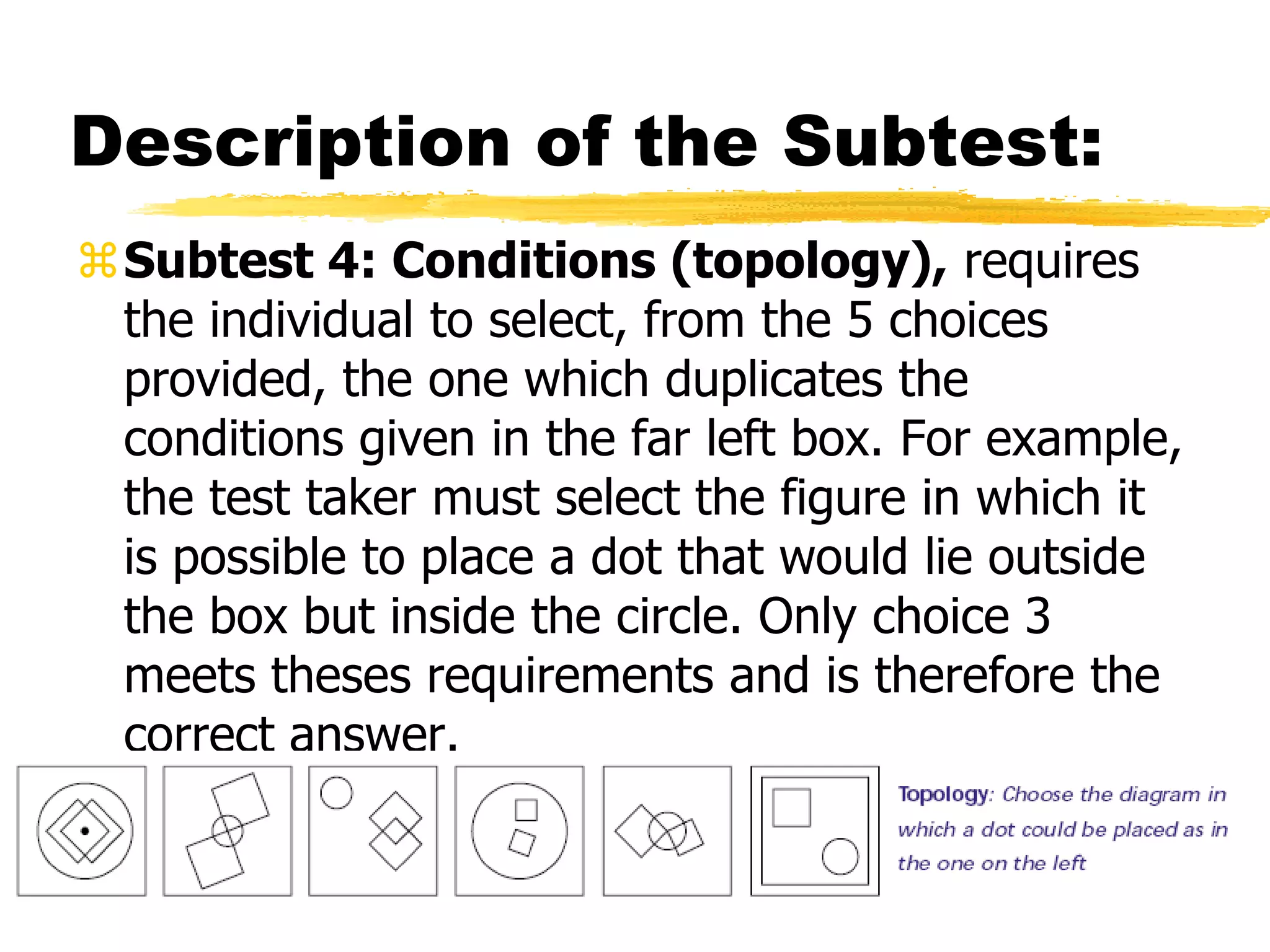
Subtest 4: Conditions (topology), requires
the individual to select, from the 5 choices
provided, the one which duplicates the
conditions given in the far left box. For example,
the test taker must select the figure in which it
is possible to place a dot that would lie outside
the box but inside the circle. Only choice 3
meets theses requirements and is therefore the
correct answer.
Administration
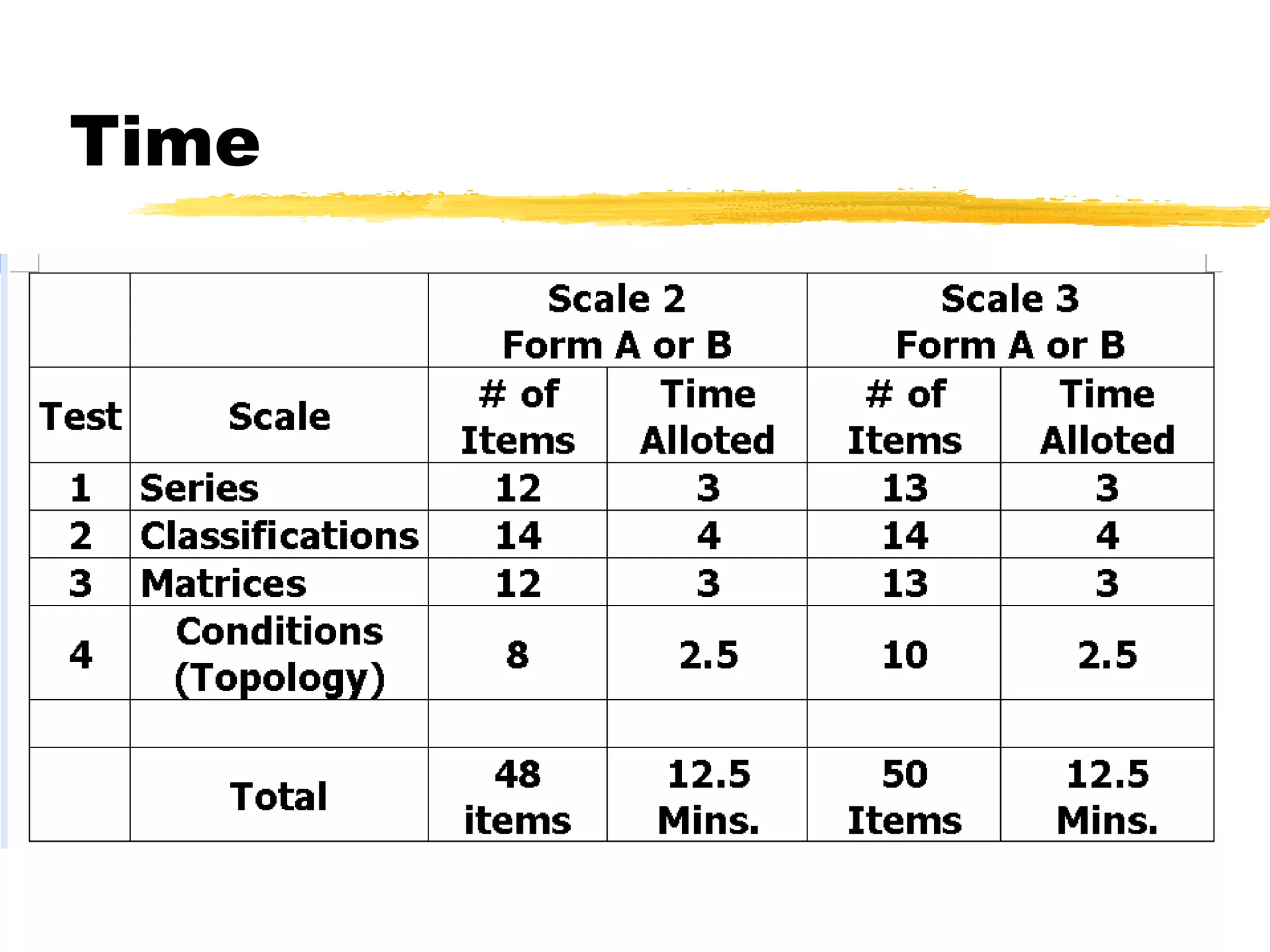
Test 1. (3 minutes)
• At the left there are four little boxes. The last one is
empty. Continuing along that row, you see six more boxes,
marked a, b, c, d, e and f. of those six boxes, one will fit
correctly in the empty box. (after 3 minutes, say STOP!
Pencils down)
Test 2. (4 minutes)
• Three of the boxes in each example have shapes that are
alike in some way, but the other two are different from these
three. In each row, you are to find the two boxes that are
different from the others. When you have found them, fill in
on your answer sheet the two boxes that have the same
letters under them as the answers you have chosen. (after 4
minutes, say STOP! Pencils down)
Administration
Test 3. (3 minutes)
• In the large square, there are four little boxes. Three of
the boxes have drawings in them, but the drawing for the
other square is missing. One of the boxes in the row at the
right fits correctly in the empty box. You are to choose the
right one and mark the answer on your answer sheet.
(after 3 minutes, say STOP! Pencils down)
Test 4. (2.5 minutes)
• In the separate square of the first example, there is dot
which is in both the circle and the square. Now look at the
five possible answers and see if you can find a drawing
where you could put in one dot that will be inside both the
circle and square. (after 2 and ½ minutes, say STOP!
Pencils down)
Scoring:
Hand Scoring
Norms:
For Scale 1: Mental age and IQ norms.
Scale 2 and Scale 3: Percentiles, by ages
and IQs
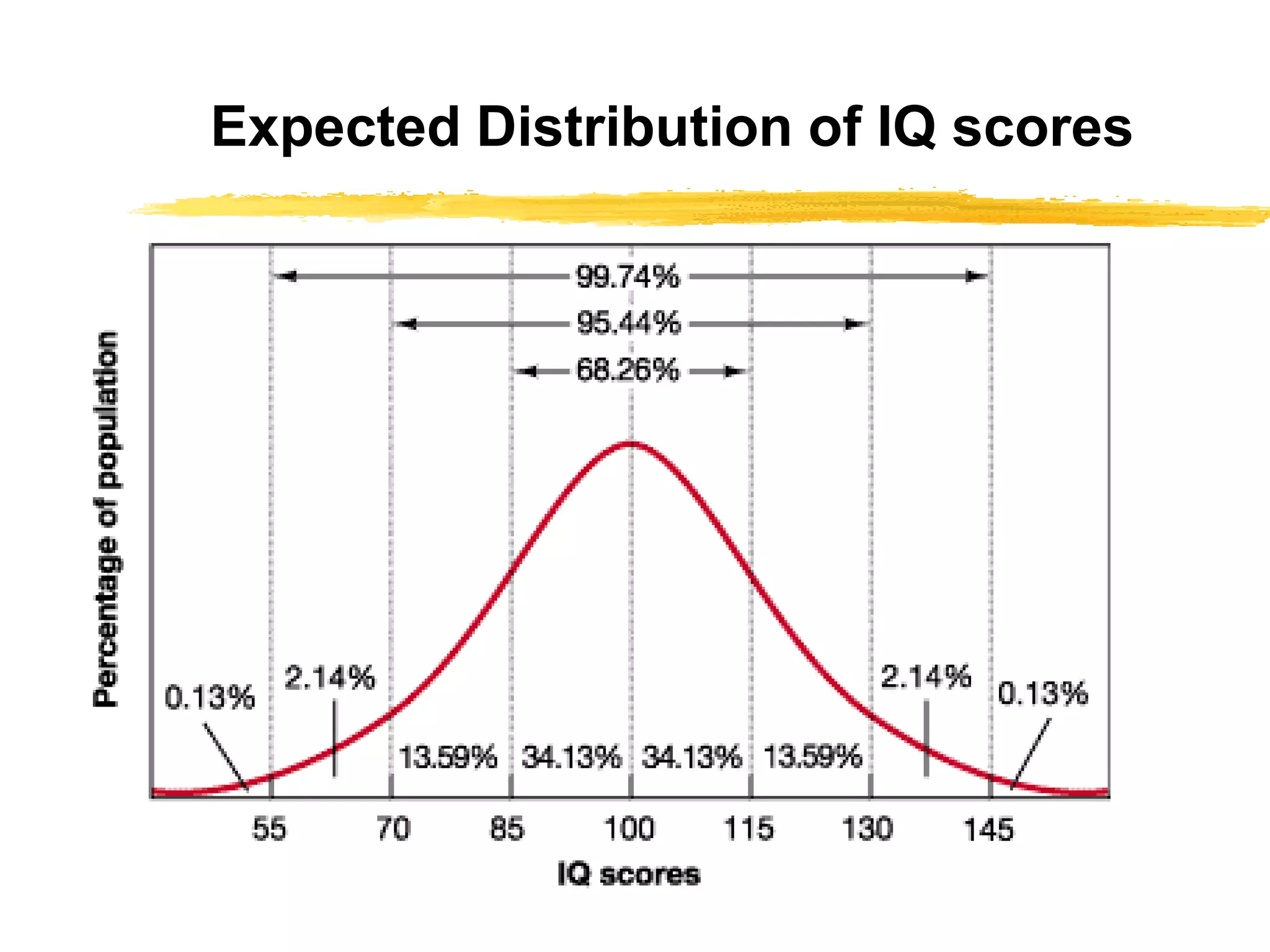
Expected Distribution of IQ scores
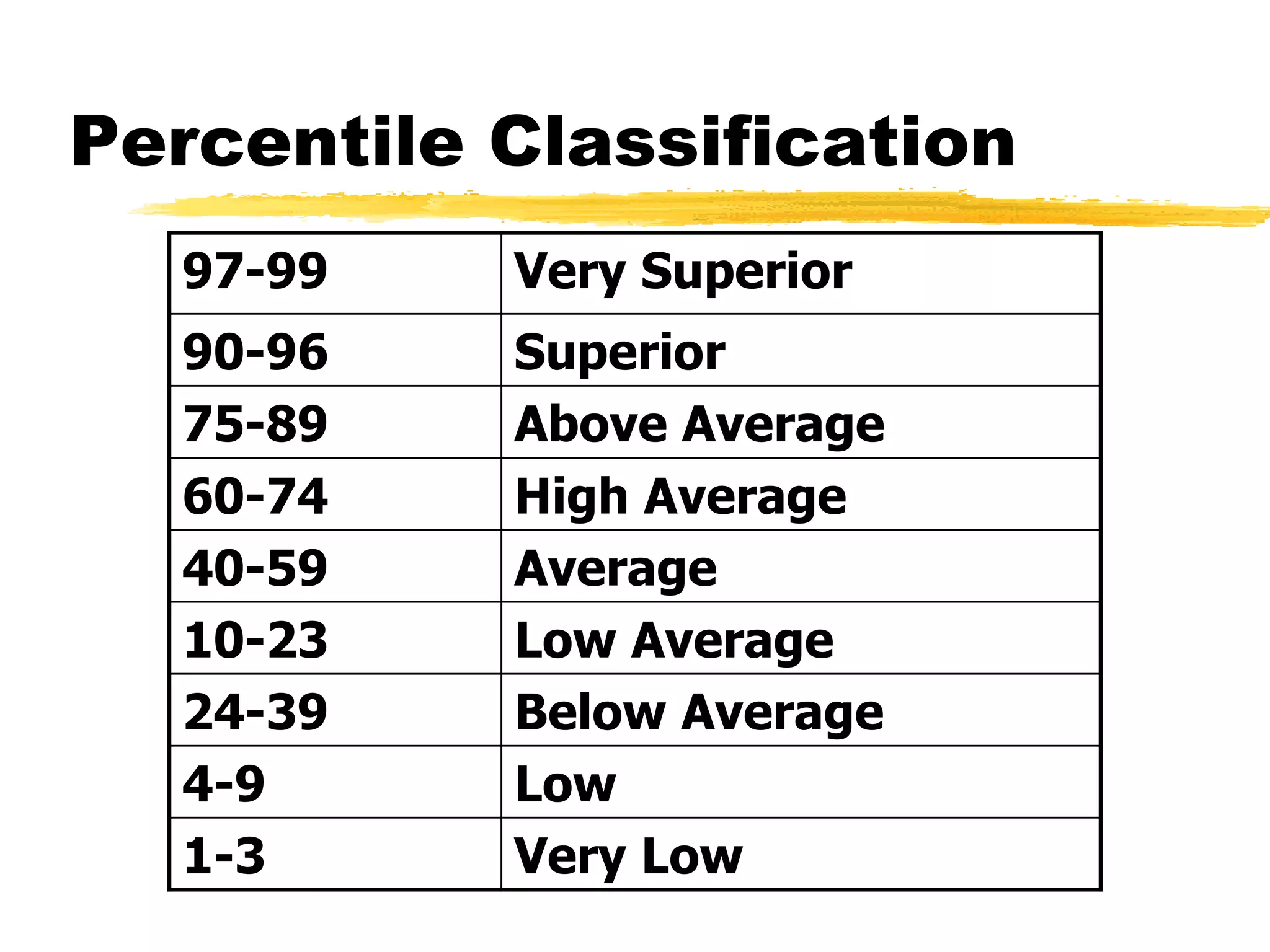
Percentile Classification
97-99 Very Superior
90-96 Superior
75-89 Above Average
60-74 High Average
40-59 Average
10-23 Low Average
24-39 Below Average
4-9 Low
1-3 Very Low
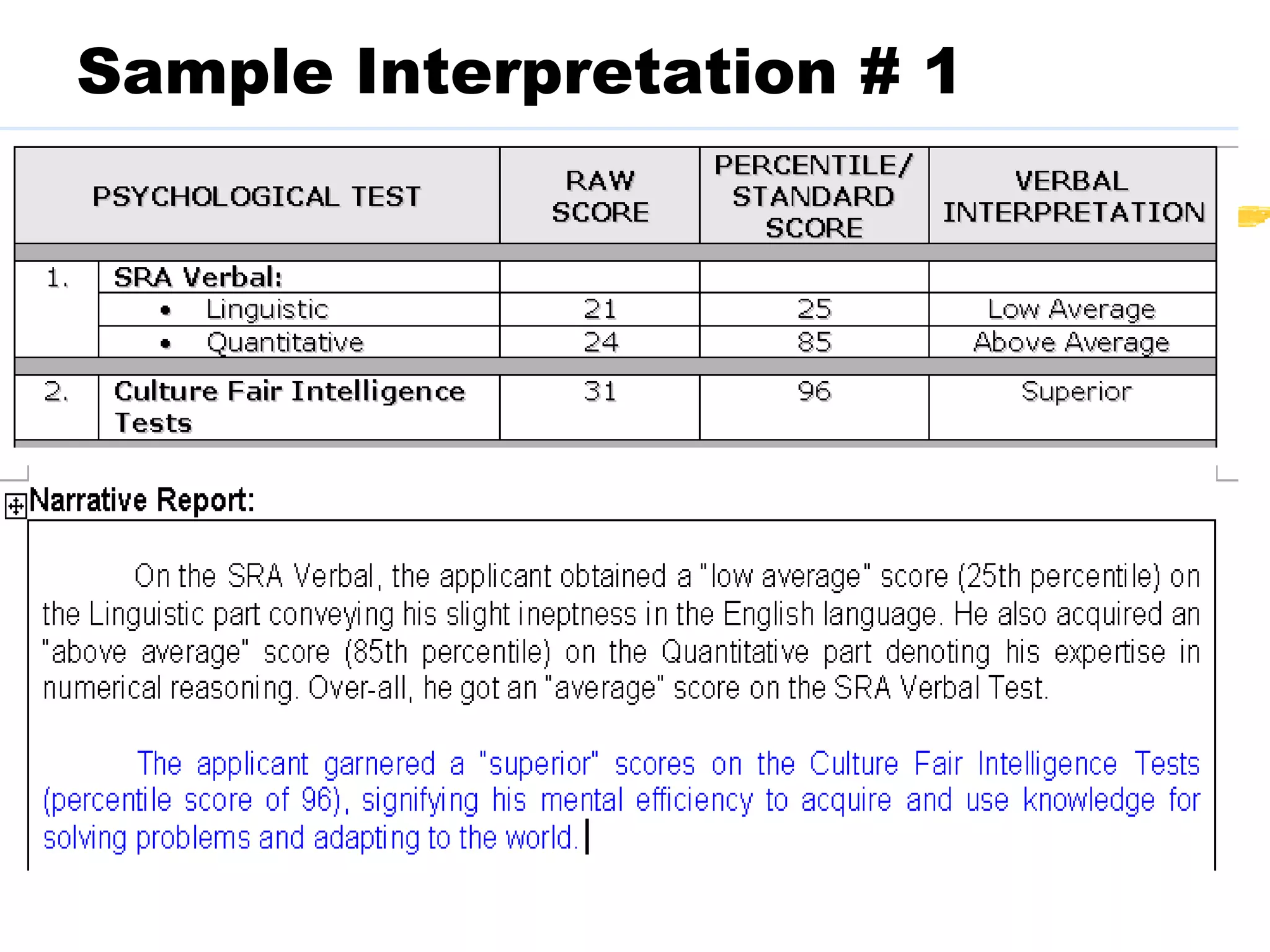
Sample Interpretation # 1
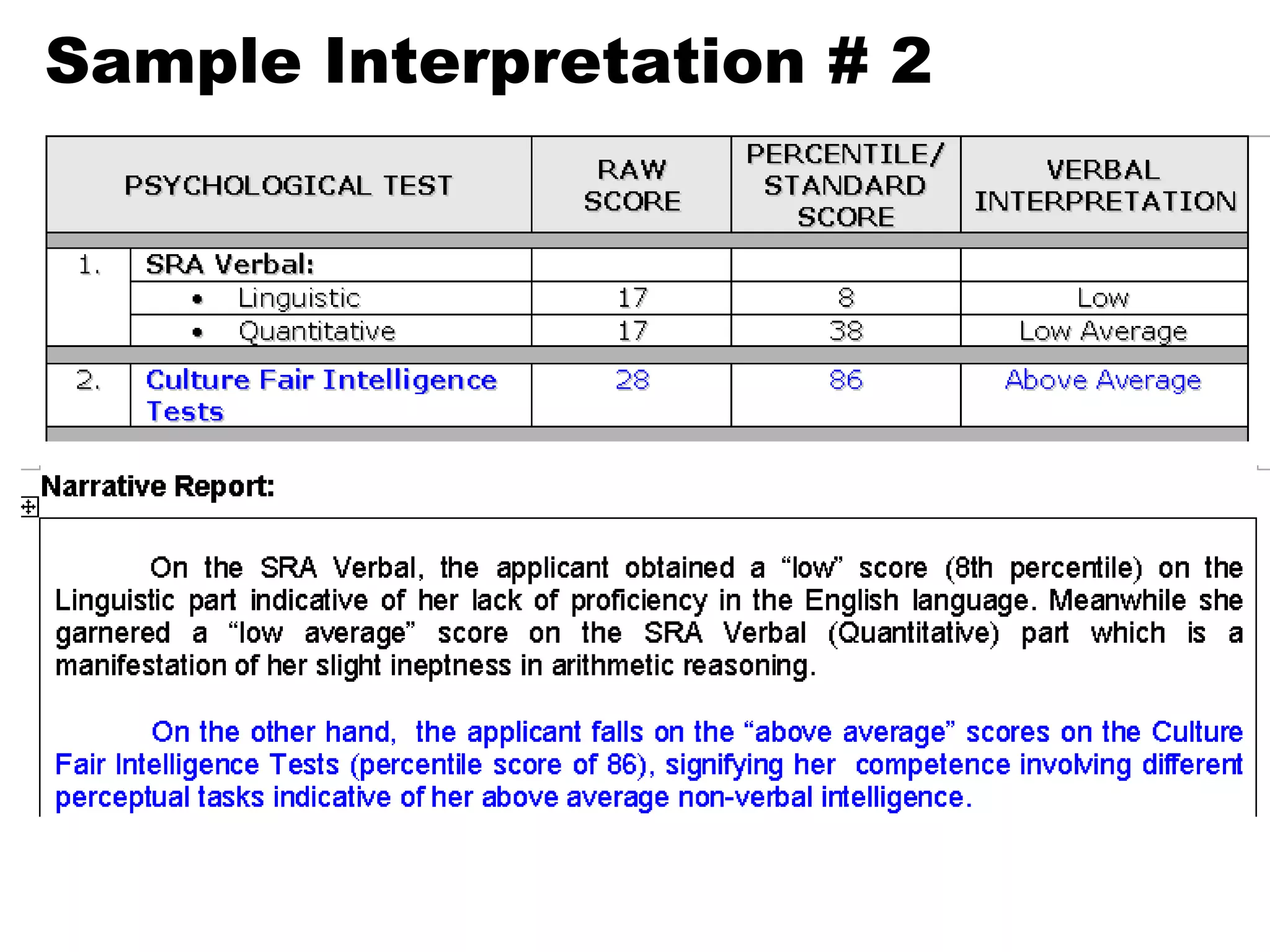
Sample Interpretation # 2
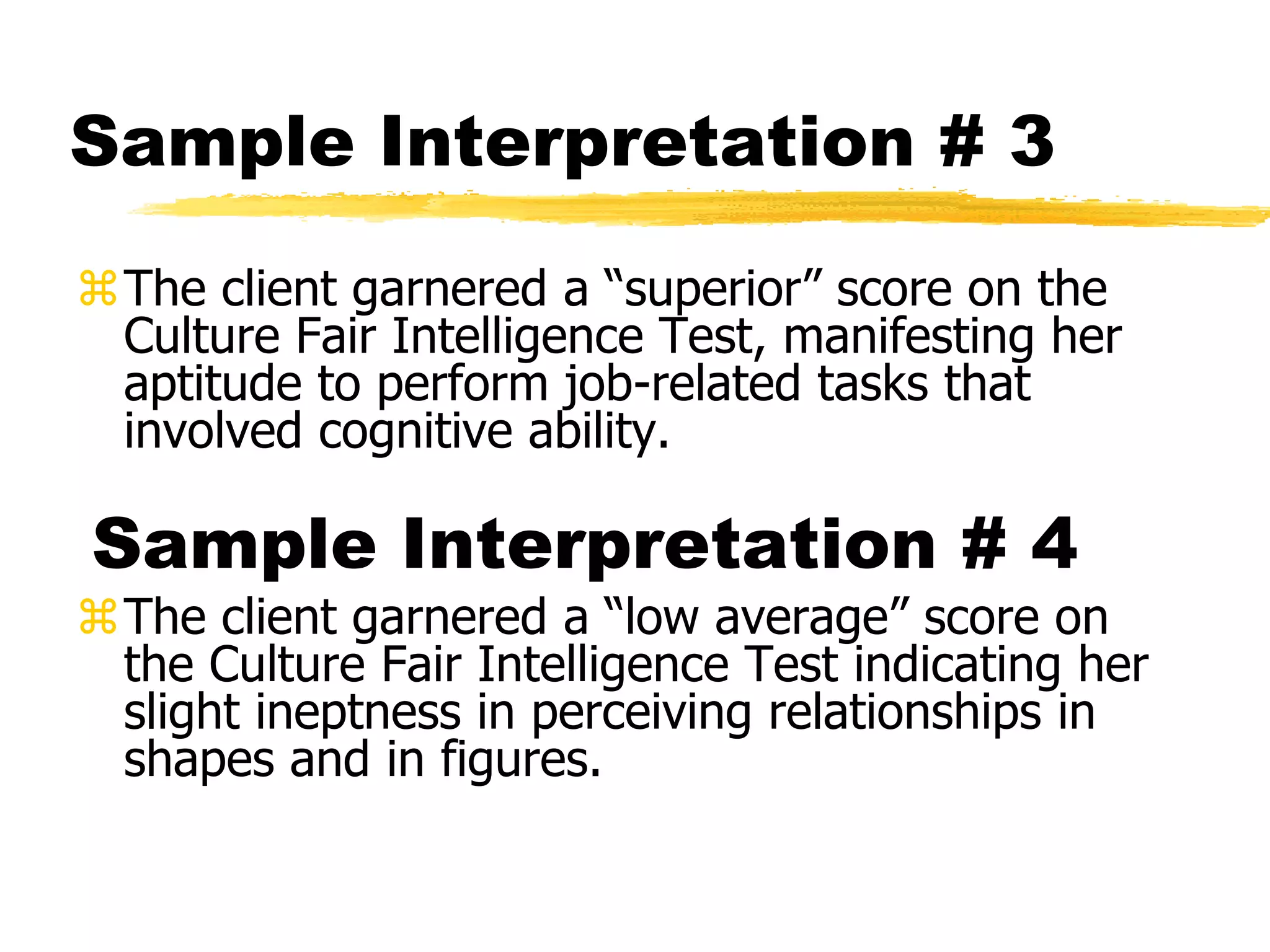
Sample Interpretation # 3
The client garnered a “superior” score on the
Culture Fair Intelligence Test, manifesting her
aptitude to perform job-related tasks that
involved cognitive ability.
Sample Interpretation # 4
The client garnered a “low average” score on
the Culture Fair Intelligence Test indicating her
slight ineptness in perceiving relationships in
shapes and in figures.
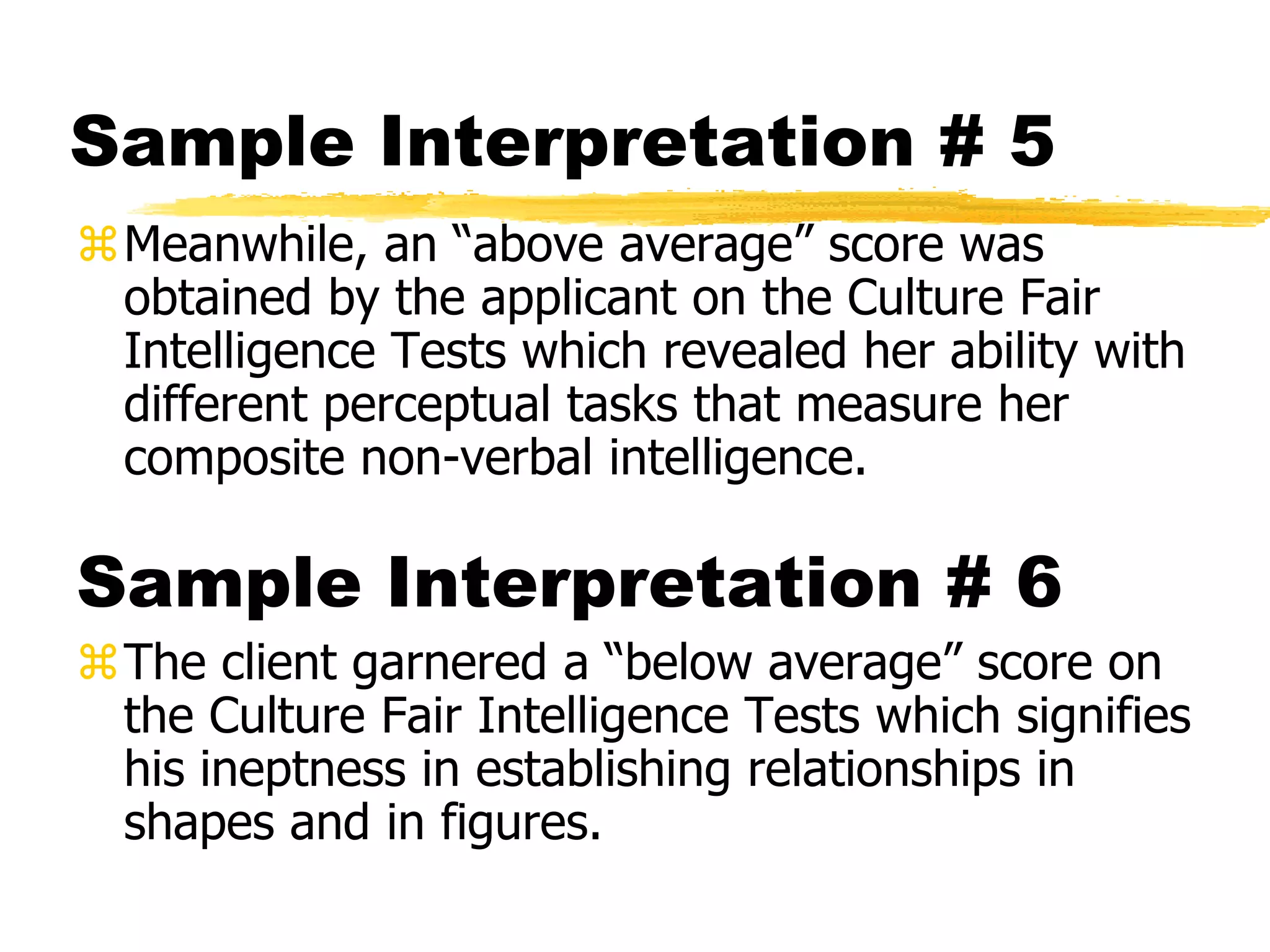
Sample Interpretation # 5
Meanwhile, an “above average” score was
obtained by the applicant on the Culture Fair
Intelligence Tests which revealed her ability with
different perceptual tasks that measure her
composite non-verbal intelligence.
Sample Interpretation # 6
The client garnered a “below average” score on
the Culture Fair Intelligence Tests which signifies
his ineptness in establishing relationships in
shapes and in figures.
Sample Interpretation # 7
The applicant falls on the “average” category on
the Culture Fair Intelligence Tests, signifying her
proficiency to execute job related tasks that
involve cognitive ability as well as perceiving
relationships in shapes and in figures.
Sample Interpretation # 8
The client obtained a “High Average” score on the
Culture Fair Intelligence Tests, signifying his
adeptness to performed job related tasks that
involved cognitive ability.
Criticism: Culture & IQ
IQ tests have been criticized for being biased in
favor of white, middle-class people.
 However, efforts to construct culture-free and
culture-fair tests have been disappointing.
Culture affects nearly everything to do with
taking a test, from attitudes to problem-solving
strategies.
Negative stereotypes about a person’s ethnicity,
gender, or age may cause the person to suffer
stereotype threat, a burden of doubt about his or
her own abilities, which can lead to anxiety or
"disidentification" with the test.

Culture Fair Intelligence Test (CFIT) Manual

  • 1.
    Culture Fair IntelligenceTests (CFIT) by Raymond B. Cattell A. Karen S. Cattell Slides created by Clarence G. Apostol MA in Counseling Psychology De La Salle University-Manila CPS 560M: Assessment Tools in Counseling
  • 2.
    Introduction Raymond B. Cattelldivided general intelligence into two distinct types: crystallized and fluid. Crystallized intelligence represents knowledge acquired through experience. Tests of crystallized intelligence, such as verbal memory and general knowledge, are thought to reflect the influence of culture and schooling. Fluid intelligence represents the biological ability to acquire knowledge and solve problems. Tests that reflect fluid intelligence, such as reasoning speed, spatial reasoning, and inductive reasoning, are thought to reflect intelligence independent of learning. Cattell developed a “culture-fair” test to measure fluid intelligence.
  • 3.
    Purpose: The Culture FairIntelligence Tests measures individual intelligence in a manner designed to reduced, as much as possible, the influence of verbal fluency, cultural climate, and educational level. The tests, which may be administered individually or in a group, are non-verbal and require only the examinees be able to perceive relationships in shapes and figures. Each scale contains 4 subtests involving different perceptual tasks, so that the composite intelligence measure avoids spurious reliance on a single skill.
  • 4.
    Purpose: It aids inthe identification of learning problems and helps in making more reliable and informed decisions in relation to the special education needs of children.  Other uses include selecting students for accelerated educational programs, advising students as to probable success in college, and increasing effectiveness of vocational guidance decisions, for both students and adults.
  • 5.
    History late 1920’s-Began inthe work undertaken by Cattell, sparked the precise scientific research of Charles Spearman into the nature and accurate measurement of intelligence. 1930-resulted in the publication of the Cattell Group and Inventory (particularly intended for use with children) were revised and recast into non-verbal form to diminish the unwanted and unnecessary effects of verbal fluency in the pure measurement of intelligence
  • 6.
    History 1940-another revision ofthe test appeared. Items had become completely perceptual and were organized into 6 subtest, 3 of which have been retained in the present format. Of the 159 items analyzes, 72 of satisfactory validity and reliability were retained for the published edition 1949-another revision and adopted the format consisting of 4 subtest (Series, Classification, Matrices and Conditions) 1961-primary outcome of this revision were slight adjustments in the difficulty level and sequencing of few items. At the same time the few samples were expanded to achieve better national representation in the final tables.
  • 7.
    Age/Range: Scale 1: 4to 8 years and older, mentally handicapped individuals Scale 2: 8-14 years and average adults Scale 3: 14 to college students and adults of superior intelligence Requirements for Purchase: Level B
  • 8.
    Requirements for Purchase (PhilippinePsychological Corporation, 1995) LEVEL A- available if the person administering the tests had undergraduate courses in testing or psychometrics, or sufficient training and experience in test administration. LEVEL B- available only if the test administrator has completed an advanced level course in testing in a university, or its equivalent in training under the direction of a qualified superior or consultant LEVEL C- available only for use, by, or under the supervision of qualified psychologists, i.e. members of APA or the PAP or other persons with at least a Master’s Degree in psychology and at least one year experience under professional supervision
  • 9.
    Reliability: Scale 1 =.91, Scale 2 = .87, Scale 3: Consistency Over • 0.85 Items (1477 M & F) high school-college students • 0.82 Length (402 M & F) high school-college students 0.82 Time (1323 M & F) high school-college students
  • 10.
    Validity: Scale 3 ConceptValidity • Direct correlations with the pure intelligence factor (0.92), 702 male and female students Concrete Validity • Correlations with other tests of general intelligence including the OTIS, SAT, and Intelligence Structure Test (0.69), 673 male and females (students and young adults)
  • 11.
  • 12.
    Description of theSubtest: Subtest 1: Series- the individual is presented with an incomplete, progressive matrices. His task is to select, from among the choices provided, the answer which best continue the series.
  • 13.
    Description of theSubtest: Subtest 2:Classifications- the individual is presented with 5 figures. In scale 2, he must select one which is different from the other four. In scale 3, he must correctly identify two figures which are in some way different from three others.
  • 14.
    Description of theSubtest: Subtest 3: Matrices- the task is to correctly complete the design or matrix presented at the left of each row.
  • 15.
    Description of theSubtest: Subtest 4: Conditions (topology), requires the individual to select, from the 5 choices provided, the one which duplicates the conditions given in the far left box. For example, the test taker must select the figure in which it is possible to place a dot that would lie outside the box but inside the circle. Only choice 3 meets theses requirements and is therefore the correct answer.
  • 16.
    Administration Test 1. (3minutes) • At the left there are four little boxes. The last one is empty. Continuing along that row, you see six more boxes, marked a, b, c, d, e and f. of those six boxes, one will fit correctly in the empty box. (after 3 minutes, say STOP! Pencils down) Test 2. (4 minutes) • Three of the boxes in each example have shapes that are alike in some way, but the other two are different from these three. In each row, you are to find the two boxes that are different from the others. When you have found them, fill in on your answer sheet the two boxes that have the same letters under them as the answers you have chosen. (after 4 minutes, say STOP! Pencils down)
  • 17.
    Administration Test 3. (3minutes) • In the large square, there are four little boxes. Three of the boxes have drawings in them, but the drawing for the other square is missing. One of the boxes in the row at the right fits correctly in the empty box. You are to choose the right one and mark the answer on your answer sheet. (after 3 minutes, say STOP! Pencils down) Test 4. (2.5 minutes) • In the separate square of the first example, there is dot which is in both the circle and the square. Now look at the five possible answers and see if you can find a drawing where you could put in one dot that will be inside both the circle and square. (after 2 and ½ minutes, say STOP! Pencils down)
  • 18.
    Scoring: Hand Scoring Norms: For Scale1: Mental age and IQ norms. Scale 2 and Scale 3: Percentiles, by ages and IQs
  • 19.
  • 20.
    Percentile Classification 97-99 VerySuperior 90-96 Superior 75-89 Above Average 60-74 High Average 40-59 Average 10-23 Low Average 24-39 Below Average 4-9 Low 1-3 Very Low
  • 21.
  • 22.
  • 23.
    Sample Interpretation #3 The client garnered a “superior” score on the Culture Fair Intelligence Test, manifesting her aptitude to perform job-related tasks that involved cognitive ability. Sample Interpretation # 4 The client garnered a “low average” score on the Culture Fair Intelligence Test indicating her slight ineptness in perceiving relationships in shapes and in figures.
  • 24.
    Sample Interpretation #5 Meanwhile, an “above average” score was obtained by the applicant on the Culture Fair Intelligence Tests which revealed her ability with different perceptual tasks that measure her composite non-verbal intelligence. Sample Interpretation # 6 The client garnered a “below average” score on the Culture Fair Intelligence Tests which signifies his ineptness in establishing relationships in shapes and in figures.
  • 25.
    Sample Interpretation #7 The applicant falls on the “average” category on the Culture Fair Intelligence Tests, signifying her proficiency to execute job related tasks that involve cognitive ability as well as perceiving relationships in shapes and in figures. Sample Interpretation # 8 The client obtained a “High Average” score on the Culture Fair Intelligence Tests, signifying his adeptness to performed job related tasks that involved cognitive ability.
  • 26.
    Criticism: Culture &IQ IQ tests have been criticized for being biased in favor of white, middle-class people.  However, efforts to construct culture-free and culture-fair tests have been disappointing. Culture affects nearly everything to do with taking a test, from attitudes to problem-solving strategies. Negative stereotypes about a person’s ethnicity, gender, or age may cause the person to suffer stereotype threat, a burden of doubt about his or her own abilities, which can lead to anxiety or "disidentification" with the test.