Tarun Panda

 Intelligence involves the ability to think, solve problems,
analyze situations, and understand social values, customs, and
norms.
 According to Wechsler, intelligence is “the aggregate or global
capacity of the individual to act purposefully, to think
rationally and to deal effectively with his environment”.
 According to Neisser, the term intelligence refers to
“individual’s abilities to understand complex ideas, to adapt
effectively to the environment, to learn from experience, to
engage in various forms of reasoning, to overcome obstacles by
careful thought”.
Intelligence

 Intelligence has also been defined on the basis of a
combination of two levels of processes.
 At one level, associative intelligence is found, which
includes tests that depend upon memory as well as upon
simple verbal associations, while at the other level,
abstract intelligence is found, which includes factors like
concept learning, thinking, problem solving skills, etc.
 Arthur Jensen gave this viewpoint of intelligence.

 According to Howard Gardner, there are 9 types of
intelligence:
 Naturalistic intelligence- a person’s sensitivity towards the
natural environment around him (plants, animals, rocks,
etc).
 Musical intelligence- it enables a person to recognize, create,
reproduce, and reflect on music, as demonstrated by
composers, musicians, sensitive listeners, etc.
 Logical-mathematical intelligence- it enables a person to
perceive relationships and connections and to use abstract,
symbolic thought; sequential reasoning skills; and inductive
and deductive thinking patterns.
Types of intelligence

 Existential intelligence- Sensitivity and capacity to tackle
deep questions about human existence, such as the
meaning of life, why do we die, and how did we get here.
 Interpersonal intelligence- It involves effective verbal and
nonverbal communication, the ability to note distinctions
among others, sensitivity to the moods and temperaments
of others, and the ability to entertain multiple
perspectives.
 Bodily-kinesthetic intelligence- Bodily kinaesthetic
intelligence is the capacity to manipulate objects and use a
variety of physical skills.

 Linguistic intelligence- Linguistic intelligence is the ability
to think in words and to use language to express and
appreciate complex meanings.
 Intra-personal intelligence- Intra-personal intelligence is
the capacity to understand oneself and one’s thoughts
and feelings, and to use such knowledge in planning
and a direction to one’s life.
 Spatial intelligence- Spatial intelligence is the ability to
think in three dimensions. Core capacities include mental
imagery, spatial reasoning, image manipulation, graphic
and artistic skills, and an active imagination.

 Raymond Cattell first proposed the concepts of fluid
and crystallized intelligence and further developed
the theory with John Horn.
 Cattell defined fluid intelligence as "…the ability to
perceive relationships independent of previous
specific practice or instruction concerning those
relationships."
 Crystallized intelligence involves knowledge that
comes from prior learning and past experiences.

 Intelligence tests are psychological tests that are designed to
measure a variety of mental functions, such as reasoning,
comprehension, and judgment.
 Interest in intelligence dates back thousands of years, but it
wasn't until psychologist Alfred Binet was commissioned to
identify students who needed educational assistance that the
first IQ test was born.
 Alfred Binet and the First IQ Test
During the early 1900s, the French government asked
psychologist, Alfred Binet to help decide which students
were mostly likely to experience difficulty in schools…
History of Intelligence
Testing

 Intelligence tests have been classified from different
angles.
 From the point of view of their administration, they are
divided into two convenient categories- individual tests
and group tests.
 Individual test is one which can be administered to one
person at a time. The first individual test was the Binet-
Simon scale.
 Group intelligence test is one which can be administered
to more than one person at a time, i.e., it can be
administered to a group. The first group intelligence test
was developed when the necessity for mass testing was
realized during World War I.
Classification of
Intelligence Tests

 Intelligence tests have also been classified on the basis of
the nature of items used in tests- verbal test and
performance test.
 A verbal test is one in which the instructions and items
are reproduced usually through the written language
before the examinees. The Army Alpha test and the
Army General Classification test are examples of verbal
tests.
 A performance test is one where language is used only to
impart instruction and items are manipulative in nature.
Examples of performance tests are- Army Beta test, the
Kohs Block Design test, etc.

 In addition to the verbal and the performance tests,
there is another type of intelligence test: the non-
verbal test or the non-language test or the culture-free
test.
 By definition, a non-verbal test is one where no
language is at all either in instructions or in
construction of items.
 Examples of non-verbal of culture-fair tests are: the
Culture Fair Intelligence test by Cattell, the Raven
Progressive Matrices, etc.

 The Stanford-Binet Intelligence Test
After the development of the Binet-Simon Scale,
the test was soon brought to the United States
where it generated considerable interest.
Stanford University psychologist Lewis Terman
took Binet's original test and standardized it
using a sample of American participants.
Examples of intelligence
Tests

 Intelligence Testing During World War I
At the outset of World War I, U.S. Army officials
were faced with the monumental task of
screening an enormous number of army
recruits.
In 1917, as president of the APA and chair of the
Committee on the Psychological Examination of
Recruits, psychologist Robert Yerkes developed
two tests known as the Army Alpha and Beta
tests.

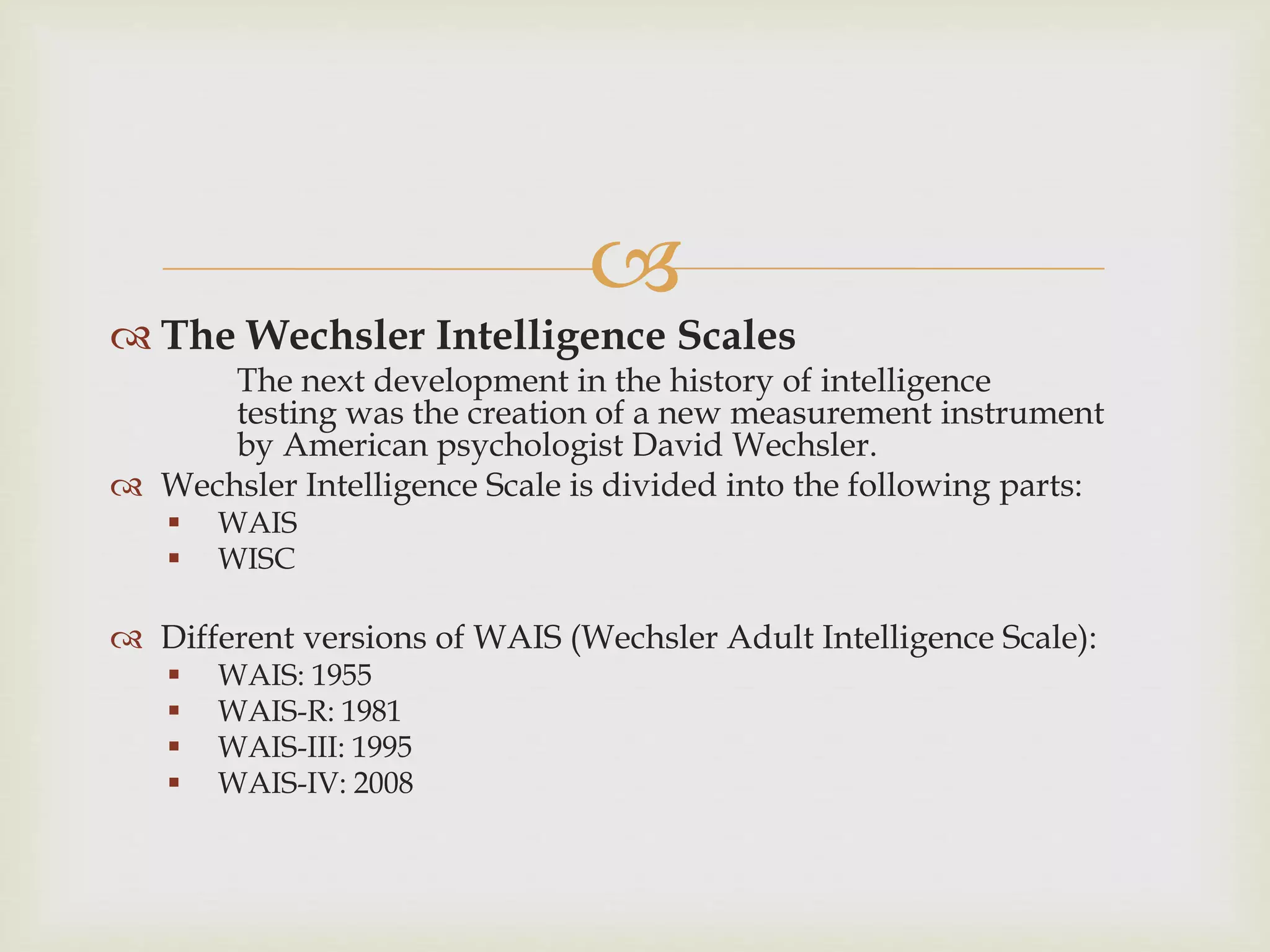
 The Wechsler Intelligence Scales
The next development in the history of intelligence
testing was the creation of a new measurement instrument
by American psychologist David Wechsler.
 Wechsler Intelligence Scale is divided into the following parts:
 WAIS
 WISC
 Different versions of WAIS (Wechsler Adult Intelligence Scale):
 WAIS: 1955
 WAIS-R: 1981
 WAIS-III: 1995
 WAIS-IV: 2008

 Main contents of Wechsler Adult Intelligence Scales:-
 Verbal:
 Information
 Comprehension
 Arithmetic
 Similarities
 Digit Span
 Vocabulary
 Letter-numbering sequencing.

 Performance:
 Coding-digit symbol
 Picture completion
 Block design
 Picture arrangement
 Matrix reasoning
 Object assembly
 Symbol research

 The goal of intelligence tests is to obtain an idea of the person's
intellectual potential.
 The tests center around a set of stimuli designed to yield a score
based on the test maker's model of what makes up intelligence.
 Intelligence tests are often given as a part of a battery of tests.
 To identify:
 Intellectual giftedness
 Learning difficulties
 Cognitive strengths and weaknesses
Purpose of intelligence
tests

 There are many different types of intelligence tests
and they all do not measure the same abilities.
 Although the tests often have aspects that are related
with each other, one should not expect that scores
from one intelligence test, that measures a single
factor, will be similar to scores on another
intelligence test, that measures a variety of factors.
Precautions

 A central criticism of intelligence tests is that
psychologists and educators use these tests to distribute
the limited resources of our society.
 Many people are under the false assumption that
intelligence tests measure a person's inborn or biological
intelligence.
 Intelligence tests are based on an individual's interaction
with the environment and never exclusively measure
inborn intelligence.

 When taking an intelligence test, a person can expect
to do a variety of tasks.
 These tasks may include having to answer questions
that are asked verbally, doing mathematical
problems, and doing a variety of tasks that require
eye-hand coordination.
 Some tasks may be timed and require the person to
work as quickly as possible.
Description

 Typically, most questions and tasks start out easy
and progressively get more difficult.
 It is unusual for anyone to know the answer to all of
the questions or be able to complete all of the tasks.
 If a person is unsure of an answer, guessing is
usually allowed.

 In general, intelligence tests measure a wide variety
of human behaviors better than any other measure
that has been developed.
 Intelligence tests are excellent predictors of academic
achievement and provide an outline of a person's
mental strengths and weaknesses.
Advantages

 Some researchers argue that intelligence tests have
serious shortcomings. For example, many
intelligence tests produce a single intelligence score.
 This single score is often inadequate in explaining
the multidimensional aspects of intelligence.
 Furthermore, intelligence tests only measure a
sample of behaviors or situations in which intelligent
behavior is revealed.
Disadvantages

 The person's raw scores on an intelligence test are
typically converted to standard scores.
 The standard scores allow the examiner to compare
the individual's score to other people who have
taken the test.
 Most intelligence tests generate an overall
intelligence quotient or IQ.
Results

 www.psychology.about.com
 www.minddisorders.com
 Baron R. (2006). Psychology. (5th Edition). Dorling
Kindersley (India) Pvt. Ltd., licensees of Pearson
Education in South Asia. (28-31).
 Singh A K. (2012). Tests, Measurements and Research
Methods in Behavioural Sciences. Bharati Bhawan
(Publishers & Distributors).
References


Intelligence Testing

  • 1.
  • 2.
      Intelligence involvesthe ability to think, solve problems, analyze situations, and understand social values, customs, and norms.  According to Wechsler, intelligence is “the aggregate or global capacity of the individual to act purposefully, to think rationally and to deal effectively with his environment”.  According to Neisser, the term intelligence refers to “individual’s abilities to understand complex ideas, to adapt effectively to the environment, to learn from experience, to engage in various forms of reasoning, to overcome obstacles by careful thought”. Intelligence
  • 3.
      Intelligence hasalso been defined on the basis of a combination of two levels of processes.  At one level, associative intelligence is found, which includes tests that depend upon memory as well as upon simple verbal associations, while at the other level, abstract intelligence is found, which includes factors like concept learning, thinking, problem solving skills, etc.  Arthur Jensen gave this viewpoint of intelligence.
  • 4.
      According toHoward Gardner, there are 9 types of intelligence:  Naturalistic intelligence- a person’s sensitivity towards the natural environment around him (plants, animals, rocks, etc).  Musical intelligence- it enables a person to recognize, create, reproduce, and reflect on music, as demonstrated by composers, musicians, sensitive listeners, etc.  Logical-mathematical intelligence- it enables a person to perceive relationships and connections and to use abstract, symbolic thought; sequential reasoning skills; and inductive and deductive thinking patterns. Types of intelligence
  • 5.
      Existential intelligence-Sensitivity and capacity to tackle deep questions about human existence, such as the meaning of life, why do we die, and how did we get here.  Interpersonal intelligence- It involves effective verbal and nonverbal communication, the ability to note distinctions among others, sensitivity to the moods and temperaments of others, and the ability to entertain multiple perspectives.  Bodily-kinesthetic intelligence- Bodily kinaesthetic intelligence is the capacity to manipulate objects and use a variety of physical skills.
  • 6.
      Linguistic intelligence-Linguistic intelligence is the ability to think in words and to use language to express and appreciate complex meanings.  Intra-personal intelligence- Intra-personal intelligence is the capacity to understand oneself and one’s thoughts and feelings, and to use such knowledge in planning and a direction to one’s life.  Spatial intelligence- Spatial intelligence is the ability to think in three dimensions. Core capacities include mental imagery, spatial reasoning, image manipulation, graphic and artistic skills, and an active imagination.
  • 7.
      Raymond Cattellfirst proposed the concepts of fluid and crystallized intelligence and further developed the theory with John Horn.  Cattell defined fluid intelligence as "…the ability to perceive relationships independent of previous specific practice or instruction concerning those relationships."  Crystallized intelligence involves knowledge that comes from prior learning and past experiences.
  • 8.
      Intelligence testsare psychological tests that are designed to measure a variety of mental functions, such as reasoning, comprehension, and judgment.  Interest in intelligence dates back thousands of years, but it wasn't until psychologist Alfred Binet was commissioned to identify students who needed educational assistance that the first IQ test was born.  Alfred Binet and the First IQ Test During the early 1900s, the French government asked psychologist, Alfred Binet to help decide which students were mostly likely to experience difficulty in schools… History of Intelligence Testing
  • 9.
      Intelligence testshave been classified from different angles.  From the point of view of their administration, they are divided into two convenient categories- individual tests and group tests.  Individual test is one which can be administered to one person at a time. The first individual test was the Binet- Simon scale.  Group intelligence test is one which can be administered to more than one person at a time, i.e., it can be administered to a group. The first group intelligence test was developed when the necessity for mass testing was realized during World War I. Classification of Intelligence Tests
  • 10.
      Intelligence testshave also been classified on the basis of the nature of items used in tests- verbal test and performance test.  A verbal test is one in which the instructions and items are reproduced usually through the written language before the examinees. The Army Alpha test and the Army General Classification test are examples of verbal tests.  A performance test is one where language is used only to impart instruction and items are manipulative in nature. Examples of performance tests are- Army Beta test, the Kohs Block Design test, etc.
  • 11.
      In additionto the verbal and the performance tests, there is another type of intelligence test: the non- verbal test or the non-language test or the culture-free test.  By definition, a non-verbal test is one where no language is at all either in instructions or in construction of items.  Examples of non-verbal of culture-fair tests are: the Culture Fair Intelligence test by Cattell, the Raven Progressive Matrices, etc.
  • 12.
      The Stanford-BinetIntelligence Test After the development of the Binet-Simon Scale, the test was soon brought to the United States where it generated considerable interest. Stanford University psychologist Lewis Terman took Binet's original test and standardized it using a sample of American participants. Examples of intelligence Tests
  • 13.
      Intelligence TestingDuring World War I At the outset of World War I, U.S. Army officials were faced with the monumental task of screening an enormous number of army recruits. In 1917, as president of the APA and chair of the Committee on the Psychological Examination of Recruits, psychologist Robert Yerkes developed two tests known as the Army Alpha and Beta tests.
  • 14.
      The WechslerIntelligence Scales The next development in the history of intelligence testing was the creation of a new measurement instrument by American psychologist David Wechsler.  Wechsler Intelligence Scale is divided into the following parts:  WAIS  WISC  Different versions of WAIS (Wechsler Adult Intelligence Scale):  WAIS: 1955  WAIS-R: 1981  WAIS-III: 1995  WAIS-IV: 2008
  • 15.
      Main contentsof Wechsler Adult Intelligence Scales:-  Verbal:  Information  Comprehension  Arithmetic  Similarities  Digit Span  Vocabulary  Letter-numbering sequencing.
  • 16.
      Performance:  Coding-digitsymbol  Picture completion  Block design  Picture arrangement  Matrix reasoning  Object assembly  Symbol research
  • 17.
      The goalof intelligence tests is to obtain an idea of the person's intellectual potential.  The tests center around a set of stimuli designed to yield a score based on the test maker's model of what makes up intelligence.  Intelligence tests are often given as a part of a battery of tests.  To identify:  Intellectual giftedness  Learning difficulties  Cognitive strengths and weaknesses Purpose of intelligence tests
  • 18.
      There aremany different types of intelligence tests and they all do not measure the same abilities.  Although the tests often have aspects that are related with each other, one should not expect that scores from one intelligence test, that measures a single factor, will be similar to scores on another intelligence test, that measures a variety of factors. Precautions
  • 19.
      A centralcriticism of intelligence tests is that psychologists and educators use these tests to distribute the limited resources of our society.  Many people are under the false assumption that intelligence tests measure a person's inborn or biological intelligence.  Intelligence tests are based on an individual's interaction with the environment and never exclusively measure inborn intelligence.
  • 20.
      When takingan intelligence test, a person can expect to do a variety of tasks.  These tasks may include having to answer questions that are asked verbally, doing mathematical problems, and doing a variety of tasks that require eye-hand coordination.  Some tasks may be timed and require the person to work as quickly as possible. Description
  • 21.
      Typically, mostquestions and tasks start out easy and progressively get more difficult.  It is unusual for anyone to know the answer to all of the questions or be able to complete all of the tasks.  If a person is unsure of an answer, guessing is usually allowed.
  • 22.
      In general,intelligence tests measure a wide variety of human behaviors better than any other measure that has been developed.  Intelligence tests are excellent predictors of academic achievement and provide an outline of a person's mental strengths and weaknesses. Advantages
  • 23.
      Some researchersargue that intelligence tests have serious shortcomings. For example, many intelligence tests produce a single intelligence score.  This single score is often inadequate in explaining the multidimensional aspects of intelligence.  Furthermore, intelligence tests only measure a sample of behaviors or situations in which intelligent behavior is revealed. Disadvantages
  • 24.
      The person'sraw scores on an intelligence test are typically converted to standard scores.  The standard scores allow the examiner to compare the individual's score to other people who have taken the test.  Most intelligence tests generate an overall intelligence quotient or IQ. Results
  • 25.
      www.psychology.about.com  www.minddisorders.com Baron R. (2006). Psychology. (5th Edition). Dorling Kindersley (India) Pvt. Ltd., licensees of Pearson Education in South Asia. (28-31).  Singh A K. (2012). Tests, Measurements and Research Methods in Behavioural Sciences. Bharati Bhawan (Publishers & Distributors). References
  • 26.