OUR RESPONSE TO COVID-19
AGHAM AT KAALAMAN PARA SA BAYAN!
OFFICERS
Gisela P. Concepcion, PhD
PRESIDENT
Edsel A. Peña, PhD
VICE-PRESIDENT
Lourdes Herold, PhD
SECRETARY
Anna Kristina Serquiña, MD PhD
TREASURER
BOARD OF DIRECTORS
Carlito Lebrilla, PhD
CHAIRPERSON
Rigoberto Advincula, PhD
Diana Aga, PhD
Joel Cuello, PhD
Alvin Culaba, PhD
Lawrence Ilag, PhD
Marjorie Peña, PhD
Mariano Sto. Domingo, PhD
Eizadora Yu, PhD
MEMBERS
PAASE
hosted bv
PAASE Philippines, Inc.
A SUBSIDIARY OF PAASE
Marine Natural Products &
Biotechnology
Laboratories
The Marine Science Institute
Velasquez St.
University of the Philippines
Diliman, Quezon City
E-MAIL
gpconcepcion@gmail.com
paase2020manila@gmail.com
WEBSITE
www.paase.org
PAASE BULLETIN # 11
ON PAASE STRATEGIC ACTION GROUP 3: MASS TESTING & FAST-TRACKING
Addressed to: DOH and COVID-19 IATF
A 3-STEP RECOMMENDATION FOR DIAGNOSTIC TESTING USING ANTIBODY AND PCR
TESTS IN LOW-RESOURCE AREAS
PAASE recommends the following algorithm for COVID-19 diagnostic testing using
antibody and/or PCR tests to be used by healthcare workers in low-resource areas.
A. Challenges in COVID-19 diagnostics
The current guideline tests only those exhibiting moderate to severe symptoms.
Unfortunately, this misses those with mild symptoms and infected asymptomatics
who may be spreading the disease unknowingly. Frontline healthcare workers
(HCW) are not getting the benefit of testing (unless they exhibit moderate to
severe symptoms) as they perform their work caring for COVID-19 patients.
B. Recommendations
1. We recommend enhanced testing to include patients under investigation
(PUI) and patients under monitoring (PUM) and all suspected to be exposed,
regardless of whether or not they show symptoms. Positives must be isolated,
monitored and treated. Contact tracing must follow a positive test and
contacts must also be monitored. This informs a more targeted quarantine
and will play a role in the government’s actions post-lockdown.
2. Our healthcare workers must also be supported with regular testing even if
they do not show symptoms, using either or both antibody and PCR tests, if
possible.
3. Antibody testing can augment our currently limited testing capacity. Some
antibody tests can give rapid results, are inexpensive and will help in places
that have little or no access to PCR testing. We provide step-by-step
guidelines on the use and utility of antibody tests by themselves in low-
resource areas and in combination with PCR.
4. With or without testing, using PCR, antibody or both, we recommend that
clinicians use disease presentation and their best judgment for patient
management.
C. Rationale
1. Cost
The RT-PCR test for COVID-19 is estimated to cost up to 3,500 pesos, which
includes test reagents, manpower, equipment and PPEs. The cost of rapid
diagnostic tests for detection of antibodies against SARS-CoV-2 (IgM and/or
IgG) is estimated to be less than 1/5th the cost of PCR.
2. Time
Rapid diagnostic (antibody) testing may take as little as 15 minutes
individually, while PCR testing can take from 2 to 4 hours to run (sometimes in
batches, requiring waiting for other samples to be ready).
3. Facilities and Expertise
PCR testing is performed under specialized laboratory facilities by highly
trained (e.g., biochemistry, molecular biology) personnel. The rapid
diagnostic (antibody) tests, however, may be done in a point-of-care setting
by a trained healthcare worker such as a physician.
OUR RESPONSE TO COVID-19
AGHAM AT KAALAMAN PARA SA BAYAN!
OFFICERS
Gisela P. Concepcion, PhD
PRESIDENT
Edsel A. Peña, PhD
VICE-PRESIDENT
Lourdes Herold, PhD
SECRETARY
Anna Kristina Serquiña, MD PhD
TREASURER
BOARD OF DIRECTORS
Carlito Lebrilla, PhD
CHAIRPERSON
Rigoberto Advincula, PhD
Diana Aga, PhD
Joel Cuello, PhD
Alvin Culaba, PhD
Lawrence Ilag, PhD
Marjorie Peña, PhD
Mariano Sto. Domingo, PhD
Eizadora Yu, PhD
MEMBERS
PAASE
hosted bv
PAASE Philippines, Inc.
A SUBSIDIARY OF PAASE
Marine Natural Products &
Biotechnology
Laboratories
The Marine Science Institute
Velasquez St.
University of the Philippines
Diliman, Quezon City
E-MAIL
gpconcepcion@gmail.com
paase2020manila@gmail.com
WEBSITE
www.paase.org
D. Summary of Guidelines
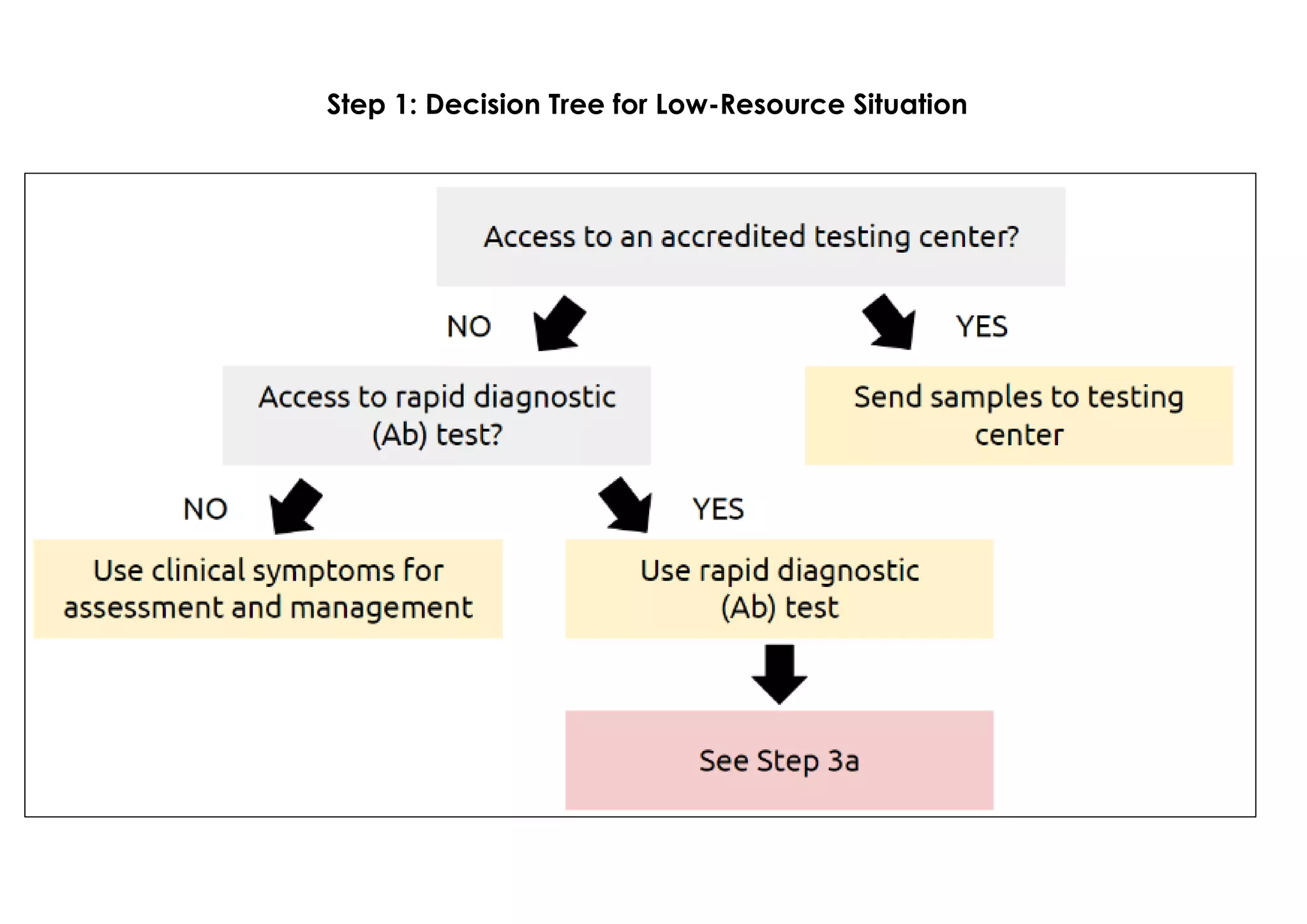
1. Step 1: Frontline healthcare workers and their local government units
follow the decision tree according to availability of resources.
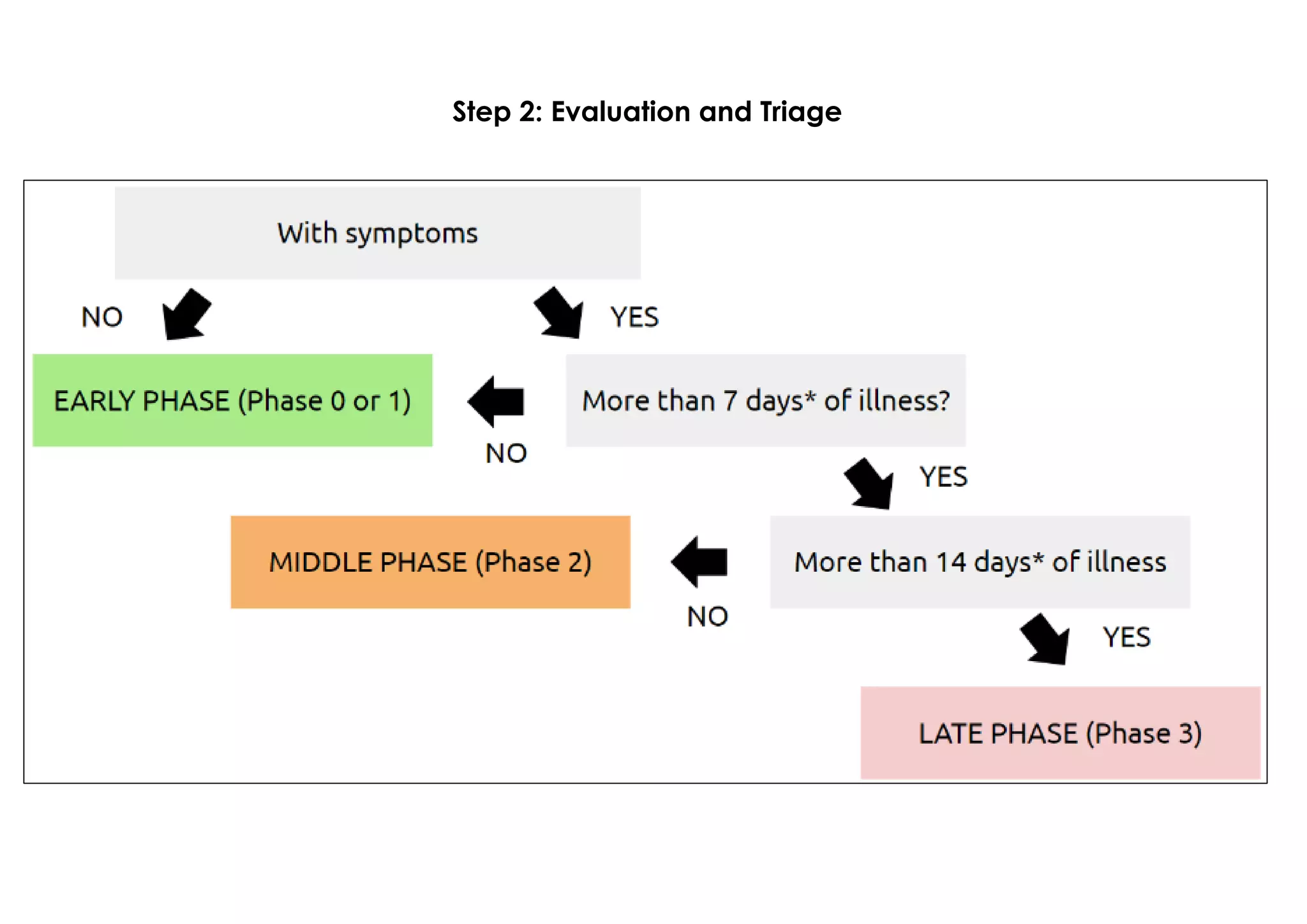
2. Step 2: Patients are triaged according to disease phase by their
clinical presentation.
3. Step 3: The following are the recommended tests for each phase
(using tests that have adequate specificity and sensitivity, and
strictly following manufacturer’s instructions)
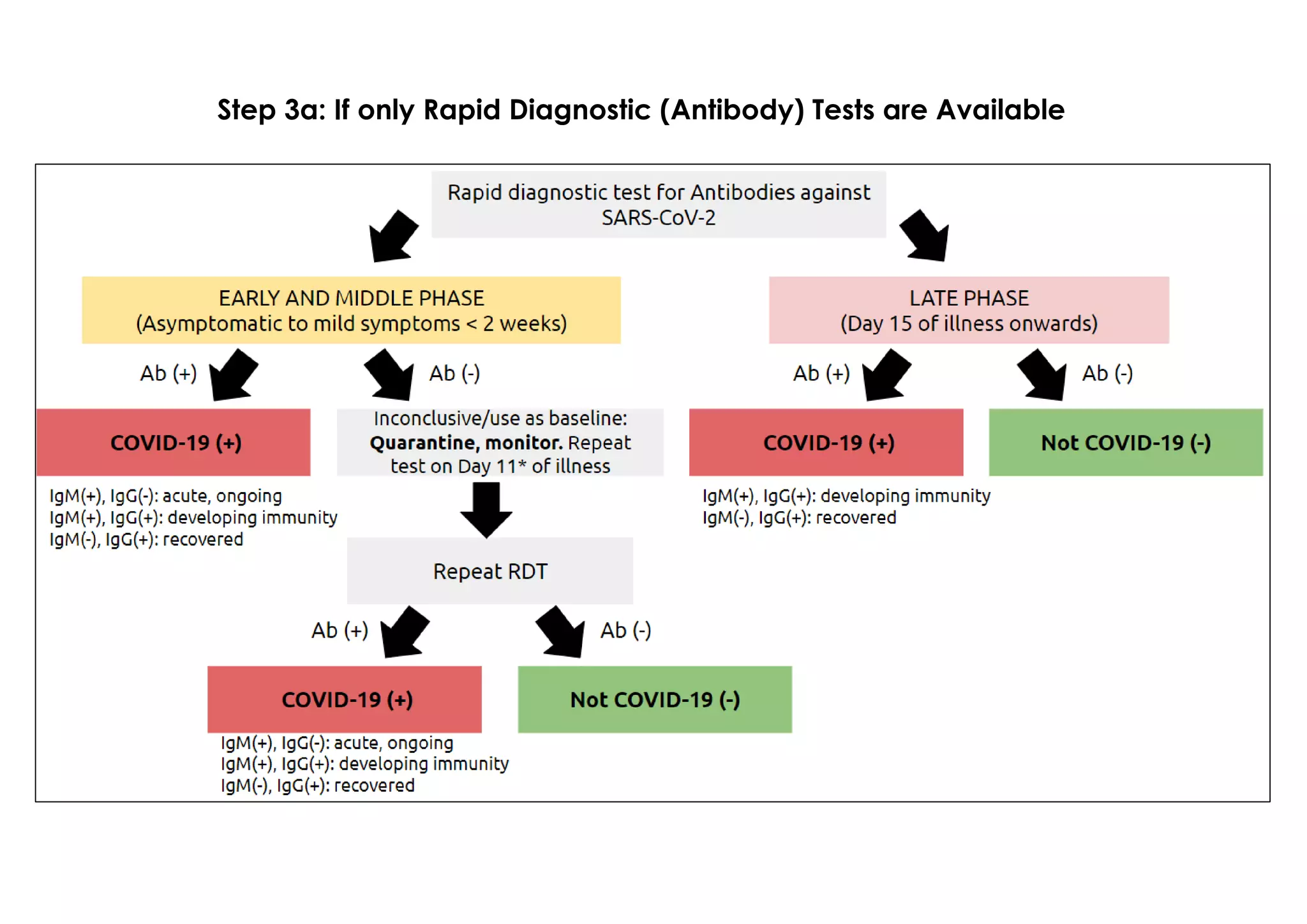
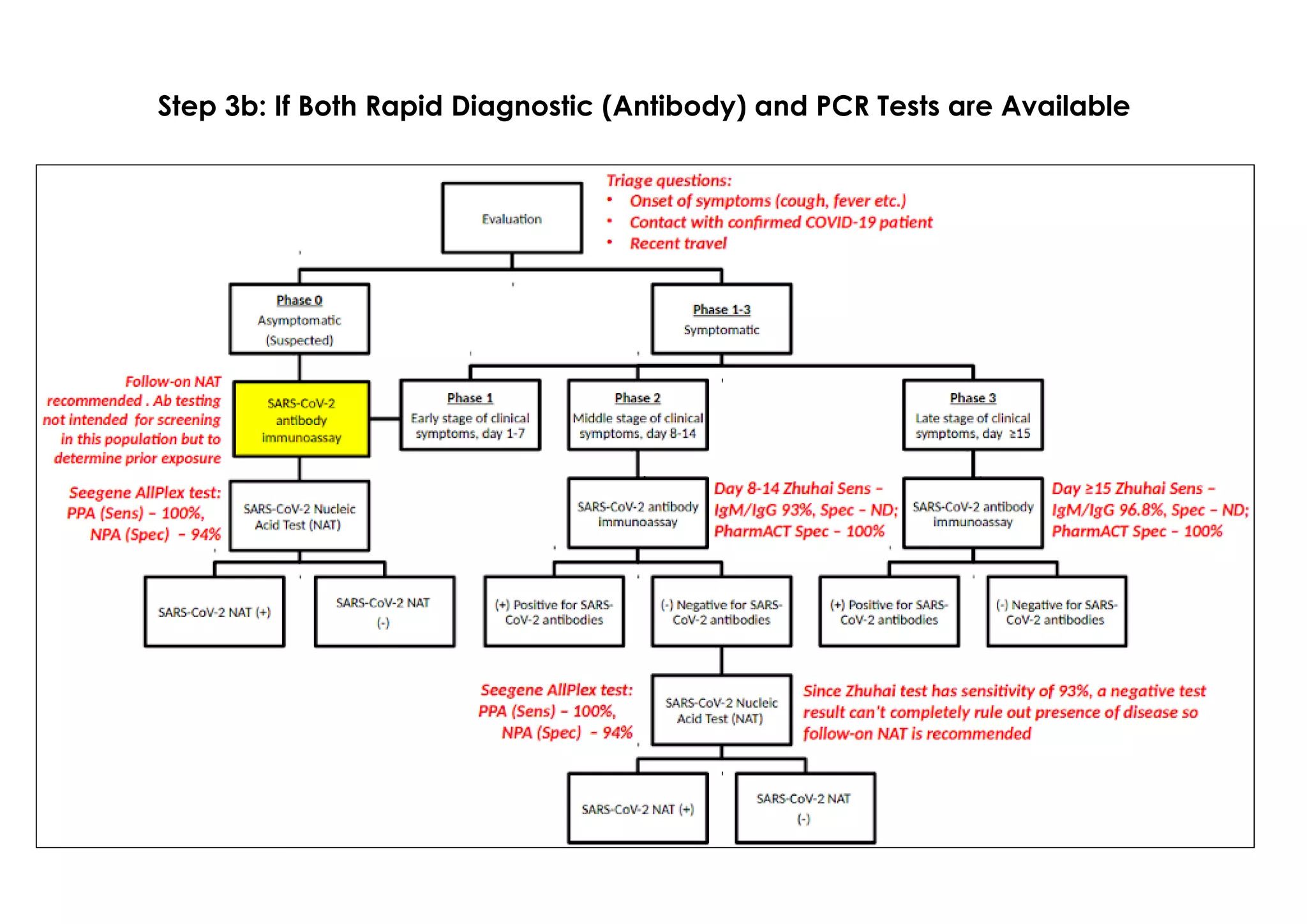
a. Phase 0 and 1: antibody test followed by PCR
b. Phase 2: antibody test (confirm negative results with PCR)
c. Phase 3: antibody test
4. If a test for viral antigens become approved for commercial use,
treat it as similar to a PCR but with potentially lower specificity and
sensitivity (i.e., more results that are false negatives and false
positives).
5. Testing healthcare workers regularly and repeatedly can be carried
out with the antibody test because their exposure is constant.
E. Limitations and Challenges of Antibody Testing
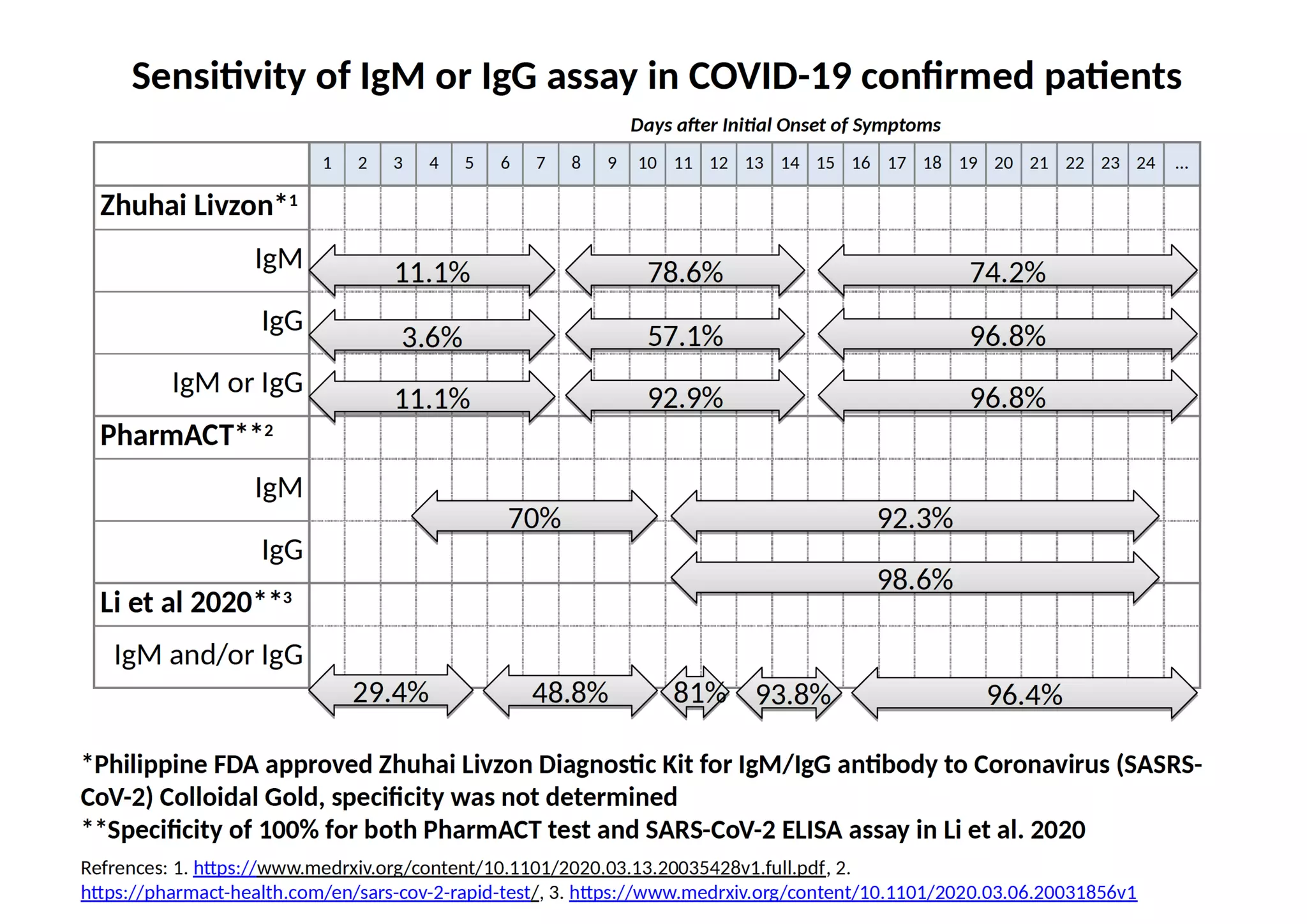
1. Accuracy of antibody tests are not fully known.
2. Accuracy may vary greatly among antibody tests.
3. Some antibody tests fail to distinguish between IgM and IgG.
4. New antibody tests are becoming available even before FDA
approval.
5. Newer antibody tests may be more accurate than FDA-approved
ones.
Validation is challenging for all of the above reasons; hence, we
recommend:
1. DOH/FDA validate the manufacturer-provided accuracies of
antibody tests being introduced, and approve/endorse only the
good performers;
2. Clinicians to interpret the results vis-a-vis clinical presentation;
3. Use the tests strictly according to manufacturer’s instructions to
minimize results variability.
3-Step Recommendation for Diagnostic Testing
The figures below provide a guide for the steps in the process that can be
used by healthcare workers. Depending on the accessibility of tests, the
HCW may proceed using Step 3a or 3b.
Prepared by:
Salvador Eugenio C. Caoili, M.D., Ph.D. and Romulo de Castro,
Ph.D.
E-mail: badong@post.upm.edu; rdcastro@usa.edu.ph Mobile: SECC (0917)
5861444, RdC (0995) 956 6505
Step 1: Decision Tree for Low-Resource Situation
Step 2: Evaluation and Triage
Step 3a: If only Rapid Diagnostic (Antibody) Tests are Available
Step 3b: If Both Rapid Diagnostic (Antibody) and PCR Tests are Available
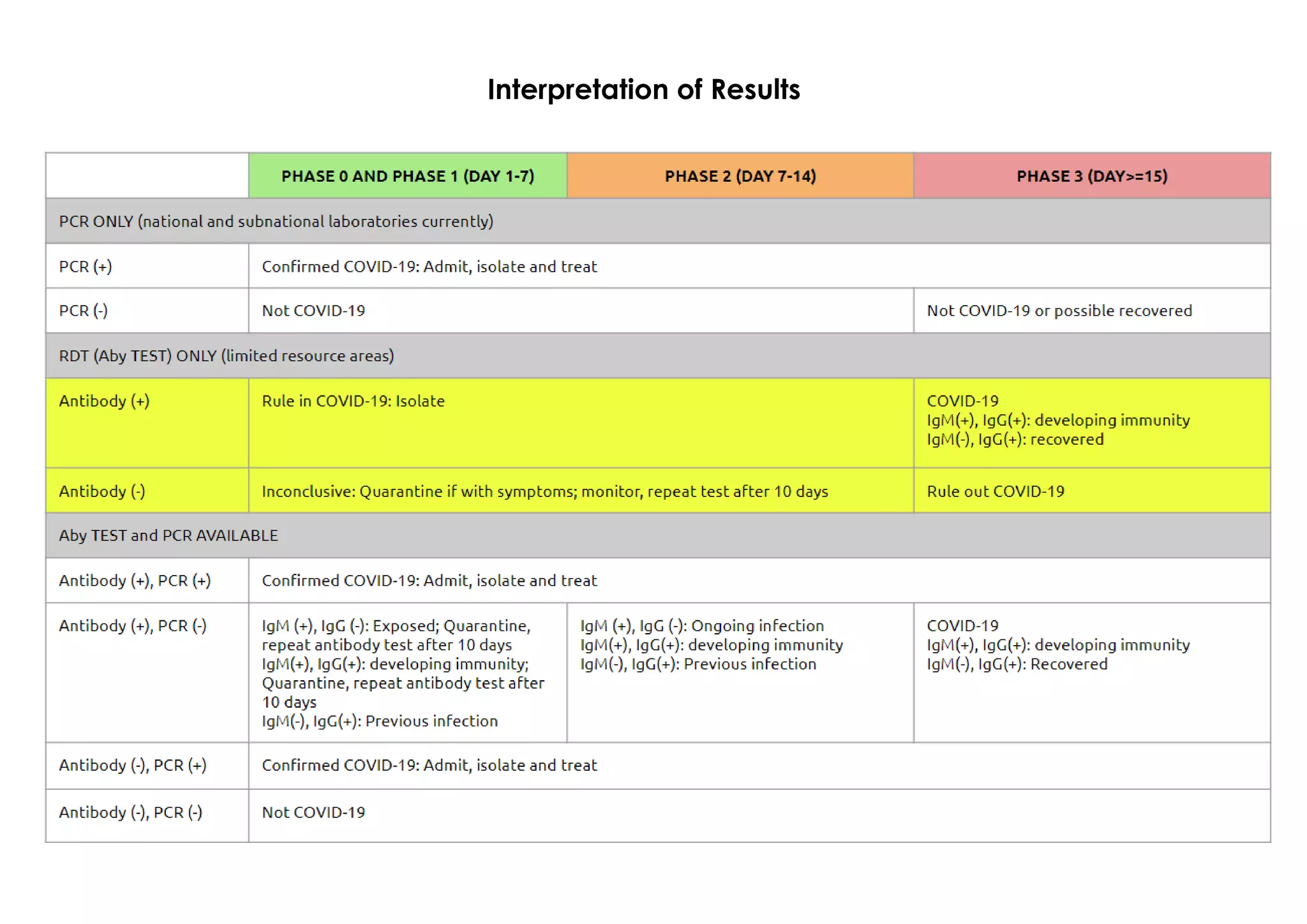
Interpretation of Results
OUR RESPONSE TO COVID-19
AGHAM AT KAALAMAN PARA SA BAYAN!
OFFICERS
Gisela P. Concepcion, PhD
PRESIDENT
Edsel A. Peña, PhD
VICE-PRESIDENT
Lourdes Herold, PhD
SECRETARY
Anna Kristina Serquiña, MD PhD
TREASURER
BOARD OF DIRECTORS
Carlito Lebrilla, PhD
CHAIRPERSON
Rigoberto Advincula, PhD
Diana Aga, PhD
Joel Cuello, PhD
Alvin Culaba, PhD
Lawrence Ilag, PhD
Marjorie Peña, PhD
Mariano Sto. Domingo, PhD
Eizadora Yu, PhD
MEMBERS
PAASE
hosted bv
PAASE Philippines, Inc.
A SUBSIDIARY OF PAASE
Marine Natural Products &
Biotechnology Laboratories
The Marine Science Institute
Velasquez St.
University of the Philippines
Diliman, Quezon City
E-MAIL
gpconcepcion@gmail.com
paase2020manila@gmail.com
WEBSITE
www.paase.org
References
1. Centers for Disease Control and Prevention (2020) Coronavirus Disease 2019
(COVID-19) Clinical Care. Retrieved 5 April 2020 from:
https://www.cdc.gov/coronavirus/2019-ncov/hcp/clinical-guidance-
management- patients.html.
2. Philippine Society for Microbiology and Infectious Diseases (2020) Interim
Guidelines on the Clinical Management of Adult Patients with Suspected or
Confirmed COVID-19 Infection Version 2.1, as of 31 March 2020.
3. Li L, Liu W, Zheng Y, Jiang X, Kou G, Ding J et al. (2020) A preliminary study on
serological assay for severe acute respiratory syndrome coronavirus 2 (SARS-
CoV-2) in 238 admitted hospital patients. medRxiv. doi:
10.1101/2020.03.06.20031856.
4. Pan Y, Li X, Yang G, Fan J, Tang Y, Zhao J et al. (2020) Serological
immunochromatographic approach in diagnosis with SARS-CoV-2 infected
COVID-19 patients. Medrxiv. Retrieved from:
https://www.medrxiv.org/content/10.1101/2020.03.13.20035428v1.full.pdf.
5. PharmACT Holding AG Inc. (2020) SARS-CoV-2 Rapid Test. Retrieved from:
https://pharmact-health.com/en/sars-cov-2-rapid-test/.
6. Seegene (2020) Seegene All-Plex Test - 2019-nCoV multiplex real-time PCR
assay for simultaneous detection of 3 target genes of SARS-CoV-2. Retrieved
from: www.seegene.com.
7. World Health Organization (2020) WHO-China Joint Mission on Coronavirus
Disease 19 (COVID-19). Retrieved 5 April 2020 from:
https://www.who.int/docs/default- source/coronaviruse/who-china-joint-
mission-on-covid-19-final-report.pdf.
Salvador Eugenio C. Caoili, M.D., Ph.D. and Romulo de Castro, Ph.D.
E-mail: badong@post.upm.edu; rdcastro@usa.edu.ph
Mobile: SECC (0917) 5861444, RdC (0995) 956 6505
Draft on Testing for COVID-19 with Antibody and PCR Tests in Low Resource Areas

Draft on Testing for COVID-19 with Antibody and PCR Tests in Low Resource Areas

  • 1.
    OUR RESPONSE TOCOVID-19 AGHAM AT KAALAMAN PARA SA BAYAN! OFFICERS Gisela P. Concepcion, PhD PRESIDENT Edsel A. Peña, PhD VICE-PRESIDENT Lourdes Herold, PhD SECRETARY Anna Kristina Serquiña, MD PhD TREASURER BOARD OF DIRECTORS Carlito Lebrilla, PhD CHAIRPERSON Rigoberto Advincula, PhD Diana Aga, PhD Joel Cuello, PhD Alvin Culaba, PhD Lawrence Ilag, PhD Marjorie Peña, PhD Mariano Sto. Domingo, PhD Eizadora Yu, PhD MEMBERS PAASE hosted bv PAASE Philippines, Inc. A SUBSIDIARY OF PAASE Marine Natural Products & Biotechnology Laboratories The Marine Science Institute Velasquez St. University of the Philippines Diliman, Quezon City E-MAIL gpconcepcion@gmail.com paase2020manila@gmail.com WEBSITE www.paase.org PAASE BULLETIN # 11 ON PAASE STRATEGIC ACTION GROUP 3: MASS TESTING & FAST-TRACKING Addressed to: DOH and COVID-19 IATF A 3-STEP RECOMMENDATION FOR DIAGNOSTIC TESTING USING ANTIBODY AND PCR TESTS IN LOW-RESOURCE AREAS PAASE recommends the following algorithm for COVID-19 diagnostic testing using antibody and/or PCR tests to be used by healthcare workers in low-resource areas. A. Challenges in COVID-19 diagnostics The current guideline tests only those exhibiting moderate to severe symptoms. Unfortunately, this misses those with mild symptoms and infected asymptomatics who may be spreading the disease unknowingly. Frontline healthcare workers (HCW) are not getting the benefit of testing (unless they exhibit moderate to severe symptoms) as they perform their work caring for COVID-19 patients. B. Recommendations 1. We recommend enhanced testing to include patients under investigation (PUI) and patients under monitoring (PUM) and all suspected to be exposed, regardless of whether or not they show symptoms. Positives must be isolated, monitored and treated. Contact tracing must follow a positive test and contacts must also be monitored. This informs a more targeted quarantine and will play a role in the government’s actions post-lockdown. 2. Our healthcare workers must also be supported with regular testing even if they do not show symptoms, using either or both antibody and PCR tests, if possible. 3. Antibody testing can augment our currently limited testing capacity. Some antibody tests can give rapid results, are inexpensive and will help in places that have little or no access to PCR testing. We provide step-by-step guidelines on the use and utility of antibody tests by themselves in low- resource areas and in combination with PCR. 4. With or without testing, using PCR, antibody or both, we recommend that clinicians use disease presentation and their best judgment for patient management. C. Rationale 1. Cost The RT-PCR test for COVID-19 is estimated to cost up to 3,500 pesos, which includes test reagents, manpower, equipment and PPEs. The cost of rapid diagnostic tests for detection of antibodies against SARS-CoV-2 (IgM and/or IgG) is estimated to be less than 1/5th the cost of PCR. 2. Time Rapid diagnostic (antibody) testing may take as little as 15 minutes individually, while PCR testing can take from 2 to 4 hours to run (sometimes in batches, requiring waiting for other samples to be ready). 3. Facilities and Expertise PCR testing is performed under specialized laboratory facilities by highly trained (e.g., biochemistry, molecular biology) personnel. The rapid diagnostic (antibody) tests, however, may be done in a point-of-care setting by a trained healthcare worker such as a physician.
  • 2.
    OUR RESPONSE TOCOVID-19 AGHAM AT KAALAMAN PARA SA BAYAN! OFFICERS Gisela P. Concepcion, PhD PRESIDENT Edsel A. Peña, PhD VICE-PRESIDENT Lourdes Herold, PhD SECRETARY Anna Kristina Serquiña, MD PhD TREASURER BOARD OF DIRECTORS Carlito Lebrilla, PhD CHAIRPERSON Rigoberto Advincula, PhD Diana Aga, PhD Joel Cuello, PhD Alvin Culaba, PhD Lawrence Ilag, PhD Marjorie Peña, PhD Mariano Sto. Domingo, PhD Eizadora Yu, PhD MEMBERS PAASE hosted bv PAASE Philippines, Inc. A SUBSIDIARY OF PAASE Marine Natural Products & Biotechnology Laboratories The Marine Science Institute Velasquez St. University of the Philippines Diliman, Quezon City E-MAIL gpconcepcion@gmail.com paase2020manila@gmail.com WEBSITE www.paase.org D. Summary of Guidelines 1. Step 1: Frontline healthcare workers and their local government units follow the decision tree according to availability of resources. 2. Step 2: Patients are triaged according to disease phase by their clinical presentation. 3. Step 3: The following are the recommended tests for each phase (using tests that have adequate specificity and sensitivity, and strictly following manufacturer’s instructions) a. Phase 0 and 1: antibody test followed by PCR b. Phase 2: antibody test (confirm negative results with PCR) c. Phase 3: antibody test 4. If a test for viral antigens become approved for commercial use, treat it as similar to a PCR but with potentially lower specificity and sensitivity (i.e., more results that are false negatives and false positives). 5. Testing healthcare workers regularly and repeatedly can be carried out with the antibody test because their exposure is constant. E. Limitations and Challenges of Antibody Testing 1. Accuracy of antibody tests are not fully known. 2. Accuracy may vary greatly among antibody tests. 3. Some antibody tests fail to distinguish between IgM and IgG. 4. New antibody tests are becoming available even before FDA approval. 5. Newer antibody tests may be more accurate than FDA-approved ones. Validation is challenging for all of the above reasons; hence, we recommend: 1. DOH/FDA validate the manufacturer-provided accuracies of antibody tests being introduced, and approve/endorse only the good performers; 2. Clinicians to interpret the results vis-a-vis clinical presentation; 3. Use the tests strictly according to manufacturer’s instructions to minimize results variability. 3-Step Recommendation for Diagnostic Testing The figures below provide a guide for the steps in the process that can be used by healthcare workers. Depending on the accessibility of tests, the HCW may proceed using Step 3a or 3b. Prepared by: Salvador Eugenio C. Caoili, M.D., Ph.D. and Romulo de Castro, Ph.D. E-mail: badong@post.upm.edu; rdcastro@usa.edu.ph Mobile: SECC (0917) 5861444, RdC (0995) 956 6505
  • 3.
    Step 1: DecisionTree for Low-Resource Situation
  • 4.
  • 5.
    Step 3a: Ifonly Rapid Diagnostic (Antibody) Tests are Available
  • 6.
    Step 3b: IfBoth Rapid Diagnostic (Antibody) and PCR Tests are Available
  • 8.
  • 9.
    OUR RESPONSE TOCOVID-19 AGHAM AT KAALAMAN PARA SA BAYAN! OFFICERS Gisela P. Concepcion, PhD PRESIDENT Edsel A. Peña, PhD VICE-PRESIDENT Lourdes Herold, PhD SECRETARY Anna Kristina Serquiña, MD PhD TREASURER BOARD OF DIRECTORS Carlito Lebrilla, PhD CHAIRPERSON Rigoberto Advincula, PhD Diana Aga, PhD Joel Cuello, PhD Alvin Culaba, PhD Lawrence Ilag, PhD Marjorie Peña, PhD Mariano Sto. Domingo, PhD Eizadora Yu, PhD MEMBERS PAASE hosted bv PAASE Philippines, Inc. A SUBSIDIARY OF PAASE Marine Natural Products & Biotechnology Laboratories The Marine Science Institute Velasquez St. University of the Philippines Diliman, Quezon City E-MAIL gpconcepcion@gmail.com paase2020manila@gmail.com WEBSITE www.paase.org References 1. Centers for Disease Control and Prevention (2020) Coronavirus Disease 2019 (COVID-19) Clinical Care. Retrieved 5 April 2020 from: https://www.cdc.gov/coronavirus/2019-ncov/hcp/clinical-guidance- management- patients.html. 2. Philippine Society for Microbiology and Infectious Diseases (2020) Interim Guidelines on the Clinical Management of Adult Patients with Suspected or Confirmed COVID-19 Infection Version 2.1, as of 31 March 2020. 3. Li L, Liu W, Zheng Y, Jiang X, Kou G, Ding J et al. (2020) A preliminary study on serological assay for severe acute respiratory syndrome coronavirus 2 (SARS- CoV-2) in 238 admitted hospital patients. medRxiv. doi: 10.1101/2020.03.06.20031856. 4. Pan Y, Li X, Yang G, Fan J, Tang Y, Zhao J et al. (2020) Serological immunochromatographic approach in diagnosis with SARS-CoV-2 infected COVID-19 patients. Medrxiv. Retrieved from: https://www.medrxiv.org/content/10.1101/2020.03.13.20035428v1.full.pdf. 5. PharmACT Holding AG Inc. (2020) SARS-CoV-2 Rapid Test. Retrieved from: https://pharmact-health.com/en/sars-cov-2-rapid-test/. 6. Seegene (2020) Seegene All-Plex Test - 2019-nCoV multiplex real-time PCR assay for simultaneous detection of 3 target genes of SARS-CoV-2. Retrieved from: www.seegene.com. 7. World Health Organization (2020) WHO-China Joint Mission on Coronavirus Disease 19 (COVID-19). Retrieved 5 April 2020 from: https://www.who.int/docs/default- source/coronaviruse/who-china-joint- mission-on-covid-19-final-report.pdf. Salvador Eugenio C. Caoili, M.D., Ph.D. and Romulo de Castro, Ph.D. E-mail: badong@post.upm.edu; rdcastro@usa.edu.ph Mobile: SECC (0917) 5861444, RdC (0995) 956 6505