Open Access Advantages, Quality and Progress of the Research Iryna Kuchma  eIFL Open Access Program Manager, eIFL.net Presented at t he International Conference „Adult Learning and e-Learning Quality“, November 25, 2008, Kaunas, Lithuania
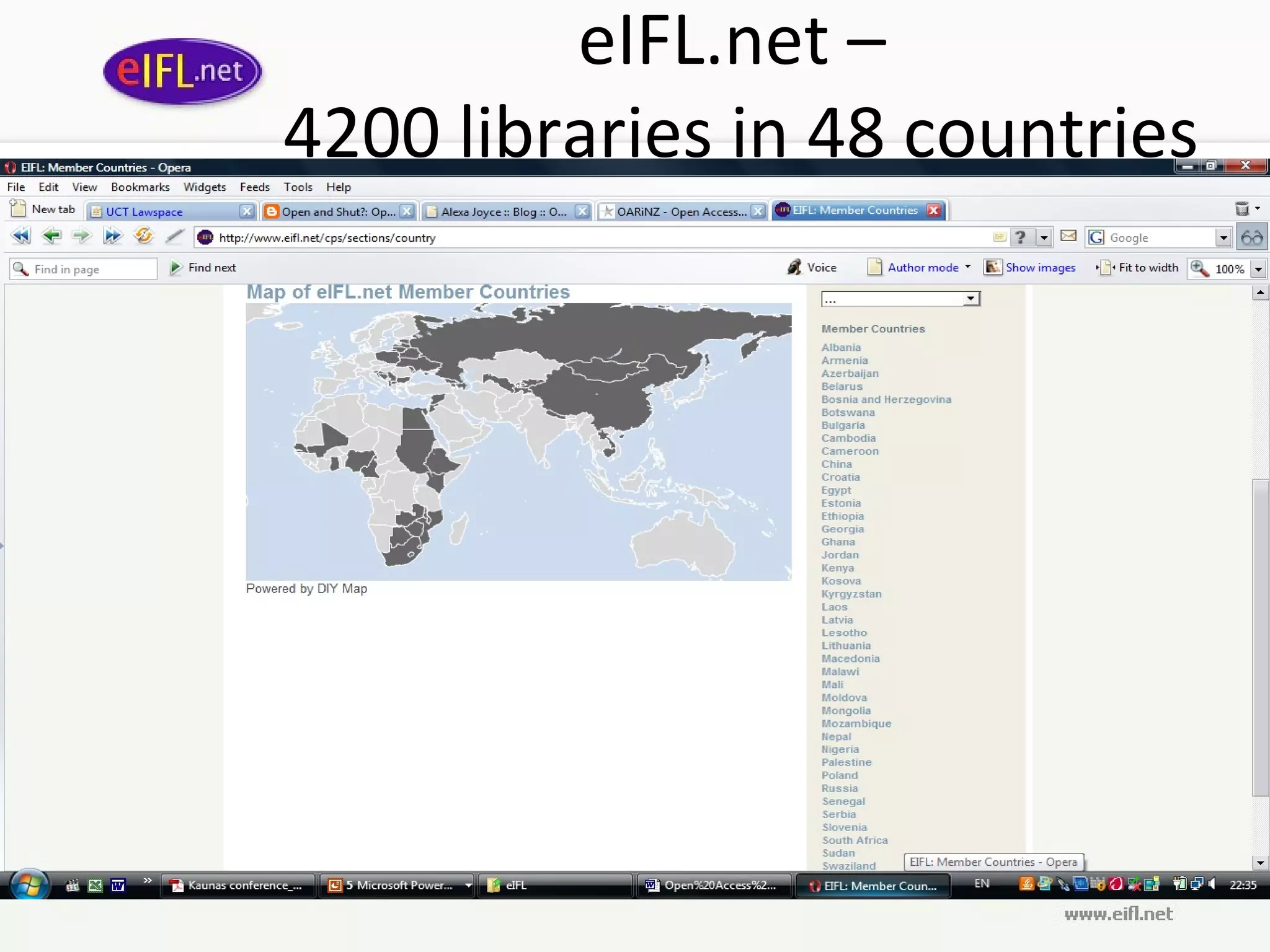
eIFL.net –  4200 libraries in 48 countries
 
eIFL.net programs Open access publishing and the building of open repositories of local content  Advocacy for access to knowledge: copyright and libraries   Promoting free and open source software for libraries   1+1=More and better. The benefits of library consortia Promoting a culture of cooperation: knowledge and information sharing   Advocating for affordable and fair access to commercially produced scholarly resources
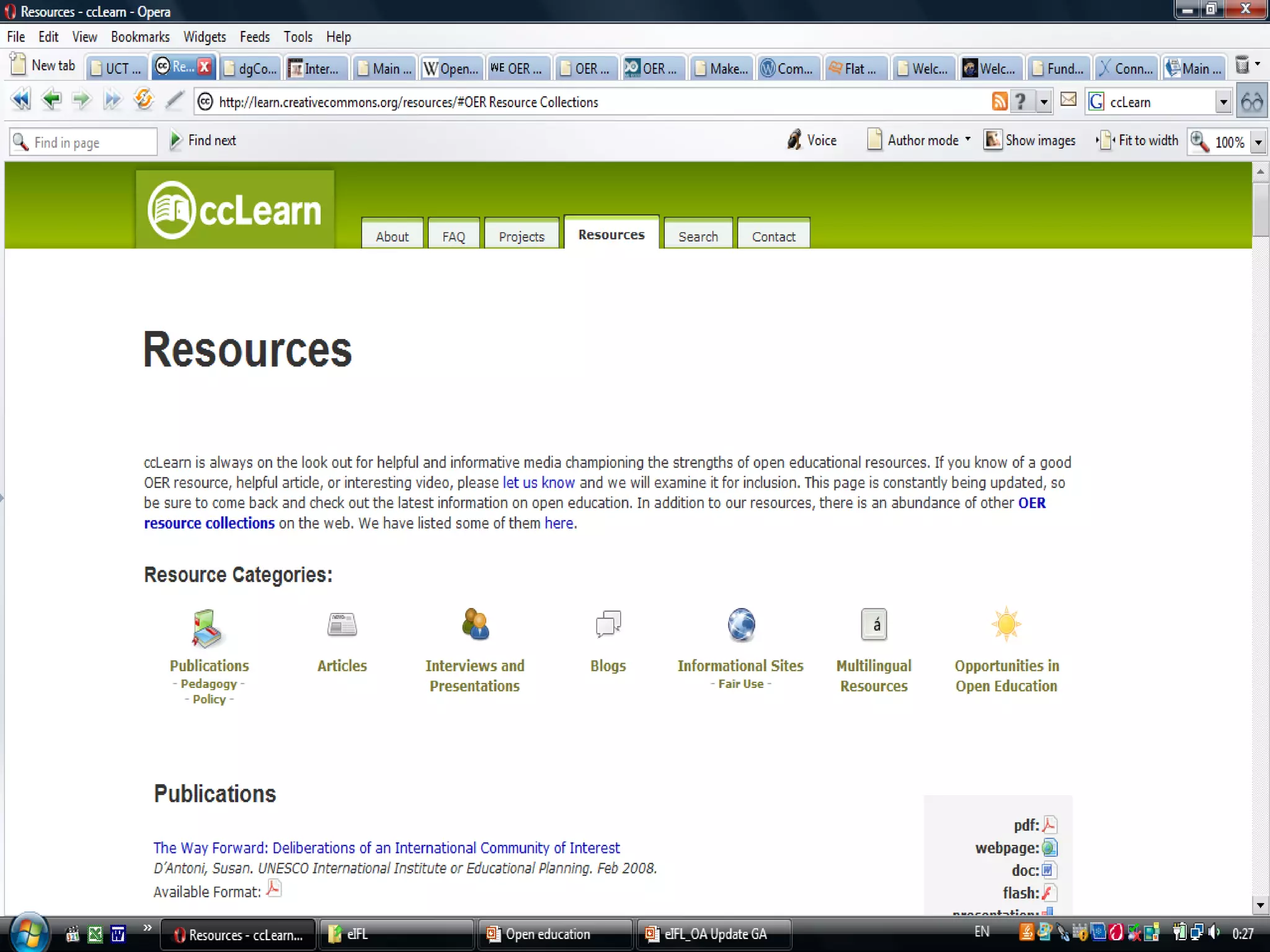
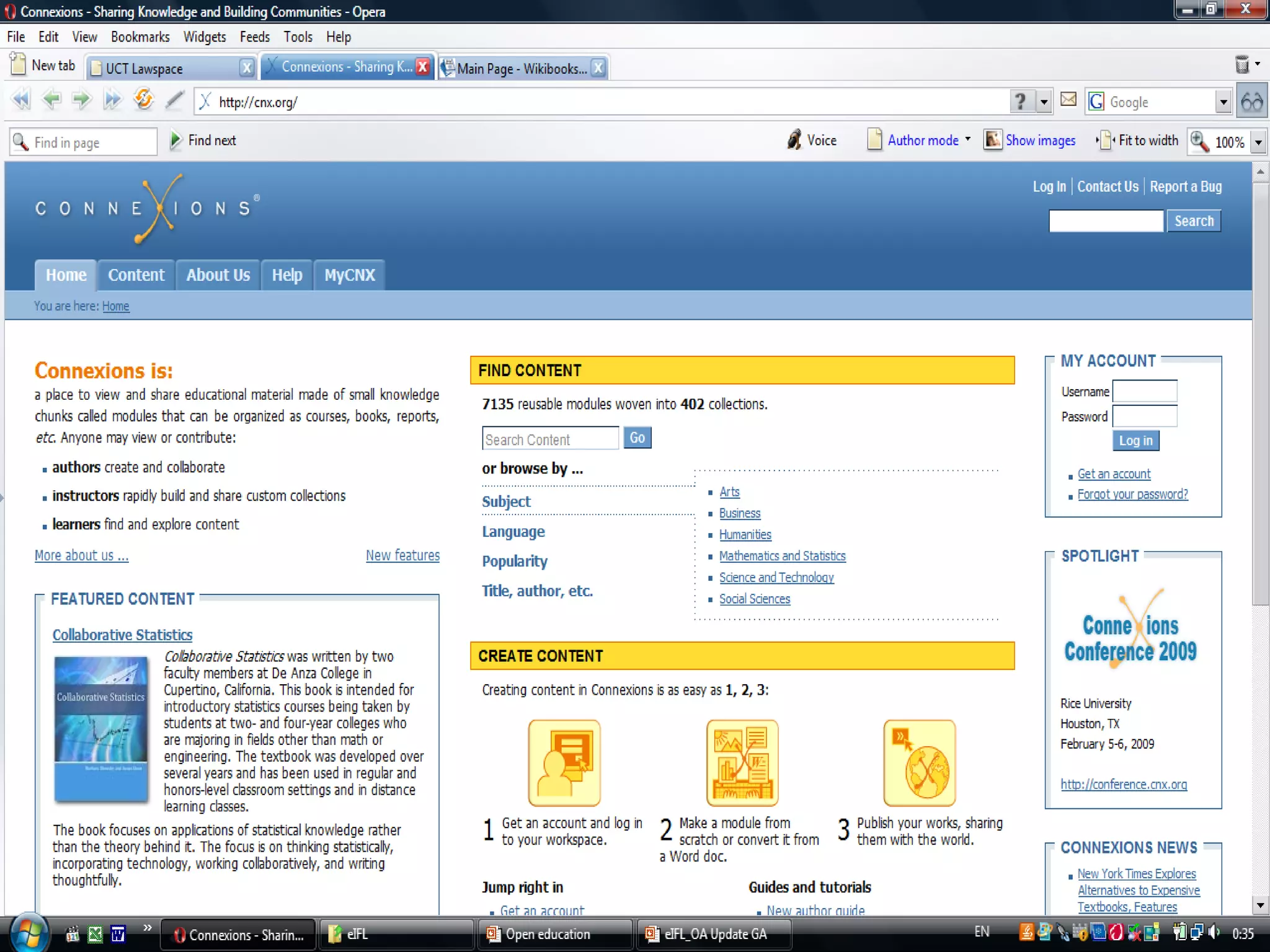
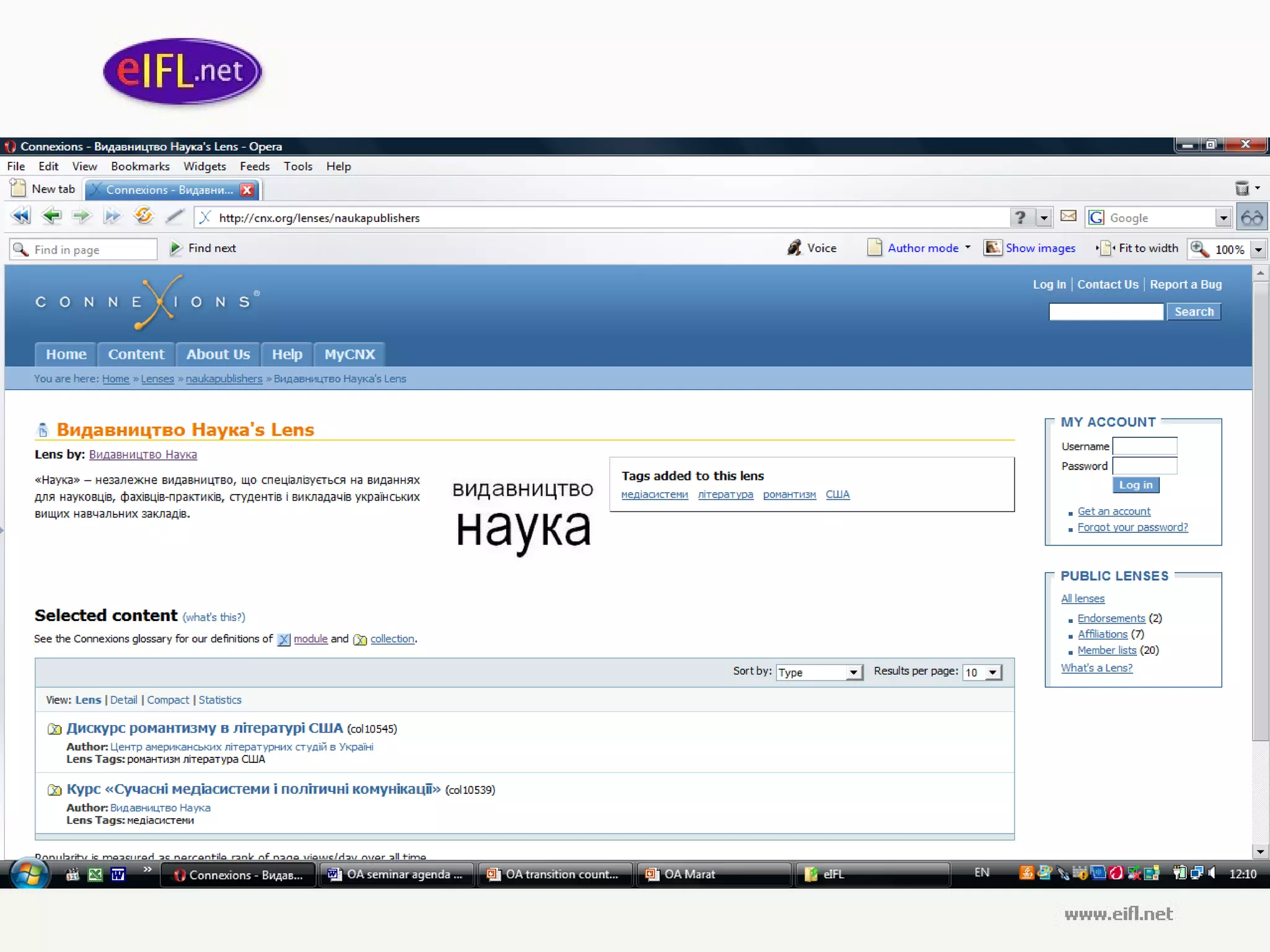
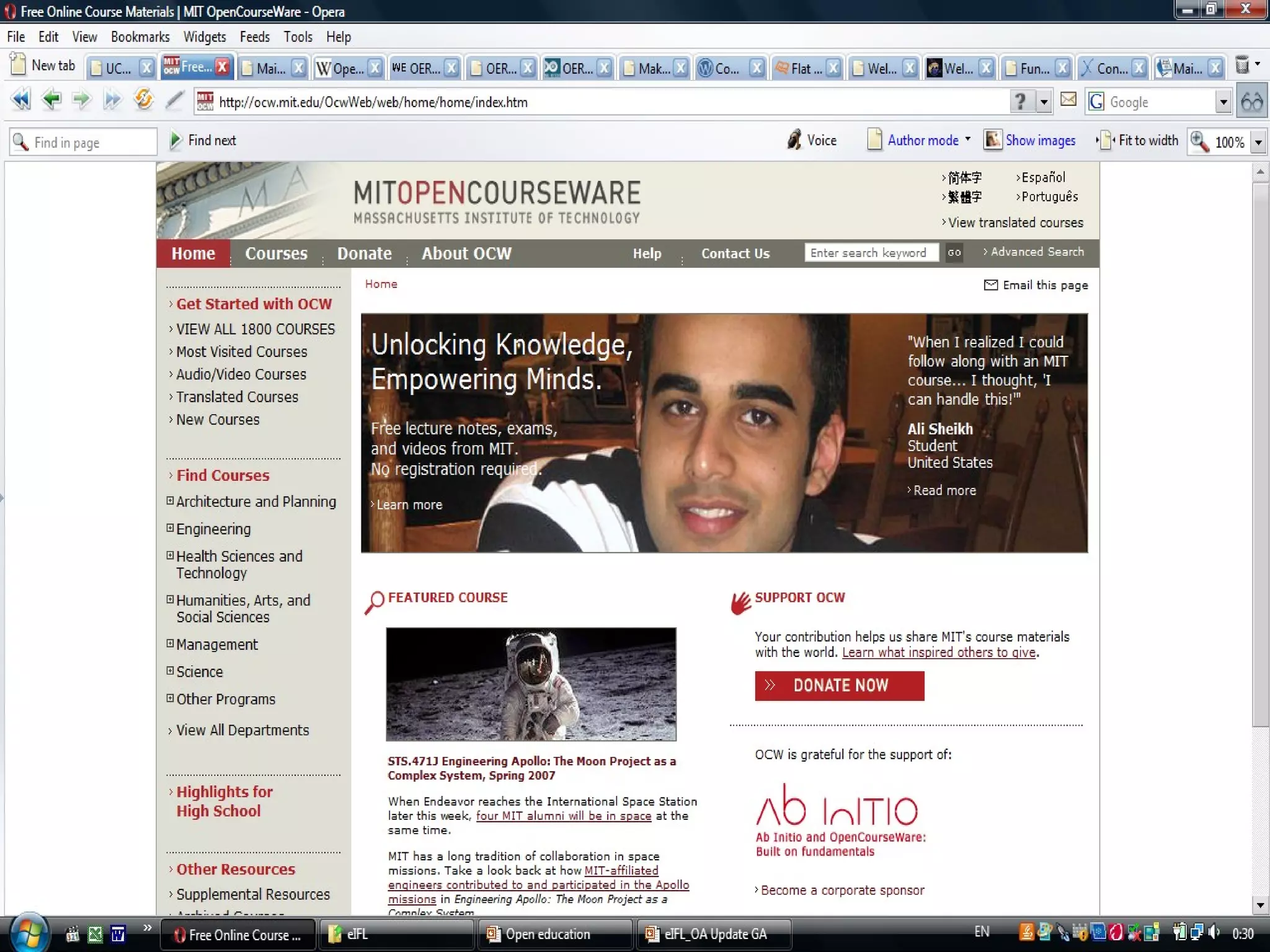
eIFL Open Access eIFL-OA seeks to  enhance access to research , thereby  accelerating innovation  and  economic development  in the countries eIFL-OA Program  - builds networks of  Open  repositories,  Open Access  journals and Open education materials;  - provides  training and advice on Open Access policies and practices;  - empowers library professionals, scientists and scholars, educators and students to become  open access advocates
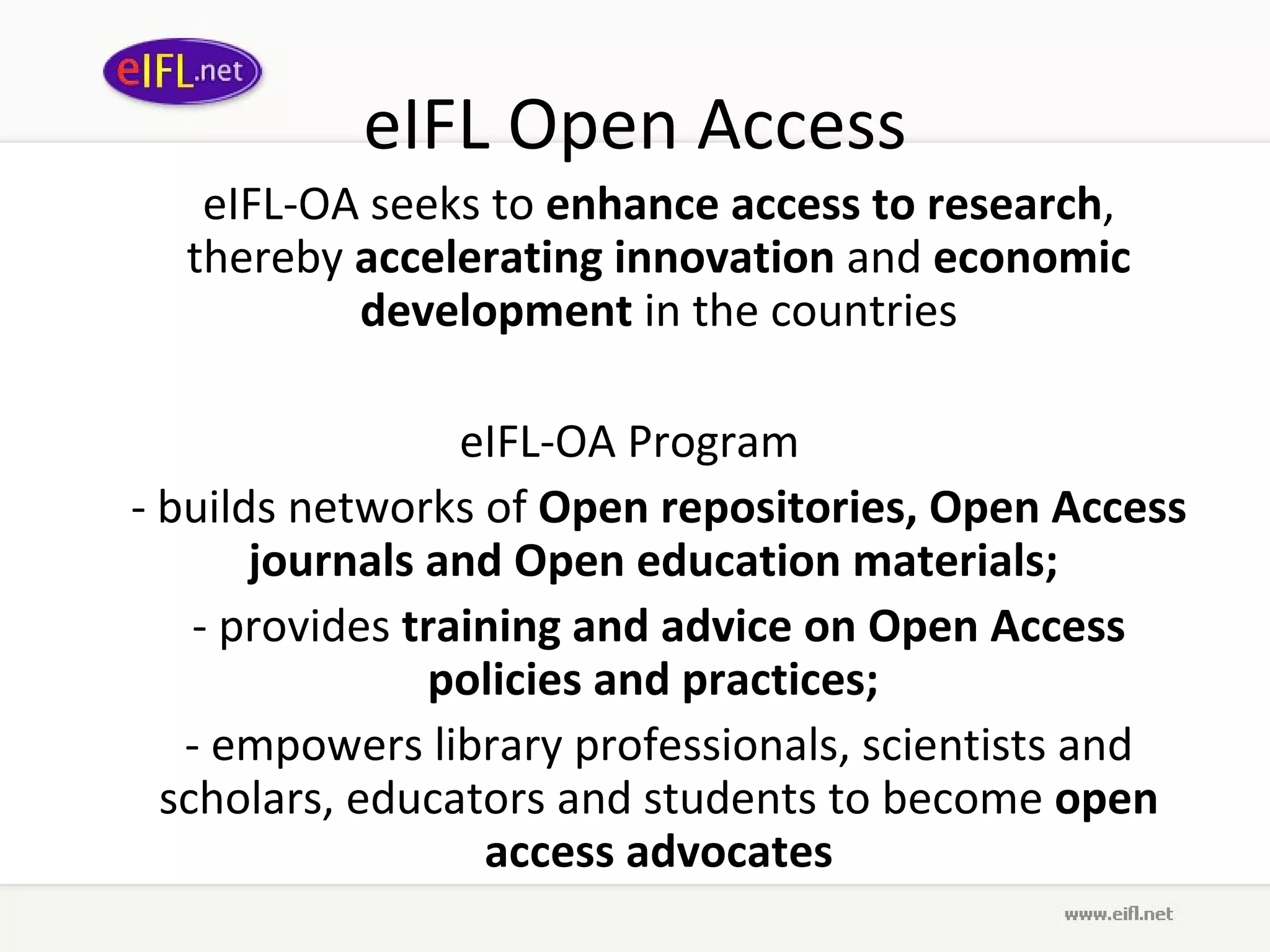
That’s not e-learning CC BY-NC-SA by mashon http :// www . flickr . com / photos / mushon /197192450/ ;  http :// www . flickr . com / photos / mushon /197192003/
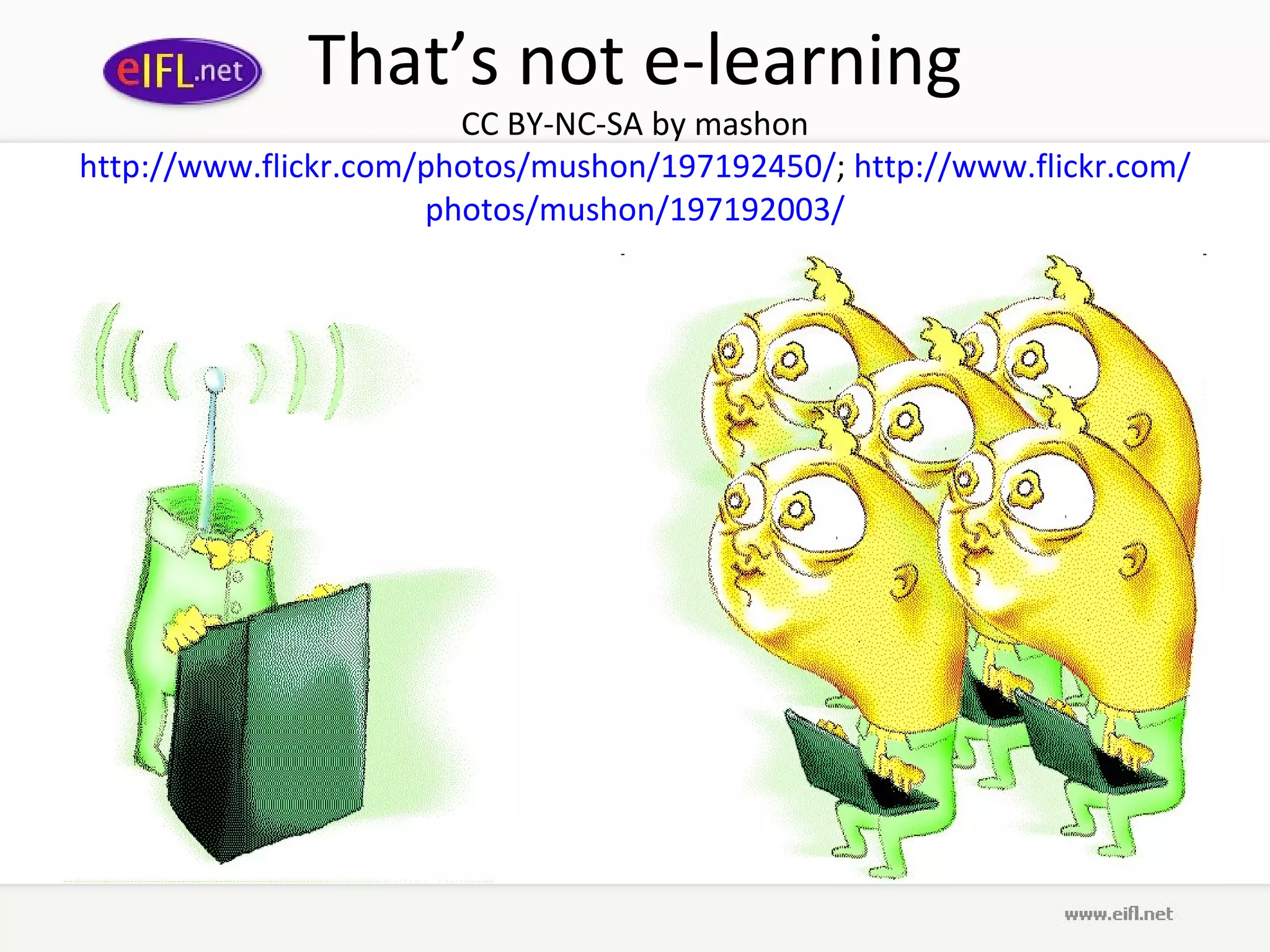
CC BY-NC by A eioux   http :// www . flickr . com / photos / aeioux /270434765/
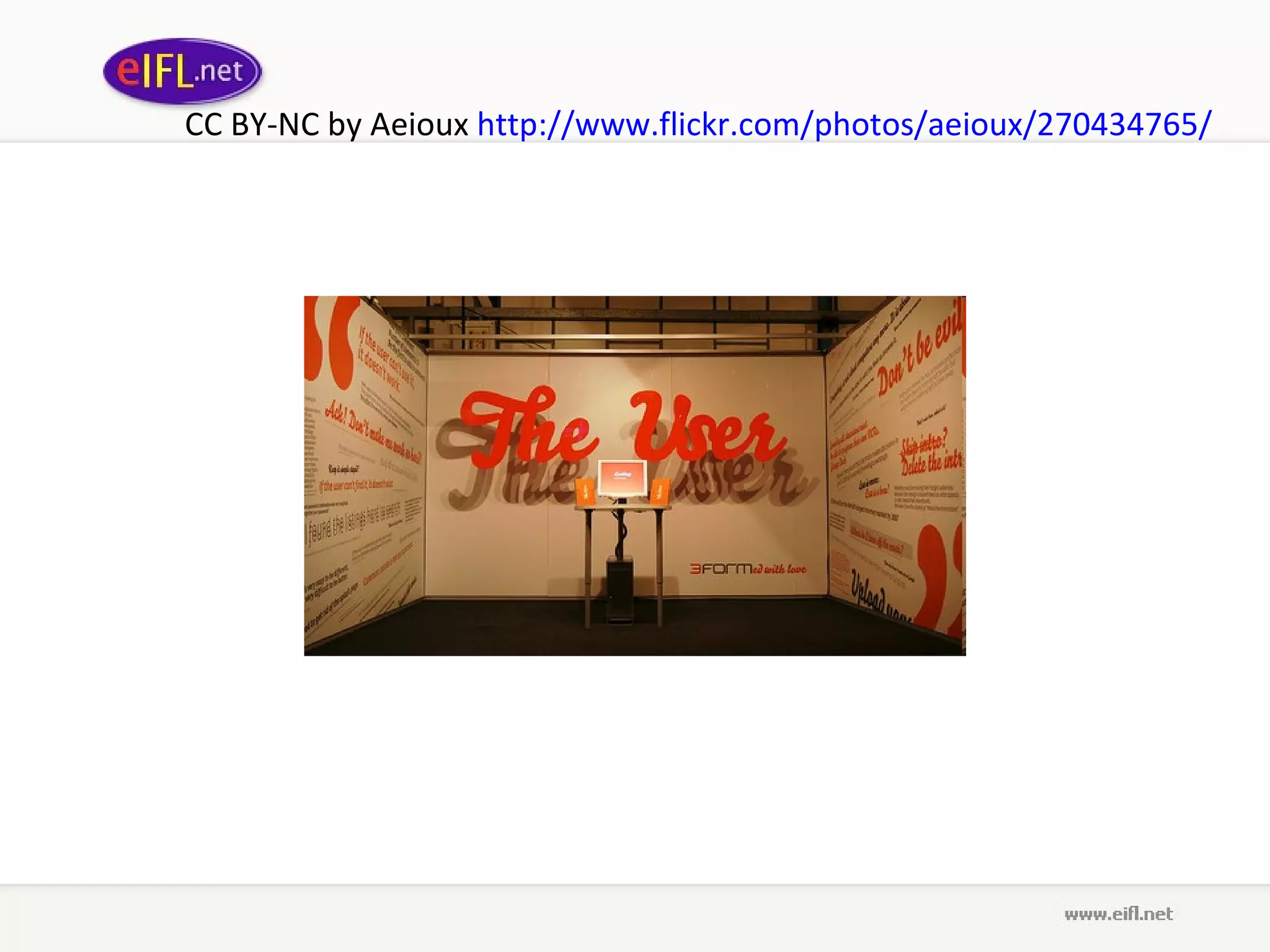
CC BY--NC-ND by  ekornblut   http :// www . flickr . com / photos / emilyjk /889172557/
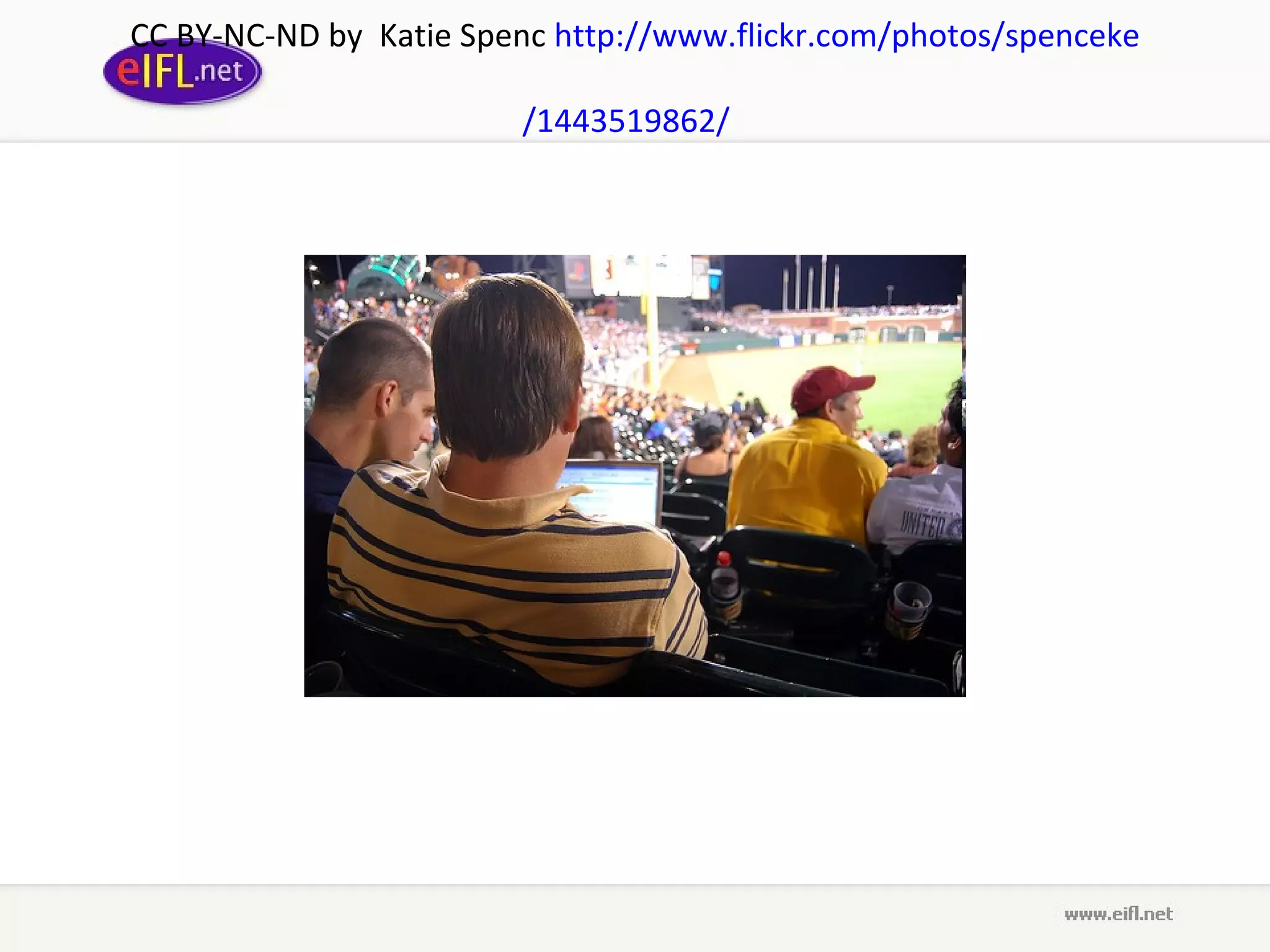
CC BY-NC-ND by  Katie Spenc   http :// www . flickr . com / photos / spenceke /1443519862/
Lifelong learning and open access “ How to support lifelong learning and widening participation?”: “ Key to this wider context are the themes of broadening participation to non-traditional groups of learners, links with work-based learning, more flexible provision of learning, and fair and transparent admissions procedures.” (Sarah Davies JISC programme manager: Online Educa tackles lifelong learning and open access:  http://www. jisc .ac. uk /news/stories/2006/11/news_educa1. aspx )
Lifelong learning and open access “ E-portfolios can support learning by supporting applications for studies or jobs,  appraisal or assessment;  supporting learners as they move between institutions and sectors;  and by guiding learning over time, in formal education, training and employment.”  (Sarah Davies JISC programme manager: Online Educa tackles lifelong learning and open access:  http://www. jisc .ac. uk /news/stories/2006/11/news_educa1. aspx )
Lifelong learning and open access the 'information imperative'  “ the fact there is a 30% growth in information per year and the corresponding need to adopt new systems, policies and approaches by all organisations”  “ 'the half-life of information is getting shorter', that is to say, information which is true one day can be wrong or no longer true the following day.” the need for the skill of 'unlearning' - not necessarily knowing information but knowing how to find it only when one needs it.” (Charles Jennings, Global Head of Learning at Reuters: Online Educa tackles lifelong learning and open access:  http://www. jisc .ac. uk /news/stories/2006/11/news_educa1. aspx )
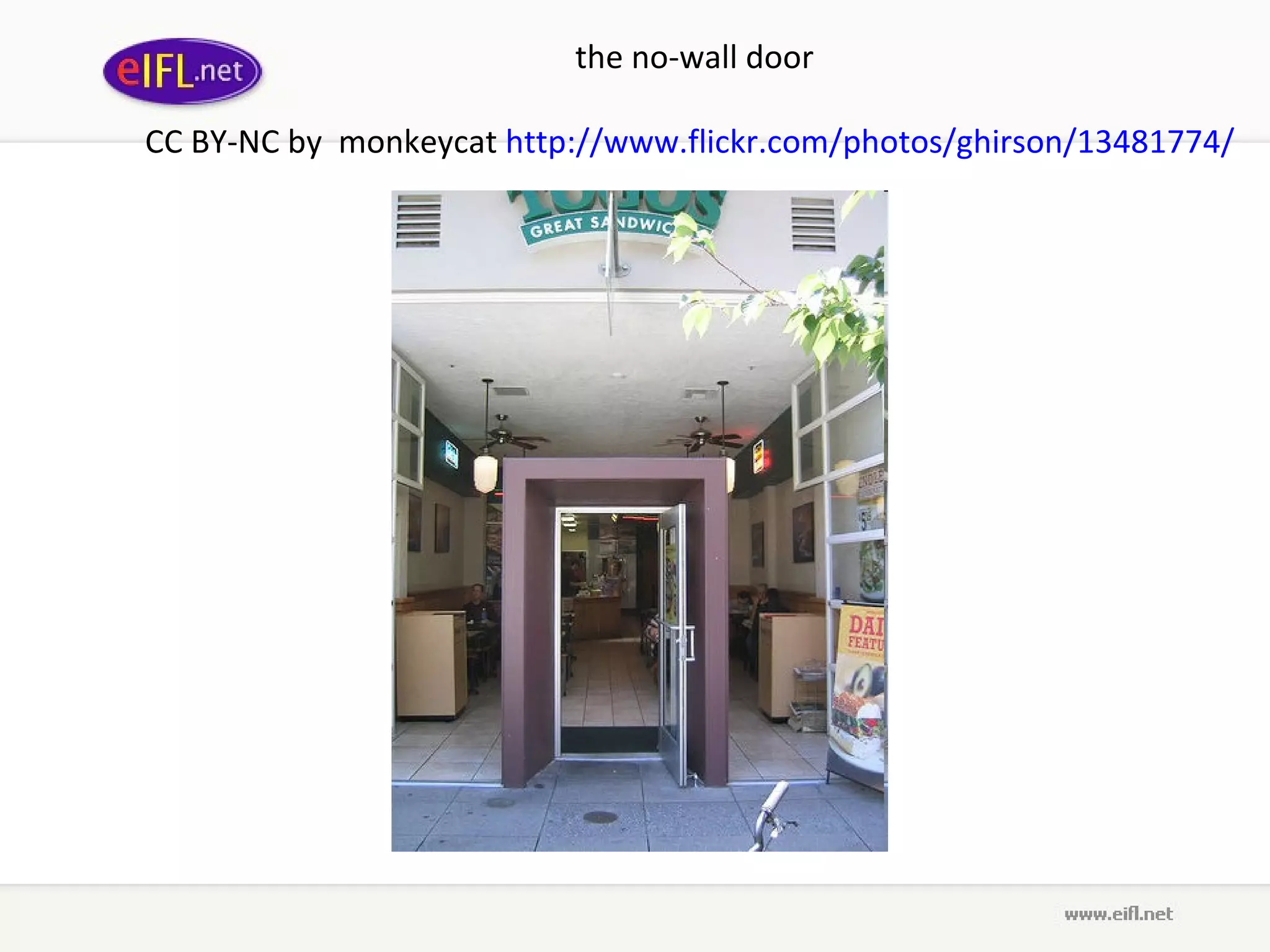
the no-wall door   CC BY-NC by  monkeyca t  http :// www . flickr . com / photos / ghirson /13481774/
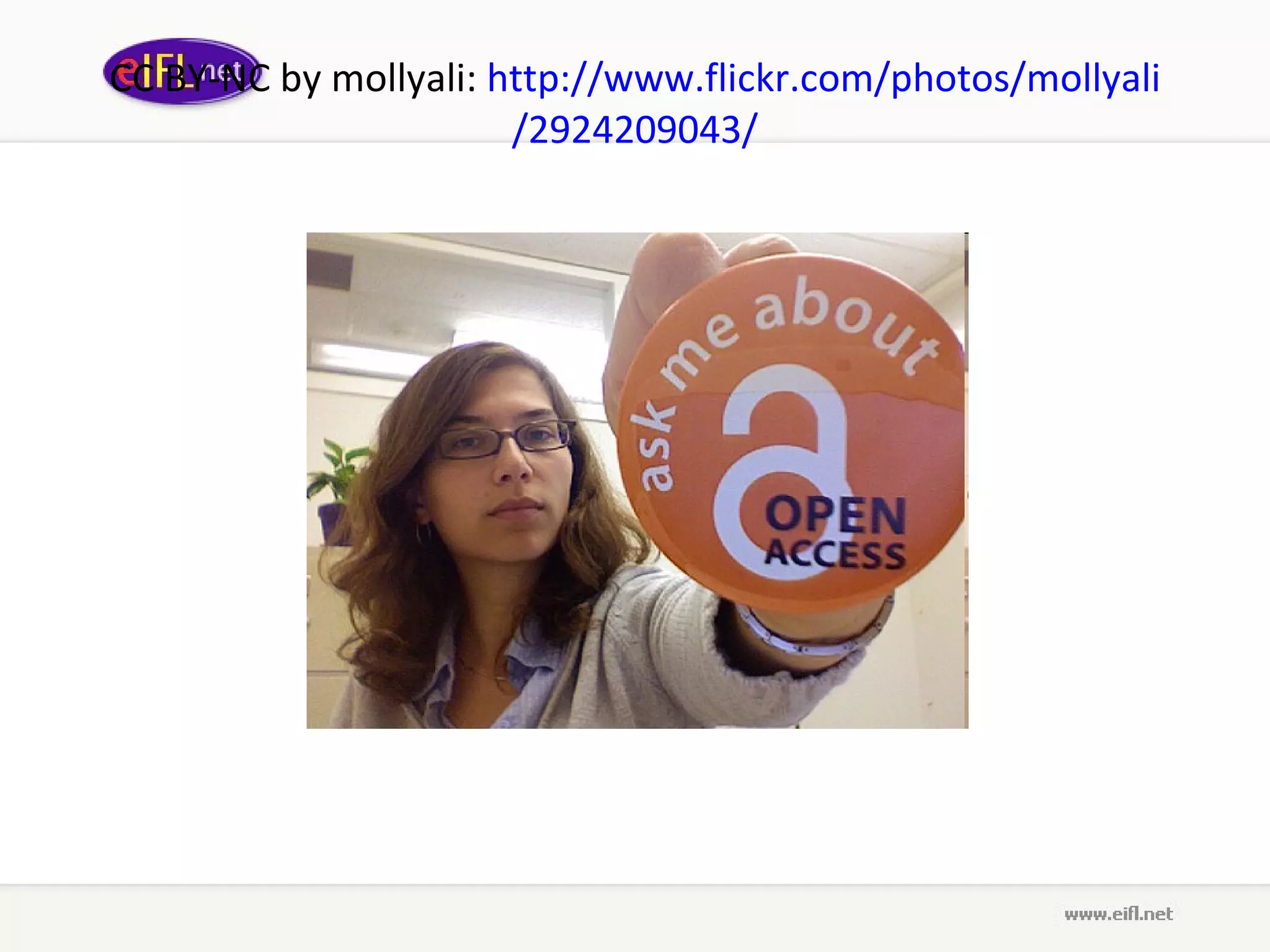
CC BY-NC by  mollyali :  http :// www . flickr . com / photos / mollyali /2924209043/
Open Access Open Access  is the free online availability of peer reviewed journal literature permitting any user to read ,  download, copy, distribute, print, search, or link to the full texts of articles 2  complementary strategies:  the development of  institutional repositories  and Open Access journals From the Budapest Open Access Initiative:  http://www. soros .org/ openaccess /read. shtml
Open Access “ It is important to stress here that  publishing is a fundamental part of the process of doing science . Moreover,  as a scientist I am not writing for money  — like my wife, who was a professional writer at one time — but I am writing for fame: I want everyone to read what I write… Everybody who writes a scientific paper is writing to be read, not to make money. For that reason we volunteer our services, and we don’t get paid.  That is what makes Open Access a powerful concept for scientists.  It means, for instance, that anyone anywhere in the world who searches for oncogenes, mouse models, or any other search term that applies to my own work, will find it, and will be able to have immediate access to it. That is the goal we are hoping to achieve.” The Basement Interviews Freeing the scientific literature Harold Varmus, Nobel laureate, former director of the US National Institutes of Health, and co-founder of open access publisher Public Library of Science, talks to Richard Poynder.  Published on June 5th 2006  http:// poynder . blogspot .com/2006/06/interview-with- harold - varmus .html
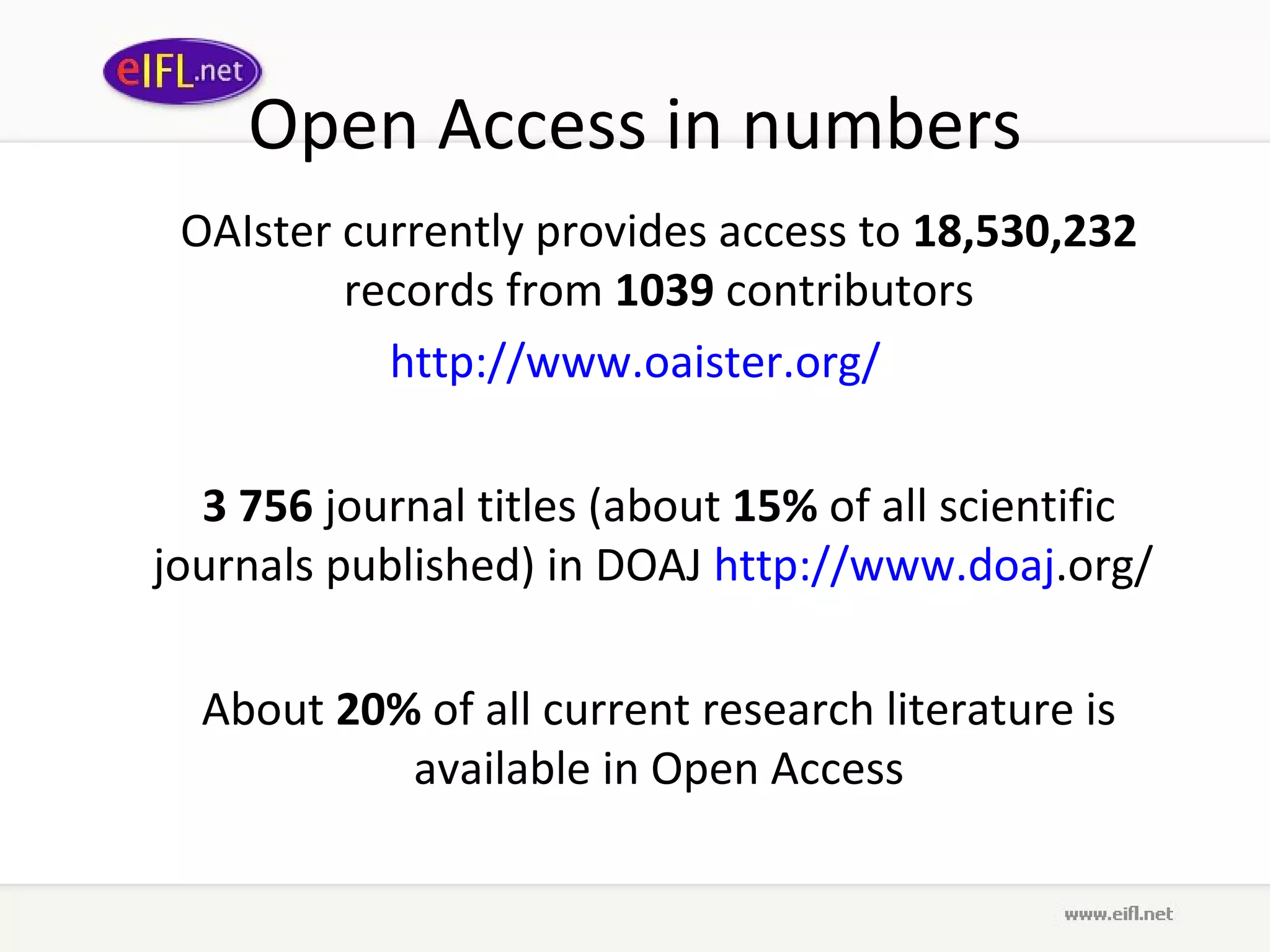
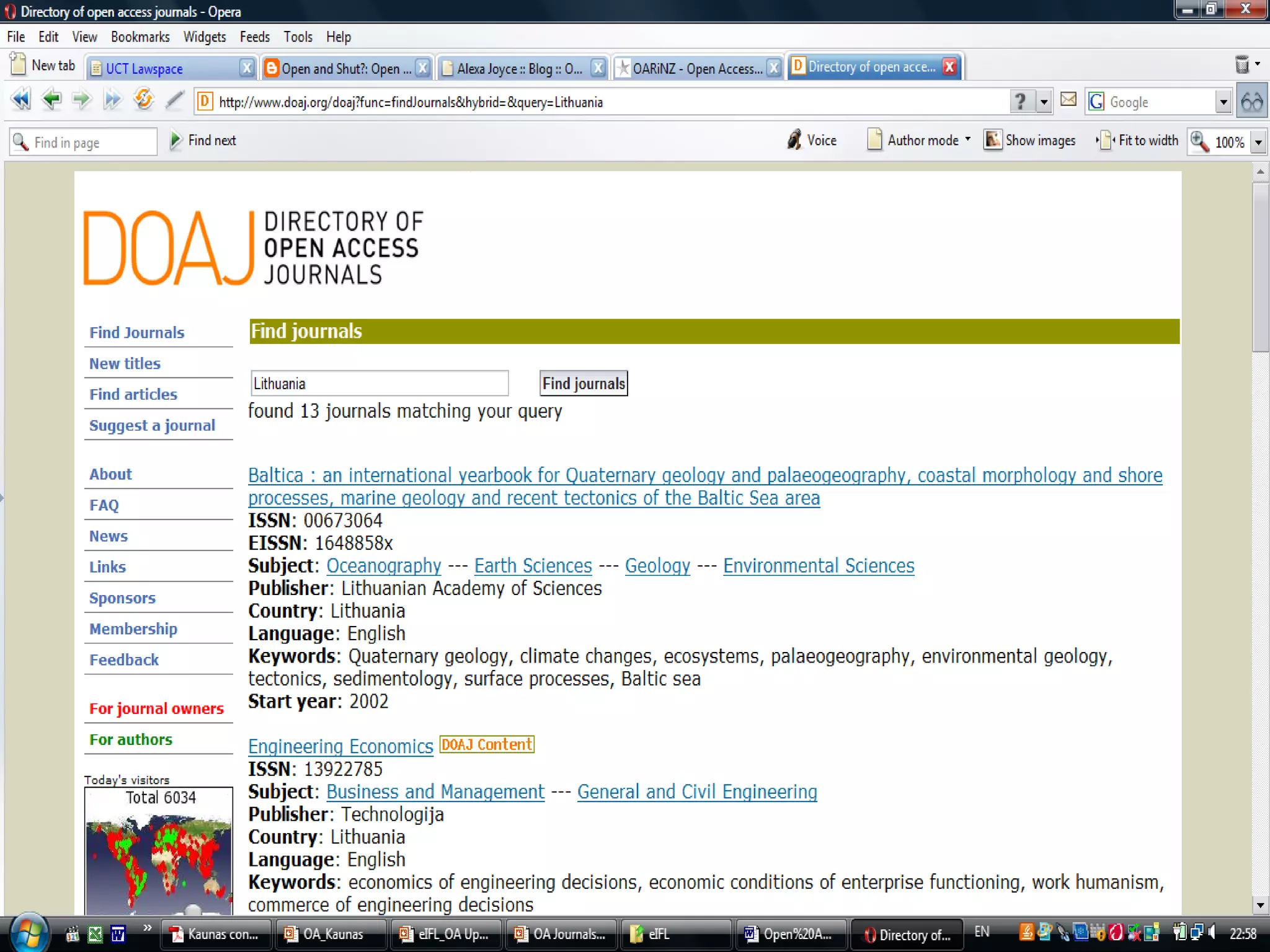
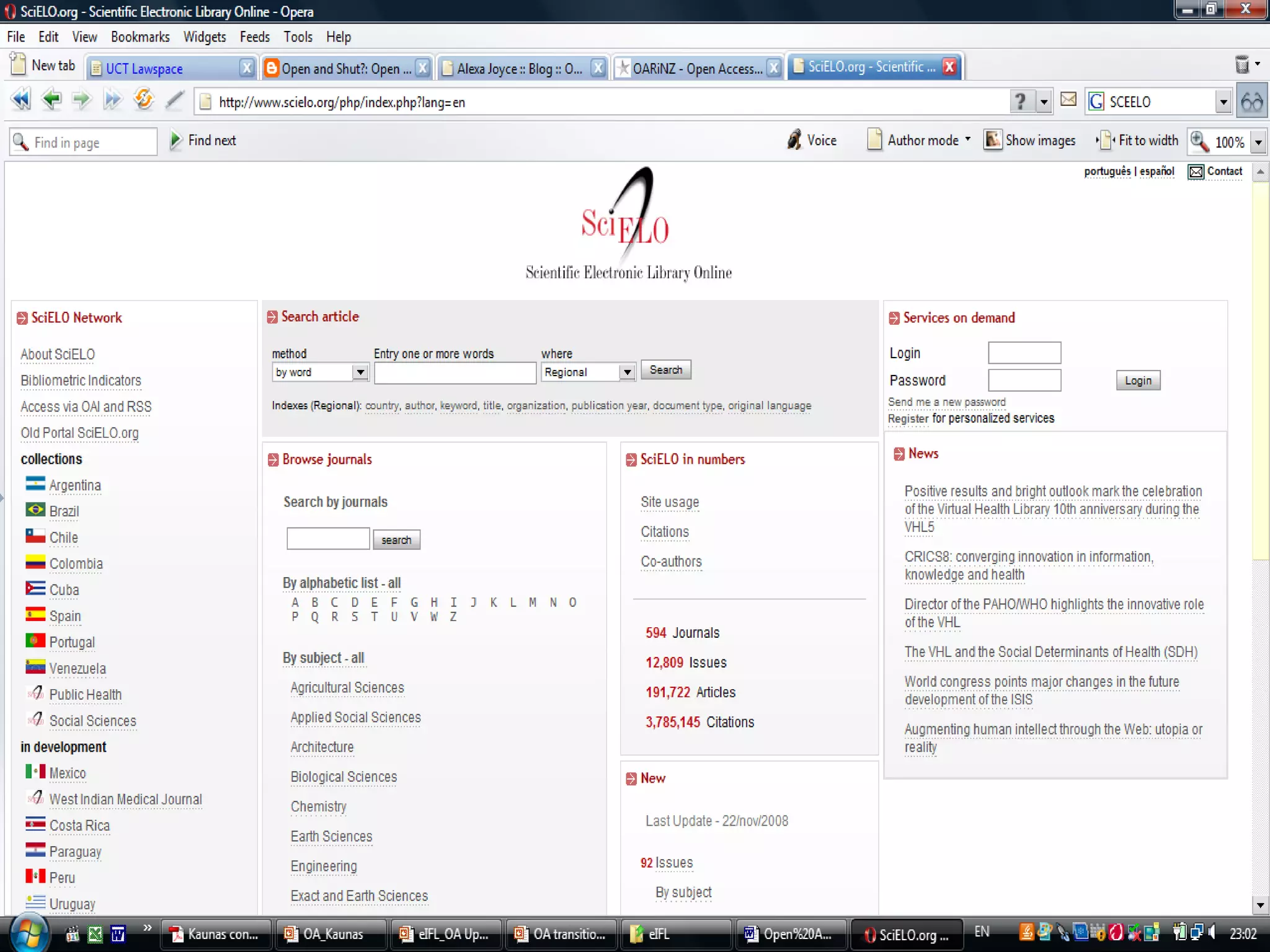
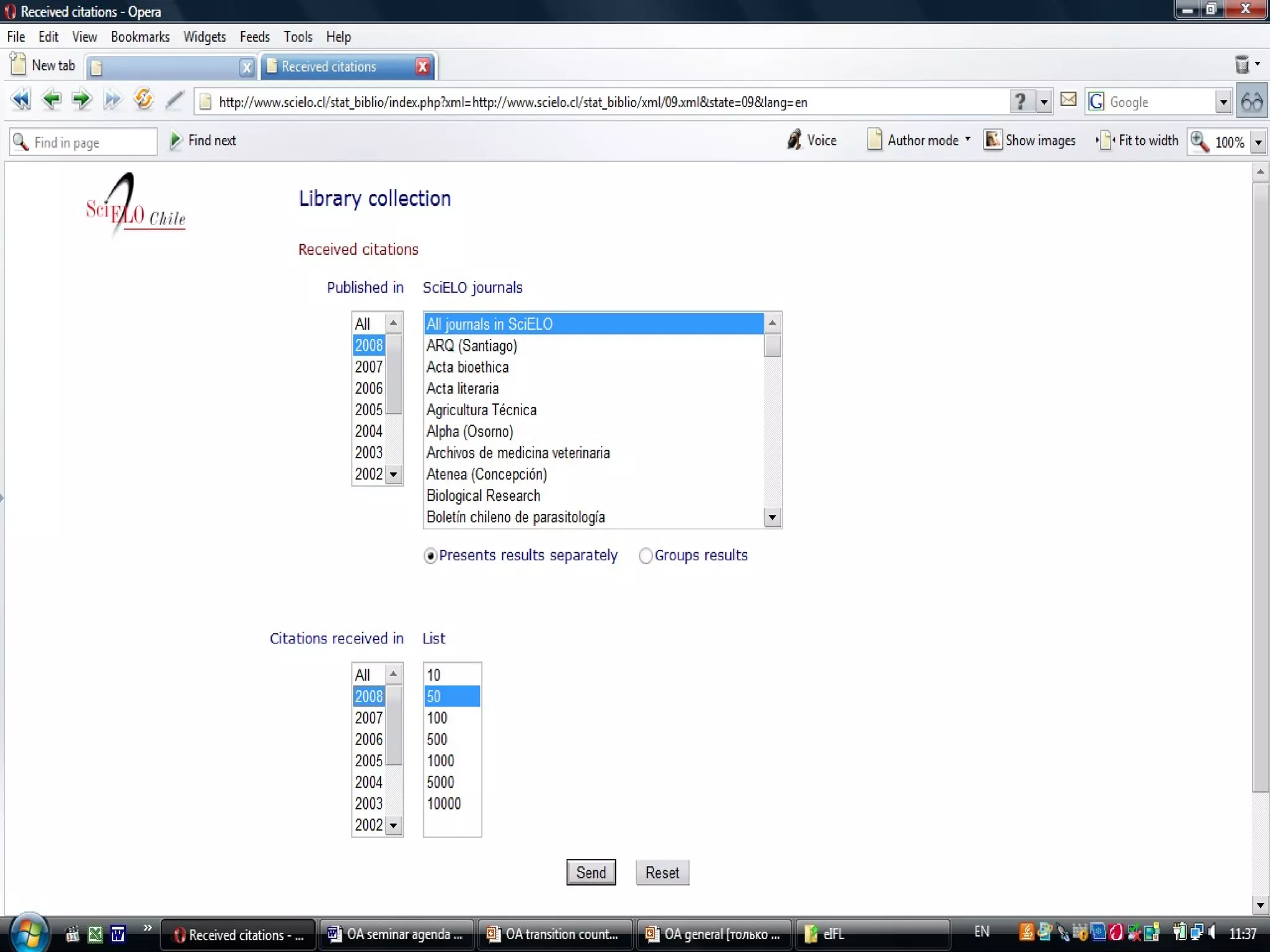
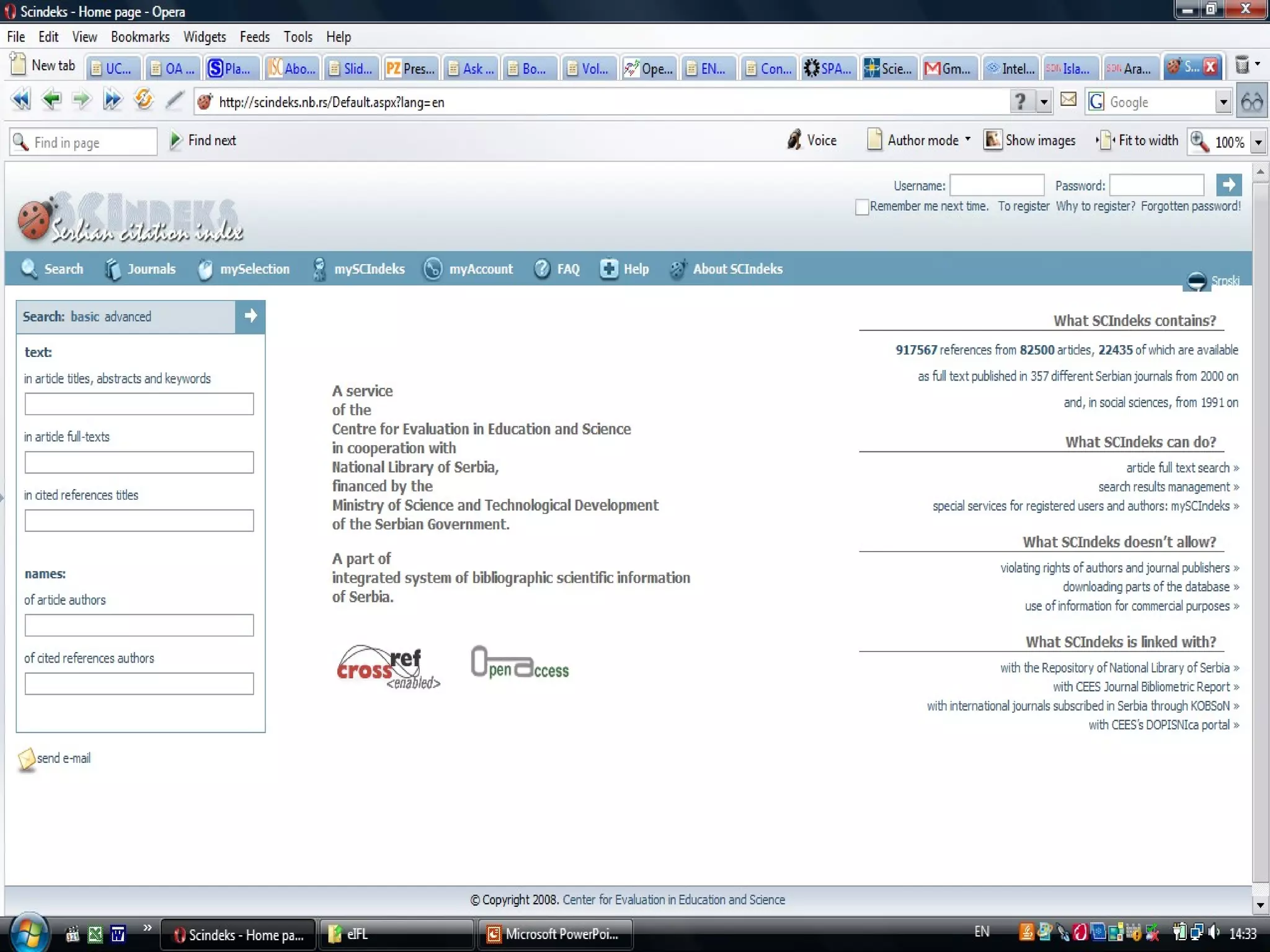
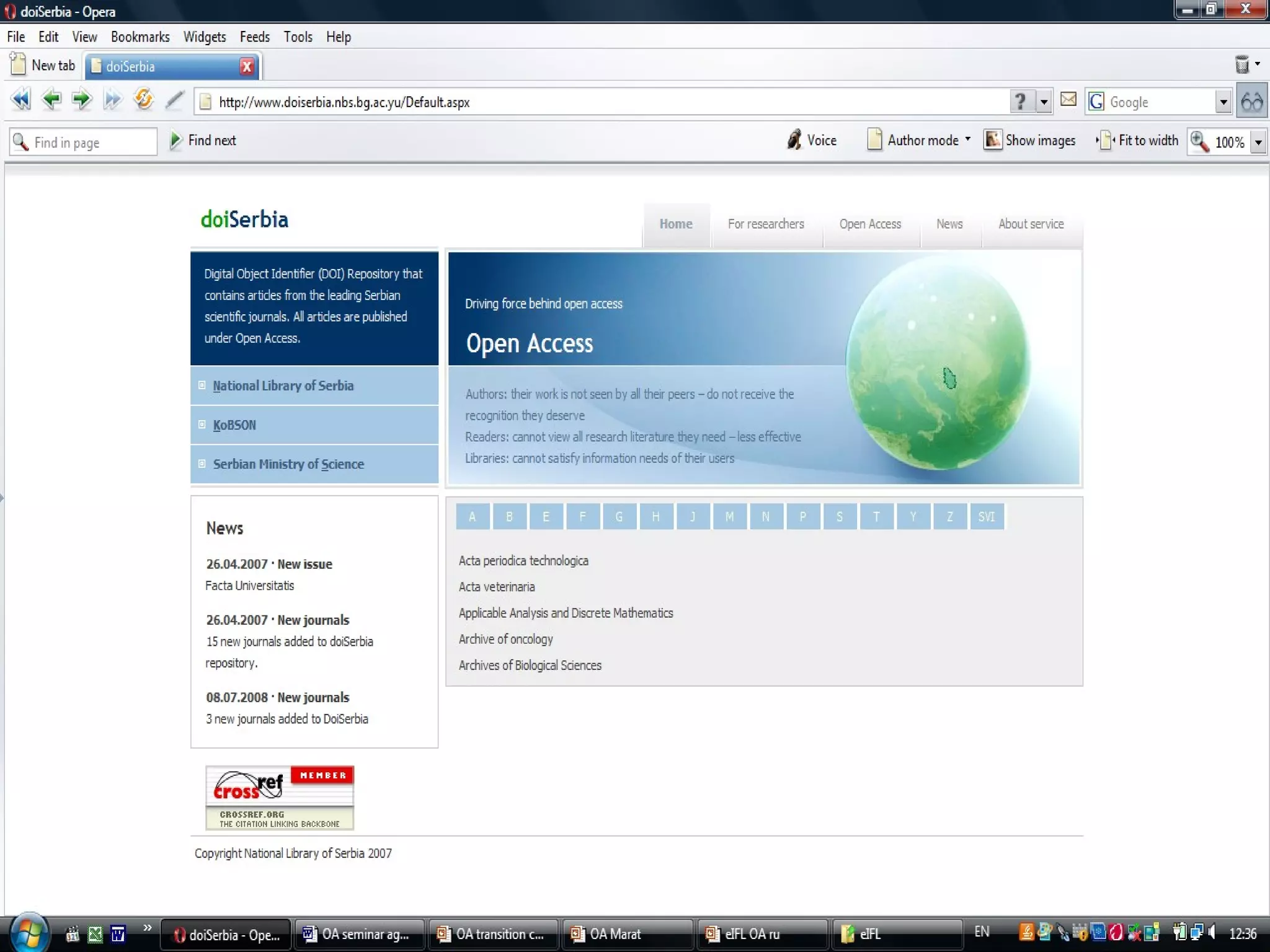
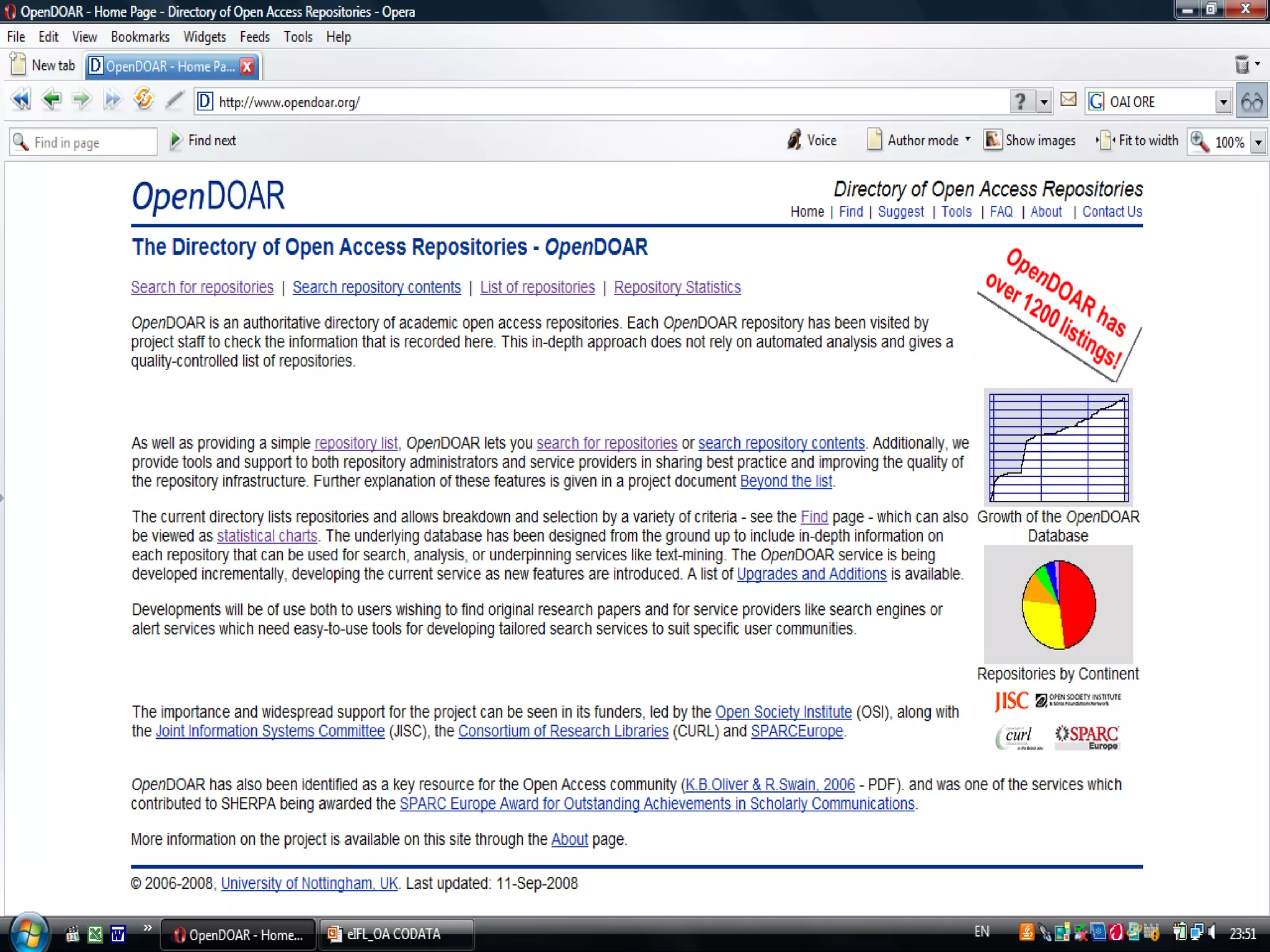
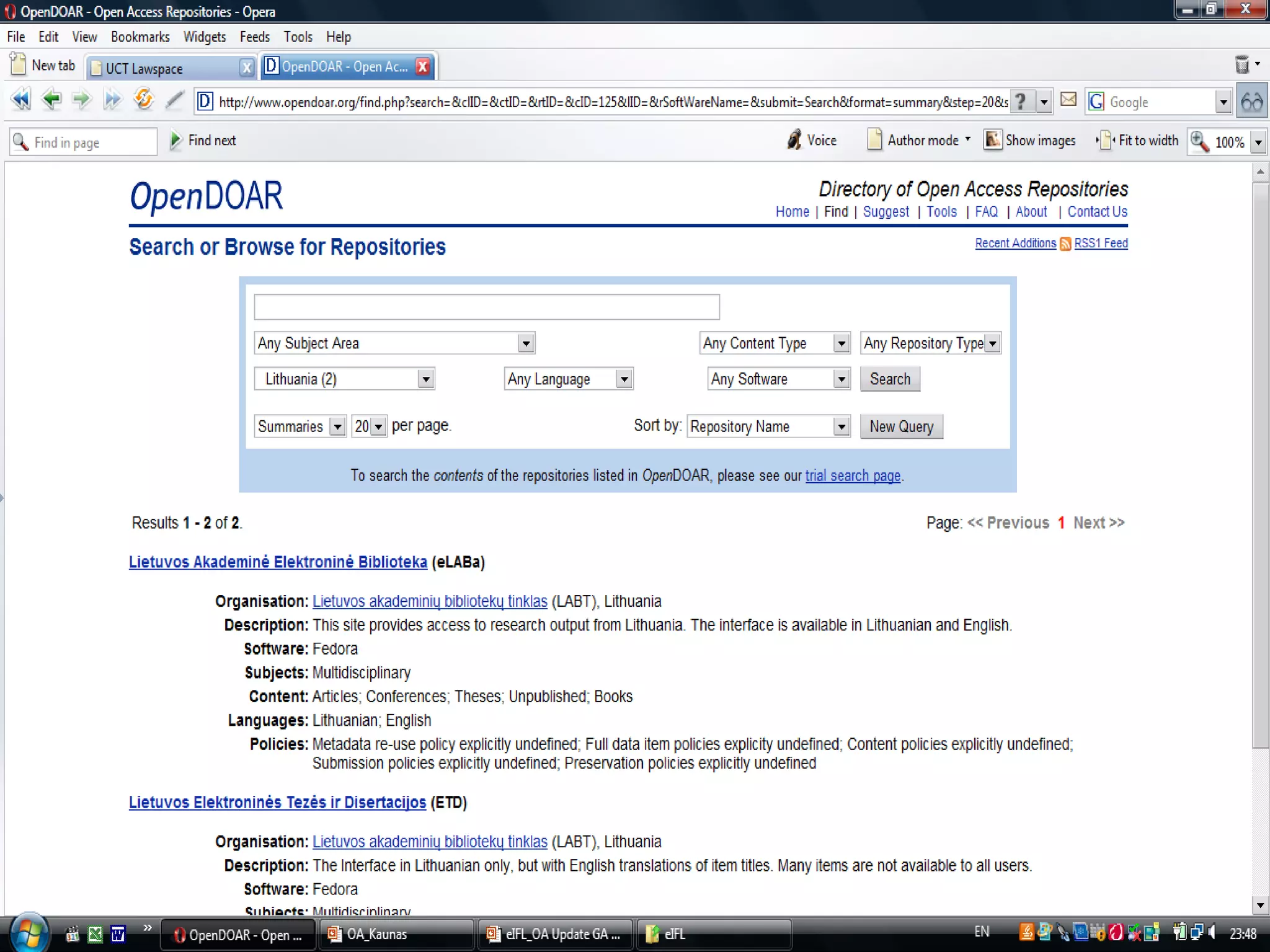
Open Access in numbers OAIster currently provides access to  18,530,232  records from  1039  contributors http://www. oaister .org/ 3 756  journal titles (about  15%  of all scientific journals published) in DOAJ  http://www. doaj .org/   About  20%  of all current research literature is available in Open Access


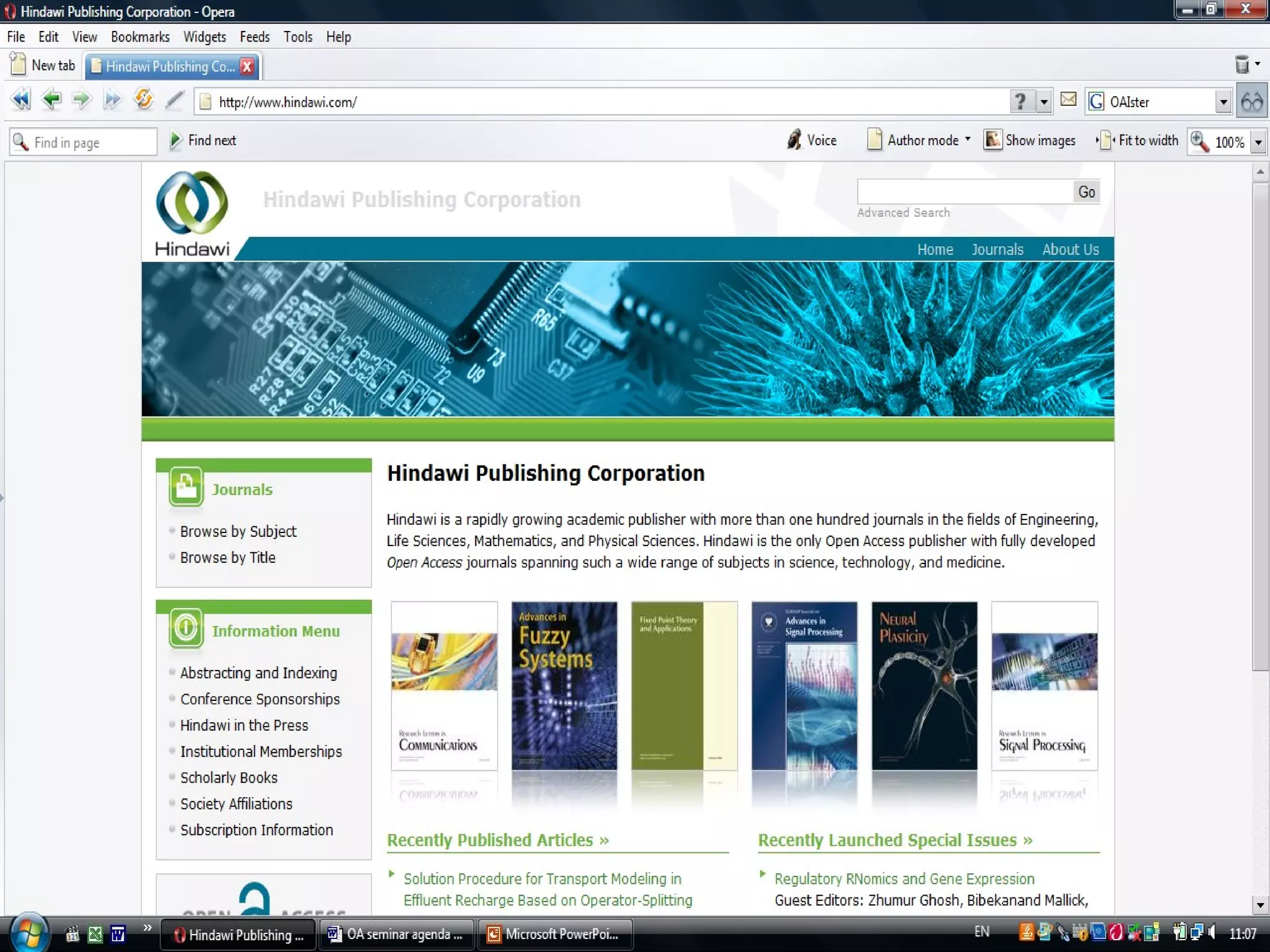
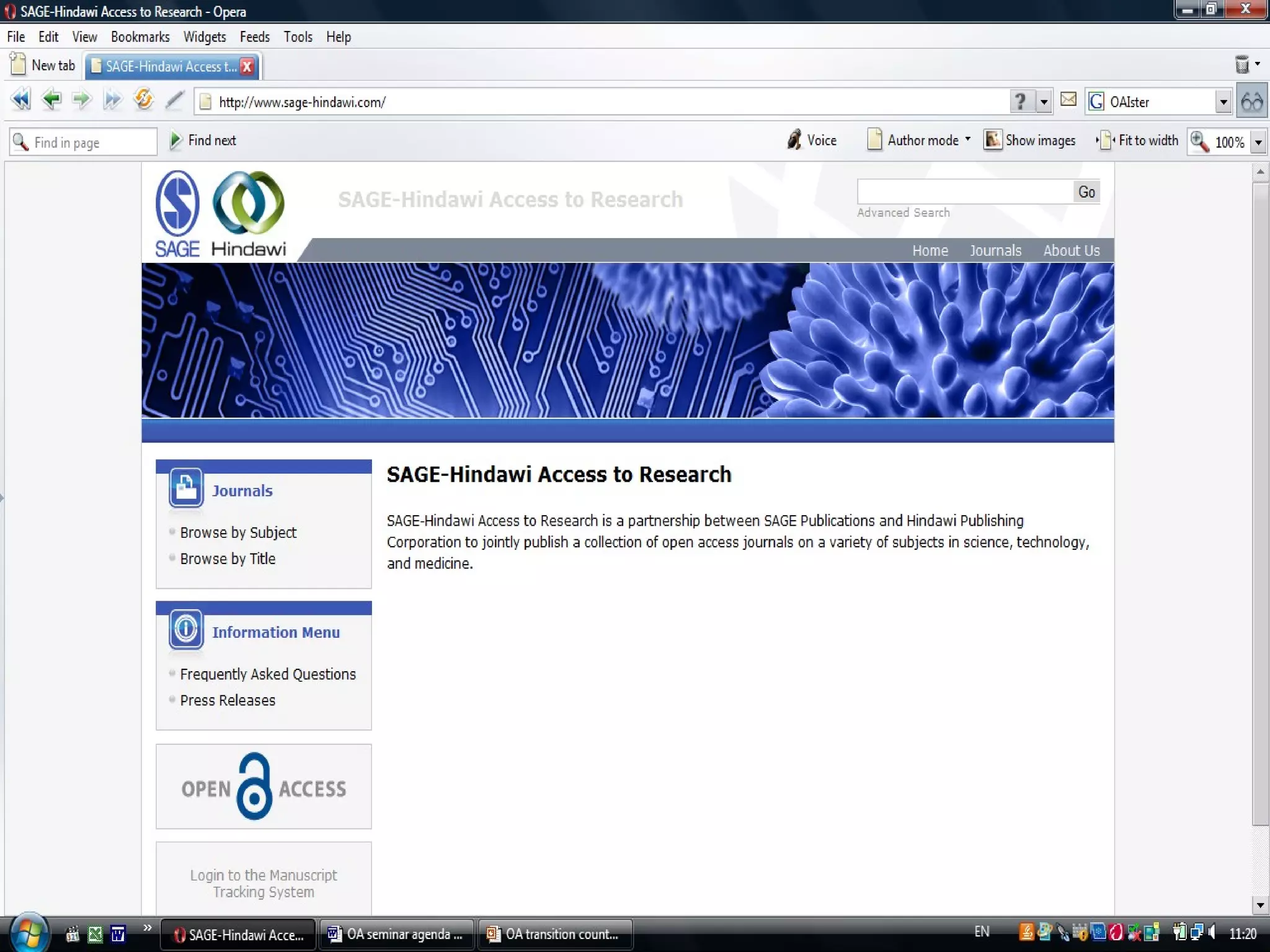
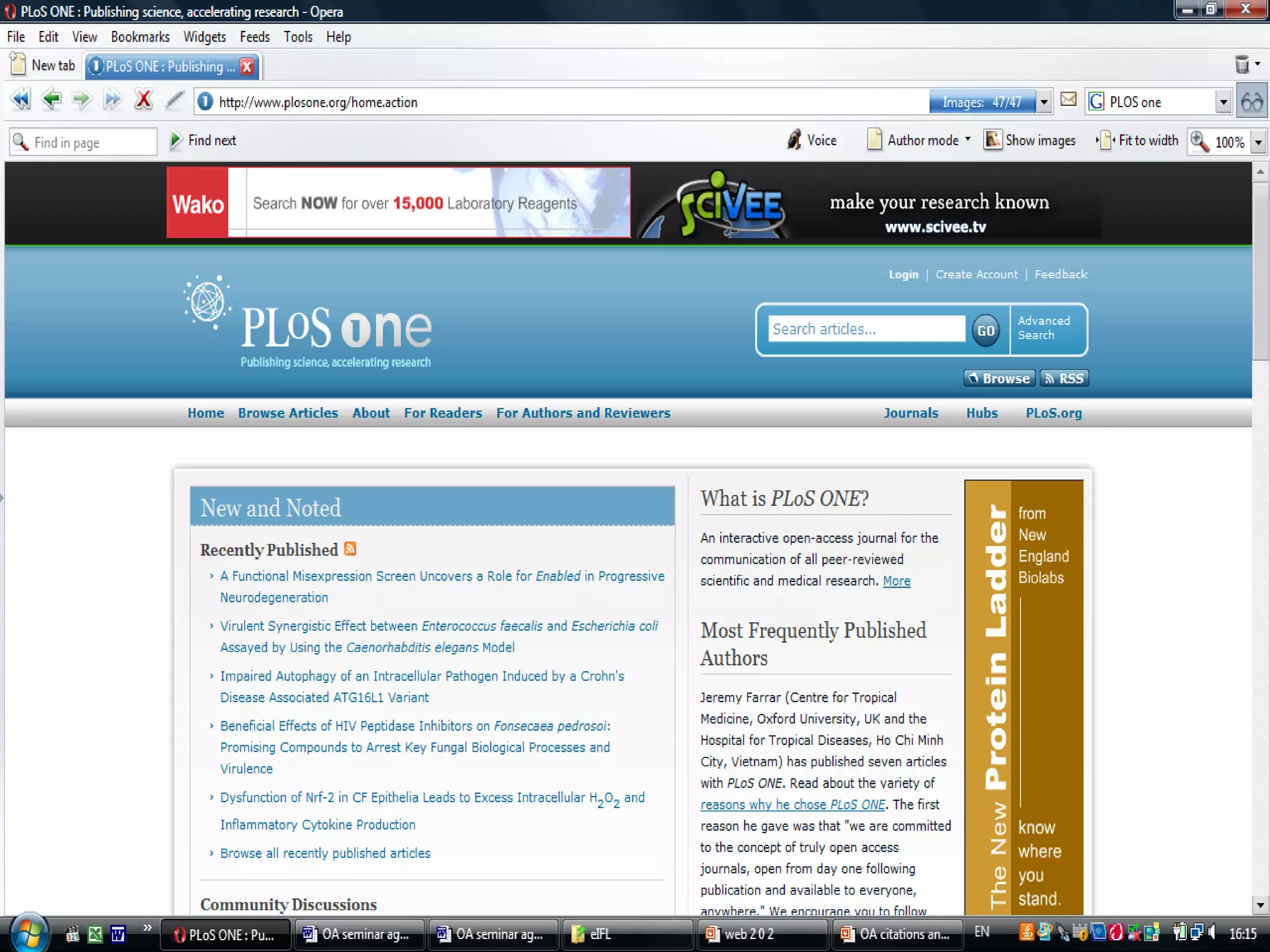
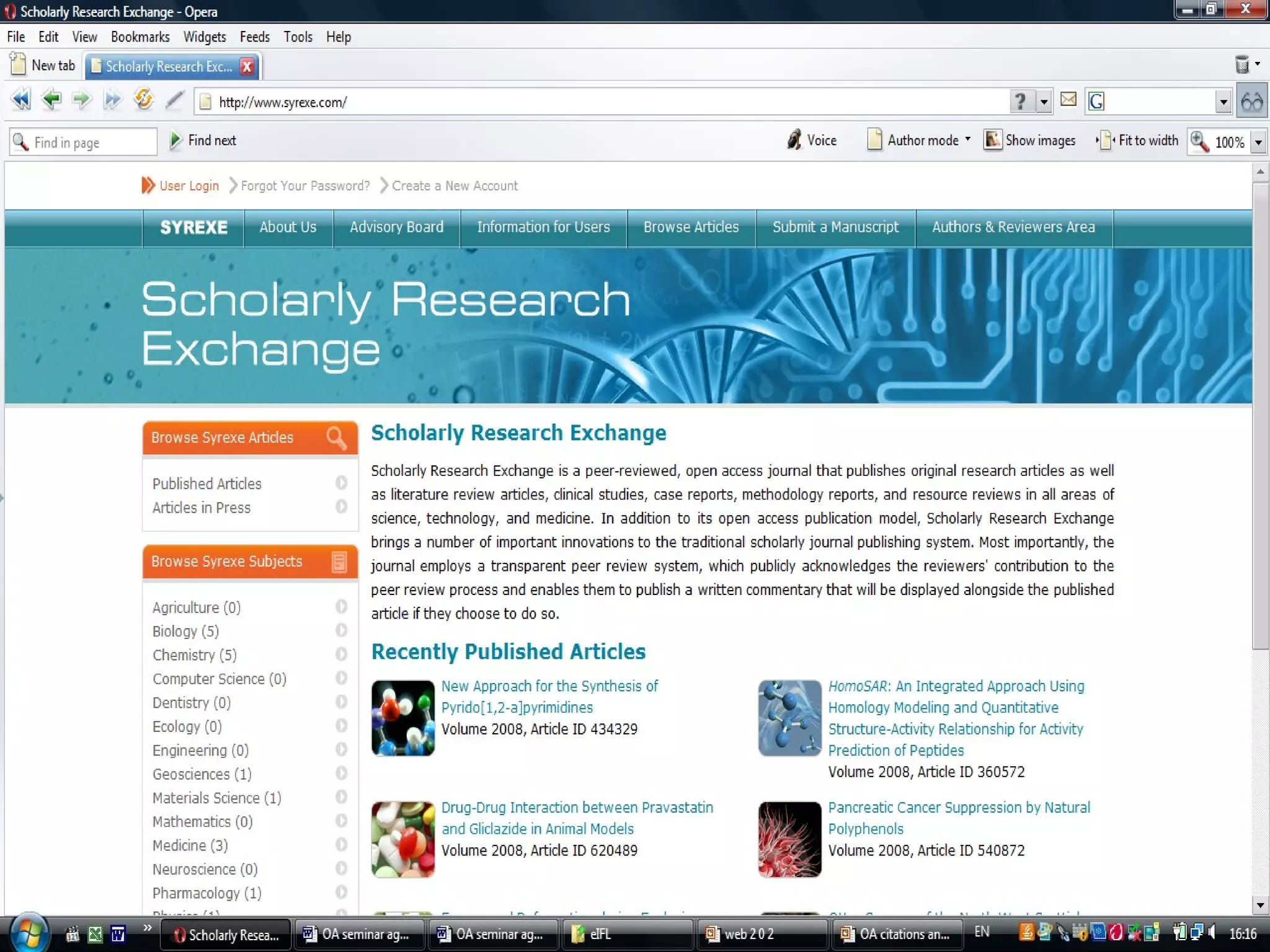
Hindawi Publishing Corporation On February 21, 2007 the Hindawi Publishing Corporation, Egypt, converted the last of its subscription-based journals to an open access model.  Hindawi Publishing Corporation is a commercial publisher of STM (Science, Technology, and Medicine) literature. Founded in 1997, Hindawi currently employs more than 250 people, and publishes more than 100 peer-reviewed journals.
Hindawi Publishing Corporation Over the past several years, Hindawi has seen an increase of more than 40% per year in the number of submitted manuscripts it receives.  Since its full conversion to Open Access in February 2007, Hindawi's growth has continued to accelerate, with monthly submission levels growing by more than 100% during 2007.  Annual impact factor growth more than  14%


Open Access Impact The advantages of Open Access are shown in the figures, especially when it comes to  increased citation rates : For 72% of papers published in the Astrophysical Journal, free versions of the paper are available (mainly through ArXiv). These 72% of papers are, on average,  cited more than twice as often  as the remaining 28% that do not have free versions. Schwarz, G. and Kennicutt Jr., R. C. (2004): Demographic and Citation Trends in Astrophysical Journal Papers and Preprints (pdf 14pp), arxiv.org/pdf/astro-ph/0411275, 10 November 2004, Bulletin of the American Astronomical Society, Vol. 36, 1654-1663
Open Access Impact Open access PNAS papers  have 50% more full-text downloads  than non-open access papers http://www.library. yale . edu /~ llicense / ListArchives /0505/msg01580.html   … and are on average  twice as likely to be cited   http://biology. plosjournals .org/ perlserv /?request=get-document& doi =10.1371/journal. pbio .0040157
Open Access Impact In Chinese scientific journals  citation indicators of Open Access journals were found to be higher  than those of non-Open Access journals. Cheng, W. H. and Ren, S. L. (2008): Evolution of open access publishing in Chinese scientific journals, Learned Publishing, Vol. 21, No. 2, April 2008, 140-152
Open Access Impact “ Government-funded open access journals would be a breakthrough for science publishing in China . A government-funded open access initiative  would reduce or eliminate the cost of publishing — enabling Chinese journals to attract more high-quality papers and improve their impact .  Domestic journals can publish papers faster .” said Zhu Zuoyan, the recently retired deputy head of the National Science Foundation of China (NSFC)  http://www. scidev .net/en/news/make-china-journals-open-access-says-top-scientist.html
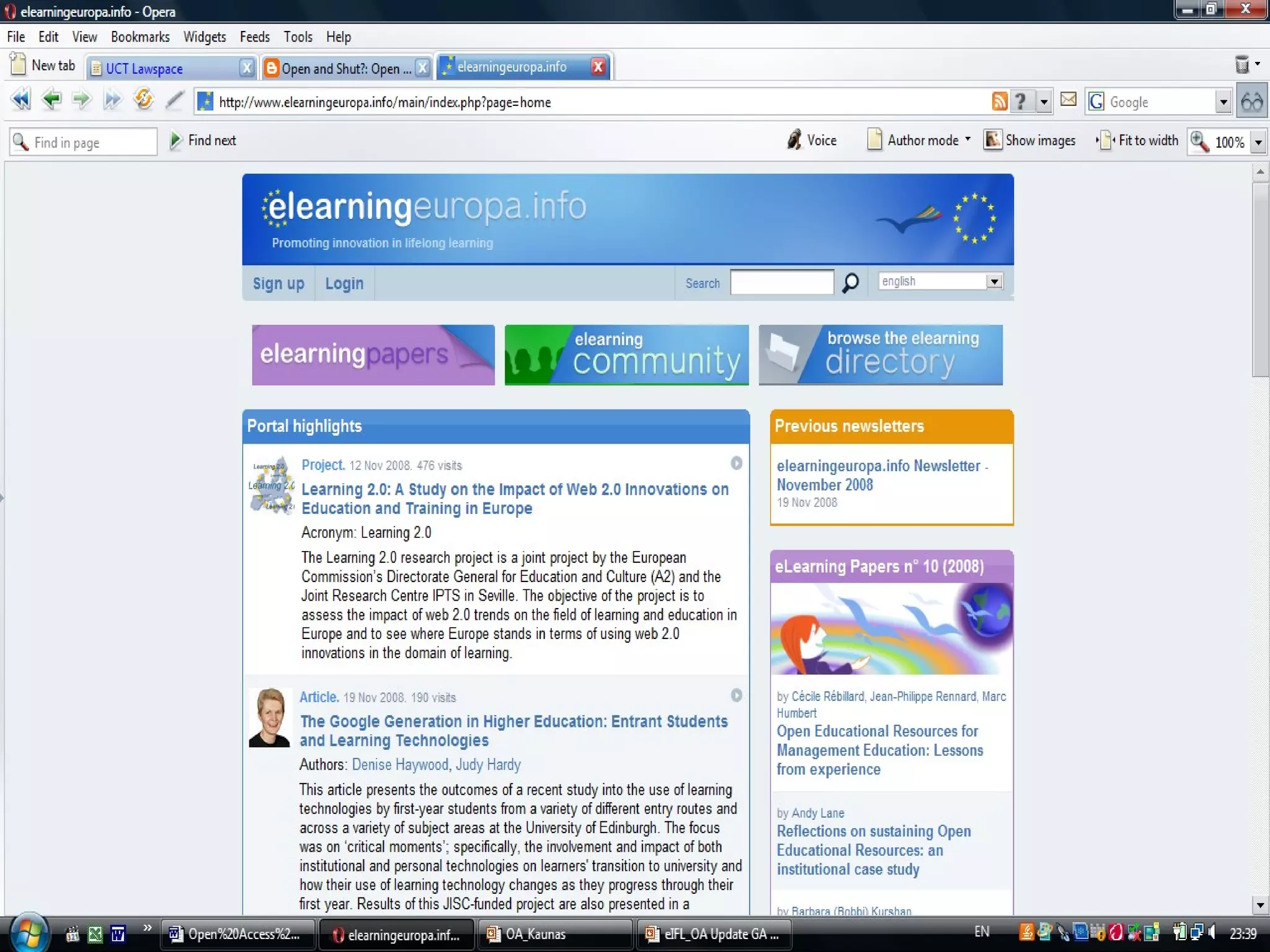
Open Access Impact And there is a long list of bibliography  The effect of open access and downloads ('hits') on citation impact : a bibliography of studies:  http:// opcit . eprints .org/ oacitation - biblio .html#most-recent   Another recent posts:  Thinking about prestige, quality, and open access  by Peter Suber in the SPARC Open Access Newsletter, issue #125:  http://www. earlham . edu /~peters/ fos /newsletter/09-02-08. htm   Open Access: The question of quality  by Richard Poynder in his blog Open and Shut?:   http :// poynder . blogspot . com /2008/11/open-access-question-of- quality _21. html
Open Access Impact Open access brings more rapid and more efficient progress for scholarly research http:// arxiv .org/   Open access to 486,864 e-prints in Physics, Mathematics, Computer Science, Quantitative Biology and Statistics  “ Brody has looked at the pattern of citations to articles deposited in arXiv, specifically at the length of the delay between when an article is deposited and when it is cited, and has published the aggregated data for each year from 1991.” Brody, Tim; Harnad, Stevan; Carr, Leslie. Earlier web usage statistics as predictors of later citation impact.  Journal of the American Association for Information Science and Technology  (JASIST), 2005, Vol. 57  no.  8 pp. 1060-1072.  http://eprints.ecs.soton.ac.uk/10713/01/timcorr.htm  (accessed 30 October 2006) Open Access: What is it and why should we have it? - ECS EPrints ...Open Access: What is it and why should we have it? Swan, A. (2006) Open Access: What is it and why should we have it?  http:// eprints . ecs . soton .ac. uk /13028/
Open Access Impact “ As more papers are deposited and more scientists use the repository, the time between an article being deposited and being cited has been shrinking dramatically, year upon year.  This is important for research uptake and progress, because it means that in this area of research, where articles are made available at – or frequently before – publication, the research cycle is accelerating.  the research cycle in high energy physics is approaching maximum efficiency  as a result of the early and free availability of articles that scientists in the field can use and build upon rapidly.” Brody, Tim; Harnad, Stevan; Carr, Leslie. Earlier web usage statistics as predictors of later citation impact.  Journal of the American Association for Information Science and Technology  (JASIST), 2005, Vol. 57  no.  8 pp. 1060-1072.  http://eprints.ecs.soton.ac.uk/10713/01/timcorr.htm  (accessed 30 October 2006) Open Access: What is it and why should we have it? - ECS EPrints ...Open Access: What is it and why should we have it? Swan, A. (2006) Open Access: What is it and why should we have it?  http:// eprints . ecs . soton .ac. uk /13028/
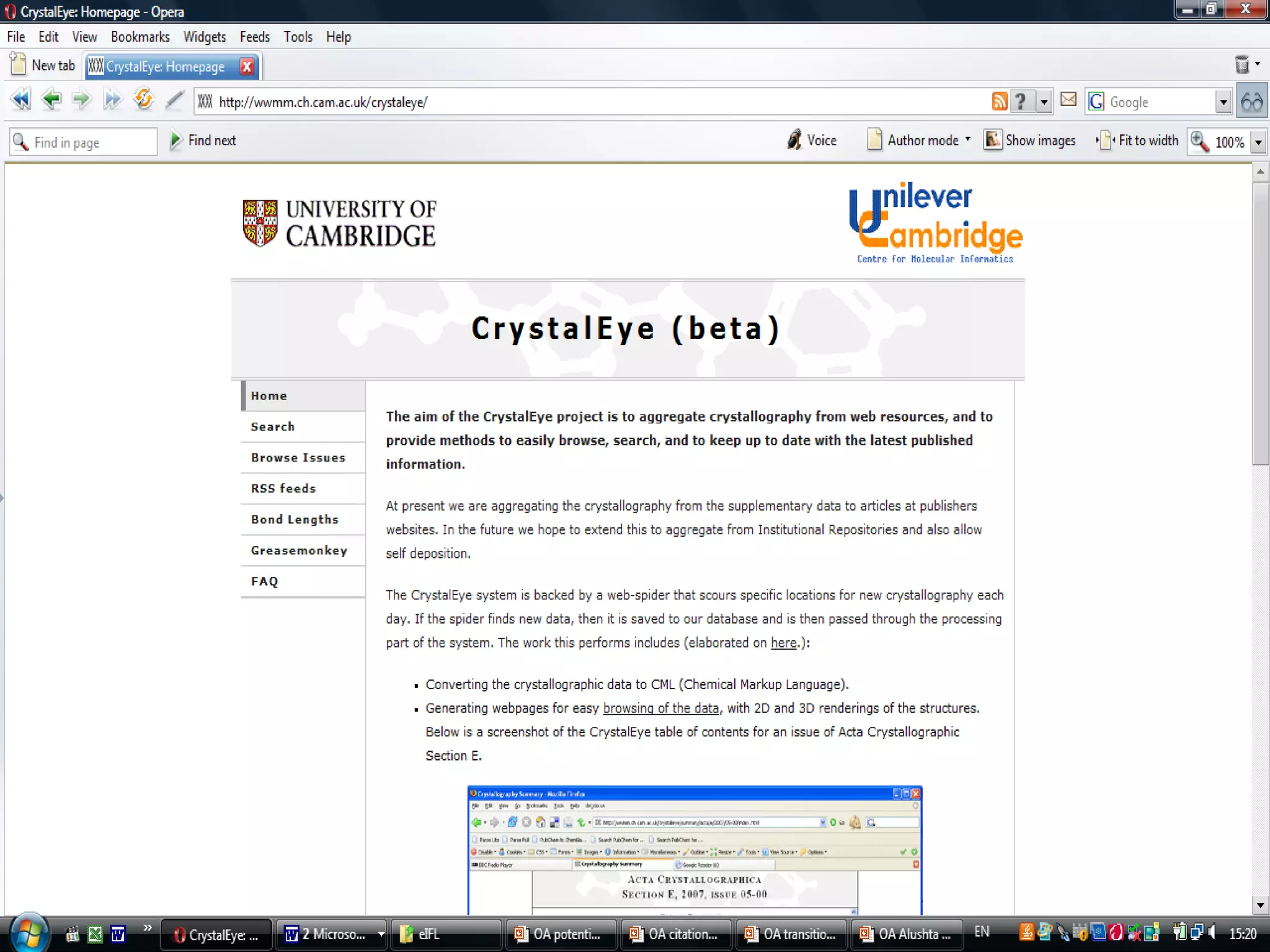
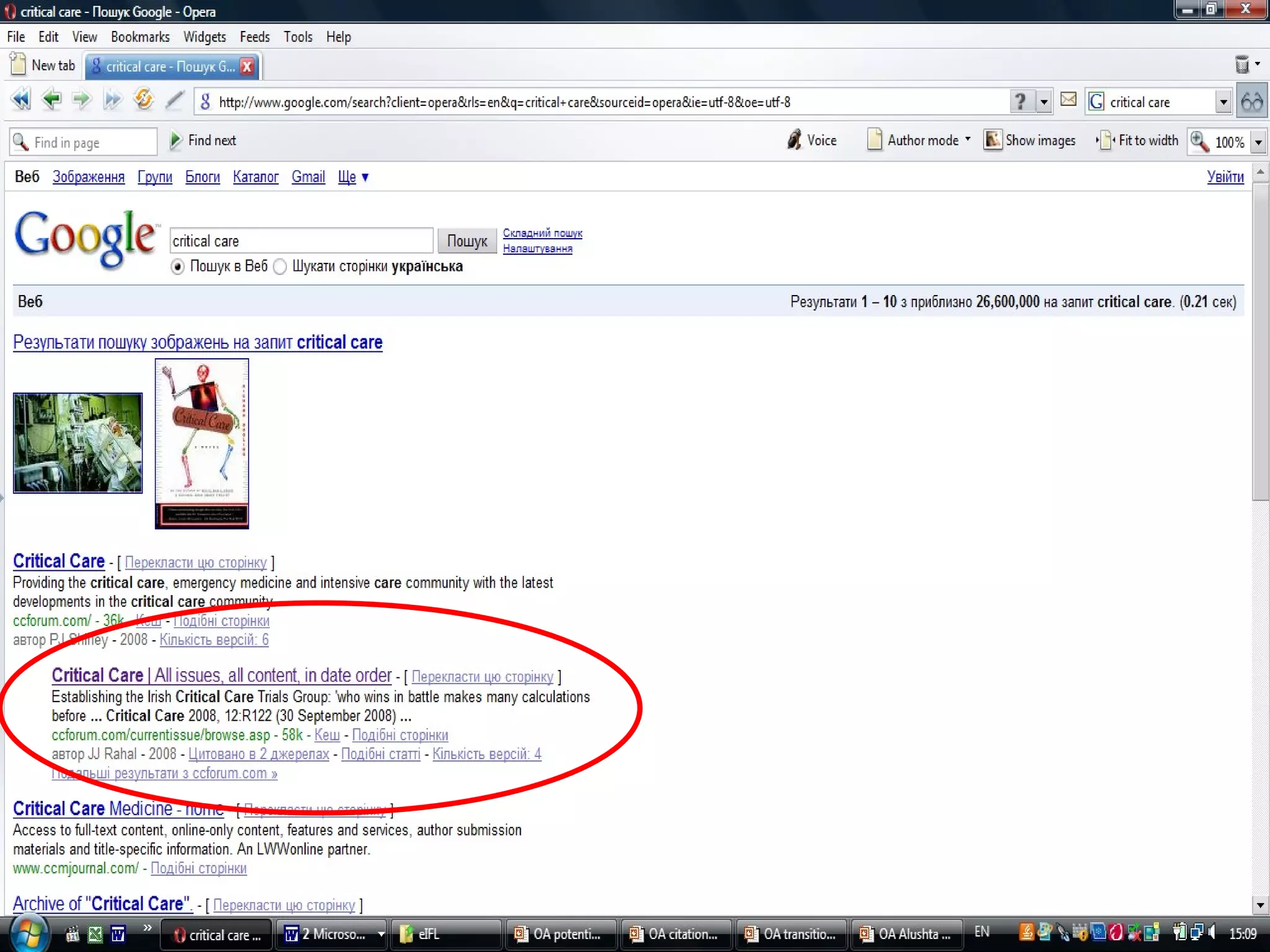
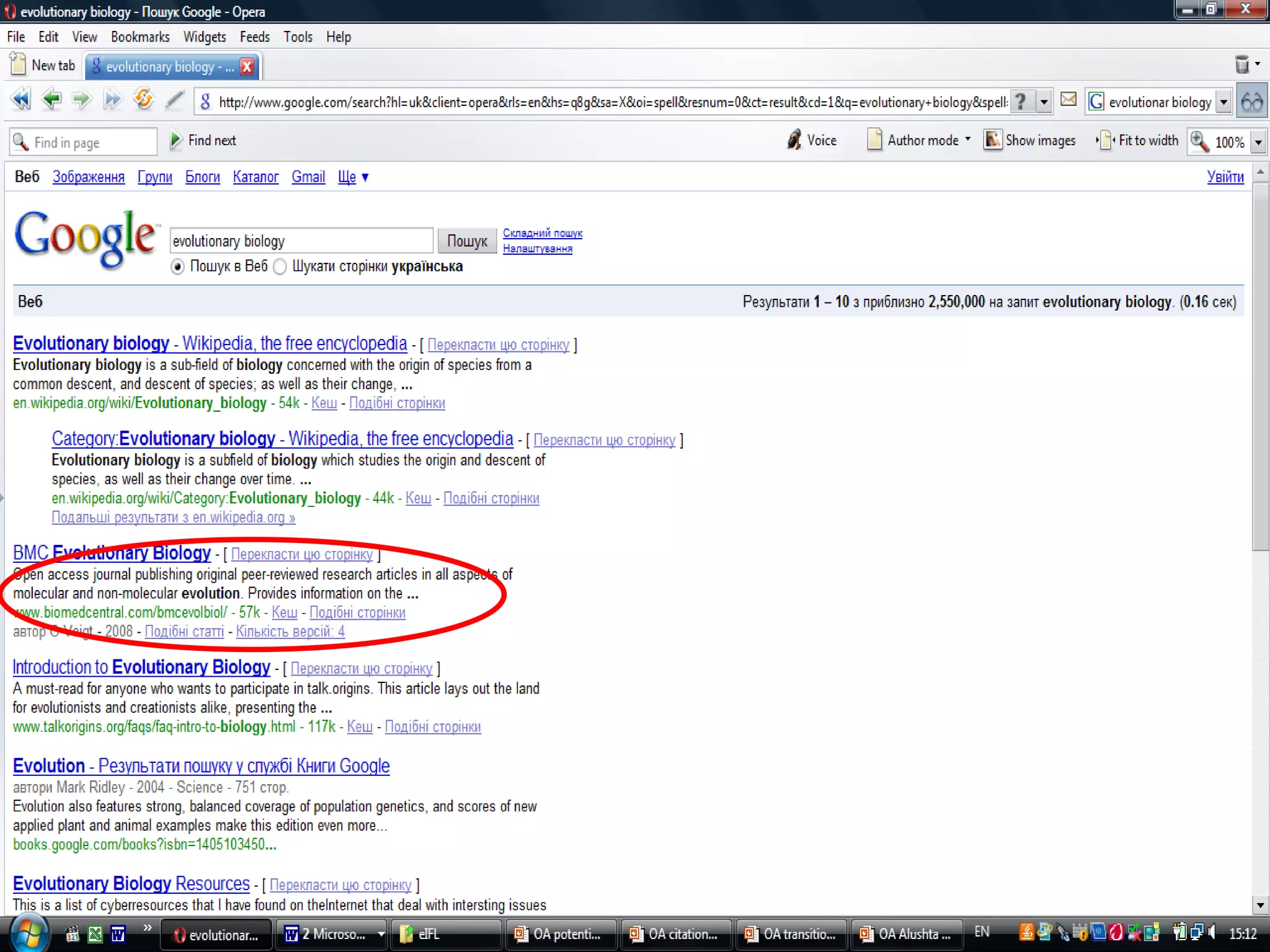
The Power of Open Access Open Access enabled the opportunities provided by technological developments, such as  data mining and text mining , to be realised
 
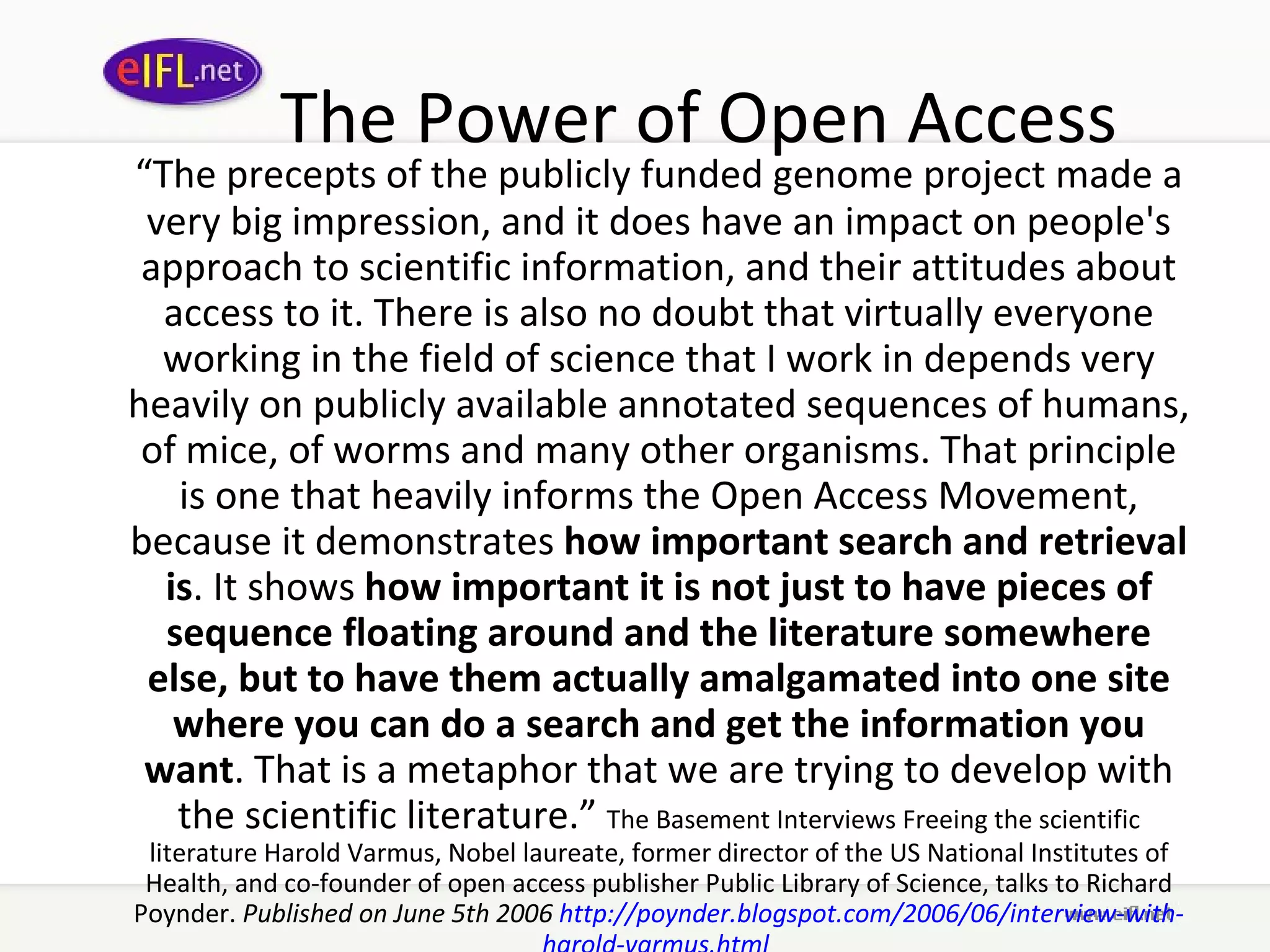
The Power of Open Access “ The precepts of the publicly funded genome project made a very big impression, and it does have an impact on people's approach to scientific information, and their attitudes about access to it. There is also no doubt that virtually everyone working in the field of science that I work in depends very heavily on publicly available annotated sequences of humans, of mice, of worms and many other organisms. That principle is one that heavily informs the Open Access Movement, because it demonstrates  how important search and retrieval is . It shows  how important it is not just to have pieces of sequence floating around and the literature somewhere else, but to have them actually amalgamated into one site where you can do a search and get the information you want . That is a metaphor that we are trying to develop with the scientific literature.”  The Basement Interviews Freeing the scientific literature Harold Varmus, Nobel laureate, former director of the US National Institutes of Health, and co-founder of open access publisher Public Library of Science, talks to Richard Poynder.  Published on June 5th 2006  http:// poynder . blogspot .com/2006/06/interview-with- harold - varmus .html
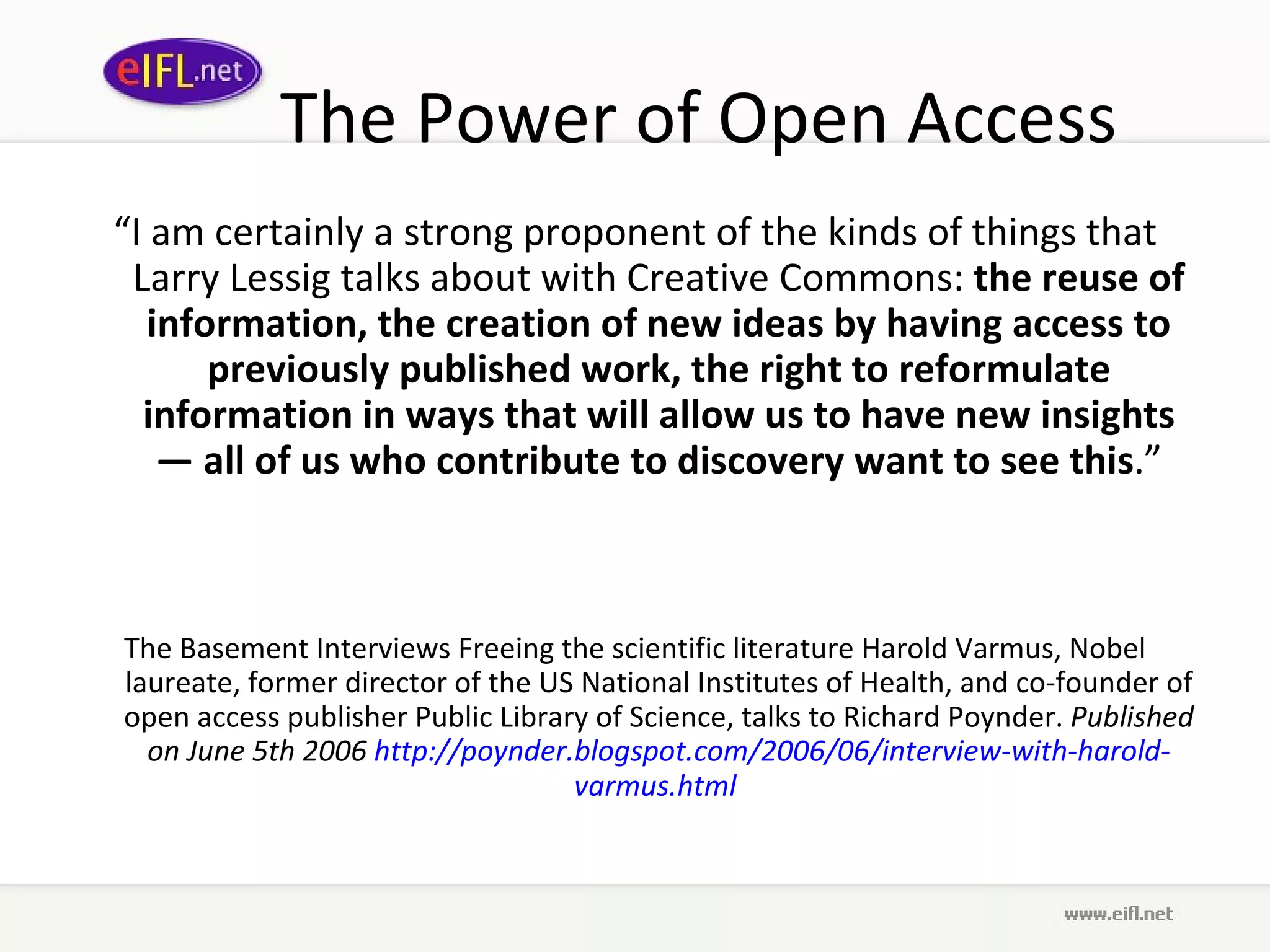
The Power of Open Access “ I am certainly a strong proponent of the kinds of things that Larry Lessig talks about with Creative Commons:  the reuse of information, the creation of new ideas by having access to previously published work, the right to reformulate information in ways that will allow us to have new insights — all of us who contribute to discovery want to see this .” The Basement Interviews Freeing the scientific literature Harold Varmus, Nobel laureate, former director of the US National Institutes of Health, and co-founder of open access publisher Public Library of Science, talks to Richard Poynder.  Published on June 5th 2006  http:// poynder . blogspot .com/2006/06/interview-with- harold - varmus .html


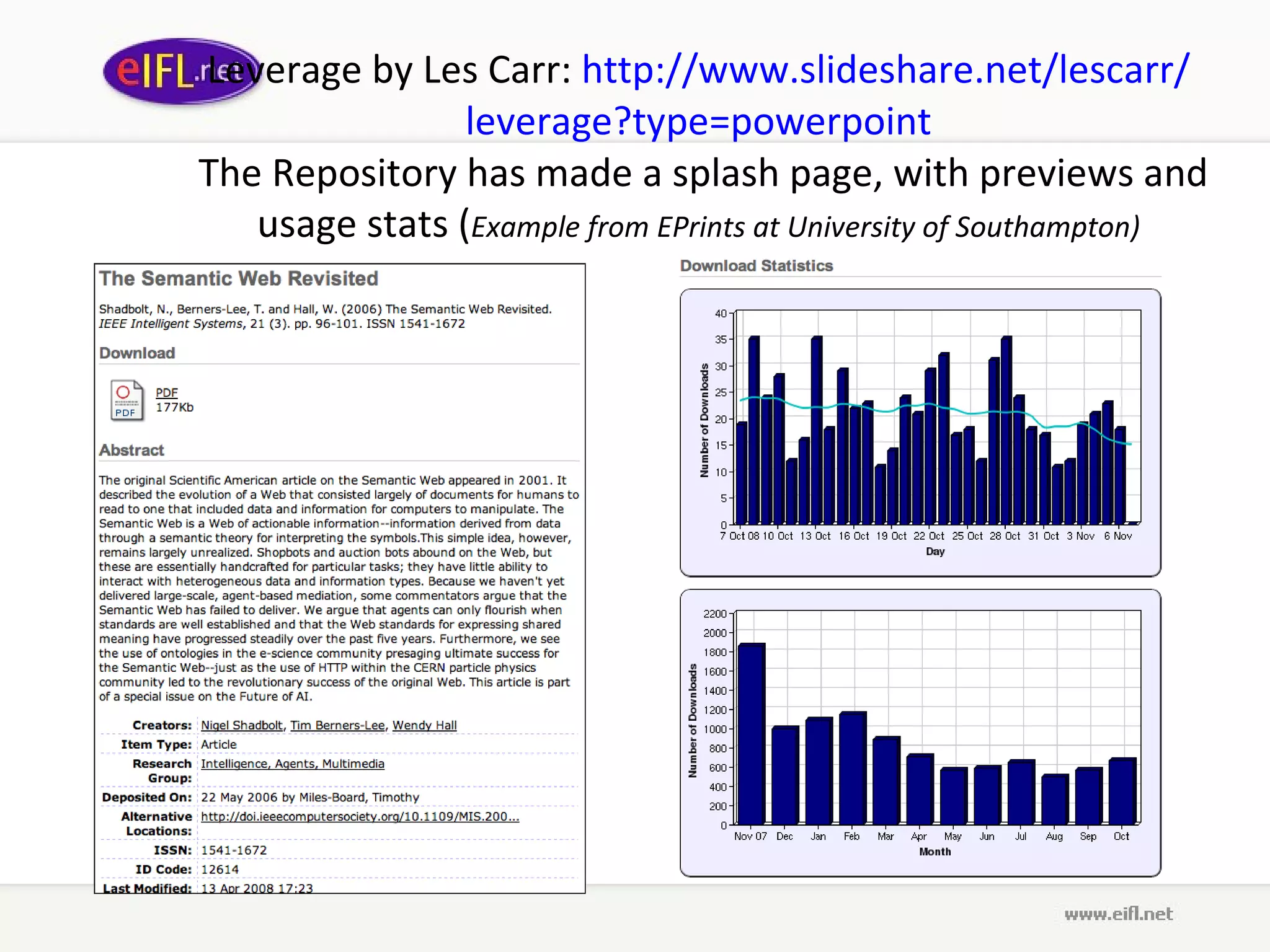
Leverage  by L es  C arr :  http :// www . slideshare . net / lescarr / leverage ? type = powerpoint  The Repository has made a splash page, with previews and usage stats ( Example from EPrints at University of Southampton)
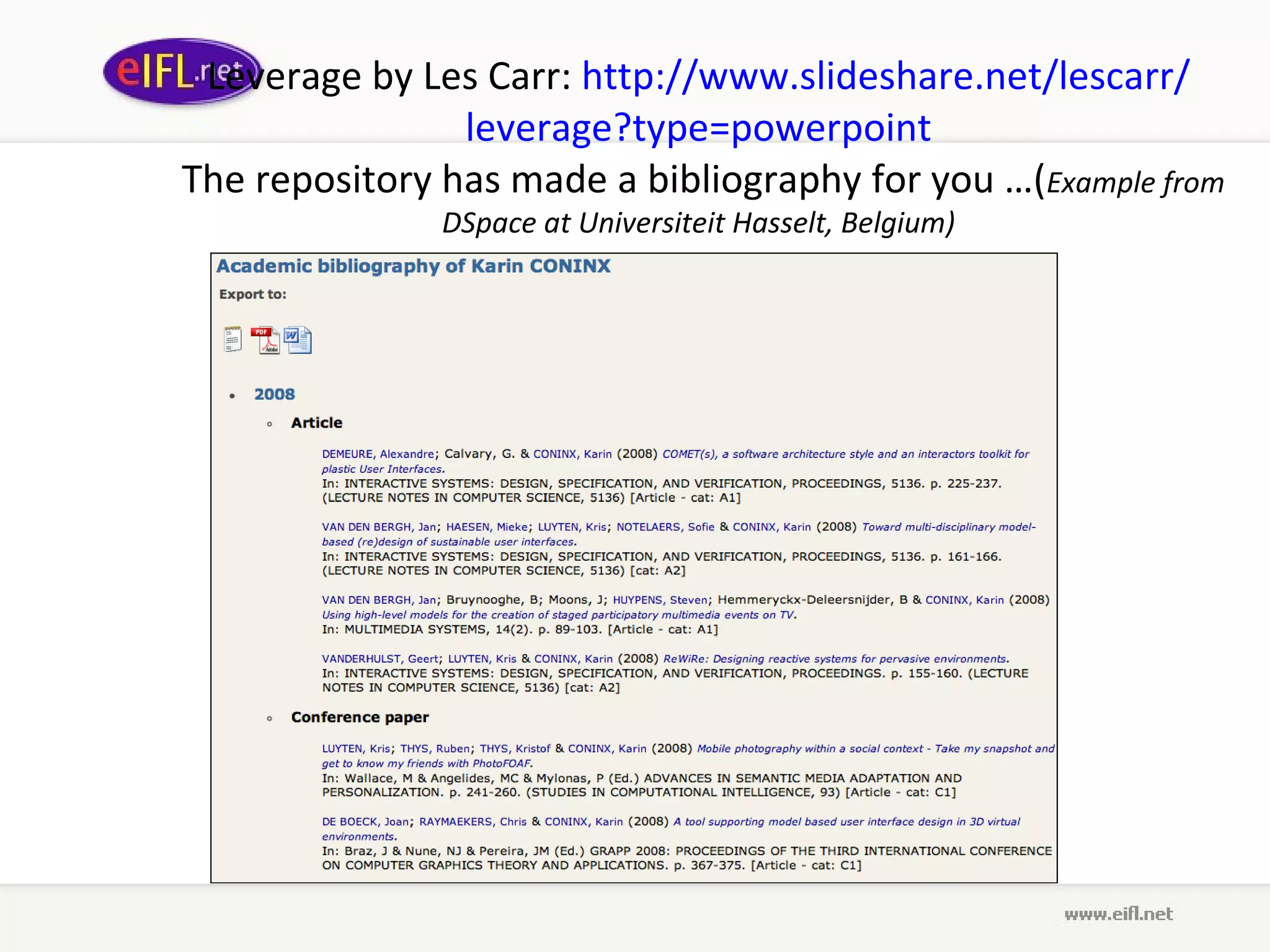
Leverage  by L es  C arr :  http :// www . slideshare . net / lescarr / leverage ? type = powerpoint  The repository has made a bibliography for you …( Example from DSpace at Universiteit Hasselt, Belgium)
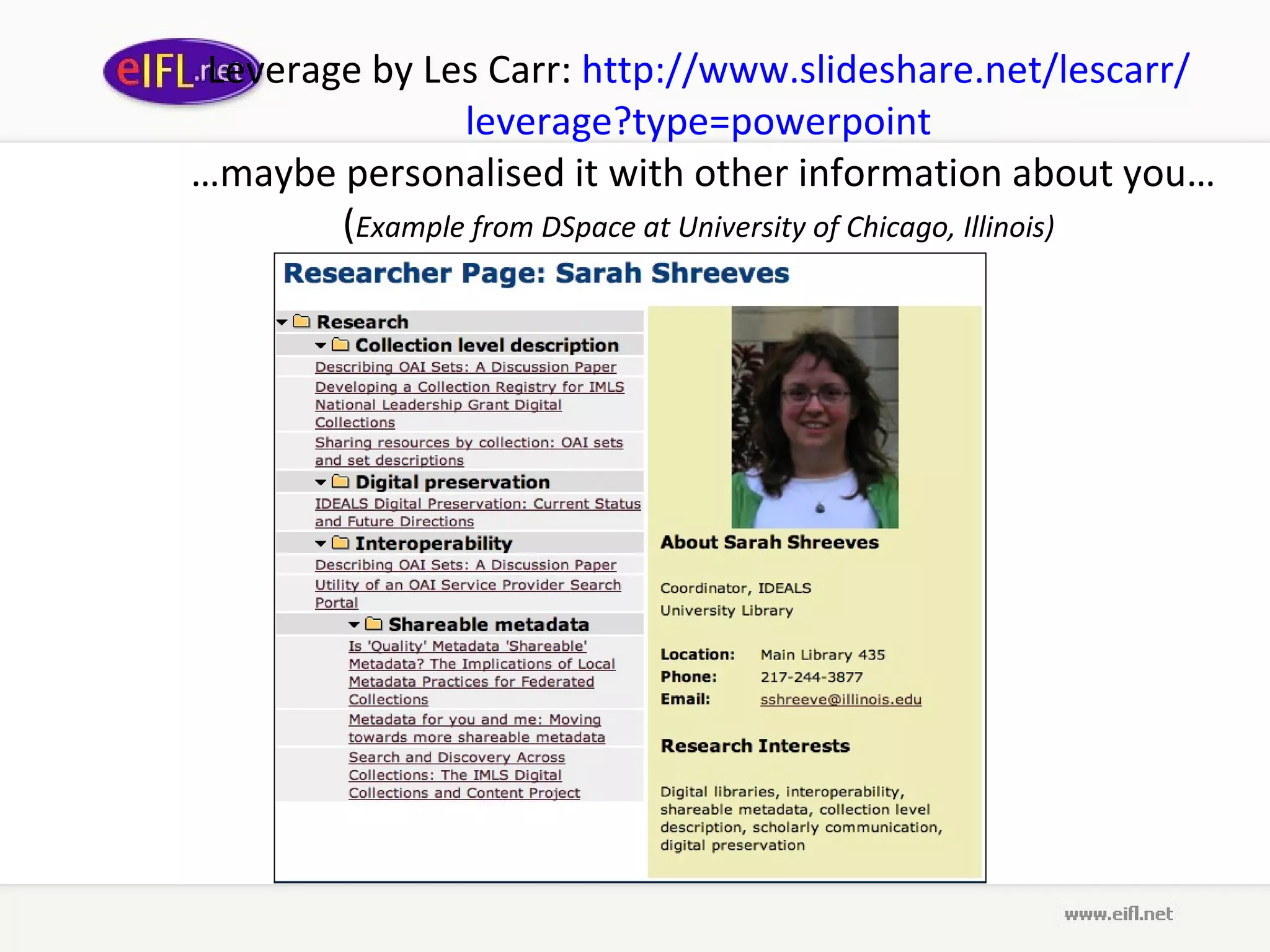
Leverage  by L es  C arr :  http :// www . slideshare . net / lescarr / leverage ? type = powerpoint  …maybe personalised it with other information about you… ( Example from DSpace at University of Chicago, Illinois)
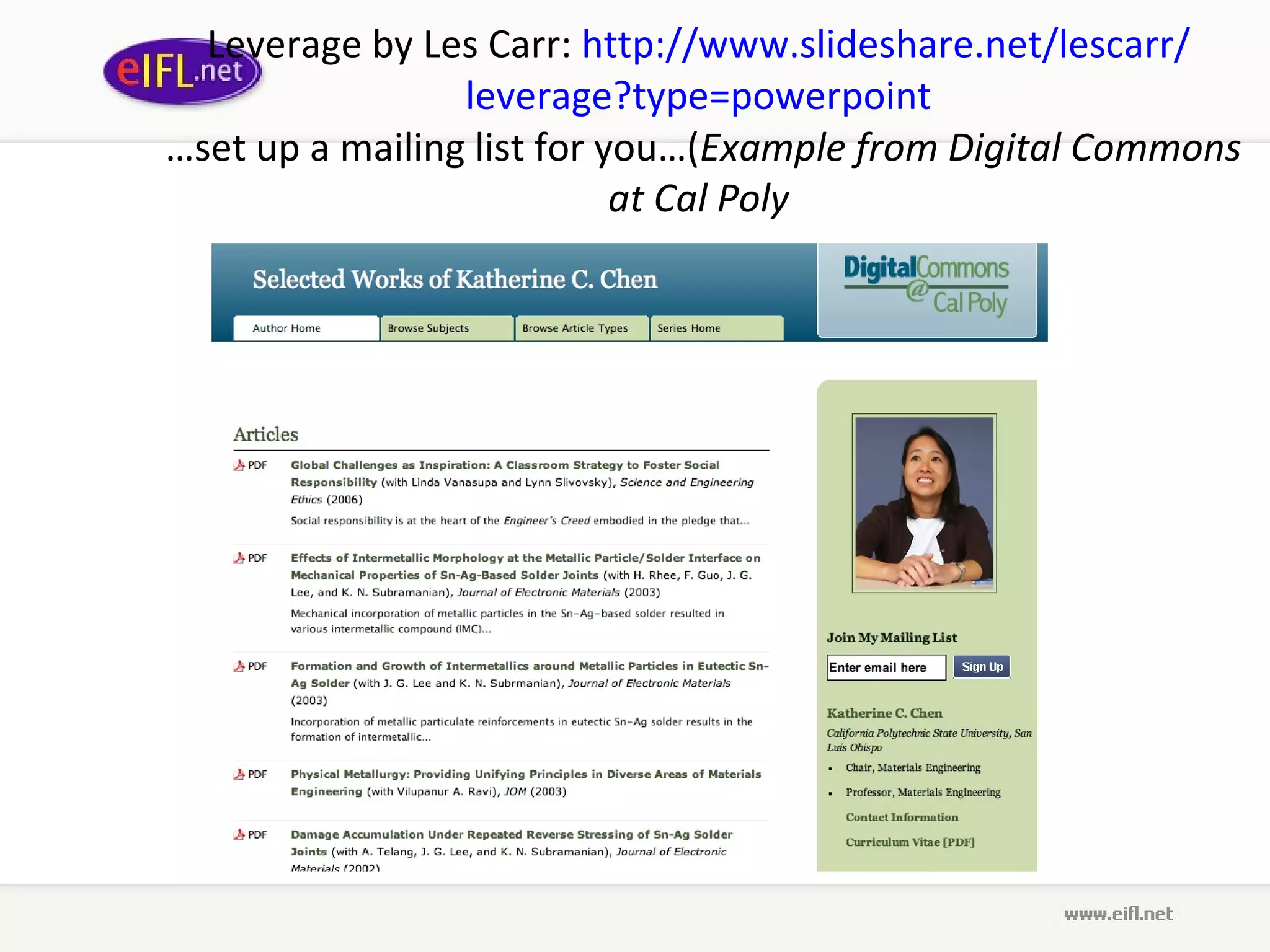
Leverage  by L es  C arr :  http :// www . slideshare . net / lescarr / leverage ? type = powerpoint  …set up a mailing list for you…( Example from Digital Commons at Cal Poly
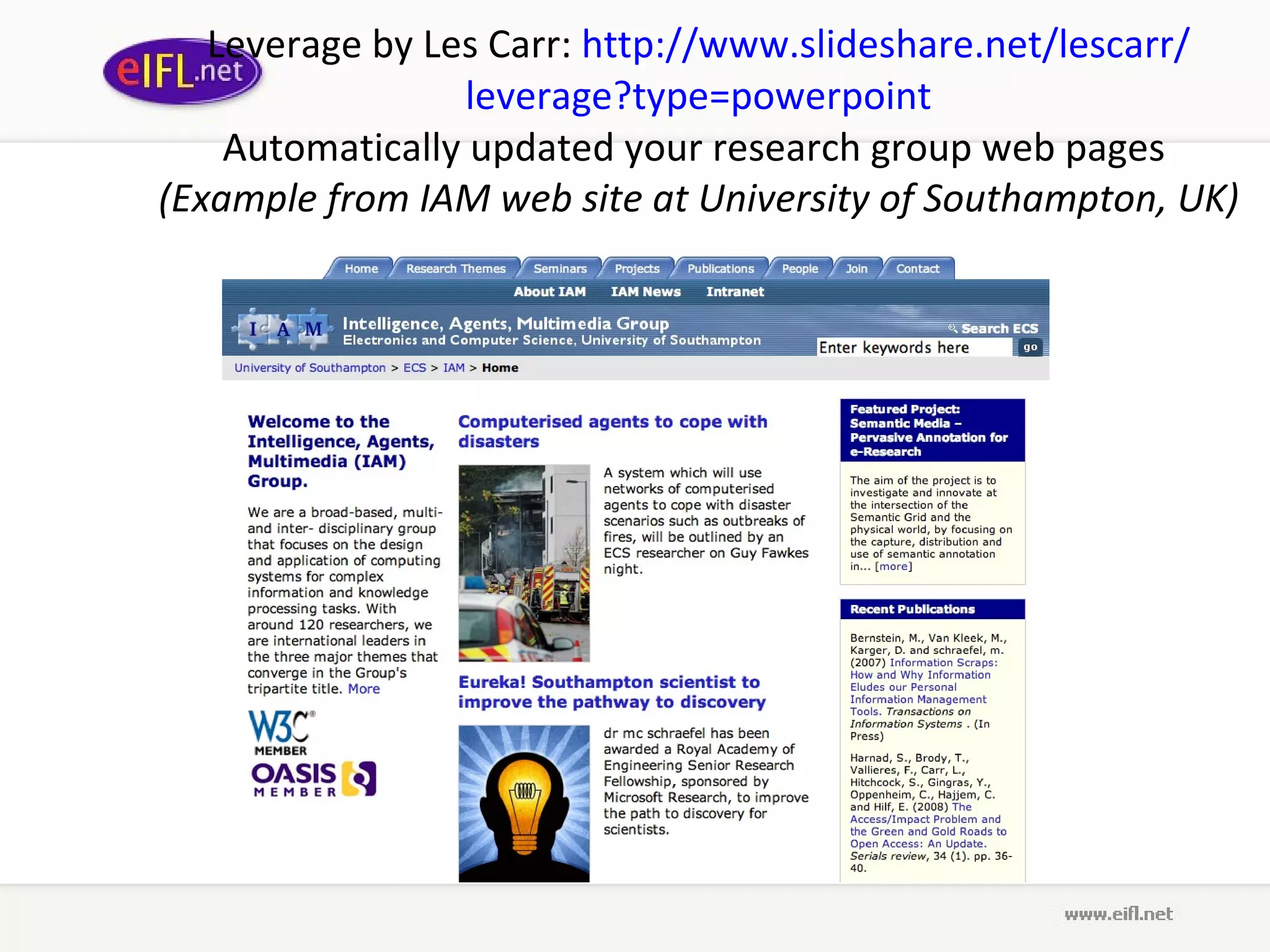
Leverage  by L es  C arr :  http :// www . slideshare . net / lescarr / leverage ? type = powerpoint  Automatically updated your research group web pages   (Example from IAM web site at University of Southampton, UK)
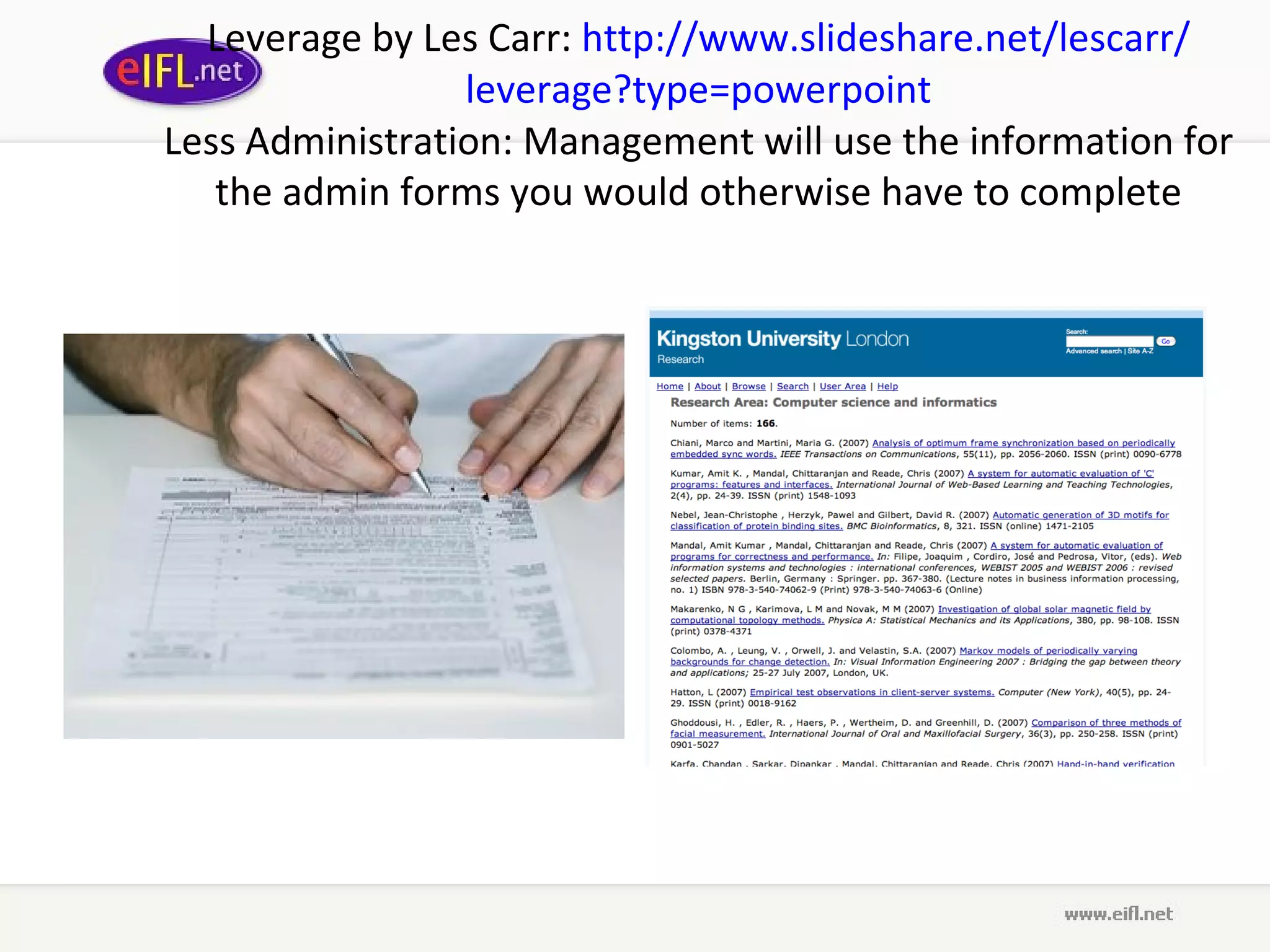
Leverage  by L es  C arr :  http :// www . slideshare . net / lescarr / leverage ? type = powerpoint Less Administration: Management will use the information for the admin forms you would otherwise have to complete
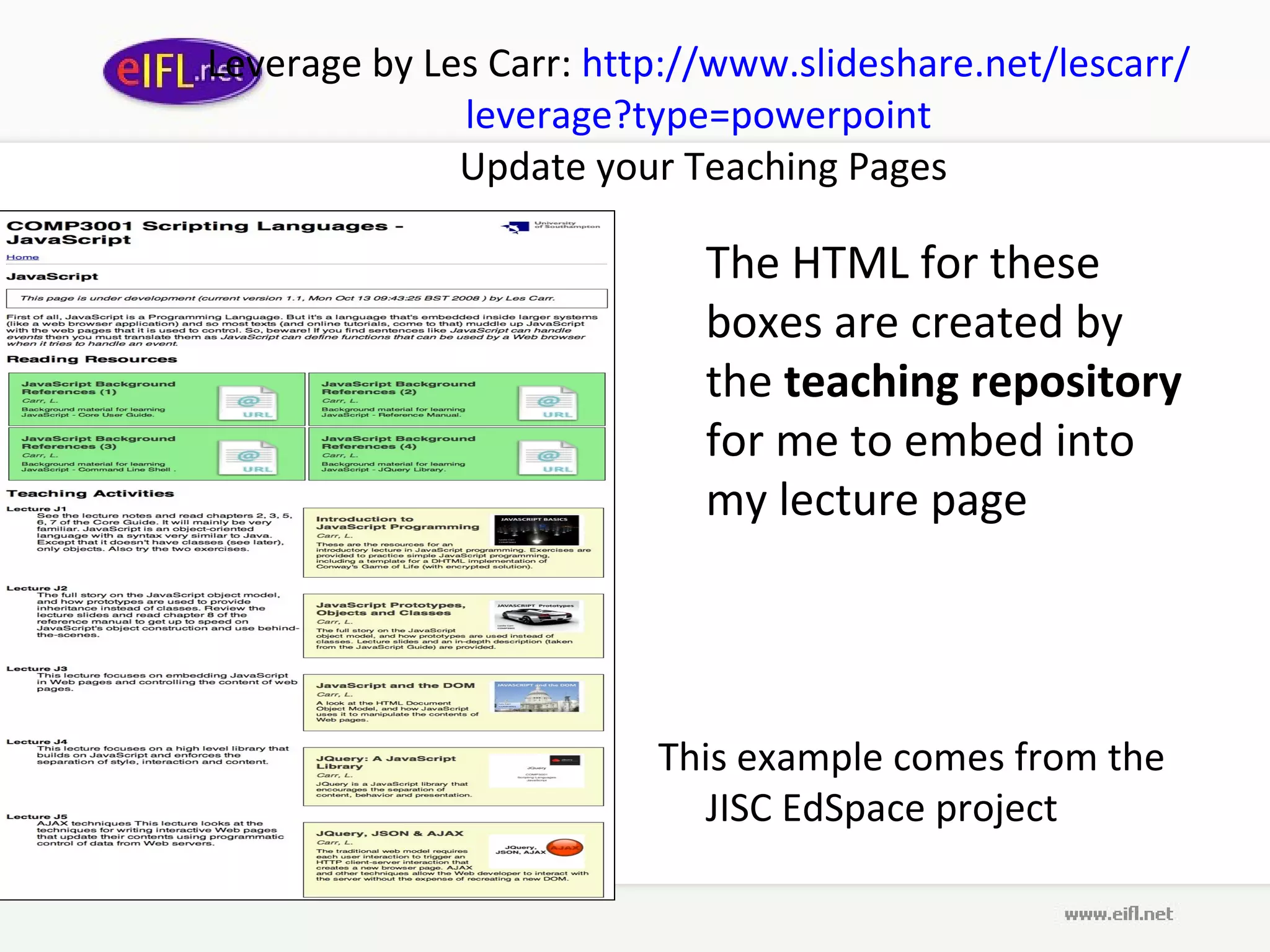
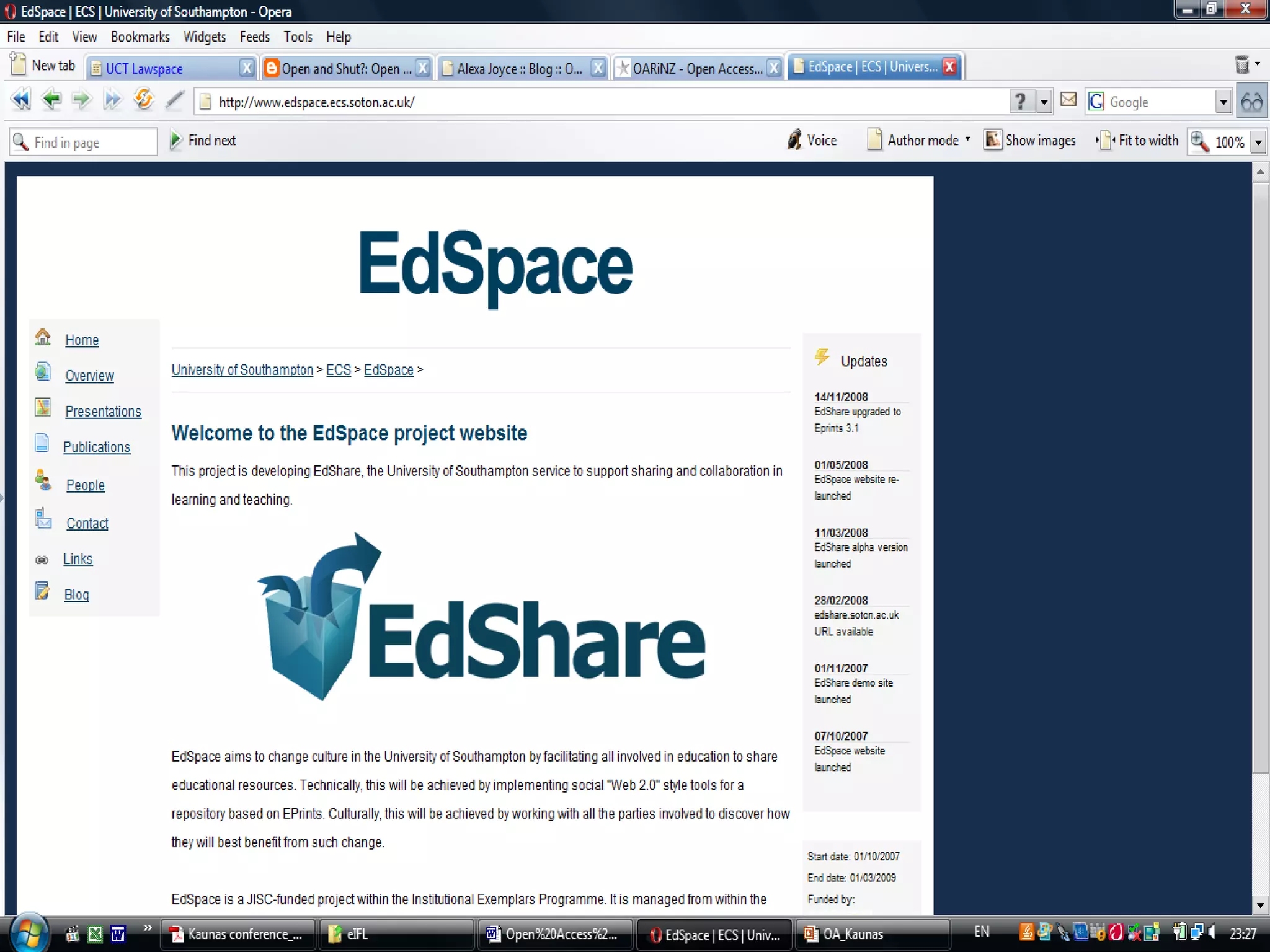
Leverage  by L es  C arr :  http :// www . slideshare . net / lescarr / leverage ? type = powerpoint  Update your Teaching Pages The HTML for these boxes are created by the  teaching repository  for me to embed into my lecture page  This example comes from the JISC EdSpace project


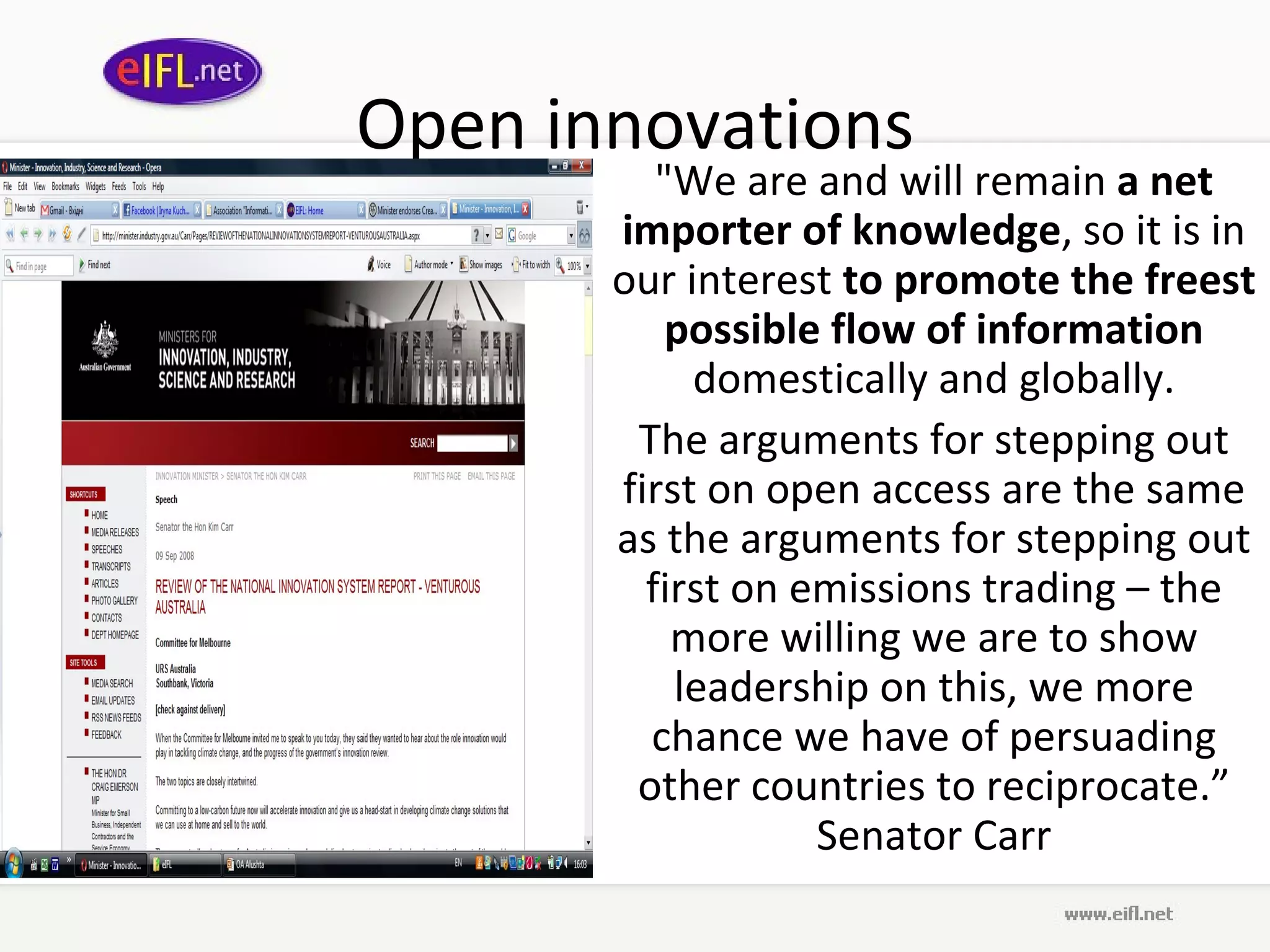
Open innovations "We are and will remain  a net importer of knowledge , so it is in our interest  to promote the freest possible flow   of information  domestically and globally. The arguments for stepping out first on open access are the same as the arguments for stepping out first on emissions trading – the more willing we are to show leadership on this, we more chance we have of persuading other countries to reciprocate.” Senator Carr
Libraries Libraries are no more just reading rooms and collections of books on the shelves From importers of knowledge they turn into exporters of knowledge Libraries as publishers and educators
The Power of Open Access There are considerable  economic, social and educational benefits to making research and other outputs available without financial, legal and technical barriers to access .
Open Access Impact John Houghton, Colin Steele and Peter Sheehan in their report to the Department of Education, Science and Training “ Research Communication Costs in Australia: Emerging Opportunities and Benefits ” mentioned  the most important potential benefit of Open Access  – “ enhanced access to, and greater use of, research findings , which would, in turn,  increase the efficiency of R&D  as it builds upon previous research.”
Open Access Impact “ Speed of access   speeding up  the research and discovery process,  increasing returns to investment  in R&D and, potentially,  reducing the time/cost  involved for a given outcome, and  increasing the rate of accumulation  of the stock of knowledge” “ Improved access  leading to  less duplicative research ,  saving duplicative R&D expenditure  and  improving the efficiency  of R&D;”  John Houghton, Colin Steele and Peter Sheehan, Report to the Department of Education, Science and Training “Research Communication Costs in Australia: Emerging Opportunities and Benefits”  http://www. dest . gov .au/NR/ rdonlyres /0ACB271F-EA7D-4FAF-B3F7-0381F441B175/13935/DEST_Research_Communications_Cost_Report_Sept2006. pdf
Open Access Impact “ Faster access  leading to  better informed research ,  reducing, saving  R&D expenditure and  improving the efficiency  of R&D;” “ Wider access  providing  enhanced opportunities for multi-disciplinary research ,  inter-institutional and inter-sectoral collaborations ;”  John Houghton, Colin Steele and Peter Sheehan, Report to the Department of Education, Science and Training “Research Communication Costs in Australia: Emerging Opportunities and Benefits”  http://www. dest . gov .au/NR/ rdonlyres /0ACB271F-EA7D-4FAF-B3F7-0381F441B175/13935/DEST_Research_Communications_Cost_Report_Sept2006. pdf
Open Access Impact “ Wider access  enabling researchers  to study their context more broadly , potentially leading to  increased opportunities for , and  rates of, application/commercialization ;” “ Improved access  leading to  improved education   outcomes , enabling a given education spend to produce  a higher level of educational attainment  (at least at the post secondary level), leading to an  improvement in the quality of the ‘stock’ of researchers and research users .” John Houghton, Colin Steele and Peter Sheehan, Report to the Department of Education, Science and Training “Research Communication Costs in Australia: Emerging Opportunities and Benefits”  http://www. dest . gov .au/NR/ rdonlyres /0ACB271F-EA7D-4FAF-B3F7-0381F441B175/13935/DEST_Research_Communications_Cost_Report_Sept2006. pdf
Thank you ! Questions ? Iryna Kuchma iryna.kuchma[at]eifl.net;  www. eifl .net The presentation is licensed with  Creative Commons Attribution 3.0 License

Open Access Advantages, Quality and Progress of the Research

  • 1.
    Open Access Advantages,Quality and Progress of the Research Iryna Kuchma eIFL Open Access Program Manager, eIFL.net Presented at t he International Conference „Adult Learning and e-Learning Quality“, November 25, 2008, Kaunas, Lithuania
  • 2.
    eIFL.net – 4200 libraries in 48 countries
  • 3.
  • 4.
    eIFL.net programs Openaccess publishing and the building of open repositories of local content Advocacy for access to knowledge: copyright and libraries Promoting free and open source software for libraries 1+1=More and better. The benefits of library consortia Promoting a culture of cooperation: knowledge and information sharing Advocating for affordable and fair access to commercially produced scholarly resources
  • 5.
    eIFL Open AccesseIFL-OA seeks to enhance access to research , thereby accelerating innovation and economic development in the countries eIFL-OA Program - builds networks of Open repositories, Open Access journals and Open education materials; - provides training and advice on Open Access policies and practices; - empowers library professionals, scientists and scholars, educators and students to become open access advocates
  • 6.
    That’s not e-learningCC BY-NC-SA by mashon http :// www . flickr . com / photos / mushon /197192450/ ; http :// www . flickr . com / photos / mushon /197192003/
  • 7.
    CC BY-NC byA eioux http :// www . flickr . com / photos / aeioux /270434765/
  • 8.
    CC BY--NC-ND by ekornblut http :// www . flickr . com / photos / emilyjk /889172557/
  • 9.
    CC BY-NC-ND by Katie Spenc http :// www . flickr . com / photos / spenceke /1443519862/
  • 10.
    Lifelong learning andopen access “ How to support lifelong learning and widening participation?”: “ Key to this wider context are the themes of broadening participation to non-traditional groups of learners, links with work-based learning, more flexible provision of learning, and fair and transparent admissions procedures.” (Sarah Davies JISC programme manager: Online Educa tackles lifelong learning and open access: http://www. jisc .ac. uk /news/stories/2006/11/news_educa1. aspx )
  • 11.
    Lifelong learning andopen access “ E-portfolios can support learning by supporting applications for studies or jobs, appraisal or assessment; supporting learners as they move between institutions and sectors; and by guiding learning over time, in formal education, training and employment.” (Sarah Davies JISC programme manager: Online Educa tackles lifelong learning and open access: http://www. jisc .ac. uk /news/stories/2006/11/news_educa1. aspx )
  • 12.
    Lifelong learning andopen access the 'information imperative' “ the fact there is a 30% growth in information per year and the corresponding need to adopt new systems, policies and approaches by all organisations” “ 'the half-life of information is getting shorter', that is to say, information which is true one day can be wrong or no longer true the following day.” the need for the skill of 'unlearning' - not necessarily knowing information but knowing how to find it only when one needs it.” (Charles Jennings, Global Head of Learning at Reuters: Online Educa tackles lifelong learning and open access: http://www. jisc .ac. uk /news/stories/2006/11/news_educa1. aspx )
  • 13.
    the no-wall door CC BY-NC by monkeyca t http :// www . flickr . com / photos / ghirson /13481774/
  • 14.
    CC BY-NC by mollyali : http :// www . flickr . com / photos / mollyali /2924209043/
  • 15.
    Open Access OpenAccess is the free online availability of peer reviewed journal literature permitting any user to read , download, copy, distribute, print, search, or link to the full texts of articles 2 complementary strategies: the development of institutional repositories and Open Access journals From the Budapest Open Access Initiative: http://www. soros .org/ openaccess /read. shtml
  • 16.
    Open Access “It is important to stress here that publishing is a fundamental part of the process of doing science . Moreover, as a scientist I am not writing for money — like my wife, who was a professional writer at one time — but I am writing for fame: I want everyone to read what I write… Everybody who writes a scientific paper is writing to be read, not to make money. For that reason we volunteer our services, and we don’t get paid. That is what makes Open Access a powerful concept for scientists. It means, for instance, that anyone anywhere in the world who searches for oncogenes, mouse models, or any other search term that applies to my own work, will find it, and will be able to have immediate access to it. That is the goal we are hoping to achieve.” The Basement Interviews Freeing the scientific literature Harold Varmus, Nobel laureate, former director of the US National Institutes of Health, and co-founder of open access publisher Public Library of Science, talks to Richard Poynder. Published on June 5th 2006 http:// poynder . blogspot .com/2006/06/interview-with- harold - varmus .html
  • 17.
    Open Access innumbers OAIster currently provides access to 18,530,232 records from 1039 contributors http://www. oaister .org/ 3 756 journal titles (about 15% of all scientific journals published) in DOAJ http://www. doaj .org/ About 20% of all current research literature is available in Open Access
  • 18.
  • 19.
  • 20.
  • 21.
    Hindawi Publishing CorporationOn February 21, 2007 the Hindawi Publishing Corporation, Egypt, converted the last of its subscription-based journals to an open access model. Hindawi Publishing Corporation is a commercial publisher of STM (Science, Technology, and Medicine) literature. Founded in 1997, Hindawi currently employs more than 250 people, and publishes more than 100 peer-reviewed journals.
  • 22.
    Hindawi Publishing CorporationOver the past several years, Hindawi has seen an increase of more than 40% per year in the number of submitted manuscripts it receives. Since its full conversion to Open Access in February 2007, Hindawi's growth has continued to accelerate, with monthly submission levels growing by more than 100% during 2007. Annual impact factor growth more than 14%
  • 23.
  • 24.
  • 25.
  • 26.
  • 27.
  • 28.
    Open Access ImpactThe advantages of Open Access are shown in the figures, especially when it comes to increased citation rates : For 72% of papers published in the Astrophysical Journal, free versions of the paper are available (mainly through ArXiv). These 72% of papers are, on average, cited more than twice as often as the remaining 28% that do not have free versions. Schwarz, G. and Kennicutt Jr., R. C. (2004): Demographic and Citation Trends in Astrophysical Journal Papers and Preprints (pdf 14pp), arxiv.org/pdf/astro-ph/0411275, 10 November 2004, Bulletin of the American Astronomical Society, Vol. 36, 1654-1663
  • 29.
    Open Access ImpactOpen access PNAS papers have 50% more full-text downloads than non-open access papers http://www.library. yale . edu /~ llicense / ListArchives /0505/msg01580.html … and are on average twice as likely to be cited http://biology. plosjournals .org/ perlserv /?request=get-document& doi =10.1371/journal. pbio .0040157
  • 30.
    Open Access ImpactIn Chinese scientific journals citation indicators of Open Access journals were found to be higher than those of non-Open Access journals. Cheng, W. H. and Ren, S. L. (2008): Evolution of open access publishing in Chinese scientific journals, Learned Publishing, Vol. 21, No. 2, April 2008, 140-152
  • 31.
    Open Access Impact“ Government-funded open access journals would be a breakthrough for science publishing in China . A government-funded open access initiative would reduce or eliminate the cost of publishing — enabling Chinese journals to attract more high-quality papers and improve their impact . Domestic journals can publish papers faster .” said Zhu Zuoyan, the recently retired deputy head of the National Science Foundation of China (NSFC) http://www. scidev .net/en/news/make-china-journals-open-access-says-top-scientist.html
  • 32.
    Open Access ImpactAnd there is a long list of bibliography The effect of open access and downloads ('hits') on citation impact : a bibliography of studies: http:// opcit . eprints .org/ oacitation - biblio .html#most-recent Another recent posts: Thinking about prestige, quality, and open access by Peter Suber in the SPARC Open Access Newsletter, issue #125: http://www. earlham . edu /~peters/ fos /newsletter/09-02-08. htm Open Access: The question of quality by Richard Poynder in his blog Open and Shut?: http :// poynder . blogspot . com /2008/11/open-access-question-of- quality _21. html
  • 33.
    Open Access ImpactOpen access brings more rapid and more efficient progress for scholarly research http:// arxiv .org/ Open access to 486,864 e-prints in Physics, Mathematics, Computer Science, Quantitative Biology and Statistics “ Brody has looked at the pattern of citations to articles deposited in arXiv, specifically at the length of the delay between when an article is deposited and when it is cited, and has published the aggregated data for each year from 1991.” Brody, Tim; Harnad, Stevan; Carr, Leslie. Earlier web usage statistics as predictors of later citation impact. Journal of the American Association for Information Science and Technology (JASIST), 2005, Vol. 57 no. 8 pp. 1060-1072. http://eprints.ecs.soton.ac.uk/10713/01/timcorr.htm (accessed 30 October 2006) Open Access: What is it and why should we have it? - ECS EPrints ...Open Access: What is it and why should we have it? Swan, A. (2006) Open Access: What is it and why should we have it? http:// eprints . ecs . soton .ac. uk /13028/
  • 34.
    Open Access Impact“ As more papers are deposited and more scientists use the repository, the time between an article being deposited and being cited has been shrinking dramatically, year upon year. This is important for research uptake and progress, because it means that in this area of research, where articles are made available at – or frequently before – publication, the research cycle is accelerating. the research cycle in high energy physics is approaching maximum efficiency as a result of the early and free availability of articles that scientists in the field can use and build upon rapidly.” Brody, Tim; Harnad, Stevan; Carr, Leslie. Earlier web usage statistics as predictors of later citation impact. Journal of the American Association for Information Science and Technology (JASIST), 2005, Vol. 57 no. 8 pp. 1060-1072. http://eprints.ecs.soton.ac.uk/10713/01/timcorr.htm (accessed 30 October 2006) Open Access: What is it and why should we have it? - ECS EPrints ...Open Access: What is it and why should we have it? Swan, A. (2006) Open Access: What is it and why should we have it? http:// eprints . ecs . soton .ac. uk /13028/
  • 35.
    The Power ofOpen Access Open Access enabled the opportunities provided by technological developments, such as data mining and text mining , to be realised
  • 36.
  • 37.
    The Power ofOpen Access “ The precepts of the publicly funded genome project made a very big impression, and it does have an impact on people's approach to scientific information, and their attitudes about access to it. There is also no doubt that virtually everyone working in the field of science that I work in depends very heavily on publicly available annotated sequences of humans, of mice, of worms and many other organisms. That principle is one that heavily informs the Open Access Movement, because it demonstrates how important search and retrieval is . It shows how important it is not just to have pieces of sequence floating around and the literature somewhere else, but to have them actually amalgamated into one site where you can do a search and get the information you want . That is a metaphor that we are trying to develop with the scientific literature.” The Basement Interviews Freeing the scientific literature Harold Varmus, Nobel laureate, former director of the US National Institutes of Health, and co-founder of open access publisher Public Library of Science, talks to Richard Poynder. Published on June 5th 2006 http:// poynder . blogspot .com/2006/06/interview-with- harold - varmus .html
  • 38.
    The Power ofOpen Access “ I am certainly a strong proponent of the kinds of things that Larry Lessig talks about with Creative Commons: the reuse of information, the creation of new ideas by having access to previously published work, the right to reformulate information in ways that will allow us to have new insights — all of us who contribute to discovery want to see this .” The Basement Interviews Freeing the scientific literature Harold Varmus, Nobel laureate, former director of the US National Institutes of Health, and co-founder of open access publisher Public Library of Science, talks to Richard Poynder. Published on June 5th 2006 http:// poynder . blogspot .com/2006/06/interview-with- harold - varmus .html
  • 39.
  • 40.
  • 41.
  • 42.
  • 43.
  • 44.
  • 45.
  • 46.
  • 47.
  • 48.
    Leverage byL es C arr : http :// www . slideshare . net / lescarr / leverage ? type = powerpoint The Repository has made a splash page, with previews and usage stats ( Example from EPrints at University of Southampton)
  • 49.
    Leverage byL es C arr : http :// www . slideshare . net / lescarr / leverage ? type = powerpoint The repository has made a bibliography for you …( Example from DSpace at Universiteit Hasselt, Belgium)
  • 50.
    Leverage byL es C arr : http :// www . slideshare . net / lescarr / leverage ? type = powerpoint …maybe personalised it with other information about you… ( Example from DSpace at University of Chicago, Illinois)
  • 51.
    Leverage byL es C arr : http :// www . slideshare . net / lescarr / leverage ? type = powerpoint …set up a mailing list for you…( Example from Digital Commons at Cal Poly
  • 52.
    Leverage byL es C arr : http :// www . slideshare . net / lescarr / leverage ? type = powerpoint Automatically updated your research group web pages (Example from IAM web site at University of Southampton, UK)
  • 53.
    Leverage byL es C arr : http :// www . slideshare . net / lescarr / leverage ? type = powerpoint Less Administration: Management will use the information for the admin forms you would otherwise have to complete
  • 54.
    Leverage byL es C arr : http :// www . slideshare . net / lescarr / leverage ? type = powerpoint Update your Teaching Pages The HTML for these boxes are created by the teaching repository for me to embed into my lecture page This example comes from the JISC EdSpace project
  • 55.
  • 56.
  • 57.
  • 58.
  • 59.
  • 60.
  • 61.
  • 62.
  • 63.
  • 64.
  • 65.
  • 66.
    Open innovations "Weare and will remain a net importer of knowledge , so it is in our interest to promote the freest possible flow of information domestically and globally. The arguments for stepping out first on open access are the same as the arguments for stepping out first on emissions trading – the more willing we are to show leadership on this, we more chance we have of persuading other countries to reciprocate.” Senator Carr
  • 67.
    Libraries Libraries areno more just reading rooms and collections of books on the shelves From importers of knowledge they turn into exporters of knowledge Libraries as publishers and educators
  • 68.
    The Power ofOpen Access There are considerable economic, social and educational benefits to making research and other outputs available without financial, legal and technical barriers to access .
  • 69.
    Open Access ImpactJohn Houghton, Colin Steele and Peter Sheehan in their report to the Department of Education, Science and Training “ Research Communication Costs in Australia: Emerging Opportunities and Benefits ” mentioned the most important potential benefit of Open Access – “ enhanced access to, and greater use of, research findings , which would, in turn, increase the efficiency of R&D as it builds upon previous research.”
  • 70.
    Open Access Impact“ Speed of access speeding up the research and discovery process, increasing returns to investment in R&D and, potentially, reducing the time/cost involved for a given outcome, and increasing the rate of accumulation of the stock of knowledge” “ Improved access leading to less duplicative research , saving duplicative R&D expenditure and improving the efficiency of R&D;” John Houghton, Colin Steele and Peter Sheehan, Report to the Department of Education, Science and Training “Research Communication Costs in Australia: Emerging Opportunities and Benefits” http://www. dest . gov .au/NR/ rdonlyres /0ACB271F-EA7D-4FAF-B3F7-0381F441B175/13935/DEST_Research_Communications_Cost_Report_Sept2006. pdf
  • 71.
    Open Access Impact“ Faster access leading to better informed research , reducing, saving R&D expenditure and improving the efficiency of R&D;” “ Wider access providing enhanced opportunities for multi-disciplinary research , inter-institutional and inter-sectoral collaborations ;” John Houghton, Colin Steele and Peter Sheehan, Report to the Department of Education, Science and Training “Research Communication Costs in Australia: Emerging Opportunities and Benefits” http://www. dest . gov .au/NR/ rdonlyres /0ACB271F-EA7D-4FAF-B3F7-0381F441B175/13935/DEST_Research_Communications_Cost_Report_Sept2006. pdf
  • 72.
    Open Access Impact“ Wider access enabling researchers to study their context more broadly , potentially leading to increased opportunities for , and rates of, application/commercialization ;” “ Improved access leading to improved education outcomes , enabling a given education spend to produce a higher level of educational attainment (at least at the post secondary level), leading to an improvement in the quality of the ‘stock’ of researchers and research users .” John Houghton, Colin Steele and Peter Sheehan, Report to the Department of Education, Science and Training “Research Communication Costs in Australia: Emerging Opportunities and Benefits” http://www. dest . gov .au/NR/ rdonlyres /0ACB271F-EA7D-4FAF-B3F7-0381F441B175/13935/DEST_Research_Communications_Cost_Report_Sept2006. pdf
  • 73.
    Thank you !Questions ? Iryna Kuchma iryna.kuchma[at]eifl.net; www. eifl .net The presentation is licensed with Creative Commons Attribution 3.0 License