Introduction to open access and
how it helps in your research and
increases the visibility and impact
of your publications
Iryna Kuchma, Open Access Programme Manager
Presentation at Open access seminars, December 6-9, 2015, An-Najah National
University, Birzeit University and Palestine Polytechnic University
Attribution 4.0 International
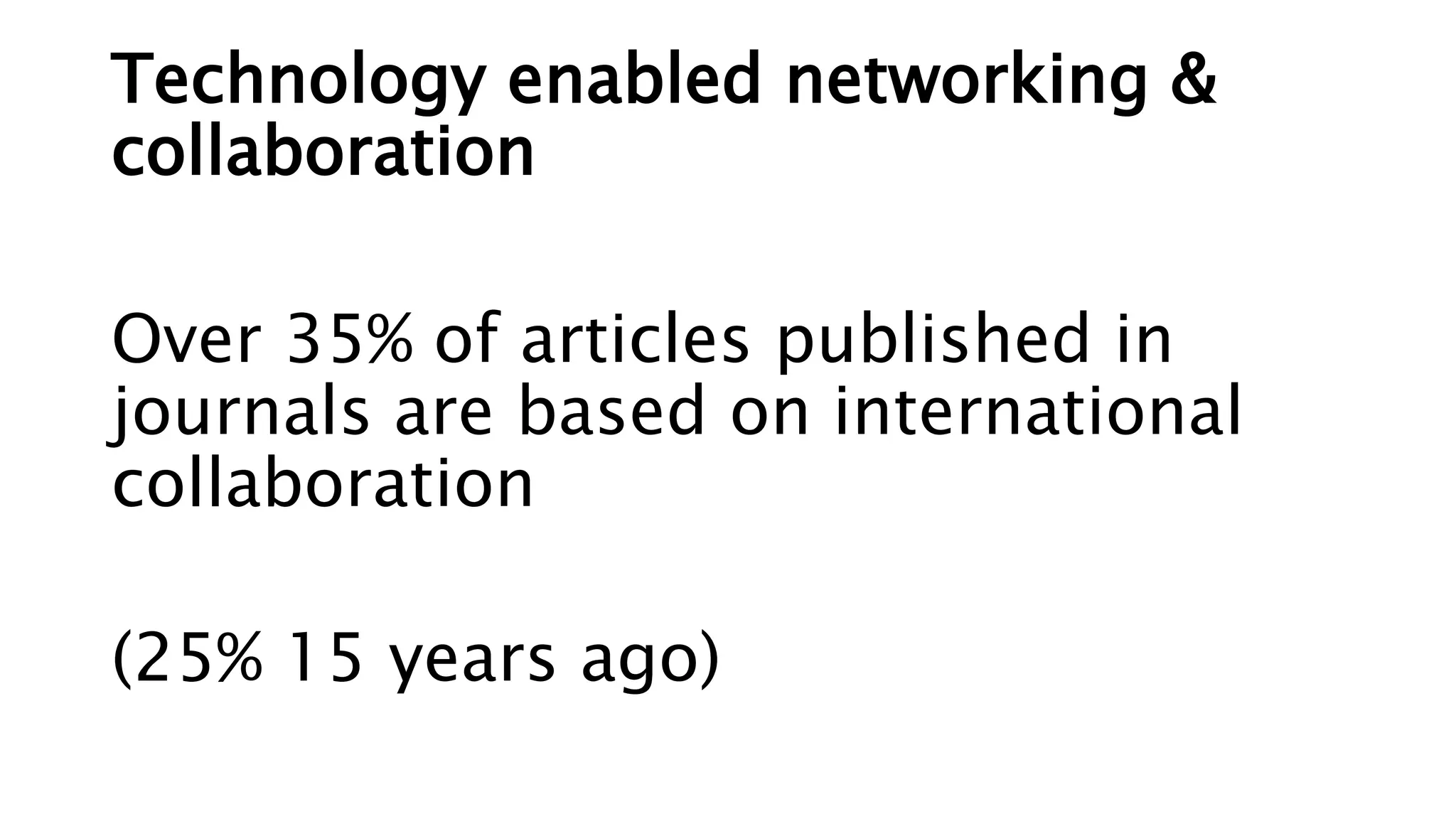
Technology enabled networking &
collaboration
Over 35% of articles published in
journals are based on international
collaboration
(25% 15 years ago)
Technology enabled networking &
collaboration (2)
Science is increasingly
interdisciplinary
Technology enabled networking &
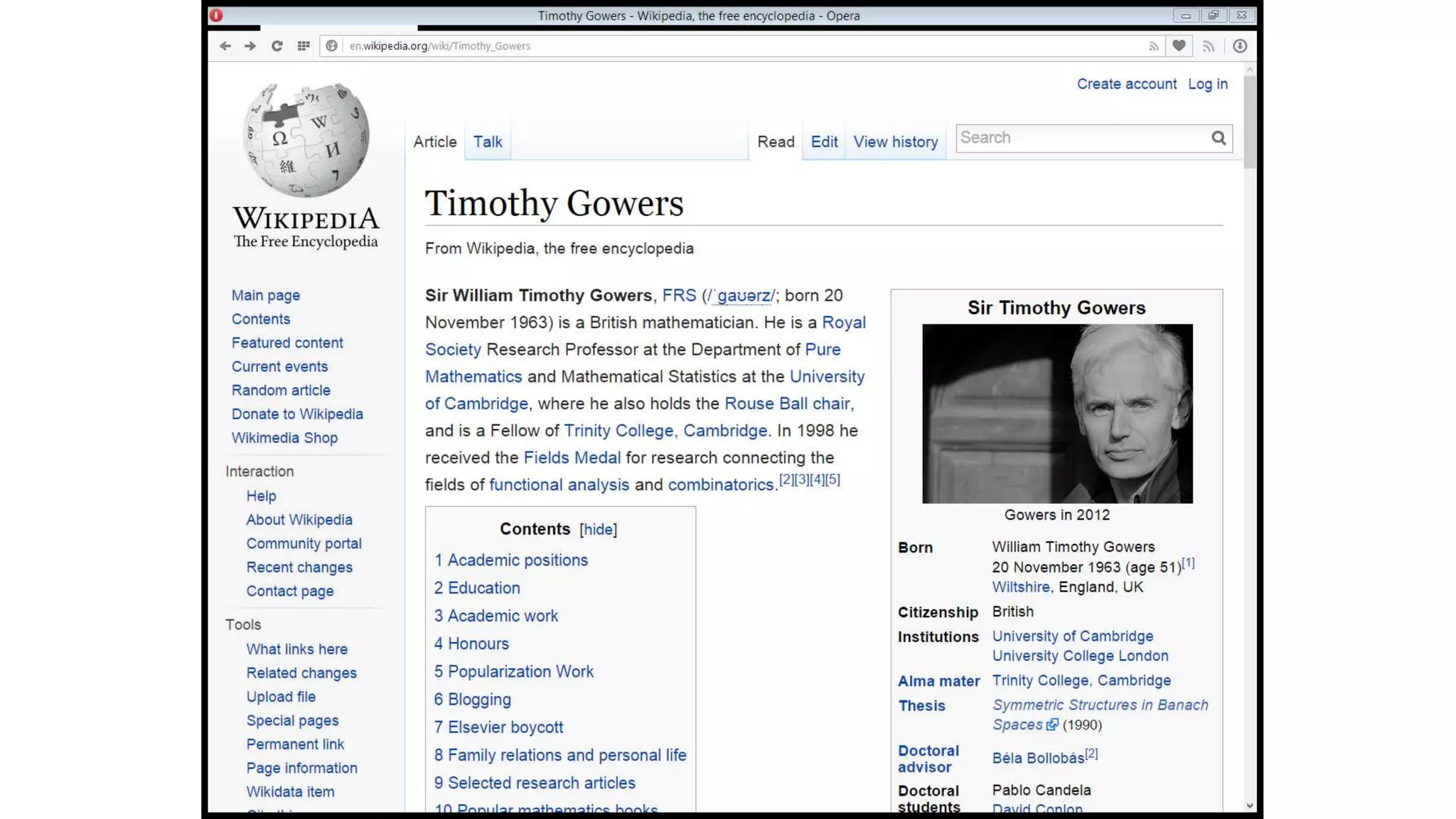
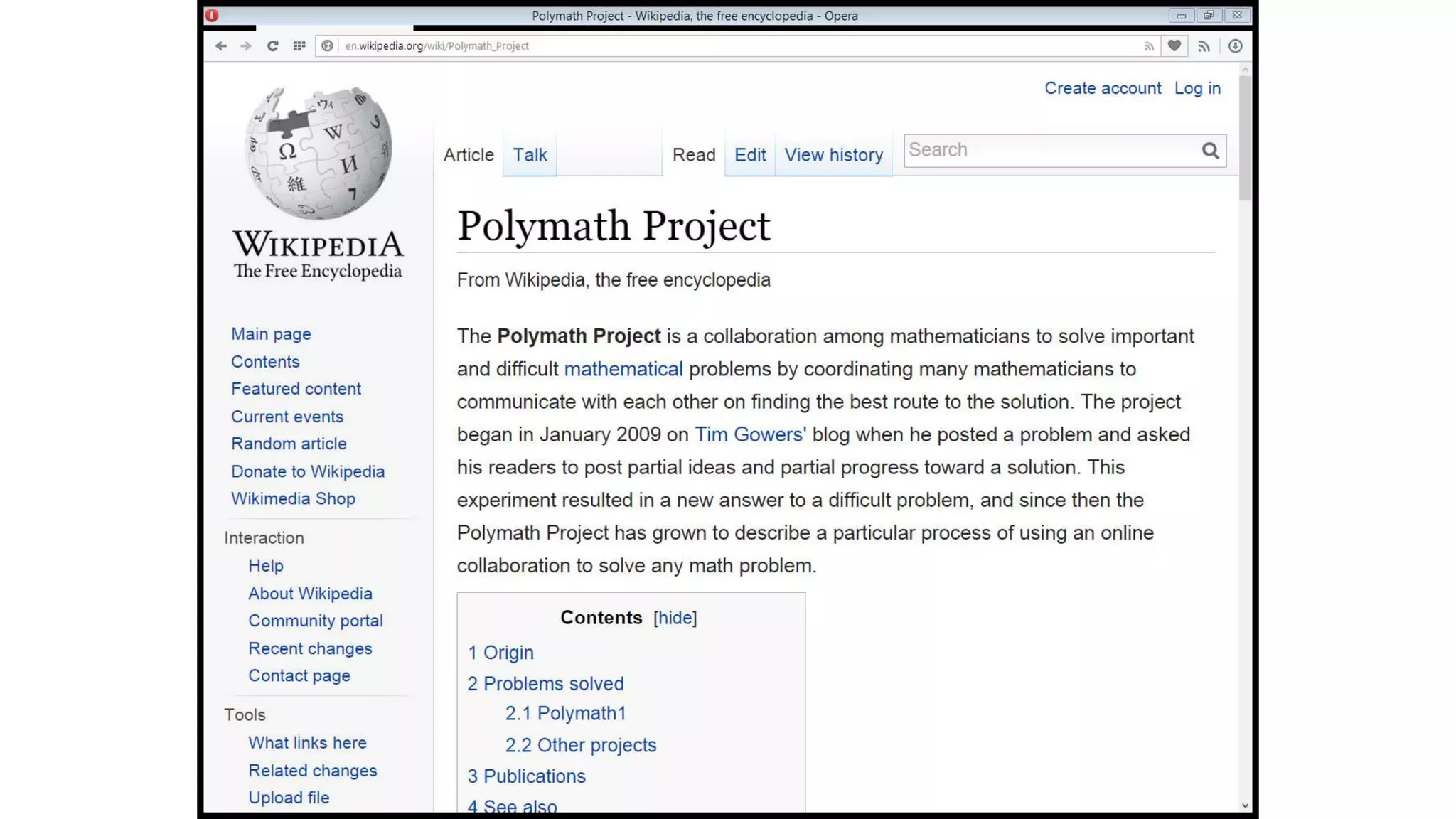
collaboration (3)
Novel communication technologies
permit modes of interaction that
exploit the collective intelligence of
the scientific community
“It felt like the difference between
driving a car and pushing it”
(Tim Gowers)
Open access (OA) is free,
online access to the results of
coupled with the right to use
results in new and innovative
Figure 10. The ecosystem of published articles, documents, spreadsheets, data fusions, and
machine-readable RDF data files resulting from our decision to apply semantic enhancements
to the PLoS NTDs article by Reis et al. [12].
Shotton D, Portwin K, Klyne G, Miles A (2009) Adventures in Semantic Publishing: Exemplar Semantic Enhancements of a
Research Article. PLoS Comput Biol 5(4): e1000361. doi:10.1371/journal.pcbi.1000361
http://127.0.0.1:8081/ploscompbiol/article?id=info:doi/10.1371/journal.pcbi.1000361
Figure 1. A superposition of Figure 3C of the PLoS NTDs article [12] onto a satellite photo of
Salvador with superimposed street plan.
Shotton D, Portwin K, Klyne G, Miles A (2009) Adventures in Semantic Publishing: Exemplar Semantic Enhancements of a
Research Article. PLoS Comput Biol 5(4): e1000361. doi:10.1371/journal.pcbi.1000361
http://127.0.0.1:8081/ploscompbiol/article?id=info:doi/10.1371/journal.pcbi.1000361
Figure 2. Superposition of Figure 3C of the 2008 PLoS NTDs article [12] and a modified version
of Figure 1 from Ko et al. [13] (copyright © Albert Ko, 2008, used with permission) onto a street
plan of Salvador.
Shotton D, Portwin K, Klyne G, Miles A (2009) Adventures in Semantic Publishing: Exemplar Semantic Enhancements of a
Research Article. PLoS Comput Biol 5(4): e1000361. doi:10.1371/journal.pcbi.1000361
http://127.0.0.1:8081/ploscompbiol/article?id=info:doi/10.1371/journal.pcbi.1000361
Figure 6. The Tag Cloud for the terms highlighted in the enhanced version of Reis et al. [12].
Shotton D, Portwin K, Klyne G, Miles A (2009) Adventures in Semantic Publishing: Exemplar Semantic Enhancements of a
Research Article. PLoS Comput Biol 5(4): e1000361. doi:10.1371/journal.pcbi.1000361
http://127.0.0.1:8081/ploscompbiol/article?id=info:doi/10.1371/journal.pcbi.1000361
Figure 9. An overlay (a) of panels (C) and (E), and (b) of panels (C), (D), and (F) from the
interactive version of Figure 3 of the PLoS NTDs article by Reis et al. [12].
Shotton D, Portwin K, Klyne G, Miles A (2009) Adventures in Semantic Publishing: Exemplar Semantic Enhancements of a
Research Article. PLoS Comput Biol 5(4): e1000361. doi:10.1371/journal.pcbi.1000361
http://127.0.0.1:8081/ploscompbiol/article?id=info:doi/10.1371/journal.pcbi.1000361
Open access (OA) for researcher
increased visibility
usage
& impact for your work
new contacts & research partnerships
OA for research institutions
publicises University's research
strengths
complete record of the research output
in easily accessible form
new tools to manage University's
OA for publishers
increased readership & citations
visibility & impact
the best possible dissemination service
for research
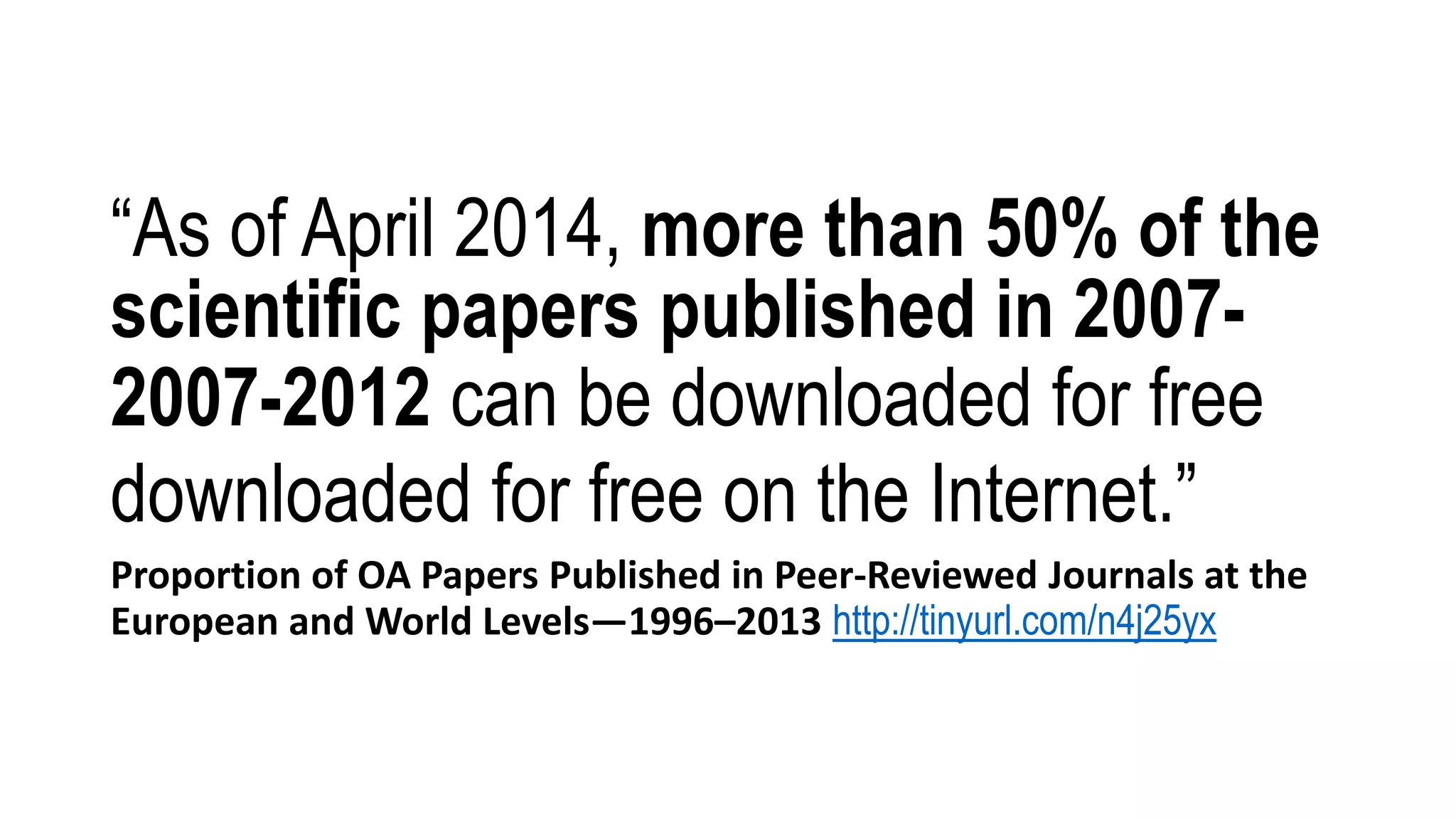
“As of April 2014, more than 50% of the
scientific papers published in 2007-
2007-2012 can be downloaded for free
downloaded for free on the Internet.”
Proportion of OA Papers Published in Peer-Reviewed Journals at the
European and World Levels—1996–2013 http://tinyurl.com/n4j25yx
Strategies to achieve open
access
Open access journals and
monographs
Open access repositories
Open access (OA) repositories
Free and Open Source Software to set
up, free technical support
Low installation and maintenance costs,
quick to set up and gain benefits
Institutions can mandate OA, speeding
development
University that doesn't know what papers
its faculty publishes is like a factory that
doesn't know what it produces
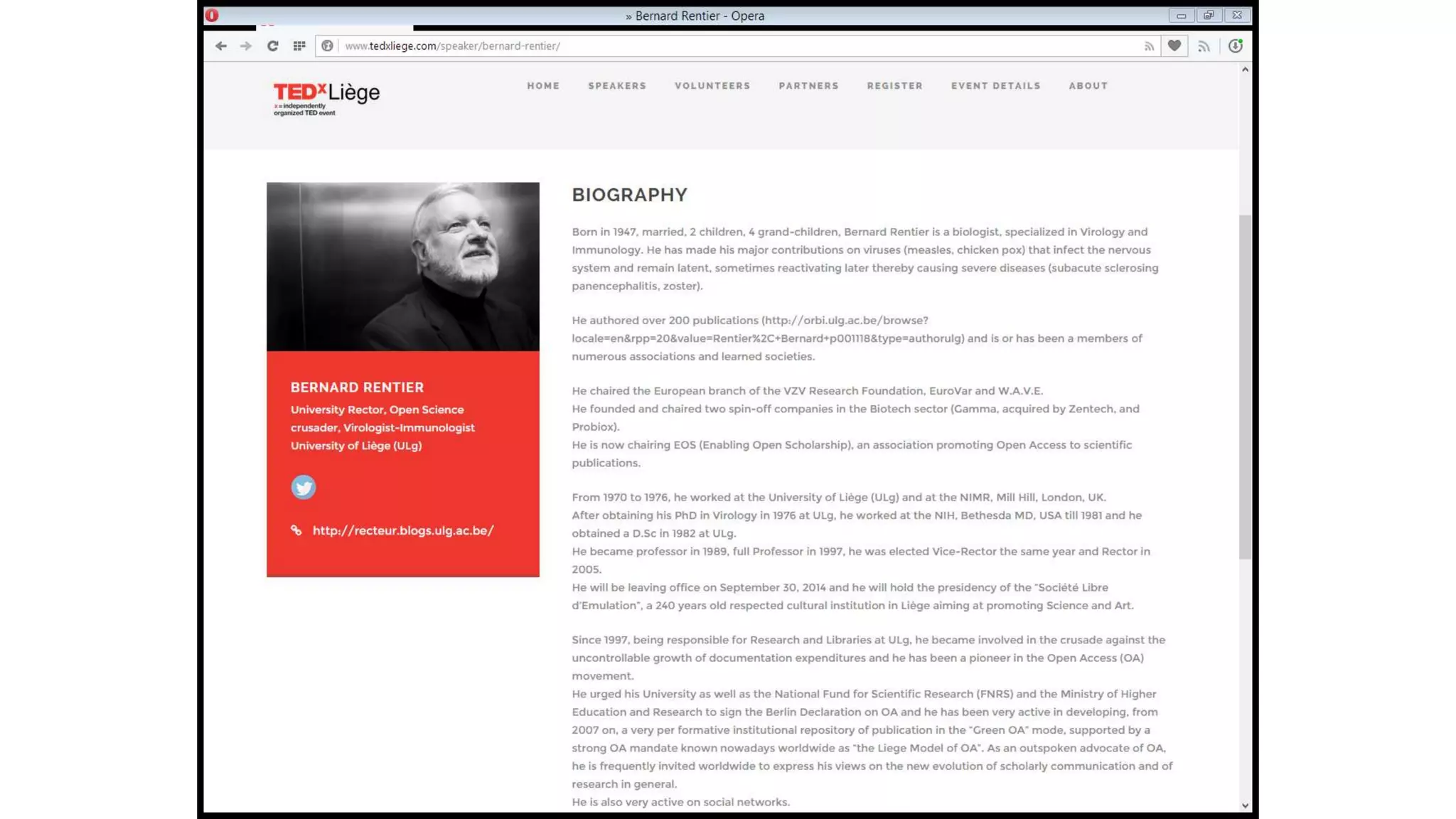
Bernard Rentier
An empty repository is useless;
a partly filled repository is partly useless;
there is a need for an institutional open
access policy
Bernard Rentier
Don't impose, just inform researchers
that only publications in the repository
will be considered for evaluation
Bernard Rentier
Mandate, keep authors at the core,
communicate permanently, be
coherent, reduce constraints
Bernard Rentier
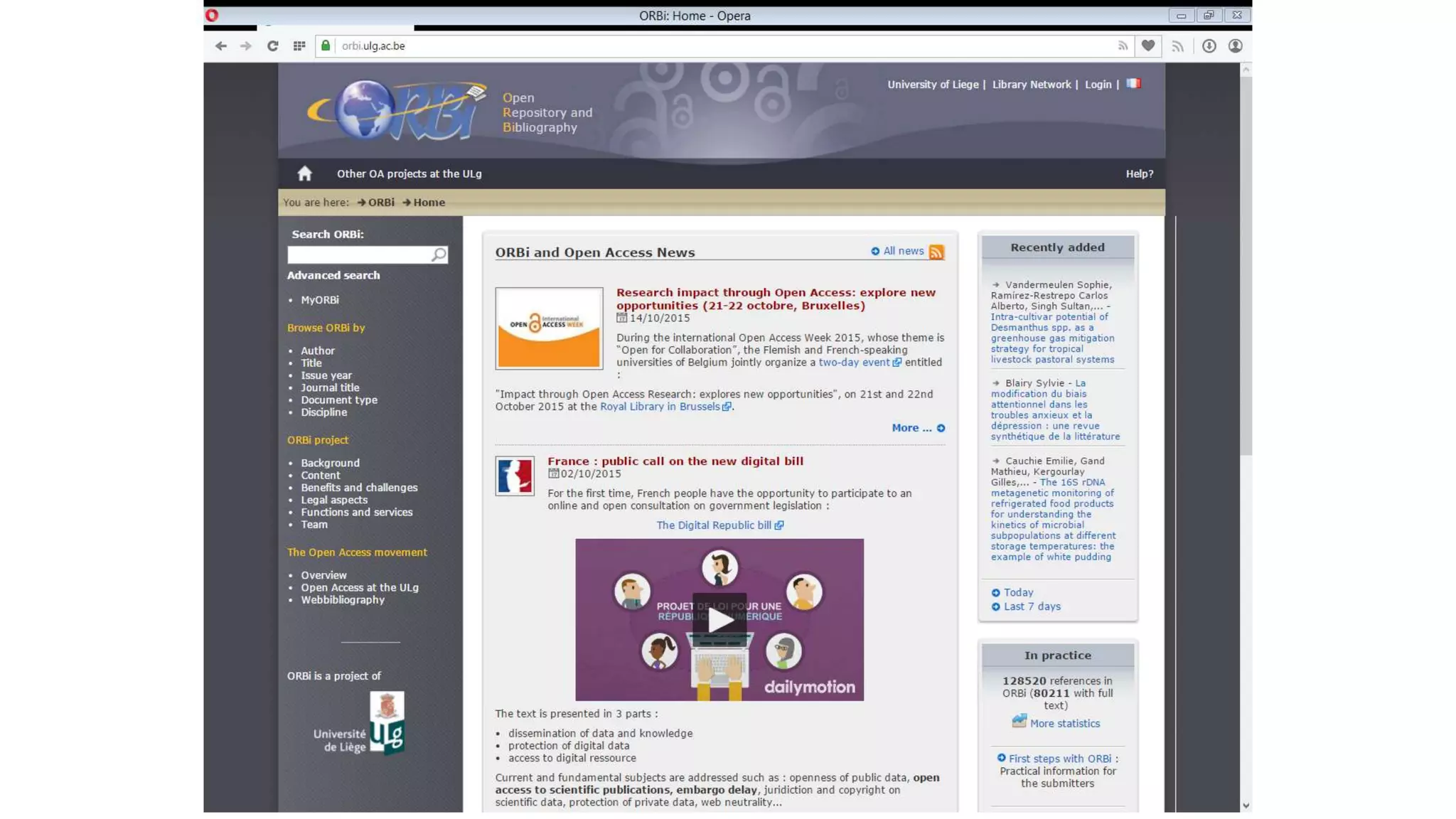
@ORBi_ULg – a personal workspace,
provides statistics and has a widget to
generate publications lists – content in
personal/faculties webpages
Bernard Rentier
The policy came into effect in November
2008 and has become the most effective
OA policy in the world at present, with
87% of the University’s research articles
currently being deposited in the
repository.
Bernard Rentier
34% of researchers are very satisfied
and 57% are satisfied with their OA
repository.
Bernard Rentier
800+ scholarly societies embraced
open access
Peter Suber and Caroline Sutton
“Putting research results in the public sphere makes
science better & strengthens our knowledge-based
knowledge-based economy. The European taxpayer
Máire Geoghegan-Quinn, European Commissioner for Research,
Innovation & Science (2010-2014)
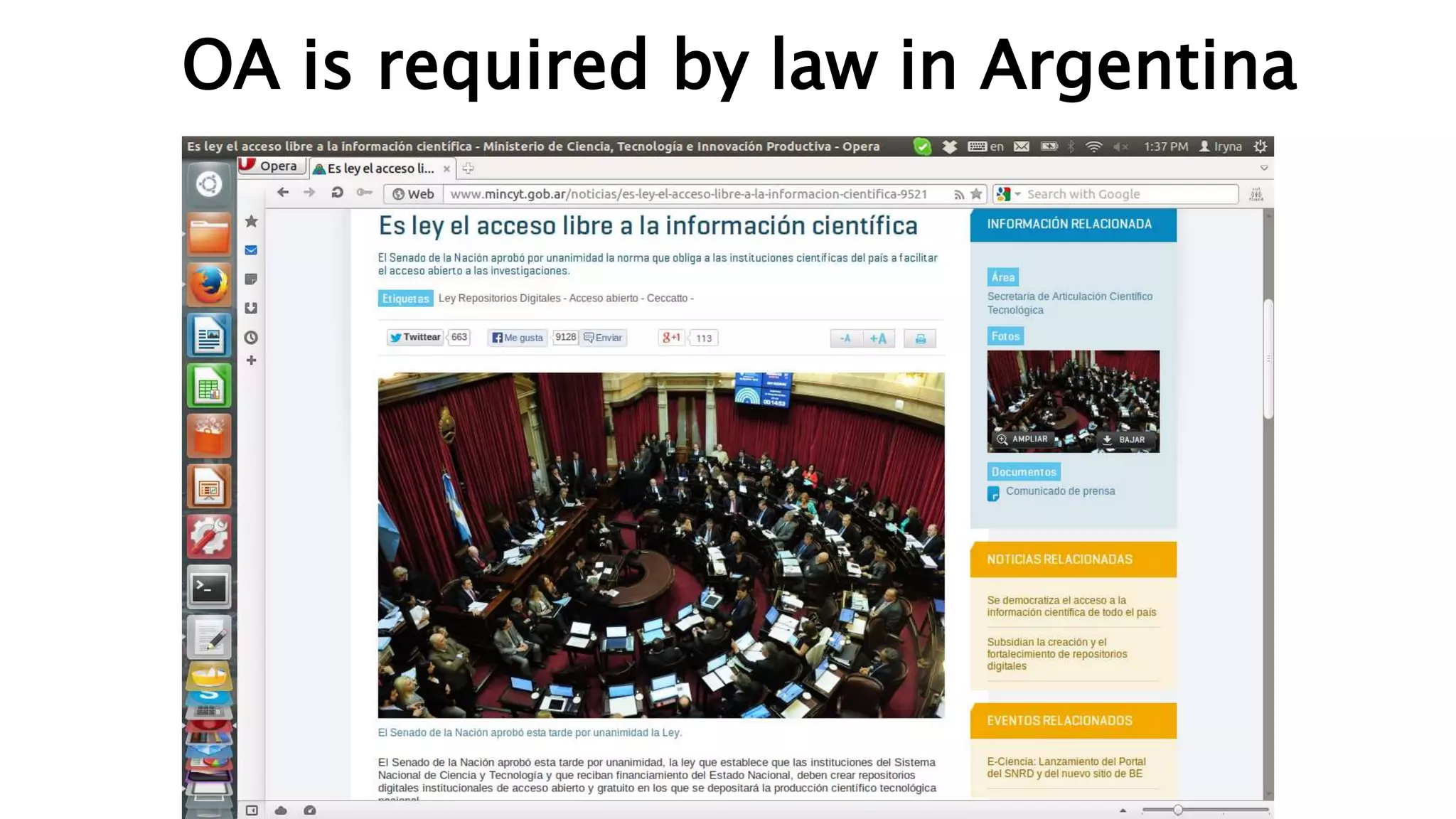
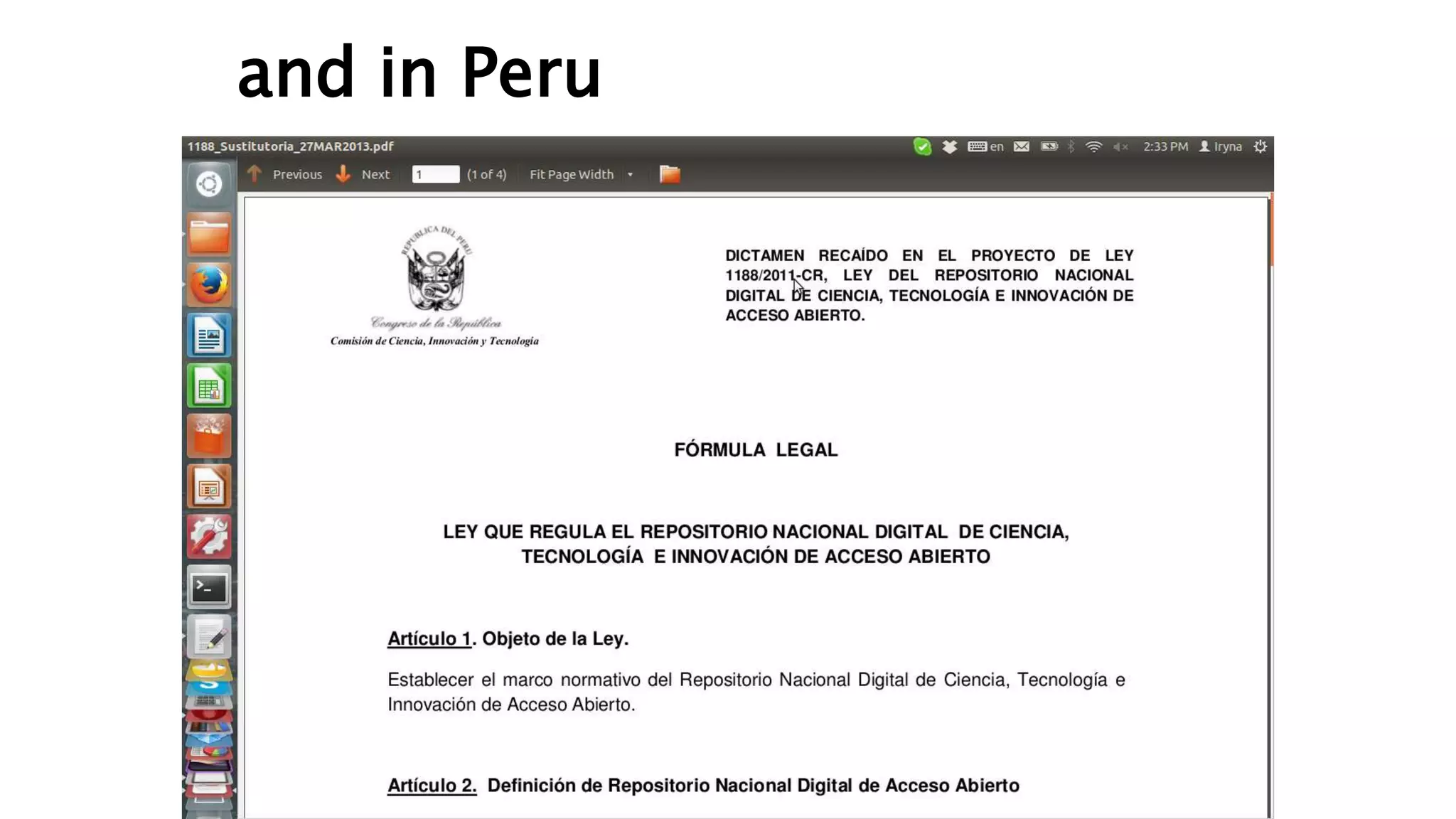
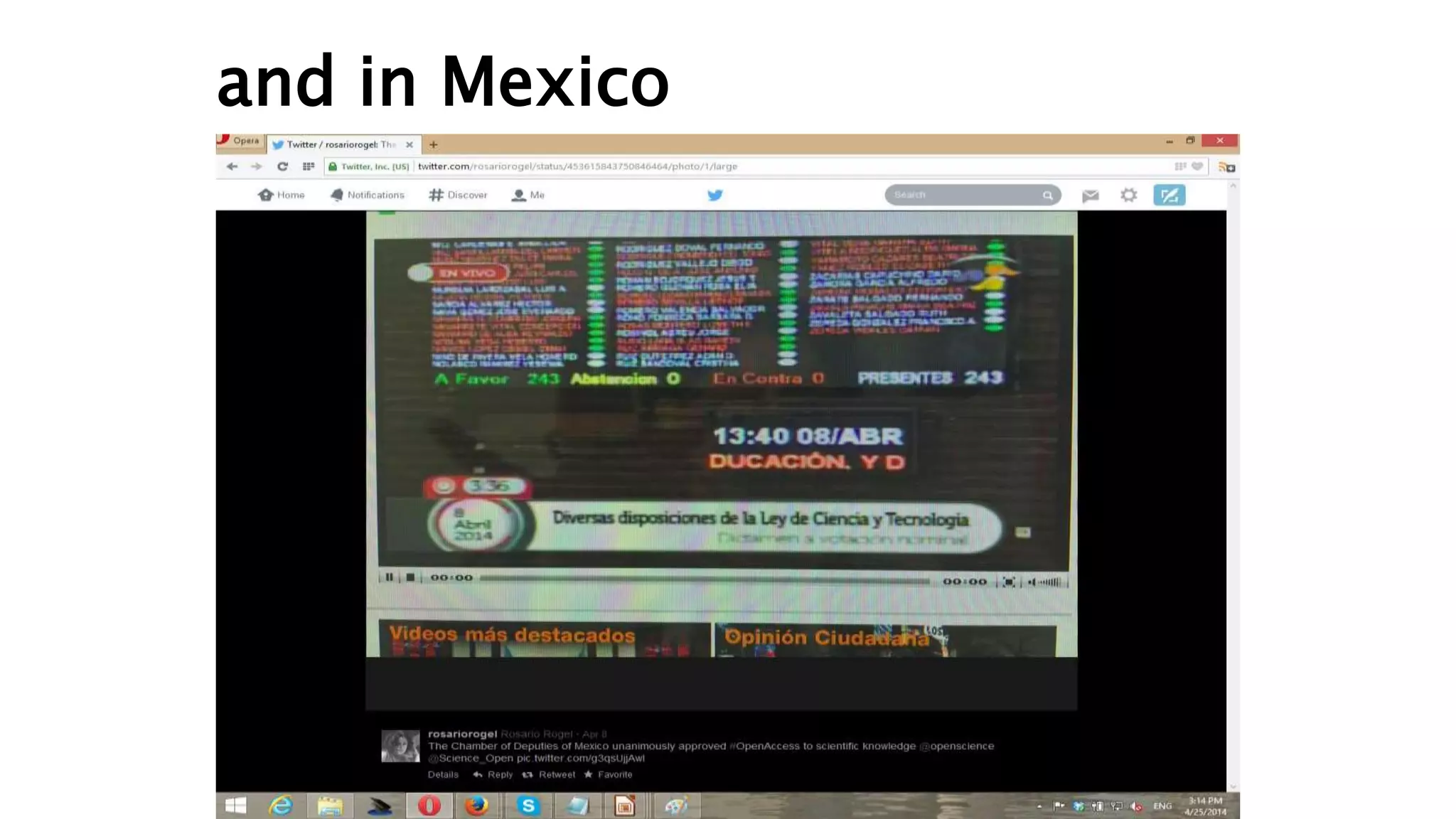
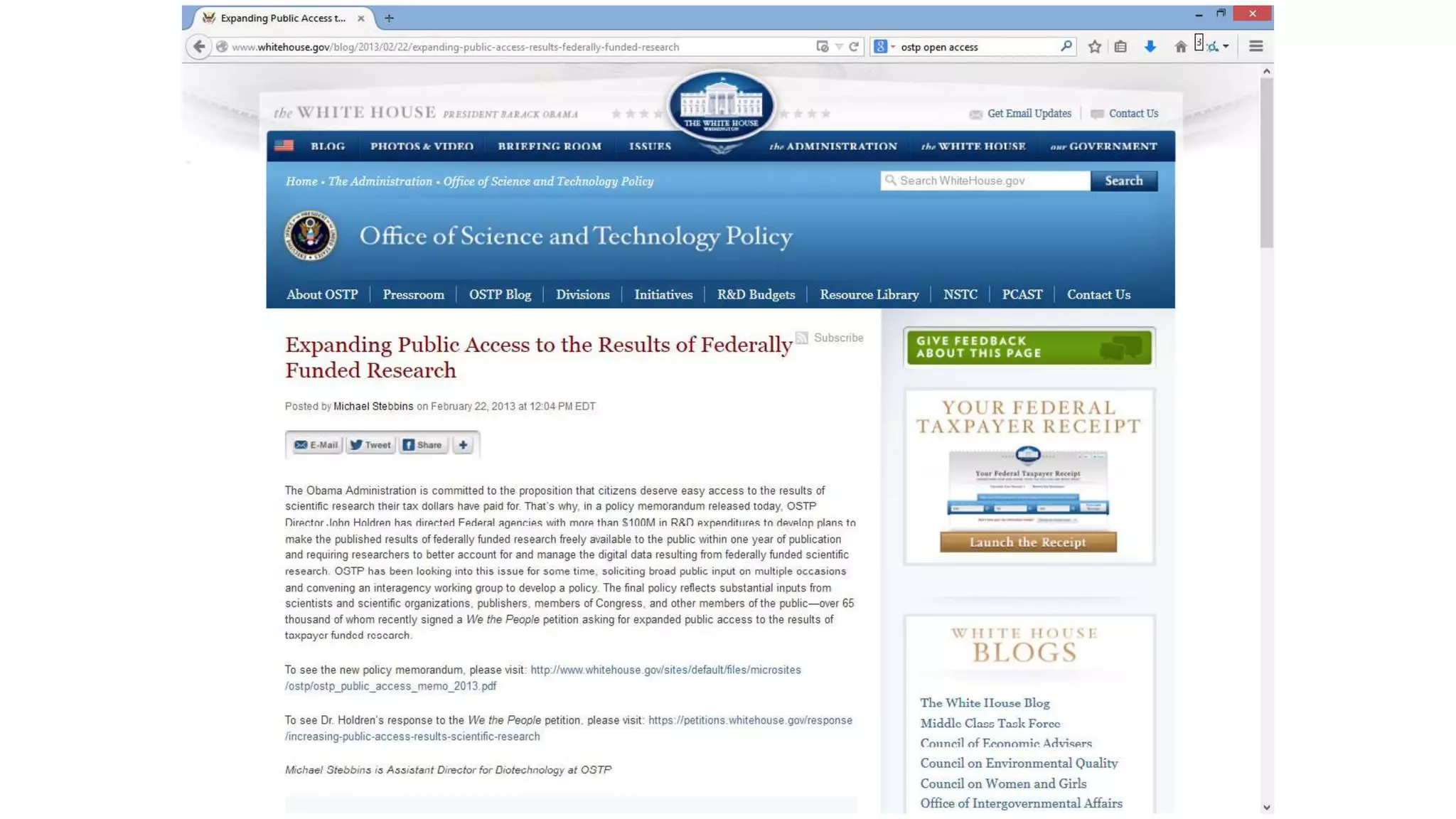
OA is required by law in Argentina
and in Peru
and in Mexico
How OA benefits your work and career
Distribution and usage
Immediate access to your research
output for everyone upon official
publication
More visibility and usage
How OA benefits your work and career
Distribution and usage
Immediate impact of your work
Intensification of research through fast
dissemination and use of research;
Possibly a citation advantage as well
There is accumulating evidence that shows that
research articles that have been self-archived in
open access repositories are cited more often than
those that have not
A bibliography of studies on “The effect of open access and downloads (‘hits’) on
citation impact” is maintained by the Open Citation Project
(http://opcit.eprints.org/oacitation-biblio.html)
How OA benefits your work and career
Plus
Monitoring of your research output
Preservation of your research output by
your library
Keep your rights instead of signing
them away
Why should authors provide OA to their
work?
Making research publications OA means that research
has much more impact than before.
Moreover, the research cycle – where work is
published, read, cited and then built upon by other
researchers – is enhanced and accelerated when results
are available on an OA basis.
Why should authors provide OA to their
work? (2)
There is growing evidence to show that countries also
benefit because OA increases the impact of the
research in which they invest public money and
therefore there is a better return on investment
(more details are here: http://www.knowledge-
exchange.info/Default.aspx?ID=316).
Why should authors provide OA to their
work? (3)
Universities are also finding OA repositories valuable in
generating management information and reports on
their research programmes and in raising awareness of
their research profile.
What are the advantages of a repository
to a University?
Opens up the outputs of the university to the world
Maximises the visibility and impact of these outputs as
a result
Showcases the university to interested constituencies –
prospective staff, prospective students and other
stakeholders
What are the advantages of a repository
to a University? (2)
Collects and curates digital outputs
Manages and measures research and teaching activities
Provides a workspace for work-in-progress, and for
collaborative or large-scale projects
What are the advantages of a repository
to a University? (3)
Enables and encourages interdisciplinary approaches
to research
Facilitates the development and sharing of digital
teaching materials and aids
Supports student endeavours, providing access to
theses and dissertations and a location for the
development of e-portfolios
Thank you!
Questions?
iryna.kuchma@eifl.net
www.eifl.net

Introduction to open access and how it helps in your research and increases the visibility and impact of your publications

  • 1.
    Introduction to openaccess and how it helps in your research and increases the visibility and impact of your publications Iryna Kuchma, Open Access Programme Manager Presentation at Open access seminars, December 6-9, 2015, An-Najah National University, Birzeit University and Palestine Polytechnic University Attribution 4.0 International
  • 2.
    Technology enabled networking& collaboration Over 35% of articles published in journals are based on international collaboration (25% 15 years ago)
  • 3.
    Technology enabled networking& collaboration (2) Science is increasingly interdisciplinary
  • 4.
    Technology enabled networking& collaboration (3) Novel communication technologies permit modes of interaction that exploit the collective intelligence of the scientific community
  • 7.
    “It felt likethe difference between driving a car and pushing it” (Tim Gowers)
  • 8.
    Open access (OA)is free, online access to the results of coupled with the right to use results in new and innovative
  • 10.
    Figure 10. Theecosystem of published articles, documents, spreadsheets, data fusions, and machine-readable RDF data files resulting from our decision to apply semantic enhancements to the PLoS NTDs article by Reis et al. [12]. Shotton D, Portwin K, Klyne G, Miles A (2009) Adventures in Semantic Publishing: Exemplar Semantic Enhancements of a Research Article. PLoS Comput Biol 5(4): e1000361. doi:10.1371/journal.pcbi.1000361 http://127.0.0.1:8081/ploscompbiol/article?id=info:doi/10.1371/journal.pcbi.1000361
  • 11.
    Figure 1. Asuperposition of Figure 3C of the PLoS NTDs article [12] onto a satellite photo of Salvador with superimposed street plan. Shotton D, Portwin K, Klyne G, Miles A (2009) Adventures in Semantic Publishing: Exemplar Semantic Enhancements of a Research Article. PLoS Comput Biol 5(4): e1000361. doi:10.1371/journal.pcbi.1000361 http://127.0.0.1:8081/ploscompbiol/article?id=info:doi/10.1371/journal.pcbi.1000361
  • 12.
    Figure 2. Superpositionof Figure 3C of the 2008 PLoS NTDs article [12] and a modified version of Figure 1 from Ko et al. [13] (copyright © Albert Ko, 2008, used with permission) onto a street plan of Salvador. Shotton D, Portwin K, Klyne G, Miles A (2009) Adventures in Semantic Publishing: Exemplar Semantic Enhancements of a Research Article. PLoS Comput Biol 5(4): e1000361. doi:10.1371/journal.pcbi.1000361 http://127.0.0.1:8081/ploscompbiol/article?id=info:doi/10.1371/journal.pcbi.1000361
  • 13.
    Figure 6. TheTag Cloud for the terms highlighted in the enhanced version of Reis et al. [12]. Shotton D, Portwin K, Klyne G, Miles A (2009) Adventures in Semantic Publishing: Exemplar Semantic Enhancements of a Research Article. PLoS Comput Biol 5(4): e1000361. doi:10.1371/journal.pcbi.1000361 http://127.0.0.1:8081/ploscompbiol/article?id=info:doi/10.1371/journal.pcbi.1000361
  • 14.
    Figure 9. Anoverlay (a) of panels (C) and (E), and (b) of panels (C), (D), and (F) from the interactive version of Figure 3 of the PLoS NTDs article by Reis et al. [12]. Shotton D, Portwin K, Klyne G, Miles A (2009) Adventures in Semantic Publishing: Exemplar Semantic Enhancements of a Research Article. PLoS Comput Biol 5(4): e1000361. doi:10.1371/journal.pcbi.1000361 http://127.0.0.1:8081/ploscompbiol/article?id=info:doi/10.1371/journal.pcbi.1000361
  • 16.
    Open access (OA)for researcher increased visibility usage & impact for your work new contacts & research partnerships
  • 17.
    OA for researchinstitutions publicises University's research strengths complete record of the research output in easily accessible form new tools to manage University's
  • 18.
    OA for publishers increasedreadership & citations visibility & impact the best possible dissemination service for research
  • 19.
    “As of April2014, more than 50% of the scientific papers published in 2007- 2007-2012 can be downloaded for free downloaded for free on the Internet.” Proportion of OA Papers Published in Peer-Reviewed Journals at the European and World Levels—1996–2013 http://tinyurl.com/n4j25yx
  • 22.
    Strategies to achieveopen access Open access journals and monographs Open access repositories
  • 44.
    Open access (OA)repositories Free and Open Source Software to set up, free technical support Low installation and maintenance costs, quick to set up and gain benefits Institutions can mandate OA, speeding development
  • 47.
    University that doesn'tknow what papers its faculty publishes is like a factory that doesn't know what it produces Bernard Rentier
  • 48.
    An empty repositoryis useless; a partly filled repository is partly useless; there is a need for an institutional open access policy Bernard Rentier
  • 49.
    Don't impose, justinform researchers that only publications in the repository will be considered for evaluation Bernard Rentier
  • 50.
    Mandate, keep authorsat the core, communicate permanently, be coherent, reduce constraints Bernard Rentier
  • 51.
    @ORBi_ULg – apersonal workspace, provides statistics and has a widget to generate publications lists – content in personal/faculties webpages Bernard Rentier
  • 52.
    The policy cameinto effect in November 2008 and has become the most effective OA policy in the world at present, with 87% of the University’s research articles currently being deposited in the repository. Bernard Rentier
  • 53.
    34% of researchersare very satisfied and 57% are satisfied with their OA repository. Bernard Rentier
  • 55.
    800+ scholarly societiesembraced open access Peter Suber and Caroline Sutton
  • 57.
    “Putting research resultsin the public sphere makes science better & strengthens our knowledge-based knowledge-based economy. The European taxpayer Máire Geoghegan-Quinn, European Commissioner for Research, Innovation & Science (2010-2014)
  • 60.
    OA is requiredby law in Argentina
  • 61.
  • 62.
  • 69.
    How OA benefitsyour work and career Distribution and usage Immediate access to your research output for everyone upon official publication More visibility and usage
  • 70.
    How OA benefitsyour work and career Distribution and usage Immediate impact of your work Intensification of research through fast dissemination and use of research; Possibly a citation advantage as well
  • 71.
    There is accumulatingevidence that shows that research articles that have been self-archived in open access repositories are cited more often than those that have not A bibliography of studies on “The effect of open access and downloads (‘hits’) on citation impact” is maintained by the Open Citation Project (http://opcit.eprints.org/oacitation-biblio.html)
  • 72.
    How OA benefitsyour work and career Plus Monitoring of your research output Preservation of your research output by your library Keep your rights instead of signing them away
  • 73.
    Why should authorsprovide OA to their work? Making research publications OA means that research has much more impact than before. Moreover, the research cycle – where work is published, read, cited and then built upon by other researchers – is enhanced and accelerated when results are available on an OA basis.
  • 74.
    Why should authorsprovide OA to their work? (2) There is growing evidence to show that countries also benefit because OA increases the impact of the research in which they invest public money and therefore there is a better return on investment (more details are here: http://www.knowledge- exchange.info/Default.aspx?ID=316).
  • 75.
    Why should authorsprovide OA to their work? (3) Universities are also finding OA repositories valuable in generating management information and reports on their research programmes and in raising awareness of their research profile.
  • 76.
    What are theadvantages of a repository to a University? Opens up the outputs of the university to the world Maximises the visibility and impact of these outputs as a result Showcases the university to interested constituencies – prospective staff, prospective students and other stakeholders
  • 77.
    What are theadvantages of a repository to a University? (2) Collects and curates digital outputs Manages and measures research and teaching activities Provides a workspace for work-in-progress, and for collaborative or large-scale projects
  • 78.
    What are theadvantages of a repository to a University? (3) Enables and encourages interdisciplinary approaches to research Facilitates the development and sharing of digital teaching materials and aids Supports student endeavours, providing access to theses and dissertations and a location for the development of e-portfolios
  • 82.

Editor's Notes