April 10, 2025 - Dubai, UAE
Navigating Uncertainty with
Agility: Adaptive Planning for
Value-Driven Delivery
Fariz Saracevic, Senior Product Manager
IBM Engineering
SUPPORTERS
GOLD PARTNER
Learning Objectives
At the conclusion of this session, attendees will be able to:
• Express a pragmatic approach of defining value, multi-level
adaptive planning, incremental value delivery, and continuous
adaptation for value-driven delivery.
• Describe how IBM® Engineering Workflow Management enables
adaptive multi-level planning, minimizes bottlenecks, and
accelerates incremental value delivery.
3
Agenda
• How is ‘Uncertainty’ setting new goals for organizations?
• How to realize new goals for organizations?
• How can IBM® Engineering Workflow Management help realize these goals?
• How to be successful in realizing these goals?
• Quick Summary
4
5
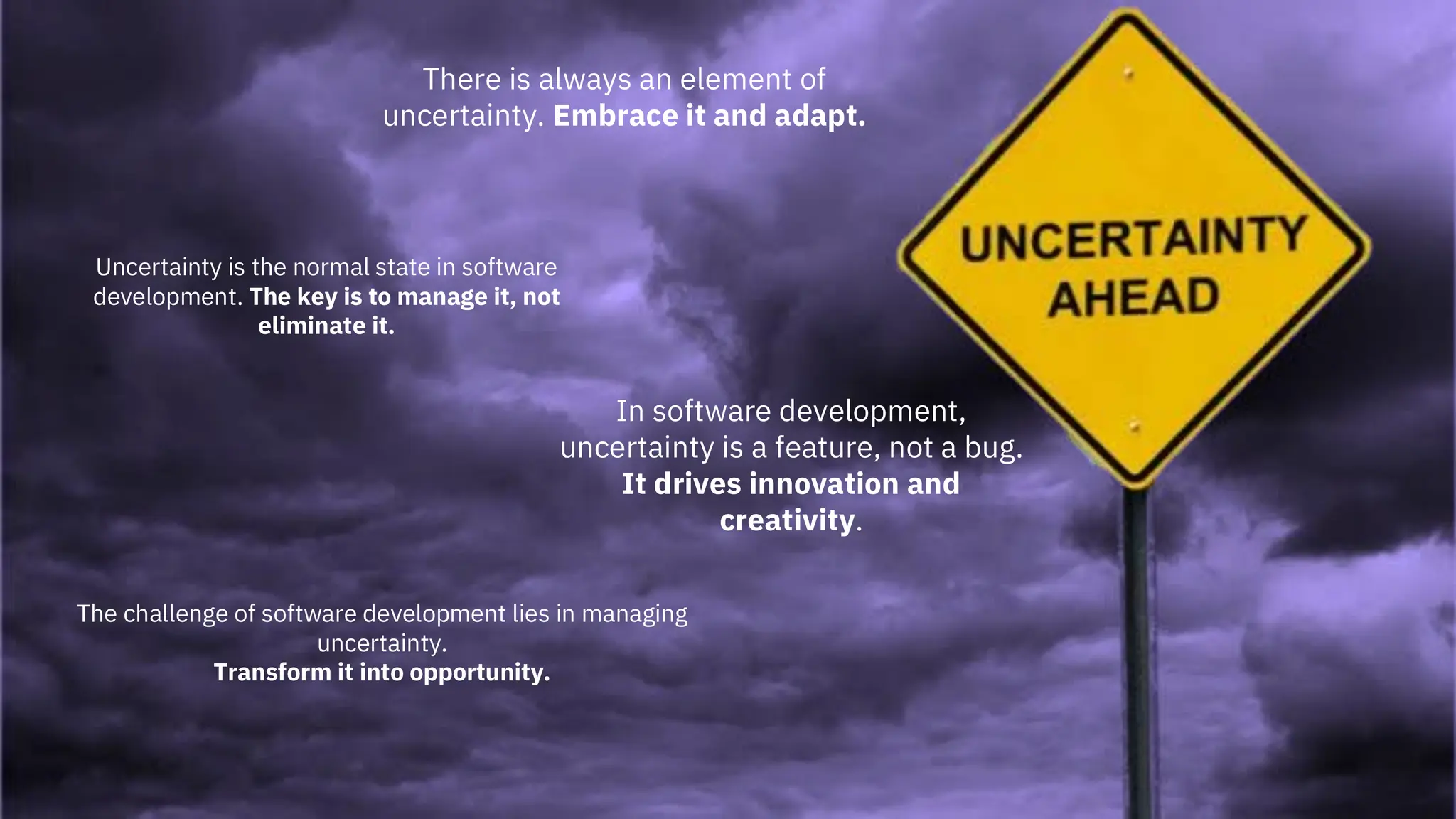
There is always an element of
uncertainty. Embrace it and adapt.
In software development,
uncertainty is a feature, not a bug.
It drives innovation and
creativity.
Uncertainty is the normal state in software
development. The key is to manage it, not
eliminate it.
The challenge of software development lies in managing
uncertainty.
Transform it into opportunity.
6
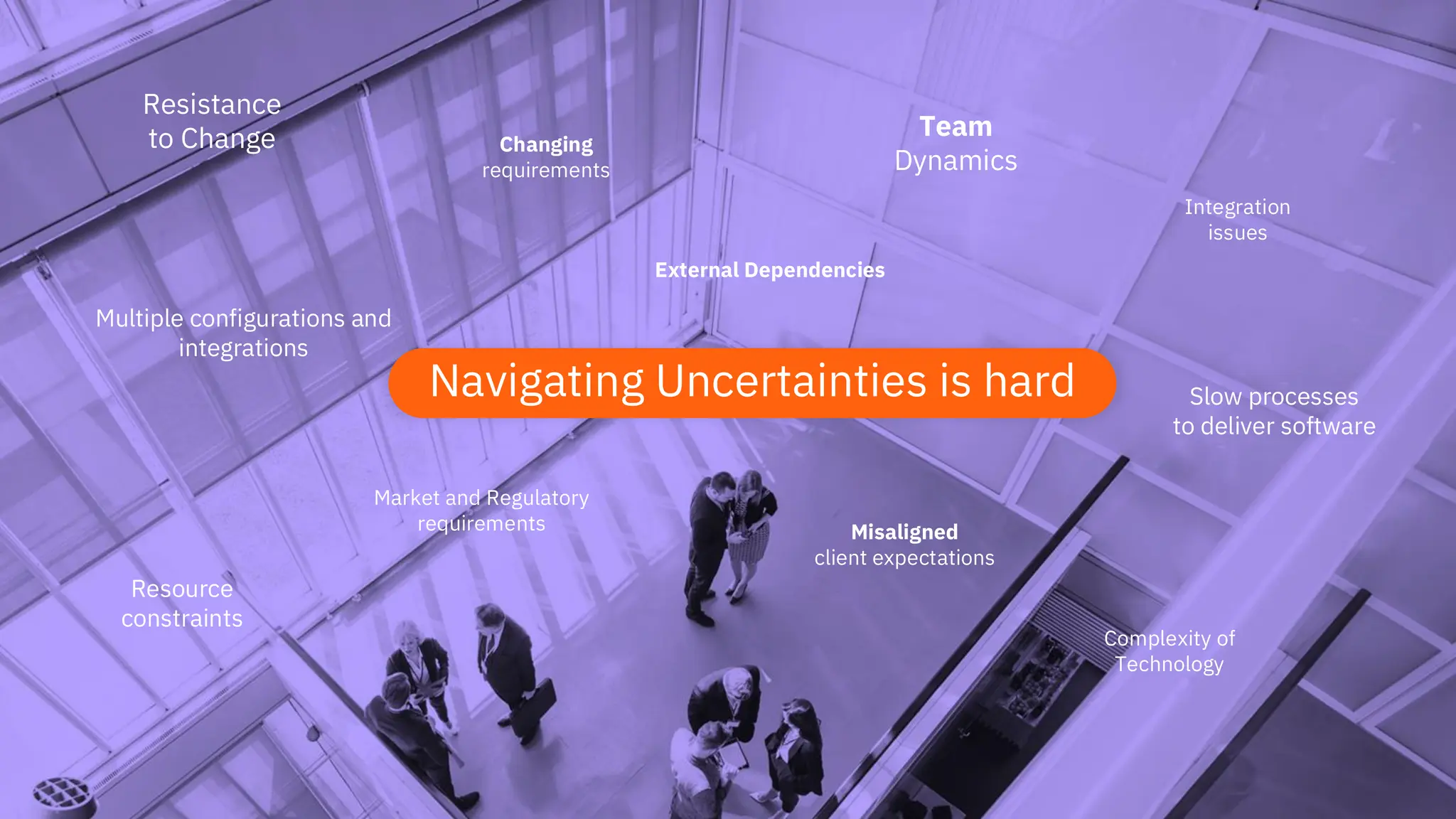
Navigating Uncertainties is hard
Integration
issues
Multiple configurations and
integrations
Slow processes
to deliver software
Team
Dynamics
Changing
requirements
Complexity of
Technology
Resource
constraints
Market and Regulatory
requirements Misaligned
client expectations
Resistance
to Change
External Dependencies
7
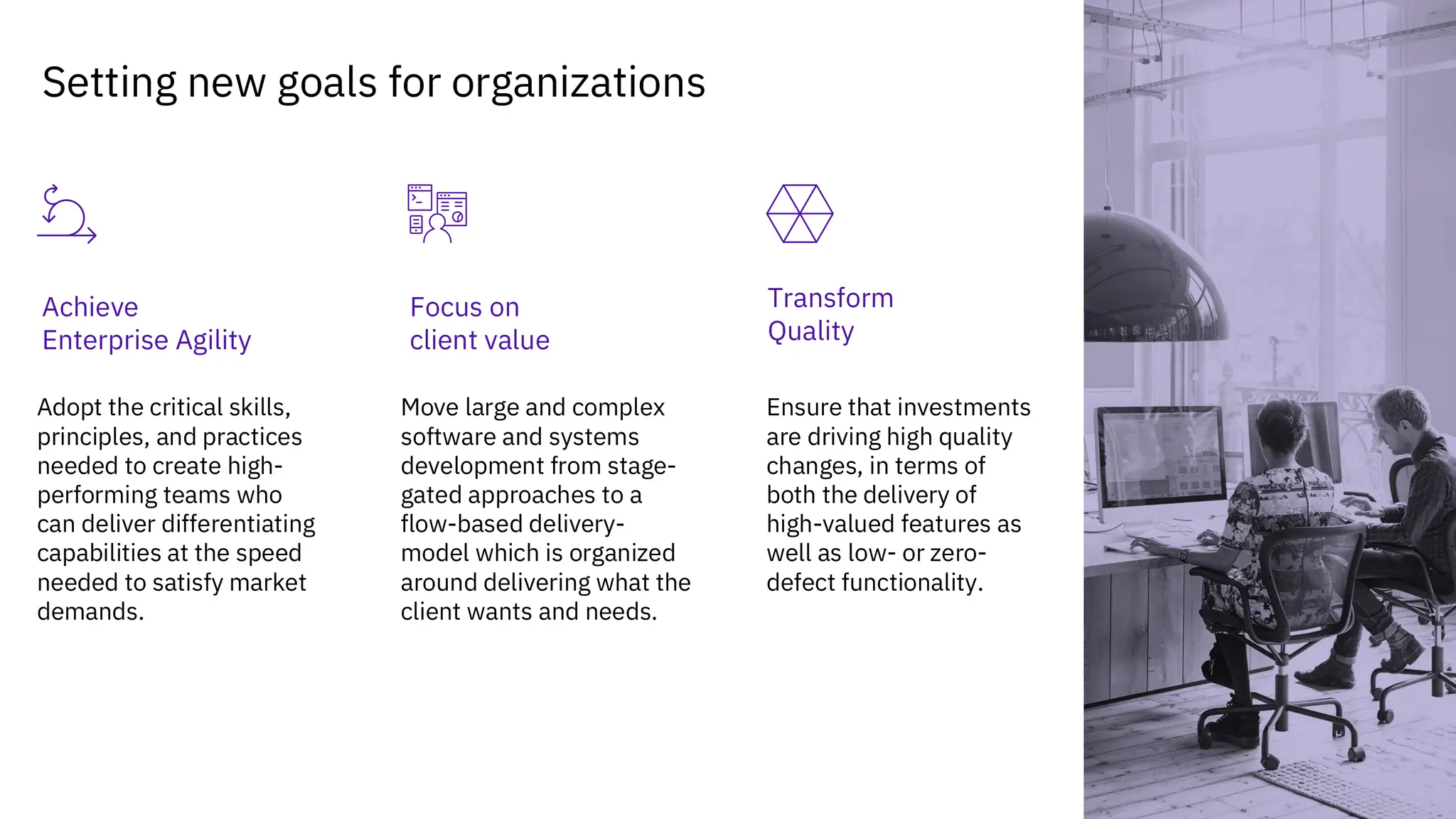
Setting new goals for organizations
Transform
Quality
Achieve
Enterprise Agility
Adopt the critical skills,
principles, and practices
needed to create high-
performing teams who
can deliver differentiating
capabilities at the speed
needed to satisfy market
demands.
Move large and complex
software and systems
development from stage-
gated approaches to a
flow-based delivery-
model which is organized
around delivering what the
client wants and needs.
Ensure that investments
are driving high quality
changes, in terms of
both the delivery of
high-valued features as
well as low- or zero-
defect functionality.
Focus on
client value
8
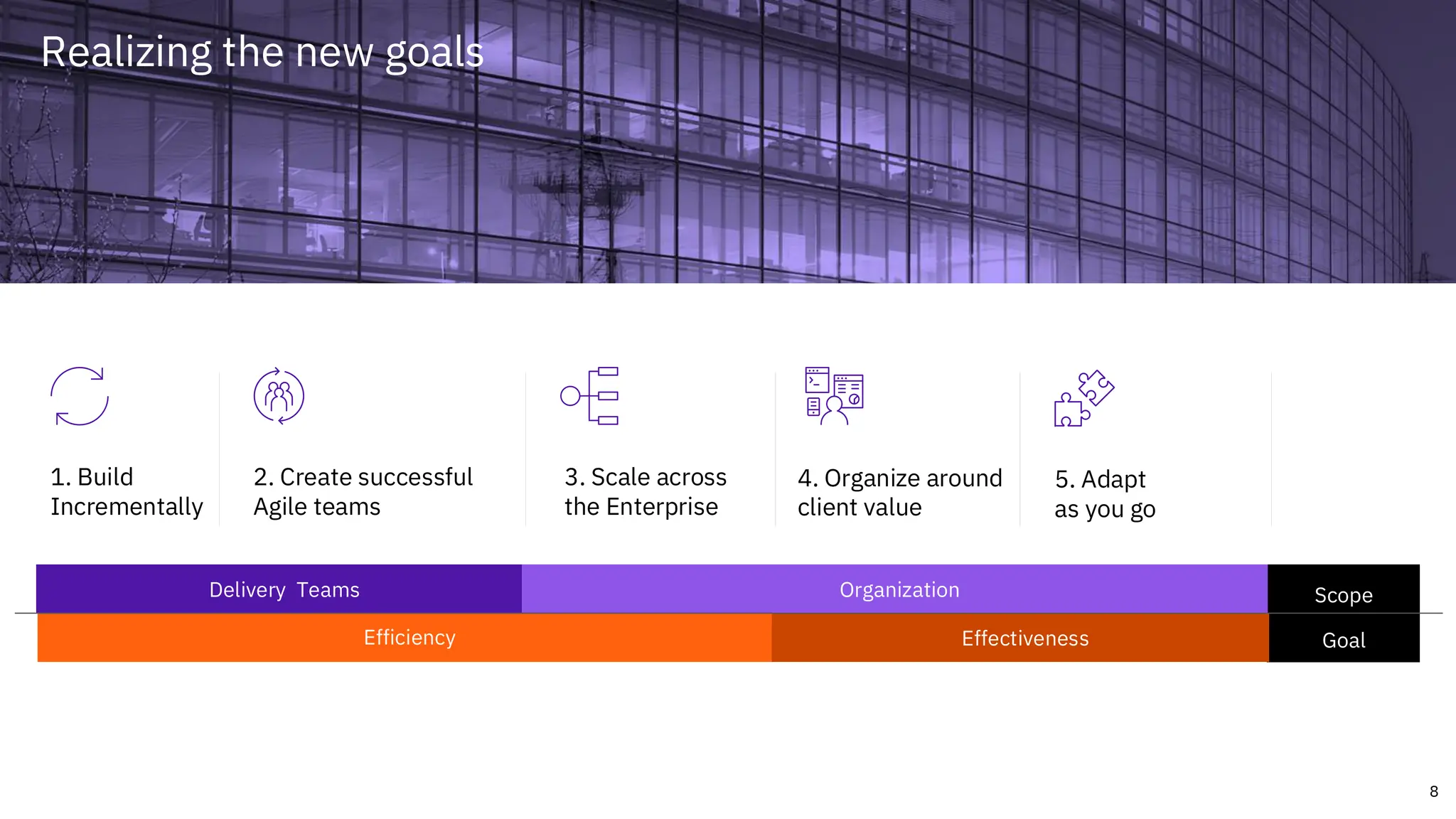
Realizing the new goals
1. Build
Incrementally
2. Create successful
Agile teams
3. Scale across
the Enterprise
4. Organize around
client value
5. Adapt
as you go
Delivery Teams
Efficiency
Organization
Effectiveness
Scope
Goal
9
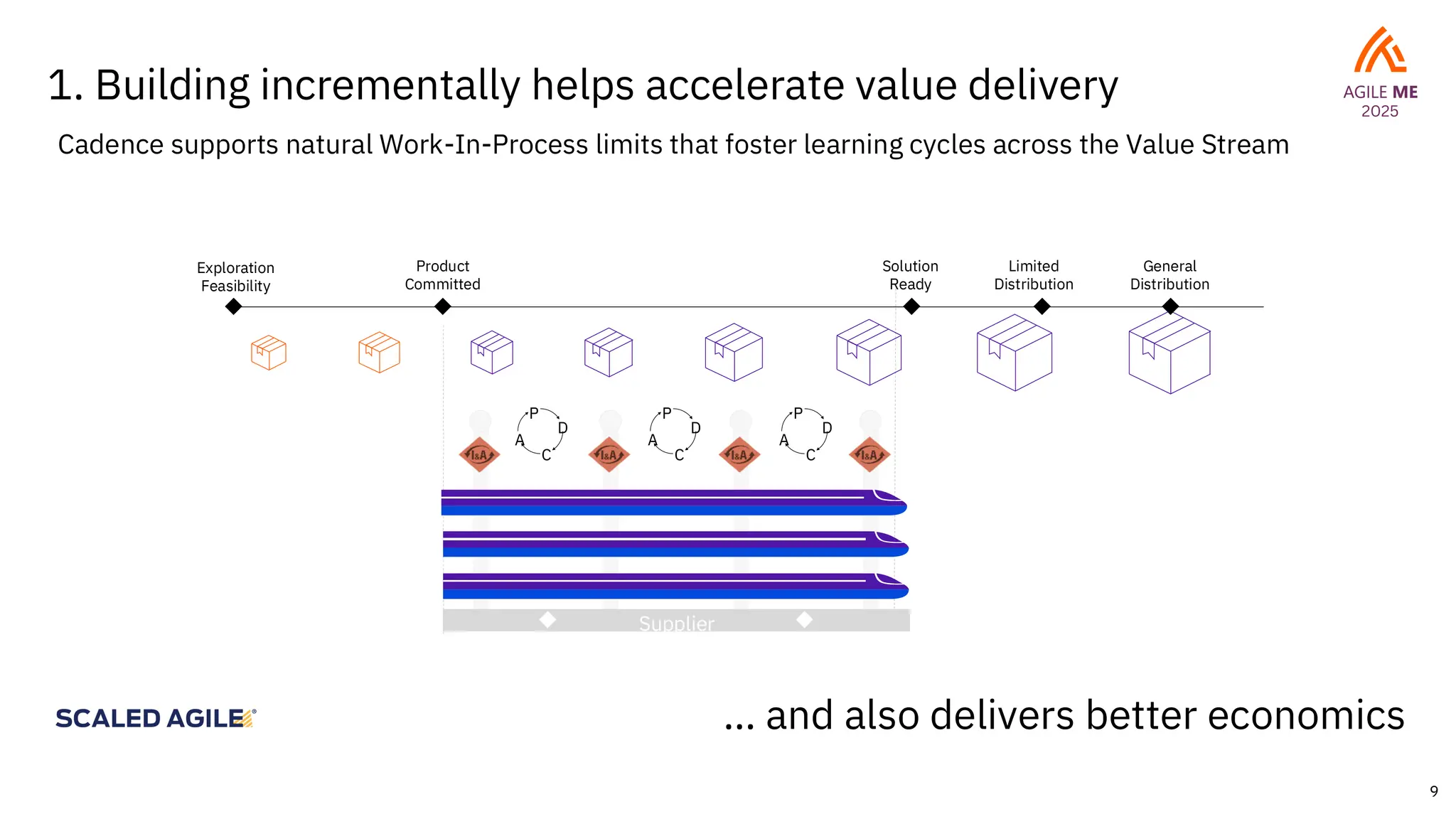
1. Building incrementally helps accelerate value delivery
Cadence supports natural Work-In-Process limits that foster learning cycles across the Value Stream
General
Distribution
Limited
Distribution
Solution
Ready
Product
Committed
Exploration
Feasibility
Supplier
P
D
C
A
P
D
C
A
P
D
C
A
… and also delivers better economics
10
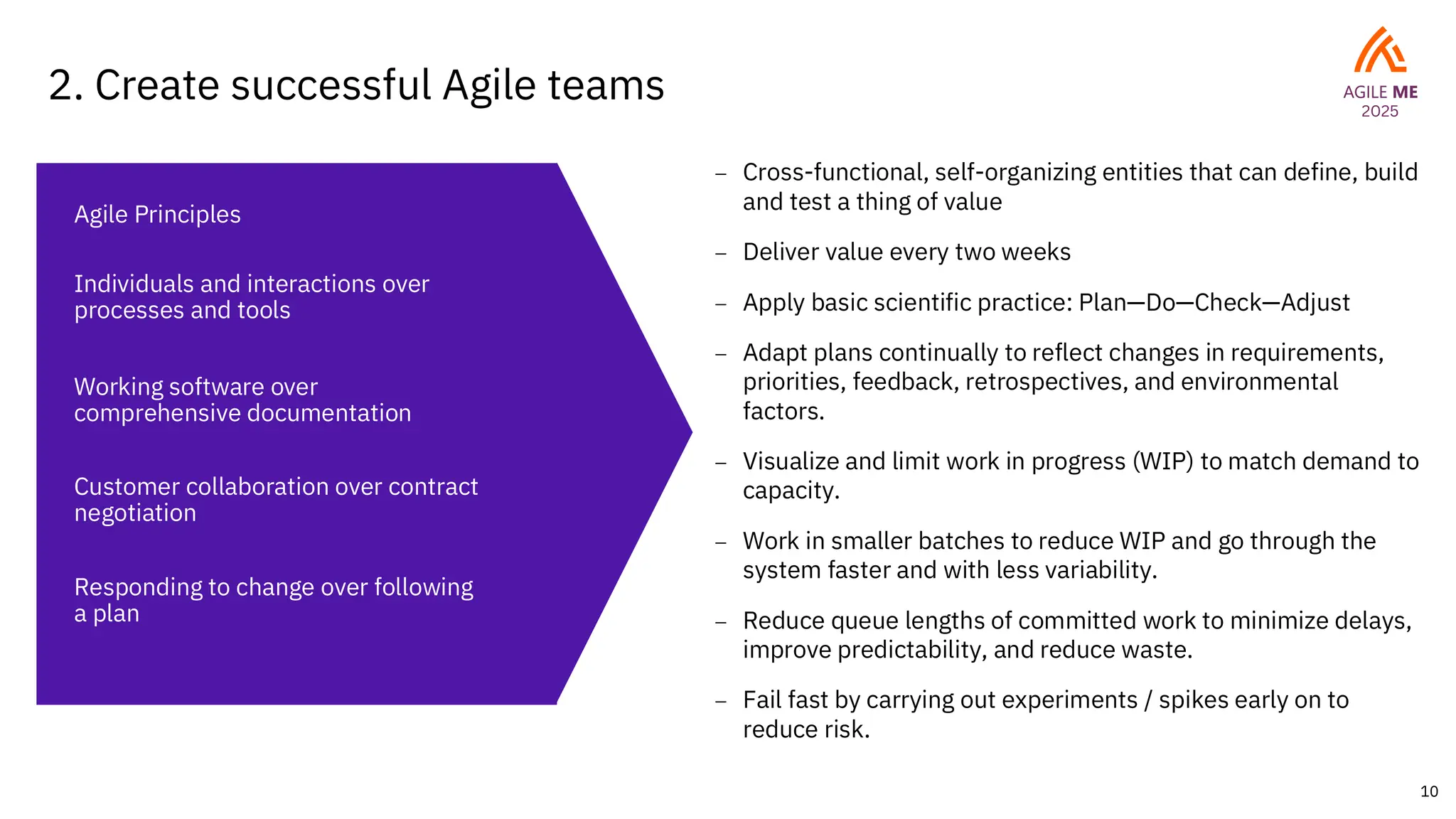
2. Create successful Agile teams
– Cross-functional, self-organizing entities that can define, build
and test a thing of value
– Deliver value every two weeks
– Apply basic scientific practice: Plan—Do—Check—Adjust
– Adapt plans continually to reflect changes in requirements,
priorities, feedback, retrospectives, and environmental
factors.
– Visualize and limit work in progress (WIP) to match demand to
capacity.
– Work in smaller batches to reduce WIP and go through the
system faster and with less variability.
– Reduce queue lengths of committed work to minimize delays,
improve predictability, and reduce waste.
– Fail fast by carrying out experiments / spikes early on to
reduce risk.
Agile Principles
Individuals and interactions over
processes and tools
Working software over
comprehensive documentation
Customer collaboration over contract
negotiation
Responding to change over following
a plan
11
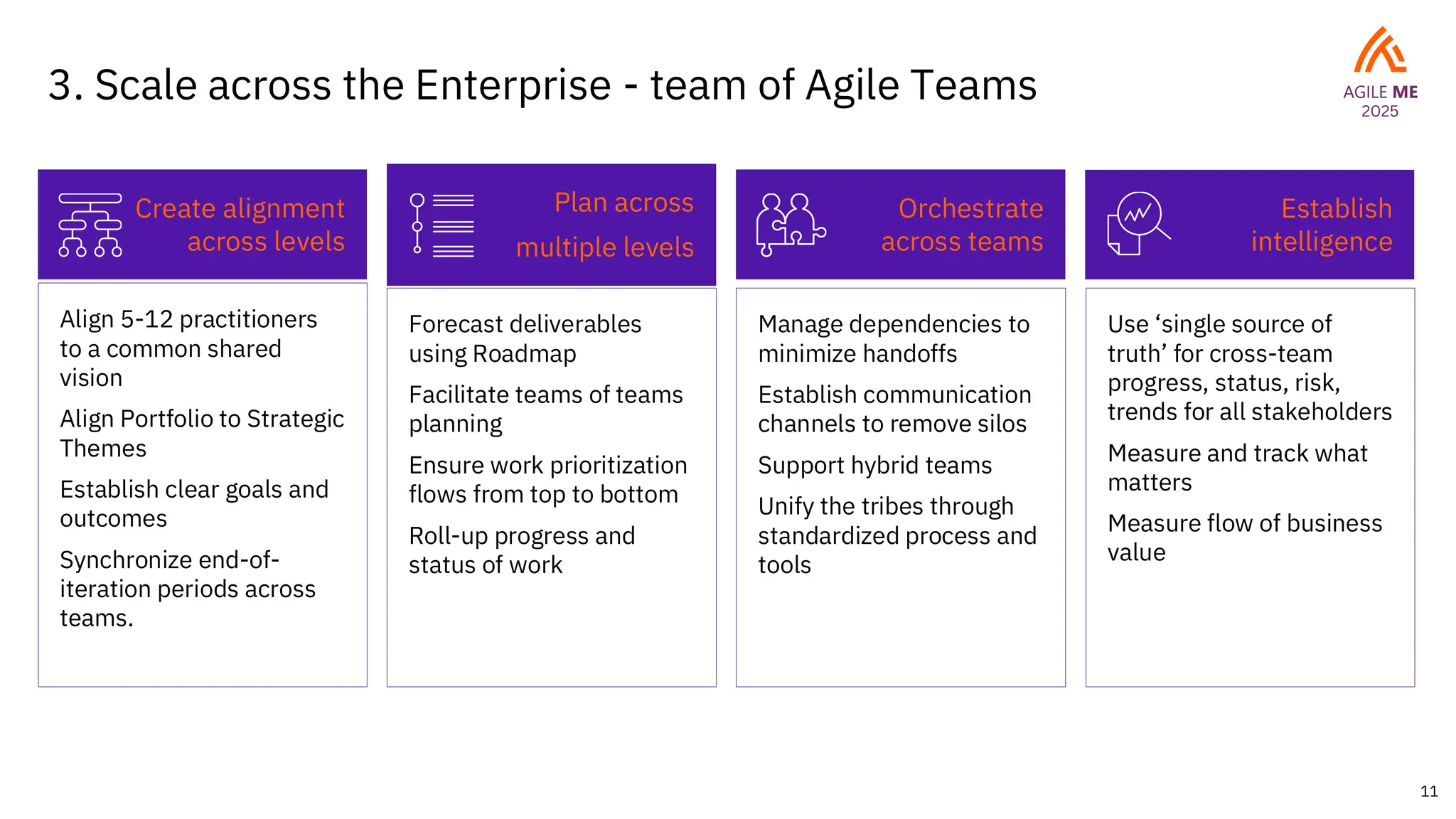
3. Scale across the Enterprise - team of Agile Teams
Align 5-12 practitioners
to a common shared
vision
Align Portfolio to Strategic
Themes
Establish clear goals and
outcomes
Synchronize end-of-
iteration periods across
teams.
Forecast deliverables
using Roadmap
Facilitate teams of teams
planning
Ensure work prioritization
flows from top to bottom
Roll-up progress and
status of work
Manage dependencies to
minimize handoffs
Establish communication
channels to remove silos
Support hybrid teams
Unify the tribes through
standardized process and
tools
Create alignment
across levels
Plan across
multiple levels
Establish
intelligence
Orchestrate
across teams
Use ‘single source of
truth’ for cross-team
progress, status, risk,
trends for all stakeholders
Measure and track what
matters
Measure flow of business
value
12
4. Define value
Organize value
▪ Organize around
delivering what the
client wants and needs.
▪ Collaborate cross-
domain resources
▪ Strive for transparency
Create a ‘shared’ vision
▪ Create a shared
understanding of goals
and value to be
delivered
▪ Adopt a “Systems View”
approach to understand
the big picture of what
needs to be delivered
▪ Manage stakeholder
expectations
Drive economic value
▪ Take an economic view
to prioritize investments
▪ Visualize workflow to
eliminate waste and
respect work-in-process
(WIP) limits
▪ Understand solution
economic trade-offs
13
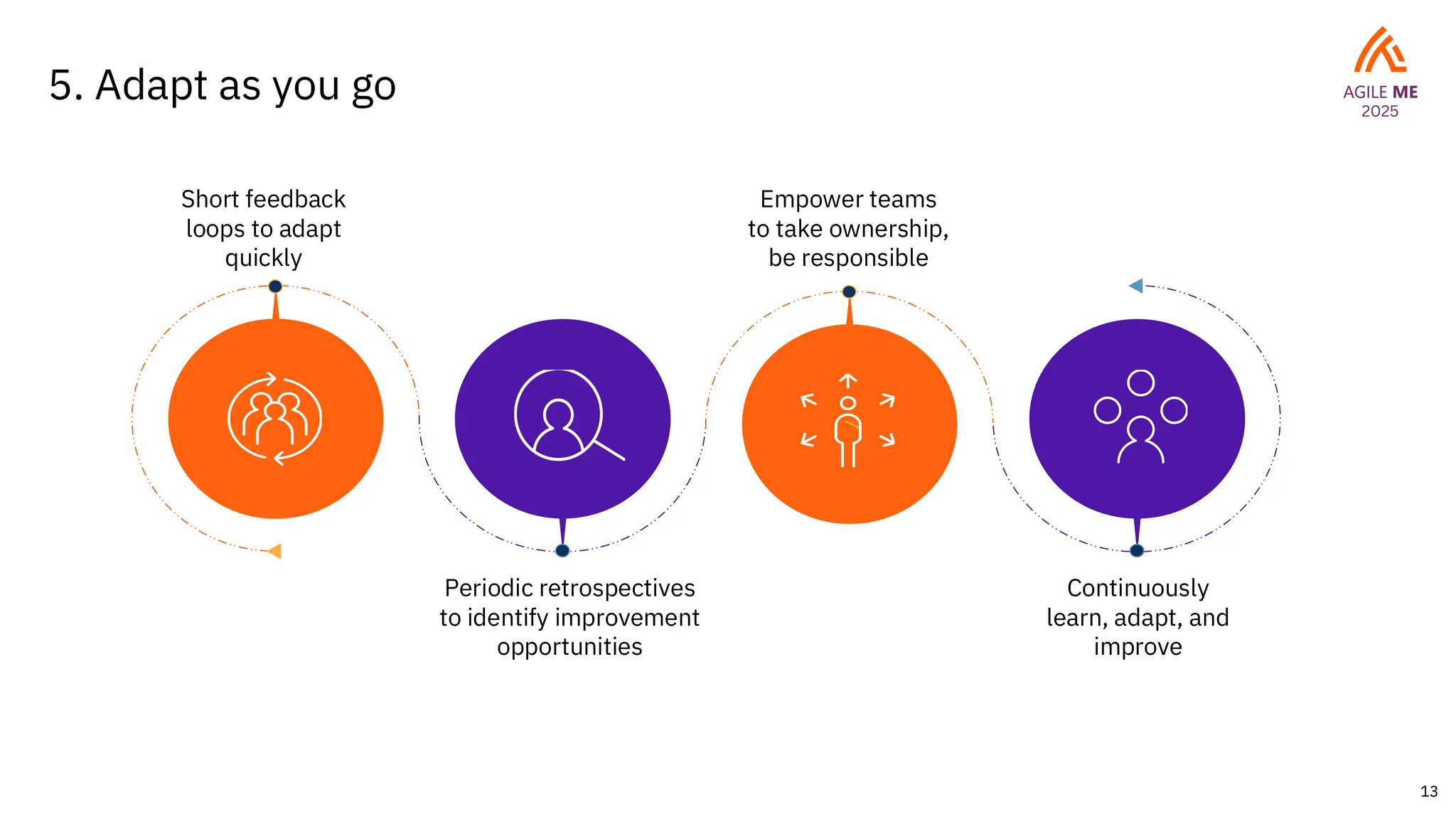
5. Adapt as you go
Short feedback
loops to adapt
quickly
Periodic retrospectives
to identify improvement
opportunities
Empower teams
to take ownership,
be responsible
Continuously
learn, adapt, and
improve
15
How can IBM help
realize these goals?
16
IBM Engineering Workflow Management
Optimize across value stream
Bring hybrid teams together by
bridging their tools’ information
islands to deliver value in a fast
and predictable manner
For organizations who have complex planning needs, EWM makes agile and lean
practices actionable to deliver efficiently and effectively at ever increasing scale.
Gain actionable insights
Visualize engineering data
and program-wide status for
actionable insights and
predictable delivery
outcomes
Achieve Enterprise Agility
Facilitate planning and manage
work to accelerate the flow of
work across the value stream for
continuous value delivery
Unlike other Application Lifecycle Management (ALM) tools, EWM:
10 out of 10 largest[2]
automotive OEM’s
7 out of 10 largest [6]
system integrators
7 out of 10 largest[5]
medical device manufacturers
10 out of 10 largest[4]
tier 1 automotive suppliers
5 out of 10 largest [8]
semi conductors’ design companies
10 out of 10 largest[3]
aerospace and defense companies
Government institutions
in more than 40 countries
7 out of 10 largest[7]
banks
5 out of 10
largest[9] pharmaceutical companies
Creates a digital thread
built on open standards
(OSLC) across disciplines
Operates at the scale that
is required by advanced
product-line engineering
Drives consistency,
completeness, and correctness
to show compliance to industry
standards
17
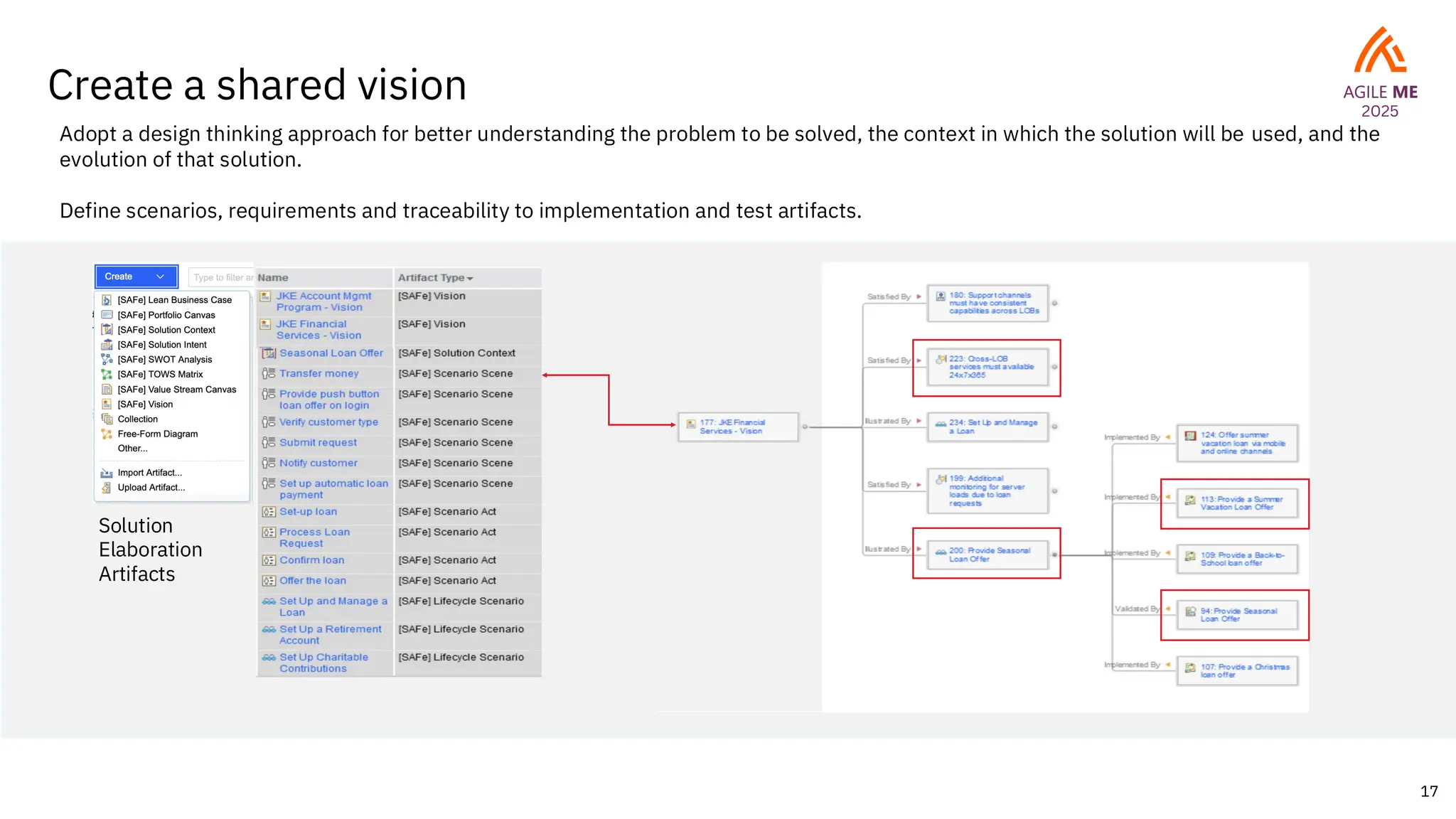
Create a shared vision
Solution
Elaboration
Artifacts
Adopt a design thinking approach for better understanding the problem to be solved, the context in which the solution will be used, and the
evolution of that solution.
Define scenarios, requirements and traceability to implementation and test artifacts.
18
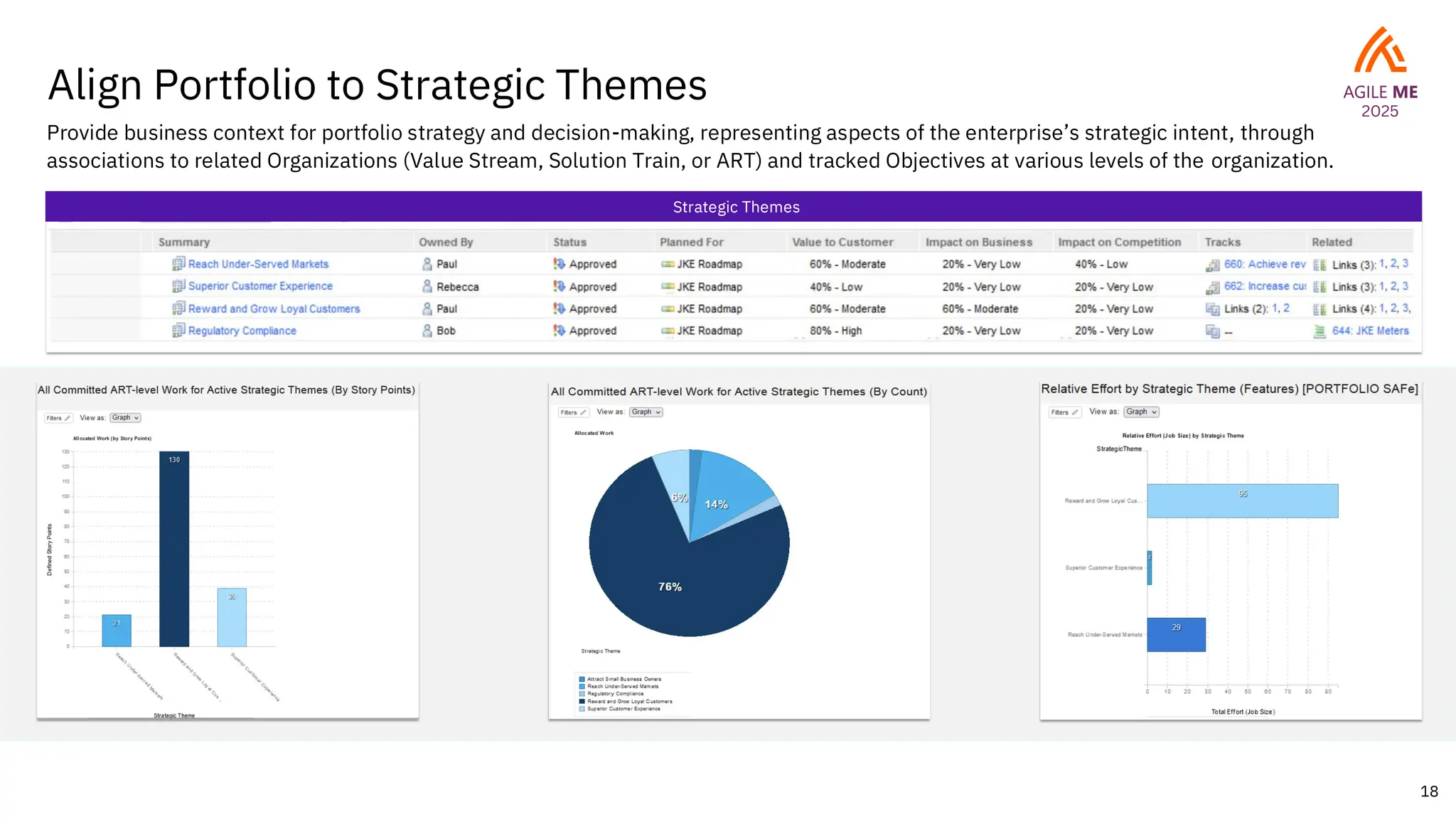
Align Portfolio to Strategic Themes
Strategic Themes
Provide business context for portfolio strategy and decision-making, representing aspects of the enterprise’s strategic intent, through
associations to related Organizations (Value Stream, Solution Train, or ART) and tracked Objectives at various levels of the organization.
19
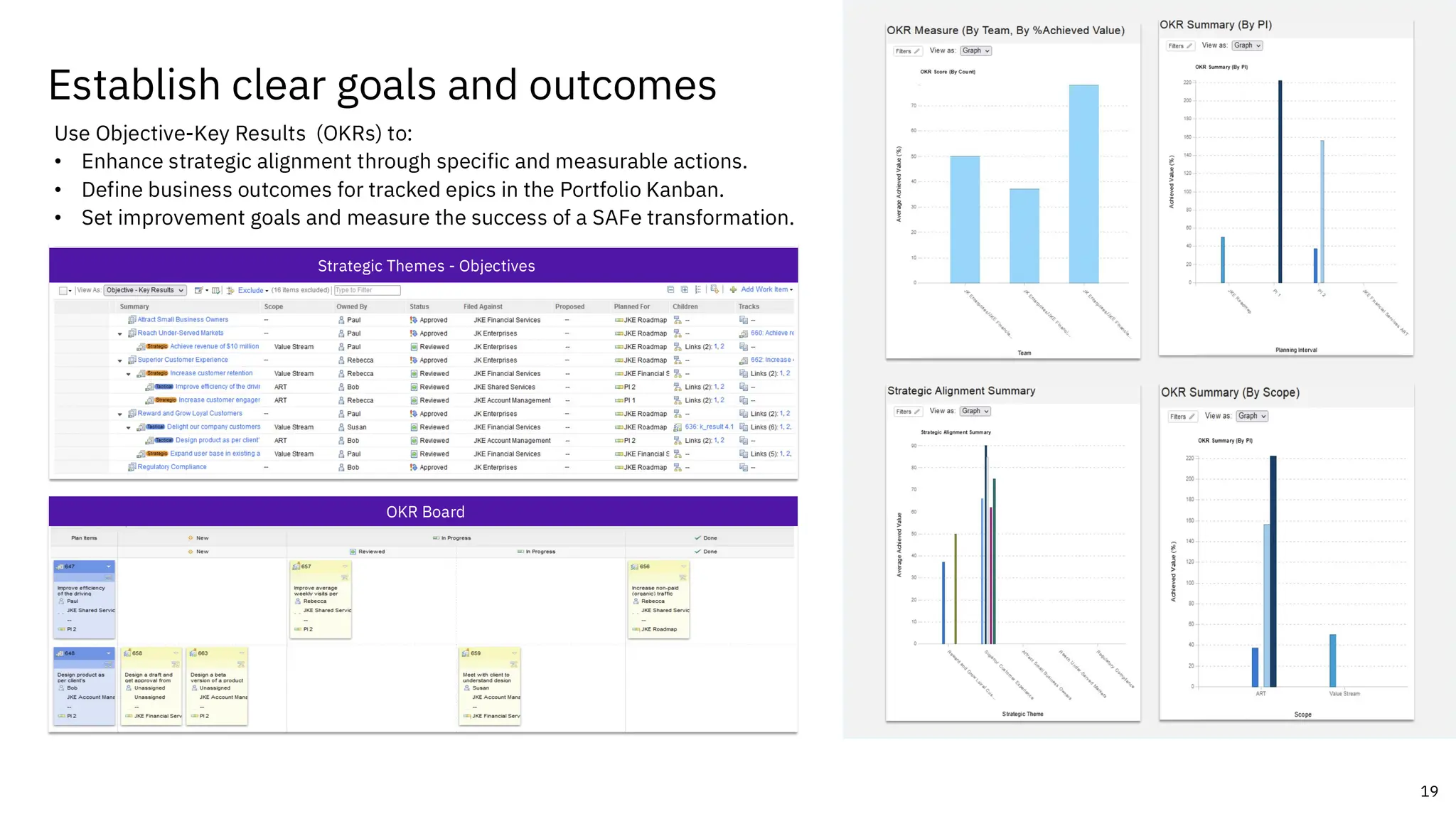
Establish clear goals and outcomes
OKR Board
Strategic Themes - Objectives
Use Objective-Key Results (OKRs) to:
• Enhance strategic alignment through specific and measurable actions.
• Define business outcomes for tracked epics in the Portfolio Kanban.
• Set improvement goals and measure the success of a SAFe transformation.
20
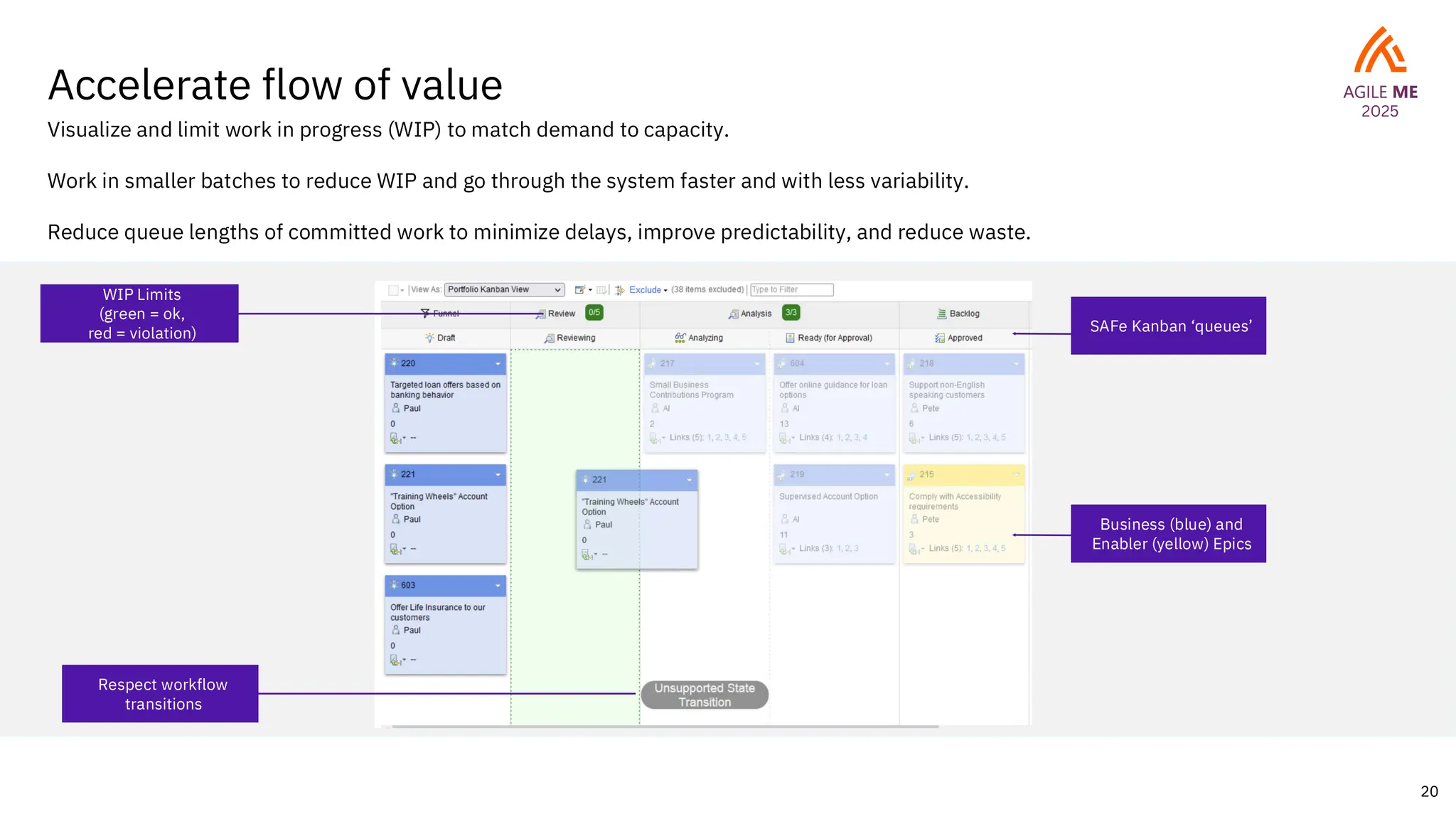
Accelerate flow of value
Visualize and limit work in progress (WIP) to match demand to capacity.
Work in smaller batches to reduce WIP and go through the system faster and with less variability.
Reduce queue lengths of committed work to minimize delays, improve predictability, and reduce waste.
WIP Limits
(green = ok,
red = violation) SAFe Kanban ‘queues’
Respect workflow
transitions
Business (blue) and
Enabler (yellow) Epics
21
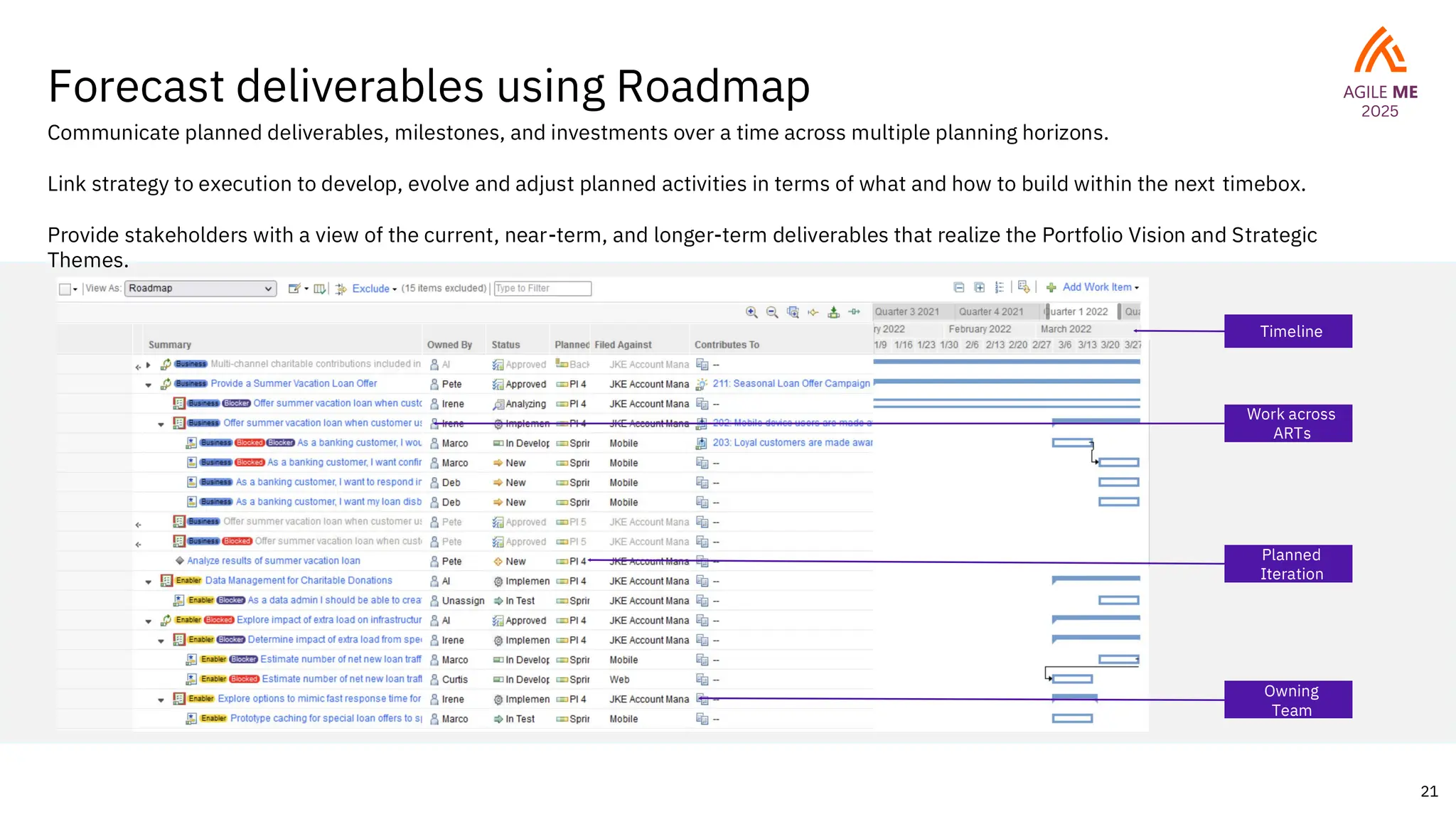
Forecast deliverables using Roadmap
Communicate planned deliverables, milestones, and investments over a time across multiple planning horizons.
Link strategy to execution to develop, evolve and adjust planned activities in terms of what and how to build within the next timebox.
Provide stakeholders with a view of the current, near-term, and longer-term deliverables that realize the Portfolio Vision and Strategic
Themes.
Timeline
Planned
Iteration
Owning
Team
Work across
ARTs
22
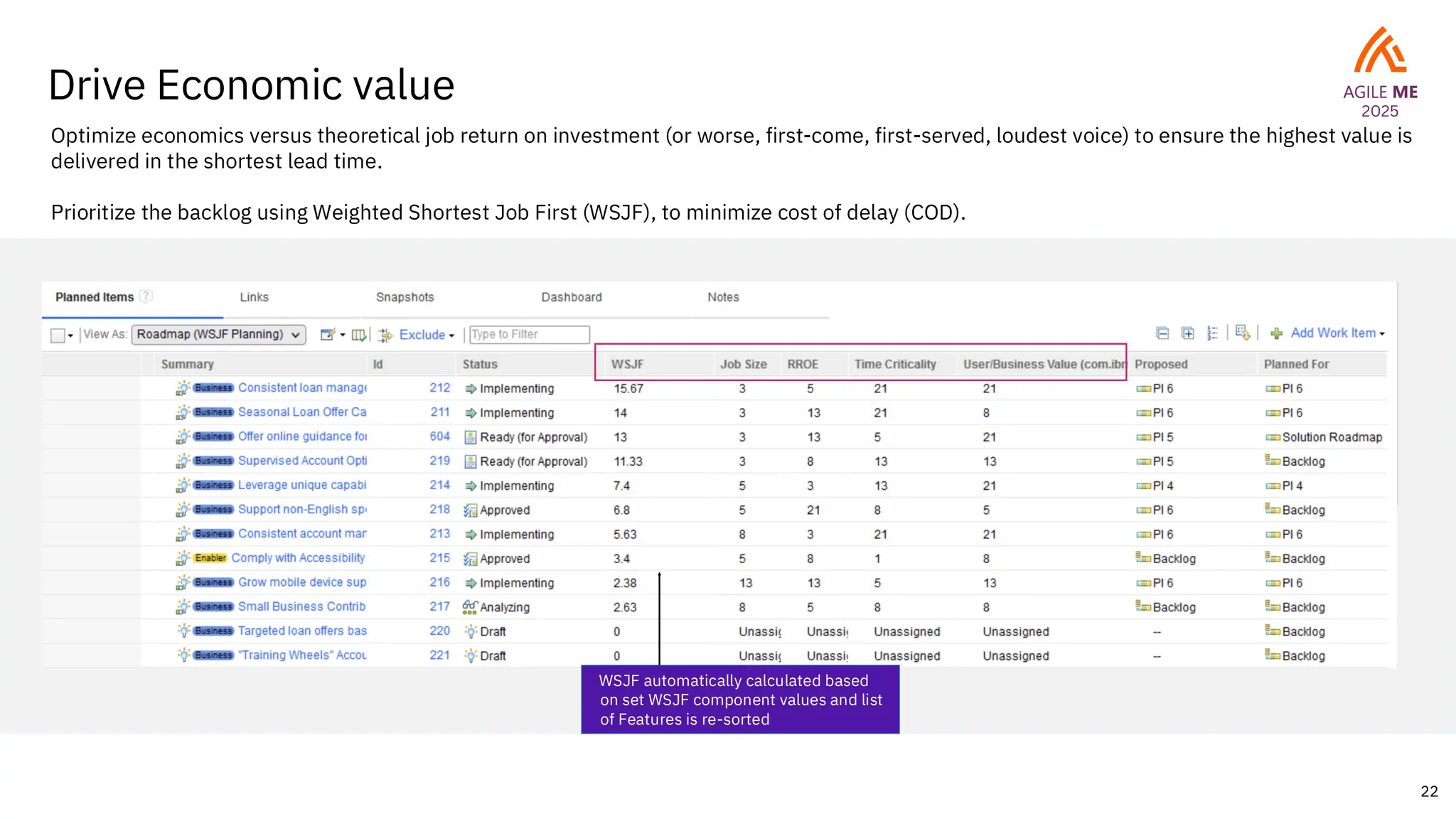
Drive Economic value
WSJF automatically calculated based
on set WSJF component values and list
of Features is re-sorted
Optimize economics versus theoretical job return on investment (or worse, first-come, first-served, loudest voice) to ensure the highest value is
delivered in the shortest lead time.
Prioritize the backlog using Weighted Shortest Job First (WSJF), to minimize cost of delay (COD).
23
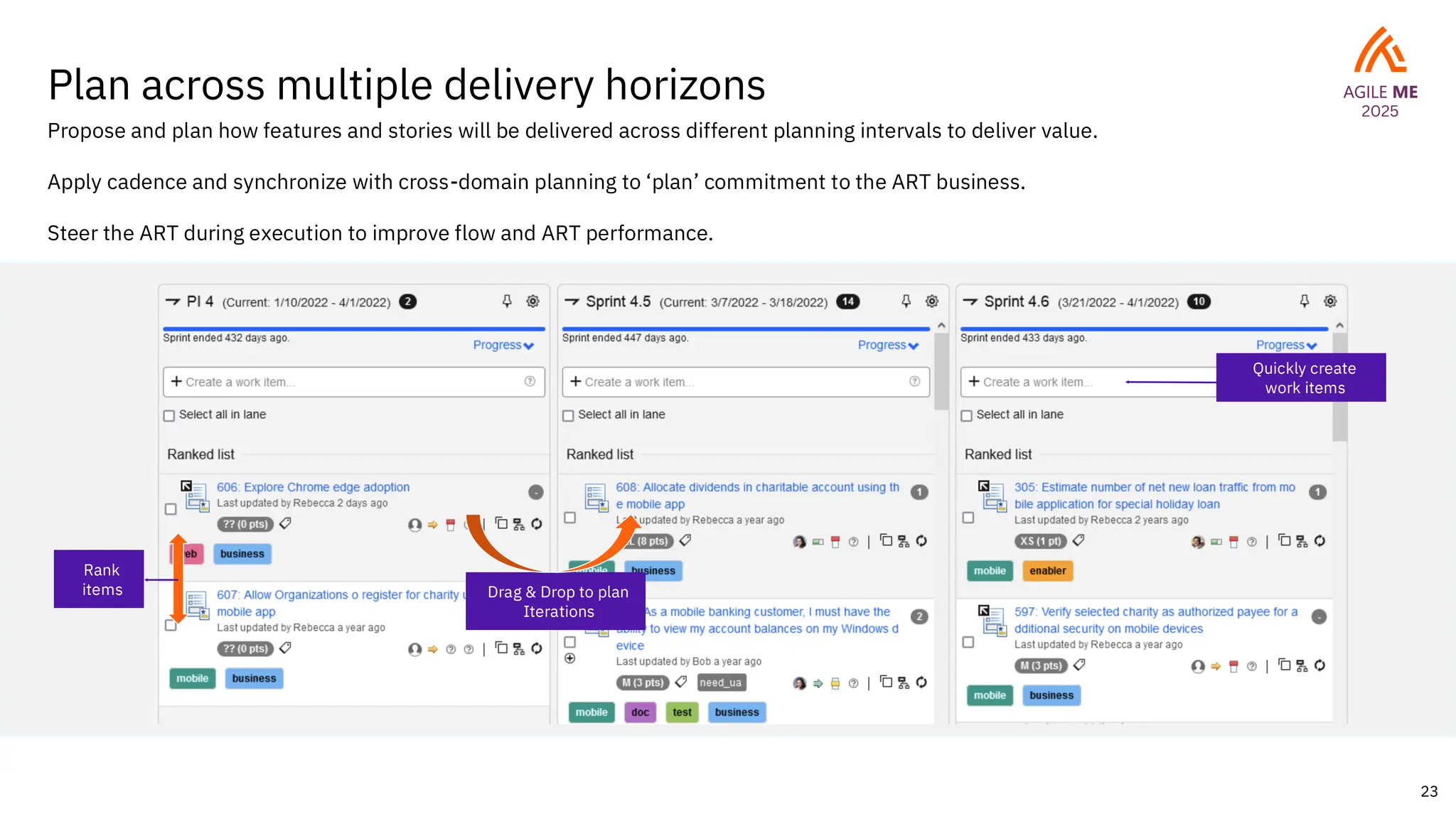
Plan across multiple delivery horizons
Propose and plan how features and stories will be delivered across different planning intervals to deliver value.
Apply cadence and synchronize with cross-domain planning to ‘plan’ commitment to the ART business.
Steer the ART during execution to improve flow and ART performance.
Drag & Drop to plan
Iterations
Quickly create
work items
Rank
items
24
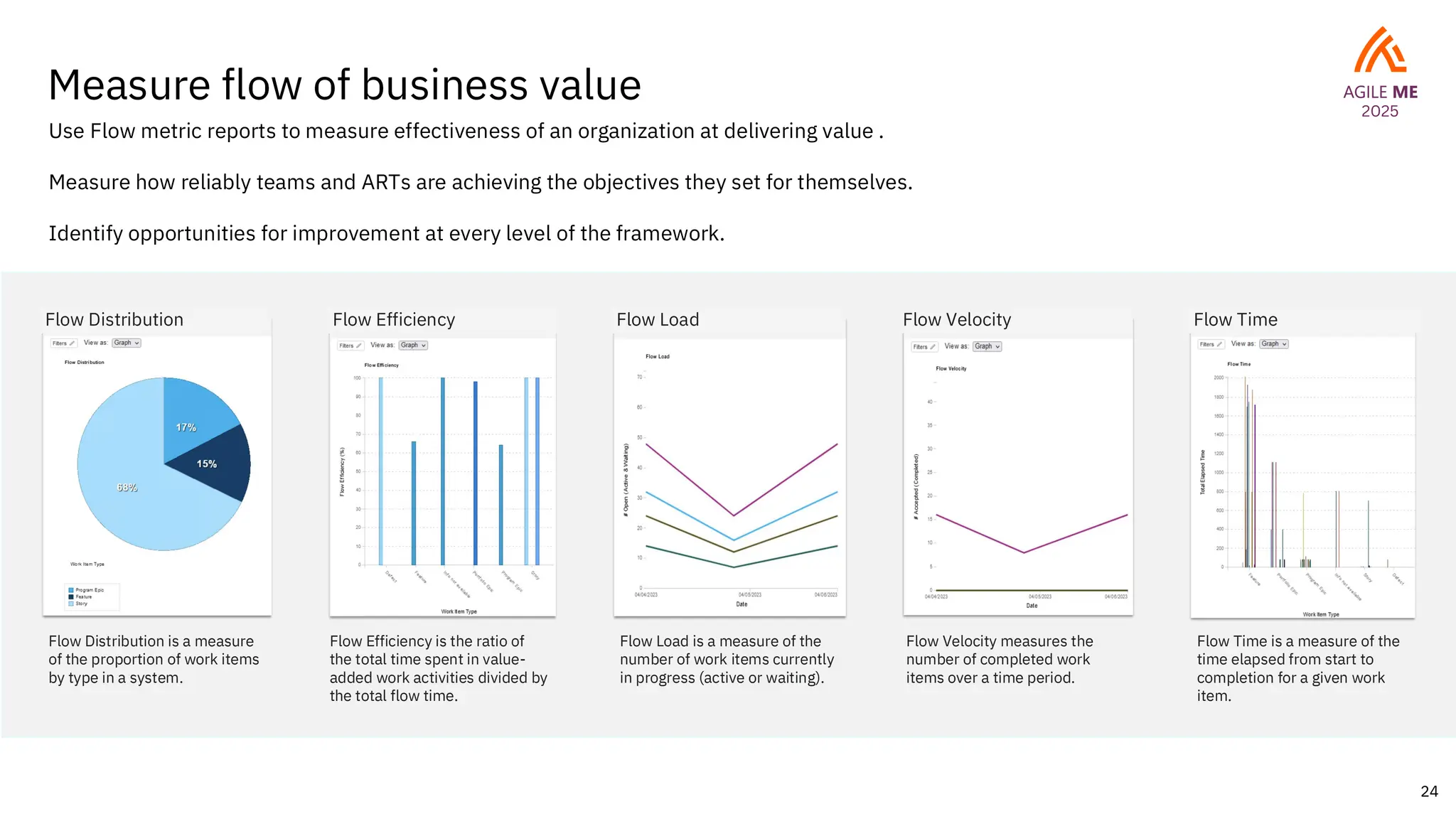
Measure flow of business value
Flow Velocity measures the
number of completed work
items over a time period.
Flow Distribution is a measure
of the proportion of work items
by type in a system.
Flow Time is a measure of the
time elapsed from start to
completion for a given work
item.
Flow Load is a measure of the
number of work items currently
in progress (active or waiting).
Flow Efficiency is the ratio of
the total time spent in value-
added work activities divided by
the total flow time.
Use Flow metric reports to measure effectiveness of an organization at delivering value .
Measure how reliably teams and ARTs are achieving the objectives they set for themselves.
Identify opportunities for improvement at every level of the framework.
Flow Velocity
Flow Distribution Flow Time
Flow Load
Flow Efficiency
25
Minimize handoffs and dependencies
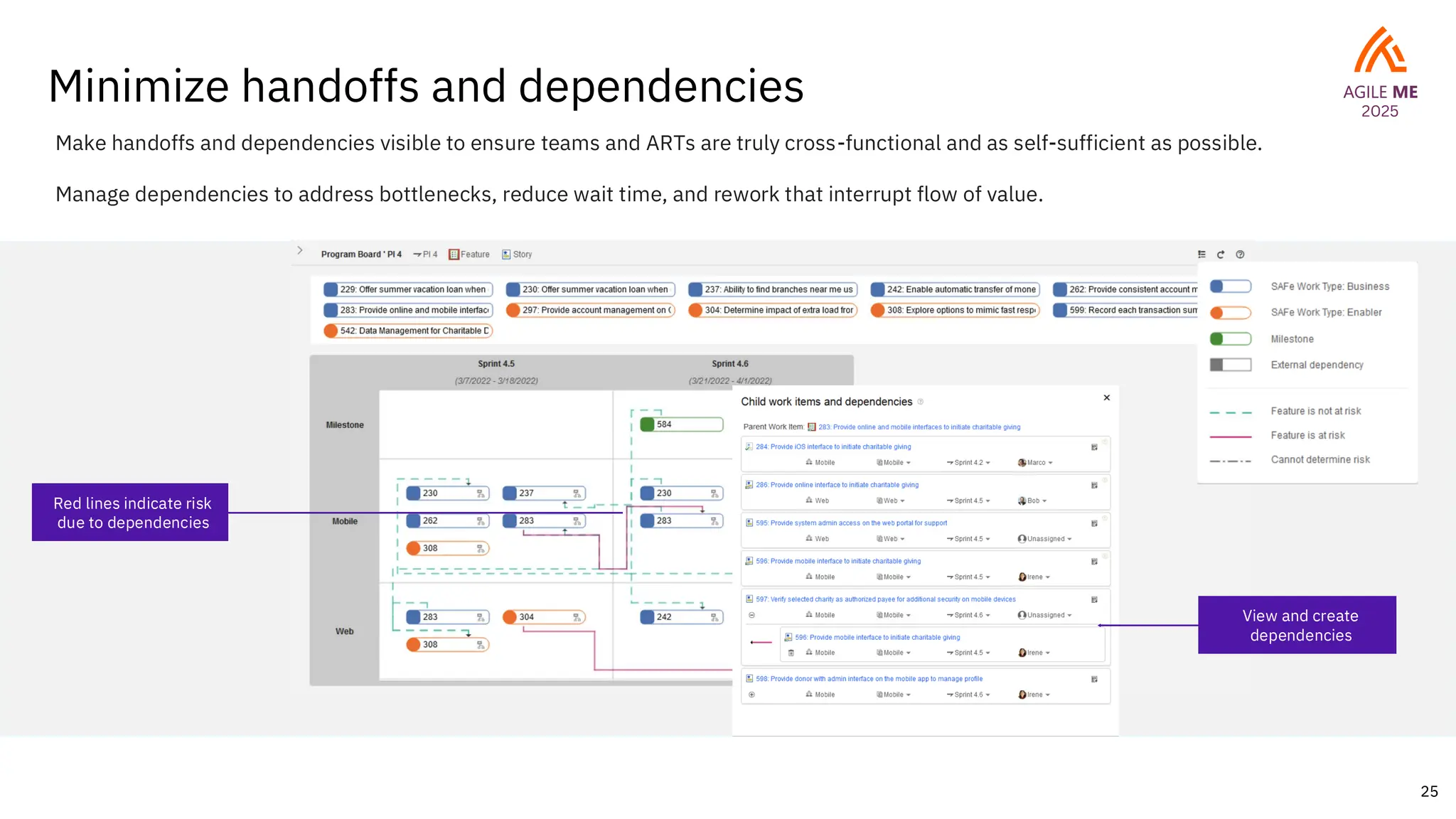
Make handoffs and dependencies visible to ensure teams and ARTs are truly cross-functional and as self-sufficient as possible.
Manage dependencies to address bottlenecks, reduce wait time, and rework that interrupt flow of value.
View and create
dependencies
Red lines indicate risk
due to dependencies
26
ROAM Risks
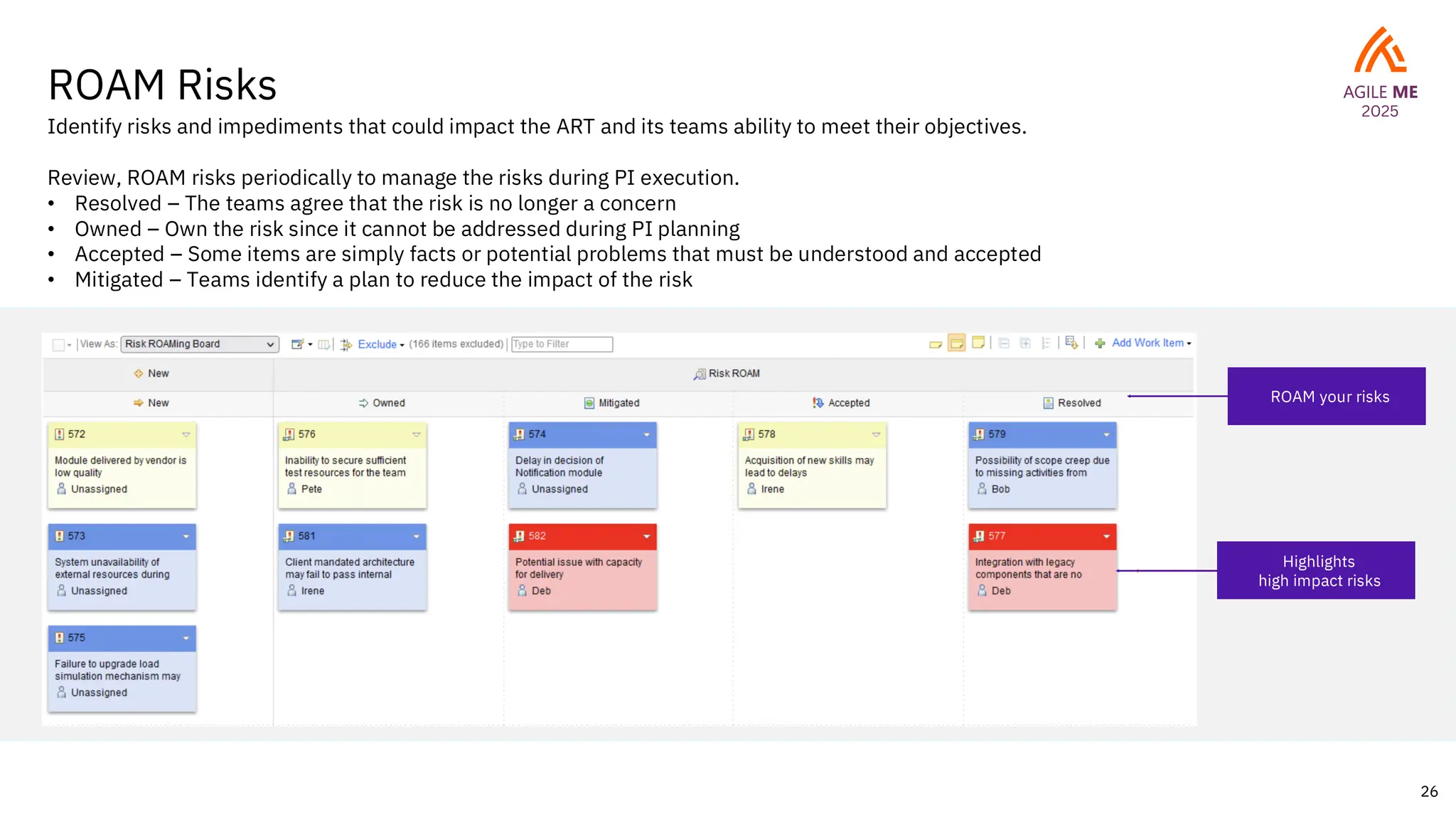
Identify risks and impediments that could impact the ART and its teams ability to meet their objectives.
Review, ROAM risks periodically to manage the risks during PI execution.
• Resolved – The teams agree that the risk is no longer a concern
• Owned – Own the risk since it cannot be addressed during PI planning
• Accepted – Some items are simply facts or potential problems that must be understood and accepted
• Mitigated – Teams identify a plan to reduce the impact of the risk
Highlights
high impact risks
ROAM your risks
27
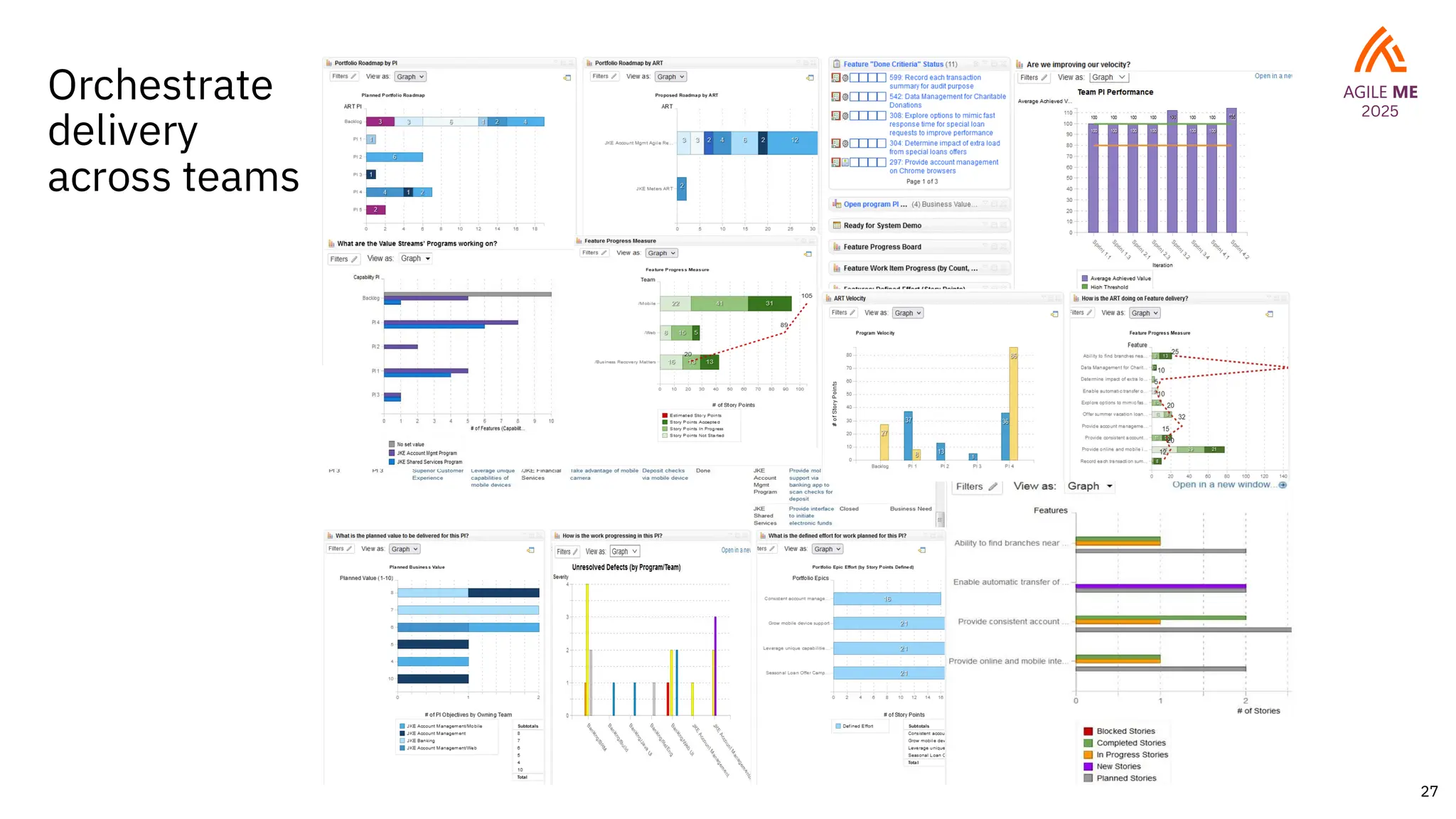
Orchestrate
delivery
across teams
28
How to be successful
realizing these goals?
29
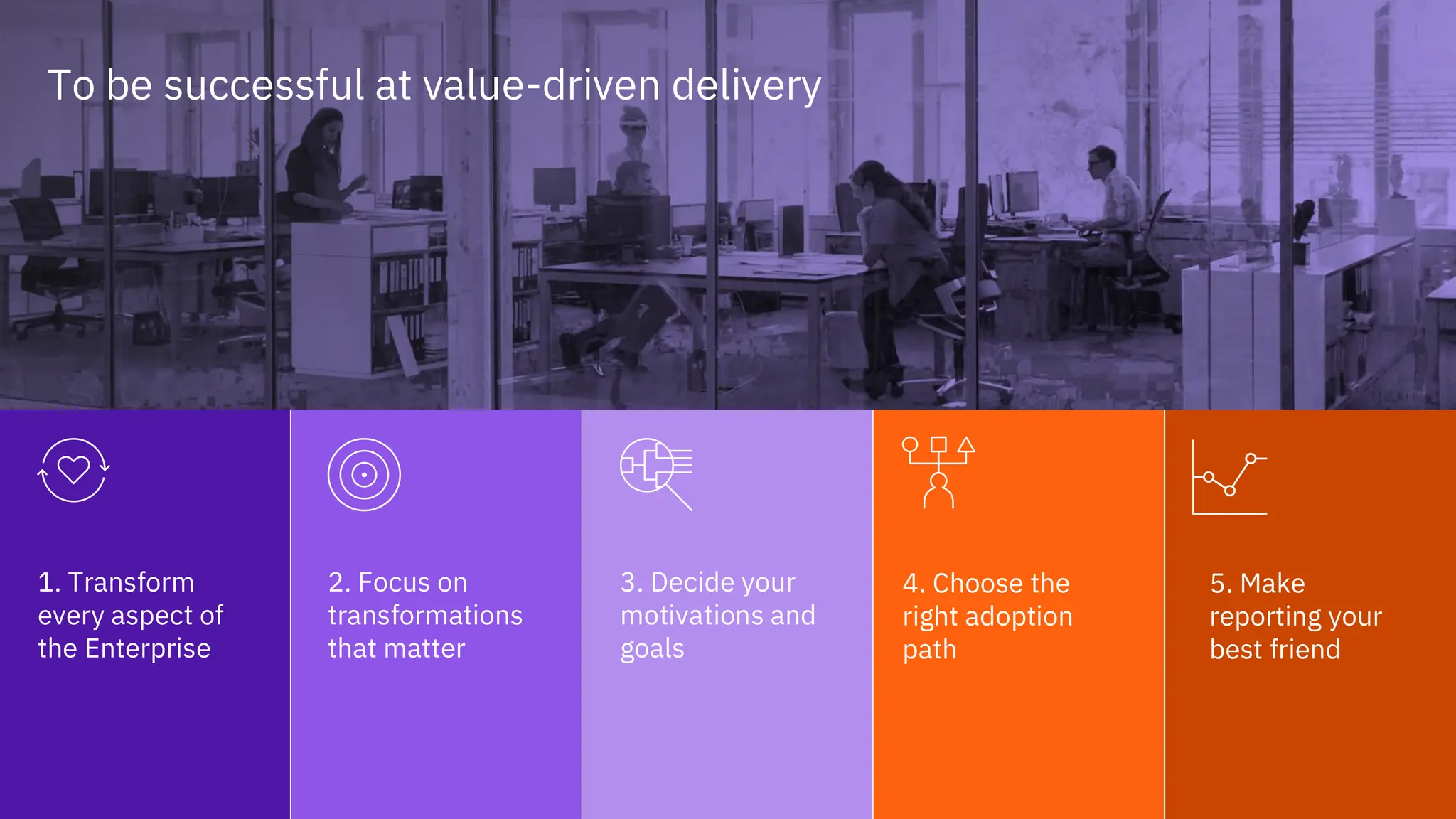
To be successful at value-driven delivery
1. Transform
every aspect of
the Enterprise
2. Focus on
transformations
that matter
3. Decide your
motivations and
goals
5. Make
reporting your
best friend
4. Choose the
right adoption
path
30
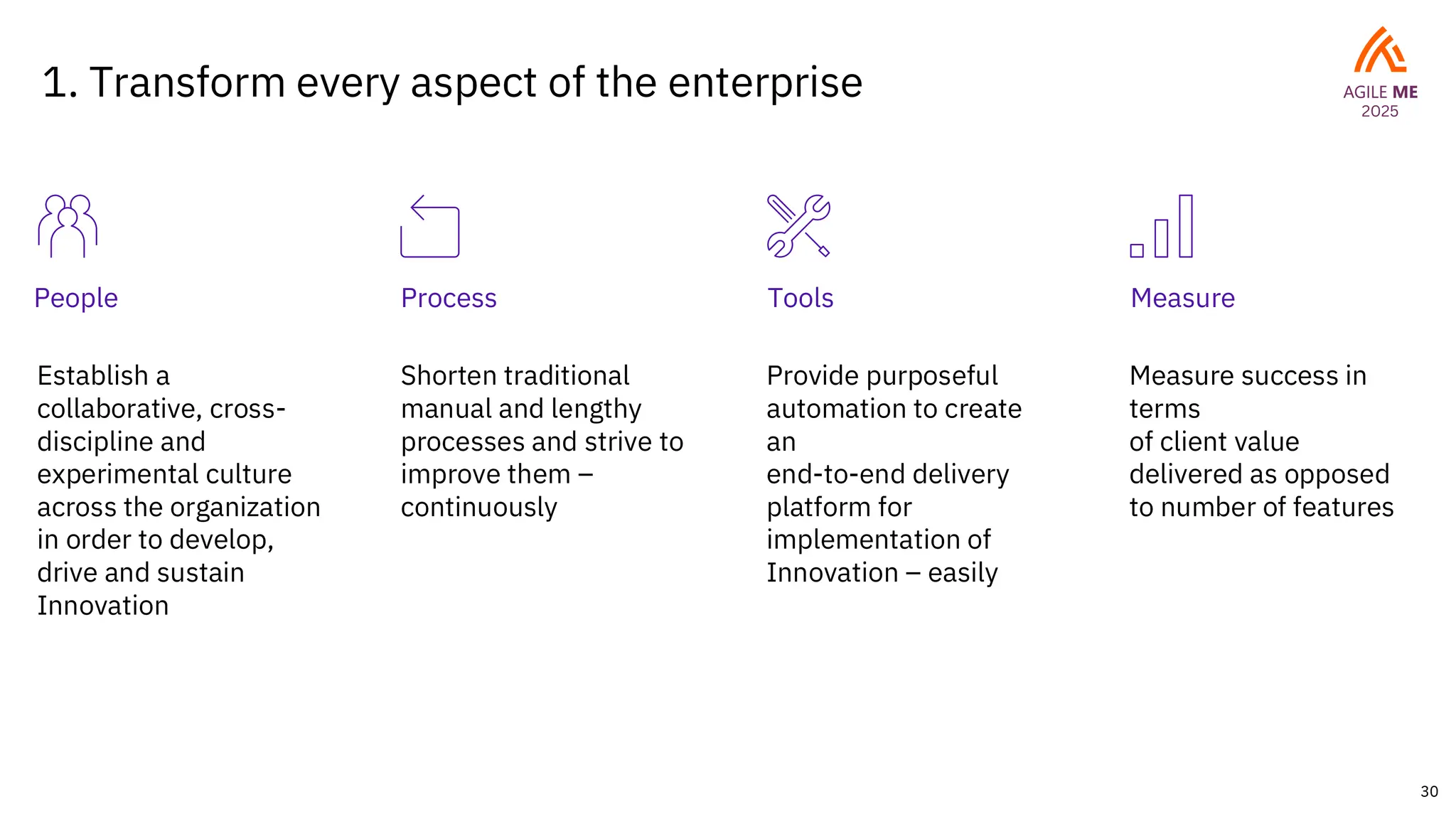
1. Transform every aspect of the enterprise
Tools
Process
Establish a
collaborative, cross-
discipline and
experimental culture
across the organization
in order to develop,
drive and sustain
Innovation
Shorten traditional
manual and lengthy
processes and strive to
improve them –
continuously
Provide purposeful
automation to create
an
end-to-end delivery
platform for
implementation of
Innovation – easily
Measure
Measure success in
terms
of client value
delivered as opposed
to number of features
People
31
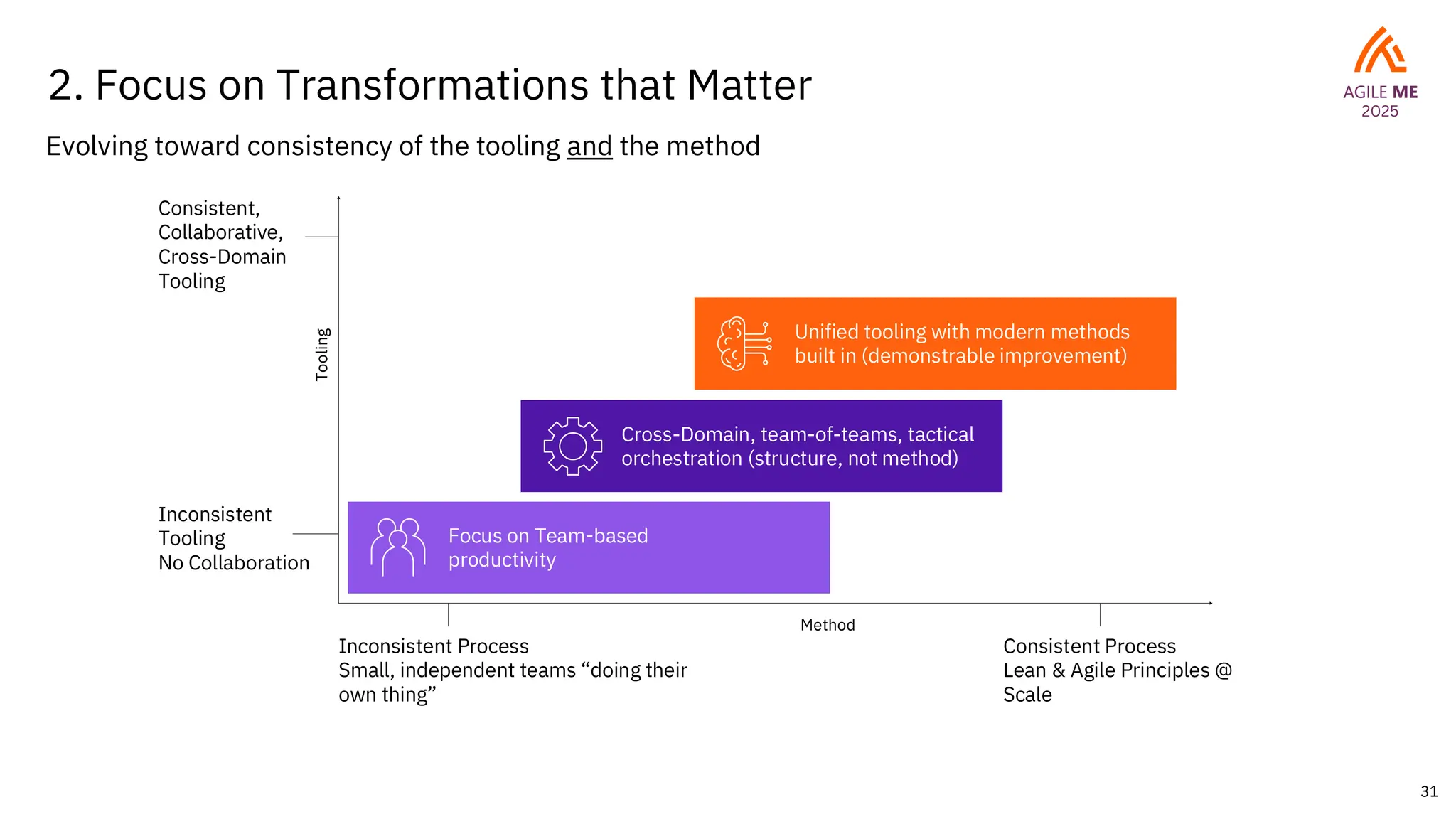
2. Focus on Transformations that Matter
Consistent,
Collaborative,
Cross-Domain
Tooling
Evolving toward consistency of the tooling and the method
Inconsistent
Tooling
No Collaboration
Inconsistent Process
Small, independent teams “doing their
own thing”
Consistent Process
Lean & Agile Principles @
Scale
Method
Tooling
Focus on Team-based
productivity
Cross-Domain, team-of-teams, tactical
orchestration (structure, not method)
Unified tooling with modern methods
built in (demonstrable improvement)
32
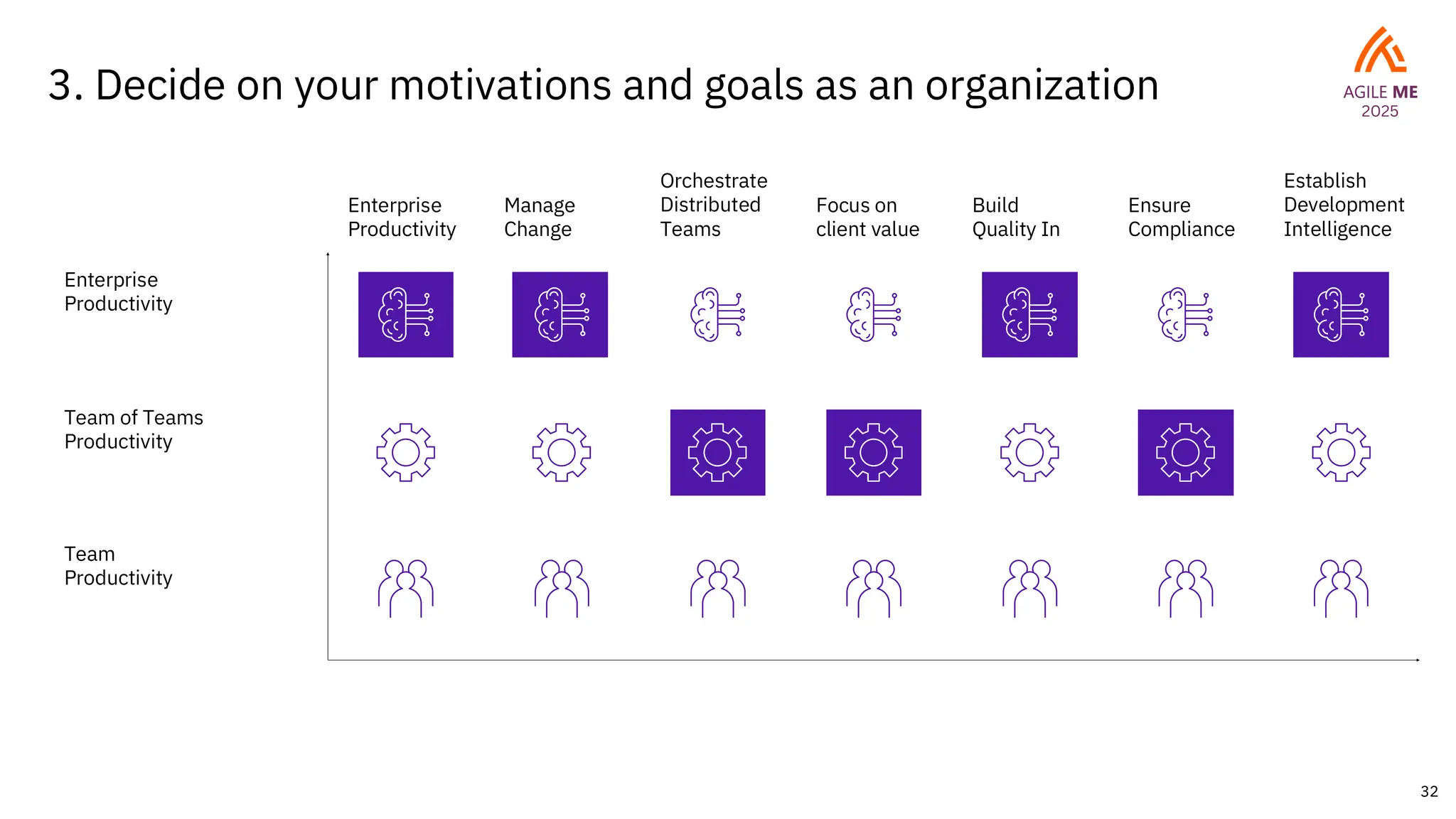
3. Decide on your motivations and goals as an organization
Enterprise
Productivity
Team of Teams
Productivity
Team
Productivity
Enterprise
Productivity
Manage
Change
Orchestrate
Distributed
Teams
Focus on
client value
Build
Quality In
Ensure
Compliance
Establish
Development
Intelligence
33
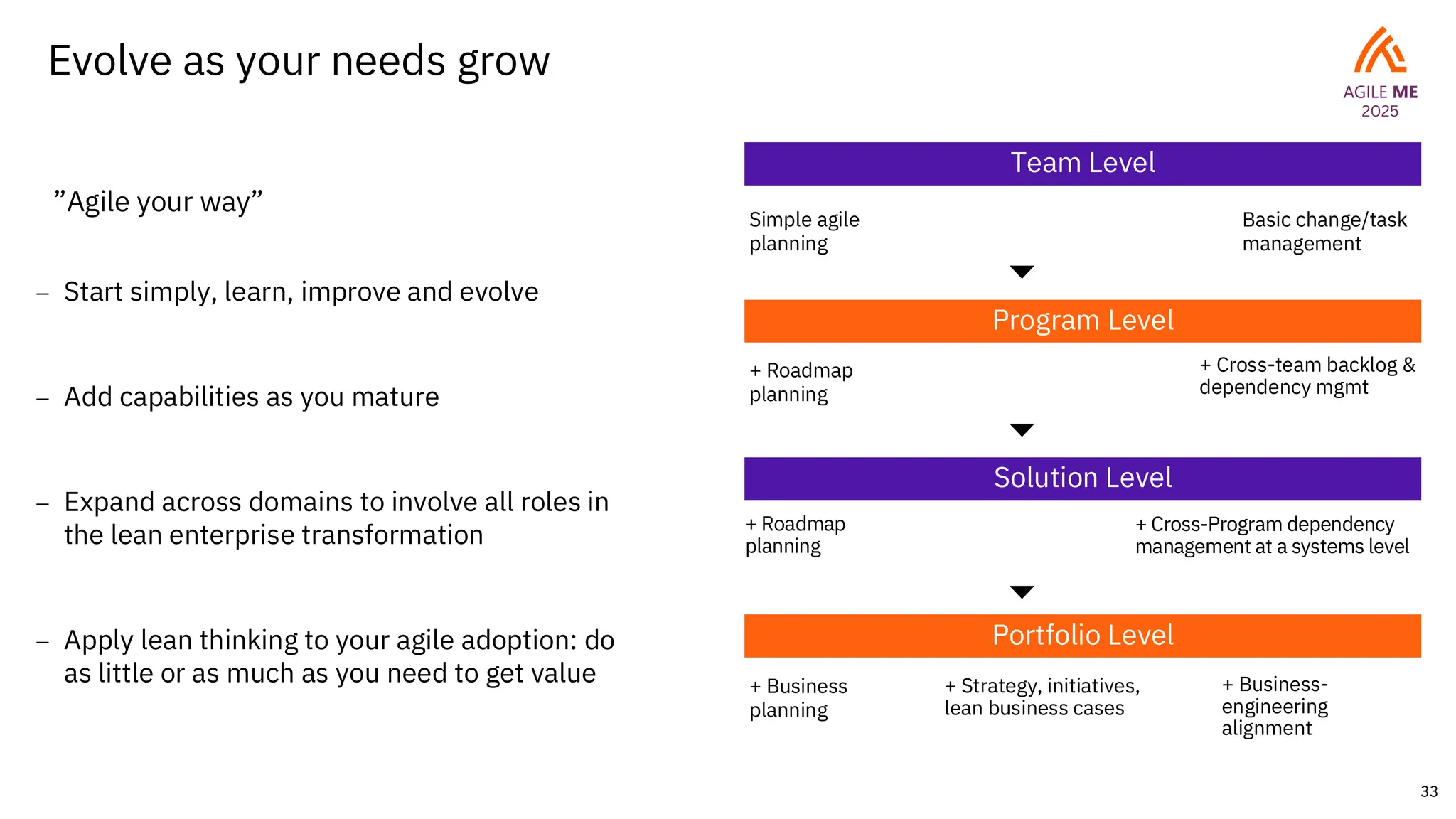
Evolve as your needs grow
”Agile your way”
– Start simply, learn, improve and evolve
Team Level
Program Level
Solution Level
Portfolio Level
Simple agile
planning
Basic change/task
management
+ Roadmap
planning
+ Cross-team backlog &
dependency mgmt
+ Roadmap
planning
+ Cross-Program dependency
management at a systems level
+ Business
planning
+ Strategy, initiatives,
lean business cases
+ Business-
engineering
alignment
– Add capabilities as you mature
– Expand across domains to involve all roles in
the lean enterprise transformation
– Apply lean thinking to your agile adoption: do
as little or as much as you need to get value
34
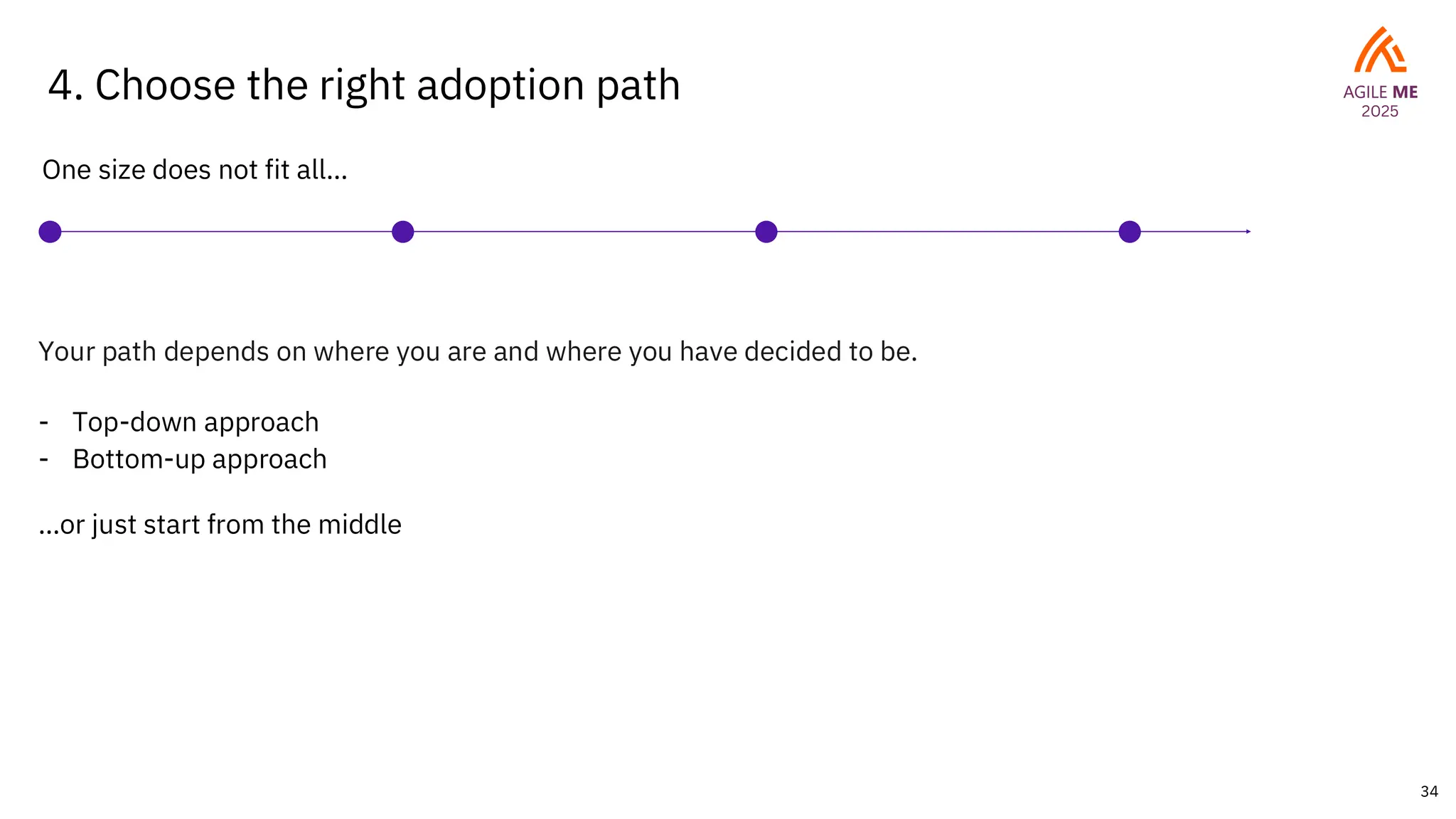
4. Choose the right adoption path
One size does not fit all…
Your path depends on where you are and where you have decided to be.
- Top-down approach
- Bottom-up approach
…or just start from the middle
35
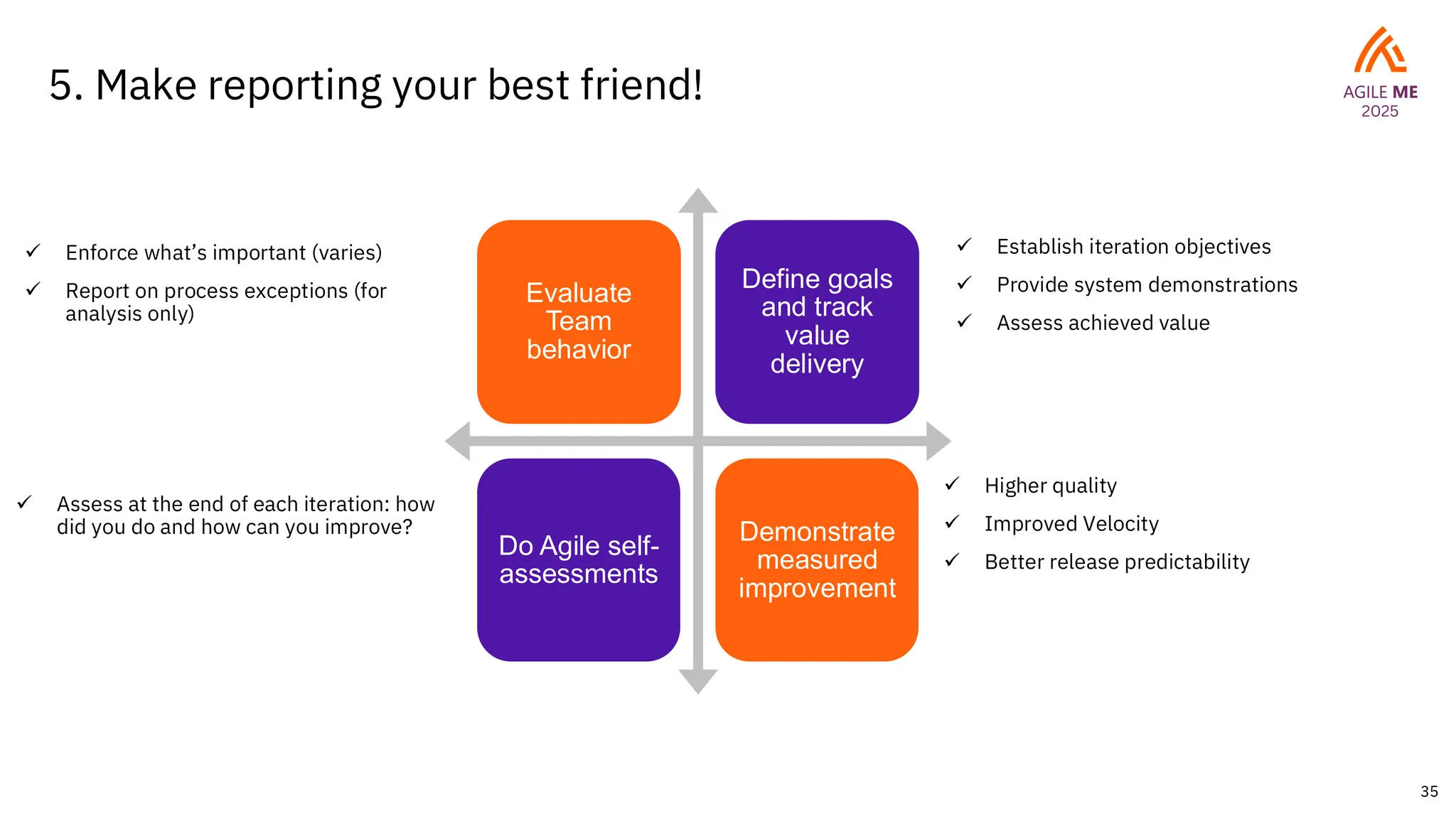
5. Make reporting your best friend!
Evaluate
Team
behavior
Define goals
and track
value
delivery
Do Agile self-
assessments
Demonstrate
measured
improvement
✓ Establish iteration objectives
✓ Provide system demonstrations
✓ Assess achieved value
✓ Higher quality
✓ Improved Velocity
✓ Better release predictability
✓ Enforce what’s important (varies)
✓ Report on process exceptions (for
analysis only)
✓ Assess at the end of each iteration: how
did you do and how can you improve?
36
Summary
37
37
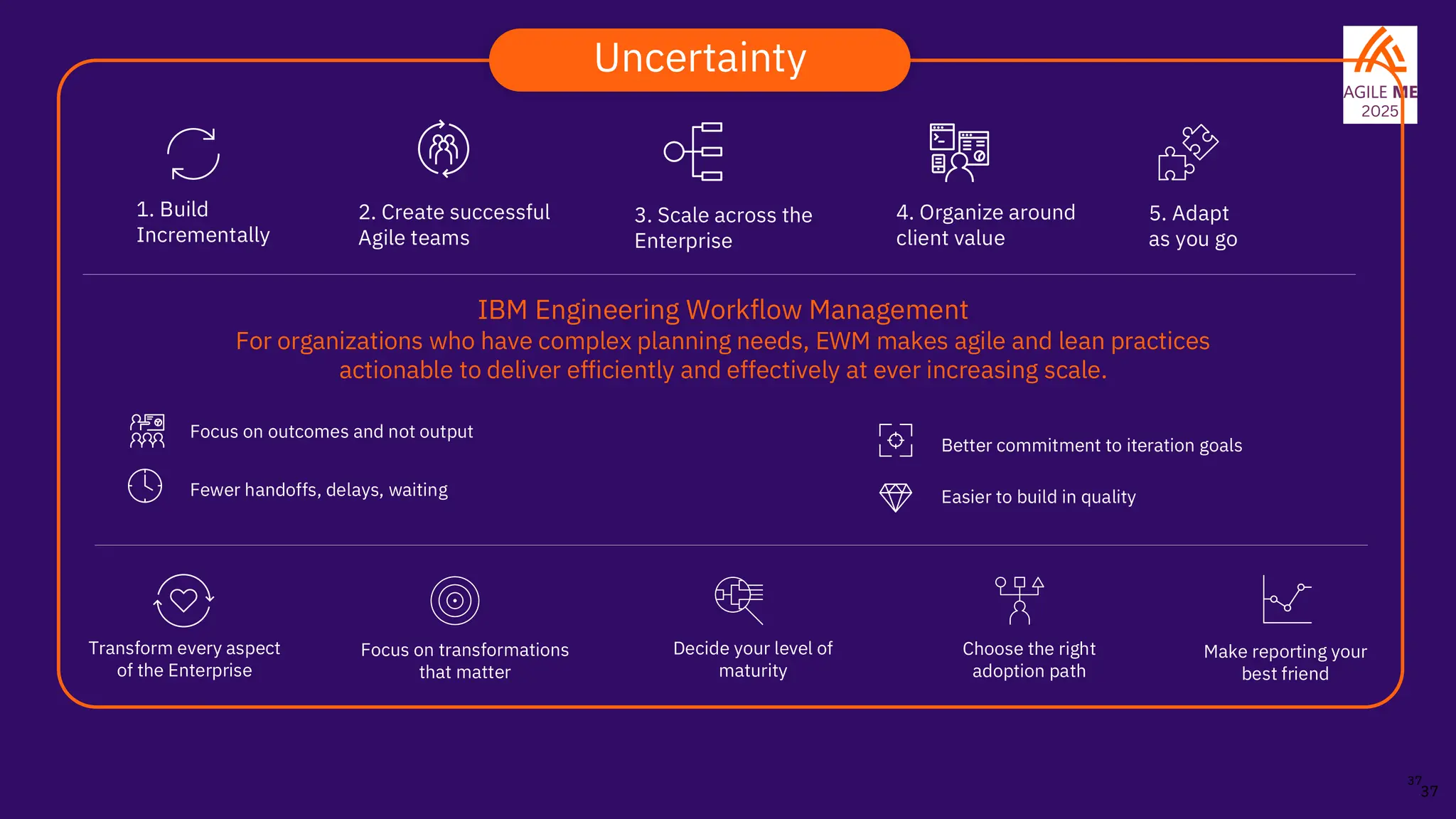
1. Build
Incrementally
2. Create successful
Agile teams
4. Organize around
client value
3. Scale across the
Enterprise
5. Adapt
as you go
IBM Engineering Workflow Management
For organizations who have complex planning needs, EWM makes agile and lean practices
actionable to deliver efficiently and effectively at ever increasing scale.
Focus on outcomes and not output
Fewer handoffs, delays, waiting Easier to build in quality
Better commitment to iteration goals
Transform every aspect
of the Enterprise
Focus on transformations
that matter
Decide your level of
maturity
Choose the right
adoption path
Make reporting your
best friend
Uncertainty
38
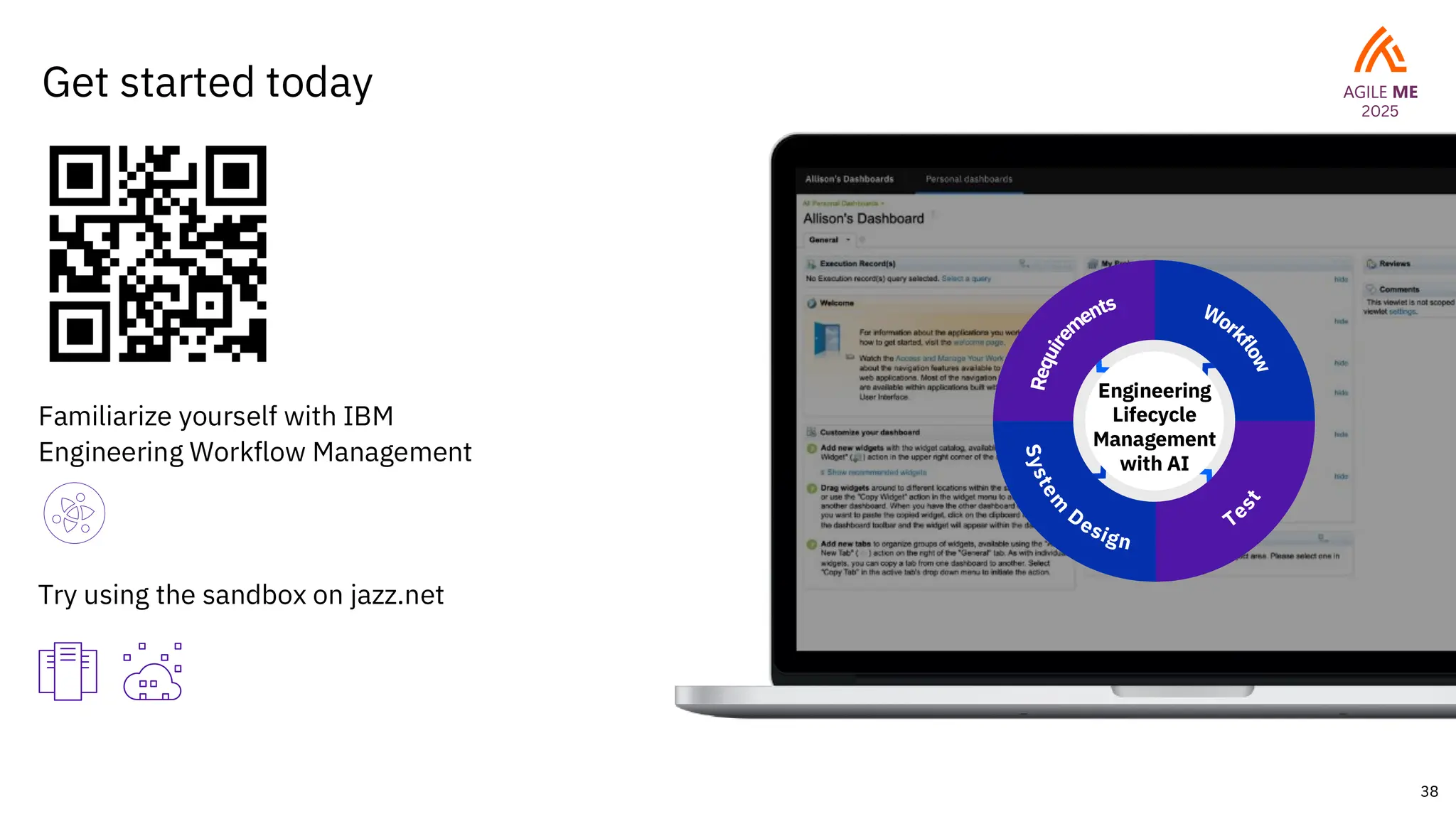
Get started today
R
e
q
u
i
r
e
m
ents
Te
s
t
Work
f
l
o
w
S
y
s
t
e
m
Design
Engineering
Lifecycle
Management
with AI
Familiarize yourself with IBM
Engineering Workflow Management
Try using the sandbox on jazz.net
39
Thank You
• © 2025 International Business Machines Corporation
• IBM and the IBM logo are trademarks of IBM Corporation, registered in
many jurisdictions worldwide. Other product and service names might be
trademarks of IBM or other companies. A current list of IBM trademarks is
available on ibm.com/trademark.
• This document is current as of the initial date of publication and may be
changed by IBM at any time.
• Statements regarding IBM’s future direction and intent are subject to
change or withdrawal without notice, and represent goals and objectives
only.
• THIS DOCUMENT IS DISTRIBUTED “AS IS” WITHOUT ANY WARRANTY,
EITHER EXPRESS OR IMPLIED. IN NO EVENT, SHALL IBM BE LIABLE FOR
ANY DAMAGE ARISING FROM THE USE OF THIS INFORMATION,
INCLUDING BUT NOT LIMITED TO, LOSS OF DATA, BUSINESS
INTERRUPTION, LOSS OF PROFIT OR LOSS OF OPPORTUNITY.
• Client examples are presented as illustrations of how those clients have
used IBM products and the results they may have achieved. Actual
performance, cost, savings or other results in other operating environments
may vary.
• Not all offerings are available in every country in which IBM operates.
• It is the user’s responsibility to evaluate and verify the operation of any
other products or programs with IBM products and programs.
• The client is responsible for ensuring compliance with laws and regulations
applicable to it. IBM does not provide legal advice or represent or warrant
that its services or products will ensure that the client is in compliance with
any law or regulation.

Navigating Uncertainty with Agility: Adaptive Planning for Value-Driven Delivery by Fariz Saracevic

  • 1.
    April 10, 2025- Dubai, UAE Navigating Uncertainty with Agility: Adaptive Planning for Value-Driven Delivery Fariz Saracevic, Senior Product Manager IBM Engineering
  • 2.
  • 3.
    Learning Objectives At theconclusion of this session, attendees will be able to: • Express a pragmatic approach of defining value, multi-level adaptive planning, incremental value delivery, and continuous adaptation for value-driven delivery. • Describe how IBM® Engineering Workflow Management enables adaptive multi-level planning, minimizes bottlenecks, and accelerates incremental value delivery. 3
  • 4.
    Agenda • How is‘Uncertainty’ setting new goals for organizations? • How to realize new goals for organizations? • How can IBM® Engineering Workflow Management help realize these goals? • How to be successful in realizing these goals? • Quick Summary 4
  • 5.
    5 There is alwaysan element of uncertainty. Embrace it and adapt. In software development, uncertainty is a feature, not a bug. It drives innovation and creativity. Uncertainty is the normal state in software development. The key is to manage it, not eliminate it. The challenge of software development lies in managing uncertainty. Transform it into opportunity.
  • 6.
    6 Navigating Uncertainties ishard Integration issues Multiple configurations and integrations Slow processes to deliver software Team Dynamics Changing requirements Complexity of Technology Resource constraints Market and Regulatory requirements Misaligned client expectations Resistance to Change External Dependencies
  • 7.
    7 Setting new goalsfor organizations Transform Quality Achieve Enterprise Agility Adopt the critical skills, principles, and practices needed to create high- performing teams who can deliver differentiating capabilities at the speed needed to satisfy market demands. Move large and complex software and systems development from stage- gated approaches to a flow-based delivery- model which is organized around delivering what the client wants and needs. Ensure that investments are driving high quality changes, in terms of both the delivery of high-valued features as well as low- or zero- defect functionality. Focus on client value
  • 8.
    8 Realizing the newgoals 1. Build Incrementally 2. Create successful Agile teams 3. Scale across the Enterprise 4. Organize around client value 5. Adapt as you go Delivery Teams Efficiency Organization Effectiveness Scope Goal
  • 9.
    9 1. Building incrementallyhelps accelerate value delivery Cadence supports natural Work-In-Process limits that foster learning cycles across the Value Stream General Distribution Limited Distribution Solution Ready Product Committed Exploration Feasibility Supplier P D C A P D C A P D C A … and also delivers better economics
  • 10.
    10 2. Create successfulAgile teams – Cross-functional, self-organizing entities that can define, build and test a thing of value – Deliver value every two weeks – Apply basic scientific practice: Plan—Do—Check—Adjust – Adapt plans continually to reflect changes in requirements, priorities, feedback, retrospectives, and environmental factors. – Visualize and limit work in progress (WIP) to match demand to capacity. – Work in smaller batches to reduce WIP and go through the system faster and with less variability. – Reduce queue lengths of committed work to minimize delays, improve predictability, and reduce waste. – Fail fast by carrying out experiments / spikes early on to reduce risk. Agile Principles Individuals and interactions over processes and tools Working software over comprehensive documentation Customer collaboration over contract negotiation Responding to change over following a plan
  • 11.
    11 3. Scale acrossthe Enterprise - team of Agile Teams Align 5-12 practitioners to a common shared vision Align Portfolio to Strategic Themes Establish clear goals and outcomes Synchronize end-of- iteration periods across teams. Forecast deliverables using Roadmap Facilitate teams of teams planning Ensure work prioritization flows from top to bottom Roll-up progress and status of work Manage dependencies to minimize handoffs Establish communication channels to remove silos Support hybrid teams Unify the tribes through standardized process and tools Create alignment across levels Plan across multiple levels Establish intelligence Orchestrate across teams Use ‘single source of truth’ for cross-team progress, status, risk, trends for all stakeholders Measure and track what matters Measure flow of business value
  • 12.
    12 4. Define value Organizevalue ▪ Organize around delivering what the client wants and needs. ▪ Collaborate cross- domain resources ▪ Strive for transparency Create a ‘shared’ vision ▪ Create a shared understanding of goals and value to be delivered ▪ Adopt a “Systems View” approach to understand the big picture of what needs to be delivered ▪ Manage stakeholder expectations Drive economic value ▪ Take an economic view to prioritize investments ▪ Visualize workflow to eliminate waste and respect work-in-process (WIP) limits ▪ Understand solution economic trade-offs
  • 13.
    13 5. Adapt asyou go Short feedback loops to adapt quickly Periodic retrospectives to identify improvement opportunities Empower teams to take ownership, be responsible Continuously learn, adapt, and improve
  • 14.
    15 How can IBMhelp realize these goals?
  • 15.
    16 IBM Engineering WorkflowManagement Optimize across value stream Bring hybrid teams together by bridging their tools’ information islands to deliver value in a fast and predictable manner For organizations who have complex planning needs, EWM makes agile and lean practices actionable to deliver efficiently and effectively at ever increasing scale. Gain actionable insights Visualize engineering data and program-wide status for actionable insights and predictable delivery outcomes Achieve Enterprise Agility Facilitate planning and manage work to accelerate the flow of work across the value stream for continuous value delivery Unlike other Application Lifecycle Management (ALM) tools, EWM: 10 out of 10 largest[2] automotive OEM’s 7 out of 10 largest [6] system integrators 7 out of 10 largest[5] medical device manufacturers 10 out of 10 largest[4] tier 1 automotive suppliers 5 out of 10 largest [8] semi conductors’ design companies 10 out of 10 largest[3] aerospace and defense companies Government institutions in more than 40 countries 7 out of 10 largest[7] banks 5 out of 10 largest[9] pharmaceutical companies Creates a digital thread built on open standards (OSLC) across disciplines Operates at the scale that is required by advanced product-line engineering Drives consistency, completeness, and correctness to show compliance to industry standards
  • 16.
    17 Create a sharedvision Solution Elaboration Artifacts Adopt a design thinking approach for better understanding the problem to be solved, the context in which the solution will be used, and the evolution of that solution. Define scenarios, requirements and traceability to implementation and test artifacts.
  • 17.
    18 Align Portfolio toStrategic Themes Strategic Themes Provide business context for portfolio strategy and decision-making, representing aspects of the enterprise’s strategic intent, through associations to related Organizations (Value Stream, Solution Train, or ART) and tracked Objectives at various levels of the organization.
  • 18.
    19 Establish clear goalsand outcomes OKR Board Strategic Themes - Objectives Use Objective-Key Results (OKRs) to: • Enhance strategic alignment through specific and measurable actions. • Define business outcomes for tracked epics in the Portfolio Kanban. • Set improvement goals and measure the success of a SAFe transformation.
  • 19.
    20 Accelerate flow ofvalue Visualize and limit work in progress (WIP) to match demand to capacity. Work in smaller batches to reduce WIP and go through the system faster and with less variability. Reduce queue lengths of committed work to minimize delays, improve predictability, and reduce waste. WIP Limits (green = ok, red = violation) SAFe Kanban ‘queues’ Respect workflow transitions Business (blue) and Enabler (yellow) Epics
  • 20.
    21 Forecast deliverables usingRoadmap Communicate planned deliverables, milestones, and investments over a time across multiple planning horizons. Link strategy to execution to develop, evolve and adjust planned activities in terms of what and how to build within the next timebox. Provide stakeholders with a view of the current, near-term, and longer-term deliverables that realize the Portfolio Vision and Strategic Themes. Timeline Planned Iteration Owning Team Work across ARTs
  • 21.
    22 Drive Economic value WSJFautomatically calculated based on set WSJF component values and list of Features is re-sorted Optimize economics versus theoretical job return on investment (or worse, first-come, first-served, loudest voice) to ensure the highest value is delivered in the shortest lead time. Prioritize the backlog using Weighted Shortest Job First (WSJF), to minimize cost of delay (COD).
  • 22.
    23 Plan across multipledelivery horizons Propose and plan how features and stories will be delivered across different planning intervals to deliver value. Apply cadence and synchronize with cross-domain planning to ‘plan’ commitment to the ART business. Steer the ART during execution to improve flow and ART performance. Drag & Drop to plan Iterations Quickly create work items Rank items
  • 23.
    24 Measure flow ofbusiness value Flow Velocity measures the number of completed work items over a time period. Flow Distribution is a measure of the proportion of work items by type in a system. Flow Time is a measure of the time elapsed from start to completion for a given work item. Flow Load is a measure of the number of work items currently in progress (active or waiting). Flow Efficiency is the ratio of the total time spent in value- added work activities divided by the total flow time. Use Flow metric reports to measure effectiveness of an organization at delivering value . Measure how reliably teams and ARTs are achieving the objectives they set for themselves. Identify opportunities for improvement at every level of the framework. Flow Velocity Flow Distribution Flow Time Flow Load Flow Efficiency
  • 24.
    25 Minimize handoffs anddependencies Make handoffs and dependencies visible to ensure teams and ARTs are truly cross-functional and as self-sufficient as possible. Manage dependencies to address bottlenecks, reduce wait time, and rework that interrupt flow of value. View and create dependencies Red lines indicate risk due to dependencies
  • 25.
    26 ROAM Risks Identify risksand impediments that could impact the ART and its teams ability to meet their objectives. Review, ROAM risks periodically to manage the risks during PI execution. • Resolved – The teams agree that the risk is no longer a concern • Owned – Own the risk since it cannot be addressed during PI planning • Accepted – Some items are simply facts or potential problems that must be understood and accepted • Mitigated – Teams identify a plan to reduce the impact of the risk Highlights high impact risks ROAM your risks
  • 26.
  • 27.
    28 How to besuccessful realizing these goals?
  • 28.
    29 To be successfulat value-driven delivery 1. Transform every aspect of the Enterprise 2. Focus on transformations that matter 3. Decide your motivations and goals 5. Make reporting your best friend 4. Choose the right adoption path
  • 29.
    30 1. Transform everyaspect of the enterprise Tools Process Establish a collaborative, cross- discipline and experimental culture across the organization in order to develop, drive and sustain Innovation Shorten traditional manual and lengthy processes and strive to improve them – continuously Provide purposeful automation to create an end-to-end delivery platform for implementation of Innovation – easily Measure Measure success in terms of client value delivered as opposed to number of features People
  • 30.
    31 2. Focus onTransformations that Matter Consistent, Collaborative, Cross-Domain Tooling Evolving toward consistency of the tooling and the method Inconsistent Tooling No Collaboration Inconsistent Process Small, independent teams “doing their own thing” Consistent Process Lean & Agile Principles @ Scale Method Tooling Focus on Team-based productivity Cross-Domain, team-of-teams, tactical orchestration (structure, not method) Unified tooling with modern methods built in (demonstrable improvement)
  • 31.
    32 3. Decide onyour motivations and goals as an organization Enterprise Productivity Team of Teams Productivity Team Productivity Enterprise Productivity Manage Change Orchestrate Distributed Teams Focus on client value Build Quality In Ensure Compliance Establish Development Intelligence
  • 32.
    33 Evolve as yourneeds grow ”Agile your way” – Start simply, learn, improve and evolve Team Level Program Level Solution Level Portfolio Level Simple agile planning Basic change/task management + Roadmap planning + Cross-team backlog & dependency mgmt + Roadmap planning + Cross-Program dependency management at a systems level + Business planning + Strategy, initiatives, lean business cases + Business- engineering alignment – Add capabilities as you mature – Expand across domains to involve all roles in the lean enterprise transformation – Apply lean thinking to your agile adoption: do as little or as much as you need to get value
  • 33.
    34 4. Choose theright adoption path One size does not fit all… Your path depends on where you are and where you have decided to be. - Top-down approach - Bottom-up approach …or just start from the middle
  • 34.
    35 5. Make reportingyour best friend! Evaluate Team behavior Define goals and track value delivery Do Agile self- assessments Demonstrate measured improvement ✓ Establish iteration objectives ✓ Provide system demonstrations ✓ Assess achieved value ✓ Higher quality ✓ Improved Velocity ✓ Better release predictability ✓ Enforce what’s important (varies) ✓ Report on process exceptions (for analysis only) ✓ Assess at the end of each iteration: how did you do and how can you improve?
  • 35.
  • 36.
    37 37 1. Build Incrementally 2. Createsuccessful Agile teams 4. Organize around client value 3. Scale across the Enterprise 5. Adapt as you go IBM Engineering Workflow Management For organizations who have complex planning needs, EWM makes agile and lean practices actionable to deliver efficiently and effectively at ever increasing scale. Focus on outcomes and not output Fewer handoffs, delays, waiting Easier to build in quality Better commitment to iteration goals Transform every aspect of the Enterprise Focus on transformations that matter Decide your level of maturity Choose the right adoption path Make reporting your best friend Uncertainty
  • 37.
    38 Get started today R e q u i r e m ents Te s t Work f l o w S y s t e m Design Engineering Lifecycle Management withAI Familiarize yourself with IBM Engineering Workflow Management Try using the sandbox on jazz.net
  • 38.
    39 Thank You • ©2025 International Business Machines Corporation • IBM and the IBM logo are trademarks of IBM Corporation, registered in many jurisdictions worldwide. Other product and service names might be trademarks of IBM or other companies. A current list of IBM trademarks is available on ibm.com/trademark. • This document is current as of the initial date of publication and may be changed by IBM at any time. • Statements regarding IBM’s future direction and intent are subject to change or withdrawal without notice, and represent goals and objectives only. • THIS DOCUMENT IS DISTRIBUTED “AS IS” WITHOUT ANY WARRANTY, EITHER EXPRESS OR IMPLIED. IN NO EVENT, SHALL IBM BE LIABLE FOR ANY DAMAGE ARISING FROM THE USE OF THIS INFORMATION, INCLUDING BUT NOT LIMITED TO, LOSS OF DATA, BUSINESS INTERRUPTION, LOSS OF PROFIT OR LOSS OF OPPORTUNITY. • Client examples are presented as illustrations of how those clients have used IBM products and the results they may have achieved. Actual performance, cost, savings or other results in other operating environments may vary. • Not all offerings are available in every country in which IBM operates. • It is the user’s responsibility to evaluate and verify the operation of any other products or programs with IBM products and programs. • The client is responsible for ensuring compliance with laws and regulations applicable to it. IBM does not provide legal advice or represent or warrant that its services or products will ensure that the client is in compliance with any law or regulation.