Julio Fernandez de Cueto
Director of Testing
Interamerican Campus
Anaeli Ramos
Senior Academic & Career Advisor
Homestead Campus
 Assessment designed to help two and
four- year college and universities
develop data-driven evidence-based
student success solutions
 A non-cognitive instrument
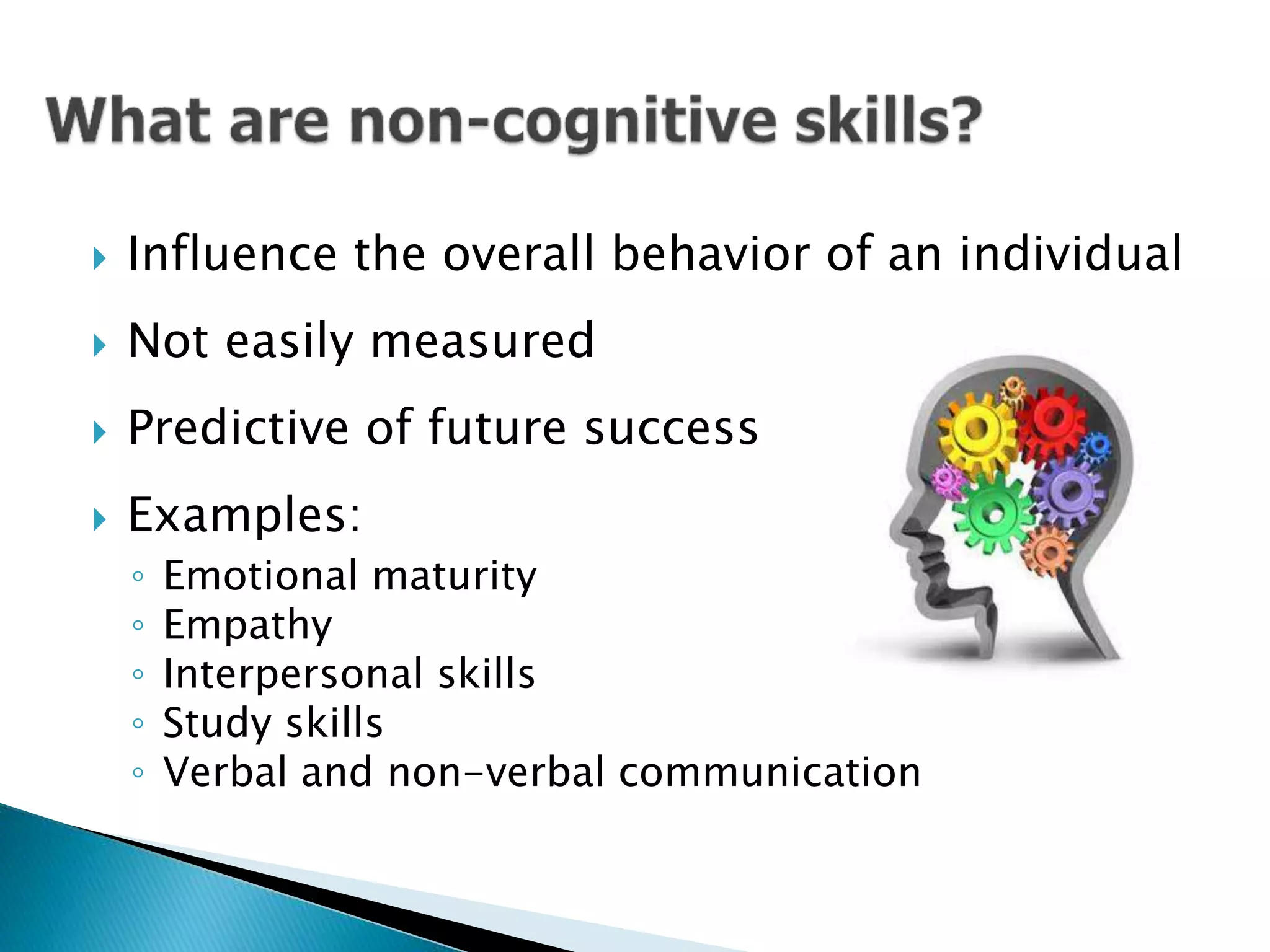
 Influence the overall behavior of an individual
 Not easily measured
 Predictive of future success
 Examples:
◦ Emotional maturity
◦ Empathy
◦ Interpersonal skills
◦ Study skills
◦ Verbal and non-verbal communication
 180 items versus 48
 Completed study comparing predictive ability
of SSI with previously used ENGAGE
 80 students took both assessments
 After 1 semester ENGAGE and SSI were very
similar in ability to identify high risk students
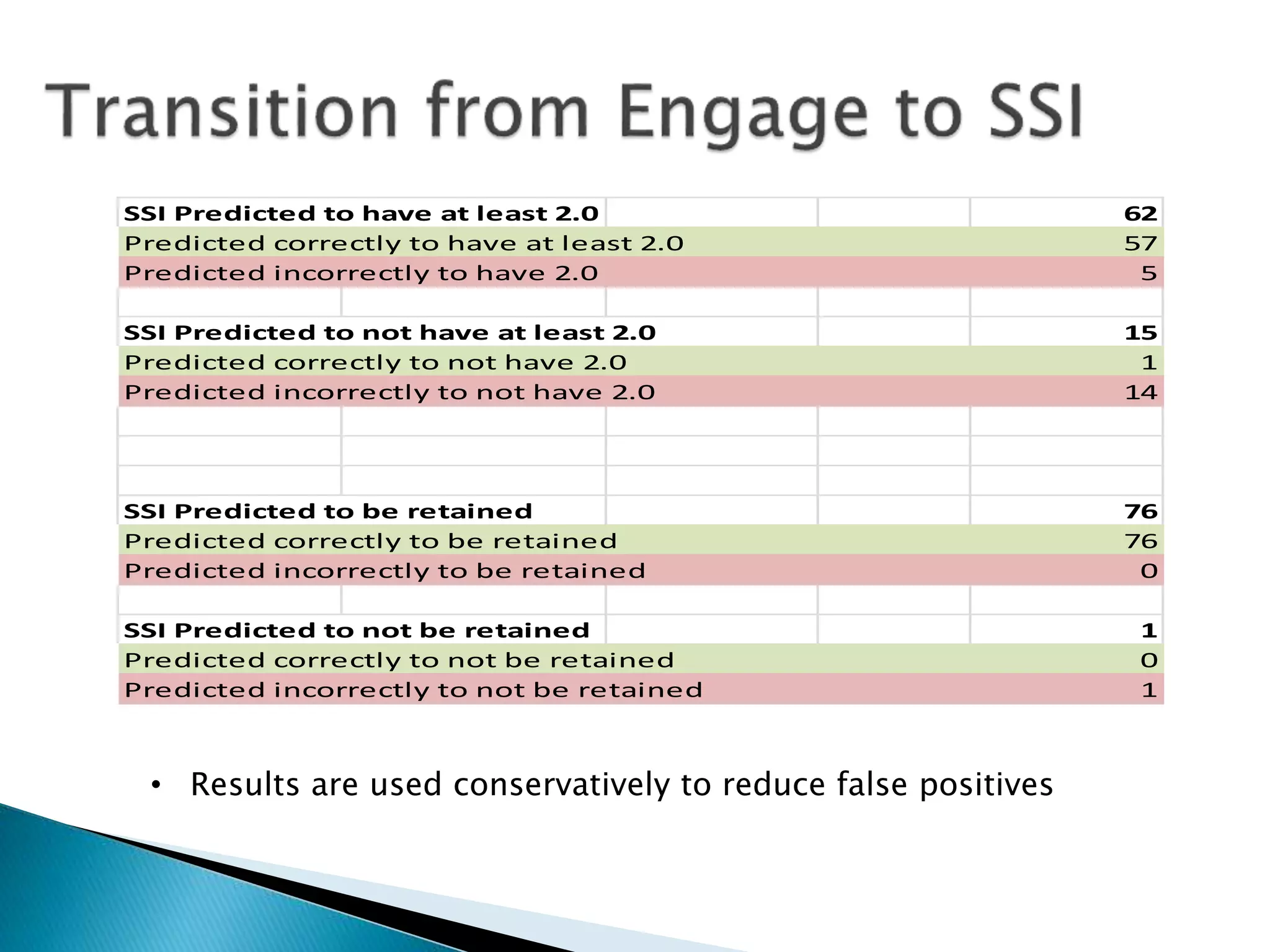
SSI Predicted to have at least 2.0 62
Predicted correctly to have at least 2.0 57
Predicted incorrectly to have 2.0 5
SSI Predicted to not have at least 2.0 15
Predicted correctly to not have 2.0 1
Predicted incorrectly to not have 2.0 14
SSI Predicted to be retained 76
Predicted correctly to be retained 76
Predicted incorrectly to be retained 0
SSI Predicted to not be retained 1
Predicted correctly to not be retained 0
Predicted incorrectly to not be retained 1
• Results are used conservatively to reduce false positives
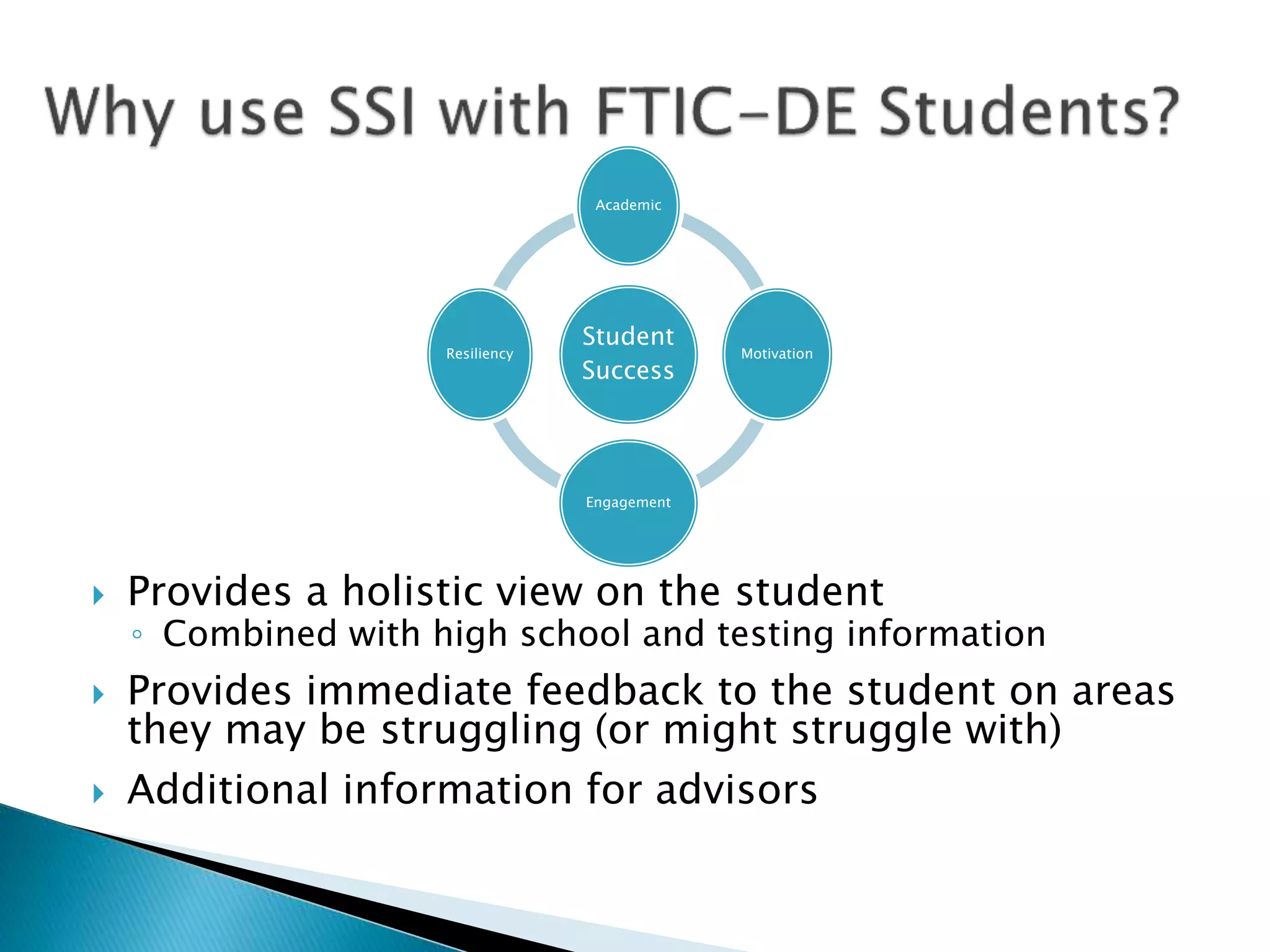
 Provides a holistic view on the student
◦ Combined with high school and testing information
 Provides immediate feedback to the student on areas
they may be struggling (or might struggle with)
 Additional information for advisors
Student
Success
Academic
Motivation
Engagement
Resiliency
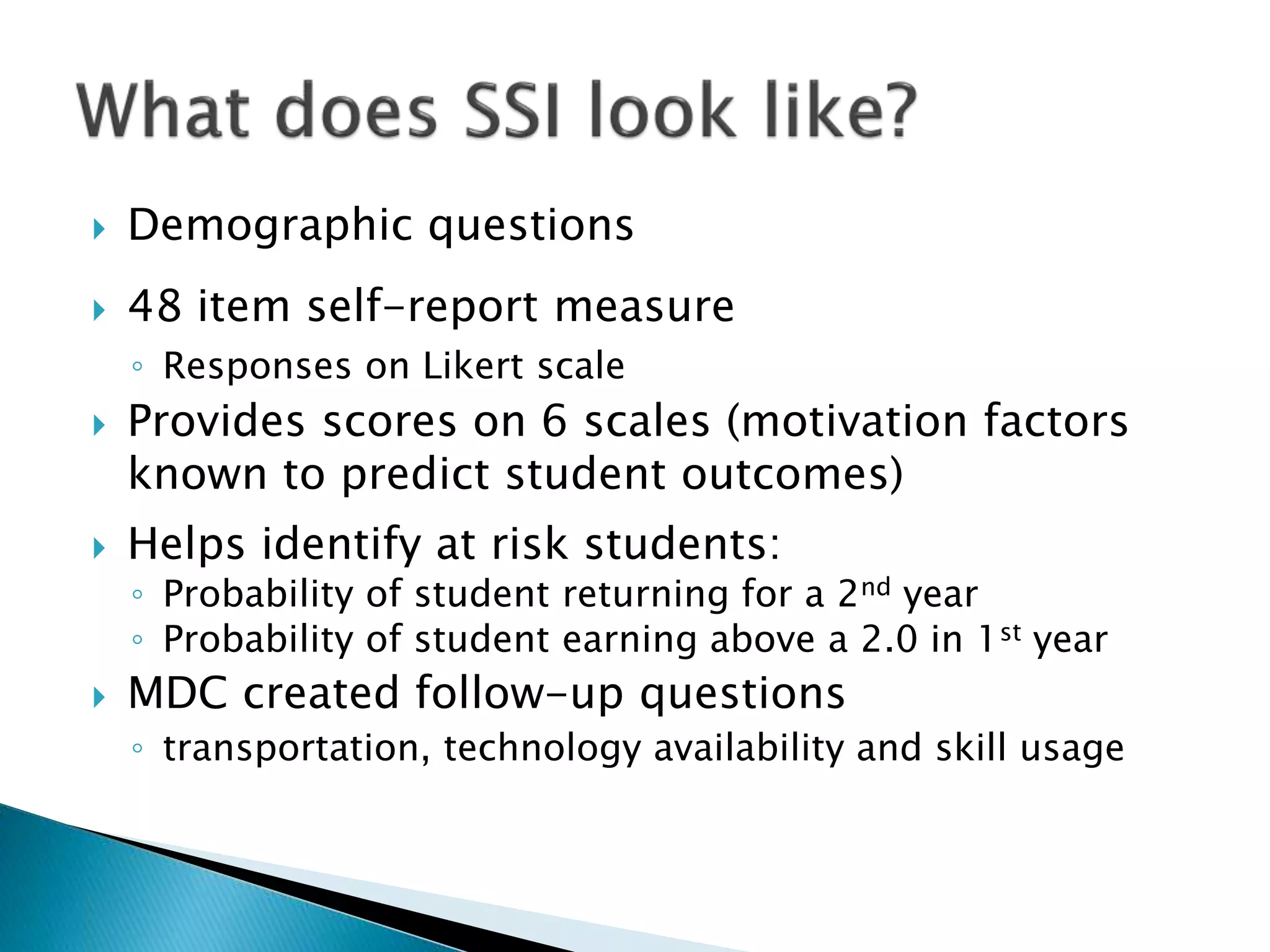
 Demographic questions
 48 item self-report measure
◦ Responses on Likert scale
 Provides scores on 6 scales (motivation factors
known to predict student outcomes)
 Helps identify at risk students:
◦ Probability of student returning for a 2nd year
◦ Probability of student earning above a 2.0 in 1st year
 MDC created follow-up questions
◦ transportation, technology availability and skill usage
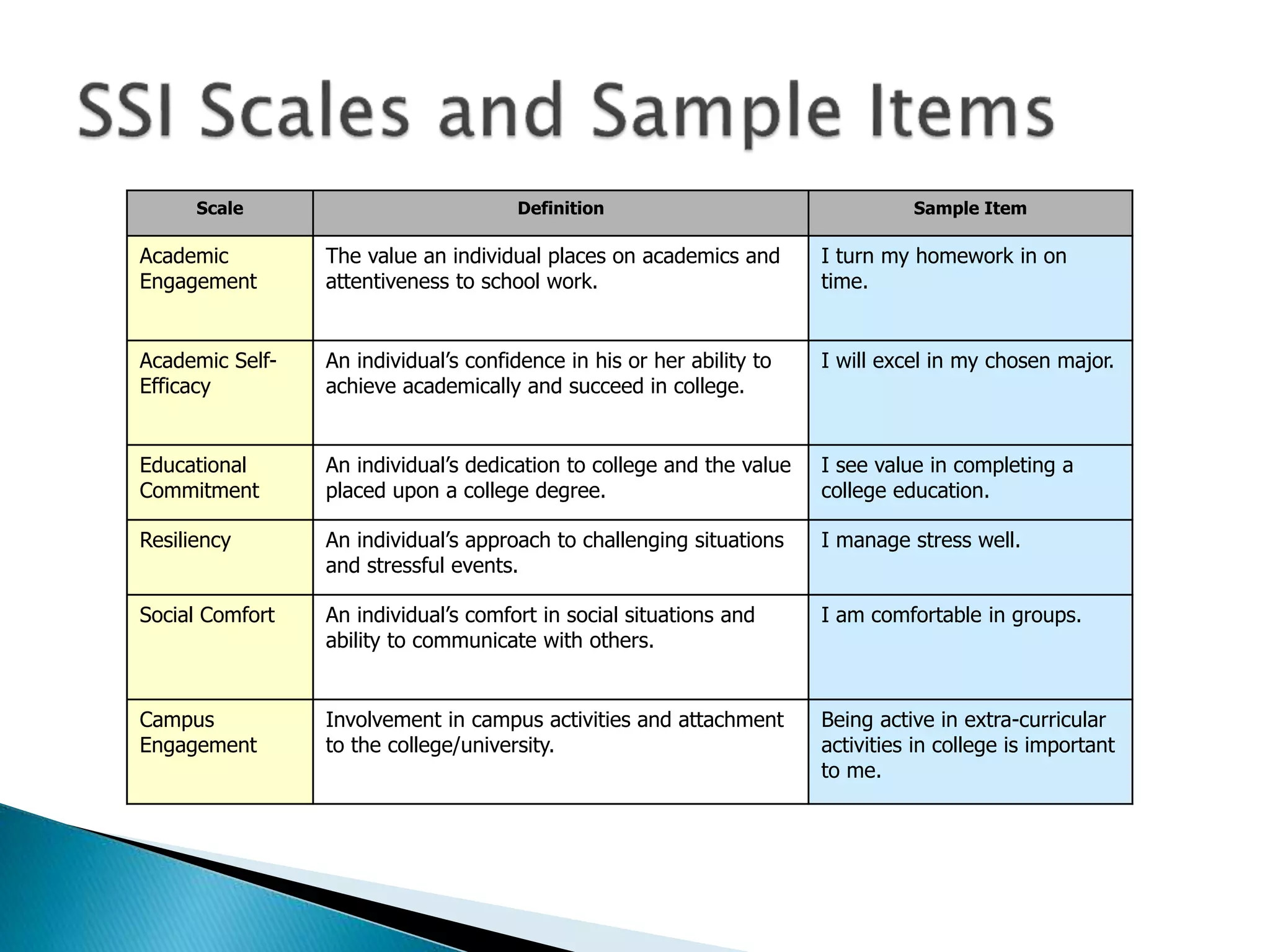
Scale Definition Sample Item
Academic
Engagement
The value an individual places on academics and
attentiveness to school work.
I turn my homework in on
time.
Academic Self-
Efficacy
An individual’s confidence in his or her ability to
achieve academically and succeed in college.
I will excel in my chosen major.
Educational
Commitment
An individual’s dedication to college and the value
placed upon a college degree.
I see value in completing a
college education.
Resiliency An individual’s approach to challenging situations
and stressful events.
I manage stress well.
Social Comfort An individual’s comfort in social situations and
ability to communicate with others.
I am comfortable in groups.
Campus
Engagement
Involvement in campus activities and attachment
to the college/university.
Being active in extra-curricular
activities in college is important
to me.
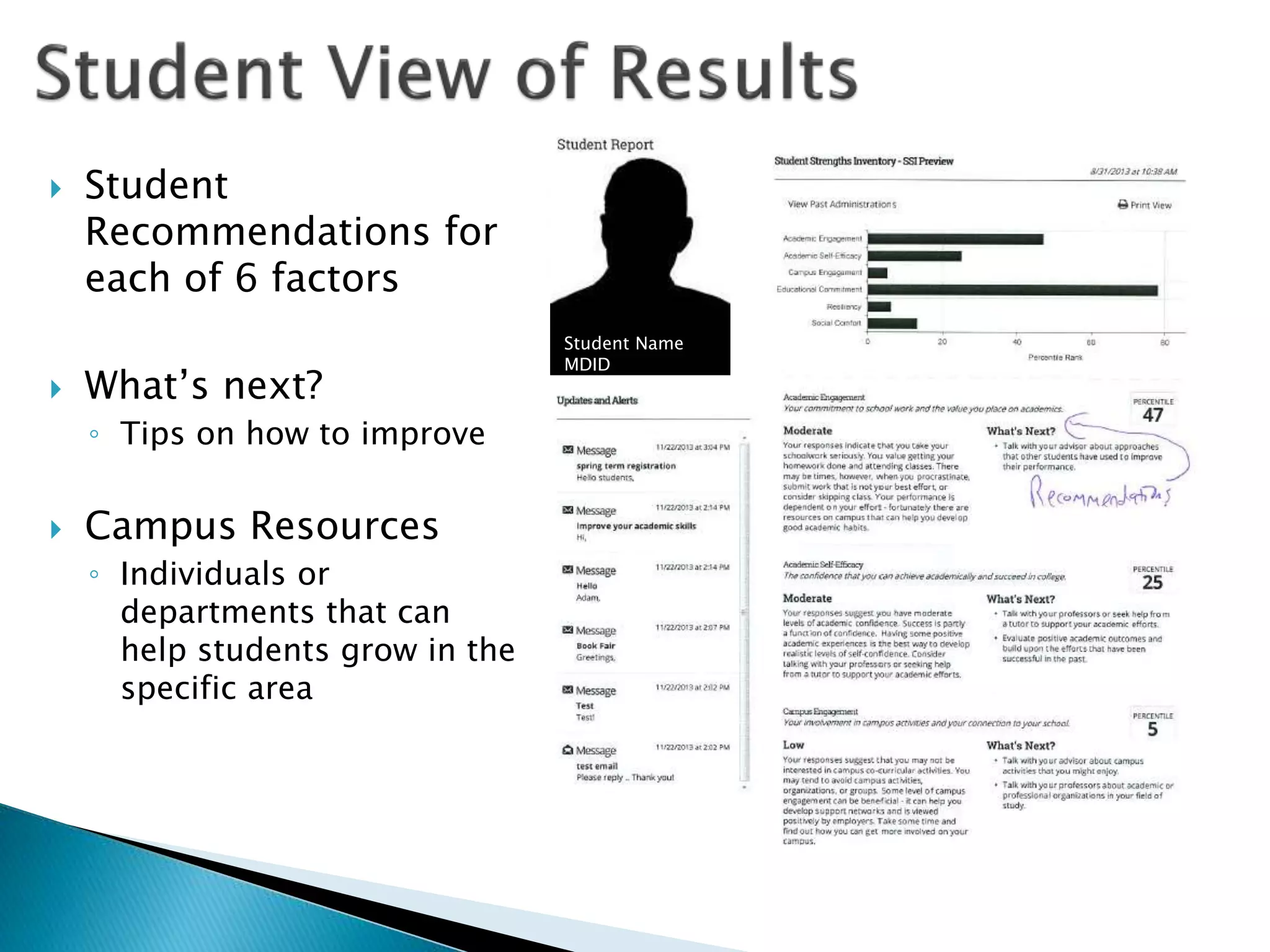
 Student
Recommendations for
each of 6 factors
 What’s next?
◦ Tips on how to improve
 Campus Resources
◦ Individuals or
departments that can
help students grow in the
specific area
Student Name
MDID
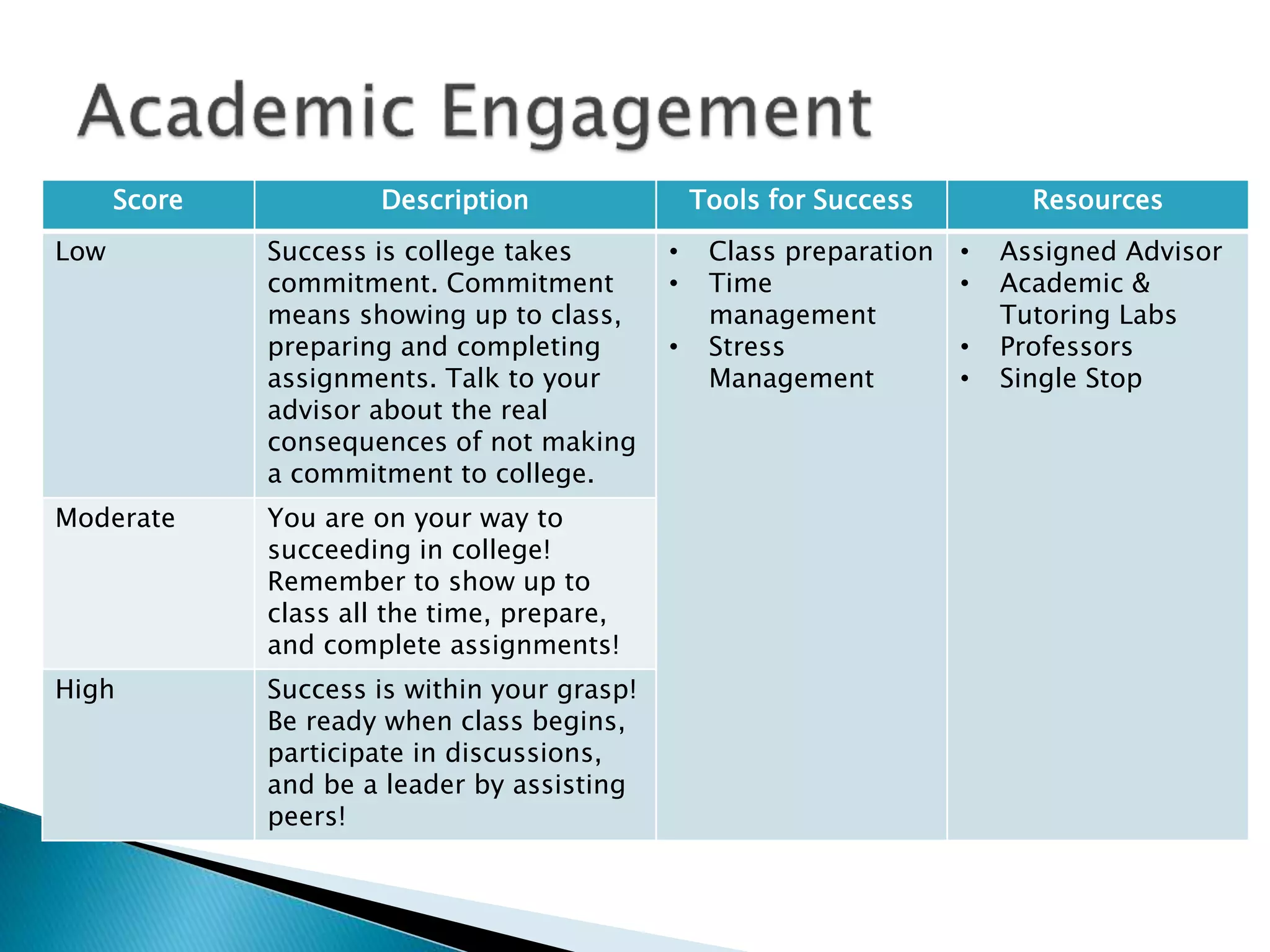
Score Description Tools for Success Resources
Low Success is college takes
commitment. Commitment
means showing up to class,
preparing and completing
assignments. Talk to your
advisor about the real
consequences of not making
a commitment to college.
• Class preparation
• Time
management
• Stress
Management
• Assigned Advisor
• Academic &
Tutoring Labs
• Professors
• Single Stop
Moderate You are on your way to
succeeding in college!
Remember to show up to
class all the time, prepare,
and complete assignments!
High Success is within your grasp!
Be ready when class begins,
participate in discussions,
and be a leader by assisting
peers!
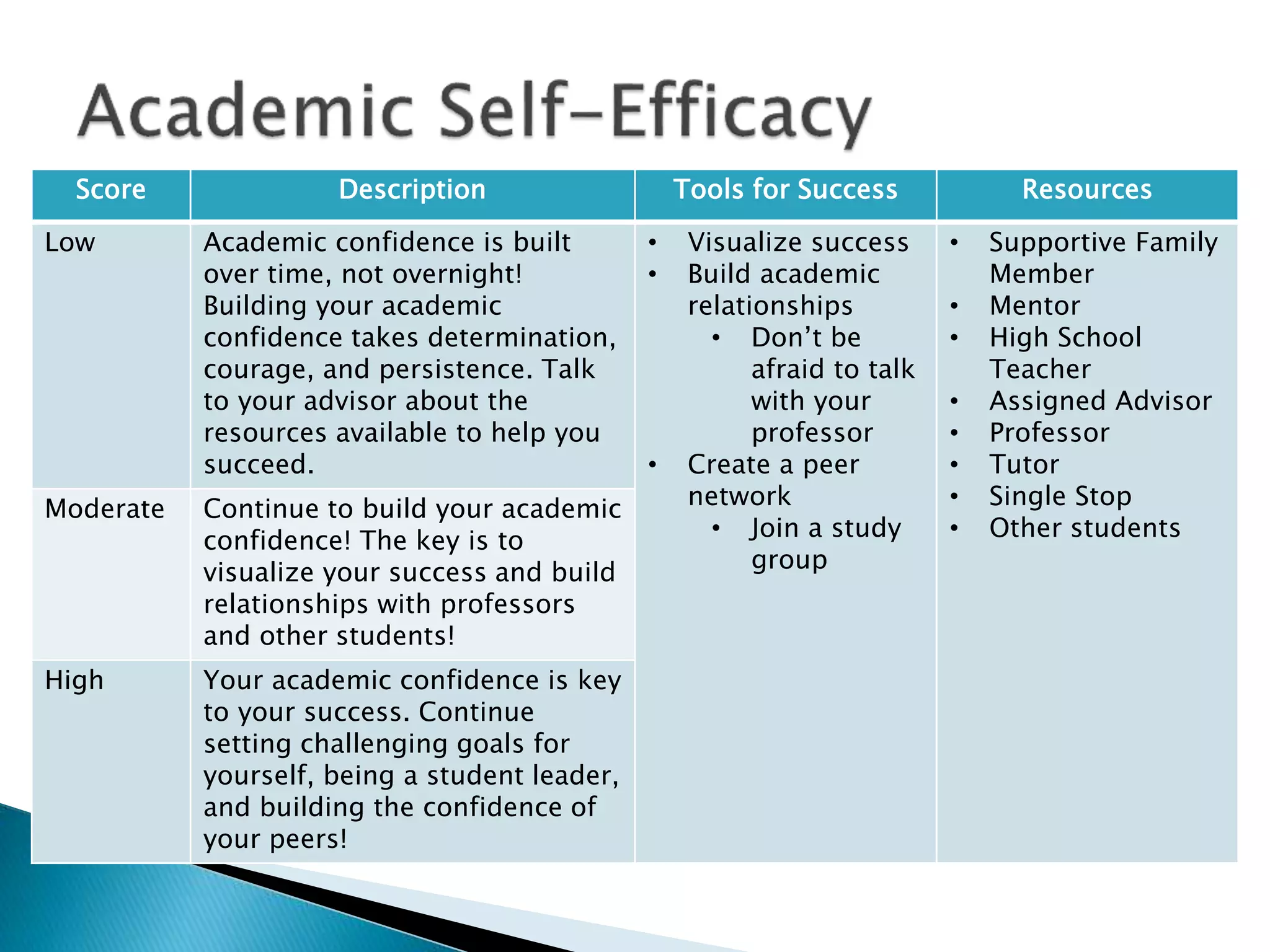
Score Description Tools for Success Resources
Low Academic confidence is built
over time, not overnight!
Building your academic
confidence takes determination,
courage, and persistence. Talk
to your advisor about the
resources available to help you
succeed.
• Visualize success
• Build academic
relationships
• Don’t be
afraid to talk
with your
professor
• Create a peer
network
• Join a study
group
• Supportive Family
Member
• Mentor
• High School
Teacher
• Assigned Advisor
• Professor
• Tutor
• Single Stop
• Other students
Moderate Continue to build your academic
confidence! The key is to
visualize your success and build
relationships with professors
and other students!
High Your academic confidence is key
to your success. Continue
setting challenging goals for
yourself, being a student leader,
and building the confidence of
your peers!
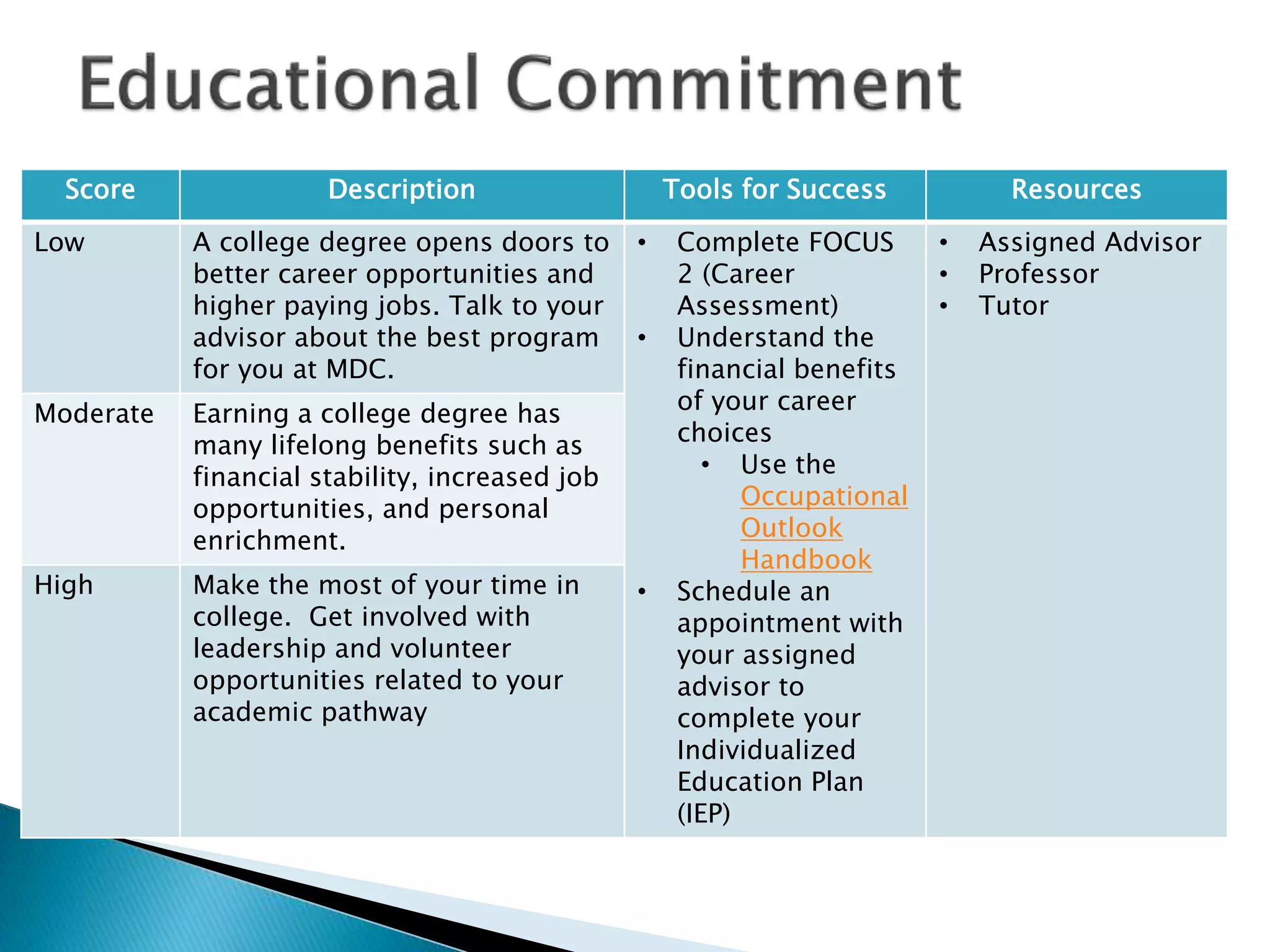
Score Description Tools for Success Resources
Low A college degree opens doors to
better career opportunities and
higher paying jobs. Talk to your
advisor about the best program
for you at MDC.
• Complete FOCUS
2 (Career
Assessment)
• Understand the
financial benefits
of your career
choices
• Use the
Occupational
Outlook
Handbook
• Schedule an
appointment with
your assigned
advisor to
complete your
Individualized
Education Plan
(IEP)
• Assigned Advisor
• Professor
• Tutor
Moderate Earning a college degree has
many lifelong benefits such as
financial stability, increased job
opportunities, and personal
enrichment.
High Make the most of your time in
college. Get involved with
leadership and volunteer
opportunities related to your
academic pathway
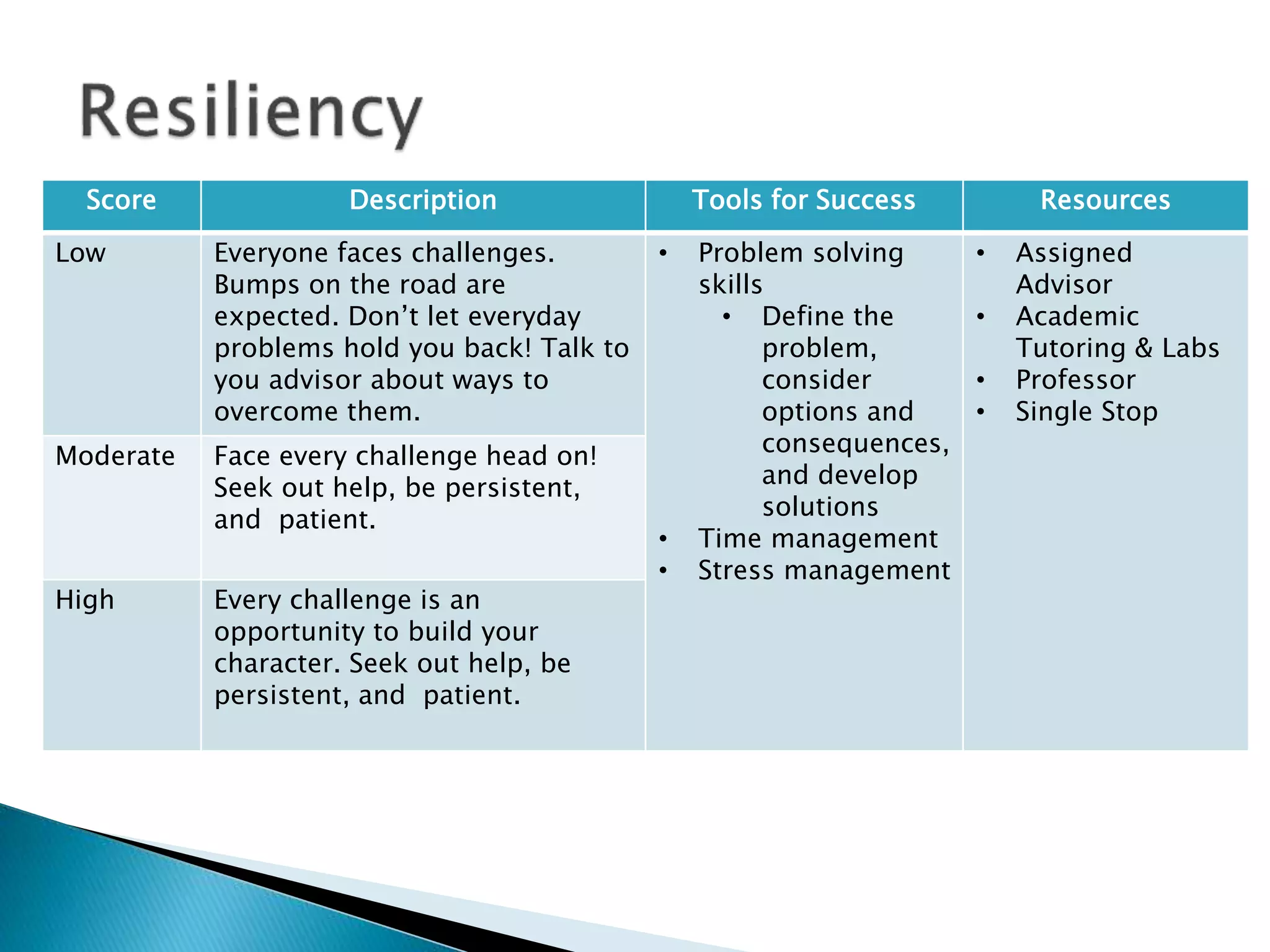
Score Description Tools for Success Resources
Low Everyone faces challenges.
Bumps on the road are
expected. Don’t let everyday
problems hold you back! Talk to
you advisor about ways to
overcome them.
• Problem solving
skills
• Define the
problem,
consider
options and
consequences,
and develop
solutions
• Time management
• Stress management
• Assigned
Advisor
• Academic
Tutoring & Labs
• Professor
• Single Stop
Moderate Face every challenge head on!
Seek out help, be persistent,
and patient.
High Every challenge is an
opportunity to build your
character. Seek out help, be
persistent, and patient.
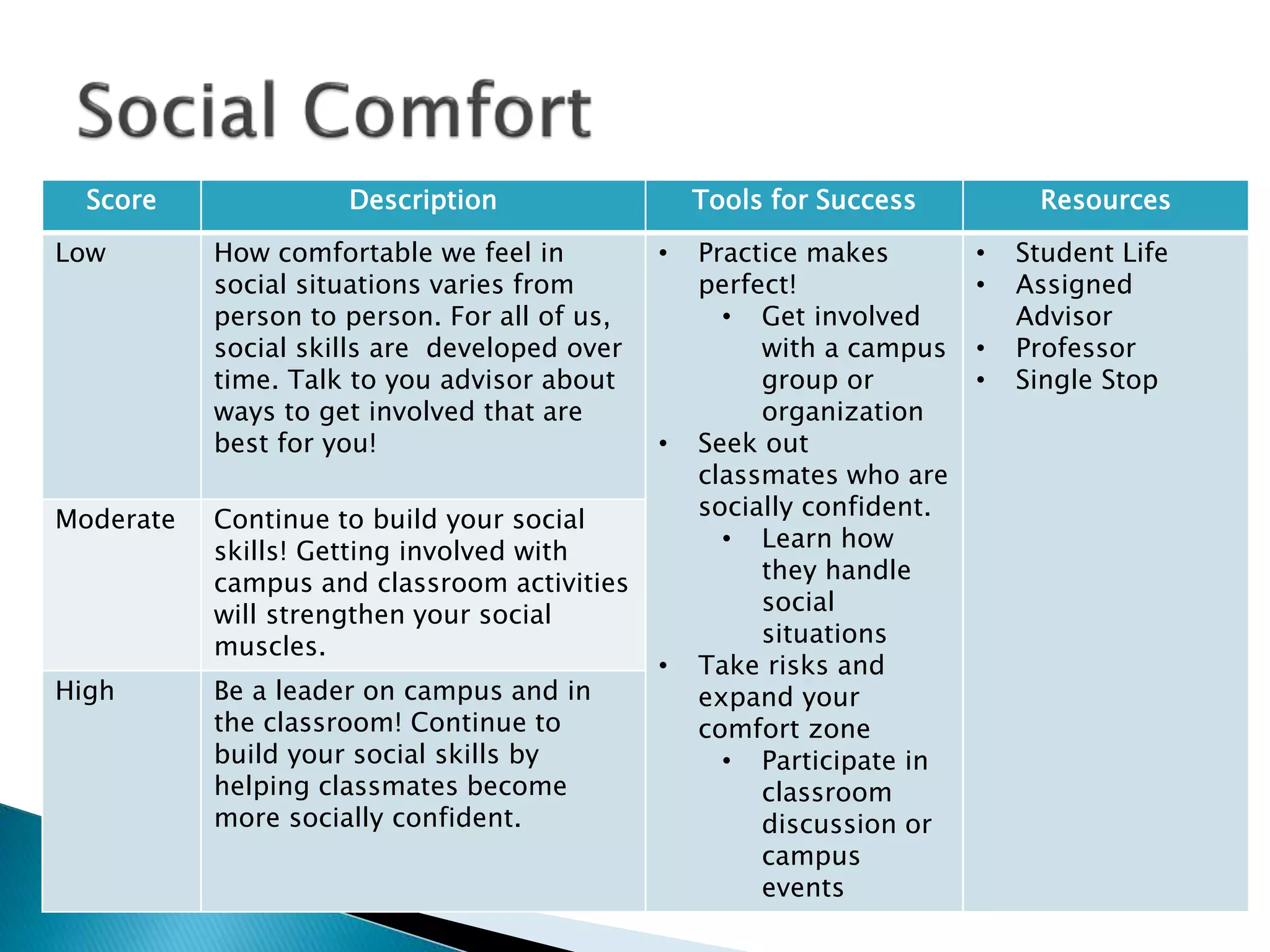
Score Description Tools for Success Resources
Low How comfortable we feel in
social situations varies from
person to person. For all of us,
social skills are developed over
time. Talk to you advisor about
ways to get involved that are
best for you!
• Practice makes
perfect!
• Get involved
with a campus
group or
organization
• Seek out
classmates who are
socially confident.
• Learn how
they handle
social
situations
• Take risks and
expand your
comfort zone
• Participate in
classroom
discussion or
campus
events
• Student Life
• Assigned
Advisor
• Professor
• Single Stop
Moderate Continue to build your social
skills! Getting involved with
campus and classroom activities
will strengthen your social
muscles.
High Be a leader on campus and in
the classroom! Continue to
build your social skills by
helping classmates become
more socially confident.
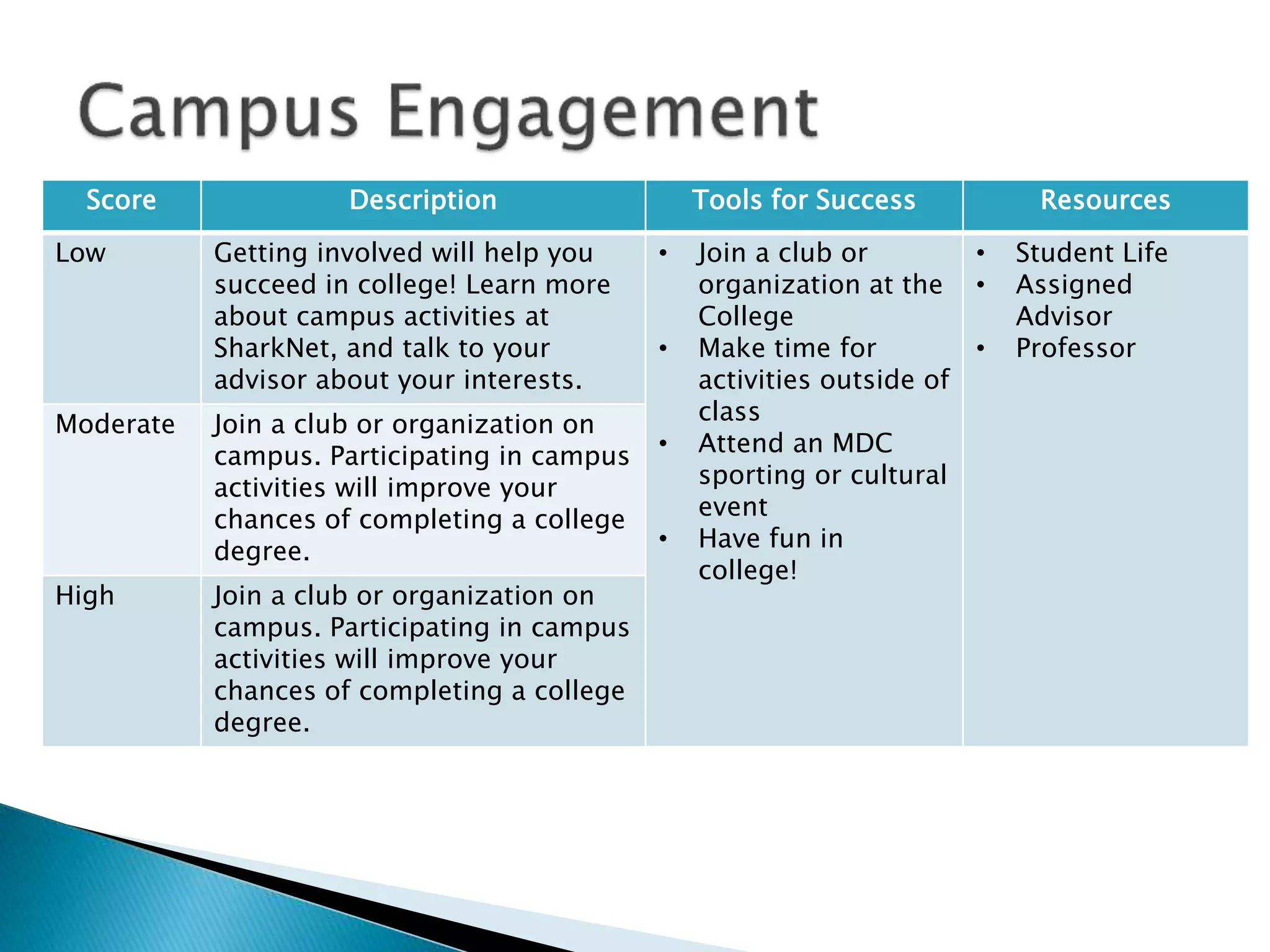
Score Description Tools for Success Resources
Low Getting involved will help you
succeed in college! Learn more
about campus activities at
SharkNet, and talk to your
advisor about your interests.
• Join a club or
organization at the
College
• Make time for
activities outside of
class
• Attend an MDC
sporting or cultural
event
• Have fun in
college!
• Student Life
• Assigned
Advisor
• Professor
Moderate Join a club or organization on
campus. Participating in campus
activities will improve your
chances of completing a college
degree.
High Join a club or organization on
campus. Participating in campus
activities will improve your
chances of completing a college
degree.
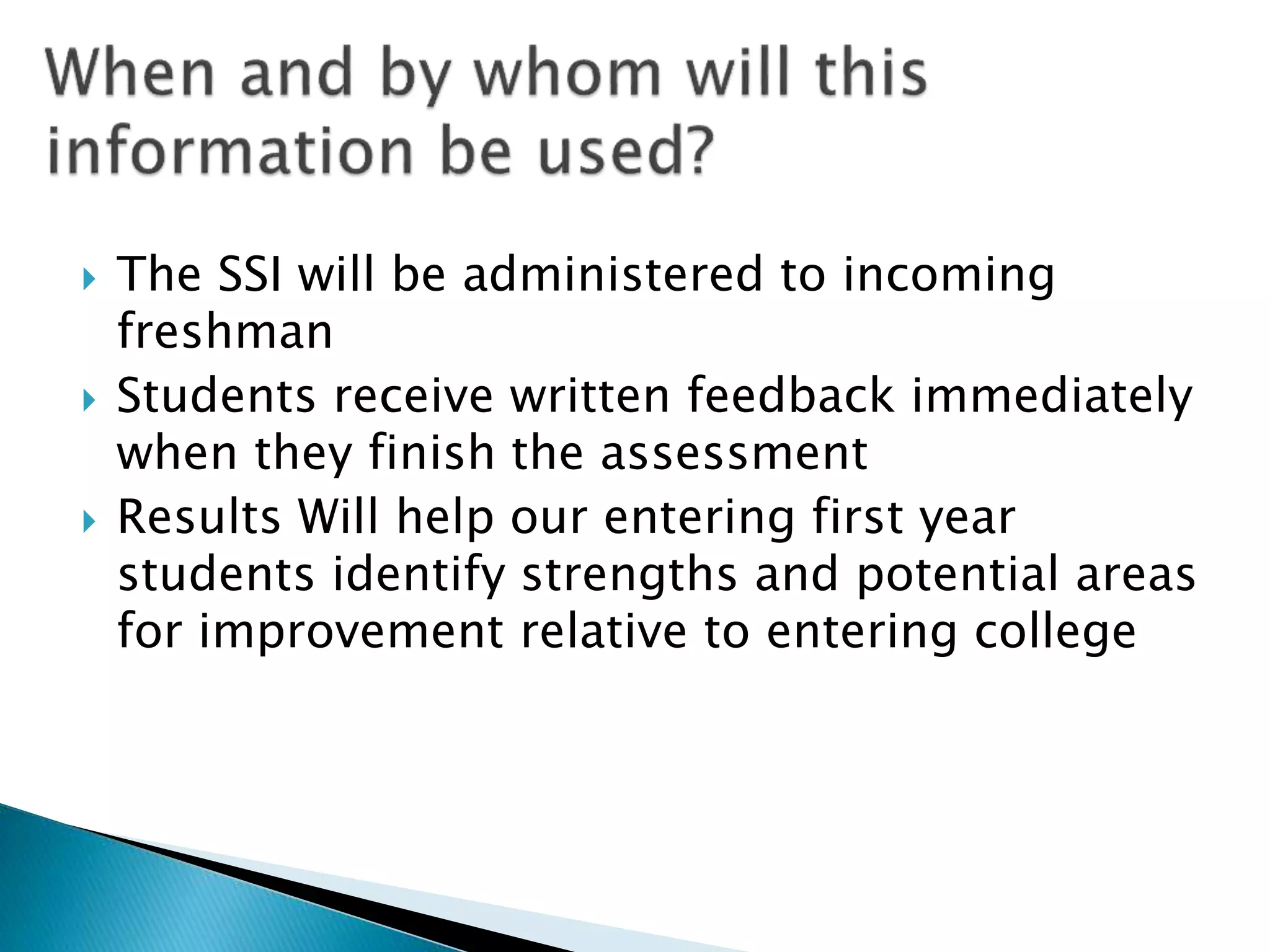
 The SSI will be administered to incoming
freshman
 Students receive written feedback immediately
when they finish the assessment
 Results Will help our entering first year
students identify strengths and potential areas
for improvement relative to entering college
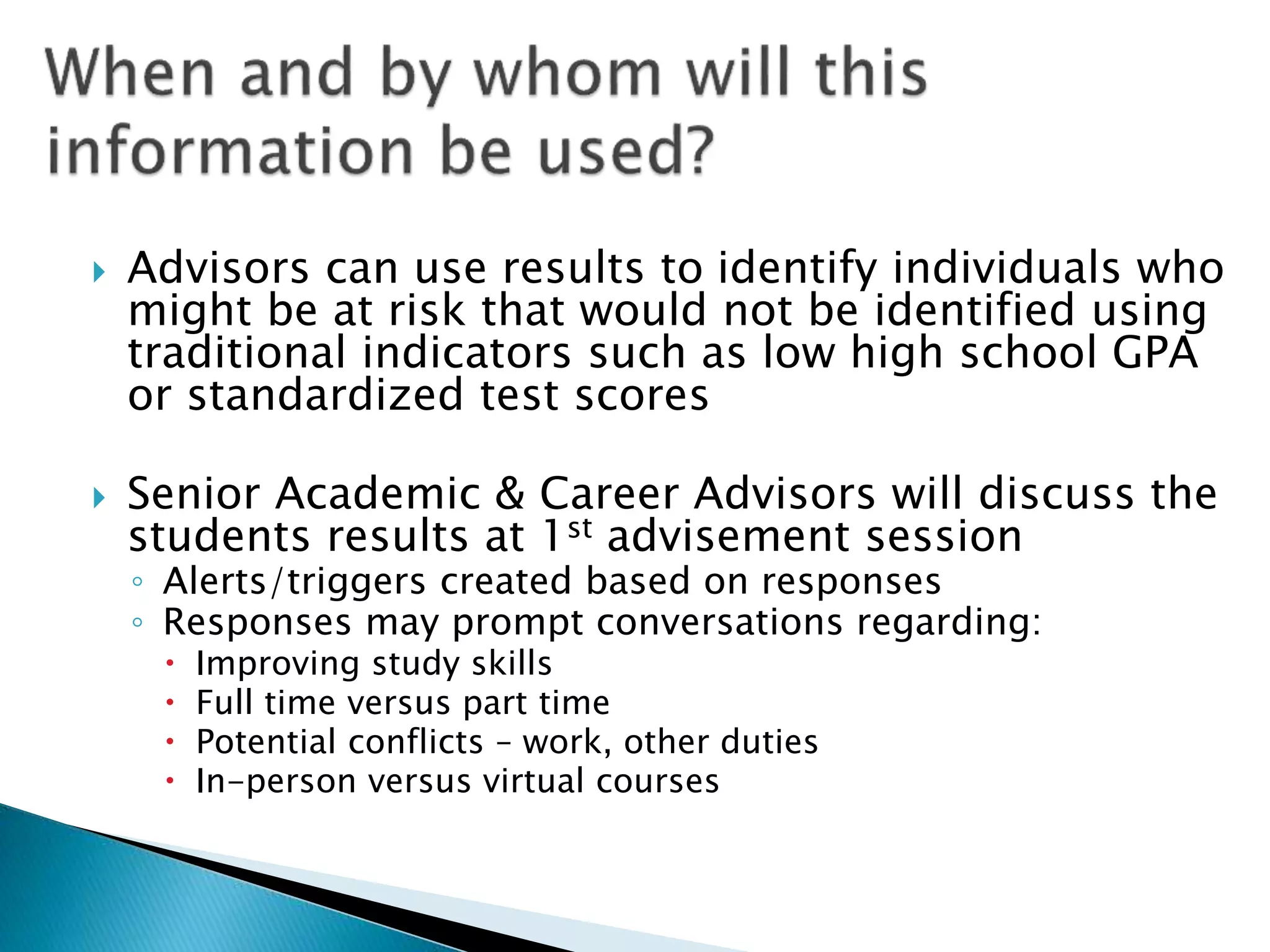
 Advisors can use results to identify individuals who
might be at risk that would not be identified using
traditional indicators such as low high school GPA
or standardized test scores
 Senior Academic & Career Advisors will discuss the
students results at 1st advisement session
◦ Alerts/triggers created based on responses
◦ Responses may prompt conversations regarding:
 Improving study skills
 Full time versus part time
 Potential conflicts – work, other duties
 In-person versus virtual courses
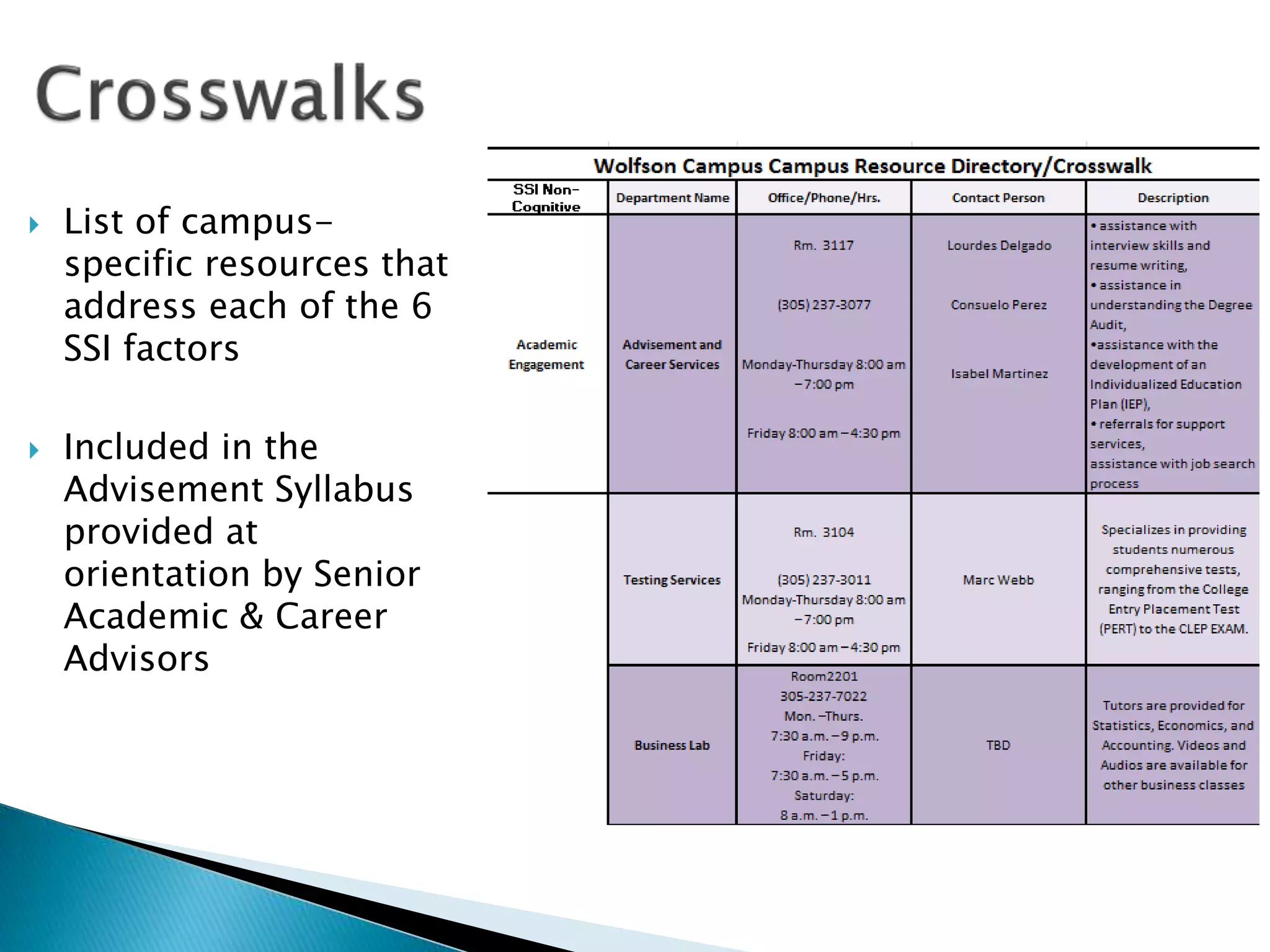
 List of campus-
specific resources that
address each of the 6
SSI factors
 Included in the
Advisement Syllabus
provided at
orientation by Senior
Academic & Career
Advisors
MDC SSI Final

MDC SSI Final

  • 1.
    Julio Fernandez deCueto Director of Testing Interamerican Campus Anaeli Ramos Senior Academic & Career Advisor Homestead Campus
  • 2.
     Assessment designedto help two and four- year college and universities develop data-driven evidence-based student success solutions  A non-cognitive instrument
  • 3.
     Influence theoverall behavior of an individual  Not easily measured  Predictive of future success  Examples: ◦ Emotional maturity ◦ Empathy ◦ Interpersonal skills ◦ Study skills ◦ Verbal and non-verbal communication
  • 4.
     180 itemsversus 48  Completed study comparing predictive ability of SSI with previously used ENGAGE  80 students took both assessments  After 1 semester ENGAGE and SSI were very similar in ability to identify high risk students
  • 5.
    SSI Predicted tohave at least 2.0 62 Predicted correctly to have at least 2.0 57 Predicted incorrectly to have 2.0 5 SSI Predicted to not have at least 2.0 15 Predicted correctly to not have 2.0 1 Predicted incorrectly to not have 2.0 14 SSI Predicted to be retained 76 Predicted correctly to be retained 76 Predicted incorrectly to be retained 0 SSI Predicted to not be retained 1 Predicted correctly to not be retained 0 Predicted incorrectly to not be retained 1 • Results are used conservatively to reduce false positives
  • 6.
     Provides aholistic view on the student ◦ Combined with high school and testing information  Provides immediate feedback to the student on areas they may be struggling (or might struggle with)  Additional information for advisors Student Success Academic Motivation Engagement Resiliency
  • 7.
     Demographic questions 48 item self-report measure ◦ Responses on Likert scale  Provides scores on 6 scales (motivation factors known to predict student outcomes)  Helps identify at risk students: ◦ Probability of student returning for a 2nd year ◦ Probability of student earning above a 2.0 in 1st year  MDC created follow-up questions ◦ transportation, technology availability and skill usage
  • 8.
    Scale Definition SampleItem Academic Engagement The value an individual places on academics and attentiveness to school work. I turn my homework in on time. Academic Self- Efficacy An individual’s confidence in his or her ability to achieve academically and succeed in college. I will excel in my chosen major. Educational Commitment An individual’s dedication to college and the value placed upon a college degree. I see value in completing a college education. Resiliency An individual’s approach to challenging situations and stressful events. I manage stress well. Social Comfort An individual’s comfort in social situations and ability to communicate with others. I am comfortable in groups. Campus Engagement Involvement in campus activities and attachment to the college/university. Being active in extra-curricular activities in college is important to me.
  • 9.
     Student Recommendations for eachof 6 factors  What’s next? ◦ Tips on how to improve  Campus Resources ◦ Individuals or departments that can help students grow in the specific area Student Name MDID
  • 10.
    Score Description Toolsfor Success Resources Low Success is college takes commitment. Commitment means showing up to class, preparing and completing assignments. Talk to your advisor about the real consequences of not making a commitment to college. • Class preparation • Time management • Stress Management • Assigned Advisor • Academic & Tutoring Labs • Professors • Single Stop Moderate You are on your way to succeeding in college! Remember to show up to class all the time, prepare, and complete assignments! High Success is within your grasp! Be ready when class begins, participate in discussions, and be a leader by assisting peers!
  • 11.
    Score Description Toolsfor Success Resources Low Academic confidence is built over time, not overnight! Building your academic confidence takes determination, courage, and persistence. Talk to your advisor about the resources available to help you succeed. • Visualize success • Build academic relationships • Don’t be afraid to talk with your professor • Create a peer network • Join a study group • Supportive Family Member • Mentor • High School Teacher • Assigned Advisor • Professor • Tutor • Single Stop • Other students Moderate Continue to build your academic confidence! The key is to visualize your success and build relationships with professors and other students! High Your academic confidence is key to your success. Continue setting challenging goals for yourself, being a student leader, and building the confidence of your peers!
  • 12.
    Score Description Toolsfor Success Resources Low A college degree opens doors to better career opportunities and higher paying jobs. Talk to your advisor about the best program for you at MDC. • Complete FOCUS 2 (Career Assessment) • Understand the financial benefits of your career choices • Use the Occupational Outlook Handbook • Schedule an appointment with your assigned advisor to complete your Individualized Education Plan (IEP) • Assigned Advisor • Professor • Tutor Moderate Earning a college degree has many lifelong benefits such as financial stability, increased job opportunities, and personal enrichment. High Make the most of your time in college. Get involved with leadership and volunteer opportunities related to your academic pathway
  • 13.
    Score Description Toolsfor Success Resources Low Everyone faces challenges. Bumps on the road are expected. Don’t let everyday problems hold you back! Talk to you advisor about ways to overcome them. • Problem solving skills • Define the problem, consider options and consequences, and develop solutions • Time management • Stress management • Assigned Advisor • Academic Tutoring & Labs • Professor • Single Stop Moderate Face every challenge head on! Seek out help, be persistent, and patient. High Every challenge is an opportunity to build your character. Seek out help, be persistent, and patient.
  • 14.
    Score Description Toolsfor Success Resources Low How comfortable we feel in social situations varies from person to person. For all of us, social skills are developed over time. Talk to you advisor about ways to get involved that are best for you! • Practice makes perfect! • Get involved with a campus group or organization • Seek out classmates who are socially confident. • Learn how they handle social situations • Take risks and expand your comfort zone • Participate in classroom discussion or campus events • Student Life • Assigned Advisor • Professor • Single Stop Moderate Continue to build your social skills! Getting involved with campus and classroom activities will strengthen your social muscles. High Be a leader on campus and in the classroom! Continue to build your social skills by helping classmates become more socially confident.
  • 15.
    Score Description Toolsfor Success Resources Low Getting involved will help you succeed in college! Learn more about campus activities at SharkNet, and talk to your advisor about your interests. • Join a club or organization at the College • Make time for activities outside of class • Attend an MDC sporting or cultural event • Have fun in college! • Student Life • Assigned Advisor • Professor Moderate Join a club or organization on campus. Participating in campus activities will improve your chances of completing a college degree. High Join a club or organization on campus. Participating in campus activities will improve your chances of completing a college degree.
  • 16.
     The SSIwill be administered to incoming freshman  Students receive written feedback immediately when they finish the assessment  Results Will help our entering first year students identify strengths and potential areas for improvement relative to entering college
  • 17.
     Advisors canuse results to identify individuals who might be at risk that would not be identified using traditional indicators such as low high school GPA or standardized test scores  Senior Academic & Career Advisors will discuss the students results at 1st advisement session ◦ Alerts/triggers created based on responses ◦ Responses may prompt conversations regarding:  Improving study skills  Full time versus part time  Potential conflicts – work, other duties  In-person versus virtual courses
  • 18.
     List ofcampus- specific resources that address each of the 6 SSI factors  Included in the Advisement Syllabus provided at orientation by Senior Academic & Career Advisors

Editor's Notes

  • #5 At risk information is only available to the advisors not students
  • #6 At risk information is only available to the advisors not students
  • #7 At risk information is only available to the advisors not students
  • #17 At risk information is only available to the advisors not students
  • #18 At risk information is only available to the advisors not students
  • #19 At risk information is only available to the advisors not students