






Patrick Christell
October 22, 2019
MASTER TECHNICAL
RECRUITING WORKSHOP:
How to Recruit Top Tech
Talent
The Plan
HOUSEKEEPING
You are in Listen-Only Mode.
You can hear us, but we can’t hear you.
ASK QUESTIONS
Don’t be shy!
Use the Questions Panel in your side bar to talk to
Patrick.
SHARE
We’re LIVE.
Use the #rdaily hashtag to share on social media.
WE’RE RECORDING
You will receive a copy of this slide deck & recording
after the webinar.
Keep an eye on your inbox.
Patrick Christell
Senior Sourcer, Hire4ce
I build teams.
Expert-level Sourcer with a demonstrated history of deploying Agile
sourcing methodology with the end result of transforming companies.
Particular expertise in shepherding startups to the SME level. Skilled in
Passive Candidate Generation, Proactive Pipeline Building, Digital
Copywriting, Recruiting, Bleeding edge tools, techniques and
methodologies, OSINT, Psychometrics.
If your company needs to scale fast and sustainably, or you've got that
open job req that you can't seem to fill, drop me a line at
patrick.christell@hire4ce.com.
MASTER TECHNICAL
RECRUITING WORKSHOP:
How To Recruit Top Tech
Talent
BY: Patrick Christell
Hire4ce
In this webinar, you will learn…
• How to spin up a sourcing function from nothing
• How to find qualified tech candidates even if you have zero background on the role/aren’t
a techie
• Tools, extensions and processes that I use
• How to create and utilize an ad hoc CRM
• How to implement continuous improvement
• How to engage candidates in 2019
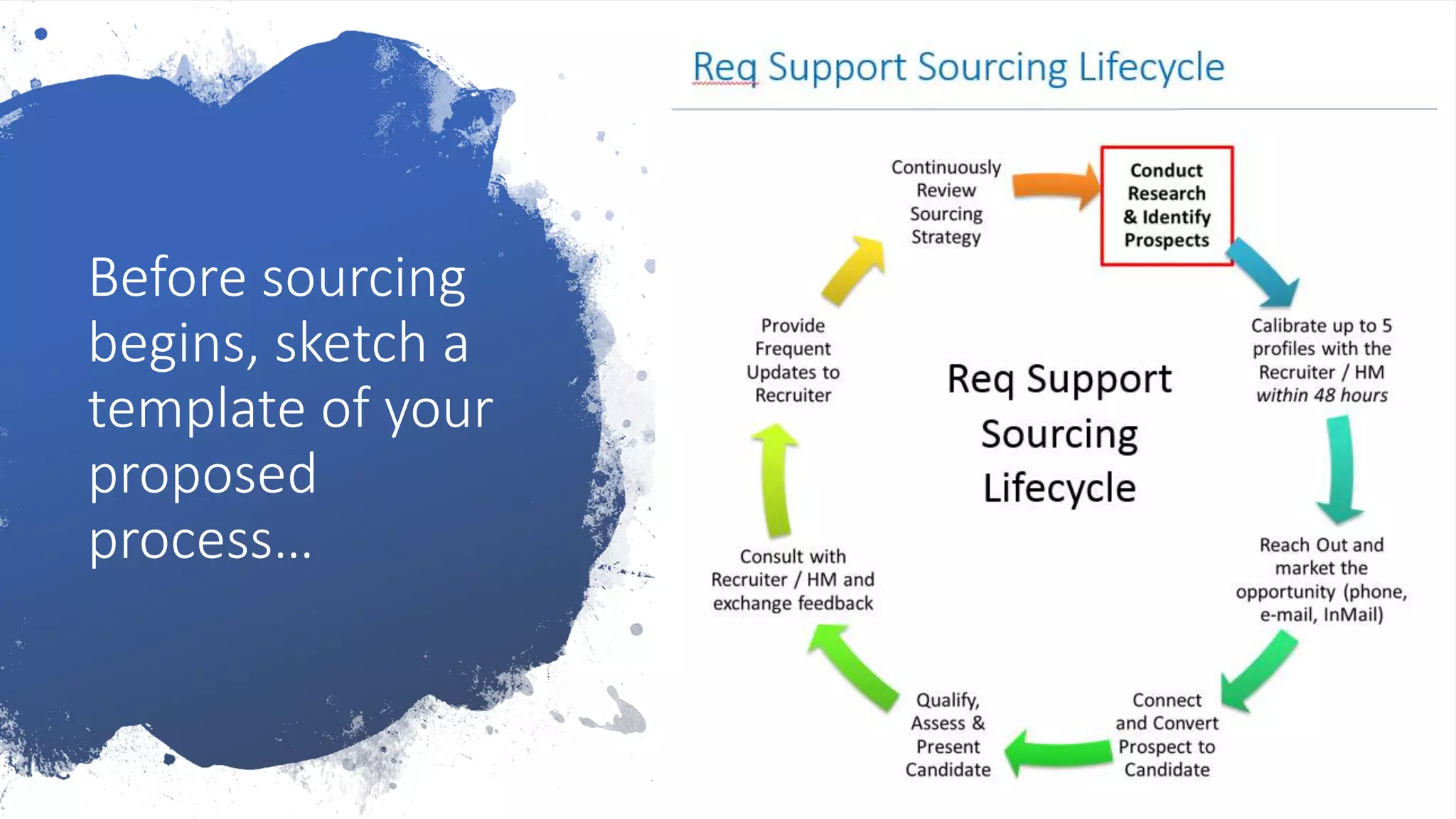
Before sourcing
begins, sketch a
template of your
proposed
process…
Understand what your hiring manager wants…
• An in-depth, PROBING intake meeting is necessary for each new or unique requisition
• Sometimes this is tough to achieve, especially after hiring managers have been burned by lazy
recruiters/bloated processes – get a sense of what it will take to get them back “on side”
• The answer… ADD VALUE!
• Conduct pre-search and bring profiles to the meeting
• Remember… you are a GUARDIAN OF THE HIRING MANAGER’S TIME. Make sure to
communicate that you understand this. It will probably seem like a breath of fresh air
• If you are totally unfamiliar with the role and what the candidates are ACTUALLY doing…
RESEARCH!
• Sit with the developers if you can. This bestows an understanding of CULTURE FIT
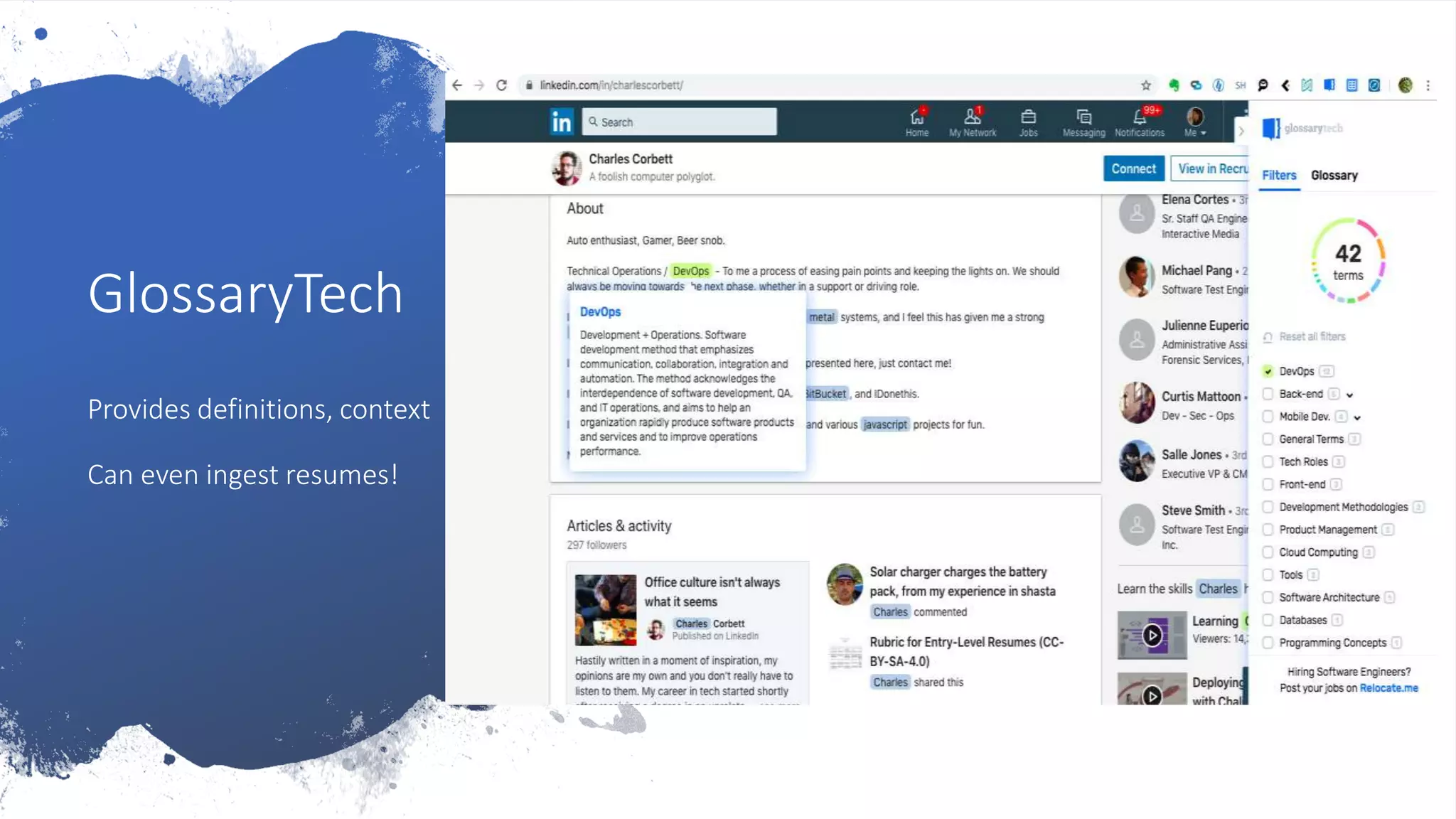
GlossaryTech
Provides definitions, context
Can even ingest resumes!
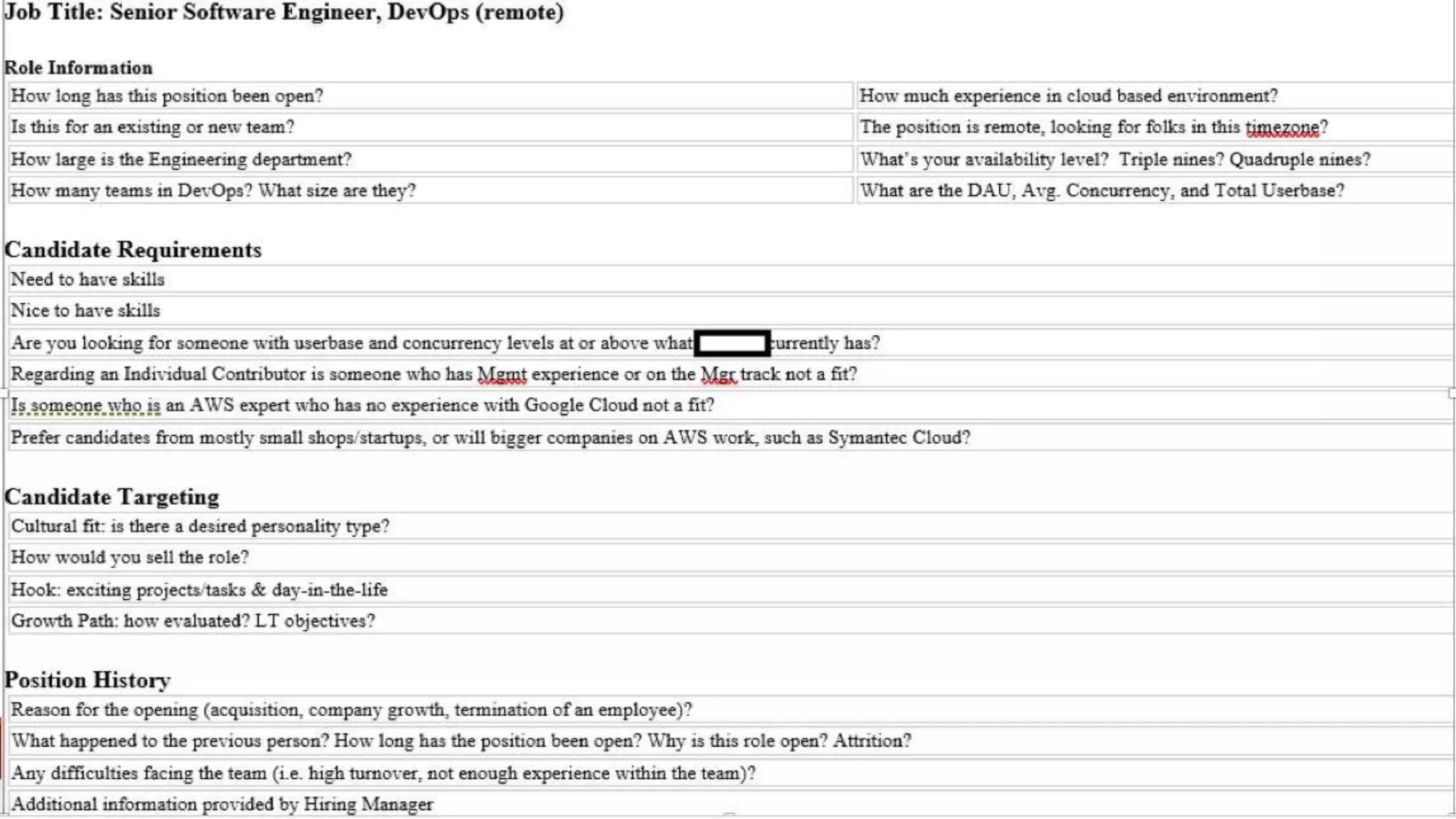
From there, craft a
role-specific intake…
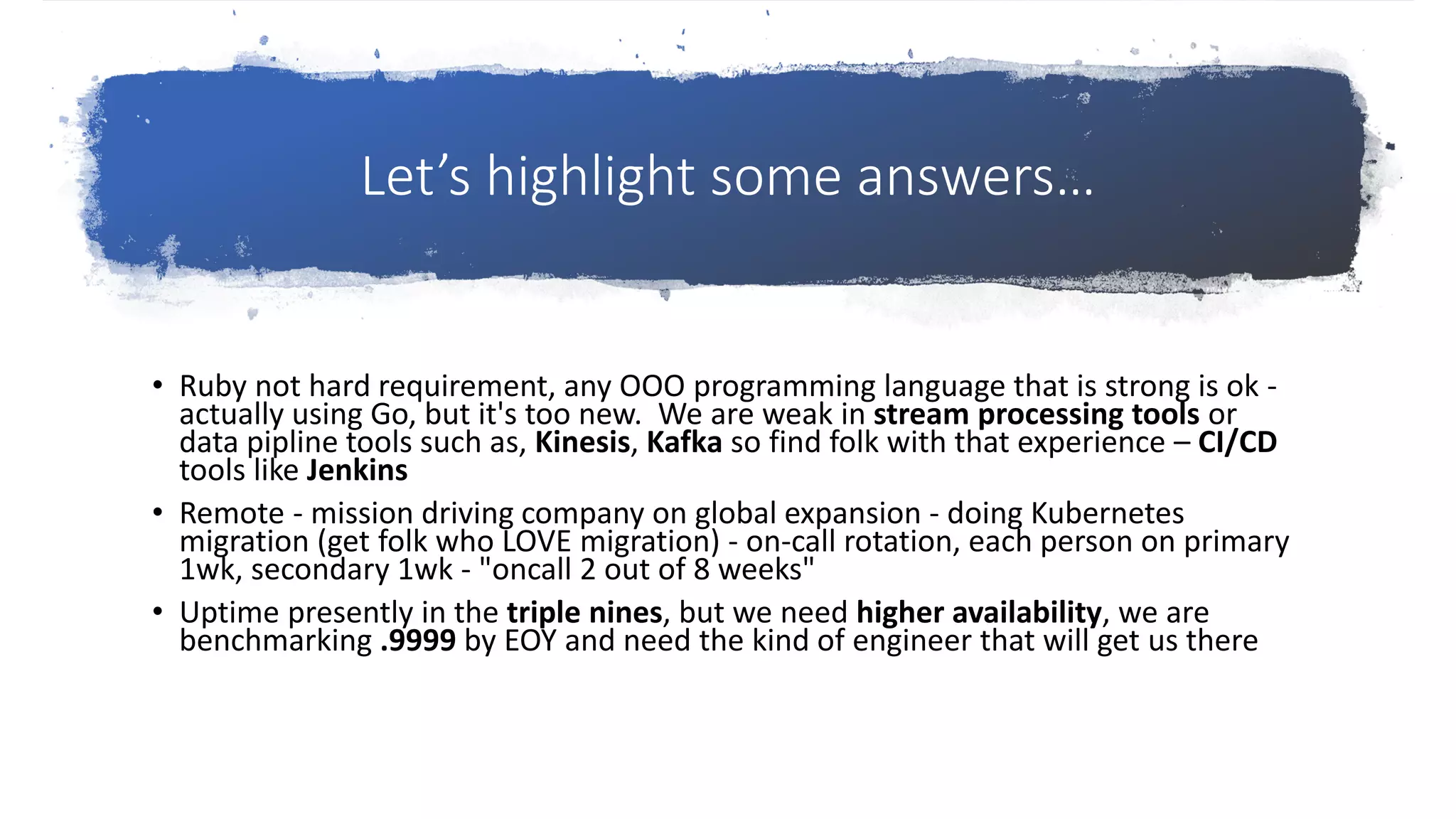
Let’s highlight some answers…
• Ruby not hard requirement, any OOO programming language that is strong is ok -
actually using Go, but it's too new. We are weak in stream processing tools or
data pipline tools such as, Kinesis, Kafka so find folk with that experience – CI/CD
tools like Jenkins
• Remote - mission driving company on global expansion - doing Kubernetes
migration (get folk who LOVE migration) - on-call rotation, each person on primary
1wk, secondary 1wk - "oncall 2 out of 8 weeks"
• Uptime presently in the triple nines, but we need higher availability, we are
benchmarking .9999 by EOY and need the kind of engineer that will get us there
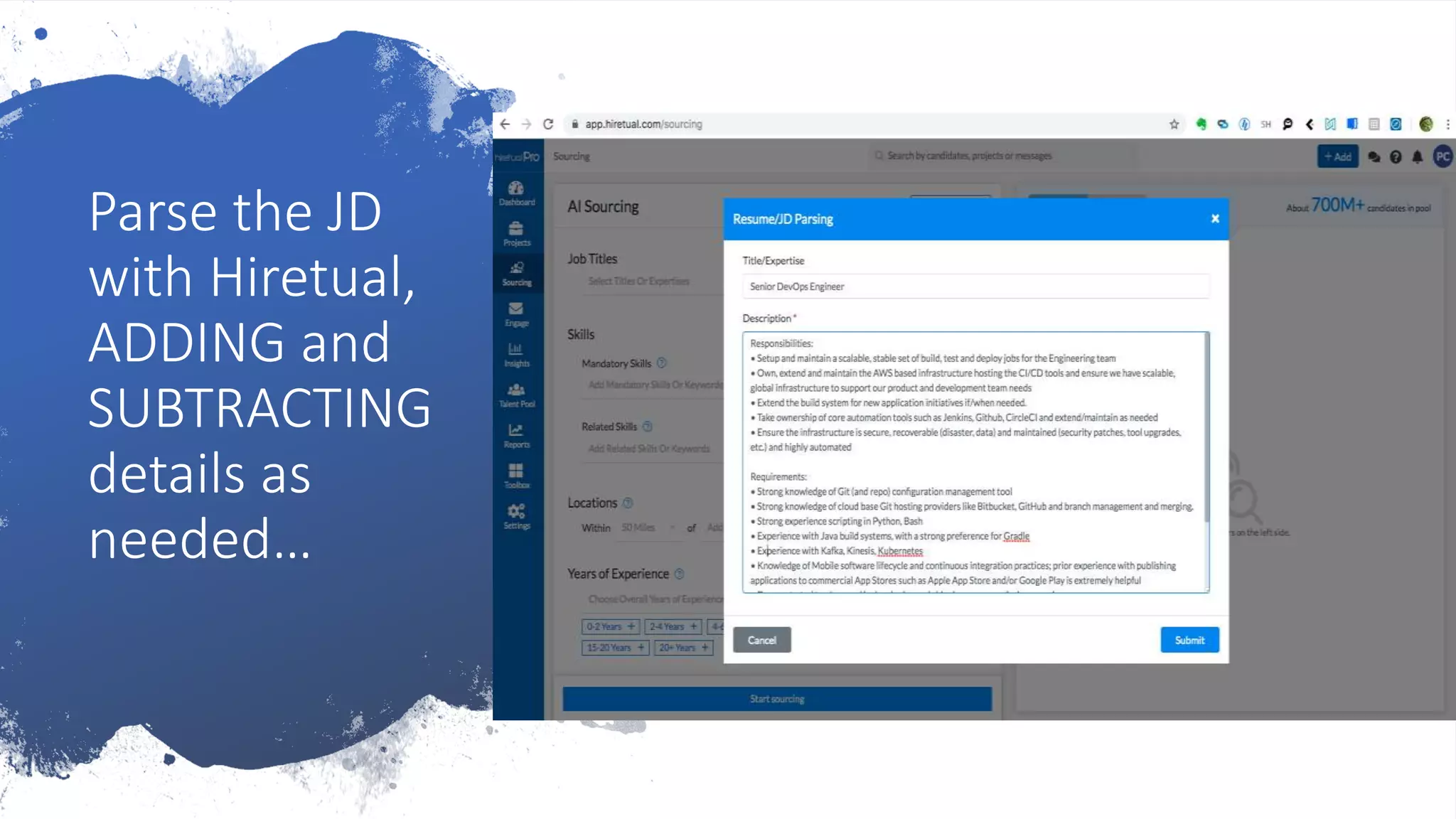
Parse the JD
with Hiretual,
ADDING and
SUBTRACTING
details as
needed…
• Sdfsdf
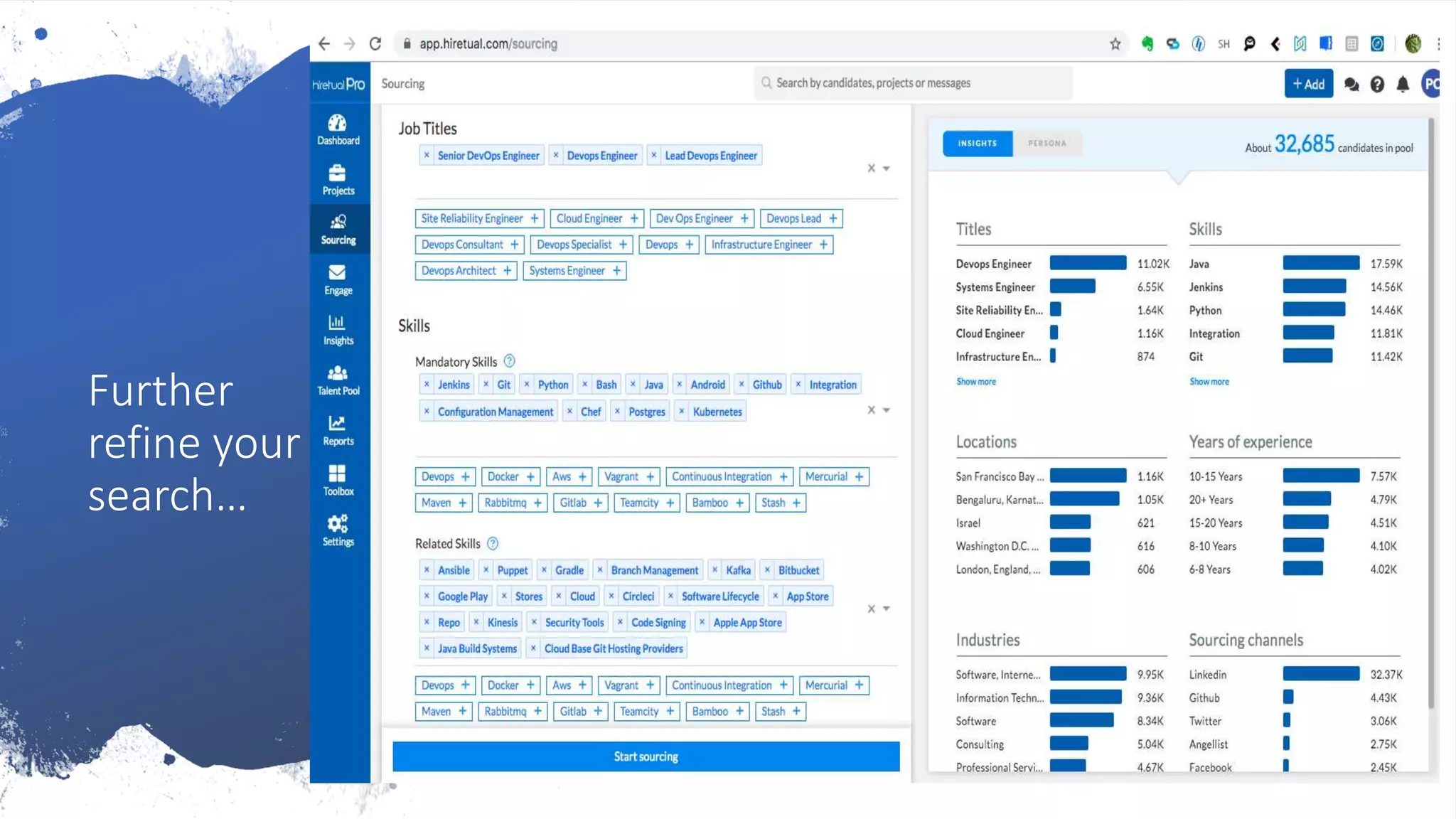
Further
refine your
search…
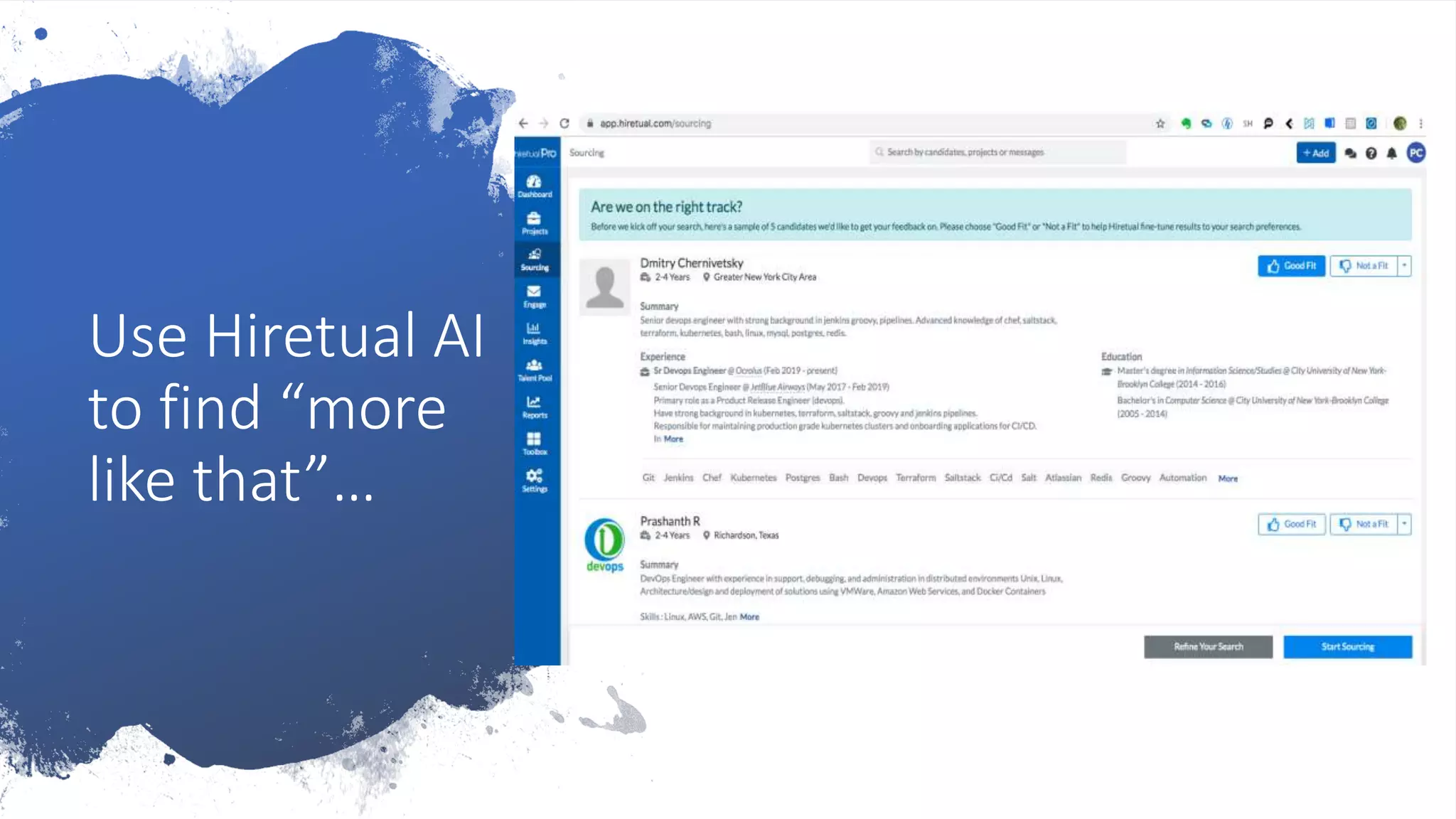
Use Hiretual AI
to find “more
like that”…
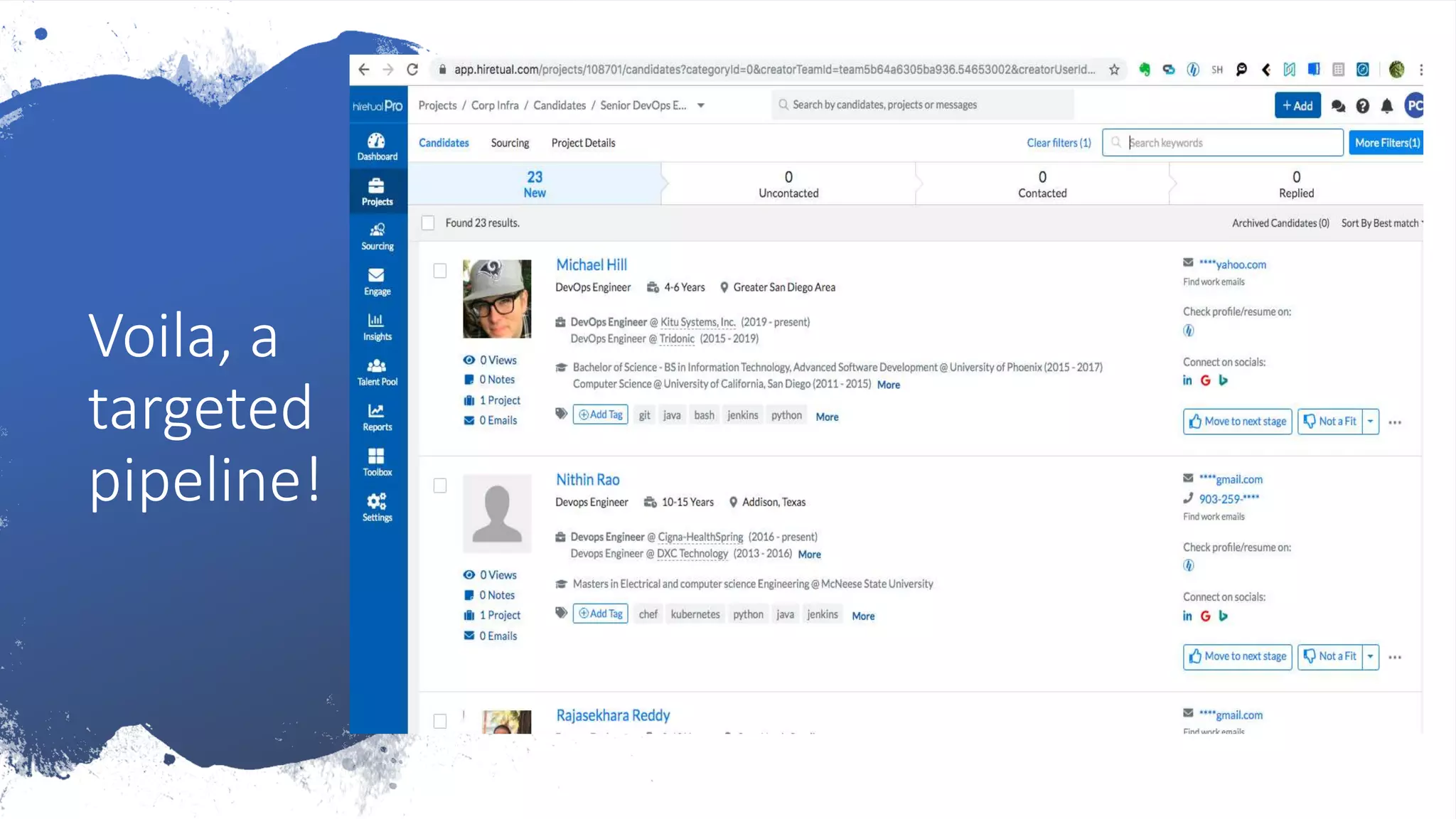
Voila, a
targeted
pipeline!
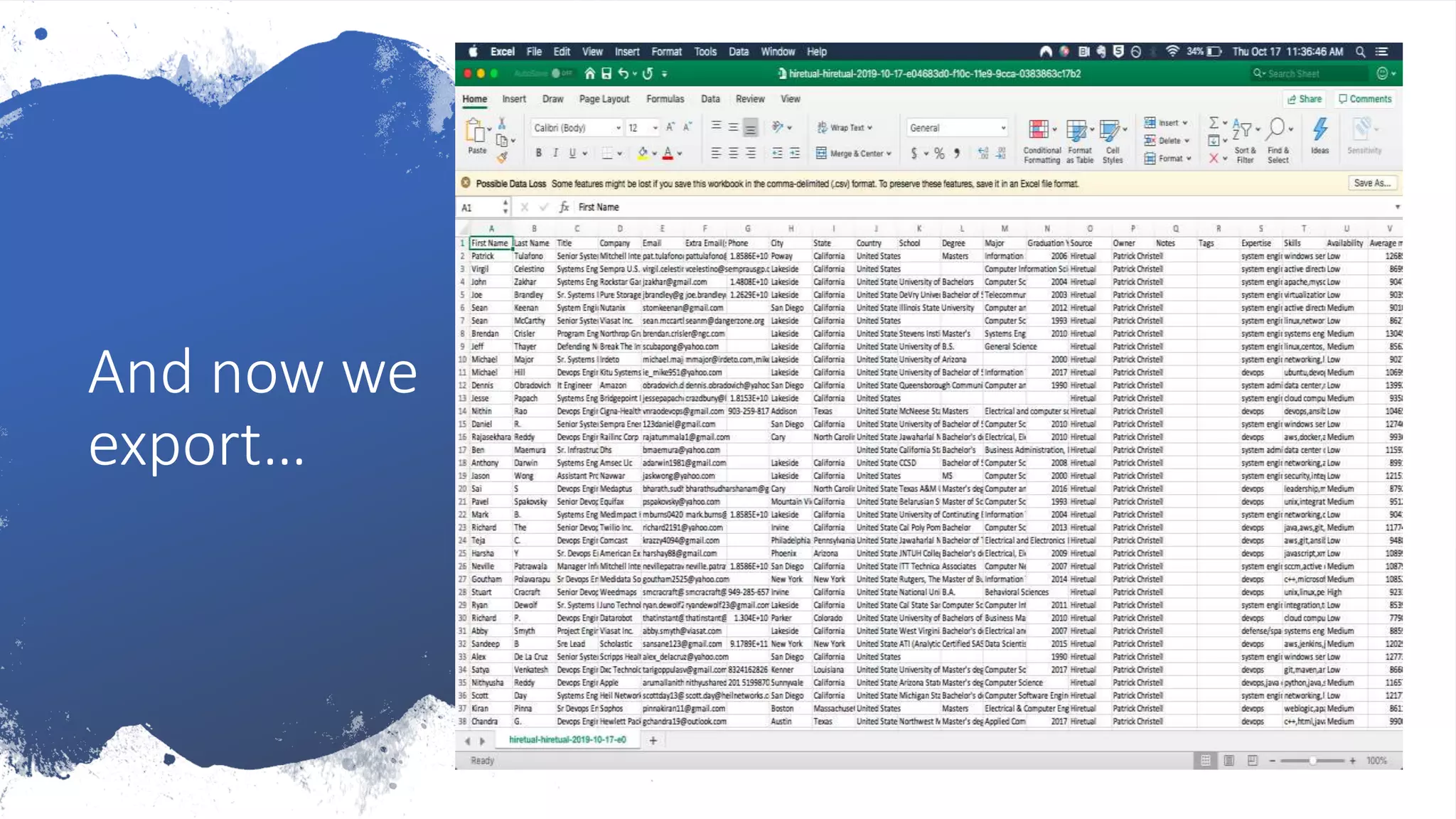
And now we
export…
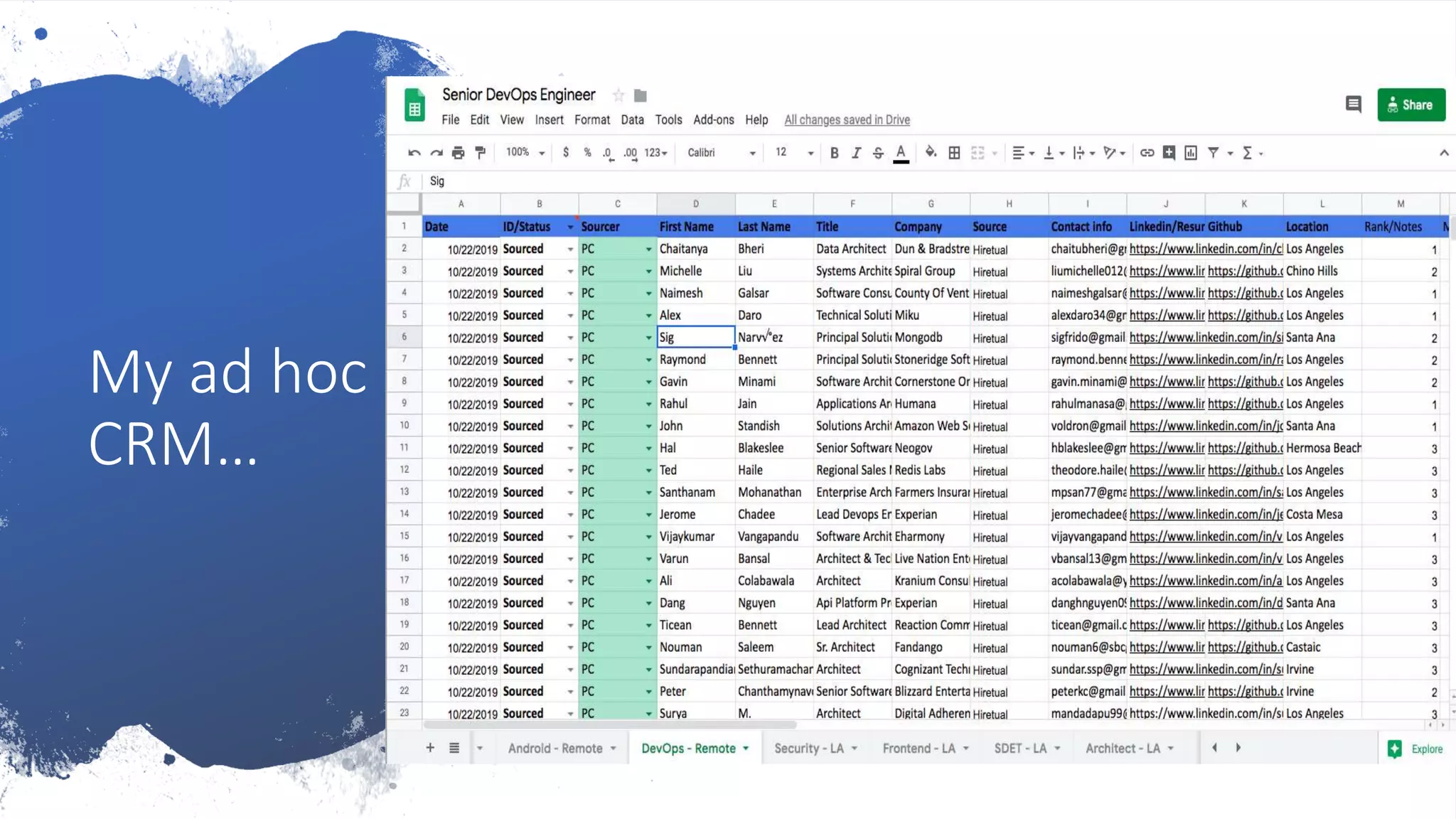
My ad hoc
CRM…
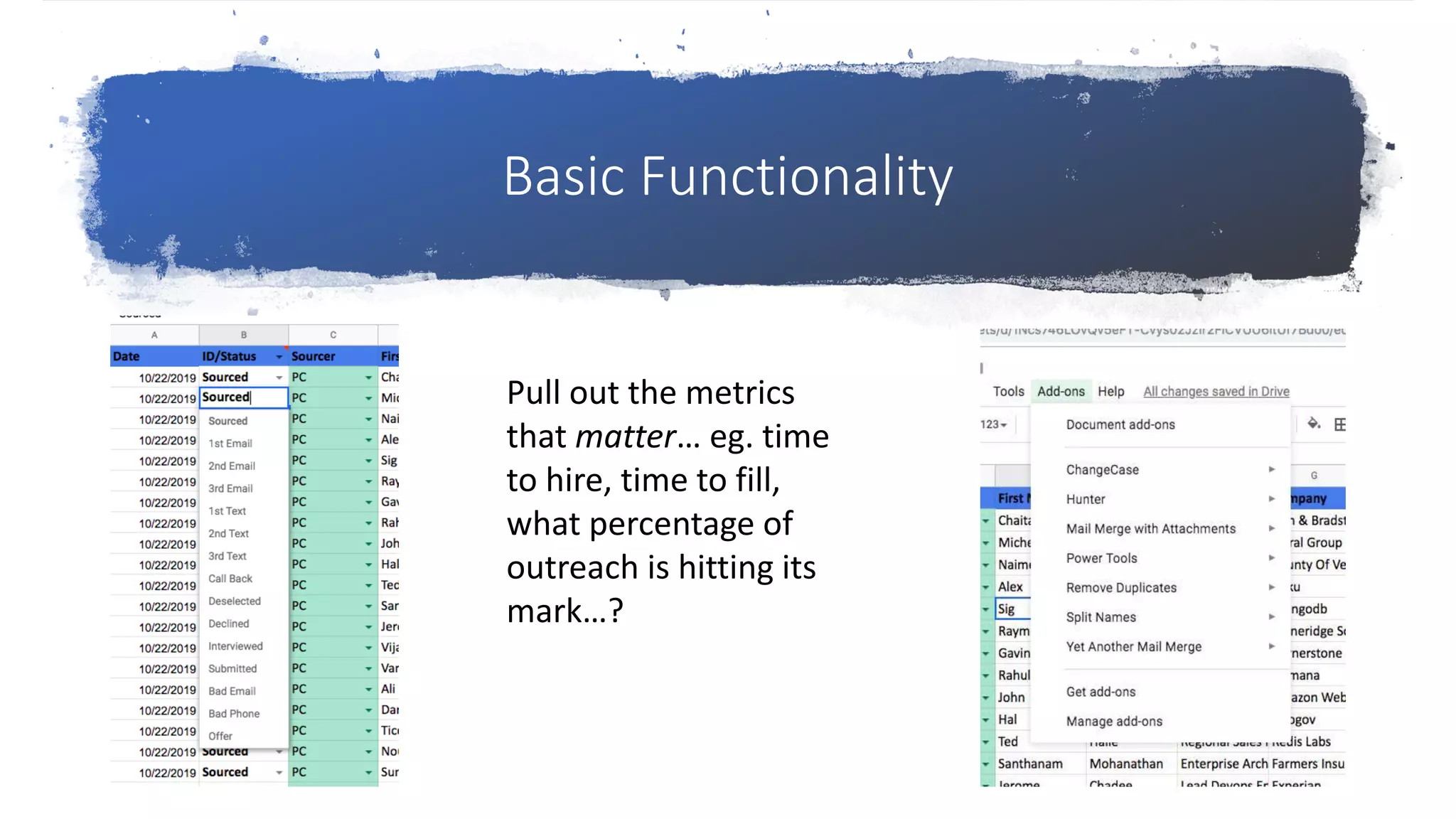
Basic Functionality
Pull out the metrics
that matter… eg. time
to hire, time to fill,
what percentage of
outreach is hitting its
mark…?
Outreach
• Email isn’t dead, but its use case has changed. It’s now the first lure in the
water…
• Cadence should go as follows:
• First email.
• 24 hours later, 2nd email.
• First text, same day as 2nd email
• 3rd email or social outreach, 72 hours after initial outreach.
• First email outreach on Tuesdays (Most inboxes are full on Mondays)
• Sunday night works brilliantly for software devs.
• Rinse and repeat.
• In every communication beyond the first, give your targets a chance to opt out.
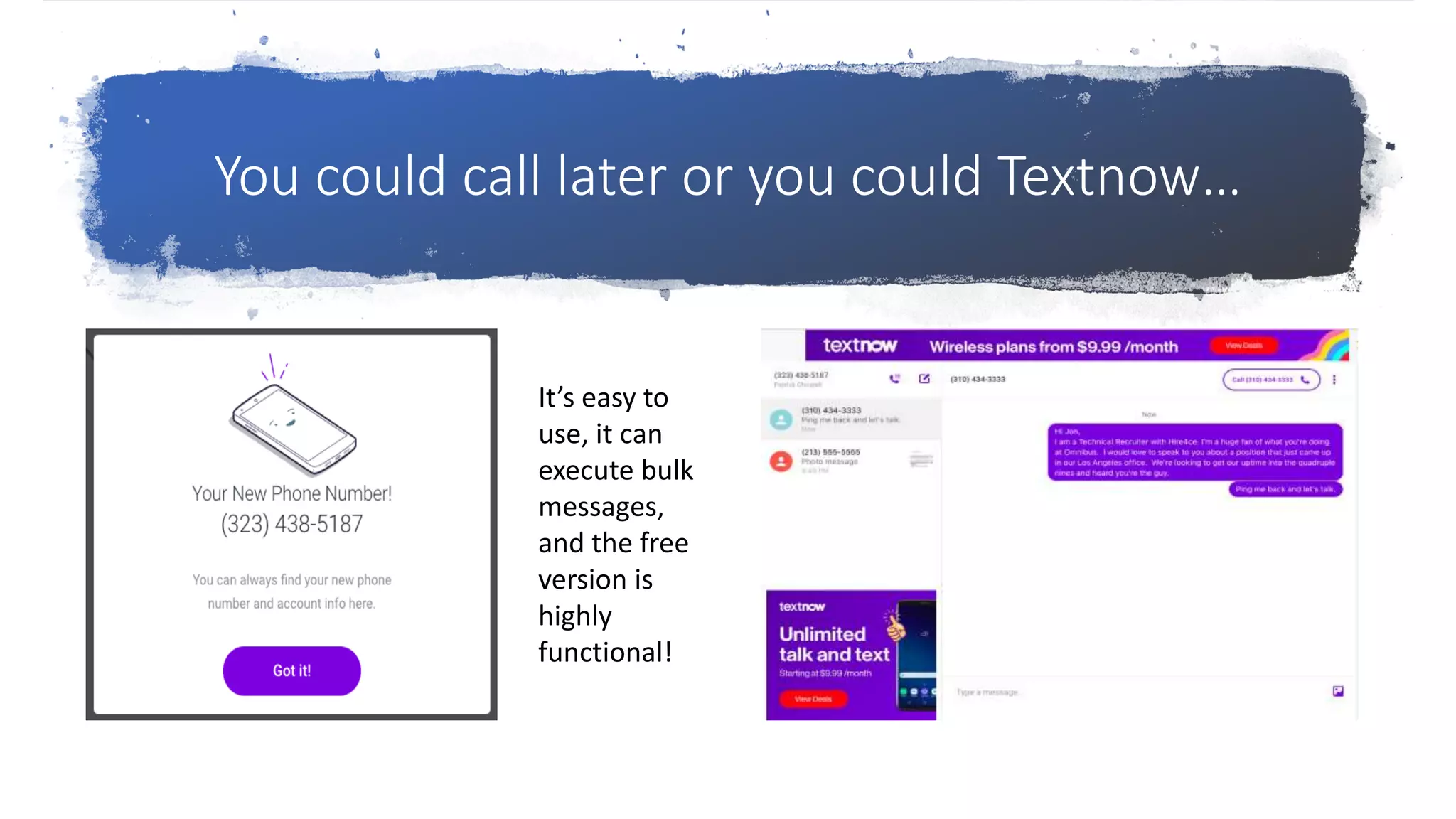
You could call later or you could Textnow…
It’s easy to
use, it can
execute bulk
messages,
and the free
version is
highly
functional!
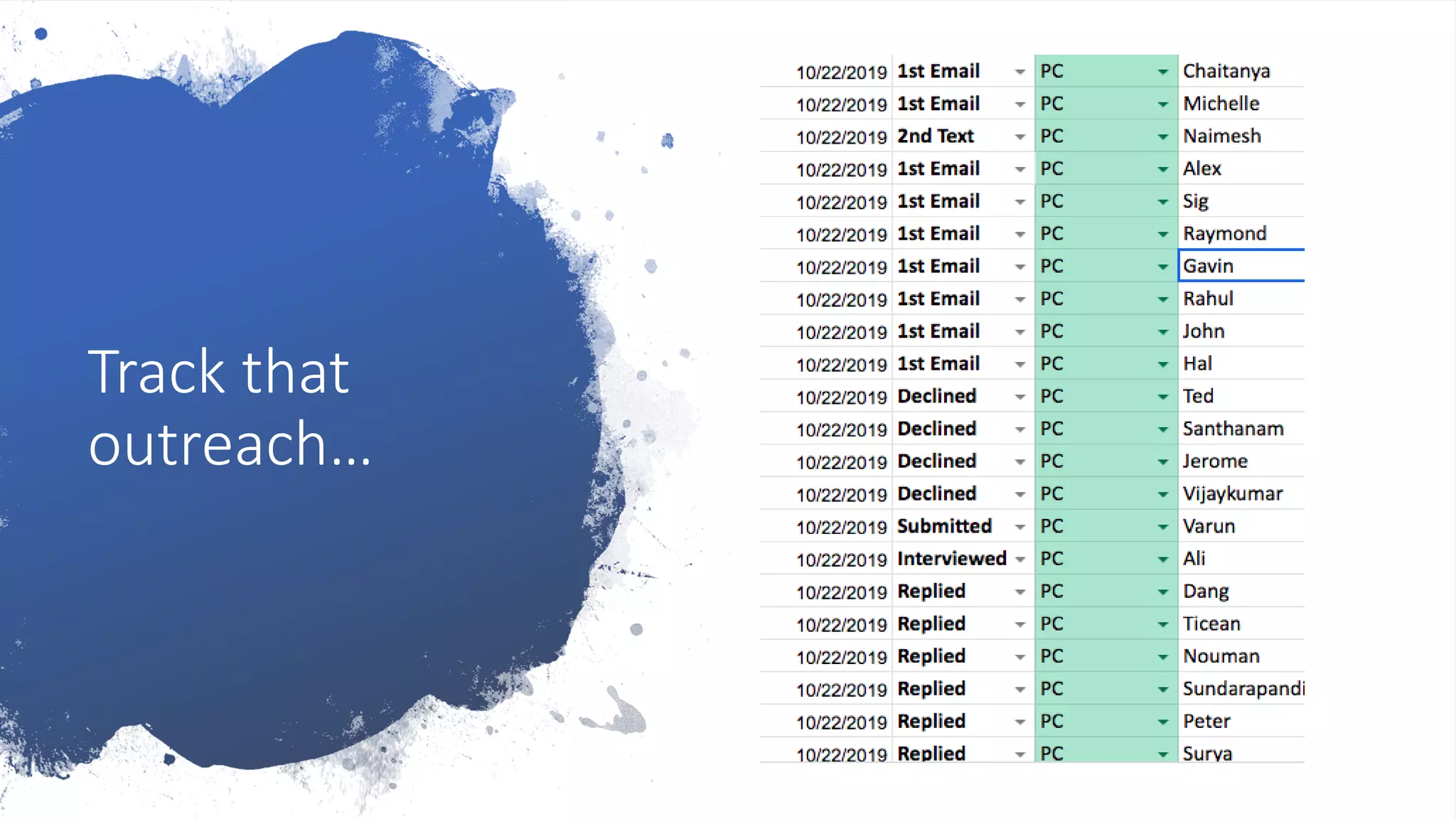
Track that
outreach…
Track that
outreach…
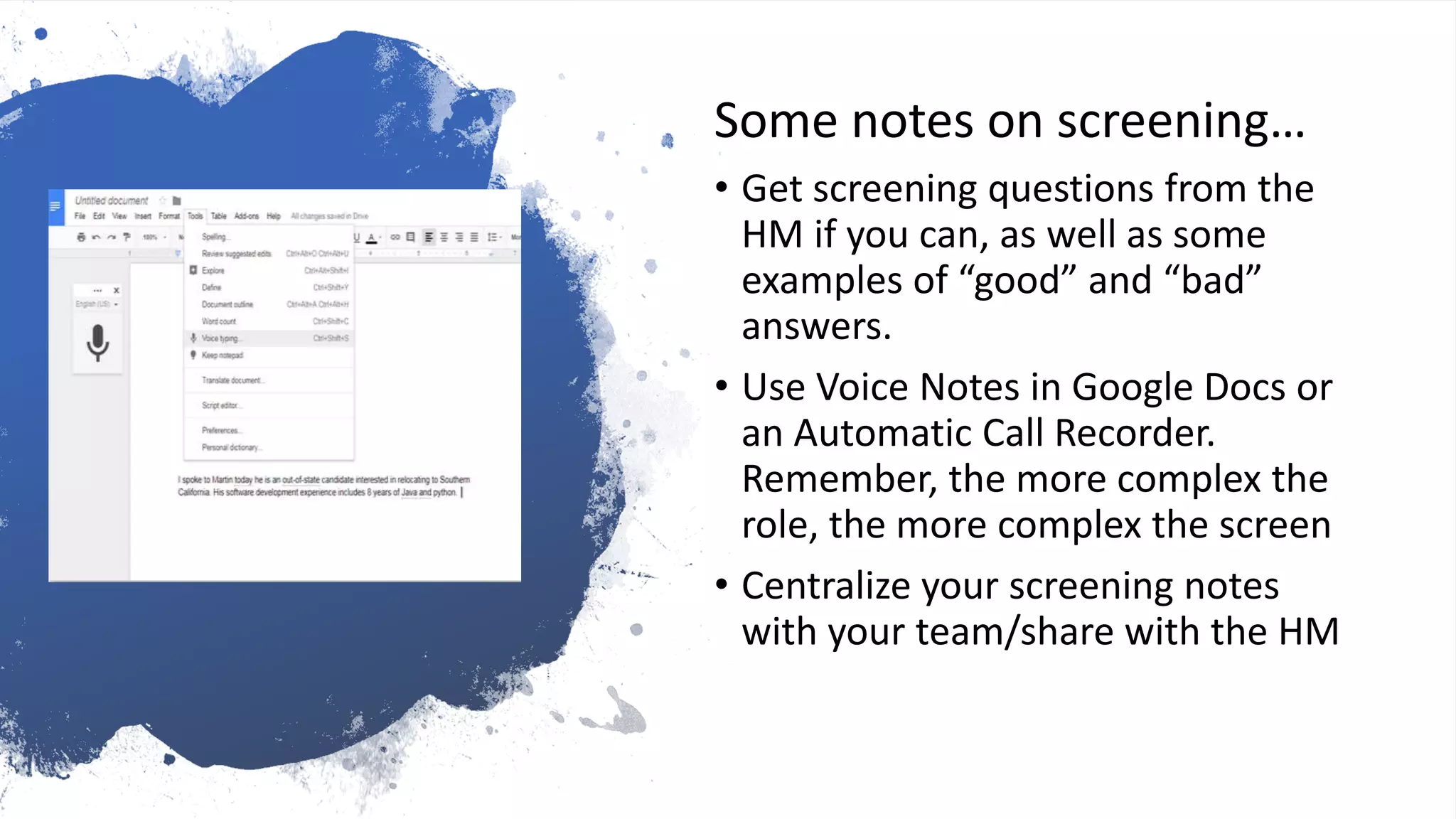
Some notes on screening…
• Get screening questions from the
HM if you can, as well as some
examples of “good” and “bad”
answers.
• Use Voice Notes in Google Docs or
an Automatic Call Recorder.
Remember, the more complex the
role, the more complex the screen
• Centralize your screening notes
with your team/share with the HM
Now DEFINE YOUR SPRINT
• A sprint is defined as a “timeboxed iteration of a continuous development cycle.”
• In the above referenced project, I would define one sprint as the discovery, engagement
and outreach cadence involving 250 honed leads and cap that at one week. Define your
own, so you have fixed, trackable variables to compare to future sprints.
• If you’re working with a team, or ”pod” make sure everyone is on the same page regarding
the length of the sprint, the expected deliverable(s) and what will be discussed in the
retrospective.
• Loop recruiting teams in to your retrospectives. Loop the HMs in if appropriate.
• Remember: The more outside parties that have buy-in, the more blockers can be eliminated.
• The number one thing sprint cycles should be is ITERATIVE. The second thing is
TRACKABLE.
Find the metrics that make sense…
Examples of What to Measure…
• Average # of candidates sourced per hire
• Target should be between 120-150 (~129) for Senior SDEs in an A,B,C market
• % Screened Prospects Accepted for Interview
• Submittals Per Hire
• Cold Outreach (Response Rate) (for example 30% of passive
candidates respond)
• Average # of days from req opened to first candidate accepted by
hiring manager
• Target should be 8 days or less
• Recruiting Cost Ratio (Sum of all recruiting costs divided by full time
staff) Eg. Real Cost Per Hire
Now that we have
completed a sourcing
sprint…
Implement Continuous Improvement
• In this webinar, I have outlined my process in a step-by-step fashion.
Codify your process. In doing this, you will be able to:
• Eliminate waste through exposing bottlenecks or blockers.
• Improve results from sprint to sprint.
• Pivot logically and quickly.
• Figure out the metrics that matter to you, and track them from sprint
to sprint.
• Loop the recruiting teams in to your inter-sprint meetings. Loop the
HMs in if you can.
• If you have buy-in from HR leaders, they can eliminate blockers for
you.
Now you are an AGILE RECRUITER!
Remember, what you want is to be…
• Proactive
• Fine tune-able
• Pivot-able
• Plug-and-play into any org of any size
• Scalable
• Iterative
o Fixed, agreed-upon metrics, regular feedback checkpoints
• We are following the lean manufacturing model, but instead of cars, we are increasing
delivery accuracy and speed of our product, which is HIRES
A rocket aimed
toward the moon
will not get there
with a single
calculation; constant
micro-adjustments
are necessary…
Some Useful
Sprint Metrics…
What my extension
stack looks like…
My extensions…
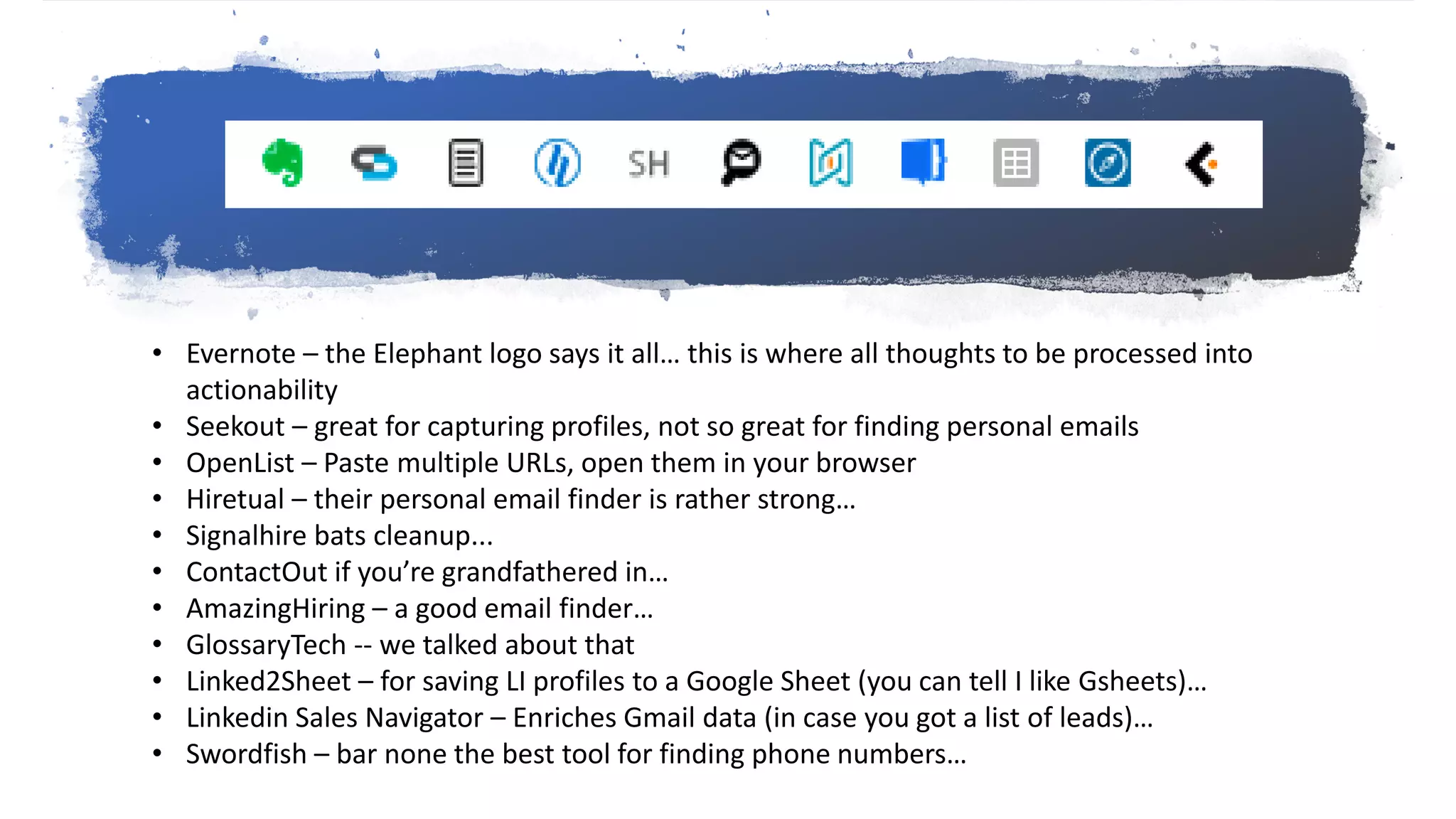
• Evernote – the Elephant logo says it all… this is where all thoughts to be processed into
actionability
• Seekout – great for capturing profiles, not so great for finding personal emails
• OpenList – Paste multiple URLs, open them in your browser
• Hiretual – their personal email finder is rather strong…
• Signalhire bats cleanup...
• ContactOut if you’re grandfathered in…
• AmazingHiring – a good email finder…
• GlossaryTech -- we talked about that
• Linked2Sheet – for saving LI profiles to a Google Sheet (you can tell I like Gsheets)…
• Linkedin Sales Navigator – Enriches Gmail data (in case you got a list of leads)…
• Swordfish – bar none the best tool for finding phone numbers…
But Patrick,
Hiretual is
expensive/not
my thing!
• Go to good old fashioned web
sourcing.
• Linked2sheet to snap up profiles and
import them into Google Sheets (use at
your own risk)
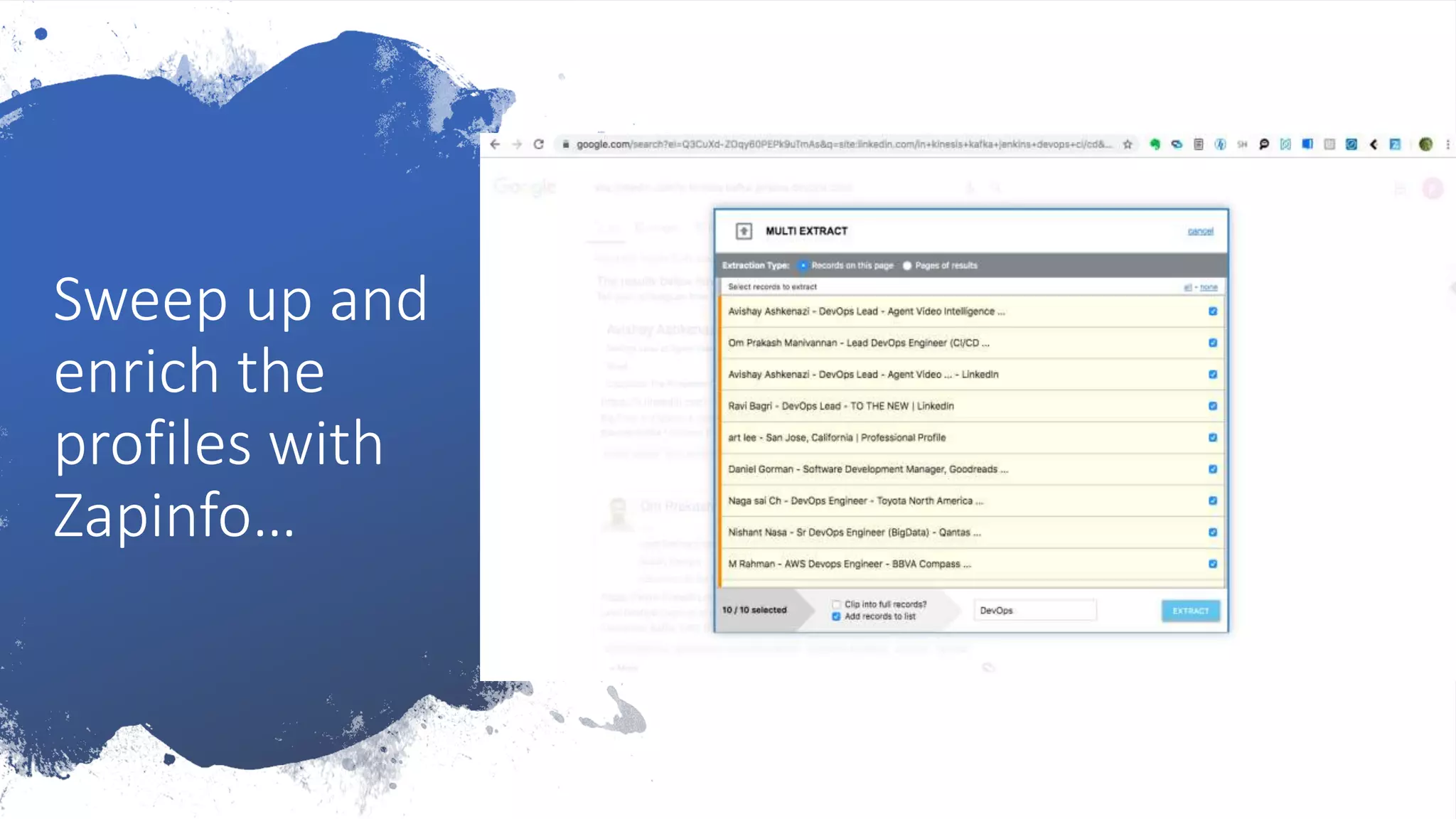
• Or use Zapinfo
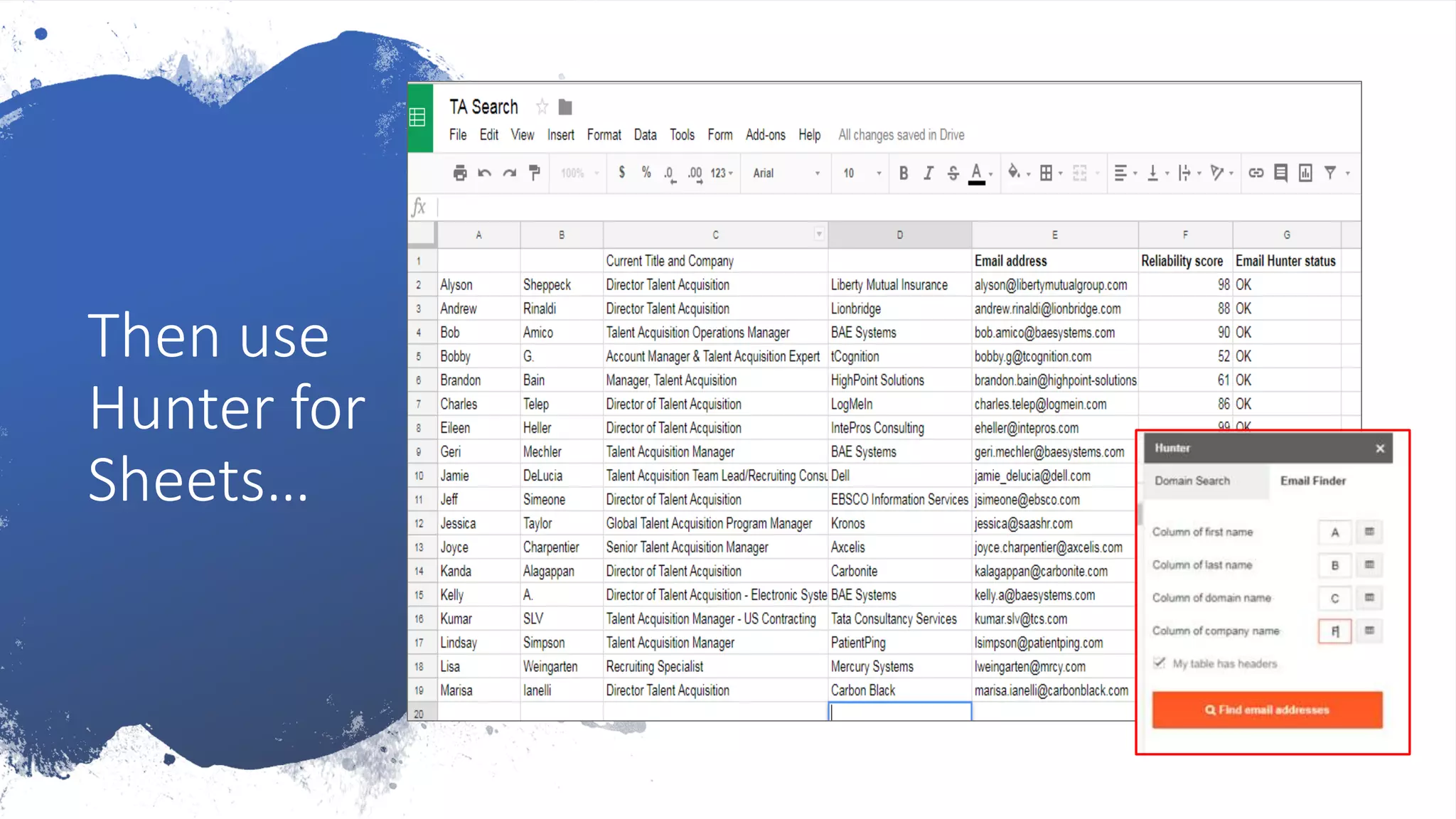
• Hunter for Sheets to get corporate
emails
• Citable to track research pivots
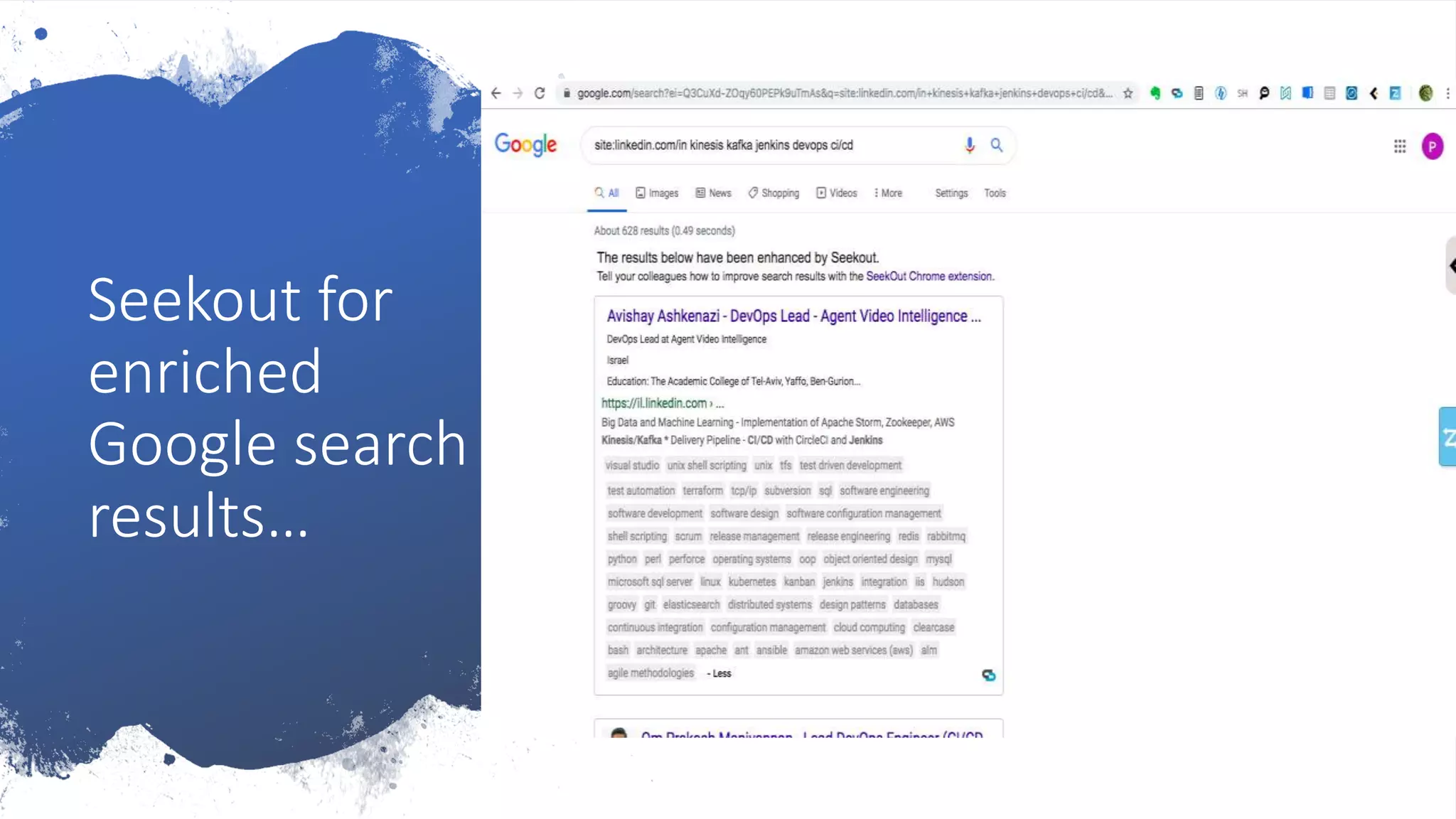
Seekout for
enriched
Google search
results…
• Go to good old fashioned web
sourcing.
• Linked2sheet to snap up profiles and
import them into Google Sheets (use at
your own risk)
• Or use Zapinfo
• Hunter for Sheets to get corporate
emails
• Citable to track research pivots
Sweep up and
enrich the
profiles with
Zapinfo…
Then use
Hunter for
Sheets…
Seekout for Insights
https://seekout.io/peopleInsights?filters=%7B%22current_company%22%3A%7B%22equals%
22%3A%7B%2229%22%3A%7B%22title%22%3A%22Accenture%22%2C%22id%22%3A%2229
%22%7D%7D%7D%7D&page=1&pageSize=100
Seekout vs. Hiretual vs. AmazingHiring vs. LIR
• Hiretual is magic for junior-mid-senior software engineers in recognizable niches
• Seekout can be tuned to find highly specific candidates eg. It is a purple squirrel hunter.
Also, its Insights function blows anything else out there out of the water
• AmazingHiring contains elements of both Hiretual and Seekout. Good for engineers in
Europe
• Each search tool has a slightly different algorithm, so while there will be overlap, they will
find unique candidates that other tools won’t
• All three have very easy ways to enrich/export candidate data
• LIRs search functionality gets more blunted with time, its only edge is the radar. Try to
export that project data and see what happens!
In conclusion…
• My stack/methodology/implementation works well for ME to get results that pertain to MY
specific situation… YOUR mileage may vary
• As recruiters, we are expected to be experts on topics we know very little about. While some
tips that have been discussed here will help you iterate faster toward true expertise, there is no
substitute for experience, reading resumes, and experiencing multiple situations and multiple
use cases for tools
• Learn to spot the difference between “spoke failures” and “wheel failures”
• Failure WILL happen, just make sure to Fail Forward Fast – a type of iteration in and of itself.
• It’s easy to forget one fundamental truth beneath all the strides toward greater productivity and
automation… we are dealing with PEOPLE, and in passive candidates, we as recruiters should be
gaining fulfillment by showing them opportunities that may just be better than what they were
doing before
Thank You!

Master Technical Recruiting Workshop: How to Recruit Top Tech Talent

  • 1.
    Patrick Christell October 22,2019 MASTER TECHNICAL RECRUITING WORKSHOP: How to Recruit Top Tech Talent
  • 2.
    The Plan HOUSEKEEPING You arein Listen-Only Mode. You can hear us, but we can’t hear you. ASK QUESTIONS Don’t be shy! Use the Questions Panel in your side bar to talk to Patrick. SHARE We’re LIVE. Use the #rdaily hashtag to share on social media. WE’RE RECORDING You will receive a copy of this slide deck & recording after the webinar. Keep an eye on your inbox.
  • 4.
    Patrick Christell Senior Sourcer,Hire4ce I build teams. Expert-level Sourcer with a demonstrated history of deploying Agile sourcing methodology with the end result of transforming companies. Particular expertise in shepherding startups to the SME level. Skilled in Passive Candidate Generation, Proactive Pipeline Building, Digital Copywriting, Recruiting, Bleeding edge tools, techniques and methodologies, OSINT, Psychometrics. If your company needs to scale fast and sustainably, or you've got that open job req that you can't seem to fill, drop me a line at patrick.christell@hire4ce.com.
  • 5.
    MASTER TECHNICAL RECRUITING WORKSHOP: HowTo Recruit Top Tech Talent BY: Patrick Christell Hire4ce
  • 6.
    In this webinar,you will learn… • How to spin up a sourcing function from nothing • How to find qualified tech candidates even if you have zero background on the role/aren’t a techie • Tools, extensions and processes that I use • How to create and utilize an ad hoc CRM • How to implement continuous improvement • How to engage candidates in 2019
  • 7.
    Before sourcing begins, sketcha template of your proposed process…
  • 8.
    Understand what yourhiring manager wants… • An in-depth, PROBING intake meeting is necessary for each new or unique requisition • Sometimes this is tough to achieve, especially after hiring managers have been burned by lazy recruiters/bloated processes – get a sense of what it will take to get them back “on side” • The answer… ADD VALUE! • Conduct pre-search and bring profiles to the meeting • Remember… you are a GUARDIAN OF THE HIRING MANAGER’S TIME. Make sure to communicate that you understand this. It will probably seem like a breath of fresh air • If you are totally unfamiliar with the role and what the candidates are ACTUALLY doing… RESEARCH! • Sit with the developers if you can. This bestows an understanding of CULTURE FIT
  • 9.
  • 10.
    From there, crafta role-specific intake…
  • 12.
    Let’s highlight someanswers… • Ruby not hard requirement, any OOO programming language that is strong is ok - actually using Go, but it's too new. We are weak in stream processing tools or data pipline tools such as, Kinesis, Kafka so find folk with that experience – CI/CD tools like Jenkins • Remote - mission driving company on global expansion - doing Kubernetes migration (get folk who LOVE migration) - on-call rotation, each person on primary 1wk, secondary 1wk - "oncall 2 out of 8 weeks" • Uptime presently in the triple nines, but we need higher availability, we are benchmarking .9999 by EOY and need the kind of engineer that will get us there
  • 13.
    Parse the JD withHiretual, ADDING and SUBTRACTING details as needed… • Sdfsdf
  • 14.
  • 15.
    Use Hiretual AI tofind “more like that”…
  • 16.
  • 17.
  • 18.
  • 19.
    Basic Functionality Pull outthe metrics that matter… eg. time to hire, time to fill, what percentage of outreach is hitting its mark…?
  • 20.
    Outreach • Email isn’tdead, but its use case has changed. It’s now the first lure in the water… • Cadence should go as follows: • First email. • 24 hours later, 2nd email. • First text, same day as 2nd email • 3rd email or social outreach, 72 hours after initial outreach. • First email outreach on Tuesdays (Most inboxes are full on Mondays) • Sunday night works brilliantly for software devs. • Rinse and repeat. • In every communication beyond the first, give your targets a chance to opt out.
  • 21.
    You could calllater or you could Textnow… It’s easy to use, it can execute bulk messages, and the free version is highly functional!
  • 22.
  • 23.
    Track that outreach… Some noteson screening… • Get screening questions from the HM if you can, as well as some examples of “good” and “bad” answers. • Use Voice Notes in Google Docs or an Automatic Call Recorder. Remember, the more complex the role, the more complex the screen • Centralize your screening notes with your team/share with the HM
  • 24.
    Now DEFINE YOURSPRINT • A sprint is defined as a “timeboxed iteration of a continuous development cycle.” • In the above referenced project, I would define one sprint as the discovery, engagement and outreach cadence involving 250 honed leads and cap that at one week. Define your own, so you have fixed, trackable variables to compare to future sprints. • If you’re working with a team, or ”pod” make sure everyone is on the same page regarding the length of the sprint, the expected deliverable(s) and what will be discussed in the retrospective. • Loop recruiting teams in to your retrospectives. Loop the HMs in if appropriate. • Remember: The more outside parties that have buy-in, the more blockers can be eliminated. • The number one thing sprint cycles should be is ITERATIVE. The second thing is TRACKABLE.
  • 25.
    Find the metricsthat make sense… Examples of What to Measure… • Average # of candidates sourced per hire • Target should be between 120-150 (~129) for Senior SDEs in an A,B,C market • % Screened Prospects Accepted for Interview • Submittals Per Hire • Cold Outreach (Response Rate) (for example 30% of passive candidates respond) • Average # of days from req opened to first candidate accepted by hiring manager • Target should be 8 days or less • Recruiting Cost Ratio (Sum of all recruiting costs divided by full time staff) Eg. Real Cost Per Hire
  • 26.
    Now that wehave completed a sourcing sprint…
  • 27.
    Implement Continuous Improvement •In this webinar, I have outlined my process in a step-by-step fashion. Codify your process. In doing this, you will be able to: • Eliminate waste through exposing bottlenecks or blockers. • Improve results from sprint to sprint. • Pivot logically and quickly. • Figure out the metrics that matter to you, and track them from sprint to sprint. • Loop the recruiting teams in to your inter-sprint meetings. Loop the HMs in if you can. • If you have buy-in from HR leaders, they can eliminate blockers for you.
  • 28.
    Now you arean AGILE RECRUITER! Remember, what you want is to be… • Proactive • Fine tune-able • Pivot-able • Plug-and-play into any org of any size • Scalable • Iterative o Fixed, agreed-upon metrics, regular feedback checkpoints • We are following the lean manufacturing model, but instead of cars, we are increasing delivery accuracy and speed of our product, which is HIRES
  • 29.
    A rocket aimed towardthe moon will not get there with a single calculation; constant micro-adjustments are necessary…
  • 30.
  • 31.
  • 32.
    My extensions… • Evernote– the Elephant logo says it all… this is where all thoughts to be processed into actionability • Seekout – great for capturing profiles, not so great for finding personal emails • OpenList – Paste multiple URLs, open them in your browser • Hiretual – their personal email finder is rather strong… • Signalhire bats cleanup... • ContactOut if you’re grandfathered in… • AmazingHiring – a good email finder… • GlossaryTech -- we talked about that • Linked2Sheet – for saving LI profiles to a Google Sheet (you can tell I like Gsheets)… • Linkedin Sales Navigator – Enriches Gmail data (in case you got a list of leads)… • Swordfish – bar none the best tool for finding phone numbers…
  • 33.
    But Patrick, Hiretual is expensive/not mything! • Go to good old fashioned web sourcing. • Linked2sheet to snap up profiles and import them into Google Sheets (use at your own risk) • Or use Zapinfo • Hunter for Sheets to get corporate emails • Citable to track research pivots
  • 34.
    Seekout for enriched Google search results… •Go to good old fashioned web sourcing. • Linked2sheet to snap up profiles and import them into Google Sheets (use at your own risk) • Or use Zapinfo • Hunter for Sheets to get corporate emails • Citable to track research pivots
  • 35.
    Sweep up and enrichthe profiles with Zapinfo…
  • 36.
  • 37.
  • 38.
    Seekout vs. Hiretualvs. AmazingHiring vs. LIR • Hiretual is magic for junior-mid-senior software engineers in recognizable niches • Seekout can be tuned to find highly specific candidates eg. It is a purple squirrel hunter. Also, its Insights function blows anything else out there out of the water • AmazingHiring contains elements of both Hiretual and Seekout. Good for engineers in Europe • Each search tool has a slightly different algorithm, so while there will be overlap, they will find unique candidates that other tools won’t • All three have very easy ways to enrich/export candidate data • LIRs search functionality gets more blunted with time, its only edge is the radar. Try to export that project data and see what happens!
  • 39.
    In conclusion… • Mystack/methodology/implementation works well for ME to get results that pertain to MY specific situation… YOUR mileage may vary • As recruiters, we are expected to be experts on topics we know very little about. While some tips that have been discussed here will help you iterate faster toward true expertise, there is no substitute for experience, reading resumes, and experiencing multiple situations and multiple use cases for tools • Learn to spot the difference between “spoke failures” and “wheel failures” • Failure WILL happen, just make sure to Fail Forward Fast – a type of iteration in and of itself. • It’s easy to forget one fundamental truth beneath all the strides toward greater productivity and automation… we are dealing with PEOPLE, and in passive candidates, we as recruiters should be gaining fulfillment by showing them opportunities that may just be better than what they were doing before
  • 40.