Lecture 6:
Logical
Effort
CMOS VLSI Design
CMOS VLSI Design 4th Ed.
6: Logical Effort 2
Outline
 Logical Effort
 Delay in a Logic Gate
 Multistage Logic Networks
 Choosing the Best Number of Stages
 Example
 Summary
CMOS VLSI Design
CMOS VLSI Design 4th Ed.
6: Logical Effort 3
Introduction
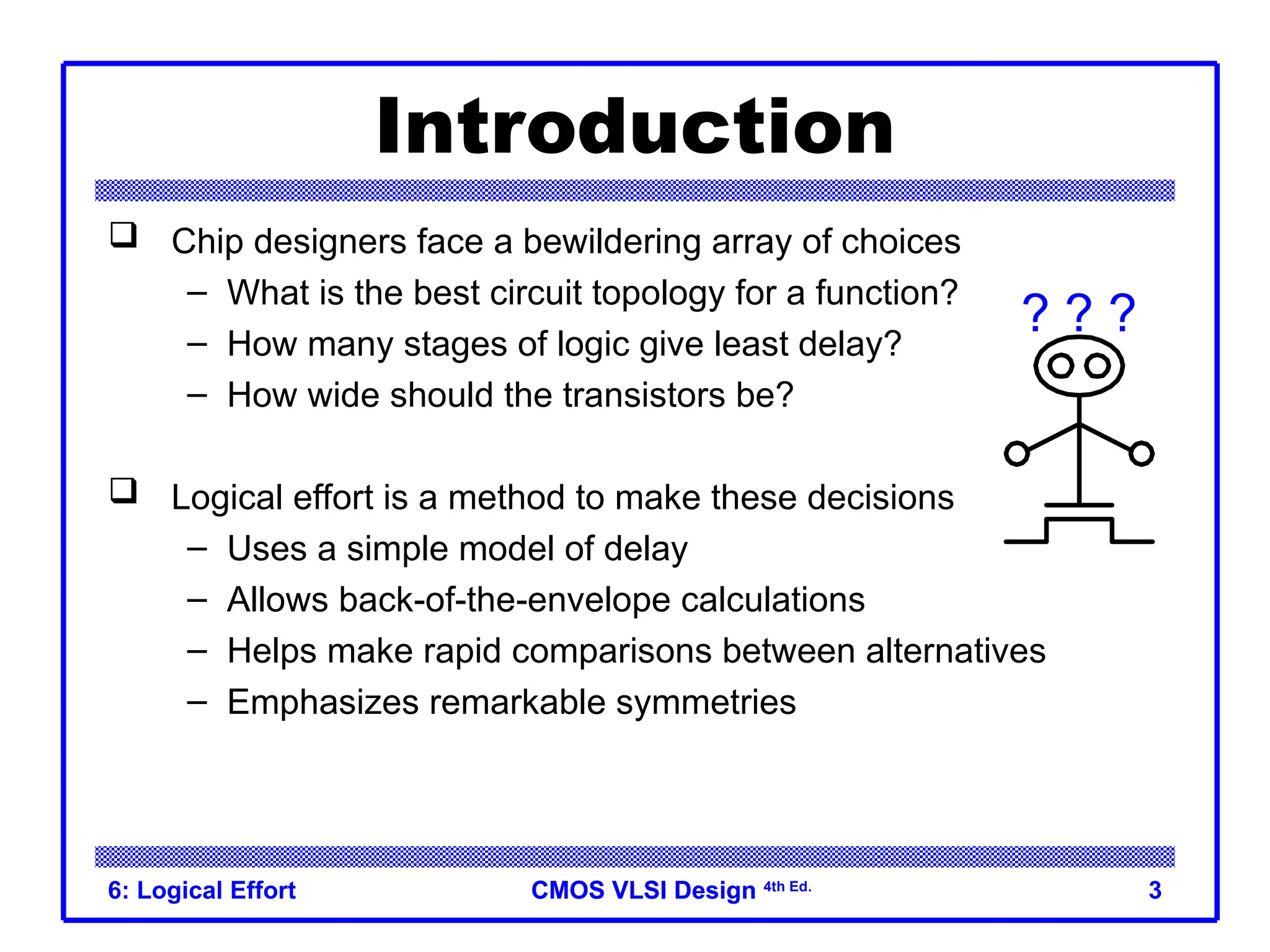
 Chip designers face a bewildering array of choices
– What is the best circuit topology for a function?
– How many stages of logic give least delay?
– How wide should the transistors be?
 Logical effort is a method to make these decisions
– Uses a simple model of delay
– Allows back-of-the-envelope calculations
– Helps make rapid comparisons between alternatives
– Emphasizes remarkable symmetries
? ? ?
CMOS VLSI Design
CMOS VLSI Design 4th Ed.
6: Logical Effort 4
Example
 Ben Bitdiddle is the memory designer for the Motoroil 68W86,
an embedded automotive processor. Help Ben design the
decoder for a register file.
 Decoder specifications:
– 16 word register file
– Each word is 32 bits wide
– Each bit presents load of 3 unit-sized transistors
– True and complementary address inputs A[3:0]
– Each input may drive 10 unit-sized transistors
 Ben needs to decide:
– How many stages to use?
– How large should each gate be?
– How fast can decoder operate?
A[3:0] A[3:0]
16
32 bits
16
words
4:16
Decoder
Register File
CMOS VLSI Design
CMOS VLSI Design 4th Ed.
6: Logical Effort 5
Delay in a Logic Gate
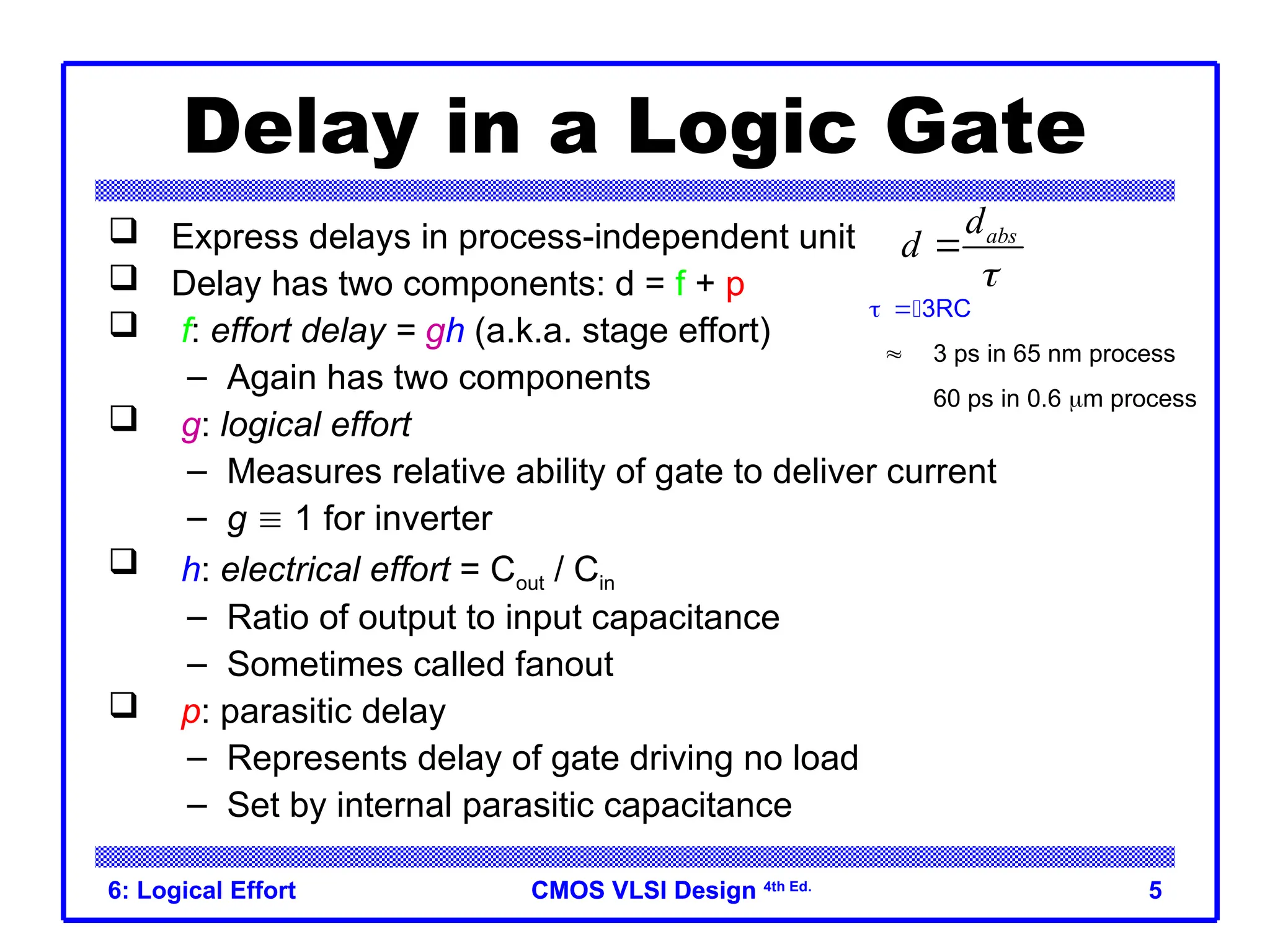
 Express delays in process-independent unit
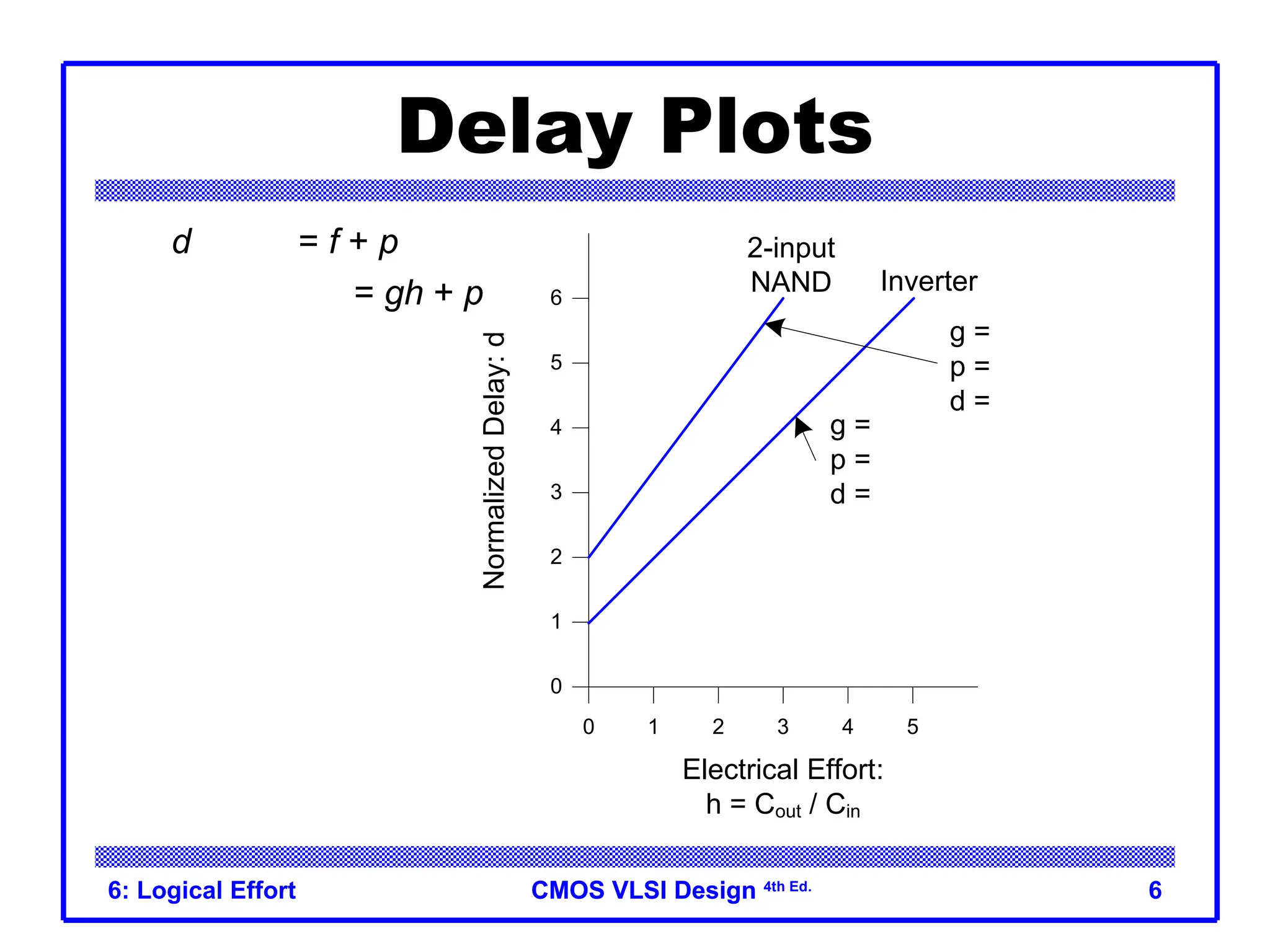
 Delay has two components: d = f + p
 f: effort delay = gh (a.k.a. stage effort)
– Again has two components
 g: logical effort
– Measures relative ability of gate to deliver current
– g  1 for inverter
 h: electrical effort = Cout / Cin
– Ratio of output to input capacitance
– Sometimes called fanout
 p: parasitic delay
– Represents delay of gate driving no load
– Set by internal parasitic capacitance
abs
d
d


3RC
 3 ps in 65 nm process
60 ps in 0.6 m process
CMOS VLSI Design
CMOS VLSI Design 4th Ed.
6: Logical Effort 6
Electrical Effort:
h = Cout / Cin
Normalized
Delay:
d
Inverter
2-input
NAND
g = 1
p = 1
d = h + 1
g = 4/3
p = 2
d = (4/3)h + 2
Effort Delay: f
Parasitic Delay: p
0 1 2 3 4 5
0
1
2
3
4
5
6
Electrical Effort:
h = Cout / Cin
Normalized
Delay:
d
Inverter
2-input
NAND
g =
p =
d =
g =
p =
d =
0 1 2 3 4 5
0
1
2
3
4
5
6
Delay Plots
d = f + p
= gh + p
 What about
NOR2?
CMOS VLSI Design
CMOS VLSI Design 4th Ed.
6: Logical Effort 7
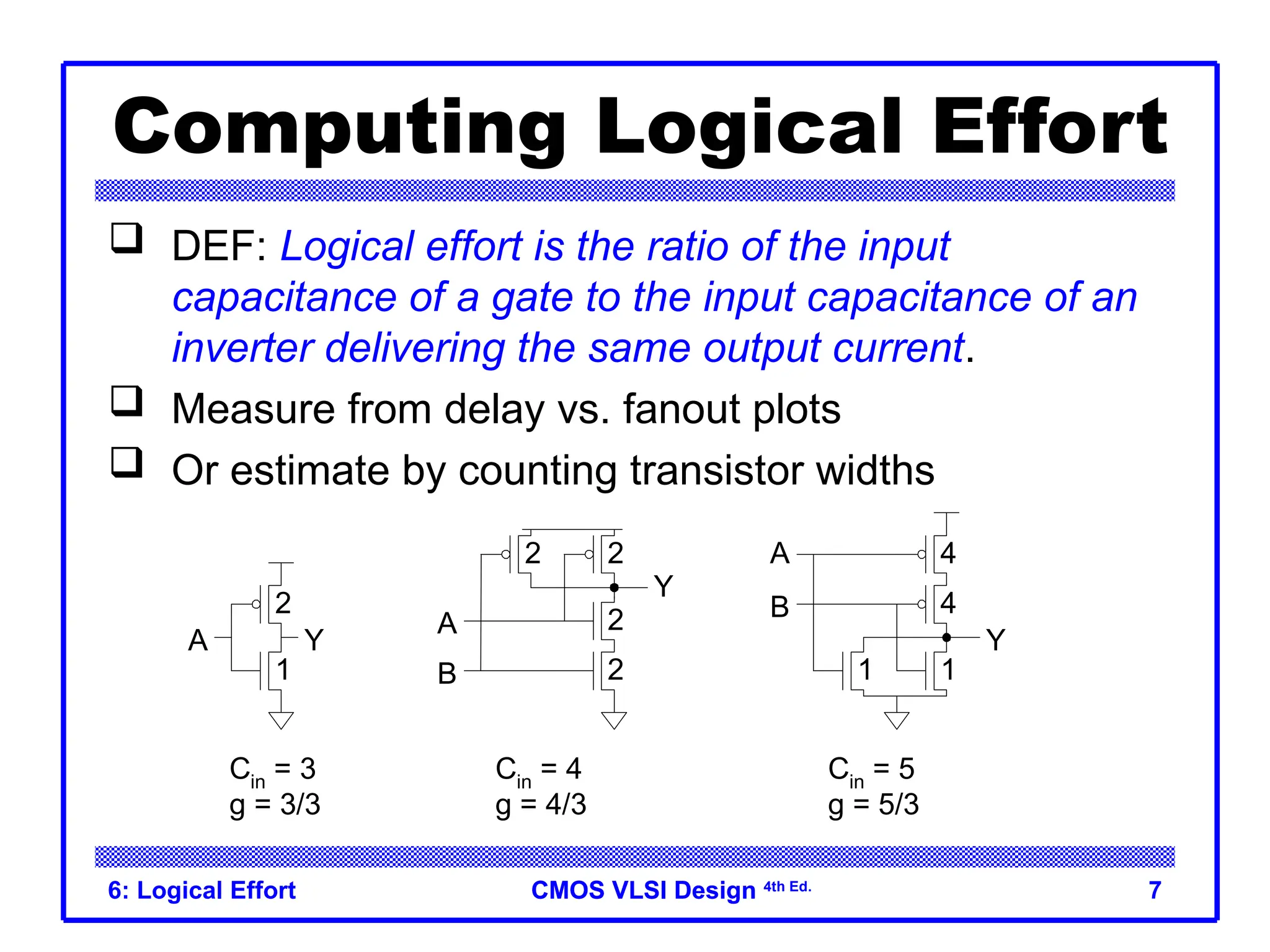
Computing Logical Effort
 DEF: Logical effort is the ratio of the input
capacitance of a gate to the input capacitance of an
inverter delivering the same output current.
 Measure from delay vs. fanout plots
 Or estimate by counting transistor widths
A Y
A
B
Y
A
B
Y
1
2
1 1
2 2
2
2
4
4
Cin = 3
g = 3/3
Cin = 4
g = 4/3
Cin = 5
g = 5/3
CMOS VLSI Design
CMOS VLSI Design 4th Ed.
6: Logical Effort 8
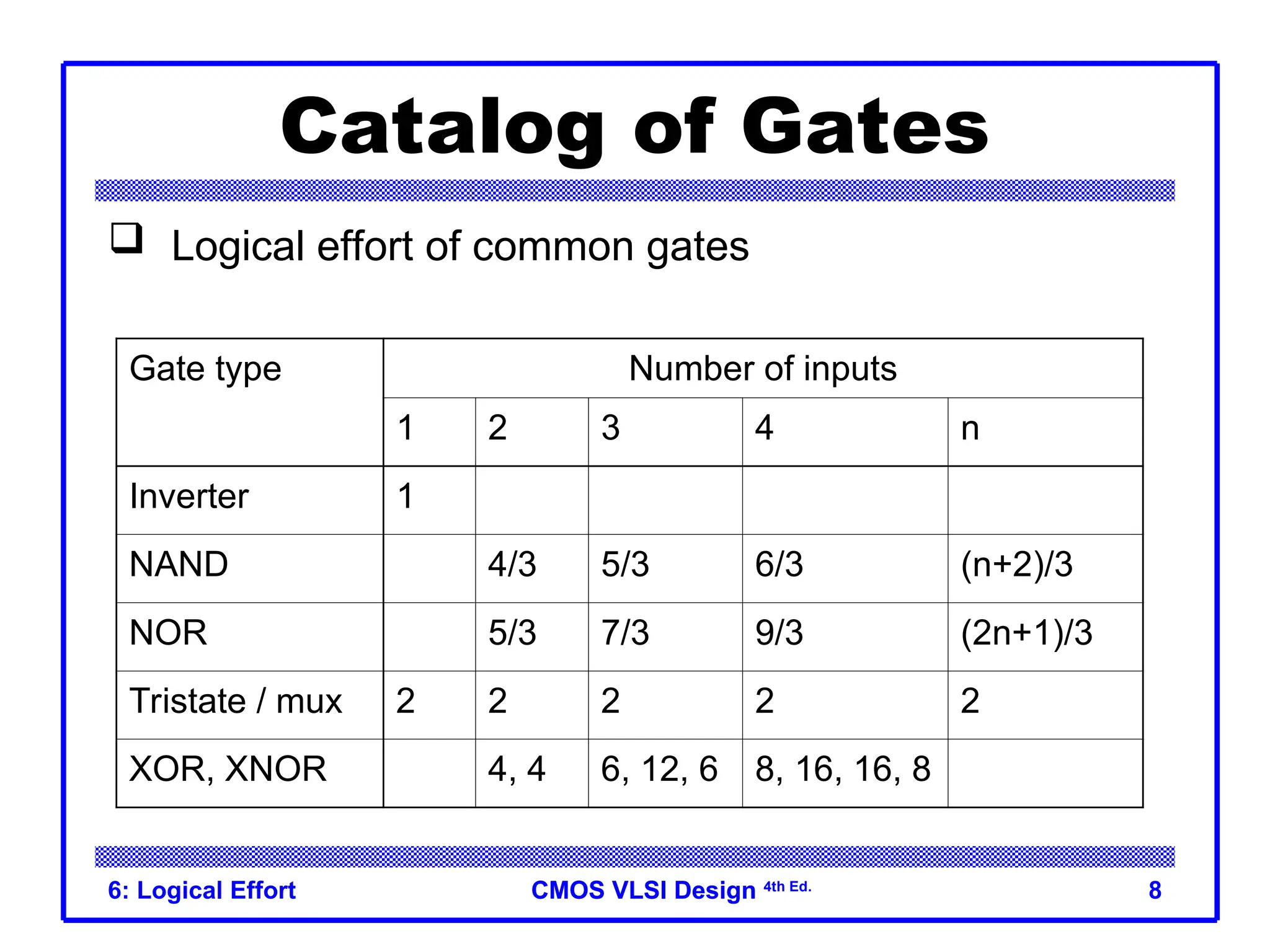
Catalog of Gates
Gate type Number of inputs
1 2 3 4 n
Inverter 1
NAND 4/3 5/3 6/3 (n+2)/3
NOR 5/3 7/3 9/3 (2n+1)/3
Tristate / mux 2 2 2 2 2
XOR, XNOR 4, 4 6, 12, 6 8, 16, 16, 8
 Logical effort of common gates
CMOS VLSI Design
CMOS VLSI Design 4th Ed.
6: Logical Effort 9
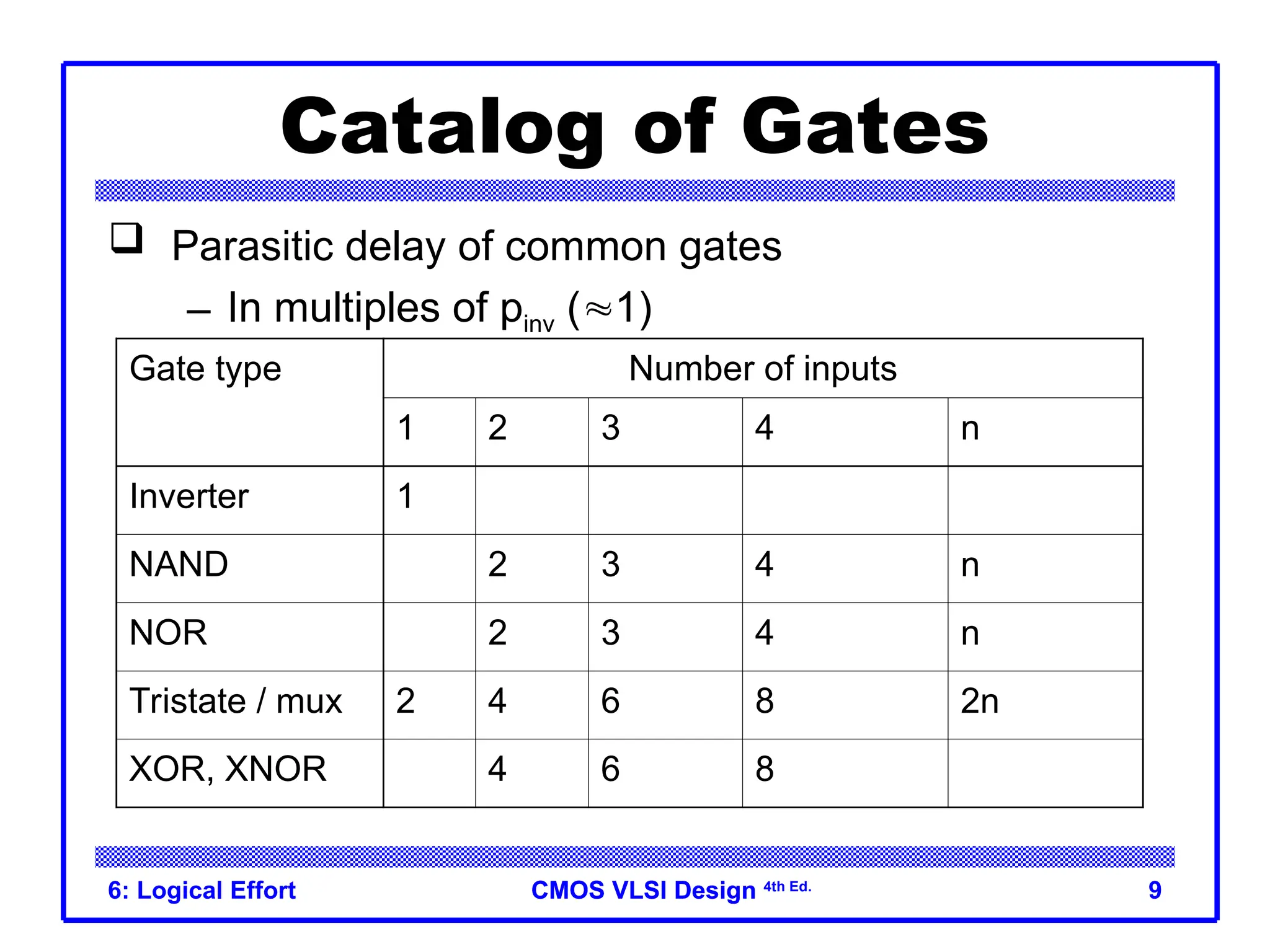
Catalog of Gates
Gate type Number of inputs
1 2 3 4 n
Inverter 1
NAND 2 3 4 n
NOR 2 3 4 n
Tristate / mux 2 4 6 8 2n
XOR, XNOR 4 6 8
 Parasitic delay of common gates
– In multiples of pinv (1)
CMOS VLSI Design
CMOS VLSI Design 4th Ed.
6: Logical Effort 10
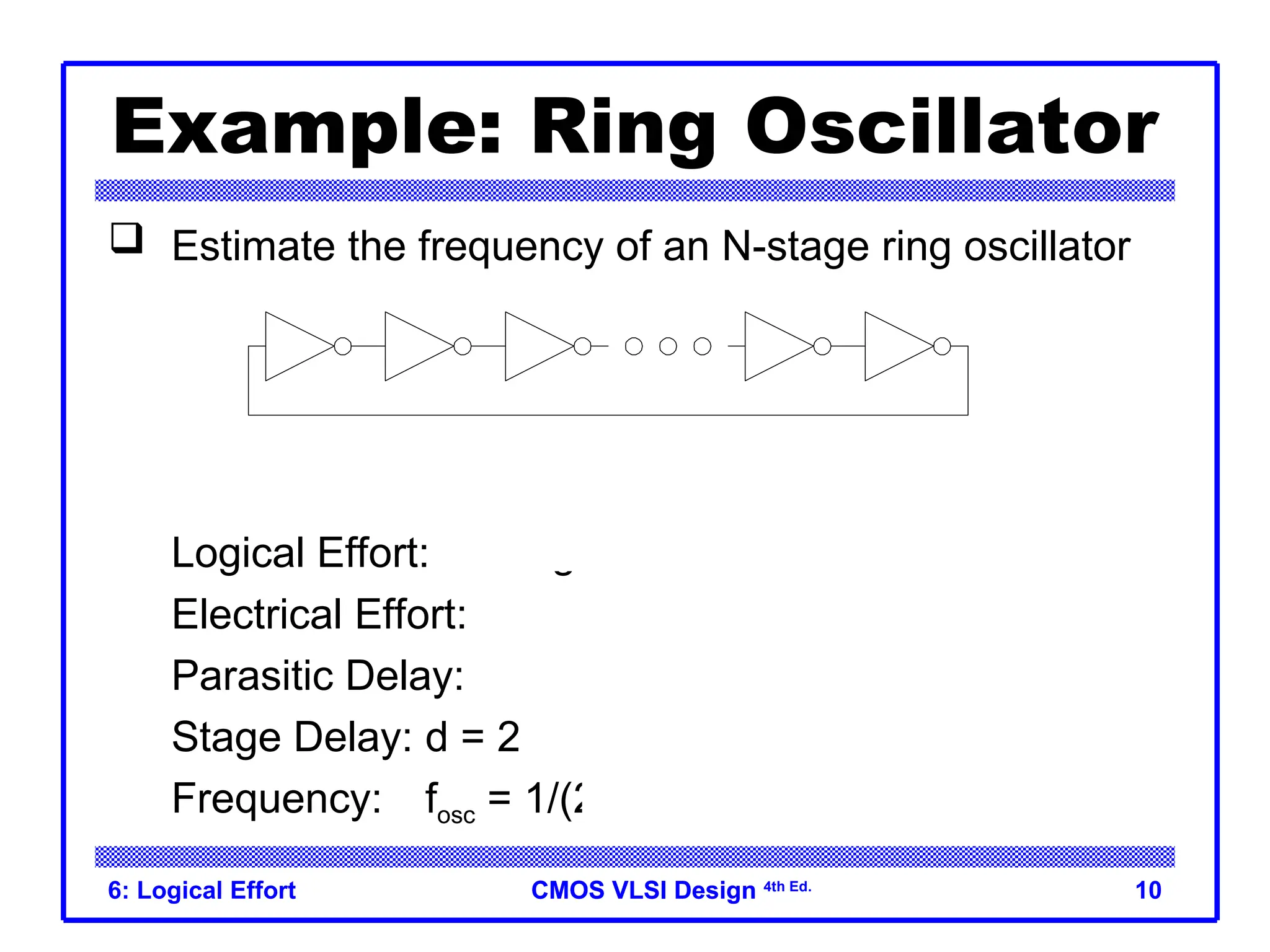
Example: Ring Oscillator
 Estimate the frequency of an N-stage ring oscillator
Logical Effort: g = 1
Electrical Effort: h = 1
Parasitic Delay: p = 1
Stage Delay: d = 2
Frequency: fosc = 1/(2*N*d) = 1/4N
31 stage ring oscillator in
0.6 m process has
frequency of ~ 200 MHz
CMOS VLSI Design
CMOS VLSI Design 4th Ed.
6: Logical Effort 11
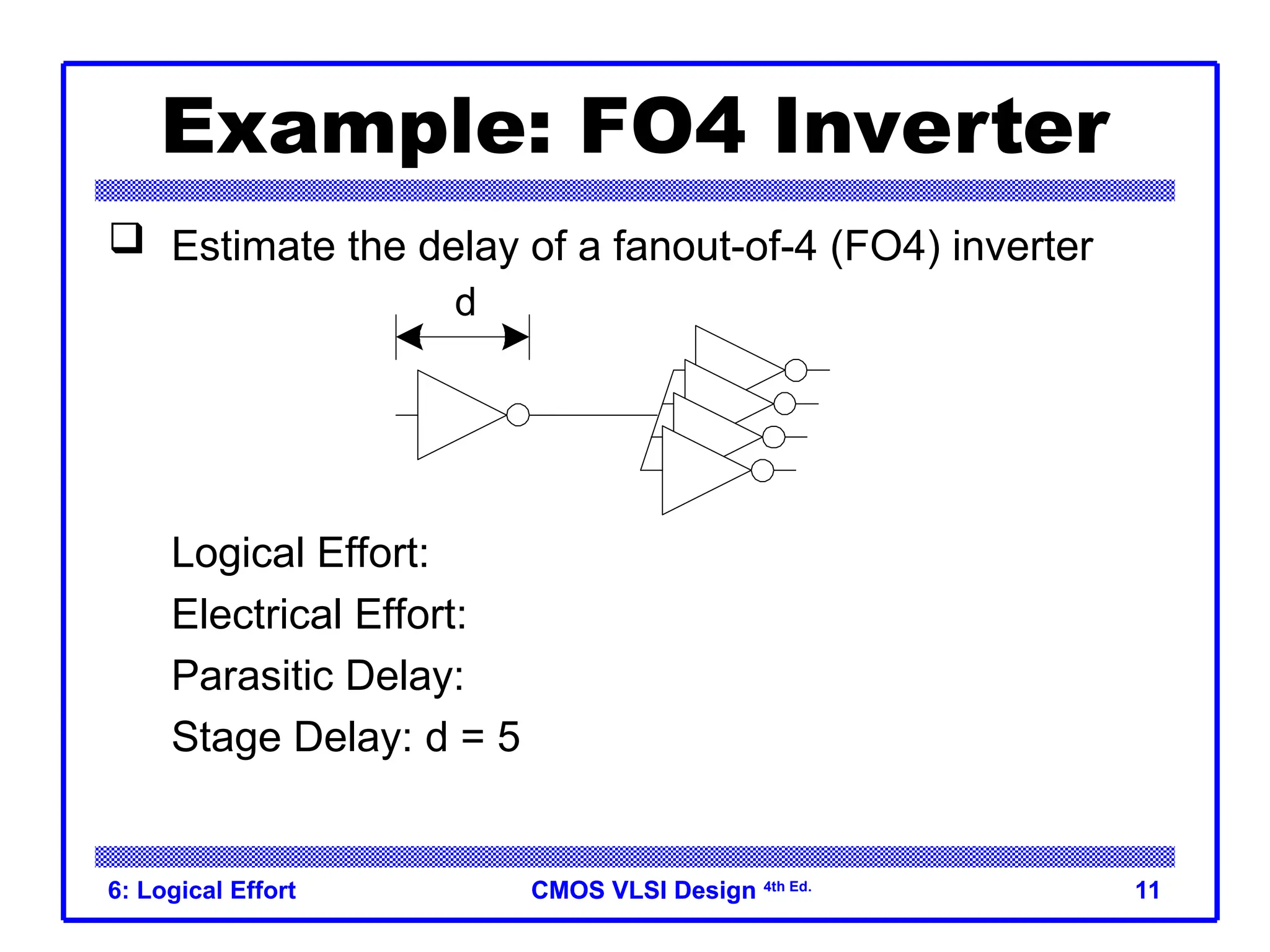
Example: FO4 Inverter
 Estimate the delay of a fanout-of-4 (FO4) inverter
Logical Effort: g = 1
Electrical Effort: h = 4
Parasitic Delay: p = 1
Stage Delay: d = 5
d
The FO4 delay is about
300 ps in 0.6 m process
15 ps in a 65 nm process
CMOS VLSI Design
CMOS VLSI Design 4th Ed.
6: Logical Effort 12
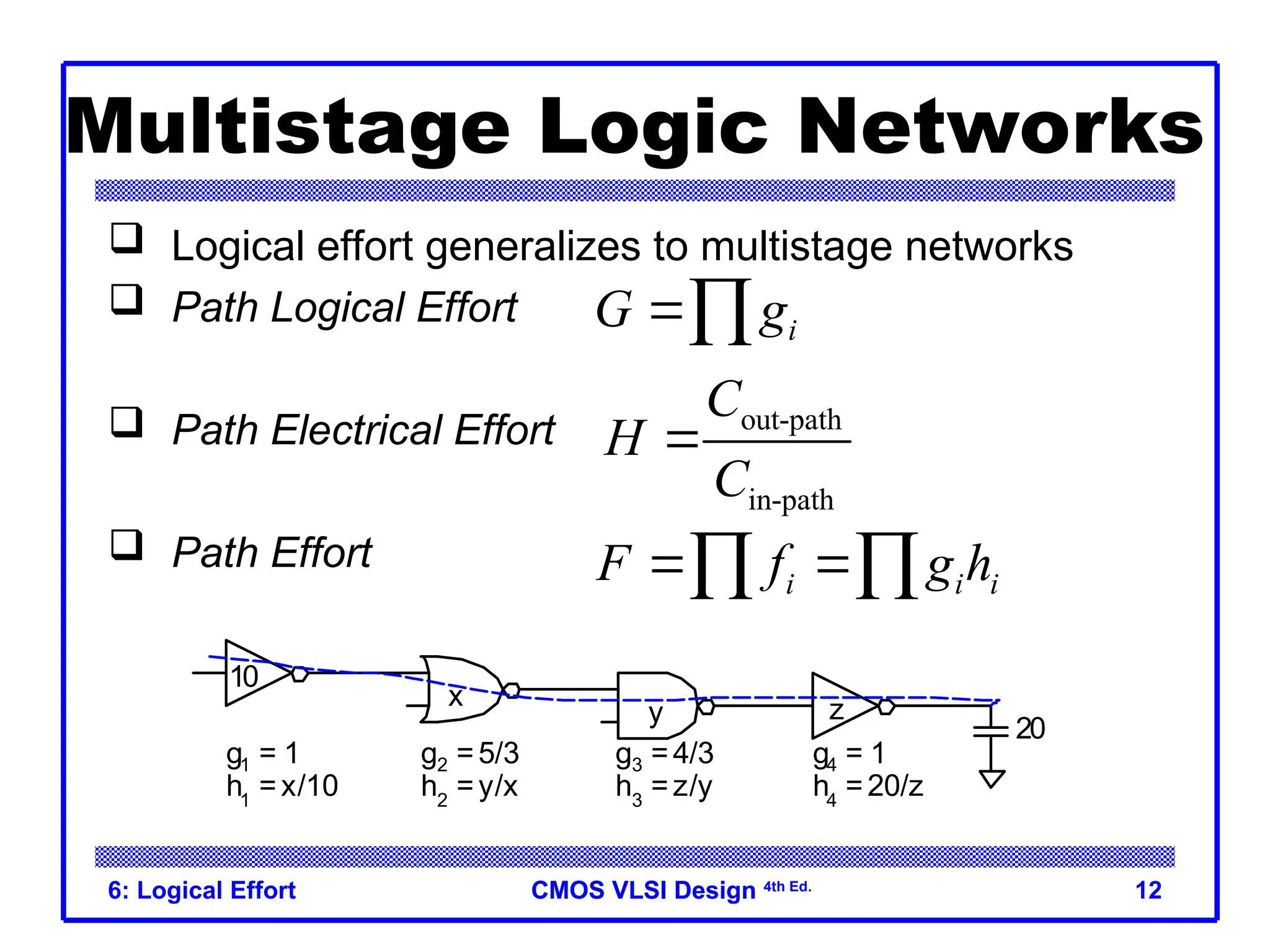
Multistage Logic Networks
 Logical effort generalizes to multistage networks
 Path Logical Effort
 Path Electrical Effort
 Path Effort
i
G g

out-path
in-path
C
H
C

i i i
F f g h
 
 
10
x
y z
20
g1 = 1
h1
=x/10
g2 =5/3
h2
=y/x
g3 =4/3
h3
=z/y
g4 = 1
h4
=20/z
CMOS VLSI Design
CMOS VLSI Design 4th Ed.
6: Logical Effort 13
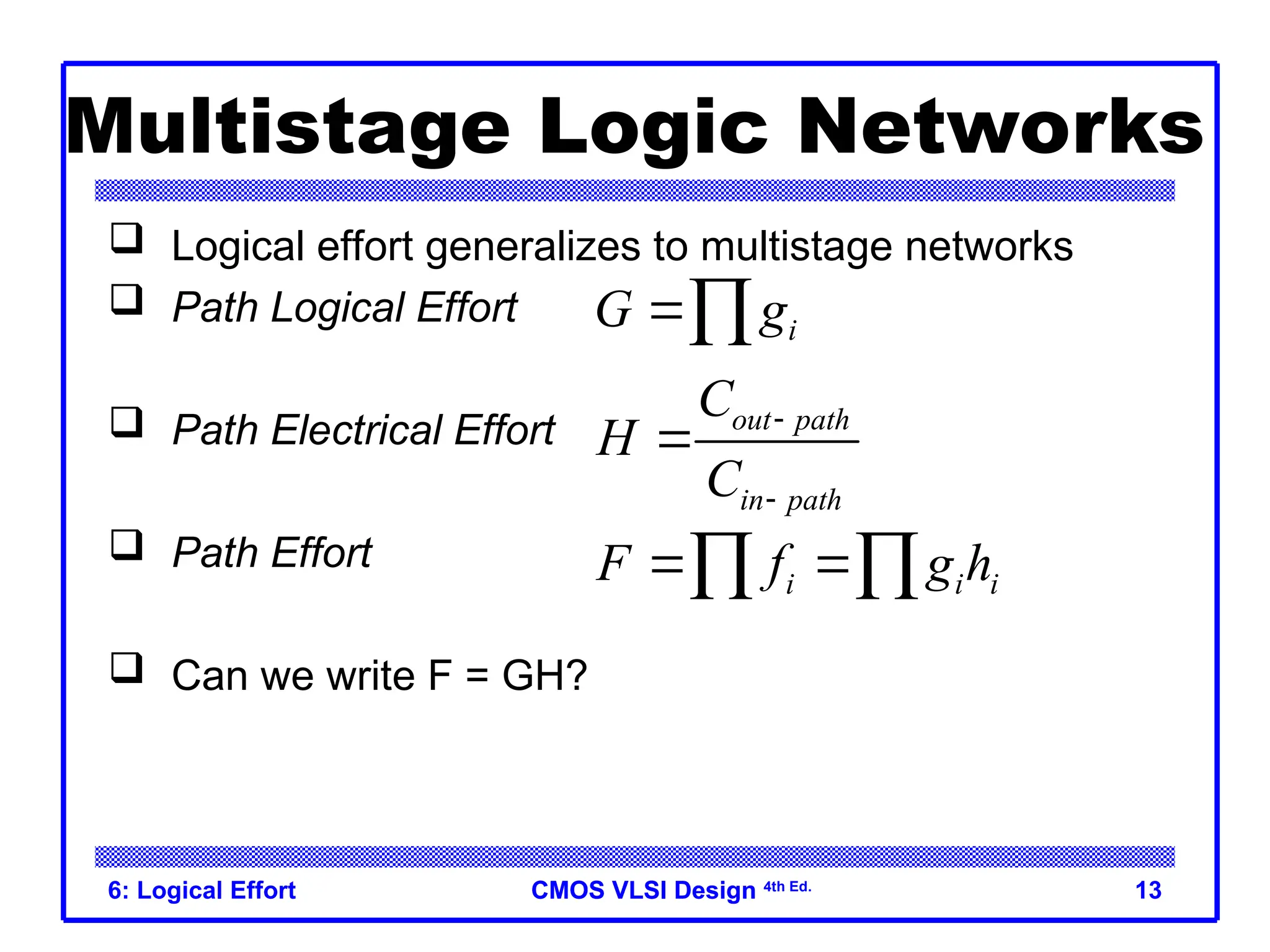
Multistage Logic Networks
 Logical effort generalizes to multistage networks
 Path Logical Effort
 Path Electrical Effort
 Path Effort
 Can we write F = GH?
i
G g

out path
in path
C
H
C



i i i
F f g h
 
 
CMOS VLSI Design
CMOS VLSI Design 4th Ed.
6: Logical Effort 14
Paths that Branch
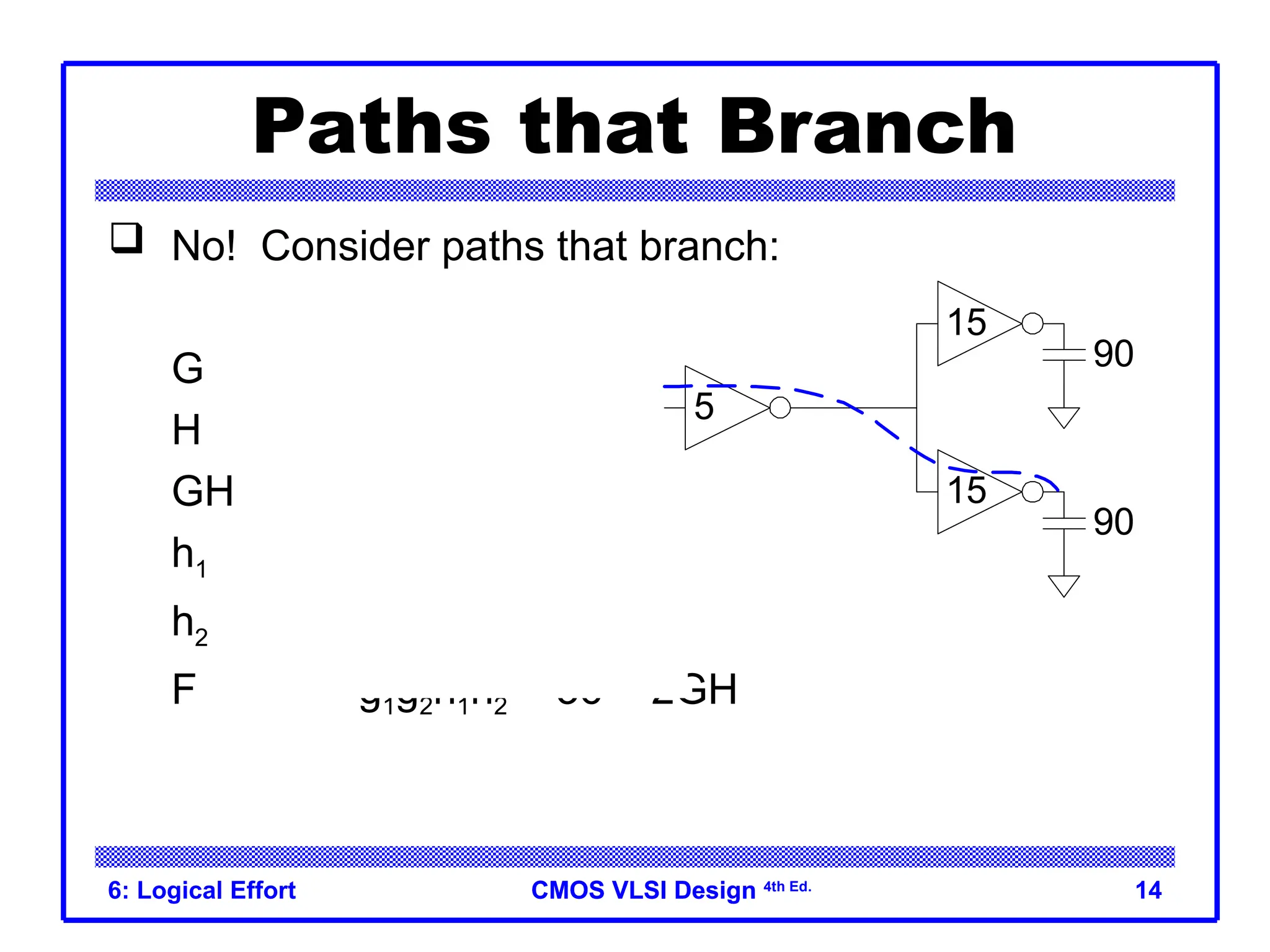
 No! Consider paths that branch:
G = 1
H = 90 / 5 = 18
GH = 18
h1 = (15 +15) / 5 = 6
h2 = 90 / 15 = 6
F = g1g2h1h2 = 36 = 2GH
5
15
15
90
90
CMOS VLSI Design
CMOS VLSI Design 4th Ed.
6: Logical Effort 15
Branching Effort
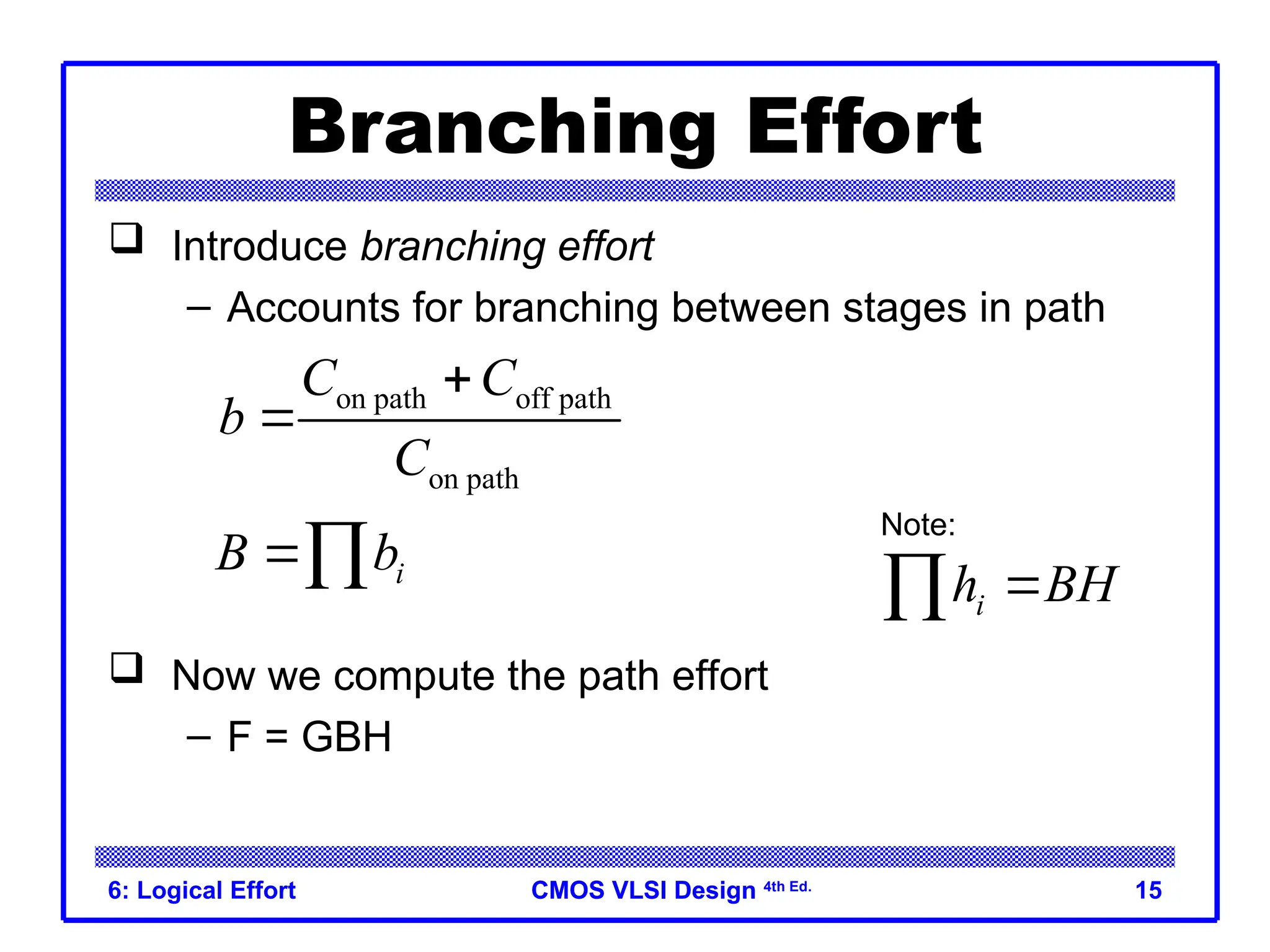
 Introduce branching effort
– Accounts for branching between stages in path
 Now we compute the path effort
– F = GBH
on path off path
on path
C C
b
C


i
B b
 i
h BH


Note:
CMOS VLSI Design
CMOS VLSI Design 4th Ed.
6: Logical Effort 16
Multistage Delays
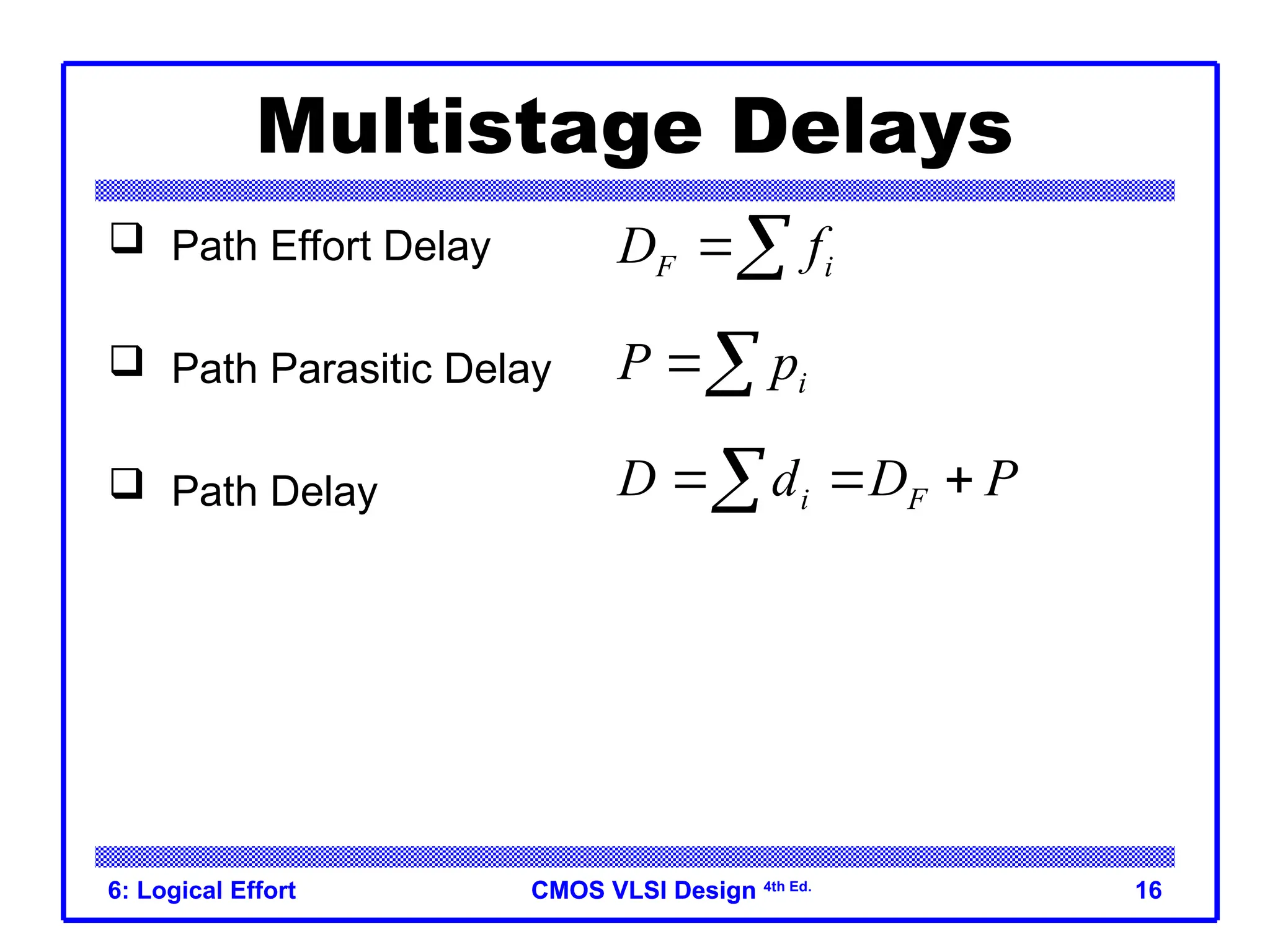
 Path Effort Delay
 Path Parasitic Delay
 Path Delay
F i
D f

i
P p

i F
D d D P
  

CMOS VLSI Design
CMOS VLSI Design 4th Ed.
6: Logical Effort 17
Designing Fast Circuits
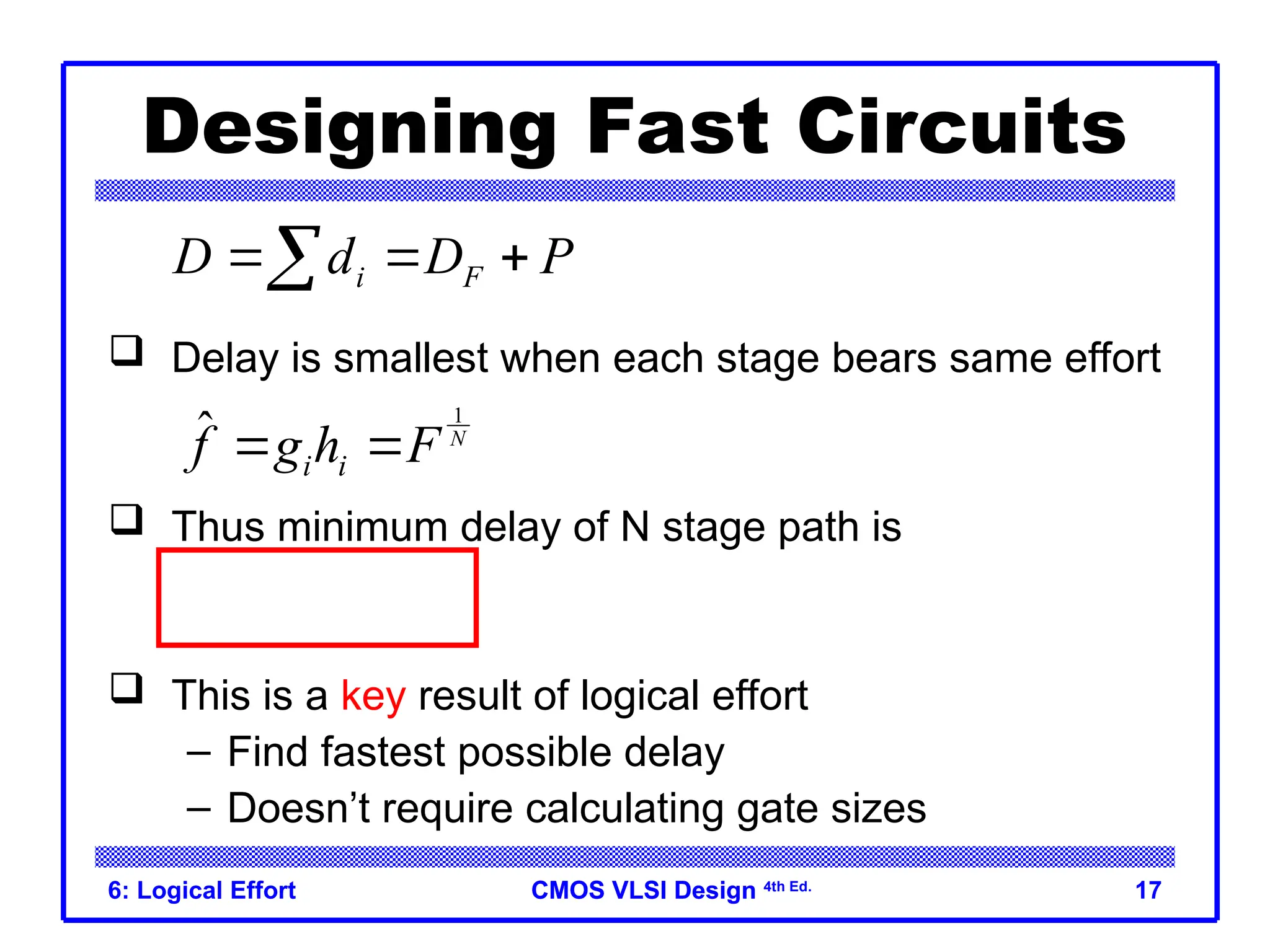
 Delay is smallest when each stage bears same effort
 Thus minimum delay of N stage path is
 This is a key result of logical effort
– Find fastest possible delay
– Doesn’t require calculating gate sizes
i F
D d D P
  

1
ˆ N
i i
f g h F
 
1
N
D NF P
 
CMOS VLSI Design
CMOS VLSI Design 4th Ed.
6: Logical Effort 18
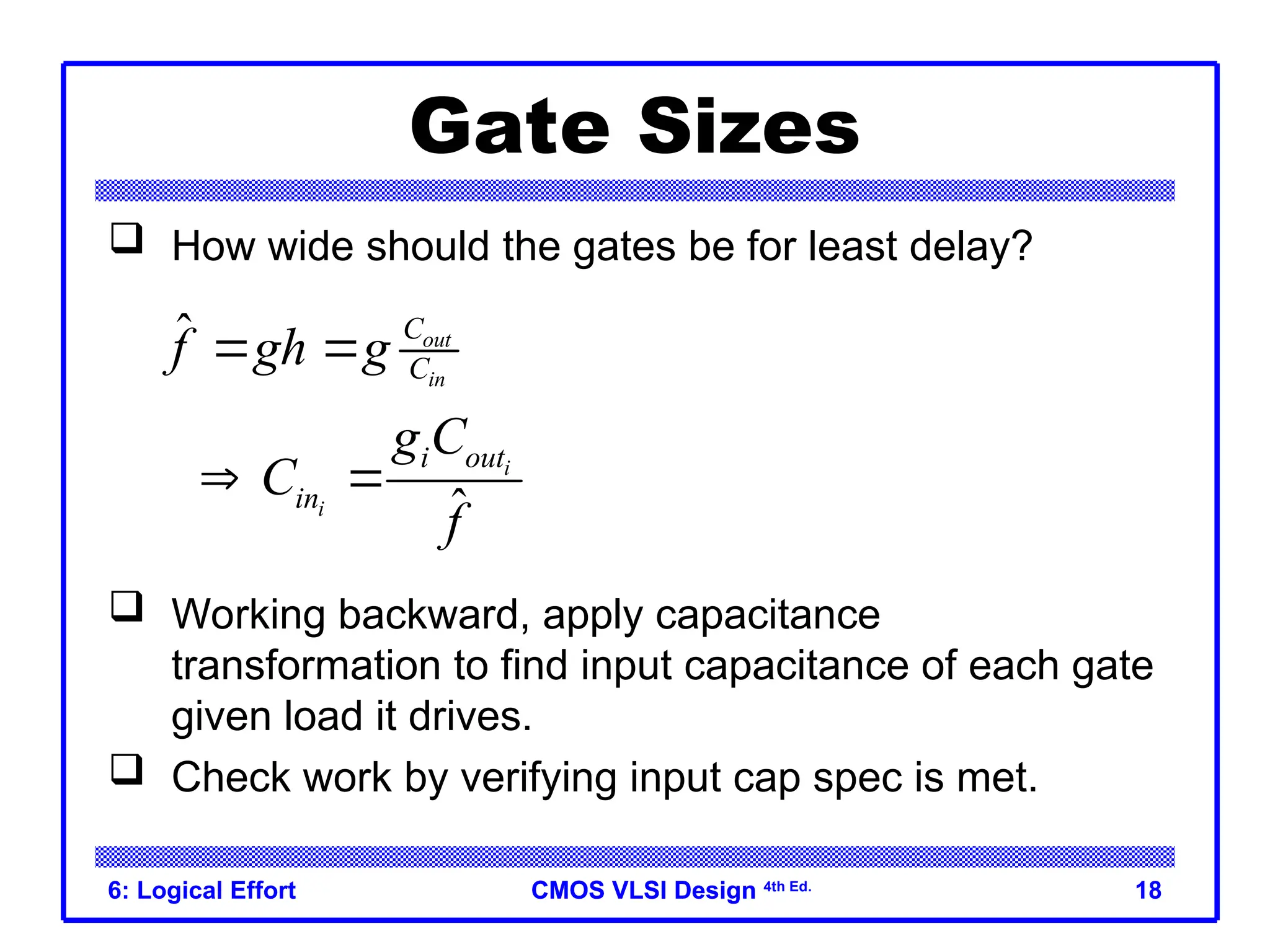
Gate Sizes
 How wide should the gates be for least delay?
 Working backward, apply capacitance
transformation to find input capacitance of each gate
given load it drives.
 Check work by verifying input cap spec is met.
ˆ
ˆ
out
in
i
i
C
C
i out
in
f gh g
g C
C
f
 
 
CMOS VLSI Design
CMOS VLSI Design 4th Ed.
6: Logical Effort 19
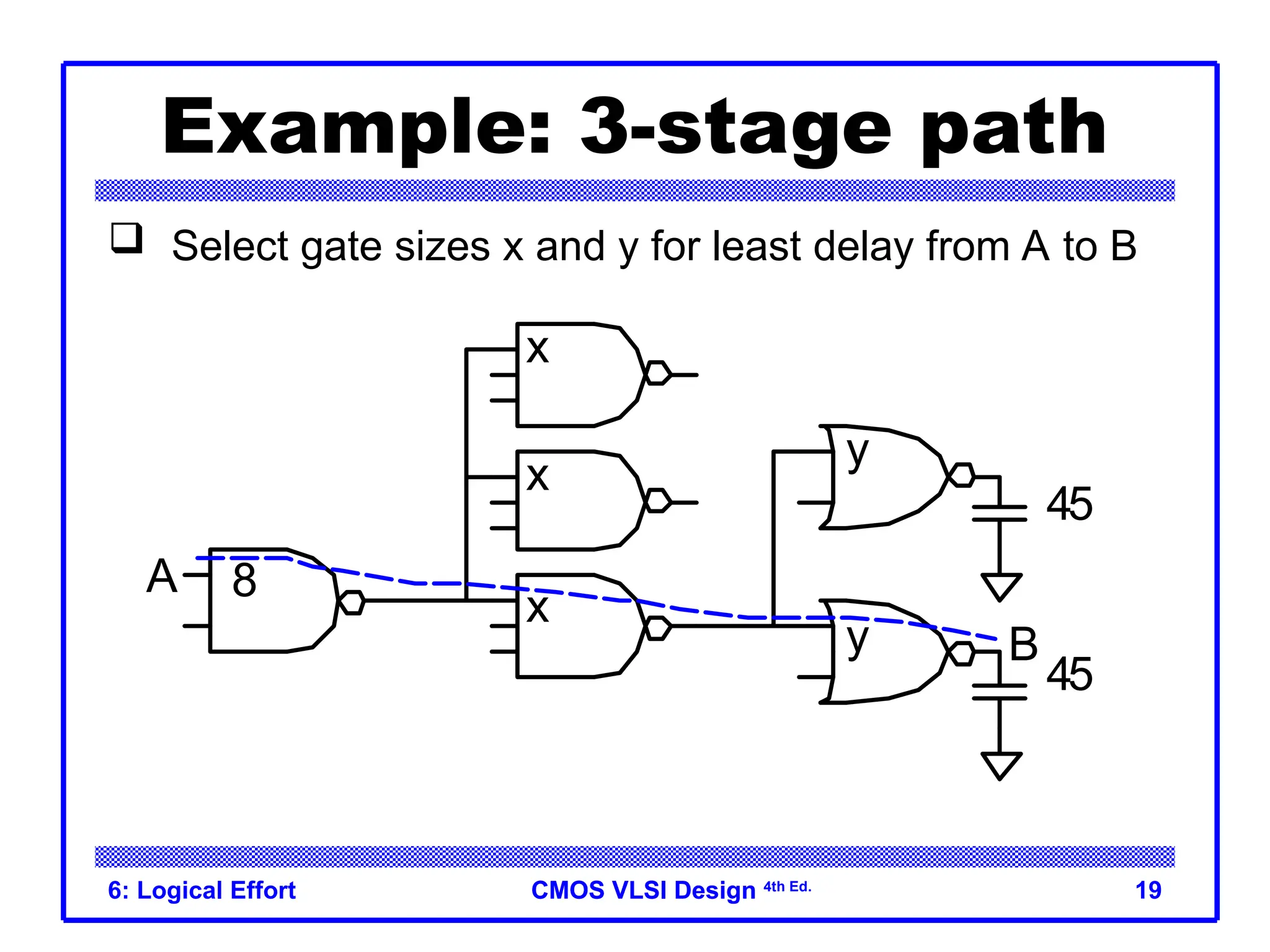
Example: 3-stage path
 Select gate sizes x and y for least delay from A to B
8
x
x
x
y
y
45
45
A
B
CMOS VLSI Design
CMOS VLSI Design 4th Ed.
6: Logical Effort 20
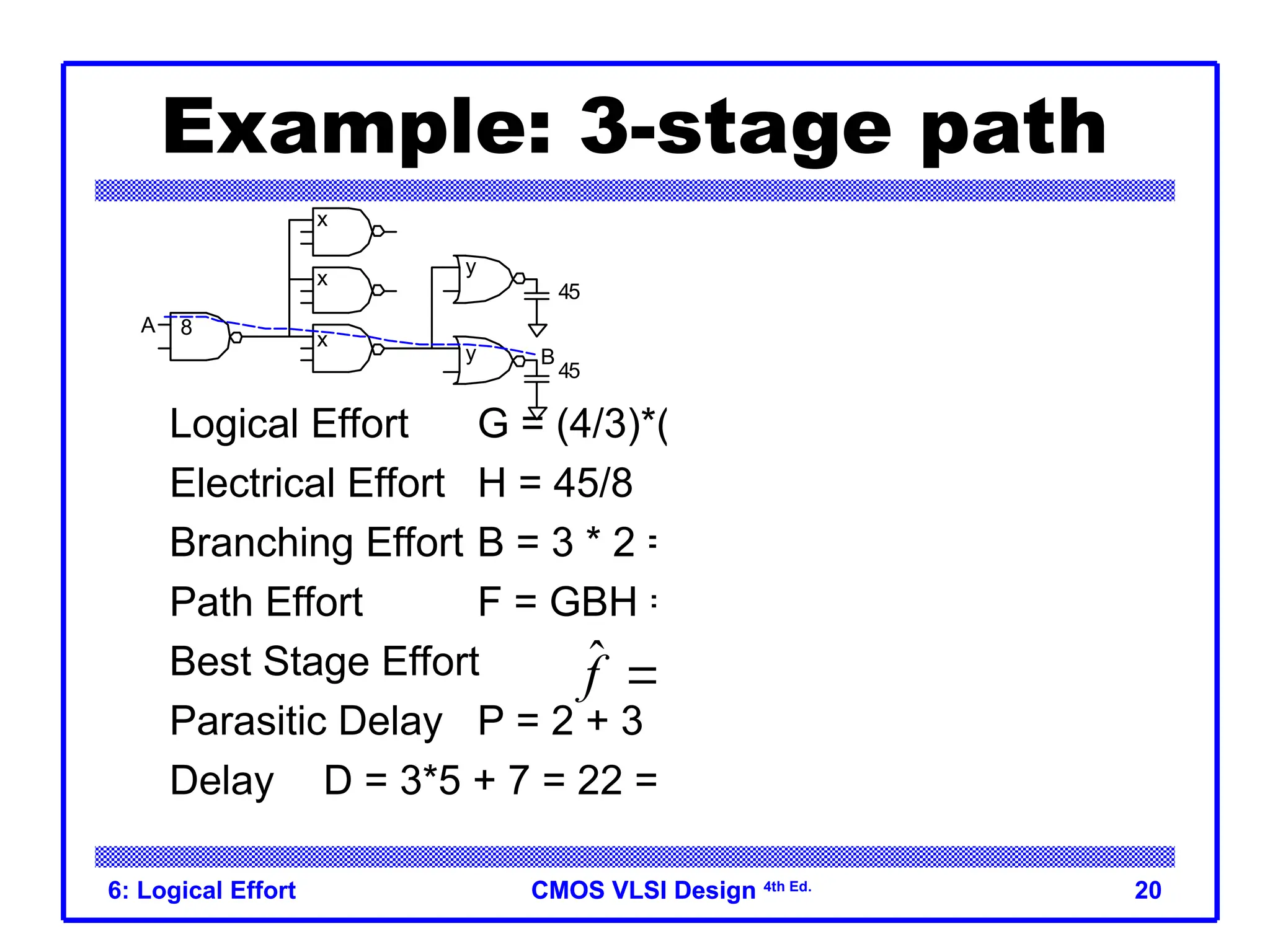
Example: 3-stage path
Logical Effort G = (4/3)*(5/3)*(5/3) = 100/27
Electrical Effort H = 45/8
Branching Effort B = 3 * 2 = 6
Path Effort F = GBH = 125
Best Stage Effort
Parasitic Delay P = 2 + 3 + 2 = 7
Delay D = 3*5 + 7 = 22 = 4.4 FO4
8
x
x
x
y
y
45
45
A
B
3
ˆ 5
f F
 
CMOS VLSI Design
CMOS VLSI Design 4th Ed.
6: Logical Effort 21
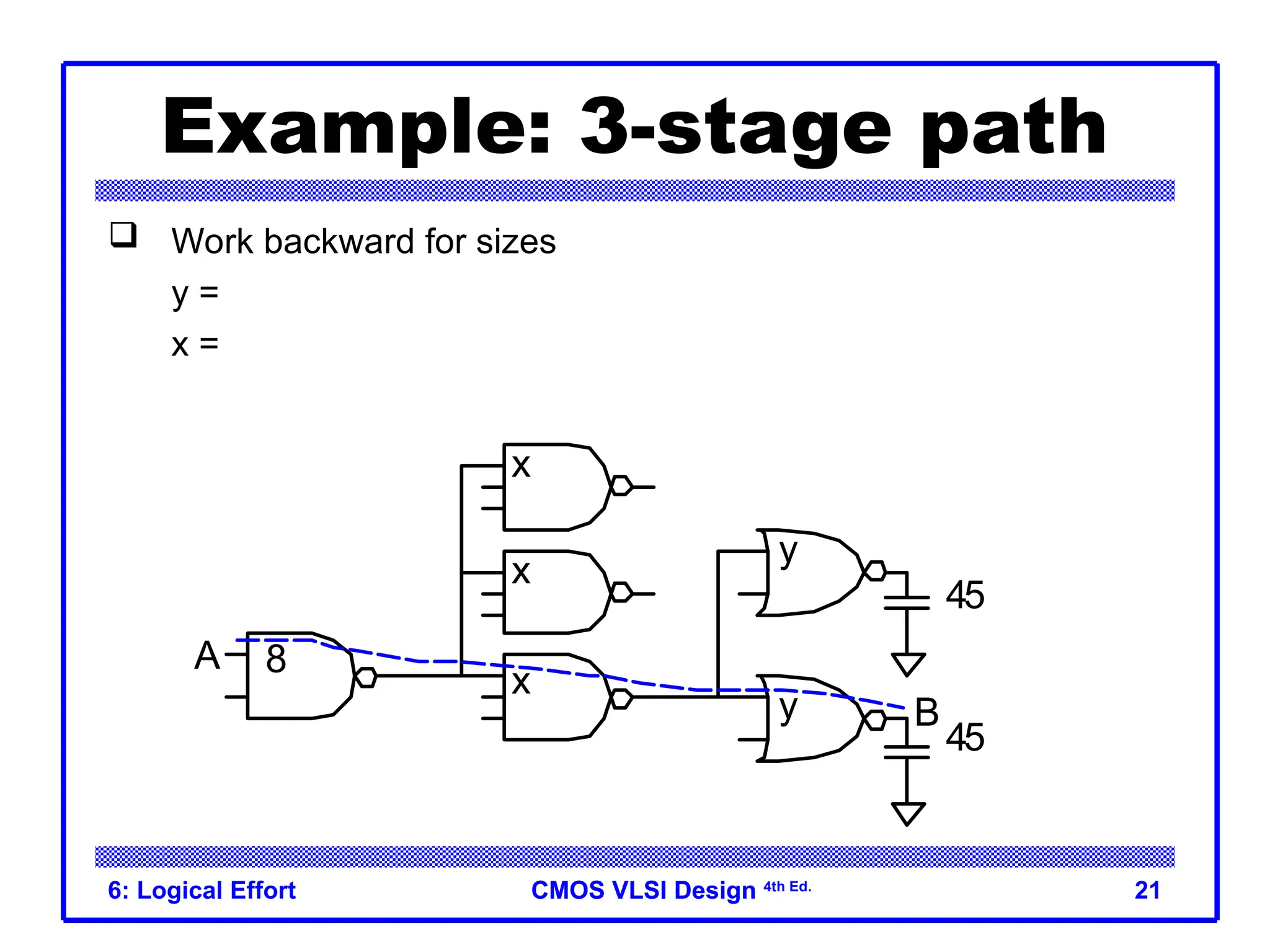
Example: 3-stage path
 Work backward for sizes
y = 45 * (5/3) / 5 = 15
x = (15*2) * (5/3) / 5 = 10
P: 4
N: 4
45
45
A
B
P: 4
N: 6
P: 12
N: 3
8
x
x
x
y
y
45
45
A
B
CMOS VLSI Design
CMOS VLSI Design 4th Ed.
6: Logical Effort 22
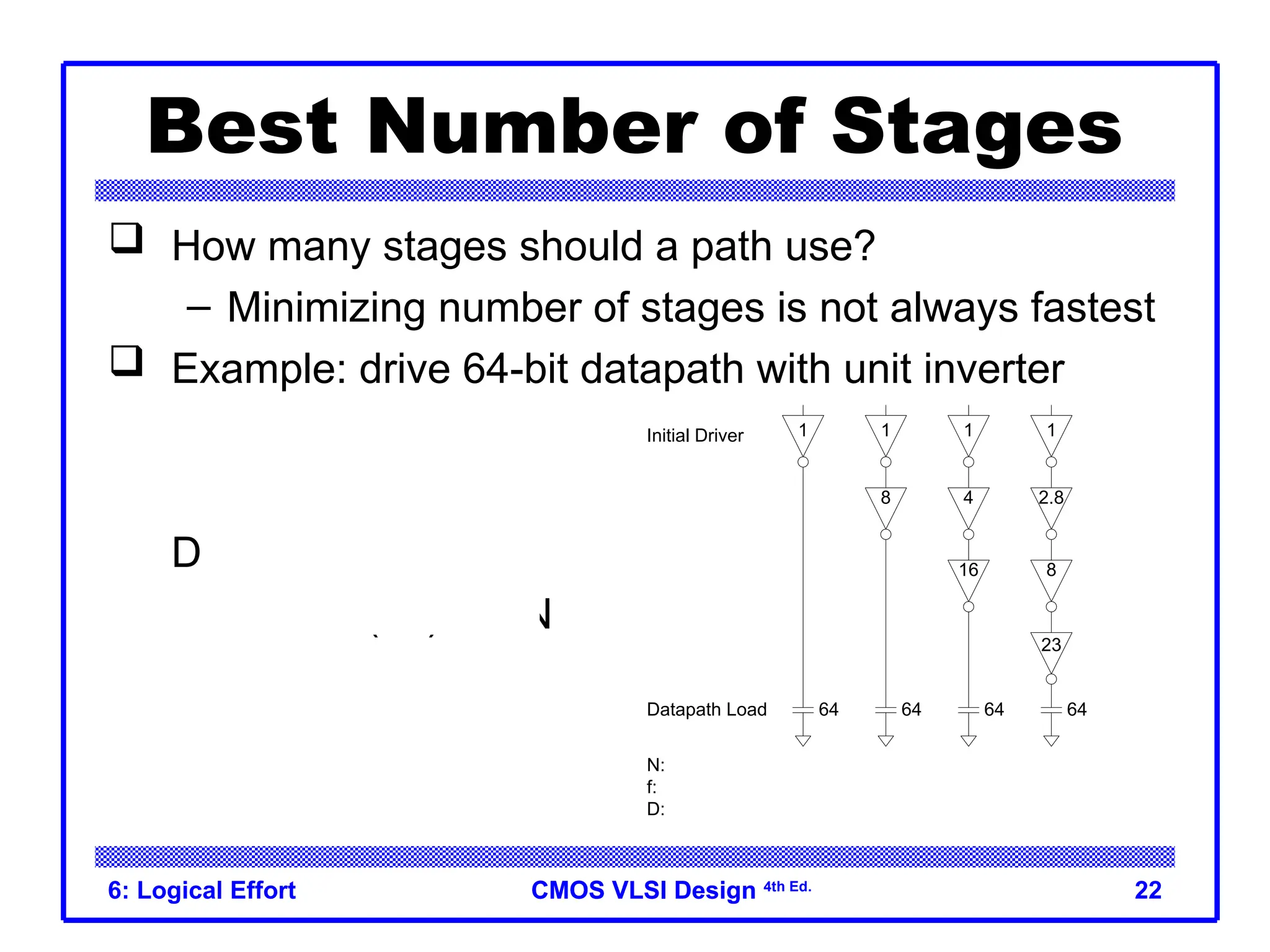
Best Number of Stages
 How many stages should a path use?
– Minimizing number of stages is not always fastest
 Example: drive 64-bit datapath with unit inverter
D = NF1/N
+ P
= N(64)1/N
+ N
1 1 1 1
8 4
16 8
2.8
23
64 64 64 64
Initial Driver
Datapath Load
N:
f:
D:
1
64
65
2
8
18
3
4
15
4
2.8
15.3
Fastest
CMOS VLSI Design
CMOS VLSI Design 4th Ed.
6: Logical Effort 23
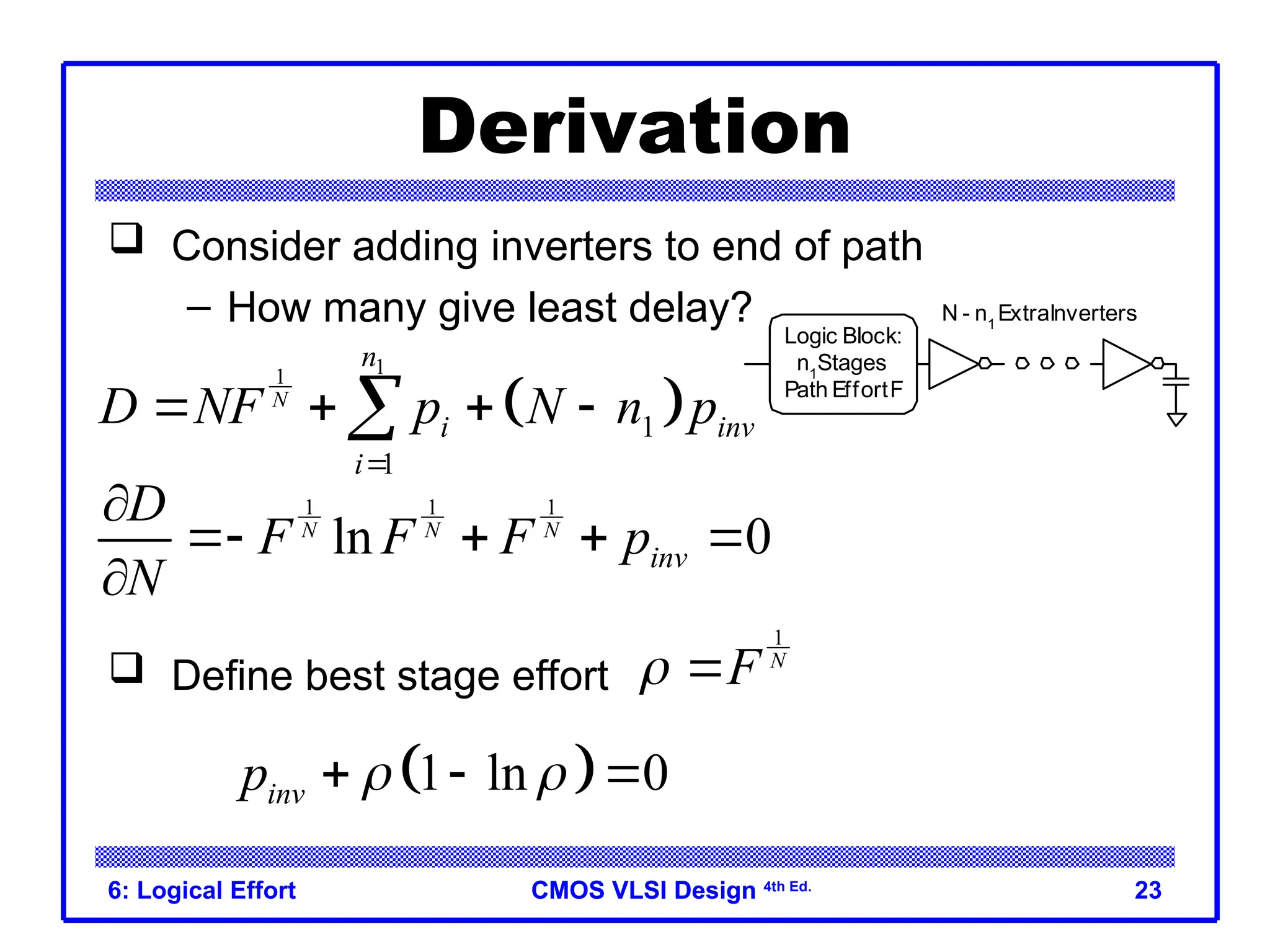
Derivation
 Consider adding inverters to end of path
– How many give least delay?
 Define best stage effort
N - n1
ExtraInverters
Logic Block:
n1
Stages
Path EffortF
 
1
1
1
1
N
n
i inv
i
D NF p N n p

   

1 1 1
ln 0
N N N
inv
D
F F F p
N

   

 
1 ln 0
inv
p  
  
1
N
F
 
CMOS VLSI Design
CMOS VLSI Design 4th Ed.
6: Logical Effort 24
Best Stage Effort
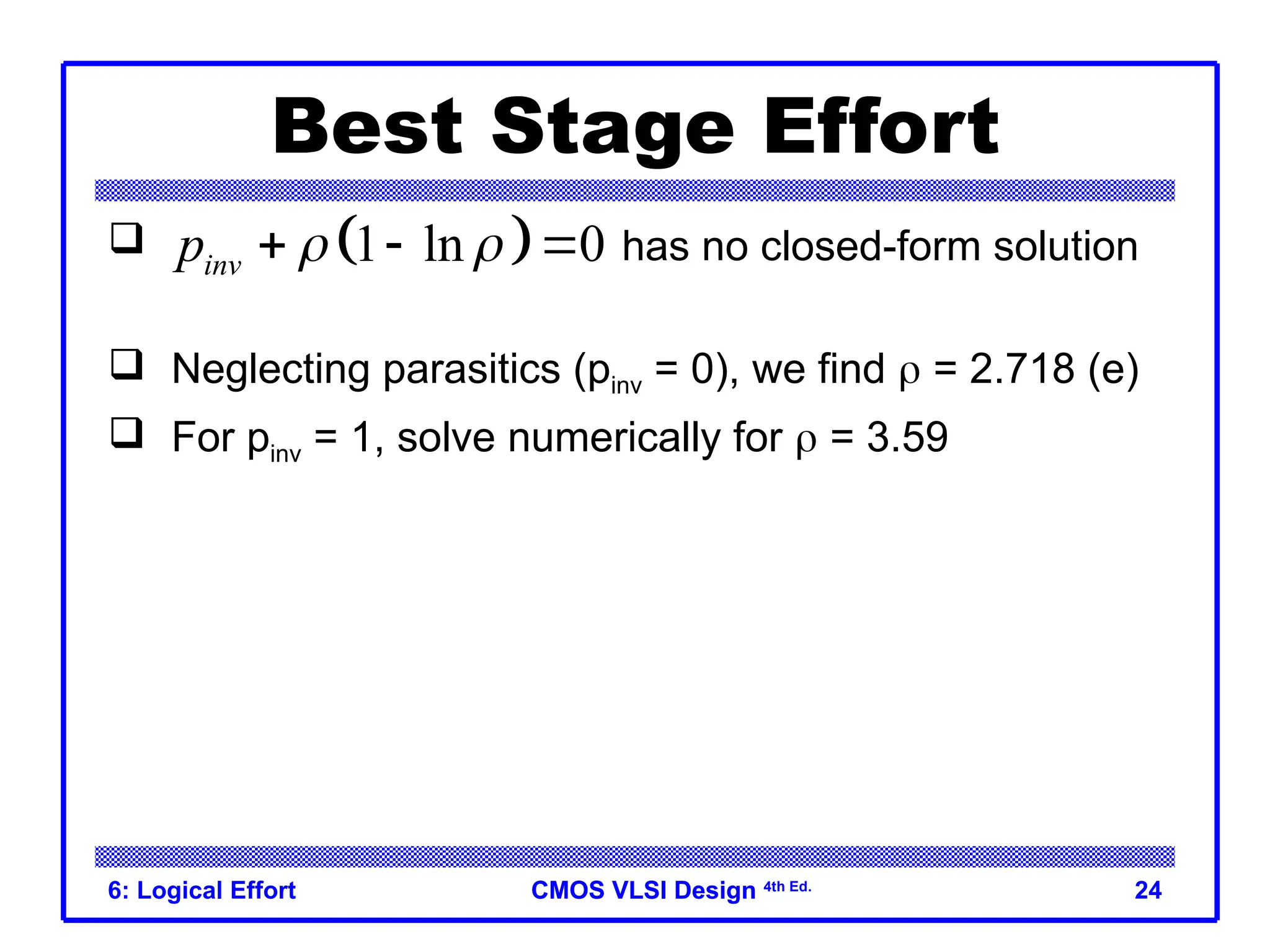
 has no closed-form solution
 Neglecting parasitics (pinv = 0), we find  = 2.718 (e)
 For pinv = 1, solve numerically for  = 3.59
 
1 ln 0
inv
p  
  
CMOS VLSI Design
CMOS VLSI Design 4th Ed.
6: Logical Effort 25
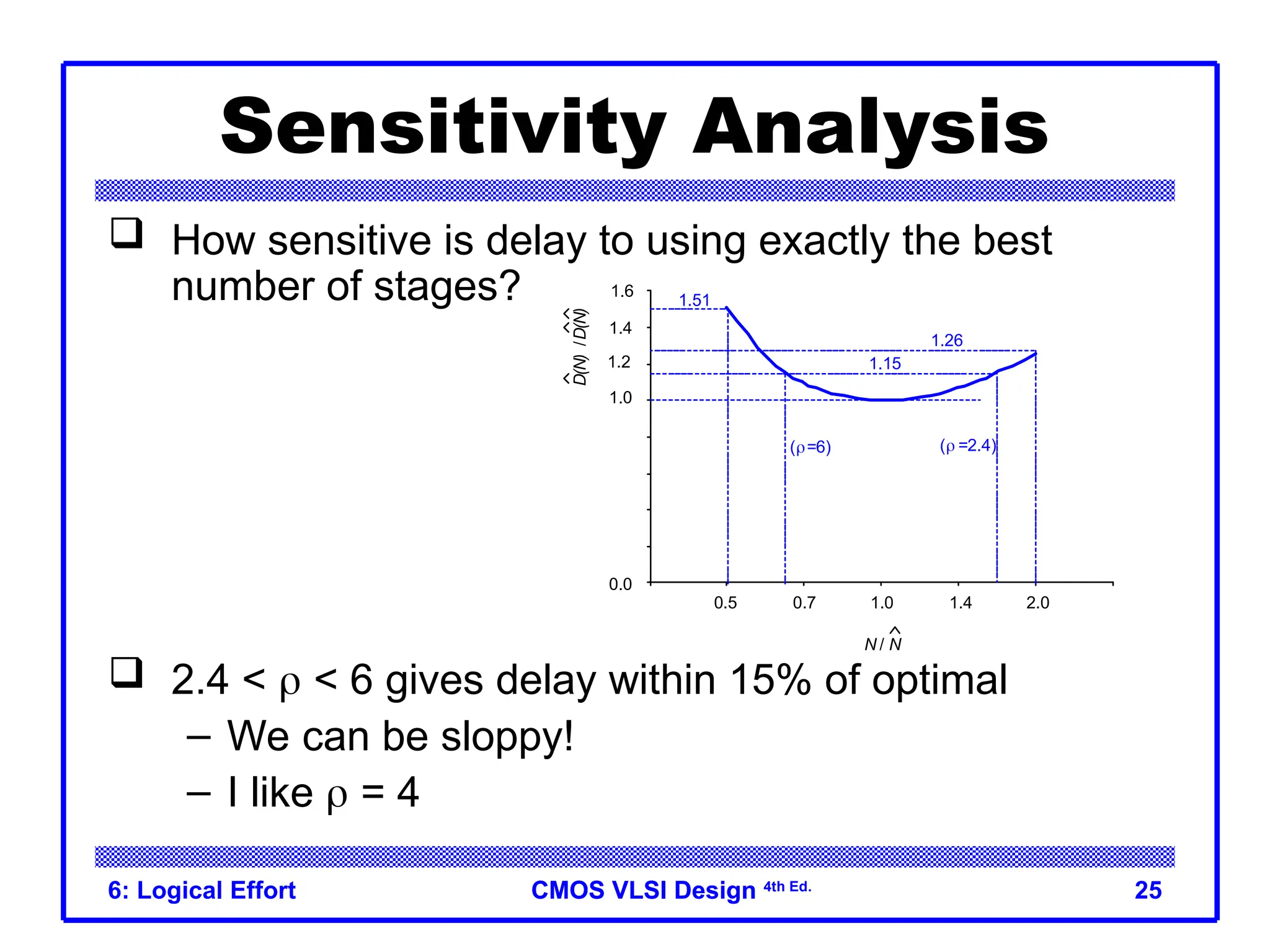
Sensitivity Analysis
 How sensitive is delay to using exactly the best
number of stages?
 2.4 <  < 6 gives delay within 15% of optimal
– We can be sloppy!
– I like  = 4
1.0
1.2
1.4
1.6
1.0 2.0
0.5 1.4
0.7
N / N
1.15
1.26
1.51
( =2.4)
(=6)
D(N)
/D(N) 0.0
CMOS VLSI Design
CMOS VLSI Design 4th Ed.
6: Logical Effort 26
Example, Revisited
 Ben Bitdiddle is the memory designer for the Motoroil 68W86,
an embedded automotive processor. Help Ben design the
decoder for a register file.
 Decoder specifications:
– 16 word register file
– Each word is 32 bits wide
– Each bit presents load of 3 unit-sized transistors
– True and complementary address inputs A[3:0]
– Each input may drive 10 unit-sized transistors
 Ben needs to decide:
– How many stages to use?
– How large should each gate be?
– How fast can decoder operate?
A[3:0] A[3:0]
16
32 bits
16
words
4:16
Decoder
Register File
CMOS VLSI Design
CMOS VLSI Design 4th Ed.
6: Logical Effort 27
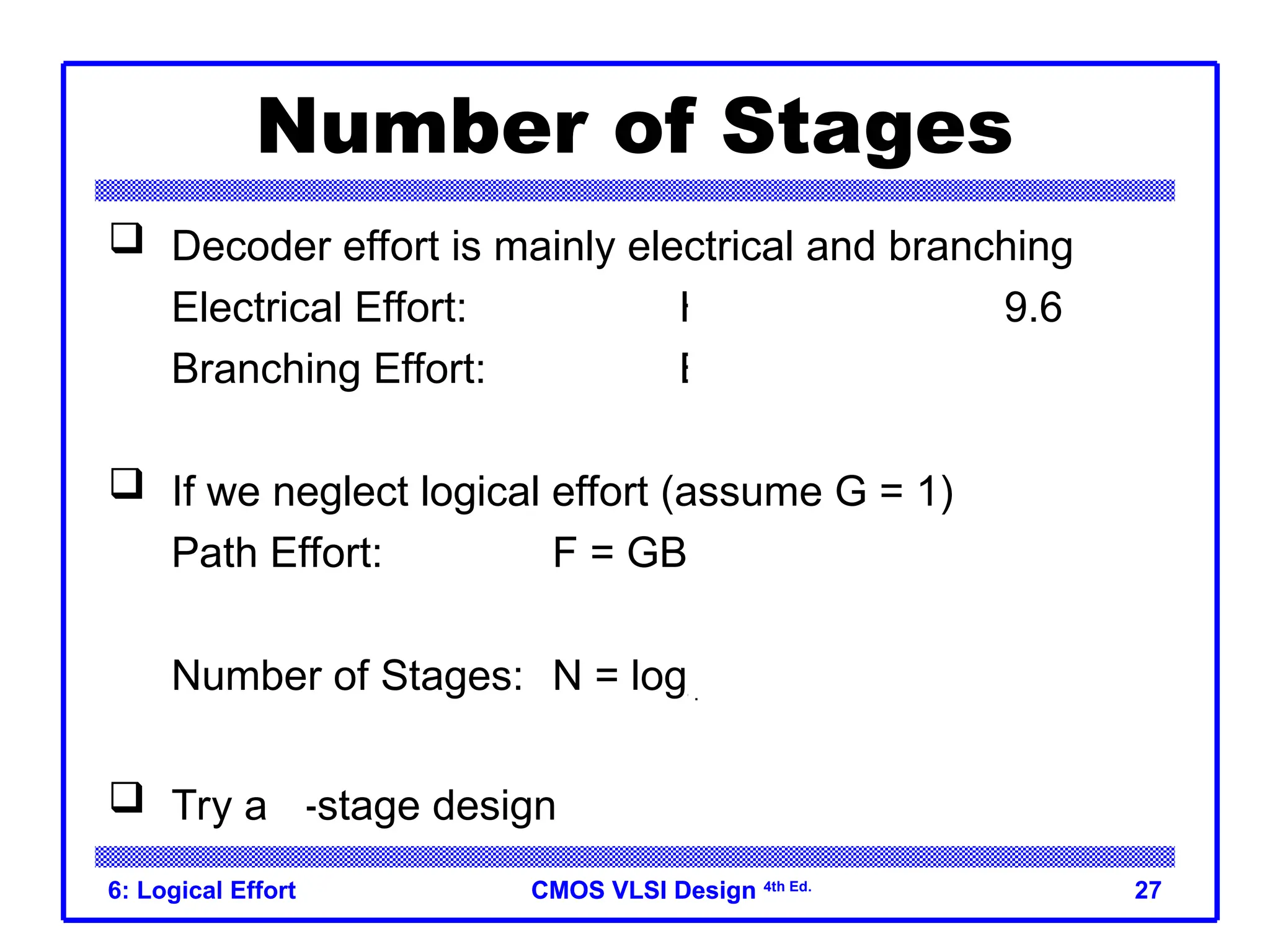
Number of Stages
 Decoder effort is mainly electrical and branching
Electrical Effort: H = (32*3) / 10 = 9.6
Branching Effort: B = 8
 If we neglect logical effort (assume G = 1)
Path Effort: F = GBH = 76.8
Number of Stages: N = log4F = 3.1
 Try a 3-stage design
CMOS VLSI Design
CMOS VLSI Design 4th Ed.
6: Logical Effort 28
Gate Sizes & Delay
Logical Effort: G = 1 * 6/3 * 1 = 2
Path Effort: F = GBH = 154
Stage Effort:
Path Delay:
Gate sizes: z = 96*1/5.36 = 18 y = 18*2/5.36 = 6.7
A[3] A[3] A[2] A[2] A[1] A[1] A[0] A[0]
word[0]
word[15]
96 units of wordline capacitance
10 10 10 10 10 10 10 10
y z
y z
1/3
ˆ 5.36
f F
 
ˆ
3 1 4 1 22.1
D f
    
CMOS VLSI Design
CMOS VLSI Design 4th Ed.
6: Logical Effort 29
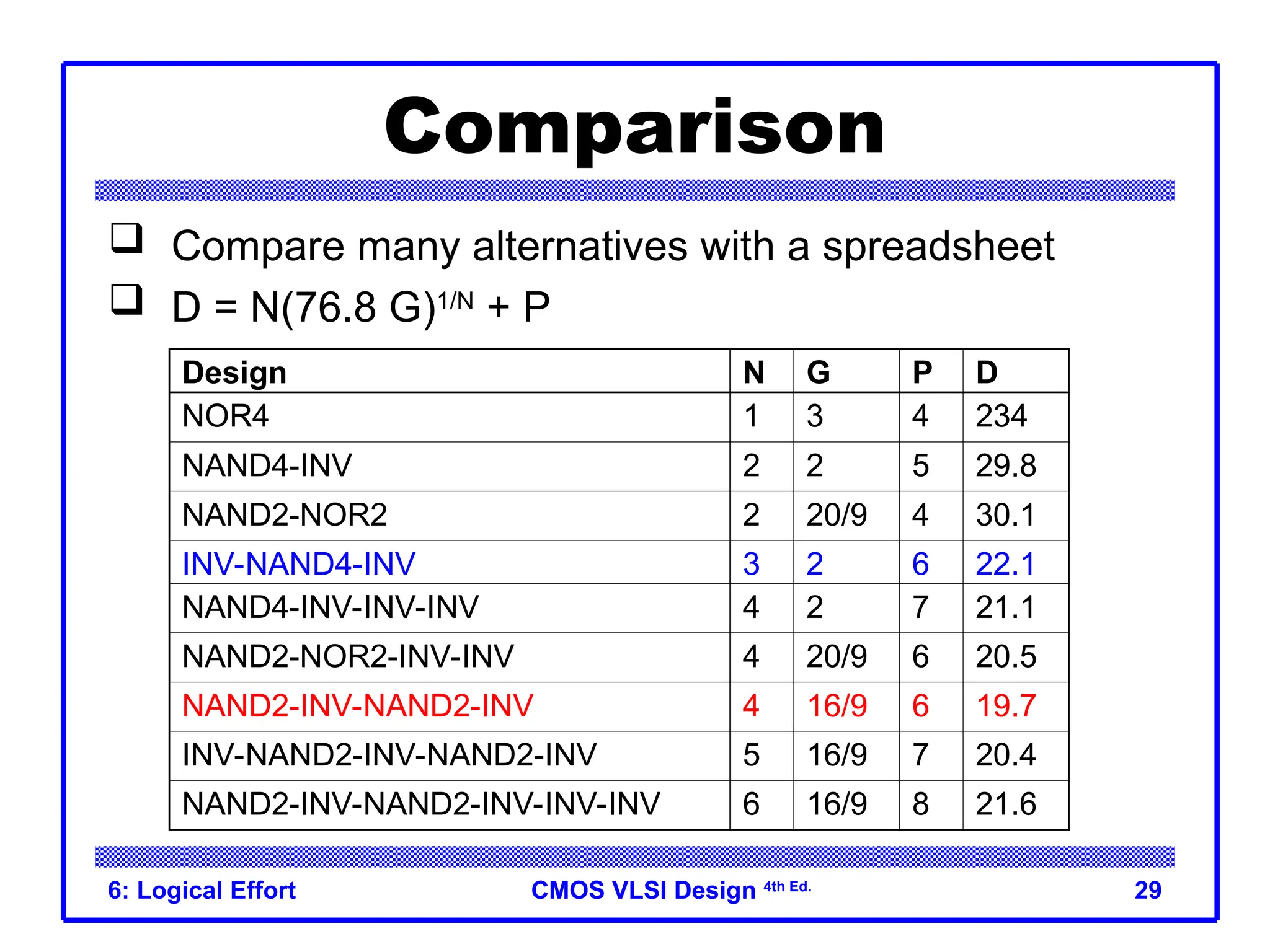
Comparison
 Compare many alternatives with a spreadsheet
 D = N(76.8 G)1/N
+ P
Design N G P D
NOR4 1 3 4 234
NAND4-INV 2 2 5 29.8
NAND2-NOR2 2 20/9 4 30.1
INV-NAND4-INV 3 2 6 22.1
NAND4-INV-INV-INV 4 2 7 21.1
NAND2-NOR2-INV-INV 4 20/9 6 20.5
NAND2-INV-NAND2-INV 4 16/9 6 19.7
INV-NAND2-INV-NAND2-INV 5 16/9 7 20.4
NAND2-INV-NAND2-INV-INV-INV 6 16/9 8 21.6
CMOS VLSI Design
CMOS VLSI Design 4th Ed.
6: Logical Effort 30
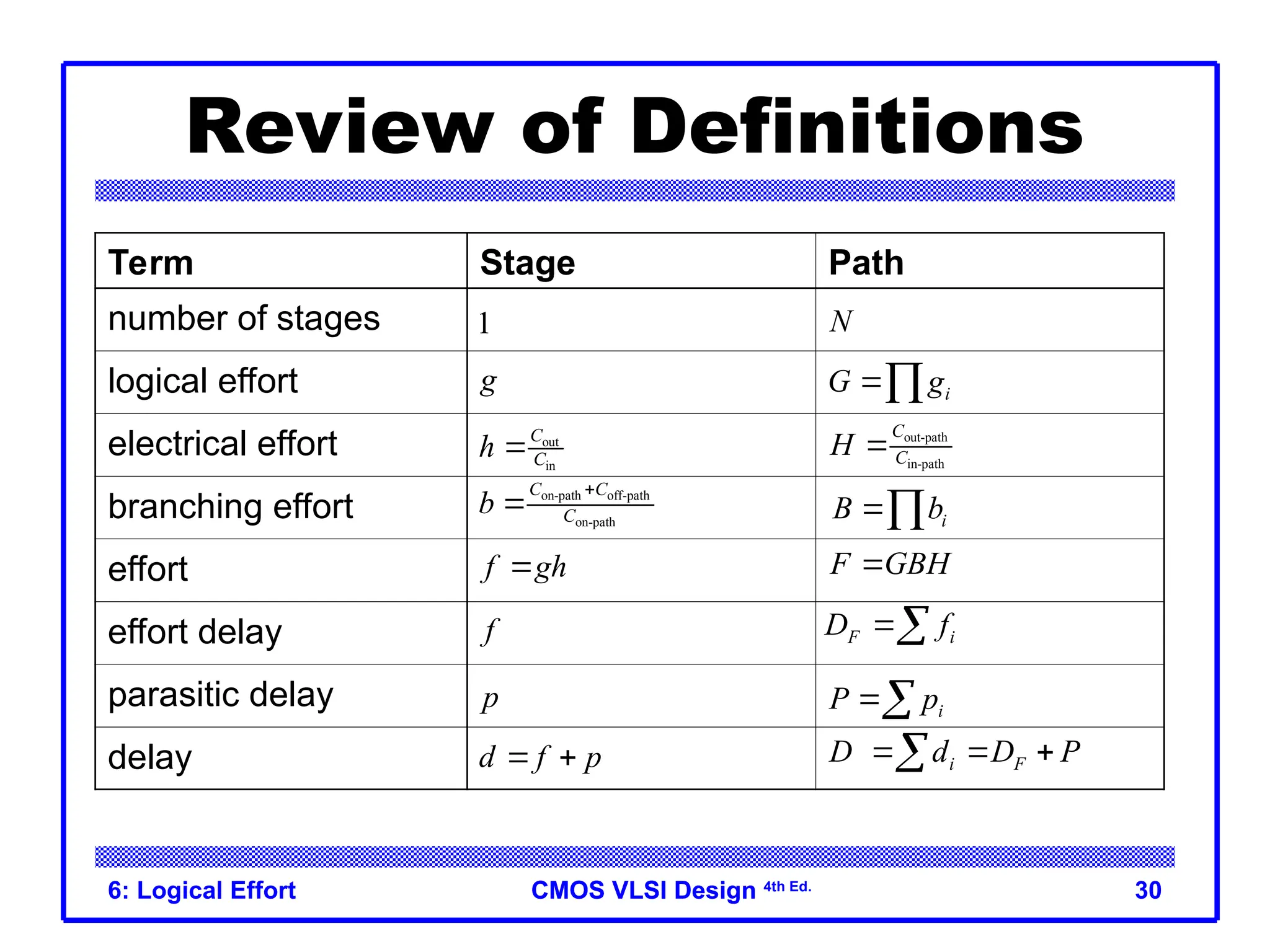
Review of Definitions
Term Stage Path
number of stages
logical effort
electrical effort
branching effort
effort
effort delay
parasitic delay
delay
i
G g

out-path
in-path
C
C
H 
N
i
B b

F GBH

F i
D f

i
P p

i F
D d D P
  

out
in
C
C
h 
on-path off-path
on-path
C C
C
b


f gh

f
p
d f p
 
g
1
CMOS VLSI Design
CMOS VLSI Design 4th Ed.
6: Logical Effort 31
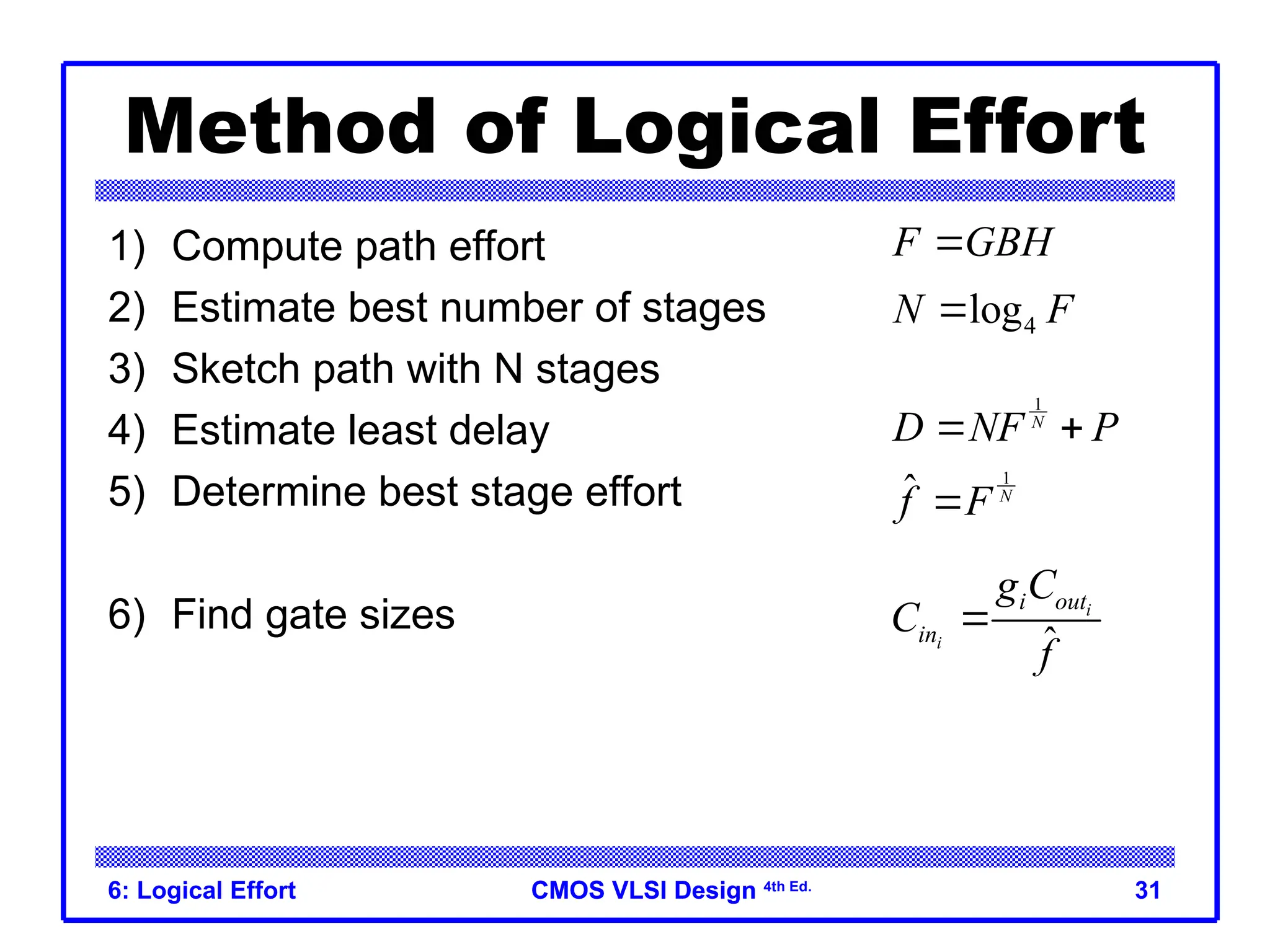
Method of Logical Effort
1) Compute path effort
2) Estimate best number of stages
3) Sketch path with N stages
4) Estimate least delay
5) Determine best stage effort
6) Find gate sizes
F GBH

4
log
N F

1
N
D NF P
 
1
ˆ N
f F

ˆ
i
i
i out
in
g C
C
f

CMOS VLSI Design
CMOS VLSI Design 4th Ed.
6: Logical Effort 32
Limits of Logical Effort
 Chicken and egg problem
– Need path to compute G
– But don’t know number of stages without G
 Simplistic delay model
– Neglects input rise time effects
 Interconnect
– Iteration required in designs with wire
 Maximum speed only
– Not minimum area/power for constrained delay
CMOS VLSI Design
CMOS VLSI Design 4th Ed.
6: Logical Effort 33
Summary
 Logical effort is useful for thinking of delay in circuits
– Numeric logical effort characterizes gates
– NANDs are faster than NORs in CMOS
– Paths are fastest when effort delays are ~4
– Path delay is weakly sensitive to stages, sizes
– But using fewer stages doesn’t mean faster paths
– Delay of path is about log4F FO4 inverter delays
– Inverters and NAND2 best for driving large caps
 Provides language for discussing fast circuits
– But requires practice to master

Logical Effort in VLSI design and testing

  • 1.
  • 2.
    CMOS VLSI Design CMOSVLSI Design 4th Ed. 6: Logical Effort 2 Outline  Logical Effort  Delay in a Logic Gate  Multistage Logic Networks  Choosing the Best Number of Stages  Example  Summary
  • 3.
    CMOS VLSI Design CMOSVLSI Design 4th Ed. 6: Logical Effort 3 Introduction  Chip designers face a bewildering array of choices – What is the best circuit topology for a function? – How many stages of logic give least delay? – How wide should the transistors be?  Logical effort is a method to make these decisions – Uses a simple model of delay – Allows back-of-the-envelope calculations – Helps make rapid comparisons between alternatives – Emphasizes remarkable symmetries ? ? ?
  • 4.
    CMOS VLSI Design CMOSVLSI Design 4th Ed. 6: Logical Effort 4 Example  Ben Bitdiddle is the memory designer for the Motoroil 68W86, an embedded automotive processor. Help Ben design the decoder for a register file.  Decoder specifications: – 16 word register file – Each word is 32 bits wide – Each bit presents load of 3 unit-sized transistors – True and complementary address inputs A[3:0] – Each input may drive 10 unit-sized transistors  Ben needs to decide: – How many stages to use? – How large should each gate be? – How fast can decoder operate? A[3:0] A[3:0] 16 32 bits 16 words 4:16 Decoder Register File
  • 5.
    CMOS VLSI Design CMOSVLSI Design 4th Ed. 6: Logical Effort 5 Delay in a Logic Gate  Express delays in process-independent unit  Delay has two components: d = f + p  f: effort delay = gh (a.k.a. stage effort) – Again has two components  g: logical effort – Measures relative ability of gate to deliver current – g  1 for inverter  h: electrical effort = Cout / Cin – Ratio of output to input capacitance – Sometimes called fanout  p: parasitic delay – Represents delay of gate driving no load – Set by internal parasitic capacitance abs d d   3RC  3 ps in 65 nm process 60 ps in 0.6 m process
  • 6.
    CMOS VLSI Design CMOSVLSI Design 4th Ed. 6: Logical Effort 6 Electrical Effort: h = Cout / Cin Normalized Delay: d Inverter 2-input NAND g = 1 p = 1 d = h + 1 g = 4/3 p = 2 d = (4/3)h + 2 Effort Delay: f Parasitic Delay: p 0 1 2 3 4 5 0 1 2 3 4 5 6 Electrical Effort: h = Cout / Cin Normalized Delay: d Inverter 2-input NAND g = p = d = g = p = d = 0 1 2 3 4 5 0 1 2 3 4 5 6 Delay Plots d = f + p = gh + p  What about NOR2?
  • 7.
    CMOS VLSI Design CMOSVLSI Design 4th Ed. 6: Logical Effort 7 Computing Logical Effort  DEF: Logical effort is the ratio of the input capacitance of a gate to the input capacitance of an inverter delivering the same output current.  Measure from delay vs. fanout plots  Or estimate by counting transistor widths A Y A B Y A B Y 1 2 1 1 2 2 2 2 4 4 Cin = 3 g = 3/3 Cin = 4 g = 4/3 Cin = 5 g = 5/3
  • 8.
    CMOS VLSI Design CMOSVLSI Design 4th Ed. 6: Logical Effort 8 Catalog of Gates Gate type Number of inputs 1 2 3 4 n Inverter 1 NAND 4/3 5/3 6/3 (n+2)/3 NOR 5/3 7/3 9/3 (2n+1)/3 Tristate / mux 2 2 2 2 2 XOR, XNOR 4, 4 6, 12, 6 8, 16, 16, 8  Logical effort of common gates
  • 9.
    CMOS VLSI Design CMOSVLSI Design 4th Ed. 6: Logical Effort 9 Catalog of Gates Gate type Number of inputs 1 2 3 4 n Inverter 1 NAND 2 3 4 n NOR 2 3 4 n Tristate / mux 2 4 6 8 2n XOR, XNOR 4 6 8  Parasitic delay of common gates – In multiples of pinv (1)
  • 10.
    CMOS VLSI Design CMOSVLSI Design 4th Ed. 6: Logical Effort 10 Example: Ring Oscillator  Estimate the frequency of an N-stage ring oscillator Logical Effort: g = 1 Electrical Effort: h = 1 Parasitic Delay: p = 1 Stage Delay: d = 2 Frequency: fosc = 1/(2*N*d) = 1/4N 31 stage ring oscillator in 0.6 m process has frequency of ~ 200 MHz
  • 11.
    CMOS VLSI Design CMOSVLSI Design 4th Ed. 6: Logical Effort 11 Example: FO4 Inverter  Estimate the delay of a fanout-of-4 (FO4) inverter Logical Effort: g = 1 Electrical Effort: h = 4 Parasitic Delay: p = 1 Stage Delay: d = 5 d The FO4 delay is about 300 ps in 0.6 m process 15 ps in a 65 nm process
  • 12.
    CMOS VLSI Design CMOSVLSI Design 4th Ed. 6: Logical Effort 12 Multistage Logic Networks  Logical effort generalizes to multistage networks  Path Logical Effort  Path Electrical Effort  Path Effort i G g  out-path in-path C H C  i i i F f g h     10 x y z 20 g1 = 1 h1 =x/10 g2 =5/3 h2 =y/x g3 =4/3 h3 =z/y g4 = 1 h4 =20/z
  • 13.
    CMOS VLSI Design CMOSVLSI Design 4th Ed. 6: Logical Effort 13 Multistage Logic Networks  Logical effort generalizes to multistage networks  Path Logical Effort  Path Electrical Effort  Path Effort  Can we write F = GH? i G g  out path in path C H C    i i i F f g h    
  • 14.
    CMOS VLSI Design CMOSVLSI Design 4th Ed. 6: Logical Effort 14 Paths that Branch  No! Consider paths that branch: G = 1 H = 90 / 5 = 18 GH = 18 h1 = (15 +15) / 5 = 6 h2 = 90 / 15 = 6 F = g1g2h1h2 = 36 = 2GH 5 15 15 90 90
  • 15.
    CMOS VLSI Design CMOSVLSI Design 4th Ed. 6: Logical Effort 15 Branching Effort  Introduce branching effort – Accounts for branching between stages in path  Now we compute the path effort – F = GBH on path off path on path C C b C   i B b  i h BH   Note:
  • 16.
    CMOS VLSI Design CMOSVLSI Design 4th Ed. 6: Logical Effort 16 Multistage Delays  Path Effort Delay  Path Parasitic Delay  Path Delay F i D f  i P p  i F D d D P    
  • 17.
    CMOS VLSI Design CMOSVLSI Design 4th Ed. 6: Logical Effort 17 Designing Fast Circuits  Delay is smallest when each stage bears same effort  Thus minimum delay of N stage path is  This is a key result of logical effort – Find fastest possible delay – Doesn’t require calculating gate sizes i F D d D P     1 ˆ N i i f g h F   1 N D NF P  
  • 18.
    CMOS VLSI Design CMOSVLSI Design 4th Ed. 6: Logical Effort 18 Gate Sizes  How wide should the gates be for least delay?  Working backward, apply capacitance transformation to find input capacitance of each gate given load it drives.  Check work by verifying input cap spec is met. ˆ ˆ out in i i C C i out in f gh g g C C f    
  • 19.
    CMOS VLSI Design CMOSVLSI Design 4th Ed. 6: Logical Effort 19 Example: 3-stage path  Select gate sizes x and y for least delay from A to B 8 x x x y y 45 45 A B
  • 20.
    CMOS VLSI Design CMOSVLSI Design 4th Ed. 6: Logical Effort 20 Example: 3-stage path Logical Effort G = (4/3)*(5/3)*(5/3) = 100/27 Electrical Effort H = 45/8 Branching Effort B = 3 * 2 = 6 Path Effort F = GBH = 125 Best Stage Effort Parasitic Delay P = 2 + 3 + 2 = 7 Delay D = 3*5 + 7 = 22 = 4.4 FO4 8 x x x y y 45 45 A B 3 ˆ 5 f F  
  • 21.
    CMOS VLSI Design CMOSVLSI Design 4th Ed. 6: Logical Effort 21 Example: 3-stage path  Work backward for sizes y = 45 * (5/3) / 5 = 15 x = (15*2) * (5/3) / 5 = 10 P: 4 N: 4 45 45 A B P: 4 N: 6 P: 12 N: 3 8 x x x y y 45 45 A B
  • 22.
    CMOS VLSI Design CMOSVLSI Design 4th Ed. 6: Logical Effort 22 Best Number of Stages  How many stages should a path use? – Minimizing number of stages is not always fastest  Example: drive 64-bit datapath with unit inverter D = NF1/N + P = N(64)1/N + N 1 1 1 1 8 4 16 8 2.8 23 64 64 64 64 Initial Driver Datapath Load N: f: D: 1 64 65 2 8 18 3 4 15 4 2.8 15.3 Fastest
  • 23.
    CMOS VLSI Design CMOSVLSI Design 4th Ed. 6: Logical Effort 23 Derivation  Consider adding inverters to end of path – How many give least delay?  Define best stage effort N - n1 ExtraInverters Logic Block: n1 Stages Path EffortF   1 1 1 1 N n i inv i D NF p N n p       1 1 1 ln 0 N N N inv D F F F p N         1 ln 0 inv p      1 N F  
  • 24.
    CMOS VLSI Design CMOSVLSI Design 4th Ed. 6: Logical Effort 24 Best Stage Effort  has no closed-form solution  Neglecting parasitics (pinv = 0), we find  = 2.718 (e)  For pinv = 1, solve numerically for  = 3.59   1 ln 0 inv p     
  • 25.
    CMOS VLSI Design CMOSVLSI Design 4th Ed. 6: Logical Effort 25 Sensitivity Analysis  How sensitive is delay to using exactly the best number of stages?  2.4 <  < 6 gives delay within 15% of optimal – We can be sloppy! – I like  = 4 1.0 1.2 1.4 1.6 1.0 2.0 0.5 1.4 0.7 N / N 1.15 1.26 1.51 ( =2.4) (=6) D(N) /D(N) 0.0
  • 26.
    CMOS VLSI Design CMOSVLSI Design 4th Ed. 6: Logical Effort 26 Example, Revisited  Ben Bitdiddle is the memory designer for the Motoroil 68W86, an embedded automotive processor. Help Ben design the decoder for a register file.  Decoder specifications: – 16 word register file – Each word is 32 bits wide – Each bit presents load of 3 unit-sized transistors – True and complementary address inputs A[3:0] – Each input may drive 10 unit-sized transistors  Ben needs to decide: – How many stages to use? – How large should each gate be? – How fast can decoder operate? A[3:0] A[3:0] 16 32 bits 16 words 4:16 Decoder Register File
  • 27.
    CMOS VLSI Design CMOSVLSI Design 4th Ed. 6: Logical Effort 27 Number of Stages  Decoder effort is mainly electrical and branching Electrical Effort: H = (32*3) / 10 = 9.6 Branching Effort: B = 8  If we neglect logical effort (assume G = 1) Path Effort: F = GBH = 76.8 Number of Stages: N = log4F = 3.1  Try a 3-stage design
  • 28.
    CMOS VLSI Design CMOSVLSI Design 4th Ed. 6: Logical Effort 28 Gate Sizes & Delay Logical Effort: G = 1 * 6/3 * 1 = 2 Path Effort: F = GBH = 154 Stage Effort: Path Delay: Gate sizes: z = 96*1/5.36 = 18 y = 18*2/5.36 = 6.7 A[3] A[3] A[2] A[2] A[1] A[1] A[0] A[0] word[0] word[15] 96 units of wordline capacitance 10 10 10 10 10 10 10 10 y z y z 1/3 ˆ 5.36 f F   ˆ 3 1 4 1 22.1 D f     
  • 29.
    CMOS VLSI Design CMOSVLSI Design 4th Ed. 6: Logical Effort 29 Comparison  Compare many alternatives with a spreadsheet  D = N(76.8 G)1/N + P Design N G P D NOR4 1 3 4 234 NAND4-INV 2 2 5 29.8 NAND2-NOR2 2 20/9 4 30.1 INV-NAND4-INV 3 2 6 22.1 NAND4-INV-INV-INV 4 2 7 21.1 NAND2-NOR2-INV-INV 4 20/9 6 20.5 NAND2-INV-NAND2-INV 4 16/9 6 19.7 INV-NAND2-INV-NAND2-INV 5 16/9 7 20.4 NAND2-INV-NAND2-INV-INV-INV 6 16/9 8 21.6
  • 30.
    CMOS VLSI Design CMOSVLSI Design 4th Ed. 6: Logical Effort 30 Review of Definitions Term Stage Path number of stages logical effort electrical effort branching effort effort effort delay parasitic delay delay i G g  out-path in-path C C H  N i B b  F GBH  F i D f  i P p  i F D d D P     out in C C h  on-path off-path on-path C C C b   f gh  f p d f p   g 1
  • 31.
    CMOS VLSI Design CMOSVLSI Design 4th Ed. 6: Logical Effort 31 Method of Logical Effort 1) Compute path effort 2) Estimate best number of stages 3) Sketch path with N stages 4) Estimate least delay 5) Determine best stage effort 6) Find gate sizes F GBH  4 log N F  1 N D NF P   1 ˆ N f F  ˆ i i i out in g C C f 
  • 32.
    CMOS VLSI Design CMOSVLSI Design 4th Ed. 6: Logical Effort 32 Limits of Logical Effort  Chicken and egg problem – Need path to compute G – But don’t know number of stages without G  Simplistic delay model – Neglects input rise time effects  Interconnect – Iteration required in designs with wire  Maximum speed only – Not minimum area/power for constrained delay
  • 33.
    CMOS VLSI Design CMOSVLSI Design 4th Ed. 6: Logical Effort 33 Summary  Logical effort is useful for thinking of delay in circuits – Numeric logical effort characterizes gates – NANDs are faster than NORs in CMOS – Paths are fastest when effort delays are ~4 – Path delay is weakly sensitive to stages, sizes – But using fewer stages doesn’t mean faster paths – Delay of path is about log4F FO4 inverter delays – Inverters and NAND2 best for driving large caps  Provides language for discussing fast circuits – But requires practice to master