DATA GATHERING
PROCEDURE
Data Gathering Procedure
This part discusses course of action done by
the researcher in attaining the specific objectives
posed in this study.
Since the professor of the respondents is the
researcher’s adviser, the researcher personally
asked permission to conduct the study from the
professor. After the permission has been
approved, the researcher started the gathering
process.
The data gathering process covered 4 meetings or 4 days. On
day 1, the researcher personally distributed the questionnaire
to the respondents and pre-test was administered. Before
answering the questionnaire, the researcher read and
explained the instructions.
They were allowed to work on their own for a time duration
of one and one half (1 ½) hours. On day 2, the researcher
implemented the instructional plan 1 (Addition and
subtraction of fractions). On day 3, the researcher
implemented the instructional plan 2 (Multiplication and
division of fractions). Lastly, on day 4, post-test was
administered. The respondents were allowed to work on their
own for a time duration of one and one half (1 ½) hours.
DATA ANALYSIS
DATA ANALYSIS
•Find meaning in data so that the derived knowledge
can be used to make informed decisions.
•It involves the interpretation of data gathered
to determine patterns, relationships or trend.
SUMMARIZINGVALUES
FOR DESCRIPTIVE
STATISTICS
DESCRIPTIVE STATISTICS
 The first step of statistical analysis is to describe
characteristics of the responses, such as the average or
mean of one variable, median, mode, standard deviation,
range etc…
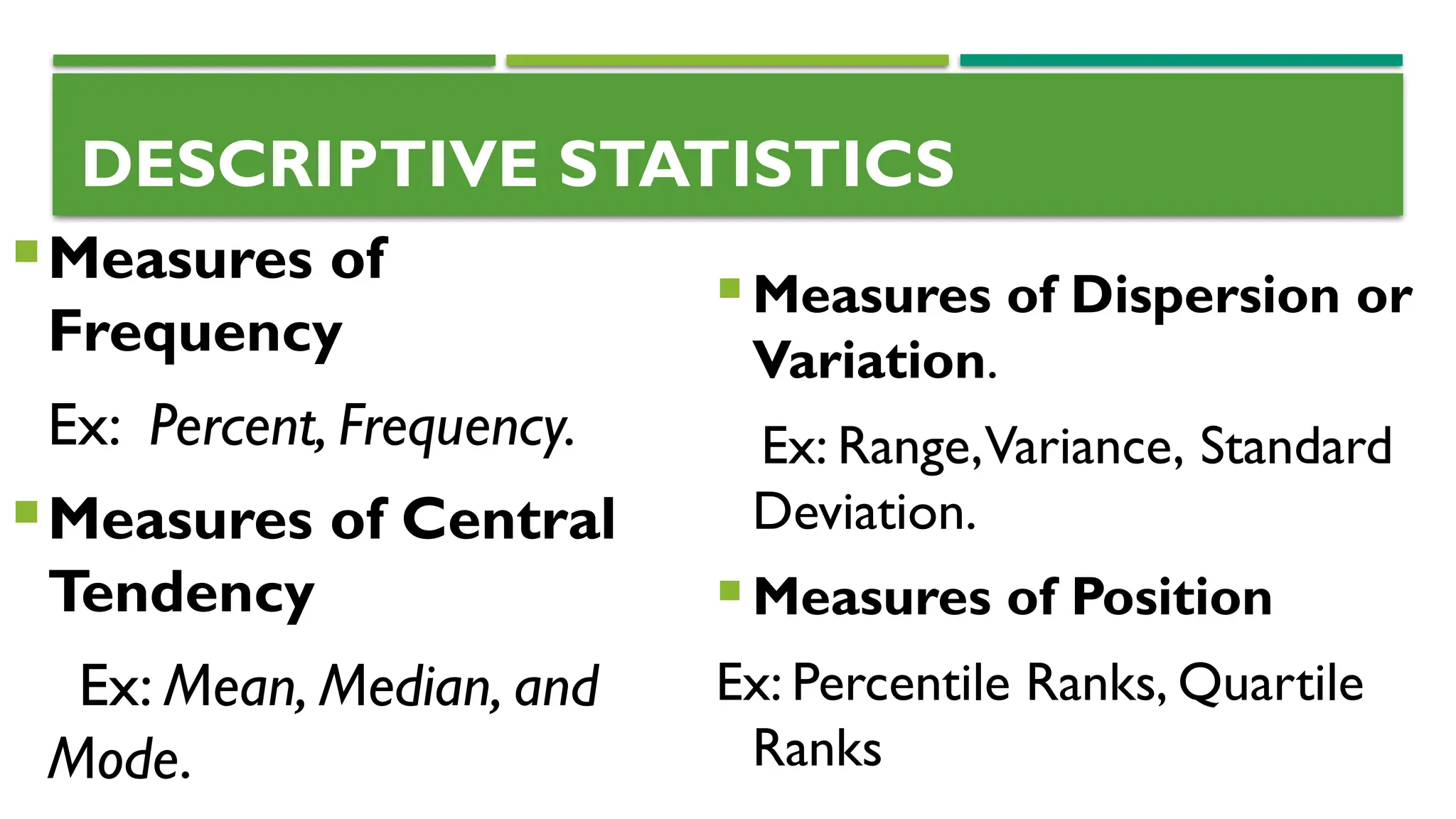
Measures of
Frequency
Ex: Percent, Frequency.
Measures of Central
Tendency
Ex: Mean, Median, and
Mode.
DESCRIPTIVE STATISTICS
 Measures of Dispersion or
Variation.
Ex: Range,Variance, Standard
Deviation.
 Measures of Position
Ex: Percentile Ranks, Quartile
Ranks
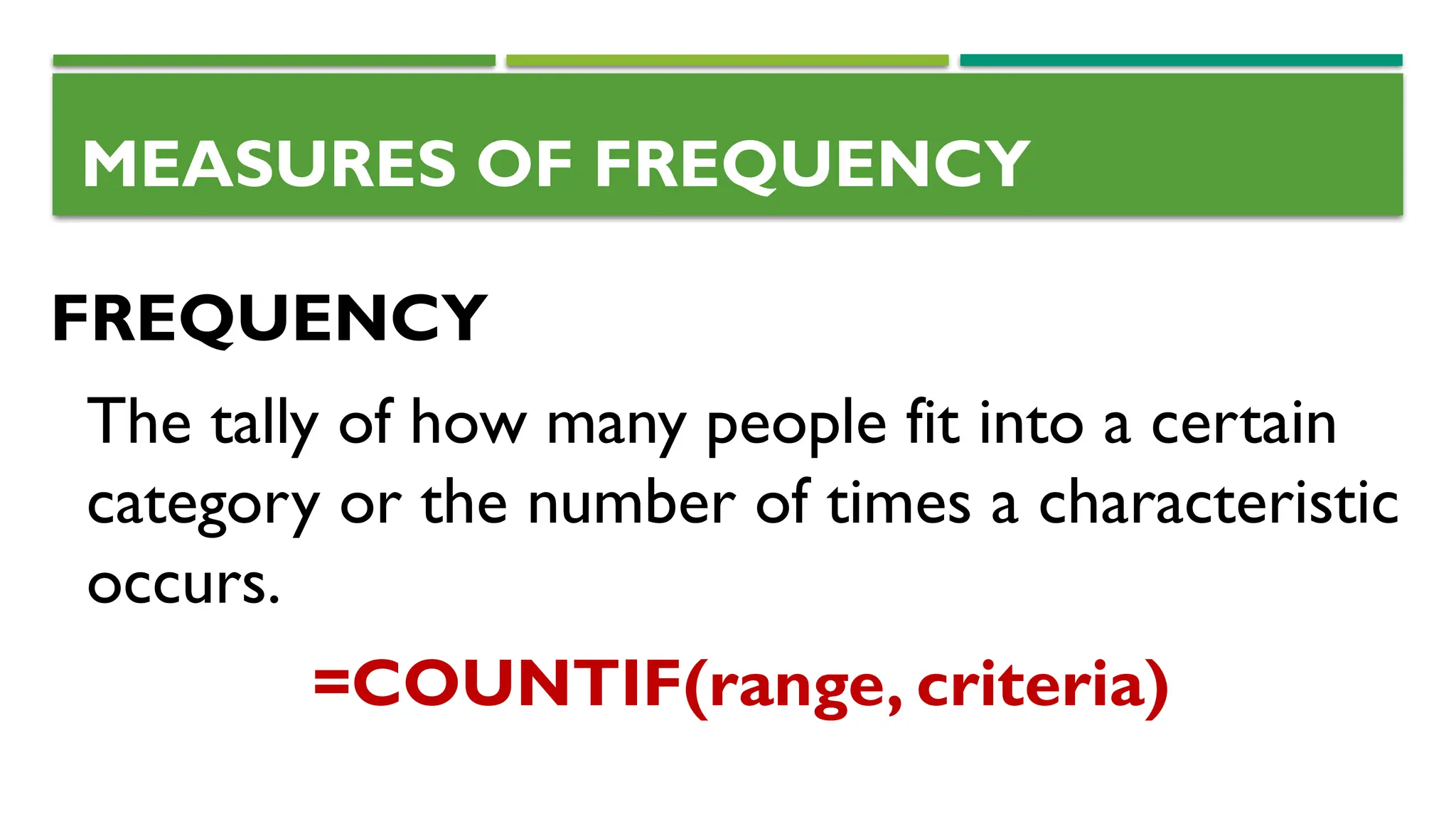
FREQUENCY
The tally of how many people fit into a certain
category or the number of times a characteristic
occurs.
=COUNTIF(range, criteria)
MEASURES OF FREQUENCY
PERCENTAGE
A part per hundred. Used to compare
one quantity against another.
MEASURES OF FREQUENCY
COMMON SUMMARIZINGVALUES OF DESCRIPTIVE
STATISTICS
MEAN, MEDIAN, MODE
STANDARD DEVIATION
PROCEDURES IN
DETERMININGTHE MEAN,
MEDIAN, MODE AND
STANDARD DEVIATION USING
EXCEL
PROCEDURES IN FINDINGTHE MEAN
FORMULA: =AVERAGE(DRAGTHEDATA)
1. Enter the scores in one of the columns on the Excel spreadsheet.
2. Place the cursor where you wish to have the mean (average) appear and
click the mouse button.
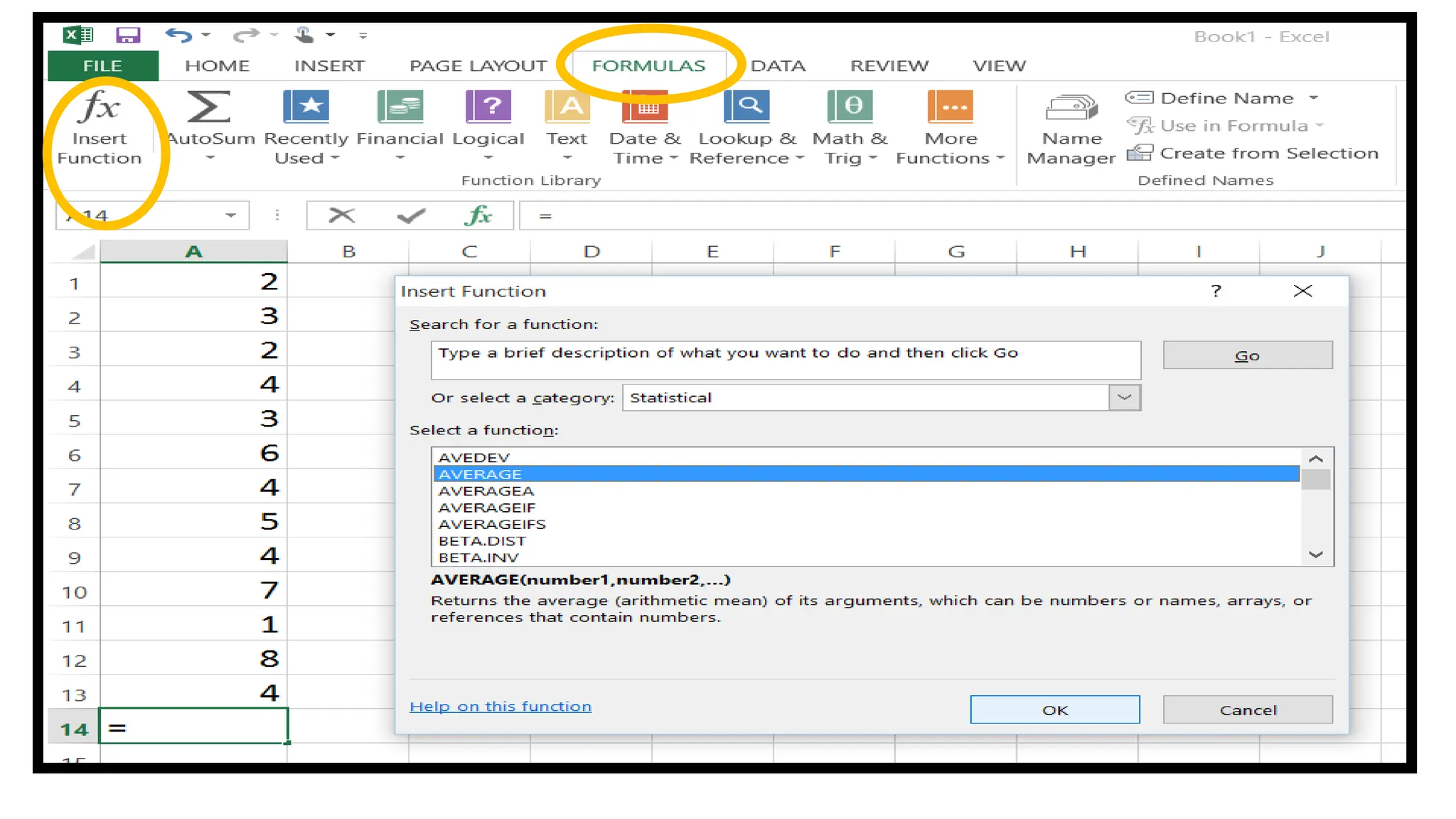
3. Select Insert Function (fx) from the FORMULAS tab.
4. Select AVERAGE from the Statistical category and click OK. (Note: If
you want the Median, select MEDIAN. If you want the Mode,
select MODE.SNGL. Excel only provides one mode. If a data set had
more than one mode, Excel would only display one of them.)
PROCEDURES IN FINDINGTHE MEAN
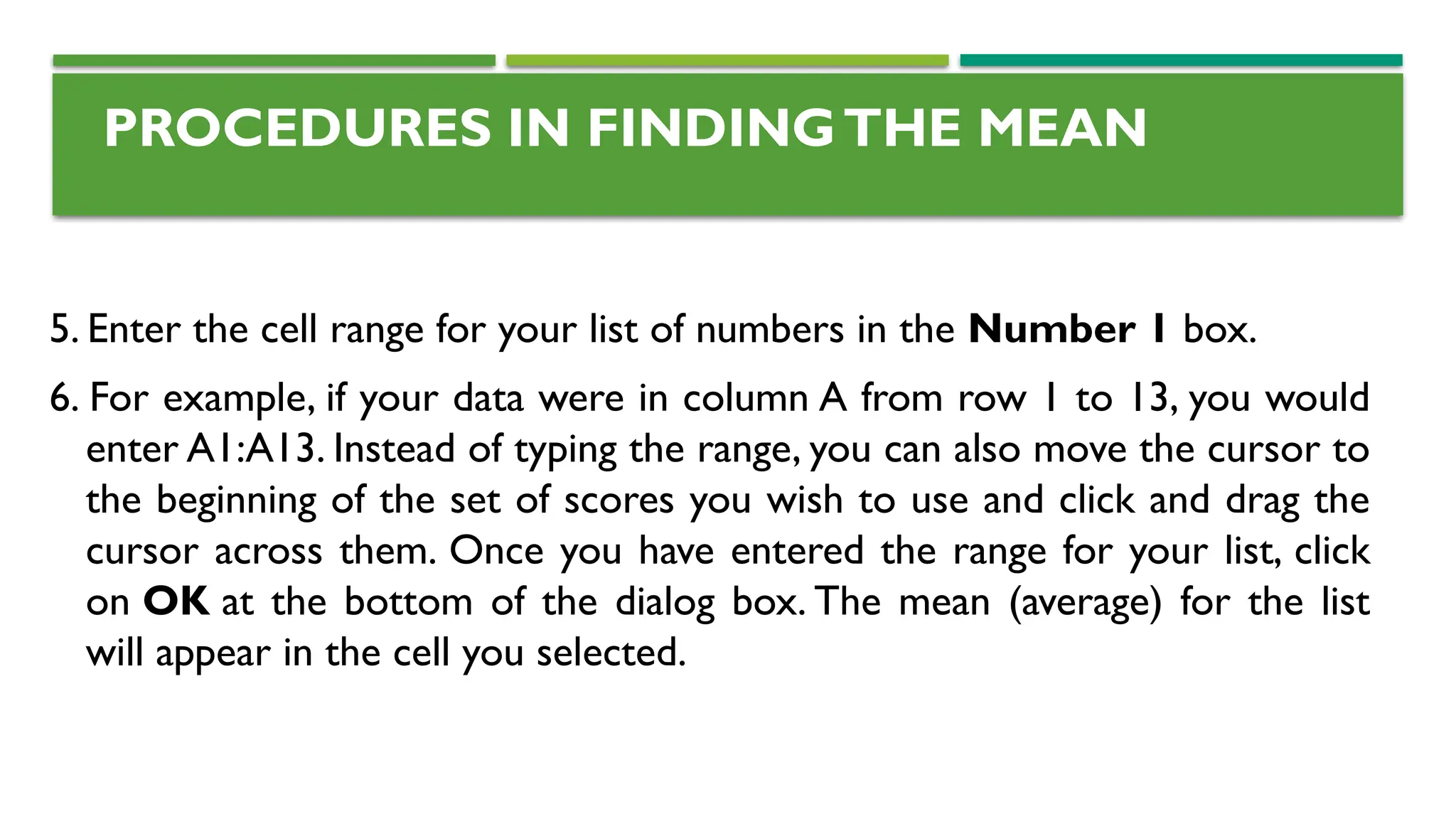
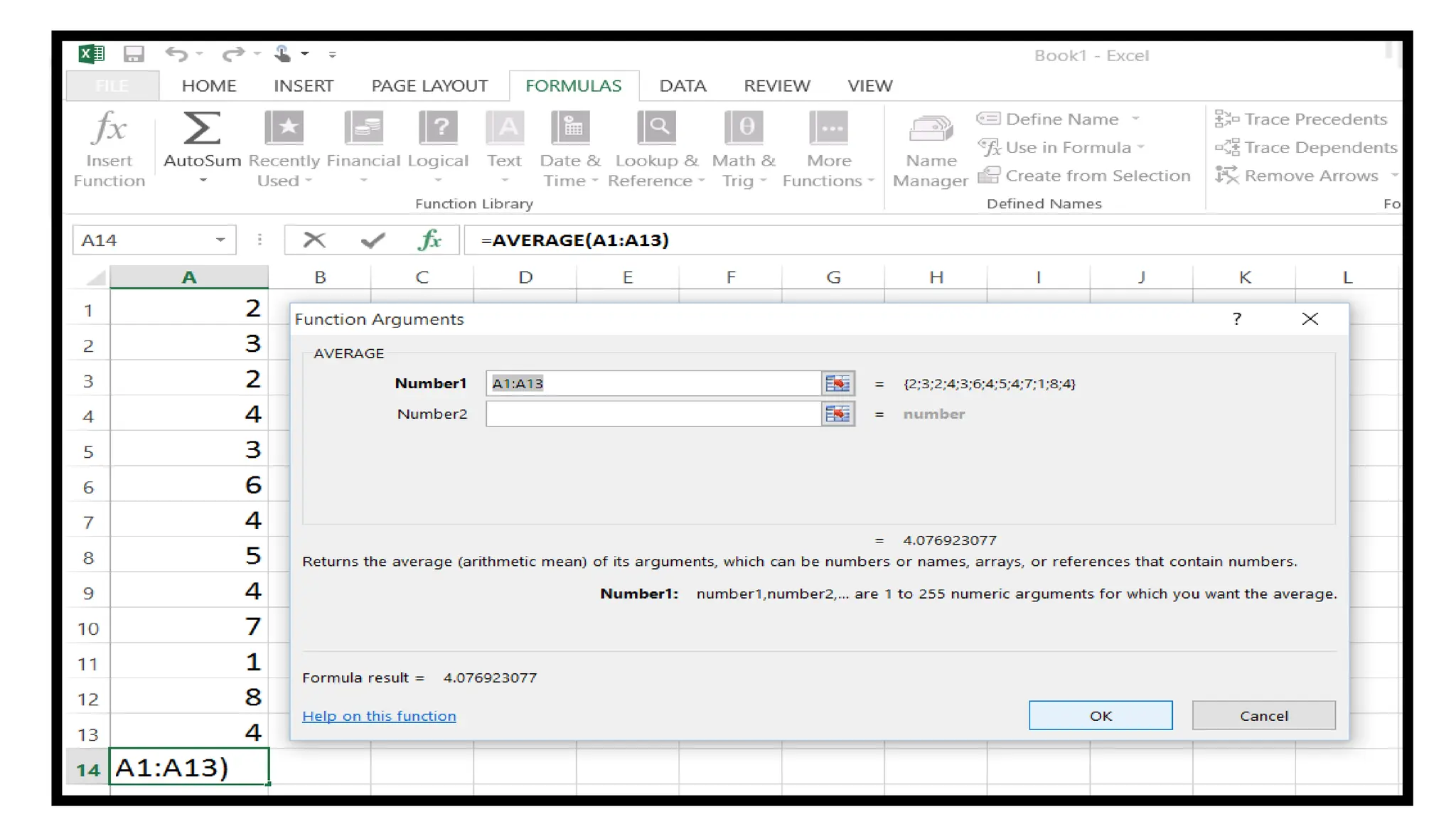
5. Enter the cell range for your list of numbers in the Number 1 box.
6. For example, if your data were in column A from row 1 to 13, you would
enter A1:A13. Instead of typing the range, you can also move the cursor to
the beginning of the set of scores you wish to use and click and drag the
cursor across them. Once you have entered the range for your list, click
on OK at the bottom of the dialog box. The mean (average) for the list
will appear in the cell you selected.
STANDARD DEVIATION
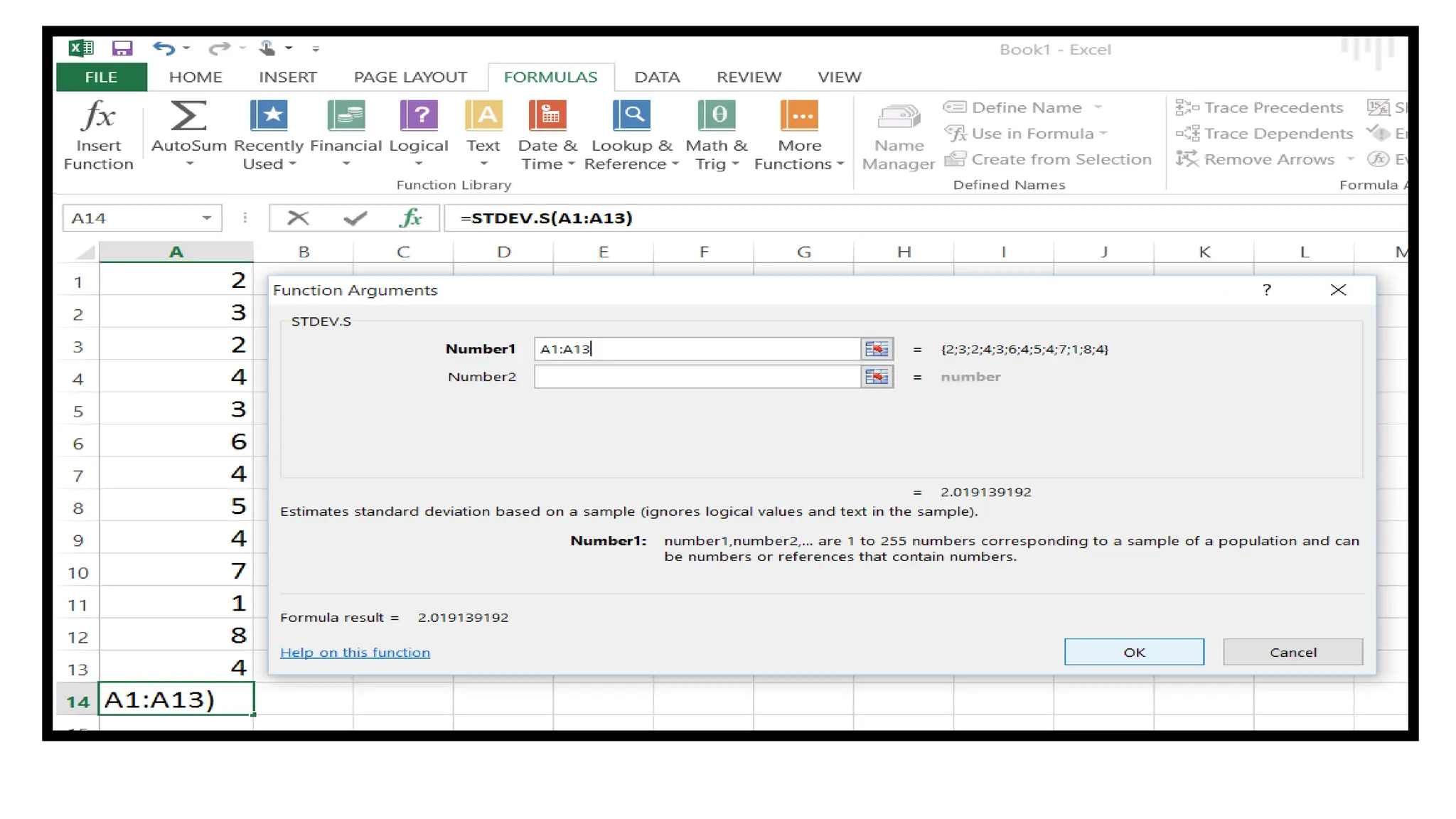
FORMULA: =STDEV.S(DRAGTHEDATA)
 It is the average difference between observed values and the mean.
 The standard deviation is used when expressing dispersion in the same
units as the original measurements. It is used more commonly than the
variance in expressing the degree to which data are spread out.
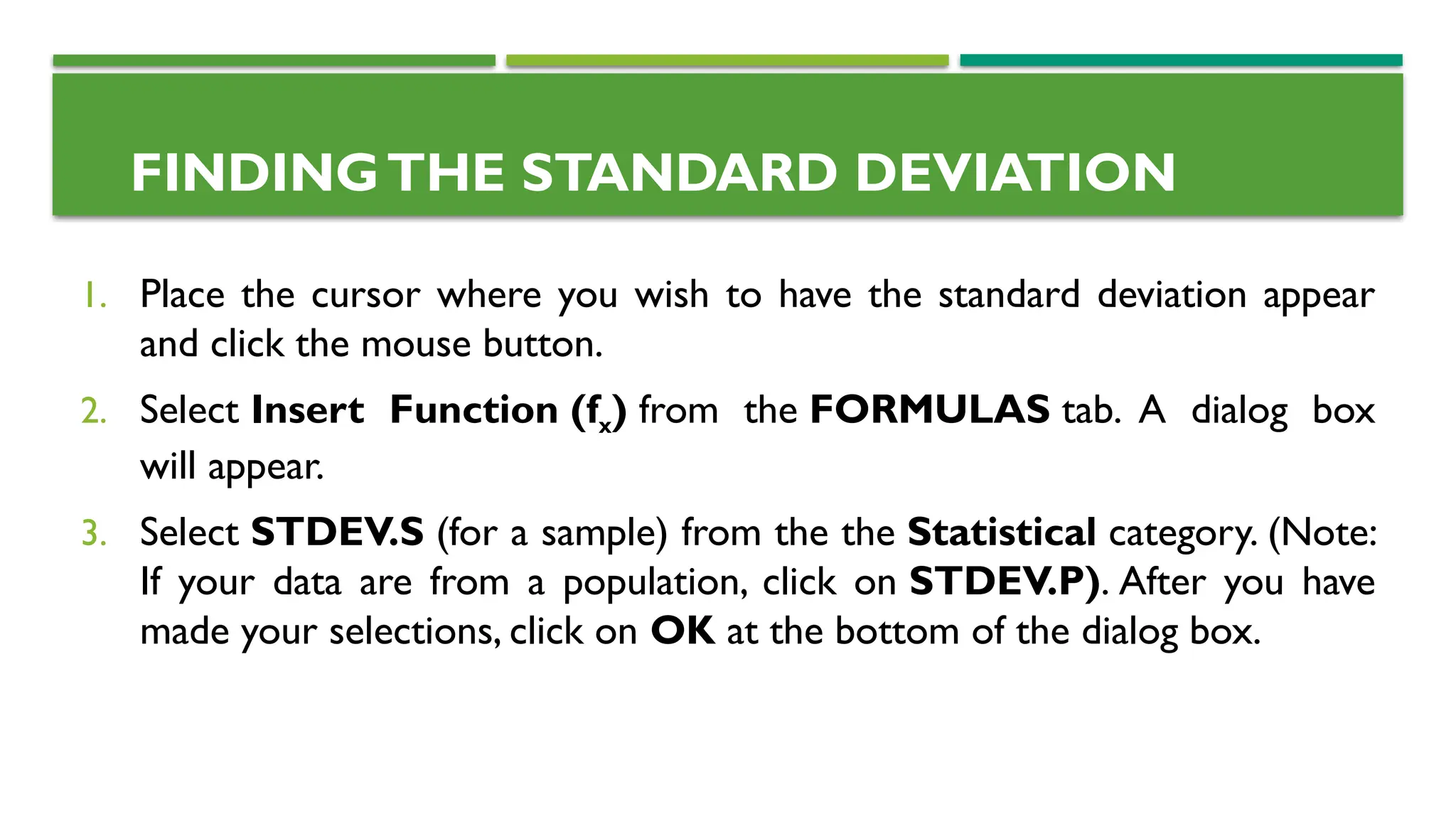
1. Place the cursor where you wish to have the standard deviation appear
and click the mouse button.
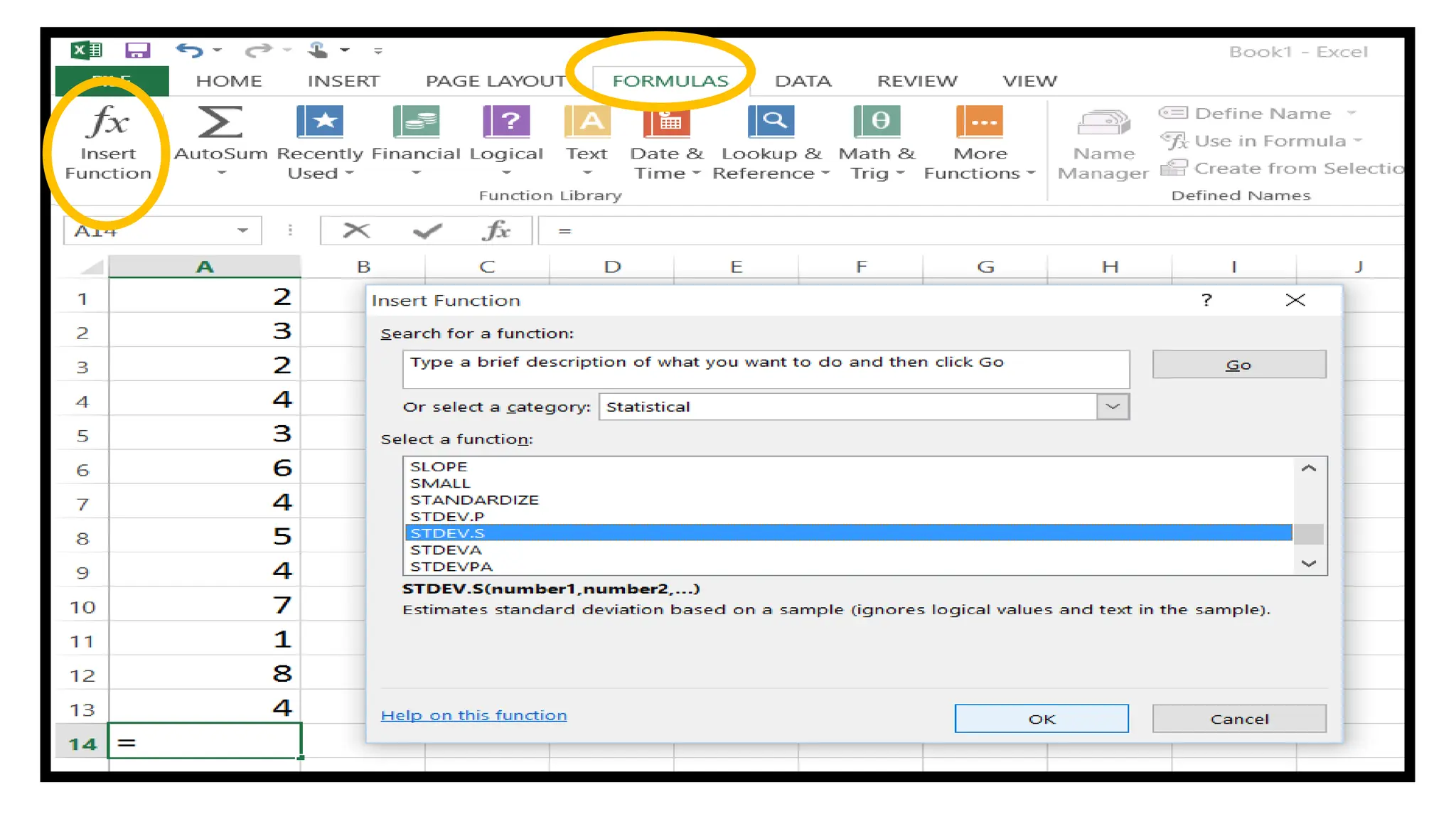
2. Select Insert Function (fx) from the FORMULAS tab. A dialog box
will appear.
3. Select STDEV.S (for a sample) from the the Statistical category. (Note:
If your data are from a population, click on STDEV.P). After you have
made your selections, click on OK at the bottom of the dialog box.
FINDINGTHE STANDARD DEVIATION
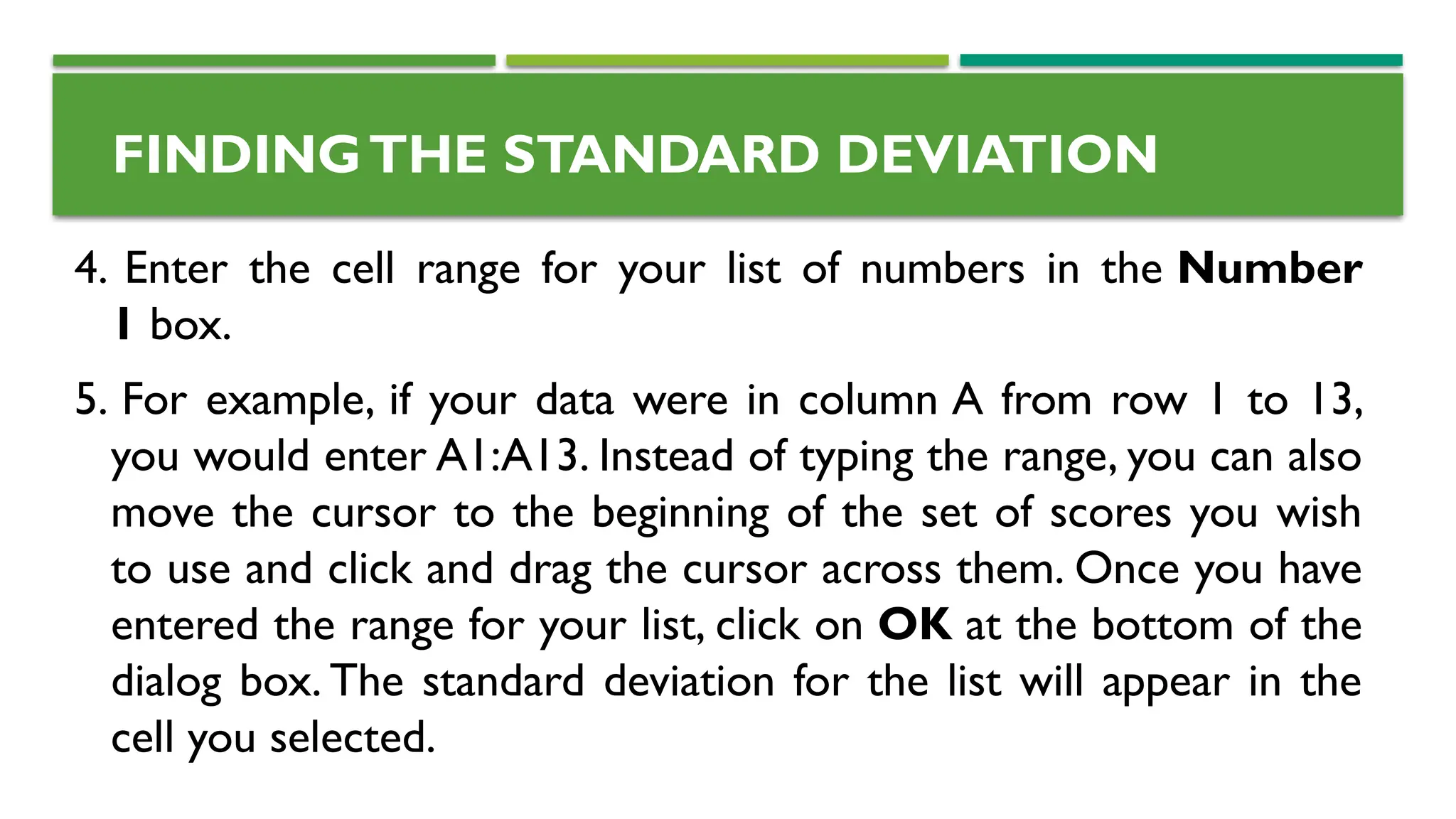
4. Enter the cell range for your list of numbers in the Number
1 box.
5. For example, if your data were in column A from row 1 to 13,
you would enter A1:A13. Instead of typing the range, you can also
move the cursor to the beginning of the set of scores you wish
to use and click and drag the cursor across them. Once you have
entered the range for your list, click on OK at the bottom of the
dialog box. The standard deviation for the list will appear in the
cell you selected.
FINDINGTHE STANDARD DEVIATION
STATISTICALTOOLS OF
INFERENTIAL STATISTICS
•Deals with the predictions and inferences based on
the analysis and interpretation of the results of the
information gathered by the statistician.
STATISTICAL TOOLS: t-test, analysis of variance, chi-
square, and Pearson’s r
T-test
(Comparing means or averages)
t-Test (Comparing means or averages)
A t-test is a type of inferential statistic used to
determine if there is a significant difference
between the means of two groups, which may be
related in certain features.
t-Test (Comparing means or averages)
Types of t-test:
One sample t-test
Independent sample t-test
Paired Sample t-test
Types of t-test
•One-Sample t-test
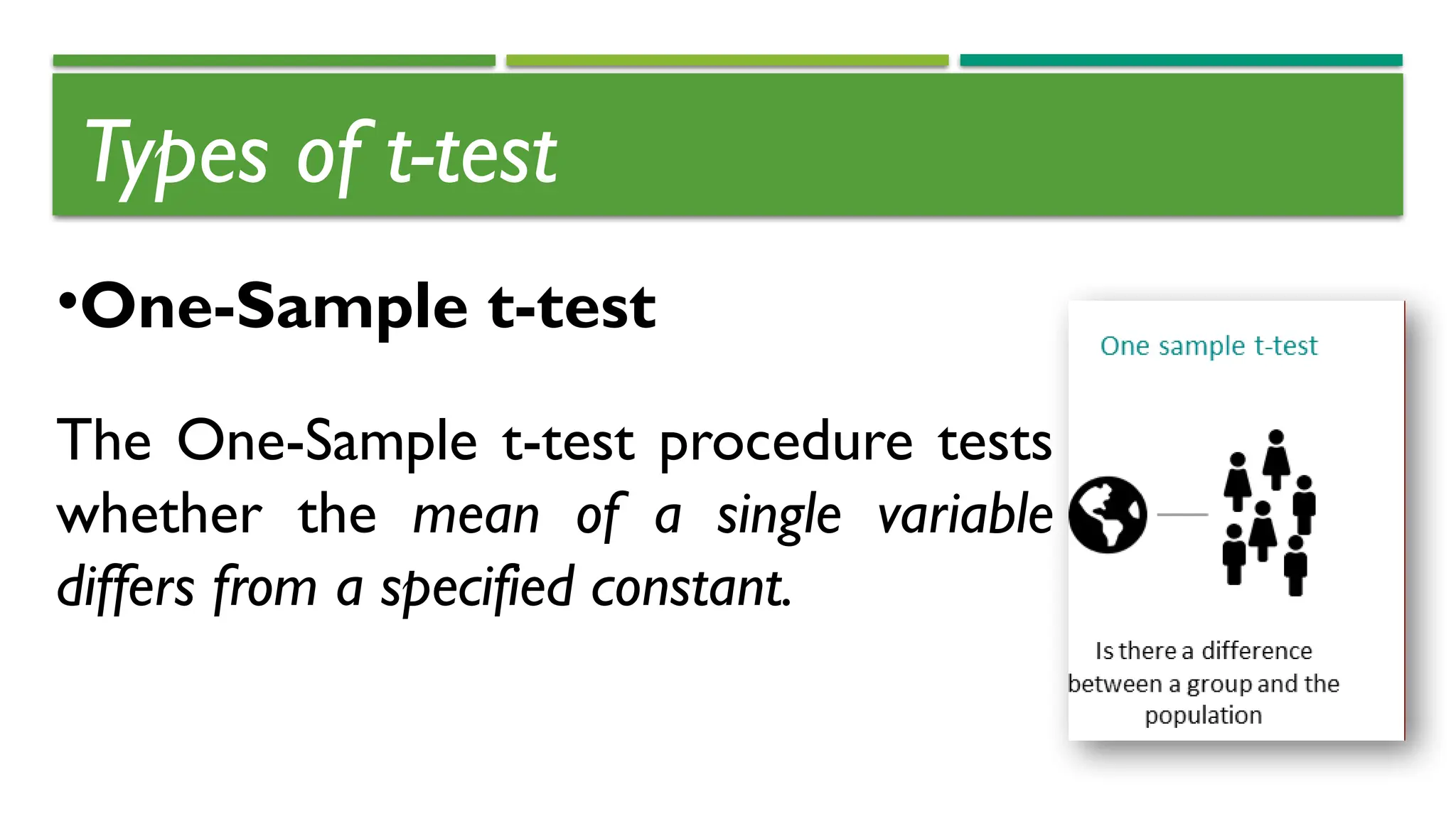
The One-Sample t-test procedure tests
whether the mean of a single variable
differs from a specified constant.
Types of t-test
•One-Sample t-test
Examples:
• A researcher might want to test whether the average
summative score for a group of students differs from 75.
• A researcher might want to test whether THE sample
respondents differs at 100 lbs.
Types of t-test
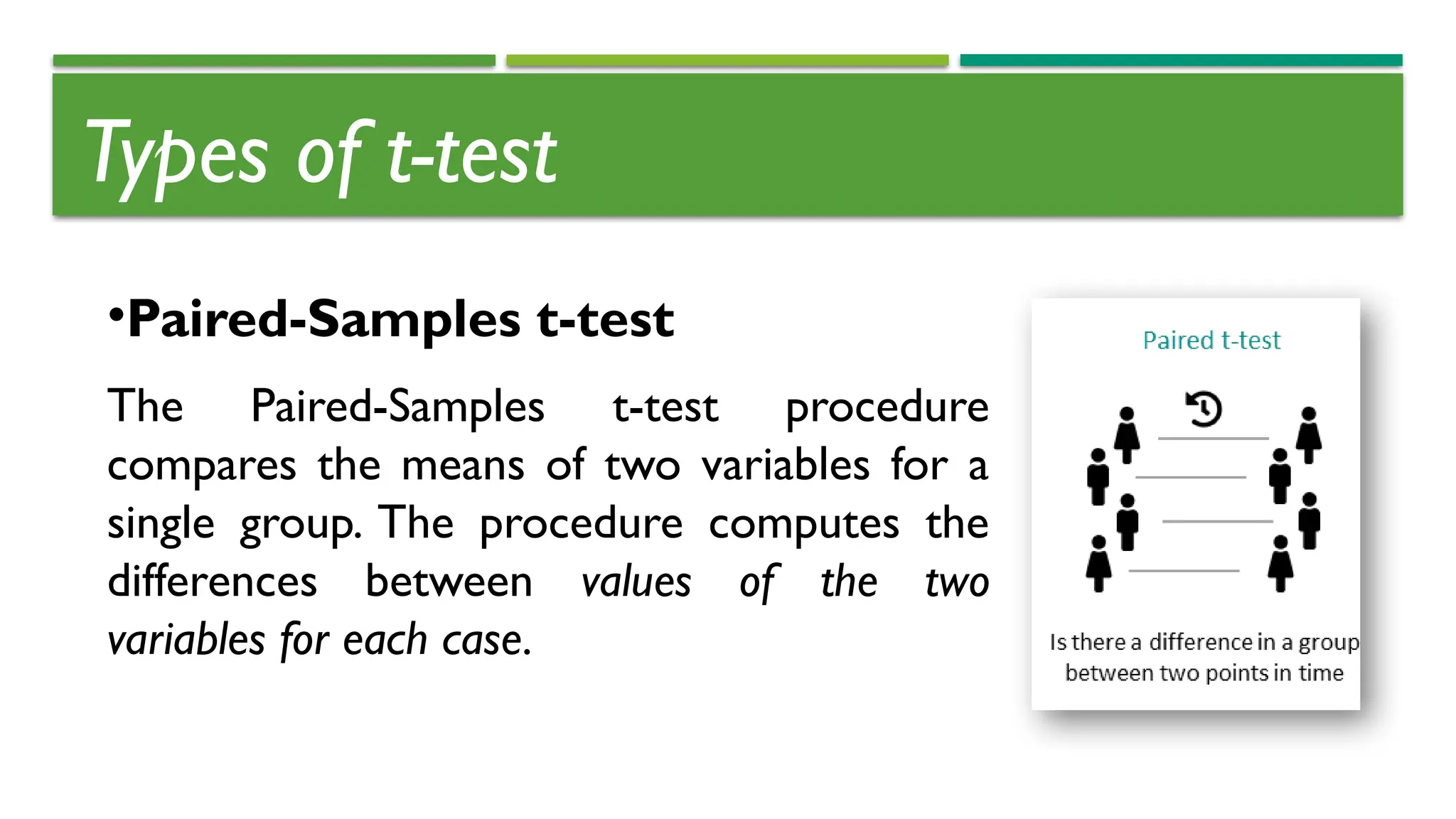
•Paired-Samples t-test
The Paired-Samples t-test procedure
compares the means of two variables for a
single group. The procedure computes the
differences between values of the two
variables for each case.
Types of t-test
•Paired-Samples t-test
Example:
In a study on high blood pressure, all patients are
measured at the beginning of the study, given a treatment,
and measured again. Thus, each subject has two
measures, often called before and after measures.
Types of t-test
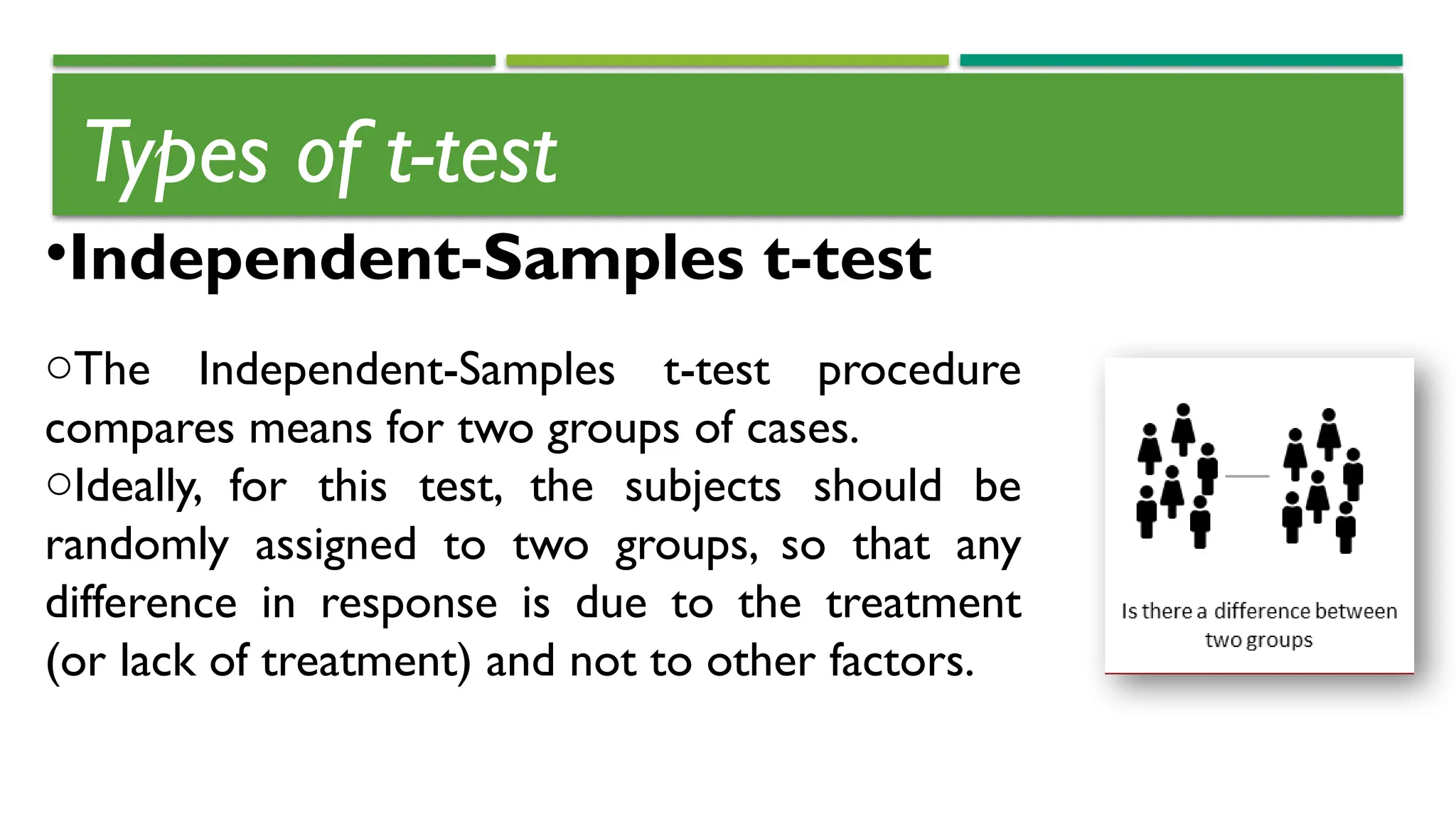
•Independent-Samples t-test
oThe Independent-Samples t-test procedure
compares means for two groups of cases.
oIdeally, for this test, the subjects should be
randomly assigned to two groups, so that any
difference in response is due to the treatment
(or lack of treatment) and not to other factors.
Example
• Patients with high blood pressure are randomly assigned
to a placebo group and a treatment group.
• The placebo subjects receive an inactive pill, and the
treatment subjects receive a new drug that is expected
to lower blood pressure.
• After the subjects are treated for two months, the two-
sample or independent sample t- test is used to compare
the average blood pressures for the placebo group
and the treatment group.
ANOVA
(Analysis ofVariance)
ANOVA (ANALYSIS OFVARIANCE)
ANOVA is used to test the hypothesis of the several
means.
In addition to determining that differences exist among
the means, you may want to know which means differ.
ANOVA (ANALYSIS OFVARIANCE)
Example:
Is there a significant difference on the test scores of
students who had self-review, pair review or group review?
BIVARIATE
CORRELATIONS
BIVARIATE CORRELATIONS
The Bivariate Correlations procedure
computes Pearson's correlation coefficient
and Spearman's rho with their significance
levels.
Correlations measure how variables or
rank orders are related. (BUT THE
RELATIONSHIP IS NOT CAUSAL)
BIVARIATE CORRELATIONS
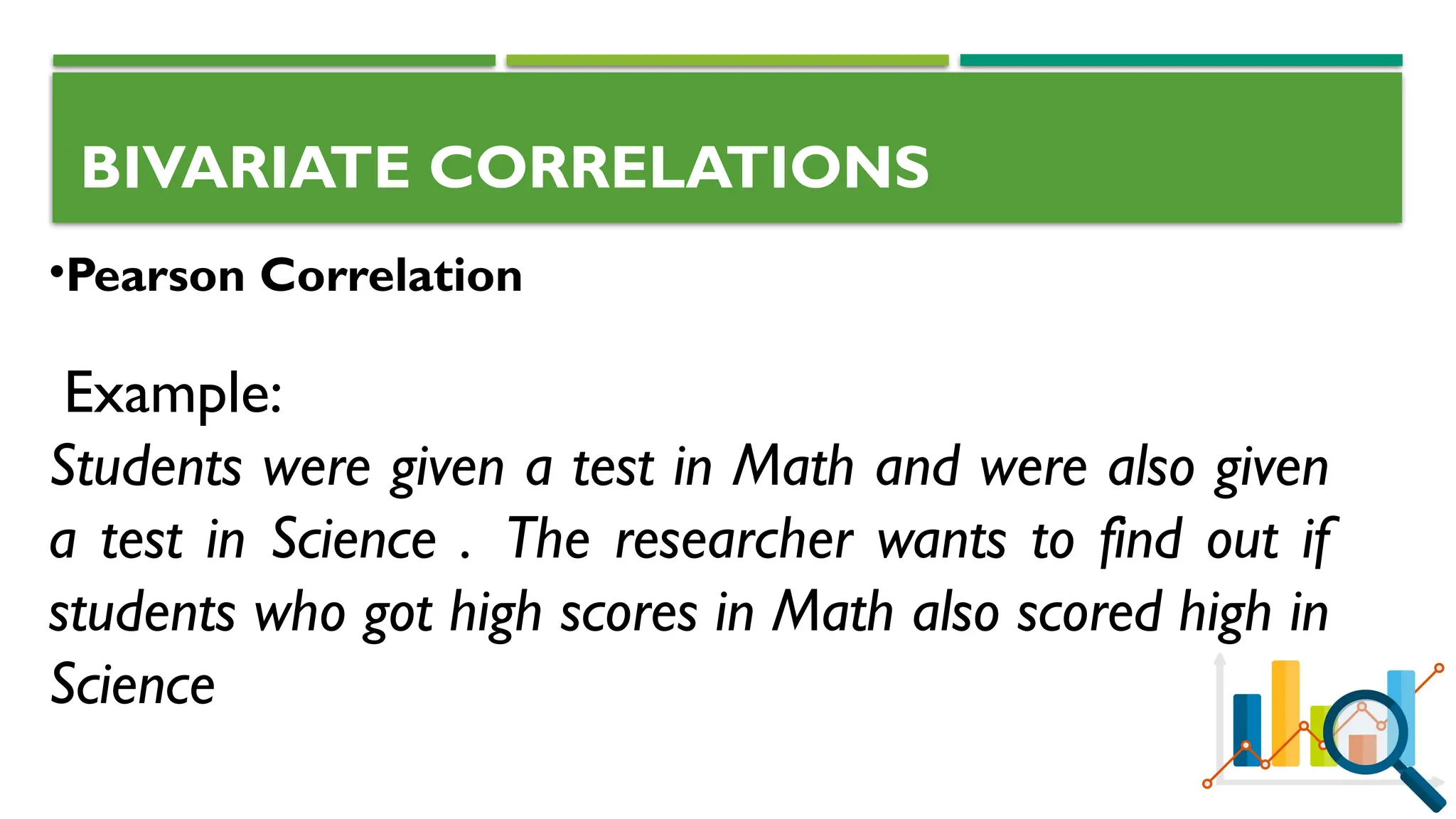
•Pearson Correlation
-produces a sample correlation coefficient, r, which
measures the strength and direction of linear
relationships between pairs of continuous variables.
-Pearson Correlation evaluates whether there is
statistical evidence for a linear relationship among the
same pairs of variables in the population.
BIVARIATE CORRELATIONS
•Pearson Correlation
Example:
Students were given a test in Math and were also given
a test in Science . The researcher wants to find out if
students who got high scores in Math also scored high in
Science
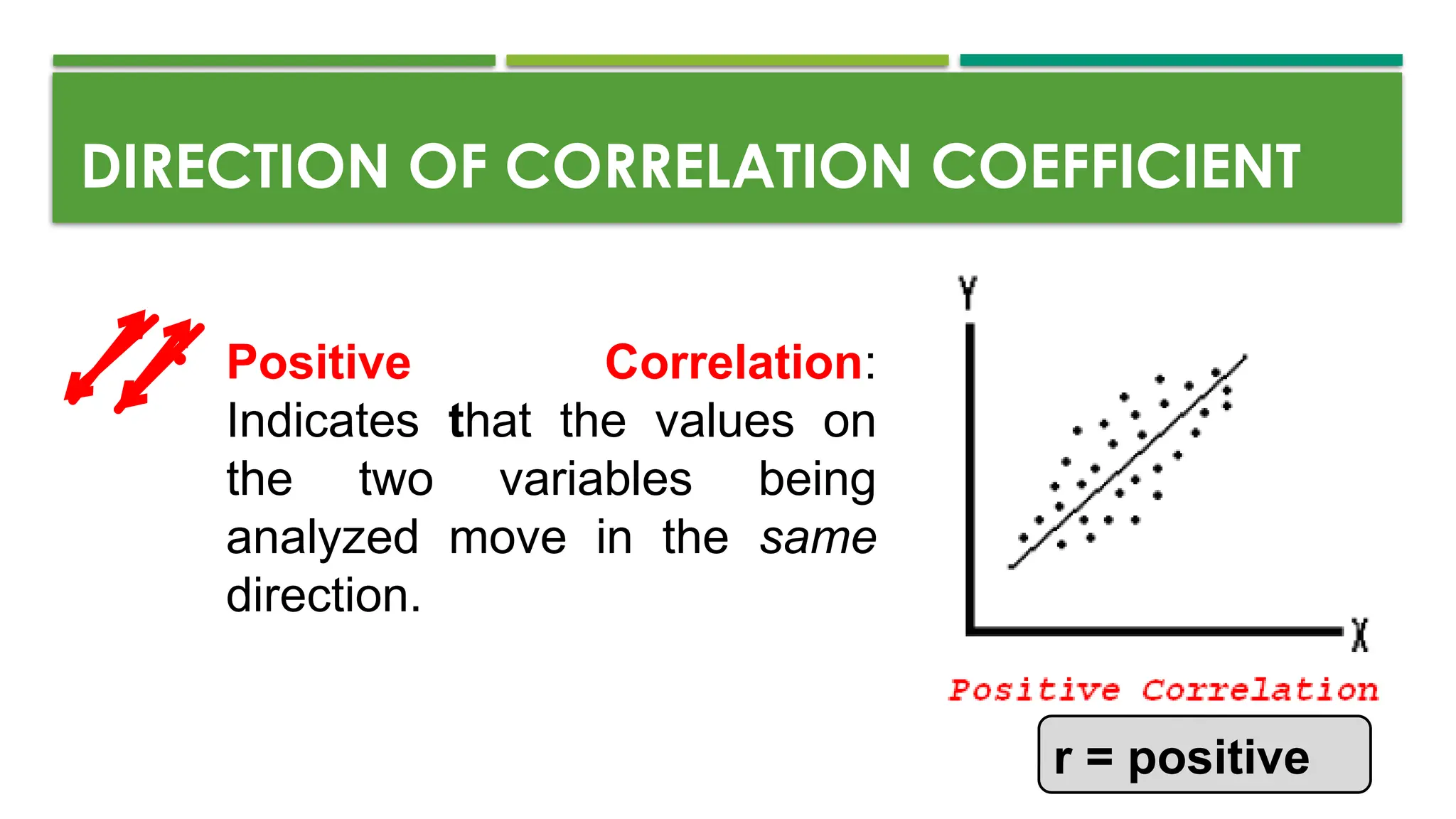
• Positive Correlation:
Indicates that the values on
the two variables being
analyzed move in the same
direction.
DIRECTION OF CORRELATION COEFFICIENT
r = positive
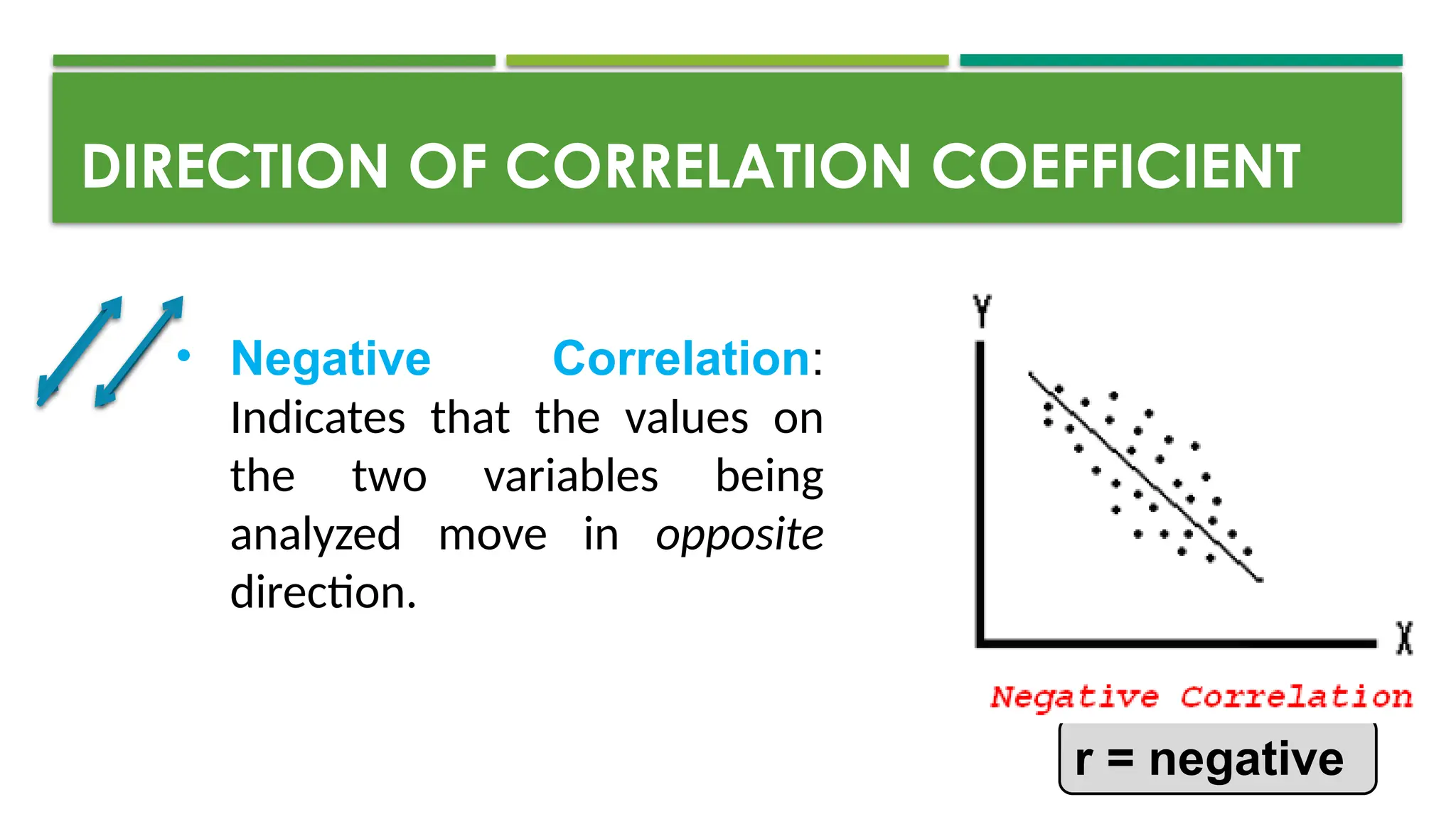
• Negative Correlation:
Indicates that the values on
the two variables being
analyzed move in opposite
direction.
DIRECTION OF CORRELATION COEFFICIENT
r = negative
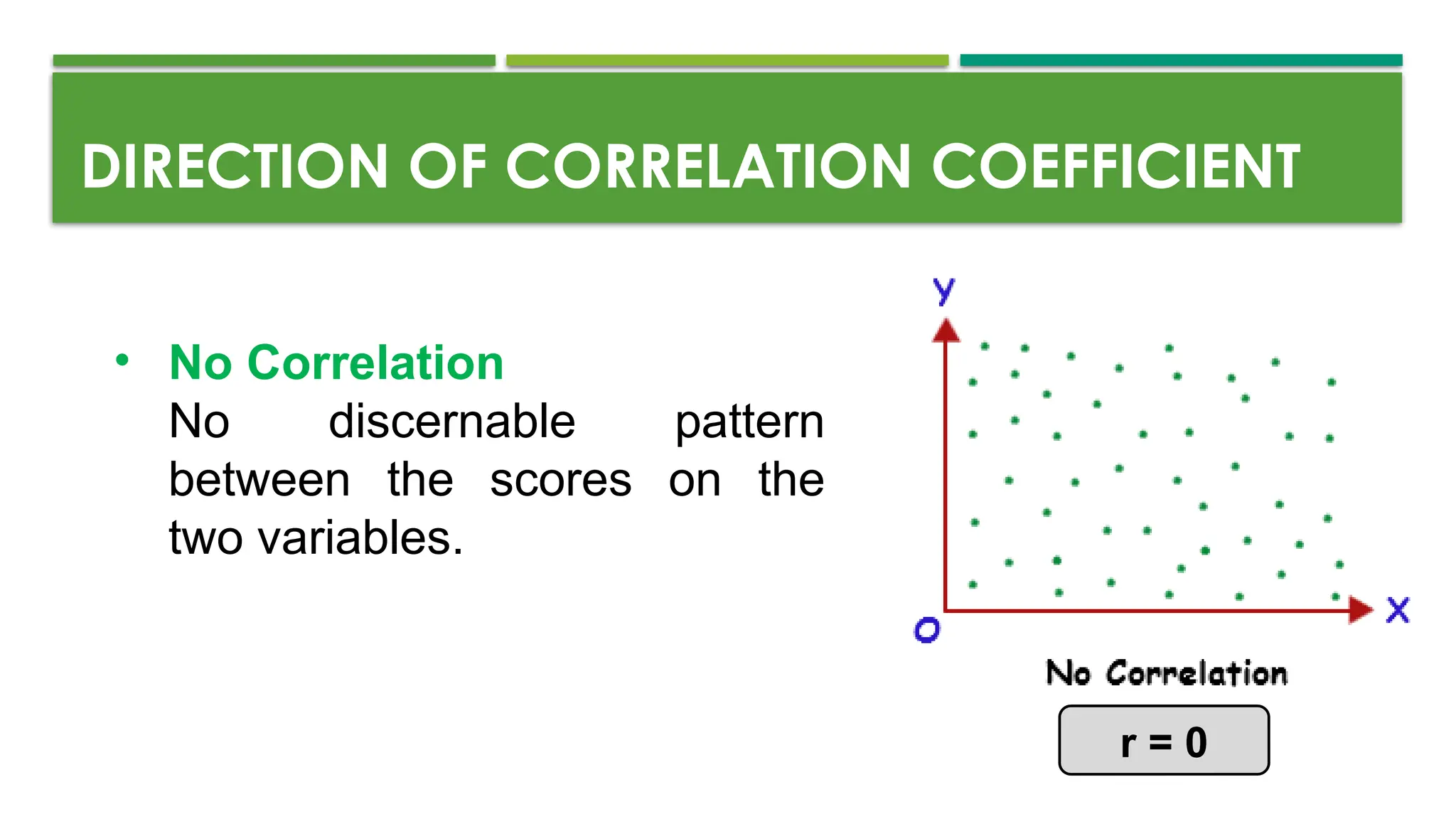
• No Correlation
No discernable pattern
between the scores on the
two variables.
DIRECTION OF CORRELATION COEFFICIENT
r = 0
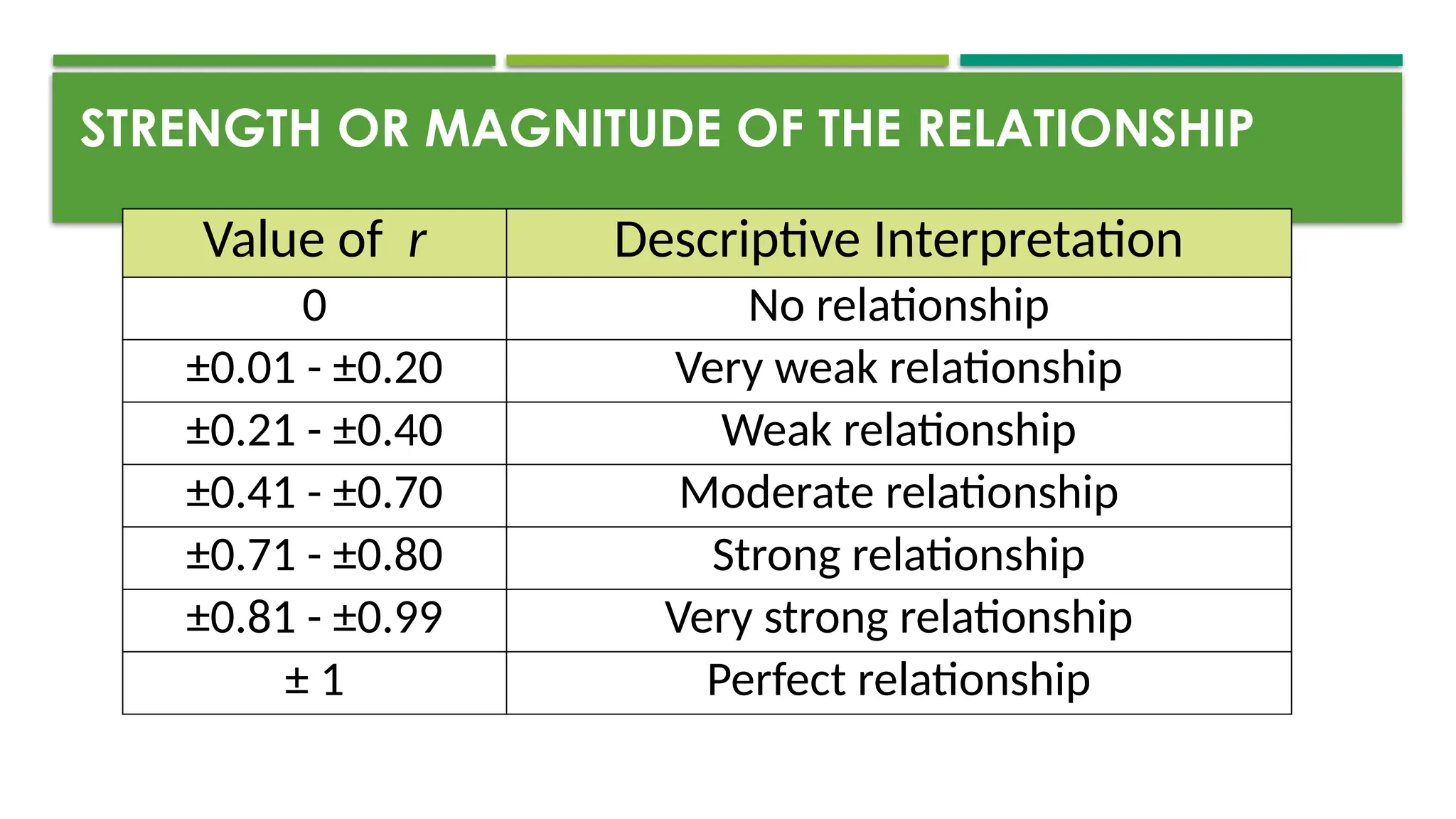
STRENGTH OR MAGNITUDE OF THE RELATIONSHIP
Value of r Descriptive Interpretation
0 No relationship
±0.01 - ±0.20 Very weak relationship
±0.21 - ±0.40 Weak relationship
±0.41 - ±0.70 Moderate relationship
±0.71 - ±0.80 Strong relationship
±0.81 - ±0.99 Very strong relationship
± 1 Perfect relationship
BIVARIATE CORRELATIONS
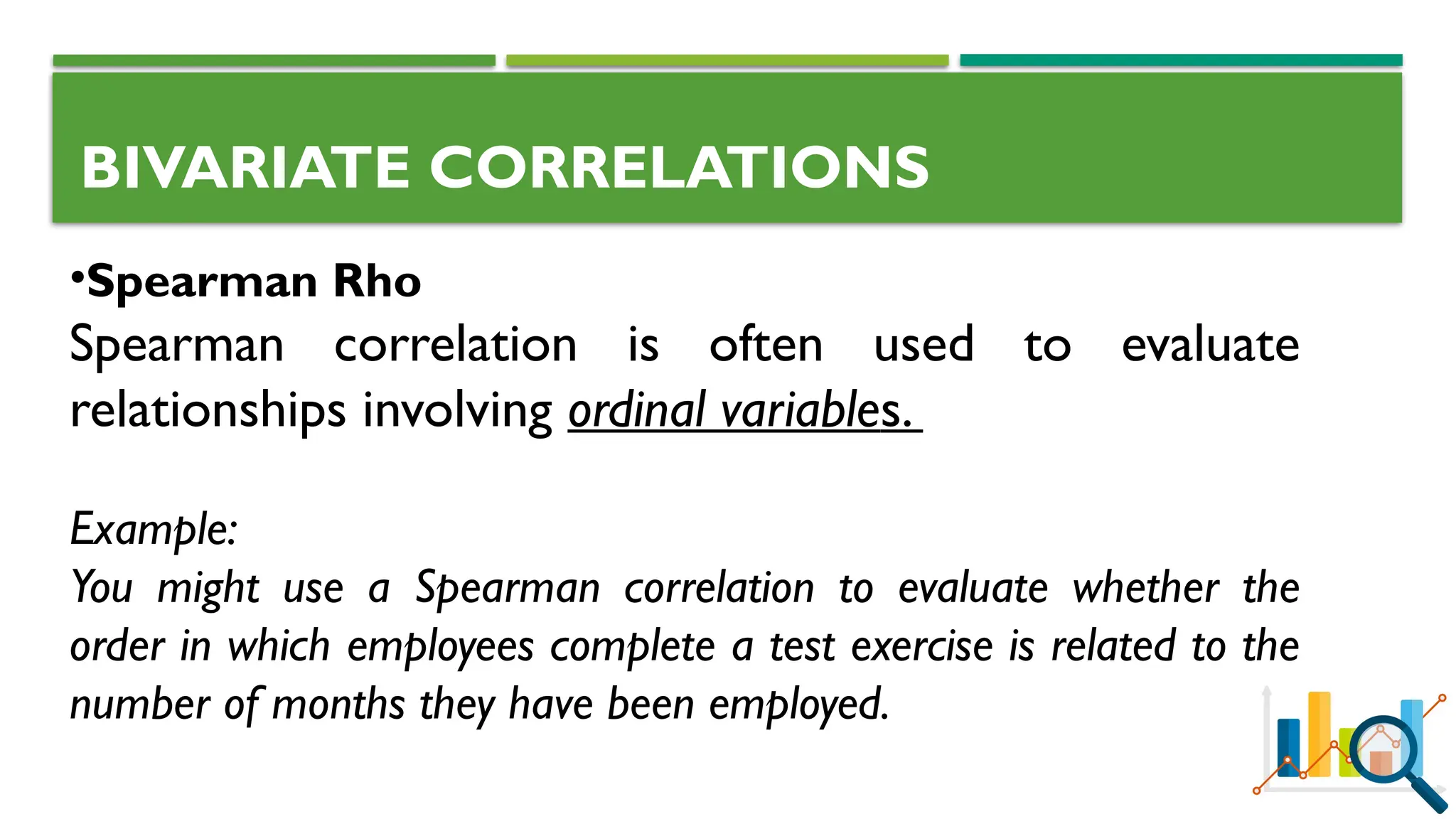
•Spearman Rho
Spearman correlation is often used to evaluate
relationships involving ordinal variables.
Example:
You might use a Spearman correlation to evaluate whether the
order in which employees complete a test exercise is related to the
number of months they have been employed.
CHI SQUARE
CHI SQUARE
It is used to measure the relationship
between two dichotomous variable
(alternative to correlation for variables
that are dichotomous)
CHI SQUARE
Example:
Is there an association between sex (male
& female) and opinion on same sex
marriage (favor & not in favor)
LINEAR
REGRESSION
LINEAR REGRESSION
Linear Regression estimates the coefficients
of the linear equation, involving one (simple
regression) or more (multiple regression)
independent variables, that best predict the
value of the dependent variable.
LINEAR REGRESSION
Example research question:
•Has the body weight an influence on the blood
cholesterol level?
•Does the oxygen level in water stimulate plant growth?
•Does customer satisfaction influence loyalty?
•Is anxiety influenced by personality traits?
LET’S TRY
EXERCISE
You want to compare the mean test-score in
General Mathematics of Grade 11-stem students
to 80.
Answer: One SampleT-test
EXERCISE
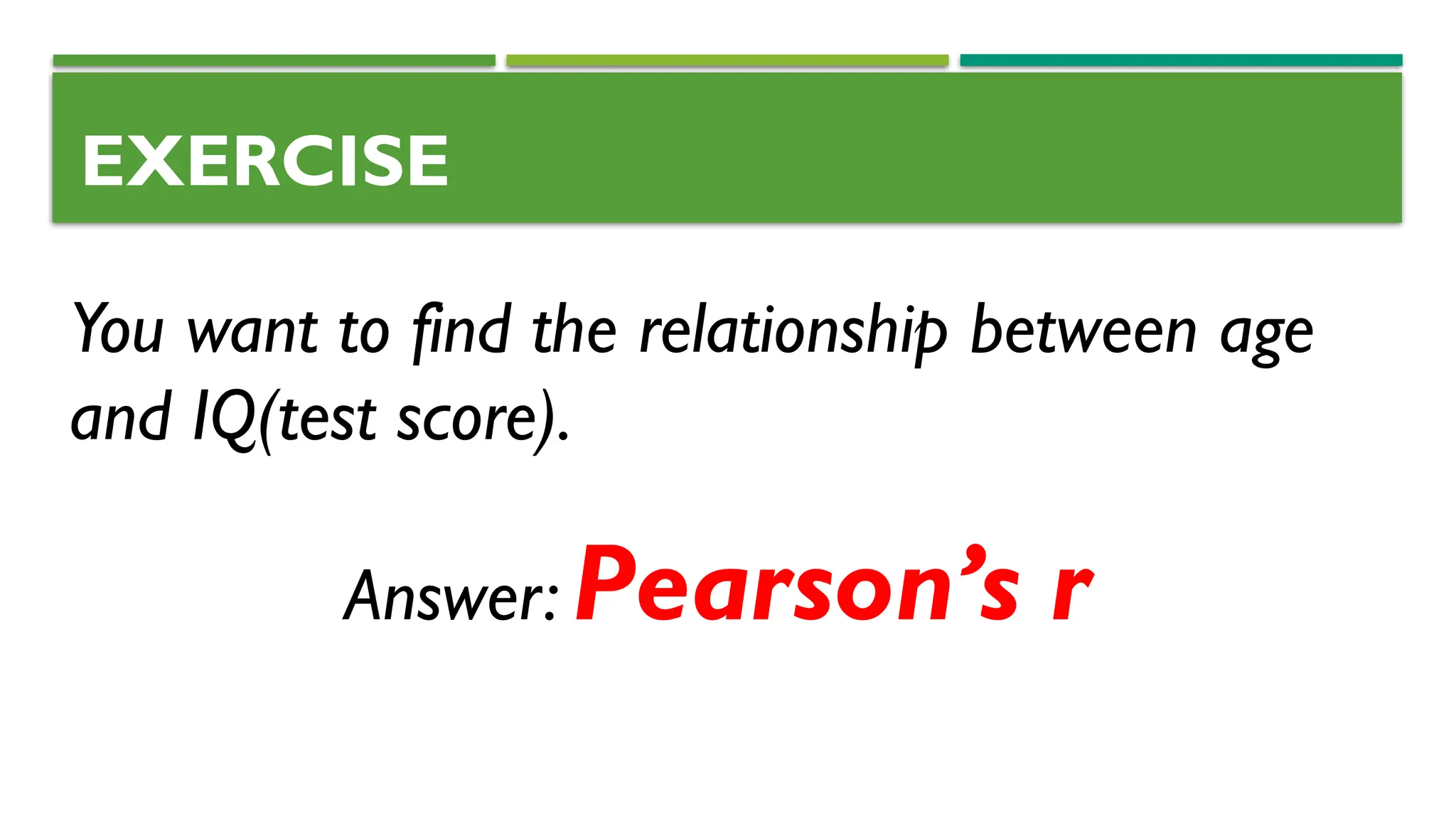
You want to find the relationship between age
and IQ(test score).
Answer: Pearson’s r
EXERCISE
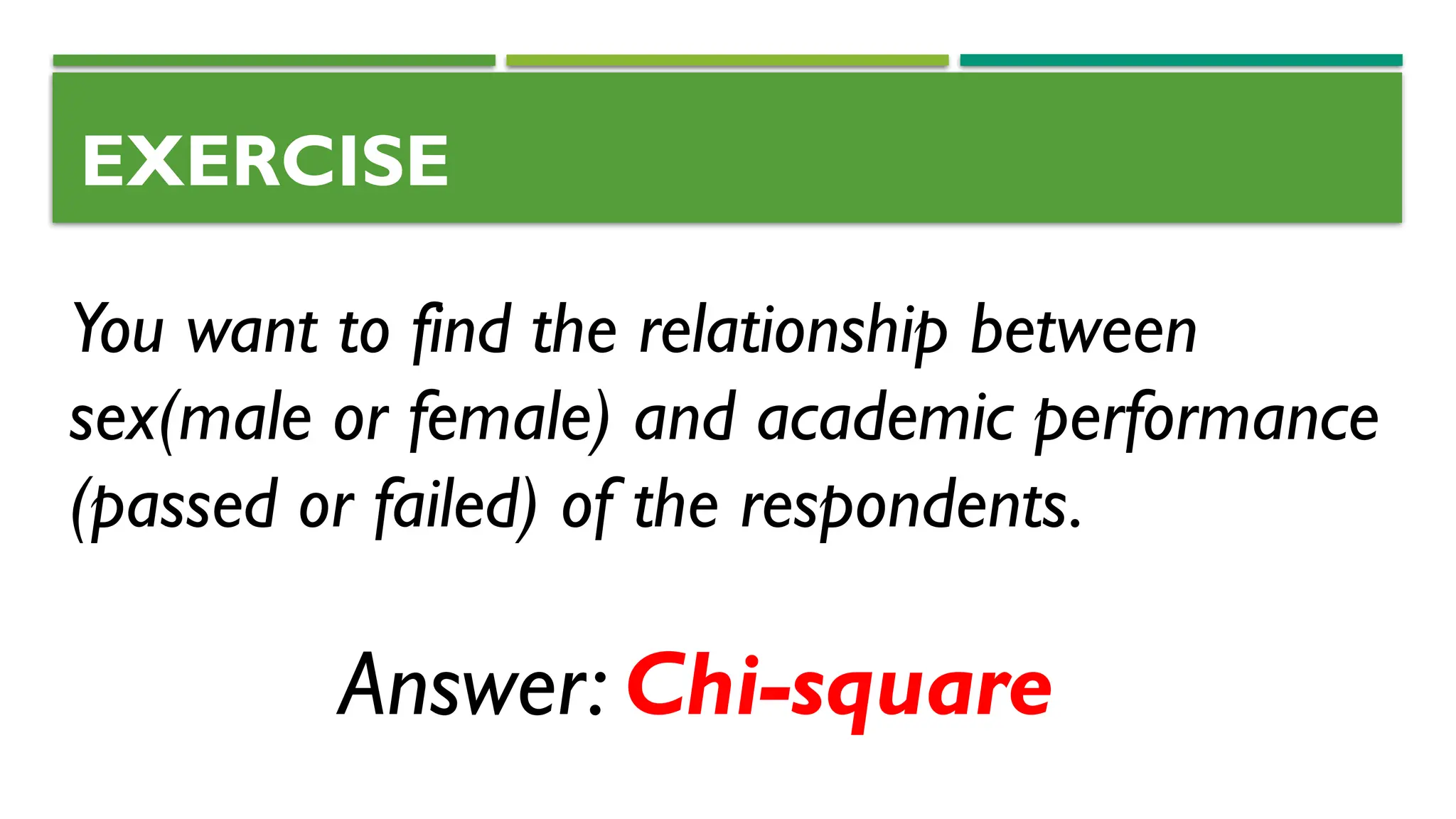
You want to find the relationship between
sex(male or female) and academic performance
(passed or failed) of the respondents.
Answer: Chi-square
EXERCISE
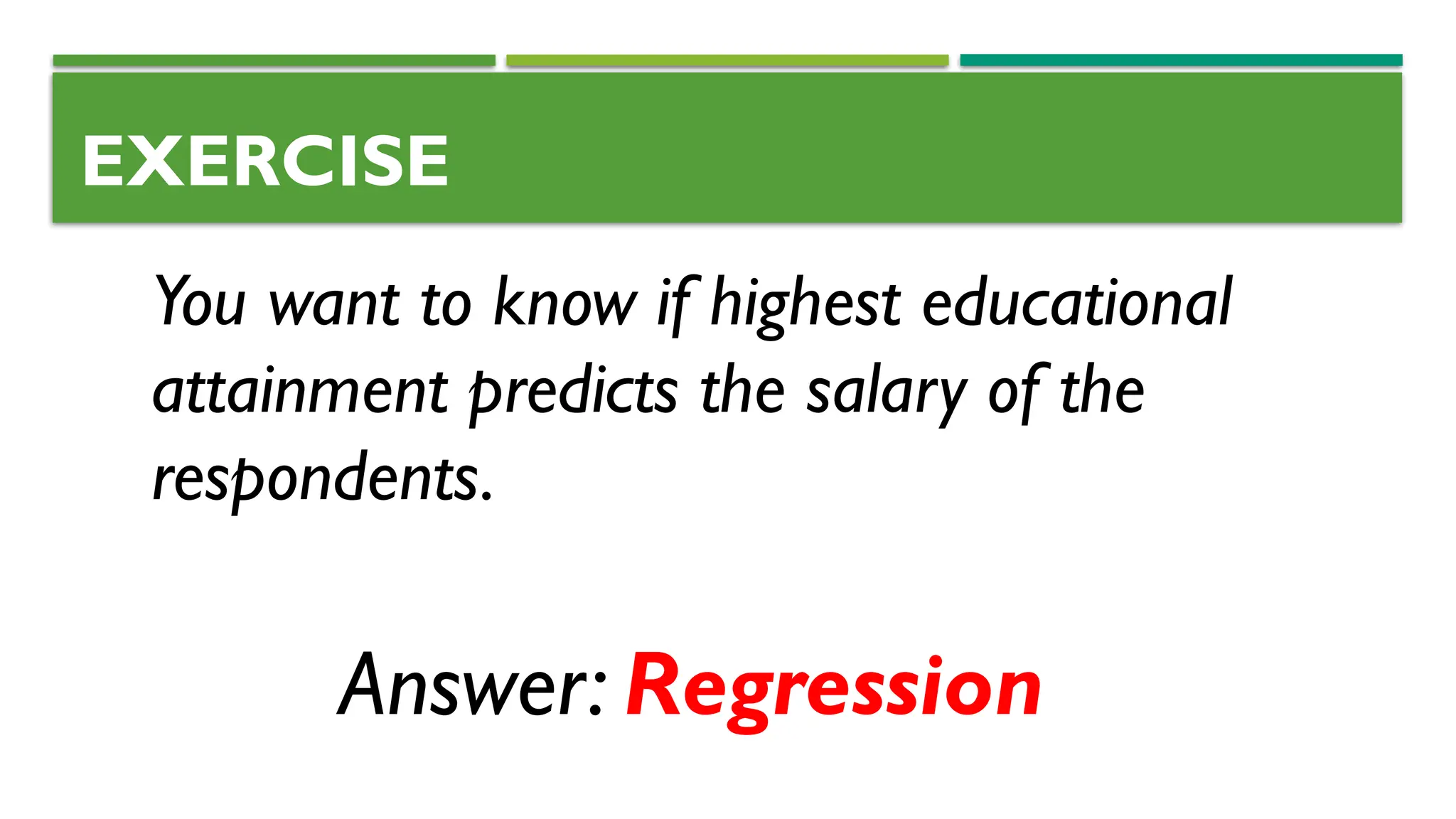
You want to know if highest educational
attainment predicts the salary of the
respondents.
Answer: Regression
EXERCISE
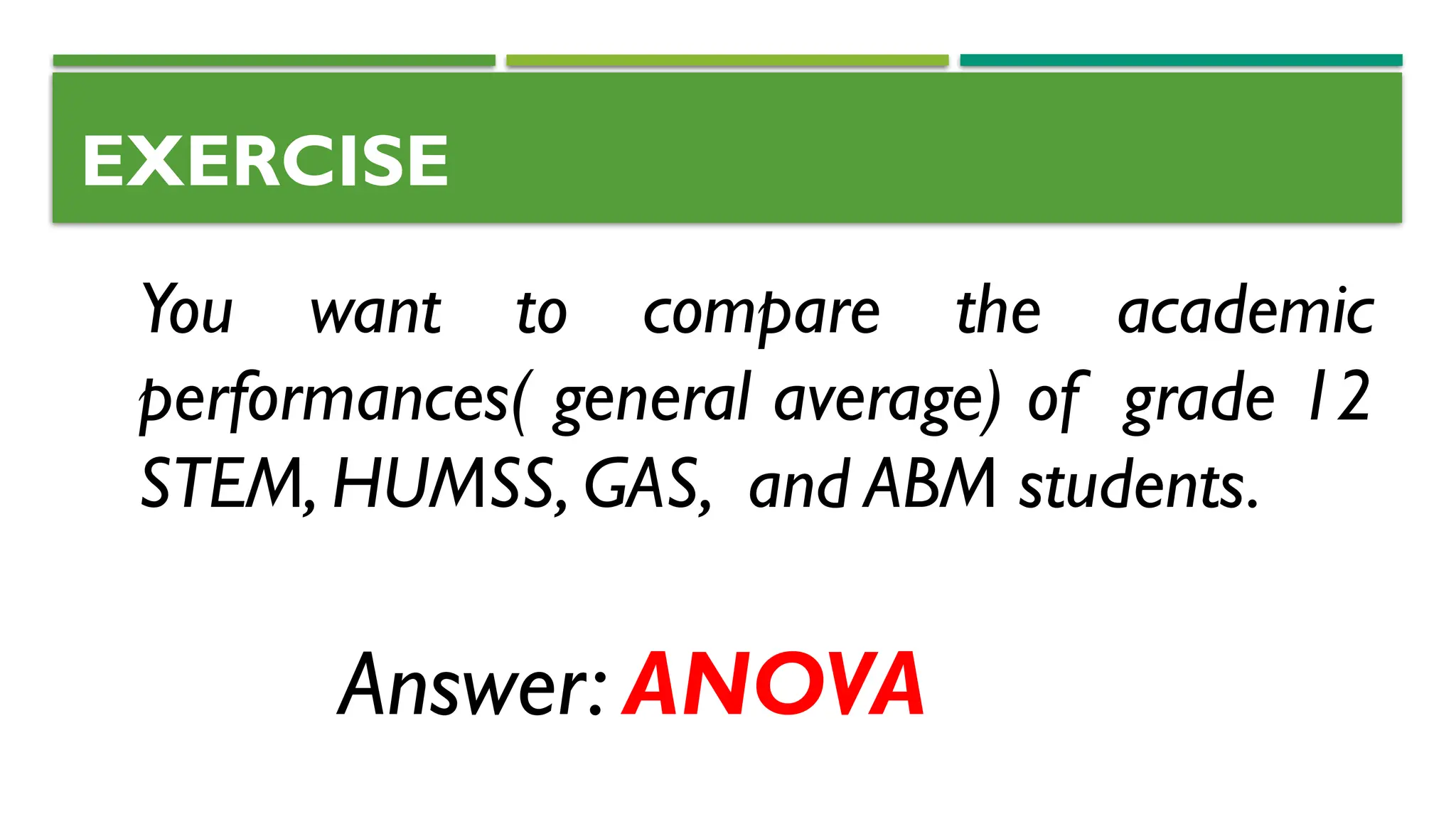
You want to compare the academic
performances( general average) of grade 12
STEM, HUMSS, GAS, and ABM students.
Answer: ANOVA
CHAPTER IV: RESULT AND
DISCUSSION
PRESENTING AND INTERPRETING DATA IN TABULAR AND
GRAPHICAL FORMS
To be able to create and present an organized picture of
information from a research report, it is important to use
certain techniques to communicate findings and
interpretations of research studies into visual
form. The common techniques being used to display
results are tabular, textual and graphical methods.
TEXTUAL PRESENTATION OF DATA
 Textual presentation use words, statements or
paragraphs with numerals, numbers to describe data.
Example: There are 42, 036 barangays in the Philippines. The
largest barangay in terms of population size in Barangay 176 in
Caloocan City with 247 thousand persons. It is followed by
Commonwealth in Quezon City (198, 295) and Batasan Hills in
Quezon City (161, 409). Twelve other barangays posted a
population size of more than a hundred thousand persons.
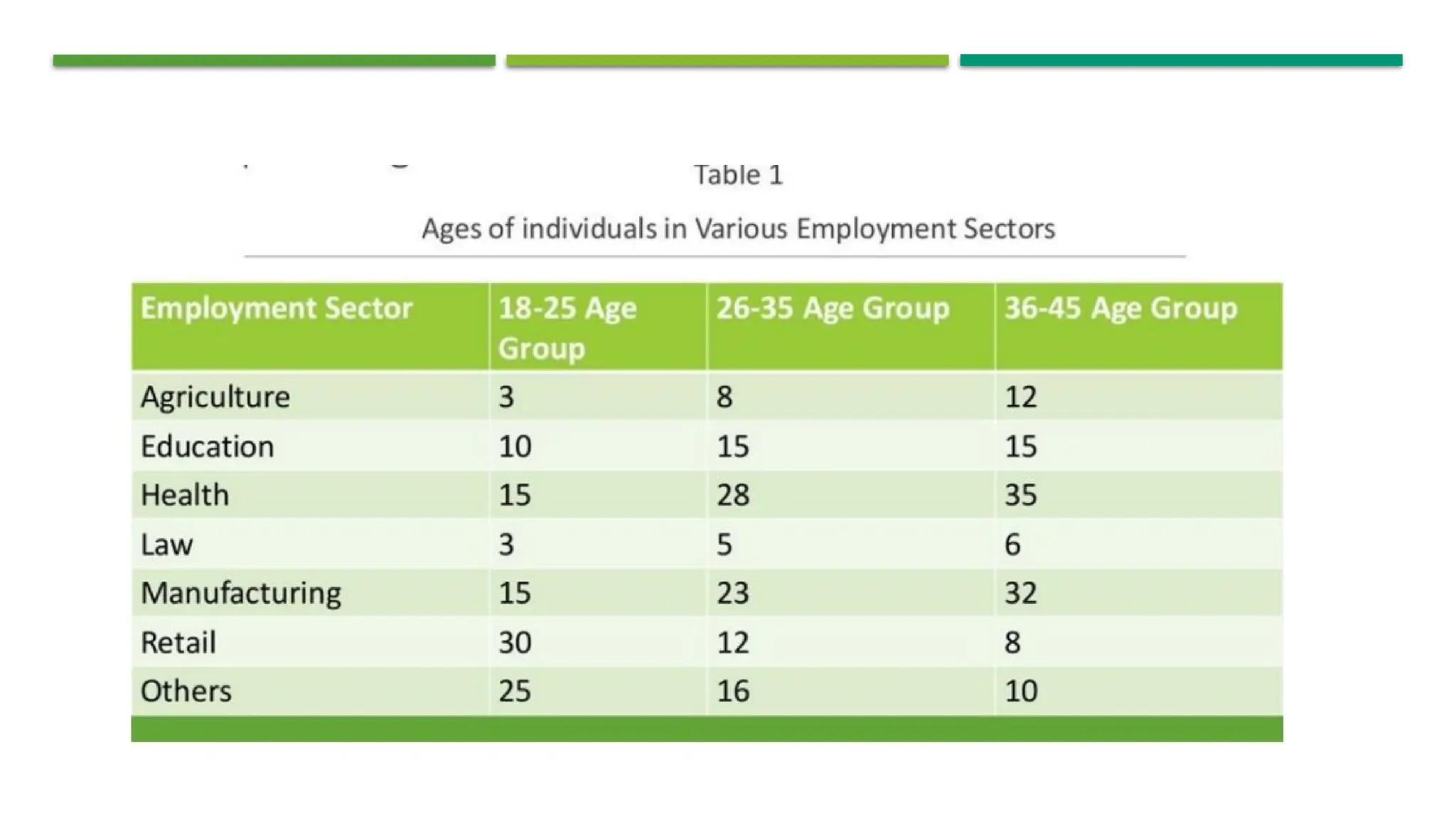
TABULAR PRESENTATION OF DATA
Tables present clear and organized
data.
A table must be clear and simple but
complete.
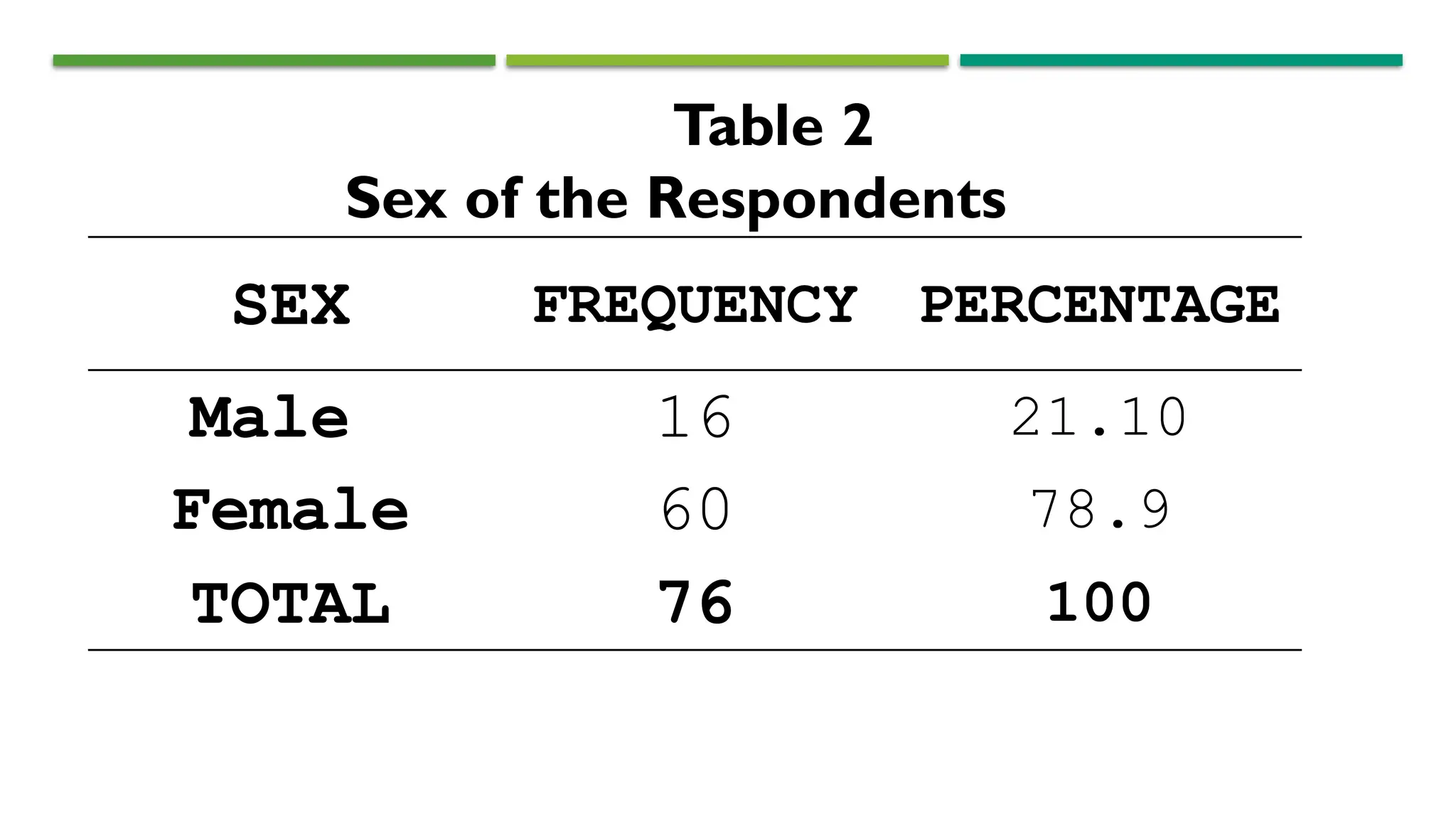
SEX FREQUENCY PERCENTAGE
Male 16 21.10
Female 60 78.9
TOTAL 76 100
Table 2
Sex of the Respondents
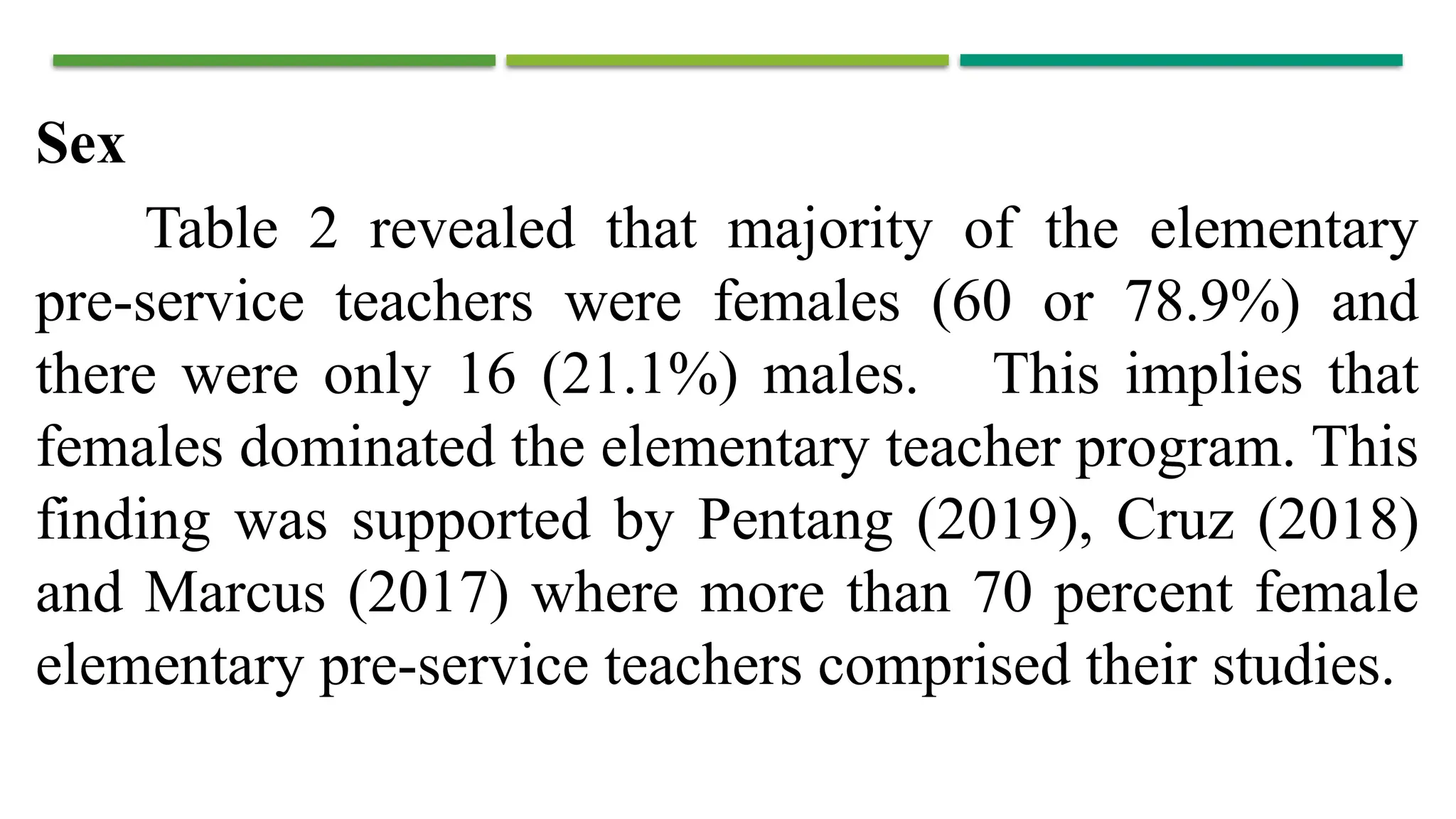
Sex
Table 2 revealed that majority of the elementary
pre-service teachers were females (60 or 78.9%) and
there were only 16 (21.1%) males. This implies that
females dominated the elementary teacher program. This
finding was supported by Pentang (2019), Cruz (2018)
and Marcus (2017) where more than 70 percent female
elementary pre-service teachers comprised their studies.
GRAPHICAL METHOD OF PRESENTING
THE DATA
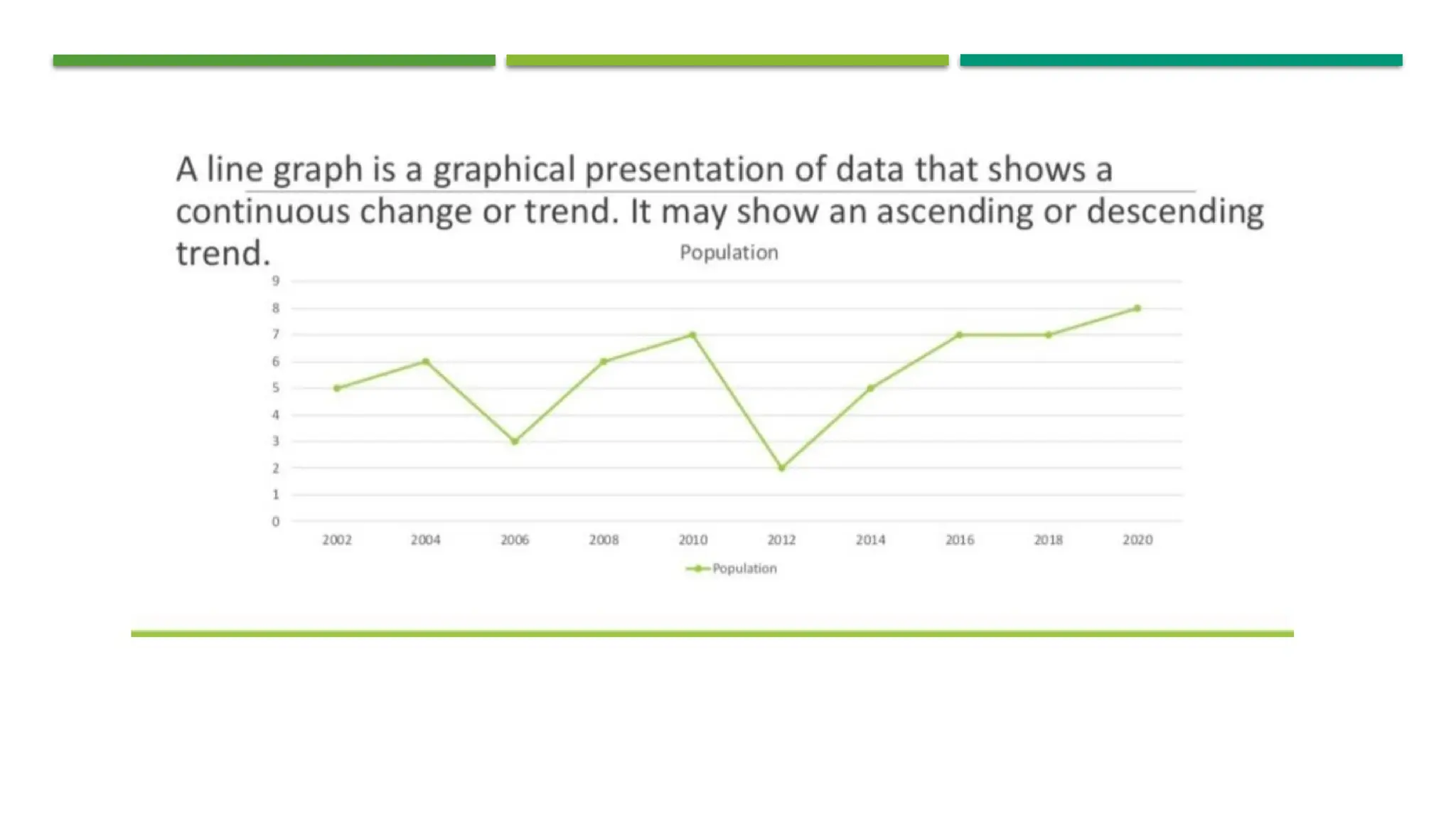
A graph or chart portrays the visual presentation
of data using symbols such as lines, dots, bars or
slices. It depicts the trend of a certain set of
measurements or shows comparison between two
or more sets of data or quantities.
BAR GRAPH
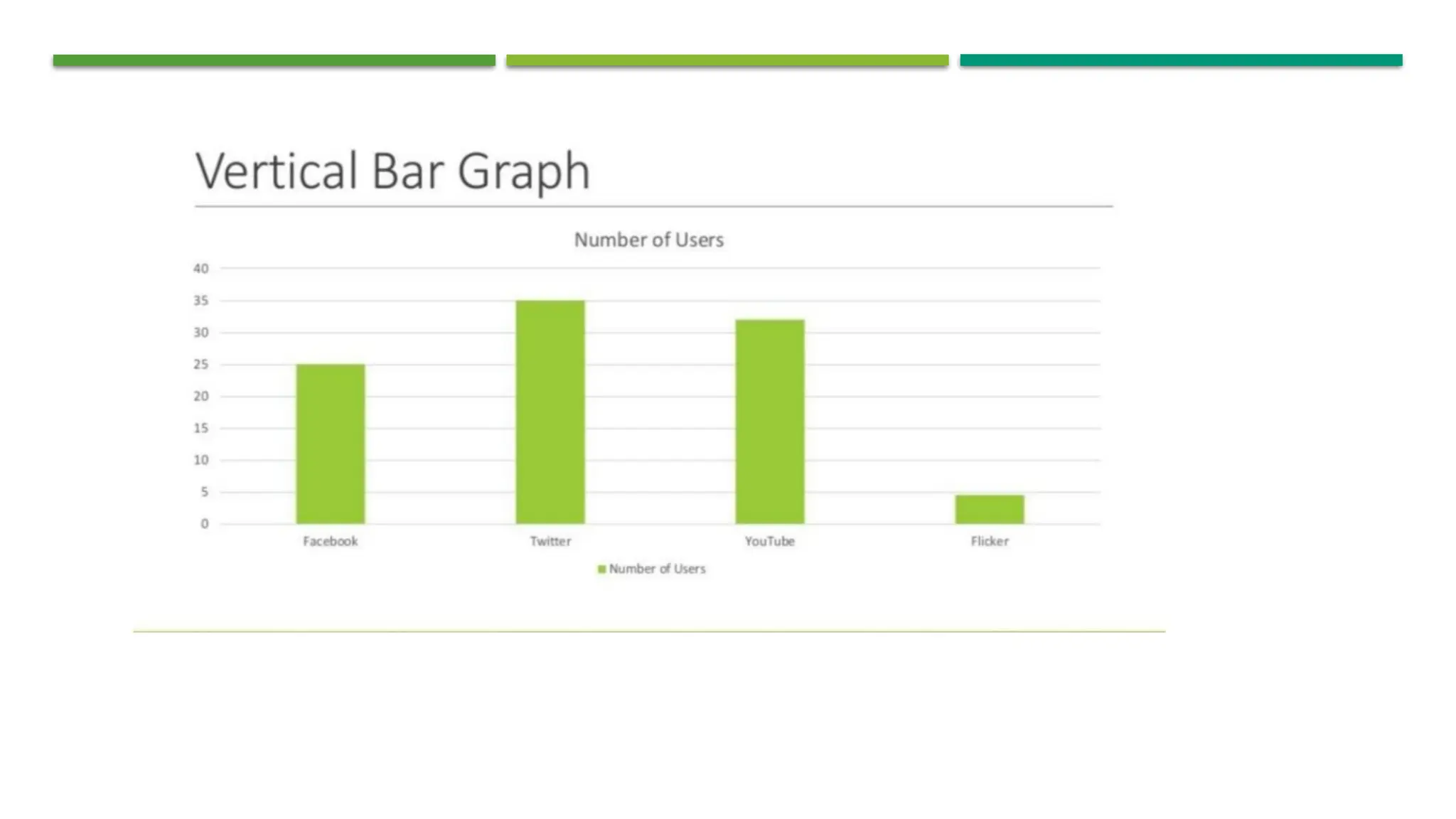
A bar graph uses bars to compare categories
of data. It may be drawn vertically or horizontally.
A vertical bar graph is best to use when comparing
means or percentages between distinct categories.
A bar graph is plotted on either the x-axis or y-
axis
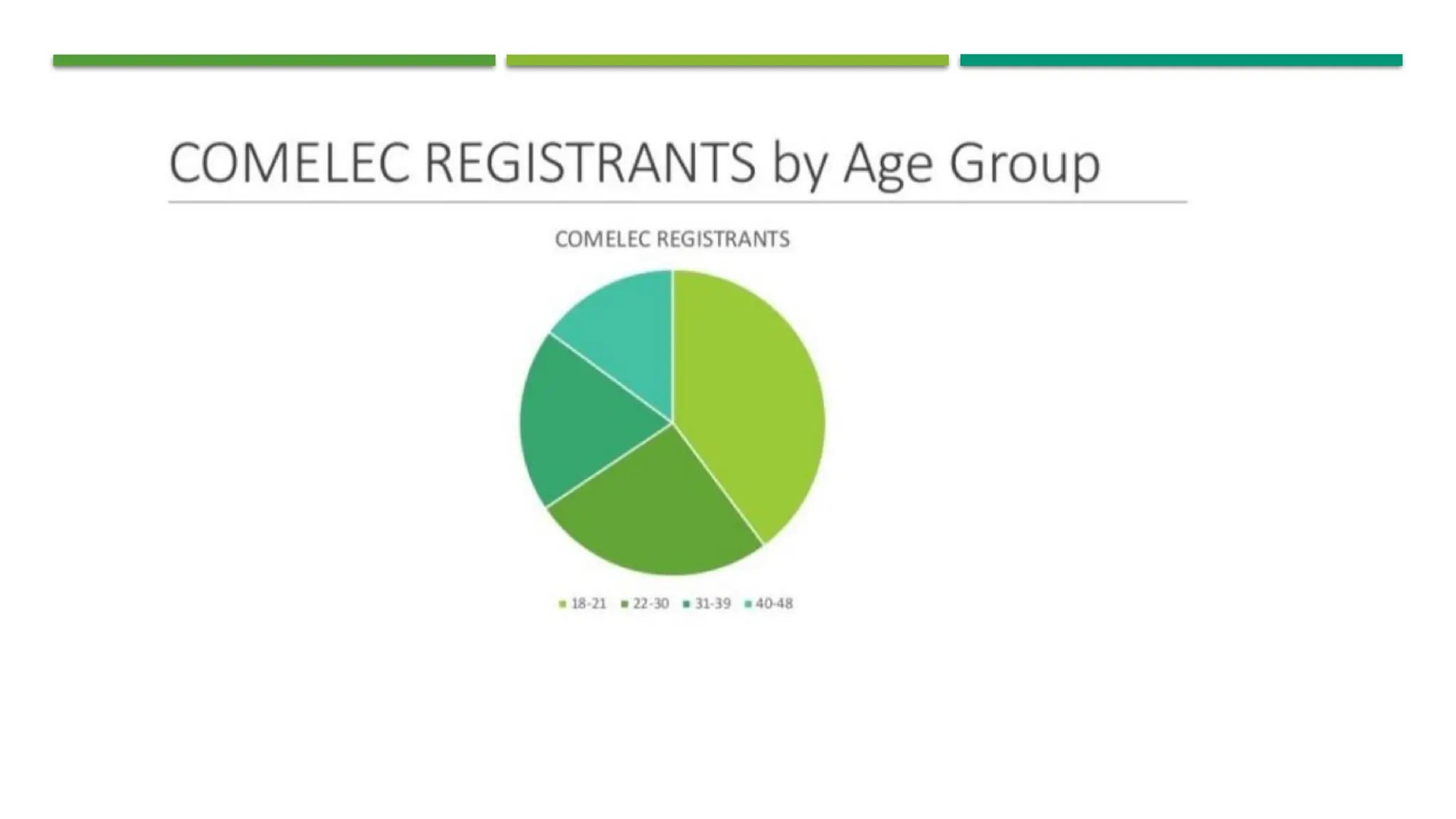
PIE CHARTS OR CIRCLE GRAPHS
A pie chart is usually used to
show how parts of a whole
compare to each other and to the
whole.
CHAPTERV: SUMMARY,
CONCLUSIONS AND
RECOMMENDATION
SUMMARY
• Provide information regarding:
- Purpose of the study
- Who
- Where
- Your objective (based on your research question)
• Provide brief recall regarding all the result of the
study.
CONCLUSION
• Synthesizes key points of the research
findings
• Based on the results of this study, the
conclusions will be drawn.
• In number form.
(no. of research question = no. of conclusion)
RECOMMENDATION
• Shows suggestion or proposal for something that
should be done, as derived from the findings
• Based on the findings and conclusions of the
study.
• In number form.
no. of research question = no. of conclusion+1(for
future researcher)
LESSON 5-DATA ANALYSIS-Practical Research 2

LESSON 5-DATA ANALYSIS-Practical Research 2

  • 1.
  • 2.
    Data Gathering Procedure Thispart discusses course of action done by the researcher in attaining the specific objectives posed in this study. Since the professor of the respondents is the researcher’s adviser, the researcher personally asked permission to conduct the study from the professor. After the permission has been approved, the researcher started the gathering process.
  • 3.
    The data gatheringprocess covered 4 meetings or 4 days. On day 1, the researcher personally distributed the questionnaire to the respondents and pre-test was administered. Before answering the questionnaire, the researcher read and explained the instructions.
  • 4.
    They were allowedto work on their own for a time duration of one and one half (1 ½) hours. On day 2, the researcher implemented the instructional plan 1 (Addition and subtraction of fractions). On day 3, the researcher implemented the instructional plan 2 (Multiplication and division of fractions). Lastly, on day 4, post-test was administered. The respondents were allowed to work on their own for a time duration of one and one half (1 ½) hours.
  • 5.
  • 6.
    DATA ANALYSIS •Find meaningin data so that the derived knowledge can be used to make informed decisions. •It involves the interpretation of data gathered to determine patterns, relationships or trend.
  • 7.
  • 8.
    DESCRIPTIVE STATISTICS  Thefirst step of statistical analysis is to describe characteristics of the responses, such as the average or mean of one variable, median, mode, standard deviation, range etc…
  • 9.
    Measures of Frequency Ex: Percent,Frequency. Measures of Central Tendency Ex: Mean, Median, and Mode. DESCRIPTIVE STATISTICS  Measures of Dispersion or Variation. Ex: Range,Variance, Standard Deviation.  Measures of Position Ex: Percentile Ranks, Quartile Ranks
  • 10.
    FREQUENCY The tally ofhow many people fit into a certain category or the number of times a characteristic occurs. =COUNTIF(range, criteria) MEASURES OF FREQUENCY
  • 11.
    PERCENTAGE A part perhundred. Used to compare one quantity against another. MEASURES OF FREQUENCY
  • 12.
    COMMON SUMMARIZINGVALUES OFDESCRIPTIVE STATISTICS MEAN, MEDIAN, MODE STANDARD DEVIATION
  • 13.
    PROCEDURES IN DETERMININGTHE MEAN, MEDIAN,MODE AND STANDARD DEVIATION USING EXCEL
  • 14.
    PROCEDURES IN FINDINGTHEMEAN FORMULA: =AVERAGE(DRAGTHEDATA) 1. Enter the scores in one of the columns on the Excel spreadsheet. 2. Place the cursor where you wish to have the mean (average) appear and click the mouse button. 3. Select Insert Function (fx) from the FORMULAS tab. 4. Select AVERAGE from the Statistical category and click OK. (Note: If you want the Median, select MEDIAN. If you want the Mode, select MODE.SNGL. Excel only provides one mode. If a data set had more than one mode, Excel would only display one of them.)
  • 15.
    PROCEDURES IN FINDINGTHEMEAN 5. Enter the cell range for your list of numbers in the Number 1 box. 6. For example, if your data were in column A from row 1 to 13, you would enter A1:A13. Instead of typing the range, you can also move the cursor to the beginning of the set of scores you wish to use and click and drag the cursor across them. Once you have entered the range for your list, click on OK at the bottom of the dialog box. The mean (average) for the list will appear in the cell you selected.
  • 18.
    STANDARD DEVIATION FORMULA: =STDEV.S(DRAGTHEDATA) It is the average difference between observed values and the mean.  The standard deviation is used when expressing dispersion in the same units as the original measurements. It is used more commonly than the variance in expressing the degree to which data are spread out.
  • 19.
    1. Place thecursor where you wish to have the standard deviation appear and click the mouse button. 2. Select Insert Function (fx) from the FORMULAS tab. A dialog box will appear. 3. Select STDEV.S (for a sample) from the the Statistical category. (Note: If your data are from a population, click on STDEV.P). After you have made your selections, click on OK at the bottom of the dialog box. FINDINGTHE STANDARD DEVIATION
  • 20.
    4. Enter thecell range for your list of numbers in the Number 1 box. 5. For example, if your data were in column A from row 1 to 13, you would enter A1:A13. Instead of typing the range, you can also move the cursor to the beginning of the set of scores you wish to use and click and drag the cursor across them. Once you have entered the range for your list, click on OK at the bottom of the dialog box. The standard deviation for the list will appear in the cell you selected. FINDINGTHE STANDARD DEVIATION
  • 23.
  • 24.
    INFERENTIAL STATISTICS •Deals withthe predictions and inferences based on the analysis and interpretation of the results of the information gathered by the statistician. STATISTICAL TOOLS: t-test, analysis of variance, chi- square, and Pearson’s r
  • 25.
  • 26.
    t-Test (Comparing meansor averages) A t-test is a type of inferential statistic used to determine if there is a significant difference between the means of two groups, which may be related in certain features.
  • 27.
    t-Test (Comparing meansor averages) Types of t-test: One sample t-test Independent sample t-test Paired Sample t-test
  • 28.
    Types of t-test •One-Samplet-test The One-Sample t-test procedure tests whether the mean of a single variable differs from a specified constant.
  • 29.
    Types of t-test •One-Samplet-test Examples: • A researcher might want to test whether the average summative score for a group of students differs from 75. • A researcher might want to test whether THE sample respondents differs at 100 lbs.
  • 30.
    Types of t-test •Paired-Samplest-test The Paired-Samples t-test procedure compares the means of two variables for a single group. The procedure computes the differences between values of the two variables for each case.
  • 31.
    Types of t-test •Paired-Samplest-test Example: In a study on high blood pressure, all patients are measured at the beginning of the study, given a treatment, and measured again. Thus, each subject has two measures, often called before and after measures.
  • 32.
    Types of t-test •Independent-Samplest-test oThe Independent-Samples t-test procedure compares means for two groups of cases. oIdeally, for this test, the subjects should be randomly assigned to two groups, so that any difference in response is due to the treatment (or lack of treatment) and not to other factors.
  • 33.
    Example • Patients withhigh blood pressure are randomly assigned to a placebo group and a treatment group. • The placebo subjects receive an inactive pill, and the treatment subjects receive a new drug that is expected to lower blood pressure. • After the subjects are treated for two months, the two- sample or independent sample t- test is used to compare the average blood pressures for the placebo group and the treatment group.
  • 34.
  • 35.
    ANOVA (ANALYSIS OFVARIANCE) ANOVAis used to test the hypothesis of the several means. In addition to determining that differences exist among the means, you may want to know which means differ.
  • 36.
    ANOVA (ANALYSIS OFVARIANCE) Example: Isthere a significant difference on the test scores of students who had self-review, pair review or group review?
  • 37.
  • 38.
    BIVARIATE CORRELATIONS The BivariateCorrelations procedure computes Pearson's correlation coefficient and Spearman's rho with their significance levels. Correlations measure how variables or rank orders are related. (BUT THE RELATIONSHIP IS NOT CAUSAL)
  • 39.
    BIVARIATE CORRELATIONS •Pearson Correlation -producesa sample correlation coefficient, r, which measures the strength and direction of linear relationships between pairs of continuous variables. -Pearson Correlation evaluates whether there is statistical evidence for a linear relationship among the same pairs of variables in the population.
  • 40.
    BIVARIATE CORRELATIONS •Pearson Correlation Example: Studentswere given a test in Math and were also given a test in Science . The researcher wants to find out if students who got high scores in Math also scored high in Science
  • 41.
    • Positive Correlation: Indicatesthat the values on the two variables being analyzed move in the same direction. DIRECTION OF CORRELATION COEFFICIENT r = positive
  • 42.
    • Negative Correlation: Indicatesthat the values on the two variables being analyzed move in opposite direction. DIRECTION OF CORRELATION COEFFICIENT r = negative
  • 43.
    • No Correlation Nodiscernable pattern between the scores on the two variables. DIRECTION OF CORRELATION COEFFICIENT r = 0
  • 44.
    STRENGTH OR MAGNITUDEOF THE RELATIONSHIP Value of r Descriptive Interpretation 0 No relationship ±0.01 - ±0.20 Very weak relationship ±0.21 - ±0.40 Weak relationship ±0.41 - ±0.70 Moderate relationship ±0.71 - ±0.80 Strong relationship ±0.81 - ±0.99 Very strong relationship ± 1 Perfect relationship
  • 45.
    BIVARIATE CORRELATIONS •Spearman Rho Spearmancorrelation is often used to evaluate relationships involving ordinal variables. Example: You might use a Spearman correlation to evaluate whether the order in which employees complete a test exercise is related to the number of months they have been employed.
  • 46.
  • 47.
    CHI SQUARE It isused to measure the relationship between two dichotomous variable (alternative to correlation for variables that are dichotomous)
  • 48.
    CHI SQUARE Example: Is therean association between sex (male & female) and opinion on same sex marriage (favor & not in favor)
  • 49.
  • 50.
    LINEAR REGRESSION Linear Regressionestimates the coefficients of the linear equation, involving one (simple regression) or more (multiple regression) independent variables, that best predict the value of the dependent variable.
  • 51.
    LINEAR REGRESSION Example researchquestion: •Has the body weight an influence on the blood cholesterol level? •Does the oxygen level in water stimulate plant growth? •Does customer satisfaction influence loyalty? •Is anxiety influenced by personality traits?
  • 52.
  • 53.
    EXERCISE You want tocompare the mean test-score in General Mathematics of Grade 11-stem students to 80. Answer: One SampleT-test
  • 54.
    EXERCISE You want tofind the relationship between age and IQ(test score). Answer: Pearson’s r
  • 55.
    EXERCISE You want tofind the relationship between sex(male or female) and academic performance (passed or failed) of the respondents. Answer: Chi-square
  • 56.
    EXERCISE You want toknow if highest educational attainment predicts the salary of the respondents. Answer: Regression
  • 57.
    EXERCISE You want tocompare the academic performances( general average) of grade 12 STEM, HUMSS, GAS, and ABM students. Answer: ANOVA
  • 58.
    CHAPTER IV: RESULTAND DISCUSSION
  • 59.
    PRESENTING AND INTERPRETINGDATA IN TABULAR AND GRAPHICAL FORMS To be able to create and present an organized picture of information from a research report, it is important to use certain techniques to communicate findings and interpretations of research studies into visual form. The common techniques being used to display results are tabular, textual and graphical methods.
  • 60.
    TEXTUAL PRESENTATION OFDATA  Textual presentation use words, statements or paragraphs with numerals, numbers to describe data. Example: There are 42, 036 barangays in the Philippines. The largest barangay in terms of population size in Barangay 176 in Caloocan City with 247 thousand persons. It is followed by Commonwealth in Quezon City (198, 295) and Batasan Hills in Quezon City (161, 409). Twelve other barangays posted a population size of more than a hundred thousand persons.
  • 61.
    TABULAR PRESENTATION OFDATA Tables present clear and organized data. A table must be clear and simple but complete.
  • 63.
    SEX FREQUENCY PERCENTAGE Male16 21.10 Female 60 78.9 TOTAL 76 100 Table 2 Sex of the Respondents
  • 64.
    Sex Table 2 revealedthat majority of the elementary pre-service teachers were females (60 or 78.9%) and there were only 16 (21.1%) males. This implies that females dominated the elementary teacher program. This finding was supported by Pentang (2019), Cruz (2018) and Marcus (2017) where more than 70 percent female elementary pre-service teachers comprised their studies.
  • 65.
    GRAPHICAL METHOD OFPRESENTING THE DATA A graph or chart portrays the visual presentation of data using symbols such as lines, dots, bars or slices. It depicts the trend of a certain set of measurements or shows comparison between two or more sets of data or quantities.
  • 67.
    BAR GRAPH A bargraph uses bars to compare categories of data. It may be drawn vertically or horizontally. A vertical bar graph is best to use when comparing means or percentages between distinct categories. A bar graph is plotted on either the x-axis or y- axis
  • 69.
    PIE CHARTS ORCIRCLE GRAPHS A pie chart is usually used to show how parts of a whole compare to each other and to the whole.
  • 71.
  • 72.
    SUMMARY • Provide informationregarding: - Purpose of the study - Who - Where - Your objective (based on your research question) • Provide brief recall regarding all the result of the study.
  • 73.
    CONCLUSION • Synthesizes keypoints of the research findings • Based on the results of this study, the conclusions will be drawn. • In number form. (no. of research question = no. of conclusion)
  • 74.
    RECOMMENDATION • Shows suggestionor proposal for something that should be done, as derived from the findings • Based on the findings and conclusions of the study. • In number form. no. of research question = no. of conclusion+1(for future researcher)